
LK-100 - Clavier électronique CASIO - Notice d'utilisation et mode d'emploi gratuit
Retrouvez gratuitement la notice de l'appareil LK-100 CASIO au format PDF.


| Type de produit | Clavier électronique |
| Marque | CASIO |
| Modèle | LK-100 |
| Dimensions | 94,5 × 37,3 × 13,5 cm |
| Poids | Environ 4,7 kg (sans piles) |
| Alimentation | 6 piles AA (LR6) ou adaptateur secteur AD-5 (9 V CC) |
| Autonomie des piles | Environ 4 heures avec piles alcalines, 1 heure avec piles manganèse |
| Consommation électrique | 9 V --- 7,7 W |
| Clavier | 61 touches standard, 5 octaves |
| Système d'éclairage des touches | Jusqu'à 4 touches allumées simultanément, activable/désactivable |
| Polyphonie | 12 notes maximum |
| Sons | 100 sons préréglés |
| Système d'apprentissage en 3 étapes | Étape 1 : maîtrise du rythme, Étape 2 : maîtrise de la mélodie, Étape 3 : jeu à vitesse normale |
| Guide vocal des doigtés | Voix simulée indiquant les numéros de doigts pendant les étapes 1 et 2 |
| Accompagnement automatique | 50 motifs rythmiques, 2 systèmes d'accords (CASIO CHORD et FINGERED) |
| Morceaux intégrés (Song Bank) | 100 morceaux |
| Fonctions de transposition et d'accord | Transposition par demi-tons (Fa# à Fa), accordage réglable (A4 ≈ 440 Hz ± 50 cents) |
| Connectique MIDI | MIDI IN/OUT, réception 5 parties multi-timbre |
| Microphone | Prise jack standard avec réglage de volume (impédance d'entrée 2 kΩ, sensibilité 10 mV) |
| Haut-parleurs | 2 × 10 cm (sortie 2 W + 2 W) |
| Entretien et nettoyage | Nettoyer avec un chiffon doux légèrement humide (eau + détergent neutre). Éviter les solvants. |
| Sécurité | Utiliser uniquement l'adaptateur AD-5. Ne pas démonter. Tenir à l'écart de l'eau et des sources de chaleur. Ne pas exposer à la pluie. |
| Pièces détachées et réparabilité | Confier toute réparation à un centre de service agréé CASIO. Utiliser exclusivement les accessoires spécifiés. |
FOIRE AUX QUESTIONS - LK-100 CASIO
Questions des utilisateurs sur LK-100 CASIO
0 question sur cet appareil. Repondez a celles que vous connaissez ou posez la votre.
Poser une nouvelle question sur cet appareil
Téléchargez la notice de votre Clavier électronique au format PDF gratuitement ! Retrouvez votre notice LK-100 - CASIO et reprennez votre appareil électronique en main. Sur cette page sont publiés tous les documents nécessaires à l'utilisation de votre appareil LK-100 de la marque CASIO.
MODE D'EMPLOI LK-100 CASIO
LK-100
GUIDE DE L'UTILISATEUR

DIRECTIVES ÉTABLIES PAR LES RÈGLES DE LA FCC POUR L'UTILISATION DE L'APPAREIL AUX ÉTATS-UNIS (non applicables dans d'autres régions).
AVIS
Cet équipement a été testé et déclaré conforme aux limites d'un appareil numérique de classe B, conformément à la partie 15 des règles de la FCC. Ces limites sont conçues pour fournir une protection raisonnable contre les interférences nuisibles dans une installation résidentielle. Cet équipement génère, utilise et peut émettre de l'énergie radiofréquence et, s'il n'est pas installé et utilisé conformément aux instructions, peut causer des interférences nuisibles aux communications radio. Cependant, il n'y a aucune garantie que des interférences ne se produiront pas dans une installation particulière. Si cet équipement cause des interférences nuisibles à la réception radio ou télévision, ce qui peut être déterminé en éteignant et en allumant l'équipement, l'utilisateur est encouragé à essayer de corriger les interférences par une ou plusieurs des mesures suivantes :
Réorienter ou déplacer l'antenne de réception. - Augmenter la distance entre l'équipement et le récepteur. - Connecter l'équipement à une prise sur un circuit différent de celui auquel le récepteur est connecté. - Consulter le revendeur ou un technicien radio/TV expérimenté pour obtenir de l'aide.
AVERTISSEMENT FCC
Des changements ou modifications non expressément approuvés par la partie responsable de la conformité pourraient annuler le droit de l'utilisateur à utiliser l'équipement.
Important !
Veuillez noter les informations importantes suivantes avant d'utiliser ce produit.
- Avant d'utiliser l'adaptateur secteur AD-5 en option pour alimenter l'appareil, assurez-vous de vérifier d'abord l'adaptateur secteur pour tout dommage. Vérifiez soigneusement le cordon d'alimentation pour détecter toute rupture, coupure, fil exposé ou autre dommage grave. Ne laissez jamais les enfants utiliser un adaptateur secteur gravement endommagé.
- N'essayez jamais de recharger des piles.
- N'utilisez pas de piles rechargeables.
- Ne mélangez jamais des piles anciennes avec des piles neuves.
- Utilisez les piles recommandées ou des types équivalents.
- Assurez-vous toujours que les pôles positif (+) et négatif (-) sont orientés correctement comme indiqué près du compartiment à piles.
- Remplacez les piles dès que possible après tout signe de faiblesse.
- Ne court-circuitez pas les bornes des piles.
- Le produit n'est pas destiné aux enfants de moins de 3 ans.
- Utilisez uniquement l'adaptateur CASIO AD-5.
- L'adaptateur secteur n'est pas un jouet.
- Assurez-vous de débrancher l'adaptateur secteur avant de nettoyer le produit.
Félicitations pour votre choix de l'instrument de musique électronique CASIO.
- Avant d'utiliser l'instrument, assurez-vous de lire attentivement les instructions contenues dans ce manuel.
- Conservez soigneusement toute la documentation utilisateur pour référence future.
Symboles
Divers symboles sont utilisés dans ce guide de l'utilisateur et sur le produit lui-même pour garantir une utilisation sûre et correcte du produit, et pour prévenir les blessures à l'utilisateur et à d'autres personnes ainsi que les dommages matériels. Ces symboles et leurs significations sont indiqués ci-dessous.

DANGER
Ce symbole indique une information qui, si elle est ignorée ou appliquée incorrectement, crée un danger de mort ou de blessure grave.

AVERTISSEMENT
Cette indication précise les points qui présentent un risque de mort ou de blessure grave si le produit est utilisé incorrectement en ignorant cette indication.

ATTENTION
Cette indication précise les points qui présentent un risque de blessure ainsi que les points pour lesquels il y a une probabilité de dommages matériels uniquement si le produit est utilisé incorrectement en ignorant cette indication.
Exemples de symboles

Ce symbole triangulaire () signifie que l'utilisateur doit être prudent. (L'exemple à gauche indique une prudence concernant un choc électrique.)

Ce cercle barré () signifie que l'action indiquée ne doit pas être effectuée. Les indications à l'intérieur ou à proximité de ce symbole sont spécifiquement interdites. (L'exemple à gauche indique que le démontage est interdit.)

Le point noir () signifie que l'action indiquée doit être effectuée. Les indications à l'intérieur de ce symbole sont des actions spécifiquement recommandées. (L'exemple à gauche indique que la fiche d'alimentation doit être débranchée de la prise électrique.)
DANGER
Piles alcalines
Effectuez immédiatement les étapes suivantes si du liquide s'échappant de piles alcalines entre en contact avec vos yeux.
- Ne vous frottez pas les yeux ! Rincez-les avec de l'eau.
- Contactez immédiatement votre médecin.
Laisser du liquide de pile alcaline dans vos yeux peut entraîner une perte de la vue.

AVERTISSEMENT
Fumée, odeur étrange, surchauffe
Continuer à utiliser le produit alors qu'il émet de la fumée, une odeur étrange ou de la chaleur présente un risque d'incendie et de choc électrique. Suivez immédiatement les étapes suivantes.
- Coupez l'alimentation.
- Si vous utilisez l'adaptateur secteur pour l'alimentation, débranchez-le de la prise murale.
- Contactez votre revendeur d'origine ou un prestataire de services CASIO agréé.
Adaptateur secteur
- Une mauvaise utilisation de l'adaptateur secteur présente un risque d'incendie et de choc électrique. Assurez-vous toujours de respecter les précautions suivantes.
- Veillez à n'utiliser que l'adaptateur secteur spécifié pour ce produit.
- N'utilisez qu'une source d'alimentation dont la tension est conforme à la valeur nominale indiquée sur l'adaptateur secteur.
- Ne surchargez pas les prises électriques et les rallonges.


- Une mauvaise utilisation du cordon électrique de l'adaptateur secteur peut l'endommager ou le casser, présentant un risque d'incendie et de choc électrique. Assurez-vous toujours de respecter les précautions suivantes.
- Ne placez jamais d'objets lourds sur le cordon et ne l'exposez pas à la chaleur.
- Ne tentez jamais de modifier le cordon et ne le soumettez pas à des courbures excessives.
- Ne tordez jamais le cordon et ne l'étirez pas.
- Si le cordon d'alimentation ou la fiche est endommagé, contactez votre revendeur d'origine ou un centre de service agréé CASIO.
- Ne touchez jamais l'adaptateur secteur avec les mains mouillées.
Cela présente un risque de choc électrique.
- Utilisez l'adaptateur secteur dans un endroit où il ne sera pas éclaboussé d'eau. L'eau présente un risque d'incendie et de choc électrique.
- Ne placez pas de vase ou tout autre récipient contenant du liquide sur l'adaptateur secteur. L'eau présente un risque d'incendie et de choc électrique.
Piles
Une mauvaise utilisation des piles peut provoquer une fuite, entraînant des dommages aux objets environnants, ou une explosion, présentant un risque d'incendie et de blessures. Assurez-vous toujours de respecter les précautions suivantes.
- Ne tentez jamais de démonter les piles ou de les court-circuiter.
- N'exposez jamais les piles à la chaleur et ne les jetez pas au feu.
- Ne mélangez jamais des piles anciennes avec des piles neuves.
- Ne mélangez jamais des piles de types différents.
- Ne chargez pas les piles.
- Assurez-vous que les extrémités positive (+) et négative (-) des piles sont orientées correctement.


N'incinérez pas le produit.
Ne jetez jamais le produit au feu. Cela pourrait provoquer une explosion, créant un risque d'incendie et de blessures.
Eau et corps étrangers
La pénétration d'eau, d'autres liquides ou de corps étrangers (tels que des morceaux de métal) dans le produit présente un risque d'incendie et de choc électrique. Prenez immédiatement les mesures suivantes.
- Mettez l'appareil hors tension.
- Si vous utilisez l'adaptateur secteur, débranchez-le de la prise murale.
- Contactez votre revendeur d'origine ou un prestataire de services CASIO agréé.
Démontage et modification
N'essayez jamais de démonter ce produit ou de le modifier de quelque manière que ce soit. Cela présente un risque de choc électrique, de brûlure ou d'autres blessures. Confiez toute inspection interne, tout réglage et toute maintenance à votre revendeur d'origine ou à un prestataire de services CASIO agréé.
Chute et impact
L'utilisation continue de ce produit après qu'il a été endommagé par une chute ou un impact violent présente un risque d'incendie et de choc électrique. Prenez immédiatement les mesures suivantes.
- Coupez l'alimentation.
- Si vous utilisez l'adaptateur secteur, débranchez-le de la prise murale.
- Contactez votre revendeur d'origine ou un centre de service agréé CASIO.


Sacs en plastique
Ne placez jamais le sac en plastique fourni avec le produit sur votre tête ou dans votre bouche. Cela présente un risque de suffocation.
Une attention particulière est requise en présence de jeunes enfants.


Ne montez pas sur le produit ou le support.*
Monter sur le produit ou le support peut le faire basculer ou l'endommager. Une attention particulière est requise en présence de jeunes enfants.

Emplacement
Évitez de placer le produit sur un support instable, une surface inégale ou tout autre endroit instable. Un emplacement instable peut faire tomber le produit, créant un risque de blessure.
ATTENTION
Adaptateur secteur
- Une mauvaise utilisation de l'adaptateur secteur présente un risque d'incendie et de choc électrique. Assurez-vous toujours de respecter les précautions suivantes.
- Ne placez pas le cordon électrique près d'une cuisinière ou d'autres sources de chaleur.
- Ne tirez jamais sur le cordon pour débrancher la prise électrique. Saisissez toujours l'adaptateur secteur pour débrancher.
- Une mauvaise utilisation de l'adaptateur secteur présente un risque d'incendie et de choc électrique. Assurez-vous toujours de respecter les précautions suivantes.
- Insérez l'adaptateur secteur dans la prise murale jusqu'au bout.
- Débranchez l'adaptateur secteur de la prise murale pendant les orages ou avant de partir en voyage ou en cas d'absence prolongée.
- Au moins une fois par an, débranchez l'adaptateur secteur de la prise murale et essuyez toute poussière accumulée autour des broches de la fiche.
Déplacement du produit
Avant de déplacer le produit, débranchez toujours l'adaptateur secteur de la prise murale et déconnectez tous les autres câbles et cordons de connexion. Laisser les cordons connectés présente un risque de dommage aux cordons, d'incendie et de choc électrique.


Nettoyage
Avant de nettoyer le produit, débranchez toujours l'adaptateur secteur de la prise murale en premier. Laisser l'adaptateur secteur branché présente un risque de dommage à l'adaptateur secteur, d'incendie et de choc électrique.

Piles
Une mauvaise utilisation des piles peut provoquer une fuite, entraînant des dommages aux objets à proximité, ou une explosion, créant un risque d'incendie et de blessures. Assurez-vous toujours de respecter les précautions suivantes.

- Utilisez uniquement des piles spécifiées pour être utilisées avec ce produit.

- Retirez les piles du produit si vous ne prévoyez pas de l'utiliser pendant une longue période.
Connecteurs
Connectez uniquement les appareils et équipements spécifiés aux connecteurs du produit. La connexion d'un appareil ou d'un équipement non spécifié présente un risque d'incendie et de choc électrique.

Emplacement
Évitez les emplacements suivants pour ce produit. De tels emplacements présentent un risque d'incendie et de choc électrique.
- Les zones soumises à une humidité élevée ou à de grandes quantités de poussière.
- Dans les zones de préparation des aliments ou d'autres zones soumises à la fumée d'huile.
- Près des climatiseurs, sur un tapis chauffant, dans les zones exposées à la lumière directe du soleil, à l'intérieur d'un véhicule garé au soleil, ou dans toute autre zone soumettant le produit à des températures élevées.
Écran d'affichage
- Ne poussez jamais sur le panneau LCD de l'écran d'affichage et ne le soumettez pas à des chocs violents. Cela pourrait fissurer le verre du panneau LCD, créant un risque de blessure.
- Si le panneau LCD se fissure ou se brise, ne touchez jamais le liquide à l'intérieur du panneau. Le liquide du panneau LCD peut provoquer une irritation cutanée.
- Si le liquide du panneau LCD pénètre dans votre bouche, rincez immédiatement votre bouche avec de l'eau et contactez votre médecin.
- Si le liquide du panneau LCD pénètre dans vos yeux ou sur votre peau, rincez à l'eau claire pendant au moins 15 minutes, puis contactez un médecin.
Volume sonore
N'écoutez pas de musique à des volumes très élevés pendant de longues périodes. Une attention particulière à cette précaution est requise lors de l'utilisation d'écouteurs. Des réglages de volume élevés peuvent endommager votre audition.
Précaution sanitaire
Dans des cas extrêmement rares, l'exposition à une lumière forte soudaine ou à une lumière clignotante peut provoquer des spasmes musculaires momentanés, une perte de conscience ou d'autres problèmes physiques chez certaines personnes.
- Si vous pensez que vous pourriez être sensible à une telle condition, consultez votre médecin avant d'utiliser ce produit.
- Utilisez ce produit dans un endroit bien éclairé.
- Si vous ressentez des symptômes similaires à ceux décrits ci-dessus lors de l'utilisation de ce produit, arrêtez immédiatement de l'utiliser et contactez votre médecin.


Objets lourds
Ne placez jamais d'objets lourds sur le produit.

Cela peut rendre le produit instable, provoquant son basculement ou la chute de l'objet, créant un risque de blessure.

Assemblage correct du support*
Un support mal assemblé peut basculer, provoquant la chute du produit et créant un risque de blessure.
Assurez-vous d'assembler correctement le support, en suivant les instructions d'assemblage fournies. Assurez-vous de monter le produit sur le support correctement.
- Le support est disponible en option.
IMPORTANT !
Lors de l'utilisation de piles, assurez-vous de les remplacer ou de passer à une autre source d'alimentation dès que vous remarquez l'un des symptômes suivants.
- Voyant d'alimentation faible : l'instrument ne s'allume pas.
- Affichage qui scintille, est faible ou difficile à lire.
- Volume anormalement faible du haut-parleur/casque, distorsion du son.
- Interruption occasionnelle du son lors de la lecture à volume élevé.
- Coupure soudaine de l'alimentation lors de la lecture à volume élevé.
- Scintillement ou affaiblissement de l'affichage lors de la lecture à volume élevé.
- Le son continue de sortir même après avoir relâché une touche.
- Une tonalité totalement différente de celle sélectionnée.
- Lecture anormale du motif rythmique et de la banque de chansons.
- Perte de puissance, distorsion du son ou volume faible lors de la lecture depuis un ordinateur ou un périphérique MIDI connecté.
- Volume du microphone anormalement faible, distorsion de l'entrée microphone.
- Voyant d'alimentation faible lorsque le microphone est utilisé.
Indicateurs à l'écran pour le doigté et le timing.
- Des indicateurs à l'écran faciles à comprendre aident à simplifier le jeu au clavier, même pour les novices.
100 sonorités incroyablement réalistes.
Fonction d'accompagnement automatique améliorée pour une plus grande polyvalence.
- 50 motifs d'accompagnement automatique intégrés.
100 airs intégrés dans la banque de chansons.
- Un total de 100 airs intégrés dans la banque de chansons est fourni pour le plaisir de l'écoute ou pour s'entraîner en jouant.
Système de leçon en 3 étapes.
- Développez vos compétences musicales en suivant les touches qui s'allument. Tout d'abord, familiarisez-vous avec le rythme des notes en regardant les touches s'allumer pendant la lecture d'un des 100 airs de la banque de chansons. Ensuite, entraînez-vous à jouer à un rythme qui vous convient. Enfin, essayez de jouer au tempo normal de l'air de la banque de chansons.
- Une voix humaine simulée est utilisée pendant la lecture des étapes 1 ou 2 pour indiquer les doigts à utiliser pour jouer les notes requises (doigté vocal). Le rythme des notes est également indiqué sur l'écran.
Accompagnement automatique.
- Il suffit de spécifier un accord et le clavier produit automatiquement le rythme, la basse et les motifs d'accords correspondants. Les remplissages en un seul geste rendent les accompagnements intéressants et naturels.
Fonction de transposition.
- Une opération simple change instantanément la tonalité du clavier.
Compatibilité MIDI.
- La connexion à un autre périphérique MIDI vous permet de faire sonner les notes à la fois sur ce clavier et sur le périphérique connecté en jouant sur ce clavier.
Prise microphone.
- Connectez un microphone disponible dans le commerce et vous pouvez chanter en accompagnement des airs de la banque de chansons.
Consignes de sécurité E-1
Caractéristiques principales E-6
Guide général E-8
Fixation du pupitre E-9
Référence rapide E-10
Alimentation E-11
Utilisation des piles E-11
Utilisation de l'adaptateur secteur E-11
Mise hors tension automatique E-12
Alerte de mise sous tension E-12
Entretien de votre clavier E-12
Connexions E-13
Prise casque/sortie E-13
Prise sustain E-13
Utilisation de la prise microphone E-13
Accessoires et options E-14
Opérations de base E-15
Mise sous/hors tension E-15
Changement de sonorités E-15
Autres fonctions utiles E-16
Lecture des morceaux de démonstration E-17
Lecture des rythmes E-18
Utilisation de l'accompagnement automatique E-18
Improvisation avec les motifs prédéfinis E-20
Système de leçon en 3 étapes E-21
Utilisation du système de leçon en 3 étapes E-21
Guide de doigté vocal E-23
Indicateur de tempo E-23
Étape 1 : Maîtrisez le tempo E-24
Étape 2 : Maîtrisez la mélodie E-25
Étape 3 : Jouez à vitesse normale. E-25
Pour pratiquer la partie de la main gauche E-26
MIDI E-27
Qu'est-ce que le MIDI ? E-27
MIDI général E-27
Référence technique......E-29
Dépannage E-29
Spécifications. E-31
Annexe A-1
Liste des sonorités GM. A-1
Liste des rythmes. A-2
Tableaux des accords avec doigtés A-3
Tableau d'implémentation MIDI
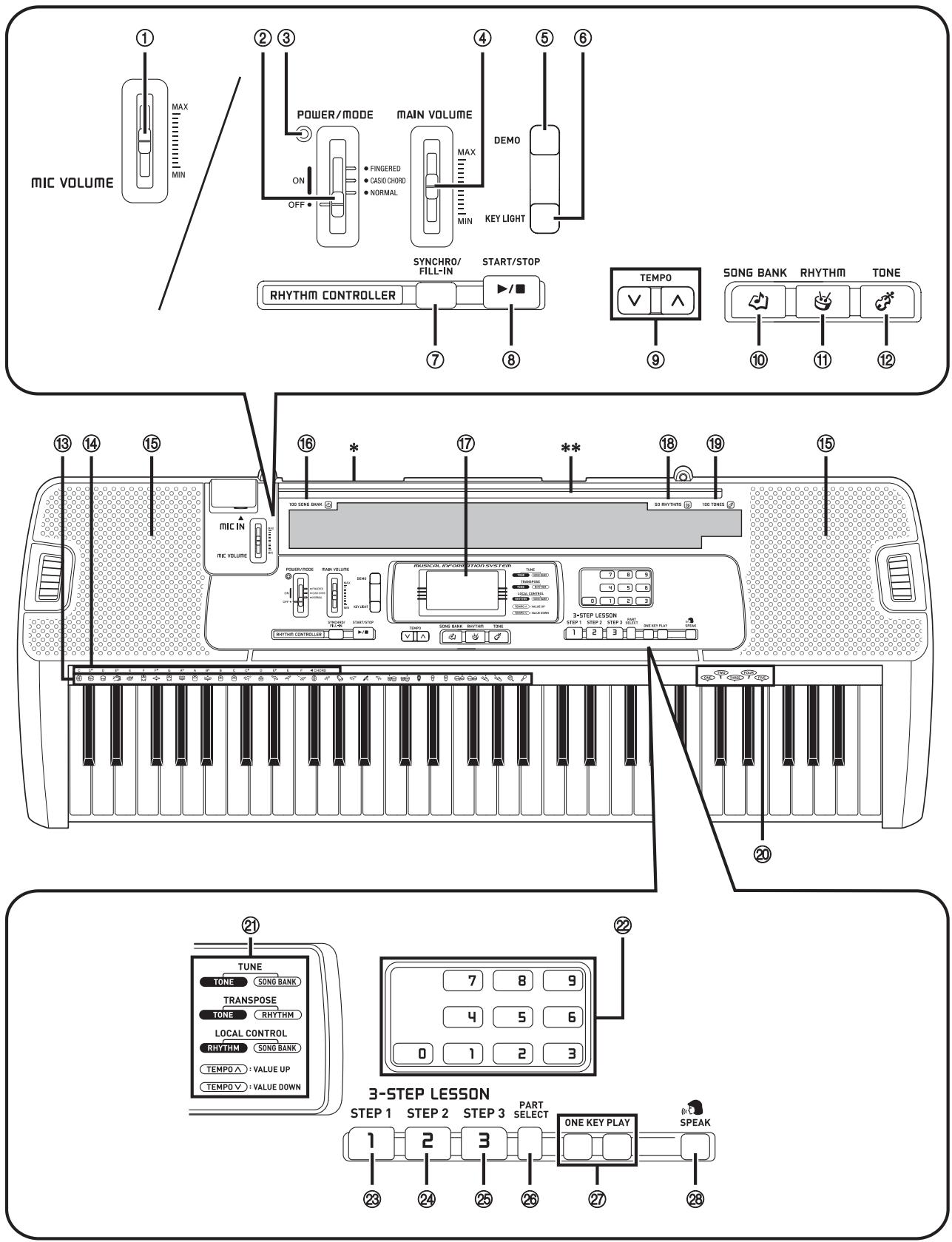
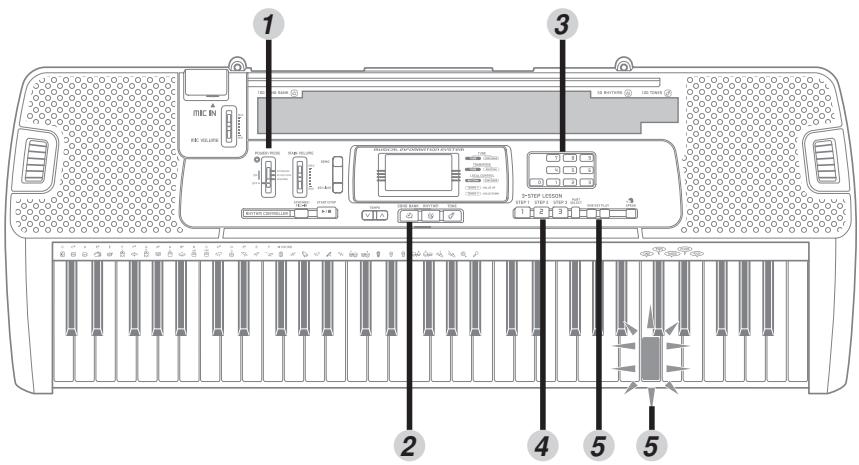
① Curseur de volume MIC ② Sélecteur POWER/MODE ③ Voyant d'alimentation ④ Curseur de volume principal ⑤ Bouton DEMO ⑥ Bouton KEY LIGHT
- CONTRÔLEUR DE RYTHME
⑦ Bouton SYNCHRO/FILL-IN ⑧ Bouton START/STOP
⑨ Boutons TEMPO, Bouton SONG BANK, Bouton RHYTHM, Bouton TONE, 13 Liste des instruments de percussion, 15 Noms des racines d'accords, Haut-parleurs
16 Liste des 100 SONG BANK, ⑦ Affichage, 18 Liste des 50 RHYTHMS
Voir "Liste des rythmes" à la page A-2 pour plus de détails.
Liste des 100 TONES
Voir "Liste des cartes de tonalités GM" à la page A-1 pour plus de détails.
Voix 1 à 5, ② Guide d'utilisation de TRANSPOSE/TUNE/LOCAL CONTROL, Boutons numériques
LEÇON EN 3 ÉTAPES
Bouton STEP1, Bouton STEP2, Bouton STEP3, Bouton PART SELECT, Boutons ONE KEY PLAY, 28 Bouton SPEAK
* Panneau arrière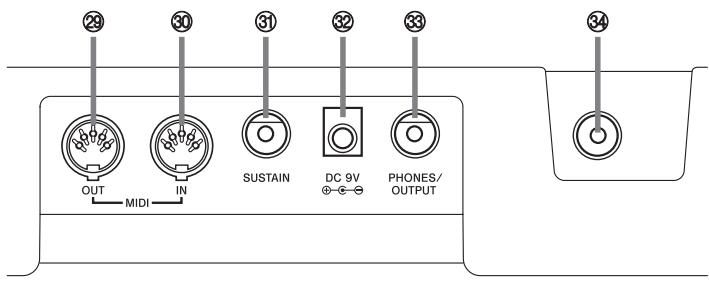
29 Borne MIDI OUT, 30 Borne MIDI IN, Prise SUSTAIN, Prise DC 9V, ③ Prise PHONES/OUTPUT
Pour la connexion de casques disponibles dans le commerce. La sortie des haut-parleurs est automatiquement coupée lorsque le casque est connecté.
Prise MIC IN
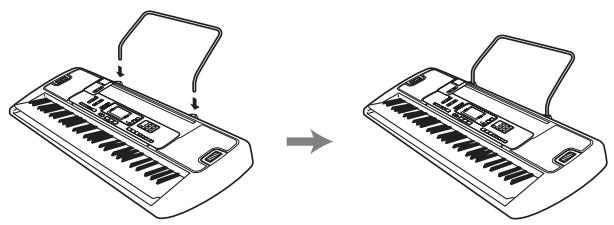
** Fixation du pupitre
Insérez les deux extrémités du pupitre fourni avec le clavier dans les deux trous sur la surface supérieure.
Cette section fournit un aperçu rapide de l'utilisation du clavier à l'aide des étapes une et deux de la fonction de leçon en 3 étapes. Voir la page E-21 pour des explications détaillées de ces étapes.
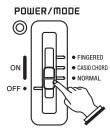
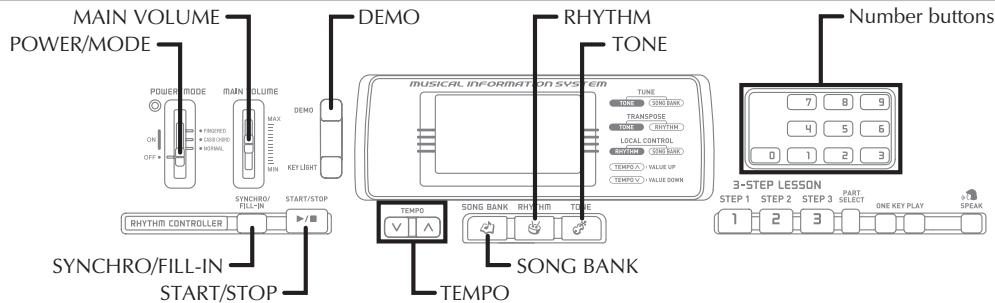
1 Réglez le sélecteur POWER/MODE sur NORMAL.
2 Appuyez sur le bouton SONG BANK.

L'indicateur SONG BANK apparaît.
3 Trouvez le morceau que vous voulez jouer dans la liste Song Bank, puis utilisez les boutons numériques pour saisir son numéro à deux chiffres.
Pour sélectionner "13 TWINKLE TWINKLE LITTLE STAR", saisissez 1 puis 3.
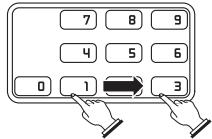

4 Appuyez sur le bouton STEP 1 ou STEP 2.
- Lorsque vous le faites, l'indicateur STEP 1 ou STEP 2 apparaît.
- Le clavier émet un battement de comptage et attend que vous jouiez quelque chose sur le clavier. Les touches que vous devez appuyer en premier clignotent.
- Jouez conformément aux doigtés qui apparaissent à l'écran.
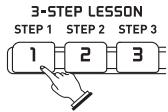
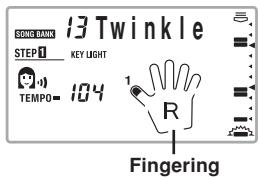
5 Jouez la partie mélodie sur le clavier.
Jouez les notes avec les boutons ONE KEY PLAY.
- Le tempo de l'accompagnement s'ajuste automatiquement pour jouer avec votre mélodie.
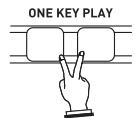
Jouez les notes sur le clavier.
- Une sous-mélodie (obligato) joue en rythme avec la mélodie.
- Avec l'étape 1, la note de mélodie correcte est jouée quelle que soit la touche du clavier que vous appuyez.
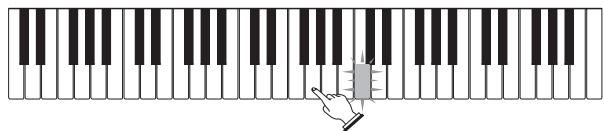
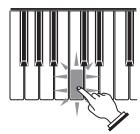
Jouez les notes sur le clavier en appuyant sur les touches lorsqu'elles s'allument.
- Maintenez la touche enfoncée tant qu'elle reste allumée.
- Si vous avez sélectionné une chanson de 84 à 99, la touche allumée s'éteint dès que vous appuyez dessus.
- La touche correspondant à la note suivante que vous devez jouer clignote. Après avoir appuyé sur la bonne touche de mélodie, l'accompagnement passe à la note suivante.
Ce clavier peut être alimenté par le courant d'une prise murale standard (en utilisant l'adaptateur secteur spécifié) ou par des piles. Assurez-vous toujours d'éteindre le clavier lorsque vous ne l'utilisez pas.
Utilisation des piles
Assurez-vous toujours d'éteindre le clavier avant d'insérer ou de remplacer les piles.
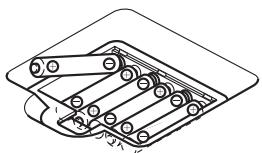
Pour insérer les piles
- Retirez le couvercle du compartiment à piles.
- Insérez 6 piles de taille AA dans le compartiment à piles.
- Vérifiez que les extrémités positive (+) et négative (-) sont orientées correctement.
- Insérez les languettes du couvercle du compartiment à piles dans les trous prévus et fermez le couvercle.
REMARQUE
- Le clavier peut ne pas fonctionner correctement si vous insérez ou remplacez les piles alors qu'il est allumé. Si cela se produit, éteignez le clavier puis rallumez-le pour rétablir le fonctionnement normal.
Informations importantes sur la batterie
Ce qui suit indique la durée de vie approximative de la batterie.
Piles alcalines : 4 heures
Piles au manganèse : 1 heure
La valeur ci-dessus correspond à la durée de vie standard des piles à température normale, avec le volume du clavier réglé sur moyen. Des températures extrêmes ou des volumes très élevés peuvent réduire la durée de vie des piles.
AVERTISSEMENT
Une mauvaise utilisation des piles peut provoquer une fuite, entraînant des dommages aux objets environnants, ou une explosion, créant un risque d'incendie et de blessures. Assurez-vous toujours de respecter les précautions suivantes.
- Ne tentez jamais de démonter les piles ou de les court-circuiter.
- N'exposez jamais les piles à la chaleur et ne les jetez pas au feu.
- Ne mélangez jamais des piles usagées avec des piles neuves.
- Ne mélangez jamais des piles de types différents.
- Ne rechargez pas les piles.
- Assurez-vous que les extrémités positive (+) et négative (-) des piles sont orientées correctement.
ATTENTION
Une mauvaise utilisation des piles peut provoquer une fuite, entraînant des dommages aux objets environnants, ou une explosion, créant un risque d'incendie et de blessures. Assurez-vous toujours de respecter les précautions suivantes.
- Utilisez uniquement des piles spécifiées pour être utilisées avec ce produit.
- Retirez les piles du produit si vous ne prévoyez pas de l'utiliser pendant une longue période.
Utilisation de l'adaptateur secteur
Assurez-vous d'utiliser uniquement l'adaptateur secteur spécifié pour ce clavier.
Adaptateur secteur spécifié : AD-5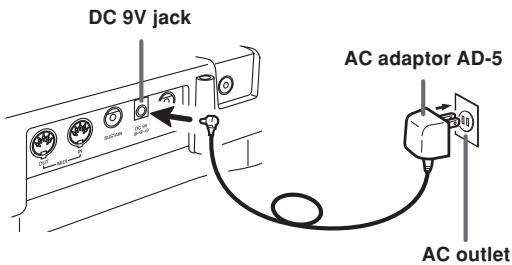
Notez les précautions importantes suivantes pour éviter d'endommager le cordon d'alimentation.
• Pendant l'utilisation
- Ne tirez jamais sur le cordon avec une force excessive.
- Ne tirez jamais sur le cordon à plusieurs reprises.
- Ne tordez jamais le cordon à la base de la fiche ou du connecteur.
- Le cordon d'alimentation ne doit pas être tendu pendant son utilisation.
• Pendant le déplacement
- Avant de déplacer le clavier, assurez-vous de débrancher l'adaptateur secteur de la prise de courant. • Pendant le stockage
- Enroulez et attachez le cordon d'alimentation, mais ne l'enroulez jamais autour de l'adaptateur secteur.
IMPORTANT !
- Assurez-vous que le clavier est éteint avant de brancher ou de débrancher l'adaptateur secteur.
- L'utilisation prolongée de l'adaptateur secteur peut le faire chauffer au toucher. Cela est normal et n'indique pas un dysfonctionnement.
Mise hors tension automatique
Lorsque vous utilisez l'alimentation par piles, le clavier s'éteint automatiquement si vous le laissez allumé sans effectuer aucune opération pendant environ 6 minutes. Dans ce cas, déplacez le sélecteur POWER/MODE sur OFF, puis remettez-le sur NORMAL, CASIO CHORD ou FINGERED pour rallumer l'appareil.
REMARQUE
- La mise hors tension automatique est désactivée (elle ne fonctionne pas) lorsque vous utilisez l'adaptateur secteur pour alimenter le clavier.
Alerte de mise sous tension
Les touches du clavier s'allument pour vous alerter si vous laissez l'appareil allumé sans effectuer aucune opération pendant environ 6 minutes. Notez que seules les touches s'allument, aucun son n'est émis. Dans ce cas, appuyez sur n'importe quel bouton ou touche du clavier pour effacer l'alerte de mise sous tension.
REMARQUE
- L'alerte de mise sous tension ne fonctionne que lorsque vous alimentez le clavier avec l'adaptateur secteur. Elle ne fonctionne pas lorsque vous utilisez des piles.
Pour désactiver la mise hors tension automatique et l'alerte de mise sous tension
Maintenez enfoncé le bouton TONE tout en allumant le clavier pour désactiver la mise hors tension automatique et l'alerte de mise sous tension.
REMARQUE
- Lorsque ces fonctions sont désactivées, le clavier ne s'éteint pas automatiquement et aucune alerte n'est effectuée, quelle que soit la durée pendant laquelle il reste sans aucune opération.
- La mise hors tension automatique et l'alerte de mise sous tension sont réactivées lorsque vous éteignez manuellement l'appareil puis le rallumez.
Évitez la chaleur, l'humidité ou la lumière directe du soleil.
N'exposez pas excessivement l'instrument à la lumière directe du soleil, ne le placez pas près d'un climatiseur ou dans un endroit extrêmement chaud.
Ne l'utilisez pas près d'un téléviseur ou d'une radio.
Cet instrument peut provoquer des interférences vidéo ou audio avec la réception TV et radio. Si cela se produit, éloignez l'instrument du téléviseur ou de la radio.
N'utilisez pas de laque, du diluant ou des produits chimiques similaires pour le nettoyage.
Nettoyez le clavier avec un chiffon doux imbibé d'une solution faible d'eau et d'un détergent neutre. Trempez le chiffon dans la solution et essorez-le jusqu'à ce qu'il soit presque sec.
REMARQUE
- Vous pouvez remarquer des lignes dans la finition du boîtier de ce clavier. Ces lignes résultent du processus de moulage utilisé pour façonner le plastique du boîtier. Ce ne sont pas des fissures ou des cassures dans le plastique, et elles ne sont pas une source d'inquiétude.
Prise Phones/Output
Avant de connecter des écouteurs ou d'autres équipements externes, assurez-vous d'abord de baisser le volume du clavier et de l'équipement connecté. Vous pouvez ensuite ajuster le volume au niveau souhaité après la connexion.
[Panneau arrière]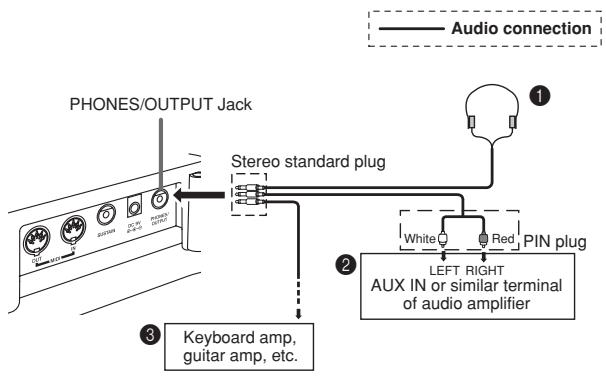
Connexion des écouteurs (Figure 1)
La connexion des écouteurs coupe la sortie des haut-parleurs intégrés du clavier, vous pouvez donc jouer même tard le soir sans déranger personne.
Équipement audio (Figure 2)
Connectez le clavier à un équipement audio à l'aide d'un câble de connexion disponible dans le commerce avec une prise standard à une extrémité et deux prises PIN à l'autre extrémité. Dans cette configuration, vous réglez normalement le sélecteur d'entrée de l'équipement audio sur la borne (généralement marquée AUX IN ou similaire) où le câble du clavier est connecté. Consultez la documentation utilisateur fournie avec votre équipement audio pour plus de détails.
Amplificateur pour instrument de musique (Figure ③)
Utilisez un câble de connexion disponible dans le commerce pour relier le clavier à un amplificateur pour instrument de musique.
REMARQUE
- Assurez-vous d'utiliser un câble de connexion avec des fiches standard aux extrémités que vous connectez au clavier et à l'amplificateur.
[Exemple de connexion]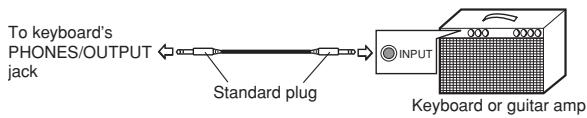
Prise Sustain
Vous pouvez connecter une pédale de sustain en option (SP-3 ou SP-20) à la prise SUSTAIN pour activer les fonctions décrites ci-dessous.
Prise SUSTAIN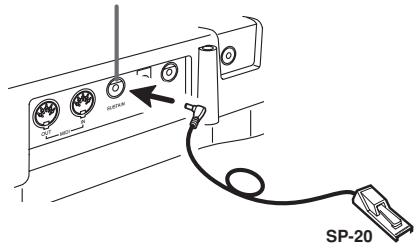
Pédale de sustain
- Avec les sons de piano, enfoncer la pédale prolonge les notes, comme la pédale forte d'un piano.
- Avec les sons d'orgue, enfoncer la pédale fait continuer les notes jusqu'à ce que la pédale soit relâchée.
Utilisation de la prise microphone
Connecter un microphone disponible dans le commerce à la prise MIC IN permet de chanter en accompagnement des morceaux intégrés du clavier ou de la sortie d'un appareil MIDI. Lors de la connexion d'un microphone, veillez à régler d'abord le volume MIC à un niveau relativement bas, puis ajustez-le au niveau souhaité après la connexion.
- Réglez le curseur MIC VOLUME du côté "MIN".
- Activez l'interrupteur marche/arrêt du microphone.
- Utilisez le curseur MIC VOLUME pour régler le volume du microphone au niveau souhaité.
[Panneau arrière]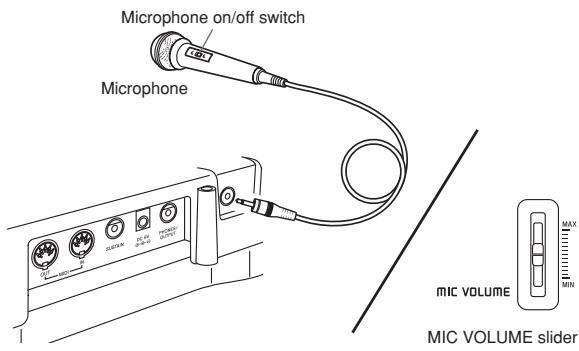
IMPORTANT !
- Veillez à utiliser l'interrupteur marche/arrêt du microphone pour l'éteindre et à le débrancher du clavier lorsque vous ne l'utilisez pas.
Type de microphone recommandé
- Microphone dynamique (fiche standard)
IMPORTANT !
- Veillez à débrancher le microphone du clavier lorsque vous ne l'utilisez pas.
Larsen (bruit de réaction)
L'une des conditions suivantes peut provoquer un larsen (bruit de réaction).
- Couvrir la tête du microphone avec la main
- Positionner le microphone trop près d'un haut-parleur
Si un larsen se produit, essayez de tenir le microphone plus loin de la tête et éloignez-vous de tout haut-parleur à proximité.
Bruit statique
L'éclairage fluorescent peut provoquer un bruit statique dans le signal du microphone. Si cela se produit, éloignez-vous de l'éclairage que vous soupçonnez d'en être la cause.
Accessoires et options
Utilisez uniquement les accessoires et options spécifiés pour ce clavier. L'utilisation d'articles non autorisés présente un risque d'incendie, de choc électrique et de blessure.
Cette partie du manuel vous fournit les informations de base nécessaires à l'utilisation de votre clavier.
Pour allumer et éteindre l'alimentation
- Réglez le sélecteur POWER/MODE sur NORMAL.
- Appuyez sur les touches du clavier.
- Utilisez le curseur MAIN VOLUME pour régler le volume à un niveau relativement bas.
- Pour éteindre l'alimentation, réglez le sélecteur POWER/MODE sur la position OFF.
Pour changer de sonorité
- Consultez la liste des sonorités* imprimée sur la console du clavier et trouvez celle que vous souhaitez.
- Voir "Liste des cartes de sonorités GM" à la page A-1 pour plus de détails.
- Appuyez sur le bouton TONE.
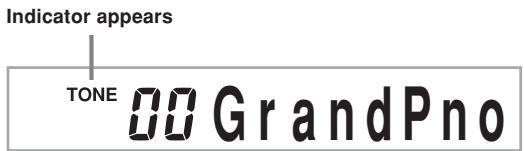
- Utilisez les boutons numériques pour saisir le numéro à 2 chiffres qui identifie la sonorité que vous souhaitez sélectionner.
Exemple : Pour sélectionner "26 ACOUSTIC BASS", saisissez 2 puis 6.
TONE 26 Aco . Bass
NOTE
- Toujours saisir deux chiffres pour le numéro de tonalité. Si vous n'en saisissez qu'un seul, l'affichage revient automatiquement au réglage de tonalité précédent après quelques secondes.
- Si vous modifiez le réglage de tonalité alors qu'une touche du clavier est enfoncée, la tonalité ne change pas tant que vous n'avez pas relâché la touche et appuyé à nouveau sur une touche du clavier.
- Avec certaines tonalités (comme les sons de percussion et les effets sonores), il peut y avoir très peu ou pas de changement de hauteur, quelle que soit la touche du clavier que vous appuyez.
- Si vous saisissez un premier chiffre incorrect pour un numéro de tonalité, vous pouvez revenir au réglage précédent en appuyant sur le bouton TONE.
Tonalités avec clavier divisé
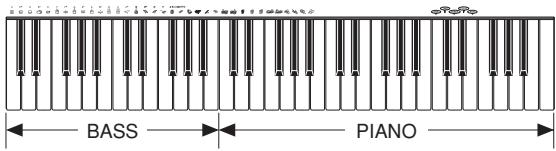
Certaines tonalités prédéfinies divisent le clavier et assignent deux sons ou plus. Avec une telle tonalité, le son produit dépend de la position du clavier que vous jouez. Par exemple, BASS/PIANO (tonalité 90) place la basse à gauche et le piano à droite du clavier.
BASS/PIANO (n° 90)
PERCUSSION (n° 99)
- PERCUSSION (tonalité 99) assigne 35 sons de percussion et cinq sons vocaux au clavier comme indiqué ci-dessous. Les sons assignés à chaque touche sont indiqués au-dessus du clavier.
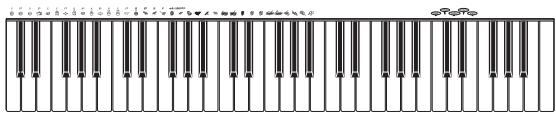
| BASS DRUM | COWBELL |
| SIDE STICK | CRASH CYMBOL 2 |
| ACOUSTIC SNARE | CLAVES |
| HAND CLAP | RIDE CYMBOL 2 |
| ELECTRIC SNARE | HIGH BONGO |
| LOW FLOOR TOM | LOW BONGO |
| CLOSED HI-HAT | MUTE HIGH CONGA |
| HIGH FLOOR TOM | OPEN HIGH CONGA |
| PEDAL HI-HAT | LOW CONGA |
| LOW TOM | HIGH TIMBALES |
| OPEN HI-HAT | LOW TIMBALES |
| LOW MID TOM | HIGH AGOGO |
| HIGH MID TOM | LOW AGOGO |
| CRASH CYMBOL 1 | CABASA |
| HIGH TOM | MARACAS |
| RIDE CYMBOL 1 | VOICE 1 |
| CHINESE CYMBOL | VOICE 2 |
| RIDE BELL | VOICE 3 |
| TAMBOURINE | VOICE 4 |
| SPLASH CYMBOL | VOICE 5 |
Polyphonie
Le terme polyphonie fait référence au nombre maximal de notes que vous pouvez jouer en même temps. Ce clavier a une polyphonie de 12 notes, ce qui inclut les notes que vous jouez ainsi que les rythmes et les motifs d'accompagnement automatique joués par le clavier. Cela signifie que lorsqu'un rythme ou un motif d'accompagnement automatique est joué par le clavier, le nombre de notes (polyphonie) disponible pour le jeu au clavier est réduit. Notez également que certaines tonalités n'offrent qu'une polyphonie de 6 notes.
- Lorsqu'un rythme ou un accompagnement automatique est joué, le nombre de sons joués simultanément est réduit.
- Bien que vous puissiez faire sonner jusqu'à 12 notes à la fois, seules les quatre dernières touches du clavier enfoncées s'allument.
Autres fonctions utiles
Pour changer la tonalité du clavier
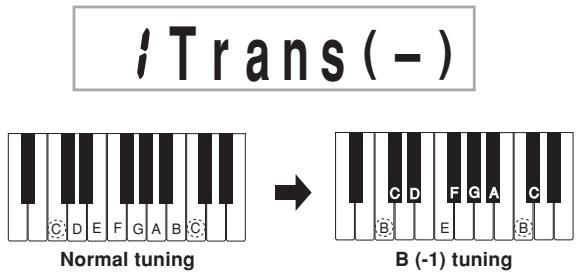
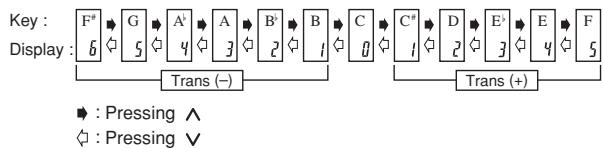
La fonction de transposition de ce clavier vous permet d'élever ou d'abaisser sa tonalité par demi-tons. Cela signifie que vous pouvez facilement l'adapter à la voix de quelqu'un, et vous pouvez éliminer les dièses et les bémols de la musique pour la rendre plus facile à jouer.
- Dans tout mode autre que le mode Banque de chansons (indiqué lorsque le témoin SONG BANK est allumé), maintenez enfoncé le bouton TONE et appuyez sur le bouton RHYTHM.
- Effectuez l'étape 2 dans les cinq secondes qui suivent l'étape 1.
Trans
- Utilisez les boutons TEMPO pour changer la tonalité du clavier.
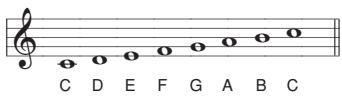
Exemple : Pour changer la tonalité en si (indiqué par -1 car c'est un ton en dessous de do, qui est la tonalité normale du clavier).
REMARQUE
- Si vous laissez l'écran de transposition affiché pendant environ cinq secondes sans rien faire, l'écran s'efface automatiquement.
- Vous ne pouvez pas modifier le réglage de transposition lorsque le clavier est en mode Banque de chansons.
- À l'étape 2 de l'opération ci-dessus, vous pouvez également utiliser les boutons numériques 0 à 5 pour spécifier do à fa.
- Appuyer simultanément sur les deux boutons TEMPO (∧/∨) ramène le réglage de transposition à do (0).
- Le réglage de transposition est automatiquement défini sur do (0) chaque fois que vous allumez le clavier.
- Le réglage de transposition est automatiquement défini sur C(0) chaque fois que vous appuyez sur le bouton SONG BANK.
- La hauteur d'une note transposée dépend du son que vous utilisez. Si l'opération de transposition fait dépasser la plage du son utilisé, la même note dans l'octave la plus élevée de la plage du son est substituée.
- L'opération de transposition n'affecte pas le son numéro 99 (PERCUSSION) ni les rythmes d'accompagnement automatique.
- La transposition des sons 75 à 79 et 90 à 96 modifie la plage de touches à laquelle chacun de ces sons est assigné.
- Le réglage de transposition est automatiquement défini sur C(0) chaque fois que vous appuyez sur le bouton DEMO.
Pour accorder le clavier
Une opération simple permet d'accorder le clavier sur un autre instrument de musique.
- Dans tout mode autre que le mode Song Bank (indiqué lorsque le témoin SONG BANK est allumé), maintenez enfoncé le bouton TONE et appuyez sur le bouton SONG BANK.
- Effectuez l'étape 2 dans les cinq secondes qui suivent l'étape 1.
00 Accord
- Utilisez les boutons TEMPO pour modifier l'accordage du clavier.
Exemple : Pour baisser l'accordage de 20
20 Accord (-)
NOTE
- Si vous laissez l'écran de réglage affiché pendant environ cinq secondes sans rien faire, l'écran s'efface automatiquement.
- À l'étape 2 de la procédure ci-dessus, vous pouvez également utiliser les touches numériques pour saisir une valeur de 00 à 50.
- Appuyer simultanément sur les deux touches TEMPO (/) ramène le réglage d'accord à 00.
- Appuyer sur la touche SONG BANK ramène le réglage d'accord à 00.
- Le réglage d'accord n'affecte pas les morceaux de la banque de chansons.
- Vous pouvez accorder le clavier dans une plage d'environ ± 50 cents (100 cents = 1 demi-ton).
- Le réglage d'accord est automatiquement réglé sur 00 chaque fois que vous allumez le clavier.
- Appuyer sur la touche DEMO ramène le réglage d'accord à 00.
- L'opération d'accord n'affecte pas le rythme (99 PERCUSSION).
Lecture des morceaux de démonstration
Vous pouvez configurer le clavier pour qu'il joue en continu ses 100 morceaux intégrés de la banque de chansons.
Les touches du clavier s'allument pour indiquer les notes de la mélodie du morceau de démonstration pendant sa lecture.
Pour démarrer la lecture du morceau de démonstration
- Allumez l'appareil et réglez le niveau du volume.
- Appuyez sur le bouton DEMO.
- La lecture de la démo se poursuit en boucle séquentielle jusqu'à ce que vous l'arrêtiez.
- Le numéro et le nom de la démo en cours de lecture sont affichés à l'écran.
- Vous pouvez jouer sur le clavier pendant la lecture d'une démo.
- Vous pouvez changer la démo en cours en appuyant sur les boutons numériques.
- Les morceaux de la banque de chansons sont lus dans l'ordre des numéros, en commençant par celui que vous sélectionnez.
Pour arrêter la lecture de la démo
Appuyez à nouveau sur le bouton DEMO ou START/STOP pour arrêter la lecture de la démo.
REMARQUE
- Seuls les boutons suivants sont activés pendant la lecture d'un morceau de la banque de chansons.
- Curseur de volume principal, boutons numériques
- Bouton START/STOP
- Sélecteur POWER/MODE (OFF)
- Bouton DEMO
- Bouton KEY LIGHT
- Bouton SPEAK
- Vous ne pouvez pas changer le son utilisé pour la mélodie d'un morceau de la banque de chansons.
Lecture des rythmes
Ce clavier dispose d'une collection de 50 motifs rythmiques intégrés passionnants. Chaque motif fournit un accompagnement de percussions pour toutes vos performances.
Pour sélectionner et jouer un rythme
- Réglez le sélecteur POWER/MODE sur NORMAL.
- Trouvez le rythme que vous souhaitez utiliser dans la "Liste des rythmes" (page A-2) et notez son numéro de rythme.
- Appuyez sur le bouton RHYTHM.
- Lorsque vous le faites, l'indicateur RHYTHM apparaît.
- Le numéro et le nom affichés à l'écran indiquent le rythme actuellement sélectionné.
- Utilisez les touches numériques pour saisir le numéro à deux chiffres du rythme que vous souhaitez utiliser.
Exemple : Pour sélectionner "37 SAMBA", saisissez 3 puis 7.
RHYTHM 37 Samba
- Veillez à toujours spécifier un numéro à deux chiffres.
- Si vous remarquez une erreur avant de saisir le deuxième chiffre, appuyez sur le bouton RHYTHM pour revenir au numéro de rythme précédemment réglé.
- Vous pouvez changer de rythme même pendant que le rythme actuel joue.
- Appuyez sur le bouton START/STOP pour lancer la lecture du rythme.
- Lorsque vous le faites, le rythme sélectionné commence à jouer.
- Utilisez les boutons TEMPO pour régler le tempo du rythme.
TEMPO = 120
Chaque fois que vous appuyez sur l'un des boutons TEMPO pendant que la valeur du tempo est affichée, le réglage du tempo change d'un pas, dans la plage de 040 à 255. - Le réglage de tempo par défaut à la mise sous tension est 120. - Après avoir affiché le réglage de tempo actuel en appuyant sur le bouton TEMPO à l'étape 6, vous pouvez également saisir le réglage de tempo souhaité en entrant une valeur à trois chiffres avec les boutons numériques. - Maintenir enfoncé l'un des boutons TEMPO modifie le réglage du tempo à grande vitesse. - Pour réinitialiser le tempo à la valeur standard de chaque rythme, appuyez sur les deux boutons TEMPO.
- Pour arrêter la lecture du rythme, appuyez à nouveau sur le bouton START/STOP.
Utilisation de l'accompagnement automatique
Ce clavier propose 50 motifs d'accompagnement qui vous permettent d'ajouter automatiquement des accompagnements complets à vos performances. Avec l'accompagnement automatique, une partie du clavier est réservée comme clavier d'accompagnement. Lorsque vous jouez vos accords sur le clavier d'accompagnement, le motif d'accompagnement s'adapte automatiquement pour suivre la progression que vous jouez.
Vous avez le choix entre deux méthodes différentes pour jouer les accords. FINGERED vous permet de jouer les accords comme vous le faites normalement, tandis que CASIO CHORD permet de jouer des accords complets avec un seul doigt.
À propos du clavier d'accompagnement
Les 1,5 octaves inférieures (à gauche) sont réservées à l'utilisation comme clavier d'accompagnement lorsque vous sélectionnez CASIO CHORD ou FINGERED avec le sélecteur POWER/MODE. Le panneau au-dessus des touches du clavier d'accompagnement est marqué avec les noms des notes qu'elles jouent. Le reste du clavier (la partie qui n'est pas incluse dans le clavier d'accompagnement) est appelé le clavier mélodique. Veuillez vous souvenir de ces termes, car ils seront utilisés dans le reste de ce manuel.
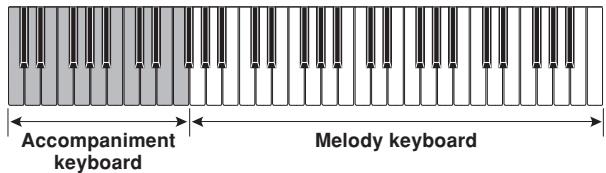
Tout le clavier peut être utilisé pour jouer la mélodie lorsque le sélecteur POWER/MODE est réglé sur NORMAL.
Utilisation du système CASIO CHORD
Le système CASIO CHORD vous permet de jouer facilement les quatre principaux types d'accords. La lecture des accords est simplifiée comme indiqué dans le tableau ci-dessous.
| Keys | Type | Example |
| Pressing one accompaniment key | Major chord | C (C Major Chord) |
| Pressing two accompaniment keys | Minor chord | Cm (C Minor Chord) |
| Pressing three accompaniment keys | Seventh chord | C7 (C Seventh Chord) |
| Pressing four accompaniment keys | Minor seventh chord | Cm7 (C Minor Seventh Chord) |
REMARQUE
- La note la plus basse (la plus à gauche) que vous jouez détermine le nom de l'accord. Si la note la plus basse est un C par exemple, le clavier produit un accord de C.
- Lorsque vous appuyez sur plus d'une touche d'accompagnement, peu importe que les touches à droite de la note la plus basse soient blanches ou noires.
Pour jouer un accompagnement automatique CASIO CHORD
- Utilisez le sélecteur POWER/MODE pour sélectionner CASIO CHORD.
- Sélectionnez un rythme automatique comme décrit dans « Pour sélectionner et jouer un rythme » à la page E-18.
- Démarrez la lecture du rythme.
- Si vous souhaitez démarrer la lecture du motif rythmique normal, appuyez sur START/STOP.
- Vous pouvez également utiliser le démarrage synchronisé (page E-20) pour lancer la lecture du rythme.
- Appuyez sur une ou jusqu'à quatre touches du clavier d'accompagnement, et l'accompagnement correspondant commence à jouer automatiquement.
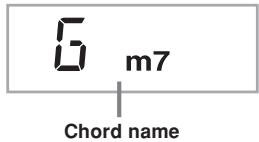
- Continuez à appuyer sur différentes touches du clavier d'accompagnement pour jouer votre progression d'accords.
- Pour arrêter la lecture de l'accompagnement automatique, appuyez à nouveau sur le bouton START/STOP.
Utilisation des doigtés standard
Le mode FINGERED vous permet de jouer une plus grande variété d'accords. Dans ce mode, vous pouvez commencer à jouer un motif d'accompagnement en appuyant sur trois ou quatre touches du clavier d'accompagnement.
Ce clavier est capable de reconnaître 15 accords différents. Voici les doigtés de ces accords avec une fondamentale de C. Notez que vous pouvez omettre les quintes (qui sont indiquées entre parenthèses dans les illustrations ci-dessous) pour produire les accords 7, m7, M7, add9, madd9 et mM7.
C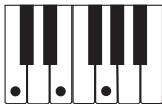
Cm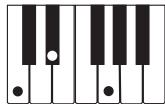
Cdim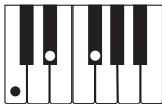
Caug*1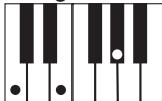
Csus4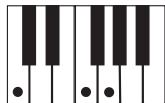
C7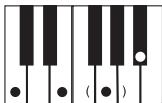
Cm7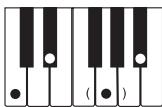
CM7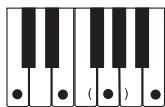
Cm75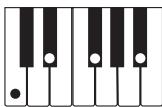
C75*1)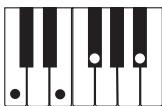
C7sus4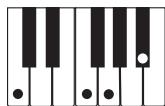
Cadd9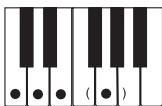
Cmadd9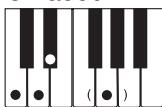
CmM7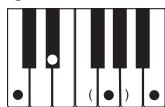
Cdim7 (*1)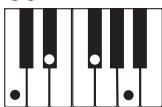
*1 Avec ces accords, la note la plus basse de votre doigté est toujours utilisée comme fondamentale. Assurez-vous que votre doigté identifie correctement la fondamentale que vous souhaitez utiliser.
IMPORTANT !
- Si vous jouez une ou deux notes seulement à la main gauche, ou trois notes qui ne forment pas une formation d'accord reconnaissable, aucun son ne sera produit. Le mode FINGERED nécessite une formation d'accord conventionnelle de trois ou quatre notes pour produire un accompagnement automatique. Notez également que les accords automatiques ne fonctionnent qu'avec les motifs rythmiques, et non indépendamment de ceux-ci.
REMARQUE
- Les exemples ci-dessus ne montrent qu'un seul des doigtés possibles pour chaque accord. Notez que vous pouvez jouer les notes qui forment un accord dans n'importe quelle combinaison. Chacun des doigtés suivants, par exemple, produit le même accord de C.
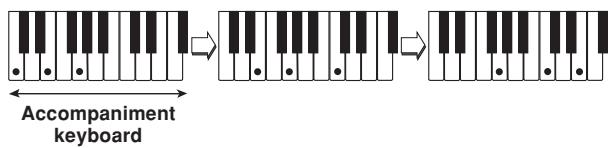
- Voir les "Tableaux de doigtés FINGERED" à la page A-3 pour des informations sur les doigtés d'accords pour toutes les fondamentales.
Pour jouer un accompagnement automatique FINGERED
- Utilisez le sélecteur POWER/MODE pour sélectionner FINGERED.
- Sélectionnez un rythme automatique comme décrit dans "Pour sélectionner et jouer un rythme" à la page E-18.
- Démarrez la lecture du rythme.
- Si vous souhaitez démarrer la lecture du motif rythmique normal, appuyez sur START/STOP.
- Vous pouvez également utiliser le démarrage synchro (sur cette page) pour lancer la lecture du rythme.
- Jouez un accord sur le clavier d'accompagnement pour lancer la lecture de l'accompagnement automatique.
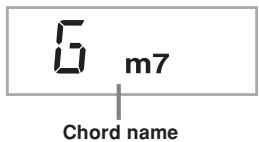
- Continuez à appuyer sur les touches du clavier d'accompagnement pour jouer votre progression d'accords.
- Pour arrêter la lecture de l'accompagnement automatique, appuyez à nouveau sur le bouton START/STOP.
Improviser avec les motifs prédéfinis
Appuyer sur le bouton START/STOP pour lancer la lecture du rythme joue la version normale du motif. Vous pouvez également jouer une variation du rythme en utilisant la procédure décrite ci-dessous.
Utilisation du remplissage (fill-in)
Vous pouvez insérer un remplissage en appuyant sur le bouton SYNCHRO/FILL-IN pendant qu'un rythme automatique joue.
Utilisation du démarrage synchro
Vous pouvez lancer le rythme et le motif d'accompagnement en même temps, en jouant sur le clavier d'accompagnement. Pour ce faire, suivez les étapes ci-dessous.
- Réglez le sélecteur POWER/MODE sur la position CASIO CHORD ou FINGERED.
- Sélectionnez un rythme automatique.
- Appuyez sur le bouton SYNCHRO/FILL-IN.
- Appuyez sur les touches d'accompagnement pour jouer le premier accord. Dès que vous le faites, le motif d'accompagnement automatique commence à jouer.
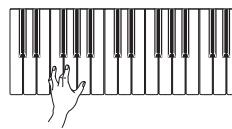
- Pour arrêter la lecture du motif d'accompagnement automatique, appuyez sur le bouton START/STOP.
REMARQUE
- Si vous réglez le sélecteur POWER/MODE sur NORMAL à l'étape 1 de la page E-18, l'opération de l'étape 4 démarre la lecture du rythme (instruments de percussion) uniquement.
Utilisation du système de leçon en 3 étapes
Même les personnes qui ne savent pas du tout jouer du clavier peuvent suivre les 100 airs intégrés de la banque de chansons avec les boutons ONE KEY PLAY. Vous pouvez également utiliser le système de leçon en 3 étapes pour apprendre à votre rythme. Jouez lentement au début jusqu'à ce que vous puissiez jouer à vitesse normale.
Parmi les 100 airs intégrés, les numéros 00 à 83 comportent un accompagnement automatique (airs avec accompagnement automatique), tandis que les numéros 84 à 99 se jouent à deux mains (airs à deux mains).
Le système de leçon en 3 étapes peut être utilisé avec le plan de leçon en 3 étapes suivant pour maîtriser le jeu au clavier.
Étape 1 : Maîtriser le rythme
Appuyer sur les boutons ONE KEY PLAY joue la mélodie pour un air avec accompagnement automatique ou la partie de la main droite pour les airs à deux mains. Dans les deux cas, l'accompagnement automatique (la partie de la main gauche dans le cas des airs à deux mains) est joué automatiquement par le clavier. À la place des boutons ONE KEY PLAY, vous pouvez également appuyer sur n'importe quelle touche du clavier pour jouer la mélodie ou la partie de la main droite. Le but de cette étape est de vous familiariser avec le rythme nécessaire pour jouer les notes de la mélodie.
Étape 2 : Maîtriser la mélodie
Dans cette étape, vous utilisez l'affichage pour apprendre quels doigts utiliser pour jouer, et le système de voyants des touches pour apprendre quelles touches du clavier enfoncer. Vous pouvez jouer au rythme que vous voulez, car l'accompagnement automatique ou la partie de la main gauche attend que vous appuyiez sur la bonne touche.
Étape 3 : Jouer à vitesse normale
À ce niveau, les touches du clavier s'allument toujours pour indiquer quelles notes jouer, mais elles n'attendent plus que vous appuyiez sur la bonne touche. L'accompagnement automatique ou la partie de la main gauche est joué à vitesse normale.
REMARQUE
- Il se peut que vous ne puissiez pas voir les touches du clavier sous la lumière directe du soleil ou dans d'autres zones très éclairées.
- Vous pouvez appuyer sur les boutons ONE KEY PLAY, STEP 1, STEP 2 et STEP 3 à tout moment, sauf pendant la lecture d'un air de démonstration. Pour revenir au mode normal du clavier, appuyez sur le bouton SONG BANK.
Réglage du tempo du système de leçon en 3 étapes
Vous pouvez utiliser la procédure de l'étape 6 de la page E-19 pour régler le tempo de la partie de la main gauche pour la lecture de la banque de chansons et du système de leçon en 3 étapes (étapes 1 à 3).
Cela signifie que vous pouvez utiliser un tempo plus lent au début, puis l'augmenter au fur et à mesure que vous apprenez. Appuyez simultanément sur les deux boutons TEMPO (A et V) pour revenir au réglage initial prédéfini du tempo.
Pour jouer un air de la banque de chansons intégrée
- Recherchez le numéro de l'air que vous souhaitez jouer dans la liste de la banque de chansons.
- Appuyez sur le bouton SONG BANK jusqu'à ce que l'indicateur SONG BANK apparaisse.
- Cela fait apparaître le numéro et le nom de l'air de la banque de chansons actuellement sélectionné sur l'écran.
- Saisissez le numéro à deux chiffres de l'air que vous souhaitez jouer.
Exemple : Pour sélectionner "13 TWINKLE TWINKLE LITTLE STAR", saisissez 1 puis 3.
SONG BANK 13 Twinkle
- Appuyez sur la touche START/STOP pour lancer la lecture du morceau sélectionné.
- Le morceau sélectionné est joué en boucle, les touches du clavier s'allument pour indiquer les notes de la mélodie.
- Pour arrêter la lecture du morceau de la banque de morceaux, appuyez à nouveau sur la touche START/STOP.
- Pour quitter le mode Banque de morceaux, appuyez à nouveau sur la touche SONG BANK.
- Lorsque vous le faites, le témoin SONG BANK s'éteint.
REMARQUE
- Saisissez toujours deux chiffres pour le numéro de morceau de la banque de morceaux.
- Vous pouvez saisir un numéro de morceau de la banque de morceaux même pendant la lecture d'un autre morceau de la banque.
- Si vous saisissez un premier chiffre incorrect pour un numéro de morceau de la banque, vous pouvez revenir au réglage précédent en appuyant sur la touche SONG BANK.
- La touche RHYTHM est désactivée en mode Banque de morceaux. Si vous souhaitez jouer un rythme, appuyez sur la touche SONG BANK pour revenir d'abord au mode normal.
Fonctionnement du système d'éclairage des touches et affichage pendant la lecture de la banque de morceaux
Les touches du clavier s'allument pour indiquer les touches à enfoncer pour jouer en accompagnement des morceaux de la banque pendant leur lecture. En même temps, l'écran affiche les doigtés, les noms d'accords, le tempo et d'autres informations.
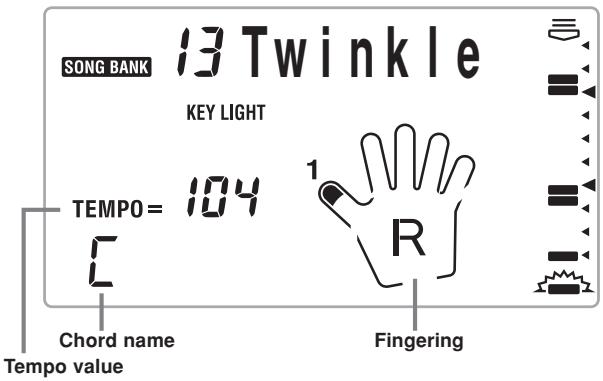
Indications de doigté croisé
L'écran affiche également quand vous devez croiser les doigts pour jouer les notes, et dans quelle direction vos doigts doivent se croiser.
Exemple : Affichage pour jouer les notes ci-dessous avec la main droite
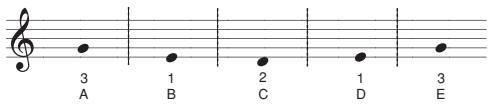
Utilisation de l'affichage de doigté croisé avec la banque de morceaux
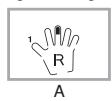
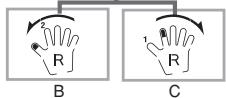
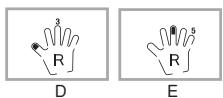
- B et C indiquent que l'index doit croiser par-dessus le pouce.
- C et D indiquent que le pouce doit croiser sous l'index.
Éclairage des touches pendant la lecture de la banque de morceaux
Lorsque vous jouez un morceau de la banque de morceaux, les touches du clavier s'allument pour vous montrer les notes jouées.
Morceau de la banque de morceaux avec accompagnement automatique
Les touches des parties d'accords et de mélodie s'allument.
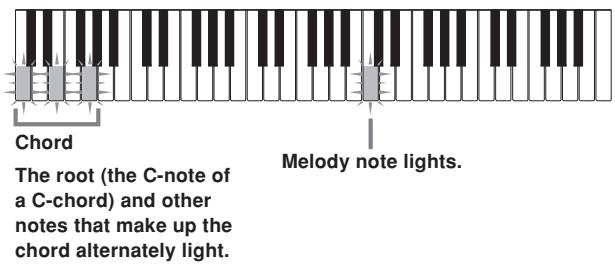
REMARQUE
- Certains morceaux de la banque de morceaux utilisent des accords (comme C6) qui ne peuvent pas être joués avec le réglage FINGERED (page E-19). En mode FINGERED, les accords peuvent sonner différemment de ceux produits par la lecture du morceau de la banque de morceaux, même si vous jouez les accords comme indiqué par les touches allumées.
Morceau de la banque de morceaux à deux mains
Les touches des parties de main gauche et de main droite s'allument.
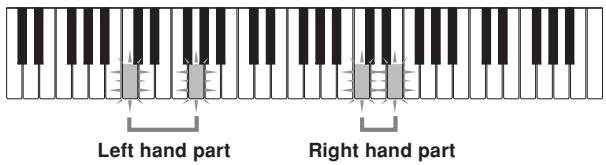
Fonctionnement du système d'éclairage des touches et contenu de l'affichage pendant la lecture de la leçon en 3 étapes
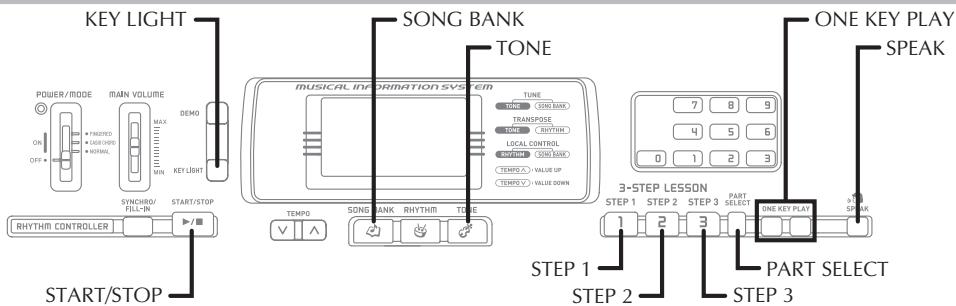
Lorsque vous sélectionnez un air d'accompagnement automatique (00 à 83) pour la leçon en 3 étapes, le système d'éclairage des touches vous montre quelles touches enfoncer, tandis que l'écran affiche les doigtés.
Hauteur de note
La touche du clavier à enfoncer s'allume. Les doigts à utiliser pour jouer les notes sont également affichés à l'écran.
Durée de note
Les touches du clavier restent allumées aussi longtemps que la note doit être jouée. Les doigtés restent également affichés à l'écran pendant la durée de la note.
Note suivante
La touche du clavier correspondant à la note suivante clignote, tandis qu'un numéro apparaît à l'écran près du doigt à utiliser pour jouer la note suivante.
Série de notes de même hauteur
La lumière de la touche s'éteint momentanément entre les notes et se rallume pour chaque note successive. Les doigtés s'éteignent et se rallument également.

REMARQUE
- La durée des notes n'est pas indiquée lorsque vous utilisez des airs à deux mains (84 à 99) avec les étapes 1 et 2 de la leçon en 3 étapes. Dès que vous enfoncez une touche allumée, elle s'éteint et la touche suivante commence à clignoter.
- La durée des notes est indiquée par le système d'éclairage des touches lorsque vous utilisez un air à deux mains avec l'étape 3. Dans ce cas, la touche suivante ne clignote pas lorsque vous enfoncez une touche allumée et le numéro de doigt suivant n'apparaît pas à l'écran. Seul le numéro de doigt actuel est affiché.
Guide de doigté vocal
Le guide de doigté vocal utilise une voix humaine simulée pour énoncer les numéros de doigté pendant les étapes 1 et 2 de la pratique d'une partie à une main. Si vous devez appuyer sur une touche avec votre pouce, par exemple, le guide vocal dit « Un ! » Dans le cas d'un accord à jouer avec le pouce, le majeur et l'annulaire, le guide vocal dit « Un, trois, cinq ! »
Le guide de doigté vocal n'énonce les doigtés que lorsque vous n'appuyez pas sur la bonne touche au moment voulu.
Pour activer et désactiver le guide de doigté vocal
Utilisez le bouton SPEAK pour activer ou désactiver le guide de doigté vocal.
Indicateur de tempo
L'indicateur de tempo vous aide à vous familiariser avec les morceaux que vous jouez pour la première fois en indiquant le tempo des notes que vous jouez au clavier. Le tempo est plus facile à voir lorsque vous utilisez un tempo lent pendant la leçon.
Utilisation de l'indicateur de tempo
L'indicateur de tempo montre le tempo des notes contenues dans la partie sélectionnée (R ou L). Les notes sont indiquées par des blocs à deux segments qui défilent du haut de l'écran vers le bas. Une note est jouée lorsque son bloc atteint le bas de l'écran.
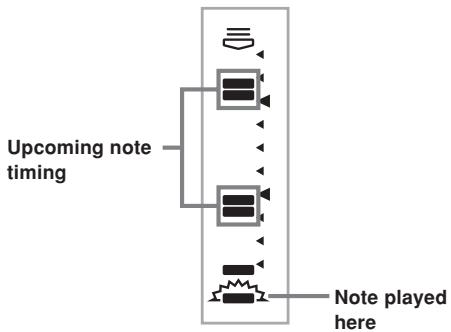
Chaque bloc à deux segments peut indiquer une ou plusieurs notes, selon le morceau que vous jouez.
REMARQUE
- L'indicateur de tempo affiche le tempo des notes chaque fois que vous lisez un morceau de la banque de morceaux et pendant une leçon en 3 étapes.
- Notez que l'indicateur de tempo n'affiche qu'un tempo approximatif. Pendant un morceau, le tempo indiqué peut être décalé de la huitième à la trente-deuxième note par rapport au tempo réel.
Désactivation de l'éclairage des touches
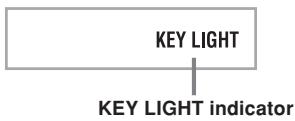
- Appuyez sur le bouton KEY LIGHT.
- L'indicateur KEY LIGHT disparaît lorsque le système d'éclairage des touches est désactivé.
- Appuyez à nouveau sur le bouton KEY LIGHT pour réactiver l'éclairage des touches.
REMARQUE
L'éclairage des touches s'active automatiquement dans les cas suivants :
- Lorsque le clavier est mis sous tension.
- Lorsque la lecture du morceau de démonstration est lancée.
- Lorsque le bouton SONG BANK est enfoncé en mode normal (page E-21).
- Lorsque la fonction d'alerte de mise sous tension fonctionne (page E-12).
Nombre de touches éclairées simultanément
Jusqu'à quatre touches du clavier peuvent être éclairées en même temps.
Pour changer la tonalité utilisée pour la mélodie d'un morceau de la banque de chansons
- Après l'étape 3 de la procédure à la page E-21, appuyez sur le bouton TONE.
- Les indicateurs SONG BANK et TONE apparaissent tous les deux, ainsi que le numéro et le nom de la tonalité actuellement assignée au clavier.
- Saisissez une valeur pour sélectionner la tonalité que vous souhaitez utiliser.
REMARQUE
- La sélection d'un autre air de la banque de morceaux fait passer le réglage de son au son de mélodie prédéfini de l'air nouvellement sélectionné.
- Le son assigné au clavier est le même que celui spécifié pour la mélodie de l'air de la banque de morceaux.
- La procédure ci-dessus peut être utilisée pour changer le son de la mélodie de la banque de morceaux avant de commencer la lecture ou pendant que la lecture est déjà en cours.
- Vous pouvez également changer le son des morceaux à deux mains (numéros de morceaux 84 à 99). Notez cependant que la sélection d'un son soutenu (comme un son d'orgue) lors de l'utilisation des étapes 1 ou 2 de la leçon en 3 étapes (où l'accompagnement attend votre saisie correcte avant de continuer) peut provoquer la tenue des notes de l'accompagnement automatique pendant que le clavier attend votre saisie. Si cela se produit, jouez quelque chose sur le clavier pour arrêter la note tenue.
Étape 1 : Maîtrisez le rythme
- Appuyez sur le bouton STEP 1.
- Lorsque vous le faites, l'indicateur STEP 1 apparaît.
- Après un compte, le clavier se met en attente et attend que vous jouiez la première note du morceau. Si le morceau comprend des mesures d'introduction, le clavier se met en attente après la fin des mesures d'introduction.
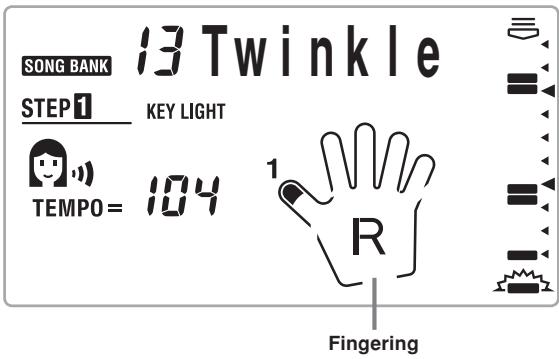
- Appuyez sur les boutons ONE KEY PLAY pour jouer chaque note du morceau.
- La partie d'accompagnement (main gauche) du morceau suit pendant que vous jouez la partie de mélodie (main droite).
- La touche du clavier correspondant à la note suivante à jouer clignote, puis s'allume lorsque vous jouez la note.
- La partie rythmique (percussions) ne sonne pas.
- Essayez d'appuyer sur n'importe quelle touche du clavier à la place des boutons ONE KEY PLAY.
- Appuyer sur n'importe quelle touche du clavier joue la note correcte de la mélodie (partie main droite).
- Appuyer sur plusieurs touches en même temps compte comme une seule note de mélodie. Appuyer sur une touche alors qu'une autre est maintenue enfoncée compte comme deux notes de mélodie.
La note correcte est jouée même si vous n'appuyez pas sur la touche qui est allumée.
- Pour arrêter la lecture à tout moment, appuyez sur le bouton START/STOP.
- Lorsque vous le faites, l'indicateur STEP 1 s'éteint.
Étape 2 : Maîtrisez la mélodie
- Appuyez sur le bouton STEP 2.
- Lorsque vous le faites, l'indicateur ÉTAPE 2 apparaît.
- Après un compte, le clavier se met en attente et attend que vous jouiez la première note de l'air. Si l'air comprend des mesures d'introduction, le clavier se met en attente après la fin des mesures d'introduction.
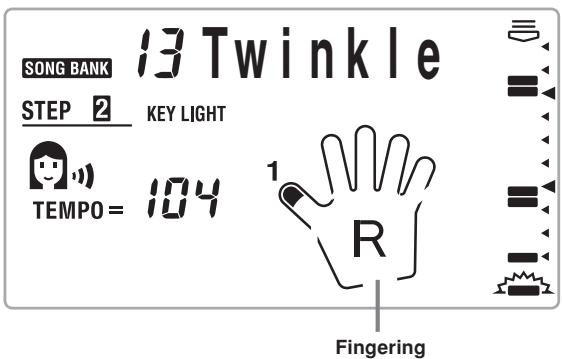
- Jouez les notes indiquées par le système de leçon en 3 étapes.
- La partie d'accompagnement (main gauche) de l'air suit pendant que vous jouez la partie mélodie (main droite).
- La touche du clavier qui correspond à la note suivante à jouer clignote, puis s'allume lorsque vous jouez la note.
- La partie rythmique (percussions) ne sonne pas.
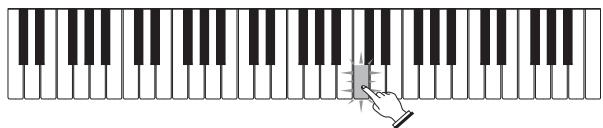
Appuyez sur les touches du clavier lorsqu'elles s'allument. Plusieurs touches peuvent s'allumer lorsque vous jouez un air à deux mains. Appuyez sur toutes les touches allumées.
- Pour arrêter la lecture à tout moment, appuyez sur le bouton START/STOP.
- Lorsque vous le faites, l'indicateur ÉTAPE 2 s'éteint.
Étape 3 : Jouez à vitesse normale
- Appuyez sur le bouton ÉTAPE 3.
- Lorsque vous le faites, l'indicateur ÉTAPE 3 s'affiche.
- La lecture commence après un compte à rebours.
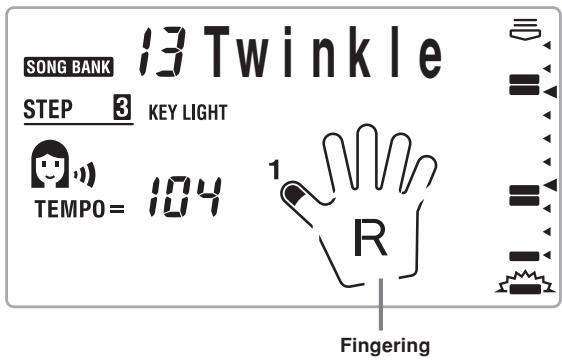
- Jouez sur le clavier en suivant les touches qui s'allument.
- La partie d'accompagnement (main gauche) du morceau joue à vitesse normale, quelle que soit votre jeu sur le clavier.
- Avec un morceau à accompagnement automatique, la touche du clavier correspondant à la prochaine note à jouer clignote, puis s'allume lorsque la note doit être jouée.
- Avec un morceau à deux mains, la touche du clavier concernée reste allumée tant que sa note joue. Dans ce cas, cependant, la touche de la prochaine note à jouer ne clignote pas. Les touches s'allument lorsque leurs notes commencent à jouer.
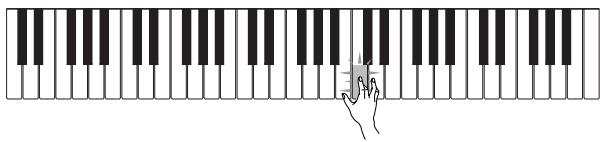
- Pour arrêter la lecture à tout moment, appuyez sur le bouton START/STOP.
- Lorsque vous le faites, l'indicateur ÉTAPE 3 s'éteint.
Pour travailler la partie de la main gauche
Une fois que vous maîtrisez la partie de la main droite, vous pouvez utiliser les morceaux à deux mains (numéros 84 à 99) pour travailler la partie de la main gauche.
- Appuyez sur le bouton SONG BANK jusqu'à ce que l'indicateur SONG BANK apparaisse.
- Cela fait apparaître le numéro et le nom de la mélodie de la banque de chansons actuellement sélectionnée sur l'écran.
- Saisissez le numéro à deux chiffres de la mélodie que vous souhaitez jouer.
- Appuyez sur le bouton PART SELECT pour basculer la lecture de la main gauche.
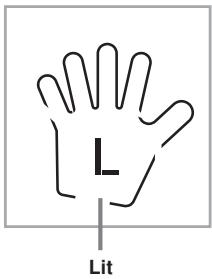
- Appuyez sur le bouton STEP 1, STEP 2 ou STEP 3.
- Lorsque vous le faites, l'indicateur STEP 1, STEP 2 ou STEP 3 apparaît.
- Après un battement de comptage, la partie de la main droite commence à jouer et les touches des notes de la main gauche clignotent.
- Appuyez sur le bouton PART SELECT pour revenir au réglage précédent de la sélection de partie.
- Pour interrompre la lecture de la mélodie, appuyez sur le bouton START/STOP.
- Lorsque vous le faites, l'indicateur STEP 1, STEP 2 ou STEP 3 disparaît.
Qu'est-ce que le MIDI ?
Les lettres MIDI signifient Musical Instrument Digital Interface, qui est le nom d'une norme mondiale pour les signaux numériques et les connecteurs qui permet d'échanger des données musicales entre des instruments de musique et des ordinateurs (machines) produits par différents fabricants.
Connexions MIDI
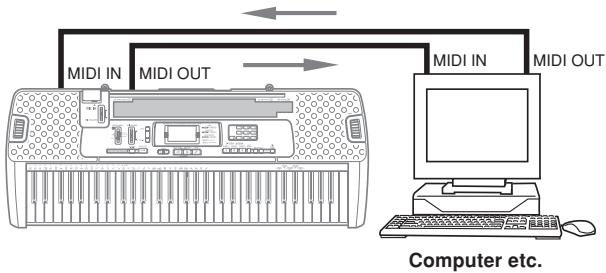
MIDI général
Le MIDI général normalise les données MIDI pour tous les types de sources sonores, quel que soit le fabricant. Le MIDI général spécifie des facteurs tels que la numérotation des timbres, les sons de batterie et les canaux MIDI disponibles pour toutes les sources sonores. Cette norme permet à tous les équipements MIDI de reproduire les mêmes nuances lors de la lecture de données MIDI générales, quel que soit le fabricant de la source sonore.
Bien que la source sonore de ce clavier ne soit pas compatible MIDI général, vous pouvez toujours connecter le clavier à un ordinateur ou à un autre équipement MIDI pour lire des données MIDI générales largement disponibles dans les magasins, sur les réseaux informatiques et à partir d'autres sources.
REMARQUE
- Les données MIDI générales composées d'un grand nombre de parties peuvent ne pas être lues correctement sur ce clavier.
- Vous aurez plus de succès en lisant des données MIDI générales qui ont peu de parties et qui sont composées de parties sur les canaux 1, 2, 3, 4 et 10.
Messages
Il existe une grande variété de messages définis dans la norme MIDI, et cette section détaille les messages particuliers qui peuvent être envoyés et reçus par ce clavier.
NOTE ON/OFF
Ce message envoie des données lorsqu'une touche est enfoncée (NOTE ON) ou relâchée (NOTE OFF).
Un message NOTE ON/OFF comprend un numéro de note (pour indiquer la note dont la touche est enfoncée ou relâchée) et une vélocité (vélocité = 100 lorsque la valeur de volume de cet appareil est de 9 à 2, et vélocité = 75 lorsque la valeur de volume est de 1 ou 0). La vélocité de NOTE ON est toujours utilisée pour déterminer le volume relatif de la note. Ce clavier ne reçoit pas les données de vélocité de NOTE OFF.
Chaque fois que vous enfoncez ou relâchez une touche sur ce clavier, le message NOTE ON ou NOTE OFF correspondant est envoyé avec une vélocité constante depuis la borne MIDI OUT.
CHANGEMENT DE PROGRAMME
Ceci est le message de sélection de sonorité. PROGRAM CHANGE peut contenir des données de sonorité dans la plage de 0 à 127.
Un message PROGRAM CHANGE (0 à 99) est envoyé via la borne MIDI OUT de ce clavier chaque fois que vous changez manuellement son numéro de sonorité. La réception d'un message PROGRAM CHANGE provenant d'un appareil externe modifie le réglage de sonorité de ce clavier.
Ce clavier peut envoyer des données de sonorité dans la plage de 00 à 99 et recevoir des données de sonorité dans la plage de 0 à 127* . Chacune des 128 sonorités General MIDI est automatiquement assignée à l'une des 100 sonorités intégrées du clavier, comme indiqué à la page A-1. Sélectionnez ce réglage lorsque vous souhaitez écouter des données General MIDI provenant d'un ordinateur ou d'un autre équipement externe.
- Lorsque le mappage GM est activé (page E-28). Lorsqu'il est désactivé, les données de sonorité sont reçues dans la plage de 0 à 99.
REMARQUE
- Le canal 10 est réservé à la partie batterie et ne reçoit pas les messages Program Change. Lors de la réception de données MIDI, il produit des sons de percussion générés par ce clavier.
PITCH BEND
Ce message transporte des informations de pitch bend pour faire glisser la hauteur vers le haut ou vers le bas en douceur pendant le jeu au clavier. Ce clavier n'envoie pas de données de pitch bend, mais il peut en recevoir.
CONTROL CHANGE
Ce message ajoute des effets tels que vibrato et changements de volume appliqués pendant le jeu au clavier. Les données CONTROL CHANGE comprennent un numéro de contrôle (pour identifier le type d'effet) et une valeur de contrôle (pour spécifier l'état marche/arrêt et la profondeur de l'effet).
Voici une liste des données pouvant être reçues à l'aide de CONTROL CHANGE.
| Effect | Control Number |
| VOLUME | 7 |
| HOLD1 | 64 |
| MODULATION | 1 |
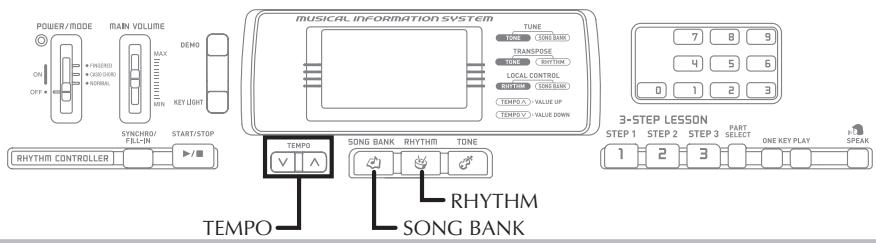
LOCAL CONTROL (par défaut : on) / Mappage GM (par défaut : off)
Ce réglage détermine si le clavier et la source sonore de ce clavier sont connectés en interne. Lors de l'enregistrement sur un ordinateur ou un autre périphérique externe connecté aux bornes MIDI IN/OUT de ce clavier, il est utile de désactiver LOCAL CONTROL.
on : Tout ce qui est joué sur le clavier est émis par la source sonore interne et simultanément envoyé comme message MIDI depuis la borne MIDI OUT. oFF : Tout ce qui est joué sur le clavier est envoyé comme message MIDI depuis la borne MIDI OUT, sans être émis par la source sonore interne. Désactivez LOCAL CONTROL lorsque vous utilisez la fonction MIDI THRU d'un ordinateur ou d'un autre périphérique externe. Notez également qu'aucun son n'est produit par le clavier si LOCAL CONTROL est désactivé et qu'aucun périphérique externe n'est connecté.
REMARQUE
- Lorsque vous utilisez ce clavier en configuration autonome, les touches du clavier ne s'allument pas lorsque la commande locale est désactivée.
Pour désactiver la COMMANDE LOCALE / Pour activer le mappage GM
- Dans tout mode autre que le mode Banque de chansons (indiqué lorsque le témoin SONG BANK est allumé), maintenez enfoncé le bouton RHYTHM et appuyez sur le bouton SONG BANK.
- Effectuez l'étape 2 dans les cinq secondes suivant l'étape 1.
- Utilisez le bouton TEMPO (v) pour désactiver la commande locale.
- Cela active également le mappage GM.
de Local
Pour activer la COMMANDE LOCALE / Pour désactiver le mappage GM
- Dans tout mode autre que le mode Banque de chansons (indiqué lorsque le témoin SONG BANK est allumé), maintenez enfoncé le bouton RHYTHM et appuyez sur le bouton SONG BANK.
- Effectuez l'étape 2 dans les cinq secondes suivant l'étape 1.
- Utilisez le bouton TEMPO (A) pour activer la commande locale.
- Cela désactive également le mappage GM.
sur Local
NOTE
- Notez que la commande LOCALE est également activée automatiquement lorsque vous mettez l'instrument sous tension, ou lorsque vous appuyez sur l'un des boutons suivants.
- START/STOP (pour démarrer la lecture du rythme ou d'un morceau de la banque de chansons)
- ONE-KEY PLAY STEP1 STEP2 STEP3
- DEMO (pour démarrer la lecture du morceau de démonstration)
- Consultez la liste des correspondances de sons GM à la fin de ce manuel pour plus d'informations sur les affectations de sons lorsque la correspondance GM est activée.
Dépannage
Consultez le tableau suivant chaque fois que vous rencontrez des problèmes de fonctionnement du clavier.
| Symptom | Cause | Action | See Page |
| • No sound when keyboard keys are pressed. | 1. Power supply problem. | 1. Correctly attach the AC adaptor, make sure that batteries (+/-) are facing correctly, and check to make sure that batteries are not dead. | Page E-11 |
| 2. Volume setting is too low. | 2. Use the MAIN VOLUME slider to increase volume. | Page E-15 | |
| 3. Headphones are plugged into the keyboard. | 3. Unplug the headphones from the PHONES/OUTPUT jack. | Page E-13 | |
| 4. The POWER/MODE selector is in the CASIO CHORD or FINGERED position. | 4. Normal play is not possible on the accompaniment keyboard while the POWER/MODE selector is set to CASIO CHORD or FINGERED. Change the POWER/MODE selector setting to NORMAL. | Page E-18 | |
| 5. Tone “99 PERCUSSION” is selected and you are pressing keys that are not assigned tones. | 5. While “99 PERCUSSION” is selected, you can use only keys that are marked on the console with illustrations of percussion instruments. | Page E-15 | |
| 6. LOCAL CONTROL is off. | 6. Turn on LOCAL CONTROL. | Page E-28 | |
| • Any of the following symptoms while using battery power. | • Low battery power | • Replace the batteries with a set of new ones or use the AC adaptor. | Page E-11 |
| • Dim power indicator • Instrument does not turn on • Display that is flickering, dim, or difficult to read • Abnormally low speaker/headphone volume • Distortion of sound output • Occasional interruption of sound when playing at high volume • Sudden power failure when playing at high volume • Flickering or dimming of the display when playing at high volume • Continued sound output even after you release a key • A tone that is totally different from the one that is selected • Abnormal rhythm pattern and Song Bank play • Loss of power, sound distortion, or low volume when playing from a connected computer or MIDI device • Abnormally low microphone volume • Distortion of microphone input • Dim power supply indicator when a microphone is used | |||
| • Key light stays on. | • Keyboard is waiting for play of the correct note during Step 1 or Step 2 play. | 1. Press the lit key to continue with Step 1 or Step 2 play. 2. Press the START/STOP button to quit Step 1 or Step 2 play. | Pages E-24, 25 Pages E-24, 25 |
| • Keyboard keys light but no sound is produced. | • Power on alert is telling you that power is left on. | • Press any button or keyboard key to resume normal operation with the keyboard in its initial power on setting. | Page E-12 |
| • RHYTHM button does not work. | • Keyboard is in the Song Bank Mode. | • Press the SONG BANK button to return to the normal mode. | Page E-21 |
| • Cannot change TRANSPOSE/TUNE/LOCAL CONTROL settings. | • Keyboard is in the Song Bank Mode. • Demo tune play is in progress. | • Press the SONG BANK button to return to the normal mode. • Stop demo tune play. | Page E-21 Page E-17 |
| • No sound is produced when playing MIDI data from a computer. | • MIDI cables are not connected properly. | • Connect MIDI cables properly. | Page E-27 |
| • Playing on the keyboard produces an unnatural sound when connected to a computer. | • The computer's MIDI THRU function is turned on. | • Turn off the MIDI THRU function on the computer or turn off LOCAL CONTROL on the keyboard. | Page E-28 |
| • Static noise when a microphone is connected. | 1. Use of a microphone that is a different from the type that is recommended. 2. Use of the microphone in the vicinity of fluorescent lighting. | 1. Use a full metal shielded Cannon type microphone. 2. Move the microphone away from source of the static. | Page E-13 Page E-13 |
| • No microphone sound. | 1. Microphone volume setting is too low. 2. Microphone on/off switch is set to off. | 1. Increase the microphone volume setting. 2. Change the microphone on/off switch setting to on. | Page E-13 Page E-13 |
| A tone's quality and volume sounds slightly different depending where it is played on the keyboard. | This is an unavoidable result of the digital sampling process,* and does not indicate malfunction. * Multiple digital samples are taken for the low range, middle range, and high range of the original musical instrument. Because of this, there may be a very slight difference in tonal quality and volume between sample ranges. | ||
Spécifications
| Model: | LK-100 |
| Keyboard: | 61 standard-size keys; 5 octaves |
| Key Light System: | Can be turned on and off (up to 4 keys can be lit at the same time) |
| Tones: | 100 presets |
| Polyphony: | 12 notes maximum |
| 3-Step Lesson System: Playback: Voice Fingering Guide: | Number of simultaneously lit keys; 4 3-Steps 1 tune repeat playback On/Off |
| Auto-accompaniment Rhythm patterns: Tempo: Chords: Other: | 50 presets Adjustable, (216 steps, ∫ = 40 to 255), initial value; 120 Two systems; CASIO CHORD, FINGERED Fill-in pattern, Synchro start |
| Song Bank tunes: | 100 tunes |
| Musical Information Function: | Tone, Auto Accompaniment, Song Bank numbers and names; tempo, 3 step lesson display, chord name, fingering, timing indicator, key lighting, voice fingering |
| Other Functions Transpose: Tuning: | F# to C to F: half-note Adjustable A4 = Approx. 440 Hz ±50 cents, Initial value: A4 = Approx. 440 Hz |
| MIDI: | 5 multi-timbre receive |
| Speakers: | 10 cm diameter × 2 (Output: 2W+2W) |
| I/O Terminals MIDI Terminals: Sustain: Power Supply: Headphones/Output: Microphone In: | IN, OUT Standard jack DC 9V jack Stereo standard jack (Output is monaural.) [output impedance: 78Ω, output voltage: 4V (RMS) MAX] Standard jack (with microphone volume slider) Input impedance: 2KΩ Input sensitivity: 10mV |
| Power Supply: Batteries: Battery life: AC adaptor: Auto Power Off: | 2-way 6 AA-size Approximately 4 hours continuous operation on alkaline batteries Approximately 1 hour continuous operation on manganese batteries AD-5 Approximately 6 minutes after the last operation (Operates during battery use only) |
| Power Consumption: | 9 V --- 7.7 W |
| Dimensions: | 94.5 × 37.3 × 13.5 cm (371/4" × 1411/16" × 55/16") |
| Weight: | Approximately 4.7 kg (10.4 lbs) (without batteries) |
- Les conceptions et les spécifications sont sujettes à modification sans préavis.
Liste des correspondances de sons GM
Lista de asignaciones de sonido GM
| Tone No./Tone Name N° de sonido/N Nombre de sonido | GM No. N° GM |
| 00 GRAND PIANO | 0 |
| 01 BRIGHT PIANO | 1 |
| 02 HONKY-TONK | 3 |
| 03 E GRAND PIANO | 2 |
| 04 ELEC PIANO 1 | 4 |
| 05 ELEC PIANO 2 | 5 |
| 06 ELEC PIANO 3 | 8 |
| 07 ELEC PIANO 4 | 9 |
| 08 HARPSICHORD | 6 |
| 09 CLAVI | 7 |
| 10 ELEC ORGAN 1 | 16 |
| 11 ELEC ORGAN 2 | 17 |
| 12 ELEC ORGAN 3 | 18 |
| 13 ELEC ORGAN 4 | 15 |
| 14 CHURCH ORGAN | 19 |
| 15 PIPE ORGAN | 104 |
| 16 REED ORGAN | 20 |
| 17 ACCORDION | 21 |
| 18 BANDONEON | 23 |
| 19 HARMONICA | 22 |
| 20 NYLON STR GT | 24 |
| 21 STEEL STR GT | 25 |
| 22 JAZZ GUITAR | 26 |
| 23 CLEAN GUITAR | 27 |
| 24 MUTE GUITAR | 28 |
| 25 DIST GUITAR | 29 30 31 84 |
| 26 ACOUSTIC BASS | 32 |
| 27 ELEC BASS | 33 34 35 |
| 28 SLAP BASS | 36 37 |
| 29 BANJO | 105 |
| 30 VIOLIN | 40 41 |
| 31 CELLO | 42 43 |
| 32 HARP | 45 46 47 |
| 33 STRINGS 1 | 48 55 |
| 34 STRINGS 2 | 49 |
| 35 STRINGS 3 | 44 |
| 36 SYNTH-STR 1 | 50 |
| 37 SYNTH-STR 2 | 51 |
| 38 CHOIR AAHS | 52 91 |
| 39 SYNTH-VOICE | 53 85 |
| 40 TRUMPET | 56 |
| 41 TUBA | 58 |
| 42 BRASS SECTION | 57 |
| 43 FRENCH HORN 1 | 60 |
| 44 FRENCH HORN 2 | 59 |
| 45 BRASS 1 | 61 |
| 46 BRASS 2 | 69 |
| 47 SYNTH-BRASS 1 | 62 |
| 48 SYNTH-BRASS 2 | 63 83 |
| 49 SYNTH-BRASS 3 | 70 |
| Tone No./Tone Name N° de sonido/N Nombre de sonido | GM No. N° GM |
| 50 SOPRANO SAX | 64 |
| 51 ALTO SAX | 65 |
| 52 TENOR SAX | 66 67 |
| 53 OBOE | 68 |
| 54 CLARINET | 71 |
| 55 PICCOLO | 72 |
| 56 FLUTE | 73 |
| 57 REORDER | 74 79 |
| 58 FLUTE ENSEMBLE | 75 76 77 |
| 59 WHISTLE | 78 |
| 60 SYNTH-LEAD 1 | 87 |
| 61 SYNTH-LEAD 2 | 81 86 |
| 62 SYNTH-LEAD 3 | 80 |
| 63 CALLIOPE | 82 |
| 64 SYNTH-PAD 1 | 89 |
| 65 SYNTH-PAD 2 | 90 |
| 66 SYNTH-PAD 3 | 95 |
| 67 BOWED GLASS | 92 93 98 |
| 68 HALO PAD | 54 94 |
| 69 SYNTH-BASS | 38 39 |
| 70 RAIN DROP | 96 |
| 71 SF | 103 |
| 72 SOUNDTRACK | 97 |
| 73 SPACE PAD | 101 |
| 74 SYNTH-SFX | 102 |
| 75 VEHICLE | 125 |
| 76 TELEPHONE | 124 |
| 77 SPACE | 126 |
| 78 INVADER | 127 |
| 79 FUNNY | 123 |
| 80 STRINGS PIANO | 106 |
| 81 STRINGS EP | 88 107 |
| 82 CHOIR EP | 108 |
| 83 CHOIR ORGAN | 109 |
| 84 STRINGS GUITAR | 99 110 |
| 85 STRINGS HARP | 111 |
| 86 BRASS STRINGS | 112 |
| 87 VIB PAD | 113 |
| 88 12STR GUITAR | 114 |
| 89 CHOIR STRINGS | 115 |
| 90 BASS/PIANO | 100 116 |
| 91 BASS/E PIANO | 117 |
| 92 BASS/VIB | 118 |
| 93 BASS/NYLON STR GT | 119 |
| 94 BASS/DIST GUITAR | 120 |
| 95 STRINGS/PIANO | 121 |
| 96 STRINGS/TRUMPET | 122 |
| 97 VIBRAPHONE | 10 11 14 |
| 98 MARIMBA | 12 13 |
| 99 PERCUSSION |
Liste des rythmes
Lista de ritmos
| POPS | |
| 00 | CLUB POP |
| 01 | FUNKY POP |
| 02 | SOUL BALLAD |
| 03 | POP BALLAD |
| 04 | LITE POP |
| 05 | 16 BEAT FUNK |
| 06 | 8 BEAT POP |
| 07 | POP ROCK |
| 08 | DANCE POP |
| 09 | POP FUSION |
| 10 | FOLKIE POP |
| ROCK | |
| 11 | ROCK WALTZ |
| 12 | SLOW ROCK |
| 13 | SOFT ROCK |
| 14 | 50'S ROCK |
| 15 | 60'S SOUL |
| 16 | 4 BEAT ROCK |
| 17 | ROCK |
| 18 | TWIST |
| 19 | NEW ORLNS R&R |
| 20 | R&B |
| JAZZ/FUSION | |
| 21 | BIG BAND |
| 22 | SWING |
| 23 | FOX TROT |
| 24 | JAZZ WALTZ |
| 25 | LATIN FUSION |
| DANCE/FUNK | |
| 26 | TECHNO |
| 27 | TRANCE |
| 28 | DISCO |
| 29 | FUNK |
| 30 | RAP |
| EUROPEAN | |
| 31 | POLKA |
| 32 | MARCH |
| 33 | WALTZ |
| 34 | SLOW WALTZ |
| 35 | TANGO |
| LATIN/VARIOUS I | |
| 36 | BOSSA NOVA |
| 37 | SAMBA |
| 38 | MAMBO |
| 39 | REGGAE |
| 40 | SKA |
| 41 | SALSA |
| 42 | FOLKLORE |
| 43 | RUMBA CATALANA |
| VARIOUS II | |
| 44 | COUNTRY |
| 45 | TOWNSHIP |
| 46 | SLOW GOSPEL |
| 47 | BALADI |
| 48 | BAROQUE |
| 49 | NEW AGE |
Tableaux des accords avec doigtés
Tableaux d'accords doigtés
Ce tableau montre les doigtés de la main gauche (y compris les formes inversées) pour un certain nombre d'accords couramment utilisés.
Ce tableau montre les doigtés (y compris les formes inversées) pour divers accords parmi les plus utilisés.
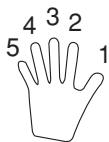
: Numéros des doigts de la main gauche
| Chord Root Type | M | m | 7 | m7 | dim7 | M7 | m75 | dim |
| C | [5,3,1] | [5,3,1] | [5,3,2,1] | [5,3,2,1] | [5,3,2,1] | [5,3,2,1] | [5,3,2,1] | [5,3,2] |
| C# (D#) | [5,3,1] | [5,3,1] | [5,3,2,1] | [5,3,2,1] | [5,3,2,1] | [5,3,2,1] | [5,3,2,1] | [5,3,2] |
| D | [5,3,1] | [5,3,1] | [5,3,2,1] | [5,3,2,1] | [5,3,2,1] | [5,3,2,1] | [5,3,2,1] | [5,3,2] |
| E# (D#) | [5,3,1] | [5,3,1] | [5,3,2,1] | [5,3,2,1] | [5,3,2,1] | [5,3,2,1] | [5,3,2,1] | [5,3,2] |
| E | [5,3,1] | [5,3,1] | [5,3,2,1] | [5,3,2,1] | [5,3,2,1] | [5,3,2,1] | [5,3,2,1] | [5,3,2] |
| F | [5,3,1] | [5,3,1] | [5,3,2,1] | [5,3,2,1] | [5,3,2,1] | [5,3,2,1] | [5,3,2,1] | [5,3,2] |
| F# (G#) | [5,3,1] | [5,3,1] | [5,3,2,1] | [5,3,2,1] | [5,3,2,1] | [5,3,2,1] | [5,3,2,1] | [5,3,2] |
| G | [5,3,1] | [5,3,1] | [5,3,2,1] | [5,3,2,1] | [5,3,2,1] | [5,4,2,1] | [5,3,2,1] | [5,3,2] |
| A# (G#) | [5,3,1] | [5,3,1] | [5,4,2,1] | [5,4,2,1] | [5,3,2,1] | [5,4,2,1] | [5,4,2,1] | [5,3,2] |
| A | [5,3,1] | [5,3,1] | [5,4,2,1] | [5,4,2,1] | * | [5,4,2,1] | [5,4,2,1] | [5,3,2] |
| B# (A#) | [5,3,1] | [5,3,1] | [5,4,2,1] | [5,4,2,1] | * | [5,4,2,1] | [5,4,2,1] | [5,3,2] |
| B | [5,2,1] | [5,2,1] | [5,3,2,1] | [5,3,2,1] | * | [5,3,2,1] | [5,4,2,1] | [5,3,2] |
| Chord Root Type | aug | sus4 | 7 sus4 | m add9 | m M7 | 7/5 | add9 |
| C | [5,3,1] | [5,2,1] | [5,3,2,1] | [4,3,2,1] | [5,3,2,1] | [5,3,2,1] | [4,3,2,1] |
| C# (D b) | [5,3,1] | [5,2,1] | [5,3,2,1] | [4,3,2,1] | [5,3,2,1] | [5,3,2,1] | [4,3,2,1] |
| D | [5,3,1] | [5,2,1] | [5,3,2,1] | [4,3,2,1] | [5,3,2,1] | [5,3,2,1] | [4,3,2,1] |
| E# (D#) | [5,3,1] | [5,2,1] | [5,3,2,1] | [4,3,2,1] | [5,3,2,1] | [5,3,2,1] | [4,3,2,1] |
| E | [5,3,1] | [5,2,1] | [5,3,2,1] | [4,3,2,1] | [5,3,2,1] | [5,3,2,1] | [4,3,2,1] |
| F | [5,3,1] | [5,2,1] | [5,3,2,1] | [4,3,2,1] | [5,3,2,1] | [5,3,2,1] | [4,3,2,1] |
| F# (G b) | [5,3,1] | [5,2,1] | [5,3,2,1] | [4,3,2,1] | [5,3,2,1] | [5,3,2,1] | [4,3,2,1] |
| G | [5,3,1] | [5,2,1] | [5,3,2,1] | [4,3,2,1] | [5,4,2,1] | [5,3,2,1] | [4,3,2,1] |
| A# (G #) | [5,3,1] | [5,2,1] | [5,4,2,1] | [4,3,2,1] | [5,4,2,1] | [5,4,2,1] | [4,3,2,1] |
| A | [5,3,1] | [5,2,1] | [5,4,2,1] | [4,3,2,1] | [5,4,2,1] | [5,4,2,1] | [4,3,2,1] |
| B# (A#) | * | [5,2,1] | [5,4,2,1] | [4,3,2,1] | [5,4,2,1] | [5,4,2,1] | [4,3,2,1] |
| B | * | [5,2,1] | [5,3,2,1] | [5,3,2,1] | [5,3,2,1] | [4,3,2,1] | [5,3,2,1] |
- Ne peut pas être spécifié dans le réglage FINGERED en raison des limitations du clavier d'accompagnement, mais des accords augmentés et diminués (septième) composés des mêmes notes constitutives (avec une note de basse différente) peuvent être utilisés à la place.
Accords avec les mêmes notes constitutives que Si bémol augmenté ......... Ré augmenté, Fa dièse augmenté
Accords avec les mêmes notes constitutives que Si augmenté. Mi augmenté, Sol augmenté
Accords avec les mêmes notes constitutives que La diminué septième ......... Do diminué septième, Mi bémol diminué septième, Fa dièse diminué septième
Accords avec les mêmes notes constitutives que Si bémol diminué septième ......... Do dièse diminué septième, Mi diminué septième, Sol diminué septième
Accords avec les mêmes notes constitutives que Si diminué septième ........ Ré diminué septième, Fa diminué septième, La bémol diminué septième
- Ne peut pas être spécifié dans le réglage FINGERED en raison des limitations du clavier d'accompagnement, mais des accords augmentés et diminués (septième) composés des mêmes notes constitutives (avec une note de basse différente) peuvent être utilisés à la place.
Accords avec les mêmes notes constitutives que Si bémol augmenté....... Ré augmenté, Fa dièse augmenté.
Accords avec les mêmes notes constitutives que Si augmenté....... Mi augmenté, Sol augmenté.
Accords avec les mêmes notes constitutives que La diminué septième....... Do diminué septième, Mi bémol diminué septième, Fa dièse diminué septième.
Accords avec les mêmes notes constitutives que Si bémol diminué septième .... Do dièse diminué septième, Mi diminué septième, Sol diminué septième.
Accords avec les mêmes notes composantes comme Bdim7 ... D dim7, Fdim7, A b dim7.
Version : 1.0
Tableau d'implémentation MIDI du modèle LK-100
| Function ... | Transmitted | Recognized | Remarks | |
| Basic Channel | Default Changed | 1 | 1-4, 10 | |
| 1 | 1-4, 10 | |||
| Mode | Default Messages Altered | Mode 3 X | Mode 3 X | |
| ********** | ********** | |||
| Note Number | True voice | 36-96 | 0-127 | *1: Depends on tone |
| ********** | 36-96 *1 | *1: Depende en el sonido | ||
| Velocity | Note ON Note OFF | X 9nV = 100 X 9nV = 0 | O 9nV = 1-127 X 9nV = 0,8nV = *2 | *2 = no relation *2 = sin relacion |
| After Touch | Key's Ch's | X X | X | |
| Pitch Bender | X | O | ||
| Control Change | 1 6, 38 7 10 11 64 | X X X X | O X O X | Modulation Data entry Volume Pan Expression Hold1 |
| X | O | |||
| X | X | |||
| O | O | |||
| 100, 101 | X | X | RPN LSB, MSB | |
| 120 | X | X | All sound off | |
| 121 | X | X | Reset all controller | |
| Program Change | :True # | O 0-99********** | O 0-127, 0-99 *3********** | *3: Depends on GM Map setting*3: Dependen el ajuste de.mapa GM |
| System Exclusive | X | X | ||
| System Common | : Song Pos | X | X | |
| : Song Sel | X | X | ||
| : Tune | X | X | ||
| System Real Time | : Clock | X | X | |
| : Commands | X | X | ||
| Aux Messages | : Local ON/OFF | X | X | |
| : All notes OFF | X | X | ||
| : Active Sense | X | X | ||
| : Reset | X | X | ||
| Remarks | ||||
Mode 1 : OMNI ON, POLY Mode 2 : OMNI ON, MONO O : Oui Mode 3 : OMNI OFF, POLY Mode 4 : OMNI OFF, MONO X : Non

Ce symbole de recyclage indique que l'emballage est conforme à la législation sur la protection de l'environnement en Allemagne.
Ce symbole de recyclage indique que l'emballage est conforme à la législation sur la protection de l'environnement en Allemagne.
CASIO

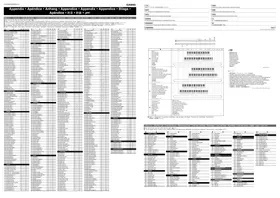
- LK
- GUIDE DE L'UTILISATEUR
- AVIS
- AVERTISSEMENT FCC
- IMPORTANT
- SYMBOLES
- DANGER
- AVERTISSEMENT
- ATTENTION
- EXEMPLES DE SYMBOLES
- PILES ALCALINES
- FUMÉE, ODEUR ÉTRANGE, SURCHAUFFE
- ADAPTATEUR SECTEUR
- PILES
- N'INCINÉREZ PAS LE PRODUIT
- EAU ET CORPS ÉTRANGERS
- DÉMONTAGE ET MODIFICATION
- CHUTE ET IMPACT
- SACS EN PLASTIQUE
- NE MONTEZ PAS SUR LE PRODUIT OU LE SUPPORT
- EMPLACEMENT
- DÉPLACEMENT DU PRODUIT
- NETTOYAGE
- CONNECTEURS
- ÉCRAN D'AFFICHAGE
- VOLUME SONORE
- PRÉCAUTION SANITAIRE
- OBJETS LOURDS
- ASSEMBLAGE CORRECT DU SUPPORT
- INDICATEURS À L'ÉCRAN POUR LE DOIGTÉ ET LE TIMING
- SONORITÉS INCROYABLEMENT RÉALISTES
- FONCTION D'ACCOMPAGNEMENT AUTOMATIQUE AMÉLIORÉE POUR UNE PLUS GRANDE POLYVALENCE
- AIRS INTÉGRÉS DANS LA BANQUE DE CHANSONS
- SYSTÈME DE LEÇON EN 3 ÉTAPES
- ACCOMPAGNEMENT AUTOMATIQUE
- FONCTION DE TRANSPOSITION
- COMPATIBILITÉ MIDI
- PRISE MICROPHONE
- CONSIGNES DE SÉCURITÉ E
- CARACTÉRISTIQUES PRINCIPALES E
- GUIDE GÉNÉRAL E
- RÉFÉRENCE RAPIDE E
- ALIMENTATION E
- ENTRETIEN DE VOTRE CLAVIER E
- CONNEXIONS E
- OPÉRATIONS DE BASE E
- SYSTÈME DE LEÇON EN 3 ÉTAPES E
- MIDI E
- RÉFÉRENCE TECHNIQUE......E
- ANNEXE A
- TABLEAU D'IMPLÉMENTATION MIDI
- CONTRÔLEUR DE RYTHME
- LEÇON EN 3 ÉTAPES
- FIXATION DU PUPITRE
- UTILISATION DES PILES
- POUR INSÉRER LES PILES
- REMARQUE
- INFORMATIONS IMPORTANTES SUR LA BATTERIE
- UTILISATION DE L'ADAPTATEUR SECTEUR
- MISE HORS TENSION AUTOMATIQUE
- ALERTE DE MISE SOUS TENSION
- POUR DÉSACTIVER LA MISE HORS TENSION AUTOMATIQUE ET L'ALERTE DE MISE SOUS TENSION
- ÉVITEZ LA CHALEUR, L'HUMIDITÉ OU LA LUMIÈRE DIRECTE DU SOLEIL
- NE L'UTILISEZ PAS PRÈS D'UN TÉLÉVISEUR OU D'UNE RADIO
- N'UTILISEZ PAS DE LAQUE, DU DILUANT OU DES PRODUITS CHIMIQUES SIMILAIRES POUR LE NETTOYAGE
- PRISE PHONES/OUTPUT
- CONNEXION DES ÉCOUTEURS (FIGURE 1)
- ÉQUIPEMENT AUDIO (FIGURE 2)
- AMPLIFICATEUR POUR INSTRUMENT DE MUSIQUE (FIGURE ③)
- PRISE SUSTAIN
- PÉDALE DE SUSTAIN
- UTILISATION DE LA PRISE MICROPHONE
- TYPE DE MICROPHONE RECOMMANDÉ
- LARSEN (BRUIT DE RÉACTION)
- BRUIT STATIQUE
- ACCESSOIRES ET OPTIONS
- POUR ALLUMER ET ÉTEINDRE L'ALIMENTATION
- POUR CHANGER DE SONORITÉ
- NOTE
- TONALITÉS AVEC CLAVIER DIVISÉ
- PERCUSSION (N° 99)
- POLYPHONIE
- AUTRES FONCTIONS UTILES
- POUR CHANGER LA TONALITÉ DU CLAVIER
- TRANS
- POUR ACCORDER LE CLAVIER
- ACCORD
- ACCORD (-)
- LECTURE DES MORCEAUX DE DÉMONSTRATION
- POUR DÉMARRER LA LECTURE DU MORCEAU DE DÉMONSTRATION
- POUR ARRÊTER LA LECTURE DE LA DÉMO
- LECTURE DES RYTHMES
- POUR SÉLECTIONNER ET JOUER UN RYTHME
- RHYTHM 37 SAMBA
- TEMPO
- UTILISATION DE L'ACCOMPAGNEMENT AUTOMATIQUE
- À PROPOS DU CLAVIER D'ACCOMPAGNEMENT
- UTILISATION DU SYSTÈME CASIO CHORD
- POUR JOUER UN ACCOMPAGNEMENT AUTOMATIQUE CASIO CHORD
- UTILISATION DES DOIGTÉS STANDARD
- POUR JOUER UN ACCOMPAGNEMENT AUTOMATIQUE FINGERED
- IMPROVISER AVEC LES MOTIFS PRÉDÉFINIS
- UTILISATION DU REMPLISSAGE (FILL-IN)
- UTILISATION DU DÉMARRAGE SYNCHRO
- UTILISATION DU SYSTÈME DE LEÇON EN 3 ÉTAPES
- ÉTAPE 1 : MAÎTRISER LE RYTHME
- ÉTAPE 2 : MAÎTRISER LA MÉLODIE
- ÉTAPE 3 : JOUER À VITESSE NORMALE
- RÉGLAGE DU TEMPO DU SYSTÈME DE LEÇON EN 3 ÉTAPES
- POUR JOUER UN AIR DE LA BANQUE DE CHANSONS INTÉGRÉE
- FONCTIONNEMENT DU SYSTÈME D'ÉCLAIRAGE DES TOUCHES ET AFFICHAGE PENDANT LA LECTURE DE LA BANQUE DE MORCEAUX
- INDICATIONS DE DOIGTÉ CROISÉ
- ÉCLAIRAGE DES TOUCHES PENDANT LA LECTURE DE LA BANQUE DE MORCEAUX
- MORCEAU DE LA BANQUE DE MORCEAUX AVEC ACCOMPAGNEMENT AUTOMATIQUE
- MORCEAU DE LA BANQUE DE MORCEAUX À DEUX MAINS
- FONCTIONNEMENT DU SYSTÈME D'ÉCLAIRAGE DES TOUCHES ET CONTENU DE L'AFFICHAGE PENDANT LA LECTURE DE LA LEÇON EN 3 ÉTAPES
- HAUTEUR DE NOTE
- DURÉE DE NOTE
- NOTE SUIVANTE
- SÉRIE DE NOTES DE MÊME HAUTEUR
- GUIDE DE DOIGTÉ VOCAL
- POUR ACTIVER ET DÉSACTIVER LE GUIDE DE DOIGTÉ VOCAL
- INDICATEUR DE TEMPO
- UTILISATION DE L'INDICATEUR DE TEMPO
- DÉSACTIVATION DE L'ÉCLAIRAGE DES TOUCHES
- NOMBRE DE TOUCHES ÉCLAIRÉES SIMULTANÉMENT
- POUR CHANGER LA TONALITÉ UTILISÉE POUR LA MÉLODIE D'UN MORCEAU DE LA BANQUE DE CHANSONS
- ÉTAPE 1 : MAÎTRISEZ LE RYTHME
- ÉTAPE 2 : MAÎTRISEZ LA MÉLODIE
- ÉTAPE 3 : JOUEZ À VITESSE NORMALE
- POUR TRAVAILLER LA PARTIE DE LA MAIN GAUCHE
- QU'EST-CE QUE LE MIDI
- CONNEXIONS MIDI
- MIDI GÉNÉRAL
- MESSAGES
- NOTE ON/OFF
- CHANGEMENT DE PROGRAMME
- PITCH BEND
- CONTROL CHANGE
- LOCAL CONTROL (PAR DÉFAUT : ON) / MAPPAGE GM (PAR DÉFAUT : OFF)
- POUR DÉSACTIVER LA COMMANDE LOCALE / POUR ACTIVER LE MAPPAGE GM
- POUR ACTIVER LA COMMANDE LOCALE / POUR DÉSACTIVER LE MAPPAGE GM
- DÉPANNAGE
- LISTE DES CORRESPONDANCES DE SONS GM
- LISTE DES RYTHMES
- LISTA DE RITMOS
- TABLEAUX DES ACCORDS AVEC DOIGTÉS
- TABLEAUX D'ACCORDS DOIGTÉS
Marque : CASIO
Modèle : LK-100
Catégorie : Clavier électronique