
UX-H100 - Système audio JVC - Notice d'utilisation et mode d'emploi gratuit
Retrouvez gratuitement la notice de l'appareil UX-H100 JVC au format PDF.


| Type de produit | Système audio micro-composant |
| Marque | JVC |
| Modèle | UX-H100 |
| Puissance de sortie | 2 x 10 W RMS (6 Ω, 1 kHz, 10% DHT) |
| Haut-parleurs | 10 cm cône pleine gamme, bass-reflex |
| Impédance des enceintes | 6 Ω |
| Plage de fréquences (enceintes) | 100 Hz - 15 kHz |
| Dimensions (unité principale, L x H x P) | 144 x 255 x 277 mm |
| Poids (unité principale) | 2,9 kg |
| Dimensions (enceinte, L x H x P) | 130 x 257 x 151 mm |
| Poids (enceinte) | 1,5 kg chacune |
| Alimentation | AC 230 V, 50 Hz |
| Consommation électrique | 38 W (en fonctionnement), 2 W (veille) |
| Tuner FM | 87,50 - 108,00 MHz |
| Tuner AM (MW) | 522 - 1629 kHz |
| Lecteur CD | CD, CD-R, CD-RW, MP3 (ISO 9660) |
| Platine cassette | Type I (Normal), 100 Hz - 10 kHz |
| Rapport signal/bruit (CD) | 85 dB |
| Fonctions principales | Minuterie quotidienne (3 programmations), Minuterie sommeil, Programmation des plages (32 plages), Lecture aléatoire, Répétition (1/ALL), Réglage des graves/aigus, Modes sonores (Rock, Pop, Classique, Jazz) |
| Entretien et nettoyage | Nettoyer avec un chiffon doux et détergent neutre ; nettoyer les têtes de cassette après 10 heures d'utilisation avec une cassette de nettoyage |
| Sécurité | Classe 1 laser ; ne pas exposer à l'humidité ; débrancher avant nettoyage ; ne pas obstruer les ouvertures de ventilation |
| Pièces détachées et réparabilité | Aucune pièce réparable par l'utilisateur à l'intérieur ; contacter un service qualifié pour toute réparation |
| Informations générales | Compatibilité CD-R/RW finalisés ; ne lit pas les formats MP3i, MP3 Pro ou Packet Write ; jusqu'à 500 fichiers MP3 par disque |
FOIRE AUX QUESTIONS - UX-H100 JVC
Questions des utilisateurs sur UX-H100 JVC
0 question sur cet appareil. Repondez a celles que vous connaissez ou posez la votre.
Poser une nouvelle question sur cet appareil
Téléchargez la notice de votre Système audio au format PDF gratuitement ! Retrouvez votre notice UX-H100 - JVC et reprennez votre appareil électronique en main. Sur cette page sont publiés tous les documents nécessaires à l'utilisation de votre appareil UX-H100 de la marque JVC.
MODE D'EMPLOI UX-H100 JVC
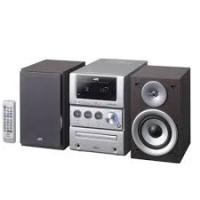
MICRO COMPONENT SYSTEM
UX-H100
- Consists of CA-UXH100 and SP-UXH100
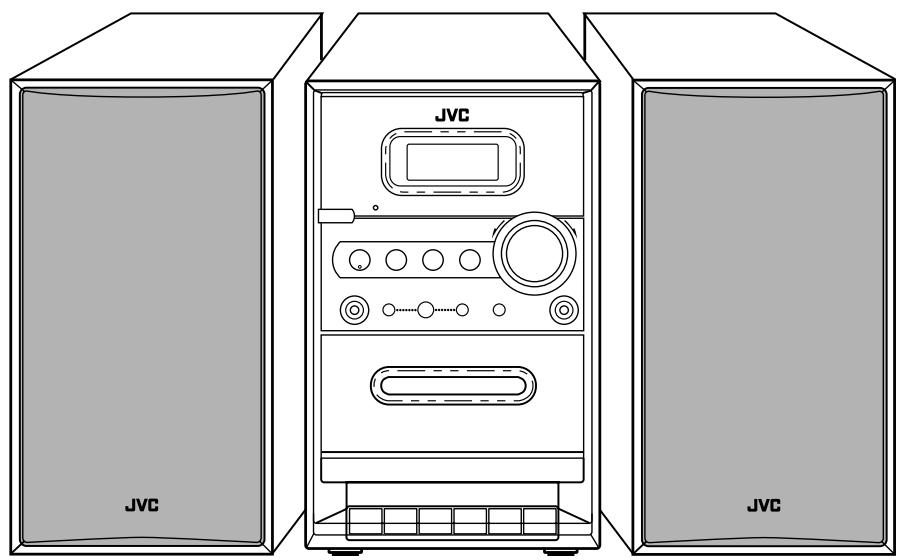

INSTRUCTIONS
IMPORTANT for the U.K.
DO NOT cut off the mains plug from this equipment. If the plug fitted is not suitable for the power points in your home or the cable is too short to reach a power point, then obtain an appropriate safety approved extension lead or consult your dealer.
BE SURE to replace the fuse only with an identical approved type, as originally fitted.
If nonetheless the mains plug is cut off ensure to remove the fuse and dispose of the plug immediately, to avoid a possible shock hazard by inadvertent connection to the mains supply.
If this product is not supplied fitted with a mains plug then follow the instructions given below:
IMPORTANT:
DO NOT make any connection to the terminal which is marked with the letter E or by the safety earth symbol or coloured green or green-and-yellow.
The wires in the mains lead on this product are coloured in accordance with the following code:
Blue: Neutral
Brown:Live
As these colours may not correspond with the coloured markings identifying the terminals in your plug proceed as follows:
The wire which is coloured blue must be connected to the terminal which is marked with the letter N or coloured black.
The wire which is coloured brown must be connected to the terminal which is marked with the letter L or coloured red.
IF IN DOUBT - CONSULT A COMPETENT ELECTRICIAN.
CAUTION- / I STANDBY/ON button!
Disconnect the mains plug to shut the power off completely (all lamps and indications go off). The / I STANDBY/ON button in any position does not disconnect the mains line.
- When the unit is on standby, the STANDBY lamp lights red.
- When the unit is turned on, the STANDBY lamp goes off.
The power can be remote controlled.
CAUTION
To reduce the risk of electrical shocks, fire, etc.:
1. Do not remove screws, covers or cabinet.
2. Do not expose this appliance to rain or moisture.
IMPORTANT FOR LASER PRODUCTS
- CLASS 1 LASER PRODUCT
- CAUTION: Do not open the top cover. There are no user serviceable parts inside the unit; leave all servicing to qualified service personnel.
- CAUTION: Visible and invisible laser radiation when open and interlock failed or defeated. Avoid direct exposure to beam.
- REPRODUCION OF LABEL: CAUTION LABEL, PLACED INSIDE THE UNIT.
| CAUTION : Visible and invisible laser radiation when open and interlock failed or defeated. AVOID DIRECT EXPOSURE TO BEAM. | ADVARSEL : Synilg og usynlg laserstråling nár maskinen er ábén eller interlocken fejér. Undgang direkte ekspensioner til stråling. | VARNING : Synilg och osynlg laserstråling nár den öppn asps och späränr ar urkoplad. Betrakta ej strålen. | VARO : Avattæssa ja suðalukitus ohitetutt aii vialisena öle itältna nakyvälle ja näkymäättabletare lasersäteiley. Välla sätten kohdismistua souaraan ieseisi. (f) |
CAUTION
- Do not block the ventilation openings or holes. (If the ventilation openings or holes are blocked by a newspaper or cloth, etc., the heat may not be able to get out.)
- Do not place any naked flame sources, such as lighted candles, on the apparatus.
- When discarding batteries, environmental problems must be considered and local rules or laws governing the disposal of these batteries must be followed strictly.
- Do not expose this apparatus to rain, moisture, dripping or splashing and that no objects filled with liquids, such as vases, shall be placed on the apparatus.
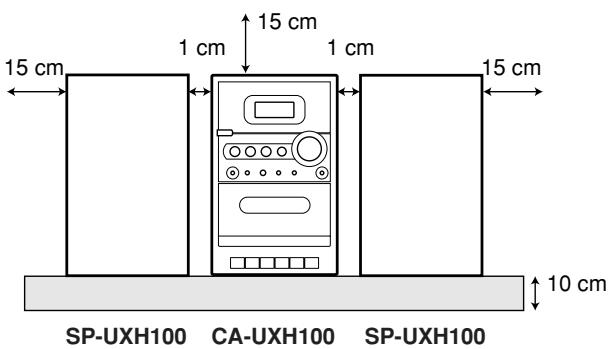
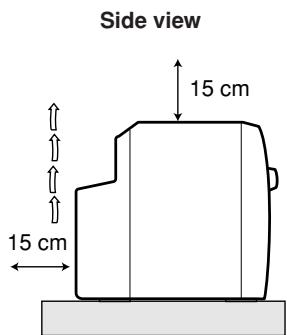
Caution: Proper Ventilation
To avoid risk of electric shock and fire, and to prevent damage, locate the apparatus as follows:
1 Front:
No obstructions and open spacing.
2 Sides/ Top/ Back:
No obstructions should be placed in the areas shown by the dimensions below.
3 Bottom:
Place on the level surface. Maintain an adequate air path for ventilation by placing on a stand with a height of 10cm or more.
Front view
CA-UXH100
SAFETY INSTRUCTIONS "SOME DOS AND DON'TS ON THE SAFE USE OF EQUIPMENT"
This equipment has been designed and manufactured to meet international safety standards but, like any electrical equipment, care must be taken if you are to obtain the best results and safety is to be assured.
责责责责责责责责责责责责责责责责责责责责责责责责
Do read the operating instructions before you attempt to use the equipment.
Do ensure that all electrical connections (including the mains plug, extension leads and interconnections between pieces of equipment) are properly made and in accordance with the manufacturer's instructions. Switch off and withdraw the mains plug when making or changing connections.
Do consult your dealer if you are ever in doubt about the installation, operation or safety of your equipment.
Do be careful with glass panels or doors on equipment.
☆☆☆☆☆☆☆☆☆☆☆☆☆☆☆☆☆☆☆☆☆☆☆☆☆☆☆☆☆☆☆☆☆
DON'T continue to operate the equipment if you are in any doubt about it working normally, or if it is damaged in any way—switch off, withdraw the mains plug and consult your dealer.
DON'T remove any fixed cover as this may expose dangerous voltages.
DONT leave equipment switched on when it is unattended unless it is specifically stated that it is designed for unattended operation or has a standby mode.
Switch off using the switch on the equipment and make sure that your family know how to do this.
Special arrangements may need to be made for infirm or handicapped people.
DON'T use equipment such as personal stereos or radios so that you are distracted from the requirements of traffic safety. It is illegal to watch television whilst driving.
DON'T listen to headphones at high volume as such use can permanently damage your hearing.
DON'T obstruct the ventilation of the equipment, for example with curtains or soft furnishings.
Overheating will cause damage and shorten the life of the equipment.
DON'T use makeshift stands and NEVER fix legs with wood screws — to ensure complete safety always fit the manufacturer's approved stand or legs with the fixings provided according to the instructions.
DON'T allow electrical equipment to be exposed to rain or moisture.
ABOVE ALL
NEVER let anyone, especially children, push anything into holes, slots or any other opening in the case -this could result in a fatal electrical shock.;
NEVER guess or take chances with electrical equipment of any kind
it is better to be safe than sorry!
We would like to thank you for purchasing one of our JVC products. Before operating this unit, read this manual carefully and thoroughly to obtain the best possible performance from your unit, and retain this manual for future reference.
About This Manual
This manual is organized as follows:
- This manual mainly explains operations using the buttons on the remote control.
You can use the buttons both on the remote control and on the unit for the same operations if they have the same or similar names (or marks), unless mentioned otherwise.
- Basic and common information that is the same for many functions is grouped in one place, and is not repeated for each procedure. For instance, we do not repeat the information about turning on/off the unit, setting the volume, changing the sound effects, and others, which are explained in the section "Basic and Common Operations" on pages 8 and 9.
- The following symbols are used in this manual:
Gives you warning and caution to prevent damage or risk of fire/electric shock. In addition, we put information here about conditions which will prevent getting the best possible performance from the unit.

Givestyouinformationandhindsightyou need to know.
Precautions
Installation
- Install in a place which is level, dry and neither too hot nor too cold—between 5^ and 35^ .
- Install the unit in a location with adequate ventilation to prevent internal heat buildup.
- Leave sufficient distance between the unit and the TV.
- Keep the speakers away from the TV to avoid interference with TV.

DO NOT install the unit in a location near heat sources, or in a place subject to direct sunlight, excessive dust or vibration.
Power sources
- When unplugging the unit from the wall outlet, always pull on the plug, not the AC power cord.

DO NOT handle the AC power cord with wet hands.
Moisture condensation
Moisture may condense on the lenses inside the unit in the following cases:
After starting to heat the room.
- In a damp room.
- If the unit is brought directly from a cold to a warm place. Should this occur, the unit may malfunction. In this case, leave the unit turned on for a few hours until the moisture evaporates, unplug the AC power cord, then plug it in again.
Others
- Should any metallic object or liquid fall into the unit, unplug the AC power cord and consult your dealer before operating any further.
- If you are not going to operate the unit for an extended period of time, unplug the AC power cord from the wall outlet.

DO NOT disassemble the unit since there are no user serviceable parts inside.
If anything goes wrong, unplug the AC power cord and consult your dealer.
Location of the Buttons and Controls 3
Main Unit 3
Remote Control 5
Getting Started 6
Unpacking 6
Putting the Batteries into the Remote Control 6
Connections 6
Connecting Other Equipment 7
Basic and Common Operations 8
Setting the Clock 8
Turning On the Power 8
Selecting the Source 9
Adjusting the Volume 9
9
Selecting the Sound Modes 9
Adjusting the Tone (Bass/Treble) 9
Listening to FM and AM (MW) Broadcasts 10
Tuning in to a Station 10
Preseting Stations 10
Tuning in to a Preset Station 11
Playing Back Discs 12
Playing Back the Entire Disc—Normal Play 12
Basic Disc Operations 13
Programming the Track Playing Order—Program Play 13
Repeating Tracks—Repeat Play 14
Playing at Random—Random Play 14
Displaying the Remaining Time during Playback 14
Playing Back Tapes. 15
Playing Back a Tape 15
Using an External Equipment 16
Listening to the External Equipment 16
Recording 17
Recording on a Tape 17
Recording Discs-Disc Synchronized Recording 18
Using the Timers 19
Using the Daily Timer 19
Using the Sleep Timer 20
Maintenance 21
Troubleshooting 22
Specifications 22
Become familiar with the buttons and controls on your unit.
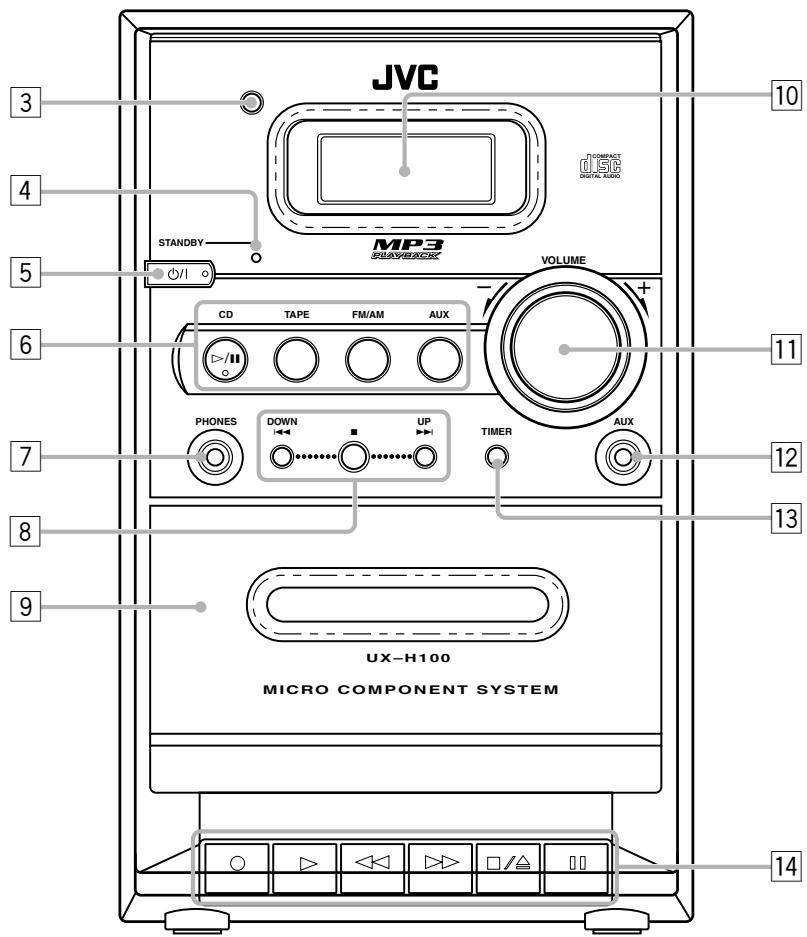
Main Unit
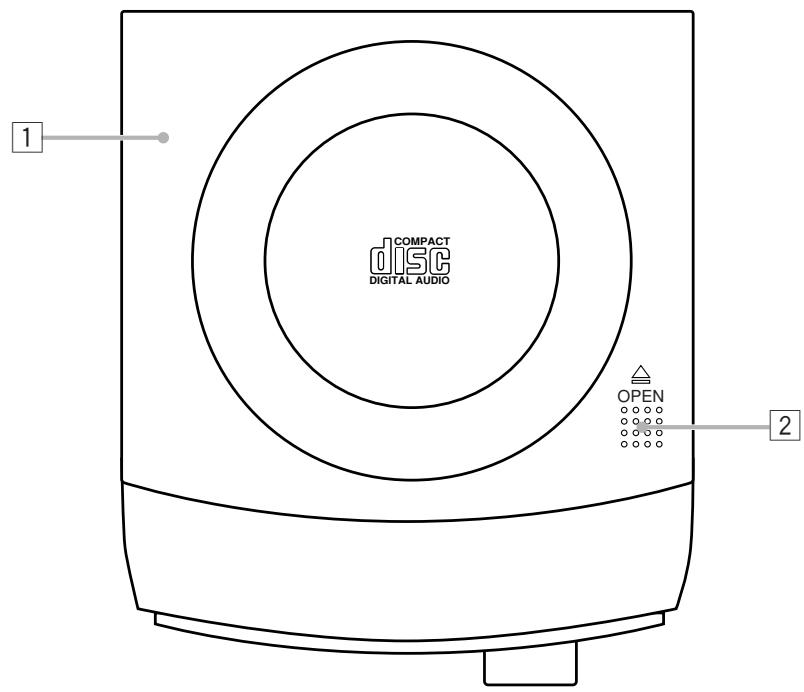
Top view
Front view
Display window
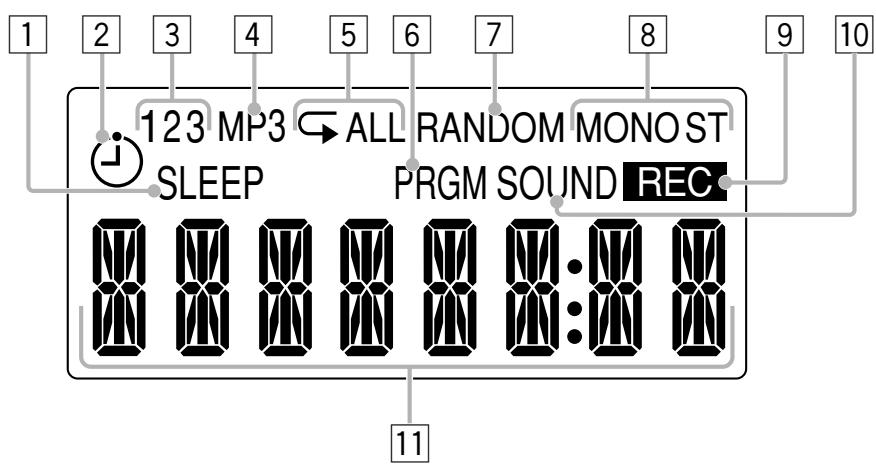
See pages in parentheses for details.
Main unit
1 Disc cover (12)
2 OPEN (disc cover open) (12)
Remote sensor (5)
4 STANDBY lamp (8)
5 1(STANDBY/ON) button (8, 19)
6 Source buttons
CD /II, TAPE, FM/AM, AUX
Pressing one of these buttons also turns on the unit.
7 PHONES jack (9)
8 MULTI CONTROL buttons
DOWN1<4,UP>
Cassette holder (15)
10 Display window
VOLUME control (9)
AUX jack (7, 17)
TIMER button (20)
14 Tape operation buttons (15, 17)
- (recording), (play), (fast backward), (fast forward), (stop/cassette holder open), (pause)
Display window
SLEEP indicator
2 (timer) indicator
3 Timer number indicators
4 MP3 indicator
Repeat indicators ALL
6 PRGM (program) indicator
7 RANDOM indicator
FM mode indicators MONO, ST (stereo)
REC indicator
10 SOUND indicator
11 Main display
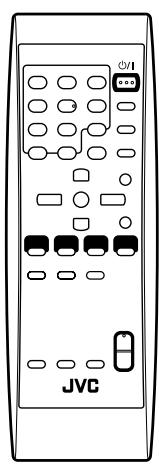
Remote Control
See pages in parentheses for details.
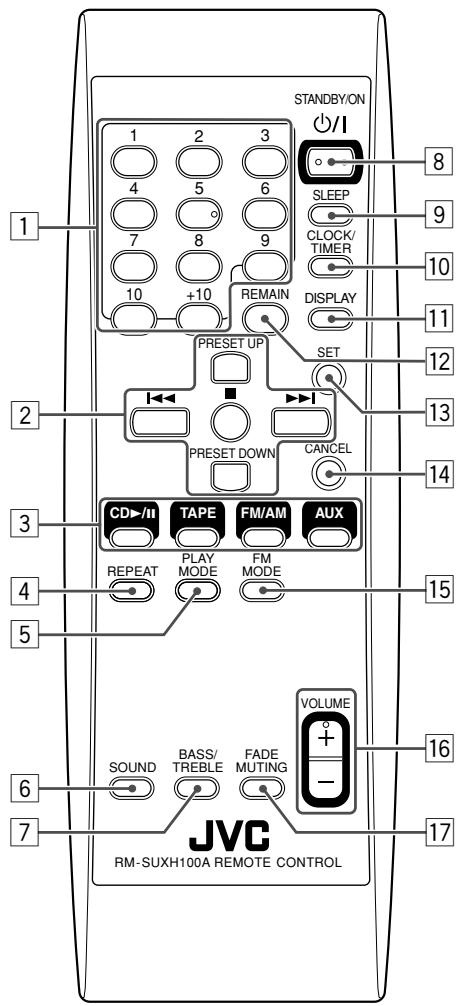
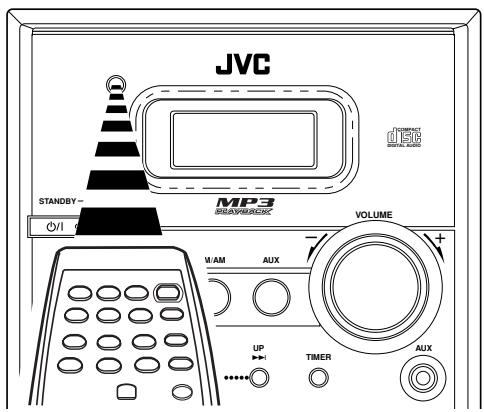
When using the remote control, point it at the remote sensor on the front panel.
Number buttons (10, 11, 13)
2 Multi control buttons
- PRESET UP, PRESET DOWN
-4,
3 Source buttons
CD /II, TAPE, FM/AM, AUX
Pressing one of these buttons also turns on the unit.
4 REPEAT button (14)
5 PLAY MODE button (10, 13, 14)
6 SOUND button (9)
BASS/TREBLE button (9)
STANDBY/ON按钮(8,19)
9 SLEEP button (20)
10 CLOCK/TIMER button (8, 19)
11 DISPLAY button (8)
12 REMAIN button (14)
13 SET button (8, 19)
14 CANCEL button (19)
15 FM MODE button (10)
16 VOLUME + /-buttons (9)
17 FADE MUTING button (9)
Unpacking
After unpacking, check to be sure that you have all the following items.
The number in parentheses indicates the quantity of each piece supplied.
AM loop antenna (1)
- Remote control (1)
- Batteries (2)
If any item is missing, consult your dealer immediately.
Putting the Batteries into the Remote Control
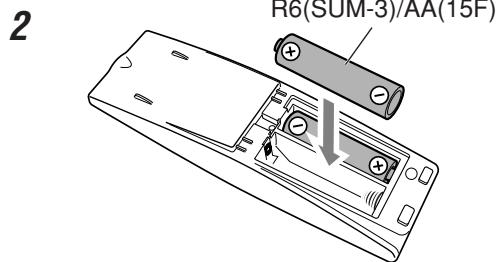
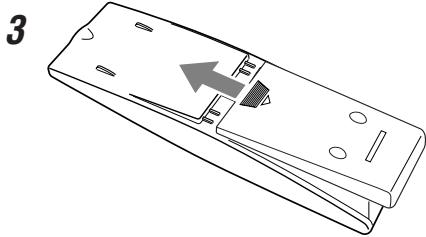
Insert the batteries—R6(SUM-3)/AA(15F)—into the remote control by matching the polarity (+ and -) on the batteries with the + and - marking on the battery compartment.
When the remote control can no longer operate the unit, replace both batteries at the same time.
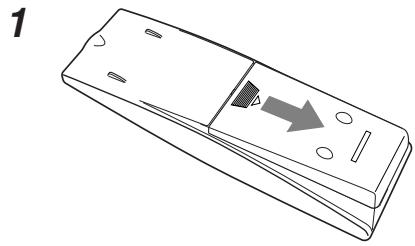

- DO NOT use an old battery together with a new one.
- DO NOT use different types of batteries together.
- DO NOT expose batteries to heat or flame.
- DO NOT leave the batteries in the battery compartment when you are not going to use the remote control for an extended period of time. Otherwise, the remote control will be damaged from battery leakage.
Connections
To connect speakers
You can connect the speakers using the speaker cords.
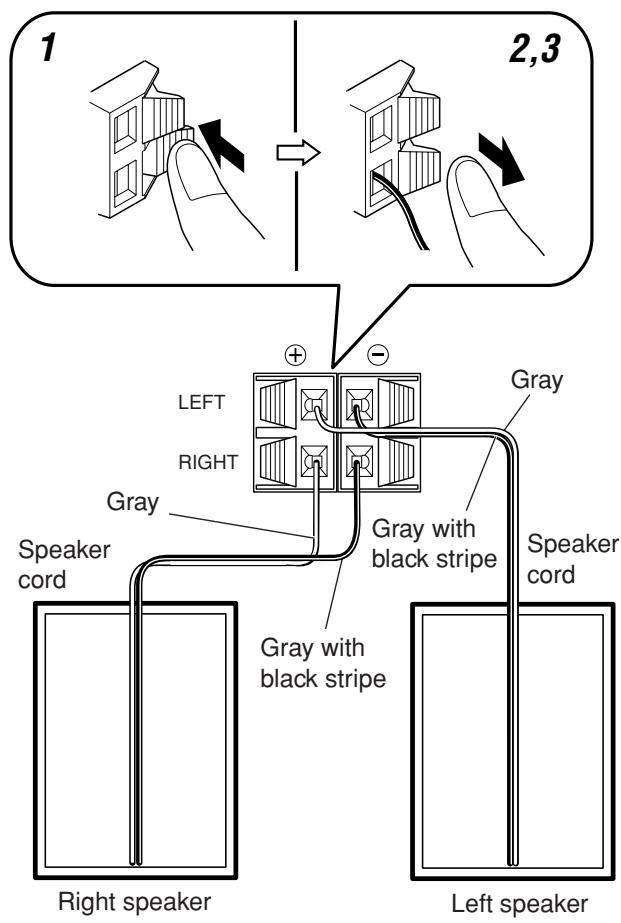
1 Hold the clamp of the speaker terminal.
2 Insert the end of the speaker cord into the terminal.
Match the polarity of the speaker terminals: gray cord () to red () and gray cord with black stripe () to black () .
3 Release your finger from the clamp.
IMPORTANT:
- Use only speakers with the same speaker impedance as indicated by the speaker terminals on the rear of the unit.
DO NOT connect more than one speaker to one speaker terminal.
To connect AM and FM antennas
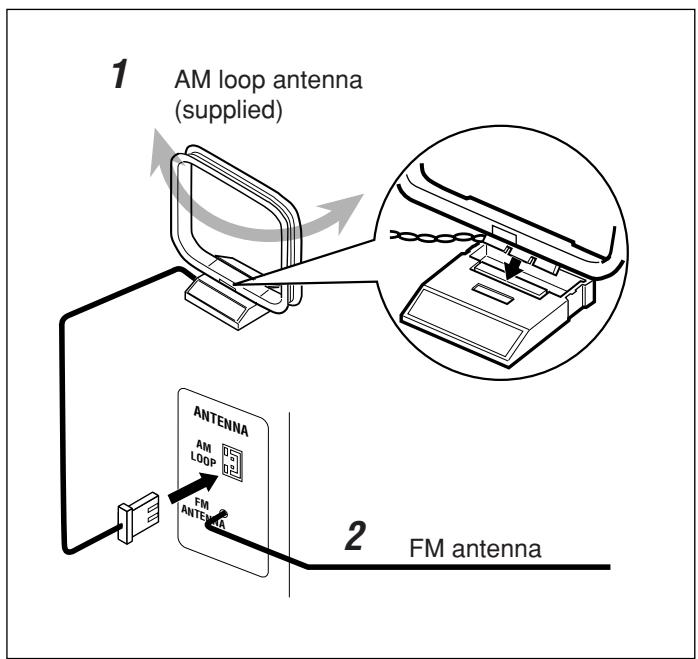
1 Connect the supplied AM loop antenna to the AM LOOP terminal.
Place the antenna away from the unit and adjust its position for the best reception.
2 Adjust the position for the FM antenna for the best reception.

For better reception of both FM and AM
- Make sure the antenna conductors do not touch any other terminals or connecting cords.
- Keep the antennas away from metallic parts of the unit, connecting cords, and the AC power cord.
Connecting Other Equipment
To connect audio equipment
You can connect audio equipment—used only as a playback device.

DO NOT connect any equipment while the power is on.
- DO NOT plug in any equipment until all connections are complete.
For playing other equipment through this unit,
connect between the audio output jacks on the other equipment and AUX jacks by using audio cords with mini plugs (not supplied).
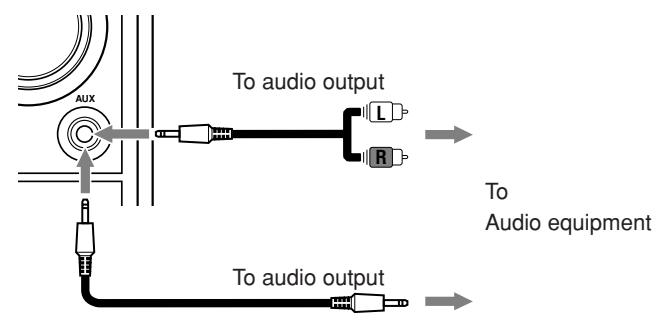
When the audio equipment has pin jacks for audio output: Be sure that the pin plugs of the audio cords are colored—white plugs and jacks are for left audio signals, and red ones for right audio signals.
NOW you are ready to plug in the unit.
IMPORTANT:
Be sure to check that all connections have been made before plugging in the power cord.
Setting the Clock
Before operating the unit any further, first set the unit's clock.
When you plug in the power cord, "0:00" starts flashing on the display.
You can set the clock when the unit is either turned on or in standby mode.
On the remote control ONLY:
1 Press CLOCK/TIMER. The hour indication starts flashing.
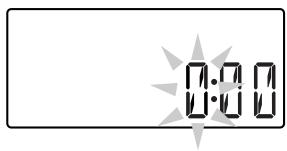

2 Press or to adjust the hour, then press SET.
- When you press and hold or , the hour indication changes continuously.
The minute indication starts flashing.
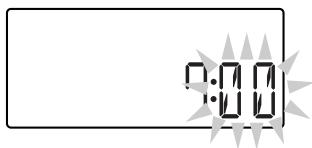


3 Press or to adjust the minute, then press SET.
- When you press and hold or , the minute indication changes continuously.
The built-in clock starts.
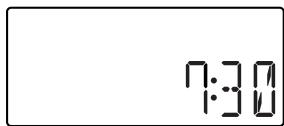


- When you unplug the AC power cord or if a power failure occurs
The clock is reset to "0:00" right away. If this happens, set the clock again.
- The clock may gain or lose 1 to 2 minutes per month. If this happens, reset the clock.
To show the clock when the unit is turned on
On the remote control ONLY:
Press DISPLAY.
Each time you press the button, the display changes the clock indication and the normal indication alternately.

To adjust the clock
On the remote control ONLY:
1 Press CLOCK/TIMER repeatedly to show the current time indication.

- When the unit is in standby mode, be sure that “:” is not flashing.
2 Press SET.
The hour indication starts flashing.
3 Press or to adjust the hour, then press SET.
The minute indication starts flashing.

4 Press or to adjust the minute, then press SET.
The built-in clock starts.



Turning On the Power
To turn on the unit, press STANDBY/ON / The STANDBY lamp on the unit goes off.
- When you press the source button—CD /II, TAPE, FM/AM and AUX, the unit automatically turns on.
STANDBY/ON
01

To turn off the unit (standby), press STANDBY/ON / again.
The STANDBY lamp on the unit lights red.
- "0:00" flashes on the display until you set the built-in clock. After setting the clock, the clock time will appear on the display while the unit is on standby.
- A little power is always consumed even while the unit is in standby mode.
To switch off the power supply completely, unplug the AC power cord from the AC outlet.

When you unplug the AC power cord or if a power failure occurs
The clock is reset to "0:00" right away and "0:00" starts flashing on the display when plugging the power cord again.
If this happens, set the clock again.
Selecting the Source
To select the source, press CD /II, TAPE, FM/AM, or AUX.
- When you select CD as the source, playback starts automatically.
To operate the tuner (FM or AM (MW)), see pages 10 and 11. To operate the CD player, see pages 12 to 14.
To operate the tape deck, see page 15.
To record on a tape, see pages 17 and 18.
To use an external equipment, see page 16.
Adjusting the Volume
You can adjust the volume level only while the unit is turned on. The volume level can be adjusted between "VOL MIN," "VOL 01" - "VOL 30," and "VOL MAX."
- The volume level has no effect on recording.
To increase the volume, press VOLUME + (or turn VOLUME control clockwise on the unit). To decrease the volume, press VOLUME - (or turn VOLUME control counterclockwise on the unit).
- When you press and hold either button, you can change the volume level continuously.
VOL 10

For private listening
Connect a pair of headphones to the PHONES jack. No sound comes out of the speakers. Be sure to turn down the volume before connecting or putting on the headphones.

DO NOT turn off (standby) the unit with the volume set to an extremely high level; Otherwise, the sudden blast of sound can damage your hearing, speakers and/or headphones when you turn on the unit or start playing any source.
REMEMBER you cannot adjust the volume level while the unit is in standby mode.
Fade Muting
On the remote control ONLY:
Press FADE MUTING.
The volume level decreases to "VOL MIN," and "MUTING" starts flashing on the display.

To release muting, press FADE MUTING again. The volume level resumes to the previous level.
- Adjusting the volume level also cancels the muting.
Selecting the Sound Modes
You can select one of the 4 sound modes.
- This function also affects the sound from headphones.
- This function only affects the playback sound, and does not affect your recording.
On the remote control ONLY:
To select the sound modes, press SOUND repeatedly.
Each time you press the button, the sound mode changes as follows:


ROCK: Powerful sound emphasizing treble and bass.
POP: More presence in the vocals and midrange.
CLASSIC: Enriched sound with fine treble and ample bass.
JAZZ: Accented lower frequencies for jazz-type music.
OFF: Equalizer effect is canceled.
When the sound mode is activated, the SOUND indicator lights up on the display.
Adjusting the Tone (Bass/Treble)
You can adjust the bass level (low frequency range) and the treble level (high frequency range) within a range of -1 to +4 . When shipped, the bass level set to "BASS 0" and the treble level set to "TREBLE 0."
- This function only affects the playback sound, and does not affect your recording.
- There is a time limit in doing the following steps. If the setting is canceled before you finish, start over from step 1.
On the remote control ONLY:
1 Press BASS/TREBLE once to adjust the bass level or press BASS/TREBLE twice to adjust the treble level.
2 Press PRESET UP to increase the level or press PRESET DOWN to decrease it.

- You cannot use the tone adjustment function and the sound mode function at the same time. (The sound mode changes automatically into "OFF" when pressing BASS/TREBLE.)
- The bass/treble setting automatically returns to "0" when you select one of the sound modes (see "Selecting the Sound Modes" above).
Tuning in to a Station
1 Press FM/AM to select either "FM" or "AM."

The unit automatically turns on and tunes in to the previously received station—either FM or AM (MW).
Each time you press the button, the band alternates between FM and AM (MW).
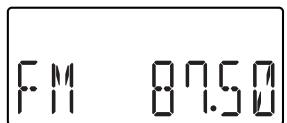
2 Press and hold or (or UP or DOWN on the unit) for more than 1 second.
- ▷▶▶(UP▶▶):
Increases the frequencies.
DOWN
Decreases the frequencies.
The unit starts searching for stations and stops when a station of sufficient signal strength is tuned in.
- If an FM program is broadcast in stereo, the ST (stereo) indicator lights up on the display (only when the reception is good).
To stop during searching, press or (or UP or DOWN on the unit).

When you repeatedly press or (or UP or DOWN on the unit)
The frequency changes step by step.
To change the FM reception mode On the remote control ONLY:
When an FM stereo broadcast is hard to receive or noisy, press FM MODE so that the MONO indicator lights up on the display. Reception will improve.
To restore the stereo effect, press FM MODE again so that the MONO indicator goes off. In stereo mode, you can hear stereo sound when a stereo program is broadcast.
- Changing the station also cancels the MONO mode.
Presetting Stations
You can preset 30 FM and 15 AM (MW) stations manually.
In some cases, test frequencies have been already stored for the tuner since the factory examined the tuner preset function before shipment. This is not a malfunction. You can preset the stations you want into memory by following the presetting method.
- There is a time limit in doing the following steps. If the setting is canceled before you finish, start again from step 2.
On the remote control ONLY:
1 Tune in to the station you want to preset.
- See "Tuning in to a Station" on the left column.
2 Press PLAY MODE.
The preset number starts flashing on the display.
- The PRGM (program) indicator lights up on the display.
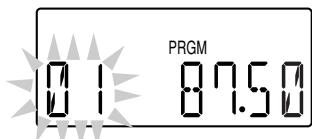

3 Press or to select a preset number.
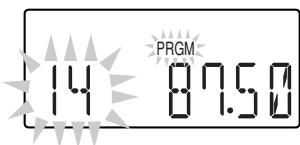
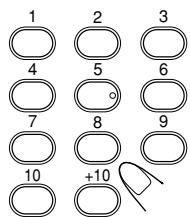
You can also use the number button(s) to select a preset number.
Ex.: For preset number 5, press 5.
For preset number 15, press +10 then 5.
For preset number 20, press +10 then 10.
For preset number 30, press +10 , +10 , then 10.
4 Press PLAY MODE again.

5 To preset more stations, repeat steps 1 to 4 above, allocating a different preset number to each station.
- Storing a new station on an already assigned number erases the previously stored one.

When you unplug the AC power cord or if a power failure occurs
The preset stations will remain in the unit.
Tuning in to a Preset Station
On the remote control ONLY:
1 Press FM/AM to select either "FM" or "AM."
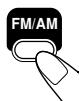
The unit automatically turns on and tunes in to the previously received station—either FM or AM (MW).
Each time you press the button, the band alternates between FM and AM (MW).
2 Press PRESET UP or PRESET DOWN repeatedly to select a preset number.
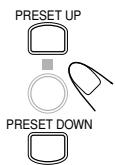
To tune in to a preset station directly using the number buttons
On the remote control ONLY:
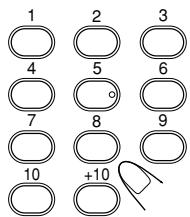
Pressing the number button(s) allows you to select the preset number you want.
Ex.: For preset number 5, press 5.
For preset number 15, press +10 , then 5.
For preset number 20, press +10 , then 10.
For preset number 30, press +10 , +10 , then 10.
This unit has been designed to play back the following discs—CD, CD-R, and CD-RW.
You can play back the discs containing the tracks in music CD format or MP3 files in ISO 9660 format.
- In this instruction, we call a disc recorded MP3 files "MP3 disc," and "file" is also referred to as "track."
When playing CD-Rs or CD-RWs
- Before playing CD-Rs or CD-RWs, read their instructions or cautions carefully.
- User-edited CD-Rs (CD-Recordable) and CD-RWs (CD-ReWritable) can be played only if they are already "finalized."
- This unit supports "multi-session" discs (up to 5 sessions).
- This unit cannot play "packet write" discs.
- Some CD-Rs or CD-RWs may not play on this unit because of their disc characteristics, damage or stain on them, or if the player's lens is dirty.
- CD-RWs may require a longer readout time. This is because the reflectance of CD-RWs is lower than for regular discs.
Notes for MP3 files
- The player can only recognize files with "MP3" or "mp3" as the extensions, which can be in any combination of upper and lower case.
- This unit recognizes up to 500 MP3 files on a disc.
- It is recommended that you record your material at a 44.1 kHz sampling rate, using the 128 kbps data transfer rate.
- Some MP3 files or discs may not be played back because of their characteristics or recording conditions.
- MP3 discs requires a longer readout time than normal discs because of the complexity of the folder/file configuration.
- ID 3 Tag is not available.
- MP3i and MP3 Pro are not available.
General notes
In general, you will have the best performance by keeping your discs and the mechanism clean.
- Store discs in their cases, and keep them in cabinets or on shelves.
- Keep the unit's disc tray closed when not in use.
- Continued use of irregular shape discs (heart-shape, octagonal, etc.) can damage the unit.
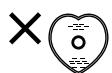
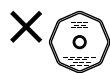
Playing Back the Entire Disc—Normal Play
1 Press OPEN on the unit.
The disc cover opens.
- You can insert a disc while listening to another source.
2 Place a disc correctly with its label side up, then press down on the portions around the disc's center hole until you hear a click.
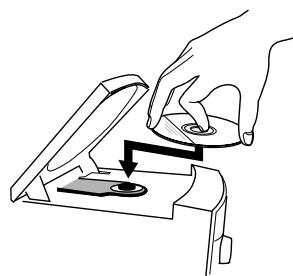
3 Close the disc cover gently.
4 Press CD▶/II.
The unit automatically turns on and the source changes to the CD player.

After loading the disc, the first track of the disc starts playing.
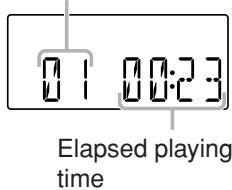
When playing audio CD
Current track number
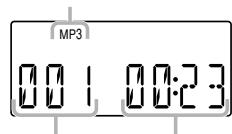
When playing MP3 disc
MP3 indicator
Current track number
Elapsed playing time
- The disc automatically stops when the last track has finished playing.
To stop playing, press ■.
The total track number and total playing time appear on the display.
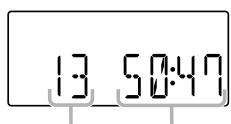
When stop playing audio CD
Total track Total playing number time
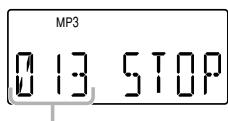
When stop playing MP3 disc
Total track number
- Total playing time does not appear when MP3 disc is loaded.
To remove the disc, press OPEN on the unit, then take out the disc by holding it at the edges while pressing the unit's pivot lightly.

- If the disc cannot be read correctly (because it is scratched, for example) or an unreadable CD-R or CD-RW is inserted. Playback will not start.
- If no disc is inserted "NO DISC" appears on the display.

DO NOT try to open the disc cover by hand as it will be damaged.
Basic Disc Operations
While playing a disc, you can do the following operations.
To stop playing for a moment
During play, press CD /
While pausing, the elapsed playing time flashes on the display.

To resume playing, press CD I again.
To go to another track
Before or during play, press or (or UP or DOWN on the unit) repeatedly.


- ▷▶▶(UP▶▶):
Skipping to the beginning of the next or succeeding tracks.
DOWN
Goes back to the beginning of the current or previous tracks.
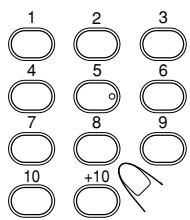
To go to another track directly using the number buttons
On the remote control ONLY:
Pressing the number button(s) before or during play allows you to start playing the track number you want.
Ex.: For track number 5, press 5.
For track number 15, press +10 then 5.
For track number 20, press +10 then 10.
For track number 32, press +10 , +10 , +10 , then 2.
To locate a particular point in a track
During play, press and hold or (or UP or DOWN on the unit).


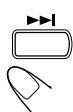
- ▷▶- (UP▶▶-):
Fast-forwards the tracks.
- DOWN:
Fast-reverses the tracks.
Programming the Track Playing Order —Program Play
You can arrange the order in which tracks play before you start playing. You can program up to 32 tracks.
On the remote control ONLY:
1 Place a disc.
- If the current source is not the CD player, press CD /II, then before going to the next step.
2 Press PLAY MODE.
The PRGM (program) indicator appears on the display.

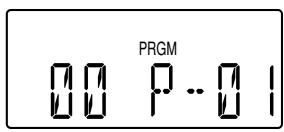
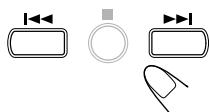
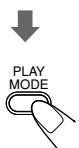
3 Press or to select the track number, then press PLAY MODE.
Track number Program step number
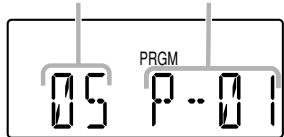
You can also use the number button(s) to select a track number.
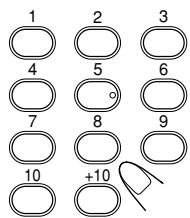
- For the operation of the number buttons, see "To go to another track directly using the number buttons" on the left column.
4 Repeat step 3 to program other tracks you want.
5 Press CD /II.
The tracks are played in the order you have programmed.


After programming a 32nd track
"FULL" will appear on the display for a while and the 32nd track number appears again.
To stop playing, press ■.
- Playback stops and the play mode returns to Normal Play.

To check the program contents
You can check the program contents by pressing PLAY MODE repeatedly before or after playback.

To modify the program
Press PLAY MODE repeatedly until the program step number you want to modify appears. Then follow steps 3 and 4 of the programming procedure.

To add tracks in the program, press PLAY MODE repeatedly until "00" appears as the track number. Then follow steps 3 and 4 of the programming procedure.
To clear the program
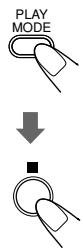
Press PLAY MODE, then press before or after playback.
The PRGM indicator disappears from the display.
-
The programmed tracks are also erased in the following cases:
-
When pressing OPEN to open the disc cover.
- When turning off the unit.
- When changing the source.
Repeating Tracks—Repeat Play
You can have all the tracks, the program or individual track currently playing, repeat as many times as you like.
On the remote control ONLY:
Press REPEAT repeatedly before or during playback.

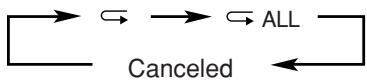
Each time you press the button, Repeat Play changes as follows, and the following repeat indicator lights up on the display:
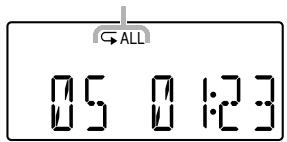
Repeat indicators
: Repeats one track.
ALL: In Normal Play, repeats all the tracks. In Program Play, repeats all the tracks in the program.
To cancel Repeat Play, press REPEAT repeatedly until the repeat indicator goes off.
- Repeat Play is canceled when you select another play mode (Normal, Program, or Random Play).
- In Random Play, Repeat Play cannot be selected.

Playing at Random—Random Play
You can play the tracks at random.
On the remote control ONLY:
Press PLAY MODE during playing.
The RANDOM indicator lights up on the display.
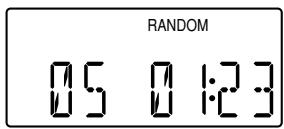

To exit from Random Play, press PLAY MODE again.
The RANDOM indicator goes off.
- It is not possible to activate the Random Play function during Program Play.

Displaying the Remaining Time during Playback
You can display the remaining time of the current track/disc and the elapsed time of the current track/disc during playing.
On the remote control ONLY:
Press REMAIN repeatedly.
Each time you press the button, the display changes as follows:

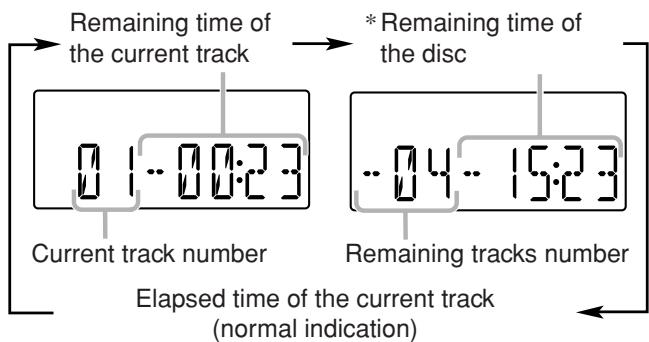
-
Remaining time of the disc will not be displayed in the following cases:
-
During MP3 playback.
- During Random Play.
- During Program Play.
For tape operations, use buttons on the unit.
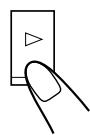
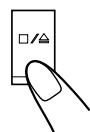
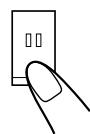
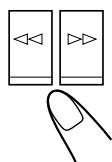
Playing Back a Tape
You can play back type I tapes only.
On the unit ONLY:
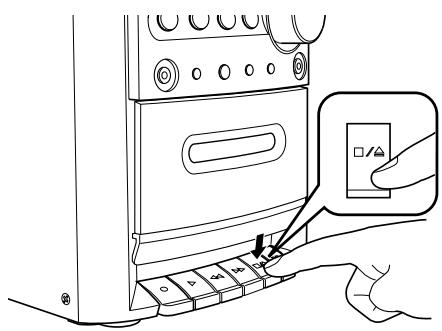
1 Press / (stop/cassette holder open).
The cassette holder opens.
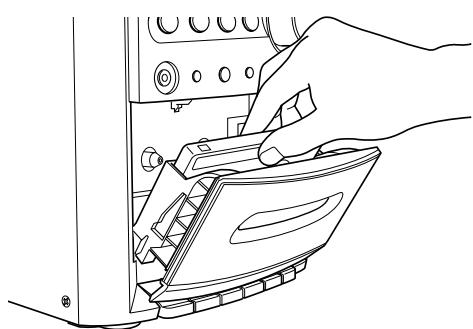
2 Put a cassette in with the exposed part of the tape down.
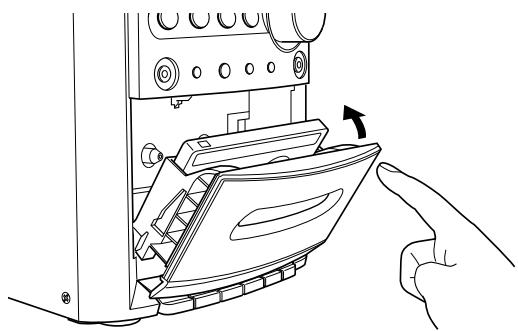
3 Close the cassette holder gently.
4 Press TAPE.
The unit automatically turns on and the source changes to the tape deck.
- You can select to the tape by pressing TAPE on the remote control.
5 Press (play).
The tape starts playing.
- When the end of the tape is reached, playing stops.
To stop playing, press / .
To stop playing for a moment, press To resume playing, press again.
To fast forward or rewind the tape, press or < < <
- The fast forwarding or rewinding stops at the end of the tape.
To remove the cassette, press / while playback is stopped.
TAPE

- DO NOT turn off the unit while playing back or recording a tape. The cassette deck or tapes may be damaged.
- The use of C-120 or longer tape is not recommended, since characteristic deterioration may occur and this tape easily jams in the pinch rollers and the capstans.
- This unit is not compatible with type II and type IV tapes.
Listening to the External Equipment
You can listen to the external equipment such as MD recorder, cassette deck, or other auxiliary.
- First, make sure that the external equipment is properly connected to the unit. (See page 7.)
1 Set the volume level to the minimum position.
2 Press AUX. "AUX" appears on the display.

3 Start playing the external equipment.
4 Adjust the volume level to the level you want to listen to.
To exit AUX mode, select other source.

For operation of the external equipment
Refer to its instructions.
IMPORTANT:
- It should be noted that it may be unlawful to re-record pre-recorded tapes, records, or discs without the consent of the owner of copyright in the sound or video recording, broadcast or cable program and in any literary, dramatic, musical, or artistic embodied therein.
- The recording level is automatically set correctly, so it is not affected by the other sound settings. Thus, during recording you can adjust the sound you are actually listening to without affecting the recording level.
- If recordings you have made have excessive noise or static, the unit may be too close to a TV. Increase the distance between the TV and the unit.
- You can only use type I tape for recording.

- DO NOT turn off the unit while playing back or recording a tape. The cassette deck or tapes may be damaged.
- DO NOT use type II and type IV tapes since the unit is not compatible with such tapes.
- The use of C-120 or longer tape is not recommended, since characteristic deterioration may occur and this tape easily jams in the pinch rollers and the capstans.

At the start and end of cassette tapes
There is leader tape which cannot be recorded onto. Thus, when recording from discs, FM/AM broadcasts, or external equipment, wind the leader tape first to ensure that the recording will be made without losing any music.
To protect your recordings
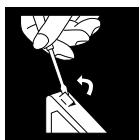
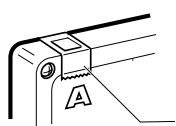
Cassettes have two small tabs on the back to protect against unexpected erasure or re-recording.
To protect your recording, remove these tabs.
To re-record on a protected tape, cover the holes with adhesive tape.
Adhesive tape
Recording on a Tape
On the unit ONLY:
1 Put a recordable cassette in with the exposed part of the tape down.
See also page 15.
2 Close the cassette holder gently.
3 Start playing the source—FM, AM, or auxiliary equipment connected to AUX jack.
- When the source is FM or AM, tune in to the station you want to record.
- When recording from discs, see "Recording Discs—Disc Synchronized Recording" on page 18.
4 Press (recording).
and lock down, and the recording starts.
- REC indicator is shown on the display during recording.

You cannot press (recording) in the following cases:
- If no cassette is inserted.
- If a protected tape is inserted.
To stop recording for a moment, press To resume recording, press again.
To stop recording, press / .
To remove the cassette, press / while recording is stopped.
Recording Discs
—Disc Synchronized Recording
You can start disc play and recording at the same time.
On the unit ONLY:
1 Put a recordable cassette in with the exposed part of the tape down.
See also page 15.
2 Close the cassette holder gently.
3 Press CD / to select the CD player as the source.
CD
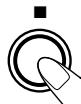
4 Press to stop the disc playback.
- If you want to start recording from a particular track, select the beginning track using UP or DOWN , then go to the next step.
- If you want to make a program, perform steps 2 to 4 on page 13. After making a program, go to the next step.
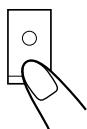
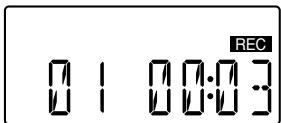
5 Press (recording).
The REC indicator appears on the display and the CD starts playback automatically and the recording starts.
-
When the end of the tape is reached, recording stops and the CD player is paused.
-
If you press (recording) while playing back the CD, the CD player returns to the beginning of that track and the track is recorded on the tape.

You cannot press (recording) in the following cases:
- If no cassette is inserted.
- If a protected cassette is inserted.
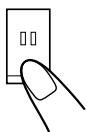
To stop recording for a moment, press . The recording is paused, but the CD playback does not stop.
To resume recording, press again.
To stop recording, press / .
The recording stops and the CD playback is paused.
To remove the cassette, press / while recording is stopped.
Daily Timer and Sleep Timer are available.
- Before using these timers, make sure the built-in clock is set correctly (see page 8).
Using the Daily Timer
You can store three Daily timer settings and use one of settings at once.
How the Daily Timer actually works
When the on-time comes, the unit automatically turns on and automatically turns off (standby) after 60 minutes.
- Once the timer has been set, it will be activated at the same time everyday until the timer is turned off and the timer setting remains in memory until you change it.
Before you start...
When using "TUNER" as the source to play, make sure to select the desired station before turning off the power.
- There is a time limit in doing the following steps. If the setting is canceled before you finish, start again from step 2.
On the remote control ONLY:
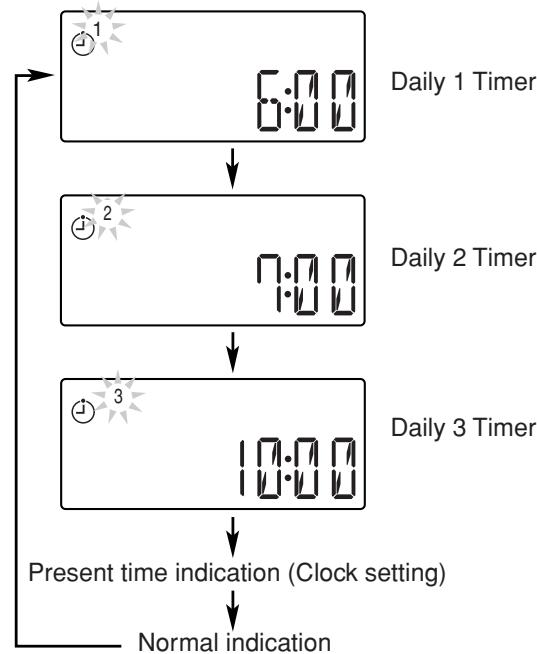
2 Press CLOCK/TIMER repeatedly to select the Daily Timer you want to adjust and activate—Daily 1, Daily 2, Daily 3.
Each time you press the button, the display changes as follows:
If you does not need to change the on-time setting, go to step 3.
3 Press SET to set the on-time you want the unit to turn on.

The hour indication starts flashing on the display.
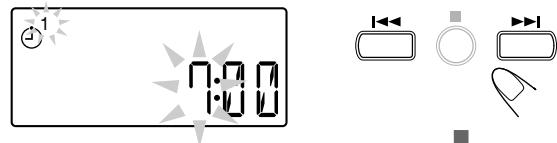
(1) Press or to set the hour, then press SET.
(2) Press or to set the minute, then press SET.
If you want to change the time setting, press CANCEL.
4 Press or to select the source to play.
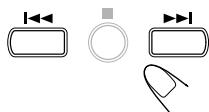
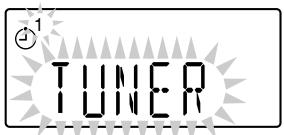
Each time you press the button, the source changes as follows:

When selecting AUX, prepare the external equipment so that it will turn on at the on-time set on the unit.
To allow this, the equipment should have the timer function.
If you want to change the time setting, press CANCEL repeatedly to return Step 3.
5 Press SET.

The Daily Timer number remains lit. The display returns to the normal indication.
- When you want to activate other timer than the adjusted one, press TIMER on the unit repeatedly. See also "To change the Daily Timer to use" on page 20 for details.
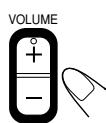
6 Press VOLUME + / - to adjust the volume.
7 Press STANDBY/ON / to turn off the unit.
To deactivate the timer temporarily,
Press TIMER on the unit repeatedly until the (timer) indicator goes off.
To change the Daily Timer to use,
Press TIMER on the unit repeatedly until the timer number indicator you want begins to flash.
The timer is activated after a few seconds and the selected timer number remains lit.
- To change the timer setting, repeat steps 1 to 7 on page 19.

If the unit is already turned on when the timer on-time comes
The timer does not work.

When you unplug the AC power cord or if a power failure occurs
The timer setting remains. Set the built-in clock and activate the timer again.
Using the Sleep Timer
With the Sleep Timer, you can fall asleep to your favorite music or radio program.
- You can set the Sleep Timer only when the unit is turned on.
How the Sleep Timer actually works
The unit automatically turns off after the specified length of time passes.
On the remote control ONLY:
1 Press SLEEP.
The SLEEP indicator flashes on the display.

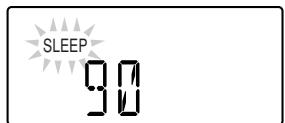
Each time you press the button, the length of time changes as follows:
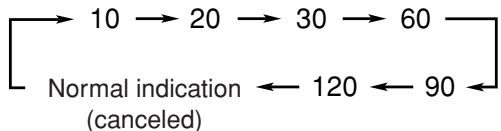
2 Wait for about 5 seconds after specifying the length of time.
The SLEEP indicator remains lit on the display.
To check the remaining time until shut-off time, press SLEEP once. The remaining time until shut-off time appears for about 5 seconds.
To change the shut-off time, press SLEEP repeatedly until the length of time you want appears.
To cancel the setting, press SLEEP repeatedly until the SLEEP indicator goes off and display returns to the normal indication.
- Turning off the unit also cancels the Sleep Timer.

When you set the Sleep Timer after the Daily Timer starts playing the selected source
The unit follows the Sleep Timer setting.

If you set the Sleep Timer while playing back or recording a tape
Do not shut the unit off with the Sleep Timer while a tape is running. If the unit turns off while playing back or recording a tape, the cassette deck or tapes may be damaged.
To get the best performance of the unit, keep your discs, tapes and mechanism clean.
General Notes
In general, you will have the best performance by keeping your discs, tapes and the mechanism clean.
- Store discs and tapes in their cases, and keep them in cabinets or on shelves.
Cleaning the unit
Stains on the unit
Should be wiped off with a soft cloth. If the unit is heavily stained, wipe it with a cloth soaked in water-diluted neutral detergent and wrung well, then wipe clean with a dry cloth.
-
Since the unit may deteriorate in quality, become damaged or have its paint peel off, be careful about the following:
-
DO NOT wipe it with a rough cloth.
-DO NOT wipe it too vigorously. - DO NOT wipe it with thinner or benzine.
- DO NOT apply any volatile substance such as an insecticide to it.
- DO NOT allow any rubber or plastic to remain in contact with it for a long time.
Handling discs
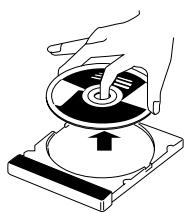
- Remove the disc from its case by holding it at the edge while pressing the center hole lightly.
- Do not touch the shiny surface of the disc, or bend the disc.
- Put the disc back in its case after use to prevent warping.
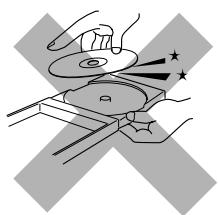
- Be careful not to scratch the surface of the disc when placing it back in its case.
- Avoid exposure to direct sunlight, temperature extremes, and moisture.
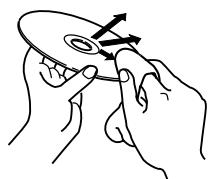
To clean the disc
Wipe the disc with a soft cloth in a straight line from center to edge.

DO NOT use any solvent—such as conventional record cleaner, spray, thinner, or benzine—to clean the disc.
Handling cassette tapes
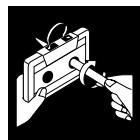
- If the tape is loose in its cassette, take up the slack by inserting a pencil in one of the reels and rotating.
- If the tape is loose, it may get stretched, cut, or caught in the cassette.
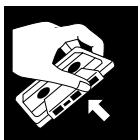
- Be careful not to touch the tape surface.
-
Avoid storing tapes in any of the following places:
-
In dusty places
- In direct sunlight or heat
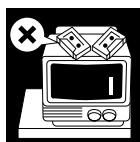
-In moist areas - On a TV or speaker
- Near a magnet
To keep the best recording and playback sound quality
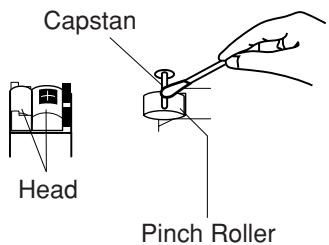
You need to clean the heads.
- Clean the heads after every 10 hours of use with a wet-type head cleaning tape (available at electronic and audio shops).
When the head becomes dirty, the following symptoms will occur:
Sound quality is reduced.
Sound level decreases.
Sound drops out.
- Do not play dirty or dusty tapes.
- Do not touch the highly-polished head with any metallic or magnetic tools.
To demagnetize the head
Turn off the unit, and use a head demagnetizer (available at electronic and audio shops).
If you are having a problem with your unit, check this list for a possible solution before calling for service.
If you cannot solve the problem from the hints given here, or the unit has been physically damaged, call a qualified person, such as your dealer, for service.
| Symptom | Possible Cause | Action |
| Power does not come on. | The power cord is not connected to an AC outlet. | Insert the plug into the socket. |
| No sound is heard. | • Connections are incorrect or loose. • A pair of headphones is connected. • MP3 disc is recorded with “packet writing.” | • Check all connections and make corrections. (See pages 6 and 7.) • Unplug the headphones from the PHONES jack. • It cannot be played. Replace the disc. |
| Hard to listen to broadcasts because of noise. | • Antennas are disconnected. • The AM (MW) loop antenna is too close to the unit. • The FM antenna is not properly extended and positioned. | • Reconnect the antenna correctly and securely. • Change the position and direction of the AM (MW) loop antenna. • Extend FM antenna and orient to the best reception position. |
| The disc does not play. | The disc is upside down. | Put the disc in with the label side up. |
| Specific files (tracks) on an MP3 disc are not played. | Files other than MP3 are included in the disc. | They cannot be played. |
| Impossible to record. | Small tabs on the back of the cassette are removed. | Cover the holes with adhesive tape. |
| Operations are disabled. | The built-in microprocessor has malfunctioned due to external electrical interference. | Unplug the AC power cord then plug it back in. |
| Unable to operate the unit by the remote control. | • The path between the remote control and the remote sensor on the unit is blocked. • The batteries are exhausted. • You are using the remote control too far from the unit. | • Remove the obstruction. • Replace the batteries. (See page 6.) • Signals cannot reach the remote sensor. Move closer to the unit. |
Specifications
Design and specifications are subject to change without notice.
Amplifier Section—CA-UXH100
Output Power:
10 W per channel, min. RMS, driven into 6 at 1kHz with no more than 10% total harmonic distortion (IEC 268-3)
Speakers/Impedance: 6 -16
Tuner
FM tuning range: 87.50 MHz—108.00 MHz
AM (MW) tuning range: 522kHz 1629 kHz
CD player
Dynamic range: 85 dB
Signal-to-noise ratio: 85 dB
Wow and flutter: Immeasurable
Cassette deck
Frequency response:
Normal (type I): 100Hz - 10000Hz
Wow and flutter: 0.35% (WRMS)
General
Power requirement: AC 230V ,50Hz
Power consumption: 38 W (at operation)
2 W (on standby)
Dimensions (W/H/D) (approx.):
144mm× 255mm× 277mm
Mass (approx.): 2.9kg
Supplied accessories
See page 6.
Speaker Section—SP-UXH100
Type: Full range Bass-reflex type
Speakers: 10 cm cone x1
Power handling capacity: 10W
Impedance: 6Ω
Frequency range: 100Hz to 15kHz
Dimensions (W/H/D) (approx.):
130mm× 257mm× 151mm
Mass (approx.): 1.5 kg each

VICTOR COMPANY OF JAPAN, LIMITED
- MICRO COMPONENT SYSTEM
- UX-H100
- - Consists of CA-UXH100 and SP-UXH100
- IMPORTANT for the U.K.
- IMPORTANT:
- CAUTION- O / I STANDBY/ON button!
- CAUTION
- IMPORTANT FOR LASER PRODUCTS
- Caution: Proper Ventilation
- SAFETY INSTRUCTIONS "SOME DOS AND DON'TS ON THE SAFE USE OF EQUIPMENT"
- ABOVE ALL
- We would like to thank you for purchasing one of our JVC products. Before operating this unit, read this manual carefully and thoroughly to obtain the best possible performance from your unit, and retain this manual for future reference.
- About This Manual
- Precautions
- Installation
- Power sources
- Moisture condensation
- Others
- Main Unit
- Display window
- Remote Control
- Unpacking
- Putting the Batteries into the Remote Control
- Connections
- To connect speakers
- To connect AM and FM antennas
- Connect the supplied AM loop antenna to the AM LOOP terminal.
- Adjust the position for the FM antenna for the best reception.
- For better reception of both FM and AM
- Connecting Other Equipment
- To connect audio equipment
- For playing other equipment through this unit,
- NOW you are ready to plug in the unit.
- Setting the Clock
- On the remote control ONLY:
- To show the clock when the unit is turned on
- Press DISPLAY.
- To adjust the clock
- Turning On the Power
- When you unplug the AC power cord or if a power failure occurs
- Selecting the Source
- Adjusting the Volume
- For private listening
- Fade Muting
- Press FADE MUTING.
- Selecting the Sound Modes
- Adjusting the Tone (Bass/Treble)
- Tuning in to a Station
- Press FM/AM to select either "FM" or "AM."
- Press and hold or (or UP or DOWN on the unit) for more than 1 second.
- To change the FM reception mode On the remote control ONLY:
- Presetting Stations
- Tune in to the station you want to preset.
- Press PLAY MODE.
- Press or to select a preset number.
- Press PLAY MODE again.
- To preset more stations, repeat steps 1 to 4 above, allocating a different preset number to each station.
- Tuning in to a Preset Station
- Press PRESET UP or PRESET DOWN repeatedly to select a preset number.
- To tune in to a preset station directly using the number buttons
- When playing CD-Rs or CD-RWs
- Notes for MP3 files
- General notes
- Playing Back the Entire Disc—Normal Play
- Press OPEN on the unit.
- Close the disc cover gently.
- Press CD▶/II.
- To stop playing, press ■.
- Basic Disc Operations
- To stop playing for a moment
- To go to another track
- To go to another track directly using the number buttons
- To locate a particular point in a track
- Programming the Track Playing Order —Program Play
- Place a disc.
- Press or to select the track number, then press PLAY MODE.
- Repeat step 3 to program other tracks you want.
- Press CD /II.
- To check the program contents
- To modify the program
- To clear the program
- Repeating Tracks—Repeat Play
- Press REPEAT repeatedly before or during playback.
- Playing at Random—Random Play
- Press PLAY MODE during playing.
- Displaying the Remaining Time during Playback
- Press REMAIN repeatedly.
- Playing Back a Tape
- On the unit ONLY:
- Press / (stop/cassette holder open).
- Put a cassette in with the exposed part of the tape down.
- Close the cassette holder gently.
- Press TAPE.
- Press (play).
- TAPE
- Listening to the External Equipment
- At the start and end of cassette tapes
- To protect your recordings
- Recording on a Tape
- You cannot press (recording) in the following cases:
- Recording Discs
- —Disc Synchronized Recording
- Using the Daily Timer
- How the Daily Timer actually works
- Before you start...
- Press SET to set the on-time you want the unit to turn on.
- Press or to select the source to play.
- Press SET.
- Press VOLUME + / - to adjust the volume.
- Press STANDBY/ON O / I to turn off the unit.
- To deactivate the timer temporarily,
- To change the Daily Timer to use,
- Using the Sleep Timer
- How the Sleep Timer actually works
- Press SLEEP.
- Wait for about 5 seconds after specifying the length of time.
- Cleaning the unit
- Stains on the unit
- Handling discs
- To clean the disc
- Handling cassette tapes
- To keep the best recording and playback sound quality
- To demagnetize the head
- Specifications
- Amplifier Section—CA-UXH100
- Tuner
- CD player
- Cassette deck
- General
- Supplied accessories
- Speaker Section—SP-UXH100
Marque : JVC
Modèle : UX-H100
Catégorie : Système audio