
UX-GD7 - Système audio JVC - Notice d'utilisation et mode d'emploi gratuit
Retrouvez gratuitement la notice de l'appareil UX-GD7 JVC au format PDF.


| Type de produit | Chaîne micro hi-fi avec lecteur DVD/CD |
| Marque | JVC |
| Modèle | UX-GD7 |
| Dimensions (unité principale) | 189 mm (L) x 224 mm (H) x 406 mm (P) |
| Dimensions (enceintes) | 165 mm (L) x 286 mm (H) x 237 mm (P) chacune |
| Poids (unité principale) | Environ 6,5 kg |
| Poids (enceintes) | Environ 2,8 kg chacune |
| Alimentation | AC 230 V, 50 Hz |
| Consommation électrique (en fonctionnement) | 150 W |
| Consommation électrique (veille) | 1,3 W |
| Puissance de sortie | 2 x 70 W (6 Ω, 10% THD) |
| Formats de disques compatibles | DVD Vidéo, DVD Audio, CD, VCD, SVCD, CD-R/RW, DVD-R/RW, DVD-RAM, MP3, JPEG, DivX |
| Radio | FM (87,50 - 108,00 MHz) avec RDS, AM (522 - 1629 kHz) |
| Entrées | AUX (mini-jack), USB (type B), antenne FM/AM, optique numérique |
| Sorties | Enceintes (6-16 Ω), casque (mini-jack), optique numérique, vidéo composite, S-vidéo, composante, RGB (SCART) |
| Fonctions spéciales | Minuterie quotidienne, répétition A-B, lecture aléatoire, programmation, zoom, 3D PHONIC, SOUND TURBO II, AHB PRO, Clear Voice |
| Accessoires fournis | Antenne FM, antenne cadre AM, télécommande, piles (x2) |
| Entretien et nettoyage | Essuyer avec un chiffon doux et sec ; ne pas utiliser de solvants ni de produits abrasifs |
| Sécurité | Ne pas exposer à l'humidité, ne pas obstruer les ventilations, débrancher en cas d'orage, respecter les consignes de sécurité laser (classe 1) |
| Réparabilité | Aucune pièce réparable par l'utilisateur ; contacter un technicien qualifié pour toute réparation |
| Code région DVD | 2 (PAL) |
FOIRE AUX QUESTIONS - UX-GD7 JVC
Questions des utilisateurs sur UX-GD7 JVC
0 question sur cet appareil. Repondez a celles que vous connaissez ou posez la votre.
Poser une nouvelle question sur cet appareil
Téléchargez la notice de votre Système audio au format PDF gratuitement ! Retrouvez votre notice UX-GD7 - JVC et reprennez votre appareil électronique en main. Sur cette page sont publiés tous les documents nécessaires à l'utilisation de votre appareil UX-GD7 de la marque JVC.
MODE D'EMPLOI UX-GD7 JVC
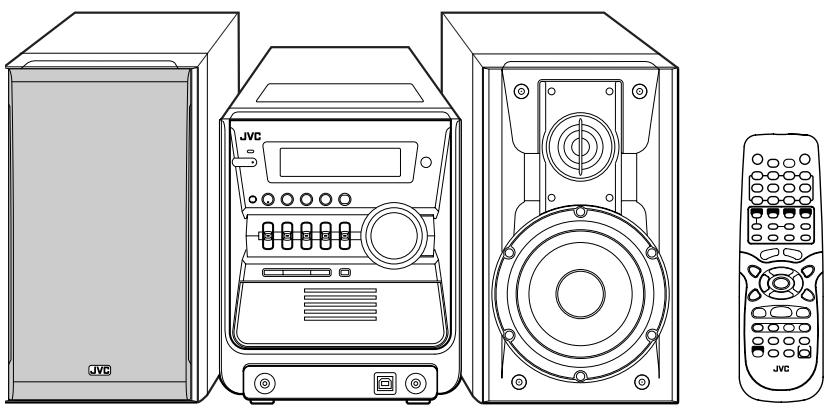
MICRO COMPONENT SYSTEM
UX-GD7—Consists of CA-UXGD7 and SP-UXGD7






R·D·S

Digital Direct Progressive Scan
INSTRUCTIONS
IMPORTANT for the U.K.
DO NOT cut off the mains plug from this equipment. If the plug fitted is not suitable for the power points in your home or the cable is too short to reach a power point, then obtain an appropriate safety approved extension lead or consult your dealer.
BE SURE to replace the fuse only with an identical approved type, as originally fitted.
If nonetheless the mains plug is cut off ensure to remove the fuse and dispose of the plug immediately, to avoid a possible shock hazard by inadvertent connection to the mains supply.
If this product is not supplied fitted with a mains plug then follow the instructions given below:
IMPORTANT:
DO NOT make any connection to the terminal which is marked with the letter E or by the safety earth symbol or coloured green or green-and-yellow.
The wires in the mains lead on this product are coloured in accordance with the following code:
Blue: Neutral
Brown: Live
As these colours may not correspond with the coloured markings identifying the terminals in your plug proceed as follows:
The wire which is coloured blue must be connected to the terminal which is marked with the letter N or coloured black.
The wire which is coloured brown must be connected to the terminal which is marked with the letter L or coloured red.
IF IN DOUBT - CONSULT A COMPETENT ELECTRICIAN.
CAUTION
To reduce the risk of electrical shocks, fire, etc.:
1 Do not remove screws, covers or cabinet.
2 Do not expose this appliance to rain or moisture.
CAUTION—O/I (standby/on) button!
Disconnect the mains plug to shut the power off completely (all lamps and indications go off). The /1 button in any position does not disconnect the mains line.
- When the unit is on standby, the STANDBY lamp lights in red.
- When the unit is turned on, the STANDBY lamp goes off.
The power can be remote controlled.
CAUTION
- Do not block the ventilation openings or holes. (If the ventilation openings or holes are blocked by a newspaper or cloth, etc., the heat may not be able to get out.)
- Do not place any naked flame sources, such as lighted candles, on the apparatus.
- When discarding batteries, environmental problems must be considered and local rules or laws governing the disposal of these batteries must be followed strictly.
- Do not expose this apparatus to rain, moisture, dripping or splashing and that no objects filled with liquids, such as vases, shall be placed on the apparatus.
Caution: Proper Ventilation
To avoid risk of electric shock and fire, and to prevent damage, locate the apparatus as follows:
1. Front: No obstructions and open spacing.
2. Sides/ Top/ Back: No obstructions should be placed in the areas shown by the dimensions below.
3. Bottom: Place on the level surface. Maintain an adequate air path for ventilation by placing on a stand with a height of 10 cm or more.
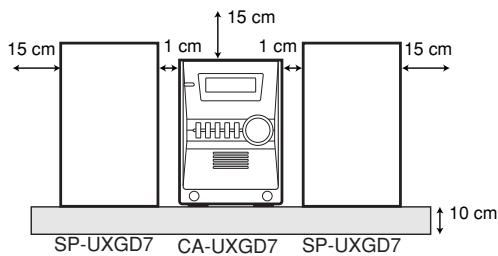
Front
Side
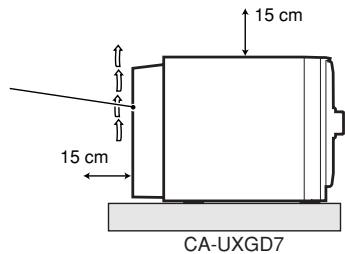
Cooling fan*
* About the cooling fan
A cooling fan is mounted on the rear panel of the unit to prevent abnormal temperature inside the unit, thus assuring normal operation of the unit. The cooling fan automatically starts rotating to intake external cool air when the volume is increased up to more than a certain level.
IMPORTANT FOR LASER PRODUCTS
1 CLASS 1 LASER PRODUCT
2 CAUTION: Do not open the top cover. There are no user serviceable parts inside the unit; leave all servicing to qualified service personnel.
3 CAUTION:Visible and invisible laser radiation when open and interlock failed or defeated. Avoid direct exposure to beam.
4 REPRODUCTION OF LABEL: CAUTION LABEL, PLACED INSIDE THE UNIT.
CAUTION:Visible and invisible laser radiation when open and interlock failed or defeated. AVOID DIRECT EXPOSURE TO BEAM. (e)
ADVARSEL: Synlig og usyning laserstråling nár maskinen er Åben eller interlocken fejler. Undgå direkte ekspondering til stråling. (d)
WARNING : Synlig och osynlig lasersträlning nar den öppnas och sparren ar urkopplad. Betrakta ej stralen. (s)
VARO: Avattaessa ja suojalukitus ohitetuna ti vialisena olet alltiina nakyvalle ja nakymattomalle lasersateilylle. Valta sateen kohdistumista suoraan itseesi. (f)
SAFETY INSTRUCTIONS "SOME DOS AND DON'TS ON THE SAFE USE OF EQUIPMENT"
This equipment has been designed and manufactured to meet international safety standards but, like any electrical equipment, care must be taken if you are to obtain the best results and safety is to be assured.
责贵责贵贵贵贵贵贵贵贵贵贵贵贵贵贵贵贵贵贵贵贵贵贵贵贵贵
Do read the operating instructions before you attempt to use the equipment.
Do ensure that all electrical connections (including the mains plug, extension leads and interconnections between pieces of equipment) are properly made and in accordance with the manufacturer's instructions. Switch off and withdraw the mains plug when making or changing connections.
Do consult your dealer if you are ever in doubt about the installation, operation or safety of your equipment.
Do be careful with glass panels or doors on equipment.
责贵贵贵贵贵贵贵贵贵贵贵贵贵贵贵贵贵贵贵贵贵贵贵贵贵贵
DONT continue to operate the equipment if you are in any doubt about it working normally, or if it is damaged in any way—switch off, withdraw the mains plug and consult your dealer.
DON'T remove any fixed cover as this may expose dangerous voltages.
DONT leave equipment switched on when it is unattended unless it is specifically stated that it is designed for unattended operation or has a standby mode.
Switch off using the switch on the equipment and make sure that your family know how to do this.
Special arrangements may need to be made for infirm or handicapped people.
DON'T use equipment such as personal stereos or radios so that you are distracted from the requirements of traffic safety. It is illegal to watch television whilst driving.
DON'T listen to headphones at high volume as such use can permanently damage your hearing.
DON'T obstruct the ventilation of the equipment, for example with curtains or soft furnishings.
Overheating will cause damage and shorten the life of the equipment.
DON'T use makeshift stands and NEVER fix legs with wood screws—to ensure complete safety always fit the manufacturer's approved stand or legs with the fixings provided according to the instructions.
DON'T allow electrical equipment to be exposed to rain or moisture.
ABOVE ALL
- NEVER let anyone, especially children, push anything into holes, slots or any other opening in the case —this could result in a fatal electrical shock.;
- NEVER guess or take chances with electrical equipment of any kind—it is better to be safe than sorry!
CONTENTS
Introduction 2
Precautions 2
How to Read This Manual 2
Getting Started 3
Step 1: Unpack 3
Step 2: Prepare the Remote Control. 3
Step 3: Hook Up. 4
Changing the Scanning Mode 6
Selecting the Video Signal 6
Before Operating the System 7
Playable Disc Types 7
Display Indicators 8
Daily Operations—Playback 10
Listening to the Radio 11
Playing Back a Disc 12
Playing Back from the PC. 15
Playing Back from Other Equipment 15
Daily Operations—Sound&Other Adjustments 16
Adjusting the Volume 16
Adjusting the Sound. 16
Making DVD Voice Clear-CLEAR VOICE 17
Presetting Automatic DVD Sound Increase LevelDVD LEVEL. 17
Changing the Display Brightness—DIMMER 17
Changing the Picture Tone—VFP (Video Fine Processor) 18
Setting the Clock 19
Turning Off the Power Automatically 19
Advanced Radio Operations 20
Receiving FM Stations with RDS 20
Searching for a Program by PTY Codes 20
Switching Temporarily to a Program of Your Choice Automatically. 21
Unique Disc Operations 22
Selecting the Sound Track 22
Selecting the Subtitle Language 23
Selecting the View Angle 23
Playing Back a Bonus Group 23
Selecting Browsable Still Pictures 24
Special Effect Playback. 24
Advanced Disc Operations 25
Programming the Playing Order—Program Play 25
Playing at Random—Random Play 26
Playing Repeatedly 27
Prohibiting Disc Ejection—Child Lock 27
On-Screen Disc Operations 28
On-screen Bar Information 28
Operations Using the On-screen Bar 29
Operations on the CONTROL Screen 31
Unique JPEG Operations 32
Timer Operations 33
Setting the Daily Timer 33
Setup Menu Operations 35
Operating Procedure 35
■ LANGUAGE Setup Menu 36
■ PICTURE Setup Menu 36
■ AUDIO Setup Menu 37
OTHERS Setup Menu 38
Operating the TV 39
Operating TV 39
Additional Information 40
Learning More about This System 40
Maintenance 42
Troubleshooting 43
Language Code List 44
OPTICAL DIGITAL OUT Signals. 45
Parts Index 46
Specifications 47
Precautions
Installation
- Install in a place which is level, dry and neither too hot nor too cold—between 5^ and 35^ .
- Install the System in a location with adequate ventilation to prevent internal heat buildup inside the System.

DO NOT install the System in a location near heat sources, or in a place subject to direct sunlight, excessive dust or vibration.
- Leave sufficient distance between the System and the TV.
- Keep the speakers away from the TV to avoid interference with TV.
Power sources
- When unplugging the System from the wall outlet, always pull on the plug, not the AC power cord.

DO NOT handle the AC power cord with wet hands.
Moisture condensation
Moisture may condense on the lenses inside the System in the following cases:
After starting to heat the room
- In a damp room
- If the System is brought directly from a cold to a warm place.
Should this occur, the System may malfunction. In this case, leave the System turned on for a few hours until the moisture evaporates, unplug the AC power cord, then plug it in again.
Internal heat
- A cooling fan is mounted on the rear panel to prevent heat buildup inside the main unit (see page G-1).

For safety, observe the following carefully:
- Make sure there is good ventilation around the main unit. Poor ventilation could overheat and damage the System.
- DO NOT block the cooling fan and the ventilation openings or holes. If they are blocked by a newspaper or cloth, etc., the heat may not be able to get out.
Others
- Should any metallic object or liquid fall into the System, unplug the AC power cord and consult your dealer before operating any further.

DO NOT disassemble the System since there are no user serviceable parts inside.
- If you are not going to operate the System for an extended period of time, unplug the AC power cord from the wall outlet.
If anything goes wrong, unplug the AC power cord and consult your dealer.
How to Read This Manual
To make this manual as simple and easy-to-understand as possible, we have adapted the following methods:
- Button and control operations are explained as listed in the table below. In this manual, the operations using the remote control are mainly explained; however, you can use the buttons and controls on the main unit if they have the same (or similar) name and marks.
- Some related tips and notes are explained later in the sections "Learning More about This System" (on pages 40 to 42) and "Troubleshooting" (on page 43), but not in the same section explaining the operations. If you want to know more about the functions, or if you have a doubt about the functions, go to these sections and you will find the answers.
| Indicates that you press the button briefly. | |
| Indicates that you press the button briefly and repeatedly until an option you want is selected. | |
| Indicates that you press one of the buttons. | |
| 2 sec. | Indicates that you press and hold the button for a specified period. ·The number inside the arrow indicates the period of press (in this example, 2 seconds). ·If no number is inside the arrow, press and hold until the entire procedure is complete or until you get a result you want. |
| Indicates that you turn the control toward the specified direction(s). | |
| Remote ONLY | Indicates that this operation is only possible using the remote control. |
| Main Unit ONLY | Indicates that this operation is only possible using the buttons and controls on the main unit. |
Getting Started
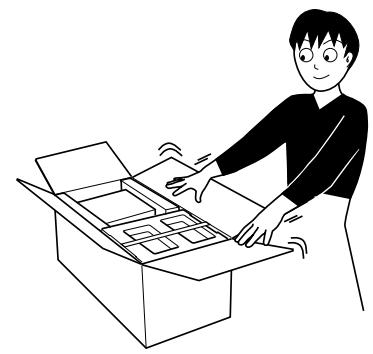
Step 1: Unpack the package and check the accessories.
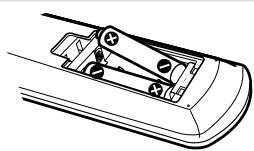
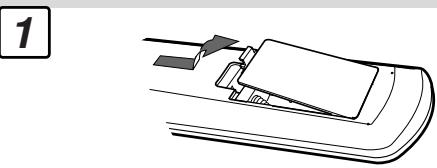
Step 2: Prepare the remote control.
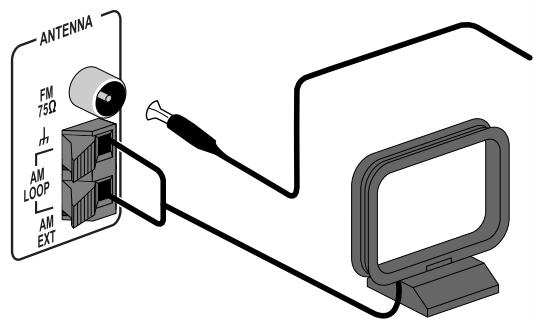
Step 3: Hook up the components such as AM/FM antennas, speakers, etc. (see pages 4 to 6).
Finally plug the AC power cord.
Now you can operate the System.
Step 1: Unpack
After unpacking, check to be sure that you have all the following items. The number in parentheses indicates the quantity of each piece supplied.
FM antenna (1)
- AM loop antenna (1)
- Remote control (1)
- Batteries (2)
If any item is missing, consult your dealer immediately.
Step 2: Prepare the Remote Control
Insert the batteries into the remote control by matching the polarity (+ and -) correctly.
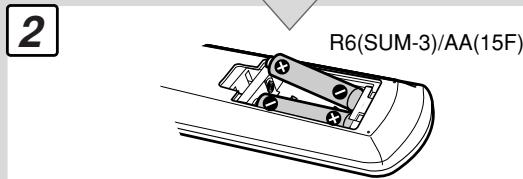
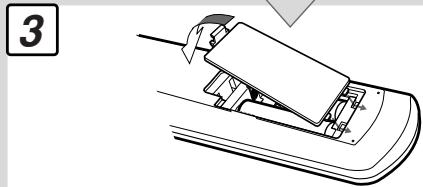
DO NOT use an old battery together with a new one.
DO NOT use different types of batteries together.
DO NOT expose batteries to heat or flame.
- DO NOT leave the batteries in the battery compartment when you are not going to use the remote control for an extended period of time. Otherwise, the remote control will be damaged from battery leakage.
Step 3: Hook Up
If you need more detailed information, see page 6.
Illustrations of the input/output terminals below are typical examples.
When you connect other components, refer also to their manuals, since the terminal names actually printed on the rear may vary.
Turn off all components before connections.
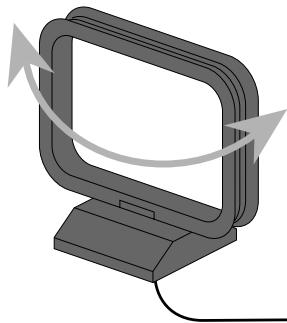
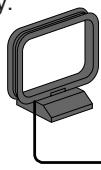
AM loop antenna (supplied)
Turn it until the best reception is obtained.
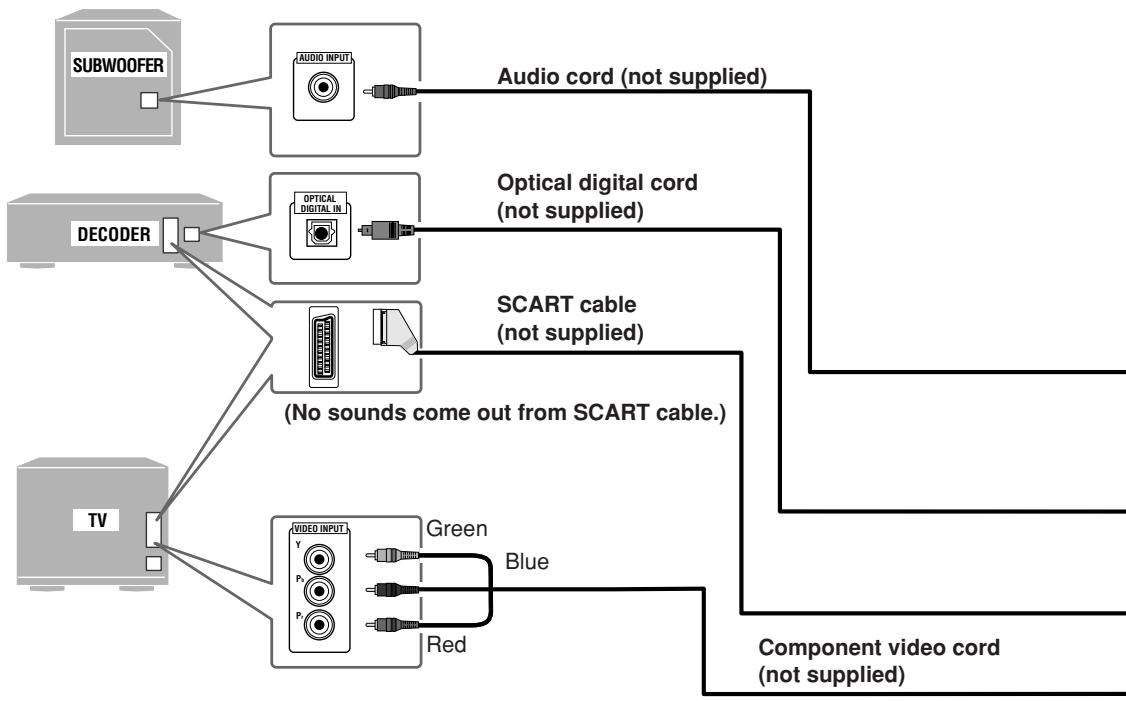
Do not connect Component video cord and SCART cable at one time.
To a wall outlet
Plug the AC power cord only after all connections are complete.
For better FM/AM reception
Vynile-covered wire (not supplied)
Extend it horizontally.
AM loop antenna
Keep it connected.
Disconnect the supplied FM antenna, and connect to an outdoor FM antenna using a 75 wire with coaxial type connector (IEC or DIN45325).
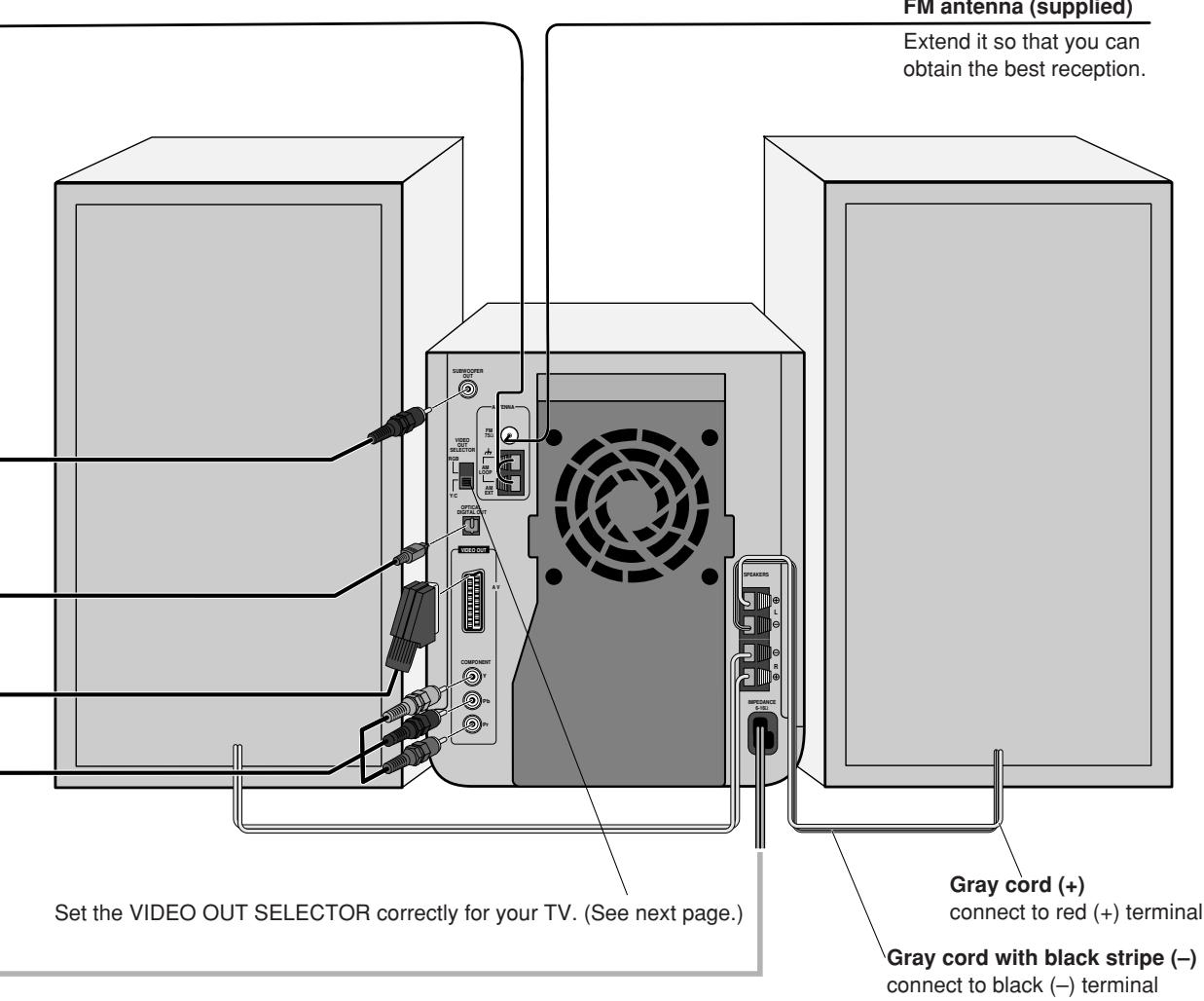
FM antenna (supplied)
Extend it so that you can obtain the best reception.
To assemble and connect the AM loop antenna To assemble the AM loop antenna
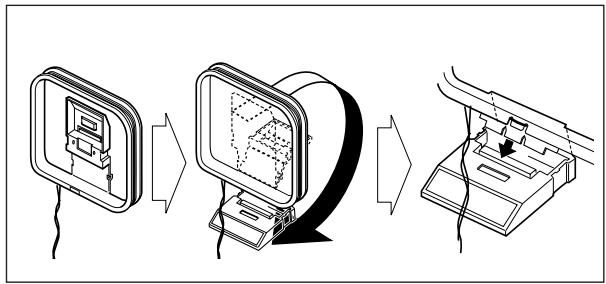
To connect the AM loop antenna
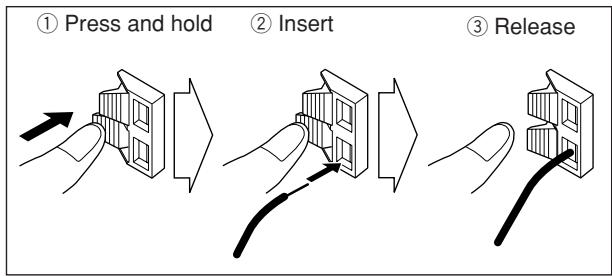
- If the AM loop antenna wire or speaker cords are covered with vinyl, remove the vinyl to expose the tip of the antenna by twisting the vinyl.
- Make sure the antenna conductors do not touch any other terminals, connecting cords or power cord. Also keep the antennas away from the metallic parts of the System, connecting cords, and the AC power cord. This could cause poor reception.
To connect the speaker cords
Connect the right speaker to the R terminals, and the left speaker to the L terminals.
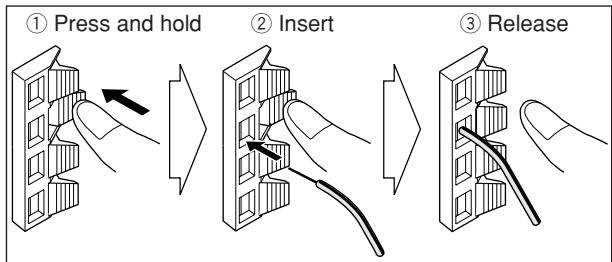
When connecting the speaker cords, match the polarity of the speaker terminals: gray cord (+) to red (+) , and gray cord with black stripe (-) to black (-) .

DO NOT connect more than one speaker to each terminal.
- DO NOT allow the conductor of the speaker cords to be in touch with the metallic parts of the System.
Changing the Scanning Mode
This System supports progressive scanning.
If you connect a progressive TV through the COMPONENT jacks, you can enjoy a high quality picture from the built-in DVD player by selecting progressive mode. And in that case, set the VIDEO OUT SELECTOR to Y/C (see below).
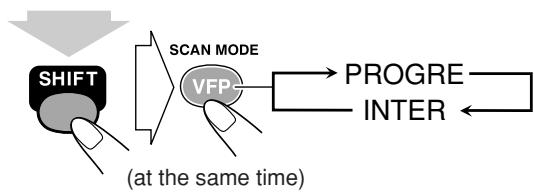
| PROGRE (Progressive) | Progressive scanning. For a progressive TV. The PROGRESSIVE indicator lights. |
| INTER (Interlaced) | Interlaced scanning. For a conventional TV. |
Selecting the Video Signal
After connecting the TV, set the video signal type correctly for your TV. The VIDEO OUT SELECTOR is on the back of the System
- Make sure the System is not yet turned on. If it is already turned on, turn off then on again so that the selector setting becomes active.
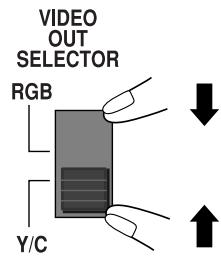
RGB
Select for sending composite video signals or RGB signals through the SCART terminal.
Y/C
Select for sending S-Video signals through the SCART terminal or component video signals through the COMPONENT jacks.
Connect only component video cord or SCART cable at one time. SCART cable can convey composite video signals, RGB signals, and S-Video signals. But S-Video signals output only when the VIDEO OUT SELECTOR is set to Y/C.
Before Operating the System
Playable Disc Types
This System has been designed to play back the following discs:
| Disc Type | Mark (Logo) | Video Format | Region Code* Number |
| DVD Video | DVD VIDEO TM | PAL | 2 or ALL |
| DVD Audio | DVD AUDIO/VIDEO | Video CD | |
| Video CD (VCD) | COMPACT DISC DIGITAL VIDEO | — | |
| Super Video CD (SVCD) | COMPACT DISC SUPER VIDEO | VIDEO CD | — |
| Audio CD | COMPACT DISC DIGITAL AUDIO | — | — |
| CD-R | Recorded in the Audio CD, VCD, SVCD, MP3, JPEG, or DivX format. | ||
| CD-RW | |||
| DVD-R | Recorded in the DVD Video, MP3, JPEG, or DivX format. | ||
| DVD-RW | Recorded in the DVD Video, MP3, JPEG, DivX, or DVD-VR (video recording) format. | ||
| DVD-RAM | |||
In addition to the above discs, this System can play back DVD-ROM and audio data recorded on CD Text, CD-G (CD Graphics), and CD-Extra.
- It is possible to play back finalised +R / + RW (Video mode only) discs. "DVD" appears to the display when a +R / + RW disc is loaded. However, the use of +R double layer disc on this unit may not be recommended.
- The following discs cannot be played back: CD-I (CD-I Ready), CD-ROM, Photo CD, SACD, etc. Playing back these discs will generate noise and damage the speakers.
DVD Video/DVD-VR comprises "Titles/Playlists" which includes "Chapters." DVD Audio/MP3/JPEG/DivX comprises "Groups/Folders" which includes "Tracks/Files." CD/SVCD/VCD comprises only "Tracks." - In this manual, "file" and "track" are interchangeably used for MP3/JPEG/DivX operations.
* Note on Region Code
DVD players and DVDs have their own Region Code numbers. This System can play back only DVDs recorded with the PAL color system whose Region Code numbers including "2."
Ex.:


If a DVD with the improper Region Code numbers is loaded, "RGN ERR (REGION CODE ERROR)" appears on the display and playback will not start.
Caution for DualDisc playback:
The Non-DVD side of a "DualDisc" does not comply with the "Compact Disc Digital Audio" standard. Therefore, the use of Non-DVD side of a DualDisc on this product may not be recommended.
DVD Video—digital audio formats
The System can play back the following digital audio formats.
- Linear PCM: Uncompressed digital audio, the same format used for CDs and most studio masters.
- Dolby Digital: Compressed digital audio, developed by Dolby Laboratories, which enables multi-channel encode to create the realistic surround sound.
- DTS (Digital Theater Systems): Compressed digital audio, developed by Digital Theater Systems, Inc., which enables multi-channel like Dolby Digital. As the compression ratio is lower than for Dolby Digital, it provides wider dynamic range and better separation.
When playing a multi-channel encoded DVD, the System properly converts these multi-channel signals into 2 channels, and emits the downmixed sound from the speakers.
- To enjoy the powerful sound of these multi-channel encoded DVDs, connect a proper decoder or an amplifier with a proper built-in decoder to the digital output terminal on the rear.
IMPORTANT: Before playing a disc, make sure of the following...
- Turn on the TV and select an appropriate input mode on the TV to view the pictures or on-screen displays on the TV screen.
- For Disc playback, you can change the initial setting to your preference. See "Setup Menu Operations" on page 35.
If “ ” appears on the TV screen when you press a button, the disc cannot accept the operation you have tried to do, or data required for that operation is not recorded on the disc.
"DVD Logo" is a trademark of DVD Format/Logo Licensing Corporation registered in the US, Japan and other countries.
Display Indicators
The indications on the display teach you a lot of things while you are operating the System. Before operating the System, be familiar with when and how the indicator illuminates on the display.
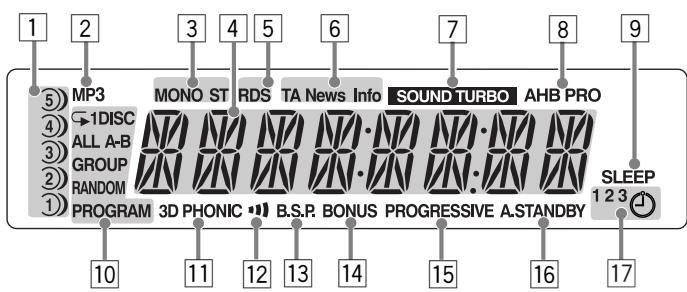
Disc tray indicators
1-5: Disc tray number indicators
- (tray indicator):
-Lights when the disc is detected.
-Flashes while playing back a disc.
- Goes off when there is no disc in the tray.
- (disc indicator): Lights when the disc in the tray is currently selected.
2 MP3 indicator
- Lights when the current track is recorded in MP3 format.
3 FM reception indicators
- MONO: Lights when FM reception mode is monaural.
- ST (stereo): Lights while an FM stereo station with sufficient signal strength is tuned in.
4 Main display
- While listening to radio; band (or preset number) and station frequency appear.
- While playing a disc; see "Indications on the main display while operating a disc" on page 9.
- While selecting "USB"; "USB" appears.
- While selecting "AUX"; "AUX" appears.
RDS (Radio Data System) indicators
- RDS: Lights when an FM station sending RDS signals is tuned in.
TA/Program type (PTY) indicator
- TA/News/Info: Lights to indicate the currently selected program type for PTY Standby Reception.
-TA/News/Info: Flashes when a program is automatically tuned in with PTY Standby Reception.
SOUND TURBO indicator
- Lights when SOUND TURBO II is activated (see page 16).
AHB (active hyper bass) PRO indicator
- Lights when AHB PRO is activated (see page 16).
9 SLEEP indicator
- Lights when the Sleep Timer is activated (see page 19).
10 Disc operation indicators
- : Lights when Repeat mode is activated.
- 1: Lights when One Track Repeat is activated.
- 1DISC: Lights when One Disc Repeat is activated.
- ALL: Lights when All Disc Repeat is activated.
A-B: Lights when A-B Repeat is activated.
GROUP: Lights when Group Repeat is activated. - RANDOM: Lights when Random Play mode is activated.
- PROGRAM: Lights when Program Play mode is activated.
13D PHONIC indicator
- Lights when 3D PHONIC is activated (see page 13).
12 Clear Voice indicator
- Lights when Clear Voice function is activated (see page 17).
[13]B.S.P. indicator
- Lights when the current disc is DVD Audio with browsable still picture (see page 24).
14BONUSindicator
- Lights when a DVD Audio with a bonus group is detected (see page 23).
15 PROGRESSIVE indicator
- Lights when progressive scanning mode is selected (see page 6).
16A. (auto) STANDBY indicator (see page 19)
- Lights when Auto Standby is activated.
- Flashes when disc playback stops with Auto Standby activated.
[17] Timer indicators (see pages 33 and 34)
- : Lights when Daily Timer stands by; flashes while working.
- 1/2/3: Lights up when a Daily Timer (1, 2, or 3) stands by; flashes while setting or working.
Indications on the main display while operating a disc
| While playing back a disc: | While disc play is stopped: |
| · DVD Video: Chapter no. Elapsed playing time 5 4 3 2 ① · By pressing SHIFT+0 (DISPLAY), you can see the current title and chapter numbers for a few seconds. | · DVD Video: Total titles/playlists no. 5 4 3 2 ① 7 15 |
| · DVD-VR: Chapter no. Elapsed playing time 5 4 3 2 ① · By pressing SHIFT+0 (DISPLAY), you can see the clock indication. | · DVD-VR: 5 4 3 2 ① 7 15 |
| · DVD Audio: Track no. Elapsed playing time 5 4 3 2 ① · By pressing SHIFT+0 (DISPLAY), you can see the current group and track numbers for a few seconds. | · DVD Audio: Group no. Track no. |
| · Audio CD/SVCD/VCD: Track no. Elapsed playing time* 5 4 3 2 ① · *“PBC” appears while playing a disc with PBC. | · Audio CD/SVCD/VCD: Total track no.* Total playing time 5 4 3 2 ① 7 15 * Changes to “PBC” when playback with PBC is stopped. |
| · MP3/DivX: Track no. Elapsed playing time 5 4 3 2 ① · While playing MP3 disc, by pressing SHIFT+ 0 (DISPLAY), you can see the current group and track numbers for a few seconds. · While playing DivX, MP3 indicator goes off. · While playing DivX, by pressing SHIFT+0 (DISPLAY), “DIVX” appears. | · MP3/DivX: Current group no. Current track no. 5 4 3 2 ① 7 15 * While playing DivX, MP3 indicator goes off. |
| · JPEG: Group no. File no. 5 4 3 2 ① · While playing JPEG, you can see the current group and track numbers for a few seconds. | · JPEG: Current group no. Current file no. 5 4 3 2 ① 7 15 * While playing JPEG, you can see the current group and track numbers for a few seconds. |
- If "RESUME" is "ON" (see page 38), "RESUME" appears when you stop playback (except for Audio CD and MP3/JPEG discs).
Daily Operations—Playback

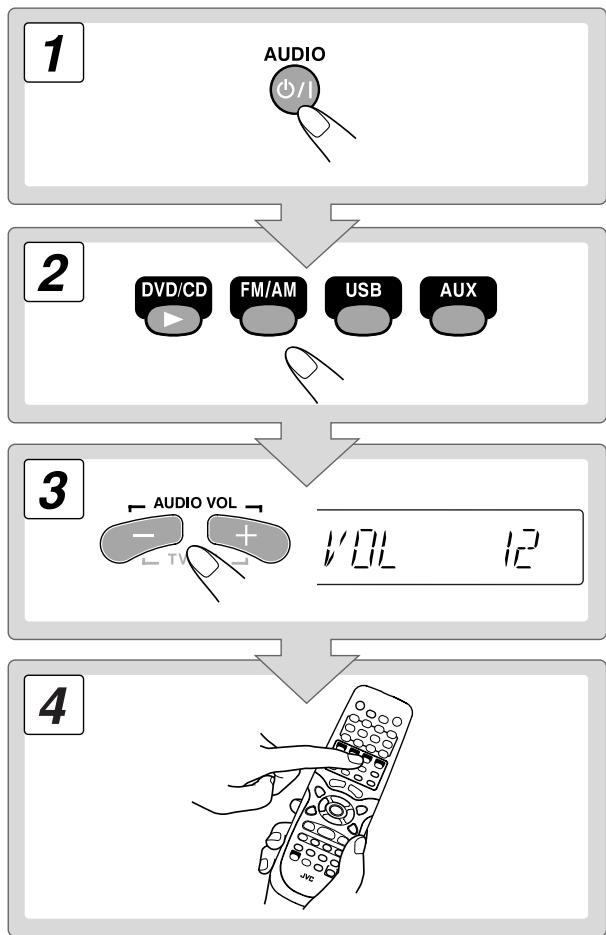
1 Turn on the power.
The STANDBY lamp on the main unit turns off.
- Without pressing AUDIO / l , the System turns on by pressing one of the source selecting buttons in the next step.
2 Select the source.
Playback automatically starts if the selected source is ready to start.
- If you press AUX or USB, start playback on the external component.
3 Adjust the volume.
4 Operate the target source as explained later.
To turn off (standby) the System
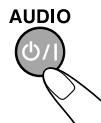
The STANDBY lamp on the main unit lights up.
- A small amount of power is always consumed even while on standby.
For private listening
Connect a pair of headphones to the PHONES jack on the main unit. The sound will no longer come out of the speakers. Be sure to turn down the volume before connecting or putting on the headphones.
- Disconnecting the headphones will activate the speakers again.

DO NOT turn off (standby) the System with the volume set to an extremely high level; otherwise, the sudden blast of sound can damage your hearing, speakers and/or headphones when you turn on the System or start playback again.
To turn off the clock indication
While the System is turned off...
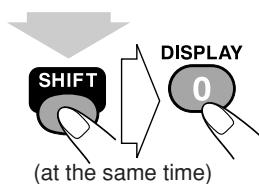
- Press the button again to display the clock indication.
Listening to the Radio
To select the band—FM or AM
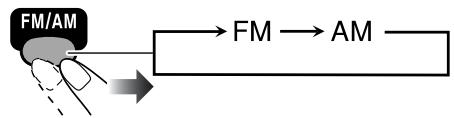
To tune in to a station
While FM or AM is selected...
| Remote control: | Main unit: |
| 1 sec. | 1 sec. |
Frequency starts changing on the display.
When a station (frequency) with sufficient signal strength is tuned in, the frequency stops changing.
- When you repeatedly press the button, the frequency changes step by step.
To stop searching manually, press either button.
If the received FM station is hard to listen
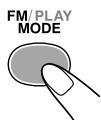
The MONO indicator lights on the display. Reception will improve though stereo effect is lost—Monaural reception mode.
To restore the stereo effect, press the button again (the MONO indicator goes off).
To preset the stations

You can preset 30 FM and 15 AM stations.
1 Tune in to a station you want to preset.
- You can also store the monaural reception mode for FM preset stations if selected.
2 Activate the preset entry mode.
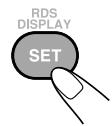
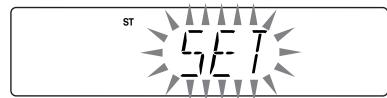
- Finish the following process while the indication on the display is flashing (5 seconds).
3 Select a preset number for the station.
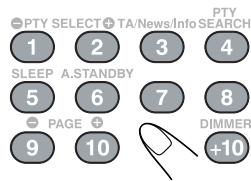
Ex.:
To select preset number 5, press 5.
To select preset number 15, press +10 , then 5.
To select preset number 30, press +10 , +10 , then 10.
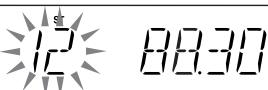
4 Store the station.
STUREII
To tune in to a preset station

1 Select a band—FM or AM.
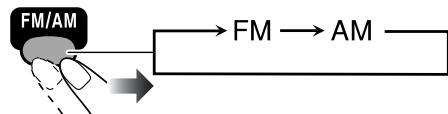
2 Select a preset number you have stored.
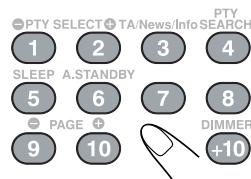
- You can also use the buttons to select a preset station.
Playing Back a Disc

- For MP3/JPEG/DivX playback, see "Operations on the CONTROL Screen" on page 31.
To insert a disc
You can insert a disc while playing another source.
Main Unit:
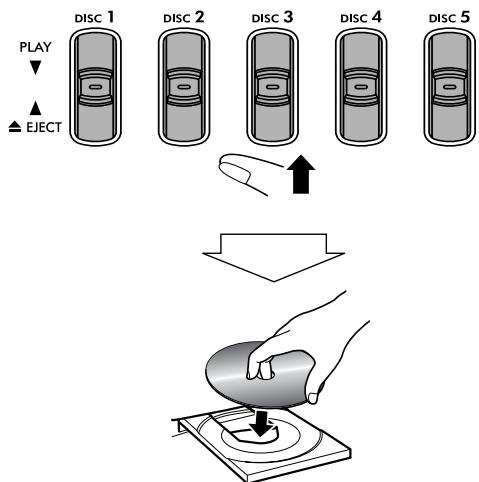
To close the disc tray and start playback, press down the same lever again.
- When current selected disc tray is open, you can use DVD/CD▶ to close the disc tray and start playback (depending on how the disc is programmed internally).
- If you press up EJECT for a tray to open it with another tray already open, the other tray automatically closes, and then the tray you have pressed up EJECT comes out.
To start:
To pause:
To stop:
To release, press DVD/CD ▷.
- While playing DVD/SVCD/VCD: This System can store the stop point, and when you start playback again by pressing DVD/CD▶, it starts from the position where you have stopped—Resume Play. ("RESUME" appears on the display when you stop playback.)
To stop completely while Resume function is activated, press twice. (To cancel Resume function, see "RESUME" on page 38.) - When operating the System, the on-screen guide icon (see the following table) appears on the TV screen. To deactivate the on-screen guide icons, see "ON SCREEN GUIDE" on page 38.
On-screen guide icons
- During playback, the following icons may appear on the TV screen:

At the beginning of a scene containing multi-angle views.

At the beginning of a scene containing multi-audio sounds.

At the beginning of a scene containing multisubtitles.
- The following icons will be also shown on the TV screen to indicate your current operation (for more details, see page 28).


To select a disc
Remote Control:
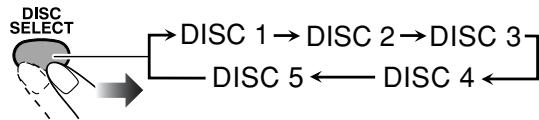
- When current source is not disc, press DVD/CD▶ to select the disc player as the source while "PLAY" is flashing on the display.
Main Unit:
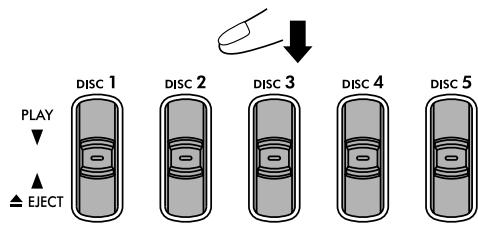
To select a title/group/playlist
While playing DVD, MP3, DivX...
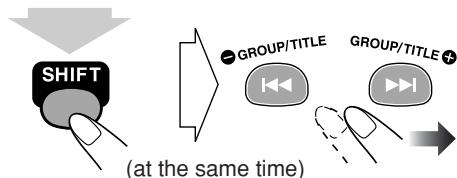
- Group name appears on the display for MP3.
- This feature may not work for some discs.
To select a chapter/track
While playing a disc except SVCD/VCD with PBC...
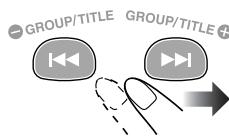
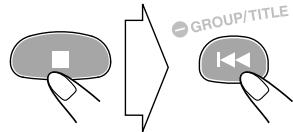
- First time you press , you can go back to the beginning of the current chapter/track.
To locate a particular position
While playing a disc except MP3/JPEG...
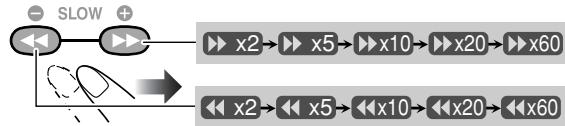
- No sound comes out while searching on DVD Video/DVD-VR/SVCD/VCD/DivX.
To return to normal playback, press DVD/CD▶.
To locate an item directly

You can select a title/manifest/chapter/track directly and start playback with the numeric buttons.
- For DVD Video/DVD-VR, you can select a title/playlist/track before starting playback, a chapter after starting playback.
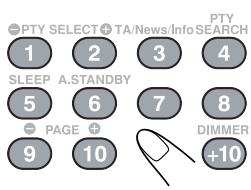
Ex.:
To select number 5, press 5.
To select number 15, press +10 , then 5.
To select number 30, press +10 , +10 , then 10.
To use 3D PHONIC
- This function is not effective for DivX.
While playing...
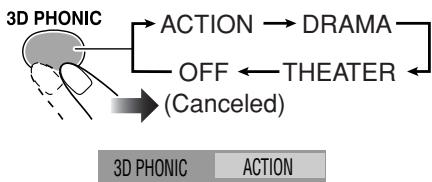
On the TV screen
| ACTION | Suitable for action movies and sports programs. |
| DRAMA | Creates natural and warm sound. Enjoy movies in a relaxed mood. |
| THEATER | Enjoy sound effects like in a major theater. |
- 3D PHONIC indicator also lights up.
To play back using the disc menu
You can operate a disc—DVD Video/DVD Audio/DVD-VR, SVCD/VCD withPlayback Control (PBC)—using the disc menu shown on the TV screen.
For DVD Video/DVD Audio:
1 Show the disc menu.
2 Select an item on the disc menu.
- You cannot use this function while displaying the pull-down menu (see page 29).
- With some discs, you can also select items by entering the number using the numeric buttons.
For SVCD/VCD with PBC:
While playing a disc with PBC, "PBC" appears on the display.
When disc menu appears on the TV screen, select an item on the menu with the numeric buttons (see "To locate an item directly" on the left for how to use the numeric buttons). Playback of the selected item starts.
To move to the next or previous page of the current menu:

To return to the previous menu:
To cancel PBC:
- You can also cancel PBC function by pressing the numeric buttons to select a track.
To reactivate PBC:
For DVD-VR:
DVD-VR format has the following two ways of playing.
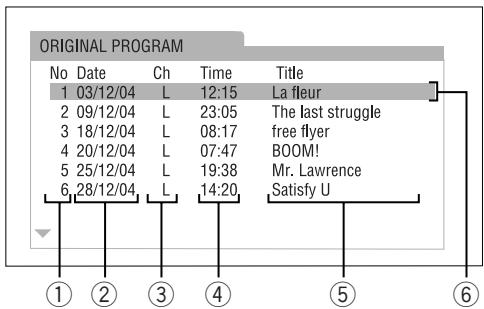
- Original program (ORIGINAL PROGRAM):
The System can play back items in a DVD-VR disc in the recorded order conventionally. - Playlist (PLAY LIST):
The System can play back the playlist edited with the DVD recording equipment.
1 Show the ORIGINAL PROGRAM or PLAY LIST.
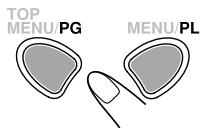
TOP MENU/PG: shows the ORIGINAL PROGRAM.
MENU/PL: shows the PLAY LIST. (The playlist
appears only when the playlist is on the DVD-VR disc.)
Ex.: ORIGINAL PROGRAM:
Ex.: PLAY LIST:
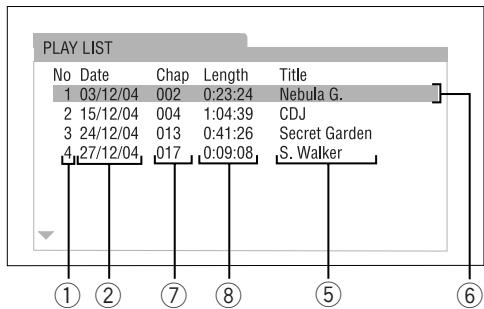
① Listed number
② Recording date
③ Recorded channel
④ Recording time
⑤ Title/ Playlist
⑥ Highlight bar (current selection)
⑦ Chapters included
⑧ Playback time
2 Select an item on the disc menu.
- You cannot use this function while displaying the pulldown menu (see page 29).
- With some discs, you can also select items by entering the number using the numeric buttons.
Playing Back from the PC
This System is equipped with a USB terminal on the front panel. You can connect your PC to this terminal and enjoy the sound out of your PC.
When you connect your PC for the first time, follow the procedure below.
- Remember you cannot send any signal or data to your PC from this System.
IMPORTANT
- Always set volume to "VOL MIN" when connecting or disconnecting the other equipment.
How to install the USB drivers
1 Turn on your PC and start running Windows® 98, Windows® 98SE, Windows® Me, Windows® 2000, or Windows® XP.
- If the PC has been turned on, quit all the applications running.
2 Select USB for the source.
3 Connect the System to the PC using a USB cable (not supplied).
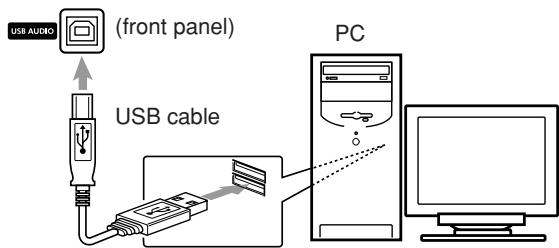
- Use "USB series A plug to B plug" cable.
4 The USB drivers are installed automatically.
To play back sounds on the PC
Refer to the manuals supplied with the sound reproducing application installed in the PC.
- Microsoft®, Windows® 98, Windows® 98SE, Windows® Me, Windows® 2000 and Windows® XP are registered trademarks of Microsoft corporation.
Playing Back from Other Equipment
To connect other equipment
By using a stereo mini plug cord (not supplied), you can connect other equipment with analog audio output jacks, such as an MD player, a TV, etc.
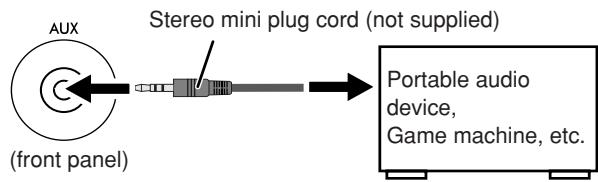
If the audio output on the other equipment is not stereo mini plug type,
Use a plug adapter to convert the stereo mini plug to the corresponding plug to the audio output.
Refer to the manuals supplied with the other equipment.
IMPORTANT
- Always set volume to "VOL MIN" when connecting or disconnecting the other equipment.
To select other equipment for the source
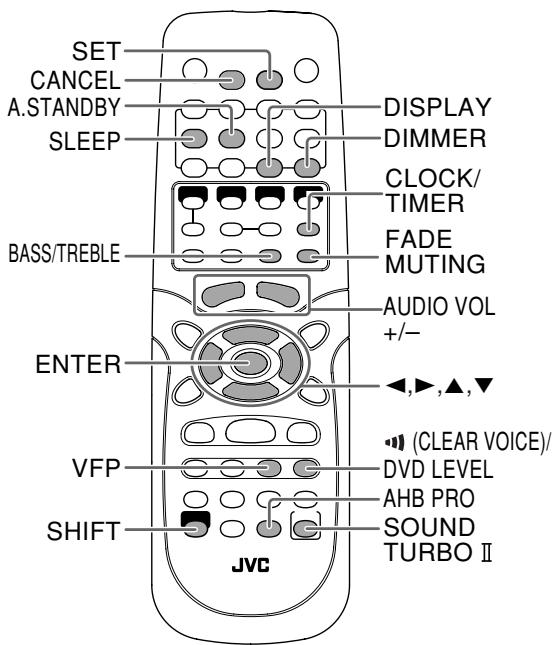
Remote control
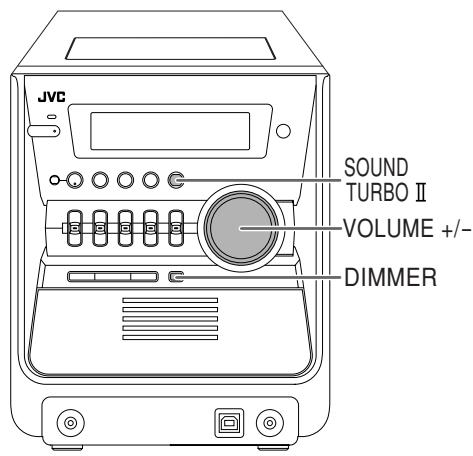
Main unit
Adjusting the Volume
You can adjust the volume level from level 0 (VOL MIN) to level 31 (VOL MAX).
| Remote control: | Main unit: |
| AUDIO VOL + TV VOL | VOLUME + TV |
To drop the volume in a moment
To restore the volume, press again, or adjust the volume level.
Adjusting the Sound
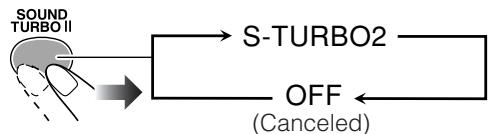
To emphasize the sound—SOUND TURBO II
This function emphasizes the sound.
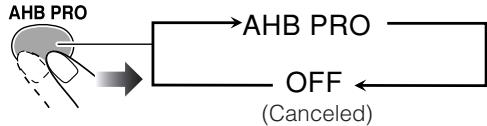
To emphasize heavy bass sound—AHB PRO

This function dynamically enhances bass response.
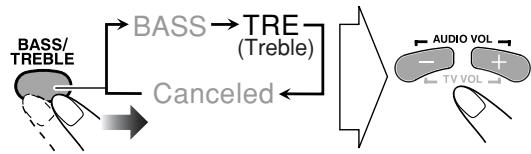
To adjust the tone—BASS/TREBLE

You can adjust the bass and treble level from 0 to +5 .
- When you adjust this setting, the SOUND TURBO II is canceled automatically.
To adjust the bass
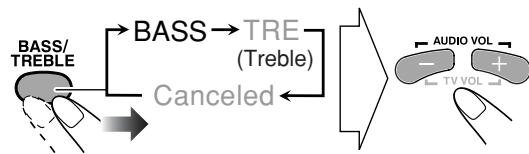
To adjust the treble
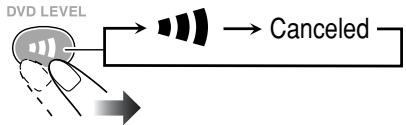
Making DVD Voice Clear—CLEAR VOICE
This function allows you to easily understand the dialog of DVD even with the volume turned down.
- This function only works for center-channel signal encoded multi-channel disc.
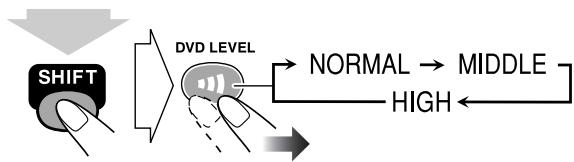
Presetting Automatic DVD Sound Increase
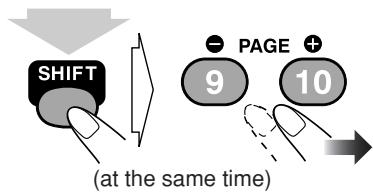
Level—DVD LEVEL Remote ONLY
Some DVD Videos/DVD Audios are recorded at a lower sound volume level than that of other discs or sources. You can increase the level for the currently loaded DVD Video/DVD Audio.
(at the same time)
| NORMAL | Original recording level. |
| MIDDLE | Output level is increased (less than “HIGH”). |
| HIGH | Output level is increased (more than “MIDDLE”). |
- Once the current DVD Video/DVD Audio is ejected, this setting is canceled and set automatically to "NORMAL."
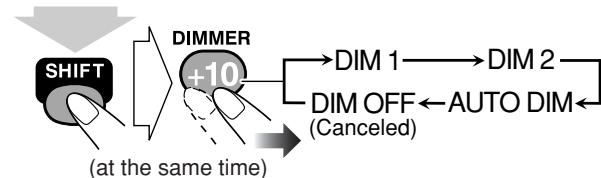
Changing the Display Brightness—DIMMER
You can dim the display window.
- This function cannot use when the System is on standby.
Remote Control:
Main Unit:
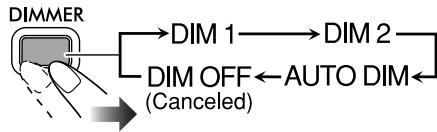
DIM 1 Dims the display.
DIM 2 Erases the display illumination.
AUTO DIM Erases the display illumination when playback starts.
- This function works only when playing DVD/SVCD/VCD/JPEG or DivX files.
- The display illuminates when playback stops.
Changing the Picture Tone—VFP (Video
Fine Processor)
While showing a playback picture on the TV screen, you can select the preset picture tone, or adjust it and store your own preferences.
To select a preset picture tone
1 Activate VFP.
SCAN MODE

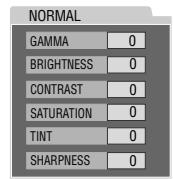
On the TV screen
2 Select a preset picture tone.
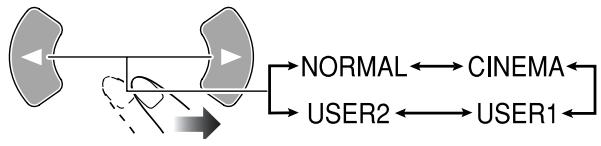
| NORMAL | Normally select this. |
| CINEMA | Suitable for a movie source. |
| USER1/USER2 | You can adjust parameters and can store the settings (see the right column). |
To adjust the picture tone
1 Select "USER1" or "USER2."
- Follow steps 1 and 2 explained on the left column.
2 Select a parameter you want to adjust.
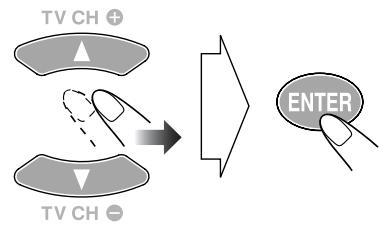
| GAMMA | Adjust if the neutral color is bright or dark (-3 to +3). |
| BRIGHTNESS | Adjust if the entire picture is bright or dark (-8 to +8). |
| CONTRAST | Adjust if the far and near positions are unnatural (-7 to +7). |
| SATURATION | Adjust if the picture is whitish or blackish (-7 to +7). |
| TINT | Adjust if the human skin color is unnatural (-7 to +7). |
| SHARPNESS | Adjust if the picture is indistinct (-8 to +8). |
3 Adjust the parameter.
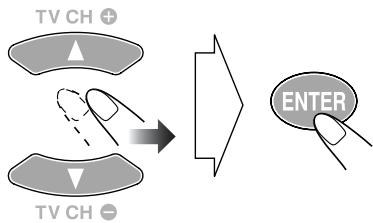
4 Repeat steps 2 to 3 to adjust other parameters.
To erase the screen, press VFP again.
Setting the Clock Remote ONLY
Without setting the built-in clock, you cannot use the Daily Timer (see page 33) and Sleep Timer (see the right column).
- To exit from the clock setting, press CLOCK/TIMER as required.
- To go back to the previous step, press CANCEL.
1 Activate the clock setting mode.
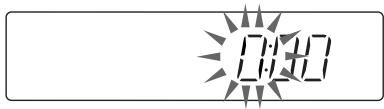
- If you have already adjusted the clock before, press the button repeatedly until the clock setting mode is selected (see page 33).
2 Adjust the hour.
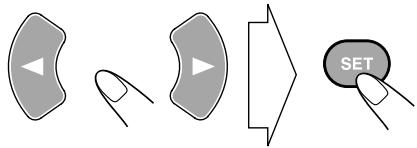
3 Adjust the minute.
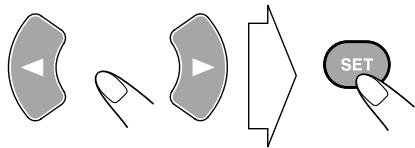
Now the built-in clock starts working.
To check the current clock time during play
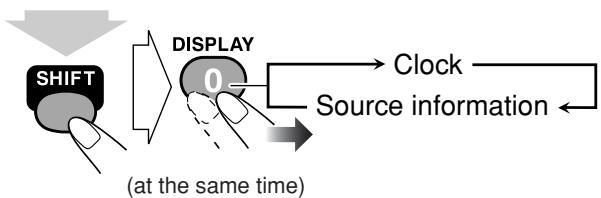
- While playing a DVD/MP3/DivX, you cannot check the current clock time (see page 9).
Turning Off the Power
Automatically
To turn off the System after playback is over—Auto Standby
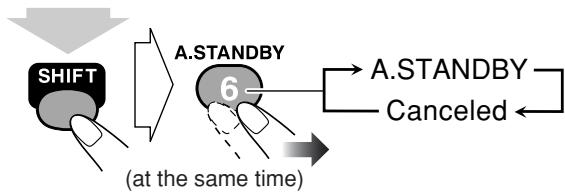
When Auto Standby is in use, the A.STANDBY indicator lights on the display. When the disc play stops, the A.STANDBY indicator starts flashing. If no operation is done for about 3 minutes while the indicator is flashing, the System turns off (in standby) automatically.
- Auto Standby does not work while you are listening to radio (FM/AM) or the external component (AUX/USB).
To turn off the System after a certain period of time—Sleep Timer
1 Specify the time (in minutes).
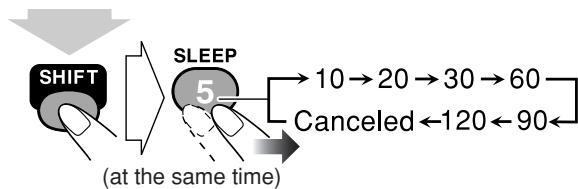
- SLEEP indicator also lights up on the display.
2 Wait until the set time goes off.
To check the time remaining until the shut-off time
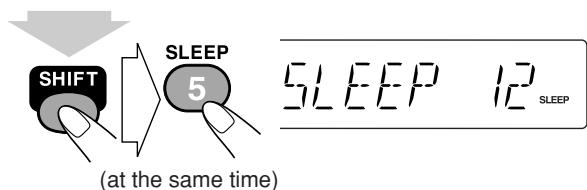
- If you press the button repeatedly, you can change the shut-off time.
Advanced Radio Operations
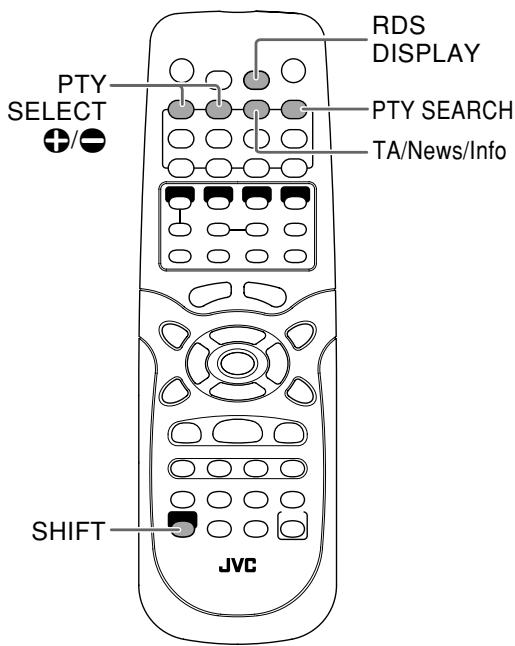
Remote control
Receiving FM Stations with RDS
Radio Data System (RDS) allows FM stations to send an additional signal along with their regular program signals.
- When tuned to an FM station which provides the RDS service, the RDS indicator lights on the display.
This System can receive the following types of RDS signals.
| PS (Program Service) | Shows commonly known station names. |
| PTY (Program Type) | Shows types of broadcast programs. |
| RT (Radio Text) | Shows text messages the station sends. |
| Enhanced Other Networks | Provides the information about the types of the programs broadcast by the RDS stations of the different networks. |
To show the RDS information
While listening to an FM station...
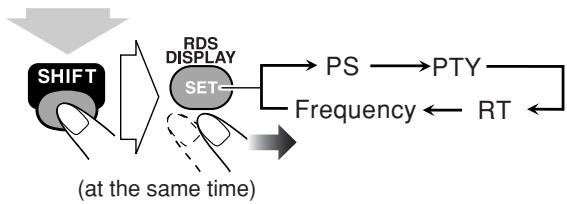
PS Station names is displayed. "NO PS" will appear if no signal is sent.
PTY The broadcast program type is displayed. "NO PTY" will appear if no signal is sent.
RT Text messages the station sends is displayed. "NO RT" will appear if no signal is sent.
Searching for a Program by

You can locate a particular kind of program from the preset stations (see page 11) by specifying the PTY codes.
To search for a program using the PTY codes
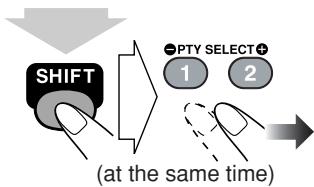
1 While listening to an FM station...
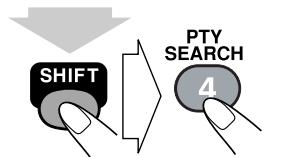
(at the same time)
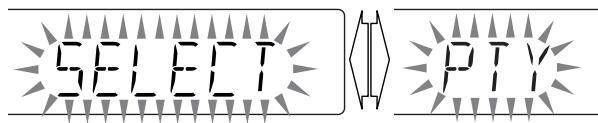
2 Select a PTY code.
NONE NEWS AFFAIRS INFO SPORT EDUCATE DRAMA CULTURE SCIENCE VARIOPED POP M ROCK M EASY M LIGHT M CLASSICS OTHER M WEATHER FINANCE CHILDREN SOCIAL RELIGION PHONE IN TRAVEL LEISURE JAZZ COUNTRY NATION M OLDIES FOLK M DOCUMENT TEST ALARM back to the beginning
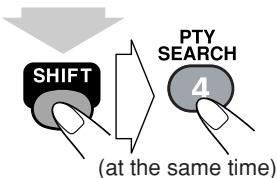
3 Start searching.
Ex.: When "NEWS" is selected...
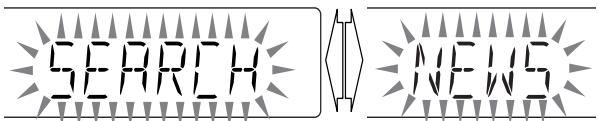
The receiver searches 30 preset FM stations, stops when it finds the one you have selected, and tunes in to that station.
- If no program is found, "NOT FOUND" appears on the display.
- To stop searching any time during search, press PTY SEARCH (while holding SHIFT).
To continue searching after it stops on an unwanted station
While the indications on the display are flashing, press PTY SEARCH again (while holding SHIFT).
Switching Temporarily to a Program of
Your Choice Automatically
The Enhanced Other Networks function allows the System to switch temporarily to a preset FM station broadcasting a program of your choice (TA, NEWS, or INFO).
- This function works while listening to an FM station providing the required signals.
While listening to an FM station, select the program type:
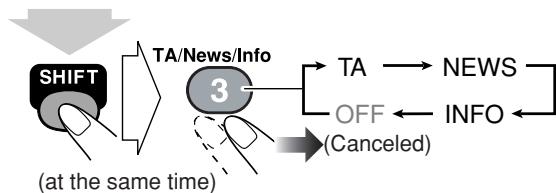
TA Traffic announcement in your area
NEWS News
INFO Program the purpose of which is to impart advice in the widest sense
How the Enhanced Other Networks function actually works:
CASE 1
If a station is not broadcasting the program of your choice
The System continues tuning in to the current station.

When a station broadcasting the program of your choice, the System automatically switches to the station. The PTY code indicator starts flashing.

When the program is over, the System goes back to the previously tuned station, but the function still remains active (the indicator stops flashing and remains lit).
CASE 2
If the station currently tuned in is broadcasting the program of your choice
The PTY code indicator starts flashing.

When the program is over, the indicator stops flashing (the function still remains active).
Remote control
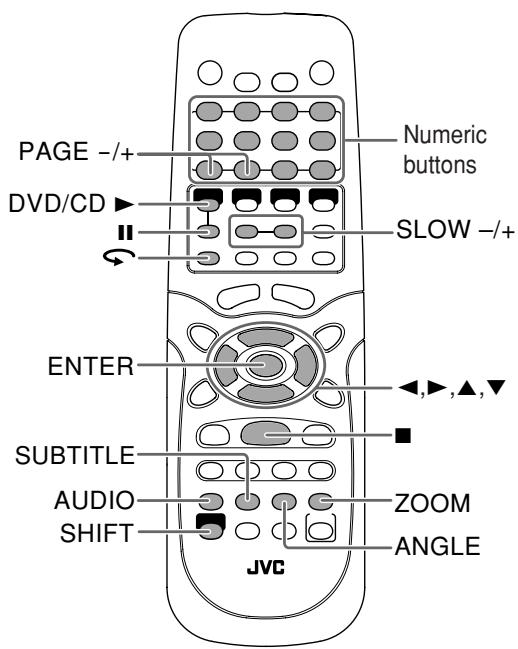
Selecting the Sound Track


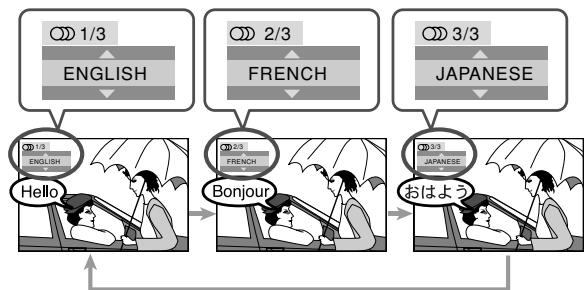
For DVD Video: While playing back a chapter containing audio languages, you can select the language to listen to.
For DVD Audio/DivX: While playing back a track containing audio channels, you can select the audio channel to listen to.
For SVCD/VCD/DVD-VR: While playing back a track, you can select the audio channel to play.
- You can also select the audio track using the on-screen bar (see page 28).
While playing a DVD Video...
Ex.:
While playing a DVD Audio/DivX...
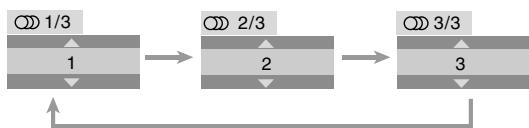
Ex.:
While playing an SVCD/VCD/DVD-VR...
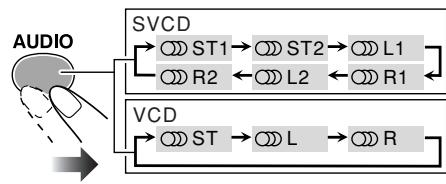
ST1/ST2/ST To listen to normal stereo (2 channel) playback.
L1/L2/L To listen to the left audio channel.
R1/R2/R To listen to the right audio channel.
- SVCD can have 4 audio channels. Karaoke SVCD usually uses these 4 channels to record two 2-channel recordings (ST1/ST2).
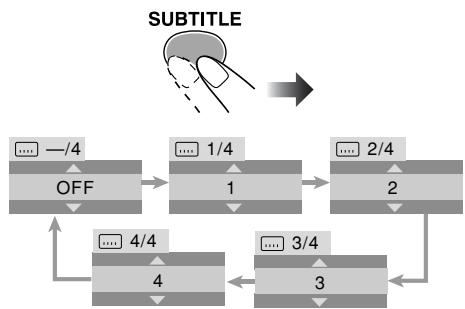
Selecting the Subtitle Language
For DVD Video/DivX: While playing back a chapter containing subtitles in different languages, you can select the subtitle language to display on the TV screen.
For SVCD: While playing back a track, you can select the subtitle even if no subtitles are recorded on the disc.
- You can also select the subtitle language using the on-screen bar (see page 28).
While playing a DVD Video/DivX...
1 Display the subtitle selection window.

SUBTITLE
2 Select the subtitle language.
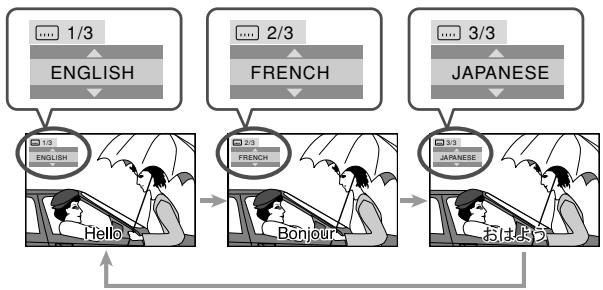
Ex.: DVD Video/DivX
While playing an SVCD...
Selecting the View Angle

While playing back a chapter containing multi-view angles, you can view the same scene from different angles.
- This function is only used while playing DVD Video.
- You can also select the multi-view angles using the on-screen bar (see page 28).
While playing...
ANGLE
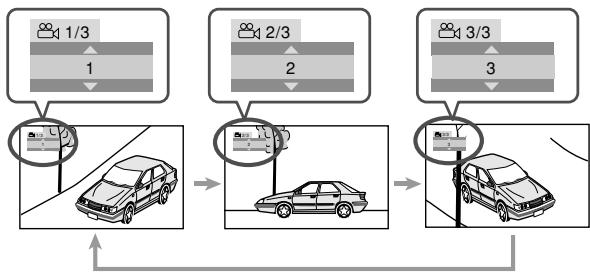
Ex.:
Playing Back a Bonus Group

Some DVD Audios have a special group called "bonus group" whose contents are not open to the public.
- This function is only used while playing DVD Audio.
- To play back a bonus group, you have to enter the specific "key number" (a kind of password) for the bonus group. The way of getting the key number depends on the disc.
1 Select the bonus group.
- The bonus group is usually recorded as the last group (for example, if a disc contains 4 groups including a bonus group, "group 4" is the bonus group).
- When the bonus group is detected, BONUS indicator lights up.
- For how to select the group, see "To select a title/group/ playlist" on page 12.
2 Enter the key number.
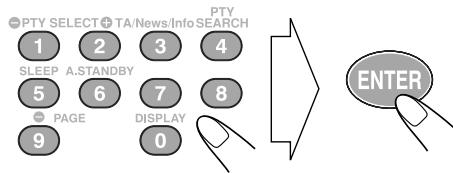
3 Follow the interactive instructions shown on the TV screen.
To cancel the key number entry, press
Selecting Browsing Still Pictures
While playing back a track linked to browsable still pictures (B.S.P.), you can select the still picture (turn the page) to be shown on the TV screen.
- This function is only used while playing DVD Audio.
- When a DVD Audio with browsable still pictures is detected, B.S.P. indicator lights up.
- If a track is linked to browsable still pictures (B.S.P.), they are usually shown in turn automatically during playback.
- You can also select the page using the on-screen bar (see page 28).
Special Effect Playback Still picture playback

| To start still picture playback: | To resume normal playback: |
| While playing... | DVD/CD |
Frame-by-frame playback
1 While playing...
Still picture playback starts.
2 Advance the still picture frame by frame.
To resume normal playback, press DVD/CD▶.
Slow-motion playback
- This function is not available for DivX.
1 While playing...
Still picture playback starts.
2 Select slow-motion speed.
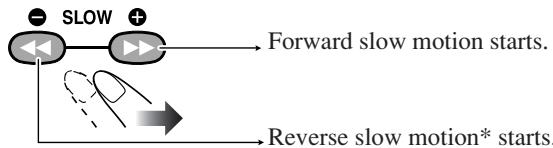
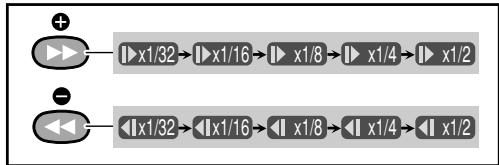
* Not available for SVCD/VCD/DVD-VR.
To resume normal playback, press DVD/CD.
To replay the previous scenes (One touch replay function)
- This function is used while playing DVD Video/DVD-VR.
RETURN

The playback position moves back about 10 seconds before the current position (only within the same title/playlist).
Zoom
1 While playing...
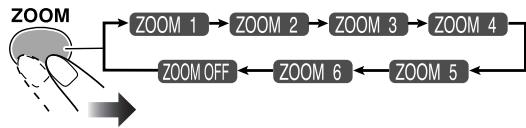
- As the number increases, magnification also increases.
2 Move the zoomed-in position.
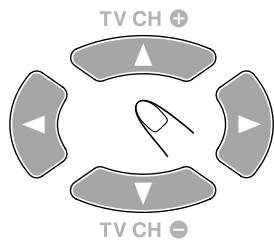
To resume normal playback, press ZOOM repeatedly until "ZOOM OFF" appears on the TV screen.
To use this function for JPEG (still pictures), see "To zoom in the still picture" on page 32.
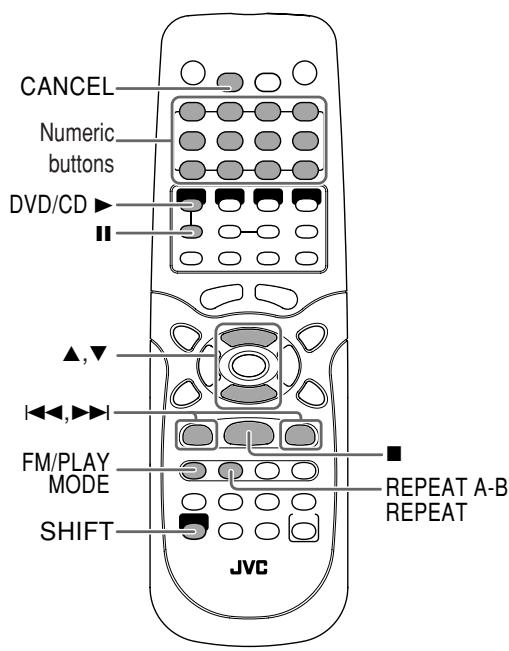
Remote control
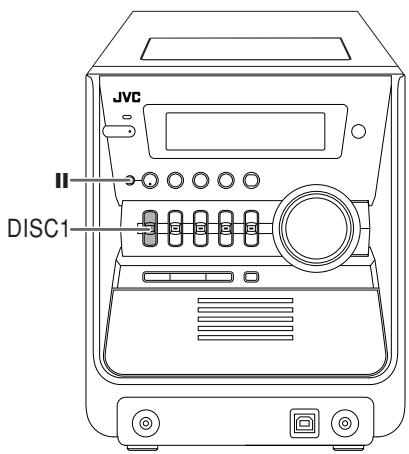
Main unit
Programming the Playing Order—
Program Play

You can arrange the playing order of the chapters or tracks (up to 99) before you start playback.
1 Before starting playback, activate Program Play.
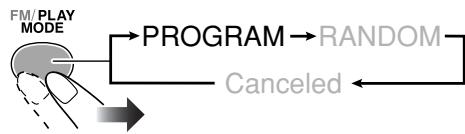
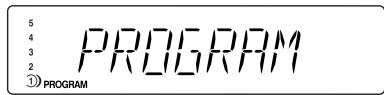
On the display
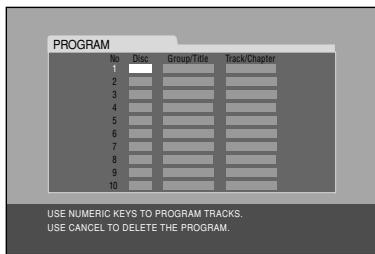
On the TV screen
2 Select chapters/tracks you want to program with the numeric buttons (see “To locate an item directly” on page 13 for how to use the numeric buttons).
- For DVD Video/MP3:
① Select a disc number on "Disc" column.
② Select a group/title number on "Group/Title" column.
③ Select a track/chapter number on "Track/Chapter" column.
- For SVCD/VCD/CD:
① Select a disc number on "Disc" column.
② Select a track number on "Track/Chapter" column.
- Even if the disc is not in the selected tray, the System may prompt for the group number entry as well, however, during playback, the System will ignore these entries.
- If you have programmed a group/title number for SVCD/VCD/CD, the System will ignore the group/title number and play the track number you have programmed.
3 If you want to program another chapters/tracks, repeat the step 2 above.
4 Start playback.
Playback starts in the order you have programmed.
| To skip a step: | To pause: | To stop: |
| GROUP/TITLE GROUP/TITLE | To release, press DVD/CD▶. |
To check the programmed contents Before or after playback...
To modify the program
Before or after playback...
| To erase the last step: | To erase the entire program: |
| TV/VIDEO CANGEL | |
| To add steps in the program: | |
| Repeat step 2 on page 25. | |
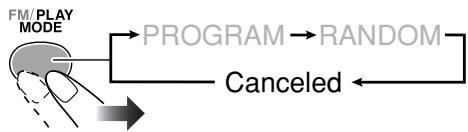
To exit from Program Play
Before or after playback...
Playing at Random—Random Play
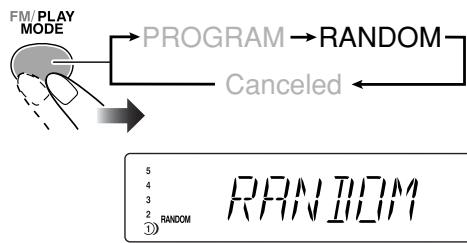
You can play the chapters or tracks of all loaded discs at random.
- Random Play cannot be used for some DVDs.
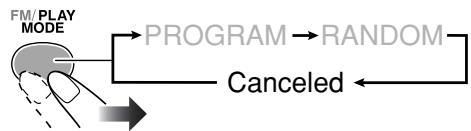
1 Before starting playback, activate Random Play.
2 Start playback.
Playback starts in random order. Random Play continues to the disc on the next tray when all the chapters or tracks in the current disc are played once (when Repeat Play is not activated).
- Playback ends when all the discs are played once (when Repeat Play is not activated).
| To skip a chapter/track: | To pause: | To stop: |
| GROUP/TITLE To skip to the beginning of the current track, press▶. | To release, press DVD/CD▶. |
- During Random Play, you cannot select the disc to play by using DISC SELECT.
To exit from Random Play
Before or after playback....
Playing Repeatedly
- You can also select the repeat mode using the on-screen bar (see page 29).
Repeat Play
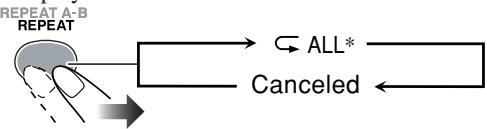
- For DVD Video/DVD-VR:
During playback...
Before playback...
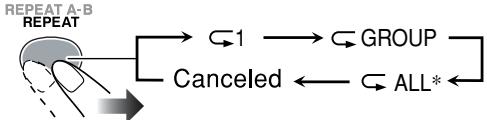
- For DVD Audio:
During or before playback...
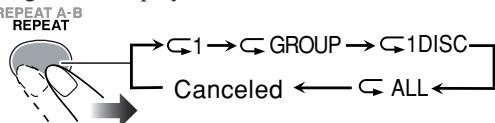
- For MP3/DivX:
During or before playback...
- For CD/SVCD/VCD:
During or before playback without PBC...
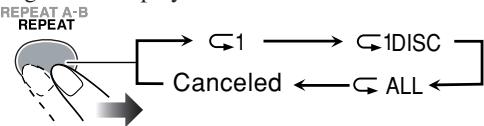
During playback with PBC...
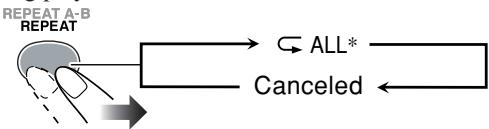
- For Program Play:
During or before playback...
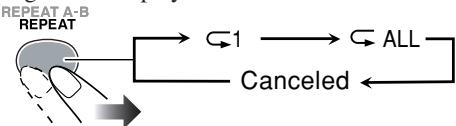
- For Random Play:
During or before playback...
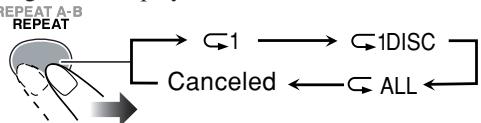
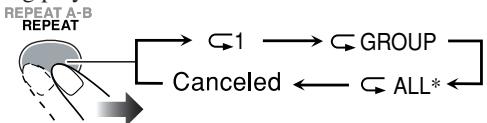
| → ALL* | Repeats the discs in all trays or all programmed tracks. |
| → 1 | Repeats the current chapter/track. |
| → GROUP | Repeats the current title/group/playlist. |
| → 1DISC | Repeats the current disc. |
| Canceled | Cancels Repeat Play mode. |
*When DVD Video, DVD Audio or SVCD/VCD with PBC is loaded in the System, this function may not work correctly.
A-B Repeat
You can repeat playback of a desired portion by specifying the beginning (point A) and the ending (point B).
- A-B Repeat cannot be used for MP3/DivX or for some DVDs.
- A-B Repeat can be used within the same title/playlist while playing a DVD Video/DVD-VR, and within the same track for the other discs.
1 While playing (without PBC for SVCD/VCD), select the start point (A).
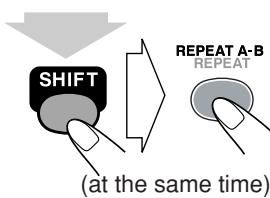
一 A- lights on the display.
- 一A appears on the TV screen if the TV is turned on.
2 Select the end point (B).
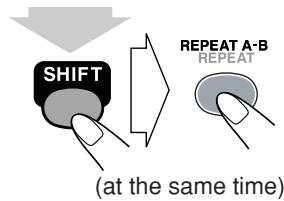
一 A-changes to 一 A-B.
- A-B appears on the TV screen and A-B Repeat starts.
- You can search for the end point using .
To cancel A-B Repeat, press REPEAT A-B again while holding SHIFT.
Prohibiting Disc Ejection—Child Lock

You can lock the disc trays so that no one can eject the loaded discs.
- This is possible while the System is on standby and the clock indication is turned on (see page 10).
While the disc trays are closed....
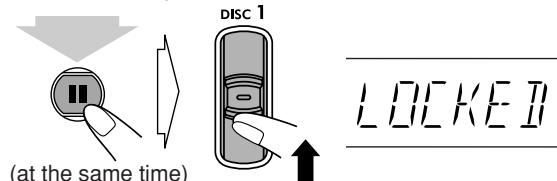
To cancel the prohibition, repeat the same procedure.
"UNLOCKED" appears on the display.
On-Screen Disc Operations
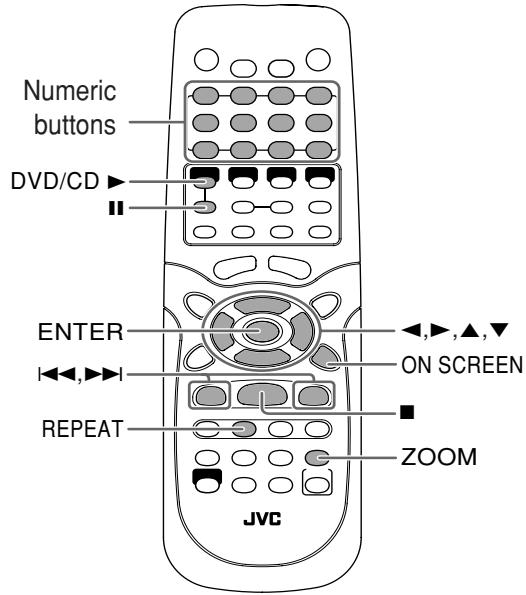
Remote control
On-screen bars DVD Video
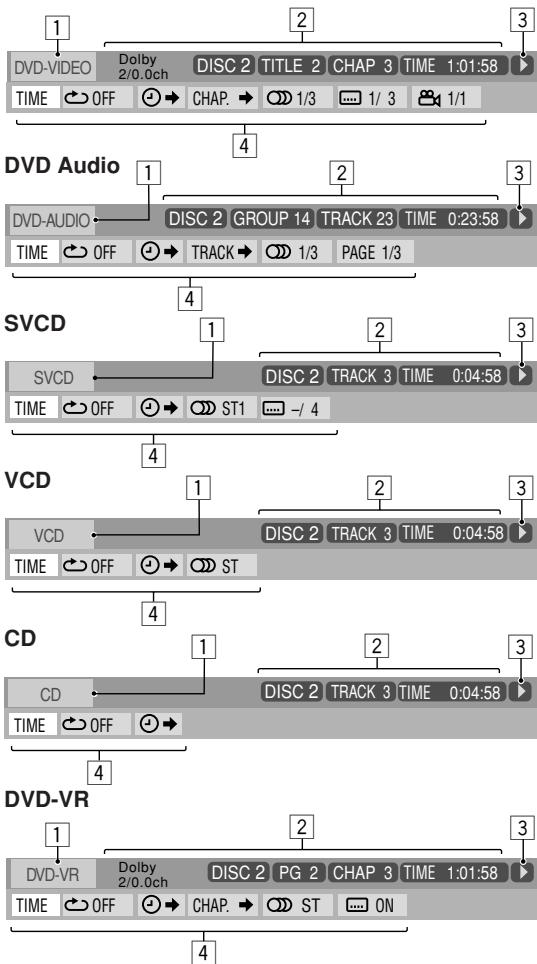

On-screen Bar Information
You can check the disc information (except for MP3/JPEG) and use some functions through the on-screen bar.
1 Disc type
②Playbackinformation
Indication Meanings
Dolby 2 Audio format
0.0ch Channel number
DISC 2 Current disc
TITLE 2 Current title/program list/playlist (for DVD-VR; "PG" or "PL" appears instead of "TITLE").
CHAP 3 Current chapter
GROUP 1 Current group
TRACK 14 Current track
TIME1:25:58 Time indications
3Operation modes
Indication Meanings
Playback
Forward/Reverse search
Forward/Reverse slow-motion
Pause
Stop
4 Function icons (on the pull-down menu)
Indication Meanings
TIME Select to change the time indication. OFF Select to repeat playback.
Select for time search.
CHAP. Select for chapter search.
TRACK Select for track search.
1/3 Select to change the audio language or channel (see also page 22).
1/3 Select to change subtitle language (see also page 23).
1/3 Select to change the view angle (see also page 23).
PAGE 1/5 Select to change the page (see also page 24).
- You cannot use , , , and buttons to select the disc menu while displaying the pull-down menu.
Operations Using the On-screen Bar
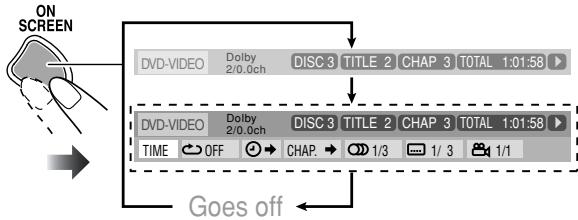
Ex.: Selecting a subtitle (French) for DVD Video:
While a disc is selected as the source...
1 Display the on-screen bar with the pull-down menu.
2 Select (highlight) the item you want.

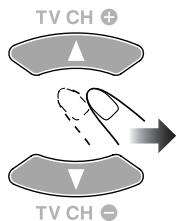
3 Display the pop-up window.

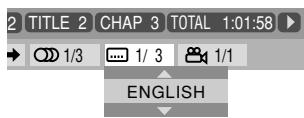
4 Select the desired option in the pop-up window.
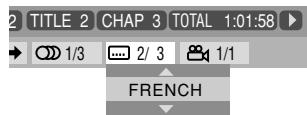
5 Finish the setting.

Pop-up window goes off.
To erase the on-screen bar
For detailed operations of the following functions, see also "Operations Using the On-screen Bar" on the left.
Changing the time information
You can change the time information in the on-screen bar and the display on the main unit except for DivX.
1 Display the on-screen bar with the pull-down menu.

2 Make sure TIME is selected (highlighted).
3 Change the time indication.
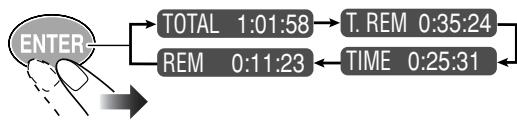
| TOTAL | Elapsed disc time. |
| T. REM | Remaining disc time. |
| TIME | Elapsed playing time of the current chapter/track. |
| REM | Remaining time of the current chapter/track. |
To erase the on-screen bar

Repeat Play
See also page 27.
- You cannot operate the Repeat Play for DivX with the on-screen bar.
1 While playing (without PBC for SVCD/VCD), display the on-screen bar with the pull-down menu.
2 Select OFF
3 Display the pop-up window.
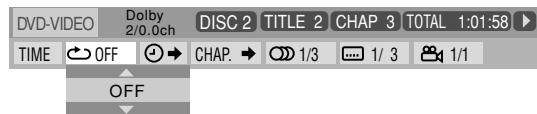
4 Select the repeat mode you want.
| ALL | Repeats all discs or all programmed tracks (not for some DVD Videos). |
| A-B | Repeats a desired portion (see below). |
| TITLE | Repeats the current title*. |
| GROUP | Repeats the current group. |
| DISC | Repeats the current disc (except for DVD). |
| CHAPTER | Repeats the current chapter. |
| TRACK** | Repeats the current track. |
| OFF | Cancels Repeat Play. |
- During playing DVD-VR, "PG" (Program List) or "PL" (Play List) appears.
**During Program Play and Random Play, "STEP" appears.
5 Finish the setting.

A-B Repeat
See also page 27.
- You cannot operate the A-B Repeat for DivX with the on-screen bar.
1 While playing, display the on-screen bar with the pulldown menu.
2 Select OFF
3 Display the pop-up window.
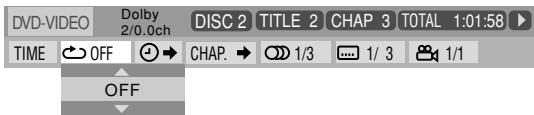
4 Select "A-B."
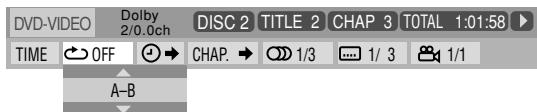
5 Select the start point (A).

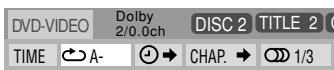
6 Select the end point (B).

A-B Repeat starts. The selected portion plays repeatedly.
- Before pressing ENTER, you can search for the end point using
Time Search
You can move to a particular point by specifying the elapsed playing time.
For DVD Video/DVD Audio/DVD-VR:
You can specify the elapsed time for the current title/ playlist.
For CD/SVCD/VCD:
- While playing back, you can specify the elapsed time for the current track except for SVCD/VCD with PBC.
- While stopped, you can specify the elapsed time for the disc except for SVCD/VCD with PBC.
1 Display the on-screen bar with the pull-down menu.
2 Select ②
3 Display the pop-up window.

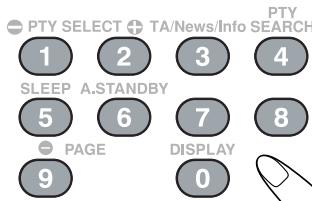
4 Enter the time.
You can specify the time in hours/minutes/seconds.
Ex.:
To move to a point of 1 (hours): 02 (minutes): 00 (seconds), press 1, 0, 2, 0, then 0.
To move to a point of 54 (minutes): 00 (seconds), press 0, 5, 4, 0, then 0.
- It is always required to enter the hour digit (even "0" hour), but it is not required to enter trailing zeros (the last two digits in the examples above).
- To correct a misentry, press cursor to erase the last entry.
5 Finish the setting.

The System starts playing the disc from the selected playing time.
Chapter/Track Search
You can search for the chapter (DVD Video/DVD-VR) or track (DVD Audio) number to play.
1 While playing, display the on-screen bar with the pulldown menu.
2 Select CHAP or TRACK
3 Display the pop-up window.

4 Enter the desired chapter/track number with the numeric buttons (see "To locate an item directly" on page 13 for how to use the numeric buttons).
- To correct a misentry, press the numeric buttons until the desired number shown in the pop-up window.
5 Finish the setting.

The System starts playing the searched chapter or track.
Operations on the CONTROL Screen
The CONTROL screen automatically appears on the TV screen when you load an MP3/JPEG/DivX.
You can search for and play the desired tracks through the CONTROL screen.
- If several types of files (MP3/JPEG/DivX) are recorded on a disc, select the file type to play (see page 37).
Ex.: When the MP3 disc is loaded.
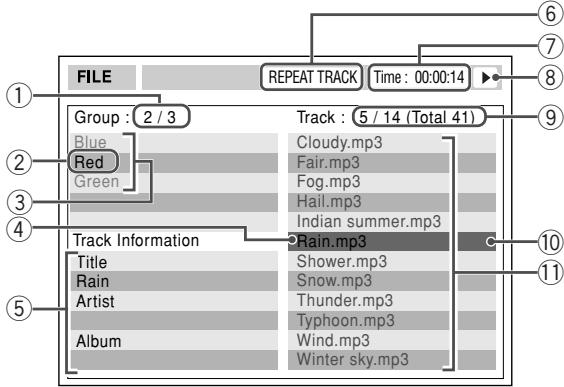
CONTROL screen
① Current group number/total group number
② Current group
③ Group list
④ Current track (in blue)
⑤ Track information (ID3 Tag Version 1.0: only for MP3)
⑥ Repeat Play setting
(7) Elapsed playing time of the current track (only for MP3)
⑧ Operation mode icon
⑨ Current track number/total number of tracks in the current group (total number of tracks on the disc)
10 Highlight (green) bar
⑪ Track list
To move the highlight bar between group list and track list
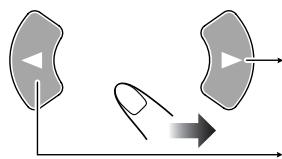
Moves the bar to the track list.
Moves the bar to the group list.
To select a group/track in the list
Move the highlight bar to a desired item.
- If you move the highlight bar while playing back an MP3 disc, the selected track starts playback automatically.
To start playback

Playback starts with the selected track.
Pressing DVD/CD also starts playback.
If the track is JPEG, selected still picture is displayed until you change it.
Unique JPEG Operations
You can enjoy the Slide-show playback for JPEG files. Each track (still picture) on the disc is shown on the screen for few seconds, then changes one after another.
To start the Slide-show while the CONTROL screen is on the TV screen
- Once the Slide-show starts, the CONTROL screen goes off.
- Some discs automatically start the Slide-show.
To cancel the Slide-show and display the current still picture

| To skip a track: | To pause: | To stop playback: |
| GROUP/TITLE GROUP/TITLE | To release, press DVD/CD▶. |
To repeat Slide-show
During or before playback...
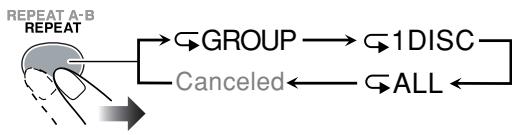

GROUP Repeats the current group.

1DISC Repeats the current disc.

ALL Repeats all discs.
To zoom in the still picture
- You cannot zoom in the still picture during the Slide-show.
1 While playing...
2 Change the magnification.
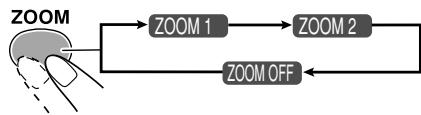
As the number increases, magnification also increases.
3 Move the zoomed-in position.
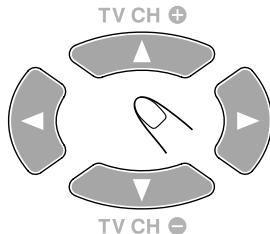
To resume normal playback, press ZOOM repeatedly until "ZOOM OFF" appears on the TV screen.
Timer Operations
Remote control
Setting the Daily Timer
Using Daily Timer, you can wake up with your favorite music.
You can store three Daily Timer settings; however, you can activate only one of the timers at a time.
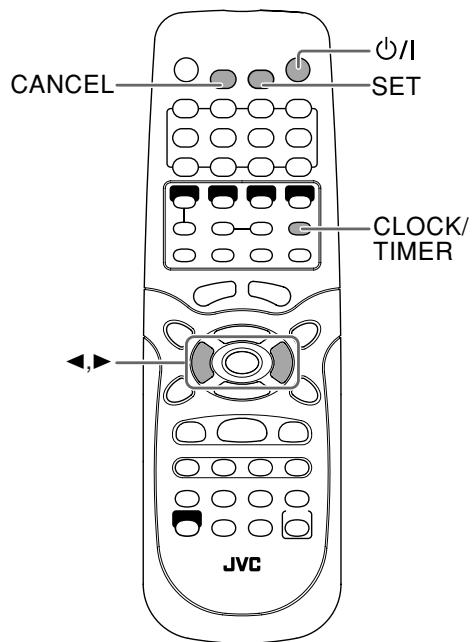
- To exit from the timer setting, press CLOCK/TIMER as required.
- To correct a misentry during the process, press CANCEL. You can return to the previous step.
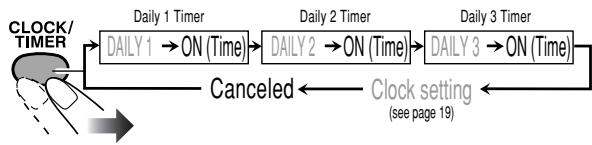
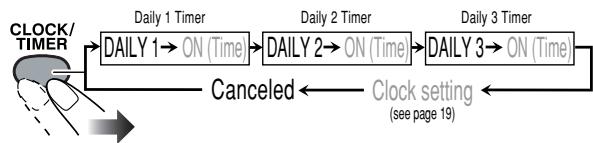
1 Select one of the timer setting modes you want to set— Daily 1 ON time, Daily 2 ON time, or Daily 3 ON time.
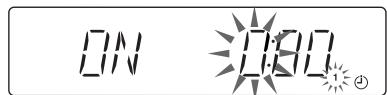
Ex.: When Daily Timer 1 setting mode is selected
- When the clock has not been adjusted, pressing CLOCK/TIMER makes the System enter the clock setting mode (see page 19).
2 Make the timer setting as you want.
Repeat the following operations until you finish setting in the following order
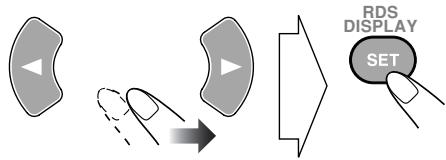
① Set the hour then the minute for on-time.
② Set the hour then the minute for off-time.
③ Select the playback source—"TUNER FM," "TUNER AM," "DISC," or "AUX."
For "TUNER FM" and "TUNER AM": Select a preset channel (see page 11).
- Select "FM - -" or "AM - -" for the last selected station.
For "DISC": Select the disc number, title/group/ playlist number, then the chapter/track number (see page 12).
- Select "DISC -" for the last selected disc tray number.
For "AUX": Connect the other equipment (see page 15).
⑤ Select the volume level.
- You can select the volume level ("1" to "MAX" and "VOL --"). If you select "VOL --," the volume is set to the last level when the System has been turned off.
Once settings are complete, the Timer setting information appears in sequence.
3 Turn off the System (on standby) if you have set the timer with the System turned on.
How Daily Timer actually works
Once the Daily Timer has been set, the timer ( ) indicator and timer number indicator (1/2/3) are lit on the display. Daily Timer is activated at the same time everyday until the timer is turned off manually (see the next column) or another timer is activated.
When the on-time comes
The System turns on, tunes in to the specified station or start playing the loaded disc with the specified track, and sets the volume level to the preset level.
- You cannot start the specified title/playlist/chapter/ track of DVD Video/DVD-VR/SVCD/VCD, though you can select it at the timer setting.
DVD Video/DVD-VR/SVCD/VCD starts playback from the beginning. - While Daily Timer is working, the timer ( 4 ) indicator and timer number indicator ( 1/2/3) flash on the display.
When the off-time comes
The System stops playback, and turns off (on standby) automatically.
- The timer setting remains in memory until you change it.
To turn off the Timer after its setting is done
Since Daily Timer is activated at the same time everyday, you may need to cancel it on some particular days.
1 Select the Timer you want to cancel.
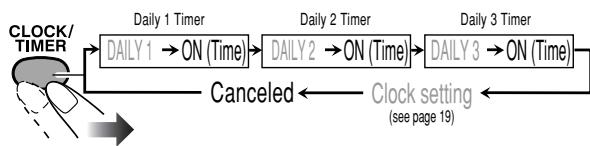
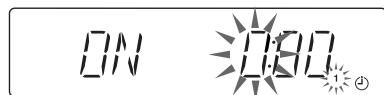
Ex.: To cancel Daily Timer 1
2 Turn off the selected Timer.

To turn on the Timer
1 Select the Timer (DAILY 1, DAILY 2, or DAILY 3) you want to activate.
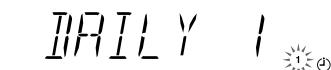
Ex.: When Daily Timer 1 is selected
2 Activate the selected Timer.
Setup Menu Operations
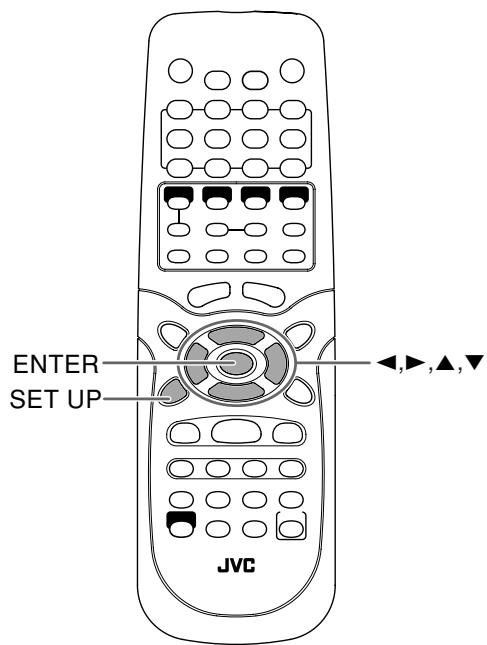
Remote control
Setup Menu Icons
The icon for the selected Setup Menu will be highlighted.
Ex.: LANGUAGE Setup Menu is selected.
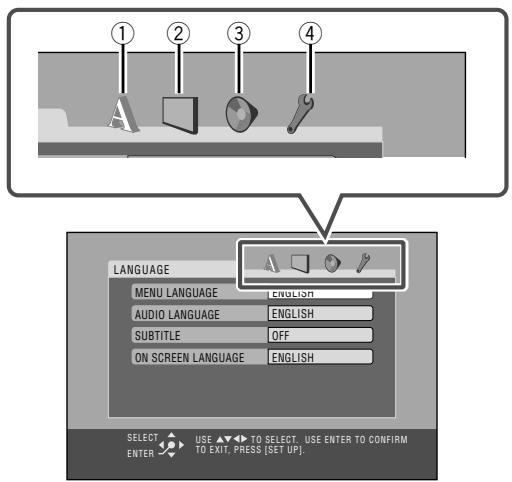
① LANGUAGE Setup Menu
② PICTURE Setup Menu
③ AUDIO Setup Menu
④ OTHERS Setup Menu
Operating Procedure

You can use the Setup Menu only when a disc is selected as the source and its playback is not yet started.
Ex.: Selecting "STILL PICTURE" for "FILE TYPE":
1 Display the Setup Menu.
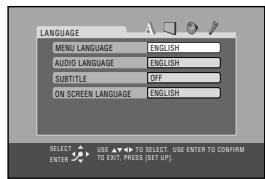
2 Select one of the Setup Menus.
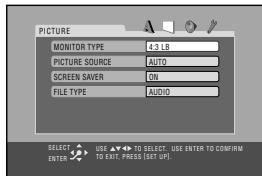
3 Select the item you want to adjust.
TVCH
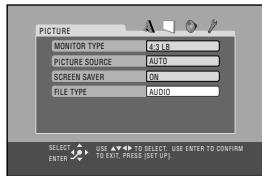
4 Display the pop-up window.

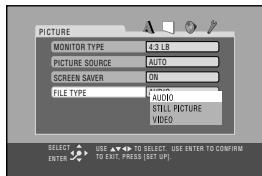
5 Select the desired option in the pop-up window.
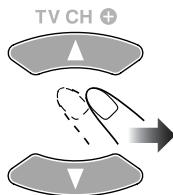
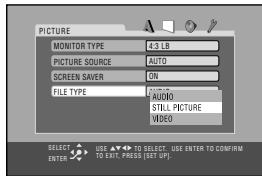
6 Finish the setting.

7 Repeat steps 3 to 4 to set other items on the same Setup Menu. Repeat steps 2 to 4 to set other items on another Setup Menu.
To exit from the Setup Menu

LANGUAGE Setup Menu
You can select the initial languages for disc playback. You can also select the language shown on the TV screen while operating this System.
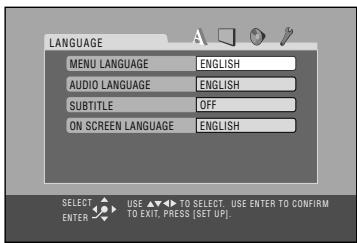
MENULANGUAGE
Some discs have multiple menu languages.
Select from-ENGLISH,SPANISH,FRENCH,CHINESE, GERMAN,ITALIAN,JAPANESE,RUSSIAN,AA-ZU (see "Language Code List" on page 44).
AUDIO LANGUAGE
Some discs have multiple audio languages.
Select from—ENGLISH, SPANISH, FRENCH, CHINESE, GERMAN, ITALIAN, JAPANESE, RUSSIAN, AA-ZU (see "Language Code List" on page 44).
SUBTITLE
Some discs have multiple subtitle languages.
Select from—ENGLISH, SPANISH, FRENCH, CHINESE, GERMAN, ITALIAN, JAPANESE, RUSSIAN, AA-ZU (see "Language Code List" on page 44) or "OFF (no subtitle)."
ON SCREEN LANGUAGE
Select one of the languages shown on the TV screen from—ENGLISH, FRENCH, or GERMAN.
PICTURE Setup Menu
You can select the desired options concerning a picture or monitor screen.
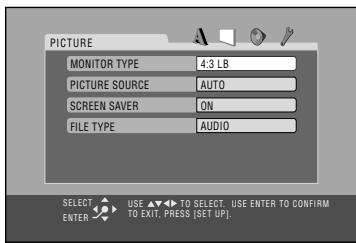
MONITOR TYPE
Select the monitor type of your TV to play DVD Video/DVD-VR/DivX recorded with aspect ratio of 16:9.
Select one of the following:
16:9:
Select when the aspect ratio of your TV is 16:9 and when the TV has the screen size adjustment function.
4:3 LB (Letter Box):
Select when the aspect ratio of your TV is 4:3 (conventional TV). While viewing a wide screen picture, the black bars appear on the top and the bottom of the screen.
4:3 PS (Pan Scan):
Select when the aspect ratio of your TV is 4:3. While viewing a wide screen picture, the black bars do not appear; however, the left and right edges of the pictures will not be shown on the screen.
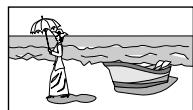
Ex.: 16:9
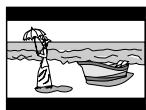
Ex.: 4:3 LB
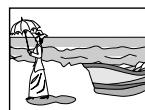
Ex... 4:3 PS
PICTURE SOURCE
You can obtain optimal picture quality by selecting an appropriate option—picture source type (either video source or film source).
Select one of the following:
| AUTO: | Normally select this. |
| When playing back a disc containing both video and film sources, the System automatically changes the processing to match to the picture type (film or video source) of the current chapter. | |
| FILM: | To play a film source disc. |
| VIDEO: | To play a video source disc. |
SCREENSAVER
You can activate or deactivate screen saver while operating the built-in disc player.
Select one of the following:
| ON: | The picture on the TV screen becomes dark when no operation is done for about 5 minutes. |
| OFF: | To cancel the screen saver. |
FILE TYPE
If several types of files are recorded on a disc, you can select which to play.
Select one of the following:
| AUDIO: | To play MP3 files. |
| STILL PICTURE: | To play JPEG files. |
| VIDEO: | To play DivX files. |
■ AUDIO Setup Menu
You can adjust the sound settings of the System.
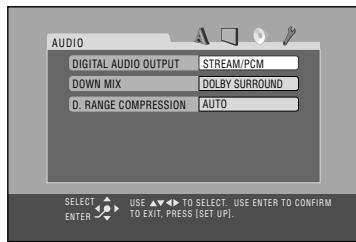
DIGITAL AUDIO OUTPUT
When using the digital output terminal on the rear, set this correctly according to the connected component.
Select one of the following:
| PCM ONLY: | To connect to a linear PCM digital equipment. |
| DOLBY DIGITAL /PCM: | To connect to a Dolby Digital decoder or an amplifier with a built-in Dolby Digital decoder. |
| STREAM/PCM: | To connect to a DTS decoder or an amplifier with a built-in DTS decoder. |
See also "OPTICAL DIGITAL OUT Signals" on page 45.
DOWN MIX
When using the digital output on the rear, set this correctly according to the connected component.
When playing a multi-channel DVD, the System converts the signals into 2 channels properly.
Select one of the following:
| DOLBY | To connect an amplifier with the Dolby |
| SURROUND: | Pro Logic decoder. |
| STEREO: | To connect a conventional stereo amplifier, receiver, MD recorder, etc. |
D. (Dynamic) RANGE COMPRESSION
You can compress the dynamic range (the difference between the loudest sound and the softest sound) to enjoy a powerful sound even at a low volume level when listening to Dolby Digital software. This is useful at night.
- The effectiveness varies depends on the software.
Select one of the following:
| AUTO: | To apply the compression effect to the downmixed multi-channel sound. |
| ON: | To always apply the compression effect for all Dolby Digital software. Loud sound will become low and vice versa. |
OTHERS Setup Menu
You can change some other convenient functions.
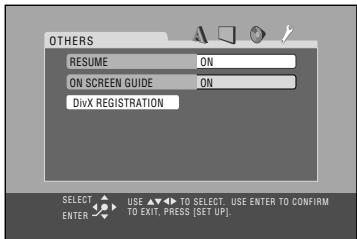
RESUME
You can activate or deactivate Resume for disc playback (see pages 12).
Select one of the following:
| ON: | To activate Resume. |
| OFF: | To cancel Resume. |
ON SCREEN GUIDE
You can activate or deactivate the on-screen guide icons (see pages 12 and 28).
- When recording the picture on a VCR, select "OFF" to avoid recording the guide icons on your video tape.
Select one of the following:
| ON: | To activate the on-screen guide icons. |
| OFF: | To cancel the on-screen guide icons. |
DivX REGISTRATION (DivX registration menu)
The System has its own Registration code for DivX playback. You can confirm the code.
- Once you played back a disc created by using the Registration code, the System's code is overwritten by a totally new one for copyright protection purpose.
Remote control
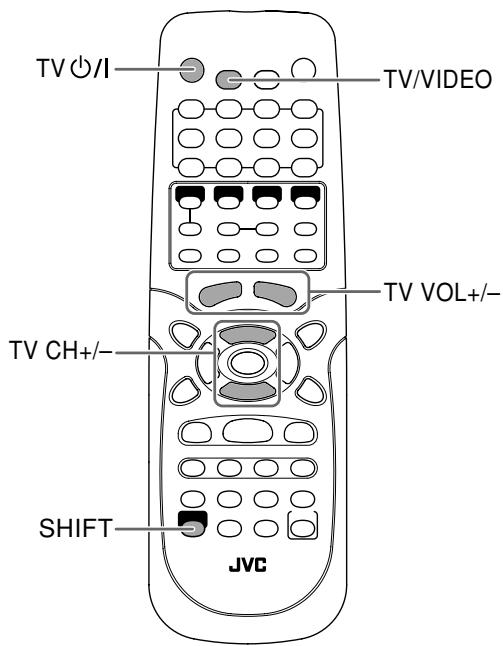
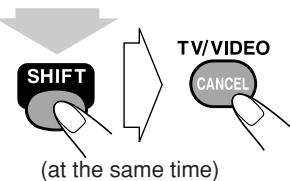
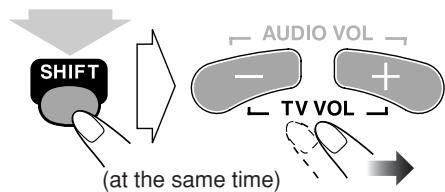
Operating TV

You can operate the JVC's TV using this remote control.
To operate the TV
To turn on or off the TV:
To select the input mode (either TV or VIDEO):
To adjust the TV volume:
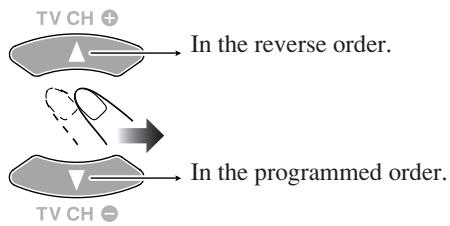
To select the TV channel:
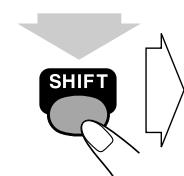
(at the same time)
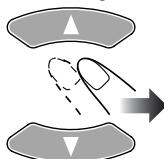
TVCH
TVCH
Learning More about This System
Getting Started (see pages 3 to 6)
Changing the Scanning Mode:
- To enjoy the progressive video picture, connect a TV with the progressive video input using component video cord.
Daily Operations—Playback (see pages 10 to 15)
Listening to the Radio:
- If you store a new station into an occupied preset number, the previously stored station in that number will be erased.
- When you unplug the AC power cord or a power failure occurs, the preset stations will be erased in a few days. If this happens, preset the stations again.
Playing Back a Disc:
- When using an 8cm disc, place it on the inner circle of the disc tray.
- On some DVD, SVCD, or VCD discs, the actual operations may be different from what is explained in this manual, due to the programming and disc structure; such differences are not malfunction of this System.
- When discs* in more than one tray are loaded on the disc trays, they are played in sequence as follows. (When DVD Video, DVD Audio or SVCD/VCD with PBC is loaded in the System, playback of the disc next to these discs will not start.)
Ex.: When DISC 2 is selected:
DISC 2 DISC 3 DISC 4 DISC 5 DISC 1 (then stops)
-
When no disc is loaded on the disc tray, the disc number is skipped.
-
You can exchange discs while playing or selecting another disc.
- Some DVD Audio discs prohibit downmixed output. When you play back such a disc, "LR ONLY" appears on the display and the System plays back the left front and right front signals.
- 3D Phonic setting is also applied to the optical digital output signals through the OPTICAL DIGITAL OUT terminal.
-
For DVD-VR playback...
-
When making a disc, use the UDF-Bridge format.
- For details about DVD-VR format and play list, refer to the manual of the recording equipment.
- If you use a DVD-RAM with a cartridge, take the disc out of the cartridge before inserting.
-
You cannot use reverse slow motion, Program Play, and Random Play.
-
For DivX playback...
-
The System supports DivX 5.x, 4.x and 3.11.
-
The System supports the DivX files whose resolution is 720 × 480 pixels or less (30 fps), and 720 × 576 pixels or less (25 fps).
-
Audio stream should conform to MPEG 1 Audio Layer-2 or MPEG 1 Audio Layer-3 (MP3).
- The System does not support GMC (Global Motion Compression).
- The file encoded in the interlaced scanning mode may not be played back correctly.
- The System has its own Registration code for DivX playback.
- If necessary, you can confirm the Registration code of your System (see page 38).
For MP3/JPEG playback...
- This System cannot play "packet write" discs.
- MP3/JPEG discs require a longer readout time than regular CDs. (It depends on the complexity of the group/file configuration.)
- Some MP3/JPEG files cannot be played back and will be skipped. This results from their recording processes and conditions.
- When making MP3 discs, use ISO 9660 Level 1 or Level 2 for the disc format.
- This System can play back MP3/JPEG files with the extension code <.mp3> or <.jpg> (regardless of the letter case—upper/lower).
- It is recommended that you make each MP3 file at a sampling rate of 44.1kHz and at a bit rate of 128 kbps.
- This System can recognize the total of 1000 tracks and of 99 groups (each group can contain up to 150 tracks). Those exceeding the maximum number cannot be recognized.
- This System can show up to 23 characters of the file (track) names (except for extension) and 30 characters of the ID3 tags on the display and the TV screen.
-
Some characters or symbols will not be shown (and will be blanked) on the display.
-
When using Resume on SVCD or VCD with PBC, the playback might start on a position slightly different from where you have stopped.
- You can use Resume only for the DVD/SVCD/VCD/DivX except for some discs—depending how the disc is programmed.
Playing Back from the PC:
- Check if your PC equipped with the CD-ROM drive is running on Windows® 98, Windows® 98SE, Windows® Me, Windows® 2000, or Windows® XP* and prepare its CD-ROM.
- DO NOT turn off the System or disconnect the USB cable while installing the drivers and for several seconds each time you PC is recognizing the System.
- Use a full speed USB cable (version 1.1).
- If your PC does not recognize the System, disconnect the USB cable and connect it again. If this does not work, restart Windows.
-
The drivers installed can be recognized only when the USB cable is connected between the System and your PC.
-
The sound may not be played back correctly—interrupted or degraded—due to your PC settings or PC specifications.
- Microsoft®, Windows® 98, Windows® 98SE, Windows® Me, Windows® 2000 and Windows® XP are registered trademarks of Microsoft corporation.
Daily Operations—Sound&Other Adjustments (see pages 16 to 19)
Adjusting the Volume:
- Be sure to turn down the volume before connecting or putting on the headphones.
Adjusting the Sound:
- This function also affects the sound through the headphones.
Setting the clock:
- "0:00" will flash on the display until you set the clock.
- The clock may gain or lose 1 to 2 minutes per month. If this happens, reset the clock.
Advanced Radio Operations (see pages 20 and 21)
- If an "ALARM" (Emergency) or "TEST" signal is received from a station while listening to the System, the System automatically switches temporarily to the station, except when you are listening to non-RDS stations—all AM and some FM stations.
- If you want to know more about RDS, visit http://www.rds.org.uk.
Unique Disc Operations (see pages 22 to 24)
- During slow-motion playback, no sound will be reproduced.
- One touch replay function works only within the same title/ playlist though it works between chapters.
While zoomed in, the picture may look coarse.
Advanced Disc Operations (see pages 25 to 27)
Programming the Playing Order—Program Play:
- If you try to program the 100th track, "MEM FULL (memory full)" appears on the display.
- While programming steps... Your entry will be ignored if you have tried to program an item number that does not exist on the disc (for example, selecting track 14 on a disc that only has 12 tracks).
- You cannot use Program Play for JPEG, DVD-VR, or DivX discs.
- You cannot eject trays while in Program Play.
Playing at Random—Random Play:
- The button does not work for skipping chapters or tracks, but only works for going back to the beginning of the current chapter or track.
- You cannot use Random Play for JPEG, DVD-VR, or DivX discs.
On-Screen Disc Operations (see pages 28 to 32)
-
For JPEG files playback...
-
It is recommended that you record a file at 640 × 480 resolution. (If a file has been recorded at a resolution of more than 640 × 480 , it will take a longer time to be shown.)
- This System can play only baseline JPEG files.
Progressive or lossless JPEG files cannot be played.
Baseline JPEG format: Used for digital cameras, web, etc.
Progressive JPEG format: Used for web.
Lossless JPEG format: An old type and rarely used now.
- This System may not play back JPEG files properly which are not recorded by digital still cameras.
- If progressive or lossless JPEG files are played back, a black screen appears. In this case, stop playback and select a baseline JPEG file. Note that it may take a long time to select another file.
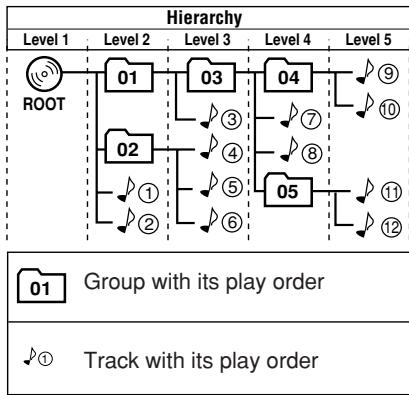
MP3/JPEG/DivX groups/tracks configuration
This System plays back the tracks as follows.
Timer Operations (see pages 33 and 34)
- If you unplug the AC power cord or if a power failure occurs, the timer will be canceled. You need to set the clock first, then the timer again.
- If you set the Sleep Timer after a Daily Timer starts playing the selected source, the Daily Timer is canceled.
- If you do not specify the preset station or track number correctly while setting a timer, the currently selected station or the first track will be played when timer is activated.
Setup Menu Operations (see pages 35 to 38)
LANGUAGE Setup Menu:
- When the language you have selected for "MENU LANGUAGE," "AUDIO LANGUAGE," or "SUBTITLE" is not recorded on a disc, the original language is used as the initial language.
PICTURE Setup Menu-MONITOR TYPE:
- Even if "4:3 PS" is selected, the screen size may become 4:3 letter box with some DVD Video discs. This depends on how the disc is recorded.
- When you select "16:9" for a picture whose aspect ratio is 4:3, the picture slightly changes due to the process for converting the picture width.
AUDIO Setup Menu-DOWN MIX:
- This setting is not effective when DTS multi-channel software is played back.
OTHERS Setup Menu-ON SCREEN GUIDE:
- Setup Menus and on-screen bar will be displayed (and recorded) even though this function is set to "OFF." Subtitles and the information for zooming in always appear on the display regardless of this setting.
Maintenance
To get the best performance of the System, keep your discs and mechanism clean.
Handling discs
- When removing the disc from its case, hold it at the edge while pressing the center hole lightly.
- Do not touch the shiny surface of the disc, or bend the disc.
- Put the disc back in its case after use to prevent warping.
- Be careful not to scratch the surface of the disc.
- Avoid exposure to direct sunlight, temperature extremes, and moisture.
To clean the disc:
Wipe the disc with a soft cloth in a straight line from center to edge.
Cleaning the System
- Stains should be wiped off with a soft cloth. If the System is heavily stained, wipe it with a cloth soaked in water-diluted neutral detergent and wrung well, then wipe clean with a dry cloth.
-
Since the System may deteriorate in quality, become damaged or get its paint peeled off, be careful about the following:
-
DO NOT wipe it with a hard cloth.
- DO NOT wipe it strongly.
- DO NOT wipe it with thinner or benzine.
- DO NOT apply any volatile substance such as insecticides to it.
- DO NOT allow any rubber or plastic to remain in contact for a long time.
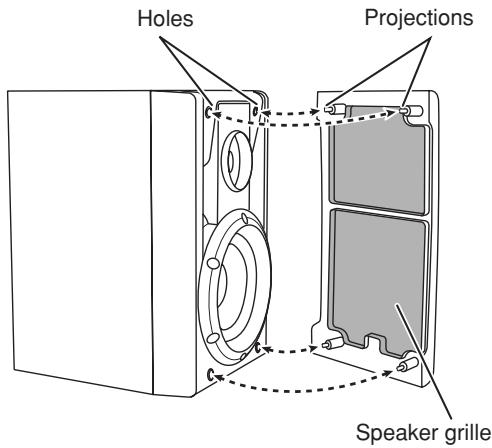
To remove the speaker grilles
Troubleshooting
If you are having a problem with your System, check this list for a possible solution before calling for service.
General:
Adjustments or settings are suddenly canceled before you finish.
There is a time limit. Repeat the procedure again.
Operations are disabled.
The built-in microprocessor may malfunction due to external electrical interference. Unplug the AC power cord and then plug it back in.
Unable to operate the System from the remote control.
The path between the remote control and the remote sensor on the System is blocked.
Point it at the remote sensor on the front panel.
Signals cannot reach the remote sensor. Get more closer to the System.
The batteries are exhausted.
No sound comes out of the speakers.
Speaker connections are incorrect or loose.
Headphones are connected.
No picture is displayed on the TV screen, the picture is blurred, or the picture is divided into two parts.
The video cord connections are incorrect or loose.
The System is connected to a TV which does not support progressive scanning.
The left and right edges of the picture are missing on the TV screen.
Select "4:3 LB" for "MONITOR TYPE" (see page 36).
Radio Operations:
Hard to listen to broadcasts because of noise.
Antennas connections are incorrect or loose.
The AM loop antenna is too close to the System.
The FM antenna is not properly extended and positioned.
Disc Operations:
The disc does not play.
The disc is placed upside down. Place the disc with the label side up.
ID3 Tag on an MP3 disc cannot be shown.
There are two types of ID3 Tag—Version 1 and Version 2. This System can show ID3 Tag Version 2.4 or earlier.
MP3/JPEG/DivX groups and tracks are not played back as you expect.
The playing order is determined when the disc was recorded. It depends on the writing application.
MP3/JPEG/DivX tracks are not played back.
The inserted disc may include several type of tracks (MP3, JPEG, and DivX files). In this case, you can only play back the files selected by the "FILE TYPE" setting (see page 37).
You have changed the "FILE TYPE" setting after you inserted a disc. In this case, reload the disc.
"NO AUDIO" appears.
This System cannot play back illegally produced DVD Audio discs.
"LR ONLY" appears.
Some DVD Audio discs prohibit downmixed output. When you play back such a disc, this System plays back the left front and right front signals only.
The disc sound is discontinuous.
The disc is scratched or dirty.
The disc tray does not open or close.
The AC power cord is not plugged in.
Child Lock is in use (see page 27).
USB Operations:
Unable to play back through the USB connection.
USB connection and setting is incorrect (see page 15).
Timer Operations:
Daily Timer does not work.
The System has been turned on when the on-time comes. Timer starts working only when the System is turned off.
Setup Menu Operations:
No subtitle appears on the display though you have selected the initial subtitle language.
Some DVDs are programmed to always display no subtitle initially. If this happens, press SUBTITLE after starting play (see page 23).
Audio language is different from the one you have selected as the initial audio language.
Some DVDs are programmed to always use the original language initially. If this happens, press AUDIO after starting play (see page 22).
Language Code List
| AA | Afar |
| AB | Abkhazian |
| AF | Afrikaans |
| AM | Ameharic |
| AR | Arabic |
| AS | Assamese |
| AY | Aymara |
| AZ | Azerbaijani |
| BA | Bashkir |
| BE | Byelorussian |
| BG | Bulgarian |
| BH | Bihari |
| BI | Bislama |
| BN | Bengali, Bangla |
| BO | Tibetan |
| BR | Breton |
| CA | Catalan |
| CO | Corsican |
| CS | Czech |
| CY | Welsh |
| DA | Danish |
| DZ | Bhutani |
| EL | Greek |
| EO | Esperanto |
| ET | Estonian |
| EU | Basque |
| FA | Persian |
| FI | Finnish |
| FJ | Fiji |
| FO | Faroese |
| FY | Frisian |
| GA | Irish |
| GD | Scotts Gaelic |
| GL | Galician |
| GN | Guarani |
| GU | Gujarati |
| HA | Hausa |
| HI | Hindi |
| HR | Croatian |
| HU | Hungarian |
| HY | Armenian |
| IA | Interlingua |
| IE | Interlingue |
| IK | Inupiak |
| IN | Indonesian |
| IS | Icelandic |
| IW | Hebrew |
| JI | Yiddish |
| JW | Javanese |
| KA | Georgian |
| KK | Kazakh |
| KL | Greenlandic |
| KM | Cambodian |
| KN | Kannada |
| KO | Korean (KOR) |
| KS | Kashmiri |
| KU | Kurdish |
| KY | Kirghiz |
| LA | Latin |
| LN | Lingala |
| LO | Laothian |
| LT | Lithuanian |
| LV | Latvian, Lettish |
| MG | Malagasy |
| MI | Maori |
| MK | Macedonian |
| ML | Malayalam |
| MN | Mongolian |
| MO | Moldavian |
| MR | Marathi |
| MS | Malay (MAY) |
| MT | Maltese |
| MY | Burmese |
| NA | Nauru |
| NE | Nepali |
| NL | Dutch |
| NO | Norwegian |
| OC | Occitan |
| OM | (Afan) Oromo |
| OR | Oriya |
| PA | Panjabi |
| PL | Polish |
| PS | Pashto, Pushto |
| PT | Portuguese |
| QU | Quechua |
| RM | Rhaeto-Romance |
| RN | Kirundi |
| RO | Rumanian |
| RW | Kinyarwanda |
| SA | Sanskrit |
| SD | Sindhi |
| SG | Sangho |
| SH | Serbo-Croatian |
| SI | Singhalese |
| SK | Slovak |
| SL | Slovenian |
| SM | Samoan |
| SN | Shona |
| SO | Somali |
| SQ | Albanian |
| SR | Serbian |
| SS | Siswati |
| ST | Sesotho |
| SU | Sundanese |
| SV | Swedish |
| SW | Swahili |
| TA | Tamil |
| TE | Telugu |
| TG | Tajik |
| TH | Thai |
| TI | Tigrinya |
| TK | Turkmen |
| TL | Tagalog |
| TN | Setswana |
| TO | Tonga |
| TR | Turkish |
| TS | Tsonga |
| TT | Tatar |
| TW | Twi |
| UK | Ukrainian |
| UR | Urdu |
| UZ | Uzbek |
| VI | Vietnamese |
| VO | Volapuk |
| WO | Wolof |
| XH | Xhosa |
| YO | Yoruba |
| ZU | Zulu |
OPTICAL DIGITAL OUT Signals
| DIGITAL AUDIO OUTPUT Playback disc | Output Signals | ||
| STREAM/PCM | DOLBY DIGITAL/PCM | PCM ONLY | |
| DVD Video with 48 kHz, 16/20/24 bit Linear PCM | 48 kHz, 16 bit Linear PCM*1 | ||
| with 96 kHz, Linear PCM | 48 kHz, 16 bit Linear PCM | ||
| with Dolby Digital | Dolby Digital bitstream | 48 kHz, 16 bit Linear PCM | |
| with DTS | DTS bitstream | 48 kHz, 16 bit Linear PCM | |
| DVD Audio with 48/96/192 kHz, 16/20/24 bit Linear PCM | No output*2 | ||
| with 44.1/88.2/176.4 kHz, 16/20/24 bit Linear PCM | No output*3 | ||
| with Dolby Digital | Dolby Digital bitstream | 48 kHz, 16 bit Linear PCM | |
| with DTS | DTS bitstream | 48 kHz, 16 bit Linear PCM | |
| DVD-RW/RAM/ROM in DVD-VR format | 48 kHz, 16 bit Linear PCM | ||
| SVCD, VCD, CD | 44.1 kHz, 16 bit Linear PCM/48 kHz, 16 bit Linear PCM | ||
| CD with DTS | DTS bitstream | 44.1 kHz, 16 bit Linear PCM | |
| MP3/DivX disc | 32/44.1/48 kHz, 16 bit Linear PCM | ||
1 While playing some DVDs, digital signals may be emitted at 20 bits or 24 bits (at their original bit rate) through the DIGITAL AUDIO OUT terminal if the discs are not copy-protected.
2 When the disc is not copyright protected, "48 kHz, 16 bit Linear PCM" signal is output.
*3 When the disc is not copyright protected, "44.1 kHz, 16 bit Linear PCM" signal is output.
Refer to the pages to see how to use the buttons and controls.
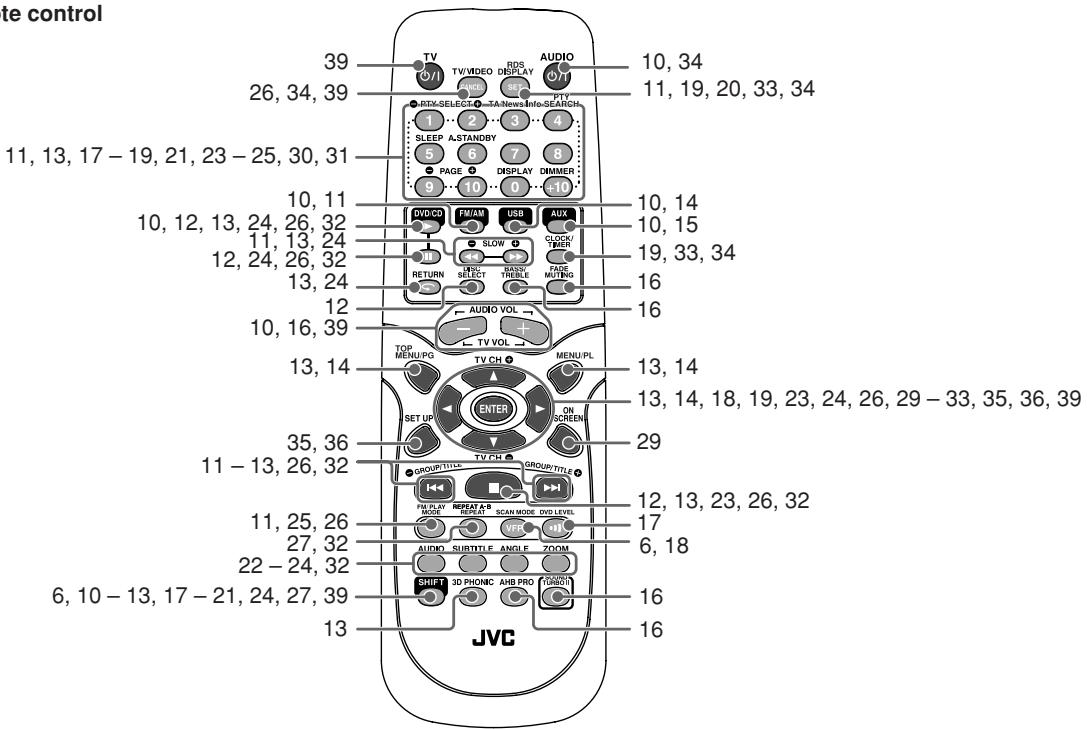
Remote control
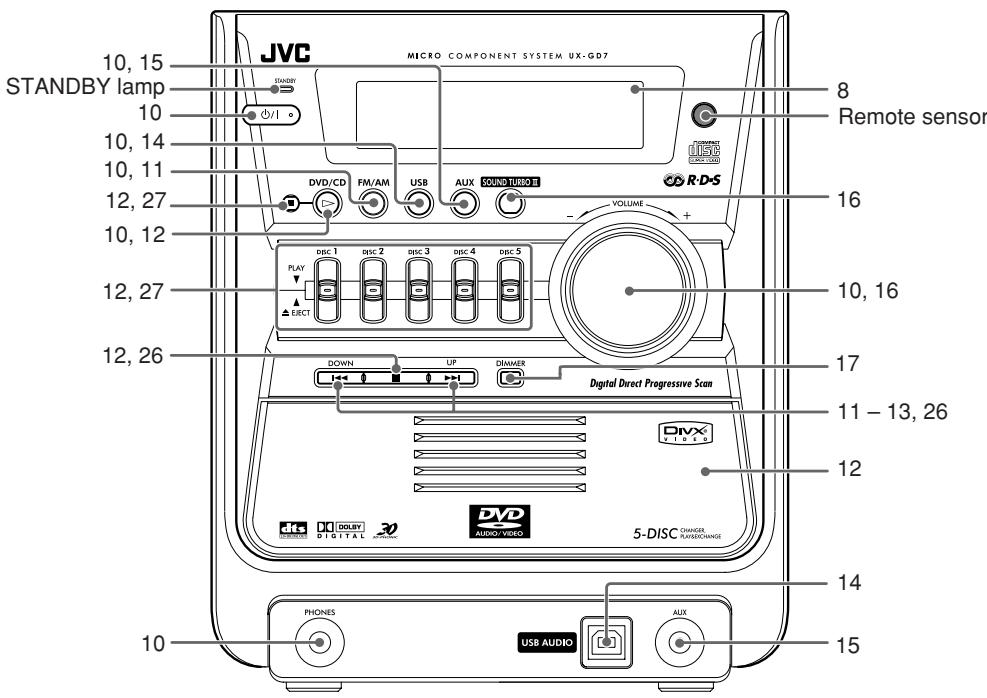
Main unit
Specifications

Amplifier section
Output power: 140W (70W + 70W) at 6 (10% THD)
Analog input:
AUX: Sensitivity/Impedance (at 1 kHz)
400mV / 47k
USB input: USB Ver.1.1
Digital output:
OPTICAL DIGITAL OUT:
-21 dBm to -15 dBm (660 nm ±30 nm)
VIDEO OUT:
Color system PAL
Video (composite): 1V(p - p) / 75
S-video: Y (luminance) 1V(p - p) / 75
C (chrominance, burst) 0.3V(p - p) / 75
RGB: 0.7 V(p-p)/75 Ω
COMPONENT: (Y) 1 V(p-p)/75 Ω
(P_B / P_R) 0.7 V(p-p)/75 Ω
Speaker terminals: Impedance 6Ω-16Ω
Tuner section
FM tuning range: 87.50 MHz - 108.00 MHz
AM tuning range: 522kHz - 1629kHz
Disc player section
Playable disc: DVD Video/DVD Audio
CD/VCD/SVCD
CD-R/CD-RW (recorded in Audio CD/
Video CD/Super Video CD/MP3/JPEG/
DivX format)
DVD-R (recorded in video/MP3/JPEG/DivX format)
DVD-RW/DVD-RAM (recorded in video/
DVD-VR/MP3/JPEG/DivX format)
Horizontal resolution: 500 lines
Wow and flutter: Immeasurable
General
Power requirement: AC 230V 50Hz
Power consumption: 150W (at operation)
1.3 W (on standby)
Dimensions (approx.): 189mm× 224mm× 406mm
(W/H/D)
Mass (approx.): 6.5kg
Speakers
Type: 2-way Bass-reflex type
Magnetically shielded
Speaker systems: Woofer: 12 cm cone x 1
Tweeter: 4 cm cone x 1
Power handling capacity: 70W
Impedance: 6Ω
Frequency range: 45Hz - 20000Hz
Sound pressure level: 84 dB/W·m
Dimensions (approx.): 165mm× 286mm× 237mm
(W/H/D)
Mass (approx.): 2.8 kg each
Supplied Accessories
See page 3.
- Manufactured under license from Dolby Laboratories. "Dolby", "Pro Logic", "MLP Lossless", and the double-D symbol are trademarks of Dolby Laboratories.
- "DTS" and "DTS 2.0 + DIGITAL OUT" are trademarks of Digital Theater Systems, Inc.
- "Official DivX Certified™ product" "Plays DivX® 5, DivX® 4, DivX® 3, and DivX® VOD video content (in compliance with DivX Certified™ technical requirements)" "DivX, DivX Certified, and associated logos are trademarks of DivXNetworks, Inc. and are used under license."
- This product incorporates copyright protection technology that is protected by U.S. patents and other intellectual property rights. Use of this copyright protection technology must be authorized by Macrovision, and is intended for home and other limited viewing uses only unless otherwise authorized by Macrovision. Reverse engineering or disassembly is prohibited.
"CONSUMERS SHOULD NOTE THAT NOT ALL HIGH DEFINITION TELEVISION SETS ARE FULLY COMPATIBLE WITH THIS PRODUCT AND MAY CAUSE ARTIFACTS TO BE DISPLAYED IN THE PICTURE. IN CASE OF 525 OR 625 PROGRESSIVE SCAN PICTURE PROBLEMS, IT IS RECOMMENDED THAT THE USER SWITCH THE CONNECTION TO THE 'STANDARD DEFINITION' OUTPUT. IF THERE ARE QUESTIONS REGARDING OUR TV SET COMPATIBILITY WITH THIS MODEL 525p AND 625p DVD PLAYER, PLEASE CONTACT OUR CUSTOMER SERVICE CENTER."
Design and specifications are subject to change without notice.
JVC
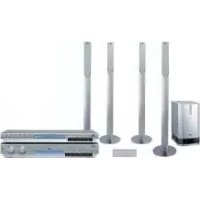
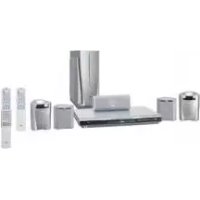
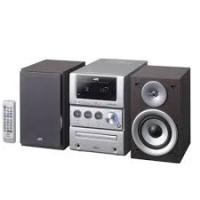
- MICRO COMPONENT SYSTEM
- UX-GD7—Consists of CA-UXGD7 and SP-UXGD7
- IMPORTANT for the U.K.
- IMPORTANT:
- CAUTION
- CAUTION—O/I (standby/on) button!
- Caution: Proper Ventilation
- * About the cooling fan
- IMPORTANT FOR LASER PRODUCTS
- SAFETY INSTRUCTIONS "SOME DOS AND DON'TS ON THE SAFE USE OF EQUIPMENT"
- ABOVE ALL
- CONTENTS
- Introduction 2
- Getting Started 3
- Before Operating the System 7
- Daily Operations—Playback 10
- Daily Operations—Sound&Other Adjustments 16
- Advanced Radio Operations 20
- Unique Disc Operations 22
- Advanced Disc Operations 25
- On-Screen Disc Operations 28
- Timer Operations 33
- Setup Menu Operations 35
- Operating the TV 39
- Additional Information 40
- Precautions
- Installation
- Power sources
- Moisture condensation
- Internal heat
- For safety, observe the following carefully:
- Others
- How to Read This Manual
- Getting Started
- Step 1: Unpack the package and check the accessories.
- Step 2: Prepare the remote control.
- Step 3: Hook up the components such as AM/FM antennas, speakers, etc. (see pages 4 to 6).
- Finally plug the AC power cord.
- Now you can operate the System.
- Step 1: Unpack
- Step 2: Prepare the Remote Control
- Step 3: Hook Up
- For better FM/AM reception
- Vynile-covered wire (not supplied)
- AM loop antenna
- FM antenna (supplied)
- To assemble and connect the AM loop antenna To assemble the AM loop antenna
- To connect the AM loop antenna
- To connect the speaker cords
- Changing the Scanning Mode
- Selecting the Video Signal
- RGB
- Y/C
- Before Operating the System
- Playable Disc Types
- * Note on Region Code
- Caution for DualDisc playback:
- DVD Video—digital audio formats
- IMPORTANT: Before playing a disc, make sure of the following...
- Display Indicators
- Indications on the main display while operating a disc
- Daily Operations—Playback
- To turn off (standby) the System
- For private listening
- To turn off the clock indication
- Listening to the Radio
- To select the band—FM or AM
- To tune in to a station
- If the received FM station is hard to listen
- To preset the stations
- Select a preset number for the station.
- Ex.:
- Store the station.
- To tune in to a preset station
- Playing Back a Disc
- To insert a disc
- To start:
- To pause:
- To stop:
- On-screen guide icons
- To select a disc
- To select a title/group/playlist
- To select a chapter/track
- To locate a particular position
- To locate an item directly
- To use 3D PHONIC
- To play back using the disc menu
- For DVD Video/DVD Audio:
- For SVCD/VCD with PBC:
- To move to the next or previous page of the current menu:
- To return to the previous menu:
- To cancel PBC:
- To reactivate PBC:
- For DVD-VR:
- Show the ORIGINAL PROGRAM or PLAY LIST.
- Ex.: ORIGINAL PROGRAM:
- Ex.: PLAY LIST:
- Select an item on the disc menu.
- Playing Back from the PC
- IMPORTANT
- How to install the USB drivers
- To play back sounds on the PC
- Playing Back from Other Equipment
- To connect other equipment
- Remote control
- Adjusting the Volume
- Adjusting the Sound
- To adjust the tone—BASS/TREBLE
- Making DVD Voice Clear—CLEAR VOICE
- Presetting Automatic DVD Sound Increase
- Level—DVD LEVEL Remote ONLY
- Changing the Display Brightness—DIMMER
- Remote Control:
- Main Unit:
- Changing the Picture Tone—VFP (Video
- Fine Processor)
- To select a preset picture tone
- Activate VFP.
- Select a preset picture tone.
- To adjust the picture tone
- Select a parameter you want to adjust.
- Adjust the parameter.
- Repeat steps 2 to 3 to adjust other parameters.
- Setting the Clock Remote ONLY
- Activate the clock setting mode.
- Adjust the hour.
- Adjust the minute.
- To check the current clock time during play
- Turning Off the Power
- Automatically
- To turn off the System after playback is over—Auto Standby
- To turn off the System after a certain period of time—Sleep Timer
- Specify the time (in minutes).
- Wait until the set time goes off.
- To check the time remaining until the shut-off time
- Advanced Radio Operations
- Receiving FM Stations with RDS
- To show the RDS information
- Searching for a Program by
- Select a PTY code.
- Start searching.
- To continue searching after it stops on an unwanted station
- Switching Temporarily to a Program of
- Your Choice Automatically
- While listening to an FM station, select the program type:
- CASE 1
- CASE 2
- Selecting the Sound Track
- Selecting the Subtitle Language
- Selecting the View Angle
- Playing Back a Bonus Group
- Select the bonus group.
- Enter the key number.
- Selecting Browsing Still Pictures
- Special Effect Playback Still picture playback
- Frame-by-frame playback
- Slow-motion playback
- To replay the previous scenes (One touch replay function)
- Zoom
- Main unit
- Programming the Playing Order—
- Program Play
- Before starting playback, activate Program Play.
- Select chapters/tracks you want to program with the numeric buttons (see “To locate an item directly” on page 13 for how to use the numeric buttons).
- If you want to program another chapters/tracks, repeat the step 2 above.
- Start playback.
- To check the programmed contents Before or after playback...
- To modify the program
- To exit from Program Play
- Playing at Random—Random Play
- Before starting playback, activate Random Play.
- Start playback.
- To exit from Random Play
- Playing Repeatedly
- Repeat Play
- A-B Repeat
- Prohibiting Disc Ejection—Child Lock
- On-Screen Disc Operations
- On-screen Bar Information
- Indication Meanings
- Operations Using the On-screen Bar
- Changing the time information
- Select the repeat mode you want.
- Finish the setting.
- While playing, display the on-screen bar with the pulldown menu.
- Select OFF
- Display the pop-up window.
- Select "A-B."
- Select the start point (A).
- Select the end point (B).
- Time Search
- For DVD Video/DVD Audio/DVD-VR:
- For CD/SVCD/VCD:
- Display the on-screen bar with the pull-down menu.
- Select ②→
- Enter the time.
- Chapter/Track Search
- Operations on the CONTROL Screen
- To select a group/track in the list
- To start playback
- Unique JPEG Operations
- To repeat Slide-show
- To zoom in the still picture
- While playing...
- Change the magnification.
- Move the zoomed-in position.
- Timer Operations
- Setting the Daily Timer
- How Daily Timer actually works
- When the on-time comes
- When the off-time comes
- To turn off the Timer after its setting is done
- Turn off the selected Timer.
- To turn on the Timer
- Activate the selected Timer.
- Setup Menu Operations
- Setup Menu Icons
- Ex.: LANGUAGE Setup Menu is selected.
- Operating Procedure
- Display the Setup Menu.
- Select one of the Setup Menus.
- Select the item you want to adjust.
- Display the pop-up window.
- Select the desired option in the pop-up window.
- Finish the setting.
- To exit from the Setup Menu
- LANGUAGE Setup Menu
- MENULANGUAGE
- AUDIO LANGUAGE
- SUBTITLE
- ON SCREEN LANGUAGE
- PICTURE Setup Menu
- MONITOR TYPE
- Select one of the following:
- 16:9:
- 4:3 LB (Letter Box):
- 4:3 PS (Pan Scan):
- PICTURE SOURCE
- SCREENSAVER
- FILE TYPE
- ■ AUDIO Setup Menu
- DIGITAL AUDIO OUTPUT
- DOWN MIX
- (Dynamic) RANGE COMPRESSION
- OTHERS Setup Menu
- RESUME
- ON SCREEN GUIDE
- DivX REGISTRATION (DivX registration menu)
- Operating TV
- To operate the TV
- Learning More about This System
- Getting Started (see pages 3 to 6)
- Changing the Scanning Mode:
- Daily Operations—Playback (see pages 10 to 15)
- Listening to the Radio:
- Playing Back a Disc:
- Playing Back from the PC:
- Daily Operations—Sound&Other Adjustments (see pages 16 to 19)
- Adjusting the Volume:
- Adjusting the Sound:
- Setting the clock:
- Advanced Radio Operations (see pages 20 and 21)
- Unique Disc Operations (see pages 22 to 24)
- Advanced Disc Operations (see pages 25 to 27)
- Programming the Playing Order—Program Play:
- Playing at Random—Random Play:
- On-Screen Disc Operations (see pages 28 to 32)
- Timer Operations (see pages 33 and 34)
- Setup Menu Operations (see pages 35 to 38)
- LANGUAGE Setup Menu:
- PICTURE Setup Menu-MONITOR TYPE:
- AUDIO Setup Menu-DOWN MIX:
- OTHERS Setup Menu-ON SCREEN GUIDE:
- Maintenance
- Handling discs
- To clean the disc:
- Cleaning the System
- Troubleshooting
- General:
- Radio Operations:
- Disc Operations:
- USB Operations:
- Timer Operations:
- Setup Menu Operations:
- Language Code List
- OPTICAL DIGITAL OUT Signals
- Specifications
- Amplifier section
- Tuner section
- Disc player section
- General
- Speakers
- Supplied Accessories
- JVC
Marque : JVC
Modèle : UX-GD7
Catégorie : Système audio