
GX25 - Téléphone mobile SHARP - Notice d'utilisation et mode d'emploi gratuit
Retrouvez gratuitement la notice de l'appareil GX25 SHARP au format PDF.


| Type de produit | Téléphone mobile GSM |
| Marque | SHARP |
| Modèle | GX25 |
| Réseau | GSM 900/1800/1900, GPRS |
| Appareil photo intégré | Oui, numérique |
| Résolution photo maximale | 480 × 640 pixels (format L) |
| Enregistrement vidéo | Oui, format .3gp |
| Messagerie | SMS, MMS, Email |
| Connectivité | Bluetooth, Infrarouge, USB |
| Affichage principal | Couleur, avec rétroéclairage |
| Affichage externe | Bleu, pour notifications |
| Batterie | Li-ion rechargeable (XN-1BT30) |
| Chargeur | Chargeur secteur (XN-1QC30/XN-1QC31), chargeur allume-cigare (XN-1CL30) |
| Fonctions supplémentaires | Navigateur WAP, Java™, éditeur de mélodies, enregistreur vocal, agenda, calculatrice |
| Entretien et nettoyage | Chiffon doux et sec – ne pas utiliser de solvants |
| Sécurité | Ne pas ouvrir, tenir à l’écart des pacemakers, SAR = 0,729 W/kg |
| Pièces détachées et réparabilité | Batterie, chargeur, câble USB, kit mains-libres en option – réparation par personnel agréé |
| Informations générales | Notice de 129 pages – déclaration de conformité disponible sur sharp-mobile.com |
FOIRE AUX QUESTIONS - GX25 SHARP
Questions des utilisateurs sur GX25 SHARP
0 question sur cet appareil. Repondez a celles que vous connaissez ou posez la votre.
Poser une nouvelle question sur cet appareil
Téléchargez la notice de votre Téléphone mobile au format PDF gratuitement ! Retrouvez votre notice GX25 - SHARP et reprennez votre appareil électronique en main. Sur cette page sont publiés tous les documents nécessaires à l'utilisation de votre appareil GX25 de la marque SHARP.
MODE D'EMPLOI GX25 SHARP
Déclaration de conformité
Par la présente, Sharp Telecommunications of Europe Ltd déclare que ce GX25 est conforme aux exigences essentielles et aux autres dispositions pertinentes de la directive 1999/5/CE.
Une copie de la déclaration de conformité originale peut être consultée à l'adresse Internet suivante : http://www.sharp-mobile.com
Introduction
Félicitations et merci d'avoir choisi le GX25.
À propos de ce guide de l'utilisateur
Ce guide de l'utilisateur est conçu avec soin pour vous aider à découvrir rapidement et efficacement les fonctions et le fonctionnement de votre téléphone.
AVIS
- Nous vous recommandons vivement de conserver des enregistrements écrits permanents et séparés de toutes les données importantes. Les données peuvent être perdues ou modifiées dans pratiquement tout produit de mémoire électronique dans certaines circonstances. Par conséquent, nous déclinons toute responsabilité en cas de perte de données ou de données rendues inutilisables, que ce soit à la suite d'une utilisation inappropriée, de réparations, de défauts, de remplacement de la batterie, d'une utilisation après l'expiration de la durée de vie spécifiée de la batterie ou de toute autre cause.
- Nous déclinons toute responsabilité, directe ou indirecte, pour les pertes financières ou les réclamations de tiers résultant de l'utilisation de ce produit et de l'une de ses fonctions, telles que le vol de numéros de carte de crédit, la perte ou la modification de données stockées, etc.
- Tous les noms de sociétés et/ou de produits sont des marques commerciales et/ou des marques déposées de leurs détenteurs respectifs.
- La disposition de l'écran illustrée dans ce guide de l'utilisateur peut différer de l'écran réel.
Les informations décrites dans ce guide de l'utilisateur sont sujettes à modification sans préavis.
- Toutes les fonctions décrites dans ce guide de l'utilisateur peuvent ne pas être prises en charge sur tous les réseaux.
- Nous déclinons toute responsabilité pour les contenus téléchargés, les informations, etc. à partir du réseau.
- Il peut arriver que quelques pixels noirs ou brillants apparaissent à l'écran. Veuillez noter que cela n'affectera en rien les fonctionnalités ou les performances.
Droits d'auteur
Conformément aux lois sur le droit d'auteur, la reproduction, la modification et l'utilisation de matériel protégé par le droit d'auteur (musique, images, etc.) ne sont autorisées que pour un usage personnel ou privé. Si l'utilisateur ne dispose pas de droits d'auteur plus étendus ou n'a pas reçu l'autorisation explicite du titulaire du droit d'auteur pour reproduire, modifier ou utiliser une copie ainsi réalisée ou modifiée, cela est considéré comme une violation des lois sur le droit d'auteur et donne au titulaire du droit d'auteur le droit de demander des dommages-intérêts. Pour cette raison, évitez toute utilisation illégale de matériel protégé par le droit d'auteur.
Windows est une marque déposée de Microsoft Corporation aux États-Unis et/ou dans d'autres pays.
Propulsé par JBlend™ Copyright 1997-2004 Aplix Corporation. Tous droits réservés. JBlend et toutes les marques et logos basés sur JBlend sont des marques ou des marques déposées d'Aplix Corporation au Japon et dans d'autres pays.

Propulsé par Mascot Capsule®/Micro3D Edition™ Mascot Capsule® est une marque déposée de HI Corporation ©2002-2004 HI Corporation. Tous droits réservés.
Sous licence d'Inter Digital Technology Corporation en vertu d'un ou plusieurs des brevets américains suivants et/ou de leurs équivalents nationaux ou étrangers et d'autres brevets en instance, y compris les brevets américains : 4,675,863 ; 4,779,262 ; 4,785,450 et 4,811,420.
La saisie de texte T9 est sous licence en vertu d'un ou plusieurs des brevets suivants : Brevets américains n° 5,818,437, 5,953,541, 5,187,480, 5,945,928 et 6,011,554 ; Brevet australien n° 727539 ; Brevet canadien n° 1,331,057 ; Brevet britannique n° 2238414B ; Brevet standard de Hong Kong n° HK0940329 ; Brevet de la République de Singapour n° 51383 ; Brevet européen n° 0 842 463 (96927260.8) DE/DK, FI, FR, IT, NL, PT, ES, SE, GB ; Brevets de la République de Corée n° KR201211B1 et KR226206B1 ; et des brevets supplémentaires sont en instance dans le monde entier.
Bluetooth est une marque de Bluetooth SIG, Inc.

La marque verbale et les logos Bluetooth sont la propriété de Bluetooth SIG, Inc. et toute utilisation de ces marques par Sharp est sous licence. Les autres marques et noms commerciaux appartiennent à leurs propriétaires respectifs.
Ce produit est sous licence du portefeuille de brevets MPEG-4 Visual pour l'utilisation personnelle et non commerciale d'un consommateur afin de (i) encoder une vidéo conformément à la norme vidéo MPEG-4 ("MPEG-4 Video") et/ou (ii) décoder une vidéo MPEG-4 encodée par un consommateur dans le cadre d'une activité personnelle et non commerciale et/ou obtenue auprès d'un fournisseur de vidéo sous licence. Aucune licence n'est accordée ou implicite pour toute autre utilisation. Des informations supplémentaires peuvent être obtenues auprès de MPEG LA. Voir http://www.mpegla.com.
Ce produit est sous licence du contrat de licence de portefeuille de brevets MPEG-4 Systems pour l'encodage conformément à la norme MPEG-4 Systems, sauf qu'une licence supplémentaire et le paiement de redevances sont nécessaires pour l'encodage en relation avec (i) des données stockées ou répliquées sur un support physique qui sont payées titre par titre et/ou (ii) des données qui sont payées titre par titre et sont transmises à un utilisateur final pour stockage permanent et/ou utilisation. Une telle licence supplémentaire peut être obtenue auprès de MPEG LA, LLC. Voir http://www.mpegl.com pour plus de détails.
Fonctions et services utiles
Votre téléphone vous offre les fonctionnalités suivantes :
- Un appareil photo numérique intégré pour prendre des photos et des clips vidéo.
- Une fonction de messagerie pour lire et créer des messages SMS.
- MMS (services de messagerie multimédia) pour personnaliser votre téléphone de diverses manières.
- Un navigateur WAP pour accéder aux informations sur l'Internet mobile.
- Applications Java™. Vous pouvez également télécharger diverses applications depuis Vodafone via l'Internet mobile.
- L'écran externe (bleu) pour vérifier rapidement les informations des appels entrants ou des messages.
- La lumière mobile (blanche) a de nombreuses utilisations : lumière auxiliaire pour l'appareil photo, notification de charge de la batterie, indicateur d'appel entrant et lampe de poche de fortune.
- E-mail pour envoyer jusqu'à 2000 caractères et recevoir des messages avec pièces jointes.
- Une fonction d'édition de mélodies pour créer des sonneries originales en utilisant jusqu'à 32 voix.
- Une fonction d'enregistreur vocal pour enregistrer et lire des clips vocaux.
- Une interface de technologie sans fil Bluetooth® pour établir un contact et transmettre des données avec certains appareils. Vous pouvez transmettre des images, des sons et des clips vidéo à des téléphones compatibles OBEX.
- Une interface infrarouge pour la communication de données. Vous pouvez transmettre des images, des sons et des clips vidéo vers des téléphones compatibles OBEX.
- Une fonction de synchronisation des données pour synchroniser la liste de contacts et les entrées de l'agenda avec Microsoft Outlook ou Outlook Express sur un PC.
- Une alarme d'agenda pour créer et envoyer des entrées d'agenda avec des réglages d'alarme.
Table des matières
Introduction 1
Fonctions et services utiles 3
Votre téléphone 7
Accessoires en option 7
Pour commencer 8
Insertion de la carte SIM et de la batterie .... 11
Chargement de la batterie 13
Allumer et éteindre votre téléphone 14
Indicateurs d'affichage (écran principal) 15
Indicateurs d'affichage (écran externe) 17
Fonctions de navigation 18
Fonctions d'appel 19
Passer un appel 19
Numérotation abrégée 19
Recomposition 20
Répondre à un appel 20
Menu en cours d'appel 21
Saisie de caractères 25
Changement de langue de saisie 26
Changement de méthode de saisie 26
Utilisation de modèles de texte 27
Utilisation du menu 28
Liste des fonctions du menu 29
Liste de contacts 31
Sélection de la mémoire de stockage 31
Modification de la liste affichée 31
Modification de l'ordre des noms 32
Ajouter un nouveau contact 32
Copie des entrées de la liste de contacts entre
carte SIM et combiné 33
Recherche d'un nom et d'un numéro 33
Appel depuis la liste de contacts 34
Modification des entrées de la liste de contacts 34
Suppression des entrées de la liste de contacts 34
Affichage des groupes 34
Appel de groupe 35
Attribution d'une sonnerie à chaque entrée de la liste de contacts 35
Entrée de la liste de contacts 35
État de la mémoire 36
Liste de numérotation rapide 36
Envoi d'une entrée du répertoire 37
Réception d'une entrée du répertoire 37
Composition d'un numéro de service 38
Appareil photo 39
Prendre une photo 39
Enregistrer une vidéo 43
Messages 47
Multimédia (MMS) 47
Texte (SMS) 52
E-mail 55
Diffusions cellulaires 57
Vodafone live! 59
Démarrage du navigateur WAP 59
Navigation dans une page WAP 60
Mes éléments 63
Images 63
Jeux et plus 65
Sons 66
Vidéos 68
Modèles de texte 70
État de la mémoire 71
Jeux et plus 72
Applications 72
Écrans de veille 73
Plus de jeux 73
Paramètres 74
Informations JavaTM 75
Applications 76
Application SIM 76
Alarmes 76
Calculatrice 77
Enregistreur vocal 78
Éditeur de mélodies 79
Aide du téléphone 83
Calendrier 84
Contacts 87
Journal d'appels 87
Liste de numérotation rapide 88
Mes numéros 88
Minuteurs d'appels 88
Compteur de données 88
Coûts d'appels 89
Paramètres 90
Connectivité 90
Profils 93
Réglage de l'affichage 99
Son 102
Paramètres d'appel 102
Date et heure 106
Changement de langue 107
Réseau 107
Sécurité 111
Réinitialisation générale 112
Connexion du GX25 à votre PC 113
Configuration système requise 113
Modem GSM/GPRS 113
Gestionnaire de combiné 114
Installation du logiciel 114
Remarque 114
Dépannage 116
Consignes de sécurité et conditions d'utilisation 119
CONDITIONS D'UTILISATION 119
ENVIRONNEMENT 122
PRÉCAUTIONS CONCERNANT
L'UTILISATION DU VÉHICULE 122
DAS 123
PRÉCAUTIONS D'UTILISATION AUX ÉTATS-UNIS 123
Index 126
Votre téléphone
Veuillez vérifier attentivement ce qui suit. Votre téléphone doit être livré complet avec :
- Téléphone GSM 900/1800/1900 GPRS
- Batterie lithium-ion rechargeable
- Chargeur secteur
- Kit mains libres
- CD-ROM
- Guide de l'utilisateur
- Guide de démarrage rapide
Accessoires en option
- Batterie de rechange Li-ion (XN-1BT30) Chargeur allume-cigare (XN-1CL30)
- Câble de données USB (XN-1DC30)
- Chargeur secteur (XN-1QC30, XN-1QC31)
- Kit mains libres personnel (XN-1ER20)
Les accessoires ci-dessus peuvent ne pas être disponibles dans toutes les régions.
Pour plus de détails, veuillez contacter votre revendeur.
Pour commencer
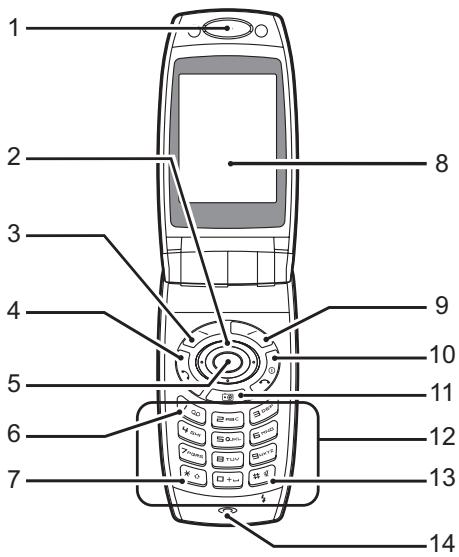
- Écouteur
- Touches de navigation (touches fléchées) :
Touches fléchées haut/bas :
Touche fléchée gauche :

Touche fléchée droite :

- Touche logicielle gauche :

- Touche d'appel :

- Touche centrale :

Déplace le curseur pour sélectionner les éléments du menu, etc.
Affiche les entrées de la liste de contacts en mode veille.
et indiquent dans ce manuel ces touches.
Affiche la liste des applications en mode veille.
indique dans ce manuel cette touche.
Affiche la liste des images enregistrées en mode veille.
indique dans ce manuel cette touche.
Exécute la fonction en bas à gauche de l'écran.
Compose ou accepte les appels, affiche les journaux d'appels en mode veille.
Affiche le menu principal en mode veille et exécute les fonctions.
- Touche de messagerie vocale : 7.*/Touche Maj :
- Écran principal
- Touche logicielle droite : 10. Touche Fin/Marche/Arrêt : 11. Touche Appareil photo : 12. Clavier
Maintenez cette touche enfoncée pour vous connecter automatiquement à la messagerie vocale. (Selon la carte SIM.)
Bascule entre quatre modes de casse : Abc, ABC, 123 et abc.
Maintenez cette touche enfoncée sur l'écran de saisie de texte pour basculer entre les modes de saisie multi-tap et T9.
Exécute la fonction en bas à droite de l'écran. Permet d'accéder à "Vodafone live!" en ouvrant le navigateur en mode veille.
Termine un appel, met sous/hors tension.
Démarre l'appareil photo numérique en mode veille.
13. Touche #/Silencieux/Lumière :

Bascule entre les écrans de symboles.
Maintenez cette touche enfoncée sur l'écran de saisie de texte pour afficher l'écran des options de langue.
Maintenez cette touche enfoncée en mode veille pour basculer les profils entre Normal et Silencieux. Appuyez sur , puis en mode veille pour activer ou désactiver la fonction Bluetooth.
14. Microphone
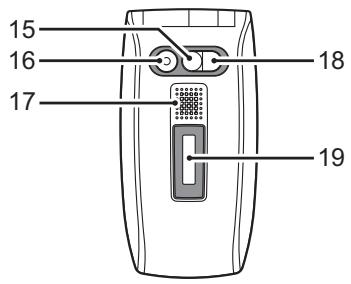
- Miroir pour autoportrait : pour prendre un autoportrait. 16. Appareil photo 17. Haut-parleur 18. Lumière mobile :
Utilisée comme lumière auxiliaire en mode appareil photo/caméra numérique, comme indicateur de charge de la batterie, ou comme notification pour les appels entrants, les appels de données/télécopie ou les messages.
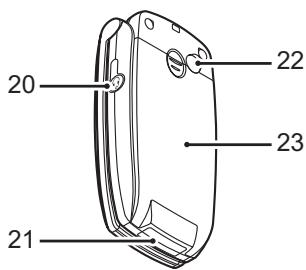
19. Écran externe 20. Connecteur du kit mains libres
21. Connecteur externe :
Sert à connecter le chargeur ou le câble de données USB.
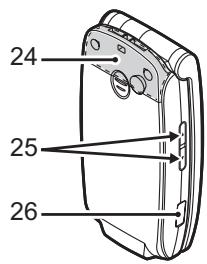
22. Connecteur RF 23. Cache de batterie 24. Antenne intégrée :
Avertissement : Ne couvrez pas la zone de la charnière du téléphone avec votre main lors de l'utilisation, car cela pourrait interférer avec les performances de l'antenne intégrée.
25. Touches latérales haut/bas :

Déplacent le curseur pour sélectionner les éléments du menu, règlent le volume de l'écouteur, etc. Maintenez cette touche enfoncée en veille pour allumer ou éteindre la lumière du mobile.
26. Port infrarouge :
Envoie et reçoit des données via infrarouge.
Insertion de la carte SIM et de la batterie
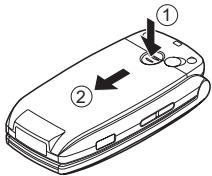
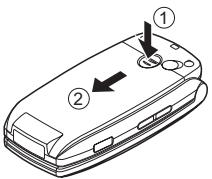
- Faites glisser le cache de batterie pour l'ouvrir (①②).
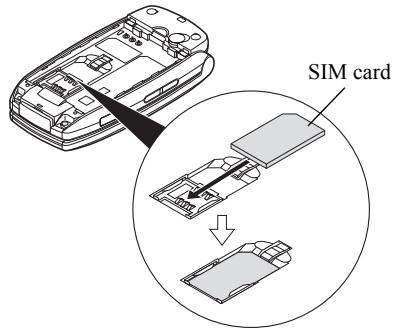
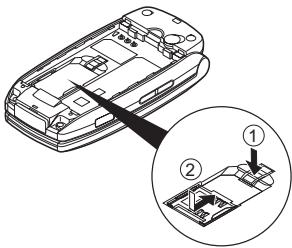
- Glissez la carte SIM dans son logement.
- Tenez la batterie de sorte que les contacts métalliques soient orientés vers le bas, faites glisser les guides situés en haut de la batterie dans les fentes prévues ①, puis insérez-la ②.
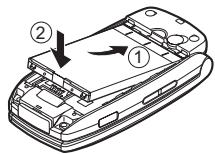
- Replacez le cache de batterie et faites-le glisser comme indiqué ci-dessous.
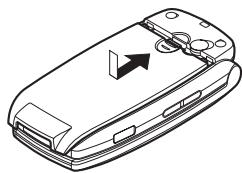
Remarque
Assurez-vous d'utiliser uniquement des cartes SIM 3V. - Assurez-vous d'utiliser la batterie d'accessoire standard (XN-1BT30).
Retrait de la carte SIM et de la batterie
- Assurez-vous d'éteindre votre téléphone et de débrancher le chargeur et autres accessoires. Faites glisser le capot de la batterie (①②).
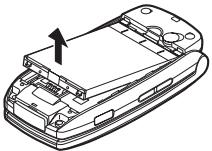
- Soulevez la batterie par le bord en saillie et retirez-la du téléphone.
- Maintenez doucement ① tout en faisant glisser la carte SIM hors de son logement ②.
Élimination de la batterie
L'appareil est alimenté par une batterie. Afin de protéger l'environnement, veuillez lire les points suivants concernant l'élimination de la batterie :
- Apportez la batterie usagée à votre déchetterie locale, à votre revendeur ou à un centre de service client pour recyclage.
- N'exposez pas la batterie usagée à une flamme nue, ne la jetez pas dans l'eau et ne la jetez pas avec les ordures ménagères.
Chargement de la batterie
Vous devez charger la batterie pendant au moins 2 heures avant la première utilisation de votre téléphone.
Utilisation du chargeur
- Retirez le capot du connecteur externe et branchez le chargeur sur la prise externe située en bas du téléphone en appuyant sur les deux côtés indiqués par des flèches. Branchez le chargeur sur une prise secteur. Conservez le capot dans un endroit sûr pour ne pas le perdre.
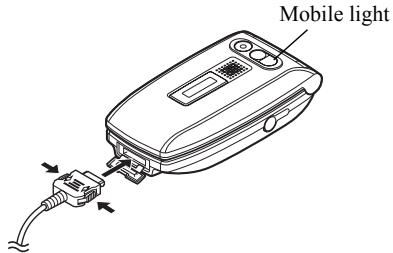
Le voyant mobile devient blanc lorsque la batterie doit être chargée.
Lorsque le téléphone est en charge, l'icône animée de l'état de la batterie ( l ) en haut à droite de l'écran affiche l'état actuel.
Temps de charge standard : environ 2 heures.
Remarque
- La durée de charge peut varier en fonction de l'état de la batterie et d'autres conditions. (Voir « Batterie » à la page 120.)
Pour débrancher le chargeur
Appuyez sur les boutons latéraux du chargeur et maintenez-les enfoncés, puis débranchez le chargeur de la prise externe du téléphone.
- Lorsque la charge est terminée, l'icône de l'indicateur de batterie affiche l'état de charge complète et le voyant mobile s'éteint. Débranchez le chargeur de la prise secteur, puis débranchez le connecteur du chargeur du téléphone. Remettez le cache en place.
Remarque
- N'utilisez pas de chargeur non approuvé, cela pourrait endommager votre téléphone et annuler toute garantie. Veuillez consulter « Batterie » à la page 120 pour plus de détails.
Pour charger à l'aide du chargeur allume-cigare Le chargeur allume-cigare en option fournit l'alimentation pour la charge à partir de la prise allume-cigare d'une voiture.
Indicateur de niveau de batterie
Le niveau de batterie actuel est affiché en haut à droite de l'écran principal et sur l'écran externe.
Batterie faible pendant l'utilisation
Lorsque la batterie est faible, une alarme retentit et « » s'affiche sur l'écran principal et sur l'écran externe.
Si vous utilisez votre téléphone et que vous entendez l'alarme de « batterie faible », branchez votre chargeur dès que possible. Le téléphone risque de ne pas pouvoir continuer à fonctionner normalement si vous continuez à l'utiliser. La batterie peut ne durer qu'environ cinq minutes avant que le téléphone ne s'éteigne pendant un appel.
| Battery Indicators | Charge Level |
| Sufficiently charged | |
| Partially charged | |
| Charging recommended | |
| Charging required | |
| Empty |
Allumer et éteindre votre téléphone
Pour allumer, maintenez enfoncée la touche √ pendant environ 2 secondes.
L'écran de veille s'affiche.
Pour éteindre l'appareil, maintenez la touche enfoncée pendant environ 2 secondes.
Pour saisir le code PIN
Si cette fonction est activée, vous devez saisir un code PIN (numéro d'identification personnel) après avoir allumé votre téléphone.
- Saisissez votre code PIN.
- Appuyez sur
Remarque
- Si votre code PIN est saisi incorrectement trois fois de suite, la carte SIM est verrouillée. Voir « Activation/Désactivation du code PIN » à la page 111.
Pour copier la liste de contacts depuis la carte SIM : lorsque vous insérez la carte SIM dans votre téléphone pour la première fois et que vous démarrez l'application Liste de contacts, vous êtes invité à indiquer si vous souhaitez copier les entrées de la liste de contacts de la carte SIM. Suivez les instructions à l'écran, ou vous pouvez le faire plus tard à l'aide du menu Liste de contacts comme suit :
« Contacts » → « Liste de contacts » → [Options] → « Avancé » → « Copier toutes les entrées »
- Sélectionnez « De la SIM vers le téléphone ».
Indicateurs d'affichage (écran principal)
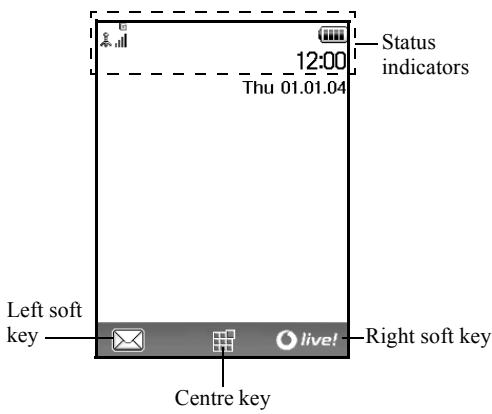
Indicateurs d'état
- refdt Intensité du signal reçu / Hors de la zone de service
E E E E d/dl d/dl d/dl
GPRS dans la zone de couverture et activé / Itinérance hors du réseau / GPRS dans la zone de couverture, activé et en itinérance
- Appel entrant
- Appel en cours
- / : CSD/GPRS en cours
- Communication fax en cours
- Renvois (p. 102) réglés sur "Tous les appels"
- / t Page WAP sécurisée affichée
- / : Alertes de message texte [non lus / boîte aux lettres pleine]
- 圆 /圆 : Alertes de message multimédia [non lus / boîte aux lettres pleine]
- / : Alertes e-mail [non lus / boîte aux lettres pleine]
- Câble de données USB connecté
- /:/ Connexion "Infrarouge" [activée (gris) / communication (rouge)]
- /: Réglage sans fil Bluetooth [activé / en communication]
- /: Application JavaTM [exécutée (couleur)/ suspendue (gris)]
- (Aucun affichage) / / / / / : Profil actuel [Normal/Réunion/Activité/Voiture/Écouteurs/Silencieux]
- T9 : Saisie de texte T9 activée
- abc/ABC/abc/123 : Méthode de saisie de texte actuelle [Première lettre en majuscule/Majuscules/Minucules/Numérique]
- / / : « Volume de la sonnerie » (p. 93) réglé sur « Silencieux »/Vibration activée (p. 94)/Vibration activée et son désactivé
- Niveau de la batterie
- Alarme quotidienne activée
- / : Entrée d'agenda activée [avec/sans alarme de rappel]
- La boîte d'envoi contient des messages multimédia non envoyés
- Alerte WAP
- Alerte de message vocal
Indicateurs d'affichage (écran externe)

Indicateurs d'état
- Force du signal reçu
- : Niveau de batterie
- Câble de données USB connecté
- φ / 国 : Connexion « infrarouge » [activée/communication]
- /Connexion sans fil Bluetooth [activée/communication]
Fonctions de navigation
Toutes les applications sont accessibles depuis le menu principal. Pour ouvrir le menu principal, appuyez sur la touche centrale ( ) en mode veille.
Pour lancer des applications, vous devez mettre en surbrillance les éléments du menu et faire des sélections. Pour sélectionner un élément de menu (indiqué entre guillemets), déplacez le curseur à l'aide de , , et , puis appuyez sur pour valider votre sélection.
Dans certaines procédures, vous devrez appuyer sur l'une des touches de fonction (indiquées entre crochets), qui sont affichées en bas à gauche et à droite de l'écran. Appuyez sur la touche de fonction correspondante ( ou ).
Pour revenir à l'écran précédent, appuyez sur la touche de fonction droite si elle affiche « Retour ». Pour fermer le menu principal, appuyez sur la touche de fonction droite si elle affiche « Quitter ».
Chaque section de ce guide de l'utilisateur commence par une liste d'éléments que vous devrez sélectionner dans l'ordre (indiqués en italique) avant d'effectuer les procédures présentées. Sélectionnez chaque élément pour afficher la série suivante d'éléments que vous devez sélectionner. Ouvrez les éléments de sous-section après avoir ouvert ceux de la section principale.
Exemple :
« Contacts » → « Liste des contacts » → [Options] → « Avancé »
Fonctions d'appel
Passer un appel
- Composez l'indicatif régional et le numéro de téléphone souhaité, puis appuyez sur pour composer.
Si vous avez composé un mauvais numéro, appuyez sur [Effacer] pour supprimer le chiffre à gauche du curseur.
Appels d'urgence
- Composez le 112 ou le 911 (numéro d'urgence international) à l'aide du clavier, puis appuyez sur la touche pour composer.
Remarque
- Les appels d'urgence peuvent ne pas être disponibles sur tous les réseaux de téléphonie mobile lorsque certains services réseau et/ou fonctions du téléphone sont utilisés. Contactez votre opérateur réseau pour plus d'informations.
- Ce numéro d'urgence peut normalement être utilisé pour passer un appel d'urgence dans n'importe quel pays, avec ou sans carte SIM insérée, si un réseau GSM est disponible.
Appels internationaux
- Maintenez enfoncée la touche jusqu'à ce que le signe "+" (préfixe d'appel international) s'affiche.
- Composez l'indicatif du pays, suivi de l'indicatif régional (sans le zéro initial) et du numéro de téléphone, puis appuyez sur pour composer.
Numérotation abrégée
Jusqu'à 8 numéros de téléphone de la liste de contacts (téléphone et SIM) peuvent être attribués à des numéros abrégés. Vous pouvez appeler ces numéros à l'aide des touches numériques (à). Pour plus de détails sur la configuration de la liste de numéros abrégés, voir "Liste de numéros abrégés" à la page 36.
- Pour composer un numéro à l'aide de la numérotation abrégée, maintenez enfoncée l'une des touches numériques (à).
Le numéro de téléphone stocké dans la liste de numéros abrégés est composé.
Rappel du dernier numéro
Vous pouvez recomposer les numéros du journal d'appels. Sélectionnez une catégorie spécifique ou "Tous les appels". Une catégorie spécifique contient jusqu'à 10 numéros et la liste "Tous les appels" contient jusqu'à 30 numéros.
- Appuyez en mode veille.
- Appuyez sur ou pour basculer entre "Tous les appels", "Numéros composés", "Appels manqués" et "Appels reçus".
- Mettez en surbrillance le numéro de téléphone que vous souhaitez appeler.
- Appuyez pour recomposer l'appel.
Recomposition automatique
Ce réglage vous permet de recomposer automatiquement le numéro si la première tentative a échoué parce que le correspondant était occupé.
Si vous souhaitez arrêter la recomposition, appuyez sur ou [Fin].
Pour régler la fonction de recomposition automatique
"Réglages" → "Réglages des appels" → "Recomposition automatique"
- Sélectionnez "Activé" ou "Désactivé".
Remarque
- Lorsque vous recevez un appel entrant, la fonction de recomposition automatique est interrompue.
La recomposition automatique n'est pas disponible pour les appels de télécopie et de données.
Répondre à un appel
Lorsqu'un appel entrant est détecté, le téléphone sonne et le voyant mobile clignote.
- Appuyez sur ou sur [Répondre] pour répondre à l'appel. Ou appuyez sur n'importe quelle touche sauf et [Occupé] lorsque la fonction "Réponse par toute touche" est activée. Réglez la fonction Réponse par toute touche dans le profil de chaque mode. (p. 98)
Astuce
- Lorsque le kit mains libres personnel (en option) est connecté au téléphone, vous pouvez répondre aux appels en appuyant sur le bouton Répondre.
- Si vous avez souscrit au service d'identification de l'appelant (CLI) et que le réseau de l'appelant envoie le numéro, le numéro de l'appelant s'affiche à l'écran. Si le nom et le numéro de l'appelant sont enregistrés dans la liste de contacts, le nom et le numéro de téléphone de l'appelant s'affichent à l'écran.
- Si le numéro est masqué, l'écran affiche "Masqué".
- Lors de la réception d'un appel d'une personne dont la photo est enregistrée dans la liste de contacts, l'écran de réception et la photo s'affichent en alternance.
Rejet d'un appel entrant
- Appuyez sur la touche ou maintenez enfoncée la touche latérale supérieure ou inférieure pendant que le téléphone sonne pour rejeter un appel que vous ne souhaitez pas répondre.
Informez l'appelant que vous êtes indisponible
- Appuyez sur [Occupé] pendant que le téléphone sonne pour envoyer une tonalité d'occupation à l'appelant d'un appel entrant, lui indiquant que vous ne pouvez pas répondre à l'appel.
Menu en cours d'appel
Votre téléphone dispose de fonctions supplémentaires disponibles pendant qu'un appel est en cours.
Réglage du volume de l'écouteur
Pendant un appel, vous pouvez régler le volume de l'écouteur (et le volume du haut-parleur, s'il est connecté).
- Pendant un appel, appuyez sur la touche latérale supérieure ou inférieure pour afficher l'écran Volume de l'écouteur.
- Appuyez sur la touche latérale supérieure (ou sur 1/2) pour augmenter le volume de l'appel, ou appuyez sur la touche latérale inférieure (ou sur 1/2) pour le diminuer. Cinq niveaux (du niveau 1 au niveau 5) sont sélectionnables.
- Appuyez sur ○ lorsque le volume est réglé au niveau souhaité.
Le téléphone revient automatiquement à l'écran d'appel si vous ne le touchez pas.
Mise en attente d'un appel
Cette fonction vous permet de gérer deux appels en même temps. Si vous souhaitez passer un autre appel pendant que vous parlez à quelqu'un, vous pouvez mettre l'appel en cours en attente pour appeler quelqu'un d'autre.
Pour passer un autre appel pendant un appel
- Pendant un appel, appuyez sur [Options].
- Sélectionnez "Mettre en attente".
L'appel en cours est mis en attente.
Pour reprendre un appel, appuyez sur [Options] et sélectionnez "Reprendre".
- Composez le numéro de téléphone de la personne que vous souhaitez appeler, puis appuyez sur ○.
Astuce
- Vous pouvez également passer un autre appel en composant le numéro de téléphone pendant un appel au lieu des étapes 1 et 2. L'appel en cours est automatiquement mis en attente.
Appel en attente
Ce service vous avertit d'un autre appel entrant pendant que vous avez un appel en cours.
- Pendant un appel, appuyez sur [Options] et sélectionnez "Répondre et mettre en attente" pour répondre au deuxième appel. Le premier appel est mis en attente et vous pouvez maintenant parler au deuxième appelant.
- Appuyez sur [Options] et sélectionnez "Échanger les appels" pour basculer entre les deux appels.
- Appuyez sur [Options] et sélectionnez "Libérer l'appel" pour terminer l'appel en cours et revenir à l'appel en attente.
Remarque
- Vous devez régler "Appel en attente" sur "Activé" si vous utilisez le service d'appel en attente (p. 103).
- Le service d'appel en attente peut ne pas être disponible sur tous les réseaux. Contactez votre opérateur réseau pour plus d'informations.
- Si vous ne souhaitez pas répondre au deuxième appel, appuyez sur [Occupé], ou appuyez sur [Options] et sélectionnez "Occupé" ou "Rejeter", à l'étape 1. Si "Rejeter" est sélectionné, le journal d'appels du deuxième appel est enregistré comme un appel manqué.
Accès au menu SMS pendant un appel
- Pendant un appel, appuyez sur [Options] et sélectionnez "Texte". Les options suivantes sont disponibles : "Créer un message" pour créer un SMS, ou "Boîte de réception", "Envoyés" ou "Brouillons" pour accéder à ces dossiers. Pour plus de détails sur les SMS, voir "Texte (SMS)" à la page 52.
Conférence téléphonique
La conférence téléphonique est un appel avec plus de 2 participants. Vous pouvez inclure jusqu'à 5 participants dans une conférence téléphonique.
Pour faire une conférence téléphonique
Pour établir une conférence téléphonique, vous devez avoir un appel en cours et un appel en attente.
- Pendant un appel, appuyez sur [Options] et sélectionnez "Multiparty" pour répondre au deuxième appel.
- Sélectionnez "Conférence tous" pour rejoindre la conférence téléphonique.
- Appuyez sur pour mettre fin à la conférence téléphonique.
Remarque
- Le service de conférence téléphonique peut ne pas être disponible sur tous les réseaux. Contactez votre opérateur réseau pour plus d'informations.
- Vous avez plus d'options pour la conférence téléphonique à l'étape 2 :
- Pour mettre tous les participants en attente, sélectionnez "Conférence tout en attente".
- Pour mettre tous les participants en attente sauf l'appel en cours, sélectionnez "Privé". Pour terminer l'appel avec tous les participants, sélectionnez "Tout libérer".
- Pour vous déconnecter de la conférence téléphonique tout en permettant aux autres participants de continuer à parler ensemble, sélectionnez "Transférer".
- Pour mettre l'appel en cours en attente et continuer à avoir une conférence téléphonique avec les participants restants, sélectionnez "Exclure".
- Pour refuser d'ajouter plus de participants à la partie en cours, sélectionnez "Refuser", ou vous pouvez envoyer la tonalité d'occupation en sélectionnant "Occupé".
Pour ajouter de nouveaux participants à la conférence téléphonique
- Appuyez sur [Options] et sélectionnez "Composer".
- Saisissez le numéro que vous souhaitez inclure dans la conférence téléphonique et appuyez sur pour composer.
- Appuyez sur [Options] et sélectionnez "Multiparty".
- Sélectionnez "Conférence tous" pour rejoindre la conférence téléphonique. Si vous souhaitez ajouter d'autres participants, répétez les étapes 1 à 4.
Pour terminer l'appel avec un participant à la conférence
- Pendant une conférence téléphonique, mettez en surbrillance la personne que vous souhaitez déconnecter de la conférence.
- Appuyez sur [Options] et sélectionnez "Libérer l'appel".
Pour avoir une conversation privée avec l'un des participants
Si vous souhaitez avoir une conversation privée avec l'un des participants, vous pouvez sélectionner le participant dans la liste de la conférence et mettre les autres participants en attente.
- Pendant une conférence téléphonique, sélectionnez la personne à qui vous souhaitez parler.
- Appuyez sur [Options] et sélectionnez "Multiparty".
- Sélectionnez "Privé".
- Une fois la conversation privée terminée, appuyez sur [Options] et sélectionnez "Multiparty".
- Sélectionnez "Conférence tous" pour revenir à la conférence téléphonique.
Mise en sourdine du microphone
- Pendant un appel, appuyez sur [Muet] pour couper le microphone. Pour réactiver le microphone, appuyez sur [Rétablir le son].
Saisie de caractères
Lors de la saisie de caractères pour créer des entrées de la liste de contacts, des messages texte ou multimédia, etc., appuyez sur les touches correspondantes.
En mode de saisie multi-tap, appuyez sur chaque touche jusqu'à ce que le caractère souhaité s'affiche. Par exemple, appuyez une fois pour la lettre "A" ou deux fois pour la lettre "B".
Tableau des caractères
En appuyant sur chaque touche, les caractères défilent dans l'ordre suivant. L'ordre varie selon la langue sélectionnée.
Mode anglais
| Key | Upper Case Characters | Lower Case Characters | Numeric |
| 100 | (full-stop), (comma) - (hyphen)? !' (apostrophe) @ :1 | 1 | |
| ABC | ABC2 | abc2 | 2 |
| DEF3 | DEF3 | def3 | 3 |
| GHI4 | ghi4 | ghi4 | 4 |
| JKL5 | jk15 | 5 | 5 |
| MNO6 | mno6 | 6 | 6 |
| Key | Upper Case Characters | Lower Case Characters | Numeric | |
| PQRS | PQRS7 | pQRS7 | 7 | |
| TUV8 | tuv8 | tuv8 | 8 | |
| WXYZ9 | wxyz9 | wxyz9 | 9 | |
| (space) + = < > £ £ ¥ % & 0 | 0 | |||
| Switches character case among four modes: Abc, ABC, 123 and abc. | ||||
| ^* | ^, ?! : ; - + # * @ , " ( ) & € £ $ % / ~ < > § = \ | ¥ i ^ [ ] { } □ Å Å A ā ā ā ā ā ā ā ā ā ā ā ā ā ā ā ā ā ā ā ā ā ā ā ā ā ā ā ā ā ā ā ā ā ā ā ā ā ā ā ā ā ā ā ā ā ā ā ā ā ā Ă ā ā ā ā ā ā ā ā ā ā ā ā ā ā ā ā ā ā ā ā ā ā ā ā ā ā ā ā ā ā ā ā ā ā ā ā ā ā ā ā ā ā ā ā ā ā ā ā ā Ī | |||
| space | space | space | space | |
Maintenez enfoncé pour saisir les chiffres de 0 à 9.

*o : Maintenez enfoncé pour basculer entre le mode multitap et le mode T9.
Maintenez enfoncé pour afficher l'écran des options de langue.
Changement de la langue de saisie
Vous pouvez changer la langue de saisie sur l'écran de saisie de texte.
- Sur l'écran de saisie de texte, appuyez sur [Options].
- Sélectionnez "Langue de saisie".
Si "Langue de saisie" n'est pas affiché, sélectionnez "Options de texte" puis "Langue de saisie".
- Sélectionnez la langue souhaitée.
Astuce
- Vous pouvez maintenir enfoncée la touche = au lieu des étapes 1 et 2 pour afficher l'écran des options de langue.
Changement de la méthode de saisie
Saisie de texte T9
La méthode de saisie de texte T9 est un raccourci pour saisir du texte facilement et rapidement.
- Sur l'écran de saisie de texte, maintenez enfoncée la touche *° pour passer en mode T9.
- Appuyez sur [Options].
- Sélectionnez "Méthode de saisie".
Si "Méthode de saisie" n'est pas affiché, sélectionnez "Options de texte" puis "Méthode de saisie".
- Sélectionnez le mode de saisie (Abc, ABC, abc, 123).
- Appuyez une fois sur chaque touche pour toute lettre dont vous avez besoin sur cette touche.
Pour saisir le mot "How", appuyez sur 4 5
- Si le mot affiché n'est pas celui que vous voulez, appuyez sur ou jusqu'à ce que vous mettiez en surbrillance le bon.
- Appuyez sur ○ pour sélectionner le mot.
Remarque
- Si le mot correct n'apparaît pas à l'étape 6, saisissez à nouveau le mot correct après être passé à la méthode de saisie multi-tap.
Astuce
- Si vous appuyez sur = au lieu de l'étape 7, un espace est inséré à côté du mot sélectionné.
Symboles et ponctuation
- Sur l'écran de saisie de texte, appuyez sur [Options].
- Sélectionnez "Ajouter un symbole".
Si "Ajouter un symbole" n'est pas affiché, sélectionnez "Options de texte" puis "Ajouter un symbole".
- Sélectionnez le symbole souhaité.
Mon dictionnaire
Vous pouvez créer votre propre liste de mots pour la saisie de texte T9.
- Sur l'écran de saisie de texte en mode T9, appuyez sur [Options].
- Sélectionnez "Mon dictionnaire".
Si « Mon dictionnaire » ne s'affiche pas, sélectionnez « Options de texte », puis « Mon dictionnaire ».
- Sélectionnez « Ajouter un mot » et saisissez un nouveau mot. Pour modifier un mot de la liste,
- Sur l'écran de saisie de texte en mode T9, appuyez sur [Options].
- Sélectionnez « Mon dictionnaire ». Si « Mon dictionnaire » ne s'affiche pas, sélectionnez « Options de texte », puis « Mon dictionnaire ».
- Mettez en surbrillance le mot souhaité.
- Appuyez sur [Options] et sélectionnez « Modifier ».
- Modifiez le mot.
Astuce
- Vous pouvez également suivre les étapes suivantes pour enregistrer un nouveau mot dans la liste pour la saisie de texte T9.
- Saisissez un (partie de) mot en mode T9 que vous souhaitez enregistrer.
- Appuyez sur [Options].
- Sélectionnez « Mon dictionnaire ». Si « Mon dictionnaire » n'est pas affiché, sélectionnez « Options de texte », puis « Mon dictionnaire ». 4. Modifiez le mot.
Utilisation des modèles de texte
Vous pouvez utiliser les phrases enregistrées dans les modèles de texte lors de la saisie de caractères.
Pour plus de détails sur la création d'un modèle de texte, voir « Ajout de phrases aux modèles de texte » à la page 70.
- Sur l'écran de saisie de texte, déplacez le curseur à l'endroit où vous souhaitez insérer le modèle.
- Appuyez sur [Options].
- Sélectionnez « Ajouter un modèle de texte ». Si « Ajouter un modèle de texte » n'est pas affiché, sélectionnez « Options de texte », puis « Ajouter un modèle de texte ».
- Sélectionnez le modèle de texte souhaité. Le modèle de texte sélectionné est inséré.
Utilisation du menu
Accès aux applications
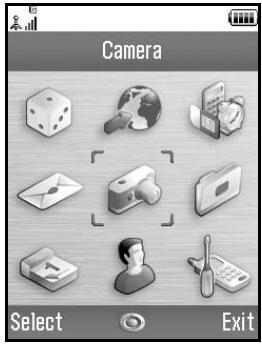
- Appuyez sur en mode veille. Le menu principal s'affiche.
- Naviguez jusqu'à l'emplacement souhaité.
- Appuyez sur pour accéder à la fonction.
Raccourcis clavier
Vous pouvez accéder directement aux menus en appuyant sur la touche correspondant au numéro du menu sur l'écran principal. Reportez-vous au tableau suivant.
Les raccourcis sont indiqués dans les titres de ce manuel. Par exemple : "M 9-7".
Exemple : accéder au sous-menu "Langue" à l'aide des touches de raccourci
Appuyez sur


Remarque
- Les touches de raccourci ne fonctionnent que pour les trois premiers niveaux de menu.
Liste des fonctions du menu
| Menu No./Main Menu | Menu No./Sub Menu1 | |
| 1 | Games & More | 1 Applications2 Screensavers3 More Games4 Settings5 Java™ Information |
| 2 | Vodafone live! | 1 Vodafone live!2 Games3 Ringtones4 Pictures5 News6 Sport7 Find & Seek8 Chat9 Search |
| 3 | Applications | 1 SIM Application*2 Alarms3 Calculator4 Voice Recorder5 Melody Editor6 Phone Help |
| 4 | Messages | 1 Create Message2 Multimedia3 Text4 Email5 Media Album6 Vodafone Mail7 Messenger8 Cell Broadcasts9 Area Info |
| Menu No./Main Menu | Menu No./Sub Menu1 | |
| 5 | Camera | 1 Take Picture2 Record Video |
| 6 | My Items | 1 Pictures2 Games & More3 Sounds4 Videos5 Text Templates6 Bookmarks7 Memory Status |
| 7 | Calendar | |
| 8 | Contacts | 1 Contacts List2 Call Log3 Speed Dial List4 My Numbers5 Call Timers6 Data Counter7 Call Costs8 Service Dialling No.* |
| 9 | Settings | 1 Connectivity2 Profiles3 Display4 Sound5 Call Settings6 Date & Time7 Language8 Network9 Security0 Master Reset |
- Disponible uniquement avec certains opérateurs.
Remarque concernant les indications de menu pour les services Carte postale et Album multimédia
- Les indications de menu pour les services Carte postale et Album multimédia varient au Royaume-Uni et en Irlande comme suit :
| Current indications in the user guide | Indications in United Kingdom | Indications in Ireland |
| "Postcard" | "live! Postcard" | (Not available) |
| "As Postcard" | "As live! Postcard" | (Not available) |
| "State/Province" | "County" | "State/Province" |
| "Media Album" | "live! Studio" | "Picture Album" |
| "To Album" | "To live! Studio" | "To Picture Album" |
Liste de contacts (M 8-1)
Vous pouvez enregistrer les numéros de téléphone et adresses e-mail de vos amis, de votre famille et de vos collègues dans la liste de contacts.
Selon la taille des entrées, votre téléphone peut stocker jusqu'à 640 entrées. Dans une liste de contacts, vous pouvez enregistrer les éléments suivants.
Éléments stockés dans la mémoire du combiné
Prénom
Nom
Tél. mobile
Tél. privé
Tél. bureau
E-mail privé
E-mail professionnel
Groupe
Adresse (rue et numéro, code postal, ville, état/
province, pays)
Note
Éléments stockés dans la mémoire SIM
Nom : le nombre de caractères pouvant être stockés varie selon la carte SIM utilisée.
Numéro de téléphone : jusqu'à 40 chiffres
En utilisant la fonction sans fil infrarouge ou Bluetooth, vous pouvez envoyer une entrée de la liste de contacts à un PC pour partager les mêmes entrées.
Sélection de la mémoire de stockage
"Contacts" → "Liste des contacts" → [Options] → "Avancé" → "Enregistrer les nouveaux contacts"
- Sélectionnez l'emplacement des contacts parmi "Vers le téléphone", "Vers la SIM" ou "Choisir avant l'enregistrement".
Astuce
- "Choisir avant l'enregistrement" vous invite à choisir la mémoire à chaque fois que vous enregistrez une nouvelle entrée.
Modification de la liste affichée
"Contacts" → "Liste des contacts" → [Options] → "Avancé" → "Emplacement des contacts"
- Sélectionnez parmi "Mémoire du téléphone", "Mémoire SIM" ou "Les deux".
Modification de l'ordre des noms
"Contacts" → "Liste des contacts" → [Options] → "Avancé" → "Ordre des noms"
- Sélectionnez parmi "Prénom - Nom" ou "Nom - Prénom".
Ajouter un nouveau contact
Vous pouvez choisir la mémoire du téléphone ou celle de la carte SIM pour stocker la nouvelle entrée. Pour changer d'emplacement, voir "Sélection de la mémoire de stockage" à la page 31.
Le nombre de numéros de téléphone que vous pouvez stocker sur la carte SIM dépend de sa capacité. Contactez votre opérateur réseau pour plus de détails.
"Contacts" → "Liste des contacts" → "Ajouter un nouveau contact" Si vous sélectionnez l'option "Choisir avant l'enregistrement" pour la mémoire à utiliser, le choix se fait entre "Vers le téléphone" et "Vers la SIM".
- Sélectionnez le champ que vous souhaitez remplir et saisissez les informations correspondantes.
- Appuyez sur [Enregistrer] lorsque vous avez terminé.
Astuce
- Pour créer une entrée, au moins un champ doit être rempli. Si vous créez une nouvelle entrée sur la carte SIM, vous devez saisir un numéro de téléphone.
Ajout d'une vignette aux entrées
"Contacts" → "Liste des contacts"
- Mettez en surbrillance l'entrée du combiné souhaitée.
- Appuyez sur [Options] et sélectionnez "Modifier/Ajouter des détails".
- Appuyez sur [Options] et sélectionnez "Image".
- Sélectionnez l'image souhaitée.
- Appuyez sur [Enregistrer] lorsque vous avez terminé.
Remarque
- Les vignettes ne peuvent être ajoutées qu'aux entrées stockées dans la mémoire du combiné.
- À partir de l'entrée de la liste des contacts à laquelle une vignette a été ajoutée, vous pouvez la modifier ou la supprimer en sélectionnant "Modifier" ou "Supprimer" après l'étape 3.
- Si vous supprimez une image dans Images enregistrées, la vignette correspondante est également supprimée.
Copie des entrées du répertoire entre la carte SIM et le combiné
"Contacts" → "Liste des contacts" → [Options] → "Avancé" → "Copier toutes les entrées"
- Sélectionnez "De la SIM vers le combiné" ou "Du combiné vers la SIM".
Remarque
- Lorsque vous insérez la carte SIM dans votre téléphone pour la première fois et que vous démarrez l'application Liste des contacts, l'écran de confirmation apparaît automatiquement, vous demandant si vous souhaitez copier ou non. Le nombre d'entrées de la liste des contacts à copier varie en fonction de la capacité de la SIM.
Copie d'une seule entrée du combiné vers la carte SIM
"Contacts" → "Liste des contacts"
- Sélectionnez l'entrée souhaitée.
- Mettez en surbrillance le numéro de téléphone souhaité.
- Appuyez sur [Options] et sélectionnez "Copier vers la SIM".
Recherche d'un nom et d'un numéro
"Contacts" → "Liste des contacts"
- Saisissez les premières lettres du nom.
Les résultats de la recherche sont affichés par ordre alphabétique.
Astuce
- Vous pouvez choisir l'emplacement des contacts parmi "Mémoire du combiné", "Mémoire SIM" ou "Les deux" avant de rechercher.
- Pour afficher les détails de l'élément, comme l'adresse, mettez en surbrillance l'élément souhaité, appuyez sur [Options] et sélectionnez "Afficher".
Composer un numéro depuis la liste de contacts
"Contacts" → "Liste de contacts"
- Mettez en surbrillance l'entrée souhaitée et appuyez sur
Astuce
- Si plusieurs numéros de téléphone sont enregistrés pour l'entrée, sélectionnez le numéro souhaité après l'étape 1 et appuyez sur . Vous pouvez également composer le numéro souhaité en appuyant sur la touche numérique correspondant à la position de l'entrée dans la liste.
- Vous pouvez également composer un numéro depuis l'écran de détails de la liste de contacts. Sur l'écran de détails, sélectionnez le numéro souhaité et appuyez sur
Modification des entrées de la liste de contacts
"Contacts" → "Liste de contacts" → [Options] → "Modifier/Ajouter des détails"
- Sélectionnez le champ que vous souhaitez modifier, puis modifiez les informations.
- Appuyez sur [Enregistrer] lorsque vous avez terminé.
Suppression des entrées de la liste de contacts
Suppression de toutes les entrées de contacts
"Contacts" → "Liste de contacts" → [Options] → "Avancé" → "Supprimer toutes les entrées"
- Saisissez votre code de combiné.
- Sélectionnez "Entrées du combiné" ou "Entrées SIM". Le code de combiné par défaut est "0000". Pour plus de détails sur la modification du code de combiné, reportez-vous à "Pour modifier le code de combiné" à la page 112.
Suppression d'une entrée de contact
"Contacts" → "Liste des contacts"
- Mettez en surbrillance l'entrée souhaitée.
- Appuyez sur [Options] et sélectionnez "Supprimer".
Affichage des groupes
Vous pouvez définir des icônes de groupe lors de l'enregistrement des entrées de contacts afin de les retrouver et de les modifier facilement.
"Contacts" → "Liste des contacts" → [Options] → "Avancé" → "Groupe" → "Afficher les groupes"
- Sélectionnez le groupe souhaité.
"☑" apparaît à côté du groupe sélectionné. Sélectionnez à nouveau le groupe pour annuler, et la case à cocher devient décochée.
Remarque
- Ce menu est disponible lorsque l'emplacement des contacts est défini sur "Mémoire du combiné".
Astuce
- Appuyez sur [Options] et sélectionnez "Uniquement en cours" pour afficher uniquement le groupe sélectionné ou "Tout sélectionner" pour afficher tous les groupes.
Appel de groupe
Des sonneries différentes peuvent être définies pour chaque groupe. Lors de l'achat de ce téléphone, les groupes sont désactivés. Si vous ne définissez pas de sonnerie de groupe, la sonnerie assignée dans le menu Paramètres est utilisée.
Contacts → Liste des contacts → Options → Avancé → Groupe → Appel de groupe
- Sélectionnez le groupe souhaité.
- Sélectionnez "Activer/Désactiver".
- Sélectionnez "Activé" ou "Désactivé".
- Sélectionnez "Assigner une sonnerie".
- Sélectionnez "Sons prédéfinis" ou "Mes sons".
- Sélectionnez la sonnerie souhaitée. Pour plus de détails sur la sélection d'une sonnerie, voir "Assignation d'une sonnerie" à la page 94.
- Sélectionnez "Vibration" et choisissez parmi "Activée", "Désactivée" ou "Activée et liée au son".
Pour plus de détails sur la sélection d'une vibration, voir "Vibration" à la page 94.
- Sélectionnez "Lumière" et choisissez "Activée", "Désactivée" ou "Activée et liée au son".
Pour plus de détails sur la sélection d'une lumière, voir "Lumière" à la page 95.
- Appuyez sur [OK].
Remarque
- Ce menu est disponible lorsque l'emplacement des contacts est défini sur "Mémoire du combiné".
Attribution d'une sonnerie à chaque entrée de la liste de contacts
Une sonnerie ou un réglage de vibration spécifique peut être associé à une entrée préenregistrée.
"Contacts" → "Liste de contacts"
- Sélectionnez l'entrée souhaitée.
- Appuyez sur [Options] et sélectionnez "Modifier/Ajouter des détails".
- Appuyez sur [Options] et sélectionnez "Sonnerie".
- Sélectionnez "Activer/Désactiver".
- Sélectionnez "Activé" ou "Désactivé".
- Sélectionnez "Attribuer une sonnerie".
- Sélectionnez "Sons prédéfinis" ou "Mes sons".
- Sélectionnez la sonnerie souhaitée.
Pour plus de détails sur la sélection d'une sonnerie, voir « Attribution d'une sonnerie » à la page 94.
- Sélectionnez « Vibreur » et choisissez parmi « Activé », « Désactivé » ou « Activé et lié au son ».
Pour plus de détails sur la sélection d'un vibreur, voir « Vibreur » à la page 94.
- Sélectionnez « Lumière » et choisissez « Activée », « Désactivée » ou « Activée et liée au son ».
Pour plus de détails sur la sélection d'une lumière, voir « Lumière » à la page 95.
- Appuyez sur [OK].
- Appuyez sur [Enregistrer].
État de la mémoire
Cette fonction vous permet de vérifier la mémoire utilisée dans la liste de contacts.
« Contacts » → « Liste de contacts » → [Options] → « Avancé » → « État de la mémoire »
Liste de numéros abrégés
Vous pouvez définir un maximum de 8 numéros de téléphone dans la liste de numéros abrégés (p. 88).
Définition des entrées de la liste de contacts dans la liste de numéros abrégés
« Contacts » → « Liste de contacts »
- Sélectionnez l'entrée souhaitée.
- Mettez en surbrillance le numéro de téléphone souhaité.
- Appuyez sur [Options] et sélectionnez "Ajouter à la numérotation rapide".
- Sélectionnez le numéro de liste souhaité.
Astuce
- Les neuf touches numériques correspondent aux numéros de liste. Pour afficher la liste de numérotation rapide, voir page 88.
Envoi d'une entrée de la liste de contacts
"Contacts" → "Liste de contacts"
- Mettez en surbrillance l'entrée souhaitée.
- Appuyez sur [Options] et sélectionnez "Envoyer le contact".
- Sélectionnez "Via Bluetooth" ou "Via infrarouge".
Pour "Via Bluetooth"
Le téléphone commence à rechercher les appareils compatibles avec la technologie sans fil Bluetooth dans un rayon de 10 mètres.
Lorsqu'ils sont détectés, une liste des appareils compatibles s'affiche, vous permettant de sélectionner l'appareil souhaité. La connexion peut être établie et l'entrée est envoyée.
Pour "Via infrarouge"
Le téléphone commence à rechercher un appareil compatible infrarouge dans un rayon de 20 centimètres.
Lorsqu'il est détecté, la connexion infrarouge est établie et l'entrée est envoyée.
Remarque
- Lors de l'appairage, vous devez saisir votre code d'accès lors du premier contact avec un appareil compatible Bluetooth, sauf si « Authentification » (p. 92) est réglé sur « Désactivée ».
Astuce
- Vous pouvez envoyer votre propre fiche de contacts. Mettez en surbrillance « Ma carte » à l'étape 1. Pour plus de détails sur l'enregistrement de vos informations dans Ma carte, voir « Enregistrement de vos informations comme fiche de contacts ».
Réception d'une fiche de contacts
Lorsque le téléphone reçoit une fiche de contacts, un message de confirmation apparaît.
- Appuyez sur [Oui].
La fiche reçue est enregistrée dans la liste de contacts. Appuyez sur [Non] pour la rejeter.
Astuce
- Pour plus de détails sur les réglages infrarouge ou Bluetooth, voir « Connectivité » à la page 90.
Enregistrement de vos informations comme fiche de contacts
Vous pouvez enregistrer vos informations dans la liste de contacts.
« Contacts » → « Liste de contacts » → « Ma carte »
- Appuyez sur [Options] et sélectionnez "Modifier/Ajouter des détails".
- Sélectionnez le champ que vous souhaitez remplir et saisissez les informations pertinentes.
- Appuyez sur [Enregistrer] lorsque vous avez terminé.
Composition d'un numéro de service
Certaines cartes SIM contiennent des numéros de service qui peuvent être composés. Contactez votre fournisseur de carte SIM pour plus d'informations. Sur l'écran Contacts, "Numéros de service" est affiché en bas de la liste.
"Contacts"
- Sélectionnez "Numéros de service".
- Sélectionnez le numéro de service souhaité.
Astuce
- Si la carte SIM ne contient qu'un seul numéro de service, vous pouvez le composer à l'étape 1 en appuyant sur .
- Si aucun numéro de service n'est stocké dans la carte SIM, ce menu n'est pas affiché.
Appareil photo (M 5)
Votre téléphone dispose d'un appareil photo numérique intégré.
Cela vous permet de prendre et d'envoyer des photos ou des clips vidéo où que vous soyez.
Prendre une photo (M 5-1)
Mettez le téléphone en mode appareil photo numérique pour prendre une photo. Les photos sont enregistrées dans Images enregistrées au format JPEG dans les trois tailles d'image suivantes.
L
480×640
L : 480 × 640 points
M : 240 × 320 points
S : 120 × 160 points
Prise de photos
"Appareil photo" → "Prendre une photo"
L'aperçu est affiché à l'écran.
- Appuyez sur ○ ou sur la touche de défilement vers le bas pour prendre la photo. Le déclencheur retentit et l'image fixe de la photo prise s'affiche. Appuyez sur [Annuler] pour reprendre une photo.
- Appuyez sur [Enregistrer].
"Enregistrement (nom du fichier) dans Mes éléments..." s'affiche, puis la photo est enregistrée.
- Appuyez sur ○ pour revenir en veille.
Indicateur de photos restantes
123 : Indique le nombre restant de photos pouvant être prises.
Astuce
- Appuyer sur la touche pendant la veille active également le mode appareil photo numérique.
- Si vous souhaitez utiliser une lumière auxiliaire, appuyez sur la touche ou la touche latérale vers le haut avant l'étape 1. Appuyez à nouveau pour éteindre la lumière. L'icône apparaît ou disparaît en haut de l'écran.
- Si vous souhaitez envoyer une photo par message multimédia après l'avoir prise, appuyez sur ⑤ avant l'étape 2. Sélectionnez ensuite "Multimédia" ou "Carte postale". (Le service de carte postale n'est pas disponible avec certains fournisseurs de services. Veuillez contacter votre fournisseur de services pour plus d'informations.) Les messages MMS volumineux peuvent entraîner une réduction de la taille des photos jointes.
Utilisation du plein écran
L'aperçu peut être affiché en plein écran sans la zone des touches logicielles ni les indicateurs.
"Appareil photo" → "Prendre une photo" → [Options] → "Viseur plein écran"
- Sélectionnez "Activé" ou "Désactivé".
Remarque
- Lorsque "Taille de l'image" est réglé sur "S", vous ne pouvez pas utiliser le plein écran.
Astuce
- Vous pouvez également activer ou désactiver le mode plein écran en appuyant sur l
Prendre un autoportrait
Pour prendre un autoportrait, tenez le téléphone avec le miroir face à vous tout en le tenant à au moins 40 cm. Appuyez sur ou sur la touche latérale vers le bas pour prendre la photo.
Utilisation de la fonction zoom
Appuyez sur ou pour modifier le taux de zoom.
Indicateurs du taux de zoom


Agrandissement.
Remarque
- Lorsque « Taille d'image » est réglé sur « S », la fonction de zoom dispose de 3 agrandissements ( x1 , x2 , x4 ).
- Lorsque « Taille d'image » est réglé sur « M », la fonction de zoom dispose de 2 agrandissements ( × 1 , × 2 ).
Sélection de la taille d'image
« Appareil photo » → « Prendre une photo » → [Options] → « Taille d'image »
- Sélectionnez la taille d'image souhaitée.
Sélection de la qualité d'image
« Appareil photo » → « Prendre une photo » → [Options] → « Qualité d'image »
- Sélectionnez « Normal » ou « Fin ».
Indicateurs de qualité d'image
F : Fin N : Normal
Sélection du mode anti-scintillement
"Camera" → "Take Picture" → [Options] → "Anti-flicker"
- Sélectionnez "Mode 1 : 50 Hz" ou "Mode 2 : 60 Hz".
Remarque
Des rayures verticales peuvent apparaître sur la photo en raison de la source de lumière. Changez le mode anti-scintillement pour y remédier. - L'appareil photo numérique utilise un capteur C-MOS. Bien que cet appareil photo ait été fabriqué selon les spécifications les plus élevées, certaines photos peuvent encore sembler trop claires ou trop sombres. - Si le téléphone a été laissé dans un endroit chaud pendant une longue période avant de prendre ou d'enregistrer une photo, la qualité de la photo peut être médiocre.
En cas de mémoire insuffisante
Lorsque le nombre de photos pouvant être prises devient inférieur ou égal à 3, l'indicateur de photos restantes en haut à gauche de l'écran devient rouge. (Le nombre de photos pouvant être prises est approximatif.)
Lorsque le nombre de photos pouvant être prises devient 0, et lorsque vous essayez de prendre une photo à nouveau, le message "Mémoire pleine. Veuillez supprimer des données !" s'affiche.
Réglage de la luminosité de la photo selon les conditions d'éclairage
Appuyez sur ou pour régler la luminosité de la photo.
Indicateurs de luminosité de la photo (niveau d'exposition)
: (Clair → Normal → Sombre)
Une fois que le téléphone est revenu à l'écran de veille, les réglages de luminosité reviennent par défaut.
Visualisation des photos prises
"Camera" → "Take Picture" → [Options] → "My Pictures"
La liste des photos s'affiche.
- Sélectionnez le fichier que vous souhaitez afficher. L'image sélectionnée s'affiche.
Astuce
- Vos images portent des noms de fichier du type "imageNNN.jpg" (NNN est un numéro consécutif). Le nom du fichier (sans extension), la date et la taille de vos images sont affichés dans la liste.
Utilisation du minuteur (retardateur)
"Appareil photo" → "Prendre une photo" → [Options] → "Retardateur"
- Sélectionnez "Activé" ou "Désactivé".
" 空 " ou " 空 " s'affiche à l'écran et le téléphone revient en mode appareil photo numérique.
- Appuyez sur ou sur la touche latérale vers le bas pour démarrer le retardateur.
10 secondes après le signal sonore du minuteur, le déclencheur retentit et l'appareil prend une photo.
Remarque
- Le compte à rebours retentit pendant que le retardateur est en fonctionnement.
- La lumière mobile et l'indicateur clignotent pendant que le retardateur est en fonctionnement.
- Si vous appuyez sur ou sur la touche latérale vers le bas pendant que le retardateur est en fonctionnement, la photo est prise instantanément.
- La fonction zoom avec ou , ou le réglage de la luminosité de l'image avec ou , n'est pas disponible pendant que le retardateur est en fonctionnement.
- Si vous souhaitez arrêter la prise de photos avec le minuteur, appuyez sur [Annuler] pendant que le retardateur est en fonctionnement.
Prise de vue en continu
Quatre photos sont prises en succession. Les modes Auto et Manuel sont disponibles.
Indicateurs de prise de vue en continu

Lorsque des photos sont prises en mode continu, ces indicateurs apparaissent à l'écran.
- Lorsque le retardateur et la prise de vue en continu sont réglés simultanément, « 空 » s'affiche à la place.
« Appareil photo » → « Prendre une photo » → [Options] → « Prise de vue en continu »
- Sélectionnez « Auto » ou « Manuel ». Sélectionnez « Désactivé » pour annuler.
- Appuyez sur ou sur la touche de défilement vers le bas pour démarrer la prise de vue en continu.
Auto : quatre photos sont prises à la suite. Manuel : les photos sont prises une par une en appuyant sur ou sur la touche de défilement vers le bas. Les photos prises sont enregistrées automatiquement. Pour arrêter la prise de vue en continu, appuyez sur [Annuler].
Remarque
- Lorsque « Taille de l'image » est réglé sur « L », vous ne pouvez pas utiliser la fonction de prise de vue en continu.
- Lorsque vous sélectionnez un cadre pour prendre des photos, vous ne pouvez pas utiliser la fonction de prise de vue en continu.
- Le retardateur ne peut pas être utilisé avec la fonction de prise de vue manuelle.
Sélection d'un cadre
Vous pouvez sélectionner le cadre parmi les motifs prédéfinis. Vous pouvez également sélectionner un cadre dans les photos enregistrées.
"Camera" → "Take Picture" → [Options] → "Add Frame"
- Sélectionnez "Cadre prédéfini" ou "Mes images".
- Sélectionnez le cadre souhaité.
Le cadre sélectionné est confirmé à l'écran.
- Appuyez sur ○
Remarque
- Lorsque "Taille d'image" est réglé sur "L", vous ne pouvez pas utiliser la fonction Cadre.
- Lorsque vous activez la prise de vue en continu, vous ne pouvez pas utiliser la fonction Cadre.
- Seules les images au format PNG peuvent être sélectionnées comme cadre si vous choisissez "Mes images" à l'étape 1. Cependant, les images plus grandes que la taille d'image sélectionnée ne peuvent pas être utilisées.
Sélection du son de l'obturateur
Vous pouvez choisir le son de l'obturateur parmi 3 motifs prédéfinis.
"Camera" → "Take Picture" → [Options] → "Shutter Sound"
- Sélectionnez le son de l'obturateur souhaité.
Pour écouter le son de l'obturateur, appuyez sur [Lecture].
Remarque
- La prise de vue en continu utilise le son d'obturateur spécial qui ne peut pas être modifié pour les réglages ci-dessus.
Enregistrer une vidéo (M 5-2)
Mettez le téléphone en mode caméra vidéo pour enregistrer une vidéo.
Les clips vidéo sont enregistrés au format « .3gp » dans les deux modes suivants :
Indicateurs de taille d'enregistrement
Mode d'envoi de message activé Mode vidéo étendu activé
Enregistrement de clips vidéo
Le son peut être enregistré avec le clip vidéo.
« Caméra » → « Enregistrer une vidéo »
L'aperçu est affiché à l'écran.
- Appuyez sur ou sur la touche latérale vers le bas pour commencer l'enregistrement du clip vidéo.
Le son d'enregistrement du clip vidéo se produit. Si vous appuyez à nouveau sur ou sur la touche latérale vers le bas, ou lorsque l'enregistrement est terminé, le son de fin d'enregistrement du clip vidéo se produit et l'affichage passe à l'étape 2.
- Sélectionnez « Enregistrer ».
« Enregistrement (nom du fichier) dans Mes éléments... » s'affiche, puis le clip vidéo est enregistré.
Pour prévisualiser un clip vidéo avant de l'enregistrer, sélectionnez « Aperçu ».
Pour envoyer un clip vidéo par message multimédia après l'enregistrement du clip vidéo, sélectionnez "Enregistrer et envoyer".
Pour enregistrer à nouveau un clip vidéo, appuyez sur [Annuler].
Indicateur de séquences restantes
123 : Indique les séquences de clips vidéo restantes pouvant être enregistrées.
Astuce
- Si vous souhaitez utiliser la lumière auxiliaire, appuyez sur ou sur la touche latérale supérieure avant l'étape 1. Appuyez à nouveau pour éteindre la lumière. apparaît ou disparaît en haut de l'écran.
Utilisation de la fonction Zoom
Appuyez sur ou pour modifier le taux de zoom.
Indicateurs de taux de zoom


Agrandissement.
Sélection du mode de taille d'enregistrement
Vous pouvez sélectionner le mode de taille d'enregistrement.
"Caméra" → "Enregistrer une vidéo" → [Options] → "Taille d'enregistrement"
- Sélectionnez "Vidéo étendue" ou "Pour message".
Remarque
- Si « Pour message » est sélectionné, la taille du clip vidéo pouvant être enregistré dépend de la taille du message définie dans les paramètres MMS (p. 51).
- Lorsque la taille du message décrite à la page 51 est définie sur « 100 Ko », « Taille d'enregistrement » n'est pas affichée.
- « Enregistrer et envoyer » n'est pas affiché après l'enregistrement en mode vidéo étendu.
Sélection de la qualité vidéo
« Appareil photo » → « Enregistrer une vidéo » → [Options] → « Qualité vidéo »
- Sélectionnez « Normale » ou « Fine ».
Indicateurs de qualité vidéo
F : Fine, N : Normale
Sélection du mode anti-scintillement
« Appareil photo » → « Enregistrer une vidéo » → [Options] → « Anti-scintillement »
- Sélectionnez « Mode 1 : 50 Hz » ou « Mode 2 : 60 Hz ».
Remarque
Des rayures verticales peuvent apparaître sur l'écran d'aperçu en raison de la source de lumière. Changez le mode anti-scintillement pour y remédier.
En cas de mémoire insuffisante
Lorsque le nombre de clips vidéo pouvant être enregistrés devient inférieur ou égal à 3, l'indicateur de nombre de clips restants en haut à gauche de l'écran devient rouge. (Le nombre de clips pouvant être enregistrés est approximatif.)
Lorsque le nombre de clips vidéo pouvant être enregistrés devient 0, et que vous essayez d'enregistrer à nouveau un clip vidéo, le message "Mémoire pleine. Veuillez supprimer des données !" s'affiche.
Réglage de la luminosité des clips vidéo selon les conditions de lumière
Appuyez sur ou pour régler la luminosité du clip vidéo.
Indicateurs de luminosité de l'image (niveau d'exposition)
Une fois que le téléphone est revenu à l'écran de veille, les réglages de luminosité reviennent par défaut.
Visualisation des clips vidéo enregistrés
"Caméra" → "Enregistrer une vidéo" → [Options] → "Mes vidéos"
La liste des clips vidéo s'affiche.
- Sélectionnez le fichier que vous souhaitez visualiser.
- Appuyez sur ○
Le clip vidéo sélectionné est lu.
Pour mettre la lecture en pause, appuyez sur ○
Pour reprendre la lecture, appuyez à nouveau sur ○
Pour arrêter la lecture, appuyez sur [Retour].
Pour afficher le clip vidéo dans sa taille d'origine, appuyez sur [× 1].
Astuce
- Vos clips vidéo reçoivent des noms de fichiers tels que "videoNNN.3gp" (NNN est un numéro consécutif). Le nom du fichier (sans extension), la date et la taille de vos clips vidéo sont affichés dans la liste.
- Si le clip vidéo a été enregistré avec le son, le volume peut être réglé en appuyant sur (ou la touche latérale haut) ou (ou la touche latérale bas).
- Le volume varie selon les paramètres du volume multimédia (p. 97). Le son est désactivé lorsque "Volume multimédia" est réglé sur "Silencieux".
Utilisation de la minuterie (Minuterie de délai)
Pour enregistrer un clip vidéo avec la minuterie : "Caméra" → "Enregistrer une vidéo" → [Options] → "Minuterie de délai"
- Sélectionnez "Activé" ou "Désactivé".
" 念 " s'affiche à l'écran et le téléphone revient en mode caméra vidéo.
- Appuyez sur ou la touche latérale bas pour démarrer la minuterie de délai.
10 secondes après le signal sonore de la minuterie, la caméra commence à enregistrer le clip vidéo.
Remarque
- Le compte à rebours sonne pendant que la minuterie de délai est en fonctionnement.
- Si ou la touche latérale bas est enfoncée pendant que la minuterie de délai est en fonctionnement, le clip vidéo est enregistré immédiatement.
- La fonction de zoom avec ou , ou le réglage de la luminosité de la vidéo avec ou , n'est pas disponible pendant que la minuterie de délai est en fonctionnement.
- Si vous souhaitez arrêter l'enregistrement de clips vidéo avec la minuterie, appuyez sur [Annuler] pendant que la minuterie de délai est en fonctionnement.
Enregistrement de clips vidéo avec le son
"Appareil photo" → "Enregistrer une vidéo" → [Options] → "Enregistrement vocal"
- Sélectionnez "Activé" ou "Désactivé".
Messages (M 4)
Votre téléphone vous permet d'envoyer et de recevoir des messages texte ou multimédia et de recevoir des alertes WAP.
Multimédia (MMS) (M 4-2)
À propos des messages multimédia
Le service de messagerie multimédia (MMS) vous permet d'envoyer et de recevoir des messages multimédia avec des images graphiques, des photographies, du son, des animations ou des clips vidéo en pièce jointe.
Remarque
- Certaines fonctions MMS peuvent ne pas être toujours disponibles selon votre réseau. Contactez votre opérateur réseau pour plus d'informations.
Création d'un nouveau MMS (M 4-2-1)
♦ → "Multimédia" → "Créer un message"
- Saisissez le message.
Pour utiliser le modèle de texte, déplacez le curseur à l'endroit où vous souhaitez insérer le modèle. Appuyez sur [Options] et sélectionnez "Options de texte". Sélectionnez "Ajouter un modèle de texte" puis choisissez le modèle souhaité.
- Sélectionnez le destinataire souhaité dans la liste des contacts.
Si l'entrée souhaitée n'existe pas, sélectionnez "Saisir le numéro" ou "Saisir l'adresse e-mail" et saisissez le numéro de téléphone ou l'adresse e-mail.
- Sélectionnez "Envoyer".
Une fois le message envoyé, il est déplacé dans la boîte d'envoi.
Remarque
- La taille actuelle du message affichée lors de la création du message est une approximation.
- Si un message ne peut pas être envoyé pour une raison quelconque, il reste dans la boîte d'envoi et "☑" s'affiche sur l'écran de veille.
Astuce
- Pour enregistrer le message sans l'envoyer, sélectionnez "Enregistrer dans les brouillons" à l'étape 3.
- Pour saisir l'objet, sélectionnez "Objet" à l'étape 3 et saisissez-le. Vous pouvez saisir jusqu'à 40 caractères pour l'objet (et jusqu'à 20 destinataires (pour À et Cc)). Cependant, ces limites peuvent être restreintes selon votre réseau. Dans ce cas, vous ne pourrez peut-être pas envoyer de MMS. Contactez votre opérateur réseau pour plus d'informations.
- Pour ajouter d'autres destinataires, sélectionnez "Ajouter un contact" à l'étape 3. Sélectionnez "À" ou "Cc" et sélectionnez le numéro souhaité du destinataire. Saisissez ensuite le numéro de téléphone ou l'adresse e-mail.
Pour envoyer un MMS à partir d'un modèle de message
Votre téléphone fournit des modèles de message avec une image et une pièce jointe vocale qui vous aident à créer facilement des MMS.
◆ →«Multimédia»→«Créer un message»→[Options]→«Modèle de message»
Un écran de confirmation demandant si vous souhaitez supprimer le texte actuel s'affiche.
- Confirmez en sélectionnant [Oui] ou [Non].
- Sélectionnez le modèle souhaité.
- Saisissez le message.
- Sélectionnez le destinataire souhaité dans les entrées de la liste de contacts.
Si l'entrée souhaitée n'existe pas, sélectionnez «Saisir le numéro» ou «Saisir l'adresse e-mail» et saisissez le numéro de téléphone ou l'adresse e-mail.
- Sélectionnez «Envoyer».
Remarque
- La sélection de «Modèle de message» supprime les messages ou images que vous avez saisis ou joints. Pour éviter la suppression, sélectionnez d'abord «Modèle de message», puis saisissez les messages.
Activation ou désactivation du réglage du diaporama
◆ →«Multimédia»→«Paramètres»→«Diaporama»
- Sélectionnez «Activé» ou «Désactivé».
Si vous sélectionnez «Activé»
- Vous pouvez créer des messages comportant jusqu'à 10 diapositives. Chaque diapositive peut contenir une image, un fichier sonore et jusqu'à 1000 caractères de texte (dans la limite totale du message de 30 Ko ou 100 Ko).
- Si vous souhaitez ajouter une diapositive à une seule diapositive, appuyez sur [Options] et sélectionnez "Ajouter une diapositive".
- Si vous souhaitez effectuer des opérations sur plusieurs diapositives, appuyez sur [Options] et sélectionnez "Contrôle des diapositives".
- Les options de contrôle des diapositives disponibles sont :
Ajouter : Pour ajouter une nouvelle diapositive.
Supprimer : Pour supprimer la diapositive active.
Précédent : Pour naviguer vers la diapositive précédente.
Suivant : Pour naviguer vers la diapositive suivante.
- Les données de clip vidéo ne peuvent pas être jointes comme données de diapositive au message.
Si vous sélectionnez "Désactivé"
- Vous pouvez joindre un maximum de 20 images, sons ou clips vidéo et jusqu'à 2000 caractères de texte (jusqu'à la limite totale du message de 30 Ko ou 100 Ko).
Insertion de données jointes
Vous pouvez envoyer des images, des sons et des clips vidéo enregistrés dans la mémoire du combiné en pièces jointes aux messages multimédia. Lors de la jonction de clips vidéo, "Diaporama" doit être réglé sur "Désactivé".
→ "Multimédia" → "Créer un message" → [Options]
- Sélectionnez parmi "Image", "Son" ou "Vidéo".
- Sélectionnez parmi "Images enregistrées", "Sons enregistrés" ou "Vidéos enregistrées".
- Sélectionnez le fichier souhaité.
L'image/le son/le clip vidéo sélectionné est joint. Une fois la pièce jointe terminée, appuyez sur [Retour] pour revenir à l'écran de création du message.
- Pour ajouter d'autres fichiers, appuyez sur [Options] et sélectionnez "Ajouter une image", "Ajouter un son" ou "Ajouter une vidéo". Ensuite, sélectionnez parmi "Images enregistrées", "Sons enregistrés" ou "Vidéos enregistrées", puis sélectionnez le fichier souhaité.
- Pour supprimer les fichiers joints, appuyez sur [Options] et sélectionnez "Supprimer".
Remarque
Les images/sons/clips vidéo protégés par des droits d'auteur ne peuvent pas être envoyés en pièce jointe à un message. Au lieu d'effectuer l'étape 2, vous pouvez envoyer des données enregistrées avec les options "Prendre une photo", "Enregistrer la voix" ou "Enregistrer une vidéo".
Lecture des MMS
Les messages que vous recevez sont stockés dans la boîte de réception.
Messages entrants
L'indicateur MMS () apparaîtra lorsque vous recevrez un message entrant.
→"Multimédia"→"Boîte de réception"
- Sélectionnez le message que vous souhaitez afficher. Le message s'affiche.
- Faites défiler l'écran pour lire le message.
Astuce
- Le volume varie selon les paramètres de volume multimédia (p. 97). Le son est désactivé lorsque "Volume multimédia" est réglé sur "Silencieux".
Enregistrement du numéro de téléphone ou de l'adresse e-mail d'un expéditeur dans la liste de contacts
→ «Multimédia» → «Boîte de réception»
- Mettez en surbrillance le message dont vous souhaitez enregistrer le numéro de téléphone ou l'adresse e-mail.
- Appuyez sur [Options] et sélectionnez «Enregistrer l'expéditeur». Pour plus de détails sur la saisie d'un nom, voir «Ajouter un nouveau contact» à la page 32.
Récupération des MMS
→ «Multimédia» → «Boîte de réception»
Lorsque « 品 » se trouve dans la boîte de réception, les opérations suivantes peuvent être effectuées.
- Mettez en surbrillance l'alerte que vous souhaitez télécharger.
- Appuyez sur [Options] et sélectionnez «Télécharger».
Astuce
- Vous pouvez appuyer sur au lieu de l'étape 2 pour lancer le téléchargement.
Confirmation de l'arrivée du rapport de livraison
→ «Multimédia» → «Envoyés»
- Mettez en surbrillance le message dont vous souhaitez confirmer l'arrivée du rapport de livraison.
- Appuyez sur [Options] et sélectionnez «Rapport de livraison». Ce menu n'est disponible que pour les messages envoyés dont le «Rapport de livraison» est défini sur «Activé». Pour plus de détails
En sélectionnant « Rapport de livraison », voir « Configuration MMS ».
Configuration MMS
Aller à « Multimédia » puis « Paramètres ».
- Sélectionnez l'élément que vous souhaitez configurer.
- Téléchargement en itinérance (Immédiat, Différé) : contrôle le moment du téléchargement des MMS en itinérance hors de votre réseau. Immédiat : télécharge immédiatement les MMS depuis le serveur.
Différé : demande si vous souhaitez télécharger depuis le serveur.
- Rapport de livraison (Activé, Désactivé) : active ou désactive le rapport de livraison lors de la réception d'un message, ce qui s'applique à la fonction Rapport de livraison.
- Rejet anonyme (Activé, Désactivé) : rejette ou non les messages provenant d'un nom d'adresse inconnu ou vide.
- Suppression automatique (Désactivé, Boîte de réception, Envoyés, Les deux) : supprime automatiquement le message le plus ancien lorsque la boîte de réception, les messages envoyés ou les deux (boîte de réception et envoyés) sont pleins.
- Diaporama (Activé, Désactivé) :
Active ou désactive le diaporama lors de l'envoi d'un message.
- Taille du message (30 Ko, 100 Ko) :
Définit la taille maximale du message pouvant être envoyé.
Avancé
- Priorité :
Priorise les messages créés.
Accusé de réception :
Active l'accusé de réception.
- Délai d'expiration :
Définit le délai d'expiration d'un message stocké sur le serveur.
- Visibilité de l'expéditeur :
Affiche les informations concernant l'expéditeur.
- Intervalle de diapositives :
Définit le temps d'affichage des diapositives lors de l'envoi d'un message.
- Modifiez chaque élément.
Envoi d'un fichier image avec une carte postale
Votre téléphone vous permet d'envoyer des messages multimédias à un centre de service de cartes postales spécifique à Vodafone, qui imprime l'image et l'envoie par courrier à l'adresse du domicile du destinataire spécifiée dans le message MMS. (Votre téléphone est initialement fourni avec l'adresse d'un centre de service de cartes postales spécifique à Vodafone, et son adresse ne peut pas être modifiée.)
Remarque
- Ce service n'est pas disponible avec certains fournisseurs de services. Veuillez contacter votre fournisseur de services pour plus d'informations.
Pour créer une nouvelle carte postale
Voir la remarque à la page 30 pour les indications de menu.

→ "Multimédia" → "Carte postale"
- Sélectionnez "Images enregistrées".
- Sélectionnez une image que vous souhaitez utiliser pour une carte postale.
- Saisissez votre message.
- Sélectionnez le destinataire souhaité dans les entrées de la liste de contacts et saisissez les informations suivantes. Si l'entrée souhaitée n'existe pas, sélectionnez "Saisir l'adresse" et saisissez les informations suivantes.
Voir la remarque ci-dessous pour plus de détails.
- Nom Ville Informations supplémentaires État/Province
- Rue et numéro Pays
- Code postal
5. Appuyez sur [Options] et sélectionnez "Envoyer".
Note
Au lieu d'effectuer l'étape 1, vous pouvez utiliser des données prises avec l'option « Prendre une photo ». - Les éléments Nom, Rue et Numéro, et Ville sont nécessaires pour terminer l'envoi de cartes postales. Informations pour un destinataire Nom (obligatoire) : Nom du destinataire pour une carte postale jusqu'à 50 caractères.
Informations supplémentaires (facultatif) : Informations supplémentaires du destinataire jusqu'à 50 caractères.
Rue et numéro (obligatoire) : Rue et numéro jusqu'à 50 caractères.
Code postal (facultatif) : Code postal jusqu'à 20 caractères.
Ville (obligatoire) : Ville jusqu'à 50 caractères.
État/Province (facultatif) : État, province et région jusqu'à 50 caractères.
Pays (facultatif) : Pays jusqu'à 20 caractères.
- Les éléments affichés diffèrent selon le service. Veuillez contacter votre fournisseur de services pour plus d'informations. Lorsque l'élément « Pays » n'est pas affiché, vous ne pouvez pas envoyer de cartes postales à l'étranger.
- Les fichiers au format GIF animé ne peuvent pas être utilisés pour le service de cartes postales.
- La qualité d'image des cartes postales varie selon la taille de l'image.
Texte (SMS) (M 4-3)
À propos de la messagerie texte
Le service de messages courts (SMS) vous permet d'envoyer des messages texte de jusqu'à 1024 caractères à d'autres utilisateurs GSM.
Pour utiliser le SMS avec votre téléphone
Les messages de plus de 160 caractères peuvent être composés. Lors de l'envoi, les messages sont divisés. Si le récepteur a un téléphone adapté, les messages se recombinent à la réception ; sinon, votre message apparaît comme un certain nombre de messages séparés de 152 caractères.
Vous pouvez envoyer ou recevoir des SMS même si vous êtes en communication téléphonique.
Vous pouvez également utiliser des modèles de texte pour vous aider à composer des SMS.
Création et envoi d'un nouveau SMS (M 4-3-1)
→ "Texte" → "Créer message"
- Saisissez votre message.
Pour utiliser le modèle de texte, placez le curseur à l'endroit où vous souhaitez insérer le modèle. Appuyez sur [Options] et sélectionnez "Ajouter un modèle de texte", puis sélectionnez le modèle souhaité.
- Sélectionnez le destinataire souhaité dans les entrées de la liste de contacts.
Si l'entrée souhaitée n'existe pas, sélectionnez "Saisir le numéro" et entrez le numéro de téléphone.
- Sélectionnez "Envoyer".
Le téléphone commence le processus d'envoi et le SMS est envoyé. Après l'envoi du message, celui-ci est ajouté à la boîte d'envoi.
Pour enregistrer le message dans la boîte de brouillons sans l'envoyer, sélectionnez "Enregistrer dans les brouillons".
Remarque
- Lorsque vous envoyez un message de plus de 160 caractères, le message de confirmation s'affiche.
Astuce
- Pour ajouter d'autres destinataires, sélectionnez "Ajouter un contact" à l'étape 3. Sélectionnez un numéro d'élément pour ajouter le numéro de téléphone du destinataire. Saisissez ensuite le numéro de téléphone.
Lecture des SMS
Messages entrants
L'indicateur SMS () apparaîtra lorsqu'un message entrant arrivera.
- Lorsque vous recevez un SMS, appuyez sur en mode veille.
- Sélectionnez le message que vous souhaitez consulter. Le numéro de téléphone de l'expéditeur et une partie du message sont affichés. Lorsque le numéro de téléphone de l'expéditeur est enregistré dans la liste de contacts, le nom de l'expéditeur est affiché à la place du numéro de téléphone. Les messages marqués d'un "☑" indiquent des messages non lus. Si la boîte de réception, la boîte d'envoi ou la boîte de brouillons est pleine, "☑" est affiché. Supprimez les messages inutiles.
- Faites défiler l'écran pour lire le message.
Extraire les numéros de téléphone des messages reçus et passer un appel
Vous pouvez passer un appel en utilisant le numéro de téléphone intégré dans le SMS reçu.
→ "Texte" → "Boîte de réception"
- Sélectionnez le message à partir duquel vous souhaitez extraire les numéros de téléphone.
- Appuyez sur [Options] et sélectionnez "Extraire les numéros".
Les numéros de téléphone intégrés dans le message sont affichés.
- Mettez en surbrillance le numéro de téléphone.
- Appuyez sur [Options] et sélectionnez "Passer un appel".
Pour enregistrer ce numéro de téléphone dans la liste de contacts, sélectionnez "Enregistrer le numéro".
Configuration des SMS (M 4-3-5)
Pour configurer l'adresse du centre de messagerie
→ "Texte" → "Paramètres" → "Centre de messagerie"
- Saisissez le numéro de téléphone du centre.
Si vous souhaitez saisir un indicatif de pays pour un message destiné à un numéro international, maintenez enfoncée la touche + jusqu'à ce qu'un signe "+" s'affiche.
Durée de vie du message
Ceci indique le nombre de jours et d'heures pendant lesquels un message que vous envoyez peut rester non livré au destinataire.
Pendant cette période, le centre de messagerie continuera d'essayer de livrer le message au destinataire.
→ "Texte" → "Paramètres" → "Durée de vie du message"
- Sélectionnez la période de validité.
Format du message
→ "Texte" → "Paramètres" → "Format du message"
- Sélectionnez le format du message.
Type de connexion
→ "Text" → "Settings" → "Type de connexion"
- Sélectionnez le type de connexion.
Optimisation
Lorsque réglé sur "On" (par défaut), les caractères à double octet tels que les caractères européens avec accent sont convertis en caractères à un octet et envoyés.
Lorsque réglé sur "Off", les caractères à double octet sont envoyés tels qu'ils sont affichés.
Veuillez noter que vous pouvez être facturé double pour les caractères à double octet envoyés dans un SMS lorsque l'optimisation est réglée sur "Off".
→ "Texte" → "Paramètres" → "Optimisation"
- Sélectionnez "On" ou "Off".
E-mail (M 4-4)
À propos de la messagerie e-mail
Le service E-mail vous permet d'envoyer et de recevoir des messages e-mail. Des messages e-mail jusqu'à 2000 caractères peuvent être envoyés. La taille des messages e-mail à recevoir dépend des paramètres e-mail.
Remarque
- Vous ne pouvez pas envoyer de messages e-mail avec des pièces jointes. Si vous transférez des messages e-mail avec des pièces jointes, les pièces jointes sont supprimées.
Création d'un nouveau message e-mail
→ "E-mail" → "Créer un message"
- Saisissez le message.
- Sélectionnez le destinataire souhaité dans les entrées du répertoire.
Si l'entrée souhaitée n'existe pas, sélectionnez "Saisir l'adresse e-mail" et saisissez l'adresse e-mail.
- Sélectionnez "Envoyer".
Une fois le message envoyé, il est déplacé dans la boîte d'envoi.
Remarque
- Si un message ne peut pas être envoyé pour une raison quelconque, il reste dans la boîte d'envoi. Pour renvoyer le message, procédez comme suit :
→"E-mail"→"Boîte d'envoi"
- Mettez en surbrillance le message souhaité.
- Appuyez sur [Options] et sélectionnez "Renvoyer".
Astuce
- Vous pouvez utiliser le modèle de texte pour faciliter la rédaction du message, et vous pouvez ajouter votre signature à la fin du message.
Pour utiliser le modèle de texte, placez le curseur à l'endroit où vous souhaitez insérer le modèle. Appuyez sur [Options] et sélectionnez "Ajouter un modèle de texte". Sélectionnez le modèle souhaité.
Pour ajouter la signature, appuyez sur [Options] et sélectionnez "Ajouter une signature". Sélectionnez la signature souhaitée.
- Sélectionnez "Enregistrer dans les brouillons" à l'étape 3 pour enregistrer le message sans l'envoyer.
- Sélectionnez "Objet" à l'étape 3 pour saisir l'objet. Jusqu'à 40 caractères peuvent être saisis comme objet.
- Sélectionnez "Ajouter un contact" à l'étape 3 pour ajouter d'autres destinataires (jusqu'à 30 destinataires (pour À, Cc et Bcc)). Sélectionnez "À", "Cc" ou "Bcc" et sélectionnez ou saisissez l'adresse souhaitée des destinataires.
Lecture d'un message électronique
Messages entrants
L'indicateur Email () apparaîtra lorsqu'il y a des messages non lus.
→ "Email" → "Boîte de réception"
- Sélectionnez le message que vous souhaitez afficher.
- Faites défiler l'écran pour lire le message.
Astuce
- Si vous souhaitez télécharger des messages électroniques, appuyez sur en veille et sélectionnez "Email". Puis sélectionnez "Vérifier les e-mails".
Enregistrement de l'adresse e-mail d'un expéditeur dans la liste de contacts
→ "Email" "Boîte de réception"
- Mettez en surbrillance le message dont vous souhaitez enregistrer l'adresse e-mail.
- Appuyez sur [Options] et sélectionnez "Enregistrer l'expéditeur".
Pour plus de détails sur la saisie d'un nom, voir "Ajouter un nouveau contact" à la page 32.
Configuration de l'e-mail (M 4-4-7)
→"Email"→"Paramètres"
- Sélectionnez l'élément que vous souhaitez configurer.
- Taille de téléchargement (Message entier, Premiers 20 Ko) : contrôle la taille de téléchargement de l'e-mail. L'option "Message entier" est limitée à un maximum de 100 Ko.
- Modifier la signature : ouvre l'écran du modèle de texte pour modifier la signature.
- Suppression automatique (Désactivée, Boîte de réception, Envoyés, Les deux) : supprime automatiquement le message le plus ancien lorsque la boîte de réception, les messages envoyés ou les deux (boîte de réception et messages envoyés) sont pleins.
- Message de réponse (Inclure l'e-mail d'origine, Exclure l'e-mail d'origine) : inclut ou exclut le message d'origine lors de la réponse.
Diffusions cellulaires (M 4-8)
Vous pouvez recevoir des messages Cell Broadcast ou des messages généraux tels que les prévisions météorologiques et les informations sur le trafic. Ces informations sont diffusées aux abonnés dans certaines zones du réseau.
Cette fonction peut ne pas être disponible sur tous les réseaux de téléphonie mobile. Contactez votre opérateur réseau pour plus d'informations.
Activation/Désactivation des Cell Broadcasts (M 4-8-1)
→ "Cell Broadcasts" → "Switch On/Off"
- Sélectionnez "On" ou "Off".
Lecture des messages Cell Broadcast (M 4-8-2)
→ "Cell Broadcasts" → "Read Messages"
- Sélectionnez le sujet souhaité.
- Faites défiler l'écran pour lire le message.
- Appuyez sur [Retour].
Réglage des langues
Vous pouvez sélectionner la langue préférée pour l'affichage des messages Cell Broadcast.
→ "Cell Broadcasts" → "Settings" → "Language"
La langue actuelle est affichée.
- Appuyez sur
La liste des langues s'affiche.
- Sélectionnez la langue souhaitée.
- Appuyez sur [Enregistrer].
Abonnement aux messages Cell Broadcast
Sélectionnez la page du message Cell Broadcast que vous souhaitez.
→ "Cell Broadcasts" → "Paramètres" → "Définir les sujets d'information"
- Sélectionnez "Ajouter/Supprimer".
- Sélectionnez la page souhaitée.
- Appuyez sur [Enregistrer].
Astuce
- Si la page souhaitée ne figure pas dans la liste affichée à l'étape 2, sélectionnez "Créer un sujet" à l'étape 1, puis saisissez le code du sujet pour ajouter une page. Pour plus de détails sur le code du sujet, contactez votre fournisseur de services.
Vodafone live! (M 2)
Votre téléphone est déjà configuré pour accéder à Vodafone live! et à l'Internet mobile*.
Personnalisé pour

live!
Vodafone live! est un nouveau portail Internet mobile qui est votre passerelle vers un nouveau monde d'informations, de jeux, de musique et de services.
Parce que votre téléphone utilise le GPRS, un système beaucoup plus rapide que les méthodes précédentes pour obtenir des informations mobiles. De plus, la connexion est 'toujours active', ce qui signifie qu'il n'y a pas besoin d'attendre la numérotation. Vous ne payez que pour les données que vous envoyez ou recevez, et non pour la durée de connexion.
- Si vous rencontrez des problèmes de connexion, veuillez contacter le support client Vodafone.
Votre téléphone contient un navigateur WAP utilisé pour surfer sur l'Internet mobile, où vous pouvez obtenir de nombreuses informations utiles. Normalement, les pages sont conçues pour un téléphone mobile.
Votre téléphone est déjà configuré pour le site Vodafone pour les paramètres WAP/MMS.
NAVIGATEUR PAR

Démarrage du navigateur WAP
- Appuyez sur en mode veille.
Pour quitter le navigateur WAP
- Appuyez pour quitter le navigateur.
Naviguer dans une page WAP
Déplacez les surlignages à l'écran.
Exécute l'option affichée en bas au centre de l'écran. - : Lance le menu d'options du navigateur. - : Sélectionne une action affichée en bas à droite de l'écran. Utilisé pour accéder à "Vodafone live!" en ouvrant le navigateur. - (appui long) : Lance "Aller à l'URL". (appui long) : Lance le signet (WAP). - : Quitte le navigateur (appui court). Éteint le téléphone. (appui long)
Menu du navigateur
Lorsque vous naviguez, vous pouvez accéder aux options de navigation en appuyant sur [Options].
- Sélectionner : sélectionne le lien que vous souhaitez voir. ("Sélectionner" ne s'affiche que lorsque le lien est en surbrillance.) Accueil : accède à la page d'accueil définie dans les paramètres WAP.
- Ajouter un favori : ajoute le site que vous consultez actuellement à votre liste de favoris. Voir les favoris : affiche une liste de favoris.
- Enregistrer les éléments :
- Enregistre les images, les sons ou les clips vidéo dans le dossier Mes éléments approprié.
- Aller à l'URL : saisit l'URL du site que vous souhaitez visiter.
- Historique : affiche une liste de l'historique.
- Suivant : passe à l'URL suivante dans la liste de l'historique.
- Recharger la page :
Actualise le contenu de la page WAP.
- Avancé...
Afficher l'URL :
Affiche l'URL du site que vous consultez actuellement.
- Enregistrer la page :
Enregistre la page que vous consultez actuellement dans votre liste de captures d'écran.
- Captures d'écran :
Affiche une liste de captures d'écran.
- Boîte de réception des alertes :
Affiche une liste de messages push WAP. Vous pouvez recevoir des messages push via les services WAP.
Cela signifie qu'un fournisseur de services envoie du contenu WAP sur votre téléphone, sans aucune configuration.
- Paramètres :
Inclut "Téléchargements", etc.
Sécurité :
Définit la sécurité.
Effacer...
Efface l'historique, le cache, etc.
- Redémarrer le navigateur :
Redémarre le navigateur.
Signets
Lorsque vous naviguez, appuyez sur [Options] et sélectionnez l'option appropriée.
Pour ajouter un signet
- Sélectionnez "Ajouter un signet".
Pour accéder aux pages marquées
- Sélectionnez "Afficher les signets".
- Sélectionnez le signet souhaité.
Pour modifier les signets
- Sélectionnez "Afficher les signets".
- Sélectionnez "Plus...".
- Mettez en surbrillance la page de signet que vous souhaitez modifier.
- Appuyez sur [Options] et sélectionnez "Détails".
- Modifiez le titre, puis appuyez sur
- Modifiez l'URL, puis appuyez sur
- Sélectionnez "Enregistrer".
Pour supprimer des signets
- Sélectionnez « Afficher les signets ».
- Sélectionnez « Plus... ».
- Mettez en surbrillance la page de signet que vous souhaitez supprimer.
- Appuyez sur [Options] et sélectionnez « Supprimer ».
- Appuyez sur [Options] et sélectionnez « OK ».
Affectation des touches de raccourci aux signets de pages Web Vous pouvez accéder rapidement aux pages Web en utilisant les touches de raccourci. Suivez les étapes ci-dessous pour affecter des raccourcis.
- Sélectionnez « Afficher les signets ».
- Sélectionnez « Plus... ».
- Mettez en surbrillance la page de signet que vous souhaitez modifier.
- Appuyez sur [Options] et sélectionnez « Touches de raccourci ». La liste des touches de raccourci s'affiche.
- Sélectionnez le numéro auquel vous souhaitez affecter des touches de raccourci. La liste des signets enregistrés s'affiche.
- Sélectionnez le signet souhaité.
Mes éléments (M 6)
Mes éléments contient plusieurs types de données : images, sons et clips vidéo. Il contient également des phrases de messages texte fréquemment utilisées et des pages WAP (adresses) consultées que vous pouvez utiliser. Vous pouvez aussi transmettre des images, des sons et des clips vidéo par infrarouge ou par technologie sans fil Bluetooth à des téléphones compatibles OBEX.
Note
- Le téléphone peut stocker environ 2100 Ko de données réparties entre Images, Jeux et plus, Sons et Vidéos.
Images (M 6-1)
Vous pouvez gérer les images prises avec un appareil photo numérique ou téléchargées depuis des sites Internet mobiles. Vous pouvez enregistrer des images aux formats suivants : JPEG, PNG, BMP, GIF, WBMP et WPNG.
Affichage des images
"Mes éléments" → "Images" → "Images enregistrées"
- Sélectionnez le fichier que vous souhaitez afficher. L'image sélectionnée s'affiche.
Utilisation d'images comme fond d'écran
"Mes éléments" → "Images" → "Images enregistrées"
La liste des images s'affiche.
- Mettez en surbrillance le fichier que vous souhaitez utiliser comme fond d'écran.
- Appuyez sur [Options] et sélectionnez "Définir comme fond d'écran".
- Spécifiez la zone que vous souhaitez afficher à l'aide des touches de navigation.
Enregistrement dans la liste de contacts
Vous ne pouvez utiliser cette option que pour les images enregistrées dans la mémoire du combiné.
"Mes éléments" → "Images" → "Images enregistrées"
- Mettez en surbrillance le fichier que vous souhaitez ajouter à la liste de contacts.
- Appuyez sur [Options] et sélectionnez "Ajouter au contact".
Pour écraser, sélectionnez "Contact existant" et choisissez les données que vous souhaitez enregistrer.
Si la taille de l'image dépasse 240 pixels en largeur ou 320 pixels en hauteur, précisez la zone que vous souhaitez afficher.
Pour enregistrer comme nouvelle entrée, sélectionnez "Nouveau contact".
Pour plus de détails sur la saisie d'un nom, voir "Ajouter un nouveau contact" à la page 32.
Modification des images
"Mes éléments" → "Images" → "Images enregistrées"
- Mettez en surbrillance le fichier que vous souhaitez modifier.
- Appuyez sur [Options] et sélectionnez "Modifier".
- Sélectionnez l'option souhaitée :
"Pivoter" : L'image est pivotée de 90° dans le sens inverse des aiguilles d'une montre. Appuyez à nouveau sur [Pivoter] pour un autre 90° . "Ajuster la taille" : Sélectionnez l'option souhaitée. "Retoucher" : Sélectionnez l'option de retouche. "Ajouter un cadre" : Sélectionnez le motif de cadre souhaité.
"Ajouter des tampons" : Appuyez sur [Tampons] et sélectionnez le motif de tampon souhaité. Répétez cette étape pour ajouter d'autres motifs.
Remarque
- La taille minimale des images que vous pouvez retoucher est de 52 points [L] × 52 points [H].
- La taille minimale des images sur lesquelles vous pouvez ajouter des tampons est de 48 points [L] × 48 points [H].
- Les images dépassant 240 [L] ou 320 [H] sont enregistrées en 240 [L] × 320 [H], quelle que soit leur taille d'origine.
- L'option « Ajuster la taille » peut ne pas être disponible selon l'image d'origine et les droits d'auteur.
Envoi d'un fichier image
« Mes éléments » → « Images » → « Images enregistrées »
- Mettez en surbrillance le fichier que vous souhaitez envoyer.
- Appuyez sur [Options] et sélectionnez « Envoyer ».
- Sélectionnez « En tant que multimédia » ou « En tant que carte postale ». Pour plus de détails sur la création d'un message, voir « Création d'un nouveau MMS » à la page 47.
Remarque
- Le service de carte postale n'est pas disponible auprès de certains fournisseurs de services. Veuillez contacter votre fournisseur de services pour plus d'informations.
- Les images protégées par des droits d'auteur ne peuvent pas être envoyées en pièce jointe à un message.
Astuce
- Pour plus de détails sur la transmission des données de Mes éléments, voir « Envoi des données de Mes éléments » à la page 69.
Téléchargement de fichiers image
Vous pouvez téléverser vos images dans l'album multimédia.
Remarque
- Ce service n'est pas disponible avec certains fournisseurs de services. Veuillez contacter votre fournisseur de services pour plus d'informations.
"Mes éléments" → "Images" → "Images enregistrées"
- Surlignez le fichier que vous souhaitez téléverser.
- Appuyez sur [Options] et sélectionnez "Envoyer".
- Sélectionnez "Vers l'album".
- Appuyez sur [Oui].
Remarque
Les images protégées par des droits d'auteur ne peuvent pas être téléversées.
Téléchargement de fichiers image (M 6-1-3)
"Mes éléments" → "Images" → "Plus d'images"
Le site de téléchargement de fichiers image s'affiche.
Jeux et plus (M 6-2)
Outre l'application préchargée, les applications téléchargées sont stockées dans Applications.
Note
- Les applications peuvent stocker jusqu'à 50 applications.
Utilisation des applications
Différents types d'applications spécifiques à Vodafone peuvent être utilisés sur ce téléphone.
Pour utiliser les applications, téléchargez-les via l'Internet mobile.
Certaines applications offrent la possibilité de se connecter à un réseau, que ce soit dans un jeu ou une application basée sur le réseau.
Note
- Les applications peuvent être locales (sans connectivité) ou basées sur le réseau (utilisant l'Internet mobile pour mettre à jour des informations ou jouer à des jeux). Le réseau peut vous facturer davantage pour l'utilisation d'applications basées sur le réseau. Veuillez contacter votre fournisseur de services pour plus d'informations.
Téléchargement d'applications
Écran de confirmation
Avant de télécharger l'application, il vous est demandé de confirmer ce que vous êtes sur le point de recevoir.
Après avoir vérifié les informations sur l'écran de confirmation, l'application peut être téléchargée.
Note
- Une authentification de l'utilisateur peut être requise avant de télécharger l'application sur certains écrans d'informations.
Exécution des applications (M 6-2-1)
"Mes éléments" → "Jeux et plus" → "Applications"
Les applications téléchargées sont affichées séquentiellement, de la plus récente à la plus ancienne.
- Sélectionnez le titre de l'application que vous souhaitez exécuter.
L'application sélectionnée est exécutée.
Lors de l'utilisation d'applications de type connexion réseau, la connexion au réseau peut être sélectionnée.
- Pour terminer l'application, appuyez sur ○ et sélectionnez "Terminer".
Plus de jeux (M 6-2-2)
"Mes éléments" → "Jeux et plus" → "Plus de jeux"
- Sélectionnez l'application que vous souhaitez télécharger. Le navigateur WAP démarre et un message de confirmation apparaît pour demander de confirmer le téléchargement.
- Appuyez sur ○ pour commencer le téléchargement.
- Appuyez sur ○ lorsque c'est terminé.
Sons (M 6-3)
Les sonneries créées à l'aide de l'éditeur de mélodies et les données AMR enregistrées par l'enregistreur vocal sont gérées dans Sons enregistrés. Les sonneries par défaut ne sont pas contenues dans Sons enregistrés.
Format SMAF ★ : sonnerie originale (composée dans l'éditeur de mélodies) Format MIDI standard Format iMelody Format WAVE Format AMR
Astuce
- SMAF (Synthetic music Mobile Application Format) est un format de données musicales pour téléphones mobiles.
Lecture de fichiers sonores
"Mes éléments" → "Sons" → "Sons enregistrés"
- Sélectionnez le fichier que vous souhaitez lire. Pour arrêter la lecture, appuyez sur .
Remarque
- Le volume varie selon les réglages du volume multimédia (p. 97). Le son est désactivé lorsque le "Volume multimédia" est réglé sur "Silencieux". Pour ajuster le volume, appuyez sur (ou la touche latérale haut) ou (ou la touche latérale bas).
Utilisation des fichiers sonores comme sonnerie
"Mes éléments" → "Sons" → "Sons enregistrés"
- Mettez en surbrillance le fichier que vous souhaitez utiliser comme sonnerie.
- Appuyez sur [Options] et sélectionnez "Définir comme sonnerie". Le son sélectionné est automatiquement utilisé pour la sonnerie du profil actuel.
Remarque
- Les fichiers au format AMR ou WAVE ne peuvent pas être utilisés comme sonnerie.
Envoi d'un fichier sonore par MMS
"Mes éléments" → "Sons" → "Sons enregistrés"
- Mettez en surbrillance le fichier que vous souhaitez envoyer.
- Appuyez sur [Options] et sélectionnez "Envoyer".
- Sélectionnez "En multimédia".
Pour plus de détails sur la création d'un message, voir "Création d'un nouveau MMS" à la page 47. Si vous sélectionnez un fichier sonore créé avec l'éditeur de mélodies, ajoutez l'étape 4 suivante.
- Sélectionnez le format de fichier "SMAF", "MIDI" ou "i Melody".
Remarque
- Les sons protégés par des droits d'auteur ne peuvent pas être envoyés en pièce jointe à un message.
- Seule la première partie des données est convertie si vous sélectionnez "i Melody" à l'étape 4.
Téléchargement de fichiers sonores
Vous pouvez télécharger vos sons vers l'album multimédia.
Remarque
- Ce service n'est pas disponible avec certains fournisseurs de services. Veuillez contacter votre fournisseur de services pour plus d'informations.
"Mes éléments" → "Sons" → "Sons enregistrés"
- Mettez en surbrillance le fichier que vous souhaitez télécharger.
- Appuyez sur [Options] et sélectionnez "Envoyer".
- Sélectionnez "Vers l'album".
Si vous sélectionnez votre sonnerie d'origine à l'étape 1, procédez comme suit, sinon passez à l'étape 5.
- Sélectionnez le format de fichier "SMAF", "MIDI" ou "i Melody".
- Appuyez sur [Oui].
Remarque
- Les sons protégés par un droit d'auteur ne peuvent pas être téléchargés.
Téléchargement de fichiers sonores (M 6-3-4)
"Mes éléments" → "Sons" → "Plus de sons"
Le site de téléchargement de fichiers sonores s'affiche.
Vidéos (M 6-4)
Les clips vidéo enregistrés par une caméra vidéo ou téléchargés depuis des sites Internet mobiles peuvent être gérés.
Lecture de fichiers de clips vidéo
"Mes éléments" → "Vidéos" → "Vidéos enregistrées"
- Sélectionnez le fichier que vous souhaitez lire.
- Appuyez sur
Pour reprendre, appuyez à nouveau sur .
Pour arrêter la lecture, appuyez sur [Retour].
Pour revenir à la taille d'origine, appuyez sur [ × 1 ]
Remarque
- Le volume varie selon les paramètres du volume multimédia (p. 97). Le son est désactivé lorsque « Volume multimédia » est réglé sur « Silencieux ». Pour régler le volume, appuyez sur (ou la touche latérale supérieure) ou (ou la touche latérale inférieure).
Envoi d'un fichier de clip vidéo par MMS
« Mes éléments » → « Vidéos » → « Vidéos enregistrées »
- Mettez en surbrillance le fichier que vous souhaitez envoyer.
- Appuyez sur [Options] et sélectionnez « Envoyer ».
- Sélectionnez « En tant que multimédia ».
Pour plus de détails sur la création d'un message, voir « Créer un nouveau MMS » à la page 47.
Remarque
- Les clips vidéo protégés par un droit d'auteur ne peuvent pas être envoyés en pièce jointe à un message.
Téléchargement de fichiers de clips vidéo
Vous pouvez télécharger vos clips vidéo dans l'album multimédia.
Remarque
- Ce service n'est pas disponible avec certains fournisseurs de services. Veuillez contacter votre fournisseur de services pour plus d'informations.
"Mes éléments" → "Vidéos" → "Vidéos enregistrées"
- Mettez en surbrillance le fichier que vous souhaitez télécharger.
- Appuyez sur [Options] et sélectionnez "Envoyer".
- Sélectionnez "Vers l'album".
- Appuyez sur [Oui].
Remarque
- Les clips vidéo protégés par des droits d'auteur ne peuvent pas être téléchargés.
Téléchargement de fichiers de clips vidéo (M 6-4-3)
"Mes éléments" → "Vidéos" → "Plus de vidéos"
Le site de téléchargement de clips vidéo est affiché.
Envoi des données de mes éléments
Choisissez le menu approprié.
"Mes éléments" → "Images" → "Images enregistrées"
"Mes éléments" → "Sons" → "Sons enregistrés"
"Mes éléments" → "Vidéos" → "Vidéos enregistrées"
- Mettez en surbrillance le fichier souhaité.
- Appuyez sur [Options] et sélectionnez "Envoyer".
- Sélectionnez "Via Bluetooth" ou "Via infrarouge".
Pour "Via Bluetooth"
Le téléphone commence à rechercher les appareils compatibles avec la technologie sans fil Bluetooth dans un rayon de 10 mètres.
Lorsqu'un appareil est détecté, une liste des appareils compatibles s'affiche, vous permettant de sélectionner l'appareil souhaité. La connexion peut être établie et le fichier est envoyé.
Pour "Via infrarouge"
Le téléphone commence à rechercher un appareil compatible infrarouge dans un rayon de 20 centimètres.
Lorsqu'un appareil est détecté, la connexion infrarouge est établie et le fichier est envoyé.
Remarque
Les images/sons/clips vidéo protégés par des droits d'auteur ne peuvent pas être envoyés. - Lors de l'appairage, vous devez saisir votre code d'accès lors du premier contact avec un appareil compatible avec la technologie sans fil Bluetooth, sauf si "Authentification" (p. 92) est réglé sur "Désactivée".
Réception des données de Mes éléments
Lorsque le téléphone reçoit les données de Mes éléments, un message de confirmation apparaît.
- Appuyez sur [Oui].
Les données reçues sont enregistrées dans le dossier Mes éléments correspondant. Appuyez sur [Non] pour rejeter.
Astuce
- Pour plus de détails sur les paramètres sans fil infrarouge ou Bluetooth, voir « Connectivité » à la page 90.
Modèles de texte (M 6-5)
Vous pouvez enregistrer jusqu'à 20 modèles de texte pour les utiliser dans les messages texte et les messages multimédia.
120 caractères peuvent être enregistrés dans n'importe quel modèle de texte.
Ajout de phrases aux modèles de texte
« Mes éléments » → « Modèles de texte »
- Sélectionnez le numéro que vous souhaitez enregistrer.
- Saisissez le texte et appuyez sur
Modification des modèles de texte
« Mes éléments » → « Modèles de texte »
- Mettez en surbrillance le modèle de texte que vous souhaitez modifier.
- Appuyez sur [Options] et sélectionnez « Modifier ».
- Saisissez un nouveau texte et appuyez sur
Affichage des modèles de texte
"Mes éléments" → "Modèles de texte"
La liste des modèles de texte s'affiche.
- Mettez en surbrillance le modèle de texte que vous souhaitez afficher.
- Appuyez sur [Options] et sélectionnez "Afficher".
Suppression de modèles de texte
"Mes éléments" → "Modèles de texte"
- Mettez en surbrillance le modèle de texte que vous souhaitez supprimer.
- Appuyez sur [Options] et sélectionnez "Supprimer".
État de la mémoire (M 6-7)
Cette fonction vous permet de vérifier l'état de la mémoire de Mes éléments. L'état de la mémoire couvre les applications, les images, les sons et les vidéos.
"Mes éléments" → "État de la mémoire"
Jeux et plus (M 1)
Applications (M 1-1)
La liste des applications Java™ s'affiche.
Les applications téléchargées sont affichées dans l'ordre, en commençant par la plus récente.
Exécution des applications
Pour plus de détails sur l'exécution des applications, voir "Exécution des applications" à la page 66.
Affichage des détails d'une application
"Jeux et plus" → "Applications"
- Mettez en surbrillance l'application Java™ souhaitée.
- Appuyez sur [Options] et sélectionnez "Détails de l'application". Les informations détaillées s'affichent.
Définition des autorisations
Lors de l'utilisation d'applications Java™ qui accèdent au réseau, la sécurité en ligne pour les transactions monétaires peut être définie avec cette option.
Pour sélectionner la fonction et la méthode de confirmation : "Jeux et plus" → "Applications"
- Mettez en surbrillance l'application Java™ souhaitée.
- Appuyez sur [Options] et sélectionnez "Autorisation".
- Sélectionnez "Accès réseau" pour définir comment l'application Java™ accède au réseau.
- Sélectionnez la méthode de confirmation souhaitée.
Toujours se connecter : permet à l'application Java™ d'accéder au réseau sans confirmation.
Première fois : vous informe lorsque l'application Java™ accède au réseau pour la première fois. Si l'accès est autorisé, aucune autre confirmation n'est demandée jusqu'à ce que vous supprimiez l'application.
Par session : vous informe lorsque l'application Java™ accède au réseau pour la première fois. Si l'accès est autorisé, aucune autre confirmation n'est demandée jusqu'à la fin de l'application.
Par accès : vous informe à chaque fois que l'application Java™ accède au réseau, que l'accès soit autorisé ou non.
Ne jamais se connecter : empêche l'application Java™ d'accéder au réseau et aucune confirmation n'est effectuée.
Pour réinitialiser les autorisations
Vous pouvez réinitialiser toutes les autorisations que vous avez accordées.
"Jeux et plus" → "Applications"
- Mettez en surbrillance l'application Java™ souhaitée.
- Appuyez sur [Options] et sélectionnez "Autorisation".
- Sélectionnez "Réinitialiser les autorisations".
Écrans de veille (M 1-2)
Vous pouvez télécharger des applications d'écran de veille pour l'écran de veille.
"Jeux et plus" → "Écrans de veille" → "Activer/Désactiver"
- Sélectionnez "On" ou "Off".
Remarque
- Si vous sélectionnez "On" et qu'aucune application de capture d'écran n'est définie, une liste des captures d'écran disponibles s'affiche, vous demandant de faire une sélection.
Définir l'application (M 1-2-2)
"Jeux & Plus" → "Économiseurs d'écran" → "Définir l'application"
Les applications téléchargées sont affichées.
- Sélectionnez l'application de capture d'écran souhaitée.
Temps de reprise (M 1-2-3)
Vous pouvez définir la période pendant laquelle l'application de capture d'écran doit s'activer.
"Jeux & Plus" → "Économiseurs d'écran" → "Temps de reprise"
- Saisissez le temps de reprise à deux chiffres à l'aide des touches numériques.
Plus de jeux (M 1-3)
Vous pouvez télécharger des applications.
"Jeux & Plus" → "Plus de jeux"
Le site de téléchargement d'applications est affiché.
- Sélectionnez l'application que vous souhaitez télécharger. Le navigateur WAP est lancé et un message de confirmation apparaît pour demander de confirmer le téléchargement.
- Appuyez sur pour commencer le téléchargement.
- Appuyez sur lorsque c'est terminé.
Paramètres (M 1-4)
Appels et alarmes (M 1-4-1)
Vous pouvez définir la priorité des appels entrants et des alarmes pendant qu'une application est en cours d'exécution.
"Jeux et plus" → "Paramètres" → "Appels et alarmes"
- Sélectionnez "Appel entrant" ou "Alarme".
- Sélectionnez les méthodes.
- "Priorité d'appel" ou "Priorité d'alarme" : L'application est suspendue automatiquement, et vous pouvez recevoir un appel, ou l'alarme sonnera. Après la fin de l'appel ou de l'alarme, l'icône de suspension ( 念 ) s'affiche pour indiquer qu'une application est suspendue.
- "Notification d'appel" ou "Notification d'alarme" : Le défilement (caractères défilants) s'affiche sur la première ligne de l'écran pendant que l'application continue. Si vous appuyez sur l , l'application est suspendue, et vous pouvez recevoir un appel. Après la fin de l'appel, l'icône de suspension ( l ) s'affiche pour indiquer qu'une application est suspendue.
Volume sonore (M 1-4-2)
Vous pouvez régler le volume de l'application, comme les effets sonores, sur l'un des cinq niveaux ou sur silencieux. Lorsque "Volume multimédia" (p. 97) est réglé sur "Silencieux", ce réglage a la priorité.
"Games & More" → "Settings" → "Sound Volume" : le niveau de volume actuel est affiché.
- Appuyez sur (ou) pour augmenter le volume ou sur (ou) pour le diminuer, puis appuyez sur ○.
Rétroéclairage (M 1-4-3)
"Games & More" → "Settings" → "Backlight" → "Switch On/Off"
- Choisissez parmi "Always On", "Always Off" ou "Default Settings".
- "Always On" : allumé pendant l'utilisation de l'application.
- "Always Off" : éteint pendant l'utilisation de l'application, même si une touche est enfoncée.
- "Default Settings" : fonctionne avec le réglage principal du rétroéclairage (p. 100).
Pour régler le fonctionnement clignotant
Ce réglage permet de contrôler le rétroéclairage depuis l'application. S'il est réglé sur "Off", le rétroéclairage ne peut pas être activé depuis l'application.
"Games & More" → "Settings" → "Backlight" → "Blink"
- Sélectionnez "On" ou "Off".
Vibration (M 1-4-4)
Lorsque le vibreur est réglé dans l'application, vous pouvez choisir d'activer ou de désactiver le fonctionnement.
Lorsqu'un fichier SMAF est spécifié dans l'application, vous pouvez faire fonctionner le vibreur réglé dans le fichier SMAF.
Remarque
- SMAF (Synthetic music Mobile Application Format) est un format de données musicales pour téléphones mobiles.
"Jeux & Plus" → "Paramètres" → "Vibreur"
- Choisissez parmi "Activé", "Désactivé" ou "Activé et lié au son". Lorsque vous choisissez "Activé et lié au son", la vibration est synchronisée avec le son du fichier SMAF dans l'application.
Rétablir les valeurs par défaut (M 1-4-5)
Pour réinitialiser tous les éléments du menu Paramètres
"Jeux & Plus" → "Paramètres" → "Rétablir les valeurs par défaut"
- Saisissez votre code de téléphone.
Le code de téléphone par défaut est "0000". Pour plus de détails sur la modification du code de téléphone, voir "Pour modifier le code de téléphone" à la page 112.
Informations Java™ (M 1-5)
Les informations concernant les licences appartenant à Java™ sont affichées.
Applications (M 3)
Application SIM (M 3-1)
Vous pouvez vous référer aux informations figurant sur la carte SIM. Contactez votre opérateur pour plus de détails.
Alarmes (M 3-2)
Réglage des alarmes
La fonction d'alarme vous permet d'être alerté à une heure spécifiée.
Notez que l'alarme peut ne pas fonctionner correctement si l'horloge n'a pas été réglée.
Remarque
- L'alarme fonctionne même si le téléphone est éteint.
- L'alarme ne sonnera pas lorsque le « Volume de la sonnerie » (p. 93) est réglé sur « Silencieux ».
« Applications » → « Alarmes »
- Sélectionnez le réglage vide.
- Saisissez l'heure souhaitée.
Pour modifier le type de tonalité d'alarme
- Sélectionnez « Définir la tonalité d'alarme ».
- Sélectionnez « Tonalité ».
- Sélectionnez « Sons prédéfinis » ou « Mes sons ».
- Sélectionnez la tonalité souhaitée.
Pour plus de détails sur la sélection d'une tonalité, voir « Attribution de sonnerie » à la page 94.
Pour modifier la vibration de la tonalité d'alarme
- Sélectionnez « Vibration ».
- Sélectionnez « Activée », « Désactivée » ou « Activée et liée au son ».
Pour plus de détails sur la sélection d'une vibration, voir « Vibration » à la page 94.
Pour modifier la durée de la tonalité d'alarme
- Sélectionnez « Durée ».
- Saisissez la durée souhaitée (02-59).
- Appuyez sur [Retour]. Pour définir l'option de répétition
- Sélectionnez « Répéter quotidiennement ».
- Sélectionnez « Activé » ou « Désactivé ».
- Appuyez sur [Enregistrer].
Modification du réglage d'une alarme
"Applications" → "Alarmes"
- Sélectionnez le réglage souhaité et modifiez-le.
Réinitialisation d'un réglage d'alarme
"Applications" → "Alarmes"
- Sélectionnez l'alarme que vous souhaitez réinitialiser.
- Sélectionnez "Réinitialiser l'alarme".
Réinitialisation de tous les réglages d'alarme
"Applications" → "Alarmes" → "Tout effacer"
Désactivation ou activation d'une alarme
"Applications" → "Alarmes"
- Mettez en surbrillance l'alarme que vous souhaitez désactiver ou activer.
- Appuyez sur [Options] et sélectionnez "Désactiver" ou "Activer".
Calculatrice (M 3-3)
La fonction calculatrice effectue les 4 opérations arithmétiques en utilisant jusqu'à 12 chiffres.
"Applications" → "Calculator"
La calculatrice s'affiche à l'écran.
Les opérations de calcul sont les suivantes.
Pour saisir un point décimal, appuyez sur
Pour effacer le nombre ou l'opérande saisi, appuyez sur [Clear].
Pour effectuer les calculs, appuyez sur ○
Pour commencer un nouveau calcul, appuyez sur [Clear].
Conversion de taux
Vous pouvez également utiliser la calculatrice comme calculatrice de change pour convertir depuis/vers une devise de référence en utilisant un taux de conversion que vous saisissez.
Pour définir un taux de conversion de devise
"Applications" → "Calculator" → [Options] → "Exchange Rate"
- Sélectionnez "Devise étrangère → Devise nationale" ou "Devise nationale → Devise étrangère".
- Saisissez le taux de conversion de devise. Pour supprimer tous les chiffres, appuyez sur [Clear].
Pour convertir une valeur
"Applications" → "Calculator"
- Saisissez la valeur à convertir.
- Appuyez sur [Options] et sélectionnez « En national » ou « En étranger ». Le résultat s'affiche.
Remarque
- Vous ne pouvez pas effectuer l'étape 2 lorsqu'un symbole arithmétique (+, -, × ou ÷) est affiché.
Enregistreur vocal (M 3-4)
Cette fonction vous permet d'enregistrer un clip vocal d'une durée maximale de 60 secondes, qui peut être utilisé pour vous rappeler des entrées d'agenda ou être envoyé dans un message multimédia. Le clip vocal enregistré est enregistré dans Sons enregistrés. Les clips vocaux sont enregistrés au format « .amr ».
Enregistrement d'un clip vocal
« Applications » → « Enregistreur vocal »
- Appuyez sur pour commencer l'enregistrement.
Pour arrêter l'enregistrement avant la fin du temps d'enregistrement, appuyez sur
- Sélectionnez « Enregistrer » pour sauvegarder le clip vocal.
Pour lire le clip vocal enregistré, sélectionnez « Lecture ».
Pour enregistrer à nouveau un clip vocal, appuyez sur [Annuler].
Remarque
- Pour modifier la taille d'enregistrement avant l'enregistrement, appuyez sur [Options] et sélectionnez « Taille d'enregistrement ». Ensuite, sélectionnez « Voix étendue » ou « Pour message ».
- Lorsque la taille du message décrite à la page 51 est définie sur "100 Ko", la "taille d'enregistrement" n'est pas affichée.
- Le volume varie selon les réglages du volume multimédia (p. 97). Le son est désactivé lorsque le "volume multimédia" est réglé sur "Silencieux". Pour régler le volume, appuyez sur (ou /la touche latérale supérieure) ou (ou /la touche latérale inférieure).
Envoi de clips vocaux
"Applications" → "Enregistreur vocal"
- Appuyez sur pour démarrer l'enregistrement.
- Appuyez sur pour arrêter l'enregistrement.
- Sélectionnez "Enregistrer et envoyer".
Pour plus de détails sur la création d'un message, voir "Création d'un nouveau MMS" à la page 47.
Remarque
- "Enregistrer et envoyer" n'est pas affiché après l'enregistrement en mode voix étendu.
Éditeur de mélodies (M 3-5)
Vous pouvez créer une sonnerie originale ou envoyer une mélodie en pièce jointe à un message multimédia.
Vous pouvez saisir jusqu'à 95 notes × 32 voix, 190 notes × 16 voix ou 380 notes × 8 voix par mélodie.
La sonnerie d'origine est enregistrée dans les sons enregistrés.
Création de votre sonnerie originale (M 3-5-1)
"Applications" → "Éditeur de mélodie" → "Créer nouveau"
- Saisissez le titre.
Jusqu'à 24 caractères peuvent être saisis.
- Sélectionnez un tempo.
Le tempo musical est décrit ci-dessous.
"Allegro (rapide)" : 150, "Moderato (normal)" : 125, "Andante (lent)" : 107, "Adagio (très lent)" : 94
- Sélectionnez parmi "8 accords", "16 accords" ou "32 accords".
- Appuyez sur les touches numériques pour spécifier la gamme musicale et la pause.
Pour plus de détails sur la spécification du niveau sonore et de la pause, voir "Spécification de la gamme musicale et de la pause" à la page 81.
- Appuyez sur * ou + pour spécifier les types de notes de musique ou de pause.
Pour plus de détails sur la spécification des notes de musique et des pauses, voir aussi "Spécification des types de notes et de pauses" à la page 81.
- Appuyez sur 品 après avoir saisi une note.
Saisissez la note suivante après que le curseur se soit déplacé vers la droite.
- Répétez les étapes 4 à 6 pour saisir les notes.
Lors de la saisie des notes, vous pouvez effectuer les opérations suivantes :
- Appuyez sur pour lire toutes les notes saisies.
- Appuyez sur [Options] et sélectionnez :
"Lecture avant le curseur" pour lire les notes jusqu'à la position du curseur.
"Sélectionner une partie" pour sélectionner un autre accord.
"Définir le timbre" pour définir ou modifier le timbre à l'aide de différents instruments. (p. 82)
"Définir la force" définit la force du timbre. (p. 82)
- Lorsque vous avez terminé la saisie, appuyez sur [Options] et sélectionnez "Enregistrer".
- Sélectionnez "Enregistrer dans Mes éléments".
Remarque
- Le volume varie selon les paramètres de Volume multimédia (p. 97). Le son est désactivé lorsque "Volume multimédia" est réglé sur "Silencieux".
- Si la capacité ou la mémoire des sons enregistrés devient insuffisante, le message "Capacité maximale : 250 Non enregistré." ou "Non enregistré. Mémoire pleine." s'affiche. L'écran revient à l'étape 9. Réessayez après avoir supprimé les données inutiles.
- Les mélodies composées de trop de notes courtes (doubles croches et triolets) ne peuvent pas être lues à l'étape 8 et le message suivant s'affiche : "Impossible de jouer car trop de notes par seconde." L'écran revient à l'étape 5.
Le message "Impossible d'enregistrer car trop de notes par seconde." peut également s'afficher, et l'écran revient à l'étape 5.
Réduisez le nombre de mélodies, remplacez les notes courtes, annulez les triolets, etc. pour remédier au problème.
Pour spécifier la gamme musicale et le silence
Utilisez les touches indiquées ci-dessous pour spécifier la gamme musicale et le silence.
| Do | Re | Mi | Fa | Sol | La | Ti | Rest |
Lorsque vous appuyez une fois sur la touche indiquée ci-dessus, une noire est spécifiée dans la gamme moyenne (sans marque).
Si vous appuyez plusieurs fois sur la même touche, la note parcourt cycliquement les gammes d'octaves disponibles.
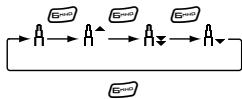
Lorsque vous appuyez sur ou pendant qu'une note est sélectionnée, la note monte ou descend d'un demi-ton.
Lors de la saisie d'un silence, un silence de noire est saisi.
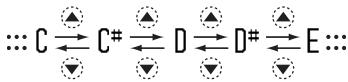
Pour spécifier les types de notes et de silences, appuyez sur ou à plusieurs reprises.
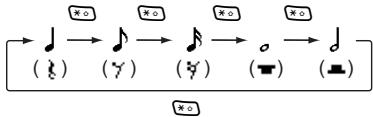
Pour créer une note pointée ou un triolet, appuyez sur après avoir sélectionné la note cible.
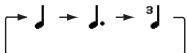
Remarque
- Vous ne pouvez pas créer une double croche pointée (ou un silence de double croche pointé) ni une ronde pointée (ou un silence de ronde pointé).
- Trois notes continues sont nécessaires pour un triolet.
Pour spécifier une liaison, appuyez sur après avoir sélectionné les notes cibles.
Un trait de soulignement (\underline{\mathbf{\alpha}}) est affiché à côté de la note, et la note est liée à la suivante.
Pour saisir la note suivante, appuyez sur pour déplacer le curseur vers la droite. Ensuite, répétez l'opération sur les pages précédentes.
Si le curseur est positionné à côté d'une note, vous pouvez répéter la note immédiatement à gauche du curseur lorsque ou est enfoncé.
Pour régler le timbre
Le téléphone peut jouer des notes en utilisant différents instruments. Vous pouvez choisir parmi 128 timbres de base (8 types de : Pianos, Carillons, Orgues, Guitares, Basses, Cordes 1, Cordes 2, Cuivres, Anches, Flûtes/Anches, Synth Leads, Synth Pads, Synth Effects, Ethnik, Percussions, et Effets) et 61 timbres étendus (40 types de Batterie (FM) et 21 types de Batterie (WT)).
- Appuyez sur [Options] et sélectionnez "Régler le timbre" à l'étape 7 de la page 80.
- Appuyez sur ou pour mettre en surbrillance une catégorie de timbre.
- Appuyez sur ou pour mettre en surbrillance un timbre.
- Appuyez sur
Vous pouvez maintenant créer une sonnerie originale.
Astuce
- Vous pouvez écouter la mélodie avec le timbre sélectionné en appuyant sur [Options] et en sélectionnant "Jouer la partie courante" à l'étape 4, ou écouter les noms des syllabes avec le timbre sélectionné en sélectionnant "Confirmer les timbres" à la place.
Pour régler la force du timbre
La force du timbre peut être réglée sur 3 niveaux pour chaque partie.
Lorsque vous achetez ce téléphone, la force du timbre est réglée sur "Fort".
- Appuyez sur [Options] et sélectionnez "Régler l'intensité" à l'étape 7 de la page 80.
- Sélectionnez une intensité pour la tonalité.
Vous pouvez maintenant créer une sonnerie originale.
Modification des sonneries originales (M 3-5-2)
"Applications" → "Éditeur de mélodie" → "Mes sons"
- Mettez en surbrillance la sonnerie originale que vous souhaitez modifier.
- Appuyez sur [Options] et sélectionnez "Modifier la mélodie".
- Modifiez le titre.
- Sélectionnez un tempo et un nombre de voix.
- Modifiez les données.
- Lorsque vous avez terminé la modification, appuyez sur [Options] et sélectionnez "Enregistrer".
- Sélectionnez "Enregistrer dans Mes éléments".
- Sélectionnez "Remplacer" ou "Nouveau".
Remarque
- Lorsque le nombre de voix est modifié à l'étape 4, un message de confirmation peut s'afficher. Si vous appuyez sur [Oui], une partie de la mélodie peut être supprimée.
Astuce
- Vous pouvez supprimer la mélodie avant ou après le curseur en appuyant sur [Options] et en sélectionnant "Supprimer après le curseur" ou "Supprimer avant le curseur".
Copier et coller des notes
Vous pouvez copier et déplacer une partie de la mélodie vers une autre position.
Seules les sonneries originales ou les mélodies modifiables peuvent être copiées ou déplacées.
- Dans l'écran de saisie de la partition, appuyez sur [Options] et sélectionnez "Copier" ou "Couper".
- Déplacez le curseur sur la première note à copier ou à couper, puis appuyez sur .
- Déplacez le curseur sur la dernière note pour mettre en surbrillance la zone, puis appuyez sur .
- Appuyez sur [Options] et sélectionnez "Coller".
- Déplacez le curseur à l'endroit où vous souhaitez coller les notes, puis appuyez sur .
Aide du téléphone (M 3-6)
Vous pouvez consulter la liste d'aide et l'utiliser pour vous guider dans les fonctions du téléphone.
"Applications" → "Aide du téléphone"
- Appuyez sur ou
Calendrier (M 7)
Le calendrier vous permet de planifier facilement des rendez-vous, associés à la date et à l'heure.
Ces entrées peuvent également être envoyées via la technologie sans fil infrarouge ou Bluetooth à un PC pour partager les mêmes plannings.
Création d'une nouvelle entrée
"Calendrier"
- Mettez en surbrillance le jour souhaité auquel vous voulez ajouter un événement.
- Appuyez sur [Options] et sélectionnez "Ajouter une nouvelle entrée".
- Saisissez le sujet.
- Saisissez le lieu.
- Sélectionnez la catégorie souhaitée.
- Saisissez la date de début.
- Saisissez l'heure de début.
- Sélectionnez la durée souhaitée.
- Sélectionnez l'option de rappel souhaitée.
Remarque
- La fonction de rappel sonne même si le téléphone est éteint.
- Le rappel ne retentira pas lorsque le « Volume de la sonnerie » (p. 93) est réglé sur « Silencieux ».
- Lorsque vous sélectionnez « Autre » à l'étape 8, vous pouvez saisir la date et l'heure de fin souhaitées.
- Lorsque vous sélectionnez « Autre » à l'étape 9, vous pouvez saisir la date et l'heure souhaitées.
- Sur l'écran de saisie de la date, lorsque vous saisissez la « Date de début » à l'étape 6 ou que vous choisissez « Autre » aux étapes 8 et 9, etc., appuyez sur [Options] et sélectionnez « Consulter le calendrier » pour faciliter la recherche de la date souhaitée dans le calendrier mensuel affiché.
Modification de la tonalité du rappel
« Calendrier »
- Sélectionnez le jour contenant les entrées d'agenda dont vous souhaitez modifier la tonalité du rappel.
- Mettez en surbrillance l'entrée souhaitée.
- Appuyez sur [Options] et sélectionnez « Modifier ».
- Sélectionnez le champ de rappel et choisissez l'option souhaitée.
Si vous sélectionnez « Aucun rappel », le rappel est désactivé.
- Sélectionnez « Tonalité » puis choisissez « Sons prédéfinis » ou « Mes sons ».
- Sélectionnez la tonalité souhaitée.
Pour plus de détails sur la sélection d'une sonnerie, voir "Assigner une sonnerie" à la page 94.
- Sélectionnez "Vibration" et choisissez parmi "Activée", "Désactivée" ou "Activée avec son".
Pour plus de détails sur la sélection d'une vibration, voir "Vibration" à la page 94.
- Sélectionnez "Durée" et saisissez la durée souhaitée.
- Appuyez sur [OK].
- Appuyez sur [Enregistrer].
Envoi d'une entrée de l'agenda
"Agenda"
- Sélectionnez le jour contenant les entrées de l'agenda que vous souhaitez envoyer.
- Mettez en surbrillance l'entrée souhaitée à envoyer.
- Appuyez sur [Options] et sélectionnez "Envoyer".
- Sélectionnez "Via Bluetooth" ou "Via infrarouge".
Pour "Via Bluetooth"
Le téléphone commence à rechercher les appareils compatibles avec la technologie sans fil Bluetooth dans un rayon de 10 mètres.
Lorsqu'ils sont détectés, une liste des appareils compatibles s'affiche, vous permettant de sélectionner l'appareil souhaité. La connexion peut être établie et l'entrée est envoyée.
Pour "Via infrarouge"
Le téléphone commence à rechercher un appareil compatible infrarouge dans un rayon de 20 centimètres.
Lorsqu'il est détecté, la connexion infrarouge est établie et l'entrée est envoyée.
Remarque
- Lors de l'appairage, vous devez saisir votre code d'accès lors du premier contact avec un appareil compatible avec la technologie sans fil Bluetooth, sauf si "Authentification" (p. 92) est réglé sur "Désactivée".
Réception d'une entrée d'agenda
Lorsque le téléphone reçoit une entrée d'agenda, un message de confirmation apparaît.
- Appuyez sur [Oui].
L'entrée reçue est enregistrée dans le calendrier. Appuyez sur [Non] pour la rejeter.
Astuce
- Pour plus de détails sur les réglages infrarouge ou Bluetooth, voir "Connectivité" à la page 90.
Affichage d'une entrée
"Calendrier"
- Sélectionnez le jour contenant les entrées d'agenda que vous souhaitez afficher.
La liste des entrées s'affiche.
- Sélectionnez l'entrée souhaitée.
Appuyez pour changer d'entrée, si disponible, dans le jour sélectionné.
Pour rechercher par date
- Dans la vue mensuelle ou quotidienne, appuyez sur [Options].
- Sélectionnez « Aller à ».
- Sélectionnez « Aujourd'hui » pour afficher aujourd'hui ou « Saisir la date » pour saisir la date souhaitée.
Pour rechercher par sujet
- Dans la vue mensuelle ou quotidienne, appuyez sur [Options].
- Sélectionnez « Rechercher ».
- Saisissez le texte souhaité.
Pour modifier le format de la semaine
- Dans la vue mensuelle, appuyez sur [Options].
- Sélectionnez « Format de la semaine ».
- Sélectionnez « Lundi-dimanche » ou « Dimanche-samedi ».
Suppression d'entrées
- Dans la vue mensuelle ou quotidienne, appuyez sur [Options].
- Sélectionnez "Supprimer".
- Sélectionnez l'option souhaitée.
- "Cette entrée" (vue quotidienne uniquement) :
Supprime l'entrée sélectionnée.
- "Toute cette journée" : Supprime toutes les entrées du jour sélectionné.
- "Tout ce mois" : Supprime toutes les entrées du mois sélectionné.
- "Jusqu'au mois dernier" :
Supprime toutes les entrées antérieures à ce mois.
- "Toutes les entrées" : Supprime toutes les entrées de cette application.
Contacts (M 8)
Journal d'appels (M 8-2)
Le téléphone enregistre les 10 derniers appels manqués, reçus et composés.
Consultation du journal d'appels
"Contacts" → "Journal d'appels"
- Appuyez sur ou pour basculer entre "Tous les appels", "Numéros composés", "Appels manqués" et "Appels reçus". La liste du journal d'appels sélectionné s'affiche.
- Sélectionnez le numéro de téléphone que vous souhaitez consulter. Si vous souhaitez composer le numéro, appuyez sur Q.
Astuce
- Vous pouvez également confirmer les journaux d'appels en appuyant sur en mode veille.
Envoi de messages
- Dans la liste du journal d'appels, mettez en surbrillance le journal d'appels auquel vous souhaitez envoyer un message.
- Appuyez sur [Options] et sélectionnez "Créer un message".
- Sélectionnez "Multimédia", "Texte" ou "Carte postale". Pour plus de détails sur la création d'un message, voir "Création d'un nouveau MMS" à la page 47 ou "Création et envoi d'un nouveau SMS" à la page 53.
Remarque
- Le service de carte postale n'est pas disponible avec certains fournisseurs de services. Veuillez contacter votre fournisseur de services pour plus d'informations.
Suppression d'une entrée du journal d'appels
- Dans la liste du journal d'appels, mettez en surbrillance l'entrée que vous souhaitez supprimer.
- Appuyez sur [Options] et sélectionnez "Supprimer".
Liste de numéros abrégés (M 8-3)
Vous pouvez consulter et effectuer d'autres opérations sur les numéros de téléphone enregistrés dans la liste de numéros abrégés.
"Contacts" → "Liste de numéros abrégés"
Les noms et numéros de téléphone stockés dans la liste de numéros abrégés sont affichés dans l'ordre.
Mes numéros (M 8-4)
Vous pouvez vérifier vos propres numéros de téléphone pour la voix, les données et le fax.
"Contacts" → "Mes numéros"
- Sélectionnez le numéro de téléphone que vous souhaitez vérifier parmi "Voix", "Données" ou "Fax".
Remarque
- "Données" ou "Fax" peuvent ne pas être affichés selon la carte SIM.
Minuteries d'appel (M 8-5)
Cette fonction vous permet de vérifier la durée de vos appels.
Vérification de la durée du dernier appel et de tous les appels
"Contacts" → "Minuteries d'appel"
- Sélectionnez "Appels reçus" ou "Numéros composés". La durée du dernier appel et de tous les appels s'affiche.
Compteur de données (M 8-6)
Vous pouvez confirmer le nombre d'octets que vous avez utilisés lors de la transmission GPRS.
"Contacts" → "Compteur de données"
- Sélectionnez "Dernières données" ou "Toutes les données".
Réinitialisation du compteur de données
"Contacts" → "Compteur de données" → "Effacer le compteur"
Coûts des appels (M 8-7)
Cette fonction vous permet de vérifier les frais de vos appels. Certains réseaux ne prennent pas en charge l'avis de taxation. Veuillez vérifier auprès de votre fournisseur de services la disponibilité de cette fonction.
Vérification du coût du dernier appel
"Contacts" → "Coûts des appels" → "Dernier appel" Le coût du dernier appel s'affiche.
Vérification du coût total des appels
"Contacts" → "Coûts des appels" → "Tous les appels"
Le coût de tous les appels est affiché.
Réglage du tarif de facturation
Réglez le tarif de facturation pour calculer le coût des appels et définissez la limite maximale du coût des appels.
"Contacts" → "Coûts d'appel" → "Unités de coût" → "Définir les unités"
- Saisissez votre code PIN2.
- Saisissez un coût par unité.
Pour saisir un point décimal, appuyez sur
- Saisissez une unité monétaire (jusqu'à 3 caractères).
Réglage de la limite de coût
Cette fonction est utile si vous souhaitez vous assurer de ne pas dépasser une certaine limite de coût.
"Contacts" → "Coûts d'appel" → "Coût maximal" → "Définir la limite"
- Saisissez votre code PIN2.
- Saisissez une valeur.
Pour saisir un point décimal, appuyez sur
Réinitialisation de tous les coûts d'appel
"Contacts" → "Call Costs" → "Clear Costs"
- Saisissez votre code PIN2.
Vérification du crédit résiduel
"Contacts" → "Call Costs" → "Residual Credit"
Paramètres (M 9)
Connectivité (M 9-1)
En configurant les paramètres de ce menu, vous pouvez vous connecter à des téléphones compatibles avec la technologie sans fil Bluetooth ou infrarouge via ces connexions, ainsi qu'à un PC via la technologie sans fil Bluetooth, infrarouge ou USB.
Utilisation de la fonction sans fil Bluetooth (M 9-1-1)
Pour activer ou désactiver
"Paramètres" → "Connectivité" → "Bluetooth" → "Activer/Désactiver"
- Sélectionnez "On" ou "Off".
Si le paramètre infrarouge a été activé, il vous sera demandé si vous souhaitez le désactiver ou non. Appuyez sur [Oui].
Le paramètre sans fil Bluetooth est activé et " 念 " s'affiche.
Astuce
- Vous pouvez activer ou désactiver la fonction sans fil Bluetooth en appuyant sur ○, puis pendant le mode veille.
Pour rechercher des appareils à appairer
Pour utiliser la fonction sans fil Bluetooth, vous devez rechercher d'autres appareils compatibles avec la technologie Bluetooth pour établir un contact avec votre téléphone. Gardez votre téléphone à une distance de 10 mètres avant la recherche.
"Paramètres" → "Connectivité" → "Bluetooth" → "Rechercher des appareils"
Le téléphone commence à rechercher les appareils dans un rayon de 10 mètres.
- Sélectionnez l'appareil souhaité pour l'appairage.
- Saisissez le code d'accès de l'appareil.
Remarque
- Si la fonction sans fil Bluetooth est désactivée avant la recherche, le téléphone active automatiquement la fonction sans fil Bluetooth et commence la recherche.
- Si la fonction infrarouge est active, l'écran de confirmation pour désactiver la fonction infrarouge s'affiche. Appuyez sur [Oui] pour désactiver.
- Vous ne pouvez sélectionner qu'un seul appareil pour l'appairage. Pour changer l'appareil appairé, voir "Dispositifs mains libres" à la page 91.
Dispositifs mains libres
Vous pouvez activer, renommer et supprimer le dispositif mains libres appairé dans la liste.
Pour activer un appareil
"Paramètres" → "Connectivité" → "Bluetooth" → "Dispositifs mains libres"
- Sélectionnez l'appareil que vous souhaitez activer.
Astuce
- Vous pouvez économiser la batterie en désactivant la fonction sans fil Bluetooth lorsqu'elle n'est pas utilisée. Désactivez la fonction sans fil Bluetooth dans « Pour activer ou désactiver » à la page 90 ou dans « Pour désactiver automatiquement » à la page 92.
- Pendant un appel, vous pouvez transférer l'appel vocal vers l'appareil apparié. Appuyez sur [Options] et sélectionnez « Activer Bluetooth ». Si vous souhaitez déconnecter l'appareil apparié, sélectionnez « Désactiver Bluetooth ».
Pour renommer un appareil
« Paramètres » → « Connectivité » → « Bluetooth » → « Appareils mains libres »
- Mettez en surbrillance l'appareil que vous souhaitez renommer.
- Appuyez sur [Options] et sélectionnez « Changer le nom ».
- Renommez l'appareil.
Pour effacer un nom d'appareil
« Paramètres » → « Connectivité » → « Bluetooth » → « Appareils mains libres »
- Mettez en surbrillance l'appareil dont vous souhaitez effacer le nom.
- Appuyez sur [Options] et sélectionnez « Supprimer ».
Appareils appariés
Vous pouvez renommer et supprimer l'appareil apparié dans la liste.
Paramètres Bluetooth sans fil
Grâce à ce paramètre, vous pouvez renommer votre téléphone, empêcher les autres téléphones GX25 de reconnaître votre téléphone, désactiver automatiquement la fonction sans fil Bluetooth pour économiser la batterie, etc.
Pour renommer votre téléphone
Vous pouvez renommer votre téléphone. Le nom est affiché sur les autres appareils lorsque votre téléphone est détecté.
"Paramètres" → "Connectivité" → "Bluetooth" → "Paramètres Bluetooth" → "Nom de l'appareil"
- Saisissez le nouveau nom de l'appareil.
Pour afficher ou masquer votre téléphone
"Paramètres" → "Connectivité" → "Bluetooth" → "Visibilité"
- Sélectionnez les paramètres de visibilité souhaités.
"Afficher mon téléphone" : Permet à d'autres appareils de reconnaître votre téléphone.
"Masquer mon téléphone" : Masque votre téléphone aux autres appareils.
Pour désactiver automatiquement
"Paramètres" → "Connectivité" → "Bluetooth" → "Paramètres Bluetooth" → "Délai d'expiration Bluetooth"
- Sélectionnez la durée souhaitée.
Votre téléphone désactive automatiquement la fonction après le délai spécifié.
Pour activer ou désactiver la demande d'authentification Vous pouvez demander à l'expéditeur ou au destinataire des données OBEX d'authentifier le code secret (échange du code secret) avant d'appairer les appareils.
"Réglages" → "Connectivité" → "Bluetooth" → "Paramètres Bluetooth" → "Authentification"
- Sélectionnez "Activé" ou "Désactivé".
Remarque
- Aucune authentification n'est requise pour les appareils appariés.
- Même si vous sélectionnez "Désactivé", vous pouvez authentifier le code d'accès lorsque l'expéditeur le demande.
Utilisation de la fonction infrarouge (M 9-1-2)
"Réglages" → "Connectivité" → "Infrarouge"
- Sélectionnez "Activé" ou "Désactivé".
Si la fonction sans fil Bluetooth a été activée, il vous sera demandé si vous souhaitez la désactiver ou non. Appuyez sur [Oui].
"?" apparaîtra à l'écran.
Le réglage infrarouge reviendra à désactivé lorsqu'aucune donnée n'est transmise/reçue via la communication infrarouge.
Logiciel PC (M 9-1-3)
En connectant votre téléphone à un PC, vous pouvez transmettre des images, des sons, des clips vidéo, des entrées de la liste de contacts et des entrées de l'agenda. Suivez la procédure pour sélectionner la méthode de connexion (sans fil Bluetooth, USB ou connexion infrarouge). Pour plus de détails sur l'obtention du logiciel de liaison, voir page 114.
"Réglages" → "Connectivité" → "Logiciel PC"
- Sélectionnez le type de connexion souhaité parmi "Câble de données", "Infrarouge" ou "Bluetooth".
Profils (M 9-2)
Les réglages de sonnerie, de tonalité et de vibration peuvent être personnalisés pour chaque profil selon votre environnement.
Il existe 6 profils, dont un profil définissable par l'utilisateur : Normal, Réunion, Activité, Voiture, Casque et Silencieux.
Activation d'un profil
"Réglages" → "Profils"
- Sélectionnez le profil souhaité.
Remarque
- Lorsqu'un profil est défini, l'icône correspondante décrite à la page 16 s'affiche sur l'écran de veille.
Astuce
- Maintenez enfoncée pour basculer les réglages de profils entre les modes Normal et Silencieux en veille.
Personnalisation des profils
"Réglages" → "Profils"
- Mettez en surbrillance le profil que vous souhaitez personnaliser.
- Appuyez sur [Options] et sélectionnez "Personnaliser".
- Sélectionnez le réglage que vous souhaitez personnaliser et modifiez-le comme vous le souhaitez. Pour plus de détails sur les réglages, voir pages 93 à 98.
- Appuyez sur [Enregistrer] lorsque vous avez terminé.
Réinitialisation des réglages de profil
"Réglages" → "Profils"
- Mettez en surbrillance le profil que vous souhaitez réinitialiser.
- Appuyez sur [Options] et sélectionnez "Rétablir les valeurs par défaut".
- Saisissez votre code de combiné.
Le code de combiné par défaut est "0000". Pour plus de détails sur la modification du code de combiné, voir "Pour modifier le code de combiné" à la page 112.
Volume de la sonnerie
Vous pouvez régler le volume de la sonnerie sur l'un des 6 niveaux ou sur une tonalité progressive.
"Réglages" → "Profils"
- Mettez en surbrillance le profil que vous souhaitez personnaliser.
- Appuyez sur [Options] et sélectionnez "Personnaliser".
- Sélectionnez "Volume de la sonnerie".
Le niveau de volume actuel est affiché.
- Appuyez sur (ou) pour augmenter le volume de la sonnerie ou sur (ou) pour le diminuer, puis appuyez sur .
Pour sélectionner "Bip progressif", appuyez sur (ou ) au niveau 5. Pour sélectionner "Silencieux", appuyez sur (ou ) au niveau 1.
Attribution de la sonnerie
Vous pouvez choisir la sonnerie parmi 28 tonalités, dont 5 motifs, 3 alertes, 10 effets sonores et 10 mélodies. Vous pouvez également sélectionner un son dans Sons enregistrés comme sonnerie par défaut, à l'exclusion des formats AMR ou WAVE.
"Réglages" → "Profils"
- Mettez en surbrillance le profil que vous souhaitez personnaliser.
- Appuyez sur [Options] et sélectionnez "Personnaliser".
- Sélectionnez "Attribuer une sonnerie".
- Sélectionnez "Sons prédéfinis" ou "Mes sons".
- Sélectionnez la sonnerie que vous souhaitez utiliser. Pour écouter l'aperçu, appuyez sur . Pour arrêter la lecture, appuyez à nouveau sur .
- Appuyez sur [Options] et sélectionnez "Attribuer".
Remarque
- Si vous supprimez une sonnerie qui utilise un son de Sons enregistrés, la sonnerie par défaut est définie.
Vibration
Lorsque l'option vibreur est activée, le téléphone vibre pour les appels entrants, quel que soit le volume de la sonnerie et les réglages de tonalité.
"Réglages" → "Profils"
- Mettez en surbrillance le profil que vous souhaitez personnaliser.
- Appuyez sur [Options] et sélectionnez "Personnaliser".
- Sélectionnez "Vibration".
- Sélectionnez parmi "Activée", "Désactivée" ou "Activée et liée au son".
Astuce
- Lorsque l'option "Activée et liée au son" est sélectionnée à l'étape 4, le vibreur se synchronise avec la mélodie choisie pour vibrer en rythme avec celle-ci. Veuillez noter que toutes les mélodies ne prennent pas en charge l'option "Activée et liée au son". Si vous sélectionnez une telle mélodie, seule l'option "Activée" à l'étape 4 permettra la fonction vibreur.
- Lorsque vous sélectionnez "Activée" ou "Activée et liée au son" à l'étape 4, "■" s'affiche sur l'écran de veille.
Lumière
Lorsque l'option lumière est activée, la lumière du téléphone s'allume lorsque le téléphone reçoit un appel.
"Réglages" → "Profils"
- Mettez en surbrillance le profil que vous souhaitez personnaliser.
- Appuyez sur [Options] et sélectionnez « Personnaliser ».
- Sélectionnez « Lumière ».
- Sélectionnez « Activée », « Désactivée » ou « Activée et liée au son ».
Astuce
- Lorsque l'option « Activée et liée au son » est sélectionnée à l'étape 4, l'éclairage se synchronise avec la mélodie choisie et pulse en rythme avec celle-ci. Veuillez noter que toutes les mélodies ne prennent pas en charge l'option « Activée et liée au son ». Si vous sélectionnez une telle mélodie, seule l'option « Activée » à l'étape 4 permettra la fonction lumineuse.
Alertes
Vous pouvez personnaliser les profils pour les alertes, y compris le son d'avertissement, l'alerte de message et l'alerte de batterie faible.
Son d'avertissement
Votre téléphone émet un son d'avertissement lorsqu'une erreur se produit.
« Paramètres » → « Profils »
- Mettez en surbrillance le profil que vous souhaitez personnaliser.
- Appuyez sur [Options] et sélectionnez « Personnaliser ».
- Sélectionnez « Alertes ».
- Sélectionnez « Son d'avertissement ».
- Sélectionnez « Activer/Désactiver ».
- Sélectionnez « On » ou « Off ».
- Sélectionnez « Volume » et choisissez entre « High », « Middle » ou « Low ».
- Sélectionnez « Sonnerie » et choisissez entre « Sons prédéfinis » ou « Mes sons ».
- Sélectionnez la sonnerie souhaitée. Pour plus de détails sur la sélection d'une sonnerie, voir « Assigner une sonnerie » à la page 94.
- Sélectionnez « Durée » et choisissez la durée souhaitée.
Alerte de message
Lors de la réception de messages, des sonneries spéciales peuvent être définies.
« Paramètres » → « Profils »
- Mettez en surbrillance le profil que vous souhaitez personnaliser.
- Appuyez sur [Options] et sélectionnez « Personnaliser ».
- Sélectionnez « Alertes ».
- Sélectionnez « Alerte de message ».
- Sélectionnez parmi « Multimédia », « Texte » ou « WAP ».
- Sélectionnez « Volume » et choisissez le volume souhaité.
- Sélectionnez « Son » et choisissez entre « Sons prédéfinis » ou « Mes sons ».
- Sélectionnez la sonnerie souhaitée.
Pour plus de détails sur la sélection d'une sonnerie, voir « Attribution d'une sonnerie » à la page 94.
- Sélectionnez « Vibration » et choisissez entre « Activée », « Désactivée » ou « Activée et liée au son ».
Pour plus de détails sur la sélection d'une vibration, voir « Vibration » à la page 94.
- Sélectionnez « Lumière » et choisissez entre « Activée », « Désactivée » ou « Activée et liée au son ».
Pour plus de détails sur la sélection d'une lumière, voir « Lumière » à la page 95.
- Sélectionnez « Durée » et saisissez la durée souhaitée.
Alerte de batterie faible
Réglez le volume de l'alerte lorsque la batterie devient faible.
« Paramètres » → « Profils »
- Mettez en surbrillance le profil que vous souhaitez personnaliser.
- Appuyez sur [Options] et sélectionnez « Personnaliser ».
- Sélectionnez « Alertes ».
- Sélectionnez « Alerte de batterie faible ».
- Choisissez entre « Élevée », « Faible » ou « Silencieuse ».
Touches du clavier
Lorsque la tonalité des touches est activée, vous entendrez une tonalité de confirmation à chaque pression sur une touche.
"Paramètres" → "Profils"
- Mettez en surbrillance le profil que vous souhaitez personnaliser.
- Appuyez sur [Options] et sélectionnez "Personnaliser".
- Sélectionnez "Tonalité des touches".
- Sélectionnez "Activer/Désactiver".
- Sélectionnez "Activé" ou "Désactivé".
- Sélectionnez "Volume" et choisissez parmi "Élevé", "Moyen" ou "Faible".
- Sélectionnez "Tonalité" et choisissez parmi "Sons prédéfinis", "Mes sons" ou "Tonalité par défaut". Si vous sélectionnez "Tonalité par défaut", passez à l'étape 9.
- Sélectionnez la tonalité souhaitée. Pour plus de détails sur la sélection de la tonalité, voir "Attribution de sonnerie" à la page 94.
- Sélectionnez "Durée" et choisissez la durée souhaitée.
Volume multimédia
Vous pouvez régler le volume pour la caméra vidéo, l'enregistreur vocal, l'éditeur de mélodies, Mes éléments, le navigateur et les messages multimédias.
"Paramètres" → "Profils"
- Mettez en surbrillance le profil que vous souhaitez personnaliser.
- Appuyez sur [Options] et sélectionnez "Personnaliser".
- Sélectionnez "Volume multimédia". Le niveau de volume actuel est affiché.
- Appuyez sur (ou) pour augmenter le volume ou sur (ou) pour le diminuer, puis appuyez sur Pour sélectionner "Silencieux", appuyez sur (ou) au niveau 1.
Son d'allumage/Son d'extinction
Le téléphone peut être configuré pour émettre un son lorsqu'il est allumé ou éteint. Vous pouvez définir le volume, la durée et la mélodie à utiliser pour cette tâche.
"Paramètres" → "Profils"
- Mettez en surbrillance le profil que vous souhaitez personnaliser.
- Appuyez sur [Options] et sélectionnez "Personnaliser".
- Sélectionnez "Son d'allumage" ou "Son d'extinction".
- Sélectionnez "Activer/Désactiver".
- Sélectionnez "Activé" ou "Désactivé".
- Sélectionnez "Volume" et choisissez le volume souhaité.
- Sélectionnez « Son » puis « Sonneries prédéfinies » ou « Mes sons ».
- Sélectionnez le son souhaité. Pour plus de détails sur la sélection d'un son, voir « Assigner une sonnerie » à la page 94.
- Sélectionnez « Durée » et saisissez la durée souhaitée.
Annulation d'écho
Cette fonction permet d'annuler les échos gênants, en particulier lors de l'utilisation du kit mains libres en voiture.
« Paramètres » → « Profils »
- Mettez en surbrillance le profil que vous souhaitez personnaliser.
- Appuyez sur [Options] et sélectionnez « Personnaliser ».
- Sélectionnez « Annulation d'écho ».
- Sélectionnez « Activé » ou « Désactivé ».
Réponse par touche
Vous pouvez également répondre à un appel en appuyant sur n'importe quelle touche, sauf sur [Occupé]. Pour plus de détails, voir page 20.
« Paramètres » → « Profils »
- Mettez en surbrillance le profil que vous souhaitez personnaliser.
- Appuyez sur [Options] et sélectionnez « Personnaliser ».
- Sélectionnez « Réponse par touche quelconque ».
- Sélectionnez « Activé » ou « Désactivé ».
Réponse automatique (pour kit mains libres voiture uniquement)
La fonction de réponse automatique vous permet de répondre aux appels automatiquement en connectant le kit mains libres voiture Bluetooth à votre téléphone via la technologie sans fil Bluetooth.
Vous pouvez sélectionner le délai souhaité avant que votre téléphone ne réponde.
« Paramètres » → « Profils »
- Mettez en surbrillance « Voiture ».
- Appuyez sur [Options] et sélectionnez « Personnaliser ».
- Sélectionnez « Réponse automatique ».
- Sélectionnez le délai souhaité. Sélectionnez « Désactivé » pour le désactiver.
Réglage de l'affichage (M 9-3)
Vous pouvez modifier les réglages de l'écran.
Réglage de l'écran principal (M 9-3-1)
Pour définir le fond d'écran
Pour l'écran de veille, 3 images sont fournies.
Les photos prises avec l'appareil photo numérique ou les images téléchargées depuis un site WAP peuvent être utilisées comme fonds d'écran.
Pour définir mes photos
"Paramètres" → "Affichage" → "Écran principal" → "Fond d'écran" → "Mes photos"
- Sélectionnez la photo souhaitée.
- Après avoir affiché la photo, appuyez sur ○
- Spécifiez la zone que vous souhaitez afficher à l'aide des touches de navigation.
Remarque
- Certaines photos ne peuvent pas être utilisées en raison de leur type d'image ou de données.
- Lorsque vous utilisez un fichier au format GIF animé, désactivez l'option "Calendrier en veille".
Pour afficher le calendrier mensuel
Vous pouvez afficher le calendrier mensuel en mode veille.
Par défaut, un calendrier de deux mois est affiché.
"Paramètres" → "Affichage" → "Écran principal" → "Calendrier en veille"
- Sélectionnez "Un mois" ou "Deux mois". Sélectionnez "Désactivé" pour le désactiver.
Remarque
- Si vous sélectionnez "Un mois" ou "Deux mois" lors de l'utilisation du fichier au format GIF animé pour le fond d'écran, le réglage du fond d'écran est réinitialisé par défaut. Lors de l'utilisation du fichier au format GIF animé, sélectionnez "Désactivé".
Astuce
- Le format hebdomadaire du calendrier mensuel dépend du réglage de "Format de semaine" (p. 86).
Pour attribuer les images
Les images peuvent être affichées lors de la mise sous tension ou hors tension, à la réception d'un appel entrant, ou lors de l'utilisation de l'alarme.
Les photos prises par un appareil photo numérique ou les images téléchargées depuis un site WAP peuvent être utilisées.
Pour définir des images intégrées
"Réglages" → "Affichage" → "Écran principal" → "Graphiques"
- Sélectionnez la situation souhaitée pour définir l'image.
- Sélectionnez "Animation prédéfinie" lorsque vous sélectionnez "Mise sous tension" ou "Mise hors tension" à l'étape 1. Sélectionnez "Motif 1", "Motif 2" ou "Motif 3" lorsque vous sélectionnez "Appel entrant" ou "Alarme" à l'étape 1.
Pour définir mes images
"Réglages" → "Affichage" → "Écran principal" → "Graphiques"
- Sélectionnez la situation souhaitée pour définir l'image.
- Sélectionnez "Mes images".
- Sélectionnez l'image souhaitée.
- Après avoir affiché l'image, appuyez sur .
- Spécifiez la zone que vous souhaitez afficher à l'aide des touches de navigation.
Remarque
- Certaines images ne peuvent pas être utilisées en raison de leur type d'image et de données.
Pour définir le message d'accueil
Vous pouvez définir le message qui apparaîtra lorsque le téléphone est allumé.
"Paramètres" → "Affichage" → "Écran principal" → "Message d'accueil"
- Sélectionnez "Activer/Désactiver".
- Sélectionnez "Activé" ou "Désactivé".
- Sélectionnez "Modifier le message" et saisissez le message. Jusqu'à 16 caractères peuvent être stockés comme message. Pour plus de détails sur la saisie de caractères, voir "Saisie de caractères" à la page 25.
Pour afficher l'horloge
Vous pouvez afficher la date et/ou l'heure actuelles sur l'écran de veille.
"Paramètres" → "Affichage" → "Écran principal" → "Afficher l'horloge"
- Sélectionnez "Heure uniquement", "Date et heure" ou "Désactivé".
Pour régler le rétroéclairage
Vous pouvez activer ou désactiver le rétroéclairage de l'écran lorsque vous appuyez sur le clavier ou lorsque le chargeur allume-cigare en option est connecté au téléphone.
Vous pouvez modifier la durée d'activation du rétroéclairage, ce qui permet d'économiser la batterie.
Astuce
- Lors de l'achat de ce téléphone, le rétroéclairage est réglé sur 15 secondes.
Pour sélectionner la durée de temporisation du rétroéclairage
"Paramètres" → "Affichage" → "Écran principal" → "Rétroéclairage" → "Temporisation"
- Sélectionnez la durée souhaitée.
Sélectionnez "Désactivé" pour l'éteindre.
Pour activer/désactiver le rétroéclairage pendant la charge avec le chargeur allume-cigare
Lorsque ce réglage est activé, le rétroéclairage du téléphone est allumé lorsque le chargeur allume-cigare est connecté.
"Paramètres" → "Affichage" → "Écran principal" → "Rétroéclairage" → "En voiture"
- Sélectionnez "Activé" ou "Désactivé".
Pour régler la luminosité du rétroéclairage
Vous pouvez régler la luminosité du rétroéclairage de l'écran sur 4 niveaux.
"Paramètres" → "Affichage" → "Écran principal" → "Rétroéclairage" → "Luminosité"
- Réglez la luminosité en appuyant sur (Clair) et (Sombre) pour une clarté maximale.
- Appuyez sur
Pour régler l'économie d'affichage
L'écran de ce téléphone s'éteindra automatiquement.
Vous pouvez modifier le délai avant que l'économie d'affichage ne s'active, ce qui permet d'économiser la batterie.
Astuce
- Lors de l'achat de ce téléphone, l'économie d'affichage est réglée sur 10 minutes.
"Paramètres" → "Affichage" → "Écran principal" → "Économie d'affichage"
- Sélectionnez la durée souhaitée.
Remarque
- L'économie d'affichage ne fonctionne pas pendant un appel, une utilisation WAP ou une application.
- Pour annuler l'économie d'affichage : l'économie d'affichage continue jusqu'à ce qu'une touche soit enfoncée ou qu'une alerte entrante se produise. La première pression sur une touche annule uniquement cette fonction. Vous devez appuyer sur une autre touche pour saisir une valeur numérique ou textuelle.
Réglage de l'écran externe (M 9-3-2)
Pour sélectionner le délai de rétroéclairage
Vous pouvez sélectionner le délai de rétroéclairage pour l'écran externe.
"Réglages" → "Affichage" → "Écran externe" → "Rétroéclairage"
- Sélectionnez la durée souhaitée.
Sélectionnez "Désactivé" pour l'éteindre.
Pour régler le contraste
Vous pouvez régler le contraste LCD de l'écran externe sur 9 niveaux.
"Réglages" → "Affichage" → "Écran externe" → "Contraste LCD"
- Réglez le contraste en appuyant sur (Élevé) et (Bas) pour une clarté maximale.
- Appuyez sur
Réinitialisation des réglages d'affichage (M 9-3-3)
Les réglages d'affichage peuvent être réinitialisés à leurs valeurs par défaut.
"Réglages" → "Affichage" → "Rétablir les valeurs par défaut"
- Saisissez votre code de combiné.
Le code de combiné par défaut est "0000". Pour plus de détails sur la modification du code de combiné, voir "Pour modifier le code de combiné" à la page 112.
Son (M 9-4)
Vous pouvez utiliser ce menu pour vérifier ou modifier les réglages des profils actuels.
Paramètres d'appel (M 9-5)
Définit divers types de fonctions et de services.
Renvois d'appels (M 9-5-1)
Ce service permet de renvoyer les appels entrants vers votre messagerie vocale ou vers un autre numéro, selon certaines conditions dans lesquelles vous ne pouvez pas répondre à un appel.
Pour renvoyer des appels
"Paramètres" → "Paramètres d'appel" → "Renvois d'appels"
- Sélectionnez l'une des options suivantes.
- "Tous les appels" : renvoie tous les appels vocaux sans sonnerie.
- "Lorsque occupé" : renvoie les appels entrants lorsque vous êtes en communication.
- "Sans réponse" : renvoie les appels entrants si vous ne répondez pas à un appel dans un délai déterminé.
- "Injoignable" : renvoie les appels entrants lorsque votre téléphone est hors du réseau ou éteint.
- Sélectionnez "Activé".
- Sélectionnez l'entrée de la liste de contacts souhaitée, y compris un numéro de téléphone que vous souhaitez transférer.
Si l'entrée souhaitée n'existe pas, sélectionnez "Saisir le numéro" et entrez le numéro de téléphone.
- Appuyez sur Si vous sélectionnez "Sans réponse" à l'étape 1 :
- Sélectionnez la période parmi 6 niveaux (05 à 30 secondes).
Remarque
- Lorsqu'un transfert est défini sur "Tous les appels", "[]" est affiché sur l'écran de veille.
Astuce
- Si vous sélectionnez "Par service" à l'étape 2, vous pouvez sélectionner d'autres options de transfert.
Pour vérifier l'état du transfert
"Paramètres" → "Paramètres d'appel" → "Transferts"
- Sélectionnez l'option de transfert que vous souhaitez vérifier.
- Sélectionnez "État".
Vous pouvez vérifier l'état de l'option de transfert sélectionnée.
Appel en attente (M 9-5-2)
Si vous souhaitez pouvoir recevoir un autre appel entrant pendant que vous avez un appel en cours, vous devez activer le service d'appel en attente.
"Paramètres" → "Paramètres d'appel" → "Appel en attente"
- Sélectionnez "Activé" ou "Désactivé".
Remarque
- Le service d'appel en attente peut ne pas être disponible sur tous les réseaux de téléphonie mobile. Contactez votre opérateur réseau pour plus d'informations.
Afficher votre numéro de téléphone (M 9-5-3)
Cette option vous permet de contrôler si votre numéro de téléphone est affiché lorsque vous appelez un autre correspondant ou non.
"Paramètres" → "Paramètres d'appel" → "Afficher votre numéro"
- Sélectionnez "Activé" ou "Désactivé".
Remarque
- Certains réseaux ne prennent pas en charge ce service. Veuillez vérifier la disponibilité auprès de votre fournisseur de services.
Restreindre les appels (M 9-5-4)
Cette fonction vous permet de restreindre les appels entrants et sortants. Pour activer cette option, vous aurez besoin du mot de passe spécifié, disponible auprès de votre fournisseur de services.
"Paramètres" → "Paramètres d'appel" → "Restreindre les appels"
- Sélectionnez "Appels sortants" ou "Appels entrants".
- Appels sortants : restreint les appels sortants.
- Appels entrants : restreint les appels entrants.
- Sélectionnez l'une des options suivantes.
(Pour "Appels sortants")
- Bloquer les appels étrangers : restreint tous les appels sortants internationaux.
- Bloquer tous les appels sortants : restreint tous les appels sortants, sauf les appels d'urgence.
- Uniquement local et national : restreint tous les appels sortants internationaux, sauf vers votre pays d'origine.
(Pour "Appels entrants")
- Bloquer tous les appels entrants : restreint tous les appels entrants.
- Barre à l'étranger : Restreint tous les appels entrants lorsque vous êtes hors de la zone de couverture de votre opérateur réseau enregistré.
- Sélectionnez l'une des options suivantes.
- "Tous les services" : Restreint tous les services.
- "Appels vocaux" : Restreint tous les appels vocaux.
- "Données" : Restreint tous les appels de données. -Fax" : Restreint tous les appels de fax.
- "Messages" : Restreint tous les messages.
- "Tout sauf les messages" : Restreint tous les services sauf les messages.
- Sélectionnez "Activé" ou "Désactivé".
- Entrez le mot de passe du réseau.
Pour annuler les paramètres
"Réglages" → "Réglages d'appel" → "Restreindre les appels"
- Sélectionnez "Appels sortants" ou "Appels entrants".
- Sélectionnez "Tout annuler".
- Saisissez le mot de passe réseau.
Numérotation fixe
Lorsque la numérotation fixe est activée, vous ne pouvez appeler que des numéros prédéfinis.
Pour activer la numérotation fixe
"Réglages" → "Réglages d'appel" → "Restreindre les appels" → "Numérotation fixe"
- Saisissez votre code PIN2.
- Sélectionnez "Activer/Désactiver".
- Sélectionnez "Activé" ou "Désactivé".
Pour ajouter un nouveau nom
"Réglages" → "Réglages d'appel" → "Restreindre les appels" → "Numérotation fixe"
- Saisissez votre code PIN2.
- Sélectionnez "Modifier la liste d'appels".
- Sélectionnez « Ajouter un contact ».
- Ajoutez un nom et un numéro de téléphone. Pour plus de détails sur l'ajout d'un nom et d'un numéro de téléphone, voir « Ajouter un contact » à la page 32.
- Appuyez sur [Enregistrer].
Modification du mot de passe réseau
« Paramètres » → « Paramètres d'appel » → « Restrictions d'appel » → « Changer le mot de passe »
- Saisissez l'ancien mot de passe réseau.
- Saisissez un nouveau mot de passe réseau.
- Saisissez à nouveau le nouveau mot de passe réseau. Si vous saisissez un mot de passe incorrect, il vous sera demandé de le saisir à nouveau.
- Appuyez sur ○
Rappel automatique (M 9-5-5)
Voir « Rappel automatique » à la page 20.
Minuteur d'appel (M 9-5-6)
La fonction Minuteur d'appel vous informe de la durée de votre appel en émettant un signal sonore après chaque minute.
« Paramètres » → « Paramètres d'appel » → « Minuteur d'appel »
- Sélectionnez « Activé » ou « Désactivé ».
Réinitialisation des paramètres d'appel (M 9-5-7)
Les paramètres d'appel peuvent être réinitialisés à leurs valeurs par défaut.
"Réglages" → "Paramètres d'appel" → "Rétablir les valeurs par défaut"
- Saisissez le code de votre combiné.
Le code de combiné par défaut est "0000". Pour plus de détails sur la modification du code de combiné, voir "Modification du code de combiné" à la page 112.
Date et heure (M 9-6)
Vous devez régler l'heure et la date correctes pour que les différentes fonctions de votre téléphone basées sur l'heure fonctionnent correctement.
"Réglages" → "Date et heure" → "Régler la date/l'heure"
- Saisissez le jour, le mois, l'année et l'heure à l'aide des touches numériques.
Astuce
- Lorsque vous saisissez l'heure au format 12 heures, appuyez sur pour basculer entre am et pm. L'ordre d'affichage de la date et de l'heure dépend du paramètre de format.
Sélection du format de l'heure
"Réglages" → "Date et heure" → "Format de l'heure"
- Sélectionnez "12 heures" ou "24 heures".
Sélection du format de la date
"Réglages" → "Date et heure" → "Format de date"
- Choisissez parmi "J.M.A", "M-J-A" ou "A/M/J".
Réglage de l'heure d'été
"Réglages" → "Date et heure" → "Heure d'été"
- Sélectionnez "Activé" ou "Désactivé".
Réglage du fuseau horaire
"Réglages" → "Date et heure" → "Fuseau horaire" → "Changer de zone"
- Appuyez sur ou pour sélectionner la ville de résidence à définir.
Personnalisation du fuseau horaire
"Réglages" → "Date et heure" → "Fuseau horaire" → "Définir une zone personnalisée"
- Saisissez les différences de fuseau horaire à l'aide des touches numériques. Appuyer sur permet de basculer entre - et +.
Changement de langue (M 9-7)
Vous pouvez changer la langue utilisée par le téléphone pour afficher les messages.
"Réglages" → "Langue"
- Sélectionnez la langue souhaitée.
Astuce
- Vous pouvez également changer la langue de saisie sur l'écran de saisie de texte (p. 26).
Remarque
- Si vous sélectionnez « Automatique » à l'étape 1, la langue prédéfinie sur la carte SIM est sélectionnée.
- Si la langue prédéfinie sur la carte SIM n'est pas prise en charge, la langue par défaut du téléphone est alors sélectionnée.
Réseau (M 9-8)
Paramètres réseau (M 9-8-1)
Pour sélectionner un réseau automatiquement
Chaque fois que le téléphone est allumé, il essaie toujours de se connecter au réseau préféré.
Si votre téléphone n'est pas connecté au réseau, vous pouvez effectuer les opérations suivantes immédiatement pour établir la connexion au réseau préféré.
« Paramètres » → « Réseau » → « Sélectionner le réseau » → « Automatique »
Pour configurer le réseau manuellement
« Paramètres » → « Réseau » → « Sélectionner le réseau » → « Manuel »
- Sélectionnez le réseau souhaité.
Pour ajouter un nouveau réseau
"Réglages" → "Réseau" → "Sélectionner le réseau" → "Ajouter un nouveau réseau"
S'il n'y a aucune entrée, appuyez sur et passez à l'étape 2.
S'il y a une entrée, appuyez sur et effectuez les étapes suivantes.
- Sélectionnez "Ajouter".
- Saisissez l'indicatif du pays.
- Saisissez le code du réseau.
- Saisissez un nouveau nom de réseau.
Pour modifier la position d'un réseau dans la liste préférée
"Réglages" → "Réseau" → "Sélectionner le réseau" → "Définir préféré"
- Sélectionnez le nom du réseau dont vous souhaitez modifier la position dans la liste.
- Sélectionnez "Insérer" ou "Ajouter à la fin".
Pour supprimer un réseau de la liste préférée
"Réglages" → "Réseau" → "Sélectionner le réseau" → "Définir préféré"
- Sélectionnez le nom du réseau que vous souhaitez supprimer.
- Sélectionnez "Supprimer".
Paramètres WAP/MMS/E-mail
Remarque
- Pour un fonctionnement normal, vous n'avez pas besoin de modifier les paramètres WAP/MMS.
Paramètres WAP (* : élément à définir comme obligatoire)
"Nom du profil"* : nom du profil WAP (nom unique)
"Adresse IP"* : adresse IP pour le WAP
"Page d'accueil" : page d'accueil
"Numéro de port"* : option de sécurité (1024-65535)
"Invite de circuit" : invite de circuit ("Activer" ou "Désactiver")
"Type de connexion" : type de connexion support ("GPRS puis CSD", "GPRS" ou "CSD")
"Paramètres GPRS" :
"APN"* : nom du point d'accès
"Nom d'utilisateur" : nom d'utilisateur
"Mot de passe" : mot de passe
"Temps d'attente" : temps d'attente (0-99999 sec.)
"Paramètres CSD" :
"Numéro de téléphone"* : numéro du point d'accès
"Type de ligne" : type de ligne ("ISDN" ou "Analogue")
"Nom d'utilisateur" : nom d'utilisateur
"Mot de passe" : mot de passe
"Temps d'attente" : temps d'attente (0-99999 s)
Paramètres MMS (* : élément à définir comme obligatoire)
"Nom du profil"* : nom du profil MMS (nom unique)
"Adresse IP"* : adresse IP pour MMS
"URL du serveur relais" :
serveur relais MMS
"Numéro de port"* : option de sécurité (1024-65535)
"Type de connexion" : type de connexion porteuse ("GPRS puis CSD", "GPRS" ou "CSD")
"Paramètres GPRS" :
"APN"* : nom du point d'accès
"Nom d'utilisateur" : nom d'utilisateur
"Mot de passe" : mot de passe
"Temps d'attente" : temps d'attente (0-99999 s.)
"Paramètres CSD" :
"Numéro de téléphone"* : numéro du point d'accès
"Type de ligne" : type de ligne ("RNIS" ou "analogique")
"Nom d'utilisateur" : nom d'utilisateur
"Mot de passe" : mot de passe
"Temps d'attente" : temps d'attente (0-99999 s.)
Paramètres e-mail (* : élément à définir comme obligatoire)
"Nom du profil"* : nom du profil e-mail (nom unique)
"Adresse e-mail"* : adresse e-mail
"Adresse de retour" : adresse e-mail à laquelle le message est renvoyé en cas d'échec d'envoi
"Serveur POP3" : serveur de réception des messages e-mail
"Nom du serveur"* : nom du serveur
"User ID"* : identifiant utilisateur
"Password"* : mot de passe
"Port Number" : option de sécurité (0-65535)
"SMTP Server" : serveur d'envoi de messages électroniques
"Server Name"* : nom du serveur
"User ID" : identifiant utilisateur
"Password" : mot de passe
"Port Number" : option de sécurité (0-65535)
"Authentication" : authentification (désactivée, POP avant SMTP, authentification SMTP)
"Primary DNS" : DNS principal
"Secondary DNS" : DNS secondaire
"Connection Type" : type de connexion porteuse ("GPRS puis CSD", "GPRS" ou "CSD")
"GPRS Settings" :
"APN"* : nom du point d'accès
"Username" : nom d'utilisateur
"Mot de passe" : mot de passe
"Durée de maintien" : durée de maintien (0-99999 s)
"Paramètres CSD" :
"N° de téléphone"* : numéro de téléphone
"Type de ligne" : type de ligne ("RNIS" ou "analogique")
"Nom d'utilisateur" : nom d'utilisateur
"Mot de passe" : mot de passe
"Durée de maintien" : durée de maintien (0-99999 s)
Pour activer le profil WAP/MMS/E-mail
"Paramètres" → "Réseau"
- Sélectionnez parmi "Paramètres WAP", "Paramètres MMS" ou "Paramètres E-mail".
- Sélectionnez le profil souhaité.
Pour modifier le profil WAP/MMS/E-mail "Paramètres" → "Réseau"
- Sélectionnez parmi "Paramètres WAP", "Paramètres MMS" ou "Paramètres E-mail".
- Mettez en surbrillance le profil souhaité.
- Appuyez sur [Options] et sélectionnez "Modifier".
- Modifiez l'élément souhaité.
Pour copier le profil WAP/MMS/E-mail : "Paramètres" → "Réseau"
- Sélectionnez parmi "Paramètres WAP", "Paramètres MMS" ou "Paramètres E-mail".
- Mettez en surbrillance le profil souhaité.
- Appuyez sur [Options] et sélectionnez "Copier".
- Modifiez le nom du nouveau profil.
Pour supprimer le profil WAP/MMS/E-mail : "Paramètres" → "Réseau"
- Sélectionnez parmi "Paramètres WAP", "Paramètres MMS" ou "Paramètres E-mail".
- Mettez en surbrillance le profil souhaité.
- Appuyez sur [Options] et sélectionnez "Supprimer".
Sécurité (M 9-9)
Activation/désactivation du code PIN (M 9-9-1)
Si le code PIN est activé, vous devez le saisir à chaque mise sous tension du téléphone. Votre code PIN est stocké sur la carte SIM et vous devriez avoir été informé de ce code lors de l'achat de la carte SIM. Contactez votre opérateur pour plus de détails.
"Paramètres" → "Sécurité" → "Saisie du PIN"
- Sélectionnez « On » pour activer le code PIN. Sélectionnez « Off » pour le désactiver.
- Saisissez votre code PIN.
Remarque
- Si vous saisissez trois fois un mauvais code PIN à l'étape 2, la carte SIM se verrouille. Pour déverrouiller, contactez votre fournisseur de services/vendeur de carte SIM.
Pour modifier le code PIN
Cette option vous permet de modifier le code PIN stocké sur la carte SIM. Avant de modifier le code PIN, sélectionnez « On » à l'étape 1 dans « Activation/désactivation du code PIN ».
« Paramètres » → « Sécurité » → « Saisie du PIN » → « Modifier le PIN »
- Saisissez le code PIN existant.
- Saisissez un nouveau code PIN.
- Saisissez à nouveau le nouveau code PIN.
Modification du code PIN2 (M 9-9-2)
Le code PIN2 est utilisé pour protéger certaines fonctions du téléphone, telles que la numérotation fixe et les limites de coût des appels. Ce qui suit vous montre comment modifier le code PIN2.
« Paramètres » → « Sécurité » → « Modifier le PIN2 »
- Saisissez le code PIN2 existant.
- Saisissez un nouveau code PIN2.
- Saisissez à nouveau le nouveau code PIN2.
Verrouillage du combiné (M 9-9-3)
Le verrouillage du combiné est une fonction de sécurité supplémentaire qui empêche toute utilisation non autorisée du téléphone ou de certaines fonctions.
"Paramètres" → "Sécurité" → "Verrouillage du combiné"
- Sélectionnez "Activé" ou "Désactivé".
- Saisissez votre code combiné.
Pour modifier le code du combiné
Avant de modifier le code du combiné, sélectionnez "Activé" à l'étape 1 dans "Verrouillage du combiné". Le code par défaut du combiné est "0000".
"Paramètres" → "Sécurité" → "Verrouillage du combiné" → "Modifier le code"
- Saisissez l'ancien code du combiné.
- Saisissez un nouveau code du combiné.
- Saisissez à nouveau le nouveau code du combiné.
Réinitialisation générale (M 9-0)
Tous les paramètres peuvent être réinitialisés à leurs valeurs par défaut. "Paramètres" → "Réinitialisation générale"
- Saisissez votre code combiné.
Connexion du GX25 à votre PC
Vous pouvez utiliser les fonctions suivantes en connectant le GX25 à votre PC via un port infrarouge, un port USB* ou une technologie sans fil Bluetooth :
- Modem GSM/GPRS
- Handset Manager pour GX25
- Nécessite un câble de données USB en option XN-1DC30 pour la connexion au port USB.
Configuration système requise
Système d'exploitation : Windows® 98, Windows® Me, Windows® 2000, Windows® XP **
- Windows® 98 Second Edition, Windows® 98 Service Pack 1 avec Internet Explorer 5.01 ou version ultérieure, Service Pack 4 *Service Pack 1a
Logiciels pris en charge : Microsoft® Outlook/Outlook Express
Interface : port infrarouge, port USB ou port sans fil Bluetooth, lecteur de CD-ROM
Modem GSM/GPRS
Vous pouvez utiliser le GX25 comme modem GSM/GPRS pour accéder à Internet depuis votre PC. Connectez votre téléphone à votre PC via Bluetooth, infrarouge ou interface USB. L'installation du logiciel sur votre PC est requise. Pour plus de détails, voir "Installation du logiciel" à la page 114.
Modem via la connexion infrarouge
Pour utiliser la fonction modem via la connexion infrarouge, voir "Utilisation de la fonction infrarouge" à la page 92 et activez la fonction modem.
Modem via le câble de données USB
Pour utiliser la fonction modem avec un câble de données USB, utilisez le câble mentionné ci-dessus (XN-1DC30) et consultez les instructions fournies avec le câble.
Modem via connexion Bluetooth
Pour utiliser la fonction modem via l'interface sans fil Bluetooth, consultez « Utilisation de la fonction sans fil Bluetooth » à la page 90 et activez la fonction modem.
Pour plus de détails sur le support logiciel, consultez le site suivant :
http://www.sharp-mobile.com
Remarque
- La communication modem n'est pas possible pendant une communication avec le gestionnaire de téléphone via Bluetooth, infrarouge ou interface USB.
Gestionnaire de téléphone
Vous pouvez transférer les éléments suivants entre votre téléphone et votre PC, et utiliser les entrées de la liste de contacts sur votre PC.
- Fichiers Mes éléments (images/sons/clips vidéo)
- Entrées de la liste de contacts
- Messages courts
- Entrées de l'agenda
Pour utiliser la fonction Gestionnaire de téléphone, consultez « Logiciel PC » à la page 92 et réglez votre téléphone en mode Transfert de données.
Pour plus de détails sur le support logiciel, consultez le site suivant :
Installation du logiciel
- Insérez le CD-ROM fourni dans le lecteur de CD-ROM de votre ordinateur.
L'écran du CD-ROM GX25 s'affiche.
Si l'écran du CD-ROM GX25 ne s'affiche pas, double-cliquez sur [Loader.exe] dans votre CD-ROM.
- Appuyez sur le bouton souhaité. L'installation démarre.
- Suivez les instructions à l'écran pour terminer l'installation.
Remarque
- Le téléphone peut ne pas reconnaître le câble de données USB s'il est connecté alors qu'une application (Caméra, Mes éléments, etc.) est en cours d'exécution. Connectez le câble de données USB en mode veille.
Communication infrarouge
- Les ports infrarouges doivent être alignés l'un avec l'autre.
Port infrarouge
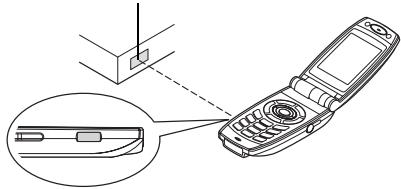
- Les ports infrarouges doivent être placés à moins de 20 cm l'un de l'autre et dans un angle de 30 degrés.
Modem GSM/GPRS
- Il n'est pas recommandé de passer ou de recevoir des appels lorsque vous utilisez le GX25 comme modem GSM/GPRS. L'opération peut être interrompue.
Gestionnaire de téléphone
- Certains fichiers volumineux peuvent ne pas être transmis du PC au téléphone.
- Lors de la connexion de votre téléphone à un PC, vous devez sélectionner la méthode de connexion pour le logiciel PC. (p. 92)
- Les applications (Appareil photo, Mes éléments, etc.) ne fonctionnent pas lorsque le téléphone est connecté au PC via l'interface de technologie sans fil Bluetooth, le port infrarouge ou le câble de données USB.
Dépannage
| Problem | Solution |
| The phone does not turn on. | ·Make sure the battery is properly inserted and charged. |
| PIN code or PIN2 code is rejected. | ·Make sure you have entered the correct code (4 to 8 digits). ·Your SIM card/protected functions will become locked after 3 unsuccessful attempts. ·Contact your SIM provider if you do not have the correct PIN code. |
| The SIM card becomes locked. | ·Enter PUK code (8 digits) provided by your service provider (if supported). ·If the attempt is successful, enter the new PIN code and confirm your phone is operational again. Otherwise contact your dealer. |
| The display is difficult to read. | ·Adjust the backlight brightness for the display, and adjust the LCD contrast for the external display. |
| Problem | Solution |
| Phone functions do not work after the phone is turned on. | ·Check the radio signal strength indicator as you may be outside the service area. ·Check to see if any error message is displayed when you turn your phone on. If so, contact your dealer. ·Make sure the SIM card is correctly inserted. |
| Calls cannot be made or received. | ·If the message “SIM card error” is displayed at start-up, you cannot use your SIM card or the SIM card is damaged. Contact your dealer or network service provider. ·Check your call barring, fixed dialling setting, remaining battery and call forwarding settings. ·Check if your phone is currently performing data communication using Infrared (IrDA), Bluetooth wireless technology interface or a USB data cable. ·Check the remaining balance if you are using a pre-paid SIM card. |
| Call quality is poor. | Your current location may not provide good call quality (i.e., in a car or train). Move to a location where radio signal strength is greater. |
| Cannot access network service. | Check where your account has been registered and where the service is available. |
| Cannot send or receive Text Message. | Make sure you are correctly subscribed for the Short Message Service, that the network supports this service, and that the centre number is set up correctly. If not, contact your network service provider. |
| Cannot connect to Multimedia Message service provider. | MMS settings and configuration may be missing or incorrect or the network does not support it. Check your service provider's access point number. Contact your service provider to confirm the correct settings. |
| Problem | Solution |
| Limited memory available. | • Delete any unnecessary data. |
| Call is terminated unexpectedly. | • Magnetised objects such as health necklaces placed near the phone may terminate the call. Keep your phone away from such objects. |
| No entries are displayed in the Contacts List | • Confirm that the Contacts Location setting (Handset or SIM) and View Groups setting are made correctly. |
| Fax transmission failure | • Before transmitting fax data, configure your fax software to use the software flow control. • Use of the optional data cable is recommended for transmitting fax data. |
| Cannot receive OBEX data. | The OBEX data cannot be received in the following cases: • Call incoming, call outgoing, call in progress • Java™ application executed • WAP communication mode enabled • When transmitting multimedia messages • When transmitting Email messages • When searching for Bluetooth wireless technology enabled devices and displaying the device list (M 9-1-1) • When connecting with devices by the selected connection method (M 9-1-3) |
Précautions de sécurité et
Conditions d'utilisation
Votre téléphone est conforme aux réglementations internationales dans la mesure où il est utilisé dans des conditions normales et conformément aux instructions suivantes.
CONDITIONS D'UTILISATION
Ondes électromagnétiques
- N'allumez pas votre téléphone à bord d'un avion (car votre téléphone peut interférer avec les systèmes électroniques de l'avion). La législation en vigueur interdit cette utilisation et des poursuites judiciaires peuvent être engagées contre l'utilisateur.
- N'allumez pas votre téléphone dans un hôpital, sauf dans les zones désignées.
- L'utilisation de la fonction de votre téléphone peut affecter les performances des appareils électroniques médicaux (stimulateurs cardiaques, appareils auditifs, pompes à insuline, etc.). Lorsque la fonction téléphone est activée, ne l'approchez pas du matériel médical ou des zones où du matériel médical est utilisé. Si vous portez un appareil auditif ou un stimulateur cardiaque, utilisez le téléphone uniquement du côté opposé de votre corps où il se trouve. Le téléphone doit être maintenu à au moins 6 pouces (15,24 cm) d'un stimulateur cardiaque à tout moment où le téléphone est allumé.
- N'allumez pas votre téléphone à proximité de gaz ou de substances inflammables.
- Respectez les règles concernant l'utilisation des téléphones mobiles dans les stations-service, les usines chimiques et sur tous les sites où il existe un risque d'explosion.
Entretien de votre téléphone
- Ne laissez pas les enfants utiliser votre téléphone sans surveillance.
- N'ouvrez pas et ne tentez pas de réparer votre téléphone vous-même. Le produit ne peut être réparé que par un personnel de service agréé.
- Ne faites pas tomber votre téléphone et ne le soumettez pas à des chocs violents. Plier le boîtier ou appuyer sur l'écran ou les touches avec une force extrême pourrait endommager le téléphone.
- N'utilisez pas de solvants pour nettoyer votre téléphone. Utilisez uniquement un chiffon doux et sec.
- Ne portez pas votre téléphone dans votre poche arrière, car il pourrait se casser lorsque vous vous asseyez. L'écran est en verre et est particulièrement fragile.
- Évitez de toucher le connecteur externe situé sous le téléphone, car les composants délicats qu'il contient peuvent être endommagés par l'électricité statique.
Batterie
- Utilisez votre téléphone uniquement avec les batteries, chargeurs et accessoires recommandés par le fabricant. Le fabricant décline toute responsabilité en cas de dommages causés par l'utilisation d'autres chargeurs, batteries ou accessoires. La configuration du réseau et l'utilisation du téléphone affectent la durée de communication et la durée en veille. L'utilisation des jeux ou de l'appareil photo accélère la consommation de la batterie.
- Lorsque l'alerte de charge de la batterie s'affiche à l'écran, chargez la batterie dès que possible. Si vous continuez à utiliser votre téléphone en ignorant l'alerte, le téléphone peut cesser de fonctionner et toutes les données et tous les paramètres que vous avez stockés peuvent être perdus à tout moment.
- Avant de retirer la batterie du téléphone, assurez-vous que le téléphone est éteint.
- Remplacez et chargez la nouvelle batterie dès que possible après avoir retiré l'ancienne.
- Ne touchez pas les bornes de la batterie. Les batteries peuvent causer des dommages, des blessures ou des brûlures si un matériau conducteur entre en contact avec les bornes exposées. Lorsque la batterie est détachée du téléphone, utilisez un couvercle en matériau non conducteur pour la conserver et la transporter en toute sécurité.
- La température recommandée pour utiliser et stocker les batteries est d'environ 20 °C.
- Les performances des batteries sont limitées à basse température, en particulier en dessous de 0 °C, et le téléphone peut ne pas fonctionner temporairement, quel que soit le niveau de charge restant.
- Exposer le téléphone à des températures extrêmes réduira la durée de vie de la batterie.
- La batterie peut être chargée et déchargée des centaines de fois, mais elle finira par s'user. Lorsque la durée de fonctionnement (temps de conversation et temps en veille) est nettement plus courte que la normale, il est temps d'acheter une nouvelle batterie.
ATTENTION
RISQUE D'EXPLOSION SI LA BATTERIE EST REMPLACÉE
PAR UN TYPE INCORRECT,
ÉLIMINEZ LES BATTERIES USAGÉES CONFORMÉMENT
AUX INSTRUCTIONS
Voir « Élimination de la batterie » à la page 12.
Entretien de l'antenne
- Ne couvrez pas la zone de la charnière du téléphone (p. 8 et p. 10, n° 24) avec votre main lors de l'utilisation, car cela pourrait interférer avec les performances de l'antenne intégrée. La qualité des appels peut se dégrader, entraînant une réduction de la durée de communication et de veille, car le téléphone mobile doit fonctionner à un niveau de puissance plus élevé que nécessaire.
- Utilisez uniquement l'antenne fournie ou une antenne approuvée par Sharp pour votre téléphone mobile. L'utilisation d'antennes non autorisées ou modifiées peut endommager le téléphone mobile. De plus, comme le téléphone mobile peut enfreindre les réglementations en vigueur, il peut perdre en performance ou dépasser la limite des niveaux de DAS.
- Pour éviter une dégradation des performances, n'endommagez pas l'antenne du téléphone mobile.
- Lorsque vous parlez directement dans le microphone, tenez le téléphone mobile de manière à ce que l'antenne soit dirigée vers le haut, par-dessus votre épaule.
- Pour éviter toute interférence avec les opérations de dynamitage, éteignez le téléphone mobile dans une zone de dynamitage ou dans un endroit où un panneau « éteignez la radio bidirectionnelle » est affiché.
Utilisation de l'appareil photo
- Informez-vous à l'avance sur la qualité d'image, les formats de fichiers, etc. Les photos prises peuvent être enregistrées au format JPEG.
- Veillez à ne pas bouger la main pendant la prise de photos.
Si le téléphone bouge pendant la prise de photo, l'image peut être floue. Lors de la prise de photo, tenez fermement le téléphone pour éviter qu'il ne bouge, ou utilisez le retardateur.
- Nettoyez le cache de l'objectif avant de prendre une photo.
Les traces de doigts, les huiles, etc. sur le cache de l'objectif gênent la mise au point. Essuyez-les avec un chiffon doux avant de prendre une photo.
Autres
- Comme pour tout dispositif de stockage électronique, des données peuvent être perdues ou corrompues dans diverses circonstances.
- Avant de connecter le téléphone à un PC ou à un périphérique, lisez attentivement le manuel d'utilisation de l'autre appareil.
- Si la batterie du téléphone a été retirée pendant un certain temps, ou si le téléphone a été réinitialisé, l'horloge et le calendrier de l'appareil peuvent être réinitialisés. Dans ce cas, la date et l'heure doivent être mises à jour.
- Utilisez uniquement le kit mains libres personnel spécifié (en option). Certaines fonctions du téléphone peuvent ne pas fonctionner si un kit mains libres non autorisé est utilisé.
- Ne faites pas clignoter la lumière mobile dans les yeux, car cela pourrait endommager la vue ou provoquer des étourdissements pouvant entraîner des accidents ou des blessures.
ENVIRONNEMENT
- Tenez votre téléphone à l'écart de la chaleur extrême. Ne le laissez pas sur le tableau de bord d'une voiture ou près d'un radiateur. Ne le laissez pas dans un endroit extrêmement humide ou poussiéreux.
- Ce produit n'étant pas étanche, ne l'utilisez pas et ne le rangez pas dans un endroit où des liquides tels que de l'eau peuvent éclabousser dessus. Les gouttes de pluie, les projections d'eau, le jus, le café, la vapeur, la transpiration, etc. peuvent également provoquer un dysfonctionnement.
PRÉCAUTIONS CONCERNANT L'UTILISATION EN VÉHICULE
- Il est de la responsabilité de l'utilisateur de vérifier les lois locales régissant l'utilisation d'un téléphone mobile dans les véhicules. Accordez toute votre attention à la conduite. Rangez-vous sur le côté de la route, garez la voiture et coupez le moteur avant de passer ou de répondre à un appel.
- L'utilisation des fonctions de votre téléphone peut interférer avec les systèmes électroniques du véhicule, tels que les freins antiblocage ABS ou l'airbag. Pour garantir qu'aucun problème de ce type ne se produise, veuillez consulter votre concessionnaire ou le fabricant de la voiture avant de connecter votre téléphone.
- Seul un personnel de maintenance qualifié est autorisé à installer les accessoires du véhicule.
Le fabricant décline toute responsabilité pour les dommages pouvant résulter d'une utilisation inappropriée ou contraire aux instructions contenues dans le présent document.
DAS
Votre téléphone mobile Sharp a été conçu, fabriqué et testé pour ne pas dépasser les limites d'exposition aux champs électromagnétiques recommandées par le Conseil de l'Union européenne. Ces limites font partie de directives complètes élaborées par des organisations scientifiques indépendantes. Les directives incluent une marge de sécurité substantielle conçue pour assurer la sécurité de l'utilisateur du téléphone et des autres, et pour tenir compte des variations d'âge et de santé, des sensibilités individuelles et des conditions environnementales. Les normes européennes prévoient que la quantité d'énergie électromagnétique radiofréquence absorbée par le corps lors de l'utilisation d'un téléphone mobile soit mesurée par référence au débit d'absorption spécifique (DAS). La limite DAS pour le grand public est actuellement de 2 watts par kilogramme en moyenne sur 10 grammes de tissu corporel. La valeur DAS de votre téléphone mobile Sharp est de 0,729 watt par kilogramme. Ceci a été testé pour garantir que cette limite n'est pas dépassée même lorsque le téléphone fonctionne à sa puissance certifiée la plus élevée. En utilisation, cependant, votre téléphone mobile Sharp peut fonctionner à puissance réduite car il est conçu pour n'utiliser que la puissance suffisante pour communiquer avec le réseau.
PRÉCAUTIONS D'UTILISATION AUX ÉTATS-UNIS
Déclaration de conformité FCC
Ce téléphone mobile GX25 avec câble d'interface PC/Données XN-1DC30 est conforme à la partie 15 des règles de la FCC.
Son fonctionnement est soumis aux deux conditions suivantes :
(1) Cet appareil ne doit pas causer d'interférences nuisibles, et (2) cet appareil doit accepter toute interférence reçue, y compris les interférences susceptibles de provoquer un fonctionnement indésirable.
Partie responsable :
SHARPE ELECTRONICS CORPORATION
Sharp Plaza, Mahwah, New Jersey 07430
TÉL : 1-800-BE-SHARP
Testé pour être conforme aux normes FCC
POUR UNE UTILISATION DOMESTIQUE OU EN BUREAU

Avis de la FCC
Le téléphone peut provoquer des interférences TV ou radio s'il est utilisé à proximité d'équipements de réception. La FCC peut exiger que vous cessiez d'utiliser le téléphone si ces interférences ne peuvent pas être éliminées.
Information à l'utilisateur
Cet équipement a été testé et déclaré conforme aux limites d'un appareil numérique de classe B, conformément à la partie 15 des règles de la FCC. Ces limites sont conçues pour fournir une protection raisonnable contre les interférences nuisibles dans une installation résidentielle. Cet équipement génère, utilise et peut émettre de l'énergie radiofréquence et, s'il n'est pas installé et utilisé conformément aux instructions, peut provoquer des interférences nuisibles aux communications radio.
Cependant, il n'y a aucune garantie que des interférences ne se produiront pas dans une installation particulière ; si cet équipement provoque des interférences nuisibles à la réception radio ou télévision, ce qui peut être déterminé en éteignant et en allumant l'équipement, l'utilisateur est encouragé à essayer de corriger les interférences par une ou plusieurs des mesures suivantes :
- Réorienter ou déplacer l'antenne de réception.
- Augmenter la distance entre l'équipement et le récepteur.
- Brancher l'équipement sur une prise située sur un circuit différent de celui auquel le récepteur est connecté.
- Consulter le revendeur ou un technicien radio/TV expérimenté pour obtenir de l'aide.
ATTENTION : Toute modification non expressément approuvée par le fabricant responsable de la conformité pourrait annuler le droit de l'utilisateur à utiliser cet équipement.
Exposition aux ondes radio
CE MODÈLE DE TÉLÉPHONE RÉPOND AUX EXIGENCES DU GOUVERNEMENT EN MATIÈRE D'EXPOSITION AUX ONDES RADIO.
Votre téléphone sans fil est un émetteur-récepteur radio. Il est conçu et fabriqué pour ne pas dépasser les limites d'émission pour l'exposition à l'énergie radiofréquence (RF) établies par la Commission fédérale des communications (FCC) du gouvernement américain. Ces limites font partie de directives complètes et établissent les niveaux d'énergie RF autorisés pour la population générale. Les directives sont basées sur des normes élaborées par des organisations scientifiques indépendantes grâce à une évaluation périodique et approfondie des études scientifiques. Les normes incluent une marge de sécurité substantielle conçue pour garantir la sécurité de toutes les personnes, quel que soit leur âge ou leur état de santé.
La norme d'exposition pour les téléphones mobiles sans fil utilise une unité de mesure appelée débit d'absorption spécifique (DAS). La limite de DAS fixée par la FCC est de 1,6 W/kg.* Les tests de DAS sont effectués dans des positions d'utilisation standard spécifiées par la FCC, avec
le téléphone émettant à son niveau de puissance certifié le plus élevé dans toutes les bandes de fréquences testées. Bien que le DAS soit déterminé au niveau de puissance certifié le plus élevé, le niveau de DAS réel du téléphone en fonctionnement peut être bien inférieur à la valeur maximale. Cela est dû au fait que le téléphone est conçu pour fonctionner à plusieurs niveaux de puissance afin de n'utiliser que la puissance nécessaire pour atteindre le réseau. En général, plus vous êtes proche d'une antenne de station de base sans fil, plus la puissance de sortie est faible.
Avant qu'un modèle de téléphone ne soit disponible à la vente au public, il doit être testé et certifié auprès de la FCC pour garantir qu'il ne dépasse pas la limite établie par l'exigence de sécurité adoptée par le gouvernement. Les tests sont effectués dans des positions et des emplacements (par exemple, à l'oreille et porté sur le corps) comme l'exige la FCC pour chaque modèle. La valeur de DAS la plus élevée pour ce modèle de téléphone lors des tests à l'oreille est de 0,618 W/kg, et lorsqu'il est porté sur le corps, comme décrit dans ce guide de l'utilisateur, elle est de 0,282 W/kg. Fonctionnement en contact avec le corps : cet appareil a été testé pour des opérations typiques en contact avec le corps, avec le dos du téléphone maintenu à 1,5 cm du corps. Pour maintenir la conformité aux exigences de la FCC en matière d'exposition RF, utilisez des accessoires qui maintiennent une distance de séparation de 1,5 cm entre le corps de l'utilisateur et le dos du téléphone. L'utilisation de clips de ceinture, d'étuis et d'accessoires similaires ne doit pas contenir de composants métalliques dans leur assemblage.
L'utilisation d'accessoires qui ne satisfont pas à ces exigences peut ne pas être conforme aux exigences d'exposition aux radiofréquences de la FCC et doit être évitée. Bien qu'il puisse y avoir des différences entre les niveaux de DAS de différents téléphones et à différentes positions, ils respectent tous l'exigence gouvernementale d'exposition sûre.
La FCC a accordé une autorisation d'équipement pour ce modèle de téléphone avec tous les niveaux de DAS déclarés évalués comme conformes aux directives d'émission RF de la FCC. Les informations sur le DAS de ce modèle de téléphone sont déposées auprès de la FCC et peuvent être trouvées dans la section Display Grant de http://www.fcc.gov/oet/fccid après avoir recherché l'ID FCC APYHRO00036.
Des informations supplémentaires sur les débits d'absorption spécifiques (DAS) peuvent être trouvées sur le site Web de la Cellular Telecommunications & Internet Association (CTIA) à http://www.phonefacts.net.
- Aux États-Unis et au Canada, la limite de DAS pour les téléphones mobiles utilisés par le public est de 1,6 watts/kg (W/kg) en moyenne sur un gramme de tissu. La norme intègre une marge de sécurité substantielle pour offrir une protection supplémentaire au public et pour tenir compte des variations dans les mesures.
Index
A
Accessoires 7
Alarmes 76
B
Batterie 11
Fonction sans fil Bluetooth 90
C
Calculatrice 77
Calendrier 84
Coûts d'appel 89
Fonctions d'appel 19
Répondre 20
Appel en attente 22
Conférence téléphonique 23
Volume de l'écouteur 21
Passer un appel 19
Mise en sourdine 24
Mise en attente 22
Recomposition 20
Numérotation abrégée 19
Journal des appels 87
Paramètres d'appel 102
Recomposition automatique 105
Appel en attente 103
Renvois 102
Minuteur 105
Réinitialisation 106
Restreindre les appels 104
Afficher votre numéro 103
Minuteries d'appel 88
Diffusion cellulaire 57
Touche centrale 9, 15
Liste de contacts 31
Assigner une sonnerie 35
Modifier la liste 31
Changer l'ordre des noms 32
Copier 33
Créer 32
Supprimer 34
Composer 34
Édition 34
Recherche 33
Appel de groupe 35
État de la mémoire 36
Réception 37
Sélection de la mémoire de stockage 31
Envoi 37
Affichage des groupes 34
D
Compteur de données 88
Date et heure 106
Indicateurs d'affichage 15
Langue d'affichage 107
Paramètres d'affichage
Rétroéclairage 100
Délai d'extinction du rétroéclairage 101
Luminosité du rétroéclairage 101
Contraste 102
Économie d'affichage 101
Message d'accueil 100
Images 99
Réinitialisation 102
Affichage de l'horloge 100
Fond d'écran 99
Volume de l'écouteur 21
E-mail 55
Création 55
Lecture 56
Configuration 56
Storing the Email Address of a Sender in a Contacts List 56
Emergency calls 19
H
Handset code 112
Handset Lock 112
1
Infrared function 92
Infrared port 10
Input languages 26
Input method 26
International calls 19
J
Java™ applications 72
L
L
Touche logicielle gauche 9
M
Réinitialisation générale 112
Éditeur de mélodies 79
État de la mémoire 71
Menu et raccourci 28
Message multimédia 47
Confirmation de réception du rapport de livraison 50
Création 47
Insertion de données jointes 49
Lecture 49
Récupération 50
Envoi avec carte postale 51
Configuration 50
Stockage du numéro de téléphone ou de l'adresse e-mail d'un expéditeur dans la liste de contacts 50
Activation ou désactivation du diaporama 48
Mes numéros (Voix/Données/Fax) 88
N
Touches de navigation 9
Paramètres réseau 107
P
Connexion PC 113
Logiciel PC 92
Aide du téléphone 83
Fichier image 63
Code PIN 111
Code PIN2 111
Mise sous/hors tension 14
Profils
Activation 93
Alerts 95
Any Key Answer 98
Customising 93
Echo Cancel 98
Keypad Tones 96
Light 95
Multimedia Volume 97
Power Off Sound 97
Power On Sound 97
Resetting 93
Ringer volume 93
Ringtone 94
Vibration 94
R
Record Video 43
Touche programmable droite 9
s
Écrans de veille 73
Sécurité 111
Changement du code PIN2 111
Activation/Désactivation du code PIN 111
Verrouillage du combiné 112
Miroir pour autoportrait 40
Application SIM 76
Carte SIM 11
Fichier sonore 66
Liste de numérotation rapide 88
T
Prendre une photo 39
Message texte 52
Création 53
Extraction des numéros de téléphone 54
Lecture 53
Configuration 54
Modèles de texte 70
Dépannage 116
V
Fichier de clip vidéo 68
Vodafone live! 59
Touche de messagerie vocale 9
Enregistreur vocal 78
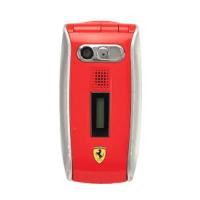
- DÉCLARATION DE CONFORMITÉ
- INTRODUCTION
- À PROPOS DE CE GUIDE DE L'UTILISATEUR
- AVIS
- DROITS D'AUTEUR
- FONCTIONS ET SERVICES UTILES
- TABLE DES MATIÈRES
- VOTRE TÉLÉPHONE
- POUR COMMENCER
- FONCTIONS DE NAVIGATION
- FONCTIONS D'APPEL
- SAISIE DE CARACTÈRES
- UTILISATION DU MENU
- LISTE DE CONTACTS
- APPAREIL PHOTO
- MESSAGES
- VODAFONE LIVE
- MES ÉLÉMENTS
- JEUX ET PLUS
- APPLICATIONS
- CALENDRIER
- CONTACTS
- PARAMÈTRES
- CONNEXION DU GX25 À VOTRE PC
- DÉPANNAGE
- CONSIGNES DE SÉCURITÉ ET CONDITIONS D'UTILISATION
- INDEX
- ACCESSOIRES EN OPTION
- INSERTION DE LA CARTE SIM ET DE LA BATTERIE
- REMARQUE
- RETRAIT DE LA CARTE SIM ET DE LA BATTERIE
- ÉLIMINATION DE LA BATTERIE
- CHARGEMENT DE LA BATTERIE
- UTILISATION DU CHARGEUR
- POUR DÉBRANCHER LE CHARGEUR
- INDICATEUR DE NIVEAU DE BATTERIE
- BATTERIE FAIBLE PENDANT L'UTILISATION
- ALLUMER ET ÉTEINDRE VOTRE TÉLÉPHONE
- POUR SAISIR LE CODE PIN
- INDICATEURS D'AFFICHAGE (ÉCRAN PRINCIPAL)
- INDICATEURS D'ÉTAT
- INDICATEURS D'AFFICHAGE (ÉCRAN EXTERNE)
- PASSER UN APPEL
- APPELS D'URGENCE
- APPELS INTERNATIONAUX
- NUMÉROTATION ABRÉGÉE
- RAPPEL DU DERNIER NUMÉRO
- RECOMPOSITION AUTOMATIQUE
- RÉPONDRE À UN APPEL
- ASTUCE
- REJET D'UN APPEL ENTRANT
- INFORMEZ L'APPELANT QUE VOUS ÊTES INDISPONIBLE
- MENU EN COURS D'APPEL
- RÉGLAGE DU VOLUME DE L'ÉCOUTEUR
- MISE EN ATTENTE D'UN APPEL
- POUR PASSER UN AUTRE APPEL PENDANT UN APPEL
- APPEL EN ATTENTE
- ACCÈS AU MENU SMS PENDANT UN APPEL
- CONFÉRENCE TÉLÉPHONIQUE
- POUR FAIRE UNE CONFÉRENCE TÉLÉPHONIQUE
- MISE EN SOURDINE DU MICROPHONE
- TABLEAU DES CARACTÈRES
- CHANGEMENT DE LA LANGUE DE SAISIE
- CHANGEMENT DE LA MÉTHODE DE SAISIE
- SAISIE DE TEXTE T
- SYMBOLES ET PONCTUATION
- MON DICTIONNAIRE
- UTILISATION DES MODÈLES DE TEXTE
- ACCÈS AUX APPLICATIONS
- RACCOURCIS CLAVIER
- REMARQUE CONCERNANT LES INDICATIONS DE MENU POUR LES SERVICES CARTE POSTALE ET ALBUM MULTIMÉDIA
- LISTE DE CONTACTS (M 8-1)
- ÉLÉMENTS STOCKÉS DANS LA MÉMOIRE DU COMBINÉ
- ÉLÉMENTS STOCKÉS DANS LA MÉMOIRE SIM
- SÉLECTION DE LA MÉMOIRE DE STOCKAGE
- MODIFICATION DE LA LISTE AFFICHÉE
- MODIFICATION DE L'ORDRE DES NOMS
- AJOUTER UN NOUVEAU CONTACT
- AJOUT D'UNE VIGNETTE AUX ENTRÉES
- COPIE DES ENTRÉES DU RÉPERTOIRE ENTRE LA CARTE SIM ET LE COMBINÉ
- COPIE D'UNE SEULE ENTRÉE DU COMBINÉ VERS LA CARTE SIM
- RECHERCHE D'UN NOM ET D'UN NUMÉRO
- COMPOSER UN NUMÉRO DEPUIS LA LISTE DE CONTACTS
- MODIFICATION DES ENTRÉES DE LA LISTE DE CONTACTS
- SUPPRESSION DES ENTRÉES DE LA LISTE DE CONTACTS
- SUPPRESSION D'UNE ENTRÉE DE CONTACT
- AFFICHAGE DES GROUPES
- APPEL DE GROUPE
- ATTRIBUTION D'UNE SONNERIE À CHAQUE ENTRÉE DE LA LISTE DE CONTACTS
- ÉTAT DE LA MÉMOIRE
- LISTE DE NUMÉROS ABRÉGÉS
- DÉFINITION DES ENTRÉES DE LA LISTE DE CONTACTS DANS LA LISTE DE NUMÉROS ABRÉGÉS
- ENVOI D'UNE ENTRÉE DE LA LISTE DE CONTACTS
- RÉCEPTION D'UNE FICHE DE CONTACTS
- ENREGISTREMENT DE VOS INFORMATIONS COMME FICHE DE CONTACTS
- CONTACTS » → « LISTE DE CONTACTS » → « MA CARTE
- COMPOSITION D'UN NUMÉRO DE SERVICE
- APPAREIL PHOTO (M 5)
- PRENDRE UNE PHOTO (M 5-1)
- PRISE DE PHOTOS
- UTILISATION DU PLEIN ÉCRAN
- PRENDRE UN AUTOPORTRAIT
- UTILISATION DE LA FONCTION ZOOM
- SÉLECTION DE LA TAILLE D'IMAGE
- SÉLECTION DE LA QUALITÉ D'IMAGE
- SÉLECTION DU MODE ANTI-SCINTILLEMENT
- EN CAS DE MÉMOIRE INSUFFISANTE
- RÉGLAGE DE LA LUMINOSITÉ DE LA PHOTO SELON LES CONDITIONS D'ÉCLAIRAGE
- VISUALISATION DES PHOTOS PRISES
- UTILISATION DU MINUTEUR (RETARDATEUR)
- PRISE DE VUE EN CONTINU
- APPAREIL PHOTO » → « PRENDRE UNE PHOTO » → [OPTIONS] → « PRISE DE VUE EN CONTINU
- SÉLECTION D'UN CADRE
- CAMERA" → "TAKE PICTURE" → [OPTIONS] → "ADD FRAME
- SÉLECTION DU SON DE L'OBTURATEUR
- CAMERA" → "TAKE PICTURE" → [OPTIONS] → "SHUTTER SOUND
- ENREGISTRER UNE VIDÉO (M 5-2)
- ENREGISTREMENT DE CLIPS VIDÉO
- CAMÉRA » → « ENREGISTRER UNE VIDÉO
- SÉLECTION DU MODE DE TAILLE D'ENREGISTREMENT
- SÉLECTION DE LA QUALITÉ VIDÉO
- RÉGLAGE DE LA LUMINOSITÉ DES CLIPS VIDÉO SELON LES CONDITIONS DE LUMIÈRE
- VISUALISATION DES CLIPS VIDÉO ENREGISTRÉS
- UTILISATION DE LA MINUTERIE (MINUTERIE DE DÉLAI)
- ENREGISTREMENT DE CLIPS VIDÉO AVEC LE SON
- MESSAGES (M 4)
- MULTIMÉDIA (MMS) (M 4-2)
- À PROPOS DES MESSAGES MULTIMÉDIA
- CRÉATION D'UN NOUVEAU MMS (M 4-2-1)
- POUR ENVOYER UN MMS À PARTIR D'UN MODÈLE DE MESSAGE
- ACTIVATION OU DÉSACTIVATION DU RÉGLAGE DU DIAPORAMA
- SI VOUS SÉLECTIONNEZ «ACTIVÉ
- SI VOUS SÉLECTIONNEZ "DÉSACTIVÉ
- INSERTION DE DONNÉES JOINTES
- → "MULTIMÉDIA" → "CRÉER UN MESSAGE" → [OPTIONS]
- LECTURE DES MMS
- MESSAGES ENTRANTS
- →"MULTIMÉDIA"→"BOÎTE DE RÉCEPTION
- ENREGISTREMENT DU NUMÉRO DE TÉLÉPHONE OU DE L'ADRESSE E-MAIL D'UN EXPÉDITEUR DANS LA LISTE DE CONTACTS
- RÉCUPÉRATION DES MMS
- CONFIRMATION DE L'ARRIVÉE DU RAPPORT DE LIVRAISON
- CONFIGURATION MMS
- ENVOI D'UN FICHIER IMAGE AVEC UNE CARTE POSTALE
- POUR CRÉER UNE NOUVELLE CARTE POSTALE
- APPUYEZ SUR [OPTIONS] ET SÉLECTIONNEZ "ENVOYER
- NOTE
- TEXTE (SMS) (M 4-3)
- À PROPOS DE LA MESSAGERIE TEXTE
- POUR UTILISER LE SMS AVEC VOTRE TÉLÉPHONE
- CRÉATION ET ENVOI D'UN NOUVEAU SMS (M 4-3-1)
- LECTURE DES SMS
- EXTRAIRE LES NUMÉROS DE TÉLÉPHONE DES MESSAGES REÇUS ET PASSER UN APPEL
- CONFIGURATION DES SMS (M 4-3-5)
- DURÉE DE VIE DU MESSAGE
- FORMAT DU MESSAGE
- TYPE DE CONNEXION
- OPTIMISATION
- E-MAIL (M 4-4)
- À PROPOS DE LA MESSAGERIE E-MAIL
- CRÉATION D'UN NOUVEAU MESSAGE E-MAIL
- LECTURE D'UN MESSAGE ÉLECTRONIQUE
- ENREGISTREMENT DE L'ADRESSE E-MAIL D'UN EXPÉDITEUR DANS LA LISTE DE CONTACTS
- CONFIGURATION DE L'E-MAIL (M 4-4-7)
- DIFFUSIONS CELLULAIRES (M 4-8)
- ACTIVATION/DÉSACTIVATION DES CELL BROADCASTS (M 4-8-1)
- LECTURE DES MESSAGES CELL BROADCAST (M 4-8-2)
- RÉGLAGE DES LANGUES
- ABONNEMENT AUX MESSAGES CELL BROADCAST
- VODAFONE LIVE! (M 2)
- PERSONNALISÉ POUR
- DÉMARRAGE DU NAVIGATEUR WAP
- POUR QUITTER LE NAVIGATEUR WAP
- NAVIGUER DANS UNE PAGE WAP
- MENU DU NAVIGATEUR
- SIGNETS
- POUR SUPPRIMER DES SIGNETS
- MES ÉLÉMENTS (M 6)
- IMAGES (M 6-1)
- AFFICHAGE DES IMAGES
- UTILISATION D'IMAGES COMME FOND D'ÉCRAN
- ENREGISTREMENT DANS LA LISTE DE CONTACTS
- MES ÉLÉMENTS" → "IMAGES" → "IMAGES ENREGISTRÉES
- MODIFICATION DES IMAGES
- ENVOI D'UN FICHIER IMAGE
- MES ÉLÉMENTS » → « IMAGES » → « IMAGES ENREGISTRÉES
- TÉLÉCHARGEMENT DE FICHIERS IMAGE
- TÉLÉCHARGEMENT DE FICHIERS IMAGE (M 6-1-3)
- JEUX ET PLUS (M 6-2)
- UTILISATION DES APPLICATIONS
- TÉLÉCHARGEMENT D'APPLICATIONS
- ÉCRAN DE CONFIRMATION
- EXÉCUTION DES APPLICATIONS (M 6-2-1)
- PLUS DE JEUX (M 6-2-2)
- SONS (M 6-3)
- LECTURE DE FICHIERS SONORES
- UTILISATION DES FICHIERS SONORES COMME SONNERIE
- ENVOI D'UN FICHIER SONORE PAR MMS
- TÉLÉCHARGEMENT DE FICHIERS SONORES
- TÉLÉCHARGEMENT DE FICHIERS SONORES (M 6-3-4)
- VIDÉOS (M 6-4)
- LECTURE DE FICHIERS DE CLIPS VIDÉO
- ENVOI D'UN FICHIER DE CLIP VIDÉO PAR MMS
- TÉLÉCHARGEMENT DE FICHIERS DE CLIPS VIDÉO
- TÉLÉCHARGEMENT DE FICHIERS DE CLIPS VIDÉO (M 6-4-3)
- ENVOI DES DONNÉES DE MES ÉLÉMENTS
- POUR "VIA BLUETOOTH
- POUR "VIA INFRAROUGE
- RÉCEPTION DES DONNÉES DE MES ÉLÉMENTS
- MODÈLES DE TEXTE (M 6-5)
- AJOUT DE PHRASES AUX MODÈLES DE TEXTE
- MES ÉLÉMENTS » → « MODÈLES DE TEXTE
- MODIFICATION DES MODÈLES DE TEXTE
- AFFICHAGE DES MODÈLES DE TEXTE
- SUPPRESSION DE MODÈLES DE TEXTE
- ÉTAT DE LA MÉMOIRE (M 6-7)
- JEUX ET PLUS (M 1)
- APPLICATIONS (M 1-1)
- EXÉCUTION DES APPLICATIONS
- AFFICHAGE DES DÉTAILS D'UNE APPLICATION
- DÉFINITION DES AUTORISATIONS
- POUR RÉINITIALISER LES AUTORISATIONS
- ÉCRANS DE VEILLE (M 1-2)
- DÉFINIR L'APPLICATION (M 1-2-2)
- TEMPS DE REPRISE (M 1-2-3)
- PLUS DE JEUX (M 1-3)
- PARAMÈTRES (M 1-4)
- APPELS ET ALARMES (M 1-4-1)
- VOLUME SONORE (M 1-4-2)
- RÉTROÉCLAIRAGE (M 1-4-3)
- POUR RÉGLER LE FONCTIONNEMENT CLIGNOTANT
- VIBRATION (M 1-4-4)
- JEUX & PLUS" → "PARAMÈTRES" → "VIBREUR
- RÉTABLIR LES VALEURS PAR DÉFAUT (M 1-4-5)
- INFORMATIONS JAVA™ (M 1-5)
- APPLICATIONS (M 3)
- APPLICATION SIM (M 3-1)
- ALARMES (M 3-2)
- RÉGLAGE DES ALARMES
- MODIFICATION DU RÉGLAGE D'UNE ALARME
- RÉINITIALISATION D'UN RÉGLAGE D'ALARME
- RÉINITIALISATION DE TOUS LES RÉGLAGES D'ALARME
- DÉSACTIVATION OU ACTIVATION D'UNE ALARME
- CALCULATRICE (M 3-3)
- APPLICATIONS" → "CALCULATOR
- CONVERSION DE TAUX
- ENREGISTREUR VOCAL (M 3-4)
- ENREGISTREMENT D'UN CLIP VOCAL
- ENVOI DE CLIPS VOCAUX
- ÉDITEUR DE MÉLODIES (M 3-5)
- CRÉATION DE VOTRE SONNERIE ORIGINALE (M 3-5-1)
- POUR SPÉCIFIER LA GAMME MUSICALE ET LE SILENCE
- POUR RÉGLER LE TIMBRE
- POUR RÉGLER LA FORCE DU TIMBRE
- MODIFICATION DES SONNERIES ORIGINALES (M 3-5-2)
- COPIER ET COLLER DES NOTES
- AIDE DU TÉLÉPHONE (M 3-6)
- CALENDRIER (M 7)
- CRÉATION D'UNE NOUVELLE ENTRÉE
- MODIFICATION DE LA TONALITÉ DU RAPPEL
- ENVOI D'UNE ENTRÉE DE L'AGENDA
- AGENDA
- RÉCEPTION D'UNE ENTRÉE D'AGENDA
- AFFICHAGE D'UNE ENTRÉE
- POUR RECHERCHER PAR DATE
- POUR RECHERCHER PAR SUJET
- POUR MODIFIER LE FORMAT DE LA SEMAINE
- SUPPRESSION D'ENTRÉES
- CONTACTS (M 8)
- JOURNAL D'APPELS (M 8-2)
- CONSULTATION DU JOURNAL D'APPELS
- ENVOI DE MESSAGES
- SUPPRESSION D'UNE ENTRÉE DU JOURNAL D'APPELS
- LISTE DE NUMÉROS ABRÉGÉS (M 8-3)
- MES NUMÉROS (M 8-4)
- MINUTERIES D'APPEL (M 8-5)
- VÉRIFICATION DE LA DURÉE DU DERNIER APPEL ET DE TOUS LES APPELS
- COMPTEUR DE DONNÉES (M 8-6)
- RÉINITIALISATION DU COMPTEUR DE DONNÉES
- COÛTS DES APPELS (M 8-7)
- VÉRIFICATION DU COÛT DU DERNIER APPEL
- VÉRIFICATION DU COÛT TOTAL DES APPELS
- RÉGLAGE DU TARIF DE FACTURATION
- RÉGLAGE DE LA LIMITE DE COÛT
- RÉINITIALISATION DE TOUS LES COÛTS D'APPEL
- VÉRIFICATION DU CRÉDIT RÉSIDUEL
- PARAMÈTRES (M 9)
- CONNECTIVITÉ (M 9-1)
- UTILISATION DE LA FONCTION SANS FIL BLUETOOTH (M 9-1-1)
- POUR RECHERCHER DES APPAREILS À APPAIRER
- DISPOSITIFS MAINS LIBRES
- POUR ACTIVER UN APPAREIL
- POUR RENOMMER UN APPAREIL
- POUR EFFACER UN NOM D'APPAREIL
- APPAREILS APPARIÉS
- PARAMÈTRES BLUETOOTH SANS FIL
- POUR RENOMMER VOTRE TÉLÉPHONE
- UTILISATION DE LA FONCTION INFRAROUGE (M 9-1-2)
- LOGICIEL PC (M 9-1-3)
- PROFILS (M 9-2)
- ACTIVATION D'UN PROFIL
- PERSONNALISATION DES PROFILS
- RÉINITIALISATION DES RÉGLAGES DE PROFIL
- VOLUME DE LA SONNERIE
- ATTRIBUTION DE LA SONNERIE
- RÉGLAGES" → "PROFILS
- VIBRATION
- LUMIÈRE
- ALERTES
- SON D'AVERTISSEMENT
- PARAMÈTRES » → « PROFILS
- ALERTE DE MESSAGE
- ALERTE DE BATTERIE FAIBLE
- TOUCHES DU CLAVIER
- VOLUME MULTIMÉDIA
- PARAMÈTRES" → "PROFILS
- SON D'ALLUMAGE/SON D'EXTINCTION
- ANNULATION D'ÉCHO
- RÉPONSE PAR TOUCHE
- RÉPONSE AUTOMATIQUE (POUR KIT MAINS LIBRES VOITURE UNIQUEMENT)
- RÉGLAGE DE L'AFFICHAGE (M 9-3)
- RÉGLAGE DE L'ÉCRAN PRINCIPAL (M 9-3-1)
- POUR DÉFINIR LE FOND D'ÉCRAN
- POUR DÉFINIR MES PHOTOS
- POUR AFFICHER LE CALENDRIER MENSUEL
- POUR ATTRIBUER LES IMAGES
- POUR DÉFINIR LE MESSAGE D'ACCUEIL
- POUR AFFICHER L'HORLOGE
- POUR RÉGLER LE RÉTROÉCLAIRAGE
- RÉGLAGE DE L'ÉCRAN EXTERNE (M 9-3-2)
- POUR RÉGLER LE CONTRASTE
- RÉINITIALISATION DES RÉGLAGES D'AFFICHAGE (M 9-3-3)
- SON (M 9-4)
- PARAMÈTRES D'APPEL (M 9-5)
- RENVOIS D'APPELS (M 9-5-1)
- POUR RENVOYER DES APPELS
- POUR VÉRIFIER L'ÉTAT DU TRANSFERT
- APPEL EN ATTENTE (M 9-5-2)
- PARAMÈTRES" → "PARAMÈTRES D'APPEL" → "APPEL EN ATTENTE
- AFFICHER VOTRE NUMÉRO DE TÉLÉPHONE (M 9-5-3)
- PARAMÈTRES" → "PARAMÈTRES D'APPEL" → "AFFICHER VOTRE NUMÉRO
- RESTREINDRE LES APPELS (M 9-5-4)
- PARAMÈTRES" → "PARAMÈTRES D'APPEL" → "RESTREINDRE LES APPELS
- NUMÉROTATION FIXE
- MODIFICATION DU MOT DE PASSE RÉSEAU
- RAPPEL AUTOMATIQUE (M 9-5-5)
- MINUTEUR D'APPEL (M 9-5-6)
- RÉINITIALISATION DES PARAMÈTRES D'APPEL (M 9-5-7)
- DATE ET HEURE (M 9-6)
- SÉLECTION DU FORMAT DE L'HEURE
- SÉLECTION DU FORMAT DE LA DATE
- RÉGLAGE DE L'HEURE D'ÉTÉ
- RÉGLAGE DU FUSEAU HORAIRE
- PERSONNALISATION DU FUSEAU HORAIRE
- CHANGEMENT DE LANGUE (M 9-7)
- RÉGLAGES" → "LANGUE
- RÉSEAU (M 9-8)
- PARAMÈTRES RÉSEAU (M 9-8-1)
- PARAMÈTRES WAP/MMS/E-MAIL
- SÉCURITÉ (M 9-9)
- ACTIVATION/DÉSACTIVATION DU CODE PIN (M 9-9-1)
- POUR MODIFIER LE CODE PIN
- MODIFICATION DU CODE PIN2 (M 9-9-2)
- VERROUILLAGE DU COMBINÉ (M 9-9-3)
- POUR MODIFIER LE CODE DU COMBINÉ
- RÉINITIALISATION GÉNÉRALE (M 9-0)
- CONFIGURATION SYSTÈME REQUISE
- MODEM GSM/GPRS
- MODEM VIA LA CONNEXION INFRAROUGE
- MODEM VIA LE CÂBLE DE DONNÉES USB
- MODEM VIA CONNEXION BLUETOOTH
- GESTIONNAIRE DE TÉLÉPHONE
- INSTALLATION DU LOGICIEL
- COMMUNICATION INFRAROUGE
- PRÉCAUTIONS DE SÉCURITÉ ET
- CONDITIONS D'UTILISATION
- ONDES ÉLECTROMAGNÉTIQUES
- ENTRETIEN DE VOTRE TÉLÉPHONE
- BATTERIE
- ATTENTION
- ENTRETIEN DE L'ANTENNE
- UTILISATION DE L'APPAREIL PHOTO
- AUTRES
- ENVIRONNEMENT
- PRÉCAUTIONS CONCERNANT L'UTILISATION EN VÉHICULE
- DAS
- PRÉCAUTIONS D'UTILISATION AUX ÉTATS-UNIS
- DÉCLARATION DE CONFORMITÉ FCC
- AVIS DE LA FCC
- INFORMATION À L'UTILISATEUR
- EXPOSITION AUX ONDES RADIO
- CE MODÈLE DE TÉLÉPHONE RÉPOND AUX EXIGENCES DU GOUVERNEMENT EN MATIÈRE D'EXPOSITION AUX ONDES RADIO
- A
- B
- C
- D
- HANDSET CODE
- INFRARED FUNCTION
- JAVA™ APPLICATIONS
- L
- M
- N
- P
- R
- S
- T
- V
Marque : SHARP
Modèle : GX25
Catégorie : Téléphone mobile