
BPA-060 - Sphygmomanometer HOMEDICS - Free user manual and instructions
Find the device manual for free BPA-060 HOMEDICS in PDF.


| Product Type | Automatic Blood Pressure Monitor |
| Brand | Homedics |
| Model | BPA-060 |
| Measurement Method | Oscillometric |
| Display | LCD |
| Blood Pressure Range | Systolic: 60-260 mmHg, Diastolic: 40-199 mmHg |
| Pulse Range | 40-160 beats/min |
| Accuracy | Blood pressure: ±3 mmHg, Pulse: ±5% |
| Cuff Size | Standard (22-32 cm arm circumference) |
| Power Source | 4 x AA batteries (not included) |
| Battery Life | Approx. 300 measurements |
| Memory | Up to 90 readings |
| Dimensions | 15.0 x 10.0 x 5.0 cm (approx.) |
| Weight | 300 g (without batteries) |
| Clinical Validation | Validated per international protocol |
| Irregular Heartbeat Detection | Yes |
| WHO Classification Indicator | Yes |
| Auto Shut-off | After 3 minutes of inactivity |
| Cleaning | Wipe with dry cloth; do not immerse |
| Storage Conditions | -20°C to 50°C, 15-90% RH |
Frequently Asked Questions - BPA-060 HOMEDICS
User questions about BPA-060 HOMEDICS
0 question about this device. Answer the ones you know or ask your own.
Ask a new question about this device
Download the instructions for your Sphygmomanometer in PDF format for free! Find your manual BPA-060 - HOMEDICS and take your electronic device back in hand. On this page are published all the documents necessary for the use of your device. BPA-060 by HOMEDICS.
USER MANUAL BPA-060 HOMEDICS
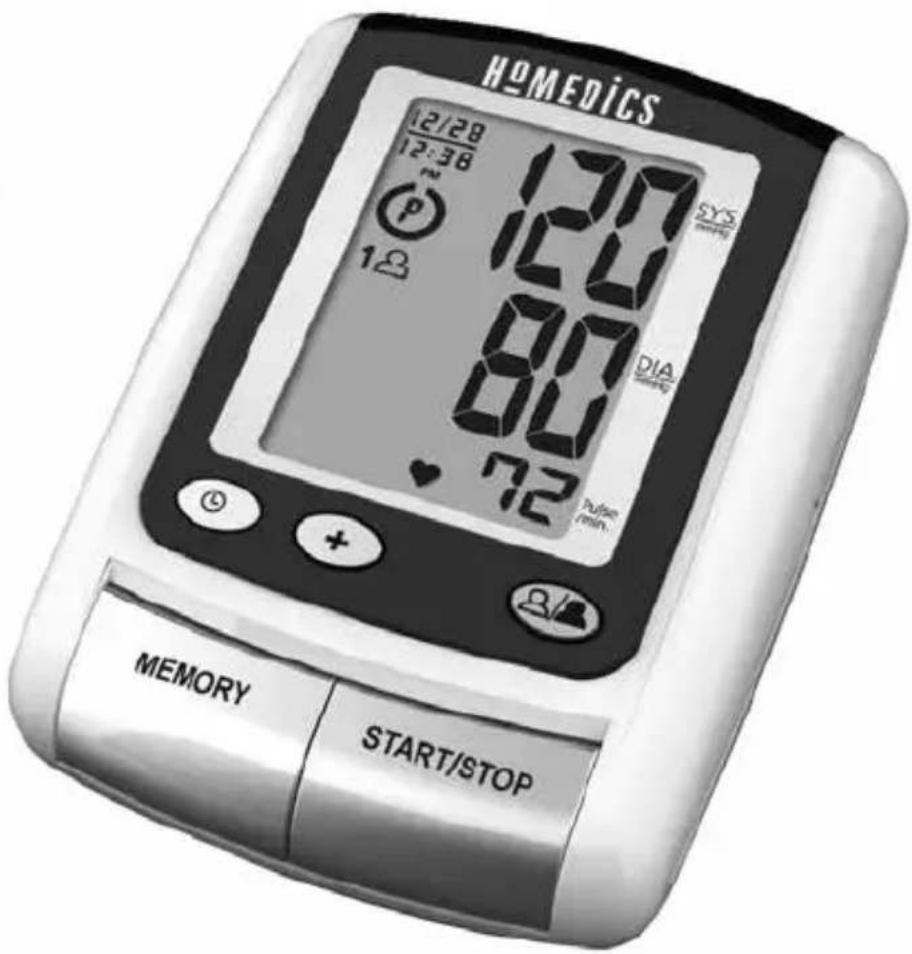
BPA-060
Ver. C
5year limited warranty
TABLE OF CONTENTS
INTRODUCTORY INFORMATION:
Important Product Notices and Safety
Instructions....3
About Blood Pressure....5
Blood Pressure Standard....5
How This Blood Pressure Monitor Works......7
USAGE INFORMATION:
Name/Function of Each Part......8
Display Explanations....9
Installing Batteries ....11
Using the AC Adapter....12
Date & Time Set Procedure....13
Using the Arm Cuff....14
Measurement Procedure....17
Risk Category Index......20
Recalling Values from Memory....21
Clearing Values from Memory....23
Important Notes Regarding Your
Blood Pressure Measurement....24
Care, Maintenance & Cleaning ....25
Potential for Electromagnetic Interference .....27
Electromagnetic Compatibility (EMC)......28
Troubleshooting....30
Specifications ....31
5 Year Limited Warranty....32
IMPORTANT PRODUCT NOTICES AND SAFETY INSTRUCTIONS
When using your blood pressure monitor, basic precautions should always be followed. Please read and follow all instructions and warnings before using this product. Save these instructions for future reference.
- Please note that this is a home healthcare product only and it is not intended to serve as a substitute for the advice of a physician or medical professional.
- This device uses oscillometric method to measure systolic and diastolic blood pressure, as well as heart rate.
- Do not use this device for diagnosis or treatment of any health problem or disease. Measurement results are for reference only. Consult a healthcare professional for interpretation of pressure measurements. Contact your physician if you have or suspect any medical problem. Do not change your medications without the advice of your physician or healthcare professional.
- Proper cuff size is critical for accurate measurements. Follow the instructions in this manual and printed on the arm cuff to ensure the appropriate size of cuff is being used.
- This device may have difficulty determining the proper blood pressure for pregnant women and for users with irregular heartbeat, diabetes, poor circulation of blood, kidney problems or for users who have suffered from a stroke.
-
The pulse display is not suitable for checking the frequency of heart pacemakers.
-
Electromagnetic interference: The device contains sensitive electronic components. Avoid strong electrical or electromagnetic fields in the direct vicinity of the device (e.g. mobile telephones, microwave ovens). These may lead to temporary impairment of measurement accuracy.
- Consider the electromagnetic compatibility of the device (ex. power disturbance, radio frequency interference etc.) Please use this device indoors only.
- Use blood pressure monitor only for its intended use.
- Donot wrap the cuff around body parts other than your arm.
• Not for use by or on persons under the age of 18. - Do not use this device on infants, children, or those who cannot express their own intention.
- Do not plug or unplug the adapter power cord with wet hands.
- Excessive use may result in blood flow interference, which is likely to cause uncomfortable sensations, such as partial subcutaneous hemorrhage, or temporary numbness to your arm. In general, these symptoms should not last long. However, if you do not recover in time, please seek advice from a medical professional.
- Please use only a 6V AC adapter (as specified in this manual) or 1.5V "AA" alkaline batteries for power supply.
Blood pressure measurements determined with this device are equivalent to those obtained by a trained observer using the cuff/stethoscope auscultatory method, within the limits prescribed by the American National Standard, Manual, electronic, or automated sphygmomanometers.
ABOUT BLOOD PRESSURE
What is Blood Pressure?
Blood pressure is the pressure exerted on the artery walls while blood flows through the arteries. The pressure measured when the heart contracts and sends blood out of the heart is systolic (highest) blood pressure. The pressure measured when the heart dilates with blood flowing back into the heart is called diastolic (lowest) blood pressure.
Why Measure Your Blood Pressure?
Among today's various health problems, those associated with high blood pressure are very common. High blood pressure dangerously correlates with cardiovascular diseases. Therefore, blood pressure monitoring is important for identifying those at risk.
BLOOD PRESSURE STANDARD
The table on page 6 contains defined levels for hypertension that are publicly available from the National Heart Lung and Blood Institute at the U.S. National Institutes of Health (NIH) (http://www.nhlbi.nih.gov/health/dci/Diseases/Hbp/HBP_WhatIs.html). Users can compare their own blood pressure readings against these defined levels to determine if they may be potentially at increased risk.
This table is applicable to most adults aged 18 and older.
Blood pressure tends to go up and down, even in people who normally don't have high readings. If your numbers stay above the "normal" range most of the time, you may be at increased risk and should consult your physician.
| Category | Systolic (mmHg) | Diastolic (mmHg) | |
| Normal Less than 120 and Less than 80 | |||
| Prehypertension 120-139 or 80-89 | |||
| High Blood Pressure | |||
| Stage 1 140-159 or 90-99 | |||
| Stage 2 160 or higher or 100 or higher | |||
Although one can easily find where their own blood pressure readings fall on this table, this monitor comes equipped with a Risk Category Index that automatically compares each reading to the defined levels and provides a helpful cue if your reading falls into one of the stages that could potentially indicate increased risk. See page 20 for more information on this feature.
Please note that cues provided by this monitor are only intended to assist you in using this table. The table and cues are only provided for convenience to help you understand your non-invasive blood pressure reading as it relates to the NIH information. They are not a substitute for a medical examination by your physician. It is important for you to consult with your physician regularly. Your physician will tell you your normal blood pressure range as well as the point at which you may actually be considered to be at risk.
HOW THIS BLOOD PRESSURE MONITOR WORKS
This monitor uses innovative technology to detect your blood pressure. This technology enables the monitor to automatically inflate and deflate at the appropriate level for each individual. With one touch of a button, the cuff will automatically inflate to block the blood flow through your artery. Next, the deflation process starts. Please note that any muscle movement during inflation or deflation will cause measurement error. When measurement is complete, the monitor will display your systolic pressure, diastolic pressure, and pulse readings.
The monitor automatically finds where your measurement results fall on the NIH's National Heart Lung and Blood Institute's table and provides a cue if your reading falls into one of the stages that could potentially indicate increased risk. Please refer to page 20 for more information on this feature.
NAME/FUNCTION OF EACH PART
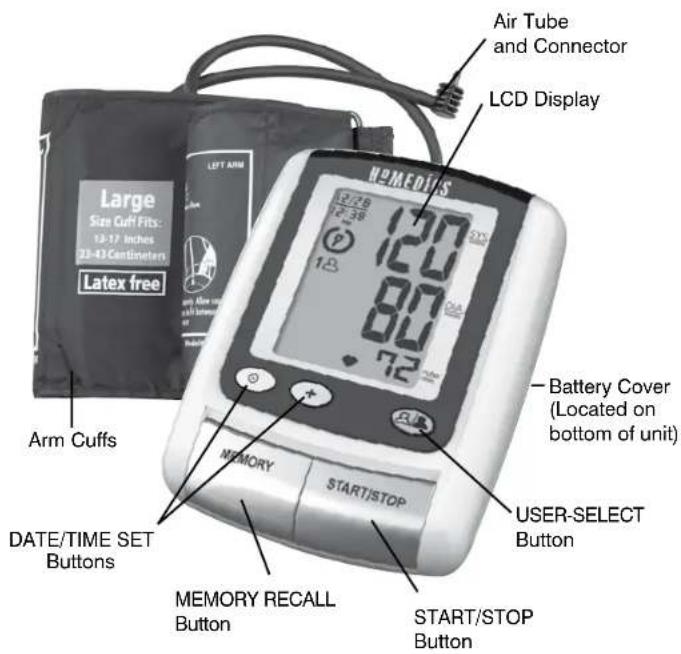
Other Accessories:
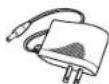

1 6V DC Output AC Adapter (not included)
4 "AA" size, 1.5V alkaline batteries
Note: Please unload the batteries when operating with the AC adapter for an extended period of time.
DISPLAY EXPLANATIONS
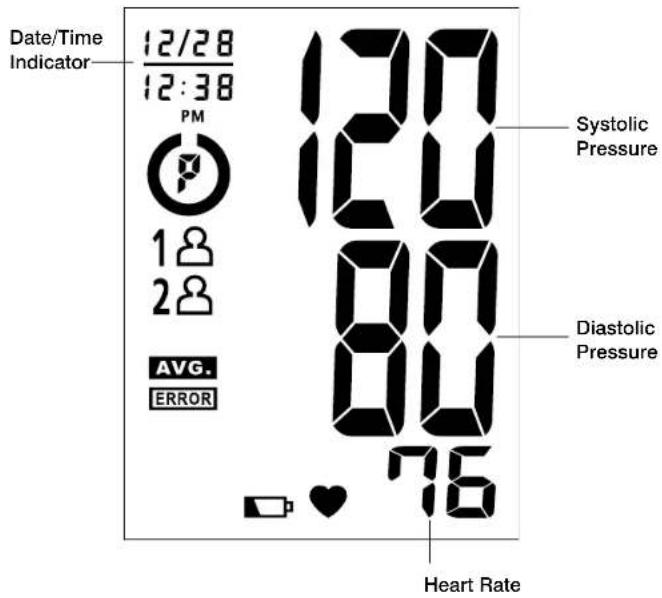
Display Symbols:
| 1# | User 1: Appears when the monitor is operated by User 1. |
| 2# | User 2: Appears when the monitor is operated by User 2. |
| Weak Battery Symbol: Appears when batteries should be replaced. | |
| Pulse Symbol: Shows the heart rate per minute. | |
| Risk Category Index: See page 20 for more information. | |
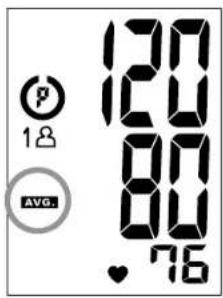
| AVG. | Memory Average: Displays average of last 3 readings |
If EEROR any of the following letters and numbers appear in the area that systolic pressure should be displayed, an error has occurred with your reading. See Troubleshooting section of this manual for more information.
| EE | Measurement Error: Wrap the cuff correctly and keep arm steady during measurement. Measure again. |
| E1 | Air Circuit Abnormality: Check cuff connection. Measure again. |
| E2 | Pressure Exceeding 300 mmHg: Turn the unit off to clear, then measure again. |
| E3 | Error Determining Measurement Data: Measure again. |
| EP | System Error: Measure again. |
INSTALLING BATTERIES
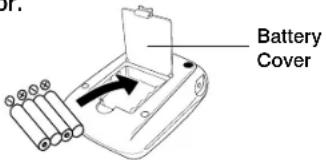
- Press down on latch and lift the battery cover to open the battery compartment.
- Install or replace 4 "AA" sized alkaline batteries in the battery compartment according to the indications inside the compartment.
- Close the battery cover by pushing in the top end of the battery door.
Replace the batteries if:
- The weak battery symbol appears on the display.
- Nothing appears on the display when the power is switched on.
Replace all batteries at one time (as simultaneous set). Use only 1.5V "AA" alkaline batteries. Remove batteries when unit is not in use for extended periods of time. Date and time will need to be reset if batteries are removed or replaced. Clean contacts on battery and in battery compartment with a soft dry cloth each time you install batteries.
Note:
Batteries are hazardous waste. Do not dispose of them together with the household garbage.
USING THE AC ADAPTER (NOT INCLUDED)
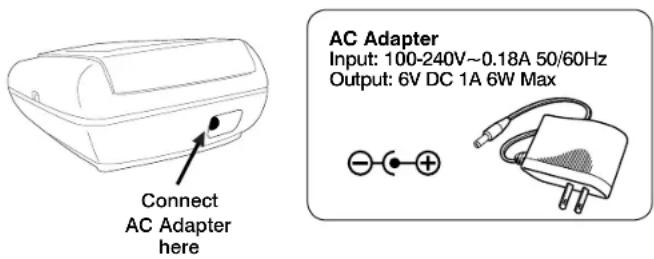
This monitor is designed for operation with batteries or an optional AC adapter. Please use only with compatible AC adapter with required voltage and current as indicated in this manual. Contact HoMedics Consumer Relations at 1-800-466-3342 to purchase a compatible AC adapter.
Note:
- When the AC adaptor is your main power supply, make sure the adaptor plug can be easily removed from the unit.
- Please unload the batteries when operating with an AC adapter for an extended period of time. Leaving the batteries in the compartment for a long time may cause leakage, which may lead to damage to the unit.
- No batteries are needed when operating with an AC adapter.
- Date and time will need to be reset if AC adapter is unplugged and unit is without batteries.
Connect the AC adapter with the AC adapter jack in the back of the unit as shown below.
DATE & TIME SET PROCEDURE
- To adjust the date and time, press the DATE/TIME SET button (⑨).
-
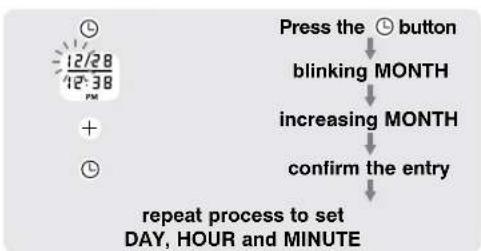
The display will show a blinking number showing the MONTH. Change the MONTH by pressing the + button. Each press will increase the number by one in a cycling manner. Press the DATE/TIME SET button (☐) again to confirm the entry, and the screen will show a blinking number representing the DAY.
-
Change the DAY, HOUR and MINUTE as described in Step 2 above, using the + button to change the numbers and the DATE/TIME SET button (☐) to confirm the entries.
flowchart
graph TD
    A["Press the button"] --> B["blinking MONTH"]
    B --> C["increasing MONTH"]
    C --> D["confirm the entry"]
    D --> E["repeat process to set DAY, HOUR and MINUTE"]
USINGTHEARMCUFF
Very Important: Proper cuff size is critical to accurate measurement.
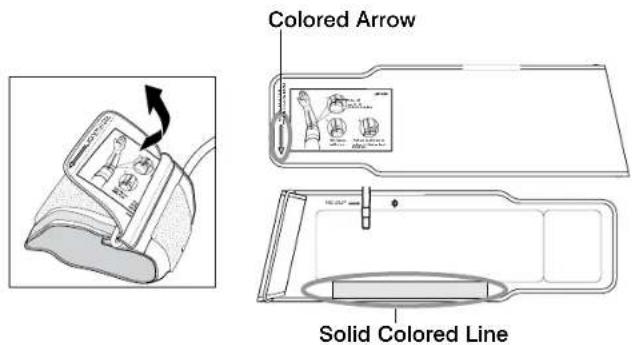
This monitor comes with two sizes of arm cuffs: Standard Size Fits 9"-13" (23 cm - 33 cm) Large Size Fits 13"-17" (33 cm - 43 cm)
The appropriate cuff is suitable for your use if the colored arrow falls within the solid color line as shown below.
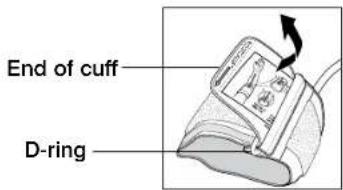
- If the cuff is not assembled, pass the end of the cuff furthest away from the tubing through the metal D-ring in order to form a loop. The smooth side without the felt material should be on the inside of the cuff loop.
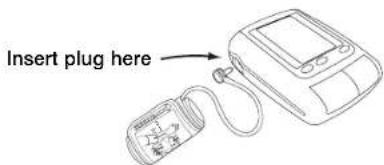
- Plug the cuff tube into the left side of the unit.
-
Open the arm cuff so that your arm may be placed through it.
-
Remove tight fitting clothing from your upper left arm so that the cuff can be wrapped around your exposed arm.
-
Position cuff edge 0.8-1.2 inches (2-3 cm) above elbow.
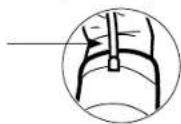
- Center tube over middle of arm.
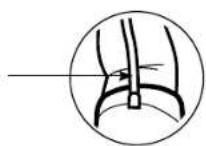
- Pull the end of the cuff so that it tightens evenly around your arm. Press the hook and loop material together to secure. Allow room for 2 fingers to fit between the cuff and your arm.

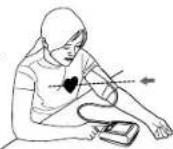
- Lay your arm on a table (palm upward) so the cuff is at the same height as your heart. Make sure the tube is not kinked.
Note:
- The device should not be used when your arm is wounded or injured.
- If it is not possible to fit the cuff to your left arm, it can also be placed on your right arm. However, all measurements should be made using the same arm.
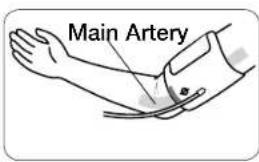
- To use on the right arm, you must position the artery symbol “Φ” over the main artery. Locate the main artery by pressing with two fingers approximately 1”
(2 cm) above the bend of your elbow on the inside of your right arm. Identify where the pulse can be felt the strongest. This is your main artery.
MEASUREMENT PROCEDURE
Important Notes:
- Blood pressure changes with every heartbeat and is in constant fluctuation throughout the day.
- Blood pressure measurement can be affected by the position of the user, his or her physiologic condition and other factors. For greatest accuracy, wait 1 hour after exercising, bathing, eating, drinking beverages with alcohol or caffeine, or smoking to measure blood pressure.
- Before measurement, it is suggested that you sit quietly for 15 minutes as measurements taken during a relaxed state will have greater accuracy. You should not be physically tired or exhausted while taking a measurement.
- During the measurement, do not talk or move your arm or hand muscles.
• See page 24 for additional notes regarding your blood pressure measurement.
If you are using this blood pressure monitor for the first time, please remove the protective film from the screen.
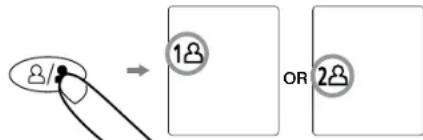
- Press the USER-SELECT button to choose User 1 or User 2.
flowchart
graph TD
    A["User"] --> B{OR}
    B --> C["Group 1"]
    B --> D["Group 2"]
- With the cuff wrapped around your arm, press the START/STOP button. Do not inflate the cuff unless it is wrapped around your arm. All digits will light up to check the display functions. The checking procedure will be completed after about 3 seconds.
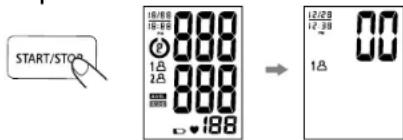
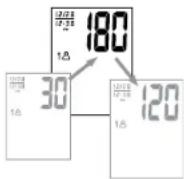
- After all symbols disappear, the display will show "00". The monitor is "Ready to Measure" and will automatically inflate the cuff to begin measurement. The cuff will then start deflating as measurement continues.
Note:
This monitor will re-inflate automatically if the system detects that your body requires more pressure for measurement.
- When the measurement is completed, the cuff will
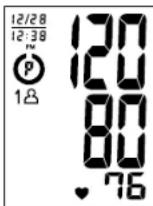
deflate entirely. Systolic pressure, diastolic pressure and pulse will be shown simultaneously on the LCD screen. The measurement is then automatically stored into memory.
Note:
- This monitor automatically turns off approximately 1 minute after last operation. You may also press the START/STOP button to turn the unit off.
- To interrupt the measurement, you may press the START/STOP (recommended), MEMORY, USER-SELECT or DATE/TIME SET ( ⏻ ) buttons. The cuff will deflate immediately after a button is pressed.
RISK CATEGORY INDEX
This monitor comes equipped with a Risk Category Index that automatically compares each reading to defined levels established by the U.S. National Institutes of Health's (NIH) National Heart Lung and Blood Institute as described earlier in this manual, and provides a helpful cue if your reading falls into one of the stages that could potentially indicate increased risk. No cue is given if the reading falls in the normal range as defined by NIH. Please note that cues provided by this monitor are only intended to assist you in using this table. The table and cues are only provided for convenience to help you understand your non-invasive blood pressure reading as it relates to the NIH information. They are not a substitute for a medical examination by your physician. It is important for you to consult with your physician regularly. Your physician will tell you your normal blood pressure range as well as the point at which you may actually be considered to be at risk.

Stage 2 Hypertension

Prehypertension

Stage 1 Hypertension
Normal (No Symbol)
RECALLING VALUES FROM MEMORY
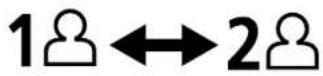
This monitor can be used by two individuals. Each user can store up to 50 measurements.
- Press the USER-SELECT button to select User 1 or User 2.
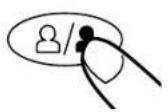
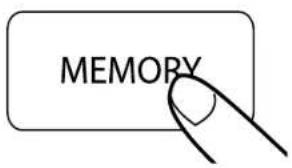
- PresstheMEMORY button to access the memory.
- The monitor will first display the calculated average applied to the last 3 memories.
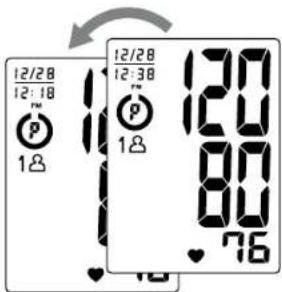
- Every new press of the MEMORY button will recall a previous reading. The latest reading will be recalled first.
CLEARING VALUES FROM MEMORY
- Press the USER-SELECT button to select User 1 or User 2.
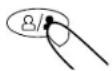
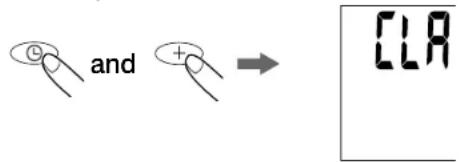
- Press and hold the DATE/TIME SET buttons (⊕ + ) at the same time while in memory recall mode, and the data for the selected user will be erased automatically.
IMPORTANT NOTES REGARDING YOUR BLOOD PRESSURE MEASUREMENT
• Take your reading in a comfortable environment as measurements can be affected by hot or cold temperatures. Take your blood pressure at normal body temperature.
- Do not move or talk during measurement as this can elevate readings.
- Do not move or cross legs during measurement. Keep feet flat on floor.
- Do not touch cuff or monitor during measurement procedure.
- It is suggested that you take your measurements at the same time each day and use the same arm for consistency.
- Users should wait a minimum of 5 minutes before taking additional measurements. More time may be necessary depending upon your physiology.
- The measurement results that users receive are for reference only. If users have any blood pressure concerns, please consult a physician.
- Once inflation reaches 300 mmHg, the unit will deflate automatically for safety reasons.
- This device may have difficulty determining the proper blood pressure for pregnant women and for users with irregular heartbeat, diabetes, poor circulation of blood, kidney problems, or for users who have suffered a stroke.
CARE, MAINTENANCE & CLEANING
- Clean the blood pressure monitor body and cuff carefully with a slightly damp, soft cloth. Do not press. Do not wash cuff or use chemical cleaner on it. Never use thinner, alcohol or petrol (gasoline) as cleaner.
- Leaky batteries can damage the unit. Remove the batteries when the unit will not be used for a long time.
- Follow local ordinances and recycling instructions regarding disposal or recycling of the device and device components, including batteries.
- If the unit is stored near freezing, allow it to acclimate to room temperature before use.
- This blood pressure monitor is not field serviceable. You should not use any tool to open the device nor should you attempt to adjust anything inside the device. If you have any problems with this device, please contact HoMedics Consumer Relations (contact information can be found on the warranty page).
- Do not immerse the unit in water as this will result in damage to the unit.
- Do not subject the monitor or cuff to extreme temperatures, humidity, moisture, or direct sunlight. Protect from dust.
-
Do not fold the cuff and tubing tightly.
-
Do not disassemble the monitor or cuff. If in need of repair, refer to the warranty section of this manual.
- Do not subject the monitor to extreme shocks (do not drop on floor).
- Do not inflate the cuff unless wrapped around arm.
- Do not wrap the cuff around body parts other than your arm.
- Do not drop or insert any object into any opening or hose.
- To avoid accidental strangulation keep this product away from children. Do not drape tube around neck.
-
This monitor may not meet its performance specifications if stored or used outside of these temperature and humidity ranges:
-
Storage/Transportation • Operating Environment Environment
| Temperature: | Temperature: |
| -13°F~158°F | 41°F~104°F |
| (-25°C~70°C) | (5°C ~40°C) |
| Humidity: | Humidity: |
| less than 93% RH | 15% ~ 93% RH |
POTENTIAL FOR ELECTROMAGNETIC INTERFERENCE
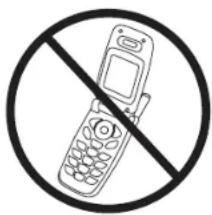
To avoid inaccurate results caused by electromagnetic interference between electrical and electronic equipment, do not use the device near a cell phone or microwave oven.
For most wireless communication devices, it is recommended to maintain a distance of 10.8 feet (3.3m) in order to avoid electromagnetic interference.
This device complies with Part 15 of the FCC Rules. Operation is subject to the following two conditions: (1) this device may not cause harmful interference, and (2) this device must accept any interference received, including interference that may cause undesired operation.
natural_image
No crossed-out graphic of a mobile phone symbol (no text or numbers present)NOTE: The manufacturer is not responsible for any radio or TV interference caused by unauthorized modifications to this equipment. Such modifications could void the user authority to operate the equipment.
NOTE: This equipment has been tested and found to comply with the limits for a Class B digital device, pursuant to Part 15 of the FCC Rules. These limits are designed to provide reasonable protection against harmful interference in a residential installation. This equipment generates, uses and can radiate radio frequency energy and, if not installed and used in accordance with the instructions, may cause harmful interference to radio communications. However, there is no guarantee that interference will not occur in a particular installation. If this equipment does cause harmful interference to radio or television reception, which can be determined by turning the equipment off and on, the user is encouraged to try to correct the interference by one or more of the following measures:
- Reorient or relocate the receiving antenna.
- Increase the separation between the equipment and receiver.
- Connect the equipment into an outlet on a circuit different from that to which the receiver is connected.
- Consult the dealer or an experienced radio/TV technician for help.
ELECTROMAGNETIC COMPATIBILITY (EMC)
- This model does not include an AC adaptor. Contact HoMedics Consumer Relations at 1-800-466-3342 to purchase a compatible AC adapter.
• Guidance and manufacturer's declaration – electromagnetic emissions
The device is intended for use in the electromagnetic environments listed below, and should only be used in such environments:
| Emissions test Compliance | Electromagnetic environment – guidance |
| RF emissions CISPR 11 Group 1 RF energy is used only to maintain device's operation. Therefore, its RF emissions are so low that it's not likely to cause any interference in nearby electronic equipment. | |
| RF emissions CISPR 11 Class B | |
| Harmonic emissions IEC 61000-3-2 | Class A The device is suitable for use in all establishments, including domestic establishments, and those directly connected to the public low-voltage power supply network that supplies buildings used for domestic purposes. |
| Voltage fluctuations/ flicker emissions IEC 61000-3-3 | |
• Guidance and manufacturer's declaration – electromagnetic immunity
The device is intended for use in the electromagnetic environments listed below, and should only be used in such environments:
| Immunity test IEC 60601 test level Compliance level Electromagnetic environment-guidance | |||
| Electrostatic discharge (ESD)IEC 61000-4-2 | ± 6 kV contact± 8 kV air | ± 6 kV contact± 8 kV air | Floors should be wood, concrete or ceramic tile. If floors are covered with synthetic material, the relative humidity should be at least 30 %. |
| Power frequency (50/60 Hz)magnetic fieldIEC 61000-4-8 | 3 A/m 3 A/m | Power frequency m | magnetic fields should be at levels characteristic of a typical location in a typical commercial or hospital environment. |
| Electrical fast transient/burstIEC 61000-4-4 | ± 2 kV for power supply lines± 1 kV for input/output lines | ± 2 kV for power supply lines± 1 kV for input/output lines | Mains power quality should be that of a typical commercial or hospital environment. |
| SurgeIEC 61000-4-5 | ± 1 kV line(s) to line(s)± 2 kV line(s) to earth | ± 1 kV line(s) to line(s)± 2 kV line(s) to earth | Mains power quality should be that of a typical commercial or hospital environment. |
| interruptions and voltage variations on power supply input linesIEC 61000-4-11 | <5 % UT (>95 % dip in UT) for 0,5 cycle40 % UT (60 % dip in UT) for 5 cycles70 % UT (30 % dip in UT) for 25 cycles<5 % UT (>95 % dip in UT) for 5 sec | <5 % UT (>95 % dip in UT) for 0,5 cycle40 % UT (60 % dip in UT) for 5 cycles70 % UT (30 % dip in UT) for 25 cycles<5 % UT (>95 % dip in UT) for 5 sec | Mains power quality should be that of a typical commercial or hospital environment. If the user of the device requires continued operation during power mains interruptions, it is recommended that the device be powered from an uninterruptible power supply or a battery. |
- Recommended separation distances between portable and mobile RF communication equipment and the device.
The device is intended for use in an electromagnetic environment where radiated RF disturbances are under control. User can help prevent electromagnetic interference by keeping the device at a minimum distance from portable and mobile RF communications equipment (transmitters). Below table details the maximum output power of transmitter:
| Rated maximum output power of transmitter W | Separation distance according to frequency of transmitter m | ||
| 150 kHz to 80 MHzd = 1.2 √P | 80 MHz to 800 MHzd = 1.2 √P | 800 MHz to 2.5 GHzd = 2.3 √P | |
| 0.01 0.12 0.12 0.23 | |||
| 0.1 0.38 0.38 0.73 | |||
| 1 1.2 1.2 2.3 | |||
| 10 3.8 3.8 7.3 | |||
| 100 | 12 12 | 23 | |
| For transmitters rated at a maximum output power not listed above, the recommended separation distanced in metres (m) can be estimated using the equation applicable to the frequency of the transmitter, where P is the maximum output power rating of the transmitter in watts (W) according to the transmitter manufacturer.NOTE 1 At 60 MHz and 800 MHz, the separation distance for the higher frequency range applies.NOTE 2 These guidelines may not apply in all situations. Electromagnetic propagation is affected by absorption and reflection from structures, objects and people. | |||
• Guidance and manufacturer's declaration – electromagnetic Immunity: The device is intended for use in the electromagnetic environments listed below, and should only be used in such environments:
| Immunity test | IEC 60601 test level | Compliance level | Electromagnetic environment – guidance |
| Conducted RFIEC 61000-4-6Radiated RFIEC 61000-4-3 | 3 Vrms150 kHz to80 MHz3 V/m80 MHz to2.5 GHz | 3 Vrms3 V/m | Portable and mobile RF communications equipment should be used no closer to any part of the device, including cables, than the recommended separation distance calculated from the equation applicable to the frequency of the transmitter. Recommended separation distanced = 1.2 √r d = 1.2 80 MHz to 800 MHz √r d = 2.3 800 MHz to 2.5 GHz √r where P is the maximum output power rating of the transmitter in watts (W) according to the transmitter manufacturer and d is the recommended separation distance in metres (m). Field strengths from fixed RF transmitters, as determined by an electromagnetic site survey, a should be less than the compliance level in each frequency range.b Interference may occur in the vicinity of equipment marked with the following symbol: (a) |
| NOTE 1 At 80 MHz and 800 MHz, the higher frequency range applies.NOTE 2 These guidelines may not apply In all situations. Electromagnetic propagation is affected by absorption and reflection from structures, objects and people. | |||
| a Field strengths from fixed transmitters, such as base stations for radio (cellular/cordless) telephones and land mobile radios, amateur radio, AM and FM radio broadcast and TV broadcast cannot be predicted theoretically with accuracy. To assess the electromagnetic environment due to fixed RF transmitters, an electromagnetic site survey should be considered. If the measured field strength in the location in which the device is used exceeds the applicable RF compliance level above, the device should be observed to verify normal operation. If abnormal performance is observed, additional measures may be necessary, such as reorienting or relocating the device.b Over the frequency range 150 kHz to 80 MHz, field strengths should be less than 3 V/m. | |||
TROUBLESHOOTING
If any abnormality arises during use, please check the following points.
| SYMPTOMS | POSSIBLE CAUSES | CORRECTION |
| Unit does not turn on when the START/ STOP button is pushed. | Batteries have run down. | Replace them with four new "AA" alkaline batteries. |
| Battery polarities have been positioned incorrectly. | Re-insert the batteries in the correct positions. | |
| EE measurement error symbol shown on display or the blood pressure value is displayed excessively low (or high). | Cuff has been placed incorrectly. | Wrap the cuff properly so that it is positioned correctly. |
| Did you talk or move during measurement? | Keep arm steady during measurement. Measure again. | |
| Shaking of the arm with the cuff on. | ||
| E1 error symbol shown on display | Air circuit abnormality. Cuff tube may not be plugged into monitor correctly. | Check cuff connection. Measure again. |
| E2 error symbol shown on display | Inflation pressure exceeding 300 mmHg. | Switch the unit off, then measure again. |
| E3 error symbol shown on display | Error determining measurement data. | Measure again. |
| EP error symbol shown on display | System error. Measure again. |
Note: If the unit still does not work, contact HoMedics Consumer Relations. Under no circumstance should you disassemble or attempt to repair the unit by yourself. Contact information for HoMedics Consumer Relations Department can be found on the warranty page.
SPECIFICATIONS
| Power Source: | Four 1.5V DC "AA" alkaline batteries or 6V DC AC adapter (not included) |
| Measurement Method: Oscillometric | |
| Measurement Range: | Pressure: 40~280 millimeters mercury (mmHg)Pulse: 40~199 beats/minute |
| Accuracy: | Pressure: ±3 mmHgPulse: ±5% of reading |
| Pressure Sensor: Semi-conductor | |
| Inflation: Pump driven | |
| Deflation: Automatic Pressure release valve | |
| Memory Capacity: 50 memories for each User (100 total) | |
| Auto-shut-off: 1 minute after last button operation | |
| Operation Environment: | Temperature: 41°F~104°F (5°C ~40°C)Humidity: 15% ~ 93% RH |
| Storage/Transportation Environment: | Temperature: -13°F~158°F (-25°C~70°C)Humidity: Less Than 93% RH |
| Weight: 0.72 lbs (325 g) (without batteries) | |
| Arm Circumference: | Standard size cuff: 9"-13" (23-33 cm)Large size cuff:13"-17" (33-43 cm) |
| Dimensions: | 5.9"(L) x 4.4"(W) x 2.2"(H)149mm(L) x 111.5mm(W) x 57mm(H) |
| Accessories: | Standard and large size cuffs, storage bag, 4 "AA" alkaline batteries |
| Internally Powered equipmentType BF EquipmentIPx0-No special protection against the ingress of waterNot suitable for use in presence of flammable anesthetic mixture with air, oxygen or nitrous oxide.Continuous operation with short-time loading. | |
| Follow Instructions for use. | |
Note: These specifications are subject to change without notice.
HOMEDICS
For service or repair, do not return this unit to the retailer. Contact HoMedics Consumer Relations at:
Email: cservice@homedics.com
Phone: 1-800-466-3342 Business Hours: 8:30am-7pm ET Monday-Friday
Distributed by HOMEDICS
HoMedics, LLC 3000 Pontiac Trail Commerce Township, MI 48390 Printed in China
LIMITED FIVE YEAR WARRANTY
HoMedics sells its products with the intent that they are free of defects in manufacture and workmanship for a period of five years from the date of original purchase, except as noted below. HoMedics warrants that its products will be free of defects in material and workmanship under normal use and service. This blood pressure monitor meets the simulated measurement cycles test requirement per EN1060-3, part 8.10. This warranty extends only to consumers and does not extend to Retailers.
To obtain warranty service on your HoMedics product, contact a Consumer Relations Representative by telephone at 1-800-466-3342 for assistance. Please make sure to have the model number of the product available.
HoMedics does not authorize anyone, including but not limited to. Retailers, the subsequent consumer purchaser of the product from a Retailer or remote purchasers, to obligate HoMedics in any way beyond the terms set forth herein. This warranty does not cover damage caused by misuse or abuse; accident the attachment of any unauthorized accessory; alteration to the product; improper installation, unauthorized repairs or modifications; improper use of electrical/power supply; loss of power, dropped product; malfunction or damage of an operating part from failure to provide manufacturer's recommended maintenance, transportation damage; theft, neglect, vandalism, or environmental conditions; loss of use during the period the product is at a repair facility or otherwise awaiting parts or repair, or any other conditions whatsoever that are beyond the control of HoMedics. This warranty is effective only if the product is purchased and operated in the country in which the product is purchased. A product that requires modifications or adoption to enable it to operate in any other country than the country for which it was designed, manufactured, approved and/or authorized, or repair of products damaged by these modifications is not covered under this warranty. THE WARRANTY PROVIDED HEREIN SHALL BE THE SOLE AND EXCLUSIVE WARRANTY. THERE SHALL BE NO OTHER WARRANTIES EXPRESS OR IMPLIED INCLUDING ANY IMPLIED WARRANTY OF MERCHANTABILITY OR FITNESS OR ANY OTHER OBLIGATION ON THE PART OF THE COMPANY WITH RESPECT TO PRODUCTS COVERED BY THIS WARRANTY. HOMEDICS SHALL HAVE NO LIABILITY FOR ANY INCIDENTAL, CONSEQUENTIAL, OR SPECIAL DAMAGES. IN NO EVENT SHALL THIS WARRANTY REQUIRE MORE THAN THE REPAIR OR REPLACEMENT OF ANY PART OR PARTS WHICH ARE FOUND TO BE DEFECTIVE WITHIN THE EFFECTIVE PERIOD OF THE WARRANTY. NO REFUNDIS WILL BE GIVEN IF REPLACEMENT PARTS FOR DEFECTIVE MATERIALS ARE NOT AVAILABLE. HOMEDICS RESERVES THE RIGHT TO MAKE PRODUCT SUBSTITUTIONS IN LIEU OF REPAIR OR REPLACEMENT.
This warranty does not extend to the purchase of opened, used, repaired, repackaged and/or rescaled products, including but not limited to sale of such products on internet auction sites and/or sales of such products by surplus or bulk resellers. Any and all warranties or guarantees shall immediately cease and terminate as to any products or parts thereof which are repaired, replaced, altered, or modified, without the prior express and written consent of HoMedics.
This warranty provides you with specific legal rights. You may have additional rights which may vary from state to state. Because of individual state regulations, some of the above limitations and exclusions may not apply to you.
For more information regarding our product line in the USA, please visit: www.homeclcs.com
HoMedics® is a registered trademark of HoMedics, LLC.
© 2009-2013 HoMedics, LLC. All rights reserved.
IB-BPA060D
PIN: 323102173 VER:001
HOMEDICS®
HoMedics, LLC 3000 Pontiac Trail Commerce Township, MI 48390
Impreso en China
GARANTÍA LIMITADA POR CINCO AÑOS
- TABLE OF CONTENTS
- INTRODUCTORY INFORMATION:
- USAGE INFORMATION:
- IMPORTANT PRODUCT NOTICES AND SAFETY INSTRUCTIONS
- ABOUT BLOOD PRESSURE
- What is Blood Pressure?
- Why Measure Your Blood Pressure?
- BLOOD PRESSURE STANDARD
- HOW THIS BLOOD PRESSURE MONITOR WORKS
- DISPLAY EXPLANATIONS
- INSTALLING BATTERIES
- Replace the batteries if:
- Note:
- USING THE AC ADAPTER (NOT INCLUDED)
- DATE & TIME SET PROCEDURE
- USINGTHEARMCUFF
- MEASUREMENT PROCEDURE
- Important Notes:
- RISK CATEGORY INDEX
- RECALLING VALUES FROM MEMORY
- CLEARING VALUES FROM MEMORY
- IMPORTANT NOTES REGARDING YOUR BLOOD PRESSURE MEASUREMENT
- CARE, MAINTENANCE & CLEANING
- POTENTIAL FOR ELECTROMAGNETIC INTERFERENCE
- ELECTROMAGNETIC COMPATIBILITY (EMC)
- TROUBLESHOOTING
- HOMEDICS
- Distributed by HOMEDICS
- LIMITED FIVE YEAR WARRANTY
- HOMEDICS®
- GARANTÍA LIMITADA POR CINCO AÑOS
Brand : HOMEDICS
Model : BPA-060
Category : Sphygmomanometer