010-094 - Sander Meec Tools - Free user manual and instructions
Find the device manual for free 010-094 Meec Tools in PDF.


| Product Type | Excenter Sander (Random Orbital Sander) |
| Brand | Meec Tools |
| Model | 010-094 |
| Rated Voltage | 730 V / 50 Hz |
| Power Output | 250 W |
| No-Load Speed | 0-13000 rpm (variable via speed control) |
| Sanding Pad Size | 125 mm (5 inch) |
| Weight | 1400 g (1.4 kg) |
| Safety Class | II (Double Insulated) |
| Sound Pressure Level | 75 dB(A) (K=3 dB) |
| Sound Power Level | 84 dB(A) (K=3 dB) |
| Vibration Level | 9.6 m/s² (K=1.5 m/s²) |
| Dust Extraction | Built-in dust collector or external dust extractor via adapter |
| Speed Control | Yes (variable speed dial) |
| Pad Brake | Yes (reduces speed under overload to prevent marks) |
| Intended Use | Dry sanding of wood, plastic, metal, filler, and painted surfaces |
| Accessories Included | Sandpaper (hook and loop), dust collector |
| Maintenance | Wipe with dry cloth, empty dust collector regularly |
| Environmental Disposal | Recycle at designated station (contains electrical/electronic components) |
Frequently Asked Questions - 010-094 Meec Tools
User questions about 010-094 Meec Tools
0 question about this device. Answer the ones you know or ask your own.
Ask a new question about this device
Download the instructions for your Sander in PDF format for free! Find your manual 010-094 - Meec Tools and take your electronic device back in hand. On this page are published all the documents necessary for the use of your device. 010-094 by Meec Tools.
USER MANUAL 010-094 Meec Tools
natural_image
Red and black power tool with visible wiring and buttons (no text or symbols)

EXCENTERSLIP
Care for the environment!
Must not be discarded with household waste. This product contains electrical or electronic components that should be recycled. Leave the product for recycling at the designated station e.g. the local authority's recycling station.
Jula reserves the right to make changes. In the event of problems, please contact our customer service www.jula.com

Tilverkare/Procusenti/Produzendi/Manufacturer
Jula AB, Box 163, 512-24 SKARA
Distr bualor, distribal yr/Dyslybaler, distribalor
Jula Pelanc Sp. 2010, u
Walborska 41, 08-28: Warsawa, Polska
Jula Marge AS, So hormsieren 6–8.
1471128-RSKDJ
2018-09-25
6183

EC DECLARATION OF CONFORMITY
EG FÖRSÄKRAN OM ÖVERENSSTÄMMELSE
EF SAMSVARSERKLAERING
DEKLARACJA ZGODNOŚCI WE

Jula AB, Box 363, SE-532 24 SKARA, SWEDEN
certify that the design and manufacturing of this product
Machinery Directive 2006/42/EC
EN 60745-1:2009+A11, EN 60745-2-4:2009+A11
Electromagnetic Compatibility Directive 2014/30/EU
EN 55014-1:2006+A1+A2; EN 55014-2:1997+A1+A2
EN 61000-3-2:2014, EN 61000-3-3:2015
RoHS Directive 2011/65/EU
EN 62321:2009
This product was CE marked in year -15
Name and address of the person authorised
to comping the technical file into vocabulary and work@reticel.org
- Read all warnings, safety instructions and other directives. Failure to follow all the instructions and safety instructions can result in the risk of electric shock, fire and/or serious personal injury.
- Save these instructions and safety instructions for future reference.
- The term "power tool" in all the warnings below refers to your mains-powered (corded) or battery powered (cordless) power tool.
Work area
- Keep the work area clean and well lit. Dark and cluttered work areas increase the risk of accidents and injuries.
- Do not use power tools in explosive environments, such as in the vicinity of flammable liquids, gases or dust. Power tools produce sparks that can ignite dust and fumes.
- Keep children and onlookers at a safe distance when using power tools. You can easily lose control of the tool if you are distracted.
Electrical safety
- The mains plug on the power tool must match the mains outlet. Never modify the plug in any way. Never use an adapter with earthed power tools. Unmodified plugs and matching outlets reduce the risk of electric shock.
- Avoid body contact with earthed surfaces such as pipes, radiators, cookers and refrigerators. There is an increased risk of electric shock if your body is earthed.
- Do not expose power tools to rain or moisture. There is a greater risk of electric shock if water gets into a power tool.
- Be careful with the power cord. Never use the power cord to carry or pull the tool, or to pull out the plug from the mains socket. Keep the power cord away from heat, oil, sharp edges and moving parts. Damaged or tangled power cords increase the risk of electric shock.
- If using the tool outdoors, only use an extension cord approved for outdoor use. Cords intended for outdoor use reduce the risk of electric shock.
Personal safety
- Slay alert. Pay attention to what you are doing, and use your common sense when working with power tools. Never use power tools if you are tired or under the influence of drugs, alcohol or medication. A moment of inattention when using a power tool can result in serious personal
the power cord. Carrying a power tool with your finger on the switch, or connecting a tool to the mains when the switch is in the ON position, increases the risk of accidents and injuries.
- Remove Allen keys/spanners etc. before starting the power tool. Spanners or the like that are left in a rotating part of the tool can cause personal injury.
- Do not overreach. Always maintain a firm footing and good balance. This will ensure you have better control over the tool in unexpected situations.
- Wear suitable clothing. Do not wear loose-fitting clothing or jewellery. Keep your hair, clothing and gloves away from moving parts. Loose-fitting clothing, jewellery and long hair can get caught in moving parts.
- If dust extraction and dust collection equipment is available, this should be connected and used correctly. The use of such devices can reduce the risk of dust-related problems.
Use and care
- Do not force the power tool. Use the correct power tool for the planned work. The tool does the job better and safer when used at the rate for which it was designed.
- Do not use the tool if it cannot be switched on and off with the power switch. Power tools that cannot be controlled with the power switch are dangerous and must be repaired.
- Unplug the power cord before making any adjustments, changing accessories or putting the power tool away. These safety precautions reduce the risk of accidentally starting the power tool.
- Store power tools out of the reach of children when not in use. Never allow children, or anyone who is unfamiliar with the power tool and these instructions, to use the tool. Power tools are dangerous if used by inexperienced persons.
- Keep the power tool properly maintained. Check that moving parts are properly adjusted and do not jam, and that no parts are incorrectly fitted or damaged. Check for other factors that could affect functionality. If the power tool is damaged, it must be repaired before being used again. Many accidents are caused by poorly maintained power tools.
- Keep cutting tools sharp and clean. Properly maintained cutting tools with sharp cutting edges are less likely to jam and are easier to control.
- Use power tools, accessories, and bits etc. in accordance with these instructions, with due consideration to the actual working conditions and the work that is to be done. It can be dangerous to use power tools for purposes other than those they are intended to be used for.
General safety instructions
- Read all warnings, safety instructions and other directives. Failure to follow all the instructions and safety instructions could result in the risk of serious personal injury and/or death.
EN
- Wear safety glasses.
• Safety gloves are recommended.
• Always make sure that the power cord is pointing away from the machine. - Check that the power switch is in the OFF position before plugging in the power cord.
- Only use the tool for dry sanding
- Never work on materials that contain asbestos. Materials that contain asbestos should only be handled by qualified personnel.
- Hold the tool firmly with both hands. Always maintain a firm footing and good balance.
- Sparks when working on metal can cause burn injuries and/or a fire. Keep onlookers at a safe distance from the work area and check that there are no flammable materials in the work area.
- Empty the dust bag at regular intervals and always after finishing the work. Handle dust very carefully – risk of explosion. Never throw sanding dust into a fire. Dust can ignite spontaneously, or if it is exposed to oil or water.
- Allow the tool to stop completely before putting it down.
- Never allow children to use the tool.
Dust
- Dust produced during the work can be harmful to health, carcinogenic, flammable or explosive. Use a dust filter mask or suitable equipment for dust extraction/collection.
- The dust from some alloys can ignite or explode. Mixtures of materials increase the risk – keep the work area clean.
WARNING:
Fire hazard! Dust in dust bags, vacuum cleaners or filters can self-ignite or be ignited by sparks, hot workpieces or other sources of heat, especially if it comes into contact with polyurethane, solvent-based paint and other chemicals. Make sure that the tool and/or workpiece does not overheat. Always empty the dust container before pausing the work.
Symbols
The following symbols are used on the tool:

Rated voltage. Double insulation.


Speed.

Recycle products that have reached the end of their useful life according to local regulations.

Read the instructions
WARNING: The tool produces an electromagnetic field during operation. This field can in some circumstances affect active or passive medical implants. If you have a medical implant you should consult your doctor and/or the manufacturer of the medical implant before using the tool to reduce the risk of serious or fatal personal injury.
Service
The power tool must only be serviced by qualified personnel using identical spare parts. This will ensure that the power tool remains safe to use.
TECHNICAL DATA
| Rated voltage: 730 V / 50 Hz |
| Output: 250 W |
| Safety class: II |
| Speed (no load): 0-13000 rpm |
| Size of sanding pad: 125 mm |
| Sound pressure level: UpA: 75 dB(A), K=3 dB |
| Sound power level: 1mA: 84 dB(A), K=3 dB |
| Vibration level: 9.6 m/s ^2 , K=1.5 m/s ^2 |
| Weight: 1400 g |
Always wear ear protection.
The declared vibration value, which has been measured by a standardised test method, can be used to compare different tools with each other and for a preliminary assessment of exposure.
WARNING: The actual vibration level when using power tools may differ from the specified maximum value, depending on how the tool is used. It is therefore necessary to determine which safety precautions are required to protect the user, based on an estimate of exposure in actual operating
EN
DESCRIPTION
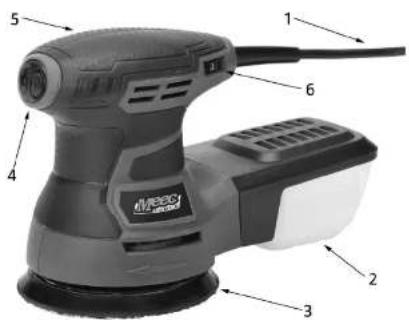
- Power cord
- Power switch
- Dust collector
- Speed control
USE
Intended use
The tool is intended for dry sanding of wood, plastic, metal, filler, and painted surfaces.
Replacing the sandpaper
NOTE: Switch off the tool, unplug the power cord, and wait until all moving parts have completely stopped before working on the tool.
- Lift the edge of the sandpaper and pull it off the pad.
- Clean the pad.
-
Press the new sandpaper firmly on the pad. Align the holes in the sandpaper with the holes in the pad for best dust extraction.
-
Switch off the tool by pressing in and then releasing the power switch.
Sanding smooth surfaces
- Place the tool with the full surface of the sandpaper against the surface to be sanded.
- Apply an even pressure during the work. Pressing harder will not speed up the work, but will put more strain on the tool and the sandpaper instead.
- The sanding rate and pattern mainly depend on the coarseness of the sandpaper, the speed of the pad, and how hard you press.
Coarse sanding
Use coarse sandpaper. Press lightly for best results.
Fine sanding
- Use fine sandpaper.
- Press moderately hard and move the tool with a circular action, or forward and back, and across, the workpiece.
- Do not tilt the tool, this will leave marks in the sanded surface.
- After finishing the work, switch off the tool and lift if from the workpiece.
Pad brake
The pad brake reduces the speed when the tool is overloaded, to reduce the risk of leaving marks in the workpiece when the tool is applied. If the speed with no load increases in time, this means the pad brake is worn and must be replaced by an authorised service centre.
Dust extractor
The tool can be used with the dust collector or dust extractor. To use a dust extractor, do as follows:
- Release the dust collector from the tool.
- Put the adapter in the tool.
- Turn the adapter clockwise to fasten it.
- Connect the dust extractor to the adapter.
MAINTENANCE
NOTE: Switch off the tool and unplug the power cord. Check that the lock button is not pressed in.
EN
- Wipe the tool with a dry and clean cloth.
Empty the dust collector
- Switch off the tool and unplug the plug. Check that the lock button is not pressed in.
- Pull the dust collector straight out.
- Hold the bottom part of the dust collector in one hand and the black cover in the other hand.
- Lift up the black cover.
- Empty the dust collector.

- EXCENTERSLIP
- Work area
- Electrical safety
- Personal safety
- Use and care
- General safety instructions
- EN
- Dust
- WARNING:
- Symbols
- Service
- Always wear ear protection.
- USE
- Intended use
- Replacing the sandpaper
- Sanding smooth surfaces
- Coarse sanding
- Fine sanding
- Pad brake
- Dust extractor
- MAINTENANCE
- Empty the dust collector
Brand : Meec Tools
Model : 010-094
Category : Sander