000-708 - Saw Meec Tools - Free user manual and instructions
Find the device manual for free 000-708 Meec Tools in PDF.


| Product Type | Cordless Circular Saw |
| Blade Size | 165 mm diameter, 16 mm bore, 1.7 mm thickness |
| No-Load Speed | 3650 rpm |
| Weight | 2.9 kg |
| Voltage | 18 V (Li-ion battery, sold separately) |
| Cutting Depth at 90° | 38 mm |
| Cutting Depth at 45° | 26 mm |
| Bevel Angle Range | 0° to 45° |
| Sound Pressure Level (LPA) | 81.47 dB(A), K=3 dB |
| Sound Power Level (LWA) | 93.47 dB(A), K=3 dB |
| Vibration Level (ah) | 1.264 m/s², K=1.5 m/s² |
| Blade Arbor | 16 mm round or rhomboidal |
| Dust Extraction Port | 35 mm outer diameter |
| Battery Type | Li-ion (compatible with Meec Tools 18V system) |
| Charging Time | Approx. 1 hour |
| Spindle Lock | Yes |
| Lower Guard | Automatic spring-loaded |
| Depth Adjustment | Tool-less with lock knob |
| Bevel Adjustment | Tool-less with lock knob |
| Parallel Fence | Included |
| Maintenance | Clean after each use; lubricate moving parts |
| Safety Features | Lock button, double insulation (battery powered), spindle lock |
Frequently Asked Questions - 000-708 Meec Tools
User questions about 000-708 Meec Tools
0 question about this device. Answer the ones you know or ask your own.
Ask a new question about this device
Download the instructions for your Saw in PDF format for free! Find your manual 000-708 - Meec Tools and take your electronic device back in hand. On this page are published all the documents necessary for the use of your device. 000-708 by Meec Tools.
USER MANUAL 000-708 Meec Tools
natural_image
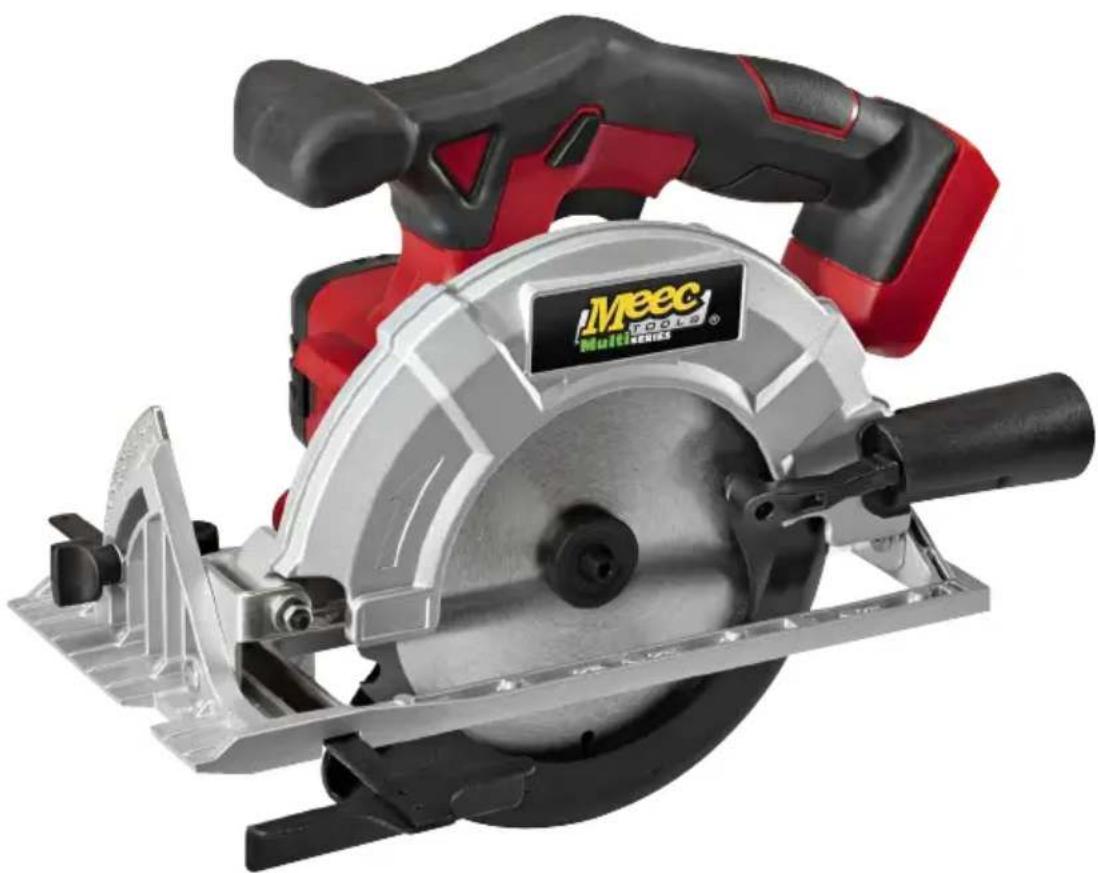
Exterior view of a Meec Multicohole tool with red and black components (no signage or text visible on the device itself)SE Bruksanvisning för cirkelsåg
NO Bruksanvisning for sirkelsag
PL Instrukcja obsługi pilarki tarczowej
EN Operating instructions for circular saw
SE - Bruksanvisning i original
EN - Operating instructions (Translation of the original instructions)
Jula reserves the right to make changes. In the event of problems, please contact our service department.
www.jula.com
Tillverkare/ Produsent / Produenci/ Manufacturer
Jula AB, Box 363, 532 24 SKARA
Importör/ Importør/ Importer/ Importer
Care for the environment!
Must not be discarded with household waste! This product contains electrical or electronic components that should be recycled. Leave the product for recycling at the designated station e.g. the local authority's recycling station.
SVENSKA....5
SÄKERHETSANVISNINGAR....5
Symboler 11
TEKNISKA DATA....12
BESKRIVNING 13
HANDHAVANDE 14
SAFETY INSTRUCTIONS....50
Symbols 56
TECHNICAL DATA 57
DESCRIPTION 58
USE 59
Intended use 59
Before use....59
Battery 60
Dust extraction....61
Fitting and dismantling the blade 61
Sawing 63
MAINTENANCE 64
Cleaning....64
Storage....64
SÄKERHETSANVISNINGAR
natural_image
Icon of a person reading a book inside a circle (no text or symbols)natural_image
Black electronic device with buttons and a pointing arrow (no visible text or symbols)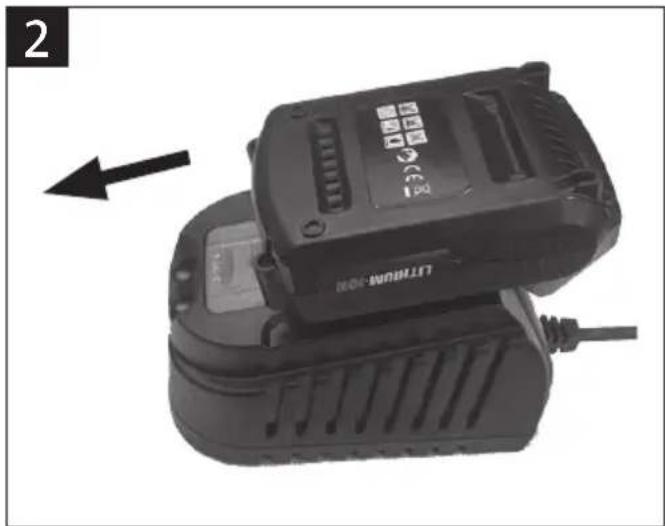
natural_image
Close-up of a black Litter-108 electric motor with a power cord and indicator lights, no visible text or symbols on the device itself.Ladda batteri
OBS!
natural_image
Close-up of hands operating a mechanical device with transparent casing (no visible text or symbols)natural_image
Close-up of a mechanical power saw with a flat blade and mounting base (no visible text or symbols)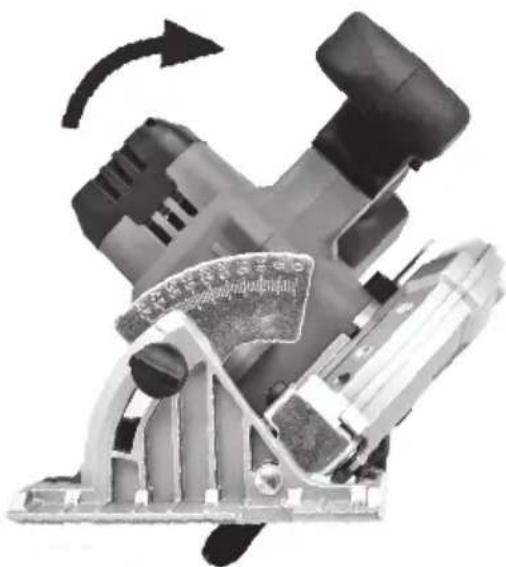
natural_image
Close-up of a mechanical device with a curved arrow indicating rotation or movement (no visible text or symbols)natural_image
Top-down view of a mechanical power tool with visible blades and housing (no text or symbols)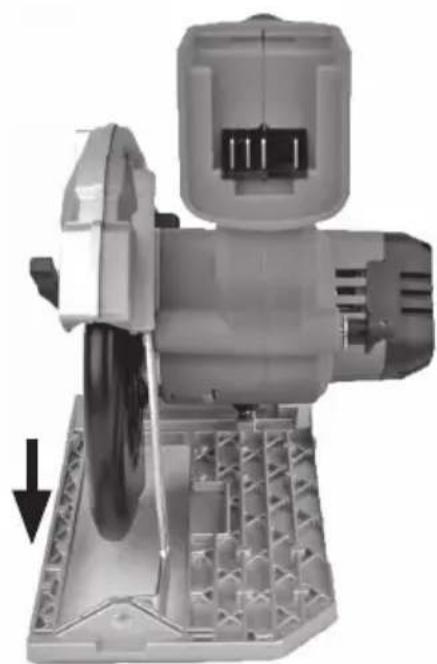
natural_image
3D rendering of a mechanical device with a cutting tool and mounting base (no visible text or symbols)SÅGNING
OBS!
natural_image
Close-up of a hand using a manual tool to cut a metal saw (no text or symbols visible)natural_image
Icon of a person reading a book inside a dark circular frame (no text or symbols)natural_image
Close-up of a black utility-branded battery with a cable, showing internal components and a directional arrow (no text or symbols on the device itself)Lade batteriet
OBS!
natural_image
Close-up of hands operating a mechanical device with visible internal components (no text or symbols)natural_image
Two views of a mechanical power tool with no visible text or symbolsnatural_image
Top-down view of a mechanical power tool with visible internal components and mounting base (no text or symbols)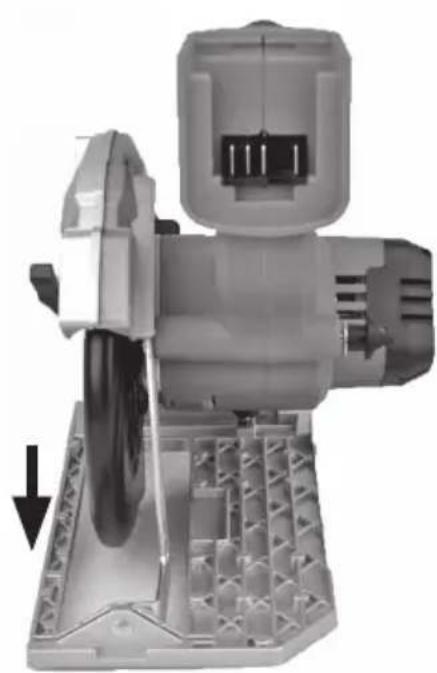
natural_image
Mechanical device with a cutting tool and mounting base, showing internal components and a downward arrow indicator (no text or symbols)SAGING
OBS!
natural_image
Close-up of a hand using a mechanical tool to cut a metal component (no visible text or symbols)natural_image
Icon of a person reading a book inside a circle (no text or symbols)natural_image
Close-up of a black Litterbox device with a power cord and indicator lights, no visible text or symbols on the device itself.natural_image
Close-up of hands operating a mechanical device with transparent casing (no visible text or symbols)natural_image
Two views of a saw cutting machine, one showing blade and blade assembly, the other showing blade and blade assembly with rotation arrow (no text or symbols)natural_image
Two views of a mechanical device showing front and side views, with no visible text or symbols.CIECIE
UWAGA!
natural_image
Close-up of a hand using a tool on a metal cutting board (no visible text or symbols)Read the operating instructions carefully before use!
Save them for future reference.

WARNING: Read all the safety instructions and other instructions. Failure to follow the safety instructions and other instructions can result in electric shock, fire and/or serious personal injury. Save all the safety instructions and other instructions for future reference. The term "power tool" in the safety instructions refers to your battery-powered (cordless) power tool.
- The appliance is not intended to be used by persons (children or adults) with any form of functional disorders, or by persons who do not have sufficient experience or knowledge on how to use it, unless they have received instructions concerning the use of the appliance by someone who is responsible for their safety. Keep children under supervision to make sure they do not play with the appliance.
- Do not use the tool for anything other than the purpose for which it is intended to be used for. The tool must only be used for its intended purpose and in accordance with these instructions. All other applications are considered to be unsuitable. The manufacturer cannot accept liability for any damages resulting from improper usage. Never modify the tool in any way. The manufacturer cannot be held responsible for any personal injury or damage to equipment incurred as a result of such modifications. Even if the tool is used in accordance with the instructions it is impossible to rule out all risk factors.
Work area
- Keep the work area clean and well lit. Dark and cluttered work areas increase the risk of accidents and injuries.
- Do not use power tools in explosive environments, such as in the vicinity of flammable liquids, gases or dust. Power tools produce sparks that can ignite dust and fumes.
- Keep children and onlookers at a safe distance when using power tools. You can easily lose control of the tool if you are distracted.
Electrical safety
- The mains plug on the tool must match the mains outlet. Never modify the plug in any way. Never use an adapter with earthed power tools. Unmodified plugs and matching outlets reduce the risk of electric shock.
- Avoid body contact with earthed surfaces such as pipes, radiators, cookers and refrigerators. There is an increased risk of electric shock if your body is earthed.
- Do not expose power tools to rain or moisture. There is a greater risk of electric shock if water gets into a power tool.
- Be careful with the power cord. Never use the power cord to carry or pull the tool, or to pull out the plug from the mains socket. Keep the power cord away from heat, oil, sharp edges and moving parts. Damaged or tangled power cords increase the risk of electric shock.
- If using the tool outdoors, only use an extension cord approved for outdoor use. Cords intended for outdoor use reduce the risk of electric shock.
- If it is absolutely necessary to use power tools in damp conditions, use a mains connection protected by an RDC. Using an RCD reduces the risk of electric shock.
Personal safety
- Stay alert. Pay attention to what you are doing, and use your common sense when working with power tools. Never use power tools if you are tired or under the influence of drugs, alcohol or medication. A moment of inattention when using a power tool can result in serious personal injury.
- Use personal safety equipment. Wear safety glasses. Depending on the type of tool and how it is used, safety equipment such as dust masks, non-slip safety shoes, safety helmets and ear protection reduce the risk of personal injury.
- Avoid accidental starting. Make sure the power switch is in the OFF position before inserting the battery or lifting/carrying the tool. Carrying a power tool with your finger on the switch, or connecting a tool to the mains supply when the switch is in the ON position, increases the risk of accidents and injuries.
- Remove Allen keys/spanners etc. before starting the tool. Spanners or the like that are left in a rotating part of the tool can cause personal injury.
- Do not overreach. Always maintain a firm footing and good balance. This will ensure you have better control over the tool in unexpected situations.
- Wear suitable clothing. Do not wear loose-fitting clothing or jewellery. Keep your hair, clothing and gloves away from moving parts. Loose-fitting clothing, jewellery and long hair can get caught in moving parts.
- If dust extraction and dust collection equipment is available, this should be connected and used correctly. The use of such devices can reduce the risk of dust-related problems.
Use and care
- Do not force the tool. Use the correct power tool for the planned work. The tool does the job better and safer when used at the rate for which it was designed.
- Do not use the tool if it cannot be switched on and off with the power switch. Power tools that cannot be controlled with the power switch are dangerous and must be repaired.
- Remove the battery before making any adjustments, changing accessories or putting the power tool away. These safety precautions reduce the risk of accidentally starting the tool.
- Store power tools out of the reach of children when not in use. Never allow children, or anyone who is unfamiliar with the tool and these instructions, to use the tool. Power tools are dangerous if used by inexperienced persons.
- Keep the power tool properly maintained. Check that moving parts are properly adjusted and do not jam, and that no parts are incorrectly fitted or damaged. Check for other factors that could affect functionality. If the tool is damaged, it must be repaired before being used again. Many accidents are caused by poorly maintained power tools.
- Keep cutting tools sharp and clean. Properly maintained cutting tools with sharp cutting edges are less likely to jam and are easier to control.
- Use the tool, accessories, etc., in accordance with these instructions, taking into account the actual working conditions and the work that is to be done. It can be dangerous to use power tools for purposes other than those they are intended to be used for.
Battery-powered tool use and care
- The battery must only be charged with the charger recommended by the manufacturer. A charger intended for one type of battery can result in a fire risk if used with another type of battery.
- Only use power tools with the specified batteries. The use of other batteries can cause accidents or a fire.
- When the battery is not being used it must be kept away from other metal objects such as paper clips, coins, keys, nails, screws and other metal objects that can short circuit the terminals. Short circuiting the battery terminals can cause burns or a fire.
- Failure to handle the battery carefully can cause acid to leak from the battery. Avoid contact with battery acid. Rinse well with plenty of water if you come into contact with battery acid. Seek medical attention if you get battery acid in your eyes. Acid leaking from the battery can cause irritation or burns.
Service
Make sure that the power tool is serviced by qualified technicians that only use identical spare parts. This will ensure that the power tool remains safe to use.
Special safety instructions
Sawing
- WARNING: Keep your hands away from the cutting area and blade. Hold your other hand on the extra handle or motor casing. If you hold the tool with both hands, they cannot come into contact with blade.
- Do not put your hand under the workpiece. The guard does not protect you from the blade under the workpiece.
- Adjust the cutting depth to the thickness of the workpiece. Slightly less than one full tooth on the blade should be visible below the workpiece.
- Never hold the workpiece in your hands or across your legs. Secure the workpiece on a stable surface. It is important to support the workpiece properly so that body contact is minimised, the blade does not jam, and you do not lose control.
- Hold the power tool by the insulated grips when working in areas where it may come into contact with concealed electrical cables or its own power cord. Contact with a live cable will cause the metal parts on the tool to also become live – risk of electric shock.
- Always use a fence or guide to obtain a straight cut when sawing. This makes the cut more precise and reduces the risk of the blade jamming.
- Always use blades with the correct size and shape of centre hole (rhomboidal or round). Blades that do not fit properly on the tool will run eccentrically, which will reduce performance.
- Never use damaged or incorrect washers or screws for the blade. Blade washers and screws are specially designed for the tool to ensure optimum functionality and maximum safety.
Additional special safety instructions
Risk of kickback
- Sudden kickback can occur when the saw blade gets stuck, jams or is incorrectly adjusted, whereby the saw kickbacks up from the workpiece towards the user.
- If the blade jams, or gets caught in a cut that is squeezed together, it will lock and the power of the motor can cause the saw to kickback towards the user.
- If the blade is twisted, or comes out of alignment in the cut, the teeth on the back edge of the blade can cut into the surface of the workpiece, so that the blade jerks out of the cut and kicks back towards the user.
- Kickback occurs during incorrect use of the tool and/or incorrect working methods or conditions, but can be prevented by taking the following measures.
- Hold the tool firmly with both hands and hold your arms in a position that prevents kickback. Stand to the side of the blade, not in line with it. Kickback can cause the tool to jerk backwards, but the user can control this by taking the appropriate measures.
- If the blade jams, or the sawing action is interrupted for any reason, release the power switch and hold the saw still in the material until the blade has completely stopped. Never attempt to remove the saw from the workpiece, or pull the saw back, while the blade is still moving – otherwise kickback can occur. Check and rectify the reason why the blade has jammed.
- When restarting the power tool in the workpiece, centre the blade in the kerf and check that the teeth are not gripping the material. If the blade jams it can slip or kick back from the workpiece when the saw is started again.
- Support large boards to minimise the risk of kickback or the blade jamming. Large boards often sag under their own weight. Supports must be placed under the board on both sides, close to the cutting line and close to the edge of the board.
- Do not use blunt or damaged blades. Poorly sharpened or incorrectly adjusted blades produce narrow saw cuts, which generate excessive friction and cause the blade to jam or kick back.
- The locking devices for the depth and angle of the blade must be tightened and secured before you start sawing. If the blade is adjusted during the sawing there is a risk of the blade jamming or kicking back.
- Take extra care when plunge cutting in walls or other similar areas where you cannot see what lies behind. The protruding blade may strike objects that can cause kickback.
Safety instructions
Bottom guard
- Check that the lower guard is closed before using the machine. Do not use the saw if the guard does not move freely and immediately closes around the blade. Never lock or block the guard in the open position. If you accidentally drop the saw this could bend the guard. Lift up the lower guard with the handle and check that it moves freely in all sawing depths and angles, and does not touch the blade or any other part.
- Check that the spring on the lower guard works. If the guard and the spring do not function correctly they must be repaired before use. The lower guard may be sluggish due to damaged parts, tacky deposits or accumulated dirt.
- The lower guard must only be moved back manually for special applications, e.g. plunge sawing and combination sawing. Lift up the lower guard by moving back the handle. The lower guard must be released as soon as the blade comes into contact with the workpiece. The lower guard will function automatically for all other types of sawing.
- Always check that the lower guard covers the blade before placing the saw on the bench or floor. An unprotected and freely rotating blade can cause the saw to move backwards, and cut everything in its path. Bear in mind that it takes a while for the blade to stop after you have released the power switch.
Remaining risks
- Even if the tool is used in accordance with the instructions it is impossible to rule out all risk factors. The following are potential risks that may be incurred as a result of the type and design of the tool.
– Damage to the lungs (if an effective face mask is not worn).
– Damage to ears (if effective ear protection is not worn).
- Vibration injuries (if the tool is used for long periods, or is not handled and maintained correctly).
- WARNING: The tool produces an electromagnetic field when in use. This field can in some circumstances affect active or passive medical implants. If you have a medical implant you should consult your doctor and/or the manufacturer of the medical implant before using the tool to reduce the risk of serious or fatal personal injury.
Vibration
WARNING:
- Declared total vibration values are measured in accordance with a standard test method, and can be used for comparisons between tools.
- The declared values can also be used for a preliminary assessment of exposure.
- Vibration levels can deviate from the declared value, depending on how the tool is used.
- Try as far as possible to reduce exposure to vibrations by, for example, wearing gloves and taking suitable breaks at regular intervals in the work.
Battery
- WARNING: Lithium-ion batteries can cause a fire or explosion if used, loaded or stored incorrectly.
- Store batteries out of the reach of children.
SYMBOLS

natural_image
Icon of a person reading a book inside a circle (no text or symbols)Read the operating instructions carefully before use. Save them for future reference.
TECHNICAL DATA
Blade capacity 165x16x1.7 mm, 24 T
Speed 3650 rpm
Weight 2.9 kg
Voltage 18 V
Saw depth 90° 38 mm
Saw depth 45° 26 mm
Sound pressure level No load: LPA = 81.47 dB (A), KPA = 3 dB
Sound power level No load: LWA = 93.47 dB (A), KWA = 3 dB
Vibration ah = 1.264 m/s ^2 , K = 1.5 m/s ^2
Always wear ear protection!
DESCRIPTION
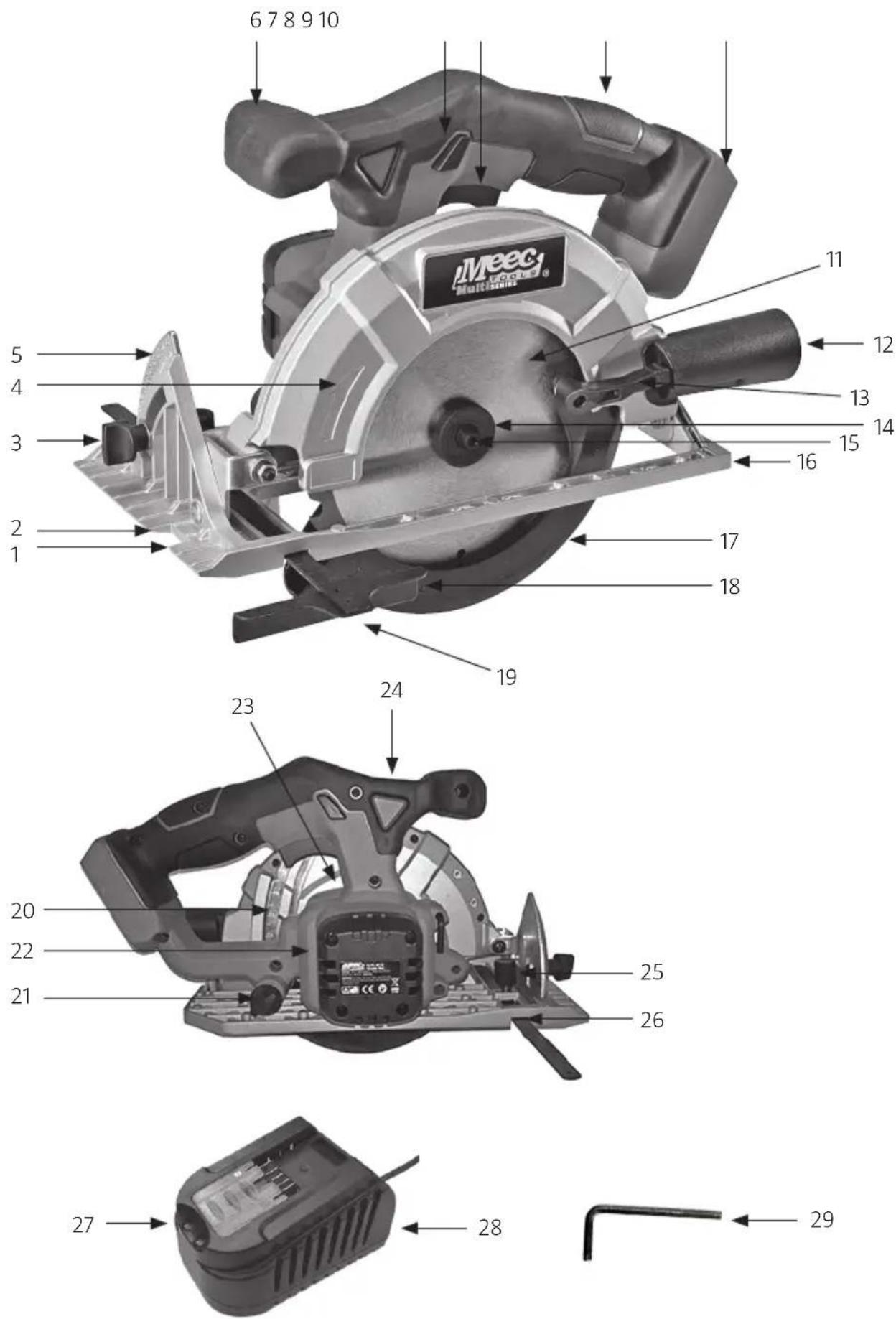
- Line 0°
- Line 45°
- Bevel angle lock knob
- Direction indicator
- Bevel angle scale
- Front handle
- Lock button
- Power switch
- Main handle
- Battery mount
- Blade
- Connection for dust extractor
- Locking lever bottom guard
- Blade flange
- Blade screw
- Base plate
- Bottom guard
- Direction indicator
- Parallel fence
- Depth scale
- Depth stop lock knob
- Ventilation openings
- Spindle lock
- Lock button
- Fence lock knob
- Slot for parallel fence
- Charging indicator
- Battery charger
- Blade spanner
Battery and charger sold separately.
USE
INTENDED USE
The circular saw is battery powered and designed for cross and rip cuts and bevel sawing of hard and soft wood and boards. It can also be used for plunge cutting.
BEFORE USE
- Carefully unpack the circular saw and inspect it. Familiarise yourself with the circular saw's controls and use.
- Check that all parts are included and are in a good condition. Do not use the machine if any parts are missing or damaged.
BATTERY
NOTE:
- Make sure the power switch is not pressed in when inserting or replacing the battery.
- Do not force the battery when connecting it, use a moderate pressure. An incorrectly connected battery can damage the battery terminals or the battery socket on the circular saw.
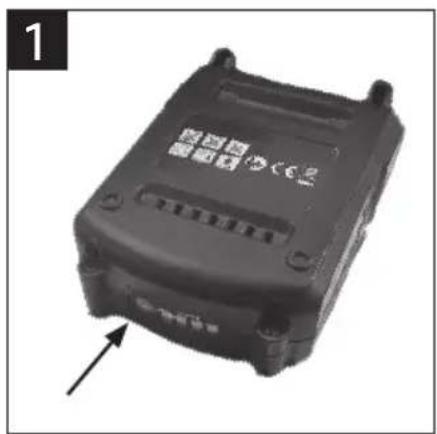
- Use the "Press" button (diagram 1) on the battery to check the charging status; 1-4 red LEDs, where 1 indicates low battery status.
natural_image
Black electronic device casing with buttons and a black arrow pointing to it (no visible text or symbols)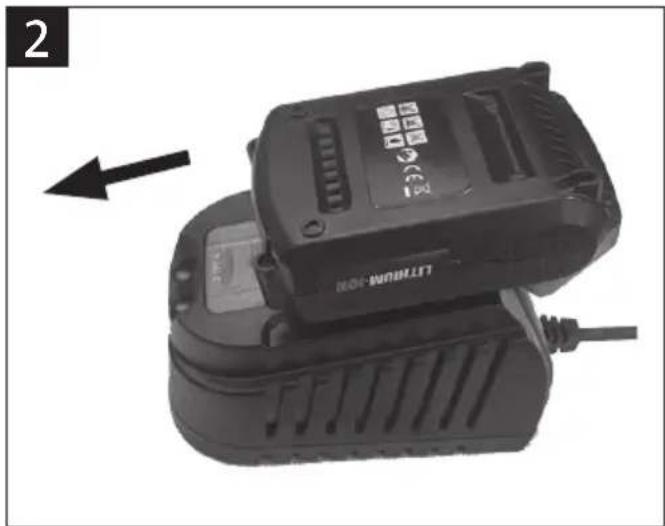
natural_image
Close-up of a black cylindrical battery with a labeled sensor and power cord, showing internal components and a cable (no readable text or symbols)Charging the battery
NOTE:
- The battery must be charged before the circular saw can be used.
- After charging for the first time, use the circular saw until the battery is completely discharged. Repeat this charging and discharging cycle 4 to 5 times.
- If the LEDs on the charger do not go on when charging:
-
check that the charger's mains adapter is properly plugged into the power point and that the charger is switched on
— check that the battery is correctly inserted in the charger -
Place the battery charger on a level and stable surface. Plug the charger into a 230 V power point.
- Connect the battery to the charger so that it clicks into place (diagram 2). The red LED lights up on the charger when correct contact is made.
- When the battery is fully charged, after about one hour, the red LED goes off and only the green LED stays on.
- Unplug the charger from the power point and remove the battery from the charger.
Connecting the battery
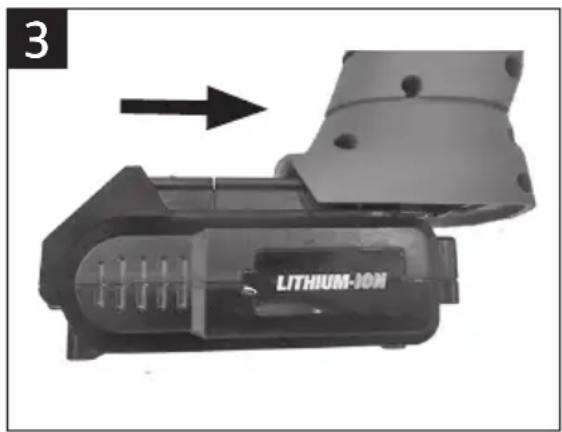
- Connect the battery to the battery socket on the multi-circular saw so that it clicks into place (diagram 3).
Removing the battery
- Press the battery lock and remove the battery from the circular saw.
DUST EXTRACTION
NOTE:
- Keep the dust port and the motor's ventilation openings clean and free of chips and dust, otherwise there is a risk of overheating.
-
Clean the dust port and ventilation openings regularly with a vacuum cleaner, unless the equipment for dust extraction and collection can be used.
-
Connect the vacuum cleaner or dust extractor to the circular saw's dust extractor connection (35 mm outside diameter) to automatically pick up sawdust and chips while sawing.
FITTING AND DISMANTLING THE BLADE
WARNING:
- Remove the battery from the circular saw.
• Always wear gloves when handling blades. - Only use undamaged, sharp blades in perfect condition. Cracked, warped or blunt blades must be replaced immediately.
NOTE:
-
Check before using for the first time that the blade that is fitted correctly and the blade screw is tightened correctly.
• Always check that the fitted blade is suitable for the material in question. -
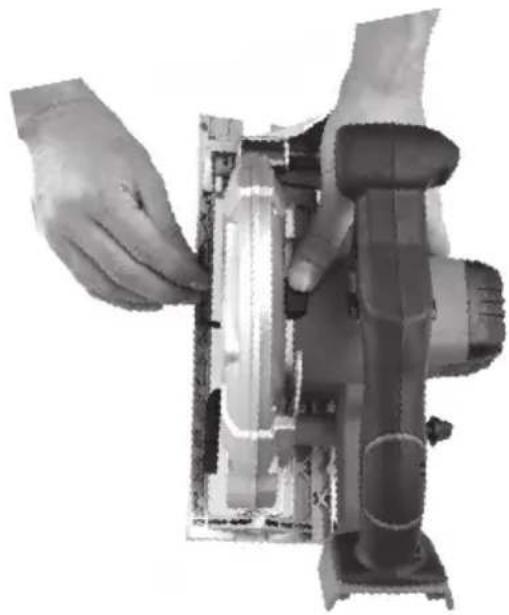
Press in the spindle lock and carefully turn the blade until the spindle lock engages.
-
Unscrew the blade screw with the supplied spanner.
-
Remove the blade screw, any washers and blade flange.
-
Loosen the lower guard lock lever, move the bottom cover to one side.
-
Change to an appropriate blade. Fit the blade with the direction marking on the blade in the same direction as the direction indicator.
-
Refit the blade flange, any washers and the blade screw.
-
Press in the spindle lock and tighten the blade screw with the spanner.
natural_image
Close-up of hands operating a mechanical device with visible internal components (no text or symbols)Adjusting the bevel angle
-
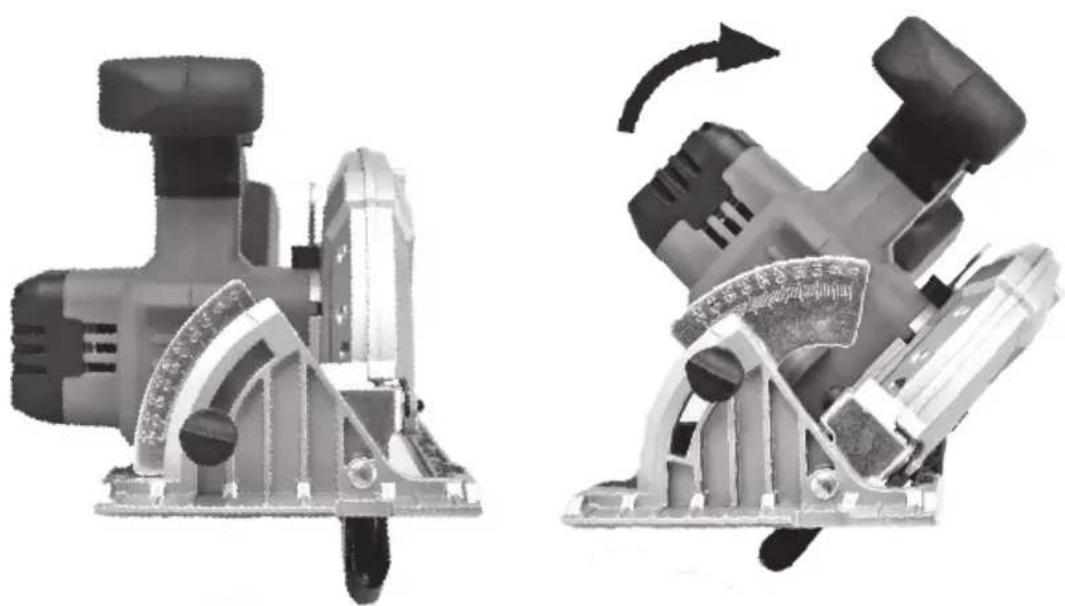
Loosen the bevel angle lock knob.
-
Adjust the bottom plate to the angle required ( 0^ to 45^ ) according to the bevel angle scale and tighten the lock knob.
-
Measure the angle between the blade and the bottom plate.
natural_image
Two views of a mechanical device with a hammer and screw, showing internal components and a rotation arrow (no text or symbols)Setting the cutting depth
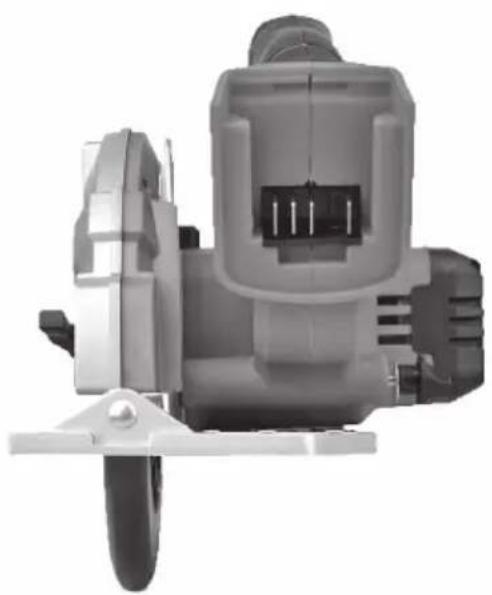
Adjust the cutting depth to the thickness of the workpiece. At the correct setting, the blade's teeth should extend approximately 3 mm below the underside of the workpiece.
-
Loosen the depth adjustment lock knob.
-
Adjust the bottom plate to the required depth according to the depth scale, or measure with a ruler, and tighten the lock knob.
natural_image
Top-down view of a mechanical power tool with visible blades and housing (no text or symbols)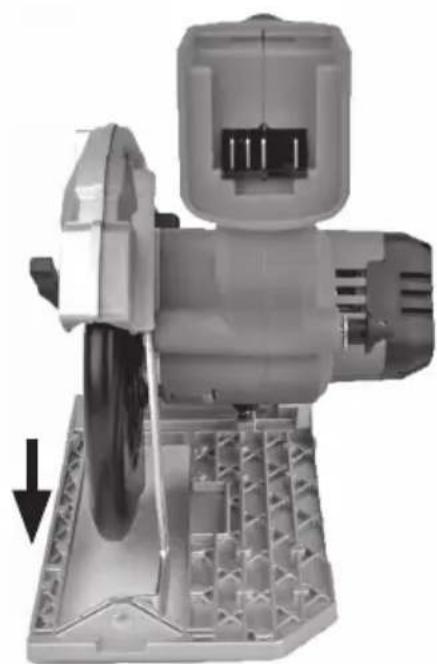
natural_image
Mechanical device with a cutting tool and mounting base, showing internal components and a downward arrow indicator (no text or symbols)SAWING
NOTE:
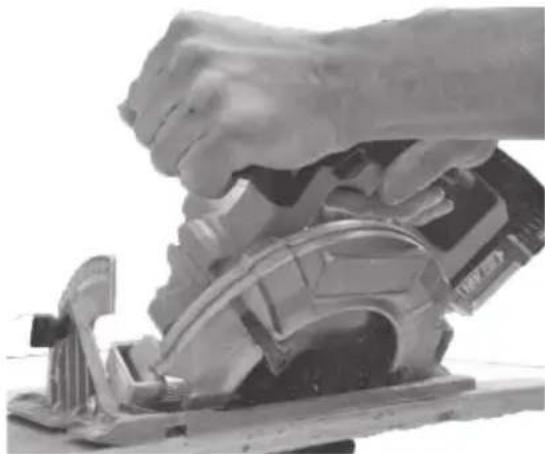
• Always use both hands to grip the handles when using the circular saw.
natural_image
Close-up of a hand using a manual tool to cut a metal saw (no text or symbols visible)- Secure the workpiece with a clamp, clips or vice.
- Practise on some waste material to get a feel of the circular saw before processing the actual workpiece.
- Hold the circular saw firmly and let the front edge of the bottom plate rest against the edge of the workpiece.
- Check that the blade does not touch the workpiece or anything else.
- Press in the lock button. NOTE: The circular saw has two lock buttons, one on the right and one on the left, to suit either hand.
- Gradually press in the power switch to start the circular start. Let the blade reach its maximum speed.
- Carefully move the circular saw forwards through the workpiece.
- Hold the bottom plate against the workpiece and work in one smooth motion. NOTE: There is a slot at the front of the bottom plate.
- For normal sawing (bevel angle 0^ ), align the 0^ line with the sawing line.
- For sawing at a bevel (bevel angle 45^ ), align the 45^ line with the sawing line.
- Release the power switch when cut is finished. Always wait until all moving parts have completely stopped before putting the circular saw to one side.
MAINTENANCE
WARNING: Always remove the battery before performing maintenance and/or cleaning.
- Regularly check that screw joints and fastening screws are tight.
- Repairs must only carried out by an authorised service centre.
- Regularly spray an appropriate lubricant on all moving parts.
CLEANING
WARNING: Always wear safety glasses and gloves when cleaning.
- Clean the circular saw after each use. Dust and contamination means the circular saw will wear quicker and have a shorter lifetime.
- Clean the casing with a soft brush or dry cloth.
- Do not use strong detergents or solvents, they can damage the plastic parts on the circular saw. Stubborn dirt can be removed with a cloth moistened with a mild detergent.
- Do not subject the circular saw to water or any other liquid.
- Do not use the circular saw unless it is completely dry.
- Keep the ventilation openings clean. Blow the ventilation openings clean with compressed air, if possible.
STORAGE
- Store the circular saw in a dry and secure place, out of the reach of children.
CE
EC DECLARATION OF CONFORMITY EG FÖRSÄKRAN OM ÖVERENSSTÄMMELSE EF SAMSVARSERKLÆRING DEKLARACJA ZGODNOŚCI WE

Jula AB, Box 363, SE-532 24 SKARA, SWEDEN
RoHS Directive 2011/65/EU EN 62321:2009
This product was CE marked in year -15
- Care for the environment!
- SVENSKA....5
- SÄKERHETSANVISNINGAR....5
- TEKNISKA DATA....12
- BESKRIVNING 13
- HANDHAVANDE 14
- MAINTENANCE 64
- SÄKERHETSANVISNINGAR
- Ladda batteri
- OBS!
- SÅGNING
- Lade batteriet
- SAGING
- CIECIE
- UWAGA!
- Read the operating instructions carefully before use!
- Work area
- Electrical safety
- Personal safety
- Use and care
- Battery-powered tool use and care
- Service
- Special safety instructions
- Sawing
- Additional special safety instructions
- Risk of kickback
- Safety instructions
- Bottom guard
- Remaining risks
- Vibration
- WARNING:
- Battery
- SYMBOLS
- TECHNICAL DATA
- USE
- INTENDED USE
- BEFORE USE
- NOTE:
- Charging the battery
- Connecting the battery
- Removing the battery
- DUST EXTRACTION
- FITTING AND DISMANTLING THE BLADE
- Adjusting the bevel angle
- Setting the cutting depth
- MAINTENANCE
- WARNING: Always remove the battery before performing maintenance and/or cleaning.
- CLEANING
- WARNING: Always wear safety glasses and gloves when cleaning.
- STORAGE
- CE
- EC DECLARATION OF CONFORMITY EG FÖRSÄKRAN OM ÖVERENSSTÄMMELSE EF SAMSVARSERKLÆRING DEKLARACJA ZGODNOŚCI WE
Brand : Meec Tools
Model : 000-708
Category : Saw