
46810 - Uncategorized PROLINE - Free user manual and instructions
Find the device manual for free 46810 PROLINE in PDF.


| Product Type | Hydraulic Bottle Jack |
| Brand | Proline |
| Model | 46810 |
| Maximum Lifting Capacity | 10000 kg |
| Minimum Saddle Height | 222 mm |
| Maximum Piston Extension | 145 mm |
| Maximum Extension Screw Extension | 80 mm |
| Maximum Saddle Height | 447 mm |
| Weight | 4.8 kg |
| Power Source | Manual hydraulic pump |
| Safety Features | Factory-adjusted safety valve, overload protection |
| Oil Type | Hydraulic oil SAE 10 |
| Maintenance | Annual oil change, venting as needed |
| Service Life | 50 cycles or 2 years (whichever first) |
| Included Accessories | Lever (2-part), instruction manual, warranty card |
| Application | Two-trace vehicles only |
| Storage | Vertical position, lever removed, dry place |
Frequently Asked Questions - 46810 PROLINE
User questions about 46810 PROLINE
0 question about this device. Answer the ones you know or ask your own.
Ask a new question about this device
Download the instructions for your Uncategorized in PDF format for free! Find your manual 46810 - PROLINE and take your electronic device back in hand. On this page are published all the documents necessary for the use of your device. 46810 by PROLINE.
USER MANUAL 46810 PROLINE
natural_image
Line drawing of a mechanical device with a cylindrical top and base mount (no text or symbols)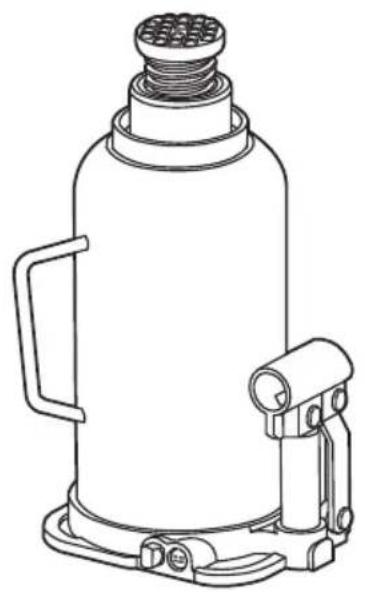
natural_image
Line drawing of a thermos flask with handle and side mount (no text or symbols)46802
46803
46805
46808
46810
46812
46815
46820
EN
Instruction manual
HYDRAULIC BOTTLE JACK 4
DE
Bedienungsanleitung
HYDRAULIKHEBER 8
PL
Before you start using your hydraulic bottle jack, read thoroughly this instruction manual. Failure to follow the instructions can result in serious risks to the user (risk of injury) and/or damage to surrounding objects. Keep this manual for future reference. Do not introduce any technical changes in jack construction as it may result in loss of its technical parameters and safety features.
THE SET INCLUDES:
•Hydraulic jack – 1 piece
- manual – 1 piecelnstruction
- Lever (2-part: 46802, 46803, 46805; 3-part: 46808, 46810, 46812, 46815, 46820) – 1 piece
- Warranty card – 1 piece
COMPONENTS (NUMBERS):
The numbers of jack components refer to the drawings presented on pages 2-3 of this instruction manual:
-
Release valve
-
Lever
-
Base
-
Lever sleeve
-
Safety valve
-
Saddle
-
Piston
-
Oil cap (for filling)
-
Oil reservoir
-
Extension screw
-
Pump
-
Carrying handle (refers only to jacks 46812, 46815, 46820)
SAFETY GUIDELINES:
-
The jack can be used only by adults who have read its user's manual. Keep any unauthorized persons away when the jack is in use. Do not use hydraulic jacks for lifting persons.
-
Be careful, control your steps and use your common sense when operating the jack. Do not use it when your are exhausted or under the influence of drugs, alcohol or other psychoactive substances. A moment of inattention can result in a serious risk to user's health.
-
Use the jack in a spacious and well-lit place.
-
Use personal protective equipment (protective gloves for protection against oil, safety glasses to protect the eyes against dust).
-
Keep away animals and children when you operate the jack.
-
The operator should remain in a stable position standing with the face towards the jack and vehicle, to keep watching the situation (vehicle and jack) during lifting. If you notice any problems, tilts, jack dislocations, jack saddle lowering (9), etc., lower the vehicle immediately, check the jack, the position of your vehicle, make sure that the ground is flat/level and the vehicle is properly immobilized, etc. to meet all the requirements listed in the manual. Then you can restart lifting the vehicle.
-
The jack is designed to lift two-trace vehicles only (the term "vehicle" in this manual means a "two-trace vehicle", so it should be used only in such applications). The jack cannot be used to support vehicles. To support vehicles use special fixed supports. The jack cannot be used to lift other vehicles e.g. "non-two-trace" ones.
-
Before you start lifting, check the jack technical condition. Check whether the jack is not damaged/cracked. If any component is damaged or cracked, do not use it as it may result in losing its technical parameters and can be dangerous to its user.
-
Do not overload the jack by lifting vehicles with a weight exceeding its maximum capacity.
-
The jack is designed to lift on firm, flat and level surfaces. Make sure that the surface can bear the load of a lifted vehicle. Failure to follow this notice can result in making a hole, sinking and/or bending the ground. It is possible to spread the load on a larger surface by using appropriate wooden blocks. Using the jack on non-compliant surfaces can result in collapsing, uncontrollable lowering of lifted vehicle and can be dangerous to the health and life of people working in the vicinity of vehicle and reduces its lifting capacity.
-
Before you start lifting your vehicle, make sure that its handbrake is engaged and two wheels on the opposite of the side we would like to lift are secured by using chocks/wedges to protect the car against unexpected movements.
-
Do not simultaneously use two or more jacks to lift the same vehicle.
-
The saddle (9) of the jack should be precisely placed under one of the chassis points designed by the manufacturer to lift the vehicle to provide full stability and should be set centrally on the seat without sliding (before you start lifting, read the user's manual of your vehicle). The jack cannot be used to lift vehicles not equipped with special lifting points.
-
Lifted vehicles should be secured with fixed supports to protect them in the case of uncontrolled sudden lowering of the seat (9), as it may result in a damage to the vehicle, injury to the user and/or other persons remaining in the vicinity. Do not enter the vehicle when it is lifted and unsecured with fixed supports.
-
Never leave your lifted vehicle unattended.
-
Safety valve (3) on the jack (marked with the phrase «DO NOT ADJUST»), has been factory adjusted and does not require any user's intervention. The user mustn't adjust the safety valve.
-
After detecting any problems in device operation, use the tips included in the table «Troubleshooting guide». If it turns out to be useless, have the jack repaired by an authorized service center (addresses provided on the warranty card). Damaged jacks cannot be either used or repaired by the user, it is even prohibited. It does not contain any parts that can replaced by the user (except for possible refilling hydraulic oil).
- Do not put the jack on its side or upside down (with its base up) (2). The jack should always be operated, stored and transported standing on its base.
SPECIFICATIONS:
| Jack product code | Maximum lifting capacity | Minimum saddle height (9) | Maximum piston extension (4) | Maximum extension of extension screw (11) | Maximum saddle height (9) | Jack weight |
| 46802 | 2000 kg | 168 mm | 100 mm 48 mm | 316 mm 2,0 kg | ||
| 46803 | 3000 kg | 188 mm | 115 mm | 60 mm | 363 mm | 2,8 kg |
| 46805 | 5000 kg | 207 mm | 125 mm | 70 mm | 402 mm | 3,7 kg |
| 46808 | 8000 kg | 222 mm | 145 mm | 80 mm | 447 mm | 4,8 kg |
| 46810 | 10000 kg | 222 mm | 145 mm | 80 mm | 447 mm | 4,8 kg |
| 46812 | 12000 kg | 227 mm | 150 mm | 80 mm | 457 mm | 6,0 kg |
| 46815 | 15000 kg | 227 mm | 150 mm | 80 mm | 457 mm | 7,0 kg |
| 46820 | 20000 kg | 235 mm | 150 mm | 60 mm | 445 mm | 8,6 kg |
Jacks 46802, 46803, 46805, 46808, 46810 (see: Fig. A, p. 2) are not equipped with a carrying handle.
Jacks 46812, 46815, 46820 (see: Fig. A, p. 2) are equipped with a carrying handle (12).
Sound pressure level at workplaces should not exceed 70 dB(A).
CONSTRUCTION:
The jack consists of a hydraulic pump (6), oil reservoir (5), telescopic piston (4), extension screw (11) with saddle (9), base (2). The lever (7) is used to operate the pump. Its narrower part is used to undo and tighten the release valve (1) of the jack.
In addition, the jack is equipped with a factory adjusted safety valve (3). It is absolutely prohibited for the user to adjust the safety valve.
HOW TO USE IT:
■ Preparing for operation:
The lever (7) of the jack consists of two or three main parts. Before you start using the jack, assemble the parts to make the whole lever (see: Fig. D, p. 3). Prior to the first operation loosen the release valve (1) partly with the lever, but without removing it from the base (2) to avoid oil leakage from the oil reservoir (5), by turning it counterclockwise (see: Fig. B, p. 2). Then insert the lever into the lever sleeve (8) (see: Fig. D, p. 3) and carry out 6 full vertical pumping cycles (see: Fig. E, p. 3). This is the best way to provide a correct distribution of hydraulic oil.
■ Lifting the vehicle:
The user should make a decision if it is necessary to extend the extension screw (11) to lift the vehicle. To lift your vehicle it may be sufficient to use the very movement of piston (4). The decision will depend on the vehicle suspension height, on the lifting height needed and should be made by the user after analyzing the table «Specifications» thoroughly. If the extension screw is necessary, the user should manually undo the extension screw to reach an appropriate height. Then it is necessary to find an appropriate place of operation for the jack. The base (2) of the jack should rest securely on a hard, level and dry, non-slippery surface, away from children and animals, in such a way to immobilize the device in a vertical position. The saddle (9) of the jack should be precisely placed under one of the chassis points designed by the manufacturer to lift the vehicle to provide full stability and should be set centrally on the seat without sliding (before you start lifting read the user's manual of your vehicle). The vehicle should be protected against the possibility of rolling away or lowering, as it is described in the section entitled «Safety guidelines».
Using the lever (7) tighten up the release valve (1) completely, turning it clockwise (see: Fig. B, p. 2). Now you can start lifting the vehicle by carrying out vertical pumping movements of the jack lever (see: Fig. E, p.3). While lifting your vehicle make sure that the car lifting point rests centrally and securely on the jack saddle and that the base rests securely on the ground. If the saddle is sliding or the jack is shaking, stop lifting the vehicle immediately and start lowering it.
If the jack is overloaded (when the weight of lifted vehicle exceeds the maximum jack capacity), which is strictly prohibited, the safety valve will be triggered, directing oil back to the oil reservoir (5), thus protecting it against damage. In such situations pumping will not bring any effect.
■ What to do in case of failure:
In the case of uncontrolled lowering of the saddle (9), when the release valve (1) is fully shut, stop using the jack and send it to a service center to have it repaired.
■ Lowering the vehicle:
If you want to lower the lifted vehicle, use the lever (7) to unscrew the release valve slowly (1), by turning it counterclockwise (see: Fig. B, p.2), making sure not to remove it from the base (2) to avoid any leakage from the oil reservoir (5).
STORAGE AND MAINTENANCE:
During storage the lever (7) of the jack should be removed from the leversleeve (8), and the bushing should remain in a horizontal position. The extension screw (11) should be completely tighten up (hidden in the piston (4) of the jack), whereas the piston should be completely hidden in the oil reservoir (5), i.e. inside the jack body. It will extend the life of its hydraulic system and reduce the possibility of letting air into the system.
In addition, it will provide protection against corrosion. The jack should be stored in a safe, dry place, away from children and animals. Clean and check the legibility of markings on the jack on a regular basis. If the markings are illegible or their legibility is poor, stop using the jack.
■ Cleaning:
The jack should be kept in a good condition, so it should be cleaned on a regular basis.
Any oil remains should be removed by using warm water and detergent. Use a dry cloth or a brush to dry its surface. Do not use any caustic agents or solvents to clean the device.
■ Venting:
As time goes by air can get into the jack hydraulic system, thus reducing its working capacity. Then, the hydraulic system should be vented (deaerated). To remove air from the hydraulic system, loosen partly the release valve (1), with lever (7) and carefully remove the oil cap by hand (10) (see: Fig. C, p.2)

NOTE! During deaeration the jack should remain in a vertical position. Oil inside the jack can be under residual pressure.
Be careful when removing the oil cap and wear protective glasses/goggles.
Carry out 7-8 full pumping cycles with the lever (see: Fig. E, p. 3) to remove air out of the system. Then using the lever tighten up the release valve and replace the oil cap on the oil reservoir. If the jack still seems to be aerated, repeat the above-mentioned procedure to obtain full effect.
■ Refilling/ changing the oil:
If it is necessary to refill the reservoir with oil, put the jackin a vertical position on its base (2) resting on a flat surface. The lever (7) of the jack should be removed from its lever sleeve (8), and the lever sleeve should remain in a horizontal position. Then carefully remove the oil cap (10) from the oil reservoir (5) (see: Fig. C, p.2), to avoid any leakage and refill the oil reservoir up to its bottom edge with hydraulic oil SAE 10 (see: Fig. F, p.3). Then, vent the hydraulic system, following the deaeration instructions and replace the oil cap on the oil reservoir.
To extend the jack life, change its oil at least once a year. To do this, use the lever (7) to loosen the release valve (1) to let the oil flow out freely from the piston (4) to the oil reservoir (5). Then, remove the oil cap (10) (see: Fig. C, p. 2), tilt the jack, remove the old oil, worn oil pouring it into a container and tighten up the release valve. Then fill the jack with proper oil SAE 10 (see: Fig. F, p. 3) up to the bottom edge of the oil opening. During this operation the jack should remain in a vertical position.
NOTE! Make sure the new oil is free from contaminations. Use clean hydraulic oil SAE 10 only.
Then, vent the hydraulic system, following the deaeration instructions and replace the oil cap on the oil reservoir.
JACK SERVICE LIFE
The jack's service life has been set at 50 cycles (lift-lower), but not longer than 2 years from the date of its first use. Failure-free operation of the jack during this period is dependent on proper maintenance and an oil change performed by the user after one year of use - as per the operating manual - see MAINTENANCE and STORAGE.
After this period, the jack should be delivered to the manufacturer's authorised service centre for a safety inspection with respect to further use. The inspection is not included within the scope of warranty repairs.
The jack's service life ends before 50 cycles or two years, however, if any part of the jack is damaged or cracked, the jack does not function properly, if markings are missing or poorly legible, the jack needs to be immediately retired from service.
TRANSPORTATION:
To avoid oil leakage check if the release valve (1) of the jack is fully shut and if the oil reservoir (5) is tightly closed with oil cap (10). If the release valve is partly opened, then close it with the lever (7) by turning it clockwise (see: Fig. B, p. 2). When transporting the jack, just in case, wrap its base (2) and its release valve with a cloth. The jack should be carried/transported in a vertical position (normal working position). Do not put the jack horizontally (on its side) or upside down (base up). The vertical position should be maintained when loading and unloading the device. The jack should be always transported in a hard, rigid carton, wood or other package.
| TROUBLESHOOTING GUIDE: | REASON OF THE PROBLEM: SOLUTION | |||
| PROBLEM | Too little oil inside the oil reservoir (5): refill the oil. | Too high level of oil inside the oil reservoir (5): remove the excess of oil and check whether the oil cap is tight (10). | The jack is aerated: deaerate its hydraulic system. | Release valve (1) is not fully closed: tighten up the release valve using the lever (7) of the jack. |
| The jack cannot lift the vehicle. | X X | X | ||
| The saddle (9) falls down (it does not hold the lifted vehicle up). | X | |||
| The jack cannot lift the vehicle to its maximum operating height. | X | X | ||
| REASON OF THE PROBLEM: SOLUTION | ||||
| PROBLEM | Too little oil inside the oil reservoir (5): refill the oil. | Too high level of oil inside the oil reservoir (5): remove the excess of oil and check whether the oil cap is tight (10). | The jack is aerated: deaerate its hydraulic system. | Release valve (1) is not fully closed: tighten up the release valve using the lever (7) of the jack. |
| The saddle (9) does not go down to its minimum height. | X | |||
| The pump (6) seems to be soft while under load (vehicle lifted). | X | X | ||
| The lever (7) goes up when the jack is under load (vehicle lifted). | X | |||
| The oil leaks from the oil cap (10). | X | |||
MANUFACTURER:
PROFIX Co. Ltd.
34, Marywilska St.
03-228 Warsaw, POLAND
ENVIRONMENTAL PROTECTION:
NOTE: Do not use the jack when oil leaks are detected. The jack contains hydraulic oil that after its release to the environment can have a negative impact on soil and surface waters.
Worn oil should be collected by an authorized company for recycling. Any oil leaks should be neutralized by covering them with sorbent to absorb it or by removing them with a piece of cloth. Any wastes in the form of contaminated sorbent or cloth after oil neutralization should be delivered to an authorized company that deals with hazardous materials.
The policy of the PROFIX company consists in permanent improvements of the offered products and therefore the company reserves the right to make amendments to the product specification without a prior notice. The images included into the operation manual are only of the exemplary nature and may slightly differ from actual appearance of the device purchased.
This instruction manual is protected by copyright. Copying it without the written consent of PROFIX Co. Ltd. is prohibited.
WARNUNG:


OCHRANA PŘÍRODNÍHO PROSTŘEDÍ:
OCHRANA PRÍRODNÉHO PROSTREDIA:
(EN) ECDECLARATION OF CONFORMITY
(PL) DEKLARACJA ZGODNOŚCI WE
(RO) DECLARATIE DE CONFORMITATE CE
(LV) EK ATBILSTIBAS DEKLARACIJA
(LT) EB ATITIKTIES DEKLARACIJA
(ET) EÜ VASTAVUSDEKLARATSIOON
Representative of the Board for Certification
DT-C2/d_zg/0222/04
Łomna Las: 2023.08.23
(EN) ECDECLARATION OF CONFORMITY
(PL) DEKLARACJA ZGODNOŚCI WE
(RO) DECLARATIE DE CONFORMITATE CE
(LV) EK ATBILSTIBAS DEKLARACIJA
(LT) EB ATITIKTIES DEKLARACIJA
(ET) EÜ VASTAVUSDEKLARATSIOON
Representative of the Board for Certification
- THE SET INCLUDES:
- COMPONENTS (NUMBERS):
- SAFETY GUIDELINES:
- CONSTRUCTION:
- HOW TO USE IT:
- ■ Preparing for operation:
- ■ Lifting the vehicle:
- ■ What to do in case of failure:
- ■ Lowering the vehicle:
- STORAGE AND MAINTENANCE:
- ■ Cleaning:
- ■ Venting:
- NOTE! During deaeration the jack should remain in a vertical position. Oil inside the jack can be under residual pressure.
- Be careful when removing the oil cap and wear protective glasses/goggles.
- ■ Refilling/ changing the oil:
- NOTE! Make sure the new oil is free from contaminations. Use clean hydraulic oil SAE 10 only.
- JACK SERVICE LIFE
- TRANSPORTATION:
- MANUFACTURER:
- ENVIRONMENTAL PROTECTION:
- WARNUNG:
- OCHRANA PŘÍRODNÍHO PROSTŘEDÍ:
- OCHRANA PRÍRODNÉHO PROSTREDIA:
Brand : PROLINE
Model : 46810
Category : Uncategorized