
80-10821CP - Binoculars National Geographic - Free user manual and instructions
Find the device manual for free 80-10821CP National Geographic in PDF.


| Product Type | Binoculars |
| Brand | National Geographic |
| Model | 80-10821CP |
| Magnification | 10x |
| Objective Lens Diameter | 42 mm |
| Prism System | Roof |
| Focus System | Center focus wheel with diopter adjustment |
| Eyecup Type | Foldable rubber eyecups |
| Interpupillary Distance Adjustment | Yes, via central hinge |
| Exit Pupil | 4.2 mm |
| Weight | Approx. 600 g |
| Material | Rubber armor |
| Color | Black |
| Included Accessories | Case, neck strap, lens covers |
| Battery | None |
| Usage | Outdoor observation, wildlife, sports |
| Safety Warnings | Never look at the sun; choke hazard; fire risk from direct sunlight |
| Cleaning Instructions | Use soft cloth or lens cleaning fluid; avoid coarse materials |
| Storage | Keep dry and dust-free; allow acclimatization after high humidity |
| Manufacturer | Explore Scientific, LLC under license from National Geographic |
| Safety Standard | ASTM F963 |
| Country of Origin | China |
Frequently Asked Questions - 80-10821CP National Geographic
User questions about 80-10821CP National Geographic
0 question about this device. Answer the ones you know or ask your own.
Ask a new question about this device
Download the instructions for your Binoculars in PDF format for free! Find your manual 80-10821CP - National Geographic and take your electronic device back in hand. On this page are published all the documents necessary for the use of your device. 80-10821CP by National Geographic.
USER MANUAL 80-10821CP National Geographic
natural_image
Product catalog image displaying various binoculars and optical equipment with no visible text or symbols on the main subjects.National Geographic Binoculars
Instruction Manual
80-10621
80-10821
80-00842CP
80-11032
80-21040CP
80-01632CP
80-11025
80-11840
80-11050
80-11042
TRV1042WP-NG
SUN WARNING
WARNING: NEVER ATTEMPT TO OBSERVE THE SUN WITH THIS DEVICE! OBSERVING THE SUN – EVEN FOR A MOMENT – WILL CAUSE INSTANT AND
IRREVERSIBLE DAMAGE TO YOUR EYE OR EVEN BLINDNESS. Eye damage is often painless, so there is no warning to the observer that the damage has occurred until it is too late. Do not point the device at or near the Sun. Do not look through the device as it is moving. Children should always have adult supervision while observing.
SAFETY WARNINGS
Read and follow the instructions, safety rules, and first aid information.
- Respect privacy: When using this device, respect the privacy of other people. For example, do not use them to look into people's homes.
- Choking hazard: Children should only use device under adult supervision. Keep packaging materials like plastic bags and rubber bands out of the reach of children as these materials pose a choking hazard.
- Risk of blindness: Never use this device to look directly at the Sun or in the direct proximity of the Sun. Doing so may result in a permanent loss of vision.
- Risk of fire: Do not place device, particularly the lenses, in direct sunlight. The concentration of light rays could cause a fire.
- Do not disassemble this device. In the event of a defect, please contact your dealer. The dealer will contact the Customer Service Department and can send the device in to be repaired if necessary.
- Do not subject the device to temperatures exceeding 60^ (140° F).

- Disposal: Keep packaging materials, like plastic bags and rubber bands, away from children as they a pose a risk of suffocation. Dispose of packaging materials as legally required. Consult the local authority on the matter if necessary and recycle materials when possible.
How to adjust the distance between your eyes:
The distance between your eyes is called interpupillary distance. It varies from person to person. To achieve perfect alignment of the lenses to eyes, follow these simples steps.
- Hold your binoculars in the normal viewing position.
- Grasp each barrel firmly. Move the barrels closer together or further apart until you see a single circular field. Always reset your binoculars to this position before using. Most binoculars have a graduated area at the top of the center hinge for reference in setting interpupillary distance for subsequent use.
How to adjust the diopter setting and center focus:
- Adjust the diopter scale on the right eyepiece to 0. Look through the binoculars at an object about 150 feet away.
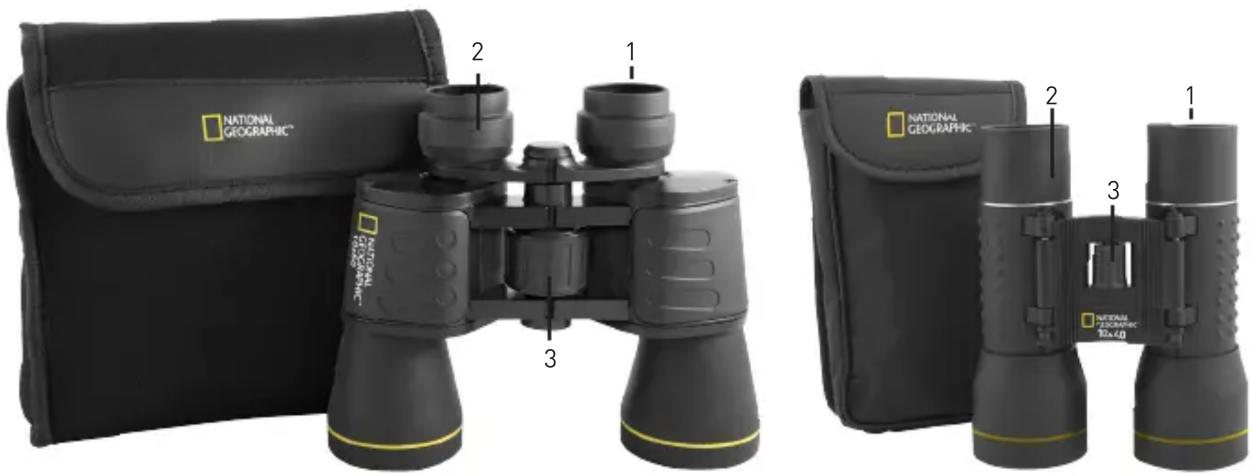
- Shut your right eye, and focus correctly for your left eye using the center focus wheel (3).
- Now shut your left eye, and adjust the focus for your right eye, using the diopter setting (2).
- Now the binoculars are correctly adjusted. You can vary the focus using the center focus wheel and both eyes will always remain in focus. Make note of the diopter setting on the right side, for future use.
natural_image
Two black binoculars with labeled parts: one from a national geographic folder, the other from a standard 10x10 range (no text or symbols on the binoculars themselves)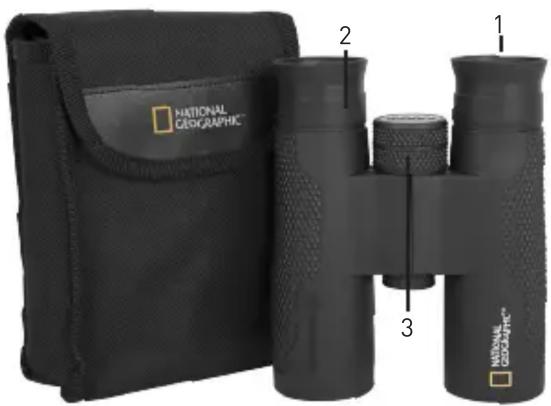
natural_image
Black binoculars with a national geography case, labeled parts 1, 2, and 3 (no text or symbols on the binoculars themselves)Parts Overview
- Foldable rubber eyecups
- Diopter settings
- Center focus wheel
How to adjust the eyecups:
If you wear sunglasses or eyeglasses, fold down the eyecups (1).
This will bring your eyes closer to the lenses thus providing an improved field of view.
How to clean:
- Blow away any dust or debris on the lens (or use a soft lens brush).
- To remove dirt or fingerprints, clean with a soft cotton cloth by rubbing in a circular motion.
Use of a coarse cloth or unnecessary rubbing may scratch the lens surfaces and eventually cause permanent damage to the binoculars. - To thoroughly clean your binoculars, you may use a photographic - lens cleaning fluid. Always apply the fluid to the cleaning cloth, never directly onto the lens.
Note: It is important to protect this device from dust and moisture. When using in high humidity conditions, let the device acclimatize for a short period of time before storing so that residual moisture can dissipate.

NATIONAL GEOGRAPHIC™
Visit us at: nationalgeographic.com

National Geographic's net proceeds support vital exploration, conservation, research, and education programs.
© 2017 National Geographic Partners LLC. All rights reserved. NATIONAL GEOGRAPHIC and Yellow Border Design are trademarks of the National Geographic Society, used under license.
© 2017 Explore Scientific®, LLC. 1010 S 48th Street, Springdale, AR 72762 exploreone.com | 866.252.3811 All rights reserved. Made in China.
CONFORMS TO THE SAFETY REQUIREMENTS OF ASTM F963
- National Geographic Binoculars
- Instruction Manual
- SUN WARNING
- WARNING: NEVER ATTEMPT TO OBSERVE THE SUN WITH THIS DEVICE! OBSERVING THE SUN – EVEN FOR A MOMENT – WILL CAUSE INSTANT AND
- SAFETY WARNINGS
- Read and follow the instructions, safety rules, and first aid information.
- How to adjust the distance between your eyes:
- How to adjust the diopter setting and center focus:
- Parts Overview
- How to adjust the eyecups:
- How to clean:
- NATIONAL GEOGRAPHIC™
Brand : National Geographic
Model : 80-10821CP
Category : Binoculars