LPE 733A X - Dishwasher SCHOLTES - Free user manual and instructions
Find the device manual for free LPE 733A X SCHOLTES in PDF.



| Product type | Built-in dishwasher |
| Brand | SCHOLTES |
| Model | LPE 733A X |
| Dimensions (W x H x D) | 44.5 cm x 82 cm x 57 cm |
| Capacity | 10 standard place settings |
| Water supply pressure | 0.05 to 1 MPa (0.5 to 10 bar) |
| Electrical supply | See rating label (230 V~ / 50 Hz typical) |
| Total power absorbed | See rating label |
| Wash programs | Super Wash, Normal, Daily 60', Soak, Bio, Rapid, Glasses |
| Wash options | Delay start (3/6/9 h), Half load, Multifunction tablets |
| Drying type | Condensation drying |
| Water consumption (Bio program) | Compliant with EN-50242 standard |
| Water connection | Cold or hot water (max 60°C), 3/4 gas thread |
| Inlet hose length | Standard (extension possible) |
| Noise level | Not specified in manual |
| Water softener | Yes, adjustable (6 levels) |
| Salt reservoir capacity | Approximately 1 kg |
| Anti-leak device | Yes (leak safety + New Acqua Stop on some models) |
| Maintenance and cleaning | Regular cleaning of arms, filters, seals and water inlet filter |
| Energy class | Not specified in manual |
| Repairability | Spare parts available via approved service (see manual) |
| Safety | Automatic stop in case of water cut-off, child safety, earthing |
| General information | Appliance compliant with EC directives, household use |
Frequently Asked Questions - LPE 733A X SCHOLTES
User questions about LPE 733A X SCHOLTES
0 question about this device. Answer the ones you know or ask your own.
Ask a new question about this device
Download the instructions for your Dishwasher in PDF format for free! Find your manual LPE 733A X - SCHOLTES and take your electronic device back in hand. On this page are published all the documents necessary for the use of your device. LPE 733A X by SCHOLTES.
USER MANUAL LPE 733A X SCHOLTES
Positioning and levelling
Connecting the water and electricity supplies
Advice regarding the first wash cycle
Technical data
Description of the appliance, 16
Overall view
Control panel
Loading the racks, 17
Lower rack
Cutlery basket
Upper rack
Start-up and use, 18-19
Starting the dishwasher
Measuring out the detergent
Wash options
Wash cycles, 20
Table of wash cycles
Rinse aid and refined salt, 21
Measuring out the rinse aid
Measuring out the refined salt
Care and maintenance, 22
Shutting off the water and electricity supplies
Cleaning the dishwasher
Preventing unpleasant odours
Cleaning the sprayer arms
Cleaning the water inlet filter
Cleaning the filters
Leaving the machine unused for extended periods
Precautions and advice, 23
General safety
Disposal
Saving energy and respecting the environment
Troubleshooting, 24
A Keep this instruction manual in a safe place for future reference. If the appliance is sold, given away or moved, please ensure the manual is kept with the machine, so that the new owner may benefit from the advice contained within it.
A Please read this instruction manual carefully: it contains important information regarding the safe installation, use and maintenance of the appliance.
A If the appliance must be moved at any time, keep it in an upright position; if absolutely necessary, it may be tilted onto its back.
Positioning and levelling
- Remove the appliance from all packaging and check that it has not been damaged during transportation.
If it has been damaged, contact the retailer and do not proceed any further with the installation process. - Check the dishwasher by placing it so that its sides or back panel are in contact with the adjacent cabinets or even with the wall. This appliance can also be recessed under a single worktop (see the Assembly instruction sheet).
- Position the dishwasher on a level and sturdy floor. If the floor is uneven, the front feet of the appliance may be adjusted until it reaches a horizontal position. If the appliance is levelled correctly, it will be more stable and much less likely to move or cause vibrations and noise while it is operating.
4^ . Adjust the height of the rear foot from the front of the appliance on the central lower part of the dishwasher, turning a hexagonal spanner (red color) with an opening of 8mm in a clockwise direction to increase the height or in an anticlockwise direction to decrease the height.
Connecting the water and electricity supplies
A Connection to the water and electricity supplies should only be performed by a qualified technician.
The dishwasher should not stand on top of the water hoses or the electricity supply cable.
The appliance must be connected to the water supply network using new hoses.
Do not use old hoses.
The water inlet (A) and outlet (B) hoses and the electricity supply cable may be positioned towards the right or the left in order to achieve the best possible installation (see figure).
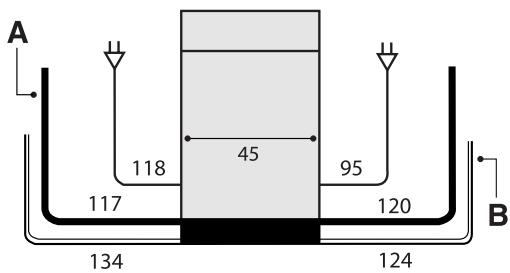
Connecting the water inlet hose
- To a suitable cold water connection point: before attaching the hose, run the water until it is perfectly clear so that any impurities that may be present in the water do not clog the appliance; after performing this operation, screw the inlet hose tightly onto a tap with a 3/4 gas threaded connection.
- To a suitable hot water connection point: your dishwasher may be supplied with hot water from the mains supply (if you have a central heating system with radiators) provided that it does not exceed a temperature of 60^ .
Screw the hose to the tap as described for connection to a cold water supply.
A If the inlet hose is not long enough, contact a specialist store or an authorised technician (see Assistance).
The water pressure must be within the values indicated in the Technical data table (see adjacent information).
The hose should not be bent or compressed.
Anti-flooding protection
To ensure floods do not occur, the dishwasher:
- is provided with a special system which blocks the water supply in the event of anomalies or leaks from inside the appliance.
Some models are also equipped with the supplementary safety device New Acqua Stop*, which guarantees anti-flooding protection even in the event of a supply hose rupture.
WARNING: HAZARDOUS VOLTAGE!
Under no circumstance should the water inlet hose be cut as it contains live electrical parts.
* Only available in selected models.
Connecting the water outlet hose
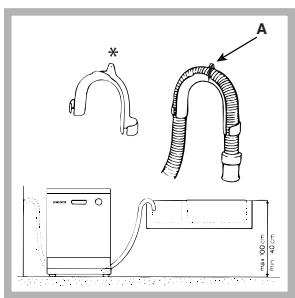
Connect the outlet hose (without bending it) to a drain duct with a minimum diameter of 4cm . Alternatively, rest it over a sink or tub; the free end of the hose should not remain immersed in water.
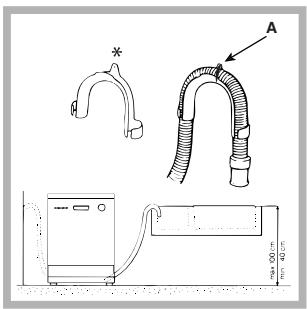
The special plastic elbow* makes it easier to find the best layout: fix the elbow to the wall securely in order to prevent the outlet hose from moving and spilling the dirty water. The part of the hose marked with the letter A should be between 40 and 100~cm above the ground (see figure).
We advise against the use of hose extensions.
Electrical connection
Before inserting the plug into the electrical socket, make sure that:
- The socket is earthed and complies with current regulations.
- The socket can withstand the maximum load of the appliance, which is indicated on the data plate located on the inside of the door (see chapter entitled Description of the appliance).
- The power supply voltage falls within the values indicated on the data plate on the inside of the door.
- The socket is compatible with the plug of the appliance. If this is not the case, ask an authorised technician to replace the plug (see Assistance); do not use extension cables or multiple sockets.
Once the appliance has been installed, the power supply cable and the electrical socket should be easily accessible.
The cable should not be bent or compressed.
A If the power supply cable is damaged, it must be replaced by the manufacturer or its Technical Assistance Service in order to prevent all potential hazards. (See Assistance)
The Company shall not be held responsible for any incidents that occur if these regulations are not observed.
Anti-condensation strip*
After installing the dishwasher, open the door and stick the adhesive transparent strip under the wooden shelf in order to protect it from any condensation which may form.
Advice regarding the first wash cycle
After the appliance has been installed, immediately before running the first wash cycle, completely fill the salt dispenser with water and add only then approximately 1 kg of salt (see chapter entitled Rinse aid and refined salt). The water may overflow: this is normal and is not a cause for concern. Select the water hardness value (see chapter entitled Rinse aid and refined salt). - After the salt has been poured into the machine, the LOW SALT indicator light* switches off.
If the salt container is not filled, the water softener and the heating element may be damaged as a result.
| Technical data | |
| Dimensions | width 44.5 cm height 82 cm depth 57 cm |
| Capacity | 10 standard place-settings |
| Water supply pressure | 0,05 ÷ 1MPa (0.5 ÷ 10 bar) 7,25 – 145 psi |
| Power supply voltage | See appliance data plate |
| Total absorbed power | See appliance data plate |
| Fuse | See appliance data plate |
| CE PC AIO77 | This dishwasher conforms to the following European Community Directives: -2006/95/EEC dated 16/01/2007 (Low Voltage) and subsequent modifications -89/336/EEC dated 03/05/89 (Electromagnetic Compatibility) and subsequent modifications -97/17/EC (Labelling) -2002/96/ CE (Waste Electrical and Electronic Equipment WEEE) |
- Only available in selected models.
EN
Overall view
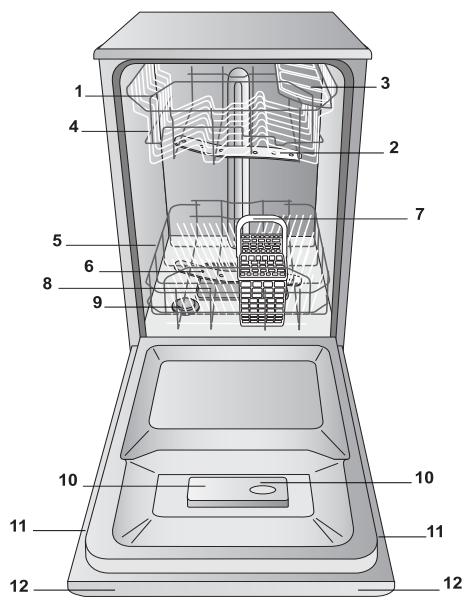
- Upper rack
- Upper sprayer arm
- Tip-up compartments
- Rack height adjuster
- Lower rack
- Lower sprayer arm
- Cutlery basket
- Washing filter
- Salt dispenser
- Detergent and rinse aid dispensers
- Data plate
- Control Panel***
Control panel
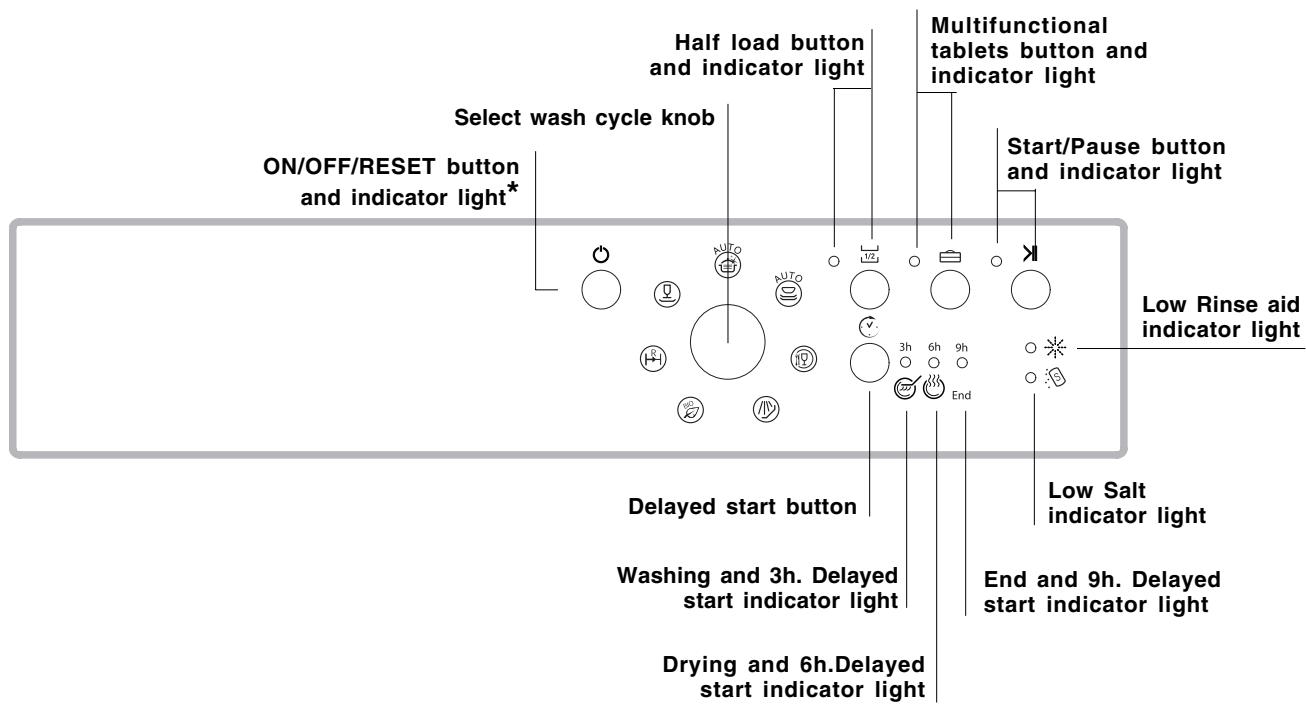
*** Only in completely built-in models.
* Only available in selected models.
The number and type of wash cycles and options may vary depending on the dishwasher model.
Before loading the racks, remove all food residues from the crockery and empty liquids from glasses and cups.
Arrange the crockery so that it is held in place firmly and does not tip over.
After loading the appliance, check that the sprayer arms can rotate freely.
Lower rack
The lower rack can hold pans, lids, plates, salad bowls, cutlery, etc. as seen in the Loading examples.
Plates and large covers should be placed at the sides of the rack, ensuring that they do not block the rotation of the upper sprayer arm.
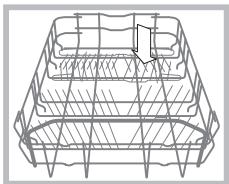
Some dishwasher models are fitted with tip-up sections*, which can be used in a vertical position when arranging plates or in a horizontal position when arranging pans and salad bowls.
Cutlery basket
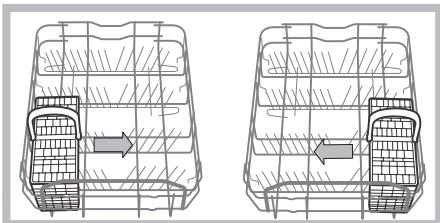
The type of cutlery basket may vary according to the dishwasher model: The cutlery basket should be positioned at the front of the lower rack, by sliding it between the fixed inserts, or on the upper rack when the half load option has been selected (in models featuring this option).
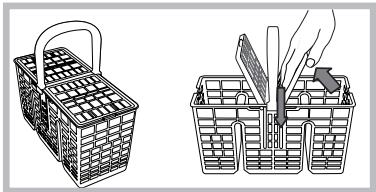
- It has a collapsible sliding system which means the cutlery can be arranged in the best possible way.
Knives and other utensils with sharp edges must be placed in the cutlery basket with the points facing downwards, or they must be positioned horizontally in the tip-up compartments on the upper rack.
Cutlery basket positioning examples
Upper rack
Load this rack with delicate and lightweight crockery: glasses, tea and coffee cups, saucers, small salad bowls, saucepans and small saucepans which are not too soiled, using the Loading examples as a guide.
- Mugs and cups, long sharp knives and serving utensils: place these on the tip-up compartments**.
Tip-up compartments with adjustable tilt*
- The tilt feature can be used to increase the space in the upper rack, to position wine glasses with different stem lengths safely and to improve drying performance.
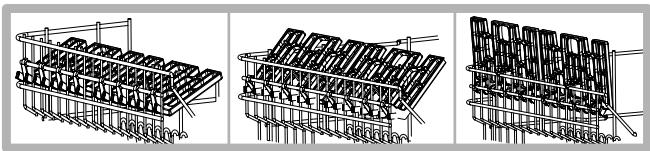
Tilt A
Tilt B
Tilt C
-Lift the tip-up compartment, slide it gently and position it in the desired tilt angle.
Adjusting the height of the upper rack
In order to make it easier to arrange the crockery, the upper rack may be moved to a higher or lower level.
The height of the upper rack should ideally be adjusted WHEN THE RACK IS EMPTY.
Never lift or lower the rack on one side only.
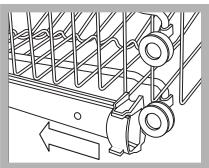
Open the left and right guide rail stops and pull out the rack; position it higher or lower as required, slide it along the guide rails until the front wheels are in place and close the stops (see figure).
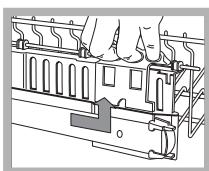
If the rack is fitted with "Dual Space" handles* (see figure), pull out the upper rack until it reaches its stop point, grip the handles at the sides of the rack and move it upwards or downwards, then slowly let it fall back into place.
Loading examples for the upper rack
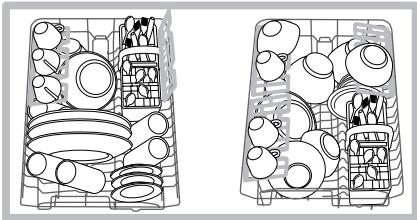
Loading examples for the lower rack
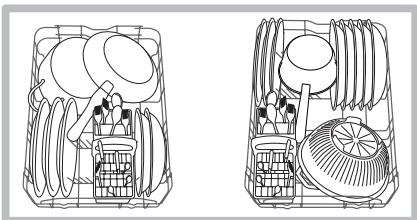
Items which should not be washed in the dishwasher
- Wooden items, objects with wooden or horn handles or glued-on parts.
- Items made from aluminium, copper, brass, pewter or tin.
- Items made from plastic material which is not heat-resistant.
Antique or hand-painted porcelain. - Antique silver. Silver which is not antique may, however, be washed in the dishwasher using a delicate wash cycle, provided that it does not come into contact with other metals.
We recommend the use of crockery which is dishwasher safe.
Starting the dishwasher
- Turn the water tap on.
- Press the ON/OFF button: all the indicator lights on the control panel will light up for a few seconds.
- Open the door and pour in a suitable amount of detergent (see below).
- Load the racks (see Loading the racks) and shut the door.
- Select the wash cycle by turning the WASH CYCLE SELECT knob in a clockwise direction: align the notch on the knob with the number or symbol representing the desired wash cycle. The START/PAUSE indicator light will flash.
- Select the wash options* (see adjacent information).
- Start the cycle by pressing the START button; the indicator light will light up and remain lit in a fixed manner. The indicator light corresponding to the wash phase will switch on, signalling that the wash cycle has begun.
- At the end of the wash cycle the END indicator light will switch on (fixed light). Switch off the appliance by pressing the ON/OFF button, shut off the water valve and unplug the appliance from the electricity socket.
- Wait for a few minutes before removing the crockery, in order to avoid burns. Unload the racks, beginning with the lower level.
A - The machine will switch off automatically during certain periods of inactivity, in order to minimise electricity consumption.
AUTO WASH CYCLES*: this model of dishwasher is equipped with a special sensor which can be used to assess the level of soiling and automatically select the most efficient and economic wash cycle accordingly. The duration of the auto wash cycles may vary due to the operation of the sensor.
Modifying a wash cycle in progress
If a mistake was made during the wash cycle selection process it is possible to change the cycle, provided that it has only just begun: once the wash cycle has started, switch off the machine by pressing and holding the ON/OFF/Reset button. Switch it back on using the same button and select the desired wash cycle and options.
Adding extra crockery
Press the Start/Pause button (the corresponding indicator light will flash). Open the door, taking care to avoid the escaping steam, and place the crockery inside the appliance. Press the Start/Pause button (fixed light): the cycle starts from the point at which it was interrupted.
A If the Start/Pause button is pressed so as to pause the machine, the wash cycle or the Delayed Start* function (if selected) is interrupted.
At this stage it is not possible to change the wash cycle.
Accidental interruptions
If the door is opened during the wash cycle, or if there is a power cut, the cycle stops. It starts again from the point at which it was interrupted once the door has been shut or once the electricity supply is restored.
Measuring out the detergent
A good wash result also depends on the correct amount of detergent being used; exceeding the stated amount does not result in a more effective wash and increases environmental pollution.
Only use detergent which has been specifically designed for dishwashers.
A DO NOT USE washing up liquid.
A Using excessive detergent may result in foam residue remaining in the machine after the cycle has ended.
The use of tablets is only recommended for models which offer the MULTI-FUNCTIONAL TABLETS option.
A To achieve the best results from each washing and drying cycle, powder detergent, rinse aid liquid and salt should be used.
Compartment A: Washing detergent
Compartment B: Pre-wash detergent
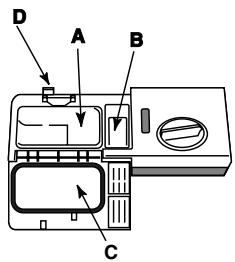
- Open cover C by pressing button D.
-
Pour in the detergent after consulting the Table of wash cycles:
-
For powder detergent use compartments A and B.
- For detergent in tablet form:
when the cycle requires 1 tablet, place it in compartment A and close the cover; when it requires 2, place the second tablet at the bottom of the appliance.
3. Remove detergent residues from the edges of the compartment and close the cover until it clicks.
Wash options*
The OPTIONS may only be set, modified or reset after the wash cycle has been selected and before the Start/Pause button has been pressed.
Only the options which are compatible with the type of wash cycle set may be selected. If an option is not compatible with the selected was cycle (see Table of wash cycles), the corresponding LED flashes rapidly 3 times.
If an option is selected which is incompatible with another option or wash cycle selected previously, the incompatible option light will flash 3 times and switches off, while the most recently selected setting remains lit.
A To deselect an option which has been set by mistake, press the corresponding button again.
Delayed start
It is possible to delay the start time of the wash cycle by 3, 6 or 9 hours.
After selecting the desired wash cycle and any other options, select Delayed Start by pressing the Delayed Start button repeatedly; the washing (3 hours), drying (6 hours) and end (9 hours) indicator lights will flash in succession.
If the Delayed Start button is pressed again, the option is deselected.
After the selection process, the countdown will begin if the Start/Pause button is pressed. The selected delay period indicator light flashes and the Start/ Pause button stops flashing (fixed light).
When the time has elapsed, the indicator light corresponding to the selected delay period stops flashing (fixed light) and the wash cycle begins.
The Delayed Start function cannot be set once the wash has already started.
| Table of options | A | B | C |
| Delayed Start | Half Load | Tabs | |
| Auto Super wash | Yes | Yes | Yes |
| Auto Normal | Yes | Yes | Yes |
| Daily 60' | Yes | Yes | Yes |
| Soak | Yes | Yes | No |
| Bio | Yes | Yes | Yes |
| Rapid 25' | Yes | No | Yes |
| Crystal | Yes | Yes | Yes |
Half load using the upper rack*
If there are not many dishes to be washed, a half load cycle may be used in order to save water, electricity and detergent. Select the wash cycle and press the HALF LOAD button: the indicator light will illuminate and the wash cycle will take place only in the upper rack.
Remember to load the upper rack only, and to reduce the amount of detergent accordingly.
It is better to use powder detergent in this case.
A This option is not compatible with the following wash cycle: Rapid.
Multi-functional tablets (Tabs)
This option optimises washing and drying results. When using multi-functional tablets, press the MULTI-FUNCTIONAL TABLETS button. The corresponding indicator light will illuminate. The "Multi-functional tablets" option results in the lengthening of the wash cycle.
The MULTI-FUNCTIONAL TABLETS option remains set for subsequent wash cycles if it is not deselected.
The use of tablets is only recommended for models which offer the MULTI-FUNCTIONAL TABLETS option.
A This option is not recommended for use with wash cycles which do not specify the use of multi-functional tablets (see Table of options).
This option is incompatible with the following wash cycle: Soak.
- Only available in selected models.
If the crockery is only lightly soiled or if it has been rinsed with water before being placed in the dishwasher, reduce the amount of detergent used accordingly.
The number and type of wash cycles and options may vary depending on the dishwasher model.
For available OPTIONS please refer to the Table of options on the Start-up and use page.
| Wash cycle selection instructions | Wash cycle | Detergent (A) = compartment A (B) = compartment B | Wash cycles which include drying | Options | Wash cycle duration (tolerance ±10%) Hrs. Min. | ||
| Powder | Liquid | Tablets | |||||
| Heavily soiled dishes and pans (not to be used for delicate items). | Super wash | 25 g (A) | 25 ml (A) | 1 (A) | Yes | A-B-C | 2:25' |
| Normally soiled pans and dishes. Standard daily wash cycle. | Normal | 21 g (A)4 g (B) | 21 ml (A)4 ml (B) | 1 (A) | Yes | A-B-C | 1:50' |
| Limited quantity of daily soiling. (4 place settings + 1 saucepan +1 frying pan). | Daily 60' | 25 g (A) | 25 ml (A) | 1 (A) | No | A-B-C | 1:00' |
| Pre-wash for dishes while awaiting completion of the load with the dishes from the next meal. | Soak | No | No | No | No | A-B | 0:08' |
| Environmentally-friendly wash cycle with low energy consumption levels, suitable for pans and dishes. | Bio* | 25 g (A) | 25 ml (A) | 1 (A) | Yes | A-B-C | 2:35' |
| Economic and fast wash to be used for lightly soiled dishes. (Run cycle immediately after use) (2 plates + 2 glasses + 4 pieces of cutlery + 1 saucepan + 1 small frying pan). | Rapid | 21 g (A) | 21 ml (A) | 1 (A) | No | A-C | 0:25' |
| Economic and fast wash for delicate items which are sensitive to high temperatures. (Run cycle immediately after use) (glasses upper rack + delicate plates lower rack). | Crystal | 25 g (A) | 25 g (A) | 1 (A) | Yes | A-B-C | 1:30' |
Notes:
Optimum performance levels when using the "Daily 60" - Rapide wash/Speed" cycles can be achieved by observing the maximum amounts of crockery specified.
To make it easier to measure out the detergent, it is worth remembering that:
1 tablespoon = 15 gr. of powder = approximately 15 ml of liquid - 1 teaspoon = 5 gr. of powder = approximately 5 ml of liquid
* The Bio wash cycle adheres to the regulation EN-50242. Although it has a longer duration than other wash cycles it uses less energy and is les harmful to the environment.
Note for Test Laboratories: for information relating to comparative EN testing conditions, please send an email to the following address: ASSISTENZA_EN_LVS@indesitcompany.com
Only use products which have been specifically designed for dishwashers. Do not use table salt or industrial salt, or washing up liquid.
Follow the instructions given on the packaging.
A If using a multi-functional product it is not necessary to add rinse aid; however, we recommend that you add salt, especially if you live in an area where the water is hard or very hard. Follow the instructions given on the packaging.
If you do not add salt or rinse aid, the LOW SALT and LOW RINSE AID indicator lights remain lit.
Measuring out the rinse aid
Rinse aid makes it easier for the crockery to dry, as water runs off surfaces more readily and therefore does not leave streaks or marks.
The rinse aid dispenser should be filled:
- When the LOW RINSE AID* indicator light on the control panel/dislay is illuminated;
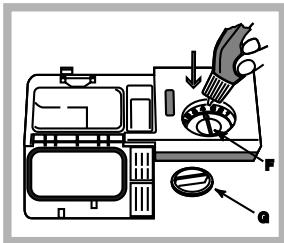
- Open the dispenser by turning the lid (G) in an anticlockwise direction.
- Pour in the rinse aid, making sure it does not overflow from the dispenser. If this happens, clean the spill immediately with a dry cloth.
- Screw the lid back on.
NEVER pour the rinse aid directly into the appliance tub.
Adjusting the amount of rinse aid
If you are not completely satisfied with the drying results, you may adjust the quantity of rinse aid used. Use a screwdriver to turn the dosage adjuster (F) to one of the 6 pre-set positions (the default position is set to 4):
- If there are streaks on the crockery, set the adjustment device to a lower number (1-3).
- If drops of water remain on the crockery or if there are limescale marks present after the cycle has finished, set the adjuster to a higher number (4-6).
Setting the water hardness
Every dishwasher is equipped with a water softener which, by using refined salt designed especially for this type of appliance, supplies water without limescale which is then used to wash the crockery.
This dishwasher offers a setting which helps to reduce pollution and optimises washing performance in accordance with the water hardness level in your area. This information can be obtained from your local water supplier.
- Switch the machine off using the ON/OFF button and open the door.
-
Set the SELECT WASH CYCLE knob first to wash cycle 5 (Bio), then to wash cycle 1 (Auto Super Wash), then to wash cycle 5 (Bio) again.
-
Press the ON/OFF button; the wash cycle phase (washing, drying, end) indicator lights will flash. It is now possible to select the water hardness level. There is a water hardness level for every wash cycle:
E.g.: wash cycle 1, water hardness level 1
wash cycle 2, water hardness level 2, etc. etc., up to a maximum of 5^ levels.
(The default water softener setting is level 3).
- To exit the function, wait a few seconds or press one of the option buttons , or switch off the machine using the ON/OFF button.
Even if using multi-functional tablets, the salt dispenser should still be filled.
| Water Hardness Table | ||||||
| °dH | °fH | mmol/l | level | |||
| 0 | 6 | 0 | 10 | 0 | 1 | 1 |
| 6 | 11 | 11 | 20 | 1.1 | 2 | 2 |
| 12 | 17 | 21 | 30 | 2.1 | 3 | 3 |
| 17 | 34 | 31 | 60 | 3.1 | 6 | 4 |
| 34 | 50 | 61 | 90 | 6.1 | 9 | 5* |
| For values between 0°f and 10°f, we do not recommend the use of salt. * this setting may cause a slight increase in the duration of the cycle. | ||||||
(^ = hardness measured in German degrees - ^ = hardness measured in French degrees - mmol/l = millimoles per litre)
Measuring out the refined salt
In order to achieve the best possible results using a wash cycle, make sure that the dispenser is never empty. Refined salt removes limescale from the water, thus avoiding the formation of deposits on crockery. The salt dispenser is located in the lower part of the dishwasher (see Description) and should be filled:
- When the green float cannot be seen by simply looking at the cap of the salt dispenser.
- When the LOW SALT indicator light on the control panel/ display is illuminated;
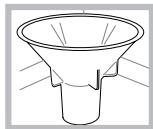
- Remove the lower rack and unscrew the container cap (anticlockwise).
- The first time you do this: fill the water tank right up to its edge.
- Position the funnel (see figure) and fill the
salt container right up to its edge (this should hold approximately 1 kg); it is not unusual for a little water to leak out.
- Remove the funnel and wipe any salt residue away from the opening; rinse the cap under running water and then screw it on, the head facing downwards so as to let the water flow out of the four cracks which are arranged in a star shape on the lower part of the cap. (Salt cap with green float)
It is advisable to perform this procedure every time you add salt to the container.
Make sure the cap is screwed on tightly, so that no detergent can get into the container during the wash cycle (this could damage the water softener beyond repair).
When necessary, measure out the salt before a wash cycle so that any saline solution which has leaked out of the salt dispenser is removed.
Shutting off the water and electricity supplies
- Turn off the water tap after every wash cycle to avoid leaks.
- Always unplug the appliance when cleaning it and when performing maintenance work.
Cleaning the dishwasher
- The external surfaces of the machine and the control panel may be cleaned using a non-abrasive cloth which has been dampened with water. Do not use solvents or abrasive products.
- Any marks on the inside of the appliance may be removed using a cloth dampened with water and a little vinegar.
Preventing unpleasant odours
- Always keep the door of the appliance ajar in order to avoid moisture from forming and being trapped inside the machine.
- Clean the seals around the door and detergent dispensers regularly using a damp sponge. This will avoid food becoming trapped in the seals, which is the main cause behind the formation of unpleasant odours.
Cleaning the sprayer arms
Food residue may become encrusted onto the sprayer arms and block the holes used to spray the water. It is therefore recommended that the arms are checked from time to time and cleaned with a small non-metallic brush.
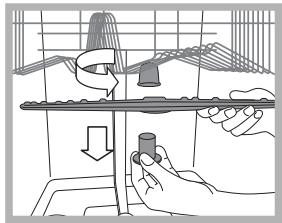
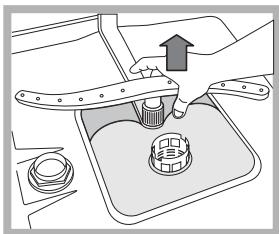
The two sprayer arms may both be removed.
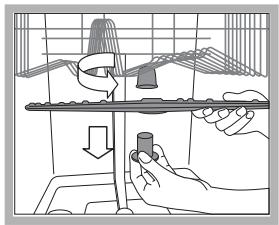
To remove the upper sprayer arm, rotate the locking ring in an anti-clockwise direction. The upper sprayer arm should be replaced with the holes facing upwards.
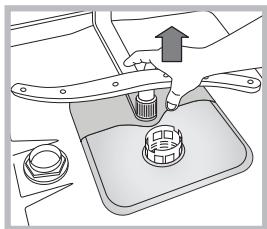
The lower sprayer arm can be removed by pulling it upwards.
Cleaning the water inlet filter*
If the water hoses are new or have not been used for an extended period of time, let the water run to make sure it is clear and free of impurities before performing the necessary connections. If this precaution is not taken, the water inlet could become blocked and damage the dishwasher.
A Clean the water inlet filter at the tap outlet regularly.
- Turn off the water tap.
- Unscrew the end of the water inlet hose, remove the filter and clean it carefully under running water.
- Replace the filter and screw the water hose back into position.
Cleaning the filters
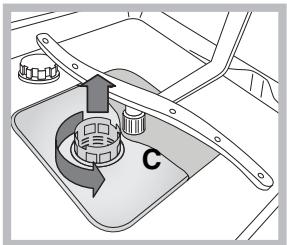
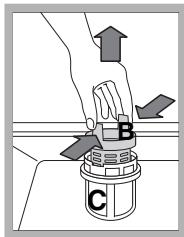
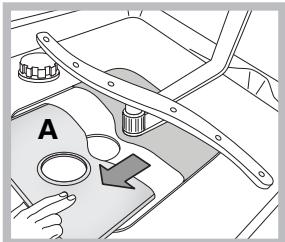
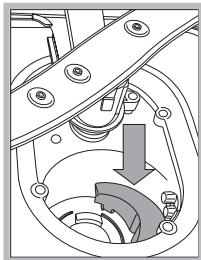
The filter assembly consists of three filters which remove food residues from the washing water and then recirculate the water. They should be cleaned if you wish to achieve the best results in every wash.
Clean the filters regularly.
The dishwasher should not be used without filters, or if the filter is loose.
- After several washes, check the filter assembly and if necessary clean it thoroughly under running water, using a non-metallic brush and following the instructions below:
- Turn the cylindrical filter C in an anti-clockwise direction and pull it out (fig. 1).
- Remove the cup filter B by exerting a slight pressure on the side flaps (fig. 2).
- Slide out the stainless steel plate filter A (fig. 3).
- Inspect the trap and remove any food residue. NEVER REMOVE the wash cycle pump (black detail) (fig. 4).
1
2
3
After cleaning the filters, replace the filter assembly and fix it in position correctly; this is essential for maintaining the efficient operation of the dishwasher.
Leaving the machine unused for extended periods
- Disconnect the appliance from the electricity supply and shut off the water tap.
- Leave the door of the appliance ajar.
- When you return, run a wash cycle when the dishwasher is empty.
This appliance was designed and manufactured in compliance with current international safety standards. The following information has been provided for safety reasons and should therefore be read carefully.
General safety
- This appliance is not intended for use by persons (including children) with reduced physical, sensory or mental capabilities, or lack of experience and knowledge, unless they have been given supervision or instruction concerning use of the appliance by a person responsible for their safety.
- Children should be supervised to ensure that they do not play with the appliance.
- The appliance was designed for domestic use inside the home and is not intended for commercial or industrial use.
- The appliance must be used by adults only, to wash domestic crockery in accordance with the instructions in this manual.
- The appliance must not be installed outdoors, even in covered areas. It is extremely dangerous to leave the machine exposed to rain and storms.
- Do not touch the appliance when barefoot.
- When unplugging the appliance always pull the plug from the mains socket, do not pull on the cable.
- The water supply tap must be shut off and the plug should be removed from the electrical socket before cleaning the appliance or carrying out any maintenance work.
- If the appliance breaks down, do not under any circumstances touch the internal parts in an attempt to perform the repair work yourself.
- Never touch the heating element.
- Do not lean or sit on the open door of the appliance: this may cause the appliance to overturn.
- The door should not be left open as it may create a dangerous obstacle.
- Keep detergent and rinse aid out of reach of children.
- The packaging material should not be used as a toy.
Disposal
- Disposal of packaging materials: observe local legislation so that the packaging may be reused.
- The European Directive 2002/96/EC relating to Waste Electrical and Electronic Equipment (WEEE) states that household appliances should not be disposed of using the normal solid urban waste cycle. Exhausted appliances should be collected separately in order to optimise the cost of re-using and recycling the materials inside the machine, while preventing potential damage to the atmosphere and to public health. The crossed-out dustbin is marked on all products to remind the owner of their obligations regarding separated waste collection.
For further information relating to the correct disposal of household appliances, owners may contact the relevant public authority or the local appliance dealer.
Saving energy and respecting the environment
Saving water and energy
- Only begin a wash cycle when the dishwasher is full. While waiting for the dishwasher to be filled, prevent unpleasant odours using the Soak cycle (see Wash cycles).
-
Select a wash cycle which is suited to the type of crockery and to the soil level of the crockery using the Table of wash cycles:
-
For dishes with a normal soil level, use the Eco wash cycle, which guarantees low energy and water consumption levels.
-
If the load is smaller than usual activate the Half load option (see Start-up and use).
-
If your electricity supply contract gives details of electricity saving time bands, run wash cycles during the periods when a lower tariff is applied. The Delayed start button (see Start-up and use) helps you organise the wash cycles accordingly.
Phosphate-free and chlorine-free detergents containing enzymes
- We strongly recommend that you use detergents that do not contain phosphates or chlorine, as these products are harmful to the environment.
- Enzymes provide a particularly effective action at temperatures around 50^ , and as a result detergents containing enzymes can be used in conjunction with low-temperature wash cycles in order to achieve the same results as a normal 65^ wash cycle.
- To avoid wasting detergent, use the product in appropriate quantities based on the manufacturer's recommendations, the hardness of the water and the soil level and quantity of crockery to be washed. Even if they are biodegradable, detergents contain substances which may alter the balance of nature.
Whenever the appliance fails to work, check for a solution from the following list before calling for Assistance.
| Problem: | Possible causes / Solutions: |
| The dishwasher does not start. | · The plug has not been inserted into the electrical socket properly, or there is no power in the house. · The dishwasher door has not been shut properly. · A delayed start has been programmed (see Start-up and use). |
| No water drains out from the dishwasher. | · The dishwasher cycle has not yet finished. · The water inlet hose is bent (see Installation). · The drain duct is blocked. · The filter is clogged up with food residues. |
| The dishwasher makes excessive noise. | · The dishes are rattling against each other or against the sprayer arms. · An excessive amount of foam has been produced: the detergent has not been measured out correctly or it is not suitable for use in dishwashers (see Start-up and use). |
| The dishes and glasses are covered in a white film or limescale deposits. | · The level of the refined salt is low or the dosage setting is not suited to the hardness of the water (see Rinse aid and salt). · The lid on the salt dispenser is not closed properly. · The rinse aid has been used up or the dosage is too low. · The crockery is made from non-stick material. |
| The dishes and glasses are streaked or have a bluish tinge. | · The rinse aid dosage is too high. |
| The crockery has not been dried properly. | · A wash cycle without a drying programme has been selected. · The rinse aid has been used up or the dosage is too low (see Rinse aid and salt). · The rinse aid dispenser setting is not high enough. |
| The dishes are not clean. | · The racks are overloaded (see Loading the racks). · The crockery has not been arranged well. · The sprayer arms cannot move freely. · The wash cycle is too gentle (see Wash cycles). · An excessive amount of foam has been produced: the detergent has not been measured out correctly or it is not suitable for use in dishwashers (see Start-up and use). · The lid on the rinse aid compartment has not been shut correctly. · The filter is dirty or blocked (see Care and maintenance). · The refined salt level is low (see Rinse aid and salt). |
| The dishwasher does not take any water in/Tap shut-off alarm (the Drying and End indicator lights flash). | · There is no water in the mains supply. · The water inlet hose is bent (see Installation). · Turn on the tap and the appliance will start after a few minutes. · The appliance is locked because no action was taken when the indicator lights were flashing. Switch off the machine using the ON/OFF button, turn on the tap and switch the machine back on after 20 seconds by pressing the same button. Re-programme the machine and restart the wash cycle. |
| Water loading solenoid valve malfunction alarm (the Drying indicator light flash). | · Switch off the appliance by pressing the ON/OFF button and switch it back on after a minute. If the alarm continues, shut off the water tap to eliminate the risk of flooding, remove the plug from the electrical socket and contact Assistance. |
| Water inlet hose alarm/Water inlet filter blocked. (the Washing, Drying and End indicator lights flashes). | · Switch off the appliance by pressing the ON/OFF button. Shut off the water tap to eliminate the risk of flooding and remove the plug from the electrical socket. Make sure the water inlet filter has not become blocked by various impurities. (see “Care and maintenance” chapter). |
DE
Deutsch, 25
Inhaltsverzeichnis
Installation, 26-27
ASSISTENZA_EN_LVS@indsitcompany.com
IodcoeHNHTe cInBHOJ UHaHr, He crn6a erO, K cInBHomy Tpy6OpBOyD C MInHMaJIbHbIM dHaMeTpOM 4 cm. IIn noLoXnTe erO Ha KpaI paKOBuHbI IIn BaHHbI. CBo6oHbI KOHeC cInBHorO UHaHra He DoJxeh OCTaBaTbCnIorpyxKeHHbIM B VOy.
Cneuajbna nlaactMaccoBa
HanpaBIAIOUa* CnyKNTI INOITIMaJIbHOrO pa3MeueHnA CInBHO rIINAHra: IPOuH0 3aKePENTe HapBaJIIOUyUHa CTHe BO N36ExaHne CMeueHnA CInBHO rIINAHra IN YTeKN BODbl.
Otpe3ok uHaHra,
IpOMapKIpObaHbI 6yKBoA,doJxKeH paCnoJaTaTbcra Ha BbICote oT 40 do 100 (cm. cxemy).
A He pekomeHdyetcra IcnoJb3ObaTb ydInHnteIbHbIe IlaHn.
3neKtpnueckoe noDcoeHHeHne
Ipeepi npDCoeHHeHnEM BUNK MaunHbIK 3JIeKtpnuecko pO3eTke Heo6xOdmo npOBepntb cJeDyUoee:
- ceTeBa rpo3eTka DOnJxHa 6bItb CoeINHeHa C 3a3EmJIeHnEM I COOTBETCTBOBaTb HOpMaTINBaM;
ceTeBa p03eTka DoJxHa 6bItb paCCHTaHa Ha MaKcMaJIbHyIO Ntpe6IeMyIO MoUHOCTb I3JeINy, yKa3aHHyIO Ha nacnOpTHoI Ta6NlUKe (CM. pa3OeI «OnucHue nocydomOeHou MauHbI); - HanpjaKeHne CeTn 3JeKtpOnNTaHnI DOJXHO COOTBeTCTBOBaT DaHHbIM Ha nacnopTHoT Ta6JIuChe, paCNOJIOKeHHo C BHyTpEHHeN CTOpOhbl DBePcbl MaUHHbl;
ceTeBa pO3eTka DoJIxHa 6bITb COBMeCTnMa co WTeNcIbHOB BUNKO I3dJIy. B npOTnBHom cnyae NOpYuHTe 3aMeHy BUNK yIOnHOMoEHOMy TexHnky (CM. TexHuYeCKoe OBCJyXuBaHue); He nCNoJIb3yInTe yDnIHnHTeIN n TpOHNk.
A N3eJnne DoJnxHo 6bItb yCTaHOBnHeo TaKIM o6pa30M, YTo6bl npOBoD 3JeKTpOniTahnIy 3JeKTpopo3EtKa 6blnn JERKO DOCTynHbl.
A Ka6eJb 3neKtpOnItaHnI n3deJIIn He DoJIxHe 6bITb corHT uIN CkAT.
A Perynpho npOBepaTe coCTOaHne ka6eJra 3JIeKtpoNTaHnI B Cnyuae Heo6xOIMocTn NOpuynte ero 3aMeHy TOJbKO yNOLHOMOeHHbIM TEXHNkAm (CM. TexHuueckoe 06cnykuaHue).
A Ipn3BODIteJIb He HecET OTBeTCTBeHHOCTN 3a nocJeDCTBnH Heco6IIODeHnpeueNCHeHHbIX BblSe Tpe6oBaHn.
Пленьka 3ацntы OT KOндсатa\*
Iocne yctaHOBNIOcYDoMOeUHNO MaunHbIB HnUky KxOHHO 3NeMeHTA OTKPOiTte ee DBePuy NHaKNeTe Ipo3paHyO cAMOKJIeUyOcR pONOCKy Cn3y DepeBraHHoN KxOHHO pa6Oey NOBepXHOCTn dIpy ee 3aUNTbI OT BO3MOXHOKOHNecHcata.
PpeDynpexdEHHno nepBomy nCNoJb3ObaHnMoMaunHbl
Iocne yctaHOKn MaunHbI, HENOCpeiCTBeHNO nepei nepBbIM cIKLOM MOKN 3aONHnTe 6aOcK COIN BOOn I 3acblte B Hero npimepHo 1 Kr COIN (cm. pa3deJI OnonackuameIb u pezeHepupyUoJra coJIb): ecnn BOJa 6ydt BbITEKaTb N3 6aUka, 3TO HopMaJIbHOe JABHeHne. Bb6epnte CTeneHb JecTKOcTn BODi (cm. pa3deJI OnonackuameIb u pezeHepupyUoJra coJIb).
CpeDCTBa npOTnB HnnpnTbIx 3anaxOB
Bcerda ocTabnTe DBepy MaunHb IOny-PrnkpbIToB Ou36exKaHne 3acto BJIaxHoCTn.
Perynphno npouhauite nepimMeTpaHbIe ynpntHeHHaDBepcIu Ido3aTOPOB MOUoJero cpeDCTBa pnp nOmoiINBnaXHOI r6Kn. TaKIM oBa3OM ydaJIaTOc OCTaTK NIIu -OCHOBHOI pnuHbI oBa3BaHNH HenpNtTHbIX 3anaXOB.
Uncstka opocnteJe
Octatkn Niun Moryt npinHnHyb K JIonactm opocnte ne 3acopntb OTBepCTn, n3 KOtOpBX BbIXoNDT BOda: BpemOT BpemEn CneDyET npOBepaTb opocNTeIN IpnOuNsaTb nx Hemetanlnecko STeKo.
06a opocnteJRAJBIAOTcBcEMhbIM.
Дясьем Верх Hero opocnteЯ Heo6xOIMO OTBnHTNb npOTNB YacOBoi CTpeKNI pIaCTMaCCOByU raKy. BepxHni opocntel yctaHaBnBaetcY OTBepCTNMAH BBePx.
HnKnn opocnteIb CHMaetcna, notaHyB erO BBepx.
OuNTka BOdHoro ФиЛьТра\*
EcIn BOIOPOBOID HOBii INI ECIN OH DOJIOe BpeMn He IcNoJIb3OBAJNC, Npei NOIcoEiHHeHEm DaIte BoDE CTeYb Do Tex nOp, Noka OHa He cTaHET pOzpaHNo. Heco6JIIOHeHne 3Toro yCNOBm MOKeT npIBeCTN K 3acOpEHIO fHbTpA i K IOBpeKdEHNI OocydoMOeUHO MaShINHbl.
- IMeETcA TOJIbKO B HekOTOpbIX MoJeIax
A PepnoDnueckn OunuaiTe BODHbI ΦnJIbTp, paCNoIOKeHHbI Ha BbIXOde KpaHa.
-Перекроче ВODоноровднь кран.
- OTKpyTnTe Kpa Tpy6bl 3aqrpy3Kn BObl, CnIMnTe ΦnIbTp n aKKypaTHo npomOIte erO NOd cTpyeB BObl.
- CHOBa BCTaBbTe ΦnIbTp n 3akpeNITpy6y.
YnctkaΦnJIbTpOBo
MoIoune cpeIcTBA, He coOpEpaIue focpaTOB, Xlopa n coOpEpaIue fepMeHTbl
HactoTeIbHO peKOMeHdyEM NcNoIb3OBA Tb MOUuNe cpeICTBa, He coDepeKaUne focpaTob IN Xnopa, YTO NOMoRaET COxpaHHTb OKpykaHou cyEly.
- Φерменты OkазыbaIoT OcOбо 3ФфЕKTиHObe BO3ДeIcTBnE npn Temперatype okono 50^ , noэтOMу npn ИСПОЛьЗВОвAHИМоJOUxBWeIeCTB C Фрм entamMоЖHO BbI6paTb ПограмMbI MoKn C Hn3KIMm TemперatypepAMn, NOJyuaЯ Te Jxe pe3yNbTaTb, UTO n npn moKe npn 65^
- AkkypaTHO Do3npyTe MOUeE CpeCTBO B COOTBeTCTBm C yka3aHnA MnpOn3BODInTeJI, C CTeNEbHO JXECTKoCTN BObl, CO CTeNEbIO 3aRpa3HeHnI N C KOJIuYeCTBOM NocyDbI BO n36eKaHne HepaunOHaNbHOro paCxOJa. XOTa MOUcne CpeCTBa I YBnIHTc 6bnopa3JnaRaembIMn, OHn CoedePkaT BeUeCTBa, OTPuaTeIbHO BnIraHoIe Ha npipOdy.
- IMeetcTOnbKoB HeKOTOpbIX MoJeJx.
B cnyae obnapykeHnna homamn B pa6ote n3denn npOBepbTe cneDyUoune nyHKtbI nepeTem, kak obaTntbcB CepBnc Texnueckoro o6cnykubHn.
| Немправно: | Возимные поочны / Метды устраенья: |
| Посydомоевая машина не занием. | • Штесльна влка машина п loхо Bставлина в сетуву розту ку лл в доме оTKлючлесь заektриец. • Дерца машина п loхо з akры. • Блал зада на phункция OTложенны заунck (см. Вklюченue u ekclлуама). • Пограмma[eupleнne He 3abepшинас. • Сливовшшанг согнуТ (сm. Монмж). • Засорис слвв в рakовин. • Фелър засорен OCTатумни. • Пocуда bьетс дуг O дуг р olугся плп o le�осту opocintelей. •Чeзmerгое песообразовaninge: Ненивьнад ДОЗИРБКУ плп Нени�ordhoe мolyош ( срешихдддддддддддддддддддддддддддддддддддддддддддддддддддддддддддддддддддддддддддддддддддддддддддддддддддд • Осутства рогершихь машиь. • Был вьбара пограмma моукь boлп o leп рулайся eepaxoda He cootbetctbyet • Релинихь олалackьать плп Hнравиьно有很大лары. • Пocуда c tecloновь mokрьtm. •Чeзmerгое песоobразовaninge: Ненивьнад ДОЗИРБКУ nll Hени�ordhoe мolyош ( сm. Onolack ueamьь noll pokрьtm. • Пocуда c tecloновь mokрьtm. • Chpemsch nopeprupovka onolackibateя. • Пocуда c tecloновь onolackibateя. • Chpemsch nopeprupovka onolackibateя. • Chpemsch nopeprupovka onolackibateя. • Chpemsch nopeprupovka onolackibateя. • Chpemsch nopeprupovka onolackibateя. • Chpemsch nopeprupovka onolackibateя. • Chpemsch nopeprupovka onolackibateя. • Chрemsch nopeprupovka onolackibateя. • Chpemsch nopeprupovka onolackibateя. • Chpemsch nopeprupovka onolackibateя. • Chpemsch nopeprupovka onolackibateя. • Chpemsch nopeprupovka onolackibateя. • Chpemsch nopeprupovka onOLackibateя. • Chpemsch nopeprupovka onOLackibateя. • Chpemsch nopeprupovka onOLackibateя. • Chpemsch nopeprupovka onOLackibateя. • Chpemsch nopeprupovka onOLackibateя. • Chpemsch nopeprupovka onOLackibateя. • ChpemsCH nopeprupovka onOLackibateя. • ChpemsCH nopeprupovka onOLackibateя. • ChpemsCH nopeprupovka onOLackibateя. • ChpemsCH nopeprupovka onOLackibateя. • ChpemsCH nopeprupovka onOLackibateя. • ChpemsCH nopeprupovka onOLackIB. • ChpemsCH nopeprupovka onOLackIB. • ChpemsCH nopeprupovka onOLackIB. • ChpemsCH nopeprupovka onOLackIB. • ChpemsCH nopeprupovka onOLackIB. • ChpemsCH nopeprupovka onOLackIB. • ChpemsCH nopeprupovka onOLackIB. • ChрemsCH nopeprupovka onOLackIB. • ChpemsCH nopeprupovka onOLackIB. • ChpemsCH nopeprupovka onOLackIB. • ChpemsCH nopeprupovka onOLackIB. • ChpemsCH nopeprupovka onOLackIB. • ChpemsCH nopeprupovka onOLackIB. • ChpemsCH noceprupovka onOLackIB. • ChpemsCH noceprupovka onOLackIB. • ChpemsCH noceprupovka onOLackIB. • ChpemsCH noceprupovka onOLackIB. • ChpemsCH noceprupovka onOLackIB. • ChpemsCH noceprupovka onOLackIB. • ChpemsCH noceprupovk • ChpemsCH noceprupovk • ChpemsCH noceprupovk • ChpemsCH noceprupovk • ChpemsCH noceprupovk • ChpemsCH noceprupovk • ChpemsCH noceprupovk • ChpemsCH noceprupovk • ChpemsCH noceprupovk • ChpamsCH noceprupovk • ChpemsCH noceprupovk • ChpemsCH noceprupovk • ChpemsCH noceprupovk • ChpemsCH noceprupovk • ChpemsCH noceprupovk • ChpemsCH noceprupovk • ChpemsCH noceprupovk • ChpemsCH nocepriu • ChpemsCH noceprupovk • ChpemsCH noceprupovk • ChpemsCH noceprupovk • ChpemsCH noceprupovk • ChpemsCH noceprupovk • ChpemsCH noceprupovk • ChpemsCH noceprupovk • ChpemsCH noceprupovk • ChрemsCH noceprupovk • ChpemsCH noceprupovk • ChpemsCH noceprupovk • ChpemsCH noceprupovk • ChpemsCH noceprupovk • ChpemsCH noceprupovk • ChpemsCH noceprupovk • ChpemsCH noceprupovk • ChpemsCH nocesprupovk • ChpemsCH nocesprupovk • ChpemsCH nocesprupovk • ChpemsCH nocesprupovk • ChpemsCH nocesprupovk • ChpemsCH nocesprupovk • ChpemsCH nocesprupovk • ChpemsCH nocesprupovk • ChpemsCH nocesprupovK • ChpemsCH nocesprupovK • ChpemsCH nocesprupovK • ChpemsCH nocesprupovK • ChpemsCH nocesprupovK • ChpemsCH nocesprupovK • ChpemsCH nocesprupovK • ChpemsCH nocesprupovK • ChpemsCH nocesprupovK • ChрemsCH nocesprupovK • ChpemsCH nocesprupovK • ChpemsCH nocesprupovK • ChpemsCH nocesprupovK • ChpemsCH nocesprupovK • ChpemsCH nocesprupovK • ChpemsCH nocesprupovK • ChpemsCH nocesprupovK • ChpemsCH noceprupovK • ChpemsCH nocesprupovK • ChpemsCH nocesprupovK • ChpemsCH nocesprupovK • ChpemsCH nocesprupovK • ChpemsCH nocesprupovK • ChpemsCH nocesprupovK • ChpemsCH nocesprupovK • ChpemsCH nocesprupovk • ChpemsCH nocesprupovK • ChpemsCH nocesprupovK • ChpemsCH nocesprupovK • ChpemsCH nocesprupovK • ChpemsCH nocesprupovK • ChpemsCH nocesprupovK • ChpemsCH nocesprupovK • ChрemsCH nocesprupovK • ChрemsCH nocesprupovK • ChрemsCH nocesprupovK • ChрemsCH nocesprupovK • ChрemsCH nocesprupovK • ChрemsCH nocesprupovK • ChрemsCH nocesprupovK • ChрemsCH nocesprupovK • ChрemsCH noceprupovK • ChрemsCH nocesprupovK • ChрemsCH nocesprupovK • ChрemsCH nocesprupovK • ChрemsCH nocesprupovK • ChрemsCH nocesprupovK • ChрemsCH nocesprupovK • ChрemsCH nocesprupovK • ChрemsCH nocesprupovk • ChрemsCH nocesprupovK • ChрemsCH nocesprupovK • ChрemsCH nocesprupovK • ChрemsCH nocesprupovK • ChрemsCH nocesprupovK • ChрemsCH nocesprupovK • ChрemsCH nocesprupovK • ChрemsCH nocesprupovK • ChpemsCH nocesprupovK • ChpemsCH nocesprupovK • ChpemsCH nocesprupovK • ChpemsCH nocesprupovK • ChpemsCH nocesprupovK • ChpemsCH nocesprupovK • ChpemsCH noceprupovK • ChpemsCH noceprupovK • ChpemsCH nocesprupovK • ChpemsCH nocesprupovK • ChpemsCH nocesprupovK • ChpemsCH nocesprupovK • ChpemsCH nocesprupovK • ChpemsCH nocesprupovK • ChpemsCH nocesprupovk • ChpemsCH nocesprupovk • ChpemsCH nocesprupovK • ChpemsCH nocesprupovK • ChpemsCH nocesprupovK • ChpemsCH nocesprupovK • ChpemsCH nocesprupovK • ChpemsCH nocesprupovK • ChрemsCH nocesprupovK • ChpemsCH nocesprupovK • ChрemsCH nocesprupovK • ChpemsCH nocesprupovK • ChpemsCH nocesprupovK • ChpemsCH nocesprupovK • ChpemsCH nocesprupovK • ChpemsCH nocesprupovK • ChpemsCH noceprupovK • ChpemsCH nocesprupovK • ChpemsCH noceprupovK • ChpemsCH nocesprupovK • ChpemsCH nocesprupovK • ChpemsCH nocesprupovK • ChpemsCH nocesprupovK • ChpemsCH nocesprupovK • ChpemsCH nocesprupovk • ChpemsCH nocesprupovK • ChpemsCH nocesprupovk • ChpemsCH nocesprupovK • ChpemsCH nocesprupovK • ChpemsCH nocesprupovK • ChpemsCH nocesprupovK • ChpemsCH nocesprupovK • ChpemsCH nocesprupovK • ChрemsCH nocesprupovK • ChрemsCH nocesprupovK • ChpemsCH nocesprupovK • ChpemsCH nocesprupovK • ChpemsCH nocesprupovK • ChpemsCH nocesprupovK • ChpemsCH nocesprupovK • ChpemsCH noceprupovK • ChpemsCH noceprupovK • ChpemsCH noceprupovK • ChpemsCH nocesprupovK • ChpemsCH nocesprupovK • ChpemsCH nocesprupovK • ChpemsCH nocesprupovK • ChpemsCH nocesprupovK • ChpemsCH nocesprupovk • ChpemsCH nocesprupovk • ChpemsCH nocesprupovk • ChpemsCH nocesprupovk • ChpemsCH nocesprupovk • ChpemsCH nocesprupovk • ChpemsCH nocesprupovk • ChpemsCH nocesprupovk • ChрemsCH nocesprupovk • ChpemsCH nocesprupovk • ChpemsCH nocesprupovk • ChpemsCH nocesprupovk • ChpemsCH nocesprupovk • ChpemsCH nocesprupovk • ChpemsCH nocesprupovk • ChpemsCH nocesprupovk • ChpemsCH noceprupovk • ChpemsCH nocesprupovk • ChpemsCH nocesprupovk • ChpemsCH nocesprupovk • ChpemsCH nocesprupovk • ChpemsCH nocesprupovk • ChpemsCH nocesprupovk • ChpemsCH nocesprupovK • ChpemsCH nocesprupovk • ChpemsCH nocesprupovK • ChpemsCH nocesprupovK • ChpemsCH nocesprupovK • ChpemsCH nocesprupovK • ChpemsCH nocesprupovK • ChрemsCH nocesprupovK • ChрemsCH nocesprupovK • ChрemsCH nocesprupovK • ChpemsCH nocesprupovK • ChpemsCH nocesprupovK • ChpemsCH nocesprupovK • ChpemsCH nocesprupovK • ChpemsCH noceprupovK • ChpemsCH nocesprupovK • ChpemsCH nocesprupovK • ChpemsCH noceprupovK • ChpemsCH nocesprupovK • ChpemsCH nocesprupovK • ChpemsCH nocesprupovK • ChpemsCH nocesprupovK • ChpemsCH nocesprupovk • ChpemsCH nocesprupovK • ChpemsCH nocesprupovK • ChpemsCH nocesprupovk • ChpemsCH nocesprupovK • ChpemsCH nocesprupovK • ChpemsCH nocesprupovK • ChpemsCH nocesprupovK • ChpemsCH nocesprupovK • ChрemsCH nocesprupovK • ChpemsCH nocesprupovK • ChpemsCH nocesprupovK • ChрemsCH nocesprupovK • ChpemsCH nocesprupovK • ChpemsCH nocesprupovK • ChpemsCH nocesprupovK • ChpemsCH nocesprupovK • ChpemsCH noceprupovK • ChpemsCH nocesprupovK • ChpemsCH noceprupovK • ChpemsCH noceprupovK • ChpemsCH nocesprupovK • ChpemsCH nocesprupovK • ChpemsCH nocesprupovK • ChpemsCH nocesprupovK • ChpemsCH nocesprupovk • ChpemsCH nocesprupovK • ChpemsCH nocesprupovk • ChpemsCH nocesprupovk • ChpemsCH nocesprupovK • ChpemsCH nocesprupovK • ChpemsCH nocesprupovK • ChpemsCH nocesprupovK • ChpemsCH nocesprupovK • ChрemsCH nocesprupovK • ChpemsCH nocesprupovK • ChрemsCH nocesprupovK • ChрemsCH nocesprupovK • ChрemsCH nocesprupovK • ChрemsCH nocesprupovK • ChрemsCH nocesprupovK • ChрemsCH nocesprupovK • ChрemsCH noceprupovK • ChрemsCH noceprupovK • ChрemsCH nocesprupovK • ChрemsCH nocesprupovK • ChрemsCH nocesprupovK • ChрemsCH nocesprupovK • ChрemsCH nocesprupovK • ChрemsCH nocesprupovK • ChрemsCH nocesprupovk • ChрemsCH nocesprupovk • ChрemsCH nocesprupovK • ChрemsCH nocesprupovK • ChрemsCH nocesprupovK • ChрemsCH nocesprupovK • ChрemsCH nocesprupovK • ChрemsCH nocesprupovK • ChрemsCH nocesprupovK • ChpemsCH nocesprupovK • ChрemsCH nocesprupovK • ChрemsCH nocesprupovK • ChрemsCH nocesprupovK • ChрemsCH nocesprupovK • ChрemsCH nocesprupovK • ChрemsCH noceprupovK • ChрemsCH nocesprupovK • ChрemsCH noceprupovK • ChрemsCH nocesprupovK • ChрemsCH nocesprupovK • ChрemsCH nocesprupovK • ChрemsCH nocesprupovK • ChрemsCH nocesprupovK • ChрemsCH nocesprupovk • ChрemsCH nocesprupovK • ChрemsCH nocesprupovk • ChрemsCH nocesprupovK • ChрemsCH nocesprupovK • ChрemsCH nocesprupovK • ChрemsCH nocesprupovK • ChрemsCH nocesprupovK • ChрemsCH nocesprupovK • ChpemsCH nocesprupovK • ChрemsCH nocesprupovK • ChpemsCH nocesprupovK • ChрemsCH nocesprupovK • ChрemsCH nocesprupovK • ChрemsCH nocesprupovK • ChрemsCH nocesprupovK • ChрemsCH noceprupovK • ChрemsCH nocesprupovK • ChрemsCH nocesprupovK • ChрemsCH noceprupovK • ChрemsCH nocesprupovK • ChрemsCH nocesprupovK • ChрemsCH nocesprupovK • ChрemsCH nocesprupovK • ChрemsCH nocesprupovk • ChрemsCH nocesprupovK • ChрemsCH nocesprupovK • ChрemsCH nocesprupovk • ChрemsCH nocesprupovK • ChрemsCH nocesprupovK • ChрemsCH nocesprupovK • ChрemsCH nocesprupovK • ChрemsCH nocesprupovK • ChpemsCH nocesprupovK • ChpemsCH nocesprupovK • ChpemsCH nocesprupovK • ChрemsCH nocesprupovK • ChрemsCH nocesprupovK • ChрemsCH nocesprupovK • ChрemsCH nocesprupovK • ChрemsCH noceprupovK • ChрemsCH nocesprupovK • ChрemsCH noceprupovK • ChрemsCH noceprupovK • ChрemsCH nocesprupovK • ChрemsCH nocesprupovK • ChрemsCH nocesprupovK • ChрemsCH nocesprupovK • ChрemsCH nocesprupovk • ChрemsCH nocesprupovK • ChрemsCH nocesprupovk • ChрemsCH nocesprupovk • ChрemsCH nocesprupovK • ChрemsCH nocesprupovK • ChрemsCH nocesprupovK • ChрemsCH nocesprupovK • ChрemsCH nocesprupovK • ChpemsCH nocesprupovK • ChрemsCH nocesprupovK • ChрemsCH nocesprupovK • ChpemsCH nocesprupovK • ChрemsCH nocesprupovK • ChрemsCH nocesprupovK • ChрemsCH nocesprupovK • ChрemsCH nocesprupovK • ChрemsCH noceprupovK • ChрemsCH noceprupovK • ChрemsCH nocesprupovK • ChрemsCH noceprupovK • ChрemsCH nocesprupovK • ChрemsCH nocesprupovK • ChрemsCH nocesprupovK • ChрemsCH nocesprupovK • ChрemsCH nocesprupovk • ChрemsCH nocesprupovk • ChрemsCH nocesprupovK • ChрemsCH nocesprupovk • ChрemsCH nocesprupovK • ChрemsCH nocesprupovK • ChрemsCH nocesprupovK • ChрemsCH nocesprupovK • ChрemsCH nocesprupovK • ChpemsCH nocesprupovK • ChрemsCH nocesprupovK • ChpemsCH nocesprupovK • ChpemsCH nocesprupovK • ChpemsCH nocesprupovK • ChpemsCH nocesprupovK • ChpemsCH noceprupovK • ChpemsCH noceprupovK • ChpemsCH nocesprupovK • ChpemsCH noceprupovK • ChpemsCH nocesprupovK • ChpemsCH nocesprupovK • ChpemsCH nocesprupovK • ChpemsCH nocesprupovK • ChpemsCH nocesprupovk • ChpemsCH nocesprupovk • ChpemsCH nocesprupovK • ChpemsCH nocesprupovk • ChpemsCH nocesprupovK • ChpemsCH nocesprupovK • ChpemsCH nocesprupovK • ChpemsCH nocesprupovK • ChрemsCH nocesprupovK • ChpemsCH nocesprupovK • ChpemsCH nocesprupovK • ChpemsCH nocesprupovK • ChрemsCH nocesprupovK • ChpemsCH nocesprupovK • ChpemsCH nocesprupovK • ChpemsCH nocesprupovK • ChpemsCH noceprupovK • ChpemsCH nocesprupovK • ChpemsCH nocesprupovK • ChpemsCH nocesprupovK • ChpemsCH noceprupovK • ChpemsCH nocesprupovK • ChpemsCH nocesprupovK • ChpemsCH nocesprupovK • ChpemsCH nocesprupovk • ChpemsCH nocesprupovK • ChpemsCH nocesprupovK • ChpemsCH nocesprupovK • ChpemsCH nocesprupovk • ChpemsCH nocesprupovK • ChpemsCH nocesprupovK • ChpemsCH nocesprupovK • ChpemsCH nocesprupovK • ChрemsCH nocesprupovK • ChpemsCH nocesprupovK • ChрemsCH nocesprupovK • ChpemsCH nocesprupovK • ChрemsCH nocesprupovK • ChpemsCH nocesprupovK • ChpemsCH nocesprupovK • ChpemsCH nocesprupovK • ChpemsCH noceprupovK • ChpemsCH nocesprupovK • ChpemsCH noceprupovK • ChpemsCH nocesprupovK • ChpemsCH noceprupovK • ChpemsCH nocesprupovK • ChpemsCH nocesprupovK • ChpemsCH nocesprupovK • ChpemsCH nocesprupovk • ChpemsCH nocesprupovK • ChpemsCH nocesprupovk • ChpemsCH nocesprupovK • ChpemsCH nocesprupovk • ChpemsCH nocesprupovK • ChpemsCH nocesprupovK • ChpemsCH nocesprupovK • ChpemsCH nocesprupovK • ChрemsCH nocesprupovK • ChрemsCH nocesprupovK • ChрemsCH nocesprupovK • ChрemsCH nocesprupovK • ChpemsCH nocesprupovK • ChpemsCH nocesprupovK • ChpemsCH nocesprupovK • ChpemsCH noceprupovK • ChpemsCH nocesprupovK • ChpemsCH nocesprupovK • ChpemsCH noceprupovK • ChpemsCH noceprupovK • ChpemsCH nocesprupovK • ChpemsCH nocesprupovK • ChpemsCH nocesprupovK • ChpemsCH nocesprupovk • ChpemsCH nocesprupovK • ChpemsCH nocesprupovK • ChpemsCH nocesprupovk • ChpemsCH nocesprupovk • ChpemsCH nocesprupovK • ChpemsCH nocesprupovK • ChpemsCH nocesprupovK • ChpemsCH nocesprupovK • ChрemsCH nocesprupovK • ChpemsCH nocesprupovK • ChpemsCH nocesprupovK • ChрemsCH nocesprupovK • ChрemsCH nocesprupovK • ChpemsCH nocesprupovK • ChpemsCH nocesprupovK • ChpemsCH nocesprupovK • ChpemsCH noceprupovK • ChpemsCH nocesprupovK • ChpemsCH noceprupovK • ChpemsCH noceprupovK • ChpemsCH noceprupovK • ChpemsCH noceprupovK • ChpemsCH noceprupovK • ChpemsCH noceprupovK • ChpemsCH noceprupovK • ChpemsCH noceprupovK • ChpemsCH noceprupovk • ChpemsCH noceprupovk • ChpemsCH noceprupovk • ChpemsCH noceprupovk • ChpemsCH noceprupovk • ChpemsCH noceprupovk • ChpemsCH noceprupovk • ChpemsCH noceprupovk • ChPcHNoCEPrOgVnEaDdDdDdDdDdDdDdDdDdDdDdDdDdDdDdDdDdDdDdDdDdDdDdDdDdDdDdDdDdDdDdDdDdDdDdDdDdDdDdDdDdDdDdDdDdDdDdDdDdDdDfDdDdDdDdDdDdDdDdDdDdDdDdDdDdDdDdDdDdDdDdDdDdDdDdDdDdDdDdDdDdDdDdDdDdDdDdDdDdDdDdDdDdDdDdDdDdDdDdDdDdlDdDdDdDdDdDdDdDdDdDdDdDdDdDdDdDdDdDdDdDdDdDdDdDdDdDdDdDdDdDdDdDdDdDdDdDdDdDdDdDdDdDdDdDdDdDdDdDdDdDddDdDdDdDdDdDdDdDdDdDdDdDdDdDdDdDdDdDdDdDdDdDdDdDdDdDdDdDdDdDdDdDdDdDdDdDdDdDdDdDdDdDdDdDdDdDdDdDdDdD dDdDdDdDdDdDdDdDdDdDdDdDdDdDdDdDdDdDdDdDdDdDdDdDdDdDdDdDdDdDdDdDdDdDdDdDdDdDdDdDdDdDdDdDdDdDdDdDdDdD • CHPcHNoCEPrOgVnEaDdDdDdDdDdDdDdDdDdDdDdDdDdDdDdDdDdDdDdDdDdDdDdDdDdDdDdDdDdDdDdDdDdDdDdDdDdDdDdDdDdDdDdDfDdDdDdDdDdDfDdDdDdDdDdDdDdDdDdDdDdDdDdDdDdDdDdDdDdDdDdDdDdDdDdDdDdDdDdDdDdDdDdDdDdDdDdDdDdDdDdDdDdDfDdDdDdDdDdDdfDdDdDdDdDdDdDd Dd Dd Dd Dd Dd Dd Dd Dd Dd Dd Dd Dd Dd Dd Dd Dd Dd Dd Dd Dd Dd Dd Dd Dd Dd Dd Dd Dd Dd Dd Dd Dd Dd Dd Dd Dd Dd Dd Dd Dd Dd Dd Dd Dd Dd Dd Dd Dd Dd Dd C • CHPcHNoCEPrOgVnEaDdDdDdDdDdDdDdDdDdDdDdDdDdDdDdDdDdDdDdDdDdDdDdDdDdDdDdDdDdDdDdDdDdDdDdDdDdDdDdDdDdDd Dd Dd Dd Dd Dd Dd Dd Dd Dd Dd Dd Dd Dd Dd Dd Dd Dd Dd Dd Dd Dd Dd Dd Dd Dd Dd Dd Dd Dd Dd Dd Dd Dd Dd Dd Dd Dd Dd Dd Dd Dd Dd Ddd Ddd Ddd Ddd Ddd Ddd Ddd Ddd Ddd Ddd Ddd Ddd Ddd Ddd Ddd Ddd Ddd Ddd Ddd Ddd Ddd Ddd Ddd Ddd Ddd Ddd Ddd Ddd Ddd Ddd Ddd Ddd Ddd Ddd Ddd Ddd Ddd Ddd Ddd Ddd Ddd Ddd Ddd Ddd Ddd Ddd Ddd Ddd Ddd Ddd D dd Ddd Ddd Ddd Ddd Ddd Ddd Ddd Ddd Ddd Ddd Ddd Ddd Ddd Ddd Ddd Ddd Ddd Ddd Ddd Ddd Ddd Ddd Ddd Ddd Ddd Ddd Ddd Ddd Ddd Ddd Ddd Ddd Ddd Ddd Ddd Ddd Ddd Ddd Ddd Ddd Ddd Ddd Ddd Ddd Ddd Ddd Ddd Ddd Ddd Dqq • CHPcHNoCEPrOgVnEaDdDdDdDdDdDdDdDdDdDdDdDdDdDdDdDdDdDdDdDdDdDdDdDdDdDdDdDdDdDdDd Ddd Ddd Ddd Ddd Ddd Ddd Ddd Ddd Ddd Ddd Ddd Ddd Ddd Ddd Ddd Ddd Ddd Ddd Ddd Ddd Ddd Ddd Ddd Ddd Ddd Ddd Ddd Ddd Ddd Ddd Ddd Ddd Ddd Ddd Ddd Ddd Ddd Ddd Ddd Ddd Ddd Ddd Ddd Ddd Ddd Ddd Ddd Ddd Ddd OeYnEa • CHPcHNoCEPrOgVnEaDdDdDdDdDdDdDdDdDdDdDdDdDdDdDdDdDdDdDdDdDdDdDd Ddd Ddd Ddd Ddd Ddd Ddd Ddd Ddd Ddd Ddd Ddd Ddd Ddd Ddd Ddd Ddd Ddd Ddd Ddd Ddd Ddd Ddd Ddd Ddd Ddd Ddd Dss Ddd Ddd Ddd Ddd Ddd Ddd Ddd Ddd Ddd Ddd Ddd Ddd Ddd Ddd Ddd Ddd Ddd Ddd Ddd Ddd Ddd Ddd Ddd Ddd Ddd Ddd Ddd Ddd Ddd Ddd Ddd Ddd Ddd Ddd Ddd Ddd Ddd Ddd Ddd Ddd Ddd Ddd Ddd Ddd Ddd Ddd Ddd Ddd Ddd Dss Ddd Ddd Ddd Ddd Ddd Ddd Ddd Ddd Ddd Ddd Ddd Ddd Ddd Ddd Ddd Ddd Ddd Ddd Ddd Ddd Ddd Ddd Dss Ddd Ddd Ddd Ddd Ddd Ddd Ddd Ddd Ddd Ddd Ddd Ddd Ddd Ddd Ddd Ddd Ddd Ddd Ddd Ddd Ddd Ddd Ddd Ddd Ddd Ddd Dss Ddd Ddd Ddd Ddd Ddd Ddd Ddd Ddd Ddd Ddd Ddd Ddd Ddd Ddd Ddd Ddd Ddd Ddd Ddd Ddd Ddd Ddd Dtt Ddd Ddd Ddd Ddd Ddd Ddd Ddd Ddd Ddd Ddd Ddd Ddd Ddd Ddd Ddd Ddd Ddd Ddd Ddd Ddd Ddd Ddd Ddd Ddd Ddd Ddd Ddd Ddd Ddd Ddd Ddd Ddd Ddd Ddd Ddd Ddd Ddd Ddd Ddd Ddd Ddd Ddd Ddd Ddd Ddd Ddd Ddd Ddd Ddd Dtt Ddd Ddd Ddd Ddd Ddd Ddd Ddd Ddd Ddd Ddd Ddd Ddd Ddd Ddd Ddd Ddd Ddd Ddd Ddd Ddd Ddd Ddd Ddd Ddd Ddd Ddd Dss Ddd Ddd Ddd Ddd Ddd Ddd Ddd Ddd Ddd Ddd Ddd Ddd Ddd Ddd Ddd Ddd Ddd Ddd Ddd Ddd Ddd Ddd Dcc • CHPcHNoCEPrOgVnEaDdDdDdDdDdDdDdDdDdDdDdDdDdDdDdDdDdDdDdDdDdDdDdDdDdDdDdDdDdDdDdDdDdDdDdDdDdDdDdDdDdDd • CHPcHNoCEPrOgVnEaDdDdDdDdDdDdDdDdDdDdDdDdDdDdDdDdDdDdDdDdDdDdDdDdDdDdDdDdDdDdDdDdDdDdDdDdDdDdDdDdDdDdOeYnEa • CHPcHNoCEPrOgVnEaDdDdDdDdDdDdDdDdDdDdDdDdDdDdDdDdDdDdDdDdDdDdDdDdDdDdDdDdDdDdDdDdDdDdDdDdDdDdDdDdDdDdDDfDfDfDfDfDf Df Df Df Df Df Df Df Df Df Df Df Df Df Df Df Df Df Df Df Df Df Df Df Df Df Df Df Df Df Df Df Df Df Df Df Df Df Df Df Df Df Df Df Df Df Df Df Df Df Df OeYnEa • CHPcHNoCEPrOgVnEaDdDdDdDdDdDdDdDdDdDdDdDdDdDdDdDdDdDdDdDdDdDdDdDdDdDdDdDdDdDdDdDdDdDdDdDdDdDdDdDfDf Df Df Df Df Df Df Df Df Df Df Df Df Df Df Df Df Df Df Df Df Df Df Df Df Df Df Df Df Df Df Df Df Df Df Df Df Df Df Df Df Df Df Df Df Df Df Df D f Df Df Df Df Df Df Df Df Df Df Df Df Df Df Df Df Df Df Df Df Df Df Df Df Df Df Df Df Df Df Df Df Df Df Df Df Df Df Df Df Df Df Df Df Df Df Df Df Df D f Df OeYnEa • CHPcHNoCEPrOgVnEaDdDdDdDdDdDdDdDdDdDdDdDdDdDdDdDdDdDdDdDdDdDdDdDdDdDdDdDdDdDdDdDdDdDdDdDdDdDd Ddd Ddd Ddd Ddd Ddd Ddd Ddd Ddd Ddd Ddd Ddd Ddd Ddd Ddd Ddd Ddd Ddd Ddd Dde EoYnEa • CHPcHNoCEPrOgVnEaDdDdDdDdDdDdDdDdDdDdDdDdDdDdDdDdDdDdDdDd Ddd Ddd Ddd Ddd Ddd Ddd Ddd Ddd Ddd Ddd Ddd Ddd Ddd Ddd Ddd Ddd Ddd Ddd Ddd Ddd Ddd Ddd Ddd Ddd Ddd Ddd Ddd Ddd Ddd Dde EoYnEa • CHPcHNoCEPrOgVnEaOeYnEa • CHPcHNoCEPrOgVnEaOeYnEa • CHPcHNoCEPrOgVnEaOeYnEa • CHPcHNoCEPrOgVnEaOeYnEa • CHPcHNoCEPrOgVnEaOeYnEa • CHPcHNoCEPrOg VnEaOeYnEa • CHPcHNoCEPrOg VnEaOeYnEa • CHPcHNoCEPrOg VnEaOeYnEa • CHPcHNoCEPrOg VnEaOeYnEa • CHPcHNoCEPrOg VnEaOeYnEa • CHPcH NoEaOeYnEa • CHPcH NoEaOeYnEa • CHPcH NoEaOeYnEa • CHPcH NoEaOeYnEa • CHPcH NoEaOeYnEa • CHPcH NoEaOeYnEa • CHPcH NoEaOeYnEa - CHPcH NoEaOeYnEa - CHPcH NoEaOeYnEa - CHPcH NoEaOeYnEa - CHPcH NoEaOeYnEa - CHPcH NoEaOeYnEa - CHPcH NoEaOeYnEa - CHPcH NoEaOe YnEa - CHPcH NoEaOeYnEa - CHPcH NoEaOeYnEa - CHPcH NoEaOeYnEa - CHPcH NoEaOeYnEa - CHPcH NoEaOeYnEa - CHPcH NoEaOeYnEa - CHPcHNoEaOeYnEa - CHPcH NoEaOeYnEa - CHPcH NoEaOeYnEa - CHPcH NoEaOeYnEa - CHPcH NoEaOeYnEa - CHPcH NoEaOeYnEa - CHPcH NoEaOeYnEa |