
SEMS 1100 A1 - Coffee maker SILVERCREST - Free user manual and instructions
Find the device manual for free SEMS 1100 A1 SILVERCREST in PDF.


| Brand | SilverCrest |
| Model | SEMS 1100 A1 |
| Product Type | Espresso Machine |
| Power Consumption | 1100 W |
| Voltage | 220-240 V ~ 50 Hz |
| Pump Pressure | 15 bar (approx. 1.5 MPa) |
| Milk Frother | Steam wand, adjustable |
| Auto Shut-off | After 30 minutes |
| Temperature Indicator | Analog dial |
| Drip Tray | Removable, with red float indicator |
| Water Tank | Removable, with Min/Max markings |
| Number of Cups | Single or double espresso (via sieve choice) |
| Accessories Included | Sieve holder, large and small espresso sieves, measuring spoon with compactor, short operating instructions |
| Control Type | Push buttons (Espresso, Steam), On/Off switch, steam knob |
| Safety Features | Overheat protection? (not explicitly stated) |
| Cleaning | Descaling every 1-2 months; milk frother and parts hand washable; drip tray dishwasher safe |
| Warranty | 3 years |
| Certifications | Food-safe |
| Intended Use | Domestic only, for espresso and cappuccino |
| Automatic Shut-off | Yes, after 30 min |
Frequently Asked Questions - SEMS 1100 A1 SILVERCREST
User questions about SEMS 1100 A1 SILVERCREST
0 question about this device. Answer the ones you know or ask your own.
Ask a new question about this device
Download the instructions for your Coffee maker in PDF format for free! Find your manual SEMS 1100 A1 - SILVERCREST and take your electronic device back in hand. On this page are published all the documents necessary for the use of your device. SEMS 1100 A1 by SILVERCREST.
USER MANUAL SEMS 1100 A1 SILVERCREST
ESPRESSO MACHINE SEMS 1100 A1
GB IE NI CY
ESPRESSO MACHINE
Operating instructions
DE AT CH
ESPRESSOMASCHINE
Bedienungsanleitung
GR CY
ΕΣΠΡΕΣΙΕΡΑ
Οδηγίες χρήσης
IAN 313486
GB IE NI CY
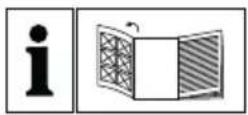
Before reading, unfold the page containing the illustrations and familiarise yourself with all functions of the device.
GR CY
GB/IE/NI/CY Operating instructions Page 1
Limitation of liability 2
Warnings 2
Intended use 3
Package contents/Transport inspection 4
Disposal of the packaging 4
Safety instructions 5
Appliance elements....8
Technical data 8
Temperature display 9
First use 9
Operation 10
Filling the water tank 10
Heating after a long time of inactivity/during first use 11
Heating up before every use 12
Preparing espresso 13
Preparing cappuccino 14
Tips for the milk froth 16
Cleaning and care 16
Cleaning the milk frother 17
Cleaning the hot water shower 18
Cleaning the accessories 18
Cleaning the appliance 18
Descaling the appliance 19
Troubleshooting 21
Disposal 22
Disposal of the appliance 22
Kompernass Handels GmbH warranty 23
Service 24
Importer 24
Introduction
Congratulations on the purchase of your new appliance.
You have selected a high-quality product. The operating instructions are part of this product. They contain important information on safety, usage and disposal. Before using the product, familiarise yourself with all operating and safety instructions. Use the product only as described and for the specified areas of application. Please also pass on these operating instructions to any future owner.
Copyright
This documentation is protected by copyright.
Any copying or reproduction, including in the form of extracts, or any reproduction of images (even in a modified state), is permitted only with the written authorisation of the manufacturer.
Limitation of liability
All technical information, data and information for installation and operation contained in these operating instructions corresponds to the latest version(s) at the time of printing and, to the best of our knowledge, takes into account our previous experience and know-how.
No claims can be derived from the details, illustrations and descriptions in these instructions.
The manufacturer assumes no responsibility for damage caused by failure to observe these instructions, improper use, incompetent repairs, unauthorised modifications or for the use of non-approved replacement parts.
Warnings
The following warning notice types are used in these operating instructions:

WARNING
A warning notice at this hazard level indicates a potentially hazardous situation.
Failure to avoid this hazardous situation could result in injury.
▶ Follow the instructions in this warning notice to prevent injury.
CAUTION
A warning notice at this hazard level indicates a potential for property damage.
Failure to avoid this situation could result in property damage.
▶ Follow the instructions in this warning notice to prevent property damage.
NOTE
▶ A note provides additional information that will assist you in using the appliance.
Intended use
The device is designed exclusively for the preparation of espresso/cappuccino and for frothing milk. It is exclusively intended for use in private households. Do not use it for commercial applications.
The appliance is not intended for any other purpose, nor for use beyond the scope described.

WARNING
Danger if not used for intended purpose!
Failure to use the appliance for its intended purpose and/or any other type of use can be hazardous.
▶ Use the appliance only for its intended purpose.
▶ Observe the procedures described in these operating instructions.
No claims of any kind will be accepted for damage arising as a result of incorrect use.
The risk shall be borne solely by the user.
Package contents/Transport inspection

WARNING
Risk of suffocation!
▶ Do not allow children to play with packaging materials. There is a risk of suffocation.
The appliance is supplied with the following components as standard:
- Espresso machine
- Sieve holder
• Large espresso sieve - Small espresso sieve
● Measuring spoon with compactor - Short operating instructions
- Operating instructions
NOTE
▶ Check the package for completeness and for signs of visible damage.
▶ If the contents are incomplete or damaged due to defective packaging or through transportation, contact the Service Hotline.
Disposal of the packaging
The packaging protects the appliance from transport damage. The packaging materials are selected from the point of view of their environmental friendliness and disposal technology and are therefore recyclable.
The recirculation of packaging into the material circuit saves on raw material and reduces the amount of waste generated. Dispose of packaging material that is no longer needed according to the regionally established regulations.
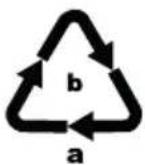
Dispose of the packaging in an environmentally friendly manner.
Note the labelling on the packaging and separate the packaging material components for disposal if necessary. The packaging material is labelled with abbreviations (a) and numbers (b) with the following meanings:
1-7: Plastics,
20-22: Paper and cardboard,
80-98: Composites.
NOTE
▶ If possible, keep the appliance's original packaging during the warranty period so that the appliance can be packed properly for return shipment in the event of a warranty claim.
Safety instructions
To ensure safe operation of the appliance, follow the safety guidelines set out below:

WARNING! RISK OF INJURY!
▶ Prior to use, check the appliance for visible external damage. Do not operate an appliance that has been damaged or dropped.
The appliance and its connecting cable must be kept away from children younger than 8 years old.
This appliance may be used by children aged 8 years or over if they are supervised or have been instructed how to use the appliance safely and have understood the potential risks.
This appliance may be used by people with reduced physical, sensory or mental capabilities or lack of experience and/or knowledge if they are supervised and have been instructed in how to use the appliance safely and have understood the potential risks.
- Cleaning and user maintenance must not be carried out by children, unless they are aged 8 or over and are supervised.
▶ Children must not use the appliance as a plaything.
- All repairs must be carried out by authorised specialist companies or by the Customer Service department. Improper repairs can pose significant risks to the user. It will also invalidate any warranty claims.

Never submerge the appliance in water or other liquids! Danger of electric shock!
▶ Never touch the appliance with wet or moist hands.
▶ To avoid risks, arrange for defective plugs and/or power cables to be replaced at once by qualified technicians or our Customer Service Department.
⚠ WARNING! RISK OF INJURY!
▶ Risk of burns! During use, some parts become very hot!
Hot vapour plumes are formed when the product is in use. Take care to ensure that you do not scald yourself! Keep a safe distance away from the steam.
The appliance should only be connected to correctly installed and earthed mains power sockets.
▶ After use, the surfaces of the heating elements will still have some residual heat.
- Do not allow any liquid to get onto the appliance's plug connections.
▶ Use the appliance only for its intended purpose. Misuse can lead to injuries.
CAUTION! PROPERTY DAMAGE!
▶ Defective components must always be replaced with original replacement parts. Compliance with safety requirements can only be guaranteed if original replacement parts are used.
- Protect the appliance from penetration by moisture and liquids.
- Protect the appliance against knocks, dust, chemicals, extreme temperatures, etc. and keep it away from sources of heat (ovens, radiators).
▶ NEVER submerse the appliance in water or other liquids!
▶ Always remove the mains adapter from the mains outlet; never pull on the power cable.
▶ Never leave the appliance unattended during operation.
- Do not use an external timer switch or a separate remote control system to operate the appliance.
CAUTION! PROPERTY DAMAGE!
- Do not operate the appliance in rooms where the temperatures are below or around 0°C. If the water in the pipes or the water tank freezes, the appliance could be damaged.
▶ Never operate the appliance outdoors. This appliance is intended for indoor use only.
NOTE
▶ Repairs to the appliance during the warranty period may only be carried out by a customer service department authorised by the manufacturer, otherwise no warranty claims can be considered for subsequent damage.
Appliance elements
Figure A:
① Temperature indicator
② Steam control
③ Storage space
4 Handle
⑤ Water tank
6 Milk frother
⑦ Drip tray
⑧ Opening for the red float
9 Drip grille
10 Hot water shower
⑪ Green steam control lamp
⑫ Red "Power" control lamp ⏻
⑬ Green heat-up control lamp
14 On/Off switch
15 "Espresso" button
16 "Steam" button
Figure B:
⑰ Sieve block
18 Sieve holder
19 Large espresso sieve
20 Small espresso sieve
②1 Measuring spoon with compactor
Technical data
Mains voltage 220 - 240 V \~ (alternating current), 50 Hz
Rated power 1100 W
Pump pressure approx. 1.5 MPa (15 bar)

Food-safe
Temperature display
The temperature indicator ① indicates how far the appliance has heated up.
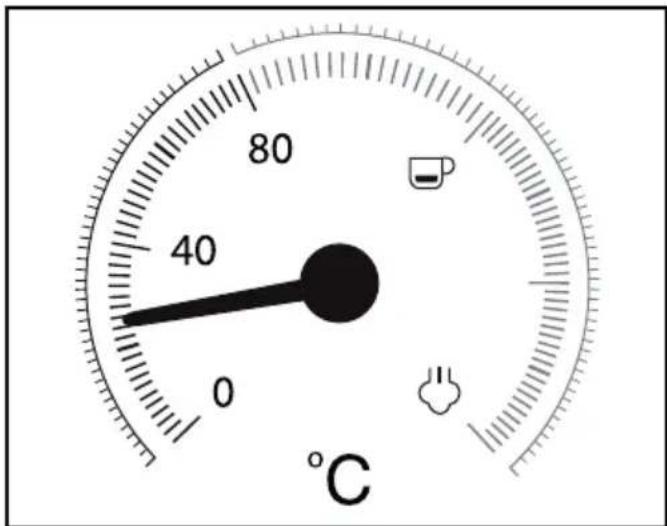
As soon as you switch the appliance on, it starts heating up until the pointer is approximately in the middle between 80°C and "☐"
When the pointer reaches the red portion of the scale, the temperature is high enough to prepare an espresso. The green heating-up control lamp 📌 ⑬ lights up.
If you press the "Steam" button ⏻ 16 the green heating-up control lamp 📋 13 goes out, and the appliance continues heating up until it reaches the range on the scale between "💡" and "💡"
Once the pointer reaches the range between "☐" and "☐" the temperature is high enough to produce steam. The green steam control lamp 🔊 lights up.
First use
1) Clean the sieve holder ⑱, the measuring spoon ㉑, the espresso sieve ⑲ ㉖, the drip grille ⑲ and the water tank ⑤ as described in the section "Cleaning and Care".
2) Place the appliance on a level and heat-resistant surface. Ensure that a mains power socket is in the vicinity.
3) Insert the drip grille ⑨ so that the red float ⑧ can protrude through the hole in the drip grille ⑨.
4) Place the sieve holder 18 in the appliance by inserting the "→ INSERT" mark, which is located next to the hot water shower 10, into the appliance and then turning it clockwise until the handle of the sieve holder 18 is facing the front ("● LOCK" mark).
5) Insert the plug into a mains power socket.
6) Proceed as follows before the first use, so as to clean the internal pipelines: Allow sufficient water for about 5 cups of espresso (about 100 ml) to flow through the appliance. Refer to the section "Operation".
7) Let the appliance generate steam for about 30 seconds. Refer to the section "Operation".
NOTE
When using the appliance for the first time, it is possible that you can hear the pump working, even though no water comes out of the appliance. If this is the case, turn the steam control ② in the direction of the "♥", so that the air can escape from the pipes of the appliance (the "Steam" button 16 is pressed). After approx. 20 seconds the air will have escaped, the noises disappear and water flows from the appliance.
Operation
NOTE
▶ Both the "Espresso" 15 and the "Steam" 🔊 16 buttons engage when pressed in. If the button is pressed again, it is released.
Filling the water tank
NOTE
▶ Use only fresh drinking water for making espresso/cappuccino.
1) Pull out the water tank ⑤ out and fill it with water:
Fill it with water to at least the Min marking.
Never fill it past the Max marking.
2) Push the water tank ⑤ back into the appliance. Ensure that the hose is inside the water tank ⑤.
Heating after a long time of inactivity/during first use
If you have not used it for some time, preheat the appliance as follows:
1) Fill the water tank ⑤ with tap water. 2) Place either the large ⑲ or the small espresso sieve ⑳ in the sieve holder ⑱:
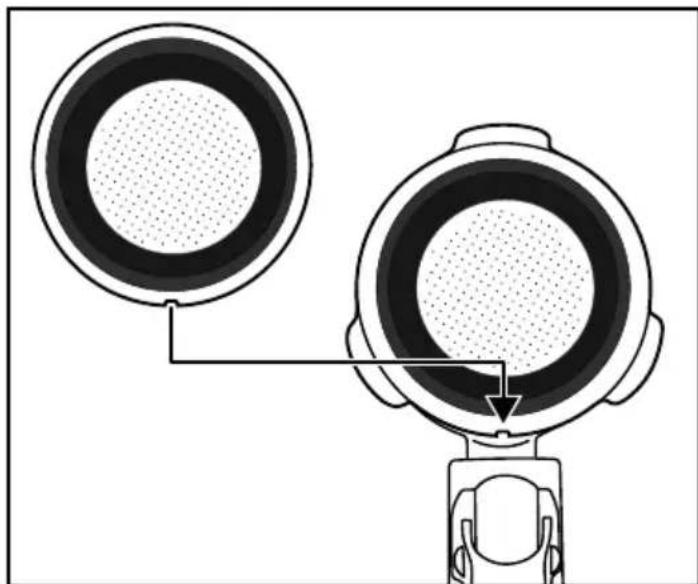
- Make sure that the small indentation on the large 19 or small espresso sieve 20 is located above the indentation on the sieve holder 18 when inserted.
natural_image
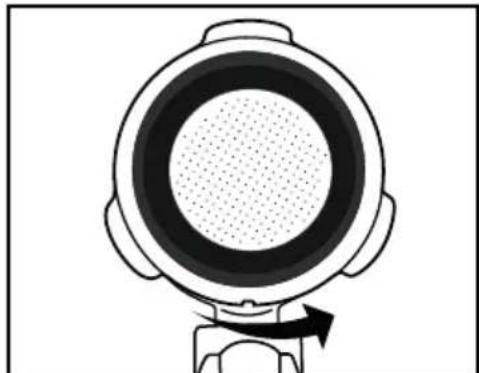
Diagram of a mechanical device with two circular components connected by a connecting rod, showing internal structure (no text or symbols)- Then turn the large 19 or small espresso sieve 20 slightly to ensure it cannot fall out.
natural_image
Diagram of a mechanical component with a circular top and arrow indicating rotation (no text or symbols)NOTE
▶ Wait until the espresso sieve 19 20 has cooled down before taking it out!
In order to remove the espresso sieves 19 20 from the sieve holder 18, turn the inserted espresso sieve 19 20 until the indentation on the espresso sieve 18 19 is located directly above the indentation on the sieve holder 18. You can now remove the espresso sieve 19 20.
3) Place the sieve holder 18 in the appliance by inserting the "→ INSERT" mark, which is located next to the hot water shower 10, into the appliance and then turning it clockwise until the handle of the sieve holder 18 is facing the front ("● LOCK" mark).
4) Place a cup under the sieve holder 18.
5) Turn the steam control ② to "0".
6) Switch the appliance on with the on/off switch ⏻ 14.
7) The red control lamp „Power“ ⏻ 12 lights up. After a short time, the pointer in the temperature indicator ① will begin to rise.
8) As soon as the green heating-up control lamp 📄 lights up, press the "Espresso" button 📄. Allow the water to flow for about 1 minute.
NOTE
▶ You may need to empty the cup in between. Interrupt the process by pressing the "Espresso" button 📄 15. Empty the cup and press the "Espresso" button 📄 15 again so that water flows through the appliance.
9) After about 1 minute, stop the pump by pressing the "Espresso" button again.
10) Wait until the green heating-up control lamp 📄 lights up again. The warming-up is concluded. You can now prepare espresso.
Heating up before every use
Before you can prepare an espresso or cappuccino, the appliance must be heated up.
1) Switch the appliance on using the on/off switch ⏻ 14. The red control lamp „Power” ⏻ 12 lights up. Neither the “Espresso” 📋 15 nor the “Steam” 🔊 16 buttons should be pressed in. Ensure that the steam control ② is turned towards “0” as far as possible.
2) Place the sieve holder 18 in the appliance by inserting the "→ INSERT" mark, which is located next to the hot water shower 10, into the appliance and then turning it clockwise until the handle of the sieve holder 18 is facing the front ("○CK" mark).
3) Press the "Espresso" button ☐ 15 so that the appliance draws water from the water tank ⑤. As soon as water starts exiting the openings in the sieve holder, press the "Espresso" button ☐ 15 again to stop the pump.
4) Wait until the green heating-up control lamp 📄 13 lights up.
5) Press the "Espresso" button 📄 15 again and allow hot water to flow through for 20 seconds before stopping the pump again. The preheating process is completed. You can now make an espresso/cappuccino.
Preparing espresso
NOTE
▶ Always ensure that the espresso sieve 19 20 is clean and free of coffee powder residues.
1) When the appliance is heated up:
To prepare an espresso, place the small espresso sieve 20 into the sieve holder 18.
To prepare two espressos, place the large espresso sieve 19 into the sieve holder 18.
2) Fill the small espresso sieve 20 with espresso powder up to the Max marking.
This corresponds to approx. 7 g of powder or a level measuring spoon ②1. Or:
Fill the large espresso sieve ⑲ with espresso powder up to the Max marking. This equates to about 7 g + 7 g of powder or two level measuring spoons ⑳.
3) Tamp down the espresso powder using the compactor on the measuring spoon 21. Add more espresso powder, if required, until the espresso sieve 19
20 is full up to the Max marking. Tamp the coffee powder down once again.
NOTE
▶ Compaction of the coffee powder is an essential process for the preparation of an espresso. If the espresso powder is compacted very strongly, the espresso runs through more slowly and more crema is generated. If the espresso powder is not so strongly compacted, the espresso runs through more quickly and it creates very little crema.
4) Place the sieve holder 18 in the appliance at the "→ INSERT" mark, then turn it clockwise until the handle of the sieve holder 18 is facing the front ("● LOCK" mark).
5) Place one (or two) cup(s) under the sieve holder openings. We recommend that you rinse the cups out with hot water beforehand, so that the espresso does not cool so quickly. You can place the cups onto the storage space ③.
6) As soon as the green heating-up control lamp 📄 13 lights up, you can press down the "Espresso" button 📄 15. The espresso flows into the cup(s).
WARNING
Never remove the sieve holder ⑱ while the espresso is coming out!
The resulting spray of hot espresso would lead to injury!
▶ Always check to make sure that the "Espresso" button is not pressed in before removing the sieve holder 18.
7) Once the cups are filled up to the required amount (about 20 ml per cup), press the "Espresso" button ☐ to stop the water being pumped through. You can now drink the espresso.
8) Switch the appliance off with the on/off switch ⏻ 14.
NOTE
▶ The appliance turns off automatically after 30 minutes.
9) After every use, remove the used espresso powder from the espresso sieve 19 20. Remove the sieve holder 18 from the appliance. To do this, fold the sieve blocker 17 upwards so that the espresso sieve 19 20 cannot fall out of the sieve carrier 18. Now empty the espresso sieve 19 20 by turning the sieve holder 18 and the blocked espresso sieve 19 20 over and knocking the espresso powder out. Always dispose of the espresso powder in an environmentally friendly manner, e.g. with the organic waste.
NOTE
Clean the hot water shower 10 (the hot water comes out of this) after each use. See also the section "Cleaning and Care".
NOTE
▶ Empty the drip tray ⑦ regularly, at the latest when the red float ⑧ is visible in the hole of the drip grille ⑨.
Preparing cappuccino
WARNING
Be careful when working with steam for the milk froth production!
The hot steam or hot splashes can lead to injuries!
▶ Always operate the steam control ② slowly.
1) Fill a container for frothing (preferably made of stainless steel) to one third with cold milk.
2) Ensure that the steam control ② is closed (turn it as far as it will go in the direction "0").
3) Push the milk frother ⑥ out to the side. Always hold it by the handle ④.
4) Press the "Steam" button 🎨 16 down. Wait for the green steam control lamp 🔊 11 to light up.
5) Hold an empty container under the milk frother ⑥. Slowly turn the steam control ② in the direction "♥". Pressurised water/spray comes from the nozzle. This cleans the nozzle and the water circuit inside the appliance.
6) Wait 15 seconds and then turn the steam control ② towards "0" until no more steam comes out of the nozzle. Pour the water out of the container.
7) Now hold the frothing container in your hand to feel the milk temperature and guide the nozzle of the milk frother ⑥ gently into the milk. Hold the frothing container at a slight angle.
8) Slowly turn the steam control ② towards 🎨.
9) Move the frothing container around in a circular motion while keeping the tip of the nozzle under the surface of the milk: deep enough that the milk does not spray out, but shallow enough to create a thick froth. Done properly, a deep buzzing sound is audible.
10) As the milk froth rises, push the nozzle deeper into the milk to froth up the next "layer" and to avoid a burnt taste in the froth.
11) Finally, insert the nozzle completely and close the steam control ② approximately halfway, so that the milk is heated. Hold the frothing container at a slight angle, so that the milk gently swirls around while it is being stirred with the nozzle.
12) When the milk froth has the desired consistency and temperature, close the steam control ② (turn it towards "0" as far as it will go).
13) Now you can remove the nozzle from the milk.
14) Press the "Steam" button 🎨 ⑯. The steam control lamp 🔊 ⑰ goes out and the heat-up control lamp - lights up.
NOTE
For the preparation of cappuccino, always use bigger cups than for espresso to leave space for the frothed milk.
15) When preparing cappuccino, proceed exactly as you would for an espresso (see section "Preparing espresso": the preheating is no longer necessary). Allow the water to flow through for about twice as long as an espresso (about 40 ml).
16) Switch off the appliance using the On/Off switch ⏻ 14.
NOTE
▶ The appliance turns off automatically after 30 minutes.
17) Now add the frothed milk into the previously prepared espresso. The cappuccino is now ready. You can add sugar or sprinkle it with cocoa powder according to taste.
NOTE
▶ Always clean the milk frother ⑥ after every use. See also the section "Cleaning and Care".
Tips for the milk froth
■ Generally, any type of milk can be frothed, including soy and rice milk. However, some types of milk can only be frothed to a certain extent.
■ Low fat or skimmed milk does not burn as easily as whole milk, however, a too low fat content adds to the risk that the milk will not be well frothed. Therefore use a milk with a fat content of 3.5% or 1.5%, if possible.
■ Well-cooled milk can be better frothed than less cold. For the best results, use milk at a temperature of about 7^ C.
■ Do not froth the milk a second time, otherwise it may burn.
- Allow frothed milk to stand for about 30 seconds before you pour it onto the espresso. This allows the larger bubbles to burst; the still liquid milk sinks to the bottom. You can then pour the fine froth onto the espresso.
Cleaning and care

WARNING! RISK OF INJURY!
▶ Always remove the plug from the mains power socket before you clean the appliance. Danger of electric shock!
▶ Always allow the appliance to cool down before you start to clean it. Risk of burns!

NEVER submerse the appliance in water or other liquids! Danger of electric shock!
Cleaning the milk frother
CAUTION! PROPERTY DAMAGE!
▶ NEVER use abrasive, corrosive or chemical agents to clean the appliance. These could damage the outer surfaces of the appliance.
1) Place an empty container under the milk frother ⑥.
2) Turn the steam control ② to ⏻ immediately after use and let the steam escape for a few seconds.
3) Close the steam control ② (turn it towards "0" as far as it will go), switch the appliance off and remove the plug from the mains power socket.
4) Allow the nozzle to cool down.
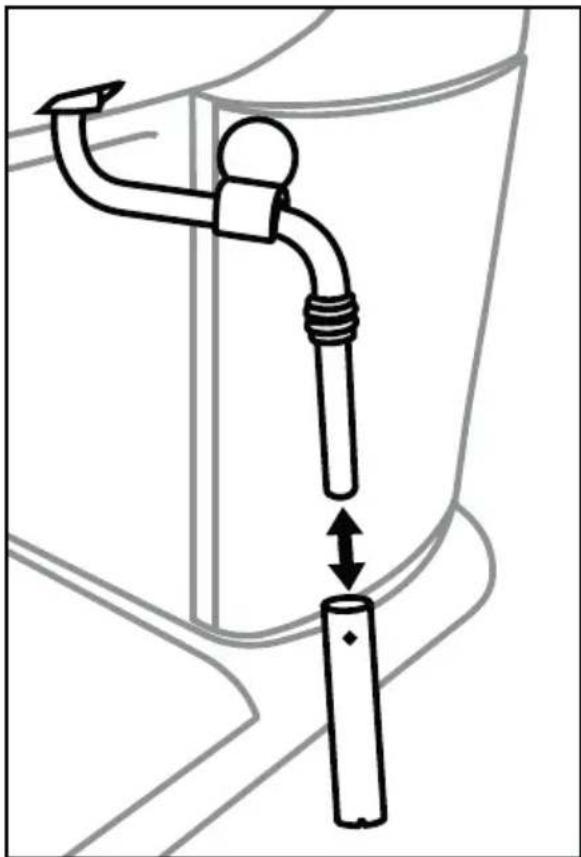
5) Pull the casing of the milk frother ⓑ off (Figure 1) and clean it thoroughly in warm water.
6) Wipe the nozzle under the casing with a damp cloth. If necessary, add a little mild detergent onto the cloth. After cleaning with detergent, always wipe off with a cloth moistened with clean water. Ensure that there is no detergent residue left on the nozzle.
7) Push the casing back onto the nozzle (Figure 1).
natural_image
Diagram of a pipe connection with a valve and cylinder, showing fluid flow direction (no text or symbols)Figure 1
Cleaning the hot water shower
Clean the hot water shower 10 after each use:
1) After you have prepared the espresso/cappuccino and removed the sieve holder ⑱, wipe the entire surface of the hot water shower ⑩ with a moistened cloth to remove all powder residues.
2) Replace the sieve holder 18 without the espresso filters 19 20.
3) Place an empty cup under the sieve holder ⑱ and press the "Espresso" button □ ⑮ down until it clicks in. Water flows out of the hot water shower ⑩ rinsing out the remaining powder residue.
4) After about 20 seconds, press the "Espresso" button 📄 again and switch the appliance off with the On/Off switch (1).
5) Remove the sieve holder 18 again.
Cleaning the accessories
1) Clean the sieve holder ⑱, the two espresso sieves ⑲ ⑳, water tank ⑴, the measuring spoon ㉑ and the drip grille ⑨ in warm water.
NOTE
▶ If you put detergent into the water, it may effect the taste of the espresso. If the stains can only be removed with detergent, always rinse the items afterwards with lots of clean water.
2) Dry all parts well.
3) The drip tray ⑦ is suitable for cleaning in the dishwasher. However, always remove the red float from the drip tray ⑦ before cleaning:
- To do this, remove the stoppers attached to the two retaining bars to the side of the float.
-Pull the float from the retaining bars.
-Clean the float and stoppers. - After cleaning the drip tray ⑦, push the cleaned float back onto the retaining bars and replace the stoppers.
Cleaning the appliance
Clean the appliance with a moist cloth. If necessary, use a little detergent on the cloth.
Ensure that the appliance is completely dry before the next use.
Descaling the appliance
Descale the appliance regularly. The appliance should be descaled after about 1 - 2 months (at approx. 4 espresso preparations per day). Depending on the hardness of the water in your area, this figure may differ.
For descaling, use a commercially available descaler for espresso machines. Proceed as described in the instructions for usage of the descaler.
If you do not have any descaling products, you can use citric acid and proceed as follows:
1) Fill the water tank ⑤ to the marking MAX.
2) Dissolve 2 tablespoons (about 30 grams) of citric acid (available in drugstores or chemists) into the water.
3) Replace the water tank ⑤ into the appliance.
4) Switch on the appliance using the On/Off switch ⏻ 14. The steam control 2 is closed.
5) Insert the sieve holder 18 without the espresso sieves 19 20 back into the appliance and place a cup under the sieve holder 18.
6) As soon as the green heat-up indicator lamp 📄 13 lights up, press the "Espresso" button 📄 15 so that it clicks in.
7) Allow around 2 cups (approx. 250 ml) of water to run through and then stop the process by pressing the "Espresso" button 📄 15 again.
8) Hold a container under the milk frother ⑥.
9) Press the "Steam" button 🎨⑯ so that it clicks into place and wait until the green steam control lamp 🔊⑰ lights up. Slowly turn the steam control ② to 🔊. Allow the appliance to generate steam for approx. 2 minutes.
10) After 2 minutes, close the steam control ②, then press the "Steam" button 🎨 ⑯ again so that no more steam is generated.
11) Let the scaling agent take effect for about 15 minutes.
12) Repeat steps 6 - 11 three times.
13) Then press the "Espresso" button down so that it clicks in, let the water run through until the water tank is empty.
14) Rinse the water tank ⑤ with clean water and then fill it with clean water up to the Max marking.
15) Press the "Espresso" button 📄 ⑮ down so that it clicks into place and wait until the green heat-up indicator lamp 📄 ⑬ lights up.
16) Allow the water to run through.
17) Repeat steps 14 - 16 three times.
18) Refill the water tank ⑤ with water.
19) Push in the "Steam" button so that it clicks into place.
20) Hold a container under the milk frother ⑥ and slowly turn the steam control ② to 🍒 as soon as the green steam control lamp ⏻ lights up.
21) After approx. 1 minute, close the steam control ② (turn it towards "0" as far as it will go), then press the "Steam" button again ⏻ and switch off the appliance.
NOTE
▶ The appliance turns off automatically after 30 minutes.
Troubleshooting
| Malfunction Cause Solution | ||
| The espresso no longer flows out. | The espresso powder is too moist and/or compressed too tightly. | Re-prepare the espresso without compressing the powder as firmly; if necessary, use new powder. |
| No water in the water tank 5. | Fill the water tank 5 with water. | |
| The holes of the sieve holder openings are blocked. | Clean the sieve holder 18. | |
| The espresso drips over the edges of the sieve holder 18, not from the openings. | The sieve holder 18 is not correctly inserted. | Insert the sieve holder 18 correctly. |
| The sieve holder openings are blocked. | Clean the sieve holder 18. | |
| There are espresso powder residues on the edges of the sieve holder 18. | Clean the espresso powder residues from the edges of the sieve holder 18. | |
| The espresso is cold. | The appliance was not preheated. | Preheat the appliance. |
| The green heating-up control lamp 13 has not yet glowed. | Wait until the green heating-up control lamp 13 lights up. | |
| The cups were not pre-warmed. | Pre-warm the cups. | |
| The pump is unusually noisy. | The water tank 5 is empty. | Fill the water tank 5 with water. |
| The crema is too light (the espresso runs out of the sieve holder 18 quickly). | Not enough espresso powder. Use more espresso powder. | |
| The espresso powder is too coarsely ground. | Use only espresso powder specially manufactured for espresso. | |
| The crema is too dark (the espresso runs out of the sieve carrier 18 slowly). | Too much espresso powder. Use less espresso powder. | |
| The powder is too finely ground or moist. | Use only espresso powder specially manufactured for espresso. | |
| The sieve is blocked. Clean the sieve. | ||
| The milk does not froth. | The milk is not cold enough. Use milk from the refrigerator. | |
| The milk frother 6 is dirty. | Clean the milk frother 6. | |
Disposal
Disposal of the appliance
Do not dispose of the appliance in your normal domestic waste. This product is subject to the provisions of the European WEEE (Waste Electrical and Electronic Equipment) Directive 2012/19/EU.
Dispose of the appliance via an approved waste disposal company or your municipal waste disposal facility. Please comply with all applicable regulations. Please contact your waste disposal facility if you are in any doubt.

Your local community or municipal authorities can provide information on how to dispose of the worn-out product.
This appliance has a 3-year warranty valid from the date of purchase. If this product has any faults, you, the buyer, have certain statutory rights. Your statutory rights are not restricted in any way by the warranty described below.
Warranty conditions
The validity period of the warranty starts from the date of purchase. Please keep your original receipt in a safe place. This document will be required as proof of purchase.
If any material or production fault occurs within three years of the date of purchase of the product, we will either repair or replace the product for you at our discretion. This warranty service is dependent on you presenting the defective appliance and the proof of purchase (receipt) and a short written description of the fault and its time of occurrence.
If the defect is covered by the warranty, your product will either be repaired or replaced by us. The repair or replacement of a product does not signify the beginning of a new warranty period.
Warranty period and statutory claims for defects
The warranty period is not prolonged by repairs effected under the warranty. This also applies to replaced and repaired components. Any damage and defects present at the time of purchase must be reported immediately after unpacking. Repairs carried out after expiry of the warranty period shall be subject to a fee.
Scope of the warranty
This appliance has been manufactured in accordance with strict quality guidelines and inspected meticulously prior to delivery.
The warranty covers material faults or production faults. The warranty does not extend to product parts subject to normal wear and tear or fragile parts such as switches, batteries, baking moulds or parts made of glass.
The warranty does not apply if the product has been damaged, improperly used or improperly maintained. The directions in the operating instructions for the product regarding proper use of the product are to be strictly followed. Uses and actions that are discouraged in the operating instructions or which are warned against must be avoided.
This product is intended solely for private use and not for commercial purposes. The warranty shall be deemed void in cases of misuse or improper handling, use of force and modifications / repairs which have not been carried out by one of our authorised Service centres.
Warranty claim procedure
To ensure quick processing of your case, please observe the following instructions:
■ Please have the till receipt and the item number (e.g. IAN 12345) available as proof of purchase.
■ You will find the item number on the type plate, an engraving on the front page of the instructions (bottom left), or as a sticker on the rear or bottom of the appliance.
If functional or other defects occur, please contact the service department listed either by telephone or by e-mail.
■ You can return a defective product to us free of charge to the service address that will be provided to you. Ensure that you enclose the proof of purchase (till receipt) and information about what the defect is and when it occurred.
You can download these instructions along with many other manuals, product videos and software on www.lidl-service.com.
Service
GB Service Great Britain
Tel.: 0800 404 7657
E-Mail: kompernass@lidl.co.uk
IE Service Ireland
Tel.: 1890 930 034
(0,08 EUR/Min., (peak))
(0,06 EUR/Min., (off peak))
E-Mail: kompernass@lidl.ie
CY Service Cyprus
Tel.: 8009 4409
E-Mail: kompernass@lidl.com.cy
IAN 313486
Importer
Please note that the following address is not the service address. Please use the service address provided in the operating instructions.
KOMPERNASS HANDELS GMBH
BURGSTRASSE 21
DE-44867 BOCHUM
GERMANY
www.kompernass.com
Περιεχόμενα
Εισαγωγή 26
natural_image
Diagram of a mechanical device with two circular components connected by a pointer, showing internal structure (no text or symbols)natural_image
Diagram of a mechanical component with a rotating arrow indicating motion (no text or symbols)ΥΠΟΔΕΙΞΗ
natural_image
Diagram of a pipe valve assembly with a cylindrical component inserted, showing fluid flow direction (no text or labels)Εικόνα 1
KOMPERNASS HANDELS GMBH
BURGSTRASSE 21
DE-44867 BOCHUM
ГЕРMANIA
www.kompernass.com
Inhaltsverzeichnis
Einführung 50
Urheberrecht 50
natural_image
Diagram of a mechanical device with two circular components connected by a shaft, showing internal structure (no text or symbols)natural_image
Diagram of a mechanical component with a circular top and arrow indicating rotation (no text or symbols)HINWEIS
natural_image
Diagram of a pipe fitting with an arrow indicating upward movement, no text or symbols presentAbbildung 1
KOMPERNASS HANDELS GMBH
BURGSTRASSE 21
DE-44867 BOCHUM
DEUTSCHLAND
www.kompernass.com
KOMPERNASS HANDELS GMBH
BURGSTRASSE 21
DE-44867 BOCHUM
GERMANY
www.kompernass.com