721-331 - Broyeur de compost Meec Tools - Free user manual and instructions
Find the device manual for free 721-331 Meec Tools in PDF.


| Product Type | Compost Shredder |
| Brand | Meec Tools |
| Model | 721-331 |
| Dimensions (L x W x H) | 60 x 40 x 90 cm |
| Weight | 25 kg |
| Power Source | Electric, 230 V |
| Motor Power | 2500 W |
| Cutting System | Rotating blades with 2 cutting edges |
| Max Branch Diameter | 40 mm |
| Collection Box Capacity | 60 L |
| Noise Level | 95 dB (A) |
| Safety Features | Overload protection, emergency stop, safety switch |
| Maintenance | Regular blade sharpening and cleaning |
| Spare Parts Availability | Blades, screws, and collection box available |
| Warranty | 2 years |
| Intended Use | Shredding garden waste for composting |
Frequently Asked Questions - 721-331 Meec Tools
User questions about 721-331 Meec Tools
0 question about this device. Answer the ones you know or ask your own.
Ask a new question about this device
Download the instructions for your Broyeur de compost in PDF format for free! Find your manual 721-331 - Meec Tools and take your electronic device back in hand. On this page are published all the documents necessary for the use of your device. 721-331 by Meec Tools.
USER MANUAL 721-331 Meec Tools
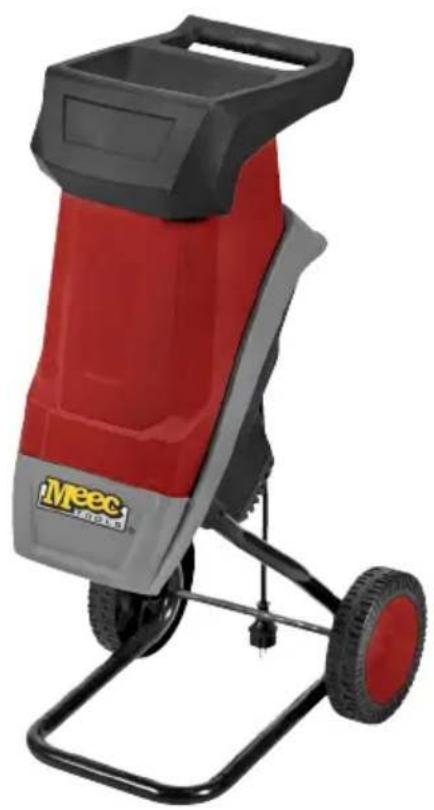
natural_image
Red and black Meec mobile power renter with wheels and handle (no visible text or symbols)EN User Instructions for compost shredder
SE - Bruksanvisning i original
NO - Bruksanvisning i original
EN - Operating instructions in original
Date of production: 2014-06-19
© Jula AB
SVENSKA....4
SÄKERHETSANVISNINGAR....4
Användning 5
SAFETY INSTRUCTIONS 49
Use 50
Maintenance and storage 50
Symbols 51
Operation....52
Additional safety information 55
TECHNICAL DATA 56
DESCRIPTION 56
ASSEMBLY 57
USE 58
Starting and stopping the shredder....59
Using the feed funnel pusher....60
Collecting shredded material....60
REPLACING BLADES....61
MAINTENANCE 62
SÄKERHETSANVISNINGAR
natural_image
Close-up of a mechanical component with a cylindrical shaft and attached rod (no visible text or symbols)natural_image
Black-and-white photo of a potted plant with leaves and a flower, no visible text or symbols
natural_image
Person using a mechanical device to lift or lift a component (no visible text or symbols)UppSAmLING AV mALT MATERIAL
natural_image
Symbol of a trash bin with diagonal lines crossing it, no text or labels presentVärna om miljön!
natural_image
Close-up of a mechanical component with visible parts and a circular mark, no text or symbols present.natural_image
Black-and-white photo of a potted plant with leaves and flowers, no visible text or symbols
natural_image
Black-and-white photo of a hand gripping a mechanical component, possibly a tool or device, with no visible text or symbols.oppSAmLING AV oppmALT mATERIALE
natural_image
Close-up of a mechanical component with a cylindrical shaft and attached rod, no visible text or symbolsnatural_image
Black-and-white photo of a potted plant with broad leaves and a small flower, labeled with number 1 in the corner (no text or symbols on the plant itself)
natural_image
Close-up of a hand gripping a mechanical component in a car seat (no visible text or symbols)ZBIERANIE pRZEmIELoNEGo mATERIAŁU
natural_image
Pure electrical circuit lines without any symbolsDBAJ O ŚRODOWISKO!
Read the operating instructions carefully before use!
Save these instructions for future reference.
WARNING!
- The electric compost shredder can only be used in a safe manner if you follow all safety instructions included in the operating instructions.
- Please read through all of the instructions before using the shredder and retain them for future reference.
-
Check through the points in the checklist below before you use the compost shredder.
-
The insulation around the socket and plug is sealed tightly.
- The extension cord's insulation is intact.
- The cord is fully unwound to avoid overheating.
- The power cord is laid appropriately so it cannot be damaged or pose a risk of tripping.
- The compost shredder should not be used by anyone (including children) with reduced physical, sensory or mental capabilities, or by anyone who lacks experience and knowledge regarding how a compost shredder is used, unless they are given help and supervision by a person responsible for their safety.
- When using electrical garden tools, you should always take basic safety precautions to reduce the risk of fire, electric shocks and personal injury.
- Never allow children to operate the shredder.
- Never operate the shredder near other people.
- If the power cord is damaged, it must not be used. If the power cord gets damaged while the shredder is in use, first pull out the plug before touching it. A damaged power cord could pose a high risk of electric shock.
• Always use ear protection and protective glasses when using the shredder.
- Do not wear loose-fitting clothing or clothing with loose-hanging straps or laces.
- Only use the shredder where you have plenty of room (so not near a wall or any other fixed objects) and place it on an even and stable surface.
- Do not use the shredder on or near pathways made of gravel or asphalt where material could be thrown up, causing damage.
- Before you start the shredder you should always ensure all screws, nuts, bolts and other attachments are properly tightened and that all protective devices are in place.
- Replace damaged or illegible labels.
USE
- Check that the feed funnel is empty before you start the shredder.
- Keep your face and body away from the feed funnel's opening.
- Never put your hands, other body parts or any clothing into the feed funnel or ejector funnel, and also keep them away from any moving parts.
- Always ensure you have a proper foothold and good balance while using the shredder. Do not overreach. Always stand on the same level as the shredder when feeding material into it.
- Keep at a safe distance from the ejection area when using the shredder.
- Take care that there are no pieces of metal, stones or other foreign objects in the material you put into the shredder.
- If foreign objects end up in the shredder's shredding mechanism and/or if the shredder begins to emit strange noises or vibrations, you should immediately shut off the power and allow the shredder to come to a complete stop. Pull out the plug and do the following:
– check whether the shredder is damaged
- check whether any parts are loose and tighten them if needed
- if any parts are damaged, have them repaired or replace them with spare parts which have the correct specifications.
- Never let a large pile of fully shredded material build up around the ejector. This could mean that material ricochets back into the shredder up through the feed funnel.
- If the shredder becomes clogged, you should turn off the power and pull the plug out before cleaning the debris away.
- Keep the engine and power cord free from debris and other objects to avoid damage and fire risk.
- Remember that trying to start the engine also sets the shredder's blades in motion.
- All protective devices must always be in place and in good condition.
- Do not move the shredder while it is running and the cord is connected to it.
- Shut off the engine and unplug the machine before leaving the work area.
- Do not tilt the shredder while it is running.
- Keep the power cord and any extension cords away from the shredder's blades. They could damage the cord and pose a risk of electric shock.
mAINTENANCE AND STORAGE
- Before any maintenance, inspection, storage or replacement of any accessories, you should first shut off the shredder's engine, unplug the machine and ensure that all moving parts have completely stopped.
- If the shredder has a key, pull it out.
- Let the shredder cool down before you begin to check it.
-
Let the shredder cool down before you put it away for storage.
-
When you carry out maintenance on the shredder's blade unit, remember that the manual start mechanism can set the blades in motion in spite of the device which ensures the engine cannot start when the protective cover has been removed.
- Keep the engine's ventilation openings free from debris and other objects to avoid damage to the engine and fire risk.
- If you are using an extension cord, it must offer the same specifications as the shredder's permanently installed power cord.
- Check regularly whether there is any damage to the power and extension cords or whether there are signs of wear and tear.
- Do not use the shredder if the cords are damaged or worn.
- Never attempt to disable the protective guard.
SymBoLS
 | Read the instructions carefully before you use the shredder and acquaint yourself with the equipment's controls and how they should be used. |
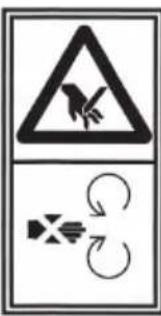 | Danger - rotating blades. Keep hands, hair and loose-fitting clothing away from the shredder's moving parts. Never reach into the feed funnel or ejector. The blades continue to rotate for approx. 5 seconds after the shredder has been switched off. |
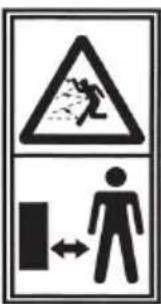 | There is a risk that objects could be ejected from the shredder. Keep bystanders away. |
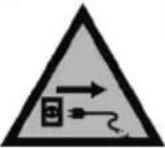 | If the power cord is damaged while the shredder is in use, do not touch it. Pull the plug out immediately. The plug should not be connected when you are not using the shredder or when you are planning to repair it in any way (for ex. replacing parts, repairing, cleaning or adjusting it). |
 | Always use protective glasses, ear protection and gloves. |
 | Do not operate the shredder when it is raining or damp. Protect the shredder against moisture. |
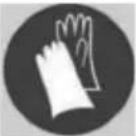 | Use gloves. |
 | Take care that no pieces of metal, stones or other debris are mixed in with the material you feed into the shredder. |
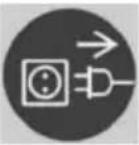 | Always pull the plug out before you maintain the shredder in any way. |
opERATIoN
WARNING!
Never use accessories or spare parts other than those recommended in these operating instructions as this could lead to personal injury.
NB:
A general voltage drop can occur when the compost shredder is started. This can have an effect on other electrical equipment (for example, lights may flicker). Disruptions of this kind will likely not occur if the electrical supply's network impedance (Zmax) is less than 0.4 ohm at 50 Hz. You can get more information about this from your network supplier.
- Only use extension cords which are intended for outdoor use.
- When using electrical tools outside you must also use extension cords which are specially designed for outdoor use.
- Keep the work area tidy.
— An unclean and messy work area invites accidents.
- Think about your working environment.
– Never expose electrical tools to rain.
- Do not use electrical tools in a damp or rainy environment.
• The work area should be well lit.
- Never use electrical tools in areas they can cause fire or explosions.
• Protection against electric shocks.
- Avoid body contact with grounded surfaces such as pipes, radiators, cables etc.
- Keep children and pets away from the work area.
- Do not allow bystanders to touch the compost shredder or extension cord. All bystanders should be kept at a distance from the work area.
• Storing the compost shredder.
- When the compost shredder is not being used it should be stored in a dry place, either locked away or out of the reach of children.
- Use the correct tools.
- Do not attempt to use power tools or accessories for tasks suited to more powerful tools.
- Do not use the compost shredder for any tasks it is not intended for.
- Wear appropriate clothing.
- Do not wear loose-fitting clothing or jewellery. These can get stuck in the shredder's moving parts.
— You should use gloves and non-skid shoes when working outdoors.
— Put your hair up or use a hair net if you have long hair.
- Use personal protective equipment.
- Use protective glasses and a face or dust mask if the shredding process is producing a lot of dust.
- Use ear protection if you are operating the compost shredder for a long time or if the noise level is high.
- Do not force the shredder.
- The compost shredder works best if you use it as it is intended. This is also how you use it safely.
- Safe tools.
- Use clamps or a vice to hold the tool. This is safer, and then you have both hands free to work with the tool.
- Position the power cord safely.
- Ensure the power cord is placed somewhere no-one can trip over or step on it.
- Also ensure that no heavy objects are placed on the cord and that it is positioned in a way that prevents it from being damaged.
• Take care with the power cord.
— Never use the cord to carry the tool or pull on the cord to pull the plug from its socket.
- Keep the power cord away from heat, oil and sharp edges.
- Do not overreach and ensure you always have a solid foothold and good balance.
- Maintaining the compost shredder
- Ensure the blades are always sharpened and clean. This will mean the shredder works more effectively.
– Follow the instructions for lubrication and replacing accessories. - Check the power cord for the compost shredder at regular intervals. If you find that it is damaged, have it repaired by an authorised service centre. Also check the extension cord at regular intervals, and replace it if it is damaged.
- Keep the handles dry, clean and free from oil and grease.
- Check damaged parts
- If you have found any damage to the shredder or any part of its protective guard, you must check the damaged parts carefully to determine whether they can still function without a problem and offer the intended protection.
- Check that the moving parts are correctly adjusted and can move freely, and whether the damaged parts or their attachments can affect them in any way.
- If a protective guard or any other part of the compost shredder is damaged, the damage must be looked at by an authorised service centre unless otherwise specified in the operating instructions.
– Damaged control and power switches must be repaired by an authorised service centre. - Never use the compost shredder if it cannot be started or stopped using the power switch.
- Disconnect the power supply
- When the compost shredder is not being used and before you carry out maintenance on it or replace any accessories such as the blades, you must first disconnect the power supply by removing the plug from the socket.
- Removing wrenches and similar items
- Get into the habit of checking that you have removed all tools, wrenches etc. from the shredder before starting it.
- Avoid unintentional starting
- Do not leave your finger on the power switch when you move the shredder if the plug is connected.
- Make sure that the switch is in the off position when you connect the plug.
- Be careful
- Always use caution. Use common sense. Do not operate the compost shredder when tired.
- Drop the shredder in for repair if it is damaged
- This electric compost shredder meets all relevant safety requirements.
- Repairs should only be carried out by competent persons using original parts, otherwise the user may be exposed to considerable risks.
- Never attempt to open the compost shredder's casing.
- The shredder's power cord should be replaced by an authorised service centre where necessary.
AddITIoNAL SAfETy INfoRmATIoN
- The mains voltage must correspond to the voltage indicated on the shredder's rating label.
- The compost shredder should be operated in combination with an RCCB (Residual Current Circuit Breaker) which has a tripping current of no more than 30 mA.
-
Use thicker extension cords, H07RN-F or better. Ideally use extension cords with strong colours that can be seen easily.
• Always use caution. Use common sense.
• Take care when the blades are in motion.
• Take care with the power cord. -
Never move the shredder by pulling on the power cord, and never pull on the cord in order to pull the plug from the socket.
- Keep the power cord away from heat, oil and sharp edges.
- Ensure the power cord is placed somewhere no-one can trip over or step on it.
- Also ensure that no heavy objects are placed on the cord.
-
Ensure the cord cannot be damaged.
-
Never attempt to open the compost shredder's casing. Do not try to alter the compost shredder in any way.
- The power cord should only be replaced by an authorised service centre.
- Do not use the shredder if the cords are damaged or worn.
-
If the power cord is damaged, it must not be used.
-
If the power cord is damaged while you are operating the shredder, first pull out the plug before you touch the cord.
— A damaged power cord could pose a high risk of electric shock.
- Do not touch the compost shredder's inner parts before you have disconnected the power supply and the blades have come to a complete stop.
- Keep the extension cord away from the shredder's blades. They could damage the cord and pose a risk of electric shock.
• Pull the plug from the socket:
- if the shredder is left unsupervised
– before you rectify a blockage
– before you check, clean or repair the shredder in any way. - if the blades have struck a foreign object, check whether the shredder is damaged and have it repaired as necessary
- if the shredder starts to vibrate substantially more than normal.
- Replace the plug: if the plug is damaged it should be replaced by a competent electrician.
- Never use a damaged or defective plug.
TEcHNICAL dATA
NB: The specifications above refer to the shredder's MAXIMUM capacity. The largest permitted diameter for a branch/twig depends on how hard the wood is.
Model no. HT6533
Nominal voltage 230-240 V \~ 50 Hz
Rated power 2,400 W
Unloaded rpm 4,500 rpm
Largest diameter for material 39 mm
Sound pressure level dB (A) (SS-EN 13683) 95.3 (K = 3 dB)
Sound power level dB(A) (2000/14/EG) 107,7 (K = 3 dB)
Guaranteed sound power level dB (A) 110
Net weight 10.7 kg
dEScRIpTIoN
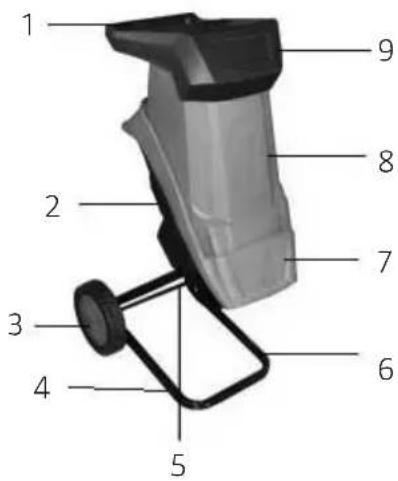
- Handle
- Engine cover
- Wheel and hubcap
- Base foot A
- Axle
- Base foot B
- Ejector
- Shredder chassis
- Feed funnel
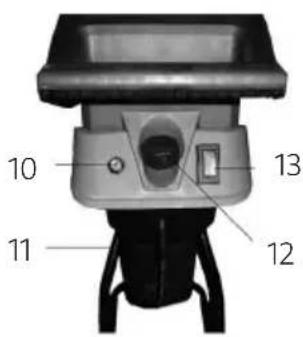
- Overload protection button
- Power cord
- Locking knob
- Power switch
ASSEmBLy
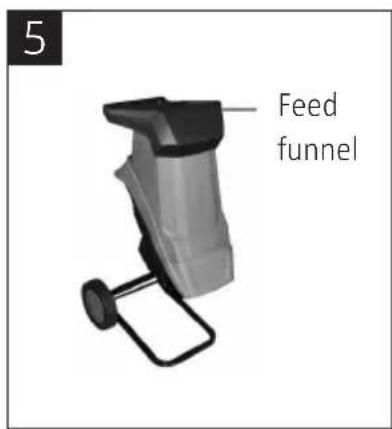
NB: It is dangerous to operate the shredder without the feed funnel (image 5).
natural_image
Close-up of a mechanical component with visible joints and a shaft (no text or symbols)- Turn the shredder upside down.
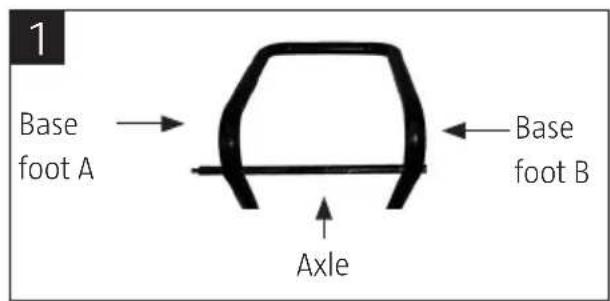
- Slide the axle through the hole in the base foot (image 1).
- Locate base foot A and base foot B using the markings.
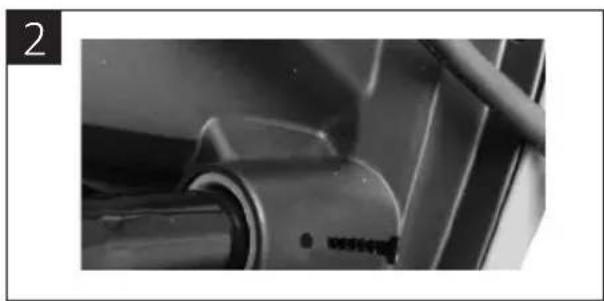
- Slide the base foot into the body of the shredder and attach using the screws (image 2).
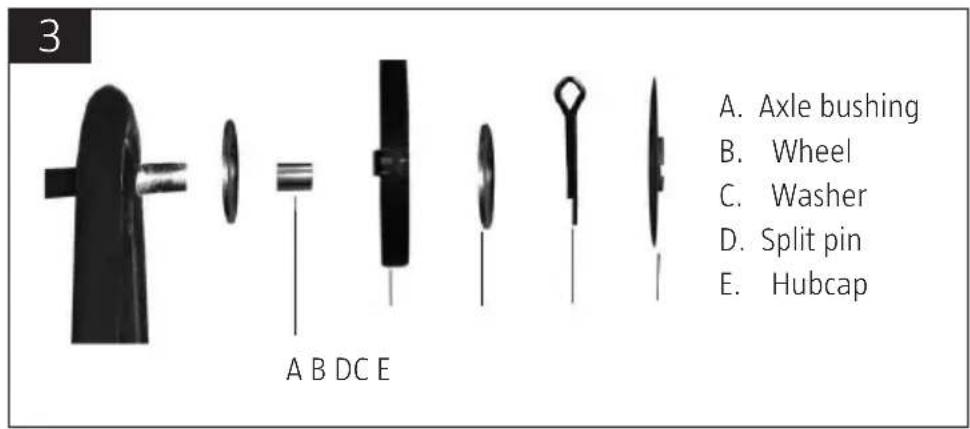
- Assemble the wheel in the order shown in image 3. Do not overtighten the nut.
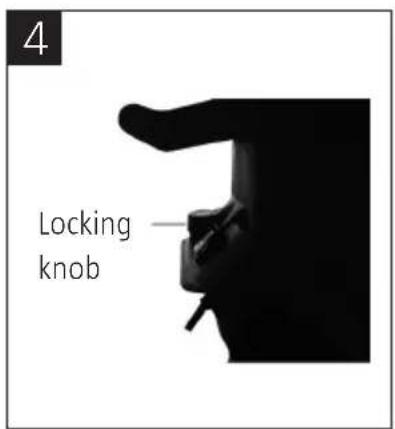
- Tighten the knob (image 4). The knob also functions as a safety switch, and if you have not tightened it sufficiently the engine will not start.
USE
WARNING! Long objects, for ex. branches, which stick out from the shredder can whip back and forth when drawn in by the blades. Keep at a safe distance.
- Before you use the shredder you should read these operating instructions carefully and acquaint yourself with its different functions.
- Before you check or repair the shredder in any way, you must first switch it off and pull the plug out of the socket. Once this is done, wait for all moving parts to stop completely.
-
Check the material you are planning to put through the shredder before you start.
-
Remove any objects which could be ejected or could get stuck or entangled in the blades.
- Remove any earth which is left on roots or similar items.
- Foreign objects such as stones, glass, metal, cloth or plastic must never be placed in the feed funnel, as the blades could be damaged.
- Always place the shredder on a level and stable surface. Take care not to let the shredder tilt or move while in use.
- Wait until the blades have reached their top speed before you begin to place material into the funnel feed.
- Only use the shredder for the following materials:
– twigs and branches (max. 40 mm thick)
— twigs from bush cuttings, twigs from hedge cuttings
— plants and other garden waste
— leaves and roots (remove earth from the roots first)
- Never place soft waste such as kitchen waste into the shredder. It can be composted directly.
- Feed the material you want to shred into the corner of the feed funnel. The blades pull the material in, as long as it is not too large or heavy.
- Do not overfill the feed funnel so that it becomes clogged.
- Ensure the shredded material can be ejected unimpeded from the ejector.
- If you want more finely shredded material, you can shred it again.
- Do not allow the shredded material to build up into such a large pile that it blocks the ejector. If the pile becomes too large it can come into contact with the blades, which could mean it being thrown up into the feed funnel.
- Organic material contains a lot of water and plant saps which can become stuck in the shredder. It is therefore best to let the material dry out for a few days before you place it into the shredder. Larger branches are however best shredded just after being cut down.
- If the blades stop while shredding is in progress, you should immediately stop the shredder and pull out the plug before you investigate the cause.
- Remove anything which has become stuck on and around the blades, and check whether the blades have been damaged before you continue using the shredder.
- If the blades have stopped for longer than 5 seconds due to a blockage, press the overload protection button and switch the shredder off.
- Let the shredder cool down for at least 1 minute before you start it again. To start the shredder again, you must first press the overload protection button and then the power switch.
-
If foreign objects end up in the shredder's shredding mechanism and/or if the shredder begins to emit strange noises or vibrations, you should immediately switch the shredder off and let the blades come to a complete stop. Pull the plug out of the socket and do the following:
-
check whether the shredder is damaged, and if any parts are damaged, have them repaired or replaced.
– check whether any parts are loose and tighten them if needed.
- If the shredder has become clogged/blocked, you should switch it off and let the blades come to a complete stop. Pull the plug out of the socket before you rectify the problem.
- Keep the engine's ventilation openings free from debris and other objects to avoid damage to the engine and fire risk.
- Switch off the shredder, let the blades come to a stop and pull the plug out of the socket as soon as you plan to leave the work area.
- Never let a large pile of fully shredded material build up around the ejector. This could mean that material ricochets back into the shredder up through the feed funnel.
STARTING AND SToppING THE SHREddER
WARNING!
- Never loosen the knob before you have switched the shredder off via the power switch and taken the plug out.
-
The shredder will stop within 5 seconds once it has been switched off.
-
Press the side of the power switch marked "I" to start the shredder, and the side marked "O" to stop it.
- If the shredder does not start, press the overload protection button to check whether the power supply is working as it should.
- Let the engine run for a few seconds before you begin to shred.
The overload protection button is triggered if:
– the blades are surrounded by too much shredded material
- you attempt to shred heavier material than the shredder can manage
– the blades are encountering too much resistance.
一
When the overload protection button is triggered, you must first switch the shredder off and pull out the plug.
-
Unscrew the knob in the middle of the main unit and open the upper part.
-
Remove the debris or blockage from the blade area.
-
Replace the upper part and tighten the knob.
-
Let the engine cool for a few minutes.
-
Put the plug back in and press the overload protection button.
-
Once that is done, press the side of the power switch marked "I".
USING THE fEEd fUNNEL pUSHER
WARNING!
- Never stick your fingers in the feed funnel.
- Never operate the shredder without a feed funnel.
- Do not overreach.
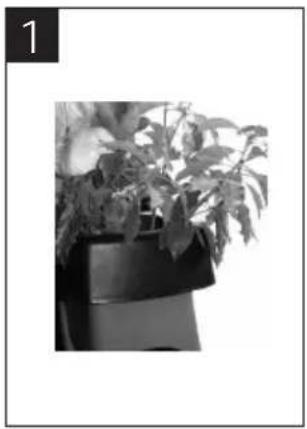
The compost shredder is accompanied by a pusher which is practical when feeding smaller sized waste such as twigs, leaves and other garden waste into the feed funnel.
- Fill the feed funnel with material.
- Place the pusher into the feed funnel and push the material towards the blades.
- Wait until all material has been fully shredded before you fill it with more.
natural_image
Black-and-white photo of a potted plant with broad leaves and stems, labeled with number 1 in the corner (no text or symbols on the plant itself)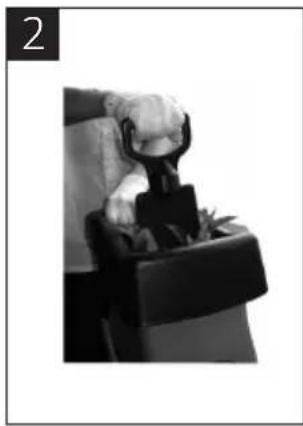
natural_image
Black-and-white photo of a hand gripping a car seatbelt, no visible text or symbolscolLEcTING SHREddEd mATERIAL
WARNING! The ventilation openings on the shredder's chassis should never be covered by the collection bag, debris or shredded material.
- Switch the shredder off before you attach or remove the collection bag.
- You can either use the collection bag, if your shredder was provided with one, or place the shredder onto tarpaulin to collect the shredded material.
- If you use the collection bag, attach it securely to the hooks which can be found on the sides of the ejector.
REpLAcING BLAdES
NB:
- When both sides of each blade have become blunt, they must be replaced.
- Both blades should be replaced at the same time.
- The blades can be sharpened, but this must be done by an experienced person using a grindstone and oil. We do not recommend having the blades sharpened as it is their weight which ensures the blade disc is properly balanced. An unbalanced blade disc can potentially damage the shredder as well as cause injury to the user.
-
You should use gloves when replacing blades.
-
Ensure that the shredder is switched off and unplugged.
- Remove the shredder's upper part by unscrewing the knob which fastens the upper part to the shredder's chassis.
- The blades are double-edged. When the edge on one side has become blunt, you should rotate the blade around to use the edge on the other side.
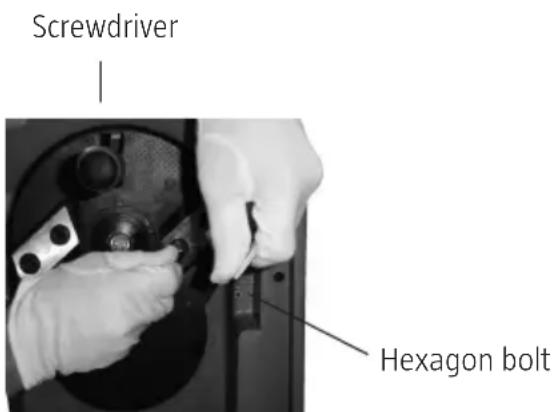
- Lock the blade disc in place with a screwdriver. Unscrew the two inner hexagon bolts and take note of how the blades are positioned.
- Remove the blade and rotate it fully (180 degrees) and place it back on the blade disc. The sharp edge should be facing downwards.
- Repeat the same process with the other blade.
mAINTENANcE
WARNING! First disconnect the shredder from the power supply before maintaining or cleaning the shredder.
- When you maintain, check, put the shredder away for storage or replace any accessories, you should first switch it off using the power switch and then pull out the plug.
- If you are using an extension cord, it must offer the same specifications as the shredder's permanently installed power cord.
- Regularly check whether there is any damage to the power and extension cords or whether there are signs of wear and tear. Do not use the shredder if the cords are damaged or worn.
- When maintaining the shredder's blade unit, you must remember that although the engine cannot start due to the safety lock, the blade disc can still begin to rotate when the engine is turned by hand.
- Never attempt to disable the safety lock.
- Use a brush to remove debris and deposits from the shredder.
- Always clean the shredder after use. Clean the plastic bodywork and all plastic parts with a cloth that has been dipped in soapy water. Never use aggressive detergents or solvents when cleaning the shredder.
- Never clean the shredder with running water, for ex. using a high-pressure washer or garden hose. Ensure that no water enters the interior of the shredder.
- Only use recommended parts and accessories for the shredder.
Jula reserves the right to make changes. In the event of problems, please contact our service department. www.jula.com
natural_image
Symbol of a trash bin crossed with no text or labels, representing waste sorting or disposal (no text present)Care for the environment!
Must not be discarded with household waste!
This product contains electrical or electronic components that should be recycled.
Leave the product for recycling at the designated station e.g. the clocal authority's recycling station.
CE
EC DECLARATION OF CONFORMITY
EG FÖRSÄKRAN OM ÖVERENSSTÄMMELSE
EF SAMSVARSERKLÆRING
DEKLARACJA ZGODNOŚCI WE

Jula AB, Box 363, SE-532 24 SKARA, SWEDEN
Machinery Directive 2006/42/EC
EN 60335-1:2002+A11+A1+A12+A2+A3+A14+A15
EN 13683:2003+A2, EN 62233:2008
Electromagnetic Compatibility Directive 2004/108/EC
EN 55014-1:2006+A1+A2, EN 55014-2:1997+A1+A2
EN 61000-3-2:2006+A1+A2, EN 61000-3-3:2008
Outdoor Noise Directive 2000/14/EC, amended by 2005/88/EC
RoHS Directive 2011/65/EU
This product was CE marked in year -14
Name and address of the person authorised to compile the technical file:
$$ B = \pi J _ {n} $$
Birgitta Jonsson
PRODUCT MANAGER
- SVENSKA....4
- SÄKERHETSANVISNINGAR....4
- SÄKERHETSANVISNINGAR
- UppSAmLING AV mALT MATERIAL
- Värna om miljön!
- oppSAmLING AV oppmALT mATERIALE
- ZBIERANIE pRZEmIELoNEGo mATERIAŁU
- DBAJ O ŚRODOWISKO!
- Read the operating instructions carefully before use!
- WARNING!
- USE
- mAINTENANCE AND STORAGE
- SymBoLS
- opERATIoN
- NB:
- AddITIoNAL SAfETy INfoRmATIoN
- TEcHNICAL dATA
- dEScRIpTIoN
- ASSEmBLy
- STARTING AND SToppING THE SHREddER
- USING THE fEEd fUNNEL pUSHER
- colLEcTING SHREddEd mATERIAL
- REpLAcING BLAdES
- mAINTENANcE
- Care for the environment!
- CE
- EC DECLARATION OF CONFORMITY
- EG FÖRSÄKRAN OM ÖVERENSSTÄMMELSE
- EF SAMSVARSERKLÆRING
- DEKLARACJA ZGODNOŚCI WE
Brand : Meec Tools
Model : 721-331
Category : Broyeur de compost