
TC-RS 420 - Grinders EINHELL - Free user manual and instructions
Find the device manual for free TC-RS 420 EINHELL in PDF.


| Product Type | Eccentric Grinder/Sander |
| Brand | Einhell |
| Model | TC-RS 420 |
| Power Source | Mains (cable) |
| Speed Control | Variable, pre-selectable via knurled screw |
| Sanding Disc Attachment | Velcro fastening |
| Dust Extraction | Integrated dust bag (included) |
| Dust Bag Connection | Twist-lock connector |
| Additional Handle | Yes, included |
| ON/OFF Switch | Sliding switch with lock |
| Suitable Materials | Wood, iron, plastic, dry sanding only |
| Not Suitable For | Wet sanding, asbestos-containing materials |
| Vibration Emission (Handle) | ah = 10.223 m/s², K = 1.5 m/s² |
| Noise | Wear ear protection (ear-muffs) |
| Required Personal Protection | Safety goggles, dust mask, ear-muffs |
| Power Cable | Replaceable by manufacturer or authorized service |
| Carbon Brushes | Replaceable by qualified electrician |
| Cleaning | Moist cloth with soft soap; no solvents |
| Storage Temperature | 5°C to 30°C, dry and dark |
| Scope of Delivery | Grinder/sander, dust bag, sanding paper, manual |
| Intended Use | DIY, not for commercial/industrial |
| Spare Parts Ordering | Requires type, article number, ID number, part number |
Frequently Asked Questions - TC-RS 420 EINHELL
User questions about TC-RS 420 EINHELL
0 question about this device. Answer the ones you know or ask your own.
Ask a new question about this device
Download the instructions for your Grinders in PDF format for free! Find your manual TC-RS 420 - EINHELL and take your electronic device back in hand. On this page are published all the documents necessary for the use of your device. TC-RS 420 by EINHELL.
USER MANUAL TC-RS 420 EINHELL
GB Original operating instructions Eccentric grinder/sander

Caution - Read the operating instructions to reduce the risk of injury.

Wear ear-muffs. The impact of noise can cause damage to hearing.

Wear a breathing mask. Dust which is injurious to health can be generated when working on wood and other materials. Never use the device to work on any materials containing asbestos!

Wear safety goggles. Sparks generated during working or splinters, chips and dust emitted by the device can cause loss of sight.
Danger!
When using the equipment, a few safety precautions must be observed to avoid injuries and damage. Please read the complete operating instructions and safety regulations with due care. Keep this manual in a safe place, so that the information is available at all times. If you give the equipment to any other person, hand over these operating instructions and safety regulations as well. We cannot accept any liability for damage or accidents which arise due to a failure to follow these instructions and the safety instructions.
1. Safety regulations
Danger!
Read all safety regulations and instructions.
Any errors made in following the safety regulations and instructions may result in an electric shock, fire and/or serious injury.
Keep all safety regulations and instructions in a safe place for future use.
General safety instructions for electric tools
The term “electric tool” used in the safety instructions refers to electric tools operated from the mains power supply (with a power cable) and to battery operated electric tools (without a power cable).
1. Workplace safety
a) Keep your work area clean and well illuminated. Untidy or unlit work areas can result in accidents. b) Do not operate the electric tool in an environment where there is a risk of explosions and where there are flammable liquids, gases or dust. Electric tools produce sparks which could set the dust or vapours alight. c) Keep the electric tool out of the reach of children and other persons. If there is a distraction, you may lose control of the appliance.
2. Electrical safety
a) The plug from this electric tool must fit into the socket. The plug should never be altered in any way. Never use adapter plugs together with earthed electric tools. Unaltered plugs and correct sockets reduce the risk of an electric shock.
b) Avoid bodily contact with earthed surfaces such as pipes, heating, ovens and fridges. The risk of electric shock is increased if your body is earthed. c) Keep the tool out of water and away from moisture. The ingress of water into an electric tool increases the risk of an electric shock. d) Do not use the power cable to carry the electric tool, to hang it up or to pull it out of the socket. Keep the cable away from heat, oil, sharp edges and moving parts of the appliance. Damaged or entangled cables increase the risk of an electric shock. e) If you are working outdoors with an electric tool, only use extension cables which are designed specifically for this purpose. Using specially designed outdoor extension cables, the risk of electric shock is reduced. f) If operation of the electric tool in a damp environment cannot be avoided, use a residual current device (RCD). The RCD reduces the risk of electric shock. a) Be careful, watch what you are doing and use an electric tool sensibly. Do not use the tool if you are tired or under the influence of drugs, alcohol or medication. A moment of distraction when using the electric tool can result in serious injuries. b) Wear personal protection equipment and always wear safety goggles. Wearing personal protection (such as dust masks, non-slip safety shoes, safety helmet or ear protection, depending upon the type and use of the electric tool) reduces the risk of injury. c) Make sure that the appliance cannot start up accidentally. Ensure that the electric tool is switched off before you connect it to the power supply and/or insert the battery, or pick up or carry the tool. If your finger is on the switch whilst carrying the electric tool or if you connect the appliance to the mains when it is switched on, this can lead to accidents. d) Remove keys and wrenches before switching on the electric tool. A tool or key which comes into contact with rotating parts of the appliance can lead to injuries. e) Avoid abnormal working postures. Make sure you stand squarely and keep your balance at all times. In this way, you can control the electric tool better in unexpected
3. Safety of persons
circumstances.
f) Wear suitable work clothes. Do not wear loose clothing or jewellery. Keep hair, clothes and gloves away from moving parts. Loose clothing, jewellery or long hair can get trapped in moving parts.
g) If vacuuming devices and draining devices can be fitted, make sure that these are correctly attached and correctly used. The use of a dust extraction system can reduce the danger posed by dust.
- Usage and treatment of the electric tool
a) Do not overload the appliance. Use the correct tool for your work. You will be able to work better and more safely within the given performance boundaries.
b) Do not use an electric tool with a defective switch. An electric tool that cannot be switched on or off is dangerous and must be repaired.
c) Pull the plug out of the socket and/or remove the battery before making any adjustments to the appliance, changing accessories, or putting the appliance down. This safety measure prevents unintentional starting of the electric tool.
d) Keep unused electric tools out of the reach of children. Do not allow people who are not familiar with the appliance or who have not read these instructions to use the appliance. Electric tools are dangerous if used by inexperienced people.
e) Clean your electric tool carefully. Check whether moving parts are functioning properly and not jamming, whether parts are broken or damaged enough to affect the functioning of this electric tool. Damaged parts must be repaired before using the appliance. Many accidents are caused by poorly maintained electric tools.
f) Keep your cutting tools sharp and clean. Carefully maintained cutting tools with sharp cutting edges will jam less and are easier to control.
g) Make sure to use electric tools, accessories, spare parts, etc. in accordance with these instructions. Take the conditions in your work area and the job to perform into account. Using electric tools for any purpose other than the one for which they are intended can lead to dangerous situations.
5. Service
a) Have your electric tool repaired only by trained personnel and/or the authorized service agent, using only genuine spare parts. This will ensure that your electric tool remains safe to use.
Special safety information
This tool may only be used for dry
• grinding/sanding operations.
- Always guide the power cable away from the back of the tool.
- Use of the tool on materials containing asbestos is prohibited.
- Always remove the plug from the power supply socket before carrying out any work on the machine (cleaning the sander, changing the sandpaper, etc.).
- Always disconnect the machine by removing the plug from the socket, not by pulling on the power cable.
- To protect your health, always wear safety goggles and a dust mask during sanding work. Keep your workplace clean and well illuminated. Make sure that the workpiece is sufficiently secured so that it cannot slip.
- Keep children away.
- For your own sake, keep the machine clean at all times and check it for signs of damage each time after using it.
- Make sure that the switch is set to OFF before you insert the plug into the power supply socket. Make sure of your footing, particularly when working on ladders and platforms.
- Touching or inhaling this dust can be harmful for the operator and other persons nearby.
- Hold the equipment by the insulated handles because the grinding/sanding belt may strike the equipment's own power cable. Damaging a live cable may make the metal parts of the equipment live and cause an electric shock.
- If you discover any damage to the machine, use the exploded diagram and the spare parts list to determine which parts need to be ordered from Customer Service.
- Important! Wear safety goggles and a dust mask.
Do not lose these safety instructions
GB
2. Layout and items supplied
2.1 Layout (Fig. 1)
1 Sanding/grinding disk 2 Handle 3 Speed controller 4 Control switch 5 Dust bag connector 6 Dust bag 7 Additional handle
2.2 Items supplied
Please check that the article is complete as specified in the scope of delivery. If parts are missing, please contact our service center or the sales outlet where you made bought the product within the maximum days indicated by the consumer protection laws of your country and upon presentation of a valid bill of purchase. Also, refer to the warranty table in the service information at the end of the operating instructions.
- Open the packaging and take out the equipment with care.
- Remove the packaging material and any packaging and/or transportation braces (if available).
- Check to see if all items are supplied.
- Inspect the equipment and accessories for transport damage.
- If possible, please keep the packaging until the end of the guarantee period.
Danger!
The equipment and packaging material are not toys. Do not let children play with plastic bags, foils or small parts. There is a danger of swallowing or suffocating!
• Eccentric grinder/sander - Dust bag 1x Sanding paper • Original operating instructions
3. Proper use
The equipment is designed for the grinding/sanding of wood, iron, plastic and similar materials using the appropriate grinding/sanding paper. The eccentric grinder/sander is not suitable for wet grinding/sanding.
The equipment is to be used only for its prescribed purpose. Any other use is deemed to be a
case of misuse. The user / operator and not the manufacturer will be liable for any damage or injuries of any kind caused as a result of this.
Please note that our equipment has not been designed for use in commercial, trade or industrial applications. Our warranty will be voided if the machine is used in commercial, trade or industrial businesses or for equivalent purposes.
4. Technical data
See warranty card of your country.
Wear ear-muffs.
The impact of noise can cause damage to hearing.
Total vibration values (vector sum of three directions) determined in accordance with EN 60745.
Handle
Vibration emission value ah = 10,223 m/s²
K uncertainty = 1,5 m/s²
Additional information for electric power tools
Warning!
The specified vibration value was established in accordance with a standardized testing method. It may change according to how the electric equipment is used and may exceed the specified value in exceptional circumstances.
The specified vibration value can be used to compare the equipment with other electric power tools.
The specified vibration value can be used for initial assessment of a harmful effect.
Keep the noise emissions and vibrations to a minimum.
- Only use appliances which are in perfect conditions. • Service and clean the appliance regularly. • Adapt your working style to suit the appliance. • Do not overload the appliance.
- Have the appliance serviced whenever necessary.
- Switch the appliance off when it is not in use. • Wear protective gloves.
Residual risks
Even if you use this electric power tool in accordance with instructions, certain residual risks cannot be ruled out. The following hazards may arise in connection with the equipment's construction and layout:
- Lung damage if no suitable protective dust mask is used.
- Damage to hearing if no suitable ear protection is used.
- Health damage caused by hand-arm vibrations if the equipment is used over a prolonged period or is not properly guided and maintained.
5. Before starting the equipment
Before you connect the equipment to the mains supply make sure that the data on the rating plate are identical to the mains data.
Warning!
Always pull the power plug before making adjustments to the equipment.
5.1 Fitting the dust bag (Fig. 2)
Place the dust bag (6) on the dust bag connector (5) and secure it by turning it.
The dust is extracted directly through the grinding/sanding paper and the grinding/sanding disk and into the dust bag.
Important.
For health safety reasons it is imperative that you use a dust bag.
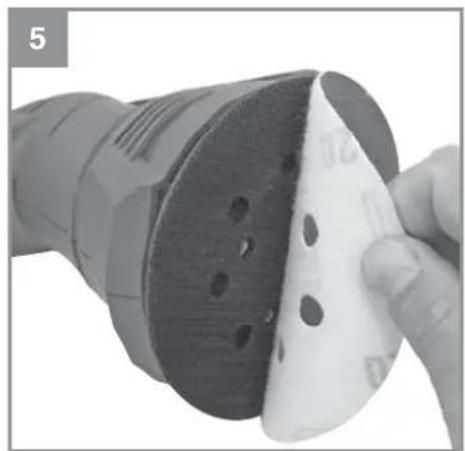
5.2 Fastening the abrasive paper (Fig. 5)
Easy replacement using Velcro fastening. Ensure that the extractor holes on the abrasive paper and grinding/sanding disc line up.
6. Operation
6.1 Switching the equipment ON/OFF (Fig. 3)
To switch on:
Push the ON/OFF switch (4) forwards.
To switch off:
Push back the ON/OFF switch (4) into its starting position.
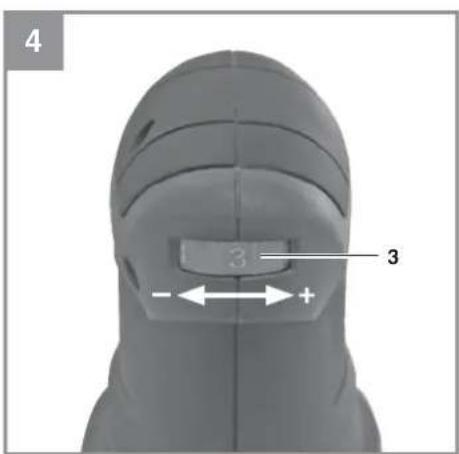
6.2 Speed control (Fig. 4/Item 3)
To pre-select the speed turn the knurled screw (3) on the switch.
Plus direction: Higher speed
Minus direction: Lower speed
6.3 Working with the eccentric grinder/sander
- Place the whole surface area of the sanding disk on the material.
- Switch on the machine and move it with gentle pressure over the workpiece completely circular movements or moving it to and fro and up and down.
- Use a coarse paper for coarse sanding and a finer paper for finish sanding. You can find the best paper for the job by means of testing.
Important.
The dust generated when working with the machine may be harmful.
• Always wear goggles and a dust mask when carrying out sanding/grinding work. - Everybody who uses the machine or enters the workplace must wear a dust mask. • Do not eat, drink or smoke at the workplace. - Do not use the machine on paints which contain lead.
7. Replacing the power cable
Danger!
If the power cable for this equipment is damaged, it must be replaced by the manufacturer or its authorized after-sales service or similarly trained personnel to avoid danger.
8. Cleaning, maintenance and ordering of spare parts
Danger!
Always pull out the mains power plug before starting any cleaning work.
8.1 Cleaning
- Keep all safety devices, air vents and the motor housing free of dirt and dust as far as possible. Wipe the equipment with a clean cloth or blow it with compressed air at low pressure. • We recommend that you clean the device immediately each time you have finished using it.
- Clean the equipment regularly with a moist cloth and some soft soap. Do not use cleaning agents or solvents; these could attack the plastic parts of the equipment. Ensure that no water can seep into the device. The ingress of water into an electric tool increases the risk of an electric shock.
8.2 Carbon brushes
In case of excessive sparking, have the carbon brushes checked only by a qualified electrician and/or an authorized service agent.
Danger! The carbon brushes should not be replaced by anyone but a qualified electrician or the authorized service technician.
8.3 Maintenance
There are no parts inside the equipment which require additional maintenance.
8.4 Ordering replacement parts:
Please quote the following data when ordering replacement parts:
• Type of machine • Article number of the machine • Identification number of the machine • Replacement part number of the part required
9. Disposal and recycling
The equipment is supplied in packaging to prevent it from being damaged in transit. The raw materials in this packaging can be reused or recycled. The equipment and its accessories are made of various types of material, such as metal and plastic. Never place defective equipment in your household refuse. The equipment should be taken to a suitable collection center for proper disposal. If you do not know the whereabouts of such a collection point, you should ask in your local council offices.
10. Storage
Store the equipment and accessories in a dark and dry place at above freezing temperature. The ideal storage temperature is between 5 and 30 °C. Store the electric tool in its original packaging.
The reprinting or reproduction by any other means, in whole or in part, of documentation and papers accompanying products is permitted only with the express consent of the iSC GmbH.
Subject to technical changes
AR
e-mail. homeservice2008@hotmail.com
(Línea Eléctrica)
e-mail. servicyc@yahoo.com
Cali - Valle del Cauca
S.I.E. Service Solutions
Avenida Ferrocarril No. 32B 26, La Francia
Tel. +57 (8) 266 0606 - 2644013
e-mail. repuestos@sieservice.com
Servifer del Tolima
Carrera 4 Tamana No. 31 - 45, La Francia
Tel. +57 316 8084916
e-mail. sfdeltolima@gmail.com
La Dorada - Caldas
Tecnibobinados
Dir. Carrera 2 No. 20 - 71, Barrio Obrero
Tel. +57 312 2120634
e-mail.tecnobibinados-jair@hotmail.com
Leticia - Amazonas
Address: Carrera 50 No. 41 – 90, Palace
Phone: +57 (4) 444 3215
Email: emergenciatecnica@hotmail.com
Granada - Meta
Address: Carrera 2 No. 8 – 23, San Agustín
Phone: 314 4737985
Email: odilioval@hotmail.com
Monteria – Cordoba
CRG Servitools
Address: Calle 38 No. 2 – 18, Centro
Phone: +57 322 6953118 - 304 5386810
Email: crgservitools@hotmail.com
Nariño - Pasto
Address: Calle 19 No. 18 – 40 Local 10
Tel. +57 (2) 736 4645
e-mail: ceseelsas@gmail.com
Neiva - Huila
Address: Carrera 7 No. 3 – 16, Centro
Tel. +57 (8) 872 2126
ventas@construequiposdelhuila.com
Pereira – Risaralda
Electrocenter
Address: Carrera 7 No. 29 - 33, Centro
Tel. +57 (6) 345 3689
e-mail: electrocenter_pereira@hotmail.com
Pitalito – Huila
Agrotec Pitalito
Address: Carrera 6 No. 3 – 45, Ba Trinidad
Tel. +57 319 2604410
e-mail. agrotecpitalito@hotmail.com
Santa Marta – Magdalena
Comercializadora Metropolitana Ltda
Dir. Calle 11 No. 5 – 82, Centro
Tel. +57 (5) 431 4323
metropolitanacomercializadora@gmail.com
Saravena – Arauca
Cacharrería Acxel
Dir. Calle 27 No. 13 – 13
Tel. +57 (7) 882 1639
e-mail. cacharreriacxel@hotmail.com
Sincelejo – Sucre
Electroaires de la costa
Dir. Carrera 18 No. 23 – 67, Centro
Tel. +57 (5) 276 5031
e-mail: frioairescosta@hotmail.com


- DANGER
- SAFETY REGULATIONS
- GENERAL SAFETY INSTRUCTIONS FOR ELECTRIC TOOLS
- WORKPLACE SAFETY
- ELECTRICAL SAFETY
- SAFETY OF PERSONS
- SERVICE
- SPECIAL SAFETY INFORMATION
- GB
- LAYOUT AND ITEMS SUPPLIED
- LAYOUT (FIG. 1)
- ITEMS SUPPLIED
- PROPER USE
- TECHNICAL DATA
- WEAR EAR-MUFFS
- HANDLE
- ADDITIONAL INFORMATION FOR ELECTRIC POWER TOOLS
- WARNING
- KEEP THE NOISE EMISSIONS AND VIBRATIONS TO A MINIMUM
- RESIDUAL RISKS
- BEFORE STARTING THE EQUIPMENT
- FITTING THE DUST BAG (FIG. 2)
- IMPORTANT
- FASTENING THE ABRASIVE PAPER (FIG. 5)
- OPERATION
- SWITCHING THE EQUIPMENT ON/OFF (FIG. 3)
- TO SWITCH ON
- TO SWITCH OFF
- SPEED CONTROL (FIG. 4/ITEM 3)
- WORKING WITH THE ECCENTRIC GRINDER/SANDER
- REPLACING THE POWER CABLE
- CLEANING, MAINTENANCE AND ORDERING OF SPARE PARTS
- CLEANING
- CARBON BRUSHES
- MAINTENANCE
- ORDERING REPLACEMENT PARTS
- DISPOSAL AND RECYCLING
- STORAGE
- AR
Brand : EINHELL
Model : TC-RS 420
Category : Grinders