 ManualGo.com
C-720 ULTRA ZOOM - Digital Camera OLYMPUS - Free user manual and instructions
Find the device manual for free C-720 ULTRA ZOOM OLYMPUS in PDF.



Download the instructions for your Digital Camera in PDF format for free! Find your manual C-720 ULTRA ZOOM - OLYMPUS and take your electronic device back in hand. On this page are published all the documents necessary for the use of your device. C-720 ULTRA ZOOM by OLYMPUS.
USER MANUAL C-720 ULTRA ZOOM OLYMPUS
Thank you for purchasing an Olympus digital camera. Before you start to use your new camera, please read these instructions carefully to enjoy optimum performance and a longer service life. Keep this manual in a safe place for future reference. CONTENTS
NAMES OF PARTS
HOW TO USE THIS MANUAL
USING THE MENU
TRANSFERRING PICTURES TO A COMPUTER
OPTIONAL ACCESSORIES
These instructions are only for quick reference. For more details on the camera functions described in this manual, refer to the camera Reference Manual on the CD-ROM enclosed in the camera package.
02.8.3 5:21 PM
Page 3 For customers in Europe “CE” mark indicates that this product complies with the European requirements for safety, health, environment and customer protection. “CE” mark cameras are intended for sales in Europe. For customers in North and South America For customers in USA Declaration of Conformity Model Number : C-720 Ultra Zoom Trade Name : OLYMPUS Responsible Party : Olympus America Inc. Address : 2 Corporate Center Drive, Melville, New York 11747-3157 U.S.A. Telephone Number : 1-631-844-5000 Tested To Comply With FCC Standards
FOR HOME OR OFFICE USE
This device complies with Part 15 of the FCC rules. Operation is subject to the following two conditions: (1) This device may not cause harmful interference. (2) This device must accept any interference received, including interference that may cause undesired operation. For customers in Canada This Class B digital apparatus meets all requirements of the Canadian Interference-Causing Equipment Regulations. Trademarks
- IBM is a registered trademark of International Business Machines Corporation.
- Microsoft and Windows are registered trademarks of Microsoft Corporation.
- Macintosh is a trademark of Apple Computer Inc.
- All other company and product names are registered trademarks and/or trademarks of their respective owners.
- The standards for camera file systems referred to in this manual are the “Design Rule for Camera File System/DCF” standards stipulated by the Japan Electronics and Information Technology Industries Association (JEITA).
02.8.3 5:21 PM
NAMES OF PARTS
Camera Zoom lever (W/T) Index display/Close-up playback lever (
Shutter button Flash switch (
Macro/Spot button ( Print button ( ) DRIVE button Erase button (
Diopter adjustment dial Viewfinder Card access lamp POWER switch Monitor Monitor button (
02.8.3 5:21 PM
Flash Self-timer lamp Lens Card cover DC-IN jack USB connector VIDEO OUT jack Strap eyelet Connector cover Battery compartment lock Tripod socket Battery compartment cover
02.8.3 5:21 PM
NAMES OF PARTS
Viewfinder/Monitor indications — Shooting information The INFO setting on the menu allows you to select how much information to display. The indications vary depending on the shooting mode.* When INFO is set to OFF: The information below is displayed constantly in the shooting mode. (After closing the menu, the information which appears in the ON mode (illustrated to the right) is displayed for approx. 3 seconds, then disappears.)
When INFO is set to ON: The information below is displayed constantly in the shooting mode.
ISO 100 # *The illustrations show examples of indications displayed in the P mode. Items 1 Shooting mode 2 Aperture value 3 Shutter speed 4 Exposurecompensation Exposure differential 5 AF target mark 6 Number of storable still pictures Seconds remaining
Indications , P, A, S, M,
Control panel indications
ISO 100 # Items 7 Record mode 8 Memory gauge 9 Battery check 0 AE lock ! Drive mode @ White balance # ISO $ Green lamp % Flash stand-by Camera movement warning Flash charge Indications
TIFF/SHQ/HQ/SQ1/SQ2
NAMES OF PARTS
Viewfinder/Monitor indications — Playback information INFO setting on the menu allows you to select how much information to display. Still picture playback information When INFO is set to ON When INFO is set to OFF Items 1 Battery check 2 Print reserve 3 Number of prints 4 Protect 5 Date 6 Time 7 Frame number 8 Record mode 9 Number of pixels (resolution setting) 0 Aperture value ! Shutter speed @ Exposure compensation # White balance $ ISO % File number
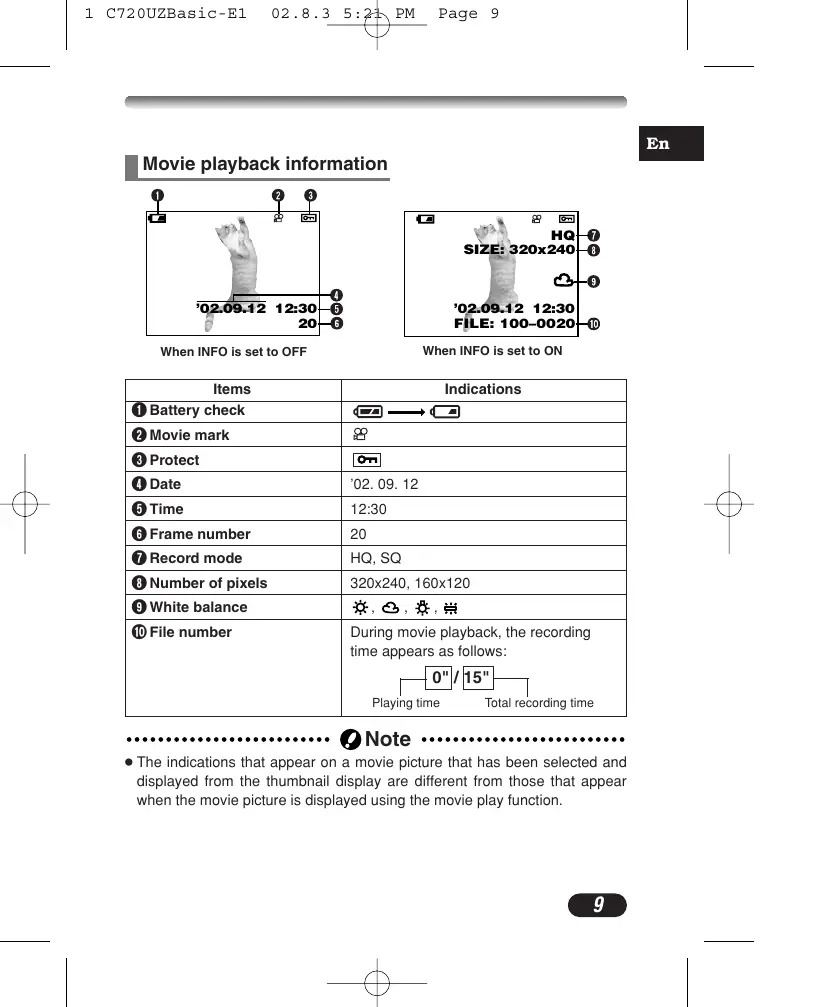
Indications Movie playback information
SIZE: 320x240 ’02.09.12 12:30
’02.09.12 12:30 FILE: 100–0020 When INFO is set to ON When INFO is set to OFF Items 1 Battery check 2 Movie mark 3 Protect 4 Date 5 Time 6 Frame number 7 Record mode 8 Number of pixels 9 White balance 0 File number Indications During movie playback, the recording time appears as follows: 0" / 15" Playing time Total recording time Note ● The indications that appear on a movie picture that has been selected and displayed from the thumbnail display are different from those that appear when the movie picture is displayed using the movie play function.
02.8.3 5:21 PM
NAMES OF PARTS
Viewfinder/Monitor indications — Memory gauge & battery check Memory gauge The memory gauge lights when you take a picture. When the gauge is lit, the camera is storing a picture on the SmartMedia card. The memory gauge indication changes as shown below depending on the shooting status. When the memory gauge is full, wait until the light goes out before you take any more shots. When taking still pictures Shoot. Wait. Before shooting (Gauge is off) Shoot. Shoot. Wait. Wait. One picture taken (Lit) No more pictures can be taken (Fully Lit) When recording movies If you continue shooting Shoot. Wait. Before shooting (Gauge is off) During shooting (Gauge lit). ● Shooting is not possible until the light goes out completely. ● Movie recording finishes automatically when the memory gauge is fully lit. Battery check If the remaining battery power is low, the battery check indication changes as follows when the camera is turned on or while the camera is in use. No indication Lights. (green) Remaining power level: high
Lights. (red) Remaining power level: low. Replace with a new battery. Remaining power level: exhausted. BATTERY EMPTY is displayed. Replace with a new battery. 1 C720UZBasic-E1
02.8.3 5:21 PM
HOW TO USE THIS MANUAL
The instructions in this manual use a series of numbers for each operating procedure and button/dial illustration. Follow these numbers in order when operating the camera. Before using the following function, set the mode dial to any of the positions shown. Mode dial setting Means “Press this button”. If a button is shown in black, press it as part of the step.
Ñ, ñ, É and í used in instructions correspond to the buttons on the arrow pad as shown.
Set the functions in the menus in the order of these arrows. Before using the menus, read “Using the Menus”, for details. In the top menu, select MODE MENU T CAMERA T P/A/S/M T M.
02.8.3 5:21 PM
Page 12 Attaching the strap
Pull out the end of the strap from the ring attached to the strap. Pull the end of the strap to remove it from the stopper and adjust the strap length.
When you have a length that you like, thread the end of the strap through the stopper. Thread the end of the strap through the ring while pulling on the strap to keep it from loosening.
Camera strap eyelet Ring Ring Stopper
Note ● Be careful with the strap when you carry the camera, as the strap can easily catch on stray objects, causing serious damage. ● Attach the strap correctly as shown so that the camera does not fall off. If the strap is attached incorrectly and the camera falls off the strap, Olympus is not responsible for any damages.
02.8.3 5:21 PM
Loading the batteries This camera uses 2 CR-V3 lithium battery packs or 4 AA (R6) NiMH batteries, NiCd batteries, alkaline batteries or lithium batteries. Important: ● CR-V3 lithium battery packs cannot be re-charged. ● Do not peel the label on a CR-V3 lithium battery pack. sure the camera is turned the battery compartment 1 Make 5 Close off; cover, then press it down (C) ● The monitor is off. ● The viewfinder is off. ● The lens is not extended. and slide it in the opposite direction of the arrow printed on it (D). ● When pressing the battery compartment cover shut, be sure to press the center of the cover, as it may be difficult to close properly by pressing the edge. ● Make sure the cover is completely closed.
the battery compartment 3 Slide cover in the direction of the arrow (A ) with your fingertip and open it (B). ● Do not use your fingernail, as this could result in injury.
When using CR-V3 lithium battery packs Using an AC power adapter (optional) Use an AC adapter designed for the area where the camera is used. Consult your nearest Olympus dealer or Service center for details.
02.8.3 5:21 PM
Page 14 Inserting/Removing the memory card (SmartMedia) This camera uses SmartMedia card to record pictures. This manual uses the term “card” when referring to SmartMedia. Be sure to use a 3 V (3.3 V) card. Non-Olympus 3 V (3.3 V) cards must be formatted with the camera. Do not use a 5 V card or a 2 MB card. sure the camera is turned off; 1 Make ● The monitor is off. ● The viewfinder is off. ● The lens is not extended. 2 Open the card cover. Inserting the card 3 Insert the card as far as it will go in the direction shown in the illustration. ● There is an arrow inside the card cover, indicating the direction in which the card should be inserted. ● Hold the card in a straight orientation to the card slot. Do not attempt to insert the card at an angle. ● Note the orientation of the card. If it is inserted incorrectly, it may become jammed. Removing the card Hold the card with your fingertips and pull it out in the direction of the arrow. the card cover securely until it 4 Close clicks.
02.8.3 5:21 PM
Before turning the camera on, press the tabs on the lens cap to remove it. Press the power switch to turn the camera on. ● The lens moves out when the mode dial is not set to ● The viewfinder turns on. ● To turn the camera off, press the power switch again. ● If the date/time has been returned to the factory default setting, "Y/M/D" appears on the monitor. Lens cap Date/time setting
Set the mode dial to , then press the POWER switch to turn on the camera. Press ● The monitor turns on automatically and the top menu appears. Press Ñ on the arrow pad to select When is selected on the screen, press Ññ to select the date format. ● Select any one of the following formats: D-M-Y (Day/Month/Year) M-D-Y (Month/Day/Year) Y-M-D (Year/Month/Day) ● This step and the following steps show the procedure used when the date and time settings are set to Y-M-D. Press í to move to the year (Y) setting. Press Ññ to set the year. When the year is set, press í to move to the month (M) setting. ● Repeat this procedure until the date and time are completely set. ● To move back to the previous setting, press É. ● The first two digits of the year cannot be changed. Press ● For a more accurate setting, don't press until the clock hits 00 seconds. The clock starts when you press the button. To turn the camera off, press the POWER switch. ● The lens retracts.
02.8.3 5:21 PM
Page 16 Note ● The current settings stay the same even when the power is turned off, unless they are readjusted. ● The date setting will be canceled if the camera is left with no batteries for approximately 1 hour. If this happens, you will need to set the date again. ● The date/time setting may be canceled if the camera has stopped operating because of a dead battery, etc.
USING THE MENU
When displaying menus, the first screen that appears on the monitor is called the top menu. The contents of this menu change depending on the mode. On the top menu, two types of menus are available: MODE MENU and the other menus (shortcut menus). (ex. P/A/S/M mode Shortcut menu ß Top menu) The shortcut menu consists of the items other than MODE MENU on the Top menu. These can be replaced with your ISO favorite items, but only when the mode MODE MENU dial is set to P/A/S/M or . Just pressing the arrow pad buttons according to the marks shown next to each item will lead you directly to their screens. (ex. P/A/S/M mode top menu) ISO MODE MENU
åMode menu MODE MENU (displayed on the top menu) contains all the functions that are available and is divided into four tabs: CAMERA, PICTURE, CARD, and SETUP. These can be selected with the tabs on the left of the screen by using Ññ. How to Set a Function in MODE MENU
On the top menu, enter MODE MENU. Select a tab (CAMERA, PICTURE, CARD, or SETUP) by using Ññ. Press í. Select the function you want by using Ññ. Press í. Select your settings by using Ññ. Press
02.8.3 5:21 PM
Page 17 For more details on the camera functions described in this manual, refer to the camera Reference Manual on the CD-ROM enclosed in the camera package. Some function settings may not be available depending on the mode. Factory default settings of some functions vary depending on the mode. Sets the date and time.
DIGITAL ZOOM The optical zoom can be extended to a maximum of approx. 24x. OFF, ON ISO Selects ISO sensitivity (based on normal camera film). AUTO, 100, 200,
Sets the record mode. TIFF, SHQ, HQ, SQ1, SQ2 CARD SETUP Formats the card.
Sets the appropriate white balance according to the light source. Runs through all saved pictures one after another.
MOVIE PLAY Plays back movies. You can also make indexes of still-shots from movies. Changes the amount of shooting information displayed on the viewfinder/monitor. OFF, ON
02.8.3 5:21 PM
Page 18 USING THE MENU (Cont.) Tabs & MODE MENU functions (shooting) In the shooting mode, the MODE MENU has 4 tabs. Press Ññ to select a tab and display the associated menu items.
SET CARD PIC CAMERA
Selects ISO sensitivity (based on normal camera film) from AUTO/100/200/400. AUTO, 100, 200,
P/A/S/M Exposure mode can be selected from P, A, S, M P ( Program auto), A (Aperture priority auto), S (Shutter priority auto), or M (Manual mode). Adjusts the flash intensity for different shooting conditions. –2EV to +2EV BKT Sets the conditions for Auto bracketing. The maximum optical zoom (8x) can be extended even more by the 3x digital zoom, making possible up to approx. 24x zoom. OFF, ON PANORAMA Allows panorama pictures to be taken with Olympus CAMEDIA-brand card.
2 in 1 Combines two pictures taken in succession and stores them as a single picture.
PICTURE tab (not available in the Display
Function , or mode) Setting Sets the record mode resolution. TIFF, SHQ, HQ, SQ1, SQ2
Sets the appropriate white balance according to the light source. AUTO,
SHARPNESS Adjusts the sharpness of images.
CONTRAST Adjusts the contrast of images.
02.8.3 5:21 PM
Function Formats cards. Setting
Selects whether to keep the current camera settings when you turn off the power. OFF, ON INFO Changes the amount of shooting information displayed on the viewfinder/monitor. OFF, ON Turns off the beep sound (used for warnings, etc.). OFF, ON REC VIEW Selects whether to display images while saving them to a card. OFF, ON MY MODE SETUP Customizes settings, which are activated in the mode. CURRENT, RESET, CUSTOM SLEEP Sets the sleep timer. Chooses how to name files and folders of images to be saved. RESET, AUTO PIXEL MAPPING Checks the CCD and image processing circuit for errors.
Adjusts the brightness of the viewfinder/monitor.
Sets the date and time.
BATTERY SAVE Enables camera operation with reduced power consumption. OFF, ON SHORT CUT Lets you assign frequently-used functions as shortcut menus on the top menu. All functions included in the CAMERA & PICTURE menus CUSTOM BUTTON Lets you assign a frequently used function to the camera’s custom button. AE lock, INFO, ISO, P/A/S/M, DIGITAL ZOOM, , WB
02.8.3 5:21 PM
Page 20 USING THE MENU (Cont.) Tabs & MODE MENU functions (Playback) When a still picture is played back, the MODE MENU has 3 tabs. When a movie is played back, the MODE MENU has 2 tabs. Press Ññ to select a tab and display the associated menu items. The EDIT tab is not available during movie playback. During still picture playback During movie playback BLACK&WHITE SEPIA SET CARD
SET CARD EDIT
CARD SETUP EDIT tab Display Function BLACK&WHITE Creates black and white pictures. SEPIA Creates sepia-toned pictures. Makes the file size smaller. Setting
640 x 480, 320 x 240 Formats cards (FORMAT), or erases all images in the card (ALL ERASE).
Selects whether to keep the current camera settings when you turn off the power. OFF, ON Turns off the beep sound (used for warning, etc.). OFF, ON Adjusts the brightness of the viewfinder/monitor.
Sets the date and time. Selects the number of frames in the index display.
4, 9, 16 1 C720UZBasic-E1
02.8.3 5:21 PM
Page 21 Shooting mode setting — Mode dial Full-auto shooting Allows you to take still pictures using NO special functions or manual adjustments. The camera sets optimal focusing and exposure. Suitable for simple shooting. Sports shooting Suitable for capturing fast-moving action (such as a sports scene or moving vehicles) without blurring. The camera automatically sets the optimal shooting conditions. Landscape-Portrait shooting Suitable for taking photos of both your subject and the background. The picture is taken with the background as well as the subject in the foreground in focus. The camera automatically sets the optimal shooting conditions. Portrait shooting Suitable for shooting a portrait-style image of a person. This mode features an in-focus subject against a blurred background. The camera automatically sets the optimal shooting conditions. P/A/S/M Program/Aperture priority/Shutter priority/Manual shooting When the mode dial is set to P/A/S/M, the following items can be set with the menus: ●P (Program shooting) The camera sets aperture and shutter speed. ●A (Aperture priority shooting) You set the aperture and the camera sets the shutter speed. ●S (Shutter priority shooting) You set the shutter speed and the camera sets the aperture. ●M (Manual shooting) You set both the aperture and shutter speed.
02.8.3 5:21 PM
Page 22 My Mode Your favorite settings can be saved in MY MODE SETUP (in the menu’s SETUP). Customized settings are activated when the power is turned on in the mode. Settings such as aperture value, zoom position, etc. can be customized. In the mode, you can select exposure mode (shooting mode) from P, A, S, or M. Settings can be specified with the camera’s setting menus. The shortcut menu can also include different items than the shortcut menus in the P/A/S/M mode. Movie record Allows you to record movies. The camera sets the aperture and shutter speed automatically. Focus and exposure are locked when the shutter button is pressed halfway. You cannot record movies with sound. Aperture setting — Aperture priority shooting Mode dial setting Shutter speed setting — Shutter priority shooting Mode dial setting To set a faster shutter speed, press Ñ. To set a slower shutter speed, press ñ. Aperture & Shutter speed setting — Manual shooting Mode dial setting To set a faster shutter speed, press Ñ. To set a slower shutter speed, press ñ. Using My Mode Mode dial setting In the top menu, select MODE MENU T CAMERA T P/A/S/M T P, A, S or M. Press . Press again to cancel the menu.
02.8.3 5:21 PM
Page 24 Mode dial setting Taking still pictures the lens cap. Set the mode dial to any of the following 1 Remove positions and press the POWER switch. Shooting mode:
, P/A/S/M, Point the camera towards a subject while viewing through the viewfinder. Flash switch Power switch Card access lamp focus on the subject, press the shutter 3 To button halfway, slowly and gently. ● When the subject is in focus, the green lamp lights up. Green lamp Number of storable still pictures
To start shooting, press the shutter button gently all the way (fully). ● If the flash is up, it will fire automatically when required. ● The card access lamp blinks and the camera begins storing pictures on the card. Note ● Never open the card cover, eject the card, remove the batteries, or disconnect an optional AC adapter when the card access lamp is blinking. Doing so could destroy stored pictures and prevent storage of pictures you have just taken.
02.8.3 5:21 PM
Mode dial setting Recording movies and press P/A /S/
the lens cap. Set the mode dial to 1 Remove the POWER switch.
Point the camera towards a subject while viewing through the viewfinder. Power switch Card access lamp the shutter button halfway. 3 Press ● When the subject is in focus, the green lamp
AF target mark blinks once. Press the shutter button all the way to start recording. ● During movie recording, lights in red. Seconds remaining the shutter button all the way again to stop recording. 5 Press ● The card access lamp blinks and the camera starts writing the movie to the card. ● If the displayed seconds remaining reach “0”, shooting finishes automatically and the camera starts writing the movie to the card.
02.8.3 5:21 PM
Page 26 Zoom T To zoom in on a subject, press the zoom lever towards T. To shoot a wider-angle picture, press the zoom lever towards W. TTelephoto/Wide-angle shooting is possible at up to 8x magnification (optical zoom limit, equivalent to 40 mm-320 mm on a 35 mm camera). By combining the digital zoom with the 8x optical zoom, zoom magnification up to approx. 24x is possible. How to shoot using the monitor T Press the (monitor) button and then follow steps 3 and 4 in “Taking still pictures”. Focus lock Zoom lever Mode dial setting If the subject of your composition is not within the AF target mark and focusing is not possible, try the following: the AF target mark over the 1 Position subject. Press the shutter button halfway to lock the focus. ● Brightness (exposure) is also locked and the green lamp lights. Green lamp your picture (point the camera towards the subject) while 2 Compose keeping the shutter button pressed halfway.
1 C720UZBasic-E1 Using the flash
02.8.3 5:21 PM
Mode dial setting Auto-flash (No indication, factory default setting) : Automatically fires in low-light and backlight conditions. Red-eye reduction flash Significantly reduces the phenomenon of “red-eye” (subject’s eyes appearing red). Fill-in flash : Always fires regardless of the lighting conditions. Flash off For situations where flash is prohibited, or when not using the flash. Night scene Adjusts the flash for slow shutter speeds. Night scene with red-eye reduction flash Adjusts the flash for slow shutter speeds, and minimizes red-eye. the (flash) switch. 1 Press ● The flash pops up. Press the (flash mode) button repeatedly until the desired 2 flash mode indication appears.
02.8.3 5:21 PM
Page 28 Mode dial setting Single-frame shooting : Shoots 1 frame at a time when the shutter button is pressed all the way. (normal shooting) Sequential shooting : Shoots pictures sequentially. Focus, exposure and white balance are locked at the first frame. AF Sequential shooting : Shoots pictures sequentially. Focus is adjusted for each frame automatically. The AF Sequential shooting speed is lower than normal sequential shooting. Self-Timer Shooting : Shoots a single frame using the self-timer control. Auto bracketing BKT : Shoots multiple frames of the same picture, each with a different exposure value. Focus and white balance are locked at the first frame. Press the DRIVE button repeatedly until the desired mode appears. Mode dial setting There are 2 metering methods: Digital ESP metering and spot metering. Digital ESP metering: Meters the center of the subject and the area around it. Spot metering: Exposure is determined by metering within the AF target mark. In this mode, a subject can be shot with optimal exposure regardless of the background light. In the working range of the macro mode, spot metering is also available (spot metering+macro mode). Press the button repeatedly until (spot metering+macro mode) appears. AE lock (spot metering) or Mode dial setting Suitable for situations when optimal exposure is difficult to achieve (such as excessive contrast between the subject and the surroundings). For example, if the sun is in the frame and shooting with automatic exposure results in a dark subject, re-compose your shot so that the sun is not in the frame. Then, press the button to lock the metered value (exposure) temporarily. Then compose your shot again with the sun in the frame and shoot. In other words, use AE lock when you want an exposure setting that's different from the setting that would normally apply to the image you want to shoot.
02.8.3 5:21 PM
Macro mode shooting Page 29
Mode dial setting Focusing is usually slow when you get close to a subject (0.1 m-0.6 m (0.3 ft1.9 ft) in the max. W position or 1.0 m-2.0 m (3.2 ft-6.5 ft) in the max. T position). However, in the mode focusing is performed quickly. The (macro) mode allows you to shoot close to the subject (within 0.1 m – 0.6 m (0.3 ft – 1.9 ft)). With the zoom lever is pressed to the maximum W position, you can fill the entire frame with your subject. Press the button repeatedly until metering+Macro mode) appears. Exposure Compensation (Macro mode) or (Spot Mode dial setting This function allows you to make fine changes to the present exposure setting. In some situations, you may get better results when the exposure that the camera sets is compensated (adjusted) manually. You can adjust between +/–2.0 in 1/3 steps. Adjusts towards – (images become darker)
Adjusts towards + í (images become brighter)
02.8.3 5:21 PM
Viewing still pictures the mode dial to 1 Set switch. (playback mode) and press the POWER
Display the desired pictures using the arrow pad. ● Pictures indicated by are movie frames. Jumps to the picture 10 frames behind. Displays the next picture. Jumps to the picture 10 frames ahead. Displays the previous picture. Zoom lever Power switch Press to avoid accidentally erasing images. To cancel protection, press again.
Turning the zoom lever towards T: Enlarges the picture. W: Displays multiple pictures at the same time. Protect mark 1 C720UZBasic-E1
02.8.3 5:21 PM
Display the movie frame (picture with ) you want to play back. ~ Steps 1 and 2 in “Viewing still pictures”. Press ● The top menu appears. Press Ñ on the arrow pad to 3 select MOVIE PLAY. Ññ to select MOVIE 4 Press PLAYBACK on the MOVIE PLAY screen. ● To exit MOVIE PLAY screen, press É. MOVIE PLAY Press to avoid accidentally erasing images. To cancel protection, press again. CANCEL SELECT
to start Playback. 5 ●Press When playback finishes, the screen returns to the beginning of the movie. ● If is pressed again when the movie playback is finished, the MOVIE PLAYBACK screen appears. To exit the movie playback mode and return to the MOVIE PLAY screen, press Ññ to select EXIT, then press
02.8.3 5:21 PM
Page 32 Mode dial setting There may be times when you want to rotate a picture. With picture rotation, you can turn them horizontally, 90 degrees clockwise, or counter-clockwise. a vertically oriented picture in the single-frame playback 1 Display mode. 2 Each time the button is pressed, the picture is rotated. Protect (Protecting Images Against Accidental Erasure) Mode dial setting It is highly recommended that you protect important pictures to avoid accidentally erasing them. Protected pictures cannot be erased by the singleframe/all-frame erase function. 1 Display the picture you want to protect by using the arrow pad. . The picture is now protected. 2 Press ● To cancel protection, press again. Single-Frame Erase Mode dial setting a picture you wish to erase by using the arrow pad. 1 Select ● If the picture is protected, cancel the protection first. 2 Press the 3 Press Ñ to select YES. 4 Press to erase the picture. ERASE screen is displayed. ● To cancel erasing, select NO in step 3 and press again.
, or press the button 1 C720UZBasic-E1
02.8.3 5:21 PM
Mode dial setting This function erases all still pictures and movies on the card, except protected ones. top menu, select MODE MENU T CARD T CARD SETUP T 1 In the ALL ERASE. 2 Press . The ALL ERASE screen is displayed. 3 Press Ñ to select YES. to start erasing. 4 Press ● A bar is displayed to show the progress of erasing. ● To cancel erasing, select NO in step 3 and press
Note ● It is not possible to erase protected pictures or pictures stored on a card that has a write-protect seal. ● Once erased, pictures cannot be restored. Check each picture before erasing to avoid accidentally erasing pictures you want to keep. ~ “Protect (Protecting Images Against Accidental Erasure)” Formatting Cards Mode dial setting This function lets you format a card. Formatting prepares cards to receive data. Olympus CAMEDIA-brand cards are highly recommended for use with this camera. If you are going to use non-OLYMPUS cards or cards formatted by other devices such as a computer, you must format them with the camera before use. Cards can be formatted in all modes.
2 Press . The FORMAT screen is displayed. 3 Press Ñ to select YES.
02.8.3 5:21 PM
Page 34 to start formatting. 4 Press ● A bar is displayed to show the progress of formatting. ● To cancel formatting, select NO in step 3 and press
Note ● All existing data stored on the card is erased when the card is formatted. Make sure that you save or transfer important data to a PC before formatting a used card. Playback on a TV Mode dial setting 1 Make sure that the TV and camera power are off . 2 Connect the camera to the TV using the video cable. Connect to the TV's video input (yellow) terminal Video cable Connect to the VIDEO OUT jack. the mode dial to and press the POWER switch. Turn on the 3 Set TV. Set the TV to the video input mode. ● For details on switching to video input, refer to your TV's instruction manual. an image by using the arrow pad. 4 Select ● The selected image will be displayed on the TV. Note ● Video signal is either NTSC or PAL compatible depending on the standard in the intended area of distribution.
02.8.3 5:21 PM
Page 35 Mode dial setting By specifying the desired number of prints of each picture on the card and whether or not the date and time are to be printed, you can print out the desired pictures according to the print reservation data with a DPOFcompatible printer or at a DPOF photo lab. What is DPOF? DPOF is short for Digital Print Order Format. DPOF is a format used to record automatic print information from cameras. By specifying which pictures are to be printed, the pictures can be printed easily by DPOF-compatible printing service labs or on a personal DPOFcompatible printer. All-frame reservation Use this feature to print all the pictures stored on the card. You can specify the desired number of prints and whether or not the date and time are to be printed. Single-frame reservation Use this feature to print only selected pictures. Display the frame to be printed and select the desired number of prints. Resetting the print reservation data This function allows you to reset all the print reservation data for pictures stored on the card. For more details, refer to the “Reference Manual” on CD-ROM.
02.8.3 5:21 PM
Page 36 By connecting the camera to a computer with the provided USB cable, images on a card can be transferred to the computer. Some OS's (operating systems) may need a special setup when connecting to the camera for the first time. Follow the chart below. For details on the procedures in the chart, refer to the “Reference Manual” on the CD-ROM and the “Software Installation Guide” (included in the CD-ROM package). Identifying the OS
Windows 98/98 SE (Second Edition) Windows 2000 Professional/Me/XP
Installing the USB driver for Windows 98
Connecting the camera to a computer using the provided USB cable
Confirming the computer recognizes the camera
Downloading image files
Disconnecting the USB cable
- Even if your computer has a USB connector, data transfer may not function correctly if you are using one of the operating systems listed below or if you have an add-on USB connector (extension card, etc.). ● Windows 95/NT 4.0 ● Windows 98/98 SE upgrade from Windows 95 ● Mac OS 8.6 or lower (except Mac OS 8.6 equipped with USB MASS Storage support
1.3.5 installed at the factory)
● Data transfer is not guaranteed on a home-built PC system or PCs with no factory installed OS.
02.8.3 5:21 PM
Note ● You can view images using: graphics applications that support the JPEG file format (Paint Shop Pro, Photoshop, etc.); Internet browsers (Netscape Communicator, Microsoft Internet Explorer, etc.); CAMEDIA Master software; or other software. For details on using commercial graphics applications, refer to their instruction manuals. ● QuickTime is needed for playing back movies. QuickTime is included on the provided software CD. ● If you want to process images, make sure to download them to your computer first. Depending on the software, image files may be destroyed if the images are processed (rotated, etc.) while they are on the card.
02.8.3 5:21 PM
Page 38 For other OS users Users running other OS cannot connect the camera directly to a computer. Windows 95 Windows NT Mac OS before OS 9 You can download images directly to your computer using an optional floppy disk adapter or PC card adapter. Does your computer have a USB interface? Is there a port marked on your computer?
Is your OS one of the following?
Connect the camera directly to your computer using the provided USB cable. Use the optional USB SmartMedia reader/writer.
- Certain card readers may not be compatible with Mac OS X. Check the Olympus website for the most up-to-date compatibility information. Does your computer have a built-in PC card slot? Yes
Use the optional PC card adapter.
- Not supported by Windows NT4.0 or lower Does your computer have a built-in floppy disk drive? Yes
Consult your nearest Olympus representative. For more details on the camera functions described in this manual, refer to the camera Reference Manual on the CD-ROM enclosed in the camera package. For more details on PC connections, refer to the “Software Installation Guide” (included in the CD-ROM package).
02.8.3 5:21 PM
Page 39 OPTIONAL ACCESSORIES As of April 2002 Camera case Conversion lenses Wide-angle Macro P-400 and P-200 photo printers for Olympus digital cameras AC adapter Standard SmartMedia card (8/16/32/64/128MB) Floppy disk adapter PC card adapter Olympus-brand removable media reader/writer NiMH batteries NiMH battery chargers Visit the Olympus home page for the latest information on optional items. http://www.olympus.com/
02.8.3 5:21 PM
If there is a problem with your camera, one of the error codes below will appear. Indications
Possible causes The card is not inserted, or it cannot be recognized. Corrective action Insert a card correctly or insert a different card. No more pictures can be taken. Replace the card or erase unwanted pictures. Writing to the card is prohibited. Remove the write-protect adhesive seal attached to the card. Cannot record, play back or erase pictures on this card. If the card is dirty, wipe the gold contacts with a clean tissue and insert it again. If the problem is still not corrected, the card cannot be used. The recorded image cannot be played back with this camera. Download the image to a personal computer and use image processing software to view it. If that cannot be done, the image file is damaged. 1 C720UZBasic-E1 Indications
02.8.3 5:21 PM
Possible causes The card is not formatted. Page 41
Corrective action Format the card. There are no pictures on the card, so there is nothing to play back. Insert a card that contains images. There is no empty space on the card, so it cannot record new information such as print data. Replace the card or erase unneeded pictures. The card cover is open. Close the card cover. The battery is dead. The camera stops working. The card access lamp and self-timer lamp blink at the same time. Install either new or freshly charged batteries. CARD-COVER OPEN Other indications Consult your nearest Olympus dealer or customer support department (see back cover).
02.8.3 5:21 PM
Page 42 SPECIFICATIONS
Product type Recording system Still Movie Digital camera (for shooting and displaying) Digital recording, JPEG (in accordance with Design rule for Camera File system (DCF)), TIFF (non-compression), Digital Print Order Format (DPOF) QuickTime Motion JPEG support Memory 3V (3.3V) SmartMedia, 4 MB - 128 MB (all cards except 2 MB) No. of storable pictures (When a 16 MB card is used) 1 frame (TIFF: 1984x1488) Approx. 7 frames (SHQ: 1984x1488) Approx. 21 frames (HQ: 1984x1488) Approx. 24 frames (SQ1: 1600x1200) Approx. 99 frames (SQ2: 640x480) No. of effective pixels 3,000,000 pixels Image pickup device 1/2.5" CCD solid-state image pickup 3,340,000 (gross) Recording image resolutions 1984 x 1488 pixels (TIFF/SHQ/HQ) 1600 x 1200 pixels (SQ1) 1280 x 960 pixels (SQ2) 1024 x 768 pixels (SQ2) 640 x 480 pixels (SQ2) Lens Olympus lens 6.4 mm to 51.2 mm, f2.8 to f3.4, 10 elements in 7 groups (equivalent to 40 mm to 320 mm lens on 35 mm camera) Photometric system Digital ESP metering, Spot metering system Aperture Shutter speed Still Used with mechanical shutter 1/2 to 1/1000 sec. (M mode: 8 to 1/1000 sec.; when Night Scene flash mode is used: 2 to 1/1000 sec.) 1/30 to 1/8000 sec. Movie Viewfinder 0.5" TFT color LCD display Approx. 114,000 pixels Monitor 1.5" TFT color LCD display Approx. 114,000 pixels
02.8.3 5:21 PM
Page 43 Battery charging time for flash Approx. 7 sec. (at normal temperature with new batteries) Autofocus TTL system autofocus, Contrast detection system, Focusing range: W: 0.1 m to ∞ (0.3 ft to ∞) T: 1.0 m to ∞ (3.2 ft to ∞) Outer connector DC-IN jack, USB connector (mini-B), VIDEO OUT jack Automatic calendar system Up to 2099 Operating environment Temperature Humidity 0°C to 40°C (32°F to104°F) (operation) –20°C to 60°C (– 4°F to 140°F) (storage) 30% to 90% (operation) 10% to 90% (storage) Power supply For batteries, use 2 CR-V3 lithium battery packs, or 4 AA (R6) NiMH batteries, NiCd batteries, alkaline batteries or lithium batteries. AC adapter (optional) Manganese (zinc-carbon) batteries cannot be used. Dimensions (W) X (H) X (D)
107.5 mm x 76 mm x 77.5 mm
(4.2" x 3.0" x 3.1") Weight 315 g (0.7 lb) (without batteries/card) SPECIFICATIONS ARE SUBJECT TO CHANGE WITHOUT ANY NOTICE OR OBLIGATION ON THE PART OF THE MANUFACTURER.
02.8.3 4:43 PM
NOMENCLATURE DES PIÈCES
02.8.3 4:43 PM
Indications , P, A, S, M, 8 – 1/1000 –2.0 – +2.0 –3.0 – +3.0 Control panel indications
ISO 100 # Postes Indications
TIFF/SHQ/HQ/SQ1/SQ2
TIFF, SHQ, HQ, SQ1, SQ2 CARD SETUP
SET CARD PIC CAMERA
TIFF, SHQ, HQ, SQ1, SQ2 CURRENT, RESET, CUSTOM Languette EDIT Affichage Fonction Réglage BLACK&WHITE CARD-COVER OPEN Autres indications 1984 x 1488 pixels (TIFF/SHQ/HQ) 1600 x 1200 pixels (SQ1) 1280 x 960 pixels (SQ2) 1024 x 768 pixels (SQ2) 640 x 480 pixels (SQ2) Objectif 107,5 mm (L) x 76 mm (H) x 77,5 mm (P) Poids LCD-Monitor LCD-Monitortaste (
02.8.3 4:47 PM
Page 89 Blitz Selbstauslöser-LED
Kartenfachabdeckung Objektiv Control panel indications
Funktionen TIFF, SHQ, HQ, SQ1, SQ2 CARD SETUP Zur Kartenformatierung.
SET CARD PIC CAMERA
BKT DIGITAL ZOOM PANORAMA 2 in 1 Funktion CURRENT, RESET, CUSTOM SLEEP AE-Speicher, INFO, ISO,
P/A/S/M, DIGITAL
02.8.3 4:47 PM
Page 104 Mode dial setting Windows 98/98SE (Second Edition) Windows 2000 Professional/Me/XP CARD-COVER OPEN Weitere Anzeigen
1.984 x 1.488 Pixel (TIFF/SHQ/HQ)
1.600 x 1.200 Pixel (SQ1)
1.280 x 960 Pixel (SQ2)
1.024 x 768 Pixel (SQ2)
640 x 480 Pixel (SQ2) Objektiv
CÓMO USAR ESTE MANUAL
Jack DC-IN Conector USB Jack VIDEO OUT Control panel indications
SIZE: 1984x1488 F2.8 1/800 +2.0
TIFF, SHQ, HQ, SQ1, SQ2 CARD SETUP
SET CARD PIC CAMERA
TIFF, SHQ, HQ, SQ1, SQ2
CURRENT, RESET, CUSTOM SLEEP (borrado). La pantalla CARD-COVER OPEN Otras indicaciones Jack DC-IN, conector USB (mini-B), jack VIDEO OUT Dimensiones (An.) X (Alt.) X (P) http://www.olympus.com/ OLYMPUS OPTICAL CO., LTD. San-Ei Building, 22-2, Nishi Shinjuku 1-chome, Shinjuku-ku, Tokyo, Japan Customer support (Japanese language only): Tel. 0426-42-7499 Tokyo OLYMPUS AMERICA INC. Two Corporate Center Drive, Melville, NY 11747-3157, U.S.A. Tel. 1-631-844-5000 Technical Support (USA) 24/7 online automated help: http://support.olympusamerica.com/ Phone customer support: Tel. 1-888-553-4448 (Toll-free) Our phone customer support is available from 8 am to 10 pm (Monday to Friday) ET E-Mail: distec@olympus.com Olympus software updates can be obtained at: http://olympus.com/digital/ Adobe [Photoshop] Support Adobe software updates and technical information can be obtained at: http://www.adobe.com/support/ OLYMPUS OPTICAL CO. (EUROPA) GMBH. Premises/Goods delivery: Wendenstrasse 14-18, 20097 Hamburg, Germany Tel. 040-237730 Letters: Postfach 10 49 08, 20034 Hamburg, Germany Hotline Numbers for customers in Europe: Tel. 01805-67 10 83 for Germany Tel. 00800-67 10 83 00 for Austria, Belgium, Denmark, France, Netherlands, Norway, Sweden, Switzerland, United Kingdom Tel. +49 180 5-67 10 83 for Finland, Italy, Luxembourg, Portugal, Spain, Czech Republic Tel. +49 40-237 73 899 for Greece, Croatia, Hungary, and the rest of Europe Our Hotline is available from 9 am to 6 pm (Monday to Friday) E-Mail: di.support@olympus-europa.com © 2002 OLYMPUS OPTICAL CO., LTD. Printed in Japan VT359302