
Inspiron 3583 - Laptop DELL - Free user manual and instructions
Find the device manual for free Inspiron 3583 DELL in PDF.


User questions about Inspiron 3583 DELL
0 question about this device. Answer the ones you know or ask your own.
Ask a new question about this device
Download the instructions for your Laptop in PDF format for free! Find your manual Inspiron 3583 - DELL and take your electronic device back in hand. On this page are published all the documents necessary for the use of your device. Inspiron 3583 by DELL.
USER MANUAL Inspiron 3583 DELL
Setup and Specifications
Notes, cautions, and warnings
NOTE: A NOTE indicates important information that helps you make better use of your product.
CAUTION: A CAUTION indicates either potential damage to hardware or loss of data and tells you how to avoid the problem.
WARNING: A WARNING indicates a potential for property damage, personal injury, or death.
© 2018 Dell Inc. or its subsidiaries. All rights reserved. Dell, EMC, and other trademarks are trademarks of Dell Inc. or its subsidiaries. Other trademarks may be trademarks of their respective owners.
Contents
1 Set up your Inspiron 3583....4
2 Create a USB recovery drive for Windows....6
3 Views of Inspiron 3583....7
Right....7
Left....7
Base....8
Display....9
Bottom....9
4 Specifications of Inspiron 3583....11
Dimensions and weight....11
Processors....11
Chipset....12
Operating system....12
Memory....12
Ports and connectors....13
Communications....13
Ethernet....13
Wireless module....14
Audio....14
Storage....15
Intel Optane memory (optional)....15
Media-card reader....15
Keyboard....16
Camera....16
Touchpad....17
Touchpad gestures....17
Power adapter....17
Battery....18
Display....18
Fingerprint reader (optional)....19
Video....20
Computer environment....20
5 Keyboard shortcuts....21
6 Getting help and contacting Dell....23
Self-help resources....23
Contacting Dell....23
Set up your Inspiron 3583
NOTE: The images in this document may differ from your computer depending on the configuration you ordered.
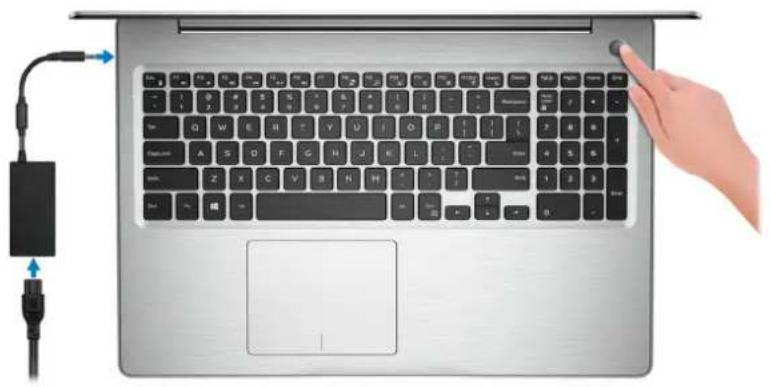
1 Connect the power adapter and press the power button.
natural_image
Hand pressing a button on a laptop keyboard with an attached cable (no text or symbols visible)NOTE: To conserve battery power, the battery might enter power saving mode. Connect the power adapter and press the power button to turn on the computer.
2 Finish operating system setup.
For Ubuntu:
Follow the on-screen instructions to complete the setup. For more information about installing and configuring Ubuntu, see the knowledge base articles SLN151664 and SLN151748 at www.dell.com/support.
For Windows:
Follow the on-screen instructions to complete the setup. When setting up, Dell recommends that you:
- Connect to a network for Windows updates.
NOTE: If connecting to a secured wireless network, enter the password for the wireless network access when prompted.
• If connected to the internet, sign-in with or create a Microsoft account. If not connected to the internet, create an offline account.
• On the Support and Protection screen, enter your contact details.
3 Locate and use Dell apps from the Windows Start menu—Recommended
Table 1. Locate Dell apps
Resources Description

My Dell
Centralized location for key Dell applications, help articles, and other important information about your computer. It also notifies you about the warranty status, recommended accessories, and software updates if available.

SupportAssist
Pro-actively checks the health of your computer's hardware and software. The SupportAssist OS Recovery tool troubleshoots issues with the operating system. For more information, see the SupportAssist documentation at www.dell.com/support.
NOTE: In SupportAssist, click the warranty expiry date to renew or upgrade your warranty.

Dell Update
Updates your computer with critical fixes and latest device drivers as they become available. For more information about using Dell Update, see the knowledge base article SLN305843 at www.dell.com/support.

Dell Digital Delivery
Download software applications, which are purchased but not pre-installed on your computer. For more information about using Dell Digital Delivery, see the knowledge base article 153764 at www.dell.com/support.
4 Create recovery drive for Windows.
NOTE: It is recommended to create a recovery drive to troubleshoot and fix problems that may occur with Windows.
For more information, see Create a USB recovery drive for Windows.
Create a USB recovery drive for Windows
Create a recovery drive to troubleshoot and fix problems that may occur with Windows. An empty USB flash drive with a minimum capacity of 16 GB is required to create the recovery drive.
NOTE: This process may take up to an hour to complete.
NOTE: The following steps may vary depending on the version of Windows installed. Refer to the Microsoft support site for latest instructions.
1 Connect the USB flash drive to your computer.
2 In Windows search, type Recovery.
3 In the search results, click Create a recovery drive.
The User Account Control window is displayed.
4 Click Yes to continue.
The Recovery Drive window is displayed.
5 Select Back up system files to the recovery drive and click Next.
6 Select the USB flash drive and click Next.
A message appears, indicating that all data in the USB flash drive will be deleted.
7 Click Create.
8 Click Finish.
For more information about reinstalling Windows using the USB recovery drive, see the Troubleshooting section of your product's Service Manual at www.dell.com/support/manuals.
Views of Inspiron 3583
Right
text_image
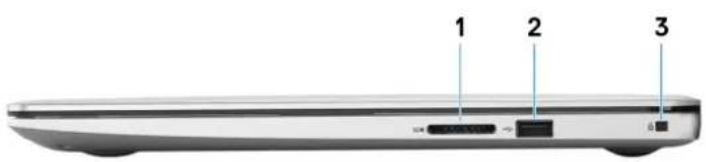
1 2 31 SD-card slot
Reads from and writes to the SD card.
2 USB 2.0 port
Connect peripherals such as external storage devices and printers. Provides data transfer speeds up to 480 Mbps.
3 Security-cable slot (wedge-shaped)
Connect a security cable to prevent unauthorized movement of your computer.
Left
text_image
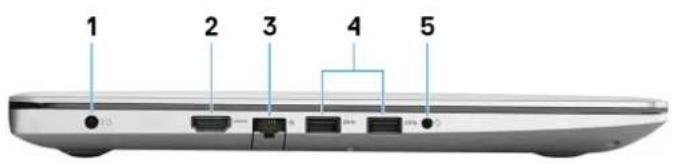
1 2 3 4 51 Power-adapter port
Connect a power adapter to provide power to your computer.
2 HDMI port
Connect to a TV or another HDMI-in enabled device. Provides video and audio output.
3 Network port
Connect an Ethernet (RJ45) cable from a router or a broadband modem for network or Internet access.
4 USB 3.1 Gen 1 ports (2)
Connect peripherals such as external storage devices and printers. Provides data transfer speeds up to 5 Gbps.
5 Headset port
Connect headphones or a headset (headphone and microphone combo).
Base
text_image
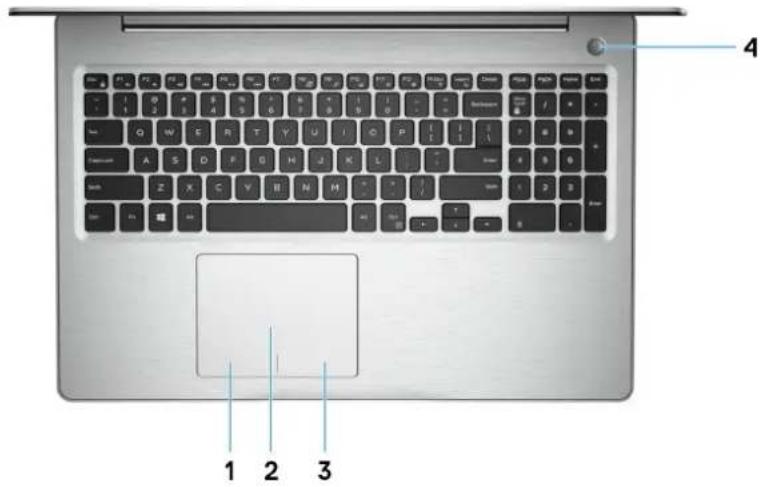
1 2 3 41 Left-click area
Press to left-click.
2 Touchpad
Move your finger on the touchpad to move the mouse pointer. Tap to left-click and two finger tap to right-click.
3 Right-click area
Press to right-click.
4 Power button with optional fingerprint reader
Press to turn on the computer if it is turned off, in sleep state, or in hibernate state.
When the computer is turned on, press the power button to put the computer into sleep state; press and hold the power button for 4 seconds to force shut-down the computer.
If the power button has a fingerprint reader, place your finger on the power button to log in.

NOTE: You can customize power-button behavior in Windows. For more information, see Me and My Dell at www.dell.com/support/manuals.
Display
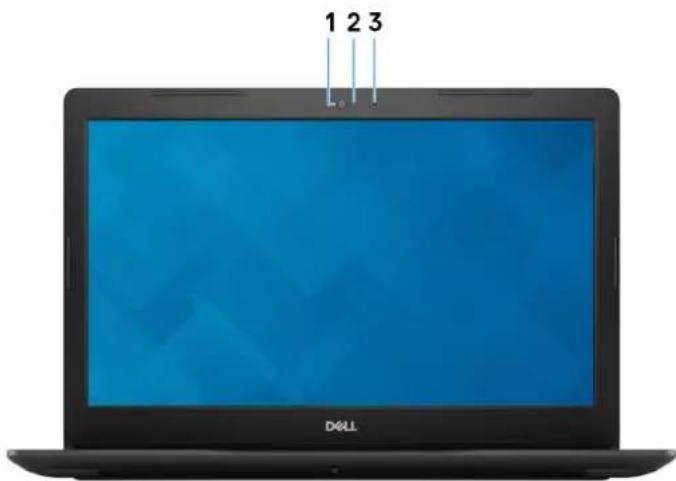
text_image
1 2 3 DOLL1 Camera
Enables you to video chat, capture photos, and record videos.
2 Camera-status light
Turns on when the camera is in use.
3 Microphone
Provides digital sound input for audio recording, voice calls, and so on.
Bottom
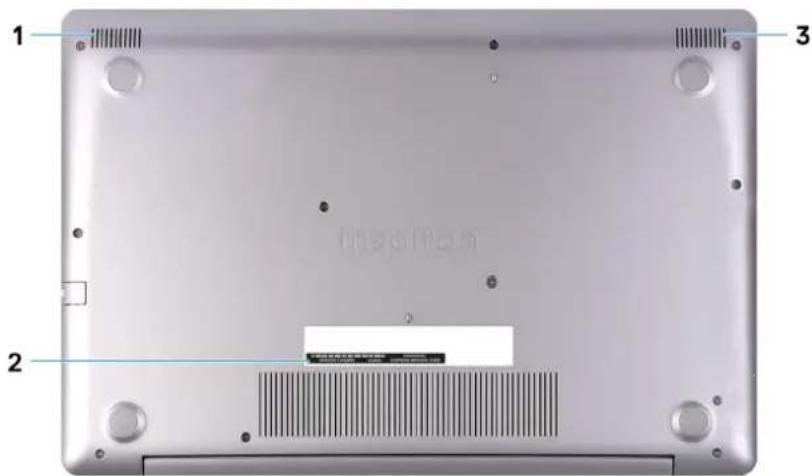
text_image
1 2 3 Unisoftech1 Left speaker
Provides audio output.
2 Service Tag label
The Service Tag is a unique alphanumeric identifier that enables Dell service technicians to identify the hardware components in your computer and access warranty information.
3 Right speaker
Provides audio output.
Specifications of Inspiron 3583
Dimensions and weight
Table 2. Dimensions and weight
| Description Values | |
| Height: | |
| Front | 19.89 mm (0.78 in) |
| Rear | 20 mm (0.79 in) |
| Width | 380 mm (14.96 in.) |
| Depth | 258 mm (10.16 in.) |
| Weight | 2 kg (4.41 lb) |
NOTE: The weight of your computer depends on the configuration ordered and the manufacturing variability.
Processors
Table 3. Processors
| Description Values | |||
| Processors | 8^th Gen Intel Core i3 8 | ^th Gen Intel Core i5 8 | ^th Gen Intel Core i7 |
| Wattage | 15 W 15 W 15 W | ||
| Core count | 2 4 4 | ||
| Thread count | 4 8 8 | ||
| Speed | Up to 2.1 GHz, 4.0 GHz Boost Up to 2.1 GHz, 3.7 GHz Boost Up to 2.1 GHz, 3.7 GHz Boost | ||
| L2 Cache | Not supported Not supported Not supported | ||
| L3 Cache | 4 MB 6 MB 8 MB | ||
| Integrated graphics | Supported Supported Supported | ||
Chipset
Table 4. Chipset
Description Values
| Processor | 8^th Gen Intel Core i3 8 | ^th Gen Intel Core i5 8 | ^th Gen Intel Core i7 |
| Chipset | Integrated in the processor | Integrated in the processor | Integrated in the processor |
| DRAM bus width | x64 x64 x64 | ||
| Flash EPROM | 16 MB 16 MB 16 MB | ||
| PCIe bus | Up to Gen2 Up to Gen2 Up to Gen3 | ||
| External bus frequency | Not supported Not supported Not supported | ||
Operating system
- Windows 10 Home (64-bit)
• Windows 10 Professional (64-bit) - Ubuntu
Memory
Table 5. Memory specifications
Description Values
| Slots | Two SODIMM slots |
| Type | Dual-channel DDR4 |
| Speed | Up to 2400 MHz |
| Maximum memory | 16 GB |
| Minimum memory | 4 GB |
| Memory size per slot | 4 GB, 8 GB, and 16 GB |
| Configurations supported | • 4 GB DDR4 at 2400 MHz (1 x 4 GB)• 8 GB DDR4 (2 x 4 GB)• 8 GB DDR4 (1 x 8 GB)• 12 GB DDR4 (1 x 4 GB + 1 x 8 GB)• 16 GB DDR4 (2 x 8 GB)• 16 GB DDR4 (1 x 16 GB) |
Ports and connectors
Table 6. Ports and connectors
| External: | |
| Network | One RJ-45 port |
| USB | • Two USB 3.1 Gen 1 ports• One USB 2.0 port |
| Audio | One headset (headphone and microphone combo) port |
| Video | One HDMI 1.4 port |
| Media card reader | One SD-card slot |
| Docking port | Not supported |
| Power adapter port | 4.5 mm |
| Security | Wedge-shaped lock slot |
| Internal: | |
| M.2 | One M.2 2280 slot for solid-state drive |

NOTE: To learn more about the features of different types of M.2 cards, see the knowledge base article SLN301626.
Communications
Ethernet
Table 7. Ethernetspecifications
| Description Values | |
| Model number | Ethernet controller integrated to the system board |
| Transfer rate | 10/100 Mbps |
Wireless module
Table 8. Wireless module specifications
Description Values
| Model number | Qualcomm QCA9565 (DW1707) | Qualcomm QCA9377 (DW1810) | Qualcomm QCA61x4A (DW1820) | Intel 9462 Intel 9560 | |
| Transfer rate | Up to 150 Mbps Up to 433 Mbps Up to 867 Mbps | ||||
| Frequency bands supported | Dual band 2.4 GHz Dual band 2.4 GHz/5 GHz | Dual band 2.4 GHz/5 GHz | Dual band 2.4 GHz/5 GHz | Dual band 2.4 GHz/5 GHz | |
| Wireless standards | WiFi 802.11b/g/n WiFi802.11a/b/g/n/ac | WiFi802.11a/b/g/n/ac | WiFi802.11a/b/g/n/ac | WiFi802.11a/b/g/n/ac | |
| Encryption | · 64-bit/128-bit WEP· AES-CCMP· TKIP | · 64-bit/128-bit WEP· AES-CCMP· TKIP | · 64-bit/128-bit WEP· AES-CCMP· TKIP | · 64-bit/128-bit WEP· AES-CCMP· TKIP | · 64-bit/128-bit WEP· AES-CCMP· TKIP |
| Bluetooth | Bluetooth 4.0 Bluetooth 4.2 Bluetooth 4.2 Bluetooth 4.2 Bluetooth 5.0 | ||||
Audio
Table 9. Audio specifications
Description Values
| Controller | Realtek ALC3204 |
| Stereo conversion | Supported |
| Internal interface | High-definition audio |
| External interface | Headset combo jack (stereo headphones/microphone-in) |
| Speakers | Two |
| Internal speaker amplifier | Supported (audio codec integrated) |
| External volume controls | Supported |
| Speaker output: | |
| Average | 2 W |
| Peak | 2.5 W |
| Subwoofer output | Not supported |
| Microphone | Supported |
Storage
Table 10. Storage specifications
Storage type Interface type Capacity
| Hard drive One 2.5-inch hard drive, SATA 3 |
- 500 GB (5400 RPM/7200 RPM)
· 1 TB (5400 RPM/7200 RPM)
· 2 TB (5400 RPM)
Intel Optane memory (optional)
Intel Optane memory functions only as a storage accelerator. It neither replaces nor adds to the memory (RAM) installed on your computer.
NOTE: Intel Optane memory is supported on computers that meet the following requirements:
- 7^th Generation or higher Intel Core i3/i5/i7 processor
- Windows 10 64-bit version or higher (Anniversary Update)
- Latest version of Intel Rapid Storage Technology driver
Table 11. Intel Optane memory
Description Values
| Type | Storage accelerator |
| Interface | PCIe 3.0x2 NVMe 1.1 |
| Connector | M.2 2280 |
| Configurations supported | 7thGeneration or higher Intel Core i3/i5/i7 processorWindows 10 64-bit version or higherIntel Rapid Storage Technology driver version 15.9 or higher |
| Capacity | Up to 16 GB |
Media-card reader
Table 12. Media-card reader specifications
Description Values
| Type | One SD-card slot |
| Cards supported | Secure Digital (SD) |
Table 13. Keyboard specifications
Description Values
| Type | Standard non-backlit keyboardBacklit keyboard |
| Layout | QWERTY |
| Number of keys | United States and Canada: 101 keysUnited Kingdom: 102 keysJapan: 105 keys |
| Size | X = 19.05 mm key pitchY = 18.05 mm key pitch |
| Shortcut keys | Some keys on your keyboard have two symbols on them. These keys can be used to type alternate characters or to perform secondary functions. To type the alternate character, press Shift and the desired key. To perform secondary functions, press Fn and the desired key.NOTE: You can define the primary behavior of the function keys (F1–F12) by changing Function Key Behavior in BIOS setup program.Keyboard shortcuts |
Camera
Table 14. Camera specifications
Description Values
| Number of cameras | One |
| Type | HD RGB camera |
| Location | Front (above the LCD screen) |
| Sensor type | CMOS sensor technology |
| Resolution: | |
| Still image | 0.92 megapixel |
| Video | 1280 x 720 (HD) at 30 fps |
| Diagonal viewing angle | 78.6 degrees |
Touchpad
Table 15. Touchpad specifications
Description Values
| Resolution: | ||
| Horizontal | 3215 | |
| Vertical | 2429 | |
| Dimensions: | ||
| Horizontal | 105 mm (4.13 in.) | |
| Vertical | 80 mm (3.15 in.) | |
Touchpad gestures
For more information about touchpad gestures for Windows 10, see the Microsoft knowledge base article 4027871 at support.microsoft.com.
Power adapter
Table 16. Power adapters specifications
Description Values
| Type | 45 W 65 W | |
| Diameter (connector) | 4.5 mm 4.5 mm | |
| Input voltage | 100 VAC-240 VAC 100 VAC-240 VAC | |
| Input frequency | 50 Hz-60 Hz 50 Hz-60 Hz | |
| Input current (maximum) | 1.30 A 1.70 A | |
| Output current (continuous) | 2.31 A 3.34 A | |
| Rated output voltage | 19.50 VDC 19.50 VDC | |
| Temperature range: | ||
| Operating | 0°C to 40°C (32°F to 104°F) | 0°C to 40°C (32°F to 104°F) |
| Storage | -40°C to 70°C (-40°F to 158°F) | -40°C to 70°C (-40°F to 158°F) |
Battery
Table 17. Battery specifications
| Description Values | |
| Type | 3-cell “smart” lithium-ion (42 WHr) |
| Voltage | 11.40 VDC |
| Weight (maximum) | 0.2 kg (0.44 lb) |
| Dimensions: | |
| Height | 5.90 mm (0.24 in.) |
| Width | 175.37 mm (6.9 in.) |
| Depth | 90.73 mm (3.57 in.) |
| Temperature range: | |
| Operating | 0°C to 35°C (32°F to 95°F) |
| Storage | -40°C to 65°C (-40°F to 149°F) |
| Operating time | Varies depending on operating conditions and can significantly reduce under certain power-intensive conditions. |
| Charging time (approximate) | 4 hours (when the computer is off) |
| NOTE: Control the charging time, duration, start and end time, and so on using the Dell Power Manager application. For more information on the Dell Power Manager see, Me and My Dell on https://www.dell.com/ | |
| Life span (approximate) 300 discharge/charge cycles | |
| Coin-cell battery | CR-2032 |
| Operating time | Varies depending on operating conditions and can significantly reduce under certain power-intensive conditions. |
Display
Table 18. Displays specifications
| Description Values | |
| Type | 15.6-inch HD15.6-inch FHD (optional)15.6-inch HD touch (optional)15.6-inch FHD touch (optional) |
| Panel technology | Twisted nematic (TN) |
| Luminance (typical) | 220 nits |
| Dimensions (active area): | |
Description Values
| Height | 344 mm (13.54 in.) |
| Width | 194 mm (7.64 in.) |
| Diagonal | 395 mm (15.55 in.) |
| Native resolution | · 1366 x 768 (HD) · 1920 x 1080 (FHD, optional) · 1366 x 768 (HD touch, optional) · 1920 x 1080 (FHD touch, optional) |
| Megapixels | 1.0 |
| Pixels Per Inch (PPI) | 100 |
| Contrast ratio (min) | 400:1 |
| Response time (max) | 25 ms |
| Refresh rate | 60 Hz |
| Horizontal view angle | · Left: 40 degrees · Right: 40 degrees |
| Vertical view angle | · Top: 10 degrees · Bottom: 30 degrees |
| Pixel pitch | 0.252 mm |
| Power consumption (maximum) | 3.7 W |
| Anti-glare vs glossy finish | · Glossy · Anti-glare (optional) |
| Touch options | Supported |
Fingerprint reader (optional)
Table 19. Fingerprint readerspecifications
Description Values
| Sensor technology | Capacitive |
| Sensor resolution | 500 PPI |
| Sensor area | 5.50 mm x 4.50 mm (0.22 in. x 0.17 in.) |
| Sensor pixel size | 108 pixels x 88 pixels |
Video
Table 20. Video specifications
Discrete graphics
Controller External display support Memory size Memory type
AMD Radeon 520 One HDMI port 2 GB GDDR5
Table 21. Video specifications
Integrated graphics
Controller External display support Memory size Processor
Intel UHD Graphics 620 One HDMI port Shared system memory 8
^th Generation Intel
Core i3/i5/i7
Computer environment
Airborne contaminant level: G1 as defined by ISA-S71.04-1985
Table 22. Computer environment
| Operating | Storage | |
| Temperature range | 0°C to 40°C (32°F to 104°F) | -40°C to 65°C (-40°F to 149°F) |
| Relative humidity (maximum) | 10% to 90% (non-condensing) | 0% to 95% (non-condensing) |
| Vibration (maximum)* | 0.66 GRMS | 1.30 GRMS |
| Shock (maximum) | 140 G† | 160 G‡ |
| Altitude (maximum) | 0 m to 3,048 m (0 ft to 10,000 ft) | 0 m to 10,668 m (0 ft to 35,000 ft) |
* Measured using a random vibration spectrum that simulates user environment.
† Measured using a 2 ms half-sine pulse when the hard drive is in use.
‡ Measured using a 2 ms half-sine pulse when the hard-drive head is in parked position.
Keyboard shortcuts
NOTE: Keyboard characters may differ depending on the keyboard language configuration. Keys used for shortcuts remain the same across all language configurations.
Some keys on your keyboard have two symbols on them. These keys can be used to type alternate characters or to perform secondary functions. The symbol shown on the lower part of the key refers to the character that is typed out when the key is pressed. If you press shift and the key, the symbol shown on the upper part of the key is typed out. For example, if you press 2, 2 is typed out; if you press Shift + 2, e is typed out.
The keys F1-F12 at the top row of the keyboard are function keys for multi-media control, as indicated by the icon at the bottom of the key. Press the function key to invoke the task represented by the icon. For example, pressing F1 mutes the audio (refer to the table below).
However, if the function keys F1-F12 are needed for specific software applications, multi-media functionality can be disabled by pressing Fn + Esc. Subsequently, multi-media control can be invoked by pressing Fn and the respective function key. For example, mute audio by pressing Fn + F1.
NOTE: You can also define the primary behavior of the function keys (F1–F12) by changing Function Key Behavior in BIOS setup program.
Table 23. List of keyboard shortcuts
Function key Re-defined key (for multi-media control) Behavior
| F1 | Fn + F1 | Mute audio |
| F2 | Fn + F2 | Decrease volume |
| F3 | Fn + F3 | Increase volume |
| F4 | Fn + F4 | Play previous track/chapter |
| F5 | Fn + F5 | Play/Pause |
| F6 | Fn + F6 | Play next track/chapter |
| F8 | Fn + F8 | Switch to external display |
| F9 | Fn + F9 | Search |
| F10 | Fn + F10 | Toggle keyboard backlight (optional) |
| F11 | Fn + F11 | Decrease brightness |
| F12 | Fn + F12 | Increase brightness |
The Fn key is also used with selected keys on the keyboard to invoke other secondary functions.
Table 24. List of keyboard shortcuts
Function key Behavior
| Fn + PrtScr | Turn off/on wireless |
| Fn + B | Pause/Break |
| Fn + Insert | Sleep |
| Fn + S | Toggle scroll lock |
| Fn + H | Toggle between power and battery-status light/hard-drive activity light |
| Fn + R | System request |
| Fn + Ctrl | Open application menu |
| Fn + Esc | Toggle Fn-key lock |
| Fn + ↑PgUp | Page up |
| Fn + ↓PgDn | Page down |
| Fn + ←Home | Home |
| Fn + End → | End |
Getting help and contacting Dell
Self-help resources
You can get information and help on Dell products and services using these self-help resources:
Table 25. Self-help resources
Self-help resources Resource location
Information about Dell products and services www.dell.com
My Dell
Tips


Contact Support In Windows search, type Contact Support, and press Enter.
Online help for operating system www.dell.com/support/windows
www.dell.com/support/linux
Troubleshooting information, user manuals, setup instructions, product specifications, technical help blogs, drivers, software updates, and so on.
www.dell.com/support
Dell knowledge base articles for a variety of computer concerns.
Learn and know the following information about your product:
- Product specifications
- Operating system
- Setting up and using your product
- Data backup
- Troubleshooting and diagnostics
• Factory and system restore - BIOS information
1 Go to www.dell.com/support.
2 Type the subject or keyword in the Search box.
3 Click Search to retrieve the related articles.
See Me and My Dell at www.dell.com/support/manuals.
To locate the Me and My Dell relevant to your product, identify your product through one of the following:
- Select Detect Product.
- Locate your product through the drop-down menu under View Products.
• Enter the Service Tag number or Product ID in the search bar.
Contacting Dell
To contact Dell for sales, technical support, or customer service issues, see www.dell.com/contactdell.

NOTE: Availability varies by country and product, and some services may not be available in your country.

NOTE: If you do not have an active internet connection, you can find contact information on your purchase invoice, packing slip, bill, or Dell product catalog.