
DV-DS253A - DVD player HITACHI - Free user manual and instructions
Find the device manual for free DV-DS253A HITACHI in PDF.


| Product Type | DVD Recorder with HDD |
| Brand | Hitachi |
| Model | DV-DS253A |
| Dimensions (approx.) | 430 × 59 × 298 mm (W × H × D) |
| Weight (approx.) | 4.1 kg |
| Power Requirements | AC 220-240V, 50/60 Hz |
| Power Consumption | 35 W |
| Operating Temperature | 5°C to 35°C |
| Operating Humidity | 10% to 80% |
| Television System | PAL B/G colour system |
| Recording Format | DVD Video Recording, DVD-VIDEO |
| Recordable Media | HDD (160GB), DVD-RAM, DVD-RW, DVD-R, DVD+RW, DVD+R, DVD+R DL |
| Recording Modes (HDD) | XP (approx. 48h), SP (84h), LP (156h), EP (222h) |
| Recording Modes (DVD 4.7GB) | XP (approx. 1h), SP (2h), LP (4h), EP (6h) |
| Video Compression | MPEG 2 (VBR support) |
| Audio Compression | Dolby Digital |
| Playback Disc Types | DVD-Video, DVD±R/RW, DVD-RAM, Video CD, Audio CD, CD-R/RW (MP3, WMA, JPEG, DivX) |
| HDMI Output | HDMI (Type A), 576i/576p/720p/1080i |
| Component Video Output | Y Pb Pr, 576i/576p |
| S-Video Output | Yes (Mini DIN 4-pin) |
| Digital Audio Output | Coaxial and Optical |
| DV Input | 4-pin (IEEE 1394) on front panel |
| Memory Card Slots | 2 slots: CF/MD/ST1 MD and SD/MMC/xD |
| Remote Control | Included with batteries (AAA) |
| Accessories Included | Video cable, audio cable, RF cable, remote control, batteries, instruction manual |
Frequently Asked Questions - DV-DS253A HITACHI
User questions about DV-DS253A HITACHI
0 question about this device. Answer the ones you know or ask your own.
Ask a new question about this device
Download the instructions for your DVD player in PDF format for free! Find your manual DV-DS253A - HITACHI and take your electronic device back in hand. On this page are published all the documents necessary for the use of your device. DV-DS253A by HITACHI.
USER MANUAL DV-DS253A HITACHI

hard disk

G-CODE is a registered trademark of Gemstar Development Corporation. The G-CODE system is manufactured under license from Gemstar Development Corporation.
Dear customer
Thank you for purchasing this product. For optimum performance and safety, please read these instructions carefully.
Before connecting, operating or adjusting this product, please read these instructions completely. Please keep this manual for future reference.

CAUTION
RISK OF ELECTRIC SHOCK DO NOT OPEN


CAUTION: THESE SERVICING INSTRUCTIONS ARE FOR USE BY QUALIFIED SERVICE PERSONNEL ONLY. TO REDUCE THE RISK OF ELECTRIC SHOCK DO NOT PERFORM ANY SERVICING OTHER THAN THAT CONTAINED IN THE OPERATING INSTRUCTIONS UNLESS YOU ARE QUALIFIED TO DO SO.

Caution: The apparatus should not be exposed to water (dripping or splashing) and no objects filled with liquids, such as vases, should be placed on the apparatus.
Caution: Do not block any ventilation openings.
Install in accordance with the manufacturer's instructions.
Caution: Slots and openings in the cabinet are provided for ventilation and to ensure reliable operation of the product and to protect it from over heating.
The openings should be never be blocked by placing the product on a bed, sofa, rug or other similar surface.
This product should not be placed in a built-in installation such as a bookcase or rack unless proper ventilation is provided or the manufacturer's instructions have been adhered to.
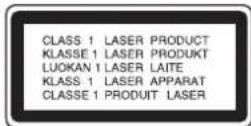

CAUTION: This product employs a Laser System.
To ensure proper use of this product, please read this owner's manual carefully and retain for future reference. Should the unit require maintenance, contact an authorized service center.
Use of controls, adjustments, or the performance of procedures other than those specified herein may result in hazardous radiation exposure.
To prevent direct exposure to laser beam, do not try to open the enclosure. Visible laser radiation when open. DO NOT STARE INTO BEAM.

WARNING: Do not install this equipment in a confined space such as a bookcase or similar unit.
CAUTION concerning the Power Cord
Most appliances recommend they be placed upon a dedicated circuit;
That is, a single outlet circuit which powers only that appliance and has no additional outlets or branch circuits. Check the specification page of this owner's manual to be certain.
Do not overload wall outlets. Overloaded wall outlets, loose or damaged wall outlets, extension cords, frayed power cords, or damaged or cracked wire insulation are dangerous. Any of these conditions could result in electric shock or fire. Periodically examine the cord of your appliance, and if its appearance indicates damage or deterioration, unplug it, discontinue use of the appliance, and have the cord replaced with an exact replacement part by an authorized servicer.
Protect the power cord from physical or mechanical abuse, such as being twisted, kinked, pinched, closed in a door, or walked upon. Pay particular attention to plugs, wall outlets, and the point where the cord exits the appliance.
SERIAL NUMBER:
You can find the serial number on the back of the unit. This number is unique to this unit and not available to others. You should record requested information here and retain this guide as a permanent record of your purchase.
Model No. ____
Serial No.
Information for users applicable in European Union countries

This symbol on the product or on its packaging means that your electrical and electronic equipment should be disposed at the end of life separately from your household wastes.
There are separate collection systems for recycling in EU.
For more information, please contact the local authority or the dealer where you purchased the product.
natural_image
Pure geometric diagram with crosshair and circle shapes, no text or symbols presentContents
Introduction ....5
Symbol Used in this Manual 5
Notes on Discs 5
Accessories 6
Recordable and Playable Discs 6
Playable Discs 7
About the internal hard disk drive 8
Remote Control Operation 8
Availability of copying or moving feature ..... 8
Card useable on this unit 9
Front Panel 10
Remote Control 11
Hookup and Settings .....12
Rear Panel 12
Connecting to the Aerial 12
Connections to Your TV 13
HDMI connection 14
Connecting to an Amplifier 15
Accessory Audio/Video Connections ..... 16
Using the Home Menu 17
Initial Settings 17
General Settings 17
Auto Programming 17
Program Edit 18
Manual Clock Set 18
TV Aspect (Standard and Wide) ..... 18
Display Mode 19
Power Save Mode 19
Initialization (HDD Format) 19
Language Settings 19
Display Menu 19
Disc Menu/Audio/Subtitle 19
Audio Settings 19
Dolby Digital / DTS / MPEG 20
Sampling Frequency 20
DRC (Dynamic Range Control) ..... 20
Vocal 20
Lock (Parental Control) Settings ..... 20
Rating 20
Set Password 20
Area Code 21
DivX® Registration Code 21
Recording Settings .....21
Record Mode Set 21
Record Aspect 21
DV Recording Audio 21
TV Recording Audio 21
Auto Chapter 22
Disc Settings 22
Disc Format 22
Finalize 22
Disc Label 23
Disc Protect 23
PBC 23
Playback 24
General Explanation of On-Screen Display ....24
Displaying Information While Watching TV . .24
Displaying Disc Information on-screen .....24
General Playback Features .....25
If a menu screen is displayed .....27
Moving to another TITLE .....27
Time Search 27
Marker Search 27
Camera Angle .....27
3D Surround .28
Last Condition Memory 28
Playing a DivX ^ Movie File .....28
Notice for displaying the DivX ^ subtitle .....28
Movie List menu options .....29
Playing an Audio CD or MP3/WMA file .....30
Audio CD and Music menu options .....30
Random 30
Program Playback with Audio CD/MP3/WMA...31
Program List menu options .....31
Repeat Programmed Tracks ....31
Erasing a Track from the Program List ....31
Changing Track Order in the Program List . .31
Save Your Program List (HDD) .....31
Viewing a JPEG File 32
Photo List menu options 32
Skip Images ....33
Rotate Images ....33
View Slide Shows 33
Editing a MP3/WMA, JPEG, DivX® file .....34
Erasing a file(s)/folder(s) 34
Naming a file 34
Copying a file(s) to another media or folder .35
Moving a file(s) 35
Recording 36
About DVD recording .....36
About HDD recording 36
Time Shift 37
Basic Recording from a TV 38
Changing TV Audio Channel .....38
Instant Timer Recording ....39
Timer Recording 39
G-CODE System 41
Checking Timer Recording Details .....42
Recording from an External Input .....42
Recording from DV Input 43
Simultaneous recording and playback .....44
Title List and Editing .....45
Title List and Chapter List Menu Overview ..... 45
Original and Playlist Editing (VR Mode) ..... 47
Adding Chapter Markers 47
Changing Title Thumbnails 47
Making a New Playlist 48
Adding Title/Chapters to the Playlist ..... 48
Deleting an Original or Playlist Title/Chapter ... 49
Deleting a Part 49
Naming a Title 50
Time Search ....50
Sort 51
Undoing/Redoing 51
Combining Titles 51
Divide 52
Combining Chapters 52
Moving a Playlist Chapter 53
Hide a Chapter/Title 53
Protect a Title 53
Full Play ....53
Dubbing 54
Before Dubbing 54
What is 'CPRM'? 54
Fast copying (Maximum 12×) ..... 54
Dubbing from HDD to DVD 55
Dubbing from DVD to HDD 55
One Touch Copy (HDD to DVD) 56
One Touch Copy (DVD to HDD) 56
Reference 57
Additional Information 57
Overwriting Recording 57
Display on other Recorders or Players ..... 57
Playing on other Players (Finalized) ..... 57
Language Codes 58
Area Codes 58
Controlling TV with Remote Control ..... 59
Troubleshooting 62
Specifications 64

4


natural_image
Pure geometric diagram with intersecting lines and a circular pattern (no text or symbols)Introduction
To ensure proper use of this product, please read this owner's manual carefully and retain for future reference.
This manual provides information on the operation and maintenance of your recorder. Should the unit require service, contact an authorized service location.
Symbol Used in this Manual

The lightning flash symbol alerts you to the presence of dangerous voltage within the product enclosure that may constitute a risk of electric shock.

The exclamation point alerts you to the presence of important operating and maintenance / servicing instructions.

Indicates hazards likely to cause harm to the unit itself or other material damage.
Note:
Indicates special notes and operating features.
Tip:
Indicates tips and hints for making the task easier.
A section whose title has one of the following symbols are applicable only to the disc represented by the symbol.
HDD Titles recorded on the HDD
DVD ALL All DVD discs listed below.
RAM DVD-RAM disc
-RWVR DVD-RW with VR recording mode
-RWvideo DVD-RW with Video recording mode
-R DVD-R disc
+RW DVD+RW disc
+R DVD+R disc
DVD DVD-Video disc
VCD Video CDs
ACD Audio CDs
DivX DivX® files
MP3 MP3 files
WMA WMA files
JPEG JPEG files
About the Symbol Display
"∅ may appear on your TV display during operation and indicates that the function explained in this owner's manual is not available on that specific DVD video disc.
Notes on Discs
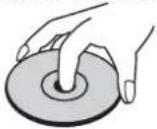
Handling Discs
Do not touch the playback side of the disc. Hold the disc by the edges so that fingerprints do not get on the surface. Never stick paper or tape on the disc.

Storing Discs
After playing, store the disc in its case. Do not expose the disc to direct sunlight or sources of heat and never leave it in a parked car exposed to direct sunlight.
Cleaning Discs
Fingerprints and dust on the disc can cause poor picture quality and sound distortion. Before playing, clean the disc with a clean cloth. Wipe the disc from the center out.
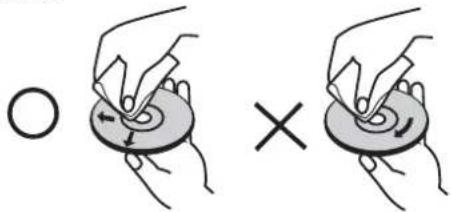
Do not use strong solvents such as alcohol, benzine, thinner, commercially available cleaners, or anti-static spray intended for older vinyl records.
Moisture Condensation
Never operate this product immediately after moving it from a cold location to a warm location. Leave it for two or three hours without operating it. If you use this product in such a situation, it may damage discs and internal parts.
Accessories
Check for the supplied accessories below.
• Video Cable • Remote Control
- Audio Cable • Batteries for Remote Control (AAA Size)
• RF Cable for TV • Instruction Manual
Dispose of batteries according to local environmental regulations. Do not put them in the household rubbish.
Recordable and Playable Discs

DVD-RAM
- DVD-RAM discs can be formatted for VR mode recording.
• These Discs can be recorded on repeatedly. Recordings can be erased, then you can record again on the same Disc. - Playable on DVD-RAM compatible players.
• Recordings can be extensively edited. - Only DVD-RAM standard Version 2.0, 2.1 and 2.2 discs can be used in this unit.
- You cannot use the cartridge-type DVD-RAM disc in this unit.

DVD-RW
- DVD-RW discs can be formatted for VR mode recording or Video mode recording.
• These Discs can be recorded on repeatedly. Recordings can be erased, then you can record again on the same Disc.
• Recordings can be extensively edited - Playable only on VR mode compatible players (after finalization)
[Video mode] - Playable on regular DVD players (after finalization)
- Limited editing features
[VR mode]
![HITACHI DV-DS253A - [VR mode] - 1](/content/2026/05/815362/images/163637aff9351383995d71675bcbaf1e9f4cab8f0f5129ef493a39038f97c6a2.jpg)
DVD-R
• These Discs can be recorded only once. After you finalize a DVD-R, you cannot record on it or edit it.
- DVD-R discs can be only formatted to Video mode.
- Playable on regular DVD players (after finalization).
- Limited editing features

DVD+RW
• These Discs can be recorded on repeatedly. Recordings can be erased, then you can record again on the same Disc.
- Playable on DVD+RW compatible players (automatically finalization)
• The edited contents are playable on DVD+RW compatible players only after finalization
• Recordings can be edited the title/chapter

DVD+R
• These Discs can be recorded only once. After you finalize a DVD+R, you cannot record on it or edit it any more.
- Playable on DVD+R compatible players (after finalization)
- Any edited contents are not be compatible on DVD+R compatible players. (Hide, chapter combine, added chapter mark, etc.)
- Limited title/chapter editing features.

DVD+R DL
• These Discs can be recorded only once. After you finalize a DVD+R DL, you cannot record on it or edit it any more.
- Storage space is nearly doubled with double layer DVD+R media, allowing consumers to record up to 8.5GB of video on a single DVD+R DL disc.
- Playable on DVD+R compatible players (after finalization)
- Any edited contents are not be compatible on DVD+R DL compatible players. (Hide, chapter combine, added chapter mark, etc.)
- Limited title/chapter editing features.

6




The recordable DVD discs (Example)
| DVD-RAM DVD-RW DVD-R DVD+RW DVD+R DVD+R (DL) | |||||
| Maxell (2x, 3x, 5x) | Maxell (1x, 2x, 4x) | Maxell (4x, 8x, 16x) | Maxell (2.4x, 4x) | Maxell (4x, 8x, 16x) | Maxell (2.4x) |
| Mitsubishi (2x, 3x) | JVC (1x, 4x) | Verbatim (4x, 8x) | SONY (4x) | Mitsubishi (4x, 8x, 16x) | Mitsubishi (2.4x, 8x) |
| Fujifilm (2x, 3x) | Verbatim (4x) | That's (8x, 16x) | Mitsubishi (4x) | Ricoh (2x, 4x, 8x, 16x) | — |
| — | Mitsubishi (2x, 4x) | — | Ricoh (2.4x, 4x) | Verbatim (8x) | — |
| — | — | — | — | — | — |
Note:
If a DVD-RW/DVD+RW disc is recorded using a personal computer or other DVD recorder, you cannot format the disc using this recorder. So if you want to use the disc on this recorder, you must format the disc using the original recorder.
The above discs were checked for usability in 2006.
Disc specifications may be changed without notice.
playable Discs

DVD (8 cm / 12 cm disc)
• Discs such as movies that can be purchased or rented

Video CD (VCD) (8 cm / 12 cm disc)
• VIDEO CDs or CD-Rs/CD-RWs in VIDEO CD/Super VIDEO CD format

Audio CD (8 cm / 12 cm disc)
- Music CDs or CD-Rs/CD-RWs in music CD format that can be purchased

CD-R/CD-RW (8 cm / 12 cm disc)
- CD-R/CD-RW discs that contain audio titles, DivX ^® , MP3, WMA, or JPEG files.
Notes:
- Depending on the conditions of the recording equipment or the CD-R/RW (or DVD±R/RW) disc itself, some CD-R/RW (or DVD±R/RW) discs cannot be played on the unit.
- Images taken with a Hitachi DVD video camera on 8 cm DVD-R discs that have not been finalized can be played on the unit. Additional recording and finalization cannot be performed.
- Do not attach any seal or label to either side (the labeled side or the recorded side) of a disc.
- Do not use irregularly shaped CDs (e.g., heart-shaped or octagonal). Doing so may result in malfunctions.
- Depending on the recording software & the finalization, some recorded discs (CD-R/RW or DVD±R/RW) may not be playable.
- DVD-R/RW, DVD+R/RW and CD-R/RW discs recorded using a personal computer or a DVD or CD Recorder may not play if the disc is damaged or dirty, or if there is dirt or condensation on the Recorder's lens.
- If you record a disc using a personal computer, even if it is recorded in a compatible format, there are cases in which it may not play because of the settings of the application software used to create the disc. (Check with the software publisher for more detailed information.)
Regional code of the recorder and DVDs

This recorder is designed and manufactured for playback of Region 4 encoded DVD software. The region code on the labels of some DVD discs indicates which type of the recorder can play those discs. This unit can play only DVD discs labeled 4 or ALL. If you try to play any other discs, the message "Incorrect region code. Can't play back" will appear on the TV screen. Some DVD discs may not have a region code label even though their playback is prohibited by area limits.
Notes on DVDs and Video CDs
Some playback operations of DVDs and Video CDs may be intentionally fixed by software manufacturers. As this unit plays DVDs and Video CDs according to disc content designed by the software manufacturer, some playback features of the unit may not be available or other functions may be added.
Refer also to the instructions supplied with the DVDs and Video CDs. Some DVDs made for business purposes may not be played on the unit.
About the internal hard disk drive
The internal hard disk drive (HDD) is a fragile piece of equipment. Please use the recorder following the guidelines below to protect against possible HDD failure.
We recommend that you back up your important recordings onto DVD discs in order to protect against accidental loss.
- Do not move the recorder while it is on.
• Install and use the recorder on a stable, level surface. - Do not block the rear vent/cooling fan.
- Do not use the recorder in excessively hot or humid places, or in places that may be subject to sudden changes in temperature. Sudden changes in temperature can cause condensation to form inside the recorder. This can be a cause of HDD failure.
- While the recorder is switched on, do not unplug from the wall socket or switch the electricity off from the breaker switch.
- Do not move the recorder immediately after switching it off. If you need to move the recorder, please follow the steps below:
- After the message POWER OFF is shown in the display, wait at least two minutes.
- Unplug from the wall socket.
- Move the recorder.
- If there's a power failure while the recorder is on there is a chance that some data on the HDD will be lost.
- The HDD is very delicate. If used improperly or in an unsuitable environment, it is possible that the HDD will fail after a few years of use. Signs of problems include playback unexpectedly freezing and noticeable block noise (mosaic) in the picture. However, sometimes there will be no warning signs of HDD failure.
If the HDD fails, no playback of recorded material will be possible. In this case it will be necessary to replace the HDD unit.
■ Exemption of liability concerning compensation of recorded contents
If the recorder fails to record or play back because of a fault, Hitachi will not accept any responsibility for compensation for HDD contents (recorded program data, etc.) or loss of them, or any direct or indirect damage. This also applies if you repair the recorder yourself (including repair of any components other than HDD).
Remote Control Operation
Point the Remote Control at the remote sensor and press the buttons.
Remote Control Battery Installation
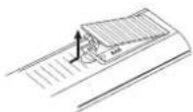
Remove the battery cover on the rear of the Remote Control, and insert two R03 (size AAA) batteries with ● and ● matched correctly.
Caution
Do not mix old and new batteries. Never mix different types of batteries (standard, alkaline, etc.).
Caution
Do not block vent holes:
- If the vent holes on this recorder are blocked, heat will accumulate inside, which could cause a fire. Also touching the hot recorder could cause burns. Do not push the recorder into an ill-ventilated, narrow space, such as a bookcase or closet, or cover it with table cloth, or place it on a carpet or rug.
Caution
Do not place any heavy object on this recorder:
- Do not place any heavy object or TV on it: The object may fall, which could cause an injury.
Availability of copying or moving feature
| From To MP3/WMA JPEG DivX Audio CD Video CD Title | |||||||
| HDD DISC No No No No No Yes | |||||||
| HDD | Memory Card | No | Yes | No | No | No | No |
| DISC | HDD | Yes | Yes | Yes | No | No | Yes |
| DISC | Memory Card | No | Yes | No | No | No | No |
| Memory Card | DISC No No No No No No | ||||||
| Memory Card | HDD | Yes | Yes | No | No | No | No |
Card useable on this unit
- Compact Flash Card (CF)
- Micro Drive (MD), ST1 MD
- Secure Digital Card (SD), Mini SD
- Multi Media Card (MMC), MMC Plus, RS MMC, MMC Mobile
• xD-Picture Card (xD)
• Compatible with: FAT 12, FAT 16, or FAT 32 - Only use the memory cards recommended above.
Regarding Write Protect
For cards that have a write protect switch, if the switch is on it will not be possible to write, erase or format the card.
Inserting/Removing the Memory Card
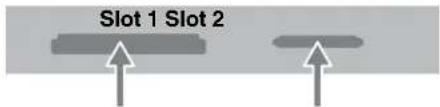
Insert CF, MD, or ST1 MD
Insert SD, Mini SD,
MMC, MMC Plus,
RS MMC, MMC Mobile,
or xD card
Inserting the card
Insert straight-in until it fits into place.
Removing the card
Slot 1: Withdraw the card carefully. Slot 2: Press on the center of the card then withdraw the card carefully.
Notes:
- Keep the memory card out of reach of children. If swallowed, seek medical advice immediately.
- A memory card may not be used for this recorder.
- Do not extract the memory card in operating (play, copy, move, etc.).
Using Memory Card
- Insert a memory card.
- Press HOME on the remote control.
- Select [MUSIC] or [PHOTO] option.
- Select [Memory Card 1] or [Memory Card 2] then press ENTER.
Details for the options are on page 17.
Front Panel
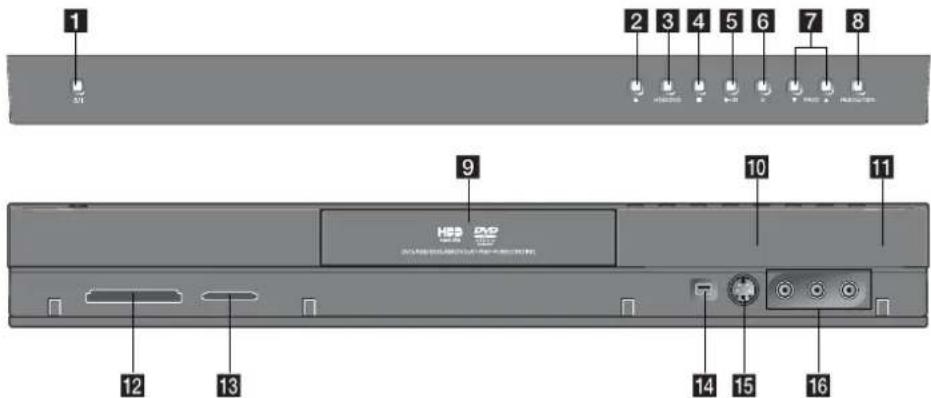
1 POWER button
Switches the recorder ON or OFF. (As to the indication of the Operate switch, "I" shows ON and "shows electrical power stand-by.)
2 ▲ (OPEN/CLOSE)
Opens or closes the disc tray.
3 HDD/DVD
Set the recorder's mode to HDD or DVD.
4 ■ (STOP)
Stops playback or recording.
5 ▶ / (PLAY/PAUSE)
Starts playback.
Pause playback or recording temporarily, press again to exit pause mode.
6 ● (REC)
Starts recording. Press repeatedly to set the recording time.
7 PROG. (▼ /▲)
Scans up or down through memorized channels.
8 RESOLUTION (page 14)
Sets the output resolution for HDMI and COMPONENT/PROGRESSIVE SCAN VIDEO OUT jacks.
– HDMI: 576i, 576p, 720p, 1080i
- COMPONENT: 576i, 576p
9 Disc Tray
Insert a disc here.
10 Display window
Shows the current status of the recorder.
T/S: Indicates the timeshifting mode.
REC: The recorder is recording.
HDD: The recorder is HDD mode.
DVD: The recorder is DVD mode.
HDD ◀▶ DVD: The recorder is dubbing.
TV: Indicates when the recorder is in TV tuner mode.
◎: Indicates when the recorder is in timer recording or a timer recording is programmed.
: Indicates clock, total playing time, elapsed time, title number, chapter/track number, channel, etc.
11 Remote Sensor
Point the recorder remote control here.
12 MEMORY CARD Slot 1
Insert a memory card (CF/MD/ST1 MD).
13 MEMORY CARD Slot 2 (page 9, 30, 32)
Insert a memory card (SD/Mini SD/MMC/MMC Plus/RS MMC/MMC Mobile/xD).
14 DV IN (page 16, 43)
Connect the DV output of a digital camcorder.
15 INPUT 2 (S-VIDEO IN)
Connect the S-Video output of an external source (TV/ Monitor, VCR, Camcorder, etc.).
16 INPUT 2 (VIDEO IN/AUDIO IN (Left/Right))
Connect the audio/video output of an external source (Audio system, TV/ Monitor, VCR, Camcorder, etc.).
Note:
The 2(OPEN/CLOSE) button will not operate with this recorder turned off. After turning the recorder on to display the clock in the 10 display window, press the
2 ▲ (OPEN/CLOSE) button.
Remote Control
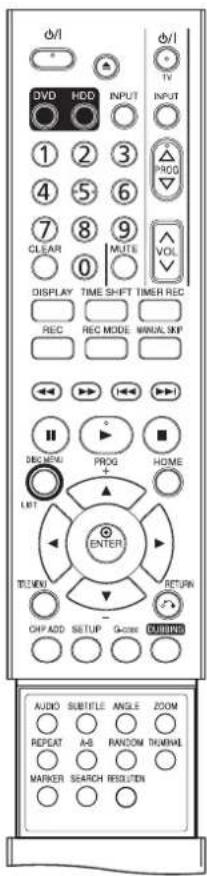
0-9 numerical buttons: (page 25, 50) Selects numbered options in a menu.
◀/▶ / ▲/▼ (left/right/up/down): Selects an option in the menu.
▲/▼ (up/down): Scans up or down through memorized channels.
A-B: (page 26) Repeat sequence.
ANGLE: (page 27) Selects a DVD camera angle, if available.
AUDIO: (page 26) Selects an audio language (DVD) or TV audio channel (CD).
CHP ADD: (page 47) Inserts a chapter marker when playing/ recording.
CLEAR: (page 27, 34) Removes a track number on the Program List or a mark on the Marker Search menu.
DISC MENU/LIST: (page 26, 45) Accesses menu on a DVD disc. Switches between Title List-Original and Title List-Playlist menu.
DISPLAY: (page 24, 45) Accesses On-Screen Display.
DUBBING: (page 56) Copies DVD to HDD (or HDD to DVD).
DVD: (page 17) Select the Recorder's function mode to DVD.
ENTER
- Acknowledges menu selection. - Displays information while viewing a TV program.
G-CODE: (page 41) To display the program menu for G-CODE System programming.
HDD: (page 17) Select the Recorder's function mode to HDD.
HOME: (page 17) Accesses or removes the HOME menu.
INPUT: (page 42) Changes the input to use for recording (Tuner, AV1-2 or DV IN).
MANUAL SKIP: (page 26)
Pressing this button during playback will skip to a scene 15 seconds forward.
MARKER: (page 27, 37) Marks any point during playback.
▲ (OPEN/CLOSE): (page 25)
Opens and closes the disc tray. Operate this button only after turning the recorder on.
II (PAUSE/STEP): (page 25)
Pause playback or recording temporarily, press again to exit pause mode.
▶ (PLAY): (page 25) Starts playback.
☐/I POWER: (page 25) Switches the recorder ON or OFF.
RANDOM: (page 30) Plays tracks in random order.
● (REC): (page 36, 37, 38) Starts recording. Press repeatedly to set the recording time.
REC MODE: (page 36, 38) Selects the recording mode (XP, SP, LP or EP).
REPEAT: (page 26) Repeat chapter, track, title, all.
RESOLUTION: (page 14) Sets the output resolution for HDMI.
RETURN (page 18, 27)
- Removes the menu.
- Display the menu of a video CD with PBC.
◀◀ / ▶(SCAN): (page 25, 37) Search backward or forward.
SEARCH: (page 27, 37) Displays Marker Search menu.
SETUP: (page 17, 18) Accesses or removes the Setup menu.
/ (SKIP): (page 25, 33)
Go to next chapter or track. Returns to beginning of current chapter or track or go to previous chapter or track.
■ (STOP): (page 25) Stops playback or recording.
SUBTITLE: (page 26) Selects a subtitle language.
THUMBNAIL: (page 47) Selects a thumbnail picture for the current title and chapter for use in the Original and Playlist menu.
TIMER REC: (page 39, 42)
Displays Timer Record menu.
TIMESHIFT: (page 37) Activates pause live TV/playback (timeshift) for a live TV program.
TITLE MENU: (page 26, 27)
Displays the disc's Title menu, if available.
TV Control Buttons (page 59)
- POWER: Turns the TV on or off.
- INPUT: Selects the TV's source.
• PROG +/-: Selects TV's channel.
• VOL +/-: Adjusts TV's volume.
- MUTE: Temporarily turns TV sound OFF, press again to restore.
ZOOM: (page 25) Enlarges DVD video image.
Hookup and Settings
Rear Panel
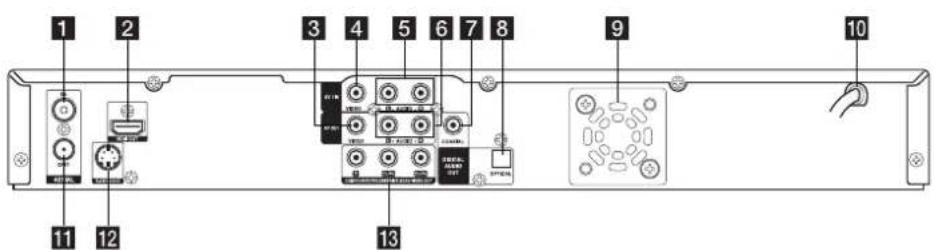
1 AERIAL
Connect the aerial to this terminal.
2 HDMI Connector (Type A)
HDMI output providing a high quality interface for digital audio and video (page 14).
3 AV (VIDEO) OUT
Connect to a TV with video inputs.
4 AV 1 (VIDEO) IN
Connect the video output of an external source (Audio system, TV/Monitor, VCR, Camcorder).
5 AV 1 (AUDIO) IN (Left/Right)
Connect the audio output of an external source (Audio system, TV/Monitor, VCR, Camcorder).
6 AV (AUDIO) OUT (Left/Right)
Connect to a TV with audio inputs.
7 COAXIAL (Digital audio out jack)
Connect to digital (coaxial) audio equipment.
8 OPTICAL (Digital audio out jack)
Connect to digital (optical) audio equipment.
9 Cooling fan
10 AC Power Cord
Plug into the power source.
11 RF. OUT
Passes the signal from the AERIAL to your TV/monitor
12 S-VIDEO OUT
Connect to a S-Video Input on TV.
13 COMPONENT/PROGRESSIVE SCAN VIDEO OUT (Y Pb Pr)
Connect to a TV with Y Pb Pr inputs.
Connecting to the Aerial
Remove the aerial cable plug from your TV set and insert it into the aerial socket at the back of the recorder. Plug one end of the aerial cable into the TV socket on the recorder and the other end into the aerial input socket on your TV set.
RF coaxial connection
Connect the RF. OUT jack on the recorder to the aerial input jack on the TV using the 75-ohm Coaxial Cable supplied (R). The RF. OUT jack passes the signal through from the AERIAL jack.
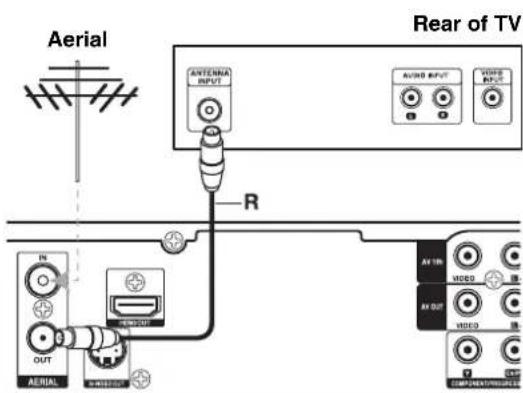
Rear of the recorder
Connections to Your TV
Make one of the following connections, depending on the capabilities of your existing equipment.
Tips:
- Depending on your TV and other equipment you wish to connect, there are various ways you could connect the recorder. Use only one of the connections described below.
- Please refer to the manuals of your TV, VCR, Stereo System or other devices as necessary to make the best connections.

Caution
- Make sure the recorder is connected directly to the TV. Tune the TV to the correct video input channel.
- Do not connect the recorder's AUDIO OUT jack to the phono in jack (record deck) of your audio system.
- Do not connect your recorder via your VCR. The DVD image could be distorted by the copy protection system.
Rear of TV
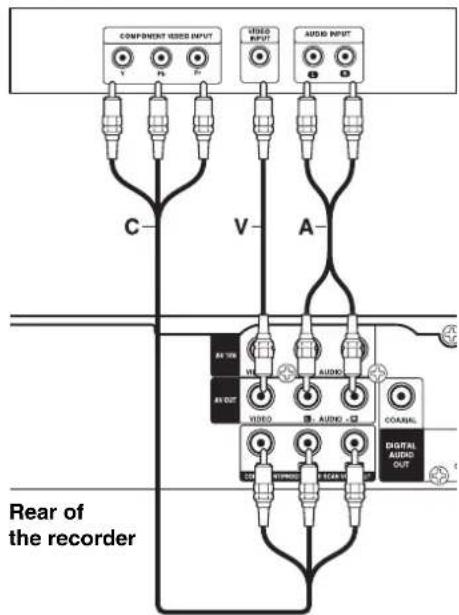
Video connection
Connect the VIDEO OUT jack on the recorder to the video in jack on the TV using the video cable (V).
S-Video connection
Connect the S-VIDEO OUT jack on the recorder to the S-Video in jack on the TV using the S-Video cable (S).
Component Video connection
Connect the COMPONENT/PROGRESSIVE SCAN VIDEO OUT jacks on the recorder to the corresponding input jacks on the TV using an Y Pb Pr cable (C).
Progressive Scan connection
If your television is a high-definition or "digital ready" television, you may take advantage of the recorder's progressive scan output for the highest video resolution possible. If your TV does not accept the Progressive Scan format, the picture will appear scrambled if you try Progressive Scan on the recorder.
Set the resolution to 576p using RESOLUTION button for progressive signal.
Note:
Progressive scan does not work with the analog video connections (yellow VIDEO OUT jack).

Caution
If the resolution is set to 720p or 1080i, the VIDEO OUT, S-VIDEO OUT and COMPONENT VIDEO OUT connections are not available.
Audio (Left/Right) Connection
Connect the left and right AUDIO OUT jacks of the recorder to the audio left and right IN jacks on the TV using the audio cables (A). Do not connect the recorder's AUDIO OUT jack to the phono in jack (record deck) of your audio system.
HDMI connection
If you have a HDMI TV or monitor, you can connect it to this recorder using a HDMI cable.
Be sure to use an HDMI cable with HDMI logo (HDMI).
- Connect the HDMI jack on the recorder to the HDMI jack on a HDMI compatible TV or monitor (H).
- Set the TV's source to HDMI (refer to TV's Owner's manual).
Tip:
When you use HDMI connection, you can change the resolution (576i, 576p, 720p, or 1080i) for the HDMI output using RESOLUTION button. (See pages 10, 11) Press the RESOLUTION button once to show the current setting in the display window on the front of the unit. Pressing the RESOLUTION button again within about 2 seconds switches the resolution setting in the following order: 576i→576p→720p→1080i.
- When the resolution is set to 720p or 1080i, the TV Aspect setting on the Setup menu is fixed at "16:9".

Caution
- Some TVs with HDMI interface do not support "Progressive Scan OFF mode: 576i". If no image appears when the HDMI connectors on recorder and the TV are joined, connect the analog VIDEO OUT jack to the video input on TV, in order to display the image through the recorder. Then press the RESOLUTION button on the front of the unit repeatedly until the image appears.
- Changing the resolution when the recorder is connected with HDMI connector may result in malfunctions. To solve the problem, turn off the recorder and then turn it on again.
Notes:
- If your TV is NOT capable of handling 96 kHz sampling frequency, set the [Sampling Freq.] option to [48 kHz] on the setup menu (See page 20). When this choice is made, this unit will automatically convert any 96 kHz signals to 48 kHz so your system can decode them.
- If your TV is not equipped with Dolby Digital and MPEG decoder, set the [Dolby Digital] and [MPEG] options to [PCM] on the setup menu (See page 20).
- If your TV is not equipped with DTS decoder, set the [DTS] options to [OFF] on the setup menu (See page 20). To enjoy DTS multi channel surround, you must connect this recorder to a DTS compatible receiver via one of this recorder's digital audio outputs.
- The arrow on the cable connector body should face up for correct alignment with the connector on the recorder.
- If there is noise or lines on the screen, please check the HDMI cable.
HDMI compatible TV
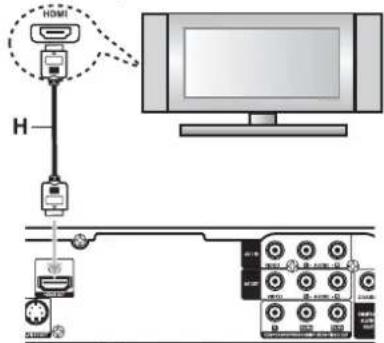
Rear of the recorder
About HDMI
HDMI (High Definition Multimedia Interface) supports both video and audio on a single digital connection for use with DVD Players, Set-Top Boxes, and other AV devices.
HDMI was developed to provide the technologies of HDCP (High-bandwidth Digital Content Protection). HDCP is used to protect digital content transmitted and received.
HDMI has the capability to support standard, enhanced, or high-definition video plus standard to multi-channel surround-sound audio, HDMI features include uncompressed digital video, a bandwidth of up to 5 gigabytes per second, one connector (instead of several cables and connectors), and communication between the AV source and AV devices such as DTVs.
HDMI, the HDMI logo and High-Definition Multimedia Interface are trademarks or registered trademarks of HDMI licensing LLC.
Additional Information for HDMI
- When you connect a HDMI or DVI compatible device make sure of the followings:
- Try switching off the HDMI/DVI device and this recorder. Next, switch on the HDMI/DVI device and leave it for around 30 seconds, then switch on this recorder.
- The connected device's video input is set correctly for this unit.
- The connected device is compatible with 720(1440)×576i, 720×576p, 1280×720p, or 1920×1080i video input.
- Not all HDCP-compatible DVI devices will work with this recorder.
- It's impossible copy protected-DVD title's playback in non-HDCP devices.
Connecting to an Amplifier
Connecting to an amplifier equipped with two channel analog stereo or Dolby Pro Logic II/Pro Logic
Connect the Left and Right AUDIO OUT jacks on the recorder to the audio left and right in jacks on your amplifier, receiver, or stereo system, using the audio cables (A).
Connecting to an amplifier equipped with two channel digital stereo (PCM) or to an Audio/Video receiver equipped with a multi-channel decoder (Dolby Digital™, MPEG 2, or DTS)
- Connect one of the recorder's DIGITAL AUDIO OUT jacks (OPTICAL O or COAXIAL X) to the corresponding in jack on your amplifier. Use an optional digital (optical O or coaxial X) audio cable.
- You will need to activate the recorder's digital output. (See "Audio Settings" on page 19).
Digital Multi-channel sound
A digital multi-channel connection provides the best sound quality. For this you need a multi-channel Audio/Video receiver that supports one or more of the audio formats supported by your recorder (MPEG 2, Dolby Digital and DTS). Check the receiver manual and the logos on the front of the receiver.

Caution
Due to the DTS Licensing agreement, the digital output will be in DTS digital out when DTS audio stream is selected.
Notes:
- Six Channel Digital Surround Sound via digital connection can only be obtained if your receiver is equipped with a Digital Multi-channel decoder.
- To see the audio format of the current DVD in the on-screen display, press AUDIO.
- This recorder does not perform internal (2 channel) decoding of a DTS sound track. To enjoy DTS multi channel surround, you must connect this recorder to a DTS compatible receiver via one of this recorder's digital audio outputs.
Rear of the recorder
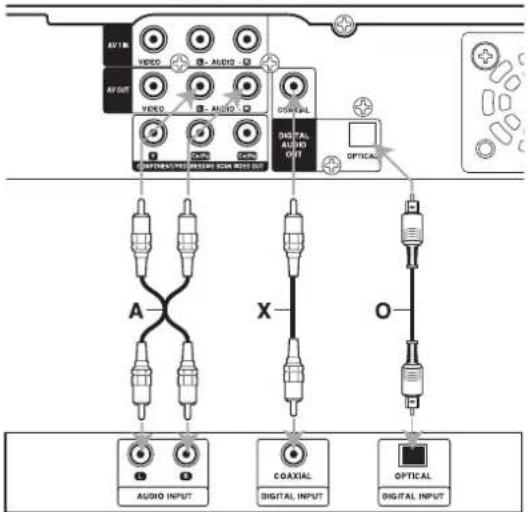
Amplifier (Receiver)
Manufactured under license from Dolby Laboratories. "Dolby", "Pro Logic", and the double-D symbol are trademarks of Dolby Laboratories.
"DTS" and "DTS Digital Out" are trademarks of DTS, Inc.
Accessory Audio/Video Connections
Notes:
• Pictures containing copy protection signals that prohibit any copying cannot be recorded.
- If you pass the recorder signals via the VCR, you may not receive a clear image on your TV screen. Be sure to connect your VCR to the recorder and your TV in the order shown below. To watch video tapes, watch the tapes through a second line input on your TV.
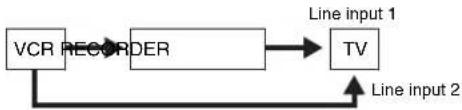
flowchart
graph LR
    A["VCR"] --> B["RECORDER"]
    B --> C["TV"]
    C --> D["Line input 1"]
    C --> E["Line input 2"]
- If you disconnect the recorder's mains lead, you will not be able to view the signals from the connected VCR or tuner.
Connecting to the INPUT 1 or INPUT 2 Jacks
Connect the input jacks (AV1 IN, AV2 IN) on the recorder to the audio/video out jacks on your accessory component, using audio/video cables.
Note:
If you use the S-VIDEO IN jack on the front panel, the VIDEO IN jack on the front panel is not available.
Jack panel of Accessory Component (VCR, Camcorder, etc.)
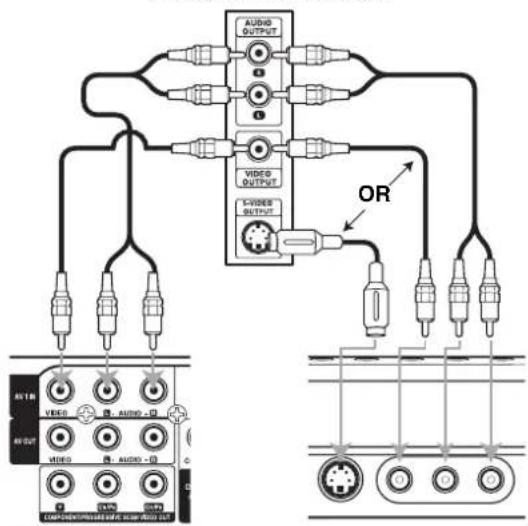
Rear of the recorder
Front of the recorder
Connecting a Digital Camcorder
Using the front panel DV IN jack, it is possible to connect a DV digital camcorder and digitally transfer DV tapes to DVD.
Use a DV cable (not supplied) to connect the DV in/out jack of your DV camcorder to the front panel DV IN jack of this recorder.
(See page 43 for operating input switch.)
Notes:
- This jack is for connection to DV digital camcorder only. It is not compatible with digital satellite tuners or D-VHS video decks.
- The DV IN jack cannot be used to connect some devices.
- No copy-guarded signal can be recorded.
- When you turn the recorder on after connecting the DV cable, the recorder may not recognize the DV digital camcorder.
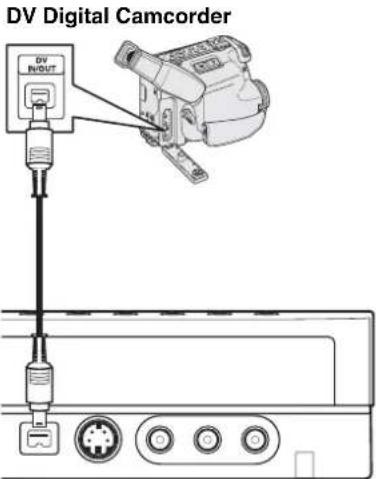
Front of the recorder
natural_image
Pure geometric diagram with crosshair and circle shapes, no text or symbols present
natural_image
Three geometric diagrams with crosshair and circular patterns, no text or symbols presentUsing the Home Menu
From the Home Menu screen you can access all the Media (HDD, DISC, MEMORY CARD) for playback and recording of the recorder.
- Press HOME to display the Home Menu screen.
- Use the ◀/▶ buttons to select a main option you want. Sub options appearss.
- Use the ▲ / ▼ and ENTER buttons to select the sub option you want.
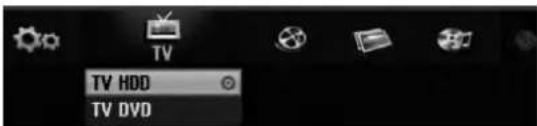
- To exit the HOME menu, press HOME.
TV
• TV HDD: Returns to live TV viewing for HDD recording. Pressing the HDD button on the remote control will also allow you to directly choose this option.
• TV DVD: Returns to live TV viewing for DVD recording. Pressing the DVD button on the remote control will also allow you to directly choose this option.
MOVIE
- HDD: Displays the Title List menu for HDD. (page 45)
- HDD DivX: Displays the [Movie List] menu for HDD. (page 28)
• DISC:
– Displays Title List menu for recordable disc. (page 45)
- Displays [Movie List] menu for DivX disc. (page 28)
- Plays back Video CD or DVD-Video disc. (page 25-28)
PHOTO (See page 32)
• HDD: Displays [Photo List] menu for HDD.
• DISC: Displays [Photo List] menu for disc.
- Memory Card 1/2: Displays [Photo List] menu for memory card.
MUSIC (See page 30)
• HDD: Displays [Music List] menu for HDD.
- DISC: Displays [Music List] (or Audio CD) menu for disc.
- Memory Card 1/2: Displays [Music List] menu for memory card.
SETUP (See page 17)
- Start: Displays Setup menu.
Initial Settings
In this menu system, there are several ways to customize the settings provided. Most menus consist of three levels to set up the options, but some require greater depth for the variety of settings.
General Operation
- Press SETUP and the Setup menu appears.
- Use ▲ / ▼ to select the desired option.
- While the desired item is selected, press ▶ to move to the second level.
- Use ▲ / ▼ to select the second desired option.
- Press ▶ to move to the third level.
- Use ▲ / ▼ to select the desired setting then press ENTER to confirm your selection. Some items require additional steps.
- Press SETUP to exit the Setup menu.
Note:
Press ◀ to go back to the previous level.
General Settings
Auto Programming
This recorder is equipped with a frequency synthesized tuner capable of receiving up to 88 TV channels.
Preparation:
- Connect the recorder to the desired type of aerial, as shown in Connecting to the Aerial on page 12.
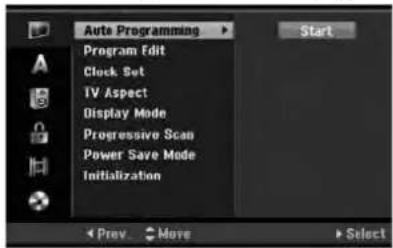
- Select the [Auto Programming] option.
- Press ▶ to move to the third level. [Start] icon is highlighted.
- Press ENTER to begin the channel search. The tuner will automatically cycle through all available channels in the area and place them in the tuner's memory.
Note:
After you have connected your recorder for the very first time. If you press SETUP for initial setting, you can only set the [Auto Programming] option. Then you can set the other options.
Program Edit
You can edit a channel manually (add, delete, name, move, etc.).
- Select [Program Edit] option then press ▶.
- Press ENTER while [Edit] is selected. The Program List menu appears.
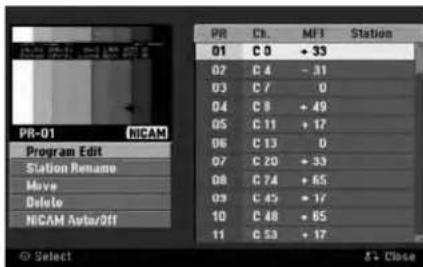
- Use ▲ / ▼ to select a PR number then press ENTER.
-
Use ▲ / ▼ to select the program option then press ENTER.
-
[Program Edit] Sets the channel manually. See "Program Edit" on the right.
• [Station Rename] Changes the station name. The display for entering characters appears. To enter characters, see page 50. Names can be up to 5 characters long. - [Move] Sorts the programme positions on the Program List. Press ▲ / ▼ to move the selected programme position to a new location.
- [Delete] Disables a programme position you do not need.
-
[NICAM Auto/off] Sets the channels for the NICAM broadcast. Normally, [NICAM] is lit on the display. If the sound from NICAM broadcast is not clear, press ENTER so [NICAM] disappears.
-
Press RETURN ( ) repeatedly to exit Program List menu.
Program Edit
You can perform a search to select and store TV channels manually.
When you select [Program Edit] in step 4 above, the display for setting channels appears.
- Use ◀ / ▶ to select the item and press ▲ / ▼ to change the setting.
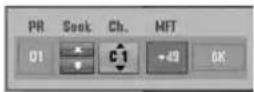
• [PR] indicates the selected programme position.
- [Seek] Searches for a channel automatically. Searching stops when the recorder tunes in a channel.
• [Ch.] Changes the channel number.
• [MFT] Fine tunes the channel to obtain a clearer picture.
- Choose OK then press ENTER to confirm the setting and returns to the Program List menu.
Manual Clock Set
- Select [Clock set] option then press ▶.
- Use ▲ / ▼ to select [Manual] option then press ENTER.
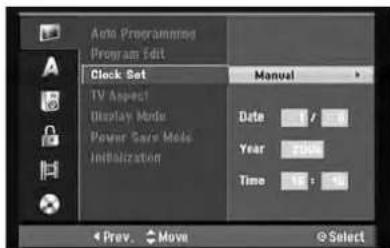
- Enter the necessary information for date and time.
◀ / ▶ (left/right): Moves the cursor to the previous or next column.
▲ / ▼ (up/down): Changes the setting at the current cursor position.
- Press ENTER to confirm your setting, then press SETUP to exit the Setup menu.
TV Aspect (Standard and Wide)
Selects the aspect ratio of the connected TV (4:3 standard or wide).
• [4:3] Select this when connecting to a 4:3 screen TV. When you select [4:3], set [Display Mode] below.
• [16:9] Select this when connecting to a wide-screen TV or TV with a wide mode function.
natural_image
Three geometric diagrams with crosshair centers and a shaded circle, no text or symbols present
natural_image
Pure geometric diagram with intersecting lines and a circular pattern (no text or symbols)Display Mode
Selects how to display a wide picture on the screen when [4:3] is selected in [TV Aspect].
• [Letter Box] Displays a wide picture with bands on the upper and lower portions of the screen.
- [Pan Scan] Automatically displays a wide picture on the entire screen and cuts off the portions that do not fit.
Power Save Mode
You can set up the unit into an economic power save mode. Nothing is displayed in the display window when the unit is turned off.
• [OFF] Power Save Mode is not active.
• [ON] Power Save Mode is active.
Initialization (HDD Format)
You can reset the recorder to its original factory settings and initialize the HDD or Memory Card.
- [Factory Set] If you need to, you can reset the recorder to all its factory settings. Some options cannot be reset. (Rating, Password, and Area Code)
- [HDD format] Initializes the HDD (Hard Disk Drive): everything recorded on the HDD will be erased.
- [M/C format] Initializes the M/C (Memory Card): everything recorded on the Memory Card will be erased.
- Select [Initialize] option then press ▶.
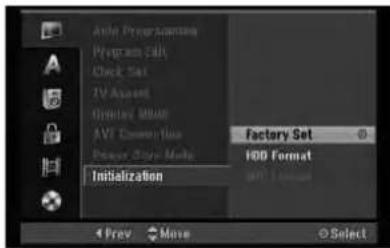
- Press ▲ / ▼ to select the desired option then press ENTER. The confirm message will appear.
- Use ◀ / ▶ to select [Yes] or [No] then press ENTER.
Language Settings
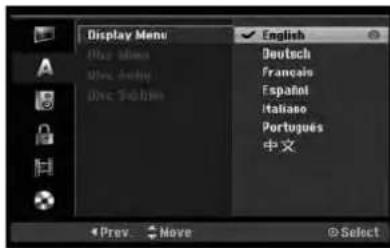
Display Menu
Select a language for the Setup menu and on-screen display.
Disc Menu/Audio/Subtitle
• [Original] Refers to the original language in which the disc was recorded.
- [Other] To select another language, press number buttons then ENTER to enter the corresponding 4-digit number according to the language code list in the reference chapter (see page 58). If you enter the wrong language code, press CLEAR.
• [Off] (for Disc Subtitle): Turn off Subtitle.
Audio Settings
Each DVD disc has a variety of audio output options. Set the recorder's Audio Output according to the type of audio system you use.
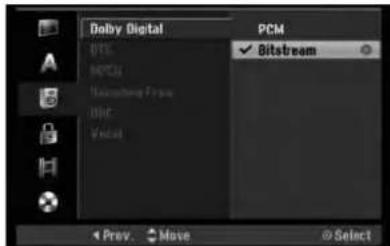
Dolby Digital / DTS / MPEG
- [Bitstream]: Select "Bitstream" if you connect the recorder's DIGITAL AUDIO OUT jack to an amplifier or other equipment with a Dolby Digital, DTS or MPEG decoder.
• [PCM] (for Dolby Digital / MPEG): Select when connected to a two-channel digital stereo amplifier. DVDs encoded in Dolby Digital or MPEG will be automatically downmixed to two-channel PCM audio. - [Off] (for DTS): If you select "Off", the DTS signal is not output through the DIGITAL AUDIO OUT jack.
Note:
If the audio format of the digital output does not match the capabilities of your receiver, the receiver will produce a strong, distorted sound or no sound at all.
Sampling Frequency
If your receiver or amplifier is NOT capable of handling 96 kHz signals, select [48 kHz]. When this choice is made, this unit will automatically convert any 96 kHz signals to 48 kHz so your system can decode them. If your receiver or amplifier is capable of handling 96 kHz signals, select [96 kHz]. When this choice is made, this unit will pass each type of signal through without any further processing.
DRC (Dynamic Range Control)
With the DVD format, you can hear a program's soundtrack in the most accurate and realistic presentation possible, thanks to digital audio technology. However, you may wish to compress the dynamic range of the audio output (the difference between the loudest sounds and the quietest ones). Then, you may listen to a movie at a lower volume without losing clarity of sound. Set DRC to [ON] for this effect.
Vocal
Set Vocal to [ON] only when a multi-channel karaoke DVD is playing. The karaoke channels on the disc will mix into normal stereo sound.
Lock (Parental Control) Settings
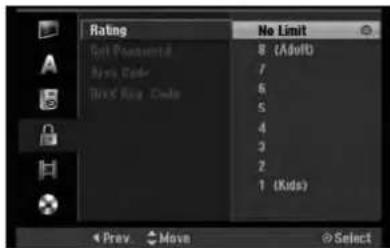
Rating
Blocks playback of rated DVDs based on their content. Not all discs are rated.
- Select [Rating] option then press ▶.
- To access the Rating, Password and Area Code features, you must input the 4-digit security code you created.
If you have not yet entered a security code you are prompted to do so. Input a 4-digit code and press ENTER. Enter it again and press ENTER to verify. If you make a mistake before pressing ENTER, press CLEAR. - Select a rating using the ▲ / ▼ buttons.
[1] - [8]: Rating one (1) has the most restrictions and rating eight (8) is the least restrictive. [No Limit]: If you select [No Limit], parental control is not active and the disc plays in full. - Press ENTER to confirm your rating selection, then press SETUP to exit the menu.
Note:
If you set a rating for the recorder, all disc scenes with the same rating or lower are played. Higher rated scenes are not played unless an alternate scene is available on the disc. The alternative must have the same rating or a lower one. If no suitable alternative is found, playback stops. You must enter the 4-digit password or change the rating level in order to play the disc.
Set Password
- Select [Set Password] option then press ▶.
- Follow step 2 as shown "Rating".
To change the password, select the [Change], press ENTER and input the new 4-digit code then press ENTER. Input it again to verify.
To delete the password, select [Delete] then press ENTER.
If you forget your 4-digit code
If you forget your password, to clear the current password, follow the procedure below.
- Press SETUP to display the Setup menu.
- Use the Number buttons to enter the 6-digit number "210499".
- Select [Yes] then press ENTER. The 4-digit password is cleared. Enter a new code.
Area Code
Enter the code of an area whose standards were used to rate the DVD video disc, referring to the list (see "Area Codes" on page 58).
- Select [Area Code] option then press ▶.
- Enter the password.
- Follow step 2 as shown "Rating".
- Select the first character using the ▲ / ▼ buttons.
- Shift the cursor using ▶ buttons and select the second character using ▲ / ▼ buttons.
- Press ENTER to confirm your area code selection, then press SETUP to exit the menu.
Note:
There is no password set under the default factory settings.
DivX® Registration Code DivX
We provide you the DivX® VOD (Video On Demand) registration code that allows you to rent and purchase videos using the DivX® VOD service. For more information, visit www.divx.com/vod.
- Select [DivX Reg. Code] option then press ▶.
- Press ENTER while [View] is selected and the registration code will appear.
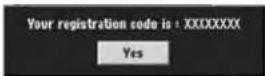
- Use the registration code to purchase or rent the videos from DivX® VOD service at www.divx.com/vod. Follow the instructions and download the video onto a disc for playback on this unit.
Note:
All the downloaded videos from DivX® VOD can only be played back on this unit.
Recording Settings
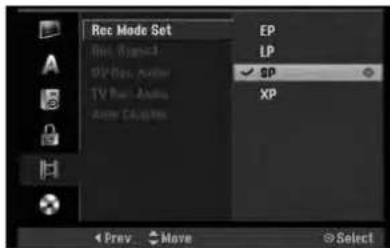
Record Mode Set
You can set the picture quality for recording; XP (High Quality), SP (Standard Quality), LP (Low Quality), EP (Extend Quality).
- Select [Rec Mode Set] option then press ▶
- Use ▲ / ▼ to select a desired Record Mode (XP, SP, LP or EP).
- Press ENTER to confirm your selection, then press SETUP to exit the menu.
Record Aspect
When DVD recording, you can set the recording aspect ratio to suit the material you're recording (16:9 or 4:3). Set [Rec Aspect] to match the aspect ratio of your TV.
DV Recording Audio
You need to set this if you have a camcorder using 32kHz/12-bit sound connected to the front panel DV IN jack.
Some digital camcorders have two stereo tracks for audio. One is recorded at the time of shooting; the other is for overdubbing after shooting.
On the Audio 1 setting, the sound that was recorded while shooting is used.
On the Audio 2 setting, the overdubbed sound is used.
TV Recording Audio
When TV recording with bilingual, you can choose audio channel to record.
[Main+Sub] Main language and Sub language [Main] Main language only
[Sub] Sub language only
Auto Chapter
When recording onto a DVD, chapter markers are put in specified setting. You can change this interval to 5 minutes, 10 minutes or 15 minutes. If you select [None], switch off automatic chapter marking altogether with the [None] setting.
Notes:
- This interval time is for reference: The actual time will slightly vary.
- When dubbing in [Fast] mode, the auto chapter feature only works with DVD-RW (Video mode)/DVD-R/DVD+RW/DVD+RW (DL)/DVD+R discs. It does not work with DVD-RAM or DVD-RW (VR mode) discs.
Moreover, the chapter interval time will vary depending on the recording mode.
Disc Settings
Disc Format
If you load a completely blank disc, the recorder will initialize the disc.
DVD-R: The recorder initialize the disc to Video mode. The recording mode will always be Video mode.
DVD-RAM/DVD-RW/DVD+RW/DVD+R (DL): The Initialize menu will appear. Select [OK] then press ENTER. DVD-RW disc is initialized to VR mode.
Also, you can reformat the DVD-RAM/DVD-RW/DVD+RW from the Setup menu as below.
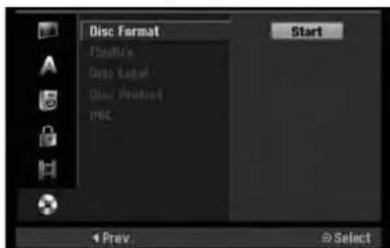
- Select [Disc Format] option then press ▶.
-
Press ENTER while [Start] is selected. Format Disc menu appears.
-
Use ◀ / ▶ to select a desired mode (VR Mode or Video Mode) then press ENTER. Confirm message will appear. For DVD-RAMs/DVD+RWs, go to step 4.
-
Use ◀ / ▶ to select [OK] then press ENTER. It takes a few moments to initialize the disc.
Note:
Even with a DVD-RAM, you must format a brand-new disc: Follow the instructions on screen.

Caution
If you want to change the disc format, everything recorded on the disc will be erased.
Finalize
Finalizing 'fixes' the recordings in place so that the disc can be played on a regular DVD player or computer equipped with a suitable DVD-ROM drive.
Finalizing a Video mode disc creates a menu screen for navigating the disc. This is accessed by pressing DISC MENU/LIST or TITLE MENU.

Caution
Once you have finalized a DVD-R and DVD+R disc, you cannot edit or record anything else on that disc except DVD+RW. However, you can record and edit a DVD-RW disc by choosing [Unfinalize] option.
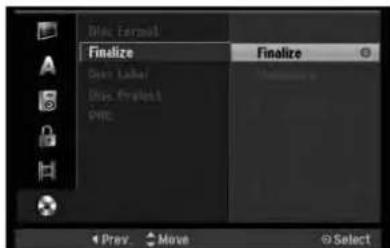
- Select [Finalize] option then press ▶.
- Press ENTER while [Finalize] is selected. Finalize menu appears.
- Select [OK] then press ENTER. The recorder starts finalizing the disc.
Notes:
- How long finalization takes depends on the type of disc, how much is recorded on the disc, and the number of titles on the disc.
- DVD+R DL disc can take up to 30 minutes to finalize.
Tips:
- If you load a DVD-RW that has already been finalized, you can 'Unfinalize' it by choosing Unfinalize from the Finalize menu. After doing this, you can edit and re-record onto the disc.
- You cannot unfinalize a DVD-R and DVD+R disc.
- If [Disc Protect] option is set to [ON], the finalize is not available. To finalize, set [Disc Protect] option to [OFF].
Disc Label
Use this to enter a name for the disc. This name appears when you load the disc and when you display disc information on-screen.
• The disc name can be up to 32 characters long.
- For discs formatted on a different recorder, you will see only a limited character set.
-
Select [Disc Label] option then press ▶.
-
Press ENTER while [Edit] is selected. Keyboard menu appears.
To enter characters, see page 50.
Disc Protect
When recording in DVD-RAM/DVD+RW/+R disc or VR mode formatted DVD-RW disc, set to [ON] to prevent accidental recording, editing or deleting of the disc loaded. If you need to unlock the disc to make edits, select [OFF].
PBC
PBC stands for Playback Control and refers to special menus and navigation features that are available on some Video CDs.
• [ON] Video CDs are played according to the PBC, if available.
• [OFF] Video CDs are played the same way as Audio CDs.


23


Playback
General Explanation of On-Screen Display
This manual gives basic instructions for operating the recorder. Some DVDs require specific operation or allow only limited operation during playback. When this occurs, the symbol appears on the TV screen, indicating that the operation is not permitted by the recorder or is not available on the disc.
Displaying Information While Watching TV During viewing the TV, press ENTER or DISPLAY to display/remove the information displayed on-screen.
e.g., when DVD-RW in VR mode is inserted.
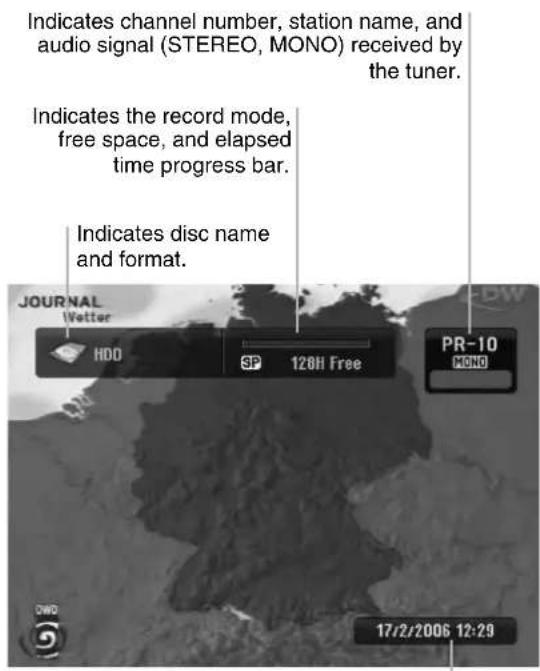
Indicates current date and time.
Displaying Disc Information on-screen
You can display various information about the disc loaded on-screen.
- Press DISPLAY once to show current status.

- Press DISPLAY once again to show various playback information.
The items displayed differ depending on the disc type or playing status.
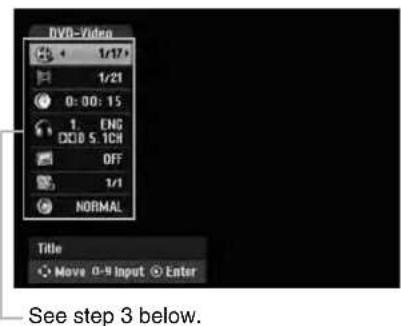
- You can select an item by pressing ▲ / ▼ and change or select the setting by pressing ◀ / ▶. For details about each item, see the pages in parentheses.
• [Title]: Current title (or track) number/total number of titles (or tracks) (page 25)
• [Chapter]: Current chapter number/total number of chapters (page 25)
• [Time]: Elapsed playing time (page 27)
• [Audio]: Selected audio language (DVD VIDEO only) or audio channel (page 26)
• [Subtitle]: Selected subtitle (page 26)
• [Angle]: Selected angle/total number of angles (page 27)
• [Sound]: Selected sound mode (page 28)
Note:
If no button is pressed for 10 seconds, the on-screen display disappears.
natural_image
Pure geometric diagram with crosshair and circle shapes, no text or symbols presentGeneral Playback Features
- Load your chosen disc in the tray, with the playback side down.
- Starts playback using HOME menu (see page 17).
- To stop the playback, press STOP (■). The unit records the stopped point, depending on the disc. “■” appears on the screen briefly. Press PLAY (▶) to resume playback (from the scene point). If you press STOP (■) again or unload the disc (“■” appears on the screen), the unit will clear the stopped point.
- Press OPEN/CLOSE ( ) to remove the disc. Press OPEN/CLOSE ( ) to close disc tray or press POWER ( ), the disc tray closes automatically and unit turns off.
Notes:
- If Parental Control is set and the disc is not within the Rating settings (not authorized), the 4-digit code must be entered and/or the disc must be authorized (see "Rating" on page 20).
- If the DV input is selected, no HDD or DVD playback will be possible.
Buttons Operations Discs
| OPEN/CLOSE (▲Opens or closes the disc tray. All Discs | |||
| PAUSE/STEP (■During playback, press PAUSE/STEP ( ) to ▶use playback. All Discs | |||
| Press PAUSE/STEP (■repeatedly to play Frame-by-Frame. | HDD | DVD ALL VCD | |
| Tip:You can advance or back up the picture frame-by-frame by pressing ◀/▶ repeatedly during PAUSE mode.The picture frame-by-frame picture in reverse is not available for Video CD. | |||
| SKIP (■During playback, press SKIP ( or ) to go to the next chapter/track or to return to the beginning of the current chapter/track.Press SKIP ▶twice briefly to step back to the previous chapter/track.Tips:To go directly to any chapter during DVD playback, press DISPLAY twice and press ▲/▼ to select the chapter icon.Then, input the chapter number or use ◀/▶.On an Audio CD, to go directly to any track, enter the track number using the numbered buttons (0-9) during playback. | HDD | VD ALL VCD | |
| DivX | ACD IP3 | ||
| WMA | |||
| SCAN (◀◀ / ▶▶) | During playback, press SCAN (◀◀ or ▶▶) repeatedly to select the required scan speed.HDD, DVD; 5 stepsDivX; 4 stepsVideo CD, Audio CD; 3 stepsNote:Noise may appear when the search speed is changed. | HDD | DVD ALL VCD |
| DivX | ACD | ||
| While the playback is paused, press SCAN (◀◀ or ▶▶) repeatedly to play in slow motion.HDD, DVD; 4 stepsVideo CD; 3 steps (Forward only) | HDD | DVD ALL VCD | |
| ZOOM | During playback or pause mode, press ZOOM to enlarge the video image.(×1 size → ×2 size → ×4 size → ×1 size (normal size))You can move through the zoomed picture using ◀▶ ▲▼ buttons.Note:The zoom function may not work for some DVDs. | HDD | DVD ALL VCD |
Buttons Operations Discs
| REPEAT During playback, press REPEAT repeatedly to select a desired repeat mode.HDD (Title/Off), DVD (Chapter/Title/Off)VR mode DVD-RW (Chapter/Title/All/Off)Video CD, Audio CD (Track/All/Off)MP3/WMA (Track/Folder/Off)Notes:On a Video CD with PBC, you must set PBC to [OFF] in the Setup menu to use the Repeat function. See page 23.If you press SKIP ( ) once during Repeat Chapter(Track) playback, the repeat playback cancels. | HDD VD ALL VCDACD IP3 VMA | |
| A-B During playback, each press of A-B button to select point A and point B and repeats a sequence from point A (Starting point) to point B (End point).Note:During HDD playback, you cannot select a sequence less than 5 seconds. | HDD VD ALL VCDACD | |
| TITLE MENU If the current DVD title has a menu, the title menu appears on the screen. Otherwise, the disc menu may appears. | DVD | |
| DISC MENU/LIST The Title List menu appears on the screen. | HDD | |
| The disc menu appears on the screen. | ||
| SUBTITLE | During playback, press SUBTITLE then press ◀ / ▶ repeatedly to select a desired subtitle language. | DVD |
| AUDIO | Press AUDIO then press ◀ / ▶ repeatedly to hear a different audio language or audio track.Note:Some discs feature both Dolby Digital and DTS soundtracks.There is no analog audio output when DTS is selected. To listen to the DTS soundtrack, connect this recorder to a DTS decoder via one of the digital outputs.See page 15 for connection details. | DVD |
| Press AUDIO then press ◀ / ▶ repeatedly during playback to hear a different audio channel (STEREO, LEFT or RIGHT).With DVD-RW discs recorded in VR mode and HDD that have both a main and a Bilingual audio channel, you can switch among Main (L), Sub (R), or Main+sub (L+R). | HDD RAM -RW VR-RWVideo -R +RW+R VCD DivX | |
| Press AUDIO repeatedly during playback to hear a different audio channel (STEREO, LEFT or RIGHT). | ACD IP3 VMA | |
| MANUAL SKIP Press MANUAL SKIP repeatedly during playback to skip forward 15 seconds.In HDD playback or Timeshift mode, each press ◀ / ▶ skips forward or reverse 5 minutes. | HDD VD ALL | |
If a menu screen is displayed DVD CD
The menu screen may be displayed first after loading a DVD or Video CD which contains a menu.
DVD
Use the ◀/▶/▲/▼ buttons to select the title/chapter you want to view, then press ENTER to start playback. Press TITLE MENU or DISC MENU/LIST to return to the menu screen.
VCD
- Use the number buttons to select the track you want to view. Press RETURN (J) to return to the menu screen.
- Menu setting and the exact operating procedures for using the menu may differ depending on the disc. Follow the instructions on the each menu screen. You may also set PBC to [OFF] under Setup menu (see page 23).
Moving to another TITLE HDD AM
-RWVR -RWVideo-R +RW-R DVD DivX
When a disc has more than one title, you can move to another title as follows:
- Press DISPLAY twice during playback then use ▲ / ▼ to select the title icon. Then, press the appropriate numbered button (0-9) or ◀ / ▶ to select a title number.
Time Search HDD AM -R N VR -RWVideo -R +RW R DVL DivX
To start playing at any chosen time on the disc:
- Press DISPLAY twice during playback. The time search box shows the elapsed playing time.
- Press ▲ / ▼ to select the time clock icon and "0:00:00" appears.
- Input the required start time in hours, minutes, and seconds from left to right. If you enter the wrong numbers, press ◀ / ▶ to move the under bar (_) to the wrong number. Then enter the correct numbers.
- Press ENTER to confirm. Playback starts from the selected time.
Marker Search
HDD AM -F V VR -RW Video -R + W +R D VD VC
To enter a Marker
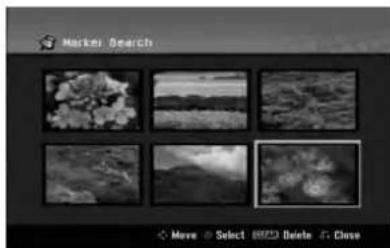
You can start playback from up to six memorized points. To enter a marker, press MARKER at the desired point on the disc. The Marker icon appears on the TV screen briefly. Repeat to enter up to six markers.
To Recall or Clear a Marked Scene
- During disc playback, press SEARCH. The marker search menu appears on the screen.
- Use ◀/▶/▲/▼ to select a marked scene that you want to recall or clear.
- Press ENTER and playback starts from the marked scene. Or, press CLEAR and the marked scene is erased from the marker search menu.
Camera Angle DVD
If the disc contains scenes recorded at different camera angles, you can change to a different camera angle during playback.
- Press ANGLE then press ◀/▶ repeatedly during playback to select a desired angle. The number of the current angle appears on the TV screen.
Tip:
The ANGLE indicator will blink on the TV screen at scenes recorded at different angles to indicate that angle switching is possible.
3D
SurrRAM RW VR -RWvideo -R
+RW R DVD VCD D vX
This unit can produce a 3D Surround effect, which simulates multi-channel audio playback from two conventional stereo speakers, instead of the five or more speakers normally required to listen to multi-channel audio from a home theater system.
- Press DISPLAY twice.
- Use ▲ / ▼ to choose "Sound".
- Use ◀ / ▶ to choose the following option:
- Press ◀/▶ repeatedly during playback to select [3D SUR.].
• To turn off the 3D Surround effect, select [NORMAL].
Last Condition Memory DVD
This recorder memorizes the user settings for the last disc that you have viewed. Settings remain in memory even if you remove the disc from the recorder or switch off the recorder. If you load a disc that had its settings memorized, the latest stop position is automatically recalled.
Notes:
- Settings are stored in memory for use any time.
- This recorder does not memorize settings of a disc if you switch off the recorder before commencing to play it.
Playing a DivX® Movie File
The recorder can play DivX ^® files. Before playing DivX ^® files, read "DivX file requirement" on page 29.
Note:
This recorder cannot play back the DivX® file(s) in the Memory Card.
- Press HOME then select [MOVIE] option.
- Select a media that contains DivX ^ file(s) then press ENTER. The [Movie List] menu appears on the TV screen.
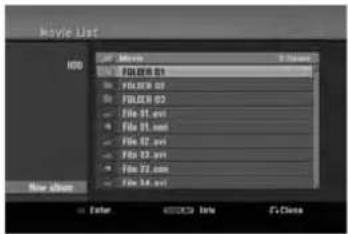
- Press ▲ / ▼ to select a folder, and press ENTER. A list of files in the folder appears. If you are in a file list and want to return to the Folder list, use the ▲ / ▼ buttons on the remote to highlight and press ENTER.
- If you want to view a particular file, press ▲ / ▼ to highlight a file and press ▶(PLAY). You can use variable playback functions. Refer to pages 25-28.
- Press ■ (STOP) to stop the playback. The Movie menu appears.
Notice for displaying the DivX® subtitle
Please refer to following notice when the DivX ^® subtitle does not display properly.
- Find a suitable language for the DivX ^® subtitle on the figure below.
| Disc Subtitle Language Available DivX® Subtitle | |
| Original, English English | |
| French, German, Italian, Spanish, Portuguese | French, German, Italian, Spanish, Portuguese, Dutch, Swedish |
| Russian Russian | |
| Other 6976 Greek | |
| Other 7665 Polish, Hungarian, Czech | |
natural_image
Pure geometric diagram with crosshair and circle shapes, no text or symbols present
natural_image
Pure geometric diagram with intersecting lines and a circular pattern (no text or symbols)- Press SETUP. The Setup menu appears. Press SETUP ➔ [LANGUAGE] ➔ [Disc Subtitle] then select the language you have found. Refer to "Disc Menu/Audio/Subtitle" on page 19.
Tip:
If the subtitle still does not display properly after the steps 1-2 proceeded, press and hold SUBTITLE about 3 seconds then press ◀ / ▶ to select another language code during playback until the subtitle is displayed properly.
Movie List menu options
- Press ▲ / ▼ to select a folder/file on the [Movie List] menu then press ENTER. [Movie List] menu options appear. The menu options displayed differ depending on the selected media.
- Press ▲ / ▼ / ◀ / ▶ to select an option, and press ENTER.
• [Play] Start playback the selected title.
- [Open] Opens the folder and a list of files in the folder appears
- [Delete] Deletes the file(s) or folder(s) from the media.
• [Rename] Edits the file name. (page 34)
• [Move] Moves the file(s) to another folder or media. (page 35)
• [Copy] Copies the file(s) to another folder or media. (page 35)
DivX file requirement
Available resolution size: 720×576 (W × H) pixel DivX file extensions: ".avi", ".divx"
playable DivX subtitle: ".smi", ".srt", ".sub (Micro DVD format only)", ".txt (Micro DVD format only)"
Playable Codec format: "DIV3", "MP43", "DIVX", "XVID", "DX50"
playable Audio format: "AC3", "PCM", "MP2", "MP3", "WMA"
- Sampling frequency: within 8 - 48kHz (MP3), within 32 - 48kHz (WMA)
- Bit rate: within 8 - 320kbps (MP3), 32 - 192kbps (WMA)
CD-R Format: ISO 9660 and JOLIET.
DVD±R/RW Format: ISO 9660 (UDF Bridge format) Maximum Files/Disc: Less than 1999 (total number of files and folders)
Notes on DivX format
- If the number of the screen frame is over 29.97 frames per second, this unit may not operate normally. - If the video and audio structure of recorded file is not interleaved, returns to the menu screen.
- If the file is recorded with GMC, the unit supports only 1-point of the record level. *GMC?
GMC is the acronym for Global Motion Compensation. It is an encoding tool specified in MPEG4 standard. Some MPEG4 encoders, like DivX or Xvid, have this option.
There are different levels of GMC encoding, usually called 1-point, 2-point, or 3-point GMC.


Playing an Audio CD or MP3/WMA file
The recorder can play audio CDs and MP3/WMA files. Before playing MP3/WMA files, read "MP3/WMA audio file requirement" on page 30.
- Press HOME.
The HOME menu appears. - Select [MUSIC] option.
- Select a media that contains MP3/WMA or audio title then press ENTER. The [Music List] menu appears on the TV screen.
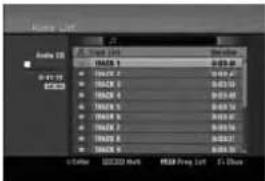
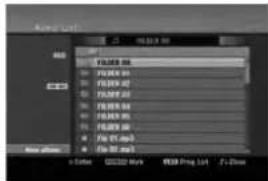
- Use ▲ / ▼ to select a track then press ▶ (PLAY). Playback starts.
You can use variable playback functions. Refer to pages 25-28.
Tips:
- Press DISPLAY to view ID3-Tag information for the MP3 file. If ID3-Tag information is not present, [ID3-Tag: None] will appear. If you select a folder, the number of subfolders and number of MP3/WMA files in the folder are displayed. Press DISPLAY again to remove the information screen.
- If you want to move to the upper directory, use the ▲ / ▼ to highlight 🔒 and press ENTER.
-
You can also display HOME menu to select another media by pressing RETURN ( )
-
To stop playback at any time, press ■ (STOP).
Tip:
You can create new folder. Select [New Album] option on the Music-HDD or Music-Memory Card menu then press ENTER. "NONAME##" folder is created.
Audio CD and Music menu options
- Press ▲ / ▼ to select a folder/file on the Audio CD or Music menu then press ENTER. The menu options appear. The menu options displayed differ depending on the selected media.
- Press ▲ / ▼ / ◀ / ▶ to select an option, and press ENTER.
• [Play] Start playback the selected title.
• [Random] Start or stop random playback.
- [Open] Opens the folder and a list of files in the folder appears
- [Delete] Deletes the file(s) from the media.
• [Rename] Edits the file name. (page 34)
- [Move] Moves the file(s) to another folder or media. (page 35)
• [Copy] Copies the file(s) to another folder or media. (page 35)
- [Program add] Adds the track(s) to Program List. (page 18)
Random
- Press RANDOM during playback or in stop mode. The unit automatically begins Random Playback and "RANDOM" appears on the menu screen.
- To return to normal playback, press RANDOM repeatedly until "RANDOM" disappears from the menu screen.
Tip:
By pressing ▶(SKIP) during Random playback, the unit selects another track and resumes Random playback.
MP3/WMA audio file requirement
File extensions
".mp3", ".wma".
Sampling frequency:
within 8 - 48kHz (MP3), within 32 - 48kHz (WMA)
Bit rate:
within 8 - 320kbps (MP3), 32 - 192kbps (WMA)
CD-R Format:
ISO 9660 and JOLIET.
DVD±R/RW Format:
ISO 9660 (UDF Bridge format)
Maximum Files/Disc:
Less than 1999 (total number of files and folders)
natural_image
Pure geometric diagram with crosshair and circle shapes, no text or symbols present
natural_image
Pure geometric diagram with crosshair and circular pattern (no text or symbols)Program Playback with Audio CD/MP3/WMA
Program Playback enables you to make custom playlists of Audio CD or MP3/WMA tracks. Programs can contain up to 99 Audio CD tracks or 256 MP3/WMA files.
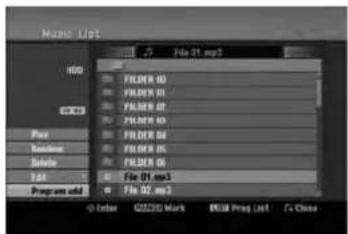
- Use ▲ / ▼ to select a track/file (or folder) on the Audio CD or Music menu.
You can select all files and folders on the Music menu by pressing CLEAR button. To cancel the selections, press CLEAR again.
Selecting multiple files/tracks (folders)
- Press MARKER.
A check mark appears on the file/track or folder. Press MARKER again to cancel the marked file/track or folder.
-
Repeat step 1 to mark additional file/track (folders).
-
Press ENTER.
The options appear on the left side of the menu.
-
Use ▲ / ▼ to select the [Program add] option then press ENTER.
-
Repeat steps 1-3 to mark additional tracks.
Note:
If you select a folder for Programmed Playback, all tracks/files in the folder are added to the Program List.
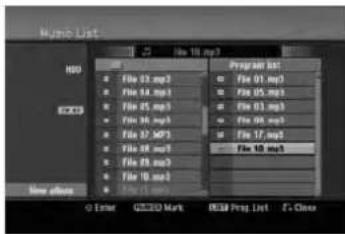
- Use ▶ to move to the Program list.
The programmed track you selected last is highlighted on the program list.
-
Use ▲ / ▼ to select the track you want to start playing.
-
Press (PLAY) to start.
Playback stops after playing the last programmed track in the program list.
- To exit Program Playback and resume normal playback, select a track on the List and press (PLAY).
Tip:
You can access or remove the Program List screen by pressing DISC MENU/LIST.
Program List menu options
- Press ▲ / ▼ to select a track/file on the Program List then press ENTER. The menu options appear.
- Use ▲ / ▼ to select an option then press ENTER to confirm your selection.
• [Play] Playback begins in the order in which you programmed the tracks from the selected track.
• [Random] Start or stop random playback.
- [Delete] Deletes the track(s) from the Program List menu.
- [Move] Moves the track(s) to change the program order.
• [Save] Memorizes the program list. (HDD only)
Repeat Programmed Tracks
Press REPEAT to select the desired Repeat mode.
• [TRACK] Repeats the current track.
• [ALL] Repeats all tracks on the Program List.
• [OFF] Cancels Repeat mode (no display).
Erasing a Track from the Program List
-
Select the track you wish to erase from the Program List. Use MARKER button to select multiple tracks.
-
Press ENTER. The menu options appears.
-
Select [Delete] option then press ENTER.
Changing Track Order in the Program List
-
Select the track you wish to move on the Program List. Use MARKER button to select multiple tracks.
-
Press ENTER. The menu options appears.
-
Select [Move] option then press ENTER.
-
Use ▲ / ▼ to move the yellow bar to the desired location, then press ENTER.
Save Your Program List (HDD)
This recorder memorizes the user program list that you have programmed.
-
Select a track on the Program List. The menu options appear.
-
Select [Save] option then press ENTER. The Program List is saved in the HDD's PROGRAM folder.
Viewing a JPEG File
The recorder can play JPEG files on HDD, DVD-RAM, DVD±RW/R, CD-R/RW, or Memory Card. Before playing JPEG recordings, read "Photo file requirement" on page 33.
- Press HOME.
The HOME menu appears.
-
Select [PHOTO] option.
-
Select a media that contains JPEG file then press ENTER.
The [Photo List] menu appears on the TV screen.
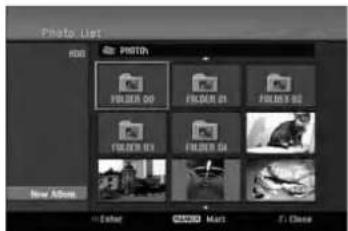
- Use ◀/▶/▲/▼ to select a folder, then press ENTER.
The menu options appear on the left side of the menu.
Tips:
- If you want to move to the upper directory, use the ▲ / ▼ to highlight and press ENTER.
- You can also display HOME menu to select another media by pressing RETURN (♪)
- Use ▲ / ▼ to select [Full Screen] then press ENTER.
The selected image is displayed in full screen. Depending upon the size and number of JPEG files, it could take a long time for the recorder to read the files.
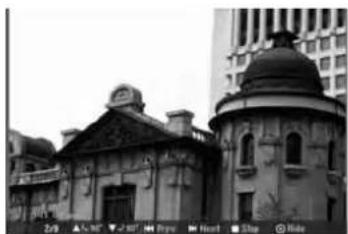
natural_image
Exterior view of a historic building with domed architecture and modern skyscraper in background (no signage)Press ENTER to appear or disappear this menu during viewing the full screen.
- To stop viewing at any time, press ■ (STOP). The [Photo List] menu appears.
Photo List menu options
- Press ▲ / ▼ to select a file on the Program List then press ENTER.
The menu options appear.
The menu options displayed differ depending on the selected media.
You can select all files and folders on the menu by pressing CLEAR button. To cancel the selections, press CLEAR again.
Selecting multiple files (folders)
- Press MARKER.
A check mark appears on the file or folder.
Press MARKER again to cancel the marked file or folder.
-
Repeat step 1 to mark additional file (folders).
-
Use ▲ / ▼ to select an option then press ENTER to confirm your selection.
- [Open] Opens the folder and a list of files in the folder appears
• [Full Screen] Shows the selected file as full screen.
- [Delete] Deletes the selected file from the media.
• [Slide Show] Displays Slide Show menu.
• [Rename] Edits the file name. (page 34)
• [Move] Moves the file(s) to another folder (album) or media. (page 35)
• [Copy] Copies the file(s) to another folder or media. (page 35)
Tip:
You can create new folder in the HDD or Memory Card. Select [New Album] option then press ENTER. "NONAME##" folder is created.
Photo file requirement
File extensions
-jpg
Photo size:
Less than 4MB recommended
CD-R Format:
ISO 9660 and JOLIET.
DVD±R/RW Format:
ISO 9660 (UDF Bridge format)
Maximum Files/Disc:
Less than 1999 (total number of files and folders)
Notes on JPEG file
Progressive and lossless compression JPEG image files are not supported.
Skip Images
While viewing a picture, press ↕◀(SKID) once to advance to the next file or return to the previous file.
Rotate Images
Use ▲ / ▼ while viewing a picture to flip the picture clockwise or counterclockwise.
View Slide Shows
-
Select [Slide Show] option on the [Photo List] menu (Refer to "Photo List menu options" on page 32).
-
Press ENTER.
The Slide Show menu appears.
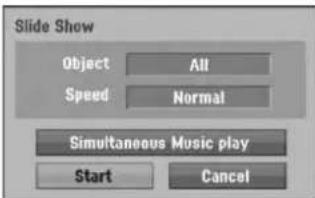
- Use ◀/▶/▲/▼ to set the options.
[Object] option:
- [Selected] Views slide show only selected files. Use the MARKER button to select multiple files.
• [All] Views slide show all files.
[Speed] option:
Sets the Slide Show speed to [Slow], [Normal], or [Fast].
- Select the [Start] option then press ENTER to start the Slide Show.
- Press ■ (STOP) to stop the Slide Show and returns to the [Photo List] menu.
To Pause the Slide Show
- Press (PAUSE/STEP) to pause slide show.
- When you want to continue slide show, press ▶ (PLAY).
To listen to music while slide show simultaneously You can display photo files while listening to MP3/WMA music files recorded on HDD.
- Select [Slide Show] option on the [Photo List] menu (Refer to "Photo List menu options" on page 32).
- Press ENTER.
The Slide Show menu appears.
- Select [Simultaneous Music play] option on the Slide Show menu.
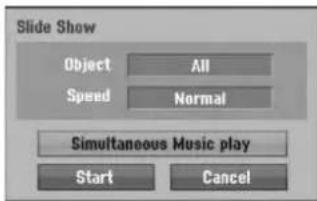
- Press ENTER.
Simultaneous Music play menu appears.
-
Press MARKER to select multiple files.
-
Select [Select All] option to select all tracks then press ENTER.
- Select [Deselect All] option to deselect all selected tracks then press ENTER.
-
Select [Cancel] option to exit this menu then press ENTER.
-
Use ◀ / ▶ / ▲ / ▼ to highlight [Start] option then press ENTER.
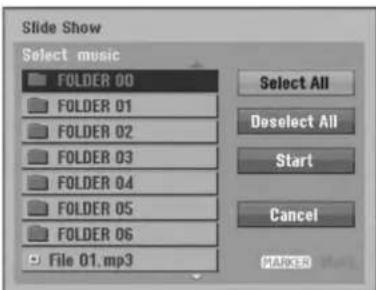
- Press ■ (STOP) to stop the Slide Show and return to the [Photo List] menu.
Editing a MP3/WMA, JPEG, DivX® file
These descriptions are MP3 file's operation for example, other kind's files are operated same way.
Notes:
- The MP3/WMA, and DivX ^® files on the disc or HDD cannot be copied or moved to Memory Card.
- The DivX ^® file(s) in the memory card is not available.
Erasing a file(s)/folder(s)
You can erase MP3/WMA, JPEG or DivX® file(s)/folder(s) on the HDD or Memory Card.
- Select a file you wish to erase on the menu. You can select all files and folders on the menu by pressing CLEAR button. To cancel the selections, press CLEAR again.
Selecting multiple files (folders)
-
Press MARKER. A check mark appears on the file or folder. Press MARKER again to cancel the marked file or folder.
-
Repeat step 1 to mark additional file (folders).
-
Press ENTER.
The menu options appear on the menu.
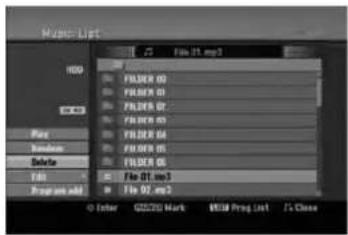
- Select [Delete] option then press ENTER. The selected file(s) is deleted from HDD or Memory Card.
Naming a file
You can name MP3/WMA files on the HDD or Memory Card independently. Names can be up to 32 characters long.
- Select a file you wish to rename on the menu.
- Press ENTER. The menu options appear on the menu.
- Select [Edit] option then press ENTER. Edit options appears.
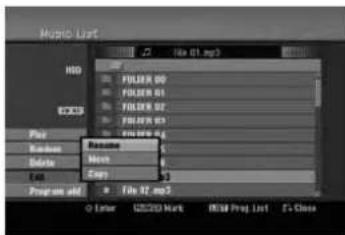
- Select [Rename] option then press ENTER. Keyboard menu appears. To enter characters, see page 50.
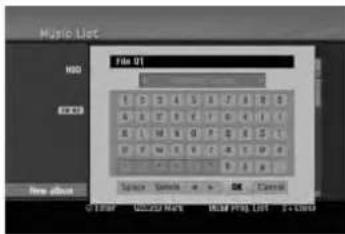
natural_image
Abstract geometric diagram with intersecting lines and a shaded circle, no text or symbols present
natural_image
Pure geometric diagram with intersecting lines and a circular pattern (no text or symbols)Copying a file(s) to another media or folder
You can copy a file(s)/folder(s) to another media or folder.
- Select a file you wish to copy on the menu. You can select all files and folders on the menu by pressing CLEAR button. To cancel the selections, press CLEAR again.
Selecting multiple files (folders)
- Press MARKER.
A check mark appears on the file or folder.
Press MARKER again to cancel the marked file or folder.
-
Repeat step 1 to mark additional file (folders).
-
Press ENTER.
The menu options appear on the menu.
-
Select [Edit] option then press ENTER. Edit options appears.
-
Select [Copy] option then press ENTER. Copy menu appears.
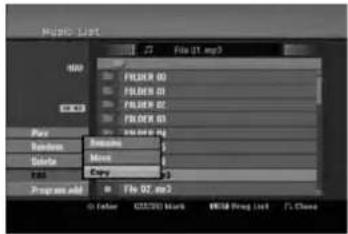
-
You can select an album (folder) to copy.
-
After selecting a media then press ENTER. The album (folder) list appears.
-
Select a folder. Also, you can create new album (folder). Select [New Album] option on the Copy menu then press ENTER. "NONAME##" folder is created.
-
Select [Copy] option then press ENTER to begin copying.
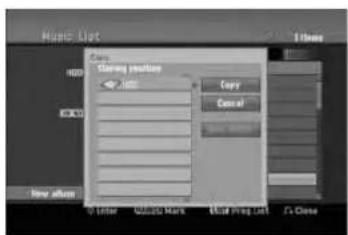
Note:
If a folder's depth is more than 5 level, the copy is not available.
Moving a file(s)
You can move a file(s)/folder(s) to another media or folder. After moving, the file(s)/folder(s) are deleted from the current location.
-
Follow steps 1-3 as shown left.
-
Press ENTER.
The options appear on the left side of the menu.
- Select [Move] option then press ENTER. Move menu will appear.
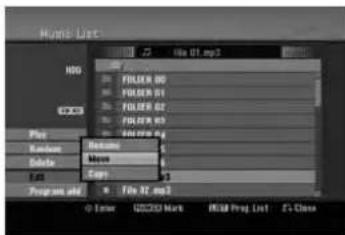
-
You can select an album (folder) to move.
-
After selecting a media then press ENTER. The album (folder) list appears.
-
Select a folder.
Also, you can create new album (folder). Select [New Album] option on the Move menu then press ENTER.
"NONAME##" folder is created.
- Select [Move] option then press ENTER to begin moving.
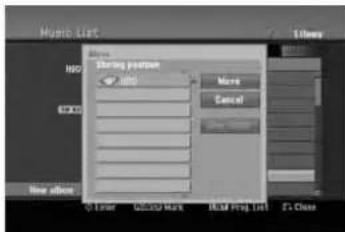
Recording
About DVD recording
Notes:
- This recorder cannot make recordings on CD-R or CD-RW discs.
- Our company takes no responsibility for recording failure due to power outages, defective discs, or damage to the Recorder.
- Fingerprints and small scratches on a disc can affect playback and/or recording performance. Please take proper care of your discs.
Disc types
This recorder can play five different kinds of DVD discs: Pre-recorded DVD-Video discs, DVD-RAM, DVD-RW, DVD-R, DVD+RW and DVD+R discs. The disc format for DVD-R, DVD+RW, DVD+R discs is always "Video format"—the same as pre-recorded DVD-Video discs. This means that once finalized, you can play a DVD-R, DVD+RW, or DVD+R in a regular DVD player. The DVD-RAM disc format is Video Recording (VR) format. By default, the DVD-RW disc format is Video Recording (VR) format, though you can change this to Video format, if required. (Reinitializing the disc will erase the contents of the disc.)
Recording modes
If the disc format is Video Recording format, then the recording mode is VR mode; if the disc format is Video mode, then the recording mode is Video mode. Record settings can be changed as required for each recording and determine the picture quality and how much space the recording will take up on the disc.
About HDD recording
Recording to the internal hard disk drive (HDD) is basically similar to recording to a VR mode DVD-RAM disc. You have the full choice of recording quality options, including the manual mode, and of course you can record, erase and re-record as many times as you like. The capacity of the hard disk drive means that you can store many hours of video on it, even in the higher quality recording modes. To help you organize the contents, the HDD is divided into ten genre. You can name and use these genres as you like—for example, you might have a genre for movies, another for TV shows, and one for camcorder recordings.
Notes:
- The maximum number of titles that can be recorded on the HDD is 255.
- Using the HDD allows you to record a maximum of 12 hours continuously.
Notes for recording
- -RW sure you change the recording format (Video mode or VR mode) before you record anything on the disc. See page 22 (Disc Format) for how to do this.
• +RW rite recording is available. - +RW -R will execute the Menu-making operation to update the new title and editing when removing the disc from the recorder. Always set the recorder to the DVD mode before using the ▲ (OPEN/CLOSE) button to remove the disc.
Notes for recording time
- When recording a TV broadcast, if the reception is poor or the picture contains interference, the recording times may be shorter.
- The recording time available may decrease if you heavily edit a disc.
- The recording times shown are not exact because the recorder uses variable bit-rate video compression so the displayed times for recording and time remaining may not always add up to exactly the length of the disc.
- If you record still pictures or audio only, the recording time may be longer.
- When using a DVD-R or DVD+R disc, you can keep recording until the disc is full, or until you finalize the disc. Before you start a recording session, check the amount of recording time left on the disc.
- When using a DVD-RW disc in Video mode, recording time available will only increase if you erase the last title recorded on the disc.
- The Delete Title operation in the Title List (Original) menu only hides the title, it does not actually erase the title from the disc and increase the recording time available (except for the last recorded title on a DVD-RW disc in Video mode).
Recording time and picture quality
There are four preset recording quality modes:
- XP – Highest quality setting, gives about 1 hour of recording time on a DVD (4.7GB).
- SP – Default quality, sufficient for most applications, gives about 2 hours of recording time on a DVD (4.7GB).
- LP – Slightly lower video quality, gives about 4 hour of recording time on a DVD disc (4.7GB).
- EP – Lowest video quality, gives about 6 hour of recording time on a DVD (4.7GB). You may see a fragmented picture during playing back the contents recorded in EP mode.
Time Shift HDD
Do not miss a scene from a live broadcast. If the telephone rings while you are watching your favorite live broadcast, just press "TIMESHIFT" and
"11(PAUSE/STEP)" before answering the phone. The timeshift function will be activated and the broadcast is then recorded for later viewing.
After the phone call or viewing interruption, press
"(PLAY)" or "/SCAN" to watch the program.
Press "■ (STOP)" to return to the live broadcast.
Timeshift (Pause, Live TV/Playback) Operation HDD
You can store a program in the HDD storage cache temporarily.
Press TIMESHIFT while watching a TV program.
The Progress Bar display appears on the screen as shown below. The Progress Bar changes to timeshift icon after 5 seconds.
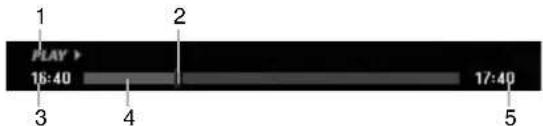
- Indicates playback mode.
- Indicates current Timeshift position.
- Indicates Timeshift start time.
- Indicates Timeshift elapsed time.
- Indicates the time that is one hour from Timeshift start time.
Tips:
- You can use trick play functions (Slow, Scan, etc.) during timeshift. Refer to Playback Operation on pages 25-28.
- You can edit the cached clip during Timeshift to retain the program on the HDD. Refer to Clip Record on the right.
Notes:
- If there is not free space on the HDD, the oldest timeshift section of the cache will be incrementally deleted.
- If no button is pressed for 6 hours, the Timeshift will stop automatically.
Marker Search in Timeshift mode
You can mark one in Timeshift mode. Press MARKER at the desired point during Timeshift.
Press SEARCH to recall the marked scene.
Clip Record HDD
You can edit during Timeshift to store the program on the HDD (Hard Disk Drive).
- During Timeshift, use pause step, search and slow-motion to find the starting point.
- Press ● (REC) at the starting point of the section you want to record. Progress of the edit is indicated in red on the Progress Bar.

- Use pause step, search and slow-motion to find the ending point.
- Press ● (REC) at the ending point of the section you want to record. Normal playback continues.
- Repeat steps 1 and 4 to make several Clip Records of a program.

- Press ■ (STOP) to stop Timeshift. Confirm message will appear.
- Use ◀ / ▶ to select [Yes] then press ENTER. Or, press ■ (STOP) again.
The current broadcast is displayed on the screen.
Notes:
- Selected sections are recorded on the HDD.
- If you want to stop Clip recording, press the ■ (STOP) button. If you press POWER to stop Clip recording, the program may not be recorded on the HDD.
- Clip records cannot be made for sections lasting less than 5 seconds.
Jump to Start or End during Timeshift
- Press ENTER during timeshift. The menu will appear.
- Press ◀ and playback starts from the very beginning of the timeshift.
Press ▶ and jumps to the very end of the timeshift then goes to pause mode.
To Exit the Timeshift
- Press ■ (STOP) to exit Timeshift function. Confirm message will appear.
- Use ◀ / ▶ to select [Yes] then press ENTER. The current broadcast is displayed on the screen.
Basic Recording from a TV
Follow the instructions below to record a TV program. Recording starts immediately and continues until the disc is full or you stop the recording.
Note:
When recording on DVD:
You must load a recordable disc for DVD recording.
- Press HOME.
The HOME menu appears.
-
Select [TV] option.
-
Select [TV HDD] or [TV DVD] option then press ENTER.
Also make sure that the TV input is set to this recorder.
If you load a completely blank disc, the recorder takes a short while to initialize the disc.
-
Set a recording mode as necessary by pressing REC MODE repeatedly. (XP, SP, LP, EP)
-
Use ▲ / ▼ buttons to select the TV channel to record.
-
Press ● (REC) once.
Recording will start. (The REC indicator lights in the display window.)
- Recording continues until you press ■ (STOP) or the disc or HDD is full.
• To record for a fixed length of time, see Instant Timer Recording on right.
- Press ■ (STOP) to stop recording.
Changing TV Audio Channel
You can select the audio channel (language) to listen by pressing AUDIO during viewing TV program. The current audio channel is displayed on-screen.
Stereo or mono broadcast:
Stereo → Left → Right → Mono
Bilingual broadcast:
Main → Sub → Main+Sub
- For TV recording with bilingual, set audio channel from the [TV Rec Audio] in sub-menu of the Setup menu (see page 21).
- If the sound is of poor quality when set to Stereo, you can often improve it by changing to Mono (Left or Right).
- This recorder can record either NICAM or regular audio. If the NICAM setting (page 18) is set to Auto, then if the broadcast is NICAM, the audio automatically changes to NICAM and you can record the NICAM audio. If the broadcast is non-NICAM, the regular audio is always recorded.
If NICAM sound distortion occurs, due to poor reception, you can switch off NICAM setting of the program.
To Pause the Recording
-
Press (PAUSE/STEP) to pause recording.
-
When you want to continue recording, press ■ (PAUSE/STEP).
Instant Timer Recording
Instant Timer Recording allows you to make a recording easily of a preset length without using the program timer.
- Follow steps 1-4 as shown left (Basic Recording from a TV).
- Press ● (REC) repeatedly to select the recording time length.
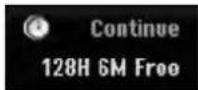
Recording starts after the first press. Each subsequent press increases the recording time within free space (maximum 240 minutes). The recording time is displayed on the TV screen. At the end of the recording, the recorder will stop recording and shut off.
Checking the Recording Time
Press ● (REC) once to check the recording time. The recalled setting will automatically return to the TV screen for a moment.
Also, remaining time of recording is shown in the display window.
To Extend the Recording Time
The recording time can be extended anytime by pressing ● (REC). Each subsequent press increases the recording time within free space (maximum 240 minutes).

Caution
If the recorder is unplugged (or there is a power failure) while the recorder is recording, the program being recorded will be lost from the beginning.
Timer Recording
This recorder can be programmed to record up to 16 programs within a period of 1 month. For unattended recording, the timer needs to know the channels to be recorded, the starting and ending time.
Note:
If you use a completely blank disc for timer recording, you must format the disc before starting timer recording. (Refer to "Disc Format" on page 22.)
Turn the recorder off for timer recording.
1. Press TIMER REC.
The Timer Record menu will appear.
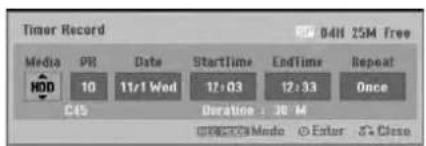
• [Media] Choose a media to record (HDD or DVD).
• [PR] Choose a memorized program number, or one of the external inputs from which to record.
• [Date] Choose a date up to 1 month in advance.
• [Start Time] Set the start time.
• [End Time] Set the end time.
• [Repeat] Choose a desired repeat (Once, Daily (Monday - Friday), or Weekly).
-
Enter the necessary information for your timer recording(s).
-
◀ / ▶ (left/right) – move the cursor left/right
- ▲ / ▼ (up/down) – change the setting at the current cursor position
- Press RETURN ( ) to exit the Timer Record menu.
- Press ENTER after filling in all the program information.
-
Press TIMER REC to display Timer Record List.
-
Set a recording mode as necessary by pressing REC MODE repeatedly. (XP, SP, LP, EP)
- Press ENTER, the program will be memorized by the recorder. To check the programming, the Timer Record List will appear. Check field's "Rec. OK" or "OK" on the Timer Record List indicates that the timer recording is programmed correctly.
- Press RETURN () to exit the Program List.
- Make sure that you load a recordable disc for DVD recording and press POWER to switch your unit to Standby. For HDD recording, also press POWER to set the recorder to the standby status.
Notes:
- You must press POWER to stop the timer recording.
- The timer indicator lights in the display window when the recorder is in standby with the timer active.
- For TV recording with bilingual, set audio channel from the [TV Rec Audio] in sub-menu of the Setup menu (see page 21).
- If you set a timer recording to record to DVD but there isn't a recordable DVD loaded at the time of the recording, the Recovery Recording feature will automatically record the program to the HDD for you.
• Using the HDD allows you to record a maximum of 12 hours continuously.
G-CODE System
This system makes programming timer recordings very simple. Most TV guides publish G-CODE programming numbers with their program details. If you want to make a timer recording of a program, you just input the corresponding G-CODE programming number. The date, start, stop and channel settings are made automatically. All you have to do is tell the recorder the recording mode, and whether it's a once-only recording, or a regular recording.
Up to 16 timer programs can be stored in the recorder.
- Press G- CODE.
The G-CODE menu will appear.
Press G-CODE again to exit the menu.
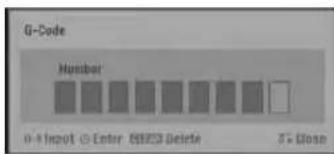
-
[Number] Enter the G- CODE programming number.
• [Repeat] Choose a desired repeat (Once, Daily (Monday - Friday), or Weekly). -
Use the number buttons then press ENTER to enter the G-CODE programming number.
To check the programming, the Timer Record menu will appear.
- ◀ / ▶ (left/right) – move the cursor left/right
-
If you make a mistake before pressing ENTER, press CLEAR repeatedly to delete password numbers one by one then correct it.
-
Use ◀/▶ to move the cursor to the Repeat column then use ▲/▼ to select [Repeat] option (Once, Daily (Monday - Friday), or Weekly).
-
Press ENTER after filling in all the program information.
The program will be memorized by the recorder.
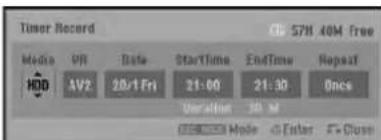
- You can change the information as required using
◀ / ▶ / ▲ / ▼.
Refer to "Timer Recording" on page 39.
-
Choose a record mode (XP, SP, LP, or EP).
-
Press ENTER, the program will be memorized by the recorder.
To check the programming, the Timer Record List will appear.
Check field's "Rec. OK" on the Timer Record List indicates that the timer recording is programmed correctly.
-
Press RETURN ( ) to exit the Timer Record menu.
-
Make sure that you load a recordable disc for DVD recording and press POWER to switch your unit to Standby.
For HDD recording, also press POWER to set the recorder to the standby status.


Checking Timer Recording Details
Programming can be checked whenever the recorder is turned on. Press TIMER REC twice.
- Use ▲ / ▼ to select a timer recording.
- Press ENTER to edit the selected program. Timer Record menu appears.
- Press CLEAR to delete the selected program from the Timer Record List.
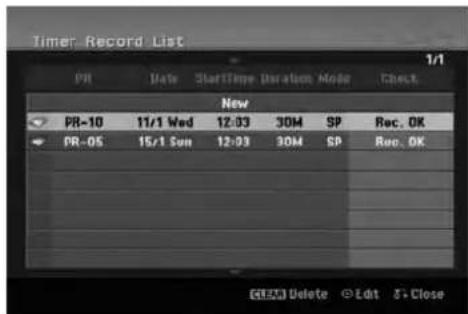
Canceling a Timer Recording
You can clear a timer setting anytime before the recording actually starts.
- Use ▲ / ▼ to select a program you want to erase on the Timer Recorder List. If you want to erase the program, press CLEAR.
Stopping a Timer Recording in Progress
After a timer recording has started, you can still cancel the program.
- Press POWER.
Timer Recording Troubleshooting
Even though the timer is set, the recorder will not record when:
• Power is turned on.
- There is no disc loaded and there is not free space on the HDD.
- A non-recordable disc is loaded and there is not free space on the HDD.
- [Disc Protect] option is set to [ON] in the Setup menu and there is no free space on the HDD. (see page 23).
- There are already 99 titles (DVD-RAM, DVD-RW, DVD-R), 49 titles (DVD+RW, DVD+R) recorded on the disc and there are already 255 titles recorded on the HDD.
You cannot enter a timer program when:
• A recording is already underway.
• The time you're trying to set has already passed.
• There are already 16 timer programs set.
If two or more timer programs overlap:
• The earlier program takes priority.
- When the earlier program finishes, the later program starts.
- If two programs are set to start at exactly the same time, the program entered first takes priority.
If the disc is damaged, the recording may not complete successfully. In this case even though the Check field shows "Rec. OK", it may not be.
Note:
If a program is timer-recorded with PDC ON, "Rec. OK" will not appear in the Check field.
Recording from an External Input Recording from External Components
You can record from an external component, such as a camcorder or VCR, connected to any of the recorder's external inputs.
-
Make sure that the component you want to record from is connected properly to the recorder. See page 16.
-
Choose a media (HDD or DVD) to record using HOME menu (see page 17).
-
Press INPUT repeatedly to select the external input to record from
- Tuner: Built-in tuner
• AV1: AV 1 IN mounted on back panel
- AV2: INPUT 2 (VIDEO, AUDIO (L/R), S-VIDEO IN) mounted on front panel
• DV: DV IN mounted on front panel
-
Select the recording mode as necessary by pressing REC MODE repeatedly. (XP, SP, LP, or EP)
-
Press ● (REC) once
Recording will start. (The REC indicator lights in the display window.)
- Recording continues until you press ■ (STOP) or the disc is full.
- To record for a fixed length of time, see "Instant Timer Recording" on page 39.
- Press ■ (STOP) to stop recording.
Note:
If your source is copy-protected using CopyGuard, you will not be able to record it using this recorder. See
"Copyright" on page 54 for more details.
Recording from DV Input
Before DV dubbing
You can connect a DV-equipped camcorder to this recorder using a single DV cable for input and output of audio, video, data and control signals.
- This recorder is only compatible with DV-format (DVC-SD, DV25) camcorders. Digital satellite tuners and Digital VHS video recorders are not compatible.
- You cannot connect more than one DV camcorder at a time to this recorder.
- You cannot control this recorder from external equipment connected via the DV IN jack (including two recorders).
- It may not always be possible to control the connected camcorder via the DV IN jack.
- Digital camcorders can usually record audio as stereo 16-bit/48kHz, or twin stereo tracks of 12-bit/32kHz. This recorder can only record one stereo audio track. Set [DV Rec Audio] option to [Audio 1] or [Audio 2] as required (see page 21).
- Audio input to the DV IN jack should be 32 or 48kHz (not 44.1kHz).
- Picture disturbance on the recording may occur if the source component pauses playback or plays an unrecorded section of tape, or if the power fails in the source component, or the DV cable becomes disconnected.
Recording from a Digital Camcorder
You can record from a digital camcorder connected to the DV IN jack on the front panel of this recorder. Using the recorder's remote, you can control both the camcorder and this recorder.
Before recording, make sure that the audio input for the DV IN jack is set up (see page 21).
Tips:
• The source signal must be DVC-SD format.
- Some camcorders cannot be controlled using this recorder's remote.
- If you connect a second recorder using a DV cable, you cannot control the second DVD from this one.
- You cannot control this unit remotely from a component connected to the DV IN jack.
- You cannot record date and time information from a DV cassette.
- Make sure your digital camcorder is connected to the front panel DV IN jack (see page 16).
- Select [TV(HDD)] or [TV(DVD)] option on the HOME menu then press ENTER (see page 17).
- Check that the DV audio input is as you require. You can choose between Audio 1 (original audio) and Audio 2 (overdubbed audio).
- DV Input is set from the [DV Rec Audio] in sub-menu of the Setup menu. See "DV Recording Audio" on page 21 for more information.
- Press INPUT repeatedly to select the DV input. DV appears in the display window and on the TV screen.
- Find the place on the camcorder tape that you want to the recording to start from.
For best results, pause playback at the point from which you want to record.
- Depending on your camcorder, you can use this recorder's remote to control the camcorder using the STOP, PLAY and PAUSE functions.
-
Press ● (REC) once to start recording.
-
Recording is automatically stopped if the recorder detects no signal.
- You can pause or stop the recording by pressing ■ (PAUSE/STEP) or ■ (STOP).
You cannot control the camcorder from this remote control during recording.
- In Video mode, the final frame of the recording may remain displayed on screen for a while after recording stops.
- For timer recording to work properly on this recorder, the digital camcorder must also be switched on and in operating.
Troubleshooting
If you cannot get a picture and/or audio through the DV IN jack, check the bullet points:
• Make sure the DV cable is properly connected.
- Try switching off the connected equipment then switch back on.
- Try switching the audio input.
Note:
Depending on the connected camcorder, you may not be able to control it using the remote control supplied with this recorder.


Simultaneous recording and playback
Playback another title during recording
Playback and recording for both DVD and built in hard disk drive (HDD) are completely independent. For example, you can record to either the DVD or HDD source and play back video from the other source at the same time.
- Start recording.
- Press HOME to display the Home Menu screen.
- Use the ▲ / ▼ / ◀ / ▶ and ENTER buttons to select a different media type that you want to play back.
- Start Playback. The recording will continue while playing back the media from the other mode.
Notes:
- You cannot use simultaneous playback and recording while copying.
- You cannot edit programs during simultaneous recording and playback.
Playback current title during recording HDD
You can play back the current title in recording simultaneously.
-
Start HDD recording.
-
Press (PLAY). The playback starts and the recording will continue while playing back.
- You can use (PAUSE/STEP) and / ◀◀ ▶▶ (SCAN) buttons for pause, search, slow-motion during playback.
- Press ■ (STOP). The playback will stop then returns to the current recording position.
Notes:
- Playback cannot be started until 15 seconds after recording starts.
- This function does not work in DVD recording mode.
Title List and Editing
Title List and Chapter List Menu Overview
Using the Title List menu, you can search for recorded titles and edit them. The editing features available in the Title List menu depend on whether you are editing video on DVD, or the HDD, and whether you're editing Original content, or a Playlist.
There are two ways to edit DVD-RAM and VR mode DVD-RW discs. You can directly edit the Original content of the disc, or you can create and edit a Playlist. The Playlist doesn't actually change any of the content on the disc, but just controls how the content is played back.
Editing material recorded on the HDD is similar to editing the Original content of a DVD-RAM or VR mode DVD-RW, with similar commands for erasing and naming titles, as well as fine control over the content of chapters within titles for DVD disc.
Note:
During recording, if you display the Title List menu for the HDD, some of the titles may appear with a mark. These titles were recorded with a Line Input setting different to the current setting of the recorder. During recording, these titles cannot be played.
- Press DISC MENU/LIST to display the Title List menu.
Playback should be stopped when you do this.
- You can also access it using HOME menu, select [MOVIE] option then select [HDD] or [DVD] option and press ENTER.
- When selecting titles, use the ▲ / ▼ buttons to display the previous/next page if there are more than six titles.
- If you are editing a VR mode disc, press DISC MENU/LIST to switch between Original and Playlist menu.
On the left side of the screen are the menu options. The main part of the screen shows thumbnails of the titles (or chapter) on the DVD or HDD. You can change these thumbnails using the THUMBNAIL button—see "Changing Title Thumbnails" on page 47.
Press DISPLAY to display the information of selected title on the Title List menu.
After selecting a title or chapter on the Title List or Chapter List menu, then press ENTER. The menu options appear on the left side of the menu. Use ▲ / ▼ to select an option then press ENTER to confirm your selection.
- To exit the Title List menu, press RETURN () repeatedly.
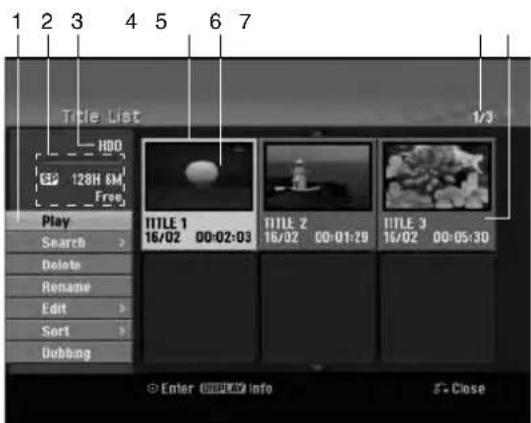
See page 46 for detailed explanation.
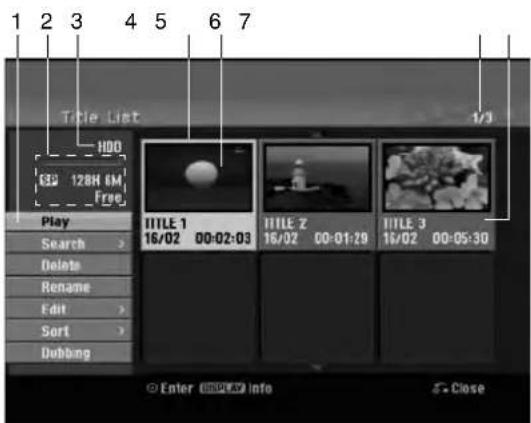
- Menu options: To display menu option, select a title or chapter then press ENTER. The options displayed differ depending on the disc type.
• [Combine] Combines two titles or chapters into one (page 51, 52).
- [Delete] Deletes the title or chapter (page 49).
- [Delete Part] Deletes a part of the Title (page 49).
• [Divide] Divides a title into two (page 52).
• [Dubbing] Copies the title to another media (page 55).
• [Full Play] Starts playback of the selected title including the hidden chapters (page 53).
- [Hide (Show)] Hides (or Shows) the selected title or chapter (page 53).
- [Move] Moves a chapter on the Chapter List-Playlist menu to a position on the menu (page 53).
• [Play] Start playback of the selected title or chapter. The hidden titles and chapters on the DVD+R/RW cannot be play back.
• [Playlist Add] Adds the title or chapter to the Playlist (page 48).
• [Protect] Protects accidental recording, editing or deleting of the title (page 53).
- [Rename (Title Name)] Edits the title name (page 50).
• [Search]
- [Chapter]; Displays Chapter List of the Title.
- [Time]; Search time for you want start point of the title (page 50).
- [Sort] Lists the programs on the Title List menu by Date, Title, or Category (page 51).
• [Title] Displays Title List of the chapter.
- [Undo]/[Redo] Un-do/Re-do the last deletion/action (page 51).
- Indicates the record mode, free space, and elapsed time progress bar.
- Current media
- Currently selected title.
- Thumbnail
- Shows the selected title number and total number of titles.
- Shows the title name, recorded date, and recording length.

Original and Playlist Editing (VR Mode)
Is editing a DVD like editing a video tape?
No. When you edit a video tape you need one video deck to play the original tape and another to record the edits. With DVD, you edit by making a 'Playlist' of what to play and when to play it. On playback, the Recorder plays the disc according to the Playlist.
About words 'Original' and 'Playlist'
RAM RW VR
Throughout this manual, you will often see the words Original and Playlist to refer to the actual content and the edited version.
- Original: content refers to what's actually recorded on the disc.
- Playlist: content refers to the edited version of the disc — how the Original content is to be played.
Titles, Chapters and Parts
Titles in the disc's original content contain one or more chapters. When you insert a disc's title into the Playlist, all the chapters within that title also appear. In other words, chapters in the Playlist behave exactly as chapters on a DVD-Video disc do. Parts are sections of Original or Playlist titles. From the Original and Playlist menu you can add or delete parts. Adding a chapter or title to the Playlist creates a new title made up of a section (i.e., chapter) of an Original title. Deleting a part removes part of a title from the Original or Playlist menu.

Caution
- When editing using the Delete, Add and Move functions, the start and end frames may not be exactly as set in the start and end point display.
- During Playlist playback, you may notice a momentary pause between edits. This is not a malfunction.
Adding Chapter Markers
HDD AM-R VR +RW R
You can create chapters within a title by inserting chapter marks at the desired points.
Notes:
- Chapter markers are inserted at regular intervals automatically. You can change this interval from the Initial Setup menu (see "Auto Chapter" on page 22).
- During recording or playing back, at the point you want to start a new chapter, press CHP ADD. A chapter marker icon appears on the TV screen.
- No chapter can be added during recording on HDD, DVD-RW (Video) or DVD-R.
Changing Title Thumbnails
HDD AM-RV VR +RW R
Each title displayed in the Title List menu is represented by a thumbnail picture taken from the start of that title or chapter.
If you prefer, select a different still picture from within a title.
Press THUMBNAIL to make the currently displayed picture the one that appears in the Title List menu.
The still picture that you choose appears in both the Original or Playlist menu.
Tip:
You can also change the thumbnail picture of the title on the Chapter List menu. Select a chapter on the Chapter List menu then press THUMBNAIL. The thumbnail picture of the title that includes the chapter is changed.
Making a New Playlist
RAM RW VR
Use this function to add an Original title or chapter to the Playlist. When you do this, the whole title is put into the Playlist (you can delete bits you don't need later — see "Deleting an Original or Playlist Title/Chapter" on page 49).
The title appears in the Playlist complete with the chapter markers that appear in the Original. However, if you add more chapter markers to the Original later, these are not automatically copied over into the Playlist title.
You can add up to 999 chapters to one disc. If you only want to add a chapter of a title, use the Adding a title/chapter to the Playlist on this page.
- Choose a title or chapter on the Title List-Original menu or Chapter List-Original menu to put into the Playlist, then press ENTER. The menu options appear on the left side of the menu.
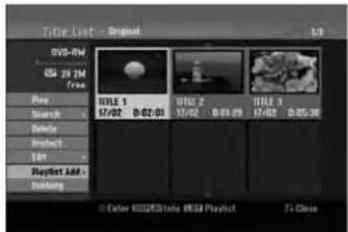
- Use ▲ / ▼ to select [Playlist Add] option then press ENTER.
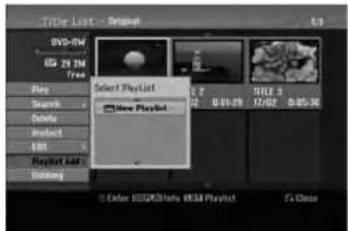
- Select [New Playlist] then press ENTER. The new title appears in the updated Playlist. All chapters of the title are added to the Playlist.
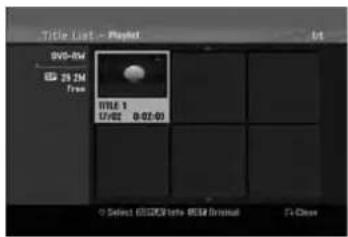
Adding Title/Chapters to the Playlist RAM RW VR
You can add an Original title or chapter to add to a Playlist title even if it is already registered.
- Choose a title or chapter on the Title List-Original menu or Chapter List-Original menu to put into the Playlist, then press ENTER. The menu options appear on the left side of the screen.
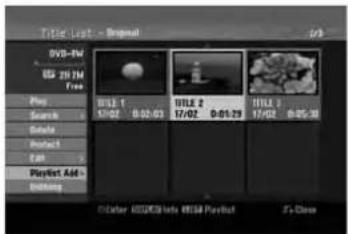
- Use ▲ / ▼ to select [Playlist Add] from menu options then press ENTER.
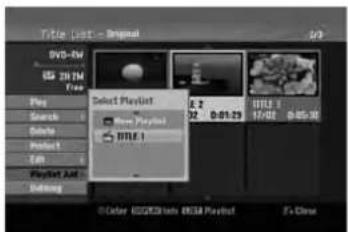
-
Choose a Title List-Playlist that is already registered to insert a title or chapter, then press ENTER.
-
Repeat steps 1-3 to add additional title or chapter on the Playlist. You can view the added chapters on the Chapter List-Playlist menu.
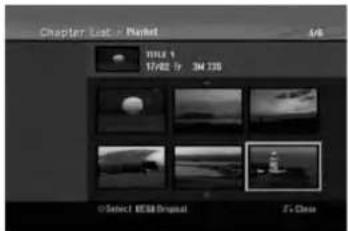
- Press RETURN ( ) to exit, or DISC MENU/LIST to go back to the Title List-Original menu.
natural_image
Abstract geometric diagram with crosshair and circular shapes (no text or symbols)Deleting an Original or Playlist Title/Chapter HDD AM-F V VR
-RWVideo -R + W +R
When you erase a title or chapter from the Playlist menu, you only remove it from the Playlist; the title/chapter remains in the Original menu.
If you choose to delete a title or chapter from the Original (title/chapter) menu, the title or chapter is actually deleted from the disc and the remaining time available for recording increases. Titles/chapters deleted from the Original are also removed from the Playlist.
Note:
It may not be possible to delete chapters that are less than 5 seconds long.
-
Use ◀/▶/▲/▼ to choose a chapter or title you want to delete on the Title List or Chapter List menu then press ENTER. The menu options appear on the left side of the screen.
-
Select [Delete] option from the options on the menu. Example: Title List (HDD)
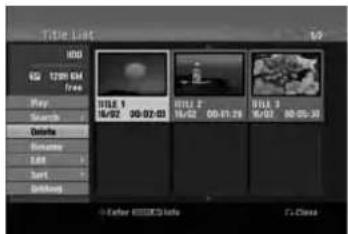
-
Press ENTER to confirm. The confirm message for deleting will appear.
-
Use ◀ / ▶ to select [Yes] then press ENTER. The selected chapter or title is deleted. After pressing ENTER, the new, updated menu is displayed.
-
Repeat steps 1 - 4 to continue to delete from the menu.
-
Press RETURN ( ) repeatedly to exit the menu.
Notes:
- When DVD+RW recording, the deleted title's name is changed to 'Deleted Title'.
- If more than two titles are repeatedly deleted, the titles are combined into one.
- If a program with a chapter added is divided or any part of it is deleted, the chapter will be erased.
- When you are deleting a title or chapter, only the last one on DVD+RW increases remaining recording time.
Deleting a Part HDD AM-F V VR
You can delete a part which you do not want in the title.
-
Use ◀ / ▶ / ▲ / ▼ to choose a title you want to delete on the Title List menu then press ENTER. The options appear on the left side of the menu.
-
Select [Delete Part] option then press ENTER. Title Edit (Delete Part) menu appears on the TV screen.
[Start Point] icon is highlighted.
Example: Title Edit (Delete Part) (HDD)
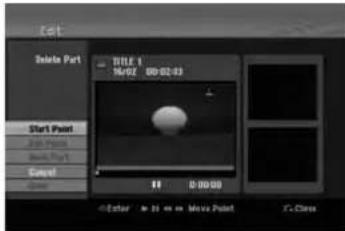
-
Starts playback and use pause step, search and slow-motion to find the starting point.
-
Press ENTER at the starting point of the section you want to delete.
'End Point' icon is highlighted.
The part is indicated on the Progress Bar.
-
Use pause step, search and slow-motion to find the ending point.
-
Press ENTER at the ending point of the section you want to delete.
You can cancel the selected point, use ▲ / ▼ to select [Cancel] icon then press ENTER.
Tip:
With HDD recordings, you can delete additional part. Select [Next Part] icon on the menu then press ENTER, then repeat steps 3-6.
- If you finish to edit, select [Done] icon then press ENTER.
The confirm message for deleting will appear.
Use ◀ / ▶ to select [Yes] then press ENTER.
The selected part is deleted from the title and Title List menu appears.
Notes:
- It may not be possible to delete parts that are less than 3 seconds long.
- If [Delete Part] is executed, the chapter in the title will be erased (HDD).
Naming a Title HDD AM-F V VR
-RWVideo -R + RW + R
You can name Original and Playlist titles
independently. Names can be up to 32 characters long.
- Choose the title you want to name on the Title List menu, then press ENTER.
The menu options appear on the left side of the menu.
- Use ▲ / ▼ to select [Rename (Title Name)] option then press ENTER.
Keyboard menu appears: (HDD)
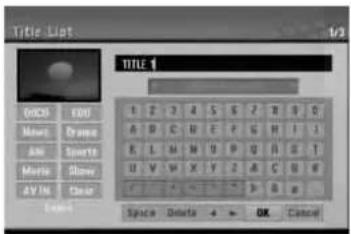
-
Enter a name for the title. Use ◀/▶/▲/▼ to select a character then press ENTER to confirm your selection.
-
Use DISC MENU/LIST button to change keyboard type.
- OK: Select to finish.
- Cancel: Cancels all entered characters.
- Space: Inserts a space at the cursor position.
- Delete: Deletes the previous character at the cursor position.
• ◀ ▶: Moves cursor to left or right.
Tip:
Remote control buttons for entering a name
▶ (PLAY): Inserts a space at the cursor position.
■ (PAUSE/STEP): Deletes the after character at the cursor position.
■ (STOP), CLEAR: Deletes the previous character at the cursor position.
/ Moves cursor to left or right.
Numbers (0-9): Enters the corresponding character at the cursor position.
Tip:
You can add the genre only for HDD title name.
Genre
DOCU: Document program
EDU: Education program
News: News program
Drama: Drama
ANI: Animation program
Sports: Sports program
Movie: Movie
Show: TV show
AV IN: External input program
etc.: etcetera (Choosing [etc.] will erase the genre display (HDD).)
- Choose OK then press ENTER to fix the name and return to the previous menu screen.
- Press RETURN ( ) repeatedly to exit the menu.
Notes:
• To erase the displayed genre, choose [etc.].
- Names can be up to 32 characters long.
- For discs formatted on a different recorder, you will see only a limited character set.
- When recording on DVD-R, DVD+RW or DVD+R discs, the entered name is displayed on the DVD player only after finalization.
Time Search HDD RAM-FV VR
-RWVideo -R+W+R
You can select start point of the title.
- Use ◀/▶/▲/▼ to choose a title on the Title List menu then press ENTER.
The options appear on the left side of the menu.
- Select [Time] option then press ENTER.
[Search] menu appears on the TV screen.
Example: Title List (HDD)
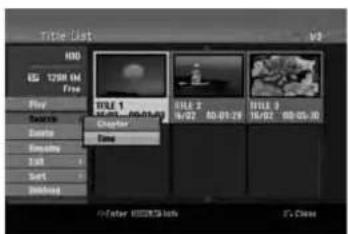
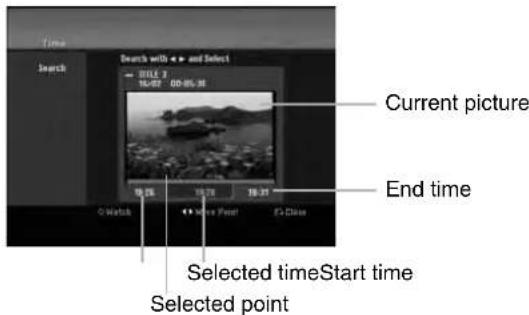
- Use ◀ / ▶ to find the point you want to start.
The point increase 1 minute step.
If you press and hold ◀ / ▶ then the point increase 5 minute step. - Press ENTER to start selected point.




Sort HDD
This function allows you to access show listings organized by Date, Title, or Category on the Title List-HDD menu. So you can find title you want to watch easily.
-
Choose any title on the Title List-HDD menu, then press ENTER. The menu options appears on the left side of the menu.
-
Use ▲ / ▼ to select [Sort] option then press ENTER. Sort options appear.
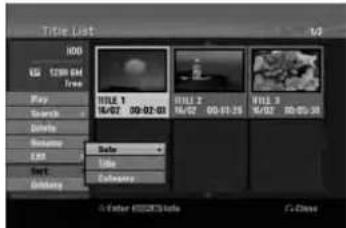
- Use ▲ / ▼ to select [Date], [Title] or [Category] option then press ENTER. After pressing ENTER, the sorted menu is displayed.
Undoing/Redoing RAM RW VR
If you make a mistake while deleting, you can undo it. There is one level of undo (in other words, you can undo the last one deletion you made).
Use ▲ / ▼ to select [Undo] option then press ENTER. It doesn't matter whether you are currently in the menu screen; the last deletion is undone.
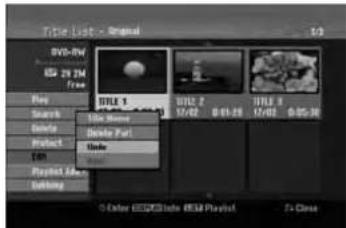
Notes:
- You can't undo a recording.
- You can't undo anything after ejecting the disc from the recorder or switching the recorder into standby mode.
- You can still undo a deletion even after exiting the menu display.
Tip:
You can redo the last undo action using the [Redo] option.
Combining Titles HDD
Use this function to combine two adjacent Original-HDD titles into one.
Notes:
- This function is not available if there is only one title within the HDD.
- If there are more than 60 titles on the HDD, you cannot combine the titles.
- The image will momentarily stop at the joining of titles.
-
If [Combine] is executed, the chapter in the title will be erased (HDD).
-
On the Title List-HDD menu, select the first title of the two titles you want to combine then press ENTER. The menu options appear on the left side of the screen.
-
Select [Combine] option then press ENTER.
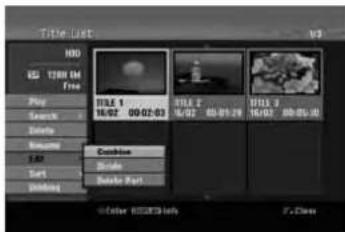
-
Select the second title of the two titles you want to combine then press ENTER. Confirm message appears.
-
Use ◀/▶ to select [Yes] then press ENTER. After pressing ENTER, the updated menu is displayed.
Divide HDD RW
Use this command to split a title up into two new titles.
-
On the Title List menu, select a title you want to divide then press ENTER. The menu options appear on the left side of the screen.
-
Select [Divide] option.
Example: Title List (HDD)
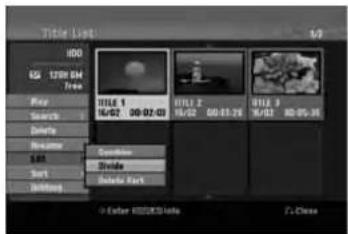
- Press ENTER.
Title Edit (Divide) menu appears. [Divide] option is highlighted.
Current picture
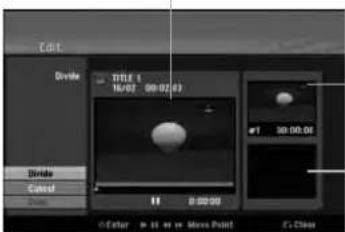
The first title's thumbnail
The second title's thumbnail
- Use play, pause step, search and slow-motion to find the point you want to divide the title.
- Select [Divide] option then press ENTER at the point. To reset the point, select [Cancel] option then press ENTER. Repeat from step 3.
- Choose [Done] option then press ENTER to fix the dividing point. The title is divided into two new titles. It take up to 4 minutes to divide.
Notes:
- You cannot select dividing point less than 3 seconds.
- Fast copying cannot be specified for divided tiles.
- If [Divide] is executed, the chapter in the title will be erased (HDD).
Combining Chapters
HDD AM-F V VR +RW R
Use this function to combine two adjacent Playlist or Original chapters into one.
Note:
This function is not available if there is only one chapter within the title.
-
On the Chapter List menu, select the second chapter of the two chapters you want to combine then press ENTER. The menu options appear on the left side of the screen.
-
Use ▲ / ▼ to select [Combine] option. The combine indicator appears between the two chapters you want to combine.
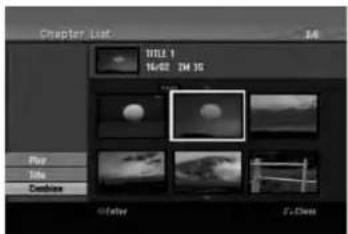
- Press ENTER.
Moving a Playlist Chapter
RAM RW VR
Use this function to re-arrange the playing order of Playlist chapters on the Title List-Playlist menu.
Note:
This function is not available if there is only one chapter.
- Select a chapter on the Chapter List-Playlist menu.
- Press ENTER.
The menu options appear on the left side of the menu. - Use ▲ / ▼ to select [Move] option from Playlist options then press ENTER.
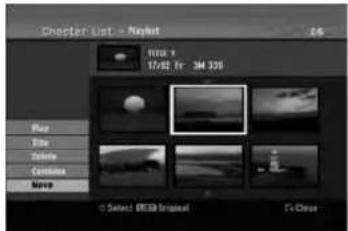
- Use ◀/▶/▲/▼ to choose the place you want to move the chapter to then press ENTER. After pressing ENTER, the updated menu is displayed.
Hide a Chapter/Title +RW R
You can skip playing chapters or titles without deleting from the disc.
-
Use ▲ / ▼ / ◀ / ▶ to choose a chapter or title you want to hide on the Title List or Chapter List menu, then press ENTER.
Options appear on the left side of the screen. -
Select [Hide] option.
Example: Title List (DVD+RW)
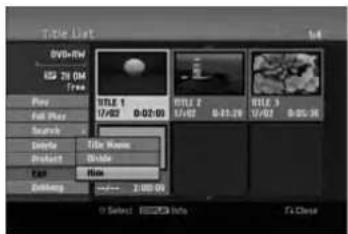
- Press ENTER to confirm.
The chapter's or title's thumbnail will dim.
Tip:
If you select a hidden chapter or title on the Title List or Chapter List menu, you can 'show' it by choosing [Show] option on the menu. After doing that, you are able to see the chapter or title.
Protect a Title
RAM RW VR +RW R
Use this function to protect against accidental recording, editing or deleting of the title.
- Press DISC MENU/LIST to display the Title List menu.
-
Use ▲ / ▼ / ◀ / ▶ to choose a title you want to protect then press ENTER. Options appear on the left side of the screen.
-
Select [Protect] from the options.
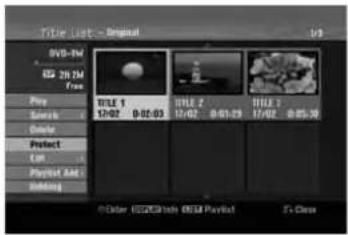
- Press ENTER to confirm.
The lock mark will appear on the title's thumbnail.
Tip:
If you select a title that has already been protected on the Title List menu, you can 'unprotect' it by choosing [Protect] option from the Title List menu options. After doing that, you can edit and delete the title.
Full Play
+RW R
Starts playback of the selected title including the hidden chapters.
Dubbing
Before Dubbing
Use the copying features of this recorder to:
- Back up important recordings stored on the HDD to a DVD.
- Make a DVD copy of a recording on the HDD to play in another player.
- Transfer video from a DVD to the HDD for editing.
- Transfer edited video from the HDD to DVD.
The simplest method of copying is to use the One Touch Copy feature. Using this you can very simply copy the title that's currently playing from HDD to DVD, or the other way around.
Note:
If the title's length is less than 5 seconds, the dubbing is not available. (from HDD to DVD)
Restrictions on copying
Some video material is copy-once protected: Such material cannot be copied to HDD or DVD. If you want to record copy-once protected material to DVD, you must use a VR mode DVD-RW disc compatible with CPRM Ver. 1.1.
You can identify copy-once protected material during playback by displaying disc information on-screen.
- A media in NTSC format cannot be copied.
- Video that is 'copy-once only' can only be recorded using DVD-RAM disc or DVD-RW disc in VR mode with CPRM (see below).
What is 'CPRM'?
CPRM is a copy protection system (with scramble system) only allowing the recording of 'copy once' broadcast programs. CPRM stands for Content Protection for Recordable Media.
This Recorder is CPRM compatible, which means that you can record copy-once broadcast programs, but you cannot then make a copy of those recordings. CPRM recordings can only be made on DVD-RAM discs or DVD-RW discs formatted in VR mode, and CPRM recordings can only be played on players that are specifically compatible with CPRM.
Copyright
- Recording equipment should be used only for lawful copying and you are advised to check carefully what is lawful copying in the area in which you are making a copy. Copying of copyright material such as films or music is unlawful unless permitted by a legal exception or consented to by the rights owner.
- This product incorporates copyright protection technology that is protected by method claims of certain U.S. patents and other intellectual property rights owned by Macrovision Corporation and other rights owners. Use of this copyright protection technology must be authorized by Macrovision Corporation, and is intended for home and other limited viewing uses only, unless otherwise authorized by Macrovision corporation. Reverse engineering or disassembly is prohibited.
- CONSUMERS SHOULD NOTE THAT NOT ALL HIGH DEFINITION TELEVISION SETS ARE FULLY COMPATIBLE WITH THIS PRODUCT AND MAY CAUSE ARTIFACTS TO BE DISPLAYED IN THE PICTURE. IN CASE OF 625 PROGRESSIVE SCAN PICTURE PROBLEMS, IT IS RECOMMENDED THAT THE USER SWITCH THE CONNECTION TO THE 'STANDARD DEFINITION' OUTPUT.
Fast copying (Maximum 12×)
Copying between DVD and HDD is a completely digital process and therefore involves no loss of quality in the audio or video. This means that you can transfer back and forth without having to worry about the quality getting worse with each copy 'generation'. It also means that copying can be carried out at the maximum speed possible.
When copying from HDD to DVD, the speed of copying depends on the recording mode and the kind of DVD disc you're using.
Minimum fast copying times
The table below shows the minimum HDD to DVD copying time for 2 hours of video recorded with SP mode.
| Disc Type | Disc Speed | Copying Time (Record Speed) |
| DVD-R/DVD+R 16x 6.5 min. (12x) | ||
| DVD-R/DVD+R/DVD+RW 8x 8 min. (8x) | ||
| DVD+R DL 8x 13 min. (4x) | ||
| DVD-RW 6x 12 min. (6x) | ||
| DVD-RAM 5x 11.5 min. (5x) | ||
| DVD-R/DVD+R DVD-RW/DVD+RW | 4x 13 min. (4x) | |
| DVD-RAM 3x 17 min. (3x) | ||
| DVD+R/DVD+RW/DVD+R DL 2.4x 21 min. (2.4x) | ||
| DVD-R/DVD-RW/DVD-RAM 2x 25 min. (2x) | ||
Notes:
- All times in the above table are approximate.
- Actual copy speed varies with the part of the disc being recorded.
- There may be cases where even 4x/6x/8x/16x compatible discs do not copy at full speed.
- Fast copying may not be possible when using disc initialized on another recorder.
natural_image
Pure geometric diagram with crosshair and circle shapes, no text or symbols present
natural_image
Pure geometric diagram with crosshair and circular target-like shapes (no text or symbols)Re-encode copying
If you choose XP, SP, LP or EP other than Fast copying, re-encode copying will start: The dubbing will be performed only at standard (1×) speed, and the playback screen will appear during dubbing. The quality of dubbed images will degrade when the speed mode is changed, for example, from SP to EP.
Dubbing from HDD to DVD
- On the Title List-HDD menu, select a title you want to dub then press ENTER. The menu options appears on the left side of the screen.
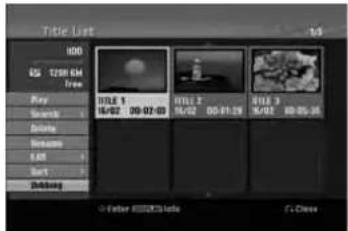
- Use ▲ / ▼ to select [Dubbing] option then press ENTER. Dubbing menu appears.
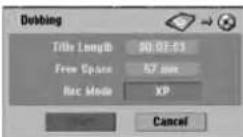
- Use ◀/▶ to select record mode (XP, SP, LP, EP, Fast or FR), then press ▼. 'Start' icon is highlighted. Fast: See page 54 for more information on Fast copying.
- When [Start] icon is highlighted, press ENTER. Dubbing starts.
- To stop dubbing, press ENTER while a message is being displayed on screen.
Notes:
- The recording time of [Fast] mode could be varied depending on data size of source.
- Stopping dubbing in [Fast] mode partway through will cancel the recording and any data recorded up to that point will be lost.
- If the remaining space on the disc is insufficient, the [Fast] mode is not available.
- The [Fast] mode is not available for edited HDD title and Clip Recording title.
• [FR] choose when PDC is off. - If [Fast] is chosen, the chapters set on HDD will not be dubbed.
Dubbing from DVD to HDD
- On the Title List menu, select a title you want to dub then press ENTER. Menu options appears on the left side of the screen.
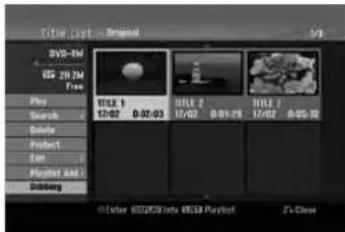
- Use ▲ / ▼ to select [Dubbing] option then press ENTER. Dubbing menu appears.
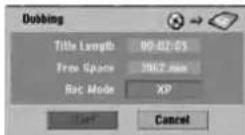
-
Use ◀/▶ to select record mode (XP, SP, LP, EP, Fast or FR), then press ▼. 'Start' icon is highlighted. Fast: Only available when copying VR mode disc to HDD. (See page 54 for more information on Fast copying.)
-
When [Start] icon is highlighted, press ENTER. Dubbing starts.
- To stop dubbing, press ENTER while a message is being displayed on screen.
Notes:
- Depending on the conditions of the recording equipment or the disc itself, the dubbing may not be capable.
- Stopping dubbing in [Fast] mode partway through will cancel the recording and any data recorded up to that point will be lost.
- The recording time of [Fast] mode can take up to 19 minutes.
- The [Fast] mode is not available for edited title on the DVD-RAM and DVD-RW with VR recording mode.
- Any chapters added to DVD will not be dubbed to HDD.
8 cm discs recorded on DVD video camera/recorder:
- A disc on which both movie and photo was recorded cannot be dubbed. To dub the movie only, copy the photo onto the DVD video camera's memory card, delete that photo from the disc, and then dub the movie to the HDD.
- If there are multiple scenes in one title, the [Fast] mode cannot be chosen.
One Touch Copy (HDD to DVD)
The One Touch Copy feature copies the currently playing title from the HDD to DVD. The whole title is copied, regardless of where in the title you start copying. The recorder copies at the maximum speed possible. The copy will be made in the recording mode (XP, SP, LP, EP) that is currently set.
For One Touch Copy to work, make sure that a recordable DVD disc is loaded.
During HDD playback, press DUBBING to copy the current title to DVD.
The on-screen display indicates that the title is being copied. Playback continues while copying.
- You cannot use the One Touch Copy function to copy a title if any part of the title is copy-once protected. The DUBBING button will not work while a Title List is being displayed.

One Touch Copy (DVD to HDD)
One Touch Copy from DVD to HDD copies a single title to the HDD in real time. When you start copying, playback jumps back to the start of the title, then continues through to the end of the title, when recording automatically stops. The copy will be made in the recording mode (XP, SP, LP, EP) that is currently set.
During DVD playback, press DUBBING to copy the current title to HDD.
Playback starts again from the beginning of the current title. The on-screen display indicates that the title is being copied.

Notes:
• Video CD cannot be copied to HDD.
- The copying stops when the recorder detects a badly scratched or copy protected part.
- If some part of the title being copied is copy-protected, copying will start, but the copy-protected portions will not be copied.
- During Playlist title's playback, One Touch Copy is not available.
Tip:
To stop dubbing at any other time, press ■ (STOP).
natural_image
Pure geometric diagram with crosshair and circle shapes, no text or symbols present
natural_image
Pure geometric diagram with intersecting lines and a circular pattern (no text or symbols)Reference
Additional Information
Overwriting Recording +RW
To overwrite a new video recording on a previously recorded title, follow these steps. This feature is not available for DVD+Rs, that always record at the end of the Disc.
- Select input source you want to record (TV channel, AV1-2, DV).
- Press DISC MENU/LIST to display the Title List menu.
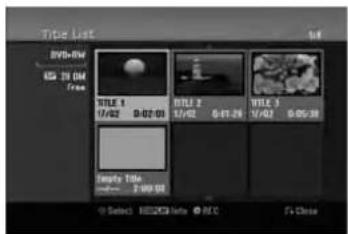
- Use ▲ / ▼ / ◀ / ▶ to choose a title you want to overwrite.
- Press ● (REC) to start overwrite recording. Overwrite recording starts from the start point of the title.
- Press ■ (STOP) to stop the overwrite recording. The new title is created and updated menu is displayed.
Notes:
- This function is not available for a protected title.
- If the overwrite is longer than the recording length of the current title, the next title is overwritten. But if next title is protected, the overwriting stops at the starting point of the title.
- If the selected title's recording length is less than 10 seconds, the next title is overwritten. But if the next title is protected, overwriting stops.
Display on other Recorders or Players
+RW R
You can view the Title List menu displayed on the other DVD player that is capable of playing DVD+RW or DVD+R discs.
-
Insert DVD+RW or DVD+R disc recorded already.
-
Press TITLE MENU in Play mode.
Title List menu will appear as shown below.
Tip:
You can remove the Title List menu by pressing ■ (STOP).
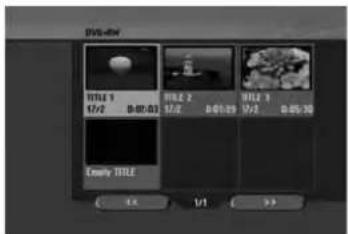
- To play back a title, select the title you want then press ENTER or ▶(PLAY).
Playing on other Players (Finalized)
Most regular DVD players can play finalized discs recorded in Video mode, finalized DVD+RW or DVD+Rs. A small number of players can also play DVD-RW discs recorded in VR mode, finalized or not. Check the manual that came with the other player to check what formats of discs it will play.
Finalizing 'fixes' the recordings and editings in place so that the disc can be played on a regular DVD player or computer equipped with a suitable DVD-ROM drive. Finalizing a Video mode disc creates a menu screen for navigating the disc. The menu can be accessed by pressing DISC MENU/LIST or TITLE MENU.
To finalize a disc, refer to "Finalize" on page 22.
Notes:
- Unfinalized DVD+RW is playable on regular DVD players.
- The edited contents of a DVD+RW disc is compatible on regular DVD players only after finalization.
- Any edited contents of the DVD+R disc are not compatible on regular DVD players. (Hide, chapter combine, added chapter mark, etc.)
- How long finalization takes depends on the type of disc, how much is recorded on the disc, and the number of titles on the disc.
- DVD+R DL disc can take up to 30 minutes to finalize.
Language Codes
Use this list to input your desired language for the following initial settings:
Disc Audio, Disc Subtitle, Disc Menu.
Language Code Language Code Language Code Language Code
| Abkhazian 6566 Fiji 7074 Lingala 7678 Singhalese 8373 | |||||||
| Afar 6565 Finnish 7073 Lithuanian 7684 Slovak 8375 | |||||||
| Afrikaans 6570 French 7082 Macedonian 7775 Slovenian | 8376 | ||||||
| Albanian | 8381 | Frisian | 7089 | Malagasy | 7771 | Somali | 8379 |
| Ameharic | 6577 | Galician | 7176 | Malay | 7783 | Spanish | 6983 |
| Arabic | 6582 | Georgian | 7565 | Malayalam | 7776 | Sudanese | 8385 |
| Armenian | 7289 | German | 6869 | Maltese | 7784 | Swahili | 8387 |
| Assamese | 6583 | Greek | 6976 | Maori | 7773 | Swedish | 8386 |
| Aymara | 6588 | Greenlandic | 7576 | Marathi | 7782 | Tagalog | 8476 |
| Azerbaijani | 6590 | Guarani | 7178 | Moldavian | 7779 | Tajik | 8471 |
| Bashkir | 6665 | Gujarati | 7185 | Mongolian | 7778 | Tamil | 8465 |
| Basque | 6985 | Hausa | 7265 | Nauru | 7865 | Tatar | 8484 |
| Bengali; Bangla | 6678 | Hebrew | 7387 | Nepali | 7869 | Telugu | 8469 |
| Bhutani | 6890 | Hindi | 7273 | Norwegian | 7879 | Thai | 8472 |
| Bihari | 6672 | Hungarian | 7285 | Oriya | 7982 | Tibetan | 6679 |
| Breton | 6682 | Icelandic | 7383 | Panjabi | 8065 | Tigrinya | 8473 |
| Bulgarian | 6671 | Indonesian | 7378 | Pashto, Pushto | 8083 | Tonga | 8479 |
| Burmese | 7789 | Interlingua | 7365 | Persian | 7065 | Turkish | 8482 |
| Byelorussian | 6669 | Irish | 7165 | Polish | 8076 | Turkmen | 8475 |
| Cambodian 7577 Italian | 7384 Portuguese 8084 Twi | 8487 | |||||
| Catalan | 6765 | Japanese | 7465 | Quechua | 8185 | Ukrainian | 8575 |
| Chinese | 9072 | Javanese | 7487 | Rhaeto-Romance | 8277 | Urdu | 8582 |
| Corsican | 6779 | Kannada | 7578 | Rumanian | 8279 | Uzbek | 8590 |
| Croatian | 7282 | Kashmiri | 7583 | Russian | 8285 | Vietnamese | 8673 |
| Czech | 6783 | Kazakh | 7575 | Samoan | 8377 | Volapūk | 8679 |
| Danish | 6865 | Kirghiz | 7589 | Sanskrit | 8365 | Welsh | 6789 |
| Dutch | 7876 | Korean | 7579 | Scots Gaelic | 7168 | Wolof | 8779 |
| English | 6978 | Kurdish | 7585 | Serbian | 8382 | Xhosa | 8872 |
| Esperanto | 6979 | Laothian | 7679 | Serbo-Croatian | 8372 | Yiddish | 7473 |
| Estonian | 6984 | Latin | 7665 | Shona | 8378 | Yoruba | 8979 |
| Faroese | 7079 | Latvian, Lettish | 7686 | Sindhi | 8368 | Zulu | 9085 |
Area Codes
Choose an area code from this list.
| Area | Code | Area | Code | Area | Code | Area | Code |
| Afghanistan | AF | Ethiopia | ET | Malaysia | MY | Saudi Arabia | SA |
| Argentina | AR | Fiji | FJ | Maldives | MV | Senegal | SN |
| Australia | AU | Finland | FI | Mexico | MX | Singapore | SG |
| Austria | AT | France | FR | Monaco | MC | Slovak Republic | SK |
| Belgium | BE | Germany | DE | Mongolia | MN | Slovenia | SI |
| Bhutan | BT | Great Britain | GB | Morocco | MA | South Africa | ZA |
| Bolivia | BO | Greece | GR | Nepal | NP | South Korea | KR |
| Brazil | BR | Greenland | GL | Netherlands | NL | Spain | ES |
| Cambodia KH | Islands | HM | Netherlands Antilles | AN | Sri Lanka | LK | |
| Canada | CA | Hungary | HU | New Zealand | NZ | Sweden | SE |
| Chile | CL | India | IN | Nigeria | NG | Switzerland | CH |
| China | CN | Indonesia | ID | Norway | NO | Thailand | TH |
| Colombia | CO | Israel | IL | Oman | OM | Turkey | TR |
| Congo | CG | Italy | IT | Pakistan | PK | Uganda | UG |
| Costa Rica | CR | Jamaica | JM | Panama | PA | Ukraine | UA |
| Croatia | HR | Japan | JP | Paraguay | PY | United States | US |
| Czech Republic | CZ | Kenya | KE | Philippines | PH | Uruguay | UY |
| Denmark | DK | Kuwait | KW | Poland | PL | Uzbekistan | UZ |
| Ecuador | EC | Libya | LY | Portugal | PT | Vietnam | VN |
| Egypt | EG | Luxembourg | LU | Romania | RO | Zimbabwe | ZW |
| El Salvador SV | Russian Federation | RU | |||||
Controlling TV with Remote Control
You can control the sound level, input source, and power switch of your TV with the supplied remote.
You can control your TV using the buttons below.
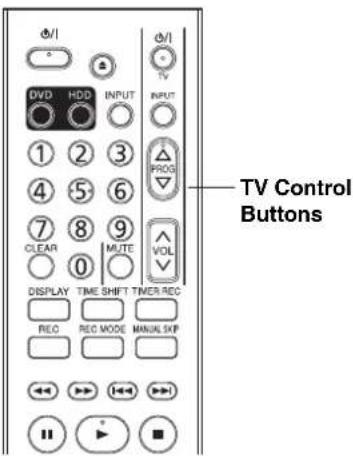
By pressing You can
| POWER Turn the TV on or off. |
| INPUT Switch the TV's input source between the TV and other input sources. |
| PROG +/- Scans up or down through memorized channels. |
| VOL +/- Adjust the volume of the TV. |
| MUTE Temporarily turns TV sound OFF, press again to restore. |
Controlling other TVs with the remote
You can control the sound level, input source, and power switch of non-Hitachi TVs as well. If your TV is listed in the table below, set the appropriate manufacturer code.
-
While holding down TV POWER button, press the number buttons to select the manufacturer code for your TV (see the table below).
-
Release TV POWER button.
Code numbers of controllable TVs
If more than one code number is listed, try entering them one at a time until you find the one that works with your TV.
| Manufacturer Code Number | |
| HITACHI 011(DEFAULT) 013 015 017 021 022 023 | |
| 024 028 029 030 035 039 040 041 048 | |
| 053 054 055 056 057 120 127 128 129 | |
| 134 135 140 143 145 147 151 156 159 | |
| 173 193 219 | |
| ADMIRAL 137 204 | |
| ADYSON 159 219 | |
| AKAI 009 010 108 132 133 135 139 140 156 | |
| 174 175 | |
| AKURA 064 086 108 110 155 171 | |
| ALBA 009 060 064 | |
| ALLSTAR 108 | |
| AMSTRAD | 006 025 157 |
| AMWAY | 108 |
| ANITECH | 010 049 108 185 219 |
| ANTECNO | 064 |
| ARC EN CIEL | 173 179 239 |
| ASA | 087 102 108 235 236 |
| ASBERG | 185 |
| ASORA | 171 |
| ATLANTIC | 089 197 |
| AUDIOSONIC 085 | |
| AUTOVOX | 159 163 197 |
| BANK | 232 |
| BEKO | 045 085 086 108 250 |
| BESTAR 086 | |
| BLAUPUNKT | 031 091 092 096 097 098 099 210 253 |
| BONDSTEC | 163 |
| BOSCH | 210 |
| BRANDT ELECTRONIQUE | 173 179 225 239 |
| BRIONVEGA | 204 |
| BSR | 144 |
| BUSH | 009 136 139 144 232 |
| CENTURY | 165 204 |
| CGE | 139 165 210 |
| CIE | 025 108 170 |
| CLATRONIC | 009 010 064 108 144 149 159 164 165 171 185 |
| CLARIVOX | 033 |
| CONDOR 108 149 191 | |
| CONIC 219 | |
| CONTEC 171 222 | |
| CONTINENTAL EDISON | 173 179 225 239 |
| COSMOS 108 | |
| CROSLEY | 165 204 |
| CROWN | 084 085 086 108 144 171 185 |
| Manufacturer | Code Number |
| CS-ELECTRONICS 064 | |
| DAEWOO 051 108 120 127 170 | |
| DANSAI 010 219 | |
| DE GRAAF 108 134 | |
| DECCA 070 108 159 161 162 184 189 190 206 | |
| DECCAVIDEO 108 | |
| DUAL 233 | |
| DUMONT 204 | |
| ELBE 058 144 157 160 192 246 | |
| ELBIT 108 248 | |
| ELECTROVENDA 108 | |
| ELEKTRONIKA 108 | |
| ELIN 108 | |
| ELITE 064 149 | |
| ELMAN 144 | |
| ELTA 010 171 | |
| EMERSON | 108 204 |
| ESC | 108 |
| ETRON 133 | |
| EUROPHON | 144 159 |
| EXPERT | 089 |
| FENNER | 171 |
| FERGUSON | 078 079 080 160 182 195 198 199 200 201 202 |
| FINLANDIA | 194 195 |
| FINLUX | 008 087 102 104 105 107 108 140 144 159 161 174 189 235 236 |
| FIRST-LINE | 144 |
| FISHER | 086 208 222 233 |
| FORMENTI | 108 149 |
| FRABA | 108 |
| FRONTECH | 136 171 220 |
| FUBA 073 109 | |
| FUJITSUGENERAL | 088 159 197 |
| FUNAI | 010 |
| GALAXIS | 108 185 |
| GALERIA | 171 |
| GBC | 137 144 171 |
| GEC | 011 108 129 147 159 189 |
| GELOSO | 064 137 144 164 171 |
| GENERAL | 171 |
| GENERALTECHNIC | 171 |
| GOLDHAND | 159 171 |
| GOLDSTAR | 038 050 108 110 136 144 159 163 166 171 191 219 237 |
| GOODMANS | 009 064 108 109 110 120 159 170 171 |
| GORENJE | 086 |
| GPM | 010 064 |
| GRANADA | 027 105 108 111 121 134 140 159 162 167 187 194 195 238 |
| GRUNDIG | 091 092 093 094 095 097 098 100 101 172 232 238 |
| HCM | 010 108 159 171 |
| HIFIVOX | 173 179 239 |
| HINARI | 010 064 108 133 171 |
| HIT | 204 |
| HYPER 009 159 163 171 | |
| ICE | 009 010 064 108 171 |
| IMPERIAL | 043 049 108 139 144 154 165 255 |
| INGERSOLL | 171 |
| INNO HIT 159 189 237 | |
| INTERBUY | 010 |
| INTERCORD | 233 |
| INTERFUNK | 108 109 113 130 133 134 135 137 141 146 147 148 165 179 210 |
| INTERVISION | 010 086 108 132 144 166 |
| Manufacturer | Code Number |
| IRRADIO | 163 235 237 |
| ITC | 144 159 |
| ITS | 009 010 064 171 |
| ITT | 141 151 186 |
| JVC | 009 169 |
| KAIDO | 136 |
| KAPSCH | 089 147 148 197 |
| KARCHER | 084 108 |
| KATHREIN | 109 |
| KAWA | 009 |
| KENDO | 060 108 137 157 |
| KENNEDY | 197 |
| KNEISSEL | 108 |
| KONKA 009 | |
| KORTING 086 204 209 | |
| KUBA 233 | |
| KUBA ELECTRONIC | 233 |
| KURA 134 | |
| LENCO 108 170 | |
| LG | 001 038 050 108 110 136 144 159 163 166 171 191 219 237 |
| LIESENKOTTER | 108 210 |
| LIFETEC | 010 064 108 170 |
| LOEWE | 109 113 204 205 |
| LOGIK | 070 227 |
| LUMA 137 197 | |
| LUXOR 102 104 132 | 133 134 135 138 140 143 145 153 156 174 186 237 |
| M ELECTRONIC | 103 104 |
| MAGNADYNE | 163 164 204 |
| MAGNAFON | 199 |
| MAGNASONIC | 108 |
| MARANTZ | 108 |
| MARSHAL | 064 |
| MATSUI | 009 016 025 060 061 062 063 070 108 131 136 152 154 159 171 172 |
| MERRIT | 132 |
| METZ | 047 092 097 098 100 101 108 204 207 254 |
| MITSUBISHI | 075 076 077 097 113 204 222 224 240 |
| MIVAR | 044 042 159 235 |
| MNARTT | 007 |
| MTC | 086 109 134 |
| MULTITECH | 136 159 171 185 |
| MURPHY | 232 |
| NAONIS | 137 |
| NECKERMANN | 037 059 060 092 098 100 101 108 109 113 115 118 119 134 135 137 143 157 159 |
| NEI | 064 108 |
| NIKKAI | 219 |
| NIKKO | 108 |
| NOBLIKO | 232 235 |
| NOGAMATIC | 173 179 239 |
| NOKIA | 014 019 032 102 103 104 108 132 133 134 135 138 140 141 145 146 147 148 156 174 |
| NORDMENDE | 129 173 179 180 181 193 195 225 226 228 239 |
| NORMN | 108 |
| NOVA | 087 |
| OCEANIC 032 103 104 135 140 156 | |
| OKANO | 108 |
| ONWA | 009 010 064 |
| ORAVA 108 | |
| ORBITER | 086 |
| ORION | 025 059 060 061 062 064 070 108 110 118 219 |
| OSAKE 106 | |
| OTTO-VERSAND 002 | 005 009 014 059 060 081 082 083 |
| 085 092 097 098 100 101 108 109 111 | |
| 113 | |
| PAEL 235 | |
| PANASONIC 002 | 003 005 167 168 229 |
| PATHE CINEMA 144 | |
| PATHE MARCONI | 173 179 225 239 |
| PHILCO 090 | 108 139 144 148 165 204 |
| PHILIPS 065 | 066 067 068 069 092 108 109 111 |
| 112 114 115 116 119 122 123 124 125 | |
| 193 212 251 252 | |
| PIONEER 193 | |
| PRANDONI-PRINCE | 137 235 |
| PRIMA 219 | |
| PRO VISION 108 | |
| PROFEX 108 | 136 171 |
| QUELLE 002 | 010 014 019 025 059 060 072 084 |
| 086 087 088 092 097 098 100 101 102 | |
| 175 | |
| RADIOLA 108 | |
| RADIOTONE | 010 085 108 171 |
| REDIFUSSION | 187 |
| REVOX | 109 |
| REX | 088 089 137 157 158 164 197 246 247 |
| RFT | 064 085 135 204 |
| RITAR | 138 |
| ROADSTAR | 108 |
| ROSITA 171 | |
| SABA | 079 146 147 173 179 181 193 195 225 |
| 226 239 | |
| SAISHO | 025 060 070 136 159 |
| SAKIO | 171 |
| SALORA | 019 032 103 104 132 133 134 135 137 |
| 138 140 142 143 145 150 156 174 237 | |
| 241 | |
| SAMBERS | 235 |
| SAMSUNG | 004 010 050 086 108 117 126 171 220 |
| 237 | |
| SANY | 193 |
| SANYO | 014 018 019 020 032 034 071 086 087 |
| 189 218 221 222 223 | |
| SCHNEIDER 009 | 064 088 108 133 141 159 163 233 |
| SEG | 010 064 108 144 159 165 171 185 219 |
| SEI-SINUDYNE | 025 108 204 212 |
| SELECO | 088 089 137 157 197 222 |
| SENTRA | 064 133 |
| SHARP 081 | 082 083 222 |
| SHINTOM | 108 |
| SHINTOSHI | 108 |
| SHIVAKI 108 | |
| SIAREM 204 | |
| SIEMENS 092 | 096 097 098 100 101 108 210 218 |
| 219 221 | |
| SIESTA | 085 |
| SILVER | 010 064 |
| SINGER 108 | 164 204 |
| SINUDYNE | 118 131 |
| SMARAGO | 172 |
| SOLAVOX | 133 |
| SONOLOR | 140 156 |
| SONTEC | 108 |
| SONY | 072 074 211 212 213 214 215 216 217 |
| 222 | |
| SPECTRA | 170 |
| STARLITE | 108 171 |
| STARLUX | 171 |
| STERN | 088 089 137 157 197 |
| Manufacturer | Code Number |
| SUNSTAR | 108 171 |
| SUPERTECH | 108 139 152 171 |
| TADISTAR | 108 |
| TASHIKO 108 | |
| TASHIKO 159 218 | |
| TEC | 108 139 144 159 170 171 |
| TECHLINE | 185 |
| TECHNISAT | 108 165 |
| TECNISON | 108 171 |
| TEKON 171 | |
| TELEAVIA | 173 178 179 225 239 |
| TELEFUNKEN | 079 177 179 181 193 195 200 210 |
| TELEOPTA | 171 |
| TELERNT | 109 |
| TELETECH | 165 171 |
| TELETEXT | 115 |
| TELETON | 088 |
| TELETON | 089 134 159 197 |
| TENSAI | 064 108 144 149 171 191 |
| TENSON | 171 |
| TESLA 204 | |
| THOMSON | 052 078 079 134 173 178 179 181 193 195 225 239 |
| THORN | 011 014 016 018 026 028 066 072 075 087 097 102 108 116 135 141 145 146 160 |
| THORN-FERGUSON | 160 188 200 227 |
| TOSHIBA 012 016 026 036 037 222 232 | |
| TOWADA 144 185 | |
| TRISTAR | 010 064 |
| TRIUMPH | 025 219 236 |
| UHER | 089 108 109 149 185 197 233 |
| ULTRAVOX | 108 164 185 204 |
| UNIVERSUM | 174 |
| UNIVOX | 204 |
| VESTEL 108 | |
| VIDEOSAT | 165 |
| VIDEOTON | 178 193 |
| VIDEOWAY | 230 |
| VISION | 108 149 |
| VOXSON | 137 204 |
| WALTHAM | 178 |
| WATSON 064 108 149 171 | |
| WEGA | 208 222 |
| WHITE WESTINGHOUSE | 108 110 149 |
| YOKO | 010 064 108 136 144 159 164 170 171 |
| ZANUSSI | 137 197 |
| ZENITH | 231 |
Notes:
- Depending on your TV, some or all buttons may not function on the TV, even after entering the correct manufacturer code.
- If you enter a new code number, the code number previously entered will be erased.
- When you replace the batteries of the remote, the code number you have set may be reset to the default setting. Set the appropriate code number again.
Troubleshooting
Check the following guide for the possible cause of a problem before contacting service.
| Symptom Cause | Solution | |
| No power. • The power cord is disconnected. • Plug the power cord into the wall outlet securely. | ||
| No picture. • The TV is not set to receive recorder signal output. | • Select the appropriate video input mode on the TV so the picture from the recorder appears on the TV screen. | |
| • Connect the video cable securely. | ||
| • The connected TV power is turned off. • Turn on the TV. | ||
| No sound. • The equipment connected with the audio cable is not set to receive recorder signal output. | • Select the correct input mode on the audio receiver so you can listen to the sound from the recorder. | |
| • Connect the audio cable securely. | ||
| • Turn on the equipment connected with the audio cable. | ||
| • Replace it with new one. | ||
| The playback picture is poor. | • The disc is dirty. • Clean the disc. | |
| The recorder does not start playback. | • No disc is inserted. • Insert a disc. (Check that the disc indicator in the display window is lit.) | |
| • An unplayable disc is inserted. • Insert a playable disc. (Check the disc type, color system, and regional code.) | ||
| • The disc is placed upside down. • Place the disc with the playback side down. | ||
| • The disc is not placed within the guide. • Place the disc on the disc tray correctly inside the guide. | ||
| • The disc is dirty. • Clean the disc. | ||
| • The Rating level is set. | • Cancel the Rating function or change the rating level. | |
| The picture from the external input is distorted | • The video signal from the external component is copy-protected. | • You cannot connect via this recorder. Connect the component directly to your TV. |
| Some channels are skipped over when using ▲ / ▼. | • Those channels are not stored in the recorder. | • Restore channels. See “Program Edit” on page 18. |
| The picture or sound of broadcasting channel is weak or missing. | • Aerial or cables are loose. | • Tighten connections or replace cable. |
| Camcorder image is not shown. | • Camcorder is off. | • Turn camcorder on and operate properly. |
| Camcorder image via A/V input or DV IN to recorder is not shown on TV screen. | • The recorder’s source is incorrect. | • Use EXTERNAL INPUT to select input channel (AV1, AV2, DV, etc.) |
| Cannot play a disc recorded using this recorder on another player. | • The disc was recorded in Video mode. | • Finalize the disc. (page 22) |
| • Some players will not play even a finalized disc recorded in Video mode. | • No solution. | |
| • The disc was recorded in VR mode. | • The other player must be RW compatible in order to play it. | |
| • Discs recorded with copy-once material cannot be played on other players. | • No solution. | |
| Cannot record or did not record successfully. | The remaining blank space on the disc is insufficient. | Use another disc. |
| The source you are trying to record is copy protected. | You cannot record the source. | |
| When setting the recording channel, the channel is tuned on the TV's own tuner. | Select the channel on the recorder's built-in TV tuner. | |
| When recording to a Video mode disc, programs that are copy-once protected cannot be recorded. | Use a VR mode formatted disc for copy-once material. | |
| Timer recording is not possible. | Clock in recorder is not set to correct time. | Set clock to correct time. See “Manual Clock Set” on page 18. |
| Timer has been programmed incorrectly. | Reprogram Timer. See “Timer Recording” on page 39. | |
| Timer record indicator light does not appear after programming timer. | Reprogram Timer. | |
| Timer recording is not possible unless channels are previously set. | Set channels. | |
| Stereo Audio Record and/or Playback is not present. | TV is not Stereo-compatible. No solution. | |
| Broadcast program is not in stereo format. | No solution. | |
| The recorder A/V Out jacks are not connected to TV A/V In jacks. | Make A/V connections. Stereo is available only via A/V output from the recorder. | |
| The recorder Audio/Video Out is not selected for viewing at the TV. | Select AUX or A/V source as TV input. | |
| The recorder's TV audio channel is set to mono. | Set TV audio channel mode to Stereo. See “Changing TV Audio Channel” on page 38. | |
| The remote control does not work properly. | The remote control is not pointed at the remote sensor of the recorder. | Point the remote control at the remote sensor of the recorder. |
| The remote control is too far from the recorder. | Operate the remote control within 7 m. | |
| There is an obstacle in the path of the remote control and the recorder. | Remove the obstacle. | |
| The batteries in the remote control are exhausted. | Replace the batteries with new ones. | |
Reference
Resetting the recorder
If you observe any of the following symptoms...
- The unit is plugged in, but the power will not turn on or off.
• The front panel display is not working.
• The recorder is not operating normally.
...you can reset the recorder as follows:
- Press and hold the POWER button for at least five seconds. This will force the unit to power off then turn the unit back on.
- Unplug the power cord, wait at least five seconds, and then plug it in again.
Specifications
General
Power requirements AC 220-240V, 50/60 Hz
Power consumption 35W
Dimensions (approx.) 430 × 59 × 298 mm (w × h × d)
Mass (approx.) 4.1 kg
Operating temperature 5°C to 35°C
Operating humidity 10 % to 80 %
Television system PAL B/G colour system
Recording format PAL
Recording
Recording format DVD Video Recording, DVD-VIDEO
Recordable media HDD, DVD-RAM, DVD-RW, DVD-R, DVD+RW,
DVD+R, DVD+R (Double Layer)
Recordable time DVD (4.7GB): Approx. 1 hour (XP mode), 2 hours (SP mode),
4 hours (LP mode), 6 hours (EP mode)
DVD+R DL (8.5GB): Approx. 1 hour 50 minutes (XP mode),
3 hours 30 minutes (SP mode),
7 hours 0 minutes (LP mode), 10 hours 30 minutes (EP mode)
HDD (160GB): Approx. 48 hours (XP mode), 84 hours (SP mode),
156 hours (LP mode), 222 hours (EP mode)
Video recording format
Sampling frequency 27MHz
Compression format MPEG 2 (VBR support)
Audio recording format
Sampling frequency 48kHz
Compression format Dolby Digital
Playback
Frequency response DVD (PCM 48 kHz): 8 Hz to 20 kHz, CD: 8 Hz to 20 kHz
DVD (PCM 96 kHz): 8 Hz to 44 kHz
Signal-to-noise ratio More than 100 dB (AUDIO OUT connector)
Harmonic distortion Less than 0.008 % (AUDIO OUT connector)
Dynamic range More than 95 dB (AUDIO OUT connector)
Inputs
AERIAL IN Aerial input, 75 ohms
VIDEO IN 1.0 Vp-p 75 ohms, sync negative, RCA jack × 2
AUDIO IN 2.0 Vrms more than 47 kohms, RCA jack (L, R) × 2
DV IN 4 pin (IEEE 1394 standard)
Outputs
VIDEO OUT 1 Vp-p 75 Ω, sync negative, RCA jack × 1
COMPONENT VIDEO OUT (Y) 1.0 V (p-p), 75 Ω, negative sync, RCA jack × 1
(Pb)/(Pr) 0.7 V (p-p), 75 Ω, RCA jack × 2
S-VIDEO OUT (Y) 1.0 V (p-p), 75 Ω, negative sync, Mini DIN 4-pin × 1
(C) 0.3 V (p-p), 75 Ω
HDMI video/audio output 19 pin (HDMI standard, Type A)
Audio output (digital audio) 0.5 V (p-p), 75 Ω, RCA jack × 1
Audio output (optical audio) 3 V (p-p), 75 Ω, Optical connector × 1
Audio output (analog audio) 2.0 Vrms (1 kHz, 0 dB), 600 Ω, RCA jack (L, R) × 1
- Design and specifications are subject to change without notice.
HITACHI
Inspire the Next
Hitachi, Ltd. Japan
292 Yoshida-cho
Totsuka-ku, Yokohama-city
Kanagawa 244-0817




HITACHI
Inspire the Next
2006/02
WARRANTY TERMS & CONDITIONS
THIS WARRANTY IS APPLICABLE TO PRODUCTS PURCHASED AND INSTALLED IN AUSTRALIA.
Hitachi Australia warrants that the products are free of defects from manufacture. Any proven defect will be rectified by Hitachi Australia Ltd, or Hitachi's authorised service company, free of charge within the appropriate time limits and subject to the conditions set out below:
- Before using this product, please review the terms and conditions below, along with any user/instruction manuals. Use of the product indicates your acceptance of these terms and conditions.
- In order to claim warranty, the customer must produce the original invoice or other purchase document as proof of purchase.
- The warranty is not transferable and is only applicable if, in the opinion of the company, the product has been installed and used in accordance with the Hitachi user instructions issued with the products.
- Damage to the products, malfunction or failure caused by incorrect voltage, alteration, accident, misuse, neglect, abuse, misjudgement, lightning strike, thunderstorm, hail, flood, fire, infestation, corrosion or other conditions beyond the control of Hitachi, tampering by unauthorised persons, faulty interfaces, allowing any foreign matter to enter or obstruct the product, cleaning and maintenance of filters, pumps, optical blocks, etc. shall in no way be considered as a defect of the products and are excluded from any warranties.
- Nothing in this warranty shall be deemed to detract or limit the rights of the owner under any state or federal consumer legislation.
- Under the terms of this warranty, the repair or replacement of any parts shall be at the option of the company or its authorised service dealer.
- All costs of re-installation, relocation, cartage, freight, mileage expenses and insurance are to be paid by the claimant.
- For Return to Base services, the user must ensure that goods are packed properly in appropriate packing. Any damage due to transport or improper packing will be at your own risk and expense.
- All service work is to be conducted by Hitachi Authorised Service Dealers with appropriate electrical license. Failure to comply with these conditions will invalidate any warranty.
- Hitachi and its authorised dealers will not be liable for any loss or damage whatsoever.
- This warranty does not cover any consumable or accessory unless the item is proven to be defective at the time of purchase and does not cover damage caused by the use of exhausted, leaking or used batteries.
- Air Conditioning Systems must be installed by authorised installers and a holder of current registered license. All refrigeration work is to be carried out by Refrigeration and Air Conditioning tradespeople. All electrical work to be conducted by tradespeople with appropriate electrical license. Failure to comply with these conditions will invalidate any warranty.
- All LCD and plasma panels exhibit some bright, dark or partially lit pixels. This is a normal limitation of these technologies and the manufacturing processes involved. Such pixels are kept to a minimum through strict quality control and are usually not noticeable when viewing normal screen images. Defective pixels are not a warranty issue unless they exceed the manufacturer's specifications for pixel defects.
- Image Retention / Burn-In: Image retention can be an issue for all phosphor-based displays, e.g. Cathode Ray Tube (CRT) TVs, Plasma or CRT-based Rear Projection TVs. In extreme cases, permanent phosphor burn can occur if still/repetitive images are left on the screen for extended periods of time. Such damage to the screen is NOT covered by warranty. Please ensure that the precautions in any documentation supplied with your product are followed in order to avoid permanent damage to your display.
-
Projector lamps are a consumable. Hitachi Australia Ltd. will replace the original projector lamp free of charge where the claim is made within the first 500 hours of operation of the projector or first 12 months from date of purchase of the projector (which ever occurs first). Failure to follow the correct operating and shutdown procedures may damage the lamp and void the warranty.
-
Projectors are not designed for constant TV viewing. They are ideal for occasional big screen viewing of movies, special events and multimedia presentations. Heavy use will consume lamps faster and reduce overall product life.
- Where the non-complying part is an LCD panel block assembly for a multimedia projector, the parts and labour warranty is for 24 months from the date of purchase or the first 2000 hours of operation (which ever occurs first).
- The warranty period for any other parts of a multimedia projector is 24 months from the date of purchase for both labour and parts. Any evidence of contaminants in the projector (i.e. excessive dust, smoke deposits, lint or any other material in the filters or light path) will be regarded as evidence of the unit being operated in an inappropriate environment or a lack of proper operational and maintenance procedures and will void the warranty.
• Charges will apply for any non-warranty services performed.
12 MONTHS WARRANTY (Return To Service Centre/Return To Base)
• DVD Players*
• DVD Recorders*
- Video Cameras*#
• Video Recorders*
12 MONTHS WARRANTY (In Home Service – see notes below)***
LCD TVs #
- Plasma Display Panels #
- Plasma TVs #
• Rear Projection Televisions*
• Twin Tub Washing Machines*
24 MONTHS WARRANTY (Return To Service Centre/Return To Base)
LCD Projectors*
- Vacuum Cleaners*
24 MONTHS WARRANTY (In Home Service – see notes below) ***
• Automatic Washing Machines*
• Cathode Ray Tube Colour Televisions*
• Refrigerators (5 years on compressor – parts only)**
5 YEAR WARRANTY (In Home Service — see notes below) ***
- Domestic Ducted Air Conditioners (only 12 month warranty applies for process cooling and industrial applications, includes parts only)
- Split Air Conditioners (only 12 month warranty applies for process cooling and industrial applications, includes parts and labour)
- Window Air Conditioners (only 12 month warranty applies for process cooling and industrial applications, includes parts and labour)
NOTES:
- Products marked:
* Indicates products when used in a commercial application have a 6 month warranty. ** Indicates products when used in a commercial application have a 12 month warranty. *** In Home Service available in major metropolitan areas only. Return to base warranty applies in all other areas. In such cases the goods must be forwarded and collected from an authorised Hitachi Service Dealer at your own risk and expense. In the case of refrigerator and air conditioning products, customers are responsible for any service call and travel costs.
# Indicates products need to be returned to your nearest capital city (Adelaide, Brisbane, Melbourne, Sydney and Perth only). In such cases the goods must be forwarded and collected from an authorised Hitachi Service Dealer at your own risk and expense.
- Split and/or Ducted System air conditioners must be installed by an Hitachi approved installer. Licence number and company details must be recorded below to claim warranty repair.
RECORD OF PURCHASE.
Please complete the information below and retain it with your purchase receipt.
Hitachi Model No:
Serial No:
Date of Purchase:
Purchase from:
Before repairs are requested, please ensure:
POWER IS SUPPLIED AND CORRECTLY CONNECTED
AND CONTROLS ARE SET CORRECTLY.
Should you need to claim warranty, call the following number to be directed to your nearest authorised Hitachi Service Dealer:
1800 HITACHI
1 8 0 0 4 4 8 2 2 4 4
Air-conditioner Installer Name:
Address:
Phone No:
Licence No:
TJ04575 ©Hitachi, Ltd. 2006
- Dear customer
- CAUTION
- CAUTION concerning the Power Cord
- SERIAL NUMBER:
- Information for users applicable in European Union countries
- Contents
- Introduction ....5
- Hookup and Settings .....12
- Playback 24
- Recording 36
- Title List and Editing .....45
- Dubbing 54
- Reference 57
- Introduction
- Symbol Used in this Manual
- Note:
- Tip:
- About the Symbol Display
- Notes on Discs
- Handling Discs
- Storing Discs
- Cleaning Discs
- Moisture Condensation
- Accessories
- Recordable and Playable Discs
- DVD-RAM
- DVD-RW
- [VR mode]
- DVD-R
- DVD+RW
- DVD+R
- DVD+R DL
- playable Discs
- DVD (8 cm / 12 cm disc)
- Video CD (VCD) (8 cm / 12 cm disc)
- Audio CD (8 cm / 12 cm disc)
- CD-R/CD-RW (8 cm / 12 cm disc)
- Notes:
- Regional code of the recorder and DVDs
- Notes on DVDs and Video CDs
- About the internal hard disk drive
- ■ Exemption of liability concerning compensation of recorded contents
- Remote Control Operation
- Remote Control Battery Installation
- Card useable on this unit
- Regarding Write Protect
- Inserting/Removing the Memory Card
- Inserting the card
- Removing the card
- Using Memory Card
- POWER button
- ▲ (OPEN/CLOSE)
- HDD/DVD
- ■ (STOP)
- ▶ / (PLAY/PAUSE)
- ● (REC)
- PROG. (▼ /▲)
- RESOLUTION (page 14)
- Disc Tray
- Display window
- Remote Sensor
- MEMORY CARD Slot 1
- MEMORY CARD Slot 2 (page 9, 30, 32)
- DV IN (page 16, 43)
- INPUT 2 (S-VIDEO IN)
- INPUT 2 (VIDEO IN/AUDIO IN (Left/Right))
- Remote Control
- ENTER
- MANUAL SKIP: (page 26)
- ▲ (OPEN/CLOSE): (page 25)
- II (PAUSE/STEP): (page 25)
- RETURN (page 18, 27)
- / (SKIP): (page 25, 33)
- TIMER REC: (page 39, 42)
- TITLE MENU: (page 26, 27)
- TV Control Buttons (page 59)
- Hookup and Settings
- Rear Panel
- Connecting to the Aerial
- RF coaxial connection
- Connections to Your TV
- Tips:
- Video connection
- S-Video connection
- Component Video connection
- Progressive Scan connection
- Audio (Left/Right) Connection
- HDMI connection
- About HDMI
- Additional Information for HDMI
- Connecting to an Amplifier
- Connecting to an amplifier equipped with two channel analog stereo or Dolby Pro Logic II/Pro Logic
- Connecting to an amplifier equipped with two channel digital stereo (PCM) or to an Audio/Video receiver equipped with a multi-channel decoder (Dolby Digital™, MPEG 2, or DTS)
- Digital Multi-channel sound
- Accessory Audio/Video Connections
- Connecting to the INPUT 1 or INPUT 2 Jacks
- Connecting a Digital Camcorder
- Using the Home Menu
- TV
- MOVIE
- PHOTO (See page 32)
- MUSIC (See page 30)
- SETUP (See page 17)
- Initial Settings
- General Operation
- General Settings
- Auto Programming
- Preparation:
- Program Edit
- Manual Clock Set
- TV Aspect (Standard and Wide)
- Display Mode
- Power Save Mode
- Initialization (HDD Format)
- Language Settings
- Display Menu
- Disc Menu/Audio/Subtitle
- Audio Settings
- Dolby Digital / DTS / MPEG
- Sampling Frequency
- DRC (Dynamic Range Control)
- Vocal
- Lock (Parental Control) Settings
- Rating
- Set Password
- If you forget your 4-digit code
- Area Code
- DivX® Registration Code DivX
- Recording Settings
- Record Mode Set
- Record Aspect
- DV Recording Audio
- TV Recording Audio
- Auto Chapter
- Disc Settings
- Disc Format
- Finalize
- Disc Label
- Disc Protect
- PBC
- Playback
- General Explanation of On-Screen Display
- Displaying Information While Watching TV During viewing the TV, press ENTER or DISPLAY to display/remove the information displayed on-screen.
- Displaying Disc Information on-screen
- General Playback Features
- If a menu screen is displayed DVD CD
- DVD
- VCD
- Moving to another TITLE HDD AM
- Marker Search
- To enter a Marker
- To Recall or Clear a Marked Scene
- Camera Angle DVD
- 3D
- SurrRAM RW VR -RWvideo -R
- +RW R DVD VCD D vX
- Last Condition Memory DVD
- Playing a DivX® Movie File
- Notice for displaying the DivX® subtitle
- Please refer to following notice when the DivX ® subtitle does not display properly.
- Movie List menu options
- DivX file requirement
- Notes on DivX format
- Playing an Audio CD or MP3/WMA file
- Audio CD and Music menu options
- Random
- MP3/WMA audio file requirement
- Program Playback with Audio CD/MP3/WMA
- Selecting multiple files/tracks (folders)
- Program List menu options
- Repeat Programmed Tracks
- Erasing a Track from the Program List
- Changing Track Order in the Program List
- Save Your Program List (HDD)
- Viewing a JPEG File
- Photo List menu options
- Selecting multiple files (folders)
- Photo file requirement
- File extensions
- Photo size:
- CD-R Format:
- DVD±R/RW Format:
- Maximum Files/Disc:
- Notes on JPEG file
- Skip Images
- Rotate Images
- View Slide Shows
- To Pause the Slide Show
- Editing a MP3/WMA, JPEG, DivX® file
- Erasing a file(s)/folder(s)
- Naming a file
- Copying a file(s) to another media or folder
- Moving a file(s)
- Recording
- About DVD recording
- Disc types
- Recording modes
- About HDD recording
- Notes for recording
- Notes for recording time
- Recording time and picture quality
- Time Shift HDD
- Timeshift (Pause, Live TV/Playback) Operation HDD
- Press TIMESHIFT while watching a TV program.
- Marker Search in Timeshift mode
- Clip Record HDD
- Jump to Start or End during Timeshift
- To Exit the Timeshift
- Basic Recording from a TV
- Changing TV Audio Channel
- To Pause the Recording
- Instant Timer Recording
- Checking the Recording Time
- To Extend the Recording Time
- Timer Recording
- Turn the recorder off for timer recording.
- Press TIMER REC.
- G-CODE System
- Checking Timer Recording Details
- Canceling a Timer Recording
- Stopping a Timer Recording in Progress
- Timer Recording Troubleshooting
- Even though the timer is set, the recorder will not record when:
- You cannot enter a timer program when:
- If two or more timer programs overlap:
- Recording from an External Input Recording from External Components
- Recording from DV Input
- Before DV dubbing
- Recording from a Digital Camcorder
- Troubleshooting
- Simultaneous recording and playback
- Playback another title during recording
- Playback current title during recording HDD
- Title List and Editing
- Title List and Chapter List Menu Overview
- Original and Playlist Editing (VR Mode)
- Is editing a DVD like editing a video tape?
- About words 'Original' and 'Playlist'
- RAM RW VR
- Titles, Chapters and Parts
- Adding Chapter Markers
- HDD AM-R VR +RW R
- Changing Title Thumbnails
- HDD AM-RV VR +RW R
- Making a New Playlist
- Adding Title/Chapters to the Playlist RAM RW VR
- Deleting an Original or Playlist Title/Chapter HDD AM-F V VR
- -RWVideo -R + W +R
- Deleting a Part HDD AM-F V VR
- Naming a Title HDD AM-F V VR
- -RWVideo -R + RW + R
- Genre
- Time Search HDD RAM-FV VR
- -RWVideo -R+W+R
- Sort HDD
- Undoing/Redoing RAM RW VR
- Combining Titles HDD
- Divide HDD RW
- Combining Chapters
- HDD AM-F V VR +RW R
- Moving a Playlist Chapter
- Hide a Chapter/Title +RW R
- Protect a Title
- RAM RW VR +RW R
- Full Play
- +RW R
- Dubbing
- Before Dubbing
- Restrictions on copying
- What is 'CPRM'?
- Copyright
- Fast copying (Maximum 12×)
- Minimum fast copying times
- Re-encode copying
- Dubbing from HDD to DVD
- Dubbing from DVD to HDD
- One Touch Copy (HDD to DVD)
- During HDD playback, press DUBBING to copy the current title to DVD.
- One Touch Copy (DVD to HDD)
- During DVD playback, press DUBBING to copy the current title to HDD.
- Reference
- Additional Information
- Overwriting Recording +RW
- Display on other Recorders or Players
- Playing on other Players (Finalized)
- Language Codes
- Area Codes
- Controlling TV with Remote Control
- Controlling other TVs with the remote
- Code numbers of controllable TVs
- Resetting the recorder
- Specifications
- General
- Video recording format
- Audio recording format
- Inputs
- Outputs
- HITACHI
- Inspire the Next
- WARRANTY TERMS & CONDITIONS
- THIS WARRANTY IS APPLICABLE TO PRODUCTS PURCHASED AND INSTALLED IN AUSTRALIA.
- RECORD OF PURCHASE.
- POWER IS SUPPLIED AND CORRECTLY CONNECTED
- AND CONTROLS ARE SET CORRECTLY.
- HITACHI
- 8 0 0 4 4 8 2 2 4 4
Brand : HITACHI
Model : DV-DS253A
Category : DVD player