
Sienna Hybrid (2021) - Automotive TOYOTA - Free user manual and instructions
Find the device manual for free Sienna Hybrid (2021) TOYOTA in PDF.


| Product Type | Minivan (Hybrid) |
| Model Year | 2021 |
| Engine | 2.5L 4-cylinder + Hybrid System (A25A-FXS) |
| Transmission | Electronically controlled Continuously Variable Transmission (eCVT) |
| Fuel Type | Unleaded gasoline (87 octane or higher) |
| Fuel Tank Capacity | 18 gal (68.2 L) |
| Seating Capacity | 7 or 8 passengers (depending on configuration) |
| Dimensions (L x W x H) | 203.7 x 78.5 x 68.5 in (approx.) |
| Wheelbase | 120.5 in |
| Curb Weight | Approximately 4,500 - 5,000 lbs |
| Tire Size (Front & Rear) | P235/65R17 or P235/60R18 (depending on trim) |
| Tire Inflation Pressure (Cold) | 35 psi (front and rear) |
| Engine Oil Type | 0W-16 or 0W-20 synthetic (SAE 0W-16 recommended) |
| Engine Oil Capacity (with filter) | Approximately 5.0 qt (4.7 L) |
| 12V Battery | Group size 35 (LN2), 12V |
| Safety Systems | SRS airbags (front, side, curtain, knee), seat belt pretensioners, Toyota Safety Sense 2.0 (PCS, LTA, RSA, DRCC, BSM), backup camera |
| Hybrid Drive Modes | EV Drive Mode, Eco, Normal, Sport, Snow (via drive mode select) |
| Towing Capacity | Up to 3,500 lbs (with towing package) |
| Maintenance Intervals | Oil change every 10,000 miles or 12 months; tire rotation every 5,000 miles |
| Hybrid Battery Cooling | Air intake vents under rear seats must be kept clear |
Frequently Asked Questions - Sienna Hybrid (2021) TOYOTA
User questions about Sienna Hybrid (2021) TOYOTA
0 question about this device. Answer the ones you know or ask your own.
Ask a new question about this device
Download the instructions for your Automotive in PDF format for free! Find your manual Sienna Hybrid (2021) - TOYOTA and take your electronic device back in hand. On this page are published all the documents necessary for the use of your device. Sienna Hybrid (2021) by TOYOTA.
USER MANUAL Sienna Hybrid (2021) TOYOTA
Search by illustration
| For safety and security | Make sure to read through them(Main topics: Child seat, theft deterrent system) | 1 |
| Vehicle status information and indicators | Reading driving-related information(Main topics: Meters, multi-information display) | 2 |
| Before driving | Opening and closing the doors and windows, adjustment before driving(Main topics: Keys, doors, seats, power windows) | 3 |
| Driving | Operations and advice which are necessary for driving(Main topics: Starting hybrid system, refueling) | 4 |
| Interior features | Usage of the interior features(Main topics: Air conditioner, storage features) | 5 |
| Maintenance and care | Caring for your vehicle and maintenance procedures(Main topics: Interior and exterior, light bulbs) | 6 |
| When trouble arises | What to do in case of malfunction and emergency(Main topics: 12-volt battery discharge, flat tire) | 7 |
| Vehicle specifications | Vehicle specifications, customizable features(Main topics: Fuel, oil, tire inflation pressure) | 8 |
| For owners | Reporting safety defects for U.S. owners, and seat belt and SRS airbag instructions for Canadian owners | 9 |
Index
Search by symptom
Search alphabetically
For your information...... 6
Reading this manual....11
How to search......12
Pictorial index 14
1 For safety and security
1-1. For safe use
Before driving....32
For safe driving ....33
Seat belts....35
SRS airbags......41
Front passenger occupant classification system .....51
Exhaust gas precautions..56
1-2. Child safety
Riding with children......57
Child restraint systems.....58
1-3. Emergency assistance
Safety Connect ....75
1-4. Hybrid system
Hybrid system features ....79
Hybrid system precautions 83
1-5. Theft deterrent system
Immobilizer system .....88
Alarm....89
2 Vehicle status information and indicators
2-1. Instrument cluster
Warning lights and indicators 92
Gauges and meters (with 4.2-inch display) .....97
Gauges and meters (with 7-inch display) ...... 101
Multi-information display 104
Head-up display 118
Energy monitor/consumption screen.... 122
3 Before driving
3-1. Key information
Keys 128
3-2. Opening, closing and locking the doors
Front doors.... 132
Sliding doors.... 137
Back door 150
Smart key system...... 164
3-3. Adjusting the seats
Front seats 169
Rear seats......171
Driving position memory 178
Head restraints...... 182
3-4. Adjusting the steering wheel and mirrors
Steering wheel...... 185
Inside rear view mirror... 186
Digital Rear-view Mirror. 188
Outside rear view mirrors 198
3-5. Opening, closing the windows and moon roof
Power windows ...... 201
Moon roof 204
4 Driving
4-1. Before driving
Driving the vehicle..... 208
Cargo and luggage ..... 215
Vehicle load limits ...... 218
Trailer towing (without towing package).... 219
Trailer towing (with towing package) 220
Dinghy towing 230
4-2. Driving procedures
Power (ignition) switch .. 231
EV drive mode ...... 236
Hybrid transmission ..... 238
Turn signal lever 242
Parking brake.... 243
Brake Hold 246
4-3. Operating the lights and wipers
Headlight switch...... 248
AHB (Automatic High Beam) 250
Fog light switch 254
Windshield wipers and washer.... 254
Rear window wiper and washer.... 257
4-4. Refueling
Opening the fuel tank cap 259
4-5. Using the driving support systems
Toyota Safety Sense 2.0262
PCS (Pre-Collision System) 267
LTA (Lane Tracing Assist) 275
RSA (Road Sign Assist) 285
Dynamic radar cruise control with full-speed range ... 288
BSM (Blind Spot Monitor) 299
Intuitive parking assist... 308
RCD (Rear Camera Detection) function.... 315
PKSB (Parking Support Brake).... 319
Parking Support Brake function (static objects) ..... 323
Parking Support Brake function (rear-crossing vehicles) 329
Driving mode select switch 333
Driving assist systems... 335
4-6. Driving tips
Hybrid vehicle driving tips 341
Winter driving tips...... 343
5 Interior features
5-1. Using the air conditioning system and defogger
Front automatic air conditioning system ....348
Rear automatic air conditioning system 358
Heated steering wheel/seat heaters/seat ventilators361
5-2. Using the interior lights
Interior lights list ...... 363
5-3. Using the storage features
List of storage features . 366
Luggage compartment features 372
5-4. Using the other interior features
Other interior features ... 374
6 Maintenance and care
6-1. Maintenance and care
Cleaning and protecting the vehicle exterior...... 400
Cleaning and protecting the vehicle interior...... 403
6-2. Maintenance
Maintenance requirements 406
General maintenance.... 407
Emission inspection and maintenance (I/M) programs 410
6-3. Do-it-yourself maintenance
Do-it-yourself service precautions.... 411
Hood 413
Positioning a floor jack .. 415
Engine compartment..... 416
12-volt battery 422
Tires 424
Tire inflation pressure ... 438
Wheels 440
Air conditioning filter..... 441
Cleaning the hybrid battery (traction battery) air intake vents and filters...... 443
Electronic key battery.... 447
Checking and replacing fuses 449
Light bulbs.... 451
7 When trouble arises
7-1. Essential information
Emergency flashers..... 458
If your vehicle has to be stopped in an emergency 459
If the vehicle is trapped in rising water.... 460
7-2. Steps to take in an emergency
If your vehicle needs to be towed.... 462
If you think something is wrong.... 465
If a warning light turns on or a warning buzzer sounds 466
If a warning message is displayed.... 477
If you have a flat tire (vehicles without spare tire)...... 481
If you have a flat tire (vehicles with spare tire).... 491
If the hybrid system will not start .... 501
If you lose your keys..... 502
If the fuel filler door cannot be opened .... 503
If the electronic key does not operate properly .... 504
If the 12-volt battery is discharged .... 506
If your vehicle overheats 511
If the vehicle becomes stuck 514
8 Vehicle specifications
8-1. Specifications
Maintenance data (fuel, oil level, etc.).... 518 Fuel information .... 528 Tire information .... 530
8-2. Customization
Customizable features .. 540
8-3. Initialization
Items to initialize ..... 554
9 For owners
9-1. For owners
Reporting safety defects for U.S. owners.... 556
Seat belt instructions for Canadian owners (in French).... 557
SRS airbag instructions for Canadian owners (in French).... 559
Index
What to do if... (Trouble-shooting) .... 568 Alphabetical Index .... 571
For your information
Main Owner's Manual
Please note that this manual applies to all models and explains all equipment, including options. Therefore, you may find explanations for equipment not installed on your vehicle and the illustrations used may differ from your vehicle.
All specifications provided in this manual are current at the time of printing. Over time, your vehicle may receive updates that modify the vehicle and make material in this manual incomplete and/or inaccurate. Because of Toyota's interest in continual product improvement, Toyota reserves the right to make changes to this manual at any time without notice.
If Toyota chooses to update the manual, updated versions can be viewed by selecting your vehicle by model and year at the following URL or on your mobile device if you have access to the Toyota app.
www.toyota.com/owners
Noise from under vehicle after turning off the hybrid system
Approximately five hours after the hybrid system is turned off, you may hear sound coming from under the vehicle for several minutes. This is the sound of a fuel evaporation leakage check and, it does not indicate a malfunction.
Accessories, spare parts and modification of your Toyota
A wide variety of non-genuine spare parts and accessories for Toyota vehicles are currently available in the market. You should know that Toyota does not warrant these products and is not responsible for their performance, repair, or replacement, or for any damage they may cause to, or adverse effect they may have on, your Toyota vehicle.
This vehicle should not be modified with non-genuine Toyota products. Modification with non-genuine Toyota products could affect its performance, safety or durability, and may even violate governmental regulations. In addition, damage or performance problems resulting from the modification may not be covered under warranty.
Installation of a mobile two-way radio system
The installation of a mobile two-way radio system in your vehicle
could affect electronic systems such as:
- Hybrid system
- Multiport fuel injection system/sequential multiport fuel injection system
● Toyota Safety Sense 2.0 - Anti-lock brake system
- SRS airbag system
- Seat belt pretensioner system
Be sure to check with your Toyota dealer for precautionary measures or special instructions regarding installation of a mobile two-way radio system.
High voltage parts and cables on the hybrid vehicles emit approximately the same amount of electromagnetic waves as the conventional gasoline powered vehicles or home electronic appliances despite of their electromagnetic shielding.
Unwanted noise may occur in the reception of the mobile two-way radio.
Vehicle data recording
The vehicle is equipped with sophisticated computers that will record certain data, such as:
- Engine speed/ Electric motor speed (traction motor speed)
- Accelerator status
- Brake status
- Vehicle speed
• Operation status of the driving assist systems
- Images from the cameras
Your vehicle is equipped with cameras. Contact your Toyota dealer for the location of recording cameras.
The recorded data varies according to the vehicle grade level and options with which it is equipped.
These computers do not record conversations or sounds, and only record images outside of the vehicle in certain situations.
● Data Transmission
Your vehicle may transmit the data recorded in these computers to Toyota without notification to you.
- Data usage
Toyota may use the data recorded in this computer to diagnose malfunctions, conduct research and development, and improve quality.
Toyota will not disclose the recorded data to a third party except:
- With the consent of the vehicle owner or with the consent of the lessee if the vehicle is leased
- In response to an official request by the police, a court of law or a government agency
- For use by Toyota in a lawsuit
- For research purposes where the data is not tied to a specific vehicle or vehicle owner
● Recorded image information can be erased by your Toyota
dealer.
The image recording function can be disabled. However, if the function is disabled, data from when the system operates will not be available.
- To learn more about the vehicle data collected, used and shared by Toyota, please visit www.toyota.com/privacyvts/.
Usage of data collected through Safety Connect (U.S.mainland only)
If your Toyota has Safety Connect and if you have subscribed to those services, please refer to the Safety Connect Telematics Subscription Service Agreement for information on data collected and its usage.
- To learn more about the vehicle data collected, used and shared by Toyota, please visit www.toyota.com/privacyvts/
Event data recorder
This vehicle is equipped with an event data recorder (EDR). The main purpose of an EDR is to record, in certain crash or near crash-like situations, such as an air bag deployment or hitting a road obstacle, data that will assist in understanding how a vehicle's systems performed. The EDR is designed to record data related to vehicle dynamics and safety systems for a short period of time, typically 30 seconds or less.
The EDR in this vehicle is designed to record such data as:
● How various systems in your vehicle were operating;
- Whether or not the driver and passenger safety belts were buckled/fastened;
- How far (if at all) the driver was depressing the accelerator and/or brake pedal; and,
- How fast the vehicle was traveling.
These data can help provide a better understanding of the circumstances in which crashes and injuries occur.
NOTE: EDR data are recorded by your vehicle only if a non-trivial crash situation occurs; no data are recorded by the EDR under normal driving conditions and no personal data (e.g., name, gender, age, and crash location) are recorded. However, other parties, such as law enforcement, could combine the EDR data with the type of personally identifying data routinely acquired during a crash investigation.
To read data recorded by an EDR, special equipment is required, and access to the vehicle or the EDR is needed. In
addition to the vehicle manufacturer, other parties, such as law enforcement, that have the special equipment, can read the information if they have access to the vehicle or the EDR.
● Disclosure of the EDR data
Toyota will not disclose the data recorded in an EDR to a third party except when:
- An agreement from the vehicle's owner (or the lessee for a leased vehicle) is obtained
- In response to an official request by the police, a court of law or a government agency
- For use by Toyota in a lawsuit However, if necessary, Toyota may:
- Use the data for research on vehicle safety performance
- Disclose the data to a third party for research purposes without disclosing information about the specific vehicle or vehicle owner
Scrapping of your Toyota
The SRS airbag and seat belt pretensioner devices in your Toyota contain explosive chemicals. If the vehicle is scrapped with the airbags and seat belt pretensioners left as they are, this may cause an accident such as fire. Be sure to have the systems of the SRS airbag and seat belt pretensioner removed and disposed of by a qualified service shop or by your Toyota dealer before you scrap your vehicle.
Perchlorate Material
Special handling may apply, See www.dtsc.ca.gov/ hazardouswaste/perchlorate.
Your vehicle has components that may contain perchlorate. These components may include the airbags, seat belt pretensioners, wireless remote control batteries, and the batteries in the tire pressure warning valve and transmitters.

WARNING
■General precautions while driving
Driving under the influence: Never drive your vehicle when under the influence of alcohol or drugs that have impaired your ability to operate your vehicle. Alcohol and certain drugs delay reaction time, impair judgment and reduce coordination, which could lead to an accident that could result in death or serious injury.
Defensive driving: Always drive defensively. Anticipate mistakes that other drivers or pedestrians might make and be ready to avoid accidents.
Driver distraction: Always give your full attention to driving. Anything that distracts the driver, such as adjusting controls, talking on a cellular phone or reading can result in a collision with resulting death or serious injury to you, your occupants or others.

WARNING
■General precaution regarding children's safety
Never leave children unattended in the vehicle, and never allow children to have or use the key.
Children may be able to start the vehicle or shift the vehicle into neutral. There is also a danger that children may injure themselves by playing with the side windows, the moon roof or other features of the vehicle. In addition, heat build-up or extremely cold temperatures inside the vehicle can be fatal to children.
Reading this manual
Explains symbols used in this manual
Symbols in this manual
| Symbols | Meanings |
 | WARNING:Explains something that, if not obeyed, could cause death or serious injury to people. |
 | NOTICE:Explains something that, if not obeyed, could cause damage to or a malfunction in the vehicle or its equipment. |
| 1 2 3... | Indicates operating or working procedures.Follow the steps in numerical order. |
Symbols in illustrations
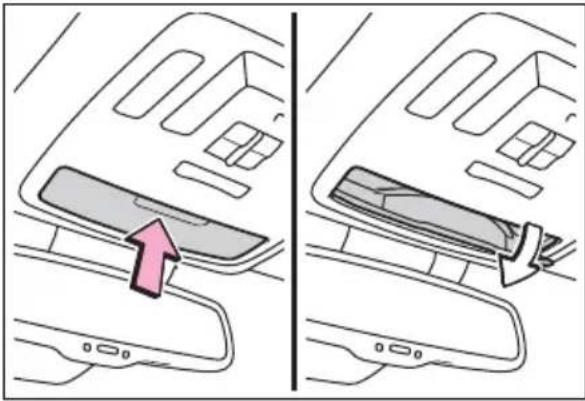
natural_image
Diagram showing two views of a car interior with a highlighted component (no text or symbols)| Symbols | Meanings |
 | Indicates the action (pushing, turning, etc.) used to operate switches and other devices. |
 | Indicates the outcome of an operation (e.g. a lid opens). |
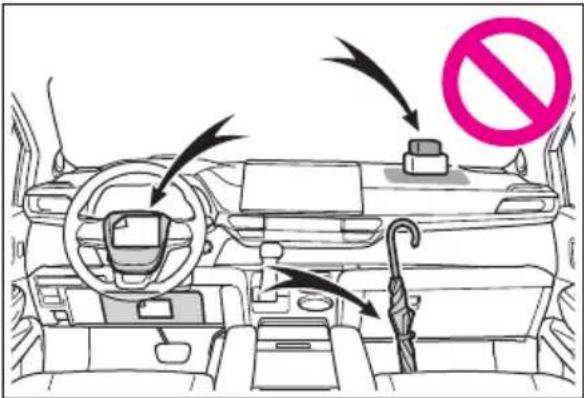
| Symbols | Meanings |
 | Indicates the component or position being explained. |
 | Means Do not, Do not do this, or Do not let this happen. |
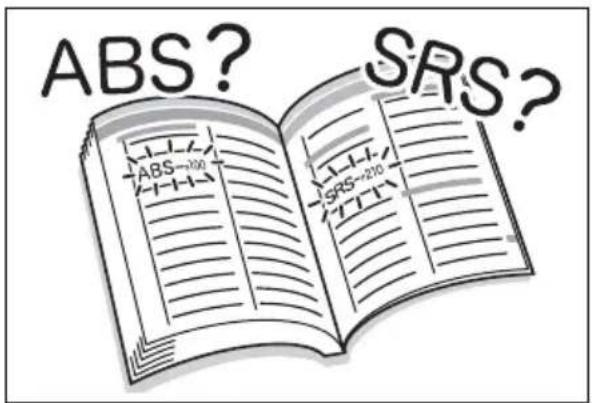
How to search
■Searching by name
● Alphabetical index: →P.571
■Searching by installation position
- Pictorial index: P.14
natural_image
Illustration of a person reading an open book with a lightbulb above, no text or symbols present■Searching by symptom or sound
- What to do if... (Troubleshooting): →P.568
natural_image
Illustration of a person reading a book with a lightbulb symbol above, next to an electric car with lightning bolts (no text or symbols present)■Searching by title
- Table of contents: P.2
natural_image
Line drawing of a person reading an open book with a lightbulb above, symbolizing ideas or learning (no text or symbols present)Pictorial index
Exterior
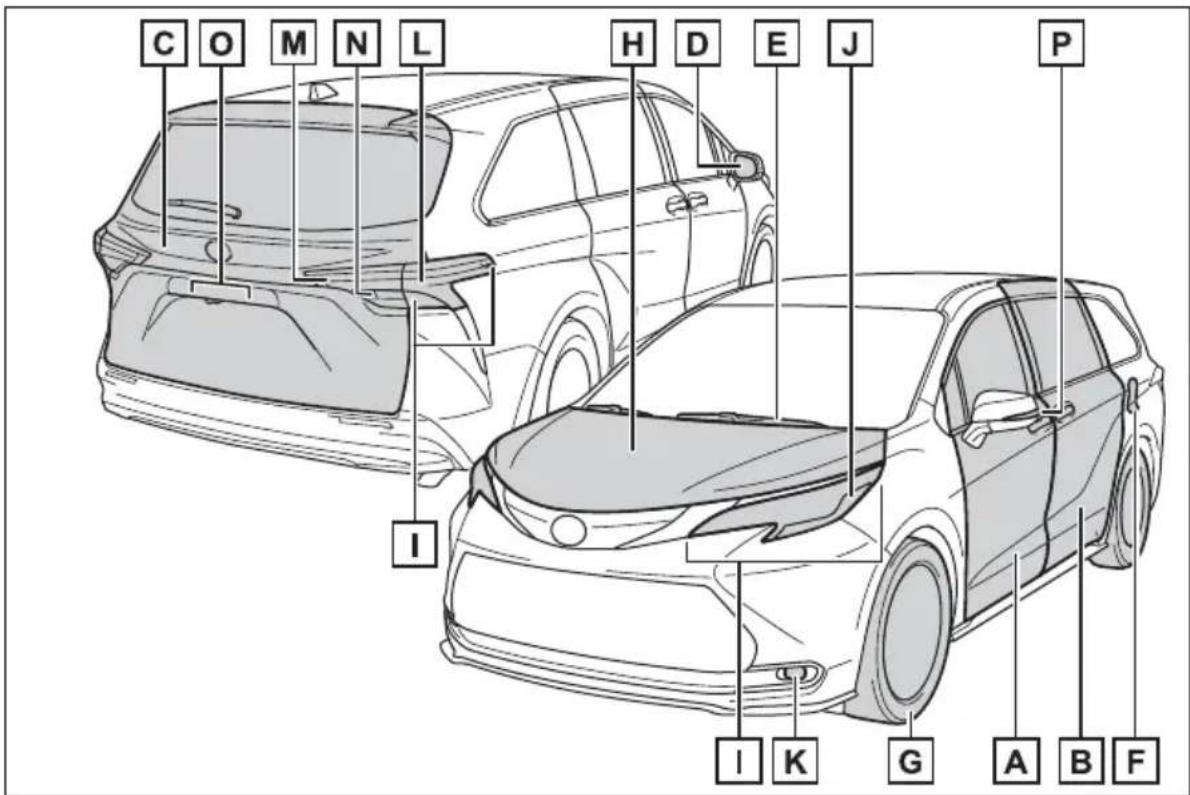
▶ Type A
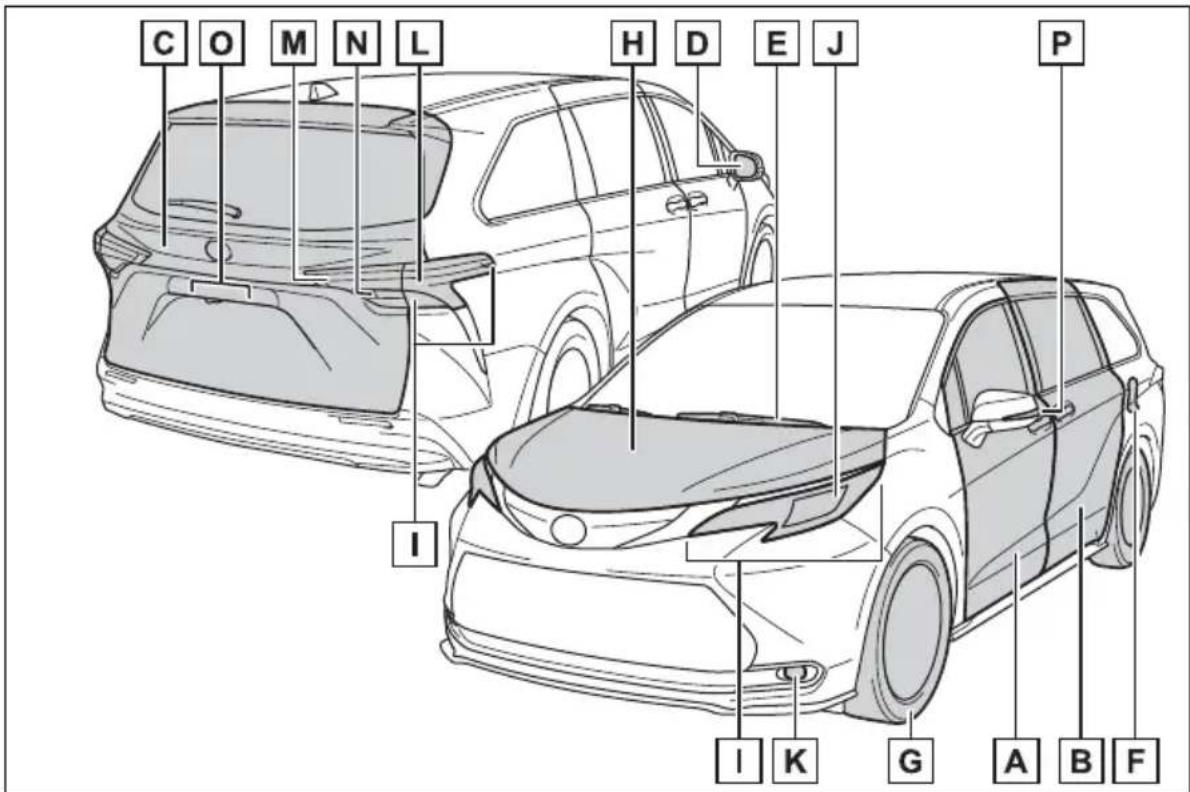
A Front doors....P.132
Locking/unlocking P.132
Opening/closing the front side windows....P.201
Locking/unlocking by using the mechanical key .....P.133, 504
Warning messages ......P.477
B Sliding doors .....P.137
Locking/unlocking P.138
Opening/closing the sliding door....P.139
Opening/closing the rear side windows ......P.201
Warning messages ......P.477
C Back door P.150
Locking/unlocking P.151
Opening from inside the cabin ^* P.154
Opening from outside....P.152, 153
Warning messages ......P.477
D Outside rear view mirrors .....P.198
Adjusting the mirror angle....P.198
Folding the mirrors .....P.199
Driving position memory ^* P.178
Defogging the mirrors ^* P.350
E Windshield wipers ......P.254
Precautions against winter season....P.343
To prevent freezing (windshield wiper de-icer) ^* .....P.350
Precautions against car wash
(Rain-sensing windshield wipers) ^* P.401
Refueling method....P.259
Fuel type/fuel tank capacity .....P.520
G Tires P.424
Tire size/inflation pressure ......P.525
Winter tires/tire chain .....P.343
Checking/rotation/tire pressure warning system .....P.424
Coping with flat tires....P.481, 491
H Hood.....P.413
Opening P.413
Engine oil P.521
Coping with overheat P.511
Warning messages ......P.477
Light bulbs of the exterior lights for driving
(Replacing method: P.451, Watts: P.526)
I Headlights/side marker lights/parking lights ......P.248
Turn signal lights P.242
J Headlights/daytime running lights ......P.248
K Fog lights ^* P.254
L Stop lights/tail lights....P.242, 248
M Side marker lights*/tail lights*....P.248
N Back-up lights
Shifting the shift lever to R....P.238
License plate lights....P.248
P Side turn signal lights ^* P.242
*: If equipped
▶ Type B
A Front doors....P.132
Locking/unlocking P.132
Opening/closing the front side windows....P.201
Locking/unlocking by using the mechanical key .....P.133, 504
Warning messages P.477
B Sliding doors P.137
Locking/unlocking P.138
Opening/closing the sliding door....P.139
Opening/closing the rear side windows .....P.201
Warning messages P.477
C Back door P.150
Locking/unlocking P.151
Opening from inside the cabin* P.154
Opening from outside....P.152, 153
Warning messages P.477
D Outside rear view mirrors .....P.198
Adjusting the mirror angle P.198
Folding the mirrors P.199
Driving position memory ^* P.178
Defogging the mirrors ^* P.350
E Windshield wipers ......P.254
Precautions against winter season .....P.343
To prevent freezing (windshield wiper de-icer) ^* .....P.350
Precautions against car wash (Rain-sensing windshield wipers) ^* P.401
Refueling method....P.259
Fuel type/fuel tank capacity .....P.520
G Tires P.424
Tire size/inflation pressure P.525
Winter tires/tire chain P.343
Checking/rotation/tire pressure warning system....P.424
Coping with flat tires....P.481, 491
H Hood....P.413
Opening P.413
Engine oil P.521
Coping with overheat P.511
Warning messages P.477
Light bulbs of the exterior lights for driving
(Replacing method: P.451, Watts: P.526)
1 Headlights/side marker lights/parking lights .....P.248
Turn signal lights .....P.242
J Parking lights*/daytime running lights....P.248
K Fog lights ^ P.254
L Stop lights/tail lights*....P.242, 248
M Side marker lights*/tail lights*....P.248
N Back-up lights
Shifting the shift lever to R....P.238
License plate lights....P.248
P Side turn signal lights ^ P.242
*: If equipped
▶ Type C
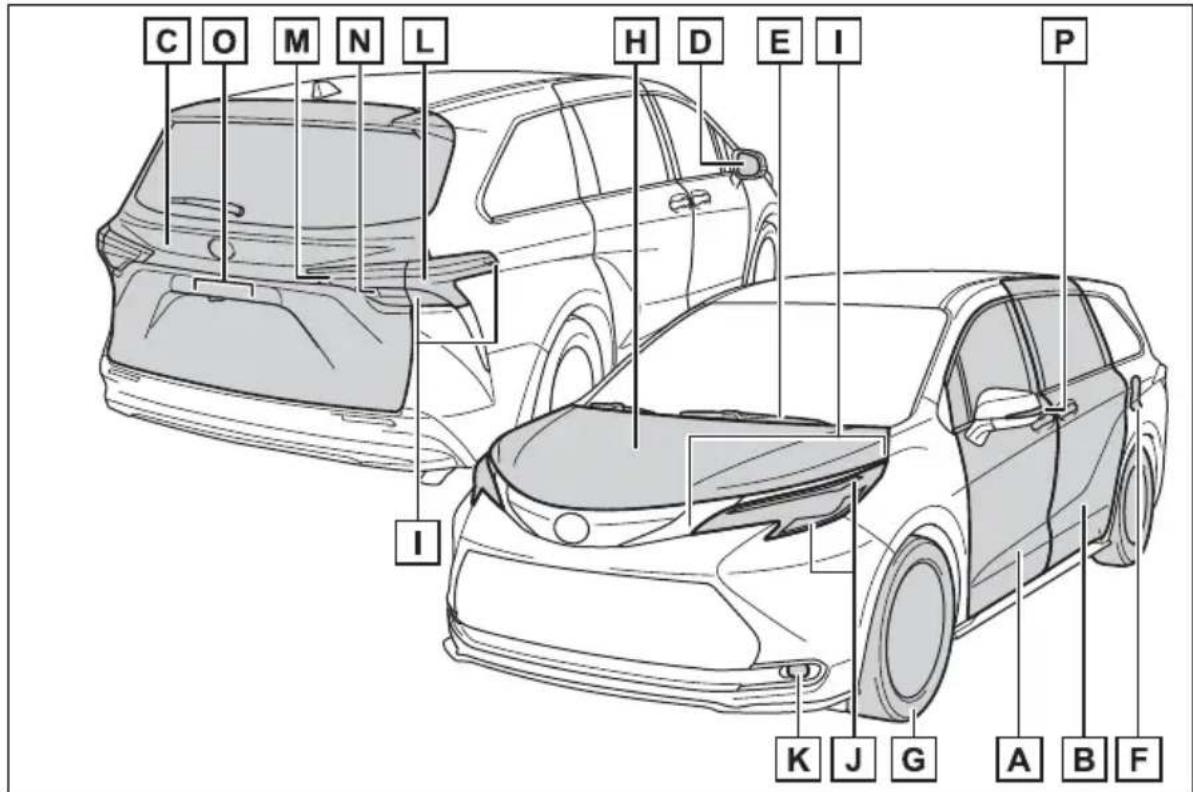
A Front doors....P.132
Locking/unlocking P.132
Opening/closing the front side windows....P.201
Locking/unlocking by using the mechanical key .....P.133, 504
Warning messages ......P.477
B Sliding doors P.137
Locking/unlocking P.138
Opening/closing the sliding door.....P.139
Opening/closing the rear side windows ......P.201
Warning messages ......P.477
C Back door P.150
Locking/unlocking P.151
Opening from inside the cabin ^* P.154
Opening from outside....P.152, 153
Warning messages ......P.477
D Outside rear view mirrors .....P.198
Adjusting the mirror angle....P.198
Folding the mirrors .....P.199
Driving position memory ^* P.178
Defogging the mirrors ^* P.350
E Windshield wipers P.254
Precautions against winter season....P.343
To prevent freezing (windshield wiper de-icer) ^* .....P.350
Precautions against car wash
(Rain-sensing windshield wipers) ^* P.401
Refueling method....P.259
Fuel type/fuel tank capacity ......P.520
G Tires P.424
Tire size/inflation pressure ......P.525
Winter tires/tire chain .....P.343
Checking/rotation/tire pressure warning system....P.424
Coping with flat tires....P.481, 491
H Hood....P.413
Opening P.413
Engine oil P.521
Coping with overheat P.511
Warning messages ......P.477
Light bulbs of the exterior lights for driving
(Replacing method: P.451, Watts: P.526)
I Headlights/side marker lights .....P.248
Turn signal lights P.242
J Parking lights*/daytime running lights....P.248
K Fog lights ^* ......P.254
L Stop lights/tail lights ^* P.242, 248
M Side marker lights ^ /tail lights ^ ......P.248
N Back-up lights
Shifting the shift lever to R....P.238
License plate lights....P.248
P Side turn signal lights ^* P.242
*: If equipped
Instrument panel
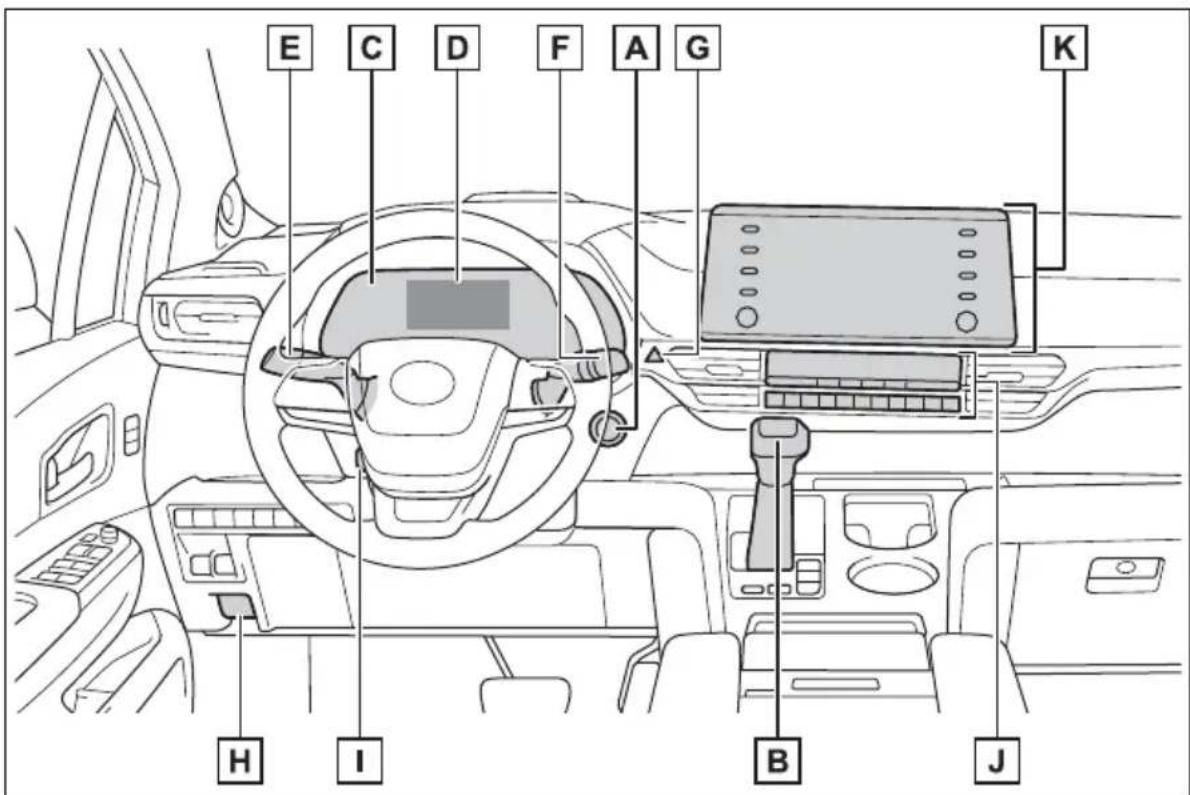
A Power switch P.231
Starting the hybrid system/changing the modes .....P.231, 234
Emergency stop of the hybrid system....P.459
When the hybrid system will not start P.501
Warning messages ......P.477
B Shift lever....P.238
Changing the shift position....P.239
Precautions against towing .....P.462
When the shift lever does not move....P.240
C Meters P.97, 101
Reading the meters/adjusting the instrument panel light P.97, 99, 101, 103
Warning lights/indicator lights ......P.92
When the warning lights come on....P.466
D Multi-information display .....P.104
Display P.104
Energy monitor....P.122
When the warning messages are displayed .....P.477
E Turn signal lever P.242
Headlight switch P.248
Headlights/parking lights/tail lights/ license plate lights/daytime running lights.....P.248
Fog lights ^*1 P.254
F Windshield wiper and washer switch .....P.254
Rear window wiper and washer switch ......P.257
Usage.....P.254, 257
Adding washer fluid....P.421
Warning messages ......P.477
G Emergency flasher switch.....P.458
H Hood lock release lever....P.413
I Tilt and telescopic steering control switch/tilt and telescopic steering lock release lever....P.185
Adjustment ......P.185
Driving position memory ^*1 P.178
J Air conditioning system....P.348
Usage....P.348
Rear window defogger P.350
K Multimedia system ^*1,2
*1: If equipped
*2:Refer to "NAVIGATION AND MULTIMEDIA SYSTEM OWNER'S MANUAL".
Switches
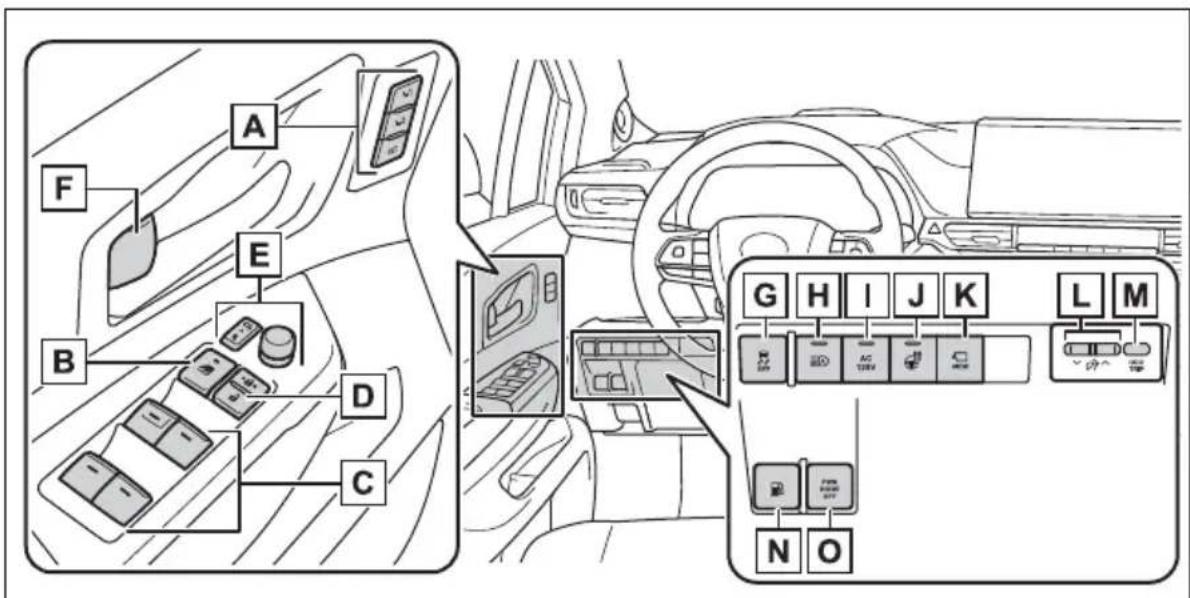
A Driving position memory switches ^1 .....P.179
B Window lock switch P.203
C Power window switches....P.201
D Door lock switches .....P.135
E Outside rear view mirror switches .....P.198
F Inside lock buttons ......P.135
G VSC OFF switch P.336
H Automatic High Beam switch P.250
I AC 120V switch ^1 ......P.374
J Heated steering wheel switch ^1 P.361
K Camera switch ^1,2
L Instrument panel light control switches .....P.99, 103
M "ODO TRIP" switch P.99, 103
N Fuel filler door opener switch....P.260
Power sliding door main switch P.148
*1:If equipped
*2:Refer to "NAVIGATION AND MULTIMEDIA SYSTEM OWNER'S MAN-
UAL".
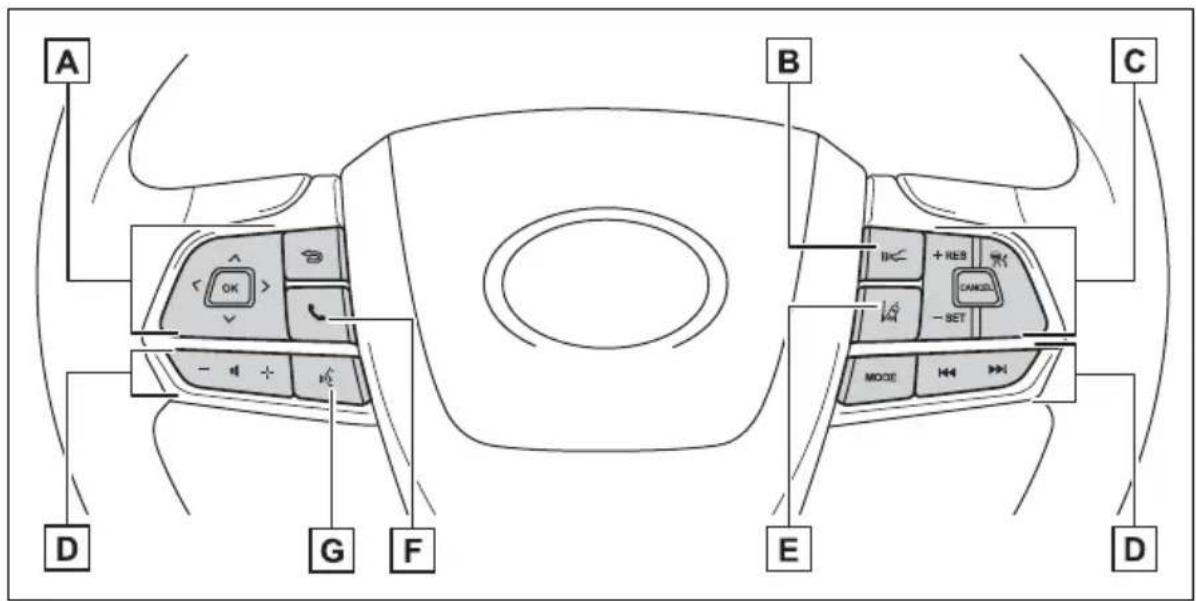
A Meter control switches....P.105
B Vehicle-to-vehicle distance switch....P.294
Cruise control switches
Dynamic radar cruise control with full-speed range .....P.288
D Audio remote control switches*
E LTA (Lane Tracing Assist) switch....P.275
F Telephone switch*
G Talk switch*
*: Refer to "NAVIGATION AND MULTIMEDIA SYSTEM OWNER'S MANUAL".
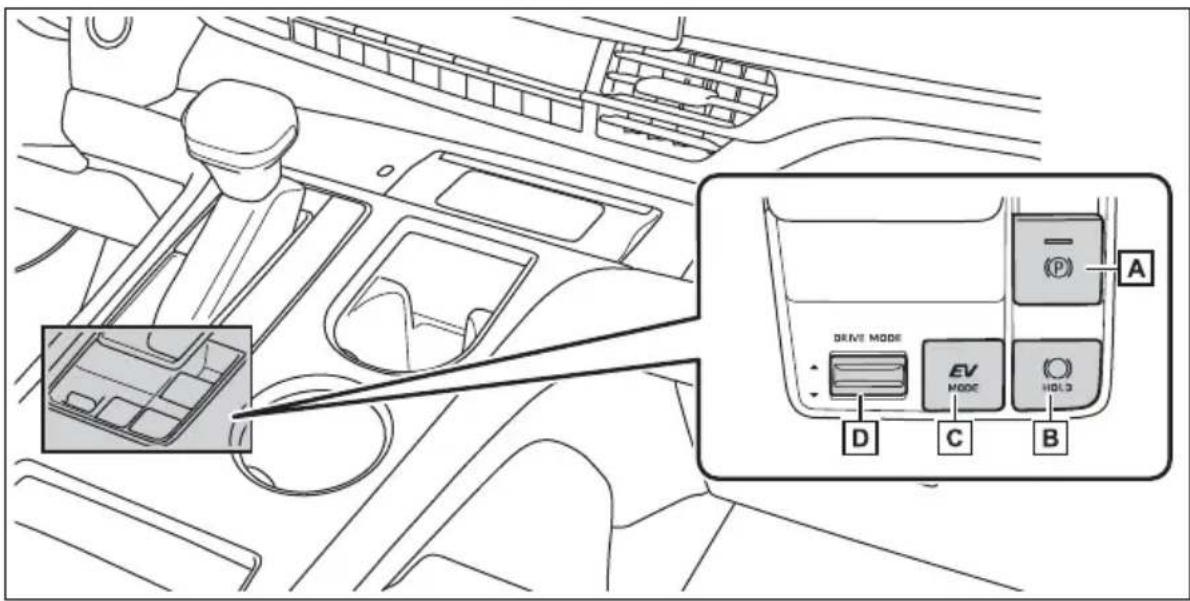
A Parking brake switch....P.243
Applying/releasing....P.243
Precautions against winter season .....P.344
Warning buzzer/message ......P.472, 477
B Brake hold switch....P.246
C EV drive mode switch .....P.236
D Driving mode select switch....P.333
Interior
▶ 8-passenger models
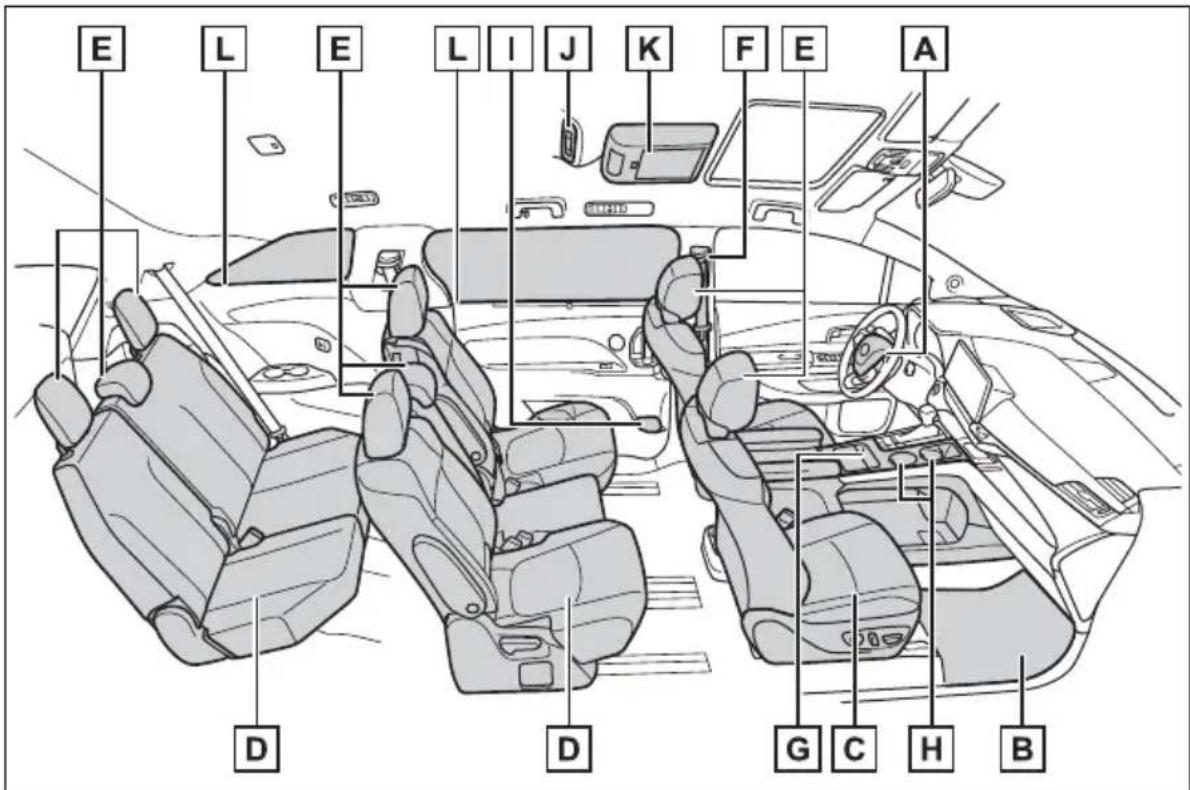
A SRS airbags....P.41
B Floor mats....P.32
C Front seats....P.169
D Second seats....P.171
Third seats....P.171
E Head restraints....P.182
F Seat belts .....P.35
G Console box P.367
H Cup holders P.368
I Bottle holders.....P.369
Door pockets P.370
J Rear automatic air conditioning system....P.358
K Rear seat entertainment system ^1,2
L Rear side sunshades ^1 P.385
*1:If equipped
*2:Refer to "NAVIGATION AND MULTIMEDIA SYSTEM OWNER'S MANUAL".
7-passenger models
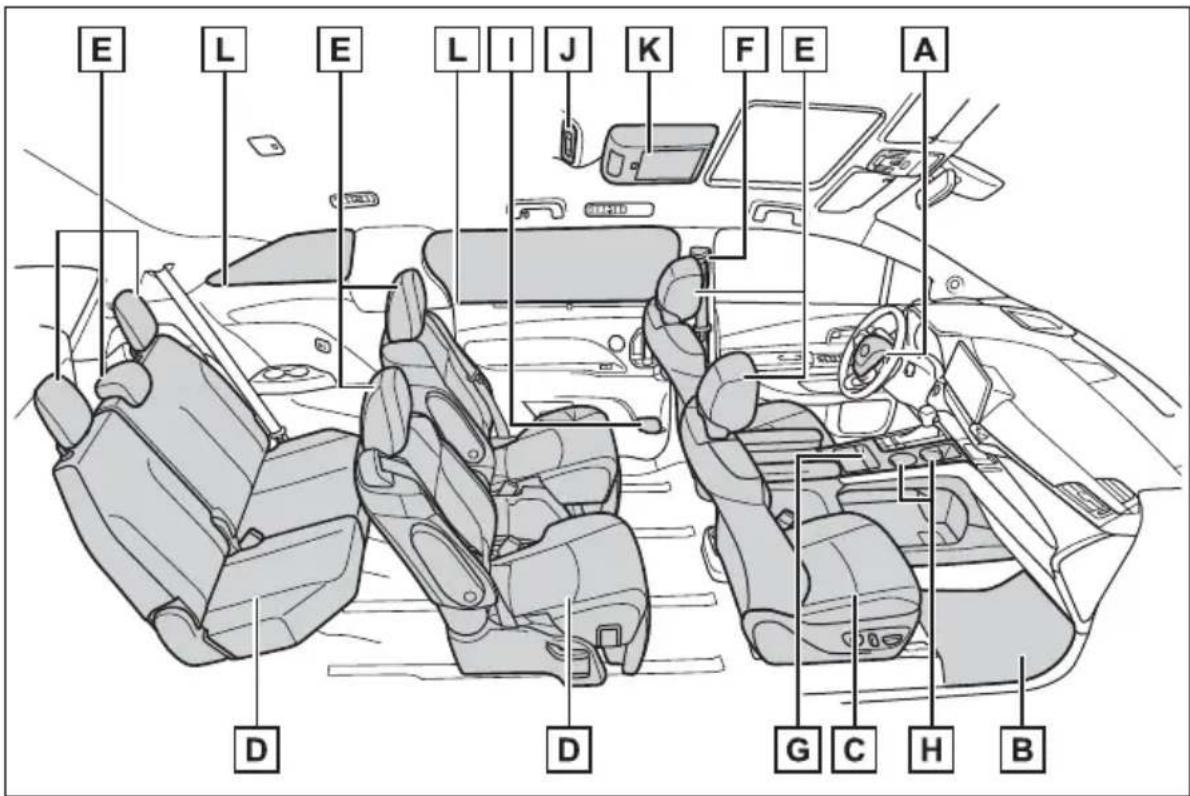
A SRS airbags....P.41
B Floor mats....P.32
C Front seats....P.169
D Second seats....P.171
Third seats....P.171
E Head restraints....P.182
F Seat belts P.35
G Console box P.367
H Cup holders....P.368
I Bottle holders....P.369
Door pockets P.370
J Rear automatic air conditioning system.....P.358
K Rear seat entertainment system ^1,2
L Rear side sunshades ^1 P.385
*1: If equipped
*2:Refer to "NAVIGATION AND MULTIMEDIA SYSTEM OWNER'S MANUAL".
Ceiling
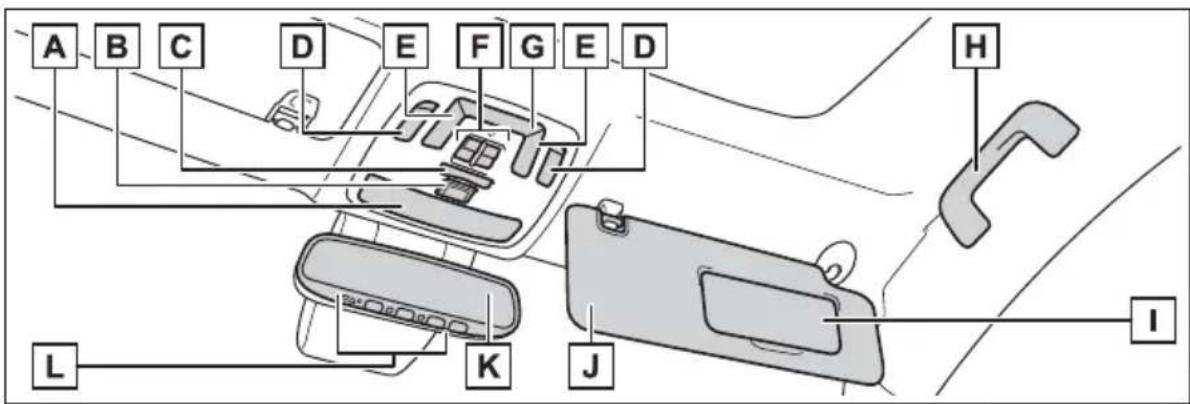
A Conversation mirror ......P.370
B “SOS” button*1 P.75
C Personal/interior light main switch .....P.364
D Interior lights ^*2 P.364
Personal lights ^*2 P.364
E Power sliding door switches....P.140
F Moon roof switches ^1 ......P.204
G Power back door switch ^1 P.154
H Assist grips P.386
I Vanity mirrors....P.374
J Sun visors....P.374
K Inside rear view mirror ^*1 ......P.186
Digital Rear-view Mirror ^*1 P.188
L Garage door opener switches ^*1 ......P.392
*1:If equipped
*2: The illustration shows the front, but they are also equipped in the rear.
1
1-1. For safe use
Before driving....32
For safe driving ....33
Seat belts....35
SRS airbags......41
Front passenger occupant classification system ....51
Exhaust gas precautions 56
1-2. Child safety
Riding with children.....57
Child restraint systems...58
1-3. Emergency assistance
Safety Connect .....75
1-4. Hybrid system
Hybrid system features ..79
Hybrid system precautions 83
1-5. Theft deterrent system
Immobilizer system .....88
Alarm....89
Before driving
Observe the following before starting off in the vehicle to ensure safety of driving.
Installing floor mats
Use only floor mats designed specifically for vehicles of the same model and model year as your vehicle. Fix them securely in place onto the carpet.
1 Insert the retaining hooks (clips) into the floor mat eye-lets.
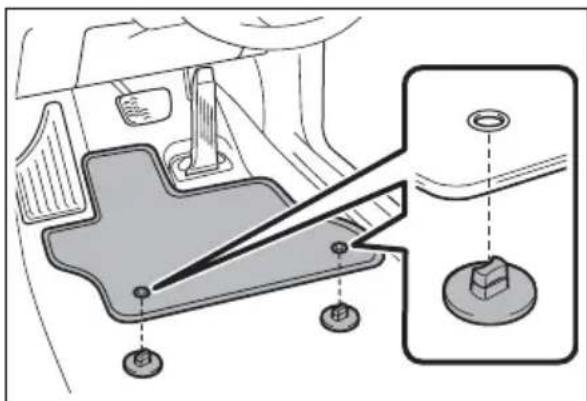
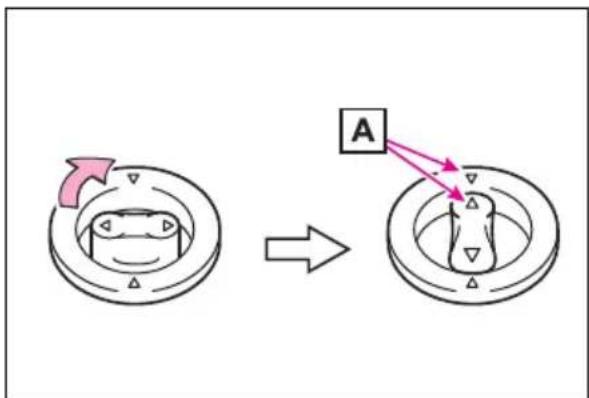
2 Turn the upper knob of each retaining hook (clip) to secure the floor mats in place.
flowchart
graph TD
    A["Circle Component"] --> B["Ring Structure"]
    style A fill:#f9f,stroke:#333
    style B fill:#bbf,stroke:#333
Always align the marks. A
The shape of the retaining hooks (clips) may differ from that shown in the illustration.

WARNING
Observe the following precautions. Failure to do so may cause the driver's floor mat to slip, possibly interfering with the pedals while driving. An unexpectedly high speed may result or it may become difficult to stop the vehicle. This could lead to an accident, resulting in death or serious injury.
■When installing the driver's floor mat
- Do not use floor mats designed for other models or different model year vehicles, even if they are Toyota Genuine floor mats.
- Only use floor mats designed for the driver's seat.
● Always install the floor mat securely using the retaining hooks (clips) provided.
- Do not use two or more floor mats on top of each other.
- Do not place the floor mat bottom-side up or upside-down.

WARNING
Before driving
- Check that the floor mat is securely fixed in the correct place with all the provided retaining hooks (clips). Be especially careful to perform this check after cleaning the floor.
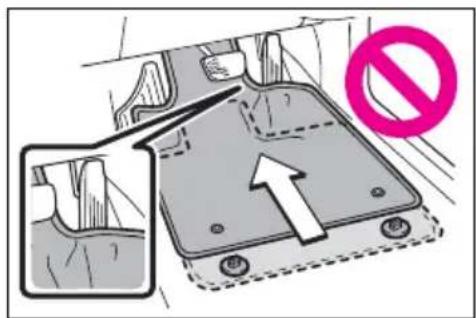
With the hybrid system stopped and the shift lever in P, fully depress each pedal to the floor to make sure it does not interfere with the floor mat.
For safe driving
For safe driving, adjust the seat and mirror to an appropriate position before driving.
Correct driving posture
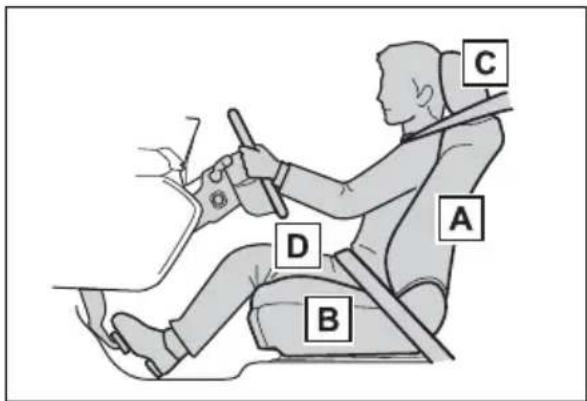
A Adjust the angle of the seat-back so that you are sitting straight up and so that you do not have to lean forward to steer. (→P.169)
B Adjust the seat so that you can depress the pedals fully and so that your arms bend slightly at the elbow when gripping the steering wheel. (→P.169)
C Lock the head restraint in place with the center of the head restraint closest to the top of your ears. (→P.182)
D Wear the seat belt correctly.
(→P.36)

WARNING
Observe the following precautions.
Failure to do so may result in death or serious injury.
- Do not adjust the position of the driver's seat while driving.
Doing so could cause the driver to lose control of the vehicle.
- Do not place a cushion between the driver or passenger and the seatback. A cushion may prevent correct posture from being achieved, and reduce the effectiveness of the seat belt and head restraint.
- Do not place anything under the front seats.
Objects placed under the front seats may become jammed in the seat tracks and stop the seat from locking in place. This may lead to an accident and the adjustment mechanism may also be damaged.
● Always observe the legal speed limit when driving on public roads.
- When driving over long distances, take regular breaks before you start to feel tired. Also, if you feel tired or sleepy while driving, do not force yourself to continue driving and take a break immediately.
Correct use of the seat belts
Make sure that all occupants are wearing their seat belts before driving the vehicle. ( P.36)
Use a child restraint system appropriate for the child until the child becomes large enough to
properly wear the vehicle's seat belt. (→P.58)
Adjusting the mirrors
Make sure that you can see backward clearly by adjusting the inside rear view mirror (if equipped), Digital Rear-view Mirror (if equipped) and outside rear view mirrors properly. (→P.186, 188, 198)
Seat belts
Make sure that all occupants are wearing their seat belts before driving the vehicle.

WARNING
Observe the following precautions to reduce the risk of injury in the event of sudden braking, sudden swerving or an accident. Failure to do so may cause death or serious injury.
■Wearing a seat belt
●Ensure that all passengers wear a seat belt.
●Always wear a seat belt properly.
● Each seat belt should be used by one person only. Do not use a seat belt for more than one person at once, including children.
Toyota recommends that children be seated in the rear seat and always use a seat belt and/or an appropriate child restraint system.
●To achieve a proper seating position, do not recline the seat more than necessary. The seat belt is most effective when the occupants are sitting up straight and well back in the seats.
- Do not wear the shoulder belt under your arm.
●Always wear your seat belt low and snug across your hips.
●Always wear the belt with the shoulder portion over the outside armrest and the lap portion under the outside armrest.
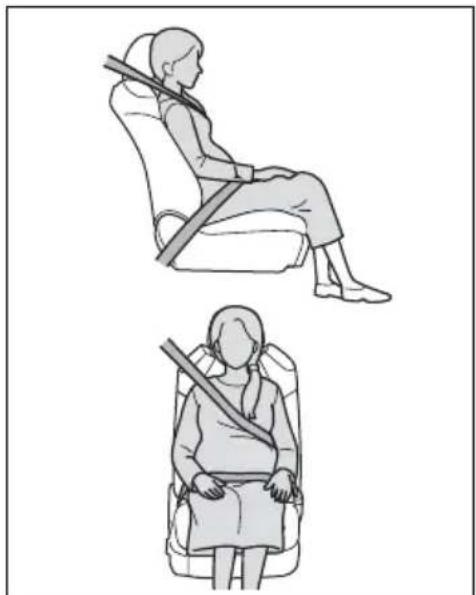
■ Pregnant women
Obtain medical advice and wear the seat belt in the proper way. (→P.36)
Women who are pregnant should position the lap belt as low as possible over the hips in the same manner as other occupants, extending the shoulder belt completely over the shoulder and avoiding belt contact with the rounding of the abdominal area.
If the seat belt is not worn properly, not only the pregnant woman, but also the fetus could suffer death or serious injury as a result of sudden braking or a collision.
natural_image
Two illustrations of a person seated in seat positions, one with a shoulder strap and the other with a backbelt (no text or symbols)■People suffering illness
Obtain medical advice and wear the seat belt in the proper way. (→P.36)
■When children are in the vehicle
$$ \rightarrow \mathrm{P}. 6 7 $$
■Seat belt damage and wear
- Do not damage the seat belts by allowing the belt, plate, or buckle to be jammed in the door.

WARNING
- Inspect the seat belt system periodically. Check for cuts, fraying, and loose parts. Do not use a damaged seat belt until it is replaced. Damaged seat belts cannot protect an occupant from death or serious injury.
- Ensure that the belt and plate are locked and the belt is not twisted. If the seat belt does not function correctly, immediately contact your Toyota dealer.
- Replace the seat assembly, including the belts, if your vehicle has been involved in a serious accident, even if there is no obvious damage.
- Do not attempt to install, remove, modify, disassemble or dispose of the seat belts. Have any necessary repairs carried out by your Toyota dealer. Inappropriate handling may lead to incorrect operation.
Correct use of the seat belts
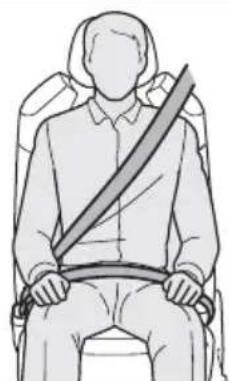
natural_image
Line drawing of a person sitting in a seat with a diagonal band (no text or symbols)- Extend the shoulder belt so that it comes fully over the shoulder, but does not come into contact with the neck or slide off the shoulder.
- Position the lap belt as low as possible over the hips.
- Adjust the position of the seatback.
Sit up straight and well back in the seat. - Do not twist the seat belt.
■Child seat belt usage
The seat belts of your vehicle were principally designed for persons of adult size.
- Use a child restraint system appropriate for the child, until the child becomes large enough to properly wear the vehicle's seat belt. (→P.58)
- When the child becomes large enough to properly wear the vehicle's seat belt, follow the instructions regarding seat belt usage. ( P.35)
■Seat belt extender
If your seat belts cannot be fastened securely because they are not long enough, a personalized seat belt extender is available from your Toyota dealer free of charge.
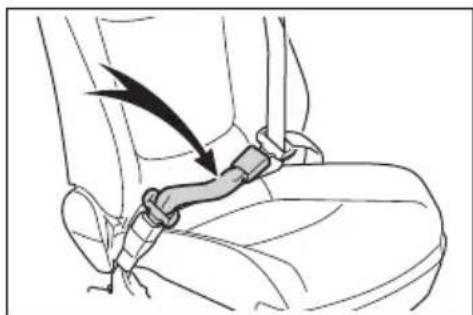
natural_image
Line drawing of a car seatbelt buckle being adjusted for use, showing no text or symbols
WARNING
■ Using a seat belt extender
Observe the following precautions to reduce the risk of injury in the event of sudden braking, sudden swerving or an accident. Failure to do so may cause death or serious injury.

WARNING
- Do not wear the seat belt extender if you can fasten the seat belt without the extender.
- Do not use the seat belt extender when installing a child restraint system because the belt will not securely hold the child restraint system, increasing the risk of death or serious injury in the event of an accident.
●The personalized extender may not be safe on another vehicle, when used by another person, or at a different seating position other than the one originally intended.

NOTICE
■When using a seat belt extender
When releasing the seat belt, press on the buckle release button on the extender, not on the seat belt.
This helps prevent damage to the vehicle interior and the extender itself.
Fastening and releasing the seat belt (except for the third center seat)
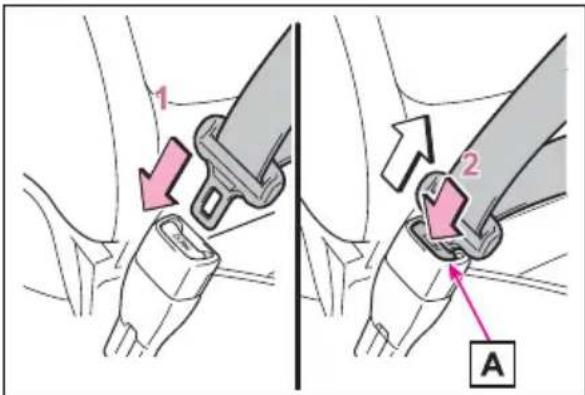
1 To fasten the seat belt, push
the plate into the buckle until a click sound is heard.
2 To release the seat belt, press the release button A
Fastening the seat belt (for the third center seat)
1 Take the plate out of the holder, and then pull down the seat belt.
2 Push into until a click sound is heard.
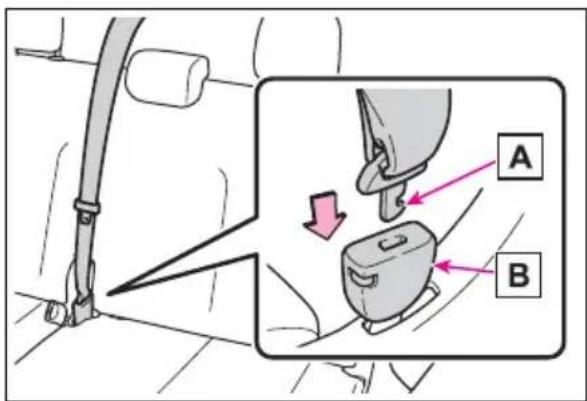
A Plate "A"
B Buckle "A"
3 Push into until a click sound is heard.
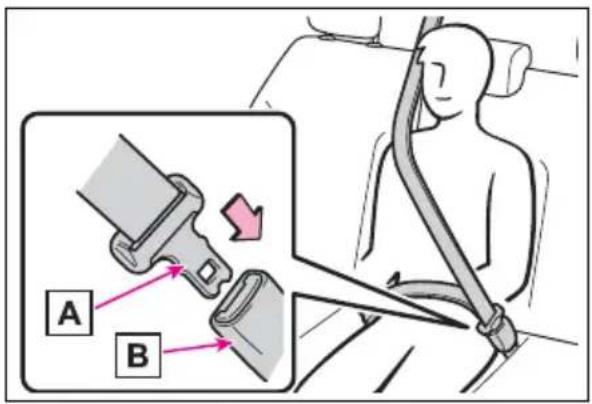
A Plate "B"
B Buckle "B"
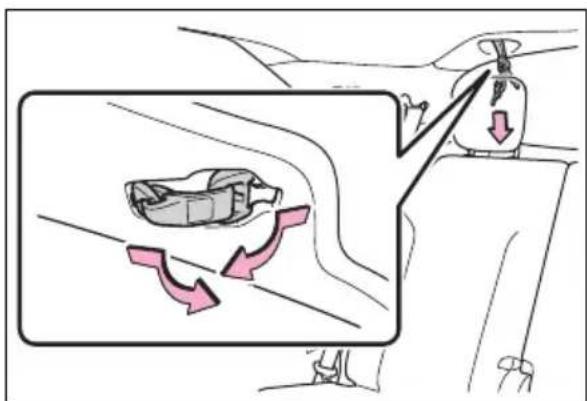
Releasing and stowing the seat belt (for the third center seat)
1 To release □press the release button on □
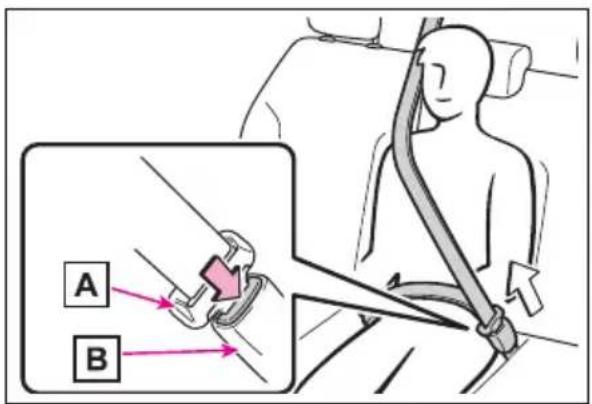
A Plate "B"
B Buckle "B"
2 To release ☐Anser the key (→P.128) or ☐Into the hole on ☐
Retract the belt slowly when releasing and stowing the seat belt.
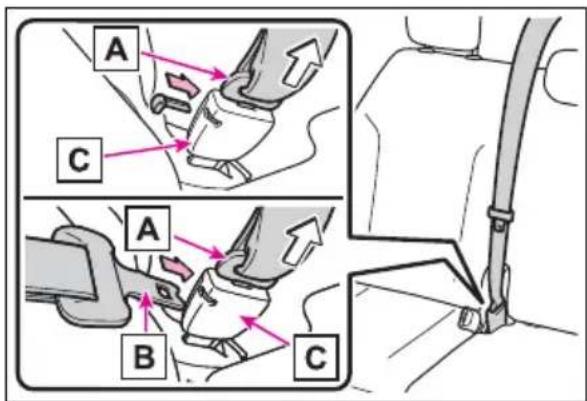
A Plate "A"
B Plate "B"
C Buckle "A"
3 Insert the seat belt plates (A) and B into the holder on the roof as shown.
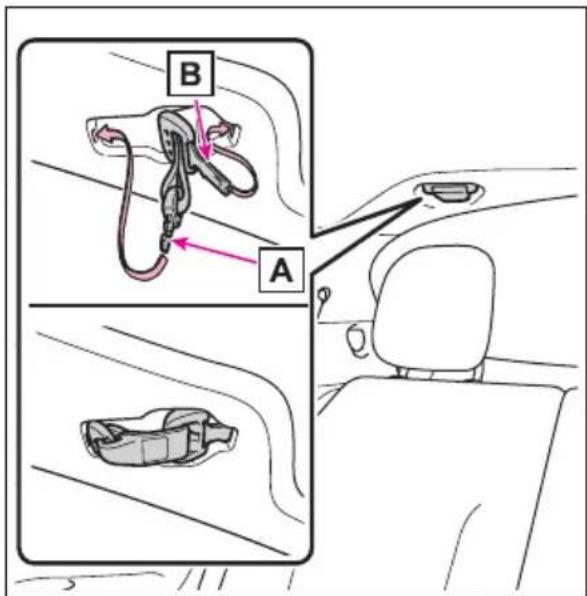
A Plate "A"
B Plate "B"
Emergency locking retractor (ELR)
The retractor will lock the belt during a sudden stop or on impact. It may also lock if you lean forward too quickly. A slow, easy motion will allow the belt to extend so that you can move around fully.
■Automatic locking retractor (ALR)
When a passenger's shoulder belt is completely extended and then retracted even slightly, the belt is locked in that position and cannot be extended. This feature is used to hold a child restraint system (CRS) firmly. To free the belt again, fully retract the belt and then pull the belt out once more.

WARNING
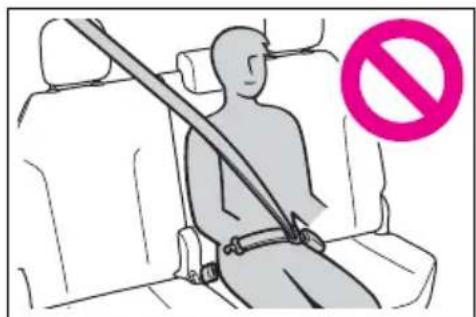
■When using the third center seat belt
Do not use the third center seat belt with either buckle released. Fastening only one of the buckles may result in death or serious injury in case of sudden braking, sudden swerving or an accident.
natural_image
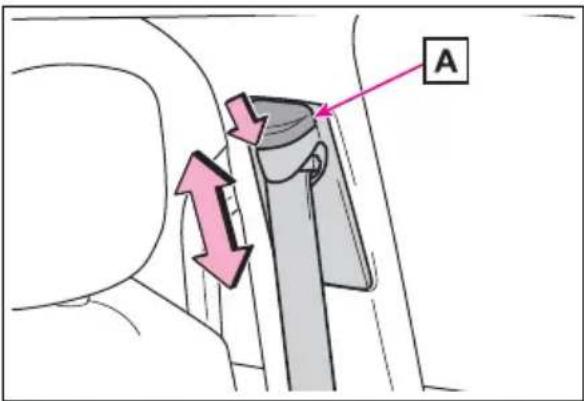
Illustration of a person sitting in a car seat with a pink prohibition symbol (no text or labels)Adjusting the seat belt shoulder anchor height (front and second outside seats [8-passenger models])
Push the seat belt shoulder anchor up and down while pressing the release button A
After releasing the button, make sure the adjuster is locked in the position by trying to move it up and down.
![TOYOTA Sienna Hybrid (2021) - Adjusting the seat belt shoulder anchor height (front and second outside seats [8-passenger models]) - 2](/content/2026/05/810579/images/0c38bc0fcf0cf3020e2adec4236d4b96d8091b17e3639f1a0eb1e5e6f533ccda.jpg)
WARNING
■Adjustable shoulder anchor
Always make sure the shoulder belt is positioned across the center of your shoulder. The belt should be kept away from your neck, but not falling off your shoulder. Failure to do so could reduce the amount of protection in an accident and cause death or serious injuries in the event of a sudden stop, sudden swerve or accident.
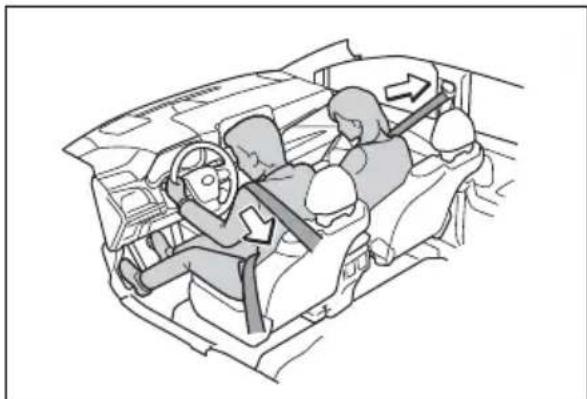
Seat belt pretensioners (front seats)
The pretensioners help the seat belts to quickly restrain the occupants by retracting the seat belts when the vehicle is subjected to certain types of severe frontal or side collision or a vehicle rollover.
The pretensioners do not activate in the event of a minor frontal impact, a minor side impact or a rear impact.
natural_image
Top-down schematic of a car interior showing driver, passenger, and crew (no text or labels)■Replacing the belt after the pre-tensioner has been activated
If the vehicle is involved in multiple collisions, the pretensioner will activate for the first collision, but will not activate for the second or subsequent collisions.
■PCS-linked seat belt pretensioner control
If the PCS (Pre-Collision System) determines that the possibility of a collision with a vehicle is high, the seat belt pretensioners will be prepared to operate.

WARNING
■Seat belt pretensioners
Observe the following precautions to reduce the risk of injury in the event of sudden braking, sudden swerving or an accident. Failure to do so may cause death or serious injury.
- Do not place anything, such as a cushion, on the front passenger's seat. Doing so will disperse the passenger's weight, which prevents the sensor from detecting the passenger's weight properly. As a result, the seat belt pretensioner for the front passenger's seat may not activate in the event of a collision.
- If the pretensioner has activated, the SRS warning light will come on. In that case, the seat belt cannot be used again and must be replaced at your Toyota dealer.
SRS airbags
The SRS airbags inflate when the vehicle is subjected to certain types of severe impacts that may cause significant injury to the occupants. They work together with the seat belts to help reduce the risk of death or serious injury.
SRS airbag system
■ Location of the SRS airbags
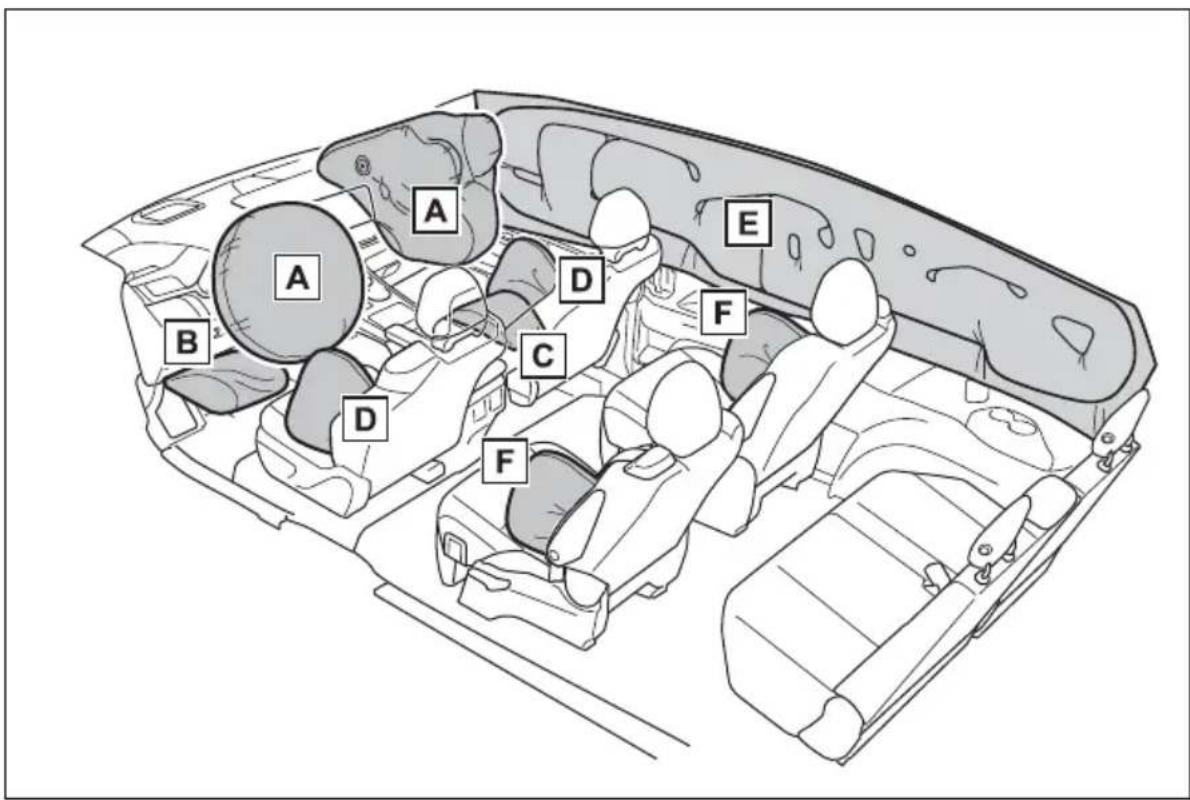
▶ SRS front airbags
A SRS driver airbag/front passenger airbag
Can help protect the head and chest of the driver and front passenger from impact with interior components
B SRS driver's knee airbag
Can help provide driver protection
© SRS front passenger's seat cushion airbag
Can help restrain the front passenger
▶ SRS side and curtain shield airbags
D SRS front side airbags
Can help protect the torso of the front seat occupants
E SRS curtain shield airbags
- Can help protect primarily the head of occupants in the outer seats
- Can help prevent the occupants from being thrown from the vehicle in the event of vehicle rollover
F SRS second seat side airbags
Can help protect the torso of occupants in the second outside seats
■SRS airbag system components
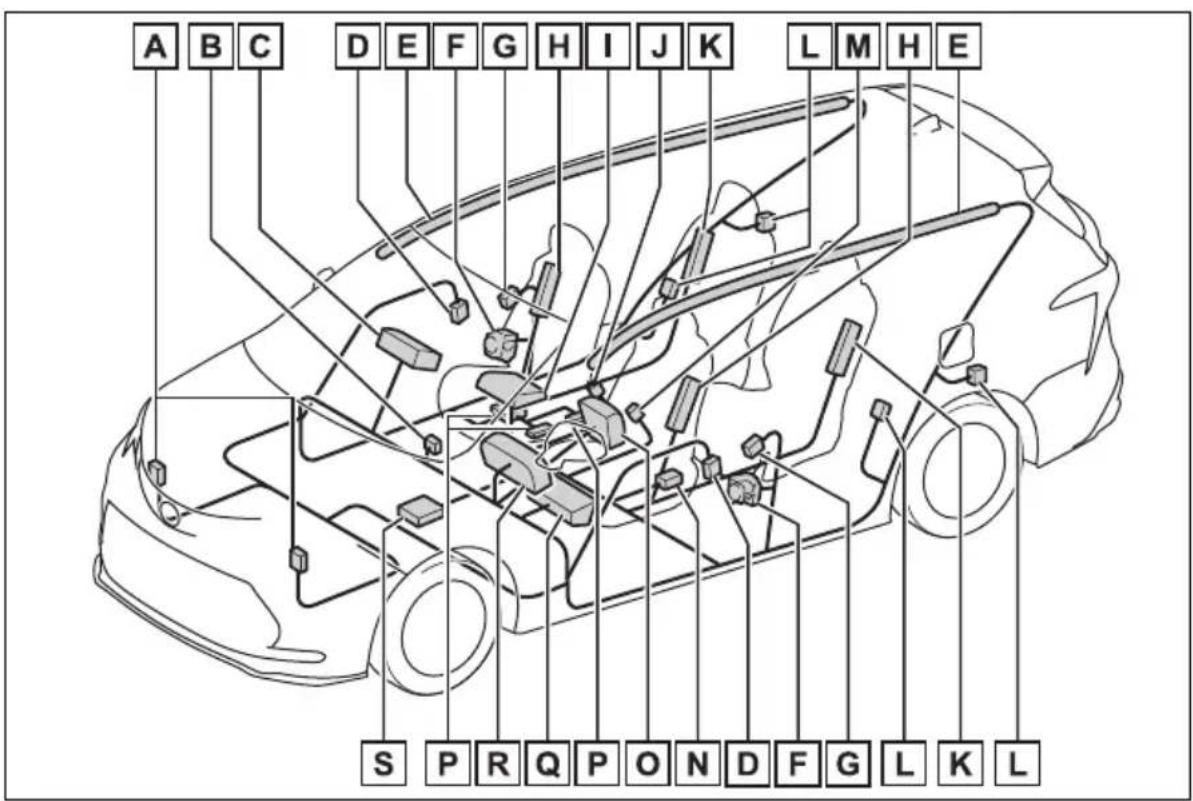
A Front impact sensors
B "AIR BAG ON" and "AIR BAG OFF" indicator lights
C Front passenger airbag
D Side impact sensors (front door)
E Curtain shield airbags
F Seat belt pretensioners and force limiters
G Side impact sensors (front)
H Side airbags (front seats)
Front passenger's seat cushion airbag
J Front passenger's seat belt buckle switch
K Side airbags (second outside seats)
L Side impact sensors (rear)
M Driver's seat belt buckle switch
N Driver's seat position sensor
Driver airbag
P Front passenger occupant classification sensors
Q Driver's knee airbag
R SRS warning light
S Airbag sensor assembly
Your vehicle is equipped with ADVANCED AIRBAGS designed based on the US motor vehicle safety standards (FMVSS208). The airbag sensor assembly (ECU) controls airbag deployment based on information obtained from the sensors etc. shown in the system components diagram above. This information includes crash severity and occupant information. As the airbags deploy, a chemical reaction in the inflators quickly fills the airbags with non-toxic gas to help restrain the motion of the occupants.
■If the SRS airbags deploy (inflate)
● Slight abrasions, burns, bruising etc., may be sustained from SRS airbags, due to the extremely high speed deployment (inflation) by hot gases.
●A loud noise and white powder will be emitted.
●Parts of the airbag module (steering wheel hub, airbag cover and inflator) as well as the front seats, parts of the front and rear pillars, and roof side rails, may be hot for several minutes. The airbag itself may also be hot.
●The windshield may crack.
●The hybrid system will be stopped and fuel supply to the engine will be stopped. (→P.86)
● All of the doors will be unlocked ( P.134)
●The brakes and stop lights will be controlled automatically.
(→P.336)
●The interior lights will turn on automatically. (→P.365)
●The emergency flashers will turn on automatically. (→P.458)
- For Safety Connect subscribers, if any of the following situations occur, the system is designed to send an emergency call to the response center, notifying them of the vehicle's location (without needing to push the "SOS" button) and an agent will attempt to speak with the occupants to ascertain the level of emergency and assistance required. If the occupants are unable to communicate, the agent automatically treats the call as an emergency and helps to dispatch the necessary emergency services. ( P.75)
• An SRS airbag is deployed.
- A seat belt pretensioner is activated.
• The vehicle is involved in a severe rear-end collision.
■ SRS airbag deployment conditions (SRS front airbags)
●The SRS front airbags will deploy in the event of an impact that exceeds the set threshold level (the level of force corresponding to an approximately 12-18 mph [20-30 km/h] frontal collision with a fixed wall that does not move or deform).
However, this threshold velocity will be considerably higher in the following situations:
- If the vehicle strikes an object, such as a parked vehicle or sign pole, which can move or deform on impact
- If the vehicle is involved in an underride collision, such as a collision in which the front of the vehicle underrides, or goes under, the bed of a truck
●Depending on the type of collision, it is possible that only the seat belt pretensioners will activate.
●The SRS front airbags for the front passenger will not activate if there is no passenger sitting in the front passenger seat. However, the SRS front airbags for the front passenger may deploy if luggage is put in the seat, even if the seat is unoccupied.
●The SRS seat cushion airbag on the front passenger seat will not operate if the occupant is not wearing a seat belt.
■ SRS airbag deployment conditions (SRS side and curtain shield airbags)
●The SRS side and curtain shield airbags will deploy in the event of an impact that exceeds the set threshold level (the level of force corresponding to the impact force produced by an approximately 3300 lb. [1500 kg] vehicle colliding with the vehicle cabin from a direction perpendicular to the vehicle orientation at an approxi-
mate speed of 12 -18 mph [20 -30 km/h]).
● Both SRS curtain shield airbags may deploy in the event of a severe side collision.
● Both SRS curtain shield airbags will deploy in the event of vehicle rollover.
●Both SRS curtain shield airbags may also deploy in the event of a severe frontal collision.
■Conditions under which the SRS airbags may deploy (inflate), other than a collision
The SRS front airbags and SRS curtain shield airbags may also deploy if a serious impact occurs to the underside of your vehicle. Some examples are shown in the illustration.
●Hitting a curb, edge of pavement or hard surface
●Falling into or jumping over a deep hole
●Landing hard or falling
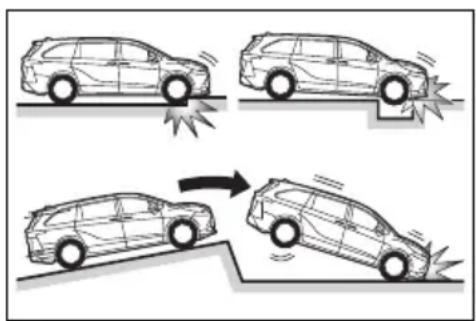
natural_image
Four illustrations showing a car collision with impact, illustrating vehicle damage and collision (no text or symbols)The SRS curtain shield airbags may also deploy under the situations shown in the illustration.
●The angle of vehicle tip-up is marginal.
●The vehicle skids and hits a curb stone.
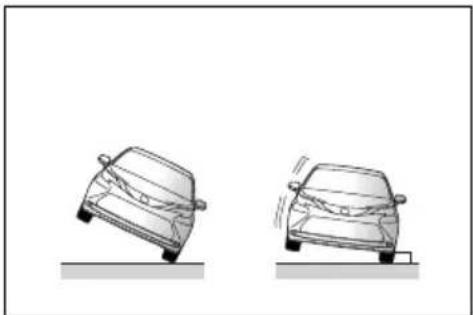
natural_image
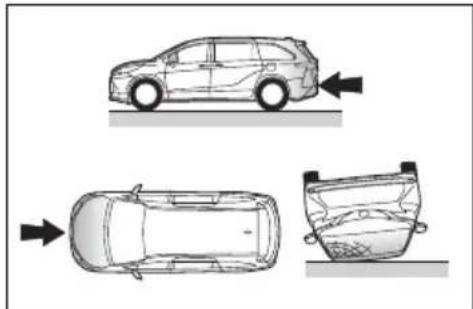
Two cartoon-style cars on a flat surface, one with a curved arrow indicating motion (no text or symbols)■Types of collisions that may not deploy the SRS airbags (SRS front airbags)
The SRS front airbags do not generally inflate if the vehicle is involved in a side or rear collision, if it rolls over, or if it is involved in a low-speed frontal collision. But, whenever a collision of any type causes sufficient forward deceleration of the vehicle, deployment of the SRS front airbags may occur.
- Collision from the side
- Collision from the rear
●Vehicle rollover
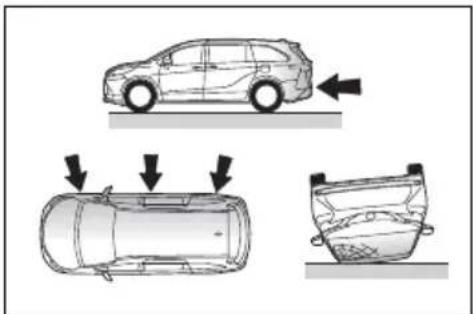
natural_image
Diagram showing a car under load with arrows indicating motion, and a separate view of the car's side profile (no text or symbols)■Types of collisions that may not deploy the SRS airbags (SRS side and curtain shield airbags)
The SRS side and curtain shield airbags may not activate if the vehicle is subjected to a collision from the side at certain angles, or a collision to the side of the vehicle body other than the passenger compartment.
- Collision from the side to the vehicle body other than the passenger compartment
●Collision from the side at an angle
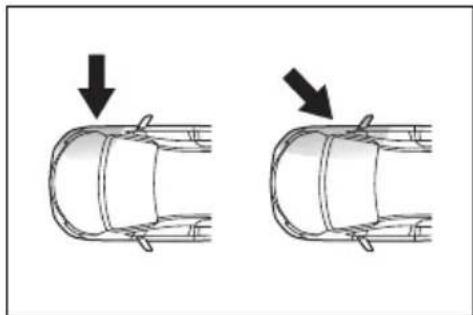
natural_image
Two mechanical diagrams showing a cylindrical component being folded, with arrows indicating direction (no text or symbols)The SRS side airbags do not generally inflate if the vehicle is involved in a frontal or rear collision, if it rolls over, or if it is involved in a low-speed side collision.
●Collision from the front
●Collision from the rear
● Vehicle rollover
natural_image
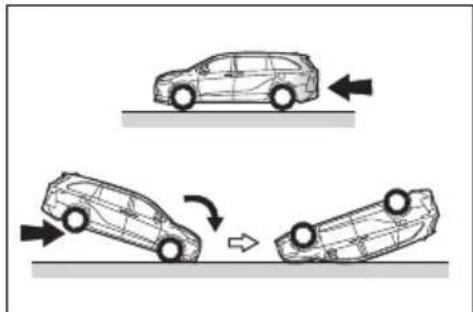
Diagram showing three views of a car: top-down, front-down, and side-down (no text or symbols present)The SRS curtain shield airbags do not generally inflate if the vehicle is involved in a rear collision, if it pitches end over end, or if it is involved in a low-speed side or low-speed frontal collision.
- Collision from the rear
●Pitching end over end
natural_image
Diagram showing three car trajectories on a surface, illustrating motion or collision (no text or symbols)■When to contact your Toyota dealer
In the following cases, the vehicle will require inspection and/or repair. Contact your Toyota dealer as soon as possible.
●Any of the SRS airbags have
been inflated.
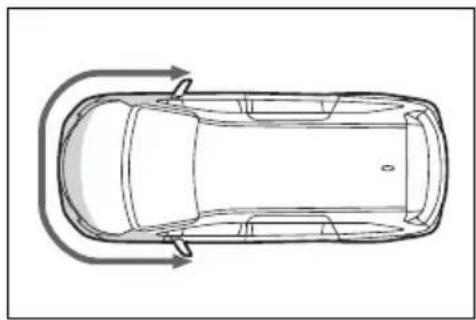
●The front of the vehicle is damaged or deformed, or was involved in an accident that was not severe enough to cause the SRS front airbags to inflate.
natural_image
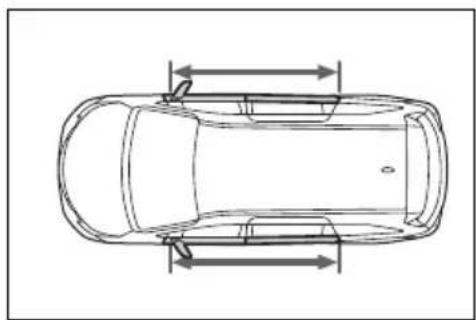
Top-down line drawing of a car with curved arrows indicating flow or movement (no text or symbols)●A portion of a door or its surrounding area is damaged, deformed or has had a hole made in it, or the vehicle was involved in an accident that was not severe enough to cause the SRS side and curtain shield airbags to inflate.
natural_image
Top-down line drawing of a car showing its rear and side views with directional arrows (no text or symbols)●The pad section of the steering wheel, dashboard near the front passenger airbag or lower portion of the instrument panel is scratched, cracked, or otherwise damaged.
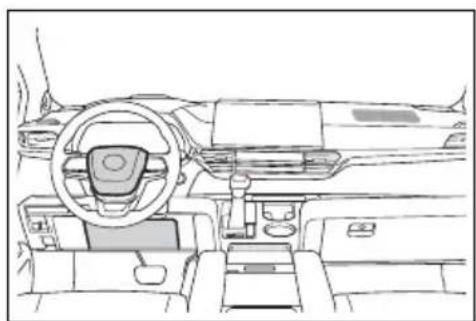
natural_image
Line drawing of a car interior showing steering wheel, dashboard, and steering wheel (no text or symbols)- The front passenger's seat cushion surface is scratched, cracked, or otherwise damaged.
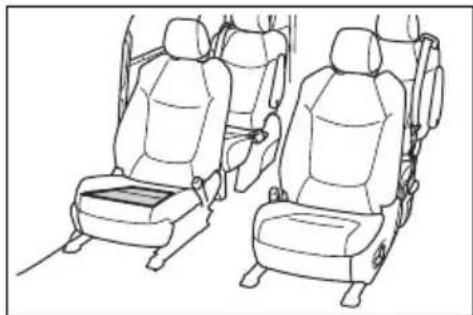
natural_image
Line drawing of two car seats with seat covers, no text or symbols present●The surface of the seats with the SRS side airbag is scratched, cracked, or otherwise damaged.
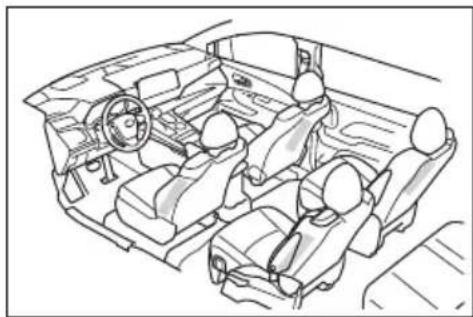
natural_image
Top-down line drawing of a car interior showing driver, steering wheel, and seatbelt (no text or symbols)●The portion of the front pillars, rear pillars or roof side rail garnishes (padding) containing the SRS curtain shield airbags inside is scratched, cracked, or otherwise damaged.
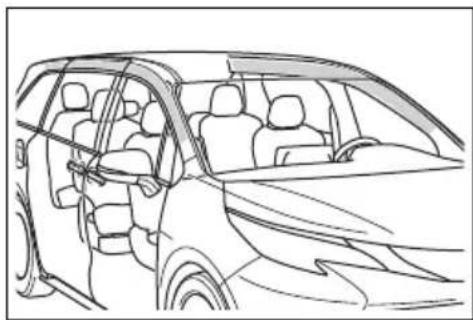
natural_image
Line drawing of a car interior showing driver, seat, and dashboard (no text or symbols)
WARNING
■ SRS airbag precautions
Observe the following precautions regarding the SRS airbags. Failure to do so may cause death or serious injury.
●The driver and all passengers in the vehicle must wear their seat belts properly. The SRS airbags are supplemental devices to be used with the seat belts.

WARNING
The SRS driver airbag deploys with considerable force, and can cause death or serious injury especially if the driver is very close to the airbag. The National Highway Traffic Safety Administration (NHTSA) advises: Since the risk zone for the driver's airbag is the first 2 - 3 in. (50 - 75 mm) of inflation, placing yourself 10 in. (250 mm) from your driver airbag provides you with a clear margin of safety. This distance is measured from the center of the steering wheel to your breast-bone. If you sit less than 10 in. (250 mm) away now, you can change your driving position in several ways:
- Move your seat to the rear as far as you can while still reaching the pedals comfortably.
- Slightly recline the back of the seat. Although vehicle designs vary, many drivers can achieve the 10 in. (250 mm) distance, even with the driver seat all the way forward, simply by reclining the back of the seat somewhat. If reclining the back of your seat makes it hard to see the road, raise yourself by using a firm, non-slippery cushion, or raise the seat if your vehicle has that feature.
- If your steering wheel is adjustable, tilt it downward. This points the airbag toward your chest instead of your head and neck.
The seat should be adjusted as recommended by NHTSA above, while still maintaining control of the foot pedals, steering wheel, and your view of the instrument panel controls.
- If the seat belt extender has been connected to the front seat belt buckles but the seat belt extender has not also been fastened to the latch plate of the seat belt, the SRS front airbags will judge that the driver and front passenger are wearing the seat belt even though the seat belt has not been connected. In this case, the SRS front airbags may not activate correctly in a collision, resulting in death or serious injury in the event of a collision. Be sure to wear the seat belt with the seat belt extender.
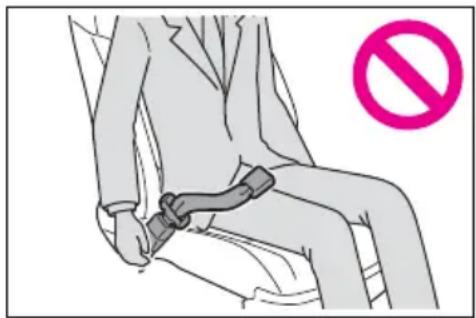
natural_image
Illustration of a person sitting on a chair with a pink prohibition symbol (no text or labels)●The SRS front passenger airbag also deploys with considerable force, and can cause death or serious injury especially if the front passenger is very close to the airbag. The front passenger seat should be as far from the airbag as possible with the seat-back adjusted, so the front passenger sits upright.
- Improperly seated and/or restrained infants and children can be killed or seriously injured by a deploying airbag. An infant or child who is too small to use a seat belt should be properly secured using a child restraint system. Toyota strongly recommends that all infants and children be placed in the rear seats of the vehicle and properly restrained. The rear seats are safer for infants and children than the front passenger seat. (→P.58)

WARNING
- Do not sit on the edge of the seat or lean against the dashboard.
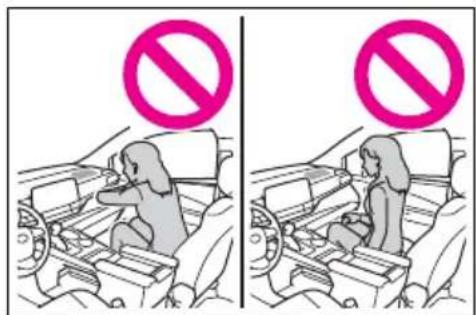
- Do not allow a child to stand in front of the SRS front passenger airbag unit or sit on the knees of a front passenger.
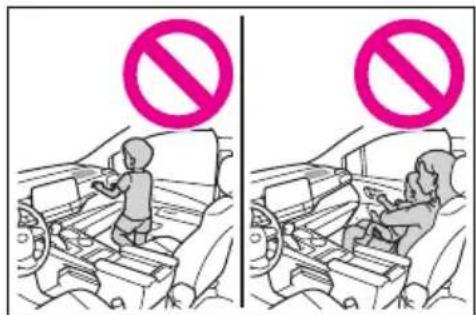
- Do not allow the front seat occupants to hold items on their knees.
- Do not lean against the door, the roof side rail or the front, side and rear pillars.
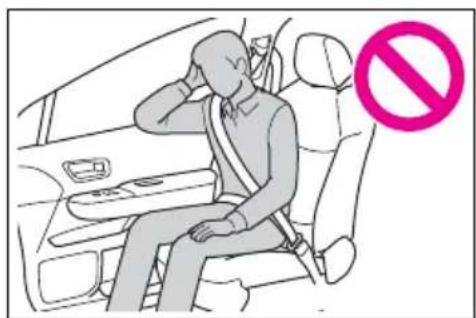
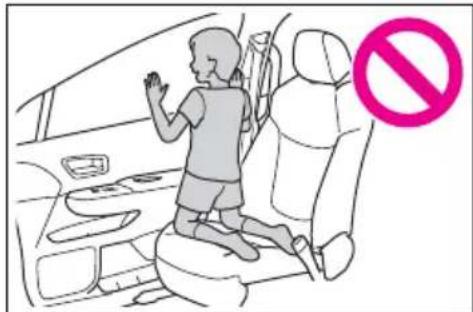
- Do not allow anyone to kneel on the passenger seats toward the door or put their head or hands outside the vehicle.
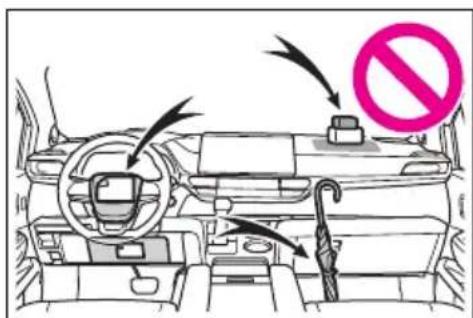
- Do not attach anything to or lean anything against areas such as the dashboard, steering wheel pad and lower portion of the instrument panel. These items can become projectiles when the SRS driver, front passenger and driver's knee airbags deploy.
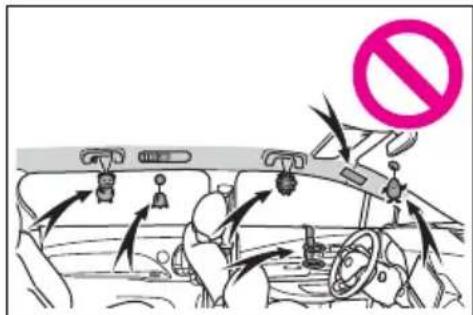
- Do not attach anything to areas such as a door, windshield, side windows, front or rear pillar, roof side rail and assist grip.

WARNING
- Do not hang coat hangers or other hard objects on the coat hooks. All of these items could become projectiles and may cause death or serious injury, should the SRS curtain shield airbags deploy.
- If a vinyl cover is put on the area where the SRS knee airbag will deploy, be sure to remove it.
- Do not use seat accessories which cover the parts where the SRS side airbags and SRS seat cushion airbag inflate as they may interfere with inflation of the SRS airbags. Such accessories may prevent the SRS side airbags and SRS seat cushion airbag from activating correctly, disable the system or cause the SRS side airbags and SRS seat cushion airbag to inflate accidentally, resulting in death or serious injury.
- Do not strike or apply significant levels of force to the area of the SRS airbag components or the front doors. Doing so can cause the SRS airbags to malfunction.
- Do not touch any of the component parts immediately after the SRS airbags have deployed (inflated) as they may be hot.
-
If breathing becomes difficult after the SRS airbags have deployed, open a door or side window to allow fresh air in, or leave the vehicle if it is safe to do so. Wash off any residue as soon as possible to prevent skin irritation.
-
If the areas where the SRS airbags are stored, such as the steering wheel pad and front and rear pillar garnishes, are damaged or cracked, have them replaced by your Toyota dealer.
- Do not place anything, such as a cushion, on the front passenger's seat. Doing so will disperse the passenger's weight, which prevents the sensor from detecting the passenger's weight properly. As a result, the SRS front airbags for the front passenger may not deploy in the event of a collision.
■Modification and disposal of SRS airbag system components
Do not dispose of your vehicle or perform any of the following modifications without consulting your Toyota dealer. The SRS airbags may malfunction or deploy (inflate) accidentally, causing death or serious injury.
● Installation, removal, disassembly and repair of the SRS airbags
● Repairs, modifications, removal or replacement of the steering wheel, instrument panel, dashboard, seats or seat upholstery, front, side and rear pillars, roof side rails, front door panels, front door trims or front door speakers
● Modifications to the front door panel (such as making a hole in it)
● Repairs or modifications of the front fender, front bumper, or side of the occupant compartment

WARNING
● Installation of a grille guard (bull bars, kangaroo bar, etc.), snow plows, winches or roof luggage carrier
- Modifications to the vehicle's suspension system
● Installation of electronic devices such as mobile two-way radios and CD players
● Modifications to your vehicle for a person with a physical disability
Front passenger occupant classification system
Your vehicle is equipped with a front passenger occupant classification system. This system detects the conditions of the front passenger seat and activates or deactivates the front passenger airbag and seat cushion airbag in the front passenger side.
System components
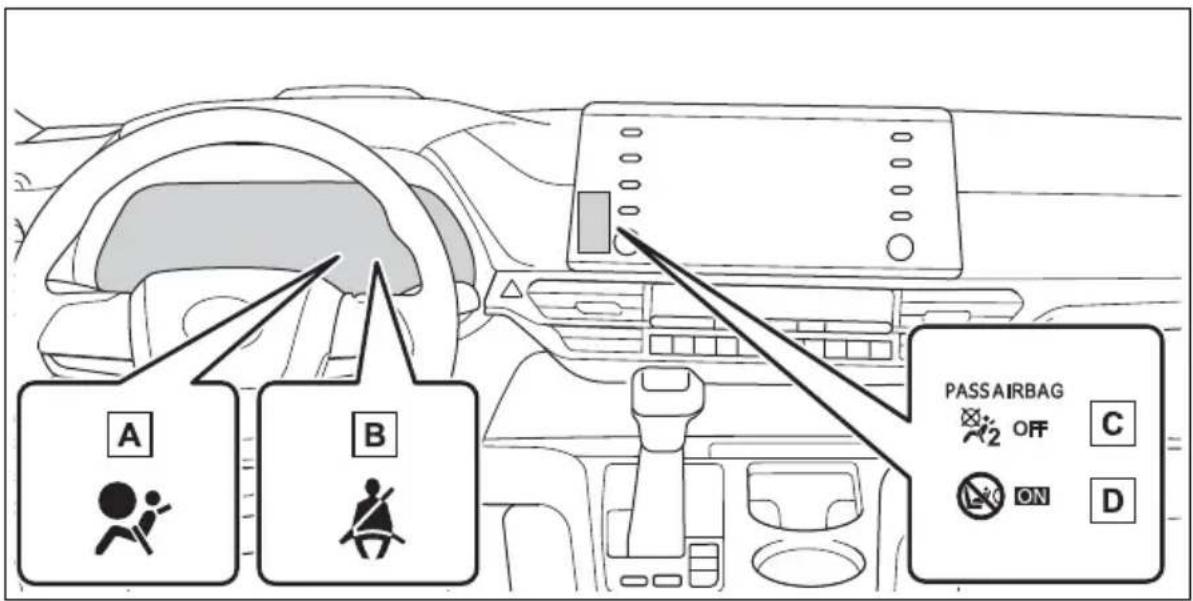
A SRS warning light
B Seat belt reminder light
C "AIR BAG OFF" indicator light
D "AIR BAG ON" indicator light

WARNING
■Front passenger occupant classification system precautions
Observe the following precautions regarding the front passenger occupant classification system. Failure to do so may cause death or serious injury.
●Wear the seat belt properly.
Make sure the front passenger's seat belt plate has not been left inserted into the buckle before someone sits in the front passenger seat.

WARNING
Make sure the "AIR BAG OFF" indicator light is not illuminated when using the seat belt extender for the front passenger seat. If the "AIR BAG OFF" indicator light is illuminated, disconnect the extender tongue from the seat belt buckle, and reconnect the seat belt. Reconnect the seat belt extender after making sure the "AIR BAG ON" indicator light is illuminated. If you use the seat belt extender while the "AIR BAG OFF" indicator light is illuminated, the SRS airbags for the front passenger will not activate, which could cause death or serious injury in the event of a collision.
- Do not apply a heavy load to the front passenger seat or equipment (e.g. seatback pocket).
- Do not put weight on the front passenger seat by putting your hands or feet on the front passenger seat seatback from the rear passenger seat.
- Do not let a rear passenger lift the front passenger seat with their feet or press on the seat-back with their legs.
-
Do not put objects under the front passenger seat.
-
Do not recline the front passenger seatback so far that it touches a rear seat. This may cause the "AIR BAG OFF" indicator light to be illuminated, which indicates that the SRS airbags for the front passenger will not activate in the event of a severe accident. If the seatback touches the rear seat, return the seatback to a position where it does not touch the rear seat. Keep the front passenger seatback as upright as possible when the vehicle is moving. Reclining the seatback excessively may lessen the effectiveness of the seat belt system.
- If an adult sits in the front passenger seat, the "AIR BAG ON" indicator light is illuminated. If the "AIR BAG OFF" indicator is illuminated, ask the passenger to sit up straight, well back in the seat, feet on the floor, and with the seat belt worn correctly. If the "AIR BAG OFF" indicator still remains illuminated, either ask the passenger to move to the rear seat, or if that is not possible, move the front passenger seat fully rearward.
- When it is unavoidable to install a forward-facing child restraint system on the front passenger seat, install the child restraint system on the front passenger seat in the proper order. (→P.61)
- Do not modify or remove the front seats.
- Do not kick the front passenger seat or subject it to severe impact. Otherwise, the SRS warning light may come on to indicate a malfunction of the front passenger occupant classification system. In this case, contact your Toyota dealer immediately.

WARNING
●Child restraint systems installed on the rear seat should not contact the front seatbacks.
- Do not use a seat accessory, such as a cushion and seat cover, that covers the seat cushion surface.
- Do not modify or replace the upholstery of the front seat.
Condition and operation in the front passenger occupant classification system
Adult *1
| Indicators/warning lights | “AIR BAG ON” and “AIR BAG OFF” indicator lights | “AIR BAG ON” |
| SRS warning light Off | ||
| Seat belt reminder light | Off^*2 or flashing^*3 | |
| Devices | Front passenger airbag Activated | |
| Front passenger's seat cushion air-bag | Activated^*2 or deactivated^*3 | |
Child *4
| Indicators/warning lights | “AIR BAG ON” and “AIR BAG OFF” indicator lights | “AIR BAG OFF” or “AIR BAG ON”*4 |
| SRS warning light Off | ||
| Seat belt reminder light | Off*2 or flashing*3 | |
| Devices | Front passenger airbag | Deactivated or activated*4 |
| Front passenger’s seat cushion air-bag | Deactivated or activated*2, 4 |
■Child restraint system with infant *5
| Indicators/warning lights | “AIR BAG ON” and “AIR BAG OFF” indicator lights | “AIR BAG OFF” *6 |
| SRS warning light Off | ||
| Seat belt reminder light | Off^*2 or flashing^*3 | |
| Devices | Front passenger airbag | Deactivated |
| Front passenger's seat cushion air-bag |
Unoccupied
| Indicators/warning lights | “AIR BAG ON” and “AIR BAG OFF” indicator lights | “AIR BAG OFF” |
| SRS warning light | Off | |
| Seat belt reminder light | ||
| Devices | Front passenger airbag | Deactivated |
| Front passenger’s seat cushion air-bag |
■There is a malfunction in the system
| Indicators/warning lights | “AIR BAG ON” and “AIR BAG OFF” indicator lights | “AIR BAG OFF” |
| SRS warning light | On | |
| Seat belt reminder light | ||
| Devices | Front passenger airbag | Deactivated |
| Front passenger’s seat cushion air-bag |
*1: The system judges a person of adult size as an adult. When a smaller adult sits in the front passenger seat, the system may recognize him/her as a child depending on his/her physique and posture.
*2: In the event the front passenger is wearing a seat belt.
^*3 :In the event the front passenger does not wear a seat belt.
*4: For some children, child in seat, child in booster seat or child in convertible seat, the system may not recognize him/her as a child. Factors which may affect this can be the physique or posture.
*5: Never install a rear-facing child restraint system on the front passenger seat. A forward-facing child restraint system should only be installed on the front passenger seat when it is unavoidable. (→P.61)
^*6 : In case the indicator light is not illuminated, consult this manual on how to install the child restraint system properly. ( P.58)
Exhaust gas precautions
Harmful substance to the human body is included in exhaust gases if inhaled.

WARNING
Exhaust gases contain harmful carbon monoxide (CO), which is colorless and odorless. Observe the following precautions. Failure to do so may cause exhaust gases to enter the vehicle and may lead to an accident caused by light-headedness, or may lead to death or a serious health hazard.
■ Important points while driving
- Keep the back door closed.
- If you smell exhaust gases in the vehicle even when the back door is closed, open the side windows and have the vehicle inspected at your Toyota dealer as soon as possible.
When parking
- If the vehicle is in a poorly ventilated area or a closed area, such as a garage, stop the hybrid system.
- Do not leave the vehicle with the hybrid system operating for a long time. If such a situation cannot be avoided, park the vehicle in an open space and ensure that exhaust fumes do not enter the vehicle interior.
- Do not leave the hybrid system operating in an area with snow build-up, or where it is snowing. If snowbanks build up around the vehicle while the hybrid system is operating, exhaust gases may collect and enter the vehicle.
Exhaust pipe
The exhaust system needs to be checked periodically. If there is a hole or crack caused by corrosion, damage to a joint or abnormal exhaust noise, be sure to have the vehicle inspected and repaired by your Toyota dealer.
Riding with children
Observe the following precautions when children are in the vehicle.
Use a child restraint system appropriate for the child, until the child becomes large enough to properly wear the vehicle's seat belt.
- It is recommended that children sit in the rear seats to avoid accidental contact with the shift lever, wiper switch, etc.
- Use the sliding door child-protector lock or the window lock switch to avoid children opening the door while driving or operating the power window accidentally. (→P.142, 203)
- Do not let small children operate equipment which may catch or pinch body parts, such as the power window, hood, back door, seats, etc.

WARNING
■When children are in the vehicle
Never leave children unattended in the vehicle, and never allow children to have or use the key.
Children may be able to start the vehicle or shift the vehicle into neutral. There is also a danger that children may injure themselves by playing with the side windows, the moon roof (if equipped) or other features of the vehicle. In addition, heat build-up or extremely cold temperatures inside the vehicle can be fatal to children.
Child restraint sys- tems
Before installing a child restraint system in the vehicle, there are precautions that need to be observed, different types of child restraint systems, as well as installation methods, etc., written in this manual.
Use a child restraint system when riding with a small child that cannot properly use a seat belt. For the child's safety, install the child restraint system to a rear seat. Be sure to follow the installation method that is in the operation manual enclosed with the restraint system.
Table of contents
Points to remember: P.58
Child restraint system: P.60
When using a child restraint system: P.61
Child restraint system installation method
• Fixed with a seat belt: P.63
- Fixed with a child restraint LATCH anchor: P.68
- Using an anchor bracket (for top tether strap): P.71
Points to remember
The laws of all 50 states of the U.S.A. as well as Canada now require the use of child restraint systems.
- Prioritize and observe the warnings, as well as the laws and regulations for child restraint systems.
- Use a child restraint system until the child becomes large enough to properly wear the vehicle's seat belt.
- Choose a child restraint system that suits your vehicle and is appropriate to the age and size of the child.

WARNING
■When a child is riding
Observe the following precautions. Failure to do so may result in death or serious injury.
- For effective protection in automobile accidents and sudden stops, a child must be properly restrained, using a seat belt or child restraint system which is correctly installed. For installation details, refer to the operation manual enclosed with the child restraint system. General installation instructions are provided in this manual.

WARNING
Toyota strongly urges the use of a proper child restraint system that conforms to the weight and size of the child, installed on the rear seat. According to accident statistics, the child is safer when properly restrained in the rear seat than in the front seat.
- Holding a child in your or someone else's arms is not a substitute for a child restraint system. In an accident, the child can be crushed against the windshield or between the holder and the interior of the vehicle.
■Handling the child restraint system
If the child restraint system is not properly fixed in place, the child or other passengers may be seriously injured or even killed in the event of sudden braking, sudden swerving, or an accident.
- If the vehicle were to receive a strong impact from an accident, etc., it is possible that the child restraint system has damage that is not readily visible. In such cases, do not reuse the restraint system.
Make sure you have complied with all installation instructions provided by the child restraint system manufacturer and that the system is properly secured.
- Keep the child restraint system properly secured on the seat even if it is not in use. Do not store the child restraint system unsecured in the passenger compartment.
- If it is necessary to detach the child restraint system, remove it from the vehicle or store it securely in the luggage compartment.
Child restraint system
■Types of child restraint system installation methods
Confirm with the operation manual enclosed with the child restraint system about the installation of the child restraint system.
| Installation method Page | ||
| Seat belt attachment P. | 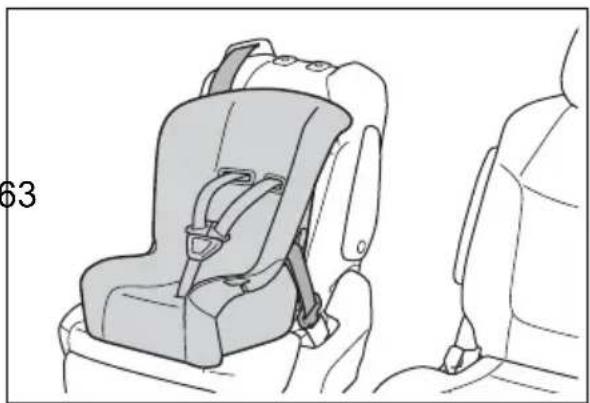 | |
| Child restraint LATCH anchors attachment | 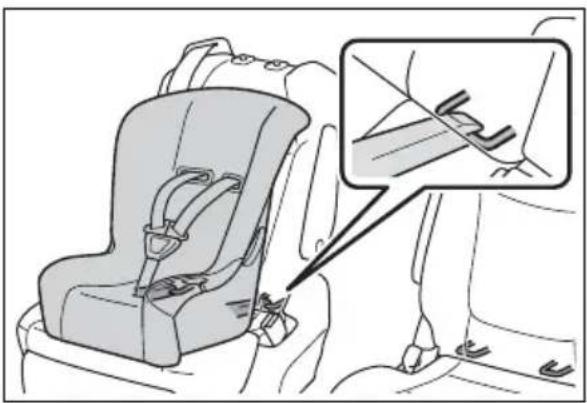 | P.68 |
| Anchor brackets (for top tether strap) attach-ment | Second seats (8-passenger models):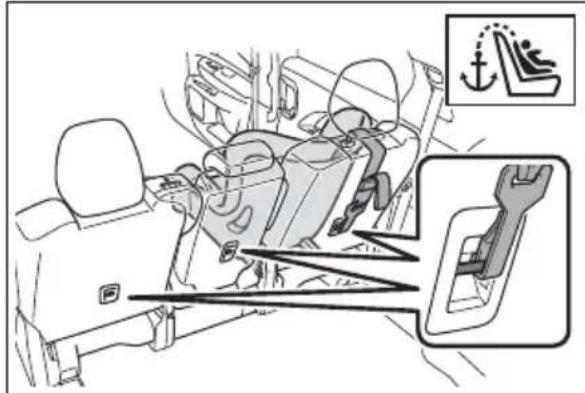 Second seats (7-passenger models): Second seats (7-passenger models):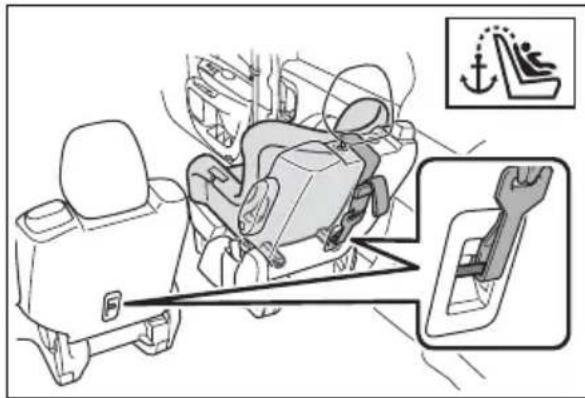 Third seats: Third seats: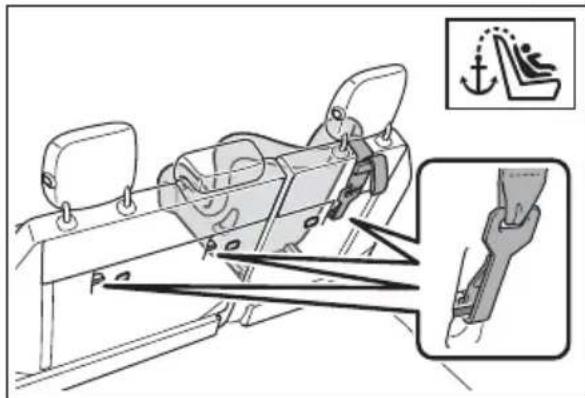 | P.71 |
When using a child restraint system
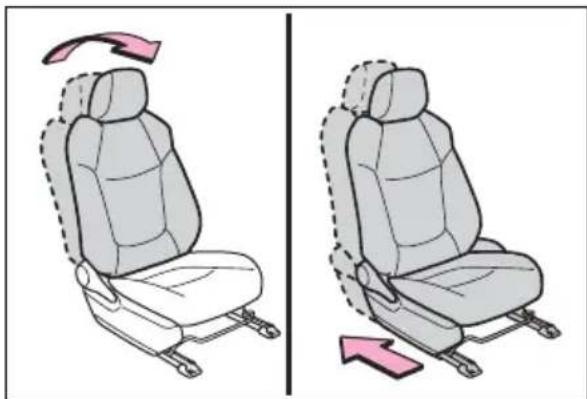
■When installing a child restraint system to a front passenger seat
For the safety of a child, install a child restraint system to a rear
seat. When installing the child restraint system to a front passenger seat is unavoidable, adjust the seat as follows and install the child restraint system.
- Raise the seatback as much as possible.
- Move the front seat fully rear-
ward.
- If the head restraint interferes with the child restraint system installation and the head restraint can be removed, remove the head restraint. Otherwise, put the head restraint in the upper most position.
natural_image
Illustration of a car seat with two side-by-side views showing seat positioning and rotation arrows (no text or symbols)
WARNING
■When using a child restraint system
Observe the following precautions.
Failure to do so may result in death or serious injury.
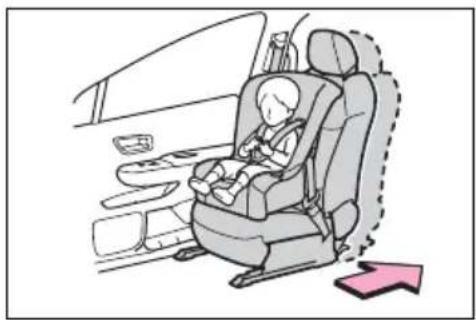
● Never install a rear-facing child restraint system on the front passenger seat even if the “AIR BAG OFF” indicator light is illuminated. In the event of an accident, the force of the rapid inflation of the front passenger airbag can cause death or serious injury to the child if the rear-facing child restraint system is installed on the front passenger seat.
● A forward-facing child restraint system may be installed on the front passenger seat only when it is unavoidable. A child restraint system that requires a top tether strap should not be used in the front passenger seat since there is no top tether strap anchor for the front passenger seat.
A forward-facing child restraint system may be installed on the front passenger seat only when it is unavoidable. When installing a forward-facing child restraint system on the front passenger seat, raise the seat-back as much as possible, move the seat to the rearmost position, even if the "AIR BAG OFF" indicator light is illuminated.
If the head restraint interferes with the child restraint system installation and the head restraint can be removed, remove the head restraint.
natural_image
Illustration of a child seated in a car seat, with no visible text or symbols
WARNING
- Do not allow the child to lean his/her head or any part of his/her body against the door or the area of the seat, front or rear pillars, or roof side rails from which the SRS side airbags or SRS curtain shield airbags deploy even if the child is seated in the child restraint system. It is dangerous if the SRS side airbags and curtain shield airbags inflate, and the impact could cause death or serious injury to the child.
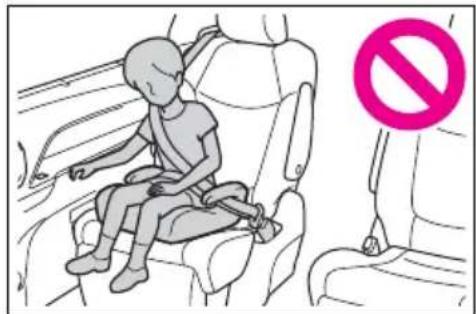
When a booster seat is installed, always ensure that the shoulder belt is positioned across the center of the child's shoulder. The belt should be kept away from the child's neck, but not so that it could fall off the child's shoulder.
● Use a child restraint system suitable to the age and size of the child and install it to the rear seat.
- If the driver's seat interferes with the child restraint system and prevents it from being attached correctly, attach the child restraint system to the right-hand rear seat.
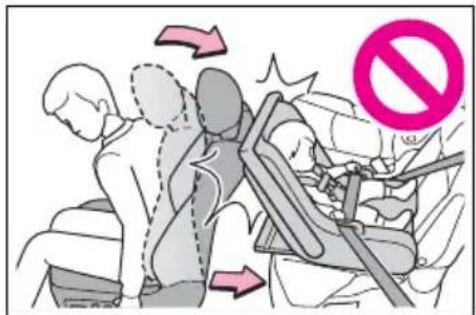
- Adjust the front passenger seat so that it does not interfere with the child restraint system.
Child restraint system fixed with a seat belt
A child restraint system for a small child or baby must itself be properly restrained on the seat with the lap portion of the lap/shoulder belt.
■Installing child restraint system using a seat belt (child restraint lock function belt)
Install the child restraint system in accordance to the operation manual enclosed with the child restraint system.
■Rear-facing — Infant seat/convertible seat
1 Adjust the rear seat.
If there is a gap between the child restraint system and the seatback, adjust the seatback angle until good contact is achieved.
2 Place the child restraint system on the rear seat facing the rear of the vehicle.
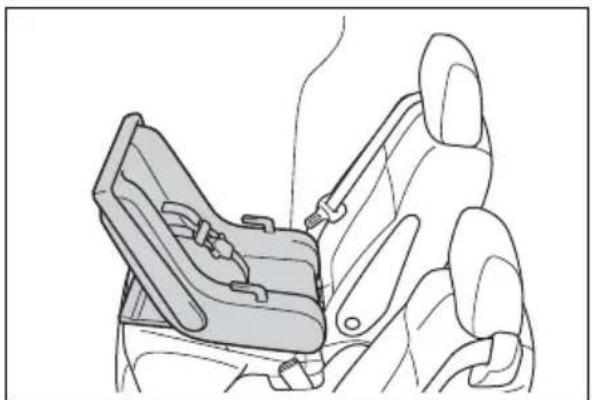
natural_image
Line drawing of a car seatbelt with a hand adjusting the seat (no text or symbols)3 Run the seat belt through the child restraint system and insert the plate into the buckle. Make sure that the belt is not twisted.
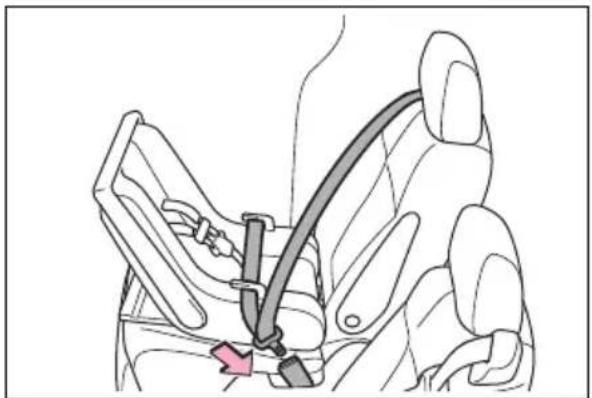
natural_image
Diagram of a car seatbelt buckle being inserted into the seat (no text or labels)4 Fully extend the shoulder belt and allow it to retract to put it in lock mode. In lock mode, the belt cannot be extended.
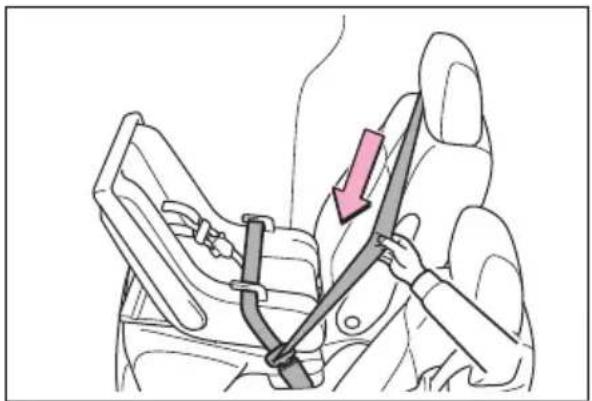
natural_image
Illustration of a car seatbelt buckle being lifted, showing a hand holding the belt and a pink arrow indicating force (no text or symbols present)5 While pushing the child restraint system down into
the rear seat, allow the shoulder belt to retract until the child restraint system is securely in place.
After the shoulder belt has retracted to a point where there is no slack in the belt, pull the belt to check that it cannot be extended.
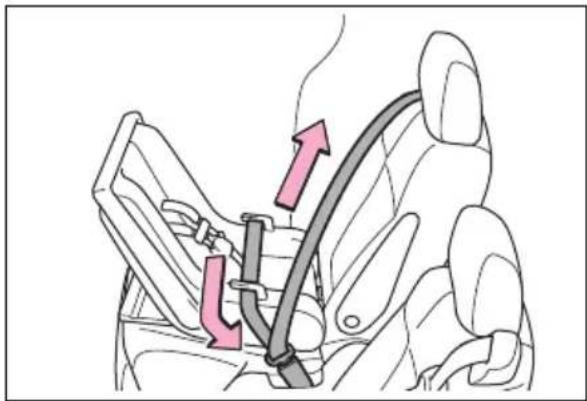
natural_image
Diagram of a car seatbelt with two arrows indicating movement or force (no text or symbols present)6 After installing the child restraint system, rock it back and forth to ensure that it is installed securely. (→P.67)
■Forward-facing — Convert- ible seat
1 Adjust the seat.
When using the front passenger seat: If installing the child restraint system to the front passenger seat is unavoidable, refer to P.61 for front passenger seat adjustment.
When using the rear seat: If there is a gap between the child restraint system and the seatback, adjust the seatback angle until good contact is achieved.
2 If the head restraint interferes with the child restraint system installation and the head restraint can be removed,
remove the head restraint. (→P.183)
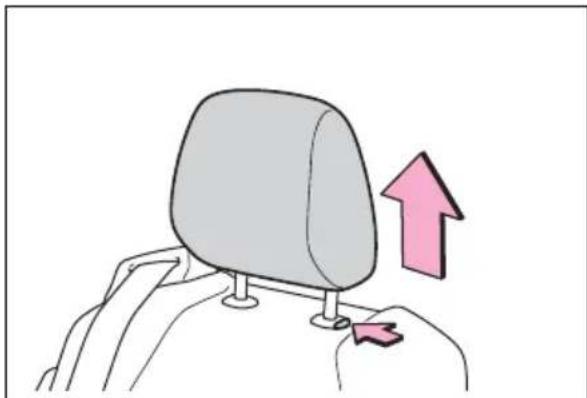
natural_image
Illustration of a person's head with a pink upward arrow indicating motion or force (no text or symbols)3 Place the child restraint system on the seat facing the front of the vehicle.
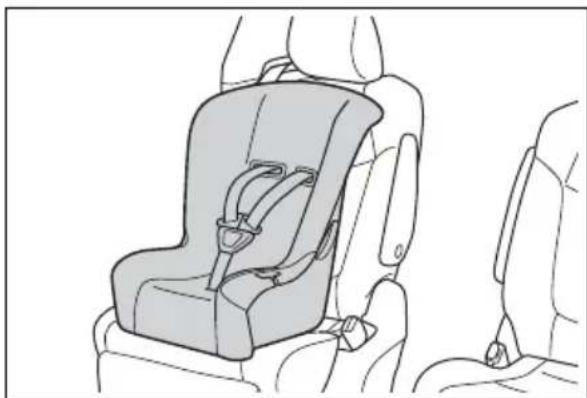
natural_image
Line drawing of a car seatbelt with straps and seat, shown from front and side views (no text or symbols)4 Run the seat belt through the child restraint system and insert the plate into the buckle. Make sure that the belt is not twisted.
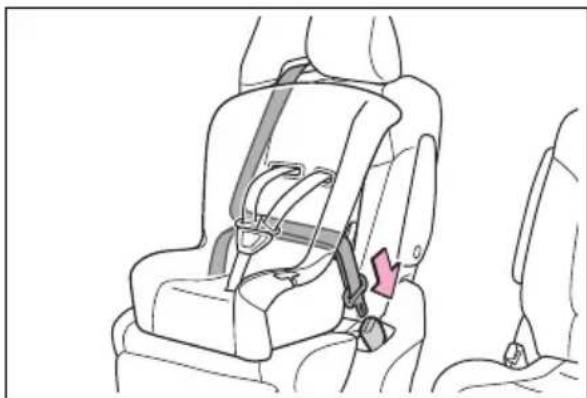
natural_image
Line drawing of a car seatbelt with a pink arrow indicating the seatbelt buckle (no text or symbols present)5 Fully extend the shoulder belt and allow it to retract to put it
in lock mode. In lock mode, the belt cannot be extended.
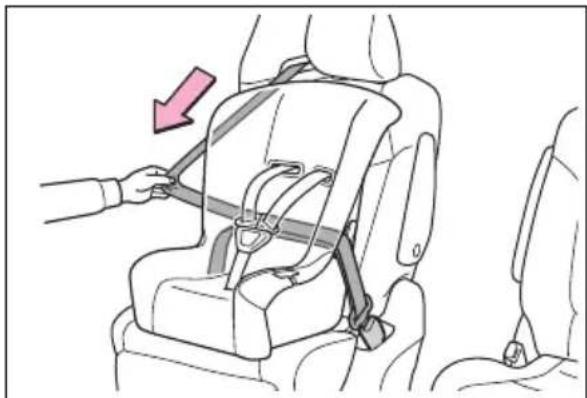
natural_image
Illustration of a car seatbelt buckle being adjusted for a hand, showing no text or symbols6 While pushing the child restraint system into the rear seat, allow the shoulder belt to retract until the child restraint system is securely in place.
After the shoulder belt has retracted to a point where there is no slack in the belt, pull the belt to check that it cannot be extended.
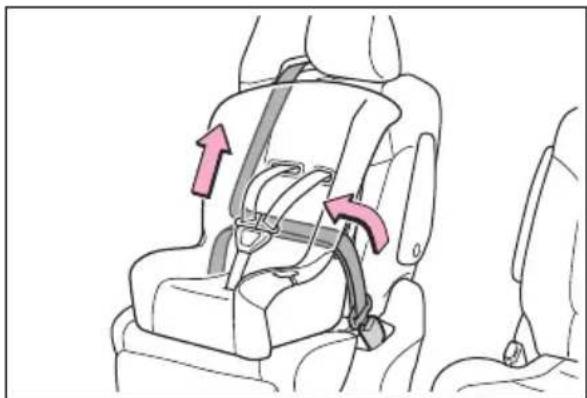
natural_image
Diagram of a car seatbelt with two directional arrows indicating movement (no text or symbols present)7 If the child restraint has a top tether strap, follow the child restraint manufacturer's operation manual regarding the installation, using the top tether strap to latch onto the top tether strap anchor. (→P.71)
8 After installing the child restraint system, rock it back
and forth to ensure that it is installed securely. (→P.67)
■Booster seat
1 If installing the child restraint system to the front passenger seat is unavoidable, refer to P.61 for front passenger seat adjustment.
2 High back type: If the head restraint interferes with your child restraint system, and the head restraint can be removed, remove the head restraint. Otherwise, put the head restraint in the upper most position. (→P.182)
3 Place the child restraint system on the seat facing the front of the vehicle.
▶ Booster type
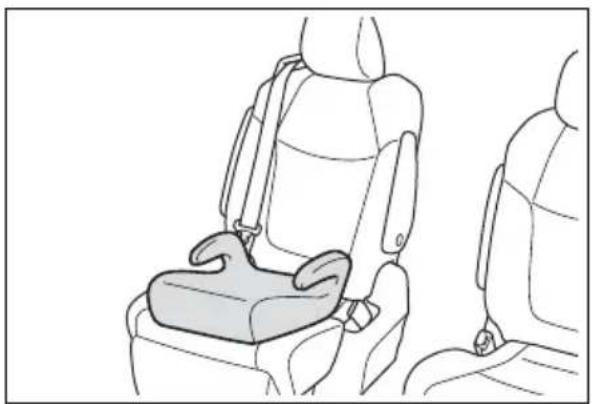
natural_image
Line drawing of a car seat with two seats, one highlighted in gray (no text or symbols)▶ High back type
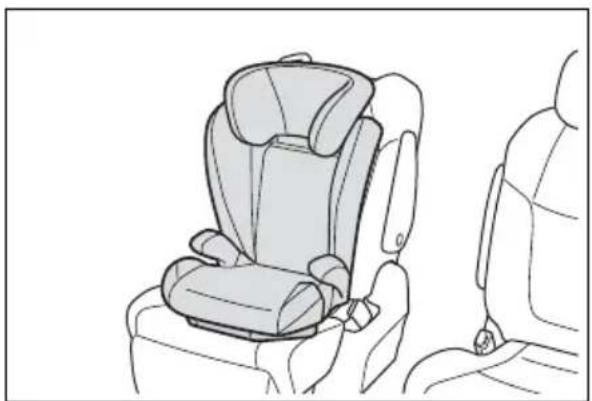
natural_image
Line drawing of a car seat with rear seats and seatbelt (no text or symbols)4 Sit the child in the child restraint system. Fit the seat belt to the child restraint system according to the manufacturer's instructions and insert the plate into the buckle. Make sure that the belt is not twisted.
Check that the shoulder belt is correctly positioned over the child's shoulder and that the lap belt is as low as possible. (→P.35)
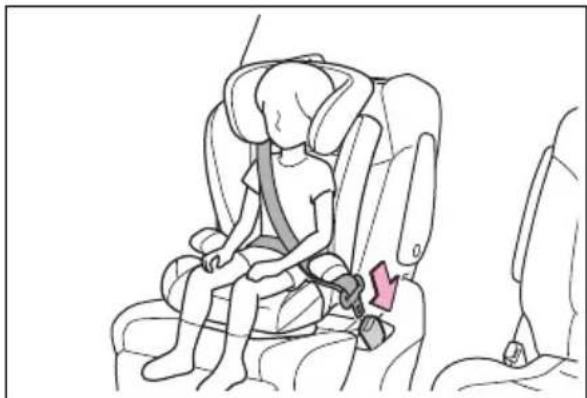
natural_image
Line drawing of a child sitting in a car seat with a red arrow indicating the seatbelt (no text or symbols present)■Removing a child restraint system installed with a seat belt
Press the buckle release button and fully retract the seat belt.
When releasing the buckle, the child restraint system may spring up due to the rebound of the seat cushion. Release the buckle while holding down the child restraint system.
Since the seat belt automatically reels itself, slowly return it to the stowing position.
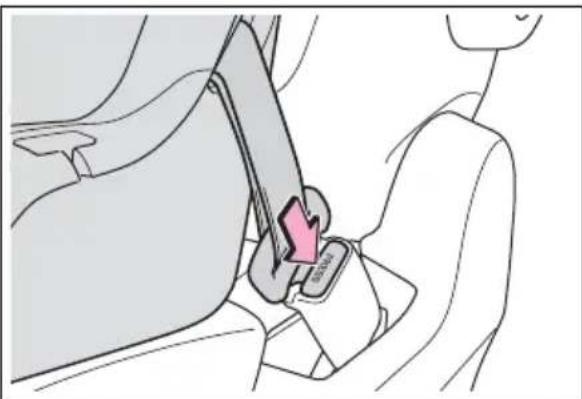
natural_image
Line drawing of a car seatbelt buckle being lifted, showing the grip and seat (no text or symbols)
WARNING
■When installing a child restraint system
Observe the following precautions. Failure to do so may result in death or serious injury.
- Do not allow children to play with the seat belt. If the seat belt becomes twisted around a child's neck, it may lead to choking or other serious injuries that could result in death. If this occurs and the buckle cannot be unfastened, scissors should be used to cut the belt.
● Ensure that the belt and plate are securely locked and the seat belt is not twisted.
● Shake the child restraint system left and right, and forward and backward to ensure that it has been securely installed.
●After securing a child restraint system, never adjust the seat. - When a booster seat is installed, always ensure that the shoulder belt is positioned across the center of the child's shoulder. The belt should be kept away from the child's neck, but not so that it could fall off the child's shoulder.
● Follow all installation instructions provided by the child restraint system manufacturer.
- When securing some types of child restraint systems in rear seats, it may not be possible to properly use the seat belts in positions next to the child restraint without interfering with it or affecting seat belt effectiveness. Be sure your seat belt fits snugly across your shoulder and low on your hips. If it does not, or if it interferes with the child restraint, move to a different position. Failure to do so may result in death or serious injury.
- When installing a child restraint system in the center rear seat, adjust both seatbacks at the same angle. Otherwise, the child restraint system cannot be securely restrained and this may cause death or serious injuries in the event of sudden braking, sudden swerving or an accident.
■When installing a booster seat
To prevent the belt from going into ALR lock mode, do not fully extend the shoulder belt. ALR mode causes the belt to tighten only. This could cause injury or discomfort to the child. (→P.39)
■ Do not use a seat belt extender
If a seat belt extender is used when installing a child restraint system, the seat belt will not securely hold the child restraint system, which could cause death or serious injury to the child or other passengers in the event of sudden braking, sudden swerving or an accident.
Child restraint system fixed with a child restraint LATCH anchor
■Child restraint LATCH anchors
LATCH anchors are provided for the rear seats.
Second seats (8-passenger models)
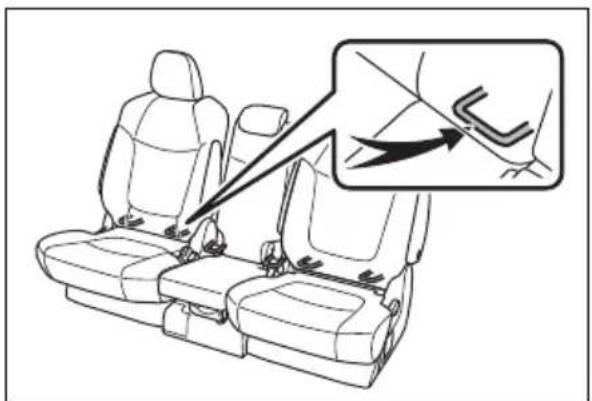
▶ Second seats (7-passenger models)
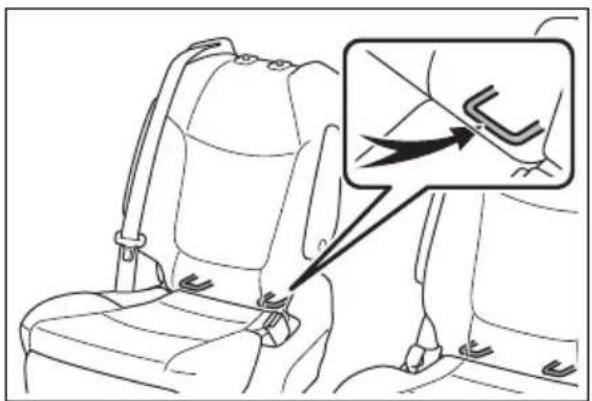
Third seats
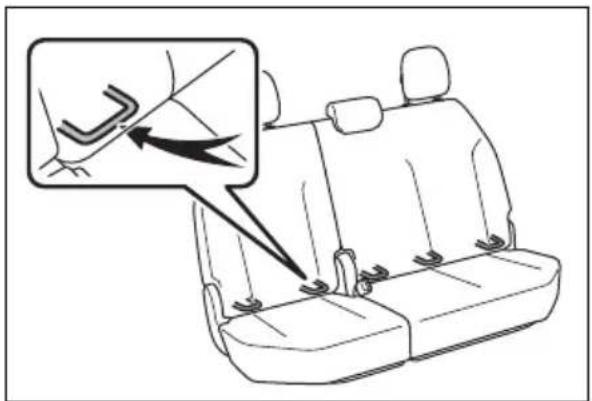
■When installing in the second seats and third seats
Install the child restraint system in accordance to the operation manual enclosed with the child restraint system.
Second seats
1 Fold the seatback while pulling the lever. Return the seatback and secure it at the 1st lock position (most upright position). Adjust the seatback to the 6th lock position.
If there is a gap between the child restraint system and the seatback, adjust the seatback angle until good contact is achieved.
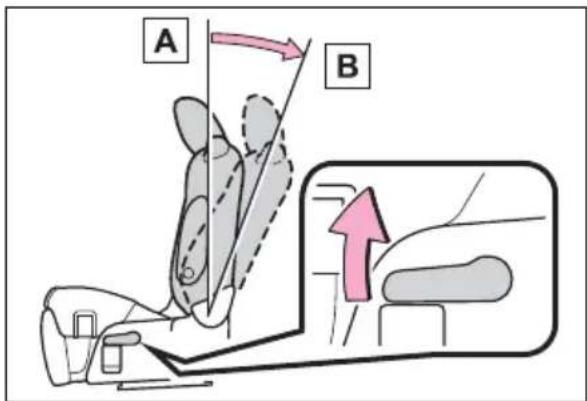
A 1st lock position
B 6th lock position
Third seats
1 Fold the seatback while pulling the strap. Return the seatback and secure it at the 1st lock position (most upright position). Adjust the seatback to the 11th lock position.
If there is a gap between the child restraint system and the seatback,
adjust the seatback angle until good contact is achieved.
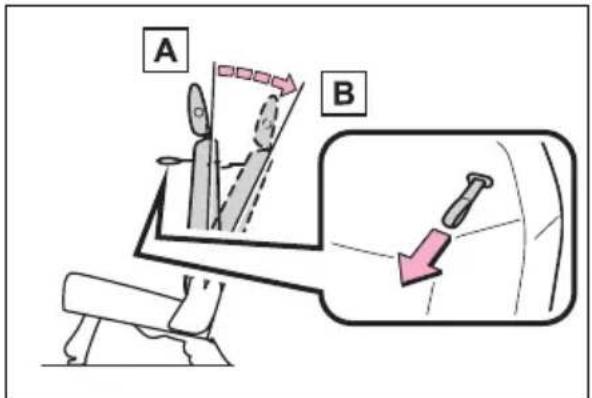
A 1st lock position
B 11th lock position
2 If the head restraint interferes with the child restraint system installation and the head restraint can be removed, remove the head restraint. Otherwise, put the head restraint in the upper most position. (→P.182)
▶ With flexible lower attachments
3 Latch the hooks of the lower attachments onto the LATCH anchors.
For owners in Canada:
The symbol on a child
restraint system indicates A
the presence of a lower connector system.
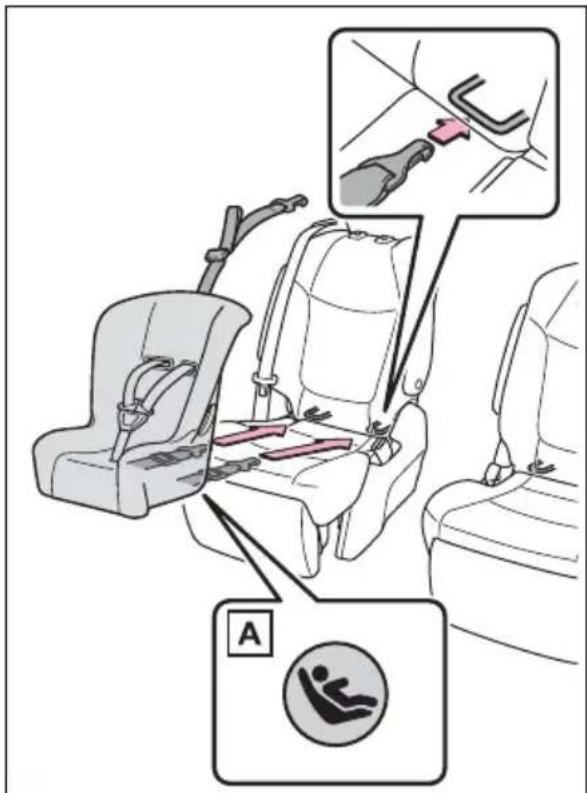
▶ With rigid lower attachments
3 Latch the buckles onto the LATCH anchors.
For owners in Canada:
The symbol on a child
restraint system indicates A
the presence of a lower connector system.
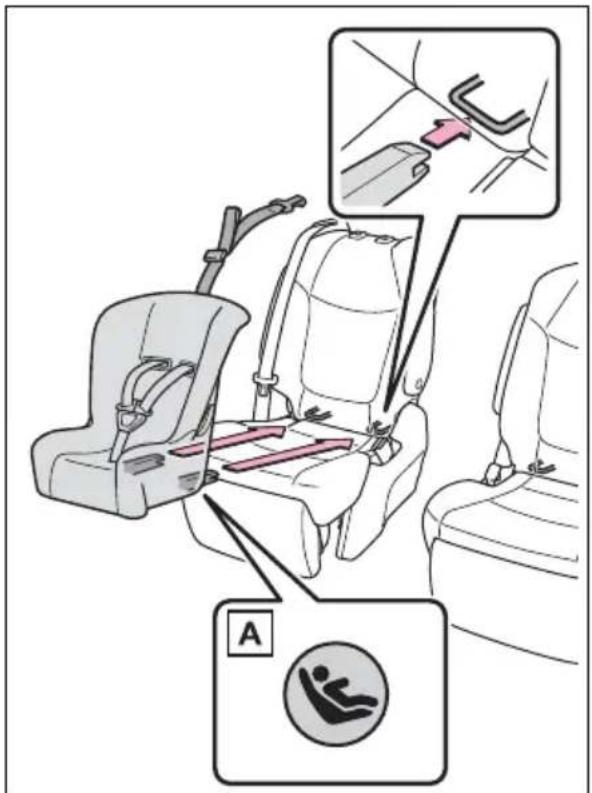
4 If the child restraint has a top tether strap, follow the child restraint manufacturer's operation manual regarding the installation, using the top tether strap to latch onto the top tether strap anchor. (→P.71)
5 After installing the child restraint system, rock it back and forth to ensure that it is installed securely. (→P.67)
■When installing a child restraint system in the third seats
Use outboard seats LATCH anchors
A and B or and . can C
be used with ☑ when installing in the third center seat. Do not use
LATCH anchors C and E simultaneously.
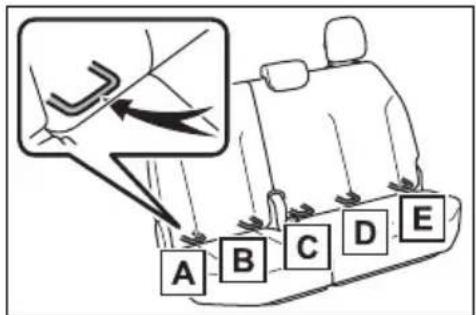
■Laws and regulations pertaining to anchors
The LATCH system conforms to FMVSS225 or CMVSS210.2.
Child restraint systems conforming to FMVSS213 or CMVSS213 specifications can be used.
This vehicle is designed to conform to SAE J1819.

WARNING
■When installing a child restraint system
Observe the following precautions.
Failure to do so may result in death or serious injury.
- When using the LATCH anchors, be sure that there are no foreign objects around the anchors and that the seat belt is not caught behind the child restraint system.
●Follow all installation instructions provided by the child restraint system manufacturer.
● Never attach two child restraint system attachments to the same anchor. In a collision, one anchor may not be strong enough to hold two child restraint system attachments and may break. If the LATCH anchors are already in use, use the seat belt to install a child restraint system.

WARNING
Third seats: Never attach two child restraint systems to the center seat and left-hand side outboard seat at the same time. Child restraint systems may interfere with each other and may not be possible to properly install the child restraint systems in positions.
- 8-passenger models: Never attach child restraint system to the second center seat strikers, which are exposed when second center seat is removed. When attaching child restraint system to the second center seat, ensure the second center seat is securely installed and attach child restraint system to the LATCH anchors of the seat.
- When securing some types of child restraint systems in rear seats, it may not be possible to properly use the seat belts in positions next to the child restraint without interfering with it or affecting seat belt effectiveness. Be sure your seat belt fits snugly across your shoulder and low on your hips. If it does not, or if it interferes with the child restraint, move to a different position. Failure to do so may result in death or serious injury.
- If the seat is adjusted, reconfirm the security of the child restraint system.
Using an anchor bracket (for top tether strap)
■ Anchor brackets (for top tether strap)
Use anchor brackets when fixing the top tether strap.
Anchor brackets are provided for the following seats:
Second seats (8-passenger models)
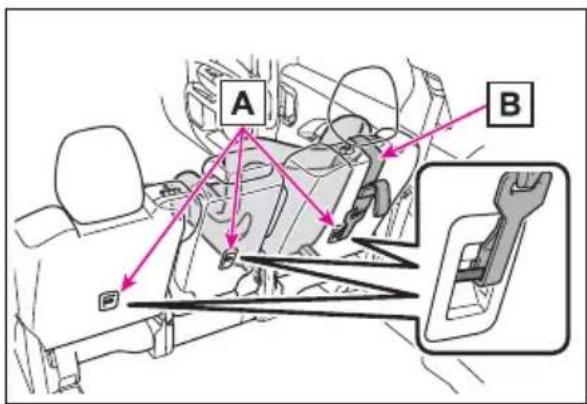
A Anchor brackets
B Top tether strap
Second seats (7-passenger models)
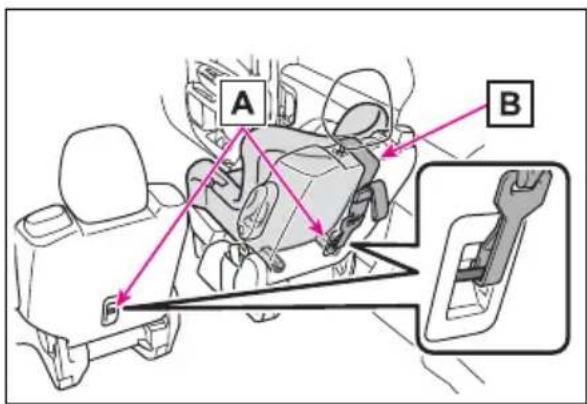
A Anchor bracket
B Top tether strap
Third seats
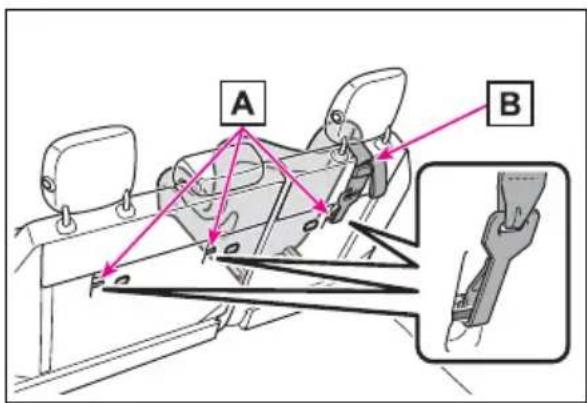
A Anchor bracket
B Top tether strap
■ Fixing the top tether strap to the anchor bracket (second seats)
Install the child restraint system in accordance to the operation manual enclosed with the child restraint system.
▶ Outboard seats
1 If the head restraint interferes with your child restraint system, and the head restraint can be removed, remove the head restraint. Otherwise, put the head restraint in the upper most position. (→P.182)
2 Latch the hook onto the anchor bracket and tighten the top tether strap.
Make sure the top tether strap is securely latched. (→P.67)
When installing the child restraint system with the head restraint being raised, be sure to have the top tether strap pass underneath the head restraint for the single tether strap. For V-shaped top tether strap, the top tether strap can pass on both sides of the head restraint, without passing underneath the head restraint.
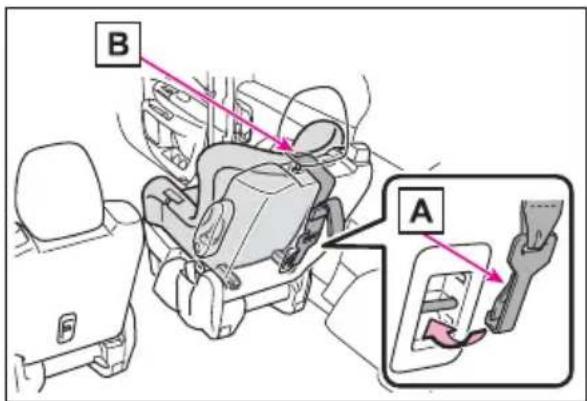
A Hook
B Top tether strap
▶ Center seat
1 If the head restraint interferes with your child restraint system, and the head restraint can be removed, remove the head restraint. Otherwise, put the head restraint in the upper most position.
(→P.182)
2 Latch the hook onto the anchor bracket and tighten the top tether strap.
Make sure the top tether strap is securely latched. (→P.67)
When installing the child restraint system with the head restraint being raised, be sure to have the top tether strap pass underneath the head restraint. Do not install child restraints with V-shaped top tether strap.
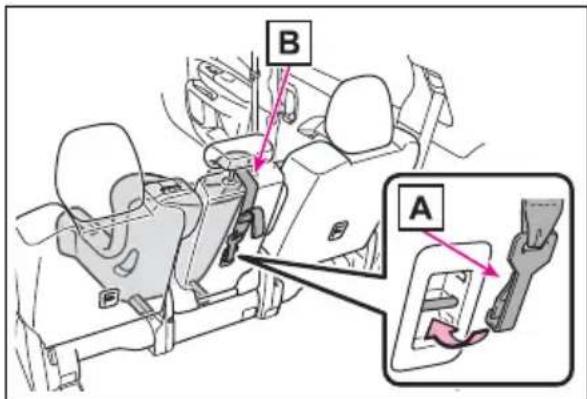
A Hook
B Top tether strap
■Fixing the top tether strap to the anchor bracket (third seats)
Install the child restraint system in accordance to the operation manual enclosed with the child restraint system.
▶ Outboard seats
Latch the hook onto the anchor bracket and tighten the top tether strap.
Make sure the top tether strap is securely latched. (→P.67)
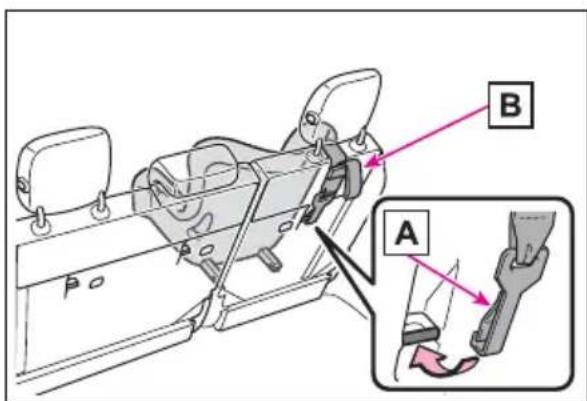
A Hook
B Top tether strap
▶ Center seat
1 If the head restraint interferes with your child restraint sys-
tem, and the head restraint can be removed, remove the head restraint. Otherwise, put the head restraint in the upper most position. (→P.182)
2 Latch the hook onto the anchor bracket and tighten the top tether strap.
Make sure the top tether strap is securely latched. (→P.67)
When installing the child restraint system with the head restraint being raised, be sure to have the tether strap pass underneath the head restraint. Do not install child restraints with V-shaped tether strap.
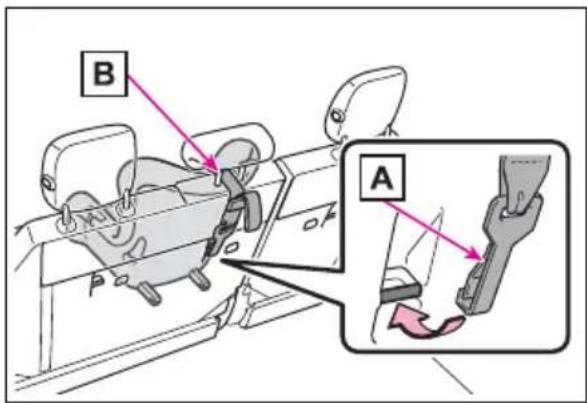
A Hook
B Top tether strap
■Laws and regulations pertaining to anchors
The LATCH system conforms to FMVSS225 or CMVSS210.2.
Child restraint systems conforming to FMVSS213 or CMVSS213 specifications can be used.
This vehicle is designed to conform to SAE J1819.

WARNING
■When installing a child restraint system
Observe the following precautions.
Failure to do so may result in death or serious injury.
● Firmly attach the top tether strap and make sure that the belt is not twisted.
- Do not attach the top tether strap to anything other than the anchor bracket.
●After securing a child restraint system, never adjust the seat.
● Follow all installation instructions provided by the child restraint system manufacturer.
Second seats and third center seat: When installing the child restraint system with the head restraint being raised, after the head restraint has been raised and then the anchor bracket has been fixed, do not lower the head restraint.
Safety Connect
*: If equipped
Safety Connect is a subscription-based telematics service that uses Global Positioning System (GPS) data and embedded cellular technology to provide safety and security features to subscribers. Safety Connect is supported by Toyota's designated response center, which operates 24 hours per day, 7 days per week.
Safety Connect service is available by subscription on select, telematics hardware-equipped vehicles.
By using the Safety Connect service, you are agreeing to be bound by the Telematics Subscription Service Agreement and its Terms and Conditions, as in effect and amended from time to time, a current copy of which is available at Toyota.com in the United States, Toyotapr.com in Puerto Rico and Toyota.ca in Canada. All use of the Safety Connect service is subject to such then-applicable Terms and Conditions.
System components
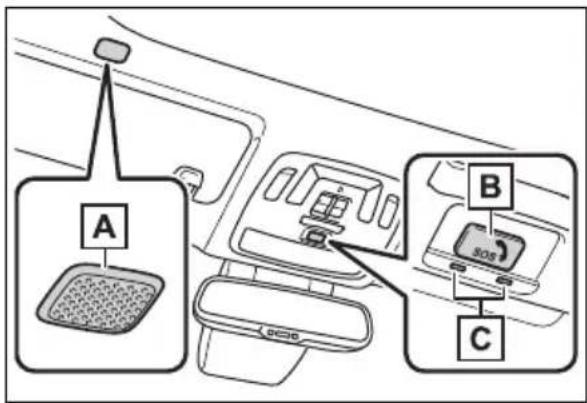
A Microphone
B "SOS" button
C LED light indicators
Services
Subscribers have the following Safety Connect services available:
● Automatic Collision Notification*
Helps drivers receive necessary response from emergency service providers. (→P.77)
*: U.S. Patent No. 7,508,298 B2
● Stolen Vehicle Location
Helps drivers in the event of vehicle theft. ( P.77)
● Emergency Assistance Button ("SOS")
Connects drivers to response-center support. ( P.77)
● Enhanced Roadside Assistance
Provides drivers various on-road assistance. (→P.78)
Subscription
After you have signed the Telematics Subscription Service Agreement and are enrolled, you can begin receiving services.
A variety of subscription terms are available for purchase. Contact your Toyota dealer, call the following appropriate Customer Experience Center or push the "SOS" button in your vehicle for further subscription details.
● The United States
1-800-331-4331
- Canada
1-888-869-6828
- Puerto Rico
1-877-855-8377
■Safety Connect Services Information
- Phone calls using the vehicle's Bluetooth® technology will not be possible when Safety Connect is active and in use.
● Safety Connect is available beginning Fall 2009 on select Toyota models (in the contiguous United States only). Contact with the Safety Connect response center is dependent upon the telematics device being in operative condition, cellular connection availability, and GPS satellite signal reception, which can limit the ability to reach the response center or receive emergency service support. Enrollment and Telematics Subscription Service Agreement are required. A variety of subscription terms are available; charges
vary by subscription term selected and location.
●Automatic Collision Notification, Emergency Assistance and Stolen Vehicle Location are available in the United States, including Hawaii and Alaska, Puerto Rico and Canada, and Enhanced Roadside Assistance are available in the United States, Puerto Rico and Canada.
●Automatic Collision Notification, Emergency Assistance, Stolen Vehicle and Enhanced Road Assistance are not available in the U.S. Virgin Islands.
For vehicles first sold in the U.S. Virgin Islands, no Safety Connect services will function in or outside the U.S. Virgin Islands.
● Safety Connect services are not subject to section 255 of the Telecommunications Act and the device is not TTY compatible.
Languages
The Safety Connect response center will offer support in multiple languages. The Safety Connect system will offer voice prompts in English, Spanish, and French. Please indicate your language of choice when enrolling.
■When contacting the response center
You may be unable to contact the response center if the network is busy.
Safety Connect LED light Indicators
When the power switch is turned to ON, the red indicator light comes on for 2 seconds then turns off. Afterward, the green indicator light comes on, indicating that the service is active.
The following indicator light patterns indicate specific system usage conditions:
● Green indicator light on = Active service
● Green indicator light flashing = Safety Connect call in process
- Red indicator light (except at vehicle start-up) = System malfunction (contact your Toyota dealer)
- No indicator light (off) = Safety Connect service not active
Safety Connect services
■Automatic Collision Notification
In case of either airbag deployment or severe rear-end collision, the system is designed to automatically call the response center. The responding agent receives the vehicle's location and attempts to speak with the vehicle occupants to assess the level of emergency. If the occupants are unable to communicate, the agent automatically treats the call as an emergency, contacts the nearest emergency services provider to describe the situation, and requests that assistance be sent to the location.
■Stolen Vehicle Location
If your vehicle is stolen, Safety Connect can work with local authorities to assist them in locating and recovering the vehicle. After filing a police report, call the Customer Experience Center at 1-800-331-4331 in the United States, 1-877-855-8377 in Puerto Rico or 1-888-869-6828 in Canada, and follow the prompts for Safety Connect to initiate this service.
In addition to assisting law enforcement with recovery of a stolen vehicle, Safety-Connect-equipped vehicle location data may, under certain circumstances, be shared with third parties to locate your vehicle. Further information is available at Toyota.com in the United States, Toyotapr.com in Puerto Rico and Toyota.ca in Canada.
Emergency Assistance Button ("SOS")
In the event of an emergency on the road, push the “SOS” button to reach the Safety Connect response center. The answering agent will determine your vehicle’s location, assess the emergency, and dispatch the necessary assistance required.
If you accidentally press the "SOS" button, tell the response-center agent that you are not experiencing an emergency.
■Enhanced Roadside Assistance
Enhanced Roadside Assistance adds GPS data to the already included warranty-based Toyota roadside service.
Subscribers can press the "SOS" button to reach a Safety Connect response-center agent, who can help with a wide range of needs, such as: towing, flat tire, fuel delivery, etc. For a description of the Enhanced Roadside Assistance services and their limitations, please see the Safety Connect Terms and Conditions, which are available at Toyota.com in the United States, Toyotapr.com in Puerto Rico and Toyota.ca in Canada.
Safety information for Safety Connect
Important! Read this information before using Safety Connect.
■Exposure to radio frequency signals
The Safety Connect system installed in your vehicle is a low-power radio transmitter and receiver. It receives and also sends out radio frequency (RF) signals.
In August 1996, the Federal Communications Commission (FCC) adopted RF exposure guidelines with safety levels for mobile wireless phones. Those guidelines are consistent with the safety standards previously set by the following U.S. and international standards bodies.
● ANSI (American National Standards Institute) C95.1 [1992]
● NCRP (National Council on Radiation Protection and Measurement) Report 86 [1986]
- ICNIRP (International Commission on Non-Ionizing Radiation Protection) [1996]
Those standards were based on comprehensive and periodic evaluations of the relevant scientific literature. Over 120 scientists, engineers, and physicians from universities, and government health agencies and industries reviewed the available body of research to develop the ANSI Standard (C95.1).
The design of Safety Connect complies with the FCC guidelines in addition to those standards.
Hybrid system features
Your vehicle is a hybrid vehicle. It has characteristics different from conventional vehicles. Be sure you are closely familiar with the characteristics of your vehicle, and operate it with care.
The hybrid system combines the use of a gasoline engine and an electric motor (traction motor) according to driving conditions, improving fuel efficiency and reducing exhaust emissions.
System components
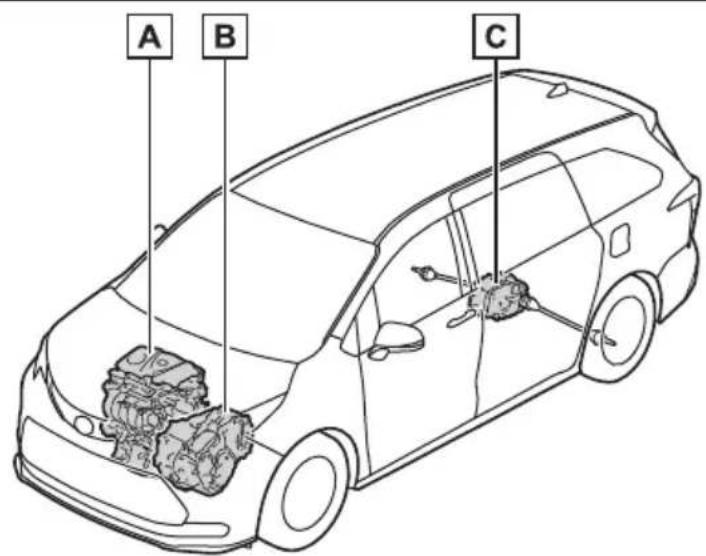
The illustration is an example for explanation and may differ from the actual item.
A Gasoline engine
B Front electric motor (traction motor)
C Rear electric motor (traction motor)*
*: AWD models only
■When stopped/during start off
The gasoline engine stops* when the vehicle is stopped. During start off, the electric motor (traction motor) drives the vehicle. At slow speeds or when traveling down a gentle slope, the engine is stopped* and the electric motor (traction motor) is used.
When the shift lever is in N, the hybrid battery (traction battery)
is not being charged.
*: When the hybrid battery (traction battery) requires charging or the engine is warming up, etc., the gasoline engine will not automatically stop. (→P.80)
■During normal driving
The gasoline engine is predominantly used. The electric motor (traction motor) charges the hybrid battery (traction battery) as necessary.
■When accelerating sharply
When the accelerator pedal is depressed heavily, the power of the hybrid battery (traction battery) is added to that of the gasoline engine via the electric motor (traction motor).
■When braking (regenerative braking)
The wheels operate the electric motor (traction motor) as a power generator, and the hybrid battery (traction battery) is charged.
■ Regenerative braking
In the following situations, kinetic energy is converted to electric energy and deceleration force can be obtained in conjunction with the recharging of the hybrid battery (traction battery).
●The accelerator pedal is released while driving with the shift lever in D or S.
●The brake pedal is depressed while driving with the shift lever in D or S.
■EV indicator
The EV indicator comes on when the vehicle is driven using only the electric motor (traction motor) or the gasoline engine is stopped.
The on/off operation of the EV indicator can be changed. (→P.112)
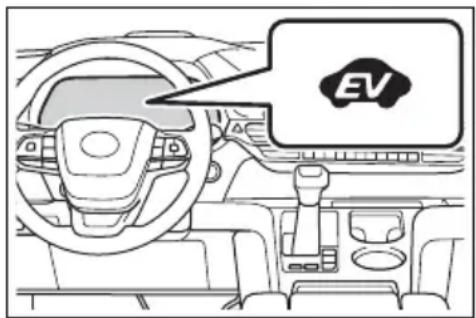
natural_image
Interior view of a car dashboard with a 'EV' logo speech bubble (no text or symbols on the car itself)■ Conditions in which the gaso- line engine may not stop
The gasoline engine starts and stops automatically. However, it may not stop automatically in the following conditions ^* :
●During gasoline engine warm-up
● During hybrid battery (traction battery) charging
- When the temperature of the hybrid battery (traction battery) is high or low
- When the heater is switched on *: Depending on the circumstances, the gasoline engine may also not stop automatically in other situations.
■ Charging the hybrid battery (traction battery)
As the gasoline engine charges the hybrid battery (traction battery), the battery does not need to be charged from an outside source. However, if the vehicle is left parked for a long time the hybrid battery (traction battery) will slowly discharge. For this reason, be sure to drive the vehicle at least once every few months for at least 30 minutes or 10 miles (16 km). If the hybrid battery (traction battery) becomes fully discharged and you are unable to start the
hybrid system, contact your Toyota dealer.
■ Charging the 12-volt battery
→P.508
■After the 12-volt battery has discharged or when the terminal has been removed and installed during exchange, etc.
The gasoline engine may not stop even if the vehicle is being driven by the hybrid battery (traction battery). If this continues for a few days, contact your Toyota dealer.
■ Sounds and vibrations specific to a hybrid vehicle
There may be no engine sound or vibration even though the vehicle is able to move with the “READY” indicator is illuminated. For safety, make sure to shift the shift lever to P and apply the parking brake when parked.
The following sounds or vibrations may occur when the hybrid system is operating and are not a malfunction:
●Motor sounds may be heard from the engine compartment.
● Sounds may be heard from the hybrid battery (traction battery) under the front seats when the hybrid system starts or stops.
- Relay operating sounds such as a snap or soft clank will be emitted from the hybrid battery (traction battery), under the front seats, when the hybrid system is started or stopped.
● Sounds from the hybrid system may be heard when the back door is open.
● Sounds may be heard from the transmission when the gasoline engine starts or stops, when driving at low speeds, or during idling.
●Engine sounds may be heard when accelerating sharply.
●Sounds may be heard due to
regenerative braking when the brake pedal is depressed or as the accelerator pedal is released.
●Vibration may be felt when the gasoline engine starts or stops.
●Cooling fan sounds may be heard from the air intake vent under the front seat.
■ Maintenance, repair, recycling, and disposal
Contact your Toyota dealer regarding maintenance, repair, recycling and disposal. Do not dispose of the vehicle yourself.
Acoustic Vehicle Alerting System
When driving with the gasoline engine stopped, a sound, which changes in accordance with the driving speed, will be played in order to warn people nearby of the vehicle's approach. The sound will stop when the vehicle speed exceeds approximately 22 mph (35 km/h).
■ Acoustic Vehicle Alerting System
In the following cases, the Acoustic Vehicle Alerting System may be difficult for surrounding people to hear.
In very noisy areas
●In the wind or the rain
If “Acoustic Vehicle Alerting System Malfunction Visit Your Dealer” is displayed on the multi-information display
The system may be malfunctioning. Have the vehicle inspected by your Toyota dealer.
Predictive efficient drive (vehicles with navigation system)\*
*: This function can only be used in the mainland U.S.A. It cannot be used in other states and territories, including Alaska and Hawaii.
This system operates based on the driving situation and traffic information to enhance fuel economy.
For details about Predictive efficient drive, refer to "NAVIGATION AND MULTIMEDIA SYSTEM OWNER'S MANUAL".
■Predictive deceleration support
- When the vehicle approaches to predictive deceleration support points registered in the navigation system, the “Reference operation range” (A) of the ECO Accelerator Guidance (→P.108) on the multi-information display will be turned off to encourage the driver to reduce excessive acceleration.
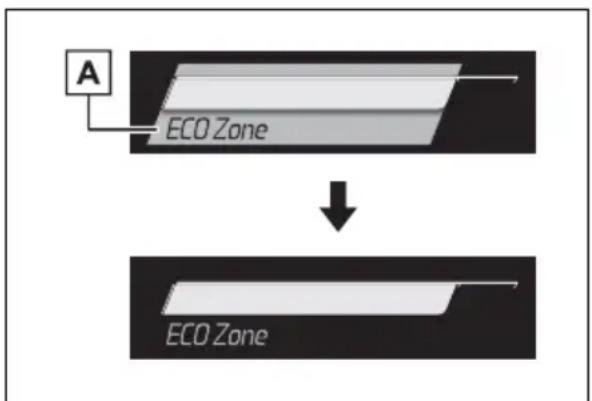
flowchart
graph TD
    A["A"] --> B["ECO Zone"]
    B --> C["ECO Zone"]
● The engine braking force will
be increased according to the driving conditions to more efficiently charge the hybrid battery (traction battery) after the accelerator pedal is released.
■Predictive SOC control
The following types of control are performed based on data such as road and traffic information during route guidance by the navigation system to help ensure that the vehicle efficiently uses electricity.
- When there is a long downhill slope along the route, the system reduces the hybrid battery (traction battery) level before reaching the slope to help ensure charging capacity for regenerative braking while traveling downhill.
- When traffic congestion is predicted along the route, the system helps ensure a certain battery level before reaching congested roads to reduce the frequency of starting the engine to charge the hybrid battery (traction battery) due to low battery levels.
Hybrid system precautions
Take care when handling the hybrid system, as it is a high voltage system (about 650V at maximum) as well as contains parts that become extremely hot when the hybrid system is operating. Obey the warning labels attached to the vehicle.
System components
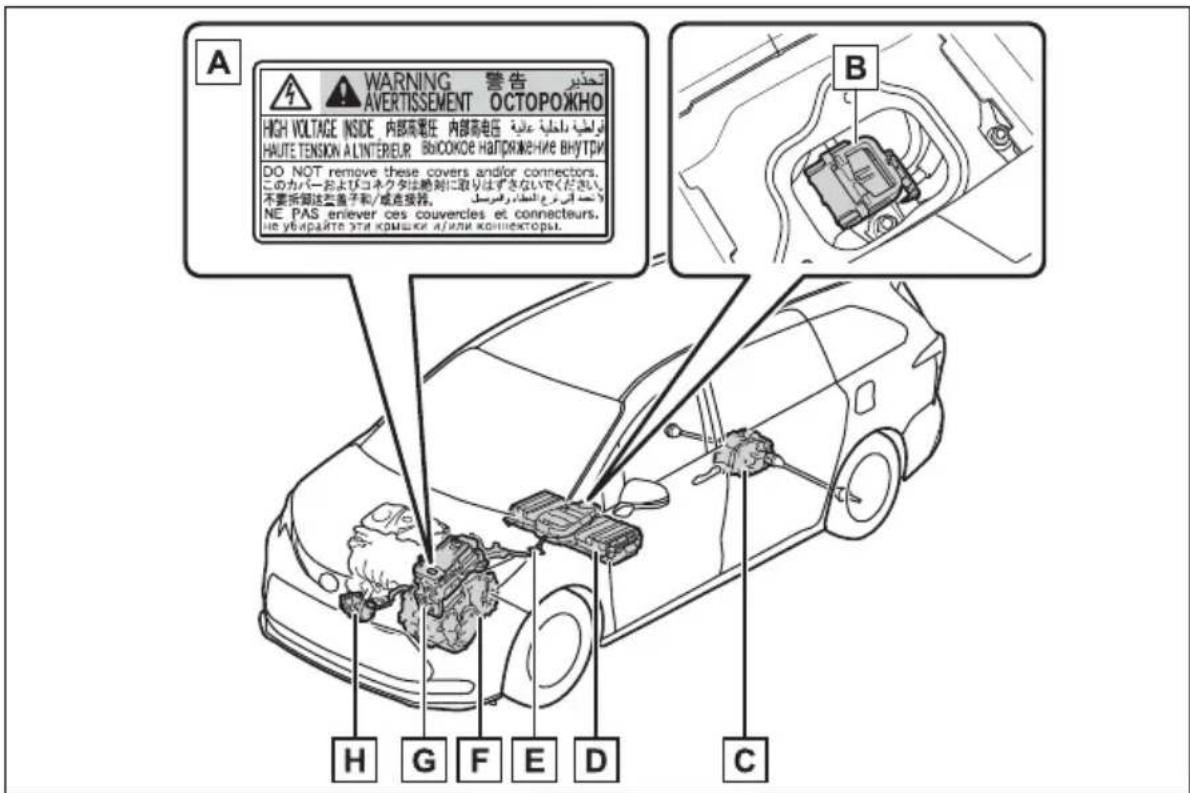
The illustration is an example for explanation and may differ from the actual item.
A Warning label
B Service plug
C Rear electric motor (traction motor)*
D Hybrid battery (traction battery)
E High voltage cables (orange)
F Front electric motor (traction motor)
G Power control unit
H Air conditioning compressor
*: AWD models only
Running out of fuel
When the vehicle has run out of fuel and the hybrid system cannot be started, refuel the vehicle with at least enough gasoline to make the low fuel level warning light ( P.472) go off. If there is only a small amount of fuel, the hybrid system may not be able to start. (The standard amount of fuel is about 3.1 gal. [11.9 L, 2.6 Imp. gal.], when the vehicle is on a level surface. This value may vary when the vehicle is on a slope. Add extra fuel when the vehicle is inclined.)
Electromagnetic waves
●High voltage parts and cables on hybrid vehicles incorporate electromagnetic shielding, and therefore emit approximately the same amount of electromagnetic waves as conventional gasoline powered vehicles or home electronic appliances.
- Your vehicle may cause sound interference in some third party-produced radio parts.
■Hybrid battery (traction battery)
The hybrid battery (traction battery) has a limited service life. The lifespan of the hybrid battery (traction battery) can change in accordance with driving style and driving conditions.

WARNING
■High voltage precautions
This vehicle has high voltage DC and AC systems as well as a 12-volt system. DC and AC high voltage is very dangerous and can cause severe burns and electric shock that may result in death or serious injury.
● Never touch, disassemble, remove or replace the high voltage parts, cables or their connectors.
●The hybrid system will become hot after starting as the system uses high voltage. Be careful of both the high voltage and the high temperature, and always obey the warning labels attached to the vehicle.
● Never try to open the service plug access hole located underneath the console box. The service plug is used only when the vehicle is serviced and is subject to high voltage.
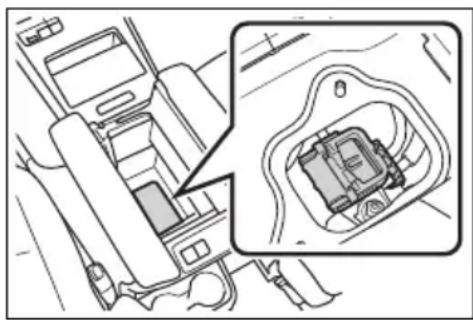
natural_image
Top-down line drawing of a car interior with a highlighted inset showing a vehicle component (no text or symbols)■Road accident cautions
Observe the following precautions to reduce the risk of death or serious injury:
●Pull your vehicle off the road, shift the shift lever to P, apply the parking brake, and turn the hybrid system off.
- Do not touch the high voltage parts, cables and connectors.
- If electric wires are exposed inside or outside your vehicle, an electric shock may occur. Never touch exposed electric wires.
- If a fluid leak occurs, do not touch the fluid as it may be strong alkaline electrolyte from the hybrid battery (traction battery). If it comes into contact with your skin or eyes, wash it off immediately with a large amount of water or, if possible, boric acid solution. Seek immediate medical attention.

WARNING
- If a fire occurs in the hybrid vehicle, leave the vehicle as soon as possible. Never use a fire extinguisher that is not meant for electric fires. Using even a small amount of water may be dangerous.
- If your vehicle needs to be towed, do so with four wheels raised. If the wheels connected to the electric motor (traction motor) are on the ground when towing, the motor may continue to generate electricity. This may cause a fire. ( P.462)
Carefully inspect the ground under the vehicle. If you find that liquid has leaked onto the ground, the fuel system may have been damaged. Leave the vehicle as soon as possible.
■ Hybrid battery (traction battery)
●Never resell, hand over or modify the hybrid battery. To prevent accidents, hybrid batteries that have been removed from a disposed vehicle are collected through Toyota dealer. Do not dispose of the battery yourself.
Unless the battery is properly collected, the following may occur, resulting in death or serious injury:
- The hybrid battery may be illegally disposed of or dumped, and it is hazardous to the environment or someone may touch a high voltage part, resulting in an electric shock.
- The hybrid battery is intended to be used exclusively with your hybrid vehicle. If the hybrid battery is used outside of your vehicle or modified in any way, accidents such as electric shock, heat generation, smoke generation, an explosion and electrolyte leakage may occur.
When reselling or handing over your vehicle, the possibility of an accident is extremely high because the person receiving the vehicle may not be aware of these dangers. - If your vehicle is disposed of without the hybrid battery having been removed, there is a danger of serious electric shock if high voltage parts, cables and their connectors are touched. In the event that your vehicle must be disposed of, the hybrid battery must be disposed of by your Toyota dealer or a qualified service shop. If the hybrid battery is not disposed of properly, it may cause electric shock that can result in death or serious injury.
Hybrid battery (traction battery) air intake vents
There are air intake vents under the front seats for the purpose of cooling the hybrid battery (traction battery). If the vent becomes blocked, the hybrid battery (traction battery) may overheat, leading to a reduction in hybrid battery (traction battery) output.
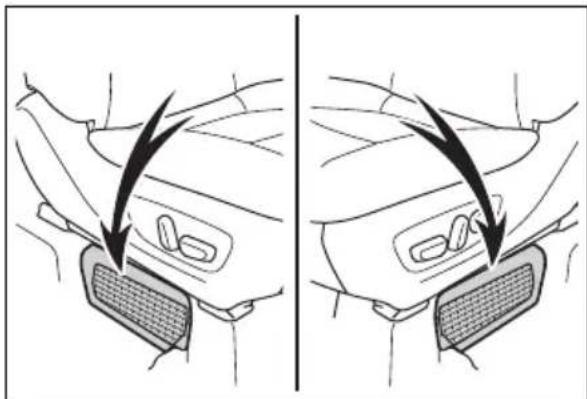
natural_image
Diagram showing two car seatbelt buckle designs with arrows indicating movement or force (no text or symbols)
NOTICE
■ Hybrid battery (traction battery) air intake vents
Make sure not to block the air intake vents with anything, such as a seat cover, plastic cover, or luggage. If the vents become blocked, the hybrid battery (traction battery) input and output may be restricted, leading to a reduction in hybrid battery (traction battery) output and a malfunction.
- When dust etc. has accumulated in the air intake vents, clean them with a vacuum cleaner to prevent the vents from clogging.
- Do not get water or foreign materials in the air intake vents as this may cause a short circuit and damage the hybrid battery (traction battery).
- Do not carry large amounts of water such as water cooler bottles in the vehicle. If water spills onto the hybrid battery (traction battery), the battery may be damaged. Have the vehicle inspected by your Toyota dealer.
There are filters installed to the air intake vents. When the filters remain noticeably dirty even after cleaning the air intake vents, filters cleaning or replacement is recommended. For information regarding filters cleaning or replacement, refer to P.444.
- If “Maintenance Required for Traction Battery Cooling Parts See Owner’s Manual” is shown on the multi-information display, the air intake vents and filters may be clogged. Refer to P.443for information on how to clean the air intake vents.
Emergency shut off sys- tem
When a certain level of impact is detected by the impact sensor, the emergency shut off system blocks the high voltage current and stops the fuel pump to minimize the risk of electrocution and fuel leakage. If the emergency shut off system activates, your vehicle will not restart. To restart the hybrid system, contact your Toyota dealer.
Hybrid warning message
A message is automatically displayed when a malfunction occurs in the hybrid system or an improper operation is attempted.
If a warning message is shown on the multi-information display, read the message and follow the
instructions.
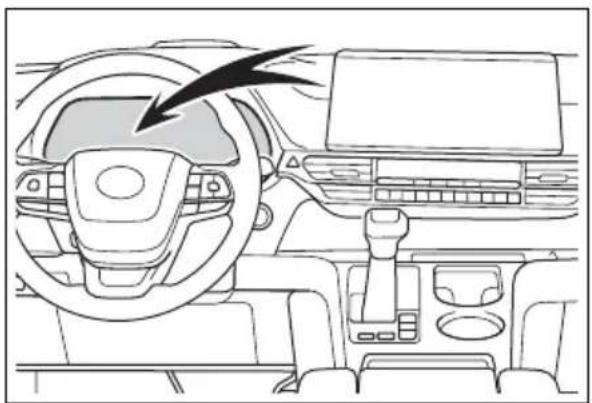
natural_image
Interior view of a car dashboard and steering wheel (no text or symbols visible)If a warning light comes on, a warning message is displayed, or the 12-volt battery is disconnected
The hybrid system may not start. In this case, try to start the system again. If the "READY" indicator does not come on, contact your Toyota dealer.
Immobilizer system
The vehicle's keys have built-in transponder chips that prevent the hybrid system from starting if a key has not been previously registered in the vehicle's on-board computer.
Never leave the keys inside the vehicle when you leave the vehicle.
This system is designed to help prevent vehicle theft but does not guarantee absolute security against all vehicle thefts.
System maintenance
The vehicle has a maintenance-free type immobilizer system.
■Conditions that may cause the system to malfunction
- If the grip portion of the key is in contact with a metallic object
- If the key is in close proximity to or touching a key to the security system (key with a built-in transponder chip) of another vehicle

NOTICE
■To ensure the system operates correctly
Do not modify or remove the system. If modified or removed, the proper operation of the system cannot be guaranteed.
Operating the system
The indicator light flashes after the power switch has been turned to OFF to indicate that the system is operating. The indicator light stops flashing after the power switch has been turned to ACC or ON to indicate that the system has been canceled.
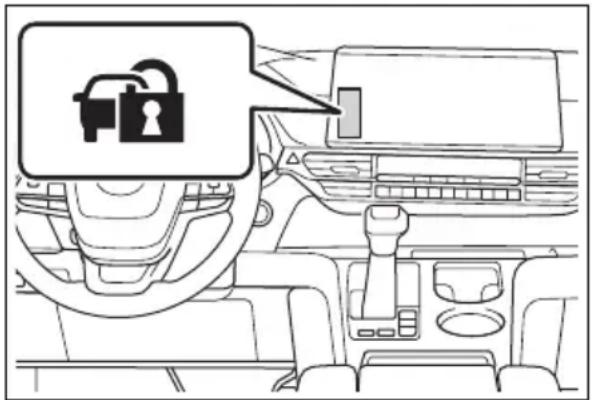
natural_image
Interior view of a car showing dashboard and steering wheel (no text or symbols)Alarm
*: If equipped
The alarm uses light and sound to give an alert when an intrusion is detected.
The alarm is triggered in the following situations when the alarm is set:
- A locked door is unlocked or opened in any way other than using the entry function (if equipped) or wireless remote control. (The doors will lock again automatically.)
● The hood is opened.
Setting/canceling/stop- ping the alarm system
■Items to check before locking the vehicle
To prevent unexpected triggering of the alarm and vehicle theft, make sure of the following:
● Nobody is in the vehicle.
● The side windows and moon roof (if equipped) are closed before the alarm is set.
- No valuables or other personal items are left in the vehicle.
Setting
Close the doors and hood, and lock all the doors. The system will be set automatically after 30
seconds.
The security indicator changes from being on to flashing when the system is set.
If all doors are closed with hood open, alarm system can be set.
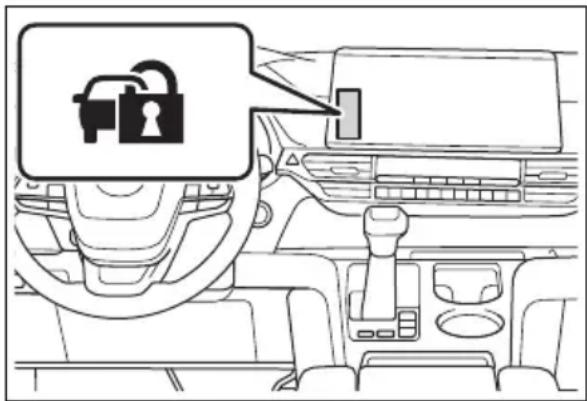
■Canceling or stopping
Do one of the following to deactivate or stop the alarm:
- Unlock the doors.
- Turn the power switch to ACC or ON, or start the hybrid system. (The alarm will be deactivated or stopped after a few seconds.)
System maintenance
The vehicle has a maintenance-free type alarm system.
■Triggering of the alarm
The alarm may be triggered in the following situations: (Stopping the alarm deactivates the alarm system.)
●The doors are unlocked using the mechanical key.
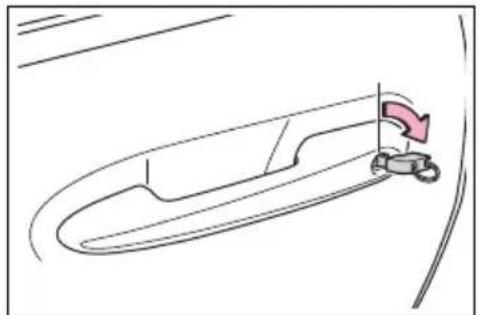
natural_image
Line drawing of a car door handle with a small object on the side (no text or symbols)If a door is unlocked using the mechanical key while the alarm is set, a warning will sound intermittently for approximately 10 seconds. If the alarm is not canceled or stopped during this time, the warning pattern changes and the warning sounds for a certain period of time.
●A person inside the vehicle opens a door or hood, or unlocks the vehicle using an inside lock button.
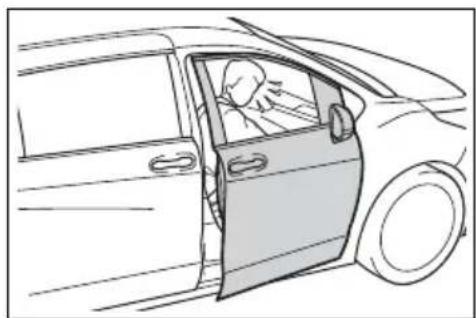
natural_image
Line drawing of a car door open showing the side door and window (no text or symbols)●The 12-volt battery is recharged or replaced when the vehicle is locked. (→P.506)
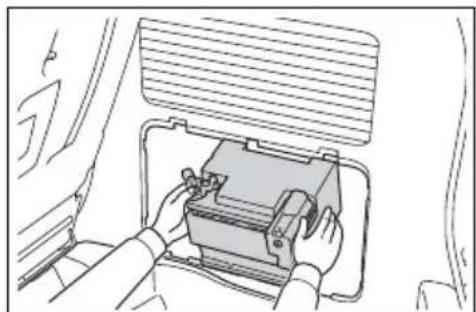
natural_image
Line drawing of hands installing or adjusting a mechanical component inside a vehicle (no text or symbols visible)■Alarm-operated door lock
In the following cases, depending on the situation, the door may automatically lock to prevent improper entry into the vehicle:
- When a person left in the vehicle triggers the alarm by unlocking a door or the back door.
- When a person left in the vehicle unlocks a door or the back door while the alarm is operating.
- When recharging or replacing the 12-volt battery.

NOTICE
■To ensure the system operates correctly
Do not modify or remove the system. If modified or removed, the proper operation of the system cannot be guaranteed.
2
2-1. Instrument cluster
Warning lights and indicators 92
Gauges and meters (with 4.2-inch display)....97
Gauges and meters (with 7-inch display) ...... 101
Multi-information display 104
Head-up display ..... 118
Energy monitor/consumption screen.... 122
Warning lights and indicators
The warning lights and indicators on the instrument cluster, center panel and outside rear view mirrors inform the driver of the status of the vehicle's various systems.
Instrument cluster
For the purpose of explanation, the following illustrations display all warning lights and indicators illuminated.
▶ With 4.2-inch display
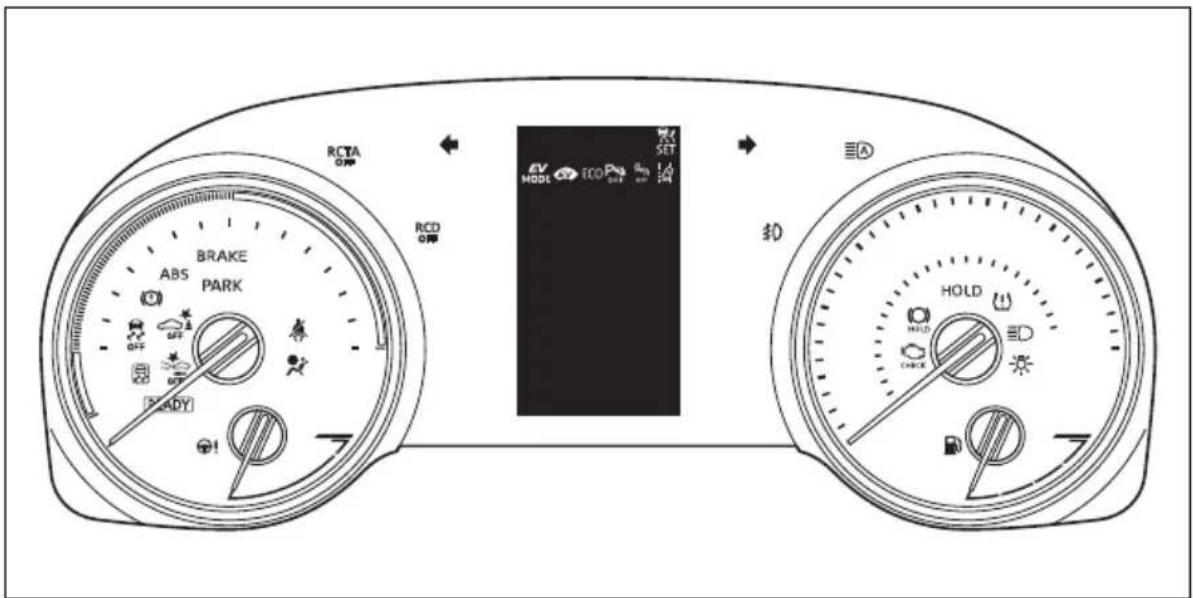
The units used on the meters and some indicators may differ depending on the target region.
▶ With 7-inch display
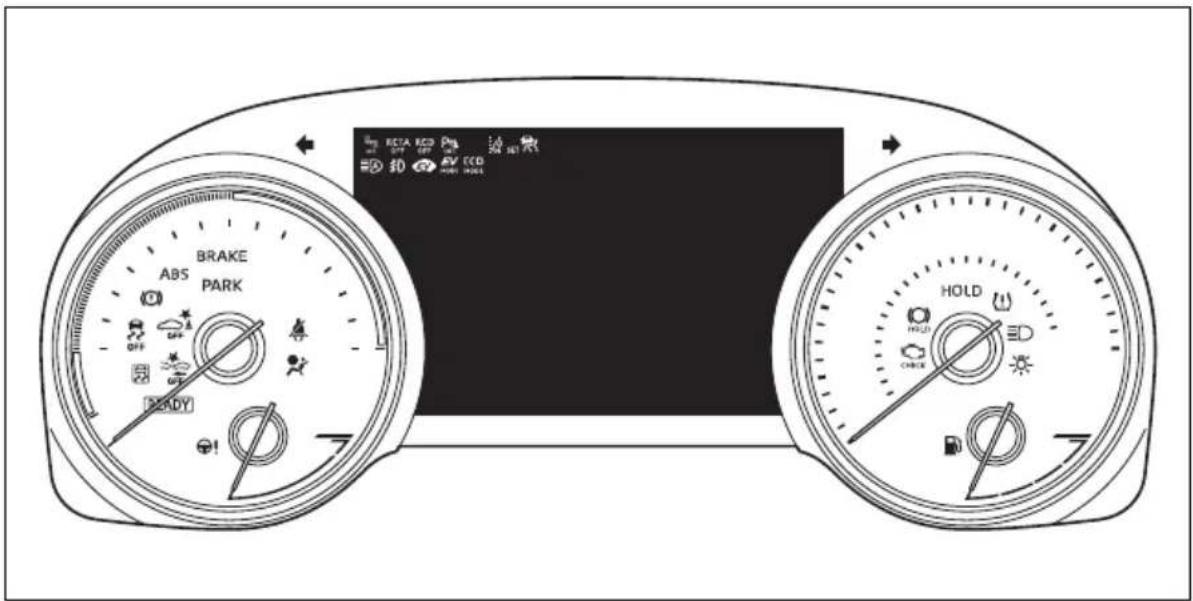
The units used on the meters and some indicators may differ depending on the target region.
Warning lights
Warning lights inform the driver of malfunctions in the indicated vehicle's systems.

(U.S.A.)
Brake system warning light ^*1 (→P.466)
(Canada)
(Red)
Brake system warning light ^*1 ( P.466)
(Yellow)
Brake system warning light ^*1 (→P.466)
(U.S.A.)
Charging system warning light ^*1,2 (→P.466)
High coolant temperature warning light ^*2 (→P.467)
Hybrid system over- heat warning light ^2 (→P.467)
Low engine oil pressure warning light ^2 (→P.467)
(Canada)
Malfunction indicator lamp ^*1 (→P.467)

Malfunction indicator lamp ^*1 (→P.467)
SRS warning light ^*1 (→P.468)

(U.S.A.)
ABS warning light ^*1 (→P.468)

(Canada)
ABS warning light ^*1 (→P.468)
(Red/yellow)
Electric power steering system warning light ^*1 (→P.468)
(Flashes or illuminates)
PCS warning light ^*1 (→P.469)
(Orange)
LTA indicator ( P.469)



(Flashes)
Intuitive parking assist OFF indicator ^3 (if equipped) (→P.469) PKSB OFF indicator ^1 (if equipped) (→P.470)
RCTA OFF indicator ^*1 (if equipped) ( P.470)
RCD OFF indicator (if equipped) ( P.470)
Slip indicator ^*1 (→P.471)
Brake Override System/Drive-Start Control/PKSB (if equipped) warning light ^*2 (→P.471)
Brake hold operated indicator ^*1 (→P.471)

Parking brake indicator ( P.472)
Parking brake indicator ( P.472)
Tire pressure warning light ^*1 ( P.472)
Low fuel level warning light ( P.472)
Seat belt reminder light ( P.473)
Rear passengers' seat belt reminder light ^*4 (→P.473)
*1: These lights turn on when the power switch is turned to ON to indicate that a system check is being performed. They will turn off after the hybrid system is on, or after a few seconds. There may be a malfunction in a system if the light does not come on, or turn off. Have the vehicle inspected by your Toyota dealer.
*2: This light illuminates on the multi-information display with a message.
*3:Intuitive parking assist OFF indicator turns on when the power switch is turned to ON while the Intuitive parking assist function is on. It will turn off after a few seconds.
*4: This light illuminates on the center panel.

WARNING
■If a safety system warning light does not come on
Should a safety system light such as the ABS and SRS warning light not come on when you start the hybrid system, this could mean that these systems are not available to help protect you in an accident, which could result in death or serious injury. Have the vehicle inspected by your Toyota dealer immediately if this occurs.
Indicators
The indicators inform the driver of the operating state of the vehicle's various systems.
Turn signal indicator ( P.242)
Headlight indicator ( P.248)
(U.S.A.)

Tail light indicator ( P.248)
(Canada)

Headlight high beam indicator ( P.250)
Automatic High Beam indicator ( P.250)
Fog light indicator (if equipped) ( P.254)
Smart key system indicator ^*1 (→P.231)
Cruise control indicator ( P.288)
Dynamic radar cruise control indicator ( P.288)
Cruise control "SET" indicator (→P.288)
LTA indicator ^*2 (→P.280)
Intuitive parking assist

OFF indicator ^*3,4 (if equipped) ( P.310)
RCD OFF indicator ^3 (if equipped) (→P.315)
PKSB OFF indicator ^3 , ^5 (if equipped) (→P.320)
Slip indicator ^*5 (→P.336)
(Flashes)
VSC OFF indicator ^*3 , ^5 ( P.336)
PCS warning light ^*3,5 (→P.269)
BSM outside rear view mirror indicators ^*5,6 (if equipped) ( P.300)
BSM OFF indicator (if equipped) ( P.300)

RCTA OFF indicator ^*3,5 (if equipped) ( P.300)

Brake hold standby indicator ^*5 (→P.246)
Brake hold operated indicator ^*5 (→P.246)
Security indicator ^4 (→P.88, 89)
"READY" indicator (→P.231)
Low outside temperature indicator ^8 (→P.98, 102)
EV indicator ( P.80)

Parking brake indicator (→P.243)
(U.S.A.)

Parking brake indicator (→P.243)
(Canada)




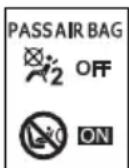
EV drive mode indicator ( P.236)
Eco drive mode indicator ^*9 (→P.333)
Eco drive mode indicator ^*10 (→P.333)
Sport mode indicator (→P.333)
"AIR BAG ON/OFF" indicator ^*5,7 ( P.51)
*1: This light illuminates on the multi-information display with a message.
*2: Depending on the operating conditions, the color and illuminating/flashing state of the light change.
^3 : The light comes on when the system is turned off.
*4:Intuitive parking assist OFF indicator turns on when the power switch is turned to ON while the Intuitive parking assist function is on. It will turn off after a few seconds.
*5: These lights turn on when the power switch is turned to ON to indicate that a system check is being performed. They will turn off after the hybrid system is on, or after a few seconds. There may be a malfunction in a system if the lights do not turn on, or turn off. Have the vehicle inspected by your Toyota dealer.
^6 : This light illuminates on the outside rear view mirrors.
^*7 :This light illuminates on the cen-
ter panel.
*8: When the outside temperature is approximately 37°F (3°C) or lower, the indicator will flash for approximately 10 seconds, then stay on.
*9:With 4.2-inch display
*10: With 7-inch display
■BSM (Blind Spot Monitor) outside rear view mirror indicators (if equipped)
In order to confirm operation, the BSM outside rear view mirror indicators illuminate in the following situations:
- When the power switch is turned to ON while the BSM function is enabled on the screen of the multi-information display.
- When the BSM function is enabled on the screen of the multi-information display while the power switch is in ON.
If the system is functioning correctly, the BSM outside rear view mirror indicators will turn off after a few seconds.
If the BSM outside rear view mirror indicators do not illuminate or do not turn off, there may be a malfunction in the system. If this occurs, have the vehicle inspected by your Toyota dealer.
Gauges and meters (with 4.2-inch display)
The meters display various drive information.
Meter display
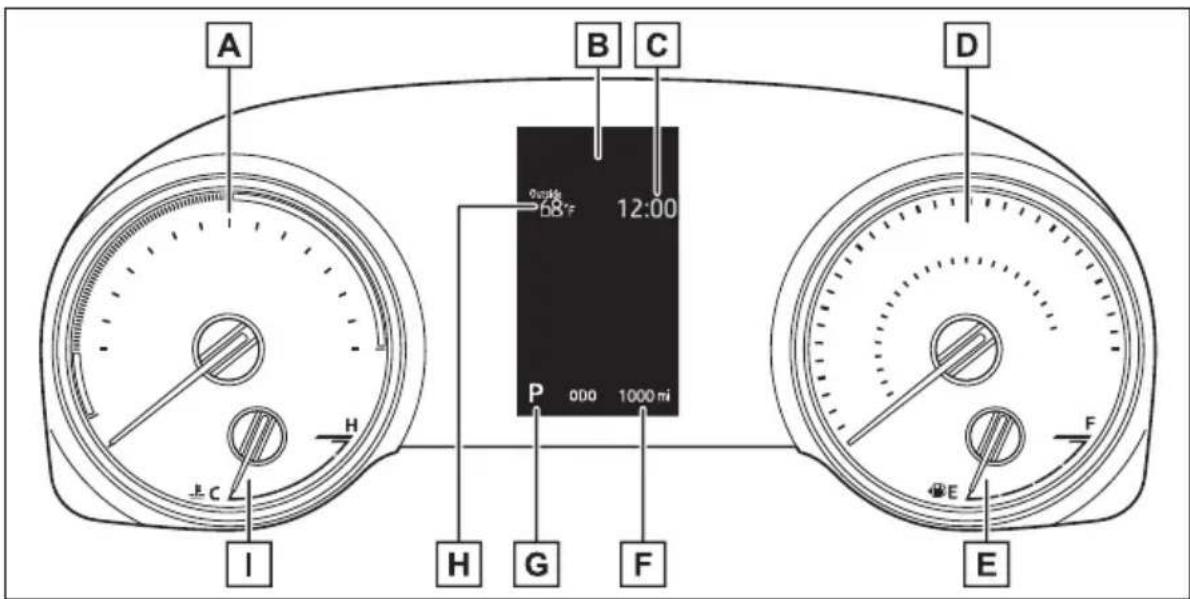
The units used on the meter and display may differ depending on the target region.
A Hybrid System Indicator
Displays the Hybrid System Indicator ( P.98)
B Multi-information display
Presents the driver with a variety of driving-related data ( P.104)
Displays warning messages if a malfunction occurs ( P.477)
C Clock ( P.100)
D Speedometer
Displays the vehicle speed
E Fuel gauge
Displays the quantity of fuel remaining in the tank
F Odometer, trip meter and oil maintenance
Odometer:
Displays the total distance that the vehicle has been driven
Trip meter:
Displays the distance the vehicle has been driven since the meter was last reset. Trip meters “A” and “B” can be used to record and display different distances independently.
Oil maintenance:
Displays the distance until the next engine oil change.
G Shift position and shift range indicator
Displays the selected shift position or selected shift range ( P.238)
H Outside temperature ( P.98)
☐ Engine coolant temperature gauge
Displays the engine coolant temperature
■The meters and display illuminate when
The power switch is in ON.
■When changing driving mode
Speedometer color is changed following the selected driving mode. (→P.333)
Hybrid System Indicator
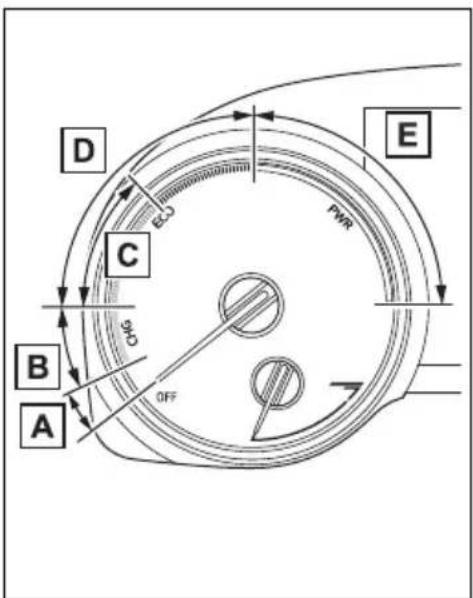
A READY OFF area
Shows that the hybrid system is not operating.
B Charge area
Shows regeneration ^* status.
Regenerated energy will be used to charge the hybrid battery (traction battery).
C Hybrid Eco area
Shows that gasoline engine power is not being used very often.
The gasoline engine will automati-
cally stop and restart under various conditions.
D Eco area
Shows that the vehicle is being driven in an Eco-friendly manner.
By keeping the indicator needle within Eco area, more Eco-friendly driving can be achieved.
E Power area
Shows that an Eco-friendly driving range is being exceeded (during full power driving etc.)
*: When used in this manual, "regen-
eration" refers to the conversion of energy created by the movement of the vehicle into electrical energy.
In the following situation, the Hybrid System Indicator does not operate.
●“READY” indicator is not illuminated.
●The shift lever is in a range other than D or S.
■Outside temperature display
● In the following situations, the correct outside temperature may not be displayed, or the display may take longer than normal to change.
- When stopped, or driving at low speeds (less than 12 mph [20 km/h])
- When the outside temperature has changed suddenly (at the entrance/exit of a garage, tunnel, etc.)
- When “--” or “E” is displayed, the system may be malfunctioning. Take your vehicle to your Toyota dealer.
●Displays the outside temperature within the range of -40^ ( -40^ ) to 122^ ( 50^ ).
- When the outside temperature is approximately 37°F (3°C) or lower, the low outside temperature indicator will flash for approximately 10 seconds, then stay on.
Liquid crystal display
→P.105

WARNING
■The information display at low temperatures
Allow the interior of the vehicle to warm up before using the liquid crystal information display. At extremely low temperatures, the display monitor may respond slowly, and display changes may be delayed.
For example, there is a lag between the driver's shifting and the new shift range appearing on the display. This lag could cause the driver to downshift again, causing rapid and excessive engine braking and possibly an accident resulting in death or injury.

NOTICE
■To prevent damage to the engine and its components
The engine may be overheating if the engine coolant temperature gauge is in the red zone ("H"). In this case, immediately stop the vehicle in a safe place, and check the engine after it has cooled completely. (→P.511)
Changing the trip meter display
Switches the items of the odometer, trip meter A, trip meter B and oil maintenance by pressing the "ODO TRIP" switch.
When the trip meter is dis- played, pressing and holding the switch will reset the trip meter.
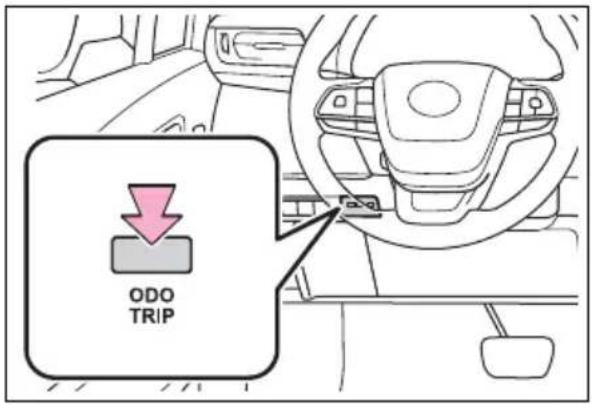
Pop-up display
Distance until the next engine oil change will displayed when a warning message indicating that oil maintenance should be performed soon or is required is displayed.
Changing the instrument panel light brightness
The brightness of the instrument panel lights can be adjusted.
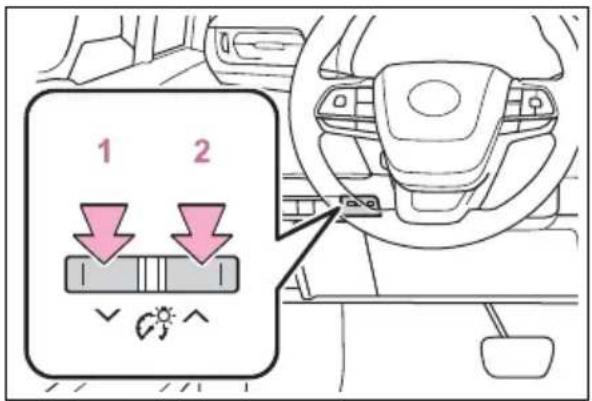
1 Darker
2 Brighter
■Instrument panel brightness adjustment
The instrument panel brightness levels when the tail lights are on and off can be adjusted individually. However, when the surroundings are bright (daytime, etc.), turning on the tail lights will not change the instrument panel brightness.
Adjusting the clock
The clocks can be adjusted on the audio system screen.
Refer to "NAVIGATION AND MULTIMEDIA SYSTEM OWNER'S MANUAL".
Gauges and meters (with 7-inch display)
The meters display various drive information.
Meter display
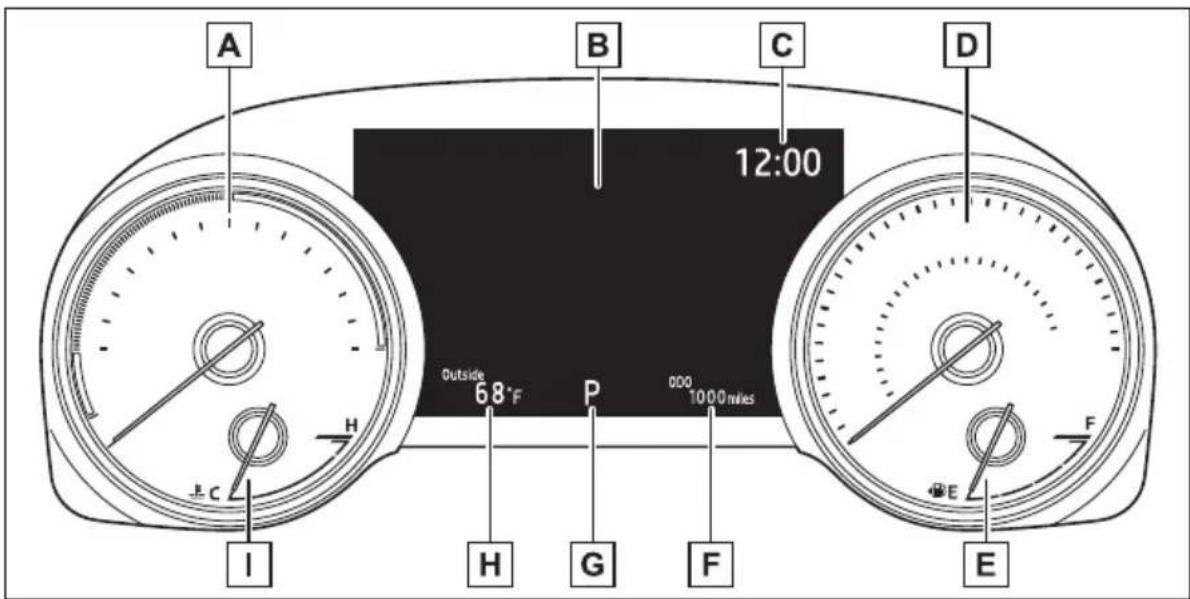
The units used on the meter and display may differ depending on the target region.
A Hybrid System Indicator
Displays the Hybrid System Indicator ( P.102)
B Multi-information display
Presents the driver with a variety of driving-related data ( P.104)
Displays warning messages if a malfunction occurs ( P.477)
C Clock ( P.104)
D Speedometer
Displays the vehicle speed
E Fuel gauge
Displays the quantity of fuel remaining in the tank
F Odometer, trip meter and oil maintenance
Odometer:
Displays the total distance that the vehicle has been driven
Trip meter:
Displays the distance the vehicle has been driven since the meter was last reset. Trip meters "A" and "B" can be used to record and display different distances independently.
Oil maintenance:
Displays the distance until the next engine oil change.
G Shift position and shift range indicator
Displays the selected shift position or selected shift range ( P.238)
H Outside temperature ( P.102)
☐ Engine coolant temperature gauge
Displays the engine coolant temperature
■The meters and display illuminate when
The power switch is in ON.
■When changing driving mode
Speedometer color is changed following the selected driving mode. (→P.333)
Hybrid System Indicator
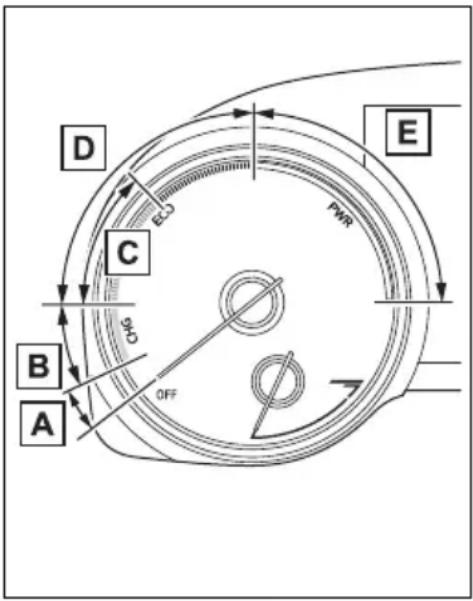
A READY OFF area
Shows that the hybrid system is not operating.
B Charge area
Shows regeneration ^* status. Regenerated energy will be used to charge the hybrid battery (traction battery).
C Hybrid Eco area
Shows that gasoline engine power is not being used very often.
The gasoline engine will automatically stop and restart under various conditions.
D Eco area
Shows that the vehicle is being driven in an Eco-friendly manner.
By keeping the indicator needle within Eco area, more Eco-friendly driving can be achieved.
E Power area
Shows that an Eco-friendly driving range is being exceeded (during full power driving etc.)
*: When used in this manual, “regeneration” refers to the conversion of energy created by the movement of the vehicle into electrical
energy.
In the following situation, the Hybrid System Indicator does not operate.
●“READY” indicator is not illuminated.
●The shift lever is in a range other than D or S.
■Outside temperature display
● In the following situations, the correct outside temperature may not be displayed, or the display may take longer than normal to change.
- When stopped, or driving at low speeds (less than 12 mph [20 km/h])
-
When the outside temperature has changed suddenly (at the entrance/exit of a garage, tunnel, etc.)
-
When “--” or “E” is displayed, the system may be malfunctioning. Take your vehicle to your Toyota dealer.
●Displays the outside temperature within the range of -40^ ( -40^ ) to 122^ ( 50^ ). - When the outside temperature is approximately 37°F (3°C) or lower, the low outside temperature indicator will flash for approximately 10 seconds, then stay on.
Liquid crystal display
→P.105
Customization
Settings (e. g. meter display) can be changed on the screen of the multi-information display. (→P.541)

WARNING
■The information display at low temperatures
Allow the interior of the vehicle to warm up before using the liquid crystal information display. At extremely low temperatures, the display monitor may respond slowly, and display changes may be delayed.
For example, there is a lag between the driver's shifting and the new shift range appearing on the display. This lag could cause the driver to downshift again, causing rapid and excessive engine braking and possibly an accident resulting in death or injury.

NOTICE
■To prevent damage to the engine and its components
The engine may be overheating if the engine coolant temperature gauge is in the red zone ("H"). In this case, immediately stop the vehicle in a safe place, and check the engine after it has cooled completely. (→P.511)
Changing the trip meter display
Switches the items of the odometer, trip meter A, trip meter B and oil maintenance by pressing the "ODO TRIP" switch.
When the trip meter is dis- played, pressing and holding the switch will reset the trip meter.
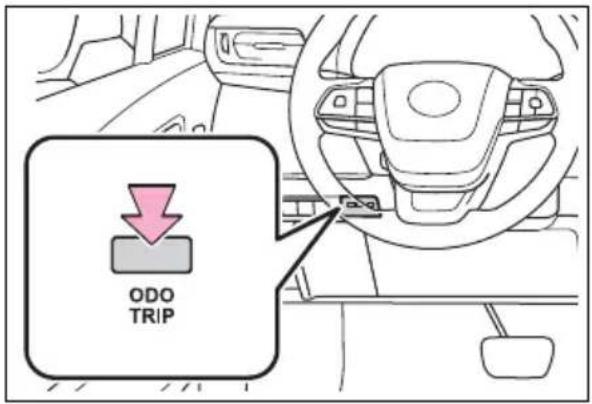
Pop-up display
Distance until the next engine oil change will displayed when a warning message indicating that oil maintenance should be performed soon or is required is displayed.
Changing the instrument panel light brightness
The brightness of the instrument panel lights can be adjusted.
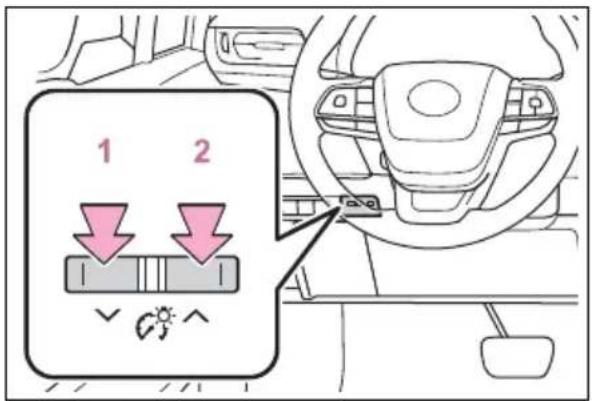
1 Darker
2 Brighter
■Instrument panel brightness adjustment
The instrument panel brightness levels when the tail lights are on and off can be adjusted individually. However, when the surroundings are bright (daytime, etc.), turning on the tail lights will not change the instrument panel brightness.
Adjusting the clock
The clocks can be adjusted on the audio system screen.
Refer to "NAVIGATION AND MULTIMEDIA SYSTEM OWNER'S MANUAL".
Multi-information display
The multi-information display is used to display fuel efficiency related information and various types of driving-related information. The multi-information display can also be used to change the display settings and other settings.
Display contents
Following information is dis- played on the multi-information display.
▶ Vehicles with 4.2-inch display
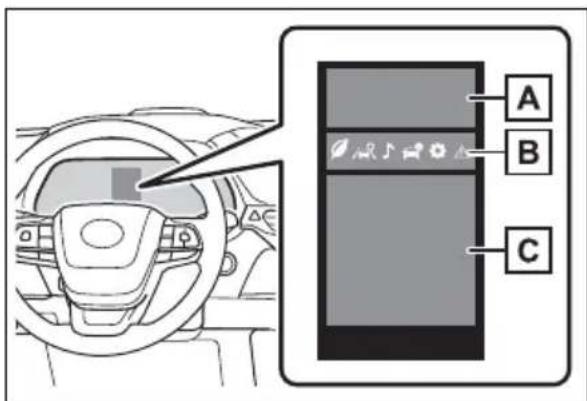
A Driving support system information
Displays recognized signs while the RSA system (if equipped) is operating. (→P.285)
Displays an image when the following systems are operating and a
menu icon other than
selected:
• LTA (Lane Tracing Assist) (→P.275)
• Dynamic radar cruise control with
full-speed range ( P.288)
B Menu icons ( P.106)
C Information display area
A variety of information can be displayed by selecting a menu icon.
Additionally, warning or suggestion/advice pop-up displays will be displayed in some situations.
▶ Vehicles with 7-inch display
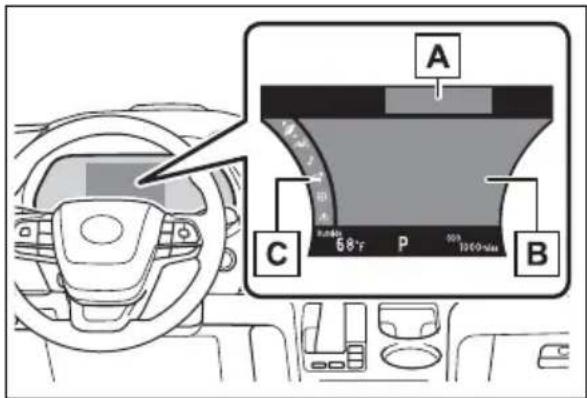
A Driving support system information
Displays recognized signs while the RSA system (if equipped) is operating. (→P.285)
Displays an image when the following systems are operating and a
menu icon other than selected:
• LTA (Lane Tracing Assist) ( P.275)
- Dynamic radar cruise control with full-speed range (→P.288)
B Information display area
A variety of information can be displayed by selecting a menu icon.
Additionally, warning or suggestion/advice pop-up displays will be displayed in some situations.
C Menu icons (→P.106)
■The multi-information display is displayed when
The power switch is in ON.
■When changing driving mode
Background color of the multi-information display is changed following the selected driving mode. (→P.333)
■Liquid crystal display
Small spots or light spots may appear on the display. This phenomenon is characteristic of liquid crystal displays, and there is no problem continuing to use the display.
Changing the display
The multi-information display is operated using the meter control switches.
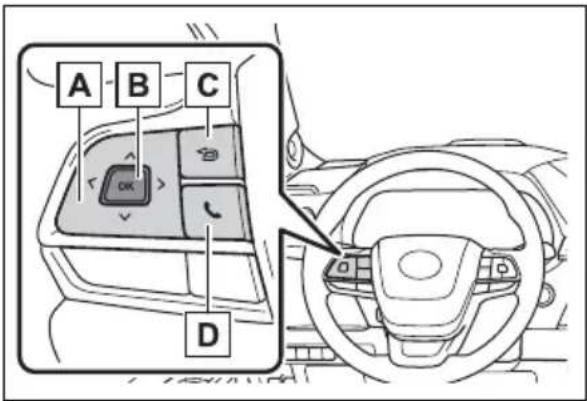
A Scroll the screen*/switch the display*/move the cursor
B Press: Enter/Set
Press and hold: Reset/Display customizable items
C Return to the previous screen
D Call sending/receiving and history display
Linked with the hands-free system, sending or receiving
call is displayed. For details regarding the hands-free system, refer to "NAVIGATION AND MULTIMEDIA SYSTEM OWNER'S MANUAL".
*: On screens where the screen can be scrolled and the display can be switched, a scroll bar or a round icon that shows the number of registered screens is displayed.

WARNING
■Caution for use while driving
For safety, avoid operating the meter control switches while driving as much as possible, and do not look continuously at the multi-information display while driving. Stop the vehicle and operate the meter control switches. Failure to do so may cause a steering wheel operation error, resulting in an unexpected accident.
Menu icons
Information related to each icon can be displayed by selecting the icon with the meter control switches.
Some of the information may be displayed automatically depending on the situation.

Driving information display ( P.106)
Driving support system information display ( P.110)

Audio system-linked display (if equipped) (→P.111)
Vehicle information display ( P.111)

Settings display ( P.112)

Warning message display ( P.116)
Driving information display (
Select to display fuel consumption data in various forms.
■Speedometer display/Distance to empty (4.2-inch display)
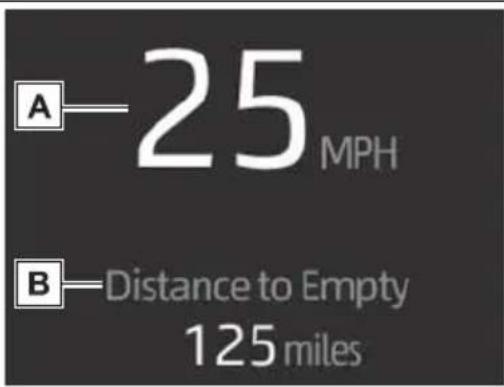
A Speedometer display Displays the vehicle speed.
B Distance to empty Displays the driving range with remaining fuel. ( P.110)
Fuel Economy
4.2-inch display
Following information is displayed.
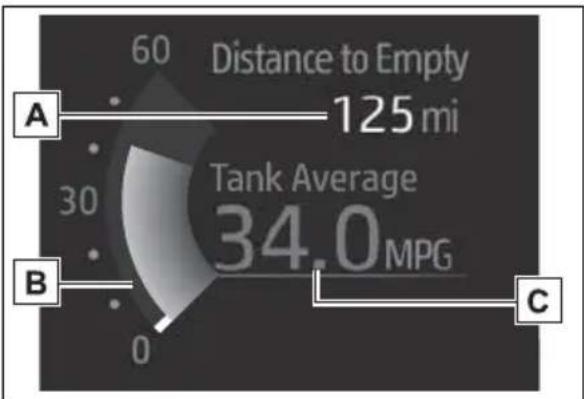
gauge
| Point | Value | |---|---| | A | 60 | | B | 0 | | C | 0 | Tank Average: 34.0 MPG | | Distance to Empty: 125 miA Distance to empty
Displays the driving range with remaining fuel. ( P.110)
B Current fuel economy
Displays the instantaneous current fuel economy.
C Average fuel economy
Displays the average fuel economy since the function was reset or the average fuel economy after starting or refueling. ^*1, 2, 3
The average fuel economy selected by “Fuel Economy” on the screen is displayed. (→P.112)
*1: Use the displayed fuel consumption as a reference only.
*2: Average fuel economy since the function was reset can be reset by pressing and holding "OK".
*3: Average fuel economy after starting is reset each time the hybrid system stops.
7-inch display
Following information is displayed.
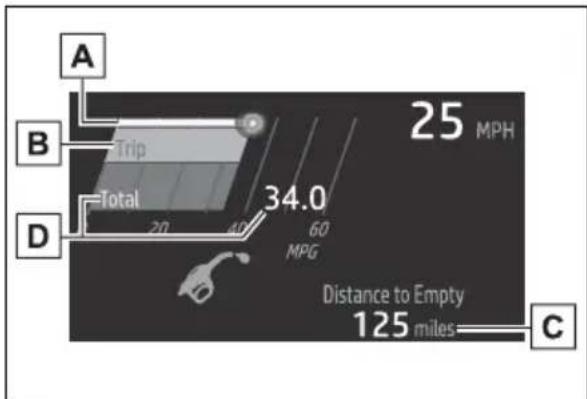
A Current fuel economy
Displays the instantaneous current fuel economy.
B Average fuel economy (after start)
Displays the average fuel consumption since hybrid system start. ^*1
C Distance to empty
Displays the driving range with remaining fuel. ( P.110)
D Average fuel economy
Displayed item (listed below) can be changed on the fuel economy type screen of P.112)
- Total (after reset)
Displays the average fuel consumption since the display was reset. ^*1, 2
- Tank (after refuel)
Displays the average fuel consumption since the vehicle was refueled. ^*1
When only a small amount of fuel is added to the tank, the display may not be updated.
When refueling, turn the power switch off. If the vehicle is refueled without turning the power switch off, the display may not be updated.
*1: Use the displayed fuel consumption as a reference only.
*2: This display can be reset by pressing and holding "OK" while it is displayed.
■ ECO Accelerator Guidance/“Eco Score”
Displays a reference operation range for using the accelerator pedal according to driving conditions, and a score result that evaluates the current driving status.
4.2-inch display
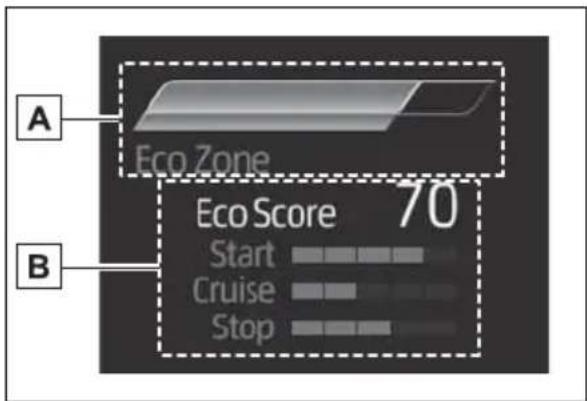
A ECO Accelerator Guidance
B "Eco Score"
7-inch display
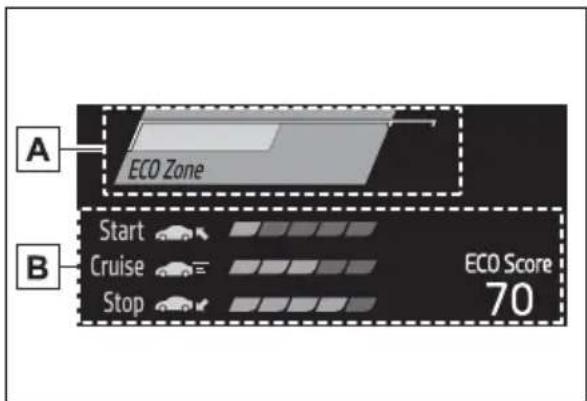
A ECO Accelerator Guidance
B "Eco Score"
• ECO Accelerator Guidance
4.2-inch display
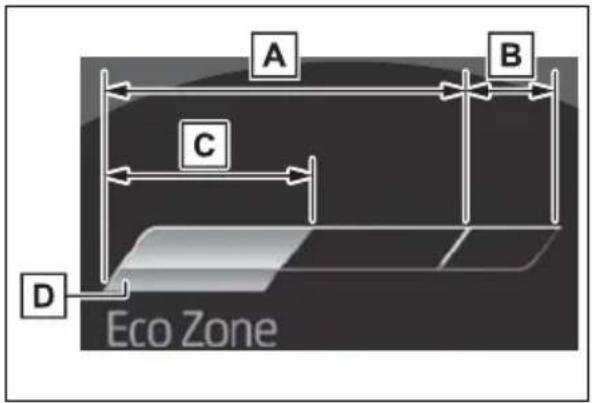
A ECO area
Shows that the vehicle is being driven in an Eco-friendly manner.
B Power area
Shows that an Eco-friendly driving range is being exceeded (during full power driving etc.).
C Current acceleration
Displayed as a green bar when within the Eco area. Eco-friendly acceleration can be achieved by keeping the accelerator pedal operation display within the range indicated by the blue bar. ( P.209)
D Reference operation range
A zone is displayed in blue under the Eco area which can be used as a reference operation range for using the accelerator pedal according to driving conditions such as starting off and cruising.
The ECO Accelerator Guidance display changes according to the driving status, such as when starting off or cruising.
It is easier to drive in an Eco-friendly manner by driving according to the display showing the accelerator pedal operations and staying within the reference operation range.
7-inch display
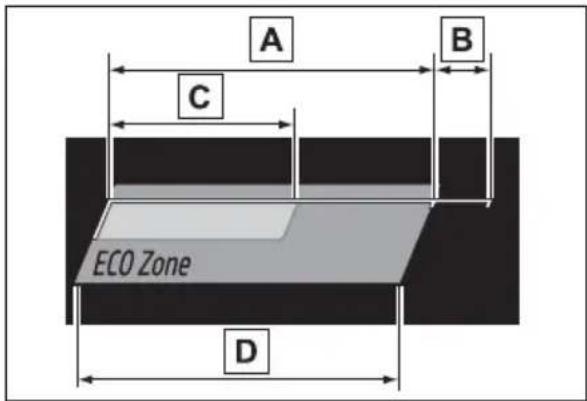
A ECO area
Shows that the vehicle is being driven in an Eco-friendly manner.
B Power area
Shows that an Eco-friendly driving range is being exceeded (during full power driving etc.).
C Current acceleration
Displayed as a green bar when within the Eco area. Eco-friendly acceleration can be achieved by keeping the accelerator pedal operation display within the range indicated by the blue bar. ( P.209)
D Reference operation range
A zone is displayed in blue under the Eco area which can be used as a reference operation range for using the accelerator pedal according to driving conditions such as starting off and cruising.
The ECO Accelerator Guidance display changes according to the driving status, such as when starting off or cruising.
It is easier to drive in an Eco-friendly manner by driving according to the display showing the accelerator pedal operations and staying within the reference operation range.
- “Eco Score”
The driving status for the following 3 situations are evaluated in 5 levels: Smooth start-off acceleration ("Start"), driving without sudden acceleration ("Cruise") and smooth stopping ("Stop"). Each time the vehicle is stopped, a score result is displayed out of a perfect score of 100 points.
4.2-inch display
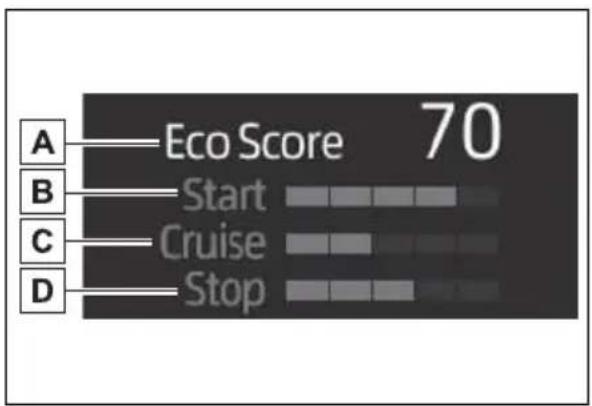
A Score result
B Eco start status
C Eco cruise status
D Eco stop status
7-inch display
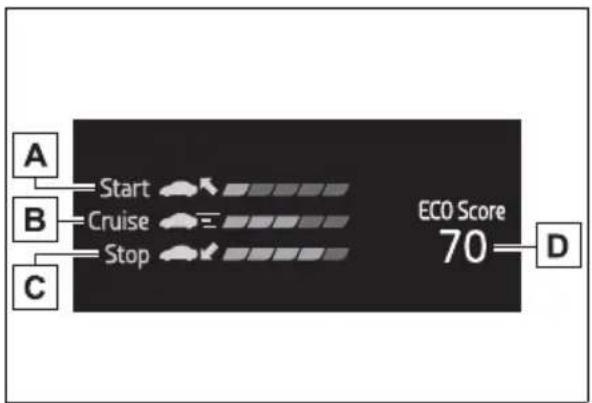
flowchart
graph LR
    A["A"] --> Start
    B["B"] --> Cruise
    C["C"] --> Stop
    Start --> ECO_Score["ECO Score 70"]
    Cruise --> ECO Score
    Stop --> ECO Score
    ECO Score --> D["D"]
A Eco start status
B Eco cruise status
C Eco stop status
D Score result
How to read the bar display:
4.2-inch display
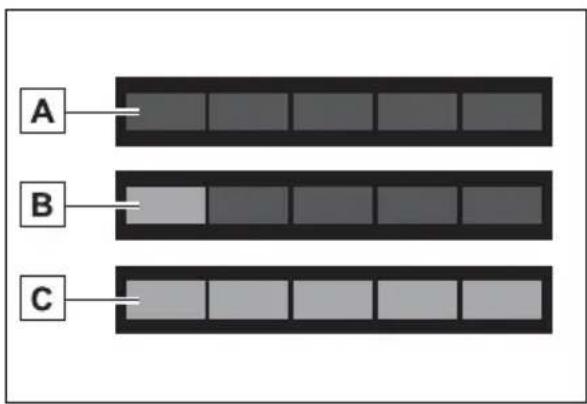
A Not yet evaluated
B Low
C High
7-inch display
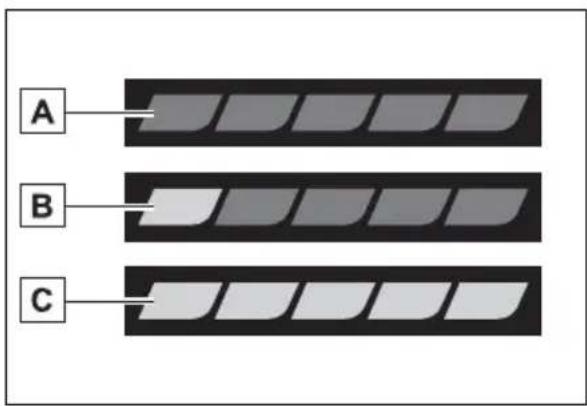
A Not yet evaluated
B Low
C High
After starting off, "Eco Score" display does not start until the vehicle speed exceeds approximately 12 mph (20 km/h).
The "Eco Score" is reset each time the vehicle starts off to start a new evaluation.
When the hybrid system stops, the current total score result is dis-
played.*
*: The score result is displayed only when “Eco Score” is selected for “Trip Summary”. (→P.112)
■ Change the speedometer display (7-inch display)
→P.115
■Distance to empty
● This distance is computed based on your average fuel consumption. As a result, the actual distance that can be driven may differ from that displayed.
- When only a small amount of fuel is added to the tank, the display may not be updated. When refueling, turn the power switch off. If the vehicle is refueled without turning the power switch off, the display may not be updated.
- When “Refuel” is displayed, the remaining fuel amount is low and the distance that can be driven with the remaining fuel cannot be calculated.
Refuel immediately.
■ ECO Accelerator Guidance/“Eco Score” will not operate when
The ECO Accelerator Guidance/“Eco Score” will not operate in the following situations:
●The Hybrid System Indicator is not operating.
●The vehicle is being driven using the dynamic radar cruise control with full-speed range.
Driving support system information display (A)
■Driving support system information display
Select to display the operational status of the following systems:
● LTA (Lane Tracing Assist) ( P.275)
● Dynamic radar cruise control with full-speed range ( P.288)
● RSA (Road Sign Assist) (if equipped) ( P.285)
■Navigation system-linked display (if equipped)
Select to display the following navigation system-linked information.
- Route guidance
- Compass display (north-up display/heading-up display)
■Route guidance to destination display
When the route guidance to destination display is enabled on the head-up display, it will not be displayed on the multi-information display. (→P.118)
Audio system-linked display (if equipped) (♪)
Select to enable selection of an audio source or track on the display.
Vehicle information display (6.0)
■Drive information (4.2-inch display)
2 items that are selected using the "Drive Info Items" setting
(average speed, distance and total time) can be displayed vertically.
The displayed information changes according to the “Drive Info Type” setting (since the system was started or between resets). (→P.112)
Use the displayed information as a reference only.
Following items will be displayed.
- "Trip"
- "Average Speed": Displays the average vehicle speed since hybrid system start*
- "Distance": Displays the distance driven since hybrid system start*
- "Total Time": Displays the elapsed time since hybrid system start*
*: These items are reset each time the hybrid system stops.
• "Total"
- "Average Speed": Displays the average vehicle speed since the display was reset*
- "Distance": Displays the distance driven since the display was reset*
- "Total Time": Displays the elapsed time since the display was reset*
*: To reset, display the desired item and press and hold "OK".
■Energy monitor
→P.122
Tire pressure
→P.427
■AWD system display (AWD models)
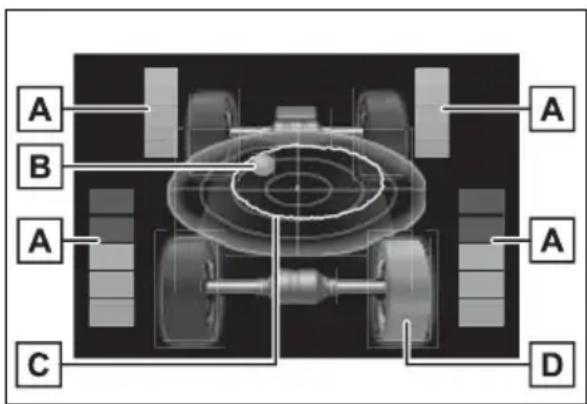
A Torque distribution display
Displays the drive status of each wheel in 6 steps from 0 to 5.
B G-force display*
Displays the size and direction of the G-force applied to the vehicle via changes to the position of the ball on the display.
C Maximum G-force course*
This item is linked with the G-force display and the course of the past movement of the ball is displayed. Press and hold "OK" to reset the record.
D Wheel spin display
When a tire is spinning, its icon on the display changes its color and blinks.
*: This item is displayed only when driving mode is set to sport mode.
■Safety system status (7-inch display)
Enable/Disable the following systems:
● PCS (Pre-Collision system)
(→P.267)
- Intuitive parking assist (if equipped) (→P.308)
● BSM (Blind Spot Monitor) ( P.299)
● RCTA (Rear Cross Traffic Alert) (→P.299)
Settings display
Vehicle settings and the content displayed on the screen can be changed by using the meter control switches.
■Setting procedure
4.2-inch display
1 Press or of the meter control switches and select
2 Press or of the meter control switches and select the desired item.
7-inch display
1 Press or of the meter control switches and select
2 Press or of the meter control switches and select the desired item.
- If the function is turned on and off or the volume, etc. is changed on the setting screen, the setting is changed each time “OK” is pressed.
- For functions that allow oper-
ation contents, display contents, etc., of function to be selected, the setting screen is displayed by pressing and holding "OK". When the setting screen is displayed, select the setting or desired value (time, etc.) with "OK".
3 After changing the settings, press of the meter control switches to return to the previous screen.
Setting items
- LTA (Lane Tracing Assist) (→P.275)
Select to set up the following items.
- "Lane Center"
Select to enable/disable the lane centering function.
- "Steering Assist"
Select to enable/disable steering wheel assistance.
- "Alert"
Select to set the alert type.
- "Sensitivity"
Select to set the lane departure alert sensitivity.
- "Sway Warning"
Select to enable/disable the vehicle sway warning.
- "Sway Sensitivity"
Select to set the vehicle sway warning sensitivity.
● PCS (Pre-Collision System) (→P.267)
Select to set up the following items.
• PCS (Pre-Collision System) on/off
Select to enable/disable the pre-collision system.
- "Sensitivity"
Select to change the pre-collision warning timing.
- BSM (Blind Spot Monitor) (if equipped) (→P.299)
Select to set up the following items.
• BSM (Blind Spot Monitor) on/off
Select to enable/disable the BSM function.
- "Brightness"
Select to switch the brightness of the outside rear view mirror indicators. ( P.300)
- "Sensitivity"
Select to change the alert timing for an approaching vehicle.
● PwA intuitive parking assist (if equipped) (→P.308)
Select to set up the following items.
- Intuitive parking assist on/off
Select to enable/disable the Intuitive parking assist.
- “Volume”
Select to set the volume of the buzzer which sounds when the Intuitive parking assist is operated.
● RCTA (Rear Cross Traffic Alert) (if equipped) (→P.299)
- RCTA (Rear Cross Traffic Alert) on/off
Select to enable/disable the RCTA function.
• “ Volume ”
Select to change the RCTA buzzer volume.
● PKSB (Parking Support Brake System) (if equipped) (→P.319)
Select to enable/disable the Parking Support Brake function.
- HUD (Head-up display) (if equipped)
Select to enable/disable the head-up display.
Press and hold "OK" to change the settings of the following items:
- "HUD Brightness/Position"
Select to adjust the brightness/position of the head-up display.
- "HUD Driving Support"
Select to change the displayed head-up display driving support item.
- "HUD Rotation"
Select to adjust the angle of the head-up display.
● RSA (Road Sign Assist) (if equipped) (→P.285)
Select to set up the following items.
- RSA (Road Sign Assist) on/off Select to enable/disable the RSA system.
- "Notification method"
Select to change each notification method used to warn the driver when the system recognizes excess speed, no overtaking and no-entry sign.
- "Notification Level"
Select to change each notification level used to warn the driver when the system recognizes a speed limit sign.
● RCD (Rear Camera Detection) (if equipped) (→P.315)
• RCD (Rear Camera Detection) on/off
Select to enable/disable the RCD function.
- “Volume”
Select to change the RCD buzzer volume.
Vehicle Settings
● PSD (Power Sliding Doors) (→P.137)
Select to set up the following items.
- “Left Hands Free PSD” (if equipped)
Select to enable/disable the left-hand power sliding door kick sensor.
- "Right Hands Free PSD" (if equipped)
Select to enable/disable the right-hand power sliding door kick sensor.
- "Left PSD Alert Volume"
Select to set the volume of the buzzer which sounds when the left-hand power sliding door system operates.
• "Right PSD Alert Volume"
Select to set the volume of the buzzer which sounds when the right-hand power sliding door system operates.
● PBD (Power Back Door) (if equipped) (→P.153)
Select to set up the following items.
- PBD (Power Back Door) on/off Select to enable/disable the power back door system.
- "Hands Free"
Select to enable/disable the kick sensor.
• "PBD Opening Adjustment"
Select the open position when power back door is fully open.
• “ Volume ”
Select to set the volume of the buzzer which sounds when the power back door system operates.
● Rear Seat Reminder ( P.134)
Select to enable/disable the rear seat reminder function.
- “TPWS Setting” (Tire Pressure Warning System) (→P.427)
- "Setting Pressure"
Select to initialize the tire pressure warning system.
- "Identifying Each Wheel & Position"
Select to register the ID codes of the tire pressure sensors to the tire pressure warning system.
Select to change the tire pressure warning system sensor ID code set. To enable this function, a second set of tire pressure warning system sensor ID codes must be registered by a Toyota dealer. For information regarding changing the registered
ID code set, contact your Toyota dealer.
- "Setting UNIT"
Select to change the units of the tire pressure displayed.
● “Oil Maintenance” ( P.418)
Select to reset the Oil maintenance.
■ Meter Settings
- "Language"
Select to change the language on the multi-information display.
- "Units"
Select to change the units of measure displayed.
● Digital Speed (7-inch display)
Select to enable/disable the speedometer display.
● EV indicator (→P.80)
Select to enable/disable the EV indicator.
- Driving information display settings
Select to set up the following items.
- "Hybrid System"
Select to enable/disable the ECO Accelerator Guidance ( P.108).
- "Fuel Economy"
Select to change the average fuel economy display ( P.106).
- Audio settings
Select to enable/disable the audio system-linked display.
● Vehicle information display settings
- "Display Contents"
Select to display the following items.
"Energy monitor"
Select to enable/disable the Energy monitor ( P.122)
"AWD" (AWD models)
Select to enable/disable the AWD system display ( P.112).
- "Drive Info Type" (4.2-inch display)
Select to change the drive information type between trip and total ( P.111).
- “Drive Info Items” (4.2-inch display)
Select to set the items on the upper and lower side of the drive information screen. from three items, average speed, distance and total time.
- “Trip Summary” (4.2-inch display)
Select to set the items displayed when the power switch is turned off.
- “Pop-Up Display”
Select to enable/disable the following pop-up displays, which may appear in some situations.
- TbT Navigation (if equipped)
- Telephone (if equipped)
- Audio operation
• Volume operation
• Voice control (if equipped)
- Brightness
● "Multi-Information Display OFF"
A blank screen is displayed.
- “Default Settings”
Select to reset the meter display settings.
■ Suspension of the settings display
● In the following situations, operation of the settings display will be temporarily suspended.
- When a warning message appears on the multi-information display
- When the vehicle begins to move
● Settings for functions not equipped to the vehicle are not displayed.
- When a function is turned off, the related settings for that function are not selectable.

WARNING
■ Cautions during setting up the display
As the hybrid system needs to be operating during setting up the display, ensure that the vehicle is parked in a place with adequate ventilation. In a closed area such as a garage, exhaust gases including harmful carbon monoxide (CO) may collect and enter the vehicle. This may lead to death or a serious health hazard.

NOTICE
■During setting up the display
To prevent 12-volt battery discharge, ensure that the hybrid system is operating while setting up the display features.
Warning message display (A)
Select to display warning messages and measures to be taken if a malfunction is detected. (→P.477)
Suggestion function
Displays suggestions to the driver in the following situations. To select a response to a displayed suggestion, use the meter control switches.
■Suggestion to turn on the headlights
If the headlight switch is in other than ☐, and the vehicle speed is 3 mph (5 km/h) or higher for a certain amount of time when the surroundings are dark, a suggestion message will be displayed.
■Suggestion to turn off the headlights
If the headlights are left on for a certain amount of time after the power switch has been turned off, a suggestion message will be displayed.
When the headlight switch is in the AUTO position: The message asking if you wish to turn the headlights off is displayed. To turn the headlights off, select "Yes".
If the driver's door is opened after the power switch is turned off, this suggestion message will not be displayed.
Customization
The suggestion function can be turned on/off. (Customizable fea-
tures: →P.541)
Head-up display\*
*: If equipped
The head-up display projects a variety of driving-related information and the operating state of the driving support systems on the windshield.
System components
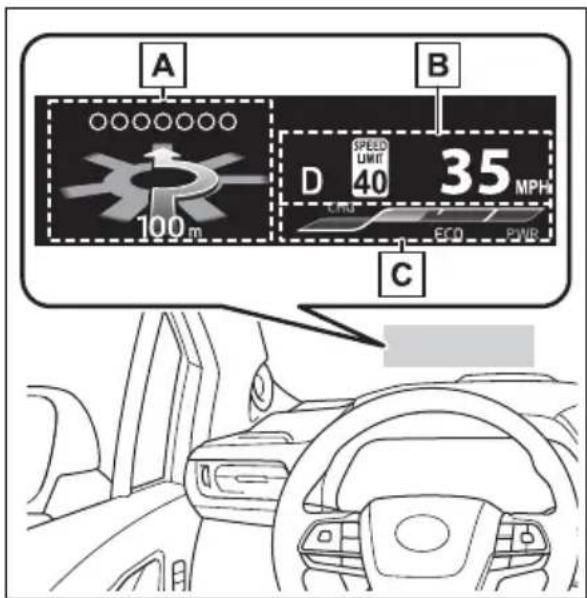
Illustrations used in this text are intended as examples, and may differ from the image that is actually displayed by the head-up display.
A Driving support system display area ( P.120) Navigation system-linked display area (if equipped)
Displays the following items which are linked to the navigation system:
- Route guidance to destination
- Street name
- Compass (heading-up display)
B Driving information display area
Displays the following items:
- Speed limit of the current road (linked to the navigation system) (U.S.A. only)
- RSA (Road Sign Assist) display (if equipped) ( P.285)
- Speedometer
- Shift position/shift range (→P.238)
C Hybrid System Indicator/tachometer/outside temperature display area ( P.121)
■Head-up display will operate when
The power switch is in ON.
■When using the head-up display
The head-up display may seem dark or hard to see when viewed through sunglasses, especially polarized sunglasses. Adjust the brightness of the head-up display or remove your sunglasses.
■ Street name display (vehicles with navigation system)
Only street names which are included in the map data will be displayed.
■Outside temperature display
- In the following situations, the correct outside temperature may not be displayed, or the display may take longer than normal to change.
- When stopped, or driving at low speeds (less than 12 mph [20 km/h])
- When the outside temperature has changed suddenly (at the entrance/exit of a garage, tunnel, etc.)
- When “-” or “E” is displayed, the system may be malfunctioning. Take your vehicle to your Toyota
dealer.
●Displays the outside temperature within the range of -40^ ( -40^ ) to 122^ ( 50^ ).
- When the outside temperature is approximately 37°F (3°C) or lower, the low outside temperature indicator will flash for approximately 10 seconds, then stay on.

WARNING
■When using the head-up display
- Check that the position and brightness of the head-up display image does not interfere with safe driving. Incorrect adjustment of the image's position or brightness may obstruct the driver's view and lead to an accident, resulting in death or serious injury.
- Do not continuously look at the head-up display while driving as you may fail to see pedestrians, objects on the road, etc. ahead of the vehicle.

NOTICE
■Head-up display projector
- Do not place any drinks near the head-up display projector. If the projector gets wet, electrical malfunctions may result.
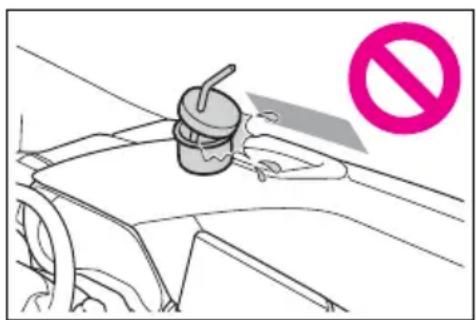
- Do not place anything on or put stickers onto the head-up display projector.
Doing so could interrupt head-up display indications.
- Do not touch the inside of the head-up display projector or thrust sharp edges or the like into the projector. Doing so could cause mechanical malfunctions.
Using the head-up display
■Enabling/disabling the head-up display
Select 📄 on the multi-information display, select "Vehicle Settings" (4.2-inch) / 📋 -inch) and then select "HUD Main". "ON" and "OFF" switches each time when "OK" is pressed.
■Changing settings of the head-up display
The following settings can be changed on “HUD Main” of the multi-information display. (→P.112)
Press and hold "OK" to display the following settings:
● “HUD Brightness/Position”
Select to adjust the brightness or vertical position of the head-up display.
- "HUD Driving Support"
- Tachometer Settings
Blank/Hybrid System/Tachometer Select to change the display to blank (no display)/Hybrid System
Indicator/tachometer.
Select to enable/disable the following items:
- Navigation (if equipped)
- Driving Assist
- Compass (if equipped)
- Audio
- "HUD Rotation"
Select to adjust the angle of the head-up display.
Press the of switch to adjust the angle of the head-up display.
■Enabling/disabling of the head-up display
If the head-up display is disabled, it will remain disabled when the power switch is turned off then back to ON.
■Display brightness
The brightness of the head-up display can be adjusted on 📄 of the multi-information display. Also, it is automatically adjusted according to the ambient brightness.
■Head-up display automatic position adjustment (vehicles with driving position memory)
If the display position is recorded into memory, the head-up display will be automatically adjusted to the desired position. ( P.178)
■When the 12-volt battery is disconnected
The customize settings of the head-up display will be reset.

WARNING
■Caution for changing settings of the head-up display
As the hybrid system needs to be operating while changing the settings of the head-up display, ensure that the vehicle is parked in a place with adequate ventilation. In a closed area such as a garage, exhaust gases including harmful carbon monoxide (CO) may collect and enter the vehicle. This may lead to death or a serious health hazard.

NOTICE
■When changing the settings of the head-up display
To prevent 12-volt battery discharge, ensure that the hybrid system is operating while changing the settings of the head-up display.
Driving support system display area
Displays the operational status of the following systems:
● LTA (Lane Tracing Assist) ( P.275)
● Dynamic radar cruise control with full-speed range ( P.288)
Details of content displayed on the head-up display may differ from that displayed on the multi-information display. For details, refer to the explanation of each system.
Pop-up display
Pop-up displays for the following systems will be displayed when necessary.
■Driving support systems
Displays a warning/suggestion/advice message or the operating state of a relevant system.
● PCS (Pre-Collision System) ( P.267)
- Parking Support Brake function (for static objects) (if equipped) (→P.323)
● Brake Override System ( P.209)
● Drive-Start Control ( P.209)
Details of content displayed on the head-up display may differ from that displayed on the multi-information display. For details, refer to the explanation of each system.

These icons are linked to the multi-information display
!: Master warning icon
Displayed when a warning message is displayed on the multi-information display. ( P.477)
i: Information icon
Displayed when a suggestion pop-up display ( P.104) or advice pop-up display is displayed on the multi-information display.
■Warning message
Some warning messages are displayed when necessary, according to certain conditions.
Details of content displayed on the head-up display may differ from that displayed on the multi-information display.
■Audio system operation status
Displayed when an audio remote control switch on the steering wheel is operated.
■Hands-free system status
Displayed when the hands-free system is operated.
■When a pop-up display is displayed
When a pop-up display is displayed, a current display may no longer be displayed. In this case, the display will return after the pop-up display disappears.
Hybrid System Indicator/tachometer/outside temperature display area
■Hybrid System Indicator
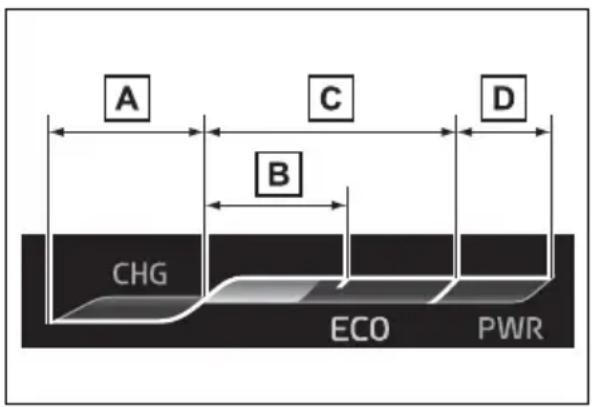
A Charge area
B Hybrid Eco area
c Eco area
D Power area
Displayed content is the same as that displayed on the meter (Hybrid System Indicator). For details, refer to P.98or P.102.
Tachometer
Displays the engine speed in revolutions per minute.
■Outside temperature
Displayed in the following situations:
- When the power switch is turned to ON (Displayed for approximately 10 seconds)
- When the low outside temperature indicator is flashing
Displayed content is the same as that displayed on the multi-information display.
Energy monitor/con- sumption screen
You can view the status of your vehicle on the multi-information display and the audio system screen\*.
*: For navigation system or multi-media system
System components
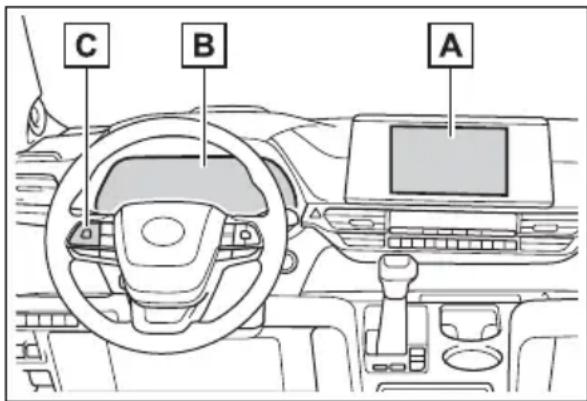
A Audio system screen
B Multi-information display
C Meter control switches ( P.105)
Energy monitor
■Audio system screen
▶ Audio or Audio Plus (vehicles without Data Communication Module)
1 Press the "MENU" button.
2 Select "Info" on the "Menu" screen.
If a screen other than "Energy monitor" is displayed, select "Energy".
▶ Audio or Audio Plus (vehicles with Data Communication Module)/Premium Audio
1 Press the "MENU" button.
2 Select "Info" on the "Menu" screen.
3 Select "ECO" on the "Information" screen.
If a screen other than "Energy monitor" is displayed, select "Energy".
These images are examples only, and may vary slightly from actual conditions.
■Multi-information display
4.2-inch display
1 Press or of the meter control switches to select

2 Press or of the meter control switches to select the energy monitor display.
7-inch display
1 Press or of the meter control switches to select

2 Press or of the meter control switches to select the energy monitor display.
These images are examples only, and may vary slightly from actual conditions.
■Reading the display
The arrows will appear in accordance with the energy flow.
When there is no energy flow, arrows will not be displayed.
The color of the arrows will change as follows.
Green: When the hybrid battery
(traction battery) is regenerated or charged.
Yellow: When the hybrid battery (traction battery) is in use.
Red: When the gasoline engine is in use.
▶ Multi-information display
With 4.2-inch display
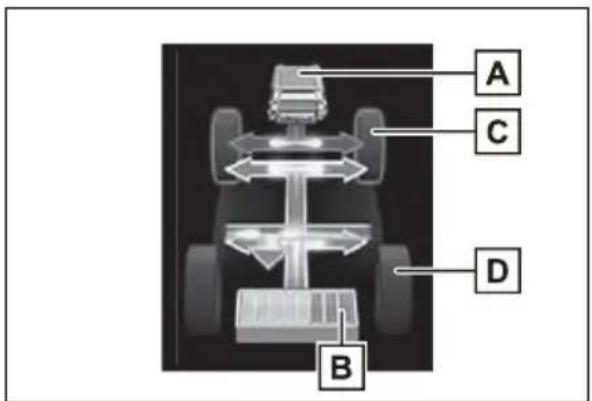
With 7-inch display
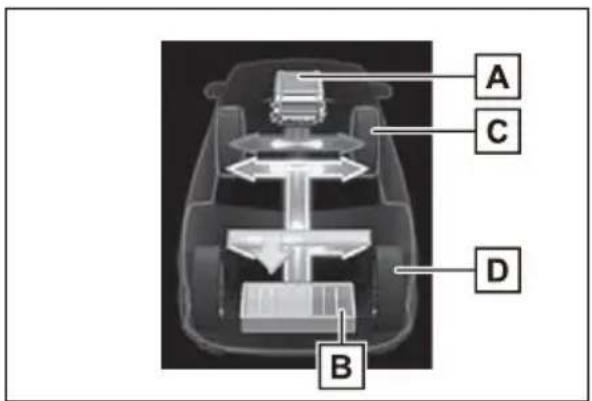
A Gasoline engine
B Hybrid battery (traction battery)
C Front tire
D Rear tire*
*: For FF vehicles, the arrows to D are not displayed.
▶ Audio system screen
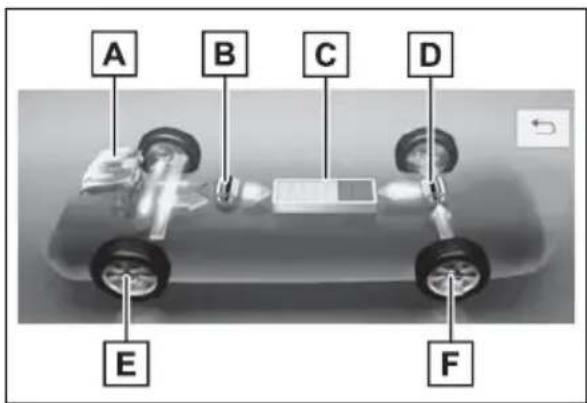
A Gasoline engine
B Front electric motor (traction motor)
C Hybrid battery (traction battery)
D Rear electric motor (traction motor)
E Front tire
F Rear tire*
*: For FF vehicles, the arrows to F are not displayed.
▶ Audio system screen (Home screen)
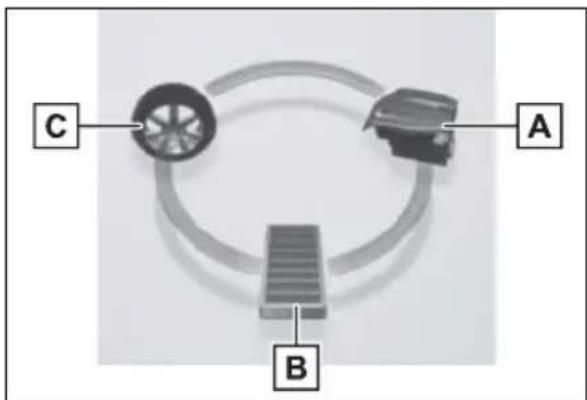
flowchart
graph TD
    A["A"] --> B["B"]
    B --> C["C"]
    C --> A
The image shows all the arrows as an example. The actual display will vary depending on conditions.
A Gasoline engine
B Hybrid battery (traction bat-
tery)
C Tire
■ Hybrid battery (traction battery) status
The display changes in 8 levels according to the remaining charge amount of the hybrid battery (traction battery).
●The figure shows the multi-information display as an example for explanation.
●These images are examples only, and may vary slightly from actual conditions.
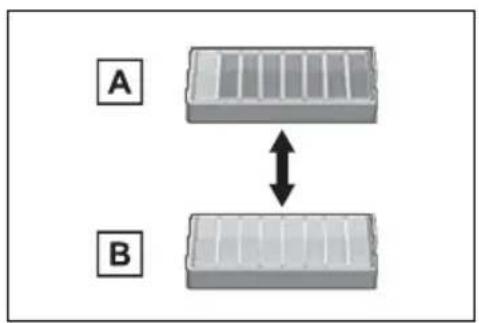
A Low
B High
■Remaining charge amount warning of hybrid battery (traction battery)
●The buzzer sounds intermittently when the hybrid battery (traction battery) remains without charging while the shift lever is in N, or the remaining charge amount drops below a certain level. If the remaining charge amount drops further, the buzzer sounds continuously.
- When a warning message is shown on the multi-information display and the buzzer sounds, follow the instructions displayed on the screen to perform trouble-shooting.
Consumption
■Trip information
▶ Audio or Audio Plus (vehicles without Data Communication Module)
1 Press the "MENU" button.
2 Select "Info" on the "Menu" screen.
If a screen other than "Trip Information" is displayed, select "Trip Information".
▶ Audio or Audio Plus (vehicles with Data Communication Module)/Premium Audio
1 Press the "MENU" button.
2 Select "Info" on the "Menu" screen.
3 Select "ECO" on the "Information" screen.
If a screen other than "Trip Information" is displayed, select "Trip Information".
The image is an example only, and may vary slightly from actual conditions.
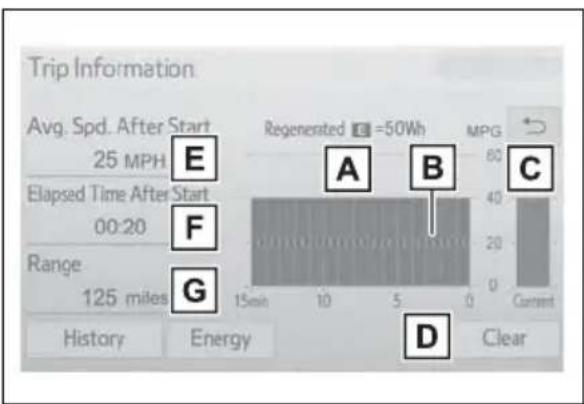
A Fuel consumption in the past 15 minutes
B Regenerated energy in the past 15 minutes
One symbol indicates 50 Wh. Up to 5 symbols are shown.
C Current fuel consumption
D Resetting the consumption data
E Average vehicle speed since the hybrid system was started
F Elapsed time since the hybrid system was started
G Cruising range ( P.126)
Average fuel consumption for the past 15 minutes is divided by color into past averages and averages attained since the power switch was last turned to ON. Use the displayed average fuel consumption as a reference.
History
▶ Audio or Audio Plus (vehicles without Data Communication Module)
1 Press the "MENU" button.
2 Select "Info" on the "Menu" screen.
If a screen other than "History" is displayed, select "History".
▶ Audio or Audio Plus (vehicles with Data Communication Module)/Premium Audio
1 Press the "MENU" button.
2 Select "Info" on the "Menu" screen.
3 Select "ECO" on the "Information" screen.
If a screen other than "History" is displayed, select "History".
The image is an example only, and may vary slightly from actual conditions.
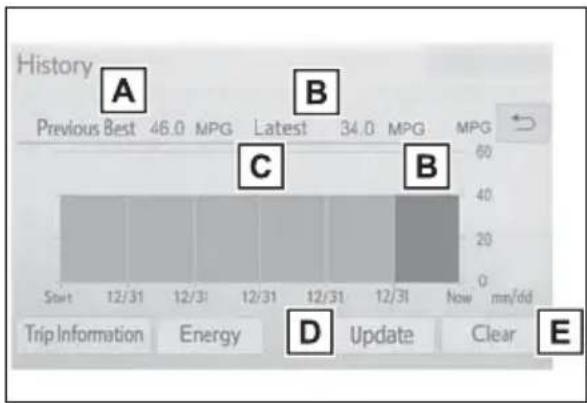
A Best recorded fuel consumption
B Latest fuel consumption
C Previous fuel consumption record
• Audio and Audio Plus:
Displays the daily average fuel consumption. (Instead of the date, "Trip 1" through "Trip 5" will be displayed.)
- Premium Audio:
Displays the daily average fuel consumption.
D Updating the latest fuel consumption data
E Resetting the history data
The average fuel consumption history is divided by color into past averages and the average fuel consumption since the last time updated. Use the displayed average fuel consumption as a reference.
■Updating the history data
Update the latest fuel consumption by selecting “Update” to measure the current fuel consumption again.
■ Resetting the data
The fuel consumption data can be deleted by selecting "Clear".
Cruising range
Displays the estimated maximum distance that can be driven with the quantity of fuel remaining.
This distance is computed based on your average fuel consumption. As a result, the actual distance that can be driven may differ from that displayed.
3
3-1. Key information
Keys 128
3-2. Opening, closing and locking the doors
Front doors.... 132
Sliding doors ...... 137
Back door...... 150
Smart key system ..... 164
3-3. Adjusting the seats
Front seats 169
Rear seats...... 171
Driving position memory 178
Head restraints...... 182
3-4. Adjusting the steering wheel and mirrors
Steering wheel ...... 185
Inside rear view mirror 186
Digital Rear-view Mirror188
Outside rear view mirrors 198
3-5. Opening, closing the windows and moon roof
Power windows ...... 201
Moon roof...... 204
Keys
Key types
The following keys are provided with the vehicle.
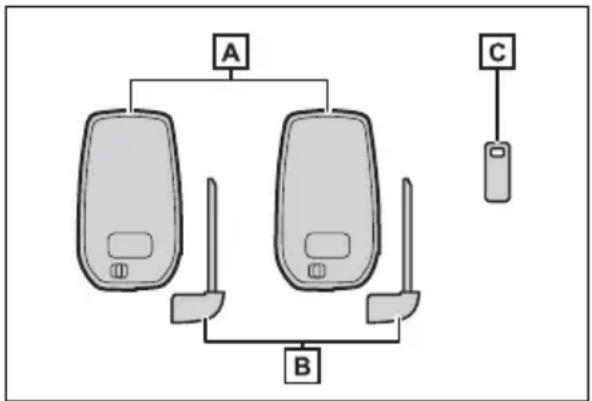
flowchart
graph TD
    A["Device A"] --> B["Switch"]
    A --> C["Phone"]
    B --> D["Mobile Phone"]
A Electronic keys
- Operating the smart key system ( P.164)
- Operating the wireless remote control function (→P.130)
B Mechanical keys
C Key number plate
■When riding in an aircraft
When bringing a key with wireless remote control function onto an aircraft, make sure you do not press any buttons on the key while inside the aircraft cabin. If you are carrying the key in your bag etc., ensure that the buttons are not likely to be pressed accidentally. Pressing a button may cause the key to emit radio waves that could interfere with the operation of the aircraft.
■Key battery depletion
●The standard battery life is 1 to 2 years.
- If the battery becomes low, an alarm will sound in the cabin and a message will be displayed on the multi-information display when the hybrid system stops.
●To reduce key battery depletion when the electronic key is to not be used for long periods of time, set the electronic key to the battery-saving mode. (→P.166)
- As the electronic key always receives radio waves, the battery will become depleted even if the electronic key is not used. The following symptoms indicate that the electronic key battery may be depleted. Replace the battery when necessary.
- The smart key system or the wireless remote control does not operate.
- The detection area becomes smaller.
- The LED indicator on the key surface does not turn on.
You can replace the battery by yourself ( P.447). However, as there is a danger that the electronic key may be damaged, it is recommended that replacement is carried out by your Toyota dealer.
●To avoid serious deterioration, do not leave the electronic key within 3 ft. (1 m) of the following electrical appliances that produce a magnetic field:
• TVs
• Personal computers
- Cellular phones, cordless phones and battery chargers
- Table lamps
- Induction cookers
- If the electronic key is near the vehicle for longer than necessary, even if the smart key system is not used, the key battery may become depleted faster than normal. When not using the smart key system, it is recommended not to stay with the electronic key near the vehicle longer than necessary.
If a message regarding the state of the electronic key or power switch mode, etc. is shown
To prevent trapping the electronic
key inside the vehicle, leaving the vehicle carrying the electronic key on your person without turning the power switch to OFF or other passengers from unintentionally taking the key out of the vehicle, etc., a message that prompts the user to confirm the state of the electronic key or power switch mode may be shown on the multi-information display. In those cases, follow the instructions on the display immediately.
If "Key Battery Low Replace Key Battery" is displayed on the multi-information display
The electronic key has a low battery. Replace the electronic key battery. ( P.447)
■Replacing the battery
→P.447
■ Confirmation of the registered key number
The number of keys already registered to the vehicle can be confirmed. Ask your Toyota dealer for details.
If “A New Key has been Registered Contact Your Dealer for Details” is displayed on the multi-information display
This message will be displayed each time the driver's door is opened when the doors are unlocked from the outside for approximately 10 days after a new electronic key has been registered. If this message is displayed but you have not had a new electronic key registered, ask your Toyota dealer to check if an unknown electronic key (other than those in your possession) has been registered.

NOTICE
■To prevent key damage
- Do not drop the keys, subject them to strong shocks or bend them.
- Do not expose the keys to high temperatures for long periods of time.
- Do not get the keys wet or wash them in an ultrasonic washer, etc.
- Do not attach metallic or magnetic materials to the keys or place the keys close to such materials.
- Do not disassemble the keys.
- Do not attach a sticker or anything else to the surface of the keys.
- Do not place the keys near objects that produce magnetic fields, such as TVs, audio systems and induction cookers.
- Do not place the keys near medical electrical equipment such as low-frequency therapy equipment or microwave therapy equipment, and do not receive medical attention with the keys on your person.
■Carrying the electronic key on your person
Carry the electronic key 3.9 in. (10 cm) or more away from electric appliances that are turned on. Radio waves emitted from electric appliances within 3.9 in. (10 cm) of the electronic key may interfere with the key, causing the key to not function properly.
In case of a smart key system malfunction or other key-related problems
→P.504

NOTICE
■When an electronic key is lost →P.502
Wireless remote control
The keys are equipped with the following wireless remote control:
▶ Vehicles with power back door
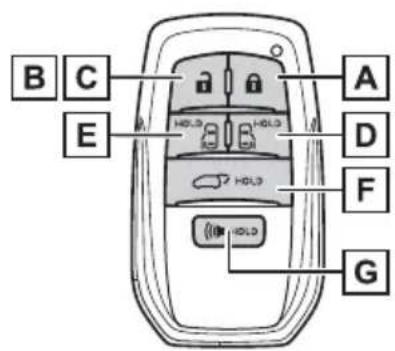
A Locks all the doors ( P.132)
B Unlocks all the doors ( P.132)
C Opens the windows ^1 and moon roof ^1,2 (→P.132)
D Opens and closes the right side power sliding door ( P.137)
E Opens and closes the left side power sliding door ( P.137)
F Opens and closes the power back door ( P.153)
G Sounds the alarm ( P.130)
*1: These settings must be customized at your Toyota dealer.
*2:If equipped
▶ Vehicles without power back door
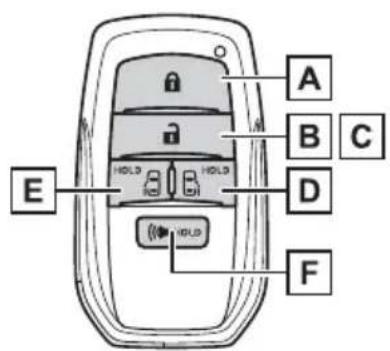
A Locks all the doors ( P.132)
B Unlocks all the doors ( P.132)
C Opens the windows ^1 and moon roof ^1,2 (→P.132)
D Opens and closes the right side power sliding door ( P.137)
E Opens and closes the left side power sliding door ( P.137)
F Sounds the alarm ( P.130)
*1: These settings must be customized at your Toyota dealer.
*2:If equipped
■Theft deterrent panic mode
When (\$) pressed for longer than about 1 second, an alarm will sound intermittently and the vehicle lights will flash to deter any person from trying to break into or damage your vehicle.
To stop the alarm, press any button on the electronic key.
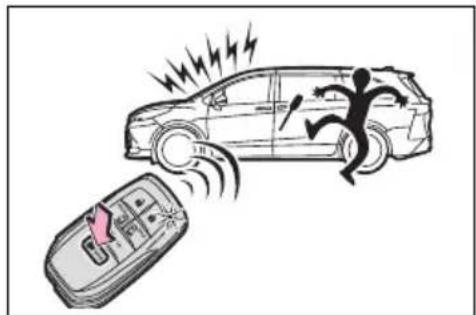
natural_image
Illustration of a car being hit by a moving phone, showing a person falling and a person running away (no text or symbols)■Conditions affecting operation →P.166
Using the mechanical key
To take out the mechanical key, slide the release lever A and take the key out.
The mechanical key can only be inserted in one direction, as the key only has grooves on one side. If the key cannot be inserted in a lock cylinder, turn it over and re-attempt to insert it.
After using the mechanical key, store it in the electronic key. Carry the mechanical key together with the electronic key. If the electronic key battery is depleted or the entry function does not operate properly, you will need the mechanical key. (→P.504)
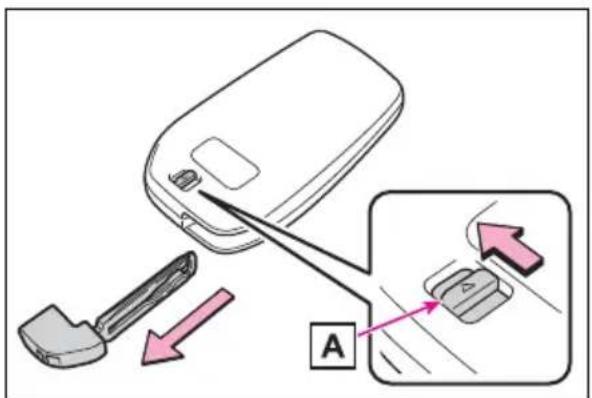
If you lose your keys P.502
If a wrong key is used
The key cylinder rotates freely to isolate inside mechanism.
Front doors
The vehicle can be locked and unlocked using the entry function (if equipped), wireless remote control, key or door lock switch.
Unlocking and locking the doors from the outside
■Using the entry function (if equipped)
Carry the electronic key to enable this function.
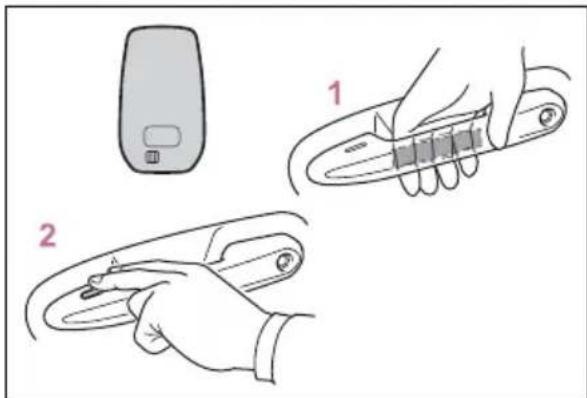
1 Grip the driver's door handle to unlock the door. Holding the driver's door handle for approximately 2 seconds unlocks all the doors. Grip the front passenger's door handle to unlock all the doors*.
Make sure to touch the sensor on the back of the handle.
The doors cannot be unlocked for 3 seconds after the doors are locked.
*: The door unlock settings can be changed. (→P.133)
2 Touch the lock sensor (the
indentation on the upper part of the door handle) to lock the doors.
Check that the door is securely locked.
■ Using the wireless remote control
▶ Vehicles with power back door
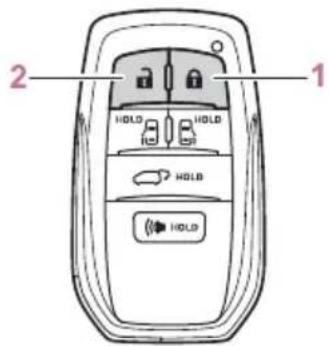
1 Locks all the doors
Check that the door is securely locked.
2 Unlocks all the doors
Pressing the button unlocks the driver's door. Pressing the button again within 5 seconds unlocks the other doors.
Press and hold to open the windows ^1 and moon roof ^1,2
*1: This setting must be customized at your Toyota dealer.
*2:If equipped
▶ Vehicles without power back door
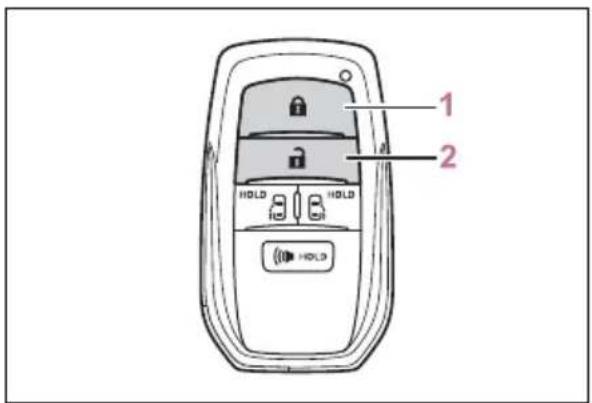
1 Locks all the doors
Check that the door is securely locked.
2 Unlocks all the doors
Pressing the button unlocks the driver's door. Pressing the button again within 5 seconds unlocks the other doors.
Press and hold to open the windows ^1 and moon roof ^1,2
*1: This setting must be customized at your Toyota dealer.
*2:If equipped
■Using the key
The doors can also be locked and unlocked with the mechanical key. (→P.504)
■ Switching the door unlock function (vehicles with entry function)
It is possible to set which doors the entry function unlocks using the wireless remote control. Perform the switching operation in the vehicle or within approximately 3.2 ft. (1 m) of the vehicle.
1 Turn the power switch to OFF. 2 When the indicator light on the key surface is not on, press and
hold


for approximately 5 seconds while pressing and holding

The setting changes each time an operation is performed, as shown below. (When changing the setting continuously, release the buttons, wait for at least 5 seconds, and repeat step 2.)
| Multi-information display/Beep | Unlocking function |
 Exterior: Beeps 3 timesInterior: Pings once Exterior: Beeps 3 timesInterior: Pings once | Holding the driver's door handle unlocks only the driver's door. |
| Holding the passenger's door handle unlocks all the doors. | |
 Exterior: Beeps twiceInterior: Pings once Exterior: Beeps twiceInterior: Pings once | Holding a door handle unlocks all the doors. |
Vehicles with alarm: To prevent unintended triggering of the alarm, unlock the doors using the wireless remote control and open and close a door once after the settings have been changed. (If a door is not opened within 60 seconds after
is pressed, the doors will be locked again and the alarm will automatically be set.) In a case that the alarm is triggered, immediately stop the alarm. (→P.89)
■Impact detection door lock release system
In the event that the vehicle is subject to a strong impact, all the doors are unlocked. Depending on the force of the impact or the type of accident, however, the system may not operate.
■Operation signals (vehicles with entry function)
A buzzer sounds and the emergency flashers flash to indicate that the doors have been locked/unlocked. (Locked: Once; Unlocked: Twice)
■Security feature
If a door is not opened within approximately 60 seconds after the vehicle is unlocked, the security feature automatically locks the vehicle again. (Vehicles with entry function: However, depending on the location of the electronic key, the key may be detected as being in the vehicle. In this case, vehicle may be unlocked.)
■When the door cannot be locked by the lock sensor on the upper part of the door handle (vehicles with entry function)
If the door will not lock even when the topside sensor area is touched, try touching both the topside and underside sensor areas at the same time. When gloves are being worn, remove the gloves.
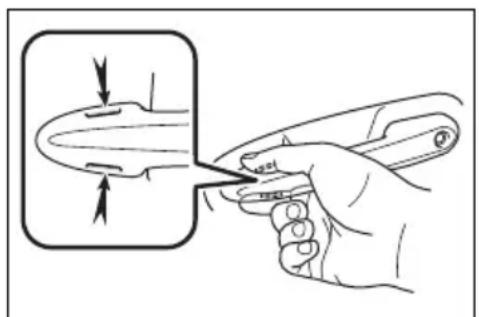
natural_image
Illustration of a hand using a tool to cut a mechanical component, showing motion arrows (no text or symbols)■Door lock buzzer
If an attempt to lock the doors using the entry function or wireless remote control is made when a door is not fully closed, a buzzer sounds continuously for 5 seconds. Fully close the door to stop the buzzer, and lock the vehicle once more.
■Setting the alarm (if equipped)
Locking the doors will set the alarm system. ( P.89)
■Conditions affecting the operation of the smart key system or wireless remote control
→P.166
If the smart key system or the wireless remote control does not operate properly
● Use the mechanical key to lock and unlock the doors. (→P.504)
- Replace the key battery with a new one if it is depleted. (→P.447)
■If the 12-volt battery is discharged
The doors cannot be locked and unlocked using the smart key system or wireless remote control. Lock or unlock the doors using the mechanical key. ( P.133, 504)
■Rear seat reminder function
- In order to remind you not to forget the luggage, etc. on the rear seat, when the power switch is turned to OFF after any of the following conditions are met, a buzzer will sound and a message will be displayed on the multi-information display for approximately 6 seconds.
- The hybrid system is started within 10 minutes after opening and closing a sliding door.
- A sliding door has been opened and closed after the hybrid system is started. However, if a sliding door is opened and then closed within approximately 2 seconds, the rear seat reminder function may not operate.
●The rear seat reminder function determines that the luggage, etc. has been placed on the rear seat depending on opening and closing
of a sliding door. Therefore, depending on the situation, the rear seat reminder function may not operate and you may still forget the luggage, etc. on the rear seat, or it may operate unnecessarily.
●The rear seat reminder function can be enabled/disabled. (→P.541)
Customization
Settings (e.g. unlocking function using a key) can be changed. (Customizable features: →P.543)

WARNING
■To prevent an accident
Observe the following precautions while driving the vehicle. Failure to do so may result in a door opening and an occupant could be thrown out of the vehicle, resulting in death or serious injury.
● Ensure that all doors are properly closed and locked.
- Do not pull the inside handle of the doors while driving. Be especially careful for the front doors, as the doors may be opened even if the inside lock buttons are in locked position.
■When opening or closing a door
Check the surroundings of the vehicle such as whether the vehicle is on an incline, whether there is enough space for a door to open and whether a strong wind is blowing. When opening or closing the door, hold the door handle tightly to prepare for any unpredictable movement.
Unlocking and locking the doors from the inside
■ Using the door lock switches
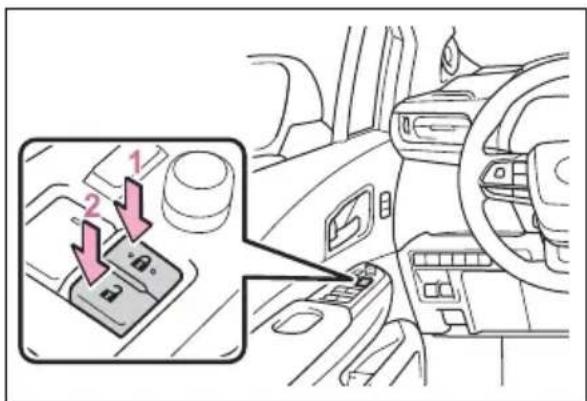
1 Locks all the doors
2 Unlocks all the doors
■ Using the inside lock buttons
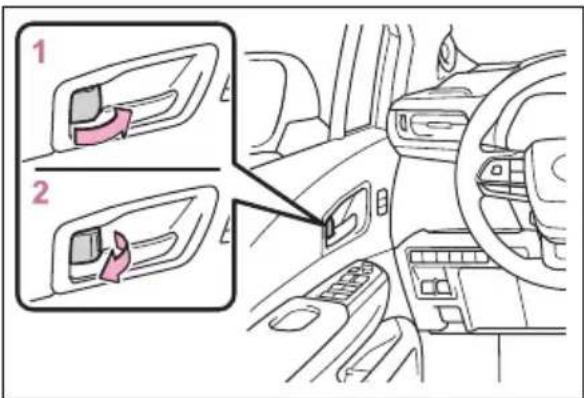
The front doors can be opened by pulling the inside handle even if the lock buttons are in the lock position.
■Locking the front doors from the outside without a key
1 Move the inside lock button to the lock position.
2 Close the door.
The door cannot be locked if the power switch is in ACC or ON, or the electronic key is left inside the
vehicle.
Depending on the position of the electronic key, the key may not be detected correctly and the door may be locked.
■Open door warning buzzer
If the vehicle speed reaches 3 mph (5 km/h), a buzzer sounds to indicate that the door(s) or the hood is not fully closed.
The open door(s) or hood is displayed on the multi-information display.
■When all the doors are locked with the entry function, wireless remote control or key
●The doors cannot be unlocked with the door lock switch.
●The door lock switch can be reset by unlocking all the doors with the entry function, wireless remote control or key.
Automatic door locking and unlocking systems
The following functions can be set or canceled:
For instructions on customizing, refer to P.540.
| Function Operation | |
| Speed linked door locking function | All doors are automatically locked when vehicle speed is approximately 12mph (20 km/h) or higher. |
| Shift position linked door locking function | All doors are automatically locked when shifting the shift lever to position other than P. |
| Shift position linked door unlocking function | All doors are automatically unlocked when shifting the shift lever to P. |
| Driver's door linked door unlocking function | All doors are automatically unlocked when driver's door is opened within approximately 45 seconds after turning the power switch off. |
Sliding doors
The sliding doors can be unlocked/locked and opened/closed by the following procedures.

WARNING
Before driving
Make sure that all doors are properly closed and locked. If the sliding doors are not fully closed, it may open unexpectedly while driving and an occupant to fall out of the vehicle, resulting in death or serious injury.
■Caution while driving
Observe the following precautions while driving. Failure to do so may cause a door to open unexpectedly and an occupant to fall out of the vehicle, resulting in death or serious injury.
● Make sure that all doors are properly closed and locked.
- Set the sliding door child-protector locks when children are seated in the vehicle.
- Do not operate the inside handle of the doors while driving.
■When children are in the vehicle
Observe the following precautions. Failure to do so may result in death or serious injury.
- Do not leave children alone in the vehicle. If a child is accidentally locked in the vehicle, they could have heat exhaustion or other injuries.
- Do not allow a child to open or close the sliding door. Doing so may cause the sliding door to move unexpectedly, or cause the child's hands, head, or neck to be caught by the moving sliding door.
■Operating the sliding doors
Observe the following precautions. Failure to do so may cause parts of the body to be caught, resulting in death or serious injury.
- When opening or closing a sliding door, thoroughly check to make sure the surrounding area is safe.
- When opening or closing the sliding doors with windows open, keep all body parts clear of the windows.
- If anyone is in the vicinity, make sure they are safe and let them know that the sliding door is about to open or close.
- Do not leave the sliding door at half-opened position because the sliding door is not latched at this position. The sliding door may move unexpectedly on an incline.
- When the vehicle is stopped on a slope, the door will slide faster when opening or closing, so be especially careful that the passengers do not get hit or pinched by the door.
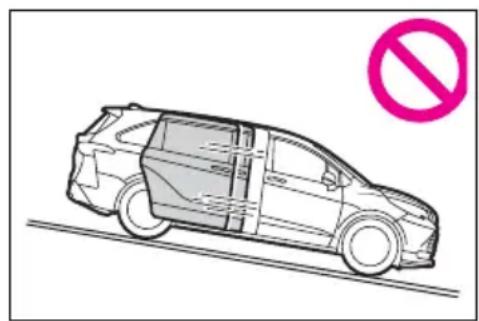
natural_image
Side view of a car with a no-smoking symbol (no text or labels present)
WARNING
- Open the sliding door fully while passengers are getting on or off on a downward slope. Do not operate the outside handle or inside handle while the door is open as the door could suddenly close by itself causing injury.
- When opening or closing the sliding door, take extra care to prevent your fingers etc. from being caught.
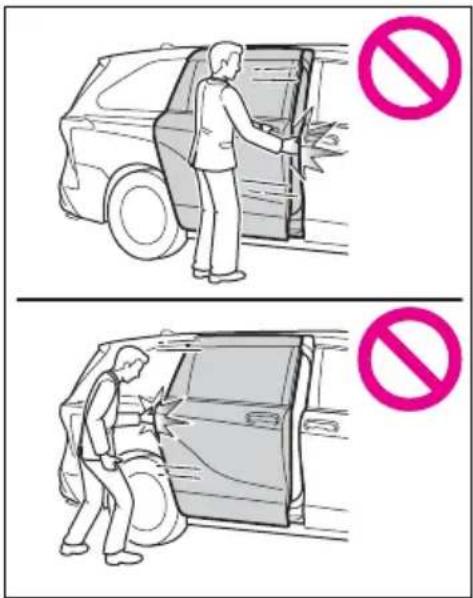
- Do not put your hands or feet on the sliding door arms, rails and pillars. Be careful not to get your hands or feet caught in the sliding doors.
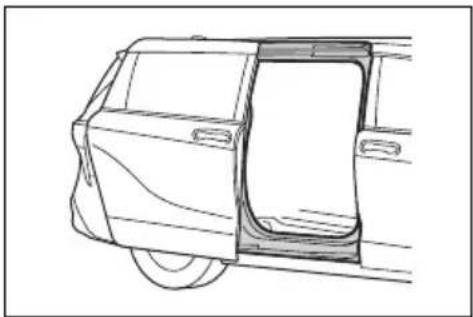
natural_image
Line drawing of a car's front and rear door panel showing structural details (no text or symbols)Unlocking and locking the sliding door from outside
■Using the entry function (if equipped)
■ Using the wireless remote control
$$ \rightarrow \mathrm{P}. 1 3 2 $$
$$ \rightarrow \mathrm{P}. 1 3 0 $$
Unlocking and locking the sliding door from inside
■ Using the door lock switches
$$ \rightarrow \mathrm{P}. 1 3 5 $$
■Using the inside lock buttons
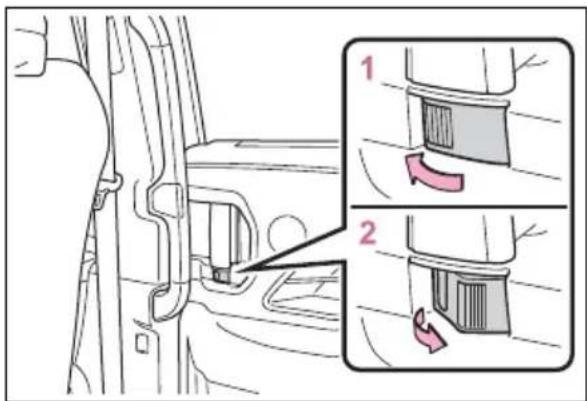
Opening/closing the sliding door automatically
■ Using wireless remote control
▶ Vehicles with power back door
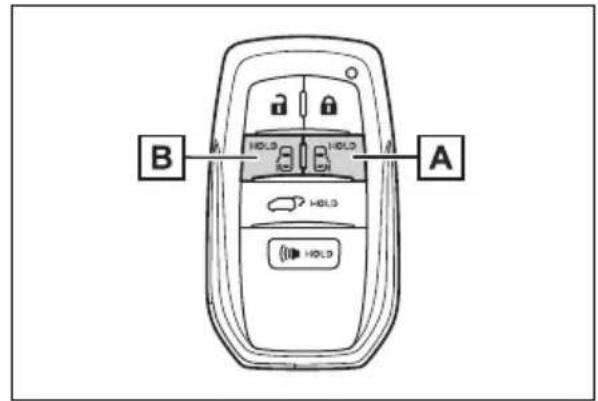
A Press and hold to open and close the right side power sliding door
B Press and hold to open and close the left side power sliding door
Unlock the sliding door before operating.
▶ Vehicles without power back door
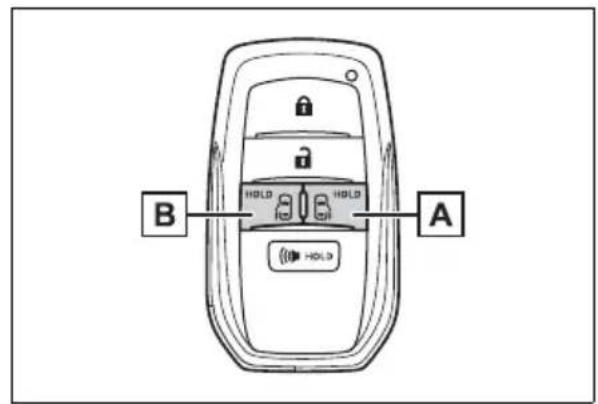
A Press and hold to open and close the right side power sliding door
B Press and hold to open and
close the left side power sliding door
Unlock the sliding door before operating.
■ Using the outside sliding door handles
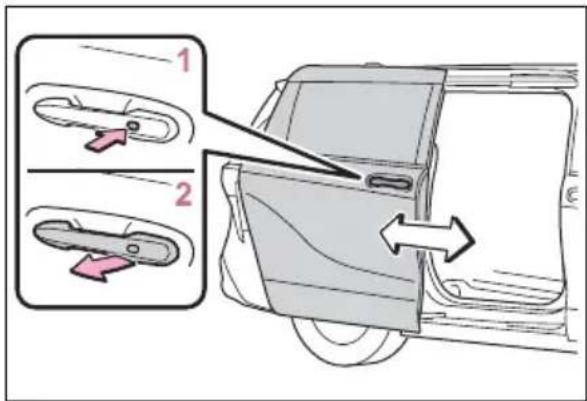
1 Press the switch to open/close the power sliding door.
When the sliding door is locked: Press the switch while carrying the electronic key on your person.
Then, all the doors will unlock and the power sliding door will be automatically and completely opened.
Press the switch within detection area of the electronic key. (→P.165)
When the sliding door is unlocked: After pressing the switch even without the electronic key carried on your person, the power sliding door will be automatically and completely opened.
2 Pull the sliding door handle to open/close the power sliding door. Unlock the sliding door before operating.
Pressing the switch or pulling the handle while the power sliding door is operating will cause the operation to stop. Pressing the switch or
pulling the handle again will cause the power sliding door to reverse its operation direction.
When the handle is operated, the power sliding door will be automatically and completely opened/closed.
Operating the handle while the power sliding door is operating will cause the operation to stop.
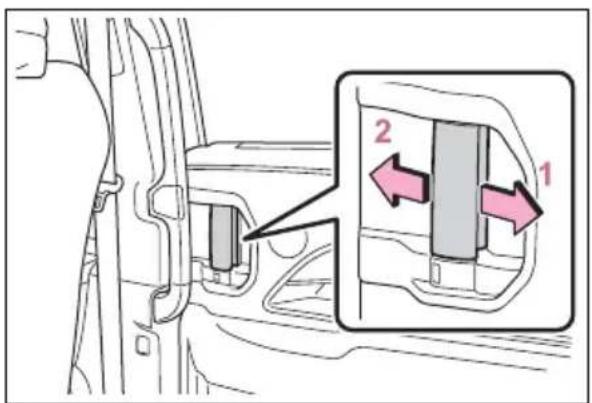
1 Open
Unlock the sliding door before operating.
2 Close
■ Using the power sliding door switches
Press and hold the switch to open and close each sliding door.
From front seats
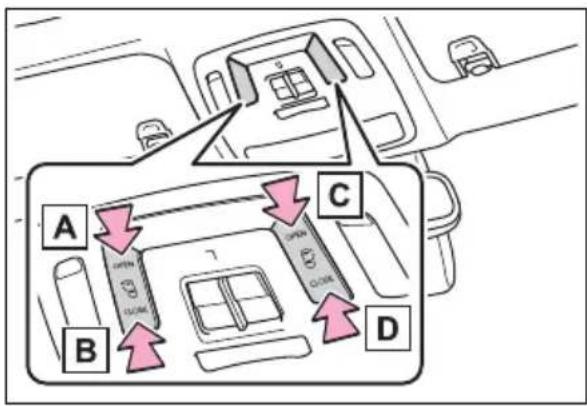
A Opens the left side power sliding door.
B Closes the left side power sliding door.
C Opens the right side power sliding door.
D Closes the right side power sliding door.
Pressing the switch again while the power sliding door is operating will cause the operation to stop.
From second seats
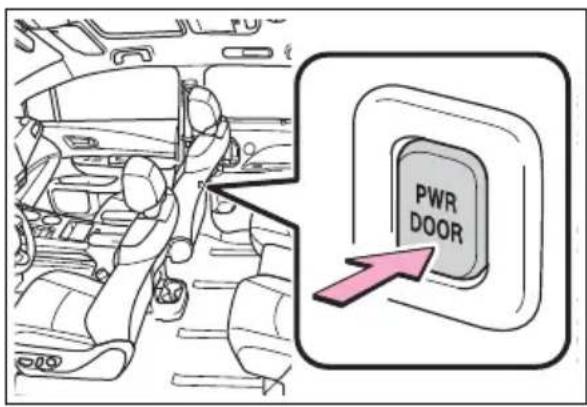
Pressing the switch again while the power sliding door is operating will cause the operation to stop.
■ Using the kick sensor (vehicles with Hands Free Power Sliding Doors)
The Hands Free Power Sliding Door enables automatic opening and closing of the power sliding door by putting your foot under the portion with a label on the rocker moulding and moving it away from the rocker moulding. When operating the Hands Free Power Sliding Door, make sure that the front door (the same side of the sliding door you open) is closed, the kick sensor operation is enabled ( P.112) and you are carrying an electronic key.
1 While carrying an electronic key, stand within the smart key system operation range, approximately 11.8 to 19.7 in. (30 to 50 ~cm ) from the rocker moulding.
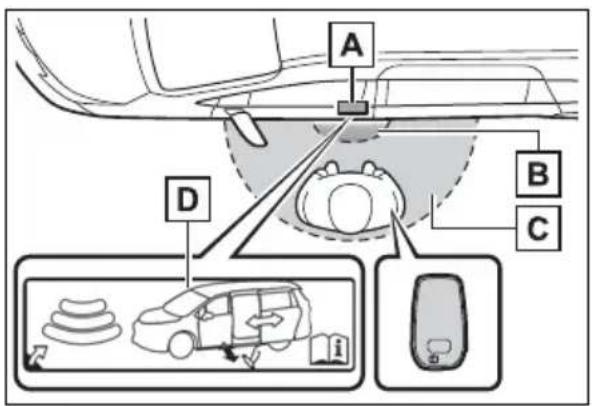
A Kick sensor
B Hands Free Power Sliding Door operation detection area
C Smart key system operation detection area ( P.165)
D Label
2 Perform a kick operation by moving your foot to within approximately 3.9 in. (10 cm) of the rocker moulding and then pulling it back.
Perform the entire kick operation within approximately 1 second.
The sliding door will not start operating while a foot is detected under the rocker moulding.
Operate the Hands Free Power Sliding Door without contacting the rocker moulding with your foot.
If another electronic key is in the cabin or luggage compartment, it may take slightly longer than normal for the operation to occur.
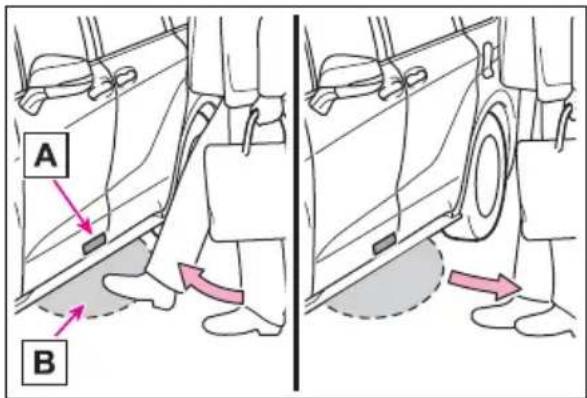
A Kick sensor
B Hands Free Power Sliding Door operation detection area
3 When the kick sensor detects that your foot is pulled back, a buzzer will sound and the sliding door will automatically fully open/close.
If a foot is moved under the rocker moulding while the sliding door is opening/closing, the sliding door will stop moving.
If a foot is moved under the rocker
moulding again during the halted operation, the sliding door will perform the reverse operation.
Sliding door child-protec- tor locks
The sliding door cannot be opened by the inside door handle and the second seat sliding door switch when the lock is set.
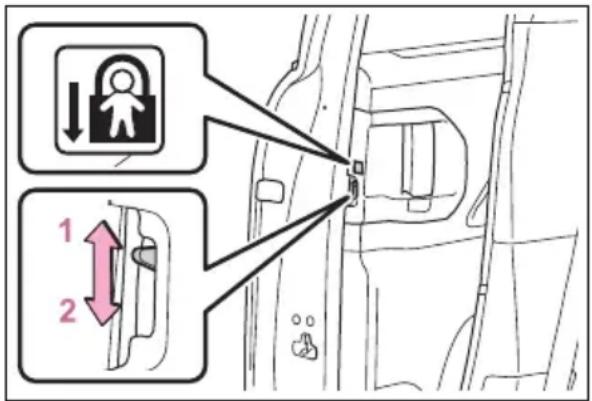
1 Unlock
2 Lock
These locks can be set to prevent children from opening the sliding doors. Push down on each sliding door switch to lock that sliding door.
■The power sliding door can be operated when
- Open operation: The shift lever is in P or the vehicle speed is below 1.9 mph (3 km/h).
●The power sliding door system is enabled.
●The power sliding door is unlocked. (Except for the wireless remote control operation or smart key system operation.)
●The sliding door child-protector lock is not set. (However, the switch for the front occupants and the outside handle still operate the power sliding door.)
■Power sliding doors
●The power sliding doors can be opened/closed manually when the power sliding door function is canceled with the main switch.
- If the sensor detects jamming of a person or an object while the power sliding door is automatically opening/closing, a buzzer will beep and the power sliding door will stop after reversing approximately 3.9 in. (10 cm). When the power sliding door is operated again after the stop, the door will be operated as follows.
To operate the door reversely:
- Pull the outside door handle, or press the switch of the sliding door handle or using the kick sensor.
To operate the door in open direction:
- Pull the inside door handle in open direction, or press the “OPEN” side of the power sliding door switch.
To operate the door in close direction:
- Pull the inside door handle in close direction or press the “CLOSE” side of the power sliding door switch.
After the jam protection function operates, the power sliding door cannot be operated even if the switch to open and close the sliding door on the electronic key is pressed.
■The situations in which the sliding door does not open completely
The left side sliding door does not open completely when the fuel filler door is opened.
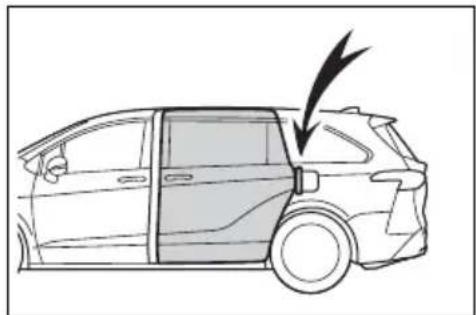
natural_image
Side view line drawing of a car with a black arrow pointing to the side panel (no text or symbols)Jam protection function
Sensor As attached to the front edge of the power sliding door. If any object obstructs the power sliding door when closing, the power sliding door will stop after reversing approximately 3.9 in. (10 cm).
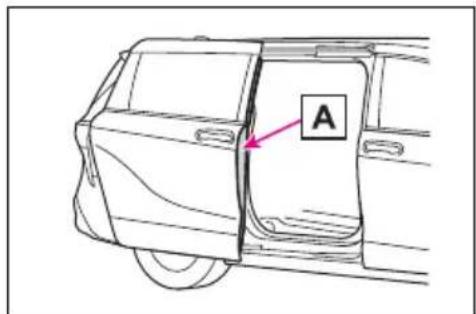
■Sliding door reserve lock function
This function is a function which reserves locking of all doors beforehand, when the power sliding door is open.
When the following procedure is performed, all the doors except the power sliding door are locked and then power sliding door will also be locked at the same time it is closed.
1 Close all doors, except the power sliding door.
2 During the power sliding door closing operation, lock the doors using the smart key system from the front doors ( P.132) or the wireless remote control.
( P.132)
A buzzer sounds and the emergency flashers flash to indicate that all the doors have been closed and locked.
- If the electronic key is placed inside the vehicle after starting a
close operation via the door reserve lock function, the electronic key may become locked inside the vehicle. Make sure to always carry the electronic key on your person.
- If the power sliding door does not fully close due to the operation of the jam protection function, etc., while the sliding door is automatically closing after a door reserve lock operation is performed, the door reserve lock function is canceled and all the doors will unlock.
●Before leaving the vehicle, make sure that all the doors are closed and locked.
■Power sliding door brake function
When the power sliding door detects an abnormality and stops operating, power sliding door brake function may be activated. When brake function is activated, door movement is restricted by the brake and motion may appear to be not smooth. This is not malfunction. Move the door to fully closed position to reset the system and normal power sliding door function will resume.
In the event that the sliding door is left slightly open, the sliding door closer will automatically close it to the fully closed position.
■Power sliding door operation
Wireless remote control: Even if the door is locked, pressing and holding the sliding door buttons will unlock all doors and start open operation.
■If the power sliding door is inoperative
When the power sliding door detects an abnormality and stops opening and can not be completely closed manually, turn the inside lock button to "LOCK" position to cancel the function and close the door manually. After that, have the vehi-
cle inspected and repaired by your Toyota dealer.
■Kick sensor operating conditions (vehicles with Hands Free Power Sliding Doors)
The Hands Free Power Sliding Door will open/close automatically when the following conditions are met:
●The kick sensor operation is enabled (→P.112)
●The front door (the same side of the sliding door you open) is closed.
●The electronic key is within the operational range. (→P.165)
● A foot is put under the portion with a label on the rocker moulding and moved away from the rocker moulding.
The power sliding door may also be operated by putting a hand, an elbow, a knee, etc. under the portion with a label on the rocker moulding and moving it away from the rocker moulding. Make sure to put it close enough to the center part of the rocker moulding.
■ Situations in which the Hands Free Power Sliding Door may not operate properly (vehicles with Hands Free Power Sliding Doors)
In the following situations, the Hands Free Power Sliding Door may not operate properly:
- When a foot remains under the rocker moulding
- If the rocker moulding is strongly hit with a foot or is touched for a while
If the rocker moulding has been touched for a while, wait for a short time before attempting to operate the Hands Free Power Sliding Door again.
- When operated while a person is too close to the rocker moulding
●When an external radio wave
source interferes with the communication between the electronic key and the vehicle ( P.166)
- When the vehicle is parked near an electrical noise source which affects the sensitivity of the Hands Free Power Sliding Door, such as a pay parking spot, gas station, electrically heated road, or fluorescent light
- When the vehicle is near a TV tower, electric power plant, radio station, large display, airport or other facility that generates strong radio waves or electrical noise
- When a large amount of water is applied to the rocker moulding, such as when the vehicle is being washed or in heavy rain
- When mud, snow, ice, etc. is attached to the rocker moulding
- When the vehicle has been parked for a while near objects that may move and contact the rocker moulding, such as plants
- When an accessory is installed to the rocker moulding
If an accessory has been installed, turn the Hands Free Power Sliding Door (kick sensor) operation setting off.
■Preventing unintentional operation of the Hands Free Power Sliding Door (vehicles with Hands Free Power Sliding Doors)
When an electronic key is in the operation range, the Hands Free Power Sliding Door may operate unintentionally, so be careful in the following situations.
- When a large amount of water is applied to the rocker moulding, such as when the vehicle is being washed or in heavy rain
- When dirt is wiped off the rocker moulding
●When a small animal or small
object, such as a ball, moves under the rocker moulding
●When an object is moved from under the rocker moulding
- If someone is swinging their legs while sitting on the rocker moulding
- If the legs or another part of someone's body contacts the rocker moulding while passing by the vehicle
- When the vehicle is parked near an electrical noise source which affects the sensitivity of the Hands Free Power Sliding Door, such as a pay parking spot, gas station, electrically heated road, or fluorescent light
- When the vehicle is near a TV tower, electric power plant, radio station, large display, airport or other facility that generates strong radio waves or electrical noise
- When the vehicle is parked in a place where objects such as plants are near the rocker moulding
● If luggage, etc. is set near the rocker moulding
- If accessories or a vehicle cover is installed/removed near the rocker moulding
- When the vehicle is being towed To prevent unintentional operation, turn the Hands Free Power Sliding Door (kick sensor) operation setting off. ( P.112)
■Automatic car washes
→P.400
■Conditions affecting the operation of the smart key system or wireless remote control
→P.166
Customization
Settings (e.g. opening and closing operation) can be changed. (Cus-
In the event that the sliding door is left slightly open, the sliding door closer will automatically close it to the fully closed position. It takes several seconds before the sliding door closer begins to operate. Be careful not to catch fingers or anything else in the sliding door, as this may cause bone fractures or other serious injuries.
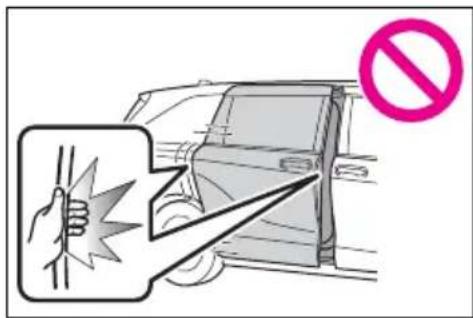
- Use caution when using the sliding door closer. The sliding door closer operates even when the power sliding door system is canceled.
■Power sliding doors
Observe the following precautions when the power sliding door system is enabled. Failure to do so may cause death or serious injury.
- Do not get in and out of the vehicle while the power sliding door is being operated.
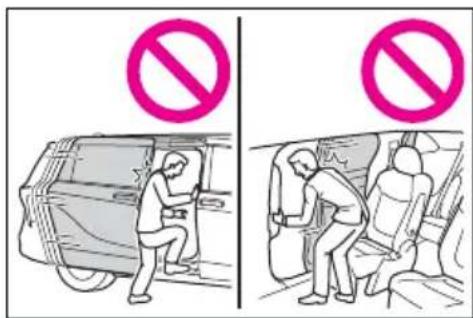

WARNING
- When using the door handle to open or close the power sliding door, remove your hand from the door handle immediately after starting power sliding door operation. If you leave your hand on the door handle during operation, your hand, fingers, wrist etc. may be subjected to an excessive amount of force.
- Check the safety of the surrounding area to make sure there are no obstacles or anything that could cause any of your belongings to get caught.
- If anyone is in the vicinity, make sure they are safe and let them know that the sliding door is about to open or close. Also, do not operate the power sliding door if anyone inside or outside the vehicle is leaning against the vehicle in the area around the sliding door.
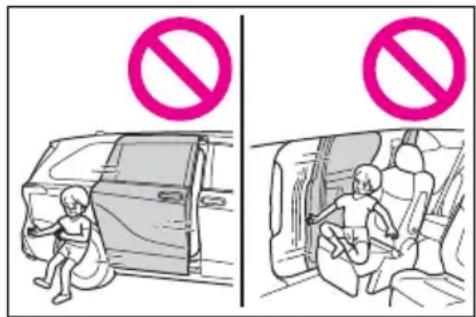
- If the power sliding door system is disabled with the main switch while the sliding door is operating automatically, the automatic operation is stopped. The sliding door then has to be operated manually. Take extra care when on an incline, as the sliding door may open or close unexpectedly.
-
If the operating conditions of the power sliding door are no longer met, a buzzer may sound and the sliding door may stop opening or closing. The sliding door then has to be operated manually. Take extra care when on an incline, as the sliding door may open or close abruptly.
● On an incline, a sliding door may close by itself after it opens automatically. Make sure the sliding door is fully open and secure.
In the following situations, the power sliding door may detect an abnormality and automatic operation may be stopped. In this case, the sliding door has to be operated manually. Take extra care when on an incline, as the sliding door may open or close abruptly. -
When the sliding door contacts an obstacle
- When the 12-volt battery voltage suddenly drops, such as when the power switch is turned to ON or the hybrid system is started during automatic operation
- Do not attach any accessories other than genuine Toyota parts to the power sliding door. The power sliding door may not operate, causing itself to malfunction, or the power sliding door may close again after it is opened.
- When the sliding door child-protector locks are set, make sure to disable the power sliding door system with the main switch in order to totally disable the system.

WARNING
■Jam protection function
Observe the following precautions. Failure to do so may cause death or serious injury.
●Never use any part of your body to intentionally activate the jam protection function.
●The jam protection function may not work if something gets caught just before the power sliding door fully closes. Be careful not to catch fingers or anything else.
●The jam protection function may not work depending on the shape of the object that is caught. Be careful not to catch fingers or anything else.
■Hands Free Power Sliding Doors (if equipped)
Observe the following precautions when operating the Hands Free Power Sliding Door. Failure to do so may cause death or serious injury.
- Check the safety of the surrounding area to make sure there are no obstacles or anything that could cause any of your belongings to get caught.
- Do not leave the electronic key within the effective range (detection area) of the power sliding door.

NOTICE
■Sliding door
Make sure magazines are not bent or protruding from the sliding door pockets. Do not insert anything too big so that the shape of the sliding door pockets is distorted. Such objects may obstruct the opening/closing of the sliding doors, damage the sliding door pockets or the vehicle body, and may result in a malfunction.
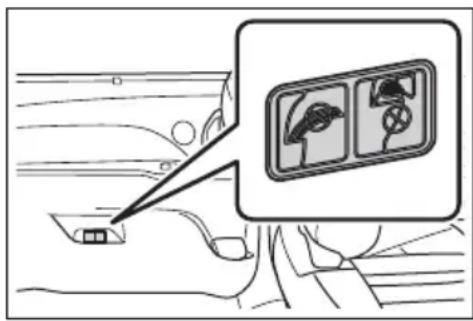
- Do not apply excessive force to the sliding door while the sliding door closer is operating.
●The sliding door closer may not operate when you repeat opening/closing in a short period of time. To operate again, open the power sliding door once and then close after a while.
■To prevent damage to your vehicle
- Do not apply excessive force when the sliding door is operating.
- Do not place your hand or foot near door hinges or rollers when the sliding door is operating.
● Avoid forcibly opening the left side sliding door fully when the fuel filler door is opened. Otherwise, the fuel filler door may be damaged.

NOTICE
● Take care not to damage the sensors (installed on the front edge of the power sliding door) with a knife or other sharp object.
● Make sure there is nothing in the doorway before closing.
- Do not close the sliding door by applying the brakes. Doing so could cause the sliding door to be damaged.
■Hands Free Power Sliding Doors precautions (if equipped)
The kick sensors are located behind the portions with labels on the rocker mouldings. Observe the following to ensure that the Hands Free Power Sliding Door function operates properly:
- Keep the portions with labels on the rocker mouldings clean at all times.
If the portions with labels on the rocker mouldings are dirty or covered with snow or mud, the kick sensors may not operate. In this situation, clean off the dirt or snow, move the vehicle from the current position and then check if the kick sensors operate.
If they do not operate, have the vehicle inspected by your Toyota dealer.
- Do not apply coatings that have a rain clearing (hydrophilic) effect, or other coatings, to the portions with labels on the rocker mouldings.
- Do not park the vehicle near objects that may move and contact portions with labels on the rocker mouldings, such as grass or trees. If the vehicle has been parked for a while near objects that may move and contact the portions with labels on the rocker mouldings, such as grass or trees, the kick sensors may not operate. In this situation, move the vehicle from the current position and then check if the kick sensors operate. If they do not operate, have the vehicle inspected by your Toyota dealer.
- Do not subject the kick sensors or their surrounding areas to a strong impact. If the kick sensors or their surrounding areas have been subjected to a strong impact, the kick sensors may not operate properly. If the kick sensors do not operate in the following situations, have the vehicle inspected by your Toyota dealer.
- The kick sensors or their surrounding areas have been subjected to a strong impact.
- The portions with labels on the rocker mouldings are scratched or damaged.
- Do not disassemble the rocker mouldings.
- Do not attach an accessory containing metal or apply metallic paint to the rocker mouldings.
Canceling the power sliding door system
The power sliding door system can be enabled/disabled by using the power sliding door
main switch or on the multi-information display. However, when the power sliding door system is disabled by the main switch, the setting of the power sliding door system cannot be changed on the multi-information display.
■ Using the multi-information display
The power sliding door system can be enabled/disabled on the multi-information display. (→P.112)
■ Using the power sliding door main switch
Use the main switch to disable the power sliding door system.
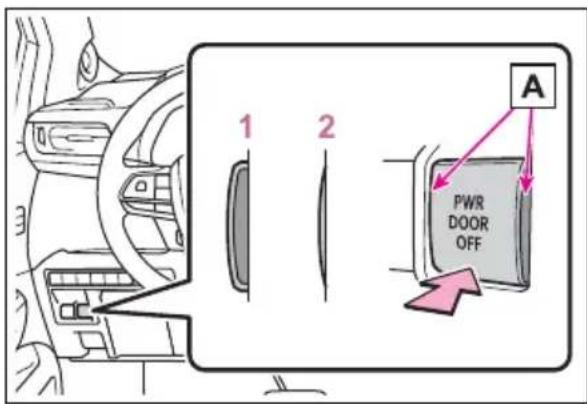
1 The power sliding door system is enabled.*
2 The power sliding door system is disabled.
The sliding doors can only be opened and closed manually.
*: The orange line of the switch indicates that the power sliding door system is enabled.
Opening/closing the sliding door manually
Operate the sliding door handle or inside door handle, when the power sliding door system is off.
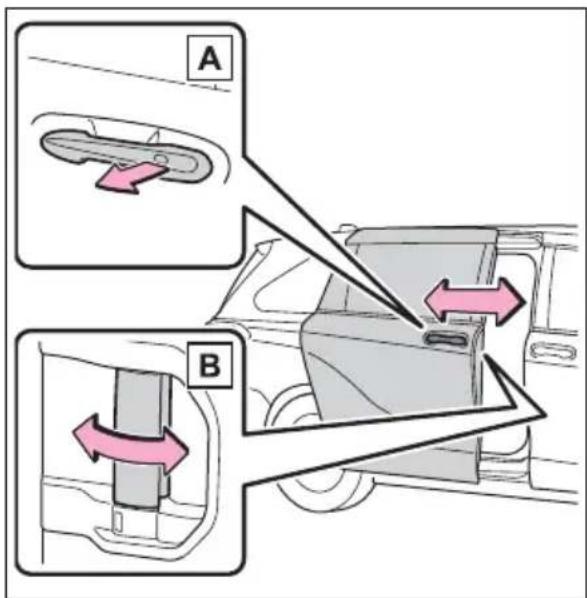
A Sliding door handle
The back door can be locked/unlocked and opened/closed by the following procedures.

WARNING
Before driving
Make sure that the back door is fully closed. If the back door is not fully closed, it may open unexpectedly while driving and hit near-by objects or luggage in the luggage compartment may be thrown out, causing an accident.
■When children are in the vehicle
Observe the following precautions. Failure to do so may result in death or serious injury.
- Do not allow children to play in the luggage compartment. If a child is accidentally locked in the luggage compartment, they could get heat exhaustion or other injuries.
- Do not allow a child to open or close the back door. Doing so may cause the back door to operate unexpectedly, or cause the child's hands, head, or neck to be caught by the closing back door.
■Caution while driving
- Keep the back door closed while driving. If the back door is left open, it may hit near-by objects or luggage in the luggage compartment may be thrown out, causing an accident.
● Never let anyone sit in the luggage compartment. In the event of sudden braking, sudden swerving or a collision, they are susceptible to death or serious injury.
■Back door handle
Do not hang any object to the back door handle. If any object is hung, the back door may suddenly shut, causing parts of the body to be caught, resulting in death or serious injury.
■Operating the back door
Observe the following precautions. Failure to do so may cause parts of the body to be caught, resulting in death or serious injury.
- Remove any heavy loads, such as snow and ice, from the back door before opening it. Failure to do so may cause the back door to suddenly shut again after it is opened.
- When opening or closing the back door, thoroughly check to make sure the surrounding area is safe.
- If anyone is in the vicinity, make sure they are safe and let them know that the back door is about to open or close.
- Use caution when opening or closing the back door in windy weather as it may move abruptly in strong wind.

WARNING
● Vehicles without power back door: The back door may suddenly shut if it is not opened fully. It is more difficult to open or close the back door on an incline than on a level surface, so beware of the back door unexpectedly opening or closing by itself. Make sure that the back door is fully open and secure before using the luggage compartment.
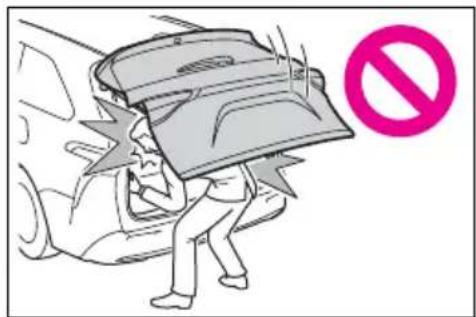
● Vehicles with power back door: The back door may suddenly shut if it is not opened fully, while on a steep incline. Make sure that the back door is secured before using the luggage compartment.
- When closing the back door, take extra care to prevent your fingers, etc. from being caught.
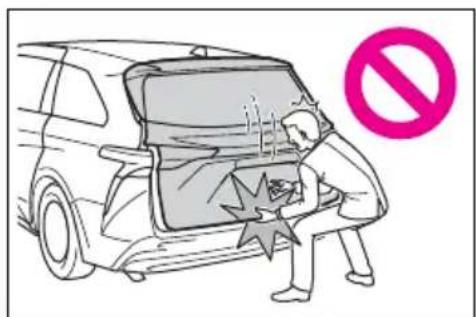
● Vehicles without power back door: When closing the back door, make sure to press it lightly on its outer surface. If the back door handle is used to fully close the back door, it may result in hands or arms being caught.
- Do not pull on the back door damper stay (vehicles without power back door) ( P.153) or back door spindle (vehicles with power back door) ( P.161) to close the back door, and do not hang on the back door damper stay (vehicles without power back door) or back door spindle (vehicles with power back door). Doing so may cause hands to be caught or the back door damper stay (vehicles without power back door) or back door spindle (vehicles with power back door) to break, causing an accident.
- Do not attach a heavy accessory part to the back door. If a bicycle carrier or similar heavy object is attached to the back door, it may suddenly shut again after being opened, causing someone's hands, head or neck to be caught and injured.

NOTICE
■Operating the back door
Do not attach a heavy accessory part to the back door. Doing so may cause the back door to be damaged.
Unlocking and locking the back door from the outside
■Using the entry function (if equipped)
Carry the electronic key to enable this function.
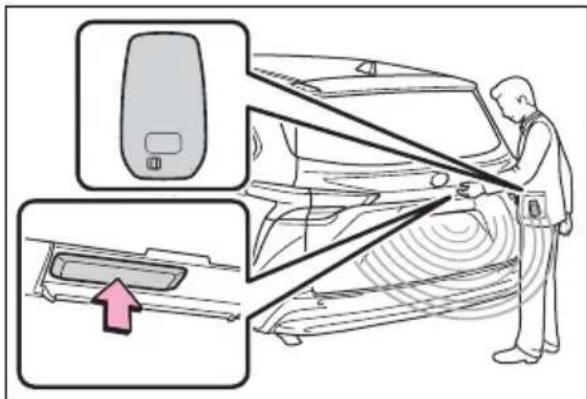
Unlocks all the doors
The doors cannot be unlocked for 3 seconds after the doors are locked.
■Using the wireless remote control
→P.132
Operation signals
A buzzer sounds and the emergency flashers flash to indicate that the doors have been locked/unlocked. (Locked: once; Unlocked: twice)
■Security feature
If a door is not opened within approximately 60 seconds after the vehicle is unlocked, the security feature automatically locks the vehicle again.
Unlocking and locking the back door from the inside
■Using the door lock switch
→P.135
Opening/closing the back door (vehicles without power back door)
Open
Raise the back door while
pressing up the back door opener to release the lock to open the back door.
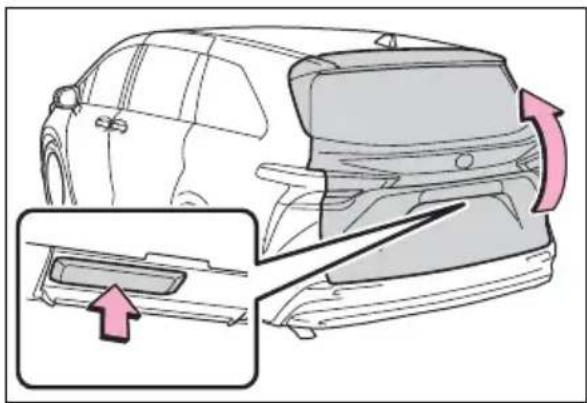
natural_image
Diagram showing a car interior with a rear truss structure and an inset view of the front compartment (no text or symbols)Close
Lower the back door using the back door handle A and make sure to push the back door down from the outside to close it.
Be careful not to pull the back door sideways when closing the back door with the handle.
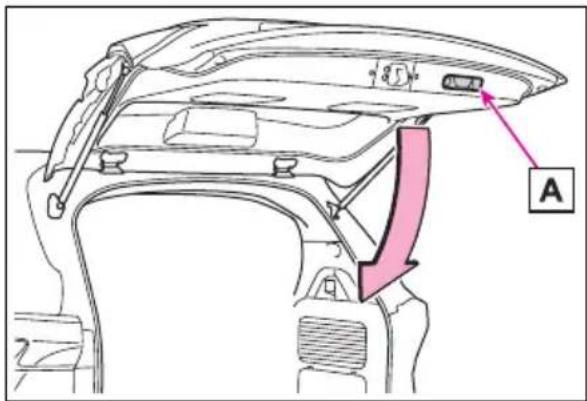
Luggage compartment light
→P.156
If the back door opener is inoperative
The back door can be unlocked from the inside.
1 Remove the both side covers.
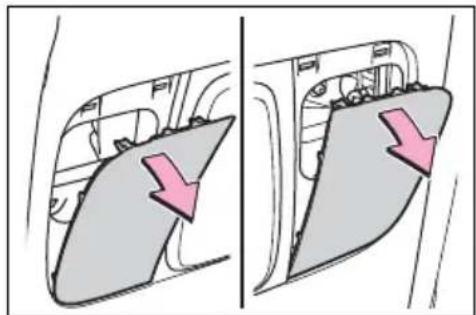
natural_image
Diagram showing two car interior compartments with a pink arrow indicating direction of movement (no text or symbols)2 Remove the bolts with a socket wrench of an appropriate size.
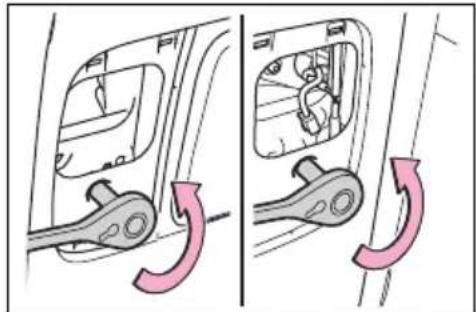
natural_image
Diagram showing two car door lock positions with arrows indicating movement or force (no text or symbols)3 Remove the inside panel.
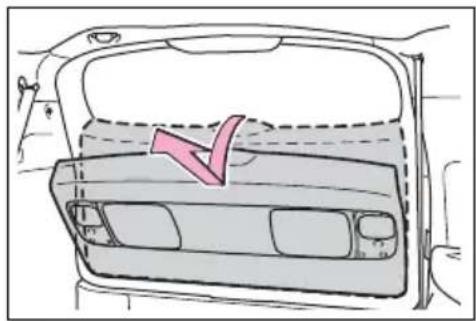
natural_image
Diagram of a car backrest with a highlighted V-shaped object on the side panel (no text or symbols)4 Move the lever.
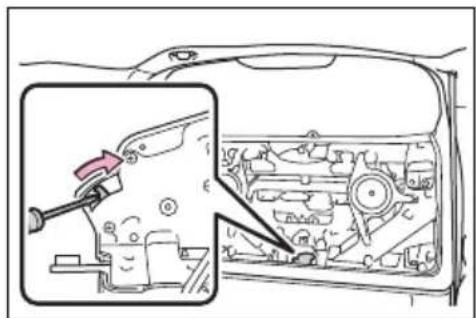
natural_image
Diagram showing a mechanical assembly inside a vehicle, with an inset close-up highlighting a component (no text or labels present)■Open door warning buzzer →P.136

NOTICE
■Back door damper stays
The back door is equipped with damper stays that hold the back door in place.
Observe the following precautions.
Failure to do so may cause damage to the back door damper stay, resulting in malfunction.
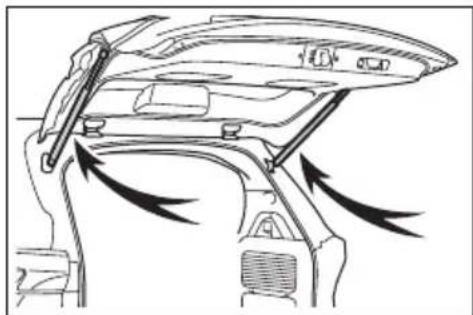
natural_image
Diagram of a car interior showing airflow or movement arrows from the window frame to the rear door (no text or symbols present)- Do not attach any foreign objects, such as stickers, plastic sheets, or adhesives to the damper stay rod.
- Do not touch the damper stay rod with gloves or other fabric items.
- Do not attach any accessories other than genuine Toyota parts to the back door.
- Do not place your hand on the damper stay or apply lateral forces to it.
Opening/closing the back door (vehicles with power back door)
■ Using the wireless remote control
Press and hold the switch.
The power back door automatically opens/closes.
Pressing the switch again while the power back door is operating will
cause the operation to reverse. However, the reverse operation cannot be performed for the first second after automatic operation starts, even if the wireless remote control switch is pressed again.
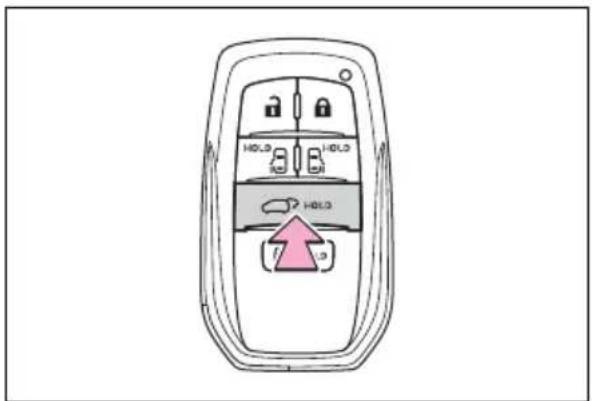
■ Using the power back door switch from front seats
Press and hold the switch to open/close the back door.
Pressing the switch again while the power back door is closing will cause it to open again.
However, the reverse operation cannot be performed for the first second after automatic operation starts even if the switch is pressed again.
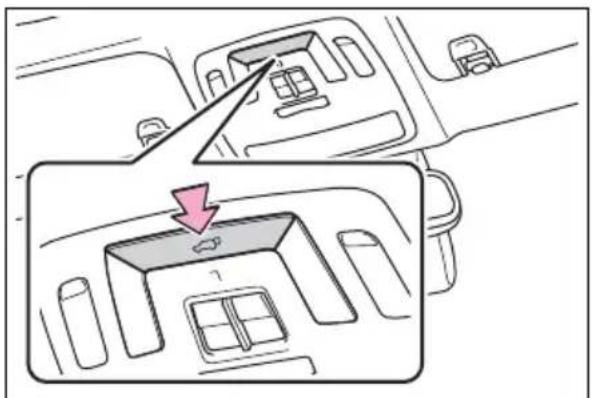
natural_image
Diagram showing car interior layout with a highlighted vehicle component (no text or symbols)■Using the back door opener switch
When the back door is unlocked: Press the back door opener switch.
When the back door is locked: While carrying the electronic key on your person, press and hold the back door opener switch.
The power back door automatically opens.
Pressing the switch while the power back door is opening/closing stops the operation.
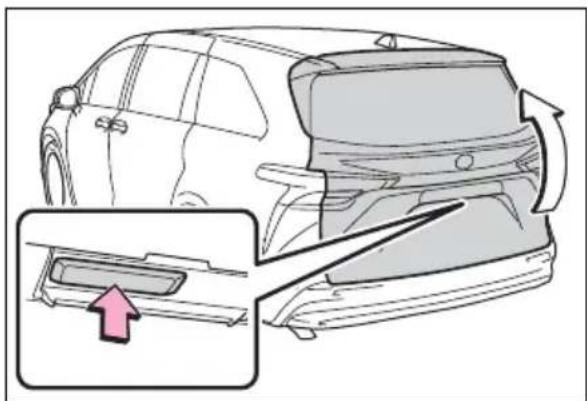
natural_image
Diagram of a car back panel with an inset showing a component being inserted (no text or symbols present)■ Using the power back door switch on the back door
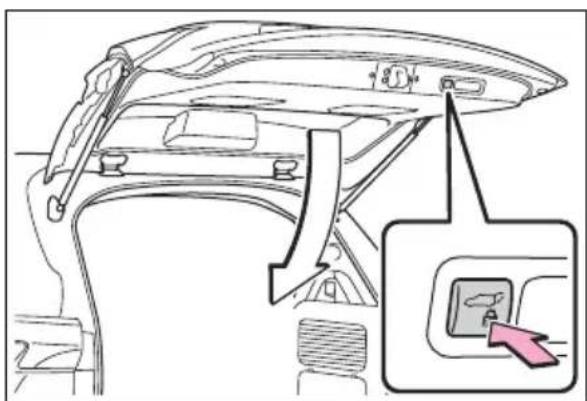
natural_image
Diagram of a car interior showing the rear window and side door, with an inset highlighting a button (no text or symbols present)- Close
Press the switch.
The power back door automatically closes.
Pressing the switch while the power back door is operating will stop the operation.
When the switch is pressed again during the halted operation, the back door will perform the reverse
operation.
- Close the back door and lock all doors (close & lock function)
Press the switch twice.
A different buzzer than the normal one will sound and the power back door will begin closing automatically. When the power back door is closed, all of the doors will lock simultaneously and operation signals will indicate that all of the doors have been locked.
If the switch is pressed while the power back door is closing, the operation will stop.
Pressing the switch again will close the power back door automatically.
Lower the back door using the back door handle Athen a buzzer sounds and the back door automatically closes.
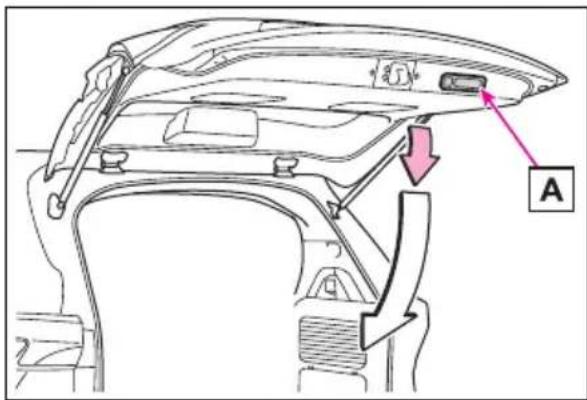
■ Using the kick sensor (vehicles with Hands Free Power Back Door)
The Hands Free Power Back Door enables automatic opening and closing of the power back door by putting your foot near the lower center part of the rear bumper and moving it away from the rear bumper. When operating the Hands Free Power Back Door, make sure that the power switch is in OFF, the kick sensor operation is enabled (→P.112) and you are carrying an electronic key.
1 While carrying an electronic key, stand within the smart key system operation range, approximately 11.8 to 19.7 in. (30 to 50~cm ) from the rear bumper.
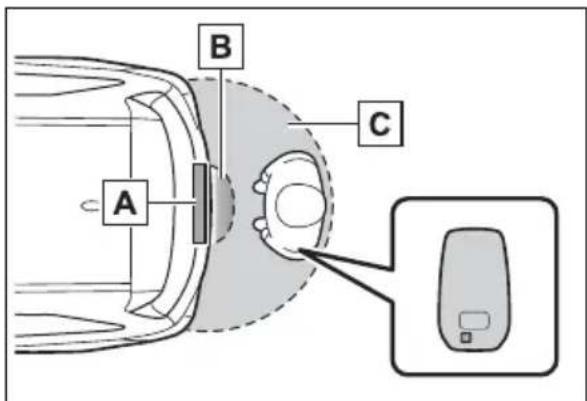
A Kick sensor
B Hands Free Power Back Door operation detection area
C Smart key system operation detection area ( P.165)
2 Perform a kick operation by moving your foot to within approximately 3.9 in. (10 cm) of the rear bumper and then pulling it back.
Perform the entire kick operation within approximately 1 second.
The back door will not start operating while a foot is detected under
the rear bumper.
Operate the Hands Free Power Back Door without contacting the rear bumper with your foot.
If another electronic key is in the cabin or luggage compartment, it may take slightly longer than normal for the operation to occur.
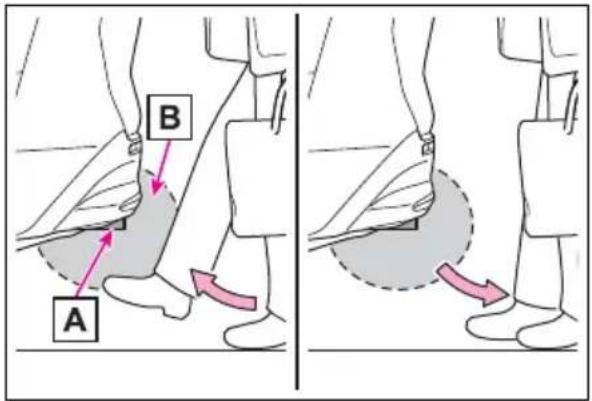
A Kick sensor
B Hands Free Power Back Door operation detection area
3 When the kick sensor detects that your foot is pulled back, a buzzer will sound and the back door will automatically fully open/close.
If a foot is moved under the rear bumper while the back door is opening/closing, the back door will stop moving.
If a foot is moved under the rear bumper again during the halted operation, the back door will perform the reverse operation.
Luggage compartment light
The luggage compartment light turns on when the back door is opened with the luggage compartment light switch on.
When the power switch is turned to OFF, the light will go off automatically after 20 minutes.
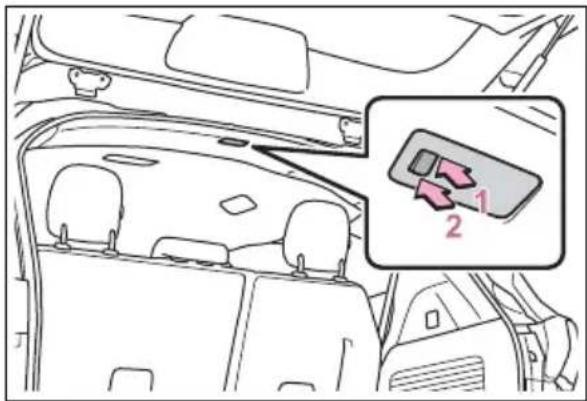
1 On
2 Off
■Back door closer
In the event that the back door is left slightly open, the back door closer will automatically close it to the fully closed position.
Whatever the state of the power switch, the back door closer operates.
■Power back door operating conditions
The power back door can automatically open and close under the following conditions:
- When the power back door system is enabled. (→P.112)
- When the back door is unlocked.
Vehicles with entry function: However, if the back door opener switch is pressed and held while carrying the electronic key on your person, the power back door will be operated even if the back door is locked. (→P.154)
- When the power switch is in ON, in addition to the above for the opening operations, the back door operates for any of the following conditions:
- Parking brake is engaged
• The brake pedal is depressed
• The shift lever is in P.
Operation of the power back door
●A buzzer sounds and the emergency flashers flash twice to indi-
cate that the back door is opening/closing.
- When the power back door system is disabled, the power back door does not operate but it can be opened and closed by hand.
- When the power back door automatically opens, if an abnormality due to people or objects is detected, operation will stop.
Jam protection function
Sensors are equipped on both sides of the power back door. If anything obstructs the power back door while it is closing, the back door will automatically operate in the opposite direction or stop.
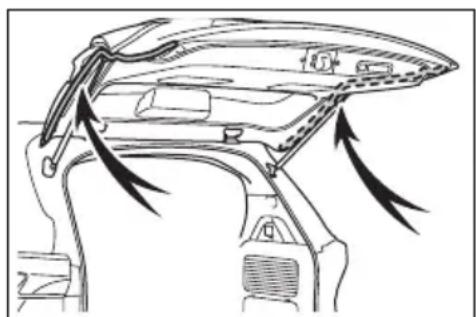
natural_image
Technical line drawing of a car interior showing structural components and airflow direction (no text or symbols)■Fall-down protection function
While the power back door is opening automatically, applying excessive force to it will stop the opening operation to prevent the power back door from suddenly shutting.
■Back door reserve lock function
This function is a function which reserves locking of all doors, beforehand, when the power back door is open.
When the following procedure is performed, all the doors except the power back door are locked and then power back door will also be locked at the same time it is closed.
1 Close all doors, except the back door.
2 During the power back door closing operation, lock the doors using the smart key system from the front doors ( P.132) or the wireless remote control.
( P.132)
A buzzer sounds and the emergency flashers flash to indicate that all the doors have been closed and locked.
- If the electronic key is placed inside the vehicle after starting a close operation via the door reserve lock function, the electronic key may become locked inside the vehicle.
- If the power back door does not fully close due to the operation of the jam protection function, etc., while the back door is automatically closing after a door reserve lock operation is performed, the door reserve lock function is canceled and all the doors will unlock.
●Before leaving the vehicle, make sure that all the doors are closed and locked.
■Close & lock function
When the power back door is open, this function closes the power back door and then locks all of the doors simultaneously.
When the following procedures are performed and there are no electronic keys for the vehicle within the vehicle, all of the doors will lock when the power back door is completely closed.
1 Close all of the doors except the power back door.
2 While carrying an electronic key, press the switch twice on the lower part of the power back door (→P.154).
A different buzzer than the normal one will sound and then the power back door will begin closing automatically. When the power back door is closed, all of the doors will lock simultaneously and operation signals will indicate that all of the doors have been locked.
■ Situations in which the close & lock function may not operate properly
In the following situations, the close & lock function may not operate properly:
- If the switch on the lower part of the power back door (→P.154) is pressed by a hand which is holding an electronic key
- If the switch on the lower part of the power back door (→P.154) is pressed when the electronic key is in a bag, etc. that is placed on the ground
- If the switch on the lower part of the power back door (→P.154) is pressed with the electronic key not near the vehicle
■Kick sensor operating conditions (vehicles with Hands Free Power Back Door)
The Hands Free Power Back Door will open/close automatically when the following conditions are met:
●The kick sensor operation is enabled (→P.112)
●The electronic key is within the operational range. (→P.165)
●A foot is put near the lower center part of the rear bumper and moved away from the rear bumper.
The power back door may also be operated by putting a hand, an elbow, a knee, etc. near the lower center part of the rear bumper and moving it away from the rear bumper. Make sure to put it close enough to the center part of the rear bumper.
■Situations in which the Hands Free Power Back Door may not operate properly (vehicles with Hands Free Power Back Door)
In the following situations, the Hands Free Power Back Door may not operate properly:
- When a foot remains under the rear bumper - If the rear bumper is strongly hit with a foot or is touched for a while If the rear bumper has been touched for a while, wait for a short time before attempting to operate the Hands Free Power Back Door again.
- When operated while a person is too close to the rear bumper
- When an external radio wave source interferes with the communication between the electronic key and the vehicle (→P.166)
- When the vehicle is parked near an electrical noise source which affects the sensitivity of the Hands Free Power Back Door, such as a pay parking spot, gas station, electrically heated road, or fluorescent light
- When the vehicle is near a TV tower, electric power plant, radio station, large display, airport or other facility that generates strong radio waves or electrical noise
- When a large amount of water is applied to the rear bumper, such as when the vehicle is being washed or in heavy rain
- When mud, snow, ice, etc. is attached to the rear bumper
- When the vehicle has been parked for a while near objects that may move and contact the rear bumper, such as plants
- When an accessory is installed to the rear bumper
If an accessory has been installed, turn the Hands Free Power Back Door (kick sensor) operation setting off.
■Preventing unintentional operation of the Hands Free Power Back Door (vehicles with Hands Free Power Back Door)
When an electronic key is in the operation range, the Hands Free Power Back Door may operate unintentionally, so be careful in the following situations.
- When a large amount of water is applied to the rear bumper, such as when the vehicle is being washed or in heavy rain
- When dirt is wiped off the rear bumper
- When a small animal or small object, such as a ball, moves under the rear bumper
- When an object is moved from under the rear bumper
● If someone is swinging their legs while sitting on the rear bumper - If the legs or another part of someone's body contacts the rear bumper while passing by the vehicle
- When the vehicle is parked near an electrical noise source which affects the sensitivity of the Hands Free Power Back Door, such as a pay parking spot, gas station, electrically heated road, or fluorescent light
- When the vehicle is near a TV tower, electric power plant, radio station, large display, airport or other facility that generates strong radio waves or electrical noise
- When the vehicle is parked in a place where objects such as plants are near the rear bumper
● If luggage, etc. is set near the rear bumper - If accessories or a vehicle cover is installed/removed near the rear bumper
- When the vehicle is being towed To prevent unintentional operation,
turn the Hands Free Power Back Door (kick sensor) operation setting off. (→P.112)
If the back door opener is inoperative
The back door can be unlocked from the inside.
1 Remove the both side covers.
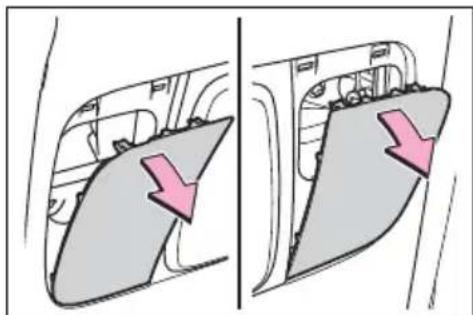
natural_image
Diagram showing two car door compartments with a pink arrow indicating the direction of change (no text or symbols present)2 Remove the bolts with a socket wrench of an appropriate size.
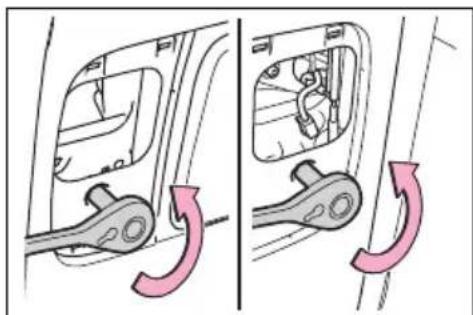
natural_image
Diagram showing two car door compartments with directional arrows indicating movement or force (no text or symbols)3 Remove the inside panel.
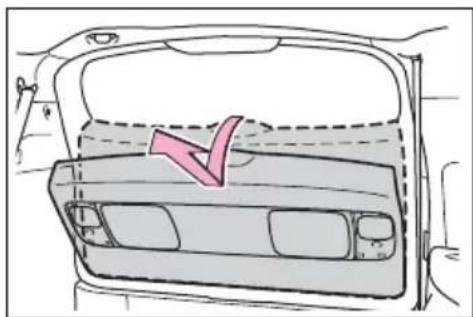
natural_image
Diagram of a car backrest with a highlighted panel and arrow indicating direction (no text or symbols)4 Move the lever.
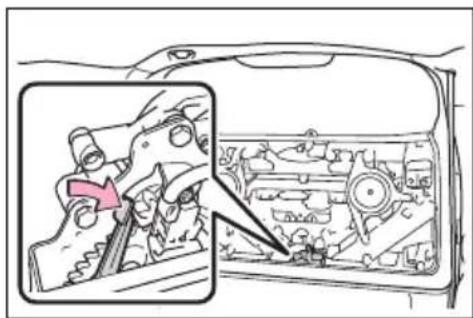
natural_image
Diagram showing engine compartment with gear and valve mechanism, no text or symbols presentCustomization
Settings (e.g. power back door opening angle) can be changed. (Customizable features: →P.546)

WARNING
■Back door closer
In the event that the back door is left slightly open, the back door closer will automatically close it to the fully closed position. It takes several seconds before the back door closer begins to operate. Be careful not to catch fingers or anything else in the back door, as this may cause bone fractures or other serious injuries.
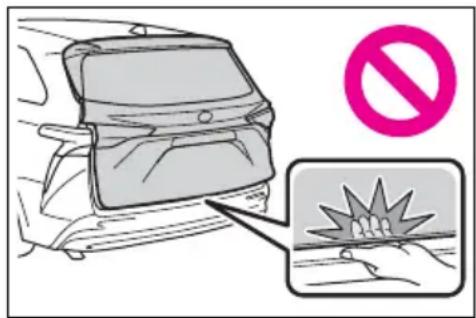
- Use caution when using the back door closer as it still operates when the power back door system is canceled.
Power back door
Observe the following precautions when operating the power back door.
Failure to do so may cause death or serious injury.
- Check the safety of the surrounding area to make sure there are no obstacles or anything that could cause any of your belongings to get caught.
- If anyone is in the vicinity, make sure they are safe and let them know that the back door is about to open or close.
- If the power back door system is disabled while the back door is operating automatically, the automatic operation is stopped. The back door then has to be operated manually. Take extra care when on an incline, as the back door may open or close unexpectedly.
- If the operating conditions of the power back door are no longer met, a buzzer may sound and the back door may stop opening or closing. The back door then has to be operated manually. Take extra care when on an incline, as the back door may open or close abruptly.
● On an incline, the back door may suddenly shut after it opens. Make sure the back door is fully open and secure.
In the following situations, the power back door may detect an abnormality and automatic operation may be stopped. In this case, the back door has to be operated manually. Take extra care when on an incline, as the back door may open or close abruptly.
- When the back door contacts an obstacle
- When the 12-volt battery voltage suddenly drops, such as when the power switch is turned to ON or the hybrid system is started during automatic operation
Jam protection function
Observe the following precautions.
Failure to do so may cause death or serious injury.
●Never use any part of your body to intentionally activate the jam protection function.

WARNING
●The jam protection function may not work if something gets caught just before the back door fully closes. Be careful not to catch fingers or anything else.
●The jam protection function may not work depending on the shape of the object that is caught. Be careful not to catch fingers or anything else.
■Hands Free Power Back Door (if equipped)
Observe the following precautions when operating the Hands Free Power Back Door. Failure to do so may cause death or serious injury.
- Check the safety of the surrounding area to make sure there are no obstacles or anything that could cause any of your belongings to get caught.
- When putting your foot near the lower center part of the rear bumper and moving it from the rear bumper, be careful not to touch the exhaust pipes until they have cooled down sufficiently, as touching hot exhaust pipes can cause burns.
- Do not leave the electronic key within the effective range (detection area) of the luggage compartment.

NOTICE
■Back door spindles
The back door is equipped with spindles that hold the back door in place.
Observe the following precautions.
Failure to do so may cause damage to the back door spindle, resulting in malfunction.
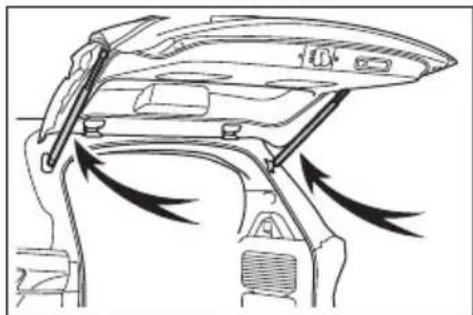
natural_image
Technical line drawing of a car interior showing structural components and airflow direction (no text or symbols)- Do not attach any foreign objects, such as stickers, plastic sheets, or adhesives to the spindle rod.
- Do not touch the spindle rod with gloves or other fabric items.
- Do not attach heavy accessories to the back door. When attaching, ask your Toyota dealer for details.
- Do not place your hand on the spindle or apply lateral forces to it.
■To prevent back door closer malfunction
Do not apply excessive force to the back door while the back door closer is operating. Applying excessive force may cause the back door closer to malfunction.

NOTICE
■To prevent damage to the power back door
Make sure that there is no ice between the back door and frame that would prevent movement of the back door. Operating the power back door when excessive load is present on the back door may cause a malfunction.
- Do not apply excessive force to the back door while the power back door is operating.
Take care not to damage the sensors (installed on the right and left edges of the power back door) with a knife or other sharp object. If the sensor is disconnected, the power back door will not close automatically.
■Close & lock function
When closing the power back door using the close & lock function, a different buzzer than the normal one will sound before the operation begins.
To check that the operation has started correctly, check that a different buzzer than the normal one has sounded.
Additionally, when the power back door is fully closed and locked, operation signals will indicate that all of the doors have been locked.
Before leaving the vehicle, make sure that the operation signals have operated and that all of the doors are locked.
■Hands Free Power Back Door precautions (if equipped)
The kick sensor is located behind lower center part of the rear bumper. Observe the following to ensure that the Hands Free Power Back Door function operates properly:
- Keep the lower center part of the rear bumper clean at all times. If the lower center part of the rear bumper is dirty or covered with snow or mud, the kick sensor may not operate. In this situation, clean off the dirt or snow, move the vehicle from the current position and then check if the kick sensor operates. If it does not operate, have the vehicle inspected by your Toyota dealer.
- Do not apply coatings that have a rain clearing (hydrophilic) effect, or other coatings, to the lower center part of the rear bumper.
- Do not park the vehicle near objects that may move and contact the lower center part of the rear bumper, such as grass or trees. If the vehicle has been parked for a while near objects that may move and contact the lower center part of the rear bumper, such as grass or trees, the kick sensor may not operate. In this situation, move the vehicle from the current position and then check if the kick sensor operates. If it does not operate, have the vehicle inspected by your Toyota dealer.

NOTICE
●Do not subject the kick sensor or its surrounding area to a strong impact.
If the kick sensor or its surrounding area has been subjected to a strong impact, the kick sensor may not operate properly. If the kick sensor does not operate in the following situations, have the vehicle inspected by your Toyota dealer.
- The kick sensor or its surrounding area has been subjected to a strong impact.
- The lower center part of the rear bumper is scratched or damaged.
- Do not disassemble the rear bumper.
- Do not attach an accessory containing metal or apply metallic paint to the rear bumper.
Canceling the power back door system (vehicles with power back door)
The power back door system can be enabled/disabled on the multi-information display. (→P.112)
If the power back door is disabled, it will remain disabled unless it is enabled on the multi-information display. (It will not be enabled even when the power switch is turned off and then back to ON.)
Canceling the Hands Free Power Back Door (vehicles with kick sensor)
The Hands Free Power Back Door (kick sensor) can be enabled/disabled on the multi-information display. ( P.112)
If the Hands Free Power Back Door is disabled, it will remain disabled unless it is enabled on the multi-information display. (It will not be enabled even when the power switch is turned off and then back to ON.)
Adjusting the open position of the back door (vehicles with power back door)
The power back door open position can be adjusted by using the power back door switch on the back door or on the multi-information display.
■Using the multi-information display
The power back door open position can be adjusted on the multi-information display. (→P.112)
■ Using the power back door switch on the back door
1 Stop the back door in the desirable position. ( P.153)
2 Press and hold the power back door switch on the back
door for approximately 2 seconds.
When the settings are completed, the buzzer sounds 4 times.
When opening the back door the next time, the back door will stop at that position.
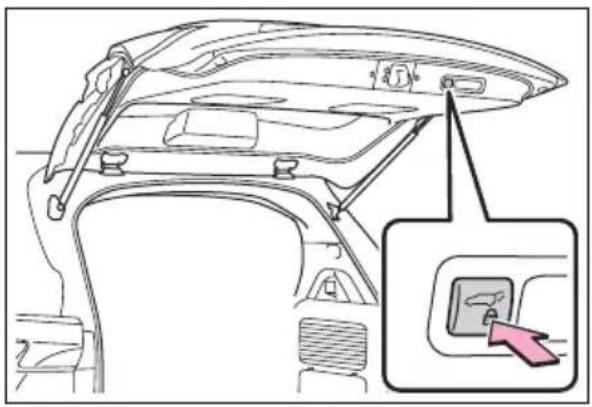
natural_image
Line drawing of a car rearview door with a highlighted component (no text or symbols)■ Canceling the adjusted open position of the back door
Press and hold the power back door switch on the back door for approximately 7 seconds.
After the buzzer sounds 4 times, it sounds twice more. When the power back door does the opening operation the next time, the door will open to the initial settings position.
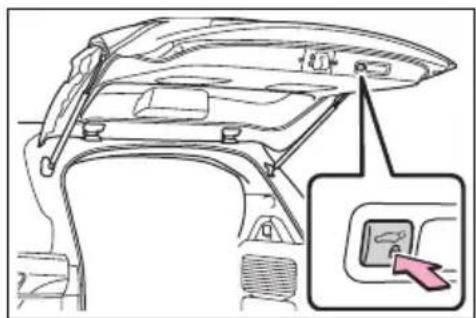
natural_image
Diagram of a car front panel with an inset showing a cursor clicking the button (no text or symbols present)Customization
The opening position can be set with the multi-information display. (→P.546)
Priority for the stop position is given to the last position set by either the power back door switch on the back door or multi-information display.
Smart key system
The following operations can be performed simply by carrying the electronic key on your person, for example in your pocket. The driver should always carry the electronic key.
- Locks and unlocks the front doors (vehicles with entry function) (→P.132)
- Locks and unlocks the sliding doors (vehicles with entry function) (→P.138)
- Locks and unlocks the back door (vehicles with entry function) (→P.151)
- Starts the hybrid system (→P.231)
Antenna location
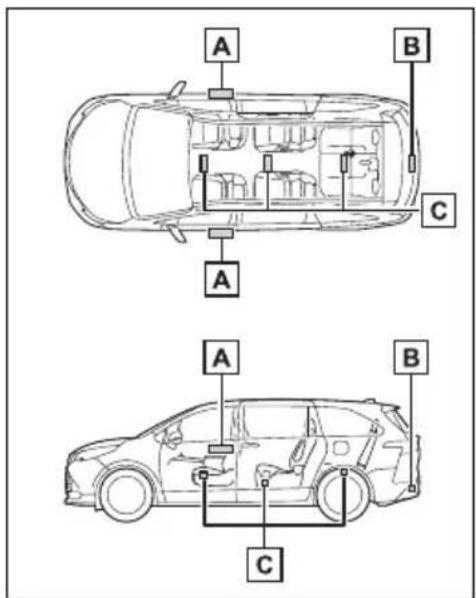
A Antennas outside the cabin (vehicles with entry function)
B Antenna outside the luggage
compartment (vehicles with entry function)
C Antennas inside the cabin
■Effective range (areas within which the electronic key is detected)
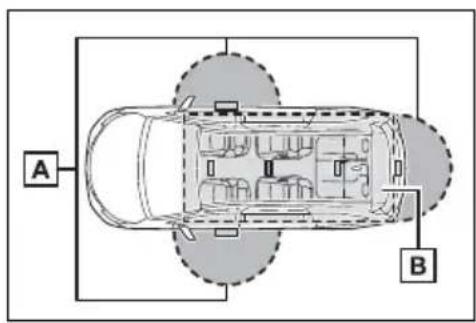
A When locking or unlocking the doors (vehicles with entry function)
The system can be operated when the electronic key is within about 2.3 ft. (0.7 m) of the outside front door handles or back door opener switch. (Only the doors detecting the key can be operated.)
B When starting the hybrid system or changing power switch modes
The system can be operated when the electronic key is inside the vehicle.
If an alarm sounds or a warning message is displayed
An alarm sounds and warning message displays shown on the multi-information display are used to protect against unexpected accidents or theft of the vehicle resulting from erroneous operation. When a warning message is displayed, take appropriate measures based on the displayed message.
When only an alarm sounds, circumstances and correction procedures are as follows.
- When an exterior alarm sounds once for 5 seconds
| Situation | Correction procedure |
| An attempt was made to lock the vehicle while a door was open. | Close all of the doors and lock the doors again. |
- When an interior alarm pings continuously
| Situation | Correction procedure |
| The power switch was turned to ACC while the driver's door was open (or the driver's door was opened while the power switch was in ACC). | Turn the power switch to OFF and close the driver's door. |
■Battery-saving function (vehicles with entry function)
The battery-saving function will be activated in order to prevent the electronic key battery and the 12-volt battery from being discharged while the vehicle is not in operation for a long time.
●In the following situations, the smart key system may take some time to unlock the doors.
- The electronic key has been left in an area of approximately 11.5 ft. (3.5 m) of the outside of the vehicle for 2 minutes or longer.
• The smart key system has not been used for 5 days or longer.
- If the smart key system has not been used for 14 days or longer, the doors cannot be unlocked at any doors except the driver's door. In this case, take hold of the driver's door handle, or use the
wireless remote control or the mechanical key, to unlock the doors.
■Turning an electronic key to battery-saving mode
- When battery-saving mode is set, battery depletion is minimized by stopping the electronic key from receiving radio waves.
Press twice while pressing
and holding .
Confirm that the electronic key indicator flashes 4 times.
While the battery-saving mode is set, the smart key system cannot be used. To cancel the function, press any of the electronic key buttons.
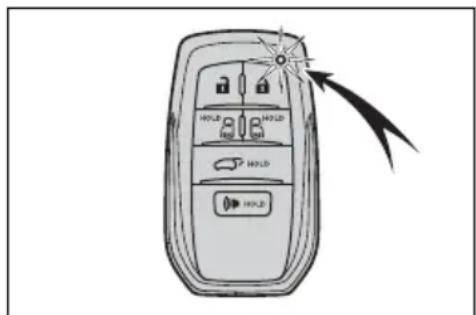
●Electronic keys that will not be used for long periods of time can be set to the battery-saving mode in advance.
■Conditions affecting operation
The smart key system uses weak radio waves. In the following situations, the communication between the electronic key and the vehicle may be affected, preventing the smart key system, wireless remote control and immobilizer system from operating properly.
(Ways of coping: →P.504)
- When the electronic key battery is depleted
●Near a TV tower, electric power plant, gas station, radio station, large display, airport or other facility that generates strong radio waves or electrical noise
- When the electronic key is in contact with, or is covered by the following metallic objects
- Cards to which aluminum foil is attached
• Cigarette boxes that have aluminum foil inside
• Metallic wallets or bags - Coins
- Hand warmers made of metal
• Media such as CDs and DVDs
- When other wireless key (that emits radio waves) is being used nearby
- When carrying the electronic key together with the following devices that emit radio waves
- Portable radio, cellular phone, cordless phone or other wireless communication devices
- Another vehicle's electronic key or a wireless key that emits radio waves
• Personal computers or personal digital assistants (PDAs)
• Digital audio players
- Portable game systems
- If window tint with a metallic content or metallic objects are attached to the rear window
- When the electronic key is placed near a battery charger or electronic devices
- When parking in a coin-operated parking lot (Radio waves used to detect vehicles may affect the smart key system.)
■Note for the entry function
● Even when the electronic key is within the effective range (detection areas), the system may not operate properly in the following cases:
- The electronic key is too close to the window or outside door handle, near the ground, or in a high place when the doors are locked or unlocked.
- The electronic key is on the instrument panel, or floor, or in the door pockets or glove box when the
hybrid system is started or power switch modes are changed.
- Do not leave the electronic key on top of the instrument panel or near the door pockets when exiting the vehicle. Depending on the radio wave reception conditions, it may be detected by the antenna outside the cabin and the door will become lockable from the outside, possibly trapping the electronic key inside the vehicle.
●As long as the electronic key is within the effective range, the doors may be locked or unlocked by anyone. However, only the doors detecting the electronic key can be used to unlock the vehicle.
● Even if the electronic key is not inside the vehicle, it may be possible to start the hybrid system if the electronic key is near the window.
●The doors may unlock if a large amount of water splashes on the door handle, such as in the rain or in a car wash when the electronic key is within the effective range. (The doors will automatically be locked after approximately 60 seconds if the doors are not opened and closed.) - If the wireless remote control is used to lock the doors when the electronic key is near the vehicle, there is a possibility that the door may not be unlocked by the entry function. (Use the wireless remote control to unlock the doors.)
●Touching the door lock sensor while wearing gloves may delay or prevent lock operation. Remove the gloves and touch the lock sensor again. - When the lock operation is performed using the lock sensor, recognition signals will be shown up to two consecutive times. After this, no recognition signals will be given.
- If the door handle becomes wet while the electronic key is within
the effective range, the door may lock and unlock repeatedly. In that case, follow the following correction procedures to wash the vehicle:
- Place the electronic key in a location 6 ft. (2 m) or more away from the vehicle. (Take care to ensure that the key is not stolen.)
- Set the electronic key to battery-saving mode to disable the smart key system. (→P.166)
- If the electronic key is inside the vehicle and a door handle becomes wet during a car wash, a message may be shown on the multi-information display and a buzzer will sound outside the vehicle. To turn off the alarm, lock all the doors.
●The lock sensor may not work properly if it comes into contact with ice, snow, mud, etc. Clean the lock sensor and attempt to operate it again, or use the lock sensor on the lower part of the door handle.
●A sudden approach to the effective range or door handle may prevent the doors from being unlocked. In this case, return the door handle to the original position and check that the doors unlock before pulling the door handle again.
- If there is another electronic key in the detection area, it may take slightly longer to unlock the doors after the door handle is gripped.
■When the vehicle is not driven for extended periods
● Vehicles with entry function: To prevent theft of the vehicle, do not leave the electronic key within 6 ft. (2 m) of the vehicle.
●The smart key system can be deactivated in advance. (→P.544)
●Battery-saving mode can reduce the power consumption of electronic keys. (→P.166)
■To operate the system properly
Make sure to carry the electronic key when operating the system. Do not get the electronic key too close to the vehicle when operating the system from the outside of the vehicle.
Depending on the position and holding condition of the electronic key, the key may not be detected correctly and the system may not operate properly. (The alarm may go off accidentally, or the door lock prevention may not operate.)
■If the smart key system does not operate properly
- If the doors cannot be locked or unlocked, perform the following.
- Bring the electronic key close to the door handle and perform a lock or unlock operation.
- Use the wireless remote control.
If the doors cannot be locked or unlocked by perform the above, use the mechanical key. ( P.504) However, if the mechanical key is used while the alarm system is set, the warning will sound. ( P.83)
● If the hybrid system cannot be started, refer to P.505
Customization
Settings (e.g. smart key system) can be changed. (Customizable features: →P.544)
If the smart key system has been deactivated in a customized setting, refer to the explanations for the following operations.
- Locking and unlocking the doors: Use the wireless remote control or mechanical key. (→P.132, 504)
● Starting the hybrid system and changing power switch modes: →P.505
●Stopping the hybrid system: →P.233

WARNING
■Caution regarding interference with electronic devices
● People with implantable cardiac pacemakers, cardiac resynchronization therapy-pacemakers or implantable cardioverter defibrillators should maintain a reasonable distance between themselves and the smart key system antennas. (→P.164)
The radio waves may affect the operation of such devices. If necessary, the entry function can be disabled. Ask your Toyota dealer for details, such as the frequency of radio waves and timing of the emitted radio waves. Then, consult your doctor to see if you should disable the entry function.
- Users of any electrical medical device other than implantable cardiac pacemakers, cardiac resynchronization therapy-pacemakers or implantable cardioverter defibrillators should consult the manufacturer of the device for information about its operation under the influence of radio waves.
Radio waves could have unexpected effects on the operation of such medical devices.
Ask your Toyota dealer for details on disabling the entry function.
Front seats
The seats can be adjusted (longitudinally, vertically, etc.). Adjust the seat to ensure the correct driving posture.
Adjustment procedure
▶ Manual seat (passenger's side only)
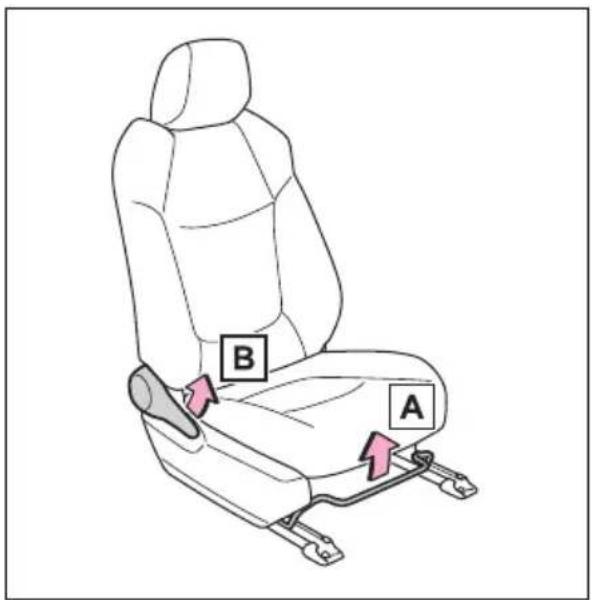
A Seat position adjustment lever
B Seatback angle adjustment lever
Power seat
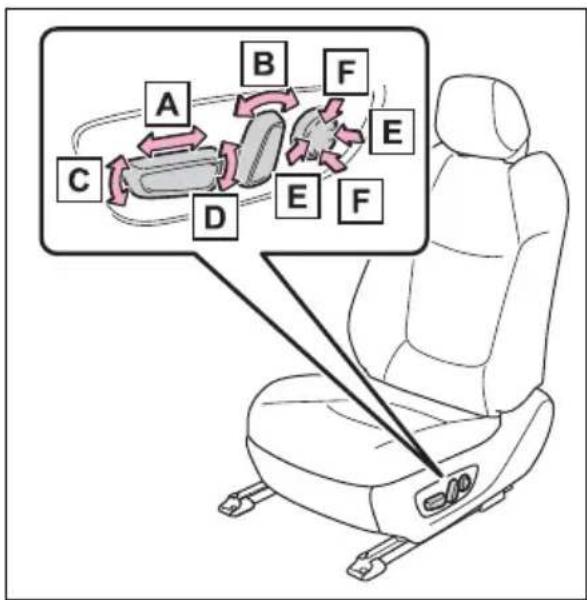
A Seat position adjustment switch
B Seatback angle adjustment switch
C Seat cushion (front) angle adjustment switch (driver's side only)
D Vertical height adjustment switch (driver's side only)
E Lumbar support adjustment switch (driver's side only) (if equipped)
F Pelvic support adjustment (driver's side only) (if equipped)
■When adjusting the seat
● Make sure that any surrounding passengers or objects are not contacting the seat.
●Take care when adjusting the seat so that the head restraint does not touch the ceiling.
■Power easy access system (if equipped)
The driver' seat and steering wheel move in accordance with power switch mode and the driver' seat belt condition. (→P.178)
■ Jam protection function (vehicles with driving position memory)
While the driving position is recalled or the power easy access system is operating, if an object is stuck behind the front seat, the front seat will stop and then slightly move forward.
When the jam protection function operates, the seat stops at a position other than the set seat position. Check the seat position.

WARNING
■When adjusting the seat position
● Take care when adjusting the seat position to ensure that other passengers are not injured by the moving seat.
- Do not put your hands under the seat or near the moving parts to avoid injury.
Fingers or hands may become jammed in the seat mechanism.
● Make sure to leave enough space around the feet so they do not get stuck.
■Seat adjustment
● To reduce the risk of sliding under the lap belt during a collision, do not recline the seat more than necessary. If the seat is too reclined, the lap belt may slide past the hips and apply restraint forces directly to the abdomen, or your neck may contact the shoulder belt, increasing the risk of death or serious injury in the event of an accident.
Adjustments should not be made while driving as the seat may unexpectedly move and cause the driver to lose control of the vehicle.
● Manual seat only: After adjusting the seat, make sure that the seat is locked in position.
Rear seats
Reclining adjustments and folding the seatbacks can be done with lever operation.
Adjustment procedure
Second seat
▶ Except ottoman seat (7-passenger models)
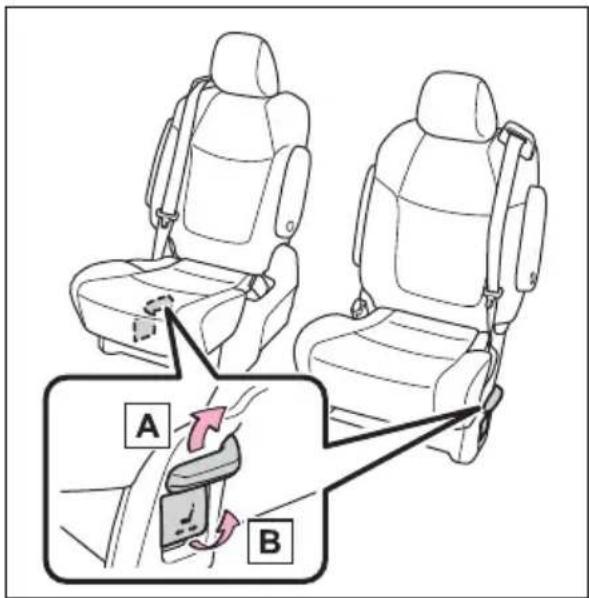
A Seatback angle adjustment lever
B Seat position adjustment lever
▶ Except ottoman seat (8-passenger models)
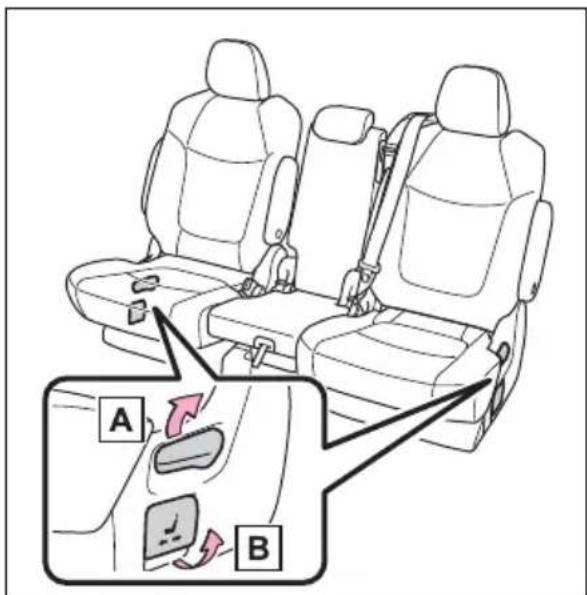
A Seatback angle adjustment lever
B Seat position adjustment lever
▶ Ottoman seat
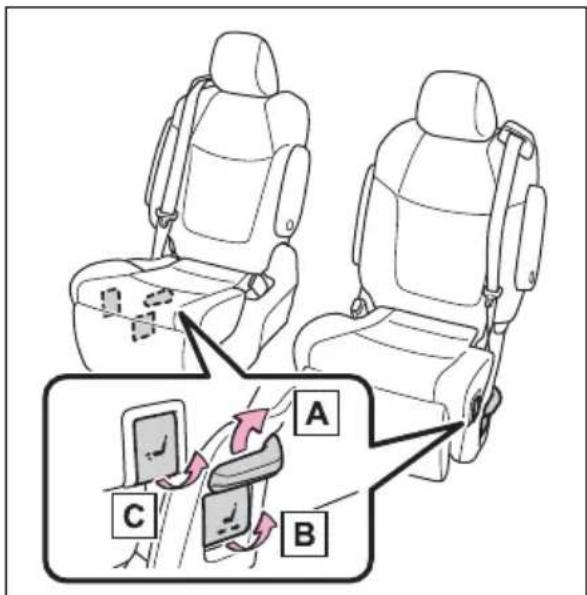
A Seatback angle adjustment lever
B Seat position adjustment lever
C Ottoman angle adjustment
lever
Third seats
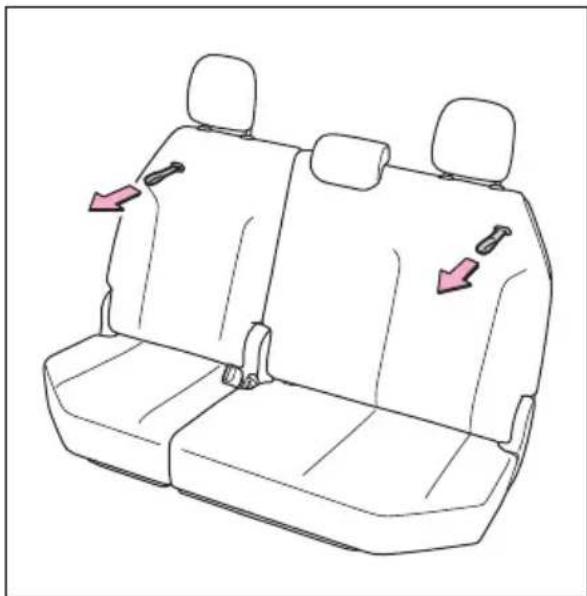
natural_image
Line drawing of a car backseat with seat covers and side seats, showing two seats and two rear seats with directional arrows indicating movement (no text or symbols)Seatback angle adjustment strap
■When using the ottoman seats (vehicles with ottoman seats)
Adjust the angle of the cushion while pulling the ottoman angle adjustment lever.
If necessary, slide the cushion to adjust the ottoman to the desired position.
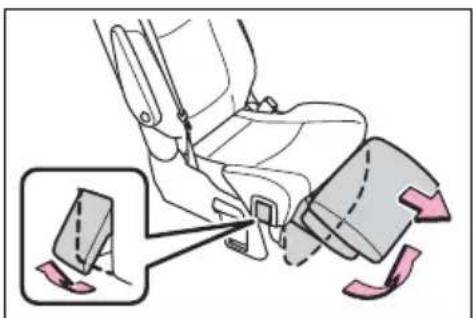

WARNING
■Seat adjustment
●Be careful that the seat does not hit passengers or luggage.
● To reduce the risk of sliding under the lap belt during a collision, do not recline the seat more than necessary. If the seat is reclined too far, the lap belt may slide past the hips and apply restraint forces directly to the abdomen, or your neck may contact the shoulder belt, increasing the risk of death or serious injury in the event of an accident.
Adjustments should not be made while driving as the seat may unexpectedly move and cause the driver to lose control of the vehicle.
■When adjusting the seat position or the ottoman (vehicles with Ottoman seats)
Make sure to leave enough space around the feet so as not to get them caught.
■When using the ottoman (vehicles with Ottoman seats)
- Do not sit on the ottoman. Seat belts may not be properly worn which may result in death or serious injury.
● Stow the ottoman when you get in and out of the vehicle or when the ottoman is not in use to avoid stumbling over it.
- Do not use the ottoman feature when the vehicle is in motion. The ottoman feature should only be used when the vehicle is stationary. If the ottoman feature is in use during an accident the lap belt may slide past the hips. This could also result in restraint forces being applied to the abdomen or your neck may contact the shoulder belt, increasing the risk of death or serious injury.

NOTICE
■To prevent an ottoman malfunction (vehicles with Ottoman seats)
- Do not place any objects in the second passenger footwell that could prevent the operation of the ottoman.
- Do not place heavy luggage on the ottoman.
- Do not place anything under the ottoman when in use. There is a possibility that something may get caught and cause damage when stowing the ottoman.
Moving a second seat for third seat access
■Getting in the vehicle
Pull the seatback angle adjustment lever and fold down the seatback. The cushion will tip up. The seat can slide forward. Move the seat to the frontmost position.
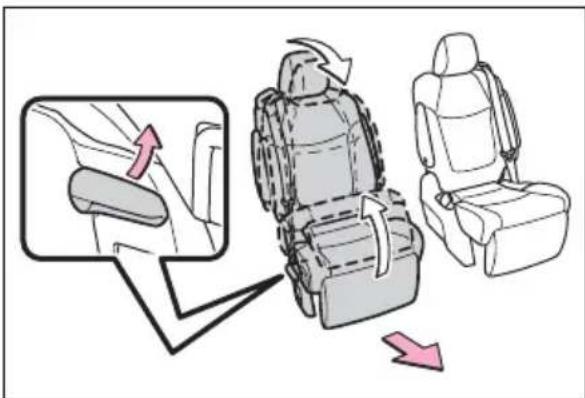
■Getting out of the vehicle
Pull the strap and fold down the seatback. The seat can slide forward. The cushion will tip up.
Move the seat to the frontmost
position.
Make sure that no passenger is seated on the second seat before pulling the strap.
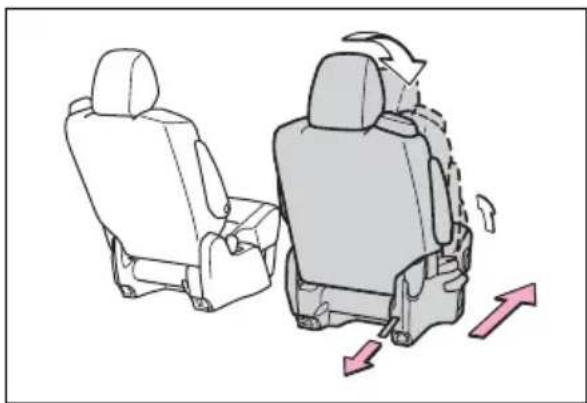
natural_image
Diagram showing two car seats with directional arrows indicating movement or change (no text or symbols)■After passengers have entered/exited the vehicle
Lift up the seatback. Either fold cushion down or pull slide lever to slide seat backward until it locks.
Removing the second center seat (8-passenger models)
1 Pull the lock release strap and fold down the second center seatback.
Make sure that the head restraint is in the lowest position.
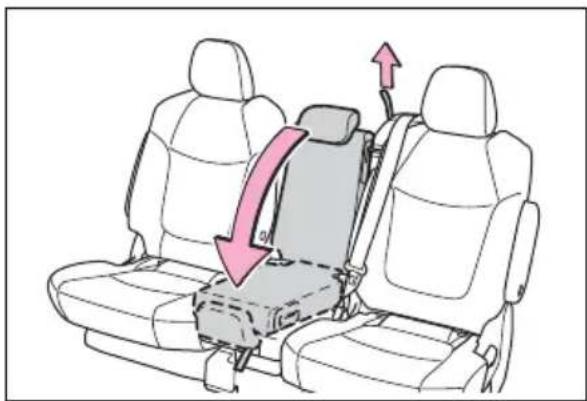
natural_image
Diagram of a car seatbelt with directional arrows indicating movement (no text or symbols)2 Pull the lock release strap in front of the cushion to release the rear latch.
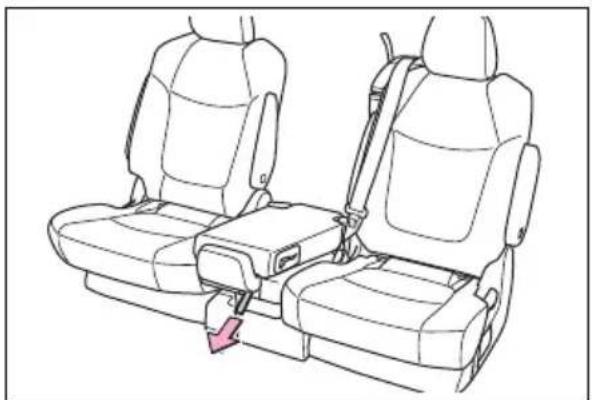
natural_image
Line drawing of two car seats with seatbelt buckle, no text or symbols present3 Pull the lock release strap under the seat to remove the seat.
Retract the cushion leg.
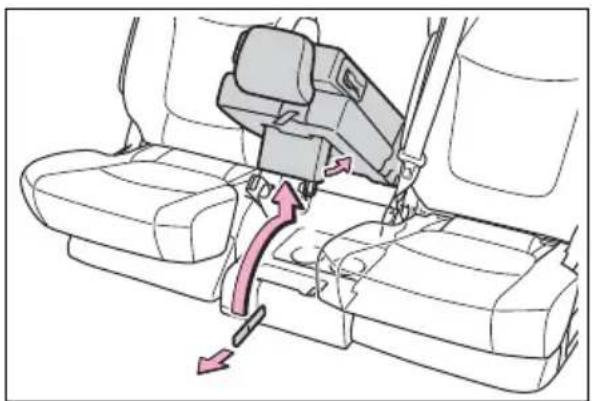
natural_image
Diagram of a car seatbelt mechanism inside a vehicle, showing directional arrows indicating movement (no text or symbols present)4 After detaching the second center seat, remove it from the vehicle or store it securely in the luggage compartment.
Installing the second center seat (8-passenger models)
1 Latch the buckles onto the anchors.
The cushion leg opens by itself.
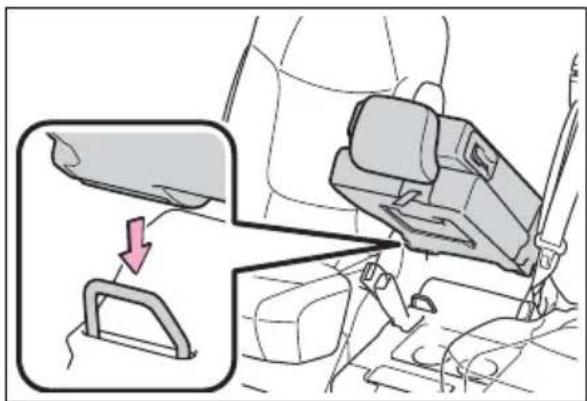
2 Unfold the seatback and lock it.
Make sure the seat is locked in place by trying to shake the seat-back and lift up the seat cushion.
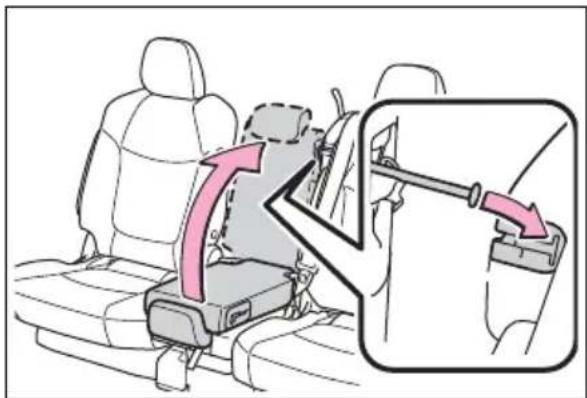
Folding down the third seats
■Before folding the third seats
1 Fold the outside head restraints and lower the center head restraint to the low-
est position ( P.182) and stow the seat belt buckles.
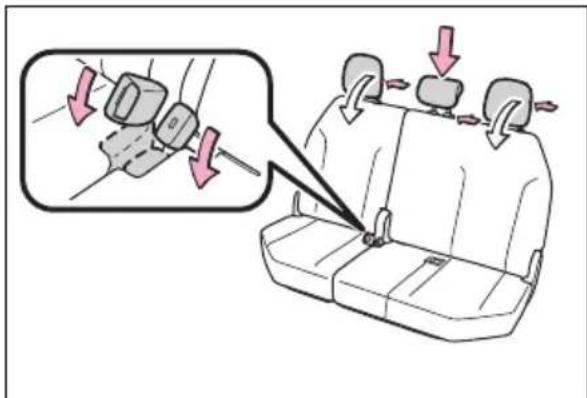
2 Stow the center seat belt. (→P.38)
■Folding down the third seat-backs
Pull the "TO RECLINE" strap and fold down the seatback.
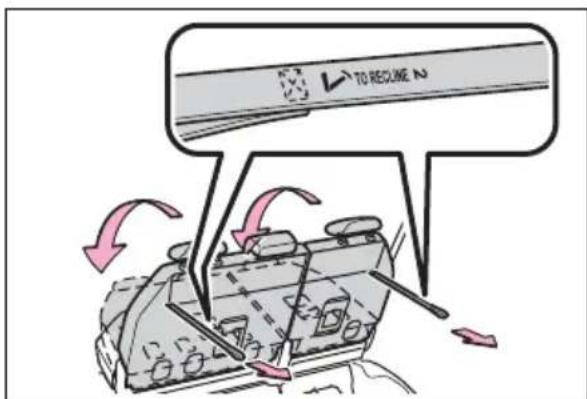
■ Returning the third seat-backs
Pull the "TO RECLINE" strap, and raise the seatback and the outside head restraints.
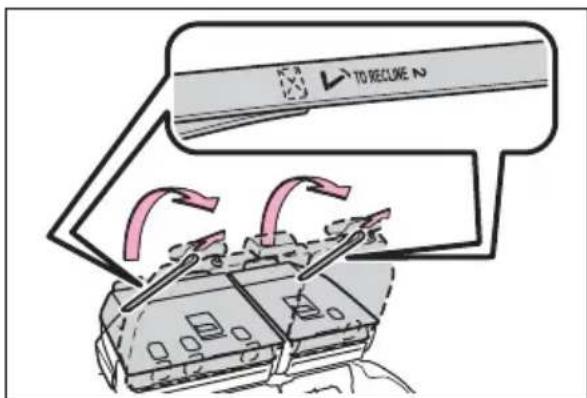
Stowing the third seats
Before stowing or returning third seat, remove any items from the floor area to prevent interference with moving parts.
■Before stowing the third seats
1 Lower the center head restraint to the lowest position ( P.182) and stow the seat belt buckles.
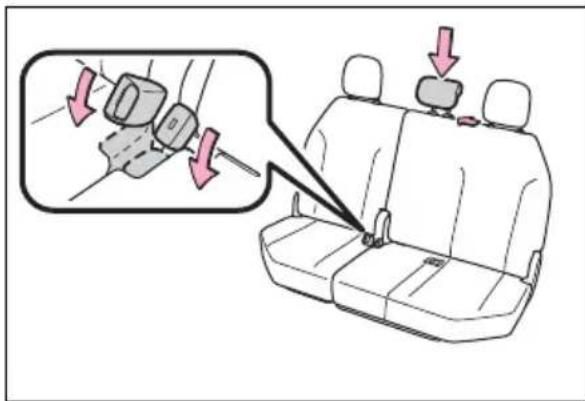
2 Stow the center seat belt. (→P.38)
■Stowing the third seats
1 Pull the handle to move the seat rearward. Then push the seat down.
The outside head restraints are
folded automatically.
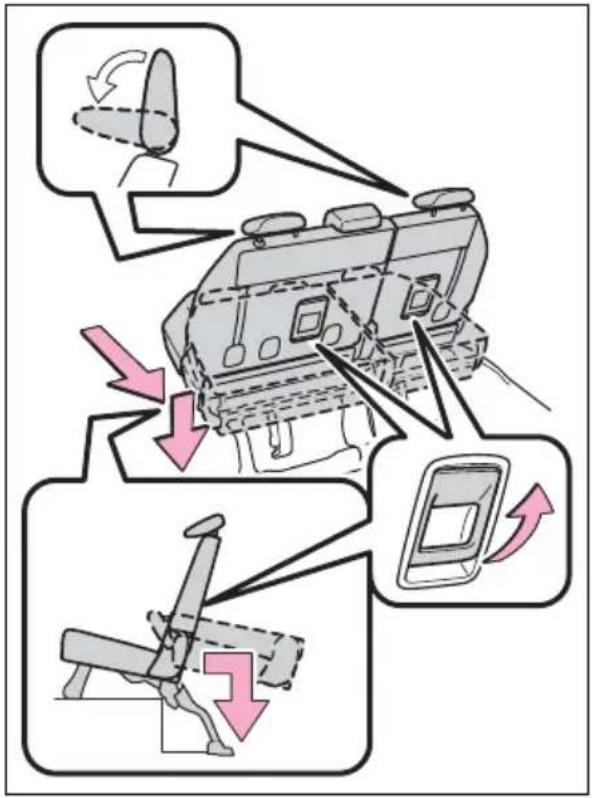
2 Push the seat against the floor.
Open the flaps.
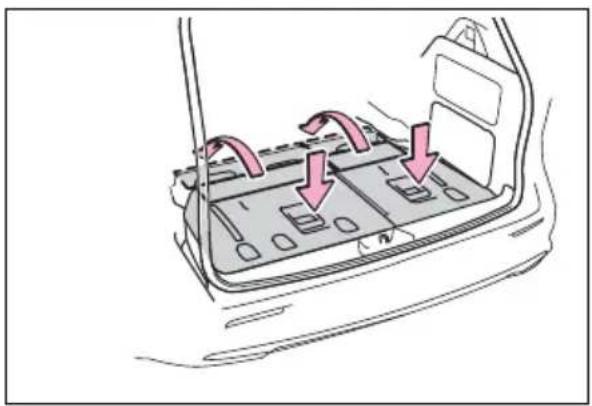
natural_image
Diagram of a car interior showing airflow or ventilation system with arrows indicating direction (no text or symbols)■Before returning the third seats
Be sure to move the second seats forward from the rearmost position, as they may interfere with the third seats returning operation.
■Returning the third seats
1 Return the flaps.
Pull the handle and lift up the seat
rearward.
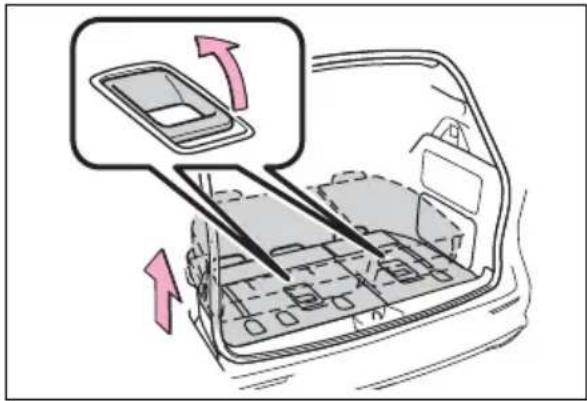
2 Push the seat forward and then engage the front leg locks.
Make sure the front and rear legs are locked securely.
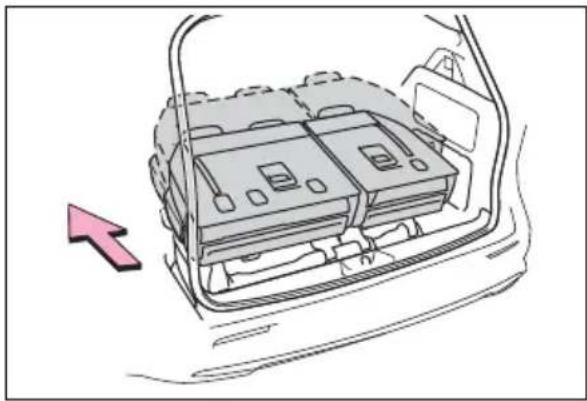
natural_image
Diagram of a car backrest with internal compartments and a pink arrow pointing to the side (no text or symbols)3 Raise the seatback and the outside head restraints. (→P.174)

WARNING
■When folding the rear seat-backs down
Observe the following precautions. Failure to do so may result in death or serious injury.
- Do not fold the seatbacks down while driving.
- Stop the vehicle on level ground, set the parking brake and shift the shift lever to P.

WARNING
- Do not allow anyone to sit on a folded seatback or in the luggage compartment while driving.
- Do not allow children to enter the luggage compartment.
● Be careful not to get any part of your body pinched by a seat.
■After returning the rear seat-backs or installing seats
Observe the following precautions. Failure to do so may result in death or serious injury.
● Make sure the seatback is securely locked by pushing it forward and rearward on the top.
- Check that the seat belts are not twisted or caught in the seatback. If the seat belt gets caught between the seatback's securing hook and latch, the seat belt may be damaged.
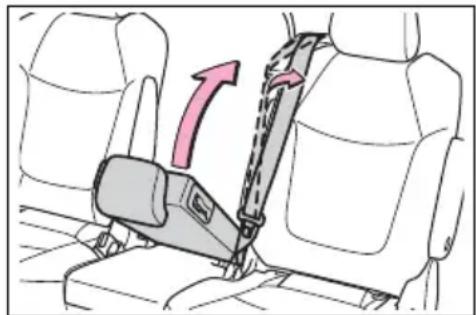
natural_image
Diagram of a car seatbelt buckle assembly with an arrow indicating direction (no text or symbols present)● Make sure the seat is locked in place by trying to shake the seatback and lift up the seat cushion.
■After removing the second center seat (8-passenger models)
- Remove the second center seat from the vehicle or store it securely in the luggage compartment.
- Do not sit on or place anything on a seat that has been removed from the vehicle.
■ Stowing the third seats
● Make sure that the seat path is clear before moving the seat. Otherwise, injury may result from contact with, or by being pinched by parts of the seat. - Do not sit on the third seat when it is in the stowed position with the seatback upright.

NOTICE
■To prevent damage to the seat
●Avoid putting heavy loads on a folded seat that is being used as a temporary table.
- Do not sit on or put heavy loads on the second center seat that has been removed from the vehicle. The metal tips of the seat leg may be damaged, preventing reinstallation of the seat.
●The second center seat must be reinstalled in its original position (8-passenger models). If it is installed in the wrong position, the seat locks or bezels will be damaged.
● Make sure that the path the seat will move through is clear before stowing or returning the third seat.
●8-passenger models: Be sure to raise the stowed second center seat above the outer trim, when removing from the storage box of the luggage room.

NOTICE
■ Stowing the seat belt
The seat belts and the buckles must be stowed before you fold down the rear seatbacks.
Driving position mem- ory\*
*: If equipped
This feature automatically adjusts the positions of the driver's seat, steering wheel, outside rear view mirrors and head-up display (if equipped) to make entering and exiting the vehicle easier or to suit your preferences.
Two different driving positions can be recorded into memory.
Each electronic key can be registered to recall your preferred driving position.
Enabling easier driver entry and exit (power easy access system)
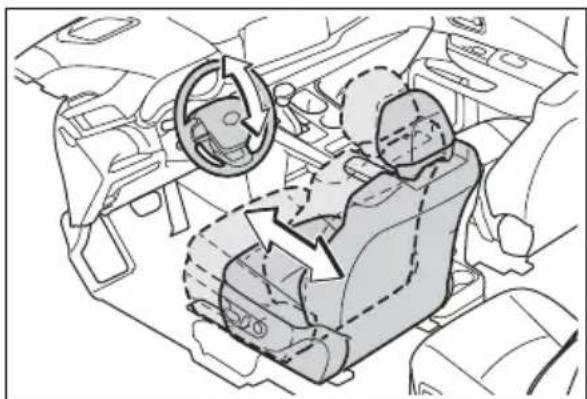
natural_image
Interior view of a car showing steering wheel, dashboard, and driver seat (no text or symbols)When all of the following have been performed, the driver's seat and steering wheel are automatically adjusted to a position that allows driver to enter and exit the vehicle easily.
● The shift lever has been shifted to P.
● The power switch has been turned off.
- The driver' seat belt has been unfastened.
When any of the following has been performed, the driver' seat and steering wheel automatically return to their original positions.
● The power switch has been turned to ACC or ON.
- The driver' seat belt has been fastened.
Recording/recalling a driving position
Recording procedure
1 Check that the shift lever is in P.
2 Turn the power switch to ON.
3 Adjust the driver's seat, steering wheel, outside rear view mirrors and head-up display (if equipped) to the desired positions.
4 While pressing the "SET" button, press button "1" or "2" until the buzzer sounds.
If the selected button has already been preset, the previously recorded position will be overwritten.
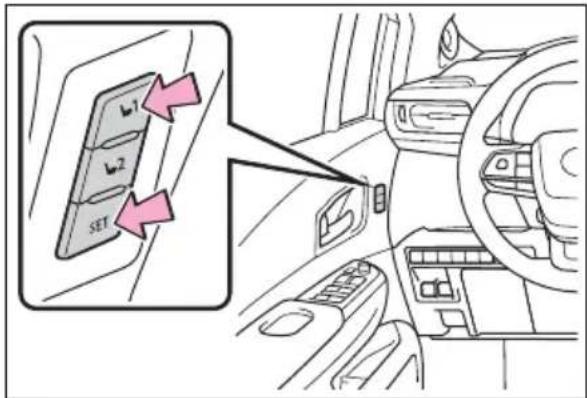
■Recall procedure
1 Check that the shift lever is in P.
2 Turn the power switch to ON.
3 Press one of the buttons for the driving position you want to recall until the buzzer sounds.
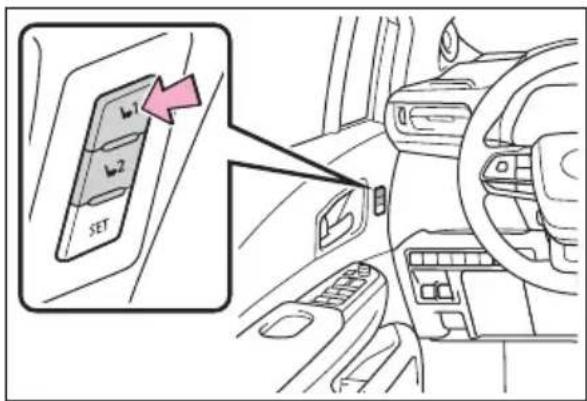
■To stop the position recall operation part-way through
Perform any of the following:
- Press the "SET" button.
- Press button "1" or "2".
- Operate any of the seat adjustment switches (only cancels seat position recall).
- Operate the tilt and telescopic steering control switch (only cancels steering wheel position recall).
■ Seat positions that can be memorized ( P.169)
The adjusted positions other than the position adjusted by lumbar support switch can be recorded.
■Operating the driving position memory after turning the power switch to OFF
Recorded seat positions can be activated up to 180 seconds after the driver's door is opened and another 60 seconds after it is closed again.
In order to correctly use the driving position memory function
If a seat position is already in the furthest possible position and the seat is operated in the same direction, the recorded position may be slightly different when it is recalled.
■When recalling the driving position
Take care when recalling the driving position so that the head restraint does not touch the ceiling.
If the 12-volt battery is disconnected
The memorized positions are erased.

WARNING
■Seat adjustment caution
Take care during seat adjustment so that the seat does not strike the rear passenger or squeeze your body against the steering wheel.
Registering/recall/cancel- ing a driving position to an electronic key (mem- ory recall function)
■Registering procedure
Record your driving position to button "1" or "2" before performing the following:
Carry only the key you want to register, and then close the driver's door.
If 2 or more keys are in the vehicle, the driving position cannot be recorded properly.
1 Check that the shift lever is in P.
2 Turn the power switch to ON.
3 Recall the driving position that you want to record.
4 While pressing the recalled button, press and hold the door lock switch (either lock or unlock) until the buzzer sounds.
If the button could not be registered, the buzzer sounds continuously for approximately 3 seconds.
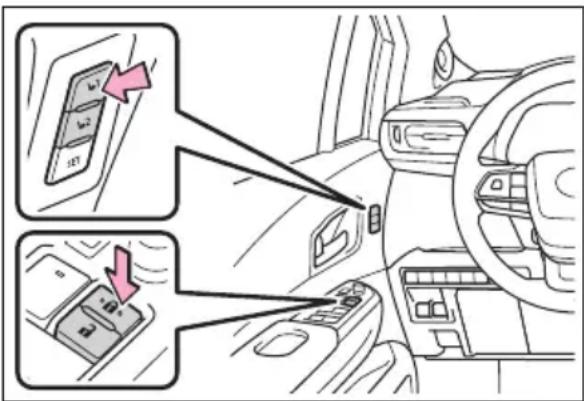
■Recall procedure
1 Make sure that the doors are locked before recalling the driving position. Carry the electronic key that has been registered to the driving position, and then unlock and open the driver's door using the smart key system or wireless remote control.
The driving position will move to the recorded position (not including the steering wheel and head-up display [if equipped]). However, the seat will move to a position slightly behind the recorded position in order to make entering the vehicle easier.
If the driving position is in a position that has already been recorded, the seat will not move.
2 Turn the power switch to ACC or ON, or fasten a seat belt.
The seat, steering wheel and head-up display (if equipped) will move to the recorded position.
■Cancelation procedure
Carry only the key you want to cancel and then close the driver's door.
If 2 or more keys are in the vehicle, the driving position cannot be canceled properly.
1 Check that the shift lever is in P.
2 Turn the power switch to ON.
3 While pressing the "SET" button, press and hold the door lock switch (either lock or
unlock) until the buzzer sounds twice.
If the button could not be canceled, the buzzer sounds continuously for approximately 3 seconds.
■Recalling the driving position using the memory recall function
● Different driving positions can be registered for each electronic key. Therefore, the driving position that is recalled may be different depending on the key being carried.
- If a door other than the driver's door is unlocked with smart key system, the driving position cannot be recalled. In this case, press the driving position button which has been set.
Customization
Settings (e.g. the unlock door settings of the memory recall function) can be customized. (Customizable features: →P.547)
Head restraints
Head restraints are provided for all seats.

WARNING
■Head restraint precautions
Observe the following precautions regarding the head restraints. Failure to do so may result in death or serious injury.
● Use the head restraints designed for each respective seat.
- Adjust the head restraints to the correct position at all times.
● After adjusting the head restraints, push down on them and make sure they are locked in position.
- Do not drive with the head restraints removed.
Vertical adjustment
■Front and second outside seats
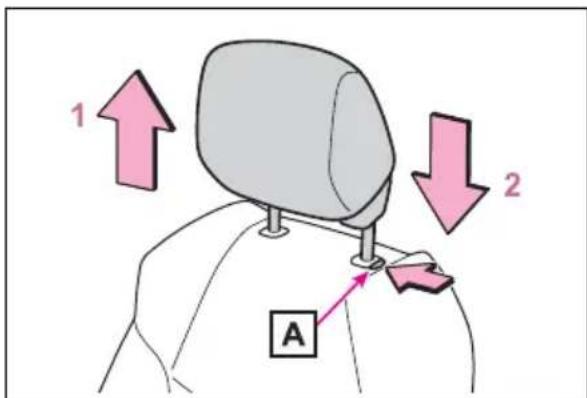
1 Up
Pull the head restraints up.
2 Down
Push the head restraint down while pressing the lock release button

■Second center \* and third center seats
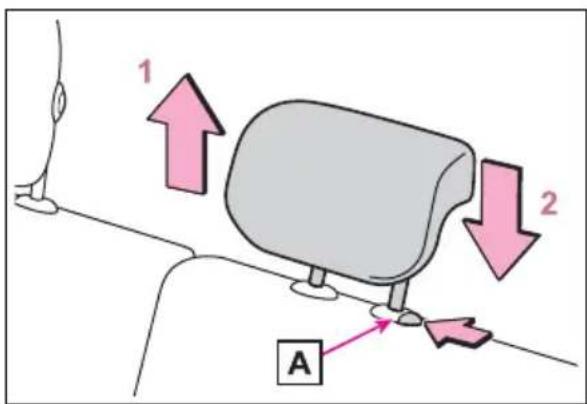
1 Up
Pull the head restraints up.
2 Down
Push the head restraint down while pressing the lock release button

*: 8-passenger models only
■Third outside seats
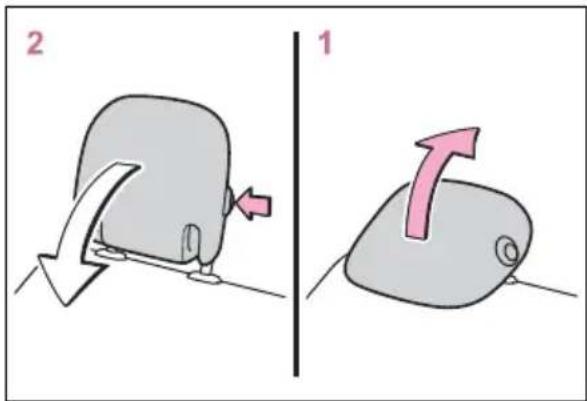
1 To use
Pull the head restraints up.
2 To fold
Press the button.
■Adjusting the height of the head restraints (Front and second outside seats)
Make sure that the head restraints are adjusted so that the center of the head restraint is closest to the
top of your ears.
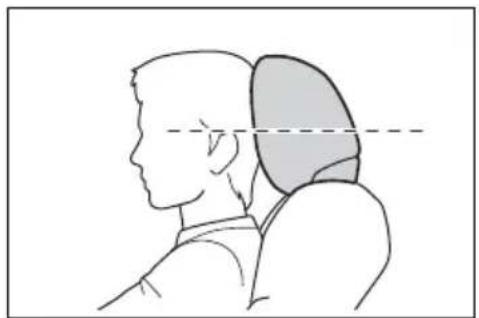
natural_image
Side profile illustration of a person facing forward and back, with no text or symbols present■Adjusting the center seat head restraint
Always raise the head restraint one level from the stowed position when using.
Removing the head restraints
■Front and second outside seats
Pull the head restraint up while pressing the lock release button A.
If the head restraint touches the ceiling, making the removal difficult, change the seat height or angle. (→P.169)
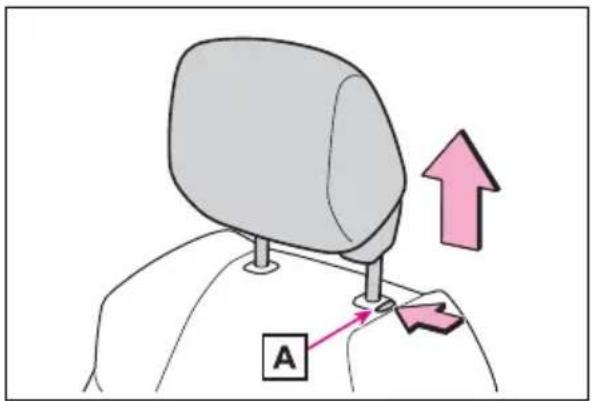
■Second center \* and third center seats
Pull the head restraint up while pressing the lock release button A.
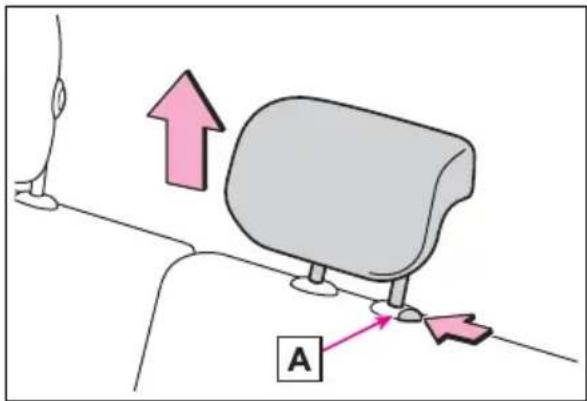
*: 8-passenger models only
■Third outside seats
The head restraint cannot be removed.
Installing the head restraints
■Front and second outside seats
Align the head restraint with the installation holes and push it down to the lock position. Press and hold the lock release button A when lowering the head restraint.
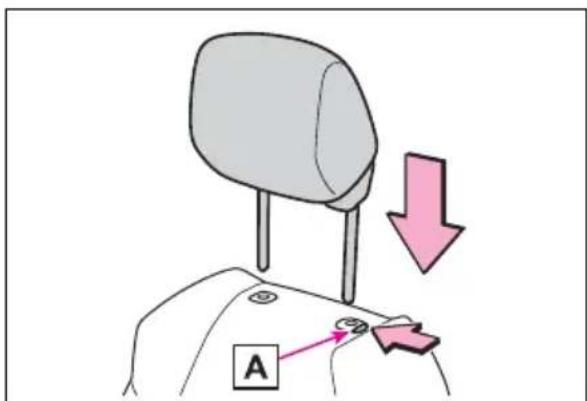
■Second center \* and third center seats
Align the head restraint with the installation holes and push it down to the lowest lock position.
Press and hold the lock release button A when lowering the head restraint.
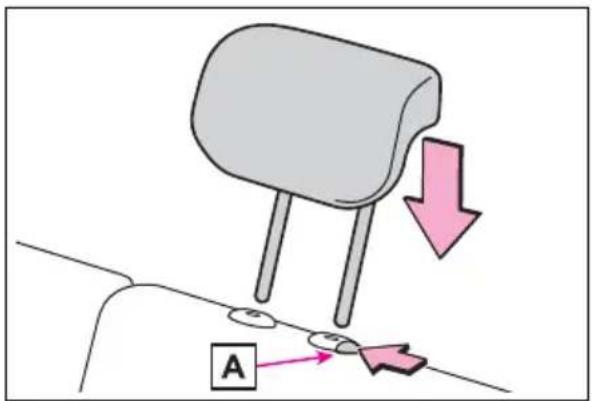
*: 8-passenger models only
Steering wheel
Adjustment procedure
▶ Manual type
1 Hold the steering wheel and push the lever down.
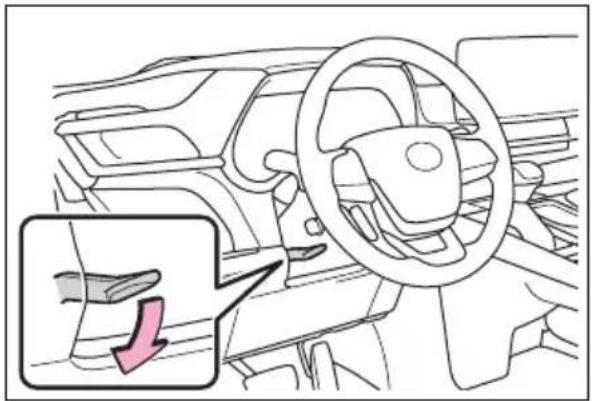
natural_image
Interior view of a car dashboard and steering wheel, showing the steering wheel and dashboard (no text or symbols visible)2 Adjust to the ideal position by moving the steering wheel horizontally and vertically.
After adjustment, pull the lever up to secure the steering wheel.
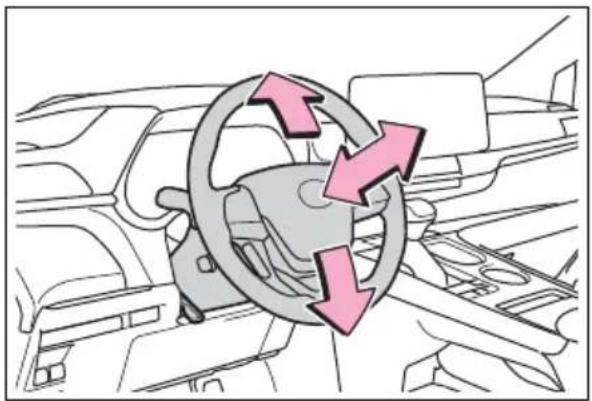
natural_image
Diagram of a car interior showing steering wheel and directional arrows (no text or symbols)Power type
Operating the switch moves the steering wheel in the following directions:
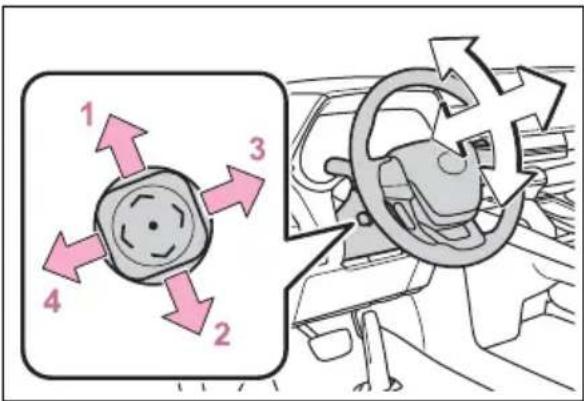
1 Up
2 Down
3 Toward the driver
4 Away from the driver
■The steering wheel (power type) can be adjusted when
The power switch is in ACC or ON ^ . ^ : If the driver' seat belt is fastened, the steering wheel can be adjusted regardless of power switch mode.
■Automatic adjustment of the steering position (power type)
A desired steering position can be entered to memory and recalled automatically by the driving position memory system. (→P.178)
■Power easy access system (if equipped)
The steering wheel and driver' seat move in accordance with power switch mode and the driver' seat belt condition. (→P.178)
■After adjusting the steering wheel (manual type)
Make sure that the steering wheel is securely locked.

WARNING
■Caution while driving
Do not adjust the steering wheel while driving.
Doing so may cause the driver to mishandle the vehicle and cause an accident, resulting in death or serious injury.
■After adjusting the steering wheel (manual type)
Make sure that the steering wheel is securely locked.
Otherwise, the steering wheel may move suddenly, possibly causing an accident, and resulting in death or serious injury. Also, the horn may not sound if the steering wheel is not securely locked.
Sounding the horn
To sound the horn, press on or close to the mark.
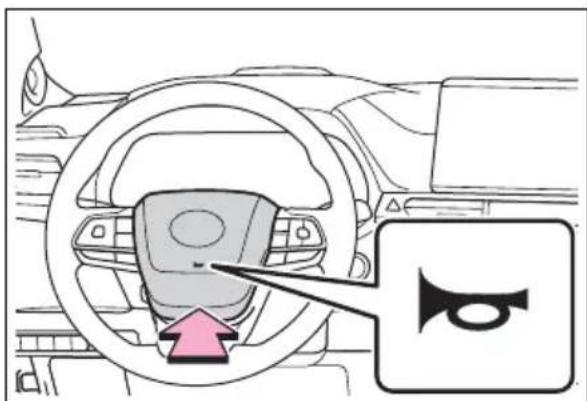
Inside rear view mir- ror\*
*: If equipped
The rear view mirror's position can be adjusted to enable sufficient confirmation of the rear view.
Adjusting the height of rear view mirror
The height of the rear view mirror can be adjusted to suit your driving posture.
Adjust the height of the rear view mirror by moving it up and down.
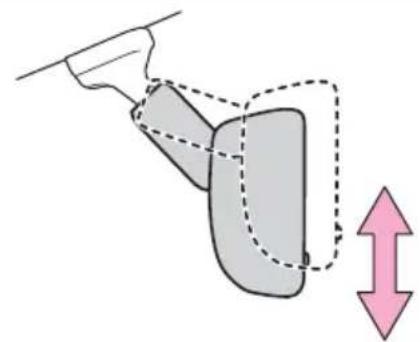
natural_image
Diagram showing a hand holding a tool interacting with a gray mechanical component, with a pink double-headed arrow indicating upward motion (no text or symbols)
WARNING
■Caution while driving
Do not adjust the position of the mirror while driving. Doing so may lead to mishandling of the vehicle and cause an accident, resulting in death or serious injury.
Anti-glare function (vehicles with manual anti-glare inside rear view mirror)
Reflected light from the head-lights of vehicles behind can be reduced by operating the lever.
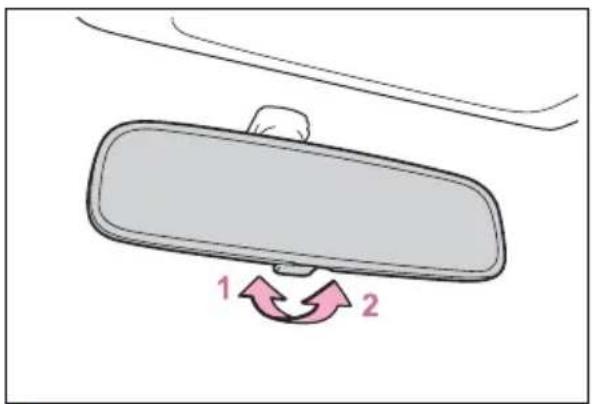
1 Normal position
2 Anti-glare position
Anti-glare function (vehicles with auto anti-glare inside rear view mirror)
Responding to the level of brightness of the headlights of vehicles behind, the reflected light is automatically reduced.
Changing automatic anti-glare function mode on/off
When the automatic anti-glare function is in ON mode, the indicator A illuminates.
The function will set to ON mode each time the power switch is turned to ON.
Pressing the button turns the function to OFF mode. (The indicator
A also turns off.)
▶ Vehicles without garage door opener
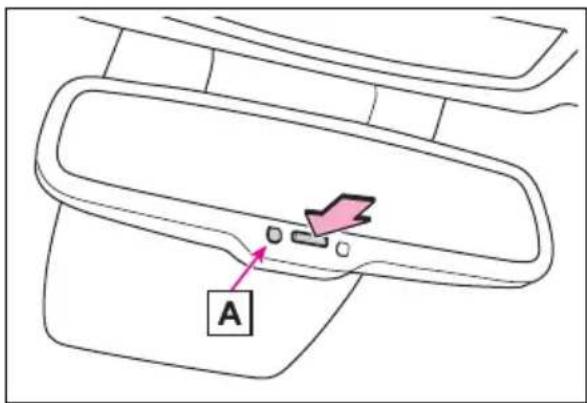
▶ Vehicles with garage door opener
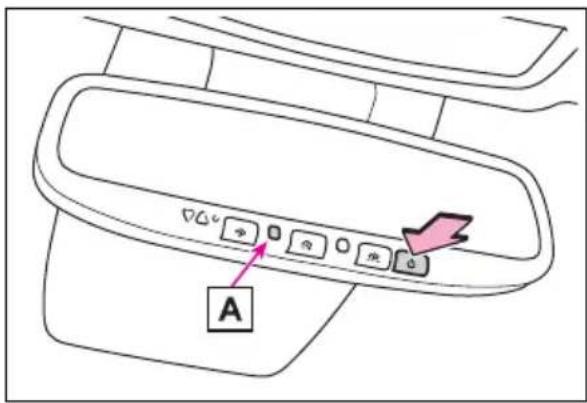
■To prevent sensor error (vehicles with auto anti-glare inside rear view mirror)
To ensure that the sensors operate properly, do not touch or cover them.
▶ Vehicles without garage door opener
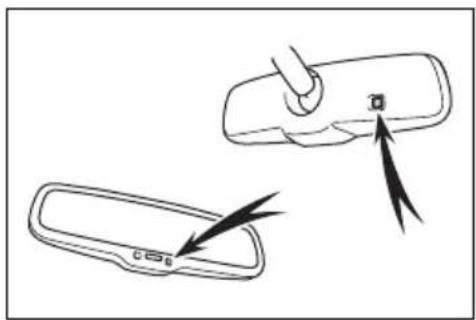
natural_image
Diagram showing two views of a car rear door with a handle and a small square button, no text or symbols present▶ Vehicles with garage door opener
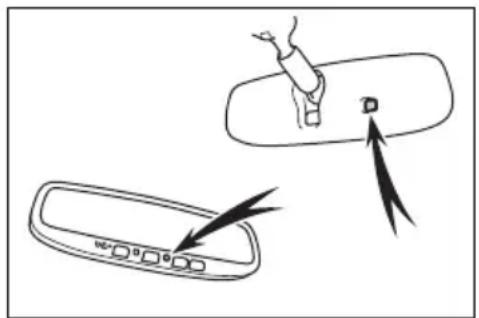
Digital Rear-view Mirror\*
*: If equipped
The Digital Rear-view Mirror is a system that uses the camera on the rear of the vehicle and displays its image on the display of the Digital Rear-view Mirror.
The Digital Rear-view Mirror can be changed between optical mirror mode and digital mirror mode by operating the lever.
The Digital Rear-view Mirror allows the driver to see the rear view despite obstructions, such as the head restraints or luggage, ensuring rear visibility.
Also, the rear seats are not displayed and privacy of the passengers is enhanced.

WARNING
Observe the following precautions.
Failure to do so may result in death or serious injury.
■Before using the Digital Rear-view Mirror
● Make sure to adjust the mirror before driving. (→P.190)
- Change to optical mirror mode and adjust the position of the Digital Rear-view Mirror so that the area behind your vehicle can be viewed properly.

WARNING
- Change to digital mirror mode and adjust the display settings.
As the range of the image displayed by the Digital Rear-view Mirror is different from that of the optical mirror, make sure to check this difference before driving.
System components
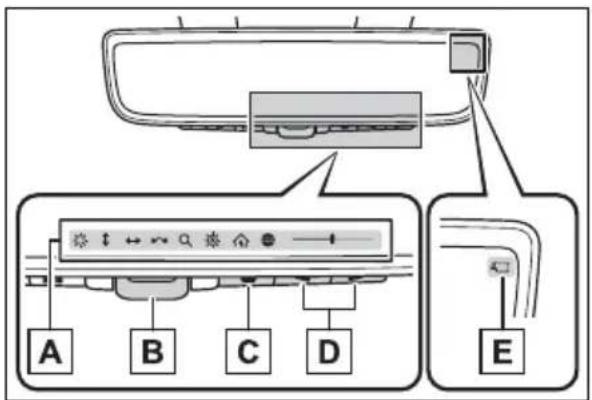
A Icon display area
Displays icons, adjusting gauge, etc. ( P.190)
B Lever
Operate to change between digital mirror mode and optical mirror mode.
C Menu button
Press to display the icon display area and select the item you want to adjust.
D Select/adjust button
Press to change the setting of the item you want to adjust.
E Camera indicator
Indicates that the camera is operating normally.
Changing modes
Operate the lever to change between digital mirror mode and optical mirror mode.
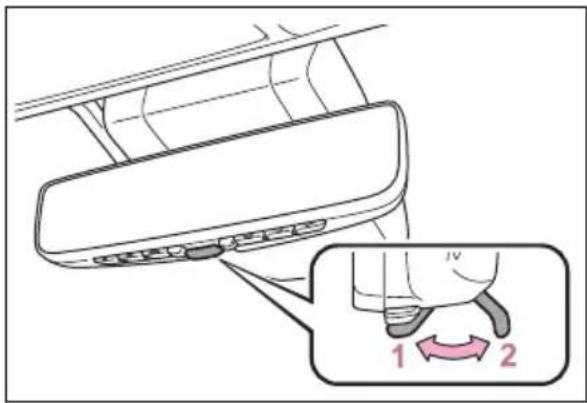
1 Digital mirror mode
Displays an image of the area behind the vehicle.
will illuminate in this mode.
2 Optical mirror mode
Turns off the display of the Digital Rear-view Mirror allows it to be used as an optical mirror.
■Digital mirror mode operating condition
The power switch is turned to ON. When the power switch is changed from ON to OFF or ACC, the image will disappear after several seconds.
When using the Digital Rear-view Mirror in digital mirror mode
- If it is difficult to see the displayed image due to light reflected off the Digital Rear-view Mirror, the camera being dirty or covered with water droplets, or if lights of a vehicle behind your vehicle or the displayed image are bothering you, change to optical mirror mode.
- When the back door is open, the Digital Rear-view Mirror image may not display properly. Before
driving, make sure the back door is closed.
- If the display is difficult to see due to reflected light, close the sun-shade for the moon roof (if equipped).
●Any of the following conditions may occur when driving in the dark, such as at night. None of them indicates that a malfunction has occurred. - Colors of objects in the displayed image may differ from their actual color.
- Depending on the height of the lights of the vehicle behind, the area around the vehicle may appear white and blurry.
• Automatic image adjustment for brighter surrounding image may cause flickering.
If it is difficult to see the displayed image or flickering bothers you, change to optical mirror mode.
●The Digital Rear-view Mirror may become hot while it is in digital mirror mode.
This is not a malfunction.
● Depending on your physical condition or age, it may take longer than usual to focus on the displayed image. In this case, change to optical mirror mode.
- Do not let passengers stare at the displayed image when the vehicle is being driven, as doing so may cause motion sickness.
■When the system malfunctions
If the symbol shown in the illustration is displayed when using the Digital Rear-view Mirror in digital mirror mode, the system may be malfunctioning. The symbol will disappear in a few seconds. Operate the lever, change to optical mirror mode and have the vehicle inspected by your Toyota dealer.
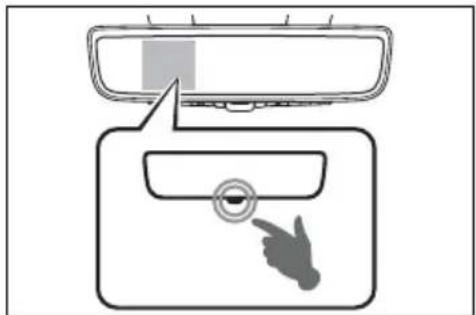
natural_image
Diagram showing a door with a cursor pointing at the bottom panel, no text or symbols presentAdjusting the mirror
■Adjusting the mirror height
The height of the rear view mirror can be adjusted to suit your driving posture.
Change to optical mirror mode, adjusting the height of the rear view mirror by moving it up and down.
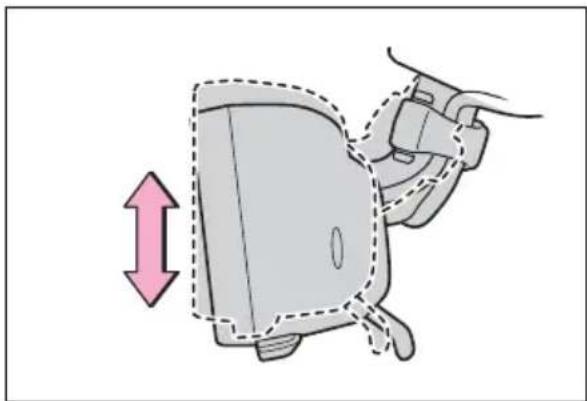
natural_image
Illustration of a hand holding a device with a pink directional arrow indicating left motion (no text or symbols)■Display settings (digital mirror mode)
Settings of the display in the digital mirror mode, on/off operation of the automatic anti-glare function, etc. can be changed.
1 Press the menu button.
The icons will be displayed.
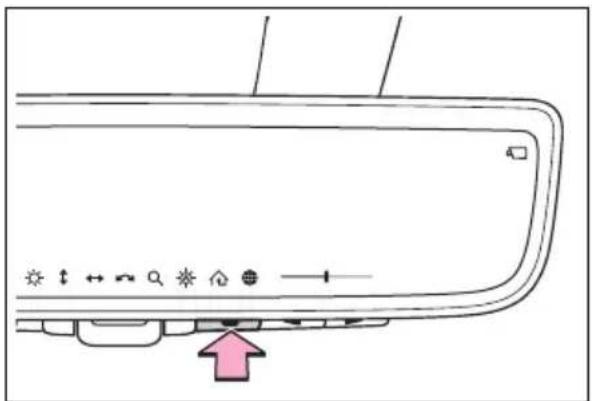
2 Press the menu button repeatedly and select the item you want to adjust.
3 Press or to change the setting.
The icons will disappear if a button is not operated for approximately 5 seconds or more.
| Icons Settings | |
| Select to adjust the brightness of the display. | |
| Select to adjust the area displayed up/down. | |
| Select to adjust the area displayed to the left/right. | |
| Select to adjust the angle of the displayed image. | |
| Select to zoom in/out the displayed image. | |
| Icons | Settings |
| Select to enable/disable the automatic anti-glare function.*Responding to the brightness of the headlights of vehicles behind, the reflected light is automatically adjusted.The automatic anti-glare function is enabled each time the power switch is changed to ON. | |
| Select to displayHomeLink® Training Tutorial to assist customers to train their Garage Door Opener System. (→P.392) | |
| Select to change the language of the Homelink® Training Tutorial. |
*: This is a function for the optical mirror mode, however, the setting can also be changed while using the digital mirror mode.
■Enabling/disabling the automatic anti-glare function (optical mirror mode)
The automatic anti-glare function in the optical mirror mode can be enabled/disabled. The setting can be changed in both the digital mirror mode and the optical mirror mode.
When using the digital mirror mode
→P.190
When using the optical mirror mode
1 Press the menu button.
The icons will be displayed.
2 Press the menu button repeatedly and select 🔒
The setting display will be displayed.
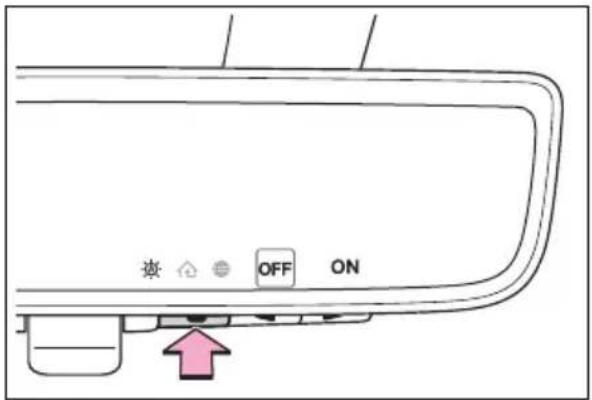
3 Press or to enable (ON)/disable (OFF) the automatic anti-glare function.
The icons will disappear if a button is not operated for approximately 5 seconds or more.
■Adjusting the display (digital mirror mode)
- If the displayed image is adjusted, it may appear distorted. This is not a malfunction.
- If the brightness of the Digital Rear-view Mirror is set too high, it may cause eye strain. Adjust the Digital Rear-view Mirror to an appropriate brightness. If your eyes become tired, change to optical mirror mode.
●The brightness of the Digital Rearview Mirror will change automatically according to the brightness of the area in front of your vehicle.
■ To prevent the light sensors from malfunctioning
To prevent the light sensors from malfunctioning, do not touch or cover them.
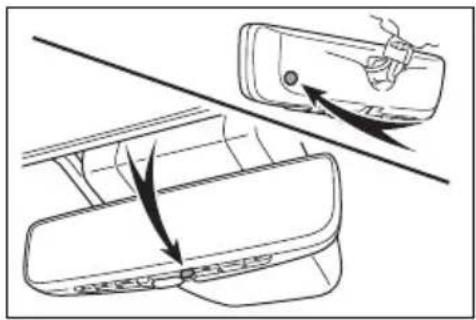
natural_image
Diagram showing a car interior with a vehicle and a hand holding a device, no text or symbols present
WARNING
Observe the following precautions.
Failure to do so may result in death or serious injury.
■While driving
- Do not adjust the position of the Digital Rear-view Mirror or adjust the display settings while driving.
Stop the vehicle and operate the Digital Rear-view Mirror control switches.
Failure to do so may cause a steering wheel operation error, resulting in an unexpected accident.
●Always pay attention to the vehicle's surroundings.
The size of the vehicles and other objects may look different when in digital mirror mode and optical mirror mode.
When backing up, make sure to directly check the safety of the area around your vehicle, especially behind the vehicle.
Additionally, if a vehicle approaches from the rear in the dark, such as at night, the surrounding area may appear dim.

WARNING
■To prevent causes of fire
If the driver continues using the Digital Rear-view Mirror while smoke or odor comes from the mirror, it may result in fire. Stop using the system immediately and contact your Toyota dealer.
Cleaning the Digital Rear-view Mirror
■Cleaning the mirror surface
If the mirror surface is dirty, the image on the display may be difficult to see.
Clean the mirror surface gently using a soft dry cloth.
■Cleaning the camera
If the camera lens is dirty or covered with foreign matter, such as water droplets, snow, mud, etc., the displayed image may not be clear. In this case, rinse the camera lens with a large quantity of water and then wipe it clean with a soft cloth dampened with water.
Dirt on the camera lens can be cleaned by operating the dedicated camera cleaning washer. (→P.257)
The camera
The camera for the Digital Rearview Mirror is located as shown.
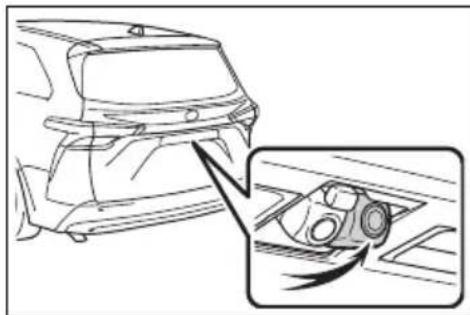
natural_image
Line drawing of a car interior showing the dashboard and dashboard lift (no text or symbols)
NOTICE
■To prevent the Digital Rear-view Mirror from malfunctioning
- Do not use detergents, such as thinner, benzene, and alcohol to clean the mirror. They may discolor, deteriorate or damage the mirror surface.
- Do not smoke, use matches, use cigarette lighters or allow open flames near the mirror. It may damage the mirror or cause a fire.
- Do not remove, disassemble or modify the mirror.
■To prevent the camera from malfunctioning
- Observe the following precautions, otherwise the Digital Rear-view Mirror may not operate properly.
- Do not strike or hit the camera or subject it to a strong impact, as the camera installation position and angle may be changed.
- Do not remove, disassemble or modify the camera.
- Do not allow an organic solvent, car wax, window cleaner or glass coating to adhere to the camera. If this happens, wipe it off as soon as possible.

NOTICE
- When washing the camera, rinse it with a large quantity of water and then wipe it clean with a soft cloth dampened with water.
Do not strongly rub the camera lens, as it may be scratched and will not be able to transmit a clear image. - Do not apply hot water to the camera in cold weather, as the sudden change of temperature may cause the camera to not operate properly.
- When using a high pressure washer to wash the vehicle, do not directly spray the camera and its surrounding area, as doing so may cause the camera to not operate properly.
- Do not subject the camera to a strong impact as this could cause a malfunction. If this happens, have the vehicle inspected by your Toyota dealer as soon as possible.
If you notice any symptoms
If you notice any of the following symptoms, refer to the following table for the likely cause and the solution.
If the symptom is not resolved by the solution, have the vehicle inspected by your Toyota dealer.
| Symptom Likely cause Solution | ||
| The image is difficult to see. | The mirror surface is dirty. | Clean the mirror surface gently, using a soft dry cloth. |
| Sunlight or headlights are shining directly into the Digital Rear-view Mirror. | Change to optical mirror mode.(If the light is coming through the moon roof [if equipped], close the sunshade.) | |
| The vehicle is in a dark area.The vehicle is near a TV tower, broadcasting station, electric power plant, or other location where strong radio waves or electrical noise may be present.The temperature around the camera is extremely high/low.The ambient temperature is extremely low.It is raining or humid.Sunlight or headlights are shining directly into the camera lens.The vehicle is under fluorescent lights, sodium lights, mercury lights, etc.Exhaust gas is obstructing the camera. | Change to optical mirror mode.(Change back to digital mirror mode when the conditions have improved.) | |
| The image is difficult to see. | Foreign matters (such as water droplets, snow, mud, etc.) is on the camera lens. | Operate the dedicated camera cleaning washer and clean the camera lens.Change to optical mirror mode.Rinse the camera with a large quantity of water, wipe it clean with a soft cloth dampened with water, and then change back to digital mirror mode. |
| The image is out of alignment. | The back door is not fully closed. | Fully close the back door. |
| The camera or its surrounding area has received a strong impact. | Change to optical mirror mode and have the vehicle inspected by your Toyota dealer. | |
The display is dim and  is displayed. is displayed. | The system may be malfunctioning. | Change to optical mirror mode and have the vehicle inspected by your Toyota dealer. |
 goes off. goes off. | ||
| is displayed. | The Digital Rear-view Mirror is extremely hot. (The display will gradually become more dim. If the temperature continues to increase, the Digital Rear-view Mirror will turn off.) | Reducing the cabin temperature is recommended to reduce the temperature of the mirror.(will disappear when the mirror becomes cool.)Ifdoes not disappear even though the mirror is cool, have the vehicle inspected by your Toyota dealer. |
| The lever cannot be operated properly. | The lever may be malfunctioning. | Change to optical mirror mode and have the vehicle inspected by your Toyota dealer.(To change to optical mirror mode, press and hold the menu button for approximately 10 seconds.) |
Outside rear view mirrors
The rear view mirror's position can be adjusted to enable sufficient confirmation of the rear view.
■Defogging the mirrors (if equipped)
The outside rear view mirrors can be cleared using the mirror defoggers. Turn on the rear window defogger to turn on the outside rear view mirror defoggers. (→P.350)

WARNING
■ Important points while driving
Observe the following precautions while driving. Failing to do so may result in loss of control of the vehicle and cause an accident, resulting in death or serious injury.
- Do not adjust the mirrors while driving.
- Do not drive with the mirrors folded.
● Both the driver and passenger side mirrors must be extended and properly adjusted before driving.
■When the mirror defoggers are operating (if equipped)
Do not touch the rear view mirror surfaces, as they can become very hot and burn you.
Adjustment procedure
1 To select a mirror to adjust, press the switch.
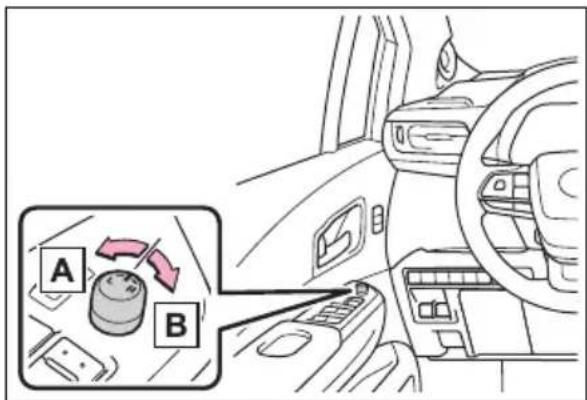
A Left
B Right
2 To adjust the mirror, press the switch.
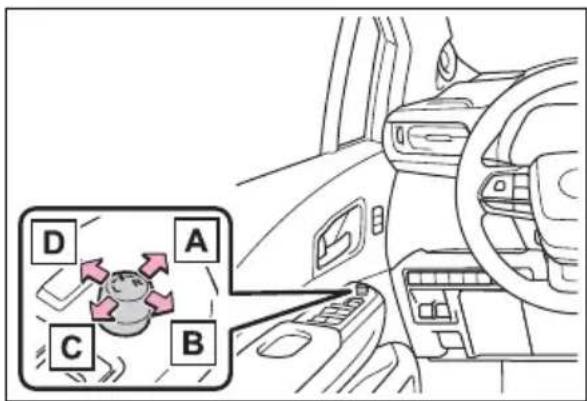
A Up
B Right
C Down
D Left
■Mirror angle can be adjusted when
The power switch is in ACC or ON.
■ Auto anti-glare function (if equipped)
When the anti-glare inside rear view mirror is set to automatic mode, the outside rear view mirrors will acti-
vate in conjunction with the anti-glare inside rear view mirror to reduce reflected light.
■Automatic adjustment of the mirror angle (vehicles with driving position memory)
A desired mirror face angle can be entered to memory and recalled automatically by the driving position memory. (→P.178)
Folding and extending the mirrors
▶ Manual type
Push the mirror back in the direction of the vehicle's rear.
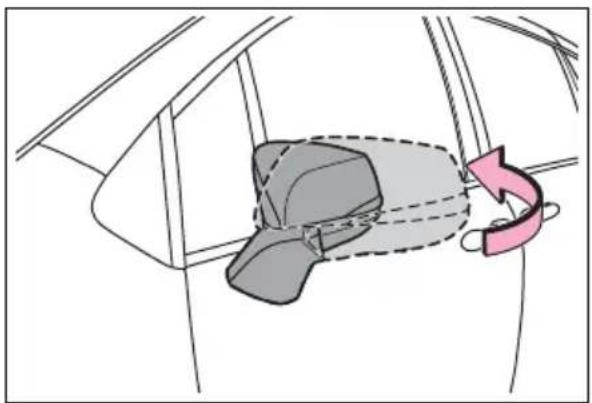
natural_image
Diagram of a car interior showing a seatbelt and directional arrow (no text or symbols)▶ Power type
Press the switch.
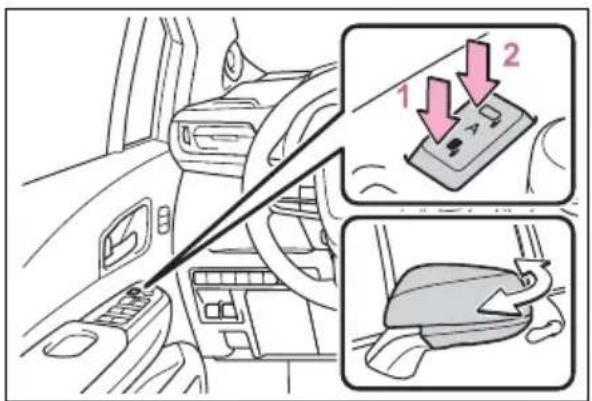
1 Folds the mirrors
2 Extends the mirrors
Putting the outside rear view mirror folding switch in the neutral position sets the mirrors to automatic mode. Automatic mode allows the folding or extending of the mirrors to be linked to locking/unlocking of the doors.
■ Using automatic mode in cold weather (power type)
When automatic mode is used in cold weather, the door mirror could freeze up and automatic stowing and return may not be possible. In this case, remove any ice and snow from the door mirror, then either operate the mirror using manual mode or move the mirror by hand.
Customization
The automatic mirror folding and extending operation can be changed.
■When a mirror is moving
To avoid personal injury and mirror malfunction, be careful not to get your hand caught by the moving mirror.
Linked mirror function when reversing (vehicles with driving position memory)
When the mirror select switch is in the L or R position, the outside rear view mirrors will automatically angle downwards when the vehicle is reversing in order to give a better view of the ground.
To disable this function, move the mirror select switch to the neutral position (between L and
R).
■Adjusting the mirror angle when the vehicle is reversing
With the shift lever in R, adjust the mirror angle at a desired position. The adjusted angle will be memorized and the mirror will automatically tilt to the memorized angle whenever the shift lever is shifted to R from next time.
The memorized downward tilt position of the mirror is linked to the normal position (angle adjusted with the shift lever in other than R). Therefore, if the normal position is changed after adjustment, the tilt position will also change.
When the normal position is changed, readjust the angle in reversing.
Power windows
Opening and closing the power windows
The power windows can be opened and closed using the switches.
Operating the switch moves the side windows as follows:
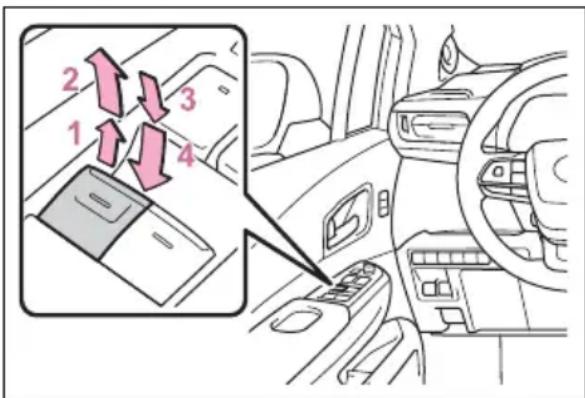
1 Closing
2 One-touch closing *
3 Opening
4 One-touch opening *
*: To stop the side window partway, operate the switch in the opposite direction.
■The power windows can be operated when
The power switch is in ON.
■Operating the power windows after turning the hybrid system off
The power windows can be operated for approximately 45 seconds even after the power switch is turned to ACC or OFF. They cannot, however, be operated once either front door is opened.
Jam protection function
If an object becomes jammed
between the side window and the window frame while the side window is closing, side window movement is stopped and the side window is opened slightly.
■ Catch protection function
If an object becomes caught between the door and side window while the side window is opening, side window movement is stopped.
■When the power window cannot be opened or closed
When the jam protection function or catch protection function operates unusually and the side window cannot be opened and closed, perform the following operations with the power window switch of that door.
- Stop the vehicle. With the power switch in ON, within 4 seconds of the jam protection function or catch protection function activating, continuously operate the power window switch in the one-touch closing direction or one-touch opening direction so that the side window can be opened and closed.
- If the side window cannot be opened and closed even when performing the above operations, perform the following procedure for function initialization.
1 Turn the power switch to ON.
2 Pull and hold the power window switch in the one-touch closing direction and completely close the side window.
3 Release the power window switch for a moment, resume pulling the switch in the one-touch closing direction, and hold it there for approximately 6 seconds or more.
4 Press and hold the power window switch in the one-touch opening direction. After the side window is completely opened, continue holding the switch for an additional 1 second or more.
5 Release the power window switch for a moment, resume pushing the switch in the one-touch opening direction, and hold it there for approximately 4 seconds or more.
6 Pull and hold the power window switch in the one-touch closing direction again. After the side window is completely closed, continue holding the switch for a further 1 second or more.
If you release the switch while the side window is moving, start again from the beginning.
If the side window reverses and cannot be fully closed or opened, have the vehicle inspected by your Toyota dealer.
■Door lock linked power window operation
●The power windows can be opened and closed using the mechanical key.* (→P.504)
●The power windows can be opened using the wireless remote control.* (→P.132)
● Vehicles with alarm: The alarm may be triggered if the alarm is set and the power window is closed using the door lock linked power window operation function. (→P.89)
*: These settings must be customized at your Toyota dealer.
■Power window open reminder function
The buzzer sounds and a message is shown on the multi-information display when the power switch is turned to OFF and the driver's door is opened with the power windows open.
Customization
Settings (e.g. linked door lock operation) can be changed. (Customizable features: →P.547)

WARNING
Observe the following precautions.
Failing to do so may result in death or serious injury.
■ Closing the power windows
The driver is responsible for all the power window operations, including the operation for the passengers. In order to prevent accidental operation, especially by a child, do not let a child operate the power windows. It is possible for children and other passengers to have body parts caught in the power window. Also, when riding with a child, it is recommended to use the window lock switch. (→P.203)
- Check to make sure that all passengers do not have any part of their body in a position where it could be caught when a power window is being operated.
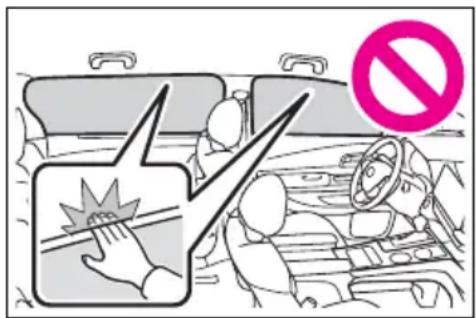
- When using the wireless remote control, key or mechanical key and operating the power windows, operate the power window after checking to make sure that there is no possibility of any passenger having any of their body parts caught in the side window. Also, do not let a child operate the power window by the wireless remote control, key or mechanical key. It is possible for children and other passengers to get caught in the power window.

WARNING
- When exiting the vehicle, turn the power switch to OFF, carry the key and exit the vehicle along with the child. There may be accidental operation, due to mischief, etc., that may possibly lead to an accident.
■Jam protection function
● Never use any part of your body to intentionally activate the jam protection function.
●The jam protection function may not work if something gets jammed just before the side window is fully closed. Be careful not to get any part of your body jammed in the side window.
■ Catch protection function
● Never use any part of your body or clothing to intentionally activate the catch protection function.
●The catch protection function may not work if something gets caught just before the side window is fully opened. Be careful not to get any part of your body or clothing caught in the side window.
Preventing accidental operation (window lock switch)
This function can be used to prevent children from accidentally opening or closing a passenger window.
Press the switch.
The indicator A will come on and the passenger windows will be
locked.
The passenger windows can still be opened and closed using the driver's switch even if the lock switch is on.
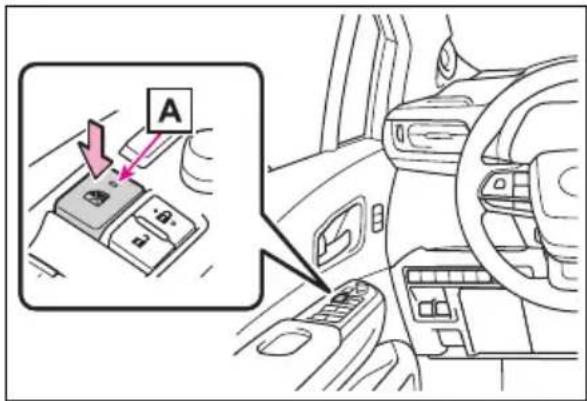
■The window lock switch can be operated when
The power switch is in ON.
Moon roof
*: If equipped
Use the overhead switches to open and close the moon roof and tilt it up and down.
Operating the moon roof
■ Opening and closing
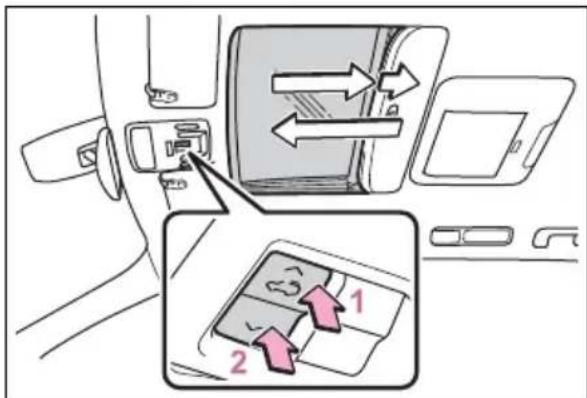
1 Opens the moon roof *
The moon roof stops slightly before the fully open position to reduce wind noise.
Press the switch again to fully open the moon roof.
2 Closes the moon roof *
*: Lightly press either side of the moon roof switch to stop the moon roof partway.
■Tilting up and down
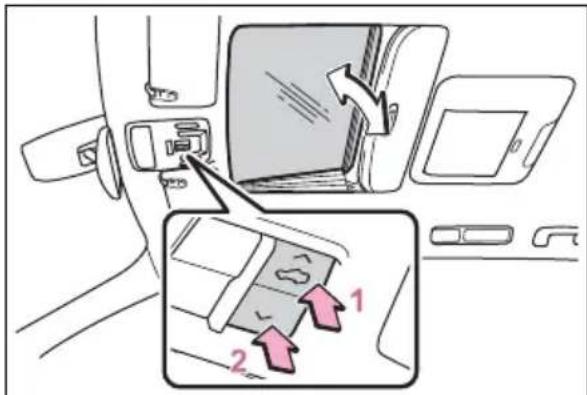
1 Tilts the moon roof up*
2 Tilts the moon roof down*
*: Lightly press either side of the moon roof switch to stop the moon roof partway.
■The moon roof can be operated when
The power switch is in ON.
■ Operating the moon roof after turning the hybrid system off
The moon roof can be operated for approximately 45 seconds after the power switch is turned to ACC or OFF. It cannot, however, be operated once either front door is opened.
Jam protection function
If an object is detected between the moon roof and the frame while the moon roof is closing or tilting down, travel is stopped and the moon roof opens slightly.
Sunshade
The sunshade can be opened and closed manually. However, the sun-shade will open automatically when the moon roof is opened.
■ Door lock linked moon roof operation
●The moon roof can be opened and closed using the mechanical key. ^* (→P.504)
●The moon roof can be opened using the wireless remote control.* (→P.132)
● Vehicles with alarm: The alarm may be triggered if the alarm is set and the moon roof is closed using the door lock linked moon roof operation function. (→P.89)
*: These settings must be customized at your Toyota dealer.
■When the moon roof does not close normally
Perform the following procedure:
1 Stop the vehicle.
2 Press and hold the close switch. *
The moon roof will close, reopen and pause for approximately 10 seconds. Then it will close again and stop at the completely closed position.
3 Check to make sure that the moon roof is completely closed and then release the switch.
*: If the switch is released at the incorrect time, the procedure will have to be performed again from the beginning.
If the moon roof does not fully close even after performing the above procedure correctly, have the vehicle inspected by your Toyota dealer.
■If the moon roof does not move normally
If the moon roof does not open or close normally or the automatic opening function does not operate, perform the following initialization procedure.
1 Stop the vehicle.
2 Press and hold the down switch. *
The moon roof will stop at the tilt-up position. After that, it will open, close, tilt up, tilt down, and stop at the fully closed position.
3 Confirm that the moon roof has completely stopped and release the switch.
*: If you release the switch while the moon roof is moving, perform the procedure again from the beginning.
If, after performing the above procedures correctly, the moon roof still does not open or close normally or the automatic opening function does not operate, have the vehicle inspected by your Toyota dealer.
■Moon roof open reminder function
The buzzer sounds and a message is shown on the multi-information display when the power switch is turned to OFF and the driver's door is opened with the moon roof open.
Customization
Settings (e.g. linked door lock operation) can be changed. (Customizable features: →P.547)

WARNING
Observe the following precautions. Failure to do so may cause death or serious injury.
■ Opening the moon roof
- Do not allow any passengers to put their hands or head outside the vehicle while it is moving.
- Do not sit on top of the moon roof.
■ Opening and closing the moon roof
●The driver is responsible for moon roof opening and closing operations. In order to prevent accidental operation, especially by a child, do not let a child operate the moon roof. It is possible for children and other passengers to have body parts caught in the moon roof.

WARNING
- Check to make sure that all passengers do not have any part of their body in a position where it could be caught when the moon roof is being operated.
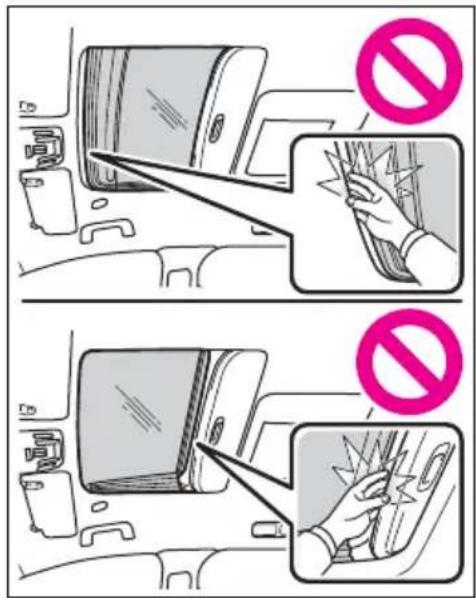
- When using the wireless remote control, key or mechanical key and operating the moon roof, operate the moon roof after checking to make sure that there is no possibility of any passenger having any of their body parts caught in the moon roof. Also, do not let a child operate moon roof by the wireless remote control or mechanical key. It is possible for children and other passengers to get caught in the moon roof.
- When exiting the vehicle, turn the power switch to OFF, carry the key and exit the vehicle along with the child. There may be accidental operation, due to mischief, etc., that may possibly lead to an accident.
■Jam protection function
●Never use any part of your body to intentionally activate the jam protection function.
●The jam protection function may not work if something gets caught just before the moon roof is fully closed. Also, the jam protection function is not designed to operate while the switch is being pressed. Take care so that your fingers, etc. do not get caught.
4-1. Before driving
Driving the vehicle..... 208
Cargo and luggage ..... 215
Vehicle load limits ..... 218
Trailer towing (without towing package)...... 219
Trailer towing (with towing package) 220
Dinghy towing 230
4-2. Driving procedures
Power (ignition) switch 231
EV drive mode ...... 236
Hybrid transmission .... 238
Turn signal lever ...... 242
Parking brake...... 243
Brake Hold 246
4-3. Operating the lights and wipers
Headlight switch...... 248
AHB (Automatic High Beam).... 250
Fog light switch ..... 254
Windshield wipers and washer.... 254
Rear window wiper and washer.... 257
4-4. Refueling
Opening the fuel tank cap 259
4-5. Using the driving support systems
Toyota Safety Sense 2.0 ...... 262
PCS (Pre-Collision System) 267
LTA (Lane Tracing Assist) 275
RSA (Road Sign Assist) 285
Dynamic radar cruise control with full-speed range 288
BSM (Blind Spot Monitor) 299
Intuitive parking assist. 308
RCD (Rear Camera Detection) function...... 315
PKSB (Parking Support Brake).... 319
Parking Support Brake function (static objects) .... 323
Parking Support Brake function (rear-crossing vehicles).... 329
Driving mode select switch 333
Driving assist systems. 335
4-6. Driving tips
Hybrid vehicle driving tips 341
Winter driving tips...... 343
Driving the vehicle
The following procedures should be observed to ensure safe driving:
Driving procedure
■Starting the hybrid system
→P.231
Driving
1 With the brake pedal depressed, shift the shift lever to D. ( P.238)
2 Release the parking brake. (→P.243)
If the parking brake is in automatic mode, the parking brake is released automatically when shifting the shift lever to any position other than P. ( P.243)
3 Gradually release the brake pedal and gently depress the accelerator pedal to accelerate the vehicle.
■Stopping
1 With the shift lever in D, depress the brake pedal.
2 If necessary, set the parking brake. ( P.243)
If the vehicle is to be stopped for an extended period of time, shift the shift lever to P. ( P.238)
■Parking the vehicle
1 With the shift lever in D, depress the brake pedal.
2 Set the parking brake ( P.243), and shift the shift lever to P ( P.238).
3 Turn the power switch to OFF to stop the hybrid system.
4 Lock the door, making sure that you have the key on your person.
If parking on a hill, block the wheels as needed.
■Starting off on a steep uphill
1 With the brake pedal depressed, shift the shift lever to D. ( P.238)
2 Pull the parking brake switch and parking brake is set manually. ( P.243)
3 Release the brake pedal and gently depress the accelerator pedal to accelerate the vehicle.
Parking brake automatic release function ( P.244)
■When starting off on a uphill
The hill-start assist control will activate. ( P.335)
■For fuel-efficient driving
Keep in mind that hybrid vehicles are similar to conventional vehicles, and it is necessary to refrain from activities such as sudden acceleration, etc. Refer to “Hybrid vehicle driving tips”. (→P.341)
- Driving in the rain
- Drive carefully when it is raining, because visibility will be reduced, the windows may become fogged-up, and the road could be slip-
pery.
●Drive carefully when it starts to rain, as the road surface could be especially slippery.
●Refrain from high speeds when driving on an expressway in the rain, because there may be a layer of water between the tires and the road surface, preventing the steering and brakes from operating properly.
■ ECO Accelerator Guidance (→P.108)
It is easier to drive in an Eco-friendly manner by driving while referring to the ECO Accelerator Guidance display. Also, by using the ECO Accelerator Guidance it is easier to increase the “Eco Score” evaluation.
- When starting off: While staying within the ECO Accelerator Guidance range, gradually depress the accelerator pedal and accelerate to the desired speed. If excessive acceleration is avoided, the “Start” score will increase.
- When driving: After accelerating to the desired speed, release the accelerator pedal and drive at a stable speed within the ECO Accelerator Guidance range. By keeping the vehicle within the ECO Accelerator Guidance range, the “Cruise” score will increase.
- When stopping: When stopping the vehicle, early releasing the accelerator pedal will cause the “Stop” score to increase.
■Restraining the hybrid system output (Brake Override System)
- When the accelerator and brake pedals are depressed at the same time, the hybrid system output may be restrained.
●A warning message is displayed on the multi-information display and head-up display (if equipped)
while the system is operating. (→P.471)
■Restraining sudden start (Drive-Start Control)
- When the following unusual operation is performed, the hybrid system output may be restrained.
- When the shift lever is shifted from R to D, D to R, N to R, P to D ^ , or P to R ^ (D includes S) with the accelerator pedal depressed, a warning message appears on the multi-information display and head-up display (if equipped). If a warning message is shown on the multi-information display and head-up display (if equipped), read the message and follow the instructions.
- When the accelerator pedal is depressed too much while the vehicle is in reverse.
*: Depending on the situation, the shift position may not be changed.
- When the TRAC is turned off (→P.336), sudden start restraint control also does not operate. If your vehicle have trouble escaping from the mud or fresh snow due to the sudden start restraint control operation, deactivate TRAC(→P.336) so that the vehicle may become able to escape from the mud or fresh snow.
■Breaking in your new Toyota
To extend the life of the vehicle, observing the following precautions is recommended:
●For the first 200 miles (300 km): Avoid sudden stops.
●For the first 500 miles (800 km): Do not tow a trailer.
●For the first 600 miles (1000 km):
- Do not drive at extremely high speeds.
- Avoid sudden acceleration.
- Do not drive continuously in low gears.
- Do not drive at a constant speed
for extended periods.
■Operating your vehicle in a foreign country
Comply with the relevant vehicle registration laws and confirm the availability of the correct fuel. (→P.520)

WARNING
Observe the following precautions.
Failure to do so may result in death or serious injury.
■When starting the vehicle
Always keep your foot on the brake pedal while stopped with the "READY" indicator is illuminated. This prevents the vehicle from creeping.
■When driving the vehicle
- Do not drive if you are unfamiliar with the location of the brake and accelerator pedals to avoid depressing the wrong pedal.
- Accidentally depressing the accelerator pedal instead of the brake pedal will result in sudden acceleration that may lead to an accident.
- When backing up, you may twist your body around, leading to a difficulty in operating the pedals. Make sure to operate the pedals properly.
- Make sure to keep a correct driving posture even when moving the vehicle only slightly. This allows you to depress the brake and accelerator pedals properly.
- Depress the brake pedal using your right foot. Depressing the brake pedal using your left foot may delay response in an emergency, resulting in an accident.
The driver should pay extra attention to pedestrians when the vehicle is powered only by the electric motor (traction motor). As there is no engine noise, the pedestrians may mis-judge the vehicle's movement. Even though the vehicle is equipped with the Acoustic Vehicle Alerting System, drive with care as pedestrians in the vicinity may still not notice the vehicle if the surrounding area is noisy.
- Do not drive the vehicle over or stop the vehicle near flammable materials such as leaves, paper or rags.
The exhaust system and exhaust gases can be extremely hot. These hot parts may cause a fire if there is any flammable material nearby.
During normal driving, do not turn off the hybrid system. Turning the hybrid system off while driving will not cause loss of steering or braking control, however, power assist to the steering will be lost. This will make it more difficult to steer smoothly, so you should pull over and stop the vehicle as soon as it is safe to do so. In the event of an emergency, such as if it becomes impossible to stop the vehicle in the normal way: P.459
- Use engine braking (downshift) to maintain a safe speed when driving down a steep hill. Using the brakes continuously may cause the brakes to overheat and lose effectiveness. ( P.238)

WARNING
- Do not adjust the position of the steering wheel, the seat, or the inside or outside rear view mirrors while driving. Doing so may result in a loss of vehicle control.
● Always check that all passengers' arms, head or other parts of their body are not outside the vehicle.
●AWD models: Do not drive the vehicle off-road. This is not an AWD vehicle designed for off-road driving. Proceed with all due caution if it becomes unavoidable to drive off-road.
●AWD models: Do not drive across a river or through other bodies of water. This may cause electric/electronic components to short circuit, damage the engine or cause other serious damage to the vehicle.
- Do not drive in excess of the speed limit. Even if the legal speed limit permits it, do not drive over 85 mph (140 km/h) unless your vehicle has high-speed capability tires. Driving over 85 mph (140 km/h) may result in tire failure, loss of control and possible injury. Be sure to consult a tire dealer to determine whether the tires on your vehicle are high-speed capability tires or not before driving at such speeds.
■When driving on slippery road surfaces
● Sudden braking, acceleration and steering may cause tire slippage and reduce your ability to control the vehicle.
● Sudden acceleration, engine braking due to shifting, or changes in engine speed could cause the vehicle to skid.
● After driving through a puddle, lightly depress the brake pedal to make sure that the brakes are functioning properly. Wet brake pads may prevent the brakes from functioning properly. If the brakes on only one side are wet and not functioning properly, steering control may be affected.
■When shifting the shift lever
- Do not let the vehicle roll backward while a forward driving position is selected, or roll forward while the shift lever is in R. Doing so may result in an accident or damage to the vehicle.
- Do not shift the shift lever to P while the vehicle is moving. Doing so can damage the transmission and may result in a loss of vehicle control.
- Do not shift the shift lever to R while the vehicle is moving forward.
Doing so can damage the transmission and may result in a loss of vehicle control.
●Do not shift the shift lever to a driving position while the vehicle is moving backward.
Doing so can damage the transmission and may result in a loss of vehicle control.
- Moving the shift lever to N while the vehicle is moving will disengage the hybrid system. Engine braking is not available with the hybrid system disengaged.

WARNING
● Be careful not to shift the shift lever with the accelerator pedal depressed.
Shifting the shift lever to a gear other than P or N may lead to unexpected rapid acceleration of the vehicle that may cause an accident and result in death or serious injury. Doing so can damage the transmission and may result in a loss of vehicle control.
■If you hear a squealing or scraping noise (brake pad wear limit indicators)
Have the brake pads checked and replaced by your Toyota dealer as soon as possible.
Rotor damage may result if the pads are not replaced when needed.
It is dangerous to drive the vehicle when the wear limits of the brake pads and/or those of the brake discs are exceeded.
■When the vehicle is stopped
- Do not depress the accelerator pedal unnecessarily. If the vehicle is in any gear other than P or N, the vehicle may accelerate suddenly and unexpectedly, causing an accident.
In order to prevent accidents due to the vehicle rolling away, always keep depressing the brake pedal while stopped with the "READY" indicator is illuminated, and apply the parking brake as necessary.
- If the vehicle is stopped on an incline, in order to prevent accidents caused by the vehicle rolling forward or backward, always depress the brake pedal and securely apply the parking brake as needed.
● Avoid revving or racing the engine.
Running the engine at high speed while the vehicle is stopped may cause the exhaust system to overheat, which could result in a fire if combustible material is nearby.
■When the vehicle is parked
- Do not leave glasses, cigarette lighters, spray cans, or soft drink cans in the vehicle when it is in the sun. Doing so may result in the following:
• Gas may leak from a cigarette lighter or spray can, and may lead to a fire.
- The temperature inside the vehicle may cause the plastic lenses and plastic material of glasses to deform or crack.
- Soft drink cans may fracture, causing the contents to spray over the interior of the vehicle, and may also cause a short circuit in the vehicle's electrical components.
- Do not leave cigarette lighters in the vehicle. If a cigarette lighter is in a place such as the glove box or on the floor, it may be lit accidentally when luggage is loaded or the seat is adjusted, causing a fire.
- Do not attach adhesive discs to the windshield or windows. Do not place containers such as air fresheners on the instrument panel or dashboard. Adhesive discs or containers may act as lenses, causing a fire in the vehicle.

WARNING
- Do not leave a door or window open if the curved glass is coated with a metallized film such as a silver-colored one. Reflected sunlight may cause the glass to act as a lens, causing a fire.
●Always apply the parking brake, shift the shift lever to P, stop the hybrid system and lock the vehicle.
Do not leave the vehicle unattended while the "READY" indicator is illuminated.
If the vehicle is parked with the shift lever in P but the parking brake is not set, the vehicle may start to move, possibly leading to an accident.
- Do not touch the exhaust pipes while the “READY” indicator is illuminated or immediately after turning the hybrid system off. Doing so may cause burns.
■When taking a nap in the vehicle
Always turn the hybrid system off. Otherwise, if you accidentally move the shift lever or depress the accelerator pedal, this could cause an accident or fire due to hybrid system overheating. Additionally, if the vehicle is parked in a poorly ventilated area, exhaust gases may collect and enter the vehicle, leading to death or a serious health hazard.
When braking
- When the brakes are wet, drive more cautiously. Braking distance increases when the brakes are wet, and this may cause one side of the vehicle to brake differently than the other side. Also, the parking brake may not securely hold the vehicle.
- If the electronically controlled brake system does not operate, do not follow other vehicles closely and avoid hills or sharp turns that require braking. In this case, braking is still possible, but the brake pedal should be depressed more firmly than usual. Also, the braking distance will increase. Have your brakes fixed immediately.
●The brake system consists of 2 or more individual hydraulic systems; if one of the systems fails, the other will still operate. In this case, the brake pedal should be depressed more firmly than usual and the braking distance will increase. Have your brakes fixed immediately.
■If the vehicle becomes stuck (AWD models)
Do not spin the wheels excessively when any of the tires is up in the air, or the vehicle is stuck in sand, mud, etc. This may damage the driveline components or propel the vehicle forward or backward, causing an accident.

NOTICE
■When driving the vehicle
- Do not depress the accelerator and brake pedals at the same time during driving, as this may restrain the hybrid system output.
- Do not use the accelerator pedal or depress the accelerator and brake pedals at the same time to hold the vehicle on a hill.

NOTICE
■ Avoiding damage to vehicle parts
- Do not turn the steering wheel fully in either direction and hold it there for an extended period of time.
Doing so may damage the power steering motor.
- When driving over bumps in the road, drive as slowly as possible to avoid damaging the wheels, underside of the vehicle, etc.
■If you get a flat tire while driving
A flat or damaged tire may cause the following situations.
- It may be difficult to control your vehicle.
●The vehicle will make abnormal sounds or vibrations.
●The vehicle will lean abnormally.
Hold the steering wheel firmly and gradually depress the brake pedal to slow down the vehicle.
Information on what to do in case of a flat tire ( P.491)
■When encountering flooded roads
Do not drive on a road that has flooded after heavy rain, etc. Doing so may cause the following serious damage to the vehicle:
Engine stalling
●Short in electrical components
●Engine damage caused by water immersion
In the event that you drive on a flooded road and the vehicle is flooded, be sure to have your Toyota dealer check the following:
●Brake function
● Changes in quantity and quality of oil and fluid used for the engine, hybrid transmission (front and rear), etc.
● Lubricant condition for the bearings and suspension joints (where possible), and the function of all joints, bearings, etc.
■When parking the vehicle
Always set the parking brake, and shift the shift lever to P. Failure to do so may cause the vehicle to move or the vehicle may accelerate suddenly if the accelerator pedal is accidentally depressed.
Cargo and luggage
Take notice of the following information about storage precautions, cargo capacity and load.

WARNING
■Things that must not be carried in the luggage compartment
The following things may cause a fire if loaded in the luggage compartment:
●Receptacles containing gasoline
Aerosol cans
■Storage precautions
Observe the following precautions. Failure to do so may prevent the pedals from being depressed properly, may block the driver's vision, or may result in items hitting the driver or passengers, possibly causing an accident.
● Stow cargo and luggage in the luggage compartment whenever possible.
- Do not stack anything in the luggage compartment higher than the seatbacks.
- Do not place cargo or luggage in or on the following locations.
- At the feet of the driver
- On the front passenger or rear seats (when stacking items)
- On the instrument panel
- On the dashboard
- On the auxiliary box or tray that has no lid
- Secure all items in the occupant compartment.
- When you fold down the rear seats, long items should not be placed directly behind the front seats.
●Never allow anyone to ride in the luggage compartment. It is not designed for passengers. They should ride in their seats with their seat belts properly fastened. Otherwise, they are much more likely to suffer death or serious bodily injury, in the event of sudden braking, sudden swerving or an accident.
Capacity and distribution
Cargo capacity depends on the total weight of the occupants.
(Cargo capacity) = (Total load capacity) - (Total weight of occupants)
Steps for Determining Correct Load Limit —
(1) Locate the statement “The combined weight of occupants and cargo should never exceed XXX kg or XXX lbs.” on your vehicle’s placard.
(2) Determine the combined weight of the driver and passengers that will be riding in your vehicle.
(3) Subtract the combined weight of the driver and passengers from XXX kg or XXX lbs.
(4) The resulting figure equals the available amount of cargo and luggage load capacity.
For example, if the “XXX” amount equals 1400 lbs. and there will be five 150 lb passengers in your vehicle, the amount of available cargo and luggage load capacity is 650 lbs. (1400 - 750 (5 × 150) = 650 lbs.)
(5) Determine the combined weight of luggage and cargo being loaded on the vehicle. That weight may not safely exceed the available cargo and luggage load capacity calculated in Step 4.
(6) If your vehicle will be towing a trailer, load from your trailer will be transferred to your vehicle. Consult this manual to determine how this reduces the available cargo and luggage load capacity of your vehicle. (→P.218)

WARNING
■ Capacity and distribution
- Do not exceed the maximum axle weight rating or the total vehicle weight rating.
Even if the total load of occupant' weight and the cargo load is less than the total load capacity, do not apply the load unevenly. Improper loading may cause deterioration of steering or braking control which may cause death or serious injury.
Calculation formula for your vehicle
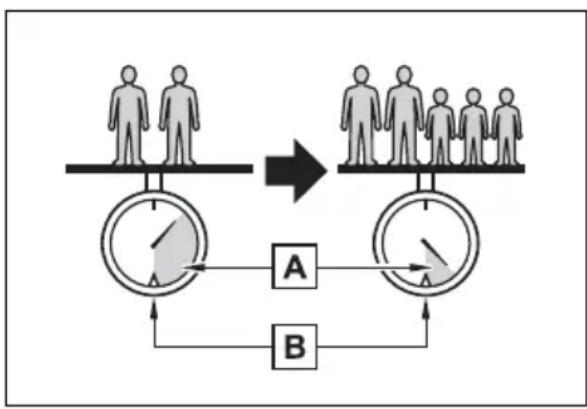
flowchart
graph TD
    A["Group 1: Human Figure"] --> B["Group 2: Group 1"]
    B --> C["Group 3: Group 2"]
    C --> D["Output: A and B"]
    style A fill:#f9f,stroke:#333
    style B fill:#ccf,stroke:#333
A Cargo capacity
B Total load capacity (vehicle capacity weight) ( P.518)
When 2 people with the combined weight of A lb. (kg) are rid-ing in your vehicle, which has a total load capacity (vehicle capacity weight) of B lb. (kg), the available amount of cargo and luggage load capacity will be C lb. (kg) as follows:
B^2 lb. (kg) - A^1 lb. (kg) = C^*3 lb. (kg)
^1 :A = Weight of people
^2 :B = Total load capacity
^*3 :C = Available cargo and luggage load
In this condition, if 3 more passengers with the combined weight of D lb. (kg) get on, the available cargo and luggage load will be reduced E lb. (kg) as follows:
C lb. (kg) - D ^4 lb. (kg) = E ^5 lb. (kg)
^ 4:D = Additional weight of people
^ 5:E = Available cargo and luggage
load
As shown in the example above, if the number of occupants increases, the cargo and luggage load will be reduced by an amount that equals the increased weight due to the additional occupants. In other words, if an increase in the number of occupants causes an excess of the total load capacity (combined weight of occupants plus cargo and luggage load), you must reduce the cargo and luggage on your vehicle.
Roof luggage carrier (if equipped)
■Roof luggage carrier components
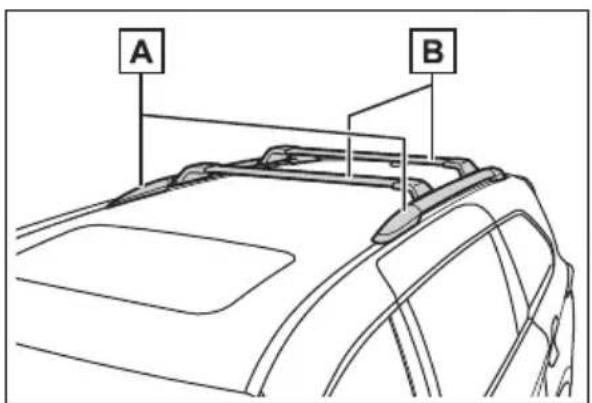
A Roof rails
B Cross rails

WARNING
■When loading cargo on the roof luggage carrier
To use the roof rails as a roof luggage carrier, you must fit the roof rails with two or more genuine Toyota cross rails or their equivalent. When you load cargo on the roof luggage carrier, observe the following:
- Place the cargo so that its weight is distributed evenly between the front and rear axles.
- If loading long or wide cargo, never exceed the vehicle overall length or width. (→P.518)
●Before driving, make sure the cargo is securely fastened on the roof luggage carrier. - Loading cargo on the roof luggage carrier will make the center of gravity of the vehicle higher. Avoid high speeds, sudden starts, sharp turns, sudden braking or abrupt maneuvers, otherwise it may result in loss of control or vehicle rollover due to failure to operate this vehicle correctly and result in death or serious injury.
- If driving for a long distance, on rough roads, or at high speeds, stop the vehicle now and then during the trip to make sure the cargo remains in its place.
- Do not exceed 150 lb. (68 kg) cargo weight on the roof luggage carrier. Place the cargo so that its weight is distributed evenly between both cross rails.

NOTICE
■When loading cargo on the roof luggage carrier
Be careful not to scratch the surface of the moon roof (if equipped).
Seating configuration variation (8-passenger models only)
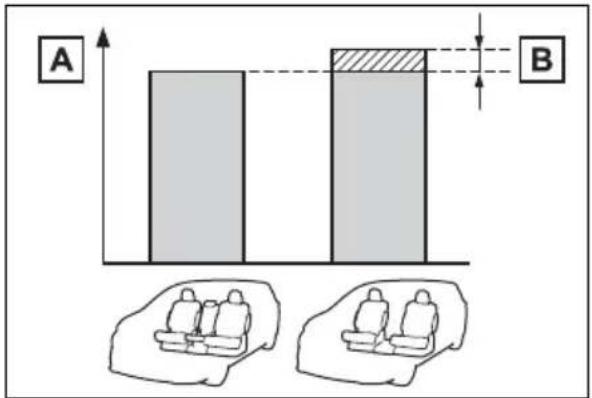
A Cargo capacity
B Weight of the removed second center seat
If removing the second center seat, it is possible to load extra cargo equal to the weight of the removed seat.
(Cargo capacity) = (Total load capacity) - (Total weight of occupants) + (Weight of the removed second center seat)
Second center seat weight:
Fabric
17.76 lb. (8.06 kg)
Synthetic leather
17.89 lb. (8.12 kg)
Vehicle load limits
Vehicle load limits include total load capacity, seating capacity, TWR (Trailer Weight Rating) and cargo capacity.
● Total load capacity (vehicle capacity weight): →P.518
Total load capacity means the combined weight of occupants, cargo and luggage.
- Seating capacity: →P.519
Seating capacity means the maximum number of occupants whose estimated average weight is 150 lb. (68 kg) per person.
● TWR (Trailer Weight Rating): →P.224, 518
TWR means the maximum gross trailer weight (trailer weight plus its cargo weight) that your vehicle is able to tow.
- Cargo capacity
Cargo capacity may increase or decrease depending on the weight and the number of occupants.
■Total load capacity and seating capacity
These details are also described on the tire and loading information label. (→P.438)

WARNING
■Overloading the vehicle
Do not overload the vehicle. It may not only cause damage to the tires, but also degrade steering and braking ability, resulting in an accident.
Trailer towing (with-out towing package)
Toyota does not recommend towing a trailer with your vehicle. Toyota also does not recommend the installation of a tow hitch or the use of a tow hitch carrier for a wheelchair, scooter, bicycle, etc. Your vehicle is not designed for trailer towing or for the use of tow hitch mounted carriers.
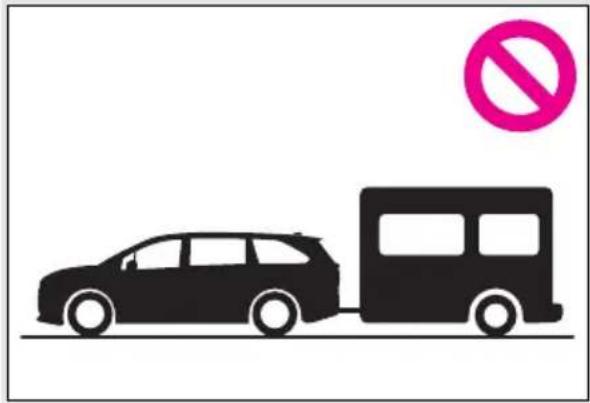
natural_image
Silhouette of a car and a van on a road with a no-smoking symbol (no text or numbers present)Trailer towing (with towing package)
Your vehicle is designed primarily as a passenger-and-load-carrying vehicle. Towing a trailer can have an adverse impact on handling, performance, braking, durability, and fuel consumption. For your safety and the safety of others, you must not overload your vehicle or trailer. You must also ensure that you are using appropriate towing equipment, that the towing equipment has been installed correctly and used properly, and that you employ the requisite driving habits.
Vehicle-trailer stability and braking performance are affected by trailer stability, brake performance and setting, trailer brakes, the hitch and hitch systems (if equipped).
To tow a trailer safely, use extreme care and drive the vehicle in accordance with your trailer's characteristics and operating conditions.
Toyota warranties do not apply to damage or malfunction caused by towing a trailer for commercial purposes.
Contact your Toyota dealer for further information about additional requirements such as a towing kit, etc.
Before towing
Check that the following conditions are met:
- Ensure that your vehicle's tires are properly inflated. (→P.525)
- Trailer tires are inflated according to the trailer manufacturer's recommendation.
● All trailer lights work as required by law.
● All lights work each time you connect them.
●The trailer ball is set at the proper height for the coupler on the trailer.
●The trailer is level when it is hitched. Do not drive if the trailer is not level, and check for improper tongue weight, overloading, worn suspension, or other possible causes.
●The trailer cargo is securely loaded.
●The rear view mirrors conform to all applicable federal, state/provincial or local regulations. If they do not, install rear view mirrors appropriate for towing purposes.

WARNING
■Trailer towing precautions
To tow a trailer safely, use extreme care and drive the vehicle in accordance with the trailer's characteristics and operating conditions. Failure to do so could cause an accident resulting in death or serious injury. Vehicle stability and braking performance are affected by trailer stability, brake setting and performance, and the hitch. Your vehicle will handle differently when towing a trailer.
■To avoid accident or injury
●Do not exceed the TWR, unbraked TWR, GCWR, GVWR or GAWR.
● Vehicles without spare tire: Do not tow a trailer when the tire installed is repaired with the emergency tire puncture repair kit.
- If the gross trailer weight is over 2000 lb. (907 kg), a sway control device with sufficient capacity is required.
- Adjust the tongue weight within the appropriate range. Place heavier loads as close to the trailer axle as possible.
- Do not exceed 65 mph (104 km/h), the posted towing speed limit or the speed limit for your trailer as set forth in your trailer owner's manual, whichever is lowest. Slow down sufficiently before making a turn, in cross winds, on wet or slippery surface, etc. to help avoid an accident. If you experience a vehicle-trailer instability from reducing a certain speed, slow down and make sure you keep your vehicle speed under the speed of which you experience the instability.
■When towing a trailer
- Do not make jerky, abrupt or sharp turns.
- Do not apply the brakes suddenly as you may skid, resulting in jackknifing and loss of vehicle control. This is especially true on wet or slippery surfaces.
- Do not exceed the trailer hitch assembly weight, gross vehicle weight, gross axle weight and trailer tongue weight capacities.
- Do not use dynamic radar cruise control with full-speed range when towing.
● Slow down and downshift before descending steep or long downhill grades. Do not make sudden downshifts while descending steep or long downhill grades.
● Vehicle-trailer instability is more likely on steep long downhills. Before descending steep or long downhill grades, slow down and downshift. Do not make sudden downshifts when descending steep or long downhill grades. Avoid holding the brake pedal down too long or applying the brakes too frequently. This could cause the brakes to overheat and result in reduced braking efficiency.
● Vehicles with compact spare tire: Do not tow a trailer when the compact spare tire is installed on your vehicle.
Toyota recommends trailers with brakes that conform to any applicable federal and state/provincial regulations.

WARNING
- If the gross trailer weight exceeds unbraked TWR, trailer brakes are required. Toyota recommends trailers with brakes that conform to all applicable federal and state/provincial regulations.
- Never tap into your vehicle's hydraulic system, as this will lower the vehicle's braking effectiveness.
● Never tow a trailer without using a safety chain securely attached to both the trailer and the vehicle. If damage occurs to the coupling unit or hitch ball, there is danger of the trailer wandering into another lane.
Towing related terms
■GCWR (Gross Combination Weight Rating)
The maximum allowable gross combination weight. The gross combination weight is the sum of the total vehicle weight (including the occupants, cargo and any optional equipment installed on the vehicle) and the weight of the trailer being towed (including the cargo in the trailer).
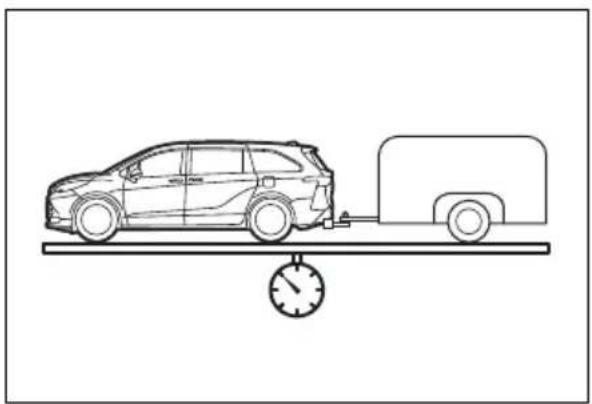
natural_image
Line drawing of a car on a balance scale with a speedometer, no text or symbols present■GVWR (Gross Vehicle Weight Rating)
The maximum allowable gross vehicle weight. The gross vehicle weight is the total weight of the vehicle. When towing a trailer, it is the sum of the vehicle weight (including the occupants, cargo and any optional equipment installed on the vehicle) and the tongue weight.
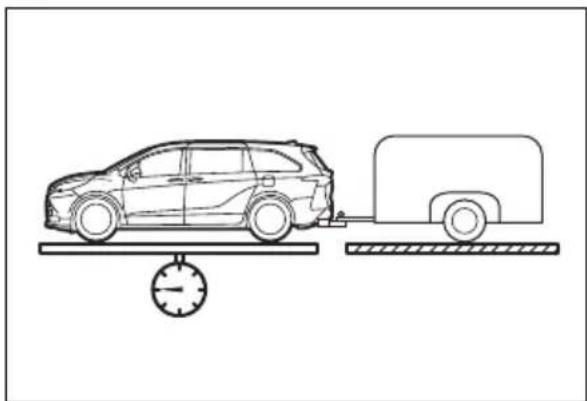
natural_image
Line drawing of a car on a platform with a speedometer and a cargo truck nearby (no text or symbols)■ GAWR (Gross Axle Weight Rating)
The maximum allowable gross axle weight. The gross axle weight is the load placed on each axle (front and rear).
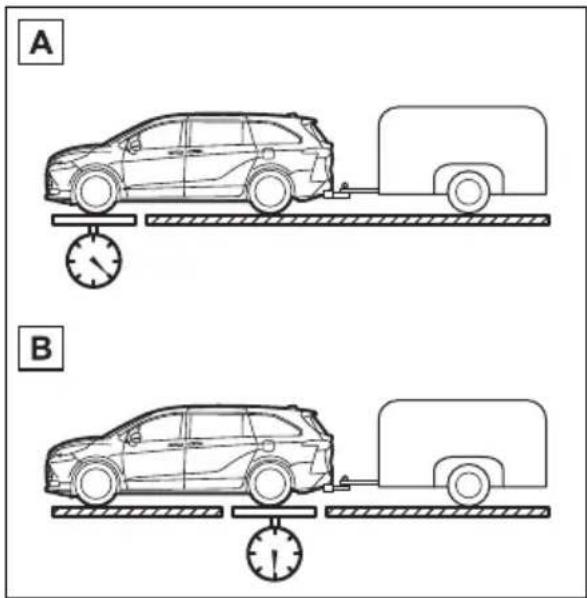
A Front GAWR
B Rear GAWR
■TWR (Trailer Weight Rating)
The maximum allowable gross trailer weight. The gross trailer weight is the sum of the trailer weight and the weight of the cargo in the trailer.
TWR is calculated assuming base vehicle with one driver, one front passenger, hitch and hitch systems (if required).
Additional optional equipment, passengers and cargo in the vehicle will reduce the trailer weight rating so as not to exceed GCWR, GVWR and GAWR.
If the gross trailer weight exceeds 3000 lb. (1360 kg), it is recommended to use a trailer with 2 or more axles.
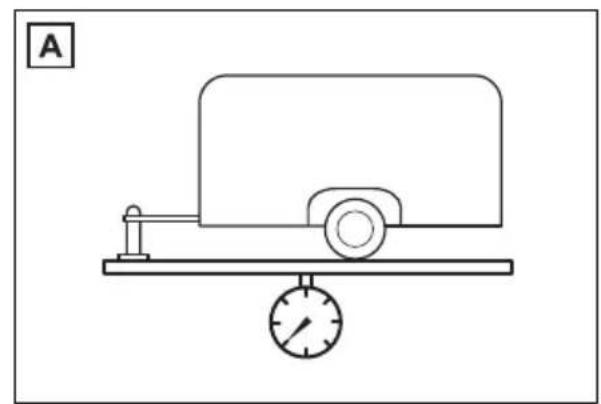
natural_image
Simple line drawing of a balance scale with a cart and pointer (no text or symbols)A (With brakes)
■ Unbraked TWR (Unbraked Trailer Weight Rating)
The trailer weight rating for towing a trailer without a trailer service brake system.
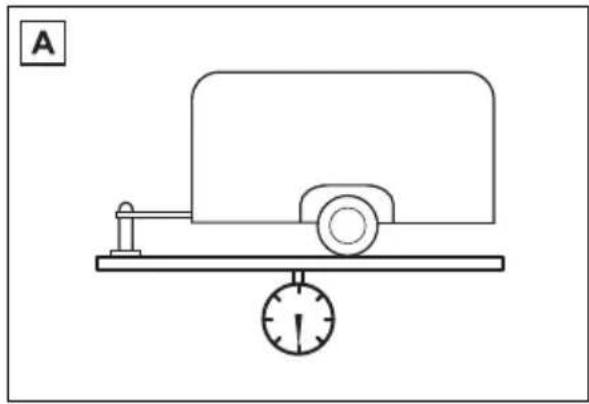
natural_image
Simple line drawing of a balance scale with a cart and pointer (no text or symbols)A (Without brakes)
■Tongue Weight
The load placed on the trailer hitch ball. ( P.224)
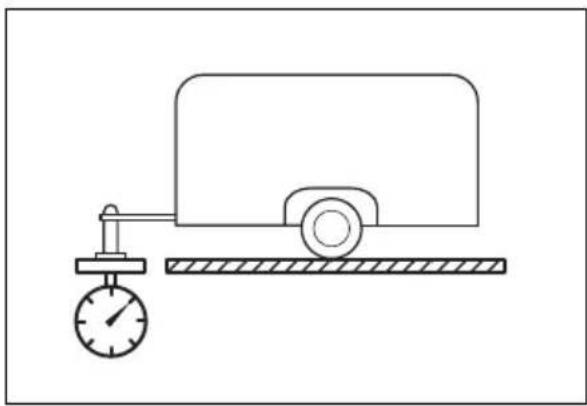
natural_image
Simple line drawing of a cart on a horizontal surface with a dial indicator (no text or symbols)Weight limits
- The gross trailer weight must never exceed 3500 lb. (1585 kg) ^* .
*: The towing package is required.
Toyota does not recommend towing with this vehicle without the towing package.
● The gross combination weight must never exceed the GCWR described below:
2WD models
8818 lb. (4000 kg) ^*
▶ AWD models
8995 lb. (4080 kg) ^*
*: The towing package is required.
Toyota does not recommend towing with this vehicle without the towing package.
- The gross vehicle weight must never exceed the GVWR indicated on the Certification Label.
- The gross axle weight on each axle must never exceed the GAWR indicated on the Certification Label.
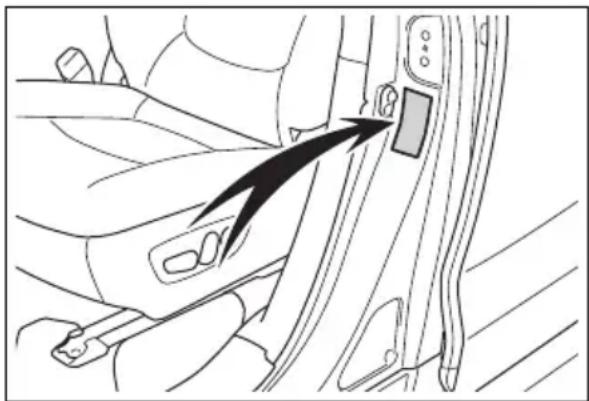
natural_image
Line drawing of a car seatbelt buckle with a black arrow indicating the buckle (no text or symbols present)- If the gross trailer weight is over the unbraked TWR, trailer service brakes are required.
- If the gross trailer weight is over 2000 lbs. (907 kg), a sway control device with sufficient capacity is required.
GCWR, TWR and Unbraked TWR
Confirm that the gross trailer weight, gross combination weight, gross vehicle weight, gross axle weight and tongue weight are all within the limits.
GCWR\*
2WD models
8818 lb. (4000 kg)
▶ AWD models
8995 lb. (4080 kg)
*: This model meets the tow-vehicle trailering requirement of SAE International per SAE J2807.
The towing package is required.
Toyota does not recommend towing with this vehicle without the towing package.
TWR\*
3500 lb. (1585 kg)
*: This model meets the tow-vehicle trailering requirement of SAE International per SAE J2807.
The towing package is required.
Toyota does not recommend towing with this vehicle without the towing package.
■Unbraked TWR \*
1000 lb. (450 kg)
*: This model meets the tow-vehicle trailering requirement of SAE International per SAE J2807.
Trailer Tongue Weight
● A recommended tongue weight varies in accordance with the types of trailers or towing as described below.
- To ensure the recommended values shown below, the trailer must be loaded by referring to the following
instructions.
- Tongue Weight
The gross trailer weight should be distributed so that the tongue weight is 9% to 11%.
(Tongue weight / Gross trailer weight x 100 = 9% to 11%)
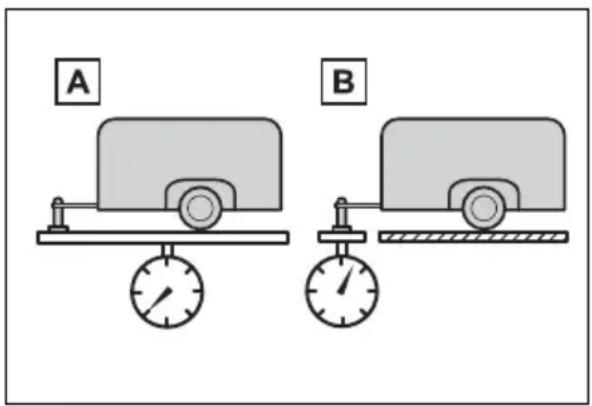
A Gross trailer weight
B Tongue weight
The gross trailer weight, gross axle weight and tongue weight can be measured with platform scales found at a highway weighing station, building supply company, trucking company, junk yard, etc.
Hitch (if equipped)
Trailer hitch assemblies have different weight capacities. Toyota recommends the use of Toyota hitch/bracket for your vehicle. For details, contact your Toyota dealer.
- If you wish to install a trailer hitch, contact your Toyota dealer.
- Use only a hitch that conforms to the gross trailer
weight requirement of your vehicle.
- Follow the directions supplied by the hitch manufacturer.
● Lubricate the hitch ball with a light coating of grease. - Remove the hitch ball whenever you are not towing a trailer. Remove the trailer hitch if you do not need it. After removing the hitch, seal any mounting holes in the vehicle body to prevent entry of any substances into the vehicle.

WARNING
Hitch
Trailer hitch assemblies have different weight capacities established by the hitch manufacturer. Even though the vehicle may be physically capable of towing a higher weight, the operator must determine the maximum weight rating of the particular hitch assembly and never exceed the maximum weight rating specified for the trailer hitch. Exceeding the maximum weight rating set by the trailer hitch manufacturer can cause an accident resulting in death or serious personal injuries.

NOTICE
■When installing a trailer hitch
Use only the position recommended by your Toyota dealer. Do not install the trailer hitch on the bumper; this may cause body damage.
Positions for towing hitch receiver
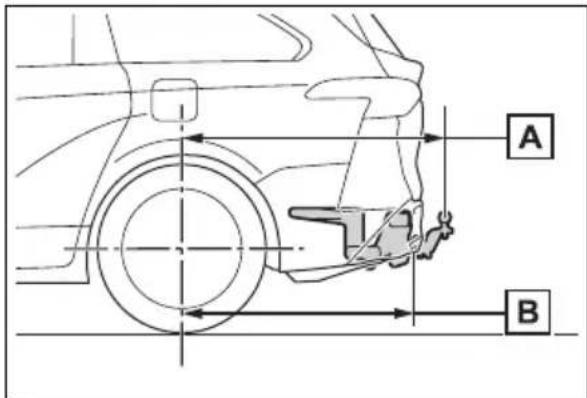
A Weight carrying ball position: 48.8 in. (1238.8 mm)
B Hitch receiver pin hole position: 42.5 in. (1079.7 mm)
Selecting trailer ball
Use the correct trailer ball for your application.
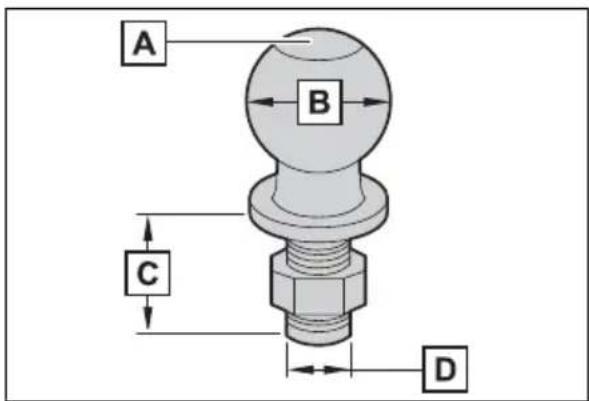
A Trailer ball load rating
Matches or exceeds the gross trailer weight rating of the trailer.
B Ball diameter
Matches the size of the trailer coupler. Most couplers are stamped with the required trailer ball size.
| Trailer class | Typical trailer ball size |
| II 2 in. | |
| I 1 7/8 in. |
C Shank length
Protrudes beyond the bottom of the lock washer and nut by at least 2 threads.
D Shank diameter
Matches the ball mount hole diameter size.
■ Matching trailer ball height to trailer coupler height
No matter which class of tow hitch applies, for a safe trailer hookup, the trailer ball setup on must be proper height for the coupler on the trailer.
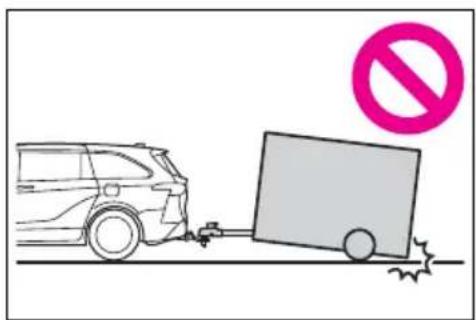
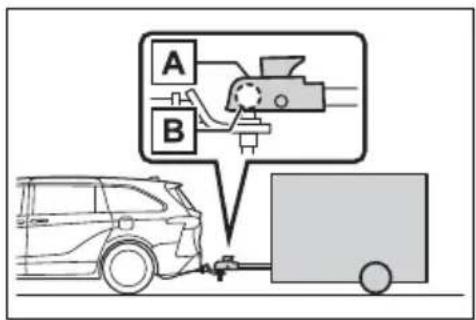
A Coupler
B Trailer ball
Connecting trailer lights
Please consult your dealer when installing trailer lights, as
incorrect installation may cause damage to the vehicle's lights. Please take care to comply with your state's laws when installing trailer lights.

NOTICE
■ Do not directly splice trailer lights
Do not directly splice trailer lights. Directly splicing trailer lights may damage your vehicle's electrical system and cause a malfunction.
Trailer towing tips
Your vehicle will handle differently when towing a trailer. Help to avoid an accident, death or serious injury, keep the following in mind when towing:
- Speed limits for towing a trailer vary by state or province. Do not exceed the posted towing speed limit.
- Toyota recommends that the vehicle-trailer speed limit is 65 mph (104 km/h) on a flat, straight, dry road. Do not exceed this limit, the posted towing speed limit or the speed limit for your trailer as set forth in your trailer owner's manual, whichever is lowest. Instability of the towing vehicle-trailer combination (trailer sway) increases as speed increases. Exceeding speed limits may cause loss of control.
- Before starting out, check the trailer lights, tires and the vehicle-trailer connections. Recheck after driving a short distance.
● Practice turning, stopping and reversing with the trailer attached in an area away from traffic until you become accustomed to the feel of the vehicle-trailer combination.
- Reversing with a trailer attached is difficult and requires practice. Grip the bottom of the steering wheel and move your hand to the left to move the trailer to the left. Move your hand to the right to move the trailer to the right. (This is generally opposite to reversing without a trailer attached.) Avoid sharp or prolonged turning. Have someone guide you when reversing to reduce the risk of an accident.
- As stopping distance is increased when towing a trailer, vehicle-to vehicle distance should be increased. For each 10 mph (16 km/h) of speed, allow at least one vehicle and trailer length.
- Avoid sudden braking as you may skid, resulting in the trailer jackknifing and a loss of vehicle control. This is especially true on wet or slippery surfaces.
- Avoid jerky starts or sudden acceleration.
- Avoid jerky steering and sharp turns, and slow down before making turn.
● Note that when making a turn, the trailer wheels will be closer than the vehicle wheels to the inside of the turn. Compensate by making a wider than normal turning radius. - Slow down before making a turn, in cross winds, on wet or slippery surfaces, etc.
Increasing vehicle speed can destabilize the trailer.
● Take care when passing other vehicles. Passing requires considerable distance. After passing a vehicle, do not forget the length of your trailer, and be sure you have plenty of room before changing lanes.
- To maintain engine braking efficiency and charging system performance, when using engine braking, do not use the transmission in D.
- Instability happens more frequently when descending steep or long downhill grades. Before descending, slow down and downshift. Do not make sudden downshifts while descending steep or long downhill grades.
- Avoid holding the brake pedal
down too long or applying the brakes too frequently. This could cause the brakes to overheat and result in reduced braking efficiency.
- Due to the added load of the trailer, your vehicle's hybrid system may overheat on hot days (at temperatures over 85°F [30°C]) when driving up a long or steep grade. If the engine coolant temperature gauge indicates overheating, immediately turn off the air conditioning (if in use), pull your vehicle off the road and stop in a safe spot. (→P.511)
- Always place wheel blocks under both the vehicle's and the trailer's wheels when parking. Apply the parking brake firmly, and put the transmission in P. Avoid parking on a slope, but if unavoidable, do so only after performing the following:
1 Apply the brakes and keep them applied.
2 Have someone place wheel blocks under both the vehicle's and trailer's wheels.
3 When the wheel blocks are in place, release the brakes slowly until the blocks absorb the load.
4 Apply the parking brake firmly.
5 Shift into P and turn off the hybrid system.
- When restarting after parking on a slope:
1 With the transmission in P, start the hybrid system. Be sure to keep the brake pedal depressed.
2 Shift into a forward gear. If reversing, shift into R.
3 If the parking brake is in manual mode, release the parking brake. ( P.243)
4 Release the brake pedal, and slowly pull or back away from the wheel blocks. Stop and apply the brakes.
5 Have someone retrieve the blocks.
■Break-in schedule
If your vehicle is new or equipped with any new power train components (such as an engine, transmission, differential or wheel bearing), Toyota recommends that you do not tow a trailer until the vehicle has been driven for over 500 miles (800 km).
After the vehicle has been driven for over 500 miles (800 km), you can start towing. However, for the next 500 miles (800 km), drive the vehicle at a speed of less than 45 mph (72 km/h) when towing a trailer, and avoid full throttle acceleration.
Maintenance
- If you tow a trailer, your vehicle will require more frequent maintenance due to the additional load. (See “Scheduled Maintenance Guide” or “Owner’s Manual Supplement”.)
- Retighten the fixing bolts of the towing ball and bracket after approximately 600 miles (1000 km) of trailer towing.
If trailer sway occurs
One or more factors (crosswinds, passing vehicles, rough roads, etc.) can adversely affect handling of your vehicle and trailer, causing instability.
- If trailer swaying occurs:
- Firmly grip the steering wheel. Steer straight ahead. Do not try to control trailer swaying by turning the steering wheel.
- Begin releasing the accelerator pedal immediately but very gradually to reduce speed. Do not increase speed. Do not apply vehicle brakes.
If you make no extreme correction with the steering or brakes, your vehicle and trailer should stabilize (if enabled, Trailer Sway Control can also help to stabilize the vehicle and trailer.).
●After the trailer swaying has stopped:
- Stop in a safe place. Get all occupants out of the vehicle.
- Check the tires of the vehicle and the trailer.
- Check the load in the trailer. Make sure the load has not shifted.
Make sure the tongue weight is appropriate, if possible.
- Check the load in the vehicle. Make sure the vehicle is not overloaded after occupants get in.
If you cannot find any problems, the speed at which trailer swaying occurred is beyond the limit of your particular vehicle-trailer combination. Drive at a lower speed to prevent instability. Remember that swaying of the towing vehicle-trailer increases as speed increases.
Dinghy towing
Your vehicle is not designed to be dinghy towed (with 4 wheels on the ground) behind a motor home.
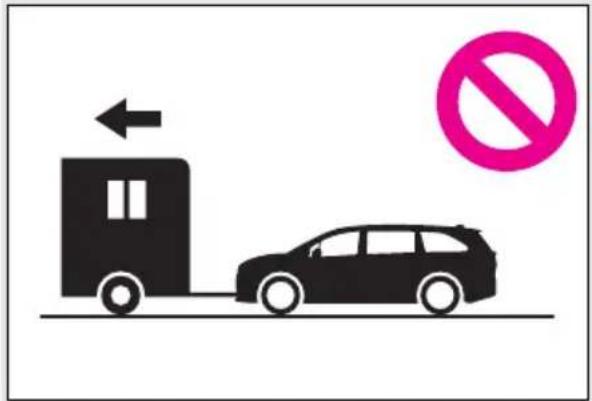

NOTICE
■To avoid serious damage to your vehicle
Do not tow your vehicle with 4 wheels on the ground.
■To prevent causing serious damage to the transmission and AWD system.
2WD models: Never tow this vehicle from the rear with the front wheels on the ground. This may cause serious damage to the transmission.
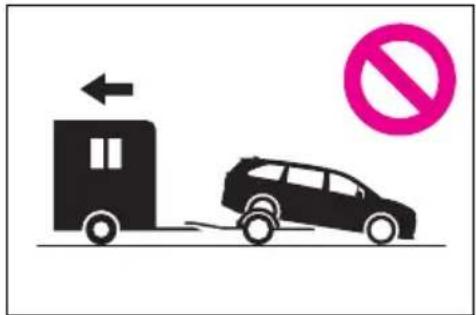
natural_image
Prohibition sign showing a van approaching a car with a downward arrow, next to a pink prohibition symbol (no text present)AWD models: Never tow this vehicle with any of the wheels on the ground. This may cause serious damage to the transmission and AWD system.
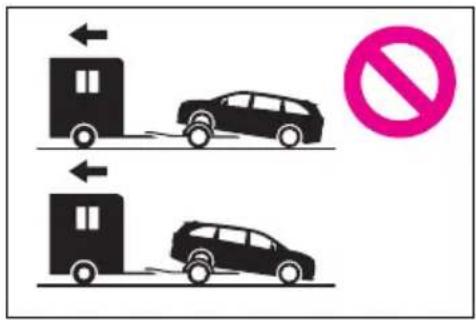
Power (ignition) switch
Performing the following operations when carrying the electronic key on your person starts the hybrid system or changes power switch modes.
Starting the hybrid sys- tem
1 Pull the parking brake switch to check that the parking brake is set. (→P.243)
The parking brake indicator will come on.
2 Check that the shift lever is set in P.
3 Firmly depress the brake pedal.
and a message will be displayed on the multi-information display.
If it is not displayed, the hybrid system cannot be started.
4 Press the power switch shortly and firmly.
When operating the power switch, one short, firm press is enough. It is not necessary to press and hold the switch.
If the "READY" indicator turns on, the hybrid system will operate normally.
Continue depressing the brake pedal until the "READY" indicator is illuminated.
The hybrid system can be started
from any power switch mode.
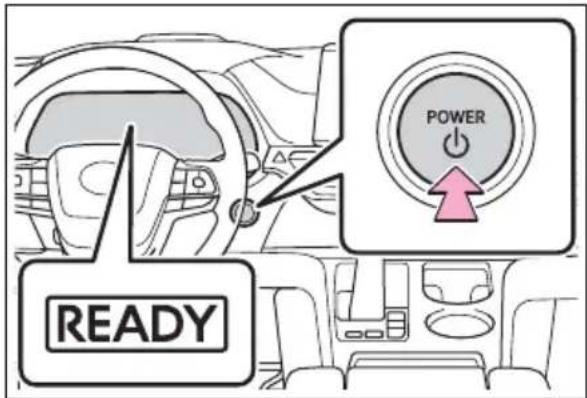
5 Check that the "READY" indicator is illuminated.
The vehicle will not move when the "READY" indicator is off.
■Power switch illumination
According to the situation, the power switch illumination operates as follows.
- When driver's door or front passenger's door is opened, the power switch illumination illuminates.
- When the power switch is in OFF and depressing the brake pedal with carrying the electronic key on your person, the power switch illumination blinks.
- When the power switch is in ACC or ON, the power switch illumination illuminates.
- When the power switch mode is changed from ACC or ON to OFF, the power switch illumination illuminates for a certain amount of time. Afterwards, the power switch illumination turns off.
■If the hybrid system does not start
●The immobilizer system may not have been deactivated. (→P.88) Contact your Toyota dealer.
- If a message related to start-up is shown on the multi-information display, read the message and follow the instructions.
■When the ambient temperature is low, such as during winter driving conditions
When starting the hybrid system, the flashing time of the "READY" indicator may be long. Leave the vehicle as it is until the "READY" indicator is steady on, as steady means the vehicle is able to move.
■ Sounds and vibrations specific to a hybrid vehicle
→P.81
If the 12-volt battery is discharged
The hybrid system cannot be started using the smart key system. Refer to P.506to restart the hybrid system.
Electronic key battery depletion
→P.128
■Conditions affecting operation
→P.166
■Note for the entry function
→P.166
■Steering lock function
●After turning the power switch to OFF and opening and closing the doors, the steering wheel will be locked due to the steering lock function. Operating the power switch again automatically cancels the steering lock.
- When the steering lock cannot be released, "Push Power Switch while Turning the Steering Wheel in Either Direction" will be displayed on the multi-information display.
Check that the shift lever is set in P. Press the power switch shortly and firmly while turning the steering wheel left and right.
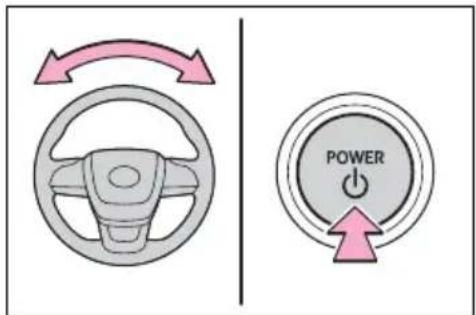
●To prevent the steering lock motor from overheating, the motor may be suspended if the hybrid system is turned on and off repeatedly in a short period of time. In this case, refrain from operating the power switch. After about 10 seconds, the steering lock motor will resume functioning.
If there is a malfunction in the smart key system
If "Smart Key System Malfunction See Owner's Manual" is displayed on the multi-information display, the system may be malfunctioning. Have the vehicle inspected by your Toyota dealer immediately.
■If the "READY" indicator does not come on
In the event that the "READY" indicator does not come on even after performing the proper procedures for starting the vehicle, contact your Toyota dealer immediately.
- When “Check Fuel Cap” is displayed on the multi-information display
→P.261
■If the hybrid system is malfunctioning
→P.86
Electronic key battery
→P.447
Operation of the power switch
- If the switch is not pressed shortly and firmly, the power switch mode may not change or the hybrid system may not start.
- If attempting to restart the hybrid
system immediately after turning the power switch to OFF, the hybrid system may not start in some cases. After turning the power switch to OFF, please wait a few seconds before restarting the hybrid system.
Customization
If the smart key system has been deactivated in a customized setting, refer to P.505.

WARNING
■When starting the hybrid system
Always start the hybrid system while sitting in the driver's seat. Do not depress the accelerator pedal while starting the hybrid system under any circumstances. Doing so may cause an accident resulting in death or serious injury.
■Caution while driving
If hybrid system failure occurs while the vehicle is moving, do not lock or open the doors until the vehicle reaches a safe and complete stop. Activation of the steering lock in this circumstance may lead to an accident, resulting in death or serious injury.

NOTICE
■When starting the hybrid system
If the hybrid system becomes difficult to start, have your vehicle checked by your Toyota dealer immediately.
■ Symptoms indicating a malfunction with the power switch
If the power switch seems to be operating somewhat differently than usual, such as the switch sticking slightly, there may be a malfunction. Contact your Toyota dealer immediately.
Stopping the hybrid sys- tem
1 Stop the vehicle completely.
2 Set the parking brake ( P.243) and shift the shift lever to P ( P.238).
3 Press the power switch shortly and firmly.
The hybrid system will stop, and the meter display will be extinguished. Make sure not to touch the shift lever when pressing the power switch.
4 Release the brake pedal and check that "ACCESSORY" or "IGNITION ON" is not shown on the meter.
■Automatic hybrid system shut off feature
●The vehicle is equipped with a feature that automatically shuts off the hybrid system when the shift lever is in P with the hybrid system operating for an extended period.
●The hybrid system will automatically shut off after approximately 1 hour if it has been left operating while the shift lever is in P.
●The message asking if you wish to enable/disable the automatic hybrid system shut off feature will sometimes be displayed on the multi-information display. Leaving
the vehicle as is or selecting “Perform Auto Off” keeps the automatic hybrid system shut off feature enabled, or selecting “Keep Vehicle On” disables the automatic hybrid system shut off feature.
●The timer for the automatic hybrid system shut off feature will reset if the brake pedal is depressed or if the shift lever is in a position other than P.
After the vehicle is parked, if the door is locked with the door lock switch (→P.135) from the inside or the mechanical key (→P.504) from the outside, the automatic hybrid system shut off feature will be disabled. The timer for the automatic hybrid system shut off feature will be re-enabled if the driver's door is opened.

WARNING
■Stopping the hybrid system in an emergency
- If you want to stop the hybrid system in an emergency while driving the vehicle, press and hold the power switch for more than 2 seconds, or press it briefly 3 times or more in succession. (→P.459) However, do not touch the power switch while driving except in an emergency. Turning the hybrid system off while driving will not cause loss of steering or braking control, however, power assist for the steering wheel may be lost making it difficult to steer smoothly before stopping the vehicle depending on the remaining charge in the 12-volt battery or usage conditions. In this situation, you should pull over and stop the vehicle as soon as it is safe to do so.
- If the power switch is operated while the vehicle is running, a warning message will be shown on the multi-information display and a buzzer sounds.
- When restarting the hybrid system after an emergency shutdown, shift the shift lever to N and press the power switch shortly and firmly.
When parking
Exhaust gases include harmful carbon monoxide (CO), which is colorless and odorless. Observe the following precautions.
Failure to do so may cause exhaust gases to enter the vehicle and may lead to an accident caused by light-headedness, or may lead to death or a serious health hazard.
- If the vehicle is in a poorly ventilated area or a closed area, such as a garage, stop the hybrid system.
- Do not leave the vehicle with the hybrid system operating for a long time. If such a situation cannot be avoided, park the vehicle in an open space and ensure that exhaust fumes do not enter the vehicle interior.
- Do not leave the hybrid system operating in an area with snow build-up, or where it is snowing. If snowbanks build up around the vehicle while the hybrid system is operating, exhaust gases may collect and enter the vehicle.
Changing power switch modes
Modes can be changed by pressing the power switch with the brake pedal released. (The
mode changes each time the switch is pressed.)
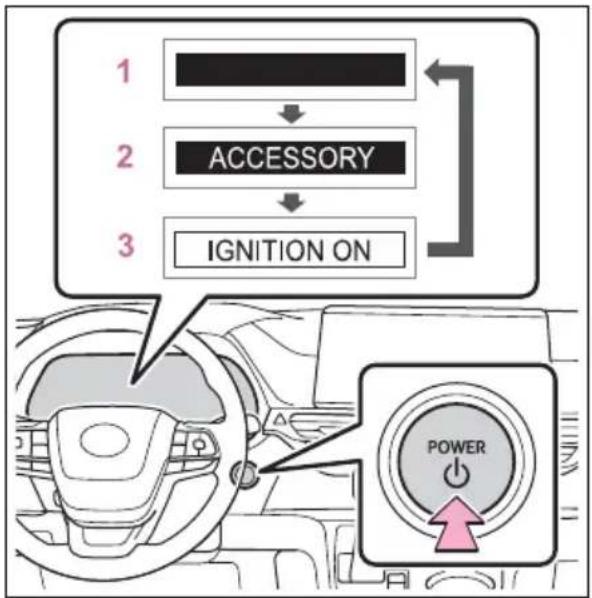
flowchart
graph TD
    A["1"] --> B["2"] --> C["3"] --> D["IGNITION ON"]
    D --> E["POWER"]
1 OFF \*
The emergency flashers can be used.
2 ACC
Some electrical components such as the audio system can be used. "ACCESSORY" will be displayed on the multi-information display.
3 ON
All electrical components can be used.
"IGNITION ON" will be displayed on the multi-information display.
*: If the shift lever is in a position other than P when turning off the hybrid system, the power switch will remain ON, not to be turned to OFF.
■Auto power off function
- If the vehicle is left in ACC or ON (the hybrid system is not operating) for more than 20 minutes with the shift lever in P, the power switch will automatically turn to OFF.
●If the 12-volt battery is low with the
shift lever is in P and the power switch is in ACC or ON (the hybrid system is not operating), a buzzer sounds and a message will be displayed on the multi-information display. If this continues, the power switch will automatically turn to OFF.
However, this function cannot entirely prevent the 12-volt battery discharge. Do not leave the vehicle with the power switch in ACC or ON for long periods of time when the hybrid system is not operating.

NOTICE
■To prevent 12-volt battery discharge
- Do not leave the power switch in ACC or ON for long periods of time without the hybrid system on.
- If "ACCESSORY" or "IGNITION ON" is displayed on the multi-information display, the power switch is not in OFF. Exit the vehicle after turning the power switch to OFF.
When stopping the hybrid system with the shift lever in a position other than P
If the hybrid system is stopped with the shift lever in a position other than P, the power switch will not be turned to OFF but instead be turned to ACC. Perform the following procedure to turn the switch to OFF:
1 Check that the parking brake is set.
2 Shift the shift lever to P.
3 Check that "Turn Power Off" is displayed on the multi-information display and press the power switch shortly and firmly.
4 Check that "Turn Power Off" on the multi-information display is off.

NOTICE
■To prevent 12-volt battery discharge
Do not stop the hybrid system when the shift lever is in a position other than P. If the hybrid system is stopped in another shift lever position, the power switch will not be turned to OFF but instead remain ON. If the vehicle is left in ON, 12-volt battery discharge may occur.
EV drive mode
In EV drive mode, electric power is supplied by the hybrid battery (traction battery), and only the electric motor (traction motor) is used to drive the vehicle.
This mode allows you to drive in residential areas early in the morning and late at night, or in indoor parking lots etc. without concern for noises and gas emissions.
However, when the Acoustic Vehicle Alerting System is active, the vehicle may produce sound.
Operating instructions
Turns EV drive mode on/off
When EV drive mode is turned on, the EV drive mode indicator will come on. Pressing the switch when in EV drive mode will return the vehicle to normal driving (using the gasoline engine and electric motor [traction motor]).
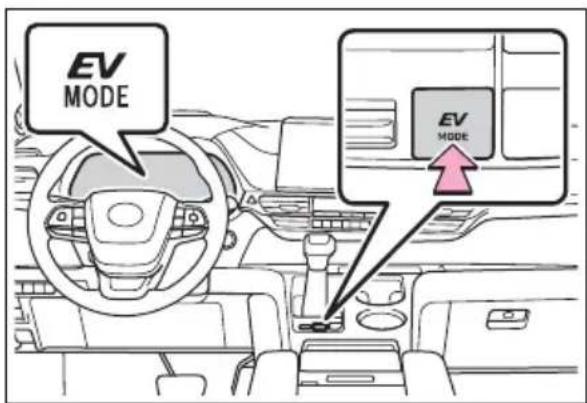
■ Situations in which EV drive mode cannot be turned on
It may not be possible to turn EV drive mode on in the following situations. If it cannot be turned on, a buzzer will sound and a message will be shown on the multi-information display.
●The temperature of the hybrid system is high.
The vehicle has been left in the sun, driven on a hill, driven at high speeds, etc.
●The temperature of the hybrid system is low.
The vehicle has been left in temperatures lower than about 32^ F ( 0^ C) for a long period of time etc.
●The gasoline engine is warming up.
●The hybrid battery (traction battery) is low.
The remaining battery level indicated in the Energy monitor display is low. ( P.122)
● Vehicle speed is high.
●The accelerator pedal is depressed firmly or the vehicle is on a hill etc.
●The windshield defogger is in use.
Use the EV drive mode when it becomes available.
■ Switching to EV drive mode when the gasoline engine is cold
If the hybrid system is started while the gasoline engine is cold, the gasoline engine will start automatically after a short period of time in order to warm up.
In this case, you will become unable to switch to EV drive mode. After the hybrid system has started and the "READY" indicator has illuminated, press the EV drive mode switch before the gasoline engine starts to switch to EV drive mode.
■Automatic cancelation of EV drive mode
When driving in EV drive mode, the gasoline engine may automatically restart in the following situations. When EV drive mode is canceled, a buzzer will sound, the EV drive mode indicator will flash and go off and a message will be shown on the multi-information display.
●The hybrid battery (traction battery) becomes low.
The remaining battery level indicated in the Energy monitor display is low. ( P.122)
●Vehicle speed is high.
●The accelerator pedal is depressed firmly or the vehicle is on a hill etc.
Drive the vehicle for a while before attempting to turn on the EV drive mode again.
■Possible driving distance when driving in EV drive mode
EV drive mode's possible driving distance ranges from a few hundred meters to approximately 0.6 mile (1 km). However, depending on vehicle conditions, there are situations when EV drive mode cannot be used.
(The distance that is possible depends on the hybrid battery [traction battery] level and driving conditions.)
Fuel economy
The hybrid system is designed to achieve the best possible fuel economy during normal driving (using the gasoline engine and electric motor [traction motor]). Driving in EV drive mode more than necessary may lower fuel economy.
If “EV Mode Unavailable” is shown on the multi-information display
The EV drive mode is not available. The reason the EV drive mode is not available (the vehicle is idling,
battery charge is low, vehicle speed is higher than the EV drive mode operating speed range or accelerator pedal is depressed too much) may be displayed. Use the EV drive mode when it becomes available.
If “EV Mode Deactivated” is shown on the multi-information display
The EV drive mode has been automatically canceled. The reason the EV drive mode is not available (the battery charge is low, vehicle speed is higher than the EV drive mode operating speed range or accelerator pedal is depressed too much) may be displayed. Drive the vehicle for a while before attempting to turn on the EV drive mode again.

WARNING
■Caution while driving
When driving in EV drive mode, pay special attention to the area around the vehicle. Because there is no engine noise, pedestrians, people riding bicycles or other people and vehicles in the area may not be aware of the vehicle starting off or approaching them, so take extra care while driving. Therefore, take extra care while driving even if the Acoustic Vehicle Alerting System is active.
Hybrid transmission
Select the shift position depending on your purpose and situation.
Shift position purpose and functions
| Shift position | Objective or function |
| P | Parking the vehicle/starting the hybrid system |
| R Reversing | |
| N Neutral | |
| D | Normal driving*1 |
| S | S mode driving*2 |
*1: To improve fuel efficiency and reduce noise, shift the shift lever to D for normal driving.
*2: By selecting shift ranges using S mode, you can control accelerating force and engine braking force.
■When driving with dynamic radar cruise control with full-speed range activated
Even when performing the following actions with the intent of enabling engine braking, engine braking will not activate because dynamic radar cruise control with full-speed range will not be canceled.
●While driving in S mode, down-shifting to 5 or 4. (→P.241)
- When switching the driving mode to sport mode while driving in D position. (→P.333)
■Restraining sudden start (Drive-Start Control)
→P.209

WARNING
■When driving on slippery road surfaces
Be careful of downshifting and sudden acceleration, as this could result in the vehicle skidding to the side or spinning.

NOTICE
■ Hybrid battery (traction battery) charge
If the shift lever is in N, the hybrid battery (traction battery) will not be charging, even when the engine is running. Therefore, if the vehicle is left with the shift lever in N for a long period of time, the hybrid battery (traction battery) will discharge, and this may result in the vehicle not being able to start.
Shifting the shift lever
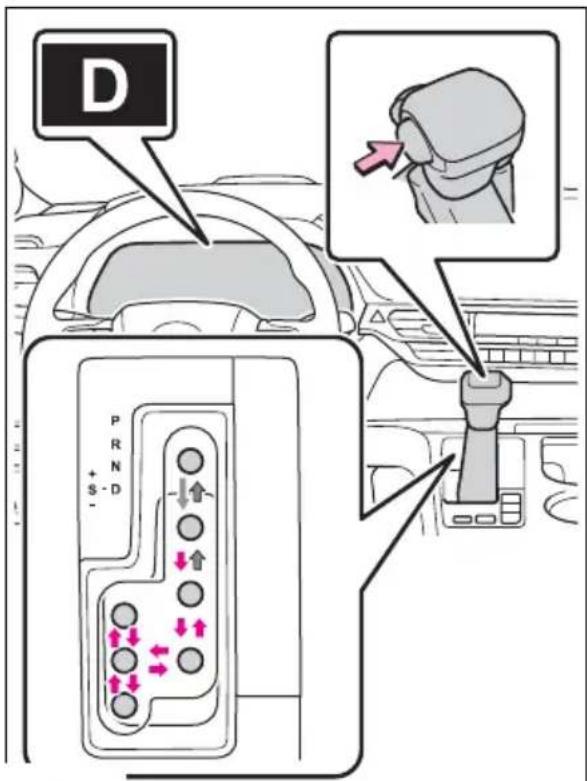

While the power switch is in ON and the brake pedal depressed*, shift the shift lever while pushing the shift release button on the shift knob.
Shift the shift lever while
pushing the shift release button on the shift knob.

Shift the shift lever nor-
mally.
When shifting the shift lever between P and D, make sure that the vehicle is completely stopped and the brake pedal is depressed.
*: For the vehicle to be able to be shifted from P, the brake pedal must be depressed before the shift release button is pushed. If
the shift release button is pushed first, the shift lock will not be released.
Shift lock system
The shift lock system is a system to prevent accidental operation of the shift lever in starting.
The shift lever can be shifted from P only when the power switch is in ON, the brake pedal is depressed and the shift release button is pushed.
If the shift lever cannot be shifted from P
First, check whether the brake pedal is being depressed.
If the shift lever cannot be shifted even though the brake pedal is depressed and the shift release button is pushed, there may be a problem with the shift lock system. Have the vehicle inspected by your Toyota dealer immediately.
The following steps may be used as an emergency measure to ensure that the shift lever can be shifted.
Releasing the shift lock:
1 Pull the parking brake switch to check that the parking brake is set. (→P.243)
2 Turn the power switch off.
3 Depress the brake pedal.
4 Pry the cover up with a flathead screwdriver or equivalent tool. To prevent damage to the cover, cover the tip of the screwdriver with a rag.
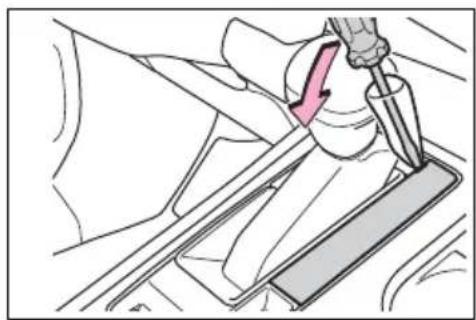
natural_image
Mechanical assembly diagram showing a hand operating a tool with a pink arrow indicating motion (no text or symbols present)5 Pull the cover forward to remove it.
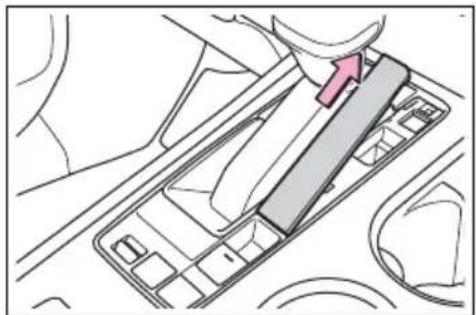
natural_image
Diagram of a car interior showing a vehicle's dashboard and steering wheel (no text or labels)6 Press and hold the shift lock override button and then push the button on the shift knob. The shift lever can be shifted while both buttons are pressed.
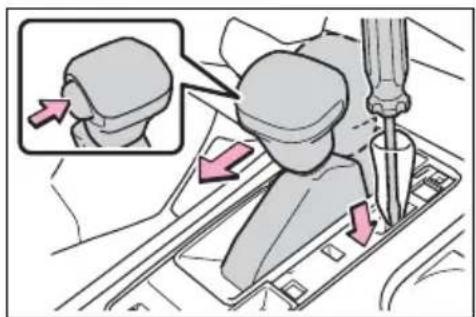
WARNING
■To prevent an accident when releasing the shift lock
Before pressing the shift lock override button, make sure to set the parking brake and depress the brake pedal.
If the accelerator pedal is accidentally depressed instead of the brake pedal when the shift lock override button is pressed and the shift lever is shifted out of P, the vehicle may suddenly start, possibly leading to an accident resulting in death or serious injury.
Selecting the driving mode
→P.333
Changing shift ranges in S mode
To enter S mode, shift the shift
lever to the S position. The shift ranges can be selected by operating the shift lever. Changing the shift range allows restriction of upper limit of the gears to be used, preventing unnecessary upshifting and enabling the level of engine braking force to be selected.
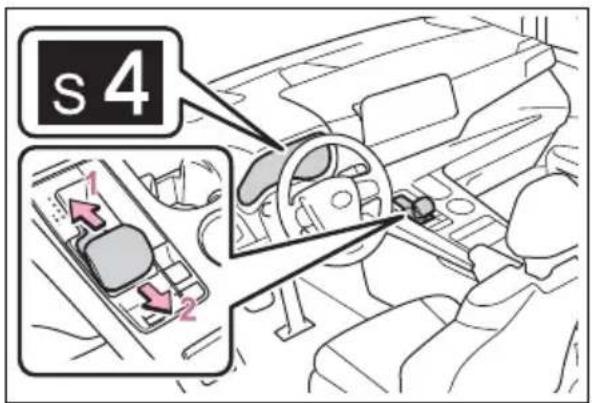
1 Upshifting
2 Downshifting
The selected shift range, from S1 to S6, will be displayed on the multi-information display.
The initial shift range in S mode is set automatically to S4 or S5 according to vehicle speed.
S mode
●You can choose from 6 levels of accelerating force and engine braking force.
●A lower shift range will provide greater accelerating force and engine braking force than a higher shift range, and the engine revolutions will also increase.
●To prevent the engine from over-revving, upshifting may automatically occur when the shift range is 4 or lower.
- When the shift range is 4 or lower, holding the shift lever toward “+” sets the shift range to 6.
■Downshifting restriction warning buzzer
To help ensure safety and driving performance, downshifting operation may sometimes be restricted. In some circumstances, downshifting may not be possible even when the shift lever is operated. (A buzzer will sound twice.)
If the “S” indicator does not come on or the “D” indicator is displayed even after shifting the shift lever to S
This may indicate a malfunction in the transmission system. Have the vehicle inspected by your Toyota dealer immediately. (In this situation, the transmission will operate in the same manner as when the shift lever is in D.)
Turn signal lever
Operating instructions
The turn signal lever can be used to show the following intentions of the driver.
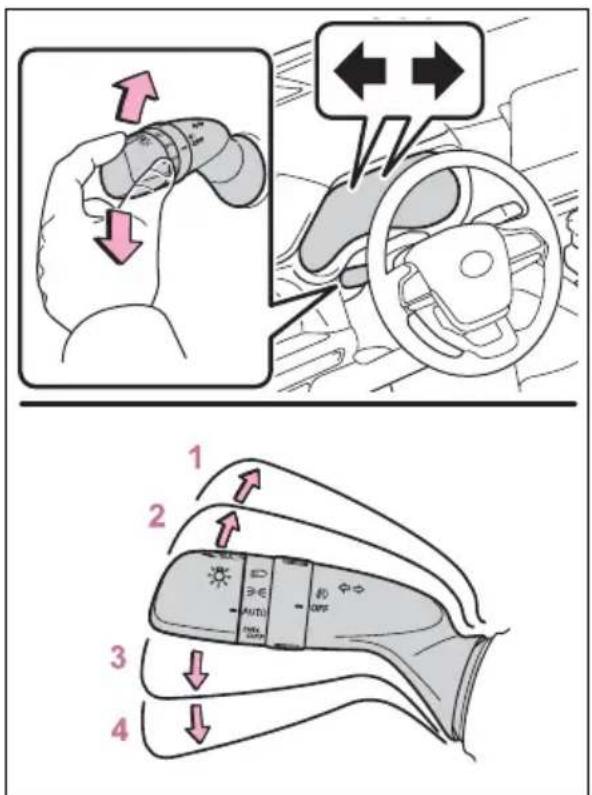
1 Right turn
2 Lane change to the right (move the lever partway and release it)
The right hand signals will flash 3 times.
3 Lane change to the left (move the lever partway and release it)
The left hand signals will flash 3 times.
4 Left turn
■Turn signals can be operated when
The power switch is in ON.
■If the indicator flashes faster than usual
Check that a light bulb in the front or rear turn signal lights has not burned out.
■If the turn signals stop flashing before a lane change has been performed
Operate the lever again.
■To discontinue flashing of the turn signals during a lane change
Operate the lever in the opposite direction.
Parking brake
The parking brake can be set or released automatically or manually. In automatic mode, the parking brake can be set or released automatically according to shift lever operation. Also, even in automatic mode, the parking brake can be set or released manually.
Operating instructions
■Using the manual mode
The parking brake can be set and released manually.
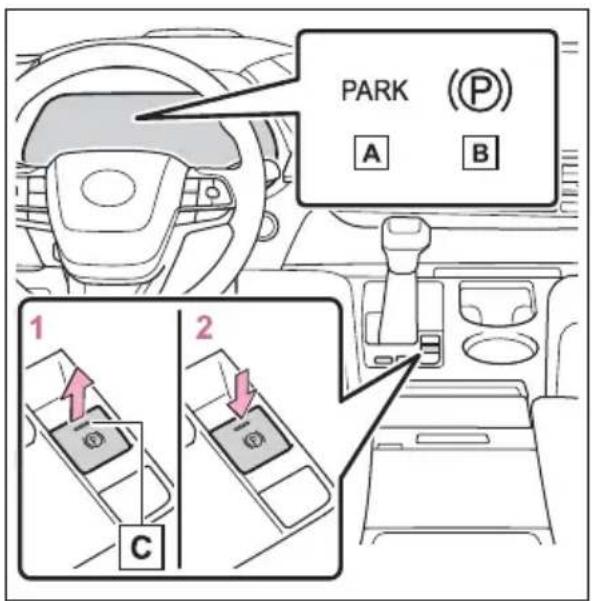
A Parking brake indicator light (U.S.A.)
B Parking brake indicator light (Canada)
C Parking brake switch indicator
1 Pull the switch to set the
parking brake.
The parking brake indicator light and Parking brake switch indicator will turn on.
Pull and hold the parking brake switch if an emergency occurs and it is necessary to operate the parking brake while driving.
2 Push the switch to release the parking brake.
- Operate the parking brake switch while depressing the brake pedal.
- Parking brake automatic release function (→P.244)
Make sure that the parking brake indicator light and parking brake switch indicator turn off.
If the parking brake indicator light and parking brake switch indicator flash, operate the switch again. (→P.472)
■Turning the automatic mode on
While the vehicle is stopped, pull and hold the parking brake switch until a buzzer sounds and a message is shown on the multi-information display.
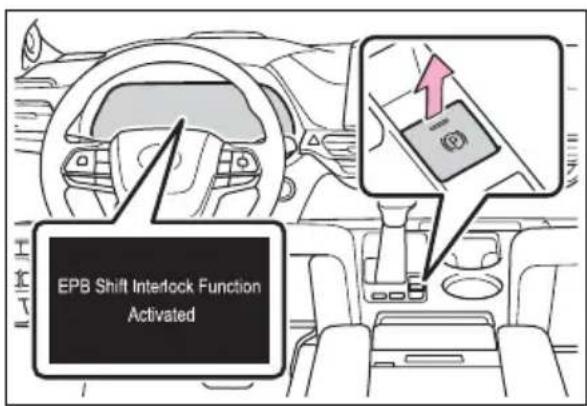
When the automatic mode is turned on, the parking brake operates as follows.
- When the shift lever is shifted from P, the parking brake will be released, and the parking brake indicator light and parking brake switch indicator will turn off.
- When the shift lever is shifted to P, the parking brake will be set, and the parking brake indicator light and parking brake switch indicator will turn on.
Operate the shift lever with the vehicle stopped and the brake pedal depressed.
■Turning the automatic mode off
While the vehicle is stopped and depressing the brake pedal, press and hold the parking brake switch until a buzzer sounds and a message is shown on the multi-information display.
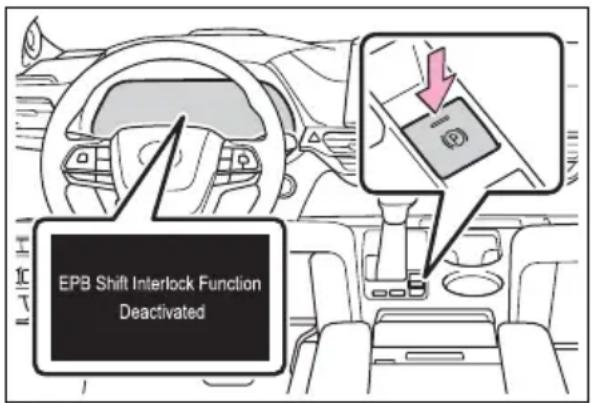
■Parking brake operation
- When the power switch is not in ON, the parking brake cannot be released using the parking brake switch.
●When the power switch is not in
ON, automatic mode (automatic brake setting and releasing) is not available.
■Parking brake automatic release function
The parking brake will be released automatically when the accelerator pedal is slowly depressed under the following conditions:
The driver's door is closed
●The driver is wearing the seat belt
●The shift lever is in a forward or reverse position.
●The malfunction indicator lamp or brake system warning light is not illuminated
If the automatic release function does not operate, release the parking brake manually.
■Parking brake automatic lock function
The parking brake will be locked automatically when the brake pedal is released under the following conditions:
●The vehicle is stopped
- The driver's door is not closed
●The driver is not wearing the seat belt
●The shift lever is in a forward or reverse position
●The malfunction indicator lamp or brake system warning light is not illuminated
If "Parking Brake Temporarily Unavailable" is displayed on the multi-information display
If the parking brake is operated repeatedly over a short period of time, the system may restrict operation to prevent overheating. If this happens, refrain from operating the parking brake. Normal operation will return after about 1 minute.
If "Parking Brake Unavailable" is displayed on the multi-information display
Operate the parking brake switch. If the message does not disappear after operating the switch several times, the system may be malfunctioning. Have the vehicle inspected by your Toyota dealer.
■Parking brake operation sound
When the parking brake operates, a motor sound (whirring sound) may be heard. This does not indicate a malfunction.
■Parking brake indicator light
● Depending on the power switch mode, the parking brake indicator light will turn on and stay on as described below: ON: Comes on until the parking brake is released. Not in ON: Stays on for approximately 15 seconds.
- When the power switch is turned off with the parking brake set, the parking brake indicator light will stay on for about 15 seconds. This does not indicate a malfunction.
■When the parking brake switch malfunctions
Automatic mode (automatic brake setting and releasing) will be turned on automatically.
Parking the vehicle
→P.208
■Parking brake engaged warning buzzer
A buzzer will sound if the vehicle is driven with the parking brake engaged. "Parking Brake ON" is displayed on the multi-information display (with the vehicle reaching a speed of 3 mph [5 km/h]).
■If the brake system warning light comes on
→P.466
■Usage in winter time
→P.344

WARNING
■When parking the vehicle
Do not leave a child in the vehicle alone. The parking brake may be released unintentionally by a child and there is the danger of the vehicle moving that may lead to an accident resulting in death or serious injury.
■Parking brake switch
Do not set any objects near the parking brake switch. Objects may interfere with the switch and may lead the parking brake to unexpectedly operate.

NOTICE
■When parking the vehicle
Before you leave the vehicle, shift the shift lever to P, set the parking brake and make sure that the vehicle does not move.
■When the system malfunctions
Stop the vehicle in a safe place and check the warning messages.
■When the parking brake cannot be released due to a malfunction
Driving the vehicle with the parking brake set will lead to brake components overheating, which may affect braking performance and increase brake wear. Have the vehicle inspected by your Toyota dealer immediately if this occurs.
Brake Hold
The brake hold system keeps the brake applied when the shift lever is in D, S or N with the system on and the brake pedal has been depressed to stop the vehicle. The system releases the brake when the accelerator pedal is depressed with the shift lever in D or S to allow smooth start off.
Enabling the system
Press the brake hold switch to turn the brake hold system on
The brake hold standby indicator (green) A comes on. While the system is holding the brake, the brake hold operated indicator (yellow) B comes on.
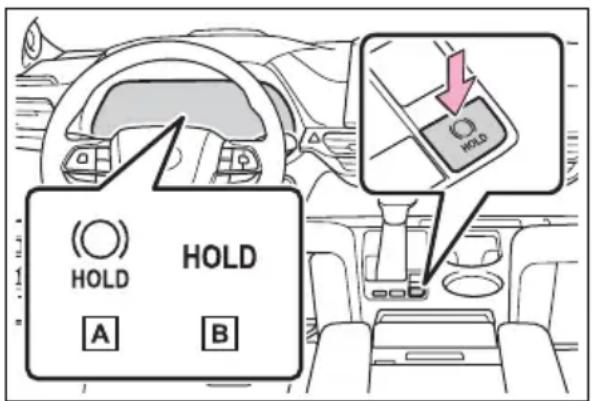
■ Brake hold system operating conditions
The brake hold system cannot be turned on in the following conditions:
- The driver's door is not closed.
●The driver is not wearing the seat belt.
If any of the conditions above are detected when the brake hold system is enabled, the system will turn off and the brake hold standby indicator light will go off. In addition, if any of the conditions are detected while the system is holding the brake, a warning buzzer will sound and a message will be shown on the multi-information display. The parking brake will then be set automatically.
■Brake hold function
- If the brake pedal is left released for a period of about 3 minutes after the system has started holding the brake, the parking brake will be set automatically. In this case, a warning buzzer sounds and a message is shown on the multi-information display.
●To turn the system off while the system is holding the brake, firmly depress the brake pedal and press the button again.
●The brake hold function may not hold the vehicle when the vehicle is on a steep incline. In this situation, it may be necessary for the driver to apply the brakes. A warning buzzer will sound and the multi-information display will inform the driver of this situation. If a warning message is shown on the multi-information display, read the message and follow the instructions.
■When the parking brake is set automatically while the system is holding the brakes
Perform any of the following operations to release the parking brake:
●Depress the accelerator pedal. (The parking brake will not be released automatically if the seat belt is not fastened.)
- Operate the parking brake switch with the brake pedal depressed.
Make sure that the parking brake indicator light goes off. ( P.243)
■When an inspection at your Toyota dealer is necessary
When the brake hold standby indicator (green) does not illuminate even when the brake hold switch is pressed with the brake hold system operating conditions met, the system may be malfunctioning. Have the vehicle inspected at your Toyota dealer.
If “Brakehold Malfunction Press Brake to Deactivate Visit Your Dealer” or “Brakehold Malfunction Visit Your Dealer” is displayed on the multi-information display
The system may be malfunctioning. Have the vehicle inspected by your Toyota dealer.
■Warning messages and buzzers
Warning messages and buzzers are used to indicate a system malfunction or to inform the driver of the need for caution. If a warning message is shown on the multi-information display, read the message and follow the instructions.
■If the brake hold operated indicator flashes
→P.471

WARNING
■When the vehicle is on a steep incline
When using the brake hold system on a steep incline, exercise caution. The brake hold function may not hold the vehicle in such a situation.
■When stopped on a slippery road
The system cannot stop the vehicle when the gripping ability of the tires has been exceeded. Do not use the system when stopped on a slippery road.

NOTICE
■When parking the vehicle
The brake hold system is not designed for use when parking the vehicle for a long period of time. Turning the power switch off while the system is holding the brake may release the brake, which would cause the vehicle to move. When operating the power switch, depress the brake pedal, shift the shift lever to P and set the parking brake.
Headlight switch
The headlights can be operated manually or automatically.
Turning on the headlights
Operating the switch turns on the lights as follows:
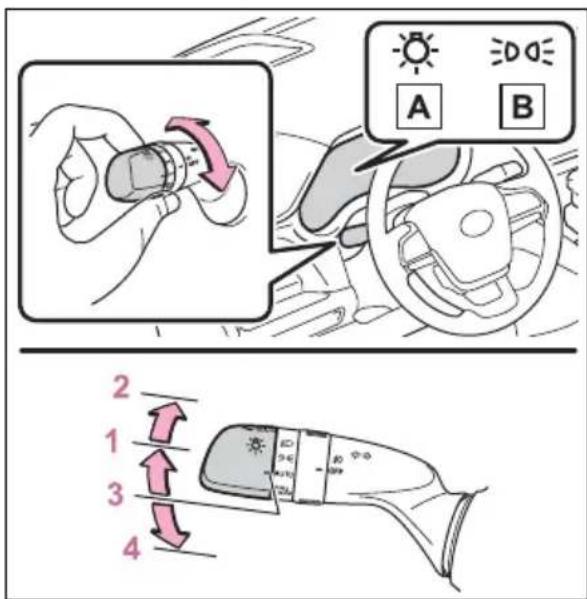
A U.S.A.
B Canada
1 The side marker, parking, tail, license plate, instrument panel lights, and daytime running lights (→P.248) turn on.
2 The headlights and all lights listed above (except daytime running lights) turn on.
3 The headlights, daytime running lights (→P.248) and all the lights listed above turn on and off automatically.
4 (S.A. only) Off
■ AUTO mode can be used when
The power switch is in ON.
■Daytime running light system
● Vehicles without projector headlights (type A): The daytime running lights illuminate using the same lights as the low beam headlights and illuminate dimmer than the low beam headlights.
● Vehicles without projector headlights (type B): The daytime running lights illuminate using the same lights as the parking lights and illuminate brighter than the parking lights.
● Vehicles with projector headlights: The daytime running lights illuminate using the same lights as the parking lights and illuminate brighter than the parking lights.
●To make your vehicle more visible to other drivers during daytime driving, the daytime running lights turn on automatically when all of the following conditions are met. (The daytime running lights are not designed for use at night.)
• The hybrid system is operating
• The parking brake is released
- The headlight switch is in the ≥00 or AUTO* position
- The fog lights are not illuminated
*: When the surroundings are bright
The daytime running lights remain on after they illuminate, even if the parking brake is set again.
●For the U.S.A.: Daytime running lights can be turned off by operating the switch.
- Compared to turning on the headlights, the daytime running light system offers greater durability and consumes less electricity, so it can help improve fuel economy.
■Headlight control sensor
The sensor may not function properly if an object is placed on the sensor, or anything that blocks the sensor is affixed to the windshield. Doing so interferes with the sensor detecting the level of ambient light and may cause the automatic headlight system to malfunction.
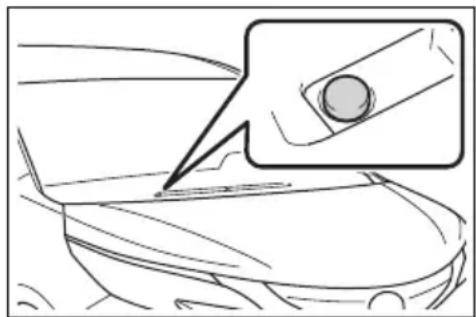
natural_image
Line drawing of a car's side profile with a magnified inset showing a circular object (no text or symbols)■Automatic light off system
- When the headlights are on: The lights turn off 30 seconds after the power switch is turned to ACC or OFF and a door is opened and closed. (The lights turn off imme-
diately if on the key is pressed after all the doors are closed.)
- When only the tail lights are on: The tail lights turn off automatically if the power switch is turned to ACC or OFF and the driver's door is opened.
Except for Canada: To turn the lights on again, turn the power switch to ON, or turn the light switch off once and then back to
≡D position.
For Canada: To turn the lights on again, turn the power switch to ON, or turn the light switch to once and then back to or position.
Light reminder buzzer
A buzzer sounds when the power switch is turned to ACC or OFF and the driver's door is opened while the lights are turned on.
■Windshield wiper linked head-light illumination (if equipped)
When driving during daytime with the headlight switch turned to AUTIF the windshield wipers are used, the headlights will turn on automatically after several seconds to help enhance the visibility of your vehicle.
■12-volt battery-saving function
In order to prevent the 12-volt battery of the vehicle from discharging, if the headlights and/or tail lights are on when the power switch is turned to OFF, the battery saving function will operate and automatically turn off all the lights after approximately 20 minutes.
When any of the following are performed, the battery-saving function is canceled once and then reactivated. All the lights will turn off automatically 20 minutes after the battery-saving function has been reactivated:
- When the headlight switch is operated
- When a door is opened or closed
If "Headlight System Malfunction Visit Your Dealer" is displayed on the multi-information display
The system may be malfunctioning. Have the vehicle inspected by your Toyota dealer.
■Welcome light illumination control
The parking lights and tail lights automatically turn on at night when the doors are unlocked using the entry function or wireless remote control if the light switch is in the
AUTO position.
Customization
Settings (e.g. light sensor sensitivity) can be changed.
(Customizable features: →P.548)

NOTICE
■To prevent 12-volt battery discharge
Do not leave the lights on longer than necessary when the hybrid system is not running.
Turning on the high beam headlights
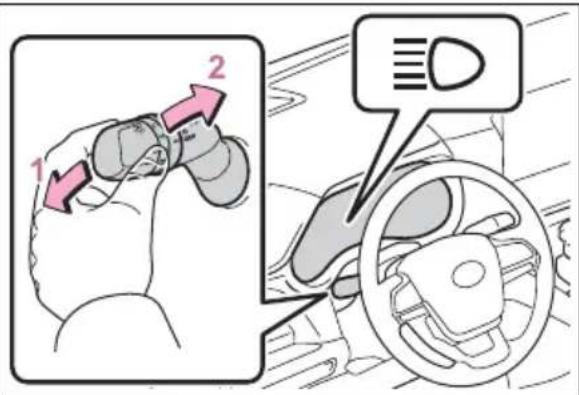
1 With the headlights on, push the lever away from you to turn on the high beams.
Pull the lever toward you to the center position to turn the high beams off.
2 Pull the lever toward you and release it to flash the high beams once.
You can flash the high beams with the headlights on or off.
AHB (Automatic High Beam)
The Automatic High Beam uses an in-vehicle front camera to assess the brightness of streetlights, the lights of vehicles ahead etc., and automatically turns the high beam on or off as necessary.

WARNING
■Limitations of the Automatic High Beam
Do not overly rely on the Automatic High Beam. Always drive safely, taking care to observe your surroundings and turning the high beam on or off manually if necessary.
■To prevent incorrect operation of the Automatic High Beam system
Do not overload the vehicle.
Activating the Automatic High Beam system
1 Press the Automatic High Beam switch.
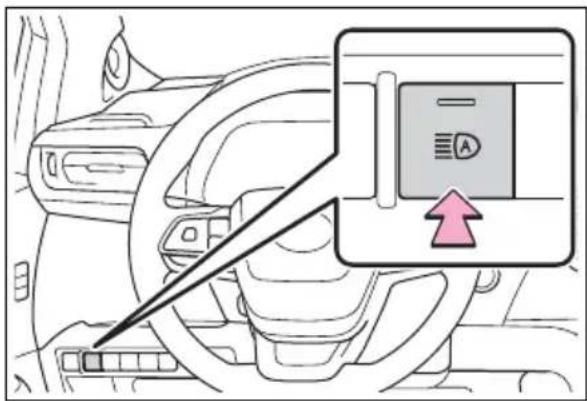
2 Turn the headlight switch to
the AU or position.
The Automatic High Beam indicator will come on when the system is operating.
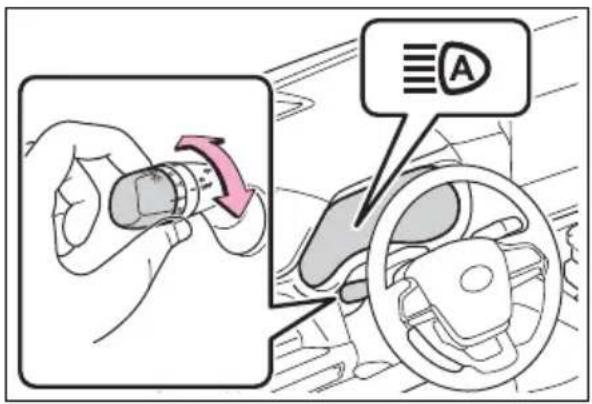
■High beam automatic turning on or off conditions
- When all of the following conditions are fulfilled, the high beam will be automatically turned on (after approximately 1 second):
- Vehicle speed is above approximately 21 mph (34 km/h) or more.
• The area ahead of the vehicle is dark.
• There are no vehicles ahead with headlights or tail lights turned on.
• There are few streetlights on the road ahead. - If any of the following conditions are fulfilled, the high beam will be automatically turned off:
• Vehicle speed drops below approximately 17 mph (27 km/h). - The area ahead of the vehicle is not dark.
• Vehicles ahead have headlights or tail lights turned on.
• There are many streetlights on the road ahead.
■Front camera detection information
●The high beam may not be automatically turned off in the following situations:
- When oncoming vehicles suddenly appear from a curve
- When the vehicle is cut in front of
by another vehicle
- When vehicles ahead are hidden from sight due to repeated curves, road dividers or roadside trees
- When vehicles ahead appear from the faraway lane on a wide road
- When vehicles ahead have no lights
●The high beam may be turned off if a vehicle ahead that is using fog lights without using the headlights is detected.
●House lights, street lights, traffic signals, and illuminated billboards or signs may cause the high beam to switch to the low beams, or the low beams to remain on.
●The following factors may affect the amount of time taken to turn the high beam on or off:
• The brightness of headlights, fog lights, and tail lights of vehicles ahead
• The movement and direction of vehicles ahead
- When a vehicle ahead only has operational lights on one side
- When a vehicle ahead is a two-wheeled vehicle
- The condition of the road (gradient, curve, condition of the road surface etc.)
• The number of passengers and amount of luggage
●The high beam may be turned on or off when the driver does not expect it.
●Bicycles or similar objects may not be detected.
- In the situations shown below, the system may not be able to accurately detect surrounding brightness levels. This may cause the low beams to remain on or the high beams to cause problems for pedestrians, vehicles ahead or other parties. In these cases, manually switch between the high and low beams.
- In bad weather (rain, snow, fog, sandstorms, etc.)
• The windshield is obscured by
fog, mist, ice, dirt, etc.
- The windshield is cracked or damaged
- The front camera is deformed or dirty
- When the temperature of the front camera is extremely high
- Surrounding brightness levels are equal to those of headlights, tail lights or fog lights
- When headlights or tail lights of vehicles ahead are turned off, dirty, changing color, or not aimed properly
- When the vehicle is hit by water, snow, dust, etc. from a preceding vehicle
- When driving through an area of intermittently changing brightness and darkness
- When frequently and repeatedly driving ascending/descending roads, or roads with rough, bumpy or uneven surfaces (such as stone-paved roads, gravel roads, etc.)
- When frequently and repeatedly taking curves or driving on a winding road
- There is a highly reflective object ahead of the vehicle, such as a sign or mirror
- The back of a vehicle ahead is highly reflective, such as a container on a truck
- The vehicle's headlights are damaged or dirty, or are not aimed properly
- The vehicle is listing or titling due to a flat tire, a trailer being towed, etc.
- The high beam and low beam are repeatedly being switched between in an abnormal manner
- The driver believes that the high beam may be causing problems or distress to other drivers or pedestrians nearby
■Temporarily lowering sensor sensitivity
The sensitivity of the sensor can be temporarily lowered.
1 Turn the power switch off while the following conditions are met.
●The headlight switch is in or AUTO position.
●The headlight switch lever is in the original position.
●Automatic High Beam switch is on.
2 Turn the power switch to ON.
3 Within 60 seconds after step 2, repeat pushing the headlight switch lever to the high beam position then pulling it to the original position quickly 10 times, then leave the lever in the original position.
4 If the sensitivity is changed, the Automatic High Beam indicator turns on and off 3 times.
Turning the high beam on/off manually
■ Switching to the high beams
Push the lever away from you.
The Automatic High Beam indicator will turn off and the headlight high beam indicator will turn on.
Pull the lever to its original position to activate the Automatic High Beam system again.
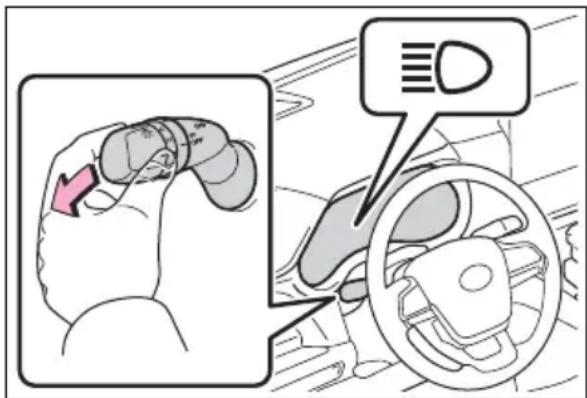
■Switching to the low beams
Press the Automatic High Beam
switch.
The Automatic High Beam indicator will turn off.
Press the switch to activate the Automatic High Beam system again.
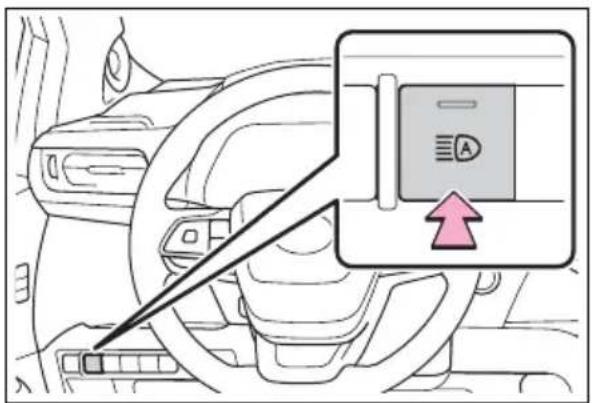
■Temporarily switching to the low beams
Pull the lever toward you and then return it to its original position.
The high beams are on while the lever is pulled toward you, however, after the lever is returned to its original position, the low beams remain on for a certain amount of time. Afterwards, the Automatic High Beam will be activated again.
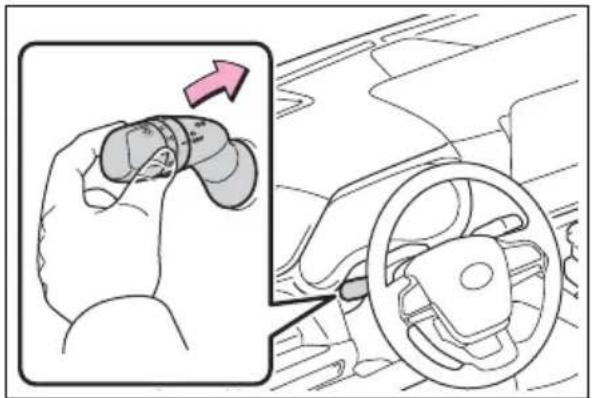
■ Temporarily switching to the low beams
It is recommended to switch to the low beams when the high beam may cause problems or distress to
other drivers or pedestrians nearby.
Fog light switch\*
*: If equipped
The fog lights offer improved visibility in difficult driving conditions, such as in rain and fog.
Operating procedure
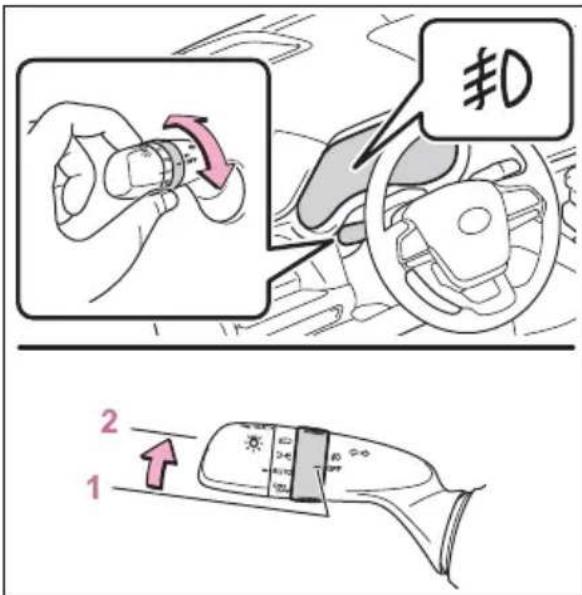
1 OFF ^1 or O ^2 Turns the fog lights off
2 Turns the fog lights on
*1: For the U.S.A.
*2:For Canada
■Fog lights can be used when
The parking lights are on or the headlights are on in low beam.

NOTICE
■To prevent 12-volt battery discharge
Do not leave the lights on longer than necessary when the hybrid system is off.
Windshield wipers and washer
Operating the lever can switch between automatic operation and manual operation, or can use the washer.

NOTICE
■When the windshield is dry Do not use the wipers, as they may damage the windshield.
Operating the wiper lever
Operating the lever operates the wipers or washer as follows:
▶ Intermittent windshield wipers
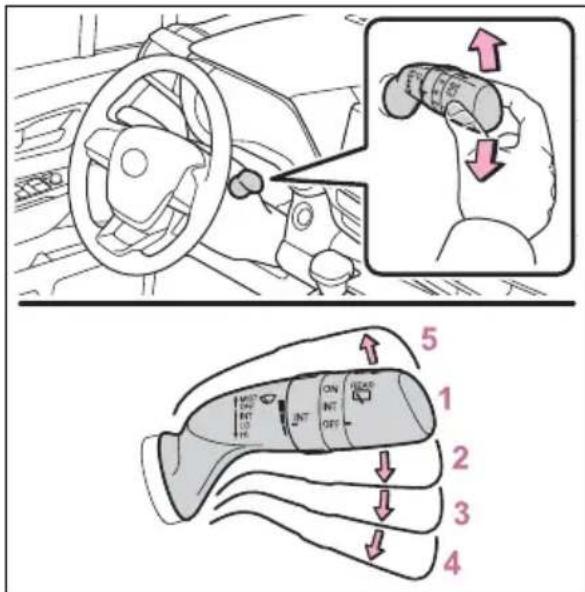
1 OFF *1 or o *2 Off
2 INT *1 or 📋*2 Intermittent operation
3 LO ^1 or ^2 Low speed operation
4 HI ^1 or ^2 High speed operation
5 MIST ^1 or ^2 Temporary operation
*1: For the U.S.A.
*2:For Canada
If equipped, wiper intervals can be adjusted when intermittent operation is selected.
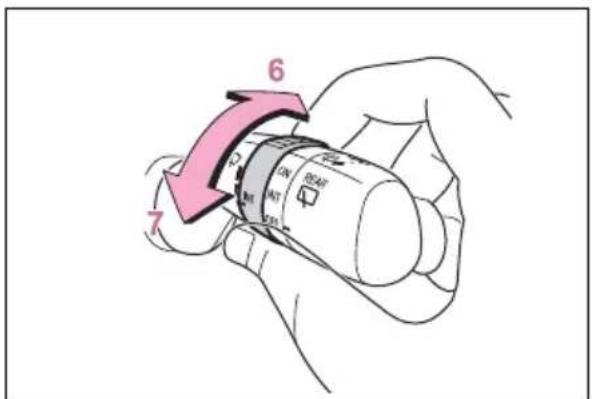
6 Increases the intermittent windshield wiper frequency
7 Decreases the intermittent windshield wiper frequency
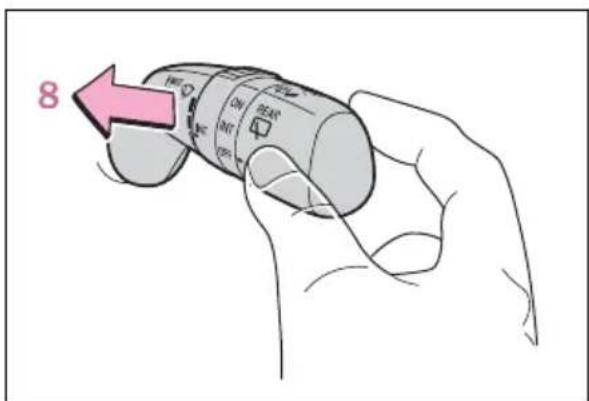
8 Washer/wiper dual operation
Pulling the lever operates the wipers and washer.
The wipers will automatically operate a couple of times after the washer squirts.
▶ Rain-sensing windshield wipers
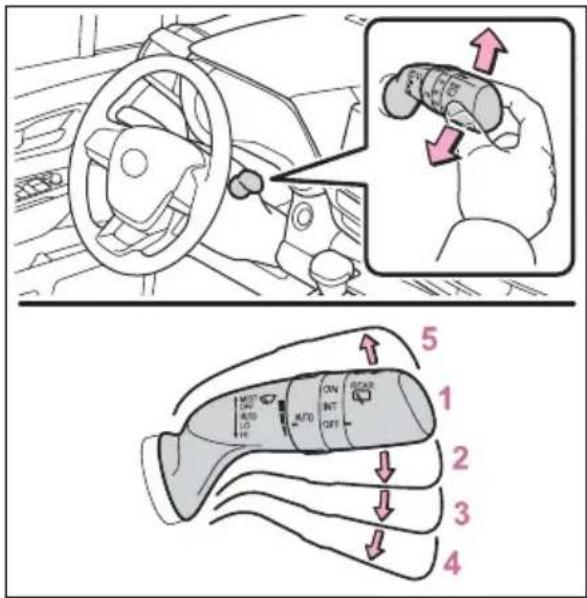
1 OFF *1 or o *2 Off
2 Rain-sensing operation
3 LO *1 or ▼*2 Low speed operation
4 HI ^1 or ^2 High speed operation
5 MIST ^1 or ^2 Temporary operation
*1: For the U.S.A.
*2:For Canada
When "AUTO" is selected, the wipers will operate automatically when the sensor detects falling rain. The system automatically adjusts wiper timing in accordance with rain volume and vehicle speed.
The sensor sensitivity can be adjusted when "AUTO" is selected.
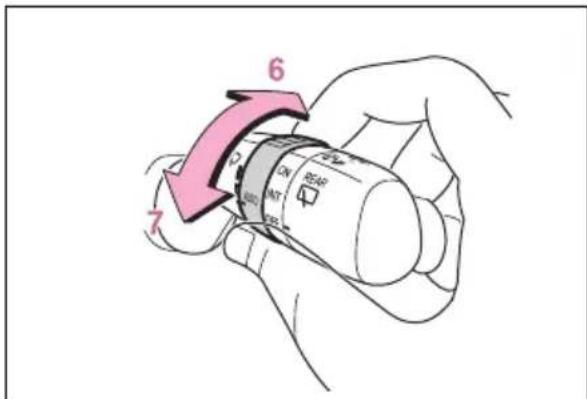
6 Increases the sensitivity
7 Decreases the sensitivity
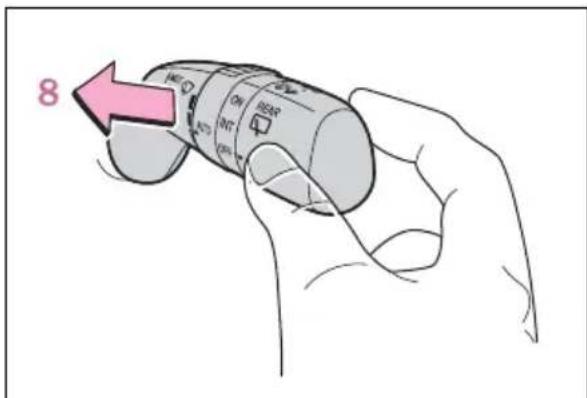
8 Washer/wiper dual operation
Pulling the lever operates the wipers and washer.
The wipers will automatically operate a couple of times after the washer squirts.
■The windshield wipers and washer can be operated when
The power switch is in ON.
■ Raindrop sensor (vehicles with rain-sensing windshield wipers)
●The raindrop sensor judges the amount of raindrops.
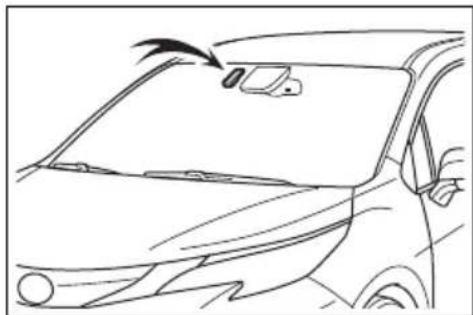
natural_image
Line drawing of a car's front window and side door, showing no text or symbols- If the wiper switch is turned to the "AUTO" position while the power switch is in ON, the wipers will operate once to show that "AUTO" mode is activated.
- If the wiper sensitivity is adjusted to higher, the wiper may operate once to indicate the change of sensitivity.
- If the temperature of the raindrop sensor is 185°F (85°C) or higher, or 5°F (-15°C) or lower, the automatic operation may not occur. In this case, operate the wipers in any mode other than “AUTO”.
■If no windshield washer fluid sprays
Check that the washer nozzles are not blocked if there is washer fluid in the windshield washer fluid reservoir.
■Front door opening linked wind-shield wiper stop function (vehicles with rain-sensing windshield wipers)
When "AUTO" is selected and the windshield wipers are operating, if a front door is opened, the operation of the windshield wipers will be stopped to prevent anyone entering/ exiting the vehicle from being sprayed by water from the wipers, provided the vehicle is stopped with the parking brake applied or the shift lever in P. When the front door is closed, wiper operation will resume.

WARNING
■Caution regarding the use of windshield wipers in "AUTO" mode (vehicles with rain-sensing windshield wipers)
The windshield wipers may operate unexpectedly if the sensor is touched or the windshield is subject to vibration in "AUTO" mode. Take care that your fingers or anything else does not become caught in the windshield wipers.
■Caution regarding the use of washer fluid
When it is cold, do not use the washer fluid until the windshield becomes warm. The fluid may freeze on the windshield and cause low visibility. This may lead to an accident, resulting in death or serious injury.

NOTICE
■When the washer fluid tank is empty
Do not operate the switch continually as the washer fluid pump may overheat.
■When a nozzle becomes blocked
In this case, contact your Toyota dealer.
Do not try to clear it with a pin or other object. The nozzle will be damaged.
■To prevent 12-volt battery discharge
Do not leave the wipers on longer than necessary when the hybrid system is off.
Rear window wiper and washer
The rear window wiper and washer can be used by operating the lever.

NOTICE
■When the rear window is dry Do not use the wiper, as it may damage the rear window.
Operating the wiper lever
Operating the switch operates the rear wiper as follows:
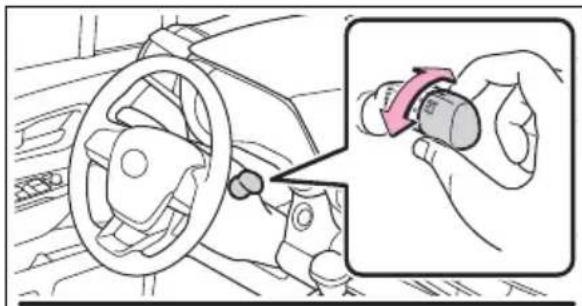
natural_image
Diagram showing a hand turning a car's steering wheel, with an inset close-up of the wheel (no text or symbols present)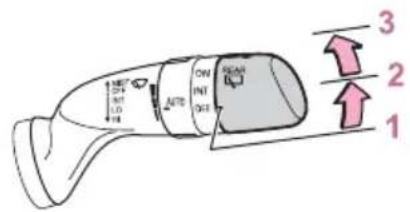
1 OFF *1 or o *2 Off
2 INT ^1 or --- ^2 Intermittent operation
3 ON ^1 or — ^2 Normal operation
*1: For the U.S.A.
*2:For Canada
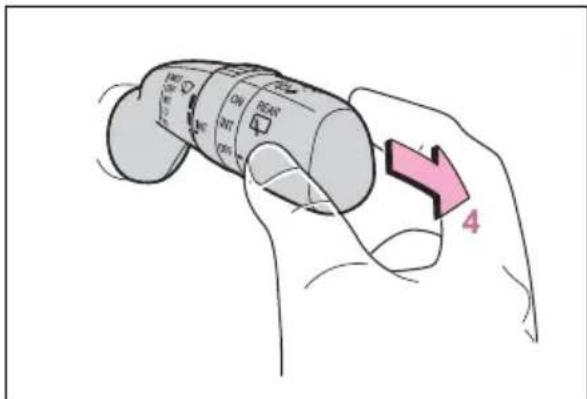
4 Washer/wiper dual operation
Pushing the lever operates the wiper and washer.
The wiper will automatically operate a couple of times after the washer squirts.
The washer will automatically operate and clean the camera for the
Digital Rear view Mirror ^1 ( P.193) and rear camera ^2 .
*1:If equipped
*2:Refer to "NAVIGATION AND MULTIMEDIA SYSTEM OWNER'S MANUAL".
■The rear window wiper and washer can be operated when
The power switch is in ON.
■If no washer fluid sprays
Check that the washer nozzle is not blocked if there is washer fluid in the washer fluid reservoir.
■Back door opening linked rear window wiper stop function
When the rear window wiper is operating, if the back door is opened while the vehicle is stopped, operation of the rear window wiper will be stopped to prevent anyone near the vehicle from being sprayed by water from the wiper. When the back door is closed, wiper operation will resume.*
*: The setting must be customized at your Toyota dealer.
■Reverse-linked rear window wiper function
When the shift lever is shifted to R when the front wipers are operating, the rear window wiper will operate once.
Customization
Setting of the reverse-linked function can be changed. (Customizable features: →P.548)

NOTICE
■When the washer fluid tank is empty
Do not operate the switch continually as the washer fluid pump may overheat.
■When a nozzle becomes blocked
In this case, contact your Toyota dealer.
Do not try to clear it with a pin or other object. The nozzle will be damaged.
■To prevent 12-volt battery discharge
Do not leave the wiper on longer than necessary when the hybrid system is off.
Opening the fuel tank cap
The fuel tank of your vehicle has a special structure, which requires a reduction in fuel tank pressure before refueling. After the opener switch has been pressed, it will take several seconds until the vehicle is ready for refueling.
Before refueling the vehicle
- Close all the doors and windows, and turn the power switch to OFF.
- Confirm the type of fuel.
Fuel types
→P.528
■Fuel tank opening for unleaded gasoline
To help prevent incorrect fueling, your vehicle has a fuel tank opening that only accommodates the special nozzle on unleaded fuel pumps.

WARNING
■When refueling the vehicle
Observe the following precautions while refueling the vehicle. Failure to do so may result in death or serious injury.
● After exiting the vehicle and before opening the fuel door, touch an unpainted metal surface to discharge any static electricity. It is important to discharge static electricity before refueling because sparks resulting from static electricity can cause fuel vapors to ignite while refueling.
● Always hold the grips on the fuel tank cap and turn it slowly to remove it. A whooshing sound may be heard when the fuel tank cap is loosened. Wait until the sound cannot be heard before fully removing the cap. In hot weather, pressurized fuel may spray out of the filler neck and cause injury.
- Do not allow anyone that has not discharged static electricity from their body to come close to an open fuel tank.
- Do not inhale vaporized fuel. Fuel contains substances that are harmful if inhaled.
- Do not smoke while refueling the vehicle. Doing so may cause the fuel to ignite and cause a fire.
- Do not return to the vehicle or touch any person or object that is statically charged. This may cause static electricity to build up, resulting in a possible ignition hazard.

WARNING
When refueling
Observe the following precautions to prevent fuel overflowing from the fuel tank:
- Securely insert the fuel nozzle into the fuel filler neck.
- Stop filling the tank after the fuel nozzle automatically clicks off.
- Do not top off the fuel tank.

NOTICE
Refueling
●Finish refueling within 30 minutes. If more than 30 minutes passes, the internal valve closes. In this condition, fuel may overflow during the refueling process. Press the fuel filler door opener switch again.
- Do not spill fuel during refueling. Doing so may damage the vehicle, such as causing the emission control system to operate abnormally or damaging fuel system components or the vehicle's painted surface.
Opening the fuel tank cap
1 Press the opener to open the fuel filler door.
The fuel filler door will open within about 10 seconds of the switch being pressed. Before refueling is possible, a message will be shown on the multi-information display in the instrument cluster to indicate the progress of the fuel filler door
opener.
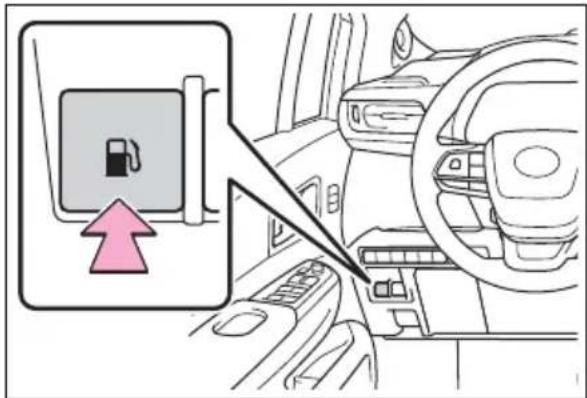
2 Turn the fuel tank cap slowly to open it and put it into the holder on the fuel filler door.
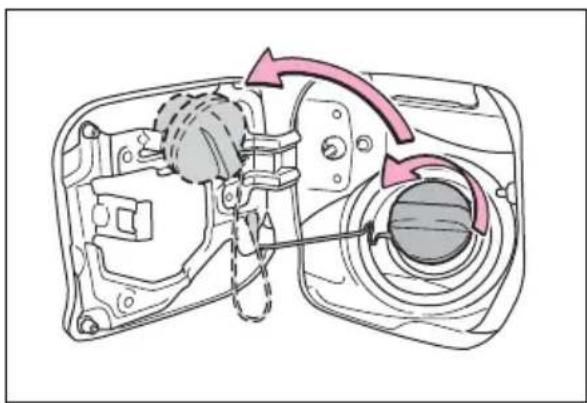
natural_image
Technical diagram of a mechanical assembly with arrows indicating motion or force direction (no text or symbols)■If the fuel filler door cannot be opened
→P.503
Closing the fuel tank cap
After refueling, turn the fuel tank cap until you hear a click. Once the cap is released, it will turn slightly in the opposite direction.
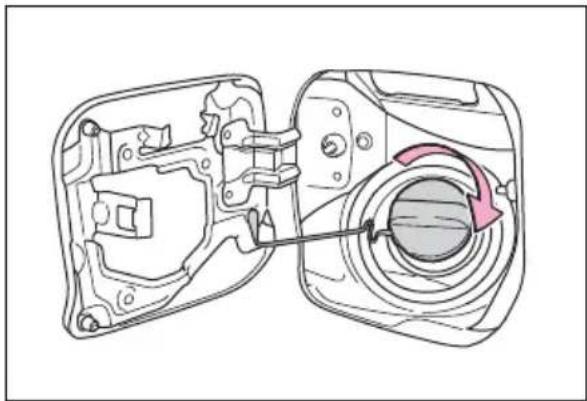
natural_image
Technical line drawing of a mechanical assembly with internal components and a circular component (no text or symbols)- When “Check Fuel Cap” is displayed on the multi-information display
The fuel tank cap may be unfas- tened or loose. Turn the power switch off, check the cap and tighten it securely. If the message remains, wait a few seconds and then turn the power switch off once again.

WARNING
■When replacing the fuel tank cap
Do not use anything but a genuine Toyota fuel tank cap designed for your vehicle. Doing so may cause a fire or other incident which may result in death or serious injury.

NOTICE
■When refueling
When refueling your vehicle, make sure that the fuel filler door lock is not pushed by the fuel nozzle boot, etc., as this may cause a valve to close, possibly resulting in a fuel spill.
If the fuel filler door lock has been pushed, operate the fuel filler door opener switch in the vehicle before continuing to refuel.
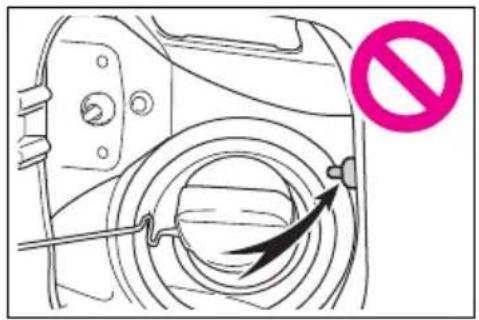
Toyota Safety Sense 2.0
The Toyota Safety Sense 2.0 consists of the following drive assist systems and contributes to a safe and comfortable driving experience:
Driving assist system
■PCS (Pre-Collision System)
→P.267
■LTA (Lane Tracing Assist)
→P.275
■AHB (Automatic High Beam)
→P.250
■RSA (Road Sign Assist) (if equipped)
→P.285
■ Dynamic radar cruise control with full-speed range
→P.288

WARNING
Toyota Safety Sense 2.0
The Toyota Safety Sense 2.0 is designed to operate under the assumption that the driver will drive safely, and is designed to help reduce the impact to the occupants and the vehicle in the case of a collision or assist the driver in normal driving conditions.
As there is a limit to the degree of recognition accuracy and control performance that this system can provide, do not overly rely on this system. The driver is always responsible for paying attention to the vehicle's surroundings and driving safely.
Sensors
Two types of sensors, located behind the front grille and wind-shield, detect information necessary to operate the drive assist systems.
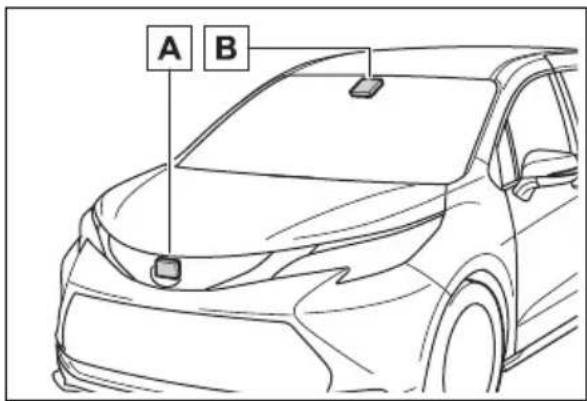
A Radar sensor
B Front camera

WARNING
■To avoid malfunction of the radar sensor
Observe the following precautions.
Otherwise, the radar sensor may not operate properly, possibly leading to an accident resulting in death or serious injury.
- Keep the radar sensor and the radar sensor cover clean at all times.
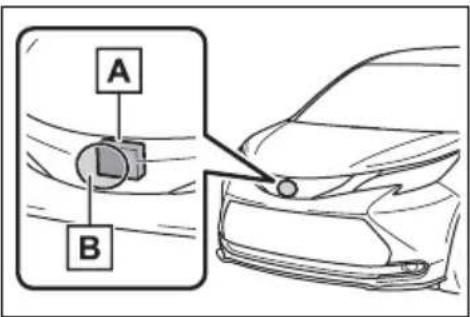
A Radar sensor
B Radar sensor cover
If the front of the radar sensor or the front or back of the radar sensor cover is dirty or covered with water droplets, snow, etc., clean it.
Clean the radar sensor and radar sensor cover with a soft cloth to avoid damaging them.
- Do not attach accessories, stickers (including transparent stickers) or other items to the radar sensor, radar sensor cover or surrounding area.
- Do not subject the radar sensor or its surrounding area to a strong impact. If the radar sensor, front grille, or front bumper has been subjected to a strong impact, have the vehicle inspected by your Toyota dealer.
- Do not disassemble the radar sensor.
- Do not modify or paint the radar sensor or radar sensor cover.
● In the following cases, the radar sensor must be recalibrated. Contact your Toyota dealer for details.
- When the radar sensor or front grille are removed and installed, or replaced
- When the front bumper is replaced
■To avoid malfunction of the front camera
Observe the following precautions.
Otherwise, the front camera may not operate properly, possibly leading to an accident resulting in death or serious injury.
- Keep the windshield clean at all times.
- If the windshield is dirty or covered with an oily film, water droplets, snow, etc., clean the windshield.
- If a glass coating agent is applied to the windshield, it will still be necessary to use the windshield wipers to remove water droplets, etc. from the area of the windshield in front of the front camera.
- If the inner side of the wind-shield where the front camera is installed is dirty, contact your Toyota dealer.

WARNING
- Do not attach objects, such as stickers, transparent stickers, etc., to the outer side of the windshield in front of the front camera (shaded area in the illustration).
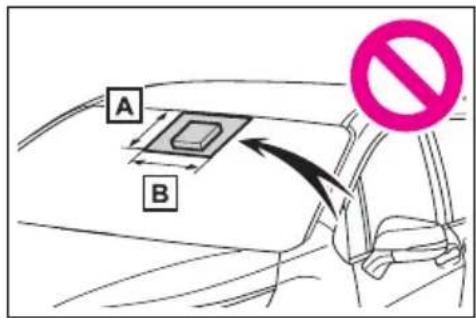
A From the top of the windshield to approximately 0.4 in. (1 cm) below the bottom of the front camera
B Approximately 7.9 in. (20 cm) (Approximately 4.0 in. [10 cm] to the right and left from the center of the front camera)
- If the part of the windshield in front of the front camera is fogged up or covered with condensation, or ice, use the windshield defogger to remove the fog, condensation, or ice. (→P.349)
- If water droplets cannot be properly removed from the area of the windshield in front of the front camera by the windshield wipers, replace the wiper insert or wiper blade.
- Do not attach window tint to the windshield.
- Replace the windshield if it is damaged or cracked.
After replacing the windshield, the front camera must be recalibrated. Contact your Toyota dealer for details.
- Do not allow liquids to contact the front camera.
- Do not allow bright lights to shine into the front camera.
- Do not dirty or damage the front camera.
When cleaning the inside of the windshield, do not allow glass cleaner to contact the lens of the front camera. Also, do not touch the lens. If the lens is dirty or damaged, contact your Toyota dealer.
- Do not subject the front camera to a strong impact.
- Do not change the installation position or direction of the front camera or remove it.
- Do not disassemble the front camera.
- Do not modify any components of the vehicle around the front camera (inside rear view mirror, etc.) or ceiling.
- Do not attach any accessories to the hood, front grille or front bumper that may obstruct the front camera. Contact your Toyota dealer for details.
- If a surfboard or other long object is to be mounted on the roof, make sure that it will not obstruct the front camera.
- Do not modify the headlights or other lights.
If a warning message is displayed on the multi-information display
A system may be temporarily unavailable or there may be a malfunction in the system.
- In the following situations, perform the actions specified in the table. When the normal operating conditions are detected, the message will disappear and the system will become operational.
If the message does not disappear, contact your Toyota dealer.
| Situation Actions | |
| When the area around a sensor is covered with dirt, moisture (fogged up, covered with condensation, ice, etc.), or other foreign matter | To clean the part of the windshield in front of the front camera, use the windshield wipers or the windshield defogger of the air conditioning sys-tem ( P.349). |
| When the temperature around the front camera is outside of the opera-tional range, such as when the vehi-cle is in the sun or in an extremely cold environment | If the front camera is hot, such as after the vehicle had been parked in the sun, use the air conditioning sys-tem to decrease the temperature around the front camera.If a sunshade was used when the vehicle was parked, depending on its type, the sunlight reflected from the surface of the sunshade may cause the temperature of the front camera to become excessively high. |
| If the front camera is cold, such as after the vehicle is parked in an extremely cold environment, use the air conditioning system to increase the temperature around the front camera. | |
| The area in front of the front camera is obstructed, such as when the hood is open or a sticker is attached to the part of the windshield in front of the front camera. | Close the hood, remove the sticker, etc. to clear the obstruction. |
- In the following situations, if the situation has changed (or the vehicle has been driven for some time) and the normal operating conditions are detected, the message will disappear and the system will become operational.
If the message does not disappear, contact your Toyota dealer.
- When the temperature around the radar sensor is outside of the opera-
tional range, such as when the vehicle is in the sun or in an extremely cold environment
- When the front camera cannot detect objects in front of the vehicle, such as when driving in the dark, snow, or fog, or when bright lights are shining into the front camera
PCS (Pre-Collision System)
The pre-collision system uses a radar sensor and front camera to detect objects ( P.267) in front of the vehicle. When the system determines that the possibility of a frontal collision with an object is high, a warning operates to urge the driver to take evasive action and the potential brake pressure is increased to help the driver avoid the collision. If the system determines that the possibility of a frontal collision with an object is extremely high, the brakes are automatically applied to help avoid the collision or help reduce the impact of the collision.
The pre-collision system can be disabled/enabled and the warning timing can be changed. ( P.269)
Detectable objects
The system can detect the following:
- Vehicles
- Bicyclists
- Pedestrians
System functions
■Pre-collision warning
When the system determines that the possibility of a frontal collision is high, a buzzer will sound and a warning message will be displayed on the multi-information display to urge the driver to take evasive action.
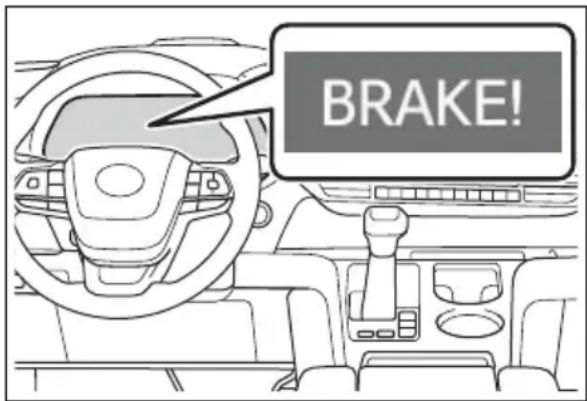
■Pre-collision brake assist
When the system determines that the possibility of a frontal collision is high, the system applies greater braking force in relation to how strongly the brake pedal is depressed.
■Pre-collision braking
If the system determines that the possibility of a frontal collision is extremely high, the brakes are automatically applied to help avoid the collision or reduce the impact of the collision.

WARNING
■Limitations of the pre-collision system
The driver is solely responsible for safe driving. Always drive safely, taking care to observe your surroundings. Do not use the pre-collision system instead of normal braking operations under any circumstances. This system will not prevent collisions or lessen collision damage or injury in every situation. Do not overly rely on this system. Failure to do so may lead to an accident, resulting in death or serious injury.
Although this system is designed to help avoid a collision or help reduce the impact of the collision, its effectiveness may change according to various conditions, therefore the system may not always be able to achieve the same level of performance. Read the following conditions carefully. Do not overly rely on this system and always drive carefully.
- Conditions under which the system may operate even if there is no possibility of a collision: P.271
- Conditions under which the system may not operate properly: P.272
- Do not attempt to test the operation of the pre-collision system yourself. Depending on the objects used for testing (dummies, cardboard objects imitating detectable objects, etc.), the system may not operate properly, possibly leading to an accident.
■Pre-collision braking
- When the pre-collision braking function is operating, a large amount of braking force will be applied.
- If the vehicle is stopped by the operation of the pre-collision braking function, the pre-collision braking function operation will be canceled after approximately 2 seconds. Depress the brake pedal as necessary.
●The pre-collision braking function may not operate if certain operations are performed by the driver. If the accelerator pedal is being depressed strongly or the steering wheel is being turned, the system may determine that the driver is taking evasive action and possibly prevent the pre-collision braking function from operating.
In some situations, while the pre-collision braking function is operating, operation of the function may be canceled if the accelerator pedal is depressed strongly or the steering wheel is turned and the system determines that the driver is taking evasive action.
- If the brake pedal is being depressed, the system may determine that the driver is taking evasive action and possibly delay the operation timing of the pre-collision braking function.
■When to disable the pre-collision system
In the following situations, disable the system, as it may not operate properly, possibly leading to an accident resulting in death or serious injury:
- When the vehicle is being towed

WARNING
- When your vehicle is towing another vehicle
- When transporting the vehicle via truck, boat, train or similar means of transportation
- When the vehicle is raised on a lift with the hybrid system on and the tires are allowed to rotate freely
- When inspecting the vehicle using a drum tester such as a chassis dynamometer or speedometer tester, or when using an on vehicle wheel balancer
- When a strong impact is applied to the front bumper or front grille, due to an accident or other reasons
- If the vehicle cannot be driven in a stable manner, such as when the vehicle has been in an accident or is malfunctioning
- When the vehicle is driven in a sporty manner or off-road
- When the tires are not properly inflated
- When the tires are very worn
- When tires of a size other than specified are installed
- When tire chains are installed
- When a compact spare tire or an emergency tire puncture repair kit is used
- If equipment (snow plow, etc.) that may obstruct the radar sensor or front camera is temporarily installed to the vehicle
Changing settings of the pre-collision system
■Enabling/disabling the pre-collision system
The pre-collision system can be enabled/disabled on the screen (→P.112) of the multi-information display.
The system is automatically enabled each time the power switch is turned to ON.
If the system is disabled, the PCS warning light will turn on and a message will be displayed on the multi-information display.
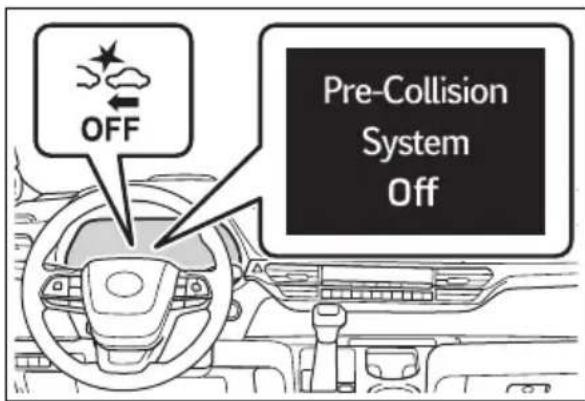
■Changing the pre-collision warning timing
The pre-collision warning timing can be changed on the screen (→P.112) of the multi-information display.
The warning timing setting is retained when the power switch is turned to OFF. However, if the pre-collision system is disabled and re-enabled, the operation timing will return to the default setting (middle).
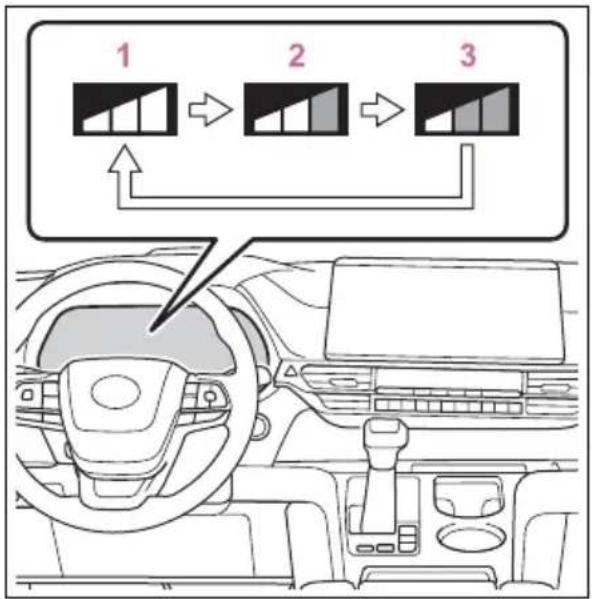
flowchart
graph TD
    A["1 State"] --> B["2 State"]
    B --> C["3 State"]
    style A fill:#f9f,stroke:#333
    style B fill:#ccf,stroke:#333
    style C fill:#cfc,stroke:#333
1 Early
2 Middle
This is the default setting.
3 Late
■Operational conditions
The pre-collision system is enabled and the system determines that the possibility of a frontal collision with a detected object is high. Each function is operational at the following speed
●Pre-collision warning
| Detectable objects Vehicle speed | Relative speed between your vehicle and object | |
| Vehicles | Approx. 7 to 110 mph (10 to 180 km/h) | Approx. 7 to 110 mph (10 to 180 km/h) |
| Bicyclists and pedestrians | Approx. 7 to 50 mph (10 to 80 km/h) | Approx. 7 to 50 mph (10 to 80 km/h) |
●Pre-collision brake assist
| Detectable objects Vehicle speed | Relative speed between your vehicle and object | |
| Vehicles | Approx. 20 to 110 mph (30 to 180 km/h) | Approx. 20 to 110 mph (30 to 180 km/h) |
| Bicyclists and pedestrians | Approx. 20 to 50 mph (30 to 80 km/h) | Approx. 20 to 50 mph (30 to 80 km/h) |
●Pre-collision braking
| Detectable objects Vehicle speed | Relative speed between your vehicle and object | |
| Vehicles | Approx. 7 to 110 mph (10 to 180 km/h) | Approx. 7 to 110 mph (10 to 180 km/h) |
| Bicyclists and pedestrians | Approx. 7 to 50 mph (10 to 80 km/h) | Approx. 7 to 50 mph (10 to 80 km/h) |
The system may not operate in the following situations:
- If a 12-volt battery terminal has been disconnected and reconnected and then the vehicle has not been driven for a certain amount of time
- If the shift lever is in R
- When the VSC OFF indicator is illuminated (only the pre-collision warning function will be operational)
■Object detection function
The system detects objects based on their size, profile, motion, etc. However, an object may not be detected depending on the surrounding brightness and the motion, posture, and angle of the detected object, preventing the system from operating properly. (→P.272) The illustration shows an image of detectable objects.
natural_image
Silhouette icons showing a car, human figures, and a bicycle (no text or symbols)■Cancelation of the pre-collision braking
If either of the following occur while the pre-collision braking function is operating, it will be canceled:
●The accelerator pedal is depressed strongly.
●The steering wheel is turned sharply or abruptly.
■Conditions under which the system may operate even if there is no possibility of a collision
- In some situations such as the following, the system may determine that there is a possibility of a frontal collision and operate.
- When passing a detectable object, etc.
- When changing lanes while overtaking a detectable object, etc.
- When approaching a detectable object in an adjacent lane or on the roadside, such as when changing the course of travel or driving on a winding road
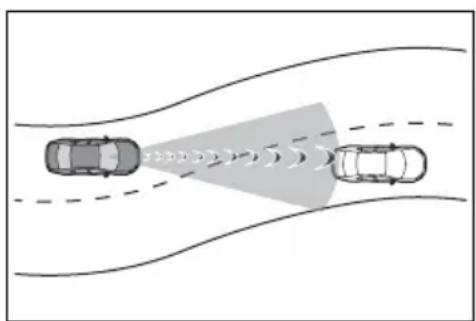
natural_image
Diagram showing two cars on curved road with dashed lane markings and a shaded triangular area indicating distance or coverage (no text or symbols)- When rapidly closing on a detectable object, etc.
- When approaching objects on the roadside, such as detectable objects, guardrails, utility poles, trees, or walls
- When there is a detectable object or other object by the roadside at
the entrance of a curve
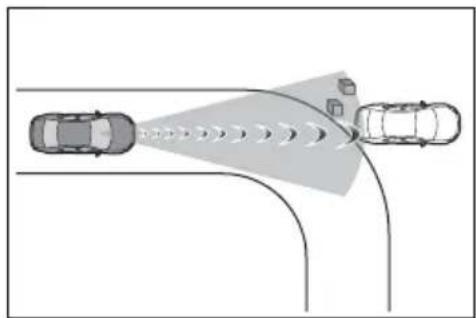
natural_image
Diagram showing a vehicle approaching a road with sensor or signal detection (no text or symbols)- When there are patterns or paint in front of your vehicle that may be mistaken for a detectable object
- When the front of your vehicle is hit by water, snow, dust, etc.
- When overtaking a detectable object that is changing lanes or making a right/left turn
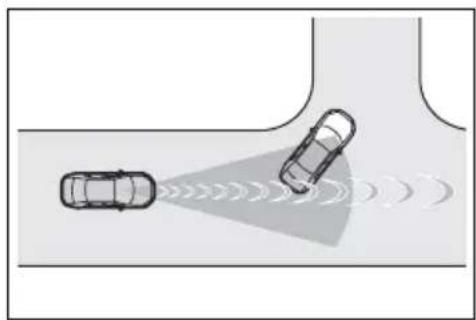
natural_image
Top-down diagram of two cars on a road with sound waves indicating traffic (no text or symbols)- When passing a detectable object in an oncoming lane that is stopped to make a right/left turn
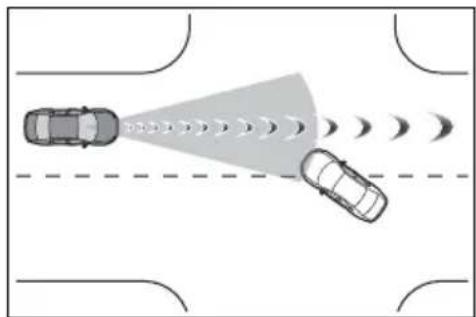
natural_image
Top-down diagram of two cars on a road with directional arrows indicating traffic or sensor placement (no text or symbols)- When a detectable object approaches very close and then stops before entering the path of your vehicle
- If the front of your vehicle is raised or lowered, such as when on an uneven or undulating road surface
- When driving on a road surrounded by a structure, such as in a tunnel or on an iron bridge
- When there is a metal object (manhole cover, steel plate, etc.), steps, or a protrusion in front of
your vehicle
- When passing under an object (road sign, billboard, etc.)
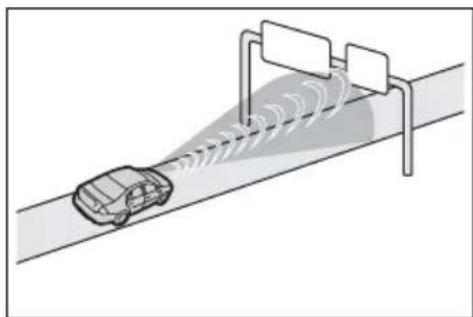
natural_image
Diagram of a car driving on a road with sensor waves projecting onto a lane (no text or symbols)- When approaching an electric toll gate barrier, parking area barrier, or other barrier that opens and closes
- When using an automatic car wash
- When driving through or under objects that may contact your vehicle, such as thick grass, tree branches, or a banner
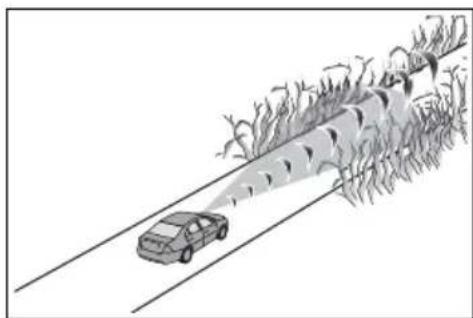
natural_image
Illustration of a car driving on a road with trees and a tunnel entrance (no text or symbols)- When driving through steam or smoke
- When driving near an object that reflects radio waves, such as a large truck or guardrail
- When driving near a TV tower, broadcasting station, electric power plant, or other location where strong radio waves or electrical noise may be present
■ Situations in which the system may not operate properly
- In some situations such as the following, an object may not be detected by the radar sensor and front camera, preventing the system from operating properly:
- When a detectable object is approaching your vehicle
- When your vehicle or a detectable object is wobbling
- If a detectable object makes an abrupt maneuver (such as sudden swerving, acceleration or deceleration)
- When your vehicle approaches a detectable object rapidly
- When a detectable object is not directly in front of your vehicle
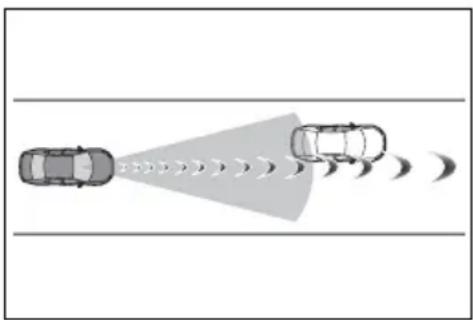
natural_image
Diagram showing two cars approaching a road with traffic light and sensor waves (no text or symbols)- When a detectable object is near a wall, fence, guardrail, manhole cover, vehicle, steel plate on the road, etc.
- When a detectable object is under a structure
- When part of a detectable object is hidden by an object, such as large baggage, an umbrella, or guardrail
- When multiple detectable objects are close together
- If the sun or other light is shining directly on a detectable object
- When a detectable object is a shade of white and looks extremely bright
- When a detectable object appears to be nearly the same color or brightness as its surroundings
- If a detectable object cuts or suddenly emerges in front of your vehicle
- When the front of your vehicle is hit by water, snow, dust, etc.
- When a very bright light ahead, such as the sun or the headlights of oncoming traffic, shines directly into the front camera
- When approaching the side or front of a vehicle ahead
- If a vehicle ahead is a motorcycle
- If a vehicle ahead is narrow, such as a personal mobility vehicle
- If a preceding vehicle has a small rear end, such as an unloaded
truck
- If a preceding vehicle has a low rear end, such as a low bed trailer
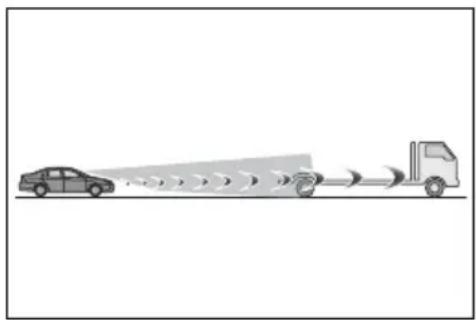
natural_image
Diagram showing a car approaching a truck with motion blur effect (no text or symbols)- If a vehicle ahead has extremely high ground clearance
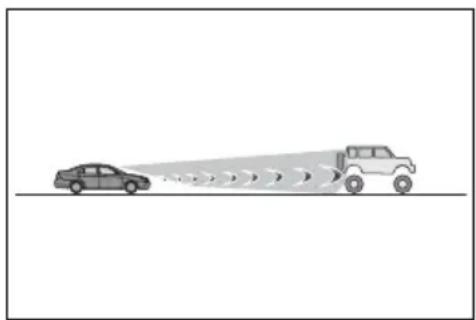
natural_image
Diagram showing a car approaching a vehicle with motion lines (no text or symbols)- If a vehicle ahead is carrying a load which protrudes past its rear bumper
- If a vehicle ahead is irregularly shaped, such as a tractor or side car
- If a vehicle ahead is a child sized bicycle, a bicycle that is carrying a large load, a bicycle ridden by more than one person, or a uniquely shaped bicycle (bicycle with a child seat, tandem bicycle, etc.)
- If a pedestrian/or the riding height of a bicyclist ahead is shorter than approximately 3.2 ft. (1 m) or taller than approximately 6.5 ft. (2 m)
- If a pedestrian/bicyclist is wearing oversized clothing (a rain coat, long skirt, etc.), making their silhouette obscure
- If a pedestrian is bending forward or squatting or bicyclist is bending forward
- If a pedestrian/bicyclist is moving fast
- If a pedestrian is pushing a stroller, wheelchair, bicycle or other vehicle
- When driving in inclement weather
such as heavy rain, fog, snow or a sandstorm
- When driving through steam or smoke
- When the surrounding area is dim, such as at dawn or dusk, or while at night or in a tunnel, making a detectable object appear to be nearly the same color as its surroundings
- When driving in a place where the surrounding brightness changes suddenly, such as at the entrance or exit of a tunnel
• After the hybrid system has started the vehicle has not been driven for a certain amount of time - While making a left/right turn and for a few seconds after making a left/right turn
- While driving on a curve and for a few seconds after driving on a curve
- If your vehicle is skidding
- If the front of the vehicle is raised or lowered
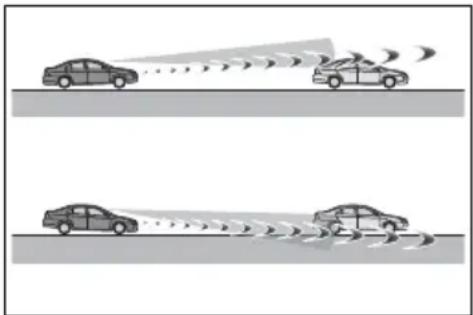
natural_image
Two cars on a road with visible sound waves, no text or symbols present- If the wheels are misaligned
- If a wiper blade is blocking the front camera
• The vehicle is being driven at extremely high speeds - When driving on a hill
- If the radar sensor or front camera is misaligned
- In some situations such as the following, sufficient braking force may not be obtained, preventing the system from performing properly:
-
If the braking functions cannot operate to their full extent, such as when the brake parts are extremely cold, extremely hot, or wet
-
If the vehicle is not properly maintained (brakes or tires are excessively worn, improper tire inflation pressure, etc.)
- When the vehicle is being driven on a gravel road or other slippery surface
■If VSC is disabled
- If VSC is disabled (→P.336), the pre-collision brake assist and pre-collision braking functions are also disabled.
●The PCS warning light will turn on and “VSC Turned Off Pre-Collision Brake System Unavailable” will be displayed on the multi-information display.
LTA (Lane Tracing Assist)
While driving on a road with clear white (yellow) lane lines, the LTA system warns the driver if the vehicle may deviate from the current lane or course*, and also can slightly operate the steering wheel to help avoid deviation from the lane or course*. Also, while the dynamic radar cruise control with full-speed range is operating, this system will operate the steering wheel to maintain the vehicle's lane position.
The LTA system recognizes white (yellow) lane lines or a course* using the front camera. Additionally, it detects preceding vehicles using the front camera and radar.
*: Boundary between asphalt and the side of the road, such as grass, soil, or a curb
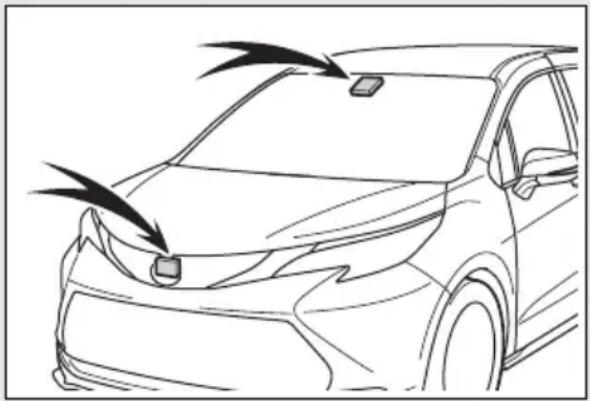
natural_image
Line drawing of a car's front bumper with two arrows pointing to the dashboard (no text or symbols)
WARNING
■Before using LTA system
- Do not rely solely upon the LTA system. The LTA system does not automatically drive the vehicle or reduce the amount of attention that must be paid to the area in front of the vehicle. The driver must always assume full responsibility for driving safely by paying careful attention to the surrounding conditions and operating the steering wheel to correct the path of the vehicle. Also, the driver must take adequate breaks when fatigued, such as from driving for a long period of time.
●Failure to perform appropriate driving operations and pay careful attention may lead to an accident, resulting in death or serious injury.
- When not using the LTA system, use the LTA switch to turn the system off.
■ Situations unsuitable for LTA system
In the following situations, use the LTA switch to turn the system off. Failure to do so may lead to an accident, resulting in death or serious injury.
● Vehicle is driven on a road surface which is slippery due to rainy weather, fallen snow, freezing, etc.
● Vehicle is driven on a snow-covered road.
● White (yellow) lines are difficult to see due to rain, snow, fog, dust, etc.
● Vehicle is driven in a temporary lane or restricted lane due to construction work.

WARNING
● Vehicle is driven in a construction zone.
● A spare tire, tire chains, etc. are equipped.
- When the tires have been excessively worn, or when the tire inflation pressure is low.
- When your vehicle is towing a trailer or during emergency towing
■Preventing LTA system malfunctions and operations performed by mistake
- Do not modify the headlights or place stickers, etc. on the surface of the lights.
- Do not modify the suspension etc. If the suspension etc. needs to be replaced, contact your Toyota dealer.
- Do not install or place anything on the hood or grille. Also, do not install a grille guard (bull bars, kangaroo bar, etc.).
- If your windshield needs repairs, contact your Toyota dealer.
■Conditions in which functions may not operate properly
In the following situations, the functions may not operate properly and the vehicle may depart from its lane. Drive safely by always paying careful attention to your surroundings and operate the steering wheel to correct the path of the vehicle without relying solely on the functions.
- When the follow-up cruising display is displayed (→P.281) and the preceding vehicle changes lanes. (Your vehicle may follow the preceding vehicle and also change lanes.)
natural_image
Diagram showing two cars on a road with dashed arrows indicating direction (no text or symbols)- When the follow-up cruising display is displayed (→P.281) and the preceding vehicle is swaying. (Your vehicle may sway accordingly and depart from the lane.)
- When the follow-up cruising display is displayed (→P.281) and the preceding vehicle departs from its lane. (Your vehicle may follow the preceding vehicle and depart from the lane.)
- When the follow-up cruising display is displayed (→P.281) and the preceding vehicle is being driven extremely close to the left/right lane line. (Your vehicle may follow the preceding vehicle and depart from the lane.)
●Vehicle is being driven around a sharp curve.

WARNING
- Objects or patterns that could be mistaken for white (yellow) lines are present on the side of the road (guardrails, reflective poles, etc.).
natural_image
Isometric illustration of a car on an elevated road with five evenly spaced pillars (no text or symbols)● Vehicle is driven where the road diverges, merges, etc.
flowchart
graph TD
    A["Top Left Road"] --> B["Top Right Road"]
    B --> C["Bottom Left Road"]
    C --> D["Bottom Right Road"]
    style A fill:#f9f,stroke:#333
    style B fill:#f9f,stroke:#333
    style C fill:#f9f,stroke:#333
    style D fill:#f9f,stroke:#333
●Repair marks of asphalt, white (yellow) lines, etc. are present due to road repair.
natural_image
Simple line drawing of a car with motion arrow, no text or symbols presentThere are shadows on the road that run parallel with, or cover, the white (yellow) lines.
●The vehicle is driven in an area without white (yellow) lines, such as in front of a tollgate or checkpoint, or at an intersection, etc.
●The white (yellow) lines are cracked, "Botts' dots", "Raised pavement marker" or stones are present.
●The white (yellow) lines cannot be seen or are difficult to see due to sand, etc.
●The vehicle is driven on a road surface that is wet due to rain, puddles, etc.
●The traffic lines are yellow (which may be more difficult to recognize than lines that are white).
● The white (yellow) lines cross over a curb, etc.
●The vehicle is driven on a bright surface, such as concrete.
- If the edge of the road is not clear or straight.
●The vehicle is driven on a surface that is bright due to reflected light, etc.
●The vehicle is driven in an area where the brightness changes suddenly, such as at the entrances and exits of tunnels, etc.
●Light from the headlights of an oncoming vehicle, the sun, etc. enters the camera.
●The vehicle is driven on a slope.
●The vehicle is driven on a road which tilts left or right, or a winding road.
●The vehicle is driven on an unpaved or rough road.

WARNING
●The traffic lane is excessively narrow or wide.
●The vehicle is extremely tilted due to carrying heavy luggage or having improper tire pressure.
●The distance to the preceding vehicle is extremely short.
●The vehicle is moving up and down a large amount due to road conditions during driving (poor roads or road seams).
- When driving in a tunnel or at night with the headlights off or when a headlight is dim due to its lens being dirty or it being misaligned.
●The vehicle is struck by a cross-wind.
●The vehicle is affected by wind from a vehicle driven in a nearby lane.
●The vehicle has just changed lanes or crossed an intersection.
● Tires which differ by structure, manufacturer, brand or tread pattern are used.
- When tires of a size other than specified are installed.
●Snow tires, etc. are equipped.
●The vehicle is being driven at extremely high speeds.
Functions included in LTA system
■Lane departure alert function
When the system determines
that the vehicle might depart from its lane or course*, a warning is displayed on the multi-information display, and either a warning buzzer will sound or the steering wheel will vibrate to alert the driver.
When the warning buzzer sounds or the steering wheel vibrates, check the area around your vehicle and carefully operate the steering wheel to move the vehicle back to the center of the lane.
Vehicle with BSM: When the system determines that the vehicle might depart from its lane and that the possibility of a collision with an overtaking vehicle in the adjacent lane is high, the lane departure alert will operate even if the turn signals are operating.
*: Boundary between asphalt and the side of the road, such as grass, soil, or a curb
natural_image
Diagram showing three cars driving on a road with directional arrows and a lightning bolt symbol (no text or labels)■Steering assist function
When the system determines that the vehicle might depart from its lane or course ^* , the system provides assistance as necessary by operating the steering wheel in small amounts for a short period of time to keep the vehicle in its lane.
If the system detects that the steering wheel has not been operated for a fixed amount of time or the steering wheel is not being firmly gripped, a warning is displayed on the multi-information display and the function is temporarily canceled.
Vehicle with BSM: When the system determines that the vehicle might depart from its lane and that the possibility of a collision with an overtaking vehicle in the adjacent lane is high, the steering assist function will operate even if the turn signals are operating.
*: Boundary between asphalt and the side of the road, such as grass, soil, or a curb
natural_image
Top-down view of a road with multiple cars and a curved arrow indicating direction (no text or symbols)■ Vehicle sway warning func- tion
When the vehicle is swaying within a lane, the warning buzzer will sound and a message will be displayed on the multi-information display to alert the driver.
natural_image
Diagram showing two cars on a road with a lightning bolt symbol indicating lightning (no text or labels)■Lane centering function
This function is linked with dynamic radar cruise control with full-speed range and provides the required assistance by operating the steering wheel to keep the vehicle in its current lane.
When dynamic radar cruise control with full-speed range is not operating, the lane centering function does not operate.
In situations where the white (yellow) lane lines are difficult to see or are not visible, such as when in a traffic jam, this function will operate to help follow a preceding vehicle by monitoring the position of the preceding vehicle.
If the system detects that the steering wheel has not been operated for a fixed amount of time or the steering wheel is not being firmly gripped, a warning is displayed on the multi-information display and the function is temporarily canceled.
natural_image
Top-down diagram of three cars driving on a curved road with an upward arrow indicating direction (no text or symbols)Turning LTA system on
Press the LTA switch to turn the LTA system on.
The LTA indicator illuminates and a message is displayed on the multi-information display.
Press the LTA switch again to turn the LTA system off.
When the LTA system is turned on or off, operation of the LTA system continues in the same condition the next time the hybrid system is started.
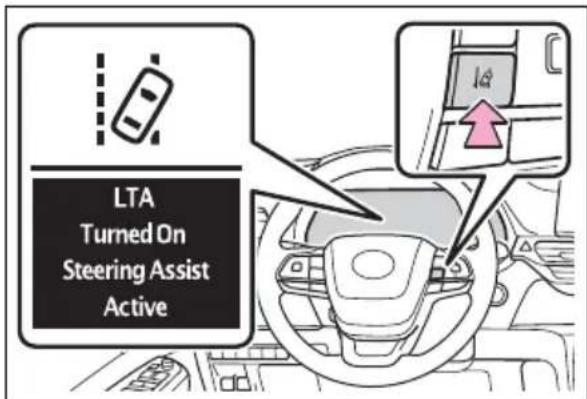
Indications on multi-information display
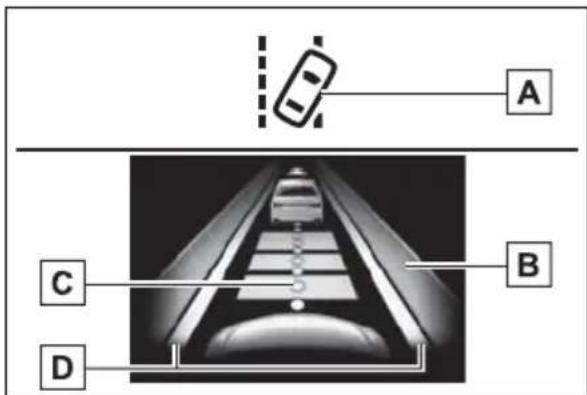
A LTA indicator
The illumination condition of the indicator informs the driver of the system operation status.
Illuminated in white: LTA system is operating.
Illuminated in green: Steering wheel assistance of the steering assist function or lane centering function is operating.
Flashing in orange: Lane departure alert function is operating.
B Operation display of steering wheel operation support
Displayed when the multi-information display is switched to the driving support system information display.
Indicates that steering wheel assistance of the steering assist function or lane centering function is operating.
Both outer sides of the lane are displayed: Indicates that steering wheel assist of the lane centering function is operating.
One outer side of the lane is displayed: Indicates that steering wheel assist of the steering assist function is operating.
Both outer sides of the lane are flashing: Alerts the driver that their input is necessary to stay in the center of the lane (lane centering function).
C Follow-up cruising display
Displayed when the multi-information display is switched to the driving support system information display.
Indicates that steering assist of the lane centering function is operating by monitoring the position of a preceding vehicle.
When the follow-up cruising display is displayed, if the preceding vehicle moves, your vehicle may move in the same way. Always pay careful attention to your surroundings and operate the steering wheel as necessary to correct the path of the vehicle and ensure safety.
D Lane departure alert function display
Displayed when the multi-information display is switched to the driving support system information display.
▶ Inside of displayed lines is white
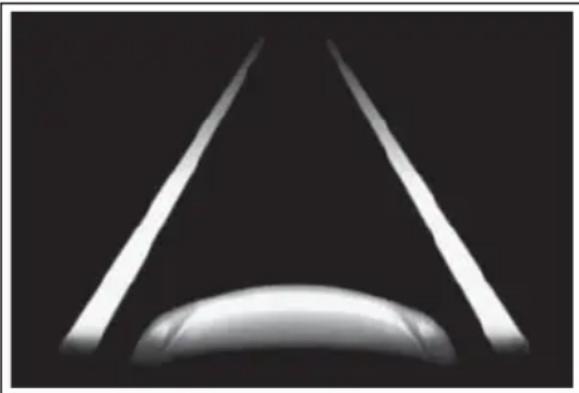
natural_image
Abstract white geometric shapes on black background, resembling a stylized arch or lens (no text or symbols)Indicates that the system is recognizing white (yellow) lines or a course*. When the vehicle departs from its lane, the white line displayed on the side the vehicle departs from flashes orange.
▶ Inside of displayed lines is black
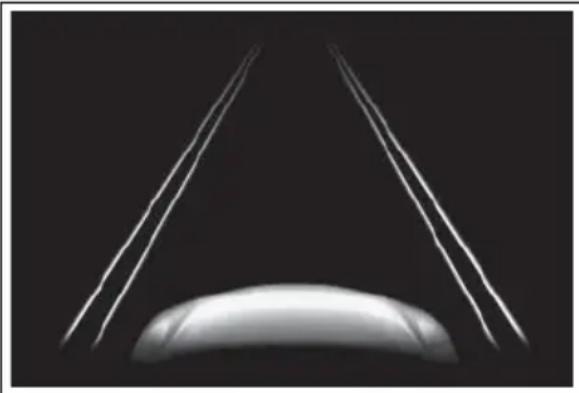
natural_image
Close-up of a curved, elongated object with two bright diagonal lines against a dark background (no text or symbols)Indicates that the system is not able to recognize white (yellow) lines or a course ^* or is temporarily canceled.
*: Boundary between asphalt and the side of the road, such as grass, soil, or a curb
■Operation conditions of each function
●Lane departure alert function This function operates when all of the following conditions are met.
- LTA is turned on.
- Vehicle speed is approximately 32 mph (50 km/h) or more. ^*1
- System recognizes white (yellow) lane lines or a course ^2 . (When a white [yellow] line or course ^2 is recognized on only one side, the system will operate only for the recognized side.)
- Width of traffic lane is approximately 9.8 ft. (3 m) or more.
- Turn signal lever is not operated. (Vehicle with BSM: Except when another vehicle is in the lane on the side where the turn signal was operated)
- Vehicle is not being driven around a sharp curve.
- No system malfunctions are detected. (→P.285)
*1: The function operates even if the vehicle speed is less than approximately 32 mph (50 km/h) when the lane centering function is operating.
*2: Boundary between asphalt and the side of the road, such as grass, soil, or a curb
●Steering assist function
This function operates when all of the following conditions are met in addition to the operation conditions for the lane departure alert function.
- Setting for "Steering Assist" in the
screen of the multi-information display is set to "ON". (→P.104)
- Vehicle is not accelerated or decelerated by a fixed amount or more.
- Steering wheel is not operated with a steering force level suitable for changing lanes.
- ABS, VSC, TRAC and PCS are not operating.
- TRAC or VSC is not turned off.
- Hands off steering wheel warning is not displayed. (→P.284)
● Vehicle sway warning function
This function operates when all of the following conditions are met.
- Setting for "Sway Warning" in the

screen of the multi-information play is set to "ON". (→P.104)
- Vehicle speed is approximately 32 mph (50 km/h) or more.
- Width of traffic lane is approximately 9.8 ft. (3 m) or more.
- No system malfunctions are detected. (→P.285)
●Lane centering function
This function operates when all of the following conditions are met.
- LTA is turned on.
- Setting for "Steering Assist" and
"Lane Center" in the screen of the multi-information display are set to "ON". (→P.104)
- This function recognizes white (yellow) lane lines or the position of a preceding vehicle (except when the preceding vehicle is small, such as a motorcycle).
- The dynamic radar cruise control with full-speed range is operating in vehicle-to-vehicle distance control mode.
- Width of traffic lane is approximately 10 to 13 ft. (3 to 4 m).
- Turn signal lever is not operated.
- Vehicle is not being driven around a sharp curve.
- No system malfunctions are detected. (→P.285)
- Vehicle does not accelerate or decelerate by a fixed amount or more.
- Steering wheel is not operated with a steering force level suitable for changing lanes.
• ABS, VSC, TRAC and PCS are not operating. - TRAC or VSC is not turned off.
- Hands off steering wheel warning is not displayed. (→P.284)
- The vehicle is being driven in the center of a lane.
- Steering assist function is not operating.
■ Temporary cancelation of functions
- When operation conditions are no longer met, a function may be temporarily canceled. However, when the operation conditions are met again, operation of the function is automatically restored. (→P.282)
- If the operation conditions (→P.282) are no longer met while the lane centering function is operating, the steering wheel may vibrate and the buzzer may sound to indicate that the function has been temporarily canceled. However, if the “Steering wheel vibration” customization setting is set to “On”, the system will notify the driver by vibrating the steering wheel instead of sounding the buzzer.
■Steering assist function/lane centering function
● Depending on the vehicle speed, lane departure situation, road conditions, etc., the driver may not feel the function is operating or the function may not operate at all.
- The steering control of the function is overridden by the driver's steering wheel operation.
- Do not attempt to test the operation of the steering assist function.
■Lane departure alert function
●The warning buzzer may be difficult to hear due to external noise, audio playback, etc. Also, it may be difficult to feel steering wheel vibrations due to the road conditions, etc.
- If the edge of the course ^* is not clear or straight, the lane departure alert function may not operate.
● Vehicle with BSM: It may not be possible for the system to determine if there is a danger of a colli-
sion with a vehicle in an adjacent lane.
- Do not attempt to test the operation of the lane departure alert function.
*: Boundary between asphalt and the side of the road, such as grass, soil, or a curb
■Hands off steering wheel warning
In the following situations, a warning message urging the driver to hold the steering wheel and the symbol shown in the illustration are displayed on the multi-information display to warn the driver. The warning stops when the system determines that the driver holds the steering wheel. Always keep your hands on the steering wheel when using this system, regardless of warnings.
natural_image
Two grayscale icons: a car with lane markings and a steering wheel, both on dark background (no text or symbols)- When the system determines the driver is not holding the steering wheel while the lane centering function is operating.
If the driver continues to keep their hands off of the steering wheel, the buzzer sounds, the driver is warned and the function is temporarily canceled. This warning also operates in the same way when the driver continuously operates the steering wheel only a small amount.
The buzzer also sounds even if the alert type is set to “Steering wheel vibration”.
- When the system determines that the vehicle may deviate from the lane while driving around a curve
while the lane centering function is operating.
Depending on the vehicle condition and road conditions, the warning may not operate. Also, if the system determines that the vehicle is driving around a curve, warnings will occur earlier than during straight-lane driving.
- When the system determines that the driver is driving without holding the steering wheel while the steering wheel assist of the steering assist function is operating.
If the driver continues to keep their hands off of the steering wheel and the steering wheel assist is operating, the buzzer sounds and the driver is warned. Each time the buzzer sounds, the continuing time of the buzzer becomes longer.
The buzzer also sounds even if the alert type is set to “Steering wheel vibration”.
■Vehicle sway warning function
When the system determines that the vehicle is swaying while the vehicle sway warning function is operating, a buzzer sounds and a warning message urging the driver to rest and the symbol shown in the illustration are simultaneously displayed on the multi-information display.
natural_image
Simple icon of a steaming coffee cup on a saucer, no text or symbols presentDepending on the vehicle and road conditions, the warning may not operate.
■Warning message
If the following warning message is displayed on the multi-information display and the LTA indicator illuminates in orange, follow the appropriate troubleshooting procedure. Also, if a different warning message is displayed, follow the instructions displayed on the screen.
●“LTA Malfunction Visit Your Dealer”
The system may not be operating properly. Have the vehicle inspected by your Toyota dealer.
●“LTA Unavailable”
The system is temporarily canceled due to a malfunction in a sensor other than the front camera. Turn the LTA system off, wait for a little while, and then turn the LTA system back on.
●“LTA Unavailable at Current Speed”
The function cannot be used as the vehicle speed exceeds the LTA operation range. Drive slower.
Customization
Function settings can be changed. (→P.549)
RSA (Road Sign Assist)\*
*: If equipped
The RSA system recognizes specific road signs using the front camera to provide information to the driver via the display.
natural_image
Line drawing of a car's front window with a small rectangular object on the lid (no text or symbols)If the system judges that the vehicle is being driven over the speed limit, performing prohibited actions, etc. according to the recognized road signs, it notifies the driver through a visual notification and notification buzzer.

WARNING
■Before using the RSA
Do not rely solely upon the RSA system. RSA is a system which supports the driver by providing information, but it is not a replacement for a driver's own vision and awareness. Drive safely by always paying careful attention to the traffic rules.
Indication on the multi-information display
When the front camera recognizes a sign, the sign will be displayed on the multi-information display.
- When the driving support system information display is selected, a maximum of 3 signs can be displayed. (→P.104)
- When a tab other than the driving support system information display is selected, the following types of road signs will be displayed. (→P.104)
- Speed limit sign
- Do Not Enter sign tion is necessary)
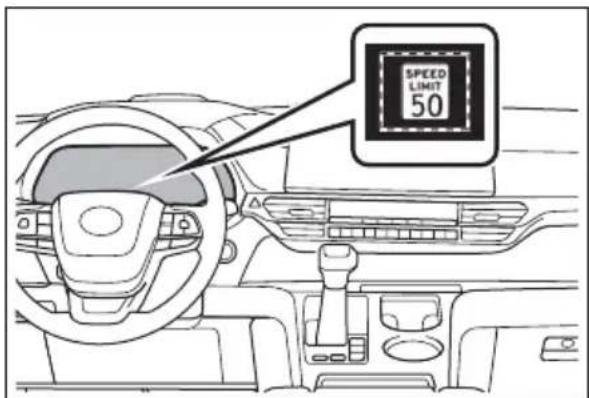
If signs other than speed limit signs are recognized, they will be displayed in an overlapping stack under the current speed limit sign.
Supported types of road signs
The following types of road signs, including electronic signs and blinking signs, are recognized.
A non-official or a recently introduced traffic sign may not be recognized.
Speed limit
Do Not Enter

Stop

Yield
(Notification function
In the following situations, the RSA system will notify the driver.
- When the vehicle speed exceeds the speed notification threshold of the speed limit sign displayed, the sign display will be emphasized and a buzzer will sound.
- When the RSA system recog-
nizes a do not enter sign and determines that your vehicle has entered a no-entry area, the displayed sign will flash and a buzzer will sound.
Depending on the situation, a notification function may not operate properly.
Setting procedure
→P.112
■Automatic turn-off of RSA sign display
In the following situations, a displayed speed limit sign and/or do not enter sign will stop being displayed automatically:
●No sign has been recognized for a certain distance.
●The road changes due to a left or right turn, etc.
In the following situations, stop and yield signs will stop being displayed automatically:
●The system determines that your vehicle has passed the sign.
●The road changes due to a left or right turn, etc.
■ Conditions in which the function may not operate or detect correctly
In the following situations, RSA does not operate normally and may not recognize signs, display the incorrect sign, etc. However, this does not indicate a malfunction.
●The front camera is misaligned due to a strong impact being applied to the sensor, etc.
- Dirt, snow, stickers, etc. are on the windshield near the front camera.
● In inclement weather such as heavy rain, fog, snow or sand storms.
●Light from an oncoming vehicle,
the sun, etc. enters the front camera.
●The sign is dirty, faded, tilted or bent.
●The contrast of electronic sign is low.
● All or part of the sign is hidden by the leaves of a tree, a pole, etc.
●The sign is only visible to the front camera for a short amount of time.
●The driving scene (turning, lane change, etc.) is judged incorrectly.
- If a sign not appropriate for the currently traveled lane, but the sign exists directly after a freeway branches, or in an adjacent lane just before merging.
●Stickers are attached to the rear of the preceding vehicle.
●A sign resembling a system compatible sign is recognized.
- Side road speed signs may be detected and displayed (if positioned in sight of the front camera) while the vehicle is traveling on the main road.
●Roundabout exit road speed signs may be detected and displayed (if positioned in sight of the front camera) while traveling on a roundabout.
●The front of the vehicle is raised or lowered due to the carried load.
●The surrounding brightness is not sufficient or changes suddenly.
- When a sign intended for trucks, etc. is recognized.
●The speed information displayed on the meter and on the navigation system may be different due to the navigation system using map data.
■Speed limit sign display
If the power switch was last turned off while a speed limit sign was displayed on the multi-information display, the same sign displays again
when the power switch is turned to ON.
Customization
Some functions can be customized. (Customizable features: →P.549)
Dynamic radar cruise control with full-speed range
In vehicle-to-vehicle distance control mode, the vehicle automatically accelerates, decelerates and stops to match the speed changes of the preceding vehicle even if the accelerator pedal is not depressed. In constant speed control mode, the vehicle runs at a fixed speed.
Use the dynamic radar cruise control with full-speed range on freeways and highways.
● Vehicle-to-vehicle distance control mode ( P.291)
- Constant speed control mode (→P.296)
System Components
■Meter display
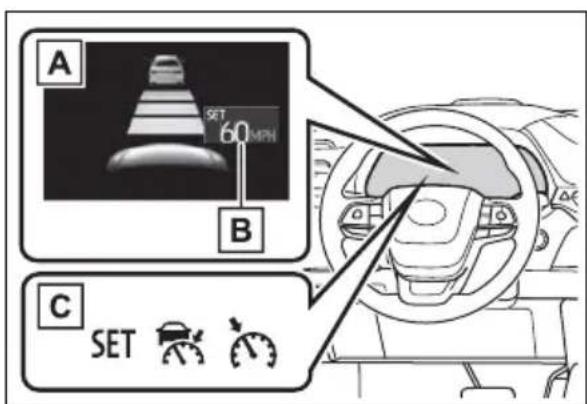
A Multi-information display
B Set speed
C Indicators
Operation switches
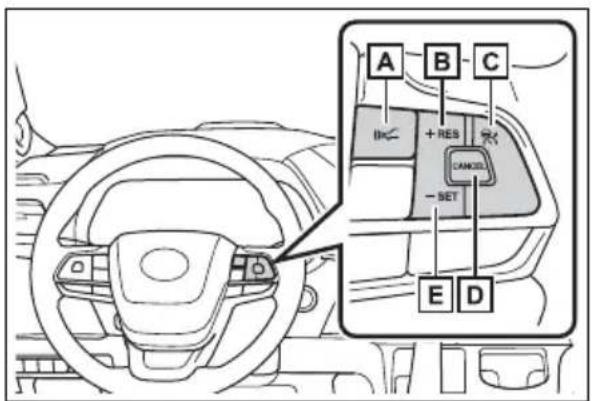
A Vehicle-to-vehicle distance switch
B “+RES” switch
Cruise control main switch
D Cancel switch
E “-SET” switch

WARNING
■Before using dynamic radar cruise control with full-speed range
●Driving safely is the sole responsibility of the driver. Do not rely solely on the system, and drive safely by always paying careful attention to your surroundings.
The dynamic radar cruise control with full-speed range provides driving assistance to reduce the driver's burden. However, there are limitations to the assistance provided.
Read the following conditions carefully. Do not overly rely on this system and always drive carefully.
- When the sensor may not be correctly detecting the vehicle ahead: P.298
-
Conditions under which the vehicle-to-vehicle distance control mode may not function correctly: P.298
-
Set the speed appropriately depending on the speed limit, traffic flow, road conditions, weather conditions, etc. The driver is responsible for checking the set speed.
● Even when the system is functioning normally, the condition of the preceding vehicle as detected by the system may differ from the condition observed by the driver. Therefore, the driver must always remain alert, assess the danger of each situation and drive safely. Relying solely on this system or assuming the system ensures safety while driving can lead to an accident, resulting in death or serious injury. - Switch the dynamic radar cruise control with full-speed range setting to off, using the cruise control main switch when not in use.

WARNING
■ Cautions regarding the driving assist systems
Observe the following precautions, as there are limitations to the assistance provided by the system. Failure to do so may cause an accident resulting in death or serious injury.
● Assisting the driver to measure following distance
The dynamic radar cruise control with full-speed range is only intended to help the driver in determining the following distance between the driver's own vehicle and a designated vehicle traveling ahead. It is not a mechanism that allows careless or inattentive driving, and it is not a system that can assist the driver in low-visibility conditions.
It is still necessary for driver to pay close attention to the vehicle's surroundings.
● Assisting the driver to judge proper following distance
The dynamic radar cruise control with full-speed range determines whether the following distance between the driver's own vehicle and a designated vehicle traveling ahead is within a set range. It is not capable of making any other type of judgement. Therefore, it is absolutely necessary for the driver to remain vigilant and to determine whether or not there is a possibility of danger in any given situation.
●Assisting the driver to operate the vehicle
The dynamic radar cruise control with full-speed range does not include functions which will prevent or avoid collisions with vehicles ahead of your vehicle.
Therefore, if there is ever any possibility of danger, the driver must take immediate and direct control of the vehicle and act appropriately in order to ensure the safety of all involved.
■Situations unsuitable for dynamic radar cruise control with full-speed range
Do not use dynamic radar cruise control with full-speed range in any of the following situations. Doing so may result in inappropriate speed control and could cause an accident resulting in death or serious injury.
●Roads where there are pedestrians, cyclists, etc.
In heavy traffic
● On roads with sharp bends
● On winding roads
● On slippery roads, such as those covered with rain, ice or snow
● On steep downhills, or where there are sudden changes between sharp up and down gradients Vehicle speed may exceed the set speed when driving down a steep hill.
● At entrances to freeways and highways

WARNING
- When weather conditions are bad enough that they may prevent the sensors from detecting correctly (fog, snow, sandstorm, heavy rain, etc.)
- When there is rain, snow, etc. on the front surface of the radar or front camera
In traffic conditions that require frequent repeated acceleration and deceleration - When your vehicle is towing a trailer or during emergency towing
- When an approach warning buzzer is heard often
Driving in vehicle-to-vehicle distance control mode
This mode employs a radar to detect the presence of vehicles up to approximately 328 ft. (100 m) ahead, determines the current vehicle-to-vehicle following distance, and operates to maintain a suitable following distance from the vehicle ahead. The desired vehicle-to-vehicle distance can also be set by operating the vehicle-to-vehicle distance switch.
When driving on downhill slopes, the vehicle-to-vehicle distance may become shorter.
A
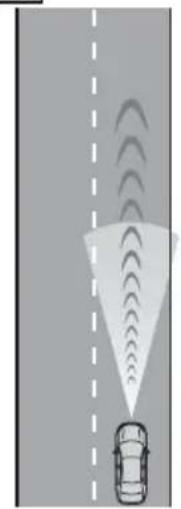
natural_image
Diagram showing a car with sensor waves projecting onto a road (no text or symbols)B
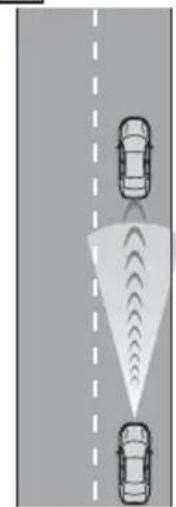
natural_image
Top-down view of two cars on a road with traffic arrows indicating sensor or sensor placement (no text or symbols)
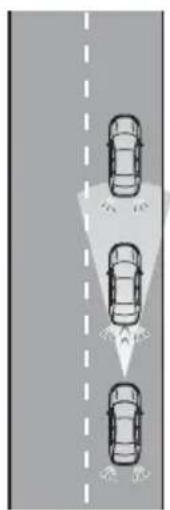
natural_image
Top-down view of three cars on a road with dashed lane markings (no text or symbols)C
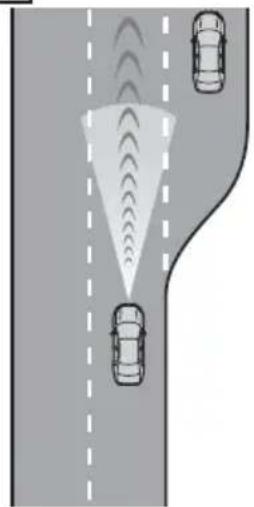
natural_image
Diagram showing three cars on a road with traffic cone and dashed lane markings (no text or symbols)A Example of constant speed cruising
When there are no vehicles ahead
The vehicle travels at the speed set by the driver.
B Example of deceleration cruising and follow-up cruising
When a preceding vehicle driving slower than the set speed appears
When a vehicle is detected running ahead of you, the system automatically decelerates your vehicle. When a greater reduction in vehicle speed is necessary, the system applies the brakes (the stop lights will come on at this time). The system will respond to changes in the speed of the vehicle ahead in order to maintain the vehicle-to-vehicle distance set by the driver. Approach warning warns you when the system cannot decelerate sufficiently to prevent your vehicle from closing in on the vehicle ahead.
When the vehicle ahead of you stops, your vehicle will also stop (vehicle is stopped by system control). After the vehicle ahead starts off, pressing the “+RES” switch or depressing the accelerator pedal (start-off operation) will resume follow-up cruising. If the start-off operation is not performed, system control continues to keep your vehicle stopped.
When the turn signal lever is operated and your vehicle moves to an over-taking lane while driving at 50 mph (80 km/h) or more, the vehicle will accelerate to help to overtake a passing vehicle.
The system's identification of what is an overtaking lane may be determined solely based on the location of the steering wheel in the vehicle (left side driver position versus right side driver position.) If the vehicle is driven to a region where the overtaking lane is on a different side from where the vehicle is normally driven, the vehicle may accelerate when the turn signal lever is operated in the opposite direction to the overtaking lane (e.g., if the driver normally operates the vehicle in a region where the overtaking lane is to the right but then drives to a region where the overtaking lane is to the left, the vehicle may accelerate when the right turn signal is activated).
C Example of acceleration
When there are no longer any preceding vehicles driving slower than the set speed
The system accelerates until the set speed is reached. The system then returns to constant speed cruising.
Setting the vehicle speed (vehicle-to-vehicle distance control mode)
1 Press the cruise control main
switch to activate the cruise control.
Dynamic radar cruise control indicator will come on and a message will be displayed on the multi-information display. Press the switch
again to deactivate the cruise control.
If the cruise control main switch is pressed and held for 1.5 seconds or more, the system turns on in constant speed control mode. (→P.296)
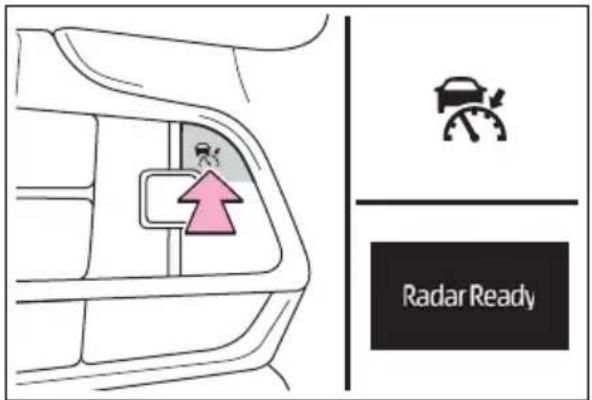
2 Accelerate or decelerate, with accelerator pedal operation, to the desired vehicle speed (at or above approximately 20 mph [30 km/h]) and press the "-SET" switch to set the speed.
Cruise control "SET" indicator will come on.
The vehicle speed at the moment the switch is released becomes the set speed.
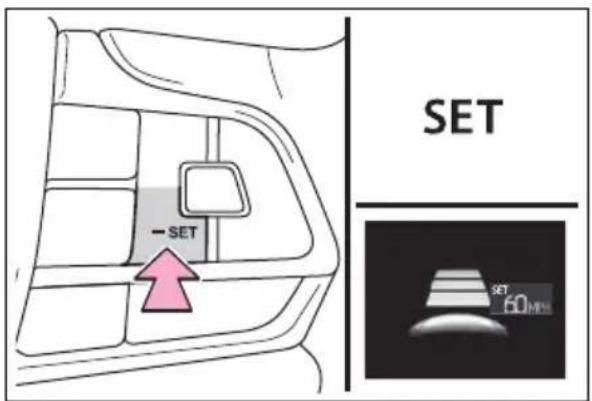
Adjusting the set speed
- Adjusting the set speed by the switch
To change the set speed, press the “+RES” or “-SET” switch until the desired set speed is displayed.
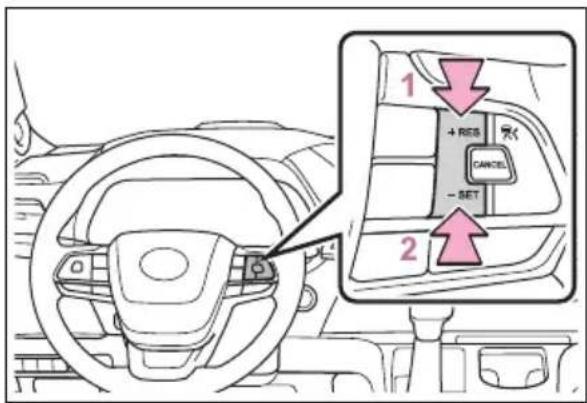
1 Increases the speed (Except when the vehicle has been stopped by system control in vehicle-to-vehicle distance control mode)
2 Decreases the speed
Fine adjustment: Press the switch.
Large adjustment: Press and hold the switch to change the speed, and release when the desired speed is reached.
In the vehicle-to-vehicle distance control mode, the set speed will be increased or decreased as follows:
For the U.S. mainland and Hawaii
Fine adjustment: By 1 mph (1.6 km/h) ^1 or 1 km/h (0.6 mph) ^2 each time the switch is pressed
Large adjustment: Increases or decreases in 1 mph (1.6 km/h) ^1 or 1 km/h (0.6 mph) ^2 increments for as long as the switch is held
▶ Except for the U.S. mainland and Hawaii
Fine adjustment: By 1 mph (1.6)
km/h) ^1 or 1 km/h (0.6 mph) ^2 each time the switch is pressed
Large adjustment: Increases or decreases in 5 mph (8 km/h) ^1 or 5 km/h (3.1 mph) ^2 increments for as long as the switch is held
In the constant speed control mode ( P.296), the set speed will be increased or decreased as follows:
Fine adjustment: By 1 mph (1.6 km/h) ^1 or 1 km/h (0.6 mph) ^2 each time the switch is pressed
Large adjustment: The speed will continue to change while the switch is held.
*1: When the set speed is shown in "MPH"
^*2 :When the set speed is shown in "km/h"
● Increasing the set speed by the accelerator pedal
1 Accelerate with accelerator pedal operation to the desired vehicle speed
2 Press the "-SET" switch
Changing the vehicle-to-vehicle distance (vehicle-to-vehicle distance control mode)
Pressing the switch changes the vehicle-to-vehicle distance as follows:
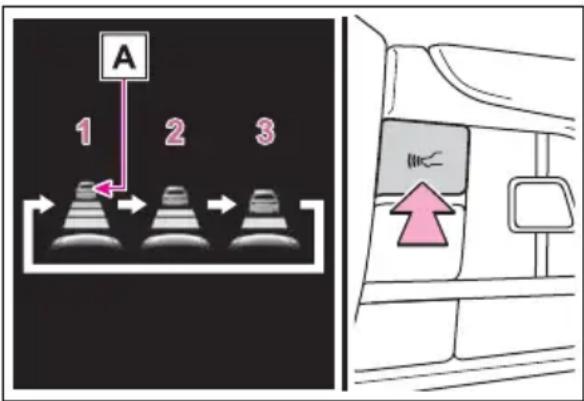
1 Long
2 Medium
3 Short
If a vehicle is running ahead of you, the preceding vehicle mark A will also be displayed.
Vehicle-to-vehicle distance settings (vehicle-to-vehicle distance control mode)
Select a distance from the table below. Note that the distances shown correspond to a vehicle speed of 50 mph (80 km/h). Vehicle-to-vehicle distance increases/decreases in accordance with vehicle speed. When the vehicle is stopped by system control, the vehicle stops at a certain vehicle-to-vehicle distance depending on the situation.
| Distance options | Vehicle-to-vehicle distance |
| Long | Approximately 160 ft. (50 m) |
| Medium | Approximately 130 ft. (40 m) |
| Short | Approximately 100 ft. (30 m) |
Resuming follow-up cruising when the vehicle has been stopped by sys- tem control (vehicle-to- vehicle distance control mode)
After the vehicle ahead of you starts off, press the "+RES" switch.
Your vehicle will also resume follow-up cruising if the accelerator pedal is depressed after the vehicle ahead of you starts off.
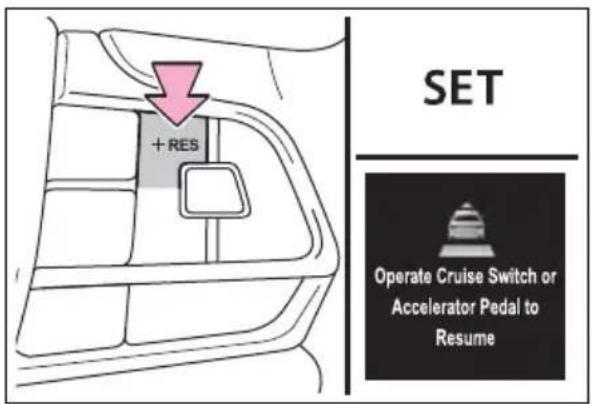
Canceling and resuming the speed control
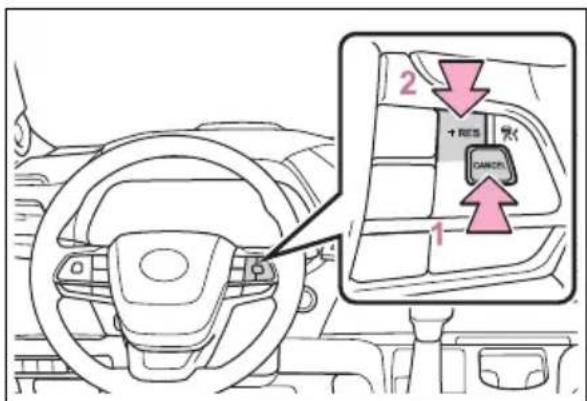
1 Pressing the cancel switch cancels the speed control.
The speed control is also canceled when the brake pedal is depressed. (When the vehicle has been stopped by system control, depressing the brake pedal does not cancel the setting.)
2 Pressing the “+RES” switch resumes the cruise control and returns vehicle speed to the set speed.
Approach warning (vehicle-to-vehicle distance control mode)
When your vehicle is too close to a vehicle ahead, and sufficient automatic deceleration via the cruise control is not possible, the display will flash and the buzzer will sound to alert the driver. An example of this would be if another driver cuts in front of you while you are following a vehicle. Depress the brake pedal to ensure an appropriate vehicle-to-vehicle distance.
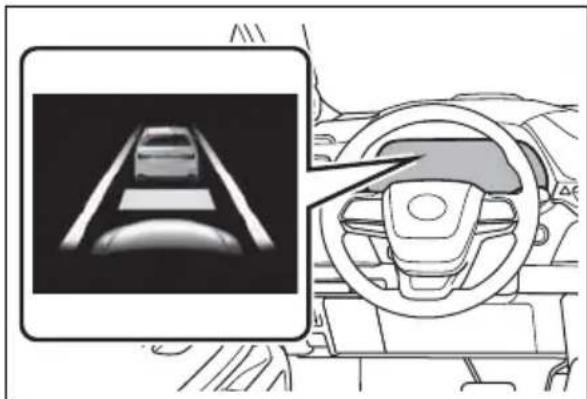
natural_image
Diagram showing a car interior with steering wheel and dashboard, alongside a smartphone displaying a 3D road visualization (no text or symbols)■Warnings may not occur when
In the following instances, warnings may not occur even when the vehicle-to-vehicle distance is small.
- When the speed of the preceding vehicle matches or exceeds your vehicle speed
- When the preceding vehicle is traveling at an extremely slow speed
- Immediately after the cruise control speed was set
- When depressing the accelerator pedal
Selecting constant speed control mode
When constant speed control mode is selected, your vehicle will maintain a set speed without controlling the vehicle-to-vehicle distance. Select this mode only when vehicle-to-vehicle distance control mode does not function correctly due to a dirty radar, etc.
1 With the cruise control off, press and hold the cruise control main switch for 1.5 seconds or more.
Immediately after the switch is pressed, the dynamic radar cruise control indicator will come on. Afterwards, it switches to the cruise control indicator.
Switching to constant speed control mode is only possible when operating the switch with the cruise control off.
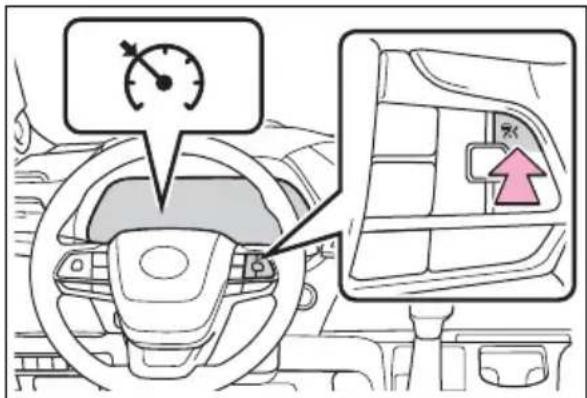
2 Accelerate or decelerate, with accelerator pedal operation, to the desired vehicle speed (at or above approximately 20 mph [30 km/h]) and press the “-SET” switch to set the speed.
Cruise control "SET" indicator will come on.
The vehicle speed at the moment the switch is released becomes the set speed.
Adjusting the speed setting: →P.293
Canceling and resuming the speed
setting: →P.295
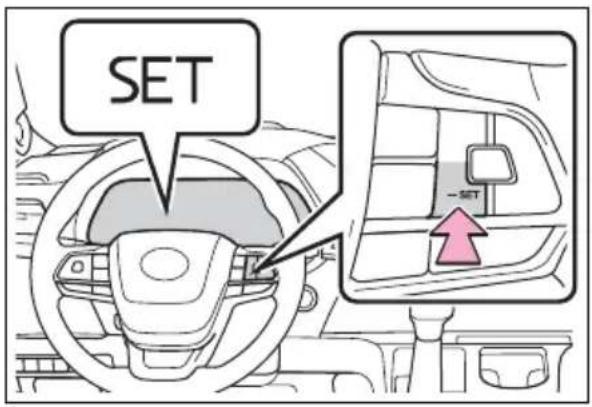
■ Dynamic radar cruise control with full-speed range can be set when
●The shift lever is in D.
●The desired set speed can be set when the vehicle speed is approximately 20 mph (30 km/h) or more. (However, when the vehicle speed is set while driving at below approximately 20 mph [30 km/h], the set speed will be set to approximately 20 mph [30 km/h].)
■Accelerating after setting the vehicle speed
The vehicle can accelerate by operating the accelerator pedal. After accelerating, the set speed resumes. However, during vehicle-to-vehicle distance control mode, the vehicle speed may decrease below the set speed in order to maintain the distance to the preceding vehicle.
■When the vehicle stops while follow-up cruising
- Pressing the “+RES” switch while the vehicle ahead stops will resume follow-up cruising if the vehicle ahead starts off within approximately 3 seconds after the switch is pressed.
- If the vehicle ahead starts off within 3 seconds after your vehicle stops, follow-up cruising will be resumed.
■Automatic cancelation of vehicle-to-vehicle distance control mode
Vehicle-to-vehicle distance control mode is automatically canceled in the following situations.
●VSC is activated.
●TRAC is activated for a period of time.
- When the VSC or TRAC system is turned off.
●The sensor cannot detect correctly because it is covered in some way.
●Pre-collision braking is activated.
●The parking brake is operated.
●The vehicle is stopped by system control on a steep incline.
●The following are detected when the vehicle has been stopped by system control:
• The driver is not wearing a seat belt.
• The driver's door is opened.
• The vehicle has been stopped for about 3 minutes
If vehicle-to-vehicle distance control mode is automatically canceled for any reasons other than the above, there may be a malfunction in the system. Contact your Toyota dealer.
■Automatic cancelation of constant speed control mode
Constant speed control mode is automatically canceled in the following situations:
●Actual vehicle speed is more than approximately 10 mph (16 km/h) below the set vehicle speed.
●Actual vehicle speed falls below approximately 20 mph (30 km/h).
●VSC is activated.
●TRAC is activated for a period of time.
- When the VSC or TRAC system is turned off.
●Pre-collision braking is activated.
●The parking brake is operated.
If constant speed control mode is automatically canceled for any reasons other than the above, there may be a malfunction in the system. Contact your Toyota dealer.
Brake operation
A brake operation sound may be heard and the brake pedal response may change, but these are not malfunctions.
■Warning messages and buzzers for dynamic radar cruise control with full-speed range
Warning messages and buzzers are used to indicate a system malfunction or to inform the driver of the need for caution while driving. If a warning message is shown on the multi-information display, read the message and follow the instructions. (→P.265, 477)
■When the sensor may not be correctly detecting the vehicle ahead
In the case of the following and depending on the conditions, operate the brake pedal when deceleration of the system is insufficient or operate the accelerator pedal when acceleration is required.
As the sensor may not be able to correctly detect these types of vehicles, the approach warning ( P.295) may not be activated.
● Vehicles that cut in suddenly
● Vehicles traveling at low speeds
● Vehicles that are not moving in the same lane
● Vehicles with small rear ends (trailers with no load on board, etc.)
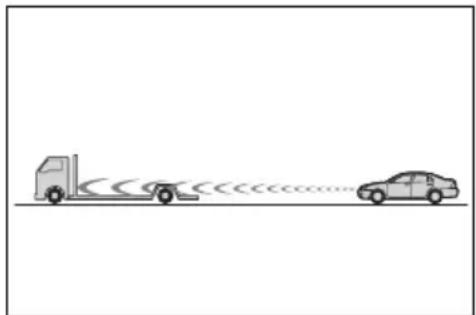
natural_image
Diagram showing a truck and a car with motion lines, no text or symbols present●Motorcycles traveling in the same lane
- When water or snow thrown up by the surrounding vehicles hinders the detecting of the sensor
- When your vehicle is pointing upwards (caused by a heavy load in the luggage compartment, etc.)
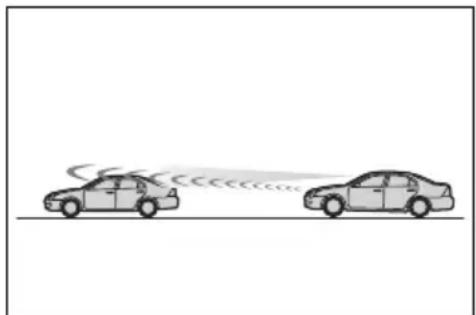
natural_image
Two cars on a road with sound waves, no text or symbols present●Preceding vehicle has an extremely high ground clearance
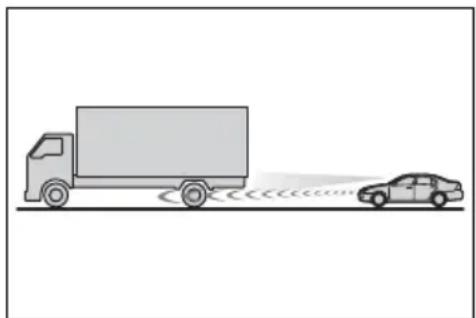
natural_image
Illustration of a truck and a car on a road with sound waves (no text or symbols)Conditions under which the vehicle-to-vehicle distance control mode may not function correctly
In the case of the following conditions, operate the brake pedal (or accelerator pedal, depending on the situation) as necessary.
As the sensor may not be able to correctly detect vehicles ahead, the system may not operate properly.
- When the road curves or when the lanes are narrow
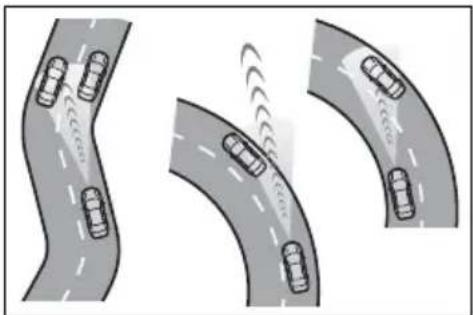
natural_image
Three curved road scenarios showing cars on different surfaces with motion indicators (no text or symbols)- When steering wheel operation or your position in the lane is unstable
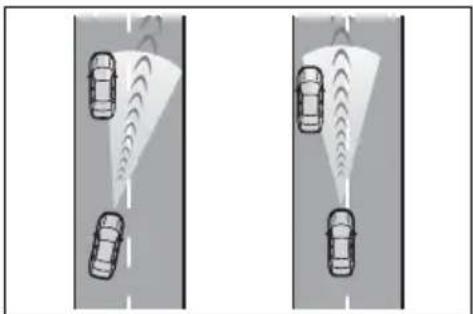
natural_image
Two identical diagrams showing cars on a road with sensor waves, no text or symbols present- When the vehicle ahead of you decelerates suddenly
- When driving on a road surrounded by a structure, such as in a tunnel or on a bridge
BSM (Blind Spot Monitor)\*
*: If equipped
The Blind Spot Monitor is a system that has 2 functions:
● The BSM (Blind Spot Monitor) function
Assists the driver in making a decision when changing lanes
● The RCTA (Rear Cross Traffic Alert) function
Assists the driver when back- ing up
These functions use the same sensors.

WARNING
■ Cautions regarding the use of the BSM function
The driver is solely responsible for safe driving. Always drive safely, taking care to observe your surroundings.
The BSM function is a supplementary function which alerts the driver that a vehicle is in a blind spot of the outside rear view mirrors or is approaching rapidly from behind into a blind spot. Do not overly rely on the BSM function. As the function cannot judge if it is safe to change lanes, over reliance could lead to an accident resulting in death or serious injury.
As the system may not function correctly under certain conditions, the driver's own visual confirmation of safety is necessary.

WARNING
■ Cautions regarding the use of the RCTA function
The driver is solely responsible for safe driving. Always drive safely, taking care to observe your surroundings.
The RCTA function is only a supplementary function which alerts the driver that a vehicle is approaching from the right or left at the rear of the vehicle. As the RCTA function may not function correctly under certain conditions, the driver's own visual confirmation of safety is necessary.
Over reliance on this function may lead to an accident resulting death or serious injury.
System components
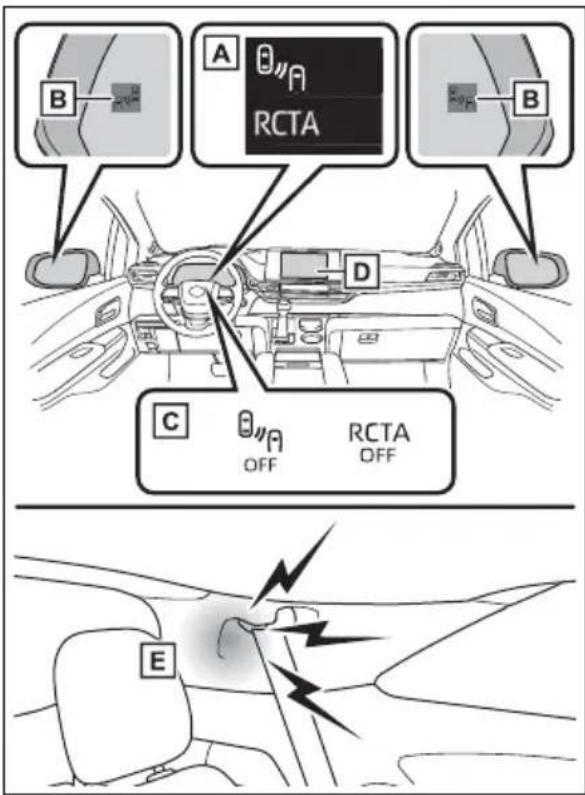
A Multi-information display
Turning the BSM function/RCTA function on/off.
B Outside rear view mirror indi-
cators
BSM function:
When a vehicle is detected in a blind spot of the outside rear view mirrors or approaching rapidly from behind into a blind spot, the outside rear view mirror indicator on the detected side will illuminate. If the turn signal lever is operated toward the detected side, the outside rear view mirror indicator will flash.
RCTA function:
When a vehicle approaching from the right or left at the rear of the vehicle is detected, both outside rear view mirror indicators will flash.

BSM OFF indicator/RCTA OFF indicator
When the Blind Spot Monitor is disabled, the BSM OFF indicator illuminates.
When the RCTA function is disabled, the RCTA OFF indicator illuminates.

Monitor screen display (RCTA function only)
If a vehicle approaching from the right or left at the rear of the vehicle is detected, the RCTA icon ( P.305) for the detected side will be displayed.

RCTA buzzer (RCTA function only)
If a vehicle approaching from the right or left at the rear of the vehicle is detected, a buzzer will sound from behind the rear seat.
Turning the BSM function/RCTA function on/off
The BSM function and the RCTA function can be
enabled/disabled on the screen of the multi-information display. ( P.112) Each time the power switch is turned off then changed to ON, the BSM function//RCTA function will be enabled automatically.

■ Outside rear view mirror indicators visibility
In strong sunlight, the outside rear view mirror indicator may be difficult to see.
■Hearing the RCTA buzzer
The RCTA buzzer may be difficult to hear over loud noises such as high audio volume.
When “Blind Spot Monitor Unavailable” or “Rear Cross Traffic Alert Unavailable” is shown on the multi-information display
The sensor voltage has become abnormal, or water, snow, mud, etc., may be built up in the vicinity of the sensor area of the rear bumper. ( P.301)
Removing the water, snow, mud, etc., from the vicinity of the sensor area should return it to normal. Also, the sensor may not function normally when used in extremely hot or cold weather.
When “Blind Spot Monitor Malfunction Visit Your Dealer” or “Rear Cross Traffic Alert Malfunction Visit Your Dealer” is shown on the multi-information display
There may be a sensor malfunction or misaligned. Have the vehicle inspected at a Toyota dealer.
Customization
Some functions can be customized. ( P.550)

WARNING
■Handling the radar sensor
Blind Spot Monitor sensors are installed inside the left and right sides of the rear bumper respectively. Observe the following to ensure the Blind Spot Monitor can function correctly.
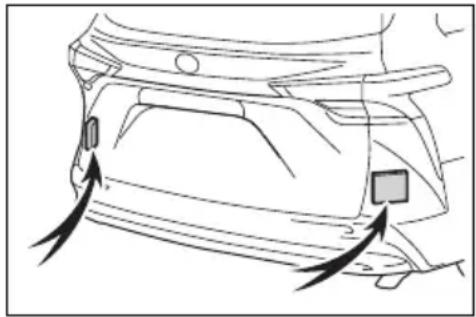
natural_image
Line drawing of a car rear bumper with two directional arrows indicating movement or force (no text or symbols)- Keep the sensors and the surrounding areas on the rear bumper clean at all times. If a sensor or its surrounding area on the rear bumper is dirty or covered with snow, the Blind Spot Monitor may not operate and a warning message (→P.301) will be displayed. In this situation, clear off the dirt or snow and drive the vehicle with the operation conditions of the BSM function (→P.303) satisfied for approximately 10 minutes. If the warning message does not disappear, have the vehicle inspected by your Toyota dealer.

WARNING
- Do not subject a sensor or its surrounding area on the rear bumper to a strong impact. If a sensor is moved even slightly off position, the system may malfunction and vehicles may not be detected correctly. In the following situations, have your vehicle inspected by your Toyota dealer.
- A sensor or its surrounding area is subject to a strong impact.
- If the surrounding area of a sensor is scratched or dented, or part of them has become disconnected.
- Do not disassemble the sensor.
- Do not attach accessories, stickers (including transparent stickers), aluminum tape, etc. to a sensor or its surrounding area on the rear bumper.
- Do not modify the sensor or surrounding area on the rear bumper.
- If a sensor or the rear bumper needs to be removed/installed or replaced, contact your Toyota dealer.
● Do not paint the rear bumper any color other than an official Toyota color.
The Blind Spot Monitor function
■Vehicles that can be detected by the Blind Spot Monitor
The BSM function uses radar sensors to detect the following vehicles traveling in adjacent lanes and advises the driver of the presence of such vehicles via the indicators on the outside rear view mirrors.
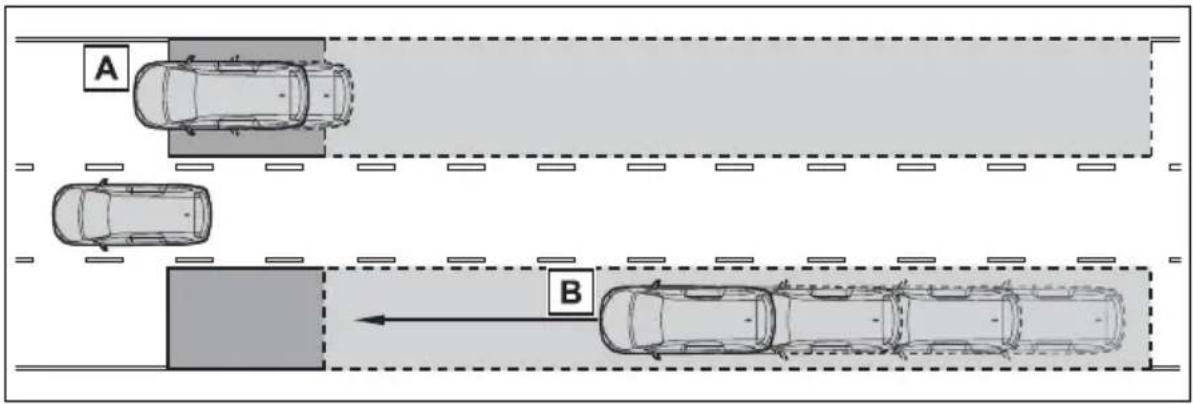
flowchart
graph TD
    A["Line A"] --> B["Line B"]
    A --> C["Vehicle Path"]
    B --> D["Vehicle Path"]
    style A fill:#f9f,stroke:#333
    style B fill:#bbf,stroke:#333
A Vehicles that are traveling in areas that are not visible using the outside rear view mirrors (the blind spots)
B Vehicles that are approaching rapidly from behind in areas that are not visible using the outside rear view mirrors (the blind spots)
■The BSM function detection areas
The areas that vehicles can be detected in are outlined below.
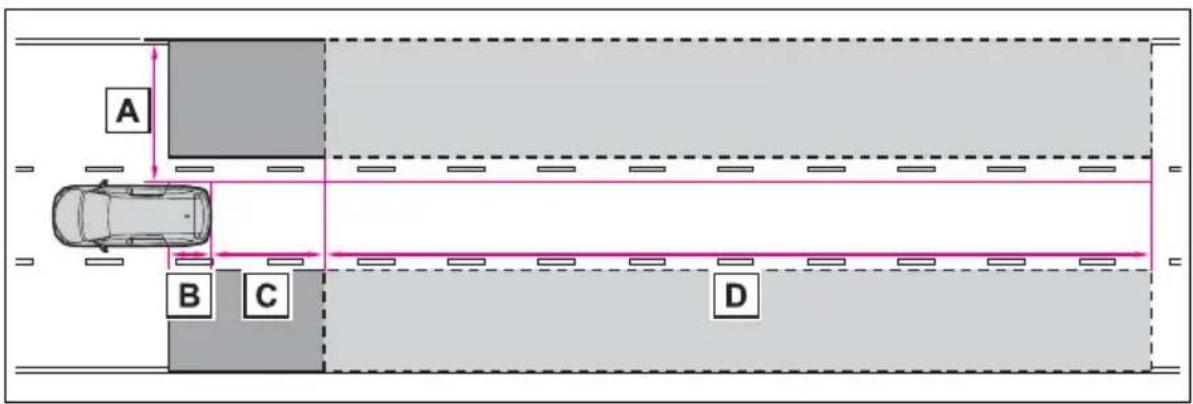
The range of each detection area is:
A Approximately 1.6 ft. (0.5 m) to 11.5 ft. (3.5 m) from either side of the vehicle
The area between the side of the vehicle and 1.6 ft. (0.5 m) from the side of the vehicle cannot be detected.
B Approximately 3.3 ft. (1 m) forward of the rear bumper
C Approximately 9.8 ft. (3 m) from the rear bumper
D Approximately 9.8 ft. (3 m) to 197 ft. (60 m) from the rear bumper
The greater the difference in speed between your vehicle and the detected vehicle is, the farther away the vehicle will be detected, causing the outside rear view mirror indicator to illuminate or flash.
■The BSM function is operational when
The BSM function is operational
when all of the following conditions are met:
●The BSM function is on.
●The shift lever is in a position other than R.
●The vehicle speed is greater than approximately 10 mph (16 km/h).
■The BSM function will detect a vehicle when
The BSM function will detect a vehicle present in the detection area in the following situations:
●A vehicle in an adjacent lane overtakes your vehicle.
- You overtake a vehicle in an adjacent lane slowly.
●Another vehicle enters the detection area when it changes lanes.
■Conditions under which the BSM function will not detect a vehicle
The BSM function is not designed to detect the following types of vehicles and/or objects:
● Small motorcycles, bicycles, pedestrians, etc.*
● Vehicles traveling in the opposite direction
●Guardrails, walls, signs, parked vehicles and similar stationary objects*
- Following vehicles that are in the same lane*
● Vehicles traveling 2 lanes away from your vehicle*
● Vehicles which are being over-taken rapidly by your vehicle
*: Depending on the conditions, detection of a vehicle and/or object may occur.
■Conditions under which the BSM function may not function correctly
●The BSM function may not detect vehicles correctly in the following situations:
- When the sensor is misaligned due to a strong impact to the sensor or its surrounding area
- When mud, snow, ice, a sticker, etc. is covering the sensor or surrounding area on the rear bumper
- When driving on a road surface that is wet with standing water during bad weather, such as heavy rain, snow, or fog
- When multiple vehicles are approaching with only a small gap between each vehicle
- When the distance between your vehicle and a following vehicle is short
- When there is a significant difference in speed between your vehicle and the vehicle that enters the detection area
- When the difference in speed between your vehicle and another vehicle is changing
- When a vehicle enters a detection area traveling at about the same speed as your vehicle
- As your vehicle starts from a stop, a vehicle remains in the detection area
- When driving up and down consecutive steep inclines, such as hills, dips in the road, etc.
- When driving on roads with sharp bends, consecutive curves, or uneven surfaces
- When vehicle lanes are wide, or
when driving on the edge of a lane, and the vehicle in an adjacent lane is far away from your vehicle
- When an accessory (such as a hitch-mounted bicycle carrier) is installed to the rear of the vehicle
- When the vehicle is heavily loaded in the luggage compartment
- When there is a significant difference in height between your vehicle and the vehicle that enters the detection area
- Immediately after the BSM function/RCTA function are turned on
- When towing a trailer
●Instances of the BSM function unnecessarily detecting a vehicle and/or object may increase in the following situations:
- When the sensor is misaligned due to a strong impact to the sensor or its surrounding area
- When the distance between your vehicle and a guardrail, wall, etc. that enters the detection area is short
- When driving up and down consecutive steep inclines, such as hills, dips in the road, etc.
- When vehicle lanes are narrow, or when driving on the edge of a lane, and a vehicle traveling in a lane other than the adjacent lanes enters the detection area
- When driving on roads with sharp bends, consecutive curves, or uneven surfaces
- When the tires are slipping or spinning
- When the distance between your vehicle and a following vehicle is short
- When an accessory (such as a hitch-mounted bicycle carrier) is installed to the rear of the vehicle
- When the vehicle throws up water or snow behind.
The Rear Cross Traffic Alert function (if equipped)
■Operation of the RCTA function
The RCTA function uses radar sensors to detect vehicles approaching from the right or left at the rear of the vehicle and alerts the driver of the presence of such vehicles by flashing the outside rear view mirror indicators and sounding a buzzer.
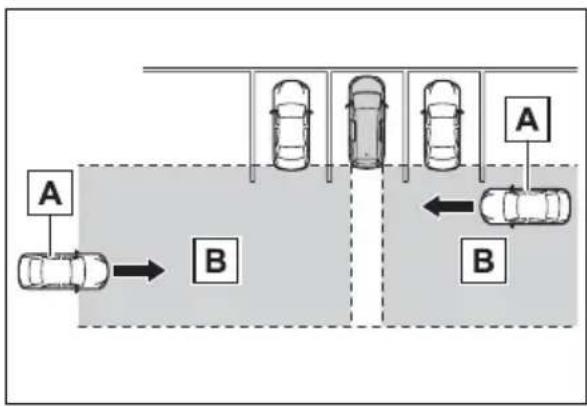
flowchart
graph TD
    A1[" cars "] --> B1[" B "]
    B1 --> A2[" cars "]
    A2 --> B2[" B "]
    B2 --> A3[" cars "]
    style A1 fill:#f9f,stroke:#333
    style A2 fill:#f9f,stroke:#333
    style B1 fill:#ccf,stroke:#333
    style B2 fill:#ccf,stroke:#333
    style A3 fill:#cfc,stroke:#333
A Approaching vehicles
B Detection areas
■RCTA icon display (if equipped)
When a vehicle approaching from the right or left at the rear of the vehicle is detected, the following will be displayed on the audio system screen.
- When the Toyota parking assist monitor (if equipped) is displayed
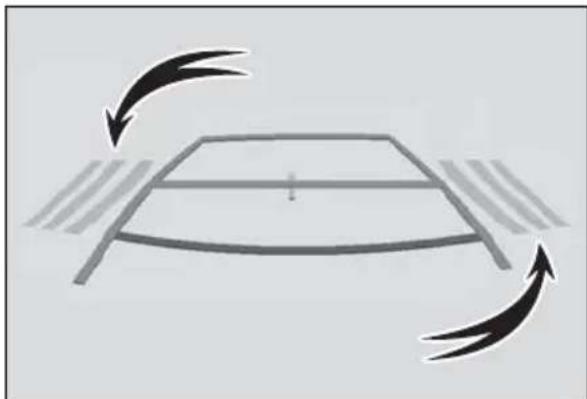
natural_image
Diagram showing a vehicle under load with curved arrows indicating motion or flow direction (no text or symbols)- When the panoramic view monitor (if equipped) is displayed
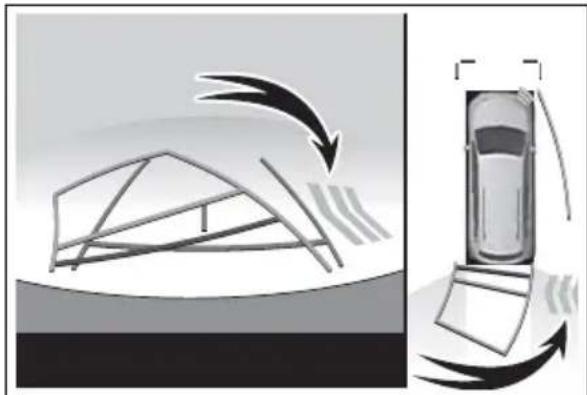
natural_image
Diagram showing a structural frame being lifted by an arrow, and a car on a lift with motion arrows (no text or symbols): The RCTA function is malfunctioning ( P.301)
■The RCTA function detection areas
The areas that vehicles can be detected in are outlined below.
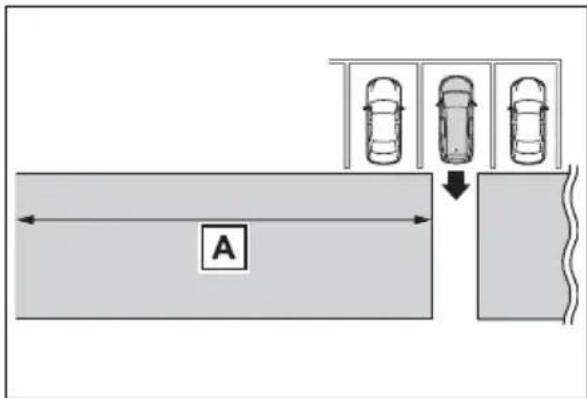
The buzzer can alert the driver of faster vehicles approaching from farther away.
Example:
| Approaching vehicle | Speed | Approximate alert distance |
| Fast | 18 mph (28 km/h) | 65 ft. (20 m) |
| Slow | 5 mph (8 km/h) | 18 ft. (5.5 m) |
■The RCTA function is operational when
The RCTA function operates when all of the following conditions are met:
●The RCTA function is on.
●The shift lever is in R.
●The vehicle speed is less than approximately 5 mph (8 km/h).
●The approaching vehicle speed is between approximately 5 mph (8 km/h) and 17 mph (28 km/h).
Setting the buzzer volume
The buzzer volume can be adjusted on the multi-information display. (→P.112)
■Conditions under which the RCTA function will not detect a vehicle
The RCTA function is not designed to detect the following types of vehicles and/or objects.
● Vehicles approaching from directly behind
● Vehicles backing up in a parking space next to your vehicle
● Vehicles that the sensors cannot detect due to obstructions
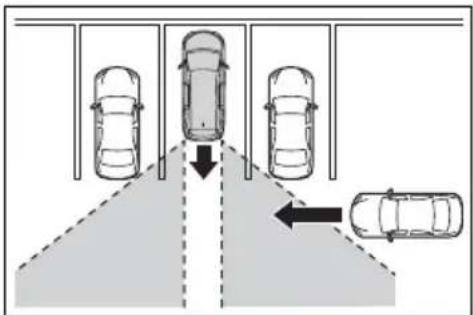
● Guardrails, walls, signs, parked vehicles and similar stationary objects*
● Small motorcycles, bicycles, pedestrians, etc.*
● Vehicles moving away from your vehicle
● Vehicles approaching from the parking spaces next to your vehicle*
*: Depending on conditions, detection of a vehicle and/or object may occur.
■ Conditions under which the RCTA function may not function correctly
●The RCTA function may not detect vehicles correctly in the following situations:
- When the sensor is misaligned due to a strong impact to the sensor or its surrounding area
- When mud, snow, ice, a sticker, etc. is covering the sensor or surrounding area on the rear bumper
- When driving on a road surface that is wet with standing water during bad weather, such as heavy rain, snow, or fog
- When multiple vehicles are approaching with only a small gap between each vehicle
- When a vehicle is approaching at high speed
- When parking on a steep incline, such as hills, a dip in the road, etc.
- When an accessory (such as a hitch-mounted bicycle carrier) is installed to the rear of the vehicle
- When backing up on a slope with a sharp change in grade
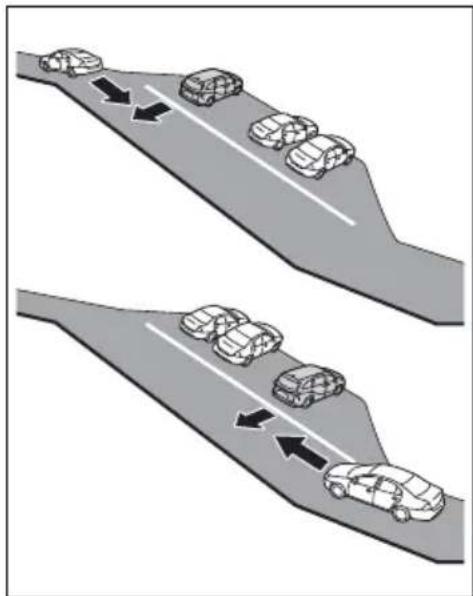
natural_image
Diagram showing two scenarios of cars moving on a road, with arrows indicating direction (no text or symbols)- When backing out of a shallow angle parking spot
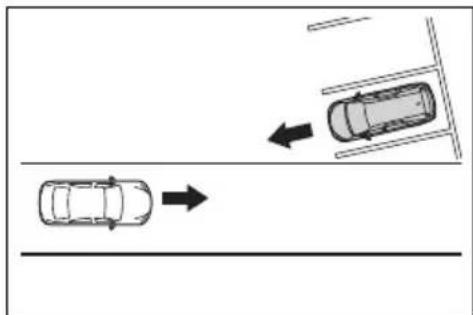
natural_image
Top-down diagram of two cars on a road with directional arrows indicating movement (no text or symbols)- Immediately after the RCTA function is turned on
- Immediately after the hybrid system is started with the RCTA function on
- When towing a trailer
- When the sensors cannot detect a vehicle due to obstructions
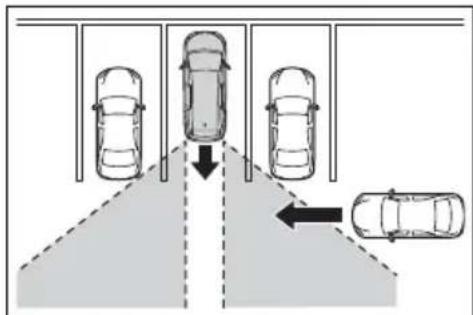
●Instances of the RCTA function unnecessary detecting a vehicle and/or object may increase in the following situations:
- When a vehicle passes by the side of your vehicle
- When the parking space faces a street and vehicles are being
driven on the street
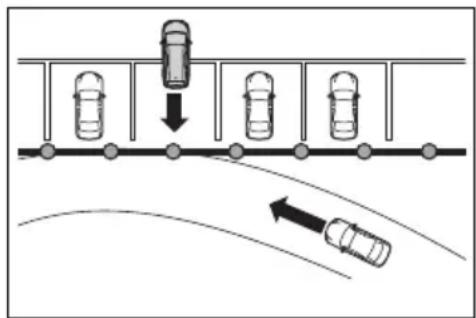
- When the distance between your vehicle and metal objects, such as a guardrail, wall, sign, or parked vehicle, which may reflect electrical waves toward the rear of the vehicle, is short
- When an accessory (such as a hitch-mounted bicycle carrier) is installed to the rear of the vehicle
Intuitive parking assist\*
*: If equipped
The distance from your vehicle to objects, such as a wall, when parallel parking or maneuvering into a garage is measured by the sensors and communicated via the multi-information display, audio system screen and a buzzer. Always check the surrounding area when using this system.
System components
■ Location and types of sensors
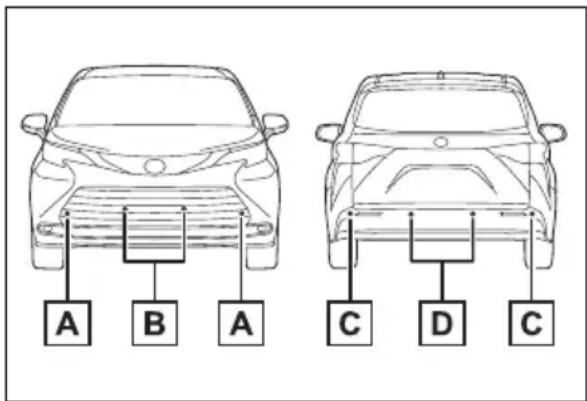
A Front corner sensors
B Front center sensors
C Rear corner sensors
D Rear center sensors
■Display (Multi-information display)
When the sensors detect an object, such as a wall, a graphic is shown on the multi-informa-
tion display depending on the position and distance to the object.
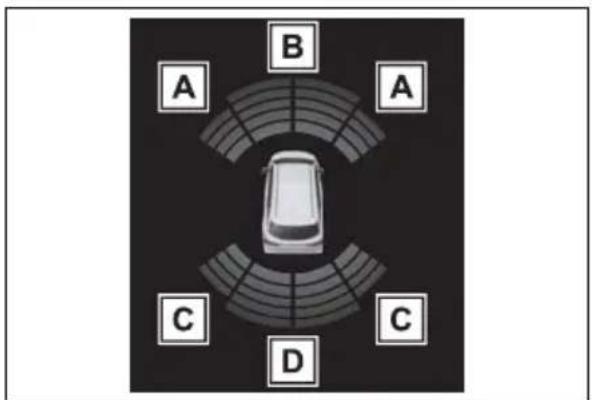
A Front corner sensor detection
B Front center sensor detection ^*1
C Rear corner sensor detection ^2
D Rear center sensor detection ^4
*1: Displayed when the shift lever is in a driving position
*2: Displayed when the shift lever is in R
■Display (audio system screen)
When the sensors detect an object, such as a wall, a graphic is shown on the navigation system (if equipped) or multimedia system (if equipped) screen depending on the position and distance to the object.
- When the Toyota parking assist monitor (if equipped) is displayed
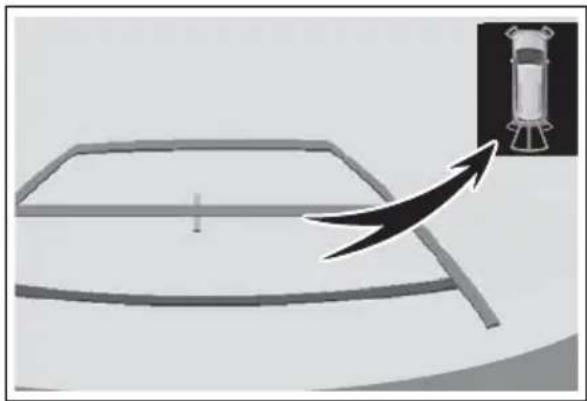
natural_image
Diagram showing a mechanical component with an arrow pointing to a cylindrical device (no text or symbols present)A simplified image is displayed on the upper corner of the screen when an obstacle is detected.
- When the panoramic view monitor (if equipped) is displayed
Panoramic view*
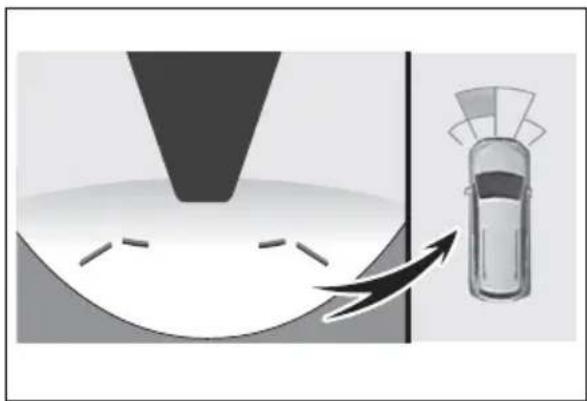
natural_image
Diagram showing a spray bottle emitting particles from a nozzle onto a curved surface, with an arrow indicating motion (no text or symbols)A graphic is shown when the panoramic view monitor is displayed.
*: A simplified image is displayed on the upper corner of the screen when an obstacle is detected while magnified display is shown.
▶ Except panoramic view
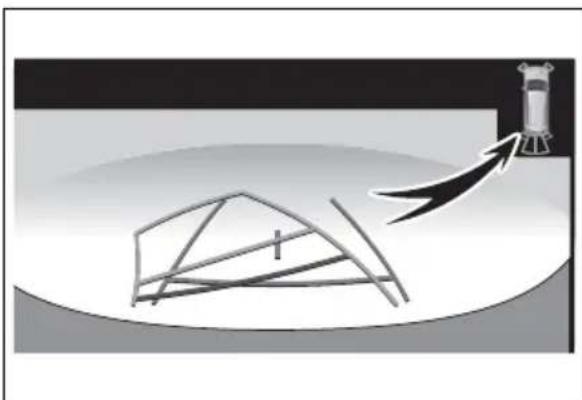
natural_image
Illustration of a crane structure with an arrow pointing to a tower (no text or symbols)A simplified image is displayed on the upper corner of the screen when an obstacle is detected.
Turning intuitive parking assist on/off
The Intuitive parking assist can be enabled/disabled on the screen of the multi-information display. (→P.112)
When the intuitive parking assist function is disabled, the intuitive parking assist OFF indicator ( P.95) illuminates on the multi-information display.
To re-enable the system, select on the multi-information display, select P and turn it on.
If the system is disabled, it will remain off even if the power switch is turned to ON after the power switch has been turned off.

WARNING
■Intuitive parking assist precautions
Observe the following precautions.
Failing to do so may result in the vehicle being unable to be driven safely and possibly cause an accident.
- Do not use the sensor at speeds in excess of approximately 6 mph (10 km/h).
The sensors' detection areas and reaction times are limited. When moving forward or reversing, check the areas surrounding the vehicle (especially the sides of the vehicle) for safety, and drive slowly, using the brake to control the vehicle's speed.
- Do not install accessories near the bumpers as those areas are within the sensors' detection areas.
●The area directly under the bumpers is not detected. Thin posts or objects lower than the sensor may not be detected when approached, even if they have been detected once.
■When to disable the function
In the following situations, disable the function as it may operate even though there is no possibility of a collision.
●The vehicle is equipped with a commercial fender pole, wireless antenna or fog lights.
●The front or rear bumper or a sensor receives a strong impact.
● A non-genuine Toyota suspension (lowered suspension, etc.) is installed.

WARNING
●A backlit license plate is installed.
■When using the intuitive parking assist
In the following situations, the system may not function correctly due to a sensor malfunction, etc. Have the vehicle checked by your Toyota dealer.
●The intuitive parking assist operation display flashes or shows continuously, and a buzzer sounds when no objects are detected.
- If the area around a sensor collides with something, or is subjected to strong impact.
- If the bumper or grille collides with something.
- If the display flashes or is displayed continuously and a buzzer does not sound, except when the mute function has been turned on.
■Notes when washing the vehicle
Do not apply intensive bursts of water or steam to the sensor area.
Doing so may result in the sensor malfunctioning.
- When using a high pressure washer to wash the vehicle, do not spray the sensors directly, as doing so may cause a sensor to malfunction.
- When using steam to clean the vehicle, do not direct steam too close to the sensors as doing so may cause a sensor to malfunction.
■The system can be operated when
●The power switch is in ON.
- Intuitive parking assist function is on.
●The vehicle speed is less than about 6 mph (10 km/h).
●The shift lever is in a position other than P.
If “Parking Assist Unavailable Clean Parking Assist Sensor” is displayed on the multi-information display
A sensor may be covered with ice, snow, dirt, etc. Remove the ice, snow, dirt, etc., from the sensor to return the system to normal.
Also, due to ice forming on a sensor at low temperatures, a warning message may be displayed or the sensor may not be able to detect an object. Once the ice melts, the system will return to normal.
If a warning message is displayed even if the sensor is clean, there may be a sensor malfunction. Have the vehicle inspected by your Toyota dealer.
If "Parking Assist Unavailable" is displayed on the multi-information display
Water may be continuously flowing over the sensor surface, such as in a heavy rain. When the system determines that it is normal, the system will return to normal.
■Sensor detection information
- The sensor's detection areas are limited to the areas around the vehicle's front and rear bumpers.
●The following situations may occur during use. - Depending on the shape of the object and other factors, the detection distance may shorten, or detection may be impossible.
- Detection may be impossible if static objects draw too close to the
sensor.
- There will be a short delay between static object detection and display (warning buzzer sounds). Even at low speeds, there is a possibility that the object will come within approximately 11.9 in. (30 cm) before the display is shown and the warning buzzer sounds.
- It might be difficult to hear the buzzer due to the volume of the audio system or air flow noise of the air conditioning system.
- It may be difficult to hear the sound of this system due to the buzzers of other systems.
■Conditions under which the function may not function correctly
Certain vehicle conditions and the surrounding environment may affect the ability of a sensor to correctly detect objects. Particular instances where this may occur are listed below.
●There is dirt, snow or ice on a sensor. (Cleaning the sensors will resolve this problem.)
●A sensor is frozen. (Thawing the area will resolve this problem.) In especially cold weather, if a sensor is frozen the sensor display may be displayed abnormally, or objects, such as a wall, may not be detected.
●A sensor is covered in any way.
- When a sensor or the area around a sensor is extremely hot or cold.
● On an extremely bumpy road, on an incline, on gravel, or on grass.
●The vicinity of the vehicle is noisy due to vehicle horns, motorcycle engines, air brakes of large vehicles, or other loud noises producing ultrasonic waves.
●There is another vehicle equipped with parking assist sensors in the vicinity.
●A sensor is coated with a sheet of
spray or heavy rain.
- If a sensor is hit by a large amount of water, such as when driving on a flooded road.
●If the vehicle is significantly tilted.
●The vehicle is approaching a tall or curved curb.
- If objects draw too close to the sensor.
■ Objects which may not be properly detected
The shape of the object may prevent the sensor from detecting it. Pay particular attention to the following objects:
●Wires, fences, ropes, etc.
●Cotton, snow and other materials that absorb sound waves
● Sharply-angled objects
●Low objects
●Tall objects with upper sections projecting outwards in the direction of your vehicle
People may not be detected if they are wearing certain types of clothing.
Sensor detection display, object distance
■ Detection range of the sensors
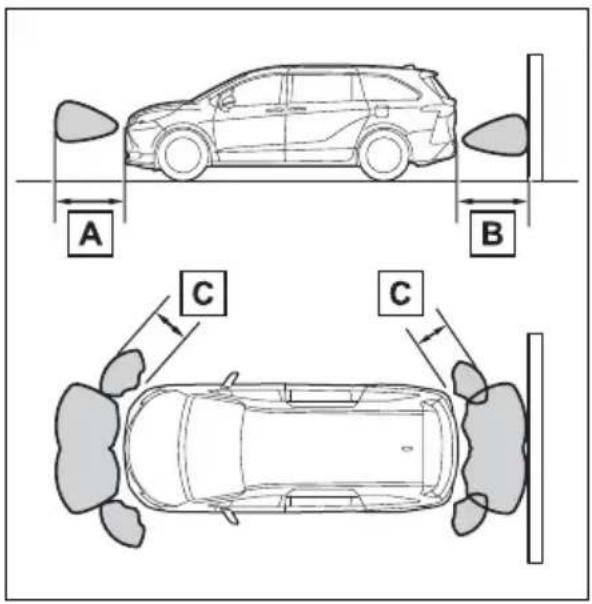
A Approximately 3.3 ft. (100 cm)
B Approximately 4.9 ft. (150 cm)
C Approximately 2.0 ft. (60 cm)
The diagram shows the detection range of the sensors. Note that the sensors cannot detect objects that are extremely close to the vehicle.
The range of the sensors may change depending on the shape of the object, etc.
■Distance display
When an object is detected by a sensor, the approximate distance to the object will be displayed on the multi-information display and audio system screen. (As the distance to the object becomes short, the distance segments may blink.)
The images may differ from that shown in the illustrations.
- Approximate distance to object 4.9 ft. (150 cm) to 2.0 ft. (60 cm) ^* (Rear center sensor)
| Multi-information display | Audio system screen |
 |  |
*: Automatic buzzer mute function is enabled. (→P.314)
- Approximate distance to object: 3.3 ft. (100 cm) to 2.0 ft. (60 cm) ^* (Front center sensor)
| Multi-information display | Audio system screen |
 |  |
*: Automatic buzzer mute function is enabled. (→P.314)
- Approximate distance to object: 2.0 ft. (60 cm) to 1.5 ft. (45 cm)*
| Multi-information display | Audio system screen |
 |  |
*: Automatic buzzer mute function is enabled. (→P.314)
- Approximate distance to object: 1.5 ft. (45 cm) to 1.0 ft. (30 cm)*
| Multi-information display | Audio system screen |
 |  |
*: Automatic buzzer mute function is enabled. (→P.314)
- Approximate distance to object: 1.0 ft. (30 cm) to 0.5 ft. (15 cm) ^*1
| Multi-information display*2 | Audio system screen*2 |
 |  |
*1: Automatic buzzer mute function is disabled. (→P.314)
*2: The distance segments will blink slowly.
- Approximate distance to object: Less than 0.5 ft. (15 cm) ^*1
| Multi-information display*2 | Audio system screen*2 |
 |  |
*1: Automatic buzzer mute function is disabled. (→P.314)
^*2 :The distance segments will blink
rapidly.
■Buzzer operation and distance to an object
A buzzer sounds when the sensors are operating.
- The buzzer beeps faster as the vehicle approaches an object. When the vehicle comes within approximately 1.0 ft. (30 cm) of the object, the buzzer sounds continuously.
- When 2 or more sensors simultaneously detect a static object, the buzzer sounds for the nearest object. If one or more objects come within approximately 1.0 ft. (30 cm) of the vehicle, the buzzer will repeat a long tone, followed by fast beeps.
- Even when the sensors are operating, the buzzer will be muted in some situations. (automatic buzzer mute function)
■Muting the buzzer sound
●Automatic buzzer mute function
Even when the sensors are operating, the buzzer will be muted in the following situations:
- The distance between the vehicle and the detected object does not become shorter (except when the distance between the vehicle and object is 1.0 ft. [30 cm] or less).
- Your vehicle is moving away from the object.
• There are no detectable objects entering the path of your vehicle.
However, if another object is detected or the situation changes while the buzzer is muted, the buzzer begins sounding again.
●To mute the buzzer sound
The buzzer can be temporarily muted by pressing “OK” of the meter control switches while a suggestion that says mute is available is shown on the multi-information display.
- When the mute is canceled
Mute will be automatically canceled in the following situations.
- When the shift position is changed
- When the vehicle speed has reached or exceeded a certain speed
- When there is a malfunction in a sensor or the system is temporarily unavailable.
- When the Intuitive parking assist is turned off once and turned on again
- When the power switch is turned off once and turned to ON again
Customization
The buzzer volume can be adjusted on the multi-information display. ( P.551)
RCD (Rear Camera Detection) function\*
*: If equipped
When the vehicle is backing up, the rear camera detection function can detect pedestrians in the detection area behind the vehicle. If a pedestrian is detected, a buzzer will sound and an icon will be displayed on the audio system screen to inform the driver of the pedestrian.
Display (audio system screen)
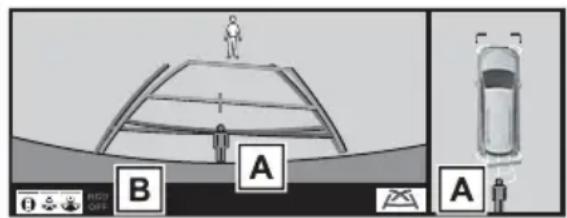
A Pedestrian detection icon
Displayed automatically when a pedestrian is detected.
B RCD OFF icon
When the RCD function is disabled, the RCD OFF icon illuminates. (Each time the power switch is turned off then changed to ON, the RCD function will be enabled automatically.)
Turning the RCD function on/off
Use the meter control switches to enable/disable the RCD function. (→P.112)
4.2-inch display
1 Press or of the meter control switches and select

2 Press or of the meter control switches to select "RCD" and then press "OK".
7-inch display
1 Press or of the meter control switches and select

2 Press or of the meter control switches to select "RCD" and then press "OK".
3 ON and OFF will be switched when "OK" is pressed.
When the RCD function is disabled, the RCD OFF indicator ( P.95) illuminates on the multi-information display.
When a pedestrian is detected
If the rear camera detection function detects a pedestrian in the detection area, the buzzer and pedestrian detection will operate as follows:
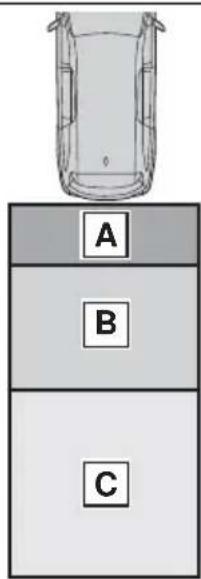
A If a pedestrian is detected in area A
Buzzer: Sounds repeatedly Pedestrian detection icon: Blinks 3 times and then stays on
B If a pedestrian is detected in area B
Buzzer (When the vehicle is stationary): Sounds 3 times Buzzer (When the vehicle is backing up, when a pedestrian approaches the rear of the vehicle): Sounds repeatedly
Pedestrian detection icon: Blinks 3 times and then stays on
C If the system determines that your vehicle may collide with a pedestrian in area C
Buzzer: Sounds repeatedly Pedestrian detection icon: Blinks 3 times and then stays on
■The rear camera detection function is operational when
●The power switch is in ON.
●RCD function is on.
●The shift lever is in R.
■Setting the buzzer volume
The buzzer volume can be adjusted on the multi-information display. ( P.112)
■Muting the buzzer sound
The buzzer can be temporarily muted by pressing “OK” of the meter control switches while a suggestion that says mute is available is shown on the multi-information display.
If “Rear Camera Detection Unavailable Remove the Dirt of Rear Camera” is displayed on the multi-information display
A rear camera lens may be dirty or covered with snow or ice. In such cases, if it is removed from the rear camera lens, the system should return to normal. (It may be necessary to drive the vehicle for some time before the system returns to normal. Even after the camera cleaning washer operated, driving the vehicle may also be necessary.)
If “Rear Camera Detection Unavailable See Owner’s Manual” is displayed on the multi-information display
- If this message is displayed after the 12-volt battery has been disconnected and reconnected, fully turn the steering wheel to the left and then the right on level ground.
- If this message is displayed only when the shift lever is in R, the rear camera lens may be dirty. Clean the rear camera lens.
■ Situations in which the system may not operate properly
●Some pedestrians, such as the following, may not be detected by the rear camera detection func-
tion, preventing the function from operating properly:
- Pedestrians who are bending forward or squatting
- Pedestrians who are lying down
• Pedestrians who are running - Pedestrians who suddenly enter the detection area
• People riding a bicycle, skateboard, or other light vehicle - Pedestrians wearing oversized clothing such as a rain coat, long skirt, etc., making their silhouette obscure
- Pedestrians whose body is partially hidden by an object, such as a cart or umbrella
- Pedestrians which are obscured by darkness, such as at night
- In some situations, such as the following, pedestrians may not be detected by the rear camera detection function, preventing the function from operating properly:
- When backing up in inclement weather (rain, snow, fog, etc.)
- When the rear camera is obscured (dirt, snow, ice, etc. are attached) or scratched
- When a very bright light, such as the sun, or the headlights of another vehicle, shines directly into the rear camera
- When backing up in a place where the surrounding brightness changes suddenly, such as at the entrance or exit of a garage or underground parking lot
- When backing up in a dim environment such as during dusk or in an underground parking lot
- When the dedicated camera cleaning washer is operating
● Even though there are no pedestrians in the detection area, some objects, such as the following, may be detected, possibly causing the rear camera detection function to operate. - Three dimensional objects, such as a pole, traffic cone, fence, or parked vehicle
- Moving objects, such as a car or
motorcycle
- Objects moving toward your vehicle when backing up, such as flags or puddles (or airborne matter, such as smoke, steam, rain, or snow)
- Cobblestone or gravel roads, tram rails, road repairs, white lines, pedestrian crossings or fallen leaves on the road
• Metal covers (gratings), such as those used for drainage ditches
- Objects reflected in a puddle or on a wet road surface
- The roadside or bumps on the road
- Shadows on the road
- In some situations, such as the following, the rear camera detection function may operate even though there are no pedestrians in the detection area.
- When backing up toward the road-side or a bump on the road
- If the vehicle is significantly tilted, such as when carrying a heavy load
- When backing up toward an incline/decline
- If the suspension has been modified or tires of a size other than specified are installed
- If the rear of the vehicle is raised or lowered due to the carried load
- If an electronic component, such as a backlit license plate is installed near the rear camera
- If a bumper protector, such as an additional trim strip, is installed to the rear bumper
- If the orientation of the rear camera has been changed due to a collision or other impact, or removal and installation
- When water is flowing over the rear camera lens
- When the rear camera is obscured (dirt, snow, ice, etc. are attached) or scratched
- If there is a flashing light in the detection area, such as the emergency flashers of another vehicle
●Situations in which the rear cam-
era detection function may be difficult to notice
- The buzzer may be difficult to hear if the surrounding area is noisy, the volume of the audio system volume is high, the air conditioning system is being used, etc.
- If the temperature in the cabin is extremely high or low, the audio system screen may not operate correctly.
PKSB (Parking Support Brake)\*
*: If equipped
The Parking Support Brake system consists of the following functions that operate when driving at a low speed or backing up, such as when parking. When the system determines that the possibility of a collision with a detected object is high, a warning operates to urge the driver to take evasive action. If the system determines that the possibility of a collision with a detected object is extremely high, the brakes are automatically applied to help avoid the collision or help reduce the impact of the collision.
PKSB (Parking Support Brake) system
■Parking Support Brake function (static objects)
→P.323
■Parking Support Brake function (rear-crossing vehicles)
→P.329

WARNING
■Limitations of the Parking Support Brake system
Do not overly rely on the system, as doing so may lead to an accident.
Always drive while checking the safety of the surroundings of the vehicle.
Depending on the vehicle and road conditions, weather, etc., the system may not operate.
The detection capabilities of sensors and radars are limited.
Always drive while checking the safety of the surroundings of the vehicle.
●The driver is solely responsible for safe driving. Always drive carefully, taking care to observe your surroundings. The Parking Support Brake system is designed to provide support to lessen the severity of collisions. However, it may not operate in some situations.
●The Parking Support Brake system is not designed to stop the vehicle completely. Additionally, even if the system has stopped the vehicle, it is necessary to depress the brake pedal immediately as brake control will be canceled after approximately 2 seconds.
- Do not attempt to test the operation of the Parking Support Brake system yourself. Depending on the situations, the system may not operate properly, possibly leading to an accident.

NOTICE
If “Parking Support Brake Unavailable” is displayed on the multi-information display and the PKSB OFF indicator illuminates
If this message is displayed immediately after the power switch is changed to ON, operate the vehicle carefully, paying attention to your surroundings. It may be necessary to drive the vehicle for a certain amount of time before the system returns to normal. (If the system does not return to normal after driving for a while, clean the sensors and their surrounding area on the bumpers.)
Enabling/Disabling the Parking Support Brake
The Parking Support Brake can be enabled/disabled on the screen of the multi-information display. All of the Parking Support Brake functions (static objects and rear-crossing vehicles) are enabled/disabled simultaneously. (→P.112)
When the Parking Support Brake is disabled, the PKSB OFF indicator ( P.95) illuminates on the multi-information display.
To re-enable the system, select on the multi-information display, select and turn it on.
If the system is disabled, it will remain off even if the power switch is turned to ON after the power switch has been turned off.
Display and buzzer for hybrid system output restriction control and brake control
If the hybrid system output restriction control or brake control operates, a buzzer will sound and a message will be displayed on the multi-information display or audio system screen to alert the driver.
On vehicles with head-up display, the head-up display will display the same message as the multi-information display.
Depending on the situation, hybrid system output restriction control will operate to either limit acceleration or restrict output as much as possible.
● Hybrid system output restriction control is operating (acceleration restriction)
Acceleration greater than a certain amount is restricted by the system.
Audio system screen: No warning displayed
Multi-information display: "Object Detected Acceleration Reduced"
PKSB OFF indicator: Not illuminated
Buzzer: Does not sound
- Hybrid system output restriction control is operating (output restricted as much as possible)
The system has determined that stronger-than-normal brake opera-
tion is necessary.
Audio system screen: "BRAKE!"
Multi-information display: "BRAKE!"
PKSB OFF indicator: Not illuminated
Buzzer: Short beep
● Brake control is operating
The system determined that emergency braking is necessary.
Audio system screen: "BRAKE!"
Multi-information display: "BRAKE!"
PKSB OFF indicator: Not illuminated
Buzzer: Short beep
● Vehicle stopped by system operation
The vehicle has been stopped by brake control operation.
Audio system screen: "Press Brake Pedal"
Multi-information display: "Switch to Brake" (If the accelerator pedal is not depressed, "Brake" will be displayed.)
PKSB OFF indicator: Illuminated
Buzzer: Short beep
System overview
If the Parking Support Brake determines that a collision with a detected object is possible, the hybrid system output will be restricted to restrain any increase in the vehicle speed. (Hybrid system output restriction control: See figure 2.) Additionally, if the accelerator pedal continues to be depressed, the brakes will be applied automatically to reduce the vehicle speed. (Brake control: See figure 3.)
● Figure 1: When the PKSB (Parking Support Brake) is not operating
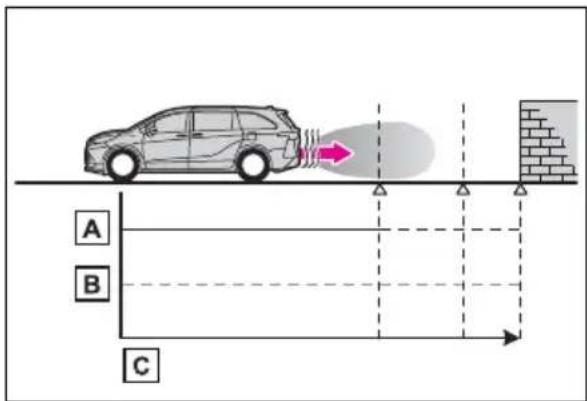
A Hybrid system output
B Braking force
c Time
● Figure 2: When hybrid system output restriction control operates
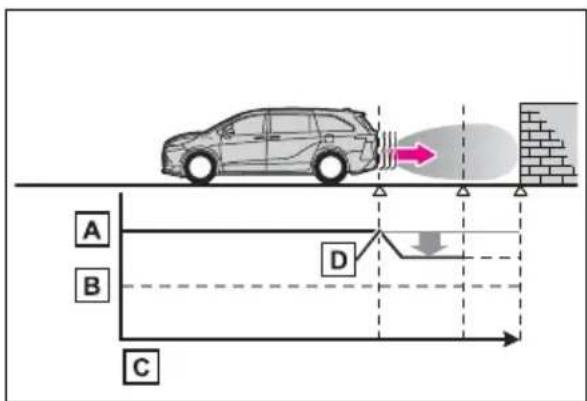
A Hybrid system output
B Braking force
c Time
D Hybrid system output restriction control begins operating
(System determines that possibility of collision with detected object is high)
● Figure 3: When hybrid system output restriction control and brake control operates
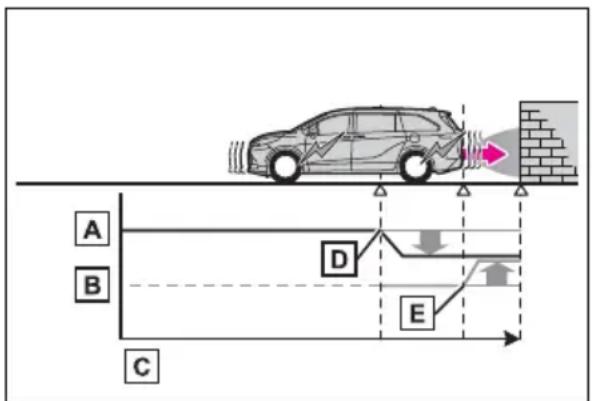
A Hybrid system output
B Braking force
c Time
D Hybrid system output restriction control begins operating (System determines that possibility of collision with detected object is high)
E Brake control begins operating (System determines that possibility of collision with detected object is extremely high)
■If the Parking Support Brake has operated
If the vehicle is stopped due to operation of the Parking Support Brake, the Parking Support Brake will be disabled and the PKSB OFF indicator will illuminate. If the Parking Support Brake operates unnecessarily, brake control can be canceled by depressing the brake pedal or waiting for approximately 2 seconds for it to automatically be canceled.
Then, the vehicle can be operated by depressing the accelerator pedal.
■Re-enabling the Parking Support Brake
To re-enable the Parking Support Brake when it is disabled due to operation of the Parking Support Brake, either enable the system again ( P.320), or turn the power switch off and then back to ON. Additionally, if the object becomes no longer in the traveling direction of the vehicle or if the traveling direction of the vehicle changes (such as changing from moving forward to backing up, or from backing up to moving forward), the system will be re-enabled automatically.
If “Parking Support Brake Unavailable Remove the Dirt of Rear Camera” is displayed on the multi-information display and the PKSB OFF indicator illuminates
●A sensor may be covered with ice, snow, dirt, etc. In this case, remove the ice, snow, dirt, etc., from the sensor to return the system to normal. If this message is shown even after removing dirt from the sensor, or shown when the sensor was not dirty to begin with, have the vehicle inspected at your Toyota dealer.
● A sensor may be frozen. Once the ice melts, the system will return to normal.
●Water may be continuously flowing over the sensor surface, such as in a heavy rain. When the system determines that it is normal, the system will return to normal.
Parking Support Brake function (static objects) ^*
*: If equipped
If the sensors detect a static object, such as a wall, in the traveling direction of the vehicle and the system determines that a collision may occur due to the vehicle suddenly moving forward due to an accidental accelerator pedal operation, the vehicle moving the unintended direction due to the wrong shift position being selected, or while parking or traveling at low speeds, the system will operate to lessen the impact with the detected static object and reduce the resulting damage.
Examples of function operation
This function will operate in situations such as the following if an object is detected in the traveling direction of the vehicle.
■When traveling at a low speed and the brake pedal is not depressed, or is depressed late
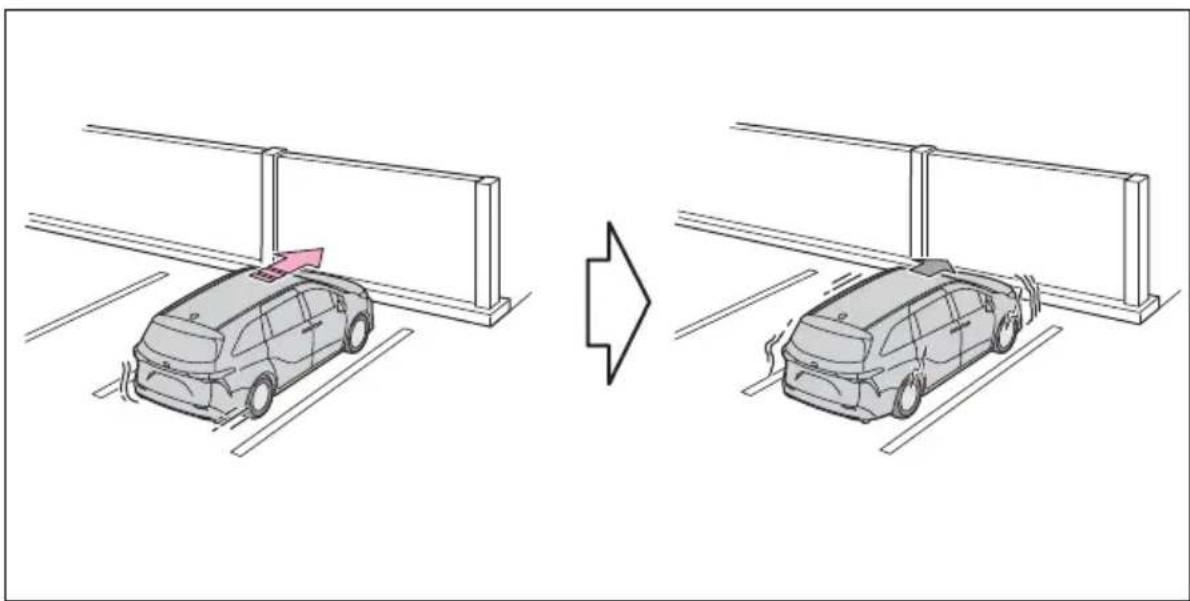
■When the accelerator pedal is depressed excessively
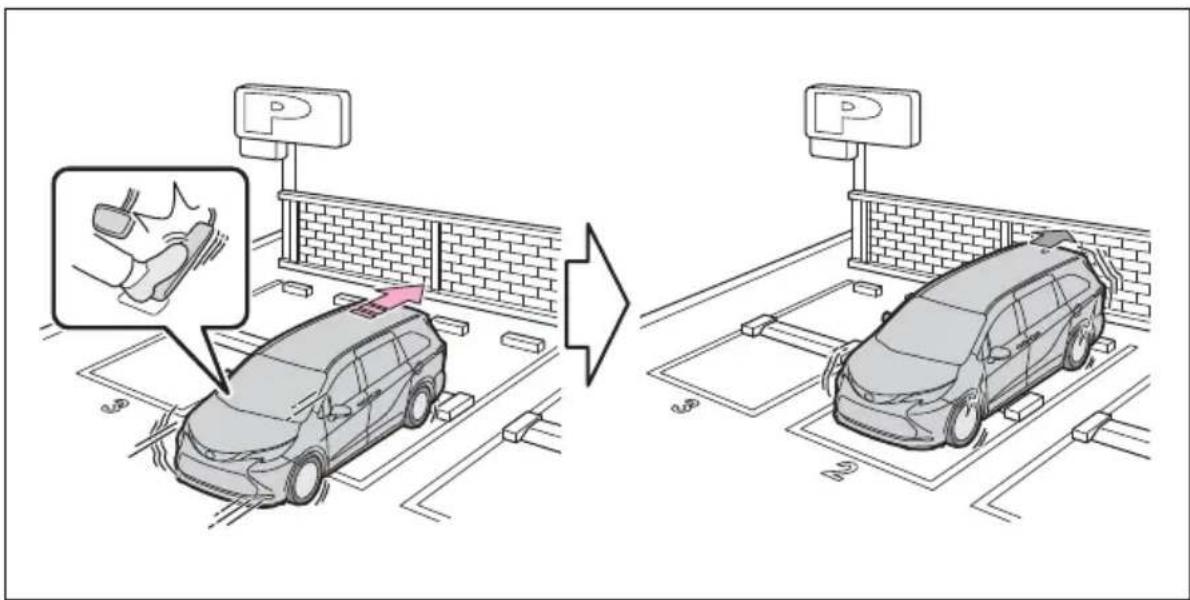
■When the vehicle moves in the unintended direction due to the wrong shift position being selected
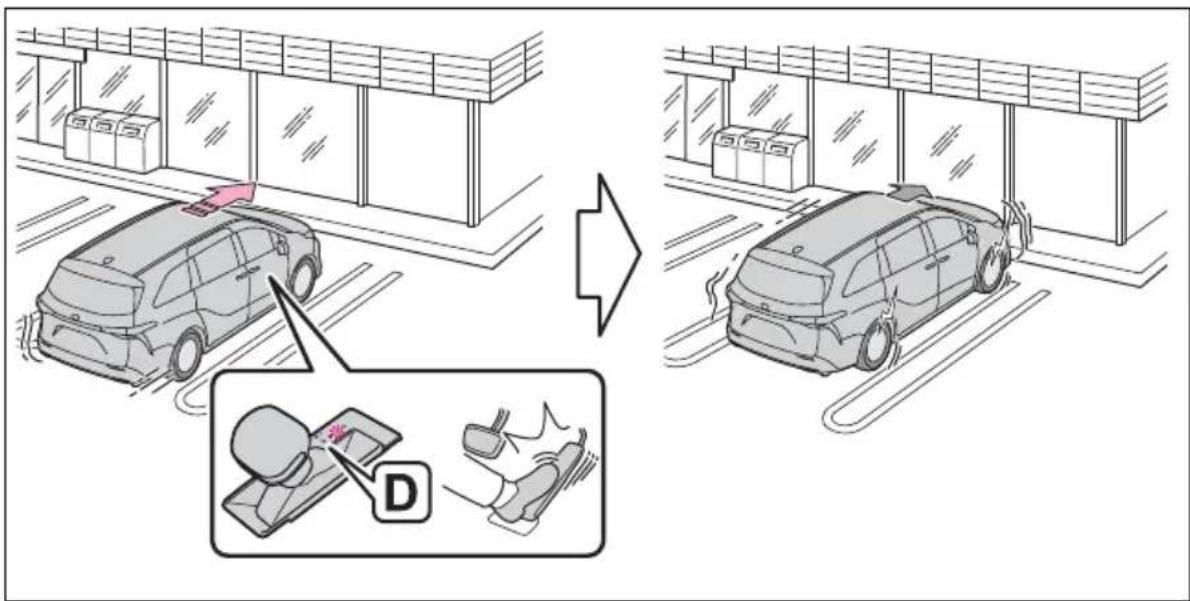
Types of sensors
→P.308

WARNING
■To ensure the Parking Support Brake can operate properly
Observe the following precautions regarding the sensors ( P.308). Failure to do so may cause a sensor to not operate properly, and may cause an accident.
- Do not modify, disassemble or paint the sensors.

WARNING
- Do not replace a sensor with a part other than a genuine part.
- Do not subject a sensor or its surrounding area to a strong impact.
- Do not damage the sensors, and always keep them clean.
- If the area around a radar sensor is subjected to an impact, the system may not operate properly due to a sensor malfunction. Have the vehicle inspected by your Toyota dealer.
■Handling the suspension
Do not modify the suspension, as changes to the height or inclination of the vehicle may prevent the sensors from detecting objects correctly or cause the system to not operate or operate unnecessarily.
■If the Parking Support Brake function (static objects) operates unnecessarily, such as at a railroad crossing
In the event that the Parking Support Brake function (static objects) operates unnecessarily, such as at a railroad crossing, brake control will be canceled after approximately 2 seconds, allowing you to proceed forward and leave the area, brake control can also be canceled by depressing the brake pedal. Depressing the accelerator pedal after brake control is canceled will allow you to proceed forward and leave the area.
■Notes when washing the vehicle
Do not apply intensive bursts of water or steam to the sensor area.
Doing so may result in the sensor malfunctioning.
- When using a high pressure washer to wash the vehicle, do not spray the sensors directly, as doing so may cause a sensor to malfunction.
- When using steam to clean the vehicle, do not direct steam too close to the sensors as doing so may cause a sensor to malfunction.
■When to disable the Parking Support Brake
In the following situations, disable the Parking Support Brake as the system may operate even though there is no possibility of a collision.
- When inspecting the vehicle using a chassis roller, chassis dynamo or free roller
- When loading the vehicle onto a boat, truck or other transport vessel
- If the suspension has been modified or tires of a size other than specified are installed
- If the front of the vehicle is raised or lowered due to the carried load
- When equipment that may obstruct a sensor is installed, such as a bumper protector (an additional trim strip, etc.), hitch-mounted bicycle carrier, or snow plow
- When using an automatic car wash
■The Parking Support Brake function (static object) will operate when
The function will operate when the PKSB OFF indicator is not illuminated ( P.93, 95) and all of the following conditions are met:
● Hybrid system output restriction control
- The Parking Support Brake is enabled.
- The vehicle speed is approximately 9 mph (15 km/h) or less.
- There is a static object in the traveling direction of the vehicle and approximately 6 to 13 ft. (2 to 4 m) away.
- The Parking Support Brake determines that a stronger-than-normal brake operation is necessary to avoid a collision.
●Brake control
- Hybrid system output restriction control is operating
- The Parking Support Brake determines that an immediate brake operation is necessary to avoid a collision.
■The Parking Support Brake function (static objects) will stop operating when
The function will stop operating if any of the following conditions are met:
● Hybrid system output restriction control
- The Parking Support Brake is disabled.
- The system determines that the collision has become avoidable with normal brake operation.
- The static object is no longer approximately 6 to 13 ft. (2 to 4 m) away from the vehicle or in the traveling direction of the vehicle.
●Brake control
- The Parking Support Brake is disabled.
- Approximately 2 seconds have elapsed since the vehicle was
stopped by brake control.
- The brake pedal is depressed after the vehicle is stopped by brake control.
- The static object is no longer approximately 6 to 13 ft. (2 to 4 m) away from the vehicle or in the traveling direction of the vehicle.
■Re-enabling the Parking Support Brake function (static objects)
→P.322
■ Detection range of the Parking Support Brake function (static objects)
The detection range of the Parking Support Brake function (static objects) differs from the detection range of the intuitive parking assist. ( P.313) Therefore, even if the intuitive parking assist detects an object and provides a warning, the Parking Support Brake function (static objects) may not start operating.
■ Objects that the Parking Support Brake function (static objects) may not detect
The sensors may not be able to detect certain objects, such as the following:
Pedestrian
● Cotton, snow, and other materials that are poor reflectors of sonic waves
- Objects which are not perpendicular to the ground, are not perpendicular to the traveling direction of the vehicle, are uneven or are waving
Low objects
●Thin objects such as wires, fences, ropes and signposts
- Objects that are extremely close to the bumper
● Sharply-angled objects
●Tall objects with upper sections projecting outwards in the direc-
■ Situations in which the Parking Support Brake function (static objects) may not operate
When the shift lever is in N
■Intuitive parking assist buzzer
Regardless of whether the intuitive parking assist system is enabled or not ( P.310), if the Parking Support Brake function (static objects) is enabled ( P.320), the front or rear sensors detect an object and brake control and hybrid system output restriction control are performed, the intuitive parking assist buzzer will sound to notify the driver of the approximate distance to the object.
■ Situations in which the Parking Support Brake function (static objects) may operate even if there is no possibility of a collision
In some situations, such as the following, the Parking Support Brake function (static objects) may operate even though there is no possibility of a collision.
●Vehicle surroundings
- When driving on a narrow road
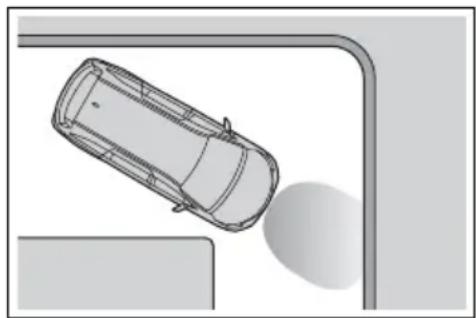
natural_image
Top-down diagram of a car approaching a corner road with a spray bubble (no text or symbols)- When driving on a gravel road or in an area with tall grass
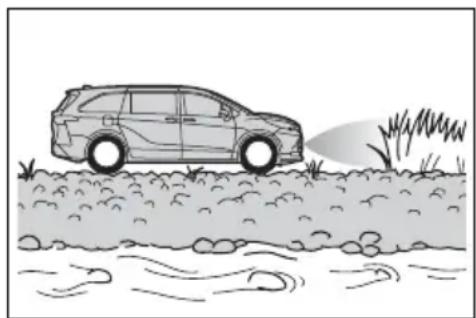
natural_image
Line drawing of a car driving on a riverbed with grass and water below (no text or symbols)- When driving toward a banner,
flag, low-hanging branch or boom barrier (such as those used at railroad crossings, toll gates and parking lots)
- When there is a structure on the roadside (such as when driving in a narrow tunnel, on a narrow bridge or on a narrow road)
- When parallel parking
- When there is a rut or hole in the surface of the road
- When driving on a metal cover (grating), such as those used for drainage ditches
- When driving up or down a steep slope
- If a sensor is hit by a large amount of water, such as when driving on a flooded road
- When loaded on ships or trucks
- Moving type automatic car wash
- Lift type parking area or multi-story parking lot
• Underground parking area
- Structures on the ground (speed bumps, cat's eyes, etc.)
• Differences in height
- When moving straight ahead or turning right
- Snow-melting pipes
• Devices for detecting vehicles, such as traffic lights, devices for detecting traffic congestion, or devices for detecting empty spaces in parking areas
- Railroad tracks
- H-shaped steel
- When there are vehicles on both sides, or there is a vehicle that resembles this vehicle
●Weather
- If a sensor is covered with ice, snow, dirt, etc. (when cleared, the system will return to normal)
- If heavy rain or water strikes a sensor
- When driving in inclement weather such as fog, snow or a sandstorm
- When strong winds are blowing
●Other sonic wave sources
- When vehicle horns, vehicle detectors, motorcycle engines, air brakes of large vehicles, the clear-
ance sonar of other vehicles or other devices which produce ultrasonic waves are near the vehicle
- If a sticker or an electronic component, such as a backlit license plate (especially fluorescent type), fog lights, fender pole or wireless antenna is installed near a sensor
●Changes in the vehicle posture
- If the vehicle is significantly tilted
- If the front of the vehicle is raised or lowered due to the carried load
- If the orientation of a sensor has been changed due to a collision or other impact
■ Situations in which the Parking Support Brake function (static objects) may not operate properly
In some situations, such as the following, this function may not operate properly.
●Weather
- When a sensor or the area around a sensor is extremely hot or cold
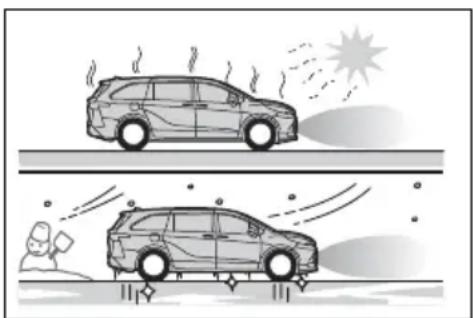
natural_image
Two cartoon illustrations showing a car on a road and a person cleaning the ground with spray (no text or symbols)- When strong winds are blowing
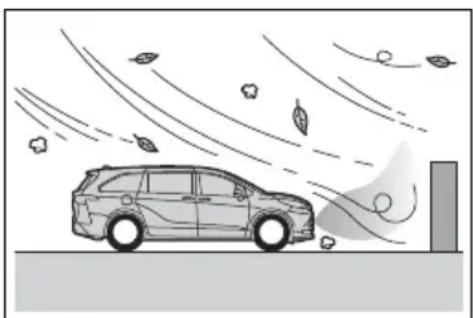
natural_image
Illustration of a car speeding with wind or exhaust smoke, leaving leaves and clouds (no text or symbols)- If a sensor is covered with ice, snow, dirt, etc. (when cleared, the system will return to normal)
- If heavy rain or water strikes a sensor
- When driving in inclement weather such as fog, snow or a sandstorm
- A sensor is frozen. (Thawing the area will resolve this problem.)
●Vehicle surroundings
- When an object that cannot be detected is between the vehicle and a detected object
- If an object such as a vehicle, motorcycle, bicycle or pedestrian cuts in front of the vehicle or runs out from the side of the vehicle
- The vehicle is approaching a tall or curved curb.
- On an extremely bumpy road, on an incline, on gravel, or on grass.
- The objects draw too close to the sensor.
●Other ultrasonic waves sources
- When vehicle horns, vehicle detectors, motorcycle engines, air brakes of large vehicles, the clearance sonar of other vehicles or other devices which produce ultrasonic waves are near the vehicle
- If a sticker or an electronic component, such as a backlit license plate (especially fluorescent type), fog lights, fender pole or wireless antenna is installed near a sensor
●Changes in the vehicle posture
- If the vehicle is significantly tilted
- If the front of the vehicle is raised or lowered due to the carried load
- If the orientation of a sensor has been changed due to a collision or other impact
- When equipment that may obstruct a sensor is installed, such as a bumper protector (an additional trim strip, etc.), hitch-mounted bicycle carrier, or snow plow
- If the suspension has been modified or tires of a size other than specified are installed
- If paint or a sticker is applied to the sensor
Parking Support Brake function (rear-crossing vehicles)\*
*: If equipped
If a rear radar sensor detects a vehicle approaching from the right or left at the rear of the vehicle and the system determines that the possibility of a collision is high, this function will perform brake control to reduce the likelihood of an impact with the approaching vehicle.
Examples of function operation
This function will operate in situations such as the following if a vehicle is detected in the traveling direction of the vehicle.
■When reversing, a vehicle is approaching and the brake pedal is not depressed, or is depressed late
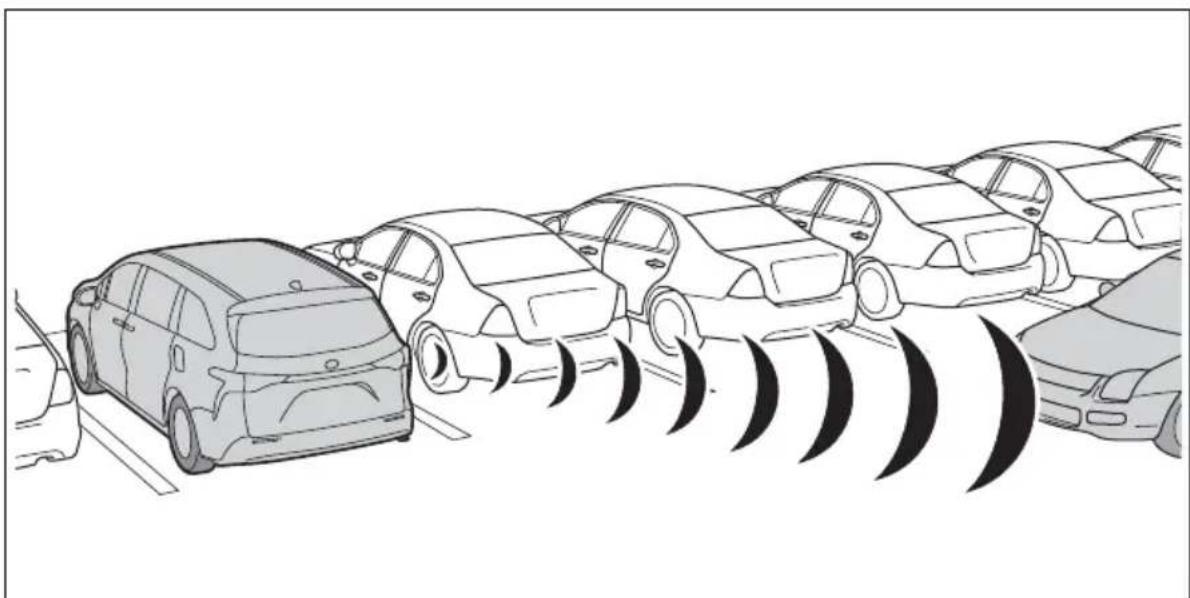
natural_image
Illustration of a row of cars with sound waves, no text or symbols presentTypes of sensors
→P.301

WARNING
■To ensure the Parking Support Brake (rear-crossing vehicles) can operate properly
Observe the following precautions regarding the rear radar sensors ( P.301). Failure to do so may cause a sensor to not operate properly, and may cause an accident.

WARNING
- Do not modify, disassemble or paint the sensors.
- Do not replace a rear radar sensor with a part other than a genuine part.
- Do not damage the rear radar sensors, and always keep the radar sensors and their surrounding area on the bumper clean.
- If the area around a rear radar sensor is subjected to an impact, the system may not operate properly due to a sensor malfunction. Have the vehicle inspected by your Toyota dealer.
- Observe the rear radar sensor handling precautions. (→P.301)
■The Parking Support Brake function (rear-crossing vehicles) will operate when
The function will operate when the PKSB OFF indicator is not illuminated ( P.93, 95) and all of the following conditions are met:
● Hybrid system output restriction control
- The Parking Support Brake is enabled.
- The vehicle speed is approximately 9 mph (15 km/h) or less.
• Vehicles are approaching from the right or left at the rear of the vehicle at a traveling speed of more than approximately 5 mph (8 km/h)
• The shift lever is in R.
- The Parking Support Brake determines that a stronger than normal brake operation is necessary to avoid a collision with an approaching vehicle.
●Brake control
• Hybrid system output restriction
control is operating
- The Parking Support Brake determines that an emergency brake operation is necessary to avoid a collision with an approaching vehicle.
■The Parking Support Brake function (rear-crossing vehicles) will stop operating when
The function will stop operating if any of the following conditions are met:
● Hybrid system output restriction control
- The Parking Support Brake is disabled.
- The collision becomes avoidable with normal brake operation.
- A vehicle is no longer approaching from the right or left at the rear of the vehicle.
●Brake control
- The Parking Support Brake is disabled.
- Approximately 2 seconds have elapsed since the vehicle was stopped by brake control.
- The brake pedal is depressed after the vehicle is stopped by brake control.
- A vehicle is no longer approaching from the right or left at the rear of the vehicle.
■Re-enabling the Parking Support Brake (rear-crossing vehicles)
→P.322
■ Detection area of the Parking Support Brake function (rear-crossing vehicles)
The detection area of the Parking Support Brake function (rear-crossing vehicles) differs from the detection area of the RCTA function ( P.306). Therefore, even if the RCTA function detects a vehicle and provides an alert, the Parking Support Brake function (rear-crossing vehicles) may not start operating.
■Conditions under which the Parking Support Brake function (rear-crossing vehicles) will not detect a vehicle
The Parking Support Brake function (rear-crossing vehicles) is not designed to detect the following types of vehicles and/or objects:
● Vehicles approaching from directly behind
● Vehicles backing up in a parking space next to your vehicle
● Vehicles that the sensors cannot detect due to obstructions
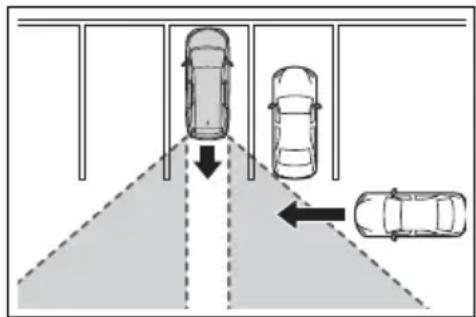
● Vehicles which suddenly accelerate or decelerate near your vehicle
●Guardrails, walls, signs, parked vehicles and similar stationary objects*
- Small motorcycles, bicycles, pedestrians, etc.*
● Vehicles moving away from your vehicle
● Vehicles approaching from the parking spaces next to your vehicle*
- Objects which are extremely close to a radar sensor*
● Vehicles which are approaching from the right or left at the rear of the vehicle at a traveling speed of less than approximately 5 mph (8 km/h)
● Vehicles which are approaching from the right or left at the rear of the vehicle at a traveling speed of more than approximately 15 mph (24 km/h)
*: Depending on the conditions, detection of a vehicle and/or object may occur.
■RCTA buzzer
Regardless of whether the RCTA function is enabled or not ( P.310), if the Parking Support Brake function is enabled ( P.320) and brake control is performed, a buzzer will sound to notify the driver.
■ Situations in which the system may operate even though there is no possibility of a collision
In some situations such as the following, the Parking Support Brake function (rear-crossing vehicles) may operate even though there is no possibility of a collision.
- When the parking space faces a street and vehicles are being driven on the street
- When a detected vehicle turns while approaching the vehicle
flowchart
graph TD
    A["Top Bus"] --> B["Left Path"]
    B --> C["Right Path"]
    C --> D["Downward Arrow"]
    D --> E["Bottom Route"]
    E --> F["Left Path"]
    style A fill:#f9f,stroke:#333
    style B fill:#ccf,stroke:#333
    style C fill:#cfc,stroke:#333
    style D fill:#fcc,stroke:#333
    style E fill:#ffc,stroke:#333
    style F fill:#cff,stroke:#333
- When a vehicle passes by the side of your vehicle
natural_image
Top-down diagram showing two cars with opposing directional arrows (no text or symbols)- When the distance between your vehicle and metal objects, such as a guardrail, wall, sign, or parked vehicle, which may reflect electrical waves toward the rear of the vehicle, is short
flowchart
graph TD
    A["Top: Car with directional arrow"] --> B["Bottom: Car with downward arrow"]
    B --> C["Bottom: Dot at bottom of line"]
- When there are spinning objects near your vehicle such as the fan of an air conditioning unit
- When water is splashed or sprayed toward the rear bumper, such as from a sprinkler
■ Situations in which the Parking Support Brake function (rear-crossing vehicles) may not operate properly
In some situations, such as the following, the radar sensors may not detect an object and this function may not operate properly
●Stationary objects
- When a sensor or the area around a sensor is extremely hot or cold
- If the rear bumper is covered with ice, snow, dirt, etc.
- When it is raining heavily or water strikes the vehicle
- When the detection area of a radar sensor is obstructed by an adjacent vehicle
●If the vehicle is significantly tilted
- When equipment that may obstruct a sensor is installed, such as a bumper protector (an additional trim strip, etc.), hitch-mounted bicycle carrier, or snow plow
- If the suspension has been modified or tires of a size other than specified are installed
- If the front of the vehicle is raised or lowered due to the carried load
- If a sticker or an electronic component, such as a backlit license plate (especially fluorescent type), fog lights, fender pole or wireless antenna is installed near a radar sensor
- If the orientation of a radar sensor has been changed
- When multiple vehicles are approaching with only a small gap between each vehicle
- If a vehicle is approaching the rear of your vehicle rapidly
● Situations in which the radar sensor may not detect a vehicle - When a vehicle approaches from the right or left at the rear of the vehicle while you are turning while backing up
- When turning while backing up
natural_image
Top-down diagram of a parking lot with cars and vertical lanes, no text or symbols present- When backing out of a shallow angle parking spot
flowchart
graph TD
    A["Top Left Car"] --> B["Top Right Car"]
    B --> C["Bottom Left Car"]
    C --> D["Bottom Right Car"]
    style A fill:#f9f,stroke:#333
    style B fill:#bbf,stroke:#333
    style C fill:#f9f,stroke:#333
    style D fill:#bbf,stroke:#333
- When backing up on a slope with a sharp change in grade
natural_image
Diagram showing two scenarios of cars moving on a road with directional arrows indicating movement (no text or symbols)- When a vehicle turns into the detection area
flowchart
graph TD
    A["Top: Car Parking"] --> B["Downward Arrow"]
    B --> C["Left: Parking Lane"]
    C --> D["Right: Car Parking"]
    D --> E["Downward Arrow"]
Driving mode select switch
The driving modes can be selected to suit the driving and usage conditions.
Selecting a driving mode
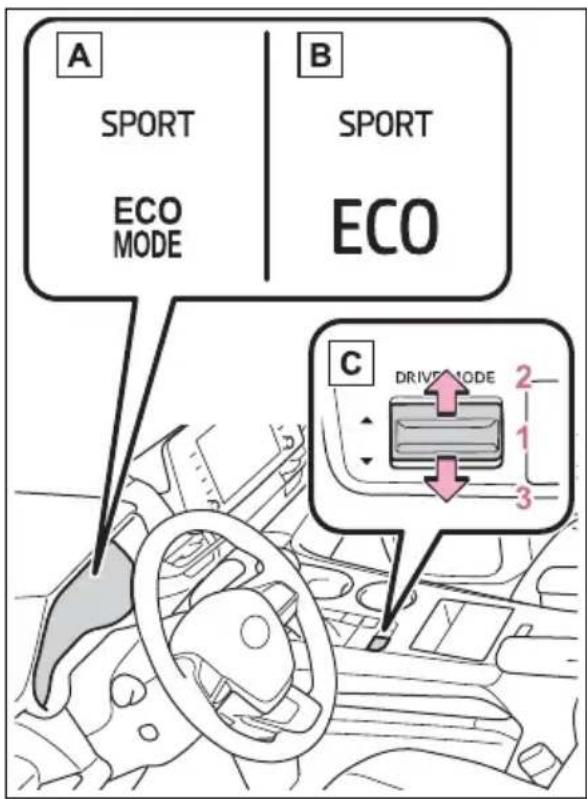
A Multi-information display (7-inch display)
B Multi-information display (4.2-inch display)
C Driving mode select switch Operate the driving mode select switch forward or backward to select the desired driving mode on the multi-information display.
1 Normal mode
Provides an optimal balance of fuel economy, quietness, and dynamic performance. Suitable for normal
driving.
2 Sport mode
Controls the hybrid system to provide quick, powerful acceleration.
This mode also changes the steering feel, making it suitable for when agile driving response is desired, such as when driving on roads with many curves.
When Sport mode is selected, Sport mode indicator comes on.
3 Eco drive mode
Helps the driver accelerate in an eco-friendly manner and improve fuel economy through moderate throttle characteristics and by controlling the operation of the air conditioning system (heating/cooling).
When Eco drive mode is selected, Eco drive mode indicator comes on.
■When changing to a driving mode other than normal mode
●The background color of the multi-information display changes according to the selected driving mode.
- When the speedometer is set to analog display, the speedometer display color also changes. (For vehicles with the 7-inch multi-information display only)
■ Air conditioning system operation in Eco drive mode
In Eco drive mode, heating/cooling operations and the fan speed is controlled to improve fuel efficiency.
Perform the following procedures to increase the air conditioning performance.
●Turn eco air conditioning mode off ( P.350)
- Adjust the fan speed (→P.349)
- Cancel Eco drive mode
■ Canceling a driving mode
- Sport mode is automatically canceled and the driving mode returns to normal mode when the power switch is turned off.
● Normal mode and Eco drive mode are not canceled until another driving mode is selected. (Even if the power switch is turned off, normal mode and Eco drive mode will not be automatically canceled).
Driving assist systems
To keep driving safety and performance, the following systems operate automatically in response to various driving situations. Be aware, however, that these systems are supplementary and should not be relied upon too heavily when operating the vehicle.
Summary of the driving assist systems
■ ECB (Electronically Controlled Brake System)
The electronically controlled system generates braking force corresponding to the brake operation
■ABS (Anti-lock Brake System)
Helps to prevent wheel lock when the brakes are applied suddenly, or if the brakes are applied while driving on a slippery road surface
Brake assist
Generates an increased level of braking force after the brake pedal is depressed when the system detects a panic stop situation
■VSC (Vehicle Stability Control)
Helps the driver to control skidding when swerving suddenly or turning on slippery road surfaces.
■Enhanced VSC (Enhanced Vehicle Stability Control)
Provides cooperative control of the ABS, TRAC, VSC and EPS.
Helps to maintain directional stability when swerving on slippery road surfaces by controlling steering performance.
■Trailer Sway Control
Helps the driver to control trailer sway by selectively applying brake pressure for individual wheels and reducing driving torque when trailer sway is detected.
■TRAC (Traction Control)
Helps to maintain drive power and prevent the drive wheels from spinning when starting the vehicle or accelerating on slippery roads
■Active Cornering Assist (ACA)
Helps to prevent the vehicle from drifting to the outer side by performing inner wheel brake control when attempting to accelerate while turning
■Hill-start assist control
Helps to reduce the backward
movement of the vehicle when starting on an uphill
■EPS (Electric Power Steering)
Employs an electric motor to reduce the amount of effort needed to turn the steering wheel
■E-Four (Electronic On-Demand AWD system) (AWD models)
Automatically switches from front wheel drive to all-wheel drive (AWD) according to the driving conditions, helping to ensure reliable handling and stability. Examples of conditions where the system will switch to AWD are when cornering, going uphill, starting off or accelerating, and when the road surface is slippery due to snow, rain, etc.
■The Secondary Collision Brake
When the airbag sensor detects a collision, the brakes and brake lights are automatically controlled to reduce the vehicle speed and that helps reduce the possibility of further damage due to a secondary collision
■When the TRAC/VSC/ABS/Trailer Sway Control systems are operating
The slip indicator will flash while the TRAC/VSC/ABS/Trailer Sway Control systems are operating.
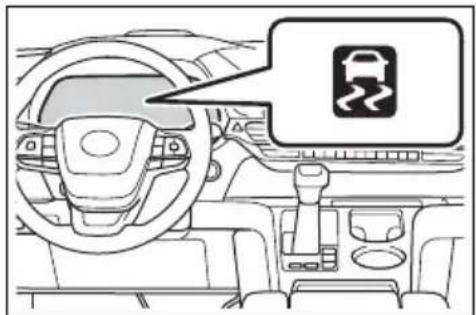
natural_image
Interior view of a car dashboard with steering wheel and dashboard, showing a parking sign icon (no text or symbols on the diagram itself)■Disabling the TRAC system
If the vehicle gets stuck in mud, dirt or snow, the TRAC system may reduce power from the hybrid system to the wheels.
Pressing to turn the system off may make it easier for you to rock the vehicle in order to free it.
To turn the TRAC system off, quickly press and release OFF
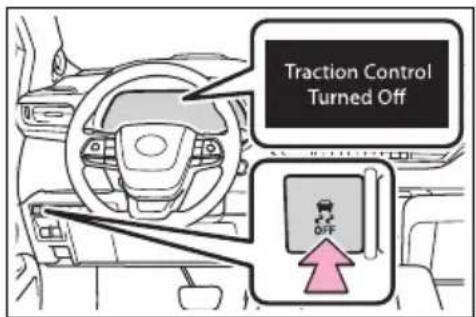
"Traction Control Turned Off" will be shown on the multi-information display.
Press again to turn the system back on.
■Turning off the TRAC/VSC/Trailer Sway Control systems
To turn the TRAC/VSC/Trailer Sway Control systems off, press and hold
OFF for more than 3 seconds while the vehicle is stopped.
The VSC OFF indicator light will come on and the "Traction Control Turned Off" will be shown on the multi-information display.*
Press again to turn the systems back on.
*: PCS will also be disabled (only Pre-Collision warning is available). The PCS warning light will come on and a message will be displayed on the multi-information display. (→P.274)
When the message is displayed on the multi-information display showing that TRAC has been disabled even if has not been pressed
TRAC is temporary deactivated. If the information continues to show, contact your Toyota dealer.
■ Operating conditions of hill-start assist control
When the following four conditions are met, the hill-start assist control will operate:
●The shift lever is in a position other than P or N (when starting off forward/backward on an upward incline).
●The vehicle is stopped.
●The accelerator pedal is not depressed.
●The parking brake is not engaged.
■Automatic system cancelation of hill-start assist control
The hill-start assist control will turn off in any of the following situations:
●The shift lever is shifted to P or N.
●The accelerator pedal is depressed.
●The parking brake is engaged.
●2 seconds at maximum elapsed after the brake pedal is released.
■ Sounds and vibrations caused by the ABS, brake assist, VSC, Trailer Sway Control, TRAC and hill-start assist control systems
●A sound may be heard from the engine compartment when the brake pedal is depressed repeatedly, when the hybrid system is
started or just after the vehicle begins to move. This sound does not indicate that a malfunction has occurred in any of these systems.
● Any of the following conditions may occur when the above systems are operating. None of these indicates that a malfunction has occurred.
- Vibrations may be felt through the vehicle body and steering.
- A motor sound may be heard also after the vehicle comes to a stop.
■ ECB operating sound
ECB operating sound may be heard in the following cases, but it does not indicate that a malfunction has occurred.
● Operating sound heard from the engine compartment when the brake pedal is operated.
- Motor sound of the brake system heard from the front part of the vehicle when the driver' door is opened.
● Operating sound heard from the engine compartment when one or two minutes passed after the stop of the hybrid system.
■Active Cornering Assist operation sounds and vibrations
When the Active Cornering Assist is operated, operation sounds and vibrations may be generated from the brake system, but this is not a malfunction.
■EPS operation sound
When the steering wheel is operated, a motor sound (whirring sound) may be heard. This does not indicate a malfunction.
■Automatic reactivation of TRAC, Trailer Sway Control and VSC systems
After turning the TRAC, Trailer Sway Control and VSC systems off, the systems will be automatically re-enabled in the following situations:
- When the power switch is turned off.
- If only the TRAC system is turned off, the TRAC will turn on when vehicle speed increases. If both the TRAC and VSC systems are turned off, automatic re-enabling will not occur when vehicle speed increases.
■Operating conditions of Active Cornering Assist
The system operates when the following occurs.
●TRAC/VSC can operate
●The driver is attempting to accelerate while turning
●The system detects that the vehicle is drifting to the outer side
●The brake pedal is released
■Reduced effectiveness of the EPS system
The effectiveness of the EPS system is reduced to prevent the system from overheating when there is frequent steering input over an extended period of time. The steering wheel may feel heavy as a result. Should this occur, refrain from excessive steering input or stop the vehicle and turn the hybrid system off. The EPS system should return to normal within 10 minutes.
■ Secondary Collision Brake operating conditions
The system operates when the SRS airbag sensor detects a collision while the vehicle is in motion. However, the system does not operate in any of the following situations.
●The vehicle speed is below 6 mph (10 km/h)
Components are damaged
■ Secondary Collision Brake automatic cancellation
The system is automatically canceled in any of the following situations.
●The vehicle speed drops below approximately 6 mph (10 km/h)
● A certain amount of time elapses during operation
●The accelerator pedal is depressed a large amount
If a message about AWD is shown on the multi-information display (AWD models)
If one of the following messages is shown on the multi-information display, perform each action.
●“AWD System Overheated Switching to 2WD Mode”
The AWD system is overheating. Drive the vehicle at low speeds and stop the vehicle in a safe place with the hybrid system operating until the message is cleared. If the message disappears, it is possible to drive the vehicle normally.
●“AWD System Overheated 2WD Mode Engaged”
The AWD system has been canceled and switched to the front-wheel drive due to overheating. Drive the vehicle at low speeds and stop the vehicle in a safe place with the hybrid system operating until the message is cleared. If the message disappears, it is possible to drive the vehicle normally.
●“AWD System Malfunction 2WD Mode Engaged Visit Your Dealer”
The AWD system has been stopped and switched to the front-wheel drive due to a malfunction. Have your vehicle inspected by your Toyota dealer immediately.

WARNING
■The ABS does not operate effectively when
●The limits of tire gripping performance have been exceeded (such as excessively worn tires on a snow covered road).
●The vehicle hydroplanes while driving at high speed on wet or slick roads.
■Stopping distance when the ABS is operating may exceed that of normal conditions
The ABS is not designed to shorten the vehicle's stopping distance. Always maintain a safe distance from the vehicle in front of you, especially in the following situations:
- When driving on dirt, gravel or snow-covered roads
●When driving with tire chains - When driving over bumps in the road
- When driving over roads with potholes or uneven surfaces
■TRAC/VSC may not operate effectively when
Directional control and power may not be achievable while driving on slippery road surfaces, even if the TRAC/VSC system is operating. Drive the vehicle carefully in conditions where stability and power may be lost.
■Active Cornering Assist does not operate effectively when
- Do not overly rely on Active Cornering Assist. Active Cornering Assist may not operate effectively when accelerating down slopes or driving on slippery road surfaces.
- When Active Cornering Assist frequently operates, Active Cornering Assist may temporarily stop operating to ensure proper operation of the brakes, TRAC and VSC.
■ Hill-start assist control does not operate effectively when - Do not overly rely on hill-start assist control. Hill-start assist control may not operate effectively on steep inclines and roads covered with ice.
●Unlike the parking brake, hill-start assist control is not intended to hold the vehicle stationary for an extended period of time. Do not attempt to use hill-start assist control to hold the vehicle on an incline, as doing so may lead to an accident.
■When the TRAC/ABS/VSC/Trailer Sway Control is activated
The slip indicator flashes. Always drive carefully. Reckless driving may cause an accident. Exercise particular care when the indicator light flashes.
■When the TRAC/VSC/Trailer Sway Control systems are turned off
Be especially careful and drive at a speed appropriate to the road conditions. As these are the systems to help ensure vehicle stability and driving force, do not turn the TRAC/VSC/Trailer Sway Control systems off unless necessary.
Trailer Sway Control is part of the VSC system and will not operate if VSC is turned off or experiences a malfunction.

WARNING
■Replacing tires
Make sure that all tires are of the specified size, brand, tread pattern and total load capacity. In addition, make sure that the tires are inflated to the recommended tire inflation pressure level. The ABS, TRAC, Trailer Sway Control and VSC systems will not function correctly if different tires are installed on the vehicle. Contact your Toyota dealer for further information when replacing tires or wheels.
■Handling of tires and the sus-pension
Using tires with any kind of problem or modifying the suspension will affect the driving assist systems, and may cause a system to malfunction.
■Trailer Sway Control precaution
The Trailer Sway Control system is not able to reduce trailer sway in all situations. Depending on many factors such as the conditions of the vehicle, trailer, road surface and driving environment, the Trailer Sway Control system may not be effective. Refer to your trailer owner's manual for information on how to tow your trailer properly.
■If trailer sway occurs
Observe the following precautions. Failing to do so may cause death or serious injury.
● Firmly grip the steering wheel. Steer straight ahead. Do not try to control trailer sway by turning the steering wheel.
- Begin releasing the accelerator pedal immediately but very gradually to reduce speed. Do not increase speed. Do not apply vehicle brakes.
If you make no extreme correction with the steering or brakes, your vehicle and trailer should stabilize. (→P.220)
■Secondary Collision Brake
Do not rely solely upon the Secondary Collision Brake. This system is designed to help reduce the possibility of further damage due to a secondary collision, however, that effect changes according to various conditions. Overly relying on the system may result in death or serious injury.
Hybrid vehicle driving tips
For economical and ecological driving, pay attention to the following points:
Using Eco drive mode
When using Eco drive mode, the torque corresponding to the accelerator pedal depression amount can be generated more smoothly than it is in normal conditions. In addition, the operation of the air conditioning system (heating/cooling) will be minimized, improving the fuel economy. (→P.333)
Use of Hybrid System Indicator
The Eco-friendly driving is possible by keeping the indicator of Hybrid System Indicator within Eco area. ( P.98, 102)
Changing the shift position
Shift the shift lever to D when stopped at a traffic light, or driving in heavy traffic etc. Shift the shift lever to P when parking. When using the N position, there is no positive effect on fuel consumption. In the N position, the gasoline engine operates but electricity cannot be generated. Also, when using the air conditioning system, etc., the hybrid battery (traction battery) power is consumed.
Accelerator pedal/brake pedal operation
- Drive your vehicle smoothly. Avoid abrupt acceleration and deceleration. Gradual acceleration and deceleration will make more effective use of the electric motor (traction motor) without having to use gasoline engine power.
- Avoid repeated acceleration. Repeated acceleration consumes hybrid battery (traction battery) power, resulting in poor fuel consumption. Battery power can be restored by driving with the accelerator pedal slightly released.
When braking
Make sure to operate the brakes gently and in a timely manner. A greater amount of electrical energy can be regenerated when slowing down.
Delays
Repeated acceleration and deceleration, as well as long waits at traffic lights, will lead to bad fuel economy. Check traffic
reports before leaving and avoid delays as much as possible. When driving in a traffic jam, gently release the brake pedal to allow the vehicle to move forward slightly while avoiding overuse of the accelerator pedal. Doing so can help control excessive gasoline consumption.
Highway driving
Control and maintain the vehicle at a constant speed. Before stopping at a toll booth or similar, allow plenty of time to release the accelerator and gently apply the brakes. A greater amount of electrical energy can be regenerated when slowing down.
Air conditioning
Use the air conditioning only when necessary. Doing so can help reduce excessive gasoline consumption.
In summer: When the ambient temperature is high, use the recirculated air mode. Doing so will help to reduce the burden on the air conditioning system and reduce fuel consumption as well.
In winter: Because the gasoline engine will not automatically cut out until it and the interior of the vehicle are warm, it will consume fuel. Also, fuel consumption can be improved by avoiding overuse of the heater.
Checking tire inflation pressure
Make sure to check the tire inflation pressure frequently. Improper tire inflation pressure can cause poor fuel economy. Also, as snow tires can cause large amounts of friction, their use on dry roads can lead to poor fuel economy. Use tires that are appropriate for the season.
Luggage
Carrying heavy luggage will lead to poor fuel economy. Avoid carrying unnecessary luggage. Installing a large roof rack will also cause poor fuel economy.
Warming up before driving
Since the gasoline engine starts up and cuts out automatically when cold, warming up the engine is unnecessary. Moreover, frequently driving short distances will cause the engine to repeatedly warm up, which can lead to excess fuel consumption.
Winter driving tips
Carry out the necessary preparations and inspections before driving the vehicle in winter. Always drive the vehicle in a manner appropriate to the prevailing weather conditions.
Pre-winter preparations
- Use fluids that are appropriate to the prevailing outside temperatures.
- Engine oil
- Engine coolant
• Power control unit coolant - Washer fluid
● Have a service technician inspect the condition of the 12-volt battery. - Have the vehicle fitted with four snow tires or purchase a set of tire chains for the front tires.*
Ensure that all tires are the same size and brand, and that chains match the size of the tires.
*: Tire chains cannot be mounted on vehicles with 20-inch tires.

WARNING
■Driving with snow tires
Observe the following precautions to reduce the risk of accidents. Failure to do so may result in a loss of vehicle control and cause death or serious injury.
● Use tires of the specified size.
●Maintain the recommended level of air pressure.
- Do not drive in excess of 75 mph (120 km/h), regardless of the type of snow tires being used.
● Use snow tires on all, not just some wheels.
■Driving with tire chains (vehicles with 17-inch or 18-inch tires)
Observe the following precautions to reduce the risk of accidents. Failure to do so may result in the vehicle being unable to be driven safely, and may cause death or serious injury.
●Do not drive in excess of the speed limit specified for the tire chains being used, or 30 mph (50 km/h), whichever is lower.
● Avoid driving on bumpy road surfaces or over potholes.
● Avoid sudden acceleration, abrupt steering, sudden braking and shifting operations that cause sudden engine braking.
● Slow down sufficiently before entering a curve to ensure that vehicle control is maintained.
- Do not use LTA (Lane Tracing Assist) system.

NOTICE
■Repairing or replacing snow tires
Request repairs or replacement of snow tires from your Toyota dealer or legitimate tire retailers. This is because the removal and attachment of snow tires affects the operation of the tire pressure warning valves and transmitters.
Before driving the vehicle
Perform the following according to the driving conditions:
- Do not try to forcibly open a window or move a wiper that is frozen. Pour warm water over the frozen area to melt the ice. Wipe away the water immediately to prevent it from freezing.
- To ensure proper operation of the climate control system fan, remove any snow that has accumulated on the air inlet vents in front of the wind-shield.
- Check for and remove any excess ice or snow that may have accumulated on the exterior lights, vehicle's roof, chassis, around the tires or on the brakes.
- Remove any snow or mud from the bottom of your shoes before getting in the vehicle.
When driving the vehicle
Accelerate the vehicle slowly, keep a safe distance between you and the vehicle ahead, and drive at a reduced speed suitable to road conditions.
When parking the vehicle
- Park the vehicle and move the shift lever to P without setting the parking brake. The parking brake may freeze up, preventing it from being released. If the vehicle is parked without setting the parking brake, make sure to block the wheels.
Failure to do so may be dangerous because it may cause the vehicle to move unexpectedly, possibly leading to an accident.
When the parking brake is in automatic mode, release the parking brake after shifting the shift lever to P. ( P.243)
- If the vehicle is left parked with the brakes damp in cold temperatures, there is a possibility of the brakes freezing.
- If the vehicle is parked without setting the parking brake, confirm that the shift lever cannot be moved out of P^* .
depressing the brake pedal. If the shift lever can be shifted from P, there may be a problem with the shift lock system. Have the vehicle inspected by your Toyota dealer immediately.

WARNING
■When parking the vehicle
When parking the vehicle without applying the parking brake, make sure to chock the wheels. If you do not chock the wheels, the vehicle may move unexpectedly, possibly resulting in an accident.
Selecting tire chains
▶ Vehicles with 17-inch or 18-inch tires
Use the tire chains of correct size and type.
Use SAE Class "S" type radial tire chains, with the exception of radial cable chains or V-bar type chains.
▶ Vehicles with 20-inch tires
Tire chains cannot be mounted.
Snow tires should be used instead.
Regulations on the use of tire chains (vehicles with 17-inch or 18-inch tires)
Regulations regarding the use of tire chains vary depending on location and type of road.
Always check local regulations before installing chains.
■Tire chain installation
Observe the following precautions when installing and removing chains:
● Install and remove tire chains in a safe location.
● Install tire chains on the front tires only. Do not install tire chains on the rear tires.
● Install tire chains on front tires as tightly as possible. Retighten chains after driving 1/4 - 1/2 mile (0.5 - 1.0 km).
● Install tire chains following the instructions provided with the tire chains.

NOTICE
■Fitting tire chains
The tire pressure warning valves and transmitters may not function correctly when tire chains are fitted.
5
5-1. Using the air conditioning system and defogger
Front automatic air conditioning system ...... 348
Rear automatic air conditioning system ...... 358
Heated steering wheel/seat heaters/seat ventilators 361
5-2. Using the interior lights
Interior lights list ...... 363
5-3. Using the storage features
List of storage features 366
Luggage compartment features 372
5-4. Using the other interior features
Other interior features . 374
Front automatic air conditioning system
Air outlets and fan speed are automatically adjusted according to the temperature setting.
Air conditioning controls
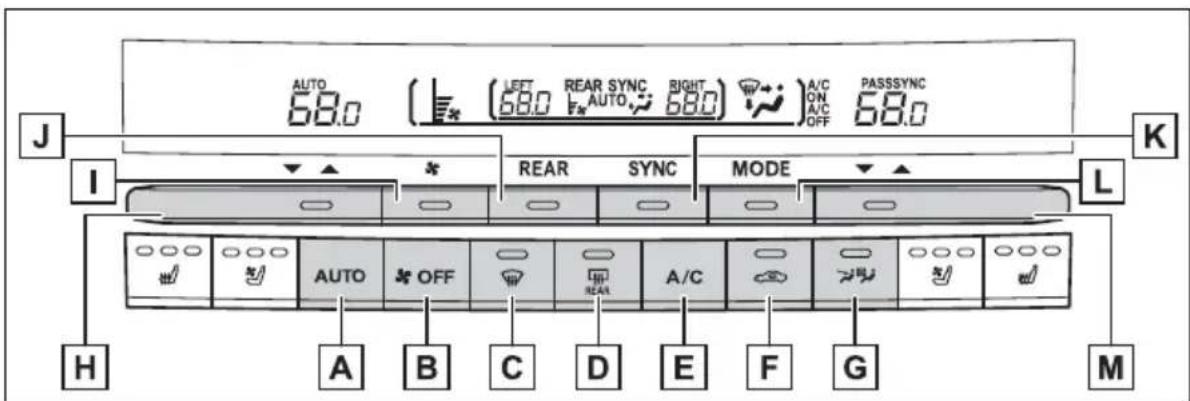
A "AUTO" switch (automatic mode)
B "OFF" switch
C Windshield defogger switch
D Rear window defogger/outside rear view mirror defoggers/wind-shield wiper de-icer switch
E "A/C" switch
F Outside/recirculated air mode switch
G S-FLOW mode switch
H Left-hand side temperature control switch
I Fan speed control switch
J "REAR" switch
K "SYNC" switch
L Airflow mode control switch
M Right-hand side temperature control switch
■Adjusting the temperature setting
Operate the each side temperature control switch upwards to
increase the each side temperature and operate the switch downwards to decrease the each side temperature.
The air conditioning system switches between individual and synchronous modes each time the "SYNC" switch is operated. (→P.355)
Operate the fan speed control switch upwards to increase the fan speed and downwards to decrease the fan speed.
Pressing the "OFF" switch turns off the fan.
■Change the airflow mode
Operate the airflow mode control switch.
The airflow mode changes as follows each time the switch is operated.
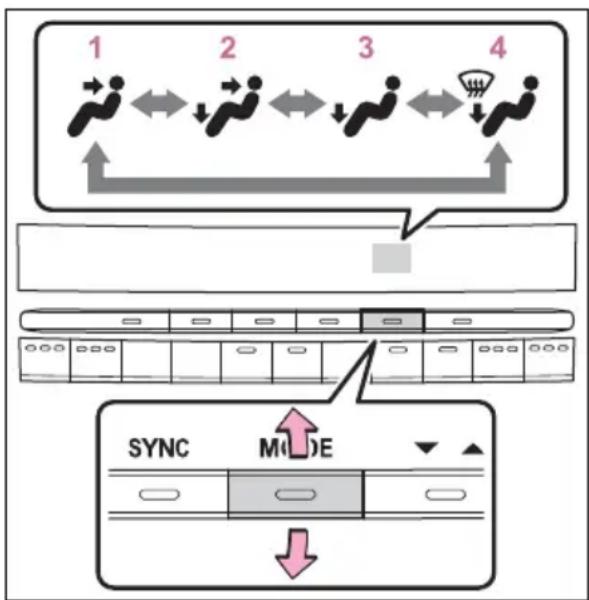
flowchart
graph TD
    A["1: Motion"] --> B["2: Motion"]
    B --> C["3: Motion"]
    C --> D["4: Motion"]
    style A fill:#f9f,stroke:#333
    style B fill:#ccf,stroke:#333
    style C fill:#cfc,stroke:#333
    style D fill:#fcc,stroke:#333
    subgraph State_1
        A1["Person with motion arrow"]
        B1["Person with motion arrow"]
        C1["Person with motion arrow"]
        D1["Person with motion arrow"]
    end
    subgraph State_2
        E["Control panel with 'SYNC' and 'MODE' icons"]
    end
    subgraph State_3
        F["Control panel with 'SYNC' and 'MODE' icons"]
    end
1 Upper body
2 Upper body and feet
3 Feet
4 Feet and the windshield defogger operates
■Switching between outside air and recirculated air modes
Press the outside/recirculated air mode switch.
The mode switches between outside air mode and recirculated air mode each time the switch is operated.
When recirculated air mode is selected, the indicator illuminates on the outside/recirculated air mode switch.
■Set cooling and dehumidification function
Press the "A/C" switch.
When the function is on, the "A/C ON" display on the front air conditioning operation panel appears.
■Defogging the windshield
Defoggers are used to defog the windshield and front side windows.
Press the windshield defogger switch.
Set the outside/recirculated air mode switch to outside air mode if the recirculated air mode is used. (It may switch automatically.)
To defog the windshield and the side windows quickly, turn the air flow and temperature up.
To return to the previous mode, press the windshield defogger switch again when the windshield is defogged.
When the windshield defogger switch is on, the indicator illuminates on the windshield defogger
switch.
■Defogging the rear window and outside rear view mirrors (if equipped), and deicing windshield wipers (if equipped)
Defoggers are used to defog the rear window and to remove rain-drops, dew and frost from the outside rear view mirrors (if equipped).
The windshield wiper de-icer is used to prevent ice from building up on the windshield and wiper blades.
Press the rear window defogger/outside rear view mirror defoggers /windshield wiper de-icer switch.
The defoggers and windshield wiper de-icer will automatically turn off after 15 minutes.
When the rear window defog- ger/outside rear view mirror defog- gers /windshield wiper de-icer switch is on, the indicator illumi- nates on the switch.
■ Eco air conditioning mode
The air conditioning is controlled with low fuel consumption prioritized such as reducing fan speed, etc.
Select the eco air conditioning mode switch on the control screen. ( P.352)
When the eco air conditioning mode is on, the indicator illuminates on the eco air conditioning mode switch.
■Fogging up of the windows
●The windows will easily fog up when the humidity in the vehicle is high. Turning “A/C” switch on will dehumidify the air from the outlets and defog the windshield effectively.
- If you turn "A/C" switch off, the windows may fog up more easily.
●The windows may fog up if the recirculated air mode is used.
■When driving on dusty roads
Close all windows. If dust thrown up by the vehicle is still drawn into the vehicle after closing the windows, it is recommended that the air intake mode be set to outside air mode and the fan speed to any setting except off.
■Outside/recirculated air mode
- Setting to the recirculated air mode temporarily is recommended in preventing dirty air from entering the vehicle interior and helping to cool the vehicle when the outside air temperature is high.
● Outside/recirculated air mode may automatically switch depending on the temperature setting or the inside temperature.
■When the outside temperature exceeds 75°F (24°C) and the air conditioning system is on
- In order to reduce the air conditioning power consumption, the air conditioning system may switch to recirculated air mode automatically. This may also reduce fuel consumption.
● Recirculated air mode is selected as a default mode when the power switch is turned to ON. - It is possible to switch to outside air mode at any time by pressing the outside/recirculated air mode
switch.
Operation of the air conditioning system in Eco drive mode
● In Eco drive mode, the air conditioning system is controlled as follows to prioritize fuel efficiency:
- Engine speed and compressor operation controlled to restrict heating/cooling capacity
- Fan speed restricted when automatic mode is selected
●To improve air conditioning performance, perform the following operations:
- Turn off Eco air conditioning mode
- When the driving mode is set to Eco driving mode, the Eco air conditioning mode will be turned on automatically. Even in this case, the Eco air conditioning mode can be turned off by pressing the Eco air conditioning mode switch.
■When the outside temperature falls to nearly 32°F (0°C)
The dehumidification function may not operate even when “A/C” switch is pressed.
■Ventilation and air conditioning odors
● To let fresh air in, set the air conditioning system to the outside air mode.
●During use, various odors from inside and outside the vehicle may enter into and accumulate in the air conditioning system. This may then cause odor to be emitted from the vents.
● To reduce potential odors from occurring:
- It is recommended that the air conditioning system be set to outside air mode prior to turning the vehicle off.
- The start timing of the blower may be delayed for a short period of time immediately after the air conditioning system is started in auto-
matic mode.
- When parking, the system automatically switches to outside air mode to encourage better air circulation throughout the vehicle, helping to reduce odors that occur when starting the vehicle.
Air conditioning filter
→P.441
■ Air conditioning system refrigerant
● A label regarding the refrigerant of the air conditioning system is attached to the hood at the location shown in the following illustration.
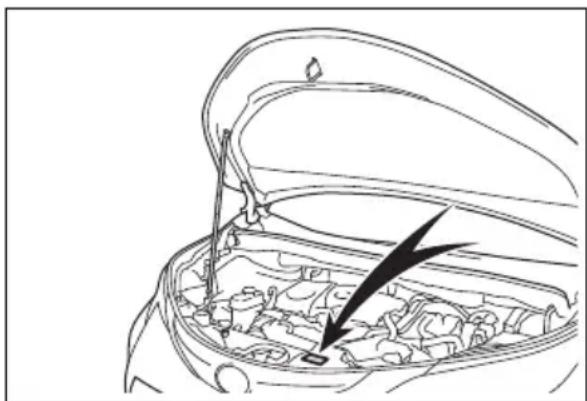
natural_image
Line drawing of a car hood with an arrow pointing to the engine compartment (no text or symbols present)●The meaning of each symbol on the label are as follows:
 | Caution |
 | Air conditioning sys-tem |
 | Air conditioning sys-tem lubricant type |
 | Requires registered technician to service air conditioning sys-tem |
| [gxx8] | Flammable refrigerant |
Customization
Some functions can be customized.
(Customizable features: →P.551)

WARNING
■To prevent the windshield from fogging up
Do not use the windshield defogger switch during cool air operation in extremely humid weather. The difference between the temperature of the outside air and that of the windshield can cause the outer surface of the windshield to fog up, blocking your vision.
■To prevent burns
● Vehicles with outside rear view mirror defoggers: Do not touch the outside rear view mirror surfaces, as they can become very hot and burn you.
● Vehicles with windshield wiper deicer: Do not touch the glass at lower part of the windshield or to the side of the front pillars when the windshield wiper deicer is on.

NOTICE
■To prevent 12-volt battery discharge
Do not leave the air conditioning system on longer than necessary when the hybrid system is off.
■When repairing/replacing parts of the air conditioning system
Have repair/replacement performed by your Toyota dealer. When a part of the air conditioning system, such as the evaporator, is to be replaced, it must be replaced with a new one.
Front air conditioning control screen
■Main control screen
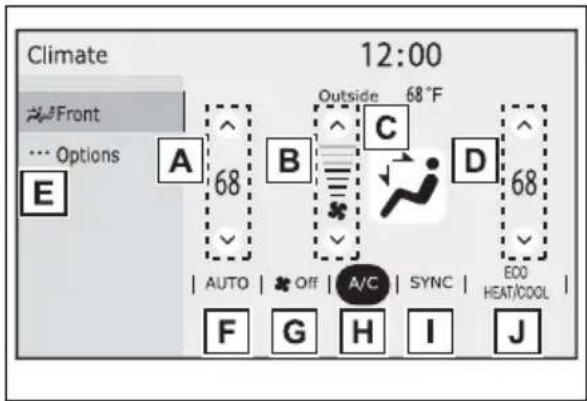
A Adjust the left side seat temperature setting
B Adjust the fan speed setting
C Select the air flow mode
Air flows to the upper body
Air flows to the upper body and feet
Air flows to the feet
Air flows to the feet and the windshield defogger operates
D Adjust the right side seat temperature setting
E Display the option control screen. (→P.353)
F "AUTO" switch (automatic mode)
Set automatic mode on/off ( P.353)
G "OFF" switch
Turn the fan off
H Set cooling and dehumidification function
If "A/C" switch is not pressed, the
system will blow ambient temperature air or heated air.
I "SYNC" switch ( P.355)
Vehicles with "3-ZONE" mode: If the indicator on the "SYNC" switch is off, the temperature for the driver, front passenger and rear seats can be adjusted separately.
Vehicles with "4-ZONE" mode: The temperature for the driver, front passenger, left-hand side rear seats and right-hand side rear seats can be adjusted separately.
J Set eco air conditioning mode
The air conditioning is controlled with low fuel consumption prioritized such as reducing fan speed, etc.
■Option control screen
Select "Options" to display the option control screen.
The functions can be switched on and off.
When the function is on, the indicator illuminates on the screen.
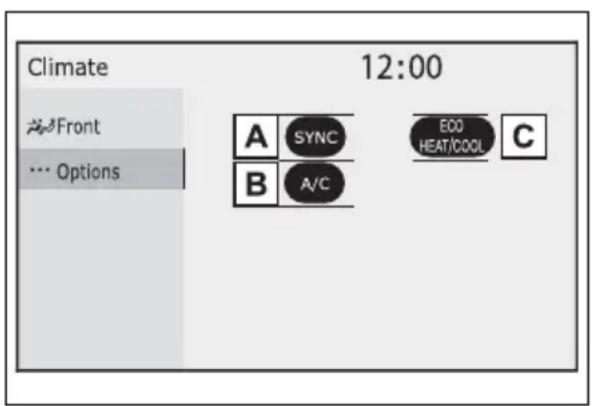
A "SYNC" switch (→P.355)
Vehicles with "3-ZONE" mode: If the indicator on the "SYNC" switch is off, the temperature for the driver, passenger and rear seats can be
adjusted separately.
Vehicles with "4-ZONE" mode: The temperature for the driver, front passenger, left-hand side rear seats and right-hand side rear seats can be adjusted separately.
B Set cooling and dehumidification function
If "A/C" switch is not pressed, the system will blow ambient temperature air or heated air.
C Set eco air conditioning mode
The air conditioning is controlled with low fuel consumption prioritized such as reducing fan speed, etc.
Using automatic mode
1 Press the "AUTO" switch on the air conditioning operation panel or select the "AUTO" switch on the control screen.
The dehumidification function begins to operate. Air outlets and fan speed are automatically adjusted according to the temperature setting and humidity.
2 Adjust the temperature setting.
3 To stop the operation, press the "OFF" switch on the air conditioning operation panel or select the "OFF" switch on the control screen.
If the fan speed setting or air flow modes are operated, the automatic mode indicator goes off. However, automatic mode
for functions other than that operated is maintained.
■ Using automatic mode
Fan speed is adjusted automatically according to the temperature setting and the ambient conditions.
Therefore, the fan may stop for a while until warm or cool air is ready to flow immediately after the automatic mode switch is pressed.
Front seat concentrated airflow mode (S-FLOW)
This function automatically controls the air conditioning airflow so that priority is given to the front seats. When the front passenger seat is not occupied, airflow may switch to only the driver's seat. Unnecessary air conditioning is suppressed, contributing to increased fuel efficiency.
Front seat concentrated airflow mode operates in the following situations.
● No passengers are detected in the rear seats
● The windshield defogger is not operating
While operating, illuminates.
■Manually turning front seat concentrated airflow mode on/off
In front seat concentrated air-flow mode, directing airflow to the front seats only and to all seats can be switched via switch operation. When the mode has been switched manually, automatic airflow control stops operating.
Press >on the air conditioning operation panel and switch the airflow.
● Indicator illuminated: Airflow to the front seats only
● Indicator off: Airflow to all the seats
■Operation of automatic airflow control
- In order to maintain a comfortable interior, airflow may be directed to seats without passengers immediately after the hybrid system is started and at other times depending on the outside temperature.
● After the hybrid system is started, if passengers move around inside or enter/exit the vehicle, the system cannot accurately detect the presence of passengers and automatic airflow control will not operate.
Operation of manual airflow control
Even if the function is manually switched to directing airflow to only the front seats, when a rear seat is occupied, it may automatically direct airflow to all seats.
■To return to automatic airflow control
1 With the indicator off, turn the power switch off.
2 After 60 minutes or more elapse, turn the power switch to ON.
Switching between the individual and synchronous modes
The air conditioning system can be switched between the individual and synchronous modes.
The mode switches each time the “SYNC” switch is operated on the air conditioning operation panel or the “SYNC” is selected on the control screen.
▶ Vehicles with "3-ZONE" mode
- In the individual mode, the temperature for the driver, front passenger, and rear seats can be adjusted separately.
- In the synchronous mode, the driver's side temperature control switch can be used to adjust the temperature for the driver, front passenger, and rear seats.
- To adjust the temperature for the front passenger seat separately from other seats: operate the front passenger's side temperature control switch. (The "SYNC" of "PASSSYNC" display disappears)
- To adjust the temperature for the rear seats separately from the front seats: when the synchronous mode is on, operate the "REAR" switch. Then, operate the driver's side or front passenger's side temperature control switch upwards to increase the rear seats temperature and down-
wards to decrease the rear seats temperature. (The "SYNC" of "REAR SYNC" display on the front air conditioning operation panel and "SYNC" display on the rear air conditioning operation panel disappear)
▶ Vehicles with "4-ZONE" mode
- In the individual mode, the temperature for the driver, front passenger, left-hand side rear seats, and right-hand side rear seats can be adjusted separately by the corresponding temperature control switch on the front and rear air conditioning operation panels.
- In the synchronous mode, the driver's side temperature control switch can be used to adjust the temperature for the driver, front passenger, left-hand side rear seats, and right-hand side rear seats.
- To adjust the temperature for the front passenger seat separately from other seats: operate the front passenger's side temperature control switch. (The "SYNC" of "PASSSYNC" display disappears)
- To adjust the temperature for the rear seats separately from the front seats: when the synchronous mode is on, operate the "REAR" switch. Then, operate the driver's side temperature control switch upwards to increase the rear seats temperature and downwards to decrease the rear
seats temperature. (The "SYNC" of "REAR SYNC" display on the front air conditioning operation panel disappears)
To adjust the temperature for the right-hand side rear seats separately from the left-hand side rear seats, operate the passenger's side temperature control switch. (The "SYNC" of "RIGHT SYNC" display on the rear air conditioning operation panel disappears)
- To adjust the temperature for the driver's seat and passenger's seat separately from the rear seats: when the synchronous mode is on, operate the passenger's side temperature control switch to adjust the front passenger's seat temperature. Then operate the "REAR" switch, and operate the driver's side temperature control switch to adjust the rear seats temperature. (The "SYNC" of "REAR SYNC" display and the "SYNC" of "PASSSYNC" display on the front air conditioning operation panel disappear) To adjust the temperature for the driver's seat, operate the "REAR" switch again and operate driver's side temperature switch.
Changing the rear seat settings (if equipped)
Operate the "REAR" switch.
The modes between the rear air conditioning system and the front air conditioning system switches each time the "REAR" switch is operated.
The air conditioning system
switches between individual and synchronous modes each time the "SYNC" switch is operated. (→P.355)
If the system is left untouched for approximately 6 seconds after changing to the rear air conditioning system, the control mode in the front control panel returns to the front.
- Adjusting the temperature setting
▶ Vehicles with "3-ZONE" mode
Operate the driver's or passenger's side temperature control switch upwards to increase the temperature and operate the switch downwards to decrease the temperature.
▶ Vehicles with "4-ZONE" mode
Operate the passenger's side temperature control switch to adjust the right-hand rear seats temperature, and operate the driver's side temperature control switch to adjust the left-hand side rear seats temperature.
Operate the temperature control switch upwards to increase the temperature and operate the switch downwards to decrease the temperature.
- Fan speed setting
Operate the fan speed control switch upwards to increase the fan speed and downwards to decrease the fan speed.
Touch the "OFF" switch to turn the fan off.
- Change the airflow mode
Operate the airflow mode control switch.
The airflow mode changes each time the switch is operated. (→P.359)
- Using automatic mode
Press the "AUTO" switch. (→P.359)
Air outlet layout and operations
■ Location of air outlets
The air outlets and air volume change according to the selected air flow mode.
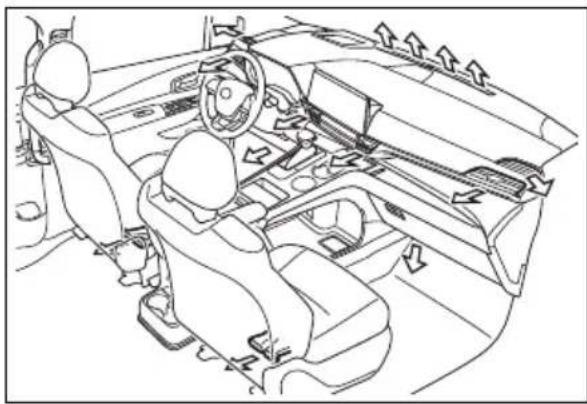
natural_image
Line drawing of two cars in a car dashboard with steering wheel and dashboard (no text or symbols)■Adjusting the air flow direction and opening/closing the air outlets
Front center outlets
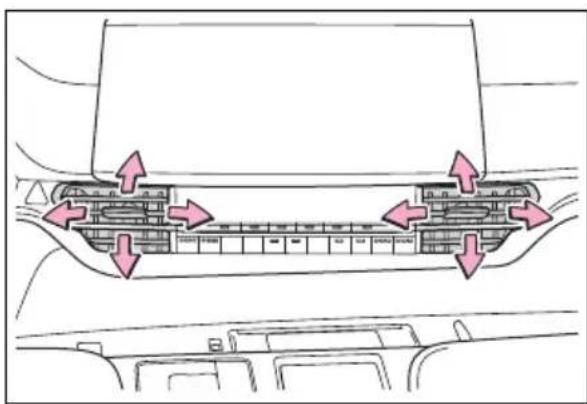
Direct air flow to the left or right,
up or down
Front side outlets
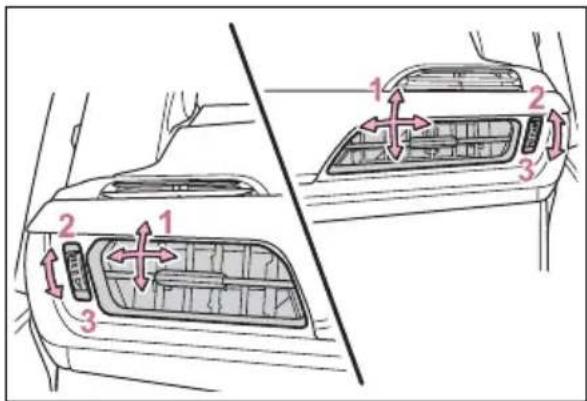
1 Direct air flow to the left or right, up or down
2 Open the vent
3 Close the vent

WARNING
■To not interrupt the wind-shield defogger from operating
Do not place anything on the instrument panel which may cover the air outlets. Otherwise, air flow may be obstructed, preventing the windshield defoggers from defogging.
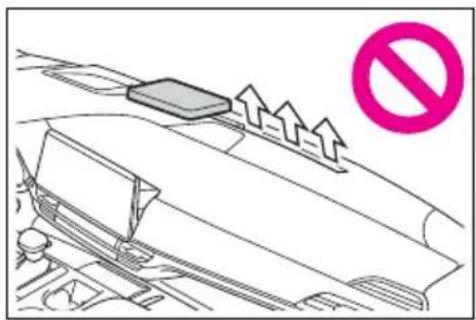
Rear automatic air conditioning system
Air outlets and fan speed are automatically adjusted according to the temperature setting.
Air conditioning controls
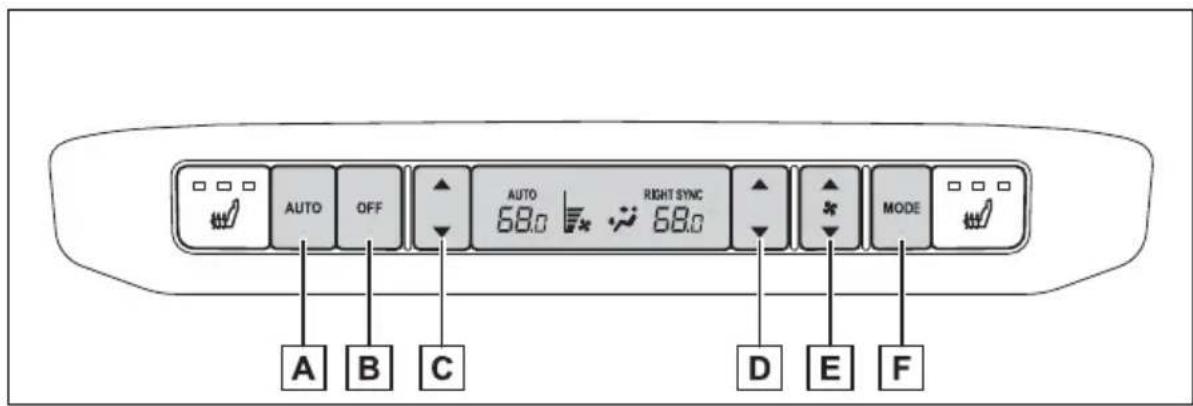
A "AUTO" switch (automatic mode)
B "OFF" switch
C Left-hand side temperature control switch
D Right-hand side temperature control switch (if equipped)
E Fan speed control switch
F Airflow mode control switch
■Adjusting the temperature setting
▶ Vehicles with "3-ZONE" mode
In the individual mode, operate the temperature control switch upwards to increase the rear seats temperature and downwards to decrease the rear seats temperature.
To change to the synchronous mode from the individual mode, press the "OFF" switch and then press the "AUTO" switch.
▶ Vehicles with "4-ZONE" mode
To adjust the temperature for the left-hand side rear seats and right-hand side rear seats together, operate the rear left-hand side temperature control switch upwards to increase the temperature and downwards to decrease the temperature.
To adjust the temperature for the right-hand side rear seats separately from the left-hand side rear seats, operate the right-hand side temperature control switch. Then, operate
the left-hand side temperature control switch to adjust the left-hand rear seats. (The "SYNC" of "RIGHT SYNC" display on the rear air conditioning operation panel disappears)
To change to the synchronous mode from the individual mode, press the “OFF” switch and then press the “AUTO” switch.
■Adjusting the fan speed setting
Operate the fan speed control switch upwards to increase the fan speed and downwards to decrease the fan speed.
Press the "OFF" switch to turn off the fan.
■Change the airflow mode
Press the airflow mode control switch.
The airflow mode changes as follows each time the switch is pressed.
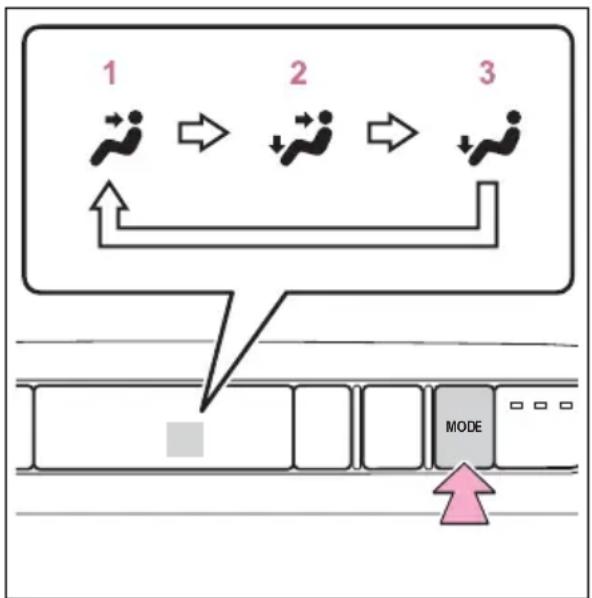
flowchart
graph TD
    A["1"] --> B["2"]
    B --> C["3"]
    style A fill:#f9f,stroke:#333
    style B fill:#f9f,stroke:#333
    style C fill:#f9f,stroke:#333
    subgraph State_1
        A1["Person with motion arrow"]
        B1["Person with motion arrow"]
    end
    subgraph State_2
        B2["Person with motion arrow"]
        C2["Person with motion arrow"]
    end
    subgraph State_3
        C3["Person with motion arrow"]
    end
    A -->|↑| B -->|→| C
    B -->|↓| C
    C -->|→| D["MODE"]
    D --> E["↓"]
    style D fill:#ccc,stroke:#333
1 Upper body
2 Upper body and feet
3 Feet
■ Ventilation and air conditioning odors
● During use, various odors from inside the vehicle may enter into and accumulate in the air conditioning system. This may then cause odor to be emitted from the vents.
●To reduce potential odors from occurring: The start timing of the blower may be delayed for a short period of time immediately after the air conditioning system is started in automatic mode.

NOTICE
■To prevent 12-volt battery discharge
Do not leave the rear air conditioning system on longer than necessary when the engine is not running.
Using the automatic mode
1 Press the "AUTO" switch. ("AUTO" appears on the display)
The dehumidification function begins to operate. Air outlets and fan speed are automatically adjusted according to the temperature setting.
2 Adjust the temperature setting.
3 To stop the operation, press the "OFF" switch.
If the fan speed setting or air flow modes are operated, the automatic mode indicator goes off. However, automatic mode for functions other than that operated is maintained.
■ Using automatic mode
Fan speed is adjusted automatically according to the temperature setting. Therefore, the fan may stop for a while until warm or cool air is ready to flow immediately after the "AUTO" switch is pressed.
Changing the rear seat settings from the front control panel
→P.356
Air outlet layout and operations
■ Location of air outlets
The air outlets and air volume changes according to the selected air flow mode.
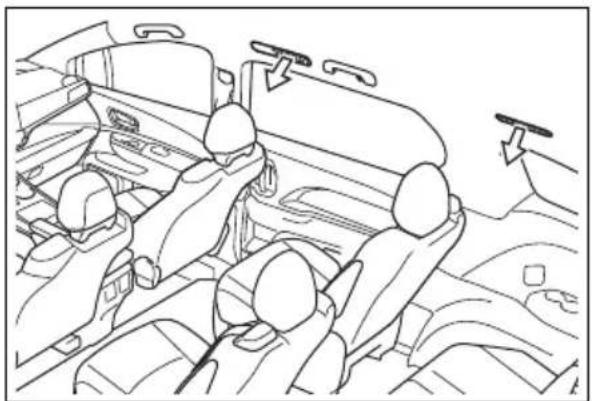
natural_image
Line drawing of a vehicle interior with multiple seats and dashboard (no text or symbols)■Adjusting the air flow direction and opening/closing the air outlets (side ceiling)
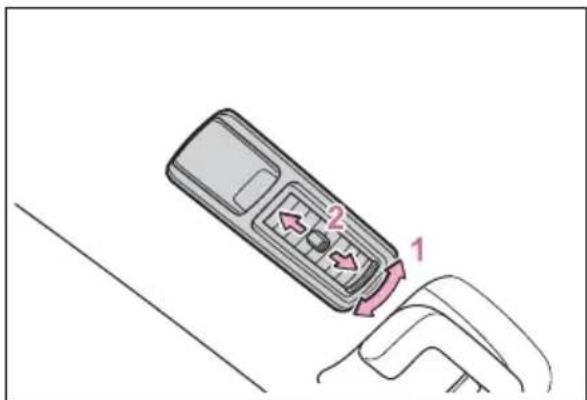
1 Direct air flow to up or down.
2 Direct air flow to the left or right and turns the knob to open or close the vent
To close the vent, move the knob rearward.

NOTICE
■To prevent 12-volt battery discharge
Do not leave the air conditioning system on longer than necessary when the hybrid system is off.
Heated steering wheel\*/seat heat-ers\*/seat ventilators\*
*: If equipped
● Heated steering wheel
Warm up the grip of the steering wheel
- Seat heaters
Warm up the seat upholstery
- Seat ventilators
Maintain good ventilation by sucking air through the seat upholstery

WARNING
■To prevent minor burn injuries
Care should be taken if anyone in the following categories comes in contact with the steering wheel or seats when the heater is on:
● Babies, small children, the elderly, the sick and the physically challenged
●Persons with sensitive skin
- Persons who are fatigued
●Persons who have taken alcohol or drugs that induce sleep (sleeping drugs, cold remedies, etc.)

NOTICE
■To prevent damage to the seat heaters and seat ventilators
Do not put heavy objects that have an uneven surface on the seat and do not stick sharp objects (needles, nails, etc.) into the seat.
■To prevent 12-volt battery discharge
Do not use the functions when the hybrid system is off.
Heated steering wheel
Turns the heated steering wheel on/off
The indicator light comes on when the heated steering wheel is operating.
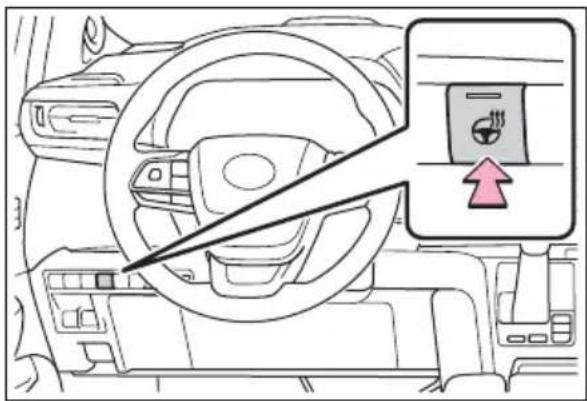
Operation condition
The power switch is in ON.
Operating the seat heat-ers
Each time the switch is pressed, the operation condition changes as follows.
Hi (3 segments lit) → Mid (2 segments lit) → Lo (1 segment
lit) Off
The level indicator lights up during operation.
Front
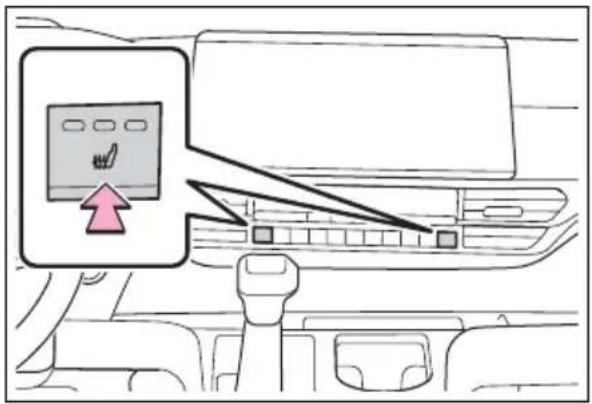
▶ Rear (second outboard seats) (if equipped)
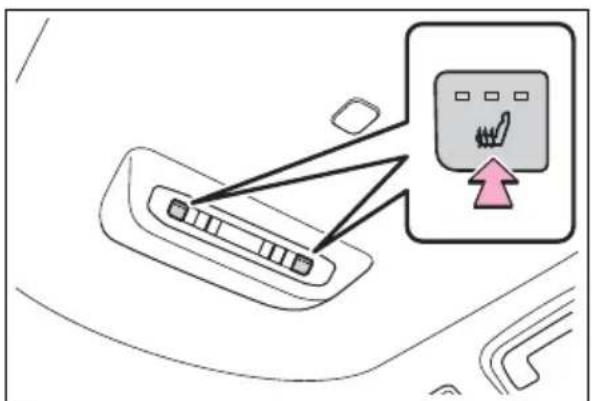
Operation condition
The power switch is in ON.

WARNING
■To prevent causes of overheating and minor burn injuries
Observe the following precautions when using a seat heater:
- Do not cover the seat with a blanket or cushion when using the seat heater.
- Do not use seat heater more than necessary.
Operating the seat ventilators (front seats)
Each time the switch is pressed, the operation condition changes as follows.
Hi (3 segments lit) → Mid (2 segments lit) → Lo (1 segment lit) → Off
The level indicator lights up during operation.
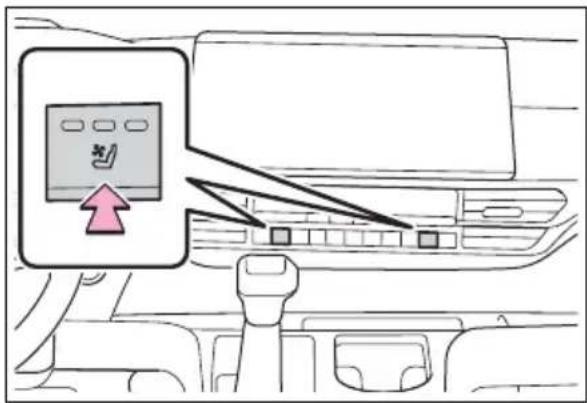
Operation condition
The power switch is in ON.
■ Air conditioning system-linked control mode
When a seat ventilator is set to Hi, the fan speed of the seat ventilator may increase according to the fan speed of the air conditioning system.
Interior lights list
Location of the interior lights
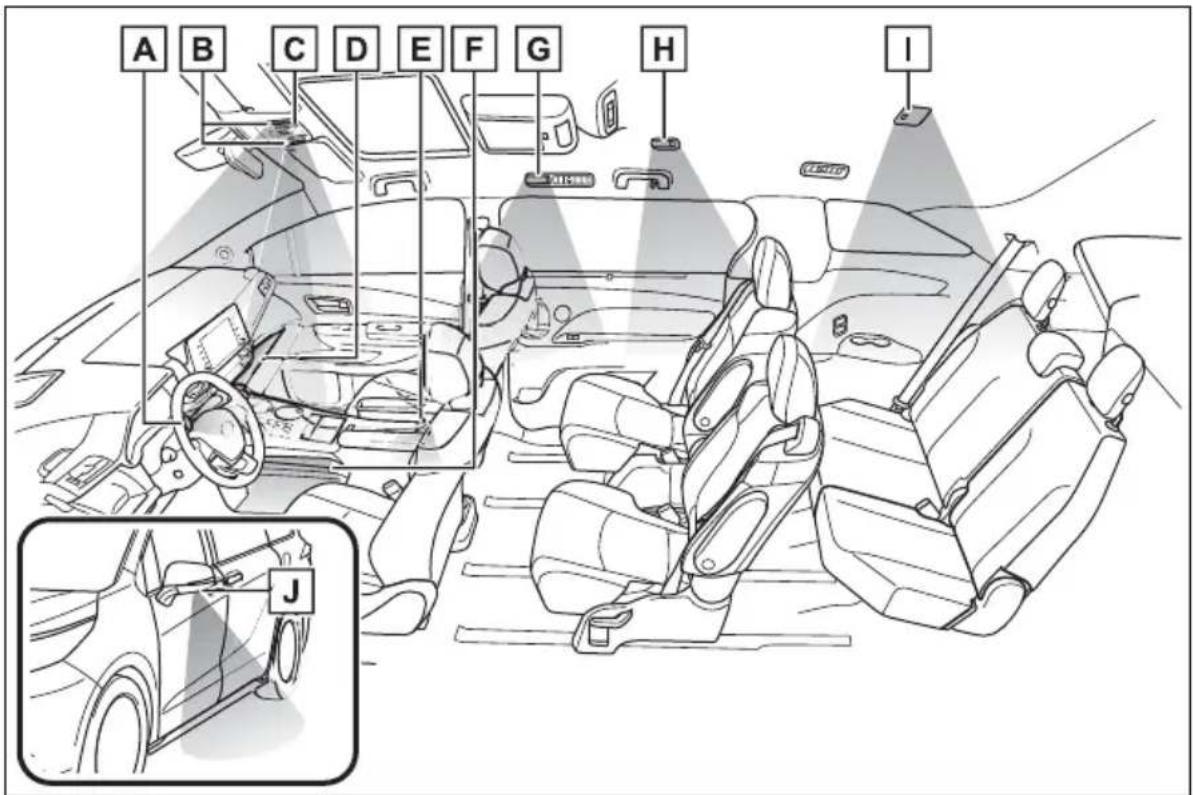
A Power switch illumination ( P.231)
B Front interior lights/personal lights ^1 (→P.364, 364)
C Shift lever light (if equipped)
D Open tray light ^2 (if equipped)
E Door courtesy lights ^1 (if equipped)
F Console tray light ^2
G Second row personal lights (Type A) ^1 ( P.364)
H Second row personal lights (Type B) ^1 (if equipped) ( P.364)
I Third row interior light ^*1 (→P.364)
J Outer foot lights (if equipped)
*1: These lights turn on when a door is opened. When the shift lever is in a position other than P, these lights turn off.
*2: When the shift lever is in a position other than P, the brightness of these lights will reduce intensity.
Operating the per- sonal/interior light main switch
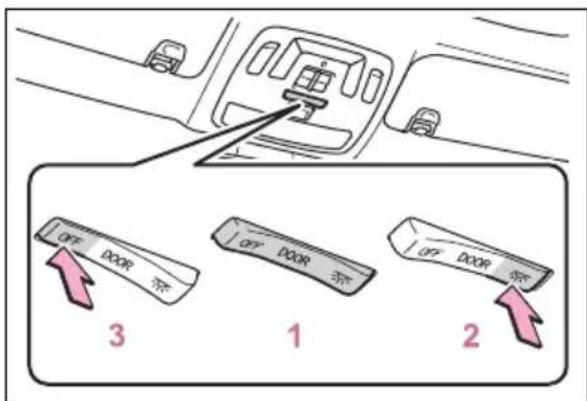
1 Turns the lights on/off linked to door positions
2 Turns the lights on
3 Turns the lights off
Operating the personal lights
Front
Turns the lights on/off
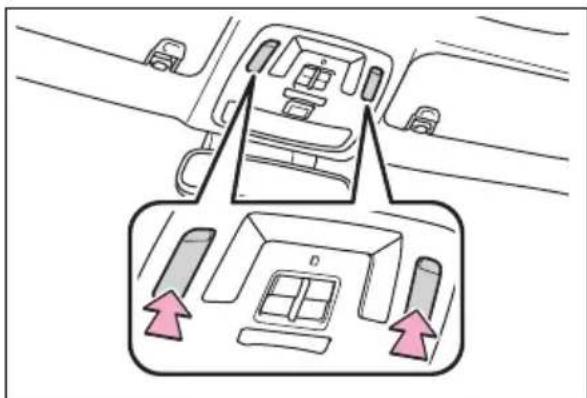
natural_image
Diagram of a car interior showing two compartments with directional arrows indicating movement or flow (no text or symbols present)Second row
Turns the lights on/off when the personal/interior light main switch is in the "DOOR" position.
When a door is opened while the personal/interior light main switch is in the "DOOR" position, the lights turn on.
When the personal/interior light main switch is in the off position, the second row personal lights will not turn on even if the switch is on.
When the personal/interior light main switch is in the on position, the second row personal lights will turn on even if the switch is off.
▶ Type A
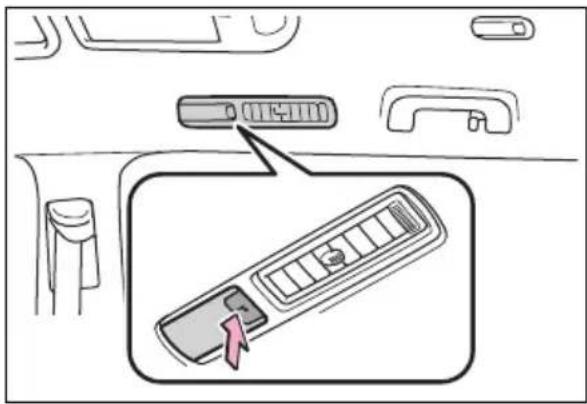
▶ Type B (if equipped)
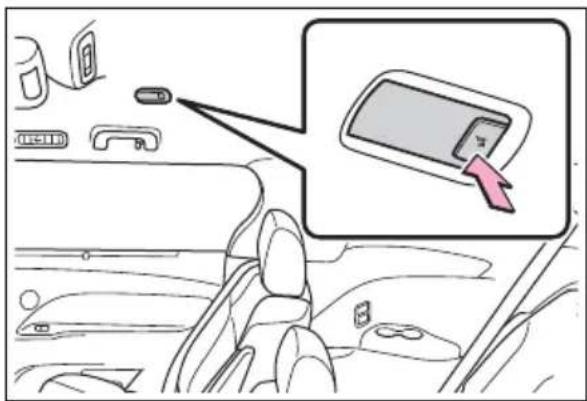
Third row interior light
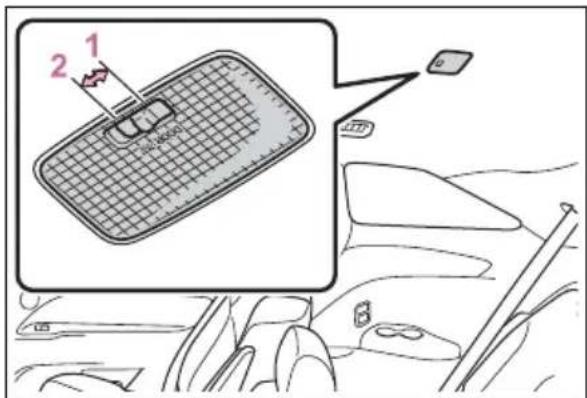
1 Turns the door position on The rear interior light turns on/off
together the front interior lights. When a door is opened while the front and rear interior light door position is on, the lights turn on.
2 Turns the light on
■Illuminated entry system
The lights automatically turn on/off according to the power switch mode, the presence of the electronic key, whether the doors are locked/unlocked, and whether the doors are opened/closed.
■To prevent the 12-volt battery from being discharged
If the interior lights remain on when the power switch is turned to OFF, the lights will go off automatically after 20 minutes.
■The interior lights will turn on automatically when
If any of the SRS airbags deploy (inflate) or in the event of a strong rear impact, the interior lights will turn on automatically.
The interior lights will turn off automatically after approximately 20 minutes.
The interior lights can be turned off manually. However, in order to help prevent further collisions, it is recommended that they be left on until safety can be ensured.
(The interior lights may not turn on automatically depending on the force of the impact and conditions of the collision.)
Customization
Setting (e.g. the time elapsed before the lights turn off) can be changed. (Customizable features: →P.552)

NOTICE
■To prevent 12-volt battery discharge
Do not leave the lights on longer than necessary when the hybrid system is off.
List of storage features
Location of the storage features
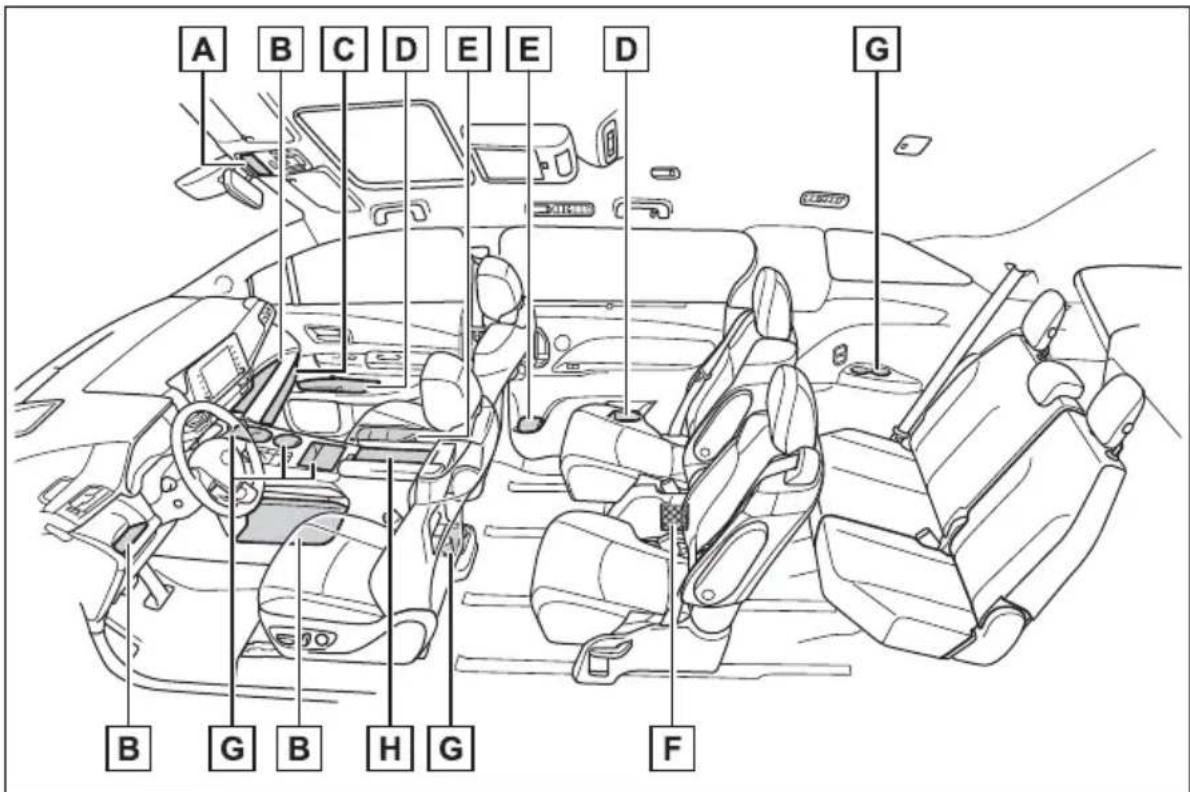
A Conversation mirror ( P.370)
B Open tray ( P.370)
C Glove box ( P.367)
D Door pockets ( P.370)
E Bottle holders ( P.369)
F Auxiliary storage (7-passenger models)
G Cup holders ( P.368)
H Console box ( P.367)

WARNING
■Items that should not be left in the vehicle
Do not leave glasses, lighters or spray cans in the storage spaces, as this may cause the following when cabin temperature becomes high:
●Glasses may be deformed by heat or cracked if they come into contact with other stored items.
●Lighters or spray cans may explode. If they come into contact with other stored items, the lighter may catch fire or the spray can may release gas, causing a fire hazard.
■When storage compartments are not in use
When driving or when the storage compartments are not in use, keep it closed.
In the event of sudden braking or sudden swerving, an accident may occur due to an occupant being struck by an open lid or the items stored inside.
Glove box
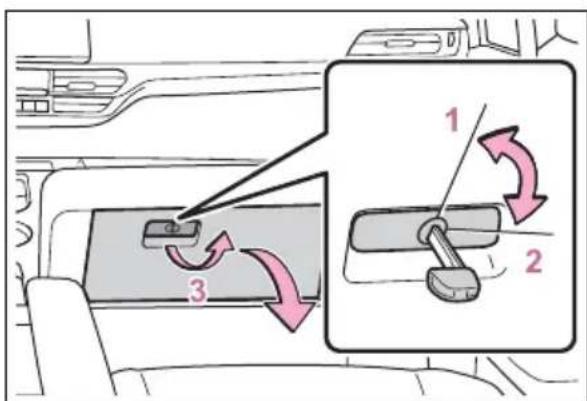
1 Unlock with the mechanical key
2 Lock with the mechanical key
3 Open (pull up the lever)
Glove box light
The glove box light turns on when the tail lights are on.

WARNING
■Caution while driving
Keep the glove box closed. In the event of sudden braking or sudden swerving, an accident may occur due to an occupant being struck by the open glove box or the items stored inside.
Console box
Press the button to open the console box.
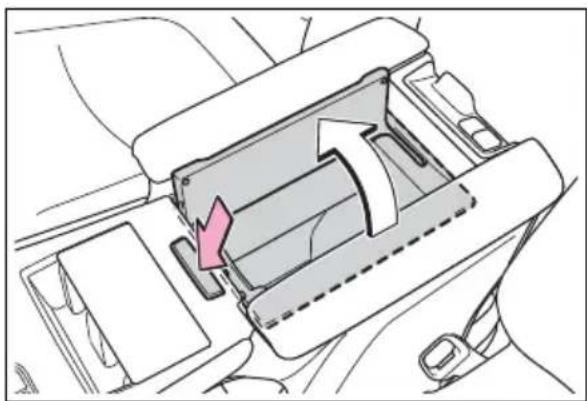
natural_image
Diagram of car gear shift lever mechanism showing internal components and directional arrows (no text or labels)■ Console box light
The console box light turns on when the tail lights are on.

WARNING
■Caution while driving
Keep the console box closed. Injuries may result in the event of an accident or sudden braking.
Cup holders
Console box (type A)
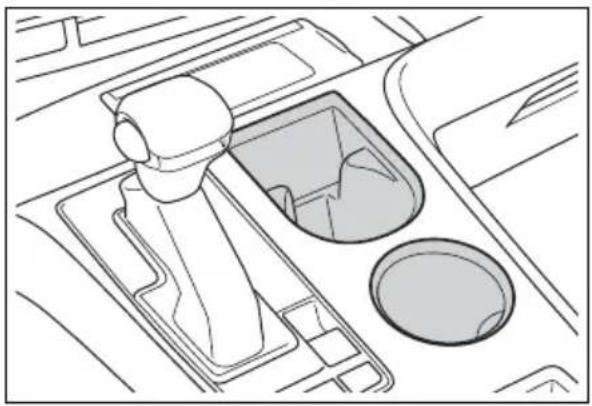
natural_image
Line drawing of a car gear shift lever and two circular compartments (no text or symbols)▶ Console box (type B) Open the lid.
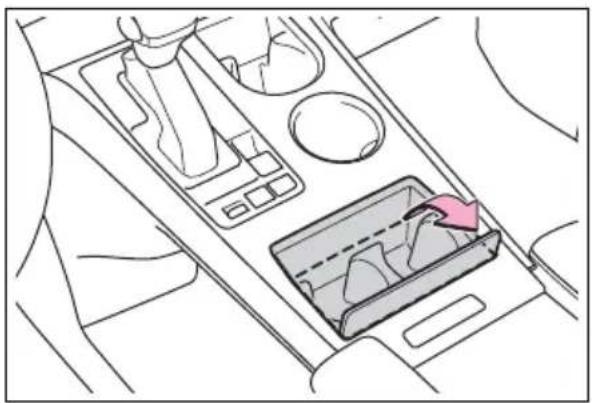
natural_image
Interior view of a car gear shift lever with a highlighted internal compartment (no text or symbols)Console box (type C)
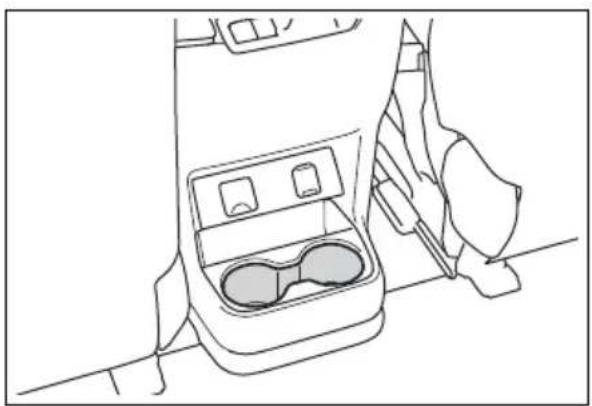
natural_image
Line drawing of a car interior showing a seat, dashboard, and rear gear (no text or symbols)▶ Second seats (8-passenger models)
Removing the second center seat. (→P.174)
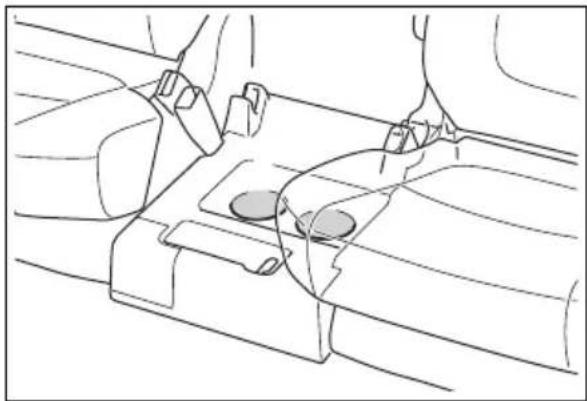
natural_image
Technical line drawing of a mechanical component with no visible text or symbolsThird seats (Vehicles without spare tire)
Also two cup holders are installed in the right side of the third seats.
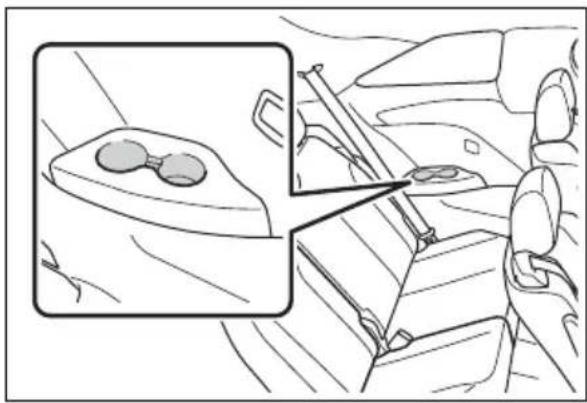
natural_image
Line drawing of a car interior showing seatbelt and dashboard (no text or symbols)▶ Third seats (Vehicles with spare tire)
Also two cup holders are installed in the right side of the third seats.
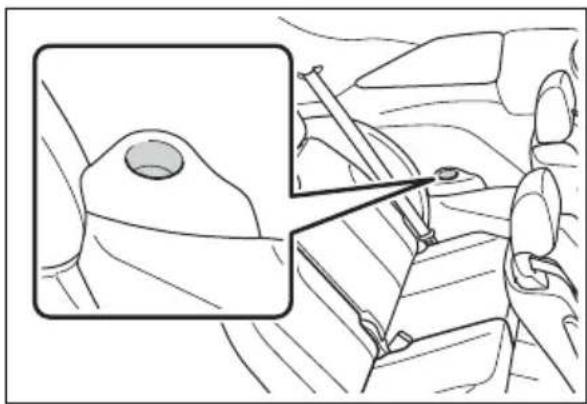
natural_image
Medical illustration showing a surgical procedure on a patient's head (no text or labels present)■ Cup holder mats (Type A)
The mats can be removed.
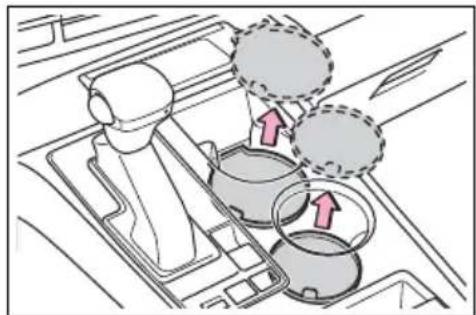
natural_image
Interior view of a car airway with handshells and seating (no text or symbols visible)
WARNING
■Items unsuitable for the cup holders
Do not place anything other than cups or beverage cans in the cup holders.
Inappropriate items must not be stored in the cup holders even if the lid is closed.
Other items may be thrown out of the holders in the event of an accident or sudden braking and cause injury. If possible, cover hot drinks to prevent burns.
■When not in use
Keep the cup holders closed. Injuries may result in the event of sudden braking, sudden swerving or an accident.
Bottle holders
Front
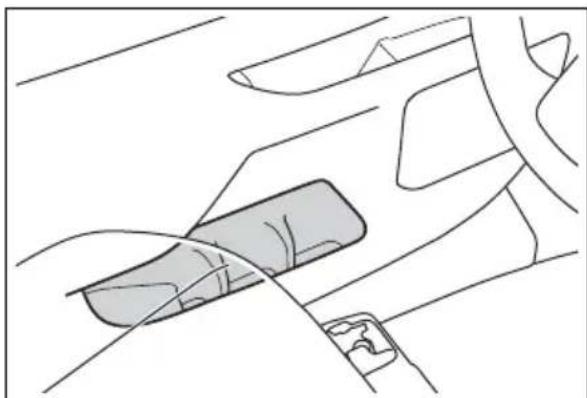
natural_image
Line drawing of a car seatbelt buckle and seatbelt (no text or symbols)Rear
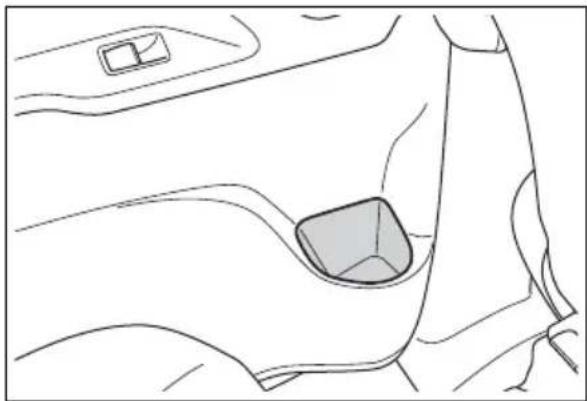
natural_image
Line drawing of a car interior showing a seat and dashboard area (no text or symbols)■Bottle holders
- When storing a bottle, close the cap.
●The bottle may not be stored depending on its size or shape.

WARNING
■Items unsuitable for the bottle holders
Do not place anything other than a bottle in the bottle holders. Other items may be thrown out of the holders in the event of an accident or sudden braking and cause injury.

NOTICE
■Items that should be not stowed in the bottle holders
Do not place open bottles or glass and paper cups containing liquid in the bottle holders. The contents may spill and glasses may break.
■Rear: When using the sliding door
Make sure items in the sliding door bottle holder will not interfere with the motion of the door before operating the door. Items that protrude from the bottle holder may prevent door opening or damage the vehicle.
Door pockets
Front
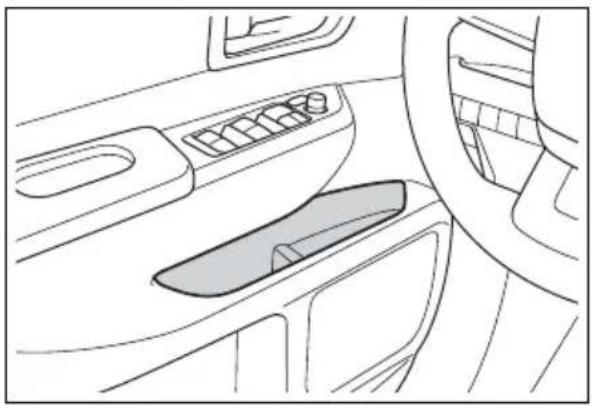
natural_image
Interior view of a car dashboard and infotainment system (no text or symbols visible)▶ Rear
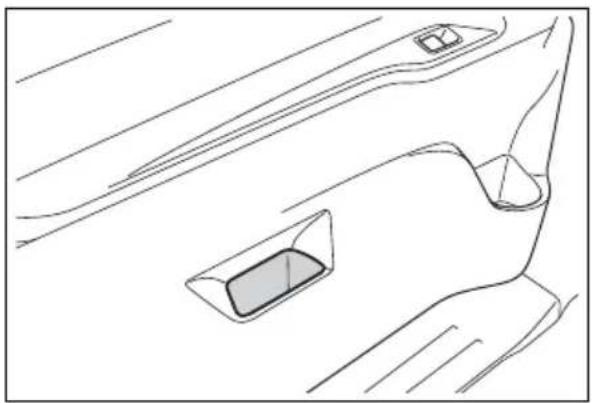
natural_image
Line drawing of a car interior showing dashboard and seat compartments (no text or symbols)
NOTICE
■Rear: When using the sliding door
Make sure magazines are not bent or protruding from the sliding door pockets. Do not insert anything too big so that the shape of the sliding door pockets is distorted. Such objects may obstruct the opening/closing of the sliding doors, damage the sliding door pockets or the vehicle body, and may result in a malfunction.
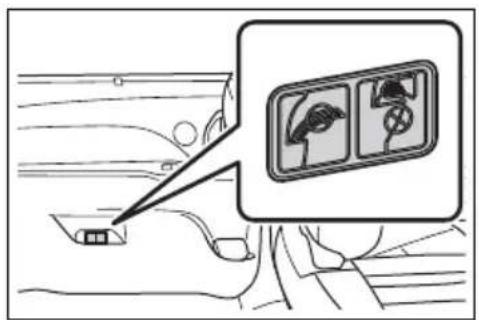
Conversation mirror
Push the lid.
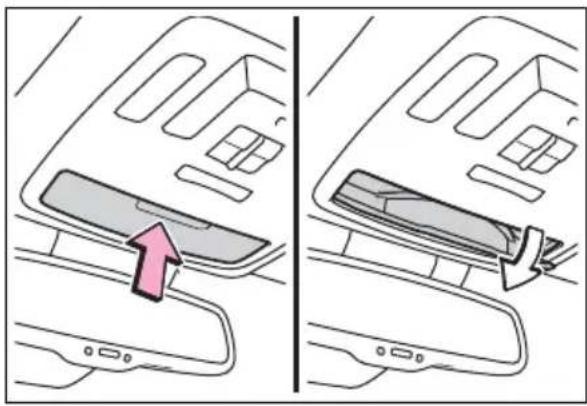
natural_image
Diagram showing two views of a car interior with a highlighted panel and directional arrow (no text or symbols)Open tray
Driver's side
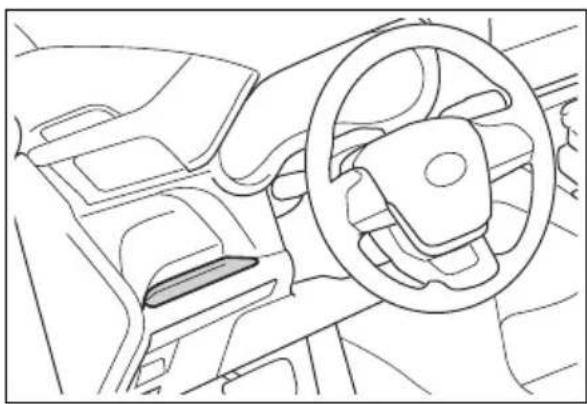
natural_image
Line drawing of a car interior showing steering wheel, dashboard, and steering wheel (no text or symbols)Front passenger's side
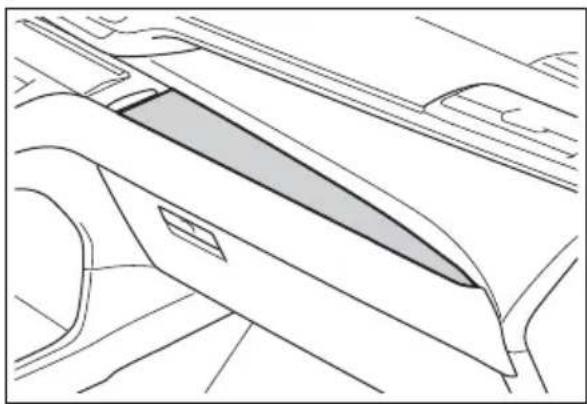
natural_image
Technical line drawing of a car interior panel showing the blade and side door (no text or symbols)Front of console box (Type A)
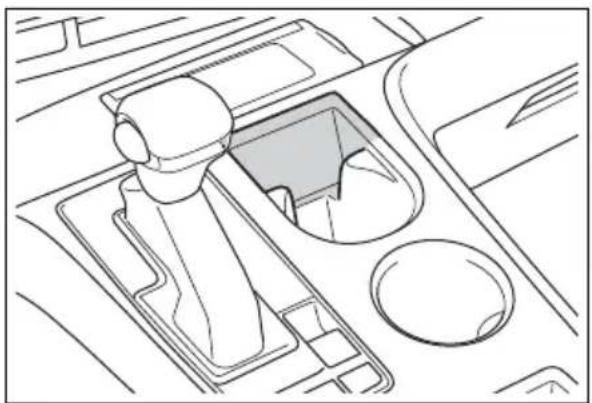
natural_image
Line drawing of a car gear shift lever and intake manifold (no text or symbols)Front of console box (Type B) Open the lid.
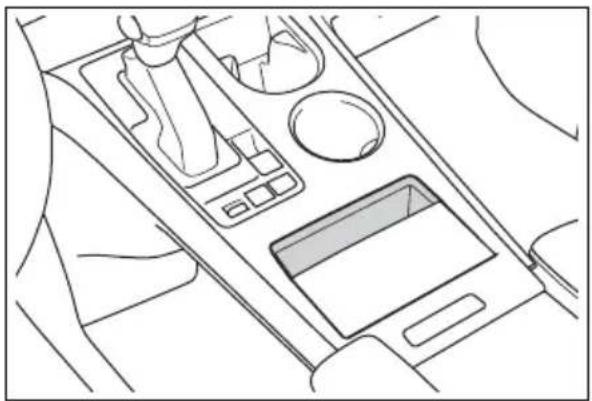
natural_image
Line drawing of a car interior showing dashboard, seatbelt, and dashboard controls (no text or symbols)▶ Rear of console box
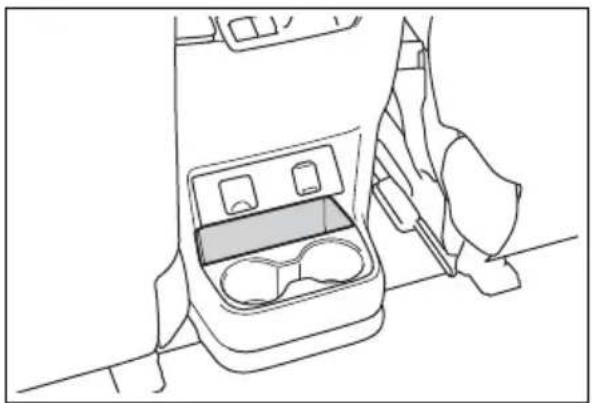
natural_image
Line drawing of a car interior showing a front compartment with seats and a side arm (no text or symbols)On the console box Close the console box.
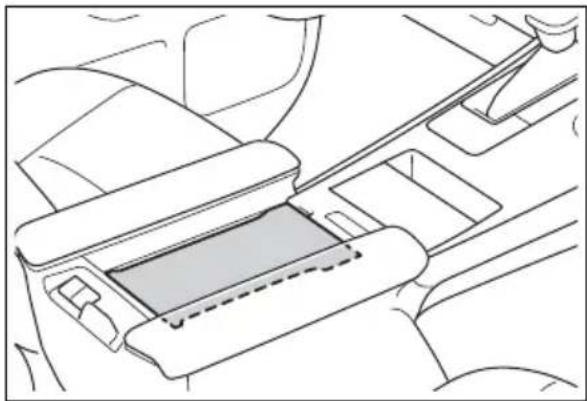
natural_image
Line drawing of a car interior showing the seatbelt and dashboard (no text or symbols)▶ Under the console box
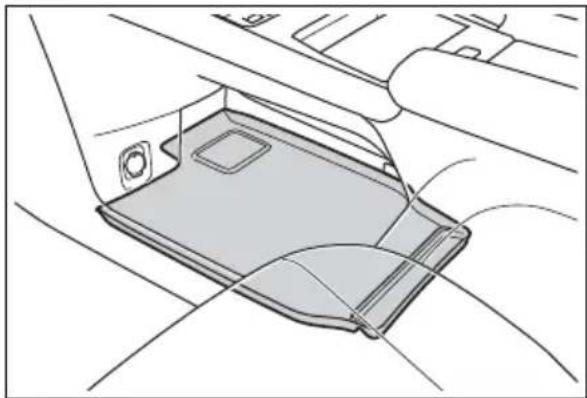
natural_image
Diagram of a car seatbelt with visible door and seat, showing no text or symbols
WARNING
■Items unsuitable for the open tray
Observe the following precautions when putting items in the open tray. Failure to do so may cause items to be thrown out of the tray in the event of sudden braking or steering. In these cases, the items may interfere with pedal operation or cause driver distraction, resulting in an accident.
- Do not store items in the tray that can easily shift or roll out.
- Do not stack items in the tray higher than the tray's edge.
- Do not put items in the tray that may protrude over the tray's edge.
Luggage compartment features
Cargo hooks
Raise the hook to use.
The cargo hooks are provided for securing loose items.
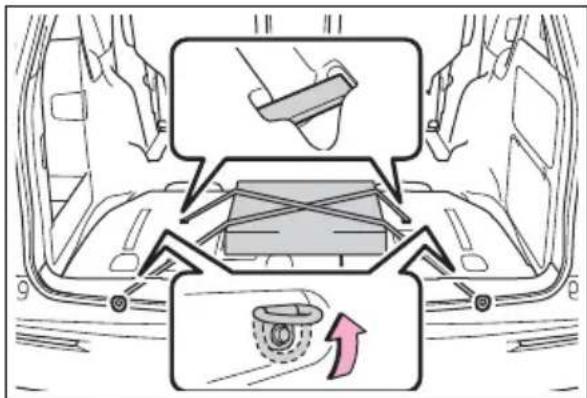

WARNING
■When cargo hooks are not in use
To avoid injury, always return the hooks to their stowed positions when not in use.
Cargo net hooks
To hang the cargo net, use the cargo net hooks and cargo hooks.
Pattern 1
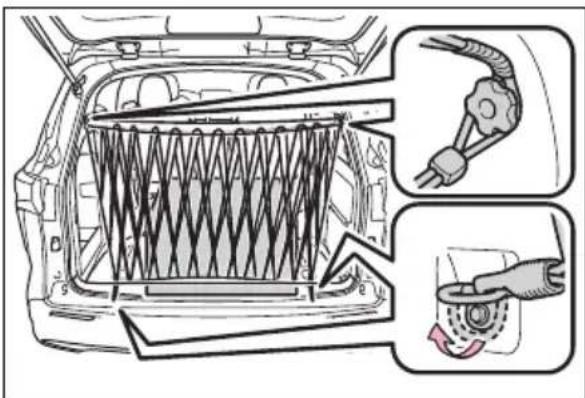
▶ Pattern 2
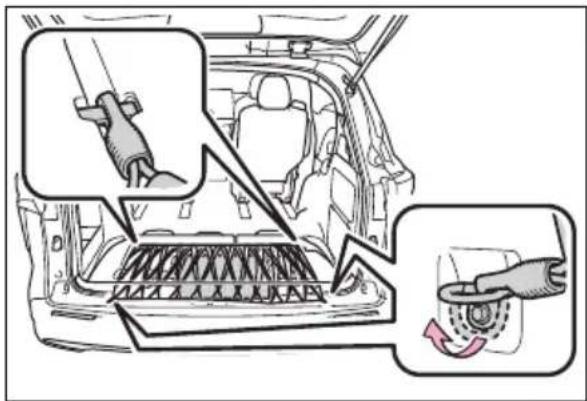

WARNING
■When the cargo net is not in use
To avoid injury, always return the hooks to their stowed positions when not in use.

NOTICE
■To prevent damage to the cargo net hooks
Avoid hanging things other than a cargo net on them.
Side auxiliary box
▶ Type A
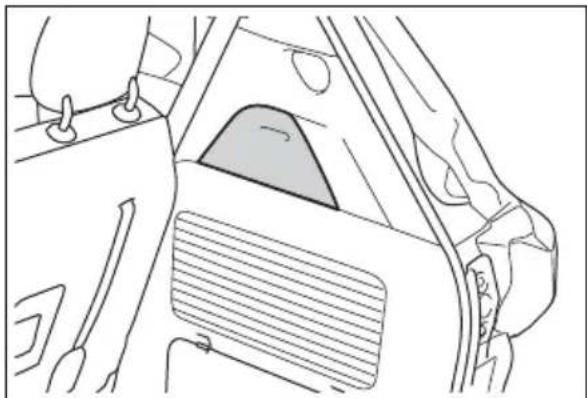
natural_image
Line drawing of a car interior showing the hood and side panel (no text or symbols)▶ Type B (vehicles without spare tire only)
Engage the latch buckle.
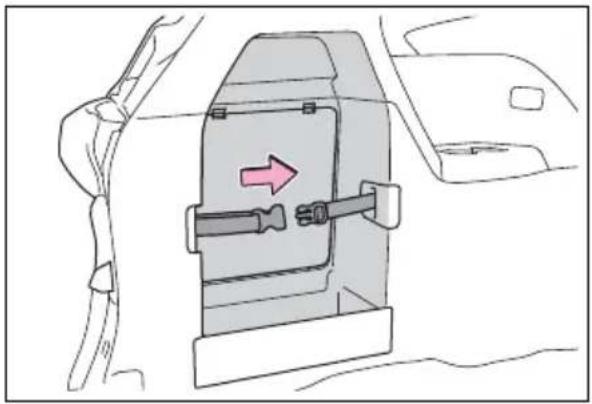
natural_image
Diagram of a car seatbelt buckle with a red arrow indicating direction (no text or symbols)Other interior features
Sun visors
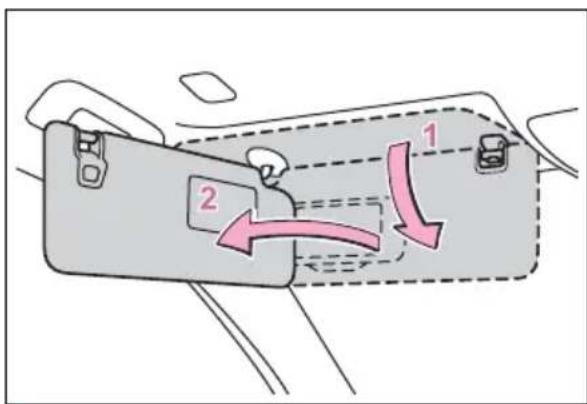
1 To set the visor in the forward position, flip it down.
2 To set the visor in the side position, flip down, unhook, and swing it to the side.
Vanity mirrors
Slide the cover to open.
The light turns on when the cover is opened.
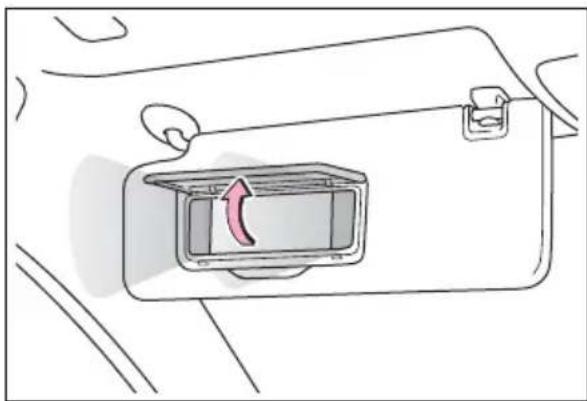
natural_image
Diagram of a car interior showing a rectangular device with a red arrow indicating rotation (no text or symbols)■Automatic light off to prevent 12-volt battery discharge
If the vanity lights remain on when the power switch is turned to OFF, the lights will go off automatically after 20 minutes.

NOTICE
■To prevent 12-volt battery discharge
Do not leave the vanity lights on for extended periods while the hybrid system is off.
Power outlet (12 VDC)
Please use a power supply for electronic goods that use less than 12 VDC /10 A (power consumption of 120 W).
When using electronic goods, make sure that the power consumption of all the connected power outlets is less than 120 W.
Open the lid.
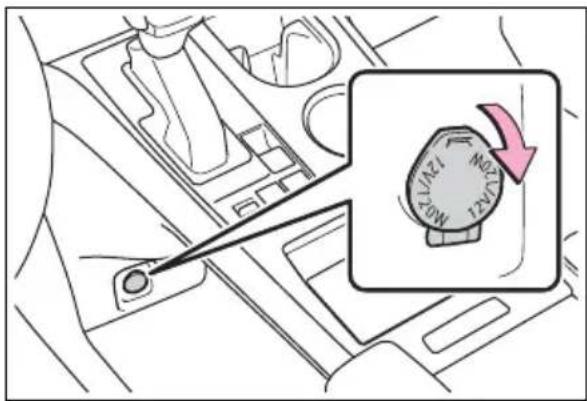
■The power outlet can be used when
The power switch is in ACC or ON.
■When stopping the hybrid system
Disconnect electrical devices with charging functions, such as mobile battery packs.
If such devices are left connected, the hybrid system may not stop nor-mally.

NOTICE
■When power outlet is not in use
To avoid damaging the power outlet, close the power outlet lid when the power outlet is not in use.
Foreign objects or liquids that enter the power outlet may cause a short circuit.
■To prevent blown fuse
Do not use an accessory that uses more than 12 V 10 A.
■To prevent 12-volt battery discharge
Do not use the power outlet longer than necessary when the hybrid system is off.
Power outlets (120 VAC) (if equipped)
Please use as a power supply for electronic devices that use less than 120 VAC (power consumption of 1500 W).
■ Using the power outlets
▶ Rear of console box
Open the lid.
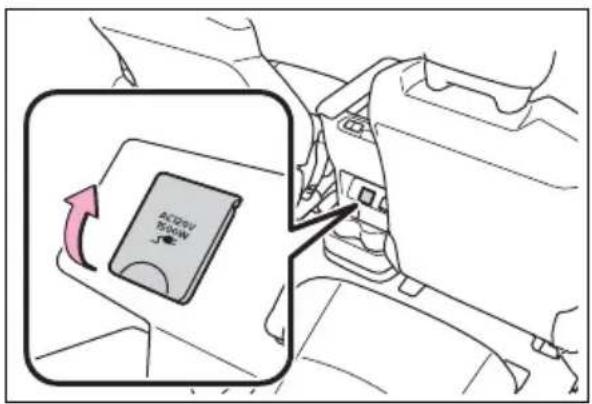
▶ Luggage compartment
Open the lid.
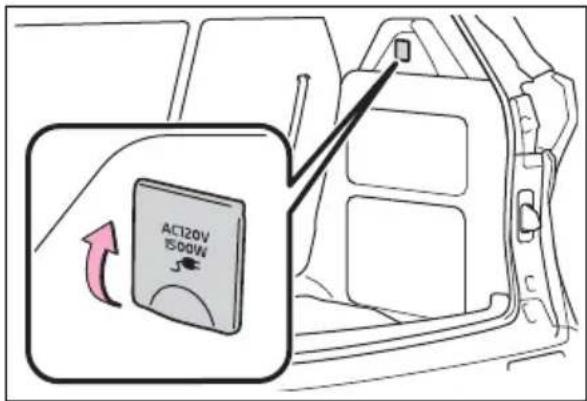
■When turning the power outlets on
1 Check that the parking brake is engaged, and press the power switch while depressing the brake pedal.
2 Check that the READY indicator is illuminated, and press the AC120V switch.
The power outlets can be used when the indicator on the AC120V switch is illuminated.
The power outlets are turned off/on each time the AC120V switch is pressed.
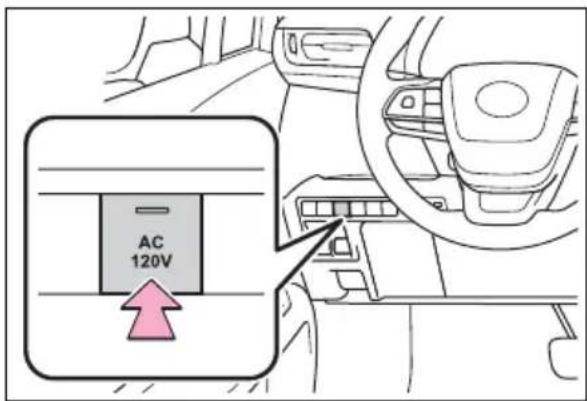
■When connecting a device
Open the lid, and fully and securely insert the plug of the device into the power outlet.
▶ Rear of console box
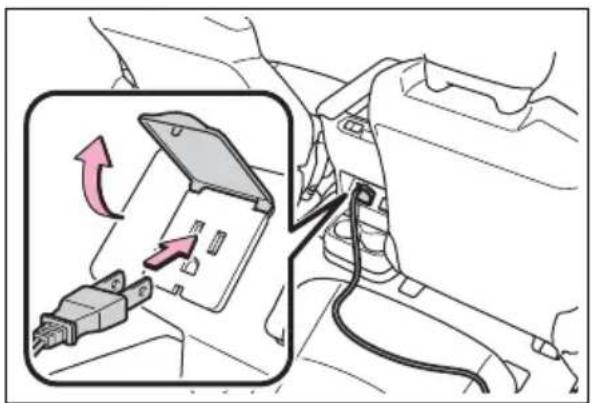
natural_image
Diagram showing a car's internal cable connector with an inset view of the switch (no text or symbols present)▶ Luggage compartment
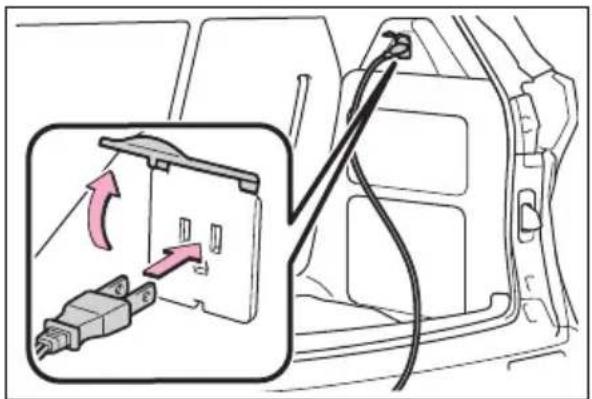
■When turning the power outlets off
1 Turn the connected devices off.
2 Press the AC120V switch to turn the power outlets off.
3 Disconnect each plug from the power outlet.
4 Close the lid of each power outlet.
■The power outlet can be used when
The READY indicator is illuminated.
■Rules/regulations regarding idling stop
The engine will start automatically to charge the hybrid battery (traction battery) if its charge becomes low. In some municipalities, if the engine starts while the vehicle is parked or
stopped, it may violate local rules or regulations regarding idling stop and you may be penalized. Make sure to check the local rules and regulations before using the power outlets while the vehicle is parked or stopped.
Power outlets
- When connecting a device, make sure that the total power consumption of all devices connected to the 120 VAC power outlets is less than 1500 W. If a device is connected and the power consumption is exceeded, a protection circuit will cut the power supply and the power outlets will not be able to be used.
● Depending on the device to be used, the current flow may be high and the initial peak wattage may exceed 1500 W. In this case, the protection circuit may operate, and the power outlets may not be able to be used.
●Depending on the connected device, it may cause interference with TV and radio broadcasts.
●The voltage of the power outlets cannot be measured with a commercially available electrical tester. If it is necessary to check the voltage, have the vehicle inspected by your Toyota dealer.
●While a power outlet is being used, a cooling fan sound may be heard from near a rear seat. This does not indicate a malfunction.
■ Devices which may not operate correctly
The following 120 VAC devices may not operate properly even if their power consumption is less than 1500 W:
● Devices with high initial peak wattage
●Measuring devices that process precise data
● Devices that require an extremely
stable power supply
● Devices that require a constant power supply from the power outlet, such as a device with a timer.
■When the 120 VAC power outlets cannot be used
If the AC120V switch is pressed but the switch indicator does not illuminate, the protection circuit may have operated.
In this case, perform the appropriate procedures as follows.
- Disconnect the plug of each device from the power outlets, check that the total power consumption of all devices to be connected to the power outlets is less than 1500 W and check that the devices are not malfunctioning, reconnect the devices and then press the AC120V switch again.
- Check the charge of the hybrid battery (traction battery) ( P.122). If the charge is low, shift the shift lever to P, allow the engine to run to charge the hybrid battery (traction battery), and then press the AC120V switch again.
- If the temperature inside the vehicle is high, such as after the vehicle has been parked in the sun, use the air conditioning system to sufficiently ventilate or cool the interior, and then press the AC120V switch again.
- If the vehicle has been stopped in a cold area, to protect the hybrid battery (traction battery), the power outlets may not be able to be used. In this case, drive the vehicle for a while to warm up the hybrid battery (traction battery), and then press the AC120V switch again.
If the power outlets cannot be used even after performing the appropriate procedures above, have the vehicle inspected by your Toyota dealer.

WARNING
For safe use
Observe the following precautions.
Failure to do so may lead to an accident, resulting in death or serious injury.
- Do not use devices such as the following when driving:
• Devices which cannot be properly secured within the vehicle.
• Devices which may distract the driver and be a hinderance to safe driving, such as a TV, DVD player, etc. - Unsecured devices which generate heat, such as a toaster, microwave, electric heater, electric kettle, coffee maker, etc., as they may cause burns or a fire in the case of sudden braking or an accident.
• Devices which may fall under the pedals and prevent the brake pedal from being depressed. - Do not use devices which produce steam while the windows are closed. Doing so may cause the windows to fog up, reducing visibility and making it difficult to drive safely. Also, the steam may damage or negatively affect other devices.
- Do not connect a malfunctioning device to a power outlet, as doing so may cause the power outlets to become inoperable.
- Do not disconnect the plug of a device while your hands are wet or insert a pin or other object into the power outlet. Also, if a liquid or snow is on the power outlet, dry the outlet before using it.

WARNING
- Do not attempt to modify, disassemble or repair a power outlet. Also, do not replace the 120 VAC inverter with a commercially available one. For information on repairs, contact your Toyota dealer.
● Be careful not to get any part of your body caught in the power outlet lid.
- Do not let children touch the power outlets.
- Keep the power outlets free of dust and foreign matter.
- If the plug of a device fits loosely in a power outlet, even though it is fully inserted, replace the power outlet. For information on replacement, contact your Toyota dealer.
■ Using the power outlets while parked or stopped
Observe the following precautions.
Failure to do so may lead to an accident, possibly resulting in death or serious injury.
● Make sure to engage the parking brake and shift the shift lever to P.
- Do not leave the vehicle unattended while the READY indicator is illuminated and a device is connected to a power outlet.
Make sure that the hood is closed. As the engine will start automatically depending on the condition of the vehicle, make sure that nothing is left near or contacting the exhaust pipes. Also, do not put your head or hands anywhere inside the engine compartment, as the cooling fan may operate suddenly. Keep hands and clothing (especially a tie, scarf, etc.) away from the fan as they may get caught in a fan.
- Do not use the power outlets in an area with poor ventilation or an enclosed area, such as a garage without a ventilation or exhaust system, or in an area where the vehicle may become surrounded by snow, as the exhaust gasses may accumulate, causing a lack of oxygen.
- Do not use the power outlets if the vehicle has a vehicle cover installed.
- Do not sleep in the vehicle while using devices such as an electric heater.
■ Devices to be connected
Make sure to read any instruction manual which came with a device and observe any warnings on the device. Do not connect a device to a power outlet if the device is malfunctioning or its plug is damaged.
Do not use power outlets for medical devices, as the output of the power outlet may be cut, depending on the condition of the vehicle.

NOTICE
Observe the following precautions.
Failure to do so may lead to the power outlets not operating correctly or damage to the vehicle or a connected device.
■To avoid short circuit or malfunction
- Do not set a device which generates heat near the interior components or on a seat. Heat may cause these parts to melt or burn.
- Do not use devices which are sensitive to vibration or heat in the vehicle.
These devices may malfunction due to vibration while driving or heat while the vehicle is parked in the sun.
- When not using a power outlet, make sure to close the cover. If foreign matter or a liquid enters the power outlet, it may cause a malfunction or short circuit.
- Do not use a multi-point outlet adapter as doing so may overload the power outlet.
■When the ambient temperature is high
If the temperature inside the vehicle is high, such as after the vehicle has been parked in the sun, the power outlets may not be able to be used. Sufficiently ventilate the interior or use the air conditioning system to cool the interior before attempting to use the power outlets.
■When the ambient temperature is low
If the vehicle has been stopped in a cold area, to protect the hybrid battery (traction battery), the power outlets may not be able to be used. In this case, drive the vehicle for a while to warm up the hybrid battery (traction battery).
■To prevent 12-volt battery discharge
Do not use the power outlets longer than necessary when the hybrid system is not running.
USB charging ports
The USB charging ports are used to supply 2.5A (USB Type-A) or 3.0A (USB Type-C) of electricity at 5 V to external devices. Use the appropriate terminal for each charging port type.
The USB charging ports are for charging only. They are not designed for data transfer or other purposes.
Depending on the external device, it may not charge properly. Refer to the manual included with the device before using a USB charging port.
■Using the USB charging ports
In the console box
Open the console box lid.
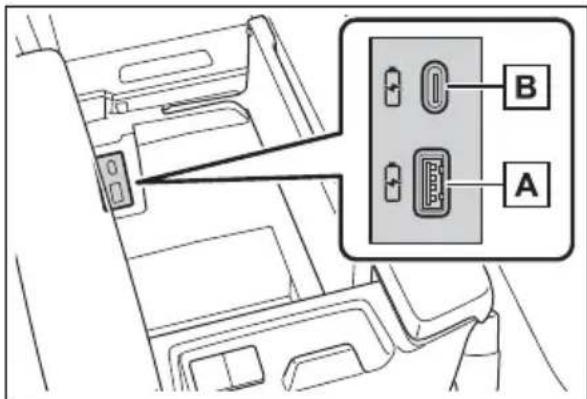
A USB Type-A
B USB Type-C
▶ Rear of console box
Open the lid.
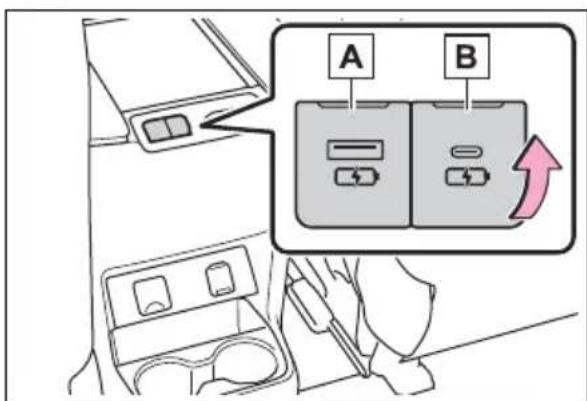
A USB Type-A
B USB Type-C
▶ Luggage compartment
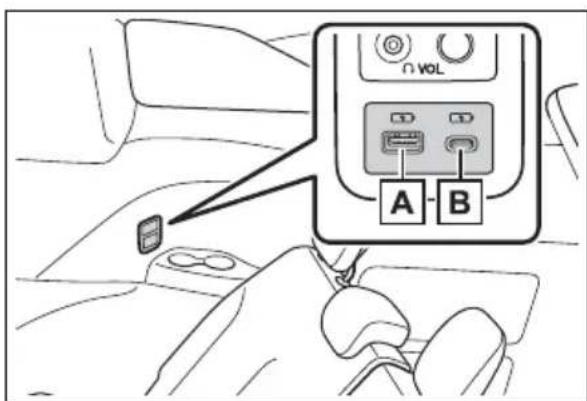
A USB Type-A
B USB Type-C
■The USB charging ports can be used when
The power switch is in ACC or ON.
■Situations in which the USB charging ports may not operate correctly
- USB Type-A: If a device which consumes more than 2.5 A at 5 V is connected
- USB Type-C: If a device which consumes more than 3.0 A at 5 V is connected
- If a device designed to communicate with a personal computer, such as a USB memory device, is connected
● If the connected external device is turned off (depending on device) - If the temperature inside the vehicle is high, such as after the vehicle has been parked in the sun
■ About connected external devices
Depending on the connected external device, charging may occasionally be suspended and then start again. This is not a malfunction.
■When using the USB charging ports in the console box
The USB charging ports can be used while the console box lid is closed.
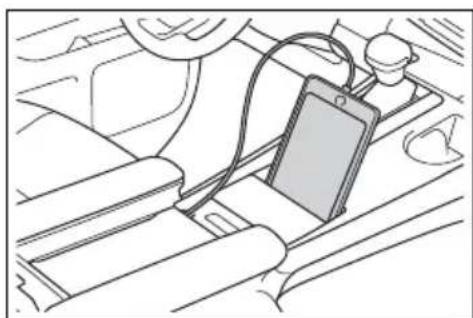
natural_image
Line drawing of a car interior with a smartphone mounted on the backrest area (no text or symbols)
NOTICE
■To prevent damage to the USB charging ports
- Do not insert foreign objects into the ports.

NOTICE
- Do not spill water or other liquids into the ports.
●Rear of console box: When the USB charging ports are not in use, close the lids. If a foreign object or liquid enters a port may cause a short circuit. - Do not apply excessive force to or impact the USB charging ports.
- Do not disassemble or modify the USB charging ports.
■To prevent damage to external devices - Do not leave external devices in the vehicle. The temperature inside the vehicle may become high, resulting in damage to an external device.
- Do not push down on or apply unnecessary force to an external device or the cable of an external device while it is connected.
■To prevent 12-volt battery discharge
Do not use the USB charging ports for a long period of time when the hybrid system is off.
Wireless charger (if equipped)
A portable device can be charged by just placing Qi standard wireless charge compatible portable devices according to the Wireless Power Consortium, such as smartphones and mobile batteries, etc., on the charge area.
This function cannot be used with portable devices that are larger than the charging area. Also, depending on the portable device, it may not operate as normal. Please read the operation manual for portable devices to be used.
■The "Qi" symbol
The "Qi" symbol is a trademark of the Wireless Power Consortium.

natural_image
Abstract black logo design resembling stylized letters or symbols (no text or readable labels)■Name for all parts
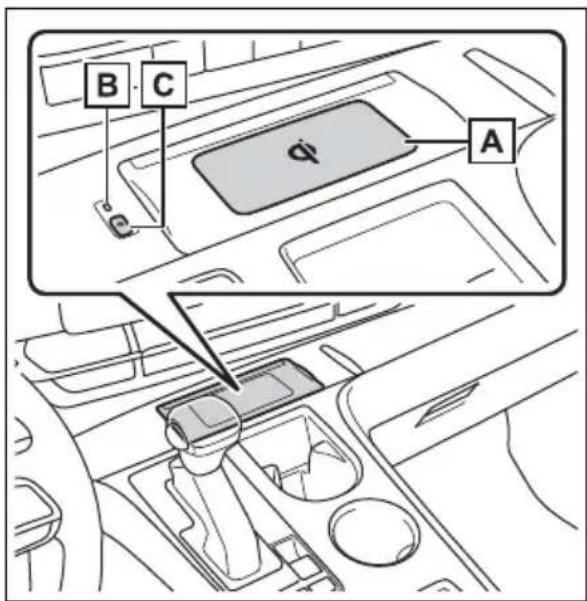
A Charge area
B Operation indicator light
C Power supply switch
■Using the wireless charger
1 Press the power supply switch of the wireless charger.
Switches on and off with each press of the power supply switch.
When turned on, the operation indicator light (green) comes on.
Even with the hybrid system off, the on/off state of the power supply switch is memorized.
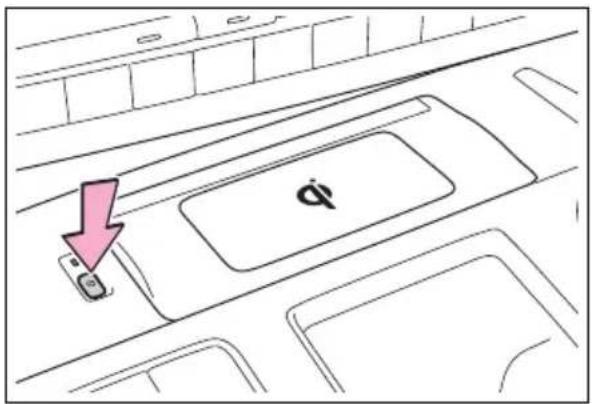
2 Place the charging side of the portable device down.
When charging, the operation indicator light (orange) comes on.
If charging is not occurring, try placing the portable device as close to the center of the charging area as possible.
When charging is complete, the operation indicator light (green) comes on.
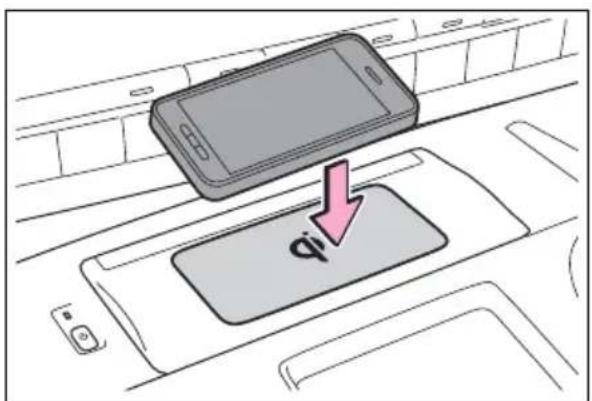
■Recharging function
- When charging is complete
and after a fixed time in the charge suspension state, charging restarts.
- When the portable device is moved, charging is stopped for a moment and then it restarts.
■Lighting conditions of operation indicator light
| Operation indicator light | Conditions |
| Turning off | When the Wireless charger power supply is off |
| Green (comes on) | On Standby (charging possible state) |
| When charging is complete* | |
| Orange (comes on) | When placing the portable device on the charging area (detecting the portable device) |
| Charging |
*: Depending on the portable device, there are cases where the operation indicator light will continue being lit up orange even after the charging is complete.
- When the operation indicator light flashes
When an error occurs, the operation indicator light flashes an orange color.
Handle the error based on the following tables.
- Flashing repeatedly once every second (Orange)
| Suspected causes | Handling method |
| Vehicle to charger communication failure. | If the power switch is in ACC: Turn the power switch to ON.If the power switch is in ON: Turn the power switch off and then back to ON.If the operation indicator light still blinks after performing the above procedure, contact your Toyota dealer. |
• Repeatedly flashes 3 times continuously (Orange)
| Suspected causes | Handling method |
| A foreign substance is between the portable device and charge area. | Remove the foreign substance from between portable device and the charge area. |
| The portable device is out of sync due to the device being shifted from the center of the charge area. | Place the portable device near the center of the charge area. |
• Repeatedly flashes 4 times continuously (Orange)
| Suspected causes | Handling method |
| Temperature rising within the wireless charger. | Stop charging at once and start charging again after for a while. |
■The wireless charger can be operated when
The power switch is in ACC or ON.
■ Usable portable devices
Qi standard wireless charge standard can be used on compatible devices.
However, not all Qi standard devices and compatibility are guaranteed.
Starting with mobile phones and smartphones, it is aimed for low power electrically supplied portable devices of no more than 5W.
■When covers and accessories are attached to portable devices
Do not charge in situations where cover and accessories not able to handle Qi are attached to the portable device. Depending on the type of cover and accessory, it may not be possible to charge. When charging is not performed even with the portable device placed on the charge area, remove the cover and accessories.
■While charging, noise enters the AM radio
Turn off the wireless charger and confirm that the noise has decreased. If the noise decreases, continuously pushing the power supply switch of the wireless charger for 2 seconds, the frequency of the charger can be changed and the noise can be reduced. Also, on that occasion, the operation indicator
light will flash orange 2 times.
■ Important points of the wireless charger
- If the electronic key cannot be detected within the vehicle interior, charging cannot be done. When the door is opened and closed, charging may be temporarily suspended.
- When charging, the wireless charging device and portable device will get warmer, however this is not a malfunction. When a portable device gets warm while charging, charging may stop due to the protection function on the portable device side. In this case, when the temperature of the portable device drops significantly, charge again.
Operation sounds
When the power supply is turned on, while searching for the portable device a sound will be produced, however this is not a malfunction.
■Cleaning the wireless charger
→P.404
■Label indicating precautions for using the wireless charger
There is a label on the wireless charger. Follow the instructions on the label.
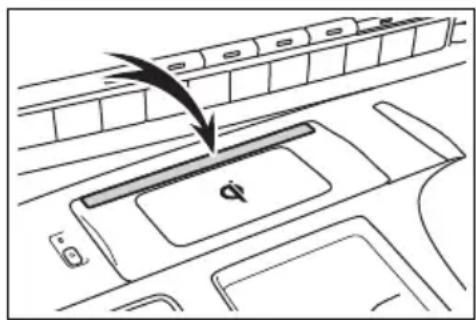
natural_image
Diagram showing a car interior with a directional arrow pointing to a vehicle's seat (no text or symbols present)
WARNING
■Caution while driving
When charging a portable device, for safety reasons, the driver should not operate the main part of the portable device while driving.
■Caution regarding interference with electronic devices
People with implantable cardiac pacemakers, cardiac resynchronization therapy-pacemakers or implantable cardioverter defibrillators, as well as any other electrical medical device, should consult their physician about the usage of the wireless charger. The operations of the wireless charger may have an affect on medical devices.
■To prevent damage or burns
Observe the following precautions.
Failure to do so may result in a possibility of equipment failure and damage, catch fire, burns due to overheat.
- Do not insert any metallic objects between the charging area and the portable device while charging
- Do not attach stickers, metallic objects, etc., to the charger area or portable device
- Do not cover with cloth, etc., and charge
- Do not charge portable devices other than designated
- Do not attempt to dismantle for disassembly or modifications
- Do not hit or apply a strong force

NOTICE
■Conditions in which the function may not operate correctly
In the following conditions, it may not operate correctly
●The portable device is fully charged
● There is foreign matter between the charge area and portable device
●The temperature of the portable device gets higher from charging
●The charging surface of the portable device is facing up
●The placement of the portable device is out of alignment with the charge area
●Near a TV tower, electric power plant, gas station, radio station, large display, airport or other facility that generates strong radio waves or electrical noise
- When the electronic key is in contact with, or is covered by the following metallic objects
- Cards to which aluminum foil is attached
• Cigarette boxes that have aluminum foil inside
- Metallic wallets or bags
- Coins
- Hand warmers made of metal
• Media such as CDs and DVDs
- When other wireless keys (that emit radio waves) are being used nearby
In addition, excluding the above-mentioned, when the charger does not perform normally or the operation display lamp is flashing continuously, it is considered that the wireless charger is malfunctioning. Contact authorized Toyota dealer.
■To prevent failure or damage to data
- Do not bring magnetic cards, such as credit cards, or magnetic recording media, etc., close to the charger while charging, otherwise, data may disappear under the influence of magnetism. Also, do not bring precision instruments such as wrist watches, etc., close to the charger, as such objects may break.
- Do not leave portable devices in the cabin. The temperature inside the cabin may become high, when under the sun, and cause damage to the device.
■To prevent 12-volt battery discharge
When the hybrid system is stopped, do not use the wireless charger for a long time.
Sunshades
Pull up the tab A of the sun-shade and hook the shade on using the anchors.
To retract the sunshade, unhook the sunshade and retract it slowly.
▶ Rear side windows
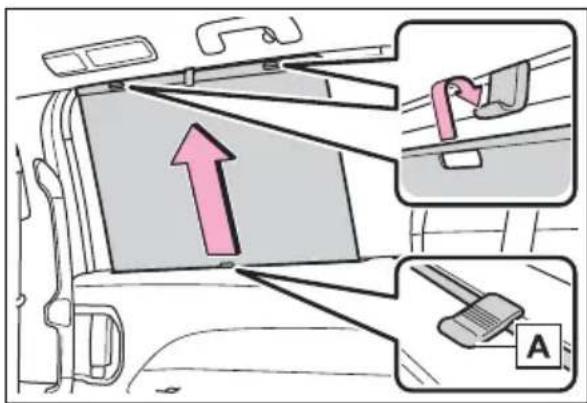
▶ Rear quarter windows (if equipped)
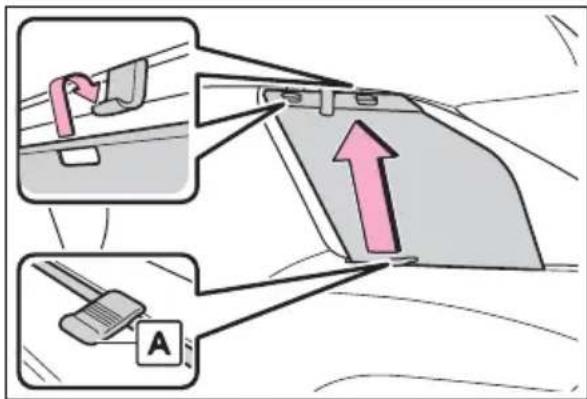

NOTICE
■To ensure normal operation of the sunshades
Observe the following precautions:
- Do not place anything where it may hinder the opening/closing of the sunshades.
- Do not attach items to the sun-shades.
- Do not apply excessive load to the sunshades while they are hanging from the hooks.
-
Do not operate the sunshade for the rear side windows while the sliding door is opening/closing.
-
Do not store the sunshade in a tilted position. If stored in a tilted position, the sunshade screen may become creased.
■To prevent damage to the sunshade
Observe the following precautions:
- Do not use the sunshade when either hook is detached. When the sliding door is opened/closed, the sunshade may be damaged.
- Do not pull on the screen while the hooks are attached. The screen may be damaged.
Armrest
Fold down the armrest for use.
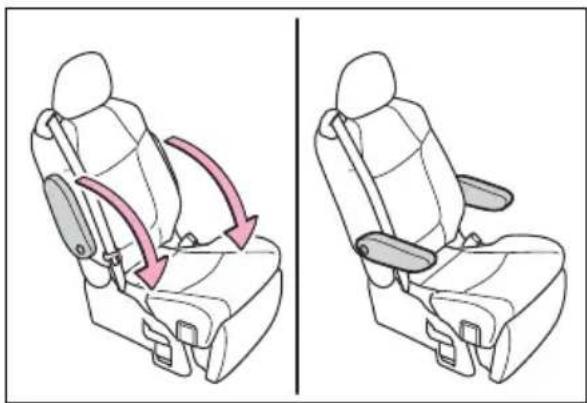
natural_image
Side-by-side illustrations of a car seat with highlighted seatbelt and directional arrows indicating movement (no text or symbols)
NOTICE
■To prevent damage to the armrest
Do not apply too much load on the armrest.
Assist grips
▶ Type A
An assist grip installed on the ceiling can be used to support your body while sitting on the
seat.
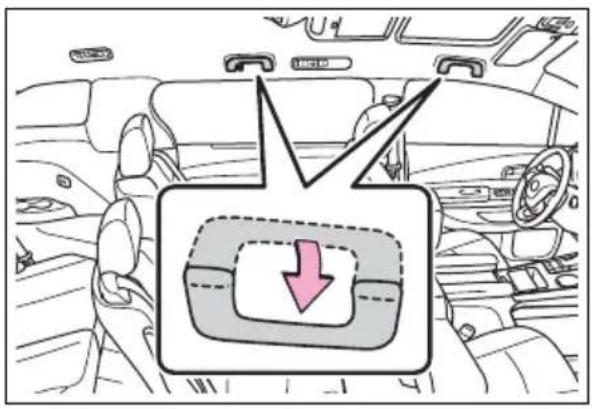
▶ Type B
An assist grip installed on the pillar can be used when getting in or out of the vehicle and others.
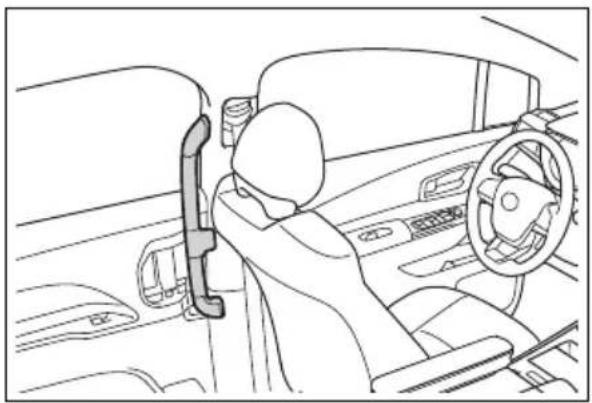
natural_image
Line drawing of a car interior showing steering wheel, dashboard, and seatbelt (no text or symbols)
WARNING
■Assist grips
Type A: Do not use the assist grip when getting in or out of the vehicle or rising from your seat.

NOTICE
■To prevent damage to the assist grip
Do not hang any heavy object or put a heavy load on the assist grip.
Grocery bag hooks
▶ Type A (rear of console box)
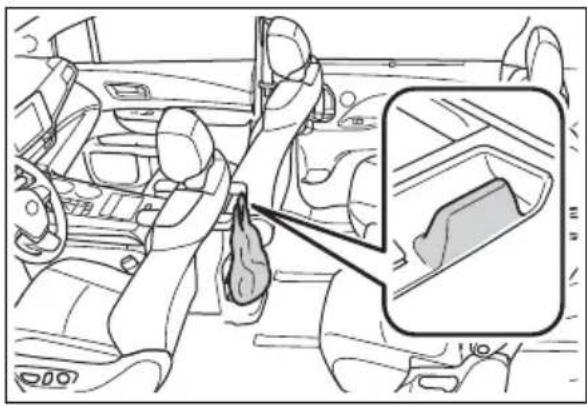
natural_image
Interior view of a car showing dashboard, steering wheel, and seatbelt (no text or symbols)▶ Type B (third seatback)
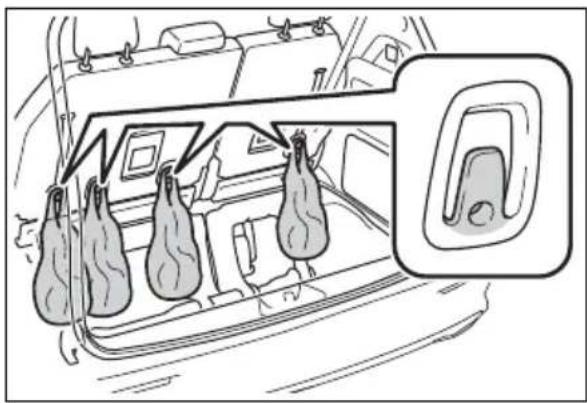
natural_image
Line drawing of a poultry barn interior with four hanging pears and a control panel (no text or symbols)▶ Type C (luggage compartment)
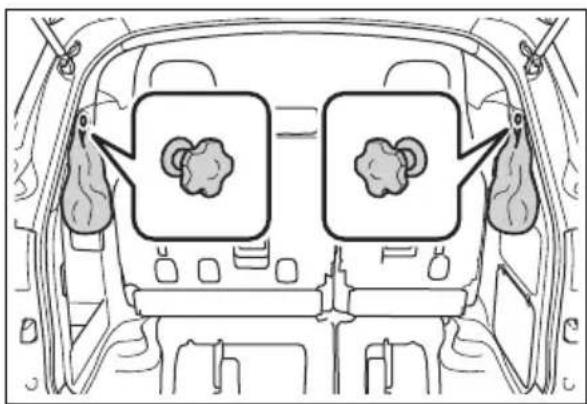

NOTICE
■To prevent damage to the grocery bag hooks
Type A and B: Do not hang any object heavier than 6.6 lb. (3 kg) on the grocery bag hook.
Coat hooks
The coat hooks are provided with the rear assist grips.
natural_image
Line drawing of a person using a device to interact with a wall-mounted device (no text or symbols)
WARNING
■Items that must not be hanged on the hook
Do not hang coat hangers or other hard or sharp objects on the hook. If the SRS curtain shield airbags deploy, these items may become projectiles, causing death or serious injury.

NOTICE
Coat hooks
- Do not hang heavy objects on the hooks.
- When using the coat hook in the assist grip of the second seats, be careful not to get the hooked object caught in the sliding doors being opened or closed.
Refrigerator (if equipped)
Opening the refrigerator lid
Press the button to open.
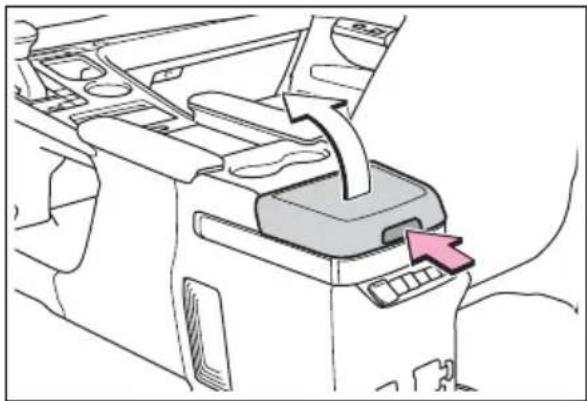
natural_image
Diagram of a car interior showing airflow direction and control panel (no text or symbols)■Turning the refrigerator on/off
To turn the cooler mode on, press the cooler mode switch
A.
When turned on, the indicator on the switch comes on.
To turn the freeze mode on, press the freeze mode switch
B.
When turned on, the indicator on the switch comes on.
To turn the refrigerator off, press the switch which indicator is illuminated.
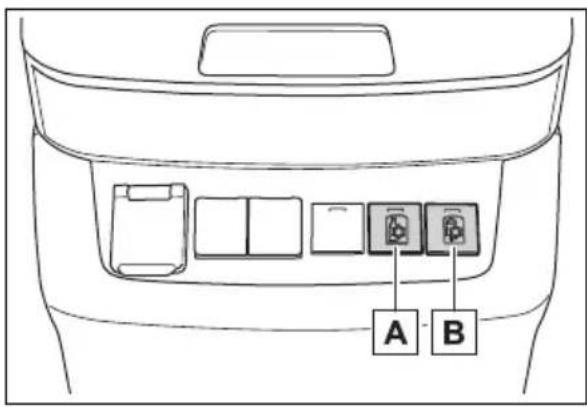
A Cooler mode switch
B Freeze mode switch
■The refrigerator can be used when
The power switch is in ON.
■Things unsuitable for the refrigerator
● Drinks in unsealed containers
●Fragile things, perishables or anything with strong odor
■To use the refrigerator effectively
- Do not keep too many things in the refrigerator.
●Cool things in advance before it is put in the refrigerator. Especially, hot things should be cooled off.
- When storing watery things, wrap them up.
● Before using the freeze mode, make sure that all items in the cooler box are suitable for freezing.
● To prevent the inside temperature from getting higher, avoid stopping the hybrid system for a long time when using the refrigerator.
■After using the refrigerator
Water droplets inside of the refrigerator may cause an odor. It is recommended to frequently wipe off water droplets.
■Cleaning the refrigerator
Clean the inside of the refrigerator using a soft cloth dampened with a diluted neutral detergent, and then make sure to dry.

WARNING
■Caution while driving
Always keep the refrigerator closed to reduce the chance of injury in case of an accident or sudden stop.

NOTICE
■To prevent battery discharge
Do not leave the refrigerator on longer than necessary when the hybrid system is not running.
Vacuum cleaner (if equipped)
■ Location of the components
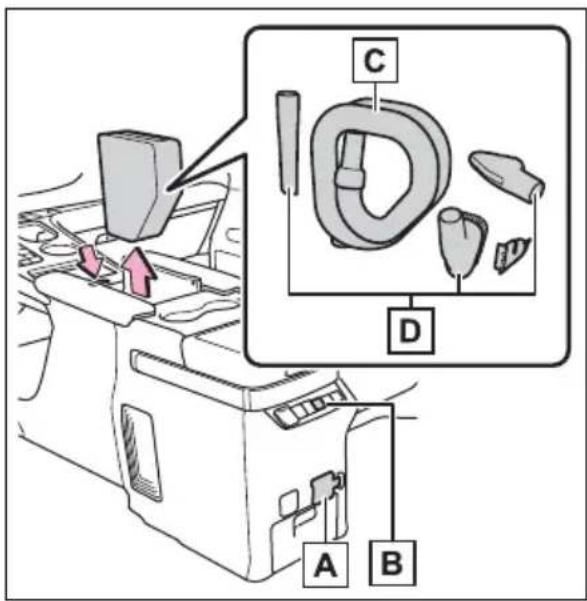
A Vacuum port
B Vacuum cleaner switch
C Hose
D Cleaning heads
■Before using the vacuum cleaner
- Stop the vehicle in a safe place.
- Set the parking brake.
- Shift the shift lever to P.
● Make sure the power switch is in ON.
● Make sure the vacuum dust bin is securely installed.
● Make sure the pre-filter and main-filter are securely installed in the dust bin.
■When using the vacuum cleaner
1 Open the lid and install the hose and cleaning head.
Make sure that the hose and cleaning head are securely installed.
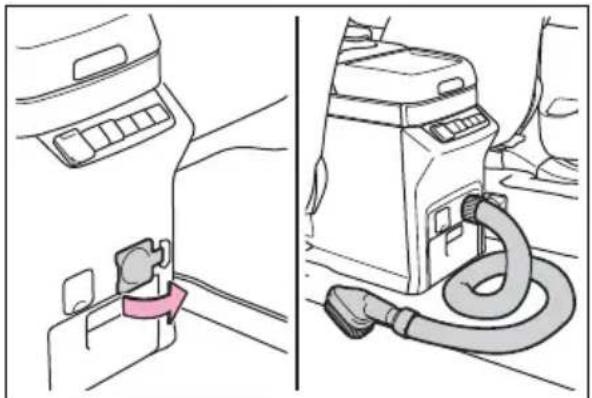
natural_image
Side-by-side line drawing showing a car interior with a hand inserting a cable to a door panel, and a washing machine connected to a hose (no text or symbols)2 Press the switch.
The vacuum cleaner can be used when the indicator on the switch is illuminated.
The vacuum cleaner is turned off/on each time the switch is pressed.
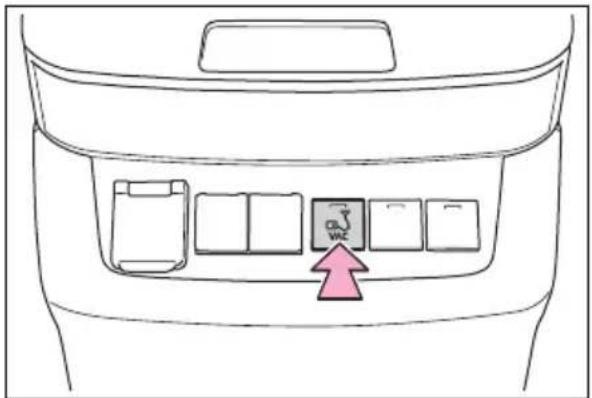
■After using the vacuum cleaner
1 Remove the hose and cleaning head and stow them.
2 Remove the access panel.
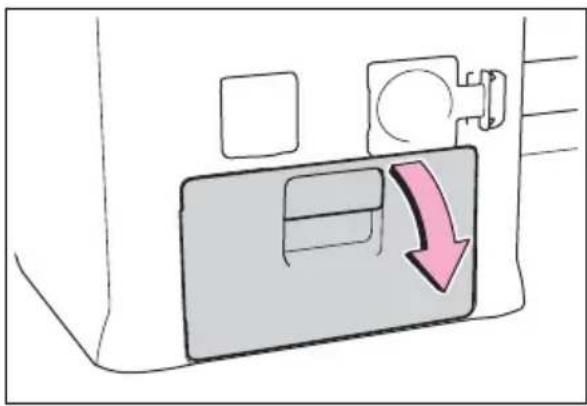
natural_image
Diagram of a door handle mechanism with a pink arrow indicating direction (no text or symbols)3 Rotate the handle counterclockwise, and lift up and pull the handle to take out the dust bin.
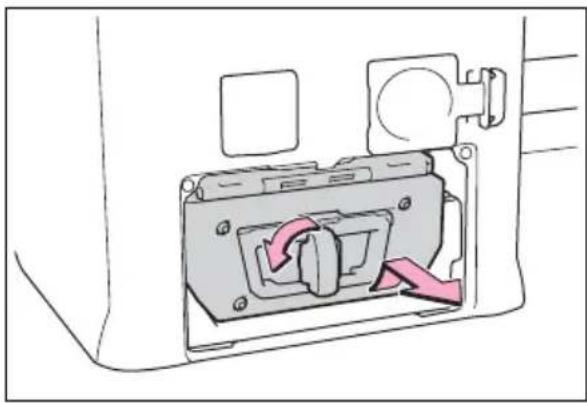
natural_image
Diagram of a device interior showing a mechanical component with a red arrow indicating rotation or movement (no text or symbols present)4 Open the lid and check the dust bin, and empty it if necessary.
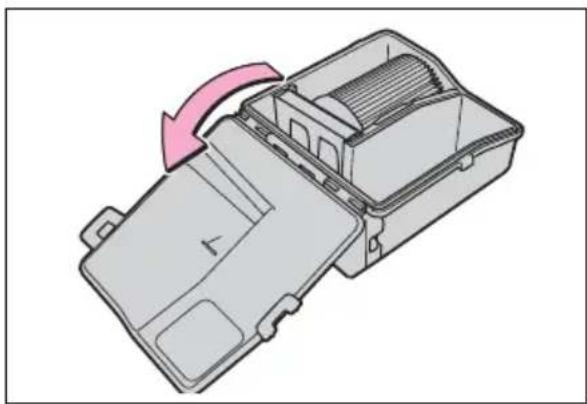
natural_image
Diagram of a mechanical device with a pink arrow indicating rotation or movement, showing internal compartments and housing (no text or symbols)5 To reinstall the dust bin, make sure that the handle is
in "up" position and put the dust bin forward.
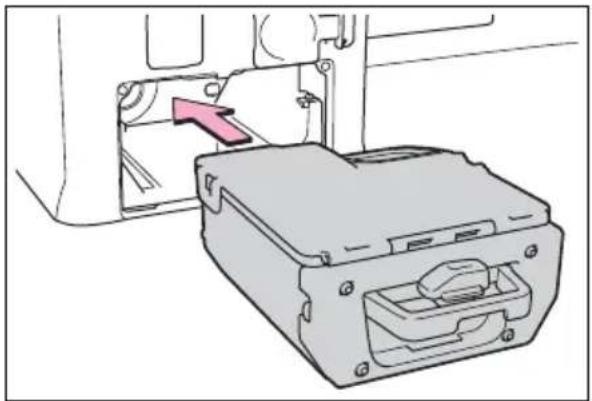
natural_image
Diagram of a printer device with a pink arrow pointing to the internal component (no text or symbols present)6 While pushing the handle down, rotate the handle clockwise to secure the dust bin.
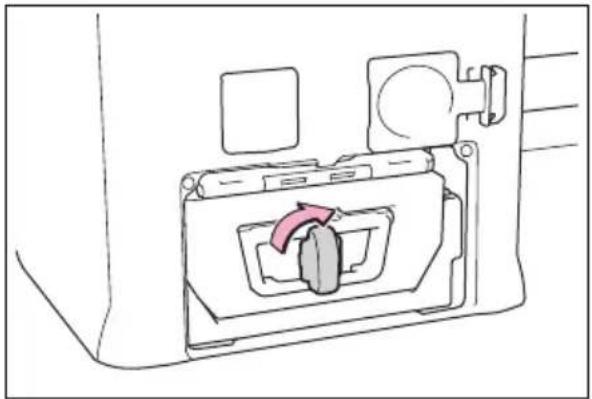
natural_image
Diagram of a device interior showing a scroll wheel and directional arrow (no text or symbols)■ Operating conditions of the vacuum cleaner
The power switch is in ON.
Vacuum filter
Toyota recommends checking or changing the filters after every 10 uses.
Replace the filters if they are clogged. New filters are available at your Toyota dealer.
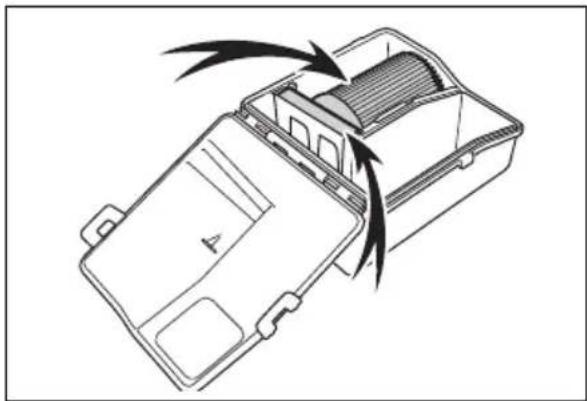
natural_image
Diagram of a mechanical device with internal components and airflow arrows (no text or symbols)If the vacuum cleaner does not operate properly
Check the following:
●The vacuum hose is securely installed
●The dust bin is securely installed
●The filters are not clogged
●The vacuum hose is not damaged
●The power switch is in ON, and the parking brake is set.
■Cleaning the vacuum cleaner
Clean the vacuum cleaner using a soft cloth dampened with diluted neutral detergent, and then make sure to dry all the parts. Take care not to wet the filter.

NOTICE
■To prevent damage to the vacuum cleaner
- Do not use the vacuum cleaner without dust bin securely installed.
- Do not use the vacuum cleaner without both pre-filter and main-filter installed in the dust bin.
- Do not vacuum liquids or other spills.
- Do not apply excessive force to the vacuum hose.
- Do not use alcohol or solvent to clean the vacuum cleaner.

NOTICE
- Do not get the pre-filter and main-filter wet, or clean the filters. If the filters get dirty, contact your Toyota dealer to have the filters changed.
■To prevent 12-volt battery discharge
Make sure to use the vacuum cleaner with the power switch in ON.
The garage door opener can be programmed using the HomeLink® to operate garage doors, gates, entry doors, door locks, home lighting systems, security systems, and other devices.
System components
The HomeLink® wireless control system in your vehicle has 3 buttons which can be programmed to operate 3 different devices. Refer to the programming methods on the following pages to determine the method which is appropriate for the device.
▶ Vehicles with auto anti-glare inside rear view mirror
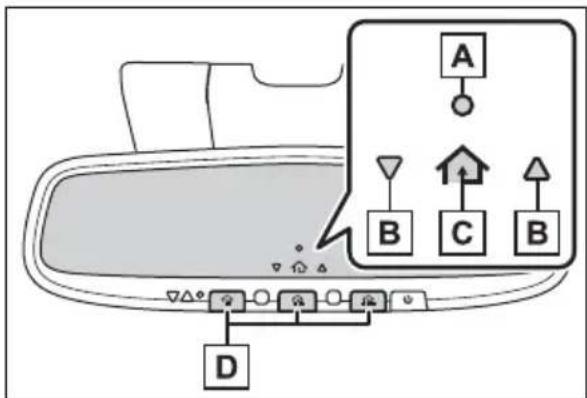
A HomeLink® indicator light
B Garage door operation indicators
C HomeLink® icon
Illuminates while HomeLink ^® is
operating.
D Buttons
▶ Vehicles with Digital Rear-view Mirror
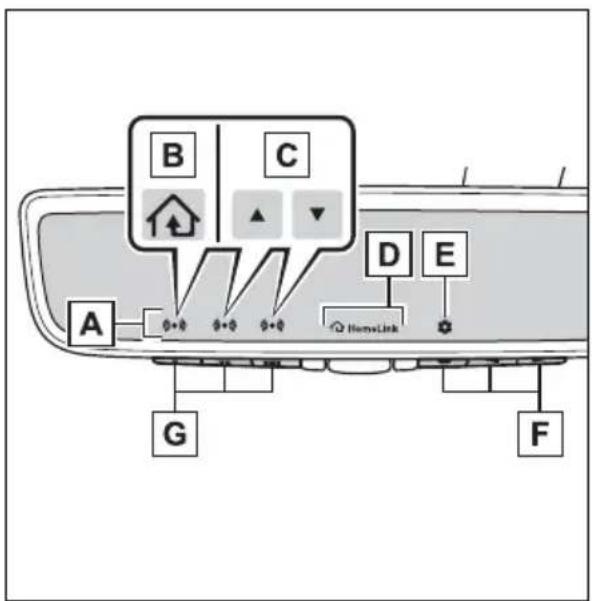
A HomeLink® indicator light illuminates above each button selected.
B HomeLink® icon
C Garage door operation indicators
D HomeLink® logo
Appears while HomeLink ^® is operating.
When the menu button ( P.189) is pressed, the logo disappears even while the HomeLink ^® is operating.
E Setting icon
Press the menu button to change the setting.
F Menu buttons
G HomeLink® buttons
■Codes stored in the HomeLink® memory
●The registered codes are not erased even if the 12-volt battery cable is disconnected.
- If learning failed when registering a different code to a HomeLink® button that already has a code registered to it, the already registered code will not be erased.
■When support is necessary
Visit on the web at www.homelink.com/toyota or call 1-800-355-3515.

WARNING
■When programming a garage door or other remote control device
The garage door or other device may operate, so ensure people and objects are out of danger to prevent potential harm.
■ Conforming to federal safety standards
Do not use the HomeLink® compatible transceiver with any garage door opener or device that lacks safety stop and reverse features as required by federal safety standards.
This includes any garage door that cannot detect an interfering object. A door or device without these features increases the risk of death or serious injury.
■When operating or programming HomeLink®
Never allow a child to operate or play with the HomeLink® buttons.
Programming HomeLink®
■Before programming HomeLink®
- During programming, it is possible that garage doors, gates, or other devices may operate. For this reason, make sure that people and objects are clear of the garage door or other devices to prevent injury or other potential harm.
- It is recommended that a new battery be placed in the remote control transmitter for successful programming.
- Garage door opener motors manufactured after 1995 may be equipped with rolling code protection. If this is the case, you may need a stepladder or other sturdy, safe device to reach the “Learn” or “Smart” button on the garage door opener motor.
■Programming HomeLink®
Steps 2 through 4 must be performed within 60 seconds, otherwise the HomeLink® indicator light will stop flashing and programming will not be successfully completed.
1 Vehicles with Digital Rear view Mirror: Press the HomeLink® button or menu button When the HomeLink®
button is pressed: Home-link® Training Tutorial will be displayed to assist you programming the HomeLink®.
When the menu button is pressed: Press the menu button and select the "SET UP". Homelink® Training Tutorial will be displayed to assist you programming the HomeLink®.
2 Press and release the HomeLink® button you want to program and check that the HomeLink® indicator light flashes (orange).
3 Point the remote control transmitter for the device at the rear view mirror, 1 to 3 in. (25 to 75 mm) from the HomeLink® buttons.
Keep the HomeLink ^® indicator light in view while programming.
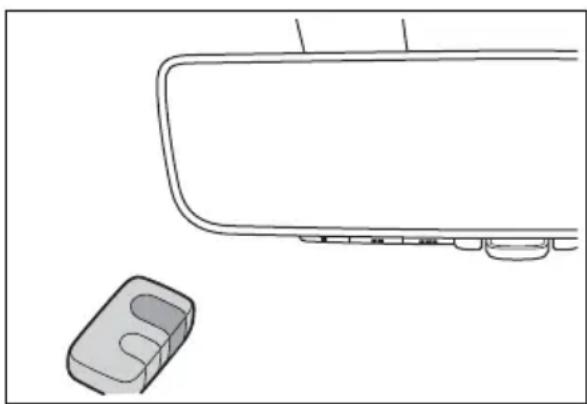
natural_image
Technical line drawing of a vehicle rearview component and a small mechanical part (no text or symbols)4 Program a device.
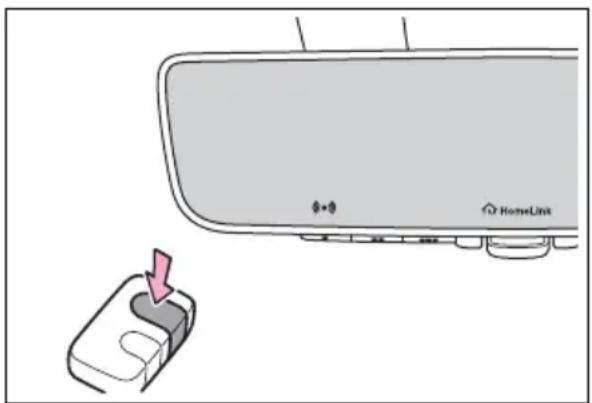
▶ Programming a device other than an entry gate (for U.S.A. owners)
Press and hold the remote control transmitter button until the HomeLink® indicator light changes from slowly flashing orange to rapidly flashing green (rolling code) or continuously lit green (fixed code), then release the button.
▶ Programming an entry gate (for U.S.A. owners)/Programming a device in the Canadian market
Press and release the remote control transmitter button at 2 second intervals, repeatedly, until the HomeLink® indicator light changes from slowly flashing orange to rapidly flashing (green) (rolling code) or continuously lit (green) (fixed code).
5 Test the HomeLink ^® operation by pressing the newly programmed button and observing the HomeLink ^® indicator light:
- HomeLink® indicator light illuminates: Programming of a fixed code device has completed. The garage door or other device should operate when a HomeLink® button is pressed and released.
- HomeLink® indicator light flashes rapidly: The garage door opener or other device is equipped with a rolling code. To complete programming, firmly press and hold the HomeLink® button for 2 seconds then release it.
- If the garage door or other device does not operate, proceed to "Programming a rolling code system".
6 Repeat the steps above to program another device for any of the remaining HomeLink® buttons.
■Programming a rolling code system
Two or more people may be needed to complete rolling code programming.
1 Locate the "Learn" or "Smart" button on the garage door opener motor in the garage.
This button can usually be found where the hanging antenna wire is attached to the unit. The name and color of the button may vary by manufacturer. Refer to the owner's manual supplied with the garage
door opener motor for details.
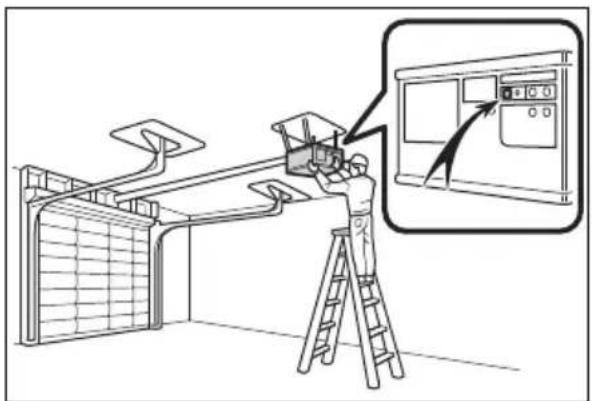
2 Press and release the "Learn" or "Smart" button.
Perform 3 within 30 seconds after performing 2.
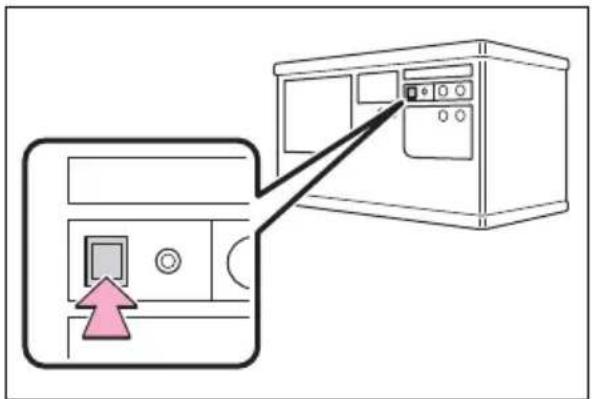
3 Press and hold the desired HomeLink® button (inside the vehicle) for 2 seconds and release it. Repeat this sequence (press/hold/release) up to 3 times to complete programming. If the garage door opener motor operates when the HomeLink® button is pressed, the garage door opener motor recognizes the HomeLink® signal.
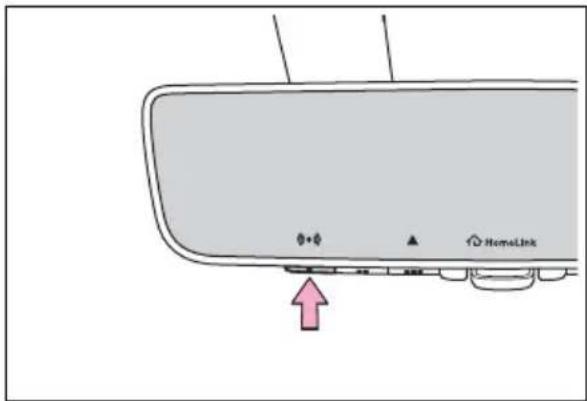
■Enabling 2-way communication with a garage door (only available for compatible devices)
When enabled, 2-way communication allows you to check the status of the opening and closing of a garage door through indicators in your vehicle.
2-way communication is only available if the garage door opener motor used is a compatible device. (To check device compatibility, refer to www.homelink.com.)
1 Within 5 seconds after programming the garage door opener has been completed, if the garage door opener motor is trained to HomeLink® , both garage door operation indicators will flash rapidly (green) and the light on the garage door opener motor will blink twice, indicating that 2-way communication is enabled.
If the indicators do not flash, perform 2 and 3 within the first 10 presses of the HomeLink® button after programming has been com-
pleted.
2 Press a programmed HomeLink® button to operate a garage door.
3 Within 1 minute of pressing the HomeLink® button, after the garage door operation has stopped, press the "Learn" or "Smart" button on the garage door opener motor. Within 5 seconds of the establishment of 2-way communication with the garage door opener, both garage door operation indicators in the vehicle will flash rapidly (green) and the light on the garage door opener motor will blink twice, indicating that 2-way communication is enabled.
■Reprogramming a single HomeLink® button
When the following procedure is performed, buttons which already have devices registered to them can be overwritten:
1 Press and hold the desired HomeLink® button.
2 When the HomeLink ^® indicator starts flashing orange, release the HomeLink ^® button and perform “Programming HomeLink ^® ” 1 (it takes 20 seconds for the HomeLink ^® indicator to start flashing).
■Before programming
●Install a new battery in the transmitter.
- The battery side of the transmitter must be pointed away from the HomeLink® buttons.
Operating HomeLink®
Press the appropriate
HomeLink® button. The
HomeLink ^® indicator light should turn on.
The status of the opening and closing of a garage door is shown by the garage door operation indicators.
▶ Vehicles with auto anti-glare inside rear view mirror
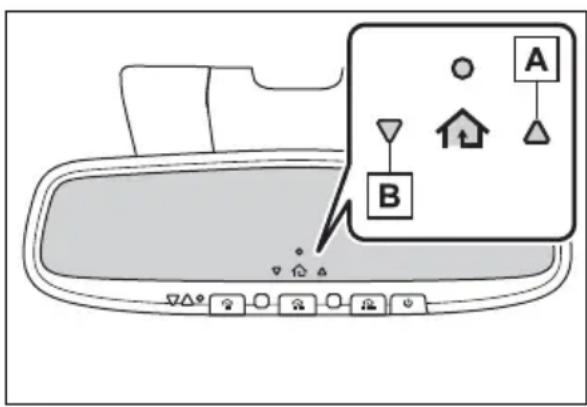
A Opening
B Closing
▶ Vehicles with Digital Rearview Mirror
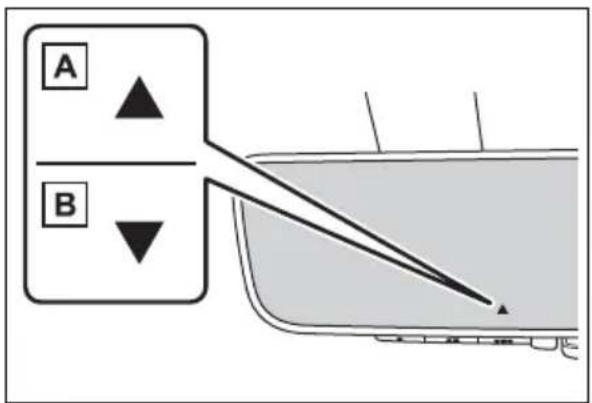
A Opening
B Closing
This function is only available if the garage door opener motor used is a compatible device. (To check device compatibility, refer to www.homelink.com.)
| Color Status | |
| Orange (flash-ing) | Currently open-ing/closing |
| Green | Opening/closing has completed |
| Red (flashing) | Feedback sig-nals cannot be received |
The indicators can operate within approximately 820 ft. (250 m) of the garage door. However, if there are obstructions between the garage door and the vehicle, such as houses and trees, feedback signals from the garage door may not be received.
To recall the previous door operation status, press and release either HomeLink® buttons
and or and (vehicles with auto anti-glare inside rear view mirror), and or and (vehicles with Digital Rear-view Mirror) simultaneously. The last recorded status will be displayed for 3 seconds.
Erasing the entire HomeLink® memory (all three codes)
Press and hold the 2 outside buttons for 10 seconds until the HomeLink® indicator light changes from continuously lit (orange) to rapidly flashing (green).
If you sell your vehicle, be sure to erase the programs stored in the HomeLink® memory.
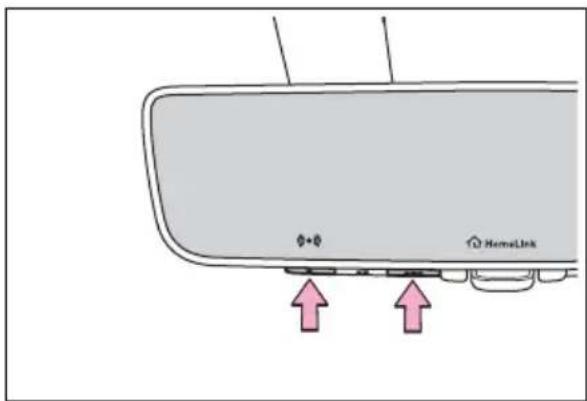
6-1. Maintenance and care
Cleaning and protecting the vehicle exterior...... 400
Cleaning and protecting the vehicle interior...... 403
6-2. Maintenance
Maintenance requirements 406
General maintenance.. 407
Emission inspection and maintenance (I/M) programs 410
6-3. Do-it-yourself maintenance
Do-it-yourself service precautions.... 411
Hood 413
Positioning a floor jack 415
Engine compartment... 416
12-volt battery 422
Tires 424
Tire inflation pressure . 438
Wheels 440
Air conditioning filter.... 441
Cleaning the hybrid battery (traction battery) air intake vents and filters...... 443
Electronic key battery.. 447
Checking and replacing fuses.... 449
Light bulbs.... 451
Cleaning and protecting the vehicle exterior
Perform the following to protect the vehicle and maintain it in prime condition:
Cleaning instructions
- Working from top to bottom, liberally apply water to the vehicle body, wheel wells and underside of the vehicle to remove any dirt and dust.
- Wash the vehicle body using a sponge or soft cloth, such as a chamois.
- For hard-to-remove marks, use car wash soap and rinse thoroughly with water.
- Wipe away any water.
- Wax the vehicle when the waterproof coating deteriorates.
If water does not bead on a clean surface, apply wax when the vehicle body is cool.
Automatic car washes
●Before washing the vehicle:
- Fold the mirrors
- Disable the power sliding door system
- Disable the power back door system (if equipped)
Start washing from the front of the vehicle. Make sure to extend the mirrors before driving.
- Brushes used in automatic car washes may scratch the vehicle surface, parts (wheel, etc.) and harm your vehicle's paint.
●Rear spoiler may not be washable in some automatic car washes. There may also be an increased risk of damage to vehicle.
■High pressure car washes
As water may enter the cabin, do not bring the nozzle tip near the gaps around the doors or perimeter of the windows, or spray these areas continuously.
■Note for a smart key system
If the door handle becomes wet while the electronic key is within the effective range, the door may lock and unlock repeatedly. In that case, follow the following correction procedures to wash the vehicle:
- Place the key in a position 6 ft. (2 m) or more separate from the vehicle while the vehicle is being washed. (Take care to ensure that the key is not stolen.)
- Set the electronic key to battery-saving mode to disable the smart key system. (→P.165)
- If the electronic key is inside the vehicle and a door handle becomes wet during a car wash, a buzzer may sound outside the vehicle and "Key Detected in Vehicle" may be shown on the multi-information display. To turn off the alarm, lock all the doors.
Wheels and wheel ornaments
- Remove any dirt immediately by using a neutral detergent.
●Wash detergent off with water immediately after use.
●To protect the paint from damage, make sure to observe the following precautions. - Do not use acidic, alkaline or abrasive detergent
- Do not use hard brushes
- Do not use detergent on the
wheels when they are hot, such as after driving or parking in hot weather
Bumpers
Do not scrub with abrasive cleaners.
Plated portions
If dirt cannot be removed, clean the parts as follows:
● Use a soft cloth dampened with an approximately 5% solution of neutral detergent and water to clean the dirt off.
● Wipe the surface with a dry, soft cloth to remove any remaining moisture.
●To remove oily deposits, use alcohol wet wipes or a similar product.

WARNING
■When washing the vehicle
Do not apply water to the inside of the engine compartment. Doing so may cause the electrical components, etc. to catch fire.
■When cleaning the windshield (vehicles with rain-sensing windshield wipers)
Set the wiper switch to off. If the wiper switch is in "AUTO", the wipers may operate unexpectedly in the following situations, and may result in hands being caught or other serious injuries and cause damage to the wiper blades.
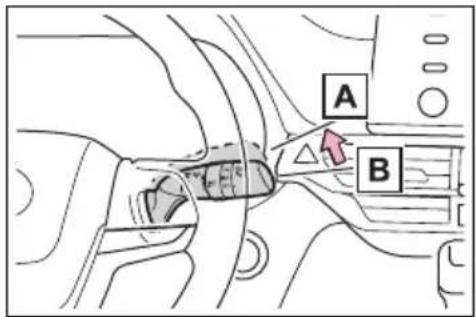
A Off
B AUTO
- When the upper part of the windshield where the raindrop sensor is located is touched by hand
- When a wet rag or similar is held close to the raindrop sensor
- If something bumps against the windshield
- If you directly touch the raindrop sensor body or if something bumps into the raindrop sensor
■Precautions regarding the exhaust pipes
Exhaust gasses cause the exhaust pipes to become quite hot.
When washing the vehicle, be careful not to touch the pipes until they have cooled sufficiently, as touching hot exhaust pipes can cause burns.

WARNING
■Precaution regarding the rear bumper with Blind Spot Monitor (if equipped)
If the paint of the rear bumper is chipped or scratched, the system may malfunction. If this occurs, consult your Toyota dealer.

NOTICE
■To prevent paint deterioration and corrosion on the body and components (aluminum wheels, etc.)
●Wash the vehicle immediately in the following cases:
• After driving near the sea coast
• After driving on salted roads
- If coal tar or tree sap is present on the paint surface
- If dead insects, insect droppings or bird droppings are present on the paint surface
• After driving in an area contaminated with soot, oily smoke, mine dust, iron powder or chemical substances
- If the vehicle becomes heavily soiled with dust or mud
- If liquids such as benzene and gasoline are spilled on the paint surface
- If the paint is chipped or scratched, have it repaired immediately.
● To prevent the wheels from corroding, remove any dirt and store in a place with low humidity when storing the wheels.
■Cleaning the exterior lights
●Wash carefully. Do not use organic substances or scrub with a hard brush.
This may damage the surfaces of the lights.
- Do not apply wax to the surfaces of the lights.
- Wax may cause damage to the lenses.
■When using an automatic car wash (vehicles with rain-sensing windshield wipers)
Set the wiper switch to off position.
If the wiper switch is in "AUTO", the wipers may operate and the wiper blades may be damaged.
■When using a high pressure car wash
- When washing the vehicle, do not let water from the high-pressure washer directly hit the camera or the area around the camera. Due to the shock from the high pressure water, it is possible that the device may not operate normally.
-
Do not bring the nozzle tip close to boots (rubber or resin manufactured cover), or connectors or the following parts. The parts may be damaged if they come into contact with high-pressure water.
-
Traction related parts
- Steering parts
- Suspension parts
- Brake parts

NOTICE
- Keep the cleaning nozzle at least 11.9 in. (30 cm) away from the vehicle body. Otherwise resin section, such as moldings and bumpers, may be deformed and damaged. Also, do not continuously hold the nozzle in the same place.
- Do not spray the lower part of the windshield continuously. If water enters the air conditioning system intake located near the lower part of the windshield, the air conditioning system may not operate correctly.
- Do not wash the underside of the vehicle using a high pressure car washer.
Cleaning and protecting the vehicle interior
Perform cleaning in a man- ner appropriate to each component and its material.
Protecting the vehicle interior
- Remove dirt and dust using a vacuum cleaner. Wipe dirty surfaces with a cloth dampened with lukewarm water.
- If dirt cannot be removed, wipe it off with a soft cloth dampened with neutral detergent diluted to approximately 1%.
Wring out any excess water from the cloth and thoroughly wipe off remaining traces of detergent and water.
■Shampooing the carpets
There are several commercial foaming-type cleaners available. Use a sponge or brush to apply the foam. Rub in overlapping circles. Do not use water. Wipe dirty surfaces and let them dry. Excellent results are obtained by keeping the carpet as dry as possible.
■Handling the seat belts
Clean with mild soap and lukewarm water using a cloth or sponge. Also check the belts periodically for excessive wear, fraying or cuts.

WARNING
Water in the vehicle
- Do not splash or spill liquid in the vehicle, such as on the floor, on the front seats, in the hybrid battery (traction battery) air intake vent or in the luggage compartment. ( P.85) Doing so may cause the hybrid battery, electrical components, etc. to malfunction or catch fire.
- Do not get any of the SRS components or wiring in the vehicle interior wet. (→P.42) An electrical malfunction may cause the airbags to deploy or not function properly, resulting in death or serious injury.
● Vehicles with wireless charger: Do not let the wireless charger ( P.381) get wet. Failure to do so may cause the charger to become hot and cause burns or could cause electric shock resulting in death or serious injury.
■Cleaning the interior (especially instrument panel)
Do not use a polish wax or polish cleaner. The instrument panel may reflect off the windshield, obstructing the driver's view and leading to an accident, resulting in death or serious injury.

NOTICE
■Cleaning detergents
- Do not use the following types of detergent, as they may discolor the vehicle interior or cause streaks or damage to painted surfaces:
• Non-seat portions: Organic substances such as benzene or gasoline, alkaline or acidic solutions, dye, and bleach - Seats: Alkaline or acidic solutions, such as thinner, benzene, and alcohol
- Do not use a polish wax or polish cleaner. The instrument panel's or other interior part's painted surface may be damaged.
Water on the floor
Do not wash the vehicle floor with water.
Vehicle systems such as the audio system may be damaged if water comes into contact with electrical components such as the audio system above or under the floor of the vehicle. Water may also cause the body to rust.
■When cleaning the inside of the windshield
Do not allow glass cleaner to contact the lens. Also, do not touch the lens. ( P.262)
■Cleaning the inside of the rear window
- Do not use a glass cleaner to clean the rear window, as this may cause damage to the rear window defogger heater wires. Use a cloth dampened with lukewarm water to gently wipe the window clean. Wipe the window in strokes running parallel to the heater wires.

NOTICE
● Be careful not to scratch or damage the heater wires.
Cleaning the areas with satin-finish metal accents (if equipped)
- Remove dirt using a water-dampened soft cloth or synthetic chamois.
- Wipe the surface with a dry soft cloth to remove any remaining moisture.
■Cleaning the areas with satin-finish metal accents
The metal areas use a layer of real metal for the surface. It is necessary to clean them regularly. If dirty areas are left uncleaned for long periods of time, they may be difficult to clean.
Cleaning the leather areas
- Remove dirt and dust using a vacuum cleaner.
- Wipe off any excess dirt and dust with a soft cloth dampened with diluted detergent.
Use a diluted water solution of approximately 5% neutral wool detergent.
- Wring out any excess water from the cloth and thoroughly wipe off all remaining traces of detergent.
● Wipe the surface with a dry, soft cloth to remove any
remaining moisture. Allow the leather to dry in a shaded and ventilated area.
■Caring for leather areas
Toyota recommends cleaning the interior of the vehicle at least twice a year to maintain the quality of the vehicle's interior.

NOTICE
■Preventing damage to leather surfaces
Observe the following precautions to avoid damage to and deterioration of leather surfaces:
- Remove any dust or dirt from leather surfaces immediately.
- Do not expose the vehicle to direct sunlight for extended periods of time. Park the vehicle in the shade, especially during summer.
- Do not place items made of vinyl, plastic, or containing wax on the upholstery, as they may stick to the leather surface if the vehicle interior heats up significantly.
Cleaning the synthetic leather areas
- Remove dirt and dust using a vacuum cleaner.
- Wipe it off with a soft cloth dampened with neutral detergent diluted to approximately 1%.
- Wring out any excess water from the cloth and thoroughly wipe off remaining traces of detergent and water.
Maintenance requirements
To ensure safe and economical driving, day-to-day care and regular maintenance are essential. It is the owner's responsibility to perform regular checks. Toyota recommends the following maintenance:
Repair and replacement
It is recommended that genuine Toyota parts be used for repairs to ensure performance of each system. If non-Toyota parts are used in replacement or if a repair shop other than a Toyota dealer performs repairs, confirm the warranty coverage.
■Allow inspection and repairs to be performed by a Toyota dealer
●Toyota technicians are well-trained specialists and are kept up to date with the latest service information. They are well informed about the operations of all systems on your vehicle.
- Keep a copy of the repair order. It proves that the maintenance that has been performed is under warranty coverage. If any problem should arise while your vehicle is under warranty, your Toyota dealer will promptly take care of it.

WARNING
■If your vehicle is not properly maintained
Improper maintenance could result in serious damage to the vehicle and possible death or serious injury.
■Handling of the 12-volt battery
●Engine exhaust, some of its constituents, and a wide variety of automobile components contain or emit chemicals known to the State of California to cause cancer and birth defects and other reproductive harm. Work in a well ventilated area.
● Oils, fuels and fluids contained in vehicles as well as waste produced by component wear contain or emit chemicals known to the State of California to cause cancer and birth defects or other reproductive harm. Avoid exposure and wash any affected area immediately.
●12-volt battery posts, terminals and related accessories contain lead and lead compounds which are known to cause brain damage. Wash your hands after handling. (→P.422)
General maintenance
General maintenance should be performed on a daily basis. This can be done by yourself or by a Toyota dealer.
Scheduled maintenance
Scheduled maintenance should be performed at specified intervals according to the maintenance schedule.
For details about maintenance items and schedules, refer to the "Scheduled Maintenance Guide" or "Owner's Manual Supplement".
Do-it-yourself maintenance
You can perform some maintenance procedures by yourself. Please be aware that do-it-your-self maintenance may affect warranty coverage.
The use of Toyota Repair Manuals is recommended.
For details about warranty coverage, refer to the separate "Owner's Warranty Information Booklet" or "Owner's Manual Supplement".
General maintenance
Listed below are the general maintenance items that should be performed at the intervals specified in the "Owner's Warranty Information Booklet" or "Owner's Manual Supplement/Scheduled Maintenance Guide". It is recommended that any problem you notice should be brought to the attention of your Toyota dealer or qualified service shop for advice.

WARNING
■If the hybrid system is running
Turn the hybrid system off and ensure that there is adequate ventilation before performing maintenance checks.
Engine compartment
| Items Check points | |
| Brake fluid | Is the brake fluid at the correct level? (→P.420) |
| Engine/power control unit coolant | Is the engine/power con-trol unit coolant at the correct level? (→P.419) |
| Engine oil | Is the engine oil at the correct level? (→P.416) |
| Exhaust system | There should not be any fumes or strange sounds. |
| Radiator/condenser | The radiator and condenser should be free from foreign objects.(→P.420) |
| Washer fluid | Is there sufficient washer fluid?(→P.421) |
Luggage compartment
| Items Check points | |
| 12-volt battery | Check the connec-tions. (→P.422) |
Vehicle interior
| Items Check points | |
| Accelerator pedal | The accelerator pedal should move smoothly (without uneven pedal effort or catching). |
| Hybrid transmission “Park” mechanism | When parked on a slope and the shift lever is in P, is the vehicle securely stopped? |
| Items Check points | |
| Brake pedal | ·Does the brake pedal move smoothly?·Does the brake pedal have appropriate clearance from the floor? (→P.524)·Does the brake pedal have the correct amount of free play? (→P.524) |
| Brakes | ·The vehicle should not pull to one side when the brakes are applied.·The brakes should work effectively.·The brake pedal should not feel spongy.·The brake pedal should not get too close to the floor when the brakes are applied. |
| Head restraints | ·Do the head restraints move smoothly and lock securely? |
| Indicators/buzzers | ·Do the indicators and buzzers function properly? |
| Lights | ·Do all the lights come on? |
| Parking brake | Does the parking brake operate normally?When parked on a slope and the parking brake is on, is the vehicle securely stopped? |
| Seat belts | Do the seat belts operate smoothly?The seat belts should not be damaged. |
| Seats | Do the seat controls operate properly? |
| Steering wheel | Does the steering wheel rotate smoothly?Does the steering wheel have the correct amount of free play?There should not be any strange sounds coming from the steering wheel. |
Vehicle exterior
| Items Check points | |
| Doors | · Do the doors operate smoothly? |
| Engine hood | · Does the engine hood lock system work properly? |
| Fluid leaks | · There should not be any signs of fluid leakage after the vehicle has been parked. |
| Tires | · Is the tire inflation pressure correct? · The tires should not be damaged or excessively worn. · Have the tires been rotated according to the maintenance schedule? · The wheel nuts should not be loose. |
| Windshield wipers/rear window wiper | · The wiper blades should not show any signs of cracking, splitting, wear, contamination or deformation. · The wiper blades should clear the windshield/rear window without streaking or skipping. |
Emission inspection and maintenance (I/M) programs
Some states have vehicle emission inspection programs which include OBD (On Board Diagnostics) checks. The OBD system monitors the operation of the emission control system.
If the malfunction indicator lamp comes on
The OBD system determines that a problem exists somewhere in the emission control system. Your vehicle may not pass the I/M test and may need to be repaired. Contact your Toyota dealer to service the vehicle.
Your vehicle may not pass the I/M test in the following situations:
- When the 12-volt battery is disconnected or discharged Readiness codes that are set during ordinary driving are erased.
Also, depending on your driving habits, the readiness codes may not be completely set.
- When the fuel tank cap is
loose
The malfunction indicator lamp comes on indicating a temporary malfunction and your vehicle may not pass the I/M test.
When the malfunction indicator lamp still remains on after several driving trips
The error code in the OBD system will not be cleared unless the vehicle is driven 40 or more times.
If your vehicle does not pass the I/M test
Contact your Toyota dealer to prepare the vehicle for re-testing.
Do-it-yourself service precautions
If you perform maintenance by yourself, be sure to follow the correct procedure as given in these sections.
Maintenance
| Items Parts and tools | |
| 12-volt battery condition(→P.422) | GreaseConventional wrench (for terminal clamp bolts) |
| Brake fluid level(→P.420) | FMVSS No.116DOT 3 or SAEJ1703 brake fluidFMVSS No.116DOT 4 or SAEJ1704 brake fluidRag or papertowelFunnel (used only for adding brake fluid) |
| Items Parts and tools | |
| Engine/power control unit coolant level (→P.419) | • “Toyota Super Long Life Cool-ant” or a similar high quality ethylene glycol-based non-silicate, non-amine, non-nitrite and non-borate coolant with long-life hybrid organic acid technology For the U.S.A.: “Toyota Super Long Life Cool-ant” is pre-mixed with 50% coolant and 50% deion-ized water. For Canada: “Toyota Super Long Life Cool-ant” is pre-mixed with 55% coolant and 45% deion-ized water.• Funnel (used only for adding coolant) |
| Engine oil level (→P.416) | • “Toyota Genuine Motor Oil” or equivalent• Rag or paper towel• Funnel (used only for adding engine oil) |
| Fuses (→P.449) | • Fuse with same amperage rating as original |
| Items | Parts and tools |
| Hybrid battery (traction battery) air intake vent (→P.443) | Vacuum cleaner, etc,Phillips screw-driver |
| Light bulbs (→P.451) | Bulb with same number and watt-age rating as originalPhillips-head screwdriverFlathead screw-driverWrench |
| Radiator and condenser (→P.420) | — |
| Tire inflation pressure (→P.438) | Tire pressure gaugeCompressed air source |
| Washer fluid (→P.421) | Water or washer fluid containing antifreeze (for winter use)Funnel (used only for adding water or washer fluid) |

WARNING
The engine compartment contains many mechanisms and fluids that may move suddenly, become hot, or become electrically energized. To avoid death or serious injury, observe the following precautions.
■ When working on the engine compartment
Make sure that "IGNITION ON" on the multi-information display and the "READY" indicator are both off.
- Keep hands, clothing and tools away from the moving fan.
- Be careful not to touch the engine, power control unit, radiator, exhaust manifold, etc. right after driving as they may be hot. Oil and other fluids may also be hot.
- Do not leave anything that may burn easily, such as paper and rags, in the engine compartment.
- Do not smoke, cause sparks or expose an open flame to fuel or the battery. Fuel and battery fumes are flammable.
● Be extremely cautious when working on the battery. It contains poisonous and corrosive sulfuric acid.
■When working near the electric cooling fan or radiator grille
Be sure the power switch is OFF. With the power switch in ON, the electric cooling fan may automatically start to run if the air conditioning is on and/or the coolant temperature is high. (→P.420)
Safety glasses
Wear safety glasses to prevent flying or falling material, fluid spray, etc., from getting in your eyes.

NOTICE
■If you remove the air cleaner filter
Driving with the air cleaner filter removed may cause excessive engine wear due to dirt in the air.
Hood
Release the lock from the inside of the vehicle to open the hood.
Opening the hood
1 Pull the hood lock release lever.
The hood will pop up slightly.
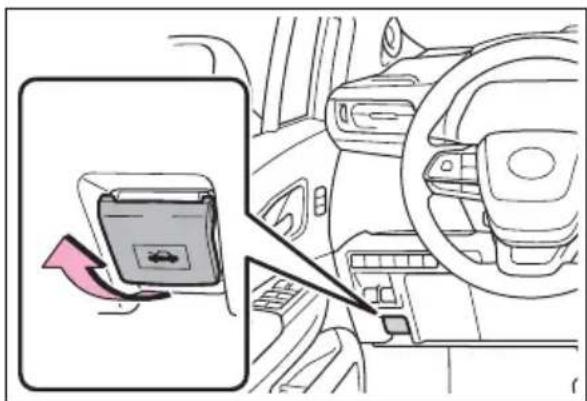
2 Push the auxiliary catch lever to the left and lift the hood.
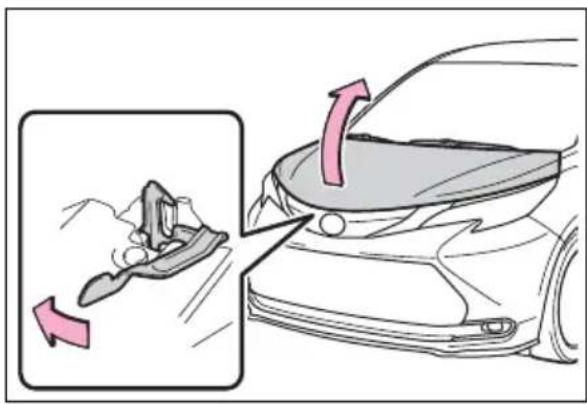
natural_image
Illustration of a car interior showing a hand turning a snowboard and a car wheel, with no text or symbols present.3 Hold the hood open by inserting the supporting rod into the slot.
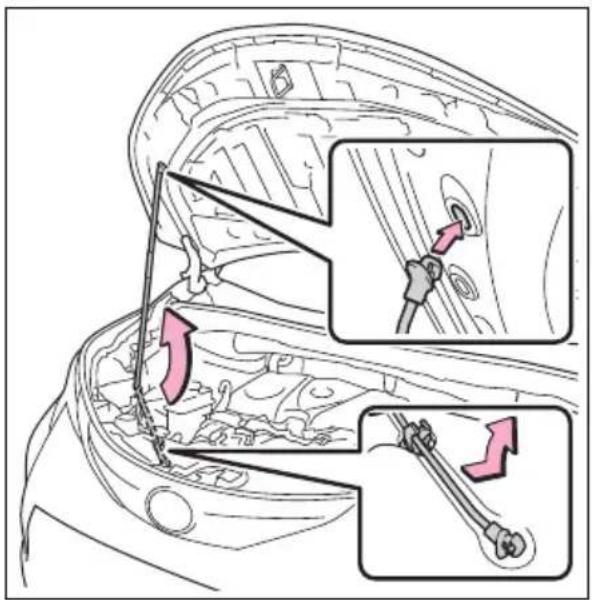

WARNING
■Pre-driving check
Check that the hood is fully closed and locked.
If the hood is not locked properly, it may open while the vehicle is in motion and cause an accident, which may result in death or serious injury.
■After installing the support rod into the slot
Make sure the rod supports the hood securely from falling down on to your head or body.
■When closing the hood
When closing the hood, take extra care to prevent your fingers etc. from being caught.
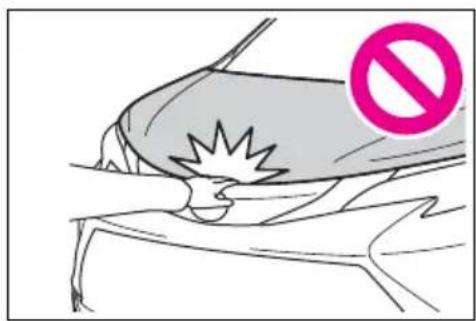
natural_image
Illustration of a person wearing a mask with a pink prohibition symbol (no text or labels)
NOTICE
■When closing the hood
Be sure to return the support rod to its clip before closing the hood. Closing the hood without returning the support rod properly could cause the hood to bend.
Positioning a floor jack
When using a floor jack, follow the instructions in the manual provided with the jack and perform the operation safely.
When raising your vehicle with a floor jack, position the jack correctly. Improper placement may damage your vehicle or cause injury.
Location of the jack point
Front
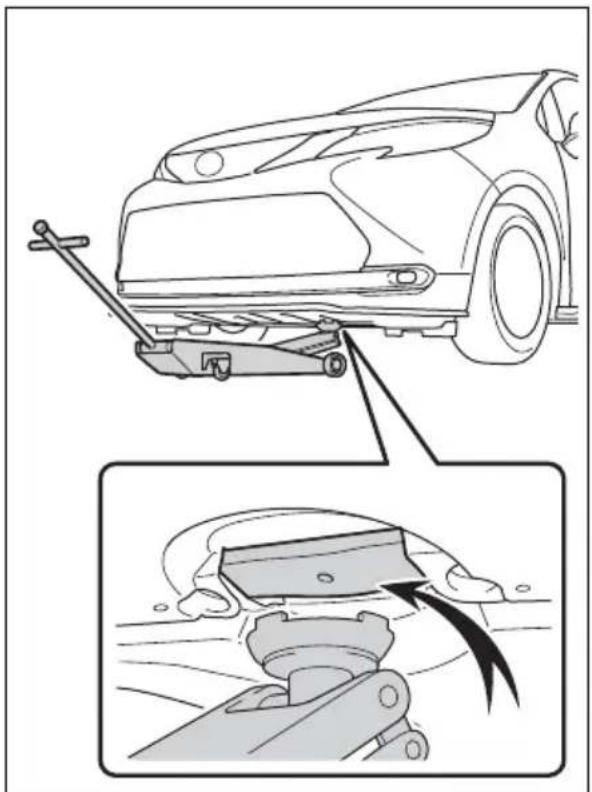
Rear
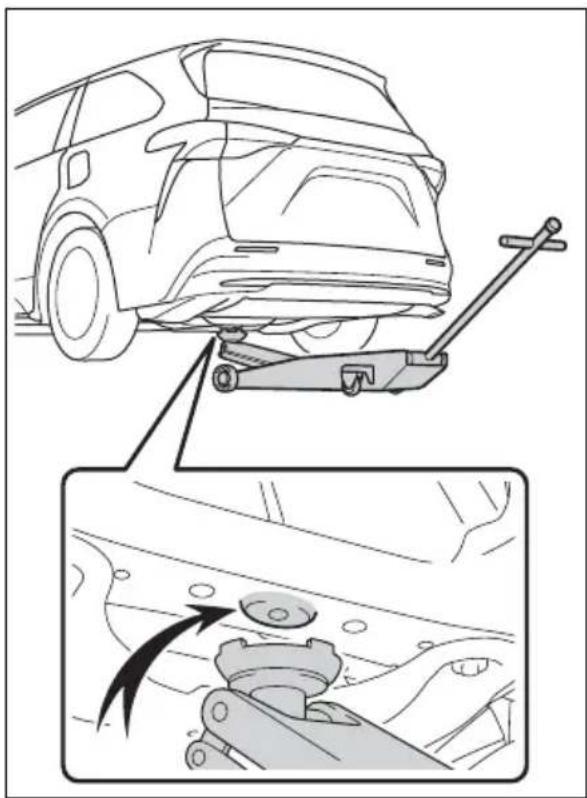
Engine compartment
Components
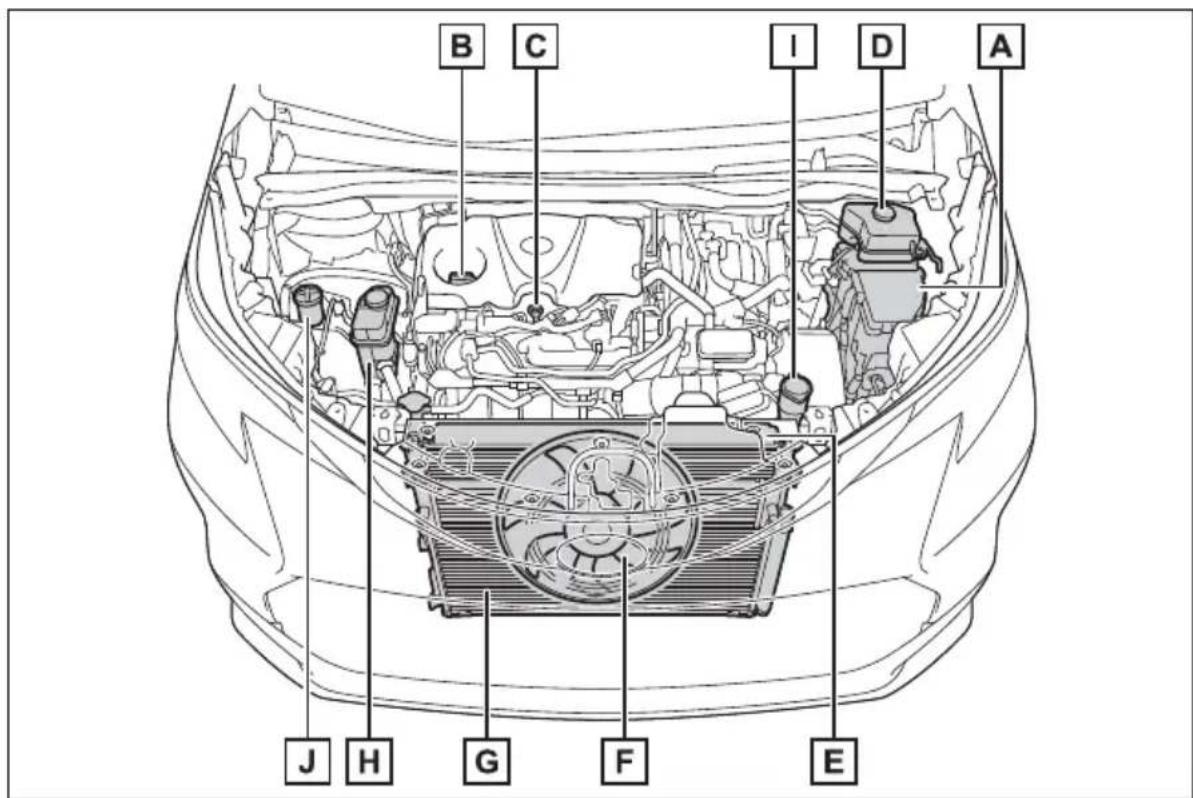
A Fuse box ( P.449)
B Engine oil filler cap ( P.417)
C Engine oil level dipstick ( P.416)
D Brake fluid reservoir ( P.420)
E Radiator ( P.420)
F Electric cooling fan
G Condenser ( P.420)
H Power control unit coolant reservoir ( P.419)
I Washer fluid tank ( P.421)
J Engine coolant reservoir ( P.419)
■12-volt battery
→P.422
Checking and adding the engine oil
With the engine at operating temperature and turned off,
check the oil level on the dipstick.
■ Checking the engine oil
1 Park the vehicle on level ground. After warming up the engine and turning off the engine, wait more than 5 minutes for the oil to drain back into the bottom of the engine.
2 Holding a rag under the end, pull the dipstick out.
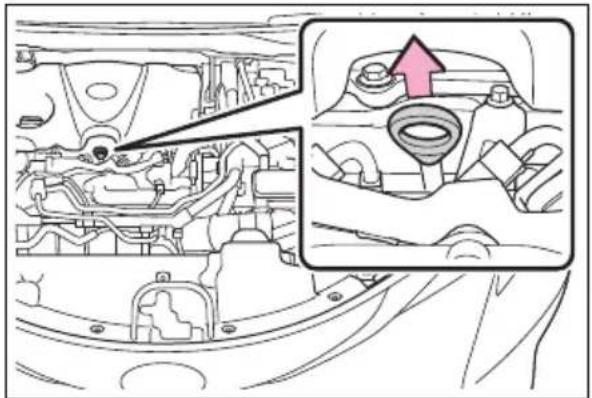
natural_image
Technical line drawing of a car engine bay with an inset showing a mechanical component (no text or symbols)3 Wipe the dipstick clean.
4 Reinsert the dipstick fully.
5 Holding a rag under the end, pull the dipstick out and check the oil level.
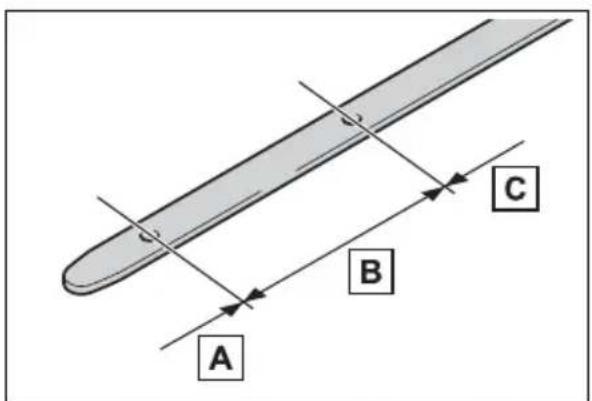
A Low
B Normal
C Excessive
The shape of the dipstick may differ depending on the type of vehicle or engine.
6 Wipe the dipstick and reinsert it fully.
■ Checking the oil type and preparing the items needed
Make sure to check the oil type and prepare the items needed before adding oil.
- Engine oil selection
$$ \rightarrow \mathrm{P}. 5 2 1 $$
- Oil quantity (Low → Full)
1.6 qt. (1.5 L, 1.3 Imp. qt.)
- Item
Clean funnel
■Adding engine oil
If the oil level is below or near the low level mark, add engine oil of the same type as that already in the engine.
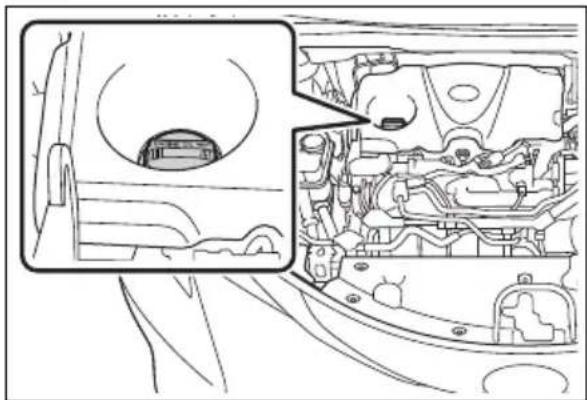
natural_image
Technical line drawing of a car engine compartment showing internal components and structural details (no text or labels)1 Remove the oil filler cap by turning it counterclockwise.
2 Add engine oil slowly, checking the dipstick.
3 Install the oil filler cap by turning it clockwise.
■Engine oil consumption
A certain amount of engine oil will be consumed while driving. In the following situations, oil consumption may increase, and engine oil may need to be refilled in between oil maintenance intervals.
- When the engine is new, for example directly after purchasing the vehicle or after replacing the engine
- If low quality oil or oil of an inappropriate viscosity is used
- When driving at high engine speeds or with a heavy load, when towing, or when driving while accelerating or decelerating frequently
- When leaving the engine idling for a long time, or when driving frequently through heavy traffic
■After changing the engine oil
The engine oil maintenance data should be reset. Perform the following procedures:
4.2-inch display
1 Press or of the meter control switches to select on the multi-information display.
2 Press or of the meter control switches, select "Vehicle Settings" and then press and hold "OK".
7-inch display
1 Press on of the meter control switches to select 📄 on the multi-information display.
2 Press or of the meter control switches, select and then press and hold "OK".
3 Press or of the meter control switches, select "Oil
Maintenance" and then press "OK".
4 Select "Yes" and press "OK".
A message will be displayed on the multi-information display.

WARNING
■Used engine oil
●Used engine oil contains potentially harmful contaminants which may cause skin disorders such as inflammation and skin cancer, so care should be taken to avoid prolonged and repeated contact. To remove used engine oil from your skin, wash thoroughly with soap and water.
- Dispose of used oil and filters only in a safe and acceptable manner. Do not dispose of used oil and filters in household trash, in sewers or onto the ground. Call your Toyota dealer, service station or auto parts store for information concerning recycling or disposal.
- Do not leave used engine oil within the reach of children.

NOTICE
■To prevent serious engine damage
Check the oil level on a regular basis.
■When replacing the engine oil
● Be careful not to spill engine oil on the vehicle components.
● Avoid overfilling, or the engine could be damaged.
- Check the oil level on the dipstick every time you refill the vehicle.

NOTICE
- Be sure the engine oil filler cap is properly tightened.
■If oil is spilled on the engine cover
To prevent the engine cover from being damaged, remove any engine oil from the engine cover as soon as possible using a neutral detergent. Do not use an organic solvent such as brake cleaner.
Checking the coolant
The coolant level is satisfactory if it is between the “FULL” and “LOW” lines on the reservoir when the hybrid system is cold.
Engine coolant reservoir
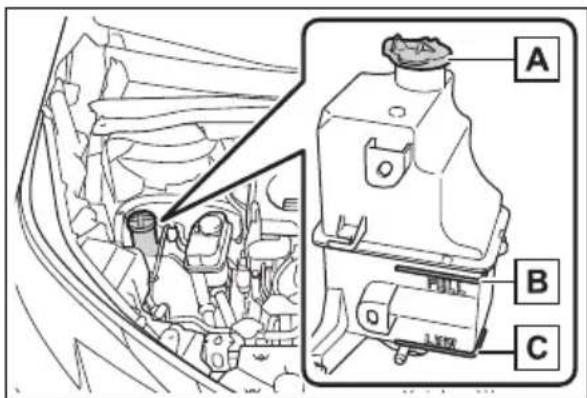
A Reservoir cap
B “FULL” line
C "LOW" line
If the level is on or below the "LOW" line, add coolant up to the "FULL" line. (→P.511)
■Power control unit coolant reservoir
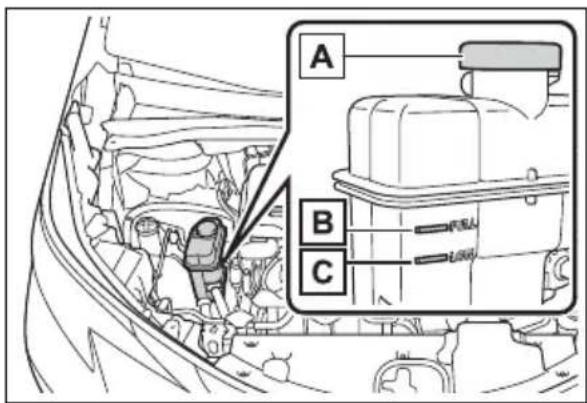
A Reservoir cap
B “FULL” line
C "LOW" line
If the level is on or below the "LOW" line, add coolant up to the "FULL" line. (→P.512)
Coolant selection
Only use "Toyota Super Long Life Coolant" or a similar high quality ethylene glycol based non-silicate, non-amine, non-nitrite, and non-borate coolant with long-life hybrid organic acid technology.
U.S.A.:
"Toyota Super Long Life Coolant" is a mixture of 50% coolant and 50% deionized water. (Minimum temperature: -31°F [-35°C])
Canada:
"Toyota Super Long Life Coolant" is a mixture of 55% coolant and 45% deionized water. (Minimum temperature: -44°F [-42°C])
For more details about coolant, contact your Toyota dealer.
■If the coolant level drops within a short time of replenishing
Visually check the radiators, hoses, engine/power control unit coolant reservoir caps, drain cock and water pump.
If you cannot find a leak, have your Toyota dealer, test the cap and
check for leaks in the cooling system.

WARNING
■When the hybrid system is hot
Do not remove the engine/power control unit coolant reservoir caps.
The cooling system may be under pressure and may spray hot coolant if the cap is removed, causing serious injuries, such as burns.

NOTICE
■When adding coolant
Coolant is neither plain water nor straight antifreeze. The correct mixture of water and antifreeze must be used to provide proper lubrication, corrosion protection and cooling. Be sure to read the antifreeze or coolant label.
If you spill coolant
Be sure to wash it off with water to prevent it from damaging parts or paint.
Checking the radiator and condenser
Check the radiator and condenser, and clear away any foreign objects.
If either of the above parts is extremely dirty or you are not sure of their condition, have your vehicle inspected by your Toyota dealer.

WARNING
■When the hybrid system is hot
Do not touch the radiator or condenser as they may be hot and cause serious injuries, such as burns.
■When the electric cooling fan is operating
Do not touch the engine compartment.
With the power switch in ON, the electric cooling fan may automatically start to run if the air conditioning is on and/or the coolant temperature is high. Be sure the power switch is OFF when working near the electric cooling fan or radiator grille.
Checking and adding the brake fluid
■ Checking fluid level
The brake fluid level should be between the "MAX" and "MIN" lines on the tank.
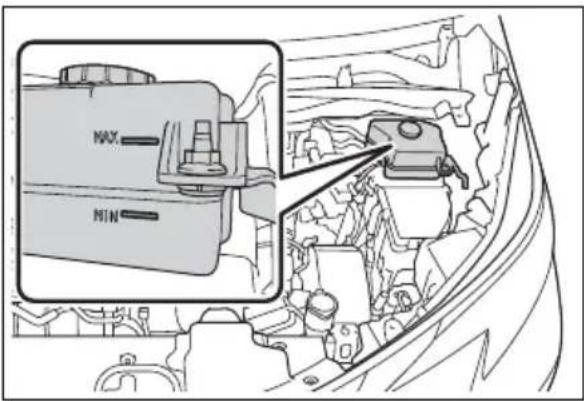
■Adding fluid
Make sure to check the fluid type and prepare the necessary item.
- Fluid type
FMVSS No.116 DOT 3 or SAE
J1703 brake fluid
FMVSS No.116 DOT 4 or SAE
J1704 brake fluid
- Item
Clean funnel
■Brake fluid can absorb moisture from the air
Excess moisture in the brake fluid can cause a dangerous loss of braking efficiency. Use only newly opened brake fluid.

WARNING
■When filling the reservoir
Take care as brake fluid can harm your hands and eyes and damage painted surfaces.
If fluid gets on your hands or in your eyes, flush the affected area with clean water immediately.
If you still experience discomfort, see a doctor.

NOTICE
■If the fluid level is low or high
It is normal for the brake fluid level to go down slightly as the brake pads wear out or when the fluid level in the accumulator is high.
If the reservoir needs frequent refilling, there may be a serious problem.
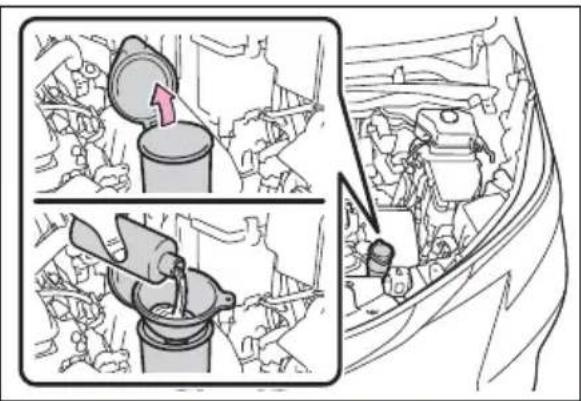

WARNING
■When adding washer fluid
Do not add washer fluid when the hybrid system is hot or operating as washer fluid contains alcohol and may catch fire if spilled on the hybrid system, etc.

NOTICE
■ Do not use any fluid other than washer fluid
Do not use soapy water or engine antifreeze instead of washer fluid. Doing so may cause streaking on the vehicle's painted surfaces, as well as damaging the pump leading to problems of the washer fluid not spraying.
Diluting washer fluid
Dilute washer fluid with water as necessary.
Refer to the freezing temperatures listed on the label of the washer fluid bottle.
Adding the washer fluid
If any washer does not work or "Windshield Washer Fluid Low" is shown on the multi-information display, the washer tank may be empty. Add washer fluid.
12-volt battery
Location
The 12-volt battery is located in the right-hand side of luggage compartment.
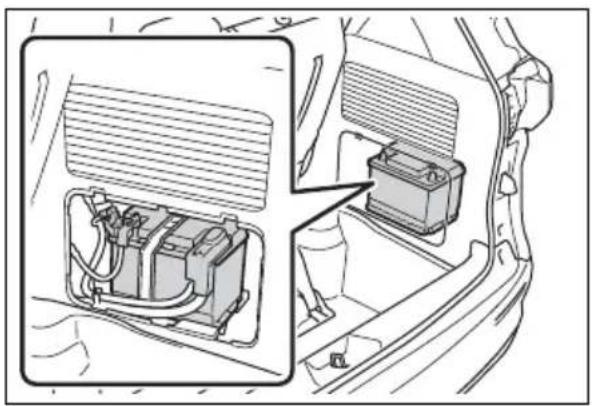
natural_image
Diagram of a car interior showing a battery pack and housing component (no text or labels)Before recharging
When recharging, the 12-volt battery produces hydrogen gas which is flammable and explosive. Therefore, observe the following precautions before recharging:
- If recharging with the 12-volt battery installed on the vehicle, be sure to disconnect the ground cable.
● Make sure the power switch on the charger is off when connecting and disconnecting the charger cables to the 12-volt battery.
■After recharging/reconnecting the 12-volt battery
The hybrid system may not start. Follow the procedure below to initialize the system.
1 Shift the shift lever to P.
2 Open and close any of the doors.
3 Restart the hybrid system.
● Unlocking the doors using the smart key system may not be possible immediately after reconnecting the 12-volt battery. If this happens, use the wireless remote control or the mechanical key to
lock/unlock the doors.
- Start the hybrid system with the power switch in ACC. The hybrid system may not start with the power switch turned off. However, the hybrid system will operate normally from the second attempt.
●The power switch mode is recorded by the vehicle. If the 12-volt battery is reconnected, the vehicle will return the power switch mode to the status it was in before the 12-volt battery was disconnected. Make sure to turn off the power switch before disconnect the 12-volt battery. Take extra care when connecting the 12-volt battery if the power switch mode prior to discharge is unknown.
If the hybrid system will not start even after multiple attempts at all methods above, contact your Toyota dealer.

WARNING
■ Chemicals in the 12-volt battery
The 12-volt battery contains poisonous and corrosive sulfuric acid and may produce hydrogen gas which is flammable and explosive. To reduce the risk of death or serious injury, take the following precautions while working on or near the 12-volt battery:
- Do not cause sparks by touching the 12-volt battery terminals with tools.
- Do not smoke or light a match near the 12-volt battery.
●Avoid contact with eyes, skin and clothes.
● Never inhale or swallow electrolyte.

WARNING
● Wear protective safety glasses when working near the 12-volt battery.
- Keep children away from the 12-volt battery.
■Where to safely charge the 12-volt battery
Always charge the 12-volt battery in an open area. Do not charge the 12-volt battery in a garage or closed room where there is insufficient ventilation.
Emergency measures regarding electrolyte
●If electrolyte gets in your eyes Flush your eyes with clean water for at least 15 minutes and get immediate medical attention. If possible, continue to apply water with a sponge or cloth while traveling to the nearest medical facility.
- If electrolyte gets on your skin Wash the affected area thoroughly. If you feel pain or burning, get medical attention immediately.
- If electrolyte gets on your clothes
It can soak through clothing on to your skin. Immediately take off the clothing and follow the procedure above if necessary.
- If you accidentally swallow electrolyte
Drink a large quantity of water or milk. Get emergency medical attention immediately.
■When replacing the 12-volt battery
Use a 12-volt battery designed for this vehicle. Failure to do so may cause gas (hydrogen) to enter the passenger compartment, causing a fire or explosion.
For replacement of the 12-volt battery, contact your Toyota dealer.
■When there is insufficient 12-volt battery fluid
Do not use if there is insufficient fluid in the 12-volt battery. There is a possible danger that the 12-volt battery may explode.

NOTICE
■When recharging the 12-volt battery
Never recharge the 12-volt battery while the hybrid system is operating. Also, be sure all accessories are turned off.
Removing the 12-volt battery cover
Remove the cover.
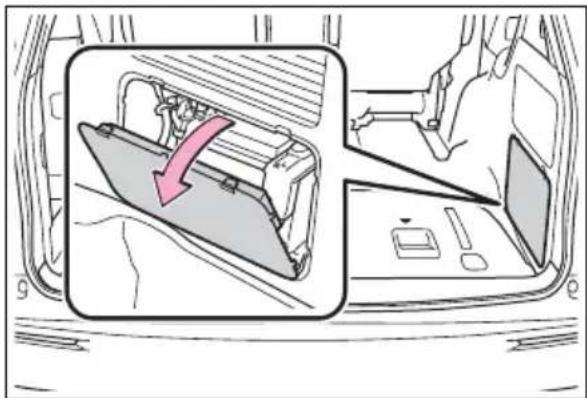
natural_image
Interior view of a car showing the backrest door, intake manifold, and dashboard (no text or symbols)Exterior
Make sure that the 12-volt battery terminals are not corroded and that there are no loose con-
nections, cracks, or loose clamps.
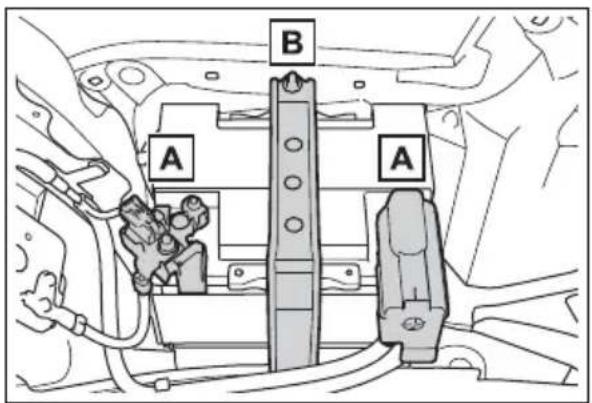
A Terminals
B Hold-down clamp
Tires
Replace or rotate tires in accordance with maintenance schedules and treadwear.
Checking tires
Check if the treadwear indicators are showing on the tires. Also check the tires for uneven wear, such as excessive wear on one side of the tread. Check the spare tire condition and pressure if not rotated.
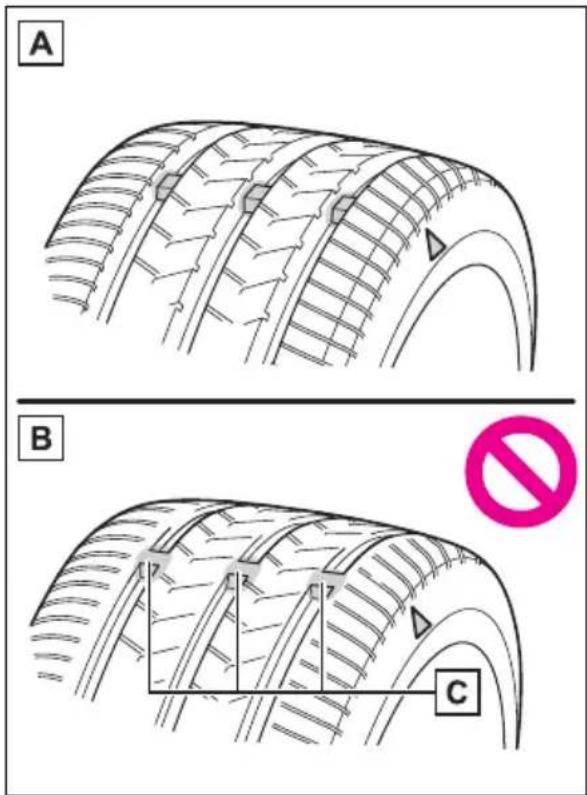
A New tread
B Worn tread
C Treadwear indicator
The location of treadwear indicators is shown by a "TWI" or "△mark,
etc., molded into the sidewall of each tire.
Replace the tires if the treadwear indicators are showing on a tire.
- When to replace your vehicle’s tires
Tires should be replaced if:
●The treadwear indicators are showing on a tire.
●You have tire damage such as cuts, splits, cracks deep enough to expose the fabric, and bulges indicating internal damage.
● A tire goes flat repeatedly or cannot be properly repaired due to the size or location of a cut or other damage.
If you are not sure, consult with your Toyota dealer.
Tire life
Any tire over 6 years old must be checked by a qualified technician even if it has seldom or never been used or damage is not obvious.
■Maximum load of tire
Check that the maximum load of the replacement tire is greater than 1/2 of the Gross Axle Weight Ratings (GAWR) of either the front axle or the rear axle, whichever is greater.
For the GAWR, see the Certification Label. For the maximum load of the tire, see the load limit at maximum cold tire inflation pressure mentioned on the sidewall of the tire. (→P.530)
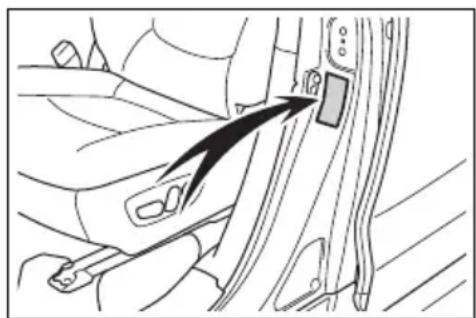
natural_image
Line drawing of a car seatbelt buckle with a black arrow indicating the buckle (no text or symbols present)Tire types
●Summer tires
Summer tires are high-speed performance tires best suited to highway driving under dry conditions. Since summer tires do not have the same traction performance as snow tires, summer tires are inadequate for driving on snow-covered or icy roads. For driving on snow-covered roads or icy roads, the use of snow tires is recommended. When installing snow tires, be sure to replace all four tires.
●All season tires
All season tires are designed to provide better traction in snow and to be adequate for driving in most winter conditions as well as for use year-round. All season tires, however, do not have adequate traction performance compared with snow tires in heavy or loose snow. Also, all season tires fall short in acceleration and handling performance compared with summer tires in highway driving.
●Snow tires
For driving on snow-covered roads or icy roads, we recommend using snow tires. If you need snow tires, select tires of the same size, construction and load capacity as the originally installed tires. Since your vehicle has radial tires as original equipment, make sure your snow tires also have radial construction. Do not install studded tires without first checking local regulations for possible restrictions. Snow tires should be installed on all wheels. (→P.343)
If the tread on snow tires wears down below 0.16 in. (4 mm)
The effectiveness of the tires as snow tires is lost.

WARNING
■When inspecting or replacing tires
Observe the following precautions to prevent accidents.
Failure to do so may cause damage to parts of the drive train as well as dangerous handling characteristics, which may lead to an accident resulting in death or serious injury.
- Do not mix tires of different makes, models or tread patterns.
Also, do not mix tires of remarkably different treadwear.
- Do not use tire sizes other than those recommended by Toyota.
- Do not mix differently constructed tires (radial, bias-belted or bias-ply tires).
- Do not mix summer, all season and snow tires.
- Do not use tires that have been used on another vehicle. Do not use tires if you do not know how they were used previously.
● Vehicles with compact spare tire: Do not tow if your vehicle has a compact spare tire installed.
● Vehicles without spare tire: Do not tow anything if a tire that has been repaired using the emergency tire puncture repair kit is installed. The load on the tire may cause unexpected damage to the tire.

NOTICE
■Driving on rough roads
Take particular care when driving on roads with loose surfaces or potholes.
These conditions may cause losses in tire inflation pressure, reducing the cushioning ability of the tires. In addition, driving on rough roads may cause damage to the tires themselves, as well as the vehicle's wheels and body.
If tire inflation pressure of each tire becomes low while driving
Do not continue driving, or your tires and/or wheels may be ruined.
Tire rotation
Rotate the tires in the order shown.
To equalize tire wear and extend tire life, Toyota recommends that tire rotation is carried out at the same interval as tire inspection.
Do not fail to initialize the tire pressure warning system after tire rotation.
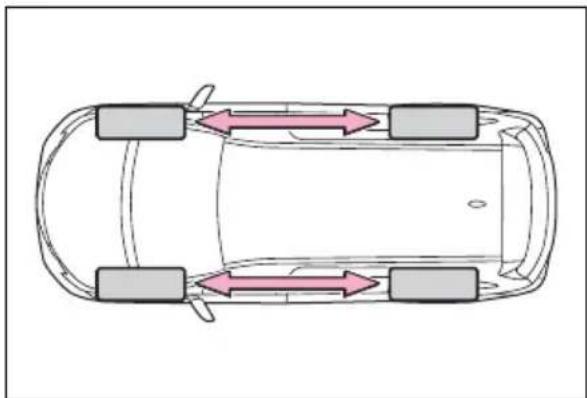
natural_image
Top-down diagram of a car with four wheels and bidirectional arrows indicating clockwise motion (no text or symbols)■When rotating the tires
Make sure that the power switch is OFF. If the tires are rotated while the power switch is in ON, the tire
position information will not be updated. If this accidentally occurs, either turn the power switch to OFF and then to ON, or initialize the system after checking that the tire pressure is properly adjusted.
Tire pressure warning system
Your vehicle is equipped with a tire pressure warning system that uses tire pressure warning valves and transmitters to detect low tire inflation pressure before serious problems arise.
The tire pressure warning system of this vehicle adopts a 2-type warning system
- When "Adjust Pressure" is displayed (Normal Warning)
The tire pressure warning light comes on and a buzzer sounds when the tire inflation pressure becomes low due to natural air leakage or outside temperature. (Ways of coping:→P.472, 525)
- When “Immediately Check tire when Safe” is displayed (Emergency Warning)
The tire pressure warning light comes on and a buzzer sounds when the tire inflation pressure becomes low suddenly due to a blowout. (Ways of coping: →P.472, 481, 491) However, the system may not be able to detect sudden tire ruptures (bursting, etc.).
The tire pressure detected by the tire pressure warning system can be displayed on the multi-information display.
The unit can be changed.
▶ With 4.2-inch display
![35 35 35 35 [psi]](/content/2026/05/810579/images/a03dbea03c2a0e82d3e791964da5cbe2b32efb0e2bf0a9dff6269000f6a4ef86.jpg)
▶ With 7-inch display
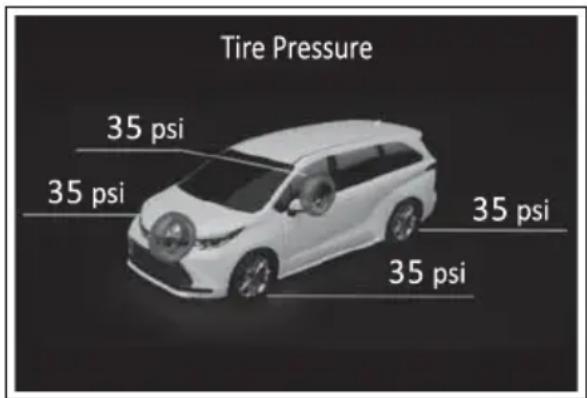
■How to change the unit
▶ With 4.2-inch display
1 Park the vehicle in a safe place and turn the power switch off.
Changing the unit cannot be performed while the vehicle is moving.
2 Turn the power switch to ON.
3 Press or of the meter control switches on the steering wheel and select
4 Press or of the meter control switches and select "Vehicle Settings", and then press and hold "OK".
5 Press or of the meter control switches and select
"TPWS Setting", and then press "OK".
6 Press or to select "Setting UNIT".
7 Press or to select the desired unit and then press "OK".
▶ With 7-inch display
1 Park the vehicle in a safe place and turn the power switch off.
Changing the unit cannot be performed while the vehicle is moving.
2 Turn the power switch to ON.
3 Press or of the meter control switches on the steering wheel and select
4 Press or of the meter control switches and select , and then press and hold "OK".
5 Press or of the meter control switches and select "TPWS Setting", and then press "OK".
6 Press or to select "Setting UNIT".
7 Press or to select the desired unit and then press "OK".
■Routine tire inflation pressure checks
The tire pressure warning system does not replace routine tire inflation pressure checks. Make sure to check tire inflation pressure as part of your routine of daily vehicle checks.
■Tire inflation pressure
- It may take a few minutes to display the tire inflation pressure after the power switch is turned to ON. It may also take a few minutes to display the tire inflation pressure after inflation pressure has been adjusted.
●Tire inflation pressure changes with temperature. The displayed values may also be different from the values measured using a tire pressure gauge.
■Situations in which the tire pressure warning system may not operate properly
● In the following cases, the tire pressure warning system may not operate properly.
- If non-genuine Toyota wheels are used.
- A tire has been replaced with a tire that is not an OE (Original Equipment) tire.
- A tire has been replaced with a tire that is not of the specified size.
- Tire chains, etc. are equipped.
- An auxiliary-supported run-flat tire is equipped.
- If a window tint that affects the radio wave signals is installed.
- If there is a lot of snow or ice on the vehicle, particularly around the wheels or wheel housings.
- If the tire inflation pressure is extremely higher than the specified level.
- If wheel without tire pressure warning valves and transmitters are used.
- If the ID code on the tire pressure warning valves and transmitters is not registered in the tire pressure warning computer.
●Performance may be affected in the following situations.
- Near a TV tower, electric power plant, gas station, radio station,
large display, airport or other faci- lity that generates strong radio waves or electrical noise
- When carrying a portable radio, cellular phone, cordless phone or other wireless communication device
If tire position information is not correctly displayed due to the radio wave conditions, the display may be corrected by driving and changing the radio wave conditions.
- When the vehicle is parked, the time taken for the warning to start or go off could be extended.
- When tire inflation pressure declines rapidly for example when a tire has burst, the warning may not function.
■Warning performance of the tire pressure warning system
The warning of the tire pressure warning system will change in accordance with the conditions under which it was initialized. For this reason, the system may give a warning even if the tire pressure does not reach a low enough level, or if the pressure is higher than the pressure that was adjusted to when the system was initialized.
Installing tire pressure warning valves and trans- mitters
When replacing tires or wheels, tire pressure warning valves and transmitters must also be installed.
When new tire pressure warning valves and transmitters are installed, new ID codes must be registered in the tire pressure warning computer and the tire
pressure warning system must be initialized. ( P.433)
■When replacing the tires and wheels
If the ID code of the tire pressure warning valve and transmitter is not registered, the tire pressure warning system will not work properly. After driving for about 20 minutes, the tire pressure warning light blinks for 1 minute and stays on to indicate a system malfunction.

NOTICE
■Repairing or replacing tires, wheels, tire pressure warning valves, transmitters and tire valve caps
- When removing or fitting the wheels, tires or the tire pressure warning valves and transmitters, contact your Toyota dealer as the tire pressure warning valves and transmitters may be damaged if not handled correctly.
● Make sure to install the tire valve caps. If the tire valve caps are not installed, water could enter the tire pressure warning valves and the tire pressure warning valves could be bound.
- When replacing tire valve caps, do not use tire valve caps other than those specified.
The cap may become stuck.

NOTICE
■To avoid damage to the tire pressure warning valves and transmitters (vehicles without spare tire)
When a tire is repaired with liquid sealants, the tire pressure warning valve and transmitter may not operate properly. If a liquid sealant is used, contact your Toyota dealer as soon as possible. After use of liquid sealant, make sure to replace the tire pressure warning valve and transmitter when repairing or replacing the tire. (→P.429)
Initializing the tire pressure warning system
■The tire pressure warning system must be initialized in the following circumstances:
- When rotating the tires.
- When changing the tire.
● After registering the ID codes. (→P.433) - When changing between two registered wheel sets.
When the tire pressure warning system is initialized, the current tire inflation pressure is set as the benchmark pressure.
■How to initialize the tire pressure warning system
▶ With 4.2-inch display
1 Park the vehicle in a safe place and stop the hybrid system for 20 minutes or more.
Initialization cannot be performed while the vehicle is moving.
2 Adjust the tire inflation pressure to the specified cold tire inflation pressure level. (→P.525)
Make sure to adjust the tire pressure to the specified cold tire inflation pressure level. The tire pressure warning system will operate based on this pressure level.
3 Start the hybrid system.
4 Press or of the meter control switches on the steering wheel and select
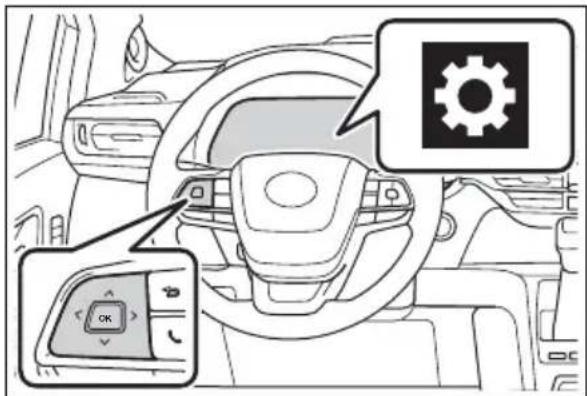
5 Press or of the meter control switches, select "Vehicle Settings" and then press and hold "OK".
6 Press or of the meter control switches, select "TPWS Setting" and then press "OK".
7 Press or of the meter control switches, select the "Setting Pressure". Then press and hold "OK".
"Setting Tire Pressure Warning System" will be displayed on the multi-information display and the tire pressure warning light will blink
3 times.
When the message disappears, initialization is complete.
A message is displayed on the multi-information display. Also, “--” is displayed for inflation pressure of each tire on the multi-information display while the tire pressure warning system determines the position.
8 Drive straight (with occasional left and right turns) at approximately 25 mph (40 km/h) or more for approximately 10 to 30 minutes.
When initialization is complete, the inflation pressure of each tire will be displayed on the multi-information display.
Even if the vehicle is not driven at approximately 25 mph (40 km/h) or more, initialization can be completed by driving for a long time. However, if initialization does not complete after driving for 1 hour or more, park the vehicle in a safe place for approximately 20 minutes and then drive the vehicle again.
▶ With 7-inch display
1 Park the vehicle in a safe place and stop the hybrid system for 20 minutes or more.
Initialization cannot be performed while the vehicle is moving.
2 Adjust the tire inflation pressure to the specified cold tire inflation pressure level. (→P.525)
Make sure to adjust the tire pressure to the specified cold tire inflation pressure level. The tire pressure warning system will operate based on this pressure level.
3 Start the hybrid system.
4 Press or of the meter control switches on the steering wheel and select
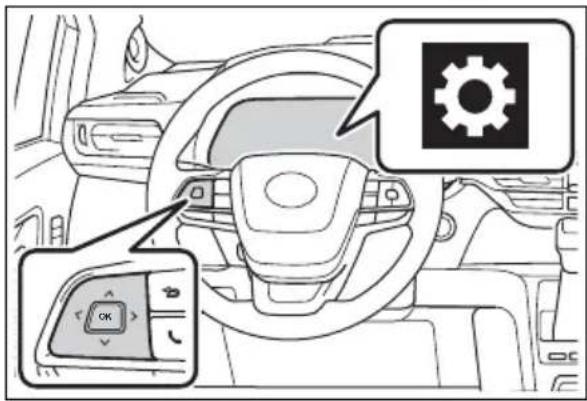
5 Press or of the meter control switches, select and then press and hold "OK".
6 Press or of the meter control switches, select "TPWS Setting" and then press "OK".
7 Press or of the meter control switches, select the "Setting Pressure". Then press and hold "OK".
"Setting Tire Pressure Warning System" will be displayed on the multi-information display and the tire pressure warning light will blink 3 times. When the message disappears, initialization is complete.
A message is displayed on the multi-information display. Also, “--” is displayed for inflation pressure of each tire on the multi-information display while the tire pressure warning system determines the position.
8 Drive straight (with occasional left and right turns) at approximately 25 mph (40
km/h) or more for approximately 10 to 30 minutes.
When initialization is complete, the inflation pressure of each tire will be displayed on the multi-information display.
Even if the vehicle is not driven at approximately 25 mph (40 km/h) or more, initialization can be completed by driving for a long time. However, if initialization does not complete after driving for 1 hour or more, park the vehicle in a safe place for approximately 20 minutes and then drive the vehicle again.
■When initializing
● Initialization is performed while driving at a vehicle speed of approximately 25 mph (40 km/h) or more.
● Make sure to carry out initialization after adjusting the tire inflation pressure. Also, make sure the tires are cold before carrying out initialization or tire inflation pressure adjustment.
●The tire pressure warning system can be initialized by yourself, but depending on the driving conditions and driving environment, initialization may take some time to complete.
■The initialization operation
- If you have accidentally turned the power switch to OFF during initialization, it is not necessary to restart the initialization again as initialization will restart automatically when the power switch has been turned to ON for the next time.
- If you accidentally perform initialization when initialization is not necessary, adjust the tire inflation pressure to the specified level when the tires are cold, and conduct initialization again.
●While the position of each tire is
being determined and the inflation pressures are not being displayed on the multi-information display, if the inflation pressure of a tire drops, the tire pressure warning light will come on.
■If the tire pressure warning system is not initialized properly
- In the following situations, initialization may take longer than usual to be completed or may not be possible. Normally, initialization completes within approximately 30 minutes.
• Vehicle is not driven at approximately 25 mph (40 km/h) or more - Vehicle is driven on unpaved roads
- Vehicle is driven near other vehicles and system cannot recognize tire pressure warning valve and transmitters of your vehicle over those of other vehicles.
- If the vehicle is driven in heavy traffic or another situation where other vehicles are driven close by, it may take time for the system to recognize the tire pressure warning valve and transmitters of your vehicle over those of other vehicles.
- If initialization does not complete after driving for 1 hour or more, park the vehicle in a safe place for approximately 20 minutes and then drive the vehicle again.
- If the vehicle is reversed during initialization, the data up to that point is reset, so perform the initialization procedure again from the beginning.
- In the following situations, initialization will not be started or was not completed properly and the system will not operate properly. Perform the initialization procedure again.
- If, when attempting to start initialization, the tire pressure warning light does not blink 3 times.
- If, when the vehicle has been driven for about 20 minutes after
performing initialization, the tire pressure warning light blinks for approximately 1 minute and then illuminates.
If the inflation pressure of each tire is still not displayed, have the vehicle inspected by your Toyota dealer.

WARNING
■When initializing the tire pressure warning system
Do not initializing tire inflation pressure without first adjusting the tire inflation pressure to the specified level. Otherwise, the tire pressure warning light may not come on even if the tire inflation pressure is low, or it may come on when the tire inflation pressure is actually normal.
Registering ID codes
Every tire pressure warning valve and transmitter has a unique ID code. When replacing a tire pressure warning valve and transmitter, it is necessary to register the ID code.
When registering the ID codes, perform the following procedure.
▶ With 4.2-inch display
1 Park the vehicle in a safe place, wait for approximately 20 minutes, and then start the hybrid system.
2 Press or of the meter control switches on the steering wheel and select
3 Press or of the meter control switches and select
"Vehicle Settings", and then press and hold "OK".
4 Press or of the meter control switches and select "TPWS Setting", and then press "OK".
5 Press or of the meter control switches and select "Identifying Each Wheel & Position". Then press and hold "OK" until the tire pressure warning light starts slowly blinking 3 times.
The change wheel set mode is activated and registration is started.
Then a message will be displayed on the multi-information display.
When registration is being performed, the tire pressure warning light will blink for approximately 1 minute then illuminate and “--” will be displayed for the inflation pressure of each tire on the multi-information display.
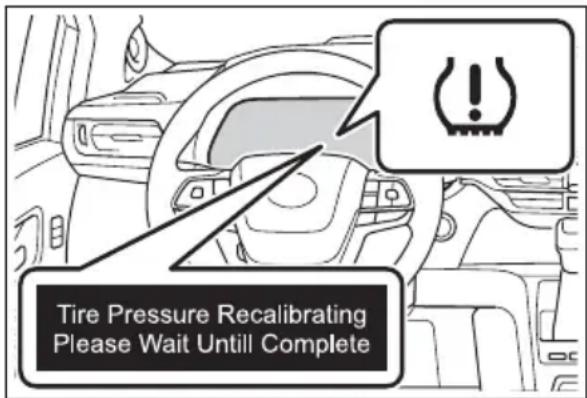
6 Drive straight (with occasional left and right turns) at approximately 25 mph (40 km/h) or more for approximately 10 to 30 minutes.
When registration is completed, the tire pressure warning light will go off and the inflation pressure of each tire will be displayed on the multi-
information display.
Even if the vehicle is not driven at approximately 25 mph (40 km/h) or more, registration can be completed by driving for a long time. However, if registration does not complete after driving for 1 hour or more, perform the procedure again from the beginning.
7 Initialize the tire pressure warning system. (→P.430)
▶ With 7-inch display
1 Park the vehicle in a safe place, wait for approximately 20 minutes, and then start the hybrid system.
2 Press or of the meter control switches on the steering wheel and select
3 Press or of the meter control switches and select , and then press and hold "OK".
4 Press or of the meter control switches and select "TPWS Setting", and then press "OK".
5 Press or of the meter control switches and select "Identifying Each Wheel & Position". Then press and hold "OK" until the tire pressure warning light starts slowly blinking 3 times.
The change wheel set mode is activated and registration is started. Then a message will be displayed on the multi-information display. When registration is being per-
formed, the tire pressure warning light will blink for approximately 1 minute then illuminate and “--” will be displayed for the inflation pressure of each tire on the multi-information display.
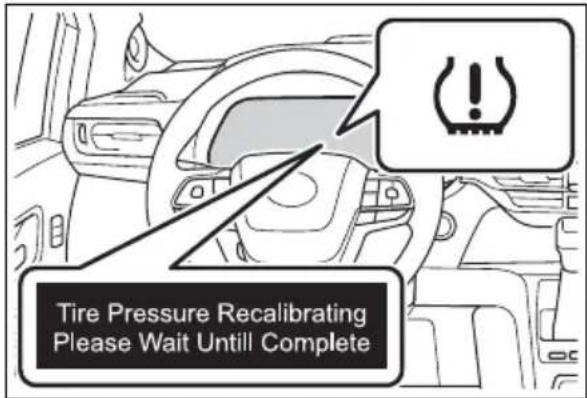
6 Drive straight (with occasional left and right turns) at approximately 25 mph (40 km/h) or more for approximately 10 to 30 minutes.
When registration is completed, the tire pressure warning light will go off and the inflation pressure of each tire will be displayed on the multi-information display.
Even if the vehicle is not driven at approximately 25 mph (40 km/h) or more, registration can be completed by driving for a long time. However, if registration does not complete after driving for 1 hour or more, perform the procedure again from the beginning.
7 Initialize the tire pressure warning system. (→P.430)
■When registering ID codes
● ID code registration is performed while driving at a vehicle speed of approximately 25 mph (40 km/h) or more.
● Before performing ID code registration, make sure that no wheels with tire pressure warning valve and transmitters installed are near the vehicle.
● Make sure to initialize the tire pressure warning system after registering the ID codes. If the system is initialized before registering the ID codes, the initialized values will be invalid.
●ID codes can be registered by yourself, but depending on the driving conditions and driving environment, registration may take some time to complete.
● As the tires will be warm when registration is completed, make sure to allow the tires to cool before performing initialization.
■ Canceling ID code registration
- To cancel ID code registration after it has been started, select "Identifying Each Wheel & Position" on the multi-information display and press and hold "OK" again.
- If ID code registration has been canceled, the tire pressure warning light will blink for approximately 1 minute when the power switch is turned to ON and then illuminate. The tire pressure warning system will be operational when the tire pressure warning light turns off.
- If the warning light does not turn off even after several minutes have elapsed, ID code registration may not have been canceled correctly. To cancel registration, perform the ID code registration start procedure again and then turn the power switch off before driving.
■If ID codes are not registered properly
- In the following situations, ID code registration may take longer than usual to be completed or may not be possible. Normally, registration completes within approximately 30 minutes. If ID code registration is not complete after driving for approximately 30 minutes, continue driving for a while.
- Vehicle is not parked for approximately 20 minutes or more before driving
• Vehicle is not driven at approximately 25 mph (40 km/h) or more - Vehicle is driven on unpaved roads
- Vehicle is driven near other vehicles and system cannot recognize tire pressure warning valve and transmitters of your vehicle over those of other vehicles
- Wheel with tire pressure warning valve and transmitter installed is inside or near the vehicle
If registration does not complete after driving for 1 hour or more, perform the ID code registration procedure again from the beginning.
- If the vehicle is reversed during registration, the data up to that point is reset, so perform the registration procedure again from the beginning.
- In the following situations, ID code registration will not be started or was not completed properly and the system will not operate properly. Perform the ID code registration procedure again.
- If, when attempting to start ID code registration, the tire pressure warning light does not blink slowly 3 times.
- If, when the vehicle has been driven for about 20 minutes after performing ID code registration, the tire pressure warning light blinks for approximately 1 minute and then illuminates.
If the ID codes cannot be registered even when performing the above procedure, contact your Toyota dealer.
Selecting wheel set
Your vehicle is equipped with tire pressure warning system
with the function to have ID codes registered for a second wheel set, for example a winter set. You can register a second wheel set by yourself or your Toyota dealer.
After registration of a second wheel set, either of these two wheel sets can be selected for usage with the tire pressure warning system.
■Operating conditions for the function
- This function will perform the change of wheel set only if a second wheel set has been registered. If no second wheel set has been registered, no change will be made when selecting this function in the menu.
- Only a change between both registered wheel set is possible, mixing between these wheel sets is not supported.
■How to change between wheel sets
1 Have the vehicle fitted with the preferred wheel set.
▶ With 4.2-inch display
2 Press or of the meter control switches on the steering wheel and select
3 Press or of the meter control switches and select "Vehicle Settings", and then press and hold "OK".
4 Press or of the meter control switches and select "TPWS Setting", and then press "OK".
5 Press or of the meter control switches and select "Identifying Each Wheel & Position". Then press and hold "OK" until the tire pressure warning light starts slowly blinking 3 times.
Afterward, the tire pressure warning light turns on after flashing for 1 minute.
After 2 minutes, registration of a second wheel set is being performed. The tire pressure warning light will turn off and “--” will be displayed for the inflation pressure of each tire on the multi-information display.
6 Initialize the tire pressure warning system. (→P.430)
If the tire inflation pressure settings for the installed tires change, initialization operations are required, but if the tire inflation pressure settings are the same, initialization is not required.
7 Drive straight (with occasional left and right turns) at approximately 25 mph (40 km/h) or more for approximately 10 to 30 minutes.
Registration of a second wheel set is complete when the tire pressure warning light turns off and the inflation pressure of each tire is displayed on the multi-information display.
▶ With 7-inch display
2 Press or of the meter control switches on the steering wheel and select
3 Press or of the meter control switches and select , and then press and hold "OK".
4 Press or of the meter control switches and select "TPWS Setting", and then press "OK".
5 Press or of the meter control switches and select "Identifying Each Wheel & Position". Then press and hold "OK" until the tire pressure warning light starts slowly blinking 3 times.
Afterward, the tire pressure warning light turns on after flashing for 1 minute.
After 2 minutes, registration of a second wheel set is being performed. The tire pressure warning light will turn off and “--” will be displayed for the inflation pressure of each tire on the multi-information display.
6 Initialize the tire pressure warning system. (→P.430)
If the tire inflation pressure settings for the installed tires change, initialization operations are required, but if the tire inflation pressure settings are the same, initialization is not required.
7 Drive straight (with occasional left and right turns) at approximately 25 mph
(40km/h) or more for approximately 10 to 30 minutes.
Registration of a second wheel set is complete when the tire pressure warning light turns off and the inflation pressure of each tire is displayed on the multi-information display.
Tire inflation pressure
Make sure to maintain the proper tire inflation pressure. Tire inflation pressure should be checked at least once per month. However, Toyota recommends that tire inflation pressure be checked once every two weeks. (→P.525)
Checking the specified tire inflation pressure
The recommended cold tire inflation pressure and tire size are displayed on the tire and loading information label. (→P.525)
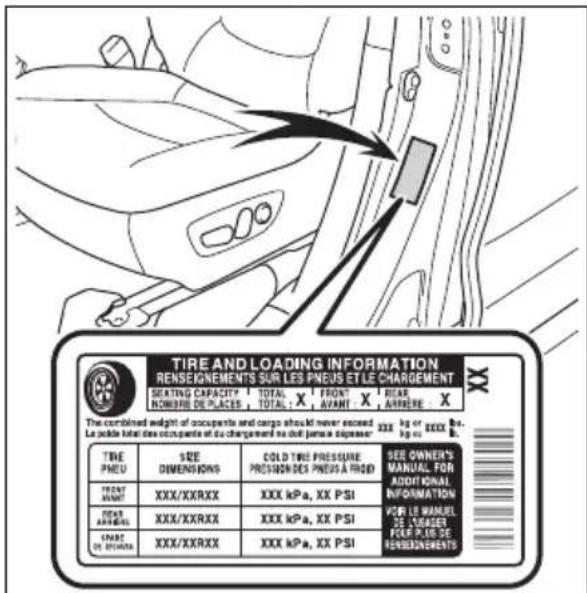
Inspection and adjustment procedure
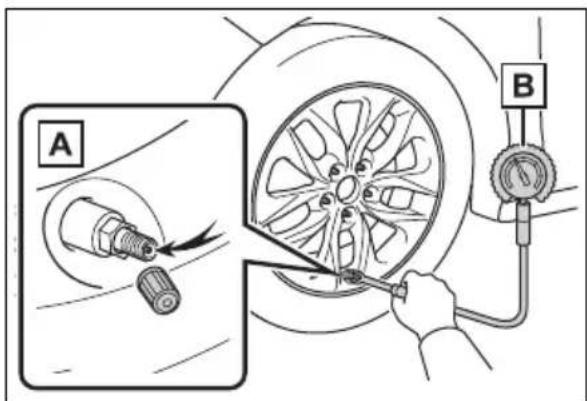
A Tire valve
B Tire pressure gauge
1 Remove the tire valve cap.
2 Press the tip of the tire pressure gauge onto the tire valve.
3 Read the pressure using the gauge gradations.
4 If the tire inflation pressure is not at the recommended level, adjust the pressure. If you add too much air, press the center of the valve to deflate.
5 After completing the tire inflation pressure measurement and adjustment, apply soapy water to the valve and check for leakage.
6 Put the tire valve cap back on.
■Tire inflation pressure check interval
You should check tire inflation pressure every two weeks, or at least once a month.
Do not forget to check the spare.
■Effects of incorrect tire inflation pressure
Driving with incorrect tire inflation pressure may result in the following:
●Reduced fuel economy
●Reduced driving comfort and poor handling
●Reduced tire life due to wear
●Reduced safety
●Damage to the drive train
If a tire needs frequent inflating, have it checked by your Toyota dealer.
■ Instructions for checking tire inflation pressure
When checking tire inflation pressure, observe the following:
- Check only when the tires are cold.
If your vehicle has been parked for at least 3 hours or has not been driven for more than 1 mile or 1.5 km, you will get an accurate cold tire inflation pressure reading.
●Always use a tire pressure gauge. It is difficult to judge if a tire is properly inflated based only on its appearance.
- It is normal for the tire inflation pressure to be higher after driving as heat is generated in the tire. Do not reduce tire inflation pressure after driving.
●Never exceed the vehicle capacity weight. Passengers and luggage weight should be placed so that the vehicle is balanced.

WARNING
■Proper inflation is critical to save tire performance
Keep your tires properly inflated. If the tires are not properly inflated, the following conditions may occur which could lead to an accident resulting in death or serious injury:
Excessive wear
Uneven wear
●Poor handling
● Possibility of blowouts resulting from overheated tires
● Air leaking from between tire and wheel
● Wheel deformation and/or tire damage
● Greater possibility of tire damage while driving (due to road hazards, expansion joints, sharp edges in the road, etc.)

NOTICE
■When inspecting and adjusting tire inflation pressure
Be sure to put the tire valve caps back on. If a valve cap is not installed, dirt or moisture may get into the valve and cause an air leak, resulting in decreased tire inflation pressure.
Wheels
If a wheel is bent, cracked or heavily corroded, it should be replaced. Otherwise, the tire may separate from the wheel or cause a loss of handling control.
Wheel selection
When replacing wheels, care should be taken to ensure that they are equivalent to those removed in load capacity, diameter, rim width and inset ^* .
Replacement wheels are available at your Toyota dealer.
*: Conventionally referred to as offset.
Toyota does not recommend using the following:
● Wheels of different sizes or types
- Used wheels
● Bent wheels that have been straightened
■When replacing wheels
The wheels of your vehicle are equipped with tire pressure warning valves and transmitters that allow the tire pressure warning system to provide advance warning in the event of a loss in tire inflation pressure. Whenever wheels are replaced, tire pressure warning valves and transmitters must be installed. (→P.427, 441)

WARNING
■When replacing wheels
- Do not use wheels that are a different size from those recommended in the Owner's Manual, as this may result in a loss of handling control.
●Never use an inner tube in a leaking wheel which is designed for a tubeless tire. Doing so may result in an accident, causing death or serious injury.
■When installing the wheel nuts
Never use oil or grease on the wheel bolts or wheel nuts. Oil and grease may cause the wheel nuts to be excessively tightened, leading to bolt or disc wheel damage. In addition, the oil or grease can cause the wheel nuts to loosen and the wheel may fall off, causing an accident and resulting in death or serious injury. Remove any oil or grease from the wheel bolts or wheel nuts.
■Use of defective wheels prohibited
Do not use cracked or deformed wheels.
Doing so could cause the tire to leak air during driving, possibly causing an accident.

NOTICE
■Replacing tire pressure warning valves and transmitters
Because tire repair or replacement may affect the tire pressure warning valves and transmitters, make sure to have tires serviced by your Toyota dealer or other qualified service shop. In addition, make sure to purchase your tire pressure warning valves and transmitters at your Toyota dealer.
- Ensure that only genuine Toyota wheels are used on your vehicle.
Tire pressure warning valves and transmitters may not work properly with non-genuine wheels.
Aluminum wheel precautions
- Use only Toyota wheel nuts and wrenches designed for use with your aluminum wheels.
- When rotating, repairing or changing your tires, check that the wheel nuts are still tight after driving 1000 miles (1600 km).
● Vehicles with 17-inch or 18-inch tires: Be careful not to damage the aluminum wheels when using tire chains. - Use only Toyota genuine balance weights or equivalent and a plastic or rubber hammer when balancing your wheels.
Air conditioning filter
The air conditioning filter must be changed regularly to maintain air conditioning efficiency.
Removal method
1 Turn the power switch off.
2 Open the glove box and slide off the damper.
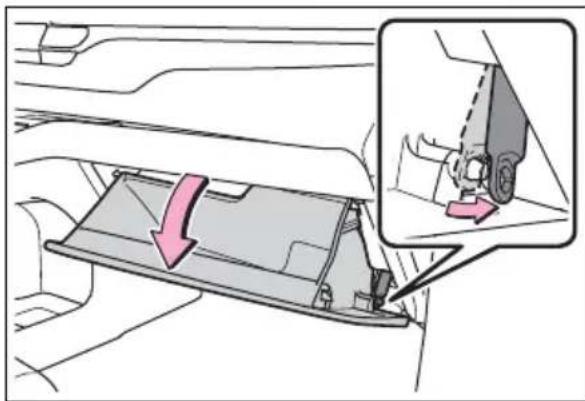
natural_image
Diagram showing a car interior with a highlighted vehicle component and an inset view of the wheel (no text or symbols present)3 Push in each side of the glove box to disconnect the claws, and then slowly and fully open the glove box while supporting it.
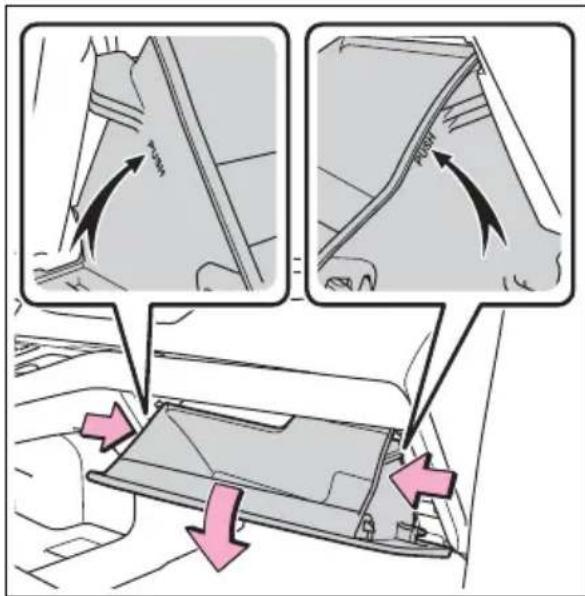
4 With the glove box fully open, slightly lift up the glove box and pull toward the seat to detach the bottom of the glove box.
Do not use excessive force if the glove box does not detach when lightly pulled. Instead, pull toward the seat while slightly adjusting the height of the glove box.
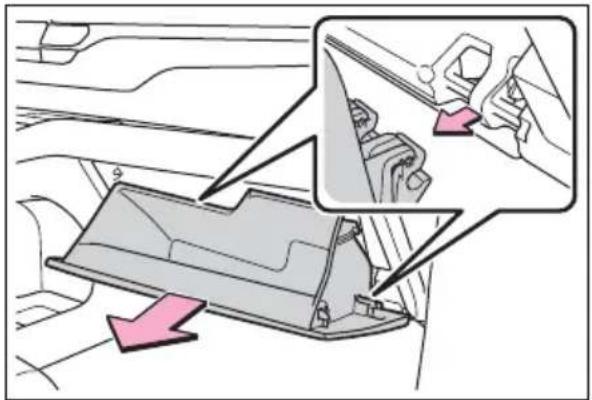
5 Unlock the filter cover (A) pull the filter cover out of the claws (B) and remove the filter cover.
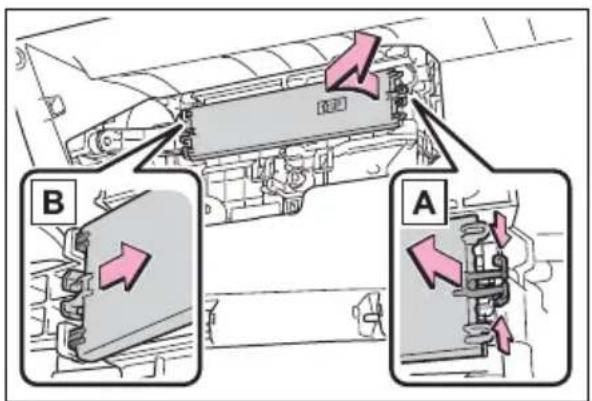
6 Remove the filter case.
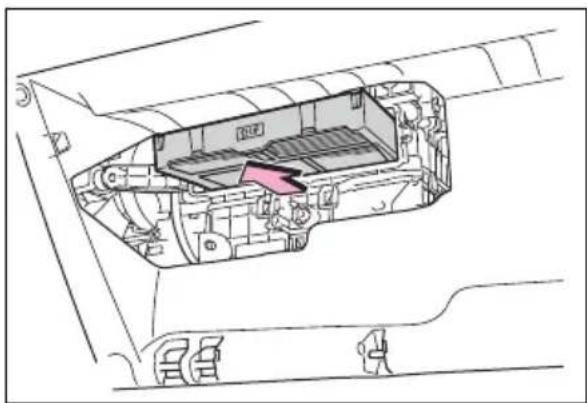
natural_image
Technical line drawing of a vehicle internal component (no text or symbols)7 Remove the air conditioning filter from the filter case and replace it with a new one.
The "UP" marks shown on the filter should be pointing up.
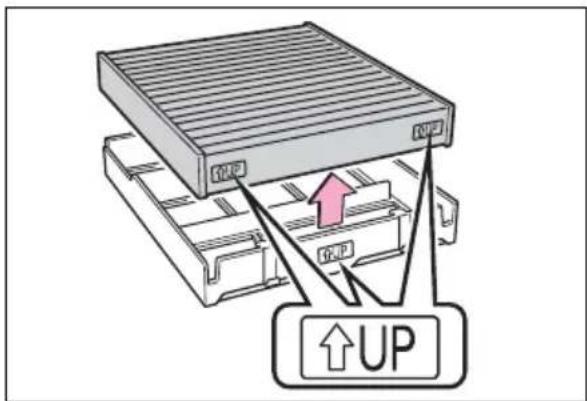
8 When installing, reverse the steps listed.
- Checking interval
Inspect and replace the air conditioning filter according to the maintenance schedule. In dusty areas or areas with heavy traffic flow, early replacement may be required. (For scheduled maintenance information, please refer to the "Owner's Manual Supplement" or "Scheduled Maintenance Guide".)
■If air flow from the vents decreases dramatically
The filter may be clogged. Check the filter and replace if necessary.

NOTICE
■When using the air conditioning system
Make sure that a filter is always installed. Using the air conditioning system without a filter may cause damage to the system.
■When removing the glove box
Always follow the specified procedure to remove the glove box ( P.441). If the glove box is removed without following the specified procedure, the hinge of the glove box may become damaged.
■To prevent damage to the filter cover
When moving the filter cover in the direction of arrow to release the fitting, pay attention not to apply excessive force to the claws. Otherwise, the claws may be damaged.
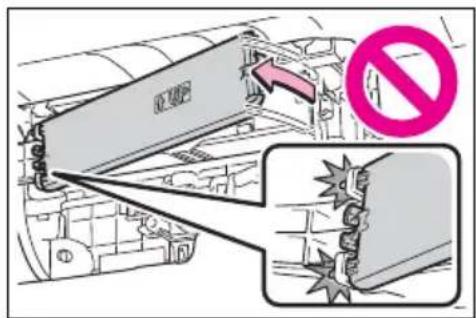
Cleaning the hybrid battery (traction battery) air intake vents and filters
To prevent the fuel economy from being affected, visually inspect the hybrid battery (traction battery) air intake vents periodically for dust and clogs. If they are dusty or clogged or if "Maintenance Required for Traction Battery Cooling Parts See Owner's Manual" is shown on the multi-information display, clean the air intake vents using the following procedures:
Cleaning the air intake vents
Remove the dust from the air intake vents with a vacuum cleaner, etc.
Make sure to only use a vacuum to suck out dust and clogs. Attempting to blow out dust and clogs using an airgun, etc. may push it into the air intake vent. (→P.446)
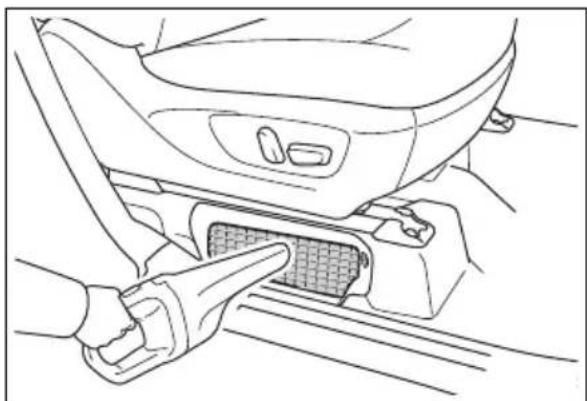
natural_image
Line drawing of a car seatbelt with hands inserting a mesh component (no text or symbols)If dust and clogs cannot be completely removed
If dust and clogs cannot be completely removed with the air intake vent covers installed, remove the covers and clean the filters.
1 Turn the power switch off.
2 Using a Phillips screwdriver, remove the clip.
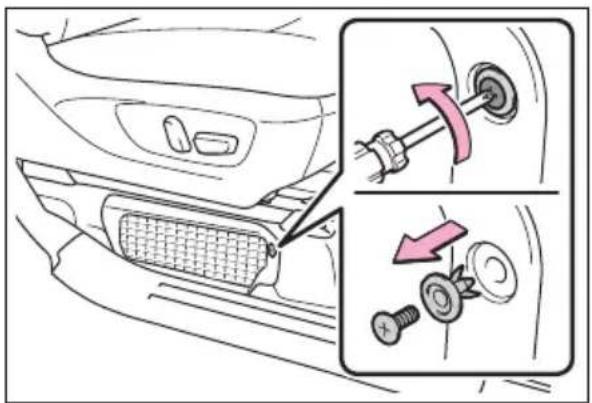
3 Remove the air intake vent cover.
Pull the cover as shown in the illustration to disengage the claws, starting from the claw in the upper right corner and pull the cover toward the front of the vehicle to remove it.
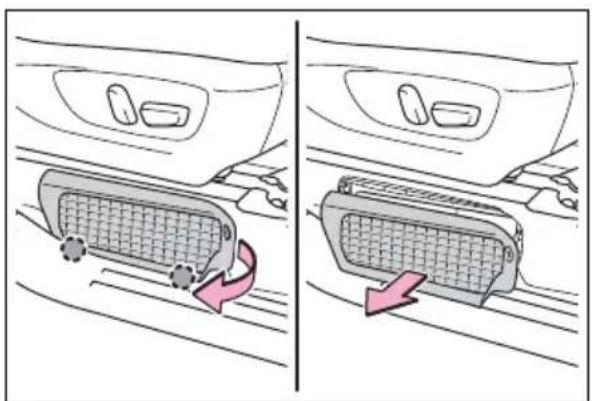
natural_image
Diagram showing car interior airflow with a mesh vent and directional arrows indicating flow direction (no text or symbols)4 Remove the air intake vent filter.
Disengage the 3 center claws from the filter.
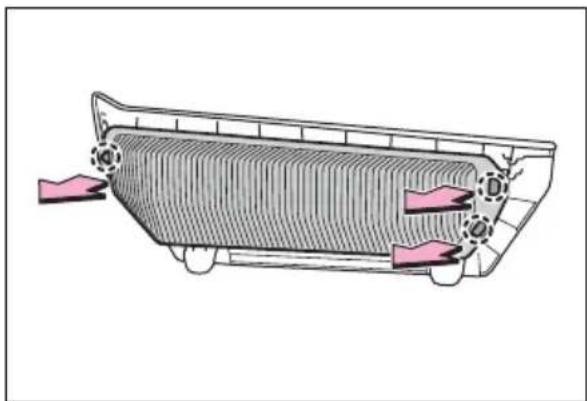
natural_image
Cross-sectional diagram of a car radiator or heat exchanger with cooling fins and airflow arrows (no text or labels)5 Remove the dust and clogs from the filter using a vacuum cleaner, etc.
Make sure to also remove the dust and clogs from the inside of the air intake vent cover.
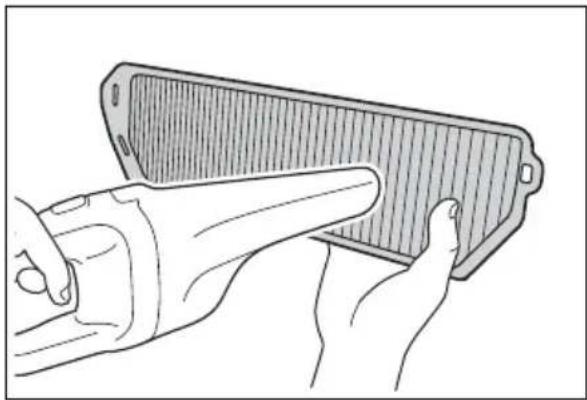
natural_image
Line drawing of a hand holding a rectangular device with a mesh grille (no text or symbols)6 Reinstall the filter to the cover.
Engage the 3 center claws to install the filter.
Make sure that the filter is not crooked or deformed when installing it.
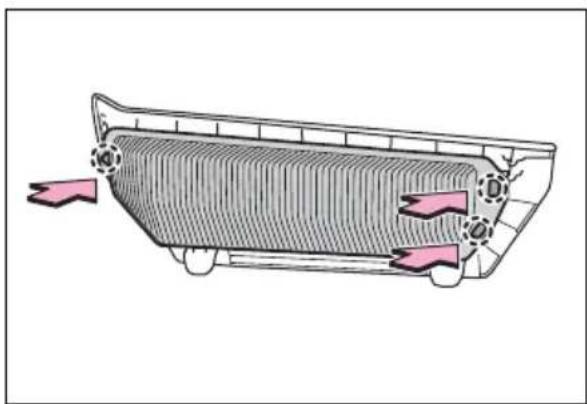
natural_image
Diagram of a car radiator with heat flow arrows indicating airflow direction (no text or labels)7 Install the air intake vent cover.
Insert the tab of the cover as shown in the illustration and push the cover to engage the claws.
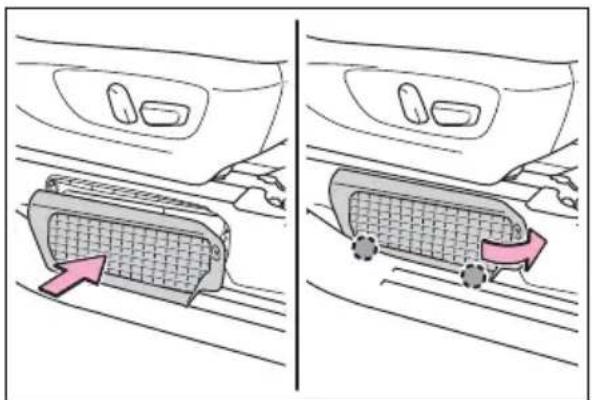
natural_image
Side-by-side illustration showing a car interior with a gas vent and a vehicle-mounted device, no text or symbols present.8 Using a Phillips screwdriver, install the clip.
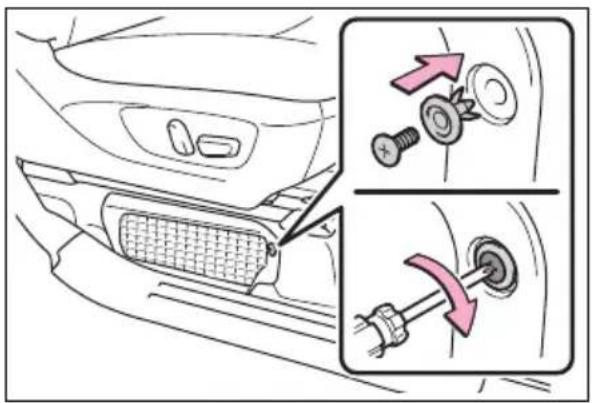
■Scheduled maintenance of the air intake vents is necessary when
In some situations such as when the vehicle is used frequently or in heavy traffic or dusty areas, the air intake vents may need to be cleaned more regularly. For details, refer to “Scheduled Maintenance Guide” or “Owner’s Manual Supplement”.
■Cleaning the air intake vents
●Dust in the air intake vents may interfere with the cooling of the hybrid battery (traction battery). If charging/discharging of the hybrid battery (traction battery) becomes limited, the distance that the vehicle can be driven using the electric
motor (traction motor) may be reduced and the fuel economy may be reduced. Inspect and clean the air intake vents periodically.
- Improper handling of the air intake vent covers and filters may result in damage to them. If you have any concerns about cleaning the filters, contact your Toyota dealer.
If “Maintenance Required for Traction Battery Cooling Parts See Owner’s Manual” is shown on the multi-information display - If this warning message is shown on the multi-information display, remove the air intake vent covers and clean the filters. (→P.444)
● After cleaning the air intake vents, start the hybrid system and check that the warning message is no longer shown. It may take approximately 20 minutes after the hybrid system is started until the warning message disappears. If the warning message does not disappear, have the vehicle inspected by your Toyota dealer.

WARNING
■When cleaning the air intake vents
- Do not use water or other liquids to clean the air intake vents. If water is applied to the hybrid battery (traction battery) or other components, a malfunction or fire may occur.
● Before cleaning the air intake vents, make sure to turn the power switch off to stop the hybrid system.
■When removing the air intake vent covers
Do not touch the service plug located underneath the console box. (→P.84)

NOTICE
■When cleaning the air intake vents
When cleaning the air intake vents, make sure to only use a vacuum to suck out dust and clogs. If a compressed air blow gun, etc. is used to blow out dust and clogs, the dust or clogs may be pushed into the air intake vents, which may affect the performance of the hybrid battery (traction battery) and cause a malfunction.
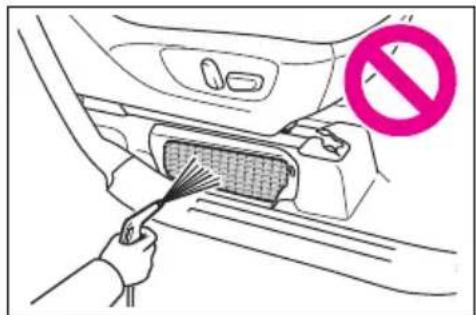
■To prevent damage to the vehicle
- Do not allow water or foreign matter to enter the air intake vents when the covers are removed.
Carefully handle the removed filter so that it will not be damaged. If the filter is damaged, have it replaced with a new filter by your Toyota dealer.
● Make sure to reinstall the filters and covers to their original positions after cleaning. - Do not install anything to the air intake vents other than the exclusive filters for this vehicle or use the vehicle without the filters installed.
If "Maintenance Required for Traction Battery Cooling Parts See Owner's Manual" is shown on the multi-information display
If the vehicle is continuously driven with the warning message (indicating that charging/discharging of the hybrid battery [traction battery] may become limited) displayed, the hybrid battery (traction battery) may malfunction. If the warning message is displayed, clean the air intake vents immediately.
Electronic key battery
Replace the battery with a new one if it is depleted.
If the key battery is depleted
The following symptoms may occur:
●The smart key system and wireless remote control will not function properly.
●The operational range will be reduced.
Items to prepare
Prepare the following before replacing the battery:
- Flathead screwdriver
● Small flathead screwdriver
● Lithium battery CR2450
■Use a CR2450 lithium battery
●Batteries can be purchased at your Toyota dealer, local electrical appliance shops or camera stores.
- Replace only with the same or equivalent type recommended by the manufacturer.
● Dispose of used batteries according to the local laws.
Replacing the battery
1 Release the lock and remove the mechanical key.
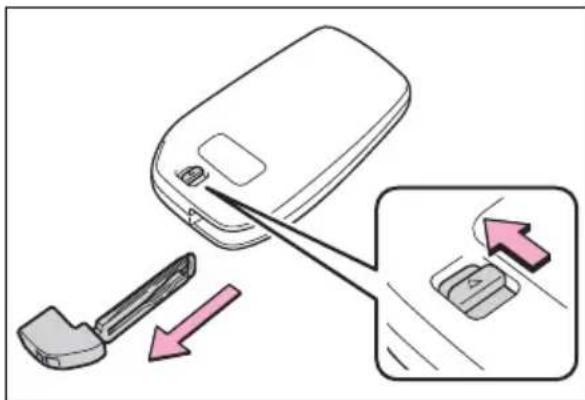
natural_image
Diagram showing a device being inserted into a slot, with arrows indicating the insertion direction (no text or symbols present)2 Remove the key cover.
Use a screwdriver of an appropriate size. Forcedly prying may cause the cover damaged.
To prevent damage to the key, cover the tip of the flathead screw-driver with a rag.
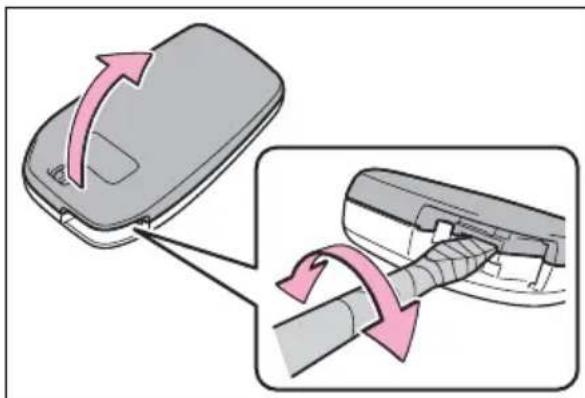
3 Remove the depleted battery using a small flathead screw-driver.
When removing the cover, the electronic key module may stick to the cover and the battery may not be visible. In this case, remove the electronic key module in order to remove the battery.
When removing the battery, use a screwdriver of an appropriate size. Insert a new battery with the “+” ter-
minal facing up.
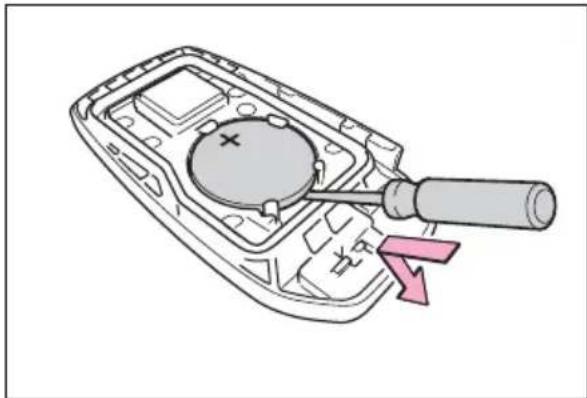
natural_image
Diagram of a handheld device with a lever and internal components, no text or symbols present4 When installing, reverse the steps listed.

WARNING
Battery precautions
Observe the following precautions.
Failure to do so may result in death or serious injury.
- Do not swallow the battery. Doing so may cause chemical burns.
A coin battery or button battery is used in the electronic key. If a battery is swallowed, it may cause severe chemical burns in as little as 2 hours and may result in death or serious injury. - Keep away new and removed batteries from children.
- If the cover cannot be firmly closed, stop using the electronic key and stow the key in the place where children cannot reach, and then contact your Toyota dealer.
- If you accidentally swallow a battery or put a battery into a part of your body, get emergency medical attention immediately.
■To prevent battery explosion or leakage of flammable liquid or gas
- Replace the battery with a new battery of the same type. If a wrong type of battery is used, it may explode.
- Do not expose batteries to extremely low pressure due to high altitude or extremely high temperatures.
- Do not burn, break or cut a battery.

NOTICE
■When replacing the battery
Use a flathead screwdriver of appropriate size. Applying excessive force may deform or damage the cover.
■For normal operation after replacing the battery
Observe the following precautions to prevent accidents:
●Always work with dry hands. Moisture may cause the battery to rust.
- Do not touch or move any other component inside the remote control.
- Do not bend either of the battery terminals.
Checking and replacing fuses
If any of the electrical components do not operate, a fuse may have blown. If this happens, check and replace the fuses as necessary.
Checking and replacing fuses
1 Turn the power switch off.
2 Open the fuse box cover.
▶ Engine compartment
Push claw A and to completely release the lock, and then lift up the cover.
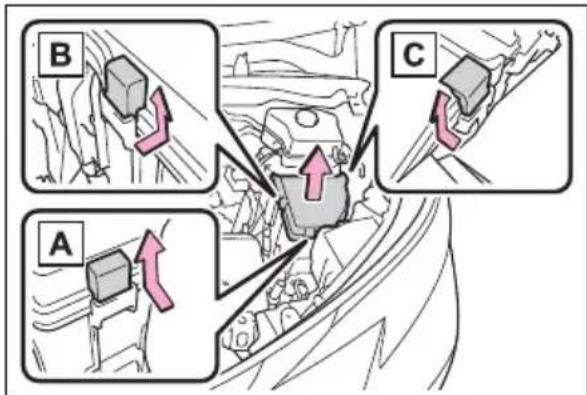
▶ Left side instrument panel Remove the lid.
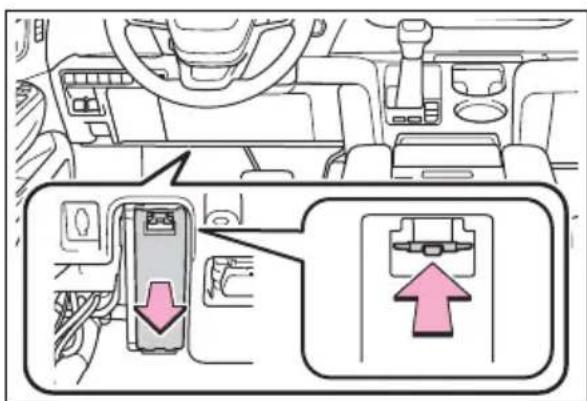
▶ Right side luggage compartment
Remove the cover
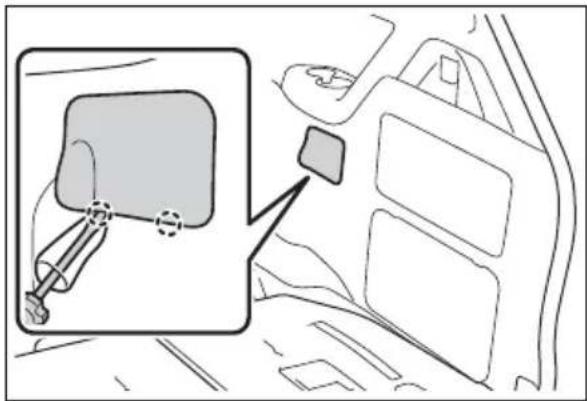
natural_image
Diagram showing a car interior with a highlighted vehicle component and a small inset view of the dashboard (no text or symbols)3 Remove the fuse.
Only type A fuse can be removed using the pullout tool.
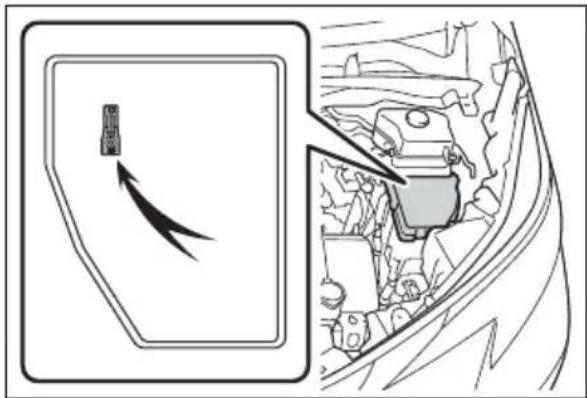
4 Check if the fuse is blown.
Replace the blown fuse with a new fuse of an appropriate amperage rating. The amperage rating can be found on the fuse box lid.
▶ Type A
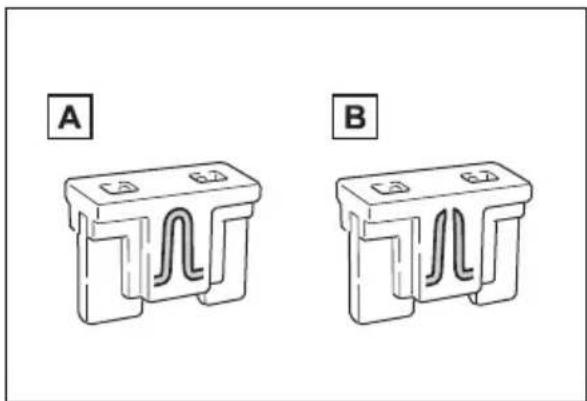
natural_image
Two identical line drawings of a mechanical component with internal channels, labeled A and B (no text or symbols on the components themselves)A Normal fuse
B Blown fuse
▶ Type B
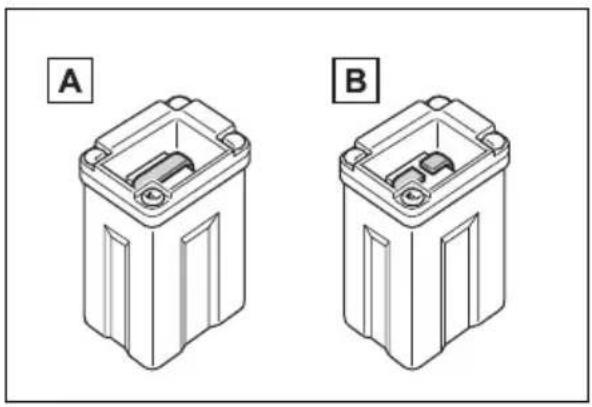
natural_image
Two identical line drawings of a battery casing labeled A and B, showing internal compartments and mounting holes (no text or symbols beyond labels)A Normal fuse
B Blown fuse
▶ Type C
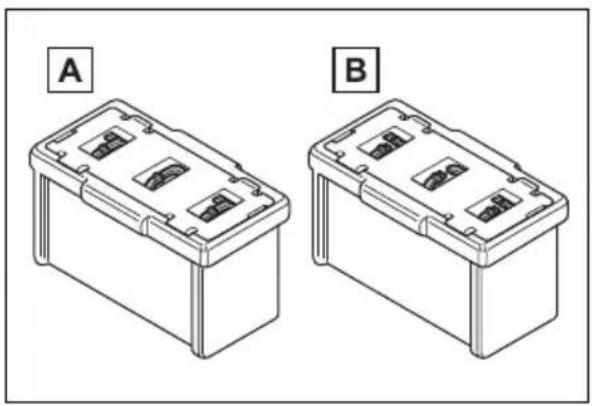
natural_image
Two identical line drawings of battery compartments labeled A and B, showing internal compartments without any text or symbols.A Normal fuse
B Blown fuse
■After a fuse is replaced
- When installing the lid, make sure that the tab is installed securely.
- If the lights do not turn on even after the fuse has been replaced, a bulb may need replacement. (→P.451)
- If the replaced fuse blows again, have the vehicle inspected by your Toyota dealer.
If there is an overload in a circuit
The fuses are designed to blow, protecting the wiring harness from damage.
■When replacing light bulbs
Toyota recommends that you use genuine Toyota products designed for this vehicle. Because certain bulbs are connected to circuits designed to prevent overload, non-genuine parts or parts not designed for this vehicle may be unusable.

WARNING
■To prevent system break- downs and vehicle fire
Observe the following precautions.
Failure to do so may cause damage to the vehicle, and possibly a fire or injury.
●Never use a fuse of a higher amperage rating than that indicated, or use any other object in place of a fuse.
●Always use a genuine Toyota fuse or equivalent.
Never replace a fuse with a wire, even as a temporary fix.
- Do not modify the fuses or fuse boxes.

NOTICE
■Before replacing fuses
Have the cause of electrical overload determined and repaired by your Toyota dealer as soon as possible.
■To prevent damage to the engine compartment fuse box cover
When opening the fuse box, completely release the claw locks before lifting up the cover. Otherwise, the claws may be damaged.
Light bulbs
You may replace the following bulbs by yourself. The difficulty level of replacement varies depending on the bulb. If necessary bulb replacement seems difficult to perform, contact your Toyota dealer.
For more information about replacing other light bulbs, contact your Toyota dealer.
Preparing for light bulb replacement
Check the wattage of the light bulb to be replaced. ( P.526)
Bulb location
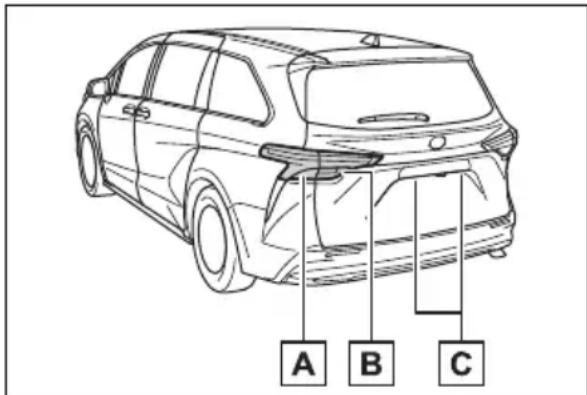
A Rear turn signal lights
B Back-up lights
C License plate lights
■Lights that need to be replaced by your Toyota dealer
- Headlights
● Daytime running lights
● Front turn signal/parking lights
- Front side marker lights
- Side turn signal lights
- Tail lights
- Stop lights
● Fog lights (if equipped)
- Rear side marker lights
● High mounted stoplight
● Outer foot lights (if equipped)
LED lights
The lights other than the following lights each consist of a number of LEDs. If any of the LEDs burn out, take your vehicle to your Toyota dealer to have the light replaced.
●Rear turn signal lights
●Back-up lights
●License plate lights
■Condensation build-up on the inside of the lens
Temporary condensation build-up on the inside of the light lens does not indicate a malfunction. Contact your Toyota dealer for more information in the following situations:
● Large drops of water have built up on the inside of the lens.
●Water has built up inside the light.
■When replacing light bulbs →P.450
Replacing light bulb
■Rear turn signal lights
1 Open the back door.
2 Remove the securing screws and remove the unit.
Remove the lamp assembly by pulling it directly backward from the rear of the vehicle.
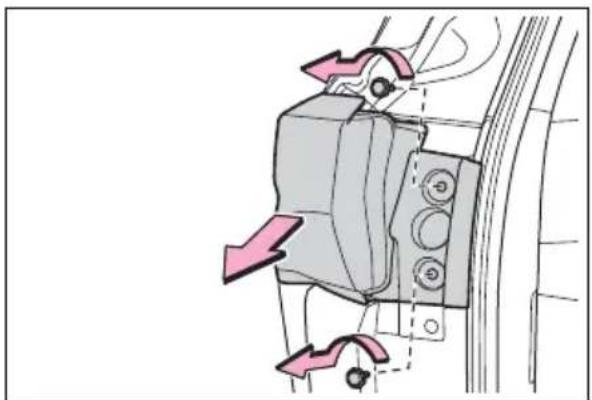
natural_image
Diagram of a mechanical component with directional arrows indicating movement or force (no text or symbols present)3 Turn the bulb base counterclockwise.
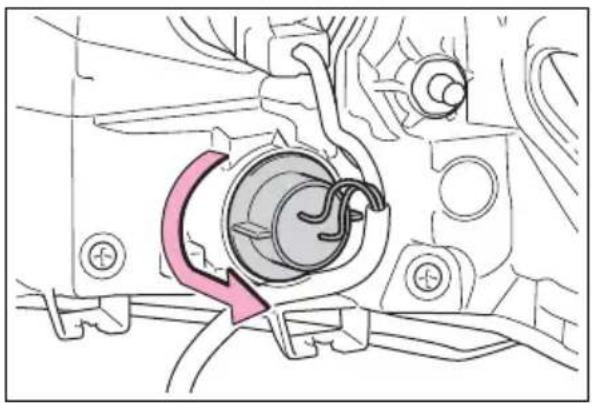
natural_image
Mechanical assembly diagram showing a rotating component with a pink arrow indicating rotation direction (no text or labels)4 Remove the light bulb.
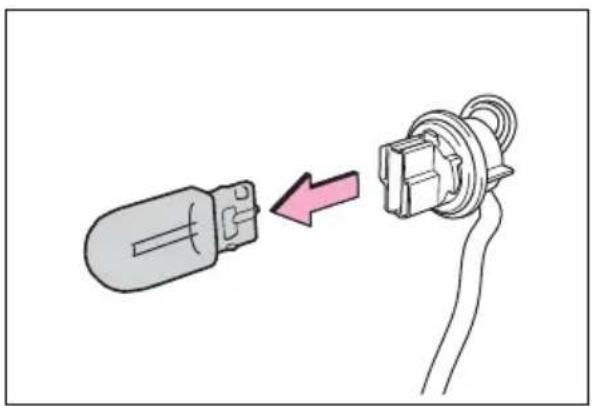
natural_image
Diagram showing a plug being inserted into a connector with a pink arrow indicating the process (no text or symbols present)5 Install a new light bulb.
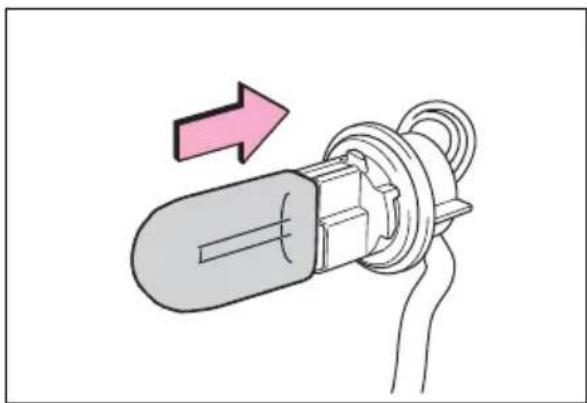
natural_image
Diagram of a plug being inserted into a socket, with a pink arrow indicating direction (no text or symbols)6 Install the bulb base to the light unit by inserting it and turning the bulb base clockwise.
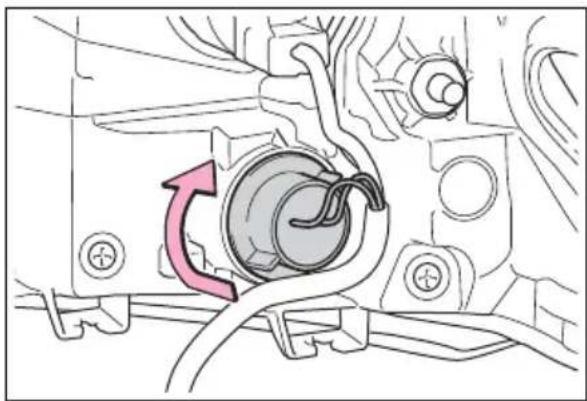
natural_image
Mechanical assembly diagram showing a rotating component with a red arrow indicating rotation direction (no text or symbols present)7 Align the grooves on the light unit with the claws, and insert the light unit straight so that the pin on the light unit fit into the hole.
Confirm that the light unit is com-
pletely secured.
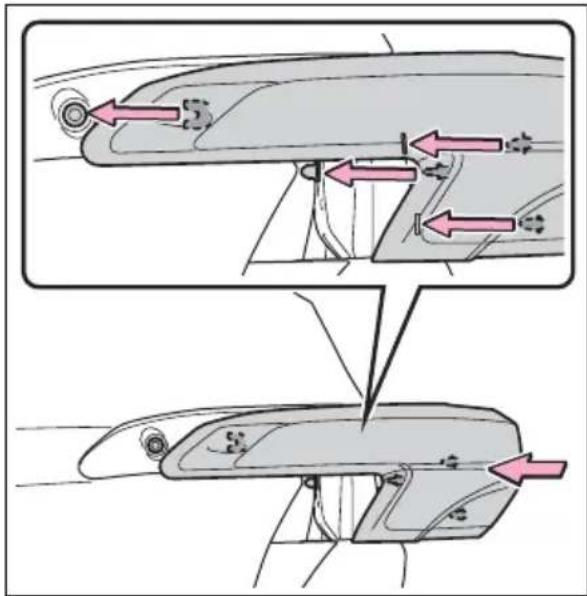
8 Reinstall the screws.
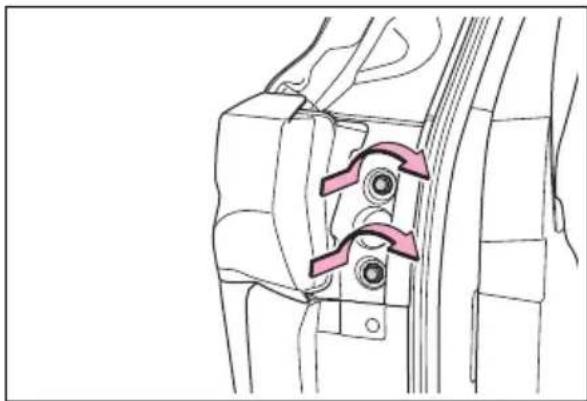
natural_image
Technical line drawing of a mechanical component with two red arrows indicating directional movement (no text or symbols)■Back-up lights
1 Open the back door and remove the cover.
To prevent damage to the cover, wrap the tip of the screwdriver with a rag, etc.
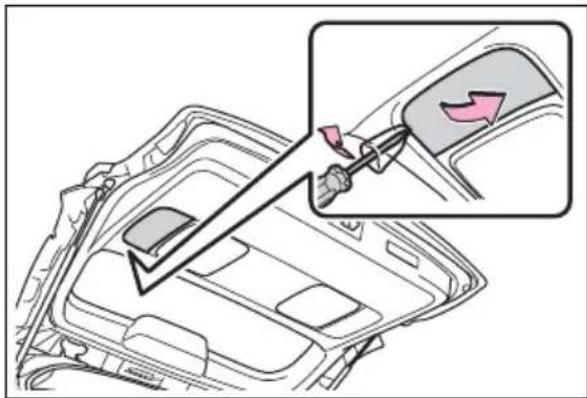
natural_image
Diagram showing a car seatbelt switch being inserted into the dashboard, with an inset close-up highlighting the lever mechanism (no text or symbols present)2 Turn the bulb base counterclockwise.
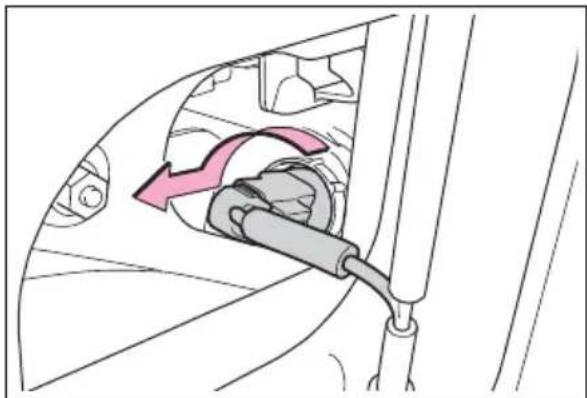
natural_image
Diagram of a car wheel assembly with a cable inserted, showing a directional arrow (no text or symbols present)3 Remove the light bulb.
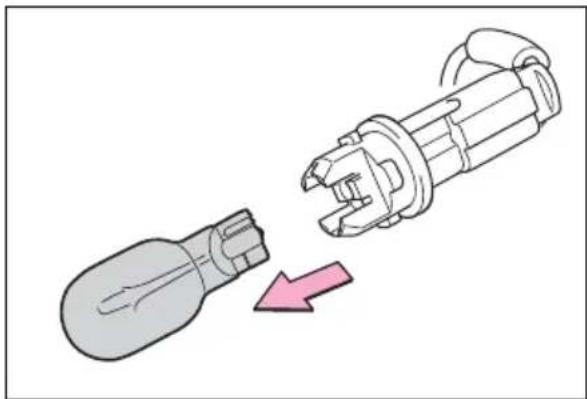
natural_image
Diagram showing a light bulb being inserted into a plug with a pink arrow indicating the insertion direction (no text or symbols present)4 Install a new light bulb.
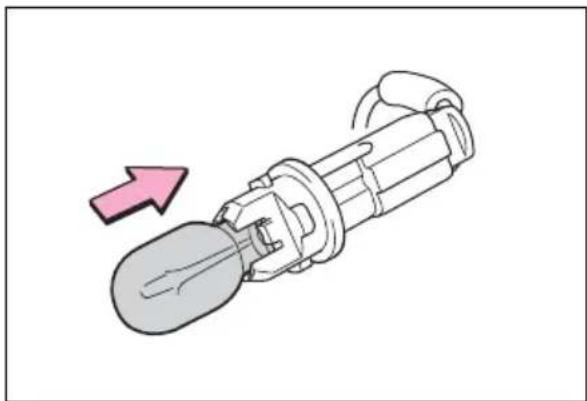
natural_image
Illustration of a mechanical device with a pink arrow indicating direction (no text or symbols)5 Install the bulb base to the light unit by inserting it and
turning the bulb base clockwise.
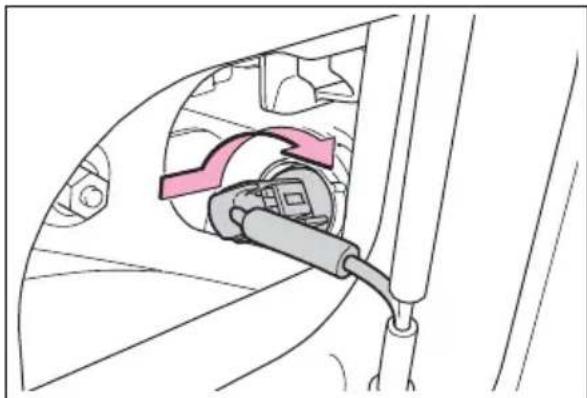
natural_image
Diagram of a car electrical plug inserted into a car wheel, showing wiring and component placement (no text or labels)6 Reinstall the cover.
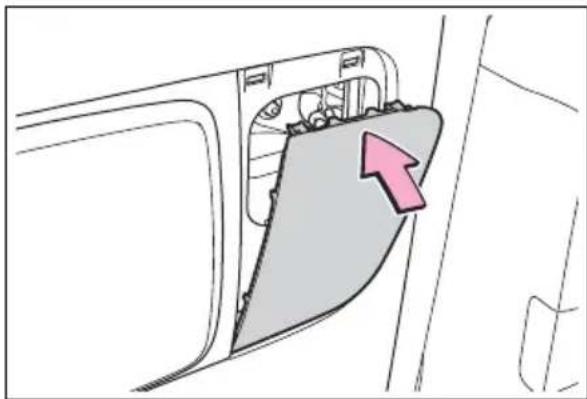
natural_image
Diagram of a car door with a highlighted seat area and an arrow pointing to the seat (no text or symbols present)■License plate lights
1 Remove the cover.
Using a flathead screwdriver, remove the cover.
To prevent damage to the vehicle, wrap the tip of the flathead screw-driver with tape, etc.
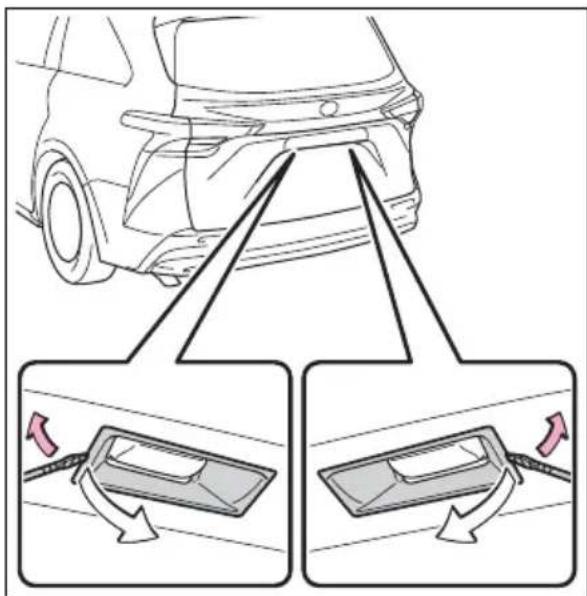
2 Remove the lens.
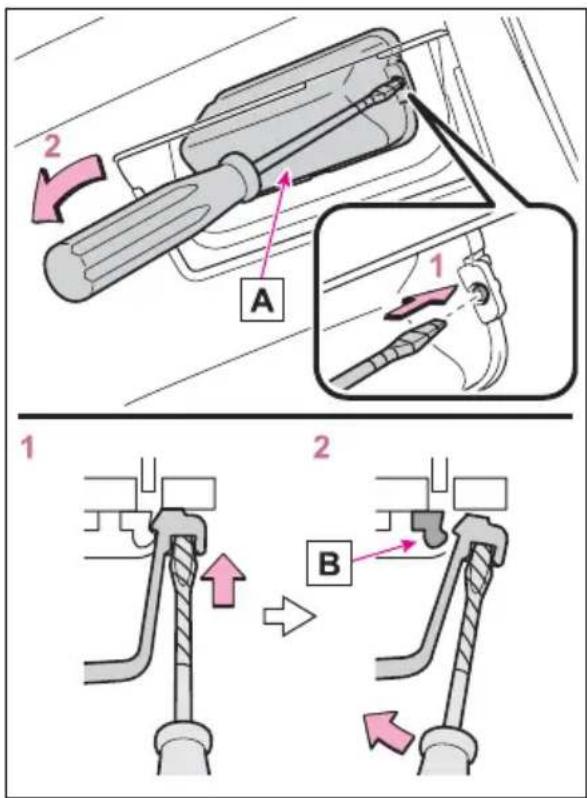
A Lens
B Hook
1 Insert a small flathead screw-driver, etc. into either the right or left hole of the lens.
2 Push the screwdriver sideways in the direction of the arrow shown in the illustration, disengage the hook, and then remove the lens.
To prevent damage to the vehicle, wrap the tip of the screwdriver with tape, etc.
3 Remove the light bulb.
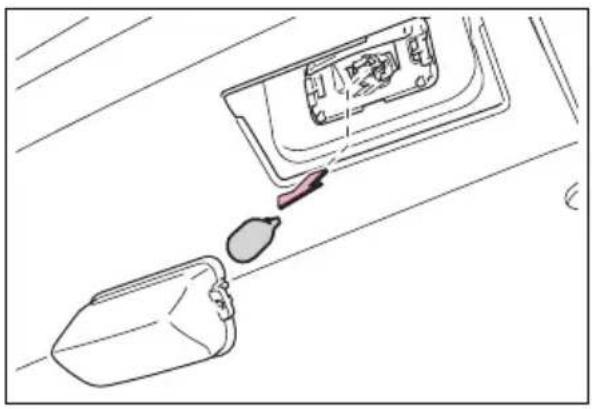
natural_image
Diagram showing a device with a container and a plug inserted into it, no text or symbols present4 Install a new light bulb.
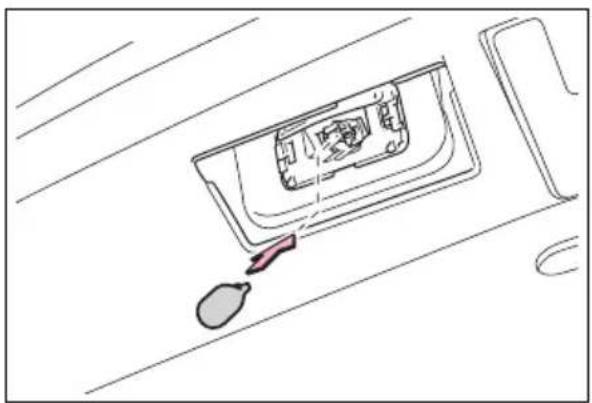
natural_image
Line drawing of a device inside a container with a mouse, no text or symbols present5 Install the lens.
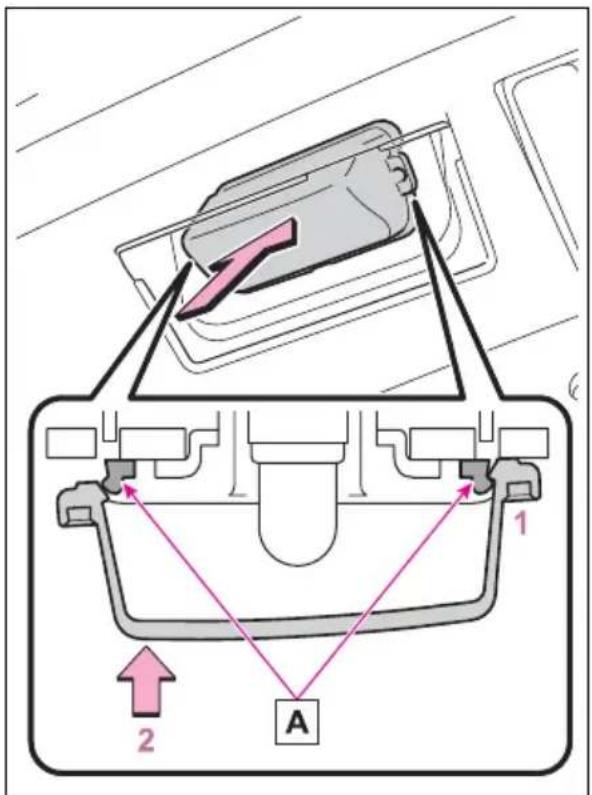
A Hooks
1 Fit the lens into either the
right or left hooks.
2 Push the lens into place.
After installation, confirm that the lens is properly installed by gently pulling it.
6 Install the cover.
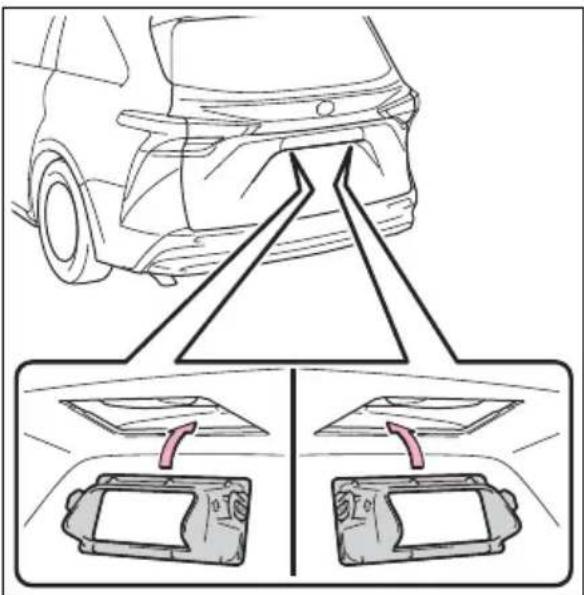
WARNING
■Replacing light bulb
●Turn off the light. Do not attempt to replace the bulb immediately after turning off the light. The bulb becomes very hot and may cause burns.
- Do not touch the glass portion of the light bulb with bare hands. When it is unavoidable to hold the glass portion, use and hold with a clean dry cloth to avoid getting moisture and oils on the bulb. Also, if the bulb is scratched or dropped, it may blow out or crack.
● Fully install light bulb and any parts used to secure it. Failure to do so may result in heat damage, fire, or water entering the light unit. This may damage the light or cause condensation to build up on the lens.

WARNING
- Do not attempt to repair or disassemble light bulbs, connectors, electric circuits or component parts.
Doing so may result in death or serious injury due to electric shock.
● Make sure bulb is fully seated and locked. - Check the wattage of the bulb before installing to prevent heat damage.
■To prevent damage or fire
7
7-1. Essential information
Emergency flashers .... 458
If your vehicle has to be stopped in an emergency 459
If the vehicle is trapped in rising water...... 460
7-2. Steps to take in an emergency
If your vehicle needs to be towed.... 462
If you think something is wrong 465
If a warning light turns on or a warning buzzer sounds 466
If a warning message is displayed.... 477
If you have a flat tire (vehicles without spare tire)481
If you have a flat tire (vehicles with spare tire) ... 491
If the hybrid system will not start .... 501
If you lose your keys ... 502
If the fuel filler door cannot be opened .... 503
If the electronic key does not operate properly.. 504
If the 12-volt battery is discharged .... 506
If your vehicle overheats 511
If the vehicle becomes stuck 514
Emergency flashers
sion.)
The emergency flashers are used to warn other drivers when the vehicle has to be stopped in the road due to a breakdown, etc.
Operating instructions
Press the switch.
All the turn signal lights will flash.
To turn them off, press the switch once again.
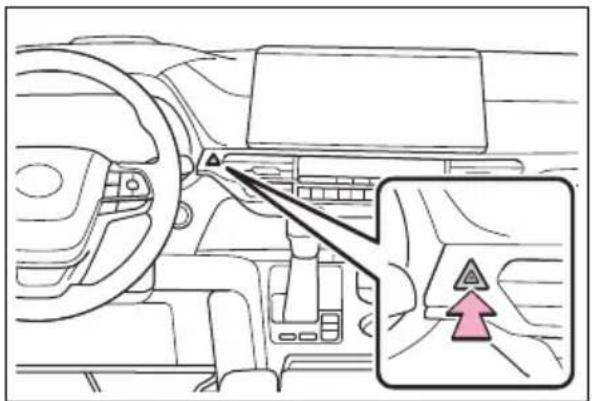
Emergency flashers
- If the emergency flashers are used for a long time while the hybrid system is not operating (while the "READY" indicator is not illuminated), the 12-volt battery may discharge.
- If any of the SRS airbags deploy (inflate) or in the event of a strong rear impact, the emergency flashers will turn on automatically. The emergency flashers will turn off automatically after operating for approximately 20 minutes. To manually turn the emergency flashers off, press the switch twice. (The emergency flashers may not turn on automatically depending on the force of the impact and conditions of the colli-
If your vehicle has to be stopped in an emergency
Only in an emergency, such as if it becomes impossible to stop the vehicle in the normal way, stop the vehicle using the following procedure:
Stopping the vehicle
1 Steadily step on the brake pedal with both feet and firmly depress it.
Do not pump the brake pedal repeatedly as this will increase the effort required to slow the vehicle.
2 Shift the shift lever to N.
If the shift lever is shifted to N
3 After slowing down, stop the vehicle in a safe place by the road.
4 Stop the hybrid system.
If the shift lever cannot be shifted to N
3 Keep depressing the brake pedal with both feet to reduce vehicle speed as much as possible.
4 Press and hold the power switch for 2 consecutive seconds or more, or press it
briefly 3 times or more in succession.
5 Stop the vehicle in a safe place by the road.

WARNING
■If the hybrid system has to be turned off while driving
●Power assist for the steering wheel will be lost, making the steering wheel heavier to turn. Decelerate as much as possible before turning off the hybrid system.
If the vehicle is trapped in rising water
In the event the vehicle is submerged in water, remain calm and perform the following.
- Remove the seat belt first.
- If the door can be opened, open the door and exit the vehicle.
- If the door can not be opened, open the window using the power window switch and exit the vehicle through the window.
- If the window can not be opened using the power window switch, remain calm, wait until the water level inside the vehicle rises to the point that the water pressure inside of the vehicle equals the water pressure outside of the vehicle, and then open the door and exit the vehicle.

WARNING
■Using an emergency hammer ^*1 for emergency escape
The rear side windows and rear window of this vehicle can be shattered by an emergency hammer ^1 used for emergency escape, however, since the windshield and front side windows ^2 are laminated glass they can not be shattered by an emergency hammer ^*1 .
*1: Contact your Toyota dealer or aftermarket accessory manufacturer for further information about an emergency hammer.
^*2 :Vehicles with laminated glass
■ Escaping the vehicle from the window
There are cases where escaping the vehicle from the window is not possible due to seating position, passenger body type, etc.
When using an emergency hammer, consider your seat location and the size of the window opening to ensure that the opening is accessible and large enough to escape.
■How to distinguish laminated glass
When looking from the cross-sectional view point, laminated glass is two sheets of glass pasted together.
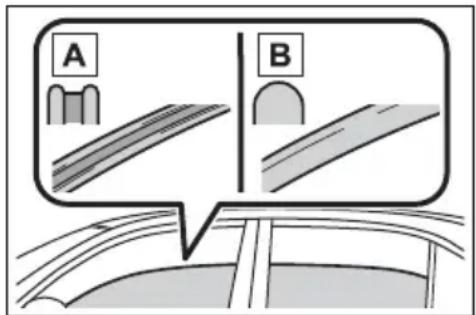
A Laminated glass
B Tempered glass
If your vehicle needs to be towed
If towing is necessary, we recommend having your vehicle towed by your Toyota dealer or commercial towing service, using a wheel-lift type truck or flat-bed truck.
Use a safety chain system for all towing, and abide by all state/provincial and local laws.
2WD models: If towing your vehicle with a wheel-lift type truck from the front, the vehicle's rear wheels and axles must be in good conditions. (→P.462, 463)
If they are damaged, use a towing dolly or flatbed truck.
AWD models: If towing your vehicle with a wheel-lift type truck, use a towing dolly. (→P.462, 463)

WARNING
Observe the following precautions. Failure to do so may result in death or serious injury.
■When towing the vehicle
2WD models: Be sure to transport the vehicle with the front wheels raised or with all four wheels raised off the ground. If the vehicle is towed with the front wheels contacting the ground, the drive-train and related parts may be damaged or electricity generated by the operation of the motor may cause a fire to occur depending on the nature of the damage or malfunction.
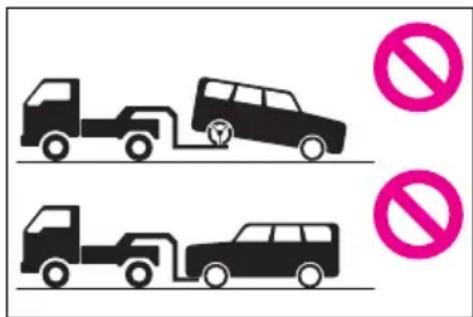
AWD models: Be sure to transport the vehicle with all four wheels raised off the ground. If the vehicle is towed with the tires contacting the ground, the drivetrain or related parts may be damaged, the vehicle may fly off the truck, or electricity generated by the operation of the motor may cause a fire to occur depending on the nature of the damage or malfunction.
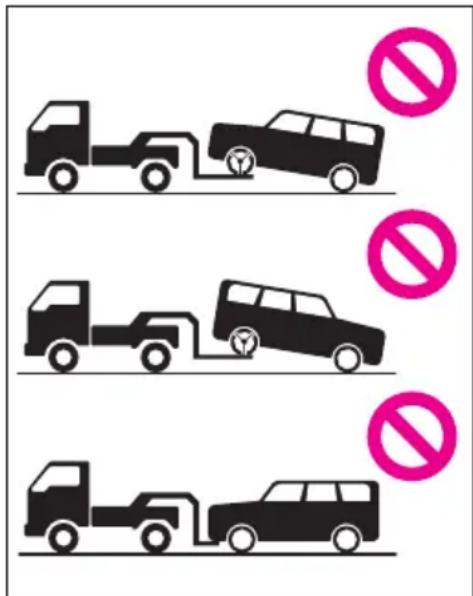

NOTICE
■To prevent damage to the vehicle when towing using a wheel-lift type truck
- Do not tow the vehicle from the rear when the power switch is off. The steering lock mechanism is not strong enough to hold the front wheels straight.
- When raising the vehicle, ensure adequate ground clearance for towing at the opposite end of the raised vehicle. Without adequate clearance, the vehicle could be damaged while being towed.
■To prevent damage to the vehicle when towing with a sling-type truck
Do not tow with a sling-type truck, either from the front or rear.
■ Recreational towing (behind motor home, etc.)
Never dinghy tow your vehicle to prevent causing serious damage to the AWD system and transmission. (→P.230)
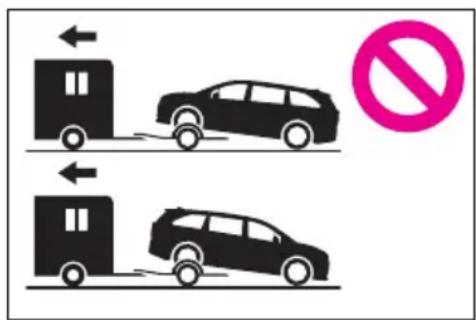
Situations when it is necessary to contact dealers before towing
The following may indicate a problem with your transmission. Contact your Toyota dealer or commercial towing service before towing.
- The hybrid system warning message is shown on the multi-information display and the vehicle does not move.
● The vehicle makes an abnormal sound.
Towing with a wheel-lift type truck
▶ From the front (2WD models)
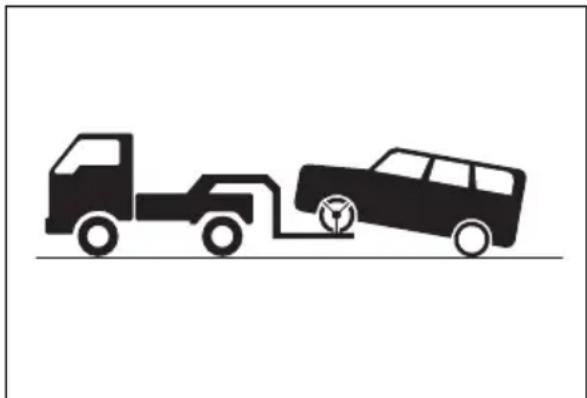
natural_image
Silhouette illustration of a truck and a car connected by a pipe, symbolizing fuel or vehicle charging (no text or symbols)Release the parking brake.
Turn automatic mode off. (→P.244)
▶ From the front (AWD models)
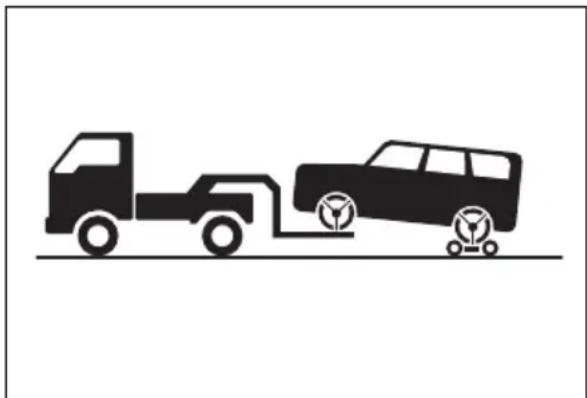
natural_image
Silhouette illustration of a truck and a car on a road, connected by a pump (no text or symbols)Use a towing dolly under the rear wheels.
From the rear
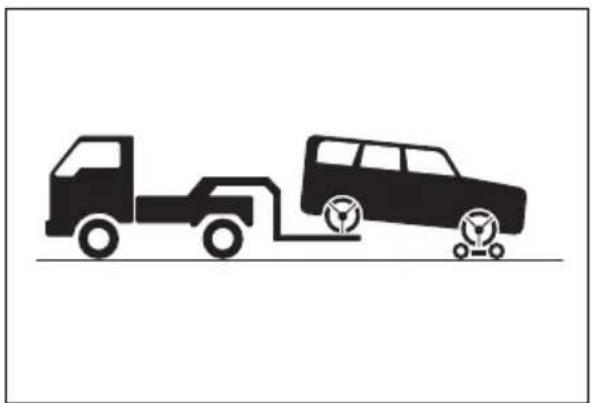
natural_image
Silhouette illustration of a truck and a car with wheels, no text or symbols presentUse a towing dolly under the front wheels.

NOTICE
■Towing with a sling-type truck
Do not tow with a sling-type truck to prevent body damage.
2WD models
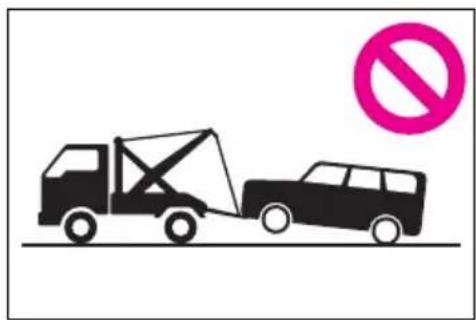
natural_image
Illustration of a truck and car with a no-smoking symbol (no text or labels)AWD models
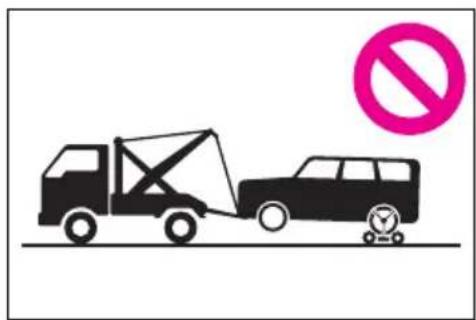
natural_image
Black-and-white illustration of a tow truck and a car with a no-smoking symbol (no text or numbers present)Using a flatbed truck
When using a flatbed truck to transport the vehicle, use tire strapping belts. Refer to the owner's manual of the flatbed
truck for the tire strapping method.
In order to suppress vehicle movement during transportation, set the parking brake and turn the power switch off.
If you think something is wrong
If you notice any of the following symptoms, your vehicle probably needs adjustment or repair. Contact your Toyota dealer as soon as possible.
Visible symptoms
- Fluid leaks under the vehicle (Water dripping from the air conditioning after use or dripping from the muffler is normal.)
- Flat-looking tires or uneven tire wear
● Engine coolant temperature gauge needle continually points higher than normal.
Audible symptoms
● Changes in exhaust sound
- Excessive tire squeal when cornering
● Strange noises related to the suspension system
● Pinging or other noises related to the hybrid system
Operational symptoms
● Engine missing, stumbling or running roughly
● Appreciable loss of power
● Vehicle pulls heavily to one side when braking
● Vehicle pulls heavily to one side when driving on a level road
● Loss of brake effectiveness, spongy feeling, pedal almost touches the floor
If a warning light turns on or a warning buzzer sounds
Calmly perform the following actions if any of the warning lights comes on or flashes. If a light comes on or flashes, but then goes off, this does not necessarily indicate a malfunction in the system. However, if this continues to occur, have the vehicle inspected by your Toyota dealer.
Actions to the warning lights or warning buzzers
■Brake system warning light (warning buzzer)
| Warning light Details/Actions | |
 (U.S.A.) (U.S.A.) | Indicates that:● The brake fluid level is low; or● The brake system is malfunctioning→ Immediately stop the vehicle in a safe place and contact your Toyota dealer. Continuing to drive the vehicle may be dangerous. |
 (Red)(Canada) (Red)(Canada) | |
■Brake system warning light
| Warning light Details/Actions | |
 (Yellow) (Yellow) | Indicates a malfunction in:● The parking brake system;● The regenerative braking system; or● The electronically controlled brake system→ Have the vehicle inspected by your Toyota dealer immediately. |
■Charging system warning light \*
| Warning light Details/Actions | |
 | Indicates a malfunction in the vehicle’s charging system→ Immediately stop the vehicle in a safe place and contact your Toyota dealer. |
*: This light illuminates on the multi-information display with a message.
■High coolant temperature warning light * (warning buzzer)
| Warning light Details/Actions | |
 | Indicates that the engine coolant temperature is too high→ Immediately stop the vehicle in a safe place. Handling method (→P.511) |
* : This light illuminates on the multi-information display with a message.
■Hybrid system overheat warning light * (warning buzzer)
| Warning light Details/Actions | |
 | Indicates that the hybrid system has overheated → Stop the vehicle in a safe place. Handling method (→P.511) |
* : This light illuminates on the multi-information display with a message.
■Low engine oil pressure warning light * (warning buzzer)
| Warning light Details/Actions | |
 | Indicates that the engine oil pressure is too low→ Immediately stop the vehicle in a safe place and contact your Toyota dealer. |
* : This light illuminates on the multi-information display with a message.
■Malfunction indicator lamp
| Warning light Details/Actions | |
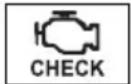 (U.S.A.) (U.S.A.) | Indicates a malfunction in:● The hybrid system;● The electronic engine control system;● The electronic throttle control system; or● The emission control system (if equipped)→ Have the vehicle inspected by your Toyota dealer immediately. |
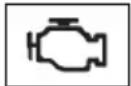 (Canada) (Canada) | |
■SRS warning light
| Warning light Details/Actions | |
 | Indicates a malfunction in:● The SRS airbag system;● The front passenger occupant classification system; or● The seat belt pretensioner system→ Have the vehicle inspected by your Toyota dealer immediately. |
■ABS warning light
| Warning light Details/Actions | |
 (U.S.A.) (U.S.A.) | Indicates a malfunction in:● The ABS; or● The brake assist system→ Have the vehicle inspected by your Toyota dealer immediately. |
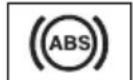 (Canada) (Canada) | |
■Electric power steering system warning light (warning buzzer)
| Warning light Details/Actions | |
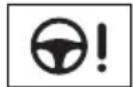 (Red/yellow) (Red/yellow) | Indicates a malfunction in the EPS (Electric Power Steering) system→ Have the vehicle inspected by your Toyota dealer immediately. |
■PCS warning light (warning buzzer)
| Warning light Details/Actions | |
 (Flashes or illuminates) (Flashes or illuminates) | When a buzzer sounds simultaneously:Indicates a malfunction has occurred in the PCS (Pre-Collision System).→ Have the vehicle inspected by your Toyota dealer immediately.When a buzzer does not sound:The PCS (Pre-Collision System) has become temporarily unavailable, corrective action may be necessary.→ Follow the instructions displayed on the multi-information display. (→P.265, 480)If the PCS (Pre-Collision System) or VSC (Vehicle Stability Control) system is disabled, the PCS warning light will illuminate.→ P.274 |
■LTA indicator (warning buzzer)
| Warning light Details/Actions | |
 (Orange) (Orange) | Indicates a malfunction in the LTA (Lane Tracing Assist)→ Follow the instructions displayed on the multi-information display. (→P.285) |
■Intuitive parking assist OFF indicator (warning buzzer)
| Warning light Details/Actions | |
 (If equipped) (If equipped) | When a buzzer sounds:Indicates a malfunction in the Intuitive parking assist function→ Have the vehicle inspected by your Toyota dealer immediately.When a buzzer does not sound:Indicates that the system is temporarily unavailable, possibly due to a sensor being dirty or covered with ice, etc.→ Follow the instructions displayed on the multi-information display. (→P.311, 477) |
■RCD OFF indicator (warning buzzer)
| Warning light Details/Actions | |
 (If equipped) (If equipped) | When a buzzer sounds:Indicates a malfunction in the RCD (Rear Camera Detection) function→ Have the vehicle inspected by your Toyota dealer immediately.When a buzzer does not sound:Indicates that the function temporarily cannot be used due to the camera being dirty, etc.→ Follow the instructions displayed on the multi-information display. (→P.477) |
■PKSB OFF indicator (warning buzzer)
| Warning light Details/Actions | |
 (If equipped) (If equipped) | When a buzzer sounds:Indicates a malfunction in the PKSB (Parking Support Brake) system→ Have the vehicle inspected by your Toyota dealer immediately.When a buzzer does not sound:Indicates that the system is temporarily unavailable, possibly due to a sensor being dirty or covered with ice, etc.→ Follow the instructions displayed on the multi-information display. (→P.322) |
■RCTA OFF indicator (warning buzzer)
| Warning light Details/Actions | |
 (If equipped) (If equipped) | When a buzzer sounds:Indicates a malfunction in the RCTA (Rear Cross Traffic Alert) function→ Have the vehicle inspected by your Toyota dealer immediately.When a buzzer does not sound:Indicates that the rear bumper around the radar sensor is covered with dirt, etc. (→P.301)→ Follow the instructions displayed on the multi-information display. (→P.301, 477) |
Slip indicator
| Warning light Details/Actions | |
 | Indicates a malfunction in:● The VSC/Trailer Sway Control system;● The TRAC system; or● The hill-start assist control system→ Have the vehicle inspected by your Toyota dealer immediately. |
■Brake Override System/Drive-Start Control/PKSB (if equipped) warning light\* (warning buzzer)
| Warning light Details/Actions | |
 | When a buzzer sounds:● Brake Override System is malfunctioning;● Drive-Start Control is operating;● Drive-Start Control is malfunctioning; or● Parking Support Brake function (for static objects) (if equipped) is operating→ Follow the instructions displayed on the multi-information display.When a buzzer does not sound:Brake Override System is operating→ Release the accelerator pedal and depress the brake pedal. |
*: This light illuminates on the multi-information display with a message.
■Brake hold operated indicator (warning buzzer)
| Warning light Details/Actions | |
 (Flashes) (Flashes) | Indicates a malfunction in the brake hold system→ Have the vehicle inspected by your Toyota dealer immediately. |
■Parking brake indicator
| Warning light Details/Actions | |
 (Flashes) (Flashes) | It is possible that the parking brake is not fully engaged or released→Operate the parking brake switch once again. |
 (Canada)(Flashes) (Canada)(Flashes) | This light comes on when the parking brake is not released. If the light turns off after the parking brake is fully released, the system is operating normally. |
■Tire pressure warning light
| Warning light Details/Actions | |
 | When the light comes on after blinking for approximately 1 minute:Malfunction in the tire pressure warning system→ Have the system checked by your Toyota dealer.When the light comes on:Low tire inflation pressure such as● Natural causes● Flat tire→ Immediately stop the vehicle in a safe place. Handling method (→P.474) |
■Low fuel level warning light
| Warning light Details/Actions | |
 | Indicates that remaining fuel is approximately 2.7 gal.(10.2 L, 2.2 Imp. gal.) or less→ Refuel the vehicle. |
■Seat belt reminder light (warning buzzer \*)
| Warning light Details/Actions | |
 | Warns the driver and/or front passenger to fasten their seat belts→ Fasten the seat belt.If the front passenger's seat is occupied, the front passenger's seat belt also needs to be fastened to make the warning light (warning buzzer) turn off. |
*: Driver's seat belt warning buzzer:
The driver's seat belt warning buzzer sounds to alert the driver that his or her seat belt is not fastened. Once the power switch is turned to ON, the buzzer sounds. If the seat belt is still unfastened, the buzzer sounds intermittently for a certain period of time after the vehicle reaches a certain speed.
Front passenger's seat belt warning buzzer:
The front passenger's seat belt warning buzzer sounds to alert the front passenger that his or her seat belt is not fastened. If the seat belt is unfastened, the buzzer sounds intermittently for a certain period of time after the vehicle reaches a certain speed.
■Rear passengers' seat belt reminder light (warning buzzer \*)
| Warning light Details/Actions | |
 | Warns the rear passengers to fasten their seat belts → Fasten the seat belt. |
*: Rear passengers' seat belt warning buzzer:
The rear passengers' seat belt warning buzzer sounds to alert the rear passengers that his or her seat belt is not fastened. If the seat belt is unfastened, the buzzer sounds intermittently for a certain period of time, after the seat belt is fastened and unfastened and the vehicle reaches a certain speed.
■Warning buzzer
In some cases, the buzzer may not be heard because of noisy place or an audio sound.
■Front passenger detection sensor, seat belt reminder and warning buzzer
- If luggage is placed on the front passenger seat, the front passenger detection sensor may cause the warning light to flash and the warning buzzer to sound even if a passenger is not sitting in the
seat.
- If a cushion is placed on the seat, the sensor may not detect a passenger, and the warning light may not operate properly.
■ SRS warning light
This warning light system monitors the airbag sensor assembly, front impact sensors, side impact sensors (front door), side impact sensors (front), side impact sensors (rear), driver's seat position sensor, driver's seat belt buckle switch, front passenger occupant classification sensors, "AIR BAG ON" indicator light, "AIR BAG OFF" indicator light, front passenger's seat belt buckle switch, seat belt pretensioners and force limiters, airbags, interconnecting wiring and power sources. (→P.42)
■If the malfunction indicator lamp comes on while driving
First check the following:
●Is the fuel tank empty?
If it is, fill the fuel tank immediately.
●Is the fuel tank cap loose?
If it is, tighten it securely.
The light will go off after several driving trips.
If the light does not go off even after several trips, contact your Toyota dealer as soon as possible.
Electric power steering system warning light (warning buzzer)
When the 12-volt battery charge becomes insufficient or the voltage temporarily drops, the electric power steering system warning light may come on and the warning buzzer may sound.
■When the tire pressure warning light comes on
Inspect the tires to check if a tire is punctured.
If a tire is punctured: →P.491
If none of the tires are punctured:
Turn the power switch to OFF then turn it to ON.
Check if the tire pressure warning light comes on or blinks.
If the tire pressure warning light blinks for approximately 1 minute then stays on
There may be a malfunction in the tire pressure warning system. Have the vehicle inspected by your Toyota dealer immediately.
▶ If the tire pressure warning light comes on
1 After the temperature of the tires has lowered sufficiently, check the inflation pressure of each tire and adjust them to the specified level.
2 If the warning light does not turn off even after several minutes have elapsed, check that the inflation pressure of each tire is at the specified level and perform initialization. (→P.430)
■The tire pressure warning light may come on due to natural causes
The tire pressure warning light may come on due to natural causes such as natural air leaks and tire inflation pressure changes caused by temperature. In this case, adjusting the tire inflation pressure will turn off the warning light (after a few minutes).
When a tire is replaced with a compact spare tire (vehicles with compact spare tire)
The compact spare tire is not equipped with a tire pressure warning valve and transmitter. If a tire goes flat, the tire pressure warning light will not turn off even though the flat tire has been replaced with the spare tire. Replace the spare tire with the standard tire and adjust the tire inflation pressure. The tire pressure warning light will go off after a few minutes.
■Conditions that the tire pressure warning system may not function properly
→P.428

WARNING
■If both the ABS and the brake system warning lights remain on
Stop your vehicle in a safe place immediately and contact your Toyota dealer. The vehicle will become extremely unstable during braking, and the ABS system may fail, which could cause an accident resulting in death or serious injury.
■When the electric power steering system warning light comes on
When the light comes on yellow, the assist to the power steering is restricted. When the light comes on red, the assist to the power steering is lost and handling operations of the steering wheel become extremely heavy. When steering wheel operations are heavier than usual, grip the steering wheel firmly and operate it using more force than usual.
■If the tire pressure warning light comes on
Be sure to observe the following precautions. Failure to do so could cause a loss of vehicle control and result in death or serious injury.
- Stop your vehicle in a safe place as soon as possible. Adjust the tire inflation pressure immediately.
- If the tire pressure warning light comes on even after tire inflation pressure adjustment, it is probable that you have a flat tire. Check the tires. If a tire is flat, change it with the spare tire and have the flat tire repaired by the nearest Toyota dealer.
● Avoid abrupt maneuvering and braking. If the vehicle tires deteriorate, you could lose control of the steering wheel or the brakes.
■If a blowout or sudden air leakage should occur
The tire pressure warning system may not activate immediately.
■Maintenance of the tires
Each tire, including the spare (if provided), should be checked monthly when cold and inflated to the inflation pressure recommended by the vehicle manufacturer on the vehicle placard or tire inflation pressure label (tire and load information label). (If your vehicle has tires of a different size than the size indicated on the vehicle placard or tire inflation pressure label [tire and load information label], you should determine the proper tire inflation pressure for those tires.)

WARNING
As an added safety feature, your vehicle has been equipped with a tire pressure monitoring system (TPMS-tire pressure warning system) that illuminates a low tire pressure telltale (tire pressure warning light) when one or more of your tires is significantly under-inflated. Accordingly, when the low tire pressure telltale (tire pressure warning light) illuminates, you should stop and check your tires as soon as possible, and inflate them to the proper pressure. Driving on a significantly under-inflated tire causes the tire to overheat and can lead to tire failure. Under-inflation also reduces fuel efficiency and tire tread life, and may affect the vehicle's handling and stopping ability.
Please note that the TPMS (tire pressure warning system) is not a substitute for proper tire maintenance, and it is the driver's responsibility to maintain correct tire pressure, even if under-inflation has not reached the level to trigger illumination of the TPMS low tire pressure telltale (tire pressure warning light).
Your vehicle has also been equipped with a TPMS (tire pressure warning system) malfunction indicator to indicate when the system is not operating properly. The TPMS (tire pressure warning system) malfunction indicator is combined with the low tire pressure telltale (tire pressure warning light). When the system detects a malfunction, the telltale will flash for approximately one minute and then remain continuously illuminated. This sequence will continue upon subsequent vehicle start-ups as long as the malfunction exists. When the malfunction indicator is illuminated, the system may not be able to detect or signal low tire pressure as intended.
TPMS (tire pressure warning system) malfunctions may occur for a variety of reasons, including the installation of replacement or alternate tires or wheels on the vehicle that prevent the TPMS (tire pressure warning system) from functioning properly. Always check the TPMS (tire pressure warning system) malfunction tell-tale after replacing one or more tires or wheels on your vehicle to ensure that the replacement or alternate tires and wheels allow the TPMS (tire pressure warning system) to continue to function properly.

NOTICE
■To ensure the tire pressure warning system operates properly
Do not install tires with different specifications or manufacturers as the tire pressure warning system may not operate properly.
If a warning message is displayed
The multi-information display shows warnings of system malfunctions, incorrectly performed operations, and messages that indicate a need for maintenance. When a message is shown, perform the correction procedure appropriate to the message.
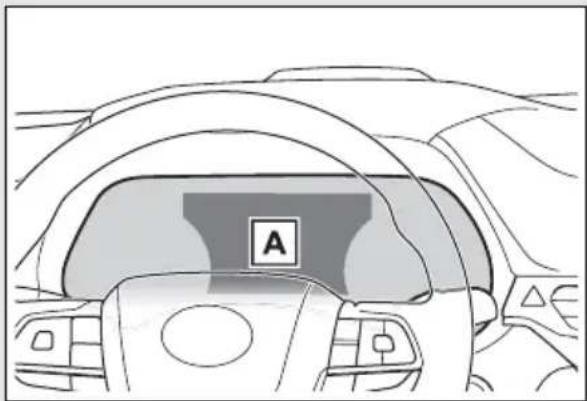
natural_image
Interior view of a car dashboard with steering wheel and steering wheel (no visible text or symbols)A Multi-information display
Follow the instructions of the message on the multi-information display.
If any of the warning messages are shown again after the following actions have been performed, contact your Toyota dealer.
Messages and warnings
The warning lights and warning buzzers operate as follows depending on the content of the message. If a message indicates the need for inspection by a dealer, have the vehicle inspected by your Toyota dealer immediately.
| Warning light | Warning buzzer* | Warning |
| — Sounds | Indicates an important situation, such as when a system related to driving is malfunctioning or that danger may result if the correction procedure is not performedIndicates a situation, such as when damage to the vehicle or danger may result | |
| Comes on or flashes | Sounds | Indicates an important situation, such as when the systems shown on the multi-information display may be malfunctioning |
| — Does not sound | Indicates a condition, such as malfunction of electrical components, their condition, or indicates the need for maintenanceIndicates a situation, such as when an operation has been performed incorrectly, or indicates how to perform an operation correctly | |
*: A buzzer sounds the first time a message is shown on the multi-information display.
■Warning messages
The warning messages explained below may differ from the actual messages according to operation conditions and vehicle specifications.
■Warning buzzer
In some cases, the buzzer may not be heard due to being in a noisy location or audio sound.
If a message that indicates the need for visiting your Toyota dealer is displayed
The system or part shown on the multi-information display is malfunctioning. Have the vehicle inspected by your Toyota dealer immediately.
If a message that indicates the need for referring to Owner's Manual is displayed
- If “Engine Coolant Temp High Stop in a Safe Place See Owner’s Manual” is shown, follow the instructions (→P.514).
- If any of the following messages are shown on the multi-information display, it may indicate a malfunction. Have the vehicle inspected by your Toyota dealer immediately.
- "Smart Key System Malfunction"
- "Hybrid System Malfunction"
- "Check Engine"
- "Hybrid Battery System Malfunction"
- "Accelerator System Malfunction"
- If any of the following messages are shown on the multi-informa-
tion display, it may indicate a malfunction. Immediately stop the vehicle and contact your Toyota dealer.
- “ Braking Power Low”
- "12-Volt Battery Charging System Malfunction"
- "Oil Pressure Low"
- If any of the following messages are shown on the multi-information display, the vehicle may have run out of fuel. Stop the vehicle in a safe place and, if the fuel level is low, refuel the vehicle.
- "Hybrid System Stopped"
- "Engine Stopped"
- If "Low Auxiliary Battery See Owner's Manual" is shown
- When the display goes off after several seconds*:
Maintain the hybrid system operation for more than 15 minutes and charge the 12- volt battery.
- When the display does not go off:
Start up the hybrid system using the procedures for "If the 12-volt battery is discharged" ( P.506)
*: Displays for about 6 seconds
- If "Maintenance Required for Traction Battery Cooling Parts See Owner's Manual" is shown, the filter may be clogged, the air intake vent may be blocked, or there may be a gap in the duct. Therefore, perform the following correction procedure.
- If the air intake vent or filter of the hybrid battery (traction battery) are dirty, perform the procedures on P.443 to clean them.
- If the warning message is shown when the air intake vent and filter of the hybrid battery (traction battery) are not dirty, have the vehicle inspected at your Toyota dealer.
If “Engine Oil Level Low Add or Replace” is displayed
The engine oil level may be low. Check the level of the engine oil, and add engine oil if necessary. This message may be displayed if the vehicle is stopped on a slope. Move the vehicle to a level surface and check if the message disappears.
If "Hybrid System Stopped Steering Power Low" is displayed
This message is displayed if the hybrid system is stopped while driving.
When steering wheel operations are heavier than usual, grip the steering wheel firmly and operate it using more force than usual.
If "Hybrid System Overheated Output Power Reduced" is shown
The message may be shown when driving under severe operating conditions. (For example, when driving up a long steep hill or driving up a steep hill in reverse.)
Coping method: →P.514
If “Traction Battery Needs to be Protected Refrain from the Use of N Position” is shown
This message may be displayed when the shift lever is in N.
As the hybrid battery (traction battery) can not be charged when the shift lever is in N, shift the shift lever to P when the vehicle is stopped.
If “Traction Battery Needs to be Protected Shift into P to Restart” is shown
This message is displayed when the hybrid battery (traction battery) charge has become extremely low because the shift lever has been left in N for a certain amount of time.
When operating the vehicle, shift to P and restart the hybrid system.
If "Shift to P Before Exiting Vehicle" is shown
Message is displayed when the driver's door is opened without turn-
ing the power switch to OFF with the shift lever in any position other than P.
Shift the shift lever to P.
If "Shift Is in N Release Accelerator Before Shifting" is shown
Message is displayed when the accelerator pedal has been depressed and the shift lever is in N. Release the accelerator pedal and shift the shift lever to D or R.
If "Accelerator Pedal is Pressed" is displayed
The accelerator pedal has been depressed when the shift lever is in P. Release the accelerator pedal.
If "Press Brake When Vehicle Is Stopped Hybrid System May Overheat" is shown
Message is displayed when the accelerator pedal is depressed to maintain the vehicle position when stopped on a upward slope, etc.
If this continues, the hybrid system may overheat.
Release the accelerator pedal and depress the brake pedal.
If "Auto Power Off to Conserve Battery" is shown
Power was turned off due to the automatic power off function.
Next time when starting the hybrid system, operate the hybrid system for approximately 5 minutes to recharge the 12-volt battery.
If “High Power Consumption Power to Climate Temporarily Limited” is displayed
Turn off unnecessary electronic equipment to reduce power consumption.
Please wait until the power supply returns to normal.
If "Headlight System Malfunction Visit Your Dealer" is displayed
The following systems may be mal-
functioning.
Have the vehicle inspected by your Toyota dealer immediately.
●The LED headlight system
●Automatic High Beam
If "Radar Cruise Control Unavailable" is shown
The dynamic radar cruise control with full-speed range system is suspended temporarily or until the problem shown in the message is resolved. (causes and coping methods: →P.265)
If a message that indicates the malfunction of front camera is displayed
The following systems may be suspended until the problem shown in the message is resolved. ( P.265, 466)
●PCS (Pre-Collision System)
●LTA (Lane Tracing Assist)
●Automatic High Beam
●RSA (Road Sign Assist) (if equipped)
● Dynamic radar cruise control with full-speed range
If "Oil Maintenance Required Soon" is displayed
Indicates that the engine oil should be scheduled to be changed.
Check the engine oil and change it if necessary.
After changing the engine oil, make sure to reset the message. (→P.418)
If "Oil Maintenance Required Visit Your Dealer" is displayed
Indicates that the engine oil should be changed.
Check and change the engine oil and oil filter by your Toyota dealer. After changing the engine oil, make sure to reset the message. (→P.418)
■Warning buzzer
→P.473

NOTICE
■ "High Power Consumption Power to Climate Temporarily Limited" is frequently shown
There is a possible malfunction relating to the charging system or the 12-volt battery may be deteriorating. Have the vehicle inspected by your Toyota dealer.
If "Low Auxiliary Battery See Owner's Manual" is displayed frequently
The 12-volt battery may have deteriorated.
As the battery may discharge in this state when left unattended, have the battery inspected by your Toyota dealer.
If you have a flat tire (vehicles without spare tire)
Your vehicle is not equipped with a spare tire, but instead is equipped with an emergency tire puncture repair kit. A puncture caused by a nail or screw passing through the tire tread can be repaired temporarily using the emergency tire puncture repair kit. (The kit contains a bottle of sealant. The sealant can be used only once to temporarily repair one tire without removing the nail or screw from the tire.) Depending on the damage condition of the flat tire, it may not be able to repaired with the emergency tire puncture repair kit. (→P.482)
After temporarily repairing the tire with the kit, have the tire repaired or replaced by your Toyota dealer.

WARNING
If you have a flat tire
Do not continue driving with a flat tire.
Driving even a short distance with a flat tire can damage the tire and the wheel beyond repair, which could result in an accident.
Driving with a flat tire may cause a circumferential groove on the side wall.
In such a case, the tire may explode when using a repair kit.
Before repairing the vehicle
- Stop the vehicle in a safe place on a hard, flat surface.
- Set the parking brake.
- Shift the shift lever to P.
- Stop the hybrid system.
- Turn on the emergency flashers. (→P.458)
● Disable the power sliding door system. (→P.148) - For vehicles with power back door: Disable the power back door system. (→P.163)
- Check the degree of the tire damage.
A tire should only be repaired with the emergency tire puncture repair kit if the damage is caused by a nail or screw passing through the tire tread.
- Do not remove the nail or screw from the tire. Removing the object may widen the
opening and prevent emergency repair with the repair kit.
• To avoid sealant leakage, move the vehicle until the area of the puncture, if known, is positioned at the top of the tire.
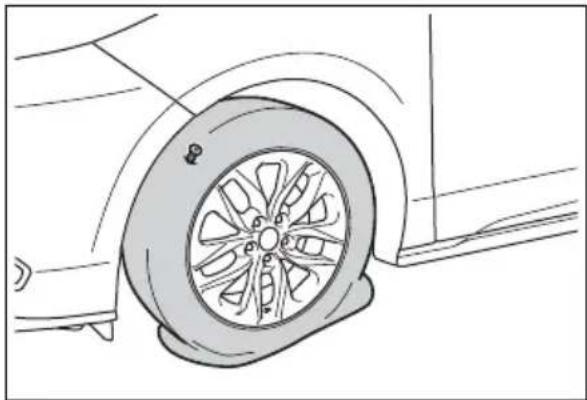
natural_image
Line drawing of a car wheel rim and tire assembly (no text or symbols)Jack and tools
As your vehicle is equipped with the emergency tire puncture repair kit, the following tools for replacing a tire are not included with your vehicle. They can be purchased at your Toyota dealer.
●Wheel nut wrench
Jack
Jack handle
A flat tire that cannot be repaired with the emergency tire puncture repair kit
In the following cases, the tire cannot be repaired with the emergency tire puncture repair kit. Contact your Toyota dealer.
- When the tire is damaged due to driving without sufficient air pressure
- When the tire lost air pressure due to a crack or damage in the tire sidewall
●When the tire is visibly separated from the wheel
●When the cut or damage to the
tread is 4 mm (0.16 in.) long or more
●When the wheel is damaged
- When two or more tires have been punctured
- When there is more than one hole or cut in the damaged tire
- When the sealant has expired

WARNING
■Using the tire jack
→P.492
Location of the emergency tire puncture repair kit
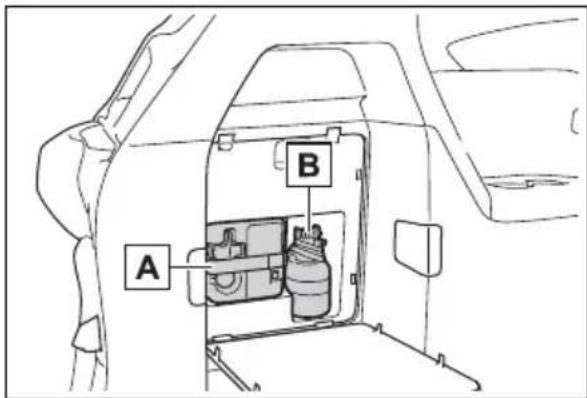
A Emergency tire puncture repair kit (compressor)
B Emergency tire puncture repair kit (bottle)
Emergency tire puncture repair kit components
Bottle
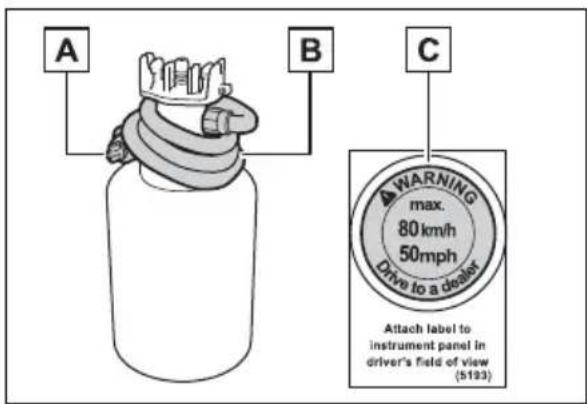
A Air release cap
B Hose
C Speed limit stickers
■Compressor
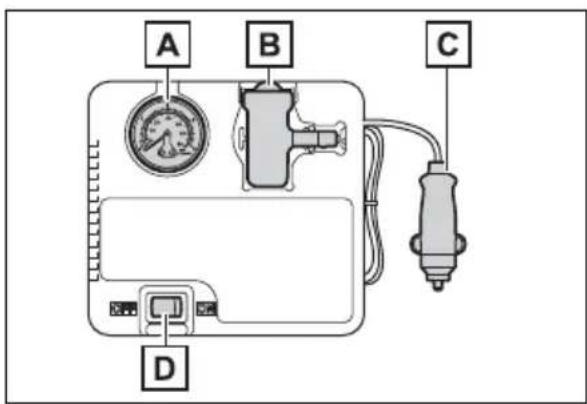
A Air pressure gauge
B Rubber stopper
C Power plug
D Compressor switch
■Note for checking the emergency tire puncture repair kit
Check the sealant expiry date occasionally. The expiry date is shown on the bottle. Do not use sealant whose expiry date has already passed. Otherwise, repairs conducted using the emergency tire
puncture repair kit may not be performed properly.
Emergency tire puncture repair kit
●The emergency tire puncture repair kit is for filling the car tire with air.
●The sealant has a limited life span. The expiry date is marked on the bottle. The sealant should be replaced before the expiry date. Contact your Toyota dealer for replacement.
●The sealant stored in the emergency tire puncture repair kit can be used only once to temporarily repair a single tire. If the sealant in the bottle and other parts of the kit have been used and need to be replaced, contact your Toyota dealer.
●The compressor can be used repeatedly.
●The sealant can be used when the outside temperature is from -40^ F ( -40^ C) to 140^ F ( 60^ C).
●The kit is exclusively designed for size and type of tires originally installed on your vehicle. Do not use it for tires that different size than the original ones, or for any other purposes.
- If the sealant gets on your clothes, it may stain.
- If the sealant adheres to a wheel or the surface of the vehicle body, the stain may not be removable if it is not cleaned at once. Immediately wipe away the sealant with a wet cloth.
●During operation of the repair kit, a loud operation noise is produced. This does not indicate a malfunction.
- Do not use to check or to adjust the tire pressure.

WARNING
■Caution while driving
Observe the following precautions.
Failure to do so may cause an accident.
● Store the repair kit in the luggage compartment.
●The emergency tire puncture repair kit is made exclusively for your vehicle.
Do not use it on other vehicles.
- Do not use emergency tire puncture repair kit for tires that are different size than the original ones or for any other purpose. Doing so may cause the tires to not be repaired properly.
■Precautions for use of the sealant
- Ingesting the sealant is hazardous to your health. If you ingest sealant, consume as much water as possible, and then immediately consult a doctor.
- If sealant gets in eyes or adheres to skin, immediately wash it off with water. If discomfort persists, consult a doctor.
Taking out the emergency tire puncture repair kit
1 Remove the cover.
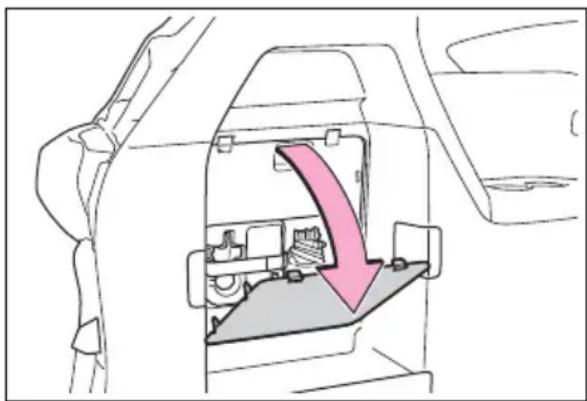
natural_image
Diagram of a car interior showing a highlighted component with a pink arrow indicating direction (no text or symbols present)2 Detach the bands and take out the emergency tire puncture repair kit.
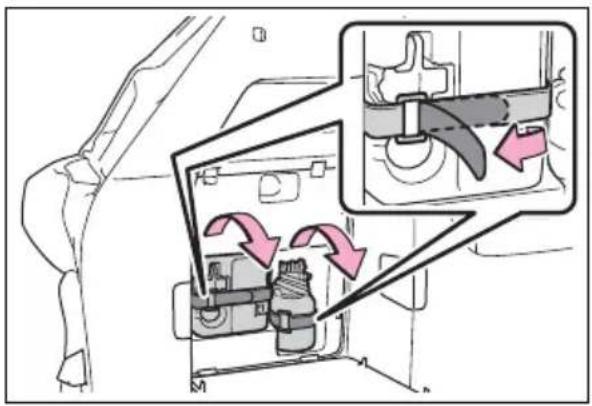
Emergency repair method
1 Remove the valve cap from the valve of the punctured tire.
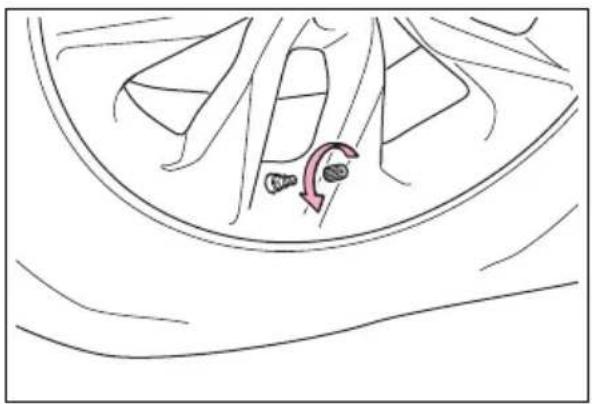
natural_image
Line drawing of a car wheel rim with a red curved arrow indicating clockwise motion (no text or symbols)2 Extend the hose. Remove the air release cap from the hose.
You will use the air release cap again. Therefore keep it in a safe place.
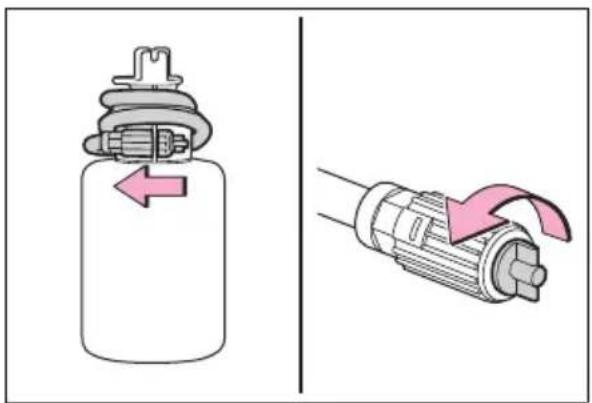
natural_image
Diagram showing two mechanical components: a cylindrical device with a left-side arrow and a multi-cylinder assembly with a curved arrow (no text or symbols)3 Connect the hose to the valve.
Screw the end of the hose clockwise as far as possible.
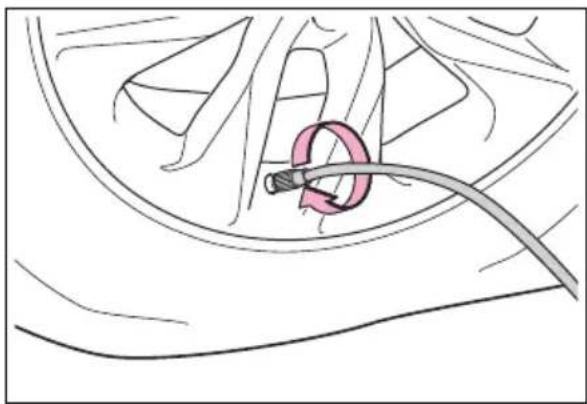
natural_image
Medical illustration showing a catheter inserted into a car wheel (no text or labels)4 Make sure that the compressor switch is off.
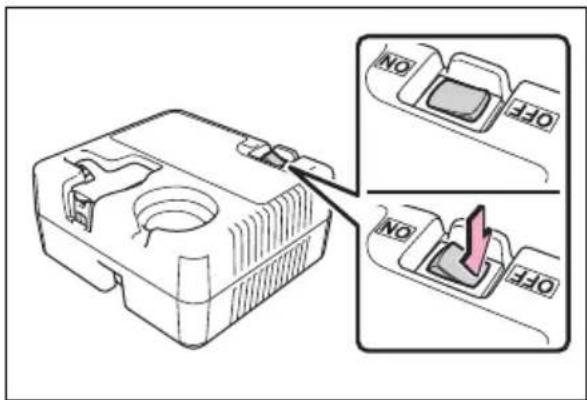
5 Lift the rubber stopper on the compressor.
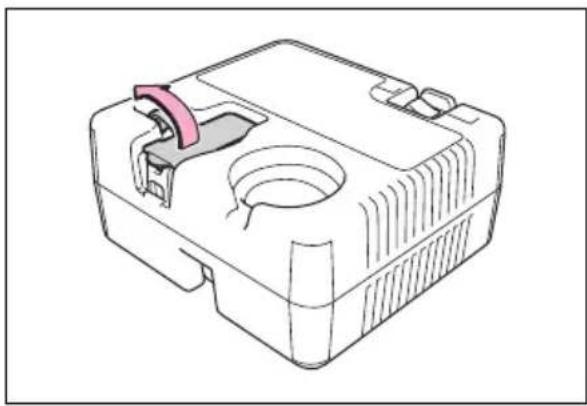
natural_image
Technical line drawing of a mechanical component with a central circular feature and a pink clip (no text or symbols)6 Remove the power plug from the compressor.
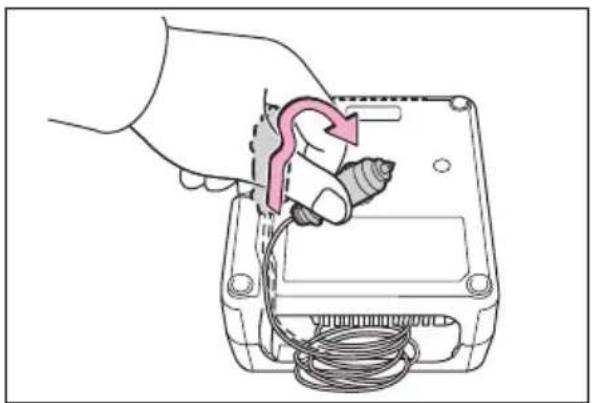
natural_image
Hand inserting a cable into an electronic device (no text or symbols visible)7 Connect the power plug to the power outlet socket. (→P.374)
8 Connect the bottle to the compressor.
Make sure that the bottle is securely connected.
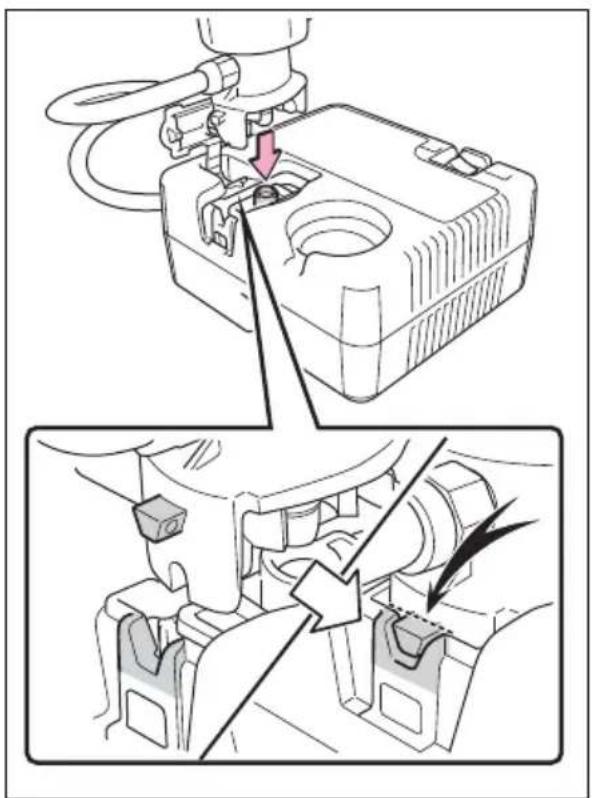
natural_image
Technical illustration showing mechanical assembly steps with arrows indicating motion (no text or symbols)9 Attach the sticker as shown.
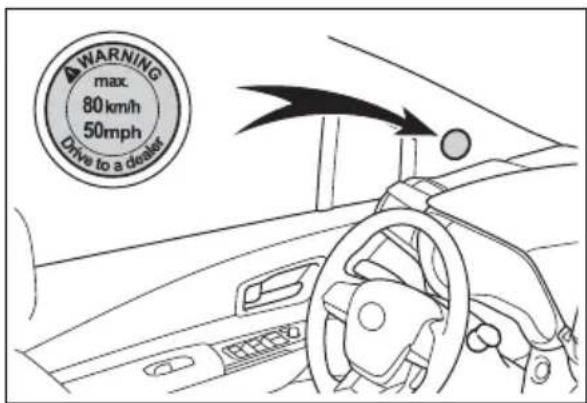
10 Check the specified tire inflation pressure.
Tire inflation pressure is specified on the label as shown. ( P.525)
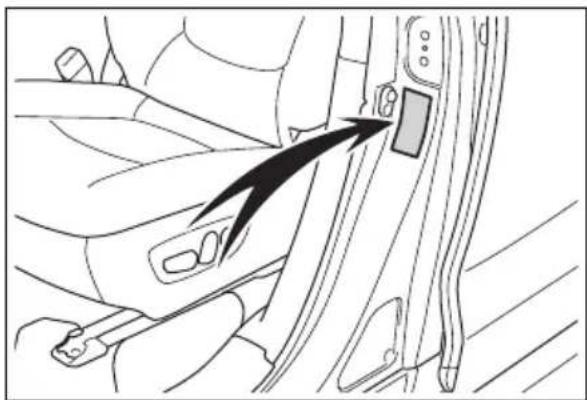
natural_image
Diagram of a car seatbelt buckle being inserted into the seat (no text or symbols present)11 Start the hybrid system. (→P.231)
12 To inject the sealant and inflate the tire, turn the compressor switch on.
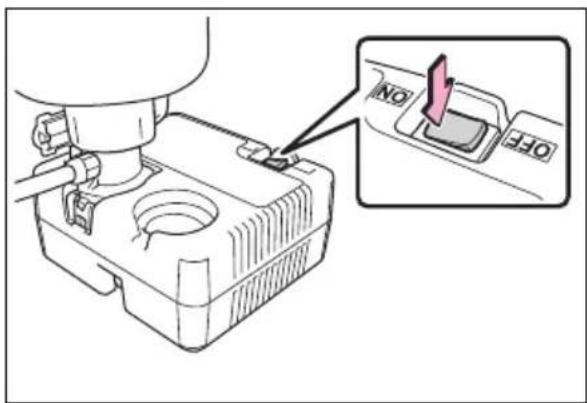
13 Inflate the tire until the recommended pressure is reached.
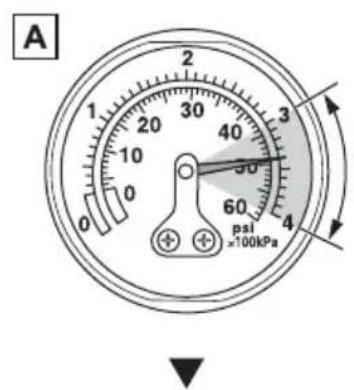
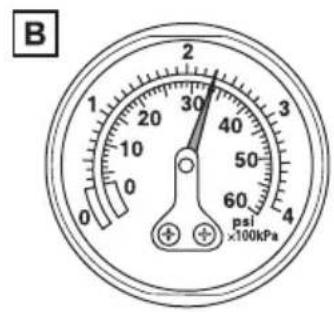
A The sealant will be injected and the pressure will spike to between 44 psi (300 kPa, 3.0 kgf/cm² or bar) and 58 psi (400 kPa, 4.0 kgf/cm² or bar), then gradually decrease.
B The air pressure gauge will display the actual tire inflation pressure about 1 to 5 minutes after the switch is turned on.
- Turn the compressor switch off and then check the tire inflation pressure. Being careful not to over inflate, check and repeat the inflation procedure until the recommended tire inflation pressure is reached.
- If the tire inflation pressure is still lower than the recommended
level after inflation for 25 minutes with the switch on, the tire is too damaged to be repaired. Turn the compressor switch off and contact your Toyota dealer.
- If the tire inflation pressure exceeds the recommended level, let out some air to adjust the tire inflation pressure. (→P.488, 525)
14 With the compressor switch off, disconnect the hose from the valve on the tire and then pull out the power plug from the power outlet socket.
Some sealant may leak when the hose is removed.
15 Install the valve cap onto the valve of the emergency repaired tire.
16 Attach the air release cap to the end of the hose.
If the air release cap is not attached, the sealant may leak and the vehicle may get dirty.
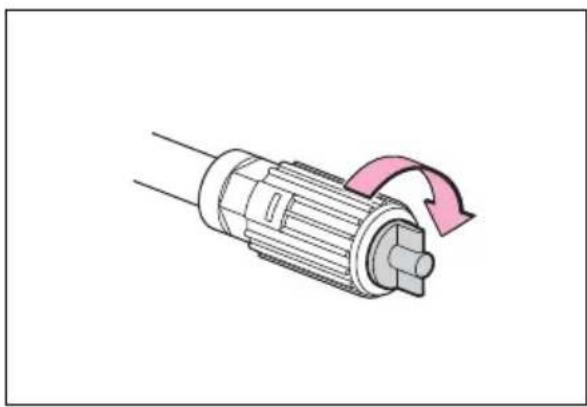
natural_image
Diagram of a mechanical component with a pink curved arrow indicating rotation or movement (no text or symbols)17 Temporarily store the bottle in the trunk while it is connected to the compressor.
18 To spread the liquid sealant evenly within the tire, immediately drive safely for about 3 miles (5 km) below 50 mph (80 km/h).
19 After driving, stop your vehicle in a safe place on a hard, flat surface and reconnect the compressor.
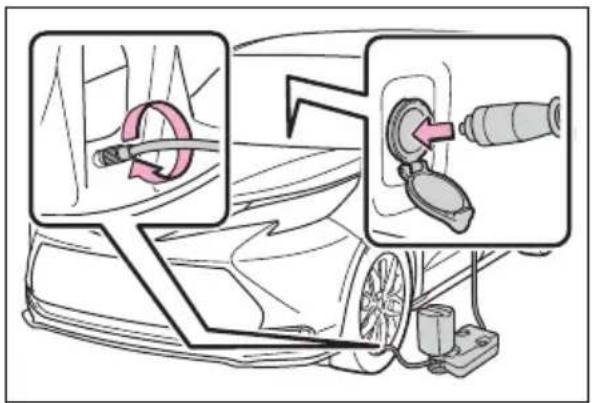
20 Turn the compressor switch on and wait for several seconds, then turn it off. Check the tire inflation pressure.
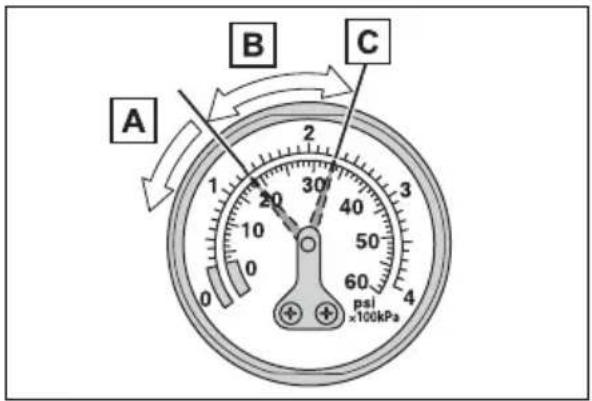
A If the tire inflation pressure is below 19 psi (130 kPa, 1.3 kgf/cm ^2 or bar): The puncture cannot be repaired. Contact your Toyota dealer.
B If the tire inflation pressure is between 19 psi (130 kPa, 1.3 kgf/cm ^2 or bar) and a point below the recommended level: Proceed to step 21.
C If the tire inflation pressure is at the recommended level: Proceed to step 22.
21 Turn the compressor switch on to inflate the tire until the recommended tire inflation pressure is reached. Drive for about 3 miles (5 km) and then perform step 19.
22 Attach the air release cap to the end of the hose.
If the air release cap is not attached, the sealant may leak and the vehicle may get dirty.
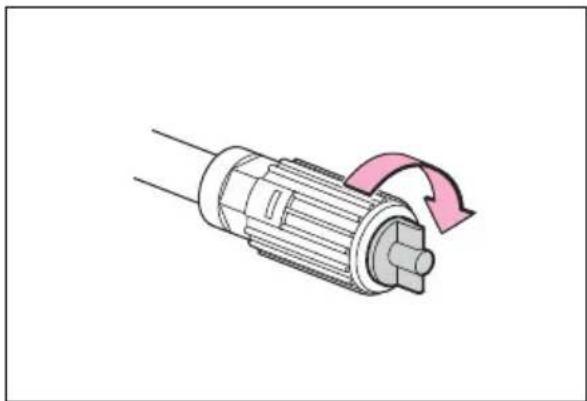
natural_image
Diagram of a mechanical component with a curved arrow indicating rotation (no text or symbols present)23 Store the bottle in the luggage compartment while it is connected to the compressor.
24 Taking precautions to avoid sudden braking, sudden acceleration and sharp turns, drive carefully at under 50mph (80 km/h) to your Toyota dealer that is less than 62 miles (100 km) away for tire repair or replacement.
Make sure to tell your Toyota dealer when you have them repair or replace the tire that sealant is injected.
If the tire is inflated to more than the specified air pressure
1 Disconnect the hose from the valve.
2 Install the air release cap to the end of the hose and push the protrusion on the air release cap into the tire valve to let some air out.
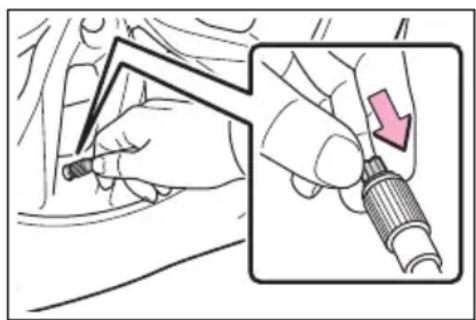
natural_image
Illustration of a hand holding a pen and a tool, with a magnified inset showing a downward arrow (no text or symbols)3 Disconnect the hose from the valve, remove the air release cap from the hose and then reconnect the hose.
4 Turn the compressor switch on and wait for several seconds, and then turn it off. Check that the air pressure indicator shows the specified air pressure.
If the air pressure is lower than the designated pressure, turn the compressor switch on again and repeat the inflation procedure until the specified air pressure is reached.
■After a tire is repaired with the emergency tire puncture repair kit
●The tire pressure warning valve and transmitter should be replaced.
● Even if the tire inflation pressure is at the recommended level, the tire pressure warning light may come on/flash.

WARNING
■When fixing the flat tire
- Stop your vehicle in a safe and flat area.
- Do not touch the wheels or the area around the brakes immediately after the vehicle has been driven.
After the vehicle has been driven, the wheels and the area around the brakes may be extremely hot. Touching these areas with hands, feet or other body parts may result in burns.
- Connect the valve and hose securely with the tire installed on the vehicle. If the hose is not properly connected to the valve, air leakage may occur as sealant may be sprayed out.
- If the hose comes off the valve while inflating the tire, there is a risk that the hose will move abruptly due to air pressure.
● After inflation of the tire has completed, the sealant may splatter when the hose is disconnected or some air is let out of the tire.
●Follow the operation procedure to repair the tire. If the procedures not followed, the sealant may spray out. - Keep back from the tire while it is being repaired, as there is a chance of it bursting while the repair operation is being performed. If you notice any cracks or deformation of the tire, turn off the compressor switch and stop the repair operation immediately.
●The repair kit may overheat if operated for a long period of time. Do not operate the repair kit continuously for more than 40 minutes.

WARNING
●Parts of the repair kit become hot during operation. Be careful handling the repair kit during and after operation. Do not touch the metal part around the connecting area between the bottle and the compressor. It will be extremely hot.
- Do not attach the vehicle speed warning sticker to an area other than the one indicated. If the sticker is attached to an area where an SRS airbag is located, such as the pad of the steering wheel, it may prevent the SRS airbag from operating properly.
■Driving to spread the liquid sealant evenly
●Drive the vehicle carefully at a low speed. Be especially careful when turning and cornering.
- If the vehicle does not drive straight or you feel a pull through the steering wheel, stop the vehicle and check the following.
- Tire condition. The tire may have separated from the wheel.
- Tire inflation pressure. If the tire inflation pressure is 19 psi (130 kPa, 1.3 kgf/cm ^2 or bar) or less, the tire may be severely damaged.

NOTICE
■When performing an emergency repair
● A tire should only be repaired with the emergency tire puncture repair kit if the damage is caused by a sharp object such as nail or screw passing through the tire tread. Do not remove the sharp object from the tire. Removing the object may widen the opening and disenable emergency repair with the repair kit.
●The repair kit is not waterproof. Make sure that the repair kit is not exposed to water, such as when it is being used in the rain.
- Do not put the repair kit directly onto dusty ground such as sand at the side of the road. If the repair kit vacuums up dust etc., a malfunction may occur.
● Make sure to stand the kit with the bottle vertical. The kit cannot work properly if it is laid on its side.
■Precautions for the emergency tire puncture repair kit
●The repair kit power source should be 12 V DC suitable for vehicle use. Do not connect the repair kit to any other source.
- If fuel splatters on the repair kit, the repair kit may deteriorate. Take care not to allow fuel to contact it.
- Place the repair kit in a storage to prevent it from being exposed to dirt or water.
● Store the repair kit in the luggage compartment out of reach of children.

NOTICE
- Do not disassemble or modify the repair kit. Do not subject parts such as the air pressure indicator to impacts. This may cause a malfunction.
■To avoid damage to the tire pressure warning valves and transmitters
When a tire is repaired with liquid sealants, the tire pressure warning valve and transmitter may not operate properly. If a liquid sealant is used, contact your Toyota dealer as soon as possible. After use of liquid sealant, make sure to replace the tire pressure warning valve and transmitter when repairing or replacing the tire. (→P.429)
If you have a flat tire (vehicles with spare tire)
Your vehicle is equipped with a spare tire. The flat tire can be replaced with the spare tire.
For details about tires: →P.424

WARNING
If you have a flat tire
Do not continue driving with a flat tire.
Driving even a short distance with a flat tire can damage the tire and the wheel beyond repair, which could result in an accident.
Before jacking up the vehicle
- Stop the vehicle in a safe place on a hard, flat surface.
- Set the parking brake.
- Shift the shift lever to P.
- Stop the hybrid system.
- Turn on the emergency flashers. (→P.458)
● Disable the power sliding door system. (→P.148) - For vehicles with power back door: Disable the power back door system. (→P.163)
Location of the spare tire, jack and tools
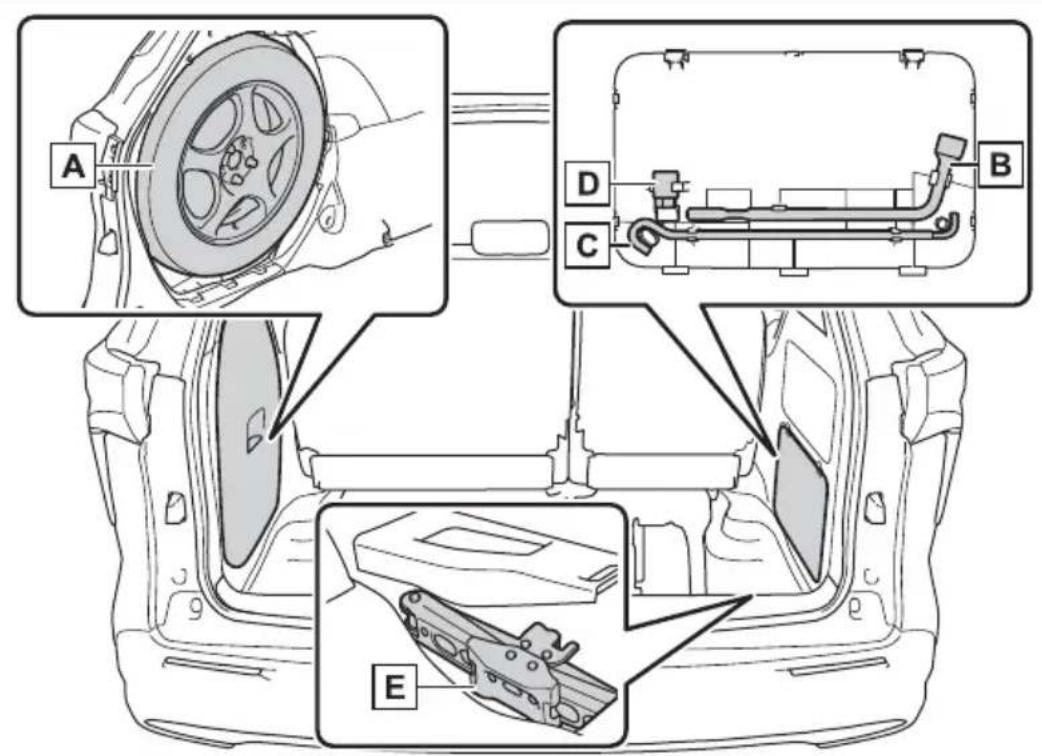
A Spare tire
B Wheel nut wrench
C Jack handle
D Wheel lock key* (if equipped)
E Jack
*: Documentation relating to the wheel lock key, such as the registration and I.D. card, is inside the glove box.

WARNING
■Using the tire jack
Observe the following precautions.
Improper use of the tire jack may cause the vehicle to suddenly fall off the jack, leading to death or serious injury.
- Do not use the tire jack for any purpose other than replacing tires or installing and removing tire chains.
● Only use the tire jack that comes with this vehicle for replacing a flat tire.
Do not use it on other vehicles, and do not use other tire jacks for replacing tires on this vehicle.

WARNING
● Put the jack properly in its jack point.
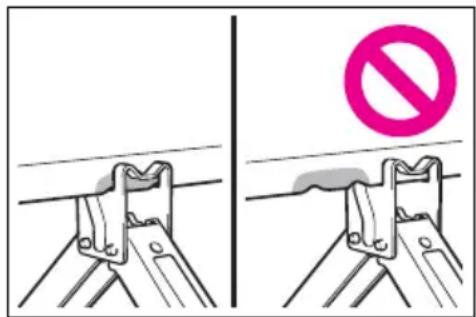
- Do not put any part of your body under the vehicle while it is supported by the jack.
- Do not start the hybrid system or drive the vehicle while the vehicle is supported by the jack.
- Do not raise the vehicle while someone is inside.
- When raising the vehicle, do not put an object on or under the jack.
- Do not raise the vehicle to a height greater than that required to replace the tire.
- Use a jack stand if it is necessary to get under the vehicle.
- When lowering the vehicle, make sure that there is no-one near the vehicle. If there are people nearby, warn them vocally before lowering.
Wheel lock nut (if equipped)
When replacing tires on a vehicle with wheel lock nuts, use the following procedures to remove and install the wheel lock nuts. The wheel lock key is stored together with the tools on the
right-hand side of the luggage compartment. Always return the wheel lock key to its original position after use, so that it does not get lost.
Removal
For ease of removal, the wheel lock nut should always be the first one loosened.
1 Place the wheel lock key on top of the wheel lock nut, turning until the wheel lock key and wheel lock nut patterns engage.
2 Place the wheel nut wrench on the wheel lock key, and while applying pressure on the wheel lock key, loosen the wheel lock nut.
Installation
For ease of installation, the wheel lock nut should always be the last one tightened.
1 By hand, install a wheel lock nut on each wheel.
2 Place the wheel lock key on top of the wheel lock nut, turning until the wheel lock key and wheel lock nut patterns engage.
3 Place the wheel nut wrench on the wheel lock key, and while applying pressure on the wheel lock key, tighten the wheel lock nut to the recommended torque.

NOTICE
Wheel lock nut
Do not use an impact wrench. Using an impact wrench may cause permanent damage to wheel lock nut and wheel lock key. If in doubt about wheel lock application, contact your Toyota dealer.
Taking out the jack
1 Pull the handle upward.
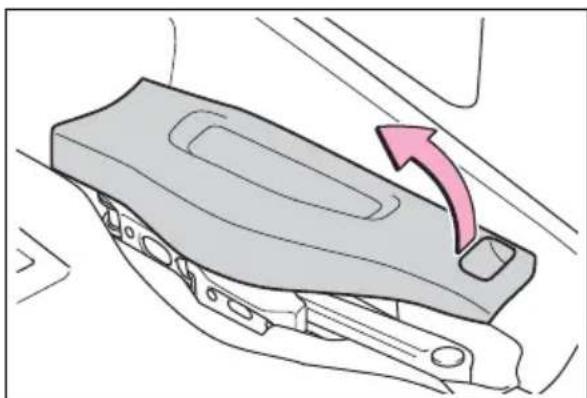
natural_image
Diagram of a car interior showing a handle and seat with a pink arrow indicating direction (no text or symbols)2 Take out the jack.
Do not touch the threaded portion of the jack as it is greased.
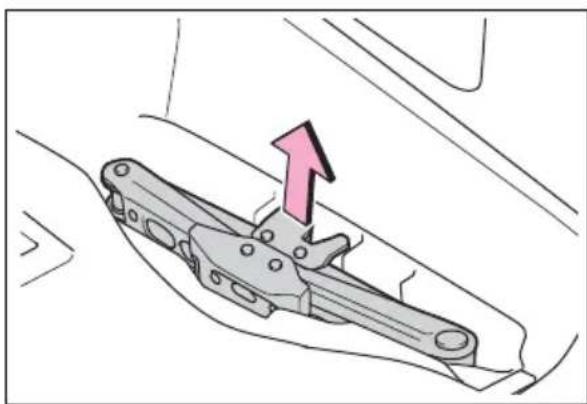
natural_image
Mechanical component diagram showing a lever mechanism with an arrow indicating direction (no text or symbols present)Taking out the tools
1 Remove the cover.
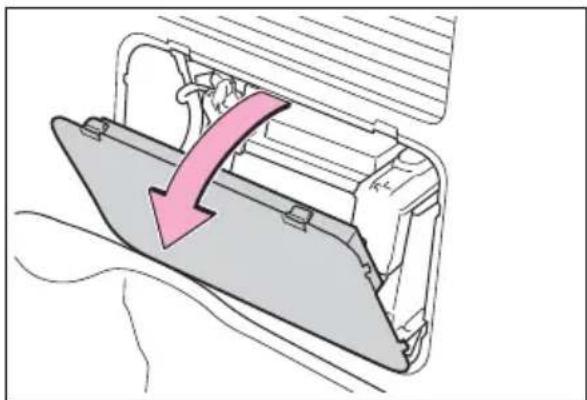
natural_image
Diagram of a mechanical device with a pink arrow indicating a directional change or movement (no text or symbols present)2 Take out the tools
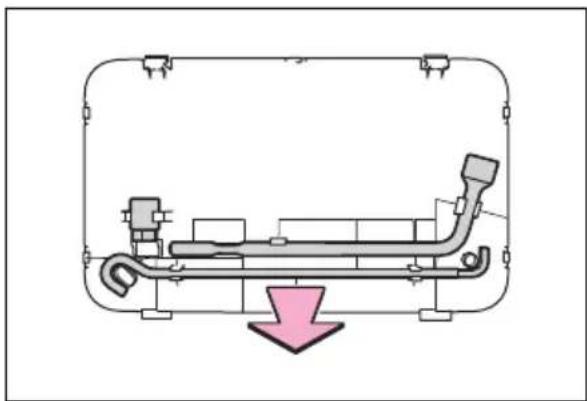
natural_image
Pure mechanical diagram showing a pipe or duct system with no text, numbers, or symbolsTaking out the spare tire
1 Remove the cover.
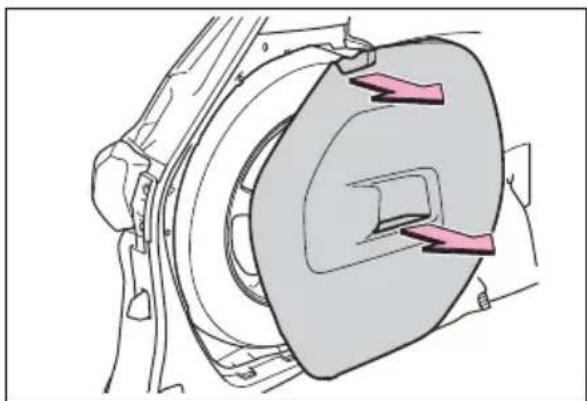
natural_image
Technical line drawing of a mechanical component with highlighted parts (no text or symbols)2 Slightly loosen the wheel nuts (one turn).
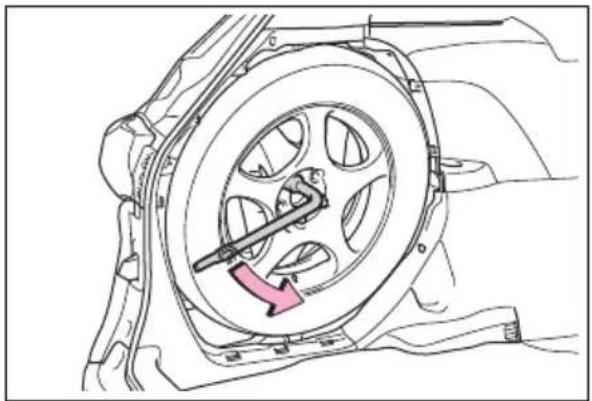
natural_image
Technical line drawing of a car wheel assembly with a highlighted component (no text or symbols)3 Remove all the wheel nuts and take out the spare tire.
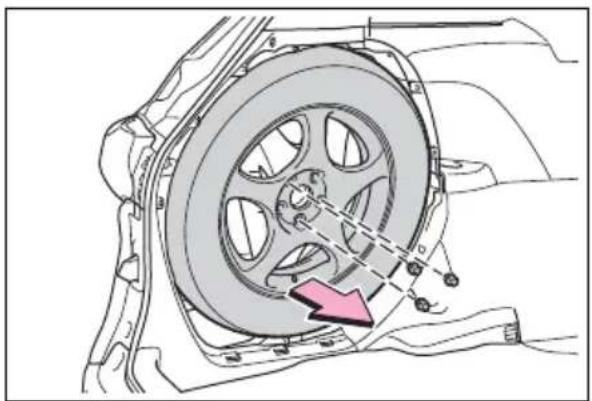
natural_image
Technical diagram of a car wheel assembly with a highlighted component (no text or symbols)Replacing a flat tire
1 Chock the tires.
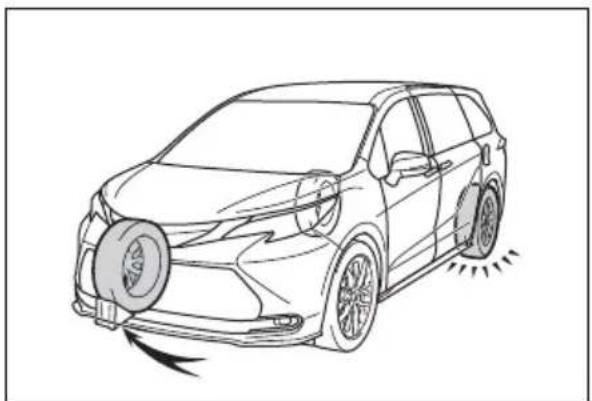
natural_image
Line drawing of a car with a tire and exhaust trail (no text or symbols)| Flat tire | Wheel chock positions |
| Front left-hand side | Behind the rear right-hand side tire |
| Front right-hand side | Behind the rear left-hand side tire |
| Rear left-hand side | In front of the front right-hand side tire |
| Rear right-hand side | In front of the front left-hand side tire |
2 Slightly loosen the wheel nuts (one turn).
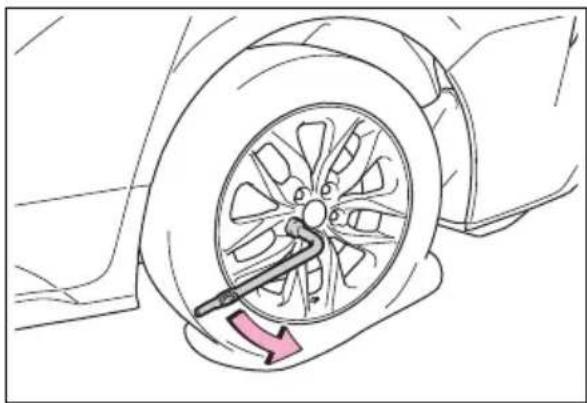
natural_image
Diagram of a car wheel with a tool inserted, showing the wheel rim and wheel (no text or symbols)3 Turn the tire jack portion A by hand until the notch of the jack is in contact with the jack point.
After removing the jack from the jack holder, turn the jack portion A in the opposite direction to lower the jack, and then adjust the jack set position.
The jack point guides are located on the side of rocker moulding. They indicate the jack point posi-
tions.
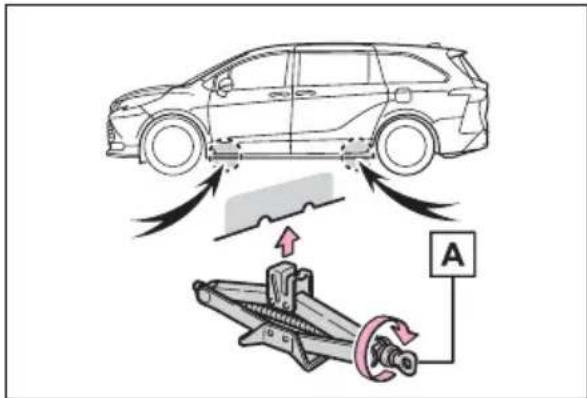
4 Assemble the jack handle and the wheel nut wrench as shown in the illustration.
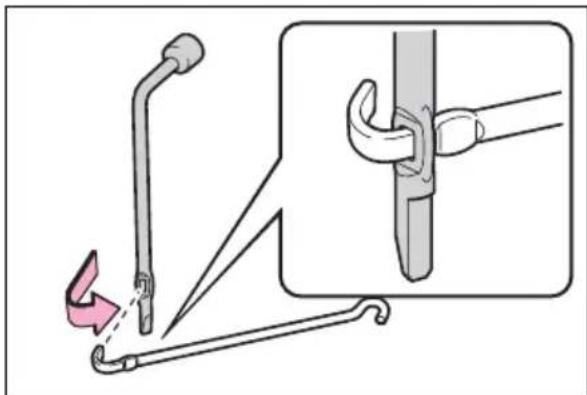
natural_image
Diagram showing a tool with a handle and angle measurement, alongside a magnified view of the hook being held (no text or symbols present)5 Raise the vehicle until the tire is slightly raised off the ground.
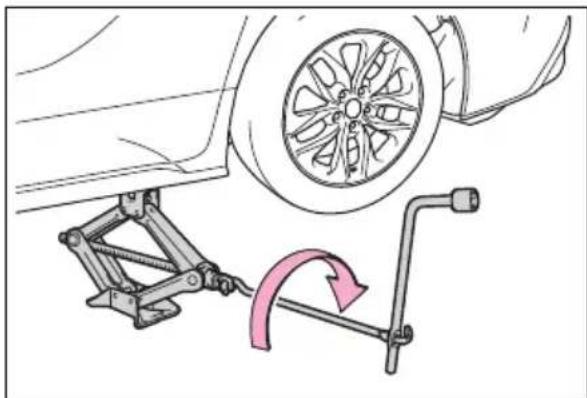
natural_image
Diagram of a car suspension system with a wheel and lever mechanism (no text or labels)6 Remove all the wheel nuts and the tire.
When resting the tire on the ground, place the tire so that the wheel design faces up to avoid
scratching the wheel surface.
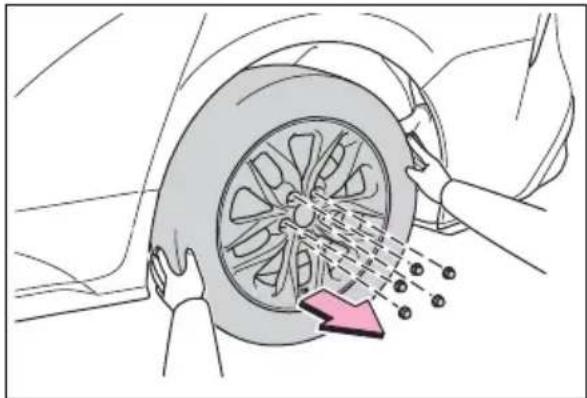
natural_image
Illustration of a car wheel rim being cleaned with a tool, showing surface texture and spray pattern (no text or symbols)
WARNING
■Replacing a flat tire
- Observe the following precautions. Failure to do so may result in serious injury.
- Do not touch the disc wheels or the area around the brakes immediately after the vehicle has been driven. After the vehicle has been driven the disc wheels and the area around the brakes will be extremely hot. Touching these areas with hands, feet or other body parts while changing a tire, etc. may result in burns.
- Remove the spare tire before jacking up the vehicle. If the spare tire is removed after jacking up the vehicle, the tire carrier and the spare tire may interfere with the jack and cause a serious accident.
●Failure to follow these precautions could cause the wheel nuts to loosen and the tire to fall off, resulting in death or serious injury. - Have the wheel nuts tightened with a torque wrench to 76 ft·lbf (103 N·m, 10.5 kgf·m) as soon as possible after changing wheels.

WARNING
- When installing a tire, only use wheel nuts that have been specifically designed for that wheel.
- If there are any cracks or deformations in the bolt screws, nut threads or bolt holes of the wheel, have the vehicle inspected by your Toyota dealer.
- When installing the wheel nuts, be sure to install them with the tapered end facing inward. (→P.440)
For vehicles with power sliding door and/or power back door: In cases such as when replacing tires, make sure to disable the power sliding door system (→P.148) and/or the power back door system (→P.163). Failure to do so may cause the sliding door and/or the back door to operate unintentionally, resulting in hands and fingers being caught and injured.
Installing the spare tire
1 Remove any dirt or foreign matter from the wheel contact surface.
If foreign matter is on the wheel contact surface, the wheel nuts may loosen while the vehicle is in motion, causing the tire to come off.
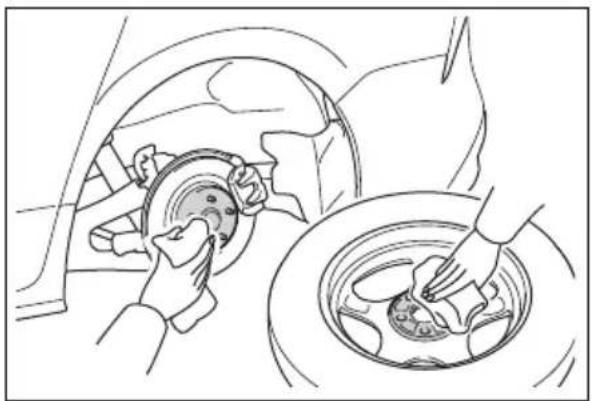
natural_image
Line drawing of a car wheel rim and wheel rim with hands cleaning the rim (no text or symbols)2 Install the tire and loosely tighten each wheel nut by hand by approximately the same amount.
Turn the wheel nuts until the washers A come into contact with the disc wheel B
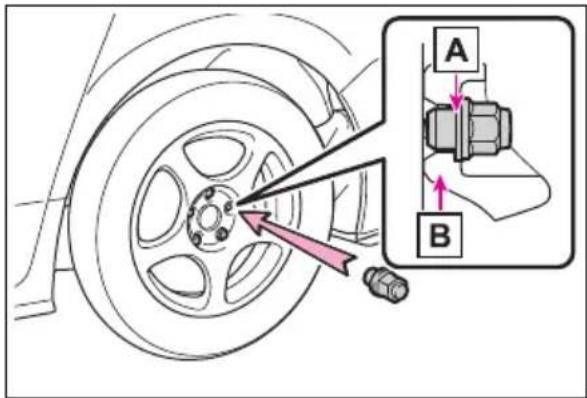
3 Lower the vehicle.
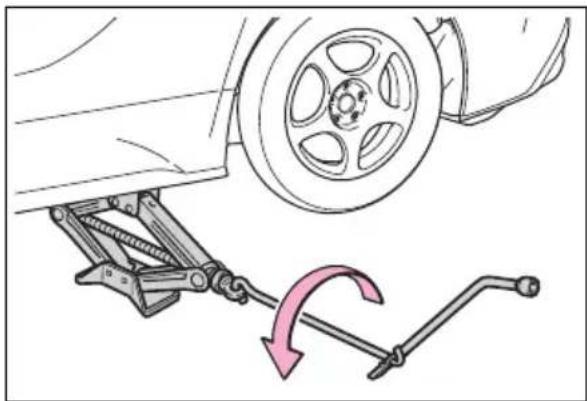
natural_image
Diagram showing a car suspension system with a wheel and attached lever mechanism (no text or symbols)4 Firmly tighten each wheel nut two or three times in the order shown in the illustration.
Tightening torque:
76 ft·lbf (103 N·m, 10.5 kgf·m)
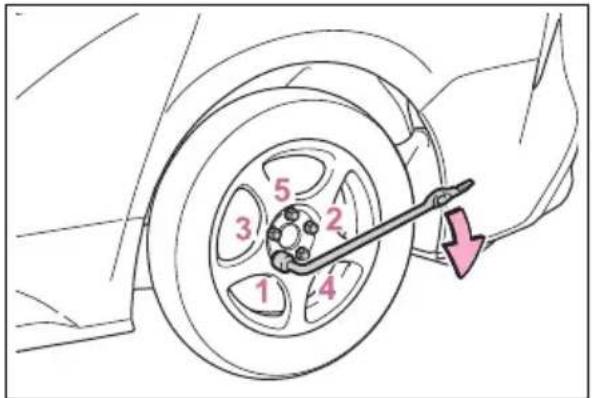
5 Stow the flat tire, tire jack and all tools.
■The compact spare tire
●The compact spare tire is identified by the label "TEMPORARY USE ONLY" on the tire sidewall. Use the compact spare tire temporarily, and only in an emergency.
● Make sure to check the tire inflation pressure of the compact spare tire. (→P.525)
■When using the compact spare tire
As the compact spare tire is not equipped with a tire pressure warning valve and transmitter, low inflation pressure of the spare tire will not be indicated by the tire pressure warning system. Also, if you replace the compact spare tire after the tire pressure warning light comes on, the light remains on.
■When the compact spare tire is attached
The vehicle height may become lower when driving with the compact spare tire compared to when driving with standard tires.
If you have a flat front tire on a road covered with snow or ice
Install the compact spare tire on one of the rear wheels of the vehicle. Perform the following steps and fit tire chains to the front tires:
1 Replace a rear tire with the compact spare tire.
2 Replace the flat front tire with the tire removed from the rear of the vehicle.
3 Fit tire chains to the front tires.

WARNING
■When using the compact spare tire
- Remember that the compact spare tire provided is specifically designed for use with your vehicle. Do not use your compact spare tire on another vehicle.
- Do not use more than one compact spare tire simultaneously.
- Replace the compact spare tire with a standard tire as soon as possible.
● Avoid sudden acceleration, abrupt steering, sudden braking and shifting operations that cause sudden engine braking.
■When the compact spare tire is attached
The vehicle speed may not be correctly detected, and the following systems may not operate correctly:
• ABS & Brake assist
• VSC/Trailer Sway Control
- TRAC
• Dynamic radar cruise control with full-speed range
• PCS (Pre-Collision System)
- EPS
• LTA (Lane Tracing Assist)
- Tire pressure warning system
• AHB (Automatic High Beam)

WARNING
- BSM (Blind Spot Monitor) (if equipped)
- Rear view monitor system (if equipped)
- Panoramic view monitor (if equipped)
• Toyota parking assist monitor (if equipped) - Intuitive parking assist (if equipped)
- PKSB (Parking Support Brake) (if equipped)
- Navigation system (if equipped)
Also, not only can the following system not be utilized fully, but it may actually negatively affect the drive-train components:
• E-Four (Electronic On-Demand AWD system) (AWD models)
■Speed limit when using the compact spare tire
Do not drive at speeds in excess of 50 mph (80 km/h) when a compact spare tire is installed on the vehicle.
The compact spare tire is not designed for driving at high speeds. Failure to observe this precaution may lead to an accident causing death or serious injury.
■After using the tools and jack
Before driving, make sure all the tools and jack are securely in place in their storage location to reduce the possibility of personal injury during a collision or sudden braking.

NOTICE
■Be careful when driving over bumps with the compact spare tire installed on the vehicle
The vehicle height may become lower when driving with the compact spare tire compared to when driving with standard tires. Be careful when driving over uneven road surfaces.
■Driving with tire chains and the compact spare tire
Do not fit tire chains to the compact spare tire.
Tire chains may damage the vehicle body and adversely affect driving performance.
■When replacing the tires
When removing or fitting the wheels, tires or the tire pressure warning valve and transmitter, contact your Toyota dealer as the tire pressure warning valve and transmitter may be damaged if not handled correctly.
Stowing the spare tire
1 Install the spare tire and loosely tighten each wheel nut by hand by approximately the same amount.
Turn the wheel nuts until the washers A come into contact with the
disc wheel B
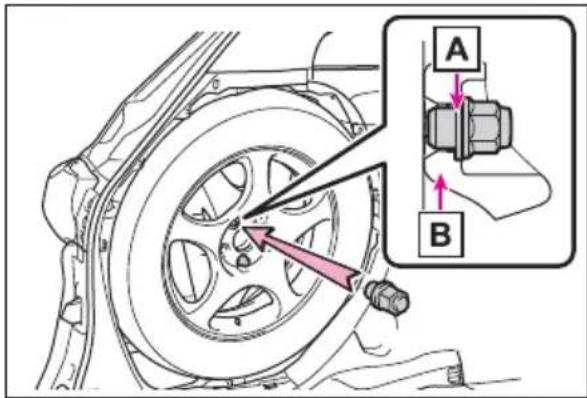
2 Firmly tighten each wheel nut two or three times in the order shown in the illustration.
Tightening torque: 36.9 ft·lbf (50 N·m, 5.1 kgf·m)
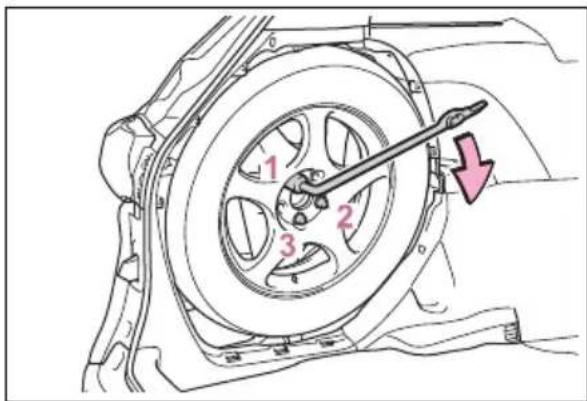
3 Installing the cover.
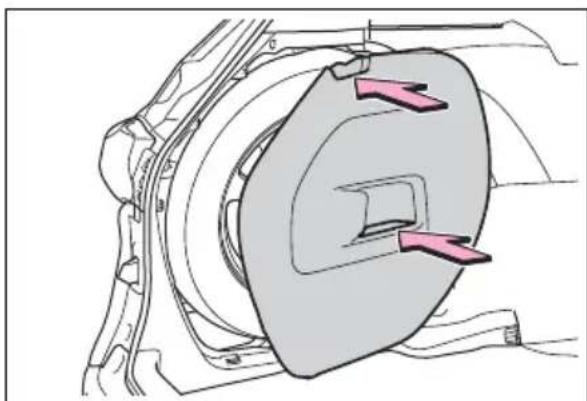
natural_image
Technical diagram of a mechanical assembly with a central component and two pink arrows indicating directional forces or features (no text or labels present)
WARNING
■When stowing the compact spare tire
Be careful not to catch fingers or other body parts between the compact spare tire and the body of the vehicle.
If the hybrid system will not start
Reasons for the hybrid sys- tem not starting vary depending on the situation. Check the following and perform the appropriate procedure:
The hybrid system will not start even though the correct starting procedure is being followed ( P.231)
One of the following may be the cause of the problem:
● The electronic key may not be functioning properly.
(→P.504)
- There may not be sufficient fuel in the vehicle's tank. Refuel the vehicle. (→P.259)
- There may be a malfunction in the immobilizer system. (→P.88)
● There may be a malfunction in the steering lock system.
- The hybrid system may be malfunctioning due to an electrical problem such as electronic key battery depletion or a blown fuse. However, depending on the type of malfunction, an interim measure is available to start the hybrid system. (→P.501)
The interior lights and headlights are dim, or the horn does not sound or sounds at a low volume
One of the following may be the cause of the problem:
● The 12-volt battery may be discharged. ( P.506)
- The 12-volt battery terminal connections may be loose or corroded. (→P.423)
The interior lights and headlights do not turn on, or the horn does not sound
One of the following may be the cause of the problem:
● The 12-volt battery may be discharged. ( P.506)
● One or both of the 12-volt battery terminals may be disconnected. (→P.423)
Contact your Toyota dealer if the problem cannot be repaired, or if repair procedures are unknown.
Starting the hybrid sys- tem in an emergency
When the hybrid system does not start, the following steps can be used as an interim measure to start the hybrid system if the power switch is functioning nor-
mally.
Do not use this starting procedure except in cases of emergency.
1 Pull the parking brake switch to check that the parking brake is set. (→P.243)
Parking brake indicator will come on.
2 Shift the shift lever to P.
3 Turn the power switch to ACC.
4 Press and hold the power switch for about 15 seconds while depressing the brake pedal firmly.
Even if the hybrid system can be started using the above steps, the system may be malfunctioning. Have the vehicle inspected by your Toyota dealer.
If you lose your keys
New genuine keys can be made by your Toyota dealer using the other key and the key number stamped on your key number plate. Keep the plate in a safe place such as your wallet, not in the vehicle.

NOTICE
■When an electronic key is lost
If the electronic key remains lost, the risk of vehicle theft increases significantly. Visit your Toyota dealer immediately with all remaining electronic keys that were provided with your vehicle.
If the fuel filler door cannot be opened
If the fuel filler door opener switch cannot be operated, the following procedure can be used to open the fuel filler door.
Opening the fuel filler door
▶ Vehicles without spare tire
1 Remove the cover of the emergency tire puncture repair kit. (→P.484)
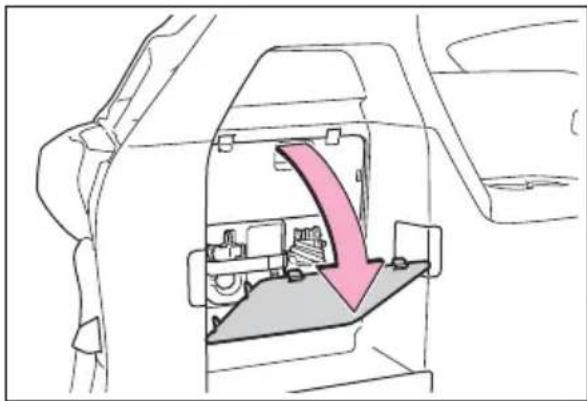
natural_image
Diagram of a car interior showing a highlighted component with a pink arrow indicating direction (no text or symbols present)2 Pull the lever.
Pull the lever to unlock the fuel filler door and it will be ready to open as usual.
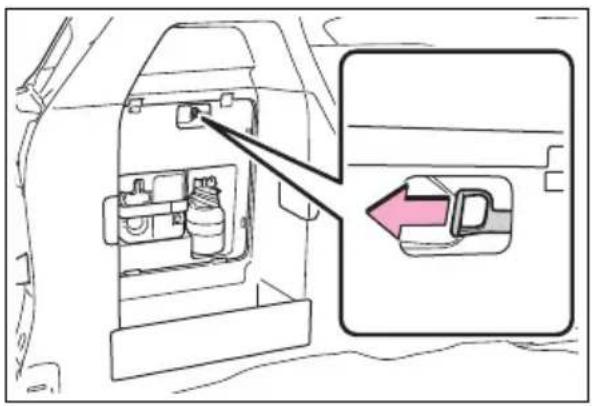
▶ Vehicles with spare tire
1 Fold down the third seat.
(→P.174)
2 Remove the cover of the compact spare tire.
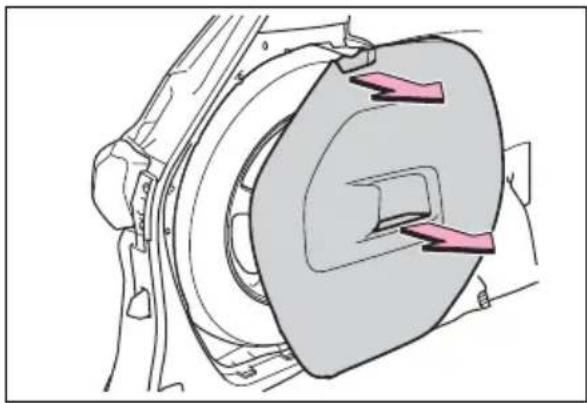
natural_image
Technical diagram of a mechanical assembly with no visible text or symbols3 Pull the lever.
Pull the lever to unlock the fuel filler door and it will be ready to open as usual.
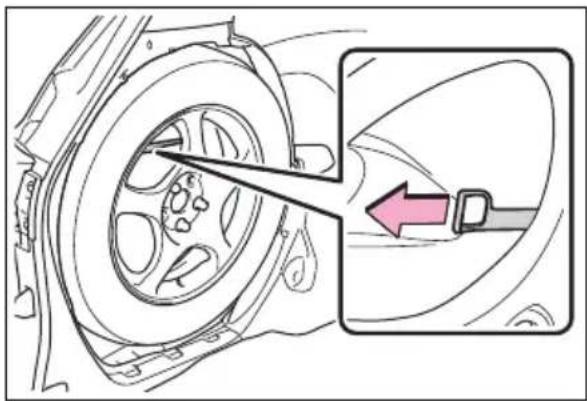
natural_image
Diagram showing a car wheel rim being locked with a belt buckle, with an inset highlighting the wheel's seat (no text or symbols present)If the electronic key does not operate properly
If communication between the electronic key and vehicle is interrupted ( P.166) or the electronic key cannot be used because the battery is depleted, the smart key system and wireless remote control cannot be used. In such cases, the doors can be opened and the hybrid system can be started by following the procedure below.
■When the electronic key does not work properly
● Make sure that the smart key system has not been deactivated in the customization setting. If it is off, turn the function on.
(Customizable features: →P.544)
- Check if battery-saving mode is set. If it is set, cancel the function. (→P.166)

NOTICE
In case of a smart key system malfunction, or other key related problems
Take your vehicle with all the electronic keys provided with your vehicle to your Toyota dealer.
Locking and unlocking the doors
Use the mechanical key ( P.131) in order to perform the
following operations.
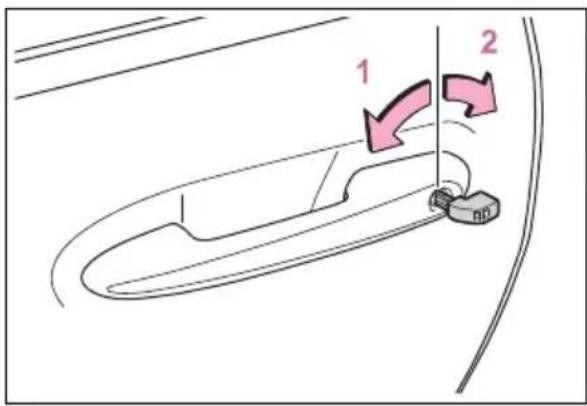
1 Locks all the doors
2 Unlocks the door
■Key linked functions
The opening and closing of the power windows and moon roof can be linked to key operation by a customized setting at your Toyota dealer.
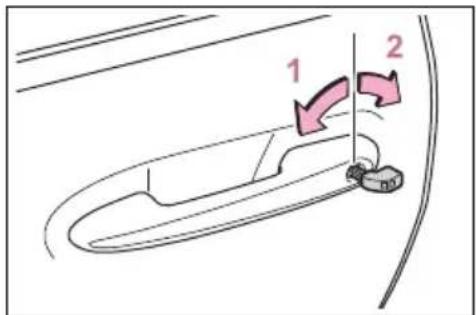
1 Closes the windows and the moon roof* (turn and hold)
2 Opens the windows and the moon roof* (turn and hold)
*: If equipped

WARNING
■When using the mechanical key and operating the power windows or the moon roof (if equipped)
Operate the power window or the moon roof after checking to make sure that there is no possibility of any passenger having any of their body parts caught in the window or the moon roof. Also, do not allow children to operate the mechanical key. It is possible for children and other passengers to get caught in the power window or the moon roof.
Starting the hybrid sys- tem
1 Ensure that the shift lever is in P and depress the brake pedal.
2 Touch the electronic key to the power switch as shown in the illustration.
When the electronic key is detected, a buzzer sounds and the power switch will turn to ON.
When the smart key system is deactivated in customization setting, the power switch will turn to ACC.
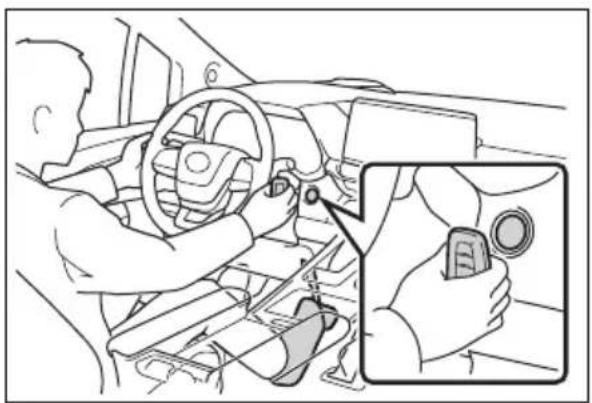
natural_image
Interior view of a car showing a driver's seat, steering wheel, and dashboard with a close-up inset of hands holding a device (no text or symbols visible)3 Firmly depress the brake pedal and check that
displayed on the multi-information display.
4 Press the power switch shortly and firmly.
In the event that the hybrid system still cannot be started, contact your Toyota dealer.
■Stopping the hybrid system
Shift the shift lever to P, set the parking brake and press the power switch as you normally do when stopping the hybrid system.
■Replacing the key battery
As the above procedure is a temporary measure, it is recommended that the electronic key battery be replaced immediately when the battery is depleted. (→P.447)
■Changing power switch modes
Release the brake pedal and press the power switch in step 3 above. The hybrid system does not start and modes will be changed each time the switch is pressed. (→P.234)
If the 12-volt battery is discharged
The following procedures may be used to start the hybrid system if the vehicle's 12-volt battery is discharged.
You can also call your Toyota dealer or a qualified repair shop.
Restarting the hybrid sys- tem
If you have a set of jumper (or booster) cables and a second vehicle with a 12-volt battery, you can jump start your vehicle by following the steps below.
1 Vehicles with alarm: Confirm that the electronic key is being carried.
When connecting the jumper (or booster) cables, depending on the situation, the alarm may activate
and the doors locked. ( P.90)
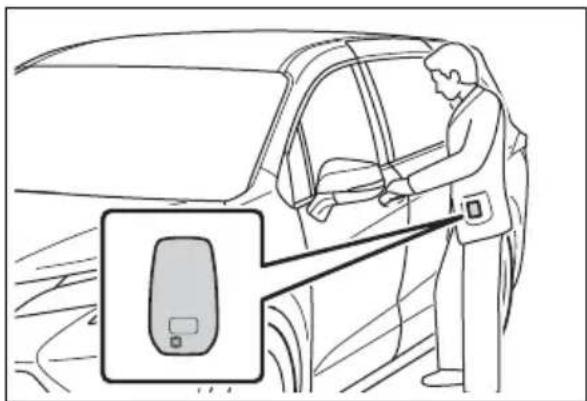
natural_image
Line drawing of a person standing beside a car, with an inset showing a small vehicle component (no text or symbols)2 Open the hood ( P.413) and fuse box cover.
Push claw A and to completely release the lock, and then lift up the cover.
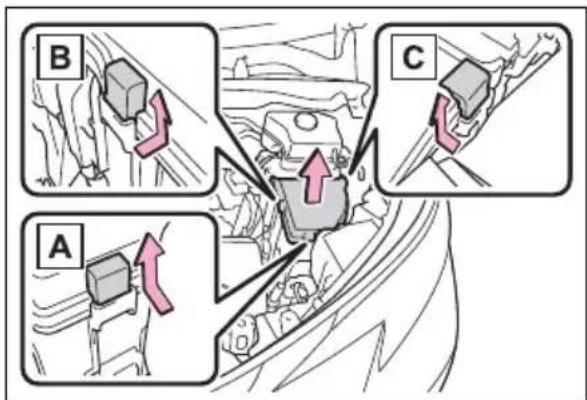
3 Open the exclusive jump starting terminal cover.
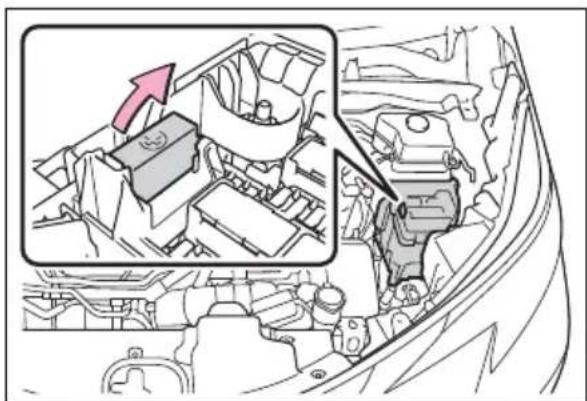
natural_image
Technical line drawing of a vehicle engine compartment with an inset showing a component highlighted (no text or symbols present)4 Connect a positive jumper cable clamp to An your vehicle and connect the clamp on the other end of the positive cable to Bon the second vehicle. Then, connect a negative cable clamp to C
on the second vehicle and connect the clamp at the other end of the negative cable to D
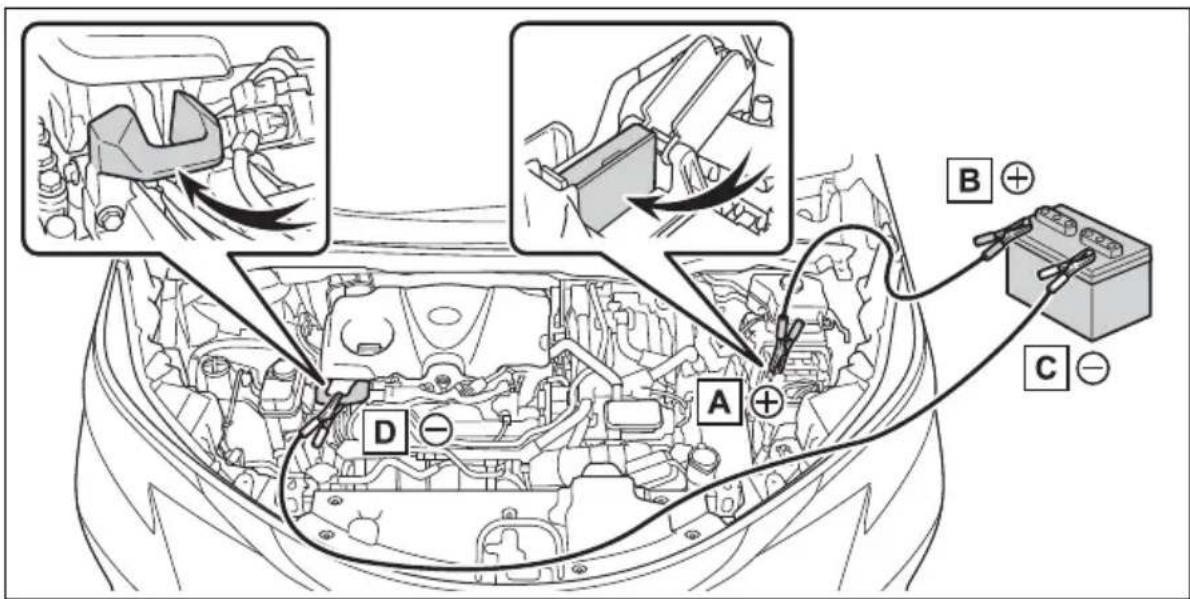
A Exclusive jump starting terminal (your vehicle)
B Positive (+) battery terminal (second vehicle)
C Negative (-) battery terminal (second vehicle)
D Solid, stationary, unpainted metallic point away from the exclusive jump starting terminal and any moving parts as shown in the illustration
5 Start the engine of the second vehicle. Increase the engine speed slightly and maintain at that level for approximately 5 minutes to recharge the 12-volt battery of your vehicle.
6 Open and close any of the doors of your vehicle with the power switch OFF.
7 Maintain the engine speed of the second vehicle and start the hybrid system of your vehicle by turning the power switch to ON.
8 Make sure the "READY" indicator comes on. If the indicator light does not come on, contact your Toyota dealer.
9 Once the hybrid system has started, remove the jumper cables in the exact reverse order from which they were connected.
10 Close the exclusive jump starting terminal cover, and reinstall the fuse box cover to its original position.
Once the hybrid system starts, have the vehicle inspected at your Toyota dealer as soon as
possible.
■ Starting the hybrid system when the 12-volt battery is discharged
The hybrid system cannot be started by push-starting.
■To prevent 12-volt battery discharge
●Turn off the headlights and the audio system while the hybrid system is off.
●Turn off any unnecessary electrical components when the vehicle is running at a low speed for an extended period, such as in heavy traffic.
■When the 12-volt battery is removed or discharged
● Information stored in the ECU is cleared. When the 12-volt battery is depleted, have the vehicle inspected at your Toyota dealer.
Some systems may require initialization. (→P.554)
■When removing the 12-volt battery terminals
When the 12-volt battery terminals are removed, the information stored in the ECU is cleared. Before removing the 12- volt battery terminals, contact your Toyota dealer.
■Charging the 12-volt battery
The electricity stored in the 12-volt battery will discharge gradually even when the vehicle is not in use, due to natural discharge and the draining effects of certain electrical appliances. If the vehicle is left for a long time, the 12-volt battery may discharge, and the hybrid system may be unable to start. (The 12-volt battery recharges automatically while the hybrid system is operating.)
■When recharging or replacing the 12-volt battery
● In some cases, it may not be possible to unlock the doors using the
smart key system when the 12-volt battery is discharged. Use the wireless remote control or the mechanical key to lock or unlock the doors.
●The hybrid system may not start on the first attempt after reinstalling the 12-volt battery. In that case, start the hybrid system in the same manner as when the electronic key does not operate properly (→P.505). This is not a malfunction, as the hybrid system will start normally on the second attempt.
●The power switch mode is memorized by the vehicle. When the 12-volt battery is reconnected, the system will return to the mode it was in before the 12-volt battery was discharged. Before disconnecting the 12-volt battery, turn the power switch off. If you are unsure what mode the power switch was in before the 12-volt battery discharged, be especially careful when reconnecting the 12-volt battery.
■When replacing the 12-volt battery
- Use a 12-volt battery that conforms to European regulations. Use a battery that the case size is same as the previous one (LN2), 20 hours rate capacity (20HR) is equivalent (60Ah) or greater, and performance rating (CCA) is equivalent (563A) or greater.
- If the sizes differ, the 12-volt battery cannot be properly secured.
- If the 20 hour rate capacity is low, even if the time period where the vehicle is not used is a short time, the 12-volt battery may discharge and hybrid system may not be able to start.
- Use a 12-volt battery with a handle. If a 12-volt battery without a handle is used, removal is more difficult.
- When removing the 12-volt bat-
tery: →P.423
●After exchanging, firmly attach the following items to the exhaust hole of the 12-volt battery.
- Use the exhaust hose that was attached to the 12-volt battery before exchanging and confirm that it is firmly connected to the hole section of the vehicle.
- Use the exhaust hole plug included with the 12-volt battery exchanged or the one installed on the battery prior to the exchange. (Depending on the 12-volt battery to be exchanged, the exhaust hole may be plugged.)
For details, consult your Toyota dealer.
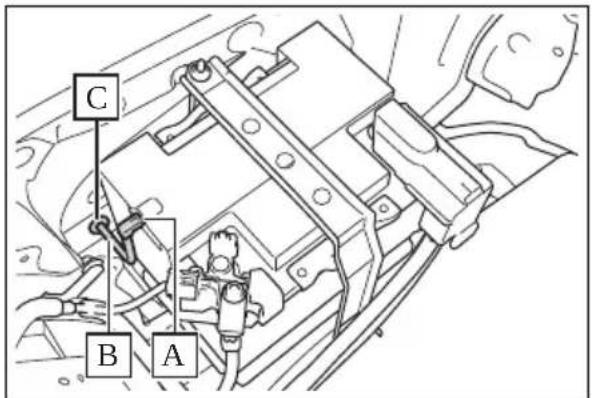
A Exhaust hole
B Exhaust hose
C Hole section of the vehicle

WARNING
■When removing the battery terminals
Always remove the negative (-) terminal first. If the positive (+) terminal contacts any metal in the surrounding area when the positive (+) terminal is removed, a spark may occur, leading to a fire in addition to electrical shocks and death or serious injury.
■ Avoiding 12-volt battery fires or explosions
Observe the following precautions to prevent accidentally igniting the flammable gas that may be emitted from the 12-volt battery:
Make sure each jumper cable is connected to the correct terminal and that it is not unintentionally in contact with any other than the intended terminal.
- Do not allow the other end of the jumper cable connected to the “+” terminal to come into contact with any other parts or metal surfaces in the area, such as brackets or unpainted metal.
- Do not allow the + and - clamps of the jumper cables to come into contact with each other.
- Do not smoke, use matches, cigarette lighters or allow open flame near the 12-volt battery.
■12-volt battery precautions
The 12-volt battery contains poisonous and corrosive acidic electrolyte, while related parts contain lead and lead compounds.
Observe the following precautions when handling the 12-volt battery:
- When working with the 12-volt battery, always wear safety glasses and take care not to allow any battery fluids (acid) to come into contact with skin, clothing or the vehicle body.
- Do not lean over the 12-volt battery.
In the event that battery fluid comes into contact with the skin or eyes, immediately wash the affected area with water and seek medical attention.
Place a wet sponge or cloth over the affected area until medical attention can be received.

WARNING
●Always wash your hands after handling the 12-volt battery support, terminals, and other battery-related parts.
- Do not allow children near the 12-volt battery.
■After recharging the 12-volt battery
Have the 12-volt battery inspected at your Toyota dealer as soon as possible. If the 12-volt battery is deteriorating, continued use may cause the 12-volt battery to emit a malodorous gas, which may be detrimental to the health of passengers.
■When replacing the 12-volt battery
For information regarding 12-volt battery replacement, contact your Toyota dealer.
●After exchanging, securely attach the exhaust hose and exhaust hole plug to the exhaust hole of the exchanged 12-volt battery. If not properly installed, gases (hydrogen) may leak into the vehicle interior, and there is the possible danger of the gas igniting and exploding.
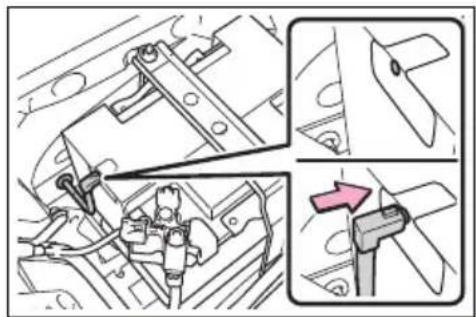
natural_image
Technical diagram showing mechanical assembly with exploded view and close-up of a worker (no text or symbols)
NOTICE
■When handling jumper cables
When connecting the jumper cables, ensure that they do not become entangled in the cooling fan, etc.
■To prevent damaging the vehicle
The exclusive jump starting terminal is to be used when charging the 12-volt battery from another vehicle in an emergency. It cannot be used to jump start another vehicle.
If your vehicle overheats
The following may indicate that your vehicle is overheating.
- The needle of the engine coolant temperature gauge (→P.97, 101) enters the red zone, or a loss of hybrid system power is experienced. (For example, the vehicle speed does not increase.)
- “Engine Coolant Temp High Stop in a Safe Place See Owner’s Manual” or “Hybrid System Overheated Output Power Reduced” is shown on the multi-information display.
- Steam comes out from under the hood.
Correction procedures
If the engine coolant temperature gauge enters the red zone or “Engine Coolant Temp High Stop in a Safe Place See Owner’s Manual” is shown on the multi-information display
1 Stop the vehicle in a safe place and turn off the air conditioning system, and then stop the hybrid system.
2 If you see steam:
Carefully lift the hood after
the steam subsides.
If you do not see steam:
Carefully lift the hood.
3 After the hybrid system has cooled down sufficiently, inspect the hoses and radiator core (radiator) for any leaks.
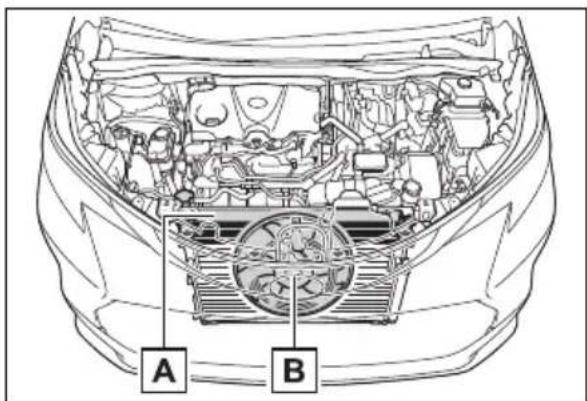
If a large amount of coolant leaks, immediately contact your Toyota dealer.
4 The coolant level is satisfactory if it is between the "FULL" and "LOW" lines on the reservoir.
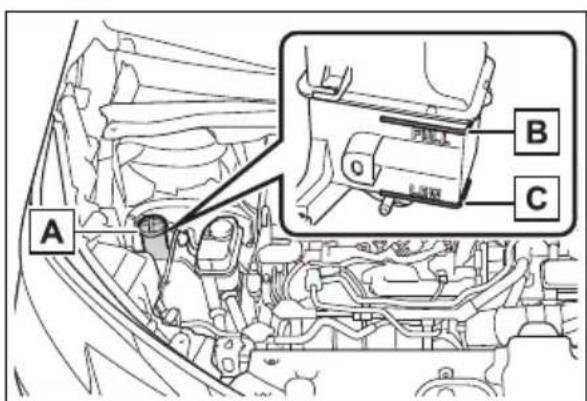
A Reservoir
B "FULL" line
C "LOW" line
5 Add coolant if necessary.
Water can be used in an emergency if engine coolant is unavailable.
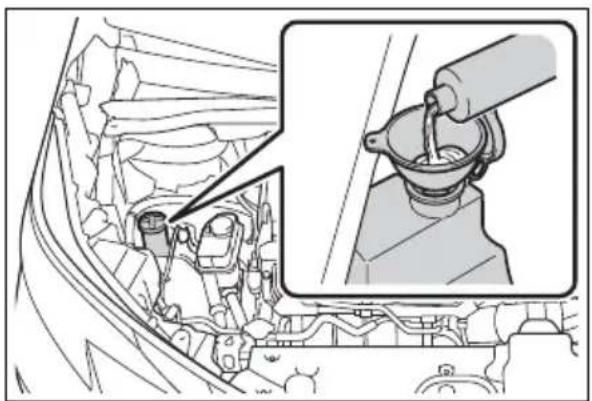
natural_image
Technical diagram showing engine components and a hand pouring liquid into a container (no text or labels)6 Start the hybrid system and turn the air conditioning system on to check that the radiator cooling fan operates and to check for coolant leaks from the radiator or hoses.
The fan operates when the air conditioning system is turned on immediately after a cold start. Confirm that the fan is operating by checking the fan sound and air flow. If it is difficult to check these, turn the air conditioning system on and off repeatedly. (The fan may not operate in freezing temperatures.)
7 If the fan is not operating: Stop the hybrid system immediately and contact your Toyota dealer. If the fan is operating: Have the vehicle inspected at the nearest Toyota dealer.
8 Check if "Engine Coolant Temp High Stop in a Safe Place See Owner's Manual" is shown on the multi-information display.
If the message does not disappear: Stop the hybrid system and contact your Toyota dealer.
If the message is not displayed: Have the vehicle inspected at the nearest Toyota dealer.
If "Hybrid System Overheated Output Power Reduced" is shown on the multi-information display
1 Stop the vehicle in a safe place.
2 Stop the hybrid system and carefully lift the hood.
3 After the hybrid system has cooled down, inspect the hoses and radiator core (radiator) for any leaks.
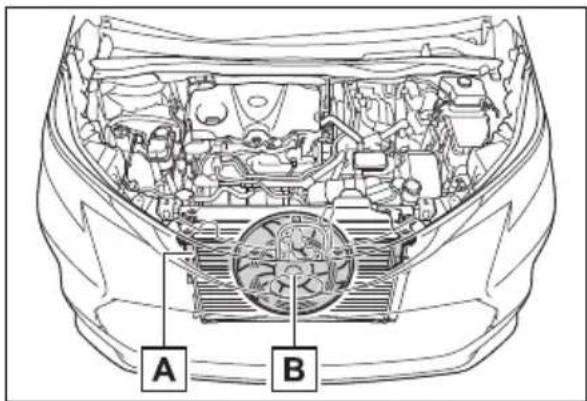
A Radiator
B Cooling fan
If a large amount of coolant leaks, immediately contact your Toyota dealer.
4 The coolant level is satisfactory if it is between the
“FULL” and “LOW” lines on the reservoir.
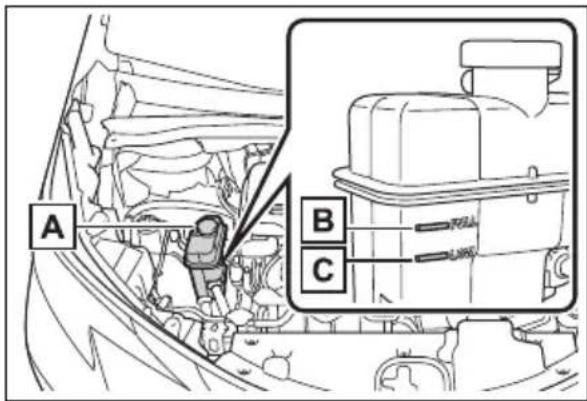
A Reservoir
B "FULL" line
C "LOW" line
5 Add coolant if necessary.
Water can be used in an emergency if power control unit coolant is unavailable.
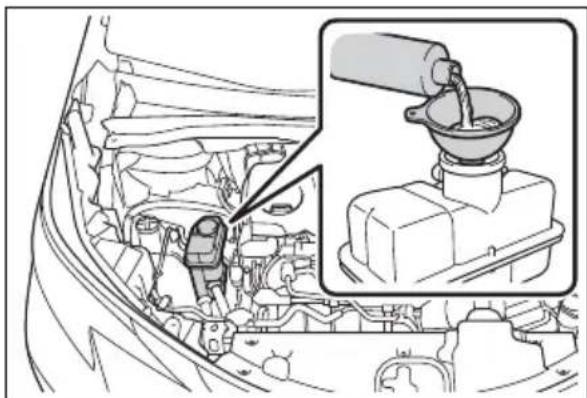
natural_image
Diagram of an engine compartment with a zoomed-in inset showing internal components (no text or labels)6 After stopping the hybrid system and waiting for 5 minutes or more, start the hybrid system again and check for the multi-information display.
If the message does not disappear: Stop the hybrid system and contact your Toyota dealer.
If the message is not displayed: The hybrid system temperature has dropped and the vehicle may be driven normally.
However, if the message appears again frequently, contact your
Toyota dealer.

WARNING
■When inspecting under the hood of your vehicle
Observe the following precautions.
Failure to do so may result in serious injury such as burns.
- If steam is seen coming from under the hood, do not open the hood until the steam has sub-sided. The engine compartment may be very hot.
After the hybrid system has been turned off, check that the "READY" indicator is off. When the hybrid system is operating, the gasoline engine may automatically start, or the cooling fan may suddenly operate even if the gasoline engine stops. Do not touch or approach rotating parts such as the fan, which may lead to fingers or clothing (especially a tie, a scarf or a muffler) getting caught, resulting in serious injury. - Do not loosen the coolant reservoir cap while the hybrid system and radiator are hot. High temperature steam or coolant could spray out.

NOTICE
■When adding engine/power control unit coolant
Add coolant slowly after the hybrid system has cooled down sufficiently. Adding cool coolant to a hot hybrid system too quickly can cause damage to the hybrid system.

NOTICE
■To prevent damage to the cooling system
Observe the following precautions:
● Avoid contaminating the coolant with foreign matter (such as sand or dust, etc.).
- Do not use any coolant additive.
If the vehicle becomes stuck
Carry out the following procedures if the tires spin or the vehicle becomes stuck in mud, dirt or snow:
Recovering procedure
1 Stop the hybrid system. Set the parking brake and shift the shift lever to P.
2 Remove the mud, snow or sand from around the stuck tire.
3 Place wood, stones or some other material to help provide traction under the tires.
4 Restart the hybrid system
5 Shift the shift lever to D or R and release the parking brake. Then, while exercising caution, depress the accelerator pedal.
■When it is difficult to free the vehicle
Press to turn off TRAC. (→P.336)
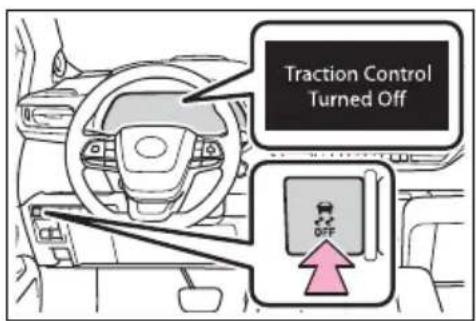

WARNING
■When attempting to free a stuck vehicle
If you choose to push the vehicle back and forth to free it, make sure the surrounding area is clear to avoid striking other vehicles, objects or people. The vehicle may also lunge forward or lunge back suddenly as it becomes free. Use extreme caution.
■When shifting the shift lever
Be careful not to shift the shift lever with the accelerator pedal depressed.
This may lead to unexpected rapid acceleration of the vehicle that may cause an accident resulting in death or serious injury.

NOTICE
■To avoid damaging the transmission and other components
● Avoid spinning the wheels and depressing the accelerator pedal more than necessary.
- If the vehicle remains stuck even after these procedures are performed, the vehicle may require towing to be freed.
8-1. Specifications
Maintenance data (fuel, oil level, etc.).... 518
Fuel information ..... 528
Tire information ..... 530
8-2. Customization
Customizable features 540
8-3. Initialization
Items to initialize ..... 554
Maintenance data (fuel, oil level, etc.)
Dimensions and weights
| Overall length | 203.7 in. (5175 mm)*2 |
| 204.1 in. (5185 mm)*3 | |
| Overall width 78.5 in. (1995 mm) | |
| Overall height*1 | 68.5 in. (1740 mm)*5 |
| 69.7 in. (1770 mm)*6 | |
| Wheelbase 120 in. (3060 mm) | |
| Front tread 67.7 in. (1720 mm) | |
| Rear tread 68.5 in. (1740 mm) | |
| Vehicle capacity weight (Occupants + luggage) | 1170 lb (530 kg)*7 |
| 1190 lb (540 kg)*8 | |
| 1235 lb (560 kg)*9 | |
| 1255 lb (570 kg)*10 | |
| 1375 lb (625 kg)*11 | |
| 1420 lb (645 kg)*12 | |
| Trailer Weight Rating (TWR) (Trailer weight + cargo weight) (with towing package *13) | 3500 lb. (1585 kg) |
*1: Unladen vehicle
*2: Except for AXLH40L-PNXSHA and AXLH45L-PNXSHA models *4
*3: For AXLH40L-PNXSHA and AXLH45L-PNXSHA models *4
*4. The model code is indicated on the Certification Label. For details, see "Vehicle identification" below.
*5. Vehicles without roof rails
*6. Vehicles with roof rails
*7: For AXLH40L-PNXLHA model *4 with vacuum cleaner, refrigerator, and spare tire
*8: For AXLH40L-PNXLHA model *4 without vacuum cleaner, AXLH40L-PNXLHA model*4 with vacuum cleaner, refrigerator, and tire puncture repair kit, AXLH40L-PNXSHA model*4, and AXLH45L-PNXLHA model*4 with vacuum cleaner
*9: For AXLH40L-PNXLHA model*4 with vacuum cleaner and without refrigerator, AXLH45L-PNXLHA model*4 without vacuum cleaner, AXLH45L-PNXSHA model*4 and AXLH45L-PNXXHA model*4
*10: For AXLH40L-PNXXHA model *4
*11: For AXLH45L-PPXEHA model *4
*12: For AXLH40L-PPXEHA and AXLH40L-PPXXHA models *4
*13. The towing package is required.
Toyota does not recommend towing with this vehicle without the towing package.
Seating capacity
| Seating capacity | Without second center seat | With second center seat |
| 7 (Front 2, Rear 5) 8 (Front 2, Rear 6) | ||
Vehicle identification
■Vehicle identification number
The vehicle identification number (VIN) is the legal identifier for your vehicle. This is the primary identification number for your Toyota. It is used in registering the ownership of your vehicle.
This number is stamped on the top left of the instrument panel.
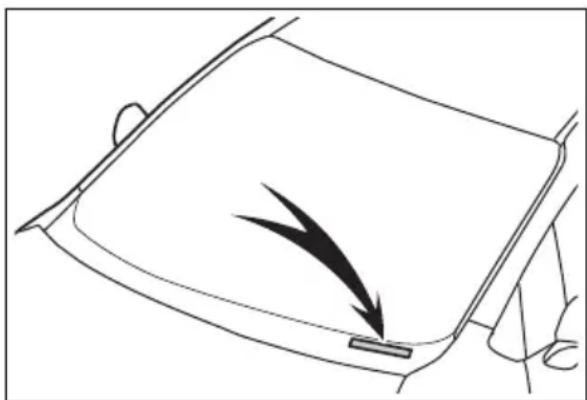
natural_image
Line drawing of a car's front panel with a black arrow pointing to the side panel (no text or symbols)This number is also on the Certification Label.
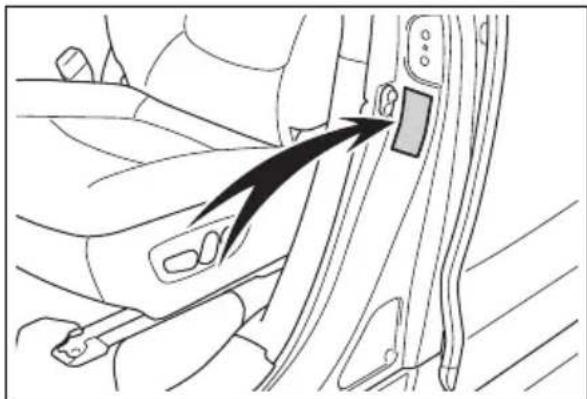
natural_image
Diagram of a car seatbelt buckle being inserted into the side panel (no text or symbols present)Engine number
The engine number is stamped
on the engine block as shown.
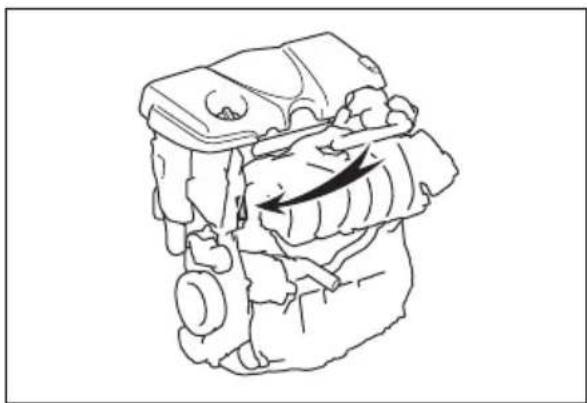
natural_image
Line drawing of a mechanical component with no visible text or symbolsEngine
| Model 2.5 L 4-cylinder (A25A-FXS) | |
| Type 4-cylinder in line, 4-cycle, | gasoline |
| Bore and stroke | 3.44 × 4.07 in. (87.5 × 103.4 mm) |
| Displacement | 151.8 cu. in. (2487 cm3) |
| Valve clearance Automatic adjustment | |
Fuel
| Fuel type Unleaded gasoline only | |
| Octane Rating | 87 (Research Octane Number 91) or higher |
| Fuel tank capacity (Reference) | 18 gal. (68.2 L, 15 Imp.gal.) |
Electric motor (traction motor)
Front
| Type Permanent magnet synchronous motor | |
| Maximum output 134 kW | |
| Maximum torque 199 ft•lbf (270 | N•m, 27.5 kgf•m) |
▶ Rear (AWD models)
| Type Permanent magnet synchronous motor | |
| Maximum output 40 kW | |
| Maximum torque 89.2 ft•lbf (121 | N•m, 12.3 kgf•m) |
Hybrid battery (traction battery)
| Type Nickel-Metal hydride battery | |
| Voltage 7.2 V/module | |
| Capacity 6.5 Ah (3HR) | |
| Quantity 40 modules | |
| Nominal voltage 288 V |
Lubrication system
■Oil capacity (Drain and refill — reference\*)
| With filter | 4.8 qt. (4.5 L, 4.0 Imp. qt.) |
| Without filter | 4.4 qt. (4.2 L, 3.7 Imp. qt.) |
*: The engine oil capacity is a reference quantity to be used when changing the engine oil. Warm up and turn off the hybrid system, wait more than 5 minutes, and check the oil level on the dipstick.
■Engine oil selection
"Toyota Genuine Motor Oil" is used in your Toyota vehicle. Use Toyota approved "Toyota Genuine Motor Oil" or equivalent to satisfy the following grade and viscosity.
Oil grade:
API SN/RC multigrade engine oil
Recommended viscosity: SAE 0W-16
SAE 0W-16 is the best choice for good fuel economy and good starting in cold weather.
If SAE 0W-16 is not available, SAE 0W-20 oil may be used. However, it must be replaced with SAE 0W-16 at the next oil change.
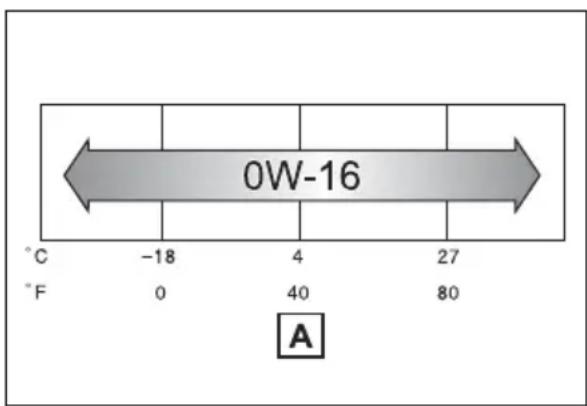
A Outside temperature
Oil viscosity (0W-16 is explained here as an example):
- The 0W in 0W-16 indicates the characteristic of the oil which allows cold startability. Oils with a lower value before the W allow for easier starting of the engine in cold weather.
- The 16 in 0W-16 indicates the viscosity characteristic of the oil when the oil is at high temperature. An oil with a higher viscosity (one with a higher value) may be better suited if
the vehicle is operated at high speeds, or under extreme load conditions.
How to read oil container label: API registered mark is added to some oil containers to help you select the oil you should use.

Cooling system
| Capacity^* | Gasoline engine 11 | .4 qt. (10.8 L, 9.5 Imp. qt.) |
| Power control unit | 2.0 qt. (1.9 L, 1.7 Imp. qt.) | |
| Coolant type | Use either of the following:“Toyota Super Long Life Coolant”Similar high-quality ethylene glycolbased non-silicate, non-amine, non-nitrite, and non-borate coolant with long-life hybrid organic acid technologyDo not use plain water alone. | |
*: The coolant capacity is the quantity of reference.
If replacement is necessary, contact your Toyota dealer.
Ignition system (spark plug)
| Make DENSO FC16HR-Q8 | |
| Gap 0.031 in. (0.8 mm) |

NOTICE
■Iridium-tipped spark plugs
Use only iridium-tipped spark plugs. Do not adjust the spark plug gap.
Electrical system (12-volt Battery)
| Open voltage at 68°F (20°C): | 12.0 V or higher(Turn the power switch to OFF and turn on the high beam headlights for 30 seconds.)If the voltage is lower than the standard value, charge the battery. |
| Charging rates 5 A max. |
Hybrid transmission
| Fluid capacity* | 4.6 qt. (4.4 L, 3.9 Imp.qt.) |
| Fluid type Toyota Genuine ATF | WS |
*: The fluid capacity is the quantity of reference. If replacement is necessary, contact your Toyota dealer.

NOTICE
■Hybrid transmission fluid type
Using transmission fluid other than the above type may cause abnormal noise or vibration, or ultimately damage the transmission of your vehicle.
Rear differential (rear electric motor) (AWD models)
| Fluid capacity* | 1.8 qt. (1.7 L, 1.5 Imp.qt.) |
| Fluid type Toyota Genuine ATF | WS |
*: The fluid capacity is the quantity of reference. If replacement is necessary, contact your Toyota dealer.

NOTICE
■Transmission fluid type
Using transmission fluid other than the above type may cause abnormal noise or vibration, or ultimately damage the transmission of your vehicle.
Brakes
| Pedal clearance*1 | 4.17 in. (106 mm) Min. |
| Pedal free play | 0.04 — 0.24 in. (1.0 — 6.0 mm) |
| Brake pad wear limit 0.04 in. (1.0 mm) | |
| Parking brake indicator*2 | When pulling the parking brake switch for 1 to 4 seconds: turns onWhen pushing the parking brake switch for 1 to 4 seconds: turns off |
| Fluid type | FMVSS No.116 DOT 3 or SAE J1703FMVSS No.116 DOT 4 or SAE J1704 |
*1: Minimum pedal clearance when depressed with a force of 67.4 lbf (300 N, 30.6 kgf) while the hybrid system is operating.
*2: Make sure to confirm that the brake system warning light (yellow) does not illuminate. (If the brake system warning light illuminates, refer to P.466)
Steering
| Free play Less than 1.2 in. (30 mm) |
Tires and wheels
17-inch tires
| Tire size | P235/65R17 103T, T155/80R17 111M (spare tire if equipped) |
| Tire inflation pressure(Recommended cold tireinflation pressure) | Front:35 psi (240 kPa, 2.4 kgf/cm2 or bar)Rear:35 psi (240 kPa, 2.4 kgf/cm2 or bar)Driving at high speeds (above 100 mph [160 km/h]) (in countries where such speeds are per-mitted by law) Add 3 psi (20 kPa, 0.2 kgf/cm2 or bar) to the front tires and rear tires.Never exceed the maximum cold tire inflation pressure indicated on the tire sidewall.Spare:60 psi (420 kPa, 4.2 kgf/cm2 or bar) |
| Wheel size 17 x 7J, 17 x | 4T (spare) |
| Wheel nut torque 76 ft·lbf | (103 N·m, 10.5 kgf·m) |
18-inch tires
| Tire size | P235/60R18 102V, T155/80R17 111M (spare tire if equipped) |
| Tire inflation pressure(Recommended cold tireinflation pressure) | Front:35 psi (240 kPa, 2.4 kgf/cm2 or bar)Rear:35 psi (240 kPa, 2.4 kgf/cm2 or bar)Driving at high speeds (above 100 mph [160 km/h]) (in countries where such speeds are per-mitted by law) Add 3 psi (20 kPa, 0.2 kgf/cm2 or bar) to the front tires and rear tires.Never exceed the maximum cold tire inflation pressure indicated on the tire sidewall.Spare:60 psi (420 kPa, 4.2 kgf/cm2 or bar) |
| Wheel size 18 x 7 1/2J, 1 | 7 x 4T (spare) |
| Wheel nut torque 76 ft•lbf | (103 N•m, 10.5 kgf•m) |
20-inch tires
| Tire size | 235/50R20 100V, T155/80R17 111M (spare tire if equipped) |
| Tire inflation pressure(Recommended cold tireinflation pressure) | Front:36 psi (250 kPa, 2.5 kgf/cm2 or bar)Rear:36 psi (250 kPa, 2.5 kgf/cm2 or bar)Driving at high speeds (above 100 mph [160 km/h]) (in countries where such speeds are per-mitted by law) Add 3 psi (20 kPa, 0.2 kgf/cm2 or bar) to the front tires and rear tires.Never exceed the maximum cold tire inflation pressure indicated on the tire sidewall.Spare:60 psi (420 kPa, 4.2 kgf/cm2 or bar) |
| Wheel size 20 x 7 1/2J, 1 | 7 x 4T (spare) |
| Wheel nut torque 76 ft·lbf | (103 N·m, 10.5 kgf·m) |
Light bulbs
| Light bulbs Bulb No. W Type | ||||
| Exterior | Rear turn signal lights WY21W 21 A | |||
| Back-up lights W16W 16 B | ||||
| License plate lights W5W 5 B | ||||
| Interior | Vanity lights | — | 1.4 | C |
| Second row personal lights | — | 8 | B | |
| Third row interior lights | — | 8 | C | |
| Luggage compartment light | — | 5 | B | |
| Front door courtesy lights | — | 5 | B | |
A: Wedge base bulbs (amber)
B: Wedge base bulbs (clear)
C: Double end bulbs (clear)
Fuel information
You must only use unleaded gasoline.
Select octane rating 87 (Research Octane Number 91) or higher. Use of unleaded gasoline with an octane rating lower than 87 may result in engine knocking. Persistent knocking can lead to engine damage.
At minimum, the gasoline you use should meet the specifications of ASTM D4814 in the U.S.A..
Gasoline quality
In very few cases, driveability problems may be caused by the brand of gasoline you are using. If driveability problems persist, try changing the brand of gasoline. If this does not correct the problem, consult your Toyota dealer.
Recommendation of the use of gasoline containing detergent additives
●Toyota recommends the use of gasoline that contains detergent additives to avoid the build-up of engine deposits.
- All gasoline sold in the U.S.A. contains minimum detergent additives to clean and/or keep clean intake systems, per EPA's lowest additives concentration program.
●Toyota strongly recommends the use of Top Tier Detergent Gasoline. For more information on Top Tier Detergent Gasoline and a list of marketers, please go to the official website www.toptiergas.com.
■ Recommendation of the use of low emissions gasoline
Gasolines containing oxygenates such as ethers and ethanol, as well as reformulated gasolines, are available in some cities. These fuels are typically acceptable for use, providing they meet other fuel requirements.
Toyota recommends these fuels, since the formulations allow for reduced vehicle emissions.
■ Non-recommendation of the use of blended gasoline
● Use only gasoline containing up to 15% ethanol.
DO NOT use any flex-fuel or gasoline that could contain more than 15% ethanol, including from any pump labeled E30 (30% ethanol
A), E50 (50% ethanol B) E85
(85% ethanol Ⓕ(which are only some examples of fuel containing more than 15% ethanol).
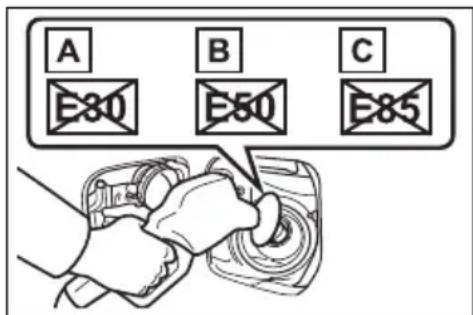
- If you use gasohol in your vehicle, be sure that it has an octane rating no lower than 87.
●Toyota does not recommend the use of gasoline containing methanol.
■Non-recommendation of the use of gasoline containing MMT
Some gasoline contains an octane enhancing additive called MMT (Methylcyclopentadienyl Manganese Tricarbonyl).
Toyota does not recommend the use of gasoline that contains MMT. If fuel containing MMT is used, your
emission control system may be adversely affected.
The malfunction indicator lamp on the instrument cluster may come on. If this happens, contact your Toyota dealer for service.
If your engine knocks
- Consult your Toyota dealer.
- You may occasionally notice light knocking for a short time while accelerating or driving uphill. This is normal and there is no need for concern.

NOTICE
■Notice on fuel quality
- Do not use improper fuels. If improper fuels are used, the engine will be damaged.
- Do not use leaded gasoline. Leaded gasoline can cause damage to your vehicle's three-way catalytic converters causing the emission control system to malfunction.
- Do not use gasohol other than the type previously stated. Other gasohol may cause fuel system damage or vehicle performance problems.
● Using unleaded gasoline with an octane number or rating lower than the level previously stated will cause persistent heavy knocking. At worst, this will lead to engine damage.
■Fuel-related poor driveability
If poor driveability (poor hot starting, vaporization, engine knocking, etc.) is encountered after using a different type of fuel, discontinue the use of that type of fuel.
■When refueling with gasohol
Take care not to spill gasohol. It can damage your vehicle's paint.
Tire information
Typical tire symbols
Full-size tire
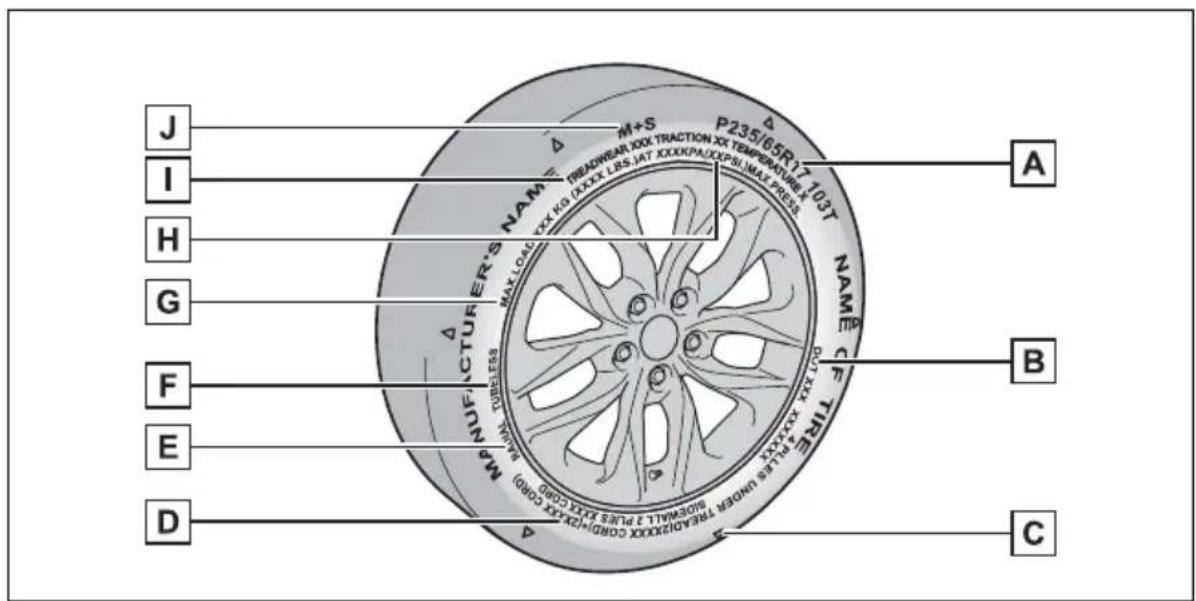
▶ Compact spare tire
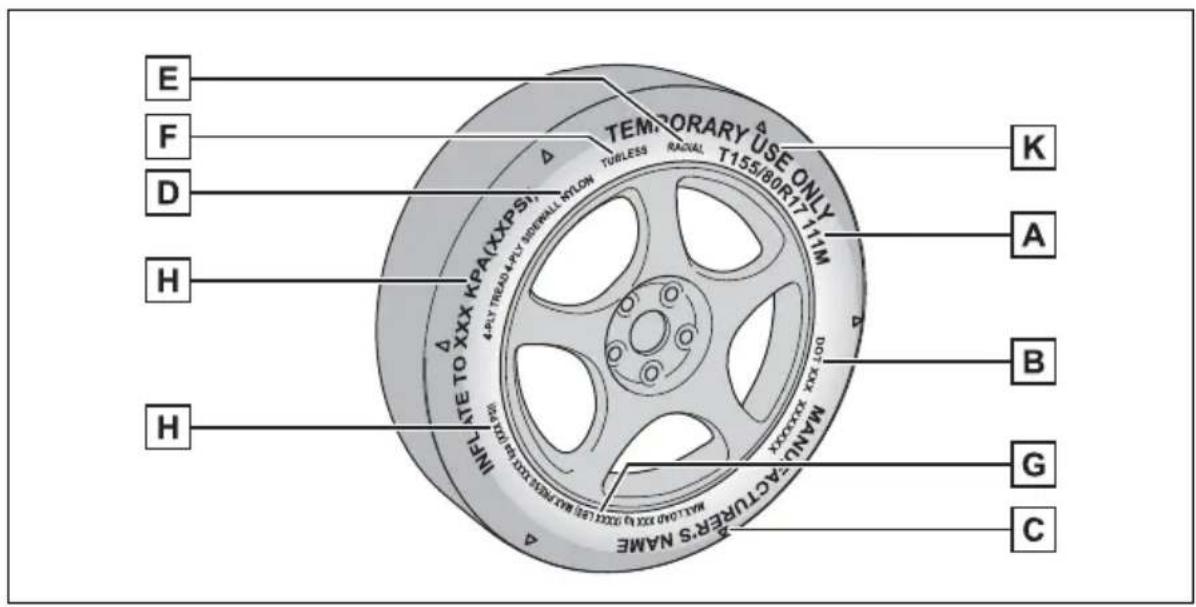
A Tire size ( P.532)
B DOT and Tire Identification Number (TIN) ( P.531)
C Location of treadwear indicators ( P.424)
D Tire ply composition and materials
Plies are layers of rubber-coated parallel cords. Cords are the strands which form the plies in a tire.
E Radial tires or bias-ply tires
A radial tire has "RADIAL" on the sidewall. A tire not marked "RADIAL" is a bias-ply tire.
F TUBELESS or TUBE TYPE
A tubeless tire does not have a tube and air is directly put into the tire. A tube type tire has a tube inside the tire and the tube maintains the air pressure.
G Load limit at maximum cold tire inflation pressure ( P.534)
H Maximum cold tire inflation pressure ( P.534)
This means the pressure to which a tire may be inflated.
I Uniform tire quality grading
For details, see "Uniform Tire Quality Grading" that follows.
J Summer tires or all season tires ( P.425)
An all season tire has “M+S” on the sidewall. A tire not marked “M+S” is a summer tire.
K "TEMPORARY USE ONLY"
A compact spare tire is identified by the phrase “TEMPORARY USE ONLY” molded on its sidewall. This tire is designed for temporary emergency use only.
Typical DOT and Tire Identification Number (TIN)
▶ Type A
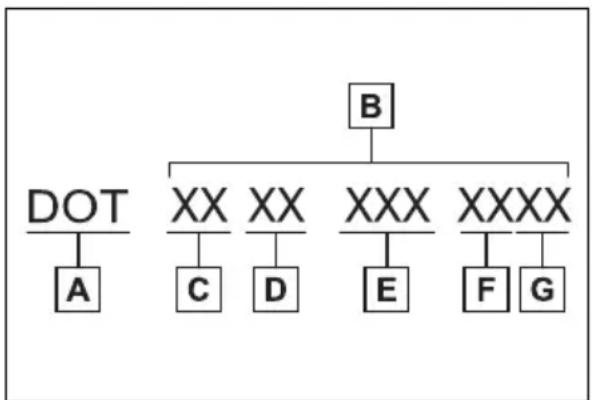
flowchart
graph TD
    B["B"] --> XX["XX"]
    B --> XXX["XXX"]
    XX --> C["C"]
    XX --> D["D"]
    XXX --> E["E"]
    XXX --> F["F"]
    XXX --> G["G"]
A DOT symbol*
B Tire Identification Number (TIN)
C Tire manufacturer's identification mark
D Tire size code
E Manufacturer's optional tire type code (3 or 4 letters)
F Manufacturing week
G Manufacturing year
*: The DOT symbol certifies that the tire conforms to applicable Federal Motor Vehicle Safety Standards.
▶ Type B
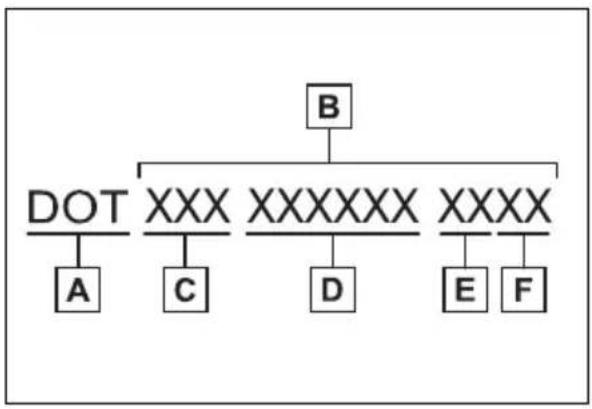
flowchart
graph TD
    A["DOT"] --> B["A"]
    A --> C["C"]
    B --> D["D"]
    B --> E["E"]
    B --> F["F"]
    C --> D
    C --> E
    D --> G["XXXXXX"]
    E --> G
    F --> G
A DOT symbol*
B Tire Identification Number (TIN)
C Tire manufacturer's identification mark
D Manufacturer's code
E Manufacturing week
F Manufacturing year
*: The DOT symbol certifies that the tire conforms to applicable Federal Motor Vehicle Safety Standards.
Tire size
■Typical tire size information
The illustration indicates typical tire size.
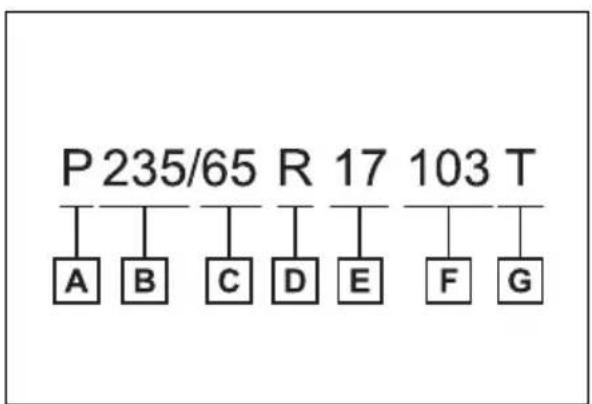
flowchart
graph TD
    A["A"] --> P["P 235/65"]
    B["B"] --> P
    C["C"] --> P
    D["D"] --> R["R 17"]
    E["E"] --> R
    F["F"] --> T["T 103 T"]
    G["G"] --> T
    P --> R
    R --> T
A Tire use
(P = Passenger car, T = Temporary use)
B Section width (millimeters)
C Aspect ratio (tire height to section width)
D Tire construction code (R = Radial, D = Diagonal)
E Wheel diameter (inches)
F Load index (2 digits or 3 digits)
G Speed symbol (alphabet with one letter)
■Tire dimensions
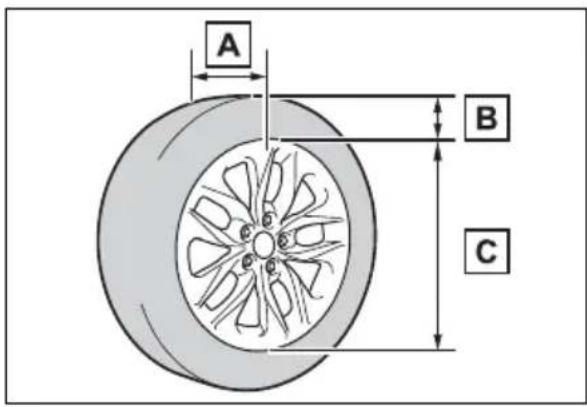
A Section width
B Tire height
C Wheel diameter
Tire section names
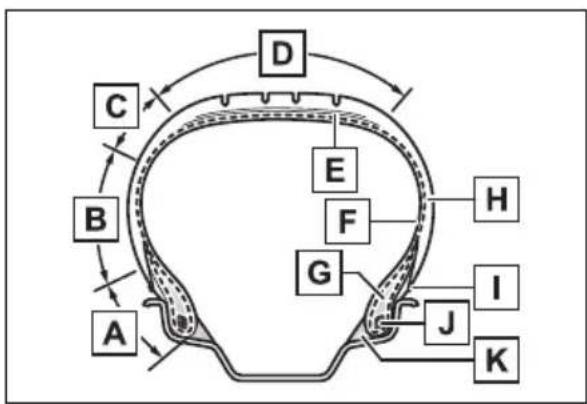
flowchart
graph TD
    A --> B
    B --> C
    C --> D
    D --> E
    E --> F
    F --> G
    G --> H
    H --> I
    I --> J
    J --> K
    K --> A
    style A fill:#f9f,stroke:#333
    style B fill:#f9f,stroke:#333
    style C fill:#f9f,stroke:#333
    style D fill:#f9f,stroke:#333
    style E fill:#f9f,stroke:#333
    style F fill:#f9f,stroke:#333
    style G fill:#f9f,stroke:#333
    style H fill:#f9f,stroke:#333
    style I fill:#f9f,stroke:#333
    style J fill:#f9f,stroke:#333
    style K fill:#f9f,stroke:#333
A Bead
B Sidewall
C Shoulder
D Tread
E Belt
F Inner liner
G Reinforcing rubber
H Carcass
I Rim lines
J Bead wires
K Chafer
Uniform Tire Quality Grading
This information has been prepared in accordance with regulations issued by the National Highway Traffic Safety Administration of the U.S. Department of Transportation.
It provides the purchasers and/or prospective purchasers of Toyota vehicles with information on uniform tire quality grading.
Your Toyota dealer will help answer any questions you may have as you read this information.
■DOT quality grades
All passenger vehicle tires must conform to Federal Safety Requirements in addition to these grades. Quality grades can be found where applicable on the tire sidewall between tread shoulder and maximum section width.
For example: Treadwear 200 Traction AA Temperature A
Treadwear
The treadwear grade is a comparative rating based on the wear rate of the tire when tested under controlled conditions on a specified government test course.
For example, a tire graded 150 would wear one and a half (1 - 1/2) times as well on the government course as a tire graded 100.
The relative performance of tires depends upon the actual conditions of their use. Performance may differ significantly from the norm due to variations in driving habits, service practices and differences in road characteristics and climate.
■Traction AA, A, B, C
The traction grades, from highest to lowest, are AA, A, B and C, and they represent the tire's ability to stop on wet pavement as measured under controlled conditions on specified government test surfaces of asphalt and concrete.
A tire marked C may have poor traction performance.
Warning: The traction grade assigned to this tire is based on braking (straight ahead) traction tests and does not include cornering (turning) traction.
■Temperature A, B, C
The temperature grades are A (the highest), B, and C, representing the tire's resistance to the generation of heat and its ability to dissipate heat when tested under controlled conditions on a specified indoor laboratory test wheel.
Sustained high temperature can cause the material of the tire to degenerate and reduce tire life, and excessive temperature can lead to sudden tire failure.
Grade C corresponds to a level of performance which all passenger car tires must meet under the Federal Motor Vehicle Safety Standard No. 109.
Grades B and A represent higher levels of performance on the laboratory test wheel than the minimum required by law.
Warning: The temperature grades of a tire assume that it is properly inflated and not overloaded.
Excessive speed, underinflation, or excessive loading, either separately or in combination, can cause heat buildup and possible tire failure.
Glossary of tire terminology
| Tire related term Meaning | |
| Cold tire inflation pressure | Tire pressure when the vehicle has been parked for three hours or more, or has not been driven more than 1 mile or 1.5 km under that condition |
| Maximum inflation pressure | The maximum cold inflated pressure to which a tire may be inflated, shown on the sidewall of the tire |
| Recommended inflation pressure | Cold tire inflation pressure recommended by a manufacturer |
| Accessory weight | The combined weight (in excess of those standard items which may be replaced) of transmission, power steering, power brakes, power windows, power seats, radio and heater, to the extent that these items are available as factory-installed equipment (whether installed or not) |
| Curb weight | The weight of a motor vehicle with standard equipment, including the maximum capacity of fuel, oil and coolant, and if so equipped, air conditioning and additional weight optional engine |
| Maximum loaded vehicle weight | The sum of:(a) Curb weight(b) Accessory weight(c) Vehicle capacity weight(d) Production options weight |
| Normal occupant weight | 150 lb. (68 kg) times the number of occupants specified in the second column of Table 1* that follows |
| Occupant distribution | Distribution of occupants in a vehicle as speci-fied in the third column of Table 1* below |
| Production options weight | The combined weight of installed regular pro-duction options weighing over 5 lb. (2.3 kg) in excess of the standard items which they replace, not previously considered in curb weight or accessory weight, including heavy duty brakes, ride levelers, roof rack, heavy duty battery, and special trim |
| Rim | A metal support for a tire or a tire and tube assembly upon which the tire beads are seated |
| Rim diameter(Wheel diameter) | Nominal diameter of the bead seat |
| Rim size designation Rim | diameter and width |
| Rim type designation | The industry manufacturer's designation for a rim by style or code |
| Rim width Nominal distance between rim flanges | |
| Vehicle capacity weight(Total load capacity) | The rated cargo and luggage load plus 150 lb.(68 kg) times the vehicle's designated seating capacity |
| Vehicle maximum load on the tire | The load on an individual tire that is determined by distributing to each axle its share of the max-imum loaded vehicle weight, and dividing by two |
| Vehicle normal load on the tire | The load on an individual tire that is determined by distributing to each axle its share of curb weight, accessory weight, and normal occupant weight (distributed in accordance with Table 1* below), and dividing by two |
| Weather side | The surface area of the rim not covered by the inflated tire |
| Bead | The part of the tire that is made of steel wires, wrapped or reinforced by ply cords and that is shaped to fit the rim |
| Bead separation | A breakdown of the bond between components in the bead |
| Bias ply tire | A pneumatic tire in which the ply cords that extend to the beads are laid at alternate angles substantially less than 90 degrees to the center-line of the tread |
| Carcass | The tire structure, except tread and sidewall rubber which, when inflated, bears the load |
| Chunking | The breaking away of pieces of the tread or sidewall |
| Cord | The strands forming the plies in the tire |
| Cord separation | The parting of cords from adjacent rubber compounds |
| Cracking | Any parting within the tread, sidewall, or inner-liner of the tire extending to cord material |
| CT | A pneumatic tire with an inverted flange tire and rim system in which the rim is designed with rim flanges pointed radially inward and the tire is designed to fit on the underside of the rim in a manner that encloses the rim flanges inside the air cavity of the tire |
| Extra load tire | A tire designed to operate at higher loads and at higher inflation pressures than the corresponding standard tire |
| Groove The space between two adjacent tread ribs | |
| Innerliner | The layer(s) forming the inside surface of a tubeless tire that contains the inflating medium within the tire |
| Innerliner separation | The parting of the innerliner from cord material in the carcass |
| Intended outboard side-wall | (a)The sidewall that contains a whitewall, bears white lettering, or bears manufacturer, brand, and/or model name molding that is higher or deeper than the same molding on the other sidewall of the tire, or(b)The outward facing sidewall of an asymmetrical tire that has a particular side that must always face outward when mounted on a vehicle |
| Light truck (LT) tire | A tire designated by its manufacturer as primarily intended for use on lightweight trucks or multipurpose passenger vehicles |
| Load rating | The maximum load that a tire is rated to carry for a given inflation pressure |
| Maximum load rating | The load rating for a tire at the maximum permissible inflation pressure for that tire |
| Maximum permissible inflation pressure | The maximum cold inflation pressure to which a tire may be inflated |
| Measuring rim | The rim on which a tire is fitted for physical dimension requirements |
| Open splice | Any parting at any junction of tread, sidewall, or innerliner that extends to cord material |
| Outer diameter The overall diameter of an inflated new tire | |
| Overall width | The linear distance between the exteriors of the sidewalls of an inflated tire, including elevations due to labeling, decorations, or protective bands or ribs |
| Passenger car tire | A tire intended for use on passenger cars, multi-purpose passenger vehicles, and trucks, that have a gross vehicle weight rating (GVWR) of 10,000 lb. or less. |
| Ply A layer of rubber-coated parallel cords | |
| Ply separation | A parting of rubber compound between adjacent plies |
| Pneumatic tire | A mechanical device made of rubber, chemicals, fabric and steel or other materials, that, when mounted on an automotive wheel, provides the traction and contains the gas or fluid that sustains the load |
| Radial ply tire | A pneumatic tire in which the ply cords that extend to the beads are laid at substantially 90 degrees to the centerline of the tread |
| Reinforced tire | A tire designed to operate at higher loads and at higher inflation pressures than the corresponding standard tire |
| Section width | The linear distance between the exteriors of the sidewalls of an inflated tire, excluding elevations due to labeling, decoration, or protective bands |
| Sidewall | That portion of a tire between the tread and bead |
| Sidewall separation | The parting of the rubber compound from the cord material in the sidewall |
| Snow tire | A tire that attains a traction index equal to or greater than 110, compared to the ASTM E-1136 Standard Reference Test Tire, when using the snow traction test as described in ASTM F-1805-00, Standard Test Method for Single Wheel Driving Traction in a Straight Line on Snow-and Ice-Covered Surfaces, and which is marked with an Alpine Symbol ( )on at least one sidewall |
| Test rim | The rim on which a tire is fitted for testing, and may be any rim listed as appropriate for use with that tire |
| Tread | That portion of a tire that comes into contact with the road |
| Tread rib | A tread section running circumferentially around a tire |
| Tread separation Pulling away of the tread from the tire carcass | |
| Treadwear indicators (TWI) | The projections within the principal grooves designed to give a visual indication of the degrees of wear of the tread |
| Wheel-holding fixture | The fixture used to hold the wheel and tire assembly securely during testing |
*: Table 1 — Occupant loading and distribution for vehicle normal load for various designated seating capacities
| Designated seating capacity, Number of occupants | Vehicle normal load, Number of occupants | Occupant distribution in a normally loaded vehicle |
| 2 through 4 2 2 in front | ||
| 5 through 10 3 | 2 in front, 1 in second seat | |
| 11 through 15 5 | 2 in front, 1 in second seat, 1 in third seat, 1 in fourth seat | |
| 16 through 20 7 | 2 in front, 2 in second seat, 2 in third seat, 1 in fourth seat |
Customizable features
Your vehicle includes a variety of electronic features that can be personalized to suit your preferences. The settings of these features can be changed using the multi-information display, audio/visual system, or at your Toyota dealer.
Customizing vehicle features
■Changing using the audio/visual system
1 Press the "MENU" button.
2 Select "Setup" on the menu screen and select "Vehicle".
3 Select "Vehicle Customization".
Various setting can be changed. Refer to the list of settings that can be changed for details.
■Changing using the multi-information display
4.2-inch display
1 Press or of the meter control switches and select

2 Press or of the meter control switches, select the item.
7-inch display
1 Press or of the meter control switches and select

2 Press or of the meter control switches, select the item.
3 To switch the function on and off, press "OK" to switch to the desired setting.
4 To perform detailed setting of functions that support detailed settings, press and hold "OK" and display the setting screen.
The method of performing detailed setting differs for each screen. Please refer to the advice sentence displayed on the screen.
To go back to the previous screen or exit the customize mode, press

■When customizing using the audio/visual system or multi-information display
Stop the vehicle in a safe place, apply the parking brake, and shift the shift lever to P. Also, to prevent 12-volt battery discharge, leave the hybrid system operating while customizing the features.

WARNING
During customization
As the hybrid system needs to be operating during customization, ensure that the vehicle is parked in a place with adequate ventilation. In a closed area such as a garage, exhaust gases including harmful carbon monoxide (CO) may collect and enter the vehicle. This may lead to death or a serious health hazard.

NOTICE
During customization
To prevent 12-volt battery discharge, ensure that the hybrid system is operating while customizing features.
Some function settings are changed simultaneously with other functions being customized. Contact your Toyota dealer for further details.
A Settings that can be changed using the audio/visual system
B Settings that can be changed using the multi-information display
C Settings that can be changed by your Toyota dealer
Definition of symbols: O = Available, - = Not available
■Predictive efficient drive ^* ( P.82)
| Function Default setting | Customized setting | A | B | C |
| Predictive efficient drive On Off O -- |
*: If equipped
■ Gauges, meters and multi-information display ( P.97, 101, 104)
| Function^*1 | Default setting | Customized setting | A | B | C |
| Language^*2 | English | Canadian French | O | O- | |
| Mexican Spanish | |||||
| Function*1 | Default setting | Customized setting | A | B | C |
| Units*2 | miles (MPG US) | km (km/L) | O O - | ||
| km (L/100 km) | |||||
| miles (MPG Imperial) | |||||
| Digital Speed*3 | On Off - O - | ||||
| EV indicator On Off - O - | |||||
| Eco Guidance (ECO Accelerator Guidance) | On Off - O - | ||||
| Fuel Economy Total Average | Trip Average | - O - | |||
| Tank Average | |||||
| Audio system linked display On Off - O - | |||||
| Energy monitor On Off - O - | |||||
| AWD system display On Off - O - | |||||
| Drive information type*4 | Trip Total - O - | ||||
| Drive information items (first item)*4 | Distance | Average Speed | - O - | ||
| Total Time | |||||
| Drive information items (second item)*4 | Total Time | Average Speed | - O - | ||
| Distance | |||||
| Trip Summary*4 | ECO Guidance | Drive Info - O - | |||
| Pop-up display On Off - O - | |||||
| Multi-Information display off | Off | On | - | O | - |
| Rear seat reminder function | On | Off | - | O | - |
| Suggestion function | On | On (when the vehicle is stopped) | O - O | ||
| Off | |||||
^*1 :For details about each function: P.112
^2 :The default setting varies according to country.
^3 :Vehicles with 7-inch display only
*4: Vehicles with 4.2-inch display only
■Head-up Display * (→P.118)
| Function Default setting | Customized setting | A | B | C | |
| Head-up display On Off – O – | |||||
| Gauge information | Hybrid Sys-tem Indicator | Tachometer | – O – | ||
| No content | |||||
| Route guidance to destina-tion | On Off – O – | ||||
| Compass* | On Off – O – | ||||
| Driving support system dis-play | On Off – O – | ||||
| Audio system operation sta-tus | On Off – O – | ||||
| Rotation | Horizontal position | Rotating coun-terclock-wise/clockwise | – O – | ||
*: If equipped
■Door lock (→P.132, 504)
| Function Default setting | Customized setting | A | B | C | |
| Unlocking using a mechanical key | Driver's door unlocked in first step, all doors unlocked in second step | All doors unlocked in first step | -- | O | |
| Automatic door locking function | Shift position linked door locking operation | Off | O | O | |
| Speed linked door locking operation | |||||
| Automatic door unlocking function | Shift position linked door unlocking operation | Off | O | O | |
| Driver's door linked door unlocking operation | |||||
■ Smart key system and wireless remote control ( P.130, 164)
| Function Default setting | Customized setting | A | B | C | |
| Operation signal (emergency flashers) | On Off O | - O | |||
| Operation buzzer volume 5 | Off | O | - O | ||
| 1 to 7 | |||||
| Time elapsed before the automatic door lock function is activated if a door is not opened after being unlocked | 60 seconds | Off | O | - O30 seconds | |
| 120 seconds | |||||
| Open door reminder buzzer (When locking the vehicle) | On Off - - O | ||||
■Smart key system (→P.164)
| Function Default setting | Customized setting | A | B | C | |
| Smart key system On Off -- O | |||||
| Smart door unlocking | Driver's door | All the doors | O | - | O |
| Number of consecutive door lock operations | 2 times | As many as desired | -- | O | |
| Time elapsed before unlocking all the door when gripping and holding the driver's door handle* (with entry function) | 2 seconds1.5 | Off | -- | O | |
| seconds | |||||
| 2.5 seconds | |||||
| Power switch illumination | On | Off | - | - | O |
*: This setting can be changed when the smart door unlocking setting is set to Driver's door.
■ Wireless remote control ( P.130)
| Function Default setting | Customized setting | A | B | C | |
| Wireless remote control On Off -- O | |||||
| Unlocking operation | Driver's door unlocked in first step, all doors unlocked in second step | All doors unlocked in first step | O - O | ||
| Theft deterrent panic mode On Off -- O | |||||
| Locking operation when door opened | On Off O - O | ||||
| Power sliding door operation Press and hold | Off | -- | O | ||
| One short press | |||||
| Press twice | |||||
| Power back door operation* | Press and hold | Off | -- | O | |
| One short press | |||||
| Press twice | |||||
| The function that activates the switch of the wire-less remote control when locking the door* (→P.153) | On (Unlocking all the door) | Off | -- | O | |
| On (Unlocking back door only) | |||||
*: If equipped
■ Power sliding doors ( P.137)
| Function Default setting | Customized setting | A | B | C | |
| Power sliding door operation (inside power sliding door switches) | Press and hold | Press twice – – | O | ||
| Operation buzzer volume | 3 | 1 | – O | – | |
| 2 | |||||
| The delay before a power sliding door operation starts after pressing the switch on the outside door handle | 0.15 seconds | 0.3 seconds | -- | O0.8 seconds | |
| Off | |||||
| Left Hands Free Power Sliding Doors (kick sensor)* | On Off - O O | ||||
| Right Hands Free Power Sliding Doors (kick sensor)* | On Off - O O | ||||
| Kick sensor detection sensitivity* | 2 | 1 | -- | O | |
| 3 | |||||
*: If equipped
■Power back door ^*1 (→P.153)
| Function Default setting | Customized setting | A | B | C | |
| Power back door operations | On Off – O – | ||||
| Back door opener switch operations | Press and hold | One short press | -- | O | |
| switch of the wireless remote control operation | Press and hold | Press twice | -- | O | |
| One short press | |||||
| Off | |||||
| Operation buzzer volume 3 | 1 | - | O | - | |
| 2 | |||||
| Opening angle 5 | 1 to 4 | - | O | - | |
| User setting*2 | |||||
| Power back door open operation when the back door opener switch is pressed | On Off -- O | ||||
| Hands Free Power Back Door (kick sensor)*1, 3 | On Off - O O | ||||
*1:If equipped
^*2 : The open position is set by the power back door switch on the back door. ( P.163)
*3: When the towing hitch is installed, kick sensor does not work.
■Driving position memory ^* (→P.178)
| Function Default setting | Customized setting | A | B | C | |
| Selection the door linking driving position memory with door unlock operation | Driver's door All doors - - O | ||||
| Driver's seat slide movement when exiting the vehicle* | Full | Off | O - | O | |
| Partial | |||||
| Steering wheel movement* | Tilt only | Off | O - | O | |
| Telescopic only | |||||
| Tilt and telescopic | |||||
*: If equipped
■ Outside rear view mirrors ( P.198)
| Function Default setting | Customized setting | A | B | C | |
| Automatic mirror folding and extending operation* | Linked to the locking/unlock-ing of the doors | Off | -- | O | |
| Linked to operation of the power switch | |||||
*: If equipped
■Power windows and moon roof * (→P.201, 204)
| Function Default setting | Customized setting | A | B | C | |
| Mechanical key linked operation | Off On – – O | ||||
| Wireless remote control linked operation (open) | Off On – – O | ||||
| Wireless remote control linked operation signal (buzzer) | On Off – – O | ||||
*: If equipped
■Lights (→P.248)
| Function Default setting | Customized setting | A | B | C | |
| Daytime Running Lights On | Off^* | O – | O | ||
| Light off reminder buzzer On | Off – – O | ||||
*: Except for Canada
■ Automatic light control system ( P.248)
| Function Default setting | Customized setting | A | B | C | |
| Light sensor sensitivity | Standard | -2 to 2 | O | - | O |
| Time elapsed before headlights automatically turn off after doors are closed | 30 seconds | Off | O | O60 | seconds |
| 90 seconds | |||||
| Windshield wiper linked headlight illumination* | On Off - - O | ||||
*: If equipped
■Rear window wiper (→P.257)
| Function Default setting | Customized setting | A | B | C | |
| Back door opening linked rear window wiper stop function | Off On – – O | ||||
| Washer linked rear window wiper operation | On Off – – O | ||||
| Shift position linked rear window wiper operation(→P.258) | Only once | Off | -- | O | |
| Continuous | |||||
■ PCS (Pre-Collision System) (→P.267)
| Function Default setting | Customized setting | A | B | C | |
| PCS (Pre-Collision System) On Off – O – | |||||
| Adjust alert timing Middle | Early | – O – | |||
| Late | |||||
■ LTA (Lane Tracing Assist) (→P.275)
| Function Default setting | Customized setting | A | B | C | |
| Lane centering function On Off – O – | |||||
| Steering assist function On Off – O – | |||||
| Alert type | Steering wheel vibration | Buzzer – O – | |||
| Alert sensitivity High Standard – O – | |||||
| Vehicle sway warning func-tion | On Off – O – | ||||
| Vehicle sway warning sensi-tivity | Standard | Low | – O – | ||
| High | |||||
■RSA (Road Sign Assist) \* (→P.285)
| Function Default setting | Customized setting | A | B | C | |
| RSA (Road Sign Assist) | On | Off | - | O | - |
| Excess speed notification method | Display only | No notification | - O | - | |
| Display and buzzer | |||||
| Excess speed notification level | 1 mph (2 km/h) | 3 mph (5 km/h) | - O | - | |
| 5 mph (10 km/h) | |||||
| Other notifications method (No-entry notification) | Display only | No notification | - O | - | |
| Display and buzzer | |||||
*: If equipped
■BSM (Blind Spot Monitor) * (→P.299)
| Function Default setting | Customized setting | A | B | C | |
| BSM (Blind Spot Monitor) On | Off – O – | ||||
| Outside rear view mirror indicator brightness | Bright Dim | – O – | |||
| Alert timing for presence of approaching vehicle (sensitivity) | Intermediate | Early | – O – | ||
| Late | |||||
| Only when vehicle detected in blind spot | |||||
*: If equipped
■RCTA (Rear cross traffic alert) function ^* (→P.299)
| Function Default setting | Customized setting | A | B | C | |
| RCTA (Rear cross traffic alert) function | On Off - O - | ||||
| Buzzer volume 2 | 1 | - O - | |||
| 3 | |||||
*: If equipped
■RCD (Rear Camera Detection) function * (→P.315)
| Function Default setting | Customized setting | A | B | C | |
| RCD (Rear Camera Detection) function | On Off – O O | ||||
| Buzzer volume 2 | 1 | – O – | |||
| 3 | |||||
*: If equipped
■Intuitive parking assist * (→P.308)
| Function Default setting | Customized setting | A | B | C | |
| Intuitive parking assist On Off | - O O | ||||
| Buzzer volume 2 | 1 | - O O | |||
| 3 | |||||
*: If equipped
■PKSB (Parking Support Brake) * (→P.319)
| Function Default setting | Customized setting | A | B | C | |
| PKSB (Parking Support Brake) function | On Off – O – | ||||
*: If equipped
■ Automatic air conditioning system ( P.348)
| Function Default setting | Customized setting | A | B | C | |
| A/C Auto switch operation On | Off O – O | ||||
| Switching to the outside air mode when the vehicle is parked | On Off – – O | ||||
■Illumination (→P.363)
| Function Default setting | Customized setting | A | B | C | |
| Time elapsed before the interior lights turn off | 15 seconds | Off | O | O7.5 seconds | |
| 30 seconds | |||||
| Operation after the power switch is turned off | On Off - - O | ||||
| Operation when the doors are unlocked | On Off - - O | ||||
| Operation when you approach the vehicle with the electronic key on your person | On Off - - O | ||||
| Footwell lighting* | On Off - - O | ||||
| Ambient lights* | On Off - - O | ||||
| Time elapsed before the outer foot lights turn off* | 15 seconds | Off | O | O7.5 seconds | |
| 30 seconds | |||||
| Operation of the outer foot lights when you approach the vehicle with the electronic key on your person* | On Off - - O | ||||
| Operation of the outer foot lights when the doors are unlocked* | On Off - - O | ||||
*: If equipped
■ Vehicle customization
- When the speed linked door locking function and shift position linked door locking function are both on, the door lock operates as follows.
- If the vehicle is started with all the doors locked, the speed linked door locking function would not operate.
- If the vehicle is started with any door unlocked, the speed linked door locking function will operate.
-
When shifting the shift lever to any position other than P, all the doors will be locked.
-
When the smart key system is off, the selecting door to unlock cannot be customized.
- When the doors remain closed after unlocking the doors and the automatic door lock function is activated, the signals will be generated in accordance with the Operation signal (buzzer) and the Operation signal (emergency flashers) settings.
Items to initialize
The following items must be initialized for normal system operation after such cases as the battery being reconnected, or maintenance being performed on the vehicle:
List of the items to initialize
| Item When to initialize Reference | ||
| Oil maintenance | After the maintenance is performed | P.418 |
| Tire pressure warning system | When rotating the tiresWhen changing the tireAfter registering the ID codes | P.430 |
9-1. For owners
Reporting safety defects for U.S. owners.... 556
Seat belt instructions for Canadian owners (in French).... 557
SRS airbag instructions for Canadian owners (in French).... 559
Reporting safety defects for U.S. owners
If you believe that your vehicle has a defect which could cause a crash or could cause injury or death, you should immediately inform the National Highway Traffic Safety Administration (NHTSA) in addition to notifying Toyota Motor Sales, U.S.A., Inc. (Toll-free: 1-800-331-4331).
If NHTSA receives similar complaints, it may open an investigation, and if it finds that a safety defect exists in a group of vehicles, it may order a recall and remedy campaign. However, NHTSA cannot become involved in individual problems between you, your dealer, or Toyota Motor Sales, U.S.A., Inc.
To contact NHTSA, you may call the Vehicle Safety Hotline toll-free at 1-888-327-4236 (TTY: 1-800-424-9153); go to http://www.safercar.gov; or write to: Administrator, NHTSA, 1200 New Jersey Ave. SE., Washington, DC 20590. You can also obtain other information about motor vehicle safety from http://www.safercar.gov.
Seat belt instructions for Canadian owners (in French)
The following is a French explanation of seat belt instructions extracted from the seat belt section in this manual.
See the seat belt section for more detailed seat belt instructions in English.
natural_image
Line drawing of a person sitting in a seat with a belt buckle (no text or symbols)natural_image
Illustration of a person sitting in a car seat with a pink prohibition symbol (no text or labels)Entretien et soin
SRS airbag instructions for Canadian owners (in French)
The following is a French explanation of SRS airbag instructions extracted from the SRS airbag section in this manual.
See the SRS airbag section for more detailed SRS airbag instructions in English.
natural_image
Illustration of a person sitting on a chair with a seatbelt, no text or symbols present
AVERTISSEMENT
natural_image
Illustration of a person sitting in a car with a pink prohibition symbol (no text or labels)What to do if... (Trouble-shooting) 568
Alphabetical Index ..... 571
What to do if... (Troubleshooting)
If you have a problem, check the following before contacting your Toyota dealer.
The doors cannot be locked, unlocked, opened or closed

You lose your keys
- If you lose your keys or mechanical keys, new genuine keys or mechanical keys can be made by your Toyota dealer. (→P.502)
- If you lose your electronic keys, the risk of vehicle theft increases significantly. Contact your Toyota dealer immediately. (→P.502)

The doors cannot be locked or unlocked
- Is the key battery weak or depleted? (→P.447)
- Vehicles with entry function: Is the power switch in ON? When locking the doors, turn the power switch off. (→P.234)
● Vehicles with entry function: Is the electronic key left inside the vehicle?
When locking the doors, make sure that you have the electronic key on your person.
- The function may not operate properly due to the condition of the radio wave. (→P.166)

The sliding door cannot be opened
- Is the child-protector lock set? The sliding door cannot be opened from inside the vehicle when the lock is set. Open the sliding door from outside and then unlock the child-protector lock. (→P.142)
If you think something is wrong

The hybrid system does not start
- Did you press the power switch while firmly depressing the brake pedal? (→P.231)
- Is the shift lever in P? (→P.231)
- Is the electronic key anywhere detectable inside the vehicle? (→P.165)
- Is the steering wheel unlocked? (→P.232)
● Is the electronic key battery
weak or depleted?
In this case, the hybrid system can be started in a temporary way. (→P.505)
- Is the 12-volt battery discharged? (→P.506)

The shift lever cannot be shifted from P even if you depress the brake pedal
- Is the power switch in ON? If you cannot release the shift lever by depressing the brake pedal with the power switch in ON (→P.240)

The steering wheel can- not be turned after the hybrid system is stopped
- It is locked automatically to prevent theft of the vehicle. (→P.232)
The windows do not open or close by operating the power window switches
- Is the window lock switch pressed?
The power window except for the one at the driver's seat cannot be operated if the window lock switch is pressed. (→P.203)
The power switch is turned off automatically
● The auto power off function will be operated if the vehicle
is left in ACC or ON (the hybrid system is not operating) for a period of time. ( P.235)

A warning buzzer sounds during driving
● The seat belt reminder light is flashing
Are the driver and the passengers wearing the seat belts? (→P.473)
● The parking brake indicator is on
Is the parking brake released? (→P.243)
Depending on the situation, other types of warning buzzer may also sound. (→P.466, 477)

An alarm is activated and the horn sounds (if equipped)
- Did anyone inside the vehicle open a door during setting the alarm? The sensor detects it and the alarm sounds. (→P.89)
To stop the alarm, turn the power switch to ON or start the hybrid system.

A warning buzzer sounds when leaving the vehicle
- Is the message displayed on the multi-information display? Check the message on the
multi-information display.
$$ (\rightarrow \mathrm{P}. 4 7 7) $$

A warning light turns on or a warning message is displayed
- When a warning light turns on or a warning message is displayed, refer to P.466, 477.
When a problem has occurred

If you have a flat tire
- Vehicles without spare tire: Stop the vehicle in a safe place and repair the flat tire temporarily with the emergency tire puncture repair kit. (→P.481)
- Vehicles with spare tire: Stop the vehicle in a safe place and replace the flat tire with the spare tire. (→P.491)
The vehicle becomes stuck
- Try the procedure for when the vehicle becomes stuck in mud, dirt, or snow. (→P.514)
Alphabetical Index
A
A/C 348, 358
Air conditioning filter......441
Eco air conditioning mode....352
Front automatic air conditioning system....348
Front seat concentrated airflow mode (S-FLOW)....354
Rear automatic air conditioning system....358
ABS (Anti-lock Brake System) 335
Function 335
Warning light 468
ACA (Active Cornering Assist) 335
Acoustic Vehicle Alerting System....81
Active Cornering Assist (ACA) 335
Airbags 41
Airbag operating conditions....44
Airbag precautions for your child 46
Airbag warning light......468
Correct driving posture......33
Curtain shield airbag operating conditions....44
Curtain shield airbag precautions 46
Front passenger occupant classification system....51
General airbag precautions....46
Locations of airbags .....41
Modification and disposal of air-bags ....49
Seat cushion airbag .....41
Side airbag operating conditions 44
Side airbag precautions .....46
Side and curtain shield airbags
operating conditions .....44
Side and curtain shield airbags precautions....46
SRS airbags 41
SRS warning light......468
Air conditioning filter .....441
Air conditioning system.348, 358
Air conditioning filter .....441
Changing the rear seat settings 356
Eco air conditioning mode ....352
Front automatic air conditioning system ....348
Front seat concentrated airflow mode (S-FLOW) ....354
Rear automatic air conditioning system ....358
Alarm 89
Alarm 89
Warning buzzer 466
Anchor brackets ......60, 71
Antenna (Smart key system) .164
Anti-lock brake system (ABS)335
Function....335
Warning light 468
Approach warning ......295
Armrest......386
Assist grips ....386
Automatic air conditioning sys- tem ....348, 358
Air conditioning filter .....441
Eco air conditioning mode ....352
Automatic High Beam ......250
Automatic light control system 249
Average fuel consumption ....125
Average fuel economy .....106
Average vehicle speed...111, 125
B
Back door 150
Wireless remote control .....153
Back-up lights
Replacing light bulbs .....451
Wattage....526
Battery (12-volt battery) .....422
If the 12-volt battery is discharged ....506
Preparing and checking before winter....343
Replacing ....508
Warning light 466
Battery (traction battery) .....83
Blind Spot Monitor (BSM).....299
Blind Spot Monitor function ..302
Rear Cross Traffic Alert function 305
Bottle holders ....369
Brake
Brake Hold 246
Fluid 420,524
Parking brake 243
Regenerative braking .....80
Warning light 466
Brake assist ....335
Brake Hold 246
Break-in tips ......209
Brightness control
Instrument panel light control 99, 103
BSM (Blind Spot Monitor).....299
Blind Spot Monitor function ..302
Rear Cross Traffic Alert function 305
C
Care
Aluminum wheels ....400
Exterior......400
Interior 403
Seat belts 403
Cargo capacity......215, 218
Cargo hooks......372
Chains....345
Child-protectors......142
Child restraint system......58
Fixed with a LATCH system ...68
Fixed with a seat belt......63
Front passenger occupant classification system ....51
Points to remember .....58
Riding with children 57
Types of child restraint system installation method ....60
Using an anchor bracket .....71
Child safety ....57
12-volt battery precautions......422, 509
Airbag precautions 46
Back door precautions......150
Child restraint system......60
Heated steering wheel and seat heater precautions......361
How your child should wear the seat belt....36
Moon roof precautions......205
Power window lock switch....203
Power window precautions...202
Removed key battery precautions....448
Seat belt extender precautions 36
Seat belt precautions......35
Seat heater precautions .....361
Cleaning 400, 403
Aluminum wheels .....400
Exterior 400
Hybrid battery (traction battery) air intake vents and filters...443
Interior 403
Radar sensor....263
Seat belts 403
Clock....100, 104
Coat hooks......388
Condenser 420
Console box.... 367
Consumption screen......122
Conversation mirror......370
Coolant
Checking 419
Preparing and checking before winter....343
Warning light 467
Cooling system ....419
Hybrid system overheating...511
Cruise control
Dynamic radar cruise control with full-speed range......288
Cup holders ....368
Current fuel consumption .....125
Current fuel economy .....106
Curtain shield airbags .....41
Customizable features .....540
D
Daytime running light system248
Replacing light bulbs .....451
Defogger
Outside rear view mirrors .....350
Rear window 350
Windshield....349
Digital Rear-view Mirror .....188
Adjustment 190
Cleaning 193
Dinghy towing 230
Display
BSM (Blind Spot Monitor).....300
Consumption screen ......122
Drive information .....111
Driving information .....106
Dynamic radar cruise control with full-speed range......288
Energy monitor......122
Head-up display 118
Intuitive parking assist......308
LTA (Lane Tracing Assist)....281
Multi-information display.....104
RCD (Rear Camera Detection) 315
RCTA....300
Warning messages......477
Do-it-yourself
maintenance......407, 411
Door lock
Back door 150
Front doors 132
Sliding doors....137
Smart key system......164
Wireless remote control......130
Doors
Automatic door locking and unlocking system....136
Back door 150
Door glasses ......201
Door lock 132
Front doors 132
Open door warning buzzer ...136
Outside rear view mirrors .....198
Sliding door child-protectors.142
Sliding doors....137
Drive information......111
Driver's seat belt reminder light 473
Drive-start control .....209
Driving
Break-in tips ......209
Correct posture......33
Driving mode select switch...333
Hybrid vehicle driving tips.....341
Procedures ......208
Winter drive tips....343
Driving information display ...106
Driving mode select switch ...333
Driving position memory .....178
Memory recall function .....180
Power easy access system ..178
Driving support system informa-
Dynamic radar cruise control with full-speed range
Function ......288
Warning message ....477
E
ECB (Electronically Controlled Brake System) ....335
Eco drive mode ....333
EDR (Event data recorder)......8
E-Four (Electronic On-Demand AWD system) 336
Elapsed time ....111
Electric motor
Location....79
Specification....520
Electric Power Steering (EPS)
Function 336
Warning light 468
Electronically Controlled Brake System (ECB) 335
Electronic key
Battery-saving function......165
If the electronic key does not operate properly....504
Replacing the battery .....447
Emergency, in case of
If a warning buzzer sounds ..466
If a warning light turns on.....466
If a warning message is displayed....477
If the 12-volt battery is discharged ....506
If the electronic key does not operate properly....504
If the fuel filler door cannot be opened ....503
If the hybrid system will not start 501
If the vehicle is trapped in rising water 460
If you have a flat tire .....481, 491
If you lose your keys......502
If you think something is wrong 465
If your vehicle becomes stuck ......514
If your vehicle has to be stopped in an emergency....459
If your vehicle needs to be towed 462
If your vehicle overheats .....511
Emergency flashers .....458
Energy monitor ....122
Engine
Compartment......416
Hood....413
Identification number .....520
Engine coolant
Capacity 522
Checking 419
Preparing and checking before winter....343
Warning light 467
Engine coolant temperature gauge....97, 101
Engine oil
Capacity ....521
Checking 416
Preparing and checking before winter....343
Warning light 467
Engine oil maintenance data .418
Enhanced Vehicle Stability Control (Enhanced VSC)....335
Enhanced VSC (Enhanced Vehicle Stability Control)......335
EPS (Electric Power Steering)
Function....336
Warning light 468
EV drive mode......236
Event data recorder (EDR)......8
EV indicator......80
F
Flat tire ....481, 491
Tire pressure warning system 427
Floor mats ....32
Fluid
Brake......420, 524
Hybrid transmission....523
Rear differential....523
Washer....421
Fog lights
Replacing light bulbs .....451
Switch....254
Footwell lights ....363
Front door courtesy lights
Wattage....526
Front doors 132
Front passenger's seat belt reminder light 473
Front passenger occupant classification system ....51
Front seat heaters ....361
Front seats......169
Adjustment 169
Cleaning 403
Correct driving posture......33
Driving position memory......178
Head restraints....182
Memory recall function .....180
Power easy access system..178
Seat heaters....361
Seat position memory .....178
Seat ventilators ....361
Front side marker lights .....248
Light switch 248
Replacing light bulbs .....451
Front turn signal lights
Replacing light bulbs .....451
Turn signal lever....242
Fuel
Capacity 520
Fuel gauge .....97, 101
Information 528
Refueling 259
Type 520, 528
Warning light 472
Fuel consumption information
Average fuel consumption....125
Current fuel consumption .....125
Fuel filler door......260
If the fuel filler door cannot be opened ....503
Refueling 259
Fuel gauge....97, 101
Fuses 449
G
Garage door opener ....392
Gauges 97, 101
Glove box ....367
Grocery bag hooks......387
H
Headlights ......248
Automatic High Beam system 250
Light switch....248
Replacing light bulbs .....451
Wattage 526
Head restraints ....182
Head-up display......118
Driving information display area 118
Driving support system display area ....120
Head-up display switch .....119
Hybrid System Indicator .....121
Navigation system-linked display 118
Pop-up display....120
Settings ......119
Head-up display switch.....119
Heated steering wheel ......361
Heaters
Front automatic air conditioning system....348
Heated steering wheel .....361
Outside rear view mirrors .....350
Rear automatic air conditioning system....358
Seat heaters....361
High mounted stoplight
Replacing light bulbs .....451
Hill-start assist control .....335
Hood 413
Hooks
Cargo hooks......372
Coat hooks 388
Grocery bag hooks......387
Retaining hooks (floor mat) ....32
Horn 186
Hybrid battery (traction battery)
Location......83
Specification....521
Hybrid battery (traction battery) air intake vents ....85, 443
Hybrid battery (traction battery) air intake vents and filters...443
Hybrid battery air vent .....85
Hybrid system 79
ACC....234
Acoustic Vehicle Alerting System 81
Emergency shut off system....86
Energy monitor/consumption screen 122
EV drive mode......236
High voltage components.....83
How to start the hybrid system 231
Hybrid battery (traction battery) air vents....443
Hybrid System Indicator .97, 101
Hybrid system precautions.....83
Hybrid vehicle driving tips.....341
If the hybrid system will not start ....501
If your vehicle has to be stopped in an emergency....459
Ignition switch (power switch) 231
Overheating....511
Power (ignition) switch .....231
Regenerative braking .....80
Starting the hybrid system....231
Hybrid System
Indicator .....98, 102, 121
Hybrid transmission......238
S mode ......241
|
I/M test 410
Identification
Engine 520
Vehicle....519
Ignition switch (power switch) 231
Auto power off function......235
Changing the power switch modes....234
If your vehicle has to be stopped in an emergency....459
Starting the hybrid system....231
Immobilizer system ....88
Indicators 95
Initialization
Items to initialize....554
Oil maintenance ....418
Tire pressure warning system 430
Inside rear view mirror ...186, 188
Instrument panel light
control 99, 103
Interior lights....363
Switch....364
Wattage 526
Intuitive parking assist
Function 308
Warning message ....311
J
Jack
Positioning a floor jack .....415
Wireless remote control .....130
Keys......128
Battery-saving function......165
Electronic key......128
If the electronic key does not operate properly....504
If you lose your keys .....502
Key number plate .....128
Keyless entry......130, 164
Mechanical key 131
Power switch 231
Replacing the battery .....447
Warning buzzer 165
Wireless remote control key.130
Knee airbags......41
L
Lane Tracing Assist (LTA).....275
Operation 275
Warning messages ......285
Language (multi-information display)....115, 541
LATCH anchors ....68
Lever
Auxiliary catch lever .....413
Hood lock release lever.....413
Shift lever 238
Turn signal lever....242
Wiper lever 254, 257
License plate lights
Light switch....248
Replacing light bulbs .....451
Wattage 526
Light bulbs
Replacing 451
Wattage 526
Lights
Automatic High Beam system 250
Fog light switch....254
Headlight switch .....248
Interior lights....364
Personal lights....364
Rear interior light 364
Replacing light bulbs .....451
Turn signal lever....242
Vanity lights 374
Wattage 526
Lock steering column .....232
LTA (Lane Tracing Assist).....275
Operation......275
Warning messages......285
Luggage compartment
light....152, 156
Wattage 526
M
Maintenance
Do-it-yourself maintenance ..411
General maintenance .....407
Maintenance data....518
Maintenance requirements...406
Malfunction indicator lamp....467
Menu icons....106
Meter
Clock 100, 104
Indicators......95
Instrument panel light control 99, 103
Meter control switches .....105
Meters 97,101
Multi-information display .....104
Settings ......112, 541
Units ......115, 541
Warning lights 93, 466
Warning messages .....477
Meter control switches .....105
Mirrors
Digital Rear-view Mirror......188
Inside rear view mirror.....186
Outside rear view mirror defoggers 350
Outside rear view mirrors .....198
Vanity mirrors 374
Moon roof
Door lock linked moon roof operation ....204
Jam protection function .....204
Operation 204
Warning message ......205
Multi-information display
Audio system-linked display.111
Changing the display......105
Display contents......104
Driving information display ...106
Driving support system information display ....110
Dynamic radar cruise control with full-speed range......288
Energy monitor......122
Hybrid System Indicator .98, 102
Intuitive parking assist-sensor 308
Language 115, 541
LTA (Lane Tracing Assist)....281
Menu icons....106
Meter control switches.....105
PCS (Pre-Collision System) .267
Pop-up display....115
Settings 112, 541
Suggestion function.....117, 541
Tire pressure 427
Units 115, 541
Vehicle information display...111
Warning messages......477
N
Navigation system-linked display .....118
Noise from under vehicle......6
Normal mode....333
0
Odometer....97, 101
Odometer and trip meter display "ODO TRIP" switch.....99, 103
"ODO TRIP" switch .....99, 103
Oil
Engine oil....521
Opener
Back door 152, 154
Hood....413
Outer foot lights
Replacing light bulbs .....451
Outside rear view mirrors.....198
Adjusting and folding .....198
BSM (Blind Spot Monitor).....300
Linked mirror function when reversing....199
Outside rear view mirror defoggers ....350
Outside temperature
display 98, 102
Overheating....511
P
Panic mode ....130
Parking assist sensors (intuitive parking assist)....308
Parking brake
Operation 243
Parking brake engaged warning buzzer 245
Warning light 472
Warning message ......244
Parking lights
Light switch 248
Replacing light bulbs .....451
Parking Support Brake (PKSB) 319
Indicator 95
Parking Support Brake function (rear-crossing vehicles).....329
Parking Support Brake function (static objects) ....323
Warning light 470
PCS (Pre-Collision System)
Enabling/disabling the pre-collision system ....269
Function 267
Warning light 469
Warning message ......265, 480
Personal lights ....364
Switch....364
Wattage....526
PKSB (Parking Support Brake) 319
Indicator 95
Parking Support Brake function (rear-crossing vehicles).....329
Parking Support Brake function (static objects) ....323
Warning light 470
Power back door switch .....154
Power outlets......374, 375
Power sliding door main switch
149
Power steering (Electric Power Steering system)....336
Warning light 468
Power switch......231
Auto power off function......235
Changing the power switch modes....234
Starting the hybrid system....231
Power windows
Door lock linked window operation....202
Jam protection function .....201
Operation......201
Window lock switch .....203
Pre-Collision System (PCS)
Enabling/disabling the pre-collision system ....269
Function......267
Warning light 469
Warning message .....265, 480
R
Radar cruise control
Dynamic radar cruise control with full-speed range .....288
Radiator 420
RCD (Rear Camera Detection)
Function....315
Warning message ....317
RCTA (Rear Cross Traffic Alert)
RCTA Function......305
Warning message ....301
Rear automatic air conditioning system ....358
Rear Cross Traffic Alert (RCTA) 299
Rear heater system ....358
Rear passengers' seat belt reminder light....473
Rear seat
Head restraints ....182
Rear seats 171
Adjustment 171
Rear side marker lights
Light switch 248
Replacing light bulbs .....451
Rear turn signal lights
Replacing light bulbs .....451
Turn signal lever....242
Wattage....526
Rear view mirror
Digital Rear-view Mirror......188
Inside rear view mirror......186
Outside rear view mirrors .....198
Rear window defogger......350
Rear window wiper......257
Refrigerator.... 388
Refueling......259
Capacity 520
Fuel types....520, 528
If the fuel filler door cannot be opened ....503
Opening the fuel tank cap ....260
Regenerative braking......80
Replacing
Electronic key battery......447
Fuses 449
Light bulbs....451
Tires 491
Wireless remote control battery 447
Reporting safety defects for U.S.
owners......556
Road Sign Assist......285
RSA (Road Sign Assist)......285
S
Safety Connect ....75
Seat belt reminder light .....473
Seat belts 35
Adjusting the seat belt shoulder anchor height ....39
Automatic Locking Retractor ..39
Child restraint system installation 63
Cleaning and maintaining the seat belt....403
Emergency Locking Retractor 38
How to wear your seat belt.....36
How your child should wear the seat belt....36
Pregnant women, proper seat belt use....35
Reminder light and buzzer....473
Seat belt extender 36
Seat belt pretensioners .....39
SRS warning light......468
Seat heaters ....361
Seating capacity ......218
Seat position memory .....178
Seats
Adjustment precautions170, 176
Adjustment .....169, 171
Child seats/child restraint system installation ....58
Cleaning 403
Driving position memory......178
Folding third seats 174
Head restraint....182
Installing second center seats 174
Properly sitting in the seat .....33
Removing second center seats 173
Seat heaters 361
Seat position memory......178
Seat ventilators......361
Stowing third seats .....175
Seat ventilators....361
Sensor
Automatic headlight system .249
Automatic High Beam system 250
BSM (Blind Spot Monitor).....301
Digital Rear-view Mirror.....192
Inside rear view mirror......187
Intuitive parking assist......308
LTA (Lane Tracing Assist)....275
Parking Support Brake function (rear-crossing vehicles).....301
Parking Support Brake function (static objects) ....308
Rain-sensing windshield wipers 256
RCTA 301
Toyota Safety Sense......262
Service plug 83
Shift lever ......238
If the shift lever cannot be shifted from P....240
Shift lock system......240
Shopping bag hooks......387
Side airbags ....41
Side auxiliary box....372
Side marker lights
Light switch 248
Replacing light bulbs .....451
Side mirrors ....198
Adjustment 198
BSM (Blind Spot Monitor).....300
Folding 199
Heaters....350
Linked mirror function when reversing ....199
Side turn signal lights
Replacing light bulbs .....451
Turn signal lever......242
Side windows ......201
Sliding doors
Canceling the power sliding door system....148
Hands Free Power Sliding doors 141
Keyless entry......138
Power sliding doors......137
Sliding door child-protectors.142
Wireless remote control......139
Smart key system 164
Antenna location......164
Entry functions.....132, 138, 151
Starting the hybrid system....231
Warning message ....477
Snow tires ....343
Spare tire
Storage location ....492
Specifications ....518
Speedometer....97, 101
Sport mode......333
Steering lock
Column lock release......232
Steering lock system warning message....232
Steering wheel
Adjustment 185
Heated steering wheel......361
Meter control switches......105
Stop lights
Replacing light bulbs .....451
Storage feature ....366
Storage precautions......367
Stuck
If the vehicle becomes stuck 514
Suggestion function......117
Sunglass holder......370
Sunshade 204, 385
Sunshades ....385
Sunvisors 374
Switches
Automatic High Beam switch250
Brake hold switch .....246
BSM (Blind Spot Monitor).....301
Digital Rear-view Mirror control switches....188
Door lock switch .....135
Driving mode select switch...333
Driving position memory
switches 178
Dynamic radar cruise control with full-speed range......289
Emergency flashers switch ..458
EV drive mode switch.....236
Fog light switch 254
Garage door opener switches 392
Head-up display switch .....119
Heated steering wheel .....361
Ignition switch (power switch) 231
Intuitive parking assist......310
Light switch 248
LTA switch....280
Meter control switches .....105
Moon roof switches ......204
Outside rear view mirror switches ....198
Parking brake switch .....243
PCS (Pre-Collision System) .269
PKSB (Parking Support Brake) 320
Power back door switch .....154
Power door lock switch .....135
Power sliding door main switch 149
Power sliding door switches.140
Power switch 231
Power window switch ......201
RCD (Rear Camera Detection) switch ....316
RCTA 301
Rear window and outside rear view mirror defoggers switch 350
Rear window wiper and washer switch 257
Seat heater switches....361, 362
Seat ventilator switches .....362
Vehicle-to-vehicle distance switch 288
VSC OFF switch....336
Window lock switch .....203
Windshield defogger switch..349
Windshield wiper de-icer switch 353
Windshield wipers and washer switch ....254
T
Tail lights
Light switch....248
Replacing light bulbs .....451
Theft deterrent system
Alarm 89
Immobilizer system......88
Tire inflation pressure
Maintenance data....525
Tire inflation pressure display function....427
Warning light 472
Tire information ....530
Glossary ....534
Size 532
Tire identification number .....531
Tire section names .....532
Tire pressure warning system
Function......427
Initializing......430
Installing tire pressure warning valves and transmitters .....429
Registering ID codes .....433
Warning light 472
Tires 424
Chains 345
Checking 424
Glossary 534
If you have a flat tire .....481, 491
Inflation pressure......438
Information 530
Replacing ....481, 491
Rotating tires 426
Size 525
Snow tires 343
Spare tire....491
Tire identification number.....531
Tire inflation pressure display function....427
Tire pressure warning system 427
Uniform Tire Quality Grading533
Warning light 472
Tools......483, 492
Top tether strap....71
Total load capacity......215, 218
Towing
Dinghy towing....230
Towing eyelet 483, 492
Trailer sway control ....335
Trailer towing......219, 220
Toyota Safety Sense ......262
Automatic High Beam .....250
Dynamic radar cruise control with full-speed range......288
LTA (Lane Tracing Assist)....275
PCS (Pre-Collision System) .267
RSA (Road Sign Assist) .....285
TRAC (Traction Control) .....335
Traction battery (Hybrid battery) 83
Hybrid battery (traction battery) air intake vents....85
Location....83
Specification....520
Warning messages .....86
Traction Control (TRAC)......335
Traction motor (electric motor)79
Trailer sway control ....335
Trailer towing......219, 220
Transmission
Driving mode select switch...333
Hybrid transmission......238
Trip meters.... 97, 101
Turn signal lights
Replacing light bulbs .....451
Turn signal lever....242
U
USB charging ports......379
V
Vacuum cleaner ....389
Vanity lights
Vanity lights 374
Wattage 526
Vanity mirrors ....374
Vehicle data recordings .....7
Vehicle identification number519
Vehicle Stability Control (VSC) 335
Ventilators (seat ventilators) .361
VSC (Vehicle Stability Control) 335
W
Warning buzzers
Approach warning ......295
Brake hold 471
Brake Override System .....471
Brake system......466
Downshifting......241
Drive-Start Control......471
Electric power steering .....468
High coolant temperature .....467
Hybrid system overheat.....467
Intuitive parking assist OFF indicator 469
Intuitive parking assist ....308
Low engine oil pressure .....467
LTA (Lane Tracing Assist)....275
LTA indicator 469
Open door 136
Open hood....136
Open window....202
PKSB OFF indicator .....470
Pre-collision warning .....267
RCD OFF indicator......470
RCTA (Rear Cross Traffic Alert) 300
RCTA OFF indicator......470
Seat belt reminder......473
Vehicle sway warning......279
Warning lights
ABS 468
Brake hold operated indicator 471
Brake Override System .....471
Brake system 466
Charging system 466
Drive-Start Control .....471
Electric power steering......468
Engine 467
High coolant temperature.....467
Hybrid system overheat .....467
Intuitive parking assist OFF indicator 469
Low engine oil pressure .....467
Low fuel level 472
LTA indicator 469
Malfunction indicator lamp ...467
Parking brake indicator .....472
PCS warning light......469
PKSB (Parking Support Brake) 471
PKSB OFF indicator......470
RCD OFF indicator......470
RCTA OFF indicator......470
Seat belt reminder light .....473
Slip indicator......471
SRS....468
Tire pressure 472
Warning messages ...... 477
Washer
Checking 421
Low washer fluid warning mes-sage 421, 477
Preparing and checking before
winter....343
Switch....254, 257
Washing and waxing .....400
Weights
Cargo capacity ......215, 218
Load limits 218
Wheels 440
Replacing wheels 440
Size 525
Window glasses
Power windows ......201
Window lock switch .....203
Windows
Power windows ......201
Rear window defogger .....350
Washer 254, 257
Windshield defogger .....349
Windshield wiper de-icer .....353
Windshield wipers
Intermittent windshield wipers 254
Position......254, 257
Rain-sensing windshield wipers 254
Winter driving tips ......343
Wireless charger....381
Wireless remote control......130
Battery-saving function......165
Locking/Unlocking .....130
Panic mode 130
Replacing the battery .....447
For vehicles with Entune Audio, Entune Audio Plus or Entune Premium Audio, refer to the “NAVIGATION AND MULTIMEDIA SYSTEM OWNER’S MANUAL” for information
regarding the equipment listed below.
- Navigation system
· Toyota parking assist monitor - Rear view monitor system
· Audio/visual system - Panoramic view monitor
- Hands-free system (for cellular phone)
Certifications
Safety Connect
FCC ID : BEJTL19BNN
Operation is subject to the following two conditions:
(1) This device may not cause harmful interference, and
(2) this device must accept any interference received, including interference that may cause undesired operation.
Any changes or modifications to this device not explicitly approved by manufacturer could void your authority to operate this equipment.
This equipment complies with FCC RF Radiation exposure limits set forth for an uncontrolled environment. This device and its antenna must not be co-located or operating in conjunction with any other antenna or transmitter. This equipment should be installed and operated with a minimum distance of 20 cm between the radiator and your body
IC ID :
2703H-TL19BNN
IC Radiation Exposure Statement:
This equipment complies with IC radiation exposure limits set forth for an uncontrolled environment.
This equipment should be installed and operated with minimum distance 20 cm between the radiator & your body.
NOTE: THE MANUFACTURER IS NOT RESPONSIBLE FOR ANY RADIO OR TV INTERFERENCE CAUSED BY UNAUTHORIZED MODIFICATIONS TO THIS EQUIPMENT. SUCH MODIFICATIONS COULD VOID THE USER'S AUTHORITY TO OPERATE THE EQUIPMENT.
IC ID : 2703H-TL19BNN
Smart key system and immobilizer system
FCC ID: NI4TMLF19D-1
NOTE
This device complies with part 15 of the FCC Rules. Operation is subject to the following two conditions: (1) This device may not cause harmful interference, and (2) this device must accept any interference received, including interference that may cause undesired operation.
FCC WARNING
Changes or modifications not expressly approved by the party responsible for compliance could void the user's authority to operate the equipment.
NOTE
This device contains licence-exempt transmitter(s)/receiver(s) that comply with Innovation, Science and Economic Development Canada's licence-exempt RSS(s). Operation is subject to the following two conditions:
(1) This device may not cause interference.
(2) This device must accept any interference, including interference that may cause undesired operation of the device.
NOTE
For vehicles sold in the U.S.A., Hawaii, Guam, Saipan and Puerto Rico
FCC ID:HYQ14FBX
NOTE:
This device complies with part 15 of the FCC Rules. Operation is subject to the following two conditions: (1) This device may not cause harmful interference, and (2) this device must accept any interference received, including interference that may cause undesired operation.
FCC WARNING:
Changes or modifications not expressly approved by the party responsible for compliance could void the user's authority to operate the equipment.
The FCC ID is affixed inside the equipment. You can find the ID when replacing the battery.
For vehicles sold in Canada
NOTE:
This device contains licence-exempt transmitter(s)/receiver(s) that comply with Innovation, Science and Economic Development Canada's licence-exempt RSS(s).
Operation is subject to the following two conditions:
(1) This device may not cause interference.
(2) This device must accept any interference, including interference that may cause undesired operation of the device.
The IC Certification number is affixed inside the equipment. You can find the number when replacing the battery.
NOTE:
For vehicles sold in the U.S.A., Hawaii, Guam, Saipan and Puerto Rico
FCC ID: HYQDNMWR009
NOTE:
This device complies with part 15 of the FCC Rules. Operation is subject to the following two conditions: (1) This device may not cause harmful interference, and (2) this device must accept any interference received, including interference that may cause undesired operation.
FCC WARNING:
Changes or modifications not expressly approved by the party responsible for compliance could void the user's authority to operate the equipment.
Radiofrequency radiation exposure Information:
This equipment complies with FCC radiation exposure limits set forth for an uncontrolled environment. This equipment should be installed and operated with minimum distance of 20 cm between the radiator (antenna) and your body. This transmitter must not be co-located or operating in conjunction with any other antenna or transmitter.
For vehicles sold in Canada
NOTE:
This device contains licence-exempt transmitter(s)/receiver(s) that comply with Innovation, Science and Economic Development Canada's licence-exempt RSS(s). Operation is subject to the following two conditions:
(1) This device may not cause interference.
(2) This device must accept any interference, including interference that may cause undesired operation of the device.
This equipment complies with ISED radiation exposure limits set forth for an uncontrolled environment and meets RSS-102 of the ISED radio frequency (RF) Exposure rules. This equipment should be installed and operated keeping the radiator at least 20 cm or more away from person's body.
NOTE:
BSM (Blind Spot Monitor)
For vehicles sold in the U.S.A., Hawaii, Guam, Saipan and Puerto Rico
FCC ID : OAYSRR3A
This device complies with part 15 of the FCC Rules. Operation is subject to the following two conditions:
(1) This device may not cause harmful interference, and
(2) this device must accept any interference received, including interference that may cause undesired operation.
FCC Warning
Changes or modifications not expressly approved by the party responsible for compliance could void the user's authority to operate the equipment.
For vehicles sold in Canada
This device contains licence-exempt transmitter(s)/receiver(s) that comply with Innovation, Science and Economic Development Canada's licence-exempt RSS(s). Operation is subject to the following two conditions:
- This device may not cause interference.
- This device must accept any interference, including interference that may cause undesired operation of the device.
Radiofrequency radiation exposure information:
This equipment complies with radiation exposure limits set forth for an uncontrolled environment. This equipment should be installed and operated with minimum distance of 20 cm between the radiator and your body.
Intuitive parking assist
For vehicles sold in the U.S.A., Hawaii, Guam, Saipan, and Puerto Rico
Product name : Intuitive parking assist Compliance statement : This device complies with part 18 of the FCC Rules.
Responsible Party : DENSO International America, Inc. 24777 Denso Drive, P.O. Box 5047, Southfield, Michigan 48033-5244, U.S.A. https://www.denso.com/us-ca/en/about-us/company-information/diam/
For vehicles sold in Canada
This ISM device complies with Canadian ICES-001.
FCC Provided Information:
This equipment has been tested and found to comply with Part 18 of the FCC Rules. These limits are designed to provide reasonable protection against harmful interference in a residential installation. Any changes or modifications not expressly approved by the party responsible for compliance could void the user's authority to operate this equipment.
This device complies with Part 18 of the FCC Rules. Operation is subject to the following two conditions:
(1) This device may not cause harmful interference, and (2) this device must accept any interference received, including interference that may cause undesired operation.
Declaration of Conformity
Trade Name: Panasonic
Model Numbers: AT1701 contains CA-QS03J1AJ
Responsible Party: Panasonic Corporation of North America
Two Riverfront Plaza, Newark, NJ 07102-5490
Support Contact: http://shop.panasonic.com/support
Panasonic
PRODUCT SAFETY AND COMPLIANCE DEPARTMENT. PANASONIC CORPORATION OF NORTH AMERICA. TWO RIVERFRONT PLAZA, 9 ^th FLOOR, NEARK, NJ 07192-5480
FCC Declaration of Conformity
Summary
| Product Name | In-Vehicle Wireless Charger | |
| Model Number | AT1701 | |
| Brand Name | Panasonic | |
| Size and Mass | 245mm (w), 136mm (l) and 48mm (h) and mass is 515grams | |
| Purpose Updated DoC | Added similarity variant model / AT1701 contains CA-QS03J1AJ | |
| Compliance Information | 47 CFR, FCC Part 18, Subpart C for ISM EquipmentFCC's KDB 680106 D01 RF Exposure Wireless Charging Apps v02Industry Canada RSS-216, Issue 1, dated August 2014For Wireless Power Transfer Devices (Wireless Chargers) | |
| Responsible Applicant | Panasonic CorporationAutomotive & Industrial Systems CompanyAutomotive Infotainment Systems Business Division4261, Ikonobe-cho, Tsuzuki-ku, Yokohama-shi, 224-8520, Japan | |
| Responsible Factories | Panasonic Corporation, Automotive & Industrial Systems CompanyAutomotive Infotainment / Systems Business DivisionGlobal Manufacturing Innovation Center, Matsumoto Factory5652 Sasaga, Matsumoto city, Nagano 399-8730, JapanPanasonic Automotive Systems Czech, s.r.o.U Panasonicu 266, 530 06 Pardubice-Stare Civice, Czech RepublicPanasonic Automotive Systems Asia Pacific (Thailand) Co., Ltd.101 Moo 2 Teparak Road, T.Bangsaothong Ging A.BangsaothongSamutprakarn 10540 ThailandPanasonic Automotive Systems Dalian Co., Ltd.No.300, HongGang Road, GanJingZi District, Dalian,Liaoning Province, 116033 China | |
| Responsible Sales Company | Panasonic Consumer Electronics CompanyDivision of Panasonic Corporation of North AmericaTwo Riverfront Plaza, Newark, NJ 07102-5490General Contact: http://shop.panasonic.com/support | |
| Special Conditions For Compliance | In-Vehicle Wireless Charger will be installed and used exclusively within transportation vehicle and as such, it is exempt from the following requirements: (1) Part 15 digital device technical rules in accordance with §15.103(a); and (2) §15.105(b) full text information to user to appear in User Manual in accordance with §18.213. | |
| EMI Test Report | TCB | UL Japan |
| Test Report | 10120384-R2 | |
| PSCD | Model Tested | AT1701 contains CA-QS03J1AJ |
| Date Issued | 12/14/2015 | |
| Methodology | FCC-OET MP-4 | |

PRODUCT SAFETY AND COMPLIANCE DEPARTMENT. PANABONIC CORPORATION OF NORTH AMERICA. TWO RIVERFRONT PLAZA, 9 ^st FLOOR, NEWMARK, NJ 07102-0490
Panasonic
PRODUCT SAFETY AND COMPLIANCE DEPARTMENT. PANASONIC CORPORATION OF NORTH AMERICA. TWO RIVERFRONT PLAZA, 9 ^th FLOOR, NETWORK, NJ 07162-5488
FCC Declaration of Conformity
Summary
| RF Exposure Evaluation | TCB | UL Japan |
| MPETest Report | 10197157S-E-R1 | |
| Model Tested | AT1701 contains CA-QS03J1AJ | |
| Date Issued | 12/14/2015 | |
| Methodology | KDB 680106 D01 RF Exposure Wireless Charging Apps v02 | |
| Importation | The subject In-Vehicle Wireless Charger can be imported on behalf of Panasonic affiliated sales companies by PNA's Logistics Import Customs, or their authored brokers, by electrically filing FCC Form 740 while declaring Box 2 with no reference to any FCC ID. | |
This DoC is granted for the subject In-Vehicle Wireless Charger on the basis of the manufacturer's attested compliance with the above described conditions and in accordance with FCC Part 18 and FCC's KDB 0680106 D01 RF Exposure Wireless Charging Apps v02.
Certificate Number: DoC 2014-008C
Applicant Ref No.: PAS-16-F001
Richard Mullin
Issued by: Richard Mullen
Issue Date: January 14, 2016
Garage door opener
For vehicles sold in the U.S.A., Hawaii, Guam, Saipan, and Puerto Rico
This device complies with FCC rules part 15 and Innovation, Science, and Economic Development Canada RSS-210. Operation is subject to the following two conditions: (1) This device may not cause harmful interference, and (2) This device must accept any interference that may be received including interference that may cause undesired operation. WARNING: The transmitter has been tested and complies with FCC and ISED rules. Changes or modifications not expressly approved by the party responsible for compliance could void the user's authority to operate the device.
This equipment complies with FCC and ISED radiation exposure limits set forth for an uncontrolled environment. End Users must follow the specific operating instructions for satisfying RF exposure compliance. This transmitter must be at least 20 cm from the user and must not be co-located or operating in conjunction with any other antenna or transmitter.
For vehicles sold in Canada
This device complies with FCC rules part 15 and Innovation, Science, and Economic Development Canada RSS-210. Operation is subject to the following two conditions: (1) This device may not cause harmful interference, and (2) This device must accept any interference that may be received including interference that may cause undesired operation. WARNING: The transmitter has been tested and complies with FCC and ISED rules. Changes or modifications not expressly approved by the party responsible for compliance could void the user's authority to operate the device.
This equipment complies with FCC and ISED radiation exposure limits set forth for an uncontrolled environment. End Users must follow the specific operating instructions for satisfying RF exposure compliance. This transmitter must be at least 20 cm from the user and must not be co-located or operating in conjunction with any other antenna or transmitter.
Tire pressure warning system
BCS Access Systems
TPM Sensor
Model: 338130
FCC ID: GQ4-75T
IC: 1470A-56T
MADE IN U.S.A.
This device complies with Part 15 of the FCC Rules and with RSS Standards of Industry Canada.
Operation is subject to the following two conditions:
(1) This device may not cause harmful interference, and
(2) This device must accept any interference received, including interference that may cause undesired operation.
WARNING: Changes or modifications not expressly approved by BCS Access Systems U.S. LLC could void the user's authority to operate the equipment.
The term "IC:" before the radio certification number only signifies that Industry Canada technical specifications were met.
(About Battery of TPM Sensor)
CR Coin Lithium Battery contains Perchlorate Material - special handling may apply,
See www.dtsc.ca gov/hazardouswaste/perchlorate
BCS Access Systems
TPM Sensor
Model: 338130
FCC ID: GQ4-75T
IC: 1470A-56T
MEX: RLVBCGQ19-0789
Integrated Receiver
Model: 340155
FCC ID: GQ4-52R
MEX: RLVBCGQ20-0162
CAN RSS-GEN/CNR-GEN
MADE IN U.S.A.
This device complies with Part 15 of the FCC Rules and with RSS Standards of Industry Canada.
Operation is subject to the following two conditions:
(1) This device may not cause harmful interference, and
(2) This device must accept any interference received, including interference that may cause undesired operation.
Le present appareil est conforme aux CNR d'Industrie Canada applicable aux appareils radio exempts de licence.
WARNING: Changes or modifications not expressly approved by BCS Access Systems U.S. LLC could void the user's authority to operate the equipment.
The term "IC:" before the radio certification number only signifies that Industry Canada technical specifications were met.
(About Battery of TPM Sensor)
CR Coin Lithium Battery contains Perchlorate Material – special handling may apply, See www.dtsc.ca.gov/hazardouswaste/perchlorate.
GAS STATION INFORMATION
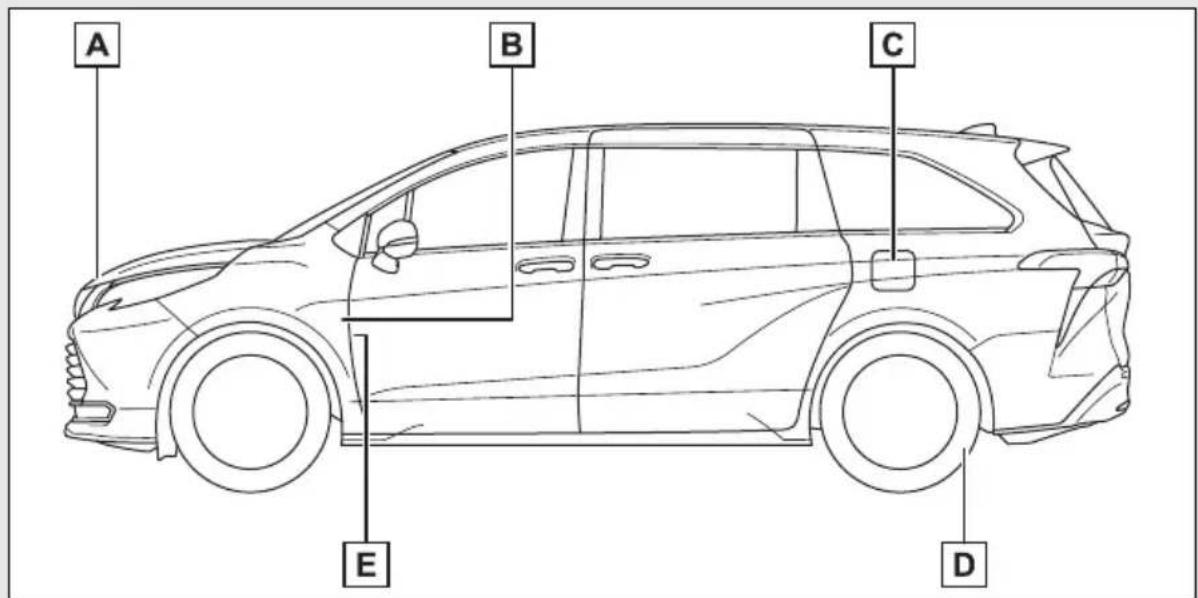
A Auxiliary catch lever ( P.413)
B Fuel filler door opener switch ( P.260)
C Fuel filler door ( P.260)
D Tire inflation pressure ( P.525)
E Hood lock release lever ( P.413)
| Fuel tank capacity (Reference) | 18 gal. (68.2 L, 15 Imp.gal.) |
| Fuel type Unleaded gasoline only P.520 | |
| Cold tire inflation pressure P.525 | |
| Engine oil capacity (Drain and refill — reference) | P.521 |
| Engine oil type P.521 | |