
GR86 (2024) - Automotive TOYOTA - Free user manual and instructions
Find the device manual for free GR86 (2024) TOYOTA in PDF.


| Product Type | Sports coupe (automobile) |
| Model Year | 2024 |
| Engine | 2.4L flat-4 (FA24) |
| Transmission | 6-speed manual or 6-speed automatic |
| Fuel Type | Premium unleaded gasoline (91 octane or higher recommended) |
| Dimensions (L x W x H) | Approx. 4265 mm x 1775 mm x 1310 mm |
| Curb Weight | Approx. 1275 kg (2810 lbs) |
| Fuel Tank Capacity | 50 L (13.2 gal) |
| Safety Systems | EyeSight (Pre-Collision Braking, Adaptive Cruise Control, Lane Departure Warning), SRS airbags (front, side, curtain), seat belt pretensioners, vehicle stability control |
| Key Features | Smart key system, power windows, automatic air conditioning, seat heaters, multi-information display, tilt/telescopic steering wheel, cruise control |
| Maintenance Intervals | Oil change every 5000 miles or 6 months; tire rotation every 5000 miles; air filter every 30000 miles |
| Recommended Engine Oil | 0W-20 synthetic (API SN or higher) |
| Tire Pressure (Front/Rear) | 240 kPa (35 psi) cold |
| Warranty | 3 years/36000 miles basic, 5 years/60000 miles powertrain |
| Battery | 12V lead-acid (Group 35) |
Frequently Asked Questions - GR86 (2024) TOYOTA
User questions about GR86 (2024) TOYOTA
0 question about this device. Answer the ones you know or ask your own.
Ask a new question about this device
Download the instructions for your Automotive in PDF format for free! Find your manual GR86 (2024) - TOYOTA and take your electronic device back in hand. On this page are published all the documents necessary for the use of your device. GR86 (2024) by TOYOTA.
USER MANUAL GR86 (2024) TOYOTA
| Pictorial index | Search by illustration | |
| For safety and security | Make sure to read through them(Main topics: Child seat, theft deterrent system) | 1 |
| Vehicle status information and indicators | Reading driving-related information(Main topics: Meters, multi-information display) | 2 |
| Before driving | Opening and closing the doors and windows, adjustment before driving(Main topics: Keys, doors, seats) | 3 |
| Driving | Operations and advice which are necessary for driving(Main topics: Starting engine, refueling) | 4 |
| Interior features | Usage of the interior features(Main topics: Air conditioner, storage features) | 5 |
| Maintenance and care | Caring for your vehicle and maintenance procedures(Main topics: Interior and exterior, light bulbs) | 6 |
| When trouble arises | What to do in case of malfunction and emergency(Main topics: Battery discharge, flat tire) | 7 |
| Vehicle specifications | Vehicle specifications, customizable features(Main topics: Fuel, oil, tire inflation pressure) | 8 |
| For owners | Reporting safety defects for U.S. owners, and seat belt, SRS airbag and headlight aim instructions for Canadian owners | 9 |
| Index | Search by symptom | |
| Search alphabetically |
For your information ....5
Reading this manual....10
How to search......11
Pictorial index 12

For safety and security
1-1. For safe use
Before driving....22
For safe driving 23
Seat belts....25
SRS airbags....29
Front passenger occupant classification system....56
Exhaust gas precautions......62
1-2. Child safety
Riding with children....63
Child restraint systems......64
1-3. Emergency assistance
Safety Connect ....75
1-4. Theft deterrent system
Engine immobilizer system ...80
Alarm....81

Vehicle status information and indicators
2-1. Instrument cluster
Warning lights and indicators 84
Gauges and meters .....88
Multi-information display .....93

Before driving
3-1. Key information
Keys.... 102
3-2. Opening, closing and locking the doors and trunk
Doors 105
Trunk.... 107
Smart key system ...... 111
3-3. Adjusting the seats
Front seats.... 119
Rear seats.... 121
Head restraints.... 123
3-4. Adjusting the steering wheel and mirrors
Steering wheel 125
Inside rear view mirror ..... 126
Outside rear view mirrors... 127
3-5. Opening, closing the windows
Power windows.... 129

Driving
4-1. Before driving
Driving the vehicle.... 132
Cargo and luggage 140
Vehicle load limits 143
Trailer towing.... 143
Dinghy towing 144
4-2. Driving procedures
Engine (ignition) switch..... 145
Automatic transmission..... 149
Manual transmission...... 153
Turn signal lever.... 155
Parking brake.... 156
ASC (Active Sound Control) 157
4-3. Operating the lights and wipers
Headlight switch.... 158
High Beam Assist...... 162
Windshield wipers and washer 165
4-4. Refueling
Opening the fuel tank cap.. 167
4-5. EyeSight
EyeSight.... 170
Pre-Collision Braking System 179
Adaptive Cruise Control..... 190
Conventional Cruise Control 208
Pre-Collision Throttle Management.... 216
Lane Departure Warning.... 221
Lane Sway Warning...... 223
Lead Vehicle Start Alert..... 225
List of alert/notification sounds 227
EyeSight malfunction and temporary stop.... 229
4-6. Using other driving systems
BSD/RCTA 233
Reverse Automatic Braking (RAB) system.... 241
Rear view camera 252
Driving mode select switch 257
Hill-start assist control..... 258
Driving assist systems...... 260
4-7. Driving tips
Winter driving tips.... 265
5 Interior features
5-1. Using the air conditioning system
Automatic air conditioning system.... 270
Seat heaters.... 276
5-2. Using the interior lights
Interior lights list...... 277
5-3. Using the storage features
List of storage features ..... 279
Trunk features..... 282
5-4. Using the other interior features
Other interior features..... 283
6 Maintenance and care
6-1. Maintenance and care
Cleaning and protecting the vehicle exterior.... 288
Cleaning and protecting the vehicle interior.... 291
Cleaning and protecting the Ultrasuede® area ...... 294
6-2. Maintenance
Maintenance requirements 296
General maintenance..... 297
Emission inspection and maintenance (I/M) programs ..... 300
6-3. Do-it-yourself maintenance
Do-it-yourself service precautions 301
Hood 303
Positioning a floor jack..... 304
Engine compartment...... 306
Tires 313
Replacing the tire.... 320
Tire inflation pressure...... 324
Wheels.... 326
Air conditioning filter...... 328
Electronic key battery...... 329
Checking and replacing fuses 331
Headlight aim.... 333
Light bulbs.... 334
7 When trouble arises
7-1. Essential information
Emergency flashers ..... 338
If your vehicle has to be stopped in an emergency 338
If the vehicle is submerged or water on the road is rising 339
7-2. Steps to take in an emergency
If your vehicle needs to be towed 341
If you think something is wrong 346
Fuel pump shut off system 347
If a warning light turns on or a warning buzzer sounds.... 348
If a warning message is displayed 357
If you have a flat tire...... 358
If the engine will not start ... 367
If you lose your keys ..... 369
If the fuel filler door cannot be opened.... 369
If the electronic key does not operate properly.... 370
If the vehicle battery is discharged.... 372
If your vehicle overheats.... 375
If the vehicle becomes stuck 377
8 Vehicle specifications
8-1. Specifications
Maintenance data (fuel, oil level, etc.).... 380
Fuel information 388
Tire information 390
8-2. Customization
Customizable features ..... 400
9 For owners
9-1. For owners
Reporting safety defects for U.S. owners 408
Reporting safety defects for Canadian owners.... 409
Seat belt instructions for Canadian owners (in French) ... 409
SRS airbag instructions for Canadian owners (in French) 411
Headlight aim instructions for Canadian owners (in French) 422
Index
What to do if... (Troubleshooting) 426
Alphabetical Index...... 429
For your information
Main Owner's Manual
Please note that this manual applies to all models and explains all equipment, including options. Therefore, you may find explanations for equipment not installed on your vehicle and the illustrations used may differ from your vehicle.
All specifications provided in this manual are current at the time of printing. Over time, your vehicle may receive updates that modify the vehicle and make material in this manual incomplete and/or inaccurate. Because of Toyota's interest in continual product improvement, Toyota reserves the right to make changes to this manual at any time without notice.
If Toyota chooses to update the manual, updated versions can be viewed by selecting your vehicle by model and year at the following URL or on your mobile device if you have access to the Toyota app.
www.toyota.com/owners
Noise from under vehicle after turning off the engine
Approximately five hours after the engine is turned off, you may hear sound coming from under the vehicle for several minutes. This is the sound of a fuel evaporation leakage check and, it does not indicate a malfunction.
Accessories, spare parts and modification of your Toyota
A wide variety of non-genuine spare parts and accessories for Toyota vehicles are currently available in the market. You should know that Toyota does not warrant these products and is not responsible for their performance, repair, or replacement, or for any damage they may cause to, or adverse effect they may have on, your Toyota vehicle.
This vehicle should not be modified with non-genuine Toyota products. Modification with non-genuine Toyota products could affect its performance, safety or durability, and may even violate governmental regulations. In addition, damage or performance problems resulting from the modification may not be covered under warranty.
Cyber Attack Risk
Installing electronic devices and radios increases the risk of cyber attacks through the installed parts, which may lead
to unexpected accidents and leakage of personal information. Toyota does not make any guarantees for problems caused by installing non-genuine Toyota products.
Installation of a mobile two-way radio system
The installation of a mobile two-way radio system in your vehicle could affect electronic systems such as:
- Multiport fuel injection system/sequential multiport fuel injection system
- EyeSight system
● Anti-lock brake system
● Vehicle dynamics integrated management - SRS airbag system
- Seat belt pretensioner system
Be sure to check with your Toyota dealer for precautionary measures or special instructions regarding installation of a mobile two-way radio system.
Vehicle data recording
The vehicle is equipped with sophisticated computers that will record certain data, such as:
• Engine speed / Electric motor speed (traction motor speed)
- Accelerator status
- Brake status
- Vehicle speed
• Operation status of the driving assist systems
• Images from the cameras
Your vehicle is equipped with cameras. Contact your Toyota dealer for the location of recording cameras.
The recorded data varies according to the vehicle grade level and options with which it is equipped.
These computers do not record conversations or sounds, and only record images outside of the vehicle in certain situations.
● Data Transmission
Your vehicle may transmit the data recorded in these computers to Toyota and third parties contracted by Toyota without notification to you.
- Data usage
Toyota and third parties contracted by Toyota may use the data recorded in this computer to diagnose malfunctions, conduct research and development, and improve quality.
Toyota and third parties contracted by Toyota will not disclose the recorded data to a third party except:
- With the consent of the vehicle owner or with the consent of the lessee if the vehicle is leased
• In response to an official request by the police, a court of law or a government agency -
For use by Toyota in a lawsuit
-
For research purposes where the data is not tied to a specific vehicle or vehicle owner
- To learn more about the vehicle data collected, used and shared by Toyota, please visit www.toyota.com/privacyvts/.
Usage of data collected through Safety Connect (U.S. mainland only)
If your Toyota has Safety Connect and if you have subscribed to those services, please refer to the Safety Connect Telematics Subscription Service Agreement for information on data collected and its usage.
To learn more about the vehicle data collected, used and shared by Toyota, please visit www.toyota.com/privacyvts/.
Statement on Warranty Coverage for Aftermarket and Recycled Parts (For U.S. Owners)
The Magnuson-Moss Warranty Act, 15 U.S.C. s.2301 et seq., makes it illegal for motor vehicle manufacturers to void a motor vehicle warranty or deny warranty coverage solely because an aftermarket or recycled part has been used to repair the vehicle or someone other than the authorized service provider performed service on the vehicle. This provision does not apply to a new motor vehicle purchased solely for commercial or industrial use.
Under federal law, a manufacturer may deny warranty coverage and charge for repairs to a vehicle if it is discovered that an aftermarket or recycled part installed on the vehicle is defective or was installed incorrectly and caused damage to another part of the vehicle otherwise covered under warranty. The Federal Trade Commission requires that a manufacturer demonstrate that an aftermarket or recycled part or service performed by a person other than an authorized service provider caused damage to another part of the vehicle otherwise covered under warranty before denying warranty coverage. Additionally, federal law allows a manufacturer to void a motor vehicle warranty or deny warranty coverage if the manufacturer provides the article or service to consumers free of charge under the warranty or the manufacturer has secured a waiver from the Federal Trade Commission.
Event data recorder
This vehicle is equipped with an event data recorder (EDR). The main purpose of an EDR is to
record, in certain crash or near crash-like situations, such as an air bag deployment or hitting a road obstacle, data that will assist in understanding how a vehicle's systems performed. The EDR is designed to record data related to vehicle dynamics and safety systems for a short period of time, typically 30 seconds or less.
The EDR in this vehicle is designed to record such data as:
• How various systems in your vehicle were operating;
- Whether or not the driver and passenger safety belts were buckled/fastened;
- How far (if at all) the driver was depressing the accelerator and/or brake pedal; and,
- How fast the vehicle was traveling.
These data can help provide a better understanding of the circumstances in which crashes and injuries occur.
NOTE: EDR data are recorded by your vehicle only if a non-trivial crash situation occurs; no data are recorded by the EDR under normal driving conditions and no personal data (e.g., name, gender, age, and crash location) are recorded. However, other parties, such as law enforcement, could combine the EDR data with the type of personally identifying data routinely acquired during a crash investigation.
To read data recorded by an EDR, special equipment is required, and access to the vehicle or the EDR is needed. In addition to the vehicle manufacturer, other parties, such as law enforcement, that have the special equipment, can read the information if they have access to the vehicle or the EDR.
● Disclosure of the EDR data
Toyota will not disclose the data recorded in an EDR to a third party except when:
- An agreement from the vehicle's owner (or the lessee for a leased vehicle) is obtained
- In response to an official request by the police, a court of law or a government agency
- For use by Toyota in a lawsuit However, if necessary, Toyota may:
- Use the data for research on vehicle safety performance
- Disclose the data to a third party for research purposes without disclosing information about the specific vehicle or vehicle owner
Scrapping of your Toyota
The SRS airbag and seat belt pretensioner devices in your Toyota contain explosive chemicals. If the vehicle is scrapped with the airbags and seat belt
pretensioners left as they are, this may cause an accident such as fire. Be sure to have the systems of the SRS airbag and seat belt pretensioner removed and disposed of by a qualified service shop or by your Toyota dealer before you scrap your vehicle.
Perchlorate Material
Special handling may apply, See www.dtsc.ca.gov/hazard-ouswaste/perchlorate.
Your vehicle has components that may contain perchlorate. These components may include airbag, seat belt pretensioners, and wireless remote control batteries.
"QR Code"
The word “QR Code” is registered trademark of DENSO WAVE INCORPORATED in Japan and other countries.

WARNING
■General precautions while driving
Driving under the influence: Never drive your vehicle when under the influence of alcohol or drugs that have impaired your ability to operate your vehicle. Alcohol and certain drugs delay reaction time, impair judgment and reduce coordination, which could lead to an accident that could result in death or serious injury.
Defensive driving: Always drive defensively. Anticipate mistakes that other drivers or pedestrians might make and be ready to avoid accidents.
Driver distraction: Always give your full attention to driving. Anything that distracts the driver, such as adjusting controls, talking on a cellular phone or reading can result in a collision with resulting death or serious injury to you, your occupants or others.
■General precaution regarding children's safety
Never leave children unattended in the vehicle, and never allow children to have or use the key.
Children may be able to start the vehicle or shift the vehicle into neutral. There is also a danger that children may injure themselves by playing with the windows or other features of the vehicle. In addition, heat build-up or extremely cold temperatures inside the vehicle can be fatal to children.
Reading this manual
Explains symbols used in this manual.
Symbols in this manual
| Symbols Meanings | |
 | WARNING:Explains something that, if not obeyed, could cause death or serious injury to people. |
 | NOTICE:Explains something that, if not obeyed, could cause damage to or a malfunction in the vehicle or its equipment. |
| 1 2 3... | Indicates operating or working procedures. Follow the steps in numerical order. |
| Symbols Meanings | |
 | Indicates the action (pushing, turning, etc.) used to operate switches and other devices. |
 | Indicates the outcome of an operation (e.g. a lid opens). |
| Symbols Meanings | |
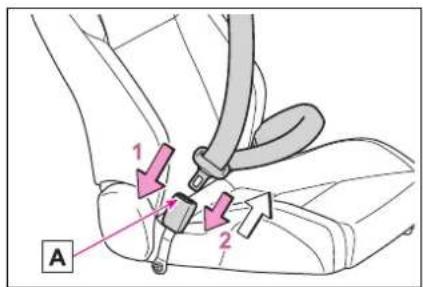
| Indicates the component or position being explained. | |
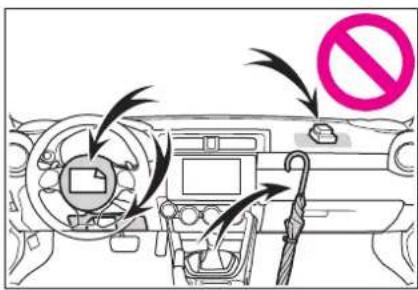
| Means Do not, Do not do this, or Do not let this happen. | |
Symbols in illustrations
How to search
■Searching by name
● Alphabetical index: →P.429
■Searching by installation position
● Pictorial index: →P.12
natural_image
Line drawing of a person reading an open book with a lightbulb above, no text or symbols present■Searching by symptom or sound
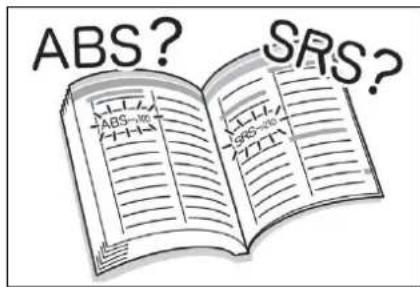
● What to do if... (Troubleshooting): →P.426
natural_image
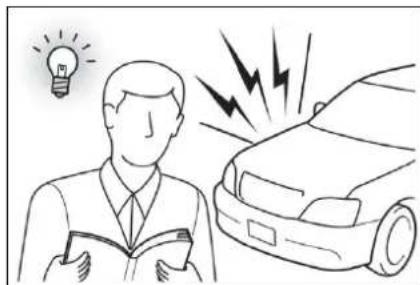
Illustration of a person reading a book with a lightbulb and electric shock effect next to a car (no text or symbols)■Searching by title
● Table of contents: →P2
natural_image
Line drawing of a person reading an open book with a lightbulb above, symbolizing knowledge or ideas (no text or symbols present)Pictorial index
Exterior
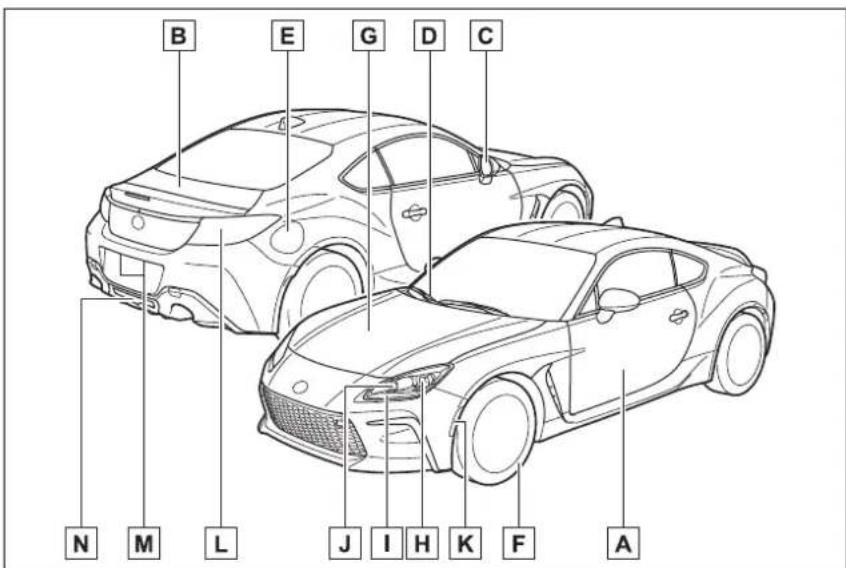
A Doors....P.105
Locking/unlocking P.105
Opening/closing the side windows....P.129
Locking/unlocking by using the mechanical key ..... P.370
Warning lights P.348
B Trunk P.107
Opening from inside the cabin P.109
Opening from outside....P.109
Warning lights P.348
C Outside rear view mirrors P.127
Adjusting the mirror angle....P.127
Folding the mirrors.... P.128
Defogging the mirrors P.272
D Windshield wipers....P.165
Precautions for winter season....P.265
Refueling method.... P.167
Fuel type/fuel tank capacity .....P.381
F Tires....P.313
Tire size/inflation pressure ......P.386
Winter tires/tire chain P.265
Checking/rotation/tire pressure warning system .....P.313
Coping with flat tires.... P.358
G Hood....P.303
Opening P.303
Engine oil P.382
Coping with overheating P.375
Warning messages P.357
Light bulbs of the exterior lights for driving
(Replacing method: P.334, Watts: P.387)
H Headlights.... P.158
Parking lights/daytime running lights....P.158
J Turn signal lights P.155
K Side marker lights....P.158
L Stop lights/tail lights/side marker lights/turn signal lights....P.155, 158
M License plate lights....P.158
N Back up light
Shifting the shift lever to R....P.150, 153
Instrument panel
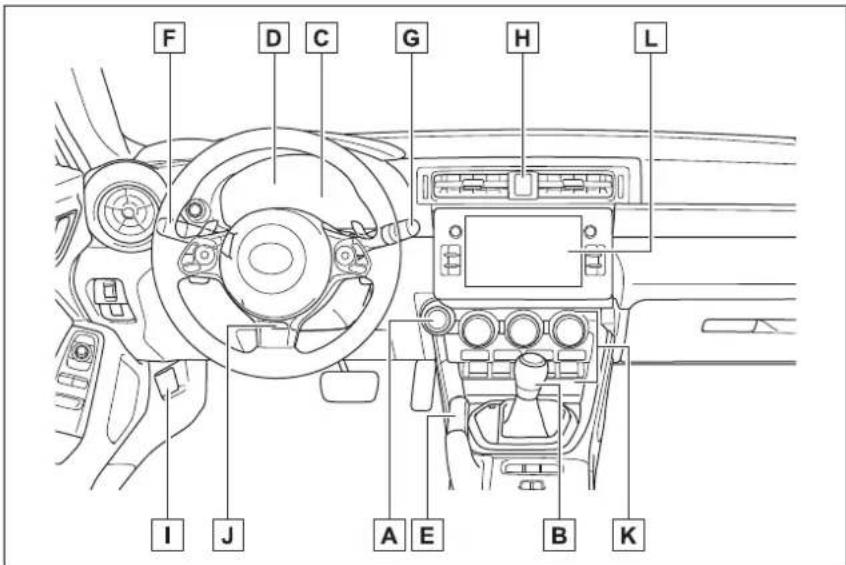
A Engine switch....P.145
Starting the engine/changing the mode .....P.145
Emergency stop of the engine .....P.338
When the engine will not start.... P.367
Warning messages ......P.357
B Shift lever.... P.149,153
Changing the shift position....P.150,153
Precautions for towing P.341
When the shift lever does not move ^*1 P.150
C Multi-information display P.93
Display P.93
When a warning message is displayed....P.357
D Meters P.88
Reading the meters/adjusting the instrument panel lights .....P.88
Warning lights/indicator lights P.84
When a warning light comes on....P.348
E Parking brake P.156
Applying/releasing.... P.156
Precautions for winter season....P.266
Warning lights P.348
F Headlight switch P.158
Turn signal lever....P.155
Headlights/parking lights/tail lights/side marker lights/daytime running lights.... P.158
G Windshield wiper and washer switch.....P.165
Usage.....P.165
Adding washer fluid....P.312
H Emergency flasher switch.....P.338
Hood lock release lever....P.303
J Tilt and telescopic steering lock release lever.....P.125
Adjustment.... P.125
K Air conditioning system....P.270
Usage....P.270
Rear window defogger P.272
L Audio system ^4
^*1 :Vehicles with an automatic transmission
*2:Refer to "MULTIMEDIA OWNER'S MANUAL".
Switches
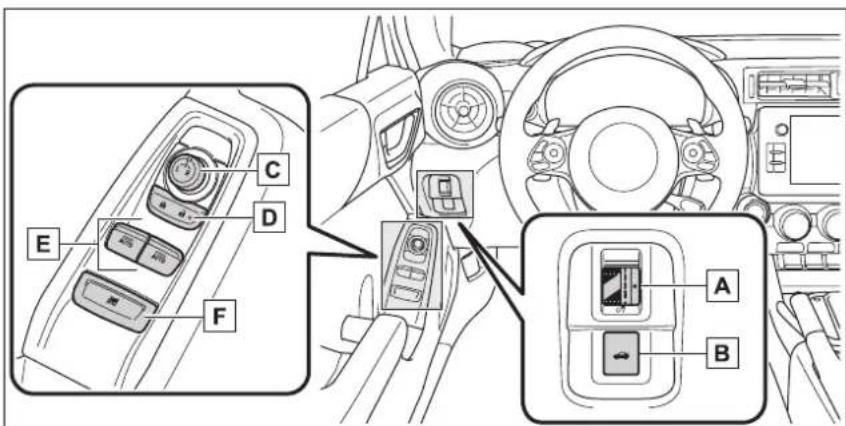
A Instrument panel light control dial....P.91
B Trunk opener switch P.109
C Outside rear view mirror switches .....P.127
D Door lock switches P.106
E Power window switches....P.129
F Window lock switch....P.130
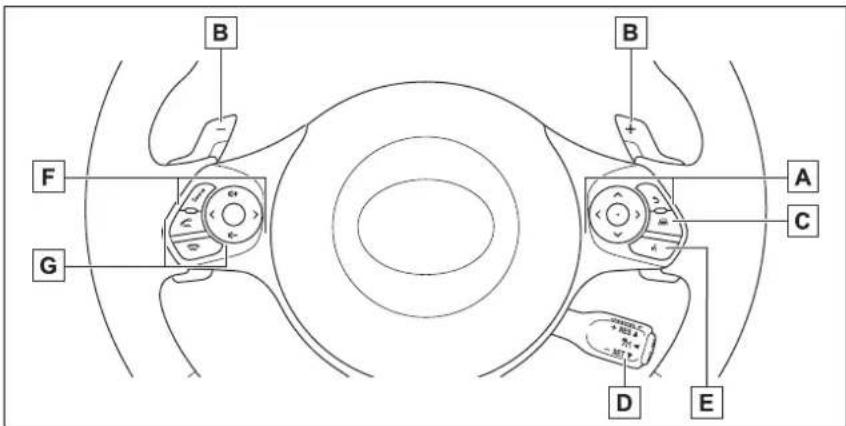
A Meter control switches.....P.94
B Paddle shift switches ^*1 P.151, 152
C (Following distance setting) switch..... P.178
D Cruise control switch
Adaptive cruise control....P.190
Conventional cruise control....P.208
E Talk switch*2
F Audio remote control switches ^2
G Telephone switches ^2
*1:If equipped
*2:Refer to "MULTIMEDIA OWNER'S MANUAL".
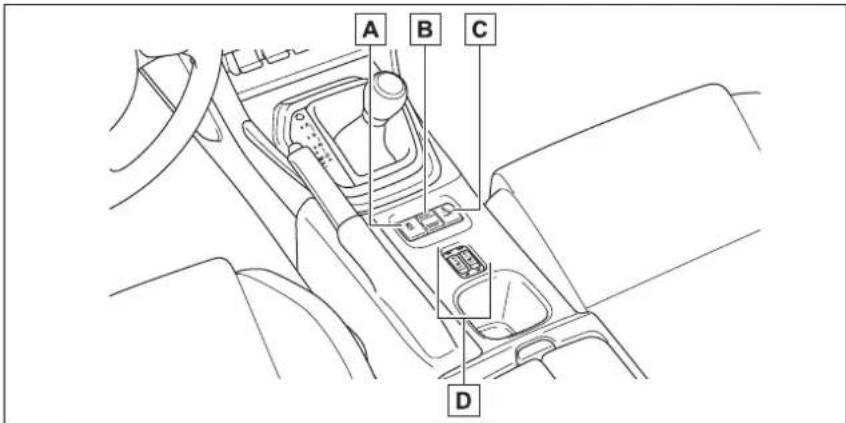
A VSC OFF switch P.261
B Driving mode select switch ^ P.257
C TRACK switch P.261
D Seat heater switches ^ P.276
*: If equipped
- For safety and security
- 1-1. For safe use
- 1-2. Child safety
- 1-3. Emergency assistance
- 1-4. Theft deterrent system
- Vehicle status information and indicators
- 2-1. Instrument cluster
- Before driving
- 3-1. Key information
- 3-2. Opening, closing and locking the doors and trunk
- 3-3. Adjusting the seats
- 3-4. Adjusting the steering wheel and mirrors
- 3-5. Opening, closing the windows
- Driving
- 4-1. Before driving
- 4-2. Driving procedures
- 4-3. Operating the lights and wipers
- 4-4. Refueling
- 4-5. EyeSight
- 4-6. Using other driving systems
- 4-7. Driving tips
- Interior features
- 5-1. Using the air conditioning system
- 5-2. Using the interior lights
- 5-3. Using the storage features
- 5-4. Using the other interior features
- Maintenance and care
- 6-1. Maintenance and care
- 6-2. Maintenance
- 6-3. Do-it-yourself maintenance
- When trouble arises
- 7-1. Essential information
- 7-2. Steps to take in an emergency
- Vehicle specifications
- 8-1. Specifications
- 8-2. Customization
- For owners
- 9-1. For owners
- Index
- For your information
- Main Owner's Manual
- Noise from under vehicle after turning off the engine
- Accessories, spare parts and modification of your Toyota
- Cyber Attack Risk
- Installation of a mobile two-way radio system
- Vehicle data recording
- Usage of data collected through Safety Connect (U.S. mainland only)
- Statement on Warranty Coverage for Aftermarket and Recycled Parts (For U.S. Owners)
- Event data recorder
- Scrapping of your Toyota
- Perchlorate Material
- "QR Code"
- WARNING
- ■General precautions while driving
- ■General precaution regarding children's safety
- Reading this manual
- Symbols in illustrations
- How to search
- ■Searching by name
- ■Searching by installation position
- ■Searching by symptom or sound
- ■Searching by title
- Pictorial index
- Exterior
- Light bulbs of the exterior lights for driving
- Instrument panel
- Switches
Brand : TOYOTA
Model : GR86 (2024)
Category : Automotive