802-366 - Refrigerator Menuett - Free user manual and instructions
Find the device manual for free 802-366 Menuett in PDF.


| Product Type | Refrigerator with Freezer Compartment |
| Dimensions (H x W x D) | 839 x 486 x 536 mm |
| Weight | 25.5 kg |
| Power Supply | 230 V ~ 50 Hz, 0.75 A |
| Energy Consumption | 0.32 kWh per day |
| Refrigerant | R600a (25 g) |
| Temperature Range - Fridge | 0 to 8 °C |
| Temperature Range - Freezer | -6 °C |
| Noise Level | < 42 dB |
| Total Volume | 103 L |
| Environmental Rating | SN/N/ST |
| Safety Class | I |
| Defrosting | Manual (defrost when ice >5 mm) |
| Adjustable Feet | Yes (front feet, turn clockwise to raise) |
| Interior Features | Vegetable box, egg rack, door compartment, shelf, lamp |
| Temperature Control | Knob (0 = off, 4 = normal, higher number = colder) |
| Installation Requirements | Level surface, 5-10 cm clearance sides, 30 cm top, avoid heat/sun |
| Mains Cord | Must be replaced by authorized service center if damaged |
| Cleaning | Unplug, wipe interior with soapy water, dry thoroughly |
| Replacing Interior Lamp | Undo cover, turn bulb anticlockwise |
| Disposal | Do not discard with household waste; recycle at designated station |
Frequently Asked Questions - 802-366 Menuett
User questions about 802-366 Menuett
0 question about this device. Answer the ones you know or ask your own.
Ask a new question about this device
Download the instructions for your Refrigerator in PDF format for free! Find your manual 802-366 - Menuett and take your electronic device back in hand. On this page are published all the documents necessary for the use of your device. 802-366 by Menuett.
USER MANUAL 802-366 Menuett
Operating instructions for refrigerator
802-366
natural_image
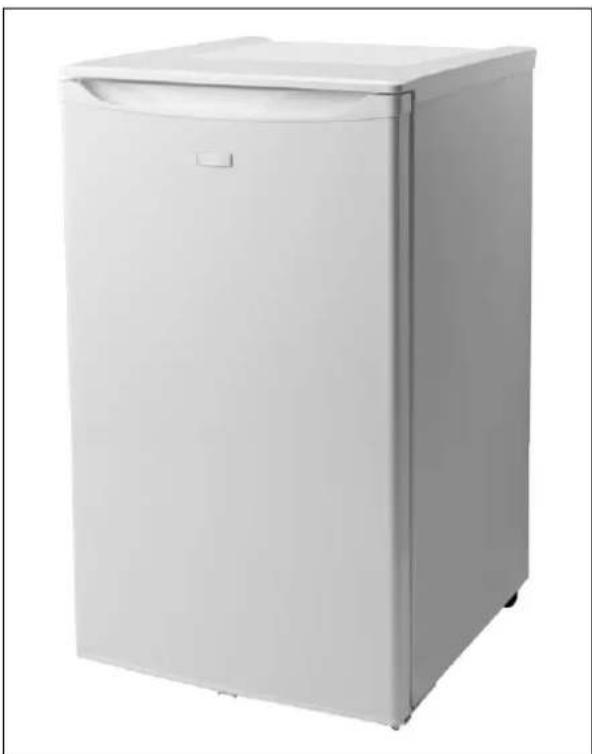
White rectangular refrigerator with lid and front panel, isolated on white background (no text or symbols visible)
Värna om miljön!
Care for the environment!
Must not be discarded with household waste! This product contains electrical or electronic components that should be recycled. Leave the product for recycling at the designated station e.g. the local authority's recycling station.
SE - Bruksanvisning i original
EN - Operating instructions (Translation of the original instructions)
Jula reserves the right to make changes. In the event of problems, please contact our service department. www.jula.com
Tillverkare/ Produsent / Produenci/ Manufacturer Jula AB, Box 363, 532 24 SKARA
Importör/ Importör/ Importer/ Importer
Packaging and transport....18
Defrosting....19
Power failure 19
Energy tips 19
MAINTENANCE 19
TROUBLESHOOTING 20
SÄKERHETSANVISNINGAR
natural_image
Technical line drawing of a mechanical assembly with gears and shafts (no text or symbols)Lossa lampskyddet.

natural_image
Pure mechanical diagram of a lever mechanism without any text, numbers, or symbolsnatural_image
Technical line drawing of a mechanical assembly with gears and shafts (no text or symbols)Løsne lampedekselet.

natural_image
Pure mechanical diagram of a lever mechanism without any text, numbers, or symbolsnatural_image
Technical line drawing of a mechanical assembly with rollers and housing (no text or symbols)natural_image
Pure mechanical diagram showing a lever mechanism with no text or symbolsRead the Operating Instructions carefully before use!
- This appliance can be used by children aged from 8 years and above and persons with reduced physical, sensory or mental capabilities or lack of experience and knowledge if they have been given supervision or instruction concerning use of the appliance in a safe way and understand the hazards involved. Children shall not play with the appliance. Cleaning and user maintenance shall not be made by children unless they are older than 8 and supervised.
- Keep the appliance and its cord out of reach of children less than 8 years.
- Electrical circuits must be insulated. The cross section of an extension cord must be at least 0.75 mm ^2 . The plug must be connected to a separate mains outlet.
- The product must be connected to 230 V \~ 50 Hz. A damaged cord must be replaced by an authorised service centre to ensure the appliance is safe to use.
• The appliance is switched off by pulling out the plug. Do not pull the power cord to unplug the plug. - Make sure that the refrigerant circuit is not damaged.
- The appliance is not intended to be used by persons (children or adults) with any form of functional disorder or by persons who do not have sufficient experience or know-how on how to use it, in so far as they have not received instructions concerning the use of the appliance from someone who is responsible for their safety.
- Keep children under supervision to make sure they do not play with the appliance.
- Do not block the vents.
- Before scrapping
- Lift off door
- Leave the shelves in place; this makes it more difficult for children to climb in.
NOTE!
- Do not pull out the plug in the event of a gas leak. Pulling out the plug risks causing a spark and subsequent fire risk.
- Do not splash or flush water on the back of the appliance – risk of malfunction or electric shock.
- Do not store flammable materials and substances such as ether, petrol, LPG or glue in the compartment.
- Do not place magnetic, heavy or water-filled objects on top of the appliance. The penetration of water can cause electronic components to stop working. Do not store objects or substances that are very sensitive to changes in temperature, e.g. serum, vaccine etc. in the compartment.
TECHNICAL DATA
| Environmental rating | SN/N/ST |
| Safety class | I |
| Volume | 103 I |
| Voltage | 230 V ~ 50 Hz |
| Power | 0.75 A |
| Noise level | < 42 dB |
| Power consumption per day | 0.32 kW |
| Refrigerant | R600a (25 g) |
| Weight | 25.5 kg |
| Refrigerator temperature | 0–8 °C |
| Freezer compartment temperature | -6 °C |
| Dimensions | 486 x 536 x 839 mm |
DESCRIPTION
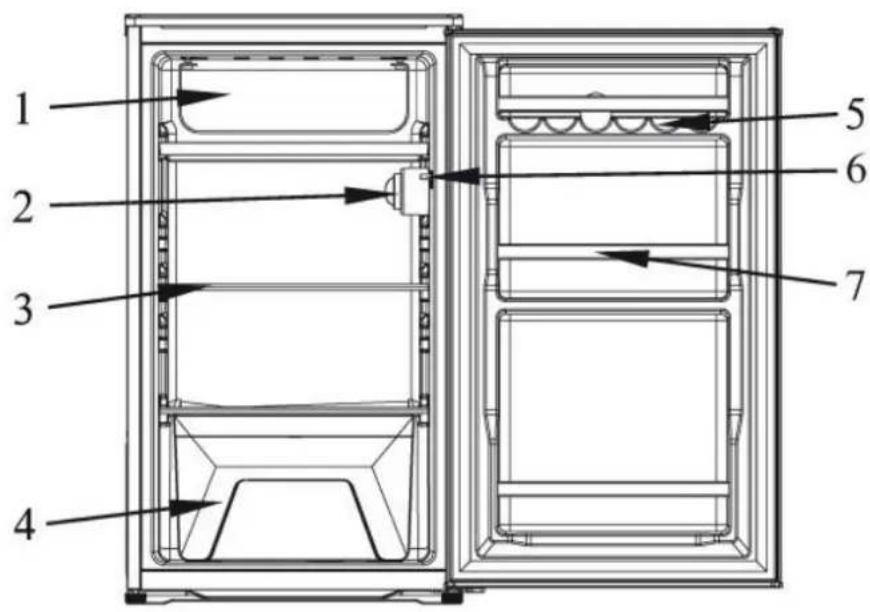
- Freezer compartment
- Lamp and temperature knob
- Shelf
- Vegetable box
- Egg rack
- Lamp switch
- Door compartment
OPERATION
Installation
- The appliance must be placed on a completely level surface. Leave a free space of 5–10 cm on all sides. Leave a free space of 30 cm over the appliance.
- Place the appliance where it is not exposed to sunlight, high temperatures or moisture.
- Loosen the lower panel before installation.
- The two feet at the front can be used to adjust the appliance if it is not standing firmly. Turn the feet clockwise to raise the appliance.
- The appliance must be placed on a hard and flat surface. Incorrect positioning can result in higher noise levels and vibrations. Soft underlayers produce a higher noise level. Place a board under the appliance if it has to stand on a carpet to solve the problem of radiant heat.
- Check that the adjustable feet are in contact with the floor. Adjust the appliance so that it leans slightly backwards to ensure that the door seals tightly shut.
The temperature is set with the temperature knob. The numbers on the knob do not show the temperature. A high number gives a lower temperature. 0 means that the appliance is switched off. 4 indicates normal temperature. Select 4–6 for a low temperature. Select 1–4 for a higher temperature.
Placing food
• Do not pack food too tightly together to ensure good air circulation.
- Food should be stored in sealed packs, so that it does not dry out or emit moisture.
- Do not put in hot food, this will raise the temperature in the compartment and consume more electricity.
• Do not open the door unnecessarily; this also increases consumption of electricity.
WARNING!
Never use electric equipment inside the appliance.
Packaging and transport
- Memorise how each part and accessory is positioned when unpacking. If the appliance is to be repacked, do the same and check carefully before transport.
- Do not lift or pull the door or handle during transport.
- The appliance must not be inclined at more than 45^ during transportation. Avoid strong vibrations and knocks.
Defrosting
Ice reduces the refrigeration capacity and increases consumption of electricity. Defrosting is necessary when the ice becomes 5 mm thick. Follow the instructions below. Take out all the food. Take out the boxes and shelves. Unplug the power cord. Open the door and allow the ice to melt. Wipe up the melted water with a dry cloth.
WARNING!
Do not use any other methods to speed up the defrosting process. This could damage the refrigeration system.
Power failure
During a power cut the appliance can stay cold for several hours, even during the summer.
- Stoppage during power failure. Do not put in any new food, and avoid opening the door.
• If a power cut is planned, you can freeze water to ice and place it at the top of the compartment.
• Take out any perishable food if you expect to be temporarily absent. Close the door properly. - If you expect to be away for a longer period, empty the compartment and pull out the plug. Defrost, clean the insides, and leave the door open.
- Pull out the plug and clean the compartment well if you are not going to use the appliance for a long time. Leave the door open to prevent unpleasant smell.
IMPORTANT!
- Do not switch off the appliance unnecessarily. This can shorten its lifespan. Wait at least 5 minutes after pulling out the plug before plugging it in again.
- Do not splash or flush water on the appliance – risk of oxidation and malfunction. Electrical components, such as switches, should be wiped with a dry cloth.
- Do not use strong, abrasive or alkaline detergents, thinner, alcohol, acid, petrol or hot water, because this can damage plastic parts and painted surfaces.
- Fat stains and other dirt can cause internal plastic components to age in advance, so wipe off all stains as soon as possible.
- Check the following points after normal maintenance:
- Are any electrical components or wires damaged or missing?
- Does the plug fit easily into the mains socket?
- Does the plug get hot?
WARNING!
Remove the door seal before scrapping. Old products must be disposed off in accordance with local regulations.
Energy tips
- Save energy and money by selecting a slightly higher, but still acceptable temperature.
- Do not open the door unnecessarily.
- Do not move boxes, baskets and shelves; leave them as they were on delivery.
MAINTENANCE
The appliance should be maintained and cleaned regularly. Always pull out the plug before cleaning.
- Internal maintenance. Wipe the insides with clean or soapy water. Re-wipe with clean water and wipe dry with a dry cloth.
- Maintaining the door seal. Oil stains and sauce etc. can easily damage the door seal. Carefully clean it.
- External maintenance. Wipe off any dust with a dry cloth and if necessary clean with a mild detergent.
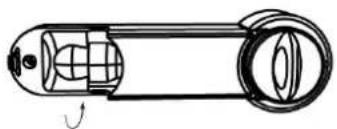
- Replacing the inside light. Undo the cover and change the bulb. See figure below.

Move the light cover 3–5 mm in the direction of the arrow.

natural_image
Technical line drawing of a mechanical component with no visible text or symbolsUndo the light cover.
natural_image
Pure mechanical diagram of a lever mechanism without any text, numbers, or symbolsRelease the bulb by turning it anticlockwise.
TROUBLESHOOTING
• The appliance does not work.
No power supply (power cord not plugged in, power cut, or fuse blown). Supply voltage too low.
• The appliance does not refrigerate as expected.
Could be because of ice deposits, high temperature setting, or leaving door open too often.
- Abnormal noise.
Could be because the appliance is not standing firmly, or is on a soft underlayer, or resonance between the appliance and surrounding objects.
• The compressor runs for long periods.
Could be because of high ambient temperature. Door opened too often, or left open. The temperature setting 4–6 can prolong the compressor running time.
- Unpleasant smell.
Strong smelling food should be carefully packed before being put in. Check if any food has gone bad, or if the appliance needs cleaning inside.
• Leaking water from the bottom of the appliance.
Blocked drain pipe. Clean with suitable tool.
- Thick ice deposits on back inside wall.
Can be a result of putting in moist or hot food. Could also be a result of ambient humidity.
The following are not malfunctions
- Condensation, which can form on the outside of the appliance in humid climate, can just be wiped off.
- Noise from circulation of refrigerant.
- Operating instructions for refrigerator
- Värna om miljön!
- Care for the environment!
- SÄKERHETSANVISNINGAR
- Read the Operating Instructions carefully before use!
- NOTE!
- DESCRIPTION
- OPERATION
- Installation
- Placing food
- WARNING!
- Packaging and transport
- Defrosting
- Power failure
- IMPORTANT!
- Energy tips
- MAINTENANCE
- TROUBLESHOOTING
- The following are not malfunctions
Brand : Menuett
Model : 802-366
Category : Refrigerator