815014 - Rice cooker Westfalia - Free user manual and instructions
Find the device manual for free 815014 Westfalia in PDF.


| Product Type | Food Dehydrator |
| Model Number | 81 50 14 |
| Brand | Westfalia |
| Number of Drying Racks | 5 stackable racks |
| Temperature Range | 35°C to 68°C |
| Display Type | Digital display with temperature control |
| Controls | On/Off switch, + and - buttons for temperature adjustment |
| Power Indicator | Red LED indicator light |
| Intended Use | Indoor domestic use only |
| Maximum Continuous Operation | 40 hours |
| Materials | Plastic housing, metal heating element |
| Cleaning Instructions | Wipe with a lightly moistened cloth; do not immerse in water or use dishwasher |
| Safety Features | Must not be used with automatic timers; do not cover; keep away from children |
| Spare Parts Availability | Original spare parts available from Westfalia |
| Accessories Included | 5 drying racks, lid, base unit |
| Preparation Before First Use | Run empty for 30 minutes at 35°C, then rinse racks and dry |
| Storage Recommendations | Store in a dry place, protect from dust and dirt, out of reach of children |
Frequently Asked Questions - 815014 Westfalia
User questions about 815014 Westfalia
0 question about this device. Answer the ones you know or ask your own.
Ask a new question about this device
Download the instructions for your Rice cooker in PDF format for free! Find your manual 815014 - Westfalia and take your electronic device back in hand. On this page are published all the documents necessary for the use of your device. 815014 by Westfalia.
USER MANUAL 815014 Westfalia
natural_image
Modern kitchen steamer with multi-tiered drying pan containing sliced apples and kiwiffruits, surrounded by fresh fruits and vegetables (no visible text or symbols)
Instruction Manual
Food Dehydrator
Article No. 81 50 14


natural_image
Cartoon illustration of a man in a gondola pulling a pipe into water, with a hat and green field in the background (no text or symbols)
Dear Customers
Instruction manuals provide valuable hints for using your new appliance. They enable you to use all functions, and they help you avoid misunderstandings and prevent damage.
Please take the time to read this manual carefully and keep it for future reference.
text_image
1 2 3 Temperature Grange 8.6 + - Temperature 5 6 5 4 7 Marine & Concrete Marine & Concrete Frost & Concrete Frost & Concrete Thermal & Vinyl Thermal & Vinyl Heat Heat Heat HeatBefore first Use......Page 17
Assembling....Page 17
Hints ......Page 18
Drying Page 19
Drying Times ......Page 22
Cleaning and Storing......Page 23
Technical Data Page 24


Sicherheitshinweise

Please note the following safety notes to avoid malfunctions, damage or physical injury:
■ Make sure the power mains correspond to the type label on the appliance.
- Persons with limited physical, sensorial or mental abilities are not allowed to use the unit, unless they are supervised and briefed for their safety by a qualified person.
- The appliance is not intended for continuous professional operation. The appliance is intended to be used in closed rooms only and in similar applications such as: staff kitchen areas in shops, offices and other working environments; farm houses; by clients in hotels, motels and other residential type environments; bed and breakfast type environments. The use in any other way is not considered as intended use.
- Place the appliance on a flat, heat-resistant and stable surface. Never place the appliance near or on hot surfaces such as gas or electric stoves. The appliance becomes warm during use! Place the appliance well away from walls and curtains.
- Do not operate the appliance outdoors and always use it in dry locations. Do not cover the appliance. There is risk of fire!
- Never leave the appliance unsupervised when in use. Keep it out of reach of children or persons in need of supervision.
- Do not operate the appliance continuously for longer than 40 hours.
- Never immerse the appliance in water or any other liquid or place it into the dishwasher. Do not use the appliance with wet hands.
- Please switch OFF the appliance and unplug from the power supply before cleaning or when not in use.
- Never move the appliance by pulling the cord. Make sure the cord cannot get caught in any way. Do not wind the cord around the appliance and do not bend it.
- Keep all parts of the appliance clean at all times as they come into direct contact with food. Only use the appliance for domestic purposes and in the way indicated in these instructions.
- Use only original spare parts which can be purchased from Westfalia.
- CAUTION: In order to avoid a hazard due to inadvertent resetting of the safety cut-off, this appliance must not be supplied through automatic switching appliances such as timers.
- Should the appliance become damaged do not use it and have it repaired by a professional or contact our customer support department. Do not disassemble the appliance or try repairing it yourself.

- Unpack the appliance and the accessory from the packaging and check all parts for damage in transport. Do not operate the food dehydrator if any parts or the base are damaged.
■ Before using the first time, wipe all parts of the appliance. Clean the appliance with a lightly moistened cloth. Use detergent as needed. - Do not wash the appliance or the racks in a dishwasher or immerse the food dehydrator in water or any other liquid.
Assembling
- Make sure that the dehydrator sits steadily on a solid, level surface.
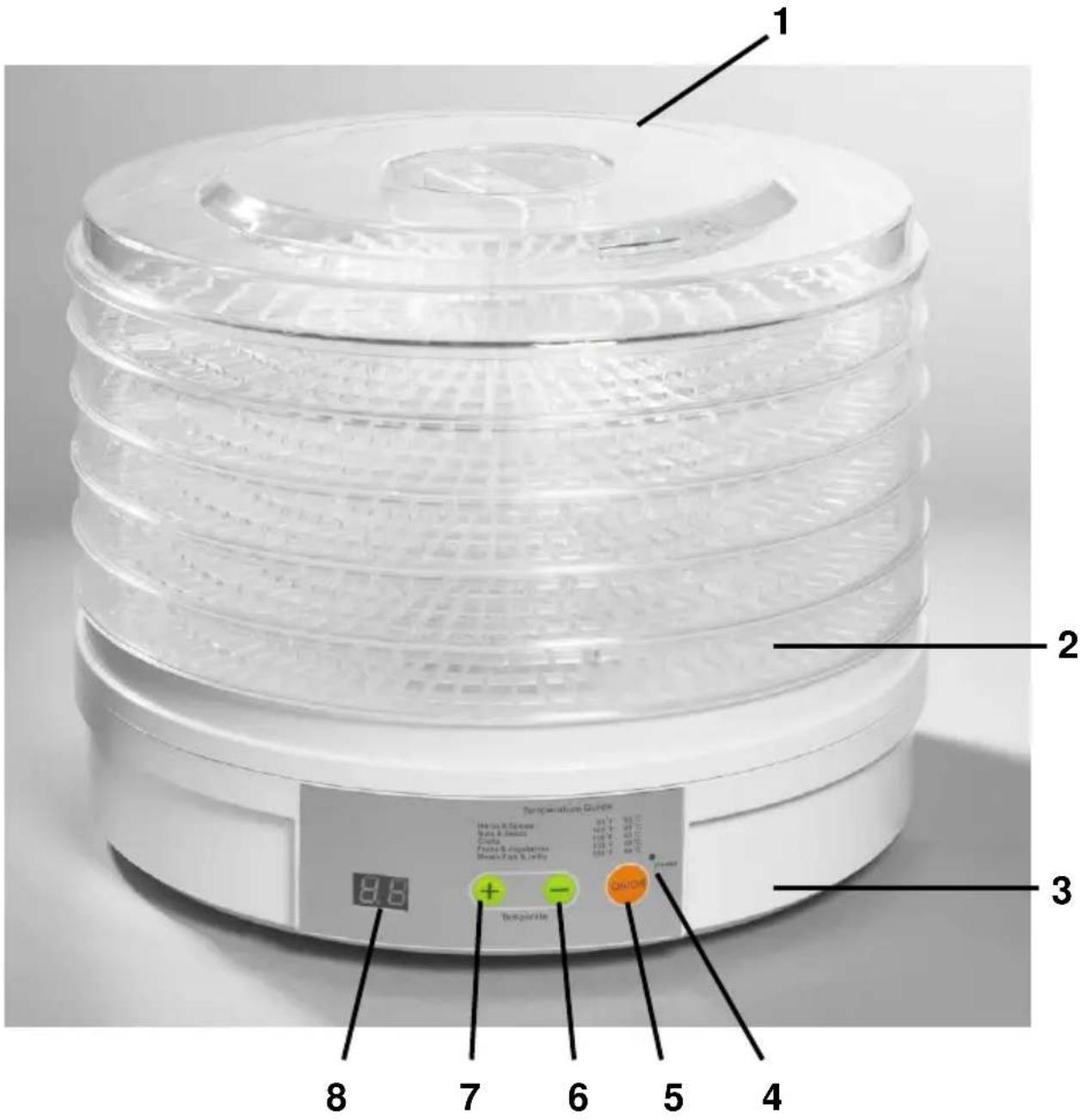
- Stock the drying racks and connect the plug with a wall socket. The power indicator light (4) turns on red and indicates that the appliance is connected with the power mains.
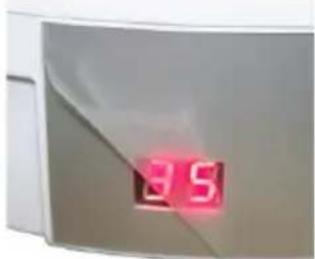
- Press the On/Off switch (5) once. The value 35 appears on the display (8).
- Press the +button (7) in order to increase the temperature, as shown on the keypad panel.
For herbs and spices select 35°,
for nuts and seeds select 41°,
for flowers 46°,
for fruits & vegetables select 58° and
for meat, fish & jerky select 68°.
- Use the +button (7) to increase the temperature and use the -button (6) to decrease the temperature.
- After cleaning the appliance must run in for 30 minutes. Please do not place any food for drying during this period. Thereafter rinse the racks in water and
dry all parts. This act is only necessary before the first use.
- If desired, peel of the protection foil form the keypad panel. The foil is intended to protect the keypad from scratches.
text_image
35Hints
- This food dehydrator includes 5 stackable racks. The air vents on the lid allow air to be circulated. Using a controlled heat temperature, air is circulated from the base of the dehydrator to each of the five racks and removes moisture from food.
- Always use the food dehydrator will all drying racks, even if not all racks are filled with food. Always operate the food dehydrator with the lid attached.
- Evenly spread the food to be dehydrated on the racks. Do not put one upon the other. Use only to 90% of the rack's space to allow air to circulate freely.
- Depending on the moisture of the food itself and the humidity in the air, drying operation time can vary. Use the dehydrator in a dust free, warm and dry room. Well air ventilation is also important.
- If you notice uneven drying during operation, switch off the dehydrator and reposition the drying racks. Place the bottom rack on top and vice versa.
- Fruit and vegetables dried in your food dehydrator will be different in appearance from those sold in health food stores and supermarkets. This is due to your food dehydrator uses no preservatives, no artificial colouring and only natural additives.
- Records of humidity, weight of product before and after drying times, will be helpful to improving your drying techniques for the future.
Storing dehydrated food
- Cool down the food before storing as condensation in the container will cause mildew.
■ Always make a dryness test. Switch off the dehydrator before taking test pieces.
The consistency of dried fruits should be soft and pliable when properly dried.
The consistency of dried vegetables should be firm without soft spots.
Dried meat is leather-like.
Dried fish is dry and pliable.
- The next day, after storing, check if there is still moisture in the food. If so, dry the food again.
- Preferably use dry containers to store the food. Containers or glass jars with metal screw lids are ideal for storing dried food. Store fruits in a cool and dry area and as dark as possible. The ideal temperature for storing dehydrated food is 5 – 20 °C.
Drying Times
Fruits
- Wash fruits and remove any blemishes. Dry off fruits and slice in equal pieces. Remove stones from stone fruits like plums, cherries, peaches etc before drying.
- If desired, pre-treat the fruits. Pre-treatment makes fruits look better and increase the shelf life. Fruits taste better and dry faster. Use pineapple or lemon juice to prevent browning. Soak fruits for 2 – 3 minutes in the juice before drying.
- Sprinkle fruits with brown sugar, cinnamon or coconut or with honey to give an interesting flavour. Blanche fruits with natural protective wax coating e.g. figs, grapes and prunes before drying. Blanching speeds up drying process. Immersion of fruits in boiling water for 1 – 2 minutes and plunge into ice cold water. Slice blanched fruits in thin slices.
- The mentioned times for dehydrating food are guidelines only. According to taste, prolong or decrease the time.
Vegetables
- Wash vegetables and remove any blemishes. Cut vegetables in equal pieces.
■ Pre-treat the vegetables to speed up drying process. Vegetables with long cooking times require steam blanching. Bring a saucepan of water to boil. Place vegetables in a colander in the saucepan and cover. Blanch vegetables for 1 – 5 minutes.
■ Finally cool down vegetables in ice water, drain and dry off before drying.
Herbs
■ Wash herbs and remove any blemishes. Use also stems or leaves.
- Evenly spread herbs on the racks. Do not put one upon the other. Many herbs can be dried with stems.
- Do not store herbs in paper bags as the oil will be absorbed by the paper.
Flowers
■ Wash flowers and remove any blemishes.
- Use young flowers as full bloom flowers tent to loose their petals. Use also petals.
■ Evenly spread flowers and the petals on the racks. Do not put one upon the other. You can also dry some flowers with their stems.
Drying Times
Making Potpourri
- Place dried flowers in a large glass container; add 3 – 4 drops of perfumed oil to enliven the fragrance. Add more oil from time to time.
Meat
- Wash meat and trim excess fat, sinew and bones.
- Make sure the meat to be dried is always fresh! Slice into thin strips. Marinate the meat for 6 – 8 hours before drying in order to tender the meat. According to taste use either ready-made marinade or prepare your own marinade. It is necessary to add salt to the marinade to remove water from the meat.
- Evenly spread the meat on the racks. Do not put one upon the other.
- If you notice uneven drying, switch off the dehydrator and move the bottom rack up and the top rack down. The min. uninterrupted drying time for meat is at least 10 hours.
Fish
- Wash the fish and remove the bones. The fish to be dried must be fresh! Slice the fish in thin strips. Sprinkle the fish with lemon juice and soak for half an hour in saltwater (250 g salt and 2 litres water). Dry off the fish before drying in the dehydrator.
- Evenly spread the fish on the racks. Do not put one upon the other. Use only to 90% of the rack's space to allow air to circulate freely.
- The min. uninterrupted drying time for fish is at least 10 hours.
Fruits and Vegetable Rolls
- Wash fruits or vegetables and remove any blemishes. Dry off fruits or vegetables.
- Line the racks with parchment paper. Make sure to cut a hole in the middle of the parchment paper, so air can freely circulate.
- Puree fresh, canned fruit or vegetables to a consistency that can be spread with a spatula over the parchment paper. Spread the puree and make sure the thickness does not exceed 5 mm.
- Chewy rolls are ready when the centres are no longer sticky to touch. Remove the fruit or vegetables while they are still warm to prevent sticking.
- Roll tightly and slice into desired portions.
Drying Times
| Food | Preparation | Drying Time in hours | Consistency after Drying |
| Apricots | Remove pits and cut into 5 mm thick slices | 15 | soft |
| Orange Peel | Cut in stripes | 13 | fragile |
| Pineapple (fresh) | Peel and cut in cubes | 13 | hard |
| Pineapple (canned) | Dry thoroughly | 20 | soft |
| Bananas | Cut in slices | 20 | crispy |
| Cherries | Remove pits and cut into tow halves | 20 | soft |
| Grapes | Cut into two halves | 20 | soft |
| Pears | Peel and cut into slices | 20 | soft |
| Figs | Cut in thin slices | 20 | hart |
| Peaches | Cut into two or four pieces | 20 | soft |
| Dates | Remove pits | 20 | hart |
| Apples | Peel and cut into slices | 15 | soft |
| Food | Preparation | Drying Time in hours | Consistency after Drying |
| Aubergine | Cut into 5 mm thick slices | 10 | fragile |
| Broccoli | Cut into small tops | 10 | fragile |
| Mushrooms | Cut in slices | 10 | hard |
| Green Beans | Cut and blanch | 13 | fragile |
| Cabbage | Cut in Stripes | 15 | hard |
Drying Times
| Food | Preparation | Drying Time in hours | Consistency after Drying |
| Brussels Sprouts | Cut into two halves | 15 | crispy |
| Cauliflower | Cut in pieces and pre-cook | 10 | hard |
| Potatoes | Peel and cut in slices | 10 | soft |
| Onions | Cut in thin slices | 10 | soft |
| Carrots | Pre-cook, cut in slices | 10 | crispy |
| Cucumber | Peel and cut in slices | 10 | hart |
| Paprika | Cut in stripes or in thin slices | 10 | crispy |
| Hot Peppers | No need to cut it | 10 | hart |
| Parsley | Tier into pieces | 10 | crispy |
| Tomatoes | Peel and cut in cubes or slices | 14 | hart |
| Beetroot | Pre-cook and cut in thin slices | 14 | crispy |
| Celery | Cut tuber into thin slices Tier leaves into pieces, cut stems | 14 | crispy |
| Spring Onions | Cut into small pieces | 10 | crispy |
| Asparagus | Cut into small pieces | 10 | crispy |
| Garlic | Cut into segments | 10 | crispy |
| Spinach | Pre-cook | 10 | crispy |
Cleaning the Appliance
- Unplug the power plug and allow the food dehydrator to cool down before cleaning.
- Use a soft brush to remove residues.
■ Before and after each use, wipe all parts of the appliance. Clean the appliance with a lightly moistened cloth. Use detergent as needed. - Do not wash the appliance or the racks in a dishwasher or immerse the food dehydrator in water or any other liquid. Do not use aggressive chemicals or abrasives for cleaning in order not to damage the surfaces.
■ Always dry well all parts before storing them.
Storing the Appliance
- Store the food dehydrator in dry locations and protect the device from dust and dirt. Keep the food dehydrator out of reach of children.


EC-Declaration of Conformity
We, the Westfalia Werkzeugcompany,
declare by our own responsibility that the product
Food Dehydrator
Article No. 81 50 14
is according to the basic requirements, which are defined in the European Directives
2006/95/EC Low Voltage Directive (LVD)
2004/108/EC Electromagnetic Compatibility (EMC)
2009/125/EC Energy-related Products (ErP)
2011/65/EU Restriction of the Use of certain hazardous
Substances in electrical and electronic
Equipment (RoHS)
and their amendments.
Hagen, October 30 ^th , 2012
Jhomo Jlinebeil
(Thomas Klingbeil, QA Representative)


CH-3425 Koppigen 8 Fairfax Road, N. Abbot TQ12 6UD
Telefon: (034) 4 13 80 00 Phone: (0844) 5 57 50 70
Telefax: (034) 4 13 80 01 Fax: (0870) 0 66 41 48
Internet: www.westfalia-versand.ch Internet: www.westfalia.net


natural_image
Symbol of a trash bin crossed with a diagonal line, representing waste sorting or disposal (no text or labels)
Werter Kunde,
Please help avoiding refuse.
If you at some point intend to dispose of this article, then please keep in mind that many of its components consist of valuable materials, which can be recycled.
Please do not discharge it in the garbage bin, but check with your local council for recycling facilities in your area.