
DVR-560HX-S - DVD Burner PIONEER - Free user manual and instructions
Find the device manual for free DVR-560HX-S PIONEER in PDF.


| Product type | DVD recorder with hard disk drive (HDD) |
| Brand | PIONEER |
| Model | DVR-560HX-S |
| Dimensions (W x H x D) | 420 mm x 75 mm x 288 mm |
| Weight | 4.5 kg |
| Power supply | 220 V to 240 V, 50/60 Hz |
| Power consumption | 51 W (operating) / 0.69 W (standby) |
| Hard disk capacity | 160 GB |
| Recording formats | DVD-R/-RW (VR and Video), DVD+R/+RW (+VR), DVD-RAM (VR), DVD-R DL, DVD+R DL |
| Playback formats | DVD-Video, DVD-RW, DVD-R, DVD+R, DVD+RW, DVD-RAM, Video CD, Super VCD, CD, CD-R/-RW (CD-DA, WMA, MP3, JPEG, DivX) |
| Connectivity | HDMI out, 2x Scart (AV1 RGB-TV, AV2 Input/Decoder), S-Video, Composite, Component, Digital audio coaxial, USB Type A and B, DV (i.LINK), G-LINK, Analog and digital antenna |
| Main functions | Recording on HDD and DVD, Program guide GUIDE Plus+ and digital EPG, Pause Live TV, One Touch Copy, Editing, DivX player, Music jukebox, Photo viewing, Copy from PC via USB |
| Safety | Class 1 laser, ventilation required (10 cm around), do not expose to humidity, unplug if not used for extended periods |
| Maintenance and cleaning | Clean discs with a soft cloth from the center outward; do not use benzene or harsh cleaners; optical lens should be serviced by an authorized center |
| Spare parts and repairability | Repair by a PIONEER authorized center; spare parts not detailed in the manual |
| General information | Operating temperature: +5°C to +35°C; humidity: 5% to 85% (without condensation) |
Frequently Asked Questions - DVR-560HX-S PIONEER
User questions about DVR-560HX-S PIONEER
0 question about this device. Answer the ones you know or ask your own.
Ask a new question about this device
Download the instructions for your DVD Burner in PDF format for free! Find your manual DVR-560HX-S - PIONEER and take your electronic device back in hand. On this page are published all the documents necessary for the use of your device. DVR-560HX-S by PIONEER.
USER MANUAL DVR-560HX-S PIONEER
Operating Instructions
Discover the benefits of registering your product online at http://www.pioneer.co.uk (or http://www.pioneer.eu)

COMPATIBLE
HOMI
Thank you for buying this Pioneer product.
Please read through these operating instructions so you will know how to operate your model properly. After you have finished reading the instructions, put them away in a safe place for future reference.
IMPORTANT

The lightning flash with arrowhead symbol, within an equilateral triangle, is intended to alert the user to the presence of uninsulated "dangerous voltage" within the product's enclosure that may be of sufficient magnitude to constitute a risk of electric shock to persons.
CAUTION
RISK OF ELECTRIC SHOCK
DO NOT OPEN
CAUTION:
TO PREVENT THE RISK OF ELECTRIC SHOCK,DO NOT REMOVE COVER (OR BACK).NO USER-SERVICEABLE PARTS INSIDE.REFER SERVICING TO QUALIFIED SERVICE PERSONNEL.

The exclamation point within an equilateral triangle is intended to alert the user to the presence of important operating and maintenance (servicing) instructions in the literature accompanying the appliance.
D3-4-2-1_En-A
WARNING
This equipment is not waterproof. To prevent a fire or shock hazard, do not place any container filled with liquid near this equipment (such as a vase or flower pot) or expose it to dripping, splashing, rain or moisture. D3-4-2-1-3_B_En
D3-4-2-1-3_B_En
WARNING
Before plugging in for the first time, read the following section carefully.
The voltage of the available power supply differs according to country or region. Be sure that the power supply voltage of the area where this unit will be used meets the required voltage (e.g., 230 V or 120 V) written on the rear panel. D3-4-2-1-4_A_En
CAUTION
This product is a class 1 laser product, but this product contains a laser diode higher than Class 1.
To ensure continued safety, do not remove any covers or attempt to gain access to the rear of the product.
Refer all servicing to qualified personnel.
The following caution label appears on your unit.
Location: inside of the unit
CLASS 1 LASER PRODUCT
CAUTION CLASS 3B VISIBLE AND INVISIBLE LASER RADIATION WHEN OPEN, AVOID EXPOSURE TO THE BEAM.
ATTENTION RADIATIONS LASER VISIBLES ET INVISIBLES DE CLASSE 3B QUAND OUVERT. EVITEZ TOUT EXPOSITION AU FAISCEAU.
ADVARSEL KLASSE 3B SYNLIG OG USYNLIG LASERSTRALING VED ABNING. UNDGU UDSAETTELSE FOR STRALING.
VARKING Klass 38 SYNLIG OCH OSYNLIG LASERSTRALNING NAR DENNA DEL AR ÖPPNAD. UNDVIK ATT UTSÄTTA DIG FÜR STRÄLEN.
VORSICHT BE GÖFFNTEER ABOECKING IST SICHBARE UNSICHBARE LASERSTRAHLUNG DER KLASSE 3B IM GERAETINNEREN VORHANEN. NICKT DEM LASERSTRAHL AUSSEZTE!
PRECAUCION CUANDO SE ABRE HAY RADIACION LASER DE CASE 3B VISIBLE E INVISIBLE. EVITE LA EXPOSICION A LOS RAYOS LASER.
VARO! AVATTAESSA OLET ALTIINA NAKYVILLE JA NAKYMATTOMALLE LUOKAN 3B LASERSATEILLLE. ALKATSO SATEESEEN.
This product complies with the Low Voltage Directive 2006/95/EC and EMC Directive 2004/108/EC.
D3-4-2-1-9a_A_En
WARNING
To prevent a fire hazard, do not place any naked flame sources (such as a lighted candle) on the equipment. D3-4-2-1-7a

If you want to dispose this product, do not mix it with general household waste. There is a separate collection system for used electronic products in accordance with legislation that requires proper treatment, recovery and recycling.
Private households in the member states of the EU, in Switzerland and Norway may return their used electronic products free of charge to designated collection facilities or to a retailer (if you purchase a similar new one).
For countries not mentioned above, please contact your local authorities for the correct method of disposal.
By doing so you will ensure that your disposed product undergoes the necessary treatment, recovery and recycling and thus prevent potential negative effects on the environment and human health. K05R A
Operating Environment
Operating environment temperature and humidity: +5^ to +35^ (+41^ to +95^) less than 85% RH (cooling vents not blocked)
Do not install this unit in a poorly ventilated area, or in locations exposed to high humidity or direct sunlight (or strong artificial light) D3-4-2-1c_A_En
VENTILATION CAUTION
When installing this unit, make sure to leave space around the unit for ventilation to improve heat radiation (at least 10cm at top, 10cm at rear, and 10cm at each side).
WARNING
Slots and openings in the cabinet are provided for ventilation to ensure reliable operation of the product, and to protect it from overheating. To prevent fire hazard, the openings should never be blocked or covered with items (such as newspapers, table-cloths, curtains) or by operating the equipment on thick carpet or a bed. D3-4-2-1-7b_A_En
If the AC plug of this unit does not match the AC outlet you want to use, the plug must be removed and appropriate one fitted. Replacement and mounting of an AC plug on the power supply cord of this unit should be performed only by qualified service personnel. If connected to an AC outlet, the cut-off plug can cause severe electrical shock. Make sure it is properly disposed of after removal. The equipment should be disconnected by removing the mains plug from the wall socket when left unused for a long period of time (for example, when on vacation). D3-4-2-2-1a_A_En
CAUTION
The STANDBY/ON switch on this unit will not completely shut off all power from the AC outlet. Since the power cord serves as the main disconnect device for the unit, you will need to unplug it from the AC outlet to shut down all power. Therefore, make sure the unit has been installed so that the power cord can be easily unplugged from the AC outlet in case of an accident. To avoid fire hazard, the power cord should also be unplugged from the AC outlet when left unused for a long period of time (for example, when on vacation). D3-4-2-2a_A_En
This product is for general household purposes. Any failure due to use for other than household purposes (such as long-term use for business purposes in a restaurant or use in a car or ship) and which requires repair will be charged for even during the warranty period. K041_En
POWER-CORD CAUTION
Handle the power cord by the plug. Do not pull out the plug by tugging the cord and never touch the power cord when your hands are wet as this could cause a short circuit or electric shock. Do not place the unit, a piece of furniture, etc., on the power cord, or pinch the cord. Never make a knot in the cord or tie it with other cords. The power cords should be routed such that they are not likely to be stepped on. A damaged power cord can cause a fire or give you an electrical shock. Check the power cord once in a while. When you find it damaged, ask your nearest PIONEER authorized service center or your dealer for a replacement. S002_En
Replacement and mounting of an AC plug on the power supply cord of this unit should be performed only by qualified service personnel.
IMPORTANT: THE MOULDED PLUG
This appliance is supplied with a moulded three pin mains plug for your safety and convenience. A 5 amp fuse is fitted in this plug. Should the fuse need to be replaced, please ensure that the replacement fuse has a rating of 5 amps and that it is approved by ASTA or BSI to BS1362.
Check for the ASTA mark or the BSI mark on the body of the fuse.
If the plug contains a removable fuse cover, you must ensure that it is refitted when the fuse is replaced. If you lose the fuse cover the plug must not be used until a replacement cover is obtained. A replacement fuse cover can be obtained from your local dealer.
If the fitted moulded plug is unsuitable for your socket outlet, then the fuse shall be removed and the plug cut off and disposed of safely. There is a danger of severe electrical shock if the cut off plug is inserted into any 13 amp socket.
If a new plug is to be fitted, please observe the wiring code as shown below. If in any doubt, please consult a qualified electrician.
IMPORTANT: The wires in this mains lead are coloured in accordance with the following code:
Blue: Neutral Brown:Live
As the colours of the wires in the mains lead of this appliance may not correspond with the coloured markings identifying the terminals in your plug, proceed as follows:
The wire which is coloured BLUE must be connected to the terminal which is marked with the letter N or coloured BLACK.
The wire which is coloured BROWN must be connected to the terminal which is marked with the letter L or coloured RED.
How to replace the fuse: Open the fuse compartment with a screwdriver and replace the fuse.
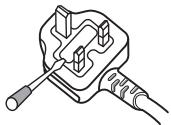
D3-4-2-1-2-2_B_En
Contents
01 Before you start
What's in the box 6
Putting the batteries in the remote control. 6
Using the remote control. 6
Disc/content format playback compatibility 7
About the internal hard disk drive . 12
Symbols used in this manual 13
02 Connections
Rear panel connections. 14
Front panel connections 15
Connecting a TV antenna 15
Easy connections 16
Using other types of audio/video output 17
Connecting to a cable box or satellite receiver 18
Connecting an external decoder box (1) 19
Connecting an external decoder box (2) 20
Connecting to an AV amplifier/receiver 20
Connecting using HDMI 21
Connecting other AV sources 23
Connecting a USB device 24
Plugging in 25
03 Controls and displays
Front panel 26
Common Interface 27
Display 28
Remote control 29
04 Getting started
Switching on and setting up 32
For users receiving digital broadcast services. 35
Setting up the GUIDE Plus+® system. 35
05 Using the GUIDE Plus+® electronic programme guide
The GUIDE Plus ^+ system 39
Using the GUIDE Plus+® system 39
Areas 41
GUIDE Plus+® FAQ and troubleshooting 50
06 Using the digital electronic programme guide
The Digital EPG system 53
Using the Digital EPG. 54
Setting timer programmes 54
Other useful EPG functions 59
07 Recording
About DVD recording 60
About HDD recording. 61
Recorded audio 61
Restrictions on video recording 62
Using the built-in A.TV and D.TV tuners 62
Setting the picture quality/ recording time 65
Basic recording from the TV. 66
Pause Live TV 67
About timer recordings 69
Simultaneous recording and playback (Chase Play) 71
Recording from an external component. 71
Playing your recordings on other DVD players 72
Initializing recordable DVD discs 73
DVD-RW Auto Initialize. 74
08Playback
Introduction 75
Basic playback 75
Using the Disc Navigator to browse the contents of a disc 79
Scanning discs. 80
Playing in slow motion 80
Frame advance/frame reverse 81
The Play Mode menu 81
Displaying and switching subtitles .83
Switching DVD and DivX soundtracks...83
Switching audio channels. 84
Switching camera angles 84
Displaying disc information
on-screen 85
09 Playing and recording from a DV/HDD camcorder
Playing from a DV camcorder 86
Recording from a DV camcorder. 86
About DV. 88
Copying from an HDD camcorder. 89
10 Editing
Editing options 90
The Disc Navigator screen. 91
11 Copying and backup
Introduction 100
One Touch Copy 100
Using Copy Lists 102
Using disc backup. 106
12 Playing and copying DivX files (PC VIDEO)
Playing DivX files. 108
Copying DivX files to the HDD. 109
Editing files on the HDD 110
13 Playing and copying music (Jukebox)
Copying music to the HDD 111
Playing music from the Jukebox 113
Copying albums/tracks 115
Editing the HDD Jukebox 116
14 Playing and copying photos (PhotoViewer)
Locating JPEG picture files 117
Playing a slideshow. 118
Creating photo movies 120
Importing files to the HDD 120
Copying files to a DVD-R/-RW 121
Copying selected files to
a DVD-R/-RW. 122
Editing files on the HDD 122
Printing files 124
15 Copying files from a PC (Connect PC)
Connecting the PC. 125
Copying WMA/MP3 files. 125
Copying JPEG and DivX files 127
16 The Disc Setup menu
Basic settings. 128
Initialize settings 129
Finalize settings 129
Optimize HDD 129
Initialize HDD. 130
17 The Video Adjust menu
Setting the picture quality for TV and external inputs. 131
Setting the picture quality for disc playback. 132
18 The Initial Setup menu
Using the Initial Setup menu 134
19 Additional information
Setting up the remote to control your TV. 149
Minimum copying times. 151
Manual recording modes 152
Troubleshooting 153
If the picture freezes and the front panel and remote control buttons stop working 160
On-screen displays. 160
Front panel displays. 163
Language code list. 164
Country/Area code list 164
Screen sizes and disc formats 165
Handling discs 166
Cleaning the pickup lens 166
Condensation 166
Hints on installation 167
Moving the recorder 167
Resetting the recorder 167
Specifications. 168
Chapter 1 Before you start
What's in the box
Please confirm that the following accessories are in the box when you open it;
Remote control
AA/R6P dry cell batteries × 2
Audio/video cable (red/white/yellow)
- G-LINK™ cable
RF antenna cable x 2
Power cable
These operating instructions
Warranty card
Putting the batteries in the remote control
- Insert two AA/R6P batteries into the battery compartment following the indications ( ,) inside the compartment.
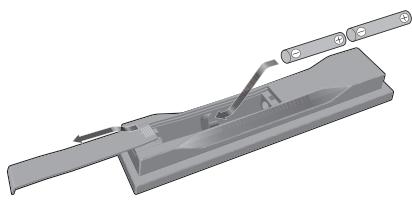

Important
Incorrect use of batteries can result in hazards such as leakage and bursting. Please observe the following:
- Don't mix new and old batteries together.
- Don't use different kinds of batteries together — although they may look similar, different batteries may have different voltages.
-
Make sure that the plus and minus ends of each battery match the indications in the battery compartment.
-
Remove batteries from equipment that isn't going to be used for a month or more.
- When disposing of used batteries, please comply with governmental regulations or environmental public instruction's rules that apply in your country or area.
WARNING
Do not use or store batteries in direct sunlight or other excessively hot place, such as inside a car or near a heater. This can cause batteries to leak, overheat, explode or catch fire. It can also reduce the life or performance of batteries. D3-4-2-3-3 En
Using the remote control
Please keep in mind the following when using the remote control:
- Make sure that there are no obstacles between the remote and the remote sensor on the unit.
- Remote operation may become unreliable if strong sunlight or fluorescent light is shining on the unit's remote sensor.
- Remote controllers for different devices can interfere with each other. Avoid using remotes for other equipment located close to this unit.
- Replace the batteries when you notice a fall off in the operating range of the remote.
- When the batteries run down or you change the batteries, the remote control mode is reset to Recorder 1. See Remote Control Mode on page 145.
- Use within the operating range in front of the remote control sensor on the front panel, as shown.
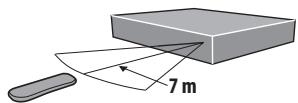
Before you start
- You can control this recorder using the remote sensor of another Pioneer component via the CONTROL IN jack on the rear panel. See Rear panel connections on page 14 for more information.
Disc/content format playback compatibility
Compatible media
DVD-RW ver. 1.1 / 1x / 1x to 2x, ver. 1.2 / 2x to 4x / 2x to 6x
DVD-R ver. 2.0/1x/1x to 4x/1x to 8x/1x to 16x,ver.2.1/1x to 8x/1x to 16x
DVD+RW 1x to 2.4x / 1x to 4x / 3.3x to 8x
DVD ^+ R 1x to 2.4x/1x to 4x/1x to 8x/ 1x to 16x
DVD-RAM ver. 2.0/2x,ver.2.1/2x/ 2x to 3x / 2x to 5x,ver.2.2/2x/2x to 3x/ 2x to 5x
DVD-R DL ver. 3.0 / 2x to 4x / 2x to 8x
DVD+R DL 2.4x/2.4x to 8x
Note that older models of DVD recorders and DVD writers may reject DVD-RW ver 1.2 discs and/or corrupt the data on the disc. If you want to share DVD-RW discs between this recorder and an older recorder/writer, we recommend using ver.1.1 discs.
The following table shows older Pioneer DVD recorders' limited compatibility with DVD-RW ver. 1.2 discs.
| Model | Playable | Recordable |
| DVR-7000 | Yes*1,2,3 | No |
| DVR-3100 | Yes*1 | No |
| DVR-5100H |
1 Discs should be finalized in this recorder before playing. Unfinalized VR mode and Video mode discs may not play.
2 Cannot read the CPRM information will show in the display when you load a disc. However, this will not affect playback.
*3 Copy-once protected disc titles will not play.
Readable file system
This recorder can play DVDs recorded under the following file systems1: ISO 9660*, UDF 1.02, UDF 1.50, UDF 2.00, UDF 2.01.
- ISO 9660 Level 1 or 2 compliant. Romeo and Joliet file systems are both compatible with this recorder.

Note
1- Depending on the recording technique used, even files recorded in compatible file systems may not play correctly.
- MP3/WMA/DivX files can be played back when recorded onto a DVD that contains no video titles and uses the UDF 1.02, UDF 1.50, UDF 2.01 or ISO 9660 file systems.
HDD/DVD Recording and playback compatibility
This recorder can play and record all widely-used DVD disc types, and additionally provides HDD functionality. The table below shows some specific compatibility differences between the different disc types.
| HDD | DVD-R | DVD-RW | DVD+R | DVD+RW | DVD-RAM | |||
| Marks used in this manual | HDD | DVD (VR) | DVD (Video) | DVD (VR) | DVD (Video) | DVD+R | DVD+RW | DVD-RAM |
| *1 | *1 | *2 | *13, 16 | |||||
| Logos | HDD | DVD | DVD | DVD | DVD | RW | RW | DVD |
| HARD DESK DMVE | R | RW | RW | DVD+R | DVD+RWtable | RAM | ||
| RW2 | DVD+RWtable | |||||||
| Re-recordable/ Erasable | ● | *3 | *3 | ● | ● | *3 | *14 | ● |
| Editing of recorded programmes | ● | ● | *4 | ● | *4 | *4 | *4 | ● |
| Recording of Copy-once protected material | ● | *12 | *12 | *12 | ||||
| Playback in other players/recorders | n/a | *5 | *6 | *7 | *6 | *6, 15 | *8 | *9 |
| Chase play | ● | |||||||
| 16:9 and 4:3 programme recording | ● | ● | ● | ● | ||||
| Bilingual broadcast recording of both audio channels | *10, 11 | *11 | *11 | *11 | ||||
Notes to table
1 Must be initialized for VR mode recording (page 129).
2 Must be initialized for Video mode recording (page 129).
3 Erasable, but free space does not increase.
4 Cannot erase sections, edit chapters or use playlist editing.
5 Must be compatible with DVD-R (VR) playback.
6 Finalize using this recorder (may not playback in some units) (page 72).
7 Must be compatible with DVD-RW (VR) playback.
8 Must be compatible with DVD+RW playback.
9 Must be compatible with DVD-RAM playback.
10 Only when HDD Recording Format is set to Video Mode Off (page 142).
11 Only when the recording mode is not set to LPCM.
12 CPRM-compatible discs only.
13 Take the disc out of the cartridge before use. Only Panasonic and Maxell discs have been tested to work reliably with this recorder. Discs from other makers may become unusable when recorded or edited.
14 Erasing a title does not increase the available recording time, nor increase the number of recordable titles left.
15 Must be compatible with DVD+R playback.
16 Depending on the disc, it may have to be initialized before it can be recorded (page 129). In this case, initialization may take over one hour.
DVD is a trademark of DVD Format/Logo Licensing Corporation.
Using DVD-R DL/DVD+R DL discs
DVD-R DL (Dual-Layer) and DVD+R DL (Double-Layer) discs contain two recordable layers on a single side, giving about 1.8 times the recording capacity of a conventional single-layer disc. This unit can record to both DVD-R DL and DVD+R DL discs.
- If you intend to play DVD-R DL (Video mode) or DVD+R DL discs recorded on this unit on other DVD recorders/players, you must finalize them. (Note that some DVD recorders/players may not play even finalized DL discs.)
- This logo indicates that the disc is a DVD-R DL or DVD+R DL disc:

R DL 4X/2X

Correct operation has been confirmed for DL discs:
DVD-R DL ver. 3.0/2x to 4x Mitsubishi Kagaku Media (Verbatim)
DVD-R DL ver. 3.0/2x to 8x Mitsubishi Kagaku Media (Verbatim) That's JVC
DVD+R DL 2.4x Mitsubishi Kagaku Media (Verbatim) RICOH
DVD+R DL 2.4x to 8x Mitsubishi Kagaku Media (Verbatim) RICOH
About DualDisc playback
A DualDisc is a new two-sided disc, one side of which contains DVD content - video, audio, etc. - while the other side contains non-DVD content such as digital audio material.
The non-DVD, audio side of the disc is not compliant with the CD audio specification and therefore may not play.
It is possible that when loading or ejecting a DualDisc, the opposite side to that being played will be scratched. Scratched discs may not be playable.
The DVD side of a DualDisc plays in this product. DVD-Audio content will not play.
For more detailed information on the DualDisc specification, please refer to the disc manufacturer or disc retailer.
Other disc compatibility
In addition to DVD, this recorder is compatible with a wide range of disc types (media) and formats. Playable discs will generally feature one of the logos on the disc and/or disc packaging shown below. Note however that some disc types, such as recordable CD (and DVD), may be in an unplayable format — see below for further compatibility information.

Audio CD

CD-R

CD-RW

Video CD

Super Video CD (Super VCD)

CD-R/-RW compatibility
This recorder cannot record CD-R or CD-RW discs.
- Readable formats: CD audio, Video CD/ Super VCD, ISO 9660 CD-ROM* containing MP3, WMA, JPEG or DivX files
- ISO 9660 Level 1 or 2 compliant. CD physical format: Mode1, Mode2 XA Form1. Romeo and Joliet file systems are both compatible with this recorder.
- Multi-session playback: Yes (except CD audio and Video CD/Super VCD)
- Unfinalized disc playback: CD audio only
Compressed audio compatibility
- Compatible media: DVD-ROM, DVD-R/-RW, DVD+R/+RW, DVD-RAM, CD-ROM, CD-R, CD-RW, USB
-
Compatible formats: MPEG-1 Audio Layer 3 (MP3), Windows Media Audio (WMA)
-
Sampling rates (MP3/WMA): 32 kHz, 44.1 kHz or 48 kHz
- Bit-rates: Any (128 kbps or higher recommended)
Variable bit-rate (VBR) WMA/MP3 playback: Yes - WMA encoder compatibility: Windows Media Codec 8 (files encoded using Windows Media Codec 9 may be playable but some parts of the specification are not supported; specifically, Pro, Lossless, Voice and VBR)
- DRM (Digital Rights Management)2 file playback: No
- File extensions: .mp3, .wma (these must be used for the recorder to recognize MP3 and WMA files - do not use for other file types)
- File structure: The recorder can load up to 99 folders/999 files at one time (if there are more files/folders that this on the disc then more can be reloaded)
WMA (Windows Media™ Audio) content
This recorder can playback Windows Media Audio content.
WMA is an acronym for Windows Media Audio and refers to an audio compression technology developed by Microsoft Corporation.
Windows Media is a trademark of Microsoft Corporation.
This product includes technology owned by Microsoft Corporation and cannot be used or distributed without a license from Microsoft Licensing, Inc.
DivX video compatibility

DivX is a compressed digital video format created by the DivX® video codec from DivX, Inc. Keeping the same terminology as DVD-Video, individual DivX video files are called "Titles". When naming files/titles on a disc prior to burning, keep in mind that by default they will be played in alphabetical order.
- Official DivX® Certified product.
- Plays all versions of DivX® video (including DivX® 6) with standard playback of DivX® media files.
- File extensions: .avi and .divx (these must be used for the recorder to recognize DivX video files). Note that all files with the .avi extension are recognized as MPEG4, but not all of these are necessarily DivX video files and therefore may not be playable on this recorder.
- File structure: Up to 99 folders or 999 files.
DivX, DivX Certified, and associated logos are trademarks of DivX, Inc. and are used under license.
DivX® VOD content
DivX
In order to play DivX VOD (video on demand) content on this recorder, you first need to register the recorder with your DivX VOD content provider. You do this by generating a DivX VOD registration code, which you submit to your provider.
Note
1 The elapsed playing time may not be displayed properly.
2 DRM (digital rights management) copy protection is a technology designed to prevent unauthorized copying by restricting playback, etc. of compressed audio files on devices other than the PC (or other recording equipment) used to record it. For detailed information, please see the instruction manuals or help files that came with your PC and/or software.
Some DivX VOD content may only be playable a fixed number of times. When you load a disc containing this type of DivX VOD content, the remaining number of plays is shown on-screen and you then have the option of playing the disc (thereby using up one of the remaining plays), or stopping. If you load a disc that contains expired DivX VOD content (for example, content that has zero remaining plays), the message Rental Expired is displayed.
If your DivX VOD content allows an unlimited number of plays, then you may load the disc into your recorder and play the content as often as you like, and no message will be displayed.

Important
- DivX VOD content is protected by a DRM system. This restricts playback of content to specific, registered devices.
- If you load a disc that contains DivX VOD content not authorized for this recorder, the message Authorization Error is displayed and the content will not play.
- Resetting the recorder (as described in Resetting the recorder on page 167) will not cause you to lose your registration code.
JPEG file compatibility
- Compatible formats: Baseline JPEG and EXIF 2.2 still image files File format used by digital still cameras
- Sampling ratio: 4:4:4, 4:2:2, 4:2:0
Horizontal resolution: 160 to 5120 pixels
Vertical resolution: 120 to 3840 pixels - Progressive JPEG compatible: No
- File extensions: .jpg, .jpeg, .jpe, .jf, .jfif (must be used for the recorder to recognize JPEG files – do not use for other file types)
- File structure: The recorder can load up to 99 folders/999 files at one time (if there are more files/folders that this on the disc then more can be reloaded)
PC-created disc compatibility
Discs recorded using a personal computer may not be playable in this unit due to the setting of the application software used to create the disc. In these particular instances, check with the software publisher for more detailed information.
Discs recorded in packet write mode (UDF format) are not compatible with this recorder.
Check the DVD-R/-RW or CD-R/-RW software disc boxes for additional compatibility information.
Dolby Digital

Manufactured under license from Dolby Laboratories. "Dolby" and the double-D symbol are trademarks of Dolby Laboratories.
DTS

Manufactured under license under U.S. Patent #: 5,451,942 & other U.S. and worldwide patents issued & pending. DTS and DTS Digital Out are registered trademarks and the DTS logos and Symbol are trademarks of DTS, Inc. © 1996-2007 DTS, Inc. All Rights Reserved.
DVB
The Digital Video Broadcasting Project, or DVB for short, is a set of open standards for digital broadcasting, covering terrestrial, cable and satellite broadcasts.
Based around the MPEG-2 coding system, these open standards ensure that compliant systems are able to work together, independent of manufacturer.
DVB is extremely flexible, being able to deliver virtually any kind of digital content to the home, including High Definition and Standard Definition TV, broadband multimedia content and interactive services.
DVB
DVB is a registered trademark of the DVB Project.
About the internal hard disk drive
The internal hard disk drive (HDD) is a fragile piece of equipment. When used without the proper care or in the wrong conditions, it is possible that recorded contents may be damaged or lost entirely, in some cases making even normal playback or recording impossible. Please understand that in the event of repair or replacement of the HDD or related components, all your HDD recordings will be lost.
Please use the recorder following the guidelines below to protect against possible HDD failure.
The HDD should not be regarded as a place to store recordings permanently. We recommend that you back up your important recordings onto DVD discs in order to protect against accidental loss.
Pioneer cannot under any circumstances accept responsibility for any direct or indirect loss arising from any inconvenience or loss of recorded material resulting from HDD failure.
- Do not move the recorder while it is on (this includes during EPG download when the front panel display shows EPG).
- Install and use the recorder on a stable, level surface.
-
Do not block the rear vent/cooling fan.
-
Do not use the recorder in excessively hot or humid places, or in places that may be subject to sudden changes in temperature. Sudden changes in temperature can cause condensation to form inside the recorder. This can be a cause of HDD failure.
- While the recorder is switched on (including during EPG download when the front panel display shows EPG), do not unplug from the wall socket or switch the electricity off from the breaker switch.
- Do not move the recorder immediately after switching it off. If you need to move the recorder, please follow the steps below:
1 After the message POWER OFF is shown on the front panel display, wait at least two minutes.
2 Unplug from the wall socket.
3 Move the recorder.
- If there's a power failure while the recorder is on there is a chance that some data on the HDD will be lost.
- The HDD is very delicate. If used over time in an improper manner or in an unsuitable environment, it is possible that the HDD will fail. Signs of problems include playback unexpectedly freezing and noticeable block noise (mosaic) in the picture. However, sometimes there will be no warning signs of HDD failure. If the HDD fails, no playback of recorded material will be possible. In this case it will be necessary to replace the HDD unit.
Optimizing HDD performance
As you record and edit material on the HDD, the data on the disk becomes fragmented, eventually affecting the recorder's performance. Before this happens, the recorder will warn you that it is time to optimize the HDD (which you can do from the Disc Setup menu; see Optimize HDD on page 129).
Symbols used in this manual
The following icons are provided to help you quickly identify which instructions you need for which kind of disc.
HDD HDD
DVD Any type of DVD disc (recordable or playback only), finalized or not.
DVD-Video Commercially produced DVD, finalized Video mode DVD-R/-RW.
DVD(Video) Video mode DVD-R/-RW (unfinalized)
DVD(VR) VRmodeDVD-R/-RW
DVD+R DVD+R
DVD+RW DVD+RW
DVD-RAM DVD-RAM
CD Audio CD
Video CD Video CD
Super VCD Super VCD
WMA/MP3 WMA or MP3 files
DivX DivX files
ALL All of the above
Chapter 2
Connections
Rear panel connections
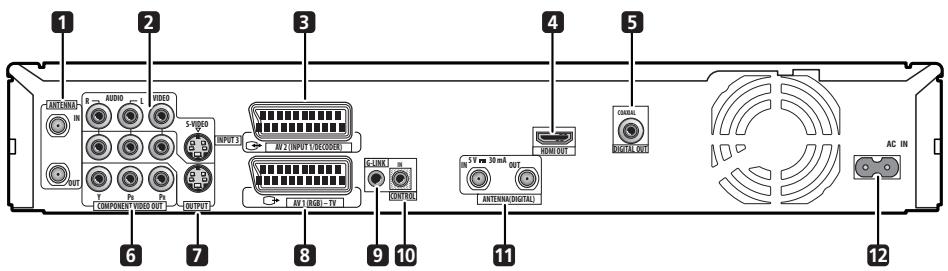
1 ANTENNA IN (RF IN)/OUT
Connect your TV antenna to the ANTENNA IN (RF IN) jack. The signal is passed through to the ANTENNA OUT jack for connection to your TV.
2 INPUT 3
Stereo analog audio, video and S-Video inputs for connection to a VCR or other source component.
3 AV2 (INPUT 1/DECODER) AV connector
Audio/video input/output SCART-type AV connector for connecting to a VCR, or other equipment with a SCART connector. The input accepts video, S-Video and RGB. See AV2/L1 /n on page 138 for how to set this up.
4 HDMI OUT
HDMI output for high quality digital audio and video.
5 DIGITAL AUDIO OUT (COAXIAL)
Coaxial digital audio jack for connecting to an AV amplifier/receiver, Dolby Digital/DTS/MPEG decoder or other equipment with a digital input.
6 COMPONENTVIDEO OUT
A high-quality video output for connecting to a TV or monitor with a component video input.
7 OUTPUT
Stereo analog audio, video and S-Video outputs for connection to a TV or AV amplifier/receiver.
8 AV1 (RGB)-TV AV connector
Audio/video output SCART-type AV connector for connecting to a TV or other equipment with a SCART connector. The video output is switchable between video, S-Video and RGB. See AV1 Out on page 138 for how to set this up.
9 G-LINKTM
Use to connect the supplied G-LINK™ cable to enable GUIDE Plus+® to control an external satellite receiver, etc.
10 CONTROL IN
Use to control this recorder from the remote sensor of another Pioneer component with a CONTROL OUT terminal and bearing the Pioneer mark. Connect the CONTROL OUT of the other component to the CONTROL IN of this recorder using a miniplug cord.
11 ANTENNA (DIGITAL) IN/OUT
Connect your DTV antenna to the ANTENNA DIGITAL) IN jack. The signal is passed through to the ANTENNA DIGITAL) OUT jack for connection to your TV.
12 AC IN - Power inlet
Connect to a power outlet using the supplied power cable after making all other connections.
Front panel connections
On the front panel there is a flip-down cover that hides more connections.
Left side:
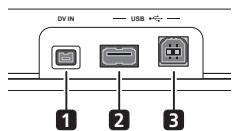
1 DV IN
A DV input i.LINK connector, suitable for connecting a DV camcorder.
2 USB port (Type A)
USB port for connecting an HDD camcorder, digital camera, keyboard or other USB device.
3 USB port (Type B)
USB port for connecting a PictBridge-compatible printer or PC.
Right side:
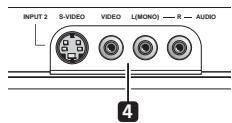
4 INPUT 2
Audio/video input (stereo analog audio; composite and S-Video), especially suitable for camcorders, game consoles, portable audio, etc.
Connecting a TV antenna
This recorder has separate built-in TV tuners for terrestrial digital and terrestrial analog TV broadcasts.
If you are ready to receive digital broadcasts now, use one of the supplied RF antenna cables connect an antenna (either an antenna wall outlet or indoor antenna) to the ANTENNA DIGITAL IN connector. Next,
connect the other supplied RF antenna cable to connect an antenna to the ANTENNA IN (RF IN) connector. Lastly, connect the recorder to your TV from the ANTENNA OUT connector.
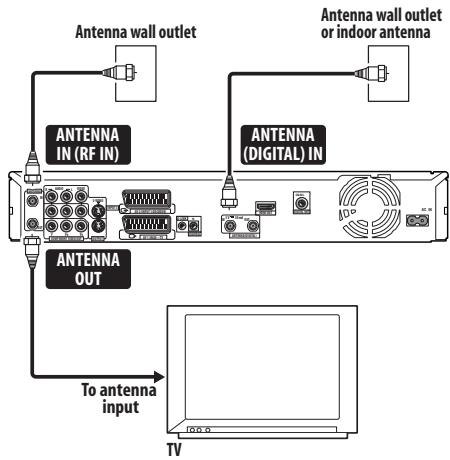

Important
- If there is only one antenna outlet on your wall, use a divider.
- Do not connect a component that can receive analog signals to the ANTENNA (DIGITAL) OUT.
If your area is not yet served with terrestrial digital services, connect your antenna's output to the ANTENNA IN (RF IN) connector using one of the supplied RF antenna cables. Next, connect the recorder to your TV from the ANTENNA OUT connector.
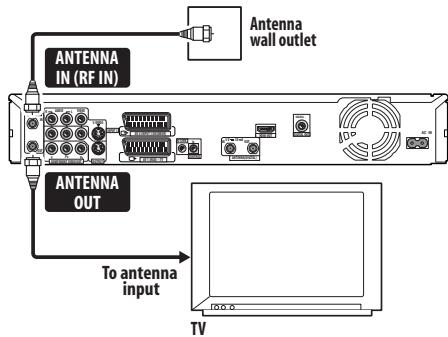
We strongly recommend using an outdoor antenna for better broadcast picture quality. If, however, you want to use an indoor antenna, use one with a signal amplifier rated at 5V , 30mA and set Aerial Power to On in the Initial Setup menu (see page 136).
Easy connections
The setup described below is a basic setup that allows you to watch and record TV programmes, and play discs. Other types of connections are explained starting on the following page.

Important
- These connections use SCART cables (not supplied). If your TV (or VCR) does not have a SCART connection, and you want to use the supplied audio/video cable, see Using the supplied audio/video cable below.
- The AV1 (RGB)-TV AV connector can output ordinary (composite), S-Video or RGB video, plus stereo analog audio. The AV2 (INPUT 1/DECODER) connector accepts ordinary, S-Video and RGB video input, as well as stereo analog audio. See AV1 Out and AV2/L1 In on page 138 for how to setup these options.
- Before making or changing any rear panel connections, make sure that all components are switched off and unplugged from the wall outlet.
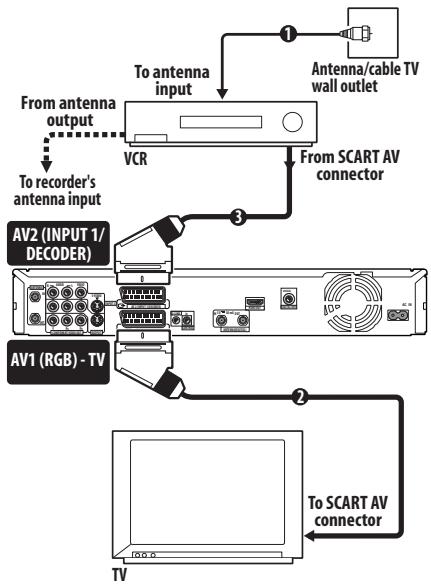
1 Connect your TV antenna to the recorder and TV.
See Connecting a TV antenna on page 15 for details.
- If you want to incorporate a VCR in your setup, connect it before the recorder (i.e., between the antenna wall outlet and the antenna input on the recorder).
2 Use a SCART cable (not supplied) to connect the AV1 (RGB)-TV AV connector on this recorder to the SCART AV connector on your TV.
3 Use another SCART cable to connect the AV2 (INPUT 1/DECODER) AV connector to a SCART AV connector on your VCR.

Tip
- This recorder has a 'through' function which allows you to record a TV programme from the built-in TV tuner in this recorder while watching a video playing on your VCR (To use this feature when the recorder is in standby, Power Save must be set to Off — see Power Save on page 134).
Using other types of audio/video output
If you can't use the SCART AV connector to connect your TV to this recorder, there are standard audio/video output jacks, as well as an S-Video and component video output.
Using the supplied audio/video cable
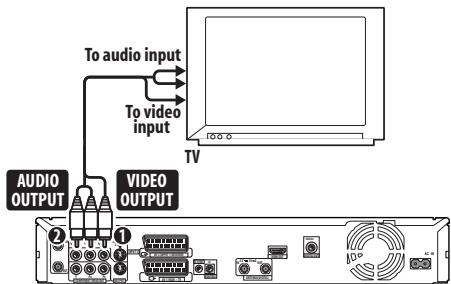
1 Connect the VIDEO OUTPUT jack to a video input on your TV.
Use the yellow jack of the supplied audio/video cable for the video connection.
2 Connect the AUDIO OUTPUT jacks to the corresponding audio inputs on your TV.
Use the red and white jacks of the supplied audio/video cable for the audio connection. Make sure you match up the left and right outputs with their corresponding inputs for correct stereo sound.
Using the S-Video or component video output
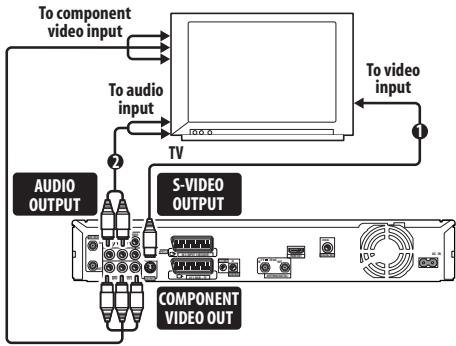
1 Connect the S-Video or component video output to a similar input on your TV.
For an S-Video connection, use an S-Video cable (not supplied) to connect the S-VIDEO OUTPUT jack to an S-Video input on your TV.
For a component video connection, use a component video cable (not supplied) to connect the COMPONENTVIDEO OUT jacks to a component video input on your TV. See also Component Video Out on page 137 for how to set up the component video output for use with a progressive scan-compatible TV.
2 Connect the AUDIO OUTPUT jacks to the corresponding audio inputs on your TV.
You can use the supplied audio/video cable, leaving the yellow video plug disconnected. Make sure you match up the left and right outputs with their corresponding inputs for correct stereo sound.
Connecting to a cable box or satellite receiver
If you have a cable box or satellite receiver with a built-in decoder, connect it to this recorder and your TV as shown on this page. If you are using a separate decoder box for your cable/satellite TV, set up following the instructions on the next page.
Using the setup on this page you can:
- Record any channel by selecting it on the cable box, satellite receiver or digital terrestrial receiver.
- Change channels and set timer recordings on the external receiver using the GUIDE Plus+® system (via the G-LINK™ cable, and after setting up).

Important
- Do not connect this recorder to your TV 'through' your VCR, satellite receiver or other component. Always connect each component directly to your TV or AV amplifier/receiver.
- When using the GUIDE Plus+ system to make a timer recording from an external receiver, make sure that the external receiver is switched on.
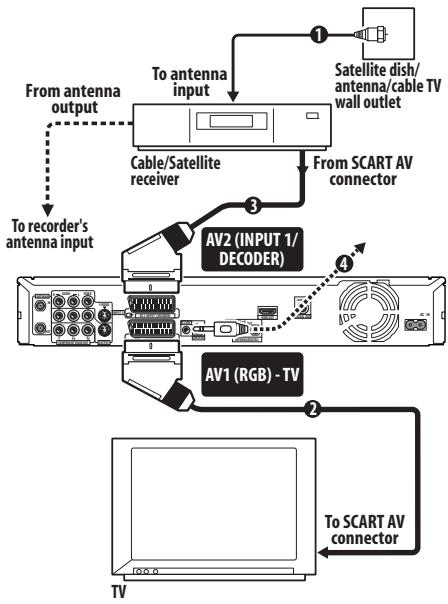
1 Connect RF antenna cables as shown. See Connecting a TV antenna on page 15 for more on RF antenna connections, including from this recorder to your TV.
2 Use a SCART cable (not supplied) to connect the AV1 (RGB)-TV AV connector to a SCART AV connector on your TV. This enables you to watch discs.
3 Use another SCART cable to connect the AV2 (INPUT 1/DECODER) AV connector to a SCART AV connector on your cable box/satellite receiver.
This enables you to record scrambled TV channels.
4 Plug the supplied G-LINK™ cable to the G-LINK™ jack.
This enables you to control the tuner in the external receiver using the GUIDE Plus+® system.
Position the IR transmitter end of the G-LINK™ cable so that the IR receiver on your cable/satellite receiver will pick up the control signals (see diagram).
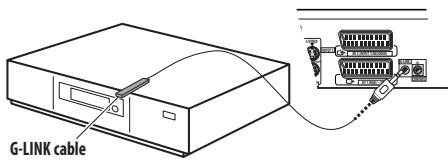
See the manual that came with your cable/ satellite receiver if you're not sure where the IR receiver is on the front panel.
Alternatively, experiment with the remote control, operating it from very close range until you find the place where the receiver responds.

Tip
- This recorder has a 'through' function which allows you to record a TV programme from the built-in TV tuner in this recorder while watching a video playing on your VCR (To use this feature when the recorder is in standby, Power Save must be set to Off — see Power Save on page 134).
Connecting an external decoder box (1)
If you have an external, dedicated decoder box for your satellite or cable TV system, use the setup described on this page. See above for how to connect the G-LINK™ cable.

Important
- Do not connect your decoder box directly to this recorder.
- Information from the decoder (for example, relating to pay TV services), is only viewable when this recorder is off (in standby).
-
For timer recording to work properly on this recorder, the VCR/satellite receiver/cable box must also be switched on during recording.
-
It is not possible to watch one TV programme and record another using this setup.
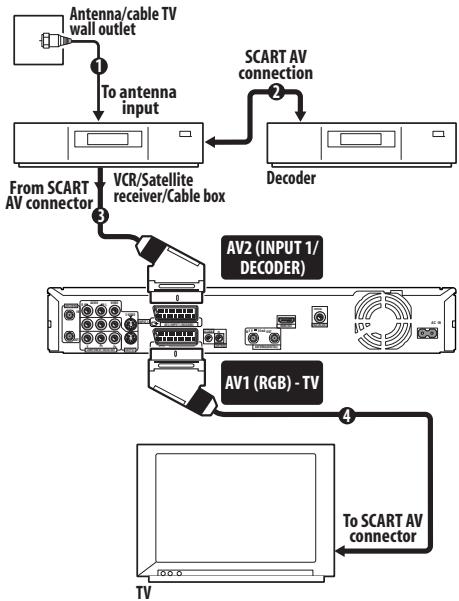
1 Connect the cable from the antenna/cable TV outlet to the antenna input on your VCR/satellite receiver/cable box.
2 Use a SCART cable (not supplied) to connect your decoder to your VCR/ satellite receiver/cable box.
See the manual for your decoder box for more detailed instructions.
3 Use a SCART cable to connect your VCR/satellite receiver/cable box to the AV2 (INPUT 1/DECODER) AV connector on this recorder.
4 Use a SCART cable to connect the AV1 (RGB)-TV AV connector to your TV.
Connecting an external decoder box (2)
If you only have a decoder, connect it to this recorder and your TV as shown on this page.
Using the setup on this page you can:
- Record scrambled channels received using the recorder's built-in analog TV tuner.

Important
- Do not connect this recorder 'through' your VCR, satellite receiver or cable box. Always connect each component directly to your TV or AV amplifier/ receiver.
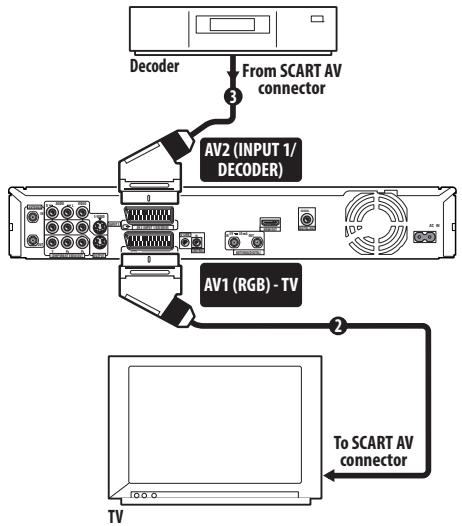
1 Connect your TV antenna to the recorder and TV.
See Connecting a TV antenna on page 15 for details.
2 Use a SCART cable (not supplied) to connect the AV1 (RGB)-TV AV connector to a SCART AV connector on your TV.
This enables you to watch discs.
3 Use another SCART cable to connect the AV2 (INPUT 1/DECODER) AV connector to a SCART AV connector on your decoder box.
This enables you to record scrambled TV channels.
Connecting to an AV amplifier/receiver
To enjoy multichannel surround sound you need to connect this recorder to an AV amplifier/receiver using the digital coaxial output.
In addition to a digital connection, we recommend also connecting using the stereo analog connection for compatibility with all discs and sources.
You'll probably also want to connect a video output to your AV amplifier/receiver. Use the ordinary video output (as shown here), or the S-Video output.

Important
- Noise may be output from your speakers if the recorder is not set up to work with your AV amplifier/receiver properly (see Audio Out on page 139).
- When watching D.TV only linear PCM audio is output from the coaxial digital out jack.
- Do not connect this recorder to your TV 'through' your VCR using A/V cables. Always connect it directly to your TV.

Note
1 In order to use this setup, you will need to make the following settings from the Initial Setup menu:
- Set the AV2/L1 In setting to Decoder from the Initial Setup menu (see AV2/L1 /n on page 138).
- From the Manual CH Setting screen, set the Decoder setting for the scrambled channels to On (see Manual
CH Setting on page 137).

1 Connect your TV antenna to the recorder and TV.
See Connecting a TV antenna on page 15 for details.
This enables you to watch and record TV channels.
2 Connect the DIGITAL AUDIO OUT (COAXIAL) jack on this recorder to a coaxial digital input on your AV amplifier/receiver.
This enables you to listen to multichannel surround sound.
3 Connect the analog AUDIO OUTPUT andVIDEO OUTPUT jacks on this recorder to an analog audio and video input on your AV amplifier/receiver.
4 Connect the AV amplifier/receiver's video output to a video input on your TV.
Connecting using HDMI
If you have an HDMI or DVI-equipped monitor or display, you can connect it to this recorder using an HDMI cable (not supplied).
The HDMI connector outputs uncompressed digital video, as well as almost every kind of digital audio.
1 Use an HDMI cable to connect the HDMI OUT connector on this recorder to an HDMI connector on an HDMI-compatible display.
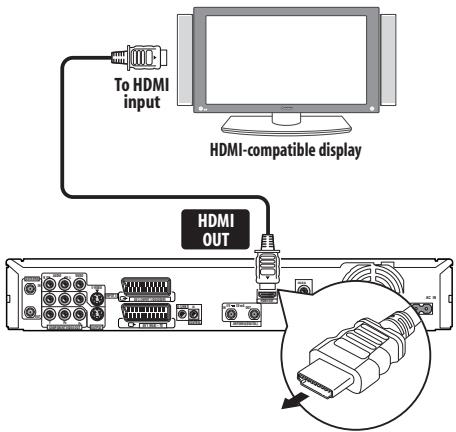
- The arrow on the cable connector body should be face down for correct alignment with the connector on the recorder.
When connected to an HDMI component or HDCP-compatible DVI component, the HDMI indicator lights.
HDMI setup is generally automatic. There are however settings you can change if you need to. See HDMI Output (only available when an HDMI device is connected) on page 144 for more information. Note that the HDMI settings remain in effect until you

Note
1 Depending on the component you have connected, using a DVI connection may result in unreliable signal transfers.
2 The pixel resolution of this recorder's HDMI video output is (according to TV format): NTSC (720 x 480i/p, 1280 x 720p, 1920 x 1080i/p) and PAL (720 x 576i/p, 1280 x 720p, 1920 x 1080i/p). If your display is not compatible with these resolutions the picture may not be correctly reproduced.
3 The 1080p video may not be displayed correctly if the High Speed HDMI cable is not used.
change them, or connect a new HDMI component.

Important
- An HDMI connection can only be made with DVI-equipped components compatible with both DVI and High-bandwidth Digital Content Protection (HDCP). If you choose to connect to a DVI connector, you will need a DVI to HDMI adaptor cable. A DVI to HDMI connection, however, does not support audio. Consult your local audio dealer for more information.
- The HDMI connection is compatible with 32kHz , 44.1kHz , 48kHz , 96kHz , 16 bit/20 bit/24 bit 2-channel linear PCM signals, as well as Dolby Digital, DTS and MPEG audio bitstream.
- If your connected component is only compatible with Linear PCM, the signal is output as Linear PCM (DTS audio is not output).
- If you have connected to a Pioneer Flat Screen TV, please select the HDMI setup on the display (refer to the supplied manual for more on this).
About HDMI
HDMI (High-Definition Multimedia Interface) supports both video and audio on a single digital connection for use with DVD players and recorders, DTV, set-top boxes, and other AV devices. HDMI was developed to provide the technologies of High-bandwidth Digital Content Protection (HDCP) as well as Digital Visual Interface (DVI) in one specification. HDCP is used to protect digital content transmitted and received by DVI-compliant displays.
HDMI has the capability to support standard, enhanced, or high-definition video plus standard to multi-channel surround-sound audio. HDMI features include uncompressed digital video, a bandwidth of up to five gigabits per second (Dual Link), one connector (instead of several cables and connectors), and communication between the AV source and AV devices such as DTVs.
HDMI, the HDMI logo and High-Definition Multimedia Interface are trademarks or registered trademarks of HDMI Licensing LLC.
HDMI Control
By connecting this unit to an HDMI Control-compatible Pioneer Flat Screen TV, AV system (amplifier or AV receiver etc.) or HD AV converter with an HDMI cable, you can control this unit from the remote control of a connected Flat Screen TV, as well as have the connected Flat Screen TV automatically change inputs in response to this unit starting playback.
Refer to the operating instructions for your Flat Screen TV, AV system or HD AV converter for more information about which operations can be carried out by connecting via HDMI cable.
Auto-select function
You can have a connected Flat Screen TV, AV system or HD AV converter automatically change inputs when playback begins on this unit (including when you have a GUI (such as Disc Navigator) set to display on this unit). Certain connected Flat Screen TVs may have their power turned from off to on when using this function.
Simultaneous power function
You can have this unit turn on automatically when the power for a connected Flat Screen TV is turned on. To have this unit's power turned off when a connected Flat Screen TV is turned off, you must change the simultaneous power function of your Flat Screen TV.
Unified language function
By receiving language information from a connected Flat Screen TV, you can have this unit's language settings automatically change to those of the Flat Screen TV (language information can be received only when no media is being played back and no recordings are taking place, or when you choose not to display this unit's GUI displays).

Important
- The KURO LINK function name used on the web and in catalogues is referred to as HDMI Control in the operating instructions and on the product.
- Depending on the type of Flat Screen TV, some HDMI input terminals do not support the HDMI Control function. For details, see the operating instructions supplied with your Flat Screen TV.
- To use the following functions, set this unit's HDMI Control to Off (page 145).
- The timer recording to use VPS/PDC (page 69).
- When you want this unit to automatically switch off upon completion of timer recording. (When HDMI Control is set to On, this unit does not automatically switch off if your Flat Screen TV is switched on upon completion of timer recording.)
- When using the Video Control function of an external component.
- Child lock settings (page 70).
- When you connect a SCART cable and an HDMI cable to the same Flat Screen TV simultaneously.
- HDMI Control may not operate properly if you do not use a High Speed HDMI cable.
- Controls may not function properly in certain situations, such as immediately after you have connect an HDMI cable, turn this unit's power off or remove the power cable for this unit or the connected component. If you experience any problems, set HDMI Control to On for all connected units, and then display the pictures stored on this unit on your Flat Screen TV to improve the situations.
- We cannot guarantee this unit will work with HDMI control-compatible components other than those made by Pioneer.
Connecting other AV sources
Connecting a VCR or analog camcorder
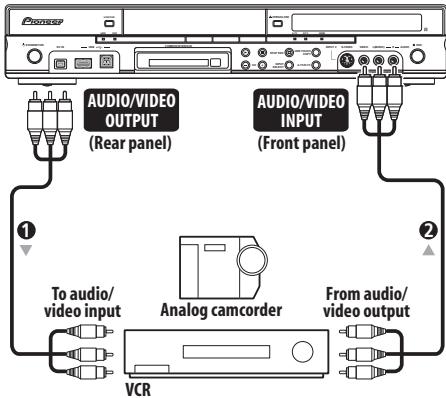
1 Connect a set of audio and video inputs of your VCR or camcorder to a set of outputs on this recorder.
This enables you to record from this recorder to your VCR or camcorder.
- You can use standard video or S-Video cables for the video connection.
- Alternatively, you can use the AV2 (INPUT 1/DECODER) SCART connector for audio/video input and output with just one SCART cable.
2 Connect a set of audio and video outputs of your VCR or camcorder to a set of inputs on this recorder.
This enables you to record tapes from your VCR or camcorder.
- You can use standard video or S-Video cables for the video connection.
- The front panel connections make convenient connections for a camcorder input.
- When connecting an external AV source that only supports monaural sound, only insert the left (white) audio jack to this device. Doing so will allow the same sound track to be recorded to both channels. You must connect to the INPUT 2 jack on the front panel.
Connecting a DV camcorder
You can connect a DV camcorder or DVD recorder with DV output to the front panel DV IN jack.

Important
- This jack is for connection to DV equipment only. It is not compatible with digital satellite receivers or D-VHS video decks.
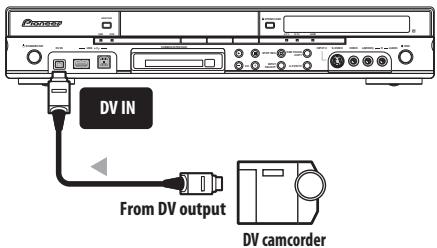
- Use a DV cable (not supplied) to connect the DV jack of your DV camcorder to the front panel DV IN jack of this recorder.
Connecting a USB device
Using the USB ports on the front of the recorder you can connect USB devices such as HDD camcorders, digital cameras, printers, keyboards and PCs. Please also see the instructions that came with the device you want to connect before using.
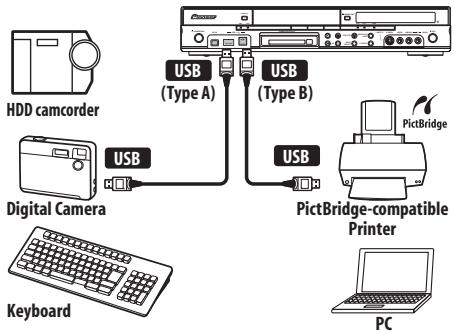

Important
- The Mass Storage Class (MSC) device should be FAT-compatible. Note that if the device is partitioned, this recorder may not recognize it.
- Some USB devices may not work with this recorder.
- When connecting a PC to this unit, make sure the power is turned off on both the PC and this unit when you connect them via USB.
- We recommend connecting USB devices when this recorder is switched off (in standby).
- We recommend USB cables 2 meters in length or shorter.
Connecting an HDD camcorder
On the recorder's HDD, video files can only be copied with the signal format shown below.
Video recording format: MPEG-2 (PS)
- Image resolution: 720 × 480 (576), 704 × 480 (576), 352 × 480 (576), 352 × 240 (288)
Audio recording format: Dolby Digital
- Use a USB cable (supplied with an HDD camcorder) to connect the USB port of your HDD camcorder to the front panel USB port of this recorder.
HDD camcorder with which operation is guaranteed (According to our survey)
- SONY
DCR-SR300, DCR-SR62, DCR-SR300E, DCR-SR52E
JPEG file storage devices
Digital still camera
- Memory card reader (any type of memory card)
- USB memory
- PC (Use Connect PC function)
The Picture Transfer Protocol (PTP) can be used to transfer up to a maximum of 4000 files.
WMA/MP3 file storage devices
- Memory card reader (any type of memory card)
- USB memory
- PC (Use Connect PC function)
Note that although multi-slot card readers can be used, the recorder will only recognize the first card inserted. To read another card, remove all the cards and insert the card to be read again.
Using a USB hub
- Use a hub compatible with USB 1.1 and/or 2.0.
- Use an independently powered hub (bus-powered hubs may not work reliably).
- In the event of unreliable operation with the hub, we recommend plugging the device directly into the recorder's USB port.
- Operation may become unreliable if too many devices are connected to the hub. In this case, try unplugging some devices.
- If the power delivered through a hub is insufficient for the devices connected, communication can become unreliable. In this case, disconnect one or more devices then perform a USB restart. (See Restart USB Device on page 146.)
Using a USB printer
- Use a PictBridge-compatible printer.
Using a USB keyboard
- Do not use a PS/2 keyboard connected using a PS/2-USB adapter.
Using a PC
- Note that you can connect a PC to this device via USB to copy WMA/MP3, JPEG and DivX files. For more information, see Copying files from a PC (Connect PC) on page 125. To use Connect PC with this device, your PC must run either the Windows XP Home Edition (SP2), Windows XP Professional (SP2) or Windows Vista Home Premium operating system and be able to run Windows Media Player 11. Even if your PC can run Windows Media Player 11, we cannot guarantee that it will function properly with this device. For more details see the 'Help' section of Windows Media Player 11.
Plugging in
After checking all the connections, plug in the recorder.
- Use the supplied power cable to connect this recorder to a power outlet.
Chapter 3 Controls and displays
Front panel
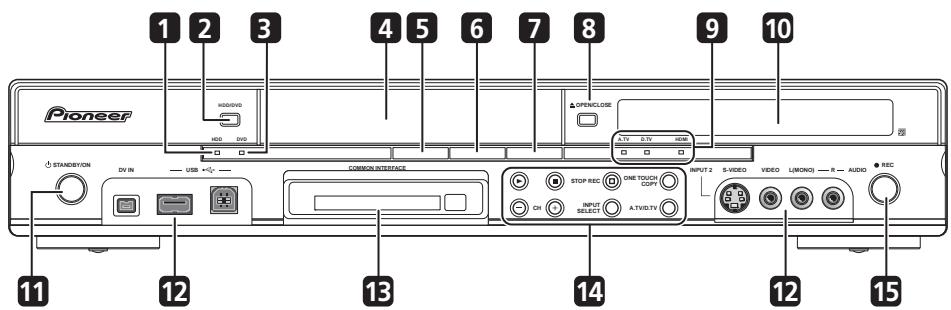
1 HDD indicator
Lights when the hard disk (HDD) is selected.
2 HDD/DVD
Press to switch between HDD and DVD for recording and playback.
3 DVD indicator
Lights when the DVD drive is selected.
4 Disc tray
5 PCVIDEO(page 108)
Press to play DivX files you have not yet viewed.
6 MUSIC(page 114)
Press to play music files in random order.
7 PHOTO(page 119)
Press to play JPEG files in random order.
8 ▲ OPEN/CLOSE
Press to open/close the disc tray.
9 A.TV indicator
Lights when analog TV is selected.
D.TV indicator
Lights when digital TV is selected.
HDMI indicator
Lights when this recorder is connected to HDMI (HDCP) compatible component.
10 Front panel display and IR remote sensor
See Display on page 28 for details.
11 念 STANDBY/ON
Press to switch the recorder on/into standby.
12 Front panel inputs
See Front panel connections on page 15 for more information on these.
13 COMMON INTERFACE slot
Slot for CA module and smart card used to decode scrambled D.TV channels. See Common Interface on page 27.
14
Press to start or restart playback.

Press to stop playback.
STOPREC
Press to stop recording.
ONE TOUCH COPY
Press to start One Touch Copy of the currently playing title to DVD or the HDD.
CH+/-
Use to change channels, skip chapters/ tracks, etc.
Controls and displays
INPUT SELECT
Press to change the input used for recording.
A.TV/D.TV
Switches between analog TV antenna input and digital TV antenna input. The
A.TV and D.TV indicators show which is selected.
15 REC
Press to start recording. Press repeatedly to set the recording time in 30 minute blocks.
Common Interface
To receive scrambled D.TV channels you will need a CA module and smart card provided by your service provider.
Different CA modules support different encryption systems. This recorder is designed to work with modules that support the DVB standard. Contact your service provider to obtain the right kind of CA module.
Note that neither CA modules nor smart cards are supplied or sold by Pioneer.
Inserting a CA module
The Common Interface card slot is located on the front panel of the recorder.
- Insert the CA module into the card slot as far as it will go.
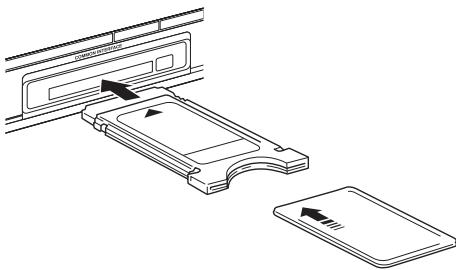
The Common Interface card slot accepts Type I and Type II PC Cards (PCMCIA cards).
Display
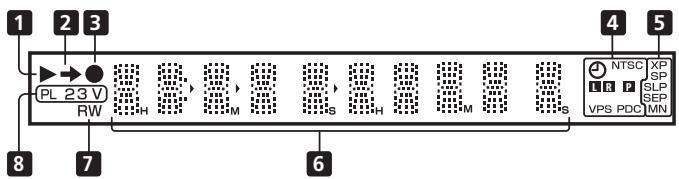
1
Lights during playback; blinks when playback is paused.
2
Lights when copying.
3
Lights during recording; blinks when recording is paused.
4 (page 69)
Lights when a timer recording has been set. (Indicator blinks if the timer has been set to DVD but there isn't a recordable disc loaded, or the timer has been set to record to the HDD but the HDD is not recordable.)
NTSC
Lights when the video output signal format is NTSC.
L R (page 139)
Indicates which channels of a bilingual broadcast are recorded.
P (page 137)
Lights when the component video output is set to progressive scan.
VPS/PDC (page 69)
Lights when receiving a VPS/PDC broadcast during a VPS/PDC-enabled timer recording.
5 Recording quality indicators (page 65)
XP
Lights when the recording mode is set to XP (high quality).
SP
Lights when the recording mode is set to SP (standard play).
LP/SLP
Lights when the recording mode is set to LP (long play) or SLP (super-long play).
EP/SEP
Lights when the recording mode is set to EP (extended play) or SEP (super-extended play).
MN
Lights when the recording mode is set to MN (manual recording level) mode.
6 Character display
7 R/RW
Lights when a recordable DVD-R or DVD-RW disc is loaded.
8 PL (page 91)
Lights when a VR mode disc is loaded and the recorder is in Play List mode.
23 (page 145)
Shows the remote control mode (if nothing is displayed, the remote control mode is 1).
V
Lights when an unfinalized Video mode disc is loaded.
Remote control
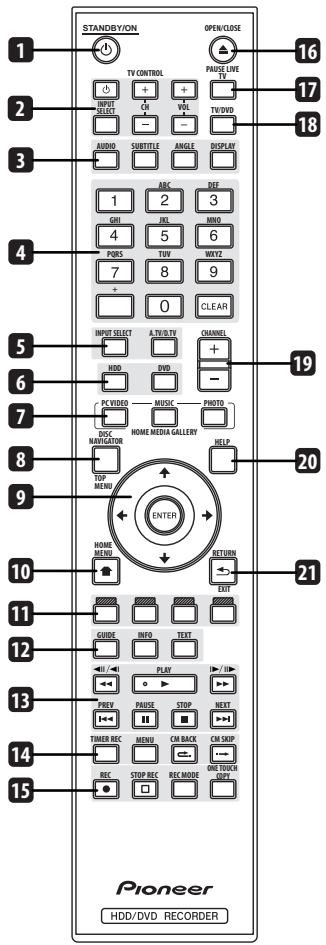
1 STANDBY/ON
Press to switch the recorder on/into standby.
2 TV CONTROL buttons (page 149)
After setting up, use these controls to control your TV.
3 AUDIO (pages 64, 83, 84)
Press to change the audio language or channel. (When the recorder is stopped, press to change the tuner audio.)
SUBTITLE (page 83)
Press to display/change the subtitles included in multilingual DVD-Video discs.
While watching D.TV, press to change the D.TV subtitles.
ANGLE (page 84)
Press to switch camera angles on discs with multi-angle scenes.
DISPLAY (page 85)
Displays/changes the on-screen information displays.
4 Number buttons, CLEAR, +
Use the number buttons for track/chapter/ title selection; channel selection, and so on. The same buttons can also be used to enter names for titles, discs and so on.
Use CLEAR to clear an entry and start again.
5 INPUT SELECT (page 71)
Press to change the input to use for recording.
A.TV/D.TV
Press to switch between analog TV antenna input and digital TV antenna input. The A.TV and D.TV indicators on the front panel show which is selected.
6 HDD (pages 66, 75)
Press to select the hard disk (HDD) for recording and playback.
DVD (pages 66, 75)
Press to select DVD for recording and playback.
7 HOME MEDIA GALLERY
Files stored on the HDD can easily be played using these buttons.
PCVIDEO (page 108)
Press to play DivX files you have not yet viewed.
MUSIC (page 114)
Press to play music files in random order.
PHOTO (page 119)
Press to play JPEG files in random order.
8 DISC NAVIGATOR (pages 79, 91)/TOP MENU (page 76)
Press to display the Disc Navigator screen, or the top menu if a DVD-Video or finalized DVD-R/-RW (Video) disc is loaded.
9 / / / and ENTER
Used to navigate all on-screen displays. Press ENTER to select the currently highlighted option.
While watching D.TV press ENTER to display the Channel List screen.
10 HOME MENU
Press to display the Home Menu, from which you can navigate all the functions of the recorder.
11 Colour buttons
(RED, GREEN, YELLOW, BLUE)
Use when an EPG screen is displayed or when tuned to a data channel of a digital broadcast. The function of each button will be described on-screen, and changes depending on the screen being displayed.
12 GUIDE
Press to display the EPG screen; press again to exit.
INFO
While watching D.TV, press to display the information banner.
Press to see additional information for the highlighted item in the EPG.
TEXT (page 64)
Press to display Teletext information (in European countries except the UK) or to start the MHEG application display (UK only) if available during digital broadcasts.
13Playback controls (page 75)

Press to start reverse or forward scanning. Press again to change the speed.

While paused, press and hold to start slow-motion playback. Press repeatedly to change the playback speed.
While paused, press to advance a single frame in either direction.
When GUIDE Plus ^+ is displayed, use to display the previous/next day.
▶ PLAY
Press to start playback.
PREV NEXT
Press to skip to the previous or next title/ chapter/track; or to display the previous or next menu page.
When GUIDE Plus ^+ is displayed, use to display the previous/next page.
II PAUSE
Press to pause playback or recording.
STOP
Press to stop playback.
14 TIMER REC (pages 40, 56)
Press to set a timer recording.
MENU (page 76)
Press to display the disc menu if a DVD-Video, finalized DVD-R/-RW (Video mode) or finalized DVD+R/+RW disc is loaded.
When in the GUIDE Plus+® system, use to jump directly to the Menu bar.
CM BACK (commercial back)
Press repeatedly to skip progressively backward through the video playing.
CMSKIP(commercialskip)
Press repeatedly to skip progressively forward through the video playing.
15 Recording controls (page 66)
REC
Press to start recording. Press repeatedly to set the recording time in blocks of 30 mins.
When the RED Action button is visible in a GUIDE Plus+® screen, use for One-Button-Record.
STOPREC
Press to stop recording.
Controls and displays
REC MODE (page 65)
Press repeatedly to change the recording mode (picture quality).
ONE TOUCH COPY (page 100)
Press to start One Touch Copy of the currently playing title to DVD or the HDD.
16 ▲ OPEN/CLOSE
Press to open/close the disc tray.
17 PAUSE LIVE TV (page 67)
Press to start recording the current TV channel, but with playback paused, effectively pausing the broadcast.
18 TV/DVD
Press to switch between 'TV mode', in which you get the picture and sound from the TV's tuner, and 'DVD mode', in which you get picture and sound from the recorder's tuner (or an external input).
19 CHANNEL + / - (page 62)
Press to change the channel of the built-in TV tuner.
20 HELP
Press for help on how to use the current GUI screen.
21 RETURN/EXIT
Press to go back one level in the on-screen menu or display.
Also press to exit the MHEG application.
Chapter 4
Getting started
Switching on and setting up
When you switch the recorder on for the first time, you can make several basic settings using the Setup Navigator feature. This takes you through setting the clock, the internal TV tuner and the video output.
If you're using the recorder for the first time, we strongly recommend you use the Setup Navigator before starting to use the recorder.
1 Switch on your TV and set the video input to this recorder.
2 Switch on the recorder.
When you switch on for the first time, your TV should display the Setup Navigator screen (If the Setup Navigator doesn't appear, you can also access it from the Initial Setup menu; see page 135).
- If this recorder is connected to a compatible TV using a fully-wired 21-pin SCART cable, the recorder will take a few seconds to download country, TV screen size and language information. (Check the manual that came with your TV for compatibility information.)
3 ENTER Choose a language (then press ENTER).
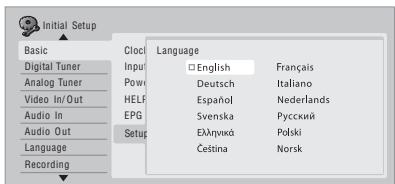
STANDBY/ON
This will also set the audio, subtitle and DVD menu language preferences.
4
Start the Setup Navigator.
Complete this setup before you start using your recorder.
Start
Cancel
Please use the Initial Setup if you want to make more detailed settings.
- If you don't want to use the Setup Navigator, press to select Cancel, then press ENTER to exit the Setup Navigator.
5 Select an Aerial Power setting for the built-in digital tuner.
- On: power is always supplied to the connected aerial, whether the recorder is on or in standby.
- Auto: power is only supplied when this recorder is on.
- Off: power is never supplied to the aerial.
6 SELECT 'Auto Scan' to start scanning for D.TV channels.
- Select Do not set if you want to skip D.TV channel setup (because they have already been set up, for example), then skip to step 8 below.
- You can go back to the previous screen in the Setup Navigator by pressing RETURN/EXIT.
7 Enter Select your country.
The recorder starts scanning for new channels. After the scan is complete the recorder will let you know how many new channels were found.
Getting started
- The country setting will apply to both the digital and analog TV tuners.
- The clock will also be set automatically here if D.TV channels are found.
- If no new channels were found a message appears asking if you want to scan again. Check the aerial connection before selecting Yes. (If you select No, skip to step 8 below.)
8 Select the analog TV (A.TV) Auto Channel Setting ('Auto Scan' or 'Download from TV'), or 'Do not set'.
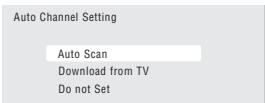
- Select Do not set if you want to skip channel setup (because they have already been set up, for example).
- You can only use the Download from TV feature if this recorder is connected to your TV using a fully-wired 21-pin SCART cable via the AV1 (RGB)-TV connector, and if your TV supports this function (check your TV's instruction manual for more details).
- SELECT your country.
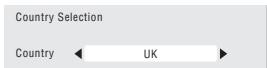
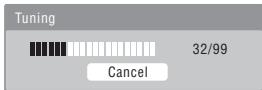
- Auto-tuning channels The Auto Scan option automatically scans and sets the channel presets.
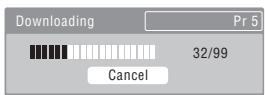
- Downloading channels from your TV Use the Download from TV option to download all the channels that your TV is tuned to.
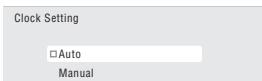
9 Select 'Auto' for automatic time setting, or 'Manual' to set the clock manually.
If the clock was already set from a D.TV channel in step 6, this step is skipped.
- Auto clock setting
Some TV channels broadcast time signals together with the programme. This recorder can use these signals to set the clock automatically.
Set 'Clock Set CH' to the channel preset number that broadcasts a time signal, then move the cursor down to 'Start' and press ENTER.
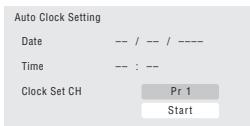
The recorder takes a short while to set the time. After you see that it's set, select Next to proceed.
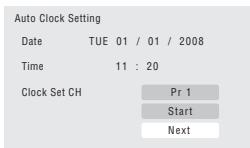
If the time could not be set automatically, press RETURN/EXIT to go back to the previous screen and select Manual.
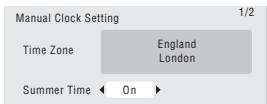
- Manual clock setting
If no stations in your area are broadcasting time signals, you can set the clock manually.
Use the / buttons to set your time zone.
You can set this by selecting a city or a time relative to GMT.
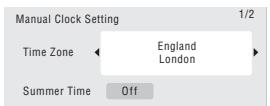
Press then use the / buttons to select 'On' or 'Off' for summer time, then press ENTER.
Select On if you are currently using summer time.
Set the date (day/month/year) and time, then press ENTER to make all the settings.
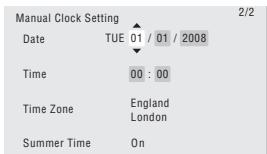
- Use the / buttons to change the value in the highlighted field.
- Use the / buttons to move from one field to another.
- Press ENTER to finish setting the time.
10 SELECT the EPG (Electronic Programme Guide) type to use.
GUIDE Plus+: Use the Gemstar GUIDE Plus + EPG (see also Setting up the GUIDE Plus + system on page 35 and Using the GUIDE Plus + electronic programme guide on page 39).
- Digital EPG: Use the SI EPG (programme information broadcast together with digital channels).
- If no channels were found when scanning for digital TV channels then this screen does not appear and the EPG is set according to the country set in step 7 above.
11 SELECT the TV screen type, Wide (16:9) or 'Standard (4:3)'.
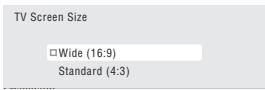
12 SELECT whether or not your TV is compatible with progressive scan video.
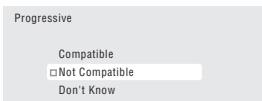
- This screen is not displayed when an HDMI signal is being output.
13 ENTER Press to continue after reading the HDD caution.
In the event of HDD failure, recordings may be lost or normal playback/recording may not be possible.
As recordings might be lost in case of an HDD failure, we recommend to use the HDD only as temporary storage media.
Please copy recordings you want to keep to recordable DVD.
Press ENTER to continue.
14 SELECT 'Finish Setup' to exit the Setup Navigator, or 'Go Back' if you want to start again.
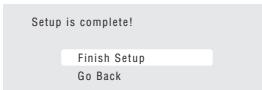
That completes basic setup using the Setup Navigator.
- If there are blank channels with no station, you can set these to skip using the manual channel setting. See Manual/CH Setting on page 137.
For users receiving digital broadcast services
This unit can set its internal clock automatically from digital broadcasts.
However, depending on the broadcaster, the clock information received may not be accurate.
Use the following procedure (while the recorder is not recording) to set the clock manually.

1 Display the Home Menu.

Select 'Setup' > 'Initial Setup'.

Select 'Basic' > 'Clock Setting'.
4 Highlight the time setting.
5 ENTER Press to display the manual clock setting screen.
6 Set the correct time.
Return to automatic clock setting
To return to the automatic clock setting, follow the instructions for 'Replace Channels' (page 135).
Setting up the GUIDE Plus+® system
This section is only applicable if you chose to use the GUIDE Plus + system as the EPG type in step 10 of the Setup Navigator above.
The GUIDE Plus+® system is a free, interactive on-screen television programming guide. The system offers programme listings for all major channels, one-touch recording, search by genre, recommendations according to your profile and more.
For the GUIDE Plus+ system to function correctly, it is important that you set the language and country correctly in the Setup Navigator, and that you have performed a
scan for available channels, as these are all used by the GUIDE Plus+ system. If any of these things are not yet set, please run the Setup Navigator first (see Switching on and setting up on page 32).
TV listings information is received via 'Host Channels'. In order to receive the correct TV listings information for your country or region you need to set up the GUIDE Plus+ system and 'download' the TV listings information. The initial download can take up to 24 hours, but once this is done, all future updates are automatic.
GUIDe Display the GUIDE Plus+ setup menu.
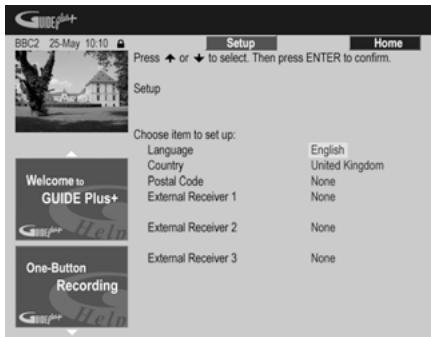
The language and country settings are already set to whatever you selected in the Setup Navigator.
2 ENTER Highlight 'Postal Code'.
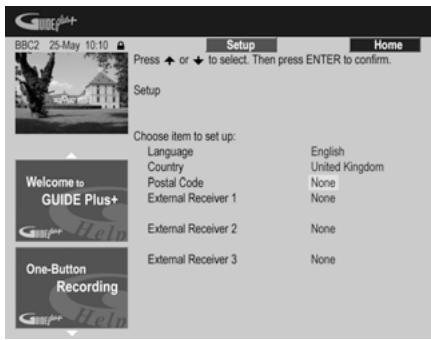
3 code.

Enter your postal
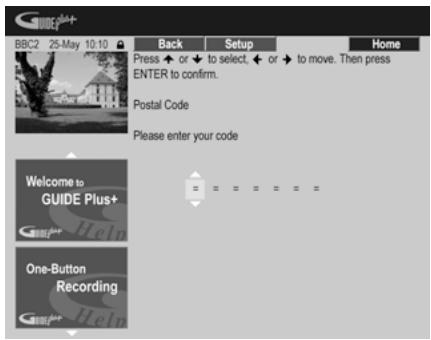
The system uses your postal code to identify which TV listings data is correct for the area in which you live, so it is important that you enter it correctly.
4 If you are using an external receiver (such as a satellite receiver) with the supplied G-LINK cable, complete this step, otherwise jump to step 5 below.
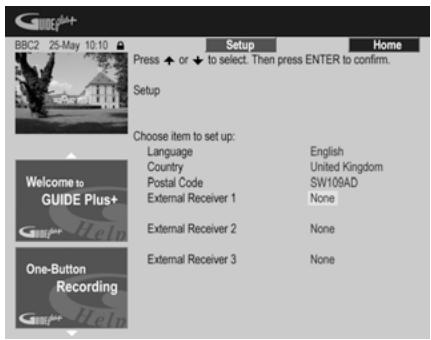
- See Connecting to a cable box or satellite receiver on page 18 for more on using the supplied G-LINK cable.
- Select External Receiver 1, 2 or 3, then press ENTER. (If you have just one external receiver, use External Receiver 1. You can add further receivers in 2 and 3 if you need to.)
After pressing ENTER:
- Select your reception method (Terrestrial, Cable or Satellite).
- Select your provider (if applicable).
- Select the brand of your external receiver.
- Identify which input your external receiver is connected to.
After completing these steps the recorder will try and communicate with your external receiver and change the channel via the G-LINK cable. If the channel was successfully changed, select Yes to confirm. If the channel did not change, select No. The GUIDE Plus+ system will try other codes assigned to your external receiver. If none of the codes changes the channel successfully, tune your external receiver to the Host Channel for your country (refer to step 5 below) and leave it on overnight. The recorder needs to be in standby; it will wake up automatically and download new codes from the Host Channel. The next day, try this setup process again:
- Press GUIDE to display the GUIDE Plus+ screen.
- Press ↑ to highlight the Menu bar, then use → to reach the Setup area and select Setup.
- Continue setting up from the start of this step again.
If your external receiver still doesn't respond to the G-LINK controller, please call customer support and report the brand and model of your external receiver.
See also GUIDE Plus ^+ FAQ and troubleshooting on page 50.
5 Identify the Host Channel for your country.
The TV listings information available in the GUIDE Plus+ system is distributed throughout Europe by selected broadcasters called Host Channels. It is important that the host (analog) channel for your country is correctly identified in order to receive listings information (EPG download).
Follow A, B or C below depending on your setup:
Getting started
A If you are not using an external receiver, this recorder will automatically scan all channels for the Host Channel:
- Leave the recorder in standby overnight (do not leave it switched on).
B If you are using an external receiver, you need to identify the Host Channel from the table below:
| Country/ Region | Host Channels | Comments |
| Austria | Eurosport | |
| Belgium | RTL-TVI | |
| France | Canal+ | Analog only |
| Germany | Eurosport | |
| Italy | MTV | Analog only |
| Netherlands | Eurosport | |
| Spain | Tele 5 | Analog only |
| Switzerland | Eurosport | |
| UK | ITV, Eurosport | ITV is analog only. Use Eurosport if you are a SKY subscriber and you no longer have an analog terrestrial antenna. |
- Tune your external receiver to the appropriate Host Channel and leave the receiver on and the recorder in standby overnight.
C If you use both an external receiver and this recorder as sources, follow the instructions above for setting up without an external receiver. Only if this is unsuccessful try the external receiver method.
About EPG download
- EPG data can only be received when the recorder is in standby. (When not using the recorder, therefore, please switch it into standby.) If you're using an external receiver, leave this on when EPG data is downloading.
- If you cannot receive any of the Host Channels (see the above table) then you won't be able to use the GUIDE Plus+ system. In this case do not set the postal code (or set Country to Other) in the GUIDE Plus+ setup screen. (When GUIDE Plus+ service starts in your area, set the postal code again.)
If digital broadcasts start in your area, please set the EPG Type Select setting in the Initial Setup menu to Digital EPG.
- Even if you can't use the EPG functions where you live, you can still set VIDEO Plus+ recordings and manual recordings — see Setting a manual recording on page 47.
- The front panel display shows EPG when receiving data. If you power on the recorder during an EPG download, the download is cancelled.
- EPG data may be received several times a day. All updates are automatic.
- When downloading EPG data, the recorder may sound as though it is on. This is normal.
Checking the downloaded data the following day
1 Display the GUIDE Plus+ screen.
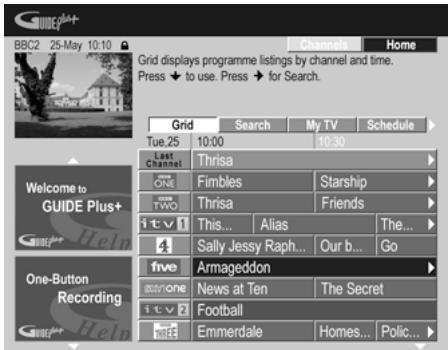
You should see a grid filled with channel logos and TV listings information. Use the / buttons to review the list. If you notice that there are channels missing, or that there are channels in the list that you don't get, go to the Editor screen:
- Press ↑ repeatedly until the Menu bar is highlighted.
- Press until Editor is highlighted. The main area of the screen now shows a list of channels. Those that are turned ON are displayed in the grid; those that are OFF are hidden. Use the / / / buttons to move down the list and turn channels ON or OFF as necessary.
- For any channel that you turn ON, the GUIDE Plus+ system will need to know how it is received (the source) and on which programme number. The source may be the built-in tuner of this recorder, or an external receiver. The programme number is the number on which the channel can be found on its receiving device/source. The entry in the Editor screen must match this number for correct recording of that channel.
- The above is especially important for the 'Host Channel'. Please make sure that the Host Channel is always switched ON.
2 Change the programme numbers as you like.
Changing the programme numbers allows you to decide the order in which the channels change when stepping through them sequentially. You can do this to group certain channels together, for example.

3 When you're done, press the BLUE Action button (Home) to get back to the GUIDE Plus+ home screen.
- You can find detailed information on using the GUIDE Plus+ system in the following chapter.
Chapter 5 Using the GUIDE Plus+® electronic programme guide
This chapter is only applicable if the EPG Type Select setting made in the Setup Navigator (or the Initial Setup menu) is set to GUIDE Plus+.
The GUIDE Plus+® system
The GUIDE Plus+® system* is a free, interactive on-screen television programming guide. The system provides programme listings for all major channels, one-touch recording, searching by genre, recommendations according to your profile and more. The GUIDE Plus+ system is a convenient way to find out what's on right now or during the coming week, by channel or by genre. The GUIDE Plus+ system also allows you to automatically set your viewing and recording selections quickly and easily. In order to receive the correct TV listings information for your country or region you need to set up the GUIDE Plus+ system and 'download' the TV listings information. If you haven't already done this, please turn to Setting up the GUIDE Plus+® system on page 35 before proceeding.
- GUIDE Plus+, SHOWVIEW, VIDEO Plus+, G-LINK are (1) registered trademarks or trademarks of, (2) manufactured under license from and (3) subject of various international patents and patent applications owned by, or licensed to, Gemstar-TV Guide International, Inc. and/or its related affiliates.
Legal Notice
GEMSTAR-TV GUIDE INTERNATIONAL, INC. AND/ OR ITS RELATED AFFILIATES ARE NOT IN ANY WAY LIABLE FOR THE ACCURACY OF THE PROGRAMME SCHEDULE INFORMATION PROVIDED BY THE GUIDE PLUS+ SYSTEM. IN NO EVENT SHALL
GEMSTAR-TV GUIDE INTERNATIONAL, INC. AND/ OR ITS RELATED AFFILIATES BE LIABLE FOR ANY AMOUNTS REPRESENTING LOSS OF PROFITS, LOSS OF BUSINESS, OR INDIRECT, SPECIAL, OR CONSEQUENTIAL DAMAGES IN CONNECTION WITH THE PROVISION OR USE OF ANY INFORMATION, EQUIPMENT, OR SERVICES RELATING TO THE GUIDE PLUS+ SYSTEM.
Using the GUIDE Plus+® system
All the various features and areas are colour-coded for ease of navigation. All screens (with the exception of some setup screens) have the following common elements:
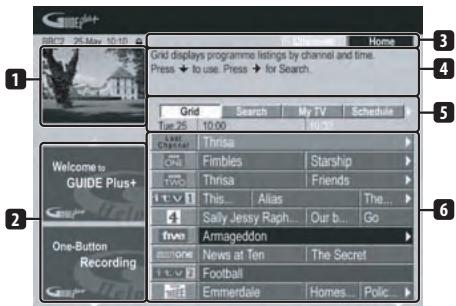
1 Video window - Allows you to continue watching the current programme while using the GUIDE Plus+ system.
2 Information panels - Display programme promotions or instructions on the GUIDE Plus+ system.
3 Action bar - Colour-coded Action buttons change function depending on the area.
4 Information box - Shows short programme descriptions or help menus.
Using the GUIDE Plus+® electronic programme guide
5 Menu bar - Gives access to the various areas of the GUIDE Plus+ system.
6 Grid - Shows TV listings information for the next seven days by channel and time.
GUIDE Plus+ navigation
The table below shows a summary of the remote buttons you'll use to navigate the GUIDE Plus+ system.
| Key | What it does |
| ●REC | Press to set or cancel One-Button-Recording. |
| GUIDE | Press to display the GUIDE Plus+ screen (also use to exit). |
| ↑/↓/←/→ | Use to navigate screens (highlight an item). |
| RED, GREEN, YELLOW, BLUE | Action buttons that change functionality depending on the Area. |
| MENU | Press to jump directly to the Menu bar. |
| TIMER REC | Press to go directly to the Schedule area. |
| INFO | Press to display extended information for the current programme. |
| ENTER | Press to confirm a selection or to leave the GUIDE Plus+ screen. |
| Number buttons | Use for numeric entry. |
| ▲▲ PREV/ ▲▲NEXT | Press to select the previous/ next page of information (in the grid, for example). |
| ▲▲/▲▲ | Press to select the previous/ next day. |
One-Button-Record
The RED Action button (Record) is visible anytime you can highlight a programme title, including from the Grid, after a search, or in your recommendations in the My TV area.
The programme name, date, channel, recording start and end times are all set automatically when you set a timer recording using One-Button-Record.
If you need to, you can edit the settings at any time before the recording is due to start (see Editing a scheduled recording on page 45).
1 Highlight a programme title.
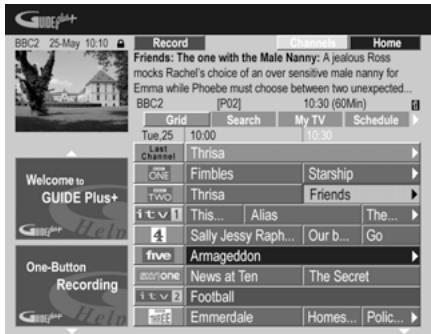
2 Press the RED Action button (Record).
The programme is now set for recording. When the programme is due to start, the recorder will switch to the correct channel and start recording1.
- You can also use the REC button to set the recording.
- You can review the shows you have set to record in the Schedule Area (see also The Schedule Area on page 44).
Lock/Unlock video window
When you enter the GUIDE Plus+ system, the channel you were watching remains visible in the video window. The date stamp above the window lets you know the channel, date and time.
The default setting for this window is 'locked', as indicated by a closed padlock icon above the video window. When locked, the video window always shows the channel you were previously watching as you move up and down through the listings grid.
If you prefer, you can unlock the video window so that as you highlight different channels in the listings grid, that channel is shown in the video window.
1

Highlight a channel logo.
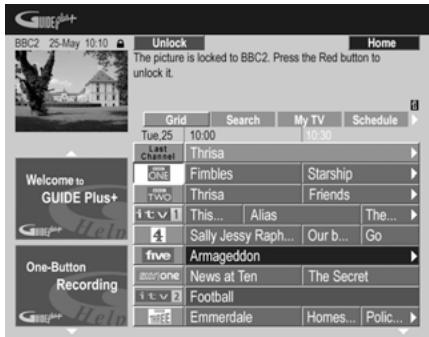
Channel logos are displayed to the left of programme titles.
2 Press the RED Action button (Unlock).
The padlock icon above the video window becomes unlocked. It remains unlocked for the remainder of your current TV viewing session.
If you want to lock the video window again, follow the same procedure. The RED Action button will now act as Lock.
Channel mosaic screen
You can switch the display style of channels in the Grid Area, Schedule Area or My TV Area from a list to a mosaic of channel icons by pressing the YELLOW Action button. Select the channel icon you want using the
cursor buttons, then press ENTER to return to the previous screen on that channel.
Areas
The GUIDE Plus+® system consists of seven Areas. All Areas can be accessed from the Menu bar.
- Grid - The GUIDE Plus+ system Home Area. Displays TV listings information for the next seven days by time and channel.
- Search - Search for TV programmes by category (e.g., Sport), subcategory (e.g., Football) or keyword.
- My TV - Set up a profile and receive recommendations according to your preferences.
- Schedule - Show all scheduled recordings.
- Info - Area for additional information, such as weather (not available in all regions).
- Editor - Change channel settings.
- Setup - Setup the GUIDE Plus+® system.
The Grid Area
The Grid is the main TV listings screen of the GUIDE Plus+ system and is the first screen that you see when you press GUIDE. You can see TV listings for the next seven days, starting with the current day.
When you highlight a programme in the Grid, you can see information about it in the Information Box, including title, synopsis, channel, source, time and length. If there is an i symbol in the Information Box, it means that there is an extended synopsis available. Press the INFO button to see it.
In some countries, you can also see a rating for a particular programme (mostly movies). These ratings are provided by local partners, such as TV magazines.
From the Grid Area you can:
View and scroll through programme listings
- Read programme synopses
Using the GUIDE Plus+® electronic programme guide
- Tune to a programme that's currently showing1
- Set a programme to record
- Lock or unlock the video window
- Access Information panels
Browsing the Grid
Use the following remote buttons to browse the grid:
/ / / (cursor buttons) - Navigate the Grid
PREV/NEXT-Previous/next page
- Previous/next day
BLUE Action button - Return to the current time/date in the Grid
ENTER - Press on the current selection to exit the GUIDE Plus+ system and start watching the programme
The Search Area
From the Search Area you can:
Search by category
Search by subcategory
Search by keyword
- Read programme synopses
- Tune to a programme that's currently showing
- Set a programme to record
- Access Information panels
Searching
You can search for programmes by category, subcategory or by keyword (My Choice). Categories for searching include Movies (purple), Sport (green), Children (blue) and Others (teal). In some countries there is a further subcategory available called 'Tip of the Day'. These are programmes recommended by a local partner, such as a TV magazine.


Select 'Search' from the Menu


Select a category and a story.
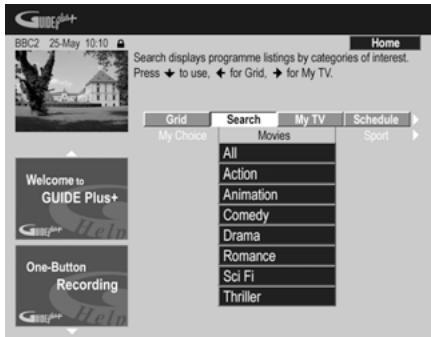
- If you choose All as the subcategory, all programmes in the category you selected will show up in the search results.

ENTER
Start the search.
The search results are shown sorted by time and date.
- If no search results are displayed, it means there are no programmes for the current day that match your search criteria.
Using My Choice keywords for a search
In addition to the standard categories, you can also set your own keywords.
1

Access My Choice.
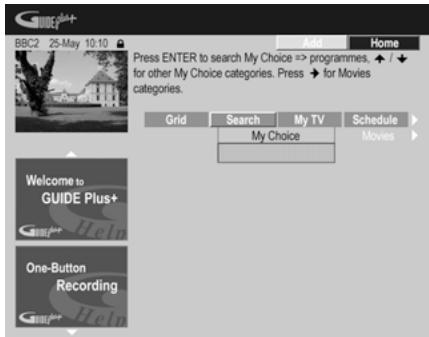
2 Press the YELLOW Action button to add a keyword.
3 ENTER Enter a keyword to appear in the menu.
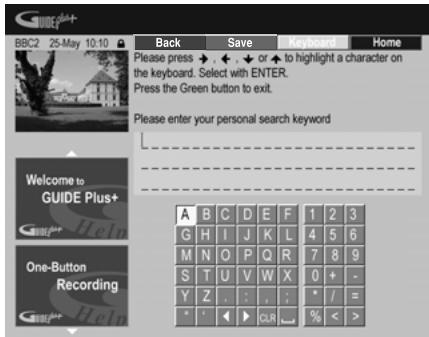
When you're finished, press the GREEN Action button to exit and continue.
4
ENTER
Start the keyword search.
- You can delete or edit keywords using the RED and GREEN Action buttons.
- When you have set more than two keywords, an All subcategory automatically appears which allows you to search for all your keywords.
My TV Area
The My TV Area allows you to set up a personal profile. You can define a profile by channels, themes and/or keywords. As soon as a personal profile has been set, the GUIDE Plus+ system continuously scans the TV listings for the next seven days. Whenever you access the My TV Area, a list of programmes matching your profile appears.
From the My TV Area you can:
- Set up a profile by channel, theme and/or keyword
- Edit and delete profiles
- Read programme synopses
- Tune to a programme that's currently showing
- Set a programme to record
- Access Information panels
Setting up a profile
You can set up a profile with any combination of up to 16 channels, four categories and 16 keywords.
1 Select 'My TV' from the Menu bar.
2 Press the YELLOW Action button to set a profile.
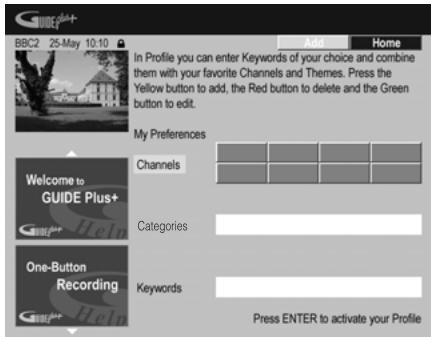
Channels is now highlighted.
3 To add a channel to your profile, press the YELLOW Action button.
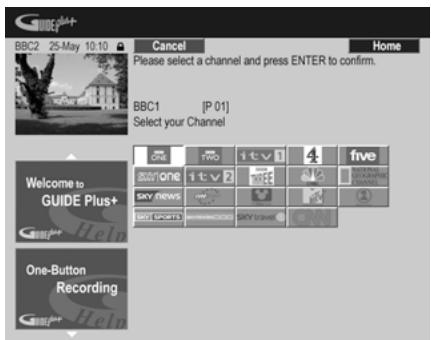
Select a channel from the mosaic of channel icons and press ENTER. Repeat this step to add up to 16 channels.
4 To add a category to your profile, highlight 'Categories' and press the YELLOW Action button.
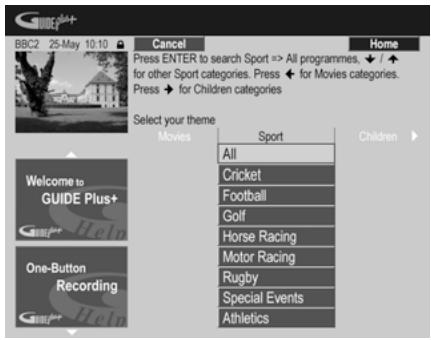
Select a category from the Search Area categories and press ENTER. Repeat this step to add up to four categories.
5 To add a keyword to your profile, highlight 'Keywords' and press the YELLOW Action button.
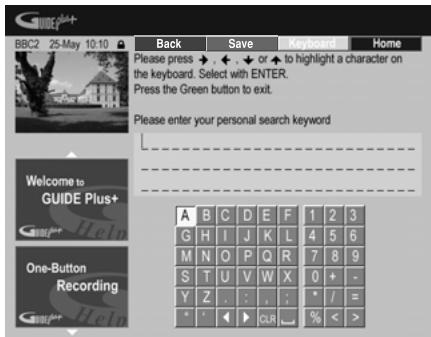
Use the / / / buttons followed by ENTER to select characters from the on-screen keyboard. When you're finished, press the GREEN Action button to exit and continue.
6 Press ENTER to activate your profile.
- You can add up to 16 keywords by repeating step 5.
- You can edit or delete your profile using the RED and GREEN Action buttons.
The Schedule Area
The Schedule Area is where you can set, see, edit and delete scheduled (timer) recordings.
From the Schedule Area you can:
- Edit or delete a One-Button-Recording
- Set, edit or delete a VIDEO Plus+ recording
- Set, edit or delete a manual recording
Editing a scheduled recording
You can edit any parameter in a scheduled recording, or delete it if you no longer require it1.
1 Highlight the left tile of a scheduled recording.
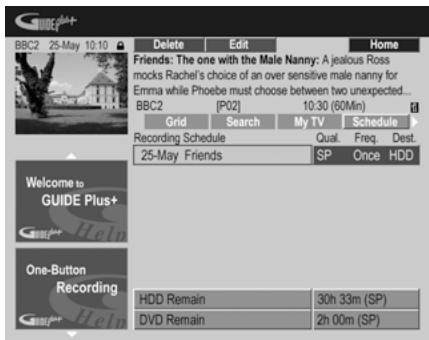
- If you only want to edit the recording quality, frequency, destination, timing or genre settings, skip to step 5 below.
2 Press the GREEN Action button (Edit).
3 Use the cursor and number buttons to edit the recording date, start time, end time and channel.
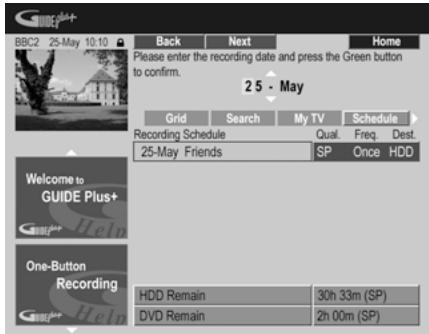
Use the / buttons or the number buttons to edit.
Press the GREEN Action button to go to continue, or the RED Action button to go back.
4 Enter a name for the scheduled recording.
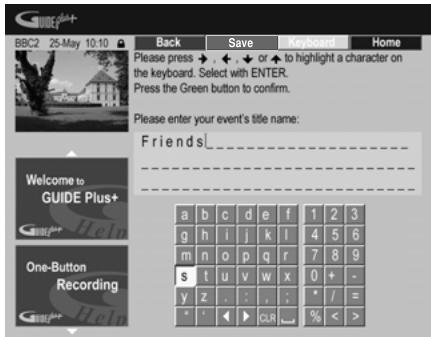
Use the / / / buttons followed by ENTER to select characters from the on-screen keyboard.
After entering the whole name, press the GREEN Action button to continue.
5 Highlight the right recording tile.
6 Press the RED Action button (Quality) to change the recording quality.
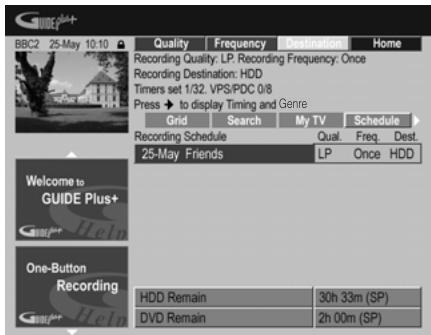
Select from AUTO2, XP, SP, LP, EP, SLP, SEP or a manual recording mode (see Manual Recording on page 141 and Manual recording modes on page 152).

Note
1 See About timer recordings on page 69 for more information about scheduled recordings.
2 This mode maximizes the recording quality to fit on to a single DVD disc. Can also be used when recording to HDD.
7 Press the GREEN Action button (Frequency) to change the recording frequency.
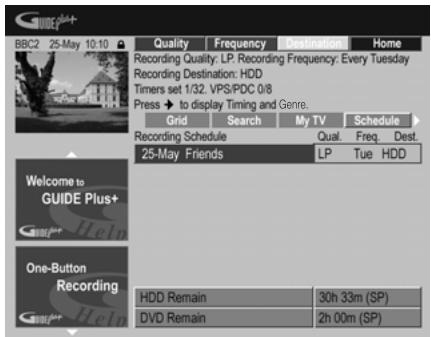
Select from the various options for one-time, daily and weekly recordings.
8 Press YELLOW Action button (Destination) to select the recording destination.
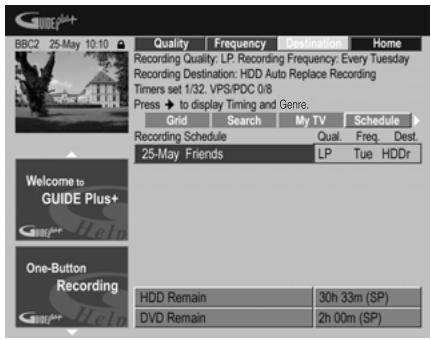
Select from DVD, HDD or HDDr (Auto Replace Recording)1.
- Auto Replace Recording is only available as an option with regular daily or weekly recordings.
9 Press to access the extended recording options.
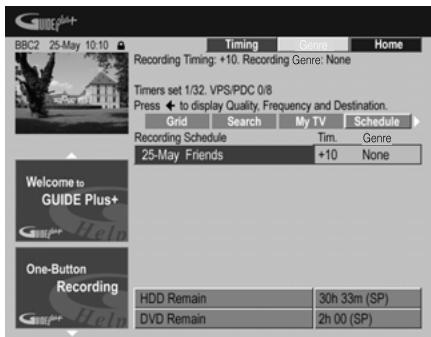
- If you want to record to a particular HDD genre, use the YELLOW Action button (Genre) to select one.
- Use the GREEN Action button (Timing) to add extra time to the end of the recording (+0, +10, +20, +30 or VPS/PDC ^2 (V-P)).
- Press to display the standard recording options again.
Note
- For a DVD timer recording, if Optimized Rec (see Optimized Rec on page 141) is set to On (and VPS/PDC is off), the recorder will adjust the recording quality to try and fit the recording on the disc. If the recording will not fit onto the disc even on MN1 recording quality (MN4 for DV+R / + RW) then the Recovery Recording feature will automatically make the recording to the HDD instead.
- If there is very little free space left on the HDD, an Auto Replace Recording may not complete successfully.
- If the HDD is being used for playback or high-speed copying when an Auto Replace Recording is due to start, the new timer recording will not replace the old one. However, the next time the timer recording starts, both of the older two programmes will be erased.
- If you set the timer recording to use VPS/PDC, you must switch the recorder into standby before the timer recording is due to start for it to work correctly. For non-VPS/PDC timer recordings there is no need to switch the recorder into standby.
- Optimized Recording will not work if VPS/PDC is on.
- Up to eight timer recordings can be set with VPS/PDC.
- VPS/PDC cannot be set for recordings made from digital broadcasts or an external input, or when the recording mode is set to AUTO.
Deleting a scheduled recording
1 Highlight the left tile of a scheduled recording.
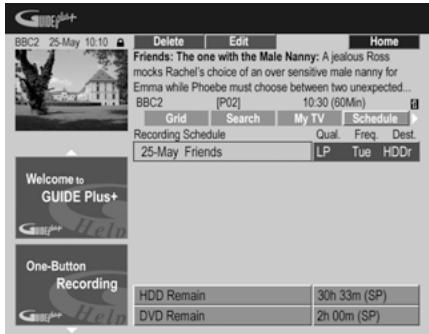
2 Press the RED Action button (Delete).
The scheduled event is deleted.
Setting aVIDEO Plus+® recording
1 Select 'Schedule' from the Menu bar.

2 Press the RED Action button (VIDEO Plus+).
3 Use the number buttons to enter a PlusCode programming number.
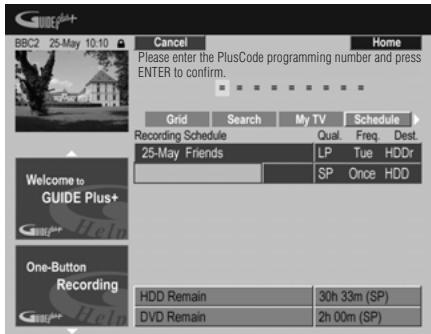
- If you live in an area not yet covered by the GUIDE Plus+ system you may also have to input a channel number. Follow the on-screen display to do this.
4 Press ENTER to confirm.
Setting a manual recording
1 Select 'Schedule' from the Menu bar.
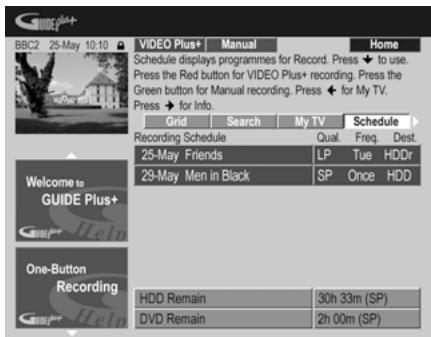
2 Press the GREEN Action button (Manual).
3 Use the number and / / / buttons to enter the recording date, then press the GREEN Action button (Next).
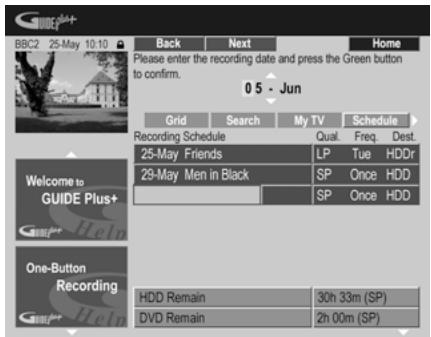
4 In the same way, enter the recording start time, followed by the GREEN Action button (Next) to confirm.
5 Enter the recording end time in the same way, followed by the GREEN Action button (Next) to confirm.
6 Use the number buttons to enter a channel number, then press the GREEN Action button (Next) to confirm.
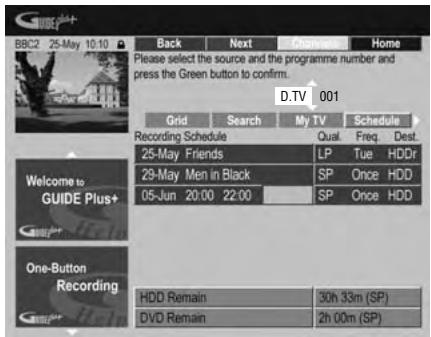
Alternatively, you can press the YELLOW Action button (Mosaic) and use the / / / buttons to select a channel from the mosaic, followed by ENTER.
The Info Area
This area is reserved for additional information such as news, weather reports, stock quotes, and so on, and varies by region. (Note that this feature is not available in all countries/regions.)
The Editor Area
The Editor Area is the central location for you to manage your channels. Any changes you make here will affect what is displayed in the Grid Area. The Editor Area is mainly used when setting up the GUIDE Plus+ system to make any manual changes as necessary.
You can also use the Editor Area if new channels become available in your area, or if you change from cable to satellite, say, or move house.
From the Editor Area you can:
- Display/hide channels in the grid (switch the channel on/off)
- Select a channel source (A.TV, D.TV, Ext. Rec. 1, Ext. Rec. 2, etc.)
- Enter a channel programme number
Switching a channel on/off
You can choose whether or not to display a channel in the Grid Area by switching the channel on or off in the Editor Area.
1 Select 'Editor' from the Menu bar.
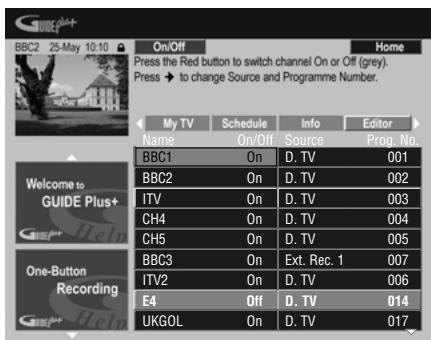
2 Highlight the left channel tile of the channel you want to switch on or off.
3 Press the RED Action button to switch the channel on or off.
Changing the source and programme number
1 Select 'Editor' from the Menu bar.
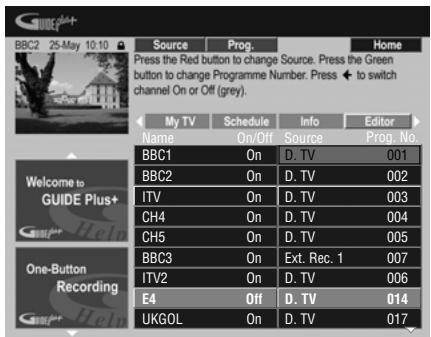
2 Highlight the right channel tile of the channel you want to make a change to.
3 Press the RED Action button to change the channel source, or the GREEN Action button to enter a programme number.
Each press of the RED Action button changes the channel source (A.TV, D.TV, Ext. Rec. 1, etc.). To set a programme number, use the number buttons to enter a programme number then press ENTER (When set to A.TV or D.TV, make sure that the programme number matches the preset number of this recorder for what you want to record).
The Setup Area
The Setup Area is where you can set up the GUIDE Plus+ system for your particular region, TV reception conditions, and so on.
Making changes to your GUIDE Plus+ setup
1 Select 'Setup' from the Menu bar.
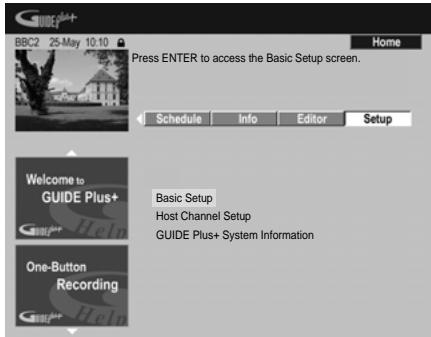
2 Highlight the part you want to change.
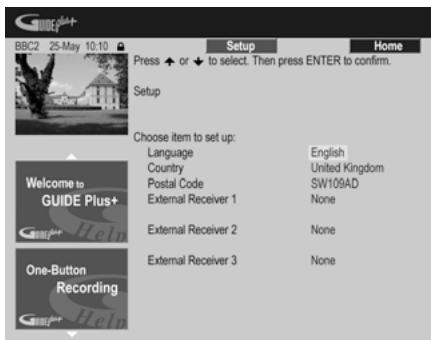
You can change the Language, Country, Postal Code1 and the External Receiver settings.
3 Press ENTER to confirm.
Manual Host Channel setup
The GUIDE Plus+ system will automatically identify your Host Channel as soon as the recorder is put into standby for the first time. See the table on page 37 for a list of all the European Host Channels.
If you know your Host Channel details (source and programme number) or if the automatic identification did not provide the expected result, you can identify your Host Channel manually. Select Host Channel Setup in the Setup area and follow the instructions on the TV. Select the correct source (e.g., internal tuner or external receiver) and enter the respective programme number (e.g., if you have to press 9 on the remote to watch your Host Channel, enter 9 as the programme number). When you next switch the recorder into standby the GUIDE Plus+ system will complete the Host Channel setup.
You can reset the Host Channel settings at any time back to the default setting of automatic. Please be aware that resetting the Host Channel will erase all TV listings data.
GUIDE Plus+® FAQ and troubleshooting
This FAQ covers only a few questions. For a complete list please consult the GUIDE Plus+ website at: www.europe.guideplus.com

FAQ
-
When I tried setting up my external receiver I could not get any of the attempts to work, what should I do? There could be several reasons why your external receiver could not be controlled. – The connections could be wrong. Make sure that the G-LINK cable is connected to the G-LINK connector on the recorder and the IR blaster is in front of the external receiver, pointing towards the IR receiver of your external receiver. See Connecting to a cable box or satellite receiver on page 18.
-
The code that is listed under your brand could be wrong. Please try other codes for your brand under satellite, cable or terrestrial. Go to the Setup Area and choose one of the three options (cable, satellite or terrestrial) that you have not already tried. Follow the on-screen prompts to make sure that the GUIDE Plus+ system can change channels on your external receiver. If it does not work, repeat the process, choosing different reception and external receiver combinations until you have tried all the codes for your brand of receiver that are already in the GUIDE Plus+ system. If it still does not work, see below on how to receive new codes overnight.
-
The unit has not yet received new codes. The nightly data downloads frequently include new codes for controlling external receivers. Please tune your external receiver to your local Host Channel and leave it on overnight.
Using the GUIDE Plus+® electronic programme guide
Switch this recorder into standby. The next morning, please perform the GUIDE Plus+ setup again to see if your external receiver can now be controlled.
-
The external receiver that you use is currently not supported. If, after leaving your external receiver on overnight, and doing the Reception and External Receiver Setup again, it still does not respond, please call Customer Support to report your brand and model.
-
My external receiver was successfully setup. However I have found that when the GUIDE Plus+ system has to change to a channel with a three-digit programme number in the external receiver's preset, it does not work. It looks like the GUIDE Plus+ system can only send two digits.
With the number of channels increasing, the number of digits has increased as well. While older boxes use only two digits, newer boxes require up to four. It is possible that you selected an older code for your brand during set-up. Please access the Setup Area, select External Receiver and repeat the setup for your brand (Note: Every time you see the on-screen question about whether the receiver has changed to a certain channel, the GUIDE Plus+ system has sent a different code). Try all the different codes until your GUIDE Plus+ system can control your external receiver correctly. If you have no success, try to receive new codes overnight.
- I used to receive data through my terrestrial antenna or analog cable without a set-top box. Now, I have "upgraded" to a satellite system or to digital cable with external receiver. What should I do to receive data for the GUIDE Plus + system?
You can try to receive your Host Channel through your new reception method. If you have problems to receive data we recommend that you keep your analog
terrestrial or cable connection only to receive data this way. It is important that you identify your Host Channel correctly in the Editor Area.
- After I performed the initial set-up I found that the line-up for all the channels received via the external set-top box is incorrect. How do I correct this?
You can change the line-up in the editor according to your preferences. Access the Editor Area. Select the channels that you would like to change. Change the source and preset number according to your preferences.
I performed the set-up but after many hours I still have a blank EPG what is going wrong?
There are several possibilities:
-
Connections are wrong. See Connections on page 14 to double check everything.
-
The initial setup of GUIDE Plus+ was completed incorrectly. Try setting it up again (see Setting up the GUIDE Plus+® system on page 35).
-
Your cabling and setup is OK, but the recorder has not been connected for enough time to receive the TV listings data. Leave the recorder in standby overnight.
-
For external receiver users only: The connections and setup are OK, but the external receiver was not tuned to the correct Host Channel. Check the list of Host Channels (see step 5 of Setting up the GUIDE Plus+® system on page 35) and leave the recorder in standby and the external receiver on overnight tuned to the correct Host Channel.
-
You live in a country/region where the GUIDE Plus+ system is not yet available. Check the list of countries to see if you are in a region that is supported.
-
I used the One-Button-Record feature (RED Action button) to set a recording, but I recorded the wrong channel.
If the channel to be recorded is received via the external receiver first make sure that the external receiver was left switched on. Next, in the Editor Area, make sure that the channel to be recorded is correctly set: Access the Editor Area. Check the source and programme number of the channel that you wanted to record. Change the source and preset numbers if incorrect.
If you are recording from the recorder's internal tuner (the A.TV or D.TV setting), make sure that the programme number is the same as the preset number set on this recorder. If they are different, go to the Editor Area and change the programme number to match the recorder's preset number.
- The TV listings information doesn't update.
The latest TV listings information is automatically downloaded by the recorder overnight. This only happens if the recorder is in standby; if the recorder is left on, it will not download. When not using the recorder, please switch it into standby.
Data downloads can take several hours. The front panel display shows EPG when downloading. If you switch the recorder on while EPG is displayed, the download will be cancelled.
- The GUIDE Plus+ system is not supported in my area, but when I switch the recorder into standby, after a while the front panel display shows EPG. Can I stop this from happening?
If the GUIDE Plus+ system is not supported in your area, please do not set the postal code in the GUIDE Plus+ setup (see Setting up the GUIDE Plus+® system on page 35). When the GUIDE Plus+ service starts in your area, please set the postal code again.
- The automatic Host Channel search failed or the GUIDE Plus + system identified the wrong Host Channel for my region.
You can identify your Host Channel manually. See Manual Host Channel setup on page 50 for how to do this.
Chapter 6 Using the digital electronic programme guide
This chapter is only applicable if the EPG Type Select setting made in the Setup Navigator (or the Initial Setup menu) is set to Digital EPG.
The Digital EPG system
The Digital EPG shows a table of scheduled digital TV programmes and detailed information about individual programmes. It also allows you easily to select and tune to a particular programme.
The Digital EPG screen consists of Programme Information and General Programme List. This section describes information displayed in the schedule and information windows.
Note that the recorder's clock must be set to the correct time and date to ensure all relevant EPG information is displayed.
General Programme List
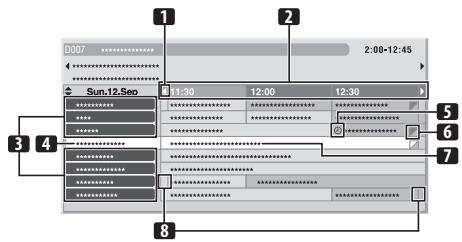
1 Appears when the schedule table can be scrolled forward or backward
2 Time schedule
3 Channel list
4 Highlights the currently selected channel
5 Indicates the programme set for recording
6 Appears when other programmes (often short ones) have been scheduled for the same period
7 Programme title
8 Time dividers
- The general programme list may show sections whose bottom right corners have been folded. This indicates that other programmes have been scheduled for that period. To view the title of such a programme and related information, highlight a folded section, and then press / .
Programme Information
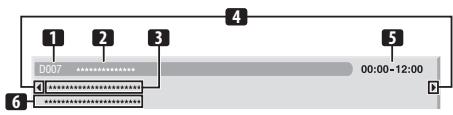
1 Channel number
2 Station name
3 Programme title
4 Appear when other programmes have been scheduled for the same period
5 Programme schedule
6 Programme genre
Using the digital electronic programme guide
Using the Digital EPG
Using the Digital EPG you can check the schedule of digital TV programmes, view information about desired programmes, and/or select programmes.
1 Guide Press to display the Digital EPG screen.
The EPG screen updates automatically if the EPG data is acquired successfully. If not, the Digital EPG screen shows a blank image.
2 Select a TV programme.

Select a TV programme.
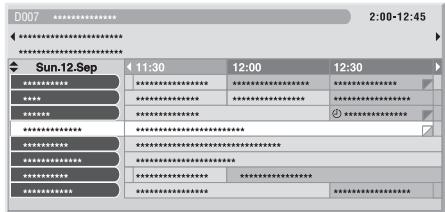
- Press IPREV/▶NEXT to skip to the previous/next channel list page.
Information about the selected programme appears in the information window. - To watch a programme currently on air, select the programme (then press ENTER).
- You can check information about programmes scheduled up to one week ahead, depending on conditions.
Depending on conditions, it may take some time to acquire EPG data.
3 Press to view more information about the selected programme.
Detailed information appears in the schedule window.
If the screen contains further information, More ... is displayed.
- To quit the display of detailed information, press INFO again (or RETURN/EXIT).
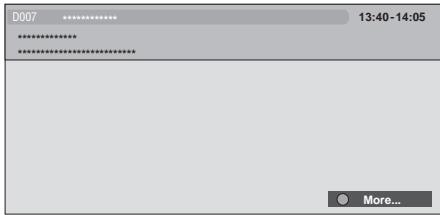
4 Press to exit the Digital EPG screen.
Setting timer programmes
Using the Digital EPG, it's easy to set digital TV programmes for recording2.
1 Press to display the Digital EPG screen.
2 Select a programme.
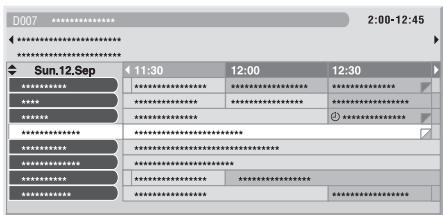
- Select a programme currently on-air: press ENTER to close the Digital EPG screen and watch the channel immediately, or press RED to set the programme for recording immediately.
- Select a programme not yet started then press ENTER or RED to set the programme for recording.
3 Enter the timer recording settings. Use the / buttons to select a field; u: the / buttons to change the value1.
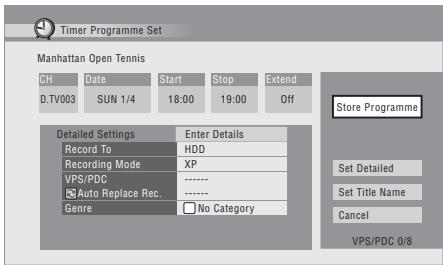
- CH - Choose a channel (Pr 1 to Pr 99 for analog channels and available digital channels (excluding skip channels)), or one of the external inputs from which to record.
- Date - Choose a date up to one month in advance, or select a daily or weekly programme.
- Start - Set the recording start time.
- Stop - Set the recording end time (maximum length of a timer recording is 24 hours).
- Extend - Extend the end time of the timer recording (select Off, 10, 20 or 30 mins).
4 If you want to change the recording mode, recording destination, etc., select 'Set Detailed'.
In this area you can set:
Record to - Select HDD for hard disk recording or DVD for DVD recording ^2 .
Recording Mode - Select from AUTO ^3 , XP, SP, LP, EP, SLP, SEP (see Setting the picture quality/recording time on page 65). If Manual Recording is on, then you can also select the LPCM setting, XP+ or MN (press ENTER then use the / buttons to select the level).
VPS/PDC4 - Choose whether or not to use VPS/PDC when making timer recordings of analog programmes (see About timer recordings on page 69).
Auto Replace Rec. – Automatically erases the previous daily or weekly recording when the next one is recorded.
Genre - Select a record genre (for HDD recording only).
Note
1 You cannot change the CH, Date, Start, Stop, Extend and title name when you have EPG Link set to On (see page 56).
2 - For a DVD timer recording, if Optimized Rec (see Optimized Rec on page 141) is set to On (and VPS/PDC is off), the recorder will adjust the recording quality to try and fit the recording on the disc. If the recording will not fit onto the disc even on MN1 recording quality (MN4 for DVD + R / + RW ) then the Recovery Recording feature will automatically make the recording to the HDD instead.
- If there is very little free space left on the HDD, an Auto Replace Recording may not complete successfully.
- If the HDD is being used for playback or high-speed copying when an Auto Replace Recording is due to start, the new timer recording will not replace the old one. However, the next time the timer recording starts, both of the older two programmes will be erased.
3 This mode maximizes the recording quality to fit on to a single DVD disc. Can also be used when recording to HDD.
4. If you set the timer recording to use VPS/PDC, you must switch the recorder into standby before the timer recording is due to start for it to work correctly. For non-VPS/PDC timer recordings there is no need to switch the recorder into standby.
- Optimized Recording will not work if VPS/PDC is on.
- Up to eight timer recordings can be set with VPS/PDC.
- VPS/PDC cannot be set for recordings made from digital broadcasts or an external input, or when the recording mode is set to AUTO.
Using the digital electronic programme guide
EPG Link ^1 (UKonly) - Choose whether or not to have this device automatically record scheduled programmes from the Digital EPG even if the times in which they are broadcast change.
Series Recording2 (UK only) - Choose whether or not to record all programmes from a series when you make a recording from the Digital EPG (for HDD recordings only).
5 After entering all the timer recording information, highlight 'Store Programme' and press ENTER.
A red clock icon appears for the programme.
6 GUIDE Press to exit the Digital EPG screen.

Tip
- To enter a title name for the timer recording in advance, select Set Title Name and follow the on-screen display.
Editing a timer programme
You can change any of the settings in a timer programme before the recording is due to start. Even if a programme is currently being recorded, you can program a new end time or edit its extend time parameter.
1 Press to display the Timer Programme View screen.
You can also access the Timer Programme View screen from the Home Menu (press HOME MENU, select Timer Recording, then Timer Recording).
This screen shows all the timer programmes currently set.
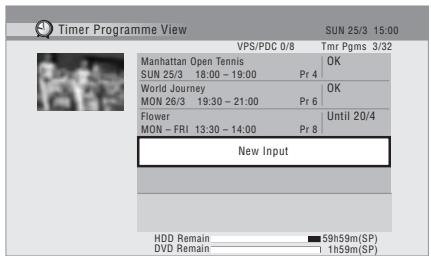
Each row is for one timer recording programme, with the date and time information, channel, recording mode, DVD or HDD and recording status.
- The amount of free space available on the HDD and the currently loaded recordable DVD is shown towards the bottom of the screen.
- In the upper-right corner, the number of timer programmes already set is shown next to Tmr Pgms.
- If there are more than five timer programmes already set, press NEXT to switch page (go back using the IPREV button).
- You can also delete a timer programme before it's started (before the recorder enters timer recording standby) by highlighting it and pressing CLEAR. See also Deleting a timer programme on page 58.
2 Highlight the timer programme you want to change.
If you want to set a new timer programme, select 'New Input' and skip to step 4.
Note
- You cannot set an EPG Link when recording mode is set to AUTO.
- You cannot change the CH, Date, Start, Stop, Extend and title name when you have EPG Link set to On.
- When you have EPG Link set to On and you set a timer recording for a programme that is divided into multiple parts, all parts of that programme are recorded automatically. In the programme list, the earliest part of the programme to be recorded has a red icon, with successive parts indicated by a gray icon. Data provided by the broadcaster determines which programmes are classified as divided programmes.
- In the programme list, the earliest programme to be recorded has a red icon, with successive programmes indicated by a gray icon.
- There is a limit to the number of programmes you can schedule to record with the Series Recording function.
Data provided by the broadcaster determines which programmes are classified as part of a series.
3 Press then select Modify from the command menu panel.
Alternatively, press ENTER.
The Timer Programme Set screen appears from which you can edit the settings.
4 Enter the timer recording settings.
Use the / buttons to select a field; use the / buttons to change the value. For more information on the options available at the Timer Programme Set screen, see Setting timer programmes on page 54.
5 After entering all the timer recording information, highlight 'Store Programme' and press ENTER.
The timer recording list screen is displayed again. The timer programme you just input appears in the list. The rightmost column shows various timer recording status messages:
- OK - Can be recorded.
- Time Over - Not enough space on the HDD (the recording won't finish).
Over 12h - Recording time of over 12 hours set (when recording to the HDD the recording will be split into two titles). - Overlap - Two timer programmes partially or completely overlap. The one starting earlier will take priority.
- Until ... (eg., Until 13/8) – For a regular recording, the last programme that could be recorded is shown.
- Data Over - Can't record because the disc management area of the disc is full.
- Cancel Once - A regular timer programme is set to skip.
- Can't Rec - Not possible to record.
- Title Over - Can't record because there is already the maximum number of titles on the disc (HDD: 999; DVD: 99).
-
Recording - The programme is currently recording.
-
Standby - The recorder is in timer recording standby.
- Valid Until ... (eg., Valid Until 13/8) (UK only) - When you have set to make a series recording of a programme that has no new scheduled broadcasts, the date displayed indicates the last day until which the scheduled programme settings remain valid. (If the programme is not broadcast for over 13 weeks, its settings are automatically deleted.)
- No Broadcast (UKonly) - Displays when a programme for which you had the EPG Link set to On does not record because the date of the scheduled recording has already passed.
- nothing displayed - Another timer recording or copying is in progress.
6 Press to exit the timer recording screen.

Note
- If you set a DVD timer recording but there is no recordable DVD disc loaded, or the disc loaded doesn't have enough free space for the complete recording, Recovery is shown. In this case (unless you load a suitable disc before the recording actually starts), the recorder will use the HDD for recording. (The message Can't Rec will appear if there are already 999 titles on the HDD or if there is not enough free space on the HDD for recording.)
- When you have EPG Link or Series Recording set to On, any changes in broadcast time or division of broadcasts are automatically accommodated for and your scheduled recordings are carried out without any additional settings. As a result, even when you have not scheduled programmes to record at the same time, changes in broadcasting schedules can cause scheduled recordings to overlap.
Using the digital electronic programme guide
Deleting a timer programme
You can delete timer programmes you no longer need.
1 TIMER REC Press TIMER REC.
2 Highlight the timer programme you want to erase.
3 Press then select 'Erase' from the command menu panel.
- Select Yes to confirm or No to cancel.
- You can also just press CLEAR when the timer programme is highlighted.
Skipping a regular timer programme
If you've set a regular daily or weekly timer programme, you can set the recorder to skip the next scheduled recording.
1 Press TIMER REC.
2 Highlight the timer programme you want to skip.
3 Press then select 'Cancel Once' from the command menu panel.
- In the timer programme list, Cancel Once appears by the programme.
- You can also just press II PAUSE when the timer programme is highlighted.
Checking for alternative broadcast times
(UK only)
You can check to see if a programme you have scheduled to record is airing at an alternative time slot1.
1 Press TIMER REC.
2 Highlight the timer programme you want to search.
3 Press then select 'Alternate Search' from the command menu panel.
- The search results are displayed. Choose the programme you would like to record and press either the RED button or ENTER to schedule a recording.
Searching for series
(UK only)
You can search for broadcasts of programmes of the same series as a programme you have scheduled to record1.
1 TIMER REC Press TIMER REC.
2 Highlight the timer programme you want to search.
3 Press then select 'Series Search' from the command menu panel.
- The search results are displayed. Choose the programme you would like to record and press either the RED button or ENTER to schedule a recording.
Searching for recommendations
(UK only)
You can search for recommended programmes generated from the content of the programmes you have scheduled to record1.
1 TIMER REC Press TIMER REC.
2 Highlight the timer programme you want to search.
3 Press then select 'Recommendation Search' from the command menu panel.
The search results are displayed. Choose the programme you would like to record and press either the RED button or ENTER to schedule a recording.
Other useful EPG functions
EPG Jump
1 Press GREEN when the Digital EPG screen (Programme List, Detailed Information or Search Result) is displayed.
2 In the 'Date' field select a date (within one week) to jump to.
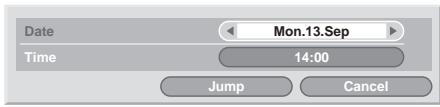
3 In the 'Time' field select a time of the day (0:00 to 23:00) to jump to.
4 SELECT 'Jump'.
The Programme List for the specified day and time is displayed.
EPG Search
1 Press YELLOW when the EPG screen (Programme List, Detailed Information or Search Result) is displayed.
2 In the 'Date' field select a date (within one week) to search in.
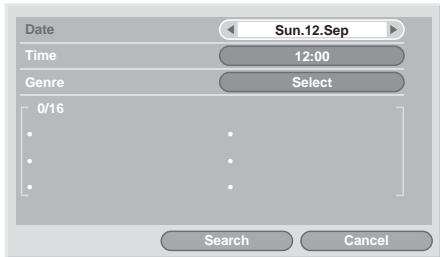
3 In the 'Time' field select the time of day (0:00 to 23:00) to search in.
4 In the 'Genre' field, select the genre to search for.
You can search for multiple genres by pressing ENTER after each genre.
5 SELECT 'OK'.
6 SELECT 'Search'.
The results of your search are displayed.
Series Search
(UK only)
1 Select a programme on the EPG screen (Programme List or Search Result).
2 INFO Press to display Detailed Information.
3 Press YELLOW.
Programmes of the same series as the selected programme are displayed at Search Result.
Chapter 7 Recording
About DVD recording
This recorder can record to DVD-R, DVD-RW, DVD+R, DVD+RW, DVD-RAM, DVD-R DL and DVD+R DL media.
DVD-R and DVD-RW discs can be initialized for Video mode or VR mode recording. Each has its advantages, and it depends on what you want to do with the recording which mode you choose.
If you want to edit your recordings in any significant way, VR mode offers greater possibilities for cutting, copying, and changing the way the video is presented.
Video mode is less flexible when it comes to editing, but it has the advantage that it is compatible with standard DVD players (many of which won't play VR mode discs1).
Once a disc is initialized for a particular mode, all recording on that disc will be in that mode.
DVD+RW discs can be initialized for +VR mode recording.
DVD-RAM discs can be initialized for VR mode recording.
DVD ^+ R discs do not require initializing.

Important
- The table below shows the maximum number of titles recordable per disc and the maximum number of chapters per title:
| Disc type/rec. format | Max. titles (per disc) | Max. chapters (per title) |
| DVD-R/-RW | 99 | 99 |
| Video mode | ||
| DVD-R/-RW/-RAM | 99 | 999*1 |
| VR mode | ||
| DVD+R/+RW | 49 | 99*2 |
1 A maximum of 999 chapters are recordable per disc.
2 A maximum of 254 chapters are recordable per disc.
- This recorder cannot play or record unfinalized DVD-R/-RW (Video mode) and DVD+R discs recorded on another recorder. DVD+RW discs recorded on another recorder are playable on this recorder but are not recordable.
- The maximum continuous recording time for one title is eight hours when using a DVD+R/+RW disc.
- If you delete a title from a DVD+R/+RW disc, the total number of recordable titles remaining may not increase.
- Although this recorder can record PAL, SECAM, NTSC and PAL-60, you can't mix multiple TV line systems on one disc. A disc can contain PAL and SECAM recordings, or NTSC and PAL-60. See also Additional information about the TV system settings on page 148.
- Fingersprints, dirt and small scratches on a disc can affect playback and/or recording performance. Please take proper care of your discs.
- If power to the recorder is cut (due to a power outage, the plug being pulled from the power outlet, etc.) during recording, editing, initializing, finalizing or other operation, some recorded material on the
disc, or the disc itself, may become unusable. In this case, try re-initializing the disc (DVD-RW only), or use a new disc. Pioneer is not responsible for lost recordings, damaged discs or other losses in these cases.
See also Disc/content format playback compatibility on page 7 for detailed disc compatibility information.
Recording to DVD-R DL/DVD+R DL discs
Recording to DVD-R DL/DVD+R DL discs is generally the same as recording to regular single-layer discs; however, please note the following points:
- When the recorder switches from the first layer to the second during recording a DVD-R DL (Video mode) disc, a new title is automatically started on the new layer.
- Up to 99 titles can be recorded on a DVD-R DL (Video mode) disc. If the 99th title is being recorded when the layer is switched, recording will stop.
- Up to 49 titles can be recorded on a DVD+R DL disc.
- You cannot play, record additional material to, edit or finalize a DVD-R DL or DVD+R DL disc that has been recorded on but not yet finalized on another DVD recorder.
About HDD recording
Recording to the hard disk drive (HDD) is very flexible; you have the full choice of recording quality options, including manual mode, and of course you can record, erase and re-record as many times as you like.
The capacity of the hard disk drive means that you can store many hours of video on it, even using the higher quality recording modes.

Important
- The maximum number of titles/chapters per title that can be recorded on the
HDD is 999 and 99 respectively. No more recording is possible on the HDD after the maximum number of titles has been reached.
- The maximum continuous recording time for one title is 12 hours.
- It is possible to record both PAL and NTSC titles on the HDD. Before recording, you need to make sure that the Input Line System setting (page 148) matches the TV line system of the source you're recording.
HDD Video mode compatibility
When recording to the HDD you can choose to record in one of two formats. Set the format from the HDD Recording Format item in the Initial Setup menu (see page 142).
When set to Video Mode On, high-speed copying from HDD to DVD-R/-RW (Video mode) or DVD+R/+RW is possible. When recording a bilingual broadcast, set which channel you want to record from the Initial Setup menu (see Bilingual Recording on page 139).
When HDD Recording Format is set to Video Mode Off, high-speed copying from HDD to DVD-R/-RW (Video mode) or DVD+R/+RW isn't possible. However, both channels of bilingual broadcasts are recorded and you can switch the audio on playback.
Recorded audio
In all modes except the LPCM mode, sound is recorded in two channels in the Dolby Digital format. (The sound can be recorded in the Dolby Digital 5.1-channel format only when video with Dolby Digital 5.1-channel audio is copied from an HDD camcorder.)
When set to LPCM, sound is recorded in high quality, uncompressed Linear PCM format.
If the broadcast audio is bilingual and you are recording to DVD-R/-RW (Video mode), DVD+R/+RW, or to the HDD with the HDD Recording Format set to Video Mode On, or
on the LPCM setting, use the Bilingual Recording setting (page 139) to select the A/L or B/R audio channel to record before recording starts. In other cases, both channels of a bilingual broadcast will be recorded and you can switch on playback.
Restrictions on video recording
You cannot record copy-protected video using this recorder. Copy-protected video includes DVD-Video discs and some satellite broadcasts. If copy-protected material is encountered during a recording, recording will pause automatically and an error message will be displayed on-screen.
Video that is 'copy-once only' can only be recorded to DVD-RAM or HDD, CPRM-compatible VR mode DVD-R/-RW (see below).
When recording a TV broadcast or through an external input, you can display copy control information on screen (see Displaying disc information on-screen on page 85).
CPRM
CPRM is a copy protection/scrambling system developed for the recording of 'copy once' broadcast programmes. CPRM stands for Content Protection for Recordable Media.
This recorder is CPRM compatible, which means that you can record copy-once broadcast programmes, but you cannot then make a copy of those recordings. CPRM recordings can only be made on CPRM-compatible DVD-R (ver. 2.0/8x or higher) or DVD-RW (ver. 1.1 or higher) discs formatted in VR mode, DVD-RAM discs or on the HDD.
DVD CPRM recordings can only be played on players that are specifically compatible with CPRM.
Recording equipment and copyright
Recording equipment should be used only for lawful copying. You are advised to check carefully what constitutes lawful copying in the country in which you are making a copy. Copying of copyrighted material such as films or music is unlawful unless permitted by a legal exception or consented to by the rightowners.
This product incorporates copyright protection technology that is protected by method claims of certain U.S. patents and other intellectual property rights owned by Macrovision Corporation and other rights owners. Use of this copyright protection technology must be authorized by Macrovision Corporation, and is intended for home and other limited viewing uses only unless otherwise authorized by Macrovision Corporation. Reverse engineering or disassembly is prohibited.
Using the built-in A.TV and D.TV tuners
Switching between A.TV and D.TV tuners
- A.TV/D.TV Press to switch between D.TV (digital) and A.TV (analog).
Changing channels
There are a number of ways to select analog and digital TV channels. Note that you can't change the TV channel during playback, recording or during recording standby.

CHANNEL + / - buttons
Number buttons
For example, to select channel 4 (digital channel D004), press 4 then ENTER; for channel 34 (digital channel D034), press 3, 4, ENTER.
- CH +/- buttons on the front panel.
- For D.TV channels only, you can also use the Channel List — see below.

Tip
- When changing terrestrial digital broadcast channels, channels with a low signal strength may result in a black screen being displayed.
- For other channels, it may take a short while for the channel picture to appear, and/or for the channel number to appear.
- In both of the above cases, some improvement may be possible by adjusting the antenna.
Using the D.TV Channel List
When in D.TV mode, you can call up the on-screen Channel List anytime by pressing ENTER. Use the / buttons to select a channel, then press ENTER to switch to that channel.2
Displaying a channel banner
A channel banner shows programme titles, start and end times of the current programme and other channel information. The information is updated every minute.
- Press to display the channel banner for the current channel.
| D001 | Wed.30 Apr 12:46 |
| Now | 11:30-12:00 |
| Next | 12:00-12:30 |
- Use the / buttons to display the channel banner for other channels. To switch to the displayed banner's channel, press ENTER.
- The channel banner displays the Subtitles (☑) and Teletext/MHEG (☑) icon if they apply to the selected channel.3
- To see more detailed channel information, press INFO again.4
Use the / buttons to display information about previous and following programmes. Use the / buttons to see information about other channels.
- If there is still more information to be displayed, More ... is displayed; press the BLUE button to see the extra information.
- To hide the channel banner, press RETURN/EXIT.
Changing D.TV audio languages
- Press to display the current audio language. Press repeatedly to change it to other available languages.
Changing D.TV subtitle languages
- Subtitle Press to display the current subtitle language. Press repeatedly to change it to other available languages.

Note
1 Analog channel presets are numbered 1 to 99; digital channel presets are numbered D001 to D999.
2. If you select a locked channel, you will need to enter your password to access it.
While listening to D.TV radio channels, the screen saver automatically starts after no button has been pressed for three minutes.
3 Due to inaccurate information provided by the broadcaster, some icons may occasionally be present or absent in error.
4 Not all channels supply more detailed information.
Using the MHEG application
(UK only)
Some stations bring you programmes with the MHEG (Multimedia and Hypermedia Expert Group) application encoded, letting you experience D.TV interactively.
The channel banner displays an icon ( 值 ) to indicate that the MHEG application can be run.


Press to start the MHEG
application.
- You can also use any of the colour buttons.
- Press TEXT to quit the MHEG application.
Viewing Teletext
(European countries except the UK)
You can view the Teletext that comes simultaneously with certain programmes.


Press to display the Teletext.
- You can also use any of the colour buttons.
- Press the TEXT button again to hide the Teletext screen.
Changing A.TV audio channels
You can change the audio channel of the broadcast or external input signal.


Press to change the audio type.
The current audio channel is displayed on-screen.
- If the NICAM audio setting (see NICAM Select on page 138) is set to NICAM and you are watching a NICAM broadcast, you can switch between NICAM and Regular (non-NICAM) audio.

- If the NICAM broadcast is bilingual, you can also select the language.
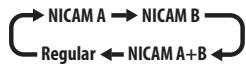
- You can also select the language for a non-NICAM bilingual broadcast.

- When watching a recording made from an external input with Bilingual recording selected (see External Audio on page 138), you can switch the audio channel between left (L), right (R) or both (L + R)


Note
- When recording to the HDD with HDD Recording Format set to Video Mode On, to DVD-R/-RW (Video mode), to DVD+R/+RW, or on the LPCM setting, only one channel of a bilingual broadcast is recorded. In this case, decide which language you want to record before recording by setting the Bilingual Recording setting (see Bilingual Recording on page 139).

Note
1 If you start recording while the MHEG application is running, the MHEG application screen will also be recorded.
To avoid this, quit the application first, then start recording. It is not possible to start the MHEG application while
recording is in progress.
Switching between TV and DVD
When the recorder is stopped or recording you can choose whether to have the audio/video from the built-in TV tuner (or external input) play on your TV ('DVD mode'), or watch the channel that the TV is currently set to ('TV mode').
During playback or when a menu is being displayed on-screen, the sound and video is always routed to your TV and is unaffected by the TV/DVD mode setting.
Note that the recorder must be connected to your TV using a SCART cable to be able to use this feature.

Switch between TV mode and DVD mode.
Setting the picture quality/ recording time
DVD (VR) DVD (Video) DVD+R DVD+RW DVD-RAM HDD
Before starting a recording, you will usually want to set the picture quality/recording time. There are six standard settings available, which allow you to choose a balance between picture quality and recording time.
When Manual Recording is set to On (see Manual Recording on page 141), a further option will be available (MN1 to MN32,
LPCM, or XP+ (a super-high quality HDD recording mode that features a transfer rate of around 15 Mbps) depending on what you set).
When recording to DVD, MN32 is the highest recording quality available. If you select XP+, the recording mode will automatically revert to MN32.
When recording to DVD +R / + RW SLP is the longest recording time available. If you select SEP or MN1 to MN3, the recording mode will automatically revert to SLP.
- Press repeatedly to select the recording quality.
- XP - High quality setting, gives about one hour of recording time on a DVD disc.
- SP (Standard Play) - Default quality, used for most applications, gives about two hours of recording time on a DVD.
- LP (Long Play) – Lower video quality than SP, but doubles the recording time on a DVD to about four hours.
- EP (Extended Play) - Lower quality than LP, but gives about six hours of recording time on a DVD disc.
- SLP (Super Long Play) – Lower quality than EP, but gives about eight hours of recording time on a DVD disc.
- SEP (Super Extended Play) - Lowest video quality but gives about ten hours of recording time on a DVD disc.
- MN1 to MN32/LPCM ^1 /XP ^2 - Manual/ Linear PCM/XP + (available only when manual recording is on).
The setting is indicated in the front panel display, and shown on-screen together with the recording time for a blank recordable disc. If a recordable disc is loaded, the approximate remaining recording time for that disc is also shown. (Note that if the On Screen Display setting (see On Screen Display on page 145) is Off then this information is not displayed.)

Note
1 Audio is recorded in 16-bit Linear PCM format, video is recorded at XP quality. When recording a bilingual broadcast, select which audio channel to record (see Bilingual Recording on page 139).
2 Applicable only to HDD recording. (If this setting is used when recording to DVD, MN32 is used.) When copied to DVD, XP+ recordings are always copied in real time.
Basic recording from the TV
DVD (VR) DVD (Video) DVD+R DVD+RW DVD-RAM HDD
Basic recording from the TV involves just setting the channel to record, choosing whether to record to the HDD or a DVD and selecting the recording quality.
1 HDB Dvd Select the HDD or DVD for recording.
- If you're recording to DVD, load a recordable disc (if you load a new blank DVD-RW or DVD+RW disc, the recorder takes a short while to initialize the disc).
- If you want to record a VR mode DVD-R or a Video mode DVD-RW, you must initialize it before proceeding (see Initializing recordable DVD discs on page 73).
2 Press to switch between D.TV (digital) and A.TV (analog).
3 Select a TV channel to record.
The front panel display shows the channel number, or channel name if it's available:
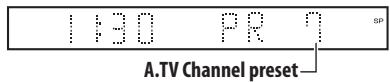
- While the recorder is stopped, you can also use the number buttons on the remote to select the channel (For channel 24, press 2, 4 then ENTER).
- If the recorder is stopped, you can also use the CH + / - buttons on the front panel to select the channel number.
4 Set the picture quality/recording time.
- See Setting the picture quality/recording time on page 65 for detailed instructions.
5 If you're recording from the A.TV tuner, select the audio channel to record.
See Changing A.TV audio channels on page 64 for more on this.
- When recording in VR mode (DVD) or with HDD Recording Format set to Video Mode Off (HDD), if a broadcast is bilingual, both audio channels are recorded, allowing you to switch the audio channel on playback. The only exception to this is when the picture quality is set to LPCM, in which case you do need to select the audio channel before recording.
6 If you're recording from the D.TV tuner, select the audio language to record.
- You may also be able to set which subtitle language to record; use SUBTITLE to select.
Note that audio and subtitle languages cannot be changed during the recording of a digital broadcast.
7 Start recording.
If you want to set a recording end time, press the REC button repeatedly. The recording time increases in 30 minute increments, up to a maximum of six hours. The time the recording will end is shown on-screen and in the front panel display. When the recording ends, the recorder automatically switches into standby if no other operation is being performed.
- To cancel the set recording time, press REC.
- If you want to pause recording at any time ^1 , press II PAUSE. Press again to restart the recording (If recording to the HDD, DVD-RAM or DVD-R/-RW (VR mode), a new chapter is started after recording restarts).
8
STOPREC

Press to stop recording.
- If you set the recording time in the previous step, you can still stop the recording anytime by pressing STOPREC.
- Recording will stop automatically when there is no more space on the HDD/DVD, or after 12 hours of HDD recording (whichever is sooner).

Tip
- During recording you can turn on/off the SCART loop through function. During recording, press the front panel CH + button to switch to SCART THRU (loop through on), or CH - to switch to SCART NORM (loop through off). Loop through is automatically reset to off after recording has finished. Note that you can't switch loop through on if recording from the AV1 (RGB)-TV connector.
Pause Live TV
HDD
The Pause Live TV feature lets you effectively pause a TV programme you're watching. When you're ready to resume watching, just press the PLAY button.
Setting up for Pause Live TV
You can use the Pause Live TV feature with an AV Link-compatible TV connected using a SCART cable (see TV tuner setup for Pause Live TV below), or using this recorder's internal tuner (see Using the recorder's internal tuner for Pause Live TV on page 68).
TV tuner setup for Pause Live TV
To use this feature with an external TV tuner, the recorder must be connected to your TV using a SCART cable, and the AV. Link setting (page 145) should be set to This Recorder Only. See also Pause Live TV on page 146 for more on this.
In order to use Pause Live TV, make the following connections and settings.
- Pause Live TV will not work as expected when watching TV via an external component such as a VCR or digital tuner. It only works with the channel selected on the TV.

Important
- Pause Live TV only works with the built-in A.TV (analog) tuner. It does not work with the D.TV tuner or the external inputs. Make sure the Auto Channel Setting is set to Download from TV (see Auto Channel Setting on page 136).
1 Connect this recorder to your TV with a SCART cable.
2 Press HOME MENU.
3 Select 'Setup' > 'Initial Setup' > 'Options2' > 'Pause Live TV' > 'TV's Tuner'.
4 Select 'Setup' > 'Initial Setup' > 'Analog Tuner' > 'Auto Channel Setting' > 'Download from TV'.
- If the Download from TV option appears grayed out, check the connections to your TV and try again.
Depending on your TV, you might have to switch off and unplug it for a few moments before plugging it back in and switching it on again.
5 Follow the on-screen instructions.

Note
1 - Not all TVs support this feature. Check the instructions that came with your TV if you are unsure.
- This feature will not work unless your TV is compatible with AV Link. See the operating instructions that came with your TV if you're unsure about your TV's compatibility with this feature.
Using the recorder's internal tuner for Pause Live TV
If you haven't connected to your TV using a SCART cable (or your TV is not compatible with AV Link) you can use the recorder's internal tuner for the Pause Live TV.
1 Press HOME MENU.
2 Select 'Setup' > 'Initial Setup' > 'Options2' > 'Pause Live TV' > 'Recorder's Tuner'.
See Pause Live TV on page 146 to do this.
You can record the channel selected on the recorder.
Using Pause Live TV
1 PAUSE LIVE TV Start recording the current TV channel.
Recording continues with playback paused.
Note that it may take up to 10 seconds for recording to start.
2 Press to start playback.
You can also use the scan buttons (▲/▶), pause (II PAUSE) and stop (■ STOP)
all without affecting the recording.
Operation table
3 Press to stop the recording.
The operation is slightly different depending on the viewing source. See the Operation table below for details.

Tip
- When the Pause Live TV setting (see page 146) is set to TV's Tuner, you can press PAUSE LIVE TV while the recorder is in standby to switch on and immediately start recording. When set to Recorder's Tuner, it is not possible to use the Pause Live TV feature from standby.
After pressing PAUSE LIVE TV, it will take at least 10 seconds for the picture to change (during this time, all controls except the power button are inoperative). (Note that startup from standby is not possible if you have selected Recorder's Tuner in Pause Live TV on page 146.) - Please note that you can't record from another component (VCR, etc.) that is connected by a SCART cable to the AV2 (INPUT 1/DECODER) connector using the Pause Live TV feature.
| Viewing source | TV/DVD mode of DVR | DVR source | Pause Live TV function button | Condition |
| TV built-in analog tuner | TV | - | Pause Live TV | Preset channel of DVR and TV are matched after downloading from TV. |
| Direct TV recording*1 | Preset channel of DVR and TV are NOT matched after downloading from TV. Record TV programme that you're watching. | |||
| TV built-in digital tuner | TV | - | Direct TV recording*1 | Preset channel info. in D.TV cannot be shared by DVR even after Download from TV. Record TV programme that you're watching. |
| External input of TV | TV | - | Direct TV recording*1 | Record TV programme that you're watching. |
| DVR built-in analog tuner | DVD | DVR built-in analog tuner | Pause Live TV | |
| DVR built-in digital tuner | DVD | DVR built-in digital tuner | Pause Live TV |
*1 No Chase Play! Warning if you change input this will stop the recording.
About timer recordings
DVD (VR) DVD (Video) DVD+R DVD+RW DVD-RAM HDD
Using the timer recording features you can program up to 32 timer recordings up to a month in advance. Timer recording programmes can be set to record just once, every day, or every week.
You can set the recording quality for your timer recording in the same way as for a regular recording, but with the added option of an AUTO mode, which maximizes the recording quality for the space available on the disc (if recording to DVD), or to fit on to a blank DVD disc (if recording to the HDD).
You can set timer recordings to record to a recordable DVD or to the hard disk drive. For regular (daily or weekly) HDD timer recordings that you don't need to keep, you can use the Auto Replace Recording feature to automatically replace the previous timer recording with the new one. Note that when you use this feature, the previous recording made on that timer programme will be replaced by the next one, regardless of whether you have watched it yet or not.
You can also set the recorder so that it will adjust the recording quality to try and fit the recording on to the disc if it would not otherwise fit at the recording quality you set (see Optimized Rec on page 141 for more on this).
Finally, if you set a timer recording to record to DVD but there isn't a recordable DVD loaded at the time of the recording, the Recovery Recording feature will automatically record the programme to the HDD for you.
This recorder is compatible with VPS (Video Programming System) and PDC (Programme Delivery Control) systems used by many analog TV stations to ensure that a timer recording catches the whole programme even when the programme is not running to schedule. Up to eight timer programmes can be set with VPS/PDC on.

Important
- A timer recording can't be set if there are already 32 timer programmes waiting to be recorded.
- Timer recording will not start if:
- The recorder is already recording.
- A disc is being initialized, finalized or unfinalized.
- Timer recording will start when the operation preventing timer recording has finished.
- When the front panel display is set to ON, the timer indicator (⊙) lights in the front panel display when the timer is active. If the indicator is blinking it means that (for a DVD timer recording) there is no disc loaded, or the disc loaded is not recordable (for an HDD timer recording it means that the HDD is not recordable).
- Approximately two minutes before a timer recording is set to start, the recorder will go into timer recording standby. In timer recording standby you cannot use some functions.
- The maximum length for timer recordings made to the HDD is 24 hours. However, because one title (HDD) is limited to 12 hours, recordings over 12 hours will be spread over two titles. Note that there will be a break in the recording of a few seconds between titles.
- When a scheduled recording finishes, this unit's power is not turned off if the power for the Flat Screen TV is on. If you want this unit's power to turn off after a timer recording finishes, set the HDMI Control to Off (page 145).
- If you set the timer recording to use VPS/PDC, set this unit's HDMI Control to Off (page 145).
VPS/PDC works only with analog stations; it does not work with digital TV stations.
VPS/PDC may not work with all broadcast stations in your country/area. Check with the stations for compatibility.
- The hours between 3:00 and 5:00 in the morning are used by the GUIDE Plus+ system to download programme information. During these times, VPS/PDC may not work reliably; leave VPS/PDC off if you set a timer recording for these times.
- Timer recordings with VPS/PDC set to On are not performed for the period between 20 minutes before the start time of timer recordings for which EPG Link is set to On until the such recordings are completed (page 56).
- If VPS/PDC is active for two timer programmes that are programmed to start at the same time, then the programme that actually starts first takes priority.
Extending a timer recording in progress
You can extend a timer recording beyond the programmed end time. This can be useful if a broadcast programme overruns, for example.
Cancelling or extending the timer
1 Press and hold for three seconds during a timer recording.
Recording continues, but the timer indicator disappears from the front panel display indicating that the timer has been cancelled.
2 Press repeatedly to extend recording in 30 minute blocks.
Stopping a timer recording
1 STOPREC Press during a timer recording.
2 SELECT 'Yes' to confirm.
Preventing use of the recorder before a timer recording (child lock)
You can make all the front panel and remote control buttons inoperative using the child lock feature. This is useful when you set a timer recording and want to make sure that the timer settings are not changed before recording has finished.
1 If the recorder is on, switch it into standby.
2 [Front panel] Press and hold for three seconds to lock the controls.
The front panel display briefly shows LOCKED. If any buttons are pressed on the remote or front panel, LOCKED is briefly displayed again.
- To unlock the recorder, press and hold (Stop) on the front panel (while the recorder is stopped) for three seconds until the display shows UNLOCKED.
- Even if you make child lock settings, this unit can still be controlled by the remote of a connected Flat Screen TV. If you do not want this unit to be able to be controlled by another component when you have set a child lock, turn this unit's HDMI Control to Off (page 145).
Timer recording FAQ

Frequently Asked Questions
- Even though the timer is set, the recorder doesn't start recording!
Check that the disc loaded or HDD is recordable, not locked (see Lock Disc on page 128), and that there are fewer than 99/999 titles already on the DVD/HDD. -
The recorder won't let me enter a timer programme! Why not?
You can't enter a timer programme if the clock isn't set. -
What happens when two or more timer programmes overlap?
Basically, the programme with the earlier recording start time has priority. However, the recorder will start recording the programme with the later start time after the earlier programme is finished. If schedule to record two programmes have the same times (but different channels, for example), then only one of the two programmes will be recorded. In this event you should cancel the scheduled recording of the lesser important programme. If one of the overlapping programmes is a regular timer programme, you may choose
'Cancel Once' in order to avoid having it overlap with a separately scheduled programme (see Skipping a regular timer programme on page 58).
Simultaneous recording and playback (Chase Play)
HDD
Chase Play allows you to watch a recording that is still in progress from the start, without having to wait until the recording has finished (i.e., playback is 'chasing' the recording).
In fact, you're not just limited to watching the recording in progress. You can watch anything else already on the HDD (or on a DVD if you're recording to the HDD) by selecting it from the Disc Navigator screen (see Using the Disc Navigator with recordable discs and the HDD on page 79).
Chase Play is not possible when DV is the recording input.
Press during recording to stick from the beginning of the recording.
Press during recording to select another title to play.
You can use all the usual playback controls, such as pause, slow-motion play, scan and skip.
- To stop playback, press STOP (recording will continue).
- To stop recording, press STOP RECR (playback will continue).
- During recording or in timer recording standby, you can't play an HDD title, DVD, DivX title or Video CD/Super VCD disc if the Input Line System setting doesn't match the TV line system of the disc/DivX title/HDD title (see also Additional information about the TV system settings on page 148). Also, during simultaneous recording and playback, if the TV line system of the playback track/title changes then playback will automatically stop.
Recording from an external component
DVD (VR) DVD (Video) DVD+R DVD+RW DVD-RAM HDD
You can record from an external component, such as a camcorder or VCR, connected to one of the recorder's external inputs.
1 Make sure that the component you want to record from is connected properly to the HDD/DVD recorder.
See Chapter 2 (page 14) for connection options.
2 Press repeatedly to select one of the external inputs to record from.
The current input is shown on-screen and in the front panel display:
AV2/L1-Input 1
L2-Input 2(front panel)
L3-Input 3

Note
1 You can't start playback immediately after recording starts. Simultaneous playback and recording doesn't work while copying or backing up.
2 This cannot be selected if AV2/L1 In is set to Decoder (see AV2/L1 In on page 138).
Check that the Audio In settings for External Audio and Bilingual Recording are as you want them (see Audio In on page 138).
- If the aspect ratio is distorted (squashed or stretched), adjust on the source component or your TV before recording.
- To watch video coming in via the DV input (front panel), select DV/HDD-Cam > DV Video Playback from the Home Menu (see also Playing from a DV camcorder on page 86).
3 REc MODE Set the recording quality.
- See Setting the picture quality/recording time on page 65 for detailed information.
4 HDD DVD Select the HDD or DVD for recording.
5 Press to start recording.
If your source is copy-protected using Copy Guard, you will not be able to record it. See Restrictions on video recording on page 62 for more details.
Playing your recordings on other DVD players
DVD (VR) DVD (Video) DVD+R DVD+RW DVD-RAM
Most regular DVD players can play finalized discs recorded in DVD-R/RW (Video mode) and DVD+R discs. A number of players (including many Pioneer models) can also play DVD-RW discs recorded in VR mode, finalized or not. Most players will not play VR mode DVD-R discs, although some DVD-ROM drives and DVD recorders may be able to (finalization might be necessary). DVD-RAM discs can only be played on DVD-RAM compatible players. Check the manual that came with the player to check what kinds of discs it will play.
When you finalize a DVD-R/-RW (Video mode) or DVD+R disc, a title menu is created from which you can select titles when you play the disc. There are a number of different styles of title menu to choose from to suit the content of the disc.
All the title menus are navigated in the usual way, pressing MENU or TOP MENU to display the menu, then using the / / / followed by ENTER to select titles and start playback.
Finalizing a disc
DVD (VR) DVD (Video) DVD+R DVD+RW
Finalizing 'fixes' the recordings on the disc so that it can be played on a regular DVD player or computer equipped with a suitable DVD-ROM drive.
Note that the disc name will appear in the title menu after you finalize a disc. Make sure the disc name is as you want it before you finalize the disc as it can't be changed afterwards. If you want to rename the disc, see Input Disc Name on page 128 before starting the steps below.
DVD+RW discs don't generally need finalizing. However, if you want a title menu to appear when you play the disc, then you will need to finalize. When using a DVD+RW, you can still record and edit even after finalizing, although the title menu will disappear if you do so. Finalize the disc again to generate a new title menu.

Important
- Once you've finalized a DVD-R/-RW (Video mode) or DVD+R disc, you can't edit or record anything else on that disc. However, the finalization on a DVD-RW disc maybe 'undone'; see Undo Finalize on page 129 for how to do this.
- A VR mode DVD-R/-RW (excluding DVD-R DL) disc can still be recorded and

Note
If the TV line system of the disc is different to the current setting of the recorder, you will not be able to finalize the disc. See Additional information about the TV system settings on page 148 for how to change the recorder's setting.
Recording
edited on this recorder even after finalizing.
DVD-R DL (Video mode) discs and DVD + DL discs must be finalized in order to play in other recorders/players. Note however that some recorders/ players will not play even finalized duallayer discs.
1 Load the disc you want to finalize.
Make sure that the recorder is stopped before proceeding.
2 2 Display the Home Menu.
3 SELECT 'Setup' > 'Disc Setup'.
4 Select 'Finalize' > 'Finalize' > 'Next Screen'.
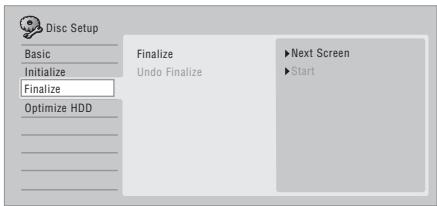
5 For DVD-R/-RW (Video mode) and DVD+R/+RW discs only, select a title menu style, then select 'Yes' to start finalization or 'No' to cancel.
The menu you select will be the one that appears when the 'top menu' (or 'menu' for a DVD+R/+RW) is selected on any DVD player.
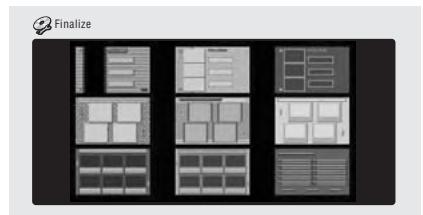
- Discs recorded partially or fully on the Pioneer DVR-7000 DVD recorder do not support this feature. These discs will have only a text title menu when finalized on this recorder.
6 The recorder will now start finalizing the disc.
During finalization:
- If the finalization process of a DVD-R/ -RW disc is going to take more than around four minutes, you can press ENTER to cancel. Around four minutes before completion, the option to cancel disappears.
- You can't cancel the finalization of a DVD +R / + RW disc.
- How long finalization takes depends on the type of disc, how much is recorded on the disc and the number of titles on the disc. A disc recorded in VR mode can take up to one hour to finalize. DVD-R/ -RW (Video mode) and DVD+R/+RW discs can take up to 20 minutes.
Initializing recordable DVD discs
DVD-R DVD-RW DVD+RW DVD-RAM
DVD-R/-RW discs can be initialized for either Video mode recording or VR mode recording.
When you first load a blank DVD-RW or DVD+RW disc, the recorder initializes it for recording automatically. By default, blank DVD-RW discs are initialized for VR mode recording. See DVD-RW Auto Initialize on page 74 if you want to change the default to Video mode.
DVD-R discs are ready for Video mode recordings out of the box; if you want to use a DVD-R for VR mode recording, you must initialize it before recording anything on the disc.
DVD+RW and DVD-RAM discs can also be initialized in order to erase the contents of the disc.

Important
- Initializing a DVD-RW, DVD+RW or DVD-RAM disc will erase everything recorded on it. Make sure there is nothing on the disc that you want to keep!
- You may not be able to re-initialize a DVD-RW disc in a different format if it was originally initialized on an older DVD recorder.
- Once initialized for VR mode recording, you can't re-initialize a DVD-R back to Video mode.
1 Display the Home Menu.


Select 'Setup' > 'Disc Setup'.
3 SELECT 'Initialize' > 'Video Mode', 'VR Mode' or 'Initialize DVD+RW'.
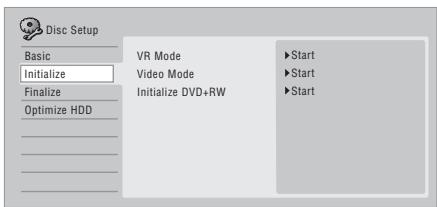
4 SELECT 'Start'.
It takes about 30 seconds to initialize the disc (except DVD-RAM discs, which can take up to an hour).
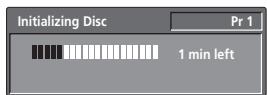
DVD-RW Auto Initialize
DVD-RW
- Default setting: VR Mode
Initialization mode is automatically carried out when you insert a blank DVD-RW. You must set the desired initialization mode before inserting a disc.
1 Display the Home Menu.
2 Select 'Setup' > 'Disc Setup'.
3 Select 'Basic'>DVD-RW Auto Init.', then 'VR Mode' or 'Video Mode'.

Disc Setup
Basic
Initialize
Finalize
Optimize HDD
Input Disc Name
Lock Disc
DVD-RW Auto Init.
□VRMode
Video Mode
Chapter 8 Playback
Introduction
Most of the features described in this chapter make use of on-screen displa
Navigate these using the cursor buttons and ENTER. To go back one level from any screen, use the RETURN/EXIT button.
Remember also that the button guide at the bottom of every screen shows which buttons do what.
Many of the functions covered in this chapter apply to the HDD, DVD discs, Video CDs, Super VCDs, WMA/MP3/DivX discs and CDs, although the exact operation of some varies slightly with the kind of disc loaded.
- Many functions are not available when a Video CD is playing in PBC mode. Start playback from the Disc Navigator screen for non-PBC playback (see Using the Disc Navigator with playback-only discs on page 80).
- For discs that contain JPEG picture files, see Playing and copying photos (PhotoViewer) on page 117.
Basic playback
ALL
This section shows you how to use your recorder for playback of discs (DVD, CD, etc.), and for playback of video from the HDD.

Important
- Throughout this manual, the term 'DVD' means any kind of playable or recordable DVD. If a function is specific to a particular kind of DVD disc, it is specified.
- Some DVD-Video, DVD+R and DVD+RW discs don't allow certain
playback controls to operate at certain points in the disc. This is not a malfunction.
1 HDB Dvd Select the HDD or DVD for playback.
- If playing video from the HDD, skip to step 3 below.
2 Load a disc.
Load a disc with the label side facing up, using the disc tray guide to align the disc (if you're loading a double-sided DVD-Video disc, load it with the side you want to play face down).
If you want to play a DTS Audio CD, please first read the note on page 77.
3 Start playback.
- If you're playing a DVD-Video or Video CD, a disc menu may appear when you start playback. Use the / / / buttons, number buttons, and ENTER to navigate DVD disc menus, and the number buttons and ENTER for Video CD menus.
- When playing video from the HDD, playback will automatically stop after the end of a title is reached.
- There may be a slight pause when playback switches from the first to the second layer of a dual-layer disc.
See the following sections for more details on playing specific kinds of discs.
4 Press to stop playback.
5 When you've finished using the recorder, eject the disc and switch the recorder back into standby.
Playing DVD discs
The table below shows the basic playback controls for DVD-Video, and recordable DVD discs.

Press to start playback.
If RESUME is displayed on-screen, playback starts from the place last stopped.

Press to stop playback.
You can resume playback from the same point by pressing
▶ PLAY. (Press ■ STOP again to cancel the resume function.)

Pauses playback, or restarts playback when paused.

Press to start scanning. Press repeatedly to increase the scanning speed.


Press to skip to previous/next chapter/title. (During playback you can also use the front panel CH +/- buttons.)
DVD +R / DVD + RW only:
PREV may not always skip to the previous title.
Except VR mode: During playback, enter a chapter number then press ENTER to skip directly to that chapter within the currently playing title.
On some discs, you can also use the number buttons to select numbered items in the disc menu.
VR mode only: During playback, enter a title number then press ENTER.
All: Press CLEAR to clear a number entry and start again.

(Commercial back/skip) Each press skips backward/forward progressively up to a maximum of two hours in either direction.


While paused, press and hold to start slow-motion playback. Press repeatedly to change the playback speed.
While paused, press to advance a single frame in either direction.

TOP MENU

Press to display the menu of a DVD-Video disc. (DVD+R/+RW discs finalized on this recorder will display the Disc Navigator. Press MENU to display the disc menu.)

Use the cursor buttons to navigate DVD-Video disc menus; press ENTER to select items.

EXIT
Press to return to the previous level of a DVD-Video disc menu.
Playing from the HDD
The table below shows the basic playback controls when playing video recorded on the hard disk (HDD).

Press to start playback.
If RESUME is displayed on-screen, playback starts from the place last stopped. Playback automatically stops after the end of a title is reached.

Press to stop playback.
You can resume playback from the same point by pressing
▶ PLAY. (Press ■ STOP again to cancel the resume function.)

Pauses playback, or restarts playback when paused.

Press to start scanning. Press repeatedly to increase the scanning speed.


Press to skip to previous/next chapter/title. (During playback you can also use the front panel CH +/- buttons.)
During playback, enter a title number then press ENTER to skip directly to that title.
Press CLEAR to clear a number entry and start again.


(Commercial back/skip) Each press skips backward/forward progressively up to a maximum of two hours in either direction.


While paused, press and hold to start slow-motion playback. Press repeatedly to change the playback speed. While paused, press to advance a single frame in either direction.
Playing Audio CDs and WMA/MP3 discs
The table below shows the basic playback controls for Audio CDs1, and WMA/MP3 files.

Press to start playback.
STOP

Press to stop playback.

Pauses playback, or restarts playback when paused.


Press to start scanning. Press again to increase the scanning speed. (There are two scan speeds; the current scan speed is shown on-screen.)


ess to skip to previous/nextck.
Playing Video CDs/Super VCDs
The table below shows the basic playback controls for Video CDs/Super VCDs.
Some discs featurePlayback Control (PBC for short) menus. These discs show PBC in the display when you load them and display a menu on-screen from where you can select what to watch.2

Press to start playback. Video CD only: If RESUME is displayed on-screen, playback starts from the place last stopped.

Press to stop playback. Video CD only: You can resume playback from the same point by pressing PLAY. (Press STOP again to cancel the resume function.)

Pauses playback, or restarts playback when paused.

Press to start scanning. Press repeatedly to increase the scanning speed.


Press to skip to previous/next track.
When a PBC menu is displayed, press to display the previous/ next page. (During playback you can also use the front panel CH + / - buttons.)

Note
1 If you want to play a DTS Audio CD, make sure the recorder is connected to a DTS-compatible amp/receiver with a digital connection. Noise will be output through the analog outputs. Also make sure that STEREO is selected using the AUDIO button (see Switching audio channels on page 84).
2 When playing in PBC mode, some playback features, such as search, repeat and programme play are not available. You can play a PBC Video CD/Super VCD in non-PBC mode by starting playback using the Disc Navigator (see Using the Disc Navigator with playback-only discs on page 80).
| During playback, enter a track number then press ENTER to skip directly to that track. Press CLEAR to clear a number entry and start again. While a PBC menu screen is displayed, use to select numbered menu items. | |
| CM BACK | Video CD in non-PBC mode only: (Commercial back/skip) Each press skips backward/forward progressively up to a maximum of two hours in either direction. |
| CM SKIP | |
| While paused, press and hold to start slow-motion playback. Press repeatedly to change the playback speed (forward only). While paused, press to advance a single frame (forward only). | |
| Return | Press to display the disc menu of a Video CD/Super VCD playing in PBC mode. |
| Audio to display the playback audio type; press repeatedly to change the playback audio type. | |
| SUBTITLE | Press to display subtitle information; press repeatedly to change subtitles. |
Using the Disc Navigator to browse the contents of a disc
Use the Disc Navigator to browse the contents of a disc and start playback.
Using the Disc Navigator with recordable discs and the HDD
DVD-R DVD-RW DVD+R DVD+RW DVD-RAM HDD
You can use the Disc Navigator to browse and edit video on recordable DVDs and the HDD, and to view information on titles.
See also Editing on page 90 for more on editing recordable discs.
1 HDB Dv Select the HDD or DVD.
2 DISC NAVIGATOR Open the Disc Navigator.
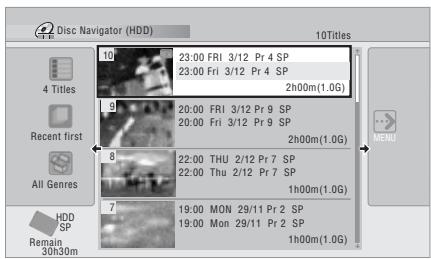
- You can also access the Disc Navigator from the Home Menu.
3 Browse the list of titles.
- Use the 一 一 P R E V / 一 I N E X T buttons to display the previous/next page of titles.
- To change the thumbnail picture displayed for a title see Set Thumbnail on page 94.
- For HDD recordings, you should be able to see a thumbnail title digest. If it doesn't display, set Set Preview to Normal. See Set Preview on page 145.
- Titles on the HDD marked with a NEW icon are recently recorded titles that haven't yet been played.
4 _ENTER^(ENTERT) Play the highlighted title.
- Press , then you can also select Play from the command menu panel.
Changing the display style of the Disc Navigator
You can choose to display titles in the Disc Navigator in various different ways, sorted alphabetically, by recording date, by genre, and so on. You can also choose whether to display four or eight titles on the screen at the same time.
1 Display the view options panel.
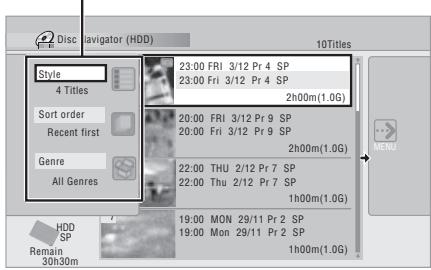
The view options panel
2 Choose 'Style', 'Sort order' or 'Genre', then press ENTER to see the available view options.
- Style - Select four or eight titles per screen view
- Sort order - Sort by date (most recent first), unwatched first, title name or recording date (oldest first)
- Genre - Display all genres or just a selected genre
3 Choose a view option, then press ENTER.
The title list display is updated according to the new display preferences.
Using the Disc Navigator with playback-only discs
DVD-Video Video CD Super VCD
1 DVD Select DVD.
2 2 Display the Home Menu.
3 Select 'Disc Navigator'.
Alternatively, for a Video CD or Super VCD, you can press DISC NAVIGATOR, which takes you straight to the Disc Navigator screen.
4 Select what you want to play.
Depending on the type of disc you have loaded, the Disc Navigator looks slightly different, but they are all navigated in the same way.
The screen below shows a Video CD. Navigate to the track/chapter/title that you want to play.
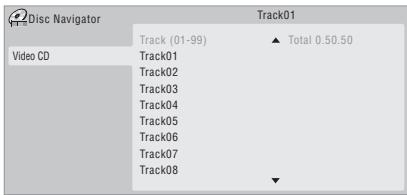
Playback starts after you press ENTER.

Tip
-
For instructions on playing DivX files, see Playing and copying DivX files (PC VIDEO) on page 108.
-
For instructions on playing Audio CD and WMA/MP3 discs, see Playing and copying music (Jukebox) on page 111.
Scanning discs
ALL
You can scan discs at various speeds, forwards or backwards.
1 During playback, start reverse or forward scanning.
The scanning speed is shown on-screen.
2 Press repeatedly to change the scanning speed.
There are four scanning speeds available when playing HDD video, a DVD or a DivX title. Reverse playback is also possible with HDD and DVD-Video.2
There are two scanning speeds for other types of disc.
3 PLAY Resume normal playback.
Playing in slow motion
DVD HDD Video CD Super VCD DivX
You can play video at various slow motion speeds. DVDs and video on the HDD can be played in slow motion in either direction, while Video CDs/Super VCDs and DivX titles can only be played forwards in slow motion.
There is no sound when playing in slow motion.
1 PAUSE Pause playback.
Press and hold to start slow motion reverse or forward play.
Note
1 - No subtitles are displayed when scanning DVDs and DivX titles.
-
No sound is output when scanning HDD videos, DVDs or DivX titles except in forward SCAN 1.
-
Depending on the disc, normal playback may automatically resume when a new chapter is reached on a DVD disc.
2 Reverse playback may not be smooth.
Press repeatedly to change the slow motion speed.
One of four slow motion play speeds can be selected during playback.
The current playback speed is indicated on-screen.
4 PLAY Resume normal playback.
Frame advance/frame reverse
DVD HDD Video CD Super VCD DivX
You can advance or back up video on a DVD disc1 or the HDD frame-by-frame.
With Video CDs/Super VCDs and DivX titles, you can only use frame advance.
1 PAUSE Pause playback.
Back up or advance one frame with each press.
3 PLAY Resume normal playback.
The Play Mode menu
ALL
The Play Mode menu gives you access to search functions, repeat and programme play functions.
HOME
MENU
- Select 'Play Mode' from the
Home Menu.
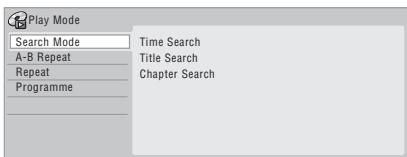
- Select Play Mode from the command menu for Audio CDs or WMA/MP3 files by pressing in the Jukebox (see Playing music from the Jukebox on page 113).
- With DivX files, Play Mode can only be selected during playback.
Search Mode
DVD HDD Video CD Super VCD DivX
The Search Mode feature lets you start playback from a specified point in a disc by time or by title/chapter/track number.
1 Select 'Search Mode' from the Play Mode menu, then choose a search option.
The available search options depend on the type of disc.
2 Enter a title/chapter/track number or a search time.
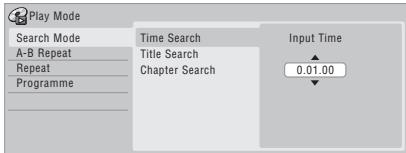
Time Search (HDD, DVD): For example, for 25 minutes into the current title, press 2, 5, 0, 0. For 1 hour and 15 minutes and 20 seconds into the title, press 1, 1, 5, 2, 0.
Time Search (Video CD): For example, for 2 minutes and 30 seconds into the current track, press 2, 3, 0.
Title/Chapter/Track Search:For example, for track 6, press 6.
3 ENTER Start playback.
A-B Repeat
DVD
HDD
CD
Video CD
Super VCD
DivX
The A-B Repeat function allows you to specify two points (A and B) within a track or title that form a loop which is played over and over.
1 During playback, select 'A-B Repeat' from the Play Mode menu.
2 ENTER With 'A (Loop Start)'
highlighted, press at the point you want the loop to start.
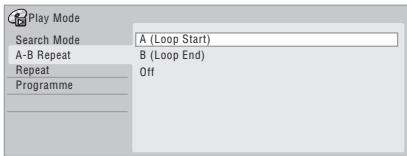
3 ENTER With 'B (Loop End)' highlighted, press at the point you want the loop to end.
Playback immediately jumps back to the start point and plays the loop round and round.
- When playing a DVD-Video, DVD-R/-RW (Video mode), DVD+R/+RW, or from the HDD, the start and end points of the loop must be in the same title.
- To resume normal playback, select Off from the A-B Repeat menu, or press CLEAR if no menu OSD (such as the Play Mode menu) is displayed.
Repeat play
ALL
There are various repeat play options, depending on the kind of disc loaded, or if you're using the HDD for playback. It's also possible to use repeat play together with
programme play to repeat the tracks/ chapters in the programme list (see Programme play below).2
- Select 'Repeat' from the Play Mode menu, then choose a repeat play mode.
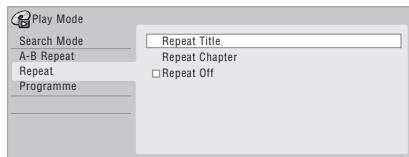
- To resume normal playback, select Repeat Off from the Repeat Play menu, or press CLEAR if no menu OSD (such as the Play Mode menu) is displayed.
Programme play
HDD
DVD-Video
CD
Video CD
Super VCD
WMA/MP3
This feature lets you program the play order of titles/chapters³/albums/tracks on a disc or the HDD.
1 SELECT 'Programme' from the Play Mode menu, then 'Input/Edit Programme'.
The Input/Edit Programme screen varies according to the disc type. Below is the DVD input screen.
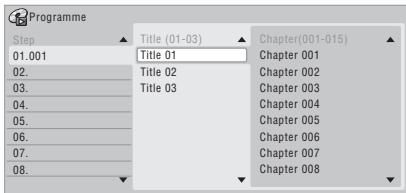
2 Select a title, chapter, album or track for the current step in the programme list.

Note
1 If you switch camera angles on a DVD during A-B repeat play, A-B repeat is cancelled.
2 If you switch the camera angle during repeat play of a DVD-Video disc, repeat play is cancelled.
3 When playing a programme list of DVD-Video chapters, chapters not included in the programme list may be sometimes be played, depending on the disc.
After pressing ENTER to add the title/ chapter/album/track, the step number automatically moves down one.
- To insert a step into the programme list, highlight the step number where you want to insert another step, then select a chapter/title/album/track as usual. After pressing ENTER, all the subsequent steps move down one.
- To delete a step from the programme list, highlight the step you want to delete, then press CLEAR.
3 Repeat step 2 to build up a programme list.
A programme list can contain up to 24 titles/chapters/albums/tracks.
4 Play the programme list.
Programme play remains active until you cancel programme play, erase the programme list, eject the disc or switch off the recorder.

Tip
- To save your programme list and exit the programme edit screen without starting playback, press HOME MENU.
- During programme play, press NEXT to skip to the next programme step.
- To repeat play the programme list, select Repeat Programme from the Repeat Play Mode menu (see Repeat play on page 82).
- Except CD, WMA/MP3: Press CLEAR during playback to switch off programme play (if no menu OSD, such as the Disc Navigator, is displayed). Press while stopped to erase the programme list.
From the programme menu you can also:
Start Programme Play - Starts playback of a saved programme list Cancel Programme Play -Turns off programme play, but does not erase the programme list
Erase Programme List - Erases the programme list and turns off programme play
Displaying and switching subtitles
DVD-Video DivX
Some DVD and DivX discs have subtitles in one or more languages; the disc box will usually tell you which subtitle languages are available. You can switch subtitle language during playback.
Check the disc packaging for details of the subtitle options.
- SubTITLE Select/change the subtitle language.
The current subtitle language is shown on-screen and in the front panel display.
- To switch off subtitles, press SUBTITLE then CLEAR.
Switching DVD and DivX soundtracks
DVD-Video DivX
When playing a DVD disc or DivX title recorded with two or more soundtracks (often in different languages), you can switch the soundtrack during playback.2

Note
- Some discs only allow you to change subtitle language from the disc menu. Press MENU or TOP MENU to access.
- To set subtitle preferences, see Subtitle Language on page 140.
2 • Some discs only allow you to change audio language from the disc menu. Press MENU or TOP MENU to access. - To set audio language preferences, see Audio Language on page 140.
Check the disc packaging for details of the soundtrack options.
Audio Change the audio soundtrack.
The current audio language is shown on-screen and in the front panel display.
- The sound may drop out for a few seconds when switching soundtracks.
- Some discs feature both Dolby Digital and DTS soundtracks. There is no analog audio output when DTS is selected. To listen to the DTS soundtrack, connect this recorder to a DTS decoder or AV amp/receiver with built-in DTS decoder via the digital output. See Connecting to an AV amplifier/receiver on page 20 for connection details.
Switching audio channels
DVD (VR) DVD-RAM HDD CD Video CD Super VCD
WMA/MP3
For HDD^1 and VR mode content recorded with bilingual audio, you can switch between left (L) channel, right (R) channel, or both (L + R) .
When playing Video CDs and Audio CDs you can switch between stereo, just the left channel or just the right channel.
Some Super VCDs have two soundtracks. With these discs you can switch between the two soundtracks as well as individual channels in each.
- Audio Press repeatedly to display/ switch the audio channel.
The audio channel(s) currently playing are indicated on-screen.
HDD DVD (VR) DVD-RAM
L + R - Both channels (default)
L - Left channel only
R - Right channel only
CD Video CD WMA/MP3
Stereo - Stereo (default)
1/L - Left channel only
2/R - Right channel only
Super VCD
1 Stereo - Soundtrack 1/Stereo (default)
1 L - Soundtrack 1/Left channel
1 R - Soundtrack 1/Right channel
2 Stereo - Soundtrack 2/Stereo
2 L - Soundtrack 2/Left channel
2 R - Soundtrack 2/Right channel
Switching camera angles
DVD-Video
Some DVD-Video discs feature scenes shot from two or more angles - check the disc box for details: it should be marked with a icon if it contains multi-angle scenes. When a multi-angle scene is playing, the same icon appears on screen to let you know that other angles are available (this can be switched off if you prefer - see Angle Indicator on page 143).
- ANGLE Switch the camera angle.
- The angle number is displayed on-screen.
- If the disc was paused, playback starts again with the new angle.
Displaying disc information on-screen
You can display various on-screen information about the disc loaded or the HDD.
- Display/change the on-screen information.
- Press once to show the HDD and removable disc (DVD, etc.) activity together. Press again to show the status of just the currently selected playback/ recording device (HDD or removable disc).
- To hide the information display, press DISPLAY repeatedly until it disappears.
HDD and removable disc activity display
Press DISPLAY once to see the HDD and removable disc (DVD, etc.) activity. Use the HDD and DVD button to switch between the two kinds of display.
The example displays below show high-speed copying from HDD to DVD, and HDD chase playback.
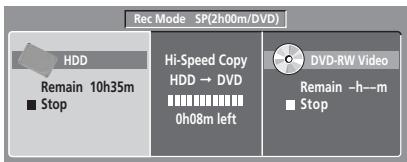
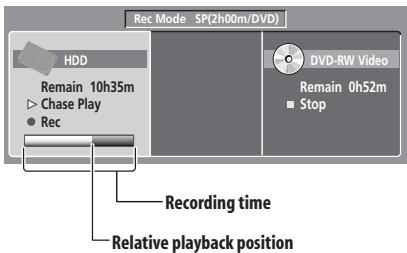
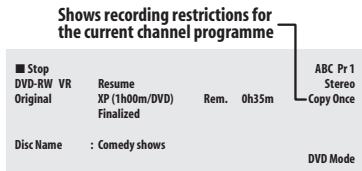
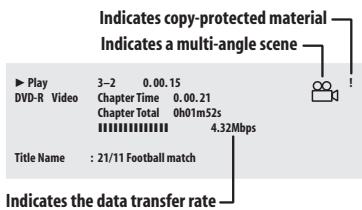

Tip
See Switching camera angles on page 84 for more on multi-angle scene switching.
- When using the simultaneous play and record feature, the display shows information for playback only.
- During real-time copy, the copy source playback information is displayed.
- The Video mode DVD-R/-RW displays become the same as a DVD-Video disc once the disc is finalized.
- The total recording time figure shown in parenthesis is calculated based on a 12cm / 4.7 GB disc at the displayed record setting.
- Recording and playback time of TV recording is approximately 0.1% shorter than the actual time. This is because of the slightly different frame rates of TV broadcasts versus DVD.
- The frame number is shown next to the elapsed time display when the disc is paused.
- Copy Once or Can't Record messages may appear in the stop or recording displays. These indicate that the broadcast TV programme contains copy control information.
Chapter 9
Playing and recording from a DV/HDD camcorder
You can also play back and record video from a DV camcorder connected to the DV IN jack on the front panel of this recorder. It is also possible to connect an HDD camcorder to the recorder's USB port and copy the images of the HDD camcorder to the recorder.

Important
- If you connect a second recorder using a DV cable, you cannot control the second unit from this one.
- You can't control this unit remotely from a component connected to the DV IN jack.
Playing from a DV camcorder
1 Make sure your DV camcorder is connected to the front panel DV IN jack.
2 From the Initial Setup menu, check that the DV audio input is setup as you would like.
See DV Input on page 139 for more on this.
- Check also that the Audio In settings for External Audio and Bilingual Recording are as you want them (see Audio In on page 138).
3 Display the Home Menu.
HOME MENI
MELO

Select 'DV/HDD-Cam' > 'DV
Video Playback'.
5 Start playback on the camcorder.
Images from the camcorder should appear on your TV.
- To record the incoming video, press HDD or DVD to select the HDD or a DVD for recording, then press REC. Press STOP REC to finish recording. If there is no signal from the device connected to the DV jack, or the signal is copy-protected, recording will pause. It will automatically restart once there is a recordable signal.
- The recorder will only start recording from the DV IN jack if there is a valid signal. Recording will pause if the signal is interrupted during recording.
- If your source is copy-protected using Copy Guard, you will not be able to record it. See Restrictions on video recording on page 62 for more details.
Recording from a DV camcorder
- The source signal must be DVC-SD format.
- You can't record date and time information from DV cassette.
- During DV recording, if a part of the tape is blank, or has copy-protected material on it, this recorder will pause recording. Recording will restart automatically when there is a recordable signal. However, if there is more than two minutes of blank tape, this recorder will stop recording and the camcorder should stop (depending on the camcorder).
Copying from a DV source
Using the recorder's remote, you can control both the camcorder and this recorder.

Important
- Some camcorders cannot be controlled using this recorder's remote.
- For best results when recording from a DV camcorder to this recorder, we recommend cueing the camcorder to the place you want to start recording from and setting the camcorder to play-pause.
1 Make sure your DV camcorder is connected to the front panel DV IN jack.
Also, set the camcorder to VTR mode.
2 Set the recording quality.
- See Setting the picture quality/recording time on page 65 for detailed information.
3 From the Initial Setup menu, check that the DV audio input is setup as you would like.
See DV Input on page 139 for more on this.
- Check also that the Audio In settings for External Audio and Bilingual Recording are as you want them (see Audio In on page 138).

4 Display the Home Menu.

Select 'DV/HDD-Cam' > 'Copy
from a DV Source'.
- DV recording only works when the DV camcorder is in VTR mode with a tape loaded.

Select 'Record to Hard Disk
Drive' or 'Record to DVD'.
7 Find the place on the camcorder tape that you want to start recording from.
For best results, pause playback at the point from which you want to record.
- Depending on your camcorder, you can use this recorder's remote to control the camcorder using the , , , , , , and buttons.
8

Select 'Start Rec'.
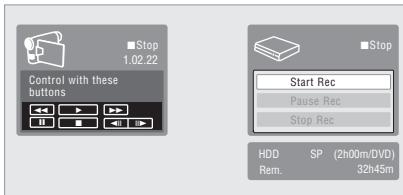
- You can pause or stop the recording by selecting Pause Rec or Stop Rec from the on-screen display. You cannot control the camcorder from this remote control during recording.
- If you restart recording after stopping the camcorder, the first few seconds of the camcorder tape will not be recorded. Use the pause button on your camcorder instead and recording will start immediately.
- HDD, DVD (VR Mode) and DVD-RAM only: A chapter marker is inserted every time there is a break in the timecode on the DV tape. This happens when the recording is stopped or paused then restarted, for example.
- If you don't want to see the DV recording screen during recording, press DISPLAY to hide it (press again to display).
- While recording, you cannot exit the DV recording screen using the HOME MENU or RETURN/EXIT button.
DV Auto Copy
DV Auto Copy allows you to make an exact copy of the contents of a DV source to the HDD or a DVD.
1 Make sure your DV camcorder is connected to the front panel DV IN jack.
Also, set the camcorder to VTR mode.
2

Set the recording quality.
- See Setting the picture quality/recording time on page 65 for detailed information.
Playing and recording from a DV/HDD camcorder
3 From the Initial Setup menu, check that the DV audio input is setup as you require.
See DV Input on page 139 for more on this.
- Check also that the Audio In settings for External Audio and Bilingual Recording are as you want them (see Audio In on page 138).

Display the Home Menu.
Select 'DV/HDD-Cam' > 'DV
Auto Copy'.
- DV recording only works when the DV camcorder is in VTR mode with a tape loaded.

Select 'Record to Hard Disk' 'Record to DVD'.
The DV tape is rewound to the beginning. Once it is rewound, the DV tape is played from the beginning and copied to either the HDD or a DVD.
- If there is a gap of two minutes or more between recorded contents, the copying process is automatically stopped.
- Once copying is finished, the DV tape is automatically rewound.
- To cancel the copying process, press STOPREC for more than three seconds.
About automatic finalization
If you use a DVD-R/-RW (Video mode) or DVD+R/+RW disc for copying, it will automatically be finalized after copying is complete.
- You can't customize the background for DVD-R/-RW or DVD+R/+RW disc finalization.
- No title names are assigned.
-
If you want to give the disc a name, please do so before you start the copy (see Input Disc Name on page 128).
-
If a timer recording is scheduled to start, and in some other instances, the disc will not be finalized.

Frequently Asked Questions
- I can't get my DV camcorder to work with the recorder!
Check that the DV cable is properly connected. Also make sure that what you're trying to record is not copy-protected.
If it still doesn't work, try switching off the camcorder then switch back on.
- There's a picture, but no sound!
Try switching the DV Input setting (see DVInput on page 139) between Stereo 1 and Stereo 2.
About DV
Using DV, also known as i.LINK or IEEE 1394-1995, you can connect a DV camcorder to this recorder using a DV cable for input of audio, video, data and control signals.
"i.LINK" and the "i.LINK" logo are trademarks.
- This recorder is only compatible with DV-format (DVC-SD) camcorders. Digital satellite receivers and Digital VHS video recorders are not compatible.
- You cannot connect more than one DV camcorder at a time to this recorder.
- You cannot control this recorder from external equipment connected via the DV IN jack.
- It may not always be possible to control the connected camcorder via the DV IN jack.
- DV camcorders can usually record audio as stereo 16-bit/48 kHz, or twin stereo tracks of 12-bit/32 kHz. This recorder can only record one stereo audio track. Set the DV Input setting as required (see DV Input on page 139).
Playing and recording from a DV/HDD camcorder
Audio input to the DV IN jack should be 32kHz or 48kHz (not 44.1 kHz).
- Picture disturbance in the recording may occur if the source component pauses playback or plays an unrecorded section of tape, or if the power fails in the source component, or the DV cable is disconnected.
- The DVIIN jack is an input only. There is no output functionality.
Copying from an HDD camcorder

Important
- For a description of the images that can be copied to the recorder, see Connecting an HDD camcorder on page 24.
1 Make sure your HDD camcorder is connected to the front panel USB port.
Make the necessary settings for USB signal transfer on the HDD camcorder. For details, see the HDD camcorder's operating instructions.

Display the Home Menu.
3 Select 'DV/HDD-Cam' > 'HDD-Cam Copy'.
4 SELECT 'Difference Copy' or 'All Movie Copy'.
- When Difference Copy is selected, only images that have never been copied to the recorder are copied. Images that have already been copied are not copied, even if they have been deleted from the recorder's HDD.
- When All Movie Copy is selected, all the images on the HDD camcorder are copied.
5 Select 'Yes' to confirm or 'No' to cancel.
Select Yes and press ENTER. The screen shown below appears.
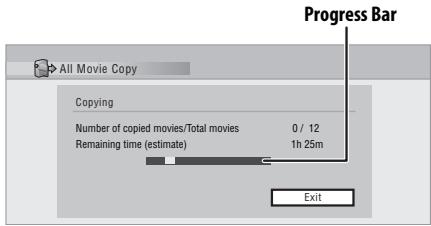
- To cancel copying press ENTER.
- No other recorder operation is possible during copying.
- The timer recording operation does not function during copying.

Note
Images taken on the same date are copied as a single title.
- Chapter markers are inserted at the positions where shooting started. Note that chapters that have been created automatically cannot be combined with other chapters.
- The maximum number of chapters per title is 99. If 100 or more scenes are taken on a single day, the chapter numbers over 99 are stored in an extra file.
- The maximum length of one title is 12 hours. Videos for which the shooting start to end time is over 12 hours cannot be copied.
- Copied titles are named "USB (date of shooting)".
Chapter 10
Editing
Editing options
The table below shows which commands you can use with the HDD and different disc types.
| HDD | DVD-R/-RW (Video mode), DVD+R/+RW | DVD-R/-RW, DVD-RAM (VR mode) | ||
| Original | Play List | |||
| Create (page 92) | ● | |||
| Play (page 92) | ● | ● | ● | ● |
| Erase (page 92) | ● | ● | ● | ● |
| Edit > Title Name (page 93) | ● | ● | ● | ● |
| Edit > Set-Thumbsail (page 94) | ● | ● | ● | ● |
| Edit > Erase Section (page 94) | ● | ● | ● | |
| Edit > Divide (page 95) | ● | ● | ||
| Edit > Chapter Edit (page 96) | ● | ● | ● | |
| Edit > Set Genre (page 97) | ● | |||
| Edit > Lock (page 97) | ● | ● | ● | |
| Edit > Move (page 97) | ● | |||
| Edit > Combine (page 97) | ● | |||
| Genre Name (page 98) | ● | |||
| Multi-Mode (page 98) | ● | |||
| Undo (page 99) | ● | ●*1 | ●*1 | |
*1 DVD-R/-RW only
The Disc Navigator screen
The Disc Navigator screen is where you can edit video content on unfinalized Video mode and DVD-R/-RW (VR mode) discs, DVD+R/+RW and DVD-RAM, as well as video content on the hard disk drive.

Important
- Titles that have been recorded with a Input Line System setting different to the current setting of the recorder are shown in the Disc Navigator with a blank thumbnail image. See also Additional information about the TV system settings on page 148.
- During recording, if you display the Disc Navigator for the HDD, some of the titles may appear with a A mark. These titles were recorded with a Input Line System setting different to the current setting of the recorder. During recording, these titles cannot be played.
1 HDD Dvd Select the HDD or DVD.
DISC 2 n VACATOR Display the Disc Navigator
screen.
Playback will automatically stop when you do this.
- The Disc Navigator is also accessible from the Home Menu.
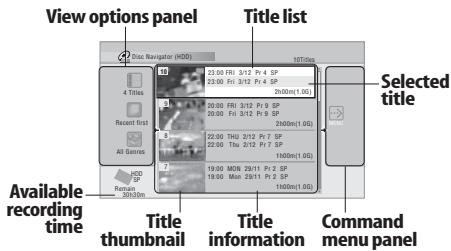
Press to display the command menu panel. Use the / and ENTER buttons to navigate the menus.
PREV NEXT When in the title list, press to display the previous/next page if there are more titles than can be displayed.
- Display Press to change the title information displayed in the title list.
- HDD
- DVD Press to switch between the HDD and DVD Disc Navigator screens.
- If you are editing a DVD-R/-RW (VR mode) or DVD-RAM disc you can display the Play List by selecting Play List from the view options panel (press , then select Play List from the view options, then Play List).
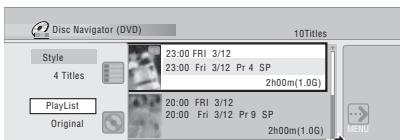
3 Press to exit the Disc Navigator.
Editing accuracy
Some editing commands ask you whether you want to keep Video mode compatibility or frame accuracy (Video Mode Compatible Editing or Frame Accurate Editing).
Frame Accurate Editing is very precise. The edit point is accurate to the exact frame you choose. However, this accuracy is not preserved in any copy you make if you use the high-speed copy function to make a DVD-R/-RW (Video mode) or DVD+R/+RW.
Video Mode Compatible Editing is less precise. The edit point you choose will only be accurate to within one-half to one second. On the other hand, these edit points will be preserved if you use high-speed copy to make a DVD-R/-RW (Video mode) or DVD+R/+RW.
HDD genres
The large capacity of the HDD means that there may be many hours of video in the recorder. To help you organize your HDD video content you can assign different genres to titles. There are 20 genres in total, including five user-definable ones that you can name as you like.
Create
DVD (VR) DVD-RAM Play List only
Use this function to create a Play List and add titles to it.
Before you can use this command, make sure that the Play List is switched on in the view options panel on the left.
1 Display the command menu panel.
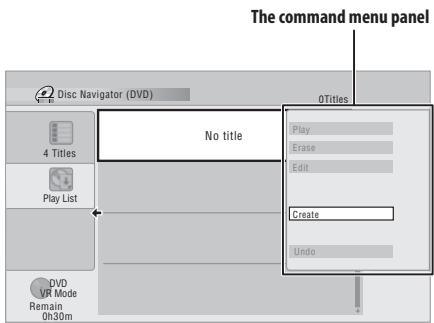
2 SELECT 'Create' from the command menu panel.
3 Select an original title to add to the Play List.
Repeat these three steps to add as many titles as necessary to the Play List.
Play
DVD(Video) DVD(VR) DVD+R DVD+RW DVD-RAM HDD
Use this function to start playback of a title.
1

Highlight the title you want to
2 SELECT 'Play' from the command menu panel.
Playback of the title you selected starts.
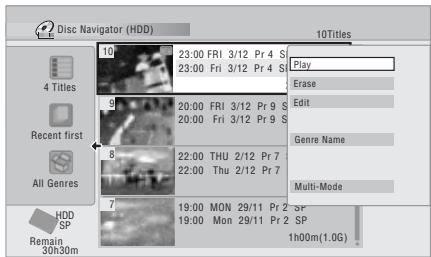
Erase
DVD(Video) DVD(VR) DVD+R DVD+RW DVD-RAM HDD
Use this function to erase unwanted titles. When you erase titles from the HDD, Original titles from a VR mode DVD-RW or DVD-RAM, the available recording space increases accordingly. Erasing a title from a DVD-RW (Video mode) or DVD+RW disc increases the available recording time only if it is the last title on the disc.1
Erasing Play List titles, or titles from a DVD-R (VR mode or Video mode) or DVD+R, will not result in any more free space on the disc.
1 Highlight the title you want to erase.
2 Select 'Erase' from the command menu panel.
3 Select 'Yes' to confirm or 'No' to cancel.

Tip
- You can erase a title quickly by pressing CLEAR when the title is highlighted. Confirm the edit by pressing ENTER.
Title Name
DVD(Video) DVD(VR) DVD+R DVD+RW DVD-RAM HDD
You can give titles new names of up to 64 characters long for VR mode, DVD-RAM and HDD recordings, and up to 40 characters for Video mode recordings and DVD+R/+RW discs.
1 Highlight the title you want to name (or rename).
2 SELECT 'Edit' > 'Title Name' from the command menu panel.
3 Input a name for the selected title.
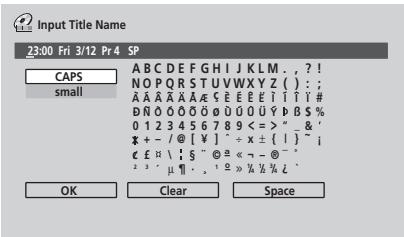
- A name generated automatically by the recorder will already be in the name input section of the screen. Use the / buttons to change the cursor position.
- Select CAPS or small to change to upper or lower-case, or use the CASE SELECTION buttons (I<PREV/ NEXT).
-
You can also use the CLEAR button to delete characters directly (press and hold for two seconds to delete the whole name). For other remote control key shortcuts, see Using the remote key shortcuts to input a name below.
-
For discs formatted on a different DVD recorder, you will see only a limited character set.
4 Select 'OK' to enter the name and return to the main Disc Navigator screen.
- To return to the main Disc Navigator screen without saving changes to the title name, press RETURN/EXIT.
Using the remote key shortcuts to input a name
The table below shows the remote control key shortcuts that you can use to input characters in the name input screen. Pressing a button repeatedly cycles through the characters shown.
If you want to enter two characters in succession that are both on the same button (for example a P and an R), press to advance the cursor one space manually between inputting the two characters.
| Key | Characters | Key | Characters | ||
| 1 | , '? ! - & 1 | 6 | m n o 6 ð ð ð ð ð ð ð ð ð ð ð ð ð ð ð ð ð ð ð ð ð ð ð ð ð ð ð ð ð ð ð ð ð ð ð ð ð ð ð ð ð ð ð ð ð ð ð ð ð ð ì ÷ ì ÷ ì ÷ ì ÷ ì ÷ ì ÷ ì ÷ ì ÷ ì ÷ ì ÷ ì ÷ ì ÷ ì ÷ ì ÷ ì ÷ ì ÷ ì ÷ ì ÷ ì ÷ ì ÷ ì ÷ ì ÷ ì ÷ ì ÷ ì ÷ ì û ì ÷ ì û ì û ì û ì û ì û ì û ì û ì û ì û ì û ì û ì û ì û ì û ì û ì û ì û ì û ì û ì û ì û ì û ì û ì û ì û ì õ ì õ ì õ ì õ ì õ ì õ ì õ ì õ ì õ ì õ ì õ ì õ ì õ ì õ ì õ ì õ ì õ ì õ ì õ ì õ ì õ ì õ ì õ ì õ ì õ ì û ì õ ì õ ì õ ì õ ì õ ì õ ì õ ì õ ì õ ì õ ì õ ì õ ì õ ì õ ì õ ì õ ì õ ì õ ì õ ì õ ì õ ì õ ì õ ì û ì û ì û ì û ì û ì û ì û ì û ì û ì û ì û ì û ì û ì û ì û ì û ì û ì û ì û ì û ì û ì û ì û ì û ì ÿ ì û ì û ì û ì û ì û ì û ì û ì û ì û ì û ì û ì û ì û ì û ì û ì û ì û ì û ì û ì û ì û ì û ì û ì û ì ë û ì û ì û ì û ì û ì û ì û ì û ì û ì û ì û ì û ì û ì û ì û ì û ì û ì û ì û ì û ì û ì û ì û ì û ì û ë û ë û ë û ë û ë û ë û ë û ë û ë û ë û ë û ë û ë û ë û ë û ë û ë û ë û ë û ë û ë û ë û ë û ë û ë û ñ ë û ë û ë û ë û ë û ë û ë û ë û ë û ë û ë û ë û ë û ë û ë û ë û ë û ë û ë û ë û ë û ë û ë û ë û ë ë û ë û ë û ë û ë û ë û ë û ë û ë û ë û ë û ë û ë û ë û ë û ë û ë û ë û ë û ë û ë û ë û ë û ë û ë ê ë ë û ë û ë û ë û ë û ë û ë û ë û ë û ë û ë û ë û ë û ë û ë û ë û ë û ë û ë û ë û ë û ë û ë û ë û í ë û ë û ë û ë û ë û ë û ë û ë û ë û ë û ë û ë û ë û ë û ë û ë û ë û ë û ë û ë û ë û ë û ë û ë û ë õ ë õ ë õ ë õ ë õ ë õ ë õ ë õ ë õ ë õ ë õ ë õ ë õ ë õ ë õ ë õ ë õ ë õ ë õ ë õ ë õ ë õ ë õ ë õ ë õ ë ÷ ë õ ë õ ë õ ë õ ë õ ë õ ë õ ë õ ë õ ë õ ë õ ë õ ë õ ë õ ë õ ë õ ë õ ë õ ë õ ë õ ë õ ë õ ë õ ë õ ë ñ ë õ ë õ ë õ ë õ ë õ ë õ ë õ ë õ ë õ ë õ ë õ ë õ ë õ ë õ ë õ ë õ ë õ ë õ ë õ ë õ ë õ ë õ ë õ ë õ ë û ë õ ë õ ë õ ë õ ë õ ë õ ë õ ë õ ë õ ë õ ë õ ë õ ë õ ë õ ë õ ë õ ë õ ë õ ë õ ë õ ë õ ë õ ë õ ë ÷ ë ÷ ë õ ë õ ë õ ë õ ë õ ë õ ë õ ë õ ë õ ë õ ë õ ë õ ë õ ë õ ë õ ë õ ë õ ë õ ë õ ë õ ë õ ë õ ë õ ë ÷ ë ñ ë õ ë õ ë õ ë õ ë õ ë õ ë õ ë õ ë õ ë õ ë õ ë õ ë õ ë õ ë õ ë õ ë õ ë õ ë õ ë õ ë õ ë õ ë õ ë ÷ ë û ë õ ë õ ë õ ë õ ë õ ë õ ë õ ë õ ë õ ë õ ë õ ë õ ë õ ë õ ë õ ë õ ë õ ë õ ë õ ë õ ë õ ë õ ë õ ë ñ ë ñ ë ñ ë ñ ë ñ ë ñ ë ñ ë ñ ë ñ ë ñ ë ñ ë ñ ë ñ ë ñ ë ñ ë ñ ë ñ ë ñ ë ñ ë ñ ë ñ ë ñ ë ñ ë ñ ë ñ ë õ ë õ ë õ ë õ ë õ ë õ ë õ ë õ ë õ ë õ ë õ ë õ ë õ ë õ ë õ ë õ ë õ ë õ ë õ ë õ ë õ ë õ ë õ ë ñ ë ò � | 0 | 0 |
| ↓ | [cursor back] | ▶ | [cursor forward] | ||
| ↓/ | [change case] | CLEAR | [clear character] | ||
| II | <space> | ■ | [finish name input] | ||
| + | ~() _/;;" ^ @ *%¥ | + = { } [ ] < > | ||||
^*1 lower-case: ; upper-case:
Using a USB keyboard to enter a name
Using a USB keyboard connected to this recorder makes entering names very quick and convenient. When in USB keyboard input mode, a USB icon ( 心 ) appears in the lower-left of the screen.
Other than the standard alpha-numeric keys, use the following keys when entering names:
| Key | Function |
| ← → | Change the cursor position |
| F1 | Select CAPS |
| F2 | Select small |
| delete | Delete character at the current cursor position |
| back space | Delete the character at the previous cursor position |
| enter | Enter the name |
| esc | Exit the input screen |
Set Thumbnail
HDD DVD (Video) DVD (VR) DVD+R DVD+RW DVD-RAM
You can change the thumbnail picture that appears in the Disc Navigator for a title to any frame that appears in that title.
1 Highlight the title you want to change the thumbnail picture for.
2 Select 'Edit' > 'Set Thumbnail' from the command menu panel.
The thumbnail setting screen appears and the playback starts from the beginning of the title.
3 Use the playback controls (, , , ) to find a suitable frame, then press ENTER to set.
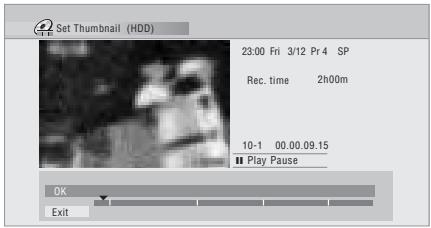
You can also use the chapter and time search features (press the MENU button), and the CM SKIP and CM BACK buttons.
4 Select 'Exit' to return to the Edit screen.
Erase Section
HDD DVD (VR) DVD-RAM
Using this command you can delete a part of a title, ideal for cutting out the commercial breaks in a recording made from the TV.
1 Highlight the title containing the section you want to erase.
2 SELECT 'Edit' > 'Erase Section' from the command menu panel.

Note
- It's possible that some USB keyboards will not work exactly as expected when connected to this recorder. See also Connecting a USB device on page 24 for more connection information.
- Certain keyboards may not be able to correctly input all characters.
2 If you use the remote control to enter a name when in the USB keyboard input mode, the recorder will automatically switch to remote control input mode. Press any key on the USB keyboard to return to USB keyboard input mode.
3 edit.

HDD only: Select the type of
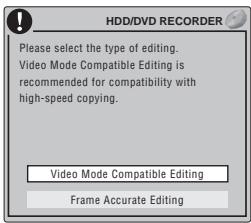
- For more information about these options, see Editing accuracy on page 91.
4 Highlight 'From' then use the playback controls (, , , , etc.) to find the start of the section to erase, then press ENTER.
The bar at the bottom of the screen indicates the current play position in the title. After pressing ENTER, a marker shows the start of the section.
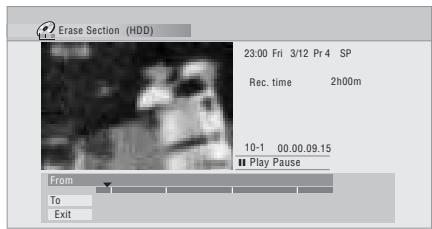
5 Highlight 'To' then, in the same way, find the end of the section to erase, then press ENTER.
After pressing ENTER, another marker indicates the end of the section, with the section itself marked in red.
6

Select 'Yes' to confirm or 'No'.
In the thumbnail viewer you can see a few seconds of video either side of the marked section to see how the edit will look.
- When editing VR mode Original content, you may not be able to erase very short sections (less than five seconds).
Divide
HDD DVD (VR) DVD-RAM Play List only
Use this command to divide a title into two. Note that once divided, the two new HDD titles cannot be recombined into one again.
1 Highlight the title you want to divide.
2 Select Edit Divide' from the command menu panel.
3 HDD only: Select the type of edit.
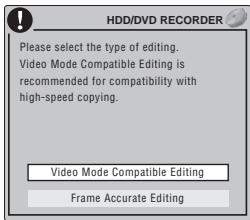
- For more information about these options, see Editing accuracy on page 91.
4 Use the playback controls (, , , , etc.) to find the place you want to divide the title.
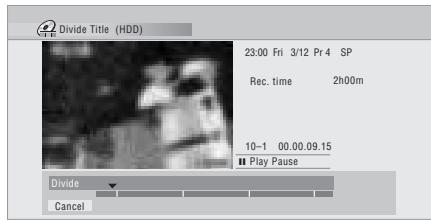
5 ENTER Press to divide the title at the current playback position.
6 Select 'Yes' to confirm or 'No' to cancel.
Chapter Edit
DVD (VR) DVD-RAM HDD
When editing a VR mode DVD or video on the HDD you can edit individual chapters within a title, with commands for erasing, combining and dividing.
1 Highlight the title that contains the chapters you want to edit.
2 SELECT 'Edit' > 'Chapter Edit' from the command menu panel.
3 HDD only: Select the type of edit.
- For more information about these options, see Editing accuracy on page 91.
4 Select the command you want:
- Divide - Divide a chapter into two or more parts: Use the playback controls (▶, II, <▲, >, etc.) to find the point at which you want to divide the chapter, then press ENTER.
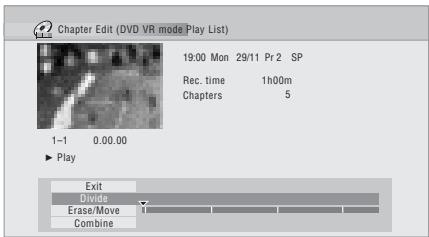
You can keep dividing the chapter as many times as you wish (up to 999 chapters per DVD-R/-RW/-RAM disc or 99 chapters per HDD title).
- Erase ^1 /Move ^2 - Erase or move chapters: Select the chapter you want to erase/move and press ENTER. Select whether you want to erase or move the chapter.
Move command only: Select the destination for the chapter, and press ENTER.
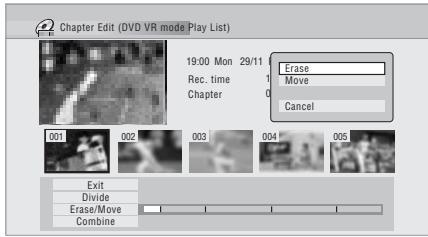
- Combine ^3 - Combine two adjacent chapters into one: Highlight the bar divider between two adjacent chapters and press ENTER.
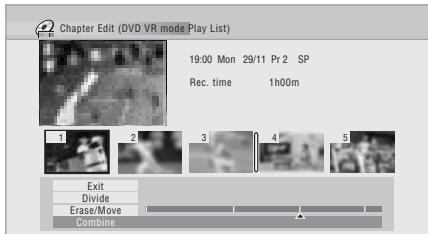
5 SELECT 'Exit' to get back to the main Disc Navigator screen.
Note
1 When editing VR mode Original content, it may not be possible to erase chapters less than five seconds long.
2 VR mode Play List only.
3 The following chapters cannot be combined:
- Two chapters that are left after a chapter is divided into three and the middle chapter is erased.
- A chapter that is created automatically as a result of copying from an HDD camcorder.
- A chapter of a title recorded in a disc that has been created or edited with other equipment (this type of chapter is sometimes combinable depending on the equipment used in creation or editing).
Set Genre
HDD
Use this command to assign a genre to a title.
1 Highlight the title you want to assign a genre to.
2 Select 'Edit' > 'Set Genre' from the command menu panel.
3 SELECT a genre for the title.
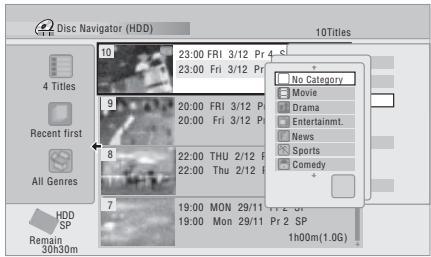
Lock
HDD DVD(Video)DVD(VR)DVD+R DVD+RW DVD-RAM
Original only
You can lock a title so that it can't be edited or erased accidentally. If you do need to edit it, you can always unlock it later.

Important
- You can't undo any edits made before changing the lock status. You also can't undo a lock/unlock command using the Undo option from the Disc Navigator menu.
1 Highlight the title you want to lock (or unlock).
2 SELECT 'Edit' > 'Lock' from the command menu panel.
An unlocked title will become locked; a locked title will be unlocked. Locked titles are shown in the Disc Navigator with a padlock icon.
Move
DVD (VR) DVD-RAM Play List only
Use this function to re-arrange the playing order of Play List titles.
1 Highlight the title you want to move.
2 Select 'Edit' > 'Move' from the command menu panel.
3 SELECT a new position for the title.
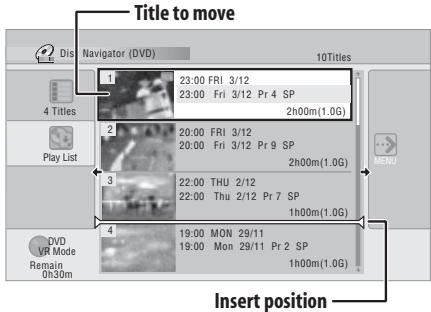
After pressing ENTER, the new, updated Play List is displayed.
Combine
DVD (VR) DVD-RAM Play List only
Use this function to combine two Play List titles into one.
1 Highlight the title you want to combine.
This title will remain in the same place after combining with another title.
2 Select 'Edit' > 'Combine' from the command menu panel.
3 SELECT another title to combine with the first.
This title will be appended to the first title selected.
The screen below shows title 3 selected to be appended to title 1.
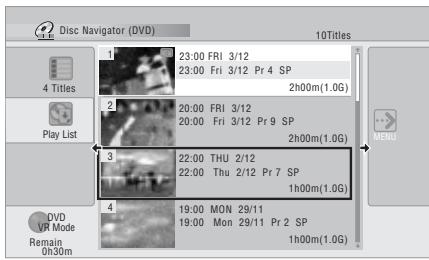
4 Select 'Yes' to confirm or 'No' to cancel.
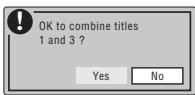
Genre Name
HDD
Use this command to rename one of the five user-definable genres (Free 1 to Free 5).
1 Select 'Genre Name' from the command menu panel.
2 Select one of the userdefinable genre names.
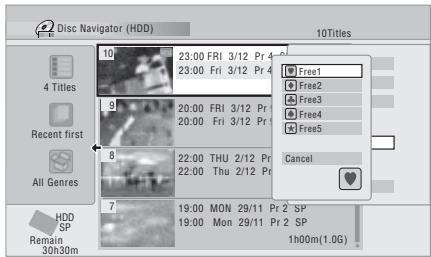
3 & & Input a name for the genre.
- The name can be up to 12 characters long.
- For information on remote control key short cuts, see Using the remote key shortcuts to input a name on page 93.
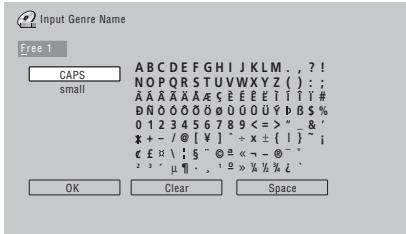
4 SELECT 'OK' to enter the name and exit.
Multi-Mode
HDD
Multi-Mode allows you to select several titles, then select a command that will be applied to all of them. In this way you can select multiple titles and then erase them all at once, for example.
1 SELECT 'Multi-Mode' from the command menu panel.
2 SELECT titles from the title list. Selected titles are marked with a
2 Select titles from the title list. Selected titles are marked with a
3 Select the command that you want applied to all the marked titles.
For example, select Erase to erase all the marked titles.
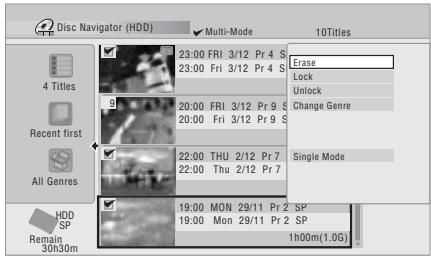
Once the command is completed, Multi-Mode is automatically exited.
Undo
DVD (Video) DVD (VR) DVD + R DVD+RW
If you make a mistake while editing, you can generally undo it. There is one level of undo (in other words, you can only undo the last edit you made).
- Select 'Undo' from the command menu panel.
- You can't undo anything after exiting the Disc Navigator screen.

Frequently asked questions
- Why doesn't the available recording time increase when I erase titles from a VR mode DVD-R?
When you erase titles from a DVD-R (or DVD+R), the titles are no longer displayed, but the content remains on the disc. DVD-R/+R are write-once media; they can't be erased or rewritten.
- I can't edit my disc!
You may find that as the available recording time is reduced on a VR mode DVD-R disc, editing is no longer possible. This is because information
about your edits requires a certain amount of disc space. As you edit, this information builds up, eventually preventing you from editing further.
Chapter 11 Copying and backup
Introduction
Use the copying features of this recorder to:
- Back up important recordings stored on the HDD to a DVD.
- Make a DVD copy of a recording on the HDD to play in another player.
- Transfer video from a DVD to the HDD for editing.
- Transfer edited video from the HDD to DVD.
The simplest way to copy a title is to use the One Touch Copy feature. This copies the currently playing HDD title to DVD, or DVD title to the HDD. See One Touch Copy below for detailed instructions.
For more sophisticated copying tasks you can build a Copy List of titles to copy, and edit titles so that you only copy the bits you want. See Using Copy Lists on page 102 for detailed instructions.
Where possible, the recorder will copy your recordings at high-speed. Depending on the recording mode, the kind of disc loaded and various other factors, copying can be as fast as one minute per hour of video. See Minimum copying times on page 151 for more on copying times.
If you want to save disc space you can copy video at a lower recording quality (for example, an XP recording on the HDD copied to SP on a DVD). Copying in this way is always done in real-time.
When real-time copying from the HDD to a DVD-R/-RW (Video mode) or DVD +R/+RW , the chapter markers in the original material are not copied. Chapter markers are put into the copy at intervals, according to the Auto Chapter settings (see also Auto Chapter (Video) and Auto Chapter (DVD + R / + RW) on page 142).
Restrictions on copying
Commercial DVD-Video discs are protected using Copy Guard. These discs cannot be copied to the HDD.
Some video material is copy-once protected. This means that it can be recorded to HDD, but it can't then be freely copied again. If you want to transfer copy-once protected material from HDD to DVD, you'll need to a CPRM ver. 1.1 or higher VR mode DVD-RW, ver. 2.0 or 2.1 VR mode DVD-R, or CPRM-compatible DVD-RAM disc (see CPRM on page 62 for more on this). Only one instance of a copy-once protected title can be added to the Copy List, and after it's been copied, the title is erased from the HDD (it is therefore not possible to copy a locked title that is copy-once protected).
You can identify copy-once protected material during playback by displaying disc information on-screen. If the current title is copy-once protected, an exclamation mark (!) is shown.
Copyright
Recording equipment should be used only for lawful copying and you are advised to check carefully what is lawful copying in the country in which you are making a copy. Copying of copyright material such as films or music is unlawful unless permitted by a legal exception or consented to by the rightowners.
One Touch Copy
- See also Copyright above.
The One Touch Copy feature copies the currently playing or selected (in the Disc Navigator) HDD title to DVD, or DVD title to HDD. The whole title is copied, regardless of where in the title you start the copy.
Copying and backup
HDD to DVD copies are made in the same recording mode. When copying DVD to HDD, the copy is made in whatever recording mode is currently set.
Make sure that a recordable DVD disc is loaded when trying to copy from the HDD.
1 REC MODE If you're copying from DVD to the HDD, select a recording mode.
Note that selecting a recording mode higher than the title playing will not result in a better quality recording.
ONE TOUCH COPY Press during playback to copy the current title.
The front panel display indicates that the title is being copied.
- High-speed copying is used when copying from the HDD to DVD. Playback continues while copying.
Real-time copying is used when copying from DVD to the HDD. Playback restarts from the beginning of the title.
Cancelling One Touch Copy
You can cancel a One Touch Copy once it's started.
ONE TOUCH COPY Press and hold for more than a second.
Copying is cancelled and the video already copied is erased.
- If you cancel an HDD to DVD-R/+R copy, the space available for recording does not return to the pre-copy figure.
Notes on copying using One Touch Copy
Copying to DVD
- Title name, chapter markers, as well as thumbnail picture markers for the Disc Navigator, are also copied. However, if you copy to a DVD-R/-RW (Video mode) or DVD+R/+RW, only the first
40 characters of a name are copied.
- The chapter markers in the copy may not be in exactly the same positions as the original when recording on to a DVD-R/ -RW (Video mode) or DVD+R/+RW.
- You can't use the One Touch Copy function to copy a title if any part of the title is copy-once protected.
- A title that contains mixed aspect ratios can't be copied to a DVD-R/-RW (Video mode) or DVD+R/+RW. Use a DVD-R/-RW (VR mode) or DVD-RAM disc for this type of material.
- Low resolution (SEP through LP modes ^1 ) widenscreen material can't be copied to a DVD-R/-RW (Video mode) or DVD+R/+RW. Use a DVD-R/-RW (VR mode) or DVD-RAM disc for this type of material.
- When HDD Recording Format is set to Video Mode Off, titles recorded in LP/ MN9 to MN15 modes cannot be high-speed copied to a DVD-R/-RW (Video mode) or DVD+R/+RW. Please use a DVD-R/-RW (VR mode) or DVD-RAM.
- Recordings of bilingual broadcasts cannot be high-speed copied to a DVD -R/-RW (Video mode) or DVD+R/+RW. Please use a DVD-R/-RW (VR mode) or DVD-RAM.
- XP + titles cannot be copied to DVD via One Touch Copy.
- Titles over eight hours cannot be copied to single-layer DVD+R/+/RW discs using One Touch Copy. Use DVD+R DL discs for titles over eight hours.
- Titles recorded in MN1 to MN6, SEP, SLP or EP mode cannot be copied to DVD+R/+RW using One Touch Copy.
Copying to the HDD
- The maximum title length for copying is 12 hours.
-
Title name and chapter markers are also copied, except when copying from a finalized Video mode DVD-R/-RW.
-
Thumbnail picture markers and chapter markers for the Disc Navigator are copied, but their position in the copy may be slightly changed from the original.
- If some part of the title being copied is copy-protected, copying will start, but the copy-protected portions will not be copied.
Using Copy Lists
- See also Copyright on page 100.
At its simplest, a Copy List is just a list of HDD or DVD titles that you want to copy. When copying HDD titles to DVD, you can, however, edit the titles in your copy list, erasing chapters you don't need, or renaming titles, for example. Edits you make to titles in the Copy List do not affect the actual video content; only the 'virtual' content of the Copy List. So you can freely erase and modify anything in your Copy List safe in the knowledge that the actual content is not being altered.
Copying from HDD to DVD

Important
- The recorder can only store one Copy List at a time.
- The Copy List is erased if the Input Line System setting is changed (see Additional information about the TV system settings on page 148).
- Resetting the recorder to its factory settings (see Resetting the recorder on page 167) will erase the Copy List.
1 Load a recordable DVD.
- It is possible to complete the following steps without having a recordable DVD loaded (or having an uninitialized DVD loaded); however, the steps are slightly different.
- If you want to use a DVD-RW (VR mode) disc for the copy, make sure it is initialized before you start.
2 Display the Home Menu.
3 SELECT 'Copy' > 'HDD DVD'.
- If this is the first time to create a Copy List, skip to step 5 below.
4 If there is already a Copy List stored in the recorder, choose whether to 'Create New Copy List' or 'Continue Using Previous Copy List'.
- If you select Continue Using Previous Copy List, skip to step 10 below.
- Selecting Create New Copy List will erase any Copy List already stored in the recorder.
5 Add titles to the Copy List (highlight a title and press ENTER to add).

Titles you've added to the Copy List are highlighted in pink.
There are some restrictions on titles that can be added to the Copy List if you are copying to a DVD-R/-RW (Video mode) or DVD+R/+RW:
- When adding titles that contain copy-once protected material, the copy-once parts will not be added.
- When adding titles that contain material of more than one aspect ratio (screen size), each part with a different aspect ratio will be added as a separate title if high-speed copying is possible.
Copying and backup
Depending on the title1, high-speed copying may not be possible to DVDs.
6 Display the command menu panel.
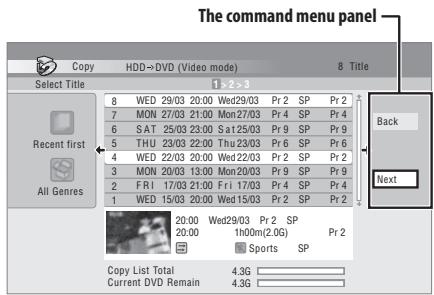
7 SELECT 'Next' to move on to the Title Edit screen.

Select 'Next' to move on to the screen.
8 Select a title to edit.
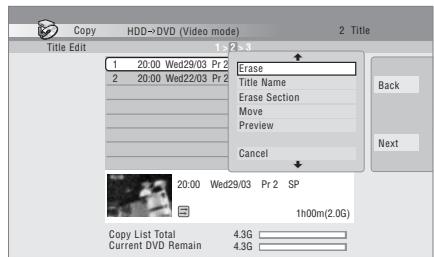
A menu of editing commands appears:
- Erase - Erase individual titles from the Copy List (see Erase on page 92).
-
Title Name – Name or rename a title in the Copy List (see Title Name on page 93).
-
Erase Section - Erase part of a title (see Erase Section on page 94).
- Move - Change the order of titles in the Copy List (see Move on page 97).
Preview - Check the content of a title in the Copy List. - Divide - Divide a title in the Copy List into two (see Divide on page 95).
- Combine - Combine two titles in the Copy List into one (see Combine on page 97).
-
Chapter Edit – Edit chapters within a Copy List title (see Chapter Edit on page 96):
-
Divide - Divide a chapter into two.
- Erase/Move - Erase a chapter/ Change the chapter order.
-
Combine - Combine two chapters into one.
-
Set Thumbnail - Set the thumbnail frame for a title (see Set Thumbnail on page 94).
- Recording Mode - Set the picture quality of the copy (see Recording Mode on page 105).
- Bilingual - Set how bilingual audio should be copied when copying from HDD to DVD-R/-RW (Video mode) and DVD+R/+RW (see Bilingual on page 105).
- Cancel - Exit the menu.
Repeat this step for as many titles you have that need editing.
9 Display the command menu panel.

Note
1 The following titles cannot be copied at high-speed for DVD+R/+RW:
- Titles recorded in MN1 to MN6, SEP, SLP or EP mode.
The following titles cannot be copied at high-speed for DVD-R/-RW (Video Mode) and DVD + R / + RW - Widescreen titles recorded at low resolution (SEP through LP/MN1 to MN15 (Video Mode Off) or MN1 to MN8 (Video Mode On)).
LP/MN9 to MN15 recordings when HDD Recording Format is set to Video Mode Off.
Bilingual recordings. - Combined titles that were originally recorded using different recording modes.
The following titles cannot be copied at high-speed for any types of DVD:
- XP+ titles.
10

Select 'Next' to proceed.
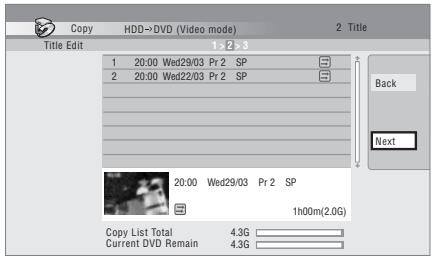
There are several options available from the next screen:
- Select Recording Mode if you want to change the recording quality (see Recording Mode on page 105).
- Select Input Disc Name if you want to change the disc name. Input a name of up to 64 characters for a VR mode disc or 40 characters for a Video mode disc or DVD+R/+RW. (The input method is similar to that of naming titles; see Title Name on page 93.)
- Select Finalize if you want to automatically finalize a DVD-R/-RW (Video mode) or DVD+R after copying.1 Select a title menu style from the following screen.
Select 'Start Copy' to start
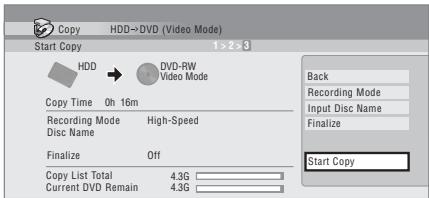
- If you're using a DVD-R DL or DVD+R DL disc and the copy will span both layers, the Copy List Total bar will be purple.
- The Current DVD Remain bar will be half-length if the first layer of a DVD-R DL or DVD+R DL disc is already full.
Copying from DVD to HDD

Important
- The DVD to HDD Copy screen isn't accessible when a finalized Video mode DVD-R/-RW or a DVD-Video is loaded. As long as the disc is not Copy Guard protected, you can still use the One Touch Copy function, however (see One Touch Copy on page 100).
- The recorder can only store one Copy List at a time.
- The Copy List will be erased if:
- any of the titles on the DVD disc are erased or edited.
- the disc tray is opened.
- playback is switched between Play List and Original.
- the DVD disc is re-initialized.
- Video mode disc is finalized.
- the recorder is reset to its factory settings (see Resetting the recorder on page 167).
- It may not be possible to copy from a DVD disc that was recorded on a different DVD recorder or a PC.


Display the Home Menu.

ENTER Select 'Copy' >DVD/CD → DD'.

Select a Copy List type.
- Selecting Create New Copy List will erase any Copy List already stored in the recorder.


Add titles to the Copy List (at a title and press ENTER to add).
Titles you've added to the Copy List are highlighted in pink.
5 SELECT 'Next' from the command menu panel to proceed to the title edit screen.
6 Select a title to edit.
A menu appears of Copy List editing commands:
- Erase - Erase individual titles from the Copy List (see Erase on page 92).
- Move - Change the order of titles in the Copy List (see Move on page 97).
Preview - Check the content of a title in the Copy List. - Cancel - Exit the menu.
Repeat this step for as many titles you have that need editing.
7 Select 'Next' from the command menu panel to proceed to the copy options screen.
- Select Recording Mode if you want to change the recording quality (see Recording Mode below).
8 SELECT 'Start Copy' to start copying.
Recording Mode
1 SELECT 'Recording Mode' from the command menu panel.
2 SELECT a recording mode for the copy.
- High-Speed Copy ^1 - The Copy List is copied at the same recording quality as the original.
- XP, SP, LP, EP, SLP, SEP, MN² – The Copy List is copied at the specified recording quality in real-time. (Note that if you copy at a higher quality setting than the original, the copy will not be better quality than the original.)
If you select MN above, you can also change the level setting (MN1 to MN3², LPCM or XP+⁴) from the Recording Quality box that appears.
- Optimized2,5 - The recording quality is automatically adjusted so that the Copy List fits on to the space available on the disc. Copying is carried out in real-time.
When you change the recording mode setting, you can see how much disc space it will require. If this is more than is available, it shows up in red and you won't be able to start copying. In this case, either change the recording quality, or press RETURN/EXIT to go back to the Copy List screen and erase one or more titles from the Copy List.
Bilingual
1 Select the title containing the audio you want to change.
2 SELECT 'Bilingual' from the command menu panel.

Note
1 When copying to a DVD-R/-RW (Video mode) or DVD+R/+RW, the chapter markers in the copy may not be in exactly the same position as the original.
2 When the copy mode is set to something other than High-Speed Copy for copying to a DVD-R/RW (Video mode) or DVD+R/+RW, the chapter markers of the original are not copied. Chapter markers are put into the copy at regular intervals, according to the Auto Chapter setting (see also Auto Chapter (Video) and Auto Chapter (DVD+R/+RW) on page 142).
3 When copying to a DVD + R / + RW MN1 to MN3 and SEP modes are not available.
4 X+ mode available only when copying to HDD.
5 Optimized mode only available when copying to DVD. Due to remaining space on the disc or the title that you copy, this mode does not always exactly fill a disc.
3 SELECT a bilingual audio option.
Using disc backup
- See also Copyright on page 100.
This feature offers a simple way to make a backup copy of finalized DVD-R/-RW (Video mode) discs or DVD+R/+RW discs. The data is copied first to the hard disk drive1, then on to another recordable DVD disc.


Display the Home Menu.

Select 'Copy' > 'Disc backup'.

Select a backup option.
There are three backup options:
-
Start new disc back-up - Start making a backup of a disc.
-
Resume writing data - Record the backup data already on the HDD to a recordable DVD.
-
Erase back-up data - Erase the backup data on the HDD.
4 Load the disc you want to make a backup of.
You can only make backup copies of finalized Video mode DVD-R/-RW discs, finalized DVD+R or DVD+RW discs (excluding DVD-R DL/DVD+R DL discs).
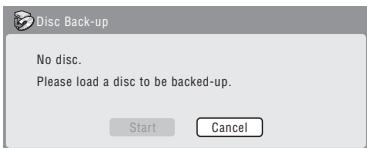
5 SELECT 'Start'.
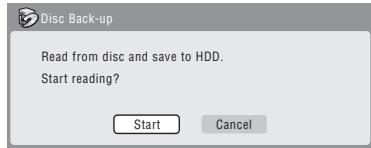
- To see the progress of the backup, press DISPLAY.
- You can cancel the backup process by pressing ONE TOUCH COPY for more than one second.
6 When the data has been copied, take out the disc and load a blank* recordable DVD.
- If you're using a DVD-RW or DVD+RW, the disc doesn't have to be blank, although the previous contents of the disc will be erased in the backup process.
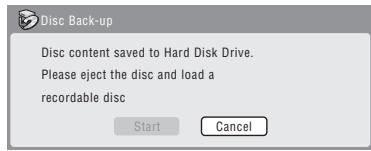
You can use a DVD-R ver. 2.0, 2.1 or 2.2 disc, or DVD-RW ver. 1.1 or ver. 1.2 disc for the backup.
- If you backup a DVD-R disc to DVD-RW, you cannot undo the finalization later.
- Actual recordable capacity of discs vary so there may be cases where the contents of the disc you're backing-up will not fit on to a particular blank disc. If this happens, please try another brand of disc.
DVD-R/-RW discs can only be backed up to DVD-R/-RW discs; DVD+R/+RW discs can only be backed up to DVD+R/+RW discs.
7 Select 'Start' to start writing the backed-up data to the blank disc.
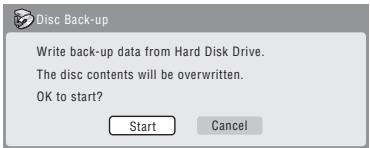
- To see the progress of the backup, press DISPLAY.
- You can cancel the backup process by pressing ONE TOUCH COPY for more than one second. However, this will make the disc unusable (although if you are using a DVD-RW or DVD+RW disc you can re-initialize it in order to make it usable again—see Initializing recordable DVD discs on page 73.)
8 After the recorder has finished recording the backup disc, you can select whether to make another backup of the same data or exit.
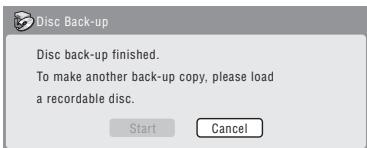
- Select Start to make another backup copy or Cancel to finish. If you want to make another backup copy, return to step 7 above.
9 If you don't need to keep the backup data on the HDD, you can delete it now.
Select Yes to delete the data from the HDD; select No to keep it (you can delete it later if you want to).
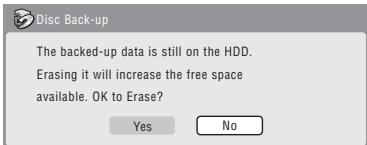
- If you decide to leave the backup data on the HDD, you can make backup copies to recordable DVD discs anytime from the Disc Back-up menu.
Chapter 12
Playing and copying DivX files (PC VIDEO)
The PC VIDEO function is used to play DivX files recorded on the HDD, DVD, or CD-R/-RW/-ROM disc. DivX files stored on a DVD or CD-R/-RW/-ROM disc or USB device can be copied to the HDD.

Important
- A demo file is recorded on the HDD upon purchase. For more information about the demo file, see Demo Mode on page 146.
Playing DivX files
1 1 Display the Home Menu.
2 SELECT 'PCVIDEO'.
3 Select the location of the files you want to play back.
View/EditVIDEOFILEon the HDDPlays DivX files recorded on the HDD.
View VIDEO FILE on a DVD/CD - Plays DivX files recorded on a DVD or CD-R/ -RW/-ROM disc.
4 SELECT the folder containing the title you want to play back.
- Press SUBTITLE or ANGLE to change the page.
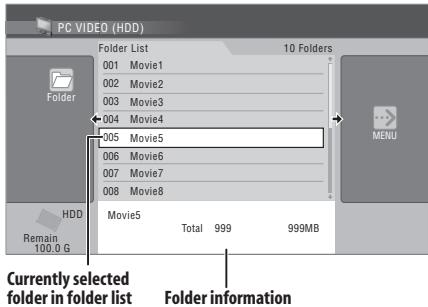
5 SELECT what you want to play.
Playback starts after you press ENTER.
- Press , then You can also select Play from the command menu panel.
- For a description of operations during playback, see Playing DivX video files on page 78.
Playing DivX files on the HDD that have not yet been viewed
The files can be played easily, simply by pressing the PCVIDEO button.

Playing DivX files.
- If there are multiple DivX files that have not yet been viewed, the file recorded on the HDD at the most recent date is played.2
- If there are no DivX files that have not yet been viewed, the file recorded on the HDD at the most recent date is played.2

Note
1 This operation cannot be performed while the recorder's GUI is displayed.
2 Files recorded with the Connect PC function are not included. However, if the only unviewed file is one recorded with the Connect PC function, that file is played.
Playing and copying DivX files (PCVIDEO)
- For a description of operations during playback, see Playing DivX video files on page 78.
Changing the display style of the PC VIDEO
1

Display the view options panel.
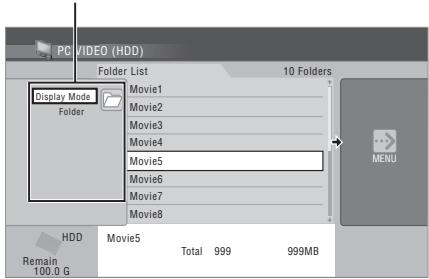
The view options panel
2 Choose 'Display Mode' then press ENTER to see the available view options.
Choose between folder and title display modes.
3 Choose a view option, then press ENTER.
The display mode will change to that which you have chosen.
Copying DivX files to the HDD
1 Display the Home Menu.
2 SELECT 'PCVIDEO'.
3 SELECT the location of the files you want to copy.
ViewVIDEOFILEonaDVD/CD
Copies DivX files from a DVD or CD-R/-RW/-ROM disc onto the HDD.
- Copy VIDEO FILE from a USB Device - Copies DivX files from a USB device onto the HDD.
4 Display the command menu panel.
- To copy from a USB device, proceed to step 6.
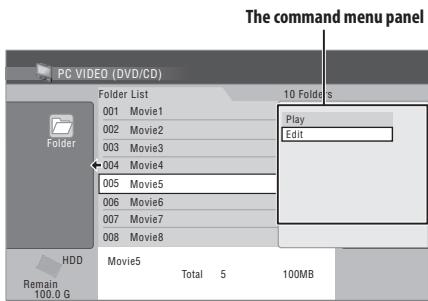
5

Select 'Edit'.
6 SELECT 'Copy all to HDD' from the menu.
On pressing ENTER all titles or folders on the DVD/CD or the USB device are copied to the HDD.
- When a folder is selected, you can copy only the titles contained in the folder by using 'Copy to HDD'.
- You can also copy titles by selecting 'Copy' > 'DVD/CD → HDD' > 'VIDEO FILE' from the Home Menu.
- To cancel copying press ENTER.
- Up to 50 000 files or 999 folders can be recorded on the HDD. Up to 999 files can be stored in one folder.
- Up to 99 folders/999 titles on the DVD/ CD or the USB device can be copied/ displayed.
- No other recorder operation is possible while DivX files are being copied.
- The timer recording operation does not function while DivX files are being copied.
Editing files on the HDD
Erasing a title or folder
1 Select the title or folder you want to erase.
Erasing a folder will erase all the titles contained in it. Please be careful!
2 Select 'Erase' from the command menu panel.
3 Select 'Yes' to confirm or 'No' to cancel.
- You can also erase a title or folder by pressing CLEAR when the title or folder is highlighted. Press ENTER to confirm.
Naming titles and folders
1 Select the title or folder you want to rename.
2 SELECT 'Edit' from the command menu panel.
3 SELECT 'Title Name' or 'Folder Name'.
4 Enter a new name for the title/folder.
Title names or Folder names can be up to 64 characters long.
See Using the remote key shortcuts to input a name on page 93 and Using a USB keyboard to enter a name on page 94 for how to enter a name.
Chapter 13
Playing and copying music (Jukebox)
The Jukebox feature allows you to use the recorder's HDD to store and playback music from your CDs. WMA/MP3 files recorded on CD-R/-RW/-ROM discs, DVDs or USB devices can also be copied to the HDD.
Copying music to the HDD
The first step is to copy some music to the HDD. CD audio, WMA and MP3 files are copied at high speed.
Usually, each track on a CD or DVD is categorized and copied onto the HDD on the basis of information on artists and albums.
Note that once copied to the HDD, audio tracks cannot be copied to a recordable DVD disc.

Important
- While copying, no other recorder operation is possible.
- When copying, scheduled timer recordings will not start until copying is complete.
- Copy protected CDs may not copy successfully.
1 Load the CD/DVD you want to copy to the HDD or connect the USB device.
2 Display the Home Menu.
3

Select 'Jukebox'.

Note
1 - Up to 50 000 tracks can be created in the Jukebox. (You can create up to 50 000 artists/albums in total.)
Sound quality is not worsened when you copy data from another source.
- When playing back an album copied from a source whose original audio track plays continuously (such as a live recording), there will be a brief pause in sound between tracks.
- Audio CDs are classified according to the information in the Gracenote database.
- WMA/MP3 files are classified according to the information included in the files. Track names may differ from the names of the original files.
- Depending on the name of the original folder and track, the artist and album under which the folder or track is classified may differ.
- When a folder of WMA/MP3 files is selected, you can copy only the files contained in the folder by using 'Copy to HDD'.
- You can also copy tracks (or files) by selecting 'Copy' > 'DVD/CD → HDD' > 'CD' or 'MUSIC FILE' from the Home Menu. (For an Audio CD, a track check screen is displayed.)
- To cancel copying press ENTER.
- If the CD loaded contains both CD audio tracks and WMA/MP3 files, the part currently selected will copy.
- Up to 99 folders/999 files on the USB device can be copied/displayed.
- Only the files that have been read can be copied. To copy the files that have not been read, reload the files (see below).
Reloading files from a WMA/MP3 disc or a USB device
If you have a WMA/MP3 disc or a USB device with more than 1000 files and/or 100 folders, you can still view all the tracks using the reload function.
1 Navigate to the last entry in the folder list ('Read next: ...').
2 ENTER Load the next batch of up to 999 files/99 folders from the disc or the connected USB device.
It takes several minutes to reload files.
About the automatic display of titles
This unit has built-in information on titles extracted from the Gracenote® database.
When an Audio CD that has never been played on the recorder is loaded and the track list screen is opened from the Jukebox, the recorder automatically searches for titles. The screen shown below is displayed.
- Press ENTER to cancel searching.
Upon completion of search, album name, artist name, track name, and genre are automatically displayed.2
- When multiple titles have been found, use / to select a title and press ENTER. If you select 'No Information' and press ENTER, 'Unknown' is displayed.
- 'Unknown' is displayed when there are no titles found.
Depending on the title, a different title name may be displayed. - Information on new CDs on sale may not be registered in the Gracenote database installed in this unit. Use the Update Disc with the latest data downloaded from the Pioneer website to update the built-in Gracenote database (see Gracenote Database on page 146).
- GUI displays may show the Gracenoted database as 'Database'.
Searching titles again
If the titles are not properly displayed, use the following procedure to search for titles again from the Gracenote database on the recorder.
1 Load the CD.

Display the Home Menu.
3 Select 'Jukebox' > 'Play Music on a DVD/CD'.
4 Select 'Acquire Track Name' from the command menu panel.
Playing music from the Jukebox
You can select artists, albums or individual tracks from the Jukebox to play.

1 Display the Home Menu.

3 SELECT a Jukebox
- Play/Edit Music on the HDD - Listen to CDs or WMA/MP3 files that have been copied to the HDD.
- Play Music on a DVD/CD - Listen to music on a DVD or CD. Proceed to step 6 for audio CDs, step 5 for WMA/MP3 files.
When an Audio CD that has never been played on the recorder is loaded, the recorder automatically searches for the titles on that Audio CD (see About the automatic display of titles on page 112).
- Play Music on a USB Device - Listen to music from an external USB device. Proceed to step 5.
4 Select the artist you want to play back.
The screen below shows artists stored on the HDD:
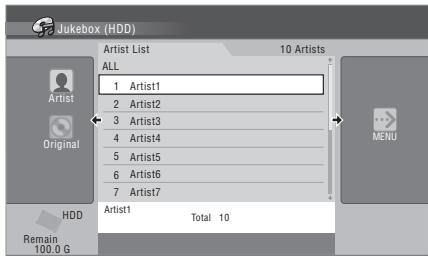
To play back all of the tracks of the selected artist, proceed to step 7. Press ENTER to switch to the album display of the selected artist.
- This step is for the display mode set to Artist. The operation varies when the display mode is set to other settings.
- To play back all artists, select All and proceed to step 7.
- Press SUBTITLE or ANGLE to change the page.
5 SELECT the album you want to play back.
To play back all of the tracks of the selected album, proceed to step 7. Press ENTER to switch to the track display of the selected album.
- To play back all albums, select All and proceed to step 7.1
6 Select the track you want to play back.
- To play back all tracks, select All.
7 Display the command menu.
8 SELECT 'Play' from the menu.
Playing and copying music (Jukebox)
- For a description of operations during playback, see Playing Audio CDs and WMA/MP3 discs on page 77.
Playing music files on the HDD in random order
The files can easily be played in random order simply by pressing the MUSIC button.
MUSIC Start playback.
Audio slideshows combining the photos and music recorded on the HDD are played. For details, see Playing a slideshow on page 118.
- The play list switches each time the MUSIC button is pressed. For details on play lists, see Playing your favourite music (Play List) below.
- For a description of operations during playback other than that of the MUSIC button, see Playing Audio CDs and WMA/MP3 discs on page 77.
Repeat play
1 Display the command menu panel during playback.
2 SELECT 'Repeat'.
- Select Play Mode when audio files stored on a DVD/CD or a USB device are being played back (see The Play Mode menu on page 81).
3 Select a repeat function from the command menu panel.
- Repeat Artist - Repeats all tracks of an artist being played back.
- Repeat Album - Repeats all tracks of an album being played back.
- Repeat Track - Repeats the track being played back.
- Repeat Off - Cancels repeat playback.
Playing your favourite music (Play List)
You can collect and play back only your favourite songs stored on the HDD.
Creating a play list
1 SELECT a track you want to add to a play list.
2 SELECT 'Add to Play List' from the command menu panel.
3 SELECT a play list ('Play List 1' to 'Play List 4') where you want to add the selected track.
- You can add up to 25 songs to a play list.
- You can rename a play list (see Editing the HDD Jukebox on page 116).
Playing a play list
1 Display the view options panel.
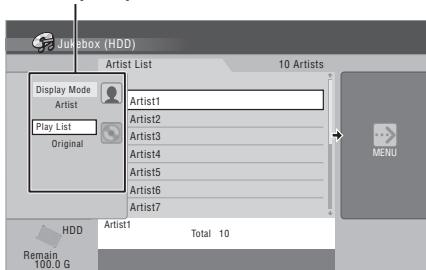
The view options panel
2 SELECT 'Play List'.
3 SELECT a play list ('Play List 1' to 'Play List 4') you want to play back.
4 SELECT 'Play' from the command menu panel.
Playing and copying music (Jukebox)
Changing the display style of the Jukebox
HDD
1 Select an artist/album you want to change the display for.
Display the view options panel.

Select a view option.
- Display Mode
Artist - Displays the artists copied onto this unit from the earliest date.
Album - Displays the albums of the selected artist. When you select All, albums of all artists are displayed.
Track - Displays the tracks of the selected artist/album. When you select All, tracks of all artists/albums are displayed.
Cancel - Cancels the switching of the display.
- Play List
Original - Displays the settings of Display Mode (Artist).
Play List 1 to Play List 4 - Displays the tracks added to each play list.
Favourites - Displays up to 25 tracks you listen to most frequently.
Cancel - Cancels the switching of the display.
CD WMA/MP3
1 Display the view options panel.
2 SELECT a view option.
Data Format
CD - Displays the Audio CD's tracks.
MUSIC FILE - Displays the folders/tracks of the WMA/MP3 files.
Cancel - Cancels the switching of the display.
- Display Mode
Album - Displays the folders of the WMA/MP3 files.
Track - Displays the tracks of the WMA/ MP3 files.
Cancel - Cancel the switching of the display.
Copying albums/tracks
You can copy the albums stored on the HDD to other folders of a different artist on the HDD. Also, you can copy the tracks stored on the HDD to other albums on the HDD.
- You cannot copy the albums/tracks stored on the HDD to a DVD or a USB device.
1 Display the Home Menu.
2 SELECT 'Jukebox' > 'Play/Edit Music on the HDD'.
3 SELECT an album/track you want to copy.
4 Select 'Edit' > 'Copy Album' or 'Copy Track' from the command menu panel.
5 Select an artist/album you want to copy the selected album/track to.
Select New Artist or New Album if you want to create a new artist/album. The name of an artist/album becomes A_number/A_number_F_number.
6 Select 'Yes' to confirm or 'No' to cancel.
Editing the HDD Jukebox
A number of commands are available for editing and changing the playback behavior of albums.

1 Display the Home Menu.

2 SELECT 'Jukebox' > 'Play/Edit Music on the HDD'.

3 SELECT what you want to edit.

4 SELECT an edit function from the command menu panel.
- Erase - Deletes the selected artist/album/track.1
- Edit > Artist name – Enter a name of up to 64 characters for the artist. See Title Name on page 93 for how to enter names.
- Edit > Album name - Enter a name of up to 64 characters for the album. See Title Name on page 93 for how to enter names.
- Edit > Track name - Enter a name of up to 64 characters for the track. See Title Name on page 93 for how to enter names.
- Play List name - Enter a name of up to 12 characters for the Play List. See Title Name on page 93 for how to enter names.
Chapter 14
Playing and copying photos (PhotoViewer)
From the PhotoViewer you can view JPEG photos and picture files stored on the HDD, DVD or CD-R/-RW/-ROM, or on a USB-equipped digital camera. You can also import files and save them to the recorder's HDD or a DVD-R/-RW disc.
Locating JPEG picture files
HOME
MENUV

Display the Home Menu.

Select 'PhotoViewer'.


Select the location of the files
you want to view or edit.
View/Edit Photos on the HDD - View or edit photos already stored on the recorder's HDD.
View Photos on a DVD/CD - View photos on a DVD, Fujicolor CD, CD-ROM or CD-R/-RW.
View Photos on a USB Device - View photos on a digital camera (or other USB device) connected to the USB port.
- Copy Files from a Digital Camera
- Copy all DCF files directly from a connected digital camera to a recordable DVD-R/-RW.
4 Select the folder containing the files you want to view, copy or edit.
The first image from the selected folder is displayed as thumbnail at the bottom of the screen.
From the Folder Information column, you can change thumbnails via the / buttons.
- Press PREV or NEXT to change the page.
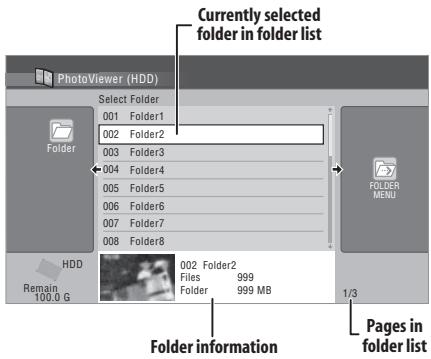
5 Select the file you want to view, copy or edit.
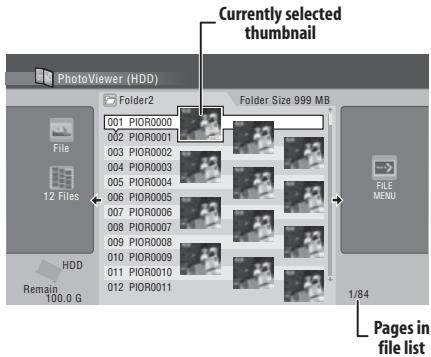
- The larger the file size, the longer it takes the recorder to load the file.

Note
1 Up to 999 files or 99 folders are viewable, but if there are more files/folders than this on the disc or connected USB camera it is still possible to view them all using the Reload function (see Reloading files from a disc or USB device on page 118).
Playing and copying photos (PhotoViewer)
- Press PREV or NEXT to change the page.
- You can change folders via the / buttons.
- If you encounter a disc that will not play, check that the disc and file formats are compatible with this recorder (see JPEG file compatibility and PC-created disc compatibility on page 11).
- The thumbnails of files that cannot be played are displayed as the A logo.
Reloading files from a disc or USB device
If you have a disc with more than 1000 files and/or 100 folders, you can still view all the images using the reload function.

Navigate to the last entry in the list ('Read next: ...').
2 ENTER
Load the next batch of up to 999
files/99 folders from the disc or connected USB device.
It will take a moment (at most a few minutes) to load in the images.
Changing the display style of the PhotoViewer
You can choose to display photos by grouping them by folder, file, or number of thumbnails.


Display the view options panel.
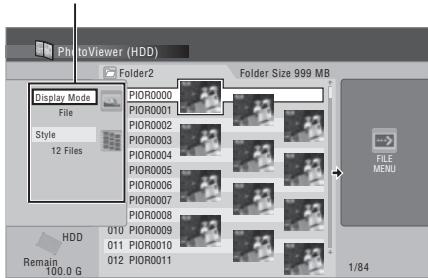
The view options panel


Choose 'Display Mode' or
'Style' then press ENTER to see the available view options.
- Display Mode - Choose between folder and file display modes.
- Style - Choose between displays of 1, 4 and 12 thumbnails.


Choose a view option, then:
The display mode will change to that which you have chosen.
Playing a slideshow


Select a folder from the folder
To start the slideshow from the first file in the folder, skip to step 3 after choosing the desired folder and pressing .


Select a thumbnail.
- Use PREV/ NEXT to display the previous/next page of thumbnails.
3 Display the command menu panel.
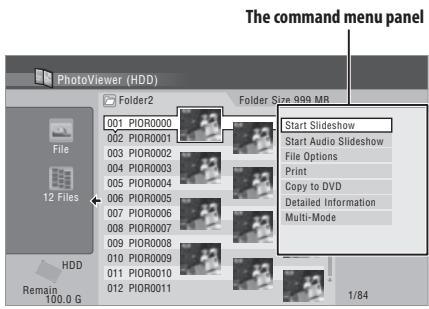
4 SELECT 'Start Slideshow' or 'Start Audio Slideshow'.
When Start Audio Slideshow is selected, you can enjoy the slideshow while playing back music in Jukebox. Select the theme and play list, then press ENTER. For details, see Creating photo movies on page 120.
For more information on adding music to the HDD, see Playing and copying music (Jukebox) on page 111.
- You can also select a file or folder then press PLAY to start playing the slideshow.
- Use | P| V| P| N eXT to display the previous/next picture,or II PAUSE to pause the slideshow.
Depending on the aspect ratio, some pictures may be displayed with black bars top and bottom, or left and right.
Large picture files may take a few seconds to display. This is normal.
5 Press to return to the thumbnail.
- You can also use the RETURN/EXIT button.
6 Press to exit the PhotoViewer.
Zooming an image
During a slideshow you can zoom in to enlarge a portion of the picture by a factor of two or four. You can also move the area of the picture displayed.
1 ENTER Press during the slideshow to zoom the picture.
Repeated presses cycle between zoom off, 2x zoom and 4x zoom. The zoom factor is displayed on-screen.
2 Use to move the zoomed area.
Rotating an image
You can rotate the displayed picture during a slideshow so you can always view pictures the right way up, whichever way they were taken.
- ANGLE Press during the slideshow to rotate the displayed picture clockwise by 90^ .
Press repeatedly to continue rotating the picture in increments of 90^ .
Playing JPEG files on the HDD in random order
The files can easily be played in random order, simply by pressing the PHOTO button.2
- PLAYING audio slideshows.
Use this procedure to play audio slideshows combining the photos and music recorded on the HDD.
- The photos switch in units of folders each time the PHOTO button is pressed.
- To stop playback, press STOP.
Playing and copying photos (PhotoViewer)
Creating photo movies
Use this procedure to create photo movies combining the photos and music recorded on the HDD. Photo movies are stored on the HDD as video titles and can be copied to DVDs.

Important
- Created video titles should be used only personally, without distributing them to others.
1 Select a folder from the folder list.
A photo movie will be created using all of the photos in the folder.
2 Select 'Create Photo Movie' from the command menu panel.
3 Select a theme and a play list.
Use the / buttons to move the cursor to Theme or Play List. Use the / buttons to select the item.
- Theme
Select the way in which the photos are displayed.
Happy moments (1) - Photos are displayed on the entire screen and switch as they fade out and in between every photo.
Happy moments (2) - Photos are displayed on parts of the screen (upper right, lower left, etc.) and switch.
Nostalgic memories - Photos are displayed in black and white on parts of the screen (upper right, lower left, etc.) and switch.
Sweetest recollections - Photos switch slowly with motion (enlargement, reduction, movement, etc.).
Blissful life - Photos switch with motion (enlargement, reduction, movement,
etc.).
Normal (OFF) - Photos are displayed on the entire screen and switch.
- Play List
Select the music to be used for the photo movie. For details, see Playing your favourite music (Play List) on page 114.
Play List 1 to Play List 4 - Select from the play lists stored in the Jukebox.
Favourites - Use up to 25 of the tracks you listen to most often.
4 SELECT 'Next'.
Cautions related to copyrights are displayed.
5 SELECT 'Yes'.
Photo movies are recorded on the HDD as they are played.
- No other recorder operation is possible while photo movies are being recorded.
- The timer recording operation does not function while photo movies are being recorded.
- To stop recording, press STOP REC for more than three seconds.
Importing files to the HDD
You can import files and save them to the HDD from a CD, DVD or a connected USB camera. Once on the HDD you can edit and organize your pictures and print them out if you've connected a PictBridge-compatible printer.
1 SELECT the location of folders/files you want to import.
To import a whole folder, select the desired folder, press , and skip to step 3 below.
- To import multiple folders, use the Multi-Mode; see Selecting multiple files or folders on page 121.
2 Select a file to import.
- To import multiple files, use the MultiMode; see Selecting multiple files or folders below.
3 SELECT 'Copy to HDD' from the command menu panel.

Select 'Copy to HDD' from the end menu panel.

Select 'Yes' to confirm and copy r(s)/file(s) , or 'No' to cancel.
- The files will be copied to the HDD with the same folder structure as the original.
- Importing to the HDD will not work if there is insufficient space on the HDD, or if there are already the maximum number of files and/or folders on the HDD (999 folders/999 files per folder, total 50 000 files).
Selecting multiple files or folders
The Multi-Mode allows you to select multiple folders/files at once for importing or editing.
1 SELECT the folder containing the files you want to import.
2 Select 'Multi-Mode' from the command menu panel.
3 SELECT files/folders from the list.
An orange check mark box (☑) is shown by the item you selected. A blue check mark box (☑) appears on the folder select screen when files from that folder are selected.
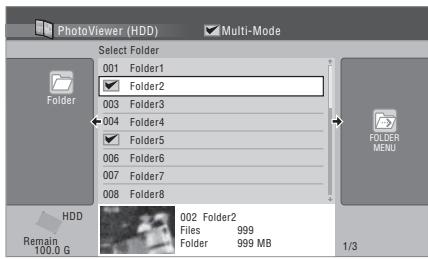
4 Display the command menu panel.
5 Select the command you want to apply to all the selected items.
Copying files to a DVD-R/-RW
Using this feature you can copy all the files1 (including audio and movie files) stored on a connected USB camera to a recordable DVD disc.
A slideshow of the files is also recorded on the disc as a Video mode title, making it possible to view the photos on other DVD players/recorders that may not be compatible with JPEG file playback.
Once the files have been copied, the disc is automatically finalized.

Important
- Use a blank DVD-R/-RW disc, or one that has already been initialized for Video mode recording but has nothing yet recorded on it. Discs that have already been recorded on (as well as CD-R/-RW discs) cannot be used.
Playing and copying photos (PhotoViewer)
- After backing up the pictures in your digital camera to DVD, we recommend verifying that they have been recorded properly before deleting anything from the camera.
1 Load a blank (or unrecorded Video mode) DVD-R or DVD-RW disc.

2 Display the Home Menu.

Files from a Digital Camera'.

4 SELECT 'Yes' to confirm or 'No' to cancel.
Note that during copying, any timer programmes set to start will not begin, and no other operations are possible.
Copying selected files to a DVD-R/-RW
This feature allows you just to copy some of the files stored on HDD to a DVD.
A slideshow of the files is also recorded on the disc as a Video mode title, making it possible to view the photos on other DVD players/recorders that may not be compatible with JPEG file playback. Note however that you may need to finalize the disc before it will play on another DVD player (copying selected files doesn't automatically finalize the disc).

Important
- A maximum of 99 slideshow titles can be recorded.
- One slideshow title can contain up to 99 files. If there are more files than this in the slideshow, multiple slideshows are created on the disc.
- If you erase a slideshow title from a DVD the slideshow will become unplayable but the free space will not increase.
1 Load a blank (or unfinalized Video mode) DVD-R or DVD-RW disc.

Display the Home Menu.
3 SELECT 'PhotoViewer' > 'View/Edit Photos on the HDD'.
4 SELECT the file(s) or folder(s) you want to copy.
- Copying a folder will copy all the files contained in it.
- To copy multiple folders, use the Multi-Mode; see Selecting multiple files or folders on page 121.
5 Select 'Copy to DVD' from the command menu panel.
6 Select 'Yes' to confirm or 'No' to cancel.
- Folder names on the disc will be number PIONR. File names will be PHOT number.
Note that during copying, any timer programmes set to start will not begin, and no other operation is possible.
While 'Cancel' is displayed, you can press ENTER to cancel.
Editing files on the HDD
There are a number of commands you can use to edit and organize your pictures stored on the HDD.
Creating a new folder
1 From the folder list, display the command menu panel.
2 SELECT 'New Folder'.
The folder appears at the bottom of the folder list with the name F_number.
Playing and copying photos (PhotoViewer)
- There can be up to 999 folders on the HDD.
Erasing a file or folder

Select the file(s) or folder(s) you
want to erase.
To erase multiple files or folders, use the Multi-Mode; see Selecting multiple files or folders on page 121.
Erasing a folder will erase all the files contained in it. Please be careful!
- You can't erase files that have been locked.
- Folders containing locked files can't be erased. Unlocked files in the folder, however, will be erased.
2 Select 'File Options' or 'Folder Options' from the command menu panel.

Select 'Erase' or 'Erase Folder'.
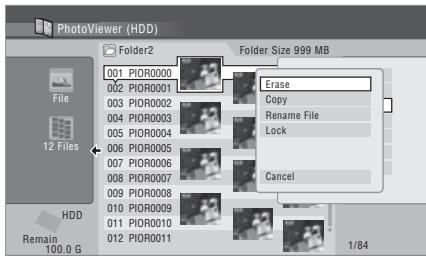
4 Select 'Yes' to confirm or 'No' to cancel.
- You can also erase a file or folder by pressing CLEAR when the file or folder is highlighted. Press ENTER to confirm.
Copying files

1. Select the file(s) or folder(s) your copy.
- Copying a folder will copy all the files contained in it.
- To copy multiple files or folders, use the Multi-Mode; see Selecting multiple files or folders on page 121.
2 Select 'File Options' or 'Folder Options' from the command menu panel.
3 SELECT 'Copy' or 'Copy Folder Contents'.
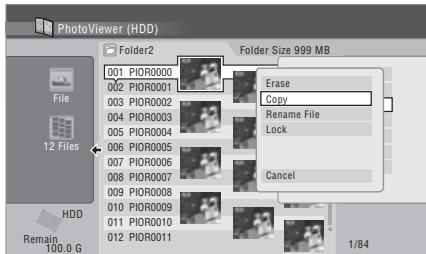
4 SELECT a folder to copy the folder(s)/file(s) to.
5 Select 'Yes' to confirm or 'No' to cancel.
- Copying to the HDD will not work if there is insufficient space on the HDD; if there are already the maximum number of files and/or folders on the HDD.
Naming files and folders
1 SELECT the file or folder you want to rename.
You can't rename files that have been locked.
2 Select 'File Options' or 'Folder Options' from the command menu panel.
3 SELECT 'Rename File' or 'Rename Folder'.
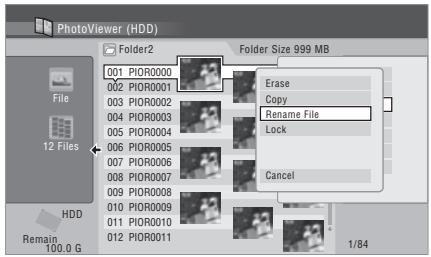
4 Enter a new name for the file/folder.
File names or Folder names can be up to 64 characters long.
See Using the remote key shortcuts to input a name on page 93 and Using a USB keyboard to enter a name on page 94 for how to enter a name.
Locking/Unlocking files
Locking files will protect them from accidental erasure and prevent them from being renamed.
Use the same process to both lock and unlock files. Locked files are displayed in the PhotoViewer with a padlock icon.
1 SELECT the file(s) you want to lock (or unlock).
- To lock/unlock multiple files or folders, use the Multi-Mode; see Selecting multiple files or folders on page 121.
2 Select 'File Options' or 'Folder Options' from the command menu panel.
3 SELECT 'Lock' or 'Lock Folder Contents'.
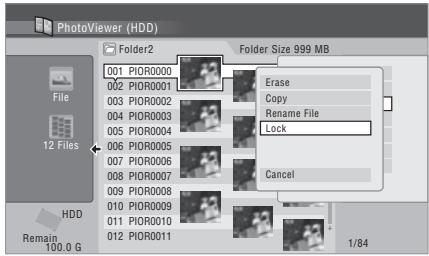
Locked files are shown with a padlock icon next to them. To remove all locks within a given folder, choose 'Folder Option' > 'Unlock Folder Contents'.
To view detailed information
This feature allows you to check the settings of the camera from which you imported the photos.
1 SELECT the file for which you would like to see detailed information.
2 SELECT 'Detailed Information'.
When no detailed information is available, nothing is displayed.
Printing files
Connecting a PictBridge-compatible printer to the USB port will enable you to print out picture files ^1 stored on the HDD, a CD/DVD or directly from a digital camera.
Make sure that the printer (and your digital camera if you are using that as a source) is connected to the recorder before starting.
1 SELECT the file(s) you want to print.
- To print multiple files, use the MultiMode; see Selecting multiple files or folders on page 121.
2 Select 'Print' from the command menu panel.
3 SELECT 'Start' to confirm or 'Cancel' to cancel.
- Once printing has started, you can cancel by pressing ENTER.

- Paper size and layout can be set; the options available depend on your printer — check the printer manual for details.
- This recorder may not work correctly with all printers.
Chapter 15
Copying files from a PC (Connect PC)
When the recorder is connected to a PC using the USB port, WMA/MP3, JPEG and DivX files stored on the PC can be copied onto the recorder's HDD. Use Windows Explorer or Windows Media Player 11, depending on the type of file copied.

Important
Install Windows Media Player 11 on the PC before connected it to the recorder.
- For more information on Connect PC, see Using a PC on page 25.
Connecting the PC
1 Connect the PC via USB cable.
The screen below is displayed. Press 'X' to close the screen.
*Depending on the Windows OS version and the Windows Media Player settings, the screen shown below may not be displayed.
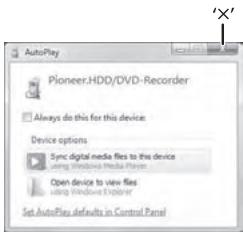
2 2 Display the Home Menu.
3 Select 'Connect PC' > 'USB'.
4 SELECT 'Yes' to confirm or 'No' to cancel.
Operating the PC, click ^^ on the window in step 1 to close it.
5 Verify that the import screen is displayed on the device.
If no actions are carried out for 20 minutes, the import screen is automatically closed. To reopen it, you will have to repeat steps 2 through 4.
- To copy WMA/MP3 files, see Copying WMA/MP3 files below.
- To copy JPEG, DivX files, see Copying JPEG and DivX files on page 127.
Copying WMA/MP3 files
From the PC:
- Open Windows Media Player 11. The device settings screen appears. Click 'Cancel'.
*Depending on the settings for Windows Media Player 11, the screen shown below may not be displayed.
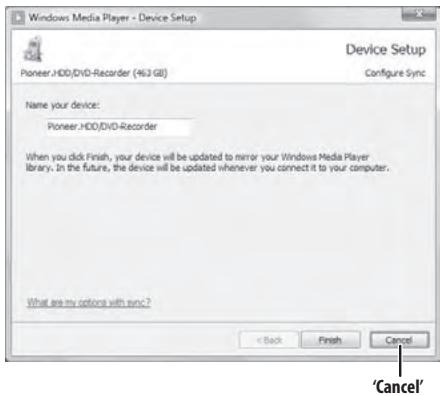
- Click 'Sync'.
- Choose the artist, album or song you would like to copy, and press the right mouse button.
- Click 'Add to Sync list'.
- Click 'Start Sync'.
Copying files from a PC (Connect PC)
This begins the synchronization process. When finished, the message
'Synchronized to Device' is displayed in Windows Media Player 11.
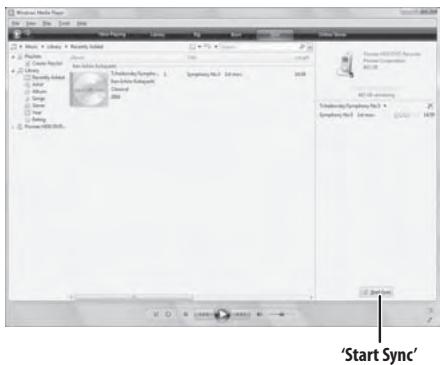
For more information refer to the Help menu of Windows Media Player 11.
The screen shown below is displayed on the recorder.
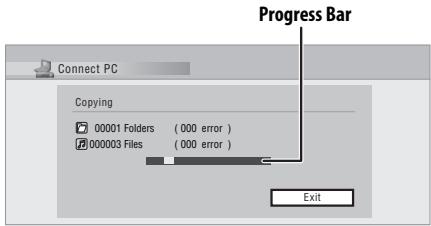
- To cancel the synchronization process on the recorder while it is underway, press ENTER on the recorder's remote control. The Connect PC screen is closed.
- If synchronization fails, make sure that the Pioneer. HDD/DVD-Recorder device is selected at the synchronization screen of Windows Media Player 11, and try again.
6. When you have finished copying files, close Windows Media Player 11 on the PC.
-
Press ENTER on the recorder's remote control, close the import screen on this device.
-
If no actions are carried out for 20 minutes after copying, the import screen on this device is automatically closed.

Note
- When using the sync function of Windows Media Player 11, music, artist and album folders are created as follows:
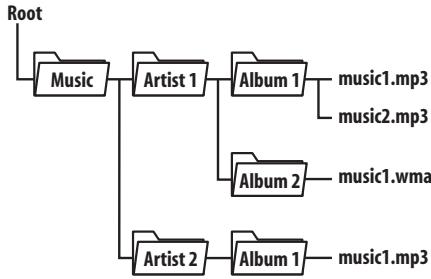
- With Windows Media Player 11, the above music folder is not displayed.
- For the maximum number of tracks that can be copied, see Copying music to the HDD on page 111.
Note that when there are many tracks contained in one album, it may take time to display and transfer these tracks. - Artists, albums and tracks with no set name that are transferred from CD/DVD/USB are displayed as 'Unknown Artist', 'Unknown Album' and 'Unknown File' in Windows Media Player 11.
- Artists, albums and track names that do not conform to the ISO8859-1 standard may display differently in Windows Media Player 11 and the Jukebox.
- Files other than WMA/MP3 files cannot be copied with Windows Media Player 11.
- Files imported to this recorder via Connect PC cannot be exported from this recorder.
Note that no recording functions, including timer recordings, will be carried out when you are using the Connect PC function.
Copying JPEG and DivX files
From the PC:
- Open Windows Explorer.
- Select the folder containing the files to be copied.
Always copy entire folders.
- Right-click the mouse and select 'Copy' from the menu.
- Select the folder into which you want to copy.
In Windows Explorer, the recorder's folder is displayed as shown below.
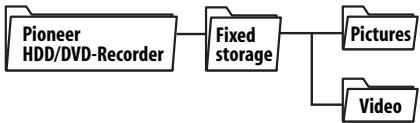
The folder into which the files should be copied depends on the type of file. Select the folder according to the type of file.
- Pictures - Select this to copy folders containing JPEG files.
- Video -Select this to copy folders containing DivX files.
For details on folder structure, see Note below.
5. Right-click the mouse and select 'Paste' from the menu.
For more information refer to the Help menu of Windows Explorer.
The screen shown below is displayed on the recorder.
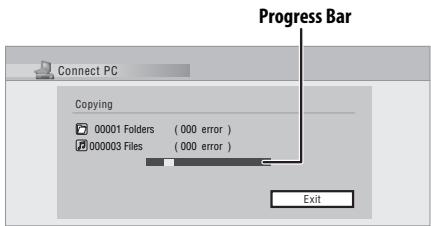
-
To cancel the synchronization process on the recorder while it is underway, press ENTER on the recorder's remote control. The Connect PC screen is closed.
-
When you have finished copying files, close Windows Explorer on the PC.
-
Press ENTER on the recorder's remote control, close the import screen on this device.
- If no actions are carried out for 20 minutes after copying, the import screen on this device is automatically closed.

Note
- JPEG files can only be copied with the folder structure shown below. It is not possible to place JPEG files directly into the Picture folder. Also, it is not possible to create more folders under folders you have created.
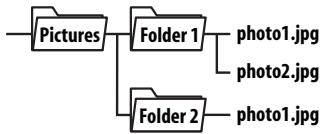
- DivX files can only be copied with the folder structure shown below. It is not possible to place DivX files directly into the Video folder. Also, it is not possible to create more folders under folders you have created.
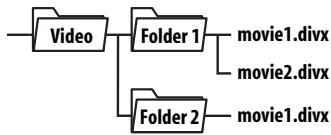
- For details on files that can be copied, see Disc/content format playback compatibility on page 7.
- For the maximum number of folders/files that can be copied, see the instructions on playing the different types of files (Copying DivX files to the HDD (PC VIDEO) on page 109, Importing files to the HDD (PhotoViewer) on page 120).
Chapter 16
The Disc Setup menu
From the Disc Setup menu you can name discs, lock the contents to prevent accidental recording and erasure, initialize and finalize discs. The Disc Setup menu is accessed from the Home Menu.
Basic settings
Input Disc Name
DVD (VR) DVD (Video) DVD+R DVD+RW DVD-RAM
When you initialize a disc for recording, the recorder automatically assigns a name for the disc ranging from DISC 1 to DISC 99. You can use the Input Disc Name function to change the default disc name to something more descriptive. This name appears when you load the disc and when you display disc information on-screen.

Display the Home Menu.
Select 'Setup' > 'Disc Setup'.

Select 'Basic' > 'Input Disc
Name' > 'Next Screen'.
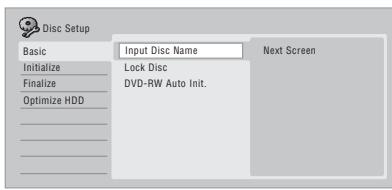
4 & \ & Input a name for the disc.
The disc name can be up to 64 characters long for a VR mode disc, or 40 for a Video mode discs and DVD+R/+RW.
- See Title Name on page 93 for more on navigating the input screen.
Lock Disc
DVD (VR) DVD-RAM
- Default setting: Off
Locking the disc will prevent accidental recording, editing or erasing of the disc.

Important
- A locked disc can still be initialized (which will completely erase the disc).
1 Display the Home Menu.
2 Select 'Setup' > 'Disc Setup'.
3 SELECT 'Basic' > 'Lock Disc' then 'On' or 'Off'.
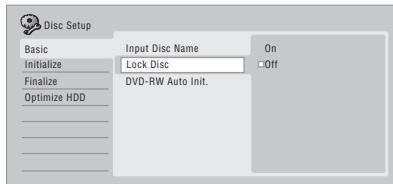
Set to On to prevent accidental recording, editing or erasing of the disc loaded. If you need to unlock the disc to make edits, select Off.
DVD-RW Auto Initialize
DVD-RW
- Default setting: VR Mode
Initialization mode is automatically carried out when you insert a blank DVD-RW. You must set the desired initialization mode before inserting a disc.
See DVD-RW Auto Initialize on page 74 for detailed instructions.
Initialize settings
DVD-R DVD-RW DVD+RW DVD-RAM
You can initialize a recordable DVD-R/-RW disc for either VR mode or Video mode recording.
The first time you load a new DVD-RW disc, it will be automatically initialized for recording according to the DVD-RW Auto Init. setting in the Disc Setup menu (see page 74).
New DVD-R discs are ready for Video mode recording when you load them, but it is also possible to initialize them for VR mode recording.
DVD+RW and DVD-RAM discs can also be initialized as a way of erasing the entire disc. When initializing a DVD-RAM disc, select VR mode.
See Initializing recordable DVD discs on page 73 for detailed instructions.
Finalize settings
Finalize
DVD-R DVD-RW DVD+R DVD+RW
Finalizing 'fixes' the recordings in place so that the disc can be played on a regular DVD player or computer equipped with a suitable DVD-ROM drive.
It is also possible to finalize DVD+RW discs. This is only necessary if you want the DVD player to display the title menu for the disc. See Playing your recordings on other DVD players on page 72 for detailed instructions.
Undo Finalize
DVD-RW
You can undo the finalization on DVD-RW discs recorded on this recorder in Video mode. You need to do this if you want to record more material or edit material already on the disc.
You can also undo the finalization of VR mode discs which have been finalized on other DVD recorders. If when you load a disc the message This disc cannot be recorded.
Undo the finalization. is displayed, use this command to be able to record on the disc using this recorder.
1

Display the Home Menu.
2

Select 'Setup' > 'Disc Setup'.
3

Select 'Finalize' > 'Undo
Finalize' then 'Start'.
Optimize HDD
HDD
As you record, erase and edit recordings, the HDD file system gradually becomes fragmented. Periodically, the HDD will need optimizing to 'clean up' all the fragmented files.
When the HDD needs optimizing the recorder will automatically display a message recommending optimization.

Important
- Optimizing the HDD can take up to eight hours to complete. During optimization, playback and recording are not possible.
- Cancelling optimization mid-way does not undo the optimization already done, so the HDD will be partly optimized.

Note
1 Once initialized for VR mode recording it is not possible to re-initialize the disc for Video mode recording. Also, once recorded in Video mode, the disc cannot be re-initialized for VR mode recording.
1 Display the Home Menu.
2 SELECT 'Setup' > 'Disc Setup'.
3 SELECT 'Optimize HDD' then
'Start'.
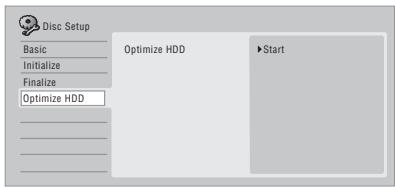
A progress bar indicates how long there is left to go. If no actions are carried out for more than 20 minutes after the optimization process is completed, the unit turns itself off.
Initialize HDD
HDD
When your HDD/DVD recorder is working without a problem this option is not visible in the Disc Setup menu. However, if the HDD file system becomes corrupted for some reason, you can initialize the HDD to fix the problem. Note that initializing the HDD will erase all the data on it.
1 Display the Home Menu.
2 SELECT 'Setup' > 'Disc Setup'.
3 SELECT 'Initialize HDD' then 'Start'.
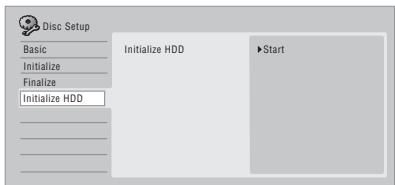
Chapter 17
The Video Adjust menu
Using the Video Adjust menu you can set up the picture quality for the built-in tuner and external inputs, for disc playback, and for recording.
Setting the picture quality for TV and external inputs
Picture Creation lets you choose a set of picture quality settings for the built-in TV tuner1 and for each external input. There are several preset settings that suit various sources, or you can create up to three of your own sets.
Choosing a preset

With the recorder stopped, press any the Home Menu.
2 SELECT 'Setup' > 'Video Adjust'.

Select a preset.
- Use the INPUT SELECT button to switch between the built-in TV tuner and the external inputs.
- Use the CHANNEL +/- buttons to change the channel of the built-in TV tuner.
There are six presets available:
-
Tuner - suitable for general TV broadcasts
VCR - suitable for video cassettes -
DTV/LDP - suitable for digital broadcasts and Laserdiscs
Memory1-user preset 1
Memory2-user preset 2
Memory3-user preset 3
You can press DISPLAY to see the individual settings for the current preset (Tuner, VCR or DTV/LDP).
Creating your own set
There are three user presets in which you can save your own set of picture quality settings.
1 Follow Choosing a preset above and select one of the user presets (Memory 1, 2 or 3).


Select 'Detailed Settings'.


Select the setting you want to
adjust.
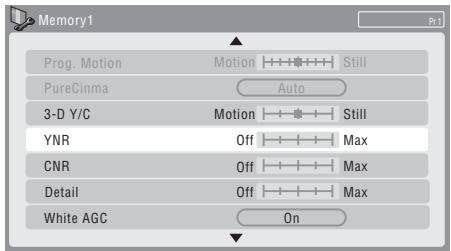
You can adjust the following settings:
-
Prog. Motion - Adjusts the motion and still picture quality when video output is set to progressive.
-
PureCinema – This setting optimizes the picture for film material when the video output is set to progressive. Usually set to Auto; but try switching to Off if the picture appears unnatural.
- 3-D Y/C - Adjusts the brightness/colour separation.
- YNR - Adjusts the amount of noise reduction (NR) applied to the Y (brightness) component.
- CNR - Adjusts the amount of noise reduction (NR) applied to the C (colour) component.
- Detail - Adjusts how sharp edges appear.
- White AGC - Turn on for automatic white level adjustment.
- White Level - Adjusts the intensity of white.
- Black Level - Adjusts the intensity of black.
- Black Setup - Corrects the standard reference black level (525 Input Line System only).
- Hue - Adjusts overall balance between red and green.
- Chroma Level - Adjusts how rich the colours appear.
4 (+_ENTER) Adjust the currently selected setting.
HOME HOMEMENO Press to exit.
You can now use the preset for any other input or the built-in TV tuner.

Tip
- To see more of the picture as you adjust different settings, press ENTER after selecting the setting you want to adjust.
Setting the picture quality for disc playback
This setting determines how the picture will look when playing discs.
Choosing a preset
1 With a disc playing (or paused), press to display the Home Menu.
2

Select 'Setup' > 'Video Adjust'.
3

Select a preset.
There are six presets available:
TV - suitable for LCD and cathode-ray tube TVs
- PDP - suitable for Flat Screen TV
Professional - suitable for professional monitors
Memory1-user preset 1
Memory2-user preset 2
Memory3-user preset 3
You can press DISPLAY to see the individual settings for the current preset (TV, PDP or Professional).
Creating your own set
There are three user presets in which you can save your own set of picture quality settings for disc playback.
1 Follow Choosing a preset above and select one of the user presets (Memory 1, 2 or 3).
2

Select 'Detailed Settings'.
3 Select the picture quality setting you want to adjust.
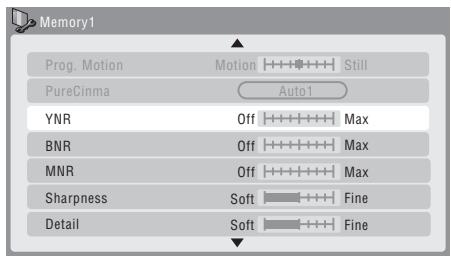
You can adjust the following settings:
- Prog. Motion – Adjusts the motion and still picture quality when video output is set to progressive. (Prog. Motion is ineffective when PureCinema is On.)
- PureCinema – This setting optimizes the picture for film material when the video output is set to progressive. Usually set to Auto 1 but try switching to Auto 2, On or Off if the picture appears unnatural.
- YNR - Adjusts the amount of noise reduction (NR) applied to the Y (brightness) component.
- BNR - Adjusts the amount of noise reduction (NR) applied to the block noise (artefacts visible in areas of flat colour, caused by MPEG compression).
- MNR - Adjusts the amount of noise reduction (NR) applied to the mosquito noise (artefacts visible around the edges of an image, caused by MPEG compression).
- Sharpness - Adjusts the sharpness of the high-frequency (detailed) elements in the picture. Sharpness is ineffective for HDMI output.
- Detail - Adjusts how sharp edges appear.
- White Level - Adjusts the intensity of white. White Level is ineffective for HDMI output.
-
Black Level - Adjusts the intensity of black. Black Level is ineffective for HDMI output.
-
Black Setup - Corrects the standard reference black level. The Black Setup setting is only valid for NTSC output signals. Black Setup is ineffective for HDMI output.
- Gamma Correction - Adjusts the brightness of darker images. Gamma Correction is ineffective for HDMI output.
- Hue - Adjusts overall balance between red and green. Hue is ineffective for HDMI output.
- Chroma Level - Adjusts how rich the colours appear. Chroma Level is ineffective for HDMI output.
4 Adjust the currently selected setting.
5 Press to exit.

Tip
- To see more of the picture as you adjust different settings, press ENTER after selecting the setting you want to adjust.
Chapter 18
The Initial Setup menu
Using the Initial Setup menu
The Initial Setup menu is where you can set various recorder options for sound, picture, language and so on.
Some settings can only be changed when the recorder is stopped. During playback and recording these settings are grayed out in the Initial Setup menu.
Except for the Setup Navigator, menu screens are exited automatically after 20 minutes of inactivity.
- Press HOME MENU and select 'Setup' > 'Initial Setup'.
In the table below, the default option is marked with a .
| Setting | Options | Explanation |
| Basic | ||
| Clock Setting | Auto | Set the channel that broadcasts a clock signal and the clock will be set automatically. |
| Manual • | If there is no channel that broadcasts a clock signal in your area, you can set the time and date manually. | |
| • If any digital TV channels are set then the clock will automatically be set. • The clock must be set in order to use timer recording. | ||
| Input Line System | 525 System | Use for NTSC or PAL-60 recording from an external input. |
| 625 System • | Use for standard PAL or SECAM recording. | |
| • This setting is applicable only when recording from an external input. • See also About the input line system on page 148 for more information on this setting. | ||
| Power Save | Mode 1 | Only signals arriving at the antenna input are passed through to the antenna output when the recorder is in standby. |
| Mode 2 | No input signals are passed through to the outputs when the recorder is in standby. | |
| Off • | When the recorder is in standby, all signals arriving at the SCART and antenna inputs are passed along to the outputs. | |
| HELP Setting | On • | Switches on the automatic Help screens for GUI displays. |
| Off | Switches off the automatic Help screens for GUI displays. (Press HELP on the remote to manually display the Help screen.) | |
| EPG Type Select | GUIDE Plus+ | Use the Gemstar GUIDE Plus+ EPG. |
| Digital EPG | Use the EPG based on information provided by D.TV broadcasts. | |
The Initial Setup menu
| Setting | Options | Explanation |
| Setup Navigator | Start | Select to start the Setup Navigator. See also Switching on and setting up on page 32. |
| Digital Tuner | ||
| Replace Channels | Next Screen | Scans for digital channels and replaces all the channel presets with the results. Before the scan starts you will need to select your country. After the scan is complete the recorder tells you whether any new channels were found, and if so, how many. (You can cancel the scan before it has finished by pressing HOME MENU or RETURN/EXIT. In this case, no channels are set.) |
| If you execute a Replace Channels command, any timer recordings set for D.TV channels will be erased. | ||
| Add New Channels | Next Screen | Automatically scans for new digital channels. After the scan is complete the recorder tells you whether any new channels were found, and if so, how many. (You can cancel the scan before it has finished by pressing HOME MENU or RETURN/EXIT. In this case, no new channels are set.) |
| Channel Sort | Next Screen | Use this screen to sort channel presets into your preferred order. Use the ↑/↓/←/→ buttons to highlight the channel you want to move, press ENTER. Use the cursor buttons again to highlight the position you want to move the channel preset to, then press ENTER again. (If there are more channel presets than will fit on one screen, you can select the next/previous page by highlighting the small triangular marks and pressing ENTER.) |
| Channel Options | Next Screen | From this screen you can skip or lock channels. Locked channels will require the correct password to be entered before the channel can be watched. Use the ↑/↓/←/→ buttons to highlight a preference box and press ENTER to toggle the preference. To enter this screen, input the parental lock password when prompted (if one has not yet been set then the password you enter becomes the parental lock password). |
| Auto Skip | Off • | No channels are automatically skipped. |
| Radio | Radio channels are skipped when selecting channels. | |
| Data | Data channels are skipped when selecting channels. | |
| Radio & Data | Radio and data channels are skipped when selecting channels. | |
| Signal Check | Next Screen | Use this screen to check the signal level and quality of digital channels. Use the ↦/→ buttons to change the RF channel; select Add New Channels then press ENTER to scan for new channels; press HOME MENU to exit. |
| Aerial Power | On | Power is supplied to the connected aerial (antenna) when this recorder is on or in standby. |
| Auto | Power is supplied to the connected aerial (antenna) only when this recorder is on. | |
| Off • | This recorder does not supply power to the connected aerial (antenna). | |
If the setting keeps reverting to Off when you try to set to On or Auto, the aerial may not be connected properly, or it may be shorted. In either case, check the connection and try making the setting again.
| D.TV Language | Next Screen | From this screen you can set your Primary and Secondary Audio preference for multilingual digital broadcasts, your Primary and Secondary Subtitle preference for programmes that are broadcast with subtitles, and your Teletext language preference. Use the ↑/↓ buttons to highlight a field then use the ←/→ buttons to change it. |
| Analog Tuner | ||
| Auto Channel Setting | Auto Scan | Select your country and then wait for the recorder to auto tune into channels in your area. After auto scan has finished, the channel mapping screen appears showing which channels have been assigned to which programme numbers. You can skip unwanted channels using the Manual CH Setting option (see page 137).Press HOME MENU to exit the channel mapping screen. |
| Download from TV | If your TV supports this feature you can download all the channels that your TV is tuned to via the SCART input. Select your country and then wait for the download to complete. After the download is complete, the channel mapping screen appears, as above. See also the operating instructions that came with your TV for more information. | |
The Initial Setup menu
| Setting | Options | Explanation |
| Manual CH Setting | Next Screen | Proceed to the next screen if you need to adjust any of the settings made by auto tuning. Select your country, then proceed to the manual channel setting screen: ·Change channel presets using the CHANNEL +/- buttons. ·To skip the displayed channel (because there is no station assigned to that channel), change the Skip setting to On. ·Set the CH SYSTEM setting to match the channel system of your country or region. ·Set the CHANNEL setting to the channel you want to assign to the current channel preset. ·To manually fine tune the channel, change the AFT setting to Off then adjust the Level setting. ·Set the Sound System setting to match the sound system of your region. ·The Name field allows you to input a name of up to five characters for the current channel preset. ·If the currently selected channel is scrambled requiring a decoder connected to the AV2 (INPUT 1/DECODER), set the Decoder setting to On. |
| Channel Swapping | Next Screen | Proceed to the next screen to swap channel assignments of different presets so that you can group together presets that naturally go together. Select two presets to swap then press ENTER. |
| Video In/Out | ||
| Input Colour System | Next Screen | Proceed to the next screen to set the input colour system for the external input and the built-in TV tuner. Use the CHANNEL +/- or INPUT SELECT buttons to change the preset or external input. On the default Auto setting the recorder can generally correctly detect whether the input signal is PAL, SECAM, 3.58 NTSC or PAL-60, but in some cases you may have to set it manually if the picture is displayed incorrectly. |
| ·Input Colour System cannot be set when the recorder is in D.TV mode. ·See also About the input colour system on page 148 for more information on this setting. | ||
| Component Video Out | Interlace | Select if your monitor/TV is not compatible with progressive-scan video. |
| Progressive | Select if your monitor/TV is progressive-scan compatible. Check the operating instructions that came with your monitor/TV if you're not sure. | |
| ·For Component Video Out to be effective, the AV1 Out setting (see page 138) must be set to something other than RGB. ·If your TV is incompatible with progressive scan video and you select Progressive, you will not be able to see any picture at all. In this case, press ▲ OPEN/CLOSE while holding down the ■ (Stop) button on the front panel to switch to Interlace (this also switches Screen Resolution on page 144 to the default setting). ·When the HDMI signal is output, no video is output from the COMPONENT VIDEO OUT. | ||
| AV1 Out | Video • | Sets the AV1 (RGB)-TV SCART output to standard composite video (compatible with all TVs). |
| S-Video | Sets the AV1 (RGB)-TV SCART output to S-Video. Recommended if you are using a long SCART cable. | |
| RGB | Sets the AV1 (RGB)-TV SCART output to RGB. Good quality but check your TV for compatibility. Note that on this setting signals from the built-in tuner and from external inputs is not output when the recorder is in TV mode. | |
- If you choose a setting that is incompatible with your TV you may not be able to see any picture at all. In this case either switch off and reconnect using the supplied video cable, or reset the recorder (see Resetting the recorder on page 167).
- The Component Video Out setting (see page 137) has no effect when AV1 Out is set to RGB.
- When the HDMI signal is output, the AV1 Out outputs the composite video signal even when it is set to RGB.
| AV2/L1 In | Video • | Sets the AV2 (INPUT 1/DECODER) SCART input to standard composite video. |
| S-Video | Sets the AV2 (INPUT 1/DECODER) SCART input to S-Video. | |
| RGB | Sets the AV2 (INPUT 1/DECODER) SCART input to RGB. | |
| Decoder | Use this setting if you connected a decoder to the AV2 (INPUT 1/DECODER) SCART connector. For scrambled channels, make sure that the channel Decoder setting is set to On. (See Manual CH Setting on page 137.) | |
| NTSC on PAL TV | On • | NTSC discs will play correctly on PAL-only TVs. |
| Off | Use if your TV is already NTSC-compatible. |
Many recent PAL TVs are compatible with NTSC input and so this setting can be switched off. Check the operating instructions that came with your TV. See also About NTSC on PAL TV on page 148 for related information.
| Audio In | ||
| NICAM Select | NICAM • | Record the NICAM audio in a NICAM broadcast. |
| Regular Audio | Record the non-NICAM audio in a NICAM broadcast. (You can still switch the audio to record using the AUDIO button before recording.) | |
| Analog Tuner Level | Normal • | Standard setting. |
| Compression | Use if the audio level from the built-in tuner is excessive, causing distortion. | |
| External Audio | Stereo • | Select if the audio from the currently selected external input is standard stereo. |
| Bilingual | Select if each channel carries a separate soundtrack. | |
When the external audio is from the DV input, an audio subcode channel within the DV audio tells the recorder whether the audio is stereo or bilingual. This has priority over the setting you make here.
The Initial Setup menu
| Setting | Options | Explanation |
| Bilingual Recording | A/L • | Record the left (A) channel of a bilingual source when recording to HDD with HDD Recording Format set to Video Mode On, to DVD-R/-RW (Video mode) or DVD+R/+RW or in LPCM mode, from an external source. |
| B/R | As above, but for right (B) channel recording. | |
| When recording bilingual audio to DVD in VR mode (except in LPCM mode), or to HDD with HDD Recording Format set to Video Mode Off (except in LPCM mode), both audio channels are recorded and you can switch to the one you want on playback. | ||
| DV Input | Stereo 1 • | Select to use the 'live' audio track (recorded during the video shoot) from a camcorder that supports two stereo audio tracks. |
| Stereo 2 | Select to use the overdubbed audio track from a camcorder that supports two stereo audio tracks. | |
| Mix | Select one of the three settings to use a mix of the two stereo audio tracks. | |
| Audio Out | ||
| Dolby Digital Out | Dolby Digital • | Output a Dolby Digital signal when a Dolby Digital source is being played. |
| Dolby Digital → PCM | Convert Dolby Digital sources to Linear PCM output. Use if your connected equipment doesn't have a Dolby Digital decoder. | |
| DTS Out | On • | Output a DTS signal when a DTS source is being played. |
| Off | Switch off the digital output when a DTS source is being played. Use when your connected equipment doesn't have a DTS decoder. In this case, use the analog audio outputs. | |
| 96 kHz PCM Out | 96 kHz → 48 kHz • | Convert 96 kHz digital audio sources to 48 kHz output. Use if your connected equipment doesn't support 96 kHz sampling rate. |
| 96 kHz | Output 96 kHz digital audio when a 96 kHz source is being played. | |
| MPEG Out | MPEG | Output an MPEG audio signal when a source using MPEG audio is being played. |
| MPEG → PCM • | Convert sources with MPEG audio to Linear PCM output. Use if your connected equipment doesn't have an MPEG audio decoder. | |
| Audio DRC | On | Switches on Audio DRC (Dynamic Range Control). Use when listening to Dolby Digital material at low volume. |
| Off • | Switches off Audio DRC. | |
Audio DRC is not effective when listening via the digital output when the Dolby Digital Out setting is set to Dolby Digital.
| Setting | Options | Explanation |
| Language | ||
| OSD Language | English • | Sets the language of the on-screen displays to English. |
| available languages | Choose from the languages displayed for the on-screen displays. | |
| Audio Language | English • | Sets the default audio language for DVD-Video playback to English. |
| available languages | Choose from the languages displayed to set the default audio language for DVD-Video playback. | |
| Other | Select to set the default audio language to something other than the ones listed. See Selecting other languages for language options on page 147. | |
| Discs do not necessarily have audio in your selected language. Also, some discs override the Audio Language preference. | ||
| Subtitle Language | English • | Sets the default subtitle language for DVD-Video playback to English. |
| available languages | Choose from the languages displayed to set the default subtitle language for DVD-Video playback. | |
| Other | Select to set the default subtitle language to something other than the ones listed. See Selecting other languages for language options on page 147. | |
| Discs do not necessarily have subtitles in your selected menu language. Also, some discs override the Subtitle Language preference. | ||
| Auto Language | On • | On this setting: • DVD-Video discs whose main audio track is in your default language will play using that language, without subtitles. • Discs whose main audio track is not in your default language but that have a subtitle track in your default language will play the original audio track with subtitles. |
| Off | Select to play DVD-Video discs according to your audio and subtitle language preferences. | |
| For Auto Language to be effective, the Audio Language and Subtitle Language options must be set to the same language. | ||
The Initial Setup menu
| Setting | Options | Explanation |
| DVD Menu Language | w/Subtitle Language • | Sets the language of DVD-Video menus to the same as that set for the subtitle language. |
| English | Sets the language of DVD-Video menus to English. | |
| available languages | Choose from the displayed languages to set the default language for DVD-Video menus. | |
| Other | Select to set the DVD menu language to something other than the ones listed. See Selecting other languages for language options on page 147. |
Discs do not necessarily have menus in your selected menu language.
| Subtitle Display | On • | Select to have discs display subtitles according to your Subtitle Language and Auto Language preferences. |
| Off | Select to switch off subtitle display. | |
| Assist Subtitle | Select to display special additional assistive subtitles, where available. |
Some discs may override these settings.
| Recording | ||
| Manual Recording | On (go to setup) | All the standard recording modes, plus MN1 to MN32, LPCM and XP+ modes can be set. |
| Off • | Just the standard recording modes (XP, SP, LP, EP, SLP and SEP) can be set. | |
See also Manual recording modes on page 152 for detailed information on manual recording levels.
| Optimized Rec | On | The recording quality of timer recordings is automatically adjusted to fit on to the selected media if it will not fit at the selected quality setting. If the recording will not fit even at MN1 (MN4 for DVD+R/+RW), then the recording will be made to the HDD in the original quality selected. |
| Off • | When a timer recording is set that won't fit on to the selected media, the recording starts but is cut off when no more recording is possible. |
Optimized Rec will only compensate for the next scheduled timer recording if more than one is set. It cannot be used together with VPS/PDC.
| Subtitle Recording | On | The selected subtitle language is recorded with the D.TV timer recording. |
| Off • | No subtitles are recorded with D.TV timer recordings. | |
| Setting | Options | Explanation |
| Set Thumbnail | 0 seconds • | Sets the default thumbnail picture in the Disc Navigator to the first frame of the title. |
| 30 seconds | Sets the default thumbnail picture to 30 seconds into the title. | |
| 3 minutes | Sets the default thumbnail picture to three minutes into the title. | |
| Auto Chapter (HDD/VR) | On • | When recording to the HDD or a VR mode DVD, chapter markers are inserted at the black screen between commercials and main programming. When recording from a DV camcorder, chapter markers are inserted at the point where the date/time switches on the recorded source. |
| Off | Automatic chapter marking is switched off. | |
| Auto Chapter (Video) | No Separation | Automatic chapter marking is switched off. |
| 10 minutes • | When recording in Video mode, chapter markers are inserted every 10 minutes. | |
| 15 minutes | Chapter markers are inserted every 15 minutes. |
This settings applies to recording or real-time copying to Video mode DVD-R/-RW discs.
| Auto Chapter (DVD+R/+RW) | No Separation | Automatic chapter marking is switched off. |
| 10 minutes • | When recording in DVD+R/+RW, chapter markers are inserted every 10 minutes. | |
| 15 minutes | Chapter markers are inserted every 15 minutes. |
This settings applies to recording or real-time copying to DVD +R / + RW discs.
| HDD Recording Format | Video Mode Off | Recordings made to the HDD are made in VR mode. Use this setting if you don't need to transfer the recording later to a DVD-R/-RW (Video mode) or DVD+R/+RW. |
| Video Mode On • | Recordings made to the HDD are compatible with Video mode recordings. This setting is convenient if you want to transfer the recording to a DVD-R/-RW (Video mode) or DVD+R/+RW as high-speed copy can be used. |
- When Video Mode On is used, you must select the audio channel you want to record when recording a bilingual broadcast. On the Video Mode Off setting, both channels will be recorded and you can switch between them on playback. See also Bilingual Recording on page 139.
- When the recording mode is set to XP+ , you cannot change HDD Recording Format.
The Initial Setup menu
| Setting | Options | Explanation |
| Playback | ||
| TV Screen Size | 4:3 (Letter Box) | Select if you have a standard 4:3 TV and prefer the letter box format presentation for widescreen material. |
| 4:3 (Pan & Scan) | Select if you have a standard 4:3 TV and prefer the pan and scan presentation for widescreen material. | |
| 16:9 • | Select if you have a widescreen 16:9 TV. Your TV settings determine how 4:3 material will look. |
Selecting 4:3 (Letter Box) or 4:3 (Pan & Scan) does not guarantee that all video material will be presented in that format as some discs override this setting.
| Still Picture | Field | Produces a stable, generally shake-free image. |
| Frame | Produces sharp image, but may be prone to shake. | |
| Auto • | Generates a generally less sharp but more stable still image. | |
| SeamlessPlayback | On | Playback is smooth, but with a trade-off against the accuracy of the edit points. |
| Off • | You may notice momentary interruption at edited points during playback of a VR mode Play List. |
This setting applies to HDD, DVD-R/RW (VR) and DVD-RAM playback.
| Angle Indicator | On • | A camera icon appears on-screen during multi-angle scenes on a DVD-Video disc. |
| Off | Nothing is indicated on-screen when a multi-angle scene is showing. |
Parental Lock
| Set Password/ Change Password | Next Screen | If no password has yet been set, enter a four digit number to become your password. If you want to change the password, first enter your old password, then enter a new one. |
| DVD Playback | Change Level | From the following screen, first enter your password and then set a parental lock level. |
| Country/ Area Code | From the following screen, first enter your password and then set a country/area code. See Country/Area code list on page 164. |
Only certain discs have parental lock and country/area code features. Check the disc packaging to see what features the disc has. If you forget your password you can reset it by resetting the recorder to its factory settings. See Resetting the recorder on page 167.
This setting is only applicable when the country is set to France, Denmark, Finland or Sweden.
| D.TV Age Limit | Next Screen | Use this screen to enter an age limit for D.TV programmes. Programmes that are broadcast with age suitability guidelines that fall above the age set here will require the correct password to be entered before the channel can be viewed. You must also enter your password in order to change the age limit setting. |
| Setting | Options | Explanation |
| HDMI Output (only available when an HDMI device is connected) | ||
| Screen Resolution | 1920 x 1080p | Constant 1920 x 1080p output. |
| 1920 x 1080i | Constant 1920 x 1080i output. | |
| 1280 x 720p | Constant 1280 x 720p output. | |
| 720 x 576p | Constant 720 x 576p output (when setting the Input Line System to 525 System, video is output in 720 x 480p). | |
| (720 x 480p) | ||
| 720 x 576i | Constant 720 x 576i output (when setting the Input Line System to 525 System, video is output in 720 x 480i). | |
| (720 x 480i) | ||
| Depending on the connected device some settings may not be available. If you choose a setting that is incompatible with your TV you may not be able to see any picture at all. In this case, press ▲ OPEN/CLOSE while holding down the ■ (Stop) button on the front panel to switch the setting (this also switches Component Video Out on page 137 to the default setting). If you have the Colour set to YCbCr 4:2:2, you cannot select 720 x 576i (720 x 480i). | ||
| 4:3 Video Output | Full | Select if your HDMI TV allows you to change the aspect ratio. |
| Normal | Select if your HDMI TV does not allow you to change the aspect ratio. 4:3 video will be shown with bars on each side. | |
| Colour | RGB (0-255) | Use if colours are weak and black appears to ‘float’ on the RGB (16-235) setting. |
| RGB (16-235) | Use this setting if colours appear overly rich and the black too deep on the RGB (0-255) setting. | |
| YCbCr 4:2:2 | The video signal is output as a YCbCr 4:2:2 component signal. This is the standard setting for HDMI-compatible devices. | |
| YCbCr 4:4:4 | The video signal is output as a YCbCr 4:4:4 component signal. | |
| Depending on the connected device some settings may not be available. When a DVI device is connected, the YCbCr 4:2:2 and YCbCr 4:4:4 options are not available. You cannot choose YCbCr 4:2:2 when the Screen Resolution is set to 720 x 576i (720 x 480i). | ||
| Audio Output | Auto • | Dolby Digital, MPEG and DTS sources are output as a bitstream signal. However, depending on the Audio Out setting, number of audio channels, and the HDMI-connected device, Linear PCM audio may be output. |
| PCM | All audio signals are converted to Linear PCM (except DTS). | |
| Bitstream Priority | Select if the connected device is compatible with bitstream audio. | |
| This setting is not available when a DVI device is connected. | ||
The Initial Setup menu
| Setting | Options | Explanation |
| HDMI Control | On • | Enables the HDMI Control function. Select this option when connected to an HDMI Control-compatible Pioneer Flat Screen TV, AV system (amplifier or AV receiver etc.) or HD AV converter. |
| Off | Disables the HDMI Control function. Select this option when not connected to an HDMI Control-compatible component, or when connected to a component manufactured by a company other than Pioneer. |
- The KURO LINK function name used on the web and in catalogues is referred to as HDMI Control in the operating instructions and on the product.
- For more information about HDMI Control, see HDMI Control on page 22.
- This setting is available even if you are not connected to an HDMI device.
For more information, see Troubleshooting on page 158.
| Options | ||
| On Screen Display | On • | The recorder displays operation displays (Stop, Play, etc.) on-screen. |
| Off | Switches off the on-screen operation displays. | |
| Front Panel Display | On • | The time is shown in the front panel display when the recorder is in standby. |
| Off | The front panel display is switched off in standby. | |
| Remote Control Mode | Recorder 1-3 (default: Recorder 1) | If you are using more than one recorder in the same room, set them to different IDs. This setting sets the recorder ID; to change the remote controller ID, press and hold RETURN/EXIT then press 1, 2 or 3 to set. The remote will only control a recorder with the same ID. |
| AV. Link | This Recorder Only • | Signals received through the AV input when the recorder is in standby are not passed through to the AV output. |
| Pass Through | Signals received when in standby are passed though to the output for connected devices. (Note that during EPG data download, the EPG data is not passed through.) | |
When set to Pass Through, make sure to set Power Save (page 134) to Off.
| DivX VOD | Registration Code | Use to display the recorder's DivX registration code. See DivX video compatibility on page 10 and DivX® VOD content on page 10. |
| Set Preview (HDD only) | Quick Preview • | When in the Disc Navigator, the thumbnail video plays short excerpts from throughout the selected title. (Note that edited titles that will play normally from the beginning.) |
| Normal | The thumbnail video plays from the beginning of the title. | |
| CI Information | Next Screen | This option displays a menu of CI card functions. Consult your service provider for more information on the functions available. |
| Setting | Options | Explanation |
| Options 2 | ||
| USB | Restart USB Device | If the connected USB device does not respond to the recorder, try using this option to restart it. If the device still does not work properly try switching it off then back on, and/or disconnecting then reconnecting the USB cable. |
| Confirm Printer | Use this option to confirm the maker and model of the printer connected to the recorder (does not work with all printers). | |
| Pause Live TV | TV's Tuner | Allows you to use the Pause Live TV feature with an AV Link-compatible TV connected by SCART cable. |
| Recorder's Tuner • | Allows you to use Pause Live TV with this recorder's internal TV tuner. | |
| See also Pause Live TV on page 67 for more information on this setting. | ||
| HDD Sleep Mode | Proceed | Puts the HDD to sleep. Using this feature when playing DVDs or CDs allows you to reduce noise produced by the unit, resulting in improved sound quality. When you wake the HDD back up it will take a few seconds to load. The HDD can be taken out of Sleep Mode by any number of actions, including: • Turning the power off and on again. • Pressing the HDD button and choosing the HDD. • When a timer recording begins. • When you try and make any changes to system settings. |
| Gracenote Database | Database Update | For details, see Updating the recorder's Gracenote database below. |
| Version Information | Shows the current version of the Gracenote database installed in this unit. | |
| Software Update | Next Screen | The Software Update function can check for and download updated system software for the digital tuner. See Using Software Update (Digital tuner) on page 147. |
| Demo Mode | On | If no operation is performed for several minutes, the unit's demo file (a video file recorded on the unit's HDD upon purchase) will be played automatically and repeatedly. |
| Off • | The unit's demo file is not played automatically. | |
| • The demo file can be deleted with the PCVIDEO function. When deleted, the demo mode will no longer function. • If the Setup Navigator has never been performed, the demo file will be played automatically even if the Demo Mode is set to Off. | ||
Selecting other languages for language options
1 SELECT 'Other' from the language list.
This option appears in the settings for DVD Menu Language, Audio Language, and Subtitle Language.
2 Select the language you want.
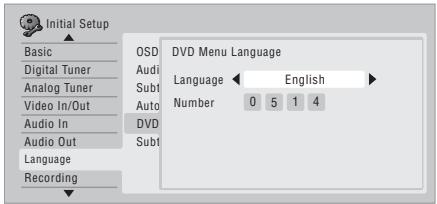
- Select by language name: Use the / buttons to change the language.
- Select by code number: Press then use the number buttons to enter the four-digit language code.
See Language code list on page 164 for a list of available languages and corresponding codes.
Using Software Update (Digital tuner)
The Software Update function can keep the built-in digital tuner up to date with the latest system software. You can either check for updates manually, or have the recorder do it automatically at regular intervals.
Access the Software Update screen from the Options menu.
There are three options available: Manual Update, Auto Update and Technical Information.
Manual Update
Select Manual Update to check for updated software immediately. If new software is found then it is automatically downloaded and installed. The new software will take effect the next time the recorder is powered on.
If for some reason the new software could not be downloaded successfully, a dialog box informs you of the error. Press HOME MENU to exit or RETURN/EXIT to return to the previous screen.
Note that channel information may be erased when software update is used, and that timer recording will not work during the update.
To cancel manual update before it has completed, press HOME MENU.
Auto Update
By default, the Auto Update option is On, which means that periodically the recorder will check for and update the digital tuner software if it's available. We recommend that you leave this option On.
If new software is found and successfully downloaded, the recorder automatically scans for new digital channels, informing you if any are found (this is the equivalent of using the Add New Channel option, found in the Digital Tuner section of the Initial Setup menu).
Technical Information
This displays the current hardware and software version numbers of the digital tuner.
Updating the recorder's Gracenote database
1 Updates the Gracenote database installed in this unit. Load the Update Disc created with the latest data downloaded from the Pioneer website. For details, visit the Pioneer website. (http://www.pioneer.eu)
2 Check the remaining space on the HDD.
When the remaining space drops to under 1 hour in the SP recording mode, delete titles stored on the HDD.
3

Display the Home Menu.
4 SELECT 'Setup'> 'Initial Setup'> 'Option2'> 'Gracenote Database'> 'Database Update'.
5 ENTER
Select 'Yes' to confirm or 'No'
to cancel.
Additional information about the TV system settings
About the input line system
This recorder is compatible with PAL, SECAM, 3.58 NTSC and PAL-60 TV systems. The Input Line System and Input Colour System settings determine how the recorder treats incoming video signals from an external input.
Please note the following points when changing the input line system:
- If, when the Input Line System setting is changed, the screen goes blank (due to incompatibility with your TV), you can switch back by pressing and holding the front panel (Stop) button then pressing INPUT SELECT (also front panel) while the recorder is stopped.
- When you switch the Input Line System setting the Copy List is erased. If you switch the setting using the (Stop) button and INPUT SELECT buttons as described above, there is no confirmation, so please use with care.
- You can't mix recordings of different TV line systems on the same disc.
- When you change this setting, the Input Colour System setting also changes (see below).
About NTSC on PAL TV
Depending on the Input Line System setting and the NTSC on PAL TV setting, the signal format output when the recorder is stopped varies as shown in the table below.
| Input Line System | NTSC on PAL TV | Output when stopped |
| 625 System | Off | PAL |
| On | PAL | |
| 525 System | Off | NTSC |
| On | PAL-60 |
About the input colour system
The available options of the Input Colour System setting depend on the Input Line System setting. The table below shows the different options available.
| Input Line System | Built-in analog tuner | External input |
| 625 System | Auto | Auto |
| PAL | PAL | |
| SECAM | SECAM | |
| 525 System | n/a | Auto |
| 3.58 NTSC | ||
| PAL-60 |
Additional information about component video output
If you switch the Component Video Out setting to Progressive when using a TV that is not compatible with progressive-scan video, you will not be able to see anything displayed on your TV. If this happens, press and hold the (Stop) button on the front panel, then press OPEN/CLOSE. This will set the recorder's video output back to Interlace.
Chapter 19
Additional information
Setting up the remote to control your TV
You can use the supplied remote to control your TV. To be able to use this feature you first have to program the remote with a maker code from the table below.
1 Press and hold down the CLEAR button, then enter the maker code for your TV.
See the table below for the list of maker codes. If there is more than one code given for your make, input the first one in the list.
- If the maker's name of your TV doesn't appear in the table below, you will not be able to use this remote to control your TV.
2 Press to check that the remote works with your TV.
If the remote is set up correctly, the TV should switch on/off. If it doesn't and there is another code given for your maker, repeat step 1 with a new code.
Using the TV remote control buttons
The table below shows how to use this remote control with your TV.
| Button | What it does |
| ○ | Press to switch the TV on/off (standby) |
| INPUT SELECT | Press to change the TV's video input |
| VOL +/- | Use to adjust the TV volume |
| CH +/- | Use to change TV channels |
Maker Code(s)
ACURA 44
ADMIRAL 31
AIWA 60
AKAI 32, 35, 42
AKURA 41
ALBA 07,39,41,44
AMSTRAD 42,44,47
ANITECH 44
ASA 45
ASUKA 41
AUDIOGONIC 07,36
BASIC LINE 41, 44
BAUR 31,07,42
BEKO 38
BEON 07
BLAUPUNKT 31
BLUE SKY 41
BLUE STAR 18
BPL 18
BRANDT 36
BTC 41
BUSH 07,41,42,44,47,56
CASCADE 44
CATHAY 07
CENTURION 07
CGB 42
CIMLINE 44
CLARIVOX 07
CLATRONIC 38
CONDOR 38
CONTEC 44
CROSLEY 32
CROWN 38,44
CRYSTAL 42
CYBERTRON 41
DAEWOO 07,44,56
DAINICHI 41
DANSAI 07
DAYTON 44
DECCA 07,48
DIXI 07,44
DUMONT 53
ELIN 07
ELITE 41
ELTA 44
EMERSON 42
ERRES
FERGUSON 07,36,51
FINLANDIA 35,43,54
FINLUX 32,07,45,48,53,54
FIRSTLINE 40, 44
FISHER 32, 35, 38, 45
FORMENTI 32.07.42
FRONTECH 31,42,46
FRONTECH/PROTECH 32
FUJITSU 48
FUNAI 40, 46, 58
GBC 32,42
GE 00, 01, 08, 07, 10, 11, 17, 02, 28, 18
GEC 07,34,48
GELOSO 32,44
GENERAL 29
GENEXXA 31,41
Maker Code(s)
GOLDSTAR 10,23,21,02,07,50
GOODMANS 07,39,47,48,56
GORENJE 38
GPM 41
GRAETZ 31,42
GRANADA 07,35,42,43,48
GRADIENTE 30,57
GRANDIN 18
GRUNDIG 31,53
HANSEATIC 07,42
HCM 18,44
HINARI 07,41,44
HISAWA 18
HITACHI 31, 33, 34, 36, 42, 43, 54, 06, 10, 24, 25, 18
HUANYU 56
HYPSON 07,18,46
ICE 46, 47
IMPERIAL 38,42
INDIANA 07
INGELEN 31
INTERFUNK 31, 32, 07, 42
INTERVISION 46, 49
ISUKAI 41
ITC 42
IT 31, 32, 42
JEC 05
JVC 13,23
KAISUI 18,41,44
KAPSCH 31
KENDO 42
KENNDy 32,42
KORPEL 07
KOYODA 44
LEYCO07,40,46,48
LIESENK&TTER 07
LOEWE 07
LUXOR 32,42,43
M-ELECTRONIC 31,44,45,54,56,07,36,51
MAGNADYNE 32,49
MAGNAFON 49
MAGNAVOX 07,10,03,12,29
MANESTH 39,46
MARANTZ 07
MARK 07
MATSUI 07,39,40,42,44,47,48
MCMICHAE134
MEDIATOR 07
MEMOREX 44
METZ 31
MINERVA 31,53
MITSUBISHI 09,10,02,21,31
MULTITECH 44, 49
NEC 59
NECKERMANN 31,07
NEI 07,42
NIKKAI 05,07,41,46,48
NOBLIKO 49
NOKIA 32,42,52
NORDMENDE 32,36,51,52
OCEANIC 31, 32, 42
ORION 32,07,39,40
OSAKI 41, 46, 48
OSO 41
OSUME 48
OTTO VERSAND 31, 32, 07, 42
PALLADIUM 38
PANAMA 46
PANASONIC 31,07,08,42,22
PATHO CINEMA 42
PAUSA 44
PHILCO 32,42
Maker Code(s)
PHILIPS 31,07,34,56,68
PHOENIX 32
PHONOLA 07
PROFEx 42,44
PROTECH 07,42,44,46,49
QUELLE 31, 32, 07, 42, 45, 53
R-LINE 07
RADIOLA 07
RADIOSHACK 10,23,21,02
RBM 53
RCA 01, 10, 15, 16, 17, 18, 61, 62, 09
REDIFFUSION 32,42
REX 31,46
ROADSTAR 41, 44, 46
SABA 31, 36, 42, 51
SAISHO 39,44,46
SALORA 31, 32, 42, 43
SAMBERS 49
SAMSUNG 07,38,44,46,69,70
SANYO 35,45,48,21,14,91
SBR 07,34
SCHAUBLORENZ42
SCHNEIDER 07,41,47
SEG 42,46
SEI 32,40,49
SELECO 31.42
SHARP 02,19,27,67,90
SIAREM 32,49
SIEMENS 31
SINUDYNE 32, 39, 40, 49
SKANTIC 43
SOLAVOX 31
SONOKO 07,44
SONOLOR 31, 35
SONTEC 07
SONY 04
SOUNDWAVE 07
STANDARD 41,44
STERN 31
SUSUMU 41
SYSLINE 07
TANDY 31,41,48
TASHIKO 34
TATUNG 07,48
TEC 42
TELEAVIA 36
TELEFUNKEN 36, 37, 52
TELETECH 44
TENSAI 40, 41
THOMSON 36,51,52,63
THORN 31,07,42,45,48
TOMASHI 18
TOSHIBA 05, 02, 26, 21, 53
TOWADA 42
ULTRAVOX 32,42,49
UNIDEN 92
UNIVERSUM 31,07,38,42,45,46,54
VESTEL 07
VICTOR 13
VOXSON 31
WALTHAM 43
WATSON 07
WATT RADIO 32,42,49
WHITE WESTINGHOUSE 07
YOKO 07,42,46
ZENITH 03,20
PIONEER 00,31,32,07,36,42,51
Minimum copying times
The table below shows the minimum HDD to DVD copying time for one hour of video.
Please note that not all discs are compatible with high-speed copying. Check with the disc manufacturer for compatibility.
| DVD disc type | Rec mode | ||||||
| SEP | SLP | EP | LP | SP | XP | ||
| DVD-R/1xDVD-RW/1x | 1x | 10 h | 8 h | 6 h | 4 h | 2 h | 1 h |
| 6 mins. | 7.5 mins. | 10 mins. | 15 mins. | 30 mins. | 60 mins. | ||
| DVD-RW/2xDVD-R DLDVD-RAM/2x | 2x | 3 mins. | 4 mins. | 5 mins. | 7.5 mins. | 15 mins. | 30 mins. |
| DVD+R/2.4xDVD+RW/2.4xDVD+R DL | 2.4x | *1 | *1 | *1 | 6.3 mins. | 12.5 mins. | 25 mins. |
| DVD-RAM/3xDVD-RAM/5x | 3x | 2 mins. | 2.5 mins. | 3.5 mins. | 5 mins. | 10 mins. | 20 mins. |
| DVD-R/4xDVD-RW/4xDVD+R/4xDVD+RW/4x | 4x | 1.5 mins.*1 | 2 mins.*1 | 2.5 mins.*1 | 4 mins. | 7.5 mins. | 15 mins. |
| DVD-R/8x/16xDVD+R/8x/16xDVD-RW/6xDVD+RW/8x | 6x | 1.25 mins.*1 | 1.6 mins.*1 | 2.2 mins.*1 | 3 mins. | 5.5 mins. | 11 mins. |
Note that all times in the above table are approximate. Also that actual copy speed varies with the part of the disc being recorded.
*1 Titles recorded on DVD + R/ + RW in SEP,SLP or EP modes cannot be high-speed copied.
Manual recording modes
The table below shows the approximate recording times for different DVD types in each manual recording mode, as well as the standard recording mode equivalents. For recording time on the HDD, see Specifications on page 168.
| Level | Rec. time*1 | Resolution*2 | |||
| Single-Layer DVD: DVD-R/-RW DVD+R/-RW DVD-RAM | Dual-Layer DVD: DVD-R DL DVD+R DL | Video mode Off (HDD) VR mode (DVD-R/-RW) DVD-RAM VR mode (DVD-R DL) | Video mode On (HDD) Video mode (DVD-R/-RW) DVD+R/+RW Video mode (DVD-R DL) DVD+R DL | ||
| MN 1 *3,4 | 803 mins. | 1440 mins. | |||
| MN 2 *3,4 | 720 mins. | 1292 mins. | |||
| MN 3 *3,4 | SEP | 600 mins. | 1077 mins. | 352 x 240/ | 352 x 240/ |
| MN 4 *4 | SLP | 480 mins. | 861 mins. | 352 x 288 | 352 x 288 |
| MN 5 *4 | 420 mins. | 754 mins. | |||
| MN 6 *4 | EP | 360 mins. | 646 mins. | ||
| MN 7 | 300 mins. | 538 mins. | 352 x 480/ | 352 x 480/ | |
| MN 8 | 270 mins. | 484 mins. | 352 x 576 | 352 x 576 | |
| MN 9 | LP | 240 mins. | 431 mins. | ||
| MN 10 | 230 mins. | 413 mins. | 480 x 480/ | ||
| MN 11 | 220 mins. | 395 mins. | 480 x 576 | ||
| MN 12 | 210 mins. | 377 mins. | |||
| MN 13 | 200 mins. | 359 mins. | 544 x 480/ | ||
| MN 14 | 190 mins. | 341 mins. | 544 x 576 | ||
| MN 15 | 180 mins. | 323 mins. | |||
| MN 16 | 170 mins. | 305 mins. | |||
| MN 17 | 160 mins. | 287 mins. | |||
| MN 18 | 150 mins. | 269 mins. | |||
| MN 19 | 140 mins. | 251 mins. | |||
| MN 20 | 130 mins. | 233 mins. | |||
| MN 21 | SP | 120 mins. | 215 mins. | 720 x 480/ | |
| MN 22 | 110 mins. | 197 mins. | 720 x 576 | ||
| MN 23 | 105 mins. | 188 mins. | |||
| MN 24 | 100 mins. | 179 mins. | |||
| MN 25 | 95 mins. | 170 mins. | 720 x 480/ | ||
| MN 26 | 90 mins. | 161 mins. | 720 x 576 | ||
| MN 27 | 85 mins. | 153 mins. | |||
| MN 28 | 80 mins. | 144 mins. | |||
| MN 29 | 75 mins. | 135 mins. | |||
| MN 30 | 70 mins. | 126 mins. | |||
| MN 31 | 65 mins. | 117 mins. | |||
| MN 32 | XP | 61 mins. | 111 mins. | ||
| LPCM | 61 mins. | 111 mins. | |||
| XP+*5 | --- mins. | --- mins. | |||
1 Recording time may be slightly shorter for certain disc types or recording modes.
2 The first figure refers to when the Input Line System is set to 525 System; the second when set to 625 System.
3 Modes MN1 to MN3 not available when using DVD + R / + RW .
4 Titles recorded at MN6 or lower cannot be high-speed copied to DVD+R/+RW.
*5 XP+ mode is available for HDD recordings only. If set for a DVD recording, the DVD will be automatically recorded in MN32 mode.
Additional information
- Levels separated by a bold line show where there is a noticeable change in picture quality.
- Audio recording in all manual recording modes is in Dolby Digital 2 ch format, except for LPCM mode, which is in Linear PCM format.
See also Recording on page 60.
Troubleshooting
Incorrect operation is often mistaken for trouble and malfunction. If you think there is something wrong with this component, please check the points below. Sometimes the trouble may lie in another component. Investigate the other components and electrical appliances being used. If the trouble cannot be rectified even after checking the points below, ask your nearest Pioneer authorized service center or your dealer to carry out repair work.
General
| Problem | Remedy |
| The disc is automatically ejected after closing the disc tray | ·Check that the disc is not an incompatible format disc (page 7). ·Check that the disc is loaded properly (aligned in disc tray and label-side up). ·Take out the disc and clean it (page 166). ·Check that the disc has a region code compatible with the recorder. |
| Can't eject a disc | ·Turn off the power to this device and press and hold ▲ OPEN/CLOSE on the front of the unit for more than three seconds. |
| Can't play a disc | ·Check that the disc is a compatible format disc (page 7). ·Take out the disc and clean it (page 166). ·Check that the disc is loaded properly (aligned in disc tray and label-side up). ·Press DVD to select the DVD. ·There may be condensation in the recorder. Leave the recorder for an hour or so for the condensation to evaporate. ·During HDD recording, you can't play discs that are recorded with a Line System different to the current recorder setting. ·DVD+R/+RW discs recorded using another recorder with copy-once protected recordings will not play in this recorder. |
| Can't record a disc | ·Check that the disc is not an incompatible format disc (page 7). ·Some DVD-RAM discs are not recordable until they have been initialized (page 73). This can take up to an hour. |
| Remote control does not work | ·If you connected this recorder to another Pioneer product using the CONTROL IN jack, point the remote control at the other component to use (page 14). ·Set the remote control to the same ID number as the recorder (page 145). (When the batteries run down, the remote mode is automatically reset to Recorder1.) ·Use the remote within its operating range (page 6). ·Replace the batteries (page 6). |
| All settings are reset | ·If the recorder is unplugged (or there is a power failure) while the recorder is on, all the settings will be lost. ·Make sure that you switch the recorder into standby before unplugging the power cord. |
| No picture | ·Check that everything is connected properly (page 14). ·Check that the connected TV and/or the AV amp/receiver is set to the correct input. ·The recorder may be set to progressive scan with an incompatible TV. Reset to interlace by pressing and holding the front panel ■ (Stop) button then pressing ▲ OPEN/CLOSE. ·When the HDMI signal is output, no video is output from the COMPONENT VIDEO OUT. ·If you are using an indoor antenna that requires power, make sure that Aerial Power in the Initial Setup menu is set to On or Auto (page 136). ·If the aerial/antenna is not connected properly, or if it is shorted, the Aerial Power setting will revert to Off automatically. Check the aerial connection and try making the setting again. |
| No sound or sound is distorted | ·Make sure that the amp/receiver or TV is set to the correct input and the volume turned up. ·There is no sound when the picture is paused, or during scanning or slow motion play. Press▶PLAY to resume regular playback. ·DTS discs can only be played if this recorder is connected to a DTS decoder or DTS compatible amp/receiver. If you have connected a suitable decoder, also make sure that the Initial Setup > Audio Out > DTS Out setting is On. ·Some 96 kHz discs do not output audio through the digital jack. In this case, switch the input of your amp/receiver to analog. ·Check the audio cable connections (page 14). ·If the sound is distorted, try cleaning the cable plugs. |
| The picture is distorted | ·Change the Input Line System setting (page 148). (You can also change it by pressing the ■ (Stop) button and INPUT SELECT on the front panel simultaneously with the recorder stopped.) |
| During playback the picture is dark or distorted | ·When a copy-protected disc is played via a VCR, the picture will not display correctly. Connect the recorder directly to your TV. |
| The picture from the external input is distorted | ·If the video signal from the external component is copy-protected, you cannot connect via this recorder. Connect the component directly to your TV. |
| Screen is stretched vertically or horizontally | ·Make sure that the TV Screen Size setting (page 143) is correct for the kind of TV you have (see also page 165). ·If you have a widescreen TV, check its aspect ratio settings. ·This recorder's input switches into wide mode automatically according to the input signal. When the unit connected is not compatible withVIDEO ID-1 (widenscreen signalling), set the connected component to output 4:3 aspect ratio (standard) video. |
| Cannot switch a bilingual programme | ·During real-time copying it is not possible to switch audio channels. The main and sub channels are both output. |
Additional information
| Problem | Remedy |
| Audio/subtitle language cannot be changed | ·Note that audio and subtitle languages cannot be changed during the recording of a digital broadcast. ·You can only use the audio track and subtitles for the language that were selected at the time of recording a digital broadcast. The audio track and subtitles cannot be changed to other languages. |
| Recorded contents are not clear or artefacts appear in areas of flat colour (due to MPEG compression; also known as block noise) | ·Change the recording mode to XP/SP |
| Can't play a disc recorded using this recorder on another player | ·If the disc was recorded in DVD-R/-RW (Video mode) or DVD+R, make sure that it's finalized (page 72). ·Some players will not play recordable DVD discs, even when recorded in DVD-R/-RW (Video mode) or DVD+R and finalized. ·If the disc was recorded in VR mode, the other player must be specifically RW compatible in order to play it (page 7). ·Discs recorded with copy-once material cannot be played on non-CPRM compatible players (page 62). ·DVD+RW discs containing only a small amount of recorded material may not play on other players. Finalize the disc and try again. ·DVD-RAM discs can only be played on DVD-RAM compatible players. |
| A DVD+R/+RW recorded using this unit cannot be subjected to time search in other equipment | ·Time search may be unavailable with certain equipment. |
| Can't record or does not record successfully | ·Check that there is some remaining blank space on the DVD/HDD. ·For a DVD-R/-RW (Video mode) or DVD+R, check that the disc isn't already finalized. ·Check the limits on the number of titles and chapters on a disc: -HDD: 999 titles -VR mode: 99 titles, 999 chapters per disc -Video mode disc: 99 titles per disc, 99 chapters per title -DVD+R/+RW: 49 titles per disc, 99 chapters per title (max 254 chapters per disc) ·Check that the source you are trying to record is not copy protected. ·For a VR formatted disc, check that the disc isn't locked (page 128). ·Check that you are recording with the same TV system (PAL, NTSC, etc.) as the disc has already been recorded in. All recordings on a disc must be in the same TV system. When recording to the HDD, it is also necessary to set the Input Line System setting to match what you want to record (page 148). ·The power may have failed during recording. |
| Timer programme doesn’t record successfully | ·When setting the recording channel, make sure you set the recorder’s built-in TV tuner, not the TV’s built-in tuner. ·When recording to a DVD-R/-RW (Video mode) or DVD+R/+RW, programmes that are copy- once protected cannot be recorded. Use a VR mode formatted disc for copy- once material (page 62). ·Two timer programmes may have overlapped, in which case only the earlier one will record completely. ·The power may have failed during recording. |
| After briefly unplugging or after a power failure the front panel display shows ‘---’ | ·A backup battery inside the recorder keeps the clock and other settings from being reset when there is no power to the recorder. After unplugging or a power failure, the battery keeps all settings for a period of several minutes. Reset the clock and other recorder settings to use the recorder again. |
| Front panel display shows ‘LOCKED’ when a button is pressed | ·The child lock is on; turn off in order to use the recorder (page 70). |
| Can’t use One Touch Copy (HDD to DVD) | ·Make sure that there is a recordable DVD-R/-RW loaded with some free space for recording and fewer than 99 titles already on the disc. Also make sure that for a DVD-R/-RW (Video mode) or a DVD+R, the disc isn’t finalized. ·Make sure there is a recordable DVD+R/+RW loaded with some free space for recording and fewer than 49 titles already on the disc. ·If you delete a title from a DVD+R/+RW disc, the number of remaining recordable titles may not decrease. ·Further recording is not possible on a finalized DVD+R. Check that there isn’t a disc menu on the disc you’re trying to use. ·If the title currently playing contains material that is copy- once protected, One Touch Copy will not work. ·If the currently playing HDD content was recorded in XP+ mode, the One Touch Copy feature can’t be used. ·One Touch Copy can’t be used for titles over eight hours long when copying to DVD+R/+RW (though you can use a DVD+R DL). ·One Touch Copy can’t be used for MN1 to MN6, SEP, SLP or EP titles when copying to DVD+R/+RW. ·One Touch Copy doesn’t work if the recorder is already recording to DVD. |
| Can’t use One Touch Copy (DVD to HDD) | ·Make sure that there is space available on the HDD and that there are fewer than 999 titles on the HDD. ·One Touch Copy doesn’t work if the recorder is already recording to the HDD. |
| File names are not displayed properly | ·Files names that do not conform to the ISO8859-1 standard may not display correctly on this unit. |
| Title searching in the Gracenote database is not possible | ·Title searching is not possible when the HDD Sleep Mode is set (page 146). |
Additional information
| Problem | Remedy |
| The device connected to the USB port is not recognized | ·Check that the device is compatible with this recorder (page 24). ·Use a USB cable less than 5 m in length. ·Check that the USB cable is inserted fully. ·Check that the USB device is powered on. ·Try switching this recorder into standby mode and then back on. ·Try using the Restart USB Device option from the Initial Setup menu (page 146). ·If several USB devices (camera, USB memory, card reader, etc.) are connected at the same time, it's possible that only the first device connected to this recorder will be recognized. |
| The power automatically turns on | ·Set the Demo Mode to Off after performing the Setup Navigator (page 146). |
| A video file recorded on the unit's HDD is played automatically | ·Set the Demo Mode to Off after performing the Setup Navigator (page 146). |
HDMI
| Problem | Remedy |
| The connected HDMI or DVI device does not display any picture (and the front panel HDMI indicator does not light) | ·Try disconnecting then reconnecting the HDMI cable (while the power of both components is on). ·Try switching the power of the HDMI/DVI device off then back on. ·Try switching off the HDMI/DVI device and this recorder. Next, switch on the HDMI/DVI device and leave it for around 30 seconds, then switch on this recorder. ·When you connect an HDMI-compatible device make sure of the following: - The connected device's video input is set correctly for this unit. - The cable you're using is fully HDMI-compliant. Using a non-standard cable may result in no picture being output. - Don't use several HDMI cables connected together. Use a single cable to connect devices together. ·When you connect a DVI-compatible device make sure of the following: - The connected device's video input is set correctly for this unit. - The DVI terminal on the connected device is HDCP-compatible. - The connected device is compatible with NTSC (720 x 480i/p, 1280 x 720p, 1920 x 1080i/p) and PAL (720 x 576i/p, 1280 x 720p, 1920 x 1080i/p) video input. ·If the recorder's internal HDD is damaged or broken, there will be no HDMI output. ·Not all HDCP-compatible DVI devices will work with this recorder. |
| The power automatically turns on | ·This unit's power may be turned on each time you turn on the power for a connected Flat Screen TV. If you do not want this unit to be turned on in this way, set this unit's HDMI Control to Off (page 145). |
| The power automatically turns off | ·This unit's power may be turned off when you control this unit from a connected Flat Screen TV. If you do not want this unit to be turned off in this way, set this unit's HDMI Control to Off (page 145). |
| Your Flat Screen TV and AV system automatically change inputs | ·The connected Flat Screen TV, AV system (amplifier or AV receiver etc.), or HD AV Converter automatically may change inputs in response to this unit starting playback or having the GUI screen (ex. Disc Navigator) displayed. If you do not want your Flat Screen TV and AV system to change inputs in this way, set this unit's HDMI Control to Off (page 145). |
| Can't record video | ·When using HDMI Control to record, you must make sure that the channel information for the Flat Screen TV matches that of this unit. If the channel information does not match you cannot make recordings. Use the Auto Channel Setting function to set this unit's channel information (page 136). |
Additional information
| Problem | Remedy |
| No video from the HDMI output | ·If you choose a setting that is incompatible with your TV you may not be able to see any picture at all. In this case, press ▲ OPEN/CLOSE while holding down the ■ (Stop) button on the front panel to switch the setting (this also switches Component Video Out on page 137 to the default setting). |
| There's no sound from the connected HDMI or DVI device | ·There is no sound when using a DVI terminal. ·Some HDMI-compatible devices do not output sound (check with the manual that came with the connected device). |
| HDMI Control does not respond | ·Verify that the HDMI cable is firmly connected (page 21). ·Check whether HDMI Control is set to On for this unit and the device connected to this unit. For more information, refer to the operating instructions of your Flat Screen TV, AV system or HD AV converter. ·Depending on the type of Flat Screen TV, some HDMI input terminals do not support the HDMI Control function. For details, see the operating instructions supplied with your Flat Screen TV. ·HDMI Control may not operate properly if you do not use a High Speed HDMI cable. ·This function may not work properly if you have multiple recorders connected to a single Flat Screen TV, AV system or HD AV converter. For more information refer to the operating instructions of your Flat Screen TV, AV system or HD AV converter. ·Controls may not function properly in certain situations, such as immediately after you have connect an HDMI cable, turn this unit's power off or remove the power cable for this unit or the connected component. If you experience any problems, set HDMI Control to On for all connected units, and then display the pictures stored on this unit on your Flat Screen TV to improve the situations. ·Check whether the connected component supports HDMI Control or not. ·Certain functions are not supported on with Flat Screen TVs, AV system or HD AV converter. ·We cannot guarantee this unit will work with HDMI Control-compatible components other than those made by Pioneer. When using HDMI Control-compatible components manufactured by companies other than Pioneer, set the HDMI Control to Off (page 145). |
If the unit does not operate normally due to external effects such as static electricity, disconnect the power plug from the outlet and insert again to return to normal operating conditions.
If the picture freezes and the front panel and remote control buttons stop working
- Press (Stop) then try restarting playback.
- Press the front panel STANDBY/ON button to switch the power off, then switch back on and restart playback. If the power fails to switch off, press and hold STANDBY/ON for five seconds until the power switches off.
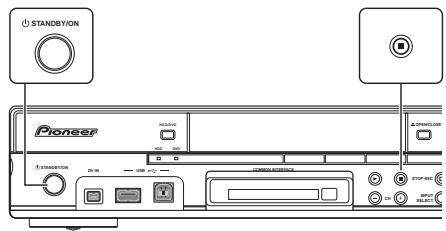
On-screen displays
The table below shows a list of error messages that you may encounter when using the recorder and an explanation of their meaning.
| Message | Explanation/Action |
| • Initializing disc. Please wait a moment. | When you load a blank DVD-RW or DVD+RW disc, the recorder automatically initializes it. |
| • Incompatible region number. | The disc loaded has an incompatible region number for the recorder and so will not play. |
| • Cannot record any more titles. • No more space for file management data. | The disc control data limit has been reached, or the maximum number of chapters and/or titles has been reached. Erase titles/chapters or combine chapters. |
| • This disc cannot be recorded. Undo the finalization. | The disc was finalized on a non-Pioneer DVD recorder. Undo the finalization in order to recording/editing. |
| • Cannot play this disc. • This disc cannot be recorded. • Cannot read the CPRM information. • Could not record the information to the disc. • Cannot edit. • Could not initialize disc. • Could not complete finalization successfully. • Could not undo finalization successfully. • Could not successfully unlock the disc. | The disc may be dirty or damaged. Take out the disc, clean it and retry. If the error persists, use a new disc. If the error appears even with a new disc, please ask your nearest Pioneer-authorized service center or your dealer to carry out repairs. |
| • Incompatible or unreadable disc. | The disc loaded is a playback-only disc type. This display may also appear if the disc is dirty or damaged. |
Additional information
| Message | Explanation/Action |
| ·Cannot record to a disc that is not CPRM compatible. ·Cannot record this content using Video mode recording. ·This video cannot be recorded to DVD+R/+RW. | The video source is copy-once protected. Use a VR mode DVD-R/-RW disc with CPRM for recording. |
| ·This content is copy protected. | The video source is copy-protected and cannot be recorded. |
| ·Incorrect CPRM information. | The recorder could not read the CPRM information. The recorder may be damaged — please ask your nearest Pioneer-authorized service center or your dealer to carry out repairs. |
| ·Repairing disc. ·Repairing the HDD. | During recording, the power was cut. This display appears when the power is restored. |
| ·Could not repair the disc. | The recorder was unable to repair the disc after a power cut. The contents of the recording will be lost. |
| ·Overheating has stopped operation. Press DISPLAY to clear message. | The internal temperature of the recorder has exceeded the operating limit. If this message reappears, please ask your nearest Pioneer-authorized service center or your dealer to carry out repairs. |
| ·HDD optimization is recommended. This can be done using Disc Setup. | The HDD should be optimized (basically, HDD housekeeping) to maintain playback and recording performance. |
| ·Please perform HDD optimization. This can be done using Disc Setup. | The HDD is in more urgent need of optimization in order to maintain performance. |
| ·The HDD has not been sufficiently optimized. Please optimize again. | If this message appears repeatedly after optimizing the HDD it is likely that there is not enough free space on the HDD for optimization to complete properly. Please erase some titles from the HDD and optimize again. |
| ·An error occurred. Please consult the service center. Note that contents on the HDD may be erased when servicing this unit. | This message is displayed when information from the HDD cannot be read. The HDD may be damaged or broken. Please ask your nearest Pioneer-authorized service center or your dealer to carry out repairs. |
| ·The Hard Disk Drive info is incorrect.Use the Disc Setup menu to reinitialize. | As the HDD info cannot be properly read, no new recordings can be made. Reinitializing the HDD (page 130) may result in your being able to make recording again. Note that reinitializing the HDD will erase all recorded contents, including protected files. |
| ·This signal's TV system is different from the recorder's setting. | The TV system (PAL, NTSC, etc.) of the current channel is different from the TV system settings of this recorder. |
| ·Recording failed due to a TV system mismatch. Press DISPLAY to clear message. | The timer recording failed because the TV system of the channel set for recording was different from the setting of the recorder. |
| ·Playback has stopped because the TV system is different than the recording. | During recording or timer recording standby, the TV System (PAL, NTSC, etc.) of the playback video changed, causing playback to stop automatically. |
| ·You are not allowed to watch this Conditional Access Programme. | A CA module or smart card (obtained from your service provider) is required to watch the selected programme. Insert the supplied module or card into the Common Interface card slot on the front panel of the recorder (page 27). |
| ·There is no DV input or the input signal is unrecordable. | No signal was detected at the DV IN jack. This may appear if a blank section of DV tape is playing in the connected camcorder. |
| ·No DV camcorder connected. | The camcorder is not connected properly, or the camcorder is switched off. |
| ·You cannot connect more than one DV camcorder at a time. | This recorder's DV jack supports connection to just one camcorder. |
| ·Cannot operate the DV camcorder. | This recorder cannot operate the DV camcorder. Try switching off the camcorder then turn it back on again. |
| ·Could not operate the DV camcorder. | This recorder was not able to operate the DV camcorder. |
| ·The DV camcorder is not set for playback. Please select playback mode on the DV camcorder. | The camcorder is in camera mode. Switch it to playback mode. |
| ·The printer is not ready or is not connected. Please check the printer. | This message is displayed when communication could not be established with the printer. See the Troubleshooting section if you do not know the cause. |
Additional information
| Message | Explanation/Action |
| • Printing has been cancelled because ... | This message is displayed when there is a printer error during printing. After checking the printer for the cause of the error, either reconnect the printer and start the printing job again, or select “Yes” to resume printing (select “No” to cancel the print job). See also the operating instructions that came with your printer for possible causes of print errors. |
Front panel displays
The table below shows a list of error messages that you may encounter when using the recorder and an explanation of their meaning.
| Message | Explanation/Action |
| • E01 | The HDD may be damaged or broken. Please ask your nearest Pioneer-authorized service center or your dealer to carry out repairs. |
| • E02 | As the HDD info cannot be properly read, no new recordings can be made. Reinitializing the HDD (page 130) may result in your being able to make recording again. Note that reinitializing the HDD will erase all recorded contents, including protected files. |
Language code list
Language (Language code letter), Language code
Japanese (ja), 1001
English (en), 0514
French (fr), 0618
German (de), 0405
Italian (it), 0920
Spanish (es), 0519
Chinese (zh), 2608
Dutch (nl), 1412
Portuguese (pt), 1620
Swedish (sv), 1922
Russian (ru), 1821
Greek (el), 0512
Polish (pl), 1612
Czech (cs), 0319
Norwegian (no), 1415
Afar (aa), 0101
Abkhazian (ab), 0102
Hungarian (hu), 0821
Armenian (hy), 0825
Interlingua (ia), 0901
Interlingue (ie), 0905
Inupiak (ik), 0911
Indonesian (in), 0914
Icelandic (is), 0919
Hebrew (iw), 0923
Yiddish (ji), 1009
Javanese (jw), 1023
Georgian (ka), 1101
Kazakh (kk), 1111
Greenlandic (kl), 1112
Cambodian (km), 1113
Kannada (kn), 1114
Korean (ko), 1115
Kashmiri (ks), 1119
Kurdish (ku), 1121
Kirghiz (ky), 1125
Latin (la), 1201
Lingala (In), 1214
Laotian (lo), 1215
Lithuanian (It), 1220
Latvian (lv), 1222
Malagasy (mg), 1307
Maori (mi), 1309
Macedonian (mk), 1311
Malayalam (ml), 1312
Mongolian (mn), 1314
Moldavian (mo), 1315
Marathi (mr), 1318
Malay (ms), 1319
Maltese (mt), 1320
Burmese (my), 1325
Nauru (na), 1401
Nepali (ne), 1405
Occitan (oc), 1503
Oromo (om), 1513
Oriya (or), 1518
Panjabi (pa), 1601
Pashto,Pushto (ps),1619
Quechua (qu), 1721
Rhaeto-Romance (rm).
1813
Kirundi (rn), 1814
Romanian (ro), 1815
Kinyarwanda (rw), 1823
Sanskrit (sa), 1901
Sindhi (sd), 1904
Sangho (sg), 1907
Serbo-Croatian (sh), 1908
Sinhalese (si), 1909
Slovak (sk), 1911
Slovenian (sl), 1912
Samoan (sm), 1913
Shona (sn), 1914
Somali (so), 1915
Albanian (sq), 1917
Serbian (sr), 1918
Siswati (ss), 1919
Sesotho (st), 1920
Vietnamese (vi), 2209
Volapuk (vo), 2215
Wolof (wo), 2315
Xhosa (xh), 2408
Yoruba (yo), 2515
Zulu (zu), 2621
Country/Area code list
Country/Area, Country/Area code, Code letter
Argentina, 0118, ar
Australia, 0121, au
Austria, 0120, at
Belgium, 0205, be
Brazil, 0218, br
Canada, 0301, ca
Chile, 0312.d
China, 0314, cn
Denmark, 0411, dk
Finland, 0609.fi
France, 0618, fr
Germany, 0405.de
Hong Kong, 0811,hk
India, 0914, in
Indonesia, 0904, id
Italy, 0920. it
Japan, 1016.jp
Republic of Korea, 1118, kr
Malaysia, 1325, my
Mexico, 1324.mx
Netherlands, 1412, nl
New Zealand, 1426, nz
Norway, 1415, no
Pakistan, 1611, pk
Philippines, 1608, ph
Portugal, 1620, pt
Russian Federation, 1821, ru
Singapore, 1907, sg
Spain, 0519, es
Sweden, 1905, se
Switzerland, 0308, ch
Taiwan, 2023, tw
Thailand, 2008, th
United Kingdom, 0702, gb
USA, 2119, us
Screen sizes and disc formats
| When viewing on a standard TV or monitor | ||
| Screen format of disc | Setting | Appearance |
| 16:9 | 4:3 (Letter Box) | The programme is shown in widescreen with black bars at the top and bottom of the screen. |
| 4:3 (Pan & Scan) | The sides of the programme are cropped so that the picture fills the whole screen. | |
| 4:3 | 4:3 (Letter Box) | The programme is presented correctly on either setting. |
| 4:3 (Pan & Scan) | ||
| When viewing on a widescreen TV or monitor | ||
| Screen format of disc | Setting | Appearance |
| 16:9 | 16:9 | The programme is presented in widescreen. |
| Your TV will determine how the picture is presented — check the manual that came with the TV for details. | ||
| 4:3 | 16:9 | |
| Your TV will determine how the picture is presented — check the manual that came with the TV for details. | ||
Handling discs
When holding discs of any type, take care not to leave fingerprints, dirt or scratches on the disc surface. Hold the disc by its edge or by the center hole and edge.
Damaged or dirty discs can affect playback and recording performance. Take care also not to scratch the label side of the disc. Although not as fragile as the recorded side, scratches can still result in a disc becoming unusable.
Should a disc become marked with fingerprints, dust, etc., clean using a soft, dry cloth, wiping the disc lightly from the center to the outside edge. Do not wipe with a circular motion.

If necessary, use a cloth soaked in alcohol, or a commercially available CD/DVD cleaning kit to clean a disc more thoroughly. Never use benzine, thinner or other cleaning agents, including products designed for cleaning vinyl records.
Storing discs
Although CDs and DVD discs are more durable than vinyl records, you should still take care to handle and store discs correctly. When you're not using a disc, return it to its case and store upright. Avoid leaving discs in excessively cold, humid, or hot environments (including under direct sunlight).
Don't glue paper or put stickers onto the disc, or use a pencil, ball-point pen or other sharp-tipped writing instrument. These could all damage the disc.

For more detailed care information see the instructions that come with discs.
Do not load more than one disc into the recorder.
Damaged discs
Discs spin at high speed inside the recorder. If you can see that a disc is cracked, chipped, warped, or otherwise damaged, don't risk using it; you could end up damaging the recorder.
This recorder is designed for use with conventional, fully circular discs only. Use of shaped discs is not recommended for this product. Pioneer disclaims all liability arising in connection with the use of shaped discs.
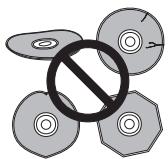
Cleaning the pickup lens
The HDD/DVD recorder's lens should not become dirty in normal use, but if for some reason it should malfunction due to dust or dirt, consult your nearest Pioneer-authorized service center. Although lens cleaners are commercially available, we do not recommend using them since some may damage the lens.
Condensation
Condensation may form inside the recorder if it is brought into a warm room from outside, or if the temperature of the room rises quickly. Although the condensation won't damage the recorder, it may temporarily impair its performance. For this reason you should leave it to adjust to the warmer temperature for about an hour before switching on and using.
Hints on installation
We want you to enjoy using this unit for years to come, so please bear in mind the following points when choosing a suitable location for it:
Do...
Use in a well-ventilated room.
Place on a solid, flat, level surface, such as a table, shelf or stereo rack.
Don't...
× Use in a place exposed to high temperatures or humidity, including near radiators and other heat-generating appliances.
× Place on a window sill or other place where the recorder will be exposed to direct sunlight.
× Use in a dusty or damp environment or in a room where it will be exposed to excessive cigarette smoke.
× Place directly on top of an amplifier, or other component in your stereo system that becomes hot in use.
× Use near a television or monitor as you may experience interference — especially if the television uses an indoor antenna.
× Use in a kitchen or other room where the recorder may be exposed to smoke or steam.
× Use on a thick rug or carpet, or cover with cloth—this may prevent proper cooling of the unit.
× Place on an unstable surface, or one that is not large enough to support all four of the unit's feet.
Moving the recorder
If you need to move the recorder, first remove the disc, if loaded, and close the disc tray. Next, press ⑥ STANDBY/ON to switch the power to standby, checking that the POWER OFF indication in the display goes off. Wait at least two minutes. Lastly, disconnect the power cord. Never lift or move the unit during playback or recording — discs rotate at a high speed and may be damaged.
Resetting the recorder
If you need to, you can reset the recorder to all its factory settings.
1 Make sure that the recorder is on.
2 Using the front panel controls, press and hold (Stop) and press STANDBY/ON.
The recorder turns off with all settings reset.
Specifications
General
Power requirements . . . . . 220 V to 240 V, 50 Hz/60 Hz
Power consumption .51 W
Power consumption in standby mode. .0.69 W (Front panel display: off)
Weight 4.5 kg
Dimensions 420 mm (W) x 75 mm (H) x 288 mm (D)
Operating temperature. +5^ to +35^
Operating humidity . . . 5 % to 85 % (no condensation)
TV system . . . NTSC (external input only)/PAL/SECAM
Readable discs
DVD-Video, DVD-RW, DVD-R, DVD+R, DVD+RW,
DVD-RAM, Video CD, Super VCD, CD, CD-R/-RW
(CD-DA, WMA, MP3, JPEG, DivX)
Recording discs and formats
DVD-R/-RW: VR mode and Video mode
DVD + / + +VR mode
DVD-RAM: VR mode
DVD-R DL: VR mode and Video mode
DVD+R DL: +VR mode
Video recording format
Sampling frequency 13.5 MHz
Compression format . MPEG
Audio recording format
Sampling frequency 48 kHz
Compression format.... Dolby Digital or Linear PCM
(uncompressed)
Recording time
HDD (160 GB)
XP+ Approx. 23 h
Fine (XP). Approx. 34 h
Standard Play (SP) Approx. 68 h
Long Play (LP) Approx. 136 h
Extended Play (EP) Approx. 204 h
Super Long Play (SLP) Approx. 272 h
Super Extended Play (SEP). Approx. 340 h
Manual Mode (MN) Approx. 23 h to 455 h
DVD-R/-RW, DVD+R/+RW, DVD-RAM
Fine (XP). Approx. 1 h
Standard Play (SP) Approx. 2 h
Long Play (LP) Approx. 4 h
Extended Play (EP) Approx. 6 h
Super Long Play (SLP) Approx. 8 h
Super Extended Play (SEP). Approx. 10 h
(DVD-R/-RW, DVD-RAM only)
Manual Mode (MN)
DVD-R/-RW/-RAM Approx. 1 h to 13 h
DVD + R / + RW Approx. 1 h to 8 h
DVD-R DL/DVD+R DL
Fine (XP) Approx. 1 h 51 m
Standard Play (SP). Approx. 3 h 35 m
Long Play (LP) Approx. 7 h 11 m
Extended Play (EP). Approx. 10 h 46 m
Super Long Play (SLP)
Approx. 14 h 21 m (DVD-R DL)
Approx. 14h4m (DVD+R DL)
Super Extended Play (SEP) . Approx. 17 h 57 m
(DVD-R DL only)
Manual Mode (MN)
DVD-R DL Approx. 1 h 51 m to 24 h
DVD+R DL . . . Approx. 1 h 51 m to 14 h 4 m
Timer
Programmes. 1 month/32 programmes
Clock.Quartz lock (24-hour digital display)
Tuner (analog)
Receivable channels
SECAM B/G
PAL B/G
PALI
| Frequency | Channel | Frequency | Channel | |
| VHF (low) | 47 MHz to 89 MHz | E2 to E4 X1 to Z | 44 MHz to 89 MHz | A to C X to Z |
| VHF (high) | 104 MHz to 300 MHz | E5 to E12 S1 to S20 M1 to M10 U1 to U10 | 104 MHz to 300 MHz | D to J 11, 13 S1 to S20 |
| Hyper | 302 MHz to 470 MHz | S21 to S41 | 302 MHz to 470 MHz | S21 to S41 |
| UHF | 470 MHz to 862 MHz | E21 to E69 | 470 MHz to 862 MHz | E21 to E69 |
SECAM D/K
| SECAM L | PAL D/K | |||
| Frequency | Channel | Frequency | Channel | |
| VHF (low) | 49 MHz to 65 MHz | FB, FC1, FC | 49 MHz to 94 MHz | R1 to R5 |
| VHF (high) | 104 MHz to 300 MHz | F1 to F6 B to Q | 104 MHz to 300 MHz | R6 to R12 S1 to S20 |
| Hyper | 300 MHz to 470 MHz | S21 to S41 | 302 MHz to 470 MHz | S21 to S41 |
| UHF | 470 MHz to 882 MHz | 21 to 69 | 470 MHz to 882 MHz | E21 to E69 |
STEREO
B/G-A2
L-NICAN
L-NICAM
E·NICAM
BYG-NICAM
D/K-NICAM
Tuner (digital)
Receiving system. DVB-T (2 K/8 K COFDM)
Tuner VHF/UHF
VHF band III (174 MHz to 230 MHz)
UHF band IV, V (470 MHz to 862 MHz)
Auto Channel Preset 999 ch, Auto Preset,
Auto Label, Auto Sort
Audio. Stereo MPEG layer I/II
Audio Decoder
. . . . . Sampling frequencies: 32 kHz, 44.1 kHz, 48 kHz
This product's digital timer has been confirmed for use in the following countries: Belgium, France, Germany, Italy, Spain, Denmark, Finland, Netherlands, Sweden, Switzerland, UK, Austria, Czech Republic.
Input/Output
Antenna
.75 Ω IEC 169-2 connector for VHF/UHF in/out (analog) .75 Ω IEC 169-2 connector for VHF/UHF in/out (digital)
Video input. .AV2(Input 1),Input 2(front), Input 3(rear)
Input level. 1 Vp-p (75 Ω)
Jacks .AV connector (Input 1), RCA jacks (Input 2, Input 3)
Video output.. AV1, Output Output level 1 Vp-p (75Ω)
Jacks.. .AV connector (AV1), RCA jack (Output)
S-Video input .AV2(Input 1),Input 2(front), Input 3(rear)
Y (luminance) - Input level. 1 Vp-p (75 Ω)
C (colour) - Input level 300 mVp-p (75 Ω)
Jacks.. AV connector (Input 1), 4-pin mini DIN (Input 2, Input 3)
S-Video output.. .AV1, Output
Y (luminance) - Output level 1 Vp-p (75 Ω)
C (colour) - Output level. 300 mVp-p (75 Ω)
Jacks.. .AV connector (Input 1)
RGB output AV1
Output level 0.7 Vp-p (75 Ω)
Jacks.. AV connector (AV1)
Audio input .AV2 (Input 1), Input 2 (front),
Input 3 (rear) L/R
During audio input. 2 V rms (Input impedance: more than 22k
Jacks.. AV connector (Input 1), RCA jacks (Input 2, Input 3)
Audio output . AV1, Output L/R
During audio output 2 V rms (Output impedance: less than 1.5k
Jacks.. .AV connector (AV1), RCA jacks (Output)
Control input ....... Mini jack
Digital audio output . Coaxial
G-LINKTM . Mini jack
Common Interface CA module
DV input. 4-pin (front)
(i.LINK/IEEE 1394 standard)
USB ......... Type A(front),Type B(front)
HDMI output 19-pin
AV Connectors (21-pin connector assignment)
AV connector input/output 21-pin connector This connector provides the video and audio signals for connection to a compatible colour TV or monitor.
13579111315171921
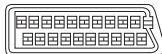
2468101214161820
PIN no. AV1 (RGB)-TV / AV2 (INPUT 1/DECODER)
1. Audio 2/R out / Audio 2/R out
2. Audio 2/R in
11 . G out / G in
3. Audio 1/L out / Audio 1/L out
6. -/ Audio 1/L in
15 R or C out / R or C in
4. GND
17. GND
7 . Bout/Bin
19.......Video out or Y out / Video out
20. -/Video in or Y in
8. Status
21. GND
Supplied accessories
Remote control 1
Dry cell batteries (AA/R6P) 2
Audio/Video cable (red/white/yellow). 1
G-LINK™ cable. 1
RF antenna cable. 2
Power cable 1
Operating Instructions
Warranty card 1
Note: The specifications and design of this product are subject to change without notice, due to improvement.
When does switchover happen?
*Copeland switches on October 17, 2007

Shetland Islands
The exact date you switch depends on the transmitter you are served by. To check when you switch, go to Digital UK's postcode checker on www.digitaluk.co.uk
Check your ITV news service or look at Teletext page 106 to see what TV region you're in.
Visit us at digitaluk.co.uk call us on 0845 6 50 50 50†
Keep this important information about how to re-tune your Digital TV Recorder during the digital TV switchover
Keep this leaflet and your instruction manual safe - you'll need them

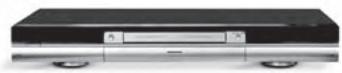
Television in the UK is going digital, bringing us all more choice and new services. Starting in late 2007 and ending in 2012, television services in the UK will go completely digital, TV region by TV region.
Please see overleaf to find out when your area switches to digital.
Digital UK is the independent, non-profit organisation leading the process of digital TV switchover in the UK. Digital UK provides impartial information on what people need to do to prepare for the move to digital, and when they need to do it.
How the switchover affects Digital TV Recorders (DTR) including Freeview Playback models and DVD Recorders with Freeview built in:
When the TV switchover happens in your area, there are at least two occasions when you will need to re-tune your digital TV recorder in order to continue receiving your existing TV channels, and also to pick up new ones. Digital UK, the body leading the digital TV switchover, will advise you when you need to re-tune during the switchover.
If you find you can't receive the extra digital channels, it may be because your area is not covered by Freeview yet or that you need an aerial upgrade. Visit www.digitaluk.co.uk to check.
How to re-tune:
Follow the instructions for 'Replace Channels' (page 135).
If you are missing any channels, it may be that they are not available in your area, or that your aerial needs upgrading.
If you have any questions, please contact your equipment supplier or call Digital UK on 0845 6 50 50 50 or visit www.digitaluk.co.uk
This product includes FontAvenue® fonts licenced by NEC Corporation. FontAvenue is a registered trademark of NEC Corporation.
Microsoft product screen shots reprinted with permission from Microsoft Corporation.

gracenote.
Music recognition technology and related data are provided by Gracenote. Gracenote is the industry standard in music recognition technology and related content delivery. For more information, please visit www.gracenote.com.
CD and music-related data from Gracenote, Inc., copyright © 2000-2007 Gracenote. Gracenote Software, copyright © 2000-2007 Gracenote. This product and service may practice one or more of the following U.S. Patents: #5,987,525; #6,061,680; #6,154,773, #6,161,132, #6,230,192, #6,230,207, #6,240,459, #6,330,593, and other patents issued or pending. Some services supplied under license from Open Globe, Inc. for U.S. Patent: #6,304,523.
Gracenote and CDDB are registered trademarks of Gracenote. The Gracenote logo and logotype, and the "Powered by Gracenote" logo are trademarks of Gracenote.
This application or device contains software from Gracenote, Inc. of Emeryville, California ("Gracenote"). The software from Gracenote (the "Gracenote Software") enables this application to perform disc and/or file identification and obtain music-related information, including name, artist, track, and title information ("Gracenote Data") from online servers or embedded databases (collectively, "Gracenote Servers") and to perform other functions. You may use Gracenote Data only by means of the intended End-User functions of this application or device.
You agree that you will use Gracenote Data, the Gracenote Software, and Gracenote Servers for your own personal non-commercial use only. You agree not to assign, copy, transfer or transmit the Gracenote Software or any Gracenote Data to any third party. YOU AGREE NOT TO USE OR EXPLOIT GRACENOTE DATA, THE GRACENOTE SOFTWARE, OR GRACENOTE SERVERS, EXCEPT AS EXPRESSLY PERMITTED HEREIN.
You agree that your non-exclusive license to use the Gracenote Data, the Gracenote Software, and Gracenote Servers will terminate if you violate these restrictions. If your license terminates, you agree to cease any and all use of the Gracenote Data, the Gracenote Software, and Gracenote Servers. Gracenote reserves all rights in Gracenote Data, the Gracenote Software, and the Gracenote Servers, including all ownership rights. Under no circumstances will Gracenote become liable for any
payment to you for any information that you provide. You agree that Gracenote, Inc. may enforce its rights under this Agreement against you directly in its own name.
The Gracenote service uses a unique identifier to track queries for statistical purposes. The purpose of a randomly assigned numeric identifier is to allow the Gracenote service to count queries without knowing anything about who you are. For more information, see the web page for the Gracenote Privacy Policy for the Gracenote service.
The Gracenote Software and each item of Gracenote Data are licensed to you "AS IS." Gracenote makes no representations or warranties, express or implied, regarding the accuracy of any Gracenote Data from in the Gracenote Servers. Gracenote reserves the right to delete data from the Gracenote Servers or to change data categories for any cause that Gracenote deems sufficient. No warranty is made that the Gracenote Software or Gracenote Servers are error-free or that functioning of Gracenote Software or Gracenote Servers will be uninterrupted. Gracenote is not obligated to provide you with new enhanced or additional data types or categories that Gracenote may provide in the future and is free to discontinue its services at any time.
GRACENOTE DISCLAIMS ALL WARRANTYES EXPRESS OR IMPLIED, INCLUDING, BUT NOT LIMITED TO, IMPLIED WARRANTYES OF MERCHANTABILITY, FITNESS FOR A PARTICULAR PURPOSE, TITLE, AND NON-INFRINGEMENT. GRACENOTE DOES NOT WARRANTY THE RESULTS THAT WILL BE OBTAINED BY YOUR USE OF THE GRACENOTE SOFTWARE OR ANY GRACENOTE SERVER. IN NO CASE WILL GRACENOTE BE LIABLE FOR ANY CONSEQUENTIAL OR INCIDENTAL DAMAGES OR FOR ANY LOST PROFITS OR LOST REVENUES.
The contents of the Gracenote data in both the recorder and the dedicated server are not 100% guaranteed.
The supply of the Gracenote data in the dedicated server may be stopped without prior notice for the reason of maintenance, etc.
The Gracenote data communication service of the dedicated server may be stopped without the consent of the users in case the required content cannot be collected or for other reason that hinders provision of the service.
http://www.pioneer.co.uk http://www.pioneer.eu
Published by Pioneer Corporation.
Copyright © 2008 Pioneer Corporation.
All rights reserved.
PIONEER CORPORATION
4-1, Meguro 1-Chome, Meguro-ku, Tokyo 153-8654, Japan
PIONEER ELECTRONICS (USA) INC.
P.O. BOX 1540, Long Beach, California 90801-1540, U.S.A. TEL: (800) 421-1404
PIONEER ELECTRONICS OF CANADA, INC.
300 Allstate Parkway, Markham, Ontario L3R 0P2, Canada TEL: 1-877-283-5901, 905-479-4411
PIONEER EUROPE NV
Haven 1087, Keetberglaan 1, B-9120 Melsele, Belgium TEL: 03/570.05.11
PIONEER ELECTRONICS ASIACENTRE PTE. LTD.
253 Alexandra Road, #04-01, Singapore 159936 TEL: 65-6472-7555
PIONEER ELECTRONICS AUSTRALIA PTY. LTD.
178-184 Boundary Road, Braeside, Victoria 3195, Australia, TEL: (03) 9586-6300
PIONEER ELECTRONICS DE MEXICO S.A. DE C.V.
Blvd.Manuel Avila Camacho 138 10 piso Col.Lomas de Chapultepec, Mexico,D.F. 11000 TEL: 55-9178-4270
K002_B_En
- IMPORTANT
- CAUTION
- RISK OF ELECTRIC SHOCK
- DO NOT OPEN
- CAUTION:
- WARNING
- CLASS 1 LASER PRODUCT
- Operating Environment
- VENTILATION CAUTION
- POWER-CORD CAUTION
- IMPORTANT: THE MOULDED PLUG
- Contents
- Before you start
- Connections
- Controls and displays
- Getting started
- Using the GUIDE Plus+® electronic programme guide
- Using the digital electronic programme guide
- Recording
- 08Playback
- Playing and recording from a DV/HDD camcorder
- Editing
- Copying and backup
- Playing and copying DivX files (PC VIDEO)
- Playing and copying music (Jukebox)
- Playing and copying photos (PhotoViewer)
- Copying files from a PC (Connect PC)
- The Disc Setup menu
- The Video Adjust menu
- The Initial Setup menu
- Additional information
- Chapter 1 Before you start
- What's in the box
- Putting the batteries in the remote control
- Using the remote control
- Before you start
- Disc/content format playback compatibility
- Compatible media
- Readable file system
- Note
- HDD/DVD Recording and playback compatibility
- Notes to table
- Using DVD-R DL/DVD+R DL discs
- About DualDisc playback
- Other disc compatibility
- CD-R/-RW compatibility
- Compressed audio compatibility
- WMA (Windows Media™ Audio) content
- DivX video compatibility
- DivX® VOD content
- DivX
- JPEG file compatibility
- PC-created disc compatibility
- Dolby Digital
- DTS
- DVB
- About the internal hard disk drive
- Optimizing HDD performance
- Symbols used in this manual
- Chapter 2
- Connections
- Rear panel connections
- ANTENNA IN (RF IN)/OUT
- INPUT 3
- AV2 (INPUT 1/DECODER) AV connector
- HDMI OUT
- DIGITAL AUDIO OUT (COAXIAL)
- COMPONENTVIDEO OUT
- OUTPUT
- AV1 (RGB)-TV AV connector
- G-LINKTM
- CONTROL IN
- ANTENNA (DIGITAL) IN/OUT
- AC IN - Power inlet
- Front panel connections
- DV IN
- USB port (Type A)
- USB port (Type B)
- INPUT 2
- Connecting a TV antenna
- Easy connections
- Connect your TV antenna to the recorder and TV.
- Use a SCART cable (not supplied) to connect the AV1 (RGB)-TV AV connector on this recorder to the SCART AV connector on your TV.
- Tip
- Using other types of audio/video output
- Using the supplied audio/video cable
- Connect the VIDEO OUTPUT jack to a video input on your TV.
- Connect the AUDIO OUTPUT jacks to the corresponding audio inputs on your TV.
- Using the S-Video or component video output
- Connect the S-Video or component video output to a similar input on your TV.
- Connecting to a cable box or satellite receiver
- Connecting an external decoder box (1)
- Connecting an external decoder box (2)
- Connecting to an AV amplifier/receiver
- Connect the DIGITAL AUDIO OUT (COAXIAL) jack on this recorder to a coaxial digital input on your AV amplifier/receiver.
- Connect the analog AUDIO OUTPUT andVIDEO OUTPUT jacks on this recorder to an analog audio and video input on your AV amplifier/receiver.
- Connecting using HDMI
- Use an HDMI cable to connect the HDMI OUT connector on this recorder to an HDMI connector on an HDMI-compatible display.
- About HDMI
- HDMI Control
- Auto-select function
- Simultaneous power function
- Unified language function
- Connecting other AV sources
- Connecting a VCR or analog camcorder
- Connect a set of audio and video inputs of your VCR or camcorder to a set of outputs on this recorder.
- Connect a set of audio and video outputs of your VCR or camcorder to a set of inputs on this recorder.
- Connecting a DV camcorder
- Connecting a USB device
- Connecting an HDD camcorder
- HDD camcorder with which operation is guaranteed (According to our survey)
- JPEG file storage devices
- WMA/MP3 file storage devices
- Using a USB hub
- Using a USB printer
- Using a USB keyboard
- Using a PC
- Plugging in
- Chapter 3 Controls and displays
- Front panel
- HDD indicator
- HDD/DVD
- DVD indicator
- Disc tray
- ▲ OPEN/CLOSE
- A.TV indicator
- D.TV indicator
- HDMI indicator
- Front panel display and IR remote sensor
- 念 STANDBY/ON
- Front panel inputs
- COMMON INTERFACE slot
- 14
- STOPREC
- ONE TOUCH COPY
- CH+/-
- Controls and displays
- INPUT SELECT
- A.TV/D.TV
- REC
- Common Interface
- Inserting a CA module
- Display
- 1
- 2
- 3
- (page 69)
- NTSC
- L R (page 139)
- P (page 137)
- VPS/PDC (page 69)
- Recording quality indicators (page 65)
- XP
- SP
- LP/SLP
- EP/SEP
- MN
- Character display
- R/RW
- PL (page 91)
- (page 145)
- V
- Remote control
- STANDBY/ON
- TV CONTROL buttons (page 149)
- AUDIO (pages 64, 83, 84)
- SUBTITLE (page 83)
- ANGLE (page 84)
- DISPLAY (page 85)
- Number buttons, CLEAR, +
- INPUT SELECT (page 71)
- HDD (pages 66, 75)
- DVD (pages 66, 75)
- HOME MEDIA GALLERY
- PCVIDEO (page 108)
- MUSIC (page 114)
- PHOTO (page 119)
- Chapter 4
- Getting started
- Switching on and setting up
- Switch on your TV and set the video input to this recorder.
- Switch on the recorder.
- ENTER Choose a language (then press ENTER).
- 4
- Start the Setup Navigator.
- Select an Aerial Power setting for the built-in digital tuner.
- SELECT 'Auto Scan' to start scanning for D.TV channels.
- Enter Select your country.
- Select the analog TV (A.TV) Auto Channel Setting ('Auto Scan' or 'Download from TV'), or 'Do not set'.
- - SELECT your country.
- Select 'Auto' for automatic time setting, or 'Manual' to set the clock manually.
- - Auto clock setting
- - Manual clock setting
- Use the ← / → buttons to set your time zone.
- Press then use the ← / → buttons to select 'On' or 'Off' for summer time, then press ENTER.
- Set the date (day/month/year) and time, then press ENTER to make all the settings.
- SELECT the EPG (Electronic Programme Guide) type to use.
- SELECT the TV screen type, Wide (16:9) or 'Standard (4:3)'.
- SELECT whether or not your TV is compatible with progressive scan video.
- ENTER Press to continue after reading the HDD caution.
- SELECT 'Finish Setup' to exit the Setup Navigator, or 'Go Back' if you want to start again.
- For users receiving digital broadcast services
- Return to automatic clock setting
- Setting up the GUIDE Plus+® system
- GUIDe Display the GUIDE Plus+ setup menu.
- ENTER Highlight 'Postal Code'.
- Enter your postal
- If you are using an external receiver (such as a satellite receiver) with the supplied G-LINK cable, complete this step, otherwise jump to step 5 below.
- Identify the Host Channel for your country.
- About EPG download
- Checking the downloaded data the following day
- Display the GUIDE Plus+ screen.
- Change the programme numbers as you like.
- When you're done, press the BLUE Action button (Home) to get back to the GUIDE Plus+ home screen.
- Chapter 5 Using the GUIDE Plus+® electronic programme guide
- The GUIDE Plus+® system
- Legal Notice
- Using the GUIDE Plus+® system
- Using the GUIDE Plus+® electronic programme guide
- GUIDE Plus+ navigation
- One-Button-Record
- Highlight a programme title.
- Press the RED Action button (Record).
- Lock/Unlock video window
- Press the RED Action button (Unlock).
- Channel mosaic screen
- Areas
- The Grid Area
- Browsing the Grid
- The Search Area
- Searching
- ENTER
- Start the search.
- Using My Choice keywords for a search
- Access My Choice.
- Press the YELLOW Action button to add a keyword.
- ENTER Enter a keyword to appear in the menu.
- Start the keyword search.
- My TV Area
- Setting up a profile
- To add a channel to your profile, press the YELLOW Action button.
- To add a category to your profile, highlight 'Categories' and press the YELLOW Action button.
- To add a keyword to your profile, highlight 'Keywords' and press the YELLOW Action button.
- Press ENTER to activate your profile.
- The Schedule Area
- Editing a scheduled recording
- Highlight the left tile of a scheduled recording.
- Press the GREEN Action button (Edit).
- Use the cursor and number buttons to edit the recording date, start time, end time and channel.
- Enter a name for the scheduled recording.
- Highlight the right recording tile.
- Press the RED Action button (Quality) to change the recording quality.
- Press the GREEN Action button (Frequency) to change the recording frequency.
- Press YELLOW Action button (Destination) to select the recording destination.
- Press to access the extended recording options.
- Deleting a scheduled recording
- Press the RED Action button (Delete).
- Setting aVIDEO Plus+® recording
- Setting a manual recording
- The Info Area
- The Editor Area
- Switching a channel on/off
- Select 'Editor' from the Menu bar.
- Changing the source and programme number
- The Setup Area
- Making changes to your GUIDE Plus+ setup
- Select 'Setup' from the Menu bar.
- Highlight the part you want to change.
- Manual Host Channel setup
- GUIDE Plus+® FAQ and troubleshooting
- FAQ
- Chapter 6 Using the digital electronic programme guide
- The Digital EPG system
- General Programme List
- Programme Information
- Using the digital electronic programme guide
- Using the Digital EPG
- Guide Press to display the Digital EPG screen.
- Select a TV programme.
- Press to view more information about the selected programme.
- Press to exit the Digital EPG screen.
- Setting timer programmes
- Press to display the Digital EPG screen.
- Select a programme.
- After entering all the timer recording information, highlight 'Store Programme' and press ENTER.
- GUIDE Press to exit the Digital EPG screen.
- Editing a timer programme
- Press to display the Timer Programme View screen.
- Highlight the timer programme you want to change.
- Press then select Modify from the command menu panel.
- Enter the timer recording settings.
- Press to exit the timer recording screen.
- Deleting a timer programme
- Skipping a regular timer programme
- Checking for alternative broadcast times
- Searching for series
- Searching for recommendations
- Other useful EPG functions
- EPG Jump
- EPG Search
- Series Search
- Chapter 7 Recording
- About DVD recording
- Recording to DVD-R DL/DVD+R DL discs
- About HDD recording
- HDD Video mode compatibility
- Recorded audio
- Restrictions on video recording
- CPRM
- Recording equipment and copyright
- Using the built-in A.TV and D.TV tuners
- Switching between A.TV and D.TV tuners
- Changing channels
- Using the D.TV Channel List
- Displaying a channel banner
- Changing D.TV audio languages
- Changing D.TV subtitle languages
- Using the MHEG application
- Press to start the MHEG
- application.
- Viewing Teletext
- Press to display the Teletext.
- Changing A.TV audio channels
- Press to change the audio type.
- Switching between TV and DVD
- Switch between TV mode and DVD mode.
- Setting the picture quality/ recording time
- - Press repeatedly to select the recording quality.
- Basic recording from the TV
- HDB Dvd Select the HDD or DVD for recording.
- Press to switch between D.TV (digital) and A.TV (analog).
- Select a TV channel to record.
- Set the picture quality/recording time.
- If you're recording from the A.TV tuner, select the audio channel to record.
- If you're recording from the D.TV tuner, select the audio language to record.
- Start recording.
- Press to stop recording.
- Pause Live TV
- Setting up for Pause Live TV
- TV tuner setup for Pause Live TV
- Using the recorder's internal tuner for Pause Live TV
- Press HOME MENU.
- Select 'Setup' > 'Initial Setup' > 'Options2' > 'Pause Live TV' > 'Recorder's Tuner'.
- Using Pause Live TV
- PAUSE LIVE TV Start recording the current TV channel.
- Press to start playback.
- Operation table
- Press to stop the recording.
- About timer recordings
- Extending a timer recording in progress
- Cancelling or extending the timer
- Press and hold for three seconds during a timer recording.
- Press repeatedly to extend recording in 30 minute blocks.
- Stopping a timer recording
- STOPREC Press during a timer recording.
- SELECT 'Yes' to confirm.
- Preventing use of the recorder before a timer recording (child lock)
- If the recorder is on, switch it into standby.
- [Front panel] Press and hold for three seconds to lock the controls.
- Timer recording FAQ
- Frequently Asked Questions
- Simultaneous recording and playback (Chase Play)
- HDD
- Recording from an external component
- DVD (VR) DVD (Video) DVD+R DVD+RW DVD-RAM HDD
- REc MODE Set the recording quality.
- HDD DVD Select the HDD or DVD for recording.
- Press to start recording.
- Playing your recordings on other DVD players
- Finalizing a disc
- Recording
- Load the disc you want to finalize.
- For DVD-R/-RW (Video mode) and DVD+R/+RW discs only, select a title menu style, then select 'Yes' to start finalization or 'No' to cancel.
- The recorder will now start finalizing the disc.
- Initializing recordable DVD discs
- Display the Home Menu.
- Select 'Setup' > 'Disc Setup'.
- SELECT 'Initialize' > 'Video Mode', 'VR Mode' or 'Initialize DVD+RW'.
- SELECT 'Start'.
- DVD-RW Auto Initialize
- DVD-RW
- Select 'Setup' > 'Disc Setup'.
- Select 'Basic'>DVD-RW Auto Init.', then 'VR Mode' or 'Video Mode'.
- Chapter 8 Playback
- Introduction
- Basic playback
- ALL
- HDB Dvd Select the HDD or DVD for playback.
- Load a disc.
- Start playback.
- Press to stop playback.
- Playing DVD discs
- Playing from the HDD
- Playing Audio CDs and WMA/MP3 discs
- Playing Video CDs/Super VCDs
- Using the Disc Navigator to browse the contents of a disc
- Using the Disc Navigator with recordable discs and the HDD
- Changing the display style of the Disc Navigator
- Using the Disc Navigator with playback-only discs
- Scanning discs
- Playing in slow motion
- Press repeatedly to change the slow motion speed.
- PLAY Resume normal playback.
- Frame advance/frame reverse
- The Play Mode menu
- Search Mode
- A-B Repeat
- During playback, select 'A-B Repeat' from the Play Mode menu.
- ENTER With 'A (Loop Start)'
- ENTER With 'B (Loop End)' highlighted, press at the point you want the loop to end.
- Repeat play
- - Select 'Repeat' from the Play Mode menu, then choose a repeat play mode.
- Programme play
- SELECT 'Programme' from the Play Mode menu, then 'Input/Edit Programme'.
- Select a title, chapter, album or track for the current step in the programme list.
- Repeat step 2 to build up a programme list.
- Play the programme list.
- Displaying and switching subtitles
- DVD-Video DivX
- - SubTITLE Select/change the subtitle language.
- Switching DVD and DivX soundtracks
- Audio Change the audio soundtrack.
- Switching audio channels
- WMA/MP3
- - Audio Press repeatedly to display/ switch the audio channel.
- Switching camera angles
- DVD-Video
- - ANGLE Switch the camera angle.
- Displaying disc information on-screen
- - Display/change the on-screen information.
- HDD and removable disc activity display
- Chapter 9
- Playing and recording from a DV/HDD camcorder
- Playing from a DV camcorder
- Display the Home Menu.
- Recording from a DV camcorder
- Copying from a DV source
- Make sure your DV camcorder is connected to the front panel DV IN jack.
- Set the recording quality.
- From the Initial Setup menu, check that the DV audio input is setup as you would like.
- Display the Home Menu.
- Select 'DV/HDD-Cam' > 'Copy
- from a DV Source'.
- Select 'Record to Hard Disk
- Drive' or 'Record to DVD'.
- Find the place on the camcorder tape that you want to start recording from.
- 8
- Select 'Start Rec'.
- DV Auto Copy
- Set the recording quality.
- From the Initial Setup menu, check that the DV audio input is setup as you require.
- Display the Home Menu.
- Select 'DV/HDD-Cam' > 'DV
- Auto Copy'.
- Select 'Record to Hard Disk' 'Record to DVD'.
- About automatic finalization
- About DV
- Copying from an HDD camcorder
- Make sure your HDD camcorder is connected to the front panel USB port.
- Select 'DV/HDD-Cam' > 'HDD-Cam Copy'.
- SELECT 'Difference Copy' or 'All Movie Copy'.
- Select 'Yes' to confirm or 'No' to cancel.
- Chapter 10
- Editing
- Editing options
- The Disc Navigator screen
- HDD Dvd Select the HDD or DVD.
- DISC 2 n VACATOR Display the Disc Navigator
- screen.
- Press to exit the Disc Navigator.
- Editing accuracy
- HDD genres
- Create
- Erase
- Title Name
- Using the remote key shortcuts to input a name
- Using a USB keyboard to enter a name
- Set Thumbnail
- Use the playback controls (, , , ) to find a suitable frame, then press ENTER to set.
- Select 'Exit' to return to the Edit screen.
- Erase Section
- Highlight the title containing the section you want to erase.
- edit.
- Highlight 'From' then use the playback controls (, I, , , etc.) to find the start of the section to erase, then press ENTER.
- Highlight 'To' then, in the same way, find the end of the section to erase, then press ENTER.
- 6
- Select 'Yes' to confirm or 'No'.
- Divide
- Highlight the title you want to divide.
- Select Edit Divide' from the command menu panel.
- HDD only: Select the type of edit.
- Use the playback controls (, I , , , etc.) to find the place you want to divide the title.
- ENTER Press to divide the title at the current playback position.
- Select 'Yes' to confirm or 'No' to cancel.
- Chapter Edit
- Highlight the title that contains the chapters you want to edit.
- SELECT 'Edit' > 'Chapter Edit' from the command menu panel.
- Select the command you want:
- SELECT 'Exit' to get back to the main Disc Navigator screen.
- Set Genre
- Lock
- Original only
- Move
- Combine
- Genre Name
- Multi-Mode
- Select the command that you want applied to all the marked titles.
- Undo
- - Select 'Undo' from the command menu panel.
- Chapter 11 Copying and backup
- Restrictions on copying
- Copyright
- Copying and backup
- REC MODE If you're copying from DVD to the HDD, select a recording mode.
- ONE TOUCH COPY Press during playback to copy the current title.
- Cancelling One Touch Copy
- ONE TOUCH COPY Press and hold for more than a second.
- Notes on copying using One Touch Copy
- Copying to DVD
- Copying to the HDD
- Using Copy Lists
- Copying from HDD to DVD
- Load a recordable DVD.
- Display the Home Menu.
- SELECT 'Copy' > 'HDD → DVD'.
- If there is already a Copy List stored in the recorder, choose whether to 'Create New Copy List' or 'Continue Using Previous Copy List'.
- Add titles to the Copy List (highlight a title and press ENTER to add).
- Display the command menu panel.
- SELECT 'Next' to move on to the Title Edit screen.
- Select a title to edit.
- Display the command menu panel.
- Copying from DVD to HDD
- ENTER Select 'Copy' >DVD/CD → DD'.
- Select a Copy List type.
- Add titles to the Copy List (at a title and press ENTER to add).
- Recording Mode
- Bilingual
- SELECT a bilingual audio option.
- Using disc backup
- Load the disc you want to make a backup of.
- SELECT 'Start'.
- When the data has been copied, take out the disc and load a blank* recordable DVD.
- Select 'Start' to start writing the backed-up data to the blank disc.
- After the recorder has finished recording the backup disc, you can select whether to make another backup of the same data or exit.
- If you don't need to keep the backup data on the HDD, you can delete it now.
- Chapter 12
- Playing and copying DivX files (PC VIDEO)
- Playing DivX files
- SELECT what you want to play.
- Playing DivX files on the HDD that have not yet been viewed
- Playing DivX files.
- Playing and copying DivX files (PCVIDEO)
- Changing the display style of the PC VIDEO
- Display the view options panel.
- Choose 'Display Mode' then press ENTER to see the available view options.
- Choose a view option, then press ENTER.
- Copying DivX files to the HDD
- SELECT 'PCVIDEO'.
- SELECT the location of the files you want to copy.
- Display the command menu panel.
- 5
- Select 'Edit'.
- SELECT 'Copy all to HDD' from the menu.
- Editing files on the HDD
- Erasing a title or folder
- Select the title or folder you want to erase.
- Select 'Erase' from the command menu panel.
- Select 'Yes' to confirm or 'No' to cancel.
- Naming titles and folders
- Select the title or folder you want to rename.
- SELECT 'Edit' from the command menu panel.
- SELECT 'Title Name' or 'Folder Name'.
- Enter a new name for the title/folder.
- Chapter 13
- Playing and copying music (Jukebox)
- Copying music to the HDD
- Load the CD/DVD you want to copy to the HDD or connect the USB device.
- Select 'Jukebox'.
- Reloading files from a WMA/MP3 disc or a USB device
- Navigate to the last entry in the folder list ('Read next: ...').
- ENTER Load the next batch of up to 999 files/99 folders from the disc or the connected USB device.
- About the automatic display of titles
- Searching titles again
- Load the CD.
- Select 'Jukebox' > 'Play Music on a DVD/CD'.
- Playing music from the Jukebox
- Playing music files on the HDD in random order
- MUSIC Start playback.
- Display the command menu panel during playback.
- SELECT 'Repeat'.
- Select a repeat function from the command menu panel.
- Playing your favourite music (Play List)
- Creating a play list
- Playing a play list
- Display the view options panel.
- SELECT 'Play List'.
- SELECT a play list ('Play List 1' to 'Play List 4') you want to play back.
- SELECT 'Play' from the command menu panel.
- Changing the display style of the Jukebox
- Copying albums/tracks
- Editing the HDD Jukebox
- Chapter 14
- Playing and copying photos (PhotoViewer)
- Locating JPEG picture files
- you want to view or edit.
- Select the folder containing the files you want to view, copy or edit.
- Select the file you want to view, copy or edit.
- Reloading files from a disc or USB device
- files/99 folders from the disc or connected USB device.
- Changing the display style of the PhotoViewer
- 'Style' then press ENTER to see the available view options.
- Playing a slideshow
- Display the command menu panel.
- SELECT 'Start Slideshow' or 'Start Audio Slideshow'.
- Press to return to the thumbnail.
- Press to exit the PhotoViewer.
- Zooming an image
- ENTER Press during the slideshow to zoom the picture.
- Use to move the zoomed area.
- Rotating an image
- - ANGLE Press during the slideshow to rotate the displayed picture clockwise by 90° .
- Playing JPEG files on the HDD in random order
- - PLAYING audio slideshows.
- Creating photo movies
- Select a folder from the folder list.
- Select 'Create Photo Movie' from the command menu panel.
- Select a theme and a play list.
- - Theme
- - Play List
- SELECT 'Next'.
- SELECT 'Yes'.
- Importing files to the HDD
- SELECT the location of folders/files you want to import.
- Select a file to import.
- SELECT 'Copy to HDD' from the command menu panel.
- Select 'Yes' to confirm and copy r(s)/file(s) , or 'No' to cancel.
- Selecting multiple files or folders
- SELECT the folder containing the files you want to import.
- Select 'Multi-Mode' from the command menu panel.
- SELECT files/folders from the list.
- Select the command you want to apply to all the selected items.
- Copying files to a DVD-R/-RW
- Load a blank (or unrecorded Video mode) DVD-R or DVD-RW disc.
- Files from a Digital Camera'.
- SELECT 'Yes' to confirm or 'No' to cancel.
- Copying selected files to a DVD-R/-RW
- Creating a new folder
- SELECT 'New Folder'.
- Erasing a file or folder
- Select the file(s) or folder(s) you
- want to erase.
- Select 'File Options' or 'Folder Options' from the command menu panel.
- Select 'Erase' or 'Erase Folder'.
- Copying files
- Select the file(s) or folder(s) your copy.
- SELECT 'Copy' or 'Copy Folder Contents'.
- SELECT a folder to copy the folder(s)/file(s) to.
- Naming files and folders
- SELECT the file or folder you want to rename.
- SELECT 'Rename File' or 'Rename Folder'.
- Enter a new name for the file/folder.
- Locking/Unlocking files
- SELECT the file(s) you want to lock (or unlock).
- SELECT 'Lock' or 'Lock Folder Contents'.
- To view detailed information
- SELECT the file for which you would like to see detailed information.
- SELECT 'Detailed Information'.
- Printing files
- SELECT the file(s) you want to print.
- Select 'Print' from the command menu panel.
- SELECT 'Start' to confirm or 'Cancel' to cancel.
- Chapter 15
- Copying files from a PC (Connect PC)
- Connecting the PC
- Connect the PC via USB cable.
- 2 Display the Home Menu.
- Select 'Connect PC' > 'USB'.
- Verify that the import screen is displayed on the device.
- Copying WMA/MP3 files
- From the PC:
- When you have finished copying files, close Windows Media Player 11 on the PC.
- Copying JPEG and DivX files
- Right-click the mouse and select 'Paste' from the menu.
- Chapter 16
- The Disc Setup menu
- Basic settings
- Input Disc Name
- arrayrl & \ & array Input a name for the disc.
- Lock Disc
- SELECT 'Basic' > 'Lock Disc' then 'On' or 'Off'.
- Initialize settings
- Finalize settings
- Finalize
- Undo Finalize
- Optimize HDD
- Initialize HDD
- Chapter 17
- The Video Adjust menu
- Setting the picture quality for TV and external inputs
- Choosing a preset
- Creating your own set
- (+_ENTER) Adjust the currently selected setting.
- HOME HOMEMENO Press to exit.
- Setting the picture quality for disc playback
- Select the picture quality setting you want to adjust.
- Adjust the currently selected setting.
- Press to exit.
- Chapter 18
- The Initial Setup menu
- Using the Initial Setup menu
- Selecting other languages for language options
- SELECT 'Other' from the language list.
- Select the language you want.
- Using Software Update (Digital tuner)
- Manual Update
- Auto Update
- Technical Information
- Updating the recorder's Gracenote database
- Check the remaining space on the HDD.
- Additional information about the TV system settings
- About the input line system
- About NTSC on PAL TV
- About the input colour system
- Additional information about component video output
- Chapter 19
- Additional information
- Setting up the remote to control your TV
- Press and hold down the CLEAR button, then enter the maker code for your TV.
- Press to check that the remote works with your TV.
- Using the TV remote control buttons
- Maker Code(s)
- Minimum copying times
- Manual recording modes
- Troubleshooting
- General
- HDMI
- If the picture freezes and the front panel and remote control buttons stop working
- On-screen displays
- Front panel displays
- Language code list
- Country/Area code list
- Screen sizes and disc formats
- Handling discs
- Storing discs
- Damaged discs
- Cleaning the pickup lens
- Condensation
- Hints on installation
- Do...
- Don't...
- Moving the recorder
- Resetting the recorder
- Specifications
- Readable discs
- Recording discs and formats
- Video recording format
- Audio recording format
- Recording time
- HDD (160 GB)
- DVD-R/-RW, DVD+R/+RW, DVD-RAM
- DVD-R DL/DVD+R DL
- Timer
- Tuner (analog)
- Receivable channels
- Tuner (digital)
- Input/Output
- AV Connectors (21-pin connector assignment)
- Supplied accessories
- When does switchover happen?
- Visit us at digitaluk.co.uk call us on 0845 6 50 50 50†
- Keep this important information about how to re-tune your Digital TV Recorder during the digital TV switchover
- How the switchover affects Digital TV Recorders (DTR) including Freeview Playback models and DVD Recorders with Freeview built in:
- How to re-tune:
- Follow the instructions for 'Replace Channels' (page 135).
- gracenote.
- http://www.pioneer.co.uk http://www.pioneer.eu
- PIONEER CORPORATION
Brand : PIONEER
Model : DVR-560HX-S
Category : DVD Burner