
YT-82833 - Hedge trimmers Yato - Free user manual and instructions
Find the device manual for free YT-82833 Yato in PDF.


| Product type | Cordless hedge trimmer |
| Brand | Yato |
| Model | YT-82833 |
| Rated voltage | 18 V DC |
| Cutting speed | 1050 min⁻¹ |
| Cutting length | 560 mm |
| Maximum cutting diameter | 19 mm |
| Insulation class | III (very low voltage) |
| Weight | 2,6 kg |
| Sound pressure level (LpA) | 80,0 dB(A) |
| Sound power level (LwA) | 87,0 dB(A) |
| Vibrations (total value) | 3,5 m/s² |
| Required battery type | Lithium-Ion 18 V (not included) |
| Recommended battery capacity | 2 Ah (36 Wh) |
| Charging time (with suitable charger) | Approximately 1 h |
| Charger power supply | 220-240 V~, 50/60 Hz |
| Safety device | Double safety trigger, blade guard |
| Blade maintenance | Regular cleaning, lubrication, professional sharpening |
| Repairability | Spare parts available at authorized service center |
| Warranty | See manufacturer's conditions |
Frequently Asked Questions - YT-82833 Yato
User questions about YT-82833 Yato
0 question about this device. Answer the ones you know or ask your own.
Ask a new question about this device
Download the instructions for your Hedge trimmers in PDF format for free! Find your manual YT-82833 - Yato and take your electronic device back in hand. On this page are published all the documents necessary for the use of your device. YT-82833 by Yato.
USER MANUAL YT-82833 Yato
DE AKKU-HECKENSCHERE
natural_image
Black-and-white photo of a hair clip with a clear glass lens, extending from a straight metal strip (no text or symbols visible)CE
natural_image
Close-up of a hand gripping a black mechanical component, showing internal clamping and assembly (no text or symbols visible)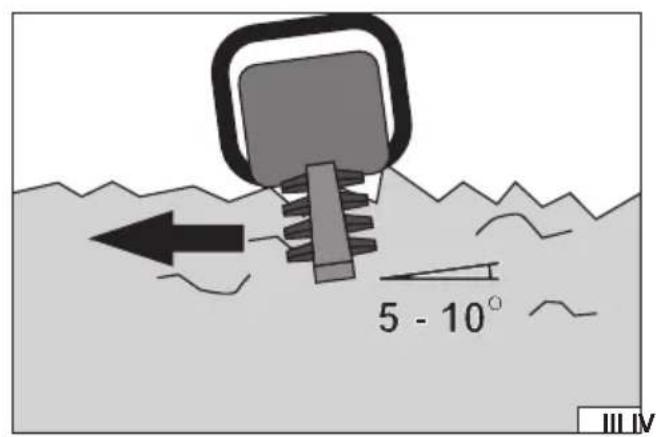
natural_image
Diagram showing a tool interacting with soil layers, with curved arrows indicating direction of movement (no text or symbols present)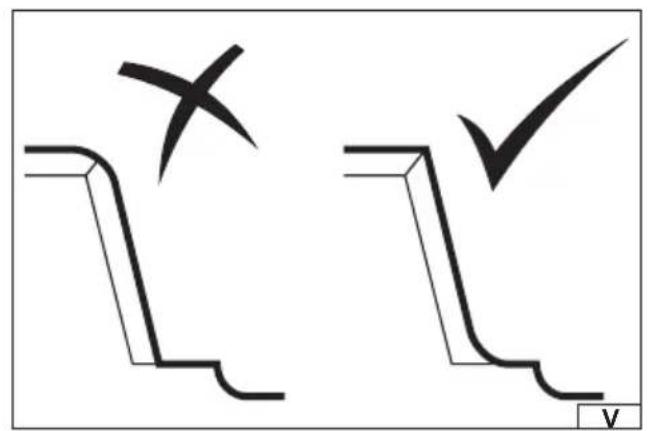
natural_image
Two abstract geometric shapes with checkmark marks, no text or symbols present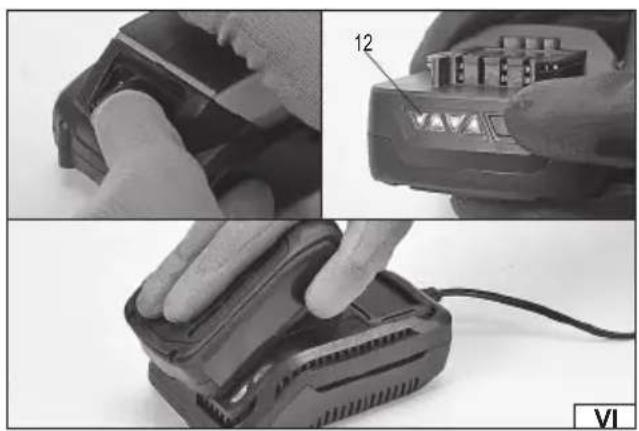
natural_image
Three-panel photo showing hands using a battery pack and charging case, with no visible text or symbols.- housing
- knives
- shield - screen
- front handle
- back handle
- electric switch lock
- switch
- blades cover
- battery
- charging station
- battery charge indicator
- battery latch
DE
Read the operating instruction
Wear hearing protectors
Wear protective goggles
Schutzbrille tragen
Keep a safe distance from the blades
Do not expose to precipitation
This symbol indicates that waste electrical and electronic equipment (including batteries and storage cells) cannot be disposed of with other types of waste. Waste equipment should be collected and handed over separately to a collection point for recycling and recovery, in order to reduce the amount of waste and the use of natural resources. Uncontrolled release of hazardous components contained in electrical and electronic equipment may pose a risk to human health and have adverse effects for the environment. The household plays an important role in contributing to reuse and recovery, including recycling of waste equipment. For more information about the appropriate recycling methods, contact your local authority or retailer.
WYPOSAŻENIE PRODUKTU
Hedge shear is intended only for trimming and forming shrub crowns and trimming of thin twigs. Because of the electric drive of shear, their operation is much quieter than in the case of combustion tool, its operation is also possible in vicinity of buildings. Due to the battery power supply, the shear allows you to work in areas, which are not accessible for to mains-powered products. Correct, reliable, and safe operation of the device is dependent on its proper use, therefore:
Prior to working with the tool, you should read all the instruction and keep it around.
For any damages or injuries caused by the tool misuse, resulting from failure to comply with its designation, no compliance with with safety regulations and recommendations included in this manual, the supplier does not accept any liability. The tool misuse causes also the loss of user's rights to the guarantee and warranty.
PRODUCT EQUIPMENT
The product is supplied in a complete state and requires no assembly. The product is supplied with the blades covers, rechargeable battery and charging station.
Attention! The product of the catalog number: YT-82833 has not been equipped with a rechargeable battery and charging station.
TECHNICAL DATA
| Parameter Unit Value | ||
| Catalog number YT-82832, YT-82833 | ||
| Rated voltage [V] 18 DC | ||
| Cutting speed [min] | ^-1 1050 | |
| The length of cutting [mm] 560 | ||
| Maximum cutting diameter [mm] 19 | ||
| Electric protection class III | ||
| Weight [kg] | 2,6 | |
| Noise level | ||
| - L_pA (pressure) | [dB (A)] | 80,0 ± 3,0 |
| - L_pA (power) | [dB (A)] | 87,0 ± 3,0 |
| Vibration (rear handle/front handle) | [m/s2] | 3,5 ± 1,5 |
| Type of the battery* | Li-Ion | |
| Capacity of the battery* | [Ah] | 2 |
| Energy of the battery | [Wh] | 36 |
| Charging station+ | ||
| Input voltage [V~] | 220 - 240 | |
| Mains frequency | [Hz] 50 / 60 | |
| Rated power | [W] | 60 |
| Output voltage | [V] 21 DC | |
| Input current | [A] | 2.4 |
| Time of charging** | [h] | 1 |
* only for models equipped with battery and charger
** charging time applies only to the battery with a capacity listed in table
The declared noise emission value has been measured using the standard test method and can be used to compare one tool to another. The declared noise emission value can be used in the preliminary exposure assessment.
The declared total vibration value has been measured using the standard test method and can be used to compare one tool to another. The declared total vibration value can be used in the initial exposure assessment.
Note! The vibration emission during tool operation may differ from the declared value, depending on the manner the tool is used.
Note! Safety measures to protect the operator, which are based on an assessment of exposure under actual conditions of use (including all parts of the work cycle, such as the time when the tool is switched off or idle and the activation time), must be specified.
GENERAL SAFETY CONDITIONS
NOTE! Get acquainted with all the instructions below. Failure to observe them may lead to an electric shock, fire or injuries. The notion of electric tool used in the instructions applies to all the tools which are powered with electric current, both wire tools and wireless ones.
OBSERVE THE FOLLOWING INSTRUCTIONS
Place of work
The place of work must be properly illuminated and clean. Disorder and poor illumination may be a cause of accidents.
Do not work with electric tools in explosive environments, or those which contain inflammable liquids, gases or vapours.
Electric tools generate sparks, which may cause a fire in case of contact with inflammable gases or vapours.
Do not allow children and outsiders to the place of work. A lack of concentration may result in a loss of control over the tool.
Electric safety
The plug of the power supply cable must fit the mains socket. Do not modify the plug. Do not use any adapters whatsoever in order to adapt the plug to the socket. Unmodified plug which fits the socket reduces the risk of an electric shock.
Avoid contact with grounded surfaces, such as pipes, heaters and refrigerators. Grounding of the body increases the risk of an electric shock.
Do not expose electric tools to precipitation or humidity. Water and humidity which gets into the electric tool increases the risk of an electric shock.
Do not overload the power supply cable. Do not use the power supply cable in order to carry the tool or to connect and disconnect the plug from the mains socket. Avoid contact of the power supply cable with heat, oils, sharp tools and moving elements. Damage to the power supply cable increases the risk of an electric shock.
In case work is realised outside closed areas, it is necessary to use extension cords designed for applications outside closed areas. Using a correct extension cord permits to reduce the risk of an electric shock.
If operating a power tool in a damp location is unavoidable, use a residual current device (RDC) protected supply. Use of an RCD reduces the risk of electric shock.
Personal safety
Commence work in good physical and psychological conditions. Pay attention to what you do. Do not work if you are tired or under effects of medicines or alcohol. Even a moment's inattention during work may lead to serious injuries.
Always use individual means of protection. Always wear goggles. Using individual means of protection, such as dust-masks, protective shoes, helmets and hearing protections permits to reduce the risk of serious injuries.
Avoid accidental activation of the tool. Make sure the switch is in the OFF position, before you connect the tool to the mains. Holding the tool with a finger on the switch or connecting an electric tool when the switch is in the ON position may lead to serious injuries.
Before you turn an electric tool on remove all the spanners and other tools, which have been used for adjustments. A spanner left on rotating elements of the tool may lead to serious injuries.
Keep your balance. Maintain an appropriate position. It will permit to control the electric tool in case of unpredicted situations during its operation.
Use protective clothes. Do not wear loose clothes or jewellery. Keep your hair, clothes and gloves away from moving elements of the electric tool. Loose clothes, jewellery or long hair may get caught on moving elements of the tool.
Use dust extractors or dust containers, if the tool is equipped with any. Make sure they are properly connected. Using of dust extractors permits to reduce the risk of serious injuries.
Operation of the electric tool
Before the battery is installed, make sure the switch is off. Installation of the battery when the switch is on may lead to accidents.
Use solely the charger recommended by the manufacturer. Using a charger designed for another type of battery may be a cause of fire.
The electric tool must be operated exclusively with the battery indicated by the manufacturer. Using another battery may be a cause of fire or injuries.
When the battery is not used, it must be stored away from such metal objects as paper clips, coins, nails, screws or other small metal elements, which might short-circuit the terminals. Short-circuited terminals of the battery may cause burns or fire.
Under adverse circumstances liquid may leak from the battery; avoid any contact. In case of accidental contact with the liquid, rinse it with water. In case of eye contact, seek medical. The liquid leaking from the battery may cause irritation or burns.
Repairs
The tool may be repaired only by authorised service centres, which must use solely original spare parts. It will guarantee a proper level of safety of operation of the electric tool.
Hedge trimmer safety warnings
Do not use hedge trimmers in poor weather conditions, especially if there is a risk of lightning. This avoids the risk of being struck by lightning.
Keep wires and power cords away from the cutting area. Power cords or cables can be hidden in hedges or bushes and can be accidentally cut by the blade.
EN
Wear ear protection. Adequate protective equipment will reduce the risk of hearing loss.
Hold the hedge trimmer only by the insulated handles, as the blade may come into contact with concealed electrical wires or its own power cord. Contact of the blades with a live wire can result in exposed metal parts of the hedge trimmer becoming energised and give the operator an electric shock.
Keep all body parts away from the blade. Do not remove the cut material or hold the cut material while the blades are in motion. The blades continue to move after the switch is turned off. A moment's inattention when operating a hedge trimmer can cause serious injury.
When removing blocked material or servicing the tool, make sure all power switches are turned off and the power cord is unplugged. Unexpected activation of the hedge trimmer when removing blocked material or servicing can cause serious injury. Carry the hedge trimmer by holding the handle with the blade stopped and being careful not to use any power switch. Proper handling of the hedge trimmer will reduce the risk of unintentional triggering and resulting injury from the blades.
When transporting or storing the hedge trimmer always fit the blade guard. Proper handling of the hedge trimmer will reduce the risk of injury from the blades.
PRODUCT SERVICE
Preparation of shear to work
Attention! Before all assembly and mounting activities, you should switch off the shear from power supply, The shear, which is mains powered, should be disconnected from the wall outlet, the shear, which is battery operated, should be disconnect from the battery.
Visually inspect the tool, If you note any damage do not approach the work before fixing them. Remove the cover from blades and check them for a damage.
Preparing the workplace
Before starting work, you should prepare the workplace. Design a safety zone around the workplace, which will not be accessible for bystanders. Make sure, that around the workplace there are not obstacles, which can cause a collision of operator or shear during operation.
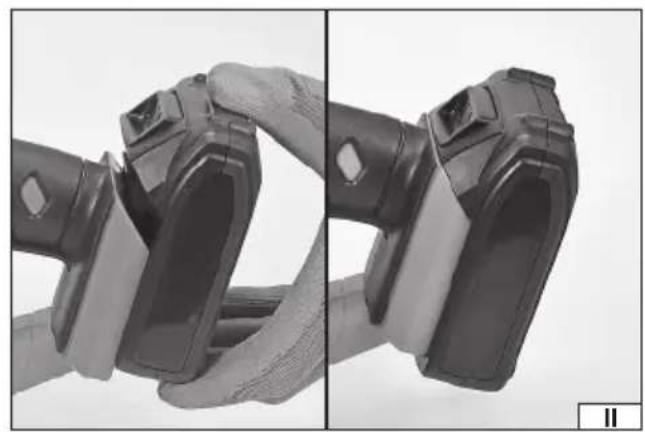
Connecting the shear to power (II)
You should insert the battery into the socket until you notice the battery latch operation. Make sure, that the battery will not slip out during work.
You should disconnect the battery by pressing both clips, and then by removing the battery from the shear housing.
Starting and stopping the shear
Make sure, that the battery is connected to the shear, and on the edges there is not the shield, and that they have no contact with any part of the body and other objects.
Adopt an position, that ensures balance. With one hand hold the front handle and press the lock switch. With the other hand grasp the rear handle. Pressing the switch will start the shear.
While you are working, all the time you should keep pressed the lock switch and switch.
The shear is stopped after releasing pressure on the switch. shear will also stop after you release the pressure on the lock switch, but in this case the blades are no longer in motion.
After a complete stoppage of shear movement, you should disconnect the shear from the power supply by disconnecting it from the battery. Then proceed to maintenance.
Work with the shear
Do not allow operation of the device at low rev speeds or during startup.
The work is most effective when the shearing takes place through full of broad movements. In order to achieve greater efficiency you can tilt the scissors at an angle of about 5-10^ in the cutting direction (III).
To achieve an equal height of a hedge, you can use a fishing line stretched along the cutting line. You should cut the part of hedge which is located above the line.
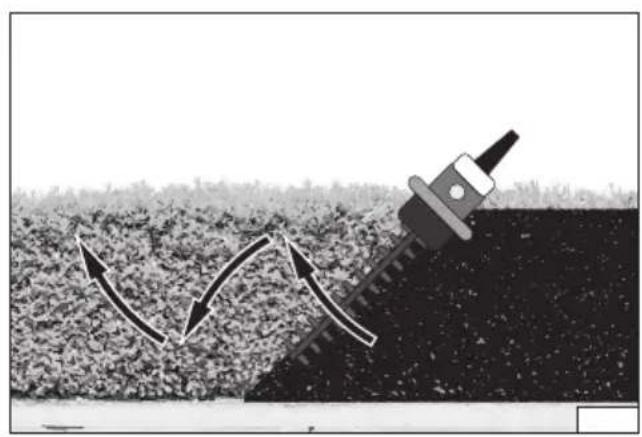
A vertical cut of the hedge is also possible. It is recommended to cut with moves along an arc from bottom to top, and then from top to bottom, to use both sides of the blades (IV).
Tips useful when working
You should ensure balance and proper posture while you work. Be extremely careful when working on slippery, sloping or uneven ground.
During operation, the blade must be constantly monitored. Do not carry out the cut in places which are remaining out of sight.
Before you start your works, you should carefully inspect the work place, remove any loose branches and remnants of previous
EN
cutting. Take special precautions when processing high hedges. Before starting work, check also the other side of the hedge.
Front cover of the shear transmission heats up during operation. To avoid burns, avoid contact with the transmission cover.
When you work you should use regular breaks. The device, during its operation, emits noise and vibration, that affect the equipment operator. The use of regular breaks and personal protective equipment such as gloves, hearing and eye protection, can reduce the impact of device operation on the condition of operator.
You should start the work being healthy and in good shape. In the event of nausea, headache, visual disturbances (eg. reduced field of vision), hearing problems, dizziness you should immediately stop working with the device.
In the case of shear jam during its operation, you should immediately switch off the shear using the power switch and disconnect it from the battery. Wait till all the shear elements cool down. and then proceed to remove the cause of the jam.
If, during the jam any part of blade or covers is damaged or deformed, then it must be replaced or repaired before the start of device operation.
Safety recommendations for battery loading
Attention! Before loading may start make sure the body of the charger, the cable and the plug are not broken or damaged. It is prohibited to use a damaged loading dock and charger! For the purpose of loading batteries only the charging dock and the charger provided may be used. Using another charger may be a cause of fire or damage the tool. Batteries may be charged only in a dry room, protected from unauthorised persons, particularly children. Do not use the charging dock and the charger without permanent supervision of an adult! If it is necessary to leave the room where loading is taking place, it is required to disconnect the charger from the mains, removing the charger from the mains socket. In case when smoke comes out of the charger, or a strange smell is emitted, etc., it is required to immediately remove the plug of the charger from the mains socket!
The drill and automatic return screwdriver is provided with an unloaded battery, so before work may commence, it is required to charge it following the procedure below, using the charger and charging dock provided. Li-ION batteries do not show the so called “memory effect”, so it is allowed to charge them at any moment. However, it is recommended to discharge them during normal work, and then load them to their full capacity. If due to the nature of the task it is not possible to do so each time, then it is required to do it at least from time to time. Under no circumstances is it allowed to discharge the batteries short-circuiting the electrodes, since this would cause irreversible damage! It is also prohibited to check the load of the batteries, short-circuiting the electrodes for sparking.
Storage of the battery
In order to prolong the life of the battery, it is required to provide adequate storage conditions. The batteries can go through approximately 500 „loading - discharging” cycles. The battery must be stored between 0 and 30°C, at the relative humidity of 50%. In order to store the battery for a prolonged period, it is required to charge it to approximately 70% of its capacity. In case of prolonged storage, it is required to recharge the battery once a year. Do not permit excessive discharging of the battery, since this would reduce its life and may cause irreversible damage.
During storage, the battery will be gradually unloading due to leakage conductance. The process of automatic unloading depends on the temperature of storage, since the higher the temperature, the fastest the process. In case of incorrect storage of batteries, there is a danger of electrolyte leakage. In case of leakage, it is required to protect the leakage with neutralizing agent. In case of contact of electrolyte with the eyes, it is required to rinse the eyes abundantly, and then immediately seek medical assistance. It is prohibited to use a tool with a damaged battery.
In case the battery is completely worn out, it is required to deposit it at a special point dedicated to disposal of such waste.
Transport of the batteries
Lithium-ion batteries are in accordance with legal regulations treated as dangerous waste. The user of the tool may transport the tool with the battery or only batteries by land. Then no additional conditions must be complied with. In transport is realised by third parties (for example dispatch through courier service), then it is required to proceed in accordance with regulations for transport of dangerous materials. Before shipment, contact an authorised person.
It is prohibited to transport damaged batteries. During transport the battery must be removed from the tool, and the exposed contacts protected, e.g. with insulating tape. Protect the batteries so that they do not move inside the package during transport. It is also required comply with the national regulations for transport of dangerous materials.
Charging the battery
Attention! Before charging you should disconnect the charger from the mains by unplugging the power supply plug from the mains. In addition, you should clean the battery and its terminals of dirt and dust with a soft, dry cloth.
The battery has a built-in charge indicator. When you press the button, LEDs will light up (VI), the more LEDs will light up, the more fully the battery pack is charged. If the button is pressed and the LEDs are off it means that the battery is discharged.
Disconnect the battery from the tool.
Push the battery in the charger socket (VI).
Plug the charger into a mains socket.
When the red LED lights up, it means the loading process.
When charging is complete, the red LED goes off, and green LED lights up, indicating a full charge of the battery.
Unplug the charger from the mains outlet.
EN
Remove the battery from the charging station, by pressing the battery latch button.
Attention! If, when the charger is connected to the power supply, the green LED is on, this indicates a fully charged battery. In this case, the charger does not start charging.
MAINTENANCE AND STORAGE OF THE PRODUCT
Attention! Before starting any operation, which is described below, you should disconnect the shear from the power supply. The tool, which is mains powered, should be disconnected from the wall outlet, the tool, which are battery operated, should be disconnect from the battery.
After each use, you should examine your tool condition with particular emphasis on the patency of the ventilation openings.
Check the alignment of all elements of the tool. Any loose connections should be tightened. Check the condition of the blades. Clean them with a brush, and then preserve by means of the lubricant spray. Excess lubricant should be wiped. If you notice any damaged or dull blades, they should be replaced by an authorized service center.
It is forbidden to operate the shear with damaged blades.
Keep the blades are always lubricated. This will prevent the occurrence of rust, which reduces the efficiency of tool, and can also increase the risk of injuries. The clearance between the blades should be between 0.2 and 0.4 mm, measured at the blade twist screw. Factory blades are sharpened in order to achieve optimum performance, but as a result of work they become dull. Before starting any job you should evaluate the blades. If you notice any rounding of the upper edge of the blade or the disappearance of the rounding of the bottom part of the blade, the blades should be sharpened (V). Sharpening should be performed in the manufacturer's authorized service center.
Before storing scissors for a long time, the blades should be sprayed with a preservative or spread it on the blades with a brush. Excess of preservative should be removed just before starting the work. Such maintenance will reduce the rusting risk of blades. The tool housing should be cleaned with a soft dry cloth. Clean the housing of residual wood, oil, grease and other contaminants. The tool should be stored in a dry, closed room, disconnected from the mains.
The tool should be stored in the areas, which are shaded, dry, and equipped with adequate ventilation to prevent condensation. The place should not be available for bystanders, especially children. During storage the blades should always be protected by the cover.
CHARAKTERISTIK DES PRODUKTES
PRODUKTA RAKSTUROJUMS
PRODUKTA APKALPOŠANA
CARACTERISTIQUES DE PRODUIT
Intertek House, Cleeve Road, Leatherhead, Surrey KT22 7SB; Wielka Brytania
DECLARATION OF CONFORMITY
0225/YT-82832/EC/2025
We declare and guarantee with full responsibility that the following products:
Cordless hedge trimmer 18 V d.c.; 560 mm; 1050 min ^-1 ; item no. YT-82832, YT-82833
meet requirements of the following European Standards / Technical Specifications:
EN 62841-1:2015 + A11:2022
EN 62841-4-2:2019 + A1:2022 + A11:2022
EN IEC 55014-1:2021
EN IEC 55014-2:2021
and fulfill requirements of the following European Directives:
2006/42/EC Machinery and safety elements
2014/30/EU Electromagnetic compatibility (EMC) Directive
2011/65/EU Restriction of the Use of Certain Hazardous Substances
Serial number: concern all serials numbers of item(s) mentioned in this declaration
The person authorized to compile the technical file:
Agnieszka Rędziak
(Place and date of issue)
V-CE PREZES ZARZADU
JAN SZMIDT
(Name and signature of authorized person)
TOYA S.A.
DECLARATION OF CONFORMITY
0225/YT-82832/EC/2025
We declare and guarantee with full responsibility that the following products:
Cordless hedge trimmer 18 V d.c.; 560 mm; 1050 min ^-1 ; item no. YT-82832, YT-82833
fulfil requirements of the following European Directive: 2000/14/WE
Conformity assessment procedure:
Manufacturer quality-control system, examination of the manufacturer's technical file and periodical inspection by notified body
Notified body:
Intertek Testing; Certification Ltd. notification no.: 0359
Intertek House, Cleeve Road, Leatherhead, Surrey KT22 7SB; United Kingdom
Measured sound power level on an equipment representative for this type: 87 dB(A)
Guaranteed sound power level for this equipment: 90 dB(A)
conformity and references of the other Community Directives applied:
2006/42/WE Machinery and safety devices
2014/30/UE Electromagnetic compatibility
2011/65/UE Restriction of the Use of Certain Hazardous Substances
Wrocław, 2025.02.05
(Place and date of issue)
V-CE PREZES ZARZADU
JAN SZMIDT
(Name and signature of authorized person)
TOYA S.A.
Intertek House, Cleeve Road, Leatherhead, Surrey KT22 7SB; United Kingdom


