
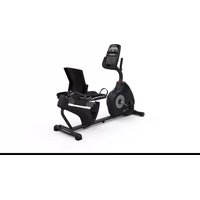
SFT 4.1 - Exercise bike Schwinn - Free user manual and instructions
Find the device manual for free SFT 4.1 Schwinn in PDF.


| Product Type | Exercise Bike |
| Brand | Schwinn |
| Model | SFT 4.1 |
| Dimensions (L x W x H) | 177.8 x 83.8 x 139.7 cm |
| Product Weight | 81 kg |
| Maximum User Weight | 124 kg |
| Power Supply | 220-240 V, dedicated 15 A circuit |
| Display | LED screen: incline, speed, time, distance, calories, heart rate |
| Workout Programs | Manual, Weight Loss, Intervals, Distance, Calories |
| Connectivity | Bluetooth 4.0 LE, 3.5mm audio jack, USB port 1A/5V |
| Audio Features | Built-in speakers, headphone jack, tablet holder |
| Heart Rate Monitor | Handlebar heart rate detection (touch sensors) |
| Incline Levels | 16 levels, adjustable in 0.5% increments |
| Speed | Increments of 0.16 km/h (0.1 mph) |
| Safety Key | Clip-on for clothing, cuts power in case of fall |
| Maintenance | Daily cleaning, belt lubrication every 3 months or 480 km |
| Warranty | Manufacturer warranty, contact local customer service |
| App Compatibility | JRNY (subscription required) |
| Usage | Household only |
Frequently Asked Questions - SFT 4.1 Schwinn
User questions about SFT 4.1 Schwinn
0 question about this device. Answer the ones you know or ask your own.
Ask a new question about this device
Download the instructions for your Exercise bike in PDF format for free! Find your manual SFT 4.1 - Schwinn and take your electronic device back in hand. On this page are published all the documents necessary for the use of your device. SFT 4.1 by Schwinn.
USER MANUAL SFT 4.1 Schwinn
Important Safety Instructions
Thanks for choosing SCHWINN SFT4.1 Treadmill as your fitness equipment. We are sincerely encourage you to read through this Owner's manual carefully before the assembling of your equipment started, especially of below WARNINGS! WARNINGS WILL REDUCE THE RISK OF BURNS, FIRE, ELECTRICAL SHOCK OR INJURY TO PERSONS.
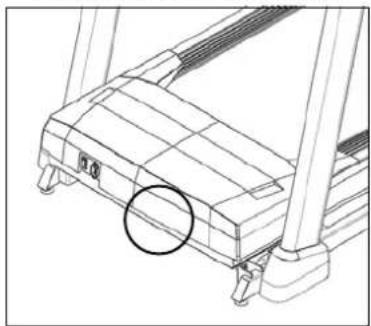
Before proceeding, find your treadmill's serial number located on a white barcode sticker near the on/off power switch and power cord and enter it in the space provided below.
ENTER YOUR SERIAL NUMBER AND MODEL NAME IN THE BOXES BELOW:
SERIAL NUMBER:
MODEL NAME: SCHWI NN SFT4.1
» Refer to the SERIAL NUMBER and MODEL NAME when calling for service.
SERIAL NUMBER LOCATION
natural_image
Technical line drawing of a mechanical device with a circled feature, no visible text or symbols
WARNING
- FAILURE TO FOLLOW THESE INSTRUCTIONS COULD RESULT IN INJURY!
- Heart rate monitoring systems may be inaccurate. Over exercising may result in serious injury or death. If you feel paint stop exercising immediately.
- When exercising, always maintain a comfortable pace.
- If you experience any kind of pain, including but not limited to chest pains, nausea, dizziness, or shortness of breath, stop exercising immediately and consult your physician before continuing. Incorrect or excessive exercise may damage your health.
- Do not wear clothes that might catch on any part of the treadmill
• Always wear athletic shoes while using this equipment. - Do not jump on the treadmill.
- While exercising, do not run near the edge of the belt to avoid the risk of injury.
- At no time should more than one person be on treadmill while in operation.
- This treadmill should not be used by persons weighing more than the weight showing in TECH SPEC section. Failure to comply will void the warranty.
- When lowering the treadmill deck, wait until rear feet are firmly on the floor before stepping on the deck.
- Do not operate under blanket or pillow. Excessive heating can occur and cause fire, electric shock, or injury to persons.
- Connect this exercise product to a properly grounded outlet only.
- To disconnect, turn all controls to the off position, then remove plug from outlet.
- Disconnect all power before moving the equipment.
- Never operate product with a damaged cord or plug even if it is working properly. Never operate any product if it appears damaged, or has been immersed in water. Contact Customer Tech Support for replacement or repair in order to avoid a hazard.
- The treadmill should never be left unattended when plugged in. Unplug from outlet when not in use, and before putting on or taking off parts.
- At NO time should pets or children under the age of 13 be closer to the treadmill than 3 meter.
- At NO time should children under the age of 13 use the treadmill.
- Children over the age of 13 or the persons with reduced physical, sensory or mental capabilities, or lack of experience and knowledge should not use the treadmill, unless supervised or unless they have been given instruction concerning use of the treadmill by a person responsible for their safety.
- Do not remove the protected covers unless instructed by professional and your local dealer. Service should only be done by and authorized service technician.
- Disconnect the safety key to prevent uncontrolled usage of third parties.
- Treadmill equipped with side handrails and front handlebar for user support and emergency dismount, press emergency button to stop the machine for emergency dismount.
- The noise level of the treadmill is less than 70 dB when there is no user on it and more than 70 dB when it is in use. If the noise of treadmill bothers you, stop exercising and take a break. Noise emission under load is higher than without load.
- Make sure the treadmill comes to complete stop before folding. Do not operate the treadmill when it is folded.
- Please note that the plastic parts, such as end caps, are susceptible to wear.
- The treadmill's safety level can only be maintained if it is checked regularly for damage and wear.
- Make sure the edge of the belt is parallel with the lateral position of the side rail and does not move under the side rail. If the belt is not centered it must be adjusted before use.
- Use the treadmill only for its intended use as described in the treadmill guide and owner's manual.
- Do not use other attachments that are not recommended by the manufacturer. Attachments may cause injury.
- Return the unit to a service center for examination and repair.
- Keep power cord away from heated surfaces. Do not carry this unit by its supply cord or use the cord as a handle.
- Never operate the treadmill with the air opening blocked. Keep the air opening clean, free of lint, hair, and the like.
- To prevent electrical shock, never drop or insert any object into any opening.
- Do not operate where aerosol (spray) products are being used or when oxygen is being administered.
- This treadmill is intended for in-home use only. Failure to comply will void the warranty.
- Do not use treadmill in any location that is not temperature controlled, such as but not limited to garages, porches, pool rooms, bathrooms, car ports or outdoors. If your treadmill has been exposed to colder temperatures or high moisture climates, it is strongly recommended that the treadmill is warmed up to room temperature before first time use. Failure to comply will void the warranty.
- Treadmill is heavy; use care and additional help if necessary when moving. Do not attempt to move or transport treadmill unless it is in the upright, folded position with the lock latch secured. Failure to follow these instructions could result in injury.
- Do not move or lift treadmill from packaging until specified to do so in the assembly instructions. You may remove the plastic wrap from console masts.
- Never open box when it is positioned upside-down or on its side.
- Unpack and assemble the unit where it will be used.
- The enclosed treadmill is equipped with high-pressure springs which can cause the lower base frame to spring open if mishandled.
- Do not remove the console covers unless instructed by Customer Tech Support. Service should only be done by an authorized service a technician.
- Have 2 people available for assembly, this will make the assembly process easier.
TECH SPECS
| Assembled Dimensions(L x W x H) | 177.8 x 83.8 x 139.7 cm /64" x 30.3" x 54.9" |
| Product Weight 81 kg / 179 lbs. | |
| Max User Weight 124 kg / 275 lbs. | |

From now on, you can assemble your equipment at your convenience. For detailed instructions on assembly, operation, programs, troubleshooting, and maintenance, please scan the QR code on the left side to access the complete manual.
If scanning the QR code fails, you can visit the website provided here: https://global.schwinnfitness.com/en/manuals.html
WARRANTY
If your equipment requires warranty service, please contact local Customer Tech Support.

NEED HELP?
If you have any questions, need assistance with missing parts, or require technical support or maintenance for your equipment, please contact Customer Tech Support.
Manufacturer: Johnson Health Industry (Vietnam) Co., Ltd.
Manufacturer address:
Lot CN-24, Thuan Thanh II Industrial Park,
Mao Dien Ward, Bac Ninh Province, Vietnam
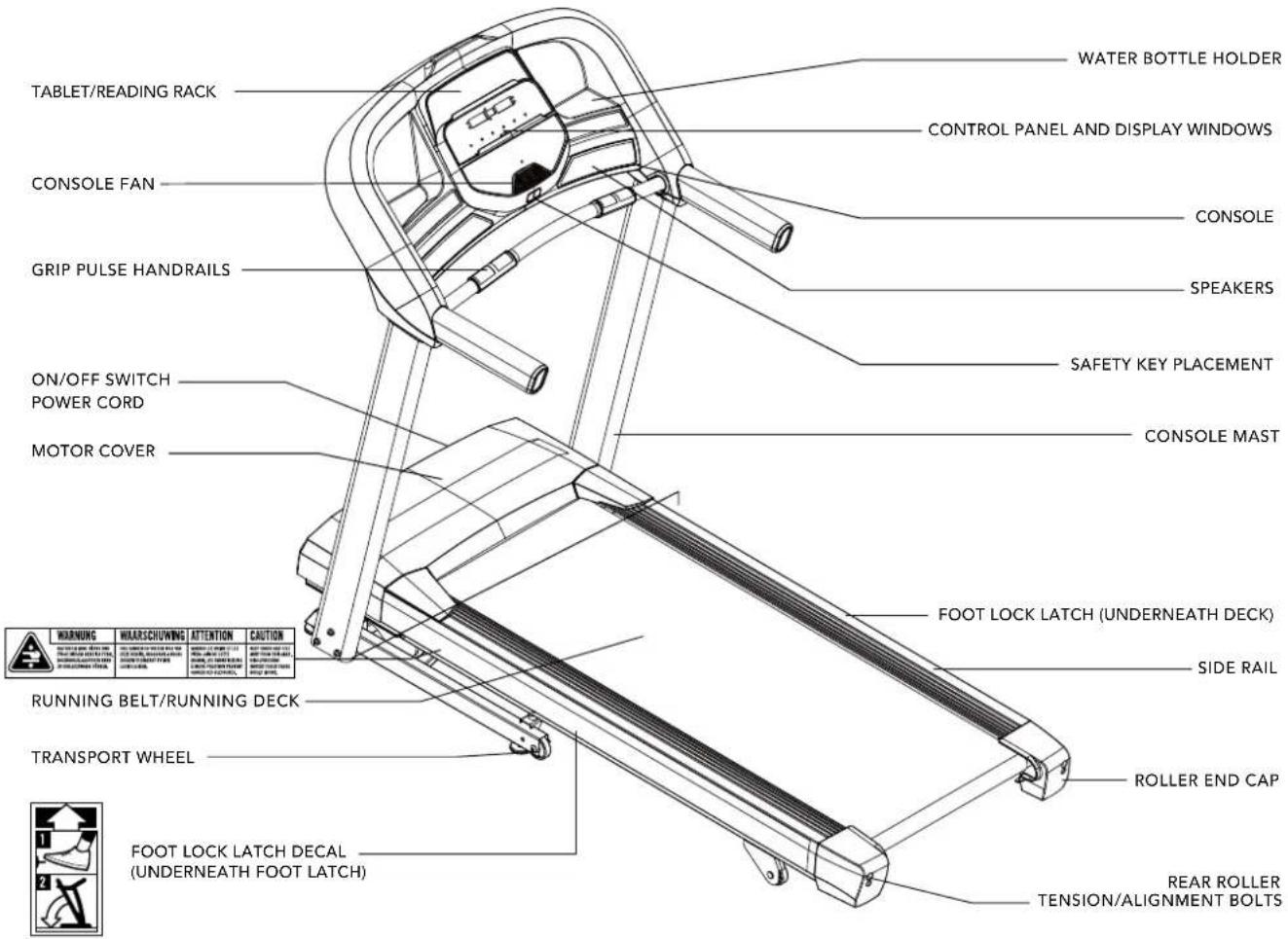
TOOLS INCLUDED:
6 mm T-Wrench
5 mm L-Wrench
4 mm T-Wrench
Phillips Screwdriver
PARTS INCLUDED:
1 Console Assembly
2 Console Masts
1 Hardware Kit
1 Safety Key
1 Audio Adapter Cable
1 Bottle of Silicone Lubricant
(for 2 applications)
☐ 2 Console Mast Covers (4 pcs)
1 Power Cord
WARNING
FAILURE TO FOLLOW THESE INSTRUCTIONS COULD RESULT IN INJURY!
WARNING
DO NOT ATTEMPT TO LIFT THE TREADMILL! Do not move or lift treadmill from packaging until specified to do so in the assembly instructions. You may remove the plastic wrap from console masts.
WARNING
Never open box when it is positioned upside-down or on its side.
Unpack and assemble the unit where it will be used.
The enclosed treadmill is equipped with high-pressure springs which can cause the lower base frame to spring open if mishandled.
The red transport cables are installed between the upper deck frame and the lower base frame to prevent the movement of the lower base frame. DO NOT remove red transport cables until instructed to do so.
NOTE: During each assembly step, ensure that ALL nuts and bolts are in place and partially threaded in before completely tightening any ONE bolt.
NOTE: A light application of grease may aid in the installation of hardware. Any grease, such as lithium bike grease is recommended.
ASSEMBLY STEP- UNPACKING
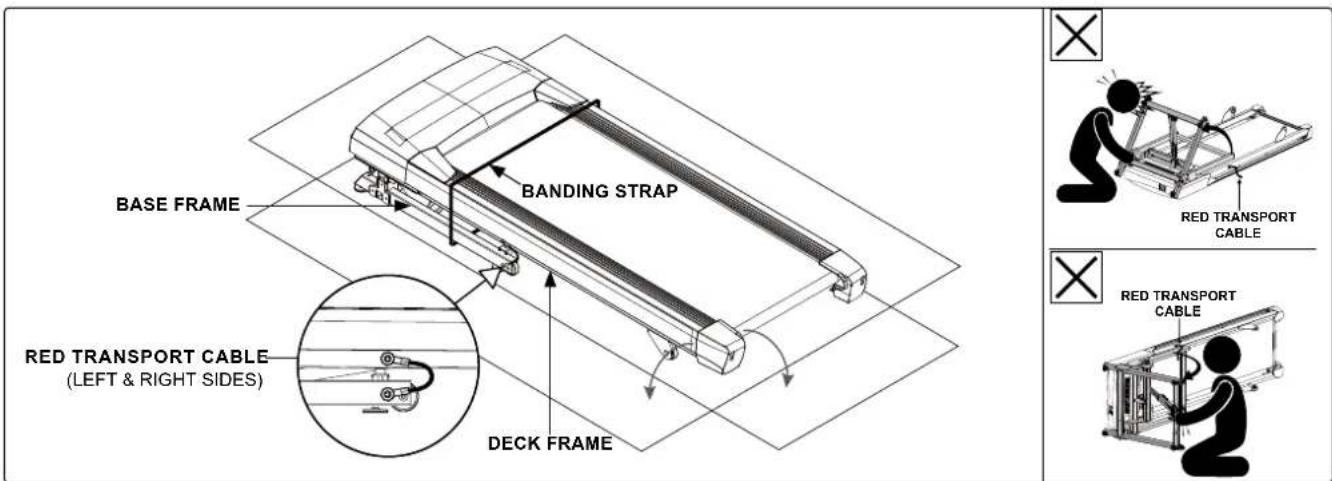
A Place the treadmill carton on a level flat surface with the bottom of the box on the ground.
B Cut banding straps on outside of box and remove box lid.
C DO NOT lift treadmill out of the box. Instead, tear down corners of bottom of treadmill box as shown. Treadmill should be assembled on flattened treadmill box as shown to protect floor surface.
D Cut the banding straps inside the box and remove everything but the treadmill frame.
E Partially lift the running deck upward from the rear to remove all contents from underneath the running deck. Red transport cables on either side of treadmill will prevent the treadmill deck from fully lifting.
WARNING
NEVER tip treadmill upside-down or on its side. DO NOT use tools to remove the red transport cables until instructed to do so. If a component requires tools to remove, wait until the Assembly Instructions instructs you how to safely remove the component.
ASSEMBLY STEP 1
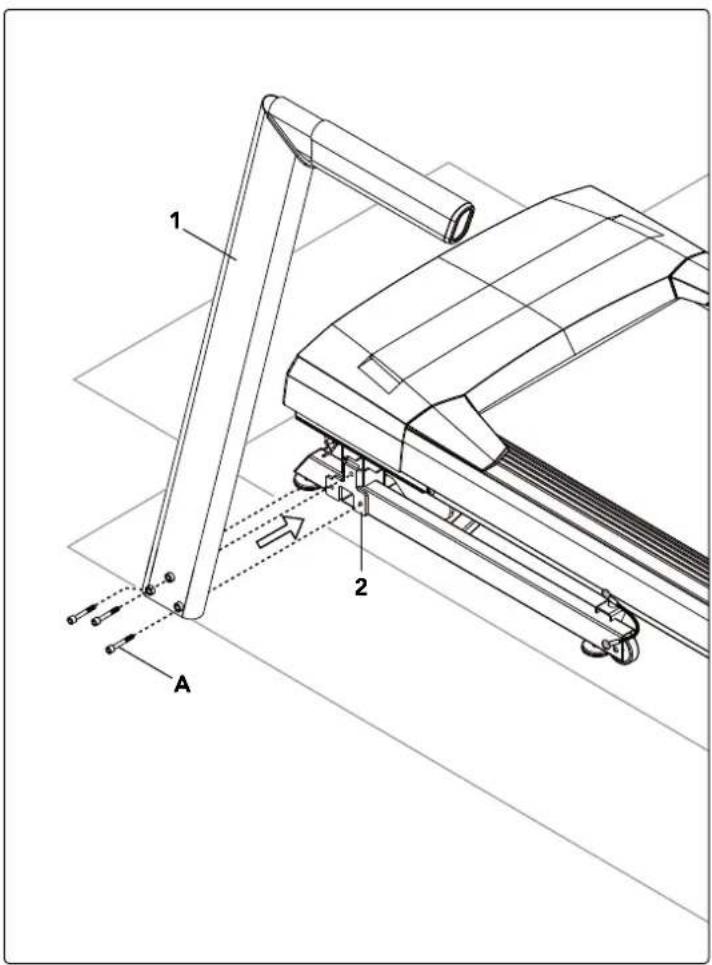
1.1 Open HARDWARE FOR STEP 1.
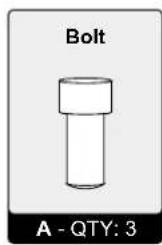
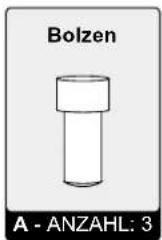
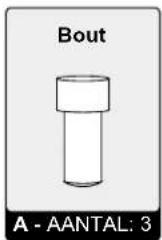
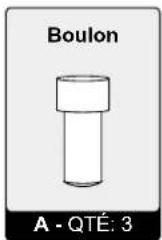
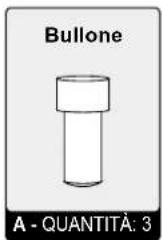
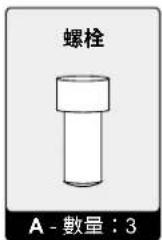
1.2 Attach the LEFT CONSOLE MAST (1) to the BASE FRAME (2) using 3 BOLTS (A).
NOTE: Do not fully tighten bolts until the end of STEP 4.
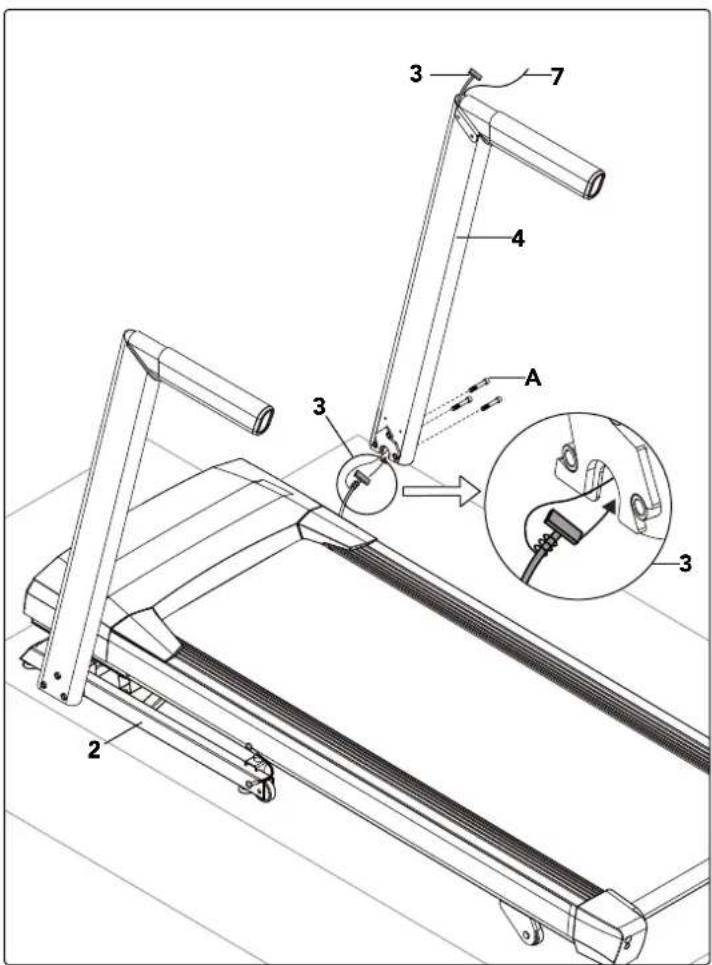
ASSEMBLY STEP 2
2.1 Open HARDWARE FOR STEP 2.
2.2 Attach LEAD WIRE (7) to end of CONSOLE CABLE (3). Pull LEAD WIRE (7) and CONSOLE CABLE (3) through bottom hole on RIGHT CONSOLE MAST (4). After pulling the LEAD WIRE (7) through the mast, the top of the CONSOLE CABLE (4) should be located at the top of the RIGHT CONSOLE MAST (4).
2.3 Attach RIGHT CONSOLE MAST (4) to MAIN FRAME (2) using 3 BOLTS (A).
NOTE: Be careful not to pinch any wires while assembling the console.
NOTE: Do not fully tighten bolts until the end of STEP 4.
ASSEMBLY STEP 3
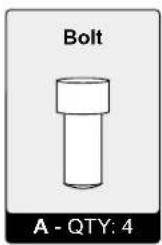
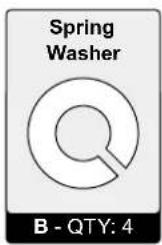
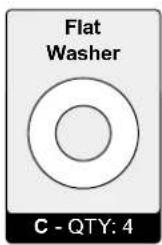
3.1 Open HARDWARE FOR STEP 3
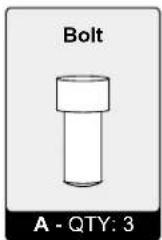
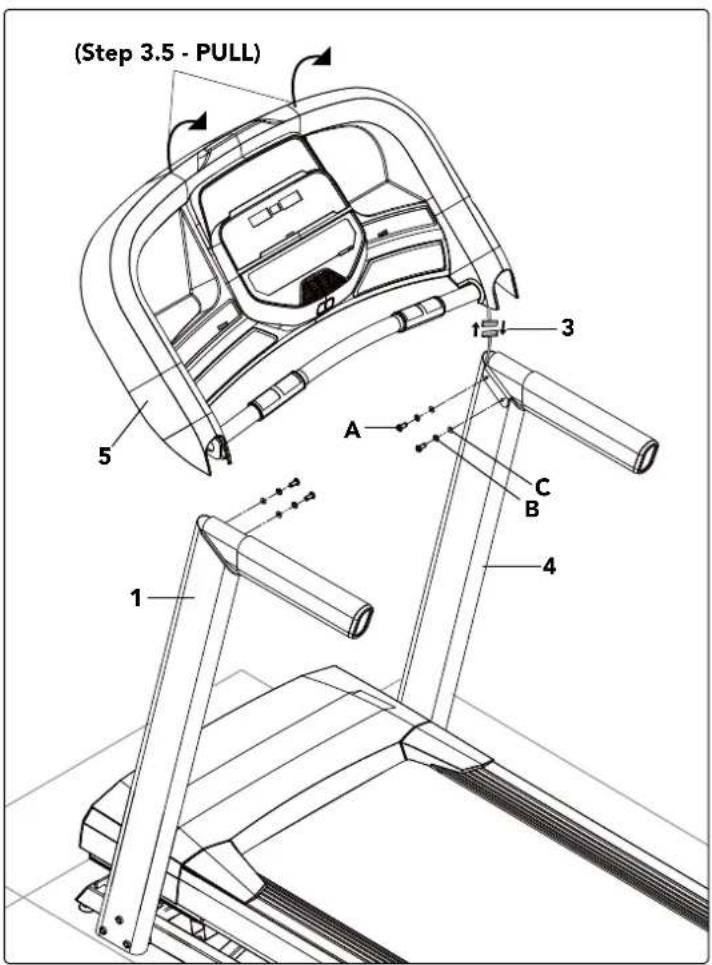
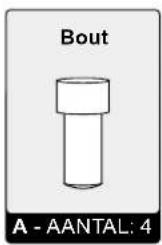
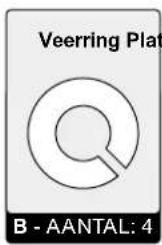
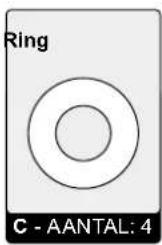
3.2 Gently place the CONSOLE (5) on top of the CONSOLE MASTS (1&4). Attach the LEFT SIDE first using 2 BOLTS (A), 2 SPRING WASHERS (B) and 2 FLAT WASHERS (C).
3.3 Connect the CONSOLE CABLES (3), detach and discard LEAD WIRE (7), and carefully tuck wires into mast to avoid damage.
3.4 Attach the RIGHT SIDE of the CONSOLE (5) using 2 BOLTS (A), 2 SPRING WASHERS (B) and 2 FLAT WASHERS (C).
3.5 Pull the top of the CONSOLE (5) towards the back of the treadmill and HOLD while TIGHTENING THE LEFT AND RIGHT SIDE BOLTS (A).
3.6 REMEMBER to tighten ALL BOLTS & SCREWS completely now that assembly is finished.
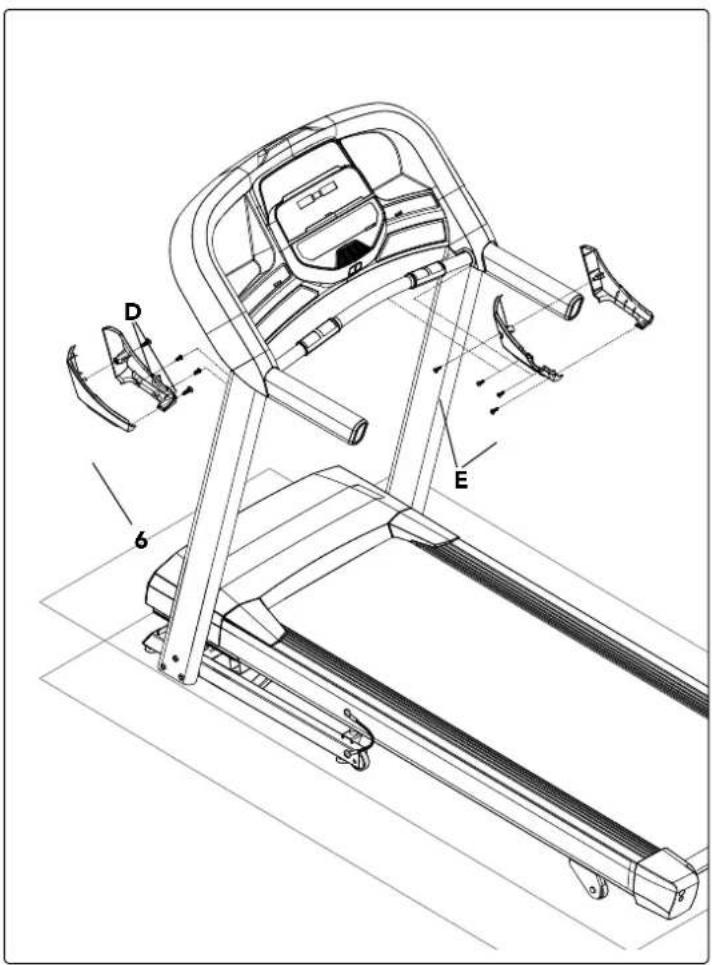
ASSEMBLY STEP 4
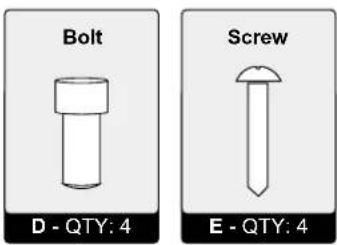
4.1 Open HARDWARE FOR STEP 4.
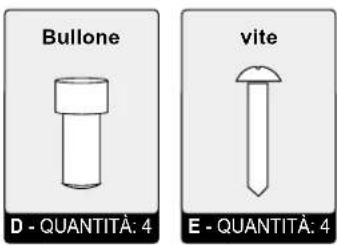
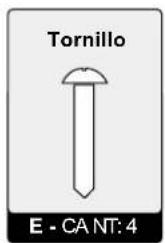
4.2 Attach the RIGHT AND LEFT SIDE CONSOLE JOINT COVERS (6) using 4 BOLTS (D) AND 4 SCREWS (E).
4.3 REMEMBER to tighten ALL BOLTS & SCREWS completely now that assembly is finished.
ASSEMBLY STEP 5 - REMOVAL OF RED TRANSPORT CABLES
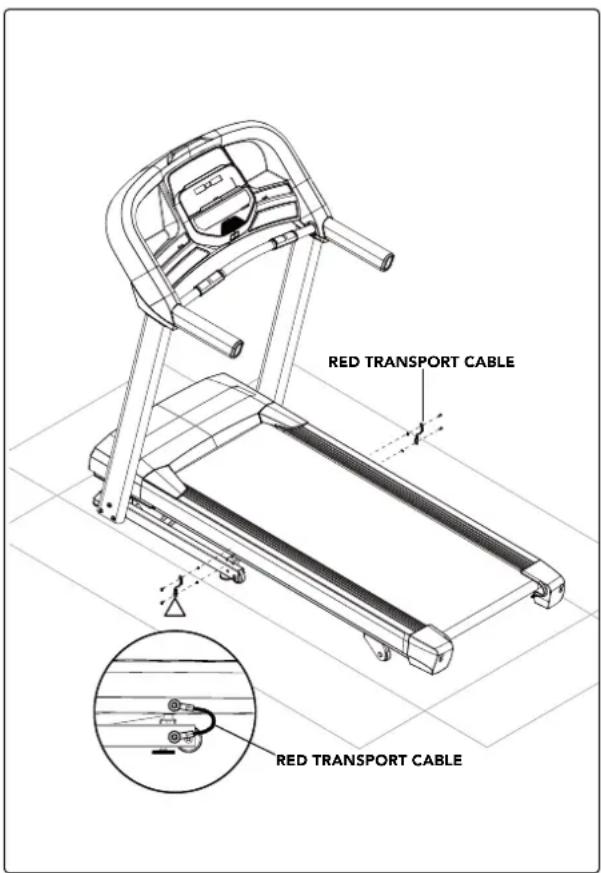
FAILURE TO FOLLOW THESE INSTRUCTIONS COULD RESULT IN INJURY!
Once the red transport cables have been detached from the treadmill, high pressure springs can cause the lower base frame to spring open. NEVER tip treadmill upside-down or on its side, and NEVER lift this unit if red transport cables are not connecting the upper deck frame to the lower base frame.
5.1 Ensure that treadmill is resting with all wheels supported by the floor.
5.2 On left side of treadmill, use the 5mm L-wrench (provided in box) to remove the two bolts connecting the red transport cable to the upper deck frame and the lower base frame.
5.3 Replace both bolts (one in the upper deck frame and one in the lower base frame) and fully tighten to lock in place. Note that to prevent the lower base frame from springing open during transport or disassembly of the treadmill in the future, the red transport cable can be reattached to the treadmill using these same bolts.
5.4 Perform same operation on right side of treadmill to remove the two bolts connecting the red transport cable to the upper deck frame and the lower base frame.
5.5 Replace both bolts and fully tighten to lock in place.
5.6 Save both red transport cables for future use by placing cables into clear poly bag alongside the owner's manual.
5.7 When red transport cables are not installed, transport unit ONLY on the ground, and ONLY after it is fully assembled and in the upright folded position with the lock latch secured.
ASSEMBLY STEP 6 - MOVING TREADMILL
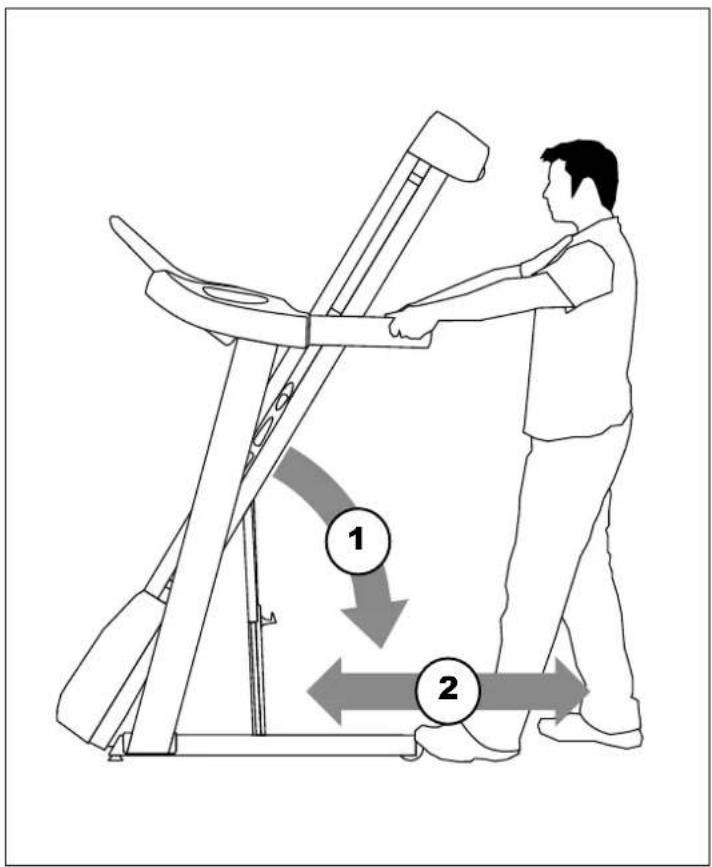
6.1 To move, make sure the treadmill is folded and securely latched. Then firmly grasp the handlebars, tilt the treadmill back (1) and roll (2).
6.2 Move treadmill off flattened box and into its final position, ready for use. Dispose of cardboard box.
NOTE: If treadmill must be disassembled or lifted in the future, use the 5mm L-wrench to re-attach red transport cables to the upper deck frame and lower base frame on both the left side and right side of the treadmill. Check to ensure that the lower base frame cannot spring open before lifting or disassembling treadmill.
ASSEMBLY COMPLETE!
Before the first use, lubricate the treadmill deck by following the instructions in the MAINTENANCE section in the TREADMILL GUIDE.
Treadmill Setup and Use
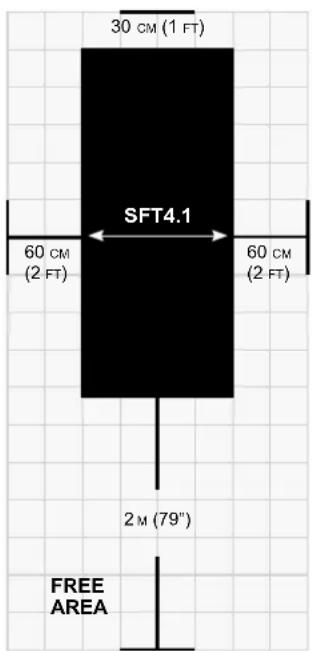
Place the treadmill on a level and stable surface. There should be 30cm of clearance in front of the treadmill for the power cord. Please leave a clear zone behind the treadmill that is at least the width of the treadmill and at least 2 meters long. This zone must be clear of any obstruction and provide the user a clear exit path from the machine. In case of an emergency, place both hands on the side arm rests to hold yourself up and place your feet onto the side rails.
For ease of access, there should be an accessible space preferentially on both sides of the treadmill equal to 0.6 meter to allow a user access to the treadmill from either side.
Do not place the treadmill in any area that will block any vent or air openings. The treadmill should not be located in a garage, covered patio, near water or outdoors.
GROUNDING INSTRUCTIONS
This product must be grounded. If a treadmill should malfunction or breakdown, grounding provides a path of least resistance for electrical current to reduce the risk of electrical shock. This product is equipped with a cord having an equipment-grounding conductor and a grounding plug. The plug must be plugged into an appropriate outlet that is properly installed and grounded in accordance with local codes and ordinances.
DANGER!
- Improper connection of the equipment-grounding conductor can result in a risk of electric shock. Check with a qualified electrician or service provider if you are in doubt as to whether the product is properly grounded. Do not modify the plug provided with the product. If it does not fit the outlet, have a proper outlet installed by a qualified electrician.
- This product is for use on a nominal local voltage circuit and has a grounding plug. No adapter should be used with this product.
- This product must be used on a dedicated circuit. To determine if you are on a dedicated circuit, shut off the power to that circuit and observe if any other devices lose power. If so, move devices to a different circuit. Note: There are usually multiple outlets on one circuit.
FOLDING TREADMILLS
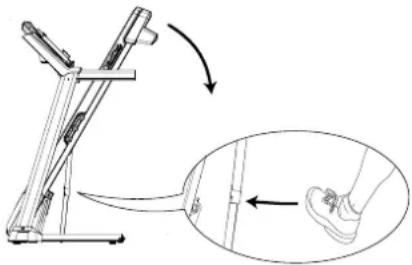
To fold, firmly grasp the back end of the treadmill. Carefully lift the end of the treadmill deck into the upright position until the lock latch engages and securely locks the deck into position. Make sure the deck is securely latched before letting go.
UNFOLDING
Firmly grasp the back end of the treadmill. To unfold, gently press down on the foot lock latch with your foot until the lock latch disengages. Carefully lower the deck to the ground.
natural_image
Diagram of a table tennis paddle with foot positioning and foot movement arrows (no text or symbols)USING THE SAFETY KEY
Your treadmill will not start unless the safety key is placed in position. Attach the clip end securely to your clothing. This safety key is designed to cut the power to the treadmill if you should fall. Check the operation of the safety key every 2 weeks.
WARNING: Never use the treadmill without securing the safety key clip to your clothing. Pull on the safety key clip first to make sure it will not come off your clothing.
POWER
Your treadmill is powered by a power supply. The power must be plugged into the power jack, which is located in the front of the machine near the stabilizer tube. Some treadmills have a power switch, located next to the power jack. Make sure it is in the on position. Unplug cord when not in use. NOTE: Some treadmills have an on/off switch located behind the console.
WARNING: Never operate product if it has a damaged cord or plug, if it is not working properly, if it has been damaged, or immersed in water.
LEVELING THE TREADMILL
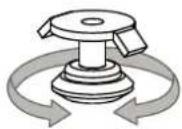
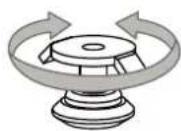
Your treadmill should be level for optimum use. Once you have placed your treadmill where you intend to use it, raise or lower one or both of the adjustable levelers located on the bottom of the treadmill frame. A carpenter's level is recommended. If your treadmill is not level, the running belt may not track properly. Once you have leveled your treadmill, lock the levelers in place by tightening the nuts against the frame.
ADJUST HEIGHT LOCK ADJUSTMENT
CONSOLE OPERATION
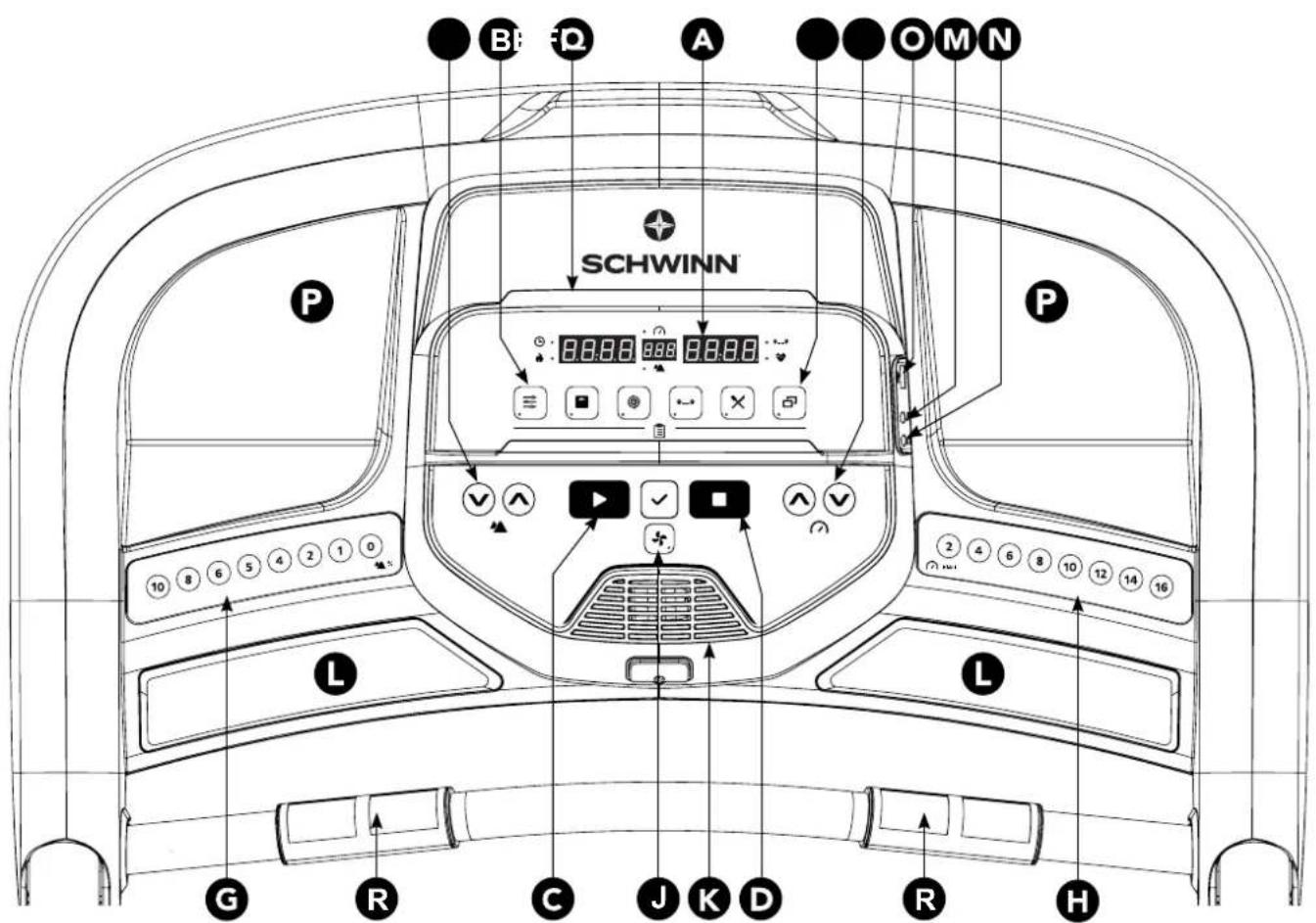
Note: There is a thin protective sheet of clear plastic on the overlay of the console that should be removed before use.
A) LED DISPLAY: Incline, Speed, Time, Distance, Calories, Heart Rate
B) PROGRAM KEYS: press to select your program.
C) START: press to begin exercising, start your workout, or resume exercising after pause.
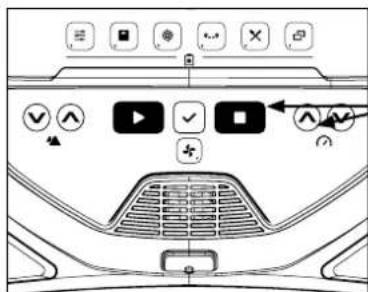
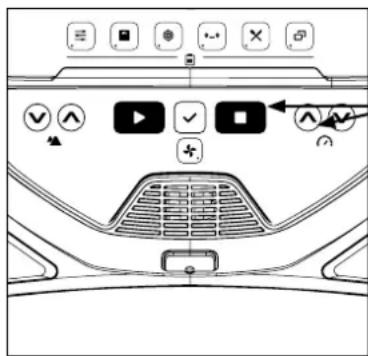
D) STOP: press to pause/end your workout. Hold for 3 seconds to reset the console.
E) INCLINE +/- KEYS: used to adjust incline in small increments (0.5% increments).
F) SPEED +/- KEYS: used to adjust speed in small increments (0.1 mph increments).
G) INCLINE QUICK KEYS: used to reach desired incline more quickly.
H) SPEED QUICK KEYS: used to reach desired speed more quickly.
I) CHANGE DISPLAY: press to change display feedback during workout.
J) FAN KEY: press to turn fan on and off.
K) FAN: personal workout fan.
L) SPEAKERS: music plays through speakers when your CD / MP3 player is connected to the console.
M) AUDIO IN JACK: plug your CD / MP3 player into the console using the included audio adaptor cable.
N) AUDIO OUT / HEADPHONE JACK: plug your headphones into this jack to listen to your music through the headphones. Note: when headphones are plugged into the headphone jack the sound will no longer come out through the speakers.
O) USB INPUT: 1A/5V USB output power.
P) WATER BOTTLE POCKETS: holds personal workout equipment.
Q) TABLET/READING RACK: holds tablet or reading material.
R) HEART RATE PULSE GRIPS: used to measure heart rate.

DISPLAY WINDOWS
• TIME : Shown as minutes : seconds. View the time remaining or the time elapsed in your workout.
• SPEED : Shown as MPH. Indicates how fast your walking or running surface is moving.
• 0__DISTANCE : Shown as miles. Indicates distance traveled or distance remaining during your workout.
• CALORIES : Total calories burned or calories remaining left to burn during your workout.
• INCLINE : Shown as percent. Indicates the incline of your walking or running surface.
- HEART RATE : Shown as BPM (beats per minute). Used to monitor your heart rate (displayed when contact is made with both pulse grips).
GETTING STARTED
1) Check to make sure no objects are placed on the belt that will hinder the movement of the treadmill.
2) Plug in the power cord and turn the treadmill ON. (The ON/OFF switch is next to the power cord.)
3) Stand on the side rails of the treadmill.
4) Attach the safety key clip to part of your clothing making sure that it is secure and will not become detached during operation.
5) Insert the safety key into the safety keyhole in the console.
6) You have two options to start your workout:
A) QUICK START UP
Simply press the START key to begin working out.
Time, distance, and calories will all count up from zero. OR...
B) SELECT A WORKOUT OR TARGET
1) Select your PROGRAM with the +/- buttons and press ENTER when your desired PROGRAM is displayed.
2) Adjust the SETTING with the +/- buttons and press ENTER when your desired SETTING is displayed.
3) Press START to begin.
SPECIFICATION FOR PROGRAMS WITH MULTIPLE SEGMENTS
1) The user can increase incline in a certain segment and it ONLY INCREASES FOR THAT SEGMENT. For the following segments, the machine will follow the values in the provided table.
2) The user can decrease the incline in any segment and it will decrease the same amount for the following segments.
WORKOUT PROFILES

1) MANUAL: Adjust your speed and incline manually during your workout.

2) WEIGHT LOSS: A workout designed specifically to target weight. Promotes weight loss by increasing and decreasing the incline, while keeping you in your fat burning zone. Includes 20 levels.
WEIGHT LOSS (10% incline Max)
Segment = workout time / 16
| Level 1 2 | 3 | 4 | 5 | 6 | 7 | 8 | 9 | 10 | 11 | 12 | 13 | 14 | 15 | 16 | 17 | 18 | 19 | 20 | |||||||||||||||||||
| Segment | INCLINE | ||||||||||||||||||||||||||||||||||||
| 1 | 0 | 0 | 0 | 0 | 0 | 1 | 2 | 2 | 2.5 | 2.5 | 2.5 | 2.5 | 3.5 | 5 | 5 | 5 5 5 | |||||||||||||||||||||
| 2 | 0 | 0 | 1 | 2 | 2.5 | 3.5 | 3.5 | 3.5 | 4.5 | 5.5 | 6 | 7 | 7.5 | 8.5 | 9.5 | 10 | 10 | ||||||||||||||||||||
| 3 | 1 | 2 | 2 | 2 | 2 | 2 | 2 | 2 | 2.5 | 3.5 | 4.5 | 4.5 | 4.5 | 5.5 | 7 | 7.5 | 8.5 | 9 | 10 | ||||||||||||||||||
| 4 | 1.5 | 3.5 | 4 | 5 | 5 | 5 | 5 | 5 | 6 | 7 | 7.5 | 8.5 | 9 | 10 | 10 | 10 | 10 | 10 | 10 | ||||||||||||||||||
| 5 | 1 | 2 | 2 | 2 | 2 | 2 | 2.5 | 3.5 | 4 | 4.5 | 4.5 | 4.5 | 5.5 | 7 | 7.5 | 8.5 | 8.5 | 8.5 | 9.5 | 10 | |||||||||||||||||
| 6 | 1.5 | 3.5 | 3.5 | 3.5 | 5 | 6.5 | 7.5 | 8.5 | 9 | 10 | 10 | 10 | 10 | 10 | 10 | 10 | 10 | 10 | 10 | ||||||||||||||||||
| 7 | 1 | 2 | 2 | 2 | 2 | 2 | 2.5 | 3.5 | 4 | 4.5 | 5 | 5.5 | 5.5 | 5.5 | 7 | 8.5 | 8.5 | 8.5 | 9 | 10 | |||||||||||||||||
| 8 | 1.5 | 3.5 | 4 | 5 | 5 | 5 | 5.5 | 6.5 | 7.5 | 8.5 | 9 | 10 | 10 | 10 | 10 | 10 | 10 | 10 | 10 | ||||||||||||||||||
| 9 | 1.5 | 3.5 | 3.5 | 3.5 | 3.5 | 3.5 | 4 | 5 | 5 | 5.5 | 6 | 7 | 7 | 7 | 8.5 | 10 | 10 | 10 | 10 | ||||||||||||||||||
| 10 | 1 | 2 | 2 | 2 | 2 | 2 | 2.5 | 3.5 | 4 | 4.5 | 4.5 | 4.5 | 4.5 | 4.5 | 6.5 | 8.5 | 8.5 | 8.5 | 9 | 10 | |||||||||||||||||
| 11 | 1.5 | 3.5 | 3.5 | 3.5 | 4 | 5 | 5 | 5 | 6 | 7 | 8.5 | 10 | 10 | 10 | 10 | 10 | 10 | 10 | 10 | ||||||||||||||||||
| 12 | 1 | 2 | 2 | 2 | 2 | 2 | 2 | 2 | 3 | 4.5 | 5.5 | 7 | 7 | 7 | 7.5 | 8.5 | 9 | 10 | 10 | 10 | |||||||||||||||||
| 13 | 1.5 | 3.5 | 4 | 5 | 5.5 | 6.5 | 7.5 | 8.5 | 8.5 | 8.5 | 9 | 10 | 10 | 10 | 10 | 10 | 10 | 10 | 10 | ||||||||||||||||||
| 14 | 1 | 2 | 2 | 2 | 2.5 | 3.5 | 4 | 5 | 5 | 5.5 | 5.5 | 5.5 | 7 | 8.5 | 9 | 10 | 10 | 10 | 10 | ||||||||||||||||||
| 15 | 0 | 0 | 0 | 0 | 1 | 2 | 2.5 | 3.5 | 4 | 4.5 | 4.5 | 4.5 | 5 | 5.5 | 7 | 8.5 | 9 | 10 | 10 | 10 | |||||||||||||||||
| 16 | 0 | 0 | 0 | 0 | 0 | 0 | 1 | 2 | 2 | 2.5 | 2.5 | 2.5 | 2.5 | 2.5 | 3.5 | 5 | 5 | 5 | 5 | 5 | |||||||||||||||||

3) INTERVALS: Improves your strength, speed and endurance by increasing and decreasing the incline throughout your workout to involve your heart and other muscles. Includes 20 levels.
Intervals (10%Incline)
Segment = workout time/16
| Level 1 2 | 3 4 5 6 | 7 8 9 10 | 11 12 | 13 14 15 | 16 17 | 18 19 | 20 | |||||||||||||
| Segment | INCLINE | |||||||||||||||||||
| 1 0 0 0 | 0 0 0 0 | 0 0 0 0 | 0 0 0 0 | 0 0 0 0 | ||||||||||||||||
| 2 | 0.5 | 0.5 | 0.5 | 0.5 | 0.5 | 0.5 | 0.5 | 0.5 | 1 | 1 | 1 | 1 | 1 | 1 | 1.5 | 1.5 | 1.5 | 1.5 | 1.5 | |
| 3 0 0 0 | 0 0 0 0 | 0 0 0 0 | 0 0 0 0 | 0 0 0 0 | ||||||||||||||||
| 4 | 1.5 | 2 | 2 | 2.5 | 3 | 3 | 3.5 | 3.5 | 4 | 4.5 | 5 | 5.5 | 5.5 | 6 | 6 | 6.5 | 7 | 7 | 8 | 8.5 |
| 5 0 0 0 | 0 0 0 0 | 0 0 0 0 | 0 0 0 0 | 0 0 0 0 | ||||||||||||||||
| 6 | 2.5 | 2.5 | 3 | 3.5 | 4 | 4.5 | 4.5 | 5 | 5.5 | 6 | 7 | 7.5 | 8 | 8 | 8.5 | 9.5 | 9.5 | 10 | 10 | 10 |
| 7 0 0 0 | 0 0 0 0 | 0 0 0 0 | 0 0 0 0 | 0 0 0 0 | ||||||||||||||||
| 8 | 3 | 3.5 | 4 | 4.5 | 5 | 5.5 | 6 | 6.5 | 7 | 8 | 9 | 9.5 | 10 | 10 | 10 | 10 | 10 | 10 | 10 | 10 |
| 9 0 0 0 | 0 0 0 0 | 0 0 0 0 | 0 0 0 0 | 0 0 0 0 | ||||||||||||||||
| 10 | 3 | 3.5 | 4 | 4.5 | 5 | 5.5 | 6 | 6.5 | 7 | 8 | 9 | 9.5 | 10 | 10 | 10 | 10 | 10 | 10 | 10 | 10 |
| 11 | 0 0 0 | 0 0 0 0 | 0 0 0 0 | 0 0 0 0 | 0 0 0 0 | 0 | ||||||||||||||
| 12 | 3 | 3.5 | 4 | 4.5 | 5 | 5.5 | 6 | 6.5 | 7 | 8 | 9 | 9.5 | 10 | 10 | 10 | 10 | 10 | 10 | 10 | 10 |
| 13 | 0 0 0 | 0 0 0 0 | 0 0 0 0 | 0 0 0 0 | 0 0 0 0 | 0 | ||||||||||||||
| 14 | 3 | 3.5 | 4 | 4.5 | 5 | 5.5 | 6 | 6.5 | 7 | 8 | 9 | 9.5 | 10 | 10 | 10 | 10 | 10 | 10 | 10 | 10 |
| 15 | 0 0 0 | 0 0 0 0 | 0 0 0 0 | 0 0 0 0 | 0 0 0 0 | 0 | ||||||||||||||
| 16 | 3 | 3.5 | 4 | 4.5 | 5 | 5.5 | 6 | 6.5 | 7 | 8 | 9 | 9.5 | 10 | 10 | 10 | 10 | 10 | 10 | 10 | 10 |

4) DISTANCE: Push yourself and go further during your workout with 13 distance workouts. Choose from 1 mile, 2 miles, 5k, 5 miles, 10k, 8 miles, 15k, 10 miles, 20k, half marathon, 15 miles, 20 miles and marathon goals. User sets starting speed levels.

5) CALORIES: Set goals for burning calories. Calories burned are calculated using distance and speed.
TO RESET THE CONSOLE
Hold STOP key for 3 seconds.
When your workout is complete, the unit will beep. Your workout information will stay displayed on the console for 30 seconds and then reset.
CONNECTING VIA BLUETOOTH 4.0LE
1) Check to ensure that your music device is Bluetooth 4.0 compatible
2) Go into your device's Bluetooth settings and scan for devices.
3) On your music device, locate the Bluetooth device list. Select your treadmill or elliptical unit that appears on this list. Wait for your music device to finish pairing with the unit.
4) You will know when pairing is successful when your music device shows the treadmill or elliptical unit as now being a paired device.
USING MULTIPLE MUSIC DEVICES
If multiple devices are being paired with the unit (i.e.: multiple users are using the treadmill or elliptical unit and pairing their music devices with it) then you will need to un-pair the current paired device and then re-pair your device through the pairing procedure noted above.
CONNECTING VIA AN AUDIO CABLE
1) Connect the included AUDIO ADAPTOR CABLE to the AUDIO IN JACK on the right side of the console and the headphone jack on your media device.
2) Use your media device buttons to adjust song settings.
3) Remove the AUDIO ADAPTOR CABLE when not in use.
4) If you don't want to use the SPEAKERS, you can plug your headphones into the AUDIO OUT JACK at the right side of the console. This ensures that if you accidentally catch the headphone line while running, you won't drop your device to the ground.
CONNECT YOUR DEVICE WITH THE JRNY APP FOR MORE DYNAMIC WORKOUTS
If you have a JRNY membership*, it can be accessed through your device when synced to the console of this machine. With that JRNY membership, you receive guided workouts adapted.
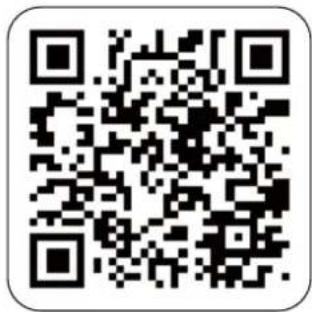
* A JRNY membership is required for the JRNY experience – see global.schwinnfitness.com/en/schwinn-jrny.html for details. Where available (including the United States), you can obtain a JRNY membership by downloading the JRNY app onto your phone or tablet and signing up within the downloaded app. JRNY memberships may not be available in all countries.
Maintenance & Troubleshooting
MAINTENANCE
Preventative maintenance is the key to smooth operating equipment, as well as keeping the users' liability to a minimum. Equipment needs to be inspected at regular intervals. Defective components must be replaced immediately. Improperly working equipment must be kept out of use until it is repaired. Ensure that any person(s) making adjustments or performing maintenance or repair of any kind is qualified to do so.

WARNING
To remove power from the treadmill, the power cord must be disconnected from the wall outlet.
| MAINTENANCE SCHEDULE | |
| ACTION FREQUENCY | |
| Clean and inspect the treadmill:Turn off the treadmill with the ON/OFF switch, then unplug the power cord at the wall outlet.Wipe down the running belt, deck, motor cover and console casing with a damp cloth. Never use solvents, as they can cause damage to the treadmill.Inspect the power cord. If the power cord is damaged, please reference contact information on the back cover of the INFORMATION CARD for assistance.Make sure the power cord is not underneath the treadmill or in any other area where it can become pinched or cut during storage or use.Check the tension and alignment of the running belt. Make sure that the treadmill belt will not damage any other components on the treadmill by being misaligned.If any labels are damaged or illegible, please reference contact information on the back cover of the INFORMATION CARD for assistance. | DAILY |
| Clean underneath the treadmill:Turn off the treadmill with the ON/OFF switch, then unplug the power cord at the wall outlet.Fold the treadmill into the upright position, making sure that the lock latch is secure.Move the treadmill.Wipe or vacuum any dust particles or other objects that may have accumulated underneath the treadmill.Return the treadmill to its previous position. | WEEKLY |
| IMPORTANT!Turn off the treadmill with the ON/OFF switch, then unplug the power cord at the wall outlet. Wait 60 seconds.Inspect all assembly bolts of the machine for proper tightness.Remove the motor cover. Wait until ALL display screens turn off.Clean the motor and lower board area to eliminate any lint or dust particles that may have accumulated. Failure to do so may result in premature failure of key electrical components.Wipe down the belt with a damp cloth. Vacuum any black/white particles that may accumulate around the unit. These particles may accumulate from normal treadmill use.If your treadmill has air shocks under the deck for lift assistance, lubricate the silver air shock tube with Teflon-based spray found at your local hardware or bike store. | MONTHLY |
MAINTENANCE SCHEDULE
LUBRICATING THE RUNNING BELT
EVERY 3 MONTHS OR 480 KM
It is necessary to lubricate your treadmill running deck every three months or 480 km to maintain optimal performance. Once the treadmill records 480 km it will display the message "LUBE" or "LUBE BELT." The treadmill will not operate while the message is showing. Your treadmill came with a bottle of 100% silicone lubricant, which can be used for two applications.
To purchase additional Silicone Lubricant: Please contact Customer Tech Support.
Tools Needed:
• T-wrench or Allen wrench
• 100% silicone oil
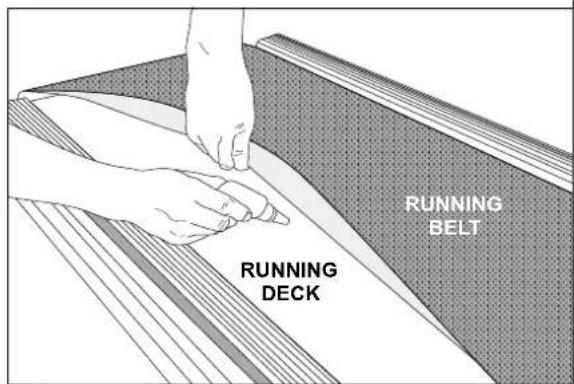
PROCEDURE:
- Turn off the treadmill with the on/off switch and unplug the power cord at the wall outlet.
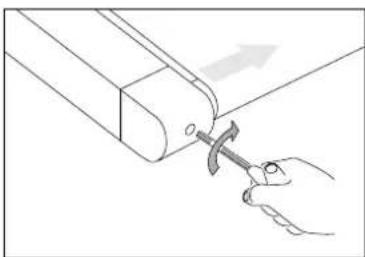
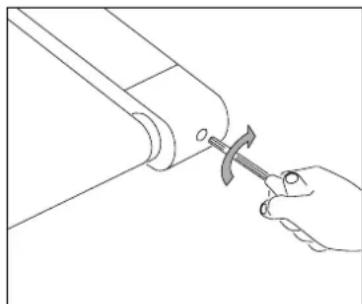
- Using the T-wrench or Allen wrench, loosen the rear roller bolts 10-15 counter-clockwise turns. This should give the belt enough slack for you to lift it.
- Lift the belt as far as you can and squirt the silicone oil in a zigzag pattern across the entire running deck surface. Use 1/2 bottle of silicone lubricant. Do not apply the silicone oil on top of the running belt. Lay the running belt down and then tighten both rear roller bolts clockwise the same number of turns loosened.
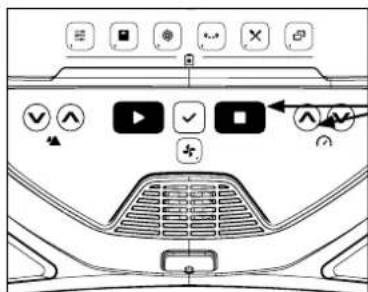
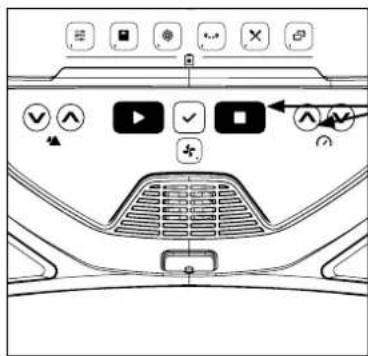
- After you have applied lubricant, plug in the power cord, and insert the safety key. Reset the Lube Belt message by first pressing and holding the SPEED UP button, then STOP button and hold BOTH buttons for 5-7 seconds.
- Stay off of the machine and press START. Allow the belt to run at 3 mph for 3 minutes to begin spreading the silicone. Then walk on the machine at a comfortable speed for 3 minutes to complete spreading the silicone and to check the running belt for proper tension and alignment.
- Once the belt is centered and tensioned, stop the belt. Wipe any excess oil from the sides with a damp cloth.
Press any key to suspend the lubrication warning message until after your next workout.
Note: Some older models may require you to hold stop for 5 seconds to suspend message for 8 km of use.
If your treadmill has air shocks under the deck for lift assistance, lubricate the silver air shock tube with Teflon-based spray found at your local hardware or bike store.
Visit the Customer Support section of our website to view “how-to” maintenance videos. Please contact Customer Tech Support with questions about applying lubricant to your treadmill.

natural_image
Line drawing of a hand using a tool to adjust or install a mechanical component (no text or symbols present)TENSIONING THE RUNNING BELT
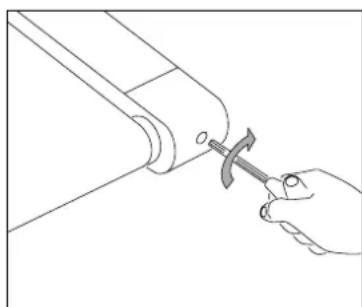
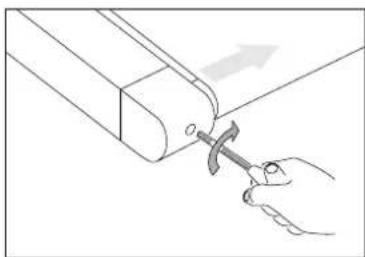
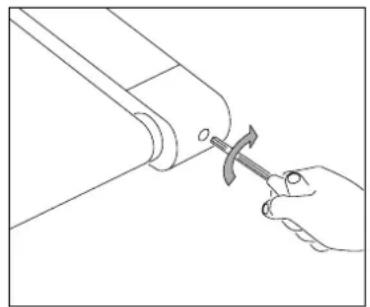
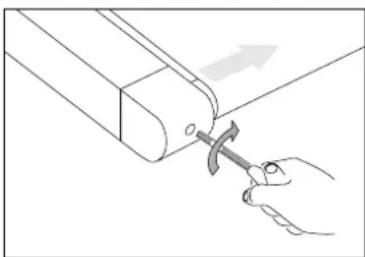
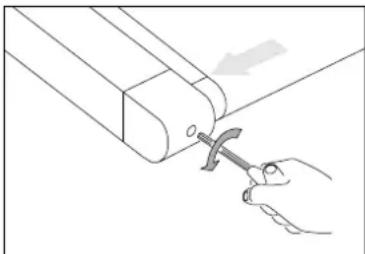
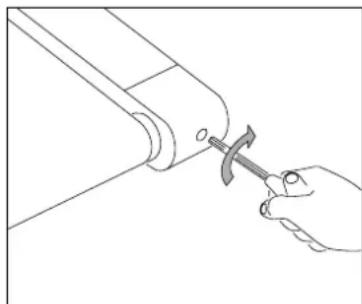
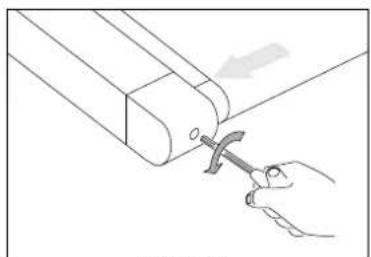
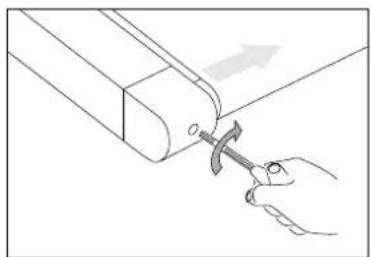
If you can feel a slipping sensation when running on the treadmill, the running belt must be tightened. In most cases, the belt has stretched from use, causing the belt to slip. This is a normal and common adjustment. To eliminate this slipping, turn the treadmill off and tension both the rear roller bolts using the supplied Allen wrench, turning them 14 turn to the right (clockwise) as shown. Turn the treadmill on and check for slipping. Repeat if necessary, but never turn the roller bolts more than 14 turn at a time. Belt is properly tensioned when the slipping sensation is gone.

WARNING
Running belt should NOT be moving during tensioning. Over-tightening the running belt can cause excessive wear on the treadmill as well as its components. Never over-tighten the belt.
natural_image
Line drawing of a hand using a hammer to measure a cylindrical object (no text or symbols)natural_image
Line drawing of a hand using a hammer to adjust or install a mechanical component (no text or symbols present)BELT IS TOO FAR TO THE RIGHT SIDE
natural_image
Line drawing of a hand using a hammer to adjust a mechanical component (no text or symbols)BELT IS TOO FAR TO THE LEFT SIDE
CENTERING THE RUNNING BELT
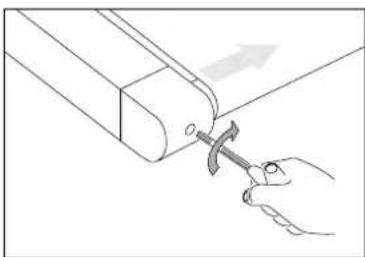
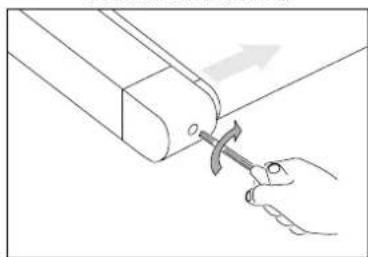
If the running belt is too far to the right side: Using the supplied Allen wrench and with the treadmill running at 1 km/h turn the LEFT adjustment bolt counter-clockwise a 14 turn and wait for the belt to adjust itself. Use the motor cover marking or part line as a reference for alignment. Repeat if necessary, until the belt remains centered during use.
If the running belt is too far to the left side: Using the supplied Allen wrench and with the treadmill running at 1 km/h turn the LEFT adjustment bolt clockwise a 14 turn and wait for the belt to adjust itself. Use the motor cover marking or part line as a reference for alignment. Repeat if necessary, until the belt remains centered during use.
- If you find the belt is slipping because it is too loose, center it then tension as needed.
- For easier adjustment bolt access, remove the end caps.
CAUTION
Do not run belt faster than 1 km/h while centering. Keep fingers, hair and clothing away from belt at all times.
To reset the Lube belt warning
The treadmill will flash "LUBE BELT" reminder every 150 mi. After lubricating belt, reset warning by holding □ down and ⚙ buttons for 3-5 seconds.
TROUBLESHOOTING
COMMON PRODUCT QUESTIONS
ARE THE SOUNDS MY TREADMILL MAKES NORMAL?
All treadmills make a certain type of thumping noise due to the belt riding over the rollers, especially new treadmills. This noise will diminish over time, although it may not totally go away. Over time, the belt will stretch, causing the belt to ride smoother over the rollers.
WHY IS THE TREADMILL I PURCHASED LOUDER THAN THE ONE AT THE STORE?
All fitness products seem quieter in a large store showroom because there is generally more background noise than in your home. Also, there will be less reverberation on a carpeted concrete floor than on a wood overlay floor. Sometimes a heavy rubber mat will help reduce reverberation through the floor. If a fitness product is placed close to a wall, there will be more reflected noise.
WHEN SHOULD I BE WORRIED ABOUT A NOISE?
As long as the sounds your treadmill makes are no louder than a normal conversational tone of voice, it is considered normal noise.
BASIC TROUBLESHOOTING
PROBLEM: The console does not light up.
SOLUTION: Verify the following:
Does the red light on the ON/OFF switch light up?
NOTE: Some treadmill models do not have a switch that lights up. If this is the case, please proceed with the yes and no solutions below.
If yes:
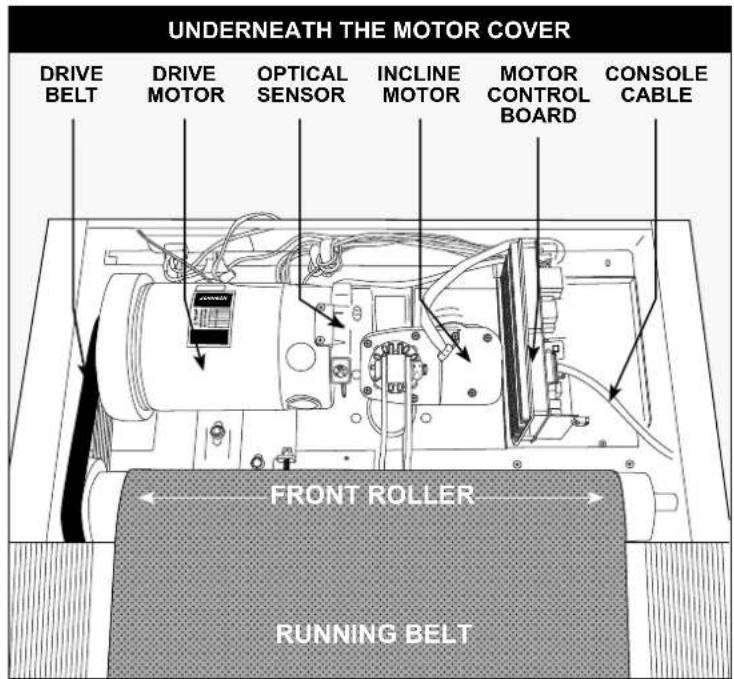
- Turn the power off, unplug the power cable and wait 60 seconds. Remove motor cover. Wait until all red LED lights have gone off on the motor control board before proceeding. Next verify that none of the wires connecting to the lower board are loose or disconnected.
- Double-check that all connections are secure, especially the console cable. Unplug and reconnect the console cable to verify.
- Make sure the console cable is not pinched or damaged in any way.
- Plug the treadmill in, turn the power switch on and look for any lit LEDs on the motor control board.
If no:
- Verify that the outlet the machine is plugged into is functional. Double-check that the breaker has not tripped, it is on a dedicated 15-amp circuit, it is not on a GFCI-equipped outlet, and it is not plugged into a power strip/surge protector or extension cord.
- Verify that the power cord is not pinched or damaged and is properly plugged into the outlet AND the machine.
- Verify that the power switch is turned to the ON position.
PROBLEM: The console reads SAFETY KEY OFF or only displays dashes.
SOLUTION: Verify the following:
- Verify the safety key is securely in place.
- If using a magnetic key, make sure the key is magnetized.
TROUBLESHOOTING
BASIC TROUBLESHOOTING
PROBLEM: The belt does not move or moves briefly, but the console works.
SOLUTION: Verify the following:
- Make sure you are following the recommendations and power guidelines of GROUNDING INSTRUCTIONS & BASIC OPERATION in this owner's manual. The unit should be on a dedicated 15-amp circuit and not on a GFCI-equipped outlet. Do not plug the machine into a power strip/surge protector or extension cord.
- Check for any belt movement. If so, make note of how far or how long it moves before stopping.
- Try to move the belt by hand. If not, the drive belt may have come off or the motor bearings may have seized.
- Turn the treadmill off and unplug it from the outlet. Remove the plastic motor cover located in front of the machine by taking out the Phillips screws. Check the drive belt for proper alignment.
- With the cover still off, check over the wire and cable connections, as they may have become loose or disconnected during shipping or assembly. Make sure connections are secure and no wires are crimped, damaged, disconnected or burnt.
PROBLEM: The incline does not move, won't go down or does not seem to be at the right level.
SOLUTION: Verify the following:
- Make sure you are following the recommendations and power guidelines on pages 4 and 5 of this TREADMILL GUIDE. The unit should be on a dedicated 15-amp circuit and not on a GFCI-equipped outlet. Do not plug the machine into a power strip/surge protector or extension cord.
-
Make sure the console shows a change on the display when the elevation buttons are pressed.
-
Turn the treadmill off and unplug it from the outlet. Verify the console cable connections at the top of the mast are connected securely. Make sure all of the multicolored wires are fully inserted into the cable harness.
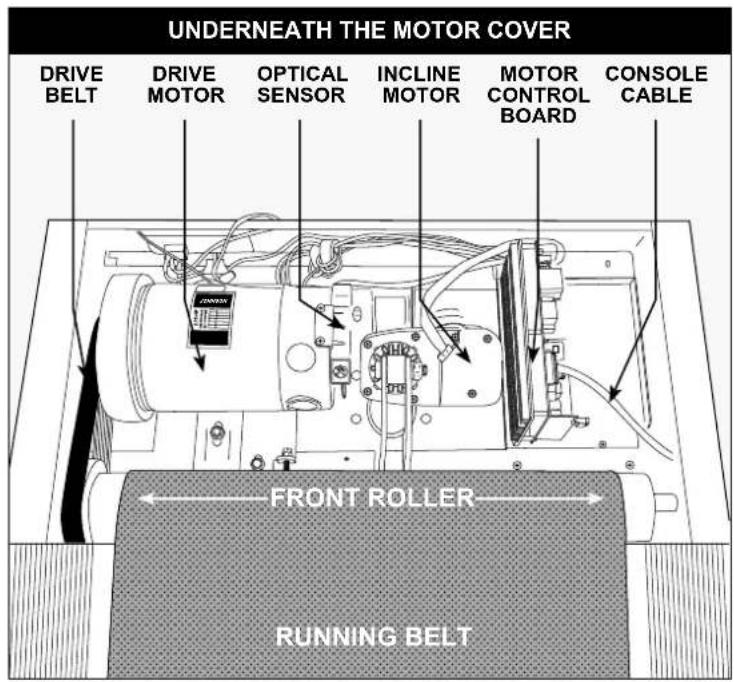
- Remove the plastic motor cover located in front of the machine by taking out the Phillips screws. Check over the wire and cable connections, as they may have become loose or disconnected during shipping or assembly. Make sure connections are secure and no wires are crimped, damaged, disconnected or burnt.
PROBLEM: No audio comes out of the speakers, but the headphones work.
SOLUTION: Verify the following:
- Turn the treadmill off and unplug it from the outlet. Remove the plastic motor cover located in front of the machine by taking out the Phillips screws.
- Check the wire and cable connections to the speaker board, near the motor control board.
PROBLEM: The treadmill circuit breaker trips during a workout.
SOLUTION: Verify the following:
- Make sure the treadmill is plugged into a dedicated 15-amp circuit.
- Verify that you do not have the machine on an extension cord or surge protector.
- Confirm that the machine is not plugged into a GFCI-equipped outlet or on a circuit that has a GFCI-equipped outlet on it.
PROBLEM: The running belt does not stay centered during a workout.
SOLUTION: Verify the following:
- Make sure the treadmill is on a level surface.
- Verify that the belt is properly tightened and centered (Refer to the TENSIONING and CENTERING THE RUNNING BELT sections for detailed directions).
PROBLEM: Operating speed appears inaccurate.
SOLUTION:
- Turn the treadmill off and unplug it from the wall.
- Remove the screws from the motor cover screws using a Phillips screwdriver
- Verify that the optical sensor is plugged into the motor control board.
- Inspect the speed sensor cable/connection for any visible damage.
BASIC TROUBLESHOOTING
PROBLEM: At higher incline levels, a message reading "Speed Range Error – Ending Workout" appears.
SOLUTION:
- This is a safety feature that automatically cuts power to the drive motor when the speed is out of range due to the combination of the load on the belt and high degree of incline
- To prevent an automatic end to your workout, reduce the incline level percentage.
TROUBLESHOOTING HEART RATE (GRIP-PULSE ONLY)
Check your exercise environment for sources of interference such as fluorescent lights, computers, underground fencing, home security systems or appliances containing large motors. These items may cause erratic heart rate readouts.
You may experience an erratic readout under the following conditions:
- Gripping the heart rate handlebars too tight. Try to maintain moderate pressure while holding onto the heart rate handlebars.
- Constant movement and vibration due to constantly holding the heart rate handlebars while exercising. If you are receiving erratic heart rate readouts, try to only hold the grips long enough to monitor your heart rate.
- When you are breathing heavily during a workout.
- When your hands are constricted by wearing a ring.
- When your hands are dry or cold. Try to moisten your palms by rubbing them together to warm.
- Anyone with heavy arrhythmia.
- Anyone with arteriosclerosis or peripheral circulation disorder.
- Anyone whose skin on the measuring palm is especially thick.
NEED ASSISTANCE?
If this troubleshooting section does not remedy the problem, discontinue use and turn the power off.

Please contact Customer Tech Support.
The following information may be asked of you when you call. Please have these items readily available:
- Model Name
- Serial Number
• Proof of Purchase
Some common troubleshooting questions that may be asked are:
• How long has this problem been occurring?
- Does this problem occur with every use? With every user?
• If you are hearing a noise, does it come from the front or the back? What kind of noise is it (thumping, grinding, squeaking, chirping etc.)?
- Has the machine been maintained per the MAINTENANCE schedule?
Answering these and other questions will give the technicians the ability to send proper replacement parts and the service necessary to get you and your treadmill running again!
THE FOLLOWING INFORMATION ONLY CONCERNS CUSTOMERSIN GERMANY
1. Disposal of electrical and electronic equipment
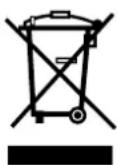
The symbol of the “crossed-out dustbin” means that you are required by law to dispose of this equipment separately from unsorted municipal waste. Disposal via household waste, such as the residual waste garbage can or the yellow garbage can, is prohibited. Avoid misdirected waste by disposing of it correctly at special collection and return points.
2. Removal of batteries and lamps
If the products contain batteries and accumulators or lamps that can be removed from the old device without destroying it, these must be removed before disposal and disposed of separately as batteries or lamps. The following batteries or accumulators are contained in this electrical device: Lithium-ion accumulator.
3. Possibilities of the return of old devices
Owners of old appliances can return them free of charge within the framework of the possibilities for the return or collection of old appliances set up and available by public waste management authorities, so that the proper disposal of the old appliances is ensured. In addition, the return is also possible with distributors under certain conditions. The following link provides an online directory of collection and take-back points: https://www.ear-system.de/ear-verzeichnis/sammel-und-ruecknahmestellen
For distributors: The return has to be free of charge with the purchase of a similar new device (1:1 return). Independently of this, there is the possibility to return the old equipment to the distributor free of charge. The prerequisite for this is that the external dimensions do not exceed 25 centimeters and the return is limited to three old devices per type of device (0:1 take-back).
Retail: Distributors with a sales area for electrical and electronic equipment of at least 400 square meters are obligated to take back WEEE. Also obliged to take back are food retailers who have a total sales area of at least 800 square meters and who also offer and make available on the market electrical and electronic equipment several times a calendar year or on a permanent basis.
Distance selling market: distributors who sell their products using distance communication means (e.g. online store) are obliged to take back WEEE if the storage and shipping areas for electrical and electronic equipment are at least 400 square meters.
4. Data protection
We would like to point out to all end users of WEEE that you are responsible for deleting personal data on the WEEE to be disposed of.
5. WEEE registration number
Under the registration number DE-49229072 we are registered with the stiftung elektro-altgeräte register, Nordostpark 72, 90411 Nuremberg, Germany, as a producer of electrical and/or electronic equipment.
Manufacturer/EU-importer: Johnson Health Tech. GmbH | Europaallee 51, 50226 Frechen, Germany
DEUTSCH
natural_image
Technical line drawing of a treadmill base with ladder and support legs (no text or symbols)WARNING
MONTAGE SCHRITT 2
natural_image
Diagram of a mechanical device with an inset showing a foot pressing a shoe (no text or symbols present)KONSOLENBEDIENUNG
natural_image
Line drawing of a hand using a tool to adjust or install a mechanical component (no text or symbols present)natural_image
Line drawing of a hand using a hammer to measure a mechanical component (no text or symbols)natural_image
Line drawing of a hand using a hammer to measure a cylindrical object (no text or symbols)BAND ZU WEIT RECHTS
natural_image
Line drawing of a hand using a hammer to adjust a mechanical component (no text or symbols)BAND ZU WEIT LINKS
ZENTRIEREN DES LAUFBANDS
Manufacturer/EU-importer: Johnson Health Tech. GmbH | Europaallee 51, 50226 Frechen, Germany
MODELNAAM: SCHWINN S F T4.1
natural_image
Technical line drawing of a mechanical device with a circled feature, no visible text or symbols
WAARSCHUWING
MONTAGE STAP 2
MONTAGE STAP 3
INKLAPBARE LOOPBANDEN
natural_image
Diagram of a table tennis paddle with foot positioning and foot movement arrows (no text or symbols)CONSOLEBEDIENING
VERBIND JE APPARAAT MET DE JRNY-APP VOOR DYNAMISCHERE WORKOUTS
PROCEDURE:
natural_image
Line drawing of a hand using a tool to adjust or install a mechanical component (no text or symbols present)SPANT DE LINKERKANT VAN DE ROLLER AAN
natural_image
Line drawing of a hand using a hammer to measure a mechanical component (no text or symbols)SPANT DE RECHTERKANT VAN DE ROLLER AAN
DE LOOPBAND AANSPANNEN
natural_image
Line drawing of a hand using a hammer to adjust or install a mechanical component (no text or symbols)BAND LIGT TE VER NAAR RECHTS
natural_image
Line drawing of a hand using a hammer to adjust a mechanical component (no text or symbols)BAND LIGT TE VER NAAR LINKS
DE LOOPBAND CENTREREN
natural_image
Technical line drawing of a mechanical device with a circled feature, no visible text or symbols
AVERTISSEMENT
Fabricant: Johnson Health Industry (Vietnam) Co., Ltd. | Adresse du fabricant: Lot CN-24, Thuan Thanh II Industrial Park, Mao Dien Ward, Bac Ninh Province, Vietnam
OUTILS INCLUS :
ASSEMBLAGE ÉTAPE 2
UTILISATION DE LA CLÉ DE SÛRETÉ
FONCTIONNEMENT DE LA CONSOLE
WEIGHT LOSS (10%indine Max)
Segment = workout time / 16
| Level 1 2 3 4 5 6 7 8 9 10 11 12 13 14 15 16 17 18 19 20 | ||||||||||||||||||||
| Segment | INCLINE | |||||||||||||||||||
| 1 | 0 | 0 | 0 | 0 | 0 | 0 | 1 | 2 | 2 | 2.5 | 2.5 | 2.5 | 2.5 | 2.5 | 3.5 | 5 | 5 | 5 | 5 | 5 |
| 2 | 0 | 0 | 1 | 2 | 2.5 | 3.5 | 3.5 | 3.5 | 4.5 | 5.5 | 6 | 7 | 7.5 | 8.5 | 9.5 | 10 | 10 | 10 | 10 | 10 |
| 3 | 1 | 2 | 2 | 2 | 2 | 2 | 2 | 2 | 2 | 2.5 | 3.5 | 4.5 | 4.5 | 4.5 | 5.5 | 7 | 7.5 | 8.5 | 9 | 10 |
| 4 | 1.5 | 3.5 | 4 | 5 | 5 | 5 | 5 | 5 | 6 | 7 | 7.5 | 8.5 | 9 | 10 | 10 | 10 | 10 | 10 | 10 | 10 |
| 5 | 1 | 2 | 2 | 2 | 2 | 2 | 2.5 | 3.5 | 4 | 4.5 | 4.5 | 4.5 | 5.5 | 7 | 7.5 | 8.5 | 8.5 | 8.5 | 9.5 | 10 |
| 6 | 1.5 | 3.5 | 3.5 | 3.5 | 5 | 6.5 | 7.5 | 8.5 | 9 | 10 | 10 | 10 | 10 | 10 | 10 | 10 | 10 | 10 | 10 | 10 |
| 7 | 1 | 2 | 2 | 2 | 2 | 2 | 2.5 | 3.5 | 4 | 4.5 | 5 | 5.5 | 5.5 | 5.5 | 7 | 8.5 | 8.5 | 8.5 | 9 | 10 |
| 8 | 1.5 | 3.5 | 4 | 5 | 5 | 5 | 5.5 | 6.5 | 7.5 | 8.5 | 9 | 10 | 10 | 10 | 10 | 10 | 10 | 10 | 10 | 10 |
| 9 | 1.5 | 3.5 | 3.5 | 3.5 | 3.5 | 3.5 | 4 | 5 | 5 | 5.5 | 6 | 7 | 7 | 7 | 8.5 | 10 | 10 | 10 | 10 | 10 |
| 10 | 1 | 2 | 2 | 2 | 2 | 2 | 2.5 | 3.5 | 4 | 4.5 | 4.5 | 4.5 | 4.5 | 4.5 | 6.5 | 8.5 | 8.5 | 8.5 | 9 | 10 |
| 11 | 1.5 | 3.5 | 3.5 | 3.5 | 4 | 5 | 5 | 5 | 6 | 7 | 8.5 | 10 | 10 | 10 | 10 | 10 | 10 | 10 | 10 | 10 |
| 12 | 1 | 2 | 2 | 2 | 2 | 2 | 2 | 2 | 3 | 4.5 | 5.5 | 7 | 7 | 7 | 7.5 | 8.5 | 9 | 10 | 10 | 10 |
| 13 | 1.5 | 3.5 | 4 | 5 | 5.5 | 6.5 | 7.5 | 8.5 | 8.5 | 8.5 | 9 | 10 | 10 | 10 | 10 | 10 | 10 | 10 | 10 | 10 |
| 14 | 1 | 2 | 2 | 2 | 2.5 | 3.5 | 4 | 5 | 5 | 5.5 | 5.5 | 5.5 | 7 | 8.5 | 9 | 10 | 10 | 10 | 10 | 10 |
| 15 | 0 | 0 | 0 | 0 | 1 | 2 | 2.5 | 3.5 | 4 | 4.5 | 4.5 | 4.5 | 5 | 5.5 | 7 | 8.5 | 9 | 10 | 10 | 10 |
| 16 | 0 | 0 | 0 | 0 | 0 | 0 | 1 | 2 | 2 | 2.5 | 2.5 | 2.5 | 2.5 | 2.5 | 3.5 | 5 | 5 | 5 | 5 | 5 |

Intervals (10%Incline)
Segment = workout time/16
| Level | 1 | 2 | 3 | 4 | 5 | 6 | 7 | 8 | 9 | 10 | 11 | 12 | 13 | 14 | 15 | 16 | 17 | 18 | 19 | 20 |
| Segment | INCLINE | |||||||||||||||||||
| 1 | 0 | 0 | 0 | 0 | 0 | 0 | 0 | 0 | 0 | 0 | 0 | 0 | 0 | 0 | 0 | 0 | 0 | 0 | 0 | 0 |
| 2 | 0.5 | 0.5 | 0.5 | 0.5 | 0.5 | 0.5 | 0.5 | 0.5 | 1 | 1 | 1 | 1 | 1 | 1 | 1 | 1.5 | 1.5 | 1.5 | 1.5 | 1.5 |
| 3 | 0 | 0 | 0 | 0 | 0 | 0 | 0 | 0 | 0 | 0 | 0 | 0 | 0 | 0 | 0 | 0 | 0 | 0 | 0 | 0 |
| 4 | 1.5 | 2 | 2 | 2.5 | 3 | 3 | 3.5 | 3.5 | 4 | 4.5 | 5 | 5.5 | 5.5 | 6 | 6 | 6.5 | 7 | 7 | 8 | 8.5 |
| 5 | 0 | 0 | 0 | 0 | 0 | 0 | 0 | 0 | 0 | 0 | 0 | 0 | 0 | 0 | 0 | 0 | 0 | 0 | 0 | 0 |
| 6 | 2.5 | 2.5 | 3 | 3.5 | 4 | 4.5 | 4.5 | 5 | 5.5 | 6 | 7 | 7.5 | 8 | 8 | 8.5 | 9.5 | 9.5 | 10 | 10 | 10 |
| 7 | 0 | 0 | 0 | 0 | 0 | 0 | 0 | 0 | 0 | 0 | 0 | 0 | 0 | 0 | 0 | 0 | 0 | 0 | 0 | 0 |
| 8 | 3 | 3.5 | 4 | 4.5 | 5 | 5.5 | 6 | 6.5 | 7 | 8 | 9 | 9.5 | 10 | 10 | 10 | 10 | 10 | 10 | 10 | 10 |
| 9 | 0 | 0 | 0 | 0 | 0 | 0 | 0 | 0 | 0 | 0 | 0 | 0 | 0 | 0 | 0 | 0 | 0 | 0 | 0 | 0 |
| 10 | 3 | 3.5 | 4 | 4.5 | 5 | 5.5 | 6 | 6.5 | 7 | 8 | 9 | 9.5 | 10 | 10 | 10 | 10 | 10 | 10 | 10 | 10 |
| 11 | 0 | 0 | 0 | 0 | 0 | 0 | 0 | 0 | 0 | 0 | 0 | 0 | 0 | 0 | 0 | 0 | 0 | 0 | 0 | 0 |
| 12 | 3 | 3.5 | 4 | 4.5 | 5 | 5.5 | 6 | 6.5 | 7 | 8 | 9 | 9.5 | 10 | 10 | 10 | 10 | 10 | 10 | 10 | 10 |
| 13 | 0 | 0 | 0 | 0 | 0 | 0 | 0 | 0 | 0 | 0 | 0 | 0 | 0 | 0 | 0 | 0 | 0 | 0 | 0 | 0 |
| 14 | 3 | 3.5 | 4 | 4.5 | 5 | 5.5 | 6 | 6.5 | 7 | 8 | 9 | 9.5 | 10 | 10 | 10 | 10 | 10 | 10 | 10 | 10 |
| 15 | 0 | 0 | 0 | 0 | 0 | 0 | 0 | 0 | 0 | 0 | 0 | 0 | 0 | 0 | 0 | 0 | 0 | 0 | 0 | 0 |
| 16 | 3 | 3.5 | 4 | 4.5 | 5 | 5.5 | 6 | 6.5 | 7 | 8 | 9 | 9.5 | 10 | 10 | 10 | 10 | 10 | 10 | 10 | 10 |

natural_image
Line drawing of a hand using a tool to adjust or install a mechanical component (no text or symbols present)RESSERRAGE DU CÔTÉ GAUCHE DU ROULEAU
natural_image
Line drawing of a hand using a hammer to adjust or install a mechanical component (no text or symbols)RESSERRAGE DU CÔTÉ DROIT DU ROULEAU
RÉGLAGE DE LA TENSION DE LA BANDE DE COURSE
natural_image
Line drawing of a hand using a hammer to adjust a cylindrical component (no text or symbols)LA BANDE DE COURSE EST TROP DÉCALÉE À DROITE
natural_image
Line drawing of a hand using a hammer to adjust a mechanical part (no text or symbols)LA BANDE DE COURSE EST
TROP DÉCALÉE À GAUCHE
CENTRAGE DE LA BANDE DE COURSE
QUESTIONS FRÉQUENTES RELATIVES AU PRODUIT
LES SONS QU'ÉMET MON TAPIS DE COURSE SONT-ILS NORMAUX ?
natural_image
Technical line drawing of a mechanical device with a circled feature, no visible text or symbols
ATTENZIONE
PASSO DI MONTAGGIO PASSO 2
PASSO DI MONTAGGIO PASSO 4
UTILIZZO DELLA CHIAVE DI SICUREZZA
natural_image
Line drawing of a hand using a tool to adjust or install a mechanical component (no text or symbols present)natural_image
Line drawing of a hand using a hammer to measure a cylindrical object (no text or symbols)SERRAGGIO DEL LATO DESTRO DEL RULLO
natural_image
Line drawing of a hand using a hammer to adjust or install a mechanical component (no text or symbols present)natural_image
Line drawing of a hand using a hammer to adjust a mechanical part (no text or symbols)CENTRATURA DEL NASTRO DA CORSA
natural_image
Technical line drawing of a mechanical device with a circled feature, no visible text or symbols1.1 Abra la BOLSA DE LA TORNILLERÍA PARA EL PASO 1.
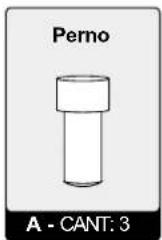
1.2 Una el MÁSTIL DE LA CONSOLA IZQUIERDA (1) al MARCO BASE (2) utilizando 3 PERNOS (A).
PASO 2 DE MONTAJE
PASO 4 DE MONTAJE
natural_image
Diagram of a mechanical device with an inset showing foot positioning and a close-up of the foot (no text or symbols present)WEIGHT LOSS (10% incline Max)
Segment = workout time / 16
| Level | 1 | 2 | 3 | 4 | 5 | 6 | 7 | 8 | 9 | 10 | 11 | 12 | 13 | 14 | 15 | 16 | 17 | 18 | 19 | 20 |
| Segment | INCLINE | |||||||||||||||||||
| 1 | 0 | 0 | 0 | 0 | 0 | 0 | 1 | 2 | 2 | 2.5 | 2.5 | 2.5 | 2.5 | 2.5 | 3.5 | 5 | 5 | 5 | 5 | 5 |
| 2 | 0 | 0 | 1 | 2 | 2.5 | 3.5 | 3.5 | 3.5 | 4.5 | 5.5 | 6 | 7 | 7.5 | 8.5 | 9.5 | 10 | 10 | 10 | 10 | 10 |
| 3 | 1 | 2 | 2 | 2 | 2 | 2 | 2 | 2 | 2 | 2.5 | 3.5 | 4.5 | 4.5 | 4.5 | 5.5 | 7 | 7.5 | 8.5 | 9 | 10 |
| 4 | 1.5 | 3.5 | 4 | 5 | 5 | 5 | 5 | 5 | 6 | 7 | 7.5 | 8.5 | 9 | 10 | 10 | 10 | 10 | 10 | 10 | 10 |
| 5 | 1 | 2 | 2 | 2 | 2 | 2 | 2.5 | 3.5 | 4 | 4.5 | 4.5 | 4.5 | 5.5 | 7 | 7.5 | 8.5 | 8.5 | 8.5 | 9.5 | 10 |
| 6 | 1.5 | 3.5 | 3.5 | 3.5 | 5 | 6.5 | 7.5 | 8.5 | 9 | 10 | 10 | 10 | 10 | 10 | 10 | 10 | 10 | 10 | 10 | 10 |
| 7 | 1 | 2 | 2 | 2 | 2 | 2 | 2.5 | 3.5 | 4 | 4.5 | 5 | 5.5 | 5.5 | 5.5 | 7 | 8.5 | 8.5 | 8.5 | 9 | 10 |
| 8 | 1.5 | 3.5 | 4 | 5 | 5 | 5 | 5.5 | 6.5 | 7.5 | 8.5 | 9 | 10 | 10 | 10 | 10 | 10 | 10 | 10 | 10 | 10 |
| 9 | 1.5 | 3.5 | 3.5 | 3.5 | 3.5 | 3.5 | 4 | 5 | 5 | 5.5 | 6 | 7 | 7 | 7 | 8.5 | 10 | 10 | 10 | 10 | 10 |
| 10 | 1 | 2 | 2 | 2 | 2 | 2 | 2.5 | 3.5 | 4 | 4.5 | 4.5 | 4.5 | 4.5 | 4.5 | 6.5 | 8.5 | 8.5 | 8.5 | 9 | 10 |
| 11 | 1.5 | 3.5 | 3.5 | 3.5 | 4 | 5 | 5 | 5 | 6 | 7 | 8.5 | 10 | 10 | 10 | 10 | 10 | 10 | 10 | 10 | 10 |
| 12 | 1 | 2 | 2 | 2 | 2 | 2 | 2 | 2 | 3 | 4.5 | 5.5 | 7 | 7 | 7 | 7.5 | 8.5 | 9 | 10 | 10 | 10 |
| 13 | 1.5 | 3.5 | 4 | 5 | 5.5 | 6.5 | 7.5 | 8.5 | 8.5 | 8.5 | 9 | 10 | 10 | 10 | 10 | 10 | 10 | 10 | 10 | 10 |
| 14 | 1 | 2 | 2 | 2 | 2.5 | 3.5 | 4 | 5 | 5 | 5.5 | 5.5 | 5.5 | 7 | 8.5 | 9 | 10 | 10 | 10 | 10 | 10 |
| 15 | 0 | 0 | 0 | 0 | 1 | 2 | 2.5 | 3.5 | 4 | 4.5 | 4.5 | 4.5 | 5 | 5.5 | 7 | 8.5 | 9 | 10 | 10 | 10 |
| 16 | 0 | 0 | 0 | 0 | 0 | 0 | 1 | 2 | 2 | 2.5 | 2.5 | 2.5 | 2.5 | 2.5 | 3.5 | 5 | 5 | 5 | 5 | 5 |

Intervals (10%Incline)
Segment = workout time/16
| Level | 1 | 2 | 3 | 4 | 5 | 6 | 7 | 8 | 9 | 10 | 11 | 12 | 13 | 14 | 15 | 16 | 17 | 18 | 19 | 20 |
| Segment | INCLINE | |||||||||||||||||||
| 1 | 0 | 0 | 0 | 0 | 0 | 0 | 0 | 0 | 0 | 0 | 0 | 0 | 0 | 0 | 0 | 0 | 0 | 0 | 0 | 0 |
| 2 | 0.5 | 0.5 | 0.5 | 0.5 | 0.5 | 0.5 | 0.5 | 0.5 | 1 | 1 | 1 | 1 | 1 | 1 | 1 | 1.5 | 1.5 | 1.5 | 1.5 | 1.5 |
| 3 | 0 | 0 | 0 | 0 | 0 | 0 | 0 | 0 | 0 | 0 | 0 | 0 | 0 | 0 | 0 | 0 | 0 | 0 | 0 | 0 |
| 4 | 1.5 | 2 | 2 | 2.5 | 3 | 3 | 3.5 | 3.5 | 4 | 4.5 | 5 | 5.5 | 5.5 | 6 | 6 | 6.5 | 7 | 7 | 8 | 8.5 |
| 5 | 0 | 0 | 0 | 0 | 0 | 0 | 0 | 0 | 0 | 0 | 0 | 0 | 0 | 0 | 0 | 0 | 0 | 0 | 0 | 0 |
| 6 | 2.5 | 2.5 | 3 | 3.5 | 4 | 4.5 | 4.5 | 5 | 5.5 | 6 | 7 | 7.5 | 8 | 8 | 8.5 | 9.5 | 9.5 | 10 | 10 | 10 |
| 7 | 0 | 0 | 0 | 0 | 0 | 0 | 0 | 0 | 0 | 0 | 0 | 0 | 0 | 0 | 0 | 0 | 0 | 0 | 0 | 0 |
| 8 | 3 | 3.5 | 4 | 4.5 | 5 | 5.5 | 6 | 6.5 | 7 | 8 | 9 | 9.5 | 10 | 10 | 10 | 10 | 10 | 10 | 10 | 10 |
| 9 | 0 | 0 | 0 | 0 | 0 | 0 | 0 | 0 | 0 | 0 | 0 | 0 | 0 | 0 | 0 | 0 | 0 | 0 | 0 | 0 |
| 10 | 3 | 3.5 | 4 | 4.5 | 5 | 5.5 | 6 | 6.5 | 7 | 8 | 9 | 9.5 | 10 | 10 | 10 | 10 | 10 | 10 | 10 | 10 |
| 11 | 0 | 0 | 0 | 0 | 0 | 0 | 0 | 0 | 0 | 0 | 0 | 0 | 0 | 0 | 0 | 0 | 0 | 0 | 0 | 0 |
| 12 | 3 | 3.5 | 4 | 4.5 | 5 | 5.5 | 6 | 6.5 | 7 | 8 | 9 | 9.5 | 10 | 10 | 10 | 10 | 10 | 10 | 10 | 10 |
| 13 | 0 | 0 | 0 | 0 | 0 | 0 | 0 | 0 | 0 | 0 | 0 | 0 | 0 | 0 | 0 | 0 | 0 | 0 | 0 | 0 |
| 14 | 3 | 3.5 | 4 | 4.5 | 5 | 5.5 | 6 | 6.5 | 7 | 8 | 9 | 9.5 | 10 | 10 | 10 | 10 | 10 | 10 | 10 | 10 |
| 15 | 0 | 0 | 0 | 0 | 0 | 0 | 0 | 0 | 0 | 0 | 0 | 0 | 0 | 0 | 0 | 0 | 0 | 0 | 0 | 0 |
| 16 | 3 | 3.5 | 4 | 4.5 | 5 | 5.5 | 6 | 6.5 | 7 | 8 | 9 | 9.5 | 10 | 10 | 10 | 10 | 10 | 10 | 10 | 10 |

CÓMO LUBRICAR LA BANDA
CADA 3 MESES O 480 KM
natural_image
Line drawing of a hand using a tool to adjust or install a mechanical component (no text or symbols present)TENSADO DE LA PARTE IZQUIERDA DEL RODILLO
natural_image
Line drawing of a hand using a hammer to press or install a mechanical component (no text or symbols)TENSADO DE LA PARTE DERECHA DEL RODILLO
TENSADO DE LA CINTA
natural_image
Line drawing of a hand using a hammer to adjust a cylindrical component (no text or symbols)LA BANDA ESTÁ DEMASIADO
HACIA LA DERECHA
natural_image
Line drawing of a hand using a hammer to adjust a mechanical part (no text or symbols)CENTRADO DE LA CINTA
natural_image
Technical line drawing of a mechanical device with a circled feature, no visible text or symbols
警告
組裝步驟 2
natural_image
Diagram of a person using a treadmill to lift a foot, showing hand positioning and movement (no text or symbols)使用安全開關
控制台操作方法
natural_image
Line drawing of a hand using a tool to adjust a mechanical component (no text or symbols)調緊滾軸左側
調整跑帶
natural_image
Line drawing of a hand using a hammer to press or install a mechanical component (no text or symbols)調緊滾軸右側
natural_image
Line drawing of a hand using a hammer to adjust or install a mechanical component (no text or symbols present)跑带太偏右
natural_image
Line drawing of a hand using a hammer to adjust a mechanical component (no text or symbols)跑带太偏左

跑带居中
RF Module Model RF Module Type Frequency Transmitter H-field requirements
JCP-3B-1001 WiFi 2.4G + BT & BLE|WiFi 2.4G, BT & BLE 2.4G 5.0dBm
DE/UK REPRESENTATIVE CONTACT INFO
EU Web Contact UK Web Contact
Simplified Declaration of Conformity
Johnson Health Tech (including Johnson Health Tech Co. Ltd., Johnson Industries Shanghai, and Johnson Industries Viet Nam), having an Authorized Representative located in the below locations, declares under our sole responsibility that the product accompanied by this Simplified Declaration meets the essential requirements of the EU and UK directives, including the requirements of the RED Directive (2014/53/EU) and the Radio Equipment Regulations 2017 (UK).
The Authorised Representative for the EU is: Johnson Health Tech. GmbH Europaallee 51, D-50226 Frechen, Germany Telephone: +49 (0) 2234/9997-100
The Authorised Representative for the UK is: Johnson Health Tech. Digital UK Limited Unit 2, 40.40 Link, Mill End Road, High Wycombe, HP12 4AX, United Kingdom
SFT4.1-21 Rev. 1.1 B | 1000532790 © 2025 Schwinn Fitness
- Important Safety Instructions
- WARNING
- WARRANTY
- NEED HELP?
- TOOLS INCLUDED:
- PARTS INCLUDED:
- ASSEMBLY STEP- UNPACKING
- ASSEMBLY STEP 1
- ASSEMBLY STEP 2
- ASSEMBLY STEP 3
- ASSEMBLY STEP 4
- ASSEMBLY STEP 5 - REMOVAL OF RED TRANSPORT CABLES
- FAILURE TO FOLLOW THESE INSTRUCTIONS COULD RESULT IN INJURY!
- ASSEMBLY STEP 6 - MOVING TREADMILL
- ASSEMBLY COMPLETE!
- Treadmill Setup and Use
- GROUNDING INSTRUCTIONS
- DANGER!
- FOLDING TREADMILLS
- UNFOLDING
- USING THE SAFETY KEY
- POWER
- LEVELING THE TREADMILL
- CONSOLE OPERATION
- DISPLAY WINDOWS
- GETTING STARTED
- A) QUICK START UP
- B) SELECT A WORKOUT OR TARGET
- SPECIFICATION FOR PROGRAMS WITH MULTIPLE SEGMENTS
- WORKOUT PROFILES
- WEIGHT LOSS (10% incline Max)
- TO RESET THE CONSOLE
- CONNECTING VIA BLUETOOTH 4.0LE
- USING MULTIPLE MUSIC DEVICES
- CONNECTING VIA AN AUDIO CABLE
- CONNECT YOUR DEVICE WITH THE JRNY APP FOR MORE DYNAMIC WORKOUTS
- Maintenance & Troubleshooting
- MAINTENANCE
- MAINTENANCE SCHEDULE
- LUBRICATING THE RUNNING BELT
- EVERY 3 MONTHS OR 480 KM
- PROCEDURE:
- TENSIONING THE RUNNING BELT
- CENTERING THE RUNNING BELT
- CAUTION
- To reset the Lube belt warning
- TROUBLESHOOTING
- COMMON PRODUCT QUESTIONS
- ARE THE SOUNDS MY TREADMILL MAKES NORMAL?
- WHY IS THE TREADMILL I PURCHASED LOUDER THAN THE ONE AT THE STORE?
- WHEN SHOULD I BE WORRIED ABOUT A NOISE?
- BASIC TROUBLESHOOTING
- SOLUTION:
- TROUBLESHOOTING HEART RATE (GRIP-PULSE ONLY)
- NEED ASSISTANCE?
- Please contact Customer Tech Support.
- THE FOLLOWING INFORMATION ONLY CONCERNS CUSTOMERSIN GERMANY
- Disposal of electrical and electronic equipment
- Removal of batteries and lamps
- Possibilities of the return of old devices
- Data protection
- WEEE registration number
- DEUTSCH
- MONTAGE SCHRITT 2
- KONSOLENBEDIENUNG
- ZENTRIEREN DES LAUFBANDS
- WAARSCHUWING
- MONTAGE STAP 2
- MONTAGE STAP 3
- INKLAPBARE LOOPBANDEN
- CONSOLEBEDIENING
- VERBIND JE APPARAAT MET DE JRNY-APP VOOR DYNAMISCHERE WORKOUTS
- DE LOOPBAND AANSPANNEN
- DE LOOPBAND CENTREREN
- AVERTISSEMENT
- OUTILS INCLUS :
- ASSEMBLAGE ÉTAPE 2
- UTILISATION DE LA CLÉ DE SÛRETÉ
- FONCTIONNEMENT DE LA CONSOLE
- RÉGLAGE DE LA TENSION DE LA BANDE DE COURSE
- CENTRAGE DE LA BANDE DE COURSE
- QUESTIONS FRÉQUENTES RELATIVES AU PRODUIT
- ATTENZIONE
- PASSO DI MONTAGGIO PASSO 2
- PASSO DI MONTAGGIO PASSO 4
- UTILIZZO DELLA CHIAVE DI SICUREZZA
- CENTRATURA DEL NASTRO DA CORSA
- PASO 2 DE MONTAJE
- PASO 4 DE MONTAJE
- CÓMO LUBRICAR LA BANDA
- CADA 3 MESES O 480 KM
- TENSADO DE LA CINTA
- CENTRADO DE LA CINTA
- 警告
- 組裝步驟 2
- 使用安全開關
- 控制台操作方法
- 調整跑帶
- 跑带居中
- DE/UK REPRESENTATIVE CONTACT INFO
- Simplified Declaration of Conformity
Brand : Schwinn
Model : SFT 4.1
Category : Exercise bike