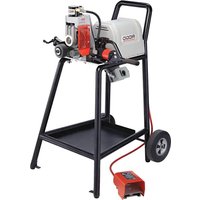
918-I - Industrial machine tool RIDGID - Free user manual and instructions
Find the device manual for free 918-I RIDGID in PDF.


| Product type | Industrial roll groover |
| Brand | RIDGID |
| Model | 918-I |
| Weight | 84.1 kg (185 lb) |
| Power supply | 120 V (12 A), 220-240 V (6 A) or 100 V (12 A), 50/60 Hz, 1400 W / 1200 W |
| Rotation speed (no load) | 45 rpm |
| Grooving capacity | Steel pipes schedule 10/40 from 1 to 12 in., copper type K/L/M/DWV from 2 to 6 in., PVC schedule 40 from 2 to 8 in. |
| Control | Rotary On/Off switch and foot pedal control |
| Hydraulic pump | Manual, with graduated depth adjustment knob |
| Compatible materials | Carbon steel, stainless steel, aluminum, PVC, copper |
| Maintenance | Check hydraulic oil level, lubricate bearings and shafts monthly, store indoors |
| Safety | Foot pedal mandatory, eye protection, fitted clothing, keep hands away from rolls |
| Spare parts | Use only genuine RIDGID parts |
| Repairability | Entrust to a RIDGID authorized repair center or factory |
| Warranty | Lifetime warranty (Full Lifetime Warranty) |
| Noise level | Sound pressure 92.9 dB(A), sound power 105.7 dB(A) |
Frequently Asked Questions - 918-I RIDGID
User questions about 918-I RIDGID
0 question about this device. Answer the ones you know or ask your own.
Ask a new question about this device
Download the instructions for your Industrial machine tool in PDF format for free! Find your manual 918-I - RIDGID and take your electronic device back in hand. On this page are published all the documents necessary for the use of your device. 918-I by RIDGID.
USER MANUAL 918-I RIDGID
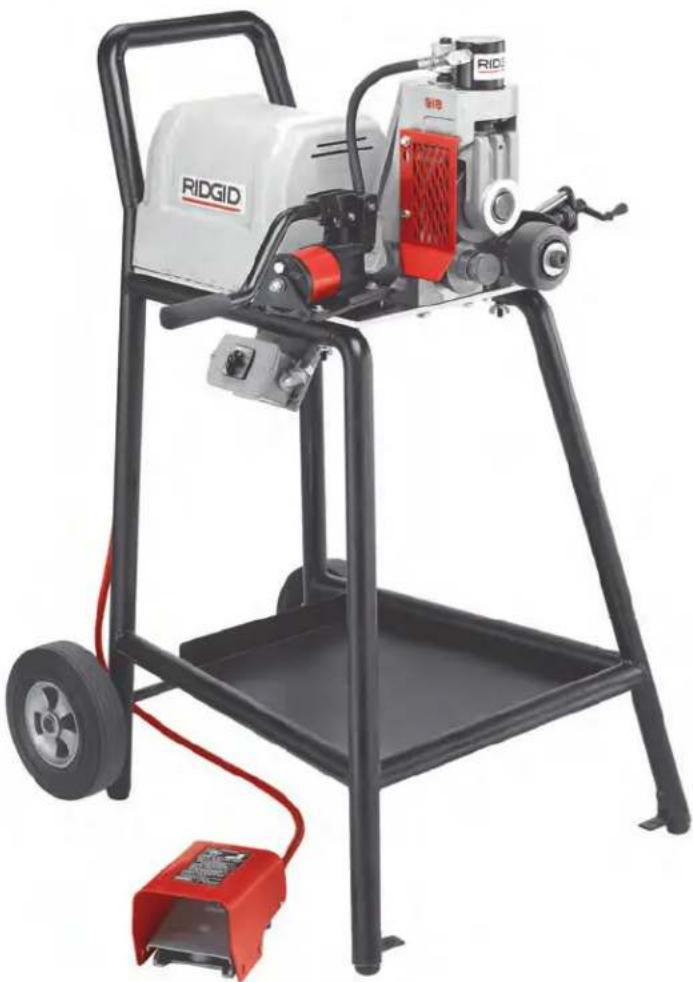
Heavy Duty Roll Grooving Machine
natural_image
Ridgid industrial machine with red and white components mounted on a black wheeled cart (no visible text or symbols)Table of Contents
Recording Form For Machine Serial Number....1
Safety Symbols 2
General Power Tool Safety Warnings
Work Area Safety 2
Electrical Safety 2
Personal Safety 3
Power Tool Use And Care ....3
Service 4
Specific Safety Information
Roll Groover Safety 4
Description, Specifications And Equipment
Description 4
Specifications 5
Standard Equipment 5
918-I Roll Groover Models 5
Accessories 5
Roll Groover Assembly Instructions....5
Assembling Roll Groove....6
Bolting Stand To Shop Floor 6
Machine Inspection....6
Machine and Work Area Set-Upn 7
Operating the No. 918-I Roll Groover 8
Pipe Preparation 8
Pipe/Tubing Lengths 8
Pipe Set-Up 8
Adjusting Roll Groove Depth 9
Forming the Roll Groove 9
Roll Grooving Tips with Model 918-I 10
Grooving Short Lengths of Pipe 10
Removing and Installing Groove Roll and Drive Shaft 10
Removing And Installing Groove Roll Sets with Solid Drive Shafts (2" - 6", 8" - 12") ....11
Removing And Installing Groove Roll Sets with Two-Piece Drive Shafts (1", 1 ^1/4 " - 1 ^1/2 ", 2 - 6" Copper)....12
Changing from Solid Drive Shaft Roll Set to Two-Piece Drive Shaft 13
Accessories....13
Table I Standard Roll Groove Specifications ....14
Table II Pipe Maximum and Minimum Wall Thickness 14
Table III Troubleshooting 15-16
Table IV Copper Roll Groove Specifications ....16
Maintenance Instructions
Hydraulic Fluid Level 17
Lubrication 17
Removing Base from Stand 17
Machine Storage 17
Service and Repair ....17
EC Declaration of Conformity....Inside Back Cover
Lifetime Warranty ....Back Cover
*Original Instructions - English
Roll Grooving
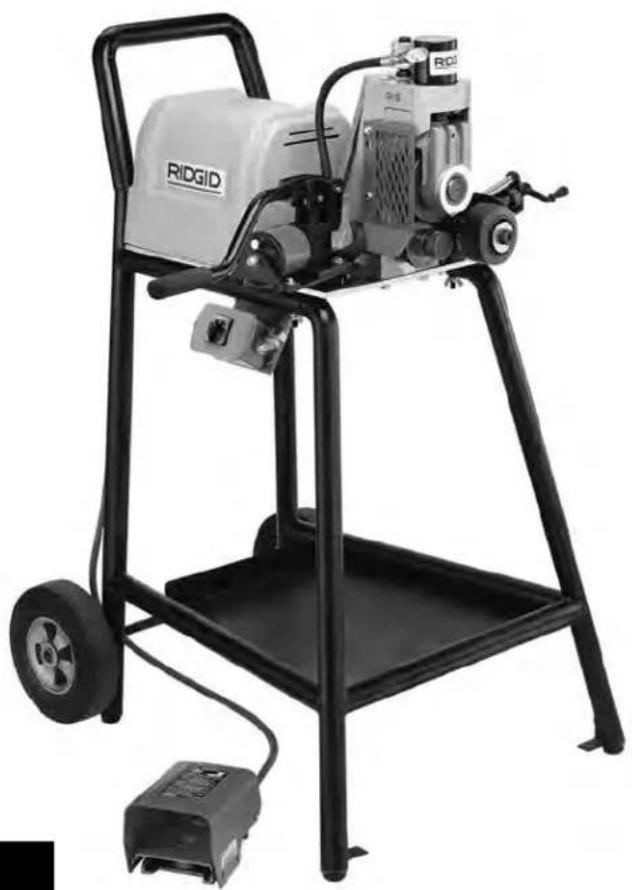
918-I Heavy Duty Roll Grooving Machine
natural_image
Ridgid industrial machine with wheels and control panel (no visible text or symbols)
WARNING!
Read this Operator's Manual carefully before using this tool. Failure to understand and follow the contents of this manual may result in electrical shock, fire and/or serious personal injury.
| 918-I Heavy Duty Roll Grooving Machine | |
| Record Serial Number below and retain product serial number which is located on nameplate. | |
| Serial No. | |
Safety Symbols
In this operator's manual and on the product, safety symbols and signal words are used to communicate important safety information. This section is provided to improve understanding of these signal words and symbols.

This is the safety alert symbol. It is used to alert you to potential personal injury hazards. Obey all safety messages that follow this symbol to avoid possible injury or death.

DANGER
DANGER indicates a hazardous situation which, if not avoided, will result in death or serious injury.

WARNING
WARNING indicates a hazardous situation which, if not avoided, could result in death or serious injury.

CAUTION
CAUTION indicates a hazardous situation which, if not avoided, could result in minor or moderate injury.
NOTICE
NOTICE indicates information that relates to the protection of property.

This symbol means read the operator's manual carefully before using the equipment. The operator's manual contains important information on the safe and proper opera -
tion of the equipment.

This symbol means always wear safety glasses with side shields or goggles when handling or using this equipment to reduce the risk of eye injury.

This symbol indicates the risk of fingers and hands being crushed between the groove rolls.

This symbol indicates that the pipe to be grooved should be a minimum of 8" (200 mm) long to reduce the risk of injury.

This symbol means do not reach inside of pipe being grooved to reduce the risk of entanglement, cutting, crushing and other injuries.

This symbol indicates the risk of hands, fingers, legs, clothes and other objects catching and/or wrapping on rotating shafts causing crushing or striking injuries.

This symbol means always use a foot switch when using the machine to reduce the risk of injury.

This symbol means do not disconnect foot switch to reduce the risk of injury.

This symbol means do not block foot switch (lock in ON position) to reduce the risk of injury.

This symbol indicates the risk of machine tipping, causing striking or crushing injuries.

This symbol indicates the risk of electrical shock.
General Power Tool Safety Warnings\*
WARNING
Read all safety warnings, instructions, illustrations and specifications provided with this power tool. Failure to follow all instructions listed below may result in electric shock, fire and/or serious injury.
SAVE ALL WARNINGS AND INSTRUCTIONS FOR FUTURE REFERENCE!
The term "power tool" in the warnings refers to your mains-operated (corded) power tool or battery-operated (cordless) power tool.
Work Area Safety
- Keep your work area clean and well lit. Cluttered or dark areas invite accidents.
- Do not operate power tools in explosive atmospheres, such as in the presence of flam mable liquids, gases, or dust. Power tools create sparks which may ignite the dust or fumes.
- Keep children and bystanders away while operating a power tool. Distractions can cause you to lose control.
Electrical Safety
- Power tool plugs must match the outlet. Never modify the plug in any way. Do not use any adapter plugs with earthed (grounded) power tools. Un-modified plugs and matching outlets will reduce risk of electric shock.
- Avoid body contact with earthed or grounded surfaces such as pipes, radiators, ranges and refri
gerators. There is an increased risk of electrical shock if your body is earthed or grounded.
- Do not expose power tools to rain or wet conditions. Water entering a power tool will increase the risk of electrical shock.
- Do not abuse the cord. Never use the cord for carrying, pulling or unplugging the power tool. Keep cord away from heat, oil, sharp edges or moving parts. Damaged or entangled cords increase the risk of electric shock.
- When operating a power tool outdoors, use an extension cord suitable for outdoor use. Use of a cord suitable for outdoor use reduces the risk of electric shock.
- If operating a power tool in a damp location is unavoidable, use a Ground Fault Circuit Interrupter (GFCI) protected supply. Use of a GFCI reduces the risk of electric shock.
Personal Safety
- Stay alert, watch what you are doing and use common sense when operating a power tool. Do not use a power tool while you are tired or under the influence of drugs, alcohol, or medication. A moment of inattention while operating power tools may result in serious personal injury.
- Use personal protective equipment. Always wear eye protection. Protective equipment such as dust mask, non-skid safety shoes, hard hat, or hearing protection used for appropriate conditions will reduce personal injuries.
- Prevent unintentional starting. Ensure the switch is in the OFF-position before connecting to power source and/or battery pack, picking up or carrying the tool. Carrying power tools with your finger on the switch or energizing power tools that have the switch ON invites accidents.
- Remove any adjusting key or wrench before turning the power tool ON. A wrench or a key left attached to a rotating part of the power tool may result in personal injury.
- Do not overreach. Keep proper footing and balance at all times. This enables better control of the power tool in unexpected situations.
-
Dress properly. Do not wear loose clothing or jewel ry. Keep your hair and clothing away from moving parts. Loose clothes, jewelry, or long hair can be caught in moving parts.
-
If devices are provided for the connection of dust extraction and collection facilities, ensure these are connected and properly used. Use of dust collection can reduce dust-related hazards.
- Do not let familiarity gained from frequent use of tools allow you to become complacent and ignore tool safety principles. A careless action can cause severe injury within a fraction of a second.
Power Tool Use and Care
- Do not force the power tool. Use the correct power tool for your application. The correct power tool will do the job better and safer at the rate for which it is designed.
- Do not use power tool if the switch does not turn it ON and OFF. Any power tool that cannot be controlled with the switch is dangerous and must be repaired.
- Disconnect the plug from the power source and/or remove the battery pack, if detachable, from the power tool before making any adjustments, changing accessories, or storing power tools. Such preventive safety measures reduce the risk of starting the power tool accidentally.
- Store idle power tools out of the reach of children and do not allow persons unfamiliar with the power tool or these instructions to operate the power tool. Power tools are dangerous in the hands of untrained users.
- Maintain power tools and accessories. Check for misalignment or binding of moving parts, breakage of parts and any other condition that may affect the power tool's operation. If damaged, have the power tool repaired before use. Many accidents are caused by poorly maintained power tools.
- Keep cutting tools sharp and clean. Properly maintained cutting tools with sharp cutting edges are less likely to bind and are easier to control.
- Use the power tool, accessories and tool bits etc. in accordance with these instructions, taking into account the working conditions and the work to be performed. Use of the power tool for operations different from those intended could result in a hazardous situation.
- Keep handles and grasping surfaces dry, clean and free from oil and grease. Slippery handles and grasping surfaces do not allow for safe handling and control of the tool in unexpected situations.
Service
- Have your power tool serviced by a qualified repair person using only identical replacement parts. This will ensure that the safety of the power tool is maintained.
Specific Safety Information
WARNING
This section contains important safety information that is specific to this tool.
Read these precautions carefully before using 918-I Roll Groover to reduce the risk of electrical shock or other serious personal injury.
SAVE ALL WARNINGS AND INSTRUCTIONS FOR FUTURE REFERENCE!
Keep this manual with the machine for use by the operator.
Roll Groover Safety
- Do not wear loose clothing when operating machine. Keep sleeves and jackets buttoned. Do not reach across the machine or pipe. Clothing can be caught by the pipe or machine resulting in entanglement.
- Keep hands away from groove rolls. Do not wear loose fitting gloves. Fingers can be crushed between groove rolls or between groove roll and pipe.
- Only groove pipe 8" (200 mm) or longer, as specified. Grooving shorter than specified pipe can result in entanglement and crushing injuries.
- Keep hands away from ends of pipe. Do not reach inside pipe. Burrs and sharp edges can catch and cut. Fingers can be crushed between groove rolls or between groove roll and pipe.
- Keep guards in place. Do not operate the groover with guards removed. Exposure to grooving rolls may result in entanglement and serious injury.
- Be sure that all equipment and material is properly set up, secured and stable. Properly support the pipe. This will help prevent tipping of the equipment and pipe.
- One person must control the work process, machine operation and foot switch. Only the operator should be in the work area when the machine is running. This helps reduce the risk of injury.
- Restrict access or barricade the area when workpiece extends beyond machine to provide a minimum of one meter (3 feet) clearance from the work-
piece. Restricting access or barricading the work area around the workpiece will reduce the risk of entanglement.
- Do not use this machine if the foot switch is broken or missing. Never block a foot switch so it does not control the machine. The foot switch provides safe control of the machine, such as shut-off in case of entanglement.
- Only use roll groover to groove pipe of recommended sizes and types according to these instructions. Other uses or modifying the roll groover for other applications may increase the risk of injury.
- Read and understand these instructions, the fitting manufacturer's installation instructions and the instructions and warnings for all equipment and materials being used before operating this tool to reduce the risk of serious personal injury.
If you have any question concerning this RIDGI product:
- Contact your local RIDGID distributor.
- Visit RIDGID.com to find your local RIDGID contact point.
- Contact Ridge Tool Technical Service Department at rttechservices@emerson.com, or in the U.S. and Canada call (800) 519-3456.
Description, Specifications, Standard Equipment and Accessories
Description
The RIDGID 918-I Roll Groover forms rolled grooves in steel, stainless steel, aluminum, PVC pipe and copper tubing. The grooves are formed by the hydraulic feeding of a grooving roll into the pipe which is supported by a drive roll.
The 918-I Roll Groover includes two (2) groove and drive shaft sets that can groove the following pipe:
- 2 " - 6" Schedule 10 and 40
- 8" – 12" Schedule 10 and 8" Schedule 40
With additional roll sets, the groover can also be adapted to groove the following:
- 2 " - 6" copper tubing (Types K, L, M, DWV)
• 1" Schedule 10 and 40 - 1^1/4 - 1^1/2 Schedule 10 and 40
CAUTION When properly used, the Model 918-I makes grooves that are dimensionally within the specifications of AWWA C606-87. Selection of appropriate materials and joining methods is the responsibility of the system designer and/or installer. Before any installation is attempted,
careful evaluation of the specific service environment, including chemical environment and service temperature, should be completed.
Specifications
Roll Grooving Capacity
(See Table II for wall thickness)
• 1 " to 12" Schedule 10
• 1 " to 8" Schedule 40
- 2 " - 6" Copper Types K, L, M, DWV
- 2" – 8" Schedule 40 PVC
CAUTION Do not use to groove 8" Schedule 40 steel pipe harder than 150 BHN. Doing so may result in improperly formed grooves that do not meet required specifications.
Depth Adjustment .....Indexed Adjustment Knob
Actuation......Hydraulic Hand Pump
Motor
Type ....Universal
Volts (V)......120 220-240 100
Frequency (Hz).....50/60 50/60 50/60
Current (A)....12.0 6.0 12.0
Power (W) 1400 1400 1200
Controls....Rotary Type ON/OFF Switch and ON/OFF Foot switch
Weight ......185 lbs. (84.1 kg)
Operating Speed.....45 RPM (no load)
Sound Pressure ( L_A )* .....92.9 dB(A), K=3
Sound Power (LWA)*......105.7 dB(A), K=3
* Sound measurements are measured in accordance with a standardized test per Standard EN 62841-1.
- Sound emissions may vary due to your location and specific use of these tools.
- Daily exposure levels for sound need to be evaluated for each application and appropriate safety measures taken when needed. Evaluation of exposure levels should consider the time a tool is switched off and not in use. This may significantly reduce the exposure level over the total working period.
Refer to your machine serial number plate for information specific to your machine.
Standard Equipment
918-I Roll Groover Only
- 918-I Groover with 2" – 6" Drive Shaft and Groove Set
- 8" – 12" Drive Shaft and Groove Set
- Carrying Case for Drive Shaft and Groove Set
- 1/8'' T-Handle Hex Wrench (groove roll changeout)
-
^3/_16 " Hex Wrench (transmission coupling)
-
5/32'' Hex Wrench (transmission cover)
- Spanner Wrench (Drive shaft changeout)
- Nipple Bracket/Pipe Stabilizer
A pipe stabilizer is available as an accessory to aid in the grooving of short lengths of pipe.
918-I Roll Groover Models
| Catalog No. | Model No. | Description | Weight | |
| lb. | kg. | |||
| 64977 | 918-I | Roll Grooving Machine Complete, 115V | 185 | 84,1 |
| 65902 | 918-I | Roll Grooving Machine Complete, 230V (Export Only) | 185 | 84,1 |
Accessories
- Groove and drive roll set for 1^1/4 - 1^1/2 Schedule 10 and Schedule 40. (set includes drive shaft, groove roll and carrying case.)
- Groove and drive roll set for 1" Schedule 10 and Schedule 40, groove and drive roll for 14 " - 12 " Schedule 10, 40. (Set includes groove rolls, drive shaft, and carrying case.)
NOTE! Drive shaft change-out is necessary for roll grooving below 2".
- Groove Roll and Drive Roll Set for Copper 2" – 6" (Types K, L, M and DWV)
- VJ-99 Pipe Stand
natural_image
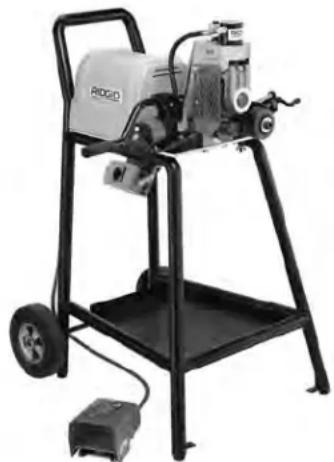
Riogdo industrial machine with wheels and control panel (no visible text or symbols)Figure 2 - 918-I Roll Groover
Roll Groover Assembly Instructions
WARNING
To prevent serious injury, proper assembly of the Roll Groover is required. The following procedures should be followed:
Assembling Roll Groover
- To identify the parts for the 918-I Roll Groover, refer to the parts diagram and parts list.
- Attach right and left legs to the rear support/handle assembly using 38 " - 16 x 2 12 " hex screws and lock washers. Do not tighten screws.
- Attach the tool tray assembly to the rear and front legs using the four (4)^3/8 " - 16 x 2 ^3/_4 " hex screws and lock washers. Do not tighten screws.
- Insert axle into tabs extending from the rear support/handle assembly and secure using four (4) retaining rings.
- Mount the roll groover/base assembly to the stand using four (418'' - 16 × 212'' hex screws, washers and wing nuts. Be careful not to "hook" the switch assembly on the stand rail. Movement of the stand legs may be required to align the base assembly.
Bolt heads go to top, wing nuts and lock washers to the bottom (stand) side. Installation of the last bolt requires opening of the motor cover. - Tighten the six (6) screws and four (4) wing nuts holding the leg and tray assemblies together. Slide the wheels onto the axle and install retaining rings to hold the wheels on the axle.
- Cut the tie wrap that holds the hydraulic pump in place for shipping. Remove the bolts/wing screws from the bottom of the pump's mounting plate.
- Place the pump mounting plate over the hole and slot on the left side of the 918-I (left side as you look at the front of the 918-I). From the bottom of the base plate, insert the 38 " - 16 x 1" bolt with washer into the hole and screw into pump mounting plate. Secure the bolt with the 38 " nut.
- From the bottom of the base plate, insert the wing screw with lock washer into the pump mounting plate (through the slot) and tighten as required.
NOTE! During 918-1 operation, the hydraulic pump should be in the outermost position. During transportation, the hydraulic pump should be in the inner most position.
Bolting the 918-I Stand to the Shop Floor
-
Mark the spot where the 918-I is to be bolted.
-
Align spot with the 918-I stand bolt-down attachment holes (Figure 3).
-
Mark the spot where the 918-I is to be bolted.
- Align spot with the 918-I stand bolt-down attachment holes (Figure 3).

natural_image
Close-up of a black metal frame with two metal legs and a small bolt, against a white background (no text or symbols)Figure 3 - Bolt-Down Attachment Holes
Machine Inspection
WARNING



Do not use this Roll Groover without a foot switch.
To prevent serious injury, inspect your Roll Groover. The following inspection procedures should be performed on a daily basis.
- Make sure machine is unplugged and the switch is set to the OFF position.
- Make sure the foot switch is present and attached to the machine.
- Inspect the power cord and plug for damage. If the plug has been modified, is missing the grounding pin or if the cord is damaged, do not use the machine until the cord has been replaced.
- Make sure all bolts holding the Roll Groover and hydraulic pump to the base are tight.
- Check that guard mounted to the roll groover is in place (Figure 3).
⚠ WARNING Do not operate Roll Groover with guard removed. Exposure to moving grooving rolls may result in fingers being crushed.
-
Inspect the Roll Groover for any broken, missing, misaligned or binding parts as well as any other conditions which may affect the safe and normal operation of this equipment. If any of these conditions are present, do not use the Roll Groover until any problem has been repaired.
-
Lubricate the Roll Groover if necessary according to the Maintenance Instructions.
- Use groover rolls and accessories that are designed for your Roll Groover and meet the needs of your application. The correct groover tools and accessories allow you to do the job successfully and safely. Accessories suitable for use with other equipment may be hazardous when used with this Roll Groover.
- Clean any oil, grease or dirt from all equipment handles and controls. This reduces the risk of injury due to a tool or control slipping from your grip.
- Inspect the groove rolls to insure they are not damaged or worn. Worn groover rolls can lead to pipe slippage and poor quality grooves.
Machine and Work Area Set-Up
WARNING



To prevent serious injury, proper set-up of the machine and work area is required. The following procedures should be followed to set-up the machine:
-
Locate a work area that has the following:
-
Adequate lighting
- No flammable liquids, vapors or dust that may ignite.
• Grounded electrical outlet - Clear path to the electrical outlet that does not contain any sources of heat or oil, sharp edges or moving parts that may damage electrical cord.
- Dry place for machine and operator. Do not use the machine while standing in water.
-
Level ground
-
Clean up the work area prior to setting up any equipment. Always wipe up any oil that may be present.
- Place machine on a flat, level surface. Be sure the groover and stands are stable. See Assembly Instructions for bolting 918-1 stand to shop floor.
- Properly support the pipe with pipe stands. See Chart "A" for maximum lengths with one (1) stand.
⚠ WARNING Failure to properly support the pipe can result in the unit tipping or the pipe falling.
-
Make sure switch is in the OFF position.
-
Position the foot switch so that the operator can safely control the roll groover and workpiece. It should allow the operator to do the following:
-
Stand with left hand on pump handle.
- Use the foot switch with his left foot.
- Have convenient access to the groover without reaching across the machine.
Machine is designed for one person operation.
- Plug the machine into the electrical outlet making sure to position the power cord along the clear path selected earlier. If the power cord does not reach the outlet, use an extension cord in good condition.
⚠ WARNING To avoid electrical shock and electrical fires, never use an extension cord that is damaged or does not meet the following requirements.
- The cord has a three-prong plug similar to shown in Electrical Safety section.
- The cord is rated as "W" or "W-A" if being used outdoors.
- The cord has sufficient wire thickness (14 AWG below 25'/12AWG 25' - 50'). If the wire thickness is too small, the cord may overheat, melting the cord's insulation or causing nearby objects to ignite.
⚠ WARNING To reduce risk of electrical shock, keep all electrical connections dry and off the ground. Do not touch plug with wet hands.
-
Check the unit to insure it is operating properly.
-
Flip the switch to ON. Press and release the foot switch. Check that the groove roll rotates in a clockwise direction as you are facing the groover. Have the machine serviced if it rotates in the wrong direction or if the foot switch does not control its stopping or starting.
- Depress and hold the foot switch. Inspect the moving parts for misalignment, binding, odd noises or any other unusual conditions that may affect the safe and normal operation of the machine. If such conditions are present, have the roll groover drive serviced.
- Release the foot switch and flip the switch to OFF.
- Check the groove and drive rolls to insure they are the correct size.
CAUTION Use of roll sets on both carbon and stainless steel pipe can lead to contamination of the stainless steel material. This contamination could cause corrosion and premature pipe failure. To prevent ferrous contamination, use roll sets dedicated for stainless steel grooving.
Operating the 918-I Roll Groover
WARNING



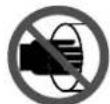

Do not wear loose clothing when operating a Roll Groover. Keep sleeves and jackets buttoned. Do not reach across the machine or pipe.
Do not use this Roll Groover if it has a broken or missing foot switch. Always wear eye protection to protect eyes from dirt and other foreign objects.
Keep hands away from grooving rolls. Do not wear loose fitting gloves when operating groover. Use pipe stands to support pipe.
When grooving, keep hands away from end of pipe. Do not reach inside pipe end.
Pipe Preparation
- Pipe ends must be cut square. Do not use cutting torch.
- Pipe out-of-roundness must not exceed the total O.D. tolerance listed in groove specifications, Table 1.
NOTE! Determine out-of-roundness by measuring maximum and minimum O.D. at 90 degrees apart.
- All internal or external weld beads, flash or seams must be ground flush at least 2 inches back from pipe end.
NOTE! Do not cut flats on gasket seat area.
Pipe/Tubing Length
The following chart lists the minimum length of pipe or tubing to be grooved and the maximum length to be grooved with one (1) pipe stand.
| Groovable Pipe Lengths - Inches | |||||
| Nom. Min. Max. Nom. Min. Max. Size Length Length Size Length Length | |||||
| 1 | 8 | 36 | 4 | 8 | 36 |
| 1^1/_4 | 8 | 36 | 4^1/_2 | 8 | 32 |
| 1^1/_2 | 8 | 36 | 5 | 8 | 3 |
| 2 | 8 | 36 | 6 O.D. | 10 | 30 |
| 2^1/_2 | 8 | 36 | 6 | 10 | 28 |
| 3 | 8 | 36 | 8 | 10 | 24 |
| 3^1/_2 | 8 | 36 | 10 | 10 | 24 |
| 4 | 8 | 36 | 12 | 10 | 24 |
2
Chart A – Minimum/Maximum Pipe Length
Pipe Set-Up
- Pipe or tubing longer than the specified maximum lengths listed in Chart A must be supported with two
(2) pipe stands. The second pipe support should be located 34 of pipe length from roll groover.
⚠ WARNING Failure to use two stands may result in the unit tipping or the pipe falling.
-
Raise upper groove roll housing by placing pump release lever in RETURN position (away from operator) (Figure 4).
-
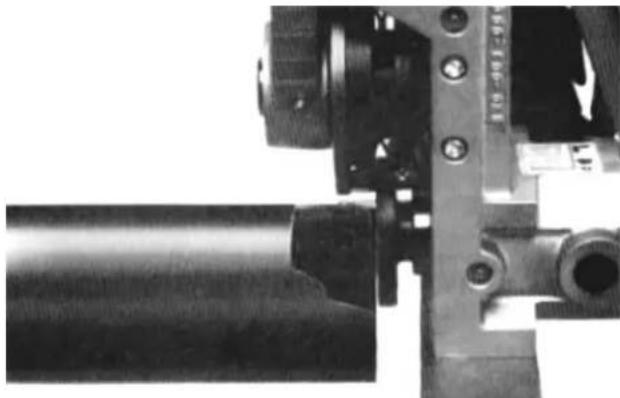
Square pipe and pipe support to roll groover making sure pipe is flush against drive roll flange (Figure 5).
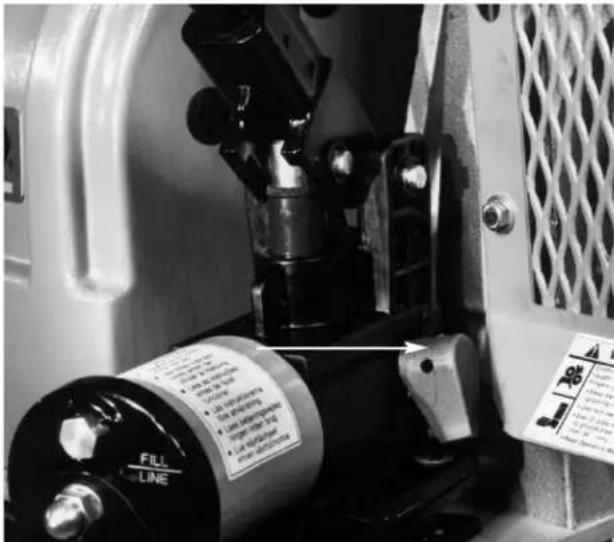
Figure 4 – Close-up of Release Lever on 918-I Pump
natural_image
Close-up of mechanical components including a cylindrical shaft and mechanical assembly (no visible text or symbols)Figure 5 – Squaring Pipe up against Flange of Drive Roll
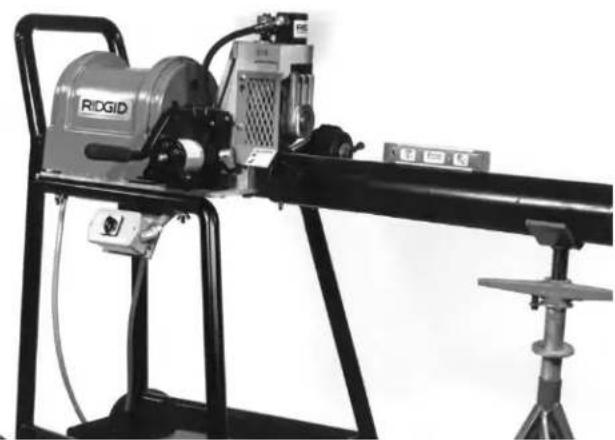
- Level pipe by adjusting pipe stand (Figure 6).
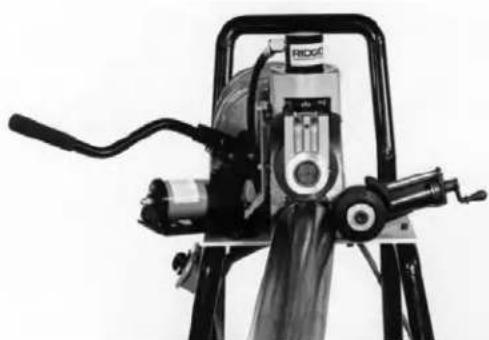
- Slightly offset pipe and pipe stand (approximately 12 degree) toward operator (Figure 7).
natural_image
Industrial machine setup with a RIDGID motor and tripod stand (no visible text or symbols)Figure 6 – Leveling Pipe on Pipe Support and 918-I Roll Groover
natural_image
Black-and-white photo of a RICCI portable oil pump on a tripod stand (no visible text or symbols)Figure 7 – Offset Pipe on 918-I (exaggerated for clarity)
Adjusting Roll Groove Depth
NOTE! Due to differing pipe characteristics, a test groove should always be performed when setting up or changing pipe sizes. The index depth adjustment knob must be reset for each diameter of pipe/tube.
- Advance the upper groove roll by placing the pump release lever in ADVANCE position (toward operator) and pump the handle until the upper roll contacts the pipe to be grooved.
NOTE! Upper roll should only touch the pipe surface. Care must be taken not to penetrate pipe surface with upper roll by applying excessive pressure.
-
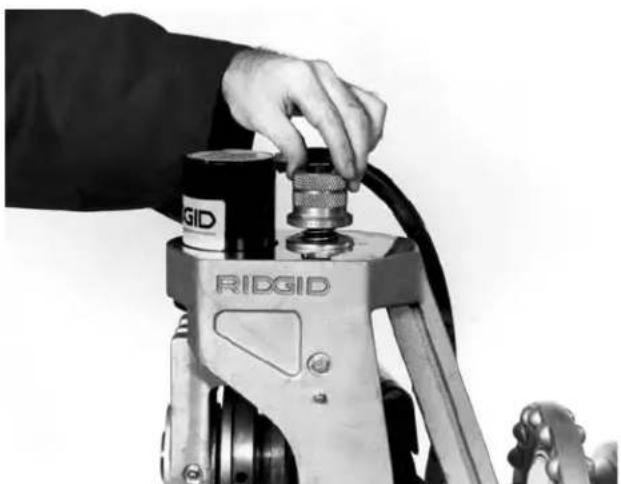
Turn down the indexed depth adjustment knob (clockwise) until it stops against the top of the machine (Figure 8).
-
Back the depth adjustment knob off one turn.
natural_image
Close-up of a hand operating a RIDGID robotic device with a handle and cable (no visible text or symbols)Figure 8 – Close-up of Depth Adjustment Knob Being Turned Down Against Top Casting
Forming the Roll Groove
CAUTION Pipe wall thickness cannot exceed the maximum wall thickness specified in the "Pipe Maximum and Minimum Wall Thickness" Table II. Do not use to groove 8" schedule 40 steel pipe that is harder than 150 BHN.
- Flip the switch from OFF and step on machine foot switch while applying downward pressure on the 918-l pump handle. Allow one full pipe rotation between quarter strokes of the pump handle.
WARNING If pipe begins to "walk off" the drive roll, stop the machine and check "Pipe Set-Up" procedure.
- To help prevent "walking", apply pressure on outside of pipe with right hand (Figure 9).
⚠ WARNING Do not reach inside of pipe. Keep hands away from sharp edges and burrs on end of pipe.
NOTE! Do not overfeed upper groove roll. Maintain constant even downward pressure, pausing to allow one pipe revolution per quarter stroke of the pump handle.
-
When the depth adjustment knob contacts the machine casting, allow two complete pipe revolutions to even out groove depth.
-
Release foot switch and retract upper groove roll by placing the pump release lever in the RETURN position (toward operator).
-
Check groove diameter before proceeding with additional grooves.
Figure 9 – Grooving Pipe While Exerting Light Hand Pressure Toward Operator
NOTE! Groove diameter should be measured using a diameter tape. To decrease groove diameter (in -crease groove depth), rotate the index depth adjustment knob one mark counter-clockwise. To increase groove diameter (decrease groove depth), rotate the depth adjustment knob clockwise.
Roll Grooving Tips with Model 918-I
- If pipe tends to "walk off" drive roll, increase offset dimension (Figure 7).
- If drive roll flange shaves pipe end, decrease offset dimension.
- If pipe end flare is excessive, lower pipe end to level with roll groover.
- If pipe wobbles and/or "walks off" drive roll, raise pipe end to level with roll groover.
- Short lengths of pipe (under three feet) may require slight pressure to maintain the 12 degree offset dimension.
Grooving Short Lengths of Pipe
Without Stabilizer
- Properly set-up pipe to ensure pipe is level and square on the shoulder of the drive roll.
- When grooving, exert pressure on the pipe towards the operator (Figure 9).
Do not attempt to groove any pieces of pipe shorter than 8" (See Chart A). Increases risk of fingers being crushed in the grooving rolls.
Do not reach inside of pipe. Keep hands away from sharp edges and burrs on end of pipe.
With Stabilizer
NOTE! Once stabilizer is adjusted for a selected pipe diameter and wall thickness, it does not have to be readjusted.
- Properly set up pipe to ensure pipe is level and square on the shoulder of the drive roll.
- Engage hydraulic pump and bring groove roll (upper roll) down until it contacts outside diameter of the pipe.
- Tighten down stabilizer roll until roll contacts outside diameter of the pipe. Continue to tighten stabilizer one full turn after making contact on outside diameter of pipe (Figure 10).
Figure 10 – Adjusting Pipe Stabilizer
Do not reach across pipe to adjust stabilizer.
NOTE! If pipe "walks off" of drive shaft during the roll grooving operation, the stabilizer will need to be further tightened ^1/2 turn.
Do not use the pipe stabilizer on 8" or short er workpieces. Increases risk of fingers being crushed in the grooving rolls.
Removing and Installing Groove Roll and Drive Shaft
NOTE! As groove dimensions are determined by the roll set geometry, specific roll sets are required when grooving the following:
- 2" - 6" Schedule 10, 40
- 8" – 12" Schedule 10, 8" Schedule 40
- 2" – 6" Copper tubing (Types K, L, M, DWV)
- 1" Schedule 10, 40
- 1^1/4 - 1^1/2 Schedule 10, 40
Make sure machine is unplugged from power source before changing the roll sets.
⚠ WARNING When removing groove rolls and shafts, be sure they are properly supported. Failure to provide support may cause them to drop suddenly.
Removing and Installing Roll Sets with Solid Drive Shafts (2" - 6", 8" - 12")
-
Removing Groove Rolls:
-
Fully raise the upper roll assembly by moving the pump release lever to the DOWN position.
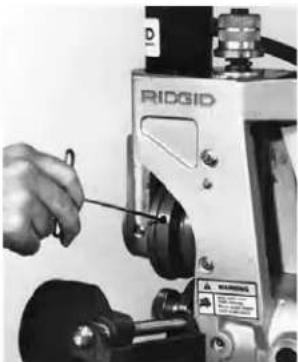
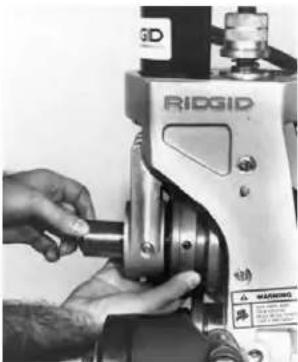
- Loosen set screw in grooving roll and remove groove roll shaft and groove roll (Figures 11 & 12).
natural_image
Close-up of a hand using a tool to adjust or install a RIGGID industrial machine (no visible text or symbols)Figure 11 – Loosen Set Screw in Groove Roll
natural_image
Close-up of hands operating a RIGID industrial machine tool (no visible text or symbols)Figure 12 – Remove Groove Roll Shaft and Groove Roll
-
Removing Solid Drive Shaft:
-
Open motor and transmission cover.
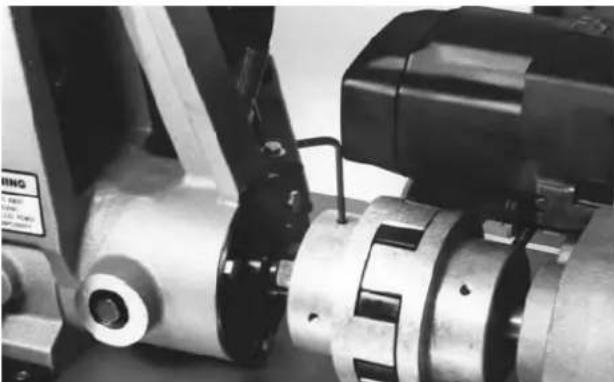
- Use ^3/_16 " hex key to loosen the two screws on the front half of the transmission coupling (Figure 13).
natural_image
Close-up of industrial machinery components with no visible text or symbolsFigure 13 – Loosen the Two Screws on the Transmission Coupling
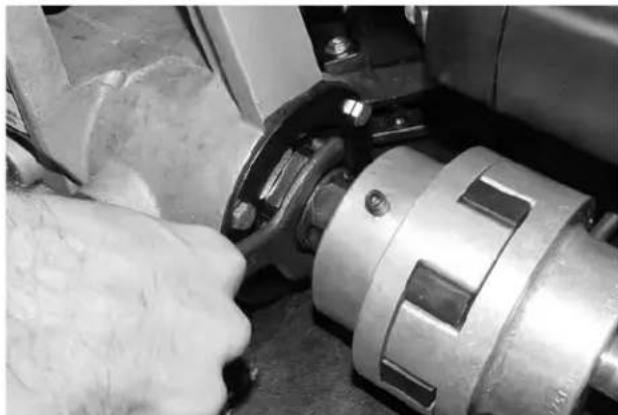
- Use the spanner wrench to loosen and remove the drive shaft retaining nut (Figure 14).
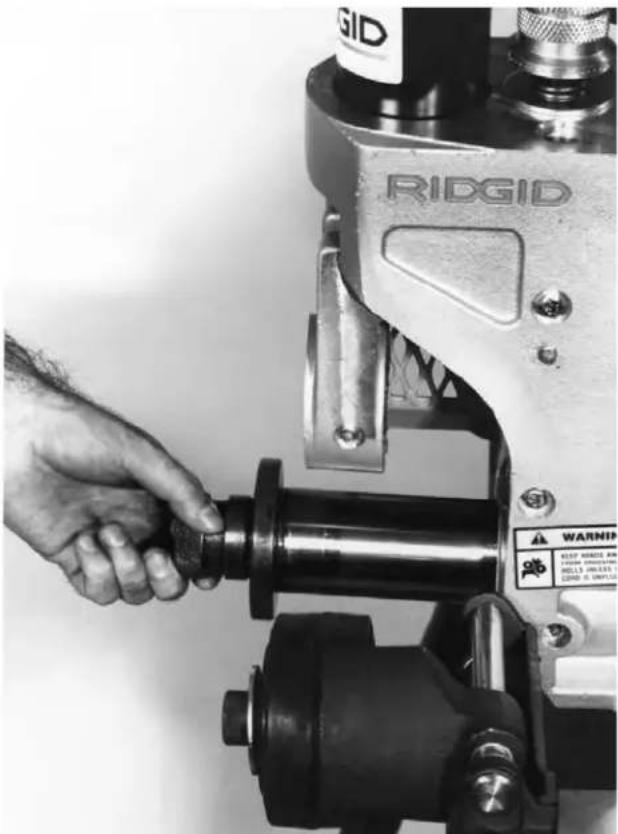
- Remove drive shaft (Figure 15).
natural_image
Close-up of a mechanical assembly with a hand operating a workpiece (no visible text or symbols)Figure 14 – Loosen and Remove Drive Shaft Retaining Nut
- Installing Solid Drive Shaft aligning hex with opening in coupling.
• Install new drive shaft through the 918-l housing and the drive shaft bearing retaining nut (with text out), aligning hex with opening in coupling.
- Use spanner wrench to tighten the drive shaft bearing retaining nut.
- Tighten transmission coupling set screws.
- Close motor and transmission cover.
⚠ WARNING Do not use groover with motor cover removed or open.
-
Installing Groove Roll:
-
With upper roll housing fully raised and drive shaft in place, insert groove roll into upper roll assembly and fully insert upper roll shaft through bearings and groove roll.
- Tighten groove roll set screw into detent on upper roll shaft.
• Using a grease gun, grease the drive shaft through the fitting on the side of the groover.
natural_image
Close-up of a hand adjusting a RIDGID microscope tool (no visible text or symbols on the device itself)Figure 15 – Remove Drive Shaft
Removing and Installing Roll Sets with Two-Piece Drive Shafts (1", 1 ^1/4 " - 1 ^1/2 ", 2" - 6" Copper)
- Removing Groove Roll:
- Fully raise the upper roll housing by moving the pump release lever to the return position, away from the operator.
- Loosen groove roll set screw (Figure 11). Grasp groove roll and remove upper shaft and groove roll from the Groover (Figure 12).
- Removing Drive Roll From Drive Shaft:
- Open motor and transmission cover.
- Use ^3/16 hex key to loosen the two screws on the front half of the transmission coupling (Figure 13).
- Use the spanner wrench to loosen and remove the drive shaft retaining nut (Figure 14).
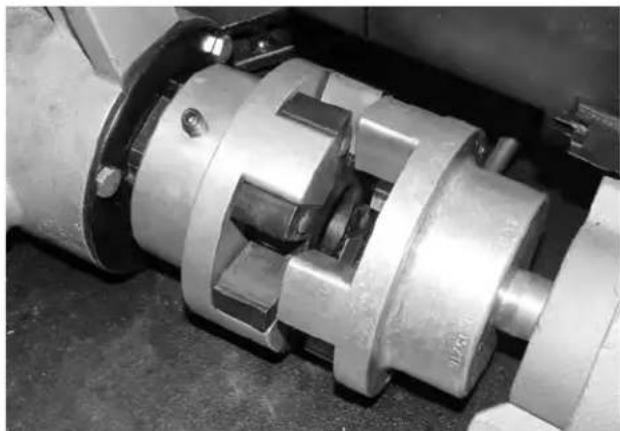
- Pull the drive shaft assembly forward. Remove drive shaft bearing retaining nut and the front half of the coupling (Figure 16). Reinsert drive shaft.
natural_image
Close-up of a mechanical assembly with interlocking gears and mounting flanges (no visible text or symbols)Figure 16 – Removing Bearing, Retaining Nut and Front Half of Coupling
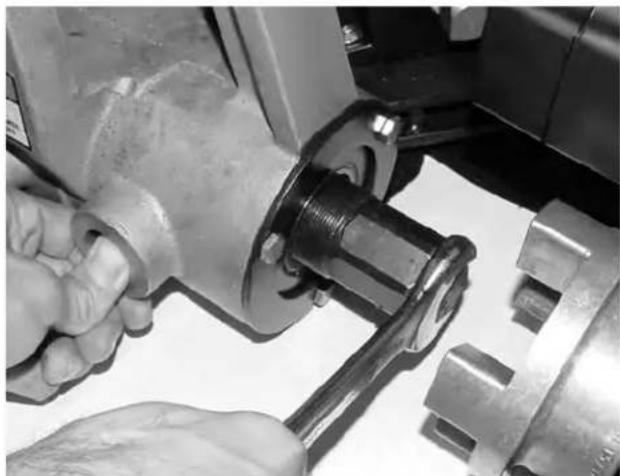
- Manually rotate the drive shaft while applying pressure to the spindle lock pin until the lock pin engages the spindle lock hole in the drive shaft.
- With the spindle lock engaged, use a ^15/_16 " wrench to loosen the draw bolt (Figure 17).
- Tap draw bolt with a mallet to release drive roll from drive shaft.
- Unthread draw bolt from drive roll, remove drive roll.
natural_image
Close-up of hands using a tool to adjust or install a mechanical component, no visible text or symbolsFigure 17 – Engaging Spindle Lock and Loosen Draw Bolt
- Installing New Drive Roll:
• Install new drive roll, insert and hand-tighten draw bolt.
- Manually rotate the drive shaft/drive roll assembly while applying pressure to the spindle lock pin until the lock pin engages the spindle lock hole in the drive shaft.
- With the spindle lock engaged, use a wrench to tighten the draw bolt.
- Release pressure on the spindle lock pin, allowing to retract.
- Pull drive shaft assembly forward. Insert front half of coupling onto back half. Insert drive shaft assembly through the bearing retaining nut, aligning hex with opening in coupling.
- Use spanner wrench to tighten the drive shaft bearing retaining nut.
- Tighten transmission coupling set screws.
- Close motor and transmission cover.
⚠ WARNING Do not use groover with cover removed or open.
4. Installing Groove Roll:
- With upper roll housing fully raised and drive shaft in place, insert groove roll into upper roll assembly and fully insert upper roll shaft through bearings and groove roll.
- Tighten groove roll set screw into detent on upper roll shaft.
5. Using a grease gun, grease the drive shaft through the fitting on the side of the Groover.
Changing from Solid Drive Shaft Roll Set to Two-Piece Drive Shaft
1. Removing Groove Roll:
- Fully raise the upper roll housing by moving the pump release lever to the return position, away from the operator.
- Loosen groove roll set screw (Figure 11). Grasp groove roll and remove upper roll shaft and groove roll from Groover (Figure 12).
2. Changing Solid Drive Shaft Roll Set to Two-Piece Drive Shaft:
- Open motor and transmission cover.
- Use ^3/16 " hex key to loosen the two screws on the transmission coupling (Figure 13).
- Use the box wrench to remove the drive shaft bearing retaining nut (Figure 14).
- Remove the drive shaft (Figure 15).
- Remove the front half of the coupling.
- Assemble proper drive roll to drive shaft (two-piece style) with draw bolt hand-tight.
- Insert two-piece drive shaft assembly into 918-l.
- Manually rotate the drive shaft while applying pres-
sure to the spindle lock pin until the lock pin engages the spindle lock hole in the drive shaft assembly.
- With the spindle lock engaged, use a wrench to tighten the draw bolt.
- Release pressure on the spindle lock pin, allowing to retract.
- Pull drive shaft assembly forward. Insert front half of coupling onto back half. Insert drive shaft assembly through the bearing retaining nut, aligning hex with opening in coupling.
- Use spanner wrench to tighten the drive shaft bearing retaining nut.
- Tighten transmission coupling set screw.
- Close motor and transmission cover.
WARNING Do not use groover with cover removed or open.
3. Installing groove roll:
- With upper housing fully raised and drive shaft in place, insert groove roll into upper roll assembly and fully insert upper roll shaft through bearings and groove roll.
- Tighten groove roll set screw into detent on upper roll shaft.
4. Using a grease gun, grease the drive shaft through the fitting on the side of the groover.
Accessories
⚠ WARNING Only the following RIDGID products have been designed to function with the 918-I Roll Groover. Other accessories suitable for use with other tools may become hazardous when used on this Roll Groover.
To prevent serious injury, use only the accessories listed below.
| Catalog No. 918-I Accessories | |
| 48405 | Roll Set for 8'' - 12'' Sch. 10, (8" Sch.40) with Carrying Case |
| 48407 | Roll Set for 1^-1/4 to 1^1/2 Sch. 10/40 with Carrying Case |
| 48412 | Roll Set for 1'' Sch. 10/40 and 1^-1/4 to 1^1/2 Sch. 10/40 with Carrying Case |
| 48417 | Roll Set for Copper ( 2'' - 6'' ) |
| 76822 | English Diameter Tape |
| 76827 | Metric Diameter TapePipe Stands (See Ridge Tool Catalog) |
NOTE: A Roll Set consists of a Groove Roll and a Drive Roll.
Table I. Standard Roll Groove Specifications ^(1)
NOTE! All Dimensions are in Inches.
| NOM. PIPE MIN. GASKET GROOVE GROOVE NOM. PIPE SIZE | DIAMETER | T A WALL THK. | B SEAT+.015/-.030 | WIDTH+.030/-.015 | C DIAMETER | D GROOVE DEPTH (Ref.) (2) | ||
| O.D. | TOL. | O.D. | TOL. | |||||
| 1 | 1.315 | +.013-.013 | .065 | .625 | .281 | 1.190 | +.000-.015 | .063 |
| 1^1/_4 | 1.660 | +.016-.016 | .065 | .625 | .281 | 1.535 | +.000-.015 | .063 |
| 1^1/_2 | 1.900 | +.016-.016 | .065 | .625 | .281 | 1.775 | +.000-.015 | .063 |
| 2 | 2.375 | +.024-.016 | .065 | .625 | .344 | 2.250 | +.000-.015 | .063 |
| 2^1/_2 | 2.875 | +.029-.016 | .083 | .625 | .344 | 2.720 | +.000-.015 | .078 |
| 3 | 3.50 | +.030-.018 | .083 | .625 | .344 | 3.344 | +.000-.015 | .078 |
| 3^1/_2 | 4.00 | +.030-.018 | .083 | .625 | .344 | 3.834 | +.000-.015 | .083 |
| 4 | 4.50 | +.035.020 | .083 | .625 | .344 | 4.334 | +.000-.015 | .083 |
| 5 | 5.563 | +.056.022 | .109 | .625 | .344 | 5.395 | +.000-.015 | .084 |
| 6 | 6.625 | +.050-.024 | .109 | .625 | .344 | 6.455 | +.000-.015 | .085 |
| 8 | 8.625 | +.050-.024 | .109 | .750 | .469 | 8.441 | +.000-.020 | .092 |
| 10 | 10.75 | +.060-.025 | .134 | .750 | .469 | 10.562 | +.000-.025 | .094 |
| 12 | 12.75 | +.060-.025 | .156 | .750 | .469 | 12.531 | +.000-.025 | .110 |
(1) As per AWWA C606-87
(2) Nominal Groove Depth is provided as a reference dimension only. Do not use groove depth to determine acceptability of a groove.
NOTE! Fitting manufacturer's recommendations should be followed regarding maximum allowable flare diameters.
Table II. Pipe Maximum and Minimum Wall Thickness
NOTE! All Dimensions are in Inches.
| Pipe Size | CARBON STEEL OR ALUMINUM PIPE OR TUBE | STAINLESS STEEL PIPE OR TUBE | PVC PIPE | |||
| Wall Thickness | Wall Thickness | Wall Thickness | ||||
| Min. | Max. | Min. | Max. | Min. | Max. | |
| 1" | .065 | .133 | .065 | .109 | .133 | .133 |
| 1^1/_4 " | .065 | .140 | .065 | .140 | .140 | .140 |
| 1^1/_2 " | .065 | .145 | .065 | .145 | .145 | .200 |
| 2" | .065 | .154 | .065 | .154 | .154 | .154 |
| 2^1/_2 " | .083 | .203 | .083 | .188 | .203 | .276 |
| 3" | .083 | .216 | .083 | .188 | .216 | .300 |
| 3^1/_2 " | .083 | .226 | .083 | .188 | .226 | .318 |
| 4" | .083 | .237 | .083 | .188 | .237 | .337 |
| 5" | .109 | .258 | .109 | .188 | .258 | .258 |
| 6" | .109 | .280 | .109 | .188 | .280 | .280 |
| 8" | .109 | .322 | .109 | .188 | .322 | .322 |
| 10" | .134 | .165 | .134 | .188 | — | — |
| 12" | .156 | .180 | .156 | .188 | — | — |
CAUTION: Do not use to groove 8" schedule 40 steel pipe that is harder than 150 BHN. Attempting to groove this harder pipe may result in improperly formed grooves that do not meet required specifications.
Table III. Troubleshooting
| PROBLEM CAUSE CORRECTION | ||
| Rolled groove too narrow or too wide. | Incorrect size of grooving and driving rolls. | Install correct size of grooving and driving rolls. |
| Mismatched grooving and driving rolls. | Match grooving and driving rolls. | |
| Grooving roll and/or driving roll worn. | Replace worn roll. | |
| Rolled groove not perpendicular to pipe axis. | Pipe length not straight. | Use straight pipe. |
| Pipe end not square with pipe axis. | Cut pipe end square. | |
| Pipe does not track while grooving. | Pipe not level. | Adjust stand to level pipe. |
| Groover not level. | Level groover. | |
| Pipe axis not offset 1/2 degree from drive roll axis. | Offset pipe 1/2 degree (See Figure 7). | |
| 1/2 degree offset not sufficient. | Offset pipe slightly more. | |
| Not applying pressure to pipe. | Apply pressure to pipe (See Figure 9). | |
| Not using stabilizer. | Use stabilizer. | |
| Excessive weld seam. | Grind flush 2" from end of pipe. | |
| Pipe end not square. | Cut pipe end square. | |
| Pipe flared at groove end. | Pipe not level. | Adjust stand to level pipe. |
| Operator is advancing groove roll too fast. | Slow down pumping action. Refer to proper operating instructions. | |
| Pipe is too hard. | Replace pipe. | |
| Stabilizer too tight. | Adjust stabilizer. | |
| Pipe drifts back and forth on driving roll axis while grooving. | Pipe length not straight. | Use straight pipe. |
| Pipe end not square with pipe axis. | Cut pipe end square. | |
| Pipe rocks from side to side. | Pipe stand too close to end of pipe. | Move pipe stand in 1/4 distance from end of pipe. |
| Pipe end flattened or damaged. | Cut off damaged pipe end. | |
| Hard spots in pipe material or weld seams harder than pipe. | Use high quality pipe of uniform hardness. | |
| Grooving roll feed rate too slow. | Feed grooving roll into pipe faster. | |
| Pipe support stand rollers not in correct location for pipe size. | Position pipe stand rollers for pipe size being used. | |
| Groover does not roll groove in pipe. | Pipe wall maximum thickness exceeded. | Check pipe capacity chart. |
| Wrong rolls. | Install correct rolls. | |
| Pipe material too hard. | Replace pipe. | |
| Adjustment nut not set. | Set depth. | |
| Groove does not meet specification. | Maximum pipe diameter tolerance exceeded. | Use correct diameter pipe. |
| Mismatched grooving and driving rolls. | Use correct set of rolls. | |
| Grooving 8" Sch.40 steel pipe harder than 150 BHN. | Do not groove hard pipe. | |
| Pipe slips on driving roll. | Driving roll knurling plugged with metal or worn flat. | Clean or replace driving roll. |
| Grooving roll feed rate too slow. | Feed grooving roll into pipe faster. | |
| PROBLEM | CAUSE | CORRECTION |
| Pipe raises or tends to tip groover over backwards. | Not level. | Adjust stands to level pipe. |
| Pump not delivering oil, cylinder does not advance. | Pump release valve open.Low oil in reservoir.Dirt in pump body.Seats worn or not seating.Too much oil in reservoir. | Close release valve.Check oil level per instructions.Have serviced by qualified technician.Have serviced by qualified technician.Check oil level per instructions. |
| Pump handle operates with “spongy” action. | Air trapped in system.Too much oil in reservoir. | Position ram lower than pump by tipping the machine on its side opposite the operator. Extend and return the cylinder piston several times to permit air to return to the pump reservoir.Check oil level per instructions. |
| Cylinder extends only partially. | Pump reservoir is low on oil.Depth adjustment set incorrectly. | Fill and bleed system.Follow depth adjustment instructions. |
Table IV. Copper Roll Groove Specifications
| 1 | 2 | 3 | 4 | 5 | ||||
| Nom. Tubing Outside Gasket Groove Groove Size Inches | Diameter O.D. | A Nominal Seal A+.03-.00 | B Min. Max.Width+.03-.00 | C Dia+.00-.02 | D Groove Depth (1) | Allow. Wall Thick. | T Allow. Flare Dia. | |
| Basic | Tolerance | |||||||
| 2 | 2.125 | ±0.002 | 0.610 | 0.300 | 2.029 | 0.048 | 0.064 | 2.220 |
| 2^1/2 | 2.625 | ±0.002 | 0.610 | 0.300 | 2.525 | 0.050 | 0.065 | 2.720 |
| 3 | 3.125 | ±0.002 | 0.610 | 0.300 | 3.025 | 0.050 | 0.045 | 3.220 |
| 4 | 4.125 | ±0.002 | 0.610 | 0.300 | 4.019 | 0.053 | 0.058 | 4.220 |
| 5 | 5.125 | ±0.002 | 0.610 | 0.300 | 5.019 | 0.053 | 0.072 | 5.220 |
| 6 | 6.125 | ±0.002 | 0.610 | 0.300 | 5.999 | 0.063 | 0.083 | 6.220 |
(1) Nominal groove depth is provided for reference only. Do not use groove depth to determine acceptability of groove.
Maintenance Instructions
⚠ WARNING Make sure machine is unplugged from power source before performing maintenance or making any adjustments.
Hydraulic Fluid Level
Remove the reservoir filler cap (Figure 18). The oil level should come to the fill line when the pump is resting on its base and the ram is fully retracted. Use only high grade hydraulic oil.
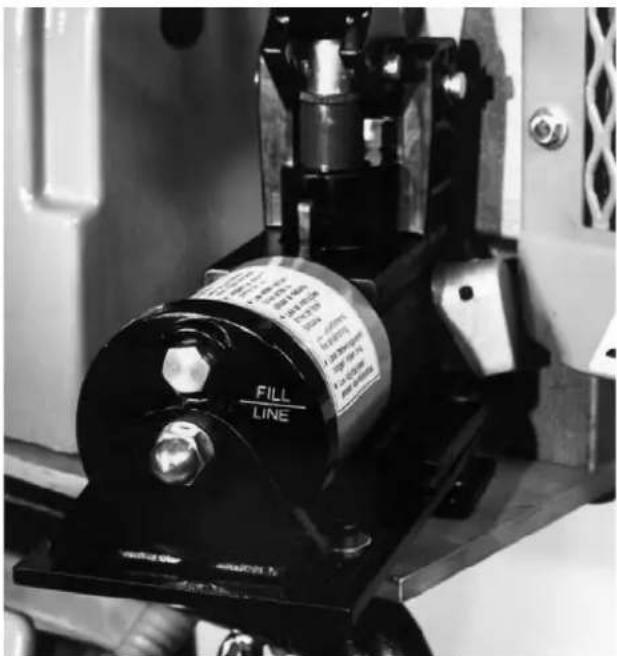
Figure 18
Lubrication
Drive Shaft and Groove Roll Shaft Bearings.
Lubricate with multi-purpose grease through fittings located on groove roll shaft and lower roll housing once a month, and after roll change.
Removing the Base Unit From the Stand
- Unplug the 918-I from the power source.
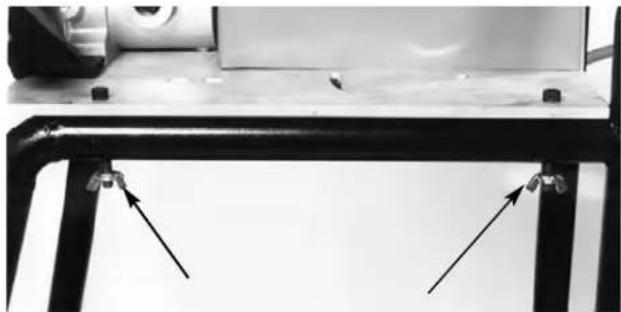
- Remove the four bolts that hold the base unit plate to the stand (Figure 19).
natural_image
Mechanical setup with metal frame and two labeled points (no visible text or symbols)Figure 19
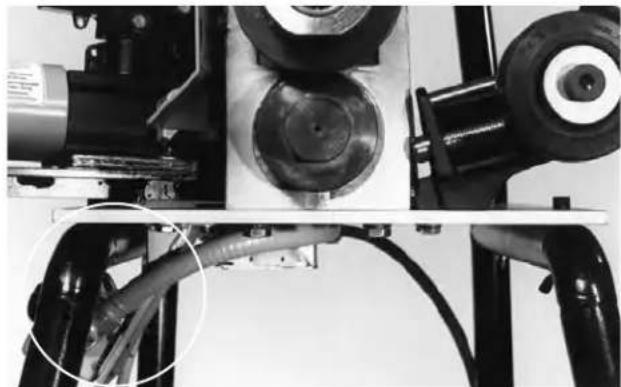
- As the base unit is being removed, be careful to not "hook" the switch assembly on to the stand rail (Figure 20).
natural_image
Close-up of mechanical components with visible wiring and a circular annotation (no text or symbols)Figure 20 – Removing Base Assembly From Stand
Machine Storage
⚠ WARNING Motor-driven equipment must be kept indoors or well covered in rainy weather. Store the machine in a locked area that is out of reach of children and people unfamiliar with roll groover equipment. This machine can cause serious injury in the hands of untrained users.
Service and Repair
Service and repair work on this Roll Groover must be performed by qualified repair personnel. Machine should be taken to a RIDGID Authorized Independent Service Center or returned to the factory. All repairs made by Ridge service facilities are warranted against defects in material and workmanship.
⚠ WARNING When servicing this machine, only identical replacement parts should be used. Failure to follow these instructions may create a risk of serious injury.
If you have any questions regarding the service or repair of this machine, call or write to:
Ridge Tool Company
Technical Service Department
400 Clark Street
Elyria, Ohio 44035-6001
Tel: (800) 519-3456
E-mail: rtctechservices@emerson.com
For name and address of your nearest Authorized Inde-pendent Service Center, contact the Ridge Tool Company at (800) 519-3456 or RIDGID.com
Le rainurage
natural_image
Ridgid pressure pump mounted on a black metal stand, no visible text or symbols on the device body
AVERTISSEMENT
natural_image
Exterior view of a precision air purifier machine on a stand (no text or symbols visible)natural_image
Close-up of a black metal frame with four legs and two small bolts at the base (no text or symbols visible)Figure 3 – Pâtes de fixation
Inspection de la machine
AVERTISSEMENT



The following chart lists the minimum length of pipe or tubing to be grooved and the maximum length to be grooved with one (1) pipe stand.
| Longueur mini des tuyaux (en pouces) | |||||
| ∅ L | L | ∅ | L | L | |
| nom. mini maxi nom. mini maxi | |||||
| 1 | 8 | 36 | 4 | 8 | 36 |
| 1^1/4 | 8 36 | 4 | ^1/2 | 8 | 32 |
| 1^1/2 | 8 36 | 5 | 8 | 3 | 2 |
| 2 | 8 | 36 | ∅ 6 ext. | 10 | 30 |
| 2^1/2 | 8 36 | 6 | 10 | 28 | |
| 3 | 8 | 36 | 8 | 10 | 24 |
| 3^1/2 | 8 36 | 10 | 10 | 24 | |
| 4 | 8 | 36 | 12 | 10 | 24 |
natural_image
Close-up of mechanical components including a cylindrical shaft and mechanical assembly (no visible text or symbols)natural_image
Industrial machine setup with a RIDGID motor and tripod stand (no visible text or symbols)natural_image
Close-up of a precision mechanical device with attached lever and tripod (no visible text or symbols)natural_image
Close-up of a hand operating a RIGID robotic device with a coiled cable (no visible text or symbols)natural_image
Worker operating a large pipe with a machine on a metal stand (no visible text or symbols)natural_image
Close-up of a RDGD motor with attached cylindrical shaft and power cord (no visible text or symbols)natural_image
Close-up of a hand using a RIGID milling machine to adjust a tool (no visible text or symbols)natural_image
Close-up of hands operating a RIGID industrial machine tool (no visible text or symbols)natural_image
Close-up of industrial machinery components with no visible text or symbolsnatural_image
Close-up of a mechanical assembly with hands operating a rotating shaft (no visible text or symbols)natural_image
Close-up of a hand adjusting a RIDGID microscope tool (no visible text or symbols on the device itself)natural_image
Close-up of a mechanical assembly with interlocking gears and mounting flanges (no visible text or symbols)natural_image
Close-up of hands using a tool to adjust or install a mechanical component, no visible text or symbolsnatural_image
Close-up of a metal frame with two small connectors and arrows pointing to the base (no text or symbols visible)Figure 19
natural_image
Close-up of mechanical components with wires and gears, no visible text or symbolsTechnical Service Department
400 Clark Street
Elyria, Ohio 44035-6001
Tel: (800) 519-3456
E-mail: rtctechservices@emerson.com
natural_image
Ridgid pressure pump mounted on a black metal stand, no visible text or symbols on the device body
¡ADVERTENCIA!
Corriente (A)....12,0 6,0 12,0
Potencia (W)....1400 1400 1200
natural_image
Industrial machine with control panel and wheels, no visible text or symbolsFigura 2 – Ranuradora a rodillos 918-I
natural_image
Close-up of a black metal chair or support frame with mounting feet (no text or symbols visible)natural_image
Three black-and-white icons: a bird head silhouette, a vehicle with wheels, and a person riding a dog (no text or symbols)natural_image
Close-up of mechanical components including a cylindrical shaft and mechanical assembly (no visible text or symbols)natural_image
Industrial machine setup with a Rigid motor and tripod stand (no visible text or symbols)natural_image
Close-up of a mechanical power tool with visible components and wiring (no text or symbols)natural_image
Close-up of a hand operating a RIDGID robotic press device with a black component and cable (no visible text or symbols)natural_image
Man in lab coat operating industrial machine with pipe connection (no visible text or symbols)¡NOTA! Once stabilizer is adjusted for a selected pipe diameter and wall thickness, it does not have to be readjusted.
natural_image
Close-up of a R10G motor with attached cable and mechanical components (no visible text or symbols)natural_image
Close-up of a hand using a tool to adjust or install a mechanical component labeled 'RIDGID' (no visible text or symbols on the device itself)natural_image
Close-up of hands operating a RIDGID industrial machine tool (no visible text or symbols)natural_image
Close-up of industrial machinery components with no visible text or symbolsnatural_image
Close-up of a mechanical assembly with a hand operating a component, no visible text or symbolsnatural_image
Close-up of a hand adjusting a RIDGID microscope tool with a warning label (no readable text beyond product name)natural_image
Close-up of a mechanical assembly with interlocking gears and mounting flanges (no visible text or symbols)natural_image
Close-up of hands using a tool to adjust or install a mechanical component, no visible text or symbolsnatural_image
Close-up of a metal frame with two connectors and arrows pointing to the bottom (no text or symbols visible)Figura 19
natural_image
Close-up of mechanical components with hoses and rollers, no visible text or symbolsTechnical Service Department
400 Clark Street
Elyria, Ohio 44035-6001
Elyria, Ohio 44035-6001
U.S.A.
Ridge Tool Europe NV (RIDGID)
EC DECLARATION OF CONFORMITY
We declare that the machines listed above, when used in accordance with the operator's manual, meet the relevant requirements of the Directives and Standards listed below.
DÉCLARATION DE CONFORMITÉ CE
DEKLARACJA ZGODNOŚCI WE
Conforms to UL 62841-1.
Certified to CSA C22.2#62841-1

Signature

Qualification: V.P. Engineering
Date: 08/01/2020
What is covered
RIDGID ^® tools are warranted to be free of defects in workmanship and material.
How long coverage lasts
This warranty lasts for the lifetime of the RIDGID ^® tool. Warranty coverage ends when the product becomes unusable for reasons other than defects in workmanship or material.
How you can get service
To obtain the benefit of this warranty, deliver via prepaid transportation the complete product to RIDGE TOOL COMPANY, Elyria, Ohio, or any RIDGIDAAUTHORIZED INDEPENDENT SERVICE CENTER. Pipe wrenches and other hand tools should be returned to the place of purchase.
What we will do to correct problems
Warranted products will be repaired or replaced, at RIDGE TOOL'S option, and returned at no charge; or, if after three attempts to repair or replace during the warranty period the product is still defective, you can elect to receive a full refund of your purchase price.
What is not covered
Failures due to misuse, abuse or normal wear and tear are not covered by this warranty. RIDGE TOOL shall not be responsible for any incidental or consequential damages.
How local law relates to the warranty
Some states do not allow the exclusion or limitation of incidental or consequential damages, so the above limitation or exclusion may not apply to you. This warranty gives you specific rights, and you may also have other rights, which vary, from state to state, province to province, or country to country.
No other express warranty applies
This FULL LIFETIME WARRANTY is the sole and exclusive warranty for RIDGE products. No employee, agent, dealer, or other person is authorized to alter this warranty or make any other warranty on behalf of the RIDGE TOOL COMPANY.

Parts are available online at Store.RIDGID.com
Ridge Tool Company
400 Clark Street
Elyria, Ohio 44035-6001
U.S.A.
Ce qui est couvert
- Heavy Duty Roll Grooving Machine
- Table of Contents
- General Power Tool Safety Warnings
- Specific Safety Information
- Description, Specifications And Equipment
- Roll Groover Assembly Instructions....5
- Machine Inspection....6
- Operating the No. 918-I Roll Groover 8
- Accessories....13
- Maintenance Instructions
- Roll Grooving
- 918-I Heavy Duty Roll Grooving Machine
- WARNING!
- Safety Symbols
- DANGER
- WARNING
- CAUTION
- NOTICE
- General Power Tool Safety Warnings\*
- SAVE ALL WARNINGS AND INSTRUCTIONS FOR FUTURE REFERENCE!
- Work Area Safety
- Electrical Safety
- Personal Safety
- Power Tool Use and Care
- Service
- Roll Groover Safety
- Description, Specifications, Standard Equipment and Accessories
- Description
- Specifications
- Roll Grooving Capacity
- Motor
- Standard Equipment
- 918-I Roll Groover Only
- Accessories
- Roll Groover Assembly Instructions
- Assembling Roll Groover
- Bolting the 918-I Stand to the Shop Floor
- Machine Inspection
- Do not use this Roll Groover without a foot switch.
- To prevent serious injury, inspect your Roll Groover. The following inspection procedures should be performed on a daily basis.
- ⚠ WARNING Do not operate Roll Groover with guard removed. Exposure to moving grooving rolls may result in fingers being crushed.
- Machine and Work Area Set-Up
- To prevent serious injury, proper set-up of the machine and work area is required. The following procedures should be followed to set-up the machine:
- Operating the 918-I Roll Groover
- Pipe Preparation
- Pipe/Tubing Length
- Pipe Set-Up
- Adjusting Roll Groove Depth
- Forming the Roll Groove
- Figure 9 – Grooving Pipe While Exerting Light Hand Pressure Toward Operator
- Roll Grooving Tips with Model 918-I
- Grooving Short Lengths of Pipe
- Without Stabilizer
- With Stabilizer
- Figure 10 – Adjusting Pipe Stabilizer
- Removing and Installing Groove Roll and Drive Shaft
- Removing and Installing Roll Sets with Solid Drive Shafts (2" - 6", 8" - 12")
- Removing and Installing Roll Sets with Two-Piece Drive Shafts (1", 1 1/4 " - 1 1/2 ", 2" - 6" Copper)
- ⚠ WARNING Do not use groover with cover removed or open.
- Installing Groove Roll:
- Using a grease gun, grease the drive shaft through the fitting on the side of the Groover.
- Changing from Solid Drive Shaft Roll Set to Two-Piece Drive Shaft
- Removing Groove Roll:
- Changing Solid Drive Shaft Roll Set to Two-Piece Drive Shaft:
- WARNING Do not use groover with cover removed or open.
- Installing groove roll:
- Using a grease gun, grease the drive shaft through the fitting on the side of the groover.
- Hydraulic Fluid Level
- Lubrication
- Removing the Base Unit From the Stand
- Machine Storage
- Service and Repair
- Le rainurage
- AVERTISSEMENT
- Inspection de la machine
- ¡ADVERTENCIA!
- EC DECLARATION OF CONFORMITY
- DÉCLARATION DE CONFORMITÉ CE
- DEKLARACJA ZGODNOŚCI WE
- What is covered
- How long coverage lasts
- How you can get service
- What we will do to correct problems
- What is not covered
- How local law relates to the warranty
- No other express warranty applies
- Parts are available online at Store.RIDGID.com
- Ridge Tool Company
- Ce qui est couvert
Brand : RIDGID
Model : 918-I
Category : Industrial machine tool