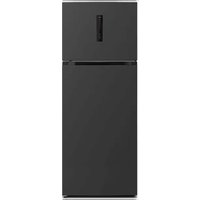
USER MANUAL UF3820NFW SABA
natural_image
Mechanical component with bracket and mounting bracket (no visible text or symbols)
ERF
natural_image
Close-up of a metallic electronic device with ports and connectors (no visible text or symbols)
natural_image
3D rendering of a black server cabinet with an open door (no text or symbols visible)
natural_image
Close-up of a metallic bracket or bracket joint (no visible text or symbols)
natural_image
Diagram showing a mechanical component before and after transformation, with no visible text or symbols
https://sav-client.conforama.fr
09 69 32 05 05
Thank you for choosing SABA quality. This product has been developed by our team of professional and according to European regulations. In order to get the most out of your new appliance, we recommend that you read this instruction manual carefully and keep it for future reference.
TABLE OF CONTENTS
GB
Safety instructions 47
Technical information. 53
Description of the device 54
Installation....55
Use 56
Reversing the door 70
Maintenance....76
Cleaning 78
Troubleshooting 80
Servicing 83
Temperature indicate 84
Accessories 85
Disposal. 85
Disposal of old electrical appliances 86
Safety instructions
To mitigate the risks associated with explosion, fire, fatalities, electric shock, personal injury, or scalding when using this product, it is imperative to adhere to fundamental safety measures, as outlined below.
- IMPORTANT SAFETY INSTRUCTIONS: READ CAREFULLY AND KEEP FOR FUTURE REFERENCE
- This appliance is intended to be used in household and similar applications such as:
- staff kitchen areas in shops, offices and other working environments.
- farm houses and by clients in hotels, motels and other residential type environments.
- bed and breakfast type environments.
- catering and similar non-retail applications.
- WARNING: Keep ventilation openings, in the appliance enclosure or in the built-in structure clear of obstruction.
- WARNING: Do not use mechanical devices or other means to accelerate the defrosting process, other than those recommended by the manufacturer.
-
WARNING: Do not damage the refrigerant circuit.
-
If the refrigerant circuit is damaged:
-Avoid naked flames and sources of ignition.
-Thoroughly ventilate the room in which the appliance is situated.
- WARNING: Do not use electrical appliances inside the food storage compartments of the appliance, unless they are of the type recommended by the manufacturer.
- Children aged from 3 to 8 years are allowed to load and unload refrigerating appliances.
- This appliance can be used by children aged from 8 years and above and persons with reduced physical, sensory or mental capabilities or lack of experience and knowledge if they have been given supervision or instruction concerning use of the appliance in a safe way and understand the hazards involved. Children shall not play with the appliance. Cleaning and user maintenance shall not be made by children without supervision.
- WARNING: When positioning the appliance, ensure the supply cord is not trapped or damaged.
-
If the supply cord is damaged, it must be replaced by the manufacturer, its service agent or similarly qualified persons in order to avoid a hazard.
-
WARNING: Do not locate multiple portable socket-outlets or portable power supplies at the appliance.
- Do not store explosive substances such as aerosol cans with a flammable propellant in this appliance.
- WARNING: Fill the ice-maker with potable water only.
- For information on the installation, handling, maintenance and disposal of the device, and the method of replacing the lamp, please refer to the following paragraphs of this manual.
- Gas warning: risk of fire /flammable materials
Please keep the product far away fire source during using, service and disposal. There are flammable materials at the back of the appliance. Please according to local regulations regarding disposal of the appliance for its flammable blowing gas, Before you scrap the appliance, please take off the doors to prevent children trapped.
- To avoid contamination of food, please respect the following instructions:
- Opening the door for long periods can cause a
significant increase of the temperature in the compartments of the appliance.
operations safely. Otherwise, please contact a qualified professional.
- Regarding the information pertaining to the installation, handling, servicing and disposal of the appliance, thanks to refer to the below paragraph of the manual.
- The refrigerating gas contained in the circuit of this appliance is isobutane (R600a); it causes a low level of pollution but is inflammable. Please contact your local disposal department for advice on the correct method of disposal.
- Please according to local regulations regarding disposal of the appliance for its flammable blowing gas. Before you scrap the appliance, please take off the doors to prevent children trapped.
- Calculation on the basis of results for 24 hours under standard test conditions. The actual energy consumption will depend on use and the location of the device.
- The technical data mentioned in the 'Specifications' are obtained in the case that the freezing drawers are removed.
Description of the device
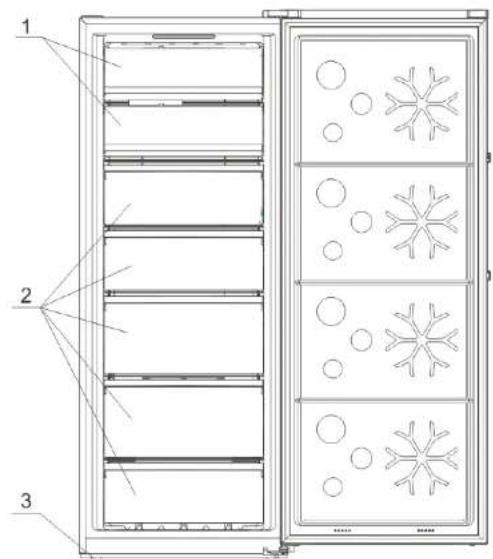
- Fr eezer drawer flap
- Freezer drawer
- Adjustable foot
NOTE: The appliance design is subject to change without prior notice.
Installation
Position the appliance and allow it to stand for two to three hours before it is turned on for the first time to allow the system to settle. Do not position next to any heat source e.g. cooker, boiler or in direct sunlight etc.
Allow at least 10cm of space at the top and 10 cm of space on both sides of the appliance and between the back of the appliance and the wall for adequate air circulation. The appliance is not designed for recessed installation ("building in").
Install on a good firm level surface, and any unevenness of the floor should be corrected prior to installation, slight unevenness can be overcome by adjusting the front feet.
NOTE: If the appliance is positioned on a carpet, soft floor covering you should readjust the front feet once the appliance has had time to settle.
Use
- This appliance is designed to operate in ambient temperature between 16°C and 38°C. If these temperatures are exceeded, i.e. colder or warmer, the appliance will not operate correctly. If the ambient temperatures are exceeded for long periods, the temperature in the freezer section will rise above -18°C and food spoilage may occur.
- Remove all packaging materials from the appliance. Wash the inside of the cabinet with lukewarm water and bicarbonate of soda (5ml to 0.5 liter of water). Dry the appliance thoroughly.
- When you use the freezer for the first time or after defrosting, set the thermostat control to the maximum position for at least 2 hours before introducing food to be stored, and then readjust to the normal position.
- If there is a power failure, do not open the door. Frozen food should not be affected if the failure lasts for less than 18 hours. If the failure is longer, then the food should be checked and either eaten immediately or cooked and then re-frozen.
START Testing
- Standing time
After the refrigerator is properly installed and well cleaned, do not switch it on immediately. Make sure to energize the refrigerator after more than 1 hour's standing, so as to ensure its normal operation.
2. Cleaning
Confirm the accessory parts inside the refrigerator and wipe the inside with a soft cloth.
3. Power-on
Insert the plug into the solid socket to start the compressor. After 1 hour, open the refrigerator door, if the temperature inside the refrigerator compartment drops obviously, it indicates the refrigeration system is working normally.
4. Storage of food
After the refrigerator runs for a period of time, the internal temperature of the refrigerator will be automatically controlled according to the user's temperature setting. After the refrigerator is fully cooled, put in foods, which usually need 2\~3 hours to be fully cooled. In summer, when the temperature is high, it takes more than 4 hours for the foods to be fully cooled (Try to open the refrigerator door as less as possible before the internal temperature cools down).
If the refrigerator is installed in the moisture place, make sure to check whether the ground wire and leakage circuit breaker are normal. If vibration noises are produced due to the refrigerator contacting the wall or if the wall gets blackened by air convection around the compressor, move the refrigerator away from the wall. Setting up the refrigerator may cause jamming noise or image chaos to the mobile phone, fixed-line telephone, radio receiver, television surrounding it, so try to keep the refrigerator as far away as possible in such case.
Functions
The display panel is illustrated as following:
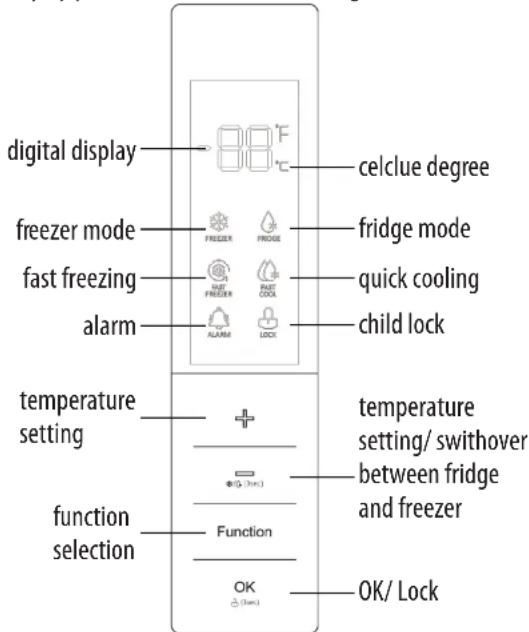
When the refrigerator system is connected to power supply for the first time, all icons on the display panel gets illuminated for 2s, and the system runs in the freezer mode at -18^ by default. When all the doors are close, the display gets extinguished automatically if no key operation within 3 minutes. When the display is off, it will light up if any door is opened or any key is
pressed.
The following key operations are valid only when the keys are unlocked and get illuminated on the display. (Refer to 1.6 for unlocking the keys)
1. Functions
1.1 Switchover between fridge/freezer modes
Press and hold the Temp. key for 3s, then switchover between the fridge mode and the freezer mode can be realized.
1.2Temp.Setting
Press '+' or '-' for the first time, with the icon of Tempflickering, and then press the '+' or '-' key again to adjust the temperature to desired value, finally press the OK key or wait for 5s to validate the above temperature setting.
Temperature setting ranges cycle as follows:
In the fridge mode: 2^ <-> 3^ <-> 4^ <-> 5^ <-> 6^ <-> 7^ <-> 8^ ;
In the freezer mode: -16^ <-> -17^ <-> -18^ <-> -19^
$$
< - > - 2 0 ^ {\circ} \mathrm{C} < - > - 2 1 ^ {\circ} \mathrm{C} < - > - 2 2 ^ {\circ} \mathrm{C} < - > - 2 3 ^ {\circ} \mathrm{C} < - > - 2 4 ^ {\circ} \mathrm{C};
$$
1.3 Fast Freezing
- When the Fast Freezing function is enabled, the compartment temperature will be controlled at -32^ C automatically, and after 26 hours of running, the Fast Freezing function gets exited. Cooling down the freezer temperature in a rapid manner is beneficial to the prevention of food nutrition against lost and the preservation of freshness.
⚠️ Under the Fast-Freezing mode, the freezer temperature is subjected to no adjustment.
The Fast-Freezing function can be enabled only in the freezer mode.
- Enabling the Fast Freeze function
- In the freezer mode, press the Function key to select Fast Freeze until the corresponding icon gets flickering, and then press the OK/Lock key within 5s for confirmation. If the OK/Lock key is not pressed within 5s, the setting will be invalidated.
- Exiting the Fast Freeze function
- "After a cumulative running period of 26 hours, the Fast Freeze function will exit automatically.
- Under the Fast Freeze mode, press the Function key to select Fast Freeze until the corresponding icon gets flickering, and then press the OK/Lock key for confirmation, the Fast Freeze function will get exited.
1.4 Quick Cooling
- When the Quick Cooling function is enabled, the compartment temperature will be controlled at 2^ C automatically. Cooling down the compartment temperature in a rapid manner is beneficial to the prevention of food nutrition against lost and the preservation of freshness.
⚠️ Under the Quick Cooling mode, the temperature is subject to no change.
The Quick-Cooling function can be enabled only in the fridge mode.
- Enabling the Q quick Cooling function
- In the fridge mode, press the Function key to select Quick Cooling until the corresponding icon gets flickering, and then press the OK/Lock key within 5s for confirmation. If the OK/Lock key is not pressed within 5s, the setting will be invalidated.
- Exiting the Quick Cooling function
- Under the Quick Cooling mode, press the Function key to select Quick Cooling until the corresponding icon gets flickering, and then press the OK/Lock key for confirmation, the Quick Cooling function will get exited.
1.5 Child Lock
- When the C hild Lock function is enabled, the temperature and function are subjected to no change to prevent maloperation.
- In case of no key operation within 3 minutes, the Child Lock function will be enabled automatically.
- Enabling/e xiting the Child Lock function manually
- Press and hold down the OK/Lock for 3s, then the Child Lock function can be enabled/ disabled.
1.6 Door open alarm
If any door is open for more than 3 minutes, buzzer alarms will be continuously issued, which can be stopped when any key is pressed, but will be restored after 3 minutes if the door keeps open. The alarms will not be lifted until the door is closed.
1.7 Power-cut memory
In case of power failure, the refrigerator will maintain the operating state before power failure when power supply is
restored.
1.8 Power-on delay
In order to protect the refrigerator compressor from being damaged in the case of short-time power failure (i.e., less than 5 minutes), the compressor will not be started immediately after it is powered on.
1.9 Over-temperature alarm (only after power outage)
When the refrigerator system is powered on, if it is set in the freezer mode and the compartment temperature is higher than -10^ , digits of temperature get flickering on the display. The temperature at which the system is energized can be displayed when any key is pressed, and the normal display will be restored when any key is pressed again or after 5s.
1.10 Fault alarm
In case E0, E1, E2, EH, or EC is displayed on the operation panel, it indicates fault with the refrigerator. Please contact the aftersales person for visiting service in such case.
Instructions for food storage
Precautions for use
- The appliance might not operate consistently (there is possibility of defrosting or temperature becoming too warm in the frozen food compartment) when sited for an extended period of time below the cold limit of the temperature range for which the refrigerating appliance is designed
- The information of climate type of the appliance is provided on the rating plate.
- The in ternal temperature could be affected by such factors as the location of refrigerating appliance, ambient temperature, and frequency of door open, etc., and if appropriate, a warning that setting of any temperature control device might have to be varied to allow for these factors should be made.
- Effervescent drinks should not be stored in the freezer compartment or the low-temperature compartment, and some products such as water ices should not be consumed too cold.
Food storage
In the fridge mode: It is suitable for the storage of such foods as need not to be frozen, the cooked food, beer, eggs, some condiments that need cold preservation, milk, fruit juice, etc. In the freezer mode, it is suitable for the storage of ice cream, frozen food and the foods to be preserved for a long time.
Fridge shelf: When removing the shelf, lift it up first, and then pull it out; and when installing the shelf, place it into position before putting it down.
Crisper box: Pull out the crisper box for access to food.
Cautions for food storage (in the fridge mode)
You'd better clean the foods and wipe them dry before storing them inside the refrigerator. Before foods are put in the refrigerator, it is advisable to seal them up, so as to prevent water evaporation to keep fresh fruits and vegetables on one hand, and prevent taint of odor on the other hand.
Do not put too many or too weight foods inside the refrigerator. Keep enough space between foods; if too close, the cold air flow
will be blocked, thus affecting the refrigeration effect. Do not store excessive or overweight foods, to avoid the shelf from being crushed. When storing the foods, keep a distance away from the inner wall; and do not place the water-rich foods too close to the fridge rear wall, lest they get frozen on the inner wall.
Categorized storage of foods: Foods should be stored by category, with the foods you eat every day placed in front of the shelf, so that the door open duration can be shortened and food spoilage due to expiration can be avoid.
In the freezer mode: These times vary depending on the type of food. The food that you freeze can be preserved from 1 to 12 (minimum at -18°C).
| Food | Storage time |
| Bacon, casseroles, milk | 1 month |
| Bread, ice cream, sausages, pies, prepared shellfish, oily fish | 2 months |
| Non-oily fish, shellfish, pizza, scones and muffins | 3 months |
| Ham, cakes, biscuits, beef and lamb chops, poultry pieces | 4 months |
| Butter, vegetables (blanched), eggs whole and yolks, cooked crayfish, minced meat (raw), pork (raw) | 6 months |
| Fruit (dry or in syrup), egg whites, beef (raw), whole chicken, lamb (raw), fruit cakes | 12 months |
In the fridge mode: Most pre-packed dairy foods have a recommended use by/best before/best by/date stamped on them. Store them in the fridge compartment and use within the recommended time.
| Food | Recommended storage temperature and time |
| Butter, cheese | Set appliance at +4°C, using it within 5 days |
| Eggs | Set appliance at +4°C, using it within 5 days |
| Fruit, vegetables, salad | Set appliance at +4°C, using it within 5 days |
| Meat, sausage, cheese, milk | Set appliance at +4°C, using it within 2 days |
| Dairy products, canned food, cans | Set appliance at +4°C, using it within 7 days |
| Drinks, bottles, tubes | Set appliance at +4°C, using it within 7 days |
Energy-saving tips: Allow the hot food cool down to the room temperature before putting it in the refrigerator. Put the frozen food in the fresh food compartment to thaw, using the low temperature of the frozen food to cool the fresh food, thus saving energy.
Storage of fruits and vegetables
In the case of refrigerating appliances with chill compartment, a statement to the effect that some types of fresh vegetables and fruits are sensitive to cold and therefore are not suitable for storage in this kind of compartment should be made.
In the freezer mode
The freezer temperature is controlled below -18^ , and it is advisable to store the food for long-term preservation in the freezer compartment, but the storage duration indicated on the food packaging should be adhered to.
The freezer drawers are used to store food that needs to be frozen. Fish and meat of large block size should be cut into small pieces and packed into fresh-keeping bags before they are evenly distributed inside the freezer drawers.
Fast freezing
- Refer to the description about fast freezing function in the "Function" section.
- Compared with the normal freezing, fast freezing enables food to pass through the maximum ice crystal formation zone at the fastest speed. Fast freezing can freeze the food water content into fine ice crystals, without damaging the cell membrane, so cell juice will not be lost when thawing, and the original freshness and nutrition of food can be maintained.
- The fast-freezing function is designed to preserve nutrition of the frozen food, with the food thoroughly frozen in the shortest time. Fast freezing consumes more energy than the normal freezing does.
- Allow the hot foods to cool down to the room temperature before putting them in the freezer compartment.
- Do not put a glass container with liquid or the canned liquid that is sealed in the freezer compartment, so as to avoid burst due to volume expansion after the liquid gets frozen up.
- Divide the food into appropriately small portions
- You 'd better pack the food up before freezing it, and the packing bag used should be dry, in case the packing bags are frozen together. Foods should be packed or covered by such suitable materials as are firm, tasteless, impervious to air and water, non-toxic and pollution-free, to avoid cross-contamination and transfer of odor.
- When you are buying frozen food, look at the Storage Guidelines on the packaging. You will be able to store each item of frozen food for the period shown against the star rating. This is usually the period stated as "Best to use them before×", found on the front of the packaging.
- Check the temperature of the frozen food cabinet in the shop where you buy the frozen foods.
- Make sure the frozen food package is in perfect condition.
- Always buy frozen products last on your shopping trip or visit to the supermarket.
- Try to keep frozen food together whilst shopping and on the journey home, as this will help to keep the food cooler.
- Don't buy frozen food unless you can freeze it straight away. Special insulated bags can be bought from most supermarkets and hardware shops. These keep the frozen foods cold longer.
- For some foods, thawing before cooking is unnecessary. Vegetables and pasta can be added directly to boiling water or steam cooked. Frozen sauces and soups can be put into a saucepan and heated gently until thawed.
- Use quality food and handle it as little as possible. When foods are frozen in small quantities, it will take less than for them to freeze up and thaw.
- Estimate the amount of foods to be frozen up. When freezing large amounts of fresh food, adjust the temperature control knob to the low mode, with the freezer temperature lowered. So, foods can be frozen up in fast manner, with the food freshness well kept.
Energy-saving tips
• Install the fridge or freezer in a cool place out of direct sunlight and away from cookers, heaters, dishwashers or any hot air emitting items.
- Do not set the fridge and freezer temperatures lower than necessary. Set the internal temperature within the correct range e.g. adjust the thermostat at middle position for 4^ in the fridge compartment and -18^ in the freezer respectively.
- Let pre-cooked foods cool down before placing them in the fridge or freezer. This will prevent the internal temperature of the fridge from rising.
- Keep your fridge full, but not over crowded, this helps reduce «cold» air loss. Meanwhile, avoid overloading the fridge or freezer. Try to leave about 20% free space for air circulation.
- To prevent cold air escaping, limit the frequency of opening door. When retuning from shopping, sort foods to be kept in your fridge before opening the door. Only open the door to put food in or take it out.
- Make sure the door seal is clean and in good condition. It should hold a piece of paper tightly in place when shut.
- Defr ost regularly or when ice is more than 5mm thick. Thick ice covering the inner sides significantly increases energy use.
- The combination of the drawers, baskets and shelves shown in the device description is optimal for efficient energy savings. Changing the combination proposition could alter the efficiency.
Reversing the door
To dismantle the refrigerator door
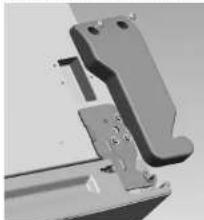
a. Use a tool to remove the screws from the upper hinge cover, remove the upper hinge, and install the communication wire into the hole on the top of the refrigerator.
natural_image
Mechanical component with bracket and mounting bracket (no visible text or symbols)
b. Screw off the three bolts on the upper hinge, remove the upper hinge, and pry off the upper hinge cover, door sleeve, magnet.
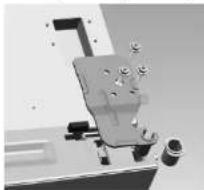
c. Put the door c ommunication wire into the hole on the door, and then cover it.
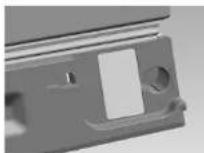
d. Remove the three bolts from the hinge cover on the left-side top of the refrigerator, remove the hinge cover, take out the wire harness in the hole, and install the door shaft sleeve.

natural_image
Close-up of a metallic door or bracket with mounting holes and a small attached component (no visible text or symbols)
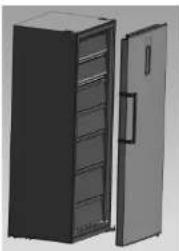
e. Lift the refrigerator door up by 50mm to remove the refrigerator door.
natural_image
Illustration of a black server cabinet with multiple shelves and an open door (no text or symbols)
f. Remove the left adjustable foot, screw off the screws which fixing the hinge, and then remove the hinge assembly.
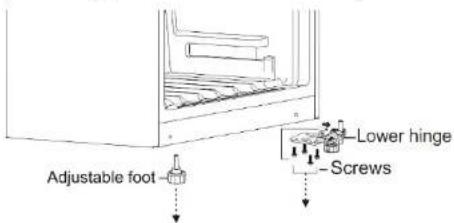
g. Relocate the door stopper and the lower hinge shaft to the left side of the hinge. Follow the steps below:
1) Remove the screw fixing the stopper with a cross screwdriver;
2) Remove the nut and washer fixing the hinge shaft with a wrench.
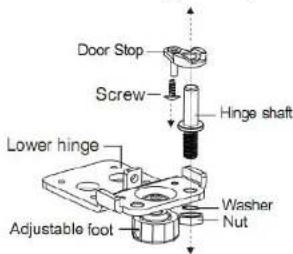
3) Put the hinge shaft into the hole on the left side of the lower hinge and fix it firmly with the removed nut and washer.
4) Align the door stopper hole with the hinge shaft, install them properly, and then fix the stopper with the removed screw.
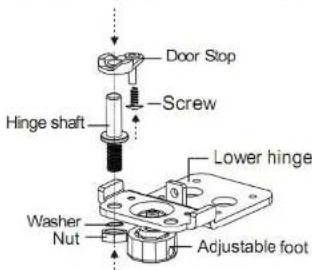
h. Install the adjusted lower hinge assembly to the left bottom side of the cabinet, and install the left adjustable foot to the right bottom side of the cabinet.
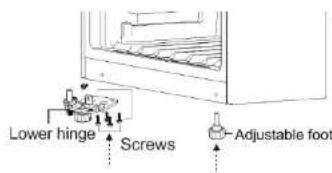
i. Remove the door stopper and door closer from the door, and install it on the left side of the door.
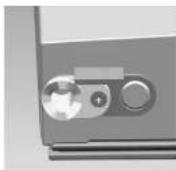
j. Install the door onto the door cabinet.
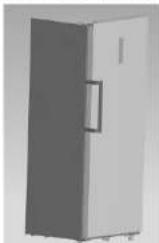
k. Take out the upper left hinge from the accessory bag, fix it into the door using bolts, and then connect the wire harness.
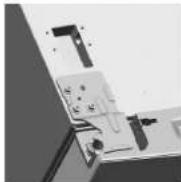
- Remove the upper left hinge cover, connect the wire harness, and install it on the cabinet.
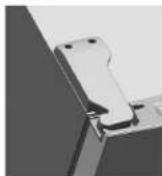
m. Remove the magnet from the door right side, and install it on the door left side.
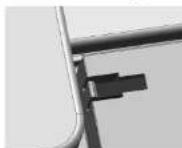
n. Remove the handle cover, screw off the screws fixing the handle, and remove the handle. Illustrated as below:

o. Install the handle on the other side of the door: rotate the handle by 180^ degrees vertically, and install it on the opposite side of the door, as shown by the figure:
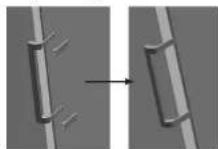
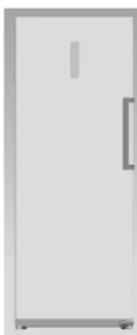
p. After the door handle is installed, the door reversing operation is finished.
natural_image
Front view of a plain white refrigerator with no visible text or symbols
- For installation of the door handle, please refer to the above Item.
Double check that the door is aligned correctly and all the seals are closed on all sides. If necessary, re-adjust the levelling feet.
NOTE: If you want to have the door swing reversed, we recommend that your contact a qualified technician. You should only try to reverse the door yourself if you believe that you are qualified to do so.
All parts removed must be saved to do the reinstallation of the door. You should rest the fridge freezer on something solid so that it will not slip during the door change process. Do not lay the fridge freezer flat as this may damage the coolant system. Ensure the fridge freezer is unplugged and empty. We recommend that 2 people handle the fridge freezer during assembly.
Maintenance
Noise from your appliance
You may notice some rather unusual noises. The noises are caused by circulation of refrigerant in the cooling system. It has become more pronounced since the introduction of CFC free gases. This is not a fault and will not affect the performance of your fridge.
Prolonged off periods
If the appliance is not in use for a long period of time, proceed as follows:
- Disconnect from the mains supply.
- Clean and dry the inside (see 'Cleaning and maintenance').
- Leave the door open to prevent any unpleasant smells from building up while the appliance is not in use.
Notes for use
- Do clean and defrost your appliance regularly.
- Do check contents of the compartments every so often.
- Do store commercially prepared food in accordance with the instructions given on the packets.
- Do choose high quality fresh food and be sure it is thoroughly clean before freezing it.
- Do wrap all food in food quality polythene bags or air tight containers and make sure any air is excluded.
-
Do Not store poisonous or any dangerous substances in your freezer. It is designed for the freezing of edible foodstuffs only.
-
Do N ot consume food which has been frozen for an excessive length of time.
- Do N ot leave the door open for long periods, as this will make the appliance more costly to run and cause excessive ice formation.
- Do N ot use sharp objects such as knives to remove the ice from the appliance. Only use a plastic scraper.
- Do N ot put hot food into the appliance. Let it cool down to room temperature.
- Do N ot put liquid-filled bottles or sealed cans containing carbonated liquids into the freezer as they may burst.
- Do N ot give children ice-cream and water ices direct from the freezer as the low temperature may cause 'freezer burns' on the lips.
- Do N ot try to keep frozen food which has thawed; it should be eaten within 24 hours or cooked and re-frozen
CHANGING THE LIGHT BULB
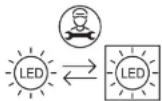
LED lighting source
Replaceable by professional
Warning: the LED light must not be replaced by the user. If the LED light is damaged, contact an authorized service representative for repairing.
The product contains a light source of energy efficiency class G.
Cleaning
- Unplug the appliance.
- Remove all substances.
- Clean the inside and outside walls with a clean sponge or soft cloth using warm water or 1 teaspoon of bicarbonate of soda to 1.2 liters of water.
- Rinse well and wipe dry with a clean soft cloth.
- If the appliance is not to be used for a long period of time then it is recommended to remove all the food stuff, clean the inside of the appliance and leave the door open to allow the air to circulate thus avoiding unpleasant odors.
- Dusts behind the refrigerator and on the ground shall be timely cleaned to improve the cooling effect and energy saving.
- The interior of the refrigerator should be cleaned regularly to avoid odor.
- Check the door gasket regularly to make sure there are no debris.
- Please turn off the power before cleaning, remove all food, shelves, drawers, etc.
-
Clean the door gasket with mild soap and water. Use a soft cloth or sponge to clean the inside of the refrigerator, with two tablespoons of baking soda and a quart of warm water. Then rinse with water and wipe clean, and open the door and dry it naturally before the power is turned on.
-
For ar eas that are difficult to clean in the refrigerator (such as gaps or corners), it is recommended to wipe them regularly with a soft rag, soft brush, etc. and when necessary, combined with some auxiliary tools (such as thin sticks) to ensure no contaminant accumulation in these areas.
- Do not use soap, detergent, scrub powder, spray cleaner, etc, as these may cause odors in the interior of the refrigerator.
- Clean the shelves and drawers with a mild detergent and dry with a soft cloth.
- Wipe the outer surface of the refrigerator with a soft cloth dampened with soapy water, detergent, etc, and then wipe dry.
- Do not use hard brushes, clean steel balls, wire brushes, abrasives, such as toothpastes, organic solvents (such as alcohol, acetone, banana oil, etc.), boiling water, acid or alkaline items clean refrigerator considering that this may damage the fridge surface and interior. Boiling water and benzene may deform or damage plastic parts.
- Do not rinse with water so as not to affect the electrical insulation properties.
- It is advisable to clean the appliance regularly and to remove any food deposits or splashes; in particular, clean the door seals, recesses and adjacent parts.
- Don 't overlook parts of the appliance such as the humidity controller, light casing, racks, egg and butter compartments, ice cube tray, and all of the drainage areas, etc.
- If the appliance is not kept clean and in good condition, its
surface could deteriorate and inexorably affect the length of its service life, and could lead to a dangerous situation.
• The appliance must not be steam cleaned.
- Use only a non-abrasive sponge, rinse with clean water then dry thoroughly before putting the parts back in place.
- Never use abrasive cleaning products or hard metal scrapers to clean the appliance, as they could scratch the surfaces and break down the coating.
• After cleaning, leave the inside of the appliance to dry with the door open before plugging it into the mains again.
- When re-stocking the appliance, be especially careful not to hit, scratch, crack or break the internal surfaces.
Troubleshooting
Before calling for service please check the following.
Power cut
If the internal temperature of the Fridge/Freezer compartment is -18^ or less when the power returns, your food is safe. The food in your Fridge/Freezer will remain frozen for approx 16 hours with the door closed. Do not open the Fridge/Freezer door more than necessary.
The Fridge/Freezer is exceptionally cold
You may have accidentally set the refrigerator temperature to a higher position.
The Fridge/Freezer is exceptionally warm
The compressor may not be working. Set the refrigerator temperature to maximum setting and wait a few minutes. If there is no humming noise, it is not working. Contact the local store where your purchase was made.
The Fridge/Freezer is not working
Check it is plugged in and switched on. Check that the fuse in the plug has not blown. Plug
In another appliance, such as a lamp, to see if the socket is working. The Fridge/Freezer should be placed in a well ventilated room with an ambient temperature of between 16°C and 38°C. Leave the Fridge/Freezer for 30 minutes
Condensation appears on the outside of the Fridge/Freezer
This may be due to a change in the room temperature. Wipe off any residue of moisture. If the problem continues contact the local store where your purchase was made.
GURGLING, WHOOSHING
These noises are caused by the circulation of the refrigerant liquid in the cooling system. It has become more pronounced since the introduction of CFC free gases. This is not a fault and will not affect the performance of your Fridge/Freezer.
HUMMING, PURRING OR PULSATING
This is the compressor motor working, as it pumps the refrigerant around the system.
Moving the Fridge/Freezer
Location
Do not place your Fridge/Freezer near a heat source, e.g. Cooker, boiler or radiator. Also avoid direct sunlight in out-buildings or sun lounges.
Leveling the Fridge/Freezer
Make sure the Fridge/Freezer is level. Use the rotating leveling feet at the ront. If the Fridge/Freezer is not level, the doors and magnetic seal alignments will be affected and may cause your Fridge/Freezer to work incorrectly.
Do not turn on the Fridge/Freezer for 4 hours
After the Fridge/Freezer is in place it needs to be left 4 hours.. This allows time for the coolant to settle.
Installation
Don't cover or block the vents or grilles of your appliance.
Vacation Time
- Turn off the refrigerator first and then unplug the unit from the wall outlet.
- Remove all the food.
- Clean the refrigerator.
- Leave the lid open slightly to avoid possible formation of condensation, mold, or odors.
- Use extreme caution in the case of children. The unit should not be accessible to child's play.
- Short vacations: Leave the refrigerator operation during vacations of less than three weeks.
- Long vacations: if the appliance will not be used for several months, remove all food an unplug the power cord. Clean and dry the interior thoroughly. To prevent odor and mold growth, leave the door open slightly: blocking it open if necessary or have the door removed.
Servicing
This product should be serviced by an authorized engineer and only genuine spare parts should be used.
Under no circumstances should you attempt to repair the appliance yourself.
Repairs carried out by inexperienced persons may cause injury or serious malfunctioning. Contact the local store where your purchase was made.
When the appliance is not in use for long periods, disconnect from the electricity supply, empty all foods and clean the appliance, leaving the door ajar to prevent unpleasant smells.
TEMPERATURE INDICATE
In order to help you get the correct adjustment of your device, it is equipped with a temperature gauge placed in the coldest area. For the proper storage of food in your refrigerator and in particular in the coldest area, make sure that «OK» appears in the temperature indicator.
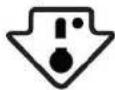

The symbol on the left side indicates the location of the coldest area of your refrigerator. It defines the height of this area.
If «OK» is not displayed, the average température in this area will be very high.
You ought to adjust the thermostat to a colder setting.
For every modification of your thermostat, you are supposed to wait for the stabilization of the temperature inside the unit before proceeding, if necessary, to a new setting. Do change the position of the thermostat gradually and wait at least 12 hours before re-checking.
NOTE: after charging the device for fresh food or after repeated or prolonged door openings, it is normal that the inscription «OK» does not appear in the temperature indicator. Wait at least 12 hours before readjusting the thermostat.
Accessories
Energy label
FR/ENG manual
Ice box
Hinge /Hinge Cover
OK label (When using the refrigeration function, attach the sticker to the side of the storage room at the top of the refrigerator's inner liner.)
GB
Disposal
The refrigerating gas contained in the circuit of this appliance is isobutene (R600a); it causes a low level of pollution but is inflammable. Please contact your local disposal department for advice on the correct method of disposal.
This instruction book is also available on our website: www.conforama.fr
Disposal of old electrical appliances

European directive 2012/19/EU on Waste from Electrical and Electronic Equipment (WEEE), requires that used household appliances are not thrown into the normal municipal waste stream. Used appliances must be collected separately in order to optimize the rate of recovery and recycling of materials that compose them, and to reduce the impact on human health and on the environment. The crossed bin symbol is affixed to all the products to remind you of the obligations of separated collection.
CE

SABA is a German brand born in 1923 in the heart of the black forest.
Pioneers in electrical equipment, it continues its search for quality by offering smart products that will accompany you on a daily life.
This product has been manufactured and sold under the responsibility of CONFORAMA FRANCE
SABA, and the SABA logo are trademarks used under license by CONFORAMA FRANCE – further information at www.saba-brand.com.
All other products, services, companies, trademarks, trade or product names and logos referenced herein are the property of their respective owners.
TECHNICAL SPECIFICATIONS
| General information cooling |
| Supplier's name or trademark:SABA |
| Supplier's access:BOULEVARD DU MANDIVET 80,77432 LOIGNES MARNE LA VALLEE (LOGAES),FR |
| Model identifier:UF3820NFW |
| Type of refrigerating appliance |
| Low-noise appliance | no | Design type: | freestanding |
| Wine storage appliance | no | Other refrigerating appliance: | yes |
| General product parameters: |
| Parameter | Value | Parameter | Value |
| Overal dimensions (millimetre) | Height | 1855 | Total volume (km3ou l) | 380 |
| Width | 710 |
| Depth | 770 |
| EEI | 100 | Energy efficiency class | E |
| Airborne acoustical noise emissions [dB(A)re1,p/N] | 39 | Airborn acoustical noise emission class | C |
| Annual energy consumption (kWh*e) | 262 | Climate class: | N.ST |
| Minimum ambient temperature [°C], for which the refrigerating appliance is suitable | 16 | Maximum ambient temperature (°C), for which the refrigerating appliance is suitable | 38 |
| Winter setting | no |
| Compartment Parameters: |
| Compartment type | Compartment parameters and values |
| Compartment Volume (km3or l) | Recommended temperature setting for optimiseofoodstorage(°C) These settings shall not contradict the storageconditionssetoutin Annex M, Table 3 | Freezing capacity (kg/24 N) | Defrosting type (auto-defrost = A, manual defrost = M) |
| Pantry | no | - | - | - | - |
| Vine storage | no | - | - | - | - |
| Cellar | no | - | - | - | - |
| Fresh food | no | - | - | - | - |
| Chill | no | - | - | - | - |
| Compartment type | Compartment parameters and values |
| Compartment Volume (dm3or l) | Recommended temperature setting for optimised food storage(°C) These settings shall not contradict the storage conditions set out in Annex IV, Table 3 | Freezing capacity (kg/24 h) | Defrosting type (auto-defrost = A, manual defrost=M) |
| 0-star or ice-making | no | - | - | - | - |
| 1-star no | | - | - | - | - |
| 2-star no | | - | - | - | - |
| 3-star no | | - | - | - | - |
| 4-star yes | | 380 -18 17,2 A | | | |
| 2-star section | no | - | - | - | - |
| Variable temperature compartment | no | - | - | - | - |
| For 4-star compartments |
| Fast freeze facility | Yes |
| Light source parameters: |
| Type of light source | LED |
| Energy efficiency class | Class G |
| Minimum duration of the guarantee offered by the manufacturer: 2 years |
| Additional information: N/A |
| Weblink to the manufacturer's website, where the information in point 4(a) Annex of Commission Regulation (EU) 2019/2019 is found: www.conforama.fr |
Flash the QR code on your appliance to access its main information.
Period of availability of repair spare parts: 10 years.
If you have any question, please contact our home appliances after-sales service before going to
Conforama store :
https://sav-client.conforama.fr
09 69 32 05 05