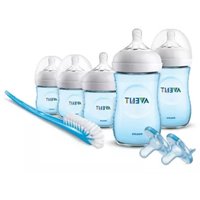
Avent SCD206 - Bottle PHILIPS - Free user manual and instructions
Find the device manual for free Avent SCD206 PHILIPS in PDF.


User questions about Avent SCD206 PHILIPS
0 question about this device. Answer the ones you know or ask your own.
Ask a new question about this device
Download the instructions for your Bottle in PDF format for free! Find your manual Avent SCD206 - PHILIPS and take your electronic device back in hand. On this page are published all the documents necessary for the use of your device. Avent SCD206 by PHILIPS.
USER MANUAL Avent SCD206 PHILIPS
natural_image
Woman smiling while gently holding a newborn baby, both smiling (no text or symbols visible)EN Instruction leaflet
www.philips.com/Avent
USA/ É.-U.A.: Manufactured for/ fabriqué pour: Philips Personal Health a division of/une division de Philips North America LLC, P.O. Box 10313. Stamford, CT 06904
Canada: Imported by/importé par Philips Electronics Ltd./ Philips Électronique Ltée 281 Hillmount Road, Markham, ON L6C 2S3
Warning!
-Always use this product with adult supervision.
- Never use feeding nipples as a pacifier, to prevent choking hazard.
-Continuous and prolonged sucking of fluids will cause tooth decay.
-Always check food temperature before feeding.
-It is not recommended to use a microwave to warm up baby's food or drinks. Microwaves might alter the quality of food/drinks and destroy some valuable nutrients and it may produce localized high temperatures. Therefore, take extra care if and when you heat up food in a microwave.
-When heating up liquid or food in the microwave, please only place the container without screw ring, nipple and cap. Always stir heated food to ensure even heat distribution and check the temperature before serving.
-Keep all components not in use out of the reach of children.
-Do not allow child to play with small parts or walk/run while using bottles or cups.
-Do not place in a heated oven.
-Drinks other than milk and water, such as fruit juices and flavored sugary drinks are not recommended. If used, they should be well diluted and only used for limited periods, not constantly sipped.
-Expressed breast milk can be stored in sterilized Philips Avent bottles/containers in the refrigerator for up to 48 hours (not in the door) or in the freezer for up to 3 months. Never refreeze breast milk or add fresh breast milk to already frozen milk.
-Always discard any breast milk that is left over at the end of a feed.
-Do not use abrasive cleaning agents or anti-bacterial cleaners. Do not place components directly on surfaces that have been cleaned with anti-bacterial cleaners.
-Plastic material properties may be affected by sterilizing and high temperatures. This can affect the fit of the cap.
-Inspect before each use and pull the feeding nipple in all directions. Throw away any part at the first signs of damage or weakness.
-Do not alter the product or parts of it in any way. This may result in unsafe functioning of the product.
Nipple
-For hygiene reasons, we recommend replacing nipples after 3 months.
-Keep nipples in a dry, covered container.
-Do not leave a feeding nipple in direct sunlight or heat, or leave in disinfectant ('sterilizing solution') for longer than recommended, as this may weaken the nipple.
Before first use
-Disassemble all parts, clean and sterilize the product by placing in boiling water for 5 minutes or sterilize by using a Philips Avent sterilizer. This is to ensure hygiene.
-During sterilizing with boiling water, prevent the cup or other parts from touching the side of the pan. This can cause irreversible product deformation, defect or damage that Philips cannot be held liable for.
Assembly
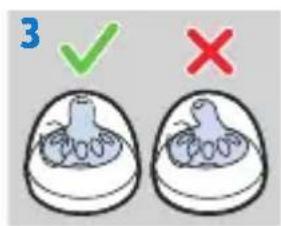
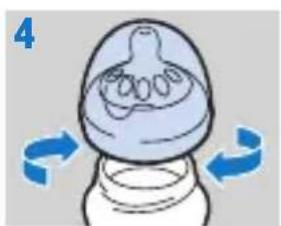
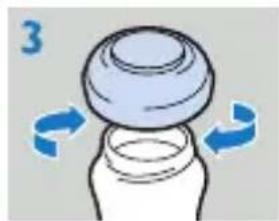
When you assemble the bottle, make sure you place the cap vertically onto the bottle so that the nipple sits upright (see image for more details). To remove the cap, place your hand over the cap and your thumb in the dimple of the cap. The nipple is easier to assemble if you wriggle it upwards instead of pulling
it up in a straight line. Make sure you pull the nipple through until its lower part is even with the screw ring.
Cleaning
-Clean all parts before each use.
-After every use, take all items apart, wash in warm soapy water and rinse thoroughly. Then sterilize using a Philips Avent sterilizer or boil for 5 minutes. Make sure that you wash your hands thoroughly and that the surfaces are clean before contact with sterilized components.
-Excessive concentration of detergents may eventually cause plastic components to crack. Should this occur, replace immediately.
-Dishwasher safe - food colorings may discolor components.
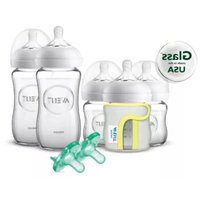
Glass natural bottle
Glass bottles may break. Do not use metal inside the bottle to stir contents or for cleaning. This can damage the glass on the inside of the bottle. Before each use, inspect bottles for sharp edges or glass fragments inside. Do not use bottles if there are any cracks on or glass fragments in the bottle. Do not let babies drink unsupervised with this bottle. Do not use handles with glass bottles. Prolonged wear or development of scratches may lead to breakage.
Choosing the right nipple for your baby
The Philips Avent nipples are available with different flow rates to help your baby with drinking. Over time you can change the nipple accommodating the individual needs of your baby. Philips Avent nipples are clearly numbered on the side to indicate flow rate (see image). Make sure you use a nipple with the correct flow rate when you feed your baby. Use a lower flow rate if your baby chokes, is leaking milk or has trouble adjusting to the drinking speed. Use a higher flow rate if your baby falls asleep during feeding, gets frustrated or when feeding takes a very long time.
These Philips Avent nipples can be used on the Natural Philips Avent feeding bottle and Philips Avent storage cups. Nipples are available for 0m, 0m+, 1m+, 3m+, 6m+ and variable flow (I/II/II).
(0)The nipple for 0m can be used from day one. Extra soft silicone nipple and it is the lowest flow rate available. Ideal for newborn and breastfed babies of all ages. The number 0 is shown on the nipple.
(1) The nipple for 0m+ has an extra soft silicone nipple. Ideal for newborn and breastfed babies of all ages. The number 1 is shown on the nipple.
(2) The nipple for 1m+ has an extra soft silicone nipple. Ideal for breastfed babies of all ages. The number 2 is shown on the nipple.
(3) The nipple for 3m+ has an extra soft silicone nipple. For bottle fed babies at 3 months of age and up. The number 3 is shown on the nipple.
(4) The nipple for 6m+ has a bite resistant silicone nipple. The sturdier nipple is ideal for bottle fed babies at 6 months of age and up. The number 4 is shown on the nipple.
(I/II/III) Variable flow: has a bite resistant silicone nipple. The sturdier nipple, with an adjustable flow rate to babies convenience is ideal for bottle fed babies at 3 months of age and up. The nipple has one slot cut on the top for fluid and the markings I, II, III on the edges of the nipple.
Note: Every baby is unique and your baby's individual needs may vary from the description of flow rates.
Compatibility
-Spare nipples are available separately. Make sure you use a nipple with the correct flow rate when you feed your baby (see ,Choosing the right nipple for your baby'). Also make sure to choose the correct nipple corresponding to the correct screw ring of your bottle: nipples from the Philips Anti-colic range only fit in screw rings of the Philips Anti-colic range, and Philips Natural nipples only fit in Philips Natural screw rings. To locate a retailer or purchase replacement bottles, nipples or any Philips Avent baby product see our website at www.philips.com/avent.
-When you use a Philips Avent sterilizer, please check on the website how to place the Natural bottle.
-The high quality plastic Natural bottle is compatible with most Philips Avent breast pumps, spouts, sealing discs and cup tops.
-The glass Natural bottle is compatible with Philips Avent breast pumps and sealing discs. For safety reasons, it is not recommended to use glass Natural bottles with handles, spouts and cup tops and spouts. If the bottle falls, it may break.
-For more information about the materials used for Philips bottles: www.philips.com/avent
Support
If you need information or support, please visit www.philips.com/support.
natural_image
Simple line drawing of a baby bottle with a lid and label (no text or symbols on the bottle itself)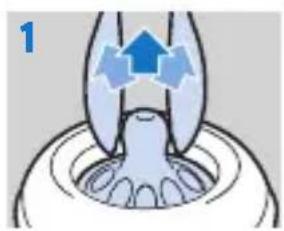
natural_image
Illustration of a biological structure with a blue arrow indicating a process or feature, no text or symbols present.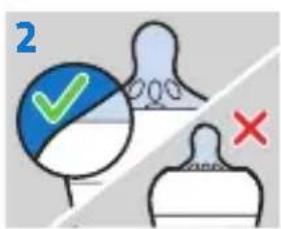
natural_image
Illustration of a baby bottle with a glass cap and blue arrows indicating rotation (no text or symbols)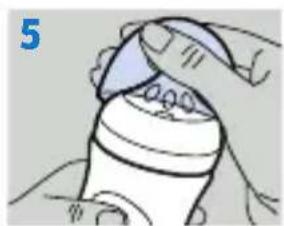
natural_image
Illustration of a hand holding a cup with a blue cap, partially covered by a white container (no text or symbols visible)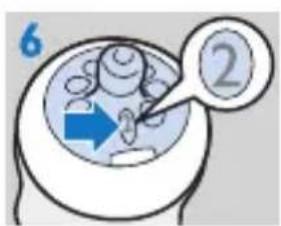
natural_image
Simple 3D illustration of a mushroom-shaped object with a blue upward arrow, no text or symbols present.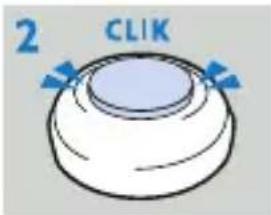
natural_image
Illustration of a bottle with a blue dome-shaped object and blue curved arrows indicating rotation (no text or symbols)Assistance
natural_image
Line drawing of a baby pump bottle with a lid and handle (no text or symbols)

Highly durable. Très durable.
IMPORTANT: Philips Avent
Soothies are available in sizes ranging from 0 to 18 months. For your child's safety, always follow age guidelines.
For your child's safety WARNING!
Inspect carefully before each use (especially when the child has teeth). Pull the pacifier in all directions. Throw away at the first signs of damage or weakness. Only use a pacifier holder that complies with local regulations. Never attach other ribbons or cords to a pacifier; your child may be strangled by them. Always use this product under adult supervision. Always make sure your baby uses the correct pacifier size. Before first use: Place the pacifier in boiling water for 5 minutes. Let it cool down and then squeeze any water out of the nipple. This is to ensure hygiene. Cleaning and sterilizing: Before each use, clean with warm water and mild soap. DO NOT use abrasive cleaning agents. Pacifiers are suitable for all commonly used forms of sterilization. Clean surfaces and your hands thoroughly before contact with sterilized pacifiers. Using: Replace the pacifier after 4 weeks of use, for safety and hygiene reasons. If pacifier becomes lodged in the mouth, DO NOT PANIC; it cannot be swallowed and is designed to cope with such an event. Remove from the mouth as carefully as possible. Never dip the nipple in sweet substances or medication; your child may get tooth decay. Storage: Do not leave a pacifier in direct sunlight or near a heat source, or leave in sterilizing solution for longer than recommended, as this may weaken the nipple. If you need information or support, please visit
www.philips.com/support.
1) All our Soothies have the same nipple shape and one-piece design, and come with a variety of shield shapes, including those distributed in US hospitals.
Meets CPSC safety requirements. Conforme aux normes de la CPSC.
Please check the nipple before use by pulling. Throw away at the first signs of damage or weakness. For safety and hygiene replace the pacifier after 4 weeks of use.