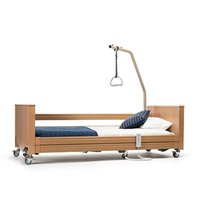
Club UL - Bed Vermeiren - Free user manual and instructions
Find the device manual for free Club UL Vermeiren in PDF.


| Product type | Electric medical bed |
| Brand | Vermeiren |
| Model | Club UL |
| Overall length | 2175 mm |
| Overall width | 1037 mm |
| Height without IV pole | 725 to 1135 mm |
| Height with IV pole | 1605 to 2015 mm |
| Total weight | 73.5 kg |
| Maximum patient weight | 165 kg |
| Maximum load capacity | 200 kg (patient + mattress + accessories) |
| Power supply | 230 V~, 50 Hz, 1.5 A |
| Output voltage | 24 VDC, 3.5 A |
| Protection class | II (double insulation) |
| Degree of protection | IPX4 (protected against water splashes) |
| Electric adjustments | Backrest, knee, height, anti-Trendelenburg position |
| Remote control | With key locking function |
| Brakes | 4 swivel casters with foot brake |
| Side rails | Optional (wood or metal depending on version) |
| Maintenance | Clean with damp cloth, disinfection by qualified personnel |
| Lifespan | 5 years (under normal maintenance) |
| Folded dimensions | 441 x 1037 x 1352 mm |
Frequently Asked Questions - Club UL Vermeiren
User questions about Club UL Vermeiren
0 question about this device. Answer the ones you know or ask your own.
Ask a new question about this device
Download the instructions for your Bed in PDF format for free! Find your manual Club UL - Vermeiren and take your electronic device back in hand. On this page are published all the documents necessary for the use of your device. Club UL by Vermeiren.
USER MANUAL Club UL Vermeiren
natural_image
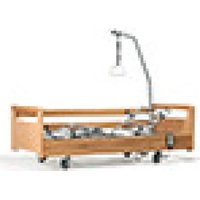
Modern mobile bed with metal frame, wooden pallets, and hanging chain (no text or symbols visible)Contents
EN
Preface
4
1. Your product 6
1.1. Options 6
2. Before use 7
2.1. Intended use 7
2.2. General safety instructions 8
2.3. Symbols on the nursing bed 9
3. Using your bed 10
3.1. Assembly/disassembly, transport and storage 10
3.2. Installation 10
3.3. Using the handset 11
3.4. Operating the brakes 12
3.5. Operating the side rails (optional) 13
3.6. Adjusting leg section manually (optional) 15
3.7. Moving to/from the bed 16
4. Maintenance
4.1. Time of maintenance 16
4.2. Maintenance instructions 18
4.3. Troubleshooting 18
4.4. Expected lifespan 19
4.5. Reuse 19
4.6. End of use 19
4.7. Warranty 19
5. Technical specifications
20
Preface
Congratulations! You are now owner of a Vermeiren nursing bed!
This nursing bed is made by qualified and committed personnel. It is designed and produced according to high quality standards guarded by Vermeiren.
Thank you for your trust in the products of Vermeiren. To support you on the use of this bed and its operating options, this manual is offered. Please read it carefully; it will help you to get familiar with the operation, capabilities and limitations of your bed.
If you still have questions after reading this manual, do not hesitate to contact your specialist dealer. He/she will be glad to help you.
Important note
To ensure your safety, and to prolong the lifetime of your product, please take good care of it and have it checked and serviced on a regular basis.
This manual reflects the latest product developments. Vermeiren has the right to implement changes to this type of product without any obligation to adapt or replace similar products previously delivered.
Pictures of the product are used to clarify the instructions. Details of the depicted product may deviate from your product.
Information available
On our website http://www.vermeiren.com/ you will always find the most recent version of the information in this manual. Please consult this website regularly for possible updates.
Visually impaired people can download the electronic version of this manual and have it read out by means of a text-to-speech software application.
 | User manualFor user and specialist dealer |
 | Installation instructionsFor specialist dealer |
 | Service manual for bedsFor specialist dealer |
 | EC declaration of conformity |
1. Your product
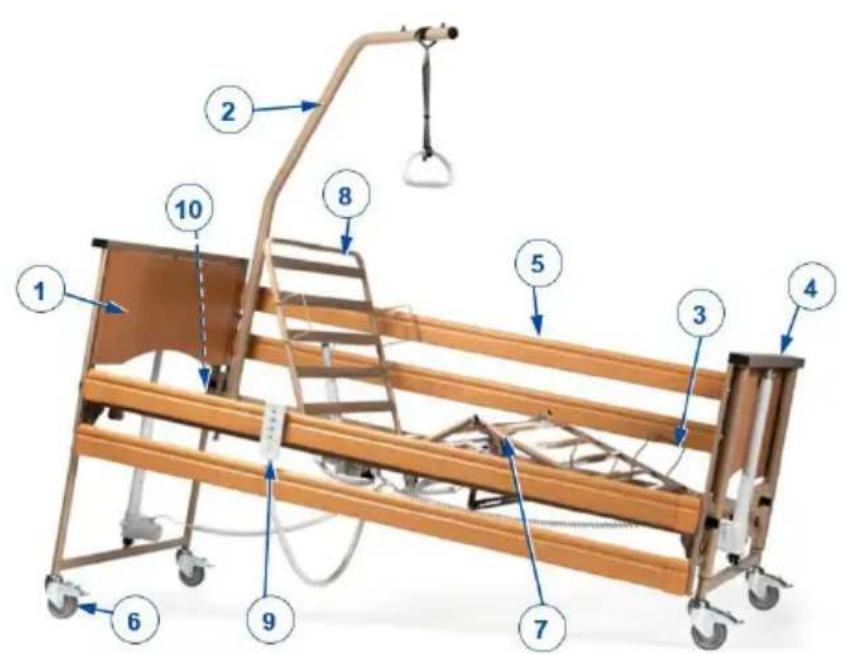
- Head panel
- Mattress retainer
- Foot panel
- Side rail (optional)
- Castor wheel with brake
- Foot section
- Head section
- Handset
-
Identification plate
-
Lifting pole / Trapeze handle (optional)
1.1. Options
Contact your specialist dealer about options. He will gladly advise you.
2. Before use
2.1. Intended use
In this paragraph a brief description of the intended use of your product is given. Additionally, relevant warnings are added to the instructions in the other paragraphs. In this way we would like to make you aware of the possible misuse that may appear.
• This product is a medical device.
- Indications and contraindications: The bed can be operated by the user, or by a caretaker. The nursing bed is suitable for a wide range of user profiles because of its range of functionalities. The high-low function ensures that caretakers can ergonomically treat patients. This function, combined with the self raising aid, is also intended for users who lack bodily strength and who need some support getting into or out of the bed. The side rails prevent restless sleepers from falling out of the bed. The bed functions for body position alterations can assist in the prevention of pressure ulcers for users who spend prolonged amounts of time in the bed.
- In some cases, users who are going through a revalidation process or users suffering from specific disorders should not use certain body position functions of the bed. Caretakers have the ability to lock specific functions on the handset in such cases.
- This nursing bed is classified as a Class II electrical product and is suitable for indoor use only.
- This nursing bed is designed and produced solely as resting place, to support one (1) person with a maximum weight of 165 kg.
- The nursing bed is designed for home-care use according to IEC 60601-2-52, application environment 4.
- This bed is designed for mattress dimensions as specified in chapter 5.. The bed can only be used with specialty mattresses, mattress overlays, or mattresses with deviating dimensions after an additional safety risk assessment has been done by a competent person.
- Only use accessories and spare parts approved by Vermeiren.
- The warranty on this product is based on normal use and maintenance as described in this manual. Damage to your product caused by improper use or lack of maintenance will cause the warranty to lapse.
2.2. General safety instructions
AWARNING
Risk of injuries and damage
- Do not make any modifications to the bed without the approval of the manufacturer.
CAUTION
Risk of injuries and/or damage
- Follow the instructions in this manual and observe the safety directives. If not, you or bystanders may get injured, or your nursing bed may get damaged.
Keep the following general warnings in mind during use:
• Use the bed only on flat, level, solid floors with all four wheels touching the ground.
- When the patient is left unattended in the bed, leave the bed in the lowest possible position and/or raise the side rails.
- Do not exceed the maximum load as stated in chapter 5..
- Do NOT use the bed as a means of transport, ladder, or storage for heavy or hot objects.
- The manufacturer is not liable for damage caused by the lack of or improper service, or as a result of not following instructions from this manual.
- Your bed has been tested on electromagnetic compatibility and complies to the standard. Despite this compatibility is it possible that the operation performance is influenced by electromagnetic fields like those of cell phones, power generators of high power energy sources.
- It is possible that the electronics of the bed influences other electronic devices. For this reason, it is advised to check your bed on damage or wear, see chapter 4..
- Do not add any mechanical or electrical devices to the bed.
- Make sure that during the operation of the bed, no objects or cables get entrapped between the moving parts of the bed. Make sure that the power supply cord does not get damaged by moving parts or sharp edges, or by being squished under the wheels.
Any serious incident [MDR (EU) 2017/745 §2 (65)] that has occurred in relation to the device should be reported to the manufacturer and the competent authority of the Member State in which the user and/or patient is established.
2.3. Symbols on the nursing bed
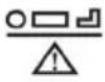 | Maximum weight of the user in kg |
 | Safe working load |
 | Maximum mattress thickness (in mm) |
 | Mattress dimensions (in cm) |
 | Type designation |
 | Catalogue number |
 | Serial number |
 | Medical device |
 | Declaration of conformity |
 | Manufacturer |
 | Date of manufacture |
 | Attention: important information |
 | Risk of entrapment |
 | It is advised to read the manual |
3. Using your bed
3.1. Assembly/disassembly, transport and storage
The bed will be assembled by your specialist dealer according to the instructions in the installation manual.
For transport, all parts are collected on a transport trolley. Attach the transport trolley and bed parts firmly to the vehicle, so they won't move during transport.
If not in use, store the bed at a dry location, see chapter 5. for the details.
3.2. Installation
CAUTION
Risk of injuries and damage
• Make sure that the bed is moved without any person in it.
- If not yet assembled, assemble the bed according to the instructions in the installation manual.
- If the bed is in use, make sure that all covers and sheets are within the side rails.
- Unplug the power cable from the socket and place the cable end on the bed.
- Release all brakes of the castor wheels, see §3.4..
- Roll the empty bed in place.
- When in position, apply the four brakes, see §3.4..
- Connect the power cable of the bed to the 220/230V AC power socket.
3.3. Using the handset
CAUTION
Risk of injuries
- To ensure safe operation of the bed, changing the operation mode using the key is ONLY allowed by authorised medical personnel.
The bed is delivered with a handset to operate the moveable parts of the bed. The handset has two operation modes: normal patient operation, and operation by authorized and trained medical staff. In the latter operation mode, the handset is only accessible by a key to be operated by trained medical personnel.
3.3.1. Use by the patient
i Some of the buttons might not respond when you press them. If this is the case, they are locked to be used only by medical staff according to your medical condition.
The following buttons can be used on the handset. Press and hold one of the buttons until the desired position is reached. To stop the movement, release the button.
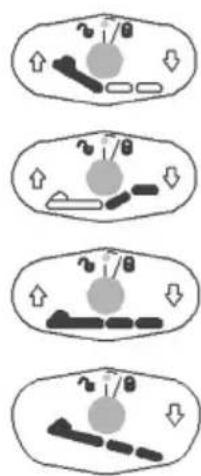
Back section UP / DOWN
Leg section UP / DOWN
Mattress support UP / DOWN
Anti-trendelenburg
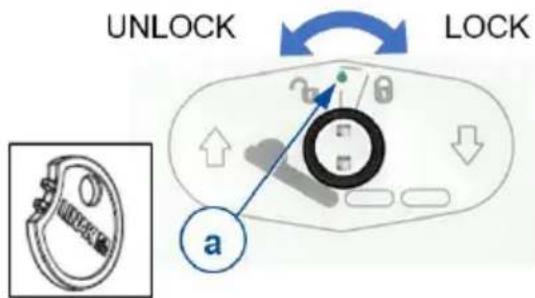
3.3.2. Lock function (for medical personnel only)
To prevent unintentional movements by the patient, buttons on the handset can be locked using a key.
To lock/unlock, the small dial between two buttons needs to be turned with help of the key.
Indicator (a) in the middle of the key turns
- green when the button is unlocked;
• yellow when the button is locked.
3.4. Operating the brakes
CAUTION
Risk of injuries
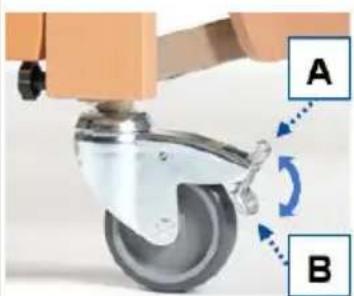
- All four castor wheels must be locked before using the nursing bed. If only one brake is applied, the bed can still move.
The brakes on all castors can be locked to prevent involuntary rolling.
3.4.1. Releasing the brakes (A)
Use your foot to press the top of the brake lever backwards.
3.4.2. Activating the brakes (B)
Use your foot to press the brake lever down towards the castor wheel.
natural_image
Close-up of a mechanical device with labeled parts A and B, showing a wheel and handle mechanism (no text or symbols beyond labels)3.5. Operating the side rails (optional)
3.5.1. Wooden side rails
CAUTION
Risk of injuries
• Make sure that the bed's functions are not impaired when raising or lowering the side rails.
- For Club Vario: The position of the raised side rails depends on the position of the mattress support platform. When the platform is secured in the highest position, the side rails should also be raised to the highest position.
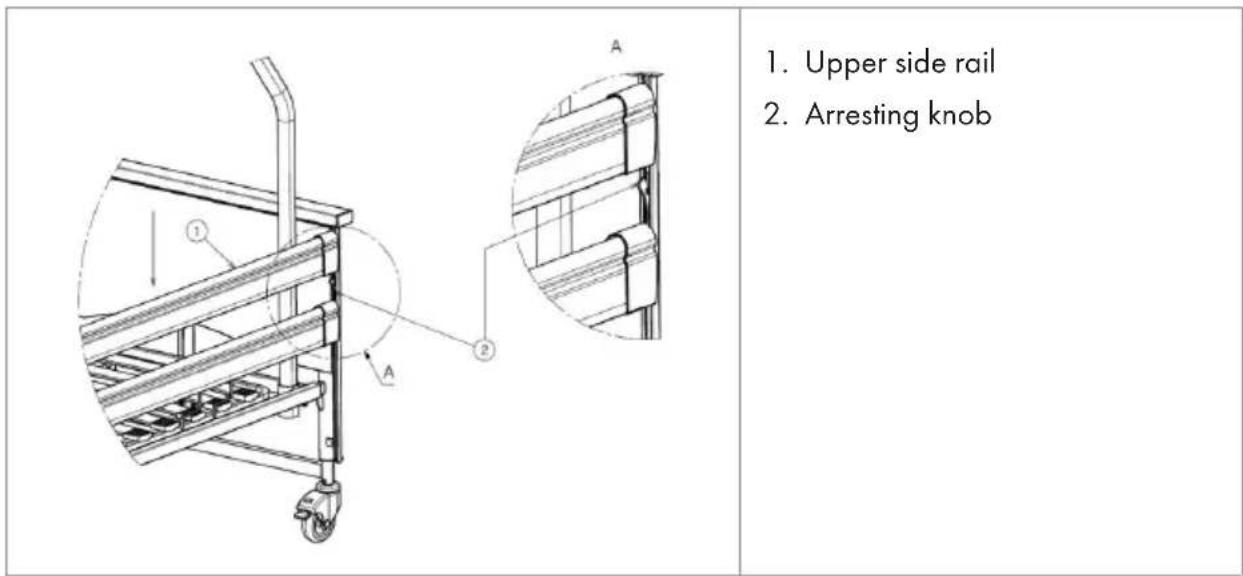
To lower the side rails:
- Raise the upper side slat gently.
- Press and hold the arresting knob on the guide of the side rail.
- Lower the side rails gently. Always take hold of the upper wooden slat only.
To raise the side rails:
- Pull the upper rail up until it is locked.
- For Club Vario with mattress support platform in highest position: Press the arresting knob and pull the upper slat further upwards until it is locked in the highest position.
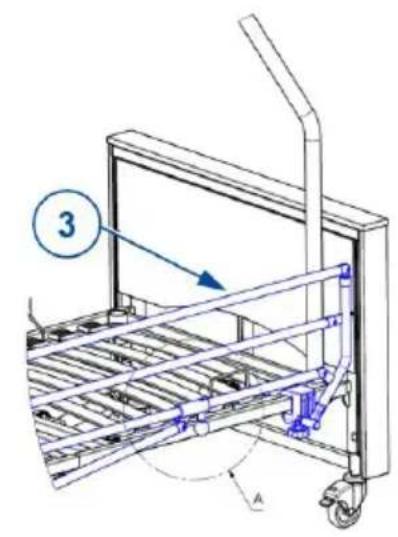
3.5.2. Metal side rails (not for Club UL)
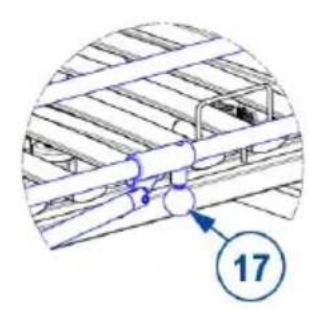
- Fold the side rail (3): pull the black, spherical knob (17) to unlock the side rail and fold the rail down.
• Unfold the side rail (3): pull the rail up until it is locked.
natural_image
Technical line drawing of a mechanical assembly with no visible text or symbols3.5.3. Split side rails (not for Club UL)
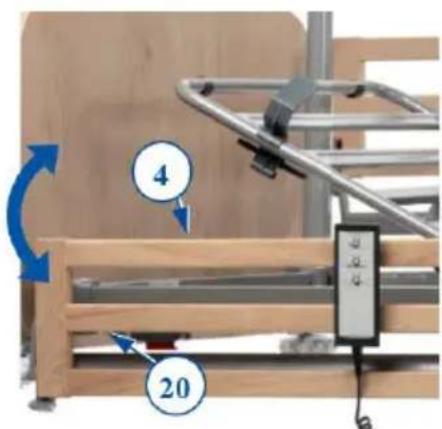
- Fold the side rail (4): pull the knob (20) to unlock the side rail and fold the rail down. If necessary, repeat for the second split side rail on the same side.
• Unfold the side rail (4): pull the rail up until it is locked.
3.6. Adjusting leg section manually (optional)
EN
CAUTION
Risk of injury by entrapment or damage to the bed
• Make sure that no bystanders or objects get trapped between the moving parts.
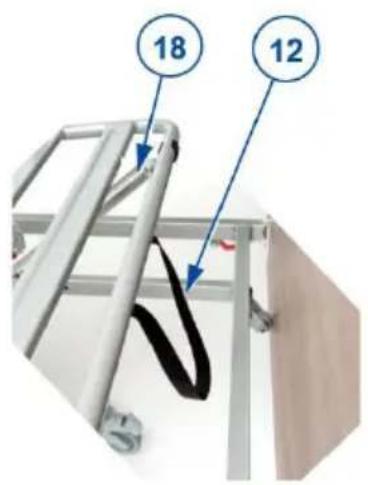
• Only use strap (12) at the foot end to adjust the height of the leg section.
3.6.1. Raising legs/feet
- To adjust the height of feet and legs, grip the strap at the food end of the bed.
- Pull the strap up to raise the leg section of the mattress support to the desired height. When you stop pulling, the system stays locked at a notch of rastomat (18).
3.6.2. Lowering legs/feet
- To lower, pull the strap to the highest position to unlock rastomat (18).
- Hold the strap and move the leg section slowly down.
3.7. Moving to/from the bed
CAUTION
Risk of falling
• In case you cannot perform the transfer in a safe manner, ask someone to assist you.
3.7.1. Going to bed
- Check whether the brakes of the castor wheels are applied, see §3.4.
- Adjust the height of the bed with the handset, see §3.3..
- Lower the side rail, see §3.5..
- Position yourself as close as possible to the side of the bed.
- Transfer to the bed. Use the lifting pole with trapeze handle to help move yourself on the bed.
- Raise the side rail, see §3.5..
3.7.2. Getting up from the bed
- Using the handset, adjust the bed to the easiest position for transfer out of the bed:
• Lower the lower leg section, see §3.3. or §3.6..
• Lower the side rail, see §3.5..
- Adjust the height of the bed to a low position with the handset; see §3.3..
2. Turn yourself to sitting position with your legs outside the bed. Use the lifting pole with trapeze handle to help move yourself from the bed.
4. Maintenance
Your nursing bed requires minimum maintenance, but it is advisable to inspect the nursing bed regularly in order to keep it trouble-free for years.
4.1. Time of maintenance
CAUTION
Risk of injuries and damage
- Repairs and replacements may only be undertaken by trained persons and only genuine replacement parts of Vermeiren should be used.
The last page of this manual contains a registration form for the specialist dealer to record each service.
The service frequency depends on the frequency and intensity of use. Contact your dealer to agree to a common timetable for inspection/maintenance/repair.
To find a service facility or specialist dealer near you, contact the nearest Vermeiren company division.
4.1.1. Once a year / for every new user
This nursing bed needs to be serviced and disinfected before passing on to a new user, but at least once a year. Contact your specialist dealer for more information.
4.1.2. Every month
Visually inspect the following points regularly:
- Castor wheels: free of wires, hair, sand and carpet fibres.
- Brakes: functioning well. If the bed can be moved while the brakes are applied, you should check wheels and brakes for wear, damage or contamination like oil, water ...
- Handset, motors, connection points and cables: no damage such as wires that have become frayed, broken or exposed.
- All parts: Present and undamaged or unworn.
Contact your specialist dealer for possible repairs or part replacements.
4.1.3. If stored
Make sure that the bed is stored dry to prevent mould or rust, see details in chapter 5..
4.2. Maintenance instructions
4.2.1. Cleaning
CAUTION
Risk of damage by moisture
- Keep handset, motors and connection points clean and protect them from moisture.
- Keep the operating console clean and protect it from water and rain.
- Never use a hose or high-pressure cleaner to clean the bed.
Wipe all rigid parts of the bed with a damp cloth (not drenched). If necessary, use a mild soap, suitable for varnishes and synthetics.
The upholstery can be cleaned with lukewarm water and a mild soap. Do not use abrasive cleaning agents to clean.
4.2.2. Disinfection
CAUTION
Risk of damage
• Disinfections may only be undertaken by trained persons. Consult your specialist dealer.
Use a soft, damp cloth and lukewarm water with a mild household disinfectant to clean the bed.
4.3. Troubleshooting
Even if you use your nursing bed properly, a technical problem may occur. In this case, contact your local specialist dealer.
CAUTION
Risk of injuries and damage
• NEVER repair your nursing bed yourself attempting to solve the problem.
The following symptoms may indicate a serious problem. Therefore always contact your specialist dealer if you spot any of the following deviations:
- Strange sound;
- Frayed/damaged power cables;
- Cracked or broken connectors;
- Jerky movements of frame sections;
• Damaged or broken castor wheels;
• Nursing bed is powered, but the handset does not work.
4.4. Expected lifespan
The average lifespan of your bed is 5 years. Depending on the frequency of use and maintenance, the lifespan of your bed will increase or decrease.
4.5. Reuse
Before each reuse, have the bed disinfected, inspected and serviced according to the instructions in §4.1. and §4.2..
4.6. End of use
At end of life, you need to dispose your nursing bed according to the local environmental legislation. The best way to do so, is to disassemble the nursing bed to facilitate the transport of recyclable parts.
4.7. Warranty
The warranty on this product is subject to the general terms and conditions of each country.
5. Technical specifications
The technical details below are only valid for this nursing bed, at standard settings and optimal ambient conditions. Take these details into account during use. The values are no longer applicable if your nursing bed has been modified, damaged or suffers from severe wear.
| Brand Vermeiren | ||
| Product group Bed | ||
| Type Club | ||
| Description Min. dimensions Max. dimensions | ||
| Maximum occupant mass 165 kg | ||
| Overall length Club: 2125 mm | Club VARIO, Club UL: 2175 mm | |
| Overall width Club: 1005 mm | Club VARIO, Club UL: 1037 mm | |
| Overall height (without lifting pole) | Club, Club VARIO: 834 - 1262 mmClub UL: 725 - 1135 mm | |
| Overall height (with lifting pole) | Club, Club VARIO: 1710 - 2120 mmClub UL: 1605 - 2015 mm | |
| Height adjustment of the bed surface (position 1) | Club: 350 mm (without mattress)Club VARIO: 335 mm (without mattress)Club UL: 215 mm | Club: 760 mm (without mattress)Club VARIO: 745 mm (without mattress)Club UL: 625 mm |
| Height adjustment of the bed surface (position 2) | Club VARIO: 400 mm (without mattress) | Club VARIO: 810 mm (without mattress) |
| Folded length 441 mm | ||
| Folded width | 1037 mm | |
| Folded height 1352 mm | ||
| Total mass | Club: 60,8 kgClub VARIO: 62 kgClub UL: 73,5 kg | |
| Max. backrest adjustment | 69° | |
| Max. thigh adjustment | 20,7° | |
| We reserve the right to introduce technical changes. Measurement tolerance +- 15 mm / 1,5 kg / 1,5°* Measured according to IEC 60601-2-52, with a horizontal reference plane, possibly in combination with anti-Trendelenburg position** Max. safe working load = mass user weight + mass mattress + mass other accessories | ||
| Max. lower leg adjustment -16,5° | ||
| Anti-Trendelenburg angle 10,6° | ||
| Max. backrest angle* 80,5° | ||
| Max. thigh angle* 20,7° | ||
| Max. lower leg angle* -28,5° | ||
| Max. safe working load ** 200 kg | ||
| Nominal load of lifting pole 80 kg | ||
| Mattress Min. RG 35, thickness 120 mm, 2000 x 900 mm, max. 20 kg | ||
| Under clearance for patient lift | Club, Club Vario: 150 mmClub UL: 30 mm | |
| Steering castors (4 pieces) | ∅ 100 mm, can be locked | |
| Front part motor | LA24090405E001B4, Linak | |
| Back section motor | LA24050110G00134, Linak | |
| Leg section motor | LA24060060G001B4, Linak | |
| Handset | HLW074-029, Linak | |
| Transformer | CA2+06473N090A0, Linak | |
| Nominal voltage, transformer | U input: 230 V~, ± 10%, 50 Hz, current: max. 1.5 A, output voltage: 24V, 3,5 A | |
| Period switched on | 10%, max. 2 min / 18min | |
| Noise level | < 65 dB(A) | |
| Class / Kind of protection | Protection class II, application part Type B / IPX4 (spray protection) | |
| Storage and use temperature | +5°C - +41°C | |
| Storage and use humidity 30% - 70% | ||
| We reserve the right to introduce technical changes. Measurement tolerance +- 15 mm / 1,5 kg / 1,5°* Measured according to IEC 60601-2-52, with a horizontal reference plane, possibly in combination with anti-Trendelenburg position** Max. safe working load = mass user weight + mass mattress + mass other accessories | ||
EN
Table des matières
Préface
23
1. Votre produit 25
1.1. Options 25
natural_image
Close-up of a mechanical device with labeled parts A and B, showing a wheel and handle mechanism (no text or symbols beyond labels)natural_image
Technical line drawing of a mechanical assembly with no visible text or symbolsnatural_image
Close-up of a mechanical device with labeled parts A and B, showing a wheel and handle mechanism (no text or symbols beyond labels)3.5. De onrusthekken bedienen (optioneel)
natural_image
Technical line drawing of a mechanical assembly with no visible text or symbolsnatural_image
Close-up of a mechanical device with labeled parts A and B, showing a wheel and handle mechanism (no text or symbols beyond labels)natural_image
Technical line drawing of a mechanical assembly with no visible text or symbolsnatural_image
Close-up of a mechanical device with labeled parts A and B, showing a wheel and handle mechanism (no text or symbols beyond labels)3.5. Barre laterali (facoltativo)
natural_image
Close-up of a mechanical device with labeled parts A and B, showing a wheel and handle mechanism (no text or symbols beyond labels)natural_image
Technical line drawing of a metal shelving unit with a numbered annotation (17) pointing to a circular detail (no text or symbols on the diagram itself)natural_image
Close-up of a mechanical device with labeled parts A and B, showing a wheel and handle mechanism (no text or symbols beyond labels)natural_image
Technical line drawing of a mechanical assembly with no visible text or symbols3.4. Ovládání brzd
POZOR
Riziko zranění
natural_image
Close-up of a mechanical device with labeled parts A and B, showing a wheel and handle mechanism (no text or symbols beyond labels)3.5. Manipulace s postranicemi (volitelné)
natural_image
Technical line drawing of a mechanical assembly with no visible text or symbolsService registration form
This product (name): ....
was inspected (I), serviced (S), repaired (R) or disinfected (D):
| By (stamp):Kind of work: I / S / R / DDate: | By (stamp):Kind of work: I / S / R / DDate: | By (stamp):Kind of work: I / S / R / DDate: |
| By (stamp):Kind of work: I / S / R / DDate: | By (stamp):Kind of work: I / S / R / DDate: | By (stamp):Kind of work: I / S / R / DDate: |
| By (stamp):Kind of work: I / S / R / DDate: | By (stamp):Kind of work: I / S / R / DDate: | By (stamp):Kind of week: I / S / R / DDate: |
| By (stamp):Kind of work: I / S / R / DDate: | By (stamp):Kind of work: I / S / R / DDate: | By (stamp):Kind of work: I / S / R / DDate: |
| By (stamp):Kind of work: I / S / R / DDate: | By (stamp):Kind of work: I / S /R / DDate: | By (stamp):Kind of work: I / S / R / DDate: |
| By (stamp):Kind of work: I / S / R / DDate: | By (stamp):Kind of work: I / S / R / DDate: | By (stamp):Kind of work: I / S / R / DDate: |

VERMEIREN GROUP
Vermeirenplein 1/15
2920 Kalmthout
Belgium
www.vermeiren.com
Version: C, 2024-10
Basic UDI-DI: 5415174Club99
All rights reserved, including translation.
- Contents
- Preface
- Your product 6
- Before use 7
- Using your bed 10
- Maintenance
- Technical specifications
- Important note
- Information available
- Your product
- Options
- Before use
- Intended use
- General safety instructions
- AWARNING
- Risk of injuries and damage
- CAUTION
- Risk of injuries and/or damage
- Symbols on the nursing bed
- Using your bed
- Assembly/disassembly, transport and storage
- Installation
- Using the handset
- Risk of injuries
- Use by the patient
- Lock function (for medical personnel only)
- Operating the brakes
- Releasing the brakes (A)
- Activating the brakes (B)
- Operating the side rails (optional)
- Wooden side rails
- Metal side rails (not for Club UL)
- Split side rails (not for Club UL)
- Adjusting leg section manually (optional)
- Risk of injury by entrapment or damage to the bed
- Raising legs/feet
- Lowering legs/feet
- Moving to/from the bed
- Risk of falling
- Going to bed
- Getting up from the bed
- Time of maintenance
- Once a year / for every new user
- Every month
- If stored
- Maintenance instructions
- Cleaning
- Risk of damage by moisture
- Disinfection
- Risk of damage
- Troubleshooting
- Expected lifespan
- Reuse
- End of use
- Warranty
- Table des matières
- Préface
- Votre produit 25
- De onrusthekken bedienen (optioneel)
- Barre laterali (facoltativo)
- Ovládání brzd
- POZOR
- Riziko zranění
- Manipulace s postranicemi (volitelné)
- Service registration form
Brand : Vermeiren
Model : Club UL
Category : Bed