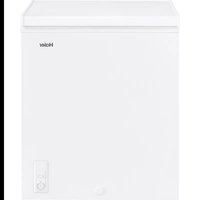
HF50CW20W - Freezer HAIER - Free user manual and instructions
Find the device manual for free HF50CW20W HAIER in PDF.


| Product Type | Upright Freezer |
| Brand | Haier |
| Model | HF50CW20W |
| Power Supply | 115 V ~ 60 Hz, 15-20 A |
| Refrigerant | R600a (isobutane) – flammable |
| Temperature Setting | 7 positions (1 to 7) + OFF |
| Power Indicator Light | Green |
| Basket | 1 sliding metal basket with vinyl coating |
| Drain Plug | Interior and exterior for defrosting |
| Defrosting | Manual, recommended every 6 months or 1/4 in (6 mm) of frost |
| Interior Cleaning | Hot water and baking soda solution (15 ml per liter) |
| Installation – Clearances | Side and rear min. 2 in (50.8 mm) |
| Ambient Temperature | 0 °F to 110 °F (-18 °C to 43 °C) |
| Grounding | Required, 3-prong outlet |
| Safety | Do not use extension cord, do not block vents |
| Warranty | 12 months parts and labor |
| Customer Service (USA) | 1-877-337-3639 |
| Customer Service (Canada) | 1-877-470-9174 |
| Control Type | Rotary knob |
| Lid Opening | Manual, adjustable hinges |
Frequently Asked Questions - HF50CW20W HAIER
User questions about HF50CW20W HAIER
0 question about this device. Answer the ones you know or ask your own.
Ask a new question about this device
Download the instructions for your Freezer in PDF format for free! Find your manual HF50CW20W - HAIER and take your electronic device back in hand. On this page are published all the documents necessary for the use of your device. HF50CW20W by HAIER.
USER MANUAL HF50CW20W HAIER
Defrosting Instructions 8
CARE AND CLEANING 9
INSTALLATION 10
TROUBLESHOOTING 11
Normal Operating Sounds You May Hear 12
LIMITED WARRANTY 13
CONSUMER SUPPORT 14
RECORD KEEPING
Thank you for purchasing this Haier product. This user manual will help you get the best performance from your new freezer.
For future reference, record the model number, serial number, and the date of purchase. The model/serial number plate is located on the inside wall of the freezer.
Staple your proof of purchase to this manual to aid in obtaining warranty service if needed.
Model number
Serial number
Date of purchase
IMPORTANT SAFETY INSTRUCTIONS
WARNING
To reduce the risk of fire, explosion, electric shock, or injury when using your freezer, follow these basic safety precautions:
- This freezer must be properly installed and located in accordance with the Installation Instructions before it is used.
- Unplug the freezer before making repairs or cleaning. NOTE: Power to the freezer cannot be disconnected by any setting on the control panel. NOTE: Repairs must be performed by a qualified Service Professional.
- Replace all parts and panels before operating.
- Do not store or use gasoline or other flammable vapors and liquids in the vicinity of this or any other appliance.
- Do not store explosive substances such as aerosol cans with a flammable propellant in this appliance.
-
Do not use an extension cord.
-
To prevent suffocation and entrapment hazards to children, remove the lid from any freezer before disposing of it or discontinuing its use.
- To avoid serious injury or death, children should not stand on, or play in or with the appliance.
- Children and persons with reduced physical, sensory or mental capabilities or lack of experience and knowledge can use this appliance only if they are supervised or have been given instructions on safe use and understand the hazards involved.
- This appliance is intended to be used in household and similar applications such as: staff kitchen areas in shops, offices and other working environments; farm houses; by clients in hotels, motels, bed & breakfast and other residential environments; catering and similar non-retail applications.
CAUTION
To reduce the risk of injury when using your freezer, follow these basic safety precautions.
- Do not clean freezer with warm water when it is cold. Components may break if exposed to sudden temperature changes or impact, such as bumping or dropping.
-
Keep fingers out of the "pinch point" areas; clearances between the lid and cabinet are necessarily small. Be careful closing lid when children are in the area.
-
Do not touch the cold surfaces in the freezer compartment when hands are damp or wet, skin may stick to these extremely cold surfaces.
- Do not refreeze frozen foods which have thawed completely.
WARNING
EXPLOSION HAZARD Flammable Refrigerant
This appliance contains isobutane refrigerant, R600a, a natural gas with high environmental compatibility. However, it is also combustible. Adhere to the warnings below to reduce the risk of injury or property damage.
1) When handling, installing and operating the appliance, care should be taken to avoid damage to the refrigerant tubing.
2) Service shall only be performed by authorized service personnel. Use only manufacturer-authorized service parts.
3) Dispose of freezer in accordance with Federal and Local Regulations. Flammable refrigerant and insulation material used require special disposal procedures. Contact your local authorities for the environmentally safe disposal of your freezer.
4) Keep ventilation openings in the appliance enclosures or in the built-in structure clear of obstruction.
5) Do not use mechanical devices or other means to accelerate the defrosting process.
6) Do not damage refrigerant circuit.
7) Do not use electrical appliances inside the food storage compartment of the appliance.
INSTALLATION
WARNING

PLOSION HAZARD
Keep flammable materials and vapors, such as gasoline, away from freezer. Failure to do so can result in fire, explosion, or death.
CONNECTING ELECTRICITY
WARNING

ECTRICAL SHOCK HAZARD
Plug into a grounded 3-prong outlet.
Do not remove the ground prong.
Do not use an adapter.
Do not use an extension cord.
Failure to follow these instructions can result in death, fire, or electrical shock.
Do not, under any circumstances, cut or remove the third (ground) prong from the power cord. For personal safety, this appliance must be properly grounded.
The power cord of this appliance is equipped with a 3-prong (grounding) plug which mates with a standard 3-prong (grounding) wall outlet to minimize the possibility of electric shock hazard from this appliance.
Have the wall outlet and circuit checked by a qualified electrician to make sure the outlet is properly grounded.
Where a standard 2-prong wall outlet is encountered, it is your personal responsibility and obligation to have it replaced with a properly grounded 3-prong wall outlet.
The freezer should always be plugged into its own individual electrical outlet which has a voltage rating that matches the rating plate.
A 115 Volt AC, 60Hz 15- or 20-amp fused, grounded electrical supply is required. This provides the best performance and also prevents overloading house wiring circuits which could cause a fire hazard from overheated wires.
Never unplug your freezer by pulling on the power cord. Always grip plug firmly and pull straight out from the outlet.
Immediately discontinue use of a damaged supply cord. If the supply cord is damaged, it must be replaced by a qualified service professional with an authorized service part from the manufacturer.
When moving the freezer away from the wall, be careful not to roll over or damage the power cord.
PROPER DISPOSAL OF YOUR OLD APPLIANCE
WARNING
SUFFOCATION AND ENTRAPMENT HAZARD
Failure to follow these disposal instructions can result in death or serious injury.
IMPORTANT: Child entrapment and suffocation are not problems of the past. Junked or abandoned appliances are still dangerous even if they will sit for "just a few days." If you are getting rid of your old appliance, please follow the instructions below to help prevent accidents.
Before You Throw Away Your Old Appliance:
Take off the freezer lid.
- Leave the baskets in place so that children may not easily climb inside.
Refrigerant and Foam Disposal:
Disse of freezer in accordance with Federal and Local Regulations. Flammable refrigerant and insulation material used require special disposal procedures. Contact your local authorities for the environmentally safe disposal of your freezer.
OPERATION
Starting the Freezer
- Clean the inside of the freezer with a mild solution of baking soda and water (see Care and Cleaning).
-
Connect cord to power outlet.
-
Make sure the temperature control is set at 4 (recommended setting) between 1 (least cold) to 7 (coldest).
- Allow freezer to operate for at least 6 to 8 hours before placing food inside.
FEATURES
Controls
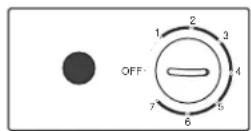
The control, located on the front of the freezer cabinet, is an adjustable dial with temperature settings ranging from 1 (least cold) to 7 (coldest) and Off.
- Turn the temperature control dial to 4 (recommended setting).
- Allow the freezer to cool for several hours before adding food.
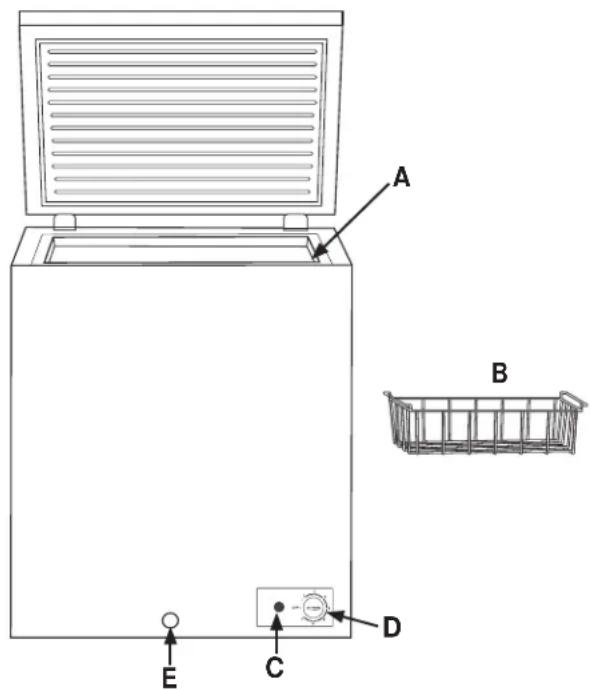
A. Interior Drain Plug (not shown)
B. Vinyl Coated Wire Basket
C. Power Indicator - green light
D. Temperature Control Adjustment
E. Exterior Drain Plug
Adjusting the temperature
- Adjust the control dial to one of the adjacent settings 3 (less cold) or 5 (colder).
NOTE: Except when starting the freezer, do not adjust the control more than one setting at a time. - Wait 24 hours between adjustments for the freezer temperature to stabilize.
FEATURES
Recommended Grounding Method
A 115 Volt, 60Hz AC only, 15- or 20-amp fused, grounded electrical supply is required. It is recommended that a separate circuit serving only your freezer be provided. Use an outlet that cannot be turned off by a switch Do not use an extension cord.
Power Indicator
The Power Indicator illuminates when the freezer is properly connected to electrical power.
IMPORTANT: Turning the control dial to OFF does not disconnect the freezer from the power supply. Even when Cooling is turned Off, the Power Indicator will remain illuminated as long as the freezer is plugged into an outlet.
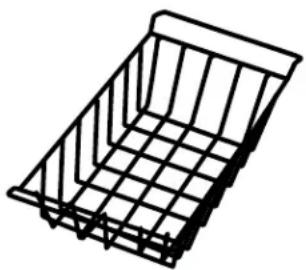
Sliding Basket
Store small packages in the basket to avoid losing them in the bottom of the freezer. The basket can be moved from side to side or it can be removed when loading or unloading the food below it.
To remove basket, lift it straight up and out. To replace basket, lower basket back into place.
DEFROSTINGINSTRUCTIONS
In most climates, defrosting will be necessary only about twice a year.
To have your freezer operate most efficiently, do not permit more than 1/4'' (6 mm) thickness of frost, on average, to accumulate on the walls.
To remove frost, scrape with a plastic or wood spatula or scraper.
Do not use an ice pick, metal, or sharp-edged instrument as it may damage or scratch the freezer.
Do not use boiling water as it may damage the freezer.
Do not use any electrical device in defrosting your freezer.
For Complete Defrosting
- Turn the temperature control to far left OFF setting and unplug the freezer.
- Remove all food and place it in corrugated boxes, insulated bags, picnic coolers, etc. Use towels and newspapers for insulation as needed.
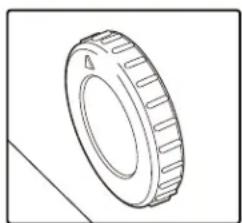
- Place a tray (not included) in front of the freezer, beneath the exterior drain plug to collect the water. Pull out the drain plug about 1" (2.5 cm) until the drain hole on the plug shows completely. Turn the drain plug clockwise until the arrow is pointed down. Unscrew counterclockwise to remove the interior drain plug. This allows the water to flow out into the tray.
NOTE: Water that has accumulated at the bottom of the freezer during defrosting will drain into the tray. Monitor the tray under the drain to avoid overflow.
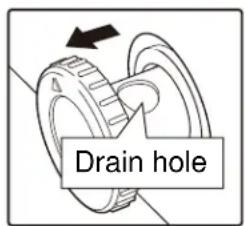
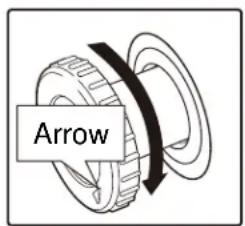
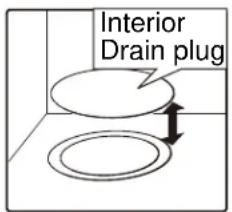
- With the lid open, you may choose to use pans of hot tap water (less than 120^ [49^] ) to speed defrosting. Directing air from an electric fan into the freezer will also help. Do not place fan or any electrical device in the freezer. Remove large pieces before they melt.
- Wipe water from walls with a towel or sponge.
- After defrosting, clean the inside of the freezer (see Care and Cleaning).
- Replace the drain plugs.
- Plug in the freezer. Return the temperature control to its previous position and return food to the freezer.
WARNING
Freezer must be
unplugged to avoid electrical hazard from power source when defrosting unit.
CARE AND CLEANING
Cleaning Your Freezer
- Outside. Protect the paint finish. The finish on the outside of the freezer is a high quality, baked-on paint finish. With proper care, it will stay new-looking and rust-free for years. Apply a coat of appliance polish wax when the freezer is new and then at least twice a year. Appliance polish wax also works well to remove tape residue from freezer surfaces.
Keep the finish clean. Wipe with a clean cloth lightly dampened with appliance polish wax or mild liquid dishwashing detergent. Dry and polish with a clean, soft cloth. Do not wipe the freezer with a soiled dishwashing cloth or wet towel. Do not use scouring pads, powdered cleaners, bleach, or cleaners containing bleach.
NOTICE: Care should be taken in moving the freezer away from the wall. All types of floor coverings can be damaged, particularly cushioned coverings and those with embossed surfaces.
- Inside. Clean the inside of your freezer at least once a year. We recommend that the freezer be unplugged before cleaning. If this is not practical, wring excess moisture out of sponge or cloth when cleaning in the vicinity of switches, lights or controls.
Use warm water and baking soda solution—about a tablespoon of baking soda to a quart of water. Rinse thoroughly with water and wipe dry. Do not use cleaning powders or other abrasive cleaners. DO NOT wash removable parts in a dishwasher.
An open box of baking soda in the freezer will absorb stale freezer odors. Change the box every three months.
CAUTION
Damp objects stick to cold metal
surfaces. DO NOT touch interior metal surfaces with wet or damp hands.
In Case of Extended Power Failure
- Keep freezer lid closed. Your freezer will keep food frozen for 24 hours provided warm air is not admitted.
- If freezer is out of operation for 24 hours or more, add dry ice. Leave ice in large pieces. Add more ice as required.
CAUTION
Handling of dry ice can cause freezing of ice or other protection is recommended.
- If dry ice is not available, move food to a frozen food locker temporarily—until power is restored.
Preparing to Move
Turn the temperature control to OFF. Disconnect the power cord plug from the wall outlet. Remove foods, defrost (on Manual Defrost models) and clean the freezer.
Secure all loose items such as baskets by taping them securely in place to prevent damage.
Be sure freezer stays in upright position during actual moving and during transportation. The freezer must be secured during transportation to prevent movement. Protect outside of freezer with blanket.
Preparing for Vacation
To maintain freezer in operation during vacations, be sure your house power is not turned off. For sure protection of freezer contents, you may want to ask a neighbor to check the power supply and freezer operation every 24 hours.
For extended vacations or absences, you may prefer to move your frozen foods to a storage locker temporarily. If your freezer is to be left empty, disconnect power cord plug from wall outlet. To prevent formation of odors, place open box of baking soda in freezer and leave freezer lid open.
Save Money and Energy
- The freezer should be located in the coolest area of the room, away from heat-producing appliances or heating ducts, and out of direct sunlight.
- Let hot foods cool to room temperature before placing in the freezer. Overloading the freezer forces the compressor to run longer.
Foods that freeze too slowly may lose quality or spoil.

- Be sure to wrap foods properly, and wipe containers dry before placing them in the freezer. This cuts down on frost buildup inside the freezer.
- Freezer baskets should not be lined with aluminum foil, wax paper or paper towels. Liners interfere with cold air circulation, making the freezer less efficient.
- Organize and label food to reduce lid openings and extended searches. Remove as many items as needed at one time, and close the lid as soon as possible.
PREPARING OF INSTALLATION
Read these instructions completely and carefully.
Freezer Location
Your freezer should be conveniently located for day-to-day use in a dry, well-ventilated room.
Do not install the freezer where the temperature will go below 0^ (-18^) or above 110^ (43^) , because it will not maintain proper temperatures.
Do not install the freezer in a location exposed to rain water or direct sunlight.
Be sure to install your freezer on a floor strong enough to support it when it is fully loaded.
Level Freezer
Level the freezer from side to side and front to back so that the lid will seal properly. Use shims to level the freezer if necessary.
NOTE: It should not be necessary to remove the lid during installation. If, for some reason, the hinges need adjustment, see instructions below.
Clearances and Ventilation
Allow at least 2^ (50.8 mm) clearance on both sides of the freezer and 2^ (50.8 mm) between the back of the freezer and the wall. Leave room above the freezer to open the lid.
Keep flammable materials and vapors, such as gasoline, away from freezer.
Do not cover the freezer with items such as blankets, sheets,
tablecloths, etc. This reduces air circulation.
Lid Removal
CAUTION
LIFTING HAZARD
The lid is heavy. Use both hands to secure the lid before lifting.
CAUTION
HINGE SPRING UNDER TENSION
If it is necessary to remove the lid, follow these steps:
- Remove each upper hinge cover by grasping on the sides and pulling upwards. Remove each lower hinge cover by grasping on the sides and pulling down.
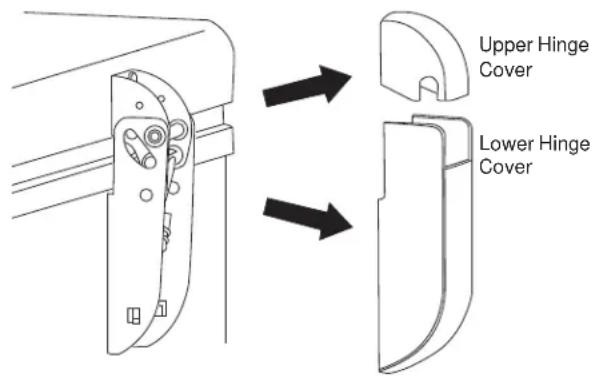
- Open the lid to the maximum position. (The hinges are loosest at this position.)
- Loosen, do not remove, the 4 screws from the lower part of the hinge that are mounted to the cabinet.
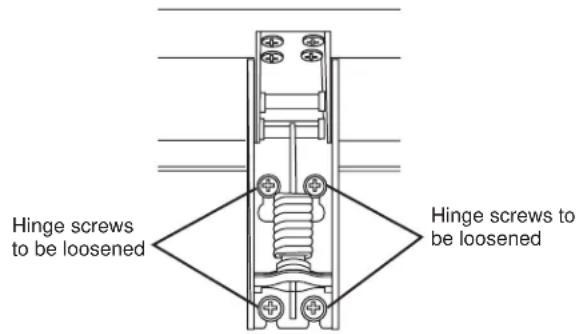
- Raise/lift the lid until the screws align with the larger slotted openings in the bottom of the hinge. Each hinge is still attached to the lid with 4 screws.
- To reinstall lid follow steps in reverse. Tighten all hinge screws but avoid over-tightening to prevent stripping. Reinstall hinge covers.
TROUBLESHOOTING
Save time and money! Review the charts on the following pages first and you may not need to call for service.
| Problem Possible Causes | What To Do | |
| Freezer does not operate | Temperature control set to OFF position. | Turn the temperature control to a setting between 1 and 7. |
| Freezer is unplugged. Push the plug completely into the outlet. | ||
| The fuse is blown/ circuit breaker is tripped. | Replace fuse or reset the breaker. | |
| Freezer starts/ stops too frequently | Lid left open. Check to see if package is holding lid open. | |
| Too frequent or too long lid openings. | Open the lid less often. | |
| Temperature control set too cold. See About the operation of your freezer. | ||
| Freezer operates too long | Lid left open. Check to see if package is holding lid open. | |
| Too frequent or too long lid openings. | Open the lid less often. | |
| Temperature control set too cold. See About the operation of your freezer. | ||
| Inadequate air circulation space around cabinet. | See Preparing to install the freezer. | |
| Room or outside weather is hot. It's normal for the freezer to work harder under these conditions. | ||
| Freezer has been disconnected recently for a period of time. | It takes 6-8 hours for the freezer to cool down completely. | |
| Large amounts of warm or hot food have been stored recently. | Warm food will cause the freezer to run more until the desired temperature is reached | |
| Noisy operation or cabinet vibrates | Floor may be weak, causing freezer to vibrate when compressor is on. | Check to make sure freezer is located on solid floor and use shims, as needed, to level the unit. |
| Cabinet is not positioned solidly on floor. | See Preparing to install the freezer. Use shims, as needed, to level the unit. | |
| Freezer is touching the wall. Level freezer or move slightly. See Level Freezer. | ||
| Freezer temperature too warm | Lid left open. Check to see if package is holding lid open. | |
| Too frequent or too long lid openings. | Open the lid less often. | |
| Temperature control is set too warm. | Turn control to a colder setting. Allow several hours for the temperature to stabilize. | |
| Large amounts of water or hot food may have been stored recently. | Wait until the freezer has had a chance to reach its selected temperature. | |
| Freezer has been disconnected recently. | Freezer requires 6-8 hours to cool down completely. | |
| Foods defrosting Temperature control set to OFF position. | Turn the temperature control to a setting between 1 and 7. | |
| Freezer is unplugged. Push the plug completely into the outlet. | ||
| The fuse is blown/ circuit breaker is tripped. | Replace fuse or reset the breaker. | |
| Lid left open. Check to see if package is holding lid open. | ||
| Too frequent or too long lid openings. | Open the lid less often. | |
| Freezer temperature too cold | Temperature control set too cold. See About the operation of your freezer. | |
TROUBLESHOOTING
| Problem Possible Causes Whata To Do | ||
| Moisture forms on outside of cabinet | Not unusual during periods of high humidity. | Wipe surface dry. |
| Lid may not be seating properly, causing cold air from inside the freezer to meet warm moist air from the outside. | See Preparing to install the freezer. | |
| Lid won't fully close by itself | Package holding lid open. Move package to a different location. | |
| Slow starting time after being off | Built-in overload protection. This is normal after being off. | |
| Excessive frost buildup Lid left open. Check to see if package is holding lid open. | ||
| Too frequent or too long lid openings. Open the lid less often. | ||
| Not unusual during periods of high humidity. | Wipe surface dry. | |
| Freezer external surface temperature is warm | The external freezer walls can be as much as 30°F (16.7°C) warmer than room temperature. | This is normal while the compressor works to transfer heat from inside the freezer cabinet. |
| Louder sound levels whenever freezer is on | Modern freezers have increased storage capacity and more stable temperatures. They require a high-efficiency compressor. | This is normal. When the surrounding noise level is low, you might hear the compressor running while it cools the interior. |
| Higher sound levels when compressor comes on | Freezer operates at higher pressures during the start of the ON cycle. | This is normal. Sound will level off or disappear as freezer continues to run. |
| Popping or cracking sound when compressor comes on | Metal parts undergo expansion and contraction, as in hot water pipes. | This is normal. Sound will level off or disappear as freezer continues to run. |
| Bubbling or gurgling sound, like boiling water | Refrigerant (used to cool freezer) is circulating throughout the system. | This is normal. |
| Moisture forms on inside freezer walls | Weather is hot and humid, which increases internal rate of frost buildup. | This is normal. |
| Lid may not be seating properly. See Preparing to install the freezer. | ||
| Lid is kept open too long, or is opened too frequently. | Open the lid less often. | |
| Odors in freezer Interior needs to be cleaned. Clean interior with sponge. | warm water and baking soda. | |
| Foods with strong odors are in the freezer. | Cover the food tightly. | |
Normal Operating Characteristics
These things are normal and do not indicate a need for service.
- A warm cabinet exterior as the refrigeration system transfers heat from the inside to the outside through the exterior cabinet walls.
- The sound of the high-efficiency compressor motor.
LIMITED WARRANTY
12 Months on Parts and Labor
For 12 months from the date of original retail purchase, GE Appliances will replace any part of the refrigerator that fails due to a defect in materials or workmanship. GE Appliances will choose, at its discretion, to replace or service the defective unit. Should GE Appliances decide to service the unit, GE Appliances will provide any part which fails due to a defect in materials or workmanship free of charge, along with any labor and related service costs to replace the defective part. During this period, should GE Appliances choose to replace the unit, it may do so by providing you with a certificate redeemable at a retailer for a replacement product.
Product must be accessible, without encumbrance and installed properly to receive warranty repair service.
NOTE: This warranty commences on the date the item was purchased, and the original purchase receipt must be presented to the authorized service representative before warranty repairs are rendered.
FOR WARRANTY SERVICE
For US Customers, all warranty service must be provided by our Factory Service Centers, or an authorized Customer Care technician. To schedule service, call 1.877.337.3639.
Please have serial number and model number available when calling for service.
In Canada, call 1.877.470.9174
What is not covered by this warranty:
Service trips to your home to teach you how to use the product.
Improper installation, delivery or maintenance.
Failure of the product if it is abused, misused, or used for other than the intended purpose or used commercially.
Loss of food due to spoilage.
Damage caused after delivery.
Replacement of house fuses or resetting of circuit breakers.
Replacement of the light bulbs.
Damage to the product caused by accident, fire, floods or acts of God.
Incidental or consequential damage caused by possible defects with this appliance.
Product not accessible to provide required service.
Associated costs when GE Appliances chooses to issue the consumer a certificate as a form of product replacement.
EXCLUSION OF IMPLIED WARRANTYES - Your sole and exclusive remedy is product repair as provided in this Limited Warranty. Any implied warranties, including the implied warranties of merchantability or fitness for a particular purpose, are limited to one year or the shortest period allowed by law.
For US Customers: This warranty is extended to the original purchaser and any succeeding owner for products purchased for home use within the USA. If the product is located in an area where service by a GE Appliances Authorized Servicer is not available, you may be responsible for a trip charge or you may be required to bring the product to an Authorized GE Appliances Service location for service. In Alaska, the warranty excludes the cost of shipping or service calls to your home.
Some states do not allow the exclusion or limitation of incidental or consequential damages. This warranty gives you specific legal rights, and you may also have other rights which vary from state to state. To know what your legal rights are, consult your local or state consumer affairs office or your state's Attorney General.
Warrantor US:
GE Appliances, a Haier company, Louisville, KY 40220
For Customers in Canada: This warranty is extended to the original purchaser and any succeeding owner for products purchased in Canada for home use within Canada. In-home warranty service will be provided in areas where it is available and deemed reasonable by Mabe to provide.
Warrantor Canada:
MC Commercial, Burlington, Ontario, L7R 5B6
CONSUMER SUPPORT
GE Appliances Website
Have a question or need assistance with your appliance? Try the GE Appliances Website 24 hours a day, any day of the year! You can also shop for more great GE Appliances products and take advantage of all our on-line support services designed for your convenience. In the US: GEAppliances.com In Canada: GEAppliances.ca
Register Your Appliance
Register your new appliance on-line at your convenience! Timely product registration will allow for enhanced communication and prompt service under the terms of your warranty, should the need arise. You may also mail in the pre-printed registration card included in the packing material.
In the US: GEAppliances.com/register
In the Canada: GEAppliances.ca/ after-sales-support
Schedule Service
Expert GE Appliances repair service is only one step away from your door. Get on-line and schedule your service at your convenience any day of the year. In the US: GEAppliances.com/ service or call 800.432.2737 during normal business hours.
In Canada: GEAppliances.ca/en/support/service-request or call 800.561.3344
Extended Warranties
Purchase a GE Appliances extended warranty and learn about special discounts that are available while your warranty is still in effect. You can purchase it on-line anytime. GE Appliances Services will still be there after your warranty expires. In the US:
GEAppliances.com/extended-warranty or call 800.626.2224 during normal business hours.
In Canada: GEAppliances.ca/en/support/purchase-extended-warranty or call 866.277.9842
Parts and Accessories
Individuals qualified to service their own appliances can have parts or accessories sent directly to their homes (VISA, MasterCard and Discover cards are accepted). Order on-line today 24 hours every day.
In the US: GEApplianceparts.com or by phone at 877.959.8688 during normal business hours.
Instructions contained in this manual cover procedures to be performed by any user. Other servicing generally should be referred to qualified service personnel. Caution must be exercised, since improper servicing may cause unsafe operation.
Customers in Canada should consult the yellow pages for the nearest MC Commercial service center, visit our website at
GEAppliances.ca/en/products/ parts-filters-accessories or call 800.661.1616.
Contact Us
If you are not satisfied with the service you receive from GE Appliances, contact us on our Website with all the details including your phone number, or write to:
In the US: General Manager, Customer Relations | GE Appliances, Appliance Park | Louisville, KY 40225
GEAppliances.com/ contact
In Canada: Director, Consumer Relations, Mabe Canada Inc. | Suite 310, 1 Factory Lane | Moncton, N.B. E1C 9M3
GEAppliances.ca/en/contact-us
TABLE DES MATIÈRES
MESURES DE SECURITE 16
UTILISATION DU CONGÉLATEUR 18
If it is necessary to remove the lid, follow these steps:
Garanter US: GE Appliances, a Haier company, Louisville, KY 40225
In the US: General Manager, Customer Relations | GE Appliances, Appliance Park | Louisville, KY 40225
GEAppliances.com/contact
SOLUTIONAR PROBLEMAS
SOLUTIONAR PROBLEMAS
GE Appliances, a Haier company, Louisville, KY 40225
MC Commercial, Burlington, Ontario, L7R 5B6
GEAppliances.com/contact
NOTAS
IMPORTANT
Do Not Return This Product To The Store
If you have a problem with this product, please call 1-877-337-3639 for the name and
telephone number of the nearest authorized service center.
DATED PROOF OF PURCHASE REQUIRED FOR WARRANTY SERVICE