
ULX-DRY I 7 - Tumble dryer Ulsonix - Free user manual and instructions
Find the device manual for free ULX-DRY I 7 Ulsonix in PDF.
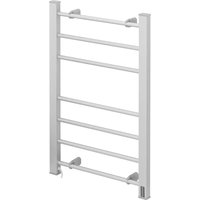


| Product Type | Electric Towel Warmer |
| Model | ULX-DRY I 7 |
| Brand | Ulsonix |
| Rated Voltage | 230 V~ / 50 Hz |
| Rated Power | 120 W |
| Dimensions (L x D x H) | 800 x 520 x 45 mm |
| Weight | 1.6 kg |
| Intended Use | Heating and drying towels for domestic use |
| Installation | Wall mounting, minimum distance of 600 mm between lowest rail and floor |
| Power Supply | Grounded mains socket |
| Control | On/Off switch with indicator light |
| Operating Temperature | Stabilizes approximately 5 minutes after start-up |
| Ambient Conditions | Temperature ≤ 40 °C, relative humidity < 85 % |
| Safety Distance | At least 10 cm between appliance and walls/objects |
| Protection | Residual Current Device (RCD) recommended in humid environment |
| Cleaning | Soft, slightly damp cloth, no corrosive or abrasive products |
| Maintenance | Regular inspection, unplug before cleaning |
| Material | Not specified in the manual (estimation: steel or aluminum with coating) |
| Capacity | Multiple towels, suitable for size (800 mm width) |
| Child Safety | Install at least 600 mm from floor, out of reach of children |
| Compatibility | Indoor use only, do not use outdoors |
Frequently Asked Questions - ULX-DRY I 7 Ulsonix
User questions about ULX-DRY I 7 Ulsonix
0 question about this device. Answer the ones you know or ask your own.
Ask a new question about this device
Download the instructions for your Tumble dryer in PDF format for free! Find your manual ULX-DRY I 7 - Ulsonix and take your electronic device back in hand. On this page are published all the documents necessary for the use of your device. ULX-DRY I 7 by Ulsonix.
USER MANUAL ULX-DRY I 7 Ulsonix
1 - Wand
1 - Wand
This User Manual has been translated for your convenience using machine translation. Reasonable efforts have been made to provide an accurate translation; however, no automated translation is perfect nor is it intended to replace human translators. The official User Manual is the English version. Any discrepancies or differences created in the translation are not binding and have no legal effect for compliance or enforcement purposes. If any questions arise related to the accuracy of the information contained in the User Manual, please refer to the English version of those contents which is the official version.
Technical data
| Parameter description Parameter value | ||
| Product name | Electric Towel Warmer | |
| Model | ULX-DRY I 7 | ULX-DRY I 12 |
| Rated voltage [V~] / frequency [Hz] | 230/50 230/50 | |
| Rated power [W] | 120 | 200 |
| Dimensions [width x depth x height; mm] | 800 x 520 x 45 | 1195 x 520 x 45 |
| Weight [kg] | 1.6 | 2.3 |
1. General description
The user manual is designed to assist in the safe and trouble-free use of the device. The product is designed and manufactured in accordance with strict technical guidelines, using state-of-the-art technologies and components. Additionally, it is produced in compliance with the most stringent quality standards.
DO NOT USE THE DEVICE UNLESS YOU HAVE THOROUGHLY READ AND UNDERSTOOD THIS USER MANUAL.
To increase the product life of the device and to ensure trouble-free operation, use it in accordance with this user manual and regularly perform maintenance tasks. The technical data and specifications in this user manual are up to date. The manufacturer reserves the right to make changes associated with quality improvement. The device is designed to reduce noise emission risks to a minimum, taking into account technological progress and noise reduction opportunities.
Legend

The product satisfies the relevant safety standards.
Read instructions before use.
The product must be recycled.
WARNING! or CAUTION! or REMEMBER! General warning sign.
ATTENTION! Electric shock warning!
Only use indoors.

PLEASE NOTE! Drawings in this manual are for illustration purposes only and in some details may differ from the actual product.
2. Usage safety

ATTENTION! Read all safety warnings and all instructions. Failure to follow the warnings and instructions may result in electric shock, fire and/or serious injury or even death.
The terms "device" or "product" are used in the warnings and instructions to refer to:
Electric Towel Warmer
2.1. Electrical safety
a) The plug must fit the socket. Do not modify the plug in any way. Using original plugs and matching sockets reduces the risk of electric shock. b) Avoid touching earthed elements such as pipes, heaters, boilers and refrigerators. There is an increased risk of electric shock if the earthed device is exposed to rain, comes into direct contact with a wet surface or is operating in a damp environment. Water getting into the device increases the risk of damage to the device and of electric shock. c) Do not touch the device with wet or damp hands. d) Use the cable only for its designated use. Never use it to carry the device or to pull the plug out of a socket. Keep the cable away from heat sources, oil, sharp edges or moving parts. Damaged or tangled cables increase the risk of electric shock. e) If using the device in a damp environment cannot be avoided, a residual current device (RCD) should be applied. The use of an RCD reduces the risk of electric shock. f) Do not use the device if the power cord is damaged or shows obvious signs of wear. A damaged power cord should be replaced by a qualified electrician or the manufacturer's service centre. g) To avoid electric shock, do not immerse the cord, plug or device in water or other liquids. Do not use the device on wet surfaces.
2.2. Safety in the workplace
a) Do not use the device in a potentially explosive environment, for example in the presence of flammable liquids, gases or dust. The device generates sparks which may ignite dust or fumes. b) If you discover damage or irregular operation, immediately switch the device off and report it to a supervisor without delay. c) If there are any doubts as to the correct operation of the device, contact the manufacturer's support service. d) Only the manufacturer's service point may repair the device. Do not attempt any repairs independently! e) In case of fire, use a powder or carbon dioxide (CO2) fire extinguisher (one intended for use on live electrical devices) to put it out. f) Regularly inspect the condition of the safety labels. If the labels are illegible, they must be replaced. g) Please keep this manual available for future reference. If this device is passed on to a third party, the manual must be passed on with it. h) Keep packaging elements and small assembly parts in a place not available to children. i) Keep the device away from children and animals.

Remember! When using the device, protect children and other bystanders.
2.3. Personal safety
a) Do not use the device when tired, ill or under the influence of alcohol, narcotics or medication which can significantly impair the ability to operate the device. b) The device is not designed to be handled by persons (including children) with limited mental and sensory functions or persons lacking relevant experience and/or knowledge unless they are supervised
by a person responsible for their safety or they have received instruction on how to operate the device.
c) To prevent the device from accidentally switching on, make sure the switch is on the OFF position before connecting to a power source. d) The device is not a toy. Children must be supervised to ensure that they do not play with the device.
2.4. Safe device use
a) Do not use the device if the ON/OFF switch does not function properly (does not switch the device on and off). Devices which cannot be switched on and off using the ON/OFF switch are hazardous, should not be operated and must be repaired. b) Disconnect the device from the power supply before commencement of adjustment, cleaning and maintenance. Such a preventive measure reduces the risk of accidental activation. c) When not in use, store in a safe place, away from children and people not familiar with the device who have not read the user manual. The device may pose a hazard in the hands of inexperienced users. d) Keep the device in perfect technical condition. Before each use check for general damage and especially check for cracked parts or elements and for any other conditions which may impact the safe operation of the device. If damage is discovered, hand over the device for repair before use. e) Keep the device out of the reach of children. f) Device repair or maintenance should be carried out by qualified persons, only using original spare parts. This will ensure safe use. g) To ensure the operational integrity of the device, do not remove factory-fitted guards and do not loosen any screws. h) Do not move, adjust or rotate the device in the course of work. i) Do not leave this appliance unattended while it is in use. j) Clean the device regularly to prevent stubborn grime from accumulating. k) The device is not a toy. Cleaning and maintenance may not be carried out by children without supervision by an adult person. l) It is forbidden to interfere with the structure of the device in order to change its parameters or construction. m) Keep the device away from sources of fire and heat. n) Do not overload the device. o) Do not cover the ventilation openings! p) Do not place the power cord under carpets, mats, etc. q) Do not use to dry down jackets and quilts! r) Attention! The heating temperature stabilizes about 5 minutes after starting the device! s) WARNING! For the safety of small children, the unit should be installed with a distance of 600 mm between the lowest rail and the ground! t) Pull the mains plug and let the unit cool down completely before cleaning and when the unit is not in use. u) Do not clean with any sharp and/or metal implements (e.g. a wire brush) as these may damage the surface of the appliance. v) Do not clean the appliance with acidic substances, medical products, thinners, fuel, oil or other chemicals as they may damage it.

ATTENTION! Despite the safe design of the device and its protective features, and despite the use of additional elements protecting the operator, there is still a slight risk of accident or injury when using the device. Stay alert and use common sense when using the device.
3. Use guidelines
The product is an electric heater designed to heat and dry towels.
The product is intended for home use only.
The user is liable for any damage resulting from unintended use of the device.
3.1. Device description ULX-DRY I 7
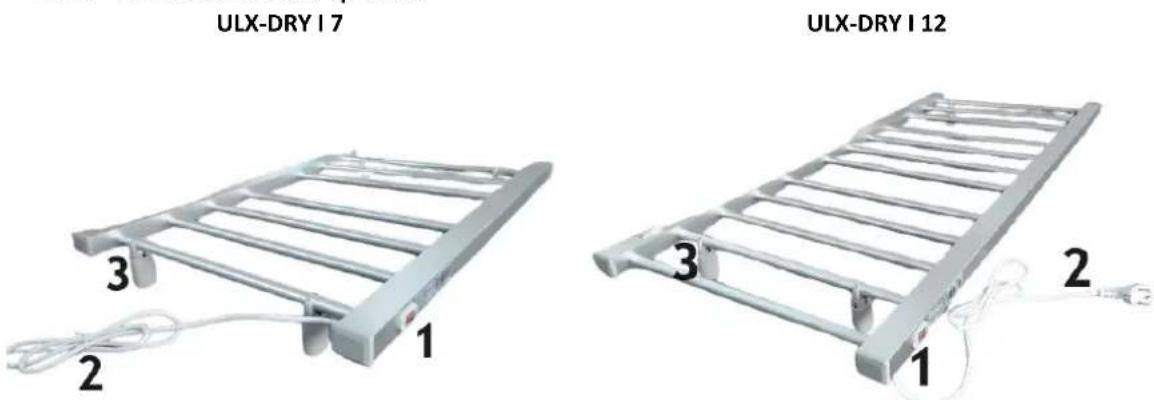
1 - ON/OFF Switch 2 - Power cord 3 - Wall mounting elements
3.2. Preparing for use APPLIANCE LOCATION
The temperature of environment must not be higher than 40° C and the relative humidity should be less than 85%. Ensure good ventilation in the room in which the device is being used. There should be at least 10 cm distance between each side of the device and the wall or other objects. The device should always be used when positioned on an even, stable, clean, fireproof and dry surface, and be out of the reach of children and persons with limited mental and sensory functions. Position the device such that you always have access to the power plug. The power cord connected to the appliance must be properly grounded and correspond to the technical details on the product label.
3.3. Assembling the device
- Attach the wall brackets to the towel warmer using flat head screws. Select a suitable location to fix the four corners of the towel warmer. Mark 4 circles on each corner. Then find the centre of the 4 marked circles to drill the holes.
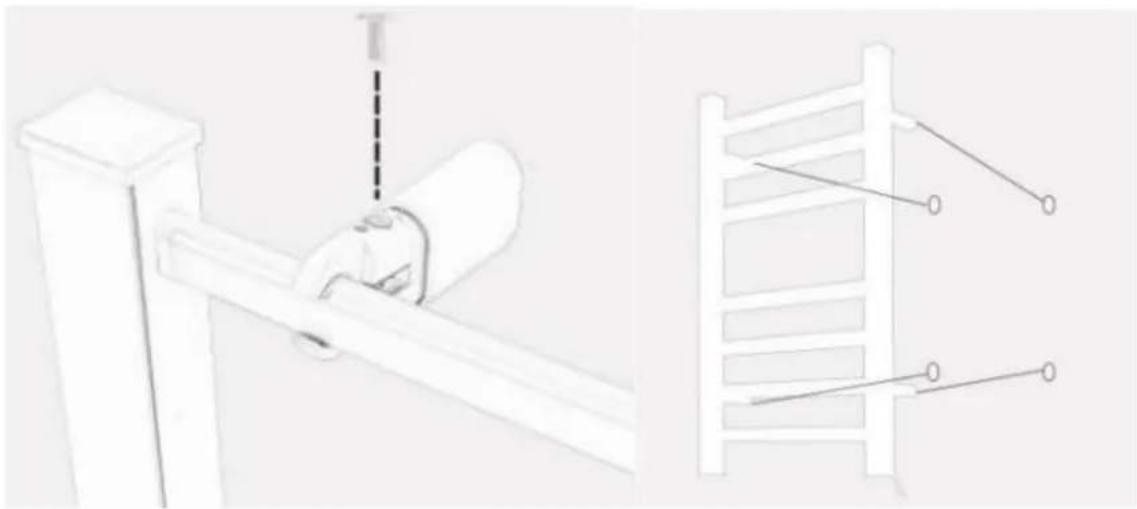
- Insert the wall plug into the 4 holes as shown in the illustration on the right. Attach the other half of the wall mounting brackets to the wall.
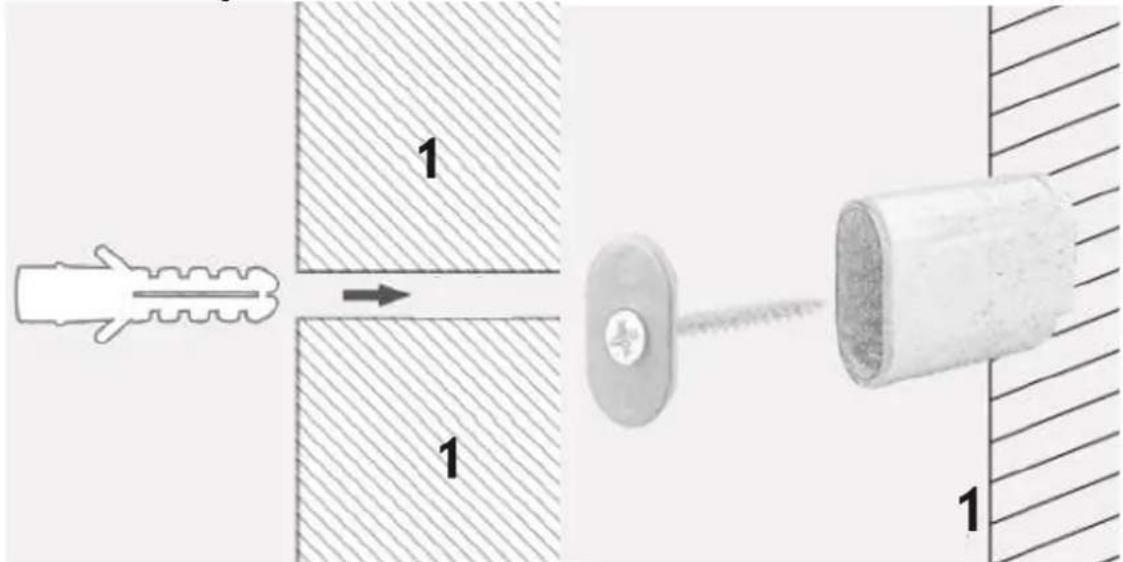
1 - Wall
- Adjust the pull-out wall mounting brackets to the correct position. Attach the pull-out wall-mounting brackets to the towel warmer with flat-head screws and then fix them to the wall-mounting element.
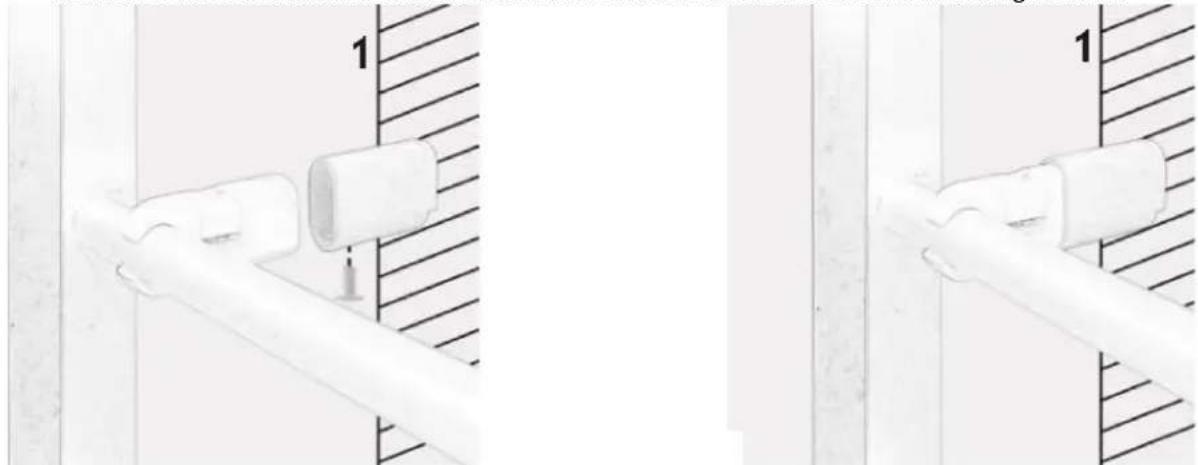
1 - Wall
3.4. Device use
Make sure the power switch is set to the OFF [0] position (i.e. the power indicator is off).
Plug the power cord into an electrical outlet.
Once connected, press the power button ON, the power indicator will light up and then the heater will start heating.
Press the switch in the [0] position, the power indicator will turn off and the product will stop working.
3.5. Cleaning and maintenance
a) Unplug the mains plug and allow the device to cool completely before each cleaning, adjustment or replacement of accessories, or if the device is not being used. b) Use only non-corrosive cleaners to clean the surface. c) Store the unit in a dry, cool place, free from moisture and direct exposure to sunlight. d) Do not spray the device with a water jet or submerge it in water. e) The device must be regularly inspected to check its technical efficiency and spot any damage. f) Use a soft, damp cloth for cleaning.
g) Do not use sharp and/or metal objects for cleaning (e.g. a wire brush or a metal spatula) because they may damage the surface material of the appliance. h) Do not clean the device with an acidic substance, agents of medical purposes, thinners, fuel, oils or other chemical substances because it may damage the device.
DISPOSING OF USED DEVICES:
Do not dispose of this device in municipal waste systems. Hand it over to an electric and electrical device recycling and collection point. Check the symbol on the product, instruction manual and packaging. The plastics used to construct the device can be recycled in accordance with their markings. By choosing to recycle you are making a significant contribution to the protection of our environment.
Contact local authorities for information on your local recycling facility.

1 - ON/OFF switch
1 - Wall
1 - Wall
1 - Wall
1 - Wall
1 - Wall
1 - Wall
1 - Wall
1 - Wall
1 - ON/OFF switch
2 - power cable
1 - Wall
1 - Wall
1 - ON/OFF contact
2 - power cord
PLACEMENT OF THE DEVICE
1 - Wall
1 - Wall
3.4. Using the device
Make sure the switch is set to the OFF [0] position (i.e., the power indicator is off).
1 - Wall
1 - Wall
1 - ON/OFF switch 2 - power cord 3 - wall mounting elements
PLACEMENT OF THE DEVICE
1 - Wall
1 - Wall
1 – ON/OFF switch 2 – Power cord 3 – Wall mounting elements
1 - Wall
1 - Wall
1 - ON/OFF switch 2 - Power cord 3 – Wall mounting elements
PLACEMENT OF THE DEVICE
1 - ON/OFF switch
1 - Wall
1 - Wall
1 - Wall
1 - Wall
For the disposal of the device please consider and act according to the national and local rules and regulations.
CONTACT
expondo Polska sp. z o.o. sp. k.
- GENERAL DESCRIPTION
- DO NOT USE THE DEVICE UNLESS YOU HAVE THOROUGHLY READ AND UNDERSTOOD THIS USER MANUAL
- LEGEND
- USAGE SAFETY
- ELECTRICAL SAFETY
- SAFETY IN THE WORKPLACE
- PERSONAL SAFETY
- SAFE DEVICE USE
- USE GUIDELINES
- DEVICE DESCRIPTION ULX-DRY I
- PREPARING FOR USE APPLIANCE LOCATION
- ASSEMBLING THE DEVICE
- DEVICE USE
- CLEANING AND MAINTENANCE
- DISPOSING OF USED DEVICES
- PLACEMENT OF THE DEVICE
- USING THE DEVICE
- CONTACT
Brand : Ulsonix
Model : ULX-DRY I 7
Category : Tumble dryer