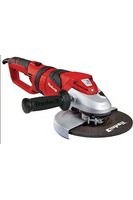
TE-AG 230 LS - Grinder EINHELL - Free user manual and instructions
Find the device manual for free TE-AG 230 LS EINHELL in PDF.


| Product type | Angle grinder |
| Brand | Einhell |
| Model | TE-AG 230 LS |
| Power consumption | 2350 W |
| Mains voltage | 230 V ~ 50 Hz |
| No-load speed | 6000 rpm |
| Max. grinding disc diameter | 230 mm |
| Spindle thread | M14 |
| Protection class | II / Double insulation |
| Weight | 6.1 kg |
| Sound pressure level (LpA) | 92.4 dB(A) |
| Sound power level (LWA) | 103.4 dB(A) |
| Vibration (main handle) | 5.841 m/s² (K=1.5 m/s²) |
| Vibration (auxiliary handle) | 6.714 m/s² (K=1.5 m/s²) |
| Main functions | Grinding and cutting of metal and stone |
| Safety | Safety switch, adjustable guard, spindle lock, 3-position auxiliary handle |
| Rotatable handle | 90° left/right rotation with locking |
| Replacement of connecting line | Must be done by manufacturer or specialist |
| Carbon brushes | Check and replace by an electrician |
| Maintenance and cleaning | Clean regularly with a damp cloth and soap, no water inside |
| Spare parts | Indicate type, article number, identification number and part number |
| Disposal and recycling | Do not dispose of with household waste, drop off at collection point |
| Storage | Dark, dry, frost-free place, 5-30 °C, out of reach of children |
Frequently Asked Questions - TE-AG 230 LS EINHELL
User questions about TE-AG 230 LS EINHELL
0 question about this device. Answer the ones you know or ask your own.
Ask a new question about this device
Download the instructions for your Grinder in PDF format for free! Find your manual TE-AG 230 LS - EINHELL and take your electronic device back in hand. On this page are published all the documents necessary for the use of your device. TE-AG 230 LS by EINHELL.
USER MANUAL TE-AG 230 LS EINHELL
GB Original operating instructions Angle grinder

natural_image
Technical line drawing of a mechanical assembly with no visible text or symbolsGB
Table of contents
- Safety information
- Layout and items supplied (Figure 1)
- Proper use
- Technical data
- Before starting the equipment
- Operation
- Replacing the power cable
- Cleaning, maintenance and ordering of spare parts
- Disposal and recycling
- Storage
GB

Danger! Read the operating instructions to reduce the risk of inquiry

Caution! Wear ear-muff s.
The impact of noise can cause damage to hearing.

Caution! Wear a breathing mask.
Dust which is injurious to health can be generated when working on wood and other materials. Never use the device to work on any materials containing asbestos!

Caution! Wear safety goggles.
Sparks generated during working or splinters, chips and dust emitted by the device can cause loss of sight.


This safety guard is designed for sanding/grinding.


This safety guard is designed for cutting and grinding/sanding.
(not included in items supplied)
-6-
GB
Danger!
When using equipment, a few safety precautions must be observed to avoid injuries and damage. Please read the complete operating manual with due care. Keep this manual in a safe place, so that the information is available at all times. If you give the equipment to any other person, give them these operating instructions as well. We accept no liability for damage or accidents which arise due to non-observance of these instructions and the safety information.
1. Safety information
Please refer to the booklet included in delivery for the safety instructions.
Danger!
Read all safety regulations and instructions.
Any errors made in following the safety regulations and instructions may result in an electric shock, fire and/or serious injury.
Keep all safety regulations and instructions in a safe place for future use.
2. Layout and items supplied (Figure 1)
2.1 Layout
- Spindle lock
- ON/OFF switch
- Additional handle
- Guard
- Flange nut wrench
- Handle
- Locking button
2.2 Items supplied
Please check that the article is complete as speci- fied in the scope of delivery. If parts are missing, please contact our service center or the nearest branch of the DIY store where you made your purchase at the latest within 5 work days after purchasing the article and upon presentation of a valid bill of purchase. Also, refer to the warranty table in the warranty provisions at the end of the operating instructions.
- Open the packaging and take out the equipment with care.
- Remove the packaging material and any packaging and/or transportation braces (if available).
- Check to see if all items are supplied.
Inspect the equipment and accessories for transport damage.
- If possible, please keep the packaging until the end of the guarantee period.
Danger!
The equipment and packaging material are not toys. Do not let children play with plastic bags, foils or small parts. There is a danger of swallowing or suffocating!
• Original operating instructions
• Safetyinstructions
3. Proper use
The angle grinder is designed for grinding metal and stone when using the appropriate grinding wheel and guard.
Caution! To cut metal and stone the grinder/sander may only be used when the guard (available as an accessory) is mounted.
The machine is to be used only for its prescribed purpose. Any other use is deemed to be a case of misuse. The user / operator and not the manufacturer will be liable for any damage or injuries of any kind caused as a result of this.
Please note that our equipment has not been designed for use in commercial, trade or industrial applications. Our warranty will be voided if the machine is used in commercial, trade or industrial businesses or for equivalent purposes.
4. Technical data
Mains voltage: 230 V \~ 50 Hz
Power input: 2350 W
Idling speed: 6000 rpm
Max. wheel diameter: 230 mm
Mounting spindle thread: M14
Protection class: ....II/回
Weight: 6,1 kg
GB
Danger!
Sound and vibration
Sound and vibration values were measured in accordance with EN 60745.
LpA sound pressure level 92,4 dB(A)
KpA uncertainty 3 dB
LWA sound power level 103,4 dB(A)
KWA uncertainty 3 dB
Wear ear-muff s.
The impact of noise can cause damage to hearing.
Total vibration values (vector sum of three directions) determined in accordance with EN 60745.
Handle:
Vibration emission value a_hAG = 5.841 m/s^2
K uncertainty = 1.5 m/s ^4
Additional handle:
Vibration emission value a_h=6.714 m/s^2
K uncertainty = 1.5 m/s ^4
Additional information for electric power tools
The specified vibration value was established in accordance with a standardized testing method. It may change according to how the electric equipment is used and may exceed the specified value in exceptional circumstances.
The specified vibration value can be used to compare the equipment with other electric power tools.
The specified vibration value can be used for initial assessment of a harmful effect.
Keep the noise emissions and vibrations to a minimum.
- Only use appliances which are in perfect working order.
• Service and clean the appliance regularly.
• Adapt your working style to suit the appliance.
• Do not overload the appliance. - Have the appliance serviced whenever necessary.
- Switch the appliance off when it is not in use.
• Wear protective gloves.
Caution!
Residual risks
Even if you use this electric power tool in accordance with instructions, certain residual risks cannot be rules out. The following hazards may arise in connection with the equipment's construction and layout:
- Lung damage if no suitable protective dust mask is used.
- Damage to hearing if no suitable ear protection is used.
- Health damage caused by hand-arm vibrations if the equipment is used over a prolonged period or is not properly guided and maintained.
5. Before starting the equipment
Before you connect the equipment to the mains supply make sure that the data on the rating plate are identical to the mains data.
5.1 Fitting the additional handle (Fig. 2)
- The angle grinder must not be used without the additional handle (3).
- The additional handle can be secured in any of three positions (A, B, C).
| Tool side Suitable for | |
| Left (position A / as shown) | Right-handedusers |
| Right(positionB)Left-handedusers | |
| Top (position C) Using | cutting wheels |
5.2 Setting the guard (Fig. 3)
- Switch off the tool. Pull the power plug.
- Adjust the guard (4) to protect your hands so that the material being ground is directed away from your body.
- The position of the guard (4) can be adjusted to any specific working conditions. Undo the clamp handle (a) and turn the cover (4) into the required position.
- Ensure that the guard (4) correctly covers the gear wheel casing.
- Secure the clamp handle (a) again.
- Ensure that the guard (4) is secure.
GB
Take care that the safety device is secure. Never use the angle grinder without the guard.
5.3 Test run for new grinding Wheels
Allow the right-angle grinder to run in idle for at least 1 minute with the grinding or cutting wheel fitted in place. Vibrating wheels are to be replaced immediately.
5.4 Swivel handle (Fig. 5)
The handle can be swiveled a maximum 90^ to the left and right. To do so, press the locking plate (7) and swivel the handle 90^ to the left or right. Important. When the locking plate (7) engages correctly it makes an audible click.
6. Operation
6.1 Switch (Fig. 4)
The angle grinder comes with a safety switch which is designed to prevent accidents. To start the equipment push the locking lever (a) forwards, then press the ON/OFF switch (3).
After switching on, you no longer need to hold the locking lever. To switch off, let go of the On/Off switch.
To use the additional locking function, first let go of the On/Off switch (3) and then the locking lever (a) when you switch on. To switch off, actuate the On/Off switch (3) again.
Wait until the machine has reached its top speed. You can then position the angle grinder on the workpiece and machine it.
6.2 Changing the grinding wheels (Fig. 5 / 6) Use the face spanner (5) supplied to change the grinding wheels.
Important! For safety reasons, the angle grinder must not be operated with the face spanner (5) inserted in it.
Pull out the power plug.
• Simple wheel change by spindle lock:
- Press the spindle lock and allow the grinding wheel to latch in place.
- Open the flange nut with the face spanner.
- (Fig. 6)
• Change the grinding or cutting wheel and
tighten the flange nut with the face spanner.
Important!
Only ever press the spindle lock when the motor and grinding spindle are at a stand-still! You must keep the spindle lock pressed while you change the wheel!
For grinding or cutting wheels up to approx. 3 mm thick, screw on the flange nut with the flat side facing the grinding or cutting wheel.
6.3 Flange arrangements when using grinding wheels and cutting wheels (Fig. 7-10)
- Flange arrangement when using a depressed-centre or straight grinding wheel (Fig. 8)
a) Clamping flange
b) Flange nut - Flange arrangement when using a depressed-centre cutting wheel (Fig. 9)
a) Clamping flange
b) Flange nut - Flange arrangement when using a straight cutting wheel (Fig. 10)
a) Clamping flange
• b) Flange nut
6.4 Motor
It is vital for the motor to be well ventilated during operation. Be sure, therefore, to keep the ventilation holes clean at all times.
6.5 Grinding Wheels
- Never use a grinding or cutting wheel bigger than the specified diameter.
- Before using a grinding or cutting wheel, check its rated speed.
- The maximum speed of the grinding or cutting wheel used must be higher than the idle speed of the angle grinder.
- Use only grinding and cutting wheels that are approved for a minimum speed of 6.500 rpm and a peripheral speed of 80 m/sec.
- Check the direction of rotation when you use diamond cutting wheels. The directional arrow on the diamond cutting wheel must point in the direction in which the tool rotates.
Take special care that the grinding/sanding wheels are properly stored and transported. Ensure that the grinding/sanding wheels are never exposed to shock, jolts or sharp edges (for example during transport or storage in a toolbox). This could cause damage (such as cracks) to the
GB
grinding/sanding wheels and place the user in serious danger.
6.6 Operating Modes
6.6.1 Rough grinding (Fig. 11)
Caution: Use the safety device for sanding/grinding (included in items supplied).
For the best rough grinding results, hold the grinding wheel at an angle of between 30^ and 40^ to the workpiece surface and guide back and forth over the workpiece in steady movements.
6.6.2 Cutting (Fig. 12)
Caution: Use the safety device for abrasive
cutting (available as accessory, see 8.4)
When you use the right-angle grinder for cutting purposes, avoid tilting it in the cutting plane. The cutting wheel must have a clean cutting edge.
A diamond cutting wheel is best used to cut hard stone.
It is prohibited to use the machine on asbestos materials!
Never use a cutting wheel for rough grinding.
7. Replacing the power cable
If the power cable for this equipment is damaged, it must be replaced by the manufacturer or its after-sales service or similarly trained personnel to avoid danger.
8. Cleaning, maintenance and ordering of spare parts
Always pull out the mains power plug before starting any cleaning work.
8.1 Cleaning
- Keep all safety devices, air vents and the motor housing free of dirt and dust as far as possible. Wipe the equipment with a clean cloth or blow it with compressed air at low pressure.
- We recommend that you clean the device immediately each time you have finished using it.
- Clean the equipment regularly with a moist cloth and some soft soap. Do not use cleaning agents or solvents; these could at-
tack the plastic parts of the equipment. Ensure that no water can seep into the device. The ingress of water into an electric tool increases the risk of an electric shock.
8.2 Carbon brushes
In case of excessive sparking, have the carbon brushes checked only by a qualified electrician. Important! The carbon brushes should not be replaced by anyone but a qualified electrician.
8.3 Maintenance
There are no parts inside the equipment which require additional maintenance.
8.4 Ordering replacement parts:
Please quote the following data when ordering replacement parts:
• Type of machine
• Article number of the machine
• Identification number of the machine
• Replacement part number of the part required
9. Disposal and recycling
The equipment is supplied in packaging to prevent it from being damaged in transit. The raw materials in this packaging can be reused or recycled. The equipment and its accessories are made of various types of material, such as metal and plastic. Never place defective equipment in your household refuse. The equipment should be taken to a suitable collection center for proper disposal. If you do not know the whereabouts of such a collection point, you should ask in your local council offices.
10. Storage
Store the equipment and accessories out of children's reach in a dark and dry place at above freezing temperature. The ideal storage temperature is between 5 and 30^ . Store the electric tool in its original packaging.
The reprinting or reproduction by any other means, in whole or in part, of documentation and papers accompanying products is permitted only with the express consent of the iSC GmbH.
Subject to technical changes
F
Sommaire



- GB
- Table of contents
- Danger!
- Safety information
- Layout and items supplied (Figure 1)
- Layout
- Items supplied
- Proper use
- Technical data
- Sound and vibration
- Wear ear-muff s.
- Handle:
- Additional handle:
- Additional information for electric power tools
- Keep the noise emissions and vibrations to a minimum.
- Caution!
- Residual risks
- Before starting the equipment
- Fitting the additional handle (Fig. 2)
- Setting the guard (Fig. 3)
- Test run for new grinding Wheels
- Swivel handle (Fig. 5)
- Operation
- Switch (Fig. 4)
- Wait until the machine has reached its top speed. You can then position the angle grinder on the workpiece and machine it.
- Pull out the power plug.
- Important!
- Flange arrangements when using grinding wheels and cutting wheels (Fig. 7-10)
- Motor
- Grinding Wheels
- Operating Modes
- Rough grinding (Fig. 11)
- Cutting (Fig. 12)
- Replacing the power cable
- Cleaning, maintenance and ordering of spare parts
- Cleaning
- Carbon brushes
- Maintenance
- Ordering replacement parts:
- Disposal and recycling
- Storage
- F
- Sommaire
Brand : EINHELL
Model : TE-AG 230 LS
Category : Grinder