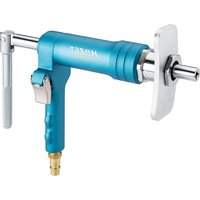
4970P-1/4 - Mechanical tool Hazet - Free user manual and instructions
Find the device manual for free 4970P-1/4 Hazet in PDF.


| Brand | Hazet |
| Model | 4970P-1/4 |
| Product Type | Brake piston retraction tool (pneumatic tool) |
| Application | Floating brake calipers with or without parking brake (except 2-piston calipers) |
| Total length | 260 mm |
| Weight | 1.07 kg |
| Operating pressure | 5 - 8 bar |
| Maximum permissible pressure | 8 bar |
| Compressed air connection | 1/4" |
| Required air flow | 13.4 l/min |
| Spindle stroke | 58.1 mm |
| Noise level | 64.3 dB (A) |
| Vibration level | 0.876 m/s² |
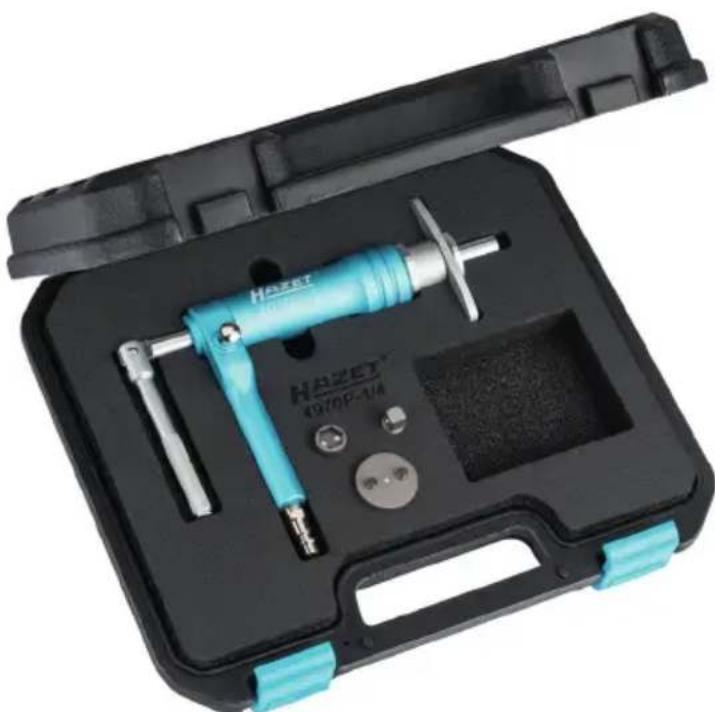
| Set contents | 1 base unit 4970 P-1, 1 set of 3 adapters 4970 P-02/3, plastic case |
| Authorized users | Specialists only |
| Lubrication | Pneumatic oil (daily) or integrated lubricator |
| Cleaning | White spirit; no chemical solvents |
| Required safety equipment | Safety glasses, hearing protection, close-fitting clothing |
| Spare parts | Original Hazet |
| Compliance standards | EU Directive 2006/42/EC, EN ISO 12100, EN ISO 20643, EN ISO 15744 |
| Warranty | According to manufacturer's conditions |
Frequently Asked Questions - 4970P-1/4 Hazet
User questions about 4970P-1/4 Hazet
0 question about this device. Answer the ones you know or ask your own.
Ask a new question about this device
Download the instructions for your Mechanical tool in PDF format for free! Find your manual 4970P-1/4 - Hazet and take your electronic device back in hand. On this page are published all the documents necessary for the use of your device. 4970P-1/4 by Hazet.
USER MANUAL 4970P-1/4 Hazet
Application note Brake piston readjusting tool
Dear customer, please follow the operating instructions in order to be able to work safely over a long period of time with your new tool.
1. General information
- Please make sure that the user of this tool carefully reads and fully understands the corresponding operating instructions and safety regulations before using the tool for the first time.
- The operating instructions contain important advice that is necessary for the safe and trouble-free operation of your HAZET tool.
- For effective use of the tool as intended, it is essential that all safety and other information in this application note is adhered to.
- Always keep these operating instructions together with your tool.
- This pneumatic tool has been designed exclusively for specific applications. HAZET emphasizes that these tools may not be modified or used in any way not corresponding to their intended application.
- HAZET will not be liable for any injuries to persons or damage to property resulting from improper application, misuse of the tool or disregard for the safety instructions.
- Furthermore, the general safety regulations and regulations for the prevention of accidents in the application range of this tool must be observed and respected.
2. Explanation of symbols
ATTENTION: Please pay attention to these symbols!
READ THE OPERATING INSTRUCTIONS AND APPLICATION NOTES!

The operator is obliged to read and to observe all operating instructions and should ensure that all users of this tool use it according to the information given.

NOTE!

This symbol indicates advice that is helpful when using the tool.
WARNING!

This symbol indicates important descriptions, dangerous conditions, safety risks and safety advice.
CAUTION!

This symbol marks advice which if disregarded results in damage, malfunction and/or functional failure of the device.
QUALIFIED PERSONNEL

The tool may only be used by qualified personnel. Handling by non-qualified people may lead to injuries to persons or damage to the tool or workpiece.
3. Liability and warranty
- Any deviation from the intended use and/or any misapplication of the device is not permitted and will be considered as improper use.
- Any claims against the manufacturer and/or its authorized agents because of damage caused by improper use of the tools are void.
- Any personal injury or material losses caused by improper use of the tool are the sole responsibility of the owner.
- The intended use of the pneumatic tools is described in the corresponding operating instructions and application notes.
4. Safety instructions
4a. Intended use
The brake piston readjusting tool is suitable for all common vehicle types.
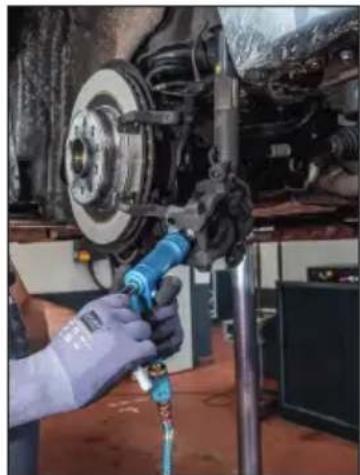
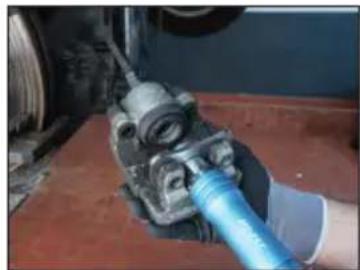
Use the brake piston readjusting tool set for readjusting (pushing or turning) brake pistons on floating calliper systems with or without locking device for hand brakes.

Not suitable for use with floating caliper brakes with 2 piston brake system.

Operational safety is only guaranteed if the tool is used as intended and in compliance with the indications given in the operating instructions.
- Incorrect use of the pneumatic tool or use whilst failing to comply with the safety instructions can result in serious injury.
4b. Dangers that may arise from the tool

Before each use, check the tool for full functionality. Do not use the tool set if its functionality cannot be ensured or if damage is detected. If the tool is used when it is not in full working order, you risk severe injuries to persons and damage to property.
- Do not use tools with a defective On/Off switch.
Any tools that cannot be switched on or off with the
On/Off switch are dangerous and must be repaired.
- All service or repair work must be carried out by qualified personnel only.
Only use original spare parts so as to guarantee long-term operational safety.
- Safety devices and/or cover parts may not be removed.

Wear eye protection. Pneumatic tools can disperse chips, dust and other abraded particles at high speed, which may result in severe eye injuries. Compressed air is dangerous. The air flow may cause harm to sensitive parts of the body like eyes, ears, etc. Dust and objects being raised by the air flow may cause injuries.

Wear hearing protection. Long exposure to the operating noise of pneumatic tools may result in permanent hearing loss.

Wear tight-fitting protective clothing. Tools with moving parts can get caught in the hair, clothing, jewellery or other loose objects, which may result in severe injuries. Never wear loose clothing and/or clothing with bands or loops which may get caught in moving parts of the tool. Take off any jewellery, watches, identification tags, bracelets, necklaces, etc. that could get caught in the tool during work. Never touch the moving parts of a tool. Long hair should be tied back or covered.
- Keep children away from pneumatic tools. Unattended tools or tools that are connected to the compressed air supply may be used by non-authorized persons and could injure them or other persons.
- Do not use the tool in an explosive atmosphere. Pneumatic tools can produce sparks that may ignite combustible materials. Never operate tools in proximity to combustible substances like petrol, naphtha, detergents, etc. Work in well-cleaned and well-ventilated areas only. Keep combustible materials out of the work area. Never use oxygen, carbon dioxide or other bottled gases to power pneumatic tools.
- Do not point the tool at any person or animal, or at yourself. Keep children and other persons out of the work area when operating the tool.
- Do not use the tool in no-load operation. Tools such as chisels etc. may break off and be flung around and may cause severe injury to the user or to persons in the work area.
- Do not allow pneumatic tools to come into contact with sources of electricity.
- Pay attention to the working pressure. For the max. air pressure, please refer to the respective operating instruction or application note. Exceeding the approved maximum pressure of tools and accessories can cause explosions and may result in severe injuries. The maximum pressure of the compressed air must be equal to or less than the approved pressure load indicated for the pneumatic tool.
- Check the tight fit of the hose connection. Do not use defective or worn pressure hoses or adapters of inferior quality. Uncontrollably moving pressure hoses may cause severe injuries.
- Only disconnect pneumatic tools in an unpressurized state. Uncontrollably moving pressure hoses may cause severe injuries.
- Use clean and dry air only. Never use oxygen, carbon dioxide or other bottled gases to power pneumatic tools.
- Only use spare parts, attachments and accessories which are recommended by the manufacturer.
- Never carry the tool by the compressed air hose.
- Never carry the connected tool with a finger on the operating lever.
- Avoid unintentional actuation.
Always keep the grips dry, clean and free of grease or oil. - Make sure that the working area is clean, well ventilated and always well lit.
- Never use the tool whilst under the influence of alcohol or drugs.
- Labels on the tool must always be kept legible.
en
- The maintenance and operation of pneumatic tools is exclusively permitted for persons who have been instructed accordingly.
- Repair work must be carried out exclusively by authorized persons.
- It is strictly forbidden to manipulate or misuse pneumatic tools or to effect emergency repairs.
- Do not reach into the working area of the pneumatic tool during operation.
- In the case of leakages or other malfunctions, the tool must be immediately disconnected from the compressed air supply and the cause of the error eliminated.
- Never use quick-release couplings directly on the tool. There must be an air hose of at least 20cm in length between the device and the quick-release coupling.
- Only replace tools to be operated, such as adapters, when the air hose is disconnected.
- Before lubricating or changing tools to be operated e.g. adapters, etc., always disconnect the pneumatic tool from the compressed air supply.
- Always check operating tools are in a satisfactory condition.
- Only use tools that are intended for the use with the respective device.
- Sustained vibration may cause damage to your health.
Take care to maintain a safe position when working.
5. Design and function
Work instruction for calliper systems with locking device for hand brakes
- Loosen brake calliper and swing to the side.
- Remove brake pads.
- Check whether there is enough room in the brake fluid expansion tank for the brake fluid that flows back when turning the brake piston.
- Select a suitable adapter and secure it in the 1/4'' spindle socket.
- Secure the vehicle-specific thrust block (Note: not included with the tool set) to the previously mounted adapter
- Connect the device to the compressed air.

ATTENTION: The pressure may not exceed 8 bar
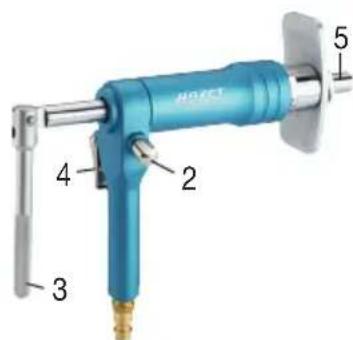
- Press the quick-release press-button (2) by moving the spindle forwards/backwards using the operating lever (3) and inserting the tool into the brake calliper.
- Actuate the pressure switch (4) and the operating lever (3) to reset/turn the brake piston.
After the piston has been turned back, press the quick-release press-button (2) in order to withdraw the spindle (5) using the operating lever (3), thus removing the tool from the brake calliper. - In all cases, the manufacturer's instructions must be adhered to.
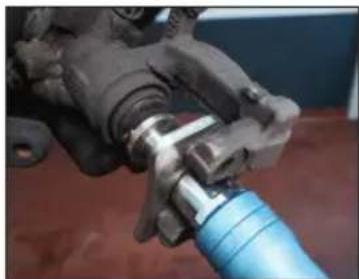
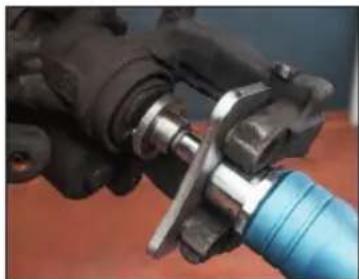
Work instruction for calliper systems without locking device for hand brakes
- Connect a suitable adapter to the basic unit and insert into the brake calliper.
- Return the piston to its starting position by moving the spindle.
- Remove tool, install brake calliper with brake pads, check brake fluid and braking effect.
Safety precaution:

Brake pistons on brake calliper systems with locking devices for hand brakes may not be pressed back, but rather only pushed and turned. Brake pistons on brake calliper systems without locking devices for hand brakes may only be pressed back.

Note:
- Always observe the manufacturer specifications.
- Only allow authorised personnel to carry out repairs on brake systems.
- Observe the existing safety and accident prevention regulations.
Set contents:
in the plastic box,
Contents:
1 x basic unit 4970 P-1
1x 4970 P-02/3 3-piece adapter set
Technical data:
Total length: 260 mm
Weight: 1.07 kg
Air requirement: 13.4 L/min
Air inlet: 1/4"
Working pressure: 5-8 bar
Stroke: 58.1 mm
Noise level: 64.3 dB
Vibration acceleration: . . . . . . 0.876 m/s²
6. Spare parts
- Only use the manufacturer's original spare parts.
- Unsuitable or defective spare parts may cause damage, malfunction or total failure of the tool.
- The use of unapproved spare parts will void all warranty, service and liability claims as well as all claims for compensation against the manufacturer or its agents, distributors and sales representatives.
7. Disposal
- For disposal, clean the tool and disassemble in accordance with the regulations for work safety and environmental protection. Please recycle components.
8. Maintenance
- Always disconnect the tool from the compressed air supply prior to carrying out maintenance work.
- We recommend using benzine to clean the tool or its individual parts.
- Never clean with solvents or acids, esters (organic compounds comprising acids and alcohol), acetone (ketone), chlorinated hydrocarbons or oils containing nitro hydrocarbons. Do not use any chemicals with a low burning point.
Lubricating:
- Pneumatic tools have to be lubricated throughout their whole serviceable life.
- The motor and the ball bearings require compressed air to operate the tool. Since the moisture in the compressed air corrodes the motor, the motor must be lubricated every day. We recommend that an integrated lubricator is used to do this.
Important:

We recommend using air fi liters and a compressed air line lubricator.
Caution!

Disconnect the compressed air supply prior to lubricating, connecting or disconnecting the tool.
9. EC Declaration of Conformity

Ensure that pneumatic tools are always used, inspected and maintained in compliance with the respective local, state, national or federal regulations.
Product description: Brake piston readjusting tool
Article No.: 4970 P-1/4
We hereby confirm that the designated product fulfils the regulation of the new EC Machinery Directive 2006/42/EC.
For the evaluation of conformity, the following harmonized standards were consulted:
EN ISO 12100:2010 EN ISO 20643:2008 + A1:2012 EN ISO 15744:2008
Person authorised to compile the technical fi le: Sandra Muller, Tel.: +49 (0) 2191 792 319
Date: 2020-09-29
Guido Schmidt