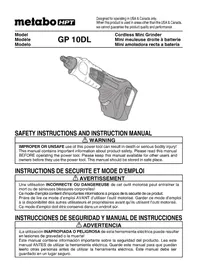
GP10DL - Grinder HiKOKI - Free user manual and instructions
Find the device manual for free GP10DL HiKOKI in PDF.


| Brand | HiKOKI |
| Model | GP10DL |
| Product type | Cordless mini die grinder |
| Power supply | Lithium-ion battery 10.8 V / 12 V max, model BCL1015 |
| No-load speed | 5,000 - 35,000 rpm |
| Chuck capacity | 1/8" (3.2 mm) |
| Weight (with battery) | 0.48 kg (1.06 lb) |
| Battery type | Rechargeable lithium-ion |
| Compatible charger | UC10SL2 or UC10SFL |
| Charging time (UC10SL2) | Approx. 30 min at 20°C |
| Charging time (UC10SFL) | Approx. 40 min at 20°C |
| Permissible charging temperature | 0°C - 50°C |
| Charge/discharge cycles | Approx. 1,000 times |
| Main applications | Carving, engraving, grinding, sanding, polishing |
| Compatible materials | Wood, metal, glass, ceramic, plastic, stone |
| Safety function | Overload protection, low battery protection, spindle lock |
| Routine maintenance | Clean with a soft damp cloth (soapy water); check screws and accessories |
| Included accessories | 40-piece set, BCL1015 battery, charger, plastic case |
| Repairability | Entrust to an authorized metabo HPT service center |
| Recommended storage | Temperature below 40°C, out of reach of children |
Frequently Asked Questions - GP10DL HiKOKI
User questions about GP10DL HiKOKI
0 question about this device. Answer the ones you know or ask your own.
Ask a new question about this device
Download the instructions for your Grinder in PDF format for free! Find your manual GP10DL - HiKOKI and take your electronic device back in hand. On this page are published all the documents necessary for the use of your device. GP10DL by HiKOKI.
USER MANUAL GP10DL HiKOKI
natural_image
Line drawing of a handheld electronic device with ports and buttons (no text or symbols)SAFETY INSTRUCTIONS AND INSTRUCTION MANUAL
WARNING
IMPROPER OR UNSAFE use of this power tool can result in death or serious bodily injury! This manual contains important information about product safety. Please read this manual BEFORE operating the power tool. Please keep this manual available for other users and owners before they use the power tool. This manual should be stored in safe place.
INSTRUCTIONS DE SECURITE ET MODE D'EMPLOI
AVERTISSEMENT
IMPORTANT SAFETY INSTRUCTIONS
Read all of the safety precautions, warnings and operating instructions in the instruction manual before operating or maintaining this power tool.
Most accidents that result from power tool operation and maintenance are caused by the failure to observe basic safety rules or precautions. An accident can often be avoided by recognizing a potentially hazardous situation before it occurs, and by observing appropriate safety procedures.
Basic safety precautions are outlined in the “SAFETY” section of this instruction manual and in the sections which contain the operation and maintenance instructions.
Hazards that must be avoided to prevent bodily injury or machine damage are identified by WARNINGS on the power tool and in this instruction manual.
Never use this power tool in a manner that has not been specifically recommended by metabo HPT.
MEANINGS OF SIGNAL WORDS
WARNING indicates a potentially hazardous situations which, if ignored, could result in death or serious injury.
CAUTION indicates a potentially hazardous situations which, if not avoided, may result in minor or moderate injury, or may cause machine damage.
NOTE emphasizes essential information.
SAFETY
GENERAL POWER TOOL SAFETY WARNINGS
WARNING
Read all safety warnings and all instructions.
Failure to follow the warnings and instructions may result in electric shock, fire and/or serious injury.
Save all warnings and instructions for future reference.
The term "power tool" in the warnings refers to your mains-operated (corded) power tool of operated (cordless) power tool.
1) Work area safety
a) Keep work area clean and well lit.
Cluttered or dark areas invite accidents.
b) Do not operate power tools in explosive atmospheres, such as in the presence of fl ammable liquids, gases or dust.
Power tools create sparks which may ignite the dust or fumes.
c) Keep children and bystanders away while operating a power tool.
Distractions can cause you to lose control.
2) Electrical safety
a) Power tool plugs must match the outlet.
Never modify the plug in any way.
Do not use any adapter plugs with earthed (grounded) power tools.
Unmodifi ed plugs and matching outlets will reduce risk of electric shock.
b) Avoid body contact with earthed or grounded surfaces such as pipes, radiators, ranges and refrigerators.
There is an increased risk of electric shock if your body is earthed or grounded.
c) Do not expose power tools to rain or wet conditions.
Water entering a power tool will increase the risk of electric shock.
d) Do not abuse the cord. Never use the cord for carrying, pulling or unplugging the power tool.
Keep cord away from heat, oil, sharp edges or moving parts.
Damaged or entangled cords increase the risk of electric shock.
e) When operating a power tool outdoors, use an extension cord suitable for outdoor use.
Use of a cord suitable for outdoor use reduces the risk of electric shock.
f) If operating a power tool in a damp location is unavoidable, use a residual current device (RCD) protected supply.
Use of an RCD reduces the risk of electric shock.
3) Personal safety
a) Stay alert, watch what you are doing and use common sense when operating a power tool.
Do not use a power tool while you are tired or under the influence of drugs, alcohol or medication.
A moment of inattention while operating power tools may result in serious personal injury.
b) Use personal protective equipment. Always wear eye protection.
Protective equipment such as non-skid safety shoes, hard hat, or hearing protection used for appropriate conditions will reduce personal injuries.
c) Prevent unintentional starting. Ensure the switch is in the off-position before connecting to power source and/or battery pack, picking up or carrying the tool.
Carrying power tools with your fi nger on the switch or energising power tools that have the switch on invites accidents.
d) Remove any adjusting key or wrench before turning the power tool on.
A wrench or a key left attached to a rotating part of the power tool may result in personal injury.
e) Do not overreach. Keep proper footing and balance at all times.
This enables better control of the power tool in unexpected situations.
f) Dress properly. Do not wear loose clothing or jewellery. Keep your hair, clothing and gloves away from parts.
Loose clothes, jewellery or long hair can be caught in moving parts.
g) If devices are provided for the connection of dust extraction and collection facilities, ensure these are connected and properly used.
Use of dust collection can reduce dust-related hazards.
4) Power tool use and care
a) Do not force the power tool. Use the correct power tool for your application.
The correct power tool will do the job better and safer at the rate for which it was designed.
b) Do not use the power tool if the switch does not turn it on and off.
Any power tool that cannot be controlled with the switch is dangerous and must be repaired.
c) Disconnect the plug from the power source and/or the battery pack from the power tool before making any adjustments, changing accessories, or storing power tools.
Such preventive safety measures reduce the risk of starting the power tool accidentally.
d) Store idle power tools out of the reach of children and do not allow persons unfamiliar with the power tool or these instructions to operate the power tool.
d u s tPowerstools are dangerous in the hands of untrained users.
e) Maintain power tools. Check for misalignment or binding of moving parts, breakage of parts and any other condition that may affect the power tool's operation.
If damaged, have the power tool repaired before use.
Many accidents are caused by poorly maintained power tools.
f) Keep cutting tools sharp and clean.
Properly maintained cutting tools with sharp cutting edges are less likely to bind and are easier to control.
g) Use the power tool, accessories and tool bits etc. in accordance with instructions, taking into account the working conditions and the work to be performed.
Use of the power tool for operations different from those intended could result in a hazardous situation.
5) o Battery tool use and care
a) Recharge only with the charger specified by the manufacturer.
A charger that is suitable for one type of battery pack may create a risk of fire when used with another battery pack.
b) Use power tools only with specifically designated battery packs.
Use of any other battery packs may create a risk of injury and fi re.
c) When battery pack is not in use, keep it away from other metal objects like paper clips, coins, keys, nails, screws, or other small metal objects, that can make a connection from one terminal to another.
Shorting the battery terminals together may cause burns or a fire.
d) Under abusive conditions, liquid may be ejected from the battery; avoid contact. If contact accidentally occurs, flush with water. If liquid contacts eyes, additionally seek medical help. g)
Liquid ejected from the battery may cause irritation or burns.
6) Service
a) Have your power tool se qualified repair person using only identical replacement parts.
This will ensure that the safety of the power) tool is maintained.
SAFETY WARNINGS COMMON FOR GRINDING OPERATIONS
a) This power tool is intended to function as a grinder. Read all safety warnings, instructions, illustrations and specifications provided with this power tool.
Failure to follow all instructions listed below may result in electric shock, fire and/or serious injury.
b) Operations such as sanding, wire brushing, polishing or cutting-off are not recommended to be performed with this power tool.
Operations for which the power tool was not designed may create a hazard and cause personal injury.
c) Do not use accessories which are not specifically designed and recommended by the tool manufacturer.
Just because the accessory can be attached to your power tool, it does not assure safe operation.
d) The rated speed of the accessories must be at least equal to the maximum speed marked on the power tool.
Accessories running faster than their rated speed can break and fly apart.
e) The outside diameter and the thickness of your accessory must be within the capacity rating of your power tool.
Incorrectly sized accessories cannot be adequately controlled.
f) The arbour size of wheels, sanding drums or any other accessory must properly fit the spindle or collet of the power tool.
Accessories that do not match the mounting hardware of the power tool will run out of balance, vibrate excessively and may cause loss of control.
g) Mandrel mounted wheels, sanding drums, cutters or other accessories must be fully inserted into the collet or chuck.
If the mandrel is insufficiently held and/or the oveihare of the wheel is too long, the mounted wheel may become loose and be ejected at high velocity.
Do not use a damaged accessory. Before each use inspect the accessory such as abrasive wheels for chips and cracks, sanding drum for cracks, tear or excess wear, wire brush for loose or cracked wires. If power tool or accessory is dropped, inspect for damage or install an undamaged accessory. After inspecting and installing an accessory, position yourself and bystanders away from the plane of the rotating accessory and run the power tool at maximum no-load speed for one minute.
Damaged accessories will normally break apart during this test time.
i) Wear personal protective equipment. Depending on application, use face shield, safety goggles or safety glasses. As appropriate, wear dust mask, hearing protectors, gloves and workshop apron capable of stopping small abrasive or workpiece fragments.
The eye protection must be capable of stopping flying debris generated by various operations. The dust mask or respirator must be capable of if ltrating particles generated by your operation. Prolonged exposure to high intensity noise may cause hearing loss.
j) Keep bystanders a safe distance away from work area. Anyone entering the work area must wear personal protective equipment.
Fragments of workpiece or of a broken accessory may fly away and cause injury beyond immediate area of operation.
k) Hold power tool by insulated gripping surfaces only, when performing an operation where the cutting accessory may contact hidden wiring.
Cutting accessory contacting a "live" wire may make exposed metal parts of the power tool "live" and could give the operator an electric shock.
I) Always hold the tool firmly in your hand(s) during the start-up.
The reaction torque accelerates to full speed, can cause the tool to twist.
m) Use clamps to support workpiece whenever practical. Never hold a small workpiece in one hand and the tool in the other hand while in use.
Clamping a small workpiece allows you to use your hand(s) to control the tool. Round material such as dowel rods, pipes or tubing have a tendency to roll while being cut, and may cause the bit to bind or jump toward you.
n) Position the cord clear of the spinning accessory.
If you lose control, the cord may be cut or snagged and your hand or arm may be pulled into the spinning accessory.
o) Never lay the power tool down until the accessory has come to a complete stop.
The spinning accessory may grab the surface and pull the power tool out of your control.
p) After changing the bits or making any adjustments, make sure chuck or any other adjustment devices are securely tightened.
Loose adjustment devices can unexpectedly shift, causing loss of control, loose rotating components will be violently thrown.
q) Do not run the power tool while carrying it at your side.
Accidental contact with the spinning accessory could snag your clothing, pulling the accessory into your body.
r) Regularly clean the power tool's air vents.
The motor's fan will draw the dust inside the housing and excessive accumulation of powdered metal may cause electrical hazards.
s) Do not operate the power tool near fl ammable materials.
Sparks could ignite these materials.
t) Do not use accessories that require liquid coolants.
Using water or other liquid coolants may result in electrocution or shock.
KICKBACK AND RELATED WARNINGS
Kickback is a sudden reaction to a pinched or snagged rotating wheel, sanding band, brush or any other accessory. Pinching or snagging causes rapid stalling of the rotating accessory which in turn causes the uncontrolled power tool to be forced the direction opposite of the accessory's rotation.
For example, if an abrasive wheel is snagged or pinched by the workpiece, the edge of the wheel that is entering into the pinch point can dig into the surface of the material causing the wheel to climb out or kick out. The wheel may either jump toward or away from the operator, depending on direction of the wheel's movement at the point of pinching. Abrasive wheels may also break under these conditions.
Kickback is the result of power tool misuse and/or incorrect operating procedures or conditions and can be avoided by taking proper precautions as given below.
a) Maintain a fi rm grip on the power tool and position your body and arm to allow you to resist kickback forces.
The operator can control kickback forces, if proper precautions are taken.
b) Use special care when working corners, sharp edges etc. Avoid bouncing and snagging the accessory.
Corners, sharp edges or bouncing have a tendency to snag the rotating accessory and cause loss of control or kickback.
c) Do not attach a toothed saw blade.
Such blades create frequent kickback and loss of control.
d) Always feed the bit into the material in the same direction as the cutting edge is exiting from the material (which is the same direction as the chips are thrown).
Feeding the tool in the wrong direction causes the cutting edge of the bit to climb out of the work and pull the tool in the direction of this feed.
e) When using rotary files, cut-off wheels, high-speed cutters or tungsten carbide cutters, always have the work securely clamped.
These wheels will grab if they become slightly canted in the groove, and can kickback. When a cut-off wheel grabs, the wheel itself usually breaks. When a rotary file, high-speed cutter or
tungsten carbide cutter grabs, it may jump from the groove and you could lose control of the tool.
SAFETY WARNINGS SPECIFIC FOR GRINDING OPERATIONS
a) Use only wheel types that are recommended for your power tool and only for recommended applications. For example: do not grind with the side of a cut-off wheel.
Abrasive cut-off wheels are intended peripheral grinding, side forces applied to these wheels may cause them to shatter.
b) For threaded abrasive cones and plugs use only undamaged wheel mandrels with an unrelieved shoulder fl ange that are of correct size and length.
Proper mandrels will reduce the possibility of breakage.
c) Do not "jam" a cut-off wheel or apply excessive pressure. Do not attempt to make an excessive depth of cut.
Overstressing the wheel increases the loading and susceptibility to twisting or snagging of the wheel in the cut and the possibility of kickback - or wheel breakage.
d) Do not position your hand in line with andnstructions; behind the rotating wheel. – Ensure that
When the wheel, at the point of operation, is moving away from your hand, the possible kickback may propel the spinning wheel and the power tool directly at you.
e) When wheel is pinched, snagged or when interrupting a cut for any reason, switch off the power tool and hold the power tool motionless until the wheel comes to a complete stop. Never attempt to remove the cut-off wheel from the cut while the wheel is in motion otherwise kickback may occur.
Investigate and take corrective action to eliminate the cause of wheel pinching or snagging.
f) Do not restart the cutting operation in the workpiece. Let the wheel reach full speed and carefully re-enter the cut.
The wheel may bind, walk up or kickback if the power tool is restarted in the workpiece.
g) Support panels or any oversized workpiece to minimize the risk of wheel pinching and kickback.
Large workpieces tend to sag under their own weight. Supports must be placed under the workpiece near the line of cut and near the edge of the workpiece on both sides of the wheel.
h) Use extra caution when making a “pocket cut” into existing walls or other blind areas.
The protruding wheel may cut gas or water pipes, electrical wiring or objects that can cause kickback.
GENERAL SAFETY INSTRUCTIONS FOR GRINDERS
- Check that speed marked on the wheel is equal to or greater than the rated speed of the grinder;
- Ensure that the wheel dimensions are compatible with the grinder;
- Abrasive wheels shall be stored and handled with care in accordance with manufacturer's instructions;
- Inspect the grinding wheel before use, do not use chipped, cracked or otherwise defective products;
- Ensure that mounted wheels and points are fitted in accordance with the manufacturer's andnstructions;
- Ensure that blotters are used when they are provided with the bonded abrasive product and when they are required;
- Do not use the power tool to machine materials that contain components that are harmful to health.
- Ensure that the abrasive product is correctly mounted and tightened before use and run the tool at no-load for 30 s in a safe position, stop immediately if there is considerable vibration or if other defects are detected. If this condition occurs, check the machine to determine the cause;
- If a guard is equipped with the tool never use the tool without such a guard;
- Do not use separate reducing bushings or adapters to adapt large hole abrasive wheels;
- For tools intended to be fitted with threaded hole wheel, ensure that the thread in the wheel is long enough to accept the spindle length;
- Secure the workpiece and check that the workpiece is properly supported. A workpiece clamped with clamping devices or in a vice is held more securely than by hand;
- Do not use cutting off wheel for side grinding;
- Ensure that sparks resulting from use do not create a hazard e.g. do not hit persons, or ignite fl ammable substances;
- Ensure that ventilation openings are kept clear when working in dusty conditions, if it should become necessary to clear dust, first disconnect the tool from the mains supply (use non metallic objects) and avoid damaging internal parts;
- Always use eye and ear protection. Other personal protective equipment such as dust mask, gloves, helmet and apron should be worn;
- Pay attention to the wheel that continues to rotate after the tool is switched off.
SPECIFIC SAFETY RULES AND SYMBOLS
- Accessories must be rated for at least the speed recommended on the tool warning label.
Wheels and other accessories running over rated speed can fly apart and cause injury.
- Hold power tools by insulated gripping surfaces when performing an operation where the cutting tool may contact hidden wiring or its own cord.
Contact with a “live” wire will make exposed metal parts of the tool “live” and shock the operator.
- Always wear ear protectors when using the
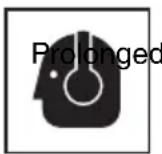
tool for extended periods.
exposure to high intensity noise can cause hearing loss.
- Never touch moving parts.
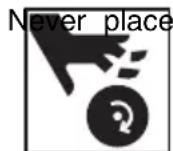
your hands, fingers or other body parts near the tool's moving parts.
- Never operate without all guards in place.
Never operate this tool without all guards or safety features in place and in proper working order. If maintenance or servicing requires the removal of a guard or safety feature, be sure to replace the guard or safety feature before resuming operation of the tool.
- Use right tool.
Don't force small tool or attachment to do the job of a heavy-duty tool.
Don't use tool for purpose not intended —for example— don't use circular saw for cutting tree limbs or logs.
- Never use a power tool for applications other than those specified.
Never use a power tool for applications other than those specified in the instruction manual.
- Handle tool correctly.
Operate the tool according to the instructions provided herein. Do not drop or throw the tool. Never allow the tool to be operated by children, individuals unfamiliar with its operation or unauthorized personnel.
- Keep all screws, bolts and covers tightly in place.
Keep all screws, bolts, and plates tightly mounted. Check their condition periodically.
- Do not use power tools if the plastic housing is cracked.
Cracks in the tool's housing or handle can lead to electric shock. Such tools should not be used until repaired.
- Accessories must be securely mounted to the tool.
Prevent potential injuries to yourself or others. Blades, cutting implements and accessories which have been mounted to the tool should be secure and tight.
- Keep motor air vent clean.
The tool's motor air vent must be kept clean so that air can freely flow at all times. Check for dust build-up frequently.
- Never use a tool which is defective or operating abnormally.
If the tool appears to be operating unusually, making strange noises, or otherwise appears defective, stop using it immediately and arrange for repairs by a metabo HPT authorized service center.
- Never leave tool running unattended. Turn power off.
Don't leave tool until it comes to a complete stop.
- Carefully handle power tools.
Should a power tool be dropped or struck against hard materials inadvertently, it may be deformed, cracked, or damaged.
- Do not wipe plastic parts with solvent.
Solvents such as gasoline, thinner benzine, carbon tetrachloride, and alcohol may damage and crack plastic parts. Do not wipe them with such solvents.
Wipe plastic parts with a soft cloth lightly dampened with soapy water and dry thoroughly.
-
Never use the grinder in places where the sparks generated by the grinder can cause explosion, such as where flammable materials or gases are present.
-
Never push in the push button while the spindle is running.
- Always wear eye protection that meets the
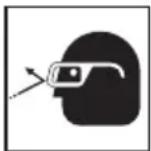
requirement of the latest revision of ANSI Standard Z87.1.
- Always wear a mank or respirator to protect yourself from dust or potentially harmful particles generated during the grinding operation.
- Always be careful with buried object such as an underground wiring. 4
Touching these active wiring or electric cable with this tool, you may receive an electric shock.
Comfi rm if there are any buried object such as electric cable within the wall, fl oor or ceiling where you are going to operate here after.
- Definitions for symbols used on this tool
V.....volts
== ...... direct current
Hz......hertz
A.....amperes
n......ratedspeed
---/min ... revolutions or reciprocation per minute
IMPORTANT SAFETY INSTRUCTIONS FOR BATTERY CHARGER
WARNING
Death or serious bodily injury could result from improper or unsafe use of battery chargers. To avoid these risks, follow these basic safety instructions:
READ ALL INSTRUCTIONS
- This manual contains important safety and operating instructions for battery charger models UC10SL2 / UC10SFL.
- Before using battery charger, read all instructions and cautionary markings on (1) battery charger, (2) battery, and (3) product using battery.
- To reduce risk of injury, charge more rechargeable battery type BCL1015. Other type of batteries may burst causing personal injury and damage.
- Use of an attachment not recommended or sold by the battery charger manufacturer may result in a risk of fire, electric shock, or injury to persons.
- To reduce risk of damage to electric plug cord, pull by plug when disconnecting battery charger.
- Make sure cord is located so that be stepped on, tripped over, or otherwise subjected to damage or stress.
- An extension cord should not be used unless absolutely necessary. Use of improper extension cord could result in a risk of fire and electric shock.
If extension cord must be used make sure:
a. That blades of extension cord are the same number, size, and shape as those of plug on battery charger:
b. That extension cord is properly wired and in good electrical condition; and
c. That wire size is large enough for AC ampere rating of battery charger as specified in Table 1.
Table 1
RECOMMENDED MINIMUM AWG SIZE FOR EXTENSION CORDS FOR BATTERY CHARGERS
| AC input rating ampere* | AWG size of cord | ||||
| Equal to or greater than | but less than | Length of cord, feet (meter) | |||
| 25 (7.5) | 50 (15) | 100 (30) | 150 (45) | ||
| 0 | 2 | 18 | 18 | 18 | 16 |
| 2 | 3 | 18 | 18 | 16 | 14 |
| 3 | 4 | 18 | 18 | 16 | 14 |
* If the input rating of a battery charger is given in watts rather than in amperes, the corresponding ampere rating is to be determined by dividing the wattage rating by the voltage rating —for example:
$$ \frac {1 , 2 5 0 \text { watts }}{1 2 5 \text { volts }} = 1 0 \text { amperes } $$
- Do not operate battery charger with damaged cord or plug-replace them immediately.
- Do not operate battery charger if it has received a sharp blow, been dropped, or otherwise damaged in any way; take it to a qualified serviceman.
- Do not disassemble battery charger; take it to a qualified serviceman when service or repair is required. Incorrect reassembly may result in a risk of electric shock or fire.
- To reduce risk of electric shock, unplug charger from receptacle before attempting any maintenance or cleaning. Removing the battery will not reduce this risk.
IMPORTANT SAFETY INSTRUCTIONS FOR USE OF THE BATTERY AND BATTERY CHARGER
You must charge the battery before you can use the power tool. Before using the models UC10SL2 / UC10SFL battery charger, be sure to read all instructions and cautionary statements on it, the battery and in this manual.
CAUTION
Use only metabo HPT battery type BCL1015. Other types of batteries may burst and cause injury!
Follow these instructions to avoid the risk of injury:
WARNING
Improper use of the battery or battery charger can lead to serious injury. To avoid these injuries:
- Never disassemble the battery.
- Never incinerate the battery, even if it is damaged or is completely worn out. The battery can explode in a fire.
-
Never short-circuit the battery.
-
Never insert any objects into the battery charger's air vents. Electric shock or damage to the battery charger may result.
- Never charge outdoors. Keep the battery away from direct sunlight and use only where there is low humidity and good ventilation.
- Never charge when the temperature is below 32^ F ( 0^ C) or above 104^ F ( 40^ C).
Charging the battery at temperatures outside the range of 32^ F – 104^ F ( 0^ C – 40^ C) may prevent proper charging and reduce battery life.
-
Never connect two battery chargers together.
-
Never insert foreign objects into the hole for the battery or the battery charger.
-
Never use a booster transformer when charging.
-
Never use an engine generator or DC power to charge.
-
Never store the battery or battery charger in places where the temperature may reach or exceed 104^ F ( 40^ C) such as inside metal box or car.
-
Never expose the battery or battery charger to rain or wet conditions.
-
Always operate charger on standard household electrical power (120 volts). Using the charger on any other voltage may overheat and damage the charger.
-
Always wait at least 15 minutes between charges to avoid overheating the charger.
-
Always disconnect the power cord from its receptacle when the charger is not in use.
CAUTION ON LITHIUM-ION BATTERY
To extend the lifetime, the lithium-ion battery equips with the protection function to stop the output.
In the cases of 1 to 3 described below, when using this product, even if you are pulling the switch, the motor may stop. This is not the trouble but the result of protection function.
-
When the battery power remaining runs out, the motor stops. In such case, charge it up immediately.
-
If the tool is overloaded, the motor may stop. In this case, release the switch of tool and eliminate causes of overloading. After that, you can use it again.
-
If the battery is overheated under overload work, the battery power may stop.
In this case, stop using the battery and let the battery cool. After that, you can use it again.
Furthermore, please heed the following warning and caution.

WARNING
In order to prevent any battery leakage, heat generation, smoke emission, explosion and ignition beforehand, please be sure to heed the following precautions.
- Make sure that swarf and dust do not collect on the battery.
○ During work make sure that swarf and dust not fall on the battery.
○ Make sure that any swarf and dust falling on the power tool during work do not collect on the battery.
○ Do not store an unused battery in a location exposed to swarf and dust.
Before storing a battery, remove any swarf and dust that may adhere to it and do not store it together with metal parts (screws, nails, etc.).
-
Do not pierce battery with a sharp object such as a nail, strike with a hammer, step on, throw or subject the battery to severe physical shock.
-
Do not use an apparently damaged or deformed battery.
-
Do not use the battery in reverse polarity.
-
Do not connect directly to an electrical or car cigarette lighter sockets.
-
Do not use the battery for a purpose other than those specified.
-
If the battery charging fails to complete even when a specified recharging time has elapsed, immediately stop further recharging.
-
Do not put or subject the battery to high temperatures or high pressure such as into a microwave oven, dryer, or high pressure container.
-
Keep away from fi re immediately when leakage or foul odor are detected.
-
Do not use in a location where strong static electricity generates.
-
If there is battery leakage, foul odor, heat generated, discolored or deformed, or in any way appears abnormal during use, recharging or storage, immediately remove it from the equipment or battery charger, and stop use.
-
Do not immerse the battery or allow any fluids to flow inside. Conductive liquid ingress, such as water, can cause damage resulting in fire or explosion. Store your battery in a cool, dry place, away from combustible and flammable items. Corrosive gas atmospheres must be avoided.
CAUTION
- If liquid leaking from the battery gets into your eyes, do not rub your eyes and wash them well with fresh clean water such as tap water and contact a doctor immediately. It do left untreated, the liquid may cause eye-problems.
- If liquid leaks onto your skin or clothes, wash well with clean water such as tap water immediately. There is a possibility that this can cause skin irritation.
- If you find rust, foul odor, overheating, discolor, deformation, and/or other irregularities when using the battery for the first time, do not use and return it to your supplier or vendor.
WARNING
If an electrically conductive foreign object enters the terminals of the lithium ion battery, a short-circuit may occur resulting in the risk of fire. Please observe the following matters when storing the battery.
- Do not place electrically conductive cuttings, nails, steel wire, copper wire or other wire in the storage case.
SAVE THESE INSTRUCTIONS AND
MAKE THEM AVAILABLE TO OTHER USERS
AND OWNERS OF THIS TOOL!
FUNCTIONAL DESCRIPTION
NOTE
The information contained in this instruction manual is designed to assist you in the safe operation and maintenance of the power tool.
Never operate, or attempt any maintenance on the tool unless you have first read and understood all safety instructions contained in this manual.
Some illustrations in this instruction manual may show details or attachments that differ from those on your own power tool.
NAME OF PARTS
2. Battery charger (UC10SL2 / UC10SFL)
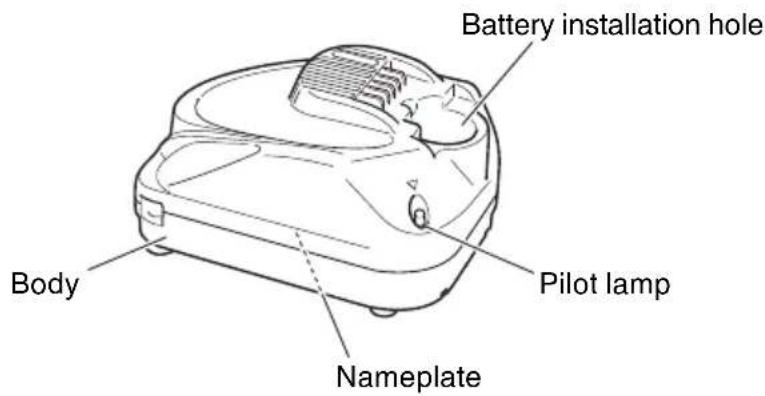
Fig. 2
SPECIFICATIONS
| Motor DC motor | ||
| Rated speed 5,000 – 35,000 / min | ||
| Collet chuck capacity | 1/8" (3.2 mm) | |
| Battery | Model BCL1015 | |
| Type Lithium - ion battery | ||
| Voltage DC 10.8 V / 12 V Peak | ||
| Charging & discharging frequency About 1,000 times | ||
| Weight | 1.06 lbs (0.48 kg) | |
- Battery charger
| Model | UC10SL2 | UC10SFL |
| Input power source Single phase: A | C 120 V 60 Hz Single phase: AC 120 V 60 Hz | |
| Charging time | Approx. 30 min.(At a temperature of 68°F (20°C)) | Approx. 40 min.(At a temperature of 68°F (20°C)) |
| Charging voltage DC 10.8 V DC 10.8 V | ||
| Charging current | DC 3.0 A | DC 2.0 A |
| Weight | 0.8 lbs. (0.35 kg) | 0.8 lbs. (0.35 kg) |
NOTE: The charging time may vary according to temperature and power source voltage.
ASSEMBLY AND OPERATION
APPLICATIONS
○ Making wood carved handicrafts and precious metal ornaments
○ Engraving and sculpting glass and ceramics
○ Grinding and polishing steel and stone
BASIC FUNCTIONS
1. Low battery warning lamp (Fig. 3)
To check the remaining battery power, operate the grinder unloaded.
If the remaining battery power is low, the warning lamp (red LED) will light. If the lamp lights, charge the battery without delay.
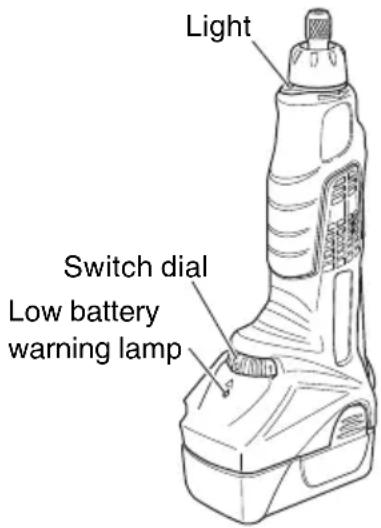
Fig. 3
NOTE
☐ The low battery warning lamp may be affected by the ambient temperature or battery characteristics. Use the lamp as a guide for when to charge the battery.
☐ The low battery warning lamp may light during operation of the grinder. This is due to a temporary drop in the battery voltage, and not to low battery power.
When checking the remaining battery power, be sure to operate the grinder in an unloaded condition.
2. Switch dial
The switch dial also serves as the start-up switch and the speed dial. When the dial is rotated from [0] to a higher number, the grinder switches on and gradually builds up speed. At the same time, the LED lamp lights and illuminates the tip of the grinder.
When the dial is returned to [0], the switches off and rotation stops.
For safety reasons, the grinder will not start up if the battery is inserted while the switch is at any position other than [0].
To switch the grinder on at such time, return the dial to [0] and then rotate it to a higher number. The approximate relationship between the numbers on the switch dial and the rotation speed is shown in the graph in Fig. 4.
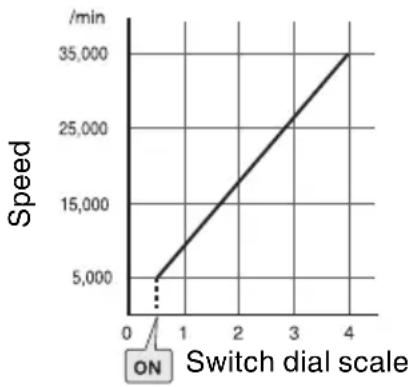
line
| Switch dial scale | Speed | | ----------------- | ------- | | 0 | 5,000 | | 1 | 15,000 | | 2 | 25,000 | | 3 | 35,000 | | 4 | 35,000 |Fig. 4
REMOVAL AND INSTALLATION METHOD OF BATTERY
○ How to install the battery.
Align the battery with the groove in the housing and slip it into place.
Always insert it all the way until it locks in place with a little click. If not, it may accidentally out of the tool, causing injury to you or someone around you (Fig. 5).
○ How to remove the battery.
Withdraw battery from the housing while pressing the latch (2 pcs) of the battery (Fig. 5).
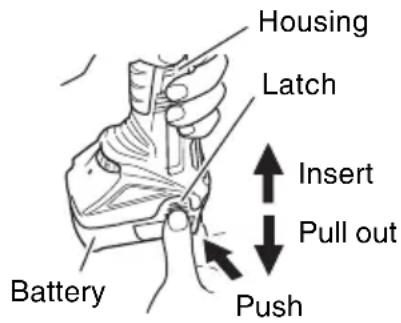
Fig. 5
CHARGING METHOD
NOTE
Before plugging into the receptacle, make sure the following points.
○ The power source voltage is stated on the nameplate.
○ The cord is not damaged.

WARNING
Do not charge at voltage higher than indicated on the nameplate.
If charged at voltage higher than indicated on the nameplate, the charger will burn out.
- Insert the plug of battery charger into the receptacle.
When the plug of battery charger has been inserted into the receptacle, pilot lamp will blink in red. (At 1-second intervals)

WARNING

Do not use the electrical cord if damaged. H immediately.
- Insert the battery to the battery charger. Insert the battery into the battery charger as shown in Fig. 6.
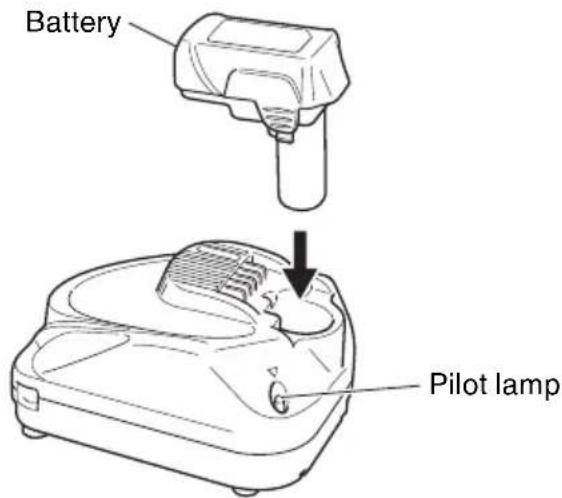
Fig. 6
- Charging
When the battery is connected to the battery charger, charging will commence and the pilot lamp will light in red. (See Table 2)
NOTE
If the pilot lamp does not light or blink in red, pull out the plug from the receptacle and check if the battery is properly mounted.
When the battery is fully charged, the pilot lamp will blink in red slowly. (At 1-second intervals) (See Table 2)
NOTE
The battery charging time becomes longer when a temperature is low or the voltage of the power source is too low.
When the pilot lamp does not blink in red (At 1-second intervals) (See Table 2) even if more than four hour has passed after start of the charging, stop the charging and contact your metabo HPT AUTHORIZED SERVICE CENTER.
Table 2
| Indications of the pilot lamp | ||||
| Pilot lamp(red) | Beforecharging | Blinks | Lights for 0.5 seconds. Does not lightfor 0.5 seconds. (off for 0.5 seconds) |     |
| Whilecharging | Lights | Lights continuously | ||
| Chargingcomplete | Blinks | Lights for 0.5 seconds. Does not lightfor 0.5 seconds. (off for 0.5 seconds) | ||
| Overheatstandby | Blinks | Lights for 1 second. Does not light for0.5 seconds. (off for 0.5 seconds) | Battery overheated.Unable to charge.(Charging will commencewhen battery cools) | |
| Chargingimpossible | Flickers | Lights for 0.1 seconds. Does not lightfor 0.1 seconds. (off for 0.1 seconds) | Malfunction in the batteryor the charger | |


○ Regarding the temperature of the rechargeable battery.
The temperatures for rechargeable batteries are as shown in the table below, and batteries that have become hot should be cooled while before being recharged.
Table 3
| Rechargeable batteries | Temperatures at which the battery can be recharged |
| BCL1015 32°F – | 122°F (0°C – 50°C) |
○ Regarding recharging time
Table 4 shows the recharging time required according to the type of battery.
Table 4 Recharging time (approx. min.) at 20°C
| Battery\Charger | UC10SL2 UC10SFL | |
| BCL1015 | Approx.30 min. | Approx.40 min. |
NOTE
The recharging time may vary according to the ambient temperature and the power supply voltage.
- Disconnect battery charger from the receptacle.
CAUTION
Do not pull the plug out of the receptacle by pulling on the cord.
Make sure to grasp the plug when removing from receptacle to avoid damaging cord.
- Remove the battery from the battery charger. Supporting the battery charger with hand, pull out the battery from the battery charger.
How to make the batteries perform longer
○ Recharge the batteries before they become completely exhausted.
When you feel that the power of the tool becomes weaker, stop using the tool and recharge its battery. If you continue to use the tool and exhaust the electric current, the battery may be damaged and its life will become shorter.
○ Avoid recharging at high temperatures.
A rechargeable battery will be hot immediately after use. If such a battery is recharged immediately after use, its internal chemical substance will deteriorate, and the battery life will be shortened. Leave the battery and recharge it after it has cooled for a while.
CAUTION
- When the battery charger has been continuously used, the battery charger will be heated, thus constituting the cause of the failures. Once the charging has been completed, give 15 minutes rest until the next charging.
- If the battery is charged while it is heated because it has been left for a long time in a location subject to direct sunl because the battery has just been used, the pilot lamp of the charger lights for 1 second, does not light for 0.5 seconds (off for 0.5 seconds). In such a case, first let the battery cool, then start charging.
- When the pilot lamp flickers (at 0.2-second intervals), check for and take out any foreign objects in the charger's battery installation hole. If there are no foreign objects, it is probable that the battery or charger is malfunctioning. Take it to your authorized Service Center.
- If the battery charger does not work while the battery is mounted correctly, it is probable that the battery or charger is malfunctioning. Take it to your authorized Service Center.
BEFORE USE
Check the work area to make sure that it is clear of debris and clutter.
Clear the area of unnecessary personnel. Ensure that lighting and ventilation is adequate.
HOW TO ATTACH THE TIP TOOL
WARNING
To prevent accidents, be sure to switch the power off and remove the battery from the grinder.
CAUTION
Make sure the mandrel is screwed in tightly.
After attaching the tip tool, check that the tool is securely fixed.
If the tool is loose, it may come off, causing damage or injury.
- How to use the screw-type mandrel (Fig. 7 (a)) Use the screw-type mandrel when using the felt polishing wheel.
Keeping the wheel straight, screw it onto the thread of the screw-type mandrel as far as the fl ange.
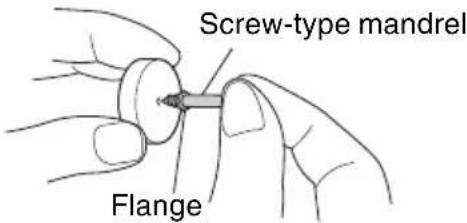
Fig. 7 (a)
- How to use the wheel mandrel (Fig. 7 (b))
Remove the screw in the end of the mandrel with a fl athead screwdriver and attach the cutting wheel or sanding disc.
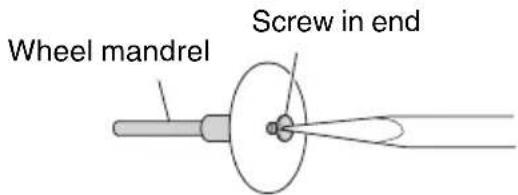
Fig. 7 (b)
- How to use the drum mandrel (Fig. 7 (c))
A 60-grit sanding band is fitted to the drum mandrel when it leaves the factory.
Loosen the screw in the end of the mandrel with a screwdriver to remove/attach the sanding band.
After attaching the sanding band, tighten the screw securely.
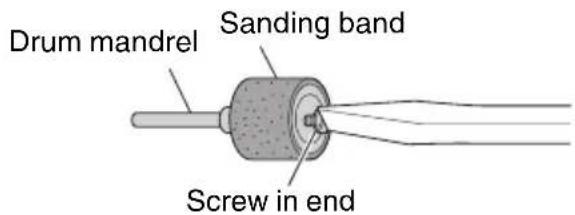
Fig. 7 (c)
- Attach the tip tool to the grinder
Rotate the collet nut by hand while pressing the lock button to further depress the lock button.
In this state, the shaft is locked and the collet nut can be loosened or tightened. (Fig. 8)
To attach the tip tool, insert the tip tool as far as it will go and tighten the collet nut securely.
To detach the tip tool, the collet nut can usually be rotated by hand, though occasionally it may be tight.
If the collet nut is tight, use the provided collet spanner to loosen it.
Iron powder on the collet nut, collet or shaft screw may cause the collet nut to be difficult to rotate. (Fig. 9)
Be sure to remove any powder before attaching or detaching the tip tool.
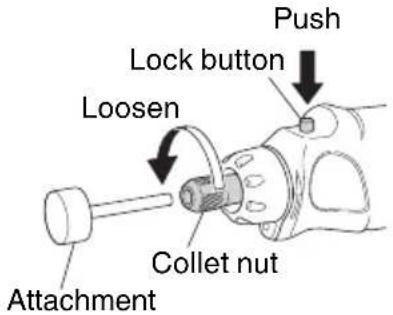
Fig. 8
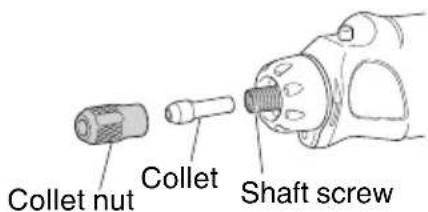
Fig. 9
NOTE
Very occasionally, the tip tool may be difficult to detach from the collet.
If this happens, with the collet nut loosened, press the end of the tool lightly against a hard object. (Fig. 10)
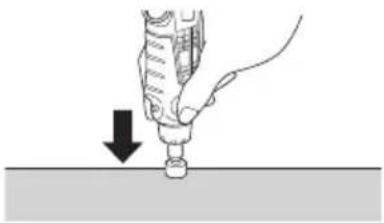
natural_image
Hand using a tool to apply a downward arrow to a small mechanical component (no text or symbols visible)- Balance adjustment of the tip tool
After attaching the tip tool, operate the grinder at low speed. If the balance is not right, follow the procedure below to adjust the balance.
Loosen the collet nut while pressing the lock button.
Next, rotate the tip tool by 1/4 and tighten the collet nut.
Operate the grinder at low speed and check the balance. If the balance is right, adjust completed.
If the balance still is not right, detach the tip tool, the collet nut and collet and re-attach them. If the tip tool is still not balanced after several such attempts, check for deformation or wear of the tip tool or deformation of the collet. If worn or deformed, replace the tip tool or collet.
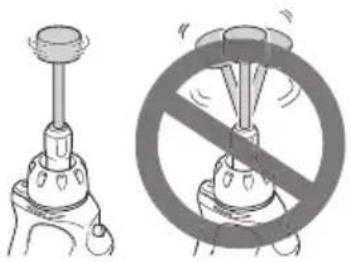
natural_image
Illustration of a mechanical device with a knob and a prohibition symbol (no text or labels)OPERATING THE GRINDER

WARNING
- Keep your face away fro during use.
● Wear goggles and a dust mask when using the grinder. Breakage of the tip tool may lead to injury. - Do not operate the grinder at extremely slow speed. A smooth fi nished surface will not be achieved and doing so may lead to damage of the tip tool, breakdown of the grinder or injury.

CAUTION
Do not touch the tip tool, collet nut or collet immediately after machining as they will be very hot and touching them may result in burns.
- Remove the battery and attach the tip tool
- Fix the workpiece so that it does not move The smaller the workpiece, the more unstable it is to machine. Fix small workpieces in a vise. Holding the workpiece by hand may result in injury.
m. Inserthetbaperytirothe grinder
-
Check the balance of the tip tool Check the tip tool visually at low speed (around [1] on the switch dial). Also check for abnormal noise during operation.
-
Select the machining speed
○ Select the optimal speed for the material while performing trial grinding with reference to Table 5.
○ If plastic is machined at high speed, it may melt due to heating. Test it gradually starting from a low speed.
Table 5 Switch dial settings
| Tip tool\Workpiece material | Softwood | Hardwood | Laminate/ Plastic | Steel | Aluminium, brass, etc. | Shell/ Stone | Ceramic | Glass |
| Aluminium oxide point | 3-4 | 3-4 | — | 2.5 | 1 | 1.5 | 3-4 | — |
| Silicon carbide point | — | — | 1.5 | 3-4 | 1 | 1.5 | 3-4 | 3-4 |
| High-speed cutter | 3-4 | 3-4 | 1 | 1.5 | 3-4 | — | — | — |
| Drill | 3-4 | 3-4 | 1 | — | 1.5 | — | — | — |
| Cutting wheel | — | — | 1 | 3-4 | 3-4 | 3-4 | 3-4 | — |
| Aluminium oxide grinding wheel | 3-4 | 3-4 | — | 2.5 | 1 | 1.5 | 3-4 | — |
| Sanding disc | 2.5 | 2.5 | 1 | — | 1 | — | — | — |
| Polishing wheel | — | — | — | 1 | 1 | |||
| Felt polishing wheel | — | — | — | 1 | 1 | — | ||
| Sanding band | 1-4 | 1-4 | 1-4 | 3-4 | 3-4 | 1-4 | 1-4 | — |
6. Machining
○ Place the rotating tip tool lightly against the workpiece and machine the workpiece with minimal pressure.
○ Rather than doing the whole task in a single action, a better fi nish is achieved gradually by multiple machinings.
NOTE
☐ The grinder narrows toward the tip tool holder. Place your finger on the narrow section and hold the grinder for easy operation. (Fig. 10)
When machining a material for the first time or using the tip tool for the fi rst time, perform trial grinding fi rst to check the optimal speed, how to hold the grinder and how to place the tool against the workpiece.
If you do not achieve the expected results, applying more pressure to the power tool will not give better results. Nor will the machining performance be improved by tilting the power tool. Adjust the rotating speed or change to another tip tool.
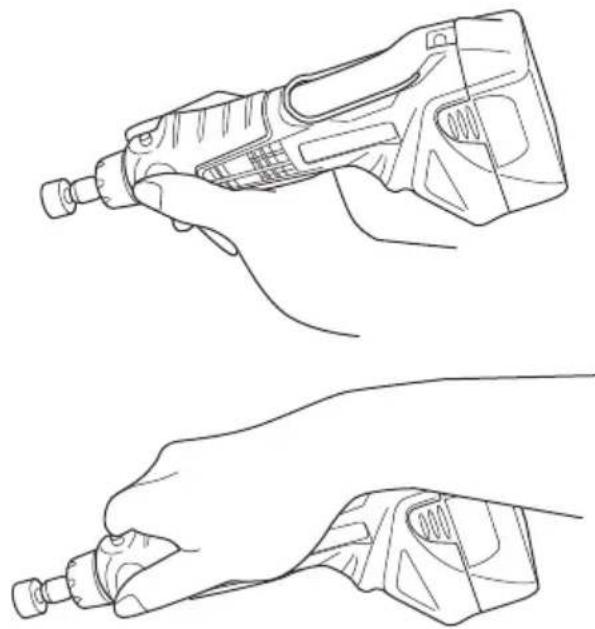
natural_image
Line drawings of a hand holding a handheld electric drill pen (no text or symbols)Fig. 10
MAINTENANCE AND INSPECTION
CAUTION
Pull out battery before doing any inspection or maintenance.
- Inspecting the accessories
Using a tip tool or mandrel with a worn or damaged end will not only result in a poor fi nish, but will place unreasonable strain on the motor, causing reduced effi ciency, damage or injury.
If the tip tool or mandrel is worn or damaged, replace it.
- Check the screws
Loose screws are dangerous. Regularly inspect them and make sure they are tight.
CAUTION
Using this power tool with loosened, screws is extremely dangerous.
- Check for dust
Dust may be removed with a soft cloth or a cloth dampened with soapy water.
Do not use bleach, chlorine, gasoline or thinner, for they may damage the plastics.
- Disposal of the exhausted battery
WARNING
Do not dispose of the exhausted battery. The battery must explode if it is incinerated. The product that you have purchased contains a rechargeable battery. The battery is recyclable. At the end of it's useful life, under various state and local laws, it may be illegal to dispose of this battery into the municipal waste stream. Check with your local solid waste officials for details in your area for recycling options or proper disposal.
- Storage
Storing in a place below 104^ F ( 40^ C) and out of the reach of children.
NOTE
Storing lithium-ion batteries
Make sure the lithium-ion batteries have been fully charged before storing them.
Prolonged storage (3 months or more) of batteries with a low charge may result in performance deterioration, significantly reducing battery usage time or rendering the batteries incapable of holding a charge.
However, significantly reduced battery usage time may be recovered by repeatedly charging and using the batteries two to fi ve times.
If the battery usage time is extremely short despite repeated charging and use, consider the batteries dead and purchase new batteries.
- Service and repairs
All quality power tools will eventually require servicing or replacement of parts because of wear from normal use. To assure that only authorized replacement parts will be used, all service and repairs must be performed by a metabo HPT AUTHORIZED SERVICE CENTER, ONLY.
CAUTION
In the operation and maintenance of power tools, the safety regulations and standards prescribed in each country must be observed.
ACCESSORIES
WARNING
Always use only authorized metabo HPT replacement parts and accessories. Never use replacement parts or accessories which are not intended for use with this tool. Contact metabo HPT if you are not sure whether it is safe to use a particular replacement part or accessory with your tool.
The use of any other attachment or accessory can be dangerous and could cause injury or mechanical damage.
NOTE
Accessories are subject to change without any obligation on the part of the metabo HPT.
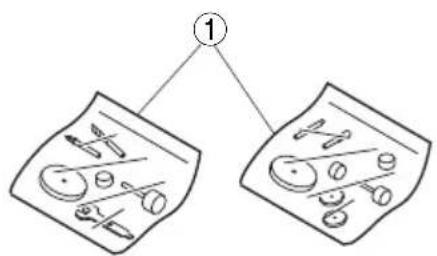
STANDARD ACCESSORIES
flowchart
graph TD
    A["Process 1"] --> B["Process 2"]
    B --> C["Output"]
    style A fill:#f9f,stroke:#333
    style B fill:#bbf,stroke:#333
natural_image
Line drawing of a battery with a cylindrical component and labeled part (2), no text or symbols present.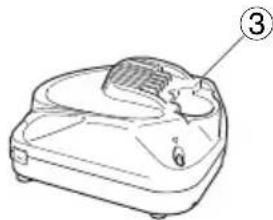
natural_image
Line drawing of a portable device with a label pointing to the number 3 (no text or symbols on the device itself)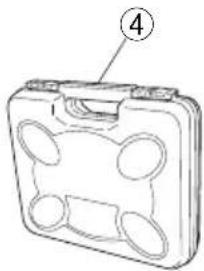
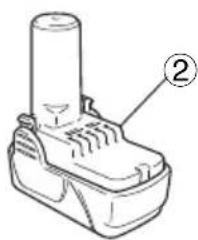
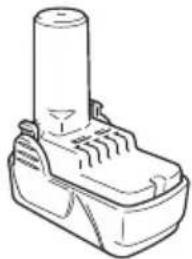
| GP10DL(LCSK) | 1Accessories × 40 pcs(Code No. 332492, 332493)......12Battery (BCL1015)......13Battery charger (UC10SL2 or UC10SFL)......14Plastic case (Code No. 332491)......1 |
| GP10DL(NN) | 1Accessories × 40 pcs(Code No. 332492, 332493)......1 |
For details of the attachments, refer to "Provided attachments".
OPTIONAL ACCESSORIES ......sold separately
(1) Battery (BCL1015)
natural_image
Line drawing of a cylindrical battery with cooling fins and a cylindrical top (no text or symbols)Provided attachments
| Use for wood engraving and grinding. | Aluminium oxide point [5/8" (φ15.9 mm) × 1]5/8"(15.9 mm) 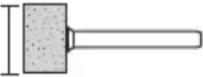 |
| Use to machine hard materials such as glass and ceramics. | Silicon carbide point [3/16" (φ4.8 mm) × 1]3/16"(4.8 mm)  |
| Use to engrave, grind and make grooves in wood, plastic and soft metals (aluminium, copper, brass). | High-speed cutter [1/8" (φ3.2 mm) × 1]1/8"(3.2 mm)  |
| Use to make holes in wood and plywood. | Drill [1/8" (φ3.2 mm) × 1]1/8"(3.2 mm)  |
| Use to slice or cut materials.Suitable for cutting thin rods and pipes.Recuts crushed grooves in screw heads.Do not press hard against workpiece as it may crack. | Cutting wheel [15/16" (φ23.8) × 0.025" (t0.6) × 6]15/16"(23.8 mm) 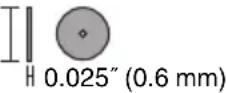 |
Cutting wheel [15/16" (φ23.8) × 0.040" (t1.0) × 2]15/16"(23.8 mm) 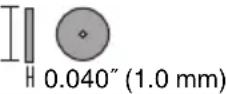 | |
| Use to polish hard materials such as stainless steel. | Aluminium oxide grinding wheel[7/8" (φ22.2) × 1]7/8"(22.2 mm)  |
| Suitable for fi nal polishing after rough grinding. | Sanding disc [3/4" (φ19.1 mm)/180-grit × 10]3/4"(19.1 mm)  |
| Use to give smooth fi nish to metal surfaces. | Polishing wheel [1" (φ25.4 mm) × 2]1"(25.4 mm)  |
| Use for mirror polishing of jewelry and metals.Choose the size to suit the workpiece. | Felt polishing wheel [1/2" (φ12.7 mm) × 4]1/2"(12.7 mm)  |
Felt polishing wheel [1" (φ25.4 mm) × 2]1"(25.4 mm)  | |
| Suitable for tasks such as shaping wood and fi nishing models.Grind in two stages with different grit numbers to achieve a good surface fi nish. | Sanding band [1/2" (φ12.7 mm)/60-grit × 6]1/2"(12.7 mm) 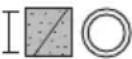 60-grit 60-grit |
Sanding band [1/2" (φ12.7 mm)/120-grit × 2]1/2"(12.7 mm) 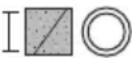 120-grit 120-grit |

CAUTION
Standard attachments are exclusively for use with the GP10DL. Do not use with other equipment such as electric drills, etc. Doing so may result in injury or damage to the tip tool.
[Accessory]
Collet spanner (for loosening tight collet nuts)
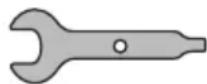
Wheel mandrel [1/8" (φ3.2 mm) × 1]

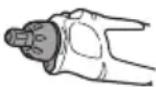
Screw-type mandrel [1/8" (φ3.2 mm) × 1]

Drum mandrel [1/8" (φ3.2 mm) × 1]
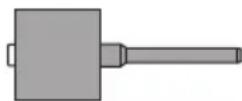
NOTE
Specifications are subject to change without any obligation on the part of the metabo HPT.
CONSIGNES DE SÉCURITÉ IMPORTANTES
line
| X-axis | Y-axis | |---|---| | 0 | 5,000 | | 1 | 15,000 | | 2 | 25,000 | | 3 | 35,000 | | 4 | 35,000 |Fig. 4
MÉTHODE DE RETRAIT ET D'INSTALLATION DE LA BATTERIE
natural_image
Illustration of a hand using a tool to press or install a bolt, with a downward arrow indicating compression (no text or symbols present)natural_image
Illustration of a mechanical device with a knob and a prohibition symbol (no text or labels)UTILISATION DE LA MEULEUSE
⚠ AVERTISSEMENT
natural_image
Line drawing of a hand holding a handheld electric drill bit (no text or symbols)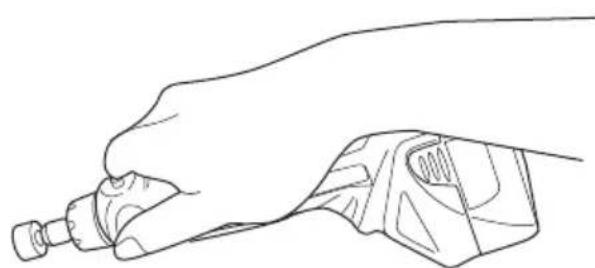
natural_image
Line drawing of a hand holding a small mechanical component (no text or symbols)Fig. 10
ENTRETIEN ET INSPECTION
PRÉCAUTION
natural_image
Line drawing of a cylindrical battery with cooling fins and a cylindrical top (no text or symbols)Accessoires fournis
natural_image
Illustration of a hand using a tool to press or install a bolt, with a downward arrow indicating compression (no text or symbols present)natural_image
Illustration of a manual presser and a prohibition symbol (no text or labels)natural_image
Line drawings of a hand holding a handheld electric drill, showing mechanical components and grip (no text or symbols)Fig. 10
natural_image
Line drawing of a cylindrical electronic component with ports and casing (no text or symbols)Please contact Koki Holdings America Ltd. at 1-800-59-TOOLS (toll free), or metabo HPT AUTHORIZED POWER TOOL SERVICE CENTER regarding COLLECTION.

Pour le RAMASSAGE, contacter Koki Holdings America Ltd. au 1-800-59-TOOLS (appel gratuit), ou UN SERVICE APRÈS-VENTE D'OUTILS ÉLECTRIQUE AGRÉÉ PAR metabo HPT.

Shinagawa Intercity Tower A, 15-1, Konan 2-chome, Minato-ku, Tokyo 108-6020, Japan
Distributed by
Koki Holdings America Ltd.
1111 Broadway Ave, Braselton, Georgia, 30517
Koki Holdings America Ltd. Canadian Branch
3405 American Drive, Units 9-10, Mississauga, ON, L4V 1T6


- SAFETY INSTRUCTIONS AND INSTRUCTION MANUAL
- WARNING
- INSTRUCTIONS DE SECURITE ET MODE D'EMPLOI
- AVERTISSEMENT
- IMPORTANT SAFETY INSTRUCTIONS
- MEANINGS OF SIGNAL WORDS
- SAFETY
- GENERAL POWER TOOL SAFETY WARNINGS
- 6) Service
- SAFETY WARNINGS COMMON FOR GRINDING OPERATIONS
- KICKBACK AND RELATED WARNINGS
- SAFETY WARNINGS SPECIFIC FOR GRINDING OPERATIONS
- GENERAL SAFETY INSTRUCTIONS FOR GRINDERS
- SPECIFIC SAFETY RULES AND SYMBOLS
- IMPORTANT SAFETY INSTRUCTIONS FOR BATTERY CHARGER
- READ ALL INSTRUCTIONS
- IMPORTANT SAFETY INSTRUCTIONS FOR USE OF THE BATTERY AND BATTERY CHARGER
- CAUTION
- CAUTION ON LITHIUM-ION BATTERY
- SAVE THESE INSTRUCTIONS AND
- MAKE THEM AVAILABLE TO OTHER USERS
- AND OWNERS OF THIS TOOL!
- FUNCTIONAL DESCRIPTION
- NOTE
- NAME OF PARTS
- Battery charger (UC10SL2 / UC10SFL)
- SPECIFICATIONS
- ASSEMBLY AND OPERATION
- APPLICATIONS
- BASIC FUNCTIONS
- Low battery warning lamp (Fig. 3)
- Switch dial
- REMOVAL AND INSTALLATION METHOD OF BATTERY
- CHARGING METHOD
- How to make the batteries perform longer
- BEFORE USE
- HOW TO ATTACH THE TIP TOOL
- OPERATING THE GRINDER
- Machining
- MAINTENANCE AND INSPECTION
- ACCESSORIES
- STANDARD ACCESSORIES
- OPTIONAL ACCESSORIES ......sold separately
- CONSIGNES DE SÉCURITÉ IMPORTANTES
- MÉTHODE DE RETRAIT ET D'INSTALLATION DE LA BATTERIE
- UTILISATION DE LA MEULEUSE
- ⚠ AVERTISSEMENT
- ENTRETIEN ET INSPECTION
- PRÉCAUTION
- Koki Holdings America Ltd.
- Koki Holdings America Ltd. Canadian Branch
Brand : HiKOKI
Model : GP10DL
Category : Grinder