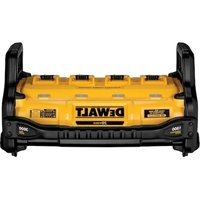
DCB1800 - Generator DEWALT - Free user manual and instructions
Find the device manual for free DCB1800 DEWALT in PDF.


| Brand | DeWalt |
| Model | DCB1800 |
| Product type | Portable power station / Generator |
| Continuous power | 1800 W |
| Peak power | 3600 W |
| AC output voltage | 120 V ~, modified sine wave |
| Max output current | 15 A |
| Number of battery charging ports | 4 slots for Li-Ion 20 V Max batteries |
| Compatible battery types | DeWALT 20 V Max (all capacities) |
| Typical charge time (2 Ah battery) | 60 min |
| Weight | Approximately 8.5 kg (without batteries) |
| Dimensions (L × W × H) | Approximately 35 × 25 × 28 cm |
| Input power (charging) | 120 V AC via 3-prong extension cord |
| Main features | Portable AC power, 4-in-1 battery charger, protection against overload/overheat/short circuit |
| Maintenance | Clean ventilation openings with dry air once a week |
| Storage | Cool, dry place, frost-free |
| Safety | Double insulation, electronic protection system, automatic shutdown |
| Warranty | 3 years (limited) + 1 year free maintenance + 2 years on batteries |
| Included accessories | None (batteries sold separately) |
| Certifications | CAN ICES-3(B)/NMB-3(B), FCC Part 15 Class B |
| Intended use | Professional, job sites, temporary power |
Frequently Asked Questions - DCB1800 DEWALT
User questions about DCB1800 DEWALT
0 question about this device. Answer the ones you know or ask your own.
Ask a new question about this device
Download the instructions for your Generator in PDF format for free! Find your manual DCB1800 - DEWALT and take your electronic device back in hand. On this page are published all the documents necessary for the use of your device. DCB1800 by DEWALT.
USER MANUAL DCB1800 DEWALT
Definitions: Safety Alert Symbols and Words
This instruction manual uses the following safety alert symbols and words to alert you to hazardous situations and your risk of personal injury or property damage.
DANGER: Indicates an imminently hazardous situation which, if not avoided, will result in death or serious injury.
WARNING: Indicates a potentially hazardous situation which, if not avoided, could result in death or serious injury.
CAUTION: Indicates a potentially hazardous situation which, if not avoided, may result in minor or moderate injury.
(### without word) Indicates a safety related message.
NOTICE: Indicates a practice not related to personal injury which, if not avoided, may result in property damage.
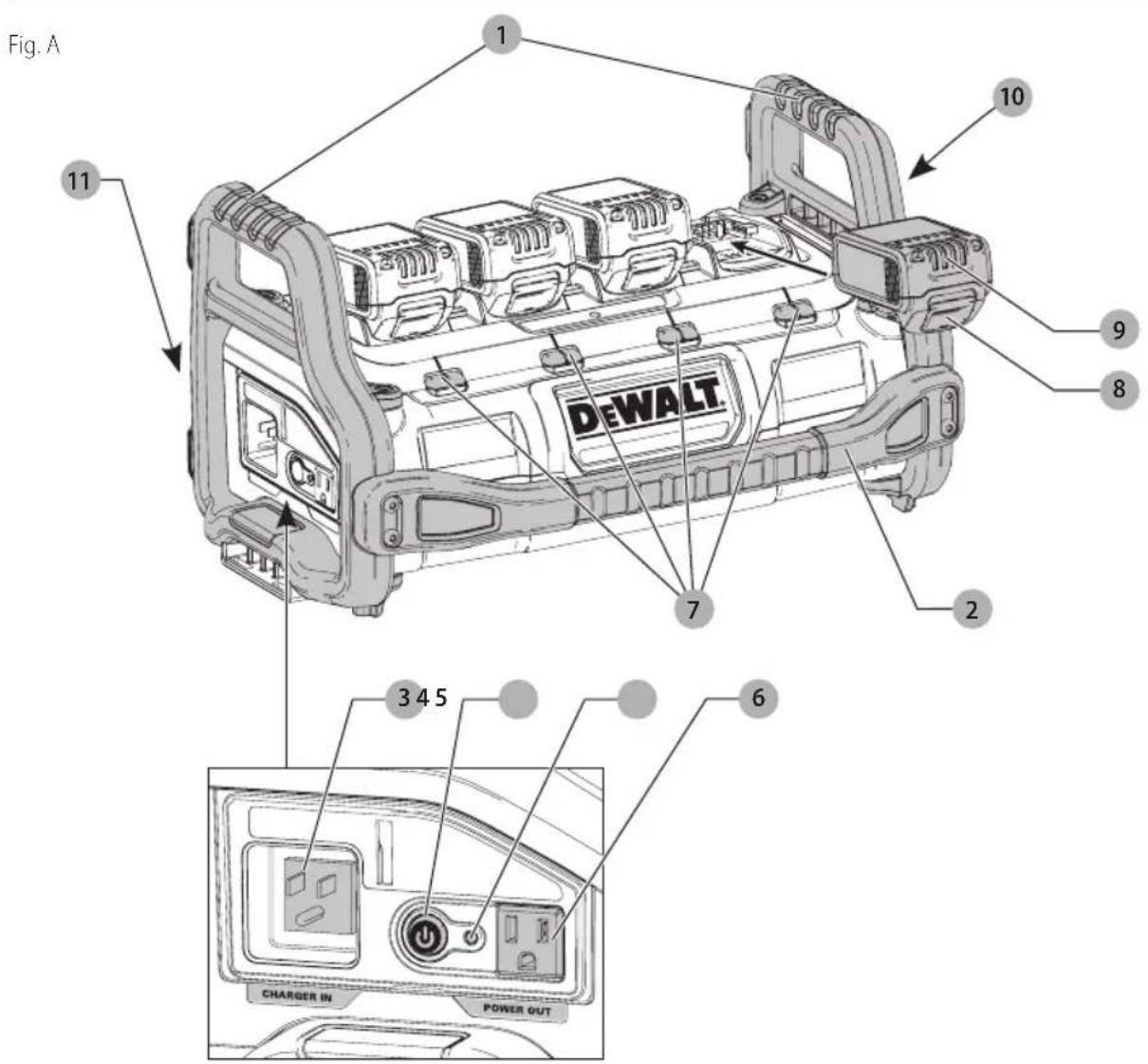
1 Side handles
2 Front handle
3 Charger-in plug
4 ON/OFF button
5 Side panel LED indicator
6 Power-out receptacle
7 Front panel LED indicators
8 Battery pack release button
9 Battery pack
10 Air intake vent
11 Exhaust outlet vent
WARNING! Read all safety warnings and all instructions. Failure to follow the warnings and instructions may result in electric shock, fire and/or serious injury.

WARNING: To reduce the risk of injury, read the instruction manual.
If you have any questions or comments about this or any DEWALT tool, call us toll free at: 1-800-4-DEWALT (1-800-433-9258).
ENGLISH
Important Safety Instructions
SAVE THESE INSTRUCTIONS: This manual contains important instructions that should be followed during installation and maintenance of the portable power station/charger and batteries.
Safety Rules for the Portable Power Station/Charger
- Before using the portable power station/charger, read all instructions and cautionary markings on the portable power station/charger, battery pack and product using the battery pack.
WARNING: Shock hazard. Do not allow any liquid to get inside the portable power station/charger. Electric shock may result.
WARNING: Burn hazard. To reduce the risk of injury, charge only DEWALT rechargeable battery packs. Other types of batteries may overheat and burst resulting in personal injury and property damage.
- Use with DEWALT 20V Max* battery packs only.
- Do not use under wet conditions or in presence of flammable liquids or gases.
- Do not expose to water, rain, snow, or any type of moisture.
- Do not insert battery packs into charging ports, plug the portable power station in, or plug any device into the portable power station's power receptacle if moisture is detected on or in the portable power station/charger.
- Do not let children come into contact with the device. Supervision is required when inexperienced operators use this device.
- Place the portable power station/charger on a stable, flat surface where it will not fall or tip over.
- Never connect the portable power station/charger output to a structure's electrical system. Connecting electricity through a building's electrical system to the outside utility feed lines could result in fire, electrocution or endanger repair persons attempting to restore service.
- ALWAYS operate portable power station/charger in a clean, dry, well ventilated area. Make sure hands are dry before touching unit. Water can conduct electricity! Water which comes in contact with electrically charged components can transmit electricity resulting in electrical shock to anyone contacting them.
- ALWAYS ensure that the portable power station/charger Charger-in cord is easily accessible during operation to allow for quick disconnection from the mains.
- Inspect extension cords before use and replace with new cord if required. Contact with worn or damaged extension cords could result in electrocution.
- Do not expose the portable power station/charger to wet or damp areas. Use only in a dry location. Do not allow any liquid to get inside the portable power station/charger. Do not submerge the portable power station/charger in any liquid.
- ALWAYS use grounded extension cord(s) of proper size (wire gauge) corresponding to rated AC current on
nameplate of portable power station; see Important Safety Instructions for the Portable Power Station/Charger. Use of undersize extension cord(s) could result in overheating of the wires or attached items, resulting in fire.
- To prevent electric shock, use only with an extension cord compliant with local electrical codes for the operating environment.
- Do not operate portable power station/charger with mechanical or electrical problem. Attempting to use the unit when it has been damaged, or when it is not functioning normally could result in fire or electrocution.
- NEVER leave portable power station/charger on and unattended. Unattended operation of this product could result in personal injury or property damage.
- ALWAYS keep cooling air vents (Fig. A, 10, 11) clear of any obstructions. Materials placed against or near the portable power station/charger can interfere with its proper ventilation features causing overheating.
- NEVER suspend the portable power station/charger. The portable power station/charger is not designed to be suspended.
- NEVER stand on the portable power station/charger. Do not use it as a stool.
- The preferred position of the portable power station/charger is on its feet or on its back. Do not operate the portable power station/charger balanced on its side.
- Make sure that the summation of electrical loads for all attachments does not exceed the load rating of the portable power station/charger. Exceeding the load capacity of the portable power station/charger by attaching too many items, or items with very high load ratings to it could result in overheating of some items or their attachment wiring resulting in fire or electrical shock.
- Do not use portable power station/charger to power medical or other critical devices.
- Unsafe operation of your portable power station/charger could lead to serious in jury or death to you or others.
- The portable power station/charger is equipped with two side handles at the top and a front handle. ALWAYS use proper lifting practice to reduce risk of injury.
- The portable power station/charger outputs a modified sine wave. Please check with your device's manufacturer for compatibility. Do not use the portable power station/charger if device will not function properly with a modified sine wave as its input.
The label on your portable power station/charger may include the following symbols. The symbols and their definitions are as follows:
V....volts IPM....impacts per minute
Hz....hertz RPM....revolutionsper min....minutes minute
or DC.....direct current sfpm.....surface feet per
Class I Construction minute (grounded) SPM strokes per minute
.../min.....per minute A.....amperes
BPM.....beats per minute W.....watts
ENGLISH
\~ or AC......alternating current
or AC/DC....alternatingor direct current
ClassII Construction (double insulated)
no ....no load speed n ....rated speed
± earthing terminal
⚠️...... safety alert symbol
△......visible radiation
wearrespiratory protection
weareye protection
O....wearhearing protection
readinstruction manual
BATTERIES AND CHARGERS
The battery packs are not fully charged out of the
carton. To ensure maximum performance and life of lithium-ion battery packs, charge the battery pack fully before first use.
Battery packs can be charged with the portable power station/charger. Before using the battery packs and portable power station/charger, read the safety instructions below and then follow charging procedures outlined. When ordering replacement battery packs, be sure to include the catalogue number and voltage.
READ ALL INSTRUCTIONS
Important Safety Instructions for All Battery Packs
WARNING: Read all safety warnings and all instructions for the battery packs and portable power station/charger. Failure to follow the warnings and instructions may result in electric shock, fire and/or serious injury.
- Do not charge or use the battery pack in explosive atmospheres, such as in the presence of flammable liquids, gases or dust. Inserting or removing the battery pack from the portable power station/charger may ignite the dust or fumes.
- NEVER force the battery pack into the portable power station/charger. DO NOT modify the battery pack in any way to fit into a non-compatible portable power station/charger as battery packs may rupture causing serious personal injury.
• DO NOT splash or immerse in water or other liquids.
- Do not store or use the portable power station/charger and battery packs in locations where the temperature may reach or exceed 104 °F (40 °C) (such as outside sheds or metal buildings in summer). For best life, store battery packs in a cool, dry location.
- Do not incinerate the battery pack even if it is severely damaged or is completely worn out. The battery pack can explode in a fire. Toxic fumes and materials are created when lithium-ion battery packs are burned.
- If battery contents come into contact with the skin, immediately wash area with mild soap and water. If battery liquid gets into the eye, rinse water over the open
eye for 15 minutes or until irritation ceases. If medical attention is needed, the battery electrolyte is composed of a mixture of liquid organic carbonates and lithium salts.
- Contents of opened battery cells may cause respiratory irritation. Provide fresh air. If symptoms persist, seek medical attention.
WARNING: Burn hazard. Battery liquid may be flammable if exposed to spark or flame.
WARNING: Fire hazard. Never attempt to open the battery pack for any reason. If the battery pack case is cracked or damaged, do not insert into the portable power station/charger. Do not crush, drop or damage the battery pack. Do not use a battery pack or portable power station/charger that has received a sharp blow, been dropped, run over or damaged in any way (e.g., pierced with a nail, hit with a hammer, stepped on). Damaged battery packs should be returned to the service center for recycling.
Transportation
WARNING: Fire hazard. Do not store or carry the battery pack so that metal objects can contact exposed battery terminals. For example, do not place the battery pack in aprons, pockets, tool boxes, product kit boxes, drawers, etc., with loose nails, screws, keys, etc. Transporting batteries can possibly cause fires if the battery terminals inadvertently come in contact with conductive materials such as keys, coins, hand tools and the like. The US Department of Transportation Hazardous Material Regulations (HMR) actually prohibit transporting batteries in commerce or on airplanes in carry-on baggage UNLESS they are properly protected from short circuits. So when transporting individual battery packs, make sure that the battery terminals are protected and well insulated from materials that could contact them and cause a short circuit.
Shipping the DEWALT FLEXVOLT™ Battery
The DeWALT FLEXVOLT™ battery has two modes: Use and Shipping.
Use Mode: When the FLEXVOLT™ battery stands alone or is in a DFWALT 20V Max* product, it will operate as a 20V Max* battery. When the FLEXVOLT™ battery is in a 60V Max* or a 120V Max* (two 60V Max* batteries) product, it will operate as a 60V Max* battery.
Shipping Mode: When the cap is attached to the FLEXVOLT™ battery, the battery is in Shipping Mode. Strings of cells are electrically
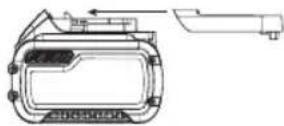
disconnected within the pack resulting in three batteries with a lower Watt hour (Wh) rating as compared to one battery with a higher Watt hour rating. This increased quantity of three batteries with the lower Watt hour rating can exempt the pack from certain shipping regulations that are imposed upon the higher Watt hour batteries.
The battery label indicates two Watt hour ratings (see example). Depending on how the battery is shipped, the appropriate Watt hour rating must be used to determine
English
the applicable shipping requirements. If utilizing the shipping cap, the pack will be considered 3 batteries at the Watt hour rating indicated for "Shipping". If shipping without the cap or in a tool, the pack will be considered one battery at the Watt hour rating indicated next to "Use".
Example of Use and Shipping Label Marking
USE: 120 Wh Shipping: 3 x 40 Wh
For example, Shipping Wh rating might indicate 3 x 40 Wh, meaning 3 batteries of 40 Watt hours each. The Use Wh rating might indicate 120 Wh (1 battery implied).
Fuel Gauge Battery Packs (Fig. B)
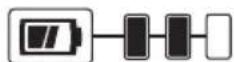
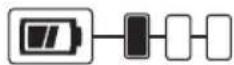
Some DEWALT battery packs include a fuel gauge which consists of three green LED lights that indicate the level of charge remaining in the battery pack.
The fuel gauge is an indication of approximate levels of charge remaining in the battery pack according to the following indicators:
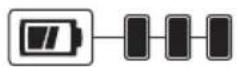
75–100% charged
51–74% charged
< 50% charged
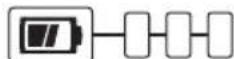
Pack needs to be charged
To actuate the fuel gauge, press and hold the fuel gauge button. A combination of the three green LED lights will illuminate designating the level of charge left. When the level of charge in the battery is below the usable limit, the fuel gauge will not illuminate and the battery will need to be recharged.
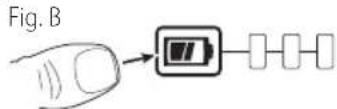
NOTE: The fuel gauge is only an indication of the charge left on the battery pack. It does not indicate tool functionality and is subject to variation based on product components, temperature and end-user application.
For more information regarding fuel gauge battery packs, please contact call 1-800-4-DrWALT (1-800-433-9258) or visit our website www.dewalt.com.
The RBRC® Seal
The RBRC® (Rechargeable Battery Recycling Corporation) Seal on the nickel cadmium, nickel metal hydride or lithium-ion batteries (or battery packs) indicates that the costs to recycle these batteries (or battery packs) at the end of their useful life have already been paid by DEWALT. In some areas, it is illegal to place spent nickel cadmium, nickel metal hydride or lithium-ion batteries in the trash or municipal solid waste stream and the Call 2 Recycle® program provides an environmentally conscious alternative.

Call 2 Recycle, Inc., in cooperation with DeWALT and other battery users, has established the program in the United States and Canada to facilitate the collection of spent nickel cadmium, nickel metal hydride or lithium-ion batteries. Help protect our environment and conserve natural resources by returning the spent nickel cadmium, nickel metal hydride or lithium-ion batteries to an authorized DeWALT service center or to your local retailer for recycling. You may also contact your local recycling center for information on where to drop off the spent battery. RBRC® is a registered trademark of Call 2 Recycle, Inc.
Important Safety Instructions for the Portable Power Station/Charger
WARNING: Read all safety warnings and all instructions for the battery packs and portable power station/charger. Failure to follow the warnings and instructions may result in electric shock, fire and/or serious injury.
- The portable power station/charger in Charger-In Mode is not intended for any uses other than charging DEWALT 20V Max* rechargeable batteries. Any other uses may result in risk of fire, electric shock or electrocution.
- Do not expose a portable power station/charger to rain or snow.
- Pull by the plug rather than the cord when disconnecting the portable power station/charger. This will reduce the risk of damage to the electric plug and cord.
- Make sure that the extension cord is located so that it will not be stepped on, tripped over or otherwise subjected to damage or stress.
- Do not expose the portable power station/charger to wet or damp areas. Use only in a dry location. Do not allow any liquid to get inside the portable power station/charger. Do not submerge the portable power station/charger in any liquid.
- An extension cord must have adequate wire size (AWG or American Wire Gauge) for safety. The smaller the gauge number of the wire, the greater the capacity of the cable, that is, 16 gauge has more capacity than 18 gauge. An undersized cord will cause a drop in line voltage resulting in loss of power and overheating. When using more than one extension to make up the total length, be sure each individual extension contains at least the minimum wire size. The following table shows the correct size to use depending on cord length and nameplate ampere rating, and the voltage drop caused by the use of extension cords, given different electrical loads. If in doubt, use the next heavier gauge. The lower the gauge number, the heavier the cord.
ENGLISH
Minimum Gauge for Cord Sets
| Volts Total Length of Cord in Feet (meters) | |||||
| 120 V 25 (7.6) | 50 (15.2) 100 (30.5) 150 (45.7) | ||||
| 240 V 50 (15.2) | 100 (30.5) 200 (61.0) 300 (91.4) | ||||
| Ampere Rating | American Wire Gauge | ||||
| More Than | Not More Than | ||||
| 0 6 18 | 16 16 14 | ||||
| 6 10 18 | 16 14 12 | ||||
| 10 12 | 16 16 14 12 | ||||
| 12 16 | 14 12 Not Recommended | ||||
- Do not place any object on top of the portable power station/charger nor place the portable power station/charger on a soft surface that might block the ventilation slots and result in excessive internal heat. Place the portable power station/charger in a position away from any heat source. The portable power station/charger is ventilated through slots in the back and sides of the housing.
- Do not operate the portable power station/charger with a damaged cord or plug.
- Do not operate the portable power station/charger if it has received a sharp blow, been dropped or otherwise damaged in any way. Take it to a DEWALT factory service center.
- Do not disassemble the portable power station/charger; take it to a DEWALT service center when service or repair is required. Incorrect reassembly may result in a risk of electric shock, electrocution or fire.
- Disconnect the portable power station/charger from the outlet and remove the battery pack(s) before attempting any cleaning. This will reduce the risk of electric shock. Removing the battery pack(s) alone will not reduce this risk.
- NEVER attempt to connect 2 portable power station/chargers together.
- The portable power station/charger is designed to operate on standard 120V household electrical power. Do not attempt to use it on any other voltage.
• This device is CAN ICES-3(B)/NMB-3(B) compliant. - This device complies with Part 15 of the FCC Rules and Industry Canada License-exempt RSS standard(s). Operation is subject to the following two conditions:
- This device may not cause harmful interference, and
- This device must accept any interference received, including interference that may cause undesired operation.
- Changes or modifications not expressly approved by the party responsible for compliance could void the user's authority to operate the equipment.
NOTE: This equipment has been tested and found to comply with the limits for a Class B digital device, pursuant to Part 15 of the FCC Rules. These limits are designed to provide reasonable protection against harmful interference in a residential installation. This equipment generates, uses and can radiate radio frequency energy and, if not installed and used in accordance with the instructions, may cause harmful interference to radio
communications. However, there is no guarantee that interference will not occur in a particular installation. If this equipment does cause harmful interference to radio or television reception, which can be determined by turning the equipment off and on, the user is encouraged to try to correct the interference by one or more of the following measures:
- Reorient or relocate the receiving antenna.
- Increase the separation between the equipment and receiver.
- Connect the equipment into an outlet on a circuit different from that to which the receiver is connected.
- Consult the dealer or an experienced radio/TV technician for help.
WARNING: Shock hazard. Do not allow any liquid to get inside a charger or the portable power station/charger. Electric shock may result.
WARNING: Burn hazard. Do not submerge the battery pack in any liquid or allow any liquid to enter the battery pack. Never attempt to open the battery pack for any reason. If the plastic housing of the battery pack breaks or cracks, return to a service center for recycling.
WARNING: Burn hazard. To reduce the risk of injury, discharge only DrWALT rechargeable battery packs. Other types of batteries may overheat and burst resulting in personal injury and property damage.
NOTICE: Under certain conditions, with a stand-alone charger or portable power station/charger plugged into its power supply, the charger or portable power station/charger can be shorted by foreign material. Foreign materials of a conductive nature, such as, but not limited to, grinding dust, metal chips, steel wool, aluminum foil or any buildup of metallic particles should be kept away from the charger and portable power station/charger terminals. Always unplug the charger and portable power station/charger from its power supply when there is no battery pack in the terminal. Unplug the charger and portable power station/charger before attempting to clean.
Light Indicators
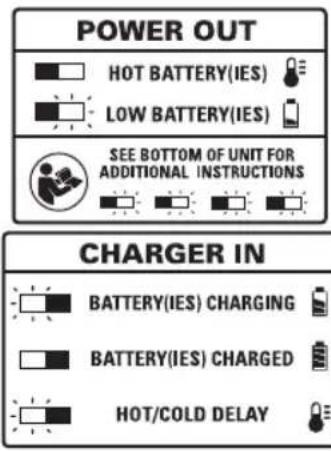
Refer to the indicators below for the charge status of the battery pack.
ENGLISH
The portable power station/charger will not charge a faulty battery pack. The portable power station/charger will indicate faulty battery pack by refusing to light.
NOTE: This could also mean a problem with the portable power station/charger.
If the portable power station/charger indicates a problem, take it and the battery pack(s) to be tested at an authorized service center.
Hot/Cold Pack Delay
When the portable power station/charger detects a battery pack that is too hot or too cold, it automatically starts a Hot/Cold Pack Delay, suspending charging until the battery pack has reached an appropriate temperature. The portable power station/charger then automatically switches to the pack charging mode. This feature ensures maximum battery pack life.
A cold battery pack will charge at a slower rate than a warm battery pack. The battery pack will charge at that slower rate throughout the entire charging cycle and will not return to maximum charge rate even if the battery pack warms.
Electronic Protection System
Lithium-Ion tools are designed with an Electronic
Protection System that will protect the battery pack against overloading, overheating or deep discharge.
The tool will automatically turn off if the Electronic
Protection System engages. If this occurs, place the lithium-ion battery pack in the portable power station/charger until it is fully charged.
For more information about charging batteries using the Portable Power Station/Charger, refer to the Charger-In Mode section.
Important Charging Notes
- Longest life and best performance can be obtained if the battery pack is charged when the air temperature is between 65 °F and 75 °F (18 ° – 24 °C). DO NOT charge the battery pack in an air temperature below +40 °F (+4.5 °C), or above +104 °F (+40 °C). This is important and will prevent serious damage to the battery pack.
- The portable power station/charger and battery pack may become warm to the touch while charging. This is a normal condition, and does not indicate a problem. To facilitate the cooling of the battery pack after use, avoid placing the portable power station/charger or battery pack in a warm environment such as in a metal shed or an uninsulated trailer.
- If the battery pack does not charge properly:
a. Check operation of receptacle by plugging in a lamp or other appliance;
b. Check to see if receptacle is connected to a light switch which turns power off when you turn out the lights;
c. Move the portable power station/charger and battery pack(s) to a location where the surrounding air temperature is approximately 65^ F – 75^ F ( 18^ – 24^ C);
d. If charging problems persist, take the tool, battery pack and portable power station/charger to your local service center.
- The battery pack should be recharged when it fails to produce sufficient power on jobs which were easily done previously. DO NOT CONTINUE to use under these conditions. Follow the charging procedure. You may also charge a partially used pack whenever you desire with no adverse effect on the battery pack.
- Foreign materials of a conductive nature such as, but not limited to, grinding dust, metal chips, steel wool, aluminum foil, or any buildup of metallic particles should be kept away from portable power station/charger cavities. Always unplug the portable power station/charger from the power supply when there is no battery pack in the port. Unplug the portable power station/charger before attempting to clean.
- Do not freeze or immerse the portable power station/charger in water or any other liquid.
Storage Recommendations
- The best storage place is one that is cool and dry, away from direct sunlight and excess heat or cold.
- For long storage, it is recommended to store a fully charged battery pack in a cool dry place out of the portable power station/charger for optimal results.
NOTE: Battery packs should not be stored completely depleted of charge. The battery pack will need to be recharged before use.
SAVE THESE INSTRUCTIONS FOR FUTURE USE
COMPONENTS (FIG. A)
WARNING: Never modify the portable power station/charger or any part of it. Damage or personal injury could result.
Refer to Figure A at the beginning of this manual for a complete list of components.
INTENDED USE
This portable power station/charger is designed to power a variety of 120 V_AC power tools and appliances and to charge up to four DEWALT 20V Max* Li-Ion battery packs.
The portable power station/charger is a professional device ideal for providing temporary power in remote situations such as jobsites.
NOTE: It is not intended for powering medical or other critical devices.
DO NOT use under wet conditions or in presence of flammable liquids or gases.
This portable power station/charger is a professional device.
DO NOT let children come into contact with the device.
Supervision is required when inexperienced operators use this device.
ASSEMBLY
WARNING: To reduce the risk of serious personal injury, turn unit off and remove the battery packs before making any adjustments or removing/installing attachments or accessories. An accidental start-up can cause injury.
Attaching the Portable Power Station/Charger to the DEWALT ToughSystem® (Fig. D)
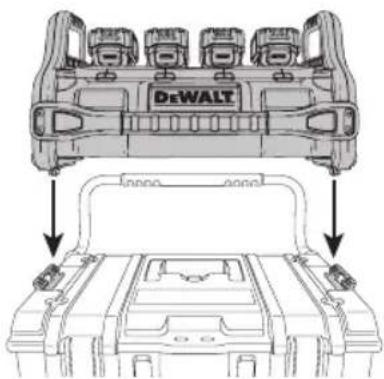
WARNING: To reduce the risk of serious personal injury, always mount the portable power station/charger to the top of the DEWALT ToughSystem®. Never mount anything on top of the portable power station/charger.
To attach the portable power station/charger to the ToughSystem®, place unit on top of a ToughSystem® box, then secure using the side latch anchors as shown. The portable power station/charger must be the top-most item. Always transport a stacked load with a ToughSystem® cart or, if necessary, carry using the handles of the bottom most box.
WARNING: Never pick up a ToughSystem® stack by the handles on the portable power station/charger.
When not mounted to the DeWALT Tough System®, the portable power station/charger should be placed on a flat surface with battery pack ports facing up.
FIG. D
OPERATION
Installing and Removing Battery Packs (Fig. A)
nOTE: For best results, make sure your battery packs are fully charged.
To install the battery packs 9 into the portable power station, align the battery packs with the rails and slide them in until they are firmly seated. Ensure that they do not disengage.
To remove the battery packs from the portable power station, press the release button 8 on each pack and firmly pull the battery packs out.
It is possible to mix and match batteries. However, the unit will default to the lowest capacity battery and the lowest charged battery. For optimal performance, use premium (3.0Ah or greater) batteries of the same size.
Power-Out Mode
WARNING: To reduce the risk of serious personal injury, turn unit off and remove the battery packs before making any adjustments or removing/installing attachments or accessories. An accidental start-up can cause injury.
WARNING: Do not operate this unit until you read and understand this instruction manual.
CAUTION: Unplug any load from the portable power session/charger before starting to prevent permanent damage to any tool or device.
CAUTION: Be sure the power tool/device and the portable power station/charger are both off before plugging your power tool/device into the portable power station/charger. An accidental start-up can cause injury.
NOTICE: If plugged into an outlet, the portable power station/charger is in Charger-in mode. Power will not turn on and the portable power station's Power-out receptacle 6 will not be live. Power-out mode will NOT be active while in Charger-in mode.
The portable power station/charger allows the user to power tools and other appliances using the Power-out mode and four batteries.
nOTE: It is not intended for powering medical or other critical devices.
Check that the batteries have enough charge to run or complete the job you are attempting and that the batteries are securely latched in their ports.
Front Panel LED and Audio Indicators
The portable power station/charger gives visual and audible feedback while in Power-out mode, as seen on the front panel LED indicators 7, and a beep will sound. The blink patterns and beeps with their associated conditions are below.
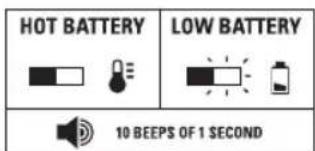
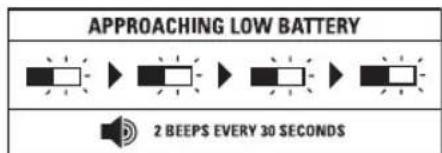
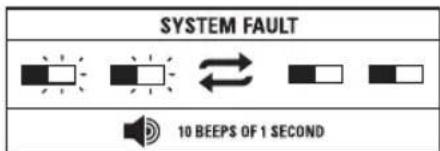
The portable power station/charger will indicate a system fault by lighting and beeping as shown. For more information, refer to the Trouble Shooting Guide at the end of this section.
English
Starting the Portable Power Station/Charger (Fig. A)
WARNING: Do not operate this unit until you read and understand this instruction manual.
If necessary, unplug the portable power station/charger extension cord from the wall outlet. The portable power station/charger will not turn on if an extension cord is plugged into the Charger-in plug and a wall outlet or generator.
Momentarily pressing the ON/OFF button 4 will illuminate the side panel LED indicator light 5 next to the button and start the portable power station/charger.
nOTE: The cooling fan may cycle during use.
If the side panel LED indicator light 5 begins to blink, this indicates a type of fault, including an overload, overheating, short circuit, or low voltage from battery discharge. Refer to the Power-Out Mode section for more information.
Status Indicators (Fig. A)
The portable power station/charger has several indicator lights to advise the user of certain situations.
- The side panel LED indicator ⑤ will light and remain on when the ON/OFF button has been pressed to turn the unit on.
- The left-hand light on the front panel LED indicators 7 denotes charger operation. See Light Indicators for more information.
Operating Heavy Loads
The maximum output is 3600 watts peak for starting heavy loads.
For continuous operation, do not exceed the continuous rated output of 1800 Watts.
Do not exceed 15 amps for the Power-out receptacle 6.
Matching premium (3.0Ah or greater) batteries are recommended for best, high performance use.
Charger-In Mode
The portable power station/charger allows the user to charge up to four batteries simultaneously using the Charger-In Mode feature. For more information, refer to the Light Indicators section.
Charging Batteries with the Portable Power Station/Charger (Fig. A)
- Connect the receptacle end of an extension cord into the portable power station/charger's Charger-in plug 3, then connect the 3-prongs of the extension cord into an appropriate wall outlet or generator before inserting battery packs.
- To install the battery packs 9 into the portable power station/charger, slide each pack into a port until the battery pack is firmly seated. Ensure that it does not disengage.
- The red (charging) light will blink continuously indicating that the charging process has started.
- The completion of charge will be indicated by the red light remaining ON continuously. The battery pack is fully charged and may be used at this time or left in the
portable power station/charger. To remove the battery pack from the portable power station, push the battery release button 8 on the battery pack and firmly pull the battery pack out of the battery terminal.
nOTE: To ensure maximum performance and life of lithium-ion battery packs, charge the battery pack fully before first use.
Portable Power Station Charging Times
| DCB1800 | |
| Mains voltage V AC | 120 |
| Battery type 20V Max* Li-Ion | |
| Approx. charging time min of battery packs | 40 (1.3 Ah) 45 (1.5 Ah) 60 (2.0 Ah)90 (3.0 Ah) 120 (4.0 Ah) 150 (5.0 Ah)180 (6.0 Ah) |
nOTE: Power-out will NOT be active while in Charger-in mode.
Transporting
WARNING: Observe safe lifting procedures when transporting.
Before transporting the portable power station, make sure to:
- Disconnect all loads.
- Turn the portable power station/charger OFF.
- Disconnect from generator or wall outlet.
- Read the Proper Hand Position for Carrying Portable Power Station/Charger section of the manual.
Proper Hand Position for Carrying Portable Power Station/Charger (Fig. A)
WARNING: To reduce the risk of serious personal injury, ALWAYS use proper hand position.
The preferred method of lifting and carrying the portable power station/charger is to use the front handle 2. If using the side handles 1, use both hands—one on each handle.
MAINTENANCE
WARNING: To reduce the risk of serious personal injury, turn unit off, disconnect from power source and remove the battery packs before making any adjustments or removing/installing attachments or accessories. An accidental start-up can cause injury.
WARNING: Do not operate this unit until you read and understand this instruction manual for safety, operation and maintenance instructions.
Good maintenance is essential for safe, economical and trouble-free operation.
WARNING: Improper maintenance or failure to cause a problem before operation can cause malfunction, serious injury or death.
Cleaning
WARNING: Blow dirt and dust off of the fan and out air vents with clean, dry air at least once a week.
To minimize the risk of eye injury, always wear ANSI Z87.1 approved eye protection when performing this.
WARNING: Never use solvents or other harsh chemicals for cleaning the non-metallic parts of the device. These chemicals may weaken the plastic materials used in these parts. Use a cloth dampened only with water and mild soap. Never let any liquid get inside the portable power station; never immerse any part of the unit into a liquid.
Accessories
WARNING: Since accessories, other than those offered by DeWALT, have not been tested with this product, use of such accessories with this device could be hazardous. To reduce the risk of injury, only DeWALT recommended accessories should be used with this product.
Recommended accessories for use with your portable power station/charger are available at extra cost from your local dealer or authorized service center. If you need assistance in locating any accessory, please contact DeWALT Industrial Tool Co., 701 East Joppa Road, Towson, MD 21286, call 1-800-4-DeWALT (1-800-433-9258) or visit our website: www.dewalt.com.
Repairs
The portable power station/charger is not user-serviceable. Battery packs are not serviceable.
WARNING: To assure product SAFETY and RAILIBILITY, repairs, maintenance and adjustment (including brush inspection and replacement) should be performed by a DeWALT factory service center or a DeWALT authorized service center. Always use identical replacement parts.
Register Online
Thank you for your purchase. Register your product now for:
- WARRAnTY sERViCE: Registering your product will help you obtain more efficient warranty service in case there is a problem with your product.
- COnFiRMATiOn OF OWnERshiP: In case of an insurance loss, such as fire, flood or theft, your registration of ownership will serve as your proof of purchase.
- FOR YOUR SAFETY: Registering your product will allow us to contact you in the unlikely event a safety notification is required under the Federal Consumer Safety Act.
Register online at www.dewalt.com/register.
Three Year Limited Warranty
DeWALT will repair, without charge, any defects due to faulty materials or workmanship for three years from the date of purchase. This warranty does not cover part failure due to normal wear or tool abuse. For further detail of warranty coverage and warranty repair information, visit www.dewalt.com or call 1-800-4DeWALT (1-800-433-9258). This warranty does not apply to accessories or damage caused where repairs have been made or attempted by others. This warranty gives you specific legal rights and you may have other rights which vary in certain states or provinces. In addition to the warranty, D£WALT tools are covered by our:
1 YEAR FREE sSERVICE
DeWALT will maintain the tool and replace worn parts caused by normal use, for free, any time during the first year after purchase.
2 YEARs FREE sSERVICE On DEWAIT BATTERY PACKs
DC9071, DC9091, DC9096, DC9182, DC9280, DC9360, DCB120, DCB127, DCB201, DCB203, DCB203BT, DCB207, DCB361
3 YEARs FREE SERVICE On DEWAIT BATTERY PACKs
DCB200, DCB204, DCB204BT, DCB205, DCB606
NOTE: Battery warranty voided if the battery pack is tampered with in any way. DeWALT is not responsible for any injury caused by tampering and may prosecute warranty fraud to the fullest extent permitted by law.
90 DAY MOnEY BACK gUARAnTEE
If you are not completely satisfied with the performance of your DeWALT Power Tool, Laser, or Nailer for any reason, you can return it within 90 days from the date of purchase with a receipt for a full refund – no questions asked.
IATin AMERiCA: This warranty does not apply to products sold in Latin America. For products sold in Latin America, see country specific warranty information contained in the packaging, call the local company or see website for warranty information.
FREE WARning IABEI REPIACEMENT: If your warning labels become illegible or are missing, call 1-800-4-DeWALT (1-800-433-9258) for a free replacement.
Troubleshooting Guide
BE SURE TO FOLLOW SAFETY RULES AND INSTRUCTIONS
Problem Possible Solution
| Portable power station/charger does not operate or turn ON when ON/OFF button is pressed. | Check that all four batteries have sufficient charge (at least 1 green LED light, ideally 2 or 3 green LED lights on battery fuel gauge, if equipped). |
| Remove batteries and reinsert fully into the tool. | |
| Check that batteries are within operating temperature (solid yellow light will illuminate if battery overtemp condition). | |
| Be sure nothing is plugged into "Charger-In" plug. | |
| Be sure load has not exceeded capacity of portable power station/charger. | |
| Portable power station/charger indicates low battery even though the battery's fuel gauge still shows 1 green LED light. | Depending on the age and condition of battery, the battery may be exhausted even with 1 bar still showing on the fuel gauge. Replace battery with new battery. |
| Portable power station/charger doesn't operate when near or below freezing. | Store battery packs in warm environment. |
| Start using item; once portable power station/charger starts working, the batteries will heat up. | |
| Portable power station/charger has overheated. | Use portable power station/charger in cooler location; keep out of direct sun and heat. Use in horizontal orientation. (Do not block air inlet or outlet.) |
| Cooling fan may need cleaning. Refer to the Maintenance section. | |
| If battery pack is overheated, use larger capacity battery. Refer to next Problem. | |
| Portable power station/charger turns off during high power operation. | Check to make sure load does not exceed capacity of portable power station/charger (15 amps). If it trips a 15 amp circuit breaker, it will likely trip the portable power station/charger. |
| Try using four of the same, premium (3.0Ah or greater) batteries fully charged. Compact (2.0Ah or less) batteries may not provide the output needed for high power operation. | |
| Device does not operate with portable power station/charger. | Consult manufacturer of device for use with modified sine wave. |
| Front panel lights blinking and portable power station/charger not working. | Portable power station/charger is in system fault. For example, if overloaded, reduce load and press power button to reset. |
| Portable power station/charger does not charge. | Check the connection of the extension cord on both ends; be sure female end is securely plugged into Charger-In plug of the portable power station/charger. |
| Check that electricity is flowing to extension cord using another device (light, tool, etc.). | |
| Remove batteries and reinsert fully into the tool. | |
| Check that the portable power station/charger and all batteries are within operating temperature (red flashing and yellow solid lights will illuminate if battery charging overtemp condition). |
USE: 120 Wh Shipping: 3 x 40 Wh
DC9071, DC9091, DC9096, DC9182, DC9280, DC9360, DCB120, DCB127, DCB201, DCB203, DCB203BT, DCB207, DCB361
COnTRAT D'EnTRETiEn gRATUiT DE TROis Ans sur IEs BIOC-PiES DeWALT
DCB200, DCB204, DCB204BT, DCB205, DCB606
USE: 120 Wh Shipping: 3 x 40 Wh
El Sello RBRC® (Rechargeable Battery Recycling Corporation)
natural_image
Technical line drawing of a DeWALT vehicle chassis showing top and front views (no text or symbols)FUNCIONAMIENTO
Eje Central Lázaro Cárdenas No. 18 - Local (55) 5588 9377 D, Col. Obrera
MERIDA, YUC
Calle 63 #459-A - Col. Centro (999) 928 5038
MONTERREY, N.L.
Av. Francisco I. Madero 831 Poniente - Col. (818) 375 23 13 Centro
PUEBLA, PUE
17 Norte #205 - Col. Centro (222) 246 3714
QUERETARO, QRO
Av. San Roque 274 - Col. San Gregorio (442) 2 17 63 14
SAN LUIS POTOSI, SLP
DC9071, DC9091, DC9096, DC9182, DC9280, DC9360, DCB120, DCB127, DCB201, DCB203, DCB203BT, DCB207, DCB361
3 AÑOs DE sERViCiO gRATUiTO PARA BATERÍAs DEWAIT
DCB200, DCB204, DCB204BT, DCB205, DCB606
Chargers/Charge Time (Minutes)
| Battery Cat # | Output Voltage | 120 Volts 12 Volts | DCB119 | DW0249 | |||||||||||||
| DC9000 | DC9310 | DC9320 | DCB095 | DCB101 | DCB102 | DCB103 | DCB107 | DCB112 | DCB113 | DCB114 | DCB115 | DCB118 | DCB132 | ||||
| DCB606 | 60/20 | X | X | X | X | 100 | 100 | 100 | 272 | 170 | 140 | X | 90 | 60 | 90 | X | X |
| DCB404 40 X X X X X X X X X X X X X X X X X X X X X X X X X X X X X X X X X X X X X X X X X X X X X X X X X X X X X X X X X X X X X X X X X X X X X X X X X X X X X X X X X X X X X X X X X X X X X X X X X X X X | |||||||||||||||||
| DCB406 40 X X X X X X X X X X X X X X X X X X X X X X X X X X X X X X X X X X X X X X X X X X X X X X X X X X X X X X X X X X X X X X X X X X X X X X X X X X X X X X X X X X X X X X X X X X X X X X X X | |||||||||||||||||
| DC9360 36 45 X X X X X X X X X X X X X X X X X X X X X X X X X X X X X X X X X X X X X X X X X X X X X X X X X X X X X X X X X X X X X X X X X X X X X X X X X X X X X X X X X X X X X X X X X X X X X X X X X X X | |||||||||||||||||
| DCB361 36 45 X X X X X X X X X X X X X X X X X X X X X X X X X X X X X X X X X X X X X X X X X X X X X X X X X X X X X X X X X X X X X X X X X X X X X X X X X X X X X X X X X X X X X X X X X X X X X | |||||||||||||||||
| DC9280 28 60 X X X X X X X X X X X X X X X X X X X X X X X X X X X X X X X X X X X X X X X X X X X X X X X X X X X X X X X X X X X X X X X X | |||||||||||||||||
| DW0242 24 X X X X X X X X X X X X X X X X X X X X X X X X X X X X X X X X X X X X X X X X X X X X X X X X X X X X X X X X X X X | |||||||||||||||||
| DCB200 | 20 | X | X | X | X | 60 | 60 | 60 | 140 | 90 | 67 | X | 45 | 45/30** | 45 | 90 | X |
| DCB201 | 20 | X | X | X | X | 30 | 30 | 30 | 70 | 45 | 35 | X | 22 | 22 | 22 | 45 | X |
| DCB203 | 20 | X | X | X | X | 35 | 35 | 35 | 90 | 60 | 45 | X | 30 | 30 | 30 | 60 | X |
| DCB203BT* | 20 | X | X | X | X | 35 | 35 | 35 | 90 | 60 | 45 | X | 30 | 30 | 30 | 60 | X |
| DCB204 | 20 | X | X | X | X | 70 | 70 | 70 | 185 | 120 | 90 | X | 60 | 60/40** | 60 | 120 | X |
| DCB204BT* | 20 | X | X | X | X | 70 | 70 | 70 | 185 | 120 | 90 | X | 60 | 60 | 60 | 120 | X |
| DCB205 | 20 | X | X | X | X | 95 | 95 | 95 | 240 | 150 | 112 | X | 75 | 75/47** | 75 | 150 | X |
| DCB207 | 20 | X | X | X | X | 30 | 30 | 30 | 60 | 40 | 30 | X | 22 | 22 | 22 | X | X |
| DC9182 | 18 | X | 40 | 40 | X | X | X | 40 | X | X | X | X | X | X | X | X | 40 |
| DCB120 | 12 | X | X | X | X | 30 | 30 | 30 | 60 | 45 | 35 | X | 20 | X | X | 45 | X |
| DCB127 | 12 | X | X | X | X | 35 | 35 | 35 | 90 | 60 | 50 | X | 30 | X | X | 60 | X |
| DCB080 8 X X X 60 X X X X X X X X X X X X X | |||||||||||||||||
*BT - Bluetooth® NOTE: The Bluetooth® word mark and logos are registered trademarks owned by the Bluetooth®, SIG, Inc. and any use of such marks by DEWALT is under license. Other trademarks and trade names are those of their respective owners.
**Battery Datecode 201536 or later.
"X" Indicates that the battery pack is not compatible with that specific charger. All charge times are approximate. Actual charge time may vary. Read the instruction manual for more specific information.
"X" indique que le bloc-piles n'est pas compatible avec ce chargeur. Les durées de charge sont approximatives; la durée de charge rélle peut varier. Lire le manuel d'utilisation pour obtenir des renseignements plus précis.
Una "X" indica que el paquete de baterías no es compatible con ese determinado cargador. El tiempo de duración de carga es aproximado; la duración de carga real puede variar. Lea el manual de instrucciones para obtener información más precisa.

- Definitions: Safety Alert Symbols and Words
- ENGLISH
- Important Safety Instructions
- Safety Rules for the Portable Power Station/Charger
- BATTERIES AND CHARGERS
- The battery packs are not fully charged out of the
- READ ALL INSTRUCTIONS
- Important Safety Instructions for All Battery Packs
- - Contents of opened battery cells may cause respiratory irritation. Provide fresh air. If symptoms persist, seek medical attention.
- Transportation
- Shipping the DEWALT FLEXVOLT™ Battery
- Fuel Gauge Battery Packs (Fig. B)
- The RBRC® Seal
- Important Safety Instructions for the Portable Power Station/Charger
- Light Indicators
- Hot/Cold Pack Delay
- Electronic Protection System
- Important Charging Notes
- Storage Recommendations
- SAVE THESE INSTRUCTIONS FOR FUTURE USE
- COMPONENTS (FIG. A)
- INTENDED USE
- ASSEMBLY
- Attaching the Portable Power Station/Charger to the DEWALT ToughSystem® (Fig. D)
- OPERATION
- Installing and Removing Battery Packs (Fig. A)
- Power-Out Mode
- Front Panel LED and Audio Indicators
- Starting the Portable Power Station/Charger (Fig. A)
- Status Indicators (Fig. A)
- Operating Heavy Loads
- Charger-In Mode
- Charging Batteries with the Portable Power Station/Charger (Fig. A)
- Transporting
- Proper Hand Position for Carrying Portable Power Station/Charger (Fig. A)
- MAINTENANCE
- Cleaning
- Accessories
- Repairs
- Register Online
- Three Year Limited Warranty
- YEAR FREE sSERVICE
- YEARs FREE sSERVICE On DEWAIT BATTERY PACKs
- YEARs FREE SERVICE On DEWAIT BATTERY PACKs
- DAY MOnEY BACK gUARAnTEE
- Troubleshooting Guide
- BE SURE TO FOLLOW SAFETY RULES AND INSTRUCTIONS
- COnTRAT D'EnTRETiEn gRATUiT DE TROis Ans sur IEs BIOC-PiES DeWALT
- USE: 120 Wh Shipping: 3 x 40 Wh
- FUNCIONAMIENTO
- MERIDA, YUC
- MONTERREY, N.L.
- PUEBLA, PUE
- QUERETARO, QRO
- SAN LUIS POTOSI, SLP
- AÑOs DE sERViCiO gRATUiTO PARA BATERÍAs DEWAIT
- Chargers/Charge Time (Minutes)
Brand : DEWALT
Model : DCB1800
Category : Generator