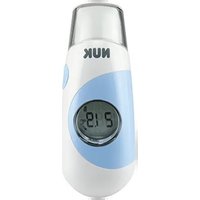
Flash - Thermometer NUK - Free user manual and instructions
Find the device manual for free Flash NUK in PDF.


| Product type | Infrared forehead thermometer |
| Brand | NUK |
| Model | Flash |
| Power supply | 1 CR2032 lithium battery (included) |
| Battery life | Approximately 3000 measurements (approx. 1 year) |
| Measuring range - forehead mode | 34.0 °C to 42.2 °C (93.2 °F to 108.0 °F) |
| Measuring range - surface mode | -22.0 °C to 80.0 °C (-7.6 °F to 176.0 °F) |
| Accuracy - forehead mode | ±0.2 °C from 35.5 °C to 42.0 °C |
| Accuracy - surface mode | ±0.3 °C from 22.0 °C to 42.2 °C, otherwise ±4% |
| Memory | Last 25 records |
| Display | LCD with temperature, mode symbol, battery indicator |
| Unit switching | °C / °F |
| Silent mode | Yes, deactivation of beeps |
| Fever indicator | Long beep + 3 short beeps if ≥ 37.5 °C |
| Auto-off | After approx. 1 minute of inactivity |
| Cleaning | Cotton swab with 70% alcohol (ethanol) for the probe |
| Protection rating | IP22 |
| Safety classification | BF type medical device |
| Operating temperature | 10.0 °C to 40.0 °C, 15% to 85% RH |
| Storage temperature | -20.0 °C to +50.0 °C, ≤85% RH |
| Warranty | 24 months |
| Box contents | Thermometer, protective cap, CR2032 battery, instruction manual |
Frequently Asked Questions - Flash NUK
User questions about Flash NUK
0 question about this device. Answer the ones you know or ask your own.
Ask a new question about this device
Download the instructions for your Thermometer in PDF format for free! Find your manual Flash - NUK and take your electronic device back in hand. On this page are published all the documents necessary for the use of your device. Flash by NUK.
USER MANUAL Flash NUK
Please note inner coverpage
Italiano 55
Inhalt
1.1 Intended use 27
1.2 Description of function....28
1.3 Scope of supply....28
1.4 Symbols on the device/packaging....28
2. Key to parts 29
3. Safety Instructions 30
3.1 Explanation of terms 30
3.2 General information 30
3.3 Special notes for this device 31
3.4 For the safety of your child 32
3.5 Handling batteries 32
3.6 Material damage 33
4. Starting the device .... 33
5. Operating the device.... 34
5.1 Basic information 34
5.2 Special things to consider when measuring a fever . . . . . . . . . . 34
5.3 Measurement at the forehead 35
5.4 Measuring surface temperatures 36
5.5 Measuring room temperature. 38
5.6 Previous measurement 38
5.7 Memory (25 entries) 38
5.8 Switching between °C and °F 38
5.9 Silent mode 39
5.10 Switching off the device. 39
6. Cleaning, maintaining and storing the device ..... 39
6.1 Cleaning....39
6.2 Changing the battery 40
6.3 Storage 40
7. Troubleshooting....41
8. Technical data 44
8.1 Production date 45
9. Guidance and manufacturer's declaration 46
9.1 Electromagnetic emissions.... 46
9.2 Electromagnetic immunity 47
9.3 Recommended separation distances. 50
10. Disposal 52
10.1 Equipment 52
10.2 Disposable/rechargeable batteries.... 52
10.3 Packaging....52
11. Warranty....53
11.1 Service Centres 54
11.2 Supplier 54
12. EU declaration of confirmity....54
1. Description
1.1 Intended use
The infrared forehead thermometer NUK Thermometer Flash can measure the infrared heat generated by the forehead to reflect patient's body temperature accurately.
The room temperature is shown on the display when it is idle.
Temperatures of surfaces can be simply and reliably measured.
This product should only be used in dry rooms. It must not be used out in the open or in humid rooms.

This product is intended for use in private households and is not suitable for commercial purposes.
1.2 Description of function
The thermometer uses an infrared sensor to measure the infrared radiation at the forehead.
This radiation is converted into body temperature and is shown in the display.
The memory makes it possible to save measurements and observe temperatures over time.
With its integrated battery, the thermometer is immediately ready for use.
1.3 Scope of supply
• 1 thermometer, consisting of:
- 1 thermometer
- 1 cover
- 1 battery CR2032 (inserted into device)
• 1 set of operating instructions
1.4 Symbols on the device/packaging
| Symbol | Meaning |
 | Please read the instructions for use in full before using the device for the first time. |
 | Caution |
 | Protection level for water and dust |
| [23DS] | Symbol for permitted temperature range when storing the device |
 | Paper Recycling |
 | Authorized representative in the European community |
 | Manufacturer |
 | Medical device of type BF |
| The CE mark and Notified Body Registration Numbers, the requirement of Annex II from Medical Device Directive 93/42/EEC are met. |
| Symbol | Meaning |
| Battery Recycling | |
| Indicates this device is subject to the Waste Electrical and Electronic Equipment Directive in the European Union. To protect the environment, dispose of useless device at appropriate collection sites according to national or local regulations. |
2. Key to parts
1 Cover
2 SCAN button
3 LCD display
4 Probe head
5 Reflective mirror with sensor lens
6 Unlocking opening
7 Stand-by (ON/MEM) button
8 Battery CR2032 (inserted into device)
9 Battery compartment lid

3. Safety Instructions
3.1 Explanation of terms
The following keywords are used in these user instructions:

Warning!
High risk: ignoring this warning could result in a risk to life and limb.
Caution!
Medium risk: ignoring this warning may result in damage.
Note:
Low risk: points to be noted when handling the device.
3.2 General information
- Please read these instructions for use carefully before using the device. These instructions form part of the device and must be kept to hand at all times.
- Use the device and its accessories only for the proper use described (see "1.1 Intended use").
- Do not use any accessory parts that are not expressly approved for the device.
- Always check for any visible damage before using the device. If you discover any damage, do not use the device.
- Changes may only be a device with the consent of the manufacturer.
- Despite use in accordance with purpose and careful handling in accordance with the information in the instructions for use, it is possible that more than 3 years after initial use, your Thermometer may start measuring inaccurately. Faulty temperature results could lead to incorrect diagnosis and therefore have health implications. In this
circumstance, do not continue using this device.
3.3 Special notes for this device
- This device is not designed to be used by people (including children) with physical, sensory or mental disabilities or with insufficient experience and/or knowledge, unless a person responsible for their safety is supervising them or instructing them on how to use the device.
- This device can be used by children aged 11 and up if they have at least 5 years' intensive experience of reading and if they are under supervision or have been briefed on the use of the device.
• Always seek the advice of a doctor in the event of high fever or ambiguous measurements.
- Do not use any additional probe covers on the device.
- Clean the device after every use in order to prevent any reinfection or infection of other persons.
- The “Surface temperature” setting cannot be used to measure body temperatures/fevers.
- Check the function and accuracy of the device after any heavy impact (e.g. falling from a height of more than 1 metre) by taking several measurements. If you have any doubts concerning the measurement results, please contact your retailer.

- The use of the device doesn't replace the investigations of the doctor.
- In order to avoid inaccurate measuring, check the reflective mirror 5 whether it is clean. Clean if necessary (see “6.1 Cleaning” on page 39).
- To avoid contamination of the reflective mirror 5 place the cover 1 to the thermometer after each measurement. Only store thermometer with cover (see "6.3 Storage" on page 40).
3.4 For the safety of your child

Warning! Children are often unaware of danger and are injured as a result. Please note therefore:
- Only allow children to use this device under the supervision of an adult.
• Always ensure that the device is kept out of reach of children when not in use. - Ensure that the packing foil does not become a deadly trap for a child. Packing foils are not toys.
3.5 Handling batteries

Warning! To prevent damage to health:
- To prevent a risk of explosion, normal batteries must not be charged, heated or disposed of by burning.
- Never try to open batteries.
-
To prevent injury, if battery acid has leaked avoid contact with skin, eyes and mucous membranes. In the event of contact with the acid, rinse the affected areas immediately with plenty of clean water and contact a doctor at once.
-
Keep the battery out of reach of children. There is risk of ingestion. If there is a suspicion of swallowing the battery, immediately see a doctor.
- Batteries may contain toxic substances, so follow the instructions for disposal (see “10.2 Disposable/rechargeable batteries” on page 52).
Caution! To prevent material damage:
- The batteries must be removed when flat or if the device is not going to be used an extended period, otherwise leaking batteries may damage the device.
- Be sure only to use type CR2032 batteries.
3.6 Material damage
Caution! To prevent material damage, follow the instructions below.
- Do not expose the device to direct sunlight or extreme heat, as UV rays and overheating may make the plastics brittle and the electronics might be damaged.
- Never use the device in very damp or wet surroundings.
Never use caustic or abrasive cleaning agents, as this could damage your device.
- Do not submerge the device in water or expose it to direct moisture. Avoid the reflective mirror steaming up.
4. Starting the device
- Remove all packaging material from the device.
- Pull out the insulating strip of the battery. The thermometer switches on with a beep.
Note: If the insulating strip tears off when you pull it out, take out the battery and remove the rest of the insulating strip (see "6.2 Changing the battery" on page 40).
- Clean the device (see "6.1 Cleaning" on page 39).
5. Operating the device
5.1 Basic information
Fever is a state of increased body temperature.
Body temperature:
A “normal” temperature is around 36.5 to 37.0 °C (97.7 – 98.6 °F). The temperature will be read in the early evening. The values differ according to where the temperature was taken (mouth, armpit, anus, ear, temple).
Causes:
Fever may result from colds, other illnesses such as respiratory infections, some intestinal infections, hyperthyroidism or the presence of tumours.
Symptoms and diagnoses:
Sweating, shivering or chills are indications of an increased body temperature.
You should contact a doctor:
When fever starts, it may have a negative effect on the body, depending on age, the constitution and the current well-being of the person. The use of the device doesn't replace the investigations of the doctor. Highest Please inform about the critical values and consult a doctor if these are exceeded.
5.2 Special things to consider when measuring a fever
Please note that when taking the temperature several times in succession, the results may fluctuate by up to half a degree.
Factors which may affect the measured value when measuring at the forehead:
• Thickness of the skin at the forehead
- Sweat on the forehead
• Vasoconstrictive medication
- Skin complaints
- Moisturising cream on the skin
The device must stay in stable ambient (room) temperature for 15 minutes before operating.
Do not hold the thermometer in your hands for longer than necessary. Otherwise, the device will warm up and may read a temperature that is too low when checking for fever.
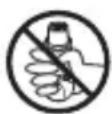
The device is intended for indoor use, where possible, try to avoid using the thermometer outdoors. External influences, such as the wind and outdoor temperature, may have an impact on the measurement.
The person who is having their temperature taken should avoid any fluctuating ambient temperatures for at least 5 minutes before the measurement. Also avoid any strenuous physical activity or taking a bath for at least 30 minutes before the measurement.
5.3 Measurement at the forehead
Make sure the forehead is dry, clean and free from make-up when taking the temperature. Avoid placing the device on any scarred areas.
- Press the Standby (ON/MEM) button 7 to switch on the device.
The forehead symbol will appear on the LCD display. Two beeps will also be heard as signals.

The mode now shown in the display is the standard mode after the device is switched on. The device is now operational.
- Remove the cover 1 from the probe head 4 (see Figure B).
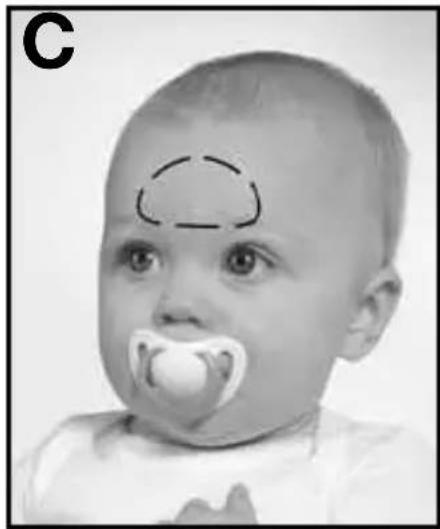
- Keep the device in the centre of the forehead just above the eyes, about 2 to 3 cm away (see Figure C).
- Briefly press the SCAN button 2.

A long beep is heard and the egg timer symbol starts flashing in the display.

As soon as the measurement is complete, this symbol disappears, followed by two short beeps.
- Read the temperature measured off the LCD display 3.
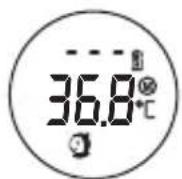
If an elevated temperature of 37.5 °C (99.5 °F) or more is measured in forehead mode, one long and three short consecutive beeps are heard.
If a potential fever is indicated during the temperature measurement, keep body temperature under continuous observation and if the person's condition is uncertain, consult a doctor.
If you would like to perform a further measurement, this is possible as soon as the egg timer symbol has disappeared.
- To do so, please repeat steps 3., 4. and 5.
After about 1 minute, if there are no further nmeasurements, the thermometer automatically switches from measuring mode to room temperature mo be seen from the temperature s
5.4 Measuring surface temperatures
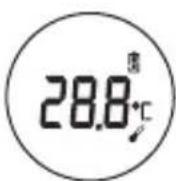
The thermometer has a measuring range of -22.0 to 80.0 °C (-7.6 to 176.0 °F) for measuring the temperature of surfaces. This enables you to measure the surface temperature of radiators, cooker hotplates, ovens or similar surfaces, as well as liquids.
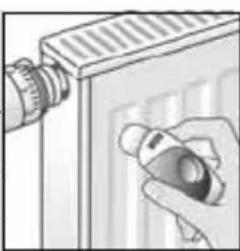
Note: Please note that steaming surfaces, such as water, food or milk, for example, may cause the reflective mirror with sensor lens 5 to mist up, resulting in a measurement which may be inaccurate.

Warning! The “Surface temperature” setting cannot be used to measure body temperatures/fevers.
Note: Please note when measuring surfaces that it really is only the temperature of the surface which is determined, not the temperature of what is inside. There may be differences in temperature between the surface and the core, especially when measuring liquids. It may be much higher. Incorrect conclusions may lead to burns or scalds. Before measuring a liquid, stir it to even out these differences as far as possible and then take the measurement immediately.
-
Press the Standby (ON/MEM) button 7 to switch on the device.
-
Hold down the Standby (ON/MEM) button 7 and press the SCAN button 2 at the same time until the adjacent symbol appears in the LCD display 3.

This activates “Surface measurement” mode which enables you to determine the temperature of surfaces.
- Remove the cover 1 from the probe head 4 (see Figure B).
- Hold the sensor lens 5 of the thermometer as close as possible to the surface to be measured without contacting it directly.
Note: Under no circumstances may the thermometer be immersed in liquids or contact hot cooker hotplates.
- Briefly press the SCAN button 2 to perform the measurement.

- Read off the temperature measured in the LCD display 3.
- Press and hold the SCAN button 2 to update the measurement constantly. The device automatically switches to "Room temperature" mode after approx. one minute.
5.5 Measuring room temperature
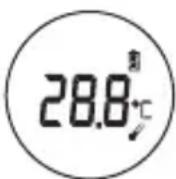
If the thermometer is not operated for around 1 minute, the device automatically switches to "Room temperature" mode.
The symbol () and the room temperature measured appear on the LCD display 3.
5.6 Previous measurement
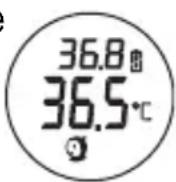
For every new temperature measurement, the result from the previous measurement will be shown for comparison at the top of the LCD display 3.
5.7 Memory (25 entries)
- With the device switched on, press the Standby (ON/MEM) button 7 simultaneously.
Memory 1 appears and displays the last temperature measurement when the button is released.
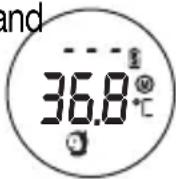
- Pressing the button again in this way displays the previous 25 temperature measurements performed.
The memory is represented in the LCD display 3 by the adjacent symbol.

5.8 Switching between °C and °F
- If the device is in "Room temperature" mode, press and hold the SCAN button 2 whilst simultaneously pressing the ON/MEM button 7 for 3 seconds.
The character in the LCD display 3 changes: “°C” to “°F”.
- The same procedure applies when switching from ° F to ° C.
5.9 Silent mode
You can switch off the sounds using silent mode.
- With the device switched on, press Standby (ON/MEM) button 7.
The silent mode symbol starts flashing in the LCD display 3.

- Release Standby (ON/MEM) button 7 again to activate silent mode.
- The same procedure applies when deactivating silent mode.
A s soon as the deactivated, you can hear all the beeps again.
5.10 Switching off the device
To switch off the thermometer, press and hold the Standby (ON/MEM) button 7 until "OFF" appears in the LCD display 3.
6. Cleaning, maintaining and storing the device
6.1 Cleaning
Caution!
- In order to avoid inaccurate measuring, check the reflective mirror 5 whether it is clean or not. Clean if necessary.
-
Do not submerge the device in water or expose it to direct moisture.
-
The probe head 4 is the most sensitive part of the thermometer. Treat this part of the device with particular care when cleaning the reflective mirror with sensor lens 5.
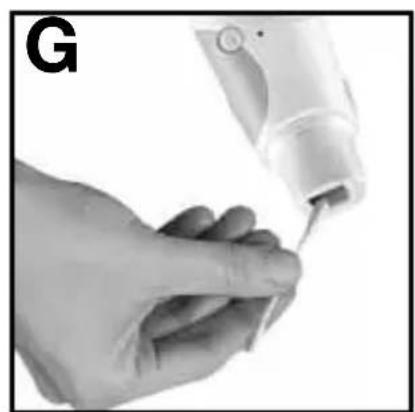
- For cleaning only use a cotton bud dipped in a solution of app. 70% alcohol (Ethanol) (see figure G).

Caution!
- Do not use other chemical agents or disinfectants to clean as this may damage the device.
-
Make sure that the tip of the device is pointing downwards so that none of the cleaning fluid enters the housing.
-
Then leave the probe head to dry completely for at least one minute.
6.2 Changing the battery
The battery must be replaced as soon as the following symbol appears in the LCD display3.
-
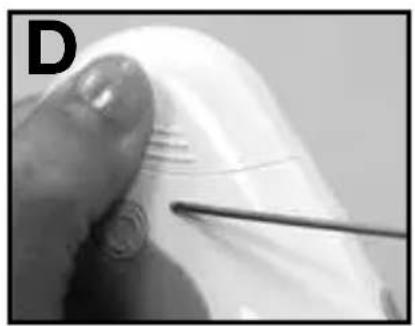
Take a small, thin object (e.g. a paper clip) and press it into the unlocking opening 6 of the battery compartment lid 9 while, at the same time, pushing this opening outwards with both thumbs (see figure D).
-
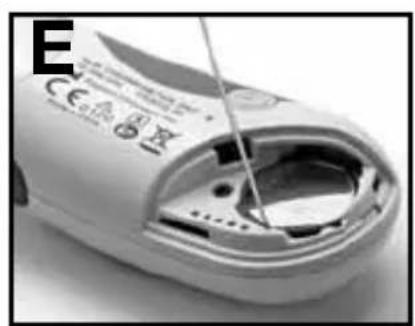
Firmly holding the device, carefully lift out the battery 8 using a small, thin object (e.g. a paper clip) (see figure E).
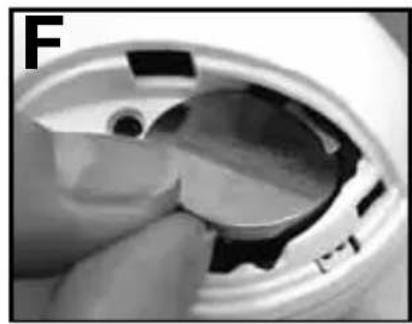
- Insert the new CR2032 battery with the positive terminal facing upwards and the minus terminal facing downwards by sliding the battery underneath the metal hook and pressing down until it clicks into place (see figure F).
Caution! If incorrectly fitted, the battery compartment and even the device may become damaged.
- Push the battery compartment lid 9 back onto the device until it audibly clicks into place.
6.3 Storage
To avoid contamination of the reflective mirror 5 place the cover 1 to the thermometer after each measurement. Only store thermometer with cover.
We recommend that you retain the packaging of the thermometer so that the device can be packaged securely for transport.
If the device is not to be used for an extended period, we recommend switching
off the device (see "5.10 Switching off the device" on page 39).
Only operate and store the device in accordance with the conditions specified.
(see "8. Technical data" on page 44).
- Troubleshooting
| Error message | Problem Possible cause Solution | ||
| Er | The device is not working properly. | Software error Remove the battery, wait one minute and then replace the battery (see sect. 6.2). If the error message appears again, contact your retailer. | |
| While the symbol is flashing, a new measurement cannot be started. | The device is not yet ready to take a new measurement | Wait until the symbol has stopped flashing. When it has stopped flashing, then start the new measurement. | |

| AbH | Room temperature greater than 40.0 °C (104.0 °F). | The device was not stored as instructed | Place the thermometer in a room with a temperature of between 10.0 °C (50.0 °F) and 40.0 °C (104.0 °F) for at least 30 minutes. |
| AbL | Room temperature less than 10.0 °C (50.0 °F). | ||
 | The device will not switch on and display anything. | Insulation strips have not been removed from the battery | Remove the insulation strips from the battery (see sect. 4.). |
| Battery empty Replace the battery (see sect. 6.2). | |||
| Hi | (1) In forehead mode: Measurement temperature >+42.2 °C (108.0 °F)(2) Surface temperature: Measurement temperature >+80.0 °C (176.0 °F) | Object to be tested outside the specified measurement range (too hot) | Take a measurement within the specified temperature range. In the event of a malfunction: Contact your retailer. |
| Lo | (1) In forehead mode: Measurement temperature < +34.0 °C (93.2 °F)(2) Surface temperature: Measurement temperature < -22.0 °C (-7.6 °F) | Object to be tested outside the specified measurement range (too cold) | |
8. Technical data
| Temperature range: | |
| Forehead mode: +34,0~42 | 2 °C (93,2~108,0 °F) |
| Surface temperature mode: | -22,0~80,0 °C (-7,6~176,0 °F) |
| Operating temperature: +10 | 0~40,0 °C (50,0~104,0 °F), 15%~85% RH (non-condensing) |
| Storage temperature: | -20,0~+50,0 °C (-4,0~122,0 °F), relative humidity ≤85% |
| Transport temperature: <70 | 0 °C (158,0 °F), relative humidity ≤95% |
| Accuracy: | |
| Forehead mode: | ±0.2 °C/0.4 °Fin the measuring range 35.5~42.0 °C (95.9~107.6 °F) ±0.3 °C / 0.5 °F outside this range Clinical Bias: -1.4 ~ -1.7 °C Limits of Agreement: 0.98 Repeatability: 0.20 °C |
| Surface temperature mode: | ±0.3 °C / 0.5 °F in range 22.0~42.2 °C (71.6~108.0 °F), otherwise ±4%(however at least ±2.0 °C / 4.0 °F) |
| Atmospheric pressure: | 800~1013 hPa |
| Protection class: | BF |
| Degree of protection: | IP22 |
| Battery: 1 CR2032 lithium battery | |
| Battery life: approx. 3,000 measurements (~1 year) | |
| Comply with: | ASTM E1965-98, ISO 80601-2-56,IEC/EN60601-1-2(EMC),IEC/EN60601-1(Safety standards),ISO10993, RoHS. |
Note: The thermometer converts the forehead temperature into its “oral equivalent” (referring to the results of the clinical assessment).
8.1 Production date
A000001: consecutive serial number
The production date is contained in the serial number:
Example: Ex. SN: E512A000001
Ex. SN: "Serial number"
E: code for "External"
5: last digit of production year, in this case, 2015
12: production month, in this case, December

9. Guidance and manufacturer's declaration
9.1 Electromagnetic emissions
The THixyz series is intended for use in the electromagnetic environment specified below. The customer or the user of the THixyz series should assure that it is used in such an environment.
| Emissions test Compliance Electromagnetic environment – guidance | ||
| RF emissionsCISPR 11 | Group 1 The THixyz series uses RF energy only for its internal function. Therefore, its RF emissions are very low and are not likely to cause any interference in nearby electronic equipment. | |
| RF emissionsCISPR 11 | Class B | The THixyz series is suitable for use in all establishments, including domestic establishments and those directly connected to the public low-voltage power supply network that supplies buildings used for domestic purposes. |
| Harmonic emissionsIEC 61000-3-2 | Not applicable | |
| Voltage fluctuations/flicker emissionsIEC 61000-3-3 | Not applicable | |
9.2 Electromagnetic immunity
| Immunity test | IEC 60601 test level | Compliance level | Electromagnetic environment – guidance |
| Conducted RF IEC 61000-4-6 | 3 Vrms150 kHz to80 MHz | Not applicable | Portable and mobile RF communications equipment should be used no closer to any part of the THixyz series, including cables, than the recommended separation distance calculated from the equation applicable to the frequency of the transmitter.Recommended separation distance d = 1,2 d = 1,2 80 MHz to 800 MHz d = 2,3 √800 MHz to 2,5 GHzwhere P is the maximum output power rating of the transmitter in watts (W) according to the transmitter manufacturer and d is the recommended separation distance in meters (m).Field strengths from fixed RF transmitters, as determined by an electromagnetic site survey, a should be less than the compliance level in each frequency range b.Interference may occur in the vicinity of equipment marked with the following symbol: |
| Radiated RF IEC 61000-4-3 | 3 V/m80 MHz to2,5 GHz | 3 V/m |
Note: At 80 MHz and 800 MHz, the higher frequency range applies.
Note: These guidelines may not apply in all situations. Electromagnetic propagation is affected by absorption and reflection from structures, objects and people.

a. Field strengths from fixed transmitters, such as base stations for radio (cellular/cordless) telephones and land mobile radios, amateur radio, AM and FM radio broadcast and TV broadcast cannot be predicted theoretically with accuracy. To assess the electromagnetic environment due to fixed RF transmitters, an electromagnetic site survey should be considered. If the measured field strength in the location in which the THixyz series is used exceeds the applicable RF compliance level above, the THixyz series should be observed to verify normal operation. If abnormal performance is observed, additional measures may be necessary, such as reorienting or relocating the THixyz series.
b. Over the frequency range 150 kHz to 80 MHz, field strengths should be less than 3 V/m.
| Immunity test | IEC 60601 test level Compliance level | Electromagnetic environment – guidance | |
| Electrostatic discharge (ESD) IEC 61000-4-2 | 6 kV contact8 kV air | 6 kV contact8 kV air | Floors should be wood, concrete or ceramic tile. If floors are covered with synthetic material, the relative humidity should be at least 30%. |
| Electrical fast transient/burst IEC 61000-4-4 | 2 kV for power supply lines1 kV for input/output lines | Not applicable | Mains power quality should be that of a typical commercial or hospital environment. |
| Immunity test IEC 60601 test level Compliance level | Electromagnetic environment – guidance | ||
| SurgeIEC 61000-4-5 | 1 kV line(s) to line(s)2 kV line(s) to earth | Not applicable | Mains power quality should be that of a typical commercial or hospital environment. |
| interruptions and voltage variations on power suppl | <5 % UT (>95 % dip in UT) for 0,5 cycle40 % UT (60 % dip in UT) for 5 cycles | Not applicable | Mains power quality should be that of a typical commercial or hospital environment. If the user of the THixyz series requires continued operation during power mains interruptions, it is recommended that the THixyz series be powered from an uninterruptible power supply or a battery. |
| input linesIEC 61000-4-11 | 70 % UT (30 % dip in UT) for 25 cycles<5 % UT (>95 % dip in UT) for 5 sec | ||


| Immunity test | IEC 60601 test level Compliance level | Electromagnetic environment – guidance |
| Power frequency (50/60 Hz) magnetic field IEC 61000-4-8 | 3 A/m 3 A/m Power frequency magnetic | fields should be at levels characteristic of a typical location in a typical commercial or hospital environment. |
Note: UT is the a.c. mains voltage prior to application of the test level.
9.3 Recommended separation distances
between portable and mobile RF communications equipment and the ME equipment or ME system.
The THixyz series is intended for use in an electromagnetic environment in which radiated RF disturbances are controlled. The customer or the user of the THixyz series can help prevent electromagnetic interference by maintaining a minimum distance between portable and mobile RF communications equipment (transmitters) and the THixyz series as
recommended below, according to the maximum output power of the communications equipment.
| Rated maximum output power of transmitter in W | Separation distance according to frequency of transmitter in m | ||
| 150 kHz to 80 MHzd = 1,2 | 80 MHz to 800 MHzd = 1,2 | 800 MHz to 2,5 GHzd = 2,3 | |
| 0,01 N/A 0,12 | 0,23 | ||
| 0,1 N/A 0,38 | 0,73 | ||
| 1 | N | / | A |
| 10 N/A 3,8 | 7,3 | ||
| 100 N/A 12 | 23 | ||
For transmitters rated at a maximum output power not listed above, the recommended separation distance d in meters (m) can be estimated using the equation applicable to the frequency of the transmitter, where P is the maximum output power rating of the transmitter in watts (W) according to the transmitter manufacturer.
Note: At 80 MHz and 800 MHz, the separation distance for the higher frequency range applies.
Note: These guidelines may not apply in all situations. Electromagnetic propagation is affected by absorption and reflection from structures, objects and people.
10. Disposal
10.1 Equipment
The symbol of the crossed-through wheelie bin means, within the European Union, that the product is subject to a separate waste collection. This applies to the product and all accessories marked with this symbol. Products labelled as such must not be disposed of with the normal household waste collections; they must be taken to a recycling bank for electrical and electronic equipment. Recycling helps to reduce the use of raw materials and is eco-friendly.
10.2 Disposable/rechargeable batteries

Batteries must not be disposed of with domestic waste. Flat batteries must be disposed of properly. Special containers for battery disposal are provided for this purpose at shops selling batteries or at municipal collection points.
Batteries and rechargeable batteries on which the following letters are printed contain, among other things, the following harmful substances: Cd (cadmium), Hg (mercury), Pb (lead).
10.3 Packaging

When you wish to dispose of the packaging, please observe the relevant environmental regulations for your country.
11. Warranty
In addition to the seller's warranty obligations arising from the contract to purchase, we as the manufacturers provide a warranty of 24 months from purchase of the device as long as the device is used properly and the operating instructions are followed. Evidence of the date of purchase and the type of device should be provided by means of a receipt.
The purchaser's statutory rights are unaffected by this manufacturer warranty.
During the warranty period, we undertake to remedy any defects attributable to poor materials or workmanship. Worn parts and batteries are excluded from the warranty.
Minor deviations from specified quality which do not affect the value or usability of the device are not covered by the warranty. We are likewise unable to accept the warranty if the defects on the device are due to transport damage for which we are not responsible, if they are attributable to misuse or lack of care or if the device has been interfered with by persons not authorized by us to do so.
The warranty service will involve repair, replacement of parts or replacement of the device at our discretion. The warranty period will be neither extended nor restarted by the performance of warranty services. The warranty for any spare parts fitted will expire with the warranty for the device as a whole.
Extended or different claims, especially those relating to the making good of damage sustained outside the device, are excluded unless liability is compulsory in law.
We will not accept the costs or risks of transport.
An device sent in without evidence of the purchase date will be treated as a repair.

The device will only be repaired following discussion with the customer.
Retain address, article number and LOT No. for possible future reference. The lot and serial number of the device can be found on the inside of the battery cover.
11.1 Service Centres
The addresses for service can be found under “NUK Contact addresses” on page 103.
Article no.: 10.256.380
11.2 Supplier
Please note that the address below is not a service address. In the event of problems or queries relating to your product, contact one of the Service Centres (see “NUK Contact addresses” on page 103).
MAPA GmbH
12. EU declaration of confirmity
The device meets all applicable European directives, as well as their respective essential requirements. These are detailed in the EU declaration of conformity, which can be requested from the manufacturer. The declaration of conformity can be found at www.nuk.de.
Indice
Radiant Innovation Inc.
1F, No.3, Industrial East 9th Road
Science-Based Industrial Park,
HsinChu,
Taiwan 300

EU-Repräsentant:
EU-representative:
Rappresentante UE:
Medical Technology Promedt Consulting
GmbH
Altenhofstraße 80,
66386 St. Ingbert
GERMANY
Hergestellt für:
Manufactured for:
Prodotto per:
Produit pour :
MAPA GmbH
NUK is a registered trademark of
MAPA GmbH, Germany
MAPA GmbH
NUK is a registered trademark of MAPA GmbH, Germany


- ITALIANO 55
- INHALT
- KEY TO PARTS 29
- SAFETY INSTRUCTIONS 30
- STARTING THE DEVICE .... 33
- OPERATING THE DEVICE.... 34
- CLEANING, MAINTAINING AND STORING THE DEVICE ..... 39
- TROUBLESHOOTING....41
- TECHNICAL DATA 44
- GUIDANCE AND MANUFACTURER'S DECLARATION 46
- DISPOSAL 52
- WARRANTY....53
- EU DECLARATION OF CONFIRMITY....54
- DESCRIPTION
- 1.1 INTENDED USE
- 1.2 DESCRIPTION OF FUNCTION
- 1.3 SCOPE OF SUPPLY
- 1.4 SYMBOLS ON THE DEVICE/PACKAGING
- KEY TO PARTS
- SAFETY INSTRUCTIONS
- 3.1 EXPLANATION OF TERMS
- WARNING
- CAUTION
- NOTE
- 3.2 GENERAL INFORMATION
- 3.3 SPECIAL NOTES FOR THIS DEVICE
- 3.4 FOR THE SAFETY OF YOUR CHILD
- 3.5 HANDLING BATTERIES
- CAUTION! TO PREVENT MATERIAL DAMAGE
- 3.6 MATERIAL DAMAGE
- STARTING THE DEVICE
- OPERATING THE DEVICE
- 5.1 BASIC INFORMATION
- BODY TEMPERATURE
- CAUSES
- SYMPTOMS AND DIAGNOSES
- YOU SHOULD CONTACT A DOCTOR
- 5.2 SPECIAL THINGS TO CONSIDER WHEN MEASURING A FEVER
- 5.3 MEASUREMENT AT THE FOREHEAD
- 5.4 MEASURING SURFACE TEMPERATURES
- 5.5 MEASURING ROOM TEMPERATURE
- 5.6 PREVIOUS MEASUREMENT
- 5.7 MEMORY (25 ENTRIES)
- 5.8 SWITCHING BETWEEN °C AND °F
- 5.9 SILENT MODE
- 5.10 SWITCHING OFF THE DEVICE
- CLEANING, MAINTAINING AND STORING THE DEVICE
- 6.1 CLEANING
- 6.2 CHANGING THE BATTERY
- 6.3 STORAGE
- TECHNICAL DATA
- 8.1 PRODUCTION DATE
- GUIDANCE AND MANUFACTURER'S DECLARATION
- 9.1 ELECTROMAGNETIC EMISSIONS
- 9.3 RECOMMENDED SEPARATION DISTANCES
- DISPOSAL
- 10.1 EQUIPMENT
- 10.2 DISPOSABLE/RECHARGEABLE BATTERIES
- 10.3 PACKAGING
- WARRANTY
- 11.1 SERVICE CENTRES
- 11.2 SUPPLIER
- EU DECLARATION OF CONFIRMITY
- INDICE
Brand : NUK
Model : Flash
Category : Thermometer