F7SP24S1 - Oven Fulgor Milano - Free user manual and instructions
Find the device manual for free F7SP24S1 Fulgor Milano in PDF.


User questions about F7SP24S1 Fulgor Milano
0 question about this device. Answer the ones you know or ask your own.
Ask a new question about this device
Download the instructions for your Oven in PDF format for free! Find your manual F7SP24S1 - Fulgor Milano and take your electronic device back in hand. On this page are published all the documents necessary for the use of your device. F7SP24S1 by Fulgor Milano.
USER MANUAL F7SP24S1 Fulgor Milano
natural_image
Simple geometric diagram with a black rectangle inside a larger rectangle (no text or symbols)F7SP24S1
ELECTRONIC OVENS
FOURS ELECTRONIQUES
HORNOS ELECTRÓNICOS
EN USE & CARE MANUAL
FR GUIDE D'UTILISATION ET D'ENTRETIEN
ES MANUAL DE USO & MANTENIMIENTO
TABLE OF CONTENTS PAGE
1 - General Appliance and Oven Safety Precautions 2
Safety for the Oven 3
Safety for the Cleaning Oven 3
2 - Features of your Oven 4
3 - General Oven Information 5
120 V / 240 V vs. 120 V / 208 V Connection 5
High Altitude Baking 5
Power Failure 5
E Error Number Codes 5
Squeak Noise 5
Flashing Symbols or Numbers 5
Beeps 5
Convection Fan 5
Component Cooling Fan 5
Using Oven Lights 5
Oven Condensation and Temperature 6
Operational Suggestions 6
Utensils 6
Oven Racks 6
Removable Guides (if present) 6
5 - Control panel 7
Keypad 7
Control panel 7
6 - General Oven Information 8
Error codes 8
Beeps 8
Door Lock 8
Power Failure 8
Default Settings 8
F Failure Number Codes 8
Locking the keyboard 8
Preheat and Fast Preheat 8
Timer 8
7 - General Oven Tips 9
Preheating the Oven 9
Operational Suggestions 9
Utensils 9
Oven Condensation and Temperature 9
High Altitude Baking 9
8 - Getting Started 10
Instructions for initial switch-on 10
9 - User Settings 11
Language 11
Temperature & Weight 11
Time 11
Language 12
Temperature & Weight 12
Time 12
TABLE OF CONTENTS PAGE
10 - System Setting 13
Event Log 13
Demo 13
11 - Starting your Oven 14
Switching the oven on and off 14
Selecting the cooking mode 14
Changing the cooking mode 14
Changing temperature 14
Cooking mode quick menu 16
Pre-heating phase 16
Eco 16
Fast Preheat 17
Using Oven Lights 17
12 - Time Oven Mode Operation 18
Cook Time 18
Stop Time 18
13 - Setting the Meat Probe (if present) 19
14 - Understanding the Various Oven Modes 21
Roast Tips and Techniques 21
General Guidelines 21
True Convection Tips and Techniques 21
Convection Roast Tips and Techniques 22
Convection Broil Tips and Techniques 22
Broil Tips and Techniques 22
Dehydrate Tips and Techniques 22
Dehydrate Chart 23
15-Recipes 24
16 - Classic Pizza (On Some Models) 26
17 - Sabbath Mode Instructions (on some models) X28
18 - Oven Care and Cleaning 29
Self-Cleaning the Oven 29
Preparing the Oven for Self-Clean 29
19 - Setting The Self Cleaning Mode 30
To Set the Self-Clean Mode 30
To Change the Cleaning Time 30
To Delay the Start of Cleaning 30
20-Oven Door 31
Automatic door locking during pyrolytic cycle 31
Removing the "FULL GLASS" panoramic door 31
Removing the oven door 31
How to remove the inner glass of the "FULL
22 - Solving Baking and Roasting Problems 34
23 - Solving Operational Problems 35
Service Data Record 35

IMPORTANT INSTRUCTION
Please read all instructions before using this appliance.


WARNING
When properly cared for, your new oven has been designed to be a safe, reliable appliance.
Read all instructions carefully before using this oven. These precautions will reduce the risk of burns, electric shock, fire, and injury to persons. When using kitchen appliances, basic safety precautions must be followed, including the following:
This appliance must be properly installed and grounded by a qualified technician. Connect only to properly grounded outlet. See "Grounding Instructions" found in the Installation Instructions.
- This appliance should be serviced only by a qualified service technician. Contact the nearest authorized service center for examination, repair or adjustment.
- Do not repair or replace any part of the oven unless specifically recommended. Refer service to an authorized servicer.
- Do not operate this appliance if it is not working properly or if it has been damaged, until an authorized servicer has examined it.
- Install or locate this appliance only in accordance with the Installation Instructions.
- Use this oven only as intended by the manufacturer. If you have any questions, contact the manufacturer.
- Do not cover or block any openings on this appliance.
- Use this appliance only for its intended use as described in this manual. Do not use corrosive chemicals, vapors, or nonfood products in this appliance. This type of oven is specifically designed to heat or cook. It is not designed for industrial or laboratory use. The use of corrosive chemicals in heating or cleaning will damage the appliance.
- In the event that personal clothing or hair catches fire, DROP AND ROLL IMMEDIATELY to extinguish flames.
- Do not allow children to use this appliance unless closely supervised by an adult. Children and pets should not be left alone or unattended in the area where the appliance is in use. Never allow children to sit or stand on any part of the oven.

CAUTION
Do not store items of interest to children above the oven. If children should climb onto the appliance to reach these items, they could be seriously injured.
To reduce the risk of fire in the oven cavity:
- Do not store flammable materials in or near the oven.
- Do not use water on a grease fire. Smother fire or use a dry chemical or foam-type extinguisher.
- It is highly recommended that a fire extinguisher be readily available and highly visible next to any cooking appliance.
- Do not overcook food. Carefully attend oven if paper, plastic or other combustible materials are placed inside the oven.
- Do not use the cavity for storage purposes. Do not leave paper products, cooking utensils or food in the cavity when not being used.
- If materials inside the oven should ignite, keep oven door closed. Turn oven off and disconnect the circuit at the circuit breaker box.
- Do not block any vent openings.
- Be sure the blower fan runs whenever the oven is in operation. If the fan does not operate, do not use the oven. Call an authorized service center.
- Never use the oven to warm or heat a room. This can damage the oven parts.
- For personal safety, wear proper clothing. Loose fitting or garments with hanging sleeves should never be worn while using this appliance.
Safety for the Oven
- Tie long hair so that it doesn't hang loose.
- Do not touch heating elements or interior surfaces of oven.
- The heating elements may be hot even though they are dark in color. Interior surfaces of an oven become hot enough to cause burns.
- During and after use, do not touch or let clothing or other flammable materials contact the heating elements or the interior surfaces of the oven until they have had sufficient time to cool.
- The trim on the top and sides of the oven door may become hot enough to cause burns.
- Use care when opening the door. Open the door slightly to let hot air or steam escape before removing or replacing food.
- Do not heat unopened food containers. Build-up of pressure may cause the container to burst and cause injury.
- Always place oven racks in desired location while oven is cool. If a rack must be moved while oven is hot, do not let pot holder contact the hot heating elements.
- Use only dry pot holders. Moist or damp pot holders on hot surfaces may result in burns from steam. Do not let pot holder touch hot heating elements. Do not use a towel or other bulky cloth.
- Do not allow aluminum foil or meat probe to contact heating elements.
Safety for the Cleaning Oven

CAUTION
Do not leave food or cooking utensils, etc., in oven during the Self-Cleaning Mode of operation.
- Confirm that the door locks and will not open once both [CLEAN] commands have been activated and the "AUTO LOCK SIMBOL" appears. If the door does not lock, turn the Cook Mode dial to OFF and do not run Self-Cleaning. Phone for Service.
- Do not clean the Door gasket. It is essential for a good seal. Care should be taken not to rub, damage, move or remove the Door gasket.
- Do not use commercial oven cleaners or oven liner protective coatings of any kind in or around any part of the oven.
- Clean only oven parts listed in this manual. (see page 30)
- Before Self-Cleaning the oven, remove the broiler pan, oven racks (only when not made of porcelain), other utensils and excess soft spillage.

WARNING
The California Safe Drinking Water and Toxic Enforcement Act requires businesses to warn customers of potential exposure to substances which are known by the State of California to cause cancer or reproductive harm.
The elimination of soil during Self-Cleaning generates some by-products which are on this list of substances.
To minimize exposure to these substances, always operate this oven according to the instructions in this manual and provide good ventilation to the room during and immediately after Self-Cleaning the oven.
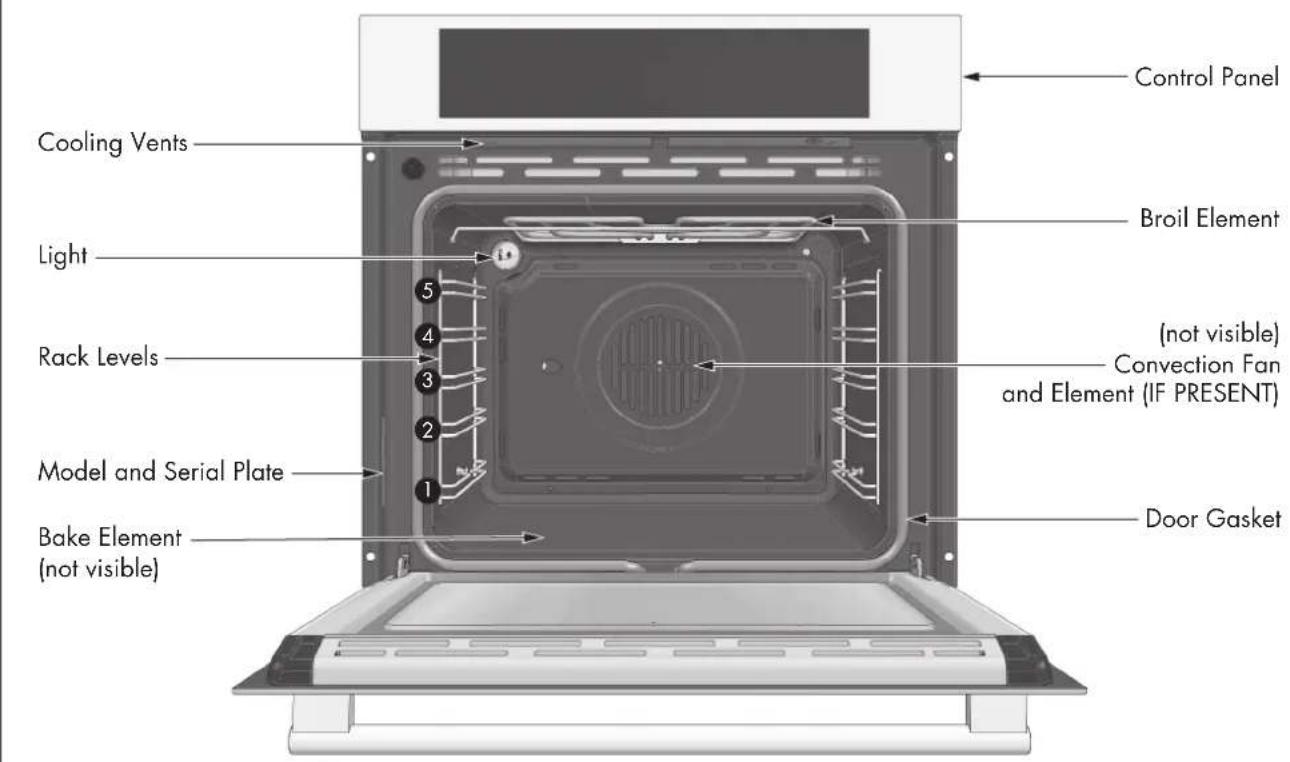
FEATURES OF YOUR OVEN
text_image
Control Panel Cooling Vents Broil Element Light (not visible) Rack Levels Convection Fan and Element (IF PRESENT) Model and Serial Plate Door Gasket Bake Element (not visible)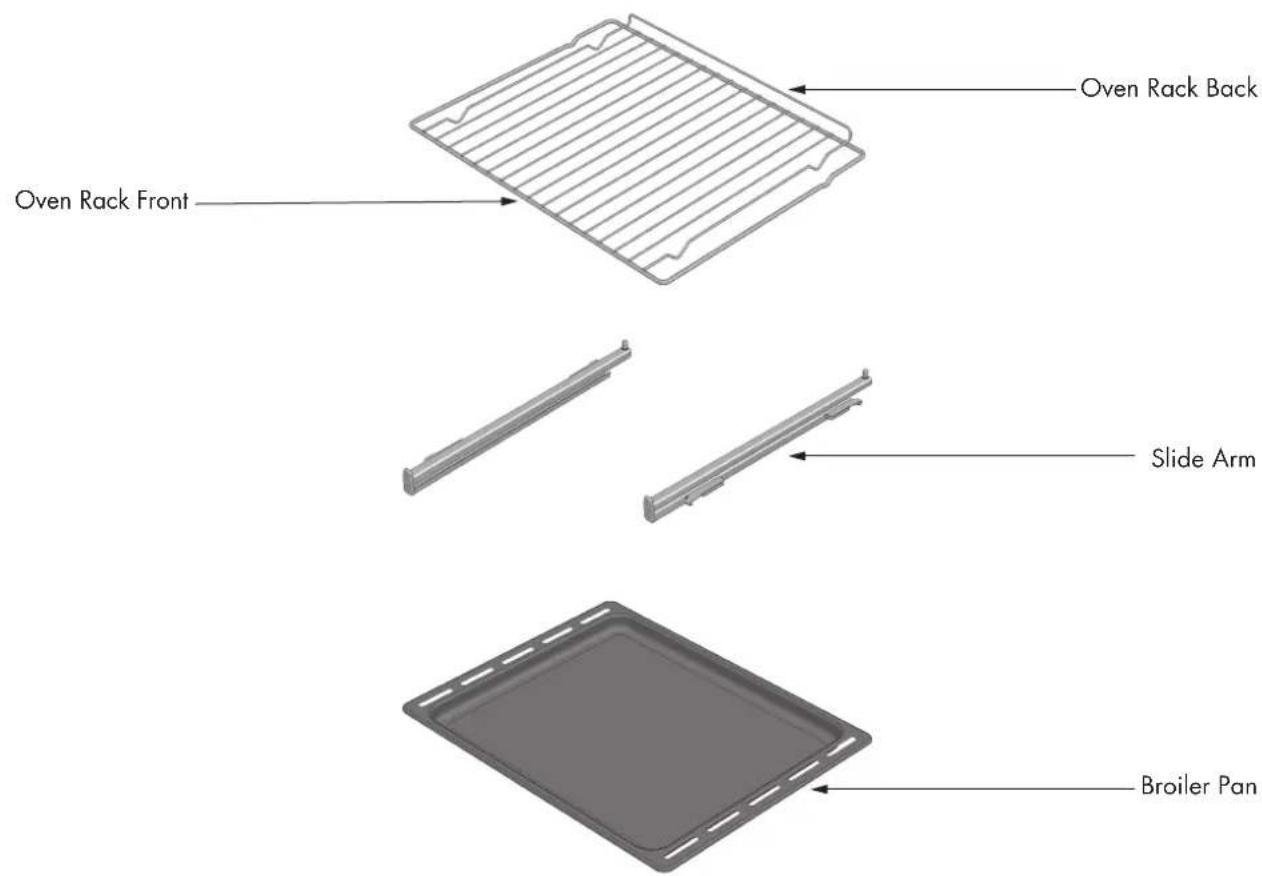
text_image
Oven Rack Back Oven Rack Front Slide Arm Broiler Pan
CAUTION
Before using your oven
- Remove all packing and foreign materials from the oven. Any material of this sort left inside may melt or burn when the appliance is used.
- Heat the empty appliance to the maximum temperature in order to remove any manufacturing residues which could affect the food with unpleasant odours.
120 V / 240 V vs. 120 V / 208 V Connection
Most oven installations will have a 120 V / 240 V connection. If your oven is installed with 120 V / 208 V, the preheat time may be slightly longer than with 120 V / 240 V. The oven is designed to assure the same clean time at 120 V / 208 V.
High Altitude Baking
When cooking at high altitude, recipes and cooking time will vary from the standard.
Power Failure
After the power returns to the oven, the clock displays the time 12.00.
E Error Number Codes
If E codes are displayed when the electronic control detects a problem in the oven or in the electronics.
Squeak Noise
You may hear a sound from the unit while using the oven due to heat warping, but this is not a malfunction.
Flashing Symbols or Numbers
Signal an incomplete action that is in progress (locking the door, preheat, etc.).
Beeps
Signal that the set temperature has been reached. Beeps also signal the end of a function or an oven fault.
Convection Fan
The convection fan operates during any Convection Mode and Dehydrate Mode.
Component Cooling Fan
Activates during any cooking or Self-Cleaning mode to cool inner components and outer door surfaces. This air is exhausted through the vent located above the oven door. It continues to run until components have cooled sufficiently. The cooling fan operates at double speed (or RPM's) in Self-Cleaning and whenever the internal components temperature becomes high.
Using Oven Lights
- When the oven is in use, oven lights turn on automatically when a mode is started. Oven lights will turn off automatically when finish and the oven mode is cancelled.
- The lights do not operate in the Self-Cleaning Mode.
• [LIGHT] Knob to activates the lights in oven.
The temperature is preset in Fahrenheit, however it can be changed to Celsius. (see page 11)
EN 4 - General Oven Tips
Default Settings
The Cooking Modes automatically select a suitable temperature. These can be changed when a different one is needed.
Oven Condensation and Temperature
- It is normal for a certain amount of moisture to evaporate from the food during any cooking process. The amount depends on the moisture content of the food. The moisture may condense on any surface cooler than the inside of the oven, such as the control panel.
- Your new oven has an electronic temperature sensor that allows maintaining an accurate temperature. Your previous oven may have had a mechanical thermostat that drifted gradually over time to a higher temperature. It is normal that you may need to adjust your favorite recipes when cooking in a new oven.
Operational Suggestions
• Use the Cooking Charts as a guide.
- Do not set pans or any weight on the open oven door.
- Use the interior oven lights to view the food through the oven door window rather than opening the door frequently.
Utensils
- Glass baking dishes absorb heat. Reduce oven temperature 25^ (15 °C) when baking in glass.
- Use pans that give the desired browning. The type of finish on the pan will help determine the amount of browning that will occur.
- Shiny, smooth metal or light non-stick / anodized pans reflect heat, resulting in lighter, more delicate browning. Cakes and cookies require this type of utensil.
- Dark, rough or dull pans will absorb heat resulting in a browner, crisper crust. Use this type for pies.
- For brown, crisp crusts, use dark non-stick / anodized or dark, dull metal utensils or glass bake ware. Insulated baking pans may increase the length of cooking time.
- Do not cook with the empty Broiler Pan in the oven, as this could change cooking performance. Store the Broiler Pan outside of the oven.
Oven Racks
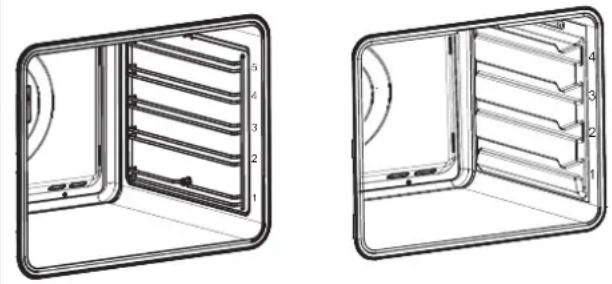
- The oven has rack guides at six levels as shown in the illustration.
- Rack positions are numbered from the bottom rack guide (#1) to the top (#4 or 5).
- Check Cooking Charts for best rack positions to use when cooking.
• Each level guide consists of paired supports formed in the walls on each side of the oven cavity.
• Always be sure to position the oven racks before turning on the oven. Make sure that the racks are level once they are in position.
Please refer to illustration on Page 4 if there is any question as to which side is the front or top of the rack.
- The racks are designed to stop when pulled forward to their limit.
CAUTION
Never use aluminum foil to cover the oven racks or to line the oven. It can cause damage to the oven liner if heat is trapped under the foil.
CAUTION
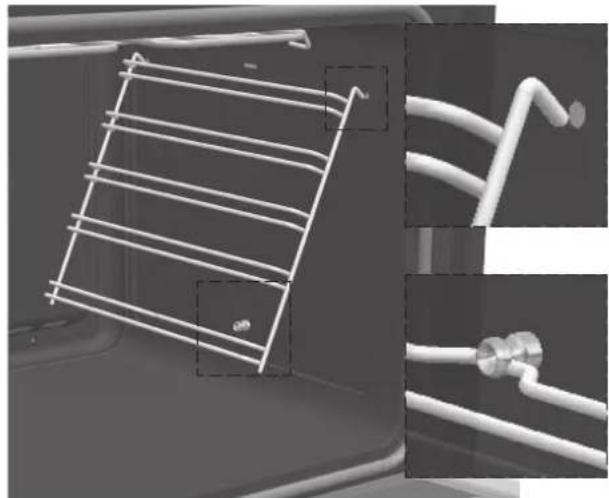
Make sure you do not force it to avoid damage to the enamel.
natural_image
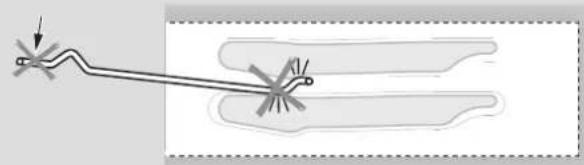
Simple line drawing of a tool or tool with an arrow pointing to it, no text or symbols present.Removable Guides (if present)
NOTE Always remove the removable guides before oven self-cleaning.
To remove the lateral frames from smooth-walled ovens, proceed as shown in the figure.
natural_image
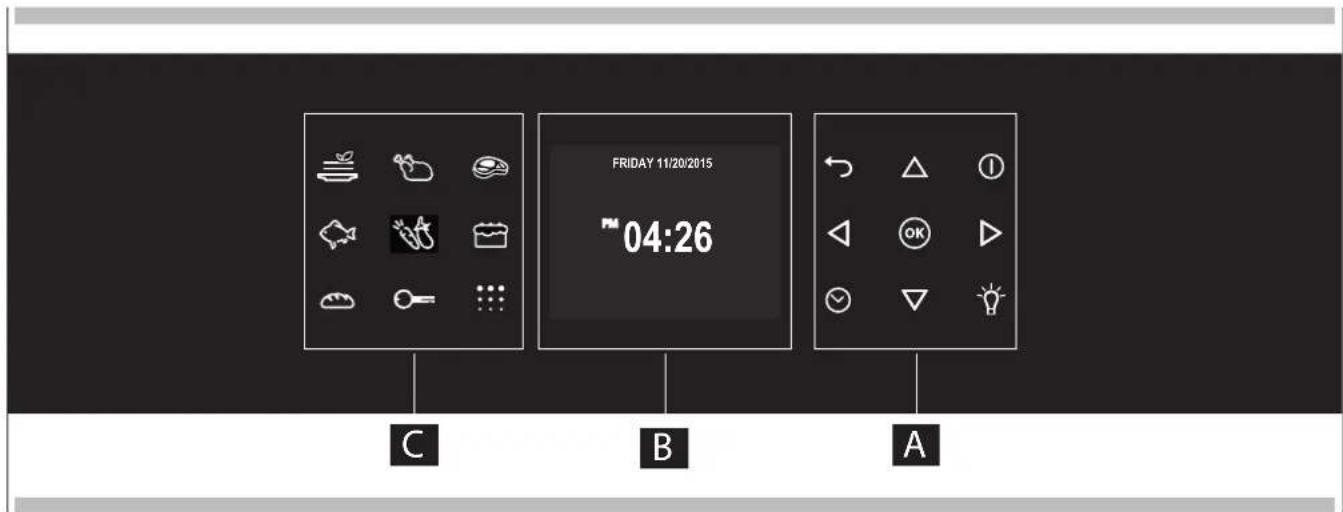
3D rendering of a car interior with white pipes and a ladder, showing no text or symbolsYour appliance could vary slightly compared to the illustrations below.
A - Function keypad
B - Display screen
C - Shortcut keypad
text_image
FRIDAY 11/20/2015 04:26 C B AKeypad
To operate the key, press gently. The keypad will not work if more than one key is pressed at the same time.
| - Movement arrows | |
| - To set the timer.- Enter the functions menu during cooking. | |
| - Switches the inner oven light on and off.The light cannot be switched on during the self-cleaning cycle. | |
| - Switches the oven on and off. | |
| - Confirms the settings and starts cooking operations. When pressed during a cooking operation, the function is placed in pause. Press again to restart. | |
| - Return to previous display page. Keep pressed to return to Home page |
Control panel
| Cooking mode quick menu | |
| Locking the keyboard | |
| Funzione Pirolisi |
Before using your oven for the first time remove all packing and foreign materials from the oven(s). Any material of this sort left inside may melt or burn when the appliance is used.
Error codes
This code appears in the event of the electronic control indicating a fault. When the error appears, the current function is blocked. If the type of error is related to a safety function, the oven becomes unusable and every time a start attempt is made, the same error appears (in which case call in the after-sales service), while if the error relates to a minor fault, after being restarted the oven can be used for the functions that do not involve the faulty part (e.g., a heating element).
Beeps
Confirms that the command has been received after a key has been pressed.
It also indicates that a time function has been completed (e.g. Timer or Timed Cooking). During the execution of a recipe, an acoustic signal warns the user that the oven is waiting for operation by the user (e.g., insert the dish or turn it over). Beeps also signal an oven fault.
Door Lock
It's displayed steadily when the door is locked. The symbol flashes when the latch is moving in order to lock or unlock the door. Do not attempt to open the door at this time. Door can be opened when the symbol no longer appears. A padlock appears when the door has been locked automatically due to self-clean mode.
Power Failure
After the power returns to the oven, the door lock mechanism perform a test run then the clock time and date are displayed
Default Settings
The cooking modes automatically select a suitable temperature when the cooking mode is selected, these can be changed when a different one is needed.
F Failure Number Codes
These codes are displayed when the electronic control detects a problem in the oven or in the electronics.
The error code is recorded in the Error Log in the Setup menu. This error can be communicated to the service technician so he/she can understand the possible cause of the problem in advance.
Locking the keyboard
Hold the key for 3 seconds. Commands are now locked and a "Key icon" will be displayed.
Repeat the same operation for 3 seconds to unlock the keyboard.
NOTE: The power off operation is always available.
Preheat and Fast Preheat
Whenever a cooking mode is set and the oven is heating, the preheating starts, during this period, the instantaneous temperature is displayed together with the thermometer icon. As soon as the 100% is reached, the control sounds an "end of preheat" tone and the current temperature value disappears.
When it's necessary to heat up the oven rapidly, a Fast Preheat mode is available: it uses the heating elements and the convection fan in a special way, in order to reduce the heating time as long as possible.
After having set one of the cooking functions for which the fast preheat is available and set the desired temperature value touch the ⏻ key, after entering the functions menu, select the icon ≈ by means of the keys △ and confirm by means of the key OK
As soon as the set-point temperature is reached, the control sounds a and both "Fast Preheat Icon" and "current temperature" disappear. The oven switches automatically to the desired cooking mode that was previously set: put the food inside now.
Timer

WARNING
The timer on your oven does not turn the appliance on or off, its only purpose is to alert you through the buzzer. When you want to turn off the oven automatically, use the end-of-cooking or delayed cooking function.
NOTE Pressing the OFF button does not reset or stop the timer.
- Press the button √ and set the desired time using the arrows △ and confirm with the button . ☑ switch the selection between hours and minutes use the arrows ◀ ▶.
- The time can be set from 1 minute to 12 hours and 59 minutes and, when set, the remaining time is always visible in the bottom status bar until the time expires or is reset.
- To change or cancel the time set, you must reset the timer by pressing and holding the button ⏰ for a few seconds.
- Timer format is usually HR:MIN, switching into MIN:SEC during the last minute.
- When the time expires, the display shows 00:00 and the buzzer will sound for one minute or until the button ⏰ is pressed.
Preheating the Oven
- Preheat the oven when using the Bake, Convection Bake and Convection Roast modes.
- Use Fast Preheat mode when a shorter time is desired to preheat the oven.
- Selecting a higher temperature does not shorten the preheat time.
- Preheating is necessary for good results when baking cakes, cookies, pastry and breads.
- Preheating will help to sear roasts and seal in meat juices.
- Place oven racks in their proper position before preheating.
- During preheating, the selected cooking temperature is always displayed.
- A beep will confirm that the oven is preheated and the "detected temperature" will turn off.
Operational Suggestions
- Do not set pans on the open oven door.
- Use the interior oven lights to view the food through the oven door window rather than opening the door frequently.
Utensils
- Glass baking dishes absorb heat. Reduce oven temperature 25^ (15°C) when baking in glass.
- Use pans that give the desired browning. The type of finish on the pan will help determine the amount of browning that will occur.
- Shiny, smooth metal or light non-stick / anodized pans reflect heat, resulting in lighter, more delicate browning. Cakes and cookies require this type of utensil.
- Dark, rough or dull pans will absorb heat resulting in a browner, crisper crust. Use this type for pies.
- For brown, crisp crusts, use dark non-stick / anodized or dark, dull metal utensils or glass bake ware. Insulated baking pans may increase the length of cooking time.
- Do not cook with the empty broiler pan in the oven, as this could change cooking performance.
- Store the broil pan outside of the oven.
Oven Condensation and Temperature
- It is normal for a certain amount of moisture to evaporate from the food during any cooking process. The amount depends on the moisture content of the food. The moisture may condense on any surface cooler than the inside of the oven, such as the control panel.
- Your new oven has an electronic temperature sensor that allows maintaining an accurate temperature. Your previous oven may have had a mechanical thermostat that drifted gradually over time to a higher temperature. It is normal that you may need to adjust your favorite recipes when cooking in a new oven.
High Altitude Baking
- When cooking at high altitude, recipes and cooking time will vary from the standard.
Instructions for initial switch-on
Once the oven has been connected to the power supply for the first time, the control automatically prepares for setting a number of user settings, which remain stored in case of any subsequent switch-on.
NOTE Both at the first and subsequent connections to the power supply, the door lock mechanism performs a calibration run – in this phase, always keep the door closed.
- Language
- Temperature & Weight
- Time
- Date
Refer to the USER SETTING paragraph for setting instructions.
After making the user settings, the control moves automatically to the "Standby" display page.
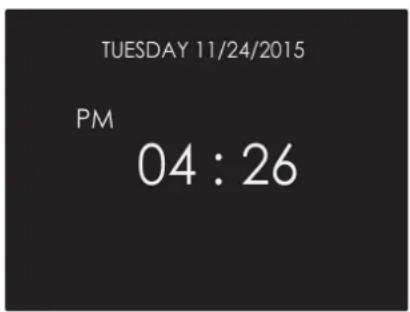
text_image
TUESDAY 11/24/2015 PM 04 : 26With the oven on, select the icon and confirm with the key ① enter the SETTINGS menu. This menu permits personalizing the settings of your oven. To make access, no active cooking or any set time functions must be in progress.
NOTE The Setting menù can never be set if any time function is already set: first delete all the active time functions.
- Press the keys ◀ ▷ to select the sub menu and confirm by means of the Ⓞ key.
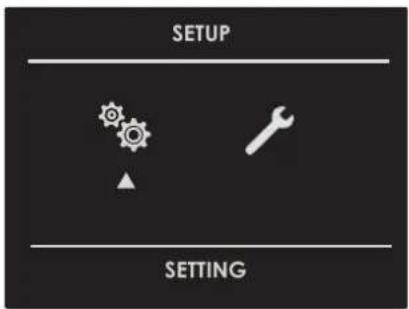
text_image
SETUP SETTING- Use this menu to change the following settings: Press the keys ◄b▶ to select the setting or change a sub menu from among the six available ones and confirm by means of the okey.
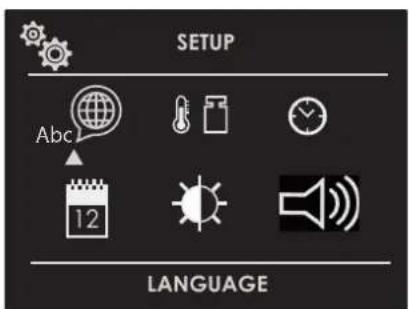
text_image
SETUP Abc 12 LANGUAGELanguage
Press the arrow key △ to ▽ select a language from among those available, and confirm with the Ⓞ key.
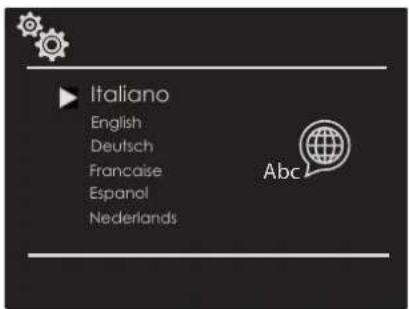
text_image
Italiano English Deutsch Francaise Espanol Nederlands AbcTemperature & Weight
Press the arrow key ◀ and to select one of the two temperature options "°C/°F" or weight options Kg/ib and confirm with the 🔊key.
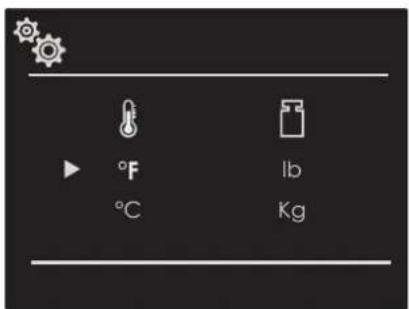
text_image
°F °C lb KgTime
Press the arrow key △ to select the time format between the options "12h AM/PM or 24h" and confirm with the okey. Subsequently, set the time using the arrows △ and confirm with the okey.
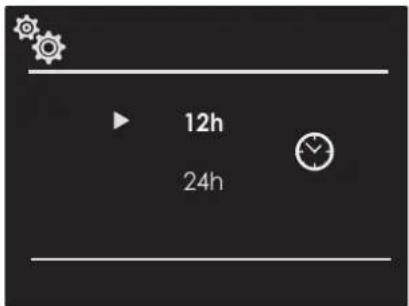
text_image
12h 24h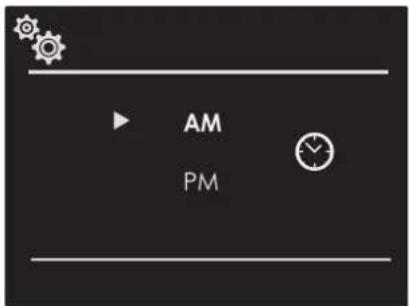
text_image
AM PM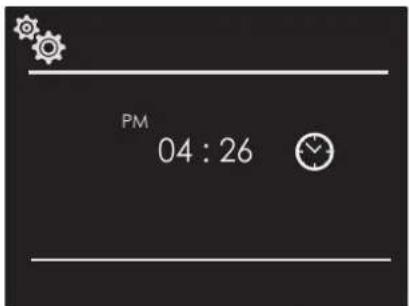
text_image
PM 04 : 26Date
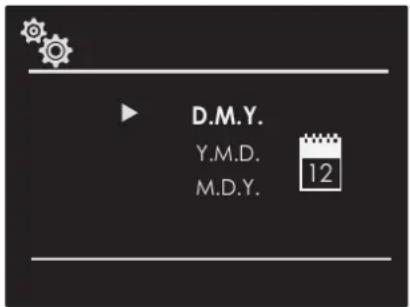
Press the arrow key △ to select the date format from among the options "D.M.Y. - Y.M.D. - M.D.Y." and confirm with the OK key. Subsequently set the value using the arrows △ and confirm with the OK key.
Volume
Press the arrow to select the desired volume level and confirm by pressing the deey .
text_image
D.M.Y. Y.M.D. M.D.Y. 12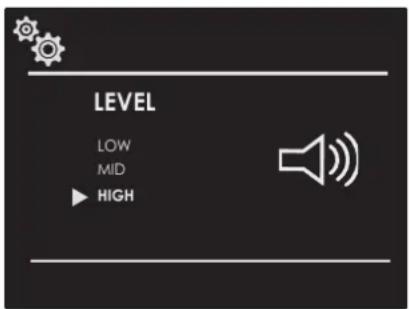
text_image
LEVEL LOW MID ▶ HIGH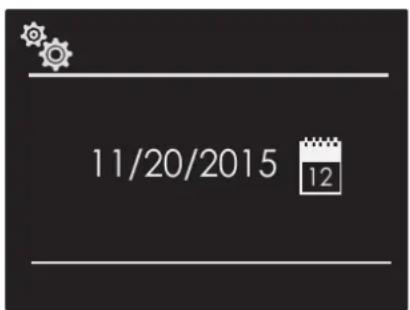
text_image
11/20/2015 12Brightness
Press the arrow key ◀ to choose which luminosity setting to change between ON or STANDBY, then by means of the arrows △ select the required degree of luminosity and confirm with the okey.
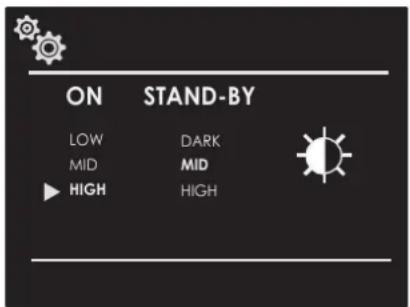
text_image
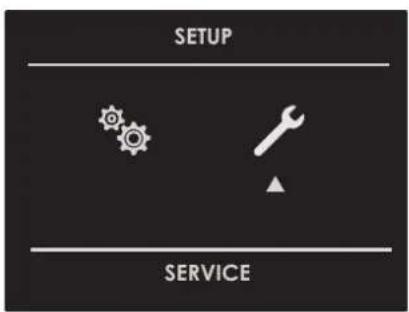
ON STAND-BY LOW DARK MID MID HIGH HIGHWith the oven on, select the icon and confirm with the key ok to enter the SETTINGS menu. This menu permits setting a number of parameters or special functions. It also permits accessing the error events list.
- Press the keys ◀ ▷ to select the sub menu and confirm with the Ⓞ key.
text_image
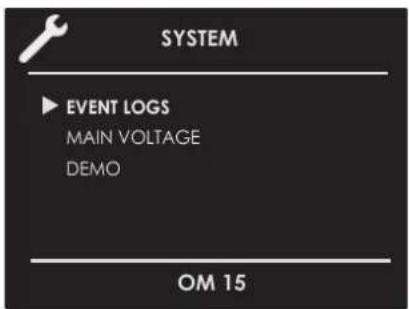
SETUP SERVICE- Use this menu to change the following settings: Press the keys △ to select the item to be set or to be displayed from among the three available ones and confirm with the @key.
text_image
SYSTEM EVENT LOGS MAIN VOLTAGE DEMO OM 15Event Log
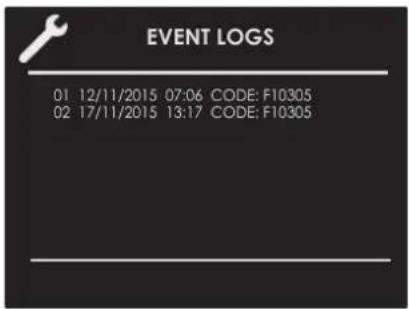
The menu permits checking any recorded errors. These codes can be notified to the after-sales service.
text_image
EVENT LOGS 01 12/11/2015 07:06 CODE: F10305 02 17/11/2015 13:17 CODE: F10305Demo
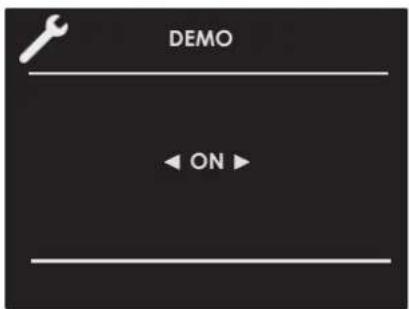
The purpose of this function is to set the DEMO mode, which makes the oven useless for cooking but automatically performs a demonstration of functions.
- Press the keys ◀ ▷ to select the item ON.
- Confirm with the OK key.
- Press the ① key.
After about 30 seconds, the oven starts to operate in this mode. To temporarily stop the DEMO function, simply keep any key pressed for a few seconds until the oven switches to standby. To start it again, press the key.
To disable the function, enter the DEMO display page and set OFF. Confirm using the OK key.
NOTE Once set, the function remains enabled even if the oven is disconnected from the power mains.
text_image
DEMO ← ON ►Switching the oven on and off

IMPORTANT
• The okey does not stop the function.
- After switching off the oven, the cooling fan could continue to operate until the inner parts of the oven have cooled down.
Press ① to switch the oven on and press again to switch it off. The oven returns to standby mode.
Selecting the cooking mode

IMPORTANT
- Do not leave the door open for a long time during cooking.
- The door must be kept closed during the BROIL functions.
- Position the grill or grills on an appropriate level.
Functions


Functions

WARM

WARM PLUS

SABBATH (On some models)

SELF CLEAN
- Select the icon and press the key OK Select the appropriate cooking mode according to the food to be cooked using the arrows and confirm with the key. OK
- On this display page, it is still possible to change the cooking mode by using the ◀ keys.
- If the proposed temperature is correct, confirm with the ok key to start cooking, otherwise, if the dkey is not pressed within 10 seconds, the oven switches to automatic mode and the cooking mode icon becomes animated.
Changing the cooking mode
- During untimed cooking, a cooking pause can be set by pressing the ☐key. All the settings of the suspended cooking operation remain stored and can be reactivated by pressing the same key again.
- To change the cooking mode while the oven is working, press the key and then the , key. At this point, another cooking mode can be selected from among those available in the group by means of the arrows ◀ ▶.
Changing temperature

IMPORTANT
- The BROIL function operates at levels. No temperature can be set because this works at fixed cycles according to the set level from L1 to L5.
- The maximum temperature of the BROIL function is limited according to the set level.
- In all the cooking modes where the temperature is fixed, this is not shown on the screen.
-
At the end of a function, the display screen shows the residual compartment heat temperature from the standby page.
-
From the cooking mode preview display page, the temperature can be changed by means of the arrows subsequently confirming by means of the key.
-
Once cooking has started, the temperature can in any case be changed, at any time, by means of the arrows .
| COOKING MODE ICON FAST | PREHEAT | MEAT PROBE | TEMPERATURE | ||
| Min. Preset Max. | |||||
| DEFROST |  | *** *** *** | |||
| DEHYDRATE |  | 120°F (50°C) 1 | 40°F (60°C) 160°F (70°C) | ||
| WARM |  | 80°F (25°C) 1 | 100°F (40°C) 120°F (50°C) | ||
| WARM PLUS |  | 130°F (55°C) 1 | 70°F (75°C) 210°F (100°C) | ||
| BAKE(BASE HEAT) |  | 170°F (75°C) 3 | 50°F (175°C) 550°F (290°C) | ||
| ROAST(CONVENTIONAL HEAT) |  | 170°F (75°C) 3 | 50°F (175°C) 550°F (290°C) | ||
| TRUE CONVECTION(FAN HEAT) |  | 170°F (75°C) 3 | 25°F (165°C) 550°F (290°C) | ||
| PIZZA |  | 170°F (75°C) 3 | 25°F (165°C) 550°F (290°C) | ||
| CONVECTION ROAST(TURBO CONVENTIONAL HEAT) |  | 170°F (75°C) 3 | 25°F (165°C) 550°F (290°C) | ||
| CONVECTION GRILL(TURBO CONVENTIONAL HEAT) |  | 170°F (75°C) 3 | 25°F (165°C) 550°F (290°C) | ||
| CONVECTION BAKE(TURBO BASE HEAT) |  | 170°F (75°C) 1 | 50°F (230°C) 550°F (290°C) | ||
| CONVECTION BROIL(TURBO GRILL & BASE HEAT) |  | 170°F (75°C) 1 | 50°F (230°C) 550°F (290°C) | ||
| BROIL L1 (*) (ECO GRILL L1) |  | 375°F (190°C) | |||
| BROIL L2 (*) (ECO GRILL L2) | 400°F (205°C) | ||||
| BROIL L3 (*) (ECO GRILL L3) | 430°F (220°C) | ||||
| BROIL L4 (*) (ECO GRILL L4) | 450°F (235°C) | ||||
| BROIL L5 (*) (ECO GRILL L5) | 480°F (250°C) | ||||
| CLASSIC PIZZA (if present) |  | 590°F (310°C) | |||
| SABBATH (if present) |  | 120°F (50°C) 1 | 40°F (60°C) 550°F (290°C) | ||
| SELF CLEAN |  | 860°F (460°C) | |||
(*) Some ovens can even have a motorised rod for cooking on a spit.
Cooking mode quick menu
The quick menu function allows you to rapidly select the most suitable cooking modes for the type of dish you want to cook.
 | MAIN COURSES |  |  |  |
 | POULTRY |  |  |  |
 | MEAT |  |  |  |
 | FISH |  |  |  |
 | VEGETABLES |  |  |  |
 | DESSERTS |  |  |  |
 | BREAD/PIZZA |  |  |
Pre-heating phase
While the oven is in pre-heating phase, the instantaneous temperature is displayed underneath the cooking mode icon.
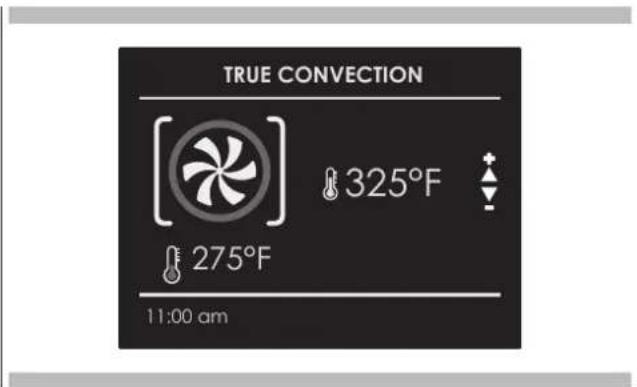
text_image
TRUE CONVECTION 325°F 275°F 11:00 amJust as soon as the set temperature is reached, an acoustic signal is heard and the instantaneous temperature indication disappears.
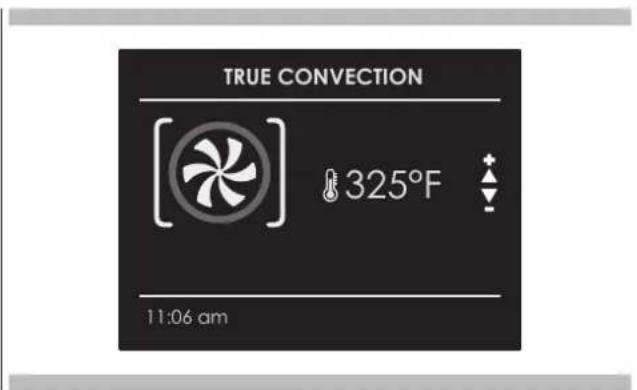
text_image
TRUE CONVECTION 325°F 11:06 amEco
This mode is intended to save energy.
Ideal for frozen or precooked food, and small portions-meals. The preheat time is very short and cooking tends to be slower. It is not recommended for heavy loads e.g. large portions or big meal preparation.
Fast Preheat
The FAST PREHEAT function permits reaching the desired temperature quicker compared to standard preheating. The function can be enabled for all the cooking modes in the BAKE (except the Sabbath and ECO), CONVECT and PIZZA groups.
To select FAST PREHEAT:
- Select the cooking mode as previously indicated and press the Ⓞ key to display the cooking mode preview display page.
- Press the Ⓧkey. Select the icon by means of the arrows and confirm with the key Ⓧk. The symbol ➞ appears in the lower part of the screen.
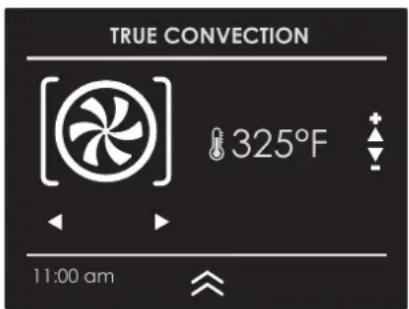
text_image
TRUE CONVECTION 325°F 11:00 am- Press the okey again to run the function.
The display page shows the icon of the active functions until the set temperature has been reached. Afterwards, the function switches to automatic in the selected cooking mode.
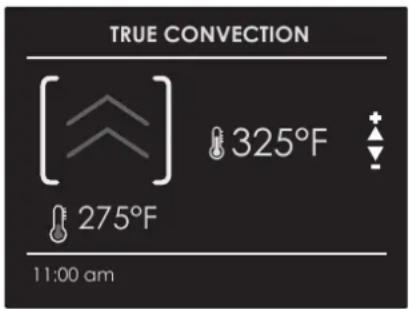
text_image
TRUE CONVECTION [ ] 325°F 275°F 11:00 amUsing Oven Lights
A single light key activates the lights.
Touch to turn lights on or off.
Oven lights turn on automatically when the door is opened.
When an oven is in use, oven lights turn on automatically when a mode is started.
Oven lights will turn off automatically when the oven mode is cancelled.
NOTE: The lights do not operate in the Self-Clean mode.
NOTE: Once switched on, the lights go off automatically after 3 minutes. To switch them back on, press the key or open the door.
Be sure that the time-of-day clock is displaying the correct time.
The timed mode turns off the oven at the end of the cook time.

CAUTION
Never leave food in the oven for more than one hour before and after cooking. This could deteriorate the properties of the food itself.
NOTE The time functions cannot be used if the meat probe is on. The maximum cooking time that can be set is 12 h.
Cook Time
Use the "Cook Time" function to operate the oven for a determinate period of time. The oven starts immediately and switches off automatically once the time has expired.
To Set a Timed Mode
- Select the cooking mode and temperature.
- There are two ways to set the function.
a) Select 📋 to set the duration and press Ⓞk
b) Select 📋 to set the stop time and press OK
- After selecting one of the two above options, set the time by means of the arrows and confirm with the key.
-
After pressing the Ⓞ key, cooking starts and the time cooking information is shown on the display page.
-
Cooking mode
- Temperature
- Cooking time
• End of cooking time
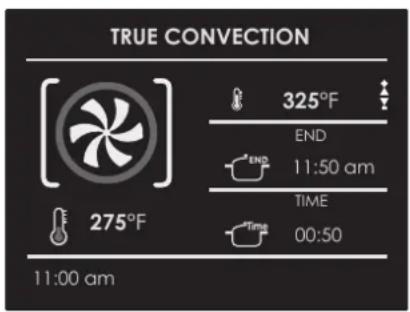
text_image
TRUE CONVECTION 325°F END 11:50 am TIME 00:50 275°F 11:00 am5 After cooking, the oven switches off and an acoustic signal warns that cooking has terminated.
To change the cooking time when the oven is already operating, simply press the ⬆ key and enter the new cooking time before pressing the Ⓞ key again.
Stop Time
Use the "Stop Time" function to delay the start of timed cooking. Enter the cooking stop time and the oven will automatically calculate the start time. The oven switches on and off automatically.
To Delay the Start of a Timed Mode
1 First of all set the required timed cooking as indicated in the "COOK TIME" paragraph.
2 Select 🔍 to set the stop time and press ⓄK
3 Set the cooking stop time by means the arrows △ and confirm by means of the @key.
4 After pressing the okey, the function positions in standby and the postponed cooking details are shown on the screen.
- Cooking mode
- Temperature
- Cooking stop time
- Cooking start time
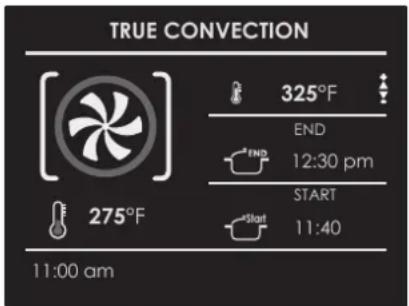
text_image
TRUE CONVECTION 325°F END 12:30 pm START 11:40 275°F 11:00 am- After cooking, the oven switches off and an acoustic signal warns that cooking has terminated.
To change the cooking time and stop time when the oven is already operating, simply press the key 📋 and enter the new cooking time or cooking stop time and press the key 📋 again.
When roasts, steaks or poultry are being cooked, this is the best way to tell when the food is correctly cooked.
This oven is optionally provided with the meat probe feature to sense the temperature inside meat and stop cooking as soon as the set value is reached.
When the probe is used, the oven automatically checks the cooking time.
NOTE : the food probe is an accessory available only in some versions of the product.
Tenderness, aroma and flavour are the result of precise, functional control.
The food probe is a thermometer which, when inserted into the food, makes it possible to check the internal temperature and use it to establish the end of cooking.
For example, meat may look like it is cooked on the outside, but still be pink on the inside!
The temperature reached by food during cooking is closely linked to problems relating to health and hygiene. Bacteria can be contained in every kind of meat, poultry and fish, as well as raw eggs.
Certain types of bacteria make food go off, while others, such as Salmonella, Campylobacter jejuni, Listeria monocytogenes, Escherichia coli and Staphylococcus aureus can be seriously harmful to human health. Bacteria multiply very quickly above a temperature of 4.4^ up to 60^ C. Mince is particularly at risk from this point of view.
To prevent bacteria from multiplying, it is necessary to take the following measures:
- Do not defrost food at room temperature, always in the fridge or in the oven using the specific function. In the latter case, cook the food immediately afterwards.
- Stuff chicken just before eating it. Never buy pre-packed ready-stuffed chicken and only buy ready-cooked stuffed chicken when you intend to eat it within 2 hours.
- Marinate food in the fridge, not at room temperature.
- Use a food probe to check the temperature of meat, fish and poultry if they are more than 5 cm thick, to ensure that the minimum cooking temperatures are reached.
- The greatest hazards are posed by poorly cooked chicken, particularly at risk from Salmonella.
- Avoid interrupting the cooking process, i.e., partially cooking food, storing it and completing the cooking process later. This sequence encourages the growth of bacteria due to the "warm" temperatures reached inside the food.
- Roast meat and poultry in the oven at temperatures of at least 165^ .
NB: Use only the meat probe supplied with the appliance.
In any case, we recommend that you consult the following table taken from the National Food Safety Database (USA).
| Food Minimum internal temperature | |
| Mince | |
| Hamburger 71°C | |
| Beef, veal, lamb, pork 74°C | |
| Chicken, turkey 74°C | |
| Beef, veal, lamb | |
| Roasts and steaks: | |
| Rare | The cooking temperature for rare meat is not indicated by the NFSD as it is unsafe for health reasons |
| Medium-rare 63°C | |
| Medium 71°C | |
| Well done 77°C | |
| Pork | |
| Chops, roasts, ribs: | |
| Medium 71°C | |
| Well done 77°C | |
| Fresh ham 71°C | |
| Fresh sausages 71°C | |
| Poultry | |
| Whole chicken or chicken pieces 82°C | |
| Duck | 82°C |
| Whole turkey (not stuffed) | 82°C |
| Turkey breast | 77°C |

WARNING
- To avoid burns, use a kitchen glove to fit and remove the meat probe when the oven is hot.
- Always remove the probe using the grip. If it is removed by pulling the cable, it could suffer damage.
- Make sure the food is completely de-frozen when the probe is fitted. Otherwise it could suffer damage.
NOTE The meat probe is not enabled for all functions (meat probe function not available also for Recipes). If it is fitted during one of these functions, a probe removal message appears on the screen.
If the meat probe is accidentally removed during operation, a warning message appears on the screen.
The temperature of the probe can be set between 104^ F and 212^ F ( 40^ C - 100^ C).
The oven stores the last temperature set by the user.
Insert the tip of the probe in the central and thickest part of the meat.
Make sure the probe is not in contact with the fat, bone, oven parts or dishes.
The meat probe is automatically recognised when it is inserted and the icon 🔒 appears on the screen.
When a cooking mode is started with the probe inserted, the display page for setting the function appears automatically.
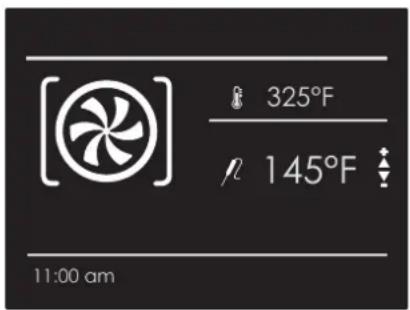
text_image
[325°F 145°F 11:00 am- Set the required probe temperature by means of the arrows and confirm with the k_day .
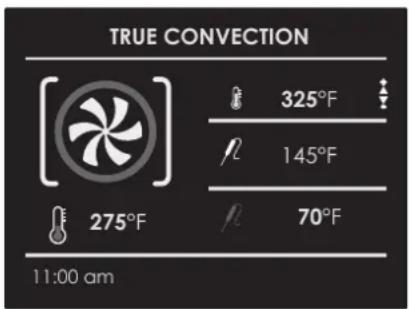
text_image
TRUE CONVECTION 325°F 145°F 70°F 275°F 11:00 am-
After pressing the OKkey, cooking starts and all probe cooking details appear on the screen.
-
Cooking mode
- Oven temperature
- Set probe temperature
- Instantaneous probe temperature
Once the set probe temperature is reached, the oven switches off and an acoustic signal warns that cooking has terminated.
NOTE: After cooking has started, the oven temperature can in any case be changed at any time by means of the arrows .
To change the probe temperature, press the OK key and then the *key and finally, the key again.
Roast Tips and Techniques
Roasting is cooking with heated air. Both upper and lower elements in the oven are used to heat the air but no fan is used to circulate the heat.
Follow the recipe or convenience food directions for baking temperature, time and rack position. Baking time will vary with the temperature of ingredients and the size, shape and finish of the baking utensil.
General Guidelines
- For best results, bake food on a single rack with at least 1" - 1 ½" (2,5 - 3cm) space between utensils and oven walls.
- Use one rack when selecting the bake mode.
- Check for doneness at the minimum time.
- Use metal bake ware (with or without a non stick finish), heatproof glass, glass-ceramic, pottery or other utensils suitable for the oven.
- When using heatproof glass, reduce temperature by 25^ (15^) from recommended temperature.
- Use baking sheets with or without sides or jelly roll pans.
- Dark metal pans or nonstick coatings will cook faster with more browning. Insulated bake ware will slightly lengthen the cooking time for most foods.
- Do not use aluminum foil or disposable aluminum trays to line any part of the oven. Foil is an excellent heat insulator and heat will be trapped beneath it. This will alter the cooking performance and can damage the finish of the oven.
- Avoid using the opened door as a shelf to place pans.
- Tips for Solving Baking Problems are found on Page 34.
True Convection Tips and Techniques
- Reduce recipe baking temperatures by 25^ (15°C).
- For best results, foods should be cooked uncovered, in low-sided pans to take advantage of the forced air circulation. Use shiny aluminum pans for best results unless otherwise specified.
- Heatproof glass or ceramic can be used. Reduce temperature by another 25^ (15°C) when using heatproof glass dishes for a total reduction of 50^ (30°C).
- Dark metal pans may be used. Note that food may brown faster when using dark metal bake ware.
- The number of racks used is determined by the height of the food to be cooked.
- Baked items, for the most part, cook extremely well in convection. Don't try to convert recipes such as custards, quiches, pumpkin pie, or cheesecakes, which do not benefit from the convection-heating process. Use the regular Bake mode for these foods.
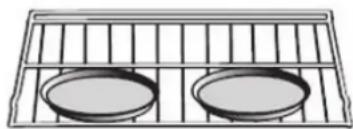
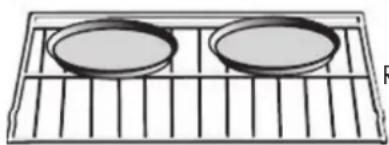
- Multiple rack cooking for oven meals is done on rack positions 1, 2, 3, and 4. All four racks can be used for cookies, biscuits and appetizers.
- 2 Rack baking: Use positions 1 and 3.
-
When baking four cake layers at the same time, stagger pans so that one pan is not directly above another. For best results, place cakes on front of upper rack and back of lower rack (See graphic at right). Allow 1" - 1 ½" (2,5 - 3cm). air space around pans.
-
Converting your own recipe can be easy. Choose a recipe that will work well in convection.
- Reduce the temperature and cooking time if necessary. It may take some trial and error to achieve a perfect result. Keep track of your technique for the next time you want to prepare the recipe using convection.
- Tips for Solving Baking Problems are found on Page 34.
Foods recommended for Convection Bake mode:
Appetizers Biscuits Coffee Cakes
Cookies (2 to 4 racks) Yeast Breads
Cream Puffs
Popovers
Casseroles and One-Dish Entreés
Oven Meals (rack positions 1, 2, 3)
Air Leavened Foods (Soufflés, Meringue, Meringue- Topped
Desserts, Angel Food Cakes, Chiffon Cakes)
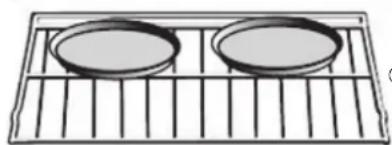
RACK POSITION
natural_image
Simple line drawing of two circular plates on a grid background (no text or symbols)Rack 3
natural_image
Simple line drawing of two circular plates placed on a grid-lined rack (no text or symbols)Rack 1
Quick and easy recipe tips
Converting from standard BAKE to CONVECTION BAKE:
- Reduce the temperature by 25^ (15°C).
- Use the same baking time as Bake mode if under 10 to 15 minutes.
- Foods with a baking time of less than 30 minutes should be checked for doneness 5 minutes earlier than in standard bake recipes.
- If food is baked for more than 40 to 45 minutes, bake time should be reduced by 25% .
Convection Roast Tips and Techniques
- Do not preheat for Convection Roast.
- Roast in a low-sided, uncovered pan.
- When roasting whole chickens or turkey, tuck wings behind back and loosely tie legs with kitchen string.
- Use the 2-piece broil pan for roasting uncovered.
- Use the probe or a meat thermometer to determine the internal doneness on "END" temperature.
- Double-check the internal temperature of meat or poultry by inserting meat thermometer into another position.
- Large birds may also need to be covered with foil (and pan roasted) during a portion of the roasting time to prevent over-browning.
Quick and easy recipe tips
Converting from standard BAKE to CONVECTION ROAST:
• Temperature does not have to be lowered.
- Roasts, large cuts of meat and poultry generally take 10-20% less cooking time. Check doneness early.
- Casseroles or pot roasts that are baked covered in CONVECTION ROAST will cook in about the same amount of time.
- The minimum safe temperature for stuffing in poultry is 165°F (75°C).
- After removing the item from the oven, cover loosely with foil for 10 to 15 minutes before carving if necessary to increase the final foodstuff temperature by 5^ to 10^ ( 3^ to 6^ ).
Cooking times are indicative and also depend on the thickness and the starting temperature of the meat before cooking.
Convection Broil Tips and Techniques
- Place rack in the required position needed before turning on the oven.
- Use Convection Broil mode with the oven door closed.
- Do not preheat oven.
- Use the 2-piece broil pan.
- Turn meats once halfway through the cooking time (see convection broil chart).
Broiling and convection broiling times are approximate and may vary slightly.
Cooking times are indicative and also depend on the thickness and the starting temperature of the meat before cooking.
Broil Tips and Techniques
- Place rack in the required position needed before turning on the oven.
- Use Broil mode with the oven door closed.
- Preheat oven for 5 minutes before use.
- Use the 2-piece broil pan.
- Turn meats once halfway through the cooking time (see convection broil chart).
Broiling and convection broiling times are approximate and may vary slightly.
Cooking times are indicative and also depend on the thickness and the starting temperature of the meat before cooking.
Dehydrate Tips and Techniques
- Dehydrating can be done using the Dehydrate mode. A lower temperature is used and the circulating heated air slowly removes the moisture for food preservation.
- The Dehydrate mode temperature is pre-programmed at 140^ (60°C).
- The Dehydrate mode temperatures available are 120^ (50°C) to 160^ (70°C).
- Multiple racks can be used simultaneously.
- Some foods require as much as 14-15 hours of time to fully dehydrate.
- Consult a food preservation book for specific times and the handling of various foods.
- This mode is suitable for a variety of fruits, vegetables, herbs and meat strips.
- Drying screens can be purchased at specialty kitchen shops.
- By using paper towels, some food moisture can be absorbed before dehydrating begins (such as with sliced tomatoes or sliced peaches).
Dehydrate Chart
| FOOD PREPARATION APPROXIMATE | DRYING TIME* (hrs) | TEST FOR DONENESS | ||
| FRUIT | ||||
| Apples | Dipped in 1⁄4 cup lemon juice and 2 cups water, 1⁄4 slices | 11 - 15 S | slightly pliable | |
| Bananas | Dipped in 1⁄4 cup lemon juice and 2 cups water, 1⁄4 slices | 11 - 15 S | slightly pliable | |
| Cherries | Wash and towel dry. For fresh cherries, remove pits | 10 - 15 P | pliable, leathery, chewy | |
| Oranges Peels and slices | 1⁄4 slices of orange; orange part of skin thinly peeled from oranges | Peels: | 2- 4 | Orange peel: dry and brittle |
| Slices: | 12 - 16 | Orange slices: skins are dry and brittle, fruit is slightly moist | ||
| Pineapple rings | Towel dried | Canned: | 9 - 13 | Soft and pliable |
| Fresh: | 8 - 12 | |||
| Strawberries | Wash and towel dry. Sliced 1⁄2" thick, skin (outside) down on rack | 12 - 17 Dry, brittle | ||
| VEGETABLE | ||||
| Peppers | Wash and towel dry. Remove membrane of pepper, coarsely chopped about 1" pieces | 16 - 20 | Leathery with no moisture inside | |
| Mushrooms | Wash and towel dry. Cut of stem end. Cut into 1/8" slices | 7 - 12 Tough and leathery, dry | ||
| Tomatoes | Wash and towel dry. Cut this slices, 1/8" thick, dry well | 16 - 23 Dry, brick red color | ||
| HERBS | ||||
| Oregano, sage parsley and thyme, and fennel | Rinse and dry with paper towel | Dry at 120°F (60°C) | 3 - 5 Crisp and brittle | |
| Basil | Use basil leaves 3 to 4 inches from top. Spray with water, shake off moisture and pat dry | Dry at 120°F (60°C) | 3 - 5 Crisp and brittle | |
The Recipe function of your oven gives you the chance to cook food without having to set the oven manually every time. By selecting a "SET" recipe, the cooking mode, the temperature and the time are automatically set according to the recipe selected from the menu.
| Recipe List Type of Food Food condition Recipes List Information displayed | ||||
| PRESET OR PERSONAL |  | FRESH | BREAD PIZZA FIRST | TYPE OF ACCESSORYLEVEL POSITIONFOOD WEIGHTCOOKING TIMEPREHEAT REQUIRED(YES/NO) |
| FROZEN | ||||
 | WHOLE | MEAT | ||
| IN PEICES | ||||
 | WHOLE | POULTRY | ||
| IN PEICES | ||||
 | WHOLE | FISH | ||
| IN PEICES | ||||
 | - | VEGETABLES | ||
| - | ||||
 | - | PIES | ||
| - | ||||
Select an already-set recipe:
- Switch the oven, select the icon 📄 and press the button OK
- Using the arrows △▼select the list between "PRESET" or "PERSONAL" and confirm by means of the @key.
- Choose the type of food to be cooked using the arrows △ and the arrows ◀ and confirm by means of the key.
- Using the arrows △ choose between "FRESH" or "FROZEN" or in other cases between "WHOLE" or "IN PEICES" and confirm with the ⓗkey.
- Select the required recipe by means of the arrows △ and confirm using the okey.
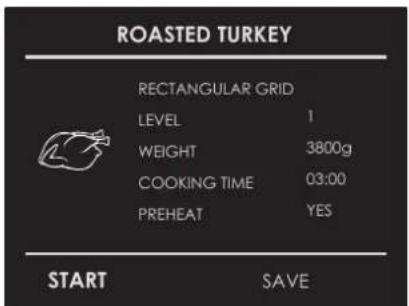
- When the recipe is selected, the following display page appears on the screen:
text_image
ROASTED TURKEY RECTANGULAR GRID LEVEL 1 WEIGHT 3800g COOKING TIME 03:00 PREHEAT YES START SAVE- To start the recipe, confirm with the okey.
During a recipe, a number of acoustic and visual messages will ask you to perform the following operations. Simply follow the instructions on the screen.
- Upon termination, the oven switches off and an acoustic and visual signal warns that the recipe has terminated.
Saving a personalized recipe:
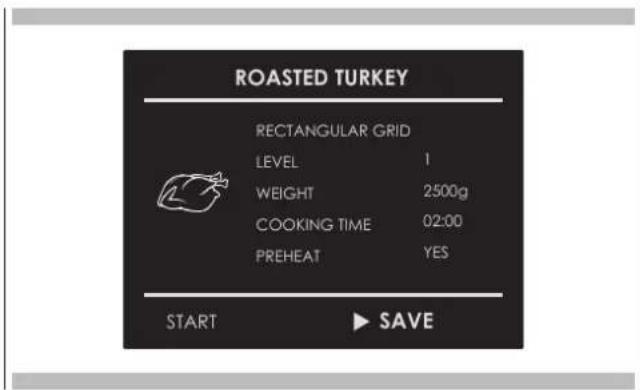
Once a recipe has been selected, the "Time" and "Weight" setting can be changed and the recipe can be saved among the "PERSONAL" ones.
- Once a recipe has been selected, press the key △ and confirm by means of the Ⓞkey.
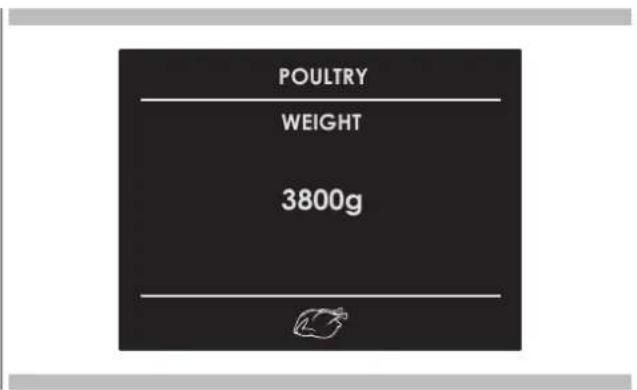
- To change the weight, enter the desired weight by means of the arrows △ and confirm by means of the ☑ay.
text_image
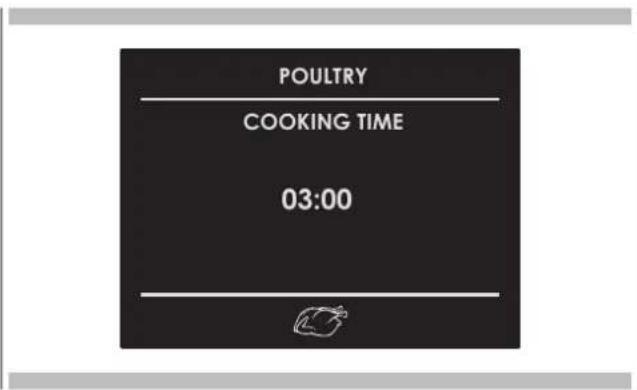
POULTRY WEIGHT 3800g- The oven switches automatically to the cooking time. To change this time, use the arrows △ and confirm again by means of the ⓗkey.
text_image
POULTRY COOKING TIME 03:00- At this point, the recipe can be saved in the list of "PERSONAL" recipes by selecting "SAVE" and confirming by means of the OK key.
text_image
ROASTED TURKEY RECTANGULAR GRID LEVEL 1 WEIGHT 2500g COOKING TIME 02:00 PREHEAT YES START ▶ SAVENOTE If the time and weight values are changed and not saved straight away, at the end of the recipe, a message appears which asks whether you want to save it.
- To start the recipe press the Ⓞ key.
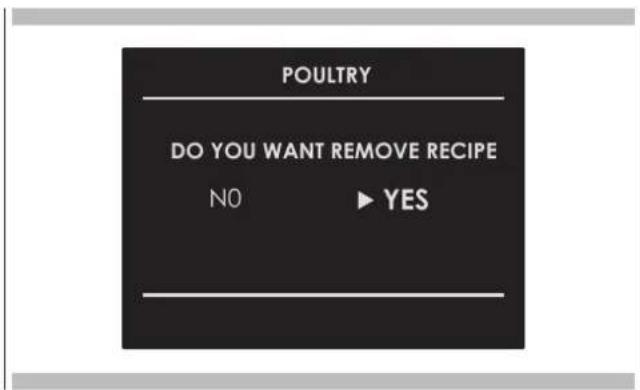
Cancelling a Personalized recipe:
- To eliminate a recipe from the list of personalized recipes, select the recipe.
- Press the key ◀ and select the choice and confirm with the OK key.
text_image
POULTRY DO YOU WANT REMOVE RECIPE NO ▶ YESThe CLASSIC PIZZA was specifically designed so you can bake perfect PIZZAS in just a few minutes.
For perfect results, select the [GUANG PIZIO] access this special recipe.
After you make your settings, Classic Pizza recipes will do the rest, reaching about 650^ F ( 345^ C) by turning on the heating elements at 100% of their capacity.
At this temperature, you are guaranteed to have a crispy base
and proper cooking of the toppings of your pizza, like at the pizzeria.
The secret to a good pizza is in the simplicity of a well-leavened dough, prepared and cooked well: use a small quantity of good quality toppings.
| Recipe List | Type of Food | Food condition | Recipes List | Information displayed |
| PRESET OR PERSONAL |  | PIZZA SINGLE THIN | COOKING TIME PROPOSED | TYPE OF ACCESSORYLEVEL POSITIONCOOKING TIMEPREHEAT REQUIRED YES/NO) |
| PIZZA SINGLE THICK | ||||
| PIZZA DOUBLE THIN | ||||
| PIZZA DOUBLE THICK |
Pizza Weight Leavened Dough Diameter
| THIN 180 gr 30 cm | |
| THICK 260 gr 30 cm |
Selecting an already-set "CLASSIC PIZZA" recipe:
- Start the oven and select the icon 🎨 and then 📄 and confirm with the key ⏻
- By means of the arrows △ select the list between "PRESET" or "PERSONAL" and confirm with the ⓚkey.
- Choose the type of pizza to be cooked by means of the arrows △ and confirm with the key
-
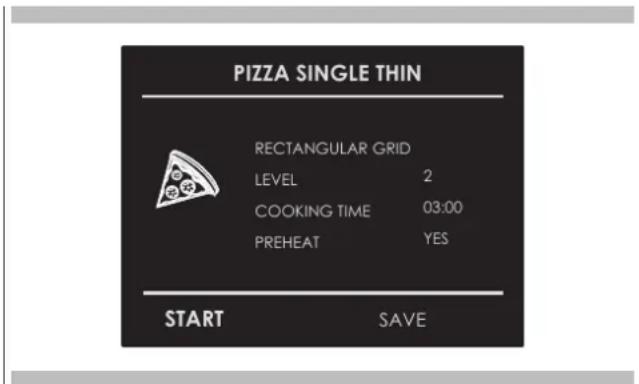
After the recipe has been selected, the following display page appears:
-
Once confirmed with the Ⓞ key, the oven preheats and, when finished, it beeps and the display will tell that it's the right moment to put in the pizzas. Baking automatically starts when you close the door and, from now to the end, there are no other settings or anything to turn on; you must simply follow the instructions on the display.
text_image
PIZZA SINGLE THIN RECTANGULAR GRID LEVEL 2 COOKING TIME 03:00 PREHEAT YES START SAVEOnce a recipe has been selected the "Time" setting can be changed (from 01:00 min/sec to 59:59 min/sec) and the recipe can be saved among the "PERSONAL" recipes of the special Classic Pizza function. If so required, the saved recipe can also be cancelled.
If the time is changed and not immediately saved, at the end of the recipe, a message appears to ask whether you want to save it.
(FOR MORE DETAILS ON HOW TO PERFORM THESE STEPS, REFER TO THE INSTRUCTIONS IN THE RECIPE PARAGRAPH).
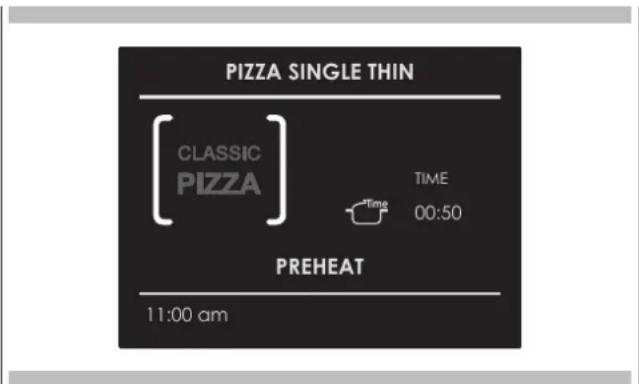
text_image
PIZZA SINGLE THIN CLASSIC PIZZA TIME 00:50 PREHEAT 11:00 amNOTE After the first pizza, you can immediately continue baking other pizzas without having to preheat.
If, on request, is selected, the recipe is repeated, while if OFF is pressed the recipe terminates.
Tips For A Good Pizza:
- Given the high temperatures and short baking time, we recommend that you insert and remove the pizzas quickly so that the door is open for as short a time as possible and the temperature doesn't drop.
- Once the beep and display indicate that baking is finished, immediately remove the pizza, since the cooking times are very short and even a few seconds can have a significant effect.
- The baking time can be changed based on the type of dough and pizza; changes should be made with the +/- keys before pressing the start key. At the end of the recipe, you will be asked if you want to save it in your personal recipes.
PIZZA GRILL
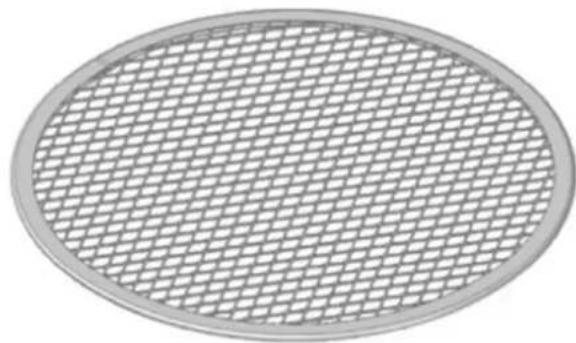
natural_image
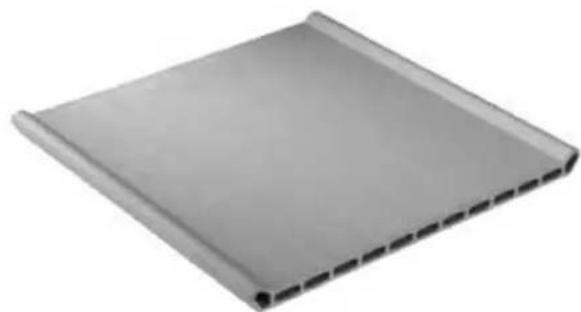
Circular metal grate with a grid pattern, no text or symbols visibleOVEN STONE (IF PRESENT)
Insert before the preheating the oven
natural_image
Exterior view of a gray corrugated metal panel (no text or symbols visible)EN 17 - Sabbath Mode Instructions (on some models)
The Sabbath Mode function of your oven complied with Jewish laws. This function allows the oven to perform only the static function.
When the Sabbath function is selected, the following functions are disabled:
- Oven lights
- All the keys except ON/OFF
- Meat Probe Function
- Timed cooking function
- Timer function
- The icon on the display screen is steady and not animated as in the case of traditional cooking modes.
- Display screen and key acoustic warnings.
To set the Sabbath Mode function, switch on the oven and select the icon ■ and press the key OK Select the Sabbath function by means of the arrows ◀ and confirm twice with the key OK
The function starts by showing the icon on the display screen.
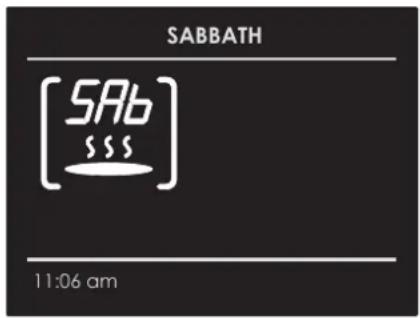
text_image
SABBATH [SAB] [sss] 11:06 amNOTE The function lasts at most 72 hours.
The temperature can be set between 120^ F ( 50^ C) and 550^ F ( 290^ C). The function can be disabled at any time by pressing the OFF key.
Abrasive detergents and steam cleaning equipment should not be used for cleaning.

WARNING
Do not use harsh abrasive cleaners or sharp metal scrapers to clean the oven door glass since they can scratch the surface, which may result in shattering of the glass.

WARNING
Ensure that the door is in the closed position before the self-cleaning cycle starts, otherwise automatic door locking will not be completed. See paragraphs that follows.
Self-Cleaning the Oven
This oven features a pyrolytic self-cleaning function that eliminates the difficult and time consuming manual scrubbing of the oven interior. During self-cleaning, the oven uses a very high temperature (approx. 860^ F/ 460^ C) to burn away food soil and grease.
- It is common to see smoke and/or an occasional flame-up during the Self-Clean cycle, depending on the content and amount of soil remaining in the oven. If a flame persists, turn off the oven and allow it to cool before opening the door to wipe up the excessive food soil.
-
The door latch is automatically activated after selecting the Self-Clean cycle. The "PADLOCK" icon will appear in the display. This ensures that the door cannot be opened while the oven interior is at clean temperatures.
-
The oven light does not operate during this mode.
- During Self-Clean, the kitchen should be well ventilated to help eliminate odors associated with Self-Clean. Odors will lessen with use.
- Three hours is the preset length of cleaning.
- The mode automatically stops at the end of the clean hours.
- When the oven heat drops to a safe temperature, the automatic door lock will release and the door can be opened.
Preparing the Oven for Self-Clean
- Remove all utensils and bake ware.
- Remove non-porcelain oven racks. If chromed racks are left in the oven during the self-clean cycle, they will permanently lose the shiny finish and change to a dull dark finish.
- Wipe up any soft soil spills and grease with paper towels. Excess grease will cause flames and smoke inside the oven during self-cleaning.
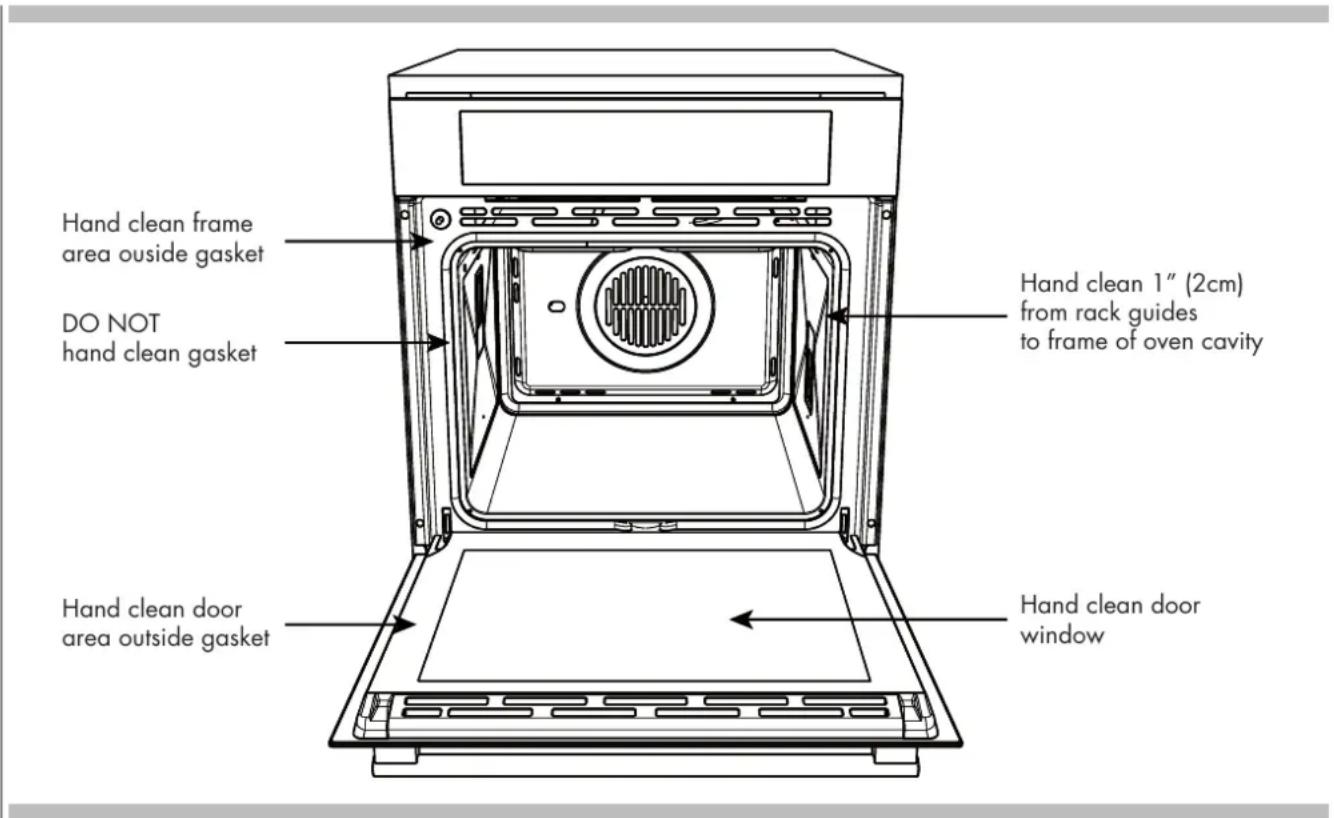
- Review illustration below. Some areas of the oven must be cleaned by hand before the cycle begins. They do not get hot enough during the cleaning cycle for soil to burn away. Use a soapy sponge or plastic scrubber. Hand-clean the oven door edge, oven front frame and up to 1- 12 " (2-3 cm) inside the frame with detergent and hot water. Do not rub the gasket on oven. Clean by hand the oven door window. Rinse all areas thoroughly then dry.
- Be sure oven interior lights are turned off and the light bulbs and lens covers are in place.
text_image
Hand clean frame area outside gasket DO NOT hand clean gasket Hand clean 1" (2cm) from rack guides to frame of oven cavity Hand clean door area outside gasket Hand clean door windowTo Set the Self-Clean Mode
- Press key and confirm with key . OK
- A message appears on the screen to remove all objects or accessories from the compartment.
- Press the okey to start door lock and cleaning cycle.
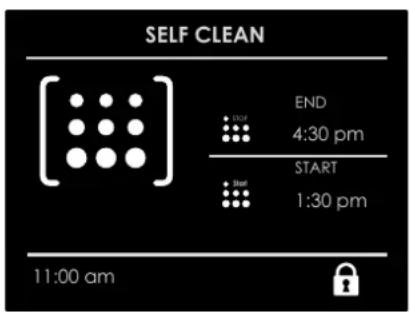
- The clean time is displayed automatically, its standard value is 3 hours.
text_image
SELF CLEAN END 4:30 pm START 1:30 pm 11:00 am-
At the end of the programmed cleaning time, the oven will automatically turn off.
-
To stop the cleaning mode at any moment, press ① key.
- The Self Cleaning cycle cannot be selected if the door is open.
- If the door is in the open position when the function has already been selected and the OK key is pressed the latch doesn't move, the "PADLOCK" icon will flash until the door will be closed and the lock motor stops. When the "CLOSED PADLOCK" it is displayed, the door cannot be opened.
- Check that the door has been locked, if door does not lock, press ① key and do not start self-clean; phone for service
- Do not attempt to open the door while the cleaning cycle is running and the door is locked.
To Change the Cleaning Time
- To change the setting from 3 hours, select either 2 hours for light soil immediately after starting.
- To change the hours, touch the √ key, select and confirm with the key (the hours will flash), use △▼ keys to change the value, then press ⚙️ confirm the new value.
- To select the minutes, touch the ▷ key (the minutes will flash), use △ or □ keys to change the value, then press to confirm the new value.
To Delay the Start of Cleaning
- Follow steps 1 through 3 above.
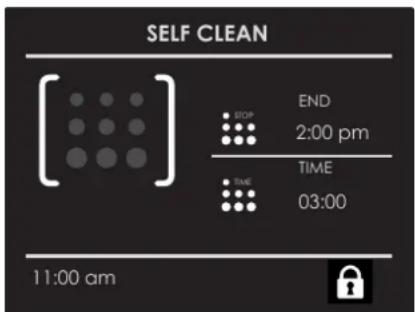
- Touch the key and verify that "STOP TIME" appears on the display. The hours will begin flashing, use or keys to change the value, then press do confirm the new value.
- To select the minutes, touch the ▷ key (the minutes will flash), use △ or □ keys to change the value, then press OK to confirm the new value.
text_image
SELF CLEAN { STOP END 2:00 pm TIME Time 03:00 11:00 am- When the delay time expires, self-cleaning will start.
- At the end of the programmed cleaning time, the oven will automatically turn off.

CAUTION
Keep in mind that the oven door will remain locked until it is safe enough to open. The lock symbol will disappear from the display when the door lock is released.
You will still need to exercise caution when the door lock is released because the inside of the oven may still be hot.
After the self-clean cycle is complete the oven control monitoring the internal temperature and the following messages will be displayed:
- From the 460°C/860°F to 270°C/518°F= "End Self Cleaning"
- From the 270°C/518°F to 50°C/122°F= "Waiting to Clean"
- From the 50°C/122°F to 25°C/77°F= "Remove Residues" (Press ON/OFF key to clear the message).
You may notice a powder ash residue in the bottom of the oven after self-cleaning. This condition is normal. Use a damp cloth or sponge to wipe up the residue after the oven cools down.
Self-cleaning Tips:
- If any soil remains in the oven after the self-clean cycle is complete, you may repeat the cycle if you want.
- Self-clean the oven regularly to prevent excessive soil build-up. Doing so will make the self-clean cycle work better and reduce smoke and odors.
Automatic door locking during pyrolytic cycle
For safety reasons, the door is locked automatically as soon as self-clean mode is selected (both standard, both eco clean). The door is also unlocked automatically when the clean time has expired but only after the temperature has fallen below the safety threshold.
NOTE It is not possible to exclude the door locking device during self-cleaning i.e. manually unlock the door since the self-cleaning mode has the highest priority and overrides all other selections.
The lock symbol (▶) the display is:
ON When the door is fully locked
OFF When the door is fully unlocked
FLASHING When the latch mechanism is moving or is waiting for a command by the electronic control. (After self clean the symbol will flash until the temperature will be safe and the door unlocked).
Removing the "FULL GLASS" panoramic door

WARNING
Make sure that:
- The oven is cool and power to the oven has been turned off before removing the door. Failure to do so could result in electrical shock or burns.
- The oven door is heavy and fragile. Use both hands to remove the oven door. The door front is glass. Handle carefully to avoid breakage.
- Grasp only the sides of the oven door. Do not grasp the handle as it may swing in your hand and cause damage or injury.
- Failure to grasp the oven door firmly and properly could result in personal injury or product damage.
Removing the oven door
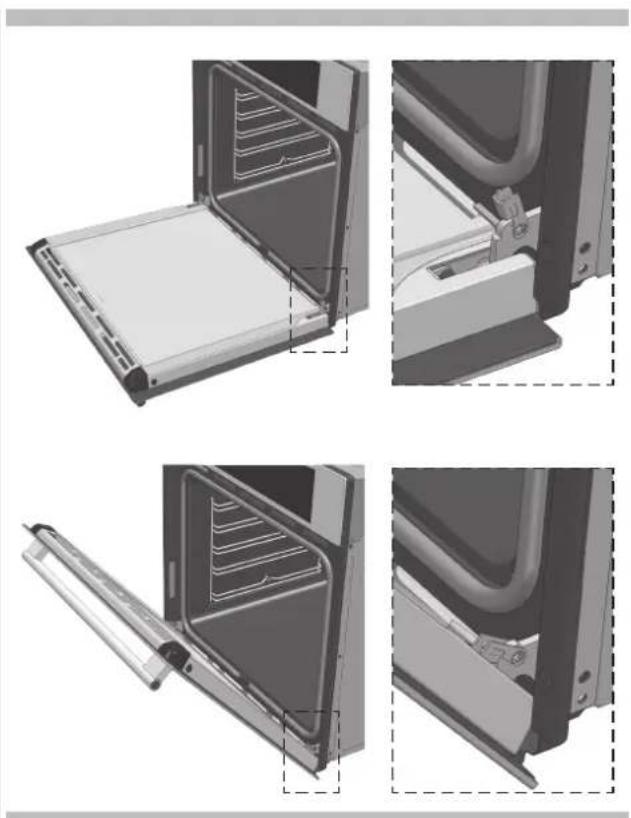
The oven door can be removed quickly and easily. To do so, proceed as follows:
- Open the door fully.
- Lift the two levers shown below.
- Close the door as far as the first stop (caused by the raised levers).
- Lift the door upwards and outwards to remove it from its mountings.
To replace fit the door, fit the hinges in their mountings and lower the two levers
natural_image
Four-panel technical illustration of a refrigerator interior showing open door, side panel, and exterior door (no text or symbols)How to remove the inner glass of the "FULL GLASS" panoramic door
- Wear protective gloves.
- Place the door on a flat horizontal surface face down on a soft cloth to avoid scratching the visible part.
- Simultaneously press the keys of the two side covers, removing the upper strip.
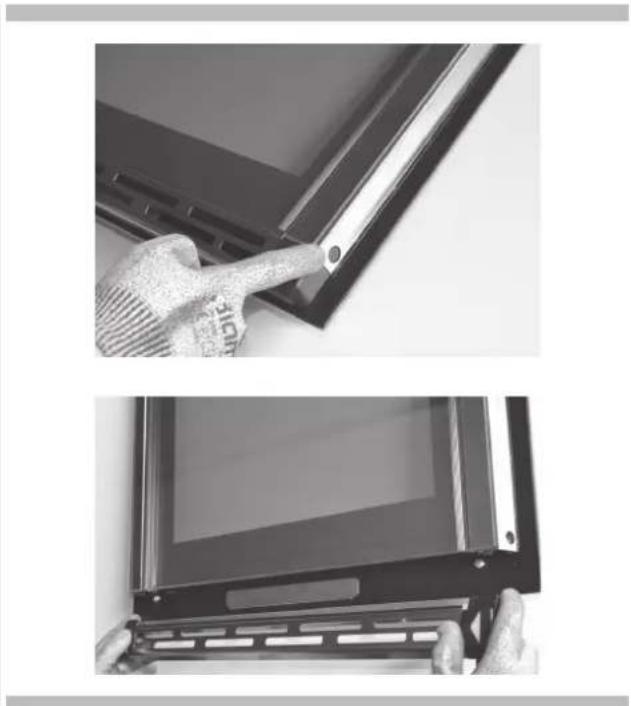
natural_image
Two-panel image showing a hand inserting a component into a device, with no visible text or symbols.- Slide out the internal glass as shown below. Pull out the second and third glass panels (intermediate panels) to clean them.
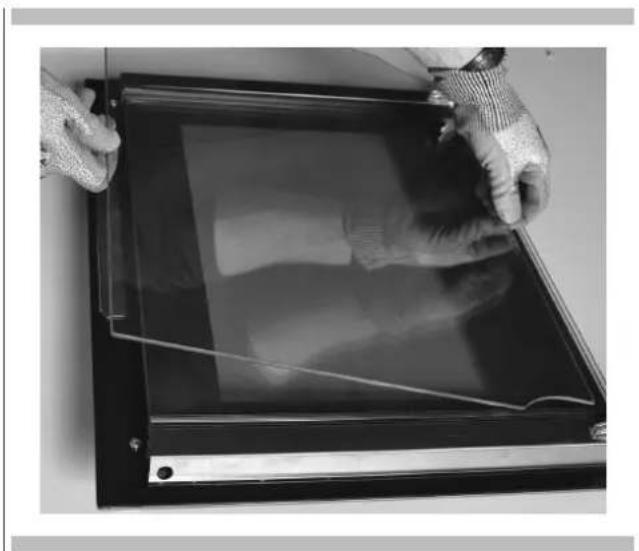
natural_image
Close-up of gloved hands holding a transparent rectangular device with visible internal components (no text or symbols)- Replace the middle panes after cleaning in reverse order, checking that they are oriented so the words INTERNAL SIDE are properly legible.
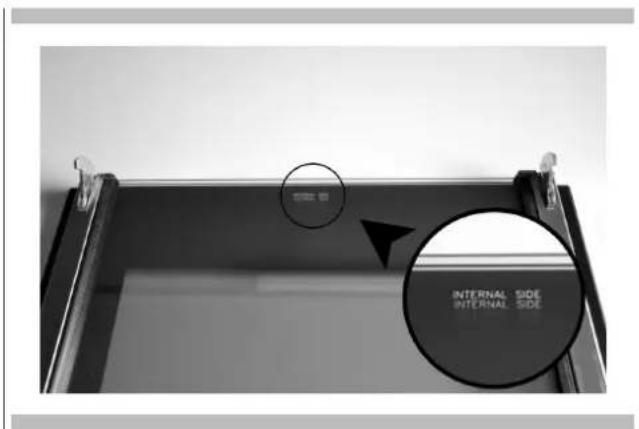
text_image
INTERNAL SIDE INTERNAL SIDENOTE: a slight gap between the middle panes and the side supports is normal because it allows for the heat expansion of the glass.
- Place the inner glass between the two uprights and put the upper strip back in place.
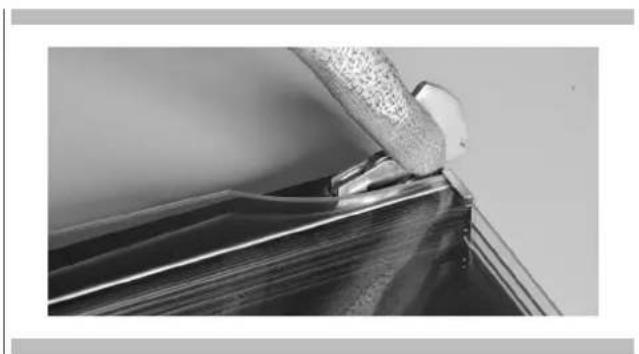
natural_image
Close-up of a hand gripping a metal bracket with a textured handle (no visible text or symbols)- The lights are switched on when the door is opened or when the oven is in a cooking cycle.
- The oven lights are not illuminated during SELF-CLEAN.
- Each light assembly consists of a removable lens, a light bulb as well as a light socket housing that is fixed in place. See figure on this page.
- Light bulb replacement is considered to be a routine maintenance item.
To Replace a Light Bulb
- Read WARNING on this page.
- Turn off power at the main power supply (fuse or breaker box).
- Remove the lens by unscrewing it (1).
- Remove the light bulb (2) from its socket (3) by pulling it.
- Replace the bulb with a new one. Avoid touching the bulb with fingers, as oils from hands can damage the bulb when it becomes hot.
- The bulb is halogen: use one with the same Volt and Watt (see figures on this page).
- Screw the lens back on.
Turn power back on at the main power supply (fuse or breaker box).

WARNING
- Make sure the oven and lights are cool and power to the oven has been turned off before replacing the light bulb(s). Failure to do so could result in electrical shock or burns.
- The lenses must be in place when using the oven.
- The lenses serve to protect the light bulb from breaking.
- The lenses are made of glass. Handle carefully to avoid breakage. Broken glass could cause an injury.
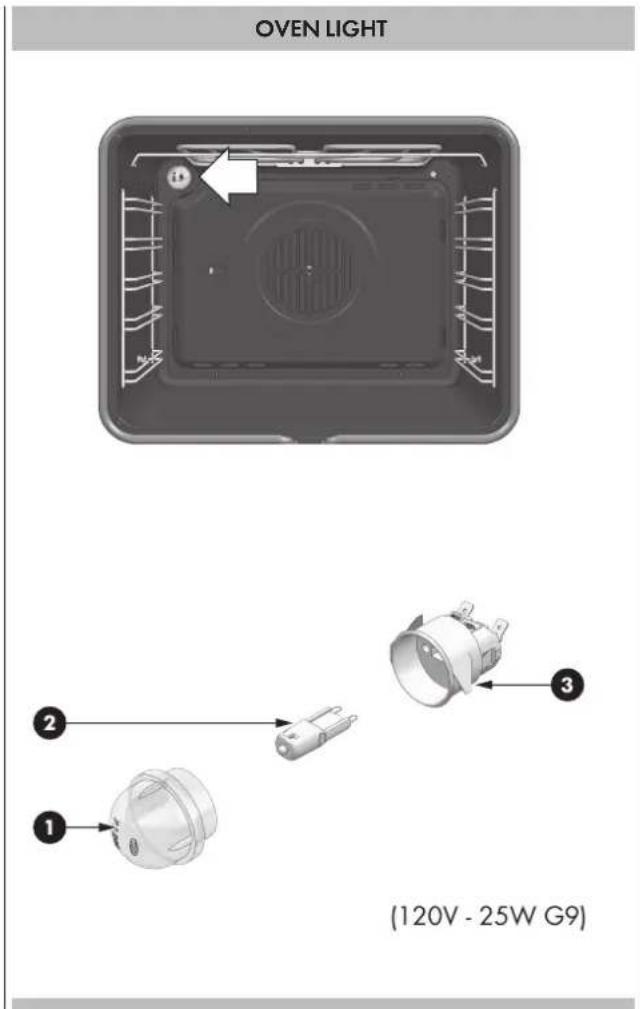
text_image
OVEN LIGHT (120V - 25W G9)EN 22 - Solving Baking and Roasting Problems
With either Bake or Convection Bake and Convection Roast poor results can occur for many reasons other than a malfunction of the oven. Check the chart below for causes of the most common problems. Since the size, shape and material of baking utensils directly affect the baking results, the best solution may be to replace old baking utensils that have darkened and warped with age and use.
| BAKING AND ROASTING PROBLEM CAUSE | |
| Food browns unevenly | - Oven not preheated- Aluminum foil on oven rack or oven bottom- Baking utensil too large for recipe- Pans touching each other or oven walls |
| Food too brown on bottom | - Oven not preheated- Using glass, dull or darkened metal pans- Incorrect rack position- Pans touching each other or oven walls |
| Food is dry or has shrunk excessively | - Oven temperature too high- Baking time too long- Oven door opened frequently- Pan size too large |
| Food is baking or roasting too slowly | - Oven temperature too low- Oven not preheated- Oven door opened frequently- Tightly sealed with aluminum foil- Pan size too small |
| Piecrust do not brown on bottom or have soggy crust | - Baking time not long enough- Using shiny steel pans- Incorrect rack position- Oven temperature is too low |
| Cakes pale, flat and may not be done inside | - Oven temperature too low- Incorrect baking time- Cake tested too soon- Oven door opened too often- Pan size may be too large |
| Cakes high in middle with crack on top | - Oven temperature too high- Baking time too long- Pans touching each other or oven walls- Incorrect rack position- Pan size too small |
| Piecrust edges too brown | - Oven temperature too high- Edges of crust too thin |
Before calling for service, check the following to avoid unnecessary service charges.
| Oven Problem Problem Solving Steps | |
| E008 Error appears in the display window. | A problem with latch mechanism occurred. Remove power and turn it back on again after a few seconds. The oven should run a latch auto-test. If condition persists, note the code number and call an authorized service center. |
| Other E Error appears in the display window. | Remove power and turn it back on again after a few seconds. If condition persists, note the code number and call an authorized service center. |
| The oven display stays OFF | Turn off power at the main power supply (fuse or breaker box). Turn breaker back on. If condition persists, call an authorized service center. |
| Cooling fan continues to run after oven is turned off | The fan turns off automatically when the electronic components have cooled sufficiently. |
| Oven door is locked and will not release, even after cooling | Turn the oven off at the circuit breaker and wait a few seconds. Turn breaker back on. The oven should reset itself and will be operable. |
| Oven is not heating | Check the circuit breaker or fuse box to your house. Make sure there is proper electrical power to the oven. Make sure the oven temperature has been selected. |
| Oven is not cooking evenly | Refer to cook charts for recommended rack position. Always reduce recipe temperature by 25 °F (15 °C) when baking with Convention Bake mode. |
| Oven light is not working properly | Replace or reinsert the light bulb if loose or defective. See Page 33. Touching the bulb with fingers may cause the bulb to burn out. |
| Oven light stays on Check for obstruction in oven door. Check to see if hinge is bent or door switch broken. | |
| Cannot remove lens cover on light | There may be a soil build-up around the lens cover. Wipe lens cover area with a clean dry towel prior to attempting to remove the lens cover. |
| Oven will not Self-Cleaning properly | Allow the oven to cool before running Self-Cleaning. Always wipe out loose soils or heavy spill-over before running Self-Cleaning. If oven is badly soiled, set oven for a four-hour Self-Cleaning. See Preparing the Oven for Self-Cleaning, Page 30. |
| Clock and timer are not working properly | Make sure there is proper electrical power to the oven. See the Clock and Timer sections on Page 11. |
| Excessive moisture | When using Bake mode, preheat the oven first. Convection Bake and Convection Roast will eliminate any moisture in oven (this is one of the advantages of convection). |
| Porcelain chips | When oven racks are removed and replaced, always tilt racks upward and do not force them to avoid chipping the porcelain. |
Service Data Record
For authorized service or parts information see "WARRANTY".
The location of the serial tag on the product can be seen when the oven door is opened. It is located on the left side, centered vertically just inside the oven cavity. See Page 4. Now is a good time to write this information in the space below provided. Keep your invoice for warranty validation.
Service Data Record
Model Number ____
Serial Number ____
Date of Installation or Occupancy ____
TABLES DES MATIERES PAGE
natural_image
Diagram showing a tool interacting with a surface, with no visible text or symbolsnatural_image
Close-up of white wire mesh structure inside a vehicle (no text or symbols visible)text_image
11/20/2015 12Luminosité
natural_image
Simple line drawing of two circular plates on a metal grid (no text or symbols)Grille 3
natural_image
Simple line drawing of two circular plates placed on a grid-lined rack (no text or symbols)Grille 1
natural_image
Oval plate with a grid pattern, no text or symbols visiblenatural_image
Exterior view of a gray corrugated metal panel (no text or symbols visible)text_image
SABBAT [5AB $$$] 11:06 amnatural_image
Technical illustration of a door oven with internal compartments and mounting brackets (no text or symbols)natural_image
Close-up of a hand inserting a cable into a device panel (no visible text or symbols)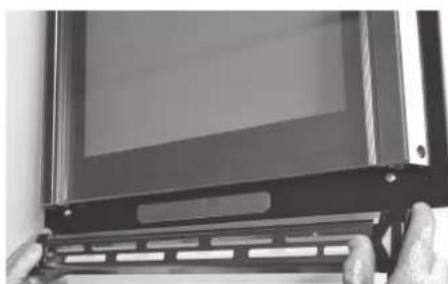
natural_image
Close-up of hands installing a flat-screen electronic device (no visible text or symbols)natural_image
Close-up of gloved hands holding a transparent rectangular device with visible internal components (no text or symbols)natural_image
Close-up of a metal tool interacting with a metallic bracket (no visible text or symbols)natural_image
Simple line drawing of a tool interacting with a surface, showing motion and angle indicators (no text or symbols)natural_image
Close-up of white wire mesh structure with inset magnified detail (no text or symbols)text_image
D.M.A. A.M.D. M.D.A. 12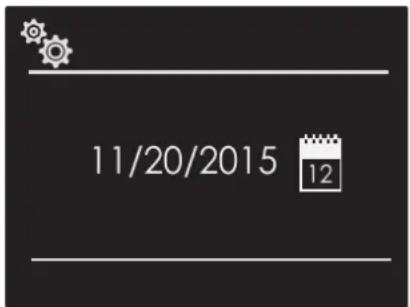
text_image
11/20/2015 12Brillo
natural_image
Simple line drawing of two circular plates placed on a grid-lined rack (no text or symbols)Rejilla 1
natural_image
Circular metal grate with a grid pattern, no text or symbols visiblePARA PIZZA (SI PRESENTE)
Introdúzcala antes de precalentar el horno
natural_image
Exterior view of a rectangular metal panel with dashed cutouts (no text or symbols)natural_image
Four-panel technical illustration of a refrigerator interior showing open door, side panels, and internal compartments (no text or symbols)natural_image
Close-up of a gloved hand pointing at a small electronic component (no visible text or symbols)