
E893DDP - Surveillance Camera Lorex - Free user manual and instructions
Find the device manual for free E893DDP Lorex in PDF.


| Product Type | 4K Ultra HD IP Dome Camera with Intelligent Deterrence |
| Brand | Lorex |
| Model | E893DDP |
| Resolution | 4K Ultra HD (8 MP) |
| Viewing Angle | Wide angle (not precisely specified) |
| Dimensions (approximate) | Diameter: 12 cm, Height: 10 cm |
| Weight (approximate) | 500 g |
| Power Supply | PoE (802.3af) or 12 V DC (adapter not included) |
| Power Consumption | ≤ 6 W (PoE) |
| Night Vision | Yes, with mechanical IR filter (day/night switching) |
| Intelligent Detection | People, vehicles, faces, masks |
| Deterrence Functions | Built-in siren, LED spotlight (steady white or strobe) |
| Audio | Built-in microphone and speaker, two-way communication |
| Video Compression | H.265 / H.264 |
| Connectivity | Ethernet RJ45 (10/100 Mbps) |
| Weather Protection | IP67 (weather-resistant, sheltered outdoor installation) |
| Operating Temperature | -20 °C to 50 °C |
| Operating Humidity | 10% to 90% (non-condensing) |
| Housing Material | Plastic and metal |
| Package Contents | Camera, assembly kit, Ethernet cable with RJ45 cable gland |
| Maintenance and Cleaning | Clean the lens with a soft, dry cloth; check connections and cables |
| Safety | Do not immerse; use only with compatible Lorex NVRs |
| Spare Parts and Repairability | Extension cables, 12 V DC adapter; repair by a professional |
| Warranty | See lorex.com/warranty |
Frequently Asked Questions - E893DDP Lorex
User questions about E893DDP Lorex
0 question about this device. Answer the ones you know or ask your own.
Ask a new question about this device
Download the instructions for your Surveillance Camera in PDF format for free! Find your manual E893DDP - Lorex and take your electronic device back in hand. On this page are published all the documents necessary for the use of your device. E893DDP by Lorex.
USER MANUAL E893DDP Lorex
Thanks for choosing the Lorex 4K Ultra HD Smart Deterrence IP Dome Camera. Here's how to get started.
Safety precautions
- Read this guide carefully and keep it for future reference.
- Follow all instructions for safe use and handling of the product.
- Do not disassemble the camera.
- Use the camera only with compatible Lorex NVRs.
- Use the camera within given temperature, humidity and voltage levels noted in the camera's specs.
- Do not point the camera directly towards the sun or a source of intense light.
• Install the camera where vandals cannot easily reach. - This camera is rated for outdoor use. Installation in a sheltered location is recommended.
• Periodically clean the camera lens with a soft cloth and warm water. - Check the packaging of the included cable to verify the cable grade based on the model number.
CBL605U: The supplied cable is rated for surface and in-wall mounting. CBL100C5: The supplied cable is rated for surface mounting only. Cables for in-wall and floor-to-floor installations are sold separately (CMR type). These and other cables are available at lorex.com.
Disclaimers
- For a full list of compatible NVRs, visit lorex.com/compatibility.
- Not intended for submersion in water. Installation in a sheltered location recommended.
- This camera includes an Auto Mechanical IR Cut Filter. When the camera changes between Day/Night viewing modes, an audible clicking noise may be heard from the camera. This clicking is normal, and indicates that the camera filter is working.
Contents
Package contents......1
Dimensions....2
Important installation guidelines....3
-
Optimizing person and vehicle detection......4
-
Optimizing face and mask detection......5
Installing the camera....8
Connecting the camera....10
Using the RJ45 cable gland & Cable extension options......12
Using deterrence features....13
Audio settings....16
Troubleshooting....17
Package contents
• 4K Ultra HD Smart Deterrence IP Dome Camera
- Mounting Kit*
- Ethernet Extension Cable with Pre-attached RJ45 Cable Gland*
*Per camera in multi-camera packs.

ATTENTION: It is recommended to connect the camera to the NVR or an external PoE switch. If using a DC power adapter (not included) with the camera, a REGULATED power supply is REQUIRED for use with this camera. Use of a non-regulated, non-conforming power supply can damage this product and voids the warranty.
User-supplied tools
- Drill (drill bit size 1/8")
- Philips screwdriver
Dimensions
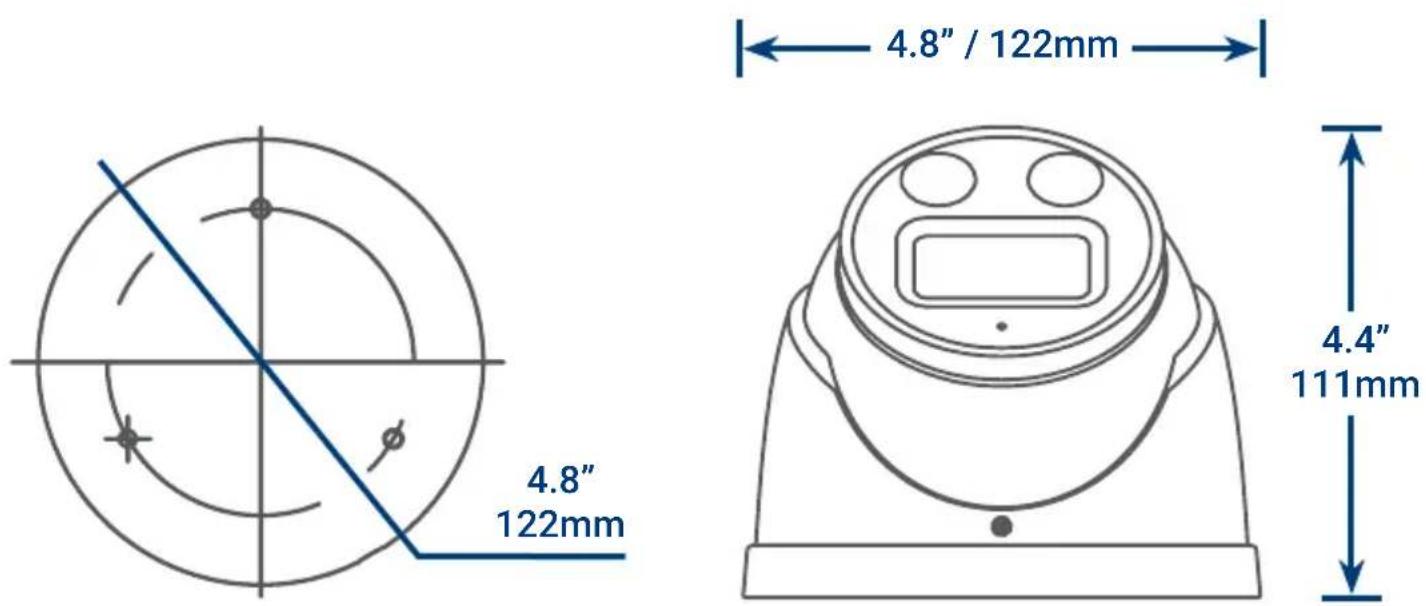
Camera base Camera
Important installation guidelines
The optimal installation location, including the height and angle of your camera, will depend on the type of detection settings that you want to enable. Since the optimal angle for person and vehicle detection is different from the optimal angle for face detection, you will need to select one approach.
Based on your detection preference choose between:
- Optimizing person and vehicle detection accuracy, see page 4.
- Optimizing face and mask detection accuracy, see pages 5-7.

Note: You cannot enable both face detection and person and vehicle detection at the same time.
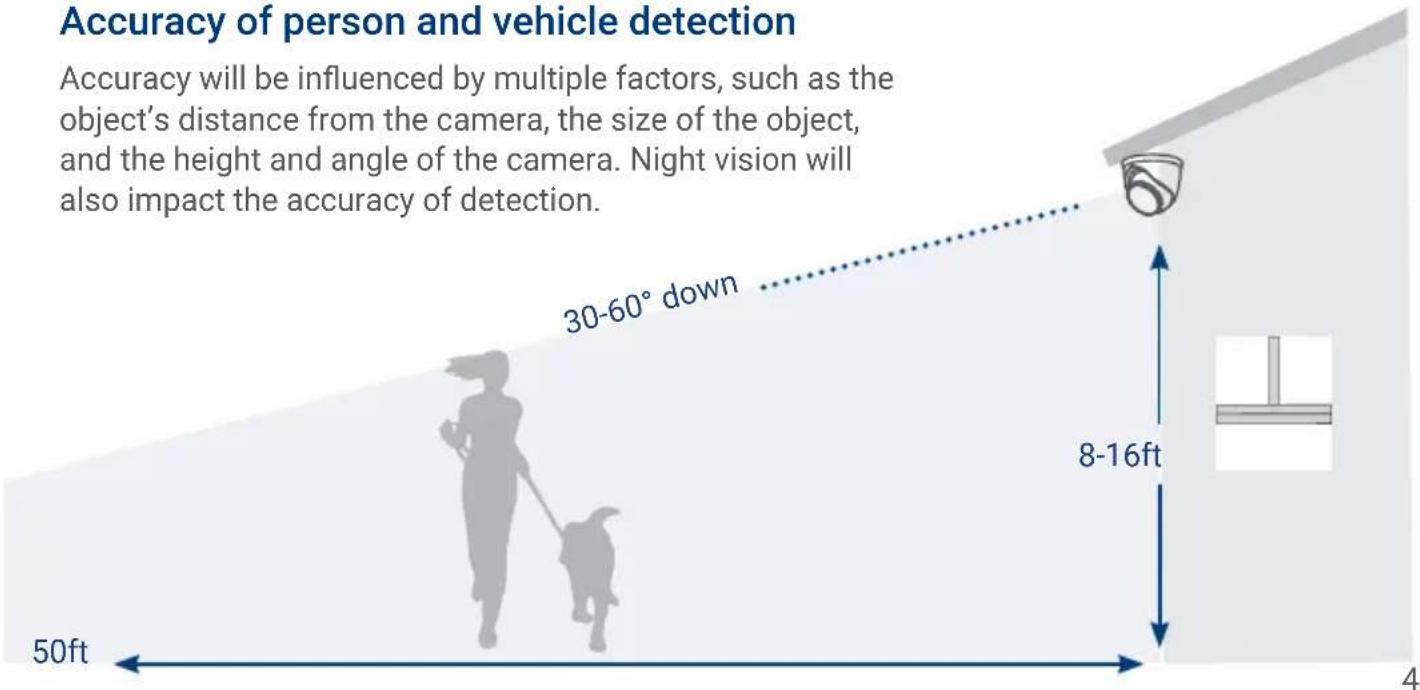
1. Optimizing person and vehicle detection accuracy
- Choose a location where objects of interest will be no further than 50ft (15m) from the camera.
• Install the camera between 8-16ft (2.5-5m) off the ground. - Angle the camera between 30 - 60^ down from the level position.
- Optimal accuracy for objects of interest appear in the bottom 2/3 of the camera image.
- Point the camera where there is the least amount of obstructions (i.e. tree branches).
Accuracy of person and vehicle detection
Accuracy will be influenced by multiple factors, such as the object's distance from the camera, the size of the object, and the height and angle of the camera. Night vision will also impact the accuracy of detection.
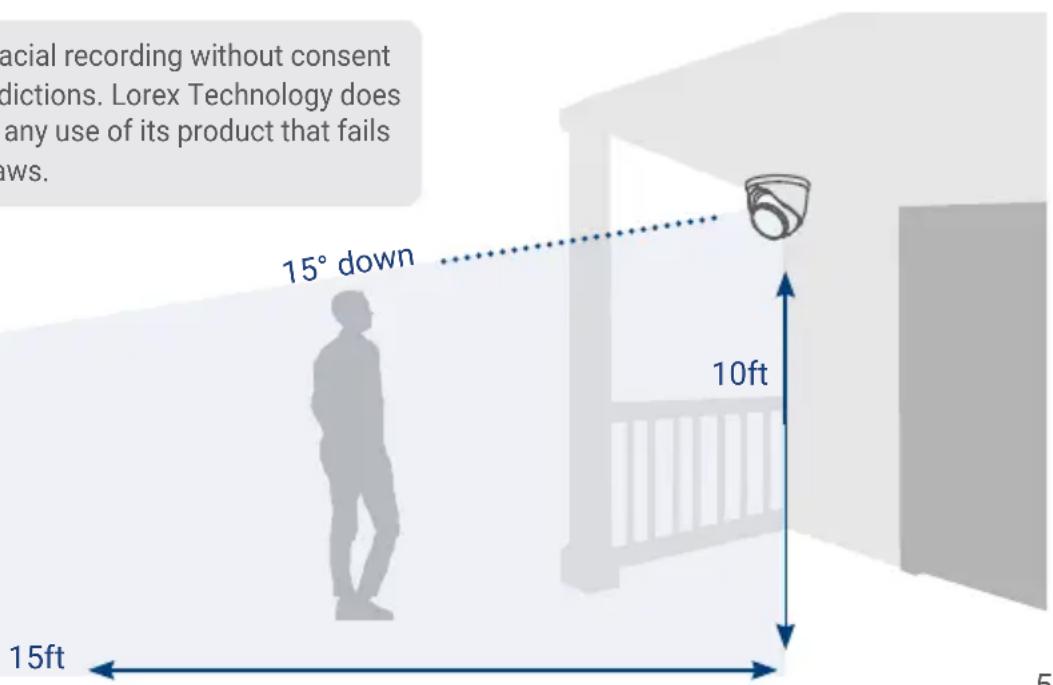
2. Optimizing face and mask detection accuracy
• Install in a bright area and avoid facing direct sunlight with strong backlights and dark shadows.
- Choose a location where objects of interest will be no further than 15ft (4.5m) from the camera.
- Position the camera 10ft (3m) off the ground to detect the full proportion of a face.
- Angle the camera around 15^ down from the level position.
- Point the camera directly where objects of interest will be facing.

ATTENTION: Facial recording without consent in certain jurisdictions. Lorex Technology does assume liability for any use of its product that fails to form with local laws.
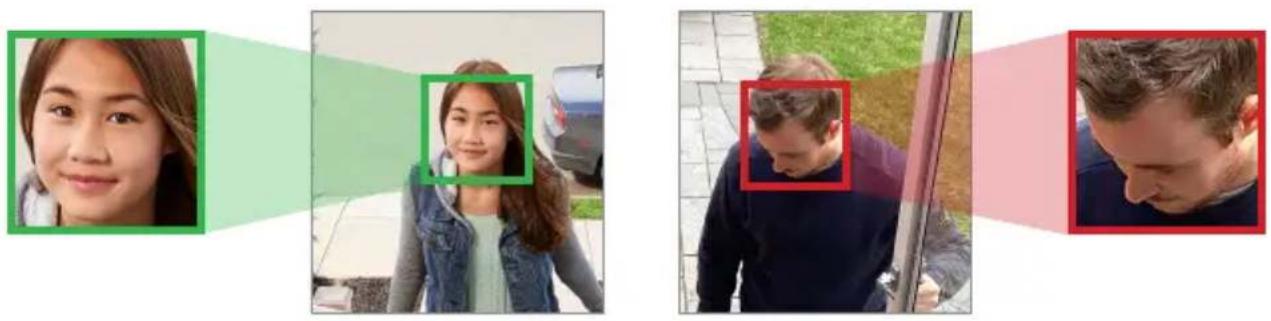
High accuracy Vs. low accuracy face detection
Accuracy will be influenced by lighting conditions and the distance/angle of a person's face to the camera. To distinguish facial features, the camera must be positioned head on with a clear view of a person's face. Obscured and partially/fully covered faces will not be accurately captured. To improve the range of face detection in low light conditions, color night vision will switch to black & white. If you cannot meet these requirements for installation, it may be best to follow the guidelines for person and vehicle detection instead.
natural_image
Four-panel image showing a person's face, outdoor background, and close-ups of a man's face (no text or symbols visible)Mask detection
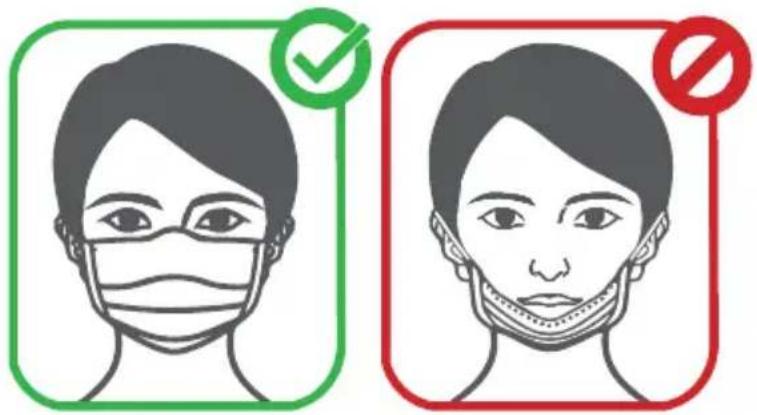
With face detection enabled, you can set the alarm type to detect if a person is not wearing a mask. A person not wearing a mask or improperly wearing a mask will be captured in the face preview sidebar and a notification will be sent through the Lorex Home App. Enable Mask Detect and Auto-response to remind a non-mask wearer to: "Please wear your face mask".

Notes:
- You can enable face detection without using mask detection.
- Face detection is disabled by default. For more information on face detection setup and configuration, refer to your NVR's manual at lorex.com.
- Face detection and mask detection are compatible with certain Lorex NVRs. For a list of compatible NVRs, please visit lorex.com/compatibility.
IMPORTANT!
Before Installing
- Test your camera prior to selecting a permanent mounting location by temporarily connecting the camera and cable to your NVR.
- Review "Important installation guidelines", page 3 before choosing a permanent mounting location.
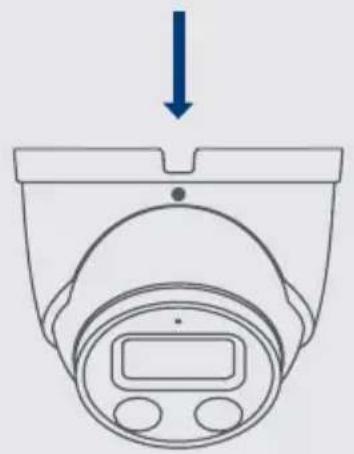
- Decide whether to run the cables through the wall/ceiling (drilling required) or along the wall/ceiling. If you run the cables along the wall/ceiling, you must run the cable through the cable notch located on the camera base (see Figure 1). This will keep the camera base flush to the surface when mounted.
Figure 1: Cable notch
natural_image
Diagram of a surveillance camera with a digital display and control panel, no text or symbols presentInstalling the camera
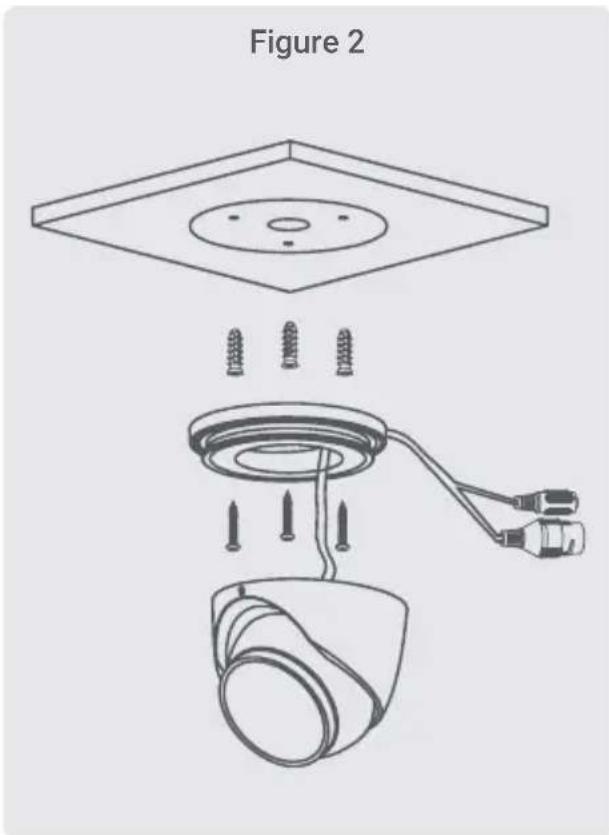
- Use the included mounting template to mark holes for the screws and camera cable.
- Drill holes for the screws and camera cable. Insert the optional anchors if installing in drywall.
- Feed the camera cable through the camera base. If you are running cables along a wall/ceiling, make sure to pass the cable through the cable notch.
- Connect cables as shown in "Connecting the camera", pages 10-11.
- Use a Philips screwdriver and the screws to attach the camera base to the mounting surface.
- Angle the dome camera and cover as shown in Figure 2.
- Use the included Allen key to tighten the dome camera firmly onto the camera base.
- Remove the vinyl film from the camera lens once your installation is complete.
Connecting the camera
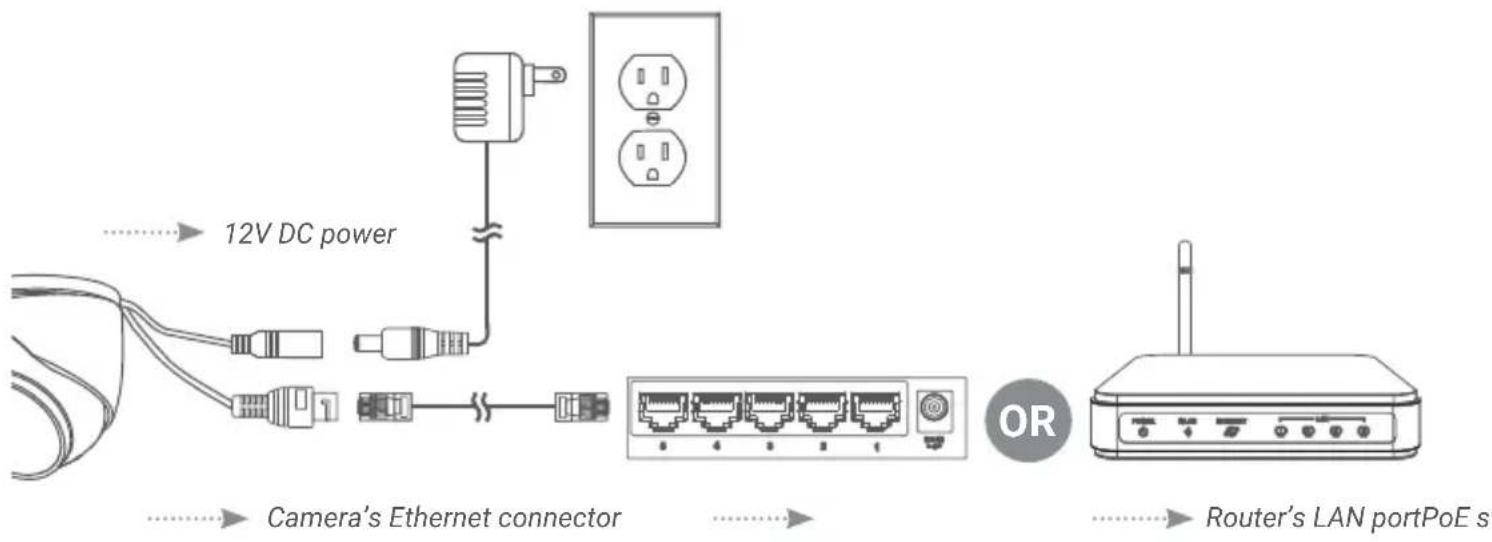
Connect the cameras and cables to your NVR using one of the following two setup methods.
1. Connect cameras directly to the NVR (recommended).
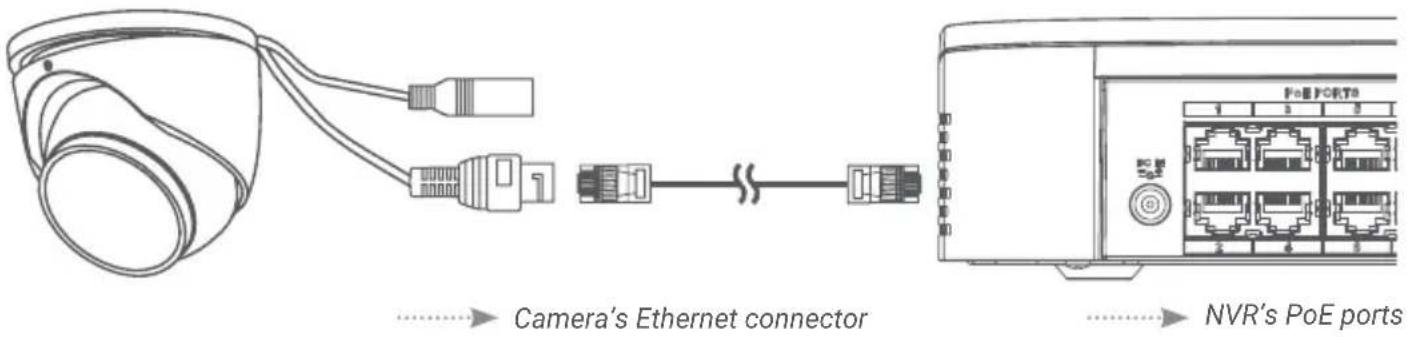
Connect the Ethernet cable to the camera and then connect the other end of the Ethernet cable to the NVR's PoE ports. The camera may take a minute to power on after being connected.

Notes:
- The smart deterrence camera is only compatible with select NVRs. For a list of compatible NVRs, visit lorex.com/compatibility.
- You must connect the camera to a supporting H.265 NVR to take advantage of H.265 compression. For instructions on enabling H.265 compression, visit lorex.com, and search "How do I enable H.265 compression?".

ATTENTION: A 12V DC power adapter (model#: ACCPWR12V1, not included) is only required if connecting the camera's Ethernet cable to a router or switch that does not support PoE.
2. Connect cameras to a PoE switch or router on your network (not included).
Connect the Ethernet cable to the camera and then connect the other end of the Ethernet cable to a router or switch on your network. See your NVR manual for details on connecting the camera to your NVR using a router or switch.
flowchart
graph TD
    A["12V DC power"] --> B["Camera's Ethernet connector"]
    B --> C["Router's LAN portPoE s"]
    C --> D["OR"]
Using the RJ45 cable gland (optional)
The pre-attached RJ45 cable gland covers both the camera's Ethernet connector and the RJ45 plug to provide weather-resistance and protection from dust, dirt and other environmental contaminants.
To use the RJ45 cable gland, twist the RJ45 cable gland barrel securely onto the camera's Ethernet connector.
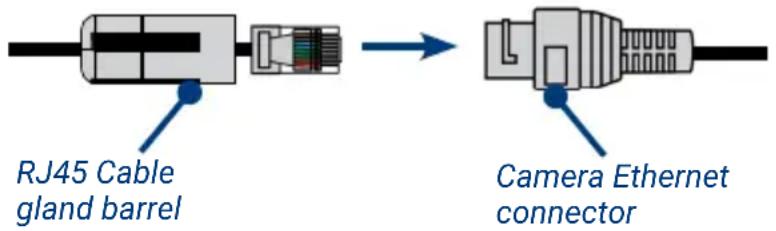
Tip: The RJ45 cable gland is weather-resistant. Seal the cap with silicone and/or electrical tape for additional sealing if it will be exposed to precipitation regularly.
Cable extension options
You can extend the Ethernet cable run for your camera up to 300ft (91m). To extend the cable run beyond 300ft (91m), a switch will be required (sold separately). Use an RJ45 coupler or a network switch (not included) to connect male ends of Ethernet cables together. We recommend using UL CMR approved cables available at lorex.com.
Cable type Max. cable run distance Max. number of extensions
CAT5e (or higher) Ethernet cable 300ft (91m) 3
Using deterrence features
Automatic deterrence settings
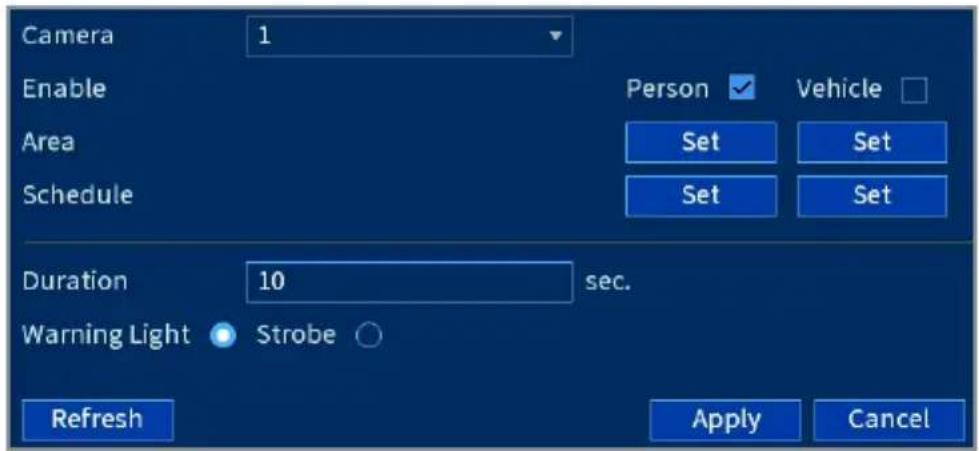
To enable the automatic warning light from the NVR:
- From the camera's live view, right-click and then click Main Menu.
- Enter the system user name (default: admin) and password.
- Click EVENTS > Event Settings > Motion > Smd/Deterrence.
- Under Camera, select the channel connected to the smart deterrence camera.
- Check Person and/or Vehicle to enable each type of smart detection.
- Click Set > Area under each detection type you have enabled to set the active areas.
- Click Set > Schedule to set the weekly schedule.
-
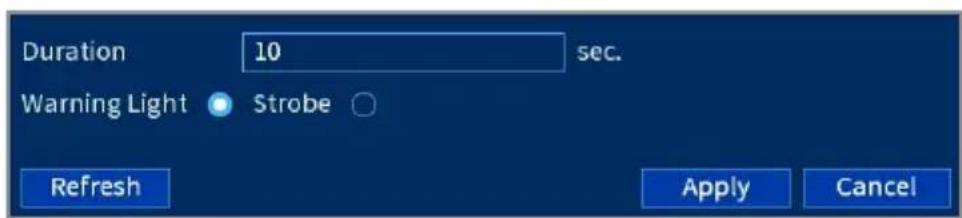
For Duration, choose how long the warning light will stay on when motion is detected.
-
Select Warning Light for a solid white light, or Strobe for a flashing light. If you select strobe, set how quickly the light will flash under Strobe Frequency.
-
Click Apply to save.
Manually activate deterrence features
To manually activate the warning light and/or siren features:
Prerequisite: Connect to your Lorex system using the app specified in your NVR's documentation.
-
Launch the Lorex app and tap your NVR to view connected channels.
-
Tap a connected smart deterrence camera to open it in single-channel view.
-
Tap ☐ to activate the warning light, or tap 🙏 to activate the siren.
Using deterrence features
Manually activate deterrence features
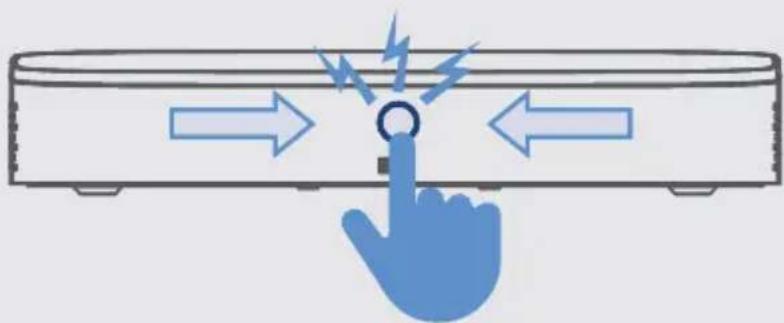
To activate deterrence features on all connected cameras, push and hold the front panel panic button on the NVR for 3 seconds.
natural_image
Illustration of a hand pressing a button on a device panel with arrows indicating direction (no text or symbols)
Note: For full instructions on using the deterrence features, refer to the NVR's manual on your product page at lorex.com.
Audio settings

ATTENTION: Audio recording and listen-in audio are disabled by default. Audio recording is use of listen-in audio without consent is illegal in certain jurisdictions. Lorex Corporation does no liability for use of its products that does not conform with local laws.
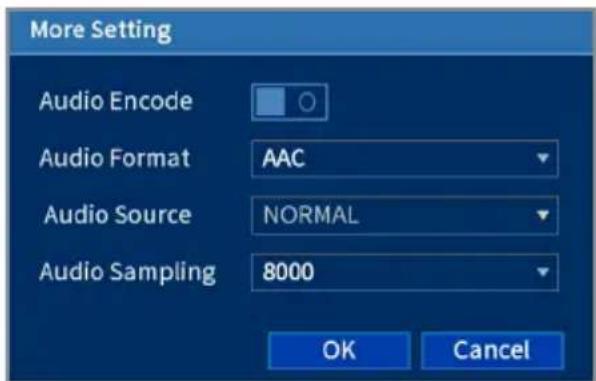
To enable audio recording and listen-in audio from the NVR:
- From the camera's live view, right-click and then click Main Menu.
- Enter the system user name (default: admin) and password.
- Click Camera and select Recording.
- Under Channel, select the channel connected to the audio-capable camera.
- Under Main Stream, click on the button More Setting.
- In the the pop-up window:
A. Enable Audio Encode for audio recording and listen-in audio. (Note: Listen-in audio requires a monitor with speakers or speakers connected to the NVR.)
B. Select the Audio Format that will be used to record audio. ACC is recommended.
- Click OK to save changes.
Troubleshooting
1. No picture/signal.
- Ensure the camera is connected to a compatible NVR. For full compatibility, visit lorex.com/compatibility.
- The camera may take up to 1 minute to power up after being connected to the NVR. Wait two minutes before following the steps below.
- Ensure the camera is connected to your NVR or to your local network.
- If you are not using PoE, you must connect the camera to a 12V DC power adapter (not included).
- If the camera is connected to the LAN, you must search your network for cameras using the NVR. See the NVR's instruction manual.
- Ensure your NVR is properly connected to a monitor.
- There may be an issue with your extension cable run. Connect the camera to the NVR using a different Ethernet cable.
2. Picture does not appear to be 4K.
- To ensure that you are viewing camera video in full 4K resolution (4K monitor required), check the video output resolution of your NVR. For full instructions, see your NVR's documentation at lorex.com.
3. Picture is too bright.
- Ensure your camera isn't pointed directly at a source of light (e.g., sun or spot light).
- Move your camera to a different location.
- Check the brightness and contrast settings on the NVR.
4. Picture is too dark.
- Check the brightness and contrast settings on the NVR.
5. Night vision is not working.
- The night vision activates when light levels drop. The area may have too much light.
6. Bright spot in video when viewing camera at night.
- Night vision reflects when pointing a camera through a window. Move the camera to a different location.
7. Picture is not clear.
- Check the camera lens for dirt, dust, spiderwebs. Clean the lens with a soft, clean cloth.
• Make sure that the cable run is within the limitations specified in the section 'Cable extension options'. - Remove the vinyl film from the camera lens when your installation is complete.
8. Picture is in color in in dark conditions.
- This camera's image sensor is extra sensitive to light, meaning that the camera stays in color mode at low-light conditions. For instructions on how to make your camera switch to night mode, visit lorex.com, and search for "How do I make my camera switch to night mode?".
9. The camera siren is not switching on automatically.
- Ensure the active areas and schedule for white light deterrence are set properly. The default schedule for the warning light is night times (between 5PM and 7AM).
Troubleshooting
10. The camera warning light is not switching on automatically.
- The camera siren cannot switch on automatically. You can control the camera siren manually using a compatible Lorex NVR or app. Refer to your NVR's documentation for full instructions.
- Ensure that you have enabled and configured white light deterrence using a compatible NVR. See your NVR's documentation for full instructions.
11. No audio.
• Audio is only supported on Lorex NVRs. For a list of compatible NVRs, visit lorex.com/compatibility.
- Ensure NVR volume is turned on / turned up.
- Ensure audio function on camera is turned on (see 'Audio Settings', page 16).
- Ensure audio is turned up on viewing device.
12. Two-way talk not working.
- Use the Lorex app specified in your NVR documentation to activate two-way talk. Tap from the camera's live view, then speak into the microphone on your mobile device. Tap again when finished speaking.
Need help?
Visit help.lorex.com for up-to-date information and resources:
- Download product guides
- Watch how-to-videos
• Find related troubleshooting tips & FAQs
Register your product
Please see our full Terms of Service and Limited Hardware Warranty Policy at lorex.com/warranty.
Copyright © 2021 Lorex Corporation
As our products are subject to continuous improvement, Lorex reserves the right to modify product design, specifications and prices, without notice and without incurring any obligation. E&OE. All rights reserved.
E893DD_QSG_TRILINGUAL_R1
LOREX®
Fr
natural_image
Four-panel image showing a person's face, outdoor scene with car and ground, and close-ups of facial features (no text or symbols visible)
Remarques :
natural_image
Line drawing of a surveillance camera with a downward arrow indicating compression or signal flow (no text or symbols)natural_image
Illustration of a hand pressing a button on a device panel with arrows indicating motion (no text or symbols)
Dépannage
Copyright © 2021 Lorex Corporation
natural_image
Four-panel image showing a person's face, outdoor scene with car and green background, and close-ups of a man's face (no text or symbols visible)
Notas:
natural_image
Line drawing of a surveillance camera with a downward arrow indicating force or direction (no text or symbols)natural_image
Illustration of a hand pressing a button on a device panel with arrows indicating motion (no text or symbols)
Copyright © 2021 Lorex Corporation

- Safety precautions
- Disclaimers
- Contents
- Package contents
- User-supplied tools
- Important installation guidelines
- Optimizing person and vehicle detection accuracy
- Accuracy of person and vehicle detection
- Optimizing face and mask detection accuracy
- High accuracy Vs. low accuracy face detection
- Mask detection
- Notes:
- IMPORTANT!
- Before Installing
- Installing the camera
- Connecting the camera
- Connect cameras directly to the NVR (recommended).
- Connect cameras to a PoE switch or router on your network (not included).
- Using the RJ45 cable gland (optional)
- Cable extension options
- Using deterrence features
- Automatic deterrence settings
- Manually activate deterrence features
- Audio settings
- Troubleshooting
- No picture/signal.
- Picture does not appear to be 4K.
- Picture is too bright.
- Picture is too dark.
- Night vision is not working.
- Bright spot in video when viewing camera at night.
- Picture is not clear.
- Picture is in color in in dark conditions.
- The camera siren is not switching on automatically.
- The camera warning light is not switching on automatically.
- No audio.
- Two-way talk not working.
- Need help?
- Register your product
- LOREX®
- Remarques :
- Dépannage
- Notas:
Brand : Lorex
Model : E893DDP
Category : Surveillance Camera