WC4E - Oven WOLF - Free user manual and instructions
Find the device manual for free WC4E WOLF in PDF.


| Product Type | Electric Convection Oven |
| Brand | Wolf |
| Model | WC4E |
| Interior Depth | 67.3 cm (26 1/2 in) |
| Exterior Depth | 105.4 cm (41 1/2 in) |
| Capacity | 5 racks |
| Electrical Supply | 208-240 V, 60 Hz, single-phase or three-phase |
| Total Power | 12.5 kW (single) |
| Thermostat | Solid state, up to 260 °C (500 °F) |
| Timer | 1 hour, dial with audible alarm |
| Fan | 1/2 HP (375 W) motor, two speeds (HI/LO) |
| Interior Lighting | Lamps with on/off switch |
| Humidity Damper | Open/closed for humidity control |
| Interior Material | Porcelain (stainless steel optional) |
| Doors | Independent (simultaneous opening optional) |
| Required Clearance (right side) | Min. 45 cm (18 in) for solid state models |
| Cooling Function | OVEN COOL position for accelerated cooling |
| Mounting Options | Legs, casters, stand with storage, stacking kits |
| Cleaning | Daily with water and soap; stainless steel interior: abrasive paste if necessary |
| Maintenance | Annual check of exhaust duct; sealed motor bearings |
| Warranty | Commercial standard (consult manual) |
Frequently Asked Questions - WC4E WOLF
User questions about WC4E WOLF
0 question about this device. Answer the ones you know or ask your own.
Ask a new question about this device
Download the instructions for your Oven in PDF format for free! Find your manual WC4E - WOLF and take your electronic device back in hand. On this page are published all the documents necessary for the use of your device. WC4E by WOLF.
USER MANUAL WC4E WOLF
natural_image
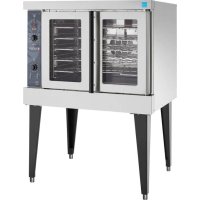
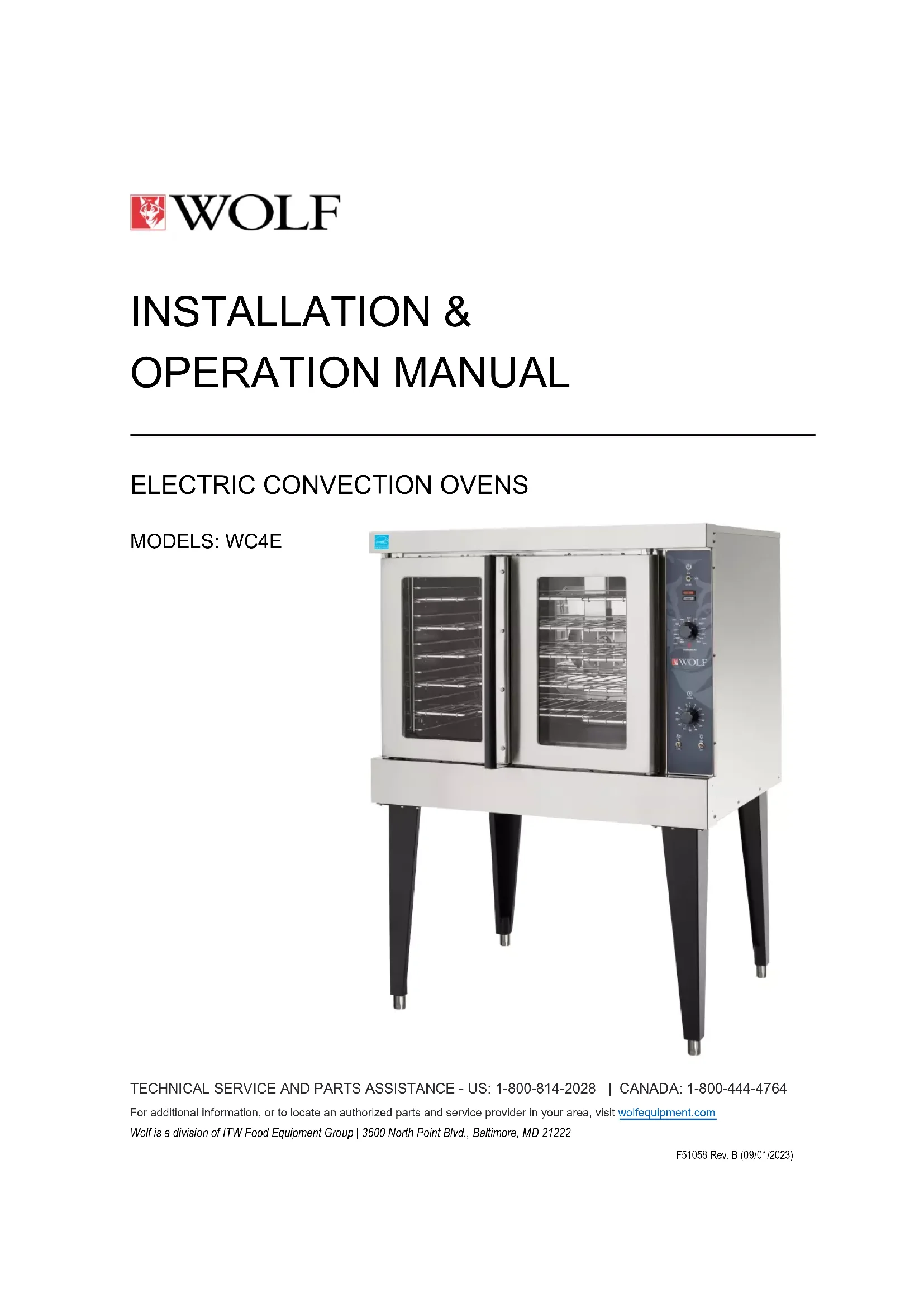
Exterior view of a stainless steel electric oven with dual doors and control knobs (no visible text or symbols)TECHNICAL SERVICE AND PARTS ASSISTANCE - US: 1-800-814-2028 | CANADA: 1-800-444-4764
For additional information, or to locate an authorized parts and service provider in your area, visit wolfequipment.com
Wolf is a division of ITW Food Equipment Group | 3600 North Point Blvd., Baltimore, MD 21222
F51058 Rev. B (09/01/2023)
Installation, Operation and Care of ELECTRIC CONVECTION OVENS KEEP THESE INSTRUCTIONS FOR FUTURE USE
Your Electric Convection Oven is produced with quality workmanship and material. Proper installation, usage and maintenance of your oven will result in many years of satisfactory performance.
The manufacturer suggests that you thoroughly read this entire manual and carefully follow all of the instructions provided.
GENERAL
The Electric Convection Ovens feature a 500°F thermostat, timer, porcelain interior and a two-speed, 12 HP blower motor as standard equipment. Ovens equipped with standard voltages are 208 or 240 V, 60 Hz, single- or three-phase.
The Oven is a single cavity oven furnished with flve racks. Independently opening doors are standard; simultaneously opening doors with chain mechanism underneath are optional. Oven lights with on-off switch are standard on all models.
An open stand with lower storage rack is available as an option.
Stacked ovens are furnished with either Stacking Kit 426983G1 (8" LEGS) or Stacking Kit 426984G1 (CASTER) for mounting one oven on top of the other.
Additional racks are available as accessories.
Features of the models are shown below:
FEATURES & OPTIONS
| Model | Oven Interior Depth | Oven Exterior Depth | Thermostat | Timer | Legs with Feet | Legs with Casters | Stand with Rack & Feet | Stand with Rack & Casters | Stack Kit with Legs* | Stack Kit with Casters* |
| Standard Electric | 26 1/2" (67.3cm) | 41 1/2" (105.4cm) | Solid State | 1 Hr. Dial | Std. | Opt. | Opt. | Opt. | Opt. | Opt. |
* With Two Stacked Ovens Only.
INSTALLATION
UNPACKING
Immediately after unpacking the oven, check for possible shipping damage. If the oven is found to be damaged, save the packaging material and contact the carrier within 15 days of delivery.
Prior to installation, verify that the electrical service agrees with the specifications on the oven data plate, located on the inside of the top front cover.
Do not use the doors or their handles to lift the oven.
LOCATION
The installation location must allow adequate clearances for servicing and proper operation. For solid state and digitally controlled models, there must be 18" (45 cm) of clearance on the right side of the oven from any open fame.
INSTALLATION CODES AND STANDARDS
In the United States, install the oven in accordance with: 1) State and local codes; 2) National Electrical Code, NFPA-70 (latest edition) and 3) NFPA Standard #96, Vapor Removal from Cooking Equipment (latest edition), available from National Fire Protection Association, Batterymarch Park, Quincy, MA 02269.
In Canada, install the oven in accordance with: 1) Local codes; 2) Canadian Electrical Code, CSA Standard C22.2 No. 1 (latest edition) and 3) Canadian Standard for Commercial Cooking Equipment CSA Standard C22.2 No.109 (latest edition).
INSTALLING BASIC OVEN
The basic oven must be installed on legs or mounted on a modular stand. Installations on concrete bases or other supports restricting air circulation underneath the oven is not advisable and may void the warranty. If using the modular stand, set the oven on the stand after unpacking.
ASSEMBLING THE LEGS TO THE SINGLE OVEN
The legs must be installed on the bottom of the oven. Gently position the oven on its left side, taking care not to cause scratches or damage.
Attach each of the four leg assemblies to the bottom of the oven with the 24 bolts and lockwashers (six bolts and lockwashers per leg). Carefully raise the oven to its normal position.
LEVELING
Adjust the legs to ensure that the oven racks are level in the final installed position.
CASTERS
If the oven is to be installed on casters, assemble the casters to the legs provided. Then attach the caster-leg units to the oven at each corner using the 24 bolts and lockwashers (six bolts and lockwashers per leg). Place the locking casters on the front legs and nonlocking casters on the rear legs.
ASSEMBLING THE STAND TO THE OVEN
Attach each of the four leg assemblies to the bottom of the oven with the 24 bolts and lockwashers (six per leg). Carefully raise the oven to the normal position.
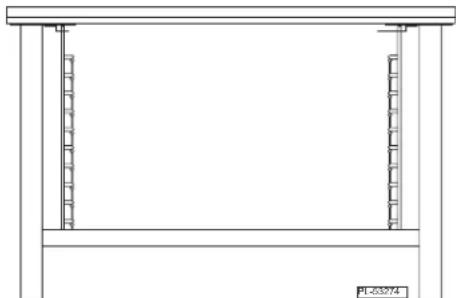
Attach the undershelf to the legs with eight bolts and lockwashers (two per leg).
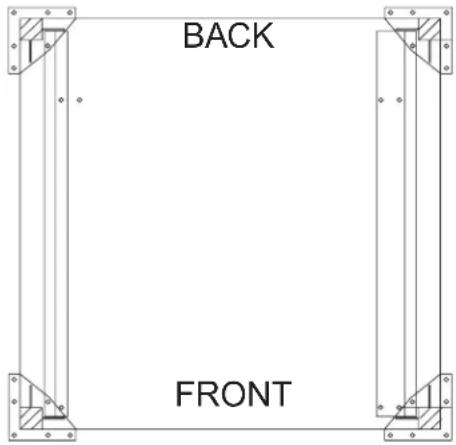
Install the rack guides into the shelf at the desired locations (for pans or racks), then attach the rack supports to the top end of the rack guides. Attach rack supports to the leg assembly by removing one middle bolt and reattaching the back through the end holes in the rack support (Fig. 2).
natural_image
Technical line drawing of a table frame with supports and vertical supports (no text or symbols)Fig. 2
ELECTRICAL CONNECTIONS
⚠ WARNING ELECTRICAL AND GROUNDING CONNECTIONS MUST COMPLY WITH THE APPLICABLE PORTIONS OF THE NATIONAL ELECTRICAL CODE ANSI/NFPA70 (LATEST EDITION) AND/OR OTHER LOCAL ELECTRICAL CODES.
WARNING DISCONNECT ELECTRICAL POWER SUPPLY AND PLACE A TAG AT THE DISCONNECT SWITCH TO INDICATE THAT YOU ARE WORKING ON THE CIRCUIT.
Remove the wiring compartment cover on the front of the oven. Remove the appropriate knockout on the bottom of the oven and attach the power supply conduit to the bottom of the oven.
Comply with the appropriate wiring diagram (located inside the right side panel) when making connections to the electrical supply lines.
Replace the wiring compartment cover and right side panel. Turn on the power supply.
ELECTRICAL DATA
| TOTAL KW | 208-240V3-PHASE LOADING | NOMINAL AMPERES PER LINE WIRE | ||||||||||
| 3-PHASE | 1-PHASE | |||||||||||
| KW PER PHASE | 208V | 240V | 208 V | 240 V | ||||||||
| L1-L2 | L2-L3 | L1-L3 | L1 | L2 | L3 | L1 | L2 | L3 | ||||
| SINGLE OVEN | 12.5 | 4 | 4 | 4.5 | 35 | 33 | 35 | 33 | 29 | 33 | 60 | 52 |
| STACKED OVENS | 25 | 8 | 8 | 9 | 70 | 66 | 70 | 66 | 58 | 66 | 120 | 104 |
ASSEMBLING STACKED OVENS
Unpack the ovens and the stack kits. Position the oven to be used as the bottom oven on its left side for access to the oven bottom, taking care not to scratch or damage it.
Attach the four leg or caster assemblies with the 24 bolts and lockwashers (six per leg).
Place the lower oven (with legs or casters) on the floor and remove two 7/16'' (11 mm) diameter knockouts on each side of the top exterior panel. Remove knockout from top oven base.
Install two locating studs to the bottom of the top oven per stacking kit instructions.
Move the oven with legs or casters to the installed position. Place the upper oven on top of the lower oven using the locating studs.
Remove the optional rear panel, if provided, from the TOP oven. Remove top oven vent guard. Install the Stacking Flue (Fig. 3) with the four screws provided. Replace the top oven rear panel, if provided.
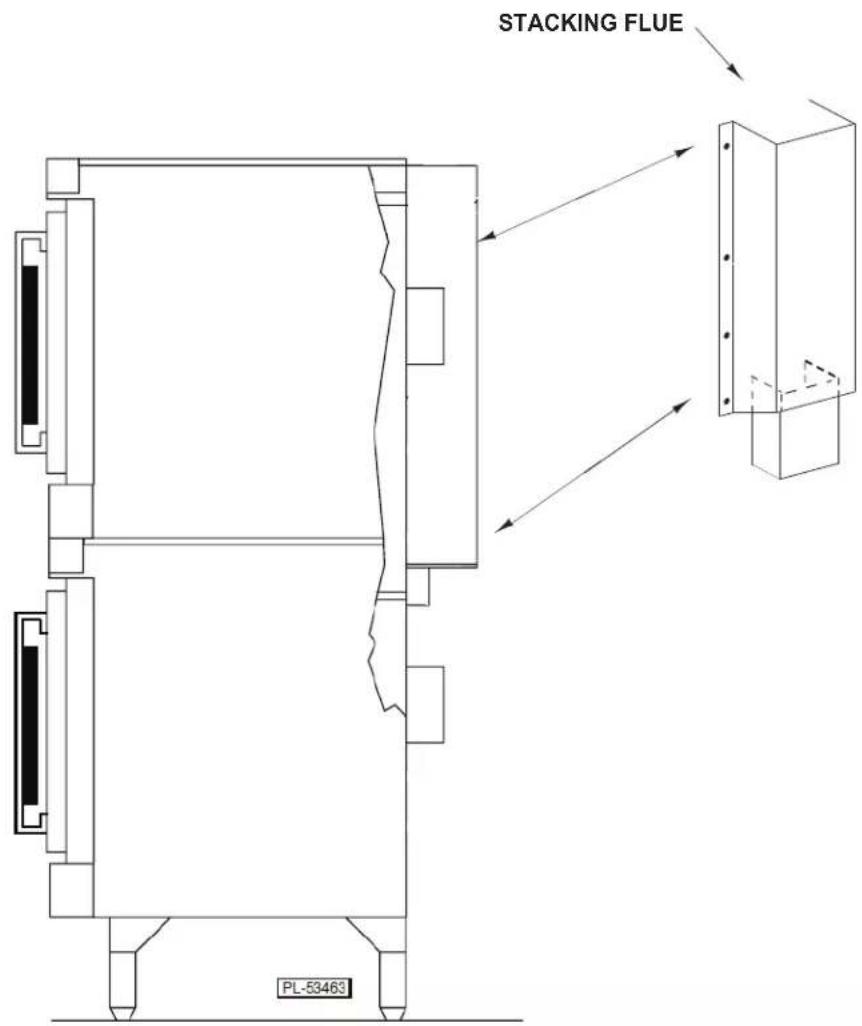
Fig. 3
ELECTRICAL CONNECTIONS (Stacked Ovens)
⚠ WARNING ELECTRICAL AND GROUNDING CONNECTIONS MUST COMPLY WITH THE APPLICABLE PORTIONS OF THE NATIONAL ELECTRICAL CODE AND/OR OTHER LOCAL ELECTRICAL CODES.
WARNING DISCONNECT ELECTRICAL POWER SUPPLY AND PLACE A TAG AT THE DISCONNECT SWITCH TO INDICATE THAT YOU ARE WORKING ON THE CIRCUIT.
Make sure that the electrical power supply agrees with the specifications on the oven data plate, the wiring diagram on the oven and Electrical Data, page 5.
The ovens are commonly connected to separate power sources. When it's necessary to connect both ovens to a single power source, the VCE-STACKWIRES kit is used (00-961571-000G1). This is a free accessory. It can be ordered with the ovens or separately.
- Carefully route these leads from the top oven through the bushing through the electrical access knockout holes common to both ovens.
- Connect wires X, Y and Z from the upper oven to the lower oven per the wiring diagram. Attach the power supply conduit to the bottom of the lower oven. Connect the power supply leads to the line side of the terminal block on the bottom oven.
- Finally, inspect and check all wiring and terminal connections for tightness or pinch points (cover on oven frame).
- Refer to reference drawing 426986 supplied with the stacking kit for electrical connection instructions.
- Refer to instructions supplied with the stacking kit for marking the combined electrical load information to the electrical data plate of the bottom oven.
OPERATION
WARNING THE OVEN AND ITS PARTS ARE HOT. USE CARE WHEN OPERATING, CLEANING OR PERFORMING ANY MAINTENANCE.
CONTROLS: WC4ED
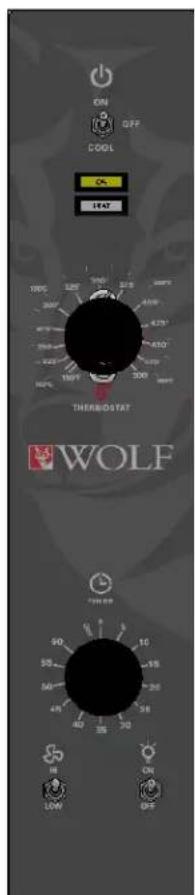
| MASTER SWITCH | - ON - Turns oven control circuits on. - OFF - T urns oven control circuits off. - OVEN COOL - Allows the fan motor to run with the doors ajar to speed oven cooling. |
| ON LIGHT (Amber) | - Lit when MASTER SWITCH is turned to ON. |
| HEAT LIGHT (White) | - Comes on and goes off when the heating elements cycle on and off. |
| TEMPERATURE | - Controls oven temperature. |
| TIMER | - Use to set the cooking time. Alarm sounds continuously when time has elapsed to 0. Turn the timer OFF to silence the alarm. The timer does not turn the oven off. Keep timer set to OFF when the oven is not in use. |
| FAN SPEED | - Adjust air velocity in the oven cavity. HI - Normal operating speed. LOW - Use this setting when cooking a delicate product like meringue, which could blow around in the oven. |
| LIGHTS | - ON - Turns the interior lights on. - OFF - Turns the interior lights off. |
BEFORE FIRST USE (All Models)
Before using the oven for the first time, it must be burned off to release any odors that might result from heating the new surfaces in the chamber.
- Using a clean damp cloth, wipe the inside of the oven, including the racks.
- Close the oven doors, turn the MASTER SWITCH to ON, turn the Thermostat to 300^ F ( 149^ C) and allow the oven to cycle for 6 to 8 hours before turning the MASTER SWITCH to OFF.
USING ELECTRICAL MODELS
Preheating
- Turn MASTER SWITCH to ON. Amber ON light will come on, indicating that power to oven is on.
- Set Thermostat as desired. Refer to COOKING GUIDELINES for suggested temperatures and times for various products.
- Prepare product and place in suitable pans. When white HEAT light goes off, oven has reached desired preheat temperature.
Cooking
- Open doors and load the product into the oven. Place pans in the center of the racks. Close doors.
- Set the Timer. After the preset time lapses, turn Timer to OFF position to stop alarm.
- When product is done, open doors and carefully remove cooked product from the oven. Care should be taken when wiping up any spills, as oven is still hot.
End of Day
- Turn Thermostat to lowest setting.
- Turn MASTER SWITCH to OVEN COOL. Leave doors open while the fan is on to cool the oven.
- When oven has cooled sufficiently, turn MASTER SWITCH to OFF and clean the oven.
RECOMMENDED TEMPERATURES AND TIMES FOR ROASTING
Meat roasting is most satisfactory at temperatures of 225 to 325°F (107 to 163°C) for beef, lamb, poultry and ham; 325°F (163°C) for fresh pork as recommended by USDA and American Meat Institute.
A pan, approximately 12 × 20 × 1' (305 x 508 x 25 mm) full of water, may be placed in the oven bottom. This water supplies humidity to reduce shrinkage. Water should be added if necessary during roasting.
Roasting pans should be no deeper than necessary to hold drippings (usually 2 to 2^1/2 (51 to 64 mm).
Cooking time and shrinkage may vary with roasting temperature, cut, grade of meat and degree of doneness. Smaller cuts will generally show greater time savings than larger cuts at a given temperature.
ROASTING TEMPERATURE CHART
| PRODUCT °F | TEMP(°C) APPROXIMATE TIMES | |
| Standing Rib Roast “ Oven Ready | 250 (121) | 3 to 4 Hrs. “ Rare4 to 4^1/_2 Hrs. — Med. |
| Rolled Rib Roasts “ 20 to 22 lb (9.1 to 10 kg) | 275 (135) | 4 Hrs. “ Med. |
| Veal Roast “ 15 lb (6.8 kg) | 300 (149) | 3 Hrs. “ Med. W ell |
| Turkeys “ 15 to 20 lb (6.8 to 9.1 kg) | 300 (149) | 3 Hrs. |
| Meat Loaf “ 8 to 10 lb (3.6 to 4.5 kg) 350 (177) | 45 to 60 Minutes | |
COOKING HINTS
Forced air convection cooking is faster than conventional oven cooking, and therefore overcooking is more common. Do not cook products faster than is practical for the best results. Since forced air convection supplies heat to the surface of the product, the thicker or more massive a product is for its type, the longer it will take to absorb enough heat to cook.
The oven will cook or bake full or partial loads at standard recipe temperatures. As with any oven, you may wish to use a temperature of up to 25 F^ (-4 C°) higher or lower than the recipe for the particular product result that you prefer.
When established, convection oven times and control settings should be noted on your recipe.
SUGGESTED COOKING GUIDELINES
Recommended temperatures, times and number of racks are intended as a guide only. Adjustments must be made to compensate for variations in recipes, ingredients, preparation and personal preference in product appearance.
The oven does not require special recipes. Excellent results can be obtained from any good commercial recipe with reduced cooking times.
COOKING GUIDELINES
The information in the Cooking Guidelines chart is suggested only. Cooking times for various products may be different depending on the brand, consistency and the chef's preferences for taste and presentation. The times below may require adjustments. Note the times and temperatures of your preferred results for future use. The preheating time for all of the following is 15 minutes.
COOKING GUIDELINES (HOLDING FEATURE)
| Product Ibs. (kg) °F (°C) Hours | Amount Temp. Hours °F | Cooking Time Time (°C) | Cooking Min. Cook Temp. °F (°C) | Hold Max. Hold Temp. | Internal Internal | |
| Prime Rib | 20 (9.06) | 225 (107) | 5 | 4 | 140 (60) | |
| Rib Eye Boneless | 12 (5.43) | 225 (107) | 3 | 4 | 140 (60) | |
| Top Round | 20 (9.06) | 225 (107) | 5 | 4 | 140 (60) | |
| Steamship Round | 20 (9.06) | 225 (107) | 7 | 2 | 140 (60) | |
| Bottom Round | 20 (9.06) | 225 (107) | 5 | 8 | 140 (60) | |
| Boneless Strip Loin | 12 (5.43) | 225 (107) | 3 | 4 | 140 (60) | |
| Whole Tenderloin | 6 (2.71) | 225 (107) | 2 | 2 | 140 (60) | |
| Top Sirloin Butt | 14 (6.34) | 225 (107) | 3 | 4 | 140 (60) | |
| Beef Short Ribs | 10 (4.53) | 225 (107) | 4 | 4 | 165 (74) | |
| Cube Steaks | 10 (5.43) | 225 (107) | 3 | 3 | 180 (82) | |
| Beef Back Ribs | 30 (13.6) | 225 (107) | 5 | 4 | 175 (79) | |
| Beef Stew | 10 (5.43) | 225 (107) | 4 | 6 | 175 (79) | 150 (66) |
| Corned Beef | 12 (5.43) | 250 (121) | 4 | 4 | 165 (74) | 150 (66) |
| Fresh Ham | 12 (5.43) | 250 (121) | 6 | 4 | 165 (74) | |
| Cooked Cured Ham | 12 (5.43) | 250 (121) | 4 | 4 | 135 (57) | |
| Pork Back Ribs | 10 (4.53) | 250 (121) | 5 | 3 | 175 (79) | 150 (66) |
| Pork Spare Ribs | 30 (13.6) | 250 (121) | 5 | 4 | 175 (79) | 150 (66) |
| Fresh Sausages | 10 (4.53) | 225 (107) | 2 | 5 (Max) | 175 (79) | |
| Pre-Cooked Sausage | 10 (4.53) | 250 (121) | 1^3/_4 5 | ^1/_2 (Max) | 160 (71) | |
| Roast Suckling Pig | 30 (13.6) | 250 (121) | 6 | 3 | 170 (77) | 155 (68) |
| Bacon | 350 (177) | 40 min. | N/A | |||
| Roasted Chicken | 10 (4.56) | 350 (177) | 45 min. | N/A | 165 (74) | |
| Chicken Pieces (per tray) | 10 (4.56) | 250 (121) | 2^1/_2 | ^1/_2 (Max) | 170 (77) | 150 (66) |
| Whole Chickens(per chicken) | 3.25 (1.47) | 250 (121) | 2^1/_2 4 | ^1/_2 (Max) | 170 (77) | 140 (60) |
| Whole Turkeys | 20 (9.06) | 230 (110) | 6^1/_2 | 12 (Max) | 170 (77) | 160 (71) |
| Bone In Turkey Breast | 10 (4.53) | 250 (121) | 5 | 1 | 160 (71) | 150 (66) |
| Roast Duckling (per duck) | 4 (1.81) | 350 (177) | 1^1/_2 | 3 (Max) | 170 (77) | 150 (66) |
| Rack of Lambper tray | 15 racks | 250 (121) | 3^1/_2 2 | ^1/_2 | 160 (71) | |
| Lamb Shanks, Braised | 250 (121) | 4 | 4 | 180 (82) | 150 (66) | |
| Fish Filets | 4-6 oz. (23g) | 225 (107) | 40 min. | 4 | 160 (71) | |
| Clear SoupsSteam Pan | 1/1 Gastronomeor 12x20x4" | 225 (107) | 3 | Overnight | 175 (79) | 150 (66) |
| Frozen Pizza | (2) 18" Pies | 350 (177) | 15 min. | 2 | 175 (79) | 160 (71) |
| Rice | 1 Qt. dry | 250 (121) | 2 | 18 | 160 (171) | N/A |
| Baked Potatoes | 90 CT. | 350 (177) | 1 | 1^1/_2 | 200 (93) | 170 (77) |
STANDARD COOKING TIME CHART
| Product Amount | Temp. Time | ||
| Frozen Croissant Dough 1.75 oz. 350°F (177°C) 25 Min | |||
| Cinnamon Croissant 1.75 oz. 350°F (177°C) 35 Min. | |||
| Small Bread Loaves 1 Tray 350°F (177°C) 30 Min. | |||
| Large Bread Loaves 1.5 lbs. | 350°F (177°C) 60 Min. | ||
| Sheet Cake | (1) 18x26" Tray | 300°F (149°C) | 25 Min. |
| Scone Mix | 1 Tray 350°F (177°C) 30 Min. | ||
| Muffln Mix | 1 Tray 350°F (177°C) 30 Min. | ||
| Kaiser Rolls | 1 Tray 350°F (177°C) 16 Min. | ||
| Italian Bread | 1 Tray 350°F (177°C) 40 Min. | ||
| Danish Rounds* | 1 Tray 350°F (177°C) 30 Min. | ||
| Cream Cake* | 1 Tray 350°F (177°C) 60 Min. | ||
| Cookies | 1 Tray 325°F (163°C) 16 Min. | ||
*The maximum internal cooking temperature should be 190°F (88°C).
POWER OUTAGE
In case of a power outage, the oven will automatically shut down. When power is restored to the lines, the oven will resume its normal operation. However, if the oven is to be left unattended during a power outage, push the MASTER SWITCH to the OFF position. When power is restored to the lines, push MASTER SWITCH to the ON position, wait for the oven to preheat, then resume normal cooking operations.
CLEANING
WARNING: DISCONNECT ELECTRICAL SUPPLY AND PLACE A TAG AT THE DISCONNECT SWITCH TO INDICATING THAT YOU ARE WORKING ON THE OVEN BEFORE CLEANING.
- Clean outside of the oven daily by wiping with a clean, damp cloth.
- Clean porcelain oven interior daily with soap or detergent and water. Rinse thoroughly and wipe dry with a soft, clean cloth.
Optional Stainless Steel Oven Interior
Soap or detergent and water usually handle routine cleaning. Rinse thoroughly and dry with a soft, clean cloth.
For burned-on foods and grease which resist simple soap and water cleaning, an abrasive cleanser (scouring powder) mixed into a paste may be used. Apply with stainless steel wool or sponge, always rubbing with the grain.
This treatment is equally effective for "heat tint" (slightly darkened areas caused by oxidation). Again, remember to rub in the direction of the polish lines. Rinse with clear water and dry with a soft cloth.
WARNING Wait for oven doors to cool before washing. Splashing hot doors with water may cause the glass to shatter.
MAINTENANCE
⚠ WARNING The oven and its parts are hot. Use care when operating, cleaning or servicing the oven.
⚠ WARNING Disconnect the electrical power to the machine and follow lockout / tagout procedures.
LUBRICATION
The fan motor comes with sealed bearings and requires no lubrication.
VENT
Periodically check the flue, when the oven is cool, to be sure it is free of obstructions.
AIR INTAKE
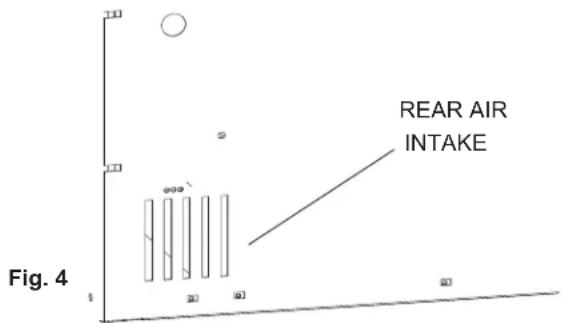
Rear air intake slots and holes should be cleaned with a damp cloth regularly. FIG 4.
WARNING
The rear air intakes must be kept clear.
Noncompliance may lead to component failure.
REPLACING SIDE MOUNTED LAMPS
- Allow oven to cool.
- Remove all racks by pulling forward, lifting up and out.
- Remove the right rack guide by lifting up and pulling out.
- Pry glass cover off by sliding a flat tool under the bottom lip of the cover.
- Replace the bulb. Gloves should be worn while handling bulbs.
- Reassemble glass cover and racks by reversing the disassembly procedure.
SERVICE AND PARTS INFORMATION
To obtain service and parts information concerning your Oven, contact the Wolf Service Depot in your area (refer to listing supplied with this oven) or Wolf Company Service Department at the address or phone number shown on the front cover of this manual.
TROUBLESHOOTING
| Problem | Possible Cause | Suggested Corrective Action |
| Uneven browning or overcooked edges. | 1. Oven is too hot.2. Too many racks used. | 1. Reduce temperature setting (refer to Cooking Guidelines).2. Use fewer racks to allow for better circulation. |
| Product pulling to edge of pan or spilling | 1. Oven is not level.2. Sheet pans are warped. | 1. Level oven racks- side to side and front to back. The rack should be level side to side and level to 1/8"(3mm) low at the front from front to back.2. Keep pans used for baking batter separate from general purpose pans. If any pan shows a tendency to warp, remove it from the baking group. |
| Excessive shrinkage. | 1. Failure to maintain water in oven.2. Roasting temperature too high. | 1. Place pan of water in bottom of oven measuring 12x20x1" (305x508x25mm).2. Reduce temperature. |
SERVICE AND PARTS INFORMATION
To obtain service and parts information concerning this model, contact the Wolf Service Agency in your area (refer to our website, www.wolfequipment.com for a complete listing of Authorized Service and Parts depots).