EasyManual
VA8214LQ - Dishwasher Atag - Free user manual and instructions
Find the device manual for free VA8214LQ Atag in PDF.



User questions about VA8214LQ Atag
0 question about this device. Answer the ones you know or ask your own.
Ask a new question about this device
Download the instructions for your Dishwasher in PDF format for free! Find your manual VA8214LQ - Atag and take your electronic device back in hand. On this page are published all the documents necessary for the use of your device. VA8214LQ by Atag.
USER MANUAL VA8214LQ Atag
Your dishwasher• Read the user manual and keep it in a safe place!
- Number of standard place settings: 14
- Never use the dishwasher for any purpose other than that specified in these operating instructions.
- Do not load the dishwasher door or dishwasher baskets with anything other than dishes.
- Never leave the dishwasher door open as someone may trip on it. Push the baskets in to avoid risking the dishwasher tipping over.
- Use only dishwasher detergent!
- This appliance can be used by children aged from 8 years and above and persons with reduced physical, sensory or mental capabilities or lack of experience and knowledge if they have been given supervision or instruction concerning use of the appliance in a safe way and understand the hazards involved. Children shall not play with the appliance. Cleaning and user maintenance shall not be made by children without supervision.
- Damaged supply cord must only be replaced by the manufacturer's service centre or someone similarly professionally qualified.
- Only use the dishwasher in household-type environments for dishwashing household dishes. All other use is prohibited.
- Never place dishes with solvent residues in the dishwasher due to the risk of explosion. Nor may dishes that contain ash, wax or lubricants be washed in the dishwasher.
- Children must be watched. Do not allow children to use or play with the dishwasher. Be especially vigilant when the door is open. Some detergent may remain inside! After adding detergent, always start the dishwasher immediately. WARNING! Knives and other pointed items must be placed with the points down in the cutlery basket or horizontally in other baskets.
Safety instructionsWARNING! Children must be supervised – dishwasher detergent is corrosive! Child lock You can activate the Automatic child lock setting to prevent children from starting the dishwasher. See the chapter Settings. You can also temporarily activate and deactivate the Child lock function. Press and hold and for three seconds. Installation See the chapter Installation. Overflow guard The overflow guard starts pumping out the water and turns off the water supply if the water level in the dishwasher exceeds the normal level. If the overflow guard is triggered, F54 (Overfilling water) appears on the display. Turn off the water tap and contact your nearest service centre. (To avoid water leakage outside the dishwasher, do not remove the plug from the wall socket until the water tap on the supply line has been turned off!) Packaging The outer packaging protects the product during transport. The packaging material is recyclable. Separate the different packaging materials to help reduce raw material use and waste. Your dealer can take the packaging for recycling or direct you to the nearest recycling centre. The packaging is comprised of:
- Corrugated cardboard made from up to 100% recycled material.
- Expanded polystyrene (EPS) with no added chlorine or fluorine.
- Supports made from untreated wood.
- Protective plastic made from polyethylene (PE). Disposal The dishwasher is manufactured and labelled for recycling. When the dishwasher has reached the end of its service life and is to be disposed of, it should immediately be made unusable. Pull out the power cable and cut it as short as possible. Remove the light source/light sources. Contact your local authority for information about where and how your dishwasher should be correctly recycled. Symbols on the appliance Read the user manual. Recycle as electrical waste. Approved in accordance with the relevant EU directives. Approved in accordance with the relevant UK legal requirements.
Safety instructionsNOTE! Follow the instructions carefully to avoid injury to persons and damage to property, and to maintain the warranty.
Safety instructionsWater hardness In order to achieve good dishwashing results, the dishwasher needs soft water (water with low mineral content). Hard water leaves a white coating on dishes and the dishwasher. Checking water hardness Water hardness is specified using German degrees of water hardness (°dH), French degrees of water hardness (°fH), English degrees of water hardness (°eH) or millimoles per litre (mmol/l). A water supply with a water hardness in excess of 5°dH (9°fH / 6°eH / 0.9 mmol/l) must be softened. This is done automatically with the aid of the built-in water softener. In order for the water softener to function properly, its settings must be adjusted to the hardness of the water supply. Once you have adjusted the water softener settings, add detergent and rinse aid in doses suitable for soft water. Contact the local waterworks to check the water hardness in your area. Make a note of the water hardness:____________ Recommended settingmmol/l°eH°fH°dH 00.0-0.90-60-90-5 11.0-1.47-1010-146-8 21.5-2.011-1415-209-11 32.1-2.515-1821-2512-14 42.6-3.419-2426-3415-19 53.5-4.325-3035-4320-24 64.4-5.231-3644-5225-29 75.3-7.037-4953-7030-39 87.1-8.850-6171-8840-49
If the water hardness exceeds 50°dH (89°fH / 62°eH / 8.9 mmol/l), we recommend connecting an external water softener. Increased consumption during regeneration The dishwasher's built-in water softener is regularly regenerated to maintain its function. Regeneration extends the dishwashing program and increases energy and water consumption. Just how often the dishwasher's water softener is regenerated depends on the selected setting. Example: If the Eco program is run with a water hardness of 14°dH (25°fH / 18°eH / 2.5 mmol/l), the water softener is regenerated at regular intervals (after 7 dishwashing cycles), energy consumption increases by 0.015 kWh, and water consumption increases by 2.3 litres, while the program time is extended by 3 minutes. Regeneration takes place during the program’s main wash.
Before washing for the first timeWARNING! Hard water leaves a white coating on dishes and inside the dishwasher. It is therefore important that you select the right setting for the water softener! See Water hardness. Never run the dishwasher with an empty salt compartment if the water supply has a water hardness in excess of 5°dH (9°fH / 6°eH / 0.9 mmol/l). Basic settings Open the door. Press . "This is a first time setup." is shown on the display. It is important that you choose the right settings to ensure good dishwashing results. Select setting with or . Confirm selected setting with . Settings Select the language to be shown on the display.Language1. Drying is faster and a better result is achieved if you use rinse aid. You will also achieve a better dishwashing result with clear and spotless dishes. Rinse aid 0/1/2/3/4/5 Pre-selected at factory: 4
The rinse aid dispenser can be adjusted between 0 (Off) and 5 (High dosage). Adjusting the water softener. Select a setting depending on the hardness of the water supply. It is important that this setting is correct! Water hardness 0/1/2/3/4/5/6/7/8/9 Pre-selected at factory: 4
For a water supply with a hardness above 5 °dH (9 °fH / 6 °eH / 0.9 mmol/l), fill with salt. For a water supply with a hardness below 6°dH (10°fH / 7°eH / 1.0 mmol/l), select 0. The water softener is deactivated and no salt needs to be added. Activate this setting when using an all-in-one detergent that contains rinse aid. TAB On/Off (All-in-one detergent)
This setting reduces the rinse aid dosage and affects how often the dishwasher's built-in softener is regenerated. Pre-selected at factory: Off To change the selected setting, see the chapter Settings.
Before washing for the first timeTop up rinse aid Top up the rinse aid compartment with rinse aid if you have selected Rinse aid 1 - 5. Lift up to open Press to close
1. Open the rinse aid compartment lid.
2. Carefully top up with rinse aid to the level marked MAX.
3. Wipe up any splashes of rinse aid around the compartment.
4. Close the lid firmly.
Top up salt For a water supply with a hardness above 5 °dH (9 °fH / 6 °eH / 0.9 mmol/l), fill with salt. Add salt to the salt compartment if you have selected Water hardness 1 - 9.
1. Remove the salt compartment lid by turning it anticlockwise.
2. Place the funnel supplied with the dishwasher in the salt compartment top-up hole. Before
washing for the first time, pour in about 1 l of water. (Water is only needed the first time.)
3. Add enough salt to fill the salt compartment (max. 750 gram). Use special dishwasher salt.
4. Wipe away excess salt and turn the lid clockwise until in the closed position.
WARNING! In order to avoid rust stains a dishwashing program must be started immediately after adding salt. Never pour dishwasher detergent into the salt compartment. This destroys the water softener!
Before washing for the first timeSave energy and water When using a dishwasher in a residential setting, less energy and water are generally used compared to washing the dishes by hand. Do not rinse under running water Do not rinse the dishes under running water as this will lead to increased energy and water consumption. Simply scrape off large food particles before loading the dishwasher. Choose a green detergent Read the environmental declaration on the packaging! Too much detergent, rinse aid and salt can result in less effective dishwashing and also entail greater environmental impact. Run a fully loaded dishwasher Save energy and water by waiting until the dishwasher is full before running a program (see number of standard place settings). Use the Rinse and hold program to rinse the dishes if there are any unpleasant odours. You can also use the Anti-odour program to prevent bad odours from dirty dishes left in the dishwasher. Run programs at a lower temperature If the dishes are only slightly dirty, you can select a program with a low temperature. Select dishwashing program – Eco This program is suitable for washing normally soiled dishes and is the most effective program in terms of combined energy and water consumption. This program is used to assess compliance with EU legislation on ecodesign. The dishwashing program is designed for an effective wash using as little energy and water as possible. The program washes at a low temperature for a long time. Select option – Automatic door opening Better drying results are achieved if you use the Automatic door opening option, which automatically opens the dishwasher door. Wait until the dishwasher indicates that the program has ended and the dishes have cooled before unloading the dishwasher. Connect to cold water Connect the dishwasher to the cold water supply if the building is heated using oil, electricity or gas. Connect to hot water Connect the dishwasher to the hot water supply (max. 70 °C) if the building is heated using an energy-efficient means such as district heating, solar power or geothermal power. Choosing a hot water connection reduces the dishwasher's energy consumption. NOTE! Do not exceed the permitted water supply temperature. Certain materials used in some cookware cannot withstand high heat. See Fragile dishes in the chapter Loading the dishwasher.
Greener dishwashingFragile dishes Some cookware is not dishwasher safe. This can be for several reasons. Some materials cannot withstand high heat, others can be damaged by dishwasher detergent. Exercise caution with, for example, handmade items, fragile decoration, crystal/glassware, silver, copper, tin, aluminium, wood and plastic. Look for the "Dishwasher safe" marking. Fragile decoration Porcelain with decoration on top of the glazing (the items feel rough) should not be washed in a dishwasher. Crystal/Glass Wash fragile items made of crystal/glass using the gentle dishwashing program Crystal glass. Remember to use a small amount of detergent and to place items so that they do not touch each other during the wash. Drying is faster and a better result is achieved if you use rinse aid. You will also achieve a better dishwashing result with clear and spotless dishes. Hand-painted glassware, as well as antique and very fragile items, should not be washed in a dishwasher. Silver Silver and stainless steel items should not come into contact, as the silver can become discoloured. In order to avoid marks and tarnishing, separate dishes made from different metals, such as silver, stainless steel and aluminium. Aluminium Aluminium can lose its shine if washed in a dishwasher. However, good quality aluminium pans can be washed in a dishwasher, even if some of the shine will be lost. Cutlery with glued handles Some types of glue are not dishwasher safe. In such cases, the handles may loosen. Loading affects the results Load the dishes carefully to ensure the best washing and drying results with the lowest possible energy and water consumption. Give your dishwasher the best chance to reach and clean all surfaces, as well as to dry the dishes as thoroughly as possible.
- All dirty surfaces should face inwards and downwards!
- Dishes should not be placed in or on each other.
- Angle dishes with hollows, such as cups, so that the rinse water will run off. This is also important for plastic items.
- Make sure small items cannot fall through the dishwasher basket; place them in the top cutlery tray. NOTE! Check that the spray arms can rotate freely.
Loading the dishwasherThe dishwasher's baskets The dishwasher is equipped with a top cutlery tray, an upper basket and a lower basket with a cutlery basket. The appearance of the baskets may differ depending on the dishwasher setup. Top cutlery tray The top cutlery tray has space for cutlery, ladles, whisks, serving cutlery and similar items. Avoid placing tall objects in the top cutlery tray. They can block the top spray arm. Raising the top cutlery tray
1. Pull out the top cutlery tray.
2. Pull forward the two locking handles on either side to raise the top cutlery tray.
Lowering the top cutlery tray
1. Make sure the upper basket is in the lowest position.
2. Pull out the top cutlery tray.
3. Slide the two locking handles on either side downwards and backwards to lower the top cutlery
Loading the dishwasherUpper basket Place glasses, cups, bowls, side plates and saucers in the upper basket. All dirty surfaces should face inwards and downwards! Wine glasses are placed on the wine glass shelf and knives are placed in the knife stand on the right. Knife stand Raising the upper basket
1. Pull out the upper basket.
2. Grab the sides of the upper basket with both hands and lift it up.
2. Grab the sides of the upper basket with both hands and push in the two locking handles to lower
Loading the dishwasherLower basket Place plates, side plates, serving dishes, pots and cutlery (in the cutlery basket) in the lower basket. Adjustable plate supports The adjustable plate supports can be adjusted to suit the dishes. Release the plate supports by pushing them inwards before repositioning them. The plate supports can also be folded down to make it easier to load pots and bowls.
Loading the dishwasherAdaptable power zones The dishwasher's two adaptable power zones can be opened in two different positions or turned off. For vases and slim items For pots and pans For higher spray pressure in the lower spray arm Pre-selected at factory: Off Leave the power zones open if you want an increased water flow where, for example, you have placed pots and pans or vases and slim items. Turn the dishwasher’s power zones off if you want greater spray pressure in the lower spray arm. Washing large plates You can adjust the lower basket for plates with a diameter of 25-39 cm by moving the adjustable plate supports and their fixtures to increase the distance between the tine rows. Cutlery basket Place cutlery with the handles facing down, except for knives, and spread them out as much as possible. Ensure that spoons do not stack inside each other. The cutlery basket is best placed in the middle at the front of the lower basket to best utilise dishwashing performance from the unique spray zone intended for the cutlery basket. WARNING! Knives and other pointed items must be placed horizontally in the dishwasher's special cutlery baskets. Fold-down section for small items The cutlery basket has a fold-down section in the middle for small items or small shafts (such as electric whisk attachments).
Loading the dishwasherAdd detergent Follow the instructions on the detergent packaging. This dishwasher is fitted with a water softener, so use detergent and rinse aid doses suitable for soft water. Too much detergent can result in less effective dishwashing and also entails greater environmental impact. Press to open Close the lid Prewash detergent Main wash detergent The detergent compartment must be dry when adding detergent. There is one compartment for the prewash and one for the main wash. If dishwasher detergent powder or dishwasher detergent gel is used, you can add a small amount of the detergent to the prewash compartment. Contact the detergent manufacturer if you have questions about the detergent. NOTE! Use only dishwasher detergent! Washing up liquid must not be used as the foam that forms prevents the dishwasher from operating effectively. All-in-one detergent There are many types of all-in-one detergents on the market. Read through the directions for these products carefully. Activate the TAB setting when using an all-in-one detergent that contains rinse aid. Dishwasher tablets are not recommended for programs lasting less than 75 minutes. Use dishwasher detergent powder or dishwasher detergent gel instead. NOTE! Optimal washing and drying results are achieved by using dishwasher detergent together with separately dispensed rinse aid and salt.
Using the dishwasherStart/Stop Select program modeSelect program Select option On/Standby mode On/Standby mode Open the door and press . Also turn on the water tap if it is turned off. Select program Eco is always pre-selected. To select another program, press or until the desired program is shown on the display. Select a program to suit the type of dishes and how dirty they are. Eco This program is suitable for washing normally soiled dishes and is the most effective program in terms of combined energy and water consumption. This program is used to assess compliance with EU legislation on ecodesign. You can read more about greener dishwashing in the chapter Greener dishwashing. For heavily soiled dishes with a lot of grease, a program with higher temperatures should be used. Auto The dishwasher can measure how dirty the dishes are and adjust water consumption and temperature accordingly. When newly installed, the program needs to be run five times before it is fully adapted and can provide the best results. Universal An effective program for daily use for slightly dried leftovers. (This program is not intended for burnt food, such as on oven dishes.) Intensive A program with a high temperature for dissolving grease on very dirty dishes, such as pans, casserole dishes and oven dishes. If these dishes do not completely fill the dishwasher, you can add plates and other dishes.
A fast and effective program for slightly dried leftovers. (This program is not intended for burnt food, such as on oven dishes.) The Automatic door opening option is important for ensuring the best drying results. Preheated (30 min + 20 min) A dishwashing program with a preheating phase (the water is heated for 30 min) and a dishwashing phase (the dishes are washed for 20 min). This program is designed to offer you a quick dishwashing program that can be started within 180 minutes of the preheating phase ending. Step 1: To start the preheating phase, press . Close the door. (The spray arms rotate and the status light is red while the water is being preheated.) Wait until the status light turns blue. When you open the door, the display shows "Preheating phase completed", indicating that the dishwashing phase is ready to be started within 180 minutes. You can load the dishes throughout the preheating phase. This program is not intended for dried leftovers. Remember to scrape off larger food particles before loading the dishwasher. Step 2: To start the dishwashing phase, press . Crystal glass A gentle dishwashing program with a low temperature for washing fragile items made of crystal/glass. Remember to use a small amount of detergent and to place items so that they do not touch each other during the wash. See also Fragile dishes in the chapter Loading the dishwasher. Porcelain that has just been used without dried leftovers can also be washed using this program. Time program The program adapts to the specified running time or finish time. With this program it is important to choose a time suited to how dirty the dishes are. Press to set the desired program time. Slightly dirty dishes0:15-0:45 Normally dirty dishes1:00-1:30 Very dirty dishes2:00-2:30 Hygiene This program is ideal to use where demands on hygiene are extra high, e.g. for baby bottles and cutting boards. The temperature is high both in the main wash and in the final rinse. Plastic A program intended for washing plastic items that are dishwasher safe. This program has an extra long drying cycle. Porcelain and glasses can also be washed.
When combined with Speed, the program is shortened (39 minutes).
Using the dishwasherRinse and hold Used to rinse dishes while you wait for the dishwasher to become fully loaded. Self-cleaning Self-cleaning program for hygienic cleaning of the dishwasher tub, spray arms and spray pipes. This program should be run (with no dishes in the machine) using dishwasher detergent or citric acid. Special dishwasher cleaners are also available on the market. For the removal of limescale deposits, see Dishwasher tub in the chapter Care and cleaning. Lower half You can use this program when you only want to wash plates and cutlery in the lower basket. Slightly dirty dishes can also be placed in the upper basket. Upper half You can use this program if you only have cups and glasses that need washing in the upper basket. Slightly dirty dishes can also be placed in the lower basket. Anti-odour
This program prevents bad odours from dirty dishes left in the dishwasher. Only the dishwasher’s fan is activated (at regular intervals during a period of 72 hours). Select program mode Press to scroll through the available program modes. The symbol is dimly lit in available program modes, and glows brighter when a program mode has been activated. (The program modes you can select vary between programs.) Speed The program time is shortened, but the dishwasher uses more energy. Green The dishwasher uses less energy and water. Night Lower noise level during the dishwashing program. The program time is extended. Intensive The higher temperature dissolves grease on very dirty dishes, but the dishwasher consumes more energy and water. The program time is extended.
Using the dishwasherSelect option Available options are dimly lit. Select the options ( , ) to activate them. The options glow brighter when activated. (The options you can select vary between programs.) Delayed start When you select Delayed start, the dishwasher will start 1-24 hours after you have pressed and closed the door.
Press once to activate Delayed start. Press several times, or hold it in, to set the desired number of hours.
Press and close the door. The timer counts down and the dishwasher starts after the selected delay. If you want to cancel the Delayed start option, open the door then press and hold for three seconds. Automatic door opening The dishwasher door opens during the drying phase, which shortens the program time and improves the drying results. Wait until the dishwasher indicates that the program has ended and the dishes have cooled before unloading the dishwasher. The drying time of the Automatic door opening option varies (from 5 to 90 minutes) depending on the model, program and temperature of the final rinse. The Automatic door opening option is pre-selected for some programs. NOTE! For the best drying results, do not close the door before the drying phase has finished and the machine has automatically switched off. WARNING! The dishwasher door must not be blocked or closed when opened automatically. Doing so may damage the door lock mechanism. Wait at least 5 minutes before closing the door. Start/Stop Press until the display shows "Program started, close door". This indicates that the dishwasher is ready to start. Close the door properly, otherwise the dishwasher will not start. If the dishwasher is not started or the door is not closed within 2 minutes of the last time the control panel was pressed, the machine switches off. To remote start the dishwasher, see the chapter ConnectLife. Stopping or changing a program If you want to change program after starting the dishwasher, open the door then press and hold for three seconds. Add more detergent if the lid of the detergent dispenser has opened. Then select a new program, press and close the door.
Using the dishwasherRemaining time Once you have selected a program, program mode and options, the time the program took when last used is displayed. Once you have started the dishwasher, the display shows the remaining program time. The remaining time is updated during the drying phase. This may differ somewhat from time to time depending on the temperature of the water supply, the amount of dishes, the ambient temperature and other factors. During the first run of each program, the remaining time displayed can be slightly misleading, as the dishwasher is estimating the time. When you run the program a second time, the dishwasher will calculate the remaining time based on the previous duration of the program. Status light The remaining cleaning cycle time is projected onto the floor. The colour indicates the current status. Status light Blue - Load more The program has started, but you can still load more dishes. Red - Do not load You should not load more dishes (risk of poorer dishwashing result). Green - Unload The dishwashing program is finished. The status light stays on for 15 minutes. Flashing red A flashing light indicates that the door has been opened while a program is in progress. If it flashes when the door is closed, an error has occurred. See the chapter Troubleshooting. Flashing blue/green The status light flashes blue/green to indicate that remote start is activated. If you want to load more dishes
Open the door. The dishwasher stops automatically. Add the dishes and close the door. After a while, the dishwasher continues the program. If the dishwashing program was remote started, the interrupted program will continue once the door is closed. You can monitor the dishwasher using the ConnectLife app and remote stop the program, although you will not be able to remote start it again.
You should not load more dishes if the status light is red.
Using the dishwasherPower failure If the dishwasher is turned off due to a power failure when a dishwashing program is running, the program continues when power is restored. If the power is cut during drying, the program is interrupted. If the dishwashing program was remote started and has not ended, the program will continue once the power is restored. You can monitor the dishwasher using the ConnectLife app and remote stop the program, although you will not be able to remote start it again. If you open the door for more than 2 minutes during drying, the program will be interrupted. Once the program has finished The end of the program is indicated by one short signal from the buzzer. The chapter Settings describes how to change this function. Moreover, the end of the program is indicated by the status light turning green. Once the dishwasher door is opened and the program has finished "Program done" appears on the display. The dishwasher automatically enters standby mode after the program has finished. Shut off the water tap after each use (if required by your insurance company). The best drying results
- Fully load the dishwasher.
- Angle dishes with hollows, such as cups, so that the rinse water will run off. This is also important for plastic items.
- Top up with rinse aid or increase the rinse aid dosage setting.
- Activate the Automatic door opening option.
- Allow the dishes to cool before unloading the dishwasher. Unloading the dishwasher Hot porcelain is more fragile. Leave the dishes to cool in the dishwasher before unloading them. Unload the lower basket first to avoid any water drops from the upper basket falling onto the dishes in the lower basket.
Final rinse Number of rinses Main washNumber of prewashes Program mode / Option Program Water cons. (liter) Hot water
Energy (approx. kWh) Dishwashing time (approx. hrs:min) Energy (approx. kWh) Dishwashing time (approx. hrs:min)
3.50.010:070.010:071Rinse and hold
Consumption values vary depending on the temperature of the incoming water, room temperature, load size, selected additional functions and more. The values for the Eco program are accurate, others are indicative only.
Connection to cold water, approx. 15 °C.
Connection to hot water, approx. 60 °C.
This program is suitable for washing normally soiled dishes and is the most effective program in terms of combined energy and water consumption. This program is used to assess compliance with EU legislation on ecodesign.
Program chartConnectLife is a smart home platform that connects people, devices and services. The ConnectLife application includes advanced digital services and carefree solutions that allow users to monitor and control appliances, receive notifications from a smartphone, and update software (supported features may vary depending on your appliance and the region/country in which you are located). To connect your smart device, you need a home Wi-Fi network (only 2.4 GHz networks are supported) and a smartphone equipped with the application ConnectLife. To download the ConnectLife application, scan the QR code or search for ConnectLife in your favourite app store.
1. Install the ConnectLife application and create an account.
2. In the ConnectLife application, go to the »Add devices« menu and select the appropriate type
of device. Then scan the QR code (it can be found on the serial number plate of the appliance; you can also enter the AUID/SN number manually).
3. The application then guides you through the entire process of connecting the appliance to your
4. After a successful connection, the appliance can be operated remotely via the mobile application.
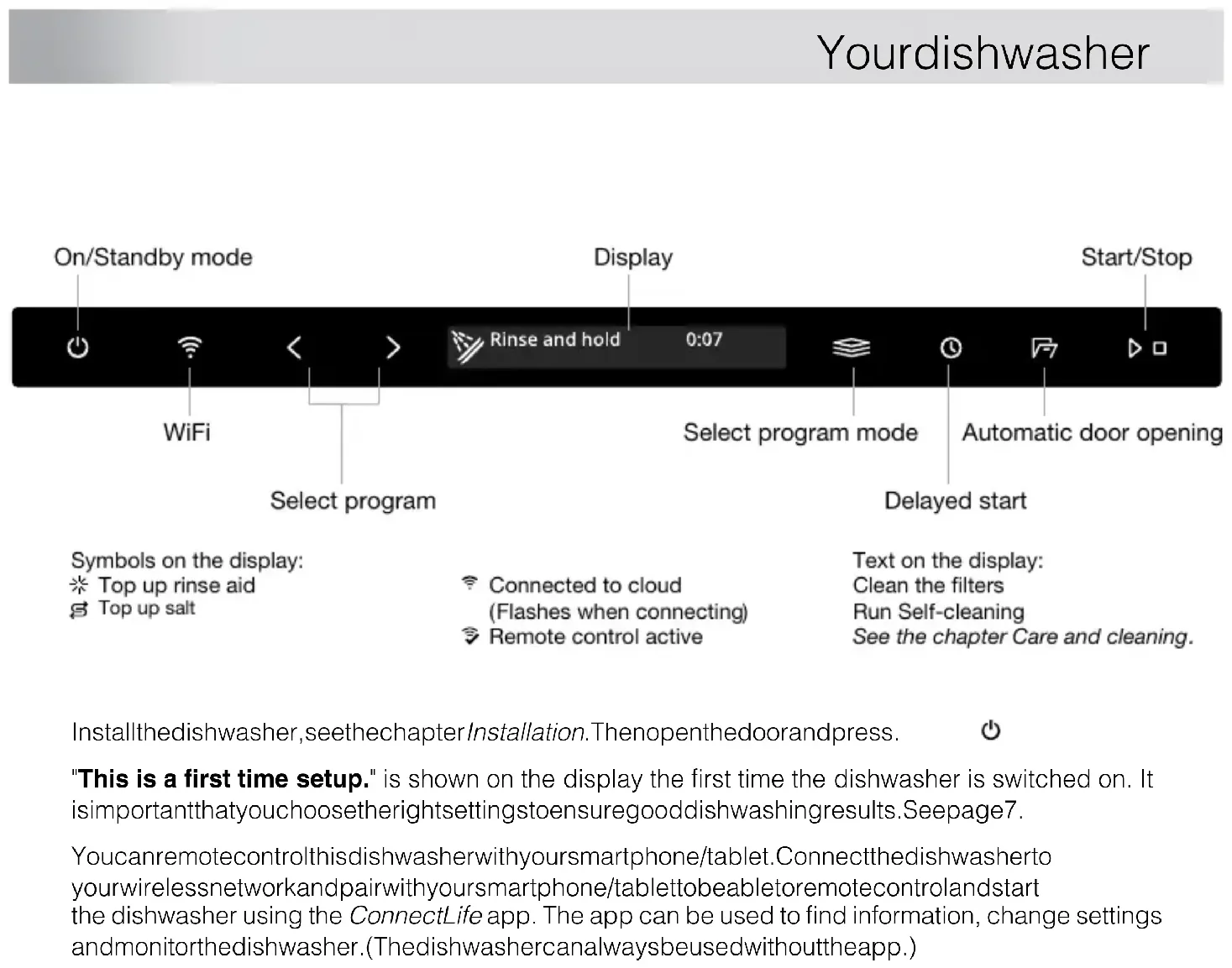
WiFi Display Start/StopOn/Standby mode Connect to a network and pair Connect the dishwasher to your wireless network and pair with your smartphone/tablet. (This can also be done from the dishwasher's Settings menu.)
- In the ConnectLife application, go to the »Add devices« menu and select the appropriate type of device. Then scan the QR code (it can be found on the serial number plate of the appliance; you can also enter the AUID/SN number manually).
On the dishwasher's control panel: Press to activate the WiFi module.
On the dishwasher's control panel: Press and hold for 3 seconds to initiate Connection setup. Network symbol on the display The dishwasher is ready to be connected to your wireless network or paired with your smartphone/tablet. Flashing 0.5 sec on/off The dishwasher is connected to your wireless network.Flashing 1.0 sec on/off The dishwasher is connected to your wireless network and the cloud.Glows
ConnectLifeRemote control the dishwasher The dishwasher's network symbol is shown on the display when the dishwasher is paired with a smartphone/tablet. You can use the ConnectLife app to monitor the dishwasher and change settings. Remote start the dishwasher To remote start the dishwasher, press . Remote start activated will appear on the dishwasher's display. Close the door. The status light will flash blue/green to indicate that remote start is activated. In the ConnectLife app, select and start a program. If the door is not closed within 2 minutes, the machine switches off. NOTE! The dishwasher can always be used without the app. When the dishwasher's control panel is pressed, commands from the ConnectLife app are blocked for 10 seconds. Pair more devices Pair more devices/users with the dishwasher. (This can also be done from the dishwasher's Settings menu.)
- In the ConnectLife application, go to the »Add devices« menu and select the appropriate type of device. Then scan the QR code (it can be found on the serial number plate of the appliance; you can also enter the AUID/SN number manually).
On the dishwasher's control panel: Press and hold for 4 seconds to initiate Add device. WiFi connection Off / WiFi connection On After connecting the dishwasher to your local network, you can select WiFi connection Off to deactivate the connection. Select WiFi connection On to reconnect to the same network. (This can also be done from the dishwasher's Settings menu.)
On the dishwasher's control panel: Press and hold for 8 seconds to select WiFi connection Off. Briefly press to select WiFi connection On again. Remove all devices Remove all connected devices/users. (This can also be done from the dishwasher's Settings menu.)
On the dishwasher’s control panel: Press and hold until Add device is shown on the display. Once a countdown has begun, press and hold for 3 seconds. Remove all devices indicates that all devices/users have been erased. Do you have questions? Please visit us at www.connectlife.io or contact us at hello@connectlife.io.
ConnectLifeOpen the door and press . To open the dishwasher's Settings menu, press or until Settings menu is shown on the display and confirm your selection with . To exit the dishwasher's Settings menu, select Exit and confirm your selection with . Confirm settingSelect setting AlternativesSettings You can choose the language used for the display.Language1. The current WiFi status is shown on the display.Network2. Connect the dishwasher to your wireless network to be able to remote control the dishwasher using the ConnectLife app. WiFi status On/OffWiFi connection After connecting the dishwasher to your local network, you can select WiFi connection Off to deactivate the connection. Select WiFi connection On to reconnect to the same network. Connect the dishwasher to your wireless network and pair with your smartphone/tablet. Connection setup
- In the ConnectLife application, go to the »Add devices« menu and select the appropriate type of device. Then scan the QR code (it can be found on the serial number plate of the appliance; you can also enter the AUID/SN number manually).
- Select Connection setup. Pair more devices/users with the dishwasher.Add device
- In the ConnectLife application, go to the »Add devices« menu and select the appropriate type of device. Then scan the QR code (it can be found on the serial number plate of the appliance; you can also enter the AUID/SN number manually).
- Select Add device. Select Remove all devices to remove all connected devices/users.Remove all devices Select WiFi factory reset to restore the default factory settings.WiFi factory reset Select Exit to exit the menu for Network, press .Exit
SettingsAlternativesSettings Programs can be shown or hidden in the menu. Choose between On and Off. Eco On/Off Auto On/Off Universal On/Off Intensive On/Off Quick pro On/Off Preheated On/Off Crystal glass On/Off Time program On/Off Hygiene On/Off Plastic On/Off Rinse and hold On/Off Self-cleaning On/Off Lower half On/Off Upper half On/Off Anti-odour On/Off Select programs3. (Eco cannot be hidden in the menu.) You can activate the Automatic child lock setting to prevent children from starting the dishwasher. On/OffAutomatic child lock4. To temporarily deactivate or activate the Automatic child lock setting, press and hold and for three seconds. For adjusting the brightness of the display.1/2/3/4Display: Brightness5. A beep confirms that the control panel has been pressed. 0/1/2/3Feedback volume6. The buzzer indicates when a dishwashing program has ended. 0/1/2/3Notification volume7. Error messages are always indicated by a loud buzzer. Setting for rinse aid dosage. The rinse aid dispenser can be adjusted between 0 (Off) and 5 (High dosage). 0/1/2/3/4/5Rinse aid8. Increase the rinse aid dosage:
- If the dishes have water marks. Decrease the rinse aid dosage:
- If the dishes have a sticky white/blue film.
- If the dishes are streaked.
- Build-up of foam. If you have very soft water, the rinse aid can be diluted 50:50 with water.
SettingsAlternativesSettings Adjusting the water softener. Select a setting depending on the hardness of the water supply. It is important that this setting is correct! 0/1/2/3/4/5/6/7/8/9Water hardness9. See Water hardness in the chapter Before washing for the first time. For a water supply with a hardness above 5 °dH (9 °fH / 6 °eH / 0.9 mmol/l), fill with salt. For a water supply with a hardness below 6°dH (10°fH / 7°eH / 1.0 mmol/l), select 0. The water softener is deactivated and no salt needs to be added. Activate this setting when using an all-in-one detergent that contains rinse aid. On/OffTAB (All-in-one detergent)
This setting reduces the rinse aid dosage and affects how often the dishwasher's built-in softener is regenerated. The Super rinse function rinses the dishes an extra two times. On/OffSuper rinse11. The program time is extended and the dishwasher uses more energy and water. Activated in the following programs: Universal Intensive Quick pro Hygiene Plastic Lower half Upper half Select whether the interior light is to be switched on when the dishwasher is turned off and the door is opened. (If is turned on, the interior light is always switched on when the door is opened.) On/OffInterior light at power off
When Odour control is activated, Anti-odour can be selected from the program table. On/OffOdour control13. Any error messages.Failure readout14. When contacting your service centre, you may be asked to provide the most recent error messages. Restores all settings to the factory defaults.Factory reset15. Select Factory reset and press .
SettingsTop up rinse aid When the rinse aid needs topping up, the symbol lights on the display. See the chapter Before washing for the first time. Top up salt When the salt needs topping up, the symbol lights on the display. See the chapter Before washing for the first time. Clean the filters Coarse filter The coarse filter traps larger food particles, which cannot get past the drainage pump. Empty the coarse filter when necessary. It should be cleaned at regular intervals depending on how often the dishwasher is used. Coarse filter
1. Lift the coarse filter by the handle.
2. Empty the coarse filter.
3. Refit the coarse filter. Press it down until it clicks into place.
Care and cleaningFine filter Debris that collects on the fine filter is automatically rinsed away during each wash. Clean the fine filter when necessary. It should be cleaned at regular intervals depending on how often the dishwasher is used. Fine filter
1. Turn the locking ring anticlockwise and lift the fine filter straight up.
2. Clean the fine filter.
3. Refit the fine filter and turn the locking ring clockwise to its stop position. Check that the edges
seal properly. Remember to refit the coarse filter! NOTE! Dishwashing results may be affected if the coarse and fine filters are incorrectly fitted. The dishwasher must not be used without the filters in place! Check that the yellow drainage pump stop (on the right in the bottom drain) is in place.
Care and cleaningCleaning the spray arms Holes and bearings can sometimes become blocked. Remove any debris using a pin or the like. The spray arms also have holes underneath. To facilitate cleaning you can remove the spray arms. Remember to fit them firmly back into place afterwards. Top spray arm
- Pull out the top cutlery tray. Push up on the top spray arm while turning it anticlockwise to release it. Upper spray arm
- Pull out the upper basket.
- Unscrew the spray arm bearings anticlockwise to remove the spray arm from the upper basket. Lower spray arm
- Pull the lower spray arm straight up to release it.
Care and cleaningClean the outside of the dishwasher Door and door seal Open the door. Clean the sides of the door and the door seal regularly with a slightly damp cloth. Clean the door seal at the lower front edge of the dishwasher with a washing-up brush. Control panel Keep the control panel clean. If necessary, wipe it with a dry or slightly damp cloth. Never use cleaning products – they may scratch the surface. Run Self-cleaning Dishwasher tub The dishwasher tub is made of stainless steel and is kept clean through normal use (when used regularly). If you have hard water, limescale deposits may build up in the dishwasher. If this happens, run the Self-cleaning program with two tablespoons of citric acid in the detergent compartment (with no dishes in the machine). Special dishwasher cleaners are also available on the market. Remove blockages Unblocking the drainage pump If the dishwasher still contains water after the program has finished, something may be blocking the drainage pump, which results in the error message Water outlet fault or BLDC drain pump fault.
Turn off the machine using and remove the plug from the wall socket.
2. Remove the coarse filter and the fine filter.
3. Scoop out the water from the dishwasher tub.
4. In order to inspect the drainage pump, remove the yellow drainage pump stop on the right in
the bottom drain. (Use a pair of pliers if necessary.)
5. Turn the pump wheel located behind the drainage pump stop by hand. Carefully remove any
sharp items, such as glass.
6. Refit the drainage pump stop along with the fine and coarse filters.
7. Plug the machine in again.
Care and cleaningDrainage pump stop NOTE! Do not forget to refit the drainage pump stop. Unblocking the inlet hose filter If the water supply contains small particles, the outer filter on the inlet hose may become blocked, which results in the Water inlet fault error message.
Turn off the machine using and remove the plug from the wall socket.
2. Turn off the water tap.
3. Unscrew the inlet hose.
4. Carefully remove the outer filter from the inlet hose and clean it.
5. Refit the filter and check that the gasket is correctly positioned.
6. Screw the inlet hose firmly into place.
7. Plug the machine into the wall socket and turn on the water tap. Allow the pressure to settle for
a while and check that the connection is watertight. Outer filter on inlet hose Gasket Winter storage/Transport Store the dishwasher above freezing temperature and avoid long transport distances in very cold weather. Transport the dishwasher upright or laying on its back. Before transporting a used dishwasher, or before prolonged storage, water must first be removed from the machine. Run the Self-cleaning program.
Care and cleaningActionError messages Unblocking the drainage pump. See the chapter Care and cleaning. If the problem persists, contact your nearest service centre. Overfilling water 1F10 See "Water remains in the dishwasher" under "Problem" in the table below. If the problem persists, contact your nearest service centre. Water outlet faultF11 Check that the water tap is on. Check that the outer filter on the inlet hose is not blocked. See Unblocking the inlet hose filter in the chapter Care and cleaning. If the problem persists, contact your nearest service centre. Water inlet fault 1F12 Turn off the water tap and contact your nearest service centre.Inlet valve leakageF40 Turn off the water tap. Remove the plug from the wall socket and contact your nearest service centre. Heater fault 1F41 Run any dishwashing program. If the problem persists, contact your nearest service centre. Diverter faultF45 Clean the coarse and fine filters. Check that the outer filter on the inlet hose is not blocked. If the problem persists, contact your nearest service centre. Water level faultF52 Turn off the water tap and contact your nearest service centre.Overfilling water 2F54 To avoid water leakage outside the dishwasher, do not remove the plug from the wall socket until the water tap on the supply line has been turned off! Run any dishwashing program. If the problem persists, contact your nearest service centre. Circulation pump faultF56 Check that the water tap is on. Check that the outer filter on the inlet hose is not blocked. See Unblocking the inlet hose filter in the chapter Care and cleaning. If the problem persists, contact your nearest service centre. Water inlet fault 2F67 See "Water remains in the dishwasher" under "Problem" in the table below. If the problem persists, contact your nearest service centre. BLDC drain pump faultF68 Press any button to clear the error message.
TroubleshootingGeneral ActionPossible causesProblem Wait a moment then try again.You have pressed the control panel too soon after opening the door. The control panel does not react when pressed. See the chapter Safety instructions. Child lock or Automatic child lock is activated. Open the door. The control panel only reacts to use when the door is open. The door is closed. Clean with a dry or slightly damp cloth. Dirt on the control panel. Turn off the water tap. Remove the plug from the wall socket and wait for 60 seconds. Then plug the appliance back into the wall socket and turn on the water tap. The control panel requires calibration. Check that the baskets are correctly positioned horizontally. The baskets are not correctly positioned. Cannot close door. Check that the dishes are not blocking the baskets from sliding properly into place. Open the door. Press and hold and until "Auto door open recovery" is shown on the display, wait until the message disappears. Close the door and check that the door lock is working. The door lock does not click into place and lock.
TroubleshootingActionPossible causesProblem Press until the display shows "Program started, close door". has not been pressed. The dishwasher does not start. Check.The door is not properly closed. Close the door and wait. After a while, the dishwasher continues the program. The dishwasher has been opened while a program is in progress. Open the door. Press and hold and until "Auto door open recovery" is shown on the display, wait until the message disappears. Close the door and check that the door lock is working. The door lock has not clicked into place and locked. Press and hold for three seconds if you want to cancel the Delayed start option. Check whether the Delayed start option has been selected. Check.The plug is not plugged into the wall socket. Check.A fuse/circuit breaker has been tripped.
TroubleshootingActionPossible causesProblem Check that the dishes are not blocking the spray arms. The spray arms are not rotating freely. The dishes are not clean. Clean the spray arms. See the chapter Care and cleaning. Spray arm holes or bearings blocked. Select a program with Intensive. The program will use a higher temperature to dissolve grease on very dirty dishes. Unsuitable dishwashing program. Dose according to water hardness. Far too much or far too little detergent results in poorer dishwashing results. Incorrect detergent dosage. Avoid large packages.Old detergent. Detergent is a perishable product. Do not cover porcelain with large bowls or the like. Avoid placing very tall glasses in the corners of the baskets. See the chapter Loading the dishwasher. Dishes loaded incorrectly. Place dishes to sit steady.Glasses and cups have toppled over during the program. Clean the coarse and fine filters.The filters are clogged. Check that the filters are fitted correctly. See the chapter Care and cleaning. The filters are not fitted correctly. Check that the yellow drainage pump stop (on the right in the bottom drain) is in place. See the chapter Care and cleaning. Drainage pump stop missing. Rinse off these types of foodstuffs if not starting the dishwasher immediately. Use the Rinse and hold program. Some foodstuffs, such as mustard, mayonnaise, lemon, vinegar, salt and dressings, can cause spots on stainless steel if left for too long. Spots on stainless steel or silver. In order to avoid marks and tarnishing, separate dishes made from different metals, such as silver, stainless steel and aluminium. All stainless steel can cause spots on silver if they come into contact during dishwashing. Aluminium can also cause spots on dishes.
TroubleshootingActionPossible causesProblem See the chapter Settings.Incorrect rinse aid dosage setting. Spots or films on the dishes. Switch all-in-one detergents or deactivate the setting TAB and top up with salt and separate rinse aid. See Rinse aid in the chapter Settings. The setting TAB is activated and all-in-one detergent with insufficient drying effect is being used. Top up with salt. See the chapter Care and cleaning. Salt compartment empty. See Water hardness in the chapter Settings. Incorrect water softener setting. Check that the salt compartment lid is tightened clockwise to its end position. Otherwise contact your nearest service centre. The water softener is leaking salt. Wash crystal at a low temperature and with a conservative amount of detergent. Contact the detergent manufacturer. Too high temperature and/or too much detergent can cause etching on crystal. Unfortunately, this cannot be repaired, only prevented. Reduce the dosage. See the chapter Settings. If you have very soft water, you may want to dilute the rinse aid 50:50 with water. Rinse aid dosage setting too high. The dishes have a sticky white/blue film. Use a detergent with a bleaching agent. Lipstick and tea/coffee stains can be difficult to remove. Spots left after washing. The detergent compartment must be dry when adding detergent. The detergent compartment was damp when adding detergent. Detergent residue in the detergent compartment after dishwashing. Check that the dishes are not preventing the detergent compartment from opening. The detergent compartment has been blocked. Check that the dishes are placed securely. Spin the spray arms to make sure they can rotate. The dishes are not correctly placed or the spray arms are not rotating freely. Rattling sound when dishwashing.
TroubleshootingActionPossible causesProblem Clean the coarse and fine filters.The filters are clogged.Water remains in the dishwasher. Check that the filters are fitted correctly. See the chapter Care and cleaning. The filters are not fitted correctly. Clean the drainage pump. See the chapter Care and cleaning. Debris in the drainage pump. Check that the yellow drainage pump stop (on the right in the bottom drain) is in place. See the chapter Care and cleaning. Drainage pump stop missing. Check that the hose is free from kinks and sharp bends. Kink in drainage hose. Disconnect the drainage hose where it connects to the sink unit's water trap. Check that no debris has fastened and that the connection has an inner diameter of at least 14 mm. Blocked drainage hose. Clean with washing-up brush and low foaming cleaner. Dirt around the seals and in corners. Bad odour in dishwasher. Run a program with a high temperature once or twice a month. Or run a self-cleaning program. See Self-cleaning in the chapter Using the dishwasher. Low temperature programs have been selected for a prolonged period. Select a program with Intensive. The program will use a higher temperature to dissolve grease on very dirty dishes. Or run a self-cleaning program once or twice a month. See Self-cleaning in the chapter Using the dishwasher. Low temperature programs have been selected for a prolonged period. Grease deposits in the dishwasher.
TroubleshootingActionPossible causesProblem Activate the Automatic door opening option. The Automatic door opening option is not activated. The dishes are not dry enough. Fully load the dishwasher.The dishwasher is not fully loaded. Top up with rinse aid or increase the rinse aid dosage setting. Rinse aid needs topping up or dosage is set too low. Switch all-in-one detergents or deactivate the setting TAB and top up with salt and separate rinse aid. See Rinse aid in the chapter Settings. The setting TAB is activated and all-in-one detergent with insufficient drying effect is being used.
TroubleshootingWiFi ActionPossible causesProblem Connect the dishwasher to your wireless network. See the chapter ConnectLife. The dishwasher is not connected to your wireless network. The dishwasher's network symbol does not appear on the display. Activate WiFi connection.WiFi connection is deactivated. See WiFi connection Off / WiFi connection On in the chapter ConnectLife. Check that the router is connected to the internet. The dishwasher cannot access your wireless network. Or the router is not connected to the internet. Connection setup failed Make sure your wireless network is using 2.4 GHz and is visible. Try moving the router closer to the dishwasher if the signal is too weak. See also troubleshooting at www.connectlife.io. If the problem persists, contact your nearest service centre. Check that the router is connected to the internet. Your smartphone/tablet is not connected to your wireless network. Or the router is not connected to the internet. Add device failed Check that your smartphone/tablet is connected to your wireless network. See also troubleshooting at www.connectlife.io. If the problem persists, contact your nearest service centre. Activate WiFi connection.WiFi connection is deactivated.The dishwasher is shown as disconnected in the ConnectLife app. See WiFi connection Off / WiFi connection On in the chapter ConnectLife. See also troubleshooting at www.connectlife.io. If the problem persists, contact your nearest service centre. Make sure that the power supply is not interrupted and that the network connection is stable before trying again. If the problem persists, contact your nearest service centre. The network connection was lost or the dishwasher lost power due to a power failure. Software update failed.
TroubleshootingIt is important that you read through and follow the instructions and directions below. Conduct installation and connection in accordance with the separate installation instructions. 859*- 912
*Remove the locking nuts when installing in a recess measuring 860-861 mm. Cover door length. Nominal dimensions. Actual measurements may vary. [mm]** Status light, min. 50 mm.
- Connections to electricity, water and drainage must be performed by a qualified professional.
- Always follow applicable regulations for water, drainage and electricity.
- Take care during installation! Wear protective gloves! There must always be two people!
- Place a drip tray on the floor beneath the dishwasher to prevent damage from any water leaks.
- Before fastening the dishwasher, test the dishwasher by running the Rinse and hold program. Check that the dishwasher fills with water and drains. Check also that none of the connections leak. WARNING! The ventilation opening in the lower part of the door must not be blocked by a rug, carpet or similar furnishing. WARNING! Turn off the water supply when installing the dishwasher! The plug must be disconnected or power to the socket turned off while the work is carried out!
- The recess and connection dimensions are included in the separate installation instructions. Check that all dimensions are correct before starting the installation. Note that the height of the cover door can be adjusted to match other fittings.
- Make sure the area on which the dishwasher is to be installed is firm. Adjust the adjustable feet so that the dishwasher is level. Tighten the lock nuts.
- If the dishwasher is built-in the surrounding furnishings must be resistant to any condensation from the dishwasher.
- Mount the protective film beneath the worktop and up around the edge. The function of the protective film is to protect the worktop from moisture. (The protective film is in the enclosed plastic bag.)
- Check that the machine is installed such that the door opens freely, otherwise door lock functionality may be disrupted.
- Note that the door springs may need adjusting after a cover door has been fitted. Adjust the left and right door springs equally until the door is evenly balanced. Drainage connection This dishwasher is suitable for installing in a raised recess (to attain an ergonomic working height). This means that the dishwasher can be placed so that the drainage hose runs to a lower level than the bottom of the dishwasher, such as by routing it directly to a floor drain. The drainage hose can also be connected to a connection nipple on the sink unit's water trap. The connection nipple must have an internal diameter of at least 14 mm. The drainage hose may be extended by a maximum of 2.5 m (the total length of the drainage hose must not exceed 4.5 m). Any joints and connecting pipes must have an internal diameter of at least 14 mm. No part of the drainage hose may be more than 950 mm above the bottom of the dishwasher. Attach the drainage hose with a hose clamp. Ensure that the drainage hose has no kinks. Connection to water supply Use only the inlet hose supplied with the dishwasher. Do not re-use old or other spare hoses. The supply pipe must be fitted with a water tap (stopcock). The water tap must be easily accessible, so that the water can be shut off if the dishwasher has to be moved. Once the installation is complete, turn on the water tap and allow the pressure to settle for a while. Check that all connections are watertight. Connect to cold water Connect the dishwasher to the cold water supply if the building is heated using oil, electricity or gas. Connect to hot water Connect the dishwasher to the hot water supply (max. 70 °C) if the building is heated using an energy-efficient means such as district heating, solar power or geothermal power. Choosing a hot water connection reduces the dishwasher's energy consumption. NOTE! Do not exceed the permitted water supply temperature. Certain materials used in some cookware cannot withstand high heat. See Fragile dishes in the chapter Loading the dishwasher.
InstallationElectrical connection Information about the electrical connection can be found on the serial number plate. This specification must match the electricity supply. The dishwasher must be connected to an earthed socket. The electric wall socket must be placed outside of the installation area to be easily accessible after installing the dishwasher. Do not use an extension cord!
InstallationInformation about your product There is a QR code on the serial number plate. Scan the code to view information about your product. Contact your nearest service centre Read the chapter Troubleshooting before contacting the service centre. If you have encountered a problem that you cannot resolve, please contact your nearest service centre for professional help, see www.atag.nl / www.atag.be. Our website also has information about spare part availability and what you can repair yourself. When making contact, provide the details on the serial number plate. Include the article number (1) and the serial number (2). Please note that non-professional repairs may risk user safety and affect the warranty. QR code
Spare parts The following spare parts are available for at least seven years after the model is no longer manufactured: Motor, circulation and drainage pump, heating element, pipes and hoses, valves, filters and aquastops, door attachment components, circuit boards, electronic display, pressure sensor, thermostats and sensors, software including restore programs. The following spare parts are available for at least ten years after the model is no longer manufactured: Door hinges and seals, other seals, spray arms, drain filters, wire baskets and plastic accessories such as baskets and lids. Number of cycles Press and hold and for 3 seconds to show Number of cycles on the display.
Number of standard place settings: 0.03-1.0 MPaWater pressure: See the serial number plateElectrical connection: See the serial number plateRated power:
Weight can vary due to different specifications.
In accordance with the EN 60436 standard. Information for consumers Information about your appliance can be found at www.atag.nl / www.atag.be. You can also find information in the EU Product Registration database for Energy Labelling, EPREL. Scan the QR code on the energy label supplied with the dishwasher (or go to https://eprel.ec.europa.eu and search for the model name). This appliance contains a light source/light sources of energy efficiency class D. Light sources are available as spare parts and can be replaced, without damage to the dishwasher, by your nearest service centre or a similarly qualified professional. Information for test institute Information about this product can be found in the European Product Database for Energy Labelling, EPREL, and can also be ordered by e-mail dishwashers@appliance-development.com. The request should include the details on the serial number plate. Include the article number (1), the serial number (2) and the model name (3).
Declaration of conformity The company declares that the device with the function Connectlife complies with the essential requirements and other relevant provisions of Directive 2014/53/EU. The detailed Declaration of Conformity can be found at the web address https://auid.connectlife.io on the page of your device among the additional documents.