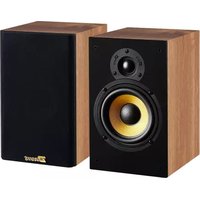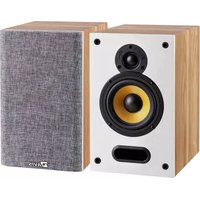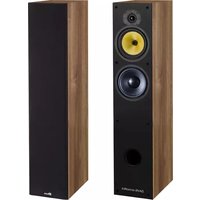
Hera 150 - Speaker DAVIS - Free user manual and instructions
Find the device manual for free Hera 150 DAVIS in PDF.


| Product Type | Passive Acoustic Speaker |
| Brand | DAVIS Acoustics |
| Model | Hera 150 |
| Category | Loudspeaker |
| Usage | Domestic use, Hi-Fi and Home Theater |
| Power Source | Passive (requires external amplifier) |
| Connectivity | Binding posts accepting bare wires, banana plugs or spades |
| Impedance | Refer to manual (not specified) |
| Break-in | Between a few hours and approximately 150 hours |
| Positioning | Facing listening area, tweeter at ear level, avoid corners |
| Protective Grille | Supplied, leave in place to protect speakers |
| Maintenance | Dry cloth, duster for front panel, avoid abrasive products |
| Cleaning stains | Slightly damp cloth, polish for lacquered finishes |
| Decoupling spikes | Supplied for floorstanding models, recommended to tighten bass |
| Speaker Warranty | 5 years (France) after online registration |
| Subwoofer Warranty | 1 year |
| Country of Manufacture | France (production site in Troyes) |
| Repairability | DAVIS authorized service center, warranty excludes mechanical damage and overpowering |
| Documents Provided | User manual |
| Dimensions | Refer to manual (not provided on this page) |
| Weight | Refer to manual (not provided on this page) |
Frequently Asked Questions - Hera 150 DAVIS
User questions about Hera 150 DAVIS
0 question about this device. Answer the ones you know or ask your own.
Ask a new question about this device
Download the instructions for your Speaker in PDF format for free! Find your manual Hera 150 - DAVIS and take your electronic device back in hand. On this page are published all the documents necessary for the use of your device. Hera 150 by DAVIS.
USER MANUAL Hera 150 DAVIS
text_image
DAVIS ACOUSTICSEnglish : Pages 7 to 11
natural_image
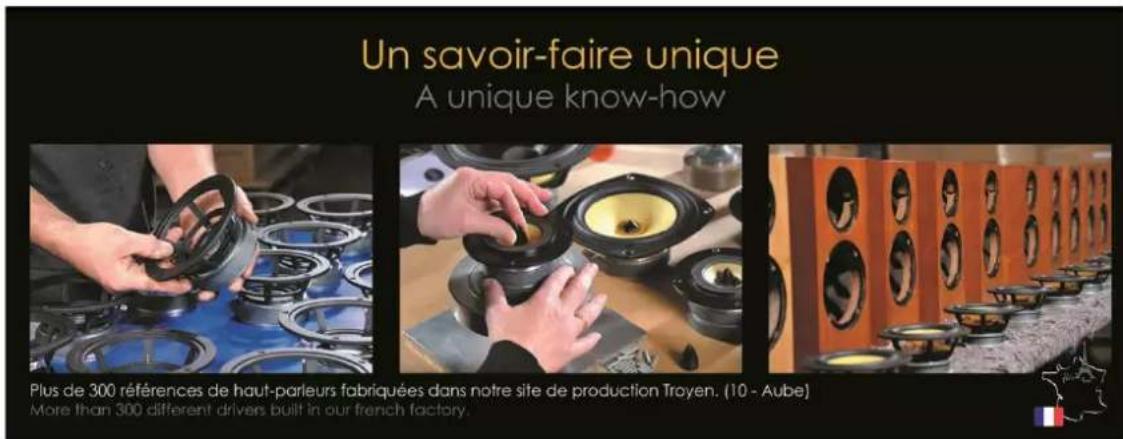
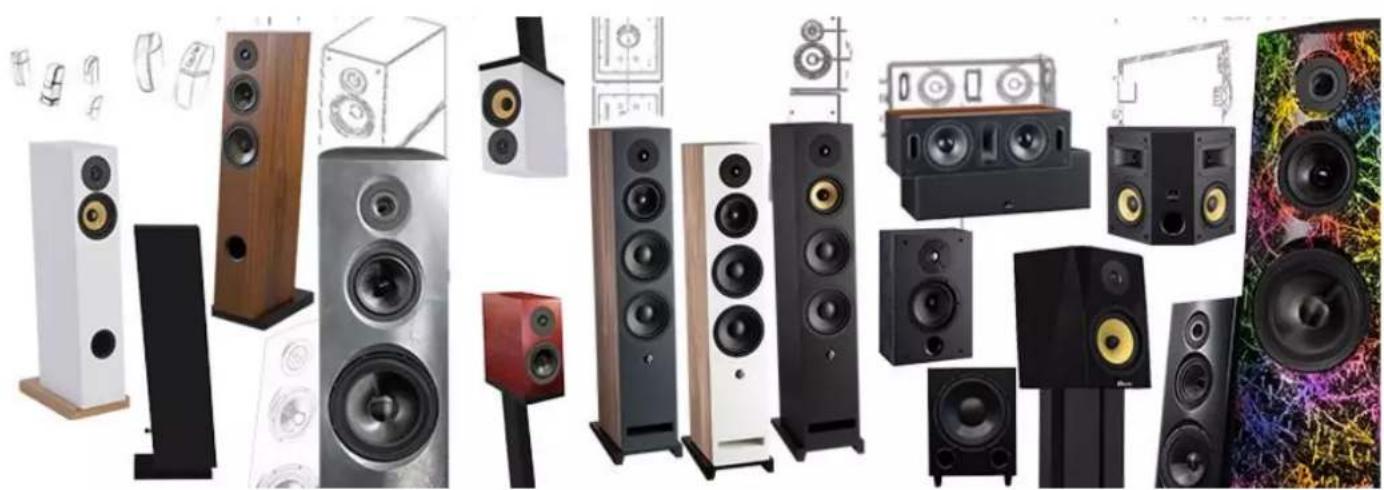
Collection of various audio and sound speakers in various styles and colors, displayed against a white background (no text or symbols visible)natural_image
Person holding a black mechanical component on a blue industrial floor (no visible text or symbols)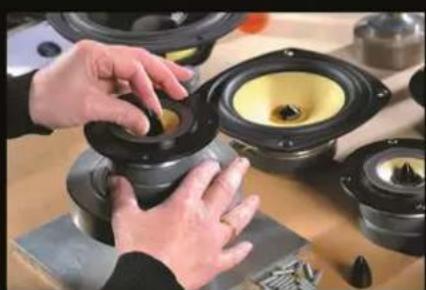
natural_image
Close-up of hands operating a speaker tower with multiple speakers and sound equipment (no visible text or symbols)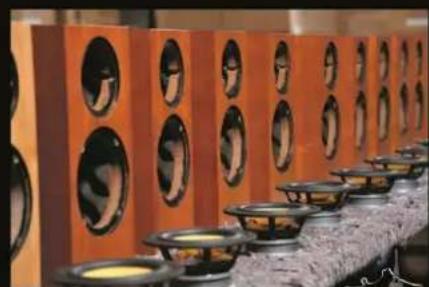
natural_image
Row of orange speaker speakers in a factory setting, no visible text or symbolsMore information about our brand, our products and our know-how :

text_image
Scan me !For all our news : Follow us on Facebook "Davis Acoustics News"

ENGLISH - Congratulations!
Welcome! We thank you for choosing this Davis Acoustics loudspeaker product for your listening pleasure.
My father Michel Visan back in the 1970's was the Chief Designer and innovator of many of the loudspeaker designs seen today, this for several leading manufacturers at the time. In 1986 he founded Davis Acoustics. Since then, the Davis name has been synonymous with true high fidelity and is to this date a recognized leader world-wide in the design, manufacture and sale of superior quality, true, life-like, sound reproduction loudspeakers. All of our products and sub components including coils, magnets, speaker cones and cabinets are designed and hand made by our highly trained dedicated craftsmen in our factory in France. Our staff are audiophiles as well. Our OEM division manufactures speakers for several of the world's leading class automotive manufactures for their client's enjoyment as well as where we design, manufacture and supply other OEM speaker brands with our technology. The tradition of design excellence and our love for audio and audiophiles worldwide is continued by our family and staff.
Your loudspeaker has been manufactured with pride and care using only the best materials and should provide you with many, many years of listening pleasure and the enjoyment that you expected. To ensure your continued satisfaction, kindly do read the manual as it contains vital information on the preparation, use, and care of your loudspeakers. Should you have any questions please feel free to contact your Davis Authorized Reseller. Enjoy the Sound of Davis! Sincerely, Olivier Visan, Director, Second Generation
We are confident in your choice of Davis for your musical enjoyment, just some quick notes before you unpack and use your loudspeakers.
Breaking-in" your loudspeakers
Your loudspeakers have been designed for the ultimate in listening pleasure and fidelity and have been tested at the factory both before assembly and after. Having said this, there is a break-in period and with some models they may sound a bit harsh during your first audition. Do not worry as this is normal. A speaker is an electro-mechanical device and as is the case with such a device the extrusion and movement of the cone comes into play as these moving parts move more freely over time. Two components may particularly benefit from a break-in period: The surround, which can be made of various types of rubber or foam that holds the edge of the cone to the speaker basket, and the spider, which connects the basket and the center of the cone. Both are flexible and therefore allowing them first to experience their full range of motion and when they loosen up this results in free movement and better response. The most enjoyable way to break-in your speakers is to simply play them, choosing music with a wide dynamic range. Adjust the volume neither too low
nor too high. About 150 hours of play time will season your speakers. Do not play at high volumes during this time. Please note where depending on the model not all speakers will sound dramatically different after break-in. Some improve only marginally, while others do change in ways that may surprise you!
Cleaning
Our cabinets are handsomely designed and assembled. We use premium hand selected woods and specialty, durable finishes. Those with a natural wood finish may show slight variances between the enclosures colors between the same model, this is normal. All require little if any maintenance. Never use a furniture polish on any of our enclosures. To remove fingerprints etc., always use a lint free, soft, dry cloth. FOR THE FACE, USE A FEATHER DUSTER. DO NOT TOUCH THE SPEAKER CONES. If there is a stain on the cabinet, use a soft cloth that has been slightly moistened, then use a soft dry cloth to dry.
Speaker-Grill Faceplates
The grills have been designed to protect your speakers. They are transparent to sound and can be kept on, this to avoid potential damage to the speakers themselves.
Starting your Davis journey
Unpacking the contents:
All our enclosures are expertly packed. Supplied with our black lacquered enclosures are complementary dust-free white gloves which we strongly urge you to use when either taking out the loudspeakers from the carton or when moving them. This is our gift to you. It avoids you placing fingerprints onto the exterior of the case needlessly. Once you have taken the enclosures out of their shipping carton, do keep all materials. They may come useful when moving and will protect the speakers during transport.
Connections:
IMPORTANT : Before making any connections to the speakers with your high-fidelity system, turn off all amplification equipment etc. It is good practice to also disconnect the equipment from the AC power source as a precaution.
Use and Operation: Your loudspeaker needs to be connected to an amplifier to operate and reproduce sound, this using high quality audio cables (not supplied). Our speaker enclosures feature multi-use connectors accepting bare wire, plug-in Banana style or Fork style common audio connectors. Consult your Dealer for suggestions and cable/connector types.
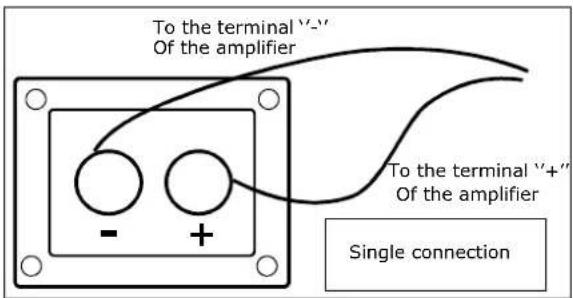
Speakers as do amplifiers have a 2 wire, polarity dependent connection. Red is positive (+) both on the amplifier and the speaker, Black represents the negative (—) connection.
Connections are easy. Use a good quality gauge of wire; you may consult your Audio Dealer for recommendations.
In a two speaker system with a simple 2 binding post connection:
If you are using bare wire: With the amplifier end terminated and connected: Strip back about 1 cm ( or 1/2 inch) on both Red (+) and Black (-) cables going from the left amplifier output to the left speaker enclosures. Unscrew the cap of the red and black binding posts on the rear of the enclosure until you see a little hole.
Insert the wires into the appropriate holes observing polarity. Tighten the binding post cap snugly. Repeat the process for the right speaker.
text_image
To the terminal '-' Of the amplifier To the terminal "+" Of the amplifier Single connectionDual Terminals for Bi-amping and bi-wiring:
It is becoming more common for higher-end performance speakers to include dual sets of binding posts. Models with dual terminals almost al-ways also feature a special type of built-in crossover with separate "high-pass" and "low-pass" sections.
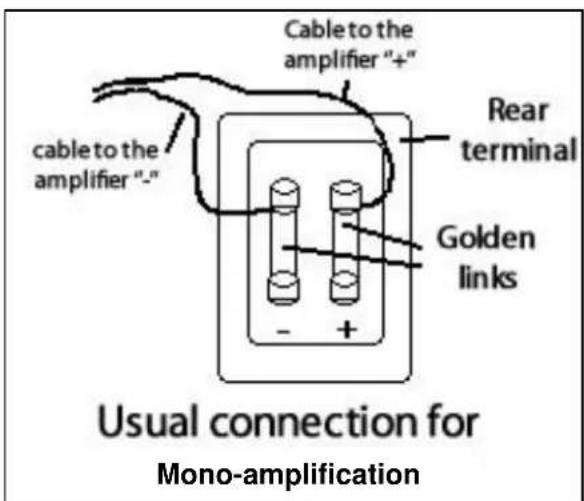
Speakers with dual sets of terminals work fine when used with a single set of speaker cables. These come from the factory set up for conventional operation, with "jumpers" installed between the two sets. These jumpers can be easily removed for bi-amping or bi-wiring.
Pictured below is standard wiring where the straps remain in place. Single amp.
text_image
Cable to the amplifier "+" cable to the amplifier "-" Rear terminal Golden links - + Usual connection for Mono-amplificationFor best performance and enjoyment of your loudspeakers and sound equipment very precise speaker placement can open up a whole new dimension in your listening pleasure.
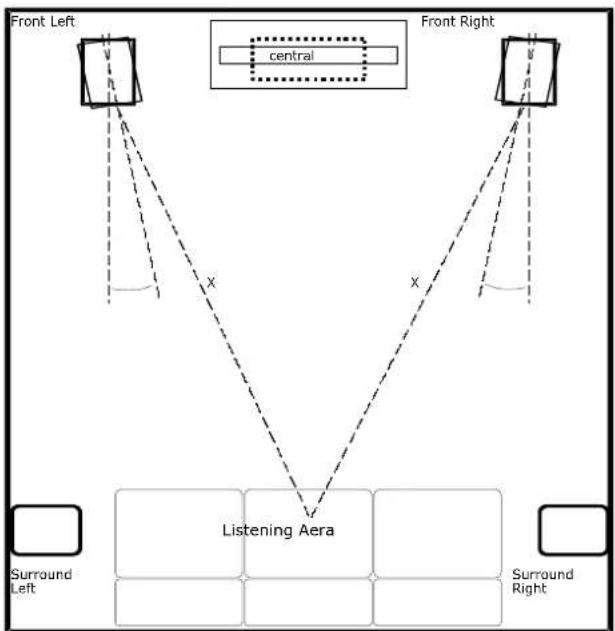
Speakers need to be located symmetrically in a room and where the listener and speakers needs to form an equilateral triangle for best performance.
The speakers' tweeters need to be placed at approximately the height of the listener's ears once the audiophile is in the listening position, usually sitting down.
So speaker placement and their relative height are pre-requisites of a good listening environment.
Floor standing units need to be placed just as stored, and where bookshelf speakers should be placed onto pedestals matching the tweeter height placement as previously stated.
- Main Front Speakers (Speakers in a 2 way system).
Place the speakers back from the wall to-wards the listening area by 30 cm (1 foot). Have them facing forward as pictured.
If you intend to angle the speakers this will amplify certain harmonics in the room and all accentuate the lower frequencies.
As audio is a personal matter, experimentation is always welcome.
Our free standing speaker columns come with isolators that may be screwed into the base of the enclosure. These are recommended as to highlight a much clearer and more precise low frequency response to the listener.
II. Center Speaker:
If so equipped and typically found in a multi-media home entrainment environment, this speaker is used to primarily project the voice track of the playback media.
This usually represents 80% of the audio track a movie. Place this speaker as close as possible to the projection screen or TV screen, typically below the TV screen for the best audio experience.
III. Surround Speakers:
Commonly termed as effect speakers, their purpose is to provide the listener with the background sounds on a movie track and should be placed in the rear at 3/4 of the total ceiling height. They should be placed horizontally and perpendicular to the floor and not angled downwards to the listener for best results. The listener will therefore hear the background track above one's listening position.
flowchart
graph TD
    A["Front Left"] -->|x| B["Listening Aera"]
    C["Front Right"] -->|x| B
    B --> D["Surround Left"]
    B --> E["Surround Right"]
    F["Central Box"] --> A
    F --> C
Conditions of guarantee
All Davis Acoustics loudspeakers are covered by guarantee drawn up by the official Davis distributor in your country. Your distributor can provide all details concerning the conditions of guarantee. Guarantee cover extends at least to that granted by the legal guarantee in force in the country where the original purchase invoice was issued.