
TCS27EPAP - Saw Tanaka - Free user manual and instructions
Find the device manual for free TCS27EPAP Tanaka in PDF.


User questions about TCS27EPAP Tanaka
0 question about this device. Answer the ones you know or ask your own.
Ask a new question about this device
Download the instructions for your Saw in PDF format for free! Find your manual TCS27EPAP - Tanaka and take your electronic device back in hand. On this page are published all the documents necessary for the use of your device. TCS27EPAP by Tanaka.
USER MANUAL TCS27EPAP Tanaka
natural_image
Line drawing of a manual chain-linking tool with a clamp and handle (no text or symbols)SAFETY INSTRUCTIONS AND INSTRUCTION MANUAL
WARNING
IMPROPER OR UNSAFE use of this power tool can result in death or serious bodily injury! This manual contains important information about product safety. Please read and understand this manual BEFORE operating the power tool. Please keep this manual available for other users and owners before they use the power tool. This manual should be stored in safe place.
INSTRUCTIONS DE SECURITE ET MODE D'EMPLOI
AVERTISSEMENT
NOTE: Some units do not carry them.
| Symbols⚠ WARNINGThe following show symbols used for the machine. Be sure that you understand their meaning before use. | ||
 | It is important that you read, fully understand and observe the following safety precautions and warnings. Careless or improper use of the unit may cause serious or fatal injury. | 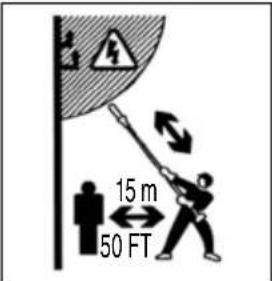 Keep all children, bystanders and helpers 50 ft (15 m) away from the unit. If anyone approaches you, stop the engine and cutting attachment immediately. Keep all children, bystanders and helpers 50 ft (15 m) away from the unit. If anyone approaches you, stop the engine and cutting attachment immediately. |
 | Read, understand and follow all warnings and instructions in this manual and on the unit. | |
 | Always wear eye, head and protectors when using this unit. | |
 | Choke – Run position (Open) | WARNING ⚠ DANGERAll overhead electrical conductors and communications wires can have electricity flow with high voltages. Never touch wires directly or indirectly when pruning, otherwise serious injury or death may result |
 | Choke – Start position (Closed) | |
 | Emergency stop | |
 | Hot surface | |
| Before using your machine• Read the manual carefully.• Check that the cutting equipment is correctly assembled and adjusted.• Start the unit and check the carburetor adjustment. See “MAINTENANCE”. | ||
Index
WHAT IS WHAT ....3
WARNINGS AND SAFETY INSTRUCTIONS ....4
SPECIFICATIONS....6
ASSEMBLY PROCEDURES 6
OPERATING PROCEDURES 8
MAINTENANCE 11
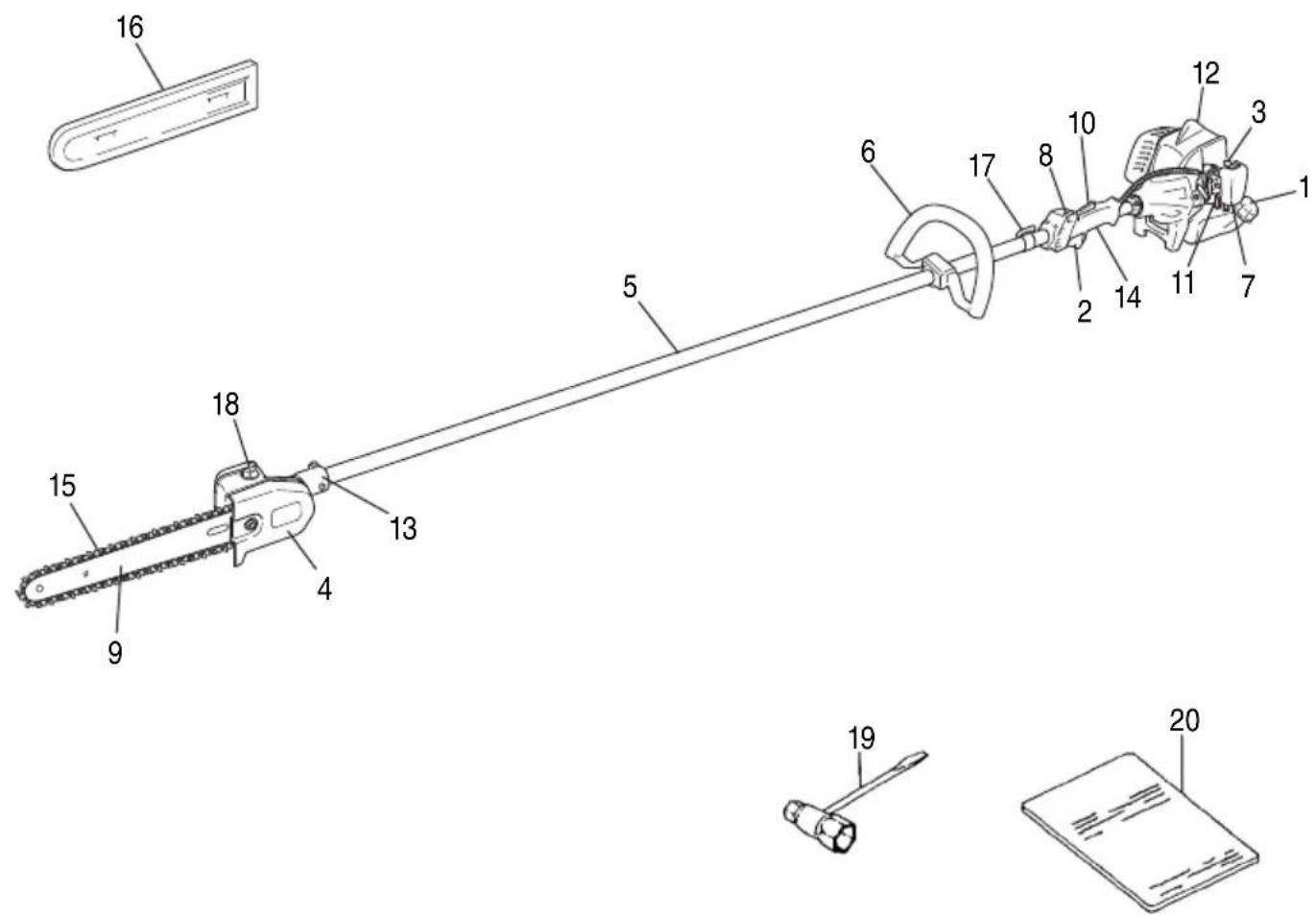
WHAT IS WHAT
Since this manual covers several models, there may be some difference between pictures and your unit. Use the instructions that apply to your unit.
- Fuel cap
- Throttle trigger
- Starter handle
- Cutting attachment
- Drive shaft tube
- Handle bar
- Priming pump
- Ignition switch
- Guide bar
- Throttle trigger lockout
- Choke lever
- Engine
- Angle transmission
- Handle grip
- Saw chain
- Guide bar cover
- Suspension eyelet
- Oil tank cap
- Combi box spanner
- Handling instructions
WARNINGS AND SAFETY INSTRUCTIONS
Operator safety
○ Always wear head protection with full face shield to help protect against falling branches and debris.
○ Avoid all power lines. This unit is not insulated against electrical current.
○ Gloves should be used when sharpening chain.
○ Always wear heavy, long pants, boots and gloves. Do not wear loose clothing, jewelry, short pants, sandals or go barefoot. Secure hair so it is shoulder length.
○ Do not operate this tool when you are tired, ill or under the influence of alcohol, drugs or medication.
○ Never let a child or inexperienced person operate the machine.
○ Wear hearing protection. Pay attention to your surroundings. Be aware of any bystanders who may be signaling a problem. Remove safety equipment immediately upon shutting off engine.
○ Wear head protection.
Never start or run the engine inside a closed room or building. Breathing exhaust fumes can kill.
○ Keep handles free of oil and fuel.
○ Keep hands away from cutting equipment.
○ Do not grab or hold the unit by the cutting equipment.
When the unit is turned off, make sure the cutting attachment has stopped before the unit is set down.
When operation is prolonged, take a break from time to time so that you may avoid possible Hand-Arm Vibration Syndrome (HAVS) which is caused by vibration.
○ The operator must obey the local regulations of cutting area.
WARNING
○ Antivibration systems do not guarantee that you will not sustain Hand-Arm Vibration Syndrome or carpal tunnel syndrome. Therefore, continual and regular users should monitor closely the condition of their hands and fingers. If any symptoms of the above appear, seek medical advice immediately.
○ If you are using any medical electric / electronic devices such as a pacemaker, consult your physician as well as the device manufacturer prior to operating any power equipment.
Unit / machine safety
○ Inspect the entire unit / machine before each use. Replace damaged parts. Check for fuel leaks and make sure all fasteners are in place and securely tightened.
○ Replace parts that are cracked, chipped or damaged in any way before using the unit / machine.
- Keep others away when making carburetor adjustments.
○ Use only accessories as recommended for this unit / machine by the manufacturer.
○ Never let the chain strike any obstacle.
If the chain makes contact, the machine should be stopped and checked carefully.
○ Make sure the automatic oiler is working. Keep the oil tank filled with clean oil. Never let chain run dry ove on the bar
All unit service, other than the items listed in the operator's / owner's manual, should be performed by Tanaka dealer. (For example, if improper tools are used to remove the fl ywheel or if an improper tool used to hold the fl ywheel in order to remove the clutch, structural damage to the fl ywheel could occur and could subsequently cause the fl ywheel to burst.)
WARNING
Never modify the unit/machine in any way. Do not use your unit / machine for any job except that for which it is intended.
Fuel safety
○ Mix and pour fuel outdoors and where there are no sparks or flames.
g○ Use a container approved for fuel.
○ Do not smoke or allow smoking near fuel or the unit/machine or while using the unit / machine.
○ Wipe up all fuel spills before starting engine.
○ Move at least 10 feet (3 m) away from fueling site before starting engine.
○ Stop engine before removing fuel cap.
○ Empty the fuel tank before storing the unit/machine. It is recommended that the fuel be emptied after each use. If fuel is left in the tank, store so fuel will not leak.
Store unit / machine and fuel in area where fuel vapors cannot reach sparks or open flames from water heaters, electric motors or switches, furnaces. etc.
WARNING
Fuel is easy to ignite or get explosion or inhale fumes, so that pay special attention when handling or fi lling fuel.
Cutting safety
○ Do not cut any material other than wood or wooden objects.
☐ For respiratory protection, wear an aerosol protection mask when cutting the wood after insecticide has been applied.
○ Keep others including children, animals, bystanders and helpers outside the 50 feet (15 m) hazard zone. Stop the engine immediately if you are approached.
○ Hold the unit / machine firmly with both hands.
○ Keep fi rm footing and balance. Do not over-reach.
○ Keep all parts of your body away from the muffler and cutting attachment when the engine is running.
Before pruning branches, the operator must be accustomed to the pruning techniques of the machine.
○ Be sure to pre-plan a safe exit from falling objects.
○ While cutting, hold the machine firmly with both hands with thumb firmly locked around front handle, and stand with feet well balanced and your body balanced.
○ Be alert against kickback (when saw kicks up and back at operator). Never cut with the nose of the bar.
○ When relocating to a new work area, be sure to shut off the machine and ensure that all cutting attachments are stopped.
○ Never place the machine on the ground when running.
○ Always ensure that the engine is shut off and cutting attachments have completely stopped before clearing debris or removing grass from the cutting attachment.
○ Always carry a first-aid kit when operating any power equipment.
Never start or run the engine inside a closed room or building and/or near infl ammable liquids. Breathing exhaust fumes can kill.
Maintenance safety
○ Maintain the unit/machine according to recommended procedures.
○ Disconnect the spark plug before performing maintenance except for carburetor adjustments.
- Keep others away when making carburetor adjustments.
○ Use only genuine Tanaka replacement parts as recommended by the manufacturer.
CAUTION
Do not disassemble the recoil starter. You may get a possibility of personal injury with recoil spring.
Transport and storage
○ Carry the unit / machine by hand with the engine stopped and the muffler away from your body.
○ Allow the engine to cool, empty the fuel tank, and secure the unit / machine before storing or transporting in a vehicle.
○ Empty the fuel tank before storing the unit/machine. It is recommended that the fuel be emptied after each use. If fuel is left in the tank, store so fuel will not leak.
○ Store unit / machine out of the reach of children.
○ Clean and maintain the unit carefully and store it in a dry place.
○ Make sure engine switch is off when transporting or storing.
○ When transporting in a vehicle, cover chain with chain cover.
If situations occur which are not covered in this manual, take care and use common sense. Contact your Tanaka dealer if you need assistance. Pay special attention to statements preceded by the following words:
WARNING
Indicates a strong possibility of severe personal injury or loss of life, if instructions are not followed.
CAUTION
Indicates a possibility of personal injury or equipment damage, if instructions are not followed.
NOTE
Helpful information for correct function and use.
SPECIFICATIONS
| Model | TCS27EPAP (S) |
| Engine displacement (cu. in) 1.62 (26.9 ml) | |
| Spark plug CHAMPION CJ6 | |
| Fuel tank capacity (fl . oz) 17.6 (0.52 l) | |
| Chain Oil Tank Capacity (fl . oz) 5.4 (0.16 l) | |
| Dry Weight (lbs)(Without guide bar and chain) 12.8 (5.8 kg) | |
| Guide bar length (in.) 10 (250 mm) | |
| Chain pitch (in.) 3/8 (9.52 mm) | |
| Chain gauge (in.) 0.043 (1.09 mm) | |
| Sound pressure level LpA (dB (A)) by ISO 11680Equivalent Uncertainty | 893 |
| Sound power level LwA (dB (A)) by ISO 11680Measured Uncertainty | 1053 |
| Sound power level LwA (dB (A)) by 2000/14/ECMeasured Guaranteed | 108111 |
| Vibration level (m/s2) by ISO 11680Front handleRear handle | 4.99.2 |
| Max. engine power by ISO 8893 (kW) 0.9 | |
| Max. engine speed (min-1) 11,000 | |
| Idle engine speed (min-1) | 3,000 |
NOTE: Equivalent noise level / vibration levels by ISO 11680 are calculated as the time-weighted energy total for noise / vibration levels under various working conditions with the following time distribution: 1/2 idle, 1/2 racing speed.
* All data subject to change without notice.
ASSEMBLY PROCEDURES
Drive shaft to engine (Fig. 1)
Loosen tube locking bolt (1) about ten turns so that the bolt point will not obstruct drive shaft tube to be inserted. When inserting drive shaft tube, hold the tube locking bolt outward preventing inside fitting from obstructing as well.
Insert the drive shaft into the clutch case of the engine properly until the marked position (2) on the drive shaft tube meets the clutch case.
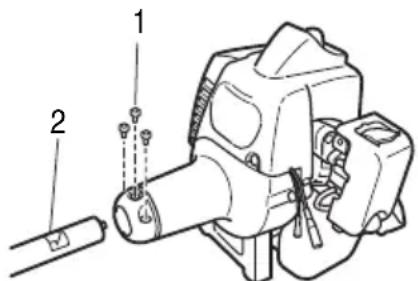
Fig. 1
NOTE
When it is hard to insert drive shaft up to the marked position on the drive shaft tube, turn drive shaft by the cutter mounting end clockwise or counterclockwise. Tighten tube locking bolt lining up the hole in the shaft tube. Then tighten clamp bolt securely.
Cutting attachment to drive shaft (Fig. 2)
Loosen tube locking bolt (3).
Insert the drive shaft into the gear case of the attachment properly until the marked position (4) on the drive shaft tube meets the gear case.
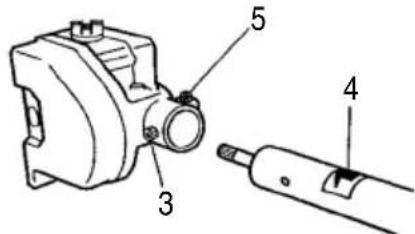
Fig. 2
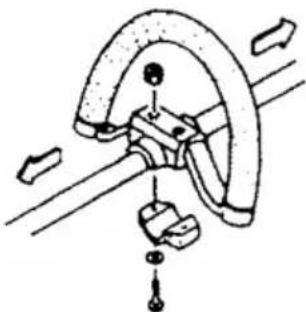
Installation of handle (Fig. 3)
Attach the handle to the drive shaft tube with the angle towards the engine.
Adjust the location to the most comfortable position before operation.
natural_image
Mechanical diagram showing a curved mechanical component with mounting holes and directional arrows (no text or labels)Fig. 3
Throttle wire / stop cord
Press the upper tab (6) and open the air cleaner cover. (Fig. 4)
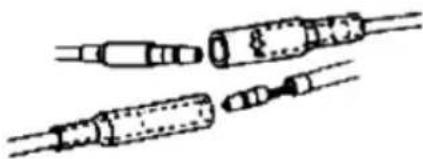
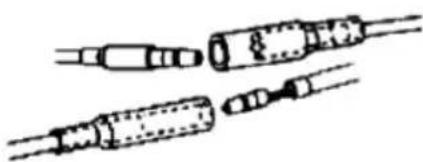
Connect stop cords. (Fig. 5)
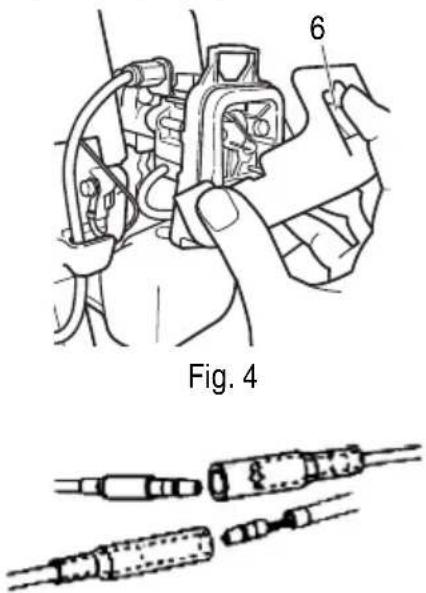
Fig. 5
If the throttle outer end (7) is threaded on your unit, screw it and the earth terminal (8) (if so equipped) into the cable adjuster stay (9) all the way, and then tighten this cable end using the adjuster nut (10) against the cable adjuster stay (9).
Connect throttle wire end (11) to carburetor (12) an install swivel cap (13) (if so equipped) where is included in tool bag, onto swivel (12) (Fig. 6).
Some models may come with the parts installed.
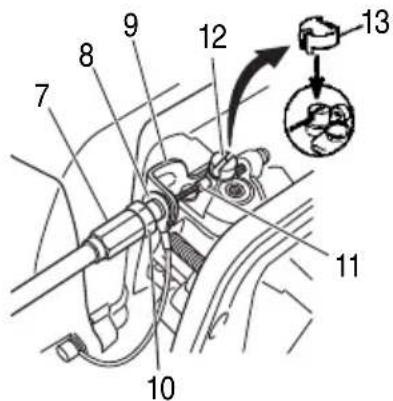
Fig. 6
WARNING
Never try to start engine without side case securely fastened.
NOTE
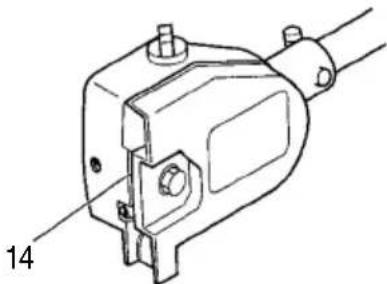
When assembling brand new unit, take off and discard a piece of cardboard (14) between gear case and side case. (Fig. 7)
natural_image
Technical line drawing of a mechanical component with no visible text or symbolsFig. 7
Installation of bar and chain
- Remove chain bar clamp nuts (15).
- Remove the side case (16). (Fig. 8)
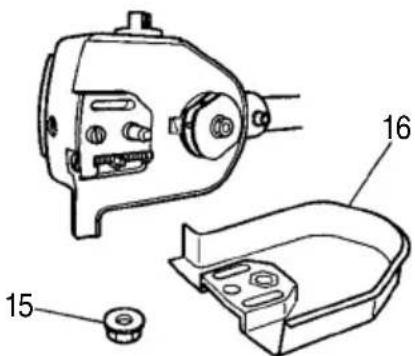
Fig. 8
- Install the chain bar (17) onto the bolts (18), then push it toward the sprocket (19) as far as it will go. Make sure that the boss of chain tension adjust bolt (20) fits into the hole (21) of the bar. (Fig. 9)
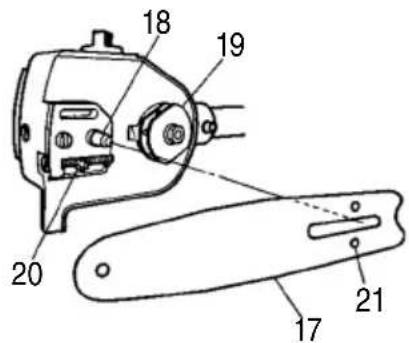
Fig. 9
NOTE
Slightly move the bar back and forth and make sure the chain tension boss (20) fits into the hole (21) in the bar properly.
- Confirm the direction of saw chain (22) is correct as in the figure, and align the chain on the sprocket. (Fig. 10)
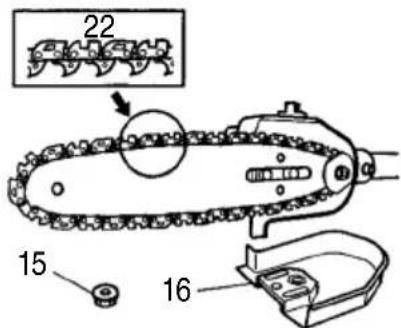
Fig. 10
- Guide the chain drive links into the bar groove all around the bar.
- Install the side case (16) onto the guide bar clamp bolt. Then fix the clamp nut (15) temporarily. (Fig. 10)
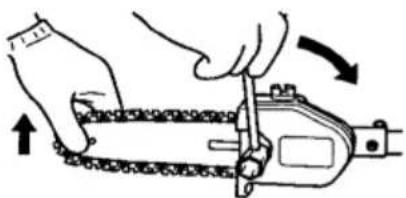
- Raise the bar end, and tighten the chain (22) by turning the tension adjustment bolt (23) clockwise. To check proper tension, lightly lift up the center of chain and there should be about 0.02 - 0.04" (0.5 - 1.0 mm) clearance (24) between bar and edge of drive link. (Fig. 11, 12)
natural_image
Illustration of hands using a chain-linking tool to cut a chain (no text or symbols)Fig. 11
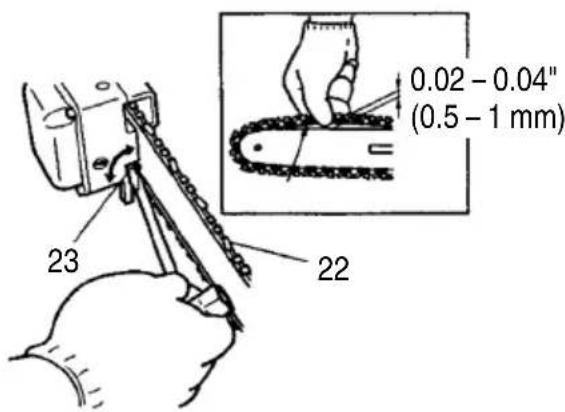
Fig. 12
CAUTION
PROPER TENSION IS EXTREMELY IMPORTANT(Fig. 11, 12)
- Raise the bar end and securely tighten the chain bar clamp nuts with the box wrench. (Fig. 11)
- A new chain will stretch so adjust the chain after a few cuts and watch chain tension carefully for the first half hour of cutting.
NOTE
Check the chain tension frequently for optimum performance and durability.
CAUTION
When the chain is excessively tightened, the bar and chain will be damaged rapidly. Conversely, when the chain is excessively loosened, it may get out of the groove in the bar.
○ Always wear gloves when touching the chain.
WARNING
During operation, hold chain saw firmly with both hands. A single hand operation may cause serious injury.
OPERATING PROCEDURES
Fuel (Fig. 13)
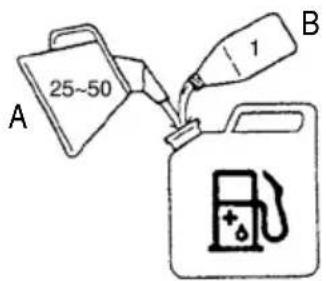
Fig. 13
WARNING
○ This unit is equipped with a two-stroke engine. Always run the engine on fuel, which is mixed with oil.
Provide good ventilation, when fueling or handling fuel.
○ Fuel contains highly fl ammable and it is possible to get the serious personal injury when inhaling or spilling on your body. Always pay attention when handling fuel. Always have good ventilation when handling fuel inside building.
Fuel
○ Always use branded 89 octane unleaded gasoline.
○ Use genuine two-cycle oil or use a mix between 25:1 to 50:1, please consult the oil bottle for the ratio or Tanaka dealer.
If genuine oil is not available, use an anti-oxidant added quality oil expressly labeled for air-cooled 2-cycle engine use (JASO FC GRADE OIL or ISO EGC GRADE). Do not use BIA or TCW (2-stroke water-cooling type) mixed oil.
○ Never use multi-grade oil (10 W/30) or waste oil.
○ Always mix fuel and oil in a separate clean container.
Always start by filing half the amount of fuel, which is to be used. Then add the whole amount of oil. Mix (shake) the fuel mixture. Add the remaining amount of fuel.
Mix (shake) the fuel-mix thoroughly before filling the fuel tank.
Fueling
WARNING
○ Always shut off the engine before refueling.
○ Slowly open the fuel tank, when filling up with fuel, so that possible over-pressure disappears.
○ Tighten the fuel cap carefully, after fueling.
○ Always move the unit at least 10 feet (3 m) from the fueling area before starting.
○ Always wash any spilled fuel from clothing immediately with soap.
○ Be sure to check for any fuel leakage after refueling.
Before fueling, clean the tank cap area carefully, to ensure that no dirt falls into the tank. Make sure that the fuel is well mixed by shaking the container, before fueling.
Chain oil (Fig. 14)
Fill up with chain oil (25). Always use good quality chain oil. When the engine is running, the chain oil is automatically discharged.
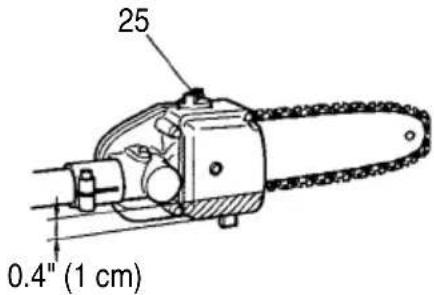
Fig. 14
NOTE
Add chain oil when its level lowers to one centimeter from bottom, (Fig. 14)
ADJUSTMENT OF CHAIN OIL SUPPLY
The chain oil quantity discharged through the lubrication system is factory-adjusted to the standard. Adjust the quantity in accordance with the operating condition. The numbered label (26) describes order of chain oil adjustment. (Fig. 15)
○ Loosen the fixing screw (27) one turn. (Fig. 15)
Turn the adjusting screw (28) clockwise to decrease the quantity and turn it counter-clockwise to increase the quantity. (Fig. 16)
☐ Do not try to turn the screw (28) clockwise beyond 1 turn from its most counter-clockwise position or the maximum quantity discharged position.
○ After adjustment has been made, tighten fixing screw (27). (Fig. 15)
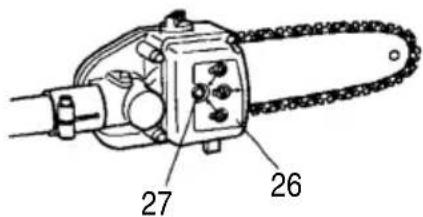
Fig. 15
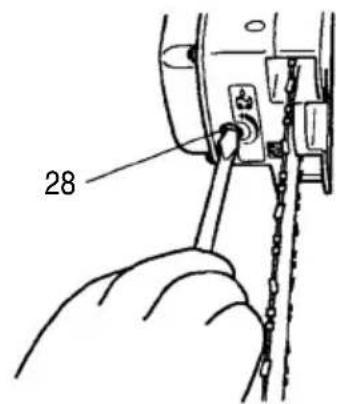
Fig. 16
NOTE
When you have lost the proper position of the screw (28), start with the most counterclockwise position.
Starting
CAUTION
Before starting, make sure the cutting attachment does not touch anything.
- Set ignition switch (29) to ON position. (Fig. 17)
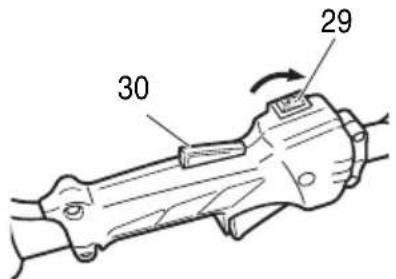
Fig. 17
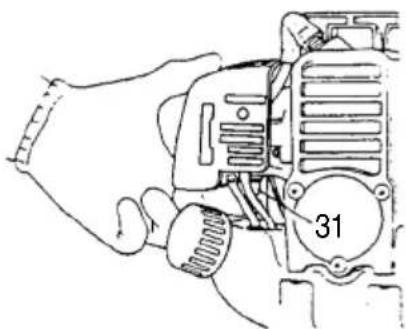
* Push priming bulb (31) several times so that fuel flows through return pipe. (Fig. 18)
natural_image
Hand operating a mechanical component with a numbered label (31), no visible text or symbols beyond the number.Fig. 18
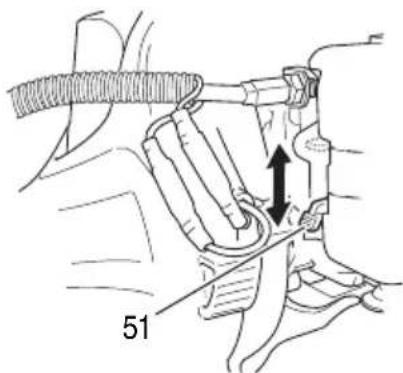
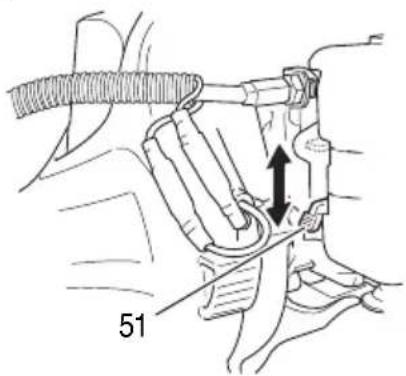
- Set choke lever (51) to CLOSED position (A). (Fig. 19)
natural_image
Mechanical assembly diagram showing a lever mechanism with a black arrow indicating direction (no text or symbols present)Fig. 19
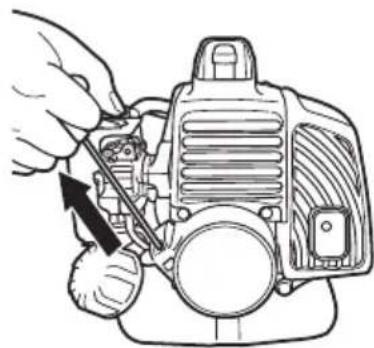
- Pull recoil starter briskly, taking care to keep handle in your grasp and not allowing it to snap back. (Fig. 20)
natural_image
Line drawing of a hand using a screwdriver to adjust or install a mechanical component (no text or symbols present)Fig. 20
- When you hear the engine want to start, return choke lever to RUN position (open) (B). Then pull reco starter briskly again.
NOTE
If engine does not start, repeat procedures from 2 to 5.
- Then allow the engine about 2 - 3 minutes to warm up before subjecting it to any load.
Stopping (Fig. 21)
Decrease engine speed and run at an idle for a few minutes, then turn off ignition switch (29).
For models with an engine ignition switch, keep the ignition switch pressed until the engine comes to a complete stop.
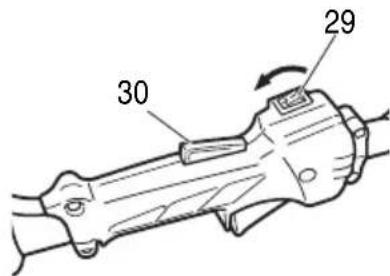
Fig. 21

WARNING
A cutting attachment can injure while it continues to spin after the engine is stopped or power control is released. When the unit is turned off, make sure the cutting attachment has stopped before the unit is set down.
SAFE OPERATION
CAUTION
○ Always wear gloves during operation or maintenance.
○ Review the area to be trimmed. Look for hazards that could contribute to unsafe conditions. DO NOT operate unit if any wires (power, telephone, cable, etc.) are closer than 50 feet (15 m) to any part of the operator or unit. (Fig. 22)
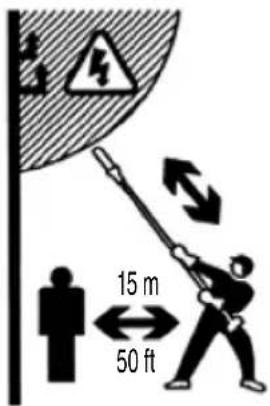
Fig. 22
○ Spectator and fellow workers must be warned, and children and animals prevented from coming nearer than 50 feet (15 m) while the pole saw is in use. (Fig. 23)
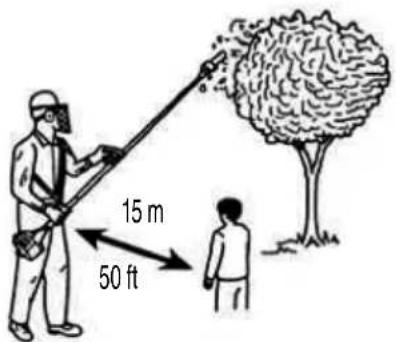
Fig. 23
○ Avoid all power lines. This unit is not insulated against electrical current.
○ Always wear head protection with full face shield to help protect against falling branches and debris. (Fig. 24)
natural_image
Illustration of two mechanical arms with arrows indicating movement, no text or symbols presentFig. 24
Pruning techniques
This attachment is designed for pruning small limbs and branches up to 8" (200 mm) in diameter.
Follow these tips for successful operation.
○ Plan cut carefully. Check direction branch will fall.
○ Long branches should be removed in several pieces.
○ Do not stand directly beneath branch being cut.
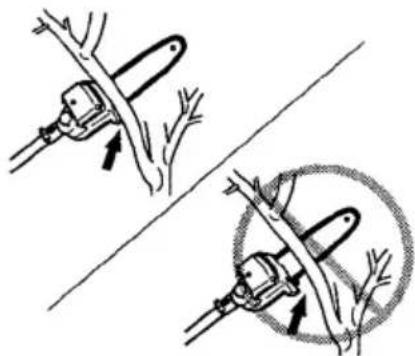
When ready to cut: Hold "front cutting guide" against branch. This will prevent whipping of the branch. DO NOT use back and forth sawing action. (Fig. 24)
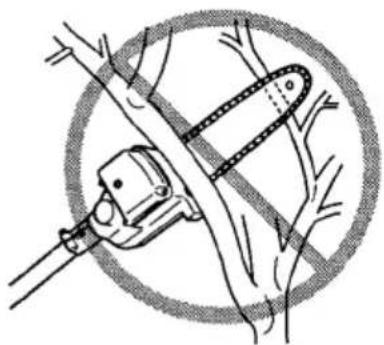
○ Look out for branch immediately behind the branch being cut, If blade hits rear branch damage to blade may occur. (Fig. 25)
natural_image
Diagram of a hand operating a chain to cut tree branches, showing mechanical components and motion (no text or labels)Fig. 25
○ Accelerate to full throttle.
○ Apply a light cutting pressure.
○ Ease cutting pressure when nearing end of cut to maintain control.
○ When pruning a limb 4" (100 mm) diameter or larger, cut as follows: (Fig. 26)
- Undercut 1/4 limb diameter near tree trunk.
- Finish top cut slightly farther out on limb.
- Flush cut stub at trunk.
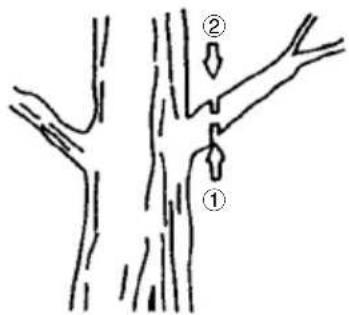
Fig. 26
○ DO NOT use for felling or bucking.
MAINTENANCE
MAINTENANCE, REPLACEMENT OR REPAIR OF THE EMISSION CONTROL DEVICES AND SYSTEMS MAY BE PERFORMED BY ANY NON-ROAD ENGINE REPAIR ESTABLISHMENT OR INDIVIDUAL.
Carburetor adjustment (Fig. 27)
WARNING
○ The cutting attachment may be spinning during carburetor adjustments.
Never start the engine without the complete clutch cover and tube assembled! Otherwise the clutch can come loose and cause personal injuries.
In the carburetor, fuel is mixed with air. When the engine is test run at the factory, the carburetor is basically adjusted. A further adjustment may be required, according to climate and altitude. The carburetor has one adjustment possibility:
T = Idle speed adjustment screw.
Idle speed adjustment (T)
Check that the air filter is clean. When the idle speed is correct, the cutting attachment will not rotate. If adjustment is required, close (clockwise) the T-screw, with the engine running, until the cutting attachment starts to rotate. Open (counter-clockwise) the screw until the cutting attachment stops. You have reached the correct idle speed when the engine runs smoothly in all positions well below the rpm when the cutting attachment starts to rotate.
If the cutting attachment still rotates after idle speed adjustment, contact your Tanaka dealer.
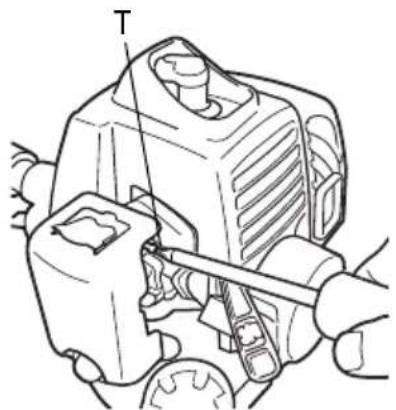
Fig. 27
NOTE
Standard Idle rpm is 2,500 – 3,000 min ^-1 .

WARNING
When the engine is idling the cutting attachment must under no circumstances rotate.
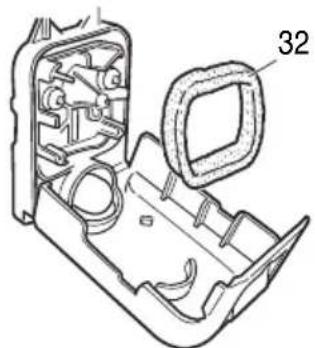
Air fi Iter (Fig. 28)
The air filter must be cleaned from dust and dirt in order to avoid:
○ Carburetor malfunctions
○ Starting problems
○ Engine power reduction
○ Unnecessary wear on the engine parts
○ Abnormal fuel consumption
natural_image
Technical line drawing of a mechanical component with no visible text or symbolsFig. 28
Clean the air filter daily or more often if working in exceptionally dusty areas.
Cleaning the air fi Iter
Remove the air filter cover and the filter (32). Rinse it in warm soap suds. Check that the filter is dry before reassembly. An air filter that has been used for some time cannot be cleaned completely. Therefore, it must regularly be replaced with a new one. A damaged filter must always be replaced.
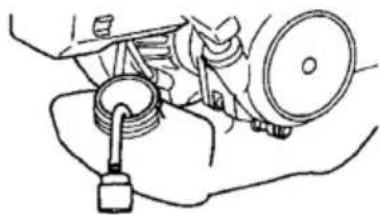
Fuel fi Iter (Fig. 29)
Drain all fuel from fuel tank and pull fuel filter line from tank. Pull filter element out of holder assembly and rinse element in warm water with detergent.
Rinse thoroughly until all traces of detergent are eliminated. Squeeze, do not wring, away excess water and allow element to air dry.
natural_image
Mechanical diagram showing a piston and crank assembly with no visible text or symbolsFig. 29
NOTE
If element is hard due to excessive dirt build-up, replace it.
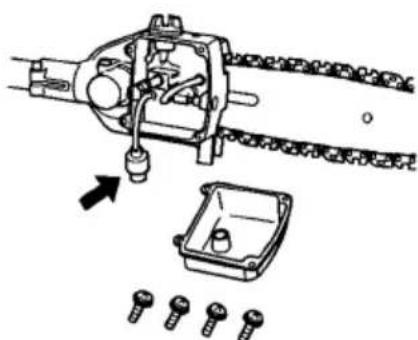
Chain oil fi Iter (Fig. 30)
Remove the oil filter and thoroughly wash it in solvent.
natural_image
Mechanical assembly diagram showing a chain link mechanism with pins and a housing (no text or symbols)Fig. 30
Spark plug (Fig. 31)
The spark plug condition is influenced by:
○ An incorrect carburetor setting
○ Wrong fuel mixture (too much oil in the gasoline)
○ A dirty air fi Iter
○ Hard running conditions (such as cold weather)
These factors cause deposits on the spark plug electrodes, which may result in malfunction and starting difficulties. If the engine is low on power, difficult to start or runs poorly at idling speed, always check the spark plug first. If the spark plug is dirty, clean it and check the electrode gap. Re-adjust if necessary. The correct gap is 0.024" (0.6 mm). The spark plug should be replaced after about 100 operation hours or earlier if the electrodes are badly eroded.
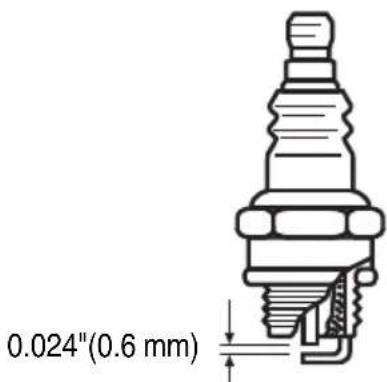
Fig. 31
NOTE
In some areas, local law requires using a resistor spark plug to suppress ignition signals. If this machine was originally equipped with resistor spark plug, use same type of spark plug for replacement.
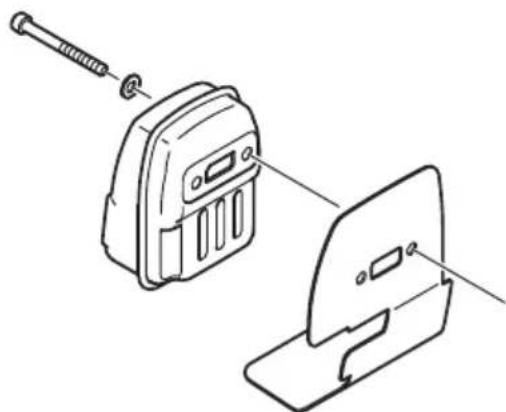
Muffl er (Fig. 32)
Remove the muffler and clean out any excess carbon from the exhaust port or muffler inlet every 100 hours of operation.
natural_image
Technical line drawing of a device with screw and housing components (no text or symbols)Fig. 32
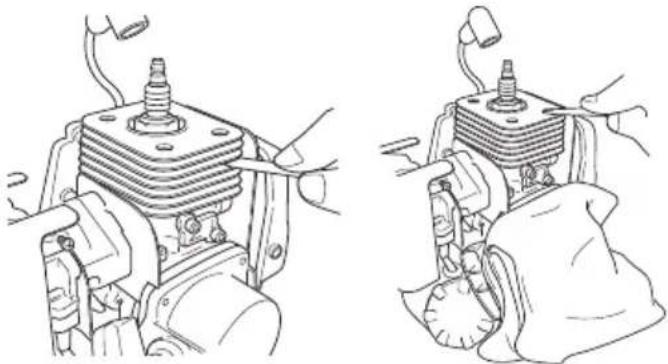
Cylinder (Engine cooling) (Fig. 33)
The engine is air cooled and air must circulate freely around engine and over cooling fins on cylinder head to prevent overheating.
Every 100 operating hours, or once a year (more often if conditions require) clean fins and external surfaces of engine of dust, dirt and oil deposits which can contribute to improper cooling.
natural_image
Technical line drawings of mechanical components, showing assembly and disassembly (no text or symbols)Fig. 33
NOTE
Do not operate engine with engine shroud or muffler guard removed as this will cause overheating and engine damage.
Oiler port (Fig. 34)
Clean the chain oiler port (33) whenever possible.
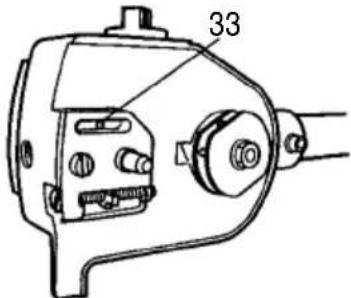
Fig. 34
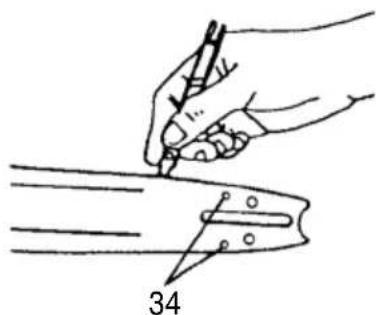
Guide bar (Fig. 35)
Before using the machine, clean the groove and oiler port (34) in the bar with the special gauge offered as an optional accessory.
natural_image
Line drawing of a hand holding a pen over a cutting board, with number 34 labeled (no text or symbols on the diagram itself)Fig. 35
Side case (Fig. 36)
Always keep the side case and drive area clean of saw dust and debris.
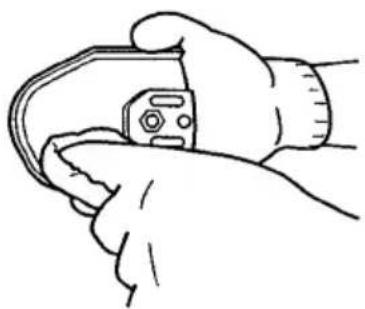
natural_image
Line drawing of a hand holding a small mechanical component (no text or symbols)Fig. 36
Angle transmission (Fig. 37)
Check angle transmission or angle gear for grease level about every 50 hours of operation by removing the grease filler plug on the side of angle transmission. If no grease can be seen on the flanks of the gears, fill the transmission with quality lithium based multipurpose grease up to 3/4.
Do not completely fill the transmission.
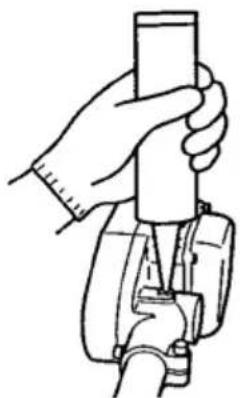
natural_image
Illustration of a hand holding a cylindrical object with a device attached (no text or symbols)Fig. 37
Maintenance schedule
Below you will find some general maintenance instructions. For further information please contact your Tanaka dealer.
Daily maintenance
○ Clean the exterior of the unit.
○ Clean the chain oil fi lter port.
○ Clean the groove and oil filter port in the guide bar.
○ Clean the side case of saw dust.
○ Check that the saw chain is sharp.
○ Check that the bar nuts are sufficiently tightened.
○ Make sure that the chain transport guard is undamaged and that it can be securely fitted.
○ Check that nuts and screws are sufficiently tightened.
Weekly maintenance
○ Check the starter, especially cord and return spring.
○ Clean the exterior of the spark plug.
○ Remove the spark plug and check the electrode gap. Adjust it to 0.024" (0.6 mm) or change the spark plug.
○ Clean the cooling fins on the cylinder and check that the air intake at the starter is not clogged.
○ Clean the air filter.
Monthly maintenance
○ Rinse the fuel tank with gasoline, and clean fuel filter.
○ Clean chain oil fi Iter.
○ Clean the exterior of the carburetor and the space around it.
○ Clean the fan and the space around it.
○ Clean the muffler of carbon.
CHAIN SHARPENING
Parts of a cutter (Fig. 38, 39)
WARNING
Gloves should be used when sharpening chain.
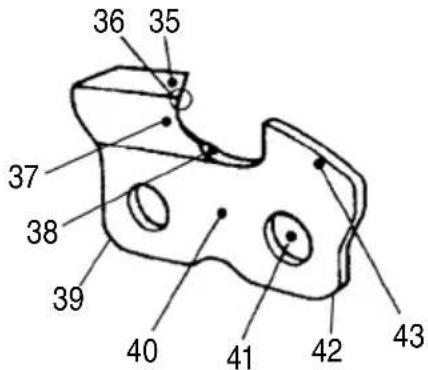
Fig. 38
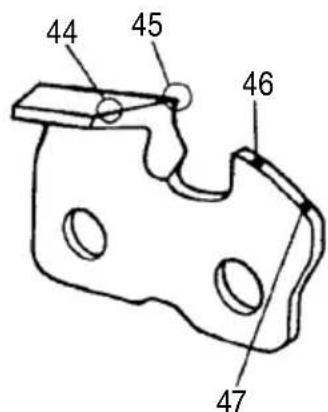
Fig. 39
- Top plate
- Working corner
- Side plate
- Gullet
- Heel
-
Chassis
-
Rivet hole
- Toe
- Depth gauge
- Correct angle on top plate (degree of angle depends on chain type)
- Slightly protruding "hook" or point (curve on non-chisel chain)
- Top of depth gauge at correct height below top plate
- Front of depth gauge rounded off.
LOWERING DEPTH GAUGES WITH A FILE
1) If you sharpen your cutters with a file holder, check and lower the depth.
2) Check depth gauges every third sharpening.
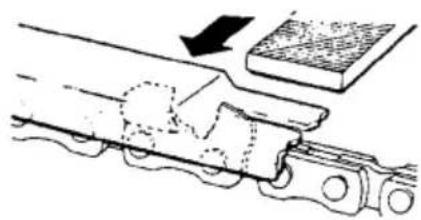
3) Place depth gauge tool on cutter. If depth gauge projects, fi le it level with the top of the tool. Always fi le from the inside of the chain toward an outside cutter. (Fig. 40)
natural_image
Mechanical assembly diagram showing a chain with a block and directional arrow (no text or symbols)Fig. 40
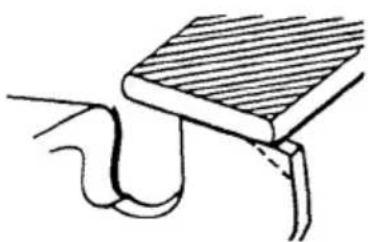
4) Round off front corner to maintain original shape of depth gauge after using depth gauge tool. Always follow the recommended depth gauge setting found in the maintenance or operator manual for your saw. (Fig. 41)
natural_image
Simple line drawing of a curved pipe or tube with a flat top surface (no text or symbols)Fig. 41
GENERAL INSTRUCTIONS FOR FILING CUTTERS
File (48) cutter on one side of the chain from the inside out. File on forward stroke only. (Fig. 42)
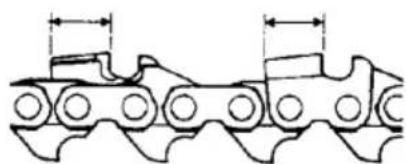
5) Keep all cutters the same length. (Fig. 43)
6) File enough to remove any damage to cutting edges (side plate (49) and top plate (50)) of cutter. (Fig. 44)
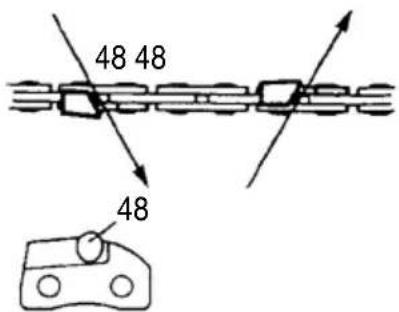
Fig. 42
natural_image
Technical line drawing of a mechanical chain with two vertical supports and a central roller (no text or symbols)Fig. 43

Fig. 44
SHARPENING ANGLES FOR SHARPENING SAW CHAIN
| 1. Part Number | 90SG-40 / 90PX-40 | |
| 2. Pitch 3/8" | ||
 | 3. Depth Gauge Setting | 0.025" |
 | 4. Side Plate Filing Angle | 80° |
 | 5. Top Plate Angle | 30° |
 | 6. File Guide Angle | 90° |
SIGNIFICATION DES SYMBOLES
PRÉCAUTIONS ET CONSIGNES DE SÉCURITÉ
Fig. 1
REMARQUE
Fig. 2
natural_image
Mechanical diagram showing a curved mechanical component with mounting holes and directional arrows (no text or labels)Fig. 3
natural_image
Technical line drawing of a mechanical assembly with hands holding parts (no text or symbols)Fig. 4
natural_image
Illustration of three types of electrical connectors or wires (no text or symbols)Fig. 5
Fig. 6
ATTENTION
natural_image
Technical line drawing of a mechanical component with mounting holes and a shaft (no text or symbols)Fig. 7
Fig. 8
natural_image
Illustration of hands using a chain-linking tool to cut a mechanical part (no text or symbols visible)Fig. 11
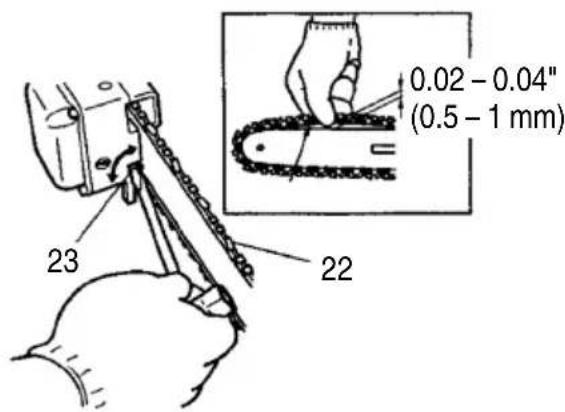
Fig. 12
IMPORTANT
UNE TENSION CORRECTE DE LA CHAÎNE EST EXTRÊMEMENT IMPORTANTE! (Fig. 11, 12)
natural_image
Hand operating a mechanical component with a numbered dial (31), no visible text or symbols beyond the number.Fig. 18
- Réglez le starter (51) sur la position FERMÉE (A). (Fig. 19)
natural_image
Mechanical assembly diagram showing a lever mechanism with a directional arrow and label '51' (no text or symbols beyond label)Fig. 19
natural_image
Line drawing of a hand using a screwdriver to adjust or install a mechanical component (no text or symbols present)Fig. 20
natural_image
Illustration of two mechanical tools with arrows indicating movement, no text or symbols presentFig. 24
natural_image
Diagram of a mechanical clamp or tool interacting with a tree branch, showing motion lines and no text or symbols.Fig. 25
Fig. 26
natural_image
Technical line drawing of a mechanical device interior showing internal components and part number 32 (no text or symbols present)Fig. 28
natural_image
Mechanical diagram showing piston and crankshaft mechanism (no text or labels)Fig. 29
REMARQUE
natural_image
Mechanical assembly diagram showing a chain link mechanism with pins and a housing (no text or symbols)Fig. 30
Bougie (Fig. 31)
Fig. 31
REMARQUE
natural_image
Technical line drawing of a device with screw and housing components (no text or symbols)Fig. 32
natural_image
Technical line drawing of two mechanical assembly steps showing tool positioning and assembly (no text or symbols)Fig. 33
REMARQUE
natural_image
Line drawing of a hand holding a pen over a blade, with no text or symbols presentFig. 35
natural_image
Line drawing of a hand holding a small mechanical component (no text or symbols)Fig. 36
natural_image
Illustration of a hand holding a cylindrical object with a mechanical clamp (no text or symbols)Fig. 37
Entretien
natural_image
Technical diagram of a mechanical assembly with no visible text or symbolsFig. 40
natural_image
Simple line drawing of a curved pipe or tube with a flat top surface (no text or symbols)Fig. 41
INSTRUCTIONS GÉNERALES POUR L'AF F U TAG E D E S MAILLONS GOUGE
natural_image
Technical line drawing of a chain with two vertical segments and circular ends (no text or symbols)Fig. 43
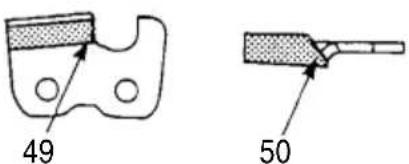
Fig. 44
SHARPENING ANGLES FOR SHARPENING SAW CHAIN
Fig. 1
NOTA
Fig. 2
natural_image
Mechanical diagram showing a curved mechanical component with mounting holes and directional arrows (no text or labels)Fig. 3
natural_image
Technical line drawing of a mechanical assembly with hands holding parts (no text or symbols)Fig. 4
natural_image
Illustration of three types of electrical connectors or wires (no text or symbols)Fig. 5
Fig. 6
ADVERTENCIA
natural_image
Technical line drawing of a mechanical component with no visible text or symbolsFig. 7
Fig. 8
natural_image
Illustration of hands using a chain-linking tool to cut a saw (no text or symbols present)Fig. 11
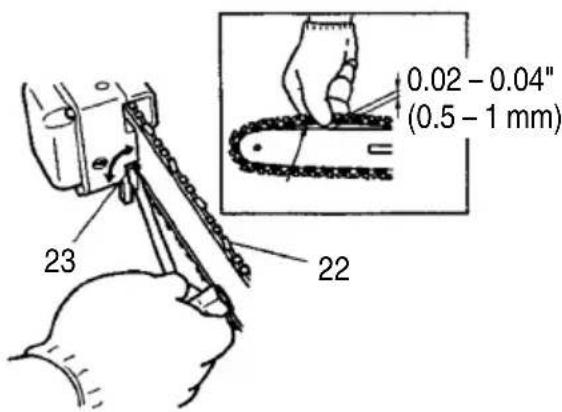
Fig. 12
PRECAUCIÓN
natural_image
Hand operating a mechanical device with a numbered label '31' (no text or symbols on the device itself)Fig. 18
natural_image
Mechanical assembly diagram showing a lever mechanism with a spring and directional arrow (no text or symbols)Fig. 19
natural_image
Line drawing of a hand using a tool to adjust or install a mechanical component (no text or symbols present)Fig. 20
natural_image
Illustration of two mechanical tools with arrows indicating movement, no text or symbols presentFig. 24
Técnica de recorte
natural_image
Diagram of a mechanical clamp or tool interacting with a tree branch, showing motion lines and no text or symbols.Fig. 25
Fig. 26
natural_image
Technical line drawing of a mechanical assembly with tool and component (no text or symbols)Fig. 27
NOTA
natural_image
Technical line drawing of a mechanical device interior with no visible text or symbolsFig. 28
natural_image
Mechanical diagram showing piston and crankshaft components (no text or labels)Fig. 29
NOTA
natural_image
Mechanical assembly diagram showing a chain link mechanism with pins and a housing (no text or symbols)Fig. 30
Bujía (Fig. 31)
Fig. 31
NOTA
natural_image
Technical line drawing of a device with screw and housing components (no text or symbols)Fig. 32
natural_image
Technical line drawings of mechanical components, showing assembly and disassembly (no text or symbols)Fig. 33
NOTA
natural_image
Line drawing of a hand holding a small mechanical component (no text or symbols)Fig. 36
natural_image
Illustration of a hand holding a cylindrical object with a device attached (no text or symbols)Fig. 37
natural_image
Mechanical assembly diagram showing a chain with a moving component and directional arrow (no text or symbols)Fig. 40
natural_image
Simple line drawing of a curved pipe or tube with a horizontal bar above it (no text or symbols)Fig. 41
natural_image
Technical line drawing of a chain with two circular components and dimension lines (no text or symbols)Fig. 43
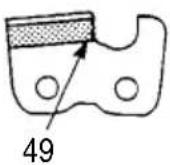
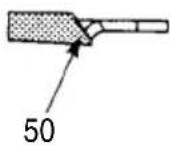
Fig. 44
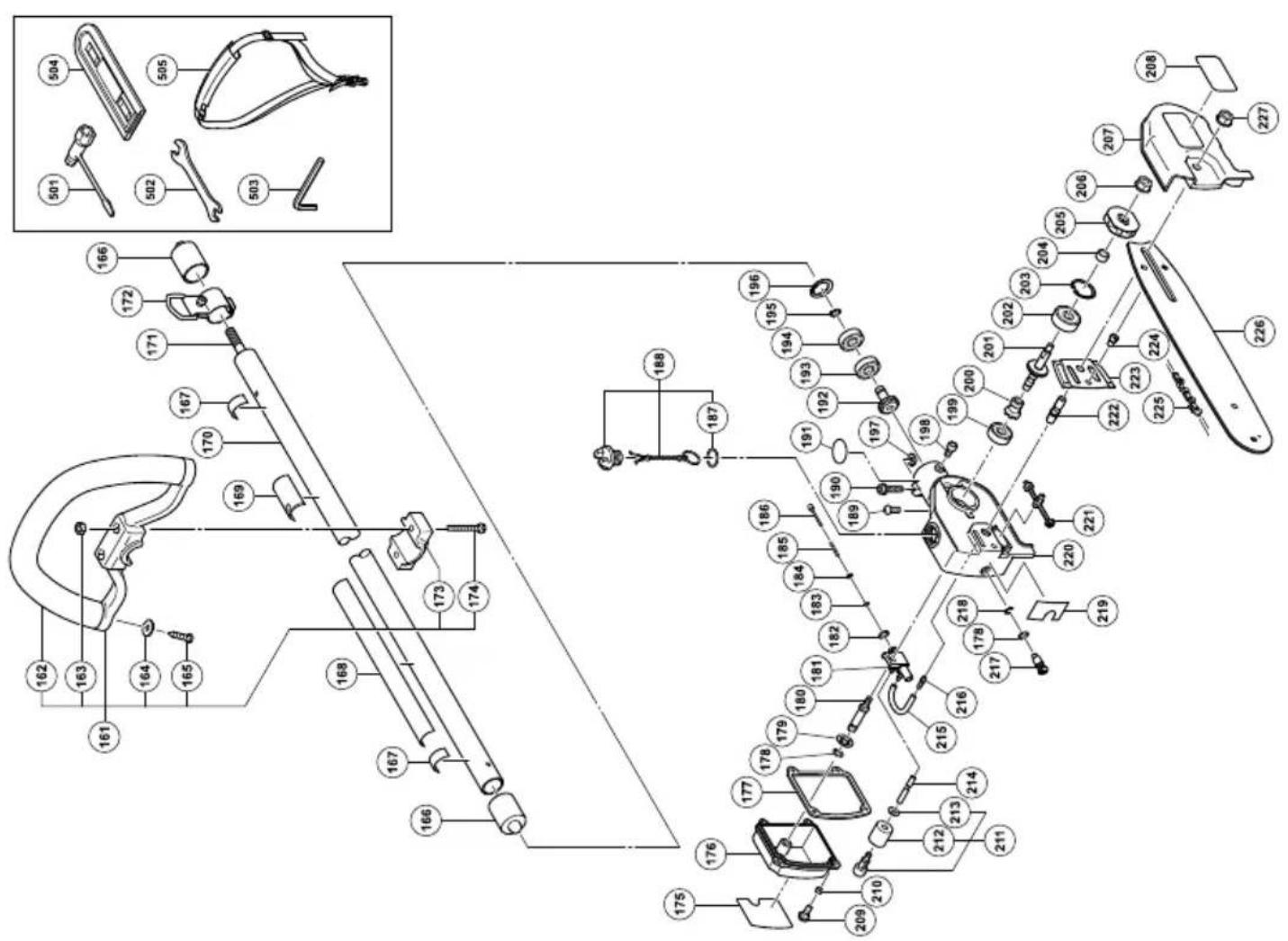
| ITEMNO. | PART NAME | Q'TY |
| 1 CYLINDER COVER 1 | ||
| 2 HITACHI LABEL 1 | ||
| 3 SCREW 4×22/PS 4 | ||
| 4 MUFFLER COVER 1 | ||
| 5 SCREW 5×16/PS 2 | ||
| 6 HEX.HOLE BOLT 6×65 2 | ||
| 7 WASHER 6 2 | ||
| 8 MUFFLER (B) 1 | ||
| 9 | SEAL LOCK HEX. SOCKETBOLT (W/WASHERS) M5×25 | 5 |
| 10 HEAT PROTECTION PANEL 1 | ||
| 11 HEX. HOLE BOLT 5×20S 8 | ||
| 12 SPARK PLUG BMR7A 1 | ||
| 13 COVER PACKING 2 | ||
| 14 SCAVENGING COVER (A) 1 | ||
| 15 HEX. HOLE BOLT 4×12WS 4 | ||
| 16 WASHER T1.6 2 | ||
| 17 SCAVENGING COVER (B) 1 | ||
| 18 CYLINDER GASKET | 1 | |
| 19 CYLINDER SET PN 1 | ||
| 20 SWIVEL | 1 | |
| 21 STOP RING | 1 | |
| 22 O-RING | 1 | |
| 23 PUMP GASKET | 1 | |
| 24 PUMP DIAPHRAGM | 1 | |
| 25 PUMP BODY ASS'Y | 1 | |
| 26 SPRING | 1 | |
| 27 CONTROL LEVER | 1 | |
| 28 DIAPHRAGM GASKET | 1 | |
| 29 PRIMING BODY 1 | ||
| 30 DIAPHRAGM COVER | 1 | |
| 31 THROTTLE SET SCREW | 2 | |
| 32 THROTTLE VALVE | 1 | |
| 33 O-RING | 1 | |
| 34 MAIN JET #32 | 1 | |
| 35 INLET SCREEN | 1 | |
| 36 NEEDLE VALVE | 1 | |
| 37 HINGE PIN SET SCREW | 1 | |
| 38 HINGE PIN | 1 | |
| 39 METERING DIAPHRAGM | 1 | |
| 40 PRIMING PUMP COMP. | 1 | |
| 41 SET SCREW | 4 | |
| 42 INLET MANIFOLD GASKET | 1 | |
| 43 CARBURETOR INSULATORSET PN | 1 | |
| 44 CARBURETOR GASKET | 1 | |
| 45 THROTTLE WIRE FIXINGPLAT | 1 | |
| 46 CARBURETOR GASKET | 1 | |
| 47 CARBURETOR ASS'Y 1 | ||
| 48 SWIVEL CAP | 1 | |
| 49 PLUS SCREW 5×60WS | 2 | |
| 50 MARK PLATE (T) 1 | ||
| 51 CLEANER ELEMENT | 1 | |
| 52 CLEANER COVER 1 | ||
| 53 CLEANER ASS'Y 1 | ||
| 54 PISTON SET PN | 1 | |
| 55 PISTON RING | 1 | |
| 56 PISTON PIN CIRCLIP | 2 | |
| 57 PISTON PIN | 1 | |
| 58 NEEDLE BEARING | 1 | |
| 59 CRANK SHAFT COMP. | 1 | |
| 60 CRANK CASE ASS'Y | 1 | |
| 61 CRANK CASE GASKET | 1 | |
| 62 OIL SEAL TB 12227 | 2 | |
| 63 BALL BEARING 6001C3 | 2 | |
| 64 CRANKSHAFT WASHER | 2 | |
| ITEM NO. | PART NAME | Q'TY |
| 65 | KNOCK PIN 4×12 | 2 |
| 66 | STARTER PULLEY ASS'Y | 1 |
| 67 | STOP RING E-5 | 2 |
| 68 | STARTER PAWL SPRING | 2 |
| 69 | STARTER PAWL | 2 |
| 70 | RECOIL STARTER BODY ASS'Y | 1 |
| 71 | SET SCREW | 1 |
| 72 | CAM PLATE | 1 |
| 73 | DUMPER SPRING | 1 |
| 74 | STARTER ROPE REEL | 1 |
| 75 | RECOIL SPRING | 1 |
| 76 | RECOIL STARTER BODY COMP. | 1 |
| 77 | STARTER ROPE 3.5×860 | 1 |
| 78 | STARTER HANDLE | 1 |
| 79 | NAME PLATE 1 | |
| 101 | D4 TAPPING SCREW | 4 |
| 102 | HANDLE (B) | 1 |
| 103 | LOCK LEVER | 1 |
| 104 | LEVER | 1 |
| 105 | SPRING (A) | 1 |
| 106 | STOP SWITCH | 1 |
| 107 | STOP SWITCH CORD | 2 |
| 108 | PROTECTION TUBE | 1 |
| 109 | THROTTLE WIRE | 1 |
| 110 | HANDLE (A) | 1 |
| 111 | HEX. HOLE BOLT M5×12 | 1 |
| 112 | HEX. HOLE BOLT M5×25/S | 2 |
| 113 | ANTI-VIBE RUBBER A | 1 |
| 114 | PIPE HOLDER (A) | 1 |
| 115 | PIPE HOLDER(B) | 1 |
| 116 | ANTI-VIBE RUBBER B | 1 |
| 117 | STOP RING C-12 OUTER | 1 |
| 118 | FAN CASE | 1 |
| 119 | CLUTCH DRUM COMP. | 1 |
| 120 | STEP BOLT | 2 |
| 121 | BENT WASHER 8 | 2 |
| 122 | CLUTCH PLATE A | 2 |
| 123 | CLUTCH ASS'Y | 1 |
| 124 | CLUTCH WASHER B | 2 |
| 125 | HEX. NUT M8 1 | |
| 126 | WASHER M8 | 1 |
| 127 | HEX. HOLE BOLT 4×18WS 2 | |
| 128 | IGNITION COIL ASS'Y | 1 |
| 129 | CORD | 1 |
| 130 | CORD | 1 |
| 131 | CORD | 1 |
| 132 | MAGNETO ROTOR COMP. | 1 |
| 133 | SHIELD TUBE ASS'Y | 1 |
| 134 | FUEL PIPE | 1 |
| 135 | TANK CAP ASS'Y | 1 |
| 136 | TANK CAP CHAIN | 1 |
| 137 | RETURN GROMMET | 1 |
| 138 | SPACER | 1 |
| 139 | TANK | 1 |
| 140 | STAND | 1 |
| 141 | FLANGE BOLT | 2 |
| 142 | PUMP FILTER BODY COMP | 1 |
| 143 | CLIP, 6.3 DIA. 1 | |
| 144 | FLANGE BOLT | 1 |
| 161 | LOOP HANDLE ASS'Y | 1 |
| 162 | HANDLE GRIP | 1 |
| 163 | HEX. NUT 6 | 2 |
| 164 | BRAKE SHAFT WASHER | 1 |
| 165 | TAPPING SCREW 5×20 | 1 |
| 166 | CAP (A) | 2 |
| ITEM NO. | PART NAME | Q'TY |
| 167 | LEVEL MARK | 2 |
| 168 | CAUTION PLATE HITACHI | 1 |
| 169 | LEVEL MARK | 1 |
| 170 | MAIN PIPE COMP. 1 | |
| 171 | DRIVE SHAFT 1829L | 1 |
| 172 | LIFTING METAL ASS'Y | 1 |
| 173 | HANDLE BRACKET A | 1 |
| 174 | BOLT 6×43/P | 2 |
| 175 | OIL ADJUSTMENT MARK | 1 |
| 176 | OIL TANK COVER | 1 |
| 177 | OIL TANK GASKET 1 | |
| 178 | O-RING P-5 | 2 |
| 179 | 8 PUSH NUT | 1 |
| 180 | STEP BOLT A | 1 |
| 181 | OIL PUMP COMP. 1 | |
| 182 | O-RING | 1 |
| 183 | O-RING 1.4 | 1 |
| 184 | WASHER 2 1 | |
| 185 | OIL PUMP SPRING | 1 |
| 186 | OIL PUMP PISTON COMP. | 1 |
| 187 | O-RING P-15 | 1 |
| 188 | OIL TANK CAP ASS'Y | 1 |
| 189 | SCREW 6×8 | 1 |
| 190 | HEX. HOLE BOLT M5×22/S | 1 |
| 191 | MANUAL MARK 1 | |
| 192 | PINION | 1 |
| 193 | BALL BEARING 609 | 1 |
| 194 | BALL BEARING 609Z ST | 1 |
| 195 | STOP RING C-9, OUTER 1 | |
| 196 | STOP RING C-24, INNER | 1 |
| 197 | STARTER PAWL WASHER | 1 |
| 198 | HEX. HOLE BOLT M5×10 | 1 |
| 199 | BALL BEARING 627 C3 | 1 |
| 200 | CAM | 1 |
| 201 | GEAR | 1 |
| 202 | BALL BEARING 638Z | 1 |
| 203 | STOP RING C-28, INNER | 1 |
| 204 | COLLER | 1 |
| 205 | SPROCKET COMP., 3/8 | 1 |
| 206 | FLANGE NUT 6 | 1 |
| 207 | SIDE COVER COMP. | 1 |
| 208 | SYMBOL MARK 1 | |
| 209 | SMALL SCREW 4×12WS | 4 |
| 210 | COLLER 3 | 4 |
| 211 | FILTER ASS'Y | 1 |
| 212 | OIL FILTER | 1 |
| 213 | WASHER 5 1 | |
| 214 | FUEL PIPE 3×5×60 | 1 |
| 215 | FUEL PIPE 3×5×75 | 1 |
| 216 | BANJO, OIL PUMP | 1 |
| 217 | OIL PUMP ADJUSTER | 1 |
| 218 | STOP RING E-6 | 1 |
| 219 | OIL MARK | 1 |
| 220 | CASE | 1 |
| 221 | CHAIN TENSIONER ASS'Y 1 | |
| 222 | CHAIN BAR TIGHTENING BOLT | 1 |
| 223 | GUIDE PLATE | 1 |
| 224 | CHAIN BAR KNOCK PIN | 1 |
| 225 | SAW CHAIN, 10 INCH, 3/8 | 1 |
| 226 | CHAIN BAR 10 INCH 3/8 | 1 |
| 227 | CHAIN BAR CLAMP NUT | 1 |
| 501 | COMBI. BOX SPANNER 13×19 MINUS | 1 |
| 502 | WRENCH 8×10 | 1 |
| 503 | HEX. BAR WRENCH 4MM | 1 |
| 504 | GUIDE BAR COVER, 10 | 1 |
| 505 | SHOULDER BELT 1 |
natural_image
Line drawing of a quill pen with inkwell (no text or symbols)WARNING:
Some dust created by power sanding, sawing, grinding, drilling, and other construction activities contains chemicals known to the State of California to cause cancer, birth defects or other reproductive harm. Some examples of these chemicals are:
- Lead from lead-based paints,
- Crystalline silica from bricks and cement and other masonry products, and
- Arsenic and chromium from chemically-treated lumber.
Your risk from these exposures varies, depending on how often you do this type of work. To reduce your exposure to these chemicals: work in a well ventilated area, and work with approved safety equipment, such as those dust masks that are specially designed to filter out microscopic particles.
AVERTISSEMENT:
Minato-ku, Tokyo 108-6020, Japan
Distributed by

Hitachi Koki U.S.A., Ltd.
3950 Steve Reynolds Blvd.
Norcross, GA 30093

Hitachi Koki Canada Corp.
450 Export Blvd. Unit B,
Mississauga ON L5S 2A4