USER MANUAL ET375GU11E/01 SIEMENS
Operating instructions
Mode d'emploi
natural_image
Illustration of a lathe machine with a container pouring liquid into it (no text or symbols)
natural_image
Illustration of a kitchen appliance with a tray and a container filled with gravel, no text or symbols present.
natural_image
Diagram of a refrigerator with cooling fins and heat exchanger, showing airflow direction (no text or labels)
Before installation 18
Safety instructions 19
How to avoid damage 20
Before first use 20
Your new appliance 21
This is your new lava stone grill 21
Control and indicator light 22
Grill heating element 22
Lava stone container 22
Water bath 22
Setting the grill 23
Grilling over the lava stones 23
Grilling over the water bath 25
Safety switch-off 26
Tables and tips 27
Grilling table 27
Tips for grilling 28
Care and cleaning 29
After-sales service 31
Read these instructions carefully. Only after reading these will you be able to operate the appliance safely and correctly.
Please keep the operating and installation instructions in a safe place. If the appliance is passed to another person, please enclose the instructions.
Before installation
Environmental protection
Remove the packaging from the appliance and dispose of the packaging in an environmentally-friendly way.
This appliance is labelled in accordance with the European Directive 2002/96/EG concerning used electrical and electronic appliances (waste electrical and electronic equipment – WEEE). The guideline determines the framework for the return and recycling of used appliances as applicable.
Transport damage
Check the appliance after removing the packaging. If it has suffered any damage during transport, do not connect the appliance.
Electrical connection
The connecting lead must be replaced if it has been damaged. This can only be carried out by one of our after-sales service technicians, in order to guarantee the safety.
Installation and connection
Please refer to the installation instructions.

Safety instructions
| This appliance should only be used for domestic cooking. |
| Do not use charcoal or similar fuels for this grill! |
| Safe operation | Do not let adults or children operate the appliance unsupervised: - if they are mentally or physically unable to use the appliance safely and correctly - if they don't have the knowledge and experience to use the appliance safely and correctly. Never allow children to play with the appliance. |
| Overheated oil and fat | Caution, fire risk! Overheated oil and fat can ignite easily. Do not leave hot oil and fat unattended. Never attempt to extinguish burning oil and fat with water. Use a lid to smother flames. Switch off the appliance. |
| Hot grill | Caution, risk of burns! The appliance heats up during operation. Keep children away! Caution, fire risk! Do not store any combustible objects in drawers or shelves under the appliance (for example cleaners, aerosols). Risk of short circuits! The connecting cables of electric appliances must not come into contact with the hot appliance. The cable insulation can be damaged. |
| Glass ceramic cover | Wait until the appliance has cooled down completely before placing the glass ceramic cover on the appliance. Do not switch on the grill with the glass ceramic cover placed on it. Do not use the glass ceramic cover as a surface for placing objects or for keeping things warm. |
| Cleaning | Switch off the grill after use. Clean the grill after every use when it has cooled down. Greasy soiling can ignite. |
Repairs
Incorrect repairs are dangerous. Risk of electric shock! Repairs must be carried out by one of our experienced after-sales engineers.
If the appliance is damaged, switch off the corresponding household fuse. Call after-sales service.
How to avoid damage
Hard or pointed objects
Hard or pointed objects may cause damage if they fall onto the glass ceramic panel or the glass ceramic cover.
Glass ceramic cover
Wait until the appliance has cooled down completely before placing the glass ceramic cover on the appliance. Do not switch on the grill with the glass ceramic cover placed on it. Do not use the glass ceramic cover as a surface for placing objects or for keeping things warm.
Before first use
Lava stones
Before using the appliance for the first time, take the lava stones out of the plastic bag and pour them into the lava stone container.
Heat up grill
Thoroughly clean the appliance and accessories before using them for the first time. Then heat up the appliance without any food placed on it at the highest level for a few minutes. This will eliminate any 'newness' smells.
There might be smoke when heating the grill for the first time. This is normal.
Your new appliance
Your new appliance and its accessories are described in this section.
This is your new
lava stone grill
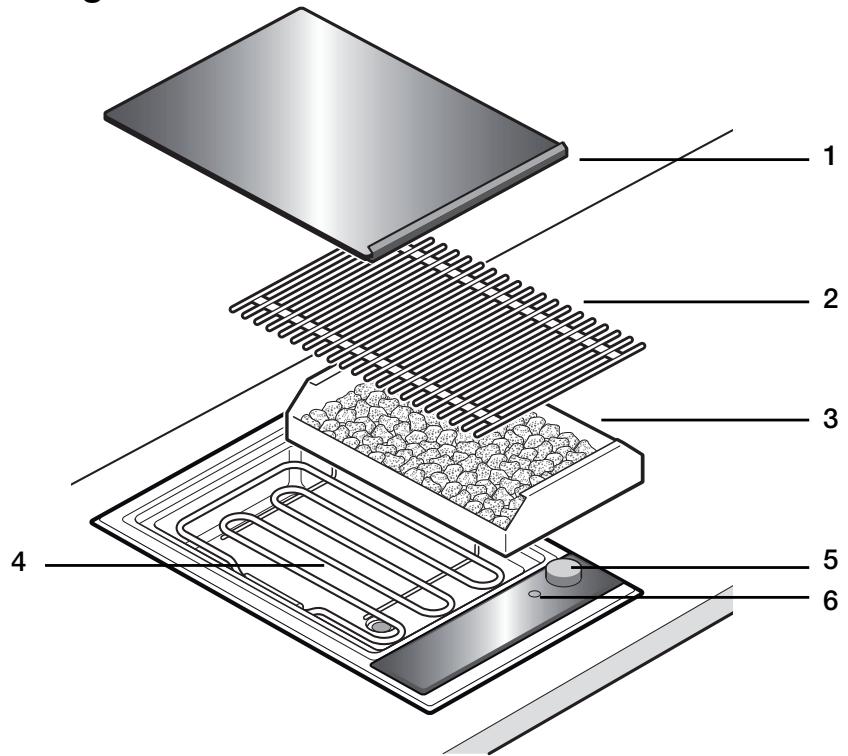
1 Glass ceramic cover
2 Grid iron
3 Lava stone container
4 Grill heating element
5 Control
6 Indicator light
Control and indicator light
Turn the control to choose the heat setting of the grill. The heat setting is infinitely variable. To switch off the grill, turn the control to 0 after grilling.
The indicator light goes on when the grill is switched on and warns that the appliance is hot.
Grill heating element

Caution, risk of burns! The grill heating element heats up during operation. Wait until the appliance has cooled down before touching the grid iron or the grill heating element.
You might notice that the grill heating element switches on and off automatically during the grilling time. This is normal.
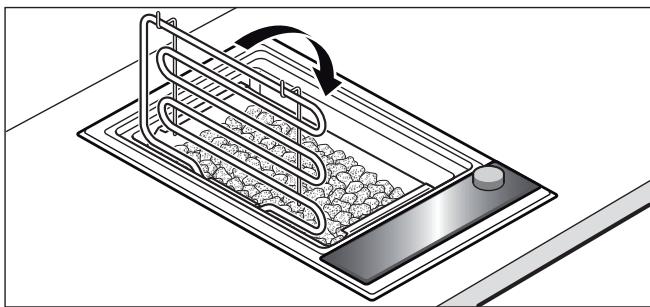
You can tilt up the heating element after taking off the grid iron. For safety reasons, tilting up the heating element will result in the heating element being switched off, even if the control is switched on.
Lava stone container
Before using the appliance for the first time, take the lava stones out of the plastic bag and pour them into the lava stone container.
Water bath

Always fill the grill trough with water before each use. The amount of water depends on whether you wish to grill with or without lava stones.
Caution, risk of scalding! If water splashes onto the hot grid iron or grill heating element when adding more water to the trough, this will result in hot steam being given off.
Setting the grill
With your new grill you can grill over the lava stones or over the water bath.
The lava stones accumulate the heat from the grill heating element and radiate an intense and even heat.
When grilling over the water bath the rising steam will keep grilled meat juicy and tender.
Grilling over the lava stones
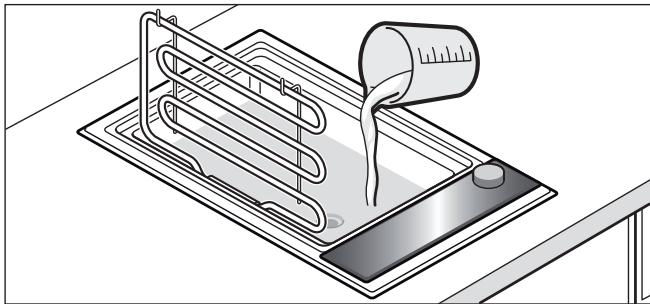
- Remove the grid iron and tilt up the grill heating element. Remove the lava stone container.
- Pour in approx. 0.7 litres of water up to the lower marking.
natural_image
Illustration of a mechanical device with a pouring liquid into a tray (no text or symbols)
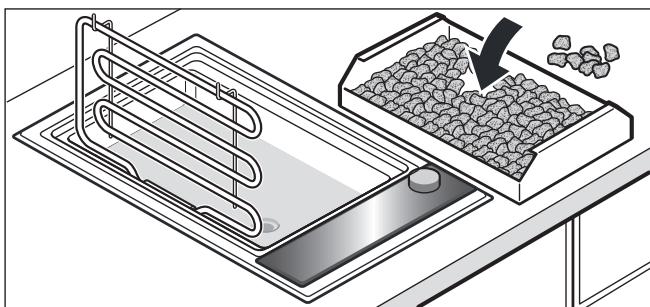
- Remove the lava stones from their packaging and pour them into the lava stone container. Insert the lava stone container into the appliance.
natural_image
Illustration of a kitchen appliance with a tray and a container filled with gravel (no text or symbols)
- Tilt down the grill heating element and put on the grid iron.
natural_image
Diagram of a refrigerator with cooling fins and heat exchanger, showing airflow direction (no text or labels)
- Preheat the grill for approx. 8-12 minutes on the highest setting. Then you can put on the food to be grilled. Select the heat setting according to the settings table.
Note: preheat the empty appliance for a maximum of 8-12 minutes. If the appliance is preheated for too long, it might switch off (overheating protection). Switch off the appliance and leave to cool down before switching on again.
Fat dripping onto the grill heating element and the hot lava stones will produce smoke. Dripping fat may flare up briefly.
Water level
When grilling, always monitor the water level in the grill trough and, if required, add more water up to the lower marking.

Caution, risk of scalding! If water splashes onto the hot grid iron or grill heating element when adding more water to the trough, this will result in hot steam being given off.
Draining the water
In the event that the water is still hot when drained, add some cold water to the container to cool it!
To drain the water, place a heat-resistant container beneath the drain valve. Open the drain tap by turning the lever down by 90^ . Then close the tap by turning the lever fully up.
Changing the lava stones
The lava stones absorb any fat which drips from the grill. When the stones become dark, this means that they are saturated and must then be replaced.
You can obtain suitable lava stones from your specialist dealer or our after-sales service.
Grilling over the water bath
- Remove the grid iron and tilt up the grill heating element. Remove the lava stone container.
- Pour in approx. 2.5 litres of water up to the upper marking.
- Tilt down the grill heating element and put on the grid iron.
- Preheat the grill for approx. 8-12 minutes on the highest setting. Then you can put on the food to be grilled. Select the heat setting according to the settings table.
Note: preheat the empty appliance for a maximum of 8-12 minutes. If the appliance is preheated for too long, it might switch off (overheating protection). Switch off the appliance and leave to cool down before switching on again.
Water level
When grilling, always monitor the water level in the grill trough and, if required, add more water up to the upper marking.

Caution, risk of scalding! If water splashes onto the hot grid iron or grill heating element when adding more water to the trough, this will result in hot steam being given off.
Draining the water
In the event that the water is still hot when drained, add some cold water to the container to cool it!
To drain the water, place a heat-resistant container beneath the drain valve. Open the drain tap by turning the lever down by 90^ . Then close the tap by turning the lever fully up.
Safety switch-off
The safety switch-off function switches off the grill heating element when overheating. When the grill has cooled down sufficiently the grill heating element automatically switches on again.
Tables and tips
Grilling table
These values are to be regarded as guidelines only. The grilling times apply to a preheated grill and will depend on the quality and the amount of the food.
The heat setting is infinitely variable. It is possible, that the optimum setting for your food is between two control settings!
Turn the food at least once.
| Food | Preheating on level 9 in minutes | Control setting Grilling over the lava stones | Control setting Grilling over the water bath | Grilling time in minutes |
| Beef steak, medium, 2-3 cm | 12 | 8 - 9 | 8 - 9 | 8 - 10 |
| T-Bone-Steak, pink, 3 cm | 10 | 7 - 8 | 8 - 9 | 10 - 15 |
| Pork collar steak, without bone | 10 | 8 - 9 | 8 - 9 | 12 - 16 |
| Pork cutlets*, 2 cm | 8 | 7 - 8 | 8 - 9 | 15 - 20 |
| Lamb cutlets, pink, 2 cm | 10 | 7 - 8 | 8 - 9 | 8 - 12 |
| Chicken breast, 2 cm | 10 | 7 - 8 | 8 - 9 | 15 - 20 |
| Chicken wings, 100 g each | 10 | 7 - 8 | 8 - 9 | 15 - 20 |
| Turkey steak, plain, 2 cm | 10 | 7 - 8 | 8 - 9 | 12 - 15 |
| Salmon steak**, 3 cm | 8 | 7 - 8 | 8 - 9 | 20 - 25 |
| Tuna steak**, 2 cm | 8 | 7 - 8 | 8 - 9 | 10 - 15 |
| Trout***, whole, 200 g | 10 | 7 - 8 | 8 - 9 | 12 - 15 |
| King prawns, 30 g each | 10 | 7 - 8 | 8 - 9 | 12 - 15 |
| Hamburgers, 1 cm | 10 | 7 - 8 | 8 - 9 | 12 - 17 |
| Shish kebap****, 100 g each | 8 | 7 - 8 | 8 - 9 | 17 - 25 |
| Sausages, 100 g each | 10 | 7 - 8 | 8 - 9 | 10 - 20 |
| Vegetables***** | 8 | 7 - 8 | 8 - 9 | 8 - 12 |
* cut along the bone
** oil the grid iron
*** oil skin well, then oil again before turning
**** turn frequently
***** for example aubergine, courgette in slices 1 cm thick, pepper (quartered)
Tips for grilling
| Quality of the meat | The grilled result depends on the nature and quality of the meat and on your personal taste. As far as possible, grilled pieces should be equally thick. In this way, they will brown evenly and they will stay nice and juicy. |
| Preheating the grill | Always preheat the grill. In this way, the intensive heat radiation will seal the surface of the grilled food and juice cannot leak out. |
| Preparing the food | To avoid drying out the surface and to improve the taste, lightly brush the food before grilling with heat-resistant oil (e.g. peanut oil). Make sure you do not use too much oil as otherwise there will be a risk of fire.Always grill steaks unsalted. Otherwise, water and soluble nutrients might leak and be lost.Do not remove the fatty layer (e.g. on a cutlet) until after grilling as otherwise the meat will lose juice and aroma. |
| Placing the food on the grill | Place grilled pieces directly on the grid iron. If there is only one piece for grilling, place it in the middle of the grid iron for best results. |
| Turning the food | Turn the meat when small fluid drops can be seen on the surface of the meat.Turn grilled pieces over as soon as they can be removed easily from the grid iron. If the meat is sticking to the grid iron its texture will be destroyed and juice will leak out. |
| Tips for grilling | Do not pierce the meat while grilling it. It may lose its juice.Meat is medium if juice appears on the surface of a steak (pink inside and crispy brown on the outside).Serve grilled food hot. Grilled food will go tough if you keep it warm. |
| Dripping Fat | Fat dripping onto the grill heating element may flare up briefly and will produce smoke. To reduce flaring up, grill fatty food over the water bath. |
Care and cleaning

Do not use high-pressure or steam jet cleaning devices.
Caution, risk of burns! Wait until the grill has cooled down completely before cleaning it.
Clean the grill after every use. Burnt in residues may be difficult to remove.
Wash new sponge cloths thoroughly before use.
Draining the water
In the event that the water is still hot when drained, add some cold water to the container to cool it!
To drain the water, place a heat-resistant container beneath the drain valve. Open the drain tap by turning the lever down by 90°. Then close the tap by turning the lever fully up.
Wipe clean the metal surfaces using warm soapy water. Polish with a clean, dry cloth.
Avoid scratching or scrubbing as this could cause permanent scratches. Remove stubborn soiling with a soft brush or soak with a small amount of soapy water.
Cleaning the grid iron
The grid iron can be cleaned by hand by adding a mild detergent to the cleaning water. Do not apply acidic substances (lemon juice, vinegar, etc.) to the enamel surface.
Do not scrape away burnt in residues but soak with a small amount of soapy water.
Lava stones
It is advisable to dry very damp lava stones occasionally in the oven at 200 °C. This will prevent the formation of mildew.
Glass ceramic panel and glass ceramic cover
Remove light soiling using a damp cloth, or with warm soapy water.
Rinse any left-over detergent with cold water and dry the surface well.
Unsuitable cleaning agents
Do not use an abrasive sponge or a scouring agent. Nor should any chemically aggressive cleaners such as oven sprays or stain removers be used.
Do not clean the grid iron, the lava stone container and the glass ceramic cover in a dish washer.
After-sales service
Our after-sales service is there for you if your appliance should need to be repaired. You will find the address and telephone number of your nearest after-sales service centre in the phone book. The after-sales service centres listed will also be happy to inform you of a service point in your local area.
E-number and FD-number
Please quote the E number (product number) and the FD number (production number) of your appliance when contacting the after-sales service. The nameplate containing these numbers can be found on the appliance. For future reference you can note these numbers here:
E-nr.
FD
Sommaire
Remarques importantes 33
natural_image
Illustration of a cooking process showing liquid being poured into a tray with a measuring cup (no text or symbols)
natural_image
Diagram showing a kitchen appliance with a tray and a container filled with granular material, no text or symbols present.
natural_image
Diagram of a refrigerator with cooling fins and a cooling tower, showing airflow direction (no text or symbols)
natural_image
Illustration of a container being poured into a rack with cooling tubes (no text or symbols)
natural_image
Illustration of a kitchen appliance with a tray and a container filled with granular material, no text or symbols present.
natural_image
Diagram of a refrigerator with cooling fins and a cooling tower, showing airflow direction (no text or symbols)
natural_image
Illustration of a mechanical device with a pouring liquid into a tray (no text or symbols)
natural_image
Illustration of a kitchen setup with a grater and a tray holding gravel (no text or symbols)
natural_image
Diagram of a refrigerator with cooling fins and a cooling tower, showing airflow direction (no text or symbols)
natural_image
Illustration of a cooking process with a ladle pouring liquid into a tray (no text or symbols)
natural_image
Diagram showing a kitchen appliance with a tray and a container filled with granular material, no text or symbols present.
natural_image
Diagram of a refrigerator with cooling fins and heat exchanger, showing airflow direction (no text or symbols)
natural_image
Illustration of a mechanical device with a pouring liquid into a tray (no text or symbols)
natural_image
Illustration of a kitchen appliance with a tray and a container filled with granular material (no text or symbols)
natural_image
Diagram of a refrigerator with cooling fins and heat exchanger, showing airflow direction (no text or labels)
natural_image
Isometric line drawing of a mechanical component with a pouring liquid into it, mounted on a base plate (no text or symbols)
natural_image
Illustration of a kitchen appliance with a tray and a container filled with gravel, no text or symbols present.
natural_image
Diagram of a refrigerator with cooling fins and heat exchanger, showing airflow direction (no text or labels)