Axis - Juicer BioChef - Free user manual and instructions
Find the device manual for free Axis BioChef in PDF.



| Product type | Slow juicer (masticating juicer) |
| Brand | BioChef |
| Model | Axis |
| Motor | 20-year warranty |
| Parts other than motor | 10-year warranty |
| Functions | Juice extraction, chopping, pasta and noodle making, sorbets, plant milks, nut butters |
| Included strainers | Two juicing strainers, one chopping strainer |
| Pasta nozzles | 6 nozzles (including fettuccine and round noodles) |
| Included containers | Juice container and pulp container |
| Pulp adjustment cap | Positions 0 to 5 (5 = largest opening for fibrous ingredients) |
| Maximum continuous use time | 30 minutes |
| Cleaning | Dishwasher-safe parts (top rack), cleaning brush included |
| Safety | Do not immerse motor base, reverse function, safety clip, pusher included |
| Power | Electric (standard wall outlet) |
| Warranty | 20 years motor, 10 years other parts (registration required within 30 days) |
| Certification | Not specified but complies with safety standards |
Frequently Asked Questions - Axis BioChef
User questions about Axis BioChef
0 question about this device. Answer the ones you know or ask your own.
Ask a new question about this device
Download the instructions for your Juicer in PDF format for free! Find your manual Axis - BioChef and take your electronic device back in hand. On this page are published all the documents necessary for the use of your device. Axis by BioChef.
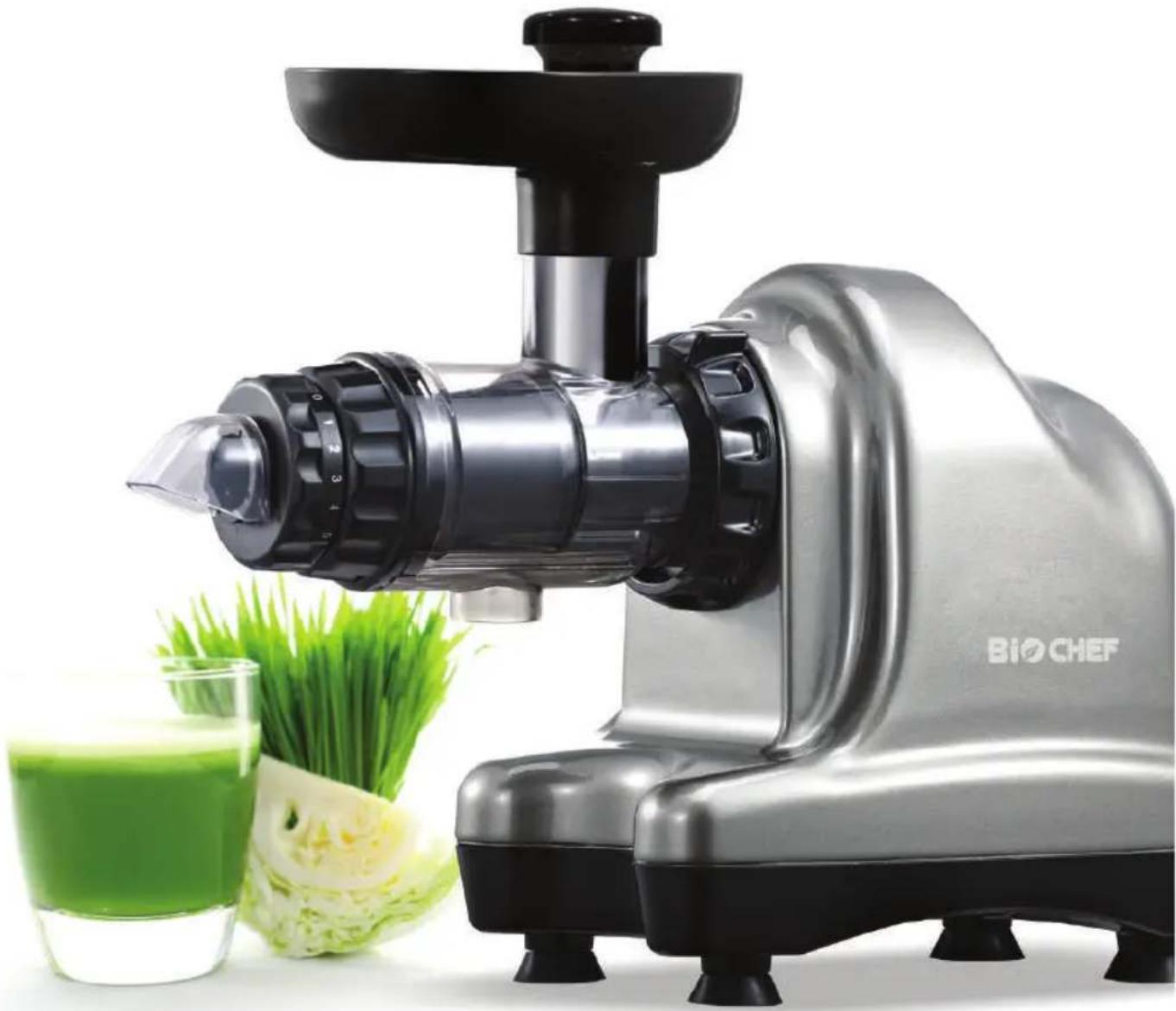
USER MANUAL Axis BioChef
natural_image
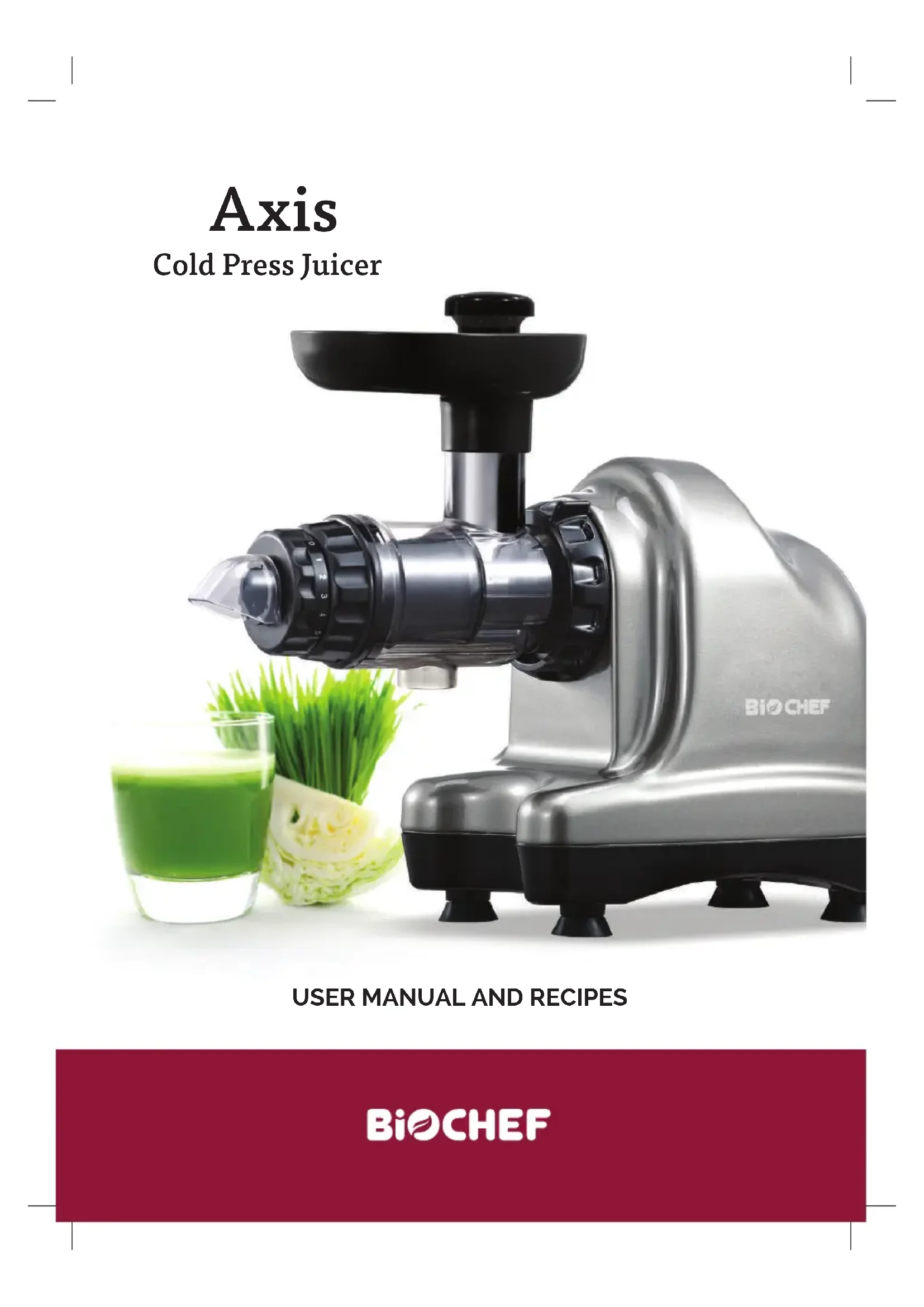
Silver Bio Chef electric shaver with green juice and celery in background (no text or symbols on main subject)USER MANUAL AND RECIPES

text_image
EN ENGLISH 3 FR FRANÇAIS 25 DE DEUTSCH 51 ES ESPAÑOL 77The information in this manual is intended to help you to get the best results from your BioChef Axis Cold Press Juicer. Please read and follow these instructions and safeguards prior to use.
Please keep your manual handy for future reference, warranty information and support details
Contents
Safety Precautions 4
Parts and Accessories 5
Assembly Instructions 6
Operating Instructions 8
Troubleshooting 9
FAQs 11
Cleaning 14
Recipes 15
Warranty 24
EN
Safety Precautions
! Read all instructions.
! To protect against risk of electrical shock, do not put the body (motor) in any water or other liquid.
! Close supervision is necessary when any appliance is used by children.
! Unplug from electrical outlet when not in use and before disassembly for cleaning.
! Avoid contact with moving parts.
! Do not operate appliance with a damaged cord or plug.
! The use of attachments not recommended or sold by the manufacturer may cause damage and will void warranty.
! Do not let cord hang over edge of counter.
! Always make sure juicer locking clip is closed while juicer is in operation.
! Make sure the motor has stopped completely before disassembling.
! Do not put your fingers or other objects into the juicer while it is in operation. If food becomes lodged in the opening, use the provided food plunger to push it down or press the button into reverse mode. If ingredients are still lodged in the juicing drum, turn off and disassemble to remove remaining food. You may need to cut produce smaller, or feed ingredients slower into the chute to prevent this.
Parts and Accessories

text_image
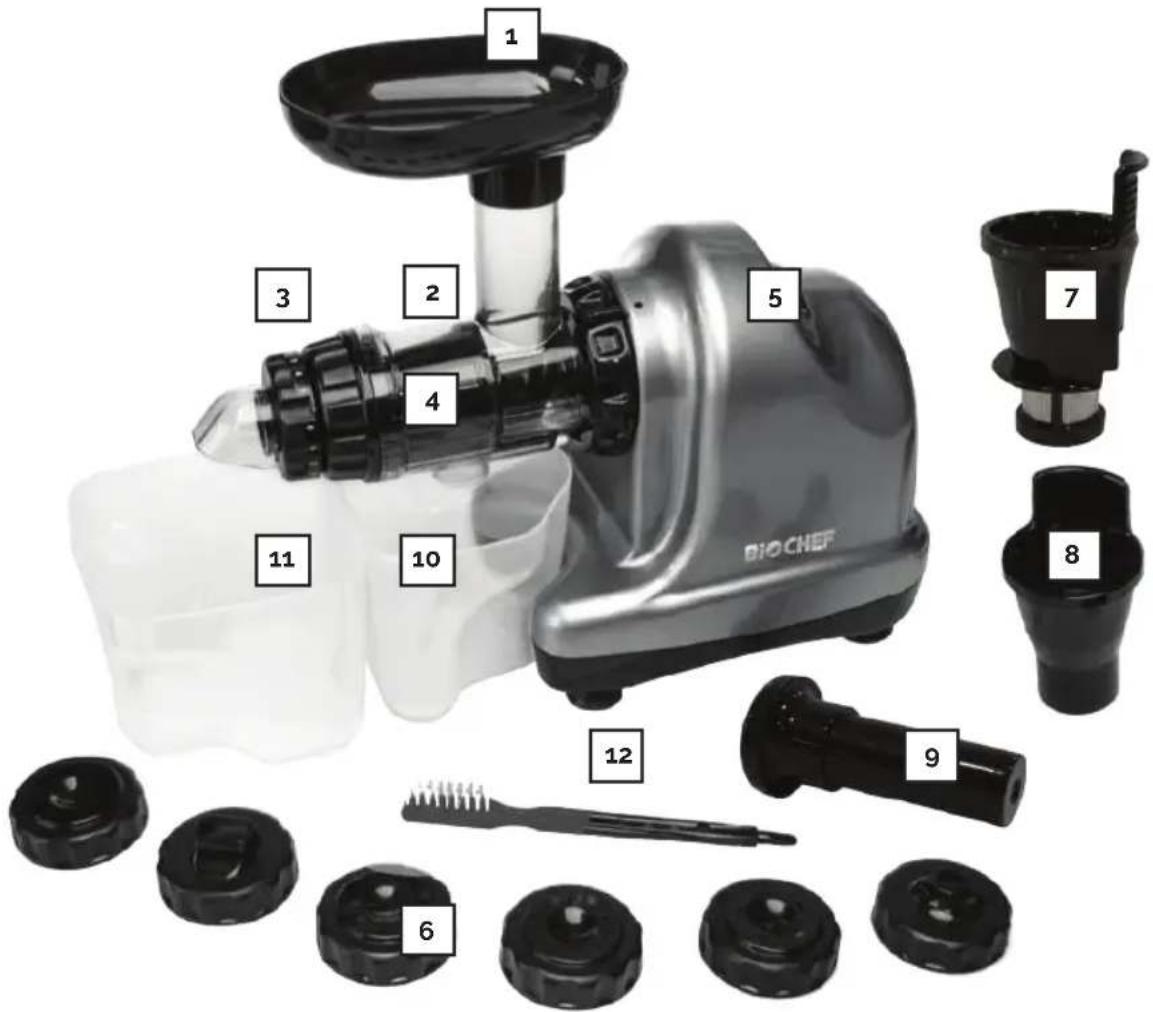
1 2 3 4 5 6 7 8 9 10 11 BIOCHEF1 Hopper and Feeding Chute
2 Drum
3 Drum Cap
4 Auger
5 Motor Base
6 Nozzles
7 2 x Juicing Strainers
8 Mincing Strainer
9 Tamper
10 Juice Container
11 Pulp Container
12 Cleaning Brush

Assembly Instructions

text_image
Connect drum with motor base by turning locking clip clockwise. Place hopper into guide.Switch the juicer off before changing accessories or touching any moving parts. Remove the drum from the main body by turning the locking clip counter clockwise. Pull the auger forward to disassemble it from the drum set.
! DO NOT place any metal objects into the hopper. If the drum is clogged or the machine stops operating, press the reverse button 2 to 3 times and press the ON button again to resume normal operation.
! DO NOT immerse the motor in water.
FOR JUICING
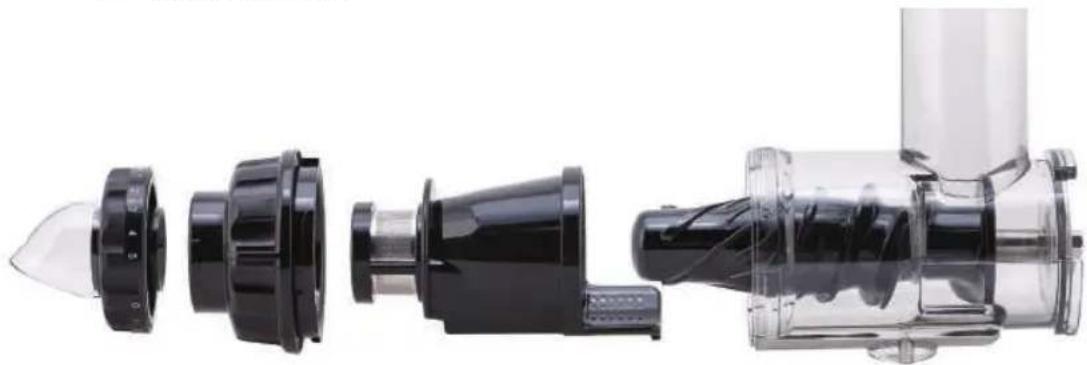
- Place the auger into the drum.
- Insert the juicing strainer (over the auger) and into the drum.
- Place the drum cap onto the drum end and turn it counter clockwise until seated firmly.
- Attach the Pulp Ejection Cover to the drum end cap.
NOTE: The pulp ejection cover is numbered from 0 - 5, with 5 being the 'firmest' position. For harder and fibrous produce, such as carrots and celery, set the position to high (i.e. 4 or 5), and for softer, pulpier produce, turn the knob to 1 or 2.
natural_image
Exploded view of a kitchen brush unit showing internal components and assembly (no text or symbols visible)FOR MINCING, PASTA, NOODLES AND BREAD
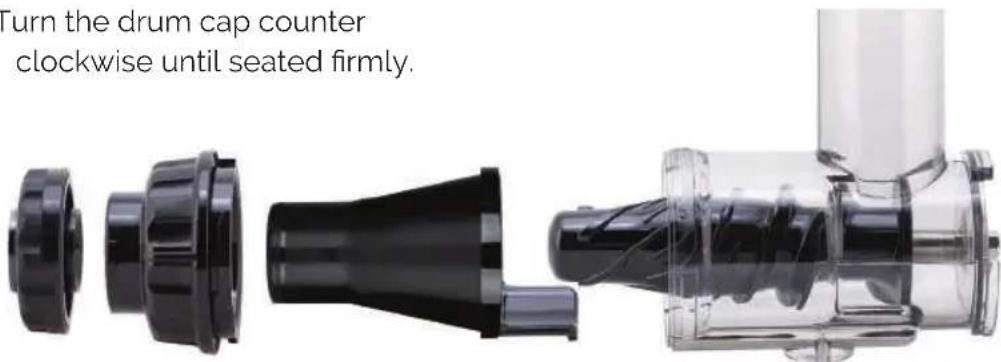
- Open the drum cap.
- Insert the mincing strainer (over the auger) into the drum.
- Attach the desired nozzle onto the drum cap.
- Turn the drum cap counter clockwise until seated firmly.
FOR PASTA & NOODLES: Sprinkle a small amount of flour on a collection tray and cut pasta / noodle lengths with scissors as it is extruded.
text_image
Turn the drum cap counter clockwise until seated firmly.EN
Operating Instructions
- While the Axis Cold Press Juicer / Food Processor can extract juice from unpeeled fruits and vegetables we recommend you thoroughly wash and peel your fresh ingredients to remove any chemicals.
- Cut fruit or vegetables into small pieces (5cm wide) so that juice may be extracted thoroughly.
- Turn on the machine before placing ingredients into the hopper one piece at a time and gently push through with the tamper.
- For maximum efficiency, the drum cap should be firmly screwed on (position 5) for hard, fibrous ingredients such as carrots and beetroot and wound out for softer ingredients such as citrus. The quality of produce will also affect juice yield.
• After placing the last pieces of fruits or vegetables into the hopper, keep the machine running for a few seconds longer to ensure the machine has extracted the last drops of juice.
• DO NOT run the machine for more than 30 minutes at a time.
natural_image
Plants of orange and lime fruits on ice with lemon slices, no text or symbols visibleTroubleshooting
EN
The motor sounds noisy, what shall I do?
- If the juicer starts to vibrate slightly during operation, turn off the machine and empty the drum set. Re-assemble and resume normal operation.
- If your machine is making a loud noise, take all the extra parts off the machine and run the motor alone. If it is still making a loud noise then contact your distributor.
- If the motor is not making a noise, check that all parts and seals are clean, as residue may create a noise.
- Check the kind of produce you are using, as some kinds of produce are noisier than others, for instance, if your produce is particularly hard or has been frozen or refrigerated.
What shall I do if I've lost the original tamper?
Call your distributor and order a new part. It is very important to use the correct plunger/tamper for the machine as they are made to fit each juicer precisely.
PLEASE NOTE Using any other type of plunger / pusher or tamper will void warranty as the length and width of the BioChef tamper is specific to this machine.
My juice is too pulpy?
- Adjut the pulp adjustment nozzle to number 4 or 5.
- Introduce ingredients at a slower pace. Overfeeding the juicer can result in pulpier juicer.
- Ensure that your ingredients are fresh. Older vegetables have less water content and can produce a pulpier juice.
EN
I would like more pulp in my juice.
Adjust the pulp adjustment nozzle closer to number 1 or 2.
Produce is clogged in my juicer, how can I avoid this?
- Softer fruits can cause the machine to clog. Always alternate soft and hard produce for maximum juice yield.
- Introduce ingredients at a slower pace.
- Adjust pulp nozzle to 1-2.
PLEASE NOTE If your juicer becomes clogged, switch into reverse mode for a couple of seconds, switch off juicer and disassemble the machine.
FAQs
Do I need to refrigerate fruits and vegetables before juicing them?
Apart from tasting better when juiced, refrigerated fruits and vegetables will provide a higher yield of juice than room temperature produce. This is because the fibre in refrigerated produce is firmer when chilled and consequently provides more juice when crushed compared to softer or warmer fruits and vegetables, which may also be in a partial stage of dehydration (losing water content).
What's the best way to prepare fruits, vegetables and leafy greens for juicing in the BioChef juicer?
VEGETABLES
We recommend preparing your vegetables by cutting them into pieces that will simply fall through the feeding chute without assistance.
FRUITS
We recommend preparing your fruits by cutting them into pieces that will simply fall through the feeding chute without assistance. We recommend removing skins from most citrus fruits although one third of the skin of lemons and limes may be left on.
LEAFY GREENS
Roll leaves into parcels and then fold them in half, ensuring that the parcels will simply fall through the feeding chute without assistance. You may notice with some leafy greens that they can cause the BioChef juicer to clog. This can be remedied by adding a few pieces of carrot or other fibrous vegetables, which will help to push through the leafy green material.
Also, wet leaves will not pass through the juicer as well as drier leaves, so when washing produce, pat dry with a kitchen towel before inserting into the BioChef juicer. The horizontal crushing and squeezing mechanism of the juicer means that the smaller you cut the pieces before you feed them into the shoot, the less likely that the fibres will become tangled around the internal mechanism. For best results cut your ingredients into 3 - 5cm pieces.
WHEATGRASS
Cut the grass close to the roots and wash thoroughly to ensure no soil or stones are present. Feed the wheatgrass tips first into the juicer.
When juicing wheatgrass, place a bunch of wheatgrass (about 3cm diameter) 'tips down' into the feeding chute.
What are the best apples for juicing?
We find that fresh and chilled green apples are the best. Nutritionally, green apples contain various antioxidants, are a good source of vitamin C and are considered to be able to prevent the formation of gall stones in the bladder and help remedy liver and kidney disorders.
EN
Do I need to peel citrus for juicing?
We recommend peeling the skin from mandarins, oranges and grapefruit prior to juicing as the skin has a bitter taste and this will transfer through to the juice. The skin of lemons and limes do not have this bitter flavour and as such can be juiced. Leave about one third of the skin of lemons and limes on.
What can I juice with a BioChef juicer and what should I avoid?
The BioChef juicer can juice just about all types of fruits and vegetables.
This is a cold press juicer and therefore does not have a cutting unit, so do not place any of the following in the juicer as it may cause damage:
- hard coconut fibre – soft, young flesh is ok
• seeds (except sesame, or other softer seeds) - unsoaked/roasted nuts (except peanuts and other softer nuts)
- legumes
- sugar cane
- frozen ingredients - for sorbet remove fruit from freezer 5-10 minutes before using.
- fish or meat
- liquorice root or other woody materials
• dried herbs and spices - stone fruit with stones in
- olives
Can I make soy, nut and rice milk?
Yes you can easily make nut milk using your juicer, simply refer to the Recipes section for instructions.
Can I grind seeds, grains or legumes with the BioChef juicer?
The BioChef juicer can make a paste from seeds and grains, however is not a grinder and using this machine as such will void the warranty.
Can the BioChef juicer make cold press olive oil?
No. This is a different process to juicing and requires different machinery.
Can I make frozen sorbets?
Yes you can easily make frozen fruit sorbets using your juicer. Refer to the recipes section for instructions.
Can I re-juice the discarded pulp in order to get more juice?
The BioChef juicer is very effective at extracting high yields but some users may put through the discarded pulp again to try and gain more juice yield. The results vary from different ingredients so feel free to experiment. Try mixing the pulp with blended fruits to make fruit roll ups. We recommend a BioChef food dehydrator for this.
Is the BioChef juicer suitable for commercial environments?
We recommend the juicer does not run for more than 30 minutes at a time. Therefore, if using in a commercial environment we would advise operating two or three juicers intermittently.
PLEASE NOTE: The BioChef juicer does not have a commercial warranty and so use of the machine in a commercial setting is at the discretion of the owner. You could also make a larger quantity of a base juice such as carrot or orange and then add specific ingredients as listed on your menu.
How long can I keep the juice before the nutritional integrity has depleted?
There's no specific answer to this as there are too many variables based on the type of produce and storage method. When storing juice, refrigerate in a glass airtight jar or bottle for best results. This storage method will usually help retain the nutritional integrity of your juice for up to 48 hours.
Can I buy spare parts for my juicer?
Yes, simply contact your local service provider (details located in rear of manual) or order online on our website.
natural_image
Two glasses of green smoothie juice with mint leaves on a white surface (no text or symbols)
Cleaning
The BioChef Axis parts are dishwasher-safe (top shelf). For best results, rinse prior to placing into the dishwasher to remove any stubborn fibres.
You can rinse your juicer easily after use by running water through the juicer.
If hand-washing simply rinse under water, and use the included cleaning brush to scrub any tough fibres. If you are in a hurry, simply leave the parts soaking in water so the fibres remain soft and pliable.
We recommend soaking your parts in a solution of bi-carb soda, water and white vinegar or lemon juice once per month or on occasion. This does a great job of removing any juice stains or residue that may build up over time.
natural_image
Top-down view of fresh fruits including carrots, kiwifera, apple, and broccoli on a dark surface (no text or symbols)Recipes
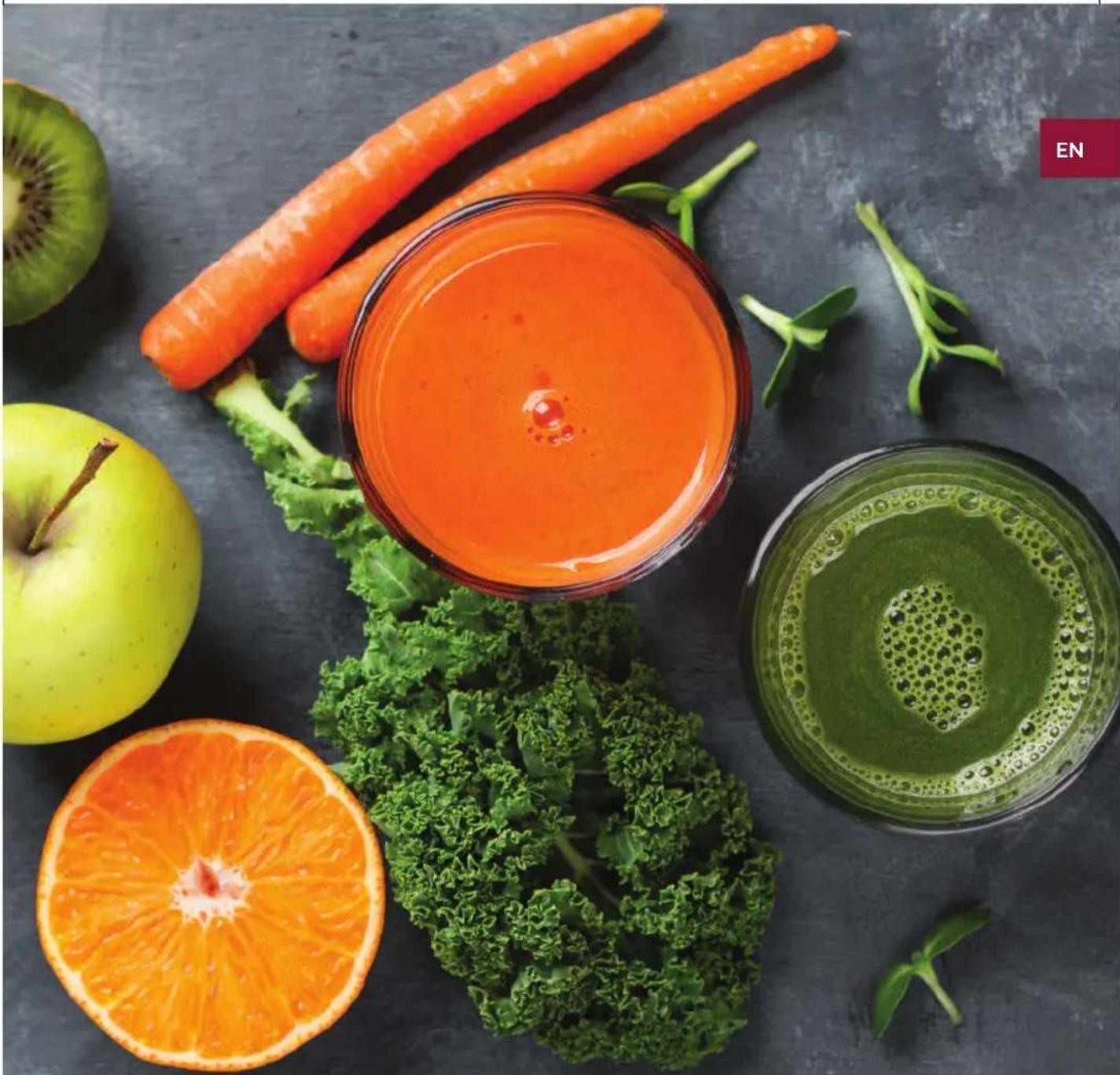
View our complete recipe collection online www.biochef.kitchen/recipes
EN
Green Juice
Servings: 4
• 1 small bunch curly kale roughly chopped
• 1 lemon peeled and quartered
- 1 inch ginger peeled
• 1 cucumber cut into long strips
• 2 granny smith apples cored and sliced
• 4 celery stalks
Green juices are rich in chlorophyll in its natural state – the way nature intended.
One of chlorophyll's most important functions is the oxygenation of the bloodstream. It is necessary for health to select foods that feed rather than rob the body of oxygen.
Without sufficient oxygen in the blood, we are prone to develop symptoms of low energy, sluggish digestion and metabolism, leading to deterioration in vitality and an increase in the onset of disease.
The addition of limes and apples to green juices greatly assist to make juices more tolerable to the palate.
Ginger Zinger
Servings: 3
- 2 medium apples
- 5 carrots
- 12 inch fresh ginger
- 14 lemon (peel removed to avoid bitterness)
Pineapple Pick-Me-Up
Servings: 4
• 3 medium carrots
- 12 small, ripened pineapple (peeled, cored, and cut in quarters)
• 1 orange (peel removed)
Immune Booster
Servings: 1 cup
• 1-3 cloves of garlic
- 1 inch fresh ginger
- 1 bunch of rainbow carrots (can substitute for any carrots), tops removed
This healing juice is a great remedy for that cold that just won't go away. Carrots are a good source of vitamin C, vitamin B complex, potassium, iron and sodium which all work to boost the immune system and improve liver function. Raw garlic is a natural anti-microbial anti-inflammatory and powerful tool for boosting the immune system.
Mocktail Mojito
Servings: 3
• 1 small bunch mint
• 1 small bunch parsley
• 1 lime (peel removed)
- 12 inch fresh ginger
- 2 cucumbers
- 1 green apple
Savoury Gazpacho
Servings: 1 - 2
• 4 ripened plum tomatoes
• 1 large cucumber
- 2 stalks celery
• 1 red bell pepper
- 14 small red onion
• 2 cups fresh parsley (leaves and stems roughly chopped and packed)
• 1 lime (peel removed)
Tomatoes are a great alkaliser when consumed without sugars or starches. Beetroot is a great blood builder. Celery improves digestion. Red Capsicum is good for skin, hair and nails. Cucumber is a natural diuretic. Parsley is high in minerals including potassium.
Wheatgrass... nature's healer
Wheatgrass is baby wheat, planted on the soil and not sown. Wheatgrass produces high concentrations of chlorophyll, active enzymes, vitamins and other nutrients. Chlorophyll makes up over 70% of the solid content of wheatgrass juice and is the basis of all plant life. It is often referred to as the “blood of plant life” as it closely resembles the molecule in human red blood cells. Wheatgrass is not only rich in chlorophyll; it has 100 elements needed by the body to keep vital and nourished. If grown in organic soil, wheatgrass absorbs 92 of the known 102 minerals from the soil.
Dr. Ann Wigmore was a pioneer in the use of wheatgrass juice for detoxifying and healing the body, mind, and spirit. The recommended daily allowance for wheatgrass is 30 mls once or twice per day. You can start with as little as 10–15mls per day and gradually increase the dose. Wheatgrass juice can temporarily cause an upset stomach if too much is consumed too soon.
Care and Use
Cut the grass close to the roots and wash thoroughly to ensure no soil or stones are present. You can get a second yield when the grass grows back, although the content won't be as rich as the original grass. Feed the wheatgrass tips first into the Axis. Four trays planted on different days over a two week period should be enough for 1 person. Undoubtedly, wheatgrass has a very strong taste. You can mix the wheatgrass shots and here are a couple of delicious recipes.
When juicing wheatgrass, barley grass or alfalfa juice, place a bunch of wheatgrass (about 3cm diameter) 'tips down' into the feeding chute.
Feed carrots and other desired fruits or vegetables into the chute for a milder tasting combination for those who haven't tried pure wheatgrass juice before.
Juiced Tomato & Herb Soup
- 8 tomatoes
- 2 carrots
- pinch of salt
- pinch of black pepper
• 1 tsp dill
• 2-3 basil leaves
• 1 tsp olive oil
Using the juicing strainer, feed in the carrots and tomatoes then mix all the ingredients together.
For more fibre, let everything run through again with the mincing strainer this time, adding some of the pulp.
Decorate with a sprinkle of fresh herbs or flowers.
Pesto
- 1 12 cups basil leaves
- bunch of parsley
- 1 garlic clove
• 1 cup pine nuts (or pistachio) - juice of 12 lemon
- 2 tsp olive oil
Using the mincing strainer feed the basil, parsley, garlic and pine nuts into the chute. Mix the oil and lemon juice into the paste until smooth.
Max Salsa
• 4 ripe tomatoes
- 12 red or green capsicum
- 12 stick celery
- 1 small onion
- 1 garlic clove
• 1-2 tbsp fresh coriander
• 12 tsp cumin
- Braggs liquid aminos
• cayenne pepper or fresh chilli
Using the mincing strainer, feed all the ingredients into chute alternatively. Mix well and serve vegetable with sticks or crackers.
Beetroot Hummus
- 1 12 cups cooked chickpeas
- 12 beetroot peeled and chopped
- 14 tsp. salt
• 1-2 garlic cloves, peeled
• 2 tbsp. hulled tahini
• 1-2 tbsp. olive oil - Squeeze of fresh lemon juice
Using the mincing strainer feed chickpeas, beetroot and garlic into the chute.
Thoroughly mix all remaining ingredients together and serve.
NUT BUTTERS
Peanut Butter
• 2 cups roasted unsalted peanuts
- olive oil
• vitamin c powder (sodium ascorbate)
Using the mincing strainer slowly add the peanuts while machine is running. Stop the machine and add the Vitamin C powder and enough olive oil to the peanut paste to make a nice soft spreading consistency.
Fresh nut butters are an ideal spread for sandwiches, base for satay, dressings or as part of a delicious dip. Almost any variety of nuts can produce nut butter. Some varieties of nuts don't have high oil content so if you want a creamy butter, add nut or olive oil until you reach the desired consistency.
Another hint for a creamy butter is to pour in the nuts slowly and alternatively, for crunchy nut paste pour in the nuts faster. Relatively soft nuts such as peanuts, pine nuts, macadamias and cashews may be poured in without soaking, while harder nuts must be soaked for around 8 hours.
When nuts are soaked, the nuts become ‘activated’ and the enzyme inhibitors are rinsed away and they are easier to digest.
TREATS
Bliss Balls
• 2 cups almonds soaked, rinsed and drained
• 1 cup unsulphured dried fruits such as dates, raisins and apricots*
• 12 cup dessicated coconut
Using the mincing strainer, mince almonds, alternating with the dried fruit. Form into balls and roll in coconut. For variation, use different nuts, carob powder, natural vanilla essence or peppermint oil.
Peanut Balls
- 2 cups peanuts
• 1 cup sesame seeds - 4 apricots
- 2 tbsp honey
- juice of half an orange
Mix peanuts, apricots, honey, juice and 1 cup sesame seeds in bowl. Using the mincing strainer, feed through the chute. Roll paste into balls and into remaining sesame seeds.
FROZEN TREATS
What a wonderful way to use excess fruit by freezing and making delicious ice creams and sorbet style desserts. Freeze fruit without skins, stones or seeds and cut into pieces that fit into the feeding chute.
Remove frozen fruit from the freezer ten minutes before you plan to use them so the hard ice crystals melt.
Banana Raspberry Sorbet
- 2 frozen bananas
• 2 cups of frozen raspberries
Using the mincing strainer, alternate ingredients into the feeding chute and mix well.
Banana Cinnamon Sorbet
• 4 frozen bananas
• 1 tsp. ground cinnamon
• 1 tbsp. honey
Using the mincing strainer, alternate ingredients into the feeding chute and mix well.
Coco Mango Icecream
- 2 frozen mangos
• 2 frozen bananas - 12 cup fresh coconut cut into pieces
- 12 cup frozen dates
Using the mincing strainer, alternate all ingredients into the feeding chute and mix well.
You may refreeze this nutritious, delicious treat.
Maca Fruit Icecream
• 2 cups frozen fruit such as strawberry, mango or pineapple
- 3 frozen bananas
- 12 cup soaked and drained macadamias
• 1 tsp natural vanilla essence
Using the mincing strainer, alternate the fruit, bananas and macadamias.
Quickly stir in the vanilla and enjoy.
EN
PASTA & NOODLES
The BioChef juicer can extrude pasta simply by replacing the juicing screen with the mincing screen. The pasta dough bypasses the juice outlet and is pushed out through the drum cap and one of the pasta nozzles supplied.
Freshly made pasta is such a treat, so much so that you may find it difficult to eat packet pasta ever again. You also know exactly what is going into the mix. There are many varieties of ingredients you can try, mixing in beetroot, carrot or other types of vegetable juice to give a vibrant colour.
Tips for pasta making
- Add an egg and a few drops of olive oil to your mixture to help prevent it from sticking together.
• Have a floured tray to lay it on when it comes out of the machine. - If making spelt or semolina pasta, reduce the amount of flour used on the dough will be too stiff.
Pasta
Firstly set up your juicer with the mincing screen and desired nozzle for fettuccine or round noodle. On a clean kitchen bench or in a large bowl, pour out a couple of cups of organic flour.
Add half a cup of warm water or vegetable juice and 12 teaspoon of sea salt (which acts as a rising agent). Keep the mixture dry, not too sticky. Break into balls and feed into the chute. As the strands of pasta come out of the machine, cut them off and lay on the floured tray. Repeat the process until dough is used. Cook noodles in boiling water for 3–5 minutes and drain.
Boiled Rice Noodle
An ideal way to use left over rice is to make rice noodles. Mix rice in a bowl together with a little sea salt and warm water.
Feed the mixture into the machine and cut at desired length. Cook in boiling water for 3-5 minutes. Add desired vegetables and Asian sauces.
OTHER
Bean, Rice and Nut Milks
Soak soybeans, rice and/or nuts in water (nuts and soybeans for a minimum of 8 hours).
Rinse and drain. Make a mixture of beans, nuts, rice, water and if desired, fruit / vegetables.
Feed the mixture into the chute simultaneously with the same volume of filtered water. For creamier results use less water, or for a thinner milk, increase the amount of water.
This works best using a large spoon and scooping the mixture from a container.
To reduce sediment, place a sieve over the collection bowl or strain through a muslin cloth.
This will make flavoured bean, nut or rice milk. If using soybeans, the resulting mixture can be used to make tofu. For flavoured milks, try the following ideas:
- add berries, banana and other fruits
- add a small amount of salt and/or sweetener eg; raw honey or maple syrup
- add vanilla and a pinch of cumin, nutmeg, cinnamon or cardamom
Tofu Recipe
Add a small amount of salt to soy juice if you haven't already and boil while stirring continuously.
Add the curdling agent (coagulant) to the boiled soy juice and let stand for 4-5 minutes while it curdles.
Remove the excess water by squeezing it with clean, food-grade muslin.
BIOCHEF AXIS COLD PRESS JUICER WARRANTY
WARRANTY PERIOD: DOMESTIC – 20 YEARS ON MOTOR & 10 YEARS ON PARTS
VITALITY 4 LIFE IS THE GLOBAL DISTRIBUTOR AND WARRANTY PROVIDER OF BIOCHEF. WARRANTY REGISTRATION AND CLAIMS ARE HANDLED BY YOUR LOCAL VITALITY 4 LIFE SUPPORT CENTRE, DETAILS ON INSIDE BACK COVER. PLEASE REGISTER YOUR WARRANTY ONLINE AT WARRANTY.VITALITY4LIFE.COM WITHIN 30 DAYS OF PURCHASE.
LODGING A WARRANTY CLAIM
Should you experience any issues with your product, please follow these steps to lodge a warranty claim:
- Contact your local Vitality 4 Life Service Centre with the following details:
- Your warranty details including name, email and phone number
– Product name and model number
– Product serial number, found on the rating label of the product
– Explanation of how the damage occurred -
Photos of the damage or issue is highly beneficial to expediting your claim
-
Vitality 4 Life will assess your claim and respond within 24-48 hours.
-
In the event the product is required to be sent to the Service Centre, the customer is liable for all packing, freight and insurance costs for transit of the product to Vitality 4 Life. Subject to the applicable consumer laws in your jurisdiction.
-
If the product, or one of its parts, qualifies for replacement or service within the 30-Day period after date of purchase, Vitality 4 Life will arrange the shipping at no cost to you.
-
Any product sent to a Vitality 4 Life Service Centre must include a Return Authorization Form. Failure to include this form may result in the product being rejected from our warehouse or a delayed service time.
-
Vitality 4 Life will contact you with a quote prior to undertaking any service work outside of the warranty coverage.
-
Typical turn-around times to address warranty claims can be between 10-14 business days, plus shipping, depending on location and type of damage or warranty claim.
TERMS OF PRODUCT WARRANTY COVERAGE
Vitality 4 Life provides the Product Warranty coverage as further described below and limited to the terms and conditions hereof:
- If the Product exhibits a defect while in normal domestic use, within the warranty period; we will, at our option, either repair or replace the Product or defective part free of charge. The Product must be delivered by insured mail, in proper packaging to your Service Centre as indicated on the back of the manual as a condition to any warranty service obligation.
- In the event that the warranty period for a product has expired, or if a Product does not qualify for warranty service, repair or replacement, consumers may still buy
replacement parts or have products repaired by one of Vitality 4 Life's Service Centres. Please contact Vitality 4 Life for further information.
- Do not send the product back to the Service Centre without a Return Authorization Form.
- In no event shall our liability exceed the retail value of the product. We make no warranty with respect to parts, from a source other than Vitality 4 Life.
- In the event that warranty parts or products are provided, the customer must cover the related shipping costs to receive goods.
- All exchanged or substitute parts and products replaced under warranty service will become the property of Vitality 4 Life. Repaired or replaced products or parts thereof will be warranted by Vitality 4 Life for the balance of the original warranty period.
- (Australia only) Our goods come with guarantees that cannot be excluded under the Australian Consumer Law. You are entitled to a replacement or refund for a major failure and compensation for any other reasonably foreseeable loss or damage. You are also entitled to have the goods repaired or replaced if the goods fail to be of acceptable quality and the failure does not amount to a major failure.
WARRANTY DOES NOT COVER
- Damage, accidental or otherwise, to the Product, not caused by direct defect in factory workmanship or materials.
- Damage due to abuse, mishandling, alteration, misuse, commercial service, tampering, accident, failure to follow care, operating and handling provisions indicated in the instructions.
- Damage caused by parts or service not authorized or performed by Vitality 4 Life.
- 'Normal' wear and tear that naturally and inevitably occurs as a result of normal use or aging.
- Some states do not allow the exclusion or limitation of incidental or consequential damages. Therefore, the above limitations may not apply to you in the case of damage in shipment. If your Product was damaged in shipment: Immediately report this type of damage to the parcel carrier and have them file an inspection report to contact the distributor from whom you purchased the Product for further instructions.
- You have rights and benefits under the consumer laws in your jurisdiction. Without detracting from these rights or benefits, Vitality 4 Life excludes all liability in respect of this product for any other loss which is not reasonably foreseeable from a failure of this product, which may include liability for negligence, loss of expenditure associated with the product and loss of enjoyment.
Axis
Cold Press Juicer
FR
natural_image
Silver Bio Chef electric shaver with green juice and celery in background (no text or symbols on main subject)MANUEL D'UTILISATION ET RECETTES
natural_image
Exploded view of a kitchen brush unit with black and transparent casing (no text or symbols visible)POUR LA FONCTION HACHER, DES PÂTES, DES NOUILLES, ET DU PAIN
natural_image
Plants of orange and lime fruits on ice with lemon slices, no text or symbols visiblenatural_image
Two glasses of green juice with mint leaves on a white surface (no text or symbols)
natural_image
Top-down view of fresh fruits including carrots, kiwifera, apple, and green juice on a dark surface (no text or symbols)Recettes
LA GARANTIE NE COUVRE PAS
natural_image
Silver Bio Chef electric shaver with green juice and celery in foreground (no text or symbols on main subject)MAHLEN, HACKEN, PASTA, BROT, DIPPS UVM
natural_image
Plants of orange and lime fruits on ice with lemon slices, no text or symbols visibleFehlerbehebung
natural_image
Two glasses of green smoothie juice with mint leaves on a white surface (no text or symbols)
natural_image
Top-down view of fresh fruits including carrots, kiwiffricots, apple, and broccoli on a dark surface (no text or symbols)Rezepte
natural_image
Exterior view of a Bio Chef electric shaver with green juice and fresh vegetables (no text or symbols on the device itself)MANUAL Y RECETAS
ES
natural_image
Exploded view of a cleaning brush and filter assembly (no text or symbols visible)natural_image
Plants of orange and lime fruits on ice with lemon slices, no text or symbols visiblenatural_image
Two glasses of green juice with mint leaves on a white surface (no text or symbols visible)Limpieza
natural_image
Top-down view of fresh fruits including carrots, kiwifera, apple, and green juice on a dark surface (no text or symbols)Recetas
Consulta todas nuestras recetas online www.biochef.kitchen/recipes

ES
ZUMOS
Zumo Verde
Support & Service Centres
Contact your local distributor for warranty & service
Vitality 4 Life – Australia & New Zealand
Email: support@vitality4life.com
Website: www.vitality4life.com.au
Vitality 4 Life – United Kingdom
Email: support@vitality4life.co.uk
Website: www.vitality4life.co.uk
Vitality 4 Life - United States
Email: support@vitality4life.com
Website: www.vitality4life.com
Vitality 4 Life – France
Email: support@vitality4life.fr
Website: www.vitality4life.fr
Website: www.vitality4life.it
Vitality 4 Life – España
Email: atencioncliente@vitality4life.es
Website: www.vitality4life.es
Vitality 4 Life – Netherlands
Email: info@vitality4life.co.nl
Website: www.vitality4life.co.nl
Be inspired...
biochef.kitchen/recipes