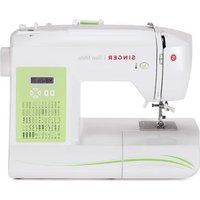
5400 - Sewing machine SINGER - Free user manual and instructions
Find the device manual for free 5400 SINGER in PDF.



User questions about 5400 SINGER
0 question about this device. Answer the ones you know or ask your own.
Ask a new question about this device
Download the instructions for your Sewing machine in PDF format for free! Find your manual 5400 - SINGER and take your electronic device back in hand. On this page are published all the documents necessary for the use of your device. 5400 by SINGER.
USER MANUAL 5400 SINGER
natural_image
Line drawing of a sewing machine with no visible text or symbols on the device body5500/5400 6199/6180/6160
INSTRUCTION MANUAL MANUEL D'INSTRUCTION MANUAL DE INSTRUCCIONES
This household sewing machine is designed to comply with IEC/EN 60335-2-28 and UL1594.
IMPORTANT SAFETY INSTRUCTIONS
When using an electrical appliance, basic safety precautions should always be followed, including the following:
Read all instructions before using this household sewing machine. Keep the instructions in a suitable place close to the machine. Make sure to hand them over if the machine is given to a third party.
DANGER — To reduce the risk of electric shock:
- A sewing machine should never be left unattended when plugged in. Always unplug this sewing machine from the electric outlet immediately after using and before cleaning, removing covers, lubricating or when making any other user servicing adjustments mentioned in the instruction manual.
WARNING – To reduce the risk of burns, fire, electric shock, or injury to person:
- Do not allow to be used as a toy. Close attention is necessary when this sewing machine is used by or near children.
- Use this sewing machine only for its intended use as described in this manual. Use only attachments recommended by the manufacturer as contained in this manual.
- Never operate this sewing machine if it has a damaged cord or plug, if it is not working properly, if it has been dropped or damaged, or dropped into water. Return the sewing machine to the nearest authorized dealer or service center for examination, repair, electrical or mechanical adjustment.
- Never operate the sewing machine with any air openings blocked. Keep ventilation openings of the sewing machine and foot control free from the accumulation of lint, dust, and loose cloth.
Eng 1
- Keep fingers away from all moving parts. Special care is required around the sewing machine needle.
- Always use the proper needle plate. The wrong plate can cause the needle to break.
- Do not use bent needles.
- Do not pull or push fabric while stitching. It may deflect the needle causing it to break.
- Wear safety glasses.
- Switch the sewing machine off (“0”) when making any adjustment in the needle area, such as threading needle, changing needle, threading bobbin, or changing presser foot, etc.
- Never drop or insert any object into any opening.
- Do not use outdoors.
- Do not operate where aerosol (spray) products are being used or where oxygen is being administrated.
- To disconnect, turn all controls to the off ("0") position, then remove plug from outlet.
- Do not unplug by pulling on cord. To unplug, grasp the plug, not the cord.
- The foot control is used to operate the machine. Avoid placing other objects on the foot control.
- Do not use the machine if it is wet.
- If the LED lamp is damaged or broken, it must be replaced by the manufacturer or its service agent or a similarly qualified person, in order to avoid a hazard.
- If the supply cord connected with the foot control is damaged, it must be replaced by the manufacturer or its service agent or a similarly qualified person, in order to avoid a hazard.
- This sewing machine is provided with double insulation. Use only identical replacement parts. See instructions for Servicing of Double-Insulated Appliances.
SAVE THESE INSTRUCTIONS
Eng 2
For Europe only:
This appliance can be used by children aged from 8 years and above and persons with reduced physical, sensory or mental capabilities or lack of experience and knowledge if they have been given supervision or instruction concerning use of the appliance in a safe way and understand the hazards involved. Children shall not play with the appliance.
Cleaning and user maintenance shall not be made by children without supervision.
The noise level under normal operating conditions is less than 70dB(A).
The machine must only be used with foot control of type JF-1000 manufactured by Jaguar International Corporation or YC-485EC manufactured by Taiwan Yamamoto Electric Corp.
For outside Europe:
This sewing machine is not intended for use by persons (including children) with reduced physical, sensory or mental capabilities, or lack of experience and knowledge, unless they have been given supervision or instruction concerning use of the sewing machine by a person responsible for their safety. Children should be supervised to ensure that they do not play with the sewing machine.
The noise level under normal operating conditions is less than 70dB(A).
The machine must only be used with foot control of type JF-1000 manufactured by Jaguar International Corporation or YC-485EC manufactured by Taiwan Yamamoto Electric Corp.
SERVICING OF DOUBLE INSULATED PRODUCTS
In a double-insulated product, two systems of insulation are provided instead of grounding. No ground means is provided on a double-insulated product, nor should a means for grounding be added to the product. Servicing of a double-insulated product requires extreme care and knowledge of the system and should be done only by qualified service personnel. Replacement parts for a double-insulated product must be identical to those parts in the product. A double-insulated product is marked with the words ‘DOUBLE INSULATION’ or ‘DOUBLE INSULATED’.
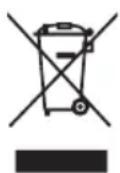
Please note that on disposal, this product must be safely recycled in accordance with relevant National legislation relating to electrical/electronic products. Do not dispose of electrical appliances as unsorted municipal waste, use separate collection facilities. Contact your local government for information regarding the collection systems available.
When replacing old appliances with new ones, the retailer may be legally obligated to take back your old appliance for disposal free of charge.
If electrical appliances are disposed of in landfills or dumps, hazardous substances can leak into the groundwater and get into the food chain, damaging your health and well-being.
SINGER is the exclusive trademark of
The Singer Company Limited S.à.r.l. or its Affiliates.
©2015 The Singer Company Limited S.à.r.l. or its Affiliates.
All rights reserved.
1. KNOWING YOUR SEWING
MACHINE
Machine identification----9-10
Accessories 11
Setting up your machine ----12
Spool pins, Presser foot lifter ----13
Darning plate,
Converting to free-arm sewing ---- 14
Winding the bobbin 15
Removing bobbin case from shuttle,
Inserting bobbin into bobbin case ----16
Inserting bobbin case into shuttle,
Threading the top thread ---- 17-18
Using automatic needle threader ---- 19
Picking up bobbin thread ----20
Needle, thread and fabric chart ---- 21-22
Changing the needle----23
Adjusting top thread tension ---- 24-25
Functions of control panel,
Straight stitch needle position ---- 26-27
Adjusting bobbin thread tension,
Changing presser foot----28
Helpful messages----29
Reverse operation button ----30
2. STARTING TO SEW
Quick reference table of stitch length
and width 31-34
Pattern number reference guide ---- 35
Straight stitching 36-37
Keeping seams straight
Hand-look quilt stitch----38-39
Inserting zippers and piping
Piping
Zigzag stitching----40
Adjusting stitch width and length
Multi-stitch zigzag, Shell stitch ---- 41-42
Satin stitch, Placement of patterns
Sewing on a button----43
Blindhem stitch 44-45
Decorative and stretch stitches ---- 46-51
Straight stretch stitch, Honeycomb stitch,
Overedge stitch, Feather stitch,
Ric-rac stitch, Double overlock stitch,
Criss-cross stitch, Entredeux stitch,
Ladder stitch, Pin stitch, Blanket stitch,
Slant pin stitch, Slant overedge stitch,
Crossed stitch, Greek key stitch,
Fishbone stitch, Thorn stitch,
Reinforced overedge stitch,
Edge-joining stitch, Wizard stitch
More decorative stitches & ideas for
decorative machine stitching ----52
Buttonhole making 53-55
Automatic buttonhole, Corded buttonholes
3. CARING FOR YOUR MACHINE
Cleaning hook area and
shuttle area 56-57
4. OPTION ACCESSORIES
Large extension table----58
5. PERFORMANCE CHECKLIST
59-61
For European version
Dimensions: 42.0cm × 20.5cm × 31.1cm
Mass of the equipment: 6.6 kg
Rated Voltage: 230 V \~
Rated Frequency: 50 Hz
Rated input: 65 W
Using ambient temperature: Normal temperature
Acoustic noise level: less than 70 db(A)
TABLE DES MATIÈRES
Dimensions: 42.0cm × 20.5cm × 31.1cm
1. KNOWING YOUR SEWING MACHINE
- Bobbin winding tension disk
- Thread take-up
- Thread tension control
- Face cover
- Thread cutter
- Removable extension table
/ Accessory box - Bobbin winder shaft
- Bobbin winder stop
- Pattern number reference guide
- Reverse stitch button
- Handle
- Horizontal spool pin
- Hand wheel
- Power/light switch
- Cord socket
- Identification plate
- Thread guide
- Buttonhole lever
- Presser foot lifter
- Thread guide
- Automatic needle threader
- Thread guide
- Presser foot screw
- Needle
- Needle plate
- Needle bar
- Thread cutter
- Foot release lever
- Needle clamp screw
- Presser foot
- Feed dogs
- Power line cord
- Foot control
- Instruction manual

DESCRIPTION
- Needles
- Bobbins
- Auxiliary spool pin
- Spool pin felt discs
- Spool pin cap
- Buttonhole opener/Seam ripper and brush
- Screwdriver for needle plate
- Darning plate
- Zipper foot
- Buttonhole foot
The foot that comes on your sewing machine is called the general purpose foot and will be used for the majority of your sewing.
Always disconnect the machine from power supply by removing the plug from the electrical outlet.
Be sure to wipe off any surplus oil from needle plate area before using your machine the first time.
POWER LINE CORD/FOOT CONTROL
Connect the plug of the power line cord into the cord socket (1) and your wall outlet (2) as illustrated. Connect the foot control plug (3) into the machine socket.
NOTE: When foot control is disconnected, the machine will not operate.

Your machine will not operate until the power/light switch is turned on. The same switch controls both the power and the light. When servicing the machine, or changing needles, etc., machine must be disconnected from the power supply.
Pull the spool pin towards you.
Place thread spool on the pin and secure with a spool cap to ensure smooth flow of thread. If the thread spool has a thread retaining slit, it should be placed to the right.
VERTICAL SPOOL PIN
Attach the spool pin and place a felt disc over it. Place a spool of thread on the spool pin.
PORTE-BOBINE HORIZONTAL
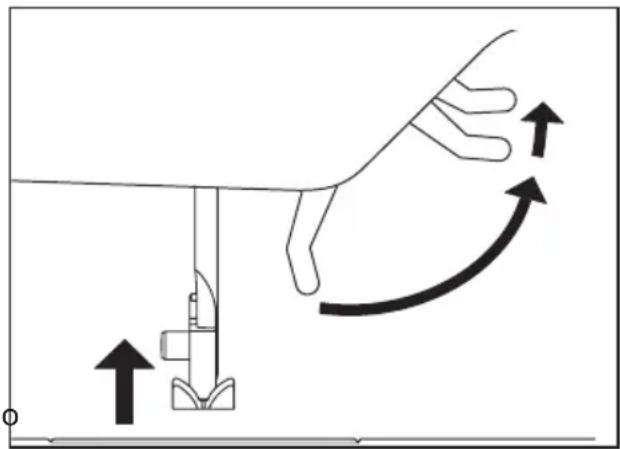
There are three positions for your presser foot.
- Lower the presser foot to sew.
- Raise the lifter to the middle position to insert or remove fabric, and to change presser foot.
- Lift it to its highest position to accommodate thicker fabrics.
natural_image
Diagram of a hand operating a sewing machine with directional arrows indicating motion (no text or symbols)Use the darning plate when you need to control fabric feeding for button sewing, free motion work and free motion darning. Raise needle and presser foot, and position darning plate onto the needle plate with the two pins on the back inserted to the holes of needle plate.
natural_image
Isometric line drawing of a device mounted on a base with pins and connectors (no text or symbols)CONVERTING TO FREE-ARM SEWING UTILISATION DU BRAS LIBRE
Your machine can be used either as a flat-bed or as a free-arm model.
With the extension table in position, it provides a large working surface.
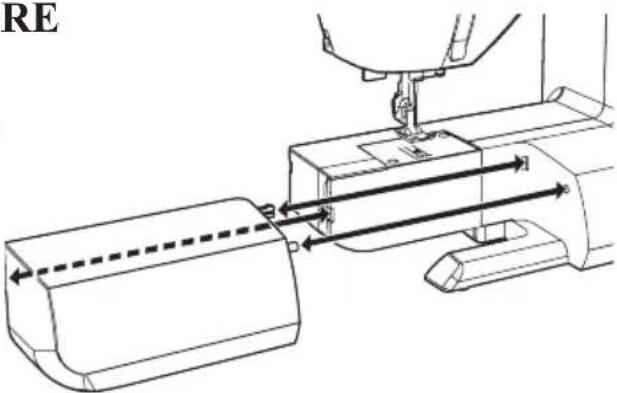
To remove the extension table, hold it firmly with both hands and pull it off to the left as shown. To replace, slide the extension table back into place until it clicks.
With the extension table removed the machine converts into a free-arm model for sewing children's clothes, cuffs, trouser legs, and other hard-to-reach places.
natural_image
Technical line drawing of a sewing machine needle stitching a component (no text or symbols)Be sure to use Class 15 bobbins.
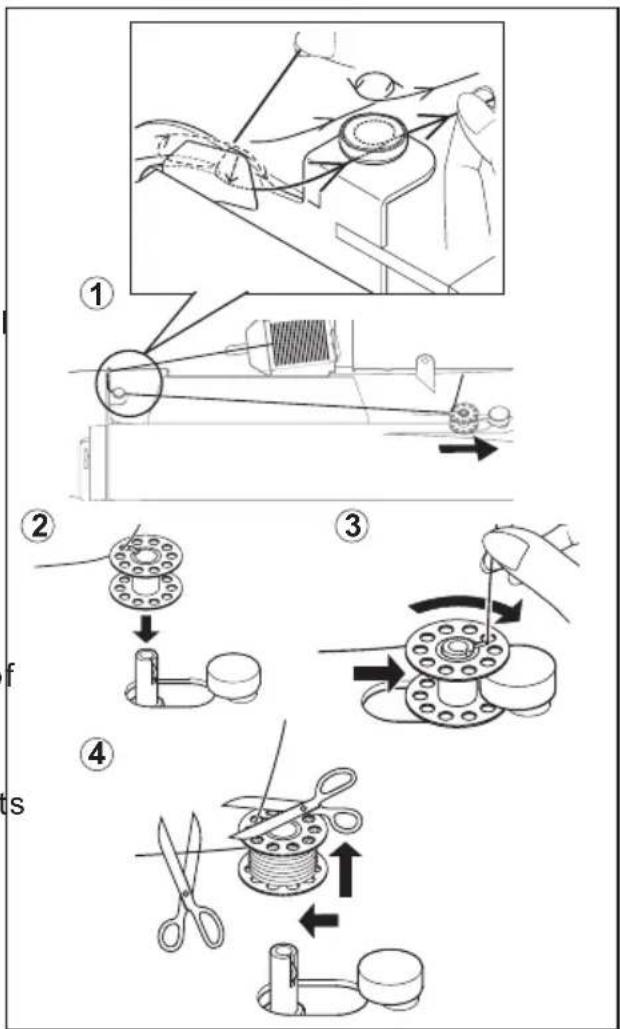
- Place a spool of thread on the spool pin, and secure it with the spool pin cap. Pull the thread out from the spool and place it through thread guides as shown in illustration. Be sure to pull thread securely into the bobbin winding tension disk.
- Put end of thread through the hole in bobbin as shown. Push bobbin winder shaft to far left position, if it is not already there.
- Place bobbin onto shaft with end of thread coming from top of bobbin. Push bobbin winder shaft to the right until it clicks. Hold the end of thread.
- Start machine and the bobbin starts to wind. Bobbin will automatically stop turning when completely filled. Push shaft to the left to remove bobbin and cut thread.
natural_image
Illustration of three hands holding a mechanical component with arrows indicating motion (no text or symbols)- Hold the latch open, with locating pin straight up.
- Slide the bobbin case onto the center spindle of the shuttle, with the thread toward you.
NOTE: Be sure the locating pin fits into the locating groove at the top of the shuttle.
A. Raise the presser foot lifter. Always be sure to raise the presser foot lifter before threading the top thread. (If the presser foot lifter is not raised, correct thread tension cannot be obtained.)
B. Turn the hand wheel toward you until the needle is in its highest position.
C. Thread the machine with your left hand while firmly gripping the thread with your right hand in the following order as illustrated.
*Pass the thread through the thread take-up (3) from right to left.
*Pass the thread through the eye of the needle (5) from front to back. (See following page for instructions on operation of the Automatic Needle Threader.)
IMPORTANT: To verify that the machine is threaded properly in the tension discs, do this simple check:
1.) With the presser foot raised and the needle threaded, pull the thread. You should detect only a slight resistance and little or no deflection of the needle.
2.) Now lower the presser foot and again pull the thread towards the back of the machine. This time you should detect a considerable amount of resistance and much more deflection of the needle. If you do not detect the resistance, this means you have not threaded the machine correctly and need to rethread it.
Raise the needle to its highest position by rotating the hand wheel towards you (counter-clockwise).
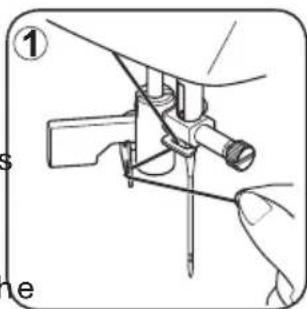
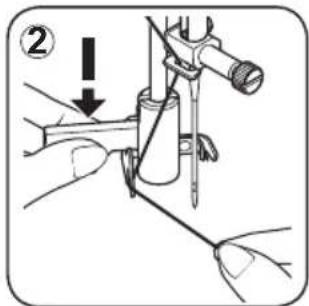
- Hook thread into thread guide as illustrated.
- Pull down lever while holding the end of thread.
- Rotate the lever to the rear of the machine.
- Guide thread into hooked end and pull the thread upward.
- Return the lever and needle will be threaded automatically.
- Release the lever and pull thread away from you.
NOTE: For smooth threading it is recommended you set the machine for straight stitch when using the needle threader.
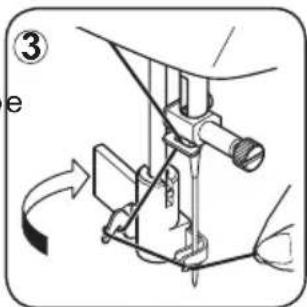
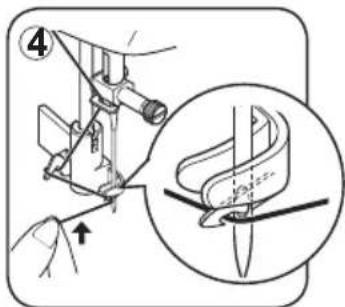
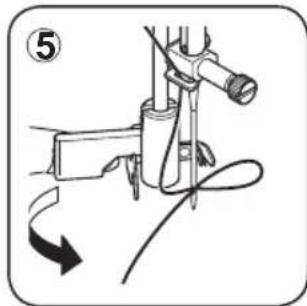
natural_image
Diagram of a mechanical device with a rotating cable and lever mechanism (no text or symbols)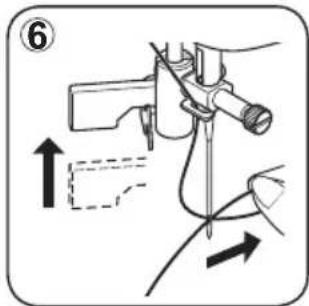
PICKING UP BOBBIN THREAD
RAPPEL DU FIL INFÉRIEURE
- Raise the presser foot lifter.
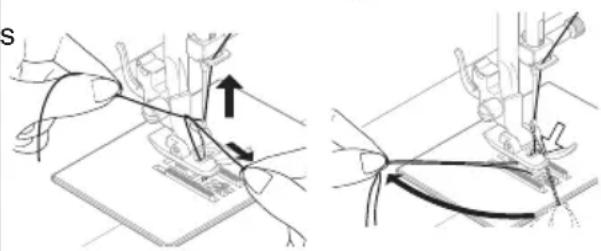
- Holding needle thread loosely with your left hand, turn hand wheel toward you (counter-clockwise) with your right hand, first lowering the needle and continuing until the needle comes to its highest position.
NOTE: A quick way to pick up the bobbin thread is, with straight stitch selected, touch and release the reverse switch. Your machine will perform one down-up cycle and stop with the needle up. Always stopping with the needle "fully up" is one of the features of your computer sewing machine.

NEEDLE, THREAD AND FABRIC CHART
Your fabric will determine the choice of a needle and thread. The following table is a practical guide to needle and thread selection. Always refer to it before a new sewing project. In most cases, you will use the same size and type of thread in the bobbin as in the top thread supply.
| FABRICS | THREAD | NEEDLES* | ||
| The fabrics below can be of any fiber: cotton, linen, silk, wool, synthetic, rayon, blends. They are listed as examples of weight. | TYPE | SIZE | ||
| Lightweight | BatisteChiffonCrepe | Cotton-wrapped/Polyester100% PolyesterAll-Purpose | 2020red shank | 11/80orange band |
| Medium weight | Corduroy/FlannelGabardine/GinghamLinen/MuslinWool Crepe | Cotton-wrapped/Polyester100% PolyesterAll-Purpose | 2020red shank | 14/90blue band |
| Medium heavy | Bonded WovensCanvas/CoatingDenim/DuckSailcloth | Cotton-wrapped/Polyester100% PolyesterAll-PurposeHeavy Duty | 2020red shank | 16/100purple band18/110yellow band |
| Knits | Bonded KnitsDouble KnitJersey/Tricot | Cotton-wrapped/Polyester100% PolyesterAll-Purpose | 2045yellow shank | 11/80orange band14/90blue band16/100purple band |
* For best sewing results, always use a SINGER branded needle.
TABLEAU DES TISSUS, DU FIL ET DES AIGUILLES
Always disconnect the machine from power supply by removing the plug from the electrical outlet.
- Raise the needle bar to its highest position by turning the hand wheel toward you (counter-clockwise).
- Loosen the needle clamp screw by turning it toward you (counter-clockwise).
- Remove the needle by pulling downward.
- Insert the new needle into the needle clamp with the flat side toward the back.
- Push the needle up as far as it can go.
- Tighten the needle clamp screw with the screw driver.
NOTE: Tighten snugly, but do not overtighten.
Helpful Hint: Placing a scrap of fabric under the presser foot and lowering the presser foot makes it easier to change the needle and will preclude dropping the needle into the needle plate slot.

90% of your sewing will be done with the tension control dial (on top of the machine) set at "5".
Helpful Hint: A slight adjustment to a higher number or a lower number may improve sewing appearance.
The correct appearance of your stitching is largely determined by the balanced tension of both top and bobbin threads. The tension is well balanced when these two threads "lock" in the middle of layers of the fabric you are sewing.
If, when you start to sew, you find that the stitching is irregular, you will need to adjust the tension control.
Make any adjustments with presser foot "down". A balanced tension (identical stitches on both top and bottom) is usually only desirable for straight stitch sewing.
POINT DROIT
ZIG ZAG and DECORATIVE SEWING
For zigzag sewing and decorative stitch functions, thread tension should be less than for straight stitch sewing.
You will always obtain a nicer stitch and less puckering when the upper thread appears on the bottom side of your fabric.
COUTURE ZIG ZAG ET DÉCORATIVE
When the machine is turned on, straight stitch is selected and pop-up screen for individual preference settings appears on the LCD display.
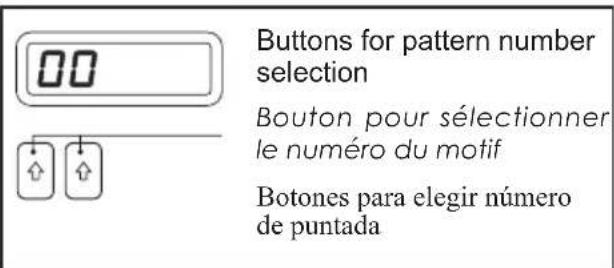
To select stitch patterns, use left button for pattern number selection to select left digit and right button to select right digit referring to pattern number reference guide.
STITCH LENGTH AND STITCH WIDTH / NEEDLE POSITION ADJUSTMENT BUTTONS
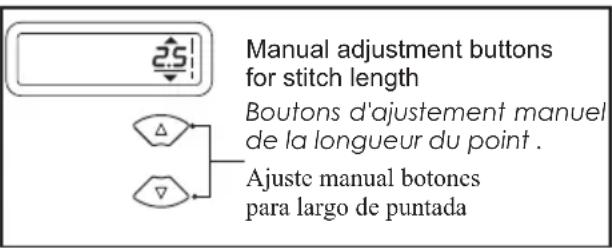
Your sewing machine will produce your stitching requirements at a 5/Default stitch length and width.
Default settings of stitch length and width are underlined on the display.
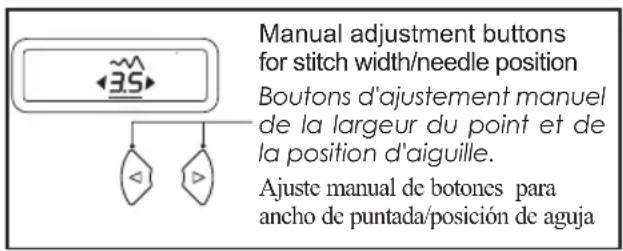
You can manually change the length width or needle position for straight stitch according to your preference by pushing manual adjustment buttons.
NOTE: Some patterns offer more options for manual adjustments than others.
BOUTON D'AJUSTEMENT DE LA LONGUEUR ET DE LA LARGEUR DU POINT/POSITION D'AIGUILLE
The position of the needle when sewing straight stitch may be adjusted to any one of 13 different positions with the Stitch Width Control as illustrated:
ADJUSTING BOBBIN THREAD TENSION
RÉGLAGE DE LA TENSION DU FIL INFÉRIEUR
AJUSTE DE LA TENSION DEL HILO DE LA BOBINA
BOBBIN THREAD TENSION REQUIRES ADJUSTMENT LESS FREQUENTLY THAN THE TOP THREAD TENSION.
If the tension is well balanced, but the fabric puckers badly, both top and bobbin thread tensions may be too tight and have to be adjusted. To test if the bobbin thread tension is correct, suspend the bobbin case by the thread and jerk it once. Correct bobbin tension will result in the thread unwinding only one or two inches. If too loose it will unwind continuously. If too tight the thread will not unwind at all. When adjusting the tension on the bobbin case, make only slight adjustments with a screwdriver.
Be sure needle is in the up position.
Raise presser foot lifter.
- Push presser foot release lever to remove the foot.
- Place the desired foot on the needle plate aligning the presser foot pin with the foot holder.
- Lower the presser foot lifter so that the foot holder snaps on the foot.
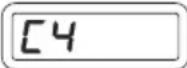
If an incorrect operation is made, a helpful message will be displayed. When a helpful message is displayed, fix the problem following the instructions below.
Bobbin winder is moved to right (operating position) during sewing.
Buttonhole lever is not lowered or raised.
Foot control plug is pulled out, while operating foot control.
→ Push in foot control plug.
Machine is locked up due to thread entangled with bobbin case or rotation interrupted forcibly.
→ Turn off power switch and eliminate the problem that caused the machine to stop. La machine ne tourne plus, en raison d'un enchevêtrement du fil dans la canette.
→ Débranchez la machine et éliminez le problème causant l'arrêt de la machine. La máquina se detuvo porque el hilo se enredó con la bobina o se interrumpió abruptamente la rotación.
→ Apague la máquina y arregle el problema que causó que se detuviera la máquina.
Reverse/tacking stitch button is pushed, while buttonhole stitch is selected.
→ Tacking stitch is made automatically after buttonhole stitch is completed. It is not necessary to push the reverse/tacking stitch button.
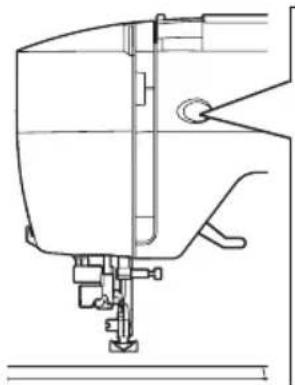
* Reverse stitch function for straight and zigzag stitches ( ⓤ )
Reverse sewing is carried out while the reverse stitch button is pushed. The machine will continue to sew in reverse as long as the reverse button is pressed.
* Tacking stitch function for tie-off of other stitches ( )
The sewing machine makes 4 tiny tacking stitches to tie off the sewing on all patterns except straight, zigzag and buttonhole stitches. The position of the tacking stitches will be at the exact spot in the pattern where the reverse/tacking stitch button is pushed.
NOTE: This function is very useful for tying off the sewing pattern to avoid raveling at the start and end of sewing.
natural_image
Technical line drawing of a mechanical device with no visible text or symbols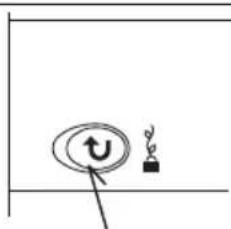
natural_image
Pure diagram of a rectangular container with internal spring and dashed vertical line, no text or symbols present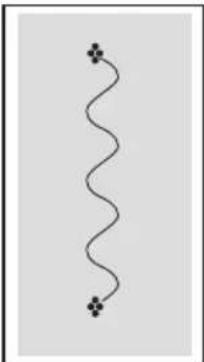
natural_image
Simple wavy line diagram with two small dots at endpoints (no text or symbols)BOUTON DOUBLE USAGE POINT INTERRUPTOR DE
MARCHE ARRIÈRE / POINT D'ARRÊT
QUICK REFERENCE TABLE OF STITCH LENGTH AND WIDTH
TABLEAU DE RÉFÉRENCE RAPIDE DES LARGEURS ET LONGUEURS DE POINTS
PATTERN NUMBER REFERENCE GUIDE
GUIDE DE RÉFÉRENCE DES MOTIFS
bar
| Point | Shape Color | |-------|-------------| | 00 | Solid Circle | | 01 | Solid Circle | | 02 | Solid Circle | | 03 | Wavy Line | | 04 | Wavy Line | | 05 | Wavy Line | | 06 | Wavy Line | | 07 | Wavy Line | | 08 | Wavy Line | | 09 | Wavy Line | | 10 | Wavy Line | | 11 | Wavy Line | | 12 | Wavy Line | | 13 | Wavy Line | | 14 | Wavy Line | | 15 | Cross | | 16 | Cross | | 17 | Cross | | 18 | Horizontal | | 19 | Horizontal | | 20 | Solid Circle | | 21 | Solid Circle | | 22 | Solid Circle | | 23 | Solid Circle | | 24 | Solid Circle | | 25 | Solid Circle | | 26 | Solid Circle | | 27 | Solid Circle | | 28 | Solid Circle | | 29 | Asterisk | | 30 | Asterisk | | 31 | Asterisk | | 32 | Asterisk | | 33 | Asterisk | | 34 | Asterisk | | 35 | Asterisk | | 36 | Asterisk | | 37 | Asterisk | | 38 | Asterisk | | 39 | Asterisk | | 40 | Asterisk | | 41 | Asterisk | | 42 | Asterisk | | 43 | Asterisk | | 44 | Asterisk | | 45 | Asterisk | | 46 | Asterisk | | 47 | Square | | 48 | Square | | 49 | Square | | 50 | Square | | 51 | Square | | 52 | Square | | 53 | Square | | 54 | Square | | 55 | Triangle | | 56 | Triangle | | 57 | Triangle | | 58 | Triangle | | 59 | Triangle |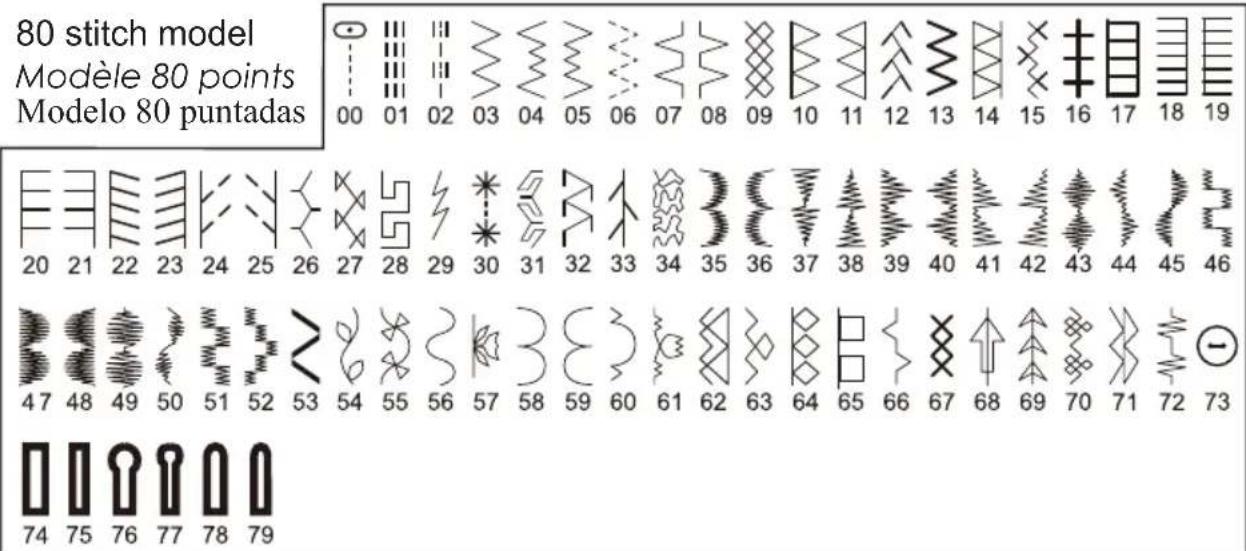
other
| Position | Line Style | |--------|----------| | 00 | Circle | | 01 | Solid | | 02 | Dash | | 03 | Wavy | | 04 | Wavy | | 05 | Wavy | | 06 | Wavy | | 07 | Wavy | | 08 | X-shaped | | 09 | Triangle | | 10 | Triangle | | 11 | Triangle | | 12 | Triangle | | 13 | X-shaped | | 14 | X-shaped | | 15 | Cross | | 16 | Cross | | 17 | Cross | | 18 | Cross | | 19 | Cross | | 20 | Square | | 21 | Square | | 22 | Square | | 23 | Square | | 24 | Square | | 25 | Square | | 26 | Square | | 27 | Square | | 28 | Asterisk | | 29 | Asterisk | | 30 | Asterisk | | 31 | Triangle | | 32 | Triangle | | 33 | Triangle | | 34 | Triangle | | 35 | Triangle | | 36 | Triangle | | 37 | Triangle | | 38 | Triangle | | 39 | Triangle | | 40 | Triangle | | 41 | Triangle | | 42 | Triangle | | 43 | Triangle | | 44 | Triangle | | 45 | Triangle | | 46 | Triangle | | 47 | Diamond | | 48 | Diamond | | 49 | Diamond | | 50 | Diamond | | 51 | Diamond | | 52 | Diamond | | 53 | Diamond | | 54 | Diamond | | 55 | Diamond | | 56 | Diamond | | 57 | Diamond | | 58 | Diamond | | 59 | Diamond | | 60 | Diamond | | 61 | Diamond | | 62 | Diamond | | 63 | Diamond | | 64 | Diamond | | 65 | Square | | 66 | Square | | 67 | Square | | 68 | Square | | 69 | Square | | 70 | Square | | 71 | Square | | 72 | Square | | 73 | Circle | | | | | | | | | | | | | | | | | | | | | | | | | | | | | | | | | | | | | | | | | | | | | | | | | | | | | | | | | | | | | | | | | | | | | | | | | | | | | | | | | | | | | | | | | | | | | | | | | | | | | | | | | | | | | | | | | | | | | | | | | | | | | | | | | | | | | | | | | | | | | | | | | | | | | | | | | | | | | | | | | | | | | | | | | | | | | | | | | | | | | | | | | | | | | | | | | | | | | | | | | | | | | | | | | | | | | | | | | | | | | | | | | | | | | | | | | | | | | | | -74 | Circle | | -75 | Circle | | -76 | Circle | | -77 | Circle | | -78 | Circle | | -79 | Circle |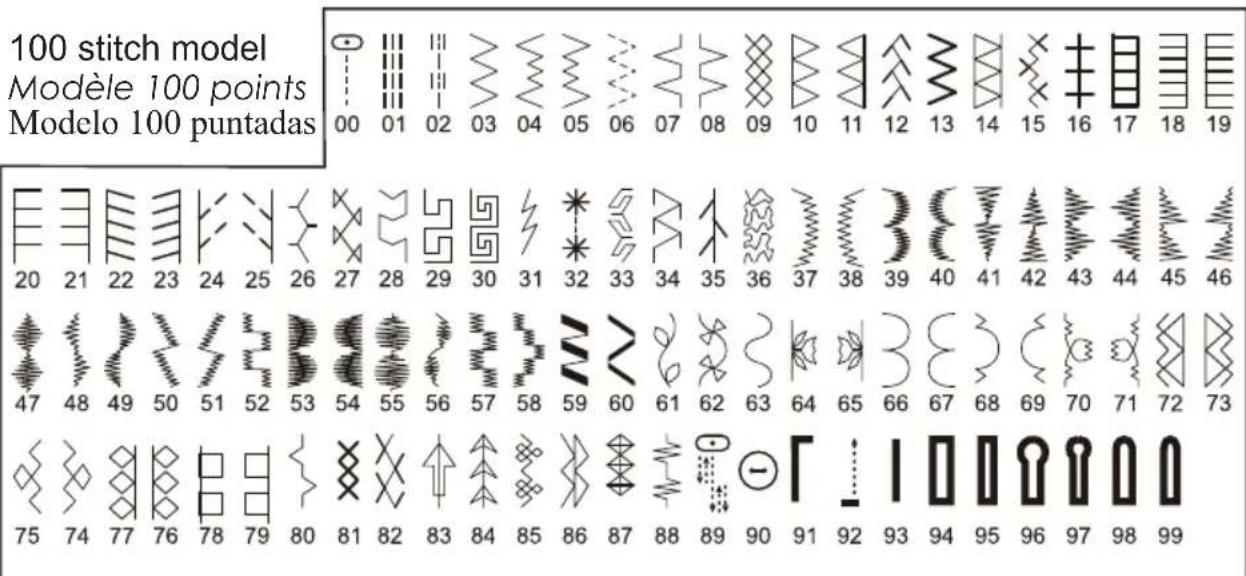
STRAIGHT STITCHING
POINT DROIT

100 stitch model : 00
80 stitch model : 00
60 stitch model : 00
PUNTADA RECTA
Straight stitch is most frequently used for all types of sewing. Let's begin by following the steps below.
NOTE: Based upon the weight of the fabric, slight “fine tuning” of the tension may be desired.
- SETTINGS
Presser foot - General purpose foot
Thread tension control - 5
A. Thread tension control
B. Reverse stitch button
C. Presser foot lifter
- Pull both threads under the presser foot toward the back of the machine, leaving about 4" (10cm) clear.
- Place the fabric under the presser foot and lower the presser foot lifter.
- Turn the hand wheel toward you (counter-clockwise) until the needle enters the fabric.
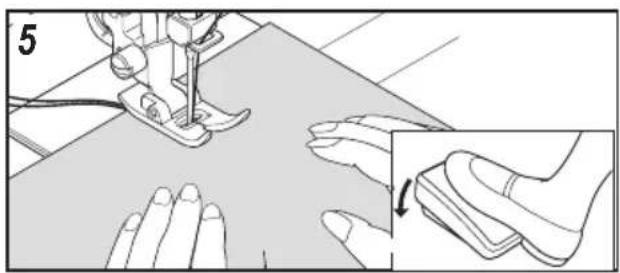
- Start the machine. Guide the fabric gently with your hands. When reaching the edge of the material, stop the sewing machine.
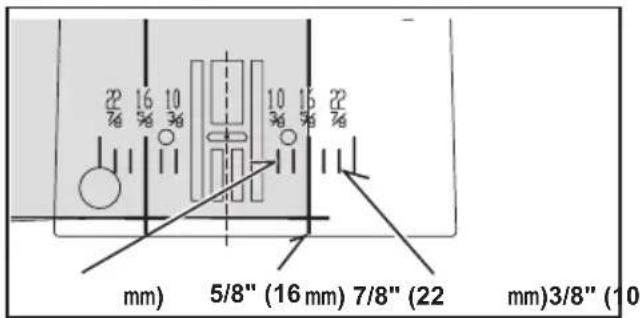
NOTE: The needle plate has both metric and inch markings as an aid for guiding your fabric when sewing a seam.
- First turn the handwheel toward you (counter-clockwise) until the needle is at its highest position. Raise the presser foot, draw materials to the rear and cut off excess thread with the thread cutter located on the bottom of face cover as shown.
NOTE: To secure the stitching and avoid raveling, press the reverse stitch switch and sew a few stitches at the start and end of the seam.
natural_image
Illustration of a sewing machine stitching fabric with hands, showing a close-up of the seam (no text or symbols)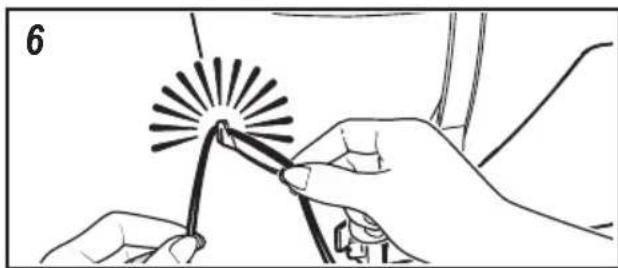
natural_image
Illustration of hands holding a tool with radiating blades, no text or symbols presentKEEPING SEAMS STRAIGHT
To keep the seam straight, use one of the numbered guide lines on the needle plate. The numbers indicate distance from the needle at its center position.
POUR GARDER LA COUTURE DROITE
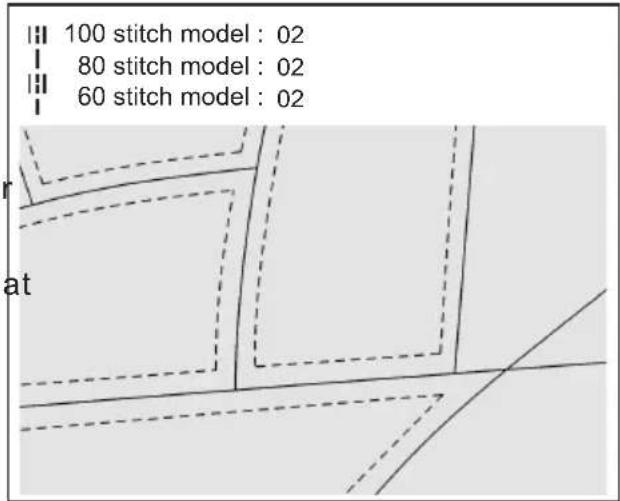
This stitch is designed to look like hand sewing for topstitching and quilting.
- Thread bobbin with desired top stitching color. When sewing, the machine will pull this thread to the top.
- Thread machine with invisible o lightweight thread of color that matches your fabric. This thread should not show.
- Increase thread tension a little bit a time until you achieve the desired appearance.
NOTE: For a dramatic appearance, experiment with different tension and stitch length combinations.
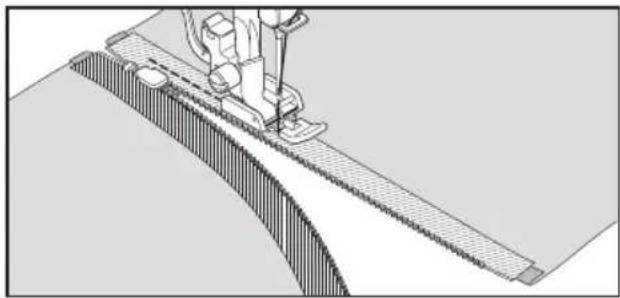
Use zipper foot to sew to the right or left of the zipper or close to the cording.
natural_image
Technical line drawing of two mechanical assembly steps (no text or symbols)Needle to left of foot
Needle to right of foot
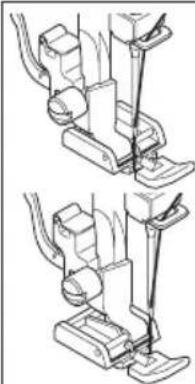
To sew down the right side, attach left side of zipper foot to presser foot holder so that the needle passes through the opening on the left side of the foot.
To sew down the left side, attach right side of foot to foot holder.
natural_image
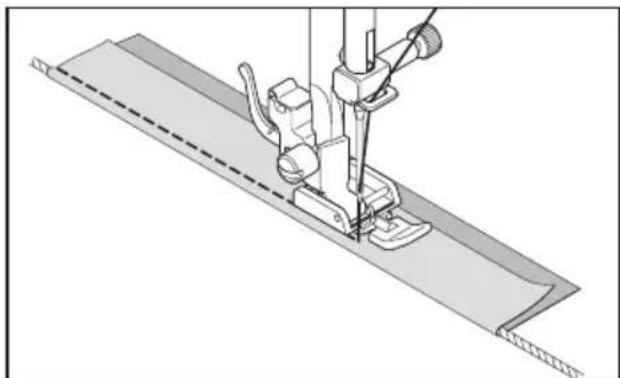
Technical illustration of a sewing machine needle stitching fabric (no text or symbols)To pipe soft furnishings, cover cord with a bias strip of fabric and pin or tack it to the main piece of fabric.
Attach left side of zipper foot to foot holder so that needle passes through the opening on the left side of the foot.
Helpful Hint: Slight adjusting of the needle position to sew closer to the piping may be accomplished with the Stitch Width Control.
natural_image
Technical line drawing of a sewing machine needle stitching fabric (no text or symbols)PASSEPOIL
The top thread may appear on the bottom depending on the thread, fabric, type of stitch and sewing speed, but the bobbin thread must never appear on the top of the fabric.
If bobbin thread is pulling to the top or you are experiencing puckering, slightly reduce the tension with the thread tension control.
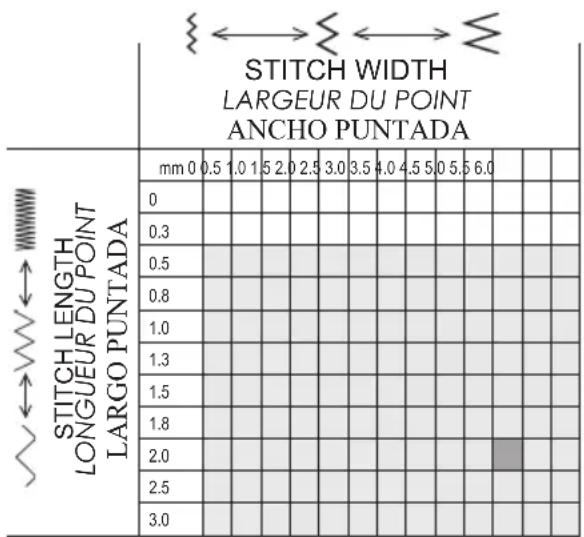
ADJUSTING STITCH WIDTH AND LENGTH
Dark grey box indicates the 5/ default value set automatically when the pattern is selected.
For the zigzag pattern the stitch length is 2 mm and the stitch width is 5 mm.
The light grey boxes indicate all the possible personal preference options available to set manually.
other
STITCH WIDTH LARGEUR DU POINT ANCHO PUNTADA | Position | Length (mm) | Longueur Du Point (mm) | Anchoring Point (mm) | | :--- | :--- | :--- | :--- | | LARGO PUNTADA | 0.5 | 1.0 | 5.2 | | LARGO PUNTADA | 0.3 | | 0.25 | | LARGO PUNTADA | 0.5 | | 3.0 | | LARGO PUNTADA | 0.8 | | 3.5 | | LARGO PUNTADA | 1.0 | | 3.0 | | LARGO PUNTADA | 1.3 | | 3.5 | | LARGO PUNTADA | 1.5 | | 3.0 | | LARGO PUNTADA | 1.8 | | 3.5 | | LARGO PUNTADA | 2.0 | | 3.0 | | LARGO PUNTADA | 2.5 | | 3.5 | | LARGO PUNTADA | 3.0 | | 3.0 | The diagram shows a schematic representation of a mechanical part with three segments: short, medium, and long segments, each associated with a specific dimension (mm). The left side is labeled 'STITCH LENGTH LONGUEUR DU POINT' and the right side is labeled 'ANCHO PUNTADA'.Les cases gris clair indique toutes les La casilla gris clara indica todas las opciones options de préférences personnelles de preferencia personal disponibles para ajustar disponibles pouvant être réglées manualmente. manuellement.
MULTI-STITCH ZIGZAG ZIGZAG MULTI-POINT
ZIG-ZAG DE TRES PUNTADAS
SETTINGS : Presser foot - General purpose foot : Thread tension control - 5
This is a strong stitch because as its name implies, it makes three short stitches where the normal zig-zag makes only one. For this reason it is recommended for overcasting all types of fabrics. It is also ideal for bartacks, mending tears, patching, and attaching flat elastic.
NOTE: Mending a tear or overedging as shown in illustration requires manual adjustment of the length control.
SETTINGS :Presser foot - General purpose foot :Thread tension control - 5
Turn under the raw edge and press. Place the fabric right side up so that the zigzag part of the stitch sews just over the folded edge, pulling the fabric in to form a shell hem. Trim away excess fabric from the backside, close to the stitching line.
Helpful Hint: For a pleasing appearance experiment with different width, length and tension settings.
This is a closely spaced stitch for appliqué, bar tacking, etc. Slightly loosen the top thread tension and manually adjust the stitch length between 0.5 and 2.0 for satin stitching.
Use a backing of stabilizer or interfacing to avoid puckering.
NOTE: When sewing a dense (closely spaced) satin stitch, the satin stitch foot MUST be used.
POINT BOURDON
PUNTADA DE RELLENO O SATÍN
PLACEMENT OF PATTERNS
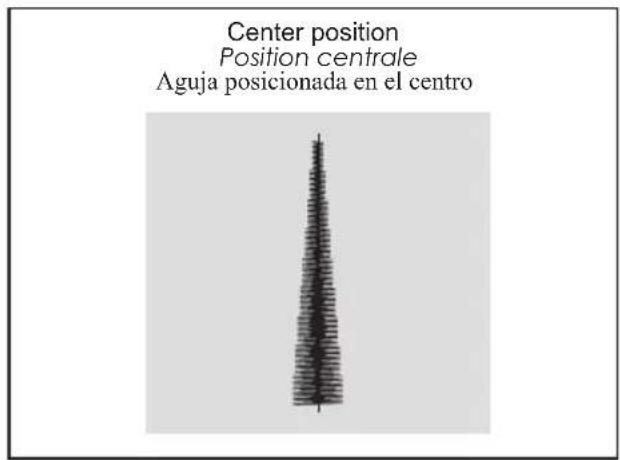
The satin stitch increases from the center needle position, making it possible to create center-tapered stitches, as illustrated.
POSITIONNEMENT DES MOTIFS
Position your fabric and button under the presser foot. Lower presser foot. Turn the handwheel to make sure needle clears both left and right openings of button. Adjust width if required. Sew 10 stitches. If a button shank is required, place a darning needle on top of the button and sew over top of it as illustrated.
Helpful hint: To secure thread, pull both threads to the backside of the fabric and tie together.
natural_image
Line drawing of a sewing machine on a workbench with a separate inset showing a small component (no text or symbols)AJUSTES : Pie prensatelas - Pie universal
The blindhem stitch is primarily used for creating nearly invisible hems on curtains, trousers, skirts, etc.
– Elastic blind stitch for soft, stretchable fabrics
natural_image
Mechanical sewing machine diagram showing needle insertion and base assembly (no text or symbols)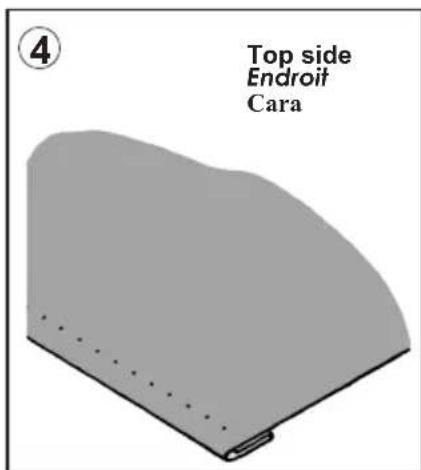
- With matching thread finish the raw edge. On fine fabric turn up and press a small 12 " (1.3cm) or less hem. On medium to heavyweight fabrics overcast the fabric's raw edge.
- Now fold the fabric as illustrated with the wrong side up.
- Place the fabric under the foot. Turn the handwheel towards you (counter-clockwise) by hand until the needle swings fully to the left. It should just pierce the fold of the fabric.
NOTE: In addition to the adjustment on the foot, the stitch width control can be used. The stitch width control changes the swing of the needle for a narrower or wider stitch.
Sew slowly, guiding the fabric carefully along the edge of the guide.
- When completed, the stitching is almost invisible on the right side of the fabric.
NOTE: It takes practice to sew blind hems. Do a test sew first.
Stretch stitches are mainly for use on knit, or stretchable fabrics, but can also be used on woven materials.
Straight stretch stitch is far stronger than an ordinary straight stitch because it locks three times - forwards, backwards and forwards. It is particularly suitable for reinforcing the seams of sportswear in stretch and non-stretch fabrics, and for curved seams which take a lot of strain. Use this stitch also to top-stitch lapels, collars and cuffs to give a professional finish to your garments.
POINT DROIT EXTENSIBLE
The honeycomb stitch is ideal for smocking and useful for overcasting and attaching elastic and stretch lace.
- For smocking, first make several rows of gathers across the fabric that you wish to smock.
- Cut an underlay fabric (such as organdy) and place it under the shirring.
- Sew the honeycomb stitch over the gathered rows, securing them in place.
POINT NID D'ABEILLE
natural_image
Illustration of two hands holding a folded paper or sheet (no text or symbols visible)PUNTADA RECTA TRIPLE
natural_image
Diagram showing a transformation of a fluted, ribbed structure into a textured, layered structure (no text or symbols)PUNTADA PANAL
This is the same type stitch used by the garment industry in making sportswear - it forms and finishes the seam in one operation. It's very effective for use in repairing raw or worn seams of garments.
POINT SURJET EXTENSIBLE
The pleasing appearance of this stitch enables it to be used for decorative topstitching or for attaching laces and trims. It is also ideal for quilting applications and edge-joining.
POINT PLUME
Ric-rac is primarily used for a decorative top-stitch. It is ideal for edging neck-bands, armholes, sleeves and hems. When manually adjusted to a very narrow width, it also can be used for sewing high-stress seams.
POINT RIC-RAC
The double overlock stitch has three main uses. It is perfect for attaching flat elastic, for overcasting, and for seaming and overcasting in one operation. It is primarily used on fabrics that stretch slightly and non-stretch fabrics such as linen, tweed, and medium to heavy-weight cotton.
POINT SURJET DOUBLE
Used primarily for decorative machine stitching.
POINT ENTRECROISÉ
Useful for decorative stitching on borders and for use in heirloom sewing. The entredeux stitch is most often sewn with a wing needle (SINGER Style 2040) to create holes in the stitch pattern.
Helpful hint: A slight + adjustment of the tension will increase the size of the hole when using a wing needle.
POINT ENTREDEUX
The ladder stitch is primarily used for drawn thread hemstitching. It can also be used for sewing over thin tape in a contrasting or same color. Place the stitch in the center and a special effect will be obtained for decoration. Another use for the ladder stitch is couching over narrow ribbon, yarn or elastic. For drawn thread work, choose a coarse linen type fabric and after sewing draw the thread out within the ladder for an open airy appearance.
POINT D'ÉCHELLE
The pin stitch is a traditional stitch pattern used for picot-like edges and for appliqué work.
POINT ÉPINGLE
The blanket stitch is traditionally a hand-sewn stitch used to put bindings on blankets. This multi-purpose stitch can also be used for couching, appliqué, drawn thread hemstitching and creating fringe.
POINT DE LANGUETTE
PUNTADA DE BROCHE
PUNTADA DE RIBETE
Excellent for hemstitching projects like table linens. Picot-like stitch can also be made on sheer materials. Sew along the raw edge of fabric and trim close to the outside of the stitching.
POINT ÉPINGLE OBLIQUE
Seams and overcasts in one operation to produce a narrow, supple seam, particularly suited to swimwear, sportswear, T-shirts, babywear in stretch nylon, jersey and cotton jersey.
POINT SURJET OBLIQUE
Use to sew and finish elastic fabrics or for decorative work.
POINT CROISÉ
A traditional pattern suited for decorative borders and edge finishings.
POINT GREC
Used mainly for decorative machine stitching.
POINT D'ARRÊTE
PUNTADA ALFILER INCLINADO
PUNTADA OVERLOCK INCLINADO
It is a versatile stitch used for joining fabric pieces as well as for decorative machine stitching.
POINT D'ÉPINE
This stitch is perfect for attaching flat elastic. It can also be used for smocking and as a seam finish.
POINT SURJET RENFORCÉ
This is a popular decorative stitch. It can also be used for joining two separate pieces of fabric, leaving a little space in between. Fold under the seam allowances on the cut edges, and press. Baste folded edges to tissue paper with about 1/8" (0.3 cm) space between. Stitch over the 1/8" (0.3 cm) allowance, just catching the fabric fold on both sides with needle. Remove bastings and paper; press.
POINT D'ASSEMBLAGE DES REBORDS
Used mainly for decorative machine stitching.
POINT SORCIER
MORE DECORATIVE STITCHES and IDEAS FOR DECORATIVE MACHINE STITCHING
AUTRES POINTS DÉCORATIFS ET IDÉES POUR LA COUTURE DECORATIVE À LA MACHINE
MAS PUNTADAS DECORATIVAS E IDEAS PARA DECORAR SUS MANUALIDADES
SETTINGS : Presser foot - General purpose foot
: Thread tension control - 5 or -1
You should carry out a test sewing on an extra piece of the fabric being sewn to check the decorative pattern to be used.
Before starting to sew, check that there is enough thread wound onto the bobbin to ensure that the thread will not run out during sewing.
For best results, stabilize fabric with a tear-away or wash-away stabilizer underneath when stitching.
Helpful hint: Bobbin thread should not appear on the top side of the fabric, so it may be necessary to slightly lower the tension setting.
natural_image
Pure technical illustrations of fabric or material sections without any text, numbers, or symbols
natural_image
Pure waveform patterns without any text, numbers, or symbolsBUTTONHOLE MAKING CONFECTION DES BOUTONNIÈRES CONFECCION DE OJALES
AUTOMATIC BUTTONHOLE
USING BUTTONHOLE FOOT
Your machine offers you two different widths of bartack, keyhole and round-end buttonholes sewn by a system that measures the size of the button an calculates the size of buttonhole required. All of this is done in one easy step.
BOUTONNIÈRE AUTOMATIQUE
* Use an interfacing in the area of the garment where buttonholes are placed. Stabilizer or regular interfacing can be used.
* Make a practice buttonhole on a scrap of the actual fabric from your project. Then try the buttonhole with your button.
100 stitch model : 94, 95
80 stitch model : 74, 75
60 stitch model : 56, 57
100 stitch model : 96, 97
80 stitch model : 76, 77
60 stitch model : 58, 59
100 stitch model : 98, 99
80 stitch model : 78, 79
60 stitch model : -,-
PROCÉDURE
natural_image
Technical line drawing of a sewing machine with no visible text or symbolsPROCEDIMIENTO
- Select one of the buttonhole patterns.
- Replace the presser foot with the buttonhole foot. (Refer to "Changing presser foot" on page 28.)
- Insert the button into the buttonhole foot. (Refer to "Using buttonhole foot" above.)
- Lower the buttonhole lever (C) so that it drops down vertically between the stoppers (A) and (B).
- Carefully mark the position of buttonhole on your garment.
- Place the fabric under the foot. Pull out the bobbin thread underneath the fabric to a length of about 4" (10 cm) to the rear.
- Align the buttonhole mark on the fabric with the mark on the buttonhole foot, and then lower the buttonhole foot.
- While holding the top thread, start the machine.

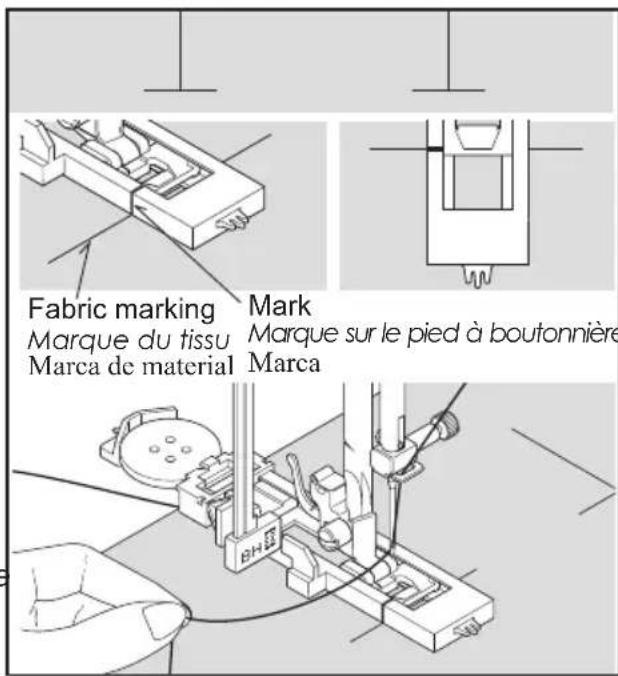
- When sewing is finished, use buttonhole opener/seam ripper to open up the fabric in the center of the buttonhole.
Be careful not to cut any of the stitching.
natural_image
Illustration of a hand holding a tool interacting with a screw-like mechanical component (no text or symbols visible)Hook filler cord (such as crochet thread or buttonhole twist) over the spur and pull both ends of the cord forward under the foot and tie off the cord as shown in the illustration. Sew buttonhole so that zigzag stitche cover the cord. When completed, release the cord from foot. Gently pull the cords to take up the slack, then snip off extra length.
BOUTONNIÈRE GANSÉES (RENFORCÉES)
To ensure the best possible operation of your machine, it is necessary to keep the essential parts clean at all times.
Always disconnect the machine from power supply by removing the plug from the electrical outlet.
| CAUTION | Always disconnect the machine from power supply by removing the plug from the electrical outlet. |
 ATTENTION ATTENTION | Débranchez toujours la machine de l'alimentation électrique en retirant la fiche de la prise murale. |
 PRECAUCION PRECAUCION | Siempre desconecte la máquina de la fuente de alimentación retirando el enchufe del tomacorriente de la pared. |
A. Raise the needle to its highest position.
B. 1. Remove the bobbin case from the shuttle.
-
Push aside the two shuttle keepers.
-
Remove the shuttle race cover and shuttle.
C. Clean the feed dogs and shuttle area with the lint brush.
NOTE: Put a drop of sewing machine oil on the center pin of the shuttle and shuttle race as indicated by the arrows.
D. 1. Be sure the shuttle race forms a half moon on the left side of the machine.
- Holding the shuttle by its center pin, replace it so as to form a half moon on the right side.
3.Slide the shuttle race cover back into position.
- Snap the shuttle keepers back into position.
Cleaning the sewing machine and foot controller
After using, keep sewing machine and footcontroller clean, use dry rags to remove dust from the sewing machine and footcontroller.
NOTE: Use dry rags to avoid electrical shock.
4. OPTION ACCESSORIES
4.ACCESOIRES EN OPTIONS
4.ACCESORIOS OPCIÓN
LARGE EXTENSION TABLE
To place onto the machine, lift the supporting leg of the extension table, and slide the table into place while fitting the guide pins A, B, C and D into machine as illustrated.
GRAND PLATEAU DE RALLONGE BASE DE EXTENSION
Machine does not sew.
* Power switch is turned off. - Turn on the switch.
* Assure foot controller plug is fully engaged (pushed into its socket).
* Buttonhole lever is not raised when sewing stitch patterns. - Raise buttonhole lever.
* Buttonhole lever is not lowered when sewing buttonhole. - Lower buttonhole lever.
* Bobbin winder is engaged. – Disengage bobbin winder (see page 15).
Machine jams/knocks.
* Thread is caught in hook. - Clean hook (see page 56 - 57).
* Needle is damaged. - Replace needle (see page 23).
Fabric does not move.
* Presser foot is not lowered – Lower presser foot.
* Stitch length is too short – Lengthen stitch length.
STITCHING PROBLEMS
Machine skips stitches.
* Needle is not all the way up into needle clamp (see page 23).
* Needle is bent or blunt. - Replace needle (see page 23).
* Machine is not threaded correctly (see page 17 -18).
* Thread is caught in hook. - Clean hook (see page 56 - 57).
Stitches are irregular.
* Needle size is not correct for thread and fabric (see page 23). * Machine is not threaded correctly (see page 17 - 18). * Top thread tension is too loose (see page 24 - 25). * Fabric is being pulled or pushed against machine feeding action. – Guide it gently.
* Bobbin has not been wound evenly. – Rewind bobbin.
Needle breaks.
* Fabric is being pulled or pushed against machine feeding action. - Guide it gently. * Needle size is not correct for thread and fabric (see page 23). * Needle is not all the way up into the needle clamp (see page 23). * Too much thread appears on the underside of stitching. * Upper thread not correctly thread (see page 17 - 18).
THREAD PROBLEMS
Thread bunches.
* Top and bobbin threads are not drawn back under presser foot before starting seam. - Draw both threads back under presser foot about 4" (10 cm) and hold until a few stitches are formed.
Needle thread breaks.
* Machine is not threaded correctly (see page 17 - 18). * Top thread tension is too tight (see page 24 - 25).
* Needle is bent. - Replace needle (see page 23).
* Needle size is not correct for thread and fabric (see page 21 - 22).
Bobbin thread breaks.
* Bobbin case is not threaded correctly (see page 16 - 17). * Lint accumulates in bobbin case or hook. - Remove lint (see page 56 - 57).
Fabric puckers.
* Top thread tension is too tight. - Adjust thread tension (see page 24 - 25). * Stitch length is too long for sheer or soft fabric. - Shorten stitch length.