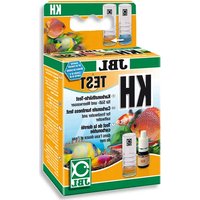
KH Test - Water tester JBL - Free user manual and instructions
Find the device manual for free KH Test JBL in PDF.



| Product type | Water test kit |
| Brand | JBL |
| Model | KH Test |
| Category | Water tester |
| Use | Measurement of carbonate hardness (alkalinity) in freshwater, saltwater and garden ponds |
| Measurement principle | Drop count titration with color change from blue to yellow/orange |
| Unit of measurement | German degree (°d), mmol/L, French degree (°f), mg/L HCO3− (conversion table included) |
| Accuracy | 1 drop = 1 °d for 5 ml sample; 1 drop = 0.5 °d for 10 ml sample |
| Test tube capacity | 5 ml or 10 ml |
| Box contents | Reagent, test tube, instruction manual |
| Dimensions (estimated) | Approximately 10 cm × 5 cm × 5 cm |
| Weight (estimated) | Approximately 70 g |
| Power supply | None (manual test) |
| Maintenance | Rinse the test tube with clear water after each use |
| Safety | Highly flammable liquid and vapor (H225); causes severe burns (H314). Keep out of reach of children. |
| Spare parts | Commercially available reagent refills |
| Warranty | 2 years (according to JBL standard) |
| General information | Manufactured by JBL GmbH & Co. KG, Germany. Instruction manual available in multiple languages. |
Frequently Asked Questions - KH Test JBL
User questions about KH Test JBL
0 question about this device. Answer the ones you know or ask your own.
Ask a new question about this device
Download the instructions for your Water tester in PDF format for free! Find your manual KH Test - JBL and take your electronic device back in hand. On this page are published all the documents necessary for the use of your device. KH Test by JBL.
USER MANUAL KH Test JBL
natural_image
Icon of an open book with a lowercase 'i' in the center, representing information (no text or symbols beyond the icon itself)DE UK FR NL
IT DK ES PT
SE CZ HU PL
RU KR TW CN

JBL GmbH & Co KG
67141 Neuhofen
+49 6236 41800
Germany
www.JBL.de
KH Test-Set
Besonderheit
natural_image
Two identical diamond-shaped warning symbols: a flame symbol and a plant with a branch (no text or labels)Gefahr
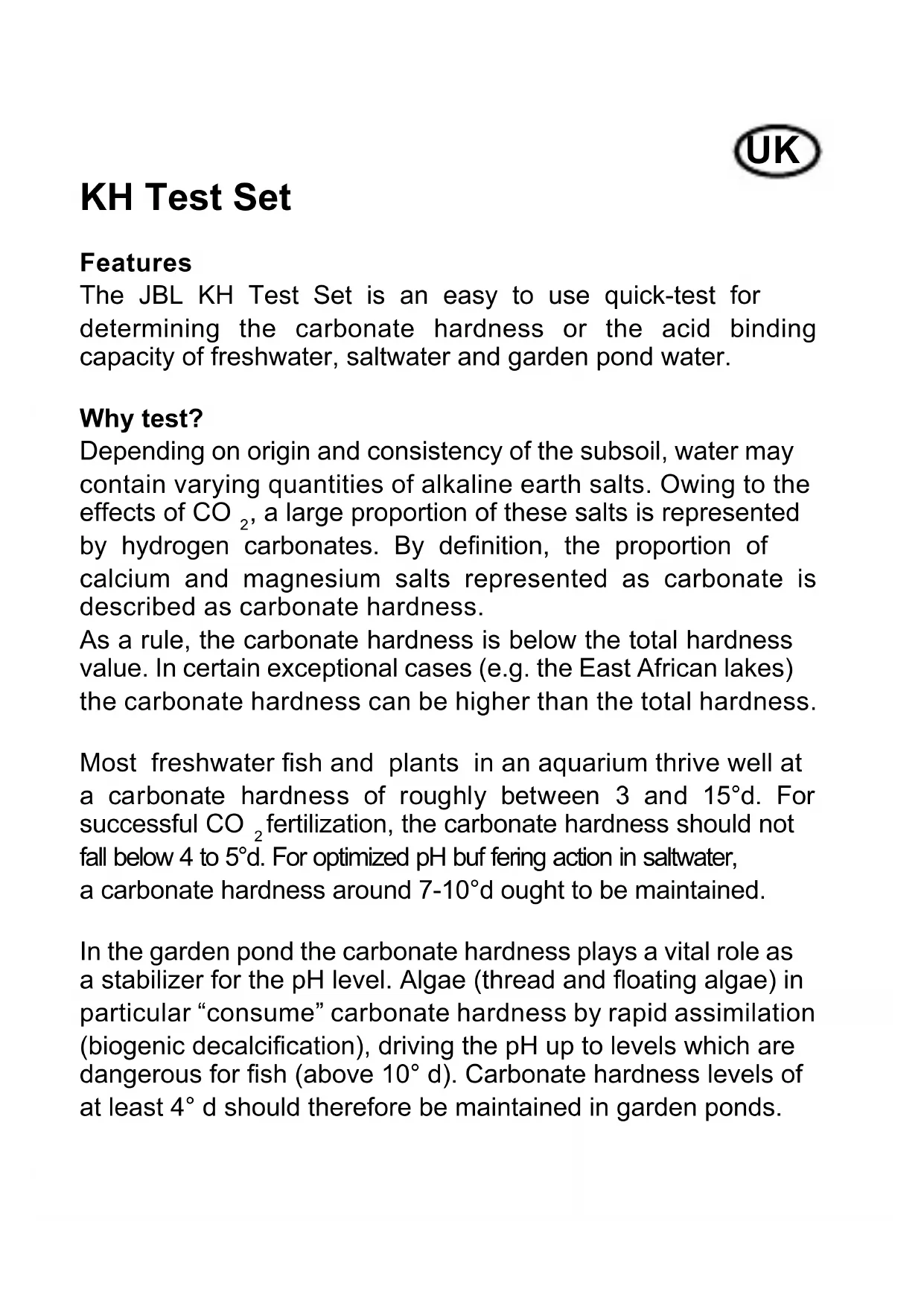
The JBL KH Test Set is an easy to use quick-test for determining the carbonate hardness or the acid binding capacity of freshwater, saltwater and garden pond water.
Why test?
Depending on origin and consistency of the subsoil, water may contain varying quantities of alkaline earth salts. Owing to the effects of CO_2 , a large proportion of these salts is represented by hydrogen carbonates. By definition, the proportion of calcium and magnesium salts represented as carbonate is described as carbonate hardness.
As a rule, the carbonate hardness is below the total hardness value. In certain exceptional cases (e.g. the East African lakes) the carbonate hardness can be higher than the total hardness.
Most freshwater fish and plants in an aquarium thrive well at a carbonate hardness of roughly between 3 and 15^ . For successful CO_2 fertilization, the carbonate hardness should not fall below 4 to 5^ . For optimized pH buffering action in saltwater, a carbonate hardness around 7 - 10^ ought to be maintained.
In the garden pond the carbonate hardness plays a vital role as a stabilizer for the pH level. Algae (thread and floating algae) in particular “consume” carbonate hardness by rapid assimilation (biogenic decalcification), driving the pH up to levels which are dangerous for fish (above 10^ d). Carbonate hardness levels of at least 4^ d should therefore be maintained in garden ponds.
What to do in the event of unfavourable values
There are various methods for reducing water hardness (e.g. by using a reverse osmosis unit such as the JBL Osmose 120). Ask your pet shop specialist for details. Use JBL AquaDur Plus or JBL pH-Plus to increase the carbonate hardness in freshwater aquariums. Use JBL CalciuMarin in marine aquariums.
In garden ponds the carbonate hardness can be increased by the addition of JBL StabiloPond KH.
Instructions
- Repeatedly rinse the measuring vessel with the water to be tested.
- Fill the measuring vessel with the water to be tested up to the 5 ml mark (CAUTION: the lower line of the water level must coincide with the marking).
- Add reagent one drop at a time, counting the drops, and shake after each drop until the colour changes from blue to yellow-orange.
- One drop of reagent solution used corresponds to 1^ carbonate hardness (German scale).
For more precise readings:
Fill the measuring vessel up to the 10 ml mark with the water to be tested.
One drop of reagent solution used up corresponds to 0.5^ general hardness (German scale).
Note: With 10 ml sample water the colour development is less intensive for the first drops. For better readability place the measuring vessel on a white surface.
See the table below for conversion into other common units of measurement.
Our tip for environmentally-friendly users
All reagents for JBL test sets are available from your retailer as reasonably-priced refill packs!
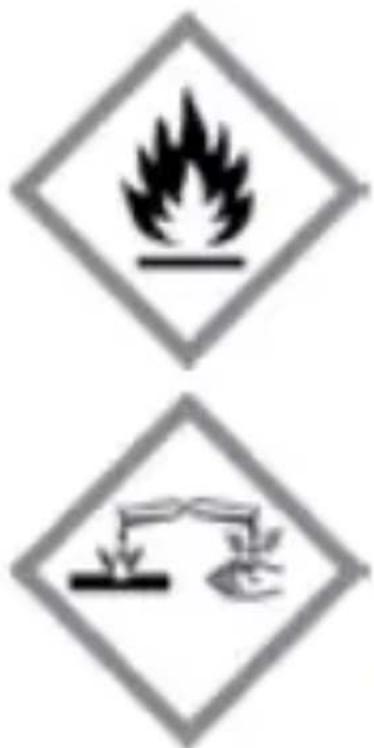
Warning and safety notices:
natural_image
Two identical diamond-shaped warning symbols: a flame symbol and a plant diagram with a ladder (no text or labels)Danger
H225 Highly flammable liquid and vapour. H314 Causes severe skin burns and eye damage.
P101 If medical advice is needed, have product container or label at hand. P102 Keep out of reach of children. P210 Keep away from heat, hot surfaces, sparks, open flames and other ignition sources. No smoking. P303 + P361 + P353 IF ON SKIN (or hair): Take off immediately all contaminated clothing. Rinse skin with water [or shower].P305 + P351 + P338 IF IN EYES: Rinse cautiously with water for several minutes. Remove contact lenses, if present and easy to do. Continue rinsing. P405 Store locked up.
| Carbonate hardness Acid binding capacity mmol/l | German degree °d | French degree °f | Hydrogen carbonate mg/l |
| Acid binding capacity mmol/l - 2.78 4.94 61.0 | |||
| German degree °d 0.36 - 1.78 21.8 | |||
| French degree °f 0.20 0.56 - 12 3 | |||
| Hydrogen carbonate mg/l 0.016 0.046 0.08 - |
Kit de test KH
Spécificité
natural_image
Two identical diamond-shaped warning symbols: a flame symbol and a plant sprout diagram (no text or labels)Danger
natural_image
Two identical diamond-shaped warning symbols: a flame symbol and a plant sprout diagram (no text or labels)Gevaar
natural_image
Two identical diamond-shaped warning symbols: a flame symbol and a plant with a ladder (no text or labels)Pericolo
H225 Liquido e vapori facilmente infiammabili. H314 Provoca gravi ustioni cutanee e gravi lesioni oculari.
natural_image
Two identical diamond-shaped warning symbols: a flame symbol and a plant sprout diagram (no text or labels)Fare
natural_image
Two identical diamond-shaped warning symbols: a flame symbol and a plant diagram (no text or labels)natural_image
Two identical diamond-shaped warning symbols: a flame symbol and a plant sprout diagram (no text or labels)Perigo
natural_image
Two identical diamond-shaped warning symbols: a flame symbol and a plant diagram with a tree (no text or labels)Fara
natural_image
Two identical diamond-shaped warning symbols: a flame symbol and a plant diagram with a ladder (no text or labels)Nebezpečí
natural_image
Two identical diamond-shaped symbols: a flame icon and a plant diagram with a branch (no text or labels)Veszély
natural_image
Two identical diamond-shaped warning symbols: a flame icon and a plant sprout diagram (no text or labels)Niebezpieczeństwo
natural_image
Warning symbol of a flame inside a diamond shape (no text or numbers)Опасно
natural_image
Symbolic diagram showing a tree with roots and leaves, enclosed in a diamond border (no text or labels)natural_image
Warning symbol of a flame inside a diamond shape (no text or numbers)
natural_image
Symbolic diagram of a tree with roots and leaves inside a diamond border (no text or labels)위험
natural_image
Two identical diamond-shaped warning symbols: a flame symbol and a plant sprout diagram (no text or labels)危險
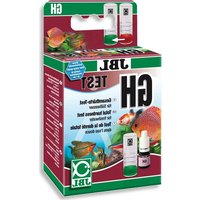
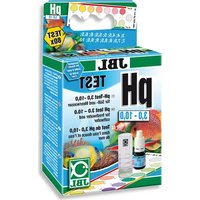
Brand : JBL
Model : KH Test
Category : Water tester