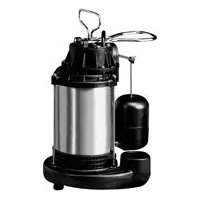
CDU980E - Pump Wayne - Free user manual and instructions
Find the device manual for free CDU980E Wayne in PDF.


User questions about CDU980E Wayne
0 question about this device. Answer the ones you know or ask your own.
Ask a new question about this device
Download the instructions for your Pump in PDF format for free! Find your manual CDU980E - Wayne and take your electronic device back in hand. On this page are published all the documents necessary for the use of your device. CDU980E by Wayne.
USER MANUAL CDU980E Wayne
Sump, Effl uent and Sewage pumps
INSTALLATION MANUAL
Read and save these instructions. This manual contains very important Safety Warnings and Operating Instructions. You will need to refer to it before attempting any installation or maintenance. Always keep this manual with the unit so that it will be easily accessible. Failure to read and follow these warnings and instructions could result in property damage, serious injury or death.
DESCRIPTIONS
SUMP PUMPS
Sump pumps are automatic pumps used to remove ground water from sump pits. The most common application is for basement drainage to prevent fl ooding in residential buildings. These sumps are designed to pump clear water only.
EFFLUENT PUMPS
Effluent pumps are pumps used to remove grey water from septic tanks, sump pits or laundry tray systems. Grey water is waste water from bathtubs, sinks, washing machines, and other kitchen appliances. The pumps are designed to pass solids 1/2 to 3/4 inches in diameter.
SEWAGE PUMPS
Sewage pumps are pumps used to remove waste water that contains solids up to 2 inches in diameter. The most common application is for draining bathroom waste water to a sewer or septic line.
UNPACKING
Inspect your pump. Occasionally, products are damaged during shipment. If the unit is damaged, contact our Customer Service department at the number listed on the parts and warranty sheet.
READ & FOLLOW ALL INSTRUCTIONS
SAVE THESE INSTRUCTIONS — DO NOT DISCARD
SAFETY GUIDELINES
This manual contains information that is very important to know and understand. This information is provided for SAFETY and to PREVENT EQUIPMENT PROBLEMS. To help recognize this information, observe all safety information labeled danger, warning, caution, and notice.
IMPORTANT SAFETY INFORMATION
WARNING
WARNING INDICATES A POTENTIALLY HAZARDOUS SITUATION WHICH, IF NOT AVOIDED, COULD RESULT IN DEATH OR SERIOUS INJURY.
RISK OF ELECTRIC SHOCK. TO REDUCE THIS RISK, OBSERVE THE FOLLOWING WARNINGS:

MAKE SURE THERE IS A PROPERLY GROUNDED RECEPTACLE AVAILABLE. This pump is supplied with a grounding conductor and grounding-type attachment plug. To reduce the risk of electric shock, be certain that it is connected only to a properly grounded, grounding-type receptacle.
NEVER REMOVE THE GROUND PRONG from the plug or bypass the grounding wires.
FOR ADDED SAFETY the receptacle should be protected with a ground fault circuit interrupter (GFCI). All wiring must be performed by a qualified licensed electrician and comply with the National Electric Code and all applicable local codes and ordinances.
DO NOT REMOVE POWER SUPPLY CORD and strain relief or connect conduit directly to the pump.
MAKE SURE THE POWER SUPPLY HAS A FUSE OR CIRCUIT BREAKER rated to handle the current (amps) noted on the pump nameplate or cordtag.
DO NOT USE AN EXTENSION CORD. Extension cords could present a safety hazard if not sized properly, become damaged or the connection falls into the sump. If receptacle is not within reach of the pump's power cord, contact a qualified licensed electrician to install a new receptacle.
ALWAYS DISCONNECT THE PUMP from power supply before installing, servicing or making any adjustments.
DO NOT SUBMERGE PEDESTAL MOTOR or allow motor to be exposed to water.
DO NOT WALK on the floor when water is present until all power is turned off. If the electric panel is in the basement, call an electrician.
NEVER HANDLE A PUMP or motor with wet hands or when standing on a wet or damp floor while the pump is plugged into the power supply.
WASH HANDS AFTER HANDLING. According to the state of California (Prop 65), this product may contain chemicals known to the state of California to cause cancer and birth defects or other reproductive harm.
RISK OF ELECTRIC SHOCK. This pump has not been investigated for use in swimming pool and marine areas.
DO NOT USE TO PUMP FLAMMABLE OR EXPLOSIVE FLUIDS such as gasoline, fuel oil, kerosene, etc. Do not use in a fl ammable and/or explosive atmosphere. Pump should only be used to pump clear water. Personal injury and/or property damage could result.
PUMPS ARE NOT DESIGNED TO TRANSFER WATER INTENDED FOR DRINKING. Do not use the pump for moving water that will be used for potable/drinking water. Pump should only be used in applications for which it is designed.
CAUTION
CAUTION INDICATES A POTENTIALLY HAZARDOUS SITUATION WHICH, IF NOT AVOIDED, MAY RESULT IN MINOR OR MODERATE INJURY.
TO REDUCE THE RISK OF HAZARDS THAT CAN CAUSE INJURY OR PROPERTY DAMAGE, OBSERVE THE FOLLOWING WARNINGS:

IF THIS PUMP CONTAINS A SWITCH FOR AUTOMATIC OPERATION, IT IS THE INSTALLER'S RESPONSIBILITY TO MAKE SURE THE SWITCH IS ABLE TO OPERATE WITHOUT ANY OBSTRUCTIONS WITHIN THE BASIN. It is recommended that the installer test and observe the pump's operation for several cycles after installation.
IT IS RECOMMENDED TO USE RIGID PIPING AND FITTINGS to secure the pump in the basin and reduce pump movement. Pump movement can prevent the switch from operating correctly.
THIS PUMP SHOULD BE INSPECTED 3 TO 4 TIMES PER YEAR for pump movement or buildup of debris on the switch or float. Reposition pump if it has moved. Remove any debris that could interfere with the operation of the switch.
IT IS RECOMMENDED TO USE A CHECK VALVE with this pump to prevent the back-flow of fluid after each pump cycle.
DO NOT INSTALL OR OPERATE THE PUMP IF IT HAS BEEN DAMAGED IN ANY WAY.
DO NOT LIFT OR CARRY THE PUMP BY THE POWER CORD. Use the pump's handle.
DO NOT USE THIS PUMP IN MUD, SAND, CEMENT, OIL OR CHEMICALS.
DO NOT USE SUMP AND EFFLUENT PUMPS TO HANDLE RAW SEWAGE.
AN INDEPENDENT HIGH WATER ALARM OR BACK UP PUMP SHOULD BE USED when risk of property damage from high water levels exists
THE SWITCH SHOULD BE REPLACED EVERY TWO (2) YEARS. This maintenance will reduce the risk of improper pump operation, switch failure, or fl ooding.
TYPICAL SUMP INSTALLATION DIAGRAMS
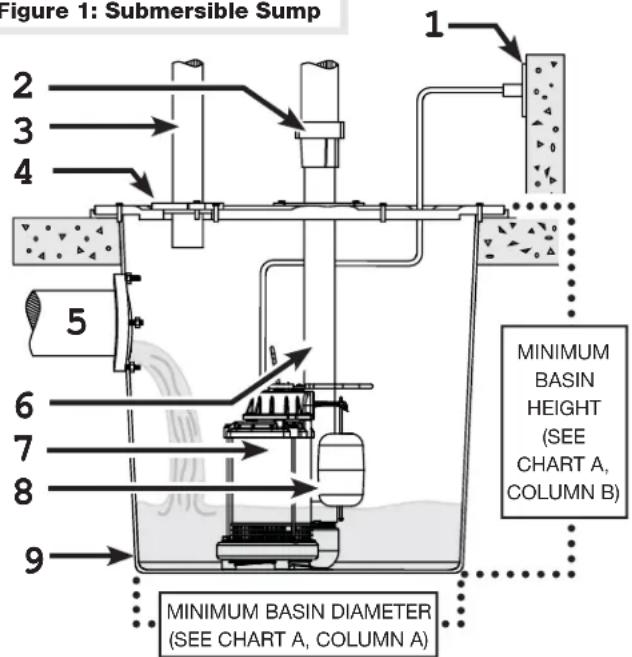
Figure 1: Submersible Sump
text_image
Figure 1: Submersible Sump 1 2 3 4 5 6 7 8 9 MINIMUM BASIN HEIGHT (SEE CHART A, COLUMN B) MINIMUM BASIN DIAMETER (SEE CHART A, COLUMN A)-
GFCI OUTLET 5. PIPE INLET 9. SUMP BASIN
-
CHECK VALVE 6. DISCHARGE PIPE 10. FLOAT ROD
-
VENT PIPE 7. SUMP PUMP 11. FLOAT GUIDE
-
GASKET/BASIN LID 8. SWITCH (SEE CHART A, ON PAGE 3) 12. SWITCH ARM
text_image
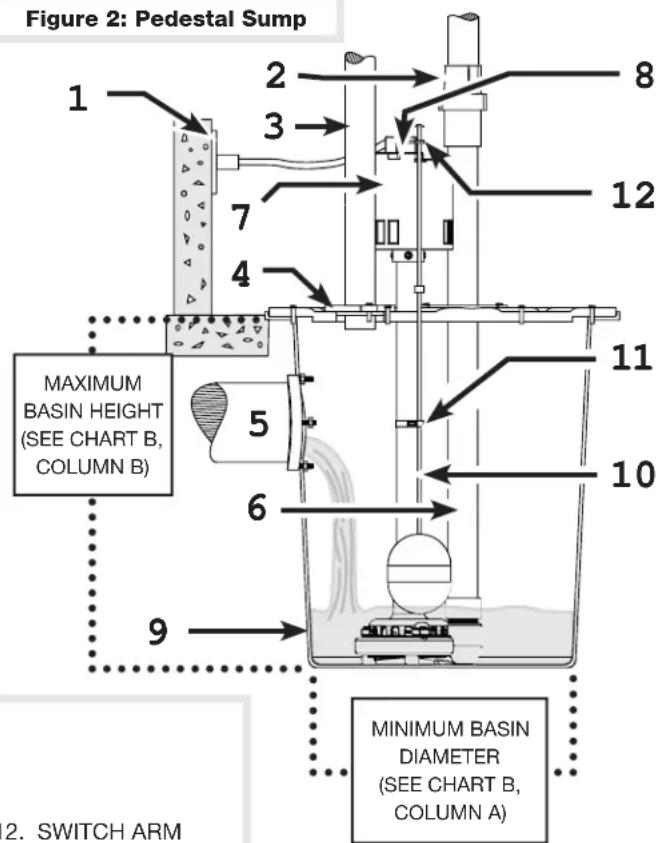
Figure 2: Pedestal Sump 1 2 3 7 4 8 12 MAXIMUM BASIN HEIGHT (SEE CHART B, COLUMN B) 5 6 9 10 11 MINIMUM BASIN DIAMETER (SEE CHART B, COLUMN A) 2. SWITCH ARMTYPICAL SUMP INSTALLATION
- This installation must be in accordance with the National Electric Code and all applicable local codes and ordinances.
- Use a basin that is large enough to accommodate the pump. The minimum requirements for the sump pumps are:
| CHART — ASwitch Type | AMinimumBasin Diameter | BMinimumBasin Height | |
| Submersible Sumps | Tether Float Switch | 14 in. 22 in. | |
| Diaphragm Switch | 11 in. 22 in. | ||
| Vertical Float Switch | 11 in. 22 in. | ||
| CHART — BSwitch Type | AMinimumBasin Diameter | BMaximumBasin Height |
| Pedestal Float Switch(Figure 2, on page 2) | 14 in. 24 in. | |
- Clean the basin of all debris.
- Assemble switch or fl oat if needed. Refer to warranty and service parts sheet for specific directions.
- Set the pump on a solid, level surface. Do not place pump directly on clay, earth, gravel or sand. A brick or block may be installed under the pump to provide a solid base.
- Position pump so the switch is away from the inlet so switch is clear from incoming water. Verify the switch has at least 1 in. clearance to the side wall of the basin and is free to move throughout its movement. If optional control device or fl oat is used, follow mounting instruction supplied with device or fl oat.
- Install discharge plumbing according to local, regional and state codes. Rigid PVC pipe is recommended.
-
If required, drill 1/8 in. "weep" hole in the discharge pipe 1 in. above the pump discharge. Water stream will be visible from the hole when the pump is running. The hole must be cleaned periodically.
-
Install a union to allow for easy removal of the pump for cleaning or service.
- Install a check valve (required) to prevent back-flow. The check valve may be positioned just above the basin to allow easy removal of the pump for cleaning and service.
- Install a gate valve or ball valve if required by local, regional or state code.
- Secure power supply cord to discharge pipe using cable or zip ties to prevent possible switch entanglement.
- Connect pump power supply cord to a ground fault circuit interrupter (GFCI) receptacle.
- Fill the basin with water. The pump will start when the water level has reached the switch-on level.
- The pump will stop when the water level has reached the switch-off level.
- Verify the switch is operating without any obstruction from the pump, piping and basin.
- Fill the basin with water again. While the pump is draining the basin, verify the discharge pipe is carrying the water to a point at least 3 ft. away from the foundation. If the discharge line is exposed to freezing temperatures, the pipe must be positioned in a downward slope away from the foundation so any remaining water will drain away and not freeze.
- Secure the basin cover and gasket to the basin to prevent debris from falling into the basin, prevent personal injury, and to contain gases and/or odors.
NOTICE
This pump is not designed to handle salt water, brine, laundry discharge, water softener, sewage, grey water, or any other application which may contain caustic chemicals and/or foreign materials. Pump damage could occur if used in these applications and will void warranty
TYPICAL EFFLUENT INSTALLATION
- This installation must be in accordance with the National Electric Code and all applicable local codes and ordinances.
- For sump applications, follow typical sump installation instructions (page 3). For effluent applications, continue to step 3.
- Clean the basin of all debris.
- Set the pump on a solid, level surface. Do not place pump directly on clay, earth, gravel, or sand. A brick or block may be installed under the pump to provide a solid base.
- Verify the fl oat switch has at least 1 inch clearance to the side wall of the basin and is free of any possible obstructions.
- If optional control device or fl oat is used, follow mounting instructions supplied with device or fl oat.
- Install discharge plumbing according to local, regional and state codes. Do not reduce the discharge pipe size below that which is provided on the pump.
- If required, drill a 1/8 in. "weep" hole in the discharge pipe 1 in. above the pump discharge. Water stream will be visible from the hole when the pump is running. The hole must be cleaned periodically.
- Install a union to allow easy removal of the pump for cleaning and service.
- Install a check valve (required) to prevent back-flow. It should be installed above the union.
- A gate valve or ball valve should be installed above the check valve as required by local, regional or state codes.
- Connect remaining discharge pipe. The remainder of the discharge line should be as short as possible with a minimum number of turns.
- Secure power supply cord to discharge pipe using cable or zip ties to prevent possible switch entanglement.
- Connect pump power supply cord to a ground fault circuit interrupter (GFCI) receptacle.
-
Fill the basin with water. The pump will start when the water level has reached the switch-on level. Verify the pump is operating normally. If the discharge line is exposed to freezing temperatures, the pipe must be positioned in a downward slope away from the foundation so any remaining water will drain away and not freeze.
-
Secure a basin/tank cover and gasket to the basin to prevent debris from falling into the basin, prevent personal injury, and to contain gases and/or odors.
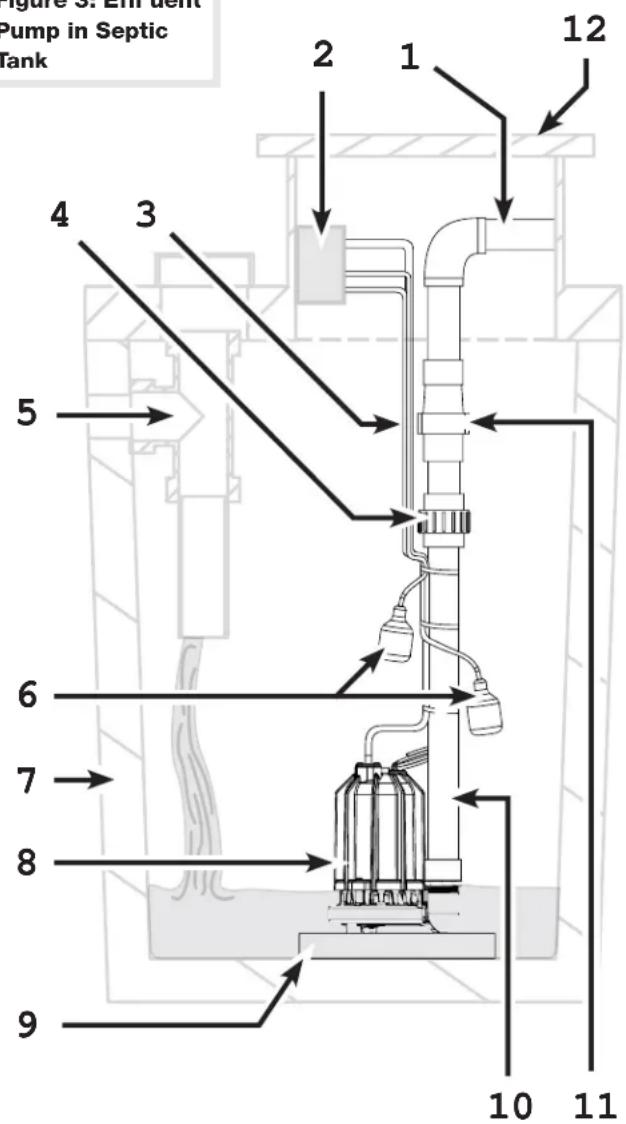
Figure 3: Effluent Pump in Septic Tank
text_image
Figure 6: Effluent Pump in Septic Tank 12 1 2 1 3 4 5 6 7 8 9 10 11- Discharge Outlet Pipe 7. Septic Tank
- Junction Box 8. Effluent Pump
- Pump/Switch Wires 9. Brick or Block
- Union 10. Discharge Pipe
- Effluent Inlet Pipe 11. Check Valve
- Switches 12. Tank Lid
TYPICAL SEWAGE INSTALLATION
- This installation must be in accordance with the National Electric Code and all applicable local codes and ordinances.
- For sump applications, follow typical sump installation instructions (page 3). For effl uent applications, follow typical effl uent installation instructions (page 4). For sewege applications, proceed to step 3.
- Use a basin that is large enough to accommodate the pump. The basin diameter should be a minimum of 18 inches and the depth a minimum of 24 inches.
- Clean the basin of all debris.
- Set the pump on a solid, level surface. Do not place pump directly on clay, earth, gravel, or sand. A brick or block may be installed under the pump to provide a solid base.
- Position pump in the basin so the switch is away from incoming water. Verify the float switch has at least 1 inch clearance to the side wall of the basin and is free of any possible obstructions.
- Install discharge plumbing according to local, regional and state codes. Do not reduce the discharge pipe size below that which is provided on the pump.
- If required, drill a 1/8 in. "weep" hole in the discharge pipe 1 in. above the pump discharge. Water stream will be visible from this hole when the pump is running. The hole must be cleaned periodically.
- If optional control device or fl oat is used, follow mounting instruction supplied with device or fl oat.
- A union should be installed above the basin to allow easy removal of the pump for cleaning and service.
- Install a check valve (required) to prevent back-flow. It should be installed above the union.
- A gate valve or ball valve should be installed above the check valve as required by local, regional or state codes.
- Connect remaining discharge pipe. The remainder of the discharge line should be as short as possible with a minimum number of turns.
- A vent pipe is required. It removes gases and odors and should be installed as required by local, regional or state codes.
- Secure power supply cord to discharge pipe using cable or zip ties to prevent possible switch entanglement.
-
Connect pump power supply cord to a properly grounded receptacle.
-
Fill the basin with water. The pump will start when the water level has reached the switch-on level. Verify the pump is operating normally.
- Install a basin cover and gasket to prevent debris from falling into the basin, prevent personal injury and to contain gases and odors.
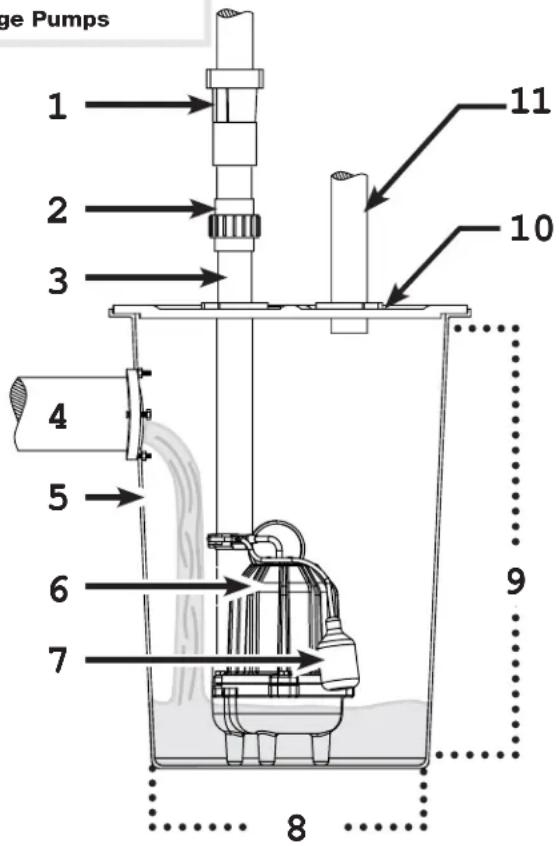
Figure 7: Submersible Sewage Pumps
text_image
ge Pumps 1 2 3 4 5 6 7 8 9 10 11- Check Valve 7. Switch
- Union 8. Minimum Diameter (18 in.)
- Discharge Pipe 9. Minimum Depth (24 in.)
- Inlet Pipe 10. Gasket/Basin Lid
- Basin 11. Vent Pipe
- Pump
MAINTENANCE
WARNING
ALWAYS DISCONNECT THE PUMP FROM POWER SUPPLY before installing, servicing or making any adjustments.
WARNING
LET PUMP COOL FOR A MINIMUM OF 2 HOURS BEFORE ATTEMPTING TO SERVICE. Submersible pumps contain oil that become pressurized and hot under normal operating conditions.
- Submersible pump models have permanently lubricated bearings and require no additional lubrication.
- The pump should be inspected 3-4 times per year for pump movement or buildup of debris on the switch or float. Reposition pump if it has moved. Remove any debris that could interfere with the operation of the switch.
WARNING
DO NOT SUBMERGE PEDESTAL MOTOR or allow motor to be exposed to water.
- Submersible pump may contain dielectric oil for cooling. Dielectric oil can be harmful to the environment. Follow state environmental laws when disposing of oil.
- The pump motor is equipped with automatic resetting thermal protector and may restart unexpectedly. Protector tripping is an indication of motor overloading as a result of operating the pump at low heads, excessively high or low voltage, inadequate wiring, incorrect motor conditions, or a faulty motor or pump.
TROUBLESHOOTING
WARNING
DO NOT USE AN EXTENSION CORD. Extension cords could present a safety hazard if not sized properly, become damaged or the connection falls into the sump. If receptacle is not within reach of the pump's power cord, contact a qualified licensed electrician to install a new receptacle.
Symptoms Possible Cause(s) Suggested Remedies
| Pump will not start or run | 1. Water level too low2. Blown fuse or tripped circuit breaker3. Low line voltage4. Motor5. Switch6. Inlet screen clogged7. Switch obstruction | 1. Water must be at the appropriate level to activate switch2. If blown, determine cause and then either replace with proper sized fuse or reset breaker3. Contact an electrician4. Replace pump5. Replace switch6. Remove debris7. Remove obstruction to ensure free motion of switch |
| Pump starts and stops too often | 1. Back-flow of water from discharge pipe2. Switch3. Check valve not functioning properly or leaking | 1. Install check valve2. Replace switch3. Remove and examine check valve for proper in stal la tion and free operation. Replace check valve if necessary. |
| Symptoms Possible Cause(s) Suggested Remedies | ||
| Pump shuts off and turns on independently of switch (trips thermal overload protection) | 1. Excessive water temperature2. Switch3. Switch obstruction4. Obstruction in discharge pipe5. Low line voltage | 1. Pump should not be used for water above 120° F2. Replace switch3. Remove obstruction to ensure free motion of switch4. Remove obstruction in discharge piping5. Contact an electrician. |
| Pump operates noisily or vibrates excessively | 1. Worn bearings2. Impeller obstructed or broken3. Piping attachments to building structure too rigid or too loose | 1. Replace pump2. Where applicable, remove screen and volute, clean impeller and/or replace impeller3. Install rubber coupling (available at local hardware stores) to isolate pump vibration from discharge plumbing |
| Pump will not shut off | 1. Switch2. Switch obstructions3. Restricted discharge (obstruction in piping)4. Excessive inflow or pump not properly sized for application | 1. Replace switch2. Remove obstruction to ensure free motion of switch3. Remove obstruction from discharge piping4. Recheck all sizing calculations to determine proper pump size |
| Pump operates but delivers little or no water | 1. Low line voltage2. Inlet screen clogged3. Broken impeller or debris in impeller cavity5. Pump not properly sized for application6. Check valve stuck closed or installed backwards7. Shut off valve closed | 1. Contact an electrician2. Remove debris3. Remove screen and volute, clean impeller and/or replace impeller5. Recheck all sizing calculations to determine proper pump size6. Remove and examine check valve for proper installation and free operation7. Open valve |