
WFH1670K - Washing machine BRANDT - Free user manual and instructions
Find the device manual for free WFH1670K BRANDT in PDF.


| Product type | Front-loading washing machine |
| Brand | BRANDT |
| Model | WFH1670K |
| Dimensions (H x W x D) | 85.0 x 59.5 x 58.5 cm (depth with open door: 103 cm) |
| Recessed height | 82.0 cm |
| Recessed depth | 56.5 cm |
| Height adjustment of feet | 2.5 cm |
| Net weight | Approximately 78 kg |
| Washing capacity (White/Cotton) | 6.0 kg max |
| Washing capacity (Synthetic) | 2.5 kg max |
| Washing capacity (Delicate) | 1.5 kg max |
| Washing capacity (Wool) | 2.0 kg max |
| Maximum spin speed | Up to 1200 rpm (depending on model) |
| Wash programs | White/Cotton, Colour/Synthetic, Delicate, Wool/Hand wash, Rinse, Spin/Drain, Quick 30°C |
| Additional functions | Pre-wash, Intensive, Extra rinse, Short wash, Smooth (Easy iron), Bio, Rinse hold, Child safety, Delay start |
| Power supply | 230 V ~ 50 Hz, 2300 W, 10 A fuse protection |
| Water pressure range | 0.1 to 1.0 MPa (1 to 10 bar) |
| Energy consumption (White 95°C) | 1.72 kWh, 51 L water, 139 min |
| Safety | Aquastop/Aquastop PLUS, door lock, child safety |
| Cleaning and maintenance | Drain filter, inlet filter, detergent drawer, drum, casing |
| Display | Multi-function LED (time, duration, program indicators) |
| Delay start | Yes, adjustable by end time |
Frequently Asked Questions - WFH1670K BRANDT
User questions about WFH1670K BRANDT
0 question about this device. Answer the ones you know or ask your own.
Ask a new question about this device
Download the instructions for your Washing machine in PDF format for free! Find your manual WFH1670K - BRANDT and take your electronic device back in hand. On this page are published all the documents necessary for the use of your device. WFH1670K by BRANDT.
USER MANUAL WFH1670K BRANDT
Operating Instructions Automatic Washing Machine
Manual de instructiones Lavadora automática
WFH 1270 K
WFH 1670 K
Brandt
Chere cliente, cher client,
Intensif (Intensive)
Intensiv (Intensive)
By buying this appliance you have made a decision for up-to-date washing technology - premium quality, long service life, highly reliable and optimal operating convenience.
- At first please check if the appliance was received undamaged.
If a transport damage is noticed please inform your dealer immediately, and do not operate the appliance!
These Operating Instructions...
...are intended to help you operate this appliance quickly and safely.
- Read the Operating Instructions - before installation and initial operation of this appliance.
- Pay special attention to the safety-informations.
- Keep these Operating Instructions for future reference.
- If you sell this appliance pass on the instructions to the new owner.
Explanation of Symbols
Throughout these Operating Instructions the following symbols are used:
Danger - High voltage! Mortal danger due to risk of electric shock!
Risk of other personal injury or property damage.
Important information or useful advice.
CONTENTS
Machine Overview 42
Safety First 43
Disposal. 43
Installation 44
Transit bar removal. 44
Location 44
Changing hinge position 44
Built-under installation. 44
Levelling. 44
Connecting the water supply. 45
Connecting the drain hose 45
Electrical connection. 46
The first time 47
Preparing to Wash. 47
Sorting the laundry. 47
Preparing the laundry. 48
The right amount 48
The door 48
Washing Detergents and Fabric Conditioners.48
Detergent dispensing drawer. 48
Proportioning aids 49
Liquid detergents 49
Choice of washing detergent. 49
Detergent proportioning 49
Fabric softener 49
Starch 49
Wash Programmes 50
The programme selector 50
Main programmes. 50
Special programmes. 50
Additional functions 51
The buttons. 51
Prewash 51
Intensive 51
Extra rinse 51
Short wash 51
surfliss (Anti-crease) 51
Bio 51
Rinse & hold 51
Child-proof lock 52
Spin speed selector. 52
Display 52
Setting the time of day. 52
Changing the type of time display. 53
Delayed start. 53
Changing the preset time. 53
Aborting a time-delay 53
Programme sequence indication 54
Indicator lamps. 54
AT A GLANCE 55
Preparation and start 55
Changing a programme 55
Aborting a programme 55
Adding more laundry 55
Programme halted by rinsehold. 55
Spinning the laundry again. 55
After completion of the programme cycle..55
Programme Table 56
Care and Maintenance 57
Troubleshooting 59
Technical Specifications and
Consumption Data 60
Machine Overview
Detergent dispensing drawer
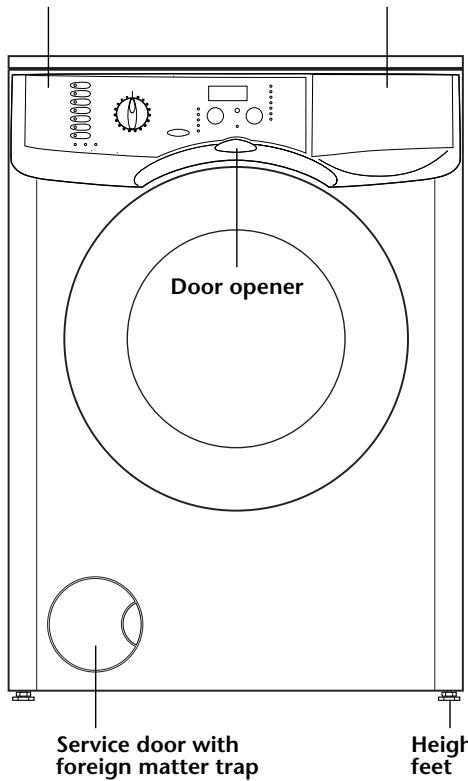
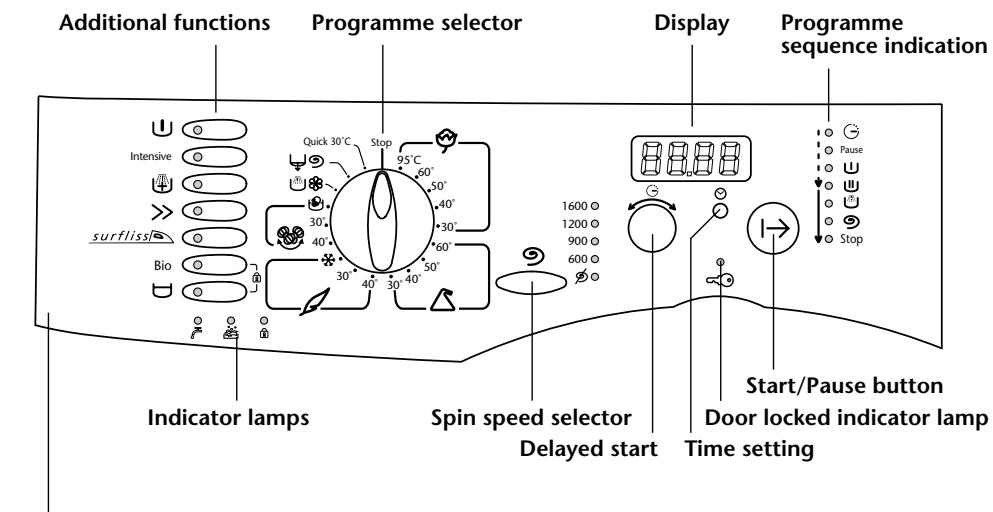
Control panel
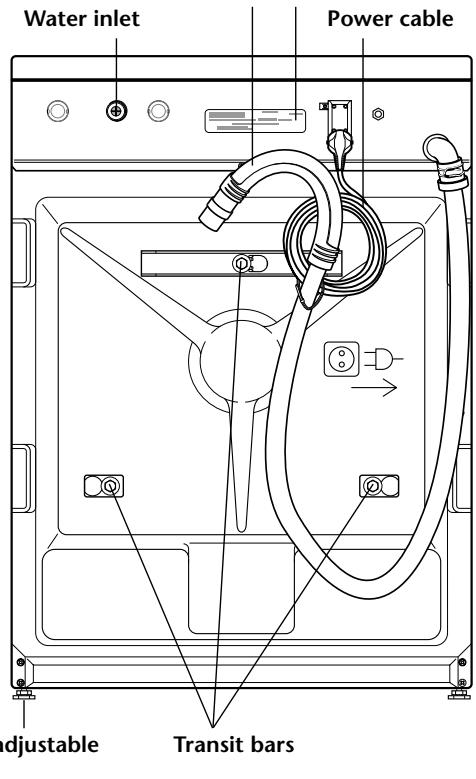
Drain hose Rating label
Safety First
Please observe the following information, as otherwise there will be risk of personal injury or material damage and any warranty and liability is invalidated.
Application
- This appliance shall only be used for washing, rinsing and spinning textiles suitable for machine wash.
- Only washing detergents, fabric conditioners and additives suitable for machine wash are permitted for use in this appliance.
- Follow the care instructions in the garments and the information given by the washing detergent manufacturer.
Safety information
- This appliance must be connected to a properly installed earthed outlet, which is protected by a fuse of adequate capacity.
The inlet hose with "Aquastop PLUS" (according to model) includes electric live parts.
Do not damage inlet hose and "Aquatop PLUS!"! Risk of electric shock!
- Inlet and drain hoses must always be securely fastened and in perfect condition.
Do not use a washbasin or bathtub to which the drain hose is fastened during operation of the appliance. Risk of scalding with high washing temperatures!
Do not touch the door when washing at high temperatures!
Burning hazard by hot parts!
Never open the door or the foreign matter trap if there is still water in the drum. Risk of flooding and possibly of scalding by hot suds!
- Keep children away from the appliance! Electric appliances are not toys.
Do not attempt to dry-clean with this appliance! Fire and explosion hazard!
- Rinse garments pre-treated with cleaning agents (petroleum ether, liquid stain remover, etc.) thoroughly in clear water before washing.
Never wash down the appliance with a water hose! Risk of electric shock! Always disconnect from the mains by unplugging before cleaning.
- Never touch the power cable plug with wet hands! Never pull on the cable to unplug, always pull on the plug only.
Do not operate the appliance if the power cable or power cable plug is faulty or the appliance shows any other faults! Risk of electric shock! - In case of any malfunction which can not be rectified by the information given in these Operating Instructions: Switch the appliance off, unplug the power cable, close the water tap, contact your service centre.
Never attempt to repair the appliance yourself! You could endanger your own life and the life of other users! Only authorised qualified electricians, such as our service technicians, are permitted to repair electric appliances.
Disposal
Where to leave the packaging?
The packaging is made of materials which can be recycled.
-
Separate the packing material by type:
-
styro foam parts and plastic wrapping go to a valuable substance collection point;
- battens go into bulky refuse.
The packaging is not to be disposed of in the regular household refuse!
What to do with the old appliance?
Dispose of your old appliance in an environmentally friendly manner.
- Ask you dealer or your local refuse collection service how to best dispose of your old appliance.
Before giving the appliance into bulky refuse, disconnect it from the mains, cut off the power cable and disable the door lock – so children will not be endangered.
Installation
Transit bar removal
Before the washing machine is operated, the transit bars must be removed! Otherwise the appliance may be damaged in operation.
Required tool: 13mm ring or box spanner.
- Loosen all three drive screws A, until they will turn freely.
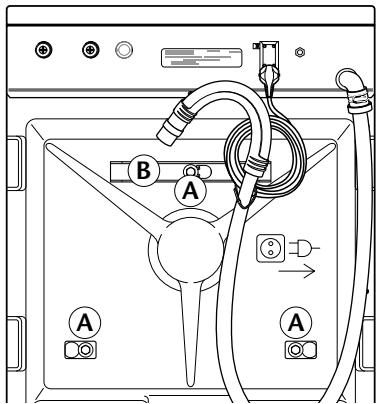
- Push the screws A sideways and pull them with the distance sleeves out; remove tie-bar B (if existing).
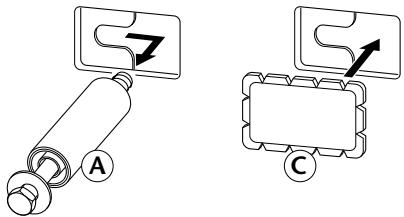
- Fit the three covers C (from the hardware bag) to the openings in the rear panel. Use a suitable tool (e.g. a screwdriver) to push them in.
Store the transit bars in a safe place.
- They will be required if the washing machine is to be transported again (e.g. if you move house).
Never transport the appliance without installed transit bars!
Location
Install the appliance in a stable, level position in frost-free surroundings.
If there is a danger of frost pump off all remaining water (see "Care and Maintenance").
The floor must have a sufficient load-bearing capacity! If, for example, you place the washing machine and a dryer on top of one another, this combination can – when loaded – reach a total weight of 160kg .
If mounted on a pedestal: Install seats for the front feet to prevent the appliance from falling off when spinning. (Customer service catalogue no. 0005323700)
Important:
- Do not stand the appliance on the power cable.
- Keep at least 1 cm distance from sides of other furniture.
- Place the appliance only on a firm floor, do not place on a long-pile carpet or similar.
Changing hinge position
If you wish to open the door to the other side, you can have the hinge position reversed by our service technician.
Built-under installation
This appliance can be installed under a worktop. A cover plate is required for built-under installation (customer service catalogue no. ET 9.38.662.31).
Only authorised specialists are permitted to carry out a built-under installation.
In addition, we recommend to fit two sliding plates under the appliance's feet.
Levelling
Required tools: 17mm open ended spanner, spirit level.
- Loosen the locking nuts on the feet with the open ended spanner.
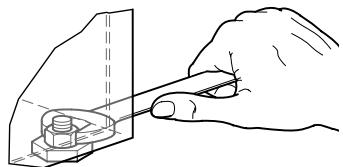
- Adjust feet until the appliance is level and does not rock.
- Important: Tighten all locking nuts after the machine has been levelled.
Connecting the water supply
This appliance can be connected to water tabs with a 3/4" B.S.P. thread.
Important:
- Observe the permissible water pressure and the max. inlet temperature (see "Technical Specifications"). Install a pressure reducing valve if the water pressure is higher.
- Do not connect to a water heater (instantaneous water heater or unpressurised boiler), as the water pressure is insufficient.
- Check with customer service for hose extensions. Do not use homemade extensions with hose clamps or similar!
- Use only the new hose supplied with the machine, not an old existing one!
- Ensure that there are no sharp bends in the hose!
Required tools: None. (Do not use a pipe wrench!)
- If not already mounted, the offset side of the inlet hose is to be screwed "finger-tight" to the water inlet port at the rear of the appliance.
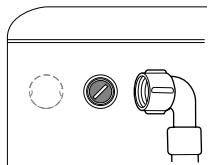
- Connect the other end of the inlet hose "finger-tight" to the water tap.
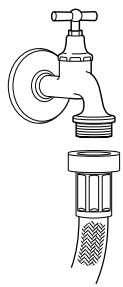
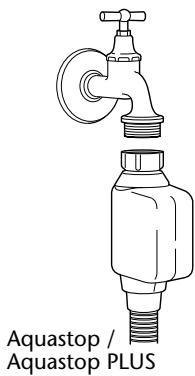
The "Aquastop" resp. "Aquastop PLUS" (according to model) turns off the water inlet, if a leakage occurs.
3. Open the water tap fully and check all connections for tightness; close water tap again. Correct the position of seals and screw couplings, if necessary.
Connecting the drain hose
The drain hose can be hung to a wash-basin, sink or bathtub – or connected permanently to a siphon trap.
Important:
- Do not run the drain hose higher than 100cm above floor level for the suds pump to be able to pump out.
- The water must be able to run off unhindered. Washbasins with a small drain are not suitable.
- The end of the hose must not immer- merge in the pumped-out water.
- Check with customer service for hose extensions. Do not use homemade extensions with hose clamps or similar!
- Use only the new hose supplied with the machine, not an old existing one!
- Ensure that there are no sharp bends in the hose!
Fastening the hose holder:
- Pull the hose holder supplied over the end of the drain hose.
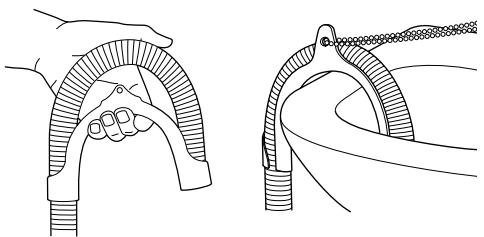
- Hang drain hose with hose holder on the edge of basin or tub and secure against slipping off - e.g. with a chain tied around the water tap.
Permanent connection to a siphon trap:
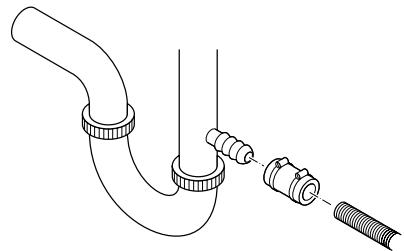
The connection should be made by a qualified plumber, to prevent the hose from slipping off. Risk of flooding!
- Install the rubber hose supplied between drain hose and siphon trap and secure with two hose clamps. Hose clamps are available at specialized dealers.
Electrical connection
Connect the appliance to a properly installed earthed outlet, which is protected by a fuse of adequate capacity.
Important:
- The connection must conform to the applicable regulations in your country and your local electricity board.
- The power cable plug must be accessible after installation.
- For a firmly fixed connection a master switch with at least 3mm contact clearance must be used.
- Voltage and rated fuse protection of the appliance are shown on the rating label at the rear.
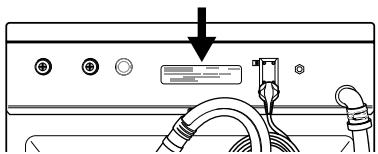
Note down the appliance's model and Identification number from the rating label, in case you need help from customer service.
- The stated voltage must match with your mains voltage.
- Connection by extension cables or trailing sockets is inadmissible.
- When connecting to the mains the programme selector must be in the «Stop« position.
A damaged power cable must be replaced by an authorised qualified electrician. Until the appliance has been repaired it must not be operated! Risk of electric shock!
The right plug
This appliance comes with a fitted plug.
If this plug is not suitable for your socket outlet, it must be cut off and the appropriate plug fitted (see below). The cut off plug should be disposed of immediately to prevent the possibility of electric shocks, should it be plugged into a socket.
In the event of losing the fuse cover, the plug must not be used until a replacement fuse cover has been fitted; it can be obtained from your nearest electrical dealer. The colour of the correct replacement fuse cover is that of the coloured marks or inserts in the base of the plug.
If the plug fitted is the moulded on type, the fuse is a 13 amp ASTA approved fuse to BS 1362.
With alternative plugs a 15 amp fuse must be fitted either in the plug or in the mains fuse box.
Fitting a different plug
The wires in the mains cable are coloured in accordance with the following code:
Green and Yellow - Earth
Blue - Neutral
Brown - Live
If you fit your own plug the colours of these wires may not correspond with the identifying marks on the plug terminals.
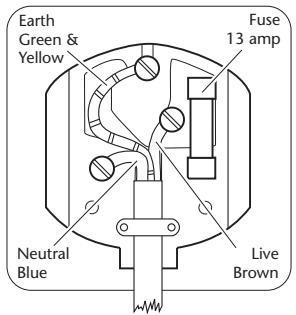
This is what you have to do:
- Connect the green and yellow (Earth) wire to the terminal in the plug marked "E" or with the symbol 12 , or coloured green, or green and yellow.
- Connect the blue (Neutral) wire to the terminal in the plug marked "N", or coloured blue or black.
- Connect the brown (Live) wire to the terminal in the plug marked "L", or coloured brown or red.
The first time
If the buzzer sounds or the appliance can not be switched on, refer to section "Troubleshooting".
- After all connections have been made the clock has to be set, see "Setting the time of day".
To flush out any remaining test water, the first washing cycle should be run without any laundry in the machine.
- Open water tap fully. Check to see that all hoses are tight.
- Check to see that the drum is empty; close door.
- Fill a small amount of washing detergent into compartment II; close detergent dispensing drawer.
- Set the programme selector to Coot-tons 60°C*.
The spin speed indicator should indicate max. spin speed - press the Spin speed « ⑨ button, if necessary.
- Press the Start/Pause button.
In case of strange noises or penetration of water: Set the programme selector to Stop and close tap. Check if all transit bars have been removed and the hoses are properly connected.
After completion of the programme cycle:
As soon as the Door locked indicator lamp goes out the door can be opened.
- Set the programme selector to Stop<.
- Close tap.
- Leave door and detergent dispensing drawer open for drying out.
Preparing to Wash
Sorting the laundry
- Sort laundry according to textile type (material), colour, degree of soiling and permissible washing temperature.
Always observe the care symbols shown on the garment labels!
| Type of textiles and care symbols | |
| Cottons: Cotton, linen | |
| 30 | 40 |
| 60 | 95 |
| Easy-care: Synthetics (polyester, polyamide); mixed fabrics (with cotton) | |
| 30 | 40 |
| 60 | |
| Delicates: Sensitive fabrics (viscose, silk, etc.); curtains | |
| cold | 30 |
| 40 | |
| Wool: Only with wool label and marked "machine wash" | |
| 30 | 40 |
| machine wash | |
| Hand wash: | Do not wash: |
- Do not wash white and coloured laundry together! New, dark coloured cottons will stain very much.
Preparing the laundry
! Laundry with hard or metal parts (bras with underwires, belts with metal buckles etc.) will damage the appliance. Remove those parts or put laundry in a laundry bag or similar.
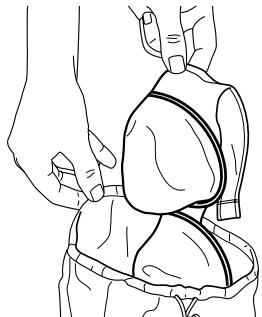
- Empty pockets, remove all foreign objects (coins, pens, paper clips). Put small pieces of laundry (baby socks, tights) in a laundry bag or similar.
- Handle curtains with extra care! Remove non-stainless runners and lead tape not sewn in. Put runners which can not be removed in a laundry bag or similar.
- Close zippers, sew on loose buttons, mend unstitched seams and tears.
- Wash only woollens marked "machine wash" or "hand wash" – and only with the appropriate wash programme.
- Wash new, coloured cottons separately – they could dye.
- Heavy stains should be treated appropriately before washing. If in doubt check with a chemist or dry cleaner.
- Use only dyes/discolouring and antiliming agents suitable for machine wash. Observe the information given on the packing!
The right amount
- The max. load depends on the laundry type, the grade of soil, and the wash programme.
Please note the information given in the "Programme Table"!
Overloading the drum adversely affects the washing result.
i Always try to utilize the max. load.
The door
i While the programme is running the door is locked; the indicator lamp Door locked < < > is on.
As soon as the Door locked indicator lamp goes out the door can be opened.
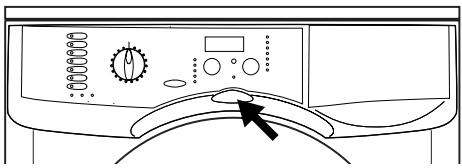
- To open, push the door opener above the door.
- Place the laundry loosely in the drum; if required give extra detergent (in eco bag or proportioning ball) in the drum.
- Close the door; push against the door until you hear the door lock engage. Do not catch any laundry in the door assembly!
Washing Detergents and Fabric Conditioners
Detergent dispensing drawer
The detergent dispensing drawer is made up of three compartments:
Compartment I for pre-wash
Compartment II for main-wash or starch (dissolved powdered starch)
Compartment III for fabric softener or starch (liquid starch)
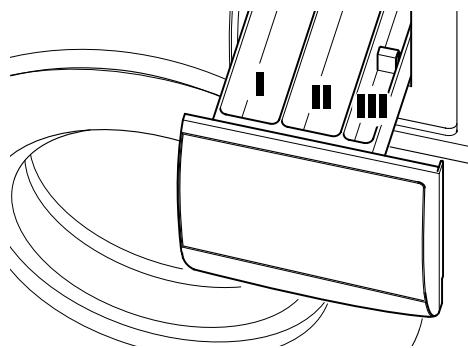
Always fill in detergent and fabric conditioner before the starting the wash programme.
Never open the detergent dispensing drawer while the wash programme is still running!
Proportioning aids
By means of detergent bags or proportioning balls the washing detergent can be placed directly in the drum.
Of course this will only work for programmes without pre-wash.
Liquid detergents
When using liquid or gel-like detergents, please note the following:
- Do not use liquid detergent if you wish to use the delay-timer function.
- Use liquid detergent only for the main-wash cycle, not for pre-wash.
Risk of stains when using liquid detergent with the delay-timer function or with pre-wash.
- Use the detergent maker's proportioning cup and observe the information given on the packing.
Choice of washing detergent
The type of detergent used depends on the type of textile, colour, degree of soiling and desired washing temperature.
- Use regular detergent for cottons (60 - 95°C), otherwise use special detergent for coloured and delicate wash.
- Wash woollens only with a special detergent for woollens.
- Modular system washing detergents allow for an individual addition of bleaching agent and softener.
- Use only washing detergents suitable for use in washing machines.
Detergent proportioning
The amount of detergent required depends on the laundry quantity, degree of soiling and water hardness.
Check with your local water board for the water hardness in your area.
| Water hardness levels | |||
| 1 | soft | 0...1.3 | 0...9 |
| 2 | medium | 1.3...2.5 | 9...18 |
| 3 | hard | 2.5...3.8 | 18...27 |
| 4 | very hard | >3.8 | >27 |
| mmol/I | Engl.degr. | ||
It is absolutely necessary you proportion as recommended on the packing!
- For small amounts of laundry or only slight soiling use accordingly less detergent.
Proportion the highly concentrated compact detergents very accurately!
Too much washing detergent causes: heavy foaming, poor wash and rinsing results, high burden on water.
Too little washing detergent causes: the laundry to look grey, lime deposits in the appliance.
Fabric softener
Fabric softener is filled in the compartment III of the detergent dispensing drawer.
- Proportion as recommended on the packing!
- Fill only up to the red max. mark.
- Dilute viscous fabric softeners with water before filling in.
If you dry your laundry in a dryer or outdoors, you do not need a fabric softener.
Starch
- Fill liquid starch and finishing agent same as fabric softener (see above) in compartment III.
- Mix powdered starch as instructed on the packing and fill in compartment II.
Never use fabric softener and starch together in the same washing cycle.
- Wipe drum after starching.
Wash Programmes
The programme selector
The programme selector can be turned either clockwise or anti-clockwise.
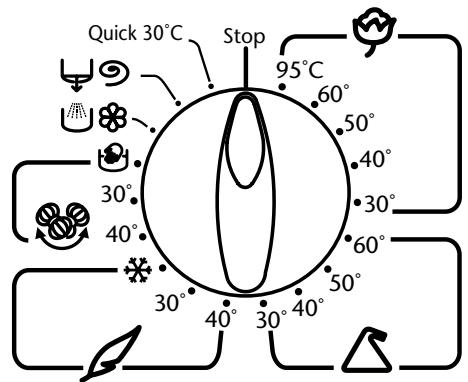
With the programme selector a programme is selected; however it will start only if the Start/Pause button is pressed.
In the "Programme Table" you can find more information on the individual wash programmes.
Main programmes
Depending on the type of textile, the following main programmes are available:
Cottons
Synthetics
Delicates
- Woollens / Hand wash
Each of these main programmes comprises a complete washing cycle - wash, rinse and, where appropriate, spin.
Always adjust the programme to suit the textile type, colour, degree of soil ing and the permissible washing temperature.
Observe the care symbols shown on the garment labels!
For each main programme different temperatures can be selected.
Select the temperature only as high as absolutely necessary. A high temperature means high current consumption.
Special programmes
For specific applications you can select any of the following special programmes:
Rinse
This programme is also used for starching.
Spin/Drain ⑨
This programme spins at maximum speed.
For delicate fabrics the speed should be reduced!
You can also use this programme if the machine has stopped for a rinsehold and you want to pump out water (see "Rinse & hold").
- Quick 30^ C
Select this programme if you need to wash small loads of cotton/blended fabrics only briefly.
Additional functions
The buttons
Depending on the selected programme (see "Programme Table"), specific additional functions can be activated by pressing a button.
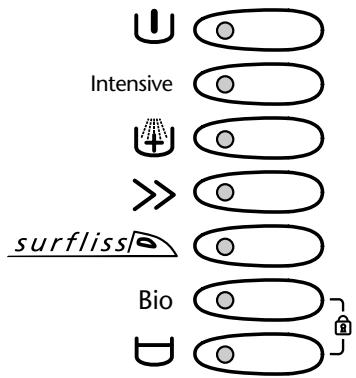
- Press the required buttons before starting the programme.
- Any not meaningful combination of buttons is blocked; attempting to select such combination will cause a buzzer to sound.
Prewash U
This button activates a pre-wash, which is carried out at a temperature of 40^ .
- A pre-wash is only worth while with heavily soiled laundry. Without pre-wash you save energy, water, washing detergent – and time.
Intensive
This function extends the wash time of the main-wash cycle. The washing detergent can work more effective, you can wash at lower temperatures – and thus save up to 35% on energy.
- Normal soiled laundry that can be boiled you can now wash at 60^ C instead of 95^ C , plus this button.
- Normal soiled synthetics you can wash at 40^ C instead of 60^ C , plus this button.
Extra rinse 4
This function includes an extra rinse cycle.
- Use this function only if you are sensitive to washing detergent residue. The increased water consumption is a burden on the environment – and your purse.
- If the foam detection system detects an overdose of washing detergent, an extra rinse cycle is included automatically.
Short wash
With this button the wash time can be reduced.
- Use this function for small loads or less soiled laundry.
surfliss (Anti-crease)
If you press this button, the drum movement is reduced and the spin cycle limited, to reduce creasing. In addition washing is done at a higher water level.
- Therefore, use this function only for delicate fabrics that crease easily.
The maximum load with this function is – for Cottons: 3.0 kg – for Synthetics: 1.5 kg – for Delicates: 1.0 kg
Bio
If you activate this function, the laundry is soaked for about an hour before the wash cycle starts.
- Use this function if heavily soiled and for stains such as protein, blood or cocoa.
Rinse & hold
If you press this button the programme stops after the last rinse cycle. The laundry remains in the water (to protect against creasing).
- Once the rinsehold is reached, the indicator lamp begins to flash.
Refer to "At a Glance" to find out what to do at this point.
Child-proof lock
With the child-proof lock the appliance can be made child-safe.
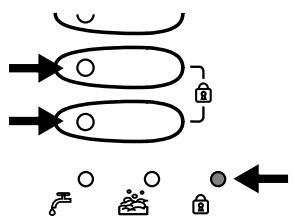
Activating the child-proof lock:
- Press both indicated buttons simultaneously and hold them for approx. 2 seconds, until the child-proof lock indicator lamp goes on.
(i) Then a running programme can not be changed anymore, and the door can not be opened.
If the programme selector is set to Stop, the programme stops. To continue with the programme, set the programme selector to the initial programme.
Deactivating the child-proof lock:
- Press both indicated buttons simultaneously and hold them for approx. 2 seconds, until the «child-proof lock« indicator lamp goes out.
Spin speed selector
Each programme automatically sets the maximum reasonable spin speed (see "Programme Table"). The currently set value is indicated (range depending on model).
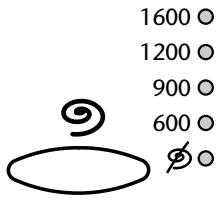
For especially sensitive textiles the spin speed should be reduced.
- By pressing the Spin speed « ⑨ button repeatedly you can reduce the spin speed – or completely disable the spin.
- If set to No spin no spinning is done; only the water is pumped off.
The higher the spin speed, the lower the residual moisture. If you wish to dry your laundry in a dryer afterwards, select the maximum spin speed – this helps saving energy when drying.
Display
Depending on the operating mode the display shows
- the current time,
the time of the programme end.
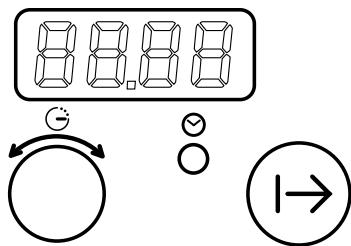
If no programme is selected, the display will turn off after approx. 1 minute (to save energy). When you actuate the programme selector or the Start/Pause or Clock button, the display turns on again.
Setting the time of day
The time needs to be set:
- after the appliance has been connected to the mains,
- after a power failure,
- at change-over of summer/winter time.
If the clock is not set, the display shows "00.00".
Here's how to set:
-
Set programme selector to «Stop«.
-
Press the Clock button. The display flashes.
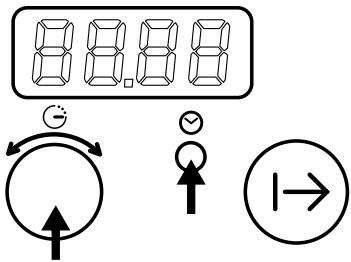
- Turn the Delayed start « button, until the current time is shown. The display stops flashing.
When a programme is selected or running, the display shows the time the programme cycle will be completed.
Changing the type of time display
The time of a programme is displayed on two various ways:
- Showing the current time of the end of a programme cycle, e.g. "20.30".
This type of display is preset at the factory. All pictured examples are relative to this type of display.
- Showing the programme duration resp. remaining time of a programme cycle, e.g. "1.30".
If you want to change the type of display:
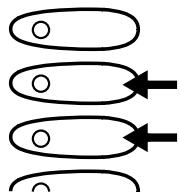
- Press the two marked additional keys at the same time and wait approx. 2 seconds.
The new type of display shows, e.g.:
- "20.30" (End of cycle time) or
- "1.30" (Remaining time, programme duration).
Delayed start
With this function you can delay the programme start individually.
Do not use liquid detergent with it! Risk of stains.
You set the time the programme should be completed; the appliance calculates the start time.
Important: The clock must be set to the correct time of day (see above).
Here's how to proceed:
- Open tap, load drum, fill in detergent.
- Select programme, select additional functions and spin speed if necessary.
- Turn the Delayed start « button until the desired time for the programme end shows.
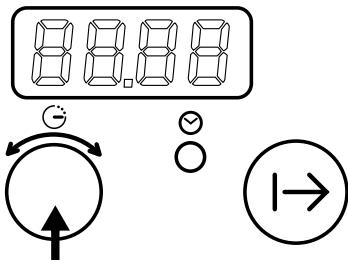
- Don't press the Start/Pause button. The programme starts automatically. The programme sequence indicator Delayed start indicates that.
During the time-delay period more laundry can be loaded.
Changing the preset time
The preset time setting can be changed even after the time-delay period has started:
- Turn the Delayed start button until the desired time for the programme end shows.
Aborting a time-delay
An active time-delay function can be aborted at any time:
- Set the programme selector to Stop , then wait approx. 2 seconds.
- Set the programme selector back to the desired programme.
- Press the Start/Pause button to start the programme.
Programme sequence indication
This row of indicator lamps signals the state of the running programme.
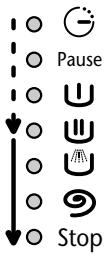
»Delayed start« G
This indicator is on if the delayed start is activated.
»Pause«
This indicator flashes, if the programme was temporarily stopped with the «Start/Pause« I → button.
- To continue the programme press the Start/Pause button again.
>>PrewashU
This indicator is on during the pre-wash cycle – if the pre-wash function is activated for a wash programme.
Wash《山
This indicator is on during the main-wash cycle.
Rinse<
This indicator is on during the rinse cycles.
If the appliance detects an overdose of washing detergent, an extra rinse cycle is automatically included.
»Spin« ⑤
This indicator is on during the final spin - after the final rinse cycle or when the special Spin/Drain programme is running.
If the appliance does not spin, the programme may be stopped by the rinsehold function.
It could also be that the automatic spin-correction-system was activated - due to too great an imbalance of the drum.
»Stop«
This indicator signals that the programme has completed its cycle.
Programmeduration
The actual duration of a programme cycle depends on the selected programme and the activated additional functions for this programme.
The informations shown in the table "Technical Specifications and Consumption Data" apply to programmes without additional functions.
Indicator lamps
These indicator lamps signal any unusual condition of the appliance.

»Water tap«
The left indicator lamp will light if the water does not flow correctly.
- Check to see if the tap is fully open. Perhaps the inlet hose is bend or the inlet filter soiled?
»Foaming«
The indicator lamp in the centre will light if too much foam develops. An extra rinse cycle is included then.
- For the next wash fill in a little less washing detergent.
>>Child-proof lock
The right indicator lamp is on while the child-proof lock is activated.
- To deactivate the child-proof lock see "Child-proof lock".
AT A GLANCE
Preparation and start
- Open water tap fully. Check to see that all hoses are tight.
- Place laundry in the drum.
- Fill in detergent and fabric conditioner.
- Set the programme selector.
- If desired:
- activate any additional function(s),
- set the spin speed,
- set a delayed start.
- Press the Start/Pause button (except for delayed start). In the display the end-of-programme time is shown.
Changing a programme
- Set the programme selector to Stop , then wait approx. 2 seconds.
- Set the programme selector to the new programme.
- Press the Start/Pause button.
Aborting a programme
- Set the programme selector to Stop , then wait approx. 2 seconds.
- Set the programme selector to «Spin/Drain«
- Press the Start/Pause button.
- Wait for the programme cycle to end.
Adding more laundry
This is only possible during the time-delay period.
- Open the door and add laundry.
- Close the door.
Programme halted by rinsehold
This condition is indicated by flashing Rinse & hold « U and »Pause« indicator lamps.
If you wish to spin:
- Set the spin speed.
- Press the Rinse & hold button. The programme is continued, pumps out and spins.
If you wish to pump out only:
- Set spin speed selector to No spin
- Press the Rinse & hold button. The programme is continued, only pumping the water out.
Spinning the laundry again
The automatic spin-correction-system can prevent the spinning if the drum is out-of-balance.
If you wish to spin again:
- Set the programme selector to Stop<.
- Open the door and rearrange the laundry evenly in the drum.
- Set the programme selector to «Spin/Drain«
- Set the spin speed.
- Press the Start/Pause button.
After completion of the programme cycle
When the programme sequence indicator Stop goes on, the programme is completed. The display will then show the current time again.
- When the Door locked indicates lamp goes out, open the door and remove the laundry.
- Set the programme selector to Stop<.
- Close tap.
- Wipe out the sealing fold of the rubber collar; check sealing fold and drum for foreign matter.
- Leave door and detergent dispensing drawer open for drying out.
Programme Table
| Care symbol | Textile type | Temperature (°C) | Load max. (kg) | Additional function | Spin speed max. | Delayed start | ||||||
| Prewash UJ | Intensive | Extra rinse (4) | Short wash > surffliss | Bio | Rinse & hold D | |||||||
| Cottons | ||||||||||||
| 95/60/50/40/30 | Long-wearing cotton and linen garments | 30° - 95° | 6.0 | ● | ● | ● | ● | ● | ● | ● | ① | ○ |
| Synthetics | ||||||||||||
| 60/50/40/30 | Easy-care synthetics (polyester, polyamide) and mixed fabrics (with cotton) | 30° - 60° | 2.5 | ● | ● | ● | ● | ● | ● | ● | ② | ○ |
| Delicates | ||||||||||||
| 40/30 | Sensitive fabrics (viscose, silk, etc.) and curtains | cold - 40° | 1.5 | ● | ● | ● | ● | ③ | ○ | |||
| Woollens / Hand wash | ||||||||||||
| 40/30 | Woolmark only , "machine wash" or "hand wash" | - 40° | 2.0 | ● | ● | ● | ② | ○ | ||||
| Special programmes | ||||||||||||
| Rinse | see above | ● | ② | ○ | ||||||||
| Spin/Drain | ① | |||||||||||
| Quick 30°C: Cotton and blended fabrics | 30° | 3.0 | ● | ● | ④ | ○ | ||||||
- Individually selectable, to some extent selectable in combination; any not meaningful combination of buttons is blocked.
① Maximum speed
② 600 or 900 rpm (dep. on model)
③ 400 or 600 rpm (dep. on model)
④ 800 to 1200 rpm (dep. on model)
Care and Maintenance
Detergent dispensing drawer
Clean when necessary:
- Pull the drawer out as far as possible, then remove it with a sharp pull.
- Clean drawer under running warm water.
- Remove the fabric conditioner suction cap (at rear of compartment III); clean suction cap and opening in the drawer under running warm water, and push a needle through the opening, if necessary.
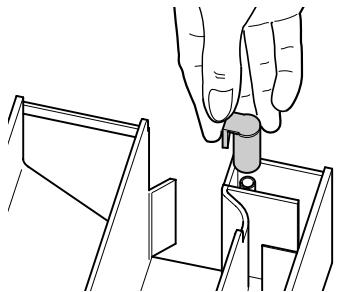
Insert the suction cap again.
- Wipe of all residue detergent from the drawer guides.
- Remove any furring from the water-jet nozzles in the drawer.
Door and drum
Clean each time:
- Wipe out the sealing fold of the rubber collar; check for foreign matter.
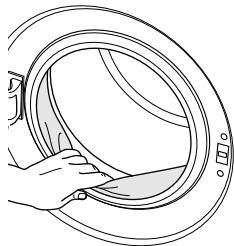
- Check drum for foreign matter.
Ferrous foreign matter can cause iron stains. If such is the case, clean drum with a cleaning agent for stainless steel. Do not use steel wool or scrub sponges!
Housing and control panel
Clean when necessary:
- Clean housing with soapy water or a mild cleaning agent; wipe dry with a soft cloth.
- Wipe control panel with a soft, wet cloth.
Do not use any scouring sponge or agent! It will damage plastic parts and the enamel.
Foreign matter trap
Clean if foreign matter (coins, buttons, baby socks, etc.) block the suds pump.
- Pump off all remaining water before cleaning (see below).
Draining the suds pump
Drain all water...
- before cleaning the foreign matter trap;
- prior to transporting the appliance (e.g. when moving house);
- in the event of a power failure (as a "temporary measure");
- when there is a danger of freezing.
At room temperatures below 0^ the remaining water in the appliance could freeze, damaging it. Important: Frost damage is not covered by the warranty.
- Switch appliance off, unplug the power cable, close the water tap.
!Allow hot suds to cool down first. Risk of scalding! - Open service door by pushing the button on the side.
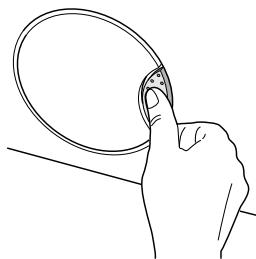
- Fold down the run-off flap and place a low bowl underneath.
- Turn the foreign matter trap anticlockwise by approx. 1/4 turn and let the water run off. When the bowl is full, turn the trap to close it. Empty bowl and repeat as often as necessary.
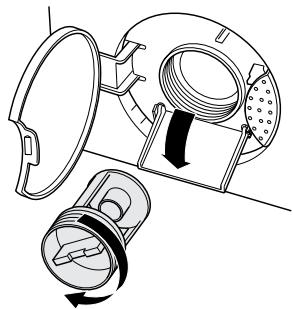
With a fully loaded drum (e.g. at a power failure) up to 20 litres of water may need to be drained!
- If there is no more water emerging remove the foreign matter trap.
- Clean the foreign matter trap and suds pump opening. Check to see if the pump's impeller turns freely.
- Replace the foreign matter trap and tighten it (turn clockwise). Close run-off flap and service door.
Water inlet filters
Clean if water flows very slowly or not at all.
- Switch appliance off, close the water tap.
- Take the inlet hose off.
- With a pair of combination or pointed pliers remove the strainer in the "Aquastop" resp. "Aquastop PLUS" (according to model), clean and put it back in place.
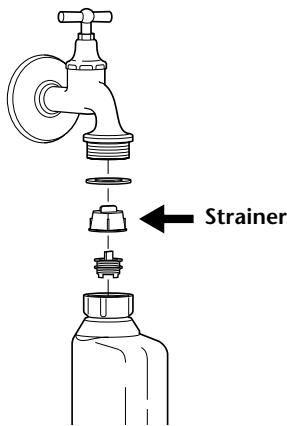
- Except for "Aquastop PLUS": With a pair of combination or pointed pliers remove the strainer from the inlet port at the rear, clean and put it back in place.
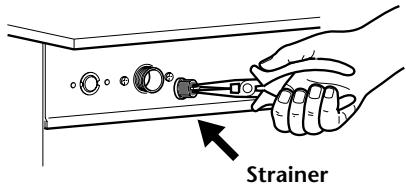
- Put inlet hose back on and tighten "finger-tight".
- Open the water tapfully and check all connections for tightness.
Decalcifying
If the detergent is proportioned correctly, it is not necessary to decalcify the appliance.
- If necessary use only a decalcifying agent suitable for washing machines. Observe the information given on the packing!
Troubleshooting
| If you notice ... | check ... |
| Appliance can not be switched on or programme will not start | Programme selected? Start/Pause I→ pressed? Door properly closed? Power cable plug plugged in? Mains fuse for this outlet intact? |
| Appliance does not react to input, or a buzzer sounds | Combination of additional functions not possible. Child-proof lock activated? See page 52. Delay-timer activated? See page 53. If the disturbance remains: Unplug, wait a few seconds, then plug in again. |
| Indicator lamps «Water tap« and «Pause« are flashing, or water does not run in or very slowly only | Water tap fully opened? Inlet hose bent? Strainer in water inlet blocked? See page 58. Water pressure too low? Check with your plumber. |
| Display shows Er02 | Suds pump blocked or drain hose bent. See page 57. |
| Washing detergents, fabric softener or starch are not flushed-in properly | Detergent dispensing drawer soiled? See page 57. Suction cap of compartment III blocked? Clean. Fabric conditioner too viscous? Add water. |
| Washing detergent foams too much | Too much detergent? Too little laundry in drum? Water hardness too little? Ask your local water board. |
| Water runs out (appliance is "leaking") | Water hoses properly tightened? Foreign matter trap properly closed? Foam emerges due to too much detergent? |
| Water is not pumped off or very slowly only | »Rinse & hold« button pressed? See page 51. Drain hose bent? Suds pump blocked? See page 57. |
| Appliance does not spin properly or not at all | »Rinse & hold« button pressed? See page 51. Spin speed set too low or to no spin? Spin stopped due to imbalance? See page 55. |
| Appliance vibrates heavily when spinning | Transit bars removed? See page 44. Appliance correctly installed? See page 44. Drain hose bent, water does not run off? |
| Door will not open | Programme completed? As soon as the »Door locked« indicator lamp goes out the door can be opened. |
| Power failure while washing | Remaining water needs to be drained? See page 57. |
| Residual matter on textiles | Grey marks (grease residue)? Increase detergent proportioning. See page 49. White residual matter (detergent residue)? Brush off. Proportion detergent correctly. See page 49. |
Let us help you!
If you can not solve the problem yourself contact our customer service.
Have the model designation and Identification number as shown on the rating label at the rear of the appliance available.
Technical Specifications and Consumption Data
| Load capacity (dry weight) | |||
| - Cottons | max. 6.0 kg | ||
| - Quick 30°C | max. 3.0 kg | ||
| - Synthetics | max. 2.5 kg | ||
| - Delicates | max. 1.5 kg | ||
| - Woollens, Hand wash | max. 2.0 kg | ||
| Spin speed (depending on model) 1) | |||
| - Cottons | Maximum speed up to 1200 rpm | Maximum speed greater 1200 rpm | |
| - Synthetics | 600 rpm | 900 rpm | |
| - Delicates | 400 rpm | 600 rpm | |
| - Woollens, Hand wash | 600 rpm | 900 rpm | |
| Dimensions | |||
| - Height / Height for built-under installation | 85.0 cm / 82.0 cm | ||
| - Width | 59.5 cm | ||
| - Depth / Depth for built-under installation | 58.5 cm / 56.5 cm | ||
| - Depth with door open | 103 cm | ||
| - Height adjustment of feet | 2.5 cm | ||
| Weight, empty | approx. 78 kg | ||
| Electrical connection | |||
| - Voltage | 230 V ~ 50 Hz | ||
| - Connected load | 2300 W | ||
| - Fuse protection | 10 A | ||
| Water inlet | |||
| - Water pressure (flow pressure) | 0.1 ... 1.0 MPa = 1 ... 10 bar | ||
| - Inlet temperature | max. 25 °C | ||
| - Delivery head of pump | max. 100 cm | ||
| Consumption data 2) | Power (kWh) | Water (litres) | Time (Min.) |
| - White cottons 95 °C 3) | 1.72 | 51 | 139 |
| - Coloured cottons 60 °C 3) 4) 5) | 0.95 | 46 | 125 |
| - Coloured cottons 40 °C 3) 4) | 0.47 | 45 | 109 |
| - Synthetics 40 °C 4) | 0.68 | 50 | 82 |
| - Delicates 30 °C | 0.23 | 39 | 39 |
| - Woollens 30 °C 4) | 0.20 | 45 | 41 |
1) Maximum speed in the respective programme; reducible by spin speed selection.
2) Depending on water, textile and ambient conditions the actual values can deviate from the declared standard values.
3) Measured values for load capacity 5.0kg .
4) Test programmes according to EN 60456.
5) Standard programme for energy label identification.