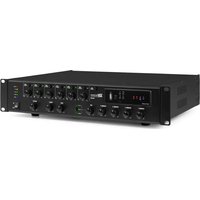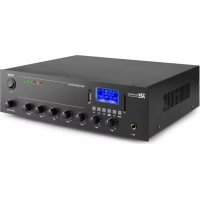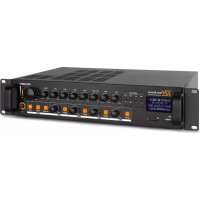
PDV120MP3 - Audio Amplifier Power Dynamics - Free user manual and instructions
Find the device manual for free PDV120MP3 Power Dynamics in PDF.


| Brand | Power Dynamics |
| Model | PDV120MP3 |
| Product type | Audio amplifier |
| Mains power supply | 220-240 VAC, 50 Hz, with earth |
| Backup power supply | 24 V DC |
| Main fuse | 10-16 A |
| Output impedances | 8 Ω low impedance and 100 V line |
| Microphone inputs | 3 (MIC1, MIC2, MIC3/LINE1) with 15 V phantom power |
| Line inputs | LINE2 and LINE3 (unbalanced RCA) |
| Zone outputs | 4 zones with switches and level controls |
| Built-in media player | USB, SD/MMC, Bluetooth, FM Tuner |
| Equalizer | Bass (BASS) and treble (TREBLE) |
| VU meter | 6 LED bar graph (-18 dB to 0 dB), red clipping LED |
| Special functions | Chime (gong), fire alarm input, backup input, TEL input |
| Output protection | Protection relay with time delay |
| Operating temperature | 5 °C to 35 °C |
| Use | Indoor only |
| Cleaning | Dry cloth, no chemicals |
| Repairs | By specialized technician, original parts mandatory |
| Warranty | Void if unauthorized modification or repair |
Frequently Asked Questions - PDV120MP3 Power Dynamics
User questions about PDV120MP3 Power Dynamics
0 question about this device. Answer the ones you know or ask your own.
Ask a new question about this device
Download the instructions for your Audio Amplifier in PDF format for free! Find your manual PDV120MP3 - Power Dynamics and take your electronic device back in hand. On this page are published all the documents necessary for the use of your device. PDV120MP3 by Power Dynamics.
USER MANUAL PDV120MP3 Power Dynamics
Power Dynamics Professional Audio
PDV Series 100V MP3 4 Zone Amplifier
Ref. nr.: 952.068, 952.071, 952.073
INSTRUCTION MANUAL GEBRUIKSAANWIJZING BEDIENUNGSANLEITUNG MANUAL DE INSTRUCCIONES MANUEL D'INSTRUCTIONS INSTRUKCJA OBSŁUGI
V1.2
Congratulations to the purchase of this Power Dynamics product. Please read this manual thoroughly prior to using the unit in order to benefit fully from all features.
Read the manual prior to using the unit. Follow the instructions in order not to invalidate the warranty. Take all precautions to avoid fire and/or electrical shock. Repairs must only be carried out by a qualified technician in order to avoid electrical shock. Keep the manual for future reference.
- Prior to using the unit, please ask advice from a specialist. When the unit is switched on for the first time, some smell may occur. This is normal and will disappear after a while.
- The unit contains voltage carrying parts. Therefore do NOT open the housing.
- Do not place metal objects or pour liquids into the unit This may cause electrical shock and malfunction.
- Do not place the unit near heat sources such as radiators, etc. Do not place the unit on a vibrating surface. Do not cover the ventilation holes.
- The unit is not suitable for continuous use.
- Be careful with the mains lead and do not damage it. A faulty or damaged mains lead can cause electrical shock and malfunction.
- When unplugging the unit from a mains outlet, always pull the plug, never the lead.
- Do not plug or unplug the unit with wet hands.
- If the plug and/or the mains lead are damaged, they need to be replaced by a qualified technician.
- If the unit is damaged to such an extent that internal parts are visible, do NOT plug the unit into a mains outlet and DO NOT switch the unit on. Contact your dealer.
- To avoid fire and shock hazard, do not expose the unit to rain and moisture.
- All repairs should be carried out by a qualified technician only.
- Connect the unit to an earthed mains outlet (220-240Vac/50Hz) protected by a 10-16A fuse.
- During a thunderstorm or if the unit will not be used for a longer period of time, unplug it from the mains. The rule is: Unplug it from the mains when not in use.
- If the unit has not been used for a longer period of time, condensation may occur. Let the unit reach room
temperature before you switch it on. Never use the unit in humid rooms or outdoors.
- To prevent accidents in companies, you must follow the applicable guide lines and follow the instructions.
- Do not repeatedly switch the fixture on and off. This shortens the life time.
- Keep the unit out of the reach of children. Do not leave the unit unattended.
- Do not use cleaning sprays to clean switches. The residues of these sprays cause deposits of dust and grease. In case of malfunction, always seek advice from a specialist.
- Do not force the controls.
- If the unit has fallen, always have it checked by a qualified technician before you switch the unit on again.
- Do not use chemicals to clean the unit. They damage the varnish. Only clean the unit with a dry cloth.
- Keep away from electronic equipment that may cause interference.
- Only use original spares for repairs, otherwise serious damage and/or dangerous radiation may occur.
- Switch the unit off prior to unplugging it from the mains and/or other equipment. Unplug all leads and cables prior to moving the unit.
- Make sure that the mains lead cannot be damaged when people walk on it. Check the mains lead before every use for damages and faults!
- The mains voltage is 220-240Vac/50Hz. Check if power outlet match. If you travel, make sure that the mains voltage of the country is suitable for this unit.
- Keep the original packing material so that you can transport the unit in safe conditions.

This mark attracts the attention of the user to high voltages that are present inside the housing and that are of sufficient magnitude to cause a shock hazard.

This mark attracts the attention of the user to important instructions that are contained in the manual and that he should read and adhere to.
The unit has been certified CE. It is prohibited to make any changes to the unit. They would invalidate the CE certificate and their guarantee!
NOTE: To make sure that the unit will function normally, it must be used in rooms with a temperature between 5^ C/41°F and 35^ C/95°F.

Electric products must not be put into household waste. Please bring them to a recycling centre. Ask your local authorities or your dealer about the way to proceed. The specifications are typical. The actual values can slightly change from one unit to the other. Specifications can be changed without prior notice.
Do not attempt to make any repairs yourself. This would invalid your warranty. Do not make any changes to the unit. This would also invalid your warranty. The warranty is not applicable in case of accidents or damages caused by inappropriate use or disrespect of the warnings contained in this manual. Power Dynamics cannot be held responsible for personal injuries caused by a disrespect of the safety recommendations and warnings. This is also applicable to all damages in whatever form.
UNPACKING INSTRUCTION
CAUTION! Immediately upon receiving the product, carefully unpack the carton, check the contents to ensure that all parts are present, and have been received in good condition. Notify the shipper immediately and retain packing material for inspection if any parts appear damage from shipping or the package itself shows signs of mishandling. Save the package and all packing materials. In the event that the product must be returned to the factory, it is important that the product be returned in the original factory box and packing.
If the device has been exposed to drastic temperature fluctuation (e.g. after transportation), do not switch it on immediately. The arising condensation water might damage your device. Leave the device switched off until it has reached room temperature.
POWERSUPPLY
On the label on the backside of the product is indicated on this type of power supply must be connected. Check that the mains voltage corresponds to this, all other voltages than specified, the light effect can be irreparably damaged. The product must also be directly connected to the mains and may be used. No dimmer or adjustable power supply.

Always connect the device to a protected circuit (circuit breaker or fuse). Make sure the device has an appropriate electrical ground to avoid the risk of electrocution or fire.
100V LINE SYSTEM
For 100V line systems, connect the amplifier to the first speaker in the system using double-insulated speaker wire which has adequate current rating to handle the total output of the amplifier.
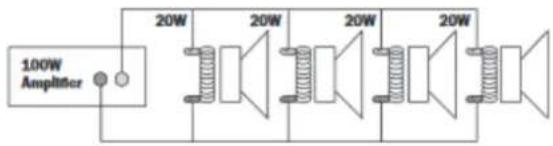
Connect the "100V" output terminal to the positive (+) connection of the speaker and "COM" output to the negative (-) connection of the speaker. Connect further speakers in parallel to the first speaker with all positive terminals and connected together and all negative terminals connected together as shown below.
Examples
Standard 100V line
4 x 20W - 80W load
Multi-tap 100V line
20 + 10 + 10 + 2 + 2 + 4 = 48W load

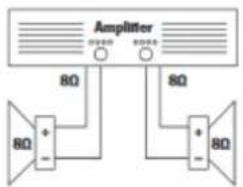
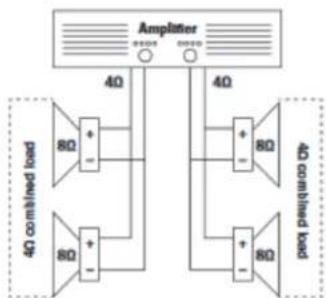
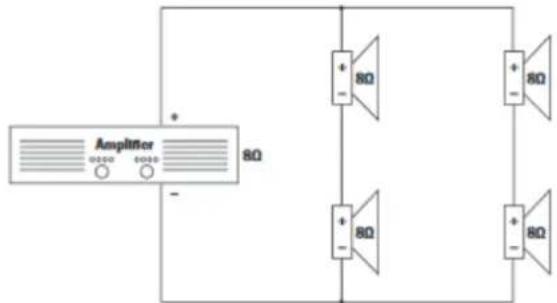
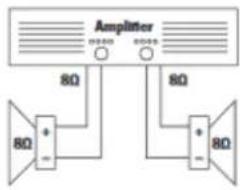
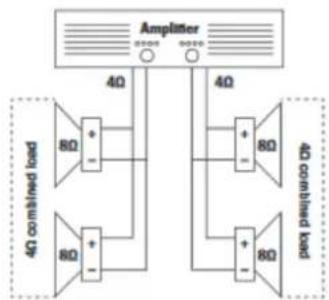
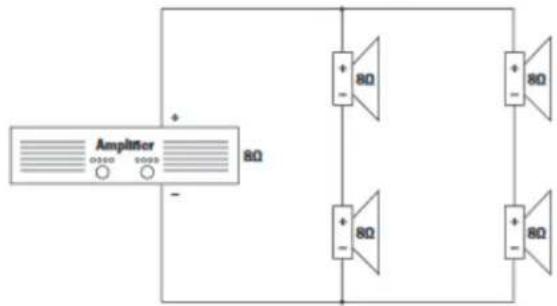
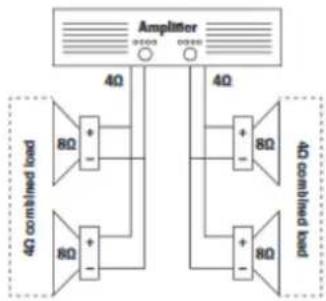
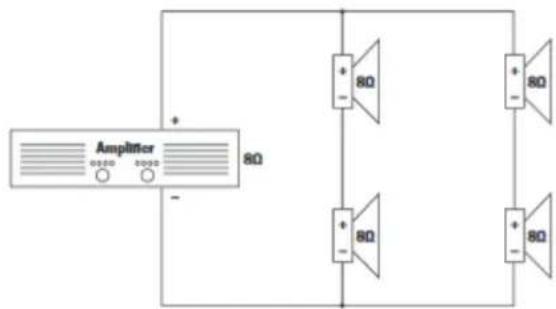
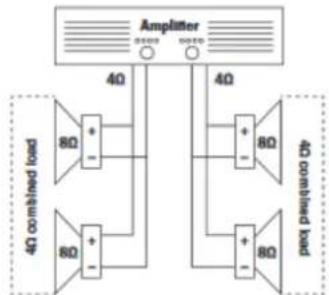
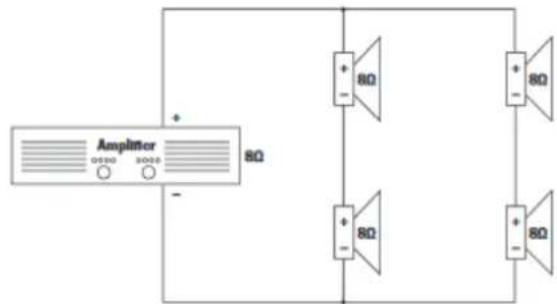
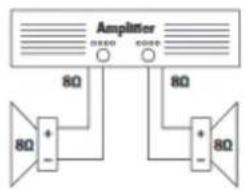
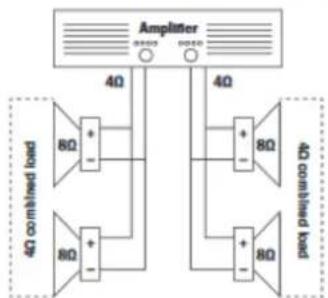
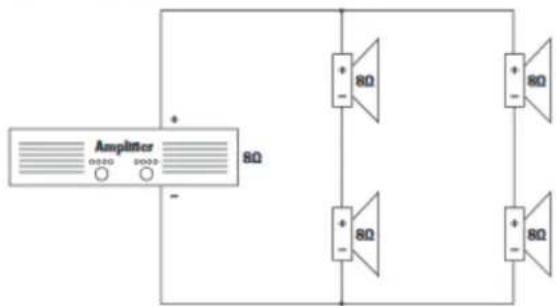
8Ω examples:
Standard 2 loudspeaker setup
Parallel 4 loudspeaker setup
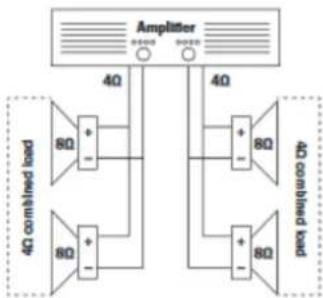
flowchart
graph TD
    A["Amplifier"] --> B["4Q"]
    B --> C["8Ω +"]
    B --> D["-"]
    C --> E["4Q"]
    D --> F["-"]
    E --> G["8Ω"]
    F --> H["-"]
    G --> I["4Q combined load"]
    H --> J["4Q combined load"]
Series parallel 4 loudspeaker mono setup
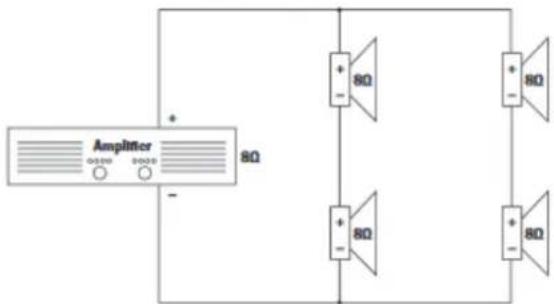
A 100V line speaker system can comprise of many speakers connected together. The determining factor for how many speakers can be used on a single amplifier is the power rating. For most purposes, it is advised to connect as many speakers as needed with a combined wattage of no more than 90% of the amplifier's output power rating.
The terminals of a 100V speaker are connected to a transformer and in some cases, this transformer may be "tapped" for different power ratings. These tapings can be used to adjust the wattage (and output volume) of each speaker in the system to help achieve the ideal total power of the system for the amplifier.
SPEAKER TERMINALS
These terminals are offering a low voltage output of 8Ω. A 100V commercial output is also available.
Please note that one wire only should be connected to COM screw and one wire to the selected impedance or voltage.
ATTENTION: Multiple combinations cannot be done at the output level.
Two different types of connections are provided. The low impedance section: 8Ω is designed for a small amount of speakers to be connected to your amplifier. The 100V section is especially designed for a multiple speaker distribution. When using the 100V output, speakers have to be equipped with a 100V transformer. The maximum amount of speakers to be placed on your distribution line is in relation to the power allocated to each speaker. The total wattage set on the secondary side of the transformers on your speaker line must not exceed the maximum RMS output power of the device. Failure to respect this may cause permanent damage to the amplifier.
OPERATION STEPS
- When all connections to the amplifier are made, turn all rotary controls down and switch on the power and the power button LED will illuminate. Turn BASS and TREBLE controls to the 12 o'clock position (pointing straight up) and turn MASTER rotary control up part way for testing.
- Ensure a signal is being fed to one of the line inputs and gradually increase the volume control for that channel until the output is heard through the speakers. Turn up the MASTER to the maximum required volume level and reduce the channel volume control if necessary.
- Note: The initial test can be made using the built-in USB/SD audio player. The output of the amplifier is represented on the level meter LEDs and care should be taken that the Red "0" LED is only lit momentarily during use. Anything longer than a short flash of this LED may be indicating distortion or clipping of the output signal and the MASTER should be turned down.
- If a microphone is connected to MIC1 input, make sure it is switched on and if it requires phantom power, make sure this feature is enabled. Gradually increase its volume control whilst speaking into the microphone until the required volume level is reached. The microphone should not be able to "hear" the speakers, which can cause feedback (squealing or howling noise).
In addition to channel and MASTER volume controls, there are BASS and TREBLE EQ controls to adjust the tone of the overall output. At the 12 o'clock position, these controls are applying no effect to the signal (no boost or cut). Moving the BASS control clockwise boosts the low frequencies in the audio, whilst moving it anticlockwise will cut these low frequencies. Likewise, moving the TREBLE control clockwise boosts the high frequencies in the audio, whilst moving it anticlockwise will cut these high frequencies. Adjust these EQ controls to suit the type of audio signal or compensate for the room acoustics.
REPLACING THE FUSES
If a fuse is defective, replace the fuse with a fuse of the same type and value. Before replacing the fuse, unplug mains lead.
Procedure:

Step 1: Open the fuse holder on the rear panel with a fitting screwdriver.
Step 2: Remove the old fuse from the fuse holder.
Step 3: Install the new fuse in the fuse holder.
Step 4: Replace the fuse holder in the housing.
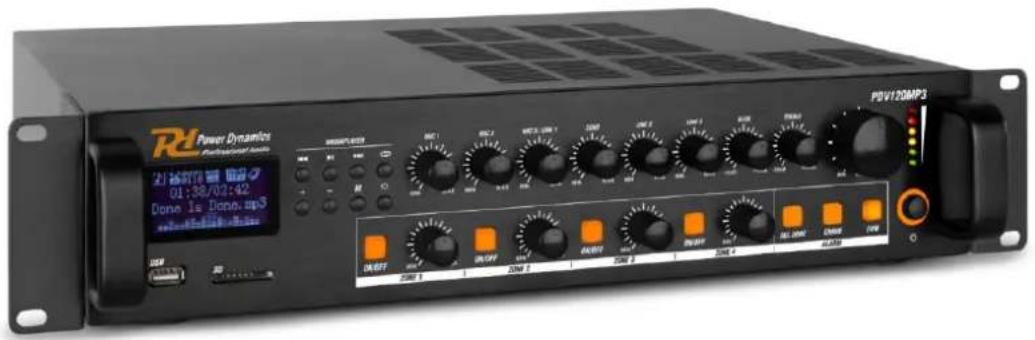
Front Panel Overview:
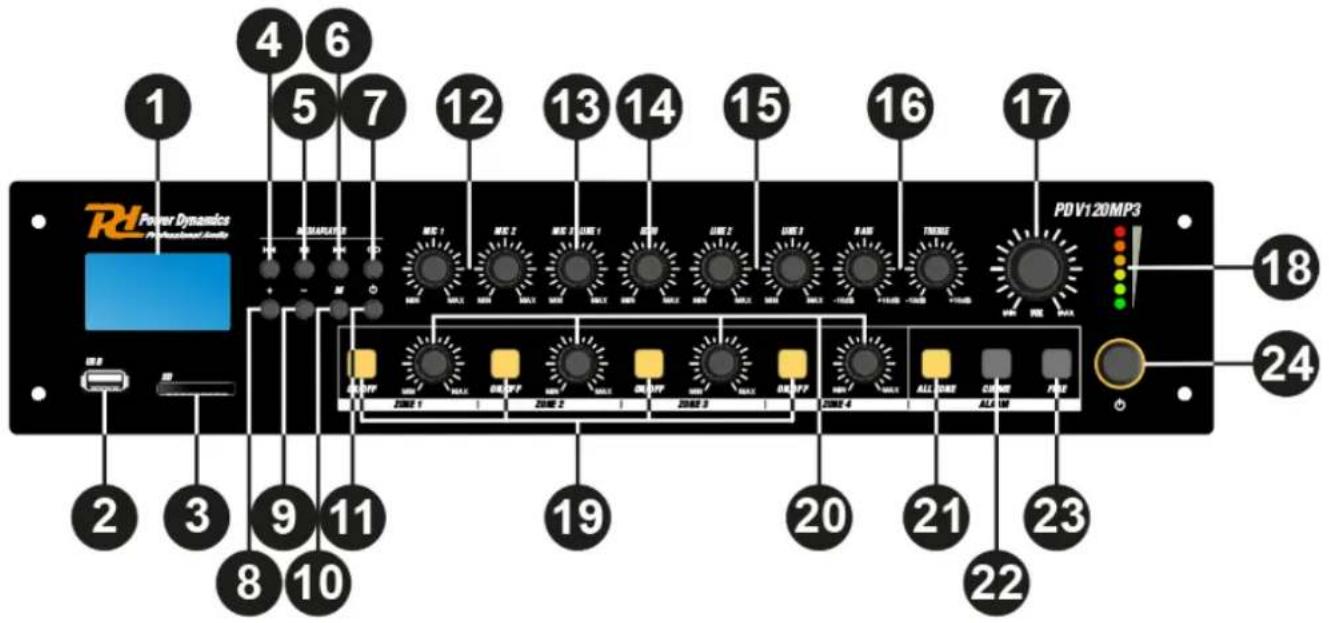
1. LCD DISPLAY
Displays modes and the current operating status.
2. USB PORT
An USB storage device can be inserted here. Tracks stored on the storage device can be played through the player and will automatically start playing when the device is inserted.
3. SD / MMC MEMORY CARD SLOT
SD/MMC memory cards can be inserted in this slot. Tracks stored on the storage device can be played through the player and will automatically start playing when the device is inserted.
4. SKIP I<< BUTTON
Previous track when in USB-, SD/MMC- or BT modes. Previous stored station when in tuner mode.
5. PLAY / PAUSE BUTTON
Each time you press the PLAY/PAUSE button, the operation changes from play to pause or from pause to play.
6. SKIP >>I BUTTON
Next track when in USB-, SD/MMC- and BT modes. Next stored station when in tuner mode.
7. REPEAT BUTTON
Switch the repeat function between repeat one track, repeat complete folder, repeat all and repeat off.
8. + BUTTON
Increase the player volume.
9. - BUTTON
Decrease the player volume.
10. M BUTTON
Switch the operation mode between USB, SD/MMC, BT and tuner.
11. ON / OFF POWER BUTTON
Press: Turn on the player.
Press and hold: Turn off the player.
12. MICROPHONE 1 & 2 VOLUME CONTROL
Increase or decrease the volume of microphone 1 and 2 input.
13. MICROPHONE 3 & LINE 1 VOLUME CONTROL
Increase or decrease the volume of microphone 3 or line 1 input.
14. MICROPHONE ECHO CONTROL
Adjust the echo level on microphone channels.
15. LINE 2 & 3 VOLUME CONTROL
Increase or decrease the volume of line 2 & 3 input.
16. TONE CONTROL
Using the bass and treble knobs, the overall system frequency response can be adjusted. While rotating clockwise, the level will be increased. Counter-clockwise turning will result in a level decrease. In center position, both are set to neutral level.
17. MASTER VOLUME CONTROL
Using the master volume control, the overall system volume will be adjusted in a range between minimum and maximum level.
18. LED INDICATORS (VU-METER)
The current system operation is indicated on the 6 digit LED bar graph. The LED's monitor the current output level within a range of -18 dB and 0 dB, while the upper LED (red) illuminates when the output is clipping.
19. ZONE 1-4 OUTPUT SWITCHES
The different connected loudspeaker lines (1-4) can be switched on and off by pressing the switches with the corresponding numbers. When a zone (1-4) is enabled, an orange light on the corresponding switch will show. When the 'All' switch is pressed, all zone (1-4) outputs will be enabled.
20. ZONE 1-4 OUTPUT LEVEL CONTROL
The output level of different zones (1-4) can be adjusted by the band switches with the corresponding numbers.
21. ALL ZONE SWITCHES
When the 'All' switch is pressed, all zone (1-4) outputs will be enabled.
22. CHIME SWITCH
When the chime button is pressed, the selected chime tone as pre-announcement for paging will be played once.
23. FIRE SWITCH
When the fire button is pressed, the fire alarm goes through the loop until the fire button is pressed again.
24. ON / OFF POWER SWITCH
Use this switch to turn the unit on. Use the switch again to turn off the device. By switching on the device, the orange light around the power button will illuminate. After powering on, the buzzer inside will ring three times and then the output protection relay will be switched on (a click will be heard when this occurs), meaning the amplifier is ready.
Rear Panel Overview:
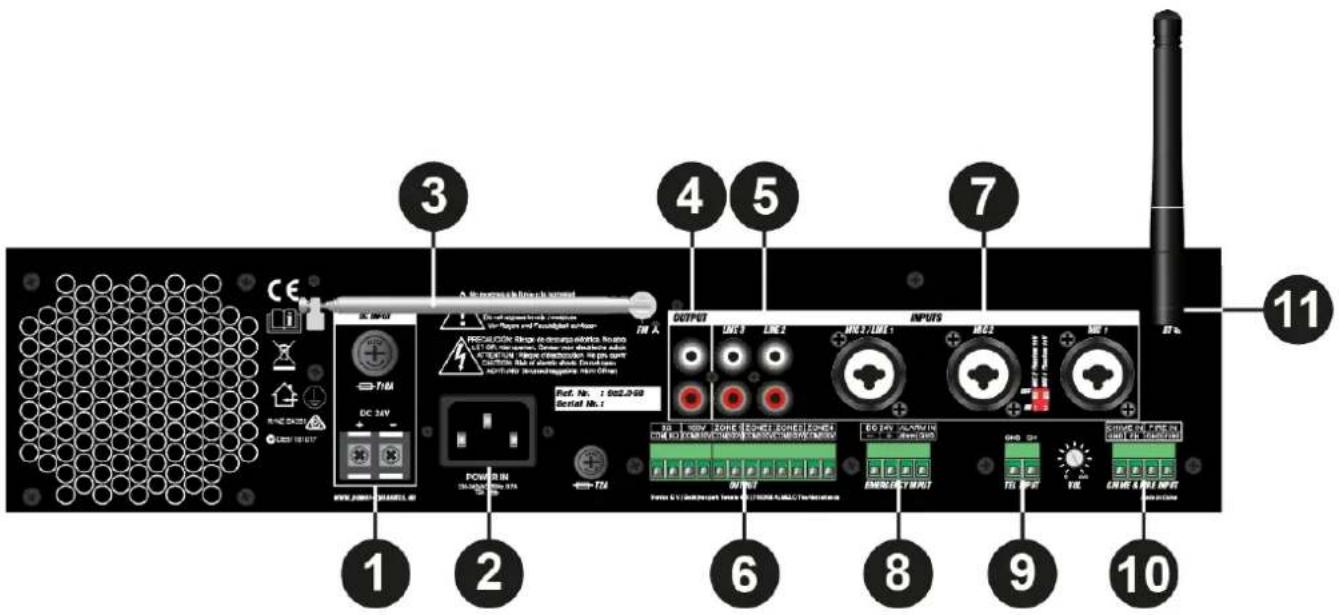
1. DC POWER INLET
The main DC power supply (24V) has to be applied to this connector. This is a standby power inlet to connect a 24V battery. A fuse holder with the main fuse is located on the top of the DC power inlet (for fuse replacement instructions, please see 'Replacing the fuses').
2. AC POWER INLET
The main AC power supply (230\~240V AC / 50\~60 Hz) has to be applied to this AC power inlet. A fuse holder with the main fuse is located on the right of the AC power inlet (for fuse replacement instructions, please see 'Replacing the fuses').
3. FM ANTENNA
For using the FM radio function, pull out this antenna to ensure the best possible FM reception.
4. OUTPUT CONNECTIONS (RCA)
These connections can be used when expanding your system by adding a second amplifier. Connect LINE2 or LINE3 input of the second amplifier with this 'OUT' connection to do so.
5. UNBALANCED LINE INPUTS 2 & 3 (RCA)
RCA jack line inputs 2 & 3. Can be turned into a stereo line input by connecting right to red, left to white.
6. OUTPUT CONNECTIONS (TERMINAL BLOCK)
Output connections for both low impedance and constant voltage distributed audiosystems. The low impedance loudspeaker and 100V constant voltage output share a 4-PIN terminal block, left two can be used to connect low impedance speakers, the two on the right can be used to connect high impedance (100V constant voltage) speakers. Zone (1-4) outputs are represented by an 8-pin connector.
7. MIC3 / LINE1, MIC2 & MIC1 INPUTS
These channels use combination connectors, accepting both XLR and 6.3 mm jack plugs. Both inputs forms will mute all other channels when a signal is present on the connected microphones/inputs. Mic input 1 & 2 can be used for capacitive microphones. Phantom power switches enable 15 Volts phantom power when a capacitive microphone is connected. Switch 2 will feed phantom power to Mic input 1, while switch 1 feeds phantom power to Mic input 2.
8. EMERGENCY INPUT
The amplifier can be connected to any 100V constant voltage amplifier output with a DC 24V remote control used as the emergency input. When the DC 24V signals, the amplifier will switch to all connected speakers (constant voltage output) to send out the emergency signal.
9. TEL INPUT
The amplifier can be connected to any telecom system using the TEL input, allowing for announcements to be made from a handset. It is a line level input with priority. Unbalanced input connections should be made to the 'CH' (Hot or Signal) and 'GND' (Ground) terminals.
10. CHIME & FIRE INPUTS
Chime & Fire inputs allow for any external source such as call stations, a signal matrix- or fire alarm system to be connected to. These inputs have priority over other inputs.
11. BT ANTENNA
When connecting to- and using BT, make sure to adjust the BT antenna to a vertical position to ensure the best possible wireless signal.
Multi-tap 100V line
20 + 10 + 10 + 2 + 2 + 4 = 48W load

80 examples:
Standard 2 loudspeaker setup
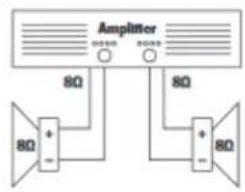
Parallel 4 loudspeaker setup
flowchart
graph TD
    A["Amplifier"] --> B["4Q"]
    A --> C["4Q"]
    B --> D["8Ω + -"]
    C --> E["8Ω + -"]
    D --> F["4Q combined load"]
    E --> G["4Q combined load"]
Series parallel 4 loudspeaker mono setup
1. GELIJKSTROOM INGANG
Multi-tap 100V line
20 + 10 + 10 + 2 + 2 + 4 = 48W load

80 examples:
Standard 2 loudspeaker setup
Parallel 4 loudspeaker setup
flowchart
graph TD
    A["Amplifier"] --> B["4Q"]
    A --> C["4Q"]
    B --> D["8Ω"]
    B --> E["+"]
    B --> F["-"]
    C --> G["8Ω"]
    C --> H["+"]
    C --> I["-"]
    D --> J["4Q"]
    E --> K["4Q"]
    F --> L["4Q"]
    G --> M["+"]
    H --> N["+"]
    I --> O["+"]
    J --> P["4Q"]
    K --> Q["4Q"]
    L --> R["4Q"]
    M --> S["4Q"]
    N --> T["4Q"]
    O --> U["4Q"]
Series parallel 4 loudspeaker mono setup
Parallel 4 loudspeaker setup
flowchart
graph TD
    A["Amplifier"] --> B["4Q"]
    B --> C["8Ω"]
    B --> D["+"]
    B --> E["-"]
    C --> F["4Q"]
    D --> G["8Ω"]
    E --> H["+"]
    E --> I["-"]
    F --> J["4Q combined load"]
    G --> K["4Q combined load"]
    H --> L["4Q combined load"]
    I --> M["4Q combined load"]
Series parallel 4 loudspeaker mono setup
Parallel 4 loudspeaker setup
flowchart
graph TD
    A["Amplifier"] -->|4Ω| B["4Q combined load"]
    A -->|4Ω| C["Output stage"]
    B --> D["8Ω + -"]
    B --> E["8Ω + -"]
    C --> F["8Ω + -"]
    C --> G["8Ω + -"]
    style A fill:#f9f,stroke:#333
    style B fill:#ccf,stroke:#333
    style C fill:#ccf,stroke:#333
    style D fill:#dfd,stroke:#333
    style E fill:#dfd,stroke:#333
    style F fill:#dfd,stroke:#333
    style G fill:#dfd,stroke:#333
Series parallel 4 loudspeaker mono setup
REPLACEMENT DU FUSIBLE
Multi-tap 100V line
20 + 10 + 10 + 2 + 2 + 4 = 48W load

80 examples:
Standard 2 loudspeaker setup
Parallel 4 loudspeaker setup
flowchart
graph TD
    A["Amplifier"] --> B["4Ω"]
    A --> C["4Ω"]
    B --> D["8Ω + -"]
    C --> E["8Ω + -"]
    D --> F["4Q combined load"]
    E --> G["4Q output stage"]
    style A fill:#f9f,stroke:#333
    style B fill:#ccf,stroke:#333
    style C fill:#ccf,stroke:#333
    style D fill:#cfc,stroke:#333
    style E fill:#cfc,stroke:#333
    style F fill:#fcc,stroke:#333
    style G fill:#fcc,stroke:#333
Series parallel 4 loudspeaker mono setup
The specifications are typical. The actual values can slightly change from one unit to the other. Specifications can be changed without prior notice.
The products referred to in this manual conform to the European Community Directives to which they are subject:
European Union
Tronios B.V.,
7602KR Almelo, The Netherlands
2014/35/EU
2014/30/EU
2011/65/EC
2014/53/EU

United Kingdom
Tronios Ltd.,
130 Harley Street,
London W1G 7JU, United Kingdom
S.I. 2016:1101
S.I. 2016:1091
S.I. 2012:3032
S.I. 2017:1206

Specifications and design are subject to change without prior notice.