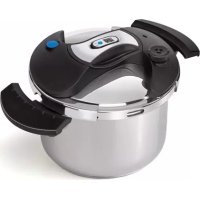
MGS07 - Saucepan MPM - Free user manual and instructions
Find the device manual for free MGS07 MPM in PDF.



| Product type | Pressure cooker |
| Brand | MPM |
| Model | MGS07 |
| Capacity | 7 L |
| Diameter | 22 cm |
| Height | 20 cm |
| Base diameter | 18.5 cm |
| Gross weight | 3.61 kg |
| Main material | Stainless steel |
| Base | 3-layer sandwich with aluminum insert |
| Operating pressure | 100 kPa |
| First safety threshold | 130-160 kPa |
| Second safety threshold | 180-300 kPa |
| Compatible heat sources | Gas, electric, vitroceramic, halogen, induction |
| Safety devices | Safety valve, safety window, pressure regulator, pressure level indicator, safety lock |
| Functions | Pressure cooking, steam cooking, built-in timer with alarm |
| Included accessories | Steamer basket with grater, glass lid, sealing gasket |
| Maintenance | Hand wash, do not put lid and gasket in dishwasher |
| Cleaning the valves | Use a toothpick to unclog the regulator |
| Gasket replacement | Every year or if damaged |
| Use | Household only |
| Maximum temperature | Approximately 120 °C |
Frequently Asked Questions - MGS07 MPM
User questions about MGS07 MPM
0 question about this device. Answer the ones you know or ask your own.
Ask a new question about this device
Download the instructions for your Saucepan in PDF format for free! Find your manual MGS07 - MPM and take your electronic device back in hand. On this page are published all the documents necessary for the use of your device. MGS07 by MPM.
USER MANUAL MGS07 MPM
Thank you very much for the trust you have placed in MPM by purchasing one of our cookware products.
By choosing our products you show us that our efforts to make the cooking process easier for you have been recognised.
Your pressure cooker is suitable for use with electric, ceramic, halogen, gas and induction cooktops, as indicated on the underside of each pot.
Please read all of this user manual carefully.
It contains useful cooking tips as well as technical data, maintenance and warranty information.
This user manual will help you fully appreciate your new cookware and enjoy many years of satisfactory use.
Before first use, wash your pressure cooker and accessories thoroughly with warm soapy water. Do not use citrus fruit-based cleaning agents on stainless steel as this might damage kitchenware by making rust-like stains. Discolorations can be removed with a stainless steel cleaner.
We hope our stainless-steel pressure cooker will serve you well. We will spare no effort to provide you with the best support possible. The safety, durability and sleek appearance of the product is guaranteed not only by excellent design and materials but its high quality is also additionally ensured by means of operational testing.
The pressure cooker will have a longer life if properly used. This User Manual will guide you through the use and cooking principles regarding your pressure cooker. Please read the instruction below carefully.
This pressure cooker is made of stainless steel for better safety and hygiene. It has good heat resistance properties and is easy to clean.
Its three-ply sandwich base includes a pure aluminium insert. The material we used is durable and has good conductivity properties, which makes it suitable for heating on induction hobs and enables effective use of the heat source.
The lid of the pressure cooker comes with an integrated timer and three-way protection system to ensure user comfort and operational safety.
The pressure cooker has ben manufactured in line with all applicable standards.
IMPORTANT SAFETY GUIDELINES
Please read this user manual thoroughly before use.
Kepp the appliance out of reach of children aged under 8 years old.
This product may only be operated by children aged 8 or more, by mentally or physically deficient persons, and by persons without knowledge of or experience in operating this appliance provided that they are supervised or have been instructed in its safe operation, and as a result have clear understanding of all related risks. Children without supervision must never clean or care for this appliance.
- Do not allow children to come near the pressure cooker when it is in operation.
This appliance cooks food under pressure. Inappropriate use may cause burns. Please make sure that the pot is correctly closed before you begin cooking. See the Instruction for Use below.
- Do not use the pressure cooker for other purposes then the ones it is intended for.
Use appropriate heat sources in compliance with the Instructions for Use.
Exercise particular caution when handling a pressure cooker. The pressure cooker must always be carried, shifted or moved gently on a horizontal plane by gripping both handles at the same time. Do not touch its hot surfaces. Use protective gloves if required.
Never put the pressure cooker inside a hot oven.
Never use the pressure cooker without water as it may cause serious damage.
- Do not fill the pot more than to 2/3 of its volume. When preparing dishes that expand while cooking, including rice and dried vegetables, do not fill the pressure cooker above 1/2 of its volume. Some vegetables, including peas, beans and dried vegetables and fruits, must be soaked in clean water prior to cooking. Dishes that generate foam or froth while cooked should be first boiled with the lid off, next strained, and only then cooked in pressure cooker.
Prior to every use check that the valves are not blocked or dirty. See the Instruction for Use below.
Never use your pressure cooker in pressurised condiction for shallow or deep frying.
After cooking meat with an outer layer of skin, which tends to swell in pressure conditions, do not pierce the meat when the skin is swollen as this could scald you.
- When cooking grain products, once safety valve is down and before you open the lid, shake your pressure cooker gently to prevent the dish from spurting.
Never open the pressure cooker before you are sure that the pressure inside has dropped. Never apply force to open the lid of your pressure cooker. See the Instruction for Use below.
Never wash the lid and the gasket in a dishwasher.
Use only genuine spare parts suitable for your pressure cooker model. In particular, use the body and the lid from the same manufacturer and specified as fully compatible.
Do not manipulate with the safety devices expect within the scope of maintenance activities specified in this User Manual.
- Keep this User Manual for future reference.
To keep your children safe, do not leave any parts of the packaging readily accessible (e.g. plastic bags, cardboard boxes, polystyrene inserts, etc.).
WARNING!
Never let children play with plastic film or bags. Choking hazard!
DESCRIPTION OF THE APPLIANCE
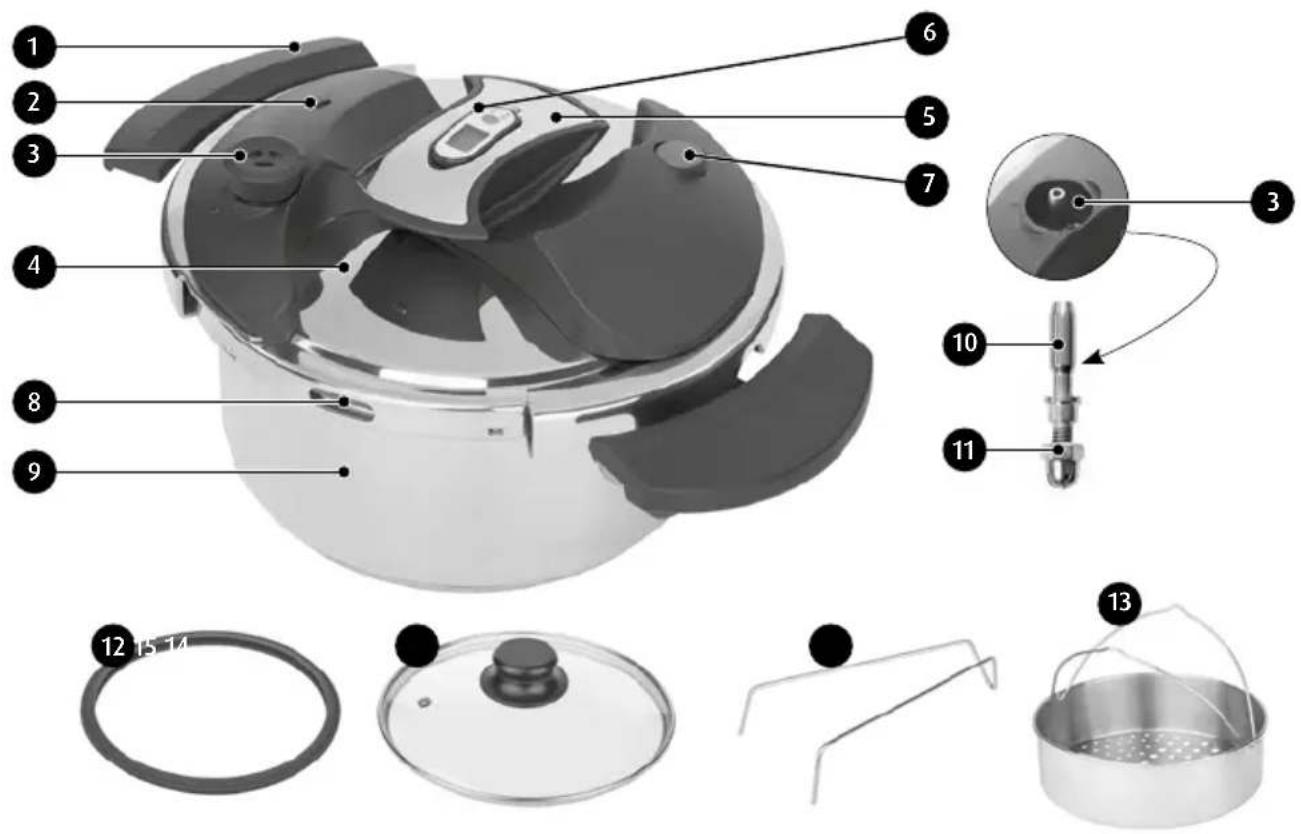
- Pot handle
- Safety valve
- Pressure regulator
- Lid
- Lid knob
- Timer
- Pressure level indicator
-
Safety window
-
Pressure cooker body / pot
-
Venting duct
- Locking screw
- Gasket
- Steaming basket
- Steaming basket support
- Glass lid
| Item number Diameter Volume | Operating pressure | First safety pressure | Second safety pressure | ||
| MGS-01 | 22 CM | 5,0 L | 100 kPa | 130-160 kPa | 180-300 kPa |
| MGS-02 | 22 CM | 4,0 Li6,0 L | 100 kPa | 130-160 kPa | 180-300 kPa |
| MGS-05 | 22 CM | 5,0 L | 100 kPa | 130-160 kPa | 180-300 kPa |
| MGS-07 | 22 CM | 7,0 L | 100 kPa | 130-160 kPa | 180-300 kPa |
HEAT SOURCE
This pressure cooker is intended for all types of hobs, including induction hobs.
ELECTRIC
COOKER

INDUCTIVE
COOKER

HALOGEN

GAS
COOKER
CERAMIC
HOB

SAFETY RULES
Please read and understand all instructions contained in this User Manual, and make sure to keep it for future reference.
The User is fully responsible for any potential accidents resulting from failure to comply with this User Manual.
- Your pressure cooker is intended for household use only – any other applications are strictly forbidden. Do not use the appliance with children close by. Children must never be near your pressure cooker when it is in operation and when the cooking has finished but the appliance has not cooled down yet. Do not use the appliance when disabled people or people who have not read and understood this User Manual are in close proximity, or with pets nearby.
- Do not touch hot metal surfaces. Use protective gloves if required.
- The boiling point of the pressure cooker is around 120 degrees Celsius, and it may generate large amounts of steam.
- Do not use your pressure cooker to prepare juice or jam and grain products, etc. as this could result in the formation of large amounts of bubbles and create splashes that could block the safety valve. Cooking this type of food in the pressure cooker is strictly forbidden.
- Never use your pressure cooker to prepare milk-based dishes.
- Do not use coarse salt. Dishes must be salted with fine-grained salt at the end of cooking when your cooker is not pressurised.
- Keep the pressure regulator, safety valve and gasket, as well as the body and lid, clean and dry.
- Do not put soda directly in your pressure cooker, and do not use it to heat up oil or wine.
- Put the pot securely on the hob. With gas hobs, the flame must not lick the walls of the pot. On electric hobs, the diameter of the cooking zone must be smaller than the diameter of the pot base.
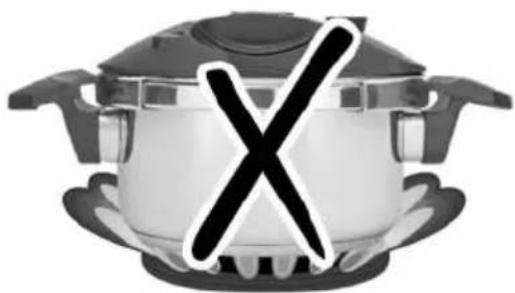
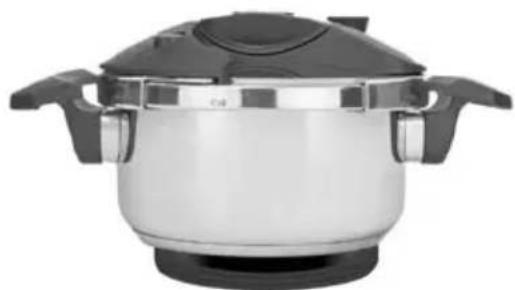
- Do not use your pressure cooker for deep frying or dry cooking (without water) as this can damage the product and reduce its life.
- If there is steam coming out of the safety valve or the safety window, remove the pot from the heat source immediately. Do not use it until the problem has been solved.
- Do not touch the safety window when the pressure cooker is in operation.
- Never cover any parts of the lid (safety window, safety valve, pressure regulator or pressure level indicator) when cooking.
- When cooking food or when boiling water, never use more than 2/3 of the volume of your pressure cooker. When cooking products that expand in water and high temperature, e.g. rice or vegetables, do not use more than 1/2 of the pot's volume.
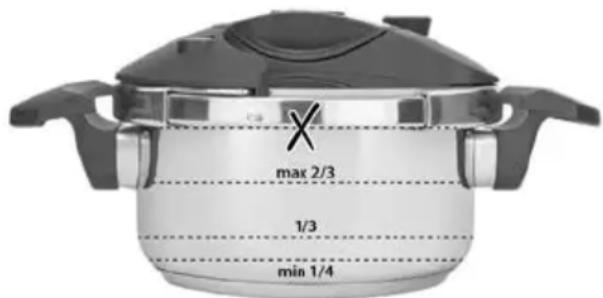
- Never open the lid when the cooker is under pressure. Never heat up your dish when the lid is not placed securely in its correct place..
- Prevent salt, vinegar, sugar or water from staying for too long in your pressure cooker after you finish cooking. This can leave stains inside the pot. Clean and dry your pressure cooker after use.
- Check each part of the pressure cooker before use to ensure safe operation and to prevent any potential accidents.
FEATURES
- This pressure cooker is for household use only. The lid and the body are made from strong and sleek stainless steel. Your pressure cooker has three-ply base filled with aluminium. The product is intended for cooking on fixed-plate electrical hobs, glass and ceramic hobs, halogen hobs, gas hobs and induction hobs.
-
Safety devices:
-
PRESSURE REGULATOR: There are two possible settings of this valve: pressure equalisation and operating pressure.
- SAFETY VALVE: The safety valve automatically checks the pressure inside your pressure cooker. If the valve detects the operating pressure, a red valve stem will go up and block the ability to open the pot. Should the pressure go above a safe level, the valve will begin releasing steam to prevent a further increase of pressure and temperature. If steam is released through the valve at the beginning of the cooking process, you must check whether the pressure cooker lid gasket and the lid itself are properly fitted and interlocked.
- SAFETY WINDOW: The safety window is located on the side of the lid. Its purpose is to release steam if the pressure regulator and the safety valve cannot work properly or when there is too much steam in the pressure cooker. Ensure that the safety window is never directed towards the user or any third parties.
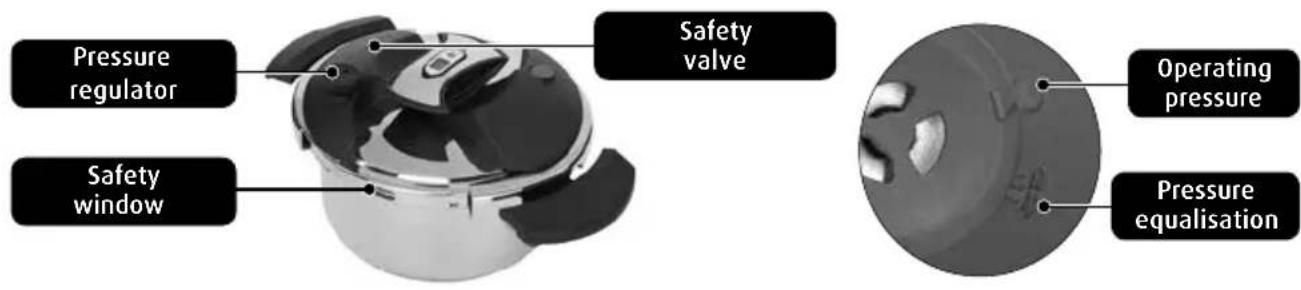
A pressure cooker is a thick-walled pan with a tightly secured lid that enables a temperature increase of up to 120^ , generating pressure that shortens the cooking time by 2 to 3 times.
ADVANTAGES OF A PRESSURE COOKER
- Significantly speeds up the cooking process
- Saves up to 70% of time and 50% of energy
- Dishes keep their nutritional and taste values
- Reduces the spread of smells during cooking
- Perfect for preparing one-pot dishes (e.g. a goulash)
INSTRUCTIONS FOR USE
- Read this User Manual thoroughly before first use. Pay special attention to the Safety Rules section.
- Before first use, wash the pot, lid, gasket and accessories (glass lid and steaming basket) with a mild detergent, then rinse them and wipe them dry. Set the pressure regulator to the pressure equalisation position. Fill your pressure cooker to 12 with cold water, close the lid, put the pot on the heat source, and wait for the steam to begin coming out through the pressure regulator. Remove the pressure cooker from the hob and leave it closed for 10 to 30 minutes to get rid of the smell from manufacturing.
- Once the pot has cooled, open the lid. Pour the water out of the pressure cooker, wash it, and dry it again.
BEFORE COOKING
- Ensure that the venting ducts, safety valve and pressure regulator are not blocked. If there is any blockage, use a thin stick (a toothpick) to clean the duct and remove the blockage. Make sure that the safety valve is clean and works properly, and that the gasket is fitted correctly in its place.
-
The pressure cooker must be filled with at least 14 litre of water or other liquid to enable proper accumulation of steam. Food and water must never exceed 23 of the pot's volume. If the food generates foam or froth, or if it expands when cooked, it may not take up more than 12 of the volume.
-
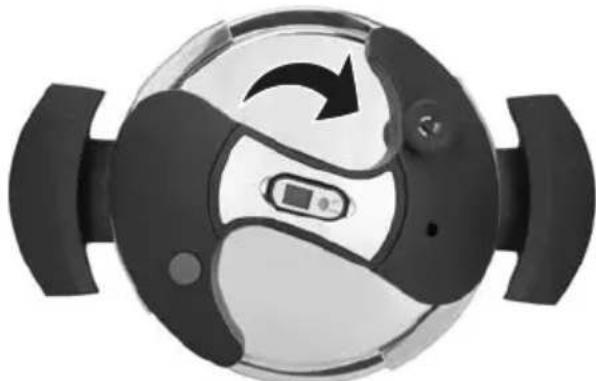
To close the lid, turn the knob clockwise until you hear a click indicating that the lid has been fully and properly closed. If required, apply pressure with your hand to close or open the lid.
COOKING
- Put your pressure cooker on a firm and flat surface of the hob. When cooking, the cooking zone diameter must not be greater than the pot diameter. If you use a gas hob for cooking, ensure that the flames do not lick the side walls of the pot. To enable the highest temperature increase possible, use high heating power.
NOTE: Whenever you move or shift you pressure cooker, hold it by its both handles. - Set the pressure regulator to the operating pressure position. At the initial heating stage, minor amounts of steam may come out through the safety valve. This will stop when the temperature increases.
- When the marking on the pressure indicator turns white, your pressure cooker has reached the operating temperature and pressure. Steam will start getting out through the pressure regulator – this is when counting down of the cooking time should begin.
- Set the heat source to the lowest level possible to prevent a further temperature increase.
- When you see that the pressure indicator has come back to the initial positio increase a little the heating power below your pressure cooker.
- When the pressure indicator shows a red line, reduce the heating power immediately.
- When the cooking time has elapsed, turn off the heat source.

QUICK COOLING OF THE PRESSURE COOKER
To quickly decrease the temperature and pressure:
- Use protective gloves and proceed with caution to set the pressure regulator (with a fork or other kitchen implement) to the pressure equalisation position to release the steam and reduce the pressure inside the pressure cooker.
or
- Put the pressure cooker under a thin stream of cold running water while being cautious not to pour water on the safety valve. Once the safety valve has dropped down, you can open the lid.
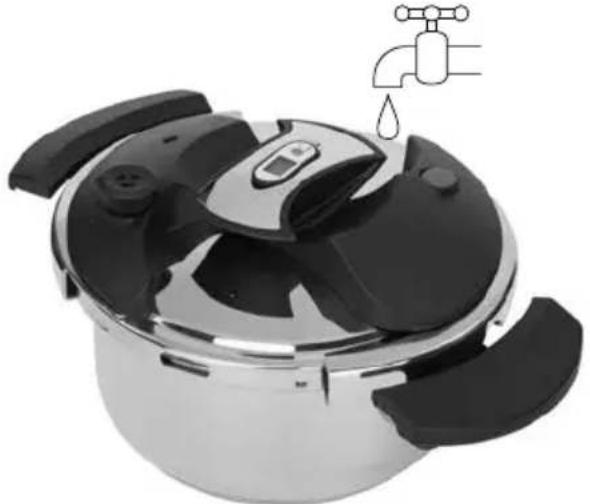
The cooking is complete. Note: Do not pour water into the safety valve.
NATURAL COOLING OF THE PRESSURE COOKER
Leave the pot to cool naturally after cooking, and do not open the lid until the safety valve and the pressure indicator have dropped down.
OPENING THE PRESSURE COOKER
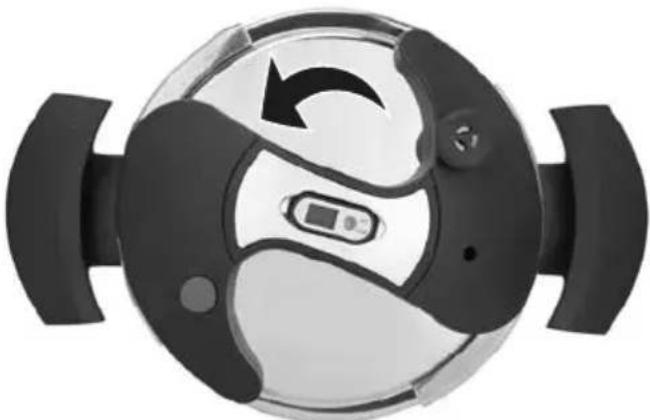
Turn the knob in the direction indicated by the arrow (anticlockwise).
TROUBLESHOOTING
| Stage Cause Remedy | ||
| The pressure cooker is overheating - the pressure regulator does not release steam. | 1. The regulator is blocked. 2. There is some food clogging the venting area. 3. Dry heating. 4. The pressure cooker stands on an inclined surface. | 1. Remove the blocking material from the pressure regulator. 2. Use a needle to remove the cause of clogging from the venting area. 3. Turn off the heat source, put the pressure cooker on a flat surface, and leave it for the pressure regulator to reduce pressure, then open the lid to see inside. 4. Put the pressure cooker on a flat surface. |
| There is steam coming out of the safety valve. | 1. The vent is blocked. 2. Too much food inside. 3. Excessive flame (heat source). | 1. Remove the blocking material from the vent. 2. Put the right amount of food inside the pot. 3. Reduce the flame (heat source), adjust the pressure regulator, and select the appropriate pressure. |
| The safety valve does not go up. | 1. The lid is not secured correctly in place. 2. Insufficient heat source to make the water boil. 3. The gasket is dirty or deformed. 4. Insufficient amount of liquid. | 1. Secure the lid correctly. 2. Increase the heat source. 3. Clean or replace the gasket. 4. Check if the pressure cooker contains enough liquid. Refill if required. |
| There is steam coming out from different areas. | 1. The pressure regulator and the safety valve do not work correctly. The gasket has not been fitted correctly in place. 2. The gasket is damaged. 3. Dirty gasket. 4. The lid has not been closed properly. | 1. Use a needle to remove any clogging material from the pressure regulator and the safety valve. 2. Fit the gasket correctly in place. 3. Replace the gasket with a new one. 4. Clean the gasket. 5. Close the lid properly. |
| Restrained closing/opening. | 1. The seal has not been fitted correctly in place. 2. The safety valve is up. 3. Deformed gasket. | 1. Ensure that the gasket fits the lid. Use a genuine gasket only. 2. Wait until the safety valve has dropped down completely. 3. Replace the gasket with a genuine one available from the manufacturer/supplier or from an authorised service centre. |
Any repairs may be carried out only by authorised home appliance service centres (for the address list, please go to our website at www.mpm.pl.
MAINTENANCE
PRESSURE COOKER
- Use mild detergents to clean any dirty areas.
- Wash and dry the pot, the steaming basket and the lids after each use.
- Do not use metal brushes for cleaning to avoid damaging the metal surface of your pressure cooker.
- Do not apply any metal tools directly to the body of the pot.
Note: If there is a high concentration of calcium in water, discolouration and sediment may appear on the pot base. This will not affect the quality of your dishes or the performance of your pressure cooker. To remove any such stains, you can wipe the pot using water with vinegar, then wash it thoroughly, and wipe it dry. Do not store any acidic or salty products, e.g. tomato sauce, in your pressure cooker as this may create corrosion stains.
If your pressure cooker will not be used for a longer time, store the pot and the lid separately in a dry place.
GASKET
- Remove any impurities from the gasket and wash it gently with warm water.
- Wipe the gasket completely dry.
- Fit the gasket correctly in place.
- Replace the gasket with a new one once a year, after prolonged use or when it is deformed or damaged. Apply a hint of edible oil on the gasket to increase its lifetime and to improve its performance. If you will not be using your pressure cooker for an extended period of time, store the gasket separately.
PRESSURE REGULATOR, VENTING DUCT AND SAFETY VALVE
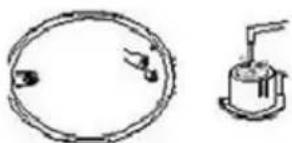
- After each use of the pressure cooker, dismantle the pressure regulator by removing it briskly from the venting duct, use a toothpick to take out any cooking residues, then rinse the regulator with cold water. Follow a similar procedure for the venting duct. Once it is clean, inspect it visually for any obstructions.
- After each use of the pressure cooker, clean the safety valve and check whether it moves correctly.
- The venting duct and the safety valves must be periodically dismantled using a key in order to be cleaned. Remember to mount them back in place after cleaning. Turn the lid upside down before use to check if the red plug falls down freely.
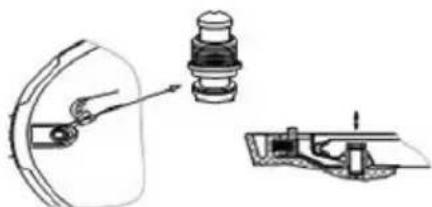
Incorrect mounting of the valve may put the User at risk.
REMOVAL OF BURNT FOOD
- Use wooden implements or other products dedicated for stainless steel to remove any burnt food.
- If the burnt mass is sticky, pour warm water with some oil over it. Next, remove the mass gently. Do not remove it with a sharp tool.
SPECIAL REMARKS AND PRACTICAL TIPS
- Never use abrasive scouring pads or metal brushes for washing. Use mild washing-up liquid.
- Never wash the lid and the gasket in a dishwasher; the gasket must not be cleaned with any washing-up liquids or agents.
- Spread some edible oil on the gasket to extend its life.
- Never close the pot after use. This will extend the life of the gasket.
- Defrost products, and soak beans and dried food prior to cooking.
- For food that forms bubbles and foam/froth, remove the lid and cook it for a while. When the bubbling and foaming/frothing stops, close the lid.
- One advantage of a pressure cooker is that the amount of water inside does not decrease even with prolonged cooking.
- If the top surface of your dish begins to go too high up, reduce the flame.
Replace the gasket with a new one every one year. If it is damaged, cracked or deformed, replace it immediately.
Never use any substitute products. Please contact the manufacturer or the supplier.
COOKING TIMES
- The cooking time begins to be measured once the pressure regulator starts releasing steam.
- The list below is only for reference purposes. Please adopt the cooking times to your individual taste.
| Product | Cooking time in minutes | Comments |
| Soups | For vegetables that produce foam or froth while cooked, begin by cooking them in a traditional way (without generated pressure), and then remove the foam/froth. | |
| Bean soup 10-20 | Beans swell in water, so it is recommended to soak them in clean water before cooking. Fill the pot to 1/2 of its volume when cooking under pressure | |
| Goulash soup 15-20 | ||
| Vegetable soup 4-8 | ||
| Cabbage soup 15 | ||
| Tomato soup 4-8 | ||
| Chicken broth 15-20 | ||
| Fish soup 6-8 | ||
| Potato soup 6-8 | ||
| Vegetables | The smaller the pieces, the shorter the cooking time. If you want your vegetables to be crispier, shorten the cooking time. We recommend steaming vegetables (water level – the minimum amount is indicated on the internal measuring scale) | |
| Brussels sprouts 4 | ||
| Beetroot 20-25 | ||
| Green peas 3-5 | ||
| Cauliflower 3-5 | ||
| Kohlrabi 4-5 | ||
| Cabbage 8-10 | ||
| Carrots 3-7 | ||
| Potatoes 10 | ||
| Meat | Meat needs to be first stir-fried in the pot with the lid off. Next, pour water (stock) into it. Large portions may be cut into smaller pieces. | |
| Pork knuckle 30-40 | ||
| Goulash 15-25 | ||
| Pork cutlet 10-12 | ||
| Whole chicken 20-25 | ||
| Veal tongues 10-15 | ||
| Roast veal 20-25 | ||
| Roast lamb | 25-30 | |
| Roast pork 20-30 | ||
| Roast beef | 40-50 | |
| Turkey thigh | 25-35 | |
| Boiled beef | 35-45 | |
| Ribs | 10-12 | |
| Fish | Note that fish stock is sticky. With that in mind, remove the pressure cooker lid immediately after the pressure has dropped down completely. | |
| Whole fish | 4 | |
| Fish stew | 4-8 | |
| Fish fillet | 3 | |
OTHER
COOKING WITH A STEAMING BASKET
Your pressure cooker comes with a steaming basket. The basket has an additional function of a vegetable and fruit grater. The bottom part of the basket features variously sized edges for grating and slicing vegetables and fruits.
To cook with your steaming basket, place the steaming basket support (included) on the pot base, put the basket on the support, fill the pressure cooker with an appropriate amount of water (up to the minimum level indicated on the pot's interior measuring scale), and lay the products on the bottom of the steaming basket.
NOTE: The products must never touch the lid of your pressure cooker.
It is recommended to remove the timer from the cover when cooking in the pressure cooker.
- Press and hold the blue button to turn the timer on - "00" will display on the screen.
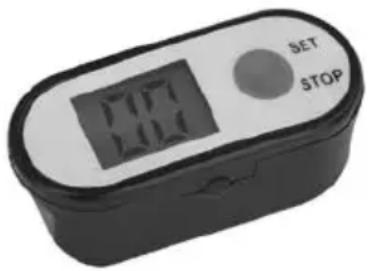
- Setting the time: Press the blue button to set the cooking time within the range from 0 to 99 minutes. A sound alarm will indicate that the cooking time has finished.
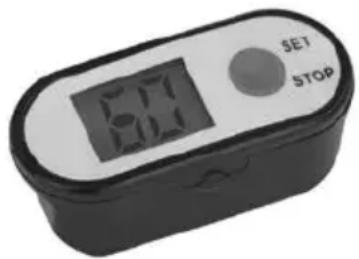
- If the time setting is incorrect, press and hold the blue button to display the initial setting of "00" and proceed as above.
ACCESSORIES
- Steaming basket with an integrated vegetable and fruit grater
- Glass lid
KEY TECHNICAL SPECIFICATIONS
- Specifications – Operating pressure: 100 kPa (+/-10%).
- Sealing reliability: below 20 kPa of the operating pressure, no water or steam leakage.
- Limit pressure for safety devices: (l): from 130 kPa to 160 kPa (li): from 180 kPa to 300 kPa.
- Safe lid opening: if the internal pressure is above 4 kPa, the lid cannot be opened.
- Safe lid closing: If the lid is not secured correctly, the internal pressure is at the level of 4 kPa.
REGULATORY LABELLING
| labelling location | |
| Manufacturer / brand details Base of the container / pot | |
| Year of manufacture and batch number | Inside the lid |
| Operating pressure (PF) | |
| Maximum safety pressure (PS) | |
TECHNICAL SPECIFICATIONS
Volume:7L
Pot diameter:22cm
Pot bottom diameter: 18,5cm
Pot height: 20cm
Pot gross weight: 3,61 kg
Operating pressure: 100kPa

NOTE: MPM agd S.A. may change the technical features of the product without notice.
NOTE: MPM agd S.A. may change the technical features of the product without notice.
DIRECTIVES IMPORTANTES DE SECURITE 52
DESCRIPTION DE L'APPAREIL 54
SOURCE DE CHALEUR 55
REGLES DE SECURITE 55
CHARACTERISTIQUES 56
MODE D'EMPLOI 57
DEPANNAGE 60
ENTRETIEN 60
TEMPS DE CUISSON 62
AUTRES 64
PRINCIPALES SPECIFICATIONS TECHNIQUES 65
ETIQUETAGE REGLEMENTAIRE 65
SPECIFICATIONS TECHNIQUES 65
Cher client,
NOTE: MPM agd S.A. may change the technical features of the product without notice.
We wish you satisfaction from using the product and invite you to check a wide range of other MPM appliances
MPM agd S.A.
ul. Brzozowa 3, 05-822 Milanówek, Poland
tel.: (22) 380 52 34, fax: (22) 380 52 72
www.mpm.pl
- IMPORTANT SAFETY GUIDELINES
- DESCRIPTION OF THE APPLIANCE
- HEAT SOURCE
- SAFETY RULES
- FEATURES
- ADVANTAGES OF A PRESSURE COOKER
- INSTRUCTIONS FOR USE
- BEFORE COOKING
- COOKING
- QUICK COOLING OF THE PRESSURE COOKER
- NATURAL COOLING OF THE PRESSURE COOKER
- OPENING THE PRESSURE COOKER
- TROUBLESHOOTING
- MAINTENANCE
- PRESSURE COOKER
- GASKET
- PRESSURE REGULATOR, VENTING DUCT AND SAFETY VALVE
- Incorrect mounting of the valve may put the User at risk.
- REMOVAL OF BURNT FOOD
- SPECIAL REMARKS AND PRACTICAL TIPS
- COOKING TIMES
- OTHER
- COOKING WITH A STEAMING BASKET
- ACCESSORIES
- KEY TECHNICAL SPECIFICATIONS
- REGULATORY LABELLING
- TECHNICAL SPECIFICATIONS
- Cher client,
Brand : MPM
Model : MGS07
Category : Saucepan