ManualGo.com
Minute Authentique P05311 - Saucepan TEFAL - Free user manual and instructions
Find the device manual for free Minute Authentique P05311 TEFAL in PDF.


Download the instructions for your Saucepan in PDF format for free! Find your manual Minute Authentique P05311 - TEFAL and take your electronic device back in hand. On this page are published all the documents necessary for the use of your device. Minute Authentique P05311 by TEFAL.
USER MANUAL Minute Authentique P05311 TEFAL
www.tefal.comwww.tefal.comTEFAL S.A.S. - 21260 SelongeyFRANCE ËÅn √§e«¡ «∞LM∑Z TE_AUTHENTIQUE_1520008720.qxp_Mise en page 1 11/06/2019 09:30 PageC1Before using your pressure cooker, please take the time to read all the instructions and always refer to the "User guide". Improper use may result in damage. For your safety, this appliance complies with the applicable standards and regulations: - Pressure Equipment Directive (PED) - Materials that come into contact with food products - Environment IMPORTANT INFORMATION fig 1
fig 3 MINI fig 4 fig 5 fig 6 fig 7 fig 8 fig 9 fig 10 fig 11 fig 12 fig 13 fig 14 fig 15 MAX1 1/3 fig 16 fig 17 fig 18 fig 19 fig 20 COMPULSORY CHECKS BEFORE EACH USE CHECK that the steam release outlet is not blocked. that the safety valve ball is mobile – fig. 13. that the pan handles are properly fastened. Tighten them, if necessary - fig 5. ALWAYS COMPLY WITH THE FOLLOWING QUANTITIES Never use your pressure cooker without liquid, as this could damage the device. Make sure there is always enough liquid in the device when cooking. Minimum 25 cl - fig. 3. Maximum 2/3 of the height of the pan, MAX 2 mark - fig. 4. Maximum 1/3 (MAX 1) - fig. 15 for foodstuffs that expand and/or foam during cooking, such as rice, legumes, dehydrated vegetables, compotes, pumpkin, courgette, carrots, potatoes, fish fillets etc. When pressure cooking, the food in the steam basket* should not be in contact with the water. The food in the steam basket* must not exceed MAX 2 level on the pan. *depending on model TE_AUTHENTIQUE_1520008720.qxp_Mise en page 1 11/06/2019 09:30 PageC41 BEFORE AND DURING COOKING Keep the pressure cooker out of reach of children when in use. Steam is very hot when it leaves the operating valve. Watch out for the jet of steam. This device cooks using pressure. Improper use may result in scalding injuries. Make sure the pressure cooker is properly closed before use. (See "Closing" section). During cooking, check that the valve is still murmuring. If there is not enough steam being released, decompress the product and check that there is enough liquid and that the steam release outlet is not blocked. After these checks, if there is still not enough steam, increase the heat source slightly. Do not cook foodstuffs that might block the safety components: - cranberries - pearl barley, spelt, millet - oat flakes - split peas - noodles, macaroni, spaghetti - rhubarb - redcurrants Never use your pressure cooker to cook recipes containing animal milk. Never use coarse salt in your pressure cooker, only use fine salt at the end of cooking. This will prevent "pitting" which may alter the bottom of your pressure cooker. Never use your pressure cooker to fry under pressure using oil. Do not leave your pressure cooker unattended while heating oil or fats. Continuing to heat oil which has started to smoke degrades it and could raise its temperature enough to catch fire. Do not use your pressure cooker for any other purpose than the one it is meant for. Do not put your pressure cooker in a hot oven. Never put a piece of aluminium foil not secured onto a mould in your pressure cooker. Never put plastic film in your pressure cooker. Alcohol vapour is flammable. Bring to a boil about 2 minutes before covering with the lid. Check your appliance on a regular basis if you are making alcohol-based recipes. Only use the compatible heat source(s) listed in the user guide. TE_AUTHENTIQUE_1520008720.qxp_Mise en page 1 11/06/2019 09:27 Page12 AFTER COOKING... After cooking meats with a skin surface (e.g. beef tongue, etc.), where there's a risk of swelling under pressure, don't score the meat when swollen to avoid being scalded. Score meat before cooking. For foodstuffs that expand and/or foam during cooking, such as rice, legumes, dehydrated vegetables, compotes, pumpkin, courgette, carrots, potatoes, fish fillets, etc. Let your pressure cooker cool down for a few minutes, then cool in cold water - figs. 8 and 9. Methodically and lightly shake the pressure cooker each time before opening to prevent bubbles of steam from overflowing and burning you. This operation is particularly important when steam is released quickly or after cooling down in cold water. Always be very careful when moving your pressure cooker under pressure. Do not touch hot surfaces. Use the handles. Use oven mitts if necessary. For soups, we recommend fast pressure release in cold water (see "End of cooking" section). Never use force to open your pressure cooker. Make sure the internal pressure has been released. (See "Safety" section). TE_AUTHENTIQUE_1520008720.qxp_Mise en page 1 11/06/2019 09:27 Page2EN
MAINTENANCE If you notice that a part of your pressure cooker is broken or cracked, do not attempt to open it under any circumstances; wait for it to cool down completely before moving it. Do not use it again and take it to an Approved TEFAL Service Centre for repair. Do not tamper with the safety systems other than when following the cleaning and maintenance instructions. Only use the correct TEFAL original parts for your model. In particular, use a TEFAL pan and lid. Never leave food in your pressure cooker. Clean and rinse your pressure cooker immediately after each use. Never put the operating valve (A) or the lid in the dishwasher. Never use bleach or products containing chlorine, as these will impair the quality of the stainless steel. Do not leave the lid soaking in water. Make sure that you get your pressure cooker checked in a TEFAL Approved Service Centre after 10 years of use. To store your pressure cooker: Place the lid upside down on the pan in order to prevent the premature wear of the lid seal.
KEEP THESE INSTRUCTIONS
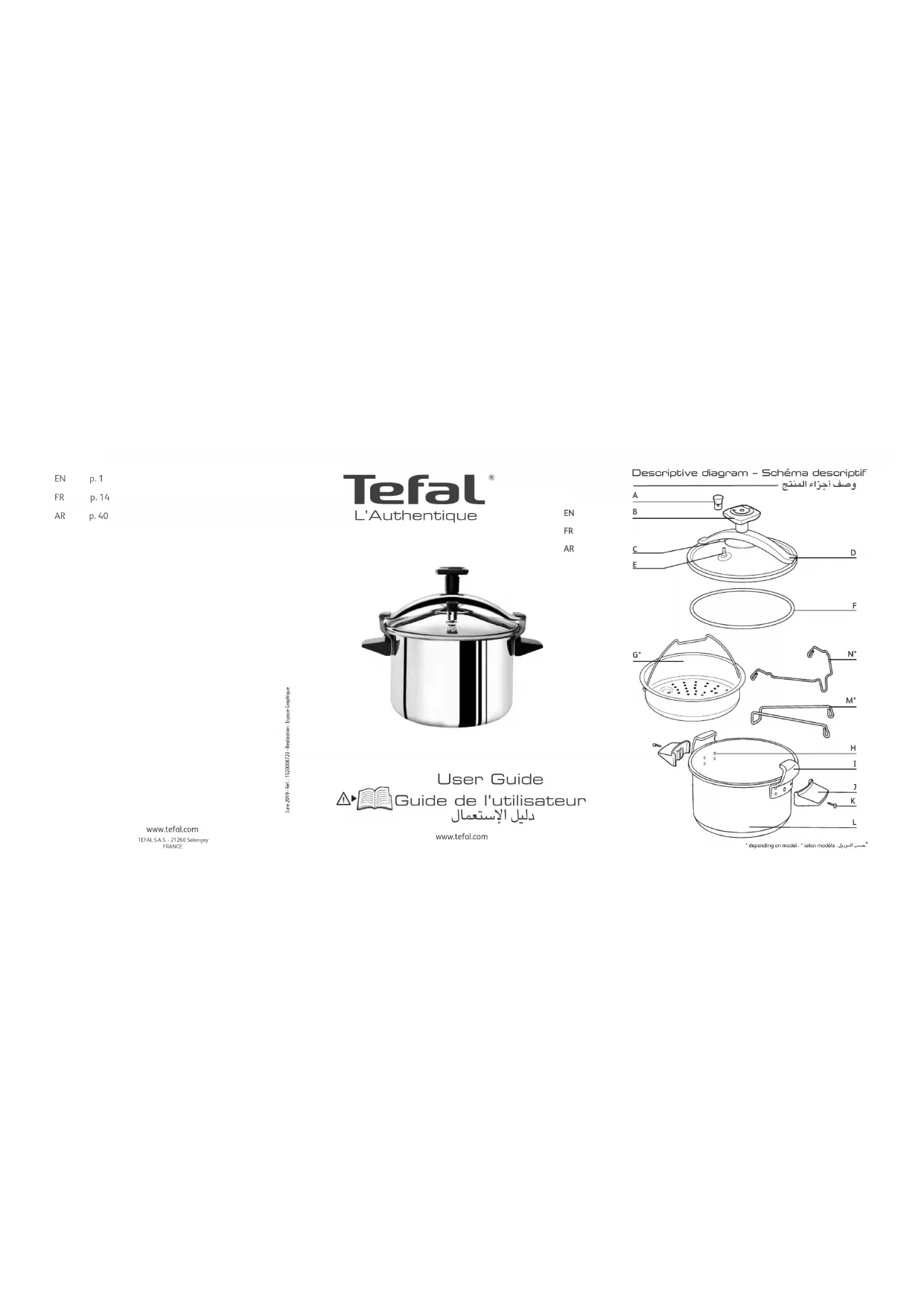
TE_AUTHENTIQUE_1520008720.qxp_Mise en page 1 11/06/2019 09:27 Page3Descriptive diagram Compulsory checks before each use Checking the operating valve Check that the draining hole of the operating valve is not obstructed (see section "Removing and positing the operating valve"). Checking the safety valve Check that the ball of the safety valve can move (use a small stick). A. Operating valve B. Tightening button C. Safety valve D. Clamp E. Steam release rod F. Seal G. Steam basket* H. Rivets
J. Handle K. Attachment screw L. Pan M/N. Tripod*
*depending on model Opening Turn the tightening button counter-clockwise to lower the clamp. Lift the lid to unlock it. Slide it horizontally - Fig 1. Closing Slide the lid horizontally and fit it onto the edge of your pressure cooker, ensuring that it correctly covers the body of the pressure cooker. Turn the tightening button clockwise until the clamp comes into contact with the pressure cooker's clamp hooks - Fig. 2. To ensure that the lid is locked, turn the tightening button again (at least three full turns). First use Turn your pressure cooker over to assemble the handles. Position them correctly, insert the screw and tighten - Fig. 5 After a few days of use, tighten the screws again. Place valve on the steam release rod and press hard - Fig. 6 Depending on model: Position the tripod* (M) and the basket* (G) on the base of the pan. Clip the tripod* (N) onto the basket* (G), then place in the bottom of the pan. Fill the pan (L) with water up to 2/3 of its capacity. Close the pressure cooker. Place your pressure cooker on a heat source then set to maximum power. When steam begins to be released by the valve, turn down the heat source and set a timer for 20 min.- Fig. 7 After 20 min., turn off the heat source. Remove the valve taking care that the steam does not scald you. When steam stops being released from the operating valve, open the pressure cooker - Fig. 1 Rinse the pressure cooker with water and dry it. Use a scouring pad with a little diluted vinegar to remove any traces of limescale. Instructions for use TE_AUTHENTIQUE_1520008720.qxp_Mise en page 1 11/06/2019 09:27 Page5Minimum and maximum fill level Minimum - Always add at least 25 cl of liquid - Fig 3 Maximum - Never fill your pressure cooker past the 2/3 full mark - Fig 4 For certain foodstuffs For foodstuffs that expand during cooking, such as rice, dehydrated vegetables or compotes, do not fill your pressure cooker above 1/3 of the depth of the pan. We recommend a fast decompression for soups. Using the steam basket* Pour 75 cl of water into the bottom of the pan (L). Depending on model: Position the tripod* (M) and the basket* (G) on the base of the pan. Clip the tripod* (N) onto the basket* (G), then place in the bottom of the pan. Before cooking Before each use, check the steam release rod is not blocked - Fig. 10 Add your ingredients and the liquid. Close the pressure cooker. Position the valve - Fig. 6 Place your pressure cooker on a heat source then set to maximum power. During cooking When the operating valve is constantly leaking steam, making a regular sound (PSCHHHT), lower the heat - Fig. 7. Use the cooking time indicated in the recipe book. During cooking, check that the valve turns while murmuring regularly. If there is not enough steam, increase the heat slightly; if there is too much steam, reduce the heat. As soon as the cooking time is finished, switch off the heat source. MAX When pressure cooking, the food in the steam basket* should not be in contact with the water
*depending on model MINI
MAX1 1/3 TE_AUTHENTIQUE_1520008720.qxp_Mise en page 1 11/06/2019 09:27 Page6EN
*depending on model End of cooking To release the steam: When the heat source has been turned off, you have two options: Gradual decompression: lift the valve to the first notch of the steam release rod or remove it - Fig 11 Fast decompression: Run cold water into your sink and submerge the bottom of your pressure cooker- Fig. 8. When steam stops being released from the operating valve: your pressure cooker is no longer under pressure. Remove the valve - Fig 9. Open the pressure cooker. When in use, if the steam release value becomes blocked, two overpressure safety measures are activated: First measure: the safety valve releases the pressure. Second measure: a leak occurs between the lid and pan by deformation of the clamp lock. If one of the overpressure safety systems is activated Turn off the heat source. Let the pressure cooker cool down. Open the pressure cooker Check the steam release rod, operating valve, safety valve and seal. Recommendations for use
1 - Ensure close supervision if your pressure cooker is used near children.
2 - It is normal for a little steam to escape from the safety valve.
3 - Steam is very hot when it leaves pressure cooker. Be careful not to
burn yourself. Use oven mitts if necessary.
4 - To move the pressure cooker, use the handles.
5 - Never leave food in the pressure cooker.
6 - Never use bleach or products containing chlorine.
7 - Do not leave the lid to soak. Do not put the lid in the dishwasher.
8 - Change the seal every year or if a split appears.
9 - Do not use a sharp or pointed object to clean the valves.
10 - Make sure that you get your pressure cooker checked in a TEFAL
Approved Service Centre after 10 years of use. Safety TE_AUTHENTIQUE_1520008720.qxp_Mise en page 1 11/06/2019 09:27 Page7To ensure the correct operation of your pressure cooker, follow these cleaning and maintenance recommendations after each use. To clean the inside of the pan Wash with a scouring pad. To clean the exterior of the pan and the steam basket* Wash using a natural sponge. You can wash the pan and the steam basket* in the dishwasher. To clean the lid Wash the lid under running water. To clean the operating valve Clean the operating valve under running water - Fig. 12 Clean the steam release rod under a strong jet of water or with a needle - Fig 10 To clean the safety valve Clean the bottom of the safety valve located inside the lid. Make sure that it works properly by lightly pushing on the ball which you should be able to push down without any difficulty- Fig 13 Wash your pressure cooker after each use. To store your pressure cooker Turn the lid over on the pan - Fig 14 To keep your pressure cooker in good condition Do not overheat the pan when it is empty. The browning and marks which may appear with extensive use do not affect the operation of the pressure cooker. If the inside of the stainless steel pan has iridescent or white marks (limescale), clean it with white vinegar or with a special stainless steel cleaning product. To clean your pressure cooker if it has blackened Clean the pan with a special stainless steel cleaning product sold in TEFAL Approved Service Centres. Do not use a sharp or pointed object to carry out this operation. Maintenance Cleaning
*depending on model To change the seal Always use the correct seal for your model. Change the seal if it is damaged. To put the new seal in place, please check the instructions on the back of the packaging. TEFAL accessories The following Authentique Pressure Cooker accessories are commercially available: To replace other parts or for repairs, contact a TEFAL Approved Service Centre. Only use the correct TEFAL original parts for your model. Your pressure cooker's base diameter - reference ** total capacity: total capacity including the volume of the lid. Technical information: Maximum operating pressure: 55 kPa. Maximum safety pressure: 110 kPa. Accessories References Steam basket*
Stainless steel 6 L 6.6 L 16 cm P05307 8 L 8.7 L 18 cm P05311 10 L 11 L 20 cm P05316 12 L 13 L 20 cm P05317 TE_AUTHENTIQUE_1520008720.qxp_Mise en page 1 11/06/2019 09:27 Page9Compatible heat sources These models can be used on all heat sources including induction. On an electric hob, use a hotplate with a diameter equal to or less than that of the pressure cooker base. On ceramic hobs, make sure that the base of the pan is clean and dry. On gas, the flame should not extend beyond the diameter of the pan. For all heat sources, make sure that your pressure cooker is well centred. When used as recommended in the manual, the stainless steel pan of your new TEFAL pressure cooker is guaranteed for 10 years against: - Any defect linked to the metallic structure of your pan, - Any premature deterioration of the base metal. The other parts of your pressure cooker are guaranteed against defects in manufacture or materials, for the period of warranty defined by the law in force in the country of purchase and from the date of purchase. This contractual warranty is established upon presentation of the receipt or invoice showing the date of purchase. These warranties exclude: Damage resulting from failure to comply with Important Information, or negligent use, particularly: - Shocks, falls, use in the oven, etc. Only TEFAL Approved Service Centres are authorised to provide this warranty service. GAS ELECTRIC (Solid plate) ELECTRIC (Radiant or halogen ceramic hobs) ELECTRIC (Ceramic induction hob) ELECTRIC (Spiral resistor) Warranty
Regulatory markings Labelling Location Identification of manufacturer or commercial brand Tightening button Year and batch of manufacture External pan wall (upper edge) Model reference External pan wall (upper edge) Maximum operating pressure (OP) Internal face of the pan clamp hook Maximum safety pressure (SP) Internal face of the pan clamp hook Capacity Outer base of the pan TE_AUTHENTIQUE_1520008720.qxp_Mise en page 1 11/06/2019 09:27 Page11TEFAL answers your questions
Problems Recommendations If you are unable to open the lid: Depressurize and remove the valve. Make sure that there is no pressure left. If necessary, heat it for a few moments without the valve. If your pressure cooker has been heated without liquid inside: Have your pressure cooker checked by an approved TEFAL Service Centre. If nothing is escaping through the valve and your pressure cooker makes no noise during cooking, your pressure cooker is not under pressure. This is normal during the first few minutes of heating. - If the phenomenon persists, check that: The heat source is sufficiently strong. The quantity of liquid in the pan is sufficient. The operating valve is in position. The pressure cooker is closed properly. The operation valve is not dirty. There is no deterioration at the seal or edge of the pan. If one of the overpressure safety systems is triggered: Turn off the heat source. Let the pressure cooker cool down. Check the steam evacuation rod, operating valve, safety valve and seal. If steam leaks from around the lid, check That the lid is closed, if necessary, tighten it. The seal is in good condition. The position of the lid seal. The cleanliness of the lid, the seal, the safety valve and the operating valve. The condition of the edge of the pan. If the food is not cooked or is burnt, check: The cooking time. The power of the heat source. The operating valve is correctly positioned. The quantity of liquid. If food has burnt in your pressure cooker: Soak your pan for a while before washing. Never use bleach or products containing chlorine. TE_AUTHENTIQUE_1520008720.qxp_Mise en page 1 11/06/2019 09:27 Page12EN