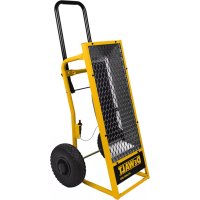
DXH45LP - Heating DEWALT - Free user manual and instructions
Find the device manual for free DXH45LP DEWALT in PDF.



| Product type | Propane radiant heater |
| Brand | DeWalt |
| Model | DXH45LP |
| Fuel | Liquefied propane gas (LPG) |
| Power | 45,000 BTU/h |
| Power supply | Propane tank (20-100 lb) or permanent installation |
| Ignition | Piezoelectric or match |
| Minimum clearances (combustible materials) | Top: 1 m, Sides: 1 m, Front: 1.4 m, Back: 0 m |
| Minimum ambient temperature | -6.67 °C (20 °F) |
| Maximum inlet pressure | 1.0 PSI |
| Safety distance to tank | 1.8 m minimum |
| Distance between multiple units | 6 m minimum |
| Safety devices | Tip-over switch, 100% shut-off valve, thermocouple |
| Intended use | Temporary job site heating (construction, renovation) |
| Maintenance | Clean with compressed air; inspect hose before each use |
| Replacement parts | List provided in manual (orifice, burner, thermocouple, etc.) |
| Warranty | 1 year against material and workmanship defects |
| Country of manufacture | United States (under license from DeWalt) |
| Standards | ANSI Z83.7-CSA 2.14 |
Frequently Asked Questions - DXH45LP DEWALT
User questions about DXH45LP DEWALT
0 question about this device. Answer the ones you know or ask your own.
Ask a new question about this device
Download the instructions for your Heating in PDF format for free! Find your manual DXH45LP - DEWALT and take your electronic device back in hand. On this page are published all the documents necessary for the use of your device. DXH45LP by DEWALT.
USER MANUAL DXH45LP DEWALT
If you have questions or comments, contact us.
Propane Portable Radiant Construction Heater DXH45LP
WARNING: READ INSTRUCTIONS
CAREFULLY: Read and follow all instructions. Place instructions in a safe place for future reference. Do not allow anyone who has not read these instructions to assemble, adjust or operate the heater.
⚠ AVERTISSEMENT: VEUILLEZ LIRE ATTENTIVEMENT
Definitions: Safety Guidelines
The definitions below describe the level of severity for each signal word. Please read the manual and pay attention to these symbols.
DANGER: Indicates an imminently hazardous situation which, if not avoided, will result in death or serious injury.
WARNING: Indicates a potentially hazardous situation which, if not avoided, could result in death or serious injury.
CAUTION: Indicates a potentially hazardous situation which, if not avoided, may result in minor or moderate injury.
NOTICE: Indicates a practice not related to personal injury which, if not avoided, may result in property damage.
▲WARNING: DO NOT OPERATE THIS HEATER UNTIL YOU READ AND UNDERSTAND THIS INSTRUCTION MANUAL FOR SAFETY, OPERATION, AND MAINTENANCE INSTRUCTIONS. SAVE THESE INSTRUCTIONS.
GENERAL HAZARD WARNING:
Failure to comply with the precautions and instructions provided with this heater, can result in death, serious bodily injury and property loss or damage from hazards of fire, explosion, burn, asphyxiation, carbon monoxide poisoning, and/or electrical shock. Only persons who can understand and follow the instructions should use or service this heater. If you need assistance or heater information such as an instructions manual, labels, etc., contact the manufacturer. Save these instructions for future reference.
▲WARNING:
Not for home or recreational vehicle use.
WARNING:
Fire, burn, inhalation, and explosion hazard. Keep solid combustibles, such as building materials, paper or cardboard, a safe distance away from the heater as recommended by the instructions. Never use the heater in spaces which do or may contain volatile or airborne combustibles, or products such as gasoline, solvents, paint thinner, dust particles or unknown chemicals.
WARNING: RISK OF FIRE OR EXPLOSION
- Turn off heater and allow to cool before removing or changing propane tanks.
- Do not operate heater where flammable liquids or vapors may be present.
- Do not start heater when chamber is hot.
- Do not start heater when excess fuel has accumulated in the chamber.
ADANGER:
CARBON MONOXIDE CAN KILL YOU
This heater produces carbon monoxide. Do not use in occupied spaces. Ventilate building, room or other enclosed spaces where heater has been used before entering. Never use in a vehicle, camper or tent. Do not use to cook or warm food.
▲WARNING
Do not exceed 27.5" W.C. (1.0 p.s.i.) inlet pressure to heater.
▲WARNING: THIS PRODUCT CAN EXPOSE YOU TO CHEMICALS INCLUDING LEAD AND LEAD COMPOUNDS, WHICH ARE KNOWN TO THE STATE OF CALIFORNIA TO CAUSE CANCER AND BIRTH DEFECTS OR OTHER REPRODUCTIVE HARM. FOR MORE INFORMATION VISIT WWW.P65WARNINGS.CA.GOV
▲WARNING: Fuels used in liquefied propane gas appliances, and the products of combustion of such fuel, can expose you to chemicals including benzene, which is known to the state of California to cause cancer and cause birth defects or other reproductive harm, for more information go to www.P65Warnings.ca.gov.
WARNING: RISK OF FIRE OR EXPLOSION
-
Do not store or use gasoline or other flammable vapors and liquids in the vicinity of this or any other appliance.
• WHAT TO DO IF YOU SMELL GAS: -
Open windows.
• DO NOT try to light any appliance.
• DO NOT operate any electrical switches. - DO NOT use any telephone in building. Immediately call the local gas supplier from an outside telephone. Follow the gas supplier's instructions.
- DO NOT touch any electrical switch; do not use any phone in your building.
- If you cannot reach your gas supplier, call the Fire Department.
CONTENTS
WARNINGS....2-3
CLEARANCE....3
INSTALLATION INSTRUCTIONS....5
LOCATION 6
PIPING 6
OPERATING INSTRUCTIONS 7
LIGHTING AND SHUT DOWN 7
MAINTENANCE INSTRUCTIONS....8
REPLACEMENT PARTS LIST 9
WARRANTY 12
SERVICE AND PARTS ORDERING INFORMATION......12
Clearance
(Minimum clearances to combustible materials.)
| MODEL NO.TYPE GAS | BTU/HR RATING NORMAL POSITION COMBUSTIBLES | OPERATING CLEARANCES TO | ||||
| LP | TOP SIDES BACK FRONT | |||||
| DXH45LP | 45,000* | VERTICAL | 40” (1m) | 40” (1m) | 0” (0m) | 54” (1,4m) |
*Tank size and tank temperature can directly affect BTU output.
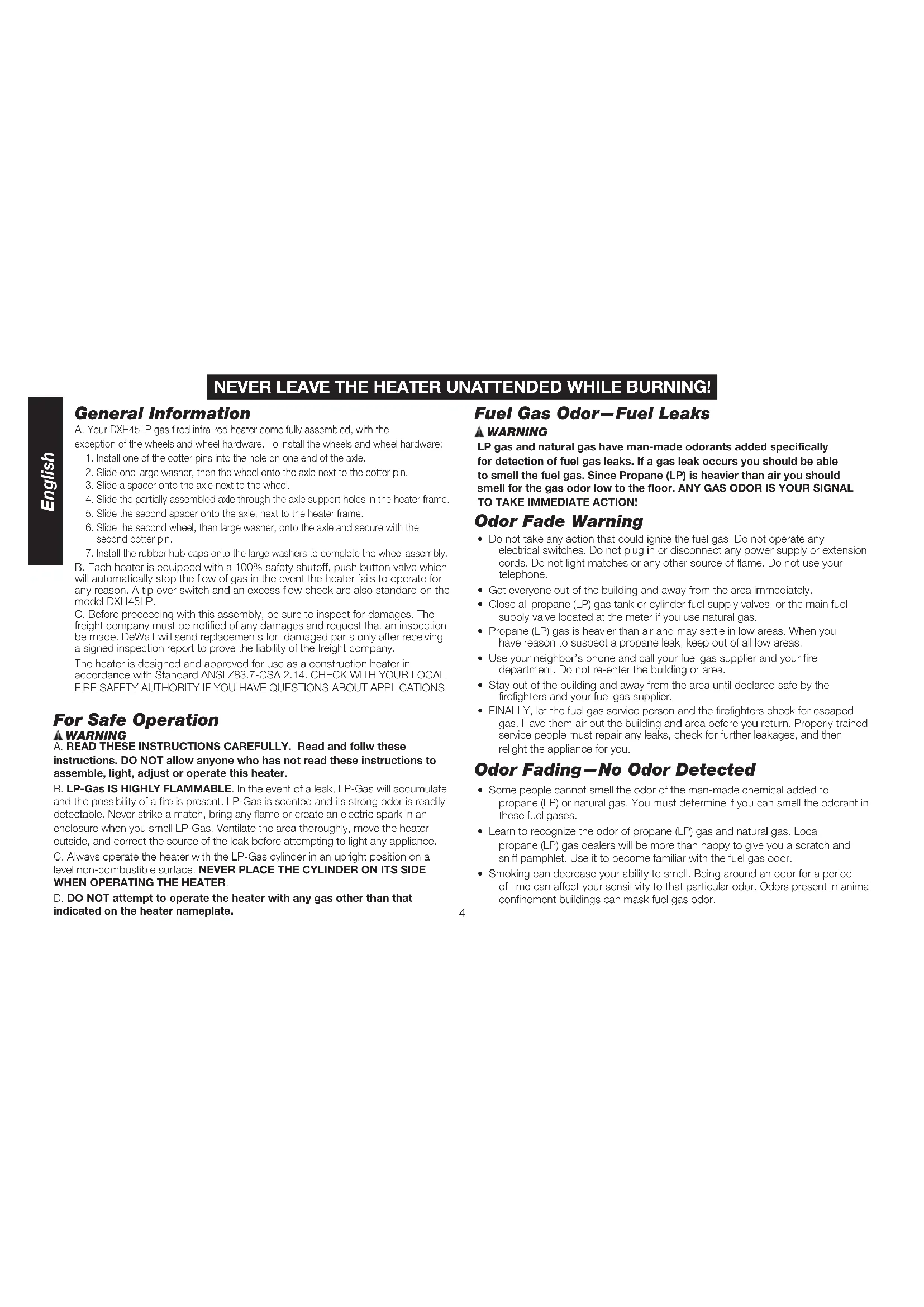
A. Your DXH45LP gas fired infra-red heater come fully assembled, with the exception of the wheels and wheel hardware. To install the wheels and wheel hardware:
- Install one of the cotter pins into the hole on one end of the axle.
- Slide one large washer, then the wheel onto the axle next to the cotter pin.
- Slide a spacer onto the axle next to the wheel.
- Slide the partially assembled axle through the axle support holes in the heater frame.
- Slide the second spacer onto the axle, next to the heater frame.
- Slide the second wheel, then large washer, onto the axle and secure with the second cotter pin.
- Install the rubber hub caps onto the large washers to complete the wheel assembly.
B. Each heater is equipped with a 100% safety shutoff, push button valve which will automatically stop the flow of gas in the event the heater fails to operate for any reason. A tip over switch and an excess flow check are also standard on the model DXH45LP.
C. Before proceeding with this assembly, be sure to inspect for damages. The freight company must be notified of any damages and request that an inspection be made. DeWalt will send replacements for damaged parts only after receiving a signed inspection report to prove the liability of the freight company.
The heater is designed and approved for use as a construction heater in accordance with Standard ANSI Z83.7-CSA 2.14. CHECK WITH YOUR LOCAL FIRE SAFETY AUTHORITY IF YOU HAVE QUESTIONS ABOUT APPLICATIONS.
For Safe Operation
WARNING
A. READ THESE INSTRUCTIONS CAREFULLY. Read and follow these instructions. DO NOT allow anyone who has not read these instructions to assemble, light, adjust or operate this heater.
B. LP-Gas IS HIGHLY FLAMMABLE. In the event of a leak, LP-Gas will accumulate and the possibility of a fire is present. LP-Gas is scented and its strong odor is readily detectable. Never strike a match, bring any flame or create an electric spark in an enclosure when you smell LP-Gas. Ventilate the area thoroughly, move the heater outside, and correct the source of the leak before attempting to light any appliance.
C. Always operate the heater with the LP-Gas cylinder in an upright position on a level non-combustible surface. NEVER PLACE THE CYLINDER ON ITS SIDE WHEN OPERATING THE HEATER.
D. DO NOT attempt to operate the heater with any gas other than that indicated on the heater nameplate.
Fuel Gas Odor—Fuel Leaks
WARNING
LP gas and natural gas have man-made odorants added specifically for detection of fuel gas leaks. If a gas leak occurs you should be able to smell the fuel gas. Since Propane (LP) is heavier than air you should smell for the gas odor low to the floor. ANY GAS ODOR IS YOUR SIGNAL TO TAKE IMMEDIATE ACTION!
Odor Fade Warning
- Do not take any action that could ignite the fuel gas. Do not operate any electrical switches. Do not plug in or disconnect any power supply or extension cords. Do not light matches or any other source of flame. Do not use your telephone.
- Get everyone out of the building and away from the area immediately.
- Close all propane (LP) gas tank or cylinder fuel supply valves, or the main fuel supply valve located at the meter if you use natural gas.
- Propane (LP) gas is heavier than air and may settle in low areas. When you have reason to suspect a propane leak, keep out of all low areas.
- Use your neighbor's phone and call your fuel gas supplier and your fire department. Do not re-enter the building or area.
- Stay out of the building and away from the area until declared safe by the firefighters and your fuel gas supplier.
- FINALLY, let the fuel gas service person and the firefighters check for escaped gas. Have them air out the building and area before you return. Properly trained service people must repair any leaks, check for further leakages, and then relight the appliance for you.
Odor Fading—No Odor Detected
- Some people cannot smell the odor of the man-made chemical added to propane (LP) or natural gas. You must determine if you can smell the odorant in these fuel gases.
- Learn to recognize the odor of propane (LP) gas and natural gas. Local propane (LP) gas dealers will be more than happy to give you a scratch and sniff pamphlet. Use it to become familiar with the fuel gas odor.
- Smoking can decrease your ability to smell. Being around an odor for a period of time can affect your sensitivity to that particular odor. Odors present in animal confinement buildings can mask fuel gas odor.
- The odorant in propane (LP) gas and natural gas is colorless and the intensity of its odor can fade under some circumstances.
- If there is an underground leak, the movement of gas through the soil can filter out the odorant.
- Propane (LP) gas odor may differ in intensity at different levels. Since Propane (LP) gas is heavier than air, there may be more odor at lower levels.
- Always be sensitive to the slightest gas odor. If you continue to detect any gas odor, no matter how small, treat it as a serious leak. Immediately go into action as discussed previously.
▲ WARNING: RISK OF ASPHYXIATION
- Do not use in unventilated areas.
- The flow of combustion and ventilation air must not be obstructed.
- Proper ventilation air must be provided to support the combustion air requirements of the heater being used.
- Refer to the specification section of the heater's manual, heater data-plate, or contact the factory to determine combustion air ventilation requirements of the heater.
- Lack of proper ventilation air will lead to improper combustion.
- Improper combustion can lead to carbon monoxide poisoning leading to serious injury or death. Symptom of carbon monoxide poisoning can include headaches, dizziness and difficulty in breathing.
Attention—Critical Points to Remember!
- Propane (LP) gas has a distinctive odor. Learn to recognize these odors. (Reference Fuel Gas Odor and Odor Fading sections above.
- Even if you are not property trained in the service and repair of the heater, ALWAYS be consciously aware of the odors of propane (LP) gas and natural gas.
- If you have not been properly trained in repair and service of propane (LP) gas then do not attempt to light heater, perform service or repairs, or make any adjustments to the heater on the propane (LP) gas fuel system.
- A periodic sniff test around the heater or at the heater's joints; i.e. hose, connections, etc., is a good safety practice under any conditions. If you smell even a small amount of gas, CONTACT YOUR FUEL GAS SUPPLIER IMMEDIATELY.
Installation Instructions
WARNING
For the U.S. and/or Canada, the installation of this appliance must comply with local and/or Provincial codes or, in the absence of these codes,
- With the (U.S.) National Fuel Gas Code, ANSI Z223.1 – Latest Edition, AND with the (U.S.) Standard for the Storage and Handling of Liquified Petroleum Gases, ANSI/NFPA 58, OR
- With the current (Canadian) CAN/CGA B149.1 AND B149.2 INSTALLATION CODES.
This heater (including hose and regulator assembly) must be inspected before each use and at least annually by a qualified service person. If the hose for Model DXH45LP shows evidence of excessive abrasion or wear, or if the hose is cut, it must be replaced prior to the heater being put into operation. The replacement hose assembly shall be that specified by the manufacturer. See the parts list.
The minimum ambient temperature rating for this heater is 20 degrees F.
This heater incorporates a "Tip Over" switch which automatically shuts off the burner in the event of tipping. Ensure that this switch is in the vertical position and is secured with the screws provided (see Fig. 2).
DO NOT operate this heater with the LP-gas supply cylinder in any other than the upright position.
WARNING
Never use a fork lift truck type cylinder.
Although this heater incorporates a "tip over" switch, the heater and LP-Gas supply cylinder must be located on a hard, flat, level surface to minimize the risk of accidental tipping. The LP Gas supply cylinder should be adequately restrained to prevent accidental tipping. DO NOT OPERATE this heater with the supply cylinder in any other than the upright position.
This appliance must be placed only in locations where the potential for physical damage to the appliance (i.e., due to physical contact) is reduced to a minimum.
Precautions must be taken to protect the appliance from physical damage.
This appliance produces radiant heat. Therefore, it must be located at least six feet away from any LP-Gas container and must not be directed toward any LP-Gas container within 20 feet.
The heater must be located in a location such that it will not be exposed directly to water spray, rain, and/or dripping water.
Use of this heater in a draft/windy area may decrease its efficiency. If possible, operate the unit in a draft free area or turn the face of the heater away from the draft.
The intended use of for this heater is the temporary heating of buildings or structures under construction, alteration or repair.
PIPING
For Model DXH45LP
(for use with LP-Gas)
This model may be connected to a self-contained LP-Gas supply system using the hose and regulator assembly supplied with the appliance, OR, it may be connected to a permanently installed LP-Gas supply system.
If connected to a self-contained LP-Gas supply system, the hose assembly must be inspected prior to each use of the heater. If it is evident that there is excessive abrasion or wear, or the hose is cut, it must be replaced prior to the heater being put into operation.
If connected to a self-contained LP-Gas supply system, the cylinder must have no less than a minimum capacity of 20 pounds and no more than a maximum capacity of 100 pounds of LP-Gas. DO NOT connect this appliance to a cylinder having less than a nominal 20 pound capacity of LP-Gas. DO NOT connect this appliance to more than one (1) 100 pound cylinder.
The connection of Model DXH45LP to an LP-Gas cylinder must be made in a well ventilated area using the regulator and hose assembly supplied with the appliance. DO NOT attempt to adjust this regulator. It has been preset at the factory to provide safe and proper operation of the appliance. Use a 7/8" open end wrench to connect the POL fitting (supplied with the LP regulator) to the LP-Gas cylinder. Turn the POL nut in a counter-clockwise direction (left hand thread) until tight. DO NOT use pipe compound on POL threads.
The heater must be located at least six feet away from any LP-Gas cylinder and must not be directed toward any LP-Gas cylinder within 20 feet. If more than one heater is used, they and the supply cylinders must be separated by at least 20 feet.
The gas supply must be turned off at the LP-Gas supply cylinder when the heater is not in use.
When the heater is to be stored indoors, the connection between the LP-Gas supply cylinder and the heater must be disconnected and the cylinder removed from the heater and stored in accordance with Chapter 5 of the Standard for the Storage and Handling of Liquefied Petroleum Gases, ANSI/NF-PA 58 (U.S.), OR CAN/CGA B149.2 (Canada).
If connected to a permanently installed LP Gas supply system, the system requires the use of a two-stage gas regulator assembly which is normally provided by your LP-Gas dealer as part of the LP-Gas supply system. Consult with your local LP-Gas dealer for details concerning proper equipment and installation.
Piping must be clean and free from scale or burr.
Before attempting to ignite the appliance, all gas fittings and connections must be thoroughly checked for gas leaks. Apply a small amount of a mild soap and water solution to all fittings and connections and observe for escaping bubbles. If any leaks are detected, shut off the gas supply to the appliance immediately. Wait a minimum of five minutes, repair the leak(s) and retest for leakage. Dry all fittings and connections after leak testing.
▲ WARNING
Never use a flame for gas leak testing.
Operating Instructions
▲ WARNING
If you do not follow these instructions exactly, a fire or explosion may result causing property damage, personal injury or loss of life.
WARNING
This appliance is hot during normal operation. Avoid physical contact.
▲ WARNING
Do not place clothing or other combustible materials on this appliance.
DO NOT operate this heater if any part has been under water. Call a qualified service technician to inspect the appliance and to replace any part of the control system or gas control valve which has been under water.
This appliance must be installed and operated only in locations where the potential for physical damage to the appliance is reduced to a minimum. The owner/operator of this appliance must ensure that precautions are taken to protect the appliance from physical damage.
LIGHTING AND SHUT-DOWN
Lighting the Heater:
WARNING
- Before attempting to light the heater, smell all around the heater area for gas. Be sure to smell next to the floor because LP-Gas is heavier than air and will settle on the floor. Turn on the gas supply to the appliance and check all fittings and connections for gas leaks using a mild soap and water solution. NEVER use a match to check for gas leaks. Should a gas leak occur, shut off the gas supply to the appliance immediately. Wait a minimum of five minutes before repairing the leak.
- Use only the fuel intended for this appliance. Check the appliance rating plate for the correct fuel information.
- Turn off the main gas supply to the appliance. Wait five minutes.
-
Turn on the main gas supply.
-
Depress red spark ignition button repeatedly or with a lighted match held to the burner face, depress and hold the reset button on the safety valve. After the burner ignites, hold the reset button depressed for about one minute or until the burner stays lit when the reset button is released.
DO NOT light the gas at the burner orifice. DO NOT face heater when attempting to light. Always stand to the side of the unit when lighting.
NOTE: In cases where long runs of gas supply lines have been installed ahead of the appliance, it may be necessary to bleed trapped air out of the supply lines before lighting the burner. New installations generally require bleeding of supply lines. Wait a minimum of five minutes after bleeding the supply lines before attempting to light the heater.
- IMPORTANT: DO NOT attempt to adjust the main burner input using the main gas supply valve, for this may cause the thermocouple to shut down the burner.
Shut-Down Instructions:
To turn the heater OFF:
- Close the LP-Gas supply cylinder valve.
- Observe the burner until flame is extinguished.
- Listen for closure of the safety valve.
Maintenance Instructions
This heater (including hose and regulator assembly) must be inspected before each use. If the hose for Model DXH4SLP shows evidence of excessive abrasion or wear, or if the hose is cut, it must be replaced prior to the heater being put into operation. The replacement hose assembly shall be that specified by the manufacturer. See the parts list.
The appliance area must be kept free and clear of combustible materials, gasoline and other flammable vapors and liquids at all times.
The flow of combustion and ventilation air must not be obstructed.
CLEANING THE HEATER
Periodically, the heater must be cleaned of all dirt and dust particles.
DANGER
Do not attempt to clean the heater while it is operating or while it is still hot.
- Turn the heater off and wait until it has completely cooled (at least 20 minutes) before cleaning.
- Clean the outside of the heater using a damp cloth. DO NOT clean the heater by spraying water on it. Wipe the outside of the heater off with a dry cloth after cleaning.
- Clean the inside of the heater using compressed air. Blow air back and forth along the entire burner face until all dust has been dislodged from the surface of the reverberator and grid screen. Blow through venturi from the control end of the heater.
- Clean the thermocouple lead.
DO NOT operate this heater if any part has been under water. Call a qualified service person to inspect the appliance and to replace any part of the control system or gas control valve which has been under water.
This heater must be inspected at least annually by a qualified service person.
Troubleshooting Information (Model DXH45LP)
If burner lights, but goes out when button is released. CHECK
- Loose wires on tipover switch. (see Fig. 2)
- Loose lead wire and repair wires if necessary.
- Loose thermocouple and tighten if necessary. Make sure T/C is located correctly between the reverberator and grid.
• Defective thermocouple. Replace if necessary.
• Defective control. Replace if necessary.
• Defective tip over switch. Replace if necessary.
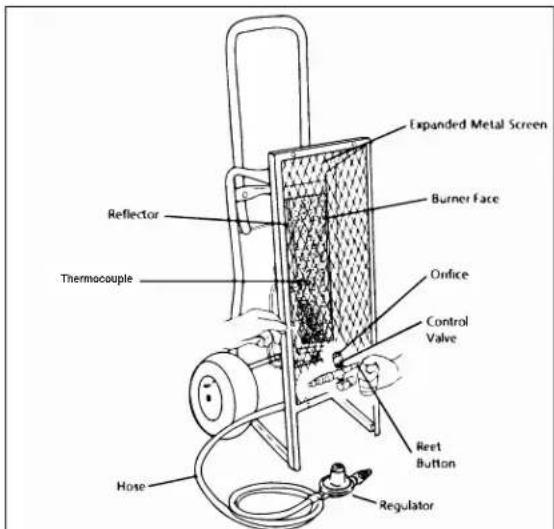
NOTE: WHEN LIGHTING BURNER WITH A MATCH OR TAPER, LIGHT AT BOTTOM OF SCREEN. (NOT AT ORIFICE)
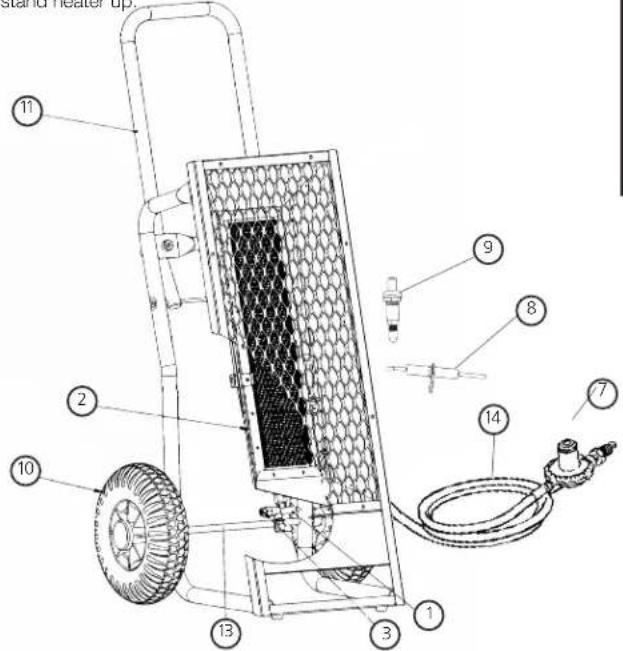
Replacement Parts List
| REF. #......ITEM# | DESCRIPTION |
| 1 ......23525 ...... | CONT M-N SS PORT 3/8MPXI/4MP |
| 2 ......23526 ...... | BURNR/LTFR PORTABLES/D1096 |
| 3 ......70758 ...... | ORIFICE/BURNER #53 DRILL |
| 4 ......21920 ...... | THERMOCOUPLE ASSY/18" |
| 5 ......42116 ...... | TIP-OVER SWITCH |
| 7 ......11663 ...... | REC.L/P 27.5" WC OUT |
| 8 ......23531 ...... | IGNITOR, MODEL #45 |
| 9 ......20735 ...... | PIEZO, MODEL #45 |
| 10 ......22169 ...... | WHEEL, MODEL #45 |
| 11 ......70757 ...... | FRAME ASS'Y W/HANDLE |
| 12 ......23534 ...... | HANDLE LOCKING KNOBS (2)* |
| 13 ......70756 ...... | AXLE |
| 14 ......16671-20 ...... | HOSE, 20' |
| 15 ......28787 ...... | HARDWARE KIT* |
| *Part not shown. | |
TIP-OVER SWITCH ARRANGEMENT
NOTE: The purpose of the tip-over Switch is to stop the flow of gas when heater is accidentally knocked over. When and if the heater is knocked over, simply stand heater up.
IF SERVICE IS REQUIRED
PLEASE DO NOT RETURN THIS APPLIANCE TO YOUR STORE
For information regarding service, please call our Toll-Free Number: 855-805-5745. Our office hours are 8:00 AM to 5:00 PM, Eastern Time Zone, Monday through Friday Please include the model number, date of purchase and description of problem in all communication.
- Do not use this heater for heating human living quarters.
- Use of direct-fired heaters in the construction environment can result in exposure to levels of CO, CO2, and NO2 considered to be hazardous to health and potentially life threatening.
- Do not use in unventilated areas.
- Know the signs of CO and CO2 poisoning.
• Headaches, stinging eyes
• Dizziness, disorientation
• Difficulty breathing, feels of being suffocated
- Proper ventilation air exchange (OSHA 29 CFR 1926.57) to support combustion and maintain acceptable air quality shall be provided in accordance with OSHA 29 CFR Part 1926.154, ANSI A10.10 Safety Requirements for Temporary and Portable Space Heating Devices and Equipment used in the Construction Industry or the Natural Gas and Propane Installation Codes CSA B149.1.
- Periodically monitor levels of CO, CO2 and NO2 existing at the construction site – at the minimum at the start of the shift and after 4 hours.
- Provide ventilation air exchange, either natural or mechanical, as required to maintain acceptable indoor air quality.
| USA 8-Hr Time weighted average (OSHA 29 CFR 1926.55 App A) | Canada 8-hr time weighted average WorkSafe BC OHS Guidelines Part 5.1 and Ontario Workplaces Reg 833 | |
| CO 50 ppm 25 ppm | ||
| CO_2 | 5000 ppm 5000 ppm | |
| NO_2 | 3 ppm (Reg 833) | |
| USA - Ceiling Limit(Short Term Exposure Limit = 15 minutes) | Canada STEL (15 minutes Reg 833/1 hour WSBC) WorkSafe BC OHS Guidelines Part 5.1 and Ontario Workplaces Reg 833 | |
| CO 100 ppm | ||
| CO_2 | 15000 ppm (WSBC)30000 ppm (Reg 833) | |
| NO_2 | 5 ppm 1.0 ppm (WorkSafeBC) | 5.0 ppm (Reg 833) |
- Ensure that the flow of combustion and ventilation air exchange cannot become obstructed.
- As the building ‘tightens up’ during the construction phases ventilation may need to be increased.
Propane Portable Radiant Construction Heater DXH45LP
natural_image
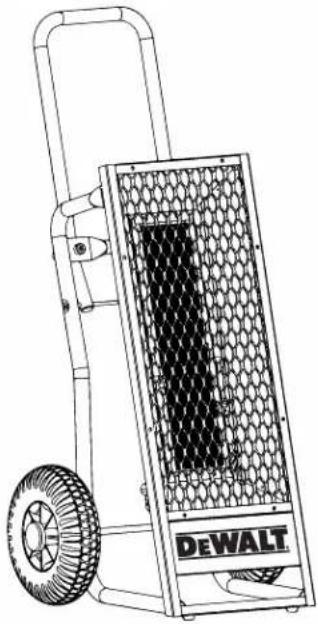
Line drawing of a handwheel with a mesh panel and 'DEWALT' label (no other text or symbols)CYLINDER NOT INCLUDED
Warning:
Use only manufacturer's replacement parts. Use of any other parts could cause injury or death. Replacement parts are only available direct from the factory and must be installed by a qualified service agency.
PARTS ORDERING INFORMATION:
PURCHASING: Accessories may be purchased at any DeWALT ^® local dealer or direct from the factory
FOR INFORMATION REGARDING SERVICE:
Please call Toll-Free 855-805-5745
www.DEWALT.com
Our office hours are 8:00 AM – 5:00 PM, EST, Monday through Friday.
Please include the model number, date of purchase, and description of problem in all communication.
LIMITED WARRANTY:
DeWALT ^® warrants its heaters and accessories to be free from defects in material and workmanship for a period of 1 year from date of purchase. DeWALT ^® will repair or replace this product free of charge if it has been proven to be defective within the 1-year period, and is returned at customer expense with proof of purchase to DeWALT ^® within the warranty period.
DeWALT®, GUARANTEED TOUGH® and the yellow and black color scheme are trademarks of the DeWALT Industrial Tool Co., used under license. ©2020 DeWALT. EGI/Enerco Group Inc. Under license from DeWALT Industrial Tool Co.


NE JAMAIS LAISSER LE CHAUFFAGE SANS SURVEILLANCE PENDANT LE BRÛLAGE!
If you have questions or comments, contact us.
MANUEL D'INSTRUCTIONS
Propane Portable Radiant Construction Heater DXH45LP
⚠ WARNING: READ INSTRUCTIONS
CAREFULLY: Read and follow all instructions. Place instructions in a safe place for future reference. Do not allow anyone who has not read these instructions to assemble, adjust or operate the heater.
⚠️ AVERTISSEMENT: VEUILLEZ LIRE ATTENTIVEMENT
SI UN ENTRETIEN EST NÉCESSAIRE
VEUILLEZ NE PAS RETOURNER CET APPAREIL A VOTRE MAGASIN
MANUEL D'INSTRUCTIONS
natural_image
Line drawing of a DeWALT wheeled cart with a mesh panel and wheels (no text or symbols on the device itself)CYLINDRE NON INCLUS
AAVERTISSEMENT:
If you have questions or comments, contact us.
Si vous avez toute question ou commentaire, veuillez nous contacter. Llámenos si tiene alguna pregunta o comentario.
855-805-5745 • www.DEWALT.com
INSTRUCTION MANUAL
MANUEL D'INSTRUCTIONS
Propane Portable Radiant Construction Heater DXH45LP
WARNING: READ INSTRUCTIONS
CAREFULLY: Read and follow all instructions. Place instructions in a safe place for future reference. Do not allow anyone who has not read these instructions to assemble, adjust or operate the heater.
⚠ AVERTISSEMENT: VEUILLEZ LIRE ATTENTIVEMENT
natural_image
Line drawing of a mechanical cart with a mesh chamber and 'DEWALT' branding (no text or symbols on the main body)NO INCLUYE CILINDRO
Advertencia:



- Definitions: Safety Guidelines
- ▲WARNING: DO NOT OPERATE THIS HEATER UNTIL YOU READ AND UNDERSTAND THIS INSTRUCTION MANUAL FOR SAFETY, OPERATION, AND MAINTENANCE INSTRUCTIONS. SAVE THESE INSTRUCTIONS.
- GENERAL HAZARD WARNING:
- ▲WARNING:
- WARNING:
- WARNING: RISK OF FIRE OR EXPLOSION
- ADANGER:
- CARBON MONOXIDE CAN KILL YOU
- ▲WARNING
- CONTENTS
- For Safe Operation
- WARNING
- Fuel Gas Odor—Fuel Leaks
- Odor Fade Warning
- Odor Fading—No Odor Detected
- ▲ WARNING: RISK OF ASPHYXIATION
- Attention—Critical Points to Remember!
- Installation Instructions
- PIPING
- For Model DXH45LP
- (for use with LP-Gas)
- ▲ WARNING
- Operating Instructions
- DO NOT operate this heater if any part has been under water. Call a qualified service technician to inspect the appliance and to replace any part of the control system or gas control valve which has been under water.
- LIGHTING AND SHUT-DOWN
- Lighting the Heater:
- Shut-Down Instructions:
- Maintenance Instructions
- CLEANING THE HEATER
- DANGER
- Troubleshooting Information (Model DXH45LP)
- TIP-OVER SWITCH ARRANGEMENT
- IF SERVICE IS REQUIRED
- PARTS ORDERING INFORMATION:
- FOR INFORMATION REGARDING SERVICE:
- LIMITED WARRANTY:
- NE JAMAIS LAISSER LE CHAUFFAGE SANS SURVEILLANCE PENDANT LE BRÛLAGE!
- SI UN ENTRETIEN EST NÉCESSAIRE
- MANUEL D'INSTRUCTIONS
- AAVERTISSEMENT:
- Advertencia:
Brand : DEWALT
Model : DXH45LP
Category : Heating